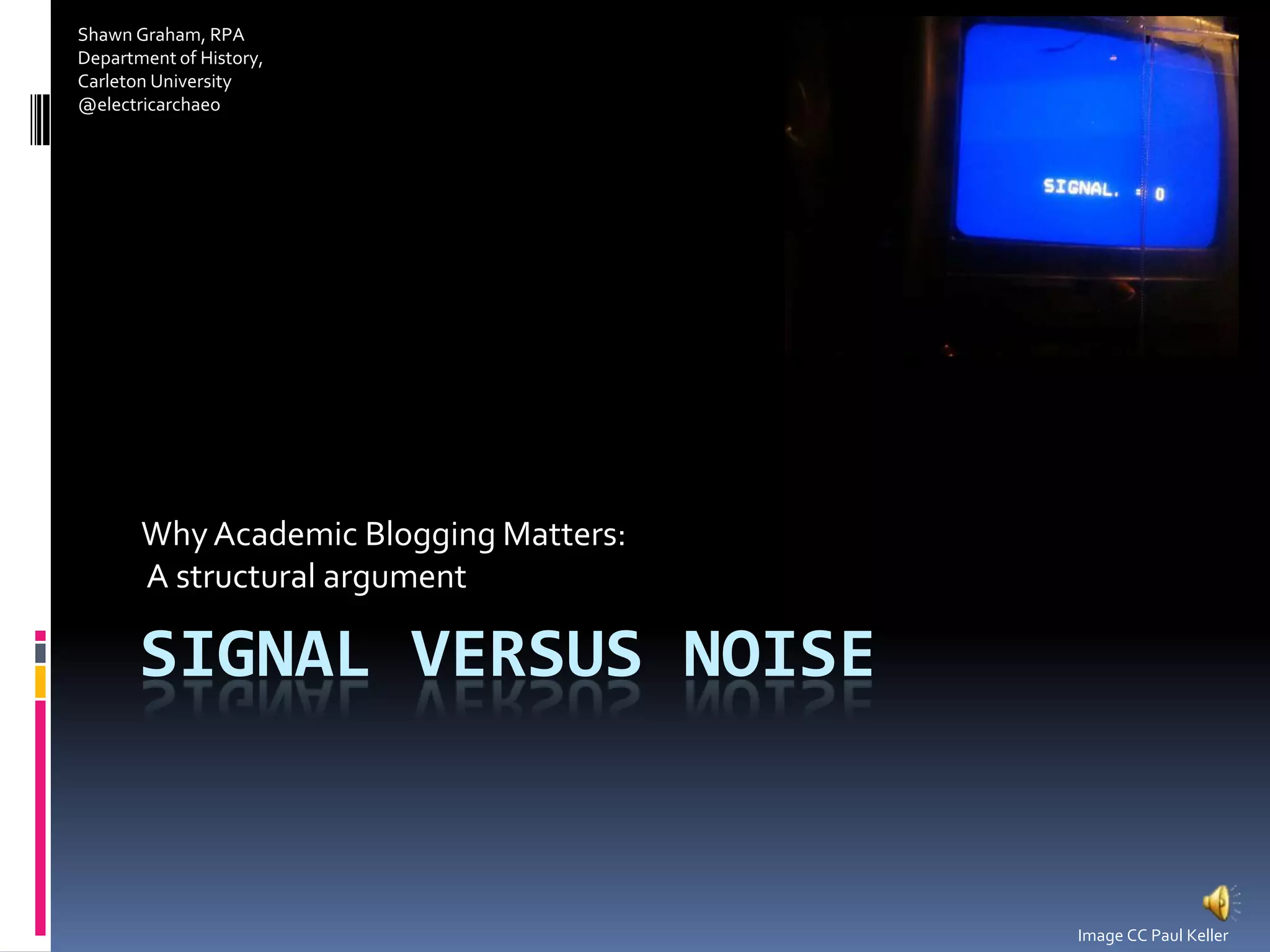
Signal versus NoiseWhy Academic Blogging Matters: A structural argumentShawn Graham, RPADepartment of History,Carleton University@electricarchaeoImage CC Paul Keller
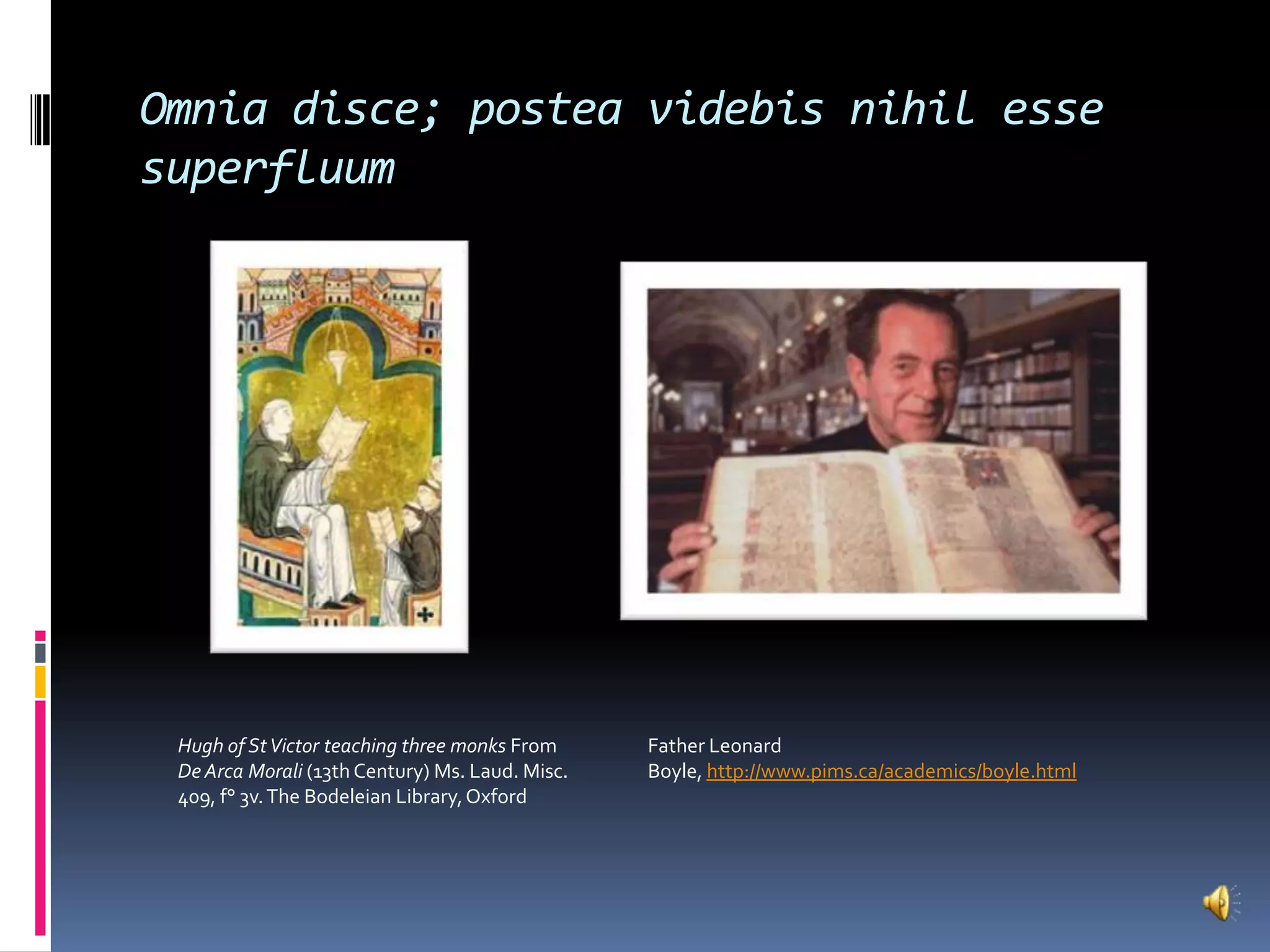
Omniadisce; posteavidebisnihilessesuperfluumFather Leonard Boyle, http://www.pims.ca/academics/boyle.htmlHugh of St Victor teaching three monks From De ArcaMorali (13th Century) Ms. Laud. Misc. 409, f° 3v. The Bodeleian Library, Oxford
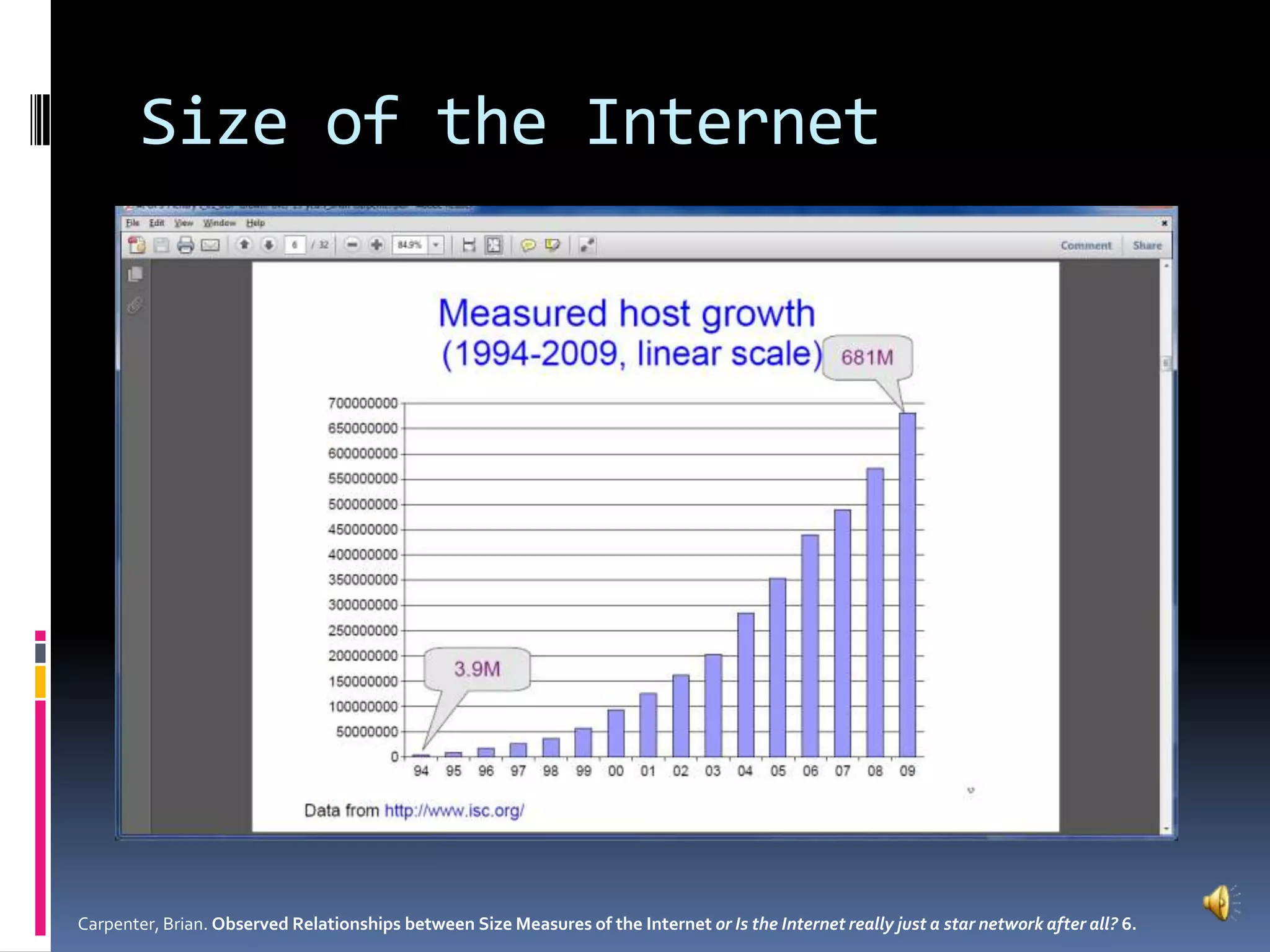
Size of the InternetCarpenter, Brian. Observed Relationships between Size Measures of the Internet or Is the Internet really just a star network after all? 6.
Wayback Machine, Showing Yahoo on October 20 1996
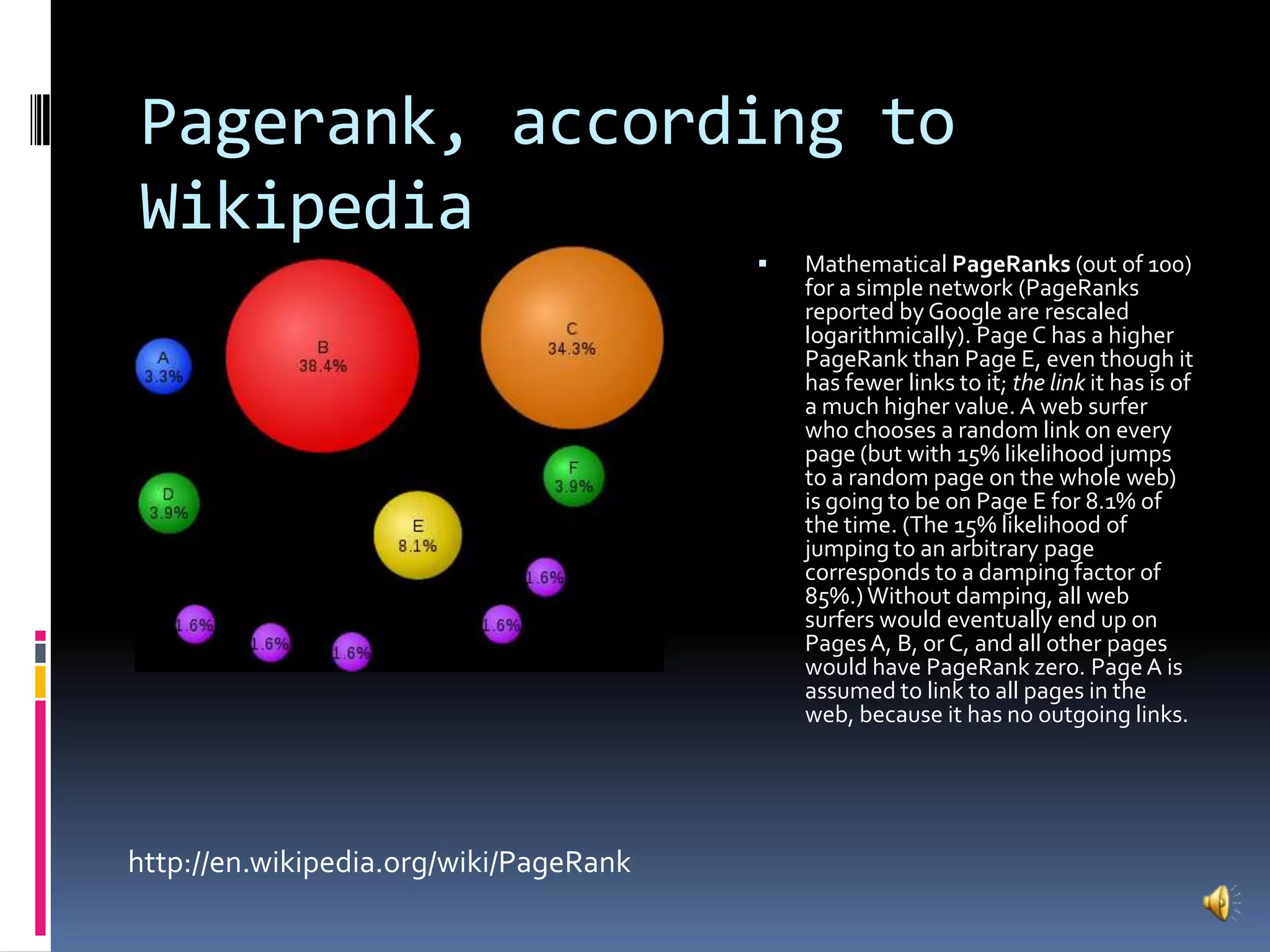
Pagerank, according to WikipediaMathematical PageRanks (out of 100) for a simple network (PageRanks reported by Google are rescaled logarithmically). Page C has a higher PageRank than Page E, even though it has fewer links to it; the link it has is of a much higher value. A web surfer who chooses a random link on every page (but with 15% likelihood jumps to a random page on the whole web) is going to be on Page E for 8.1% of the time. (The 15% likelihood of jumping to an arbitrary page corresponds to a damping factor of 85%.) Without damping, all web surfers would eventually end up on Pages A, B, or C, and all other pages would have PageRank zero. Page A is assumed to link to all pages in the web, because it has no outgoing links.http://en.wikipedia.org/wiki/PageRank
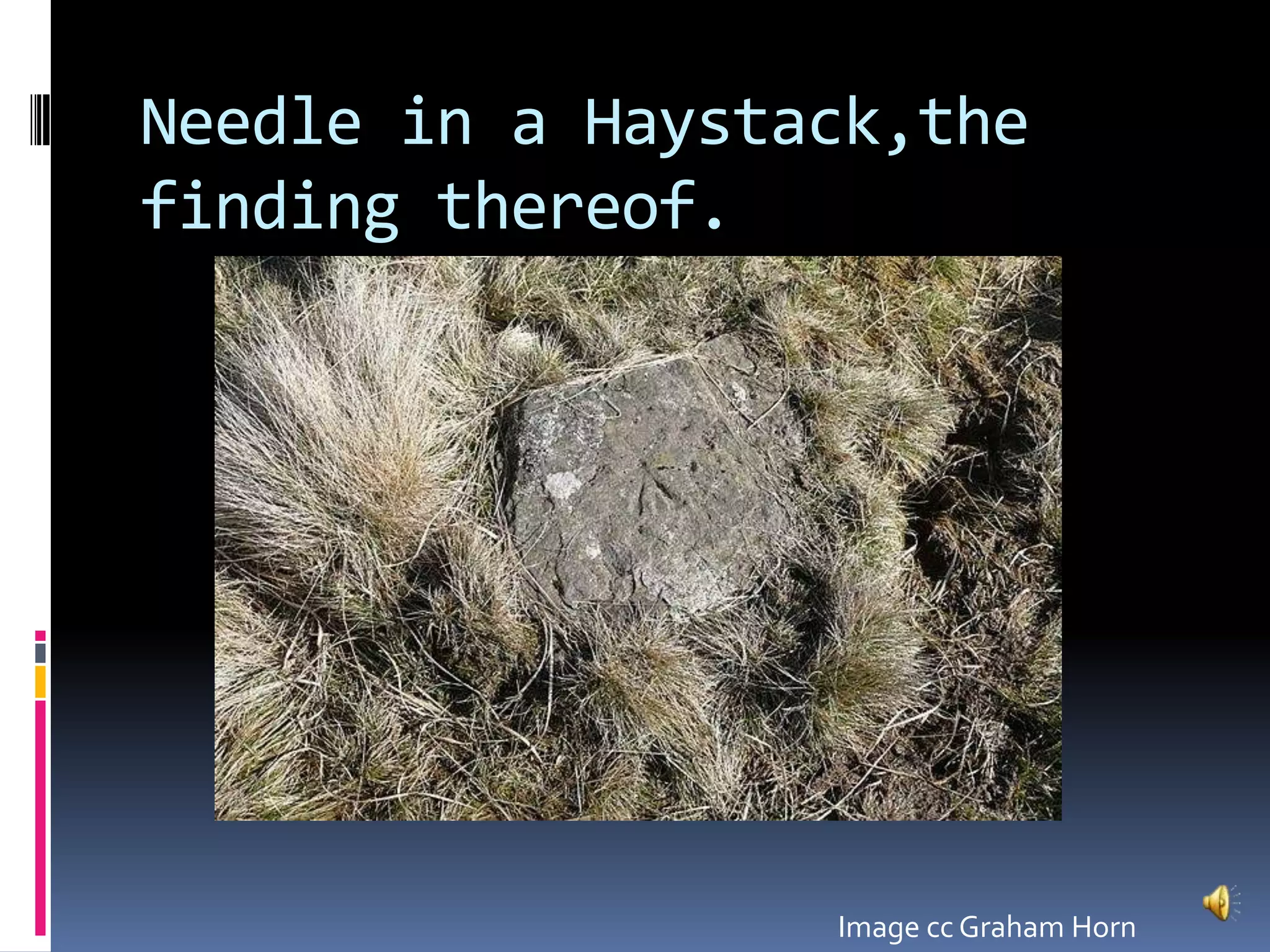
Needle in a Haystack,the finding thereof.Image cc Graham Horn
Teaching the MachineImage CC Derrick Bostrom
Segal, David. 2010 ‘A Bully Finds a Pulpit on the Web’. The New York Times, Nov. 26.
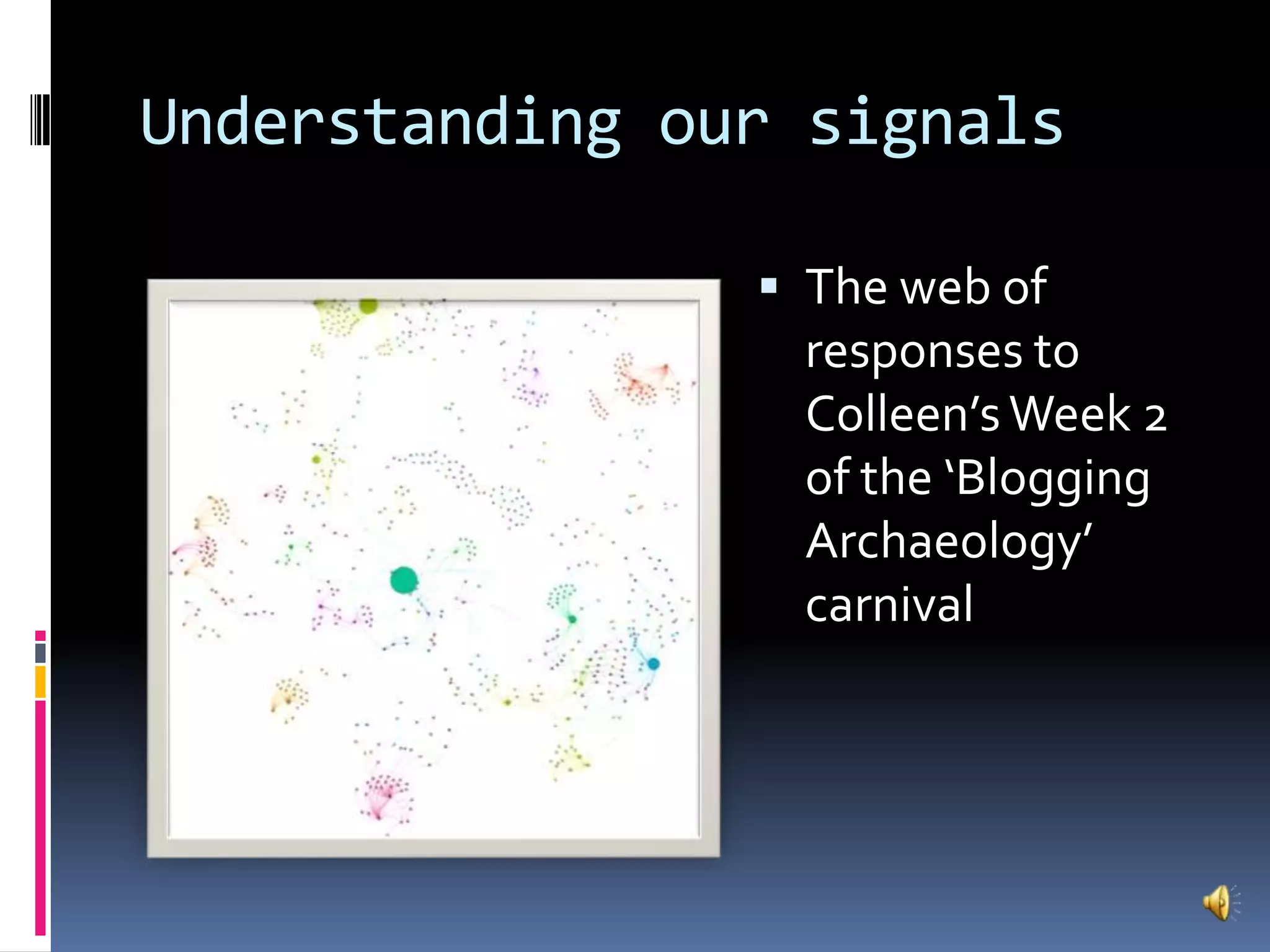
Understanding our signalsThe web of responses to Colleen’s Week 2 of the ‘Blogging Archaeology’ carnival
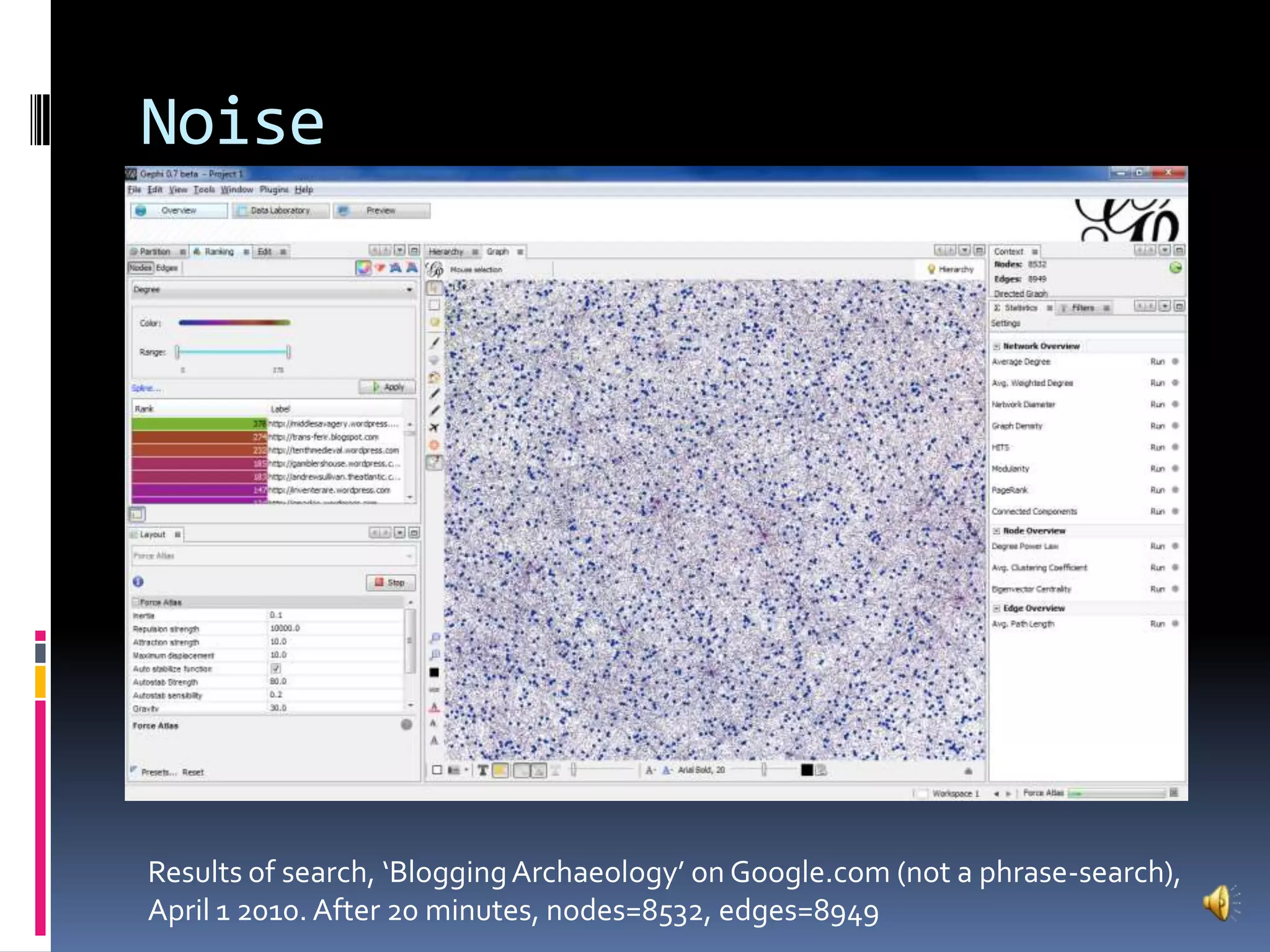
NoiseResults of search, ‘Blogging Archaeology’ on Google.com (not a phrase-search), April 1 2010. After 20 minutes, nodes=8532, edges=8949
Network stats:Diameter: 8Average Path Length: 3Filter the network so that only nodes with > 30 connections appear, reduces the graph to ~1.5 % of the nodes, and 10% of all the connectionsLeaves us with 4 communities, per modularity detection.
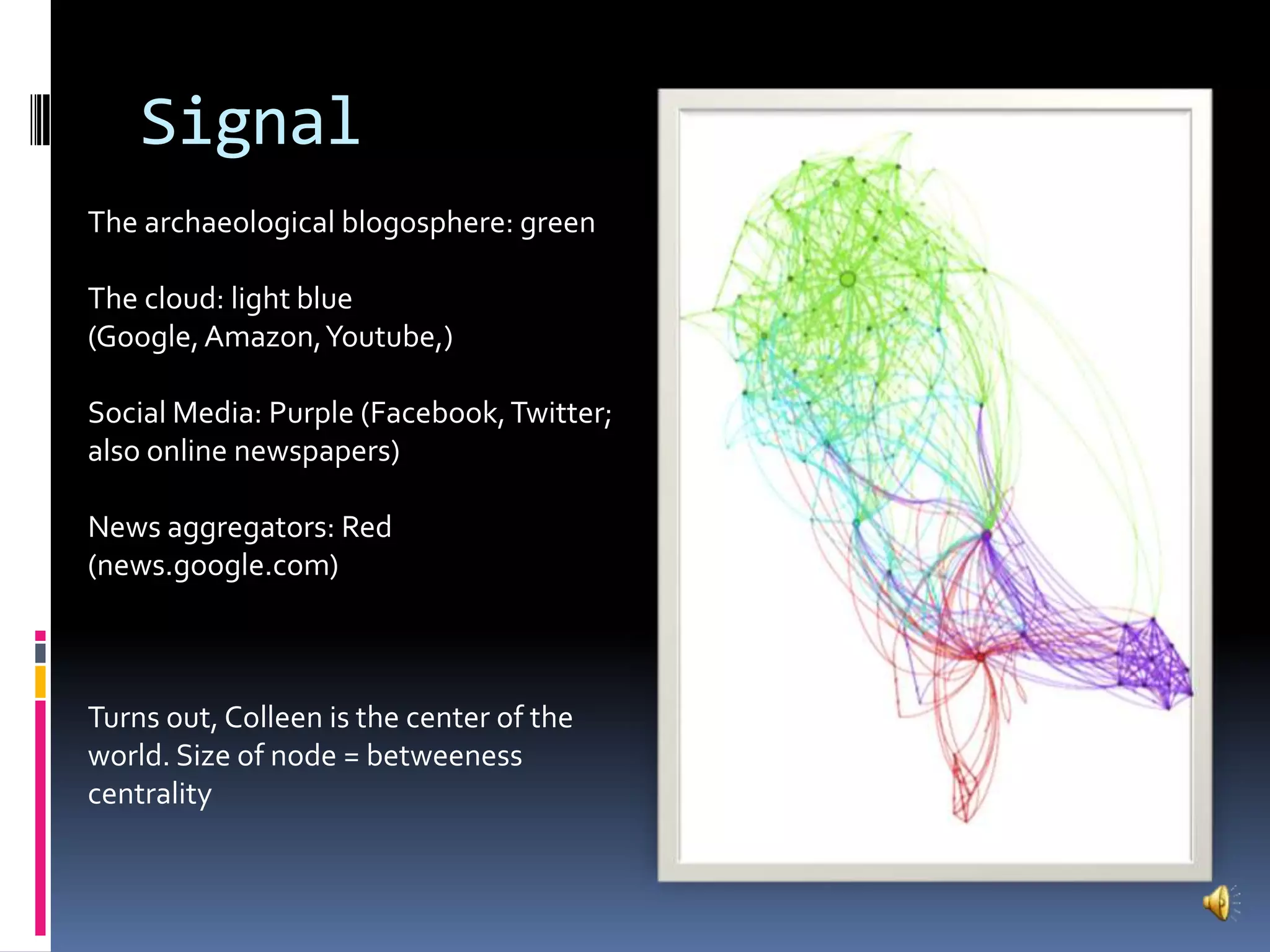
SignalThe archaeological blogosphere: greenThe cloud: light blue (Google, Amazon, Youtube,)Social Media: Purple (Facebook, Twitter; also online newspapers)News aggregators: Red (news.google.com)Turns out, Colleen is the center of the world. Size of node = betweeness centrality
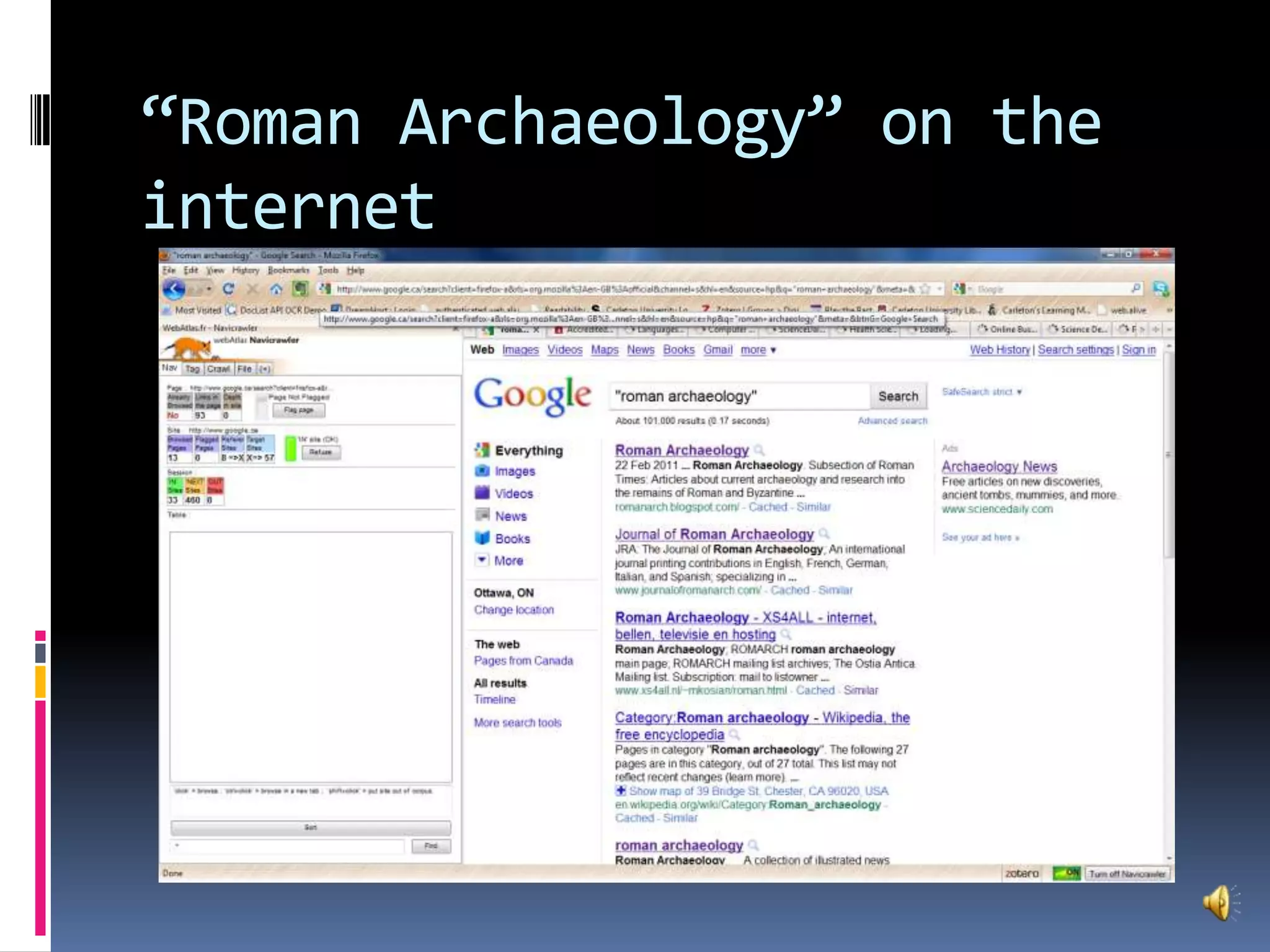
“Roman Archaeology” on the internet
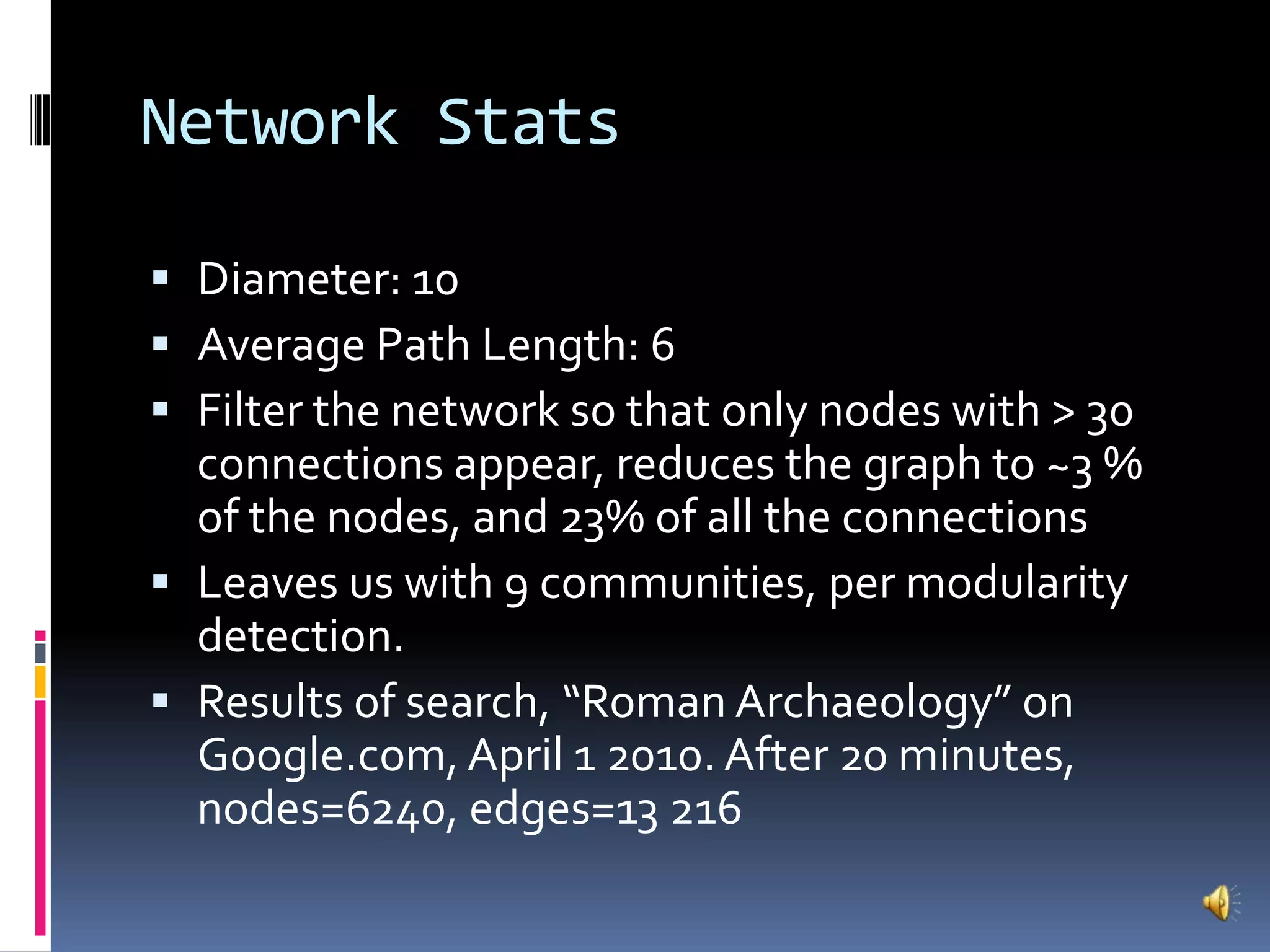
Network StatsDiameter: 10Average Path Length: 6Filter the network so that only nodes with > 30 connections appear, reduces the graph to ~3 % of the nodes, and 23% of all the connectionsLeaves us with 9 communities, per modularity detection.Results of search, “Roman Archaeology” on Google.com, April 1 2010. After 20 minutes, nodes=6240, edges=13 216
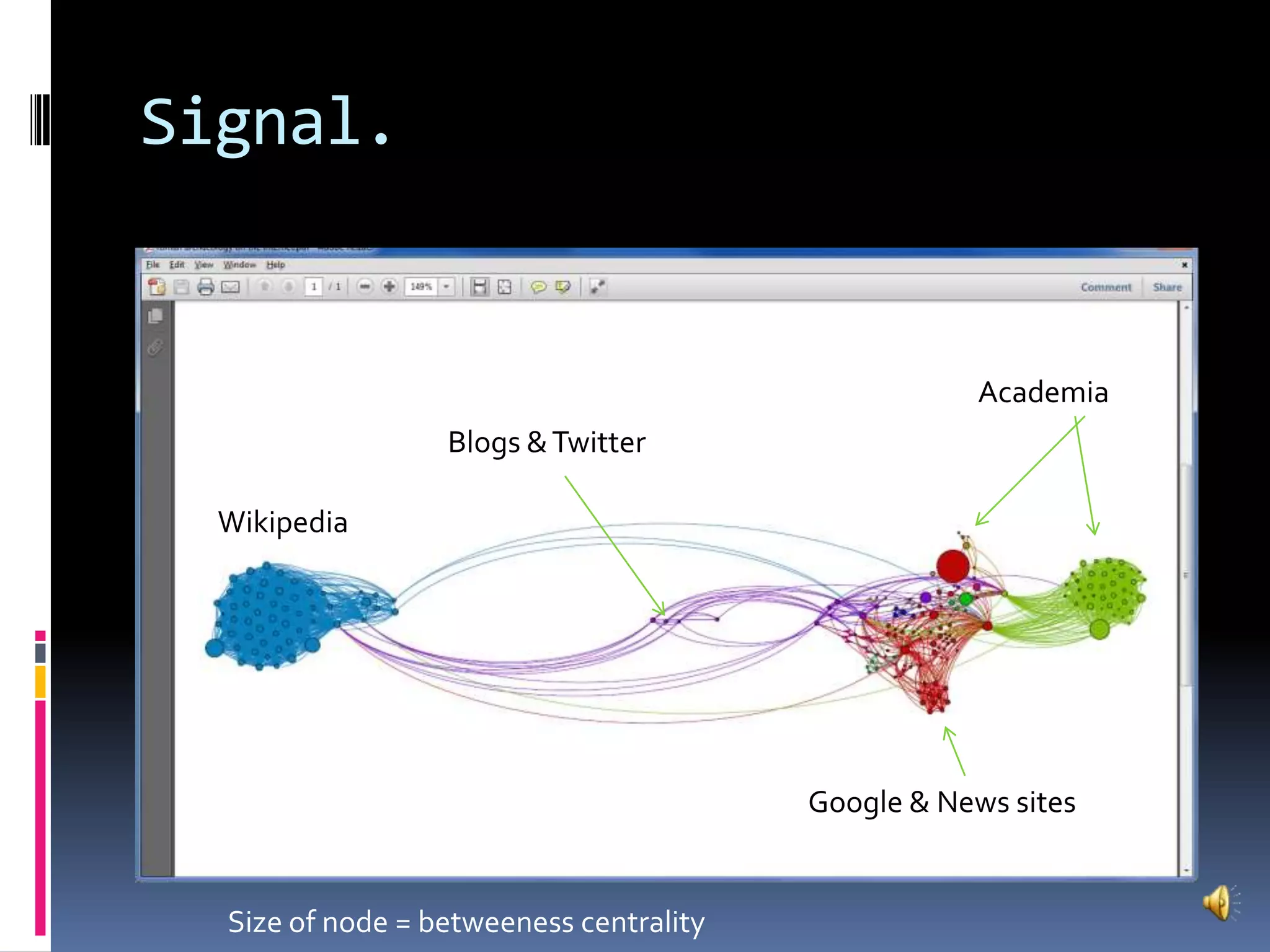
Signal.AcademiaBlogs & TwitterWikipediaGoogle & News sitesSize of node = betweeness centrality
Reference linksCarpenter, Brian. 2010. Observed Relationships between Size Measures of the Internet or Is the Internet really just a star network after all?. http://bit.ly/dUjL89  [April 1 2010]Gephi.org. 2010. Gephi, an open source graph visualization and manipulation software. http://gephi.org [April 1 2010]Jacomy, M. P. Girard, A. Delanoe. Navicrawler 1.7.3http://bit.ly/eUqTuR [April 1 2010]“Leonard Boyle” http://en.wikipedia.org/wiki/Leonard_Boyle [April 1 2010]Levy, Steve. 2010. ‘How Google’s Algorithm Rules the Web’ Wired March. http://bit.ly/9Pg9W8 [April 1 2010]Segal, David. 2010 ‘A Bully Finds a Pulpit on the Web’. The New York Times, Nov. 26. http://nyti.ms/hR7Iqy [April 1 2010]Singhal, Amit. 2010 .“Official Google Blog: Being bad to your customers is bad for business”  Dec. 1. http://bit.ly/hsoRaX [April 1 2010]“PageRank” http://en.wikipedia.org/wiki/PageRank  [April 1 2010]

Signal versus noise

  • 1.
    Signal versus NoiseWhyAcademic Blogging Matters: A structural argumentShawn Graham, RPADepartment of History,Carleton University@electricarchaeoImage CC Paul Keller
  • 2.
    Omniadisce; posteavidebisnihilessesuperfluumFather LeonardBoyle, http://www.pims.ca/academics/boyle.htmlHugh of St Victor teaching three monks From De ArcaMorali (13th Century) Ms. Laud. Misc. 409, f° 3v. The Bodeleian Library, Oxford
  • 3.
    Size of theInternetCarpenter, Brian. Observed Relationships between Size Measures of the Internet or Is the Internet really just a star network after all? 6.
  • 4.
    Wayback Machine, ShowingYahoo on October 20 1996
  • 5.
    Pagerank, according toWikipediaMathematical PageRanks (out of 100) for a simple network (PageRanks reported by Google are rescaled logarithmically). Page C has a higher PageRank than Page E, even though it has fewer links to it; the link it has is of a much higher value. A web surfer who chooses a random link on every page (but with 15% likelihood jumps to a random page on the whole web) is going to be on Page E for 8.1% of the time. (The 15% likelihood of jumping to an arbitrary page corresponds to a damping factor of 85%.) Without damping, all web surfers would eventually end up on Pages A, B, or C, and all other pages would have PageRank zero. Page A is assumed to link to all pages in the web, because it has no outgoing links.http://en.wikipedia.org/wiki/PageRank
  • 6.
    Needle in aHaystack,the finding thereof.Image cc Graham Horn
  • 7.
    Teaching the MachineImageCC Derrick Bostrom
  • 8.
    Segal, David. 2010‘A Bully Finds a Pulpit on the Web’. The New York Times, Nov. 26.
  • 9.
    Understanding our signalsTheweb of responses to Colleen’s Week 2 of the ‘Blogging Archaeology’ carnival
  • 10.
    NoiseResults of search,‘Blogging Archaeology’ on Google.com (not a phrase-search), April 1 2010. After 20 minutes, nodes=8532, edges=8949
  • 11.
    Network stats:Diameter: 8AveragePath Length: 3Filter the network so that only nodes with > 30 connections appear, reduces the graph to ~1.5 % of the nodes, and 10% of all the connectionsLeaves us with 4 communities, per modularity detection.
  • 12.
    SignalThe archaeological blogosphere:greenThe cloud: light blue (Google, Amazon, Youtube,)Social Media: Purple (Facebook, Twitter; also online newspapers)News aggregators: Red (news.google.com)Turns out, Colleen is the center of the world. Size of node = betweeness centrality
  • 13.
  • 14.
    Network StatsDiameter: 10AveragePath Length: 6Filter the network so that only nodes with > 30 connections appear, reduces the graph to ~3 % of the nodes, and 23% of all the connectionsLeaves us with 9 communities, per modularity detection.Results of search, “Roman Archaeology” on Google.com, April 1 2010. After 20 minutes, nodes=6240, edges=13 216
  • 15.
    Signal.AcademiaBlogs & TwitterWikipediaGoogle& News sitesSize of node = betweeness centrality
  • 16.
    Reference linksCarpenter, Brian.2010. Observed Relationships between Size Measures of the Internet or Is the Internet really just a star network after all?. http://bit.ly/dUjL89 [April 1 2010]Gephi.org. 2010. Gephi, an open source graph visualization and manipulation software. http://gephi.org [April 1 2010]Jacomy, M. P. Girard, A. Delanoe. Navicrawler 1.7.3http://bit.ly/eUqTuR [April 1 2010]“Leonard Boyle” http://en.wikipedia.org/wiki/Leonard_Boyle [April 1 2010]Levy, Steve. 2010. ‘How Google’s Algorithm Rules the Web’ Wired March. http://bit.ly/9Pg9W8 [April 1 2010]Segal, David. 2010 ‘A Bully Finds a Pulpit on the Web’. The New York Times, Nov. 26. http://nyti.ms/hR7Iqy [April 1 2010]Singhal, Amit. 2010 .“Official Google Blog: Being bad to your customers is bad for business” Dec. 1. http://bit.ly/hsoRaX [April 1 2010]“PageRank” http://en.wikipedia.org/wiki/PageRank [April 1 2010]