Planning your ProjectQuestions questionsquestions!
You’ve already suggested various areas, in your group contractsRemember, Ottawa, the Valley, the Outaouais generally> but narrow it down> bytown.net a good place to look: what strikes you on that site? What leaves you asking questions?What is the broad subject area?
Step One: Desired OutcomeWhat do you want users of your project to know after using it?Example: “We want visitors to understand the role of the Irish in building the Rideau Canal”Backwards-design
What are the big ideas?Irish immigration; labour relations; nature of the geography; the larger geo-political situation...?What specific understandings about them are desired?Exs?What misunderstandings are predictable?“We want visitors to understand the role of the Irish in building the Rideau Canal”
Your responses are the ‘essential questions’ that visitors to your project will be able to answer as a result of visiting your project!
You want your visitors to be able to demonstrate (if only to themselves), in some fashion, that they have understood your messageWhat kinds of activities might a visitor to your site be able to do, as a result of visiting it?This could be something internal: an on-site quiz; it might be something externalYou need to imagine the activities that might be done.These are ‘assessing’ whether or not the visitor has learned somethingStep 2: Assessing whether the outcome is reached
Perhaps you provide a ‘self-test’ at the end of the projectLike in Cosmo and other magazines, a series of multiple choice questions about the content. If you answered 8-10 questions correctly, you’re practically a historian!  ..etc.You might envision that the successful visitor would be able to look at a portion of the Rideau Canal and be able to ‘read’ its history from the structureIn which case, your content should be tailored to teach them how to do that. And that’s ...step 3.In our Rideau Example...
Hook: how do you draw your visitor in?Explore the data (visualizations, etc)Provide some sort of narrative arcProvide content & structure to meet your assessment goals defined in step 2.7 basic plots: Quest; Voyage & Return; Rebirth; Comedy; Tragedy; Overcoming the Monster; Rags to RichesStep 3: Implementation
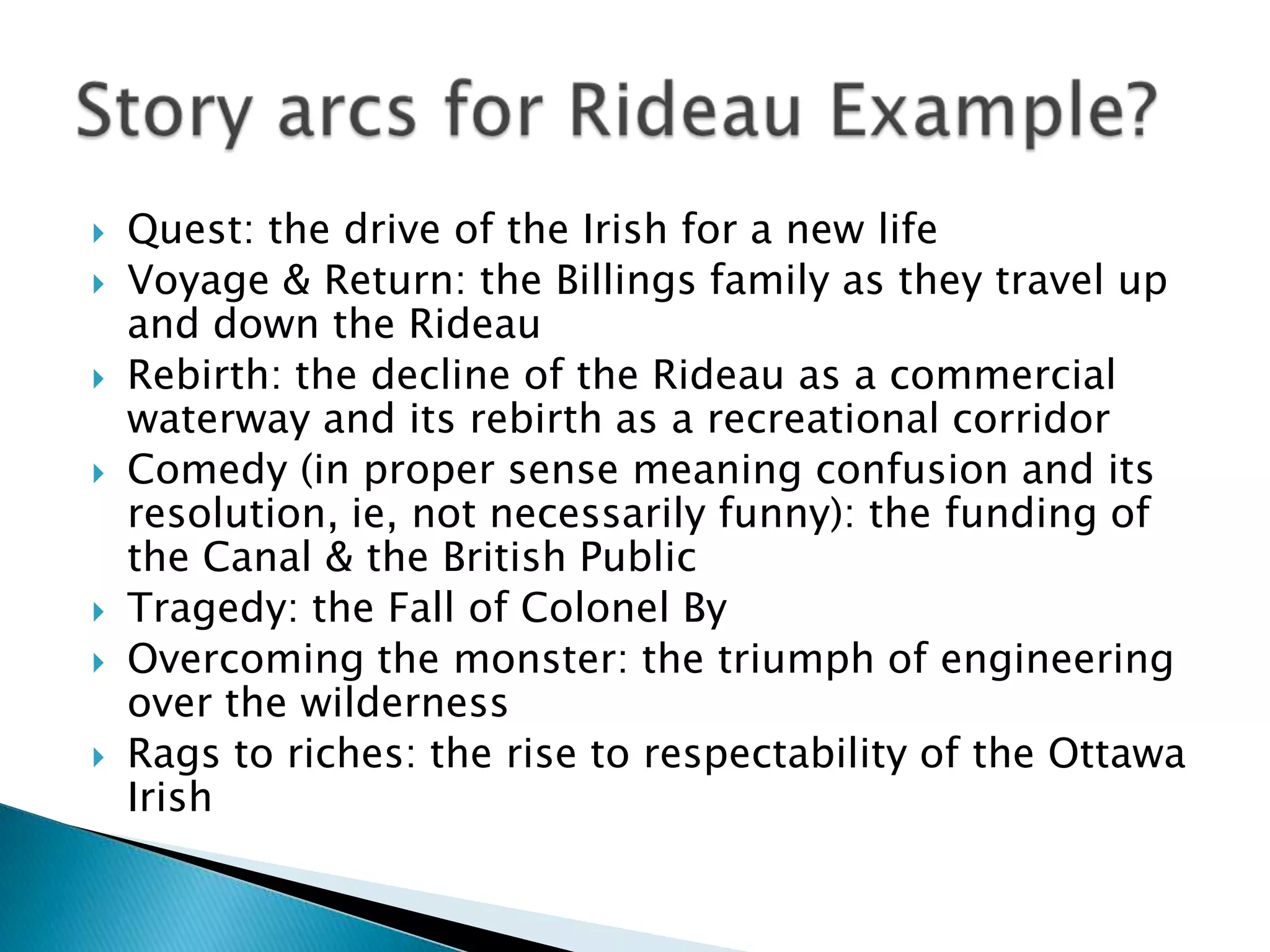
Quest: the drive of the Irish for a new life Voyage & Return: the Billings family as they travel up and down the RideauRebirth: the decline of the Rideau as a commercial waterway and its rebirth as a recreational corridorComedy (in proper sense meaning confusion and its resolution, ie, not necessarily funny): the funding of the Canal & the British PublicTragedy: the Fall of Colonel ByOvercoming the monster: the triumph of engineering over the wildernessRags to riches: the rise to respectability of the Ottawa IrishStory arcs for Rideau Example?
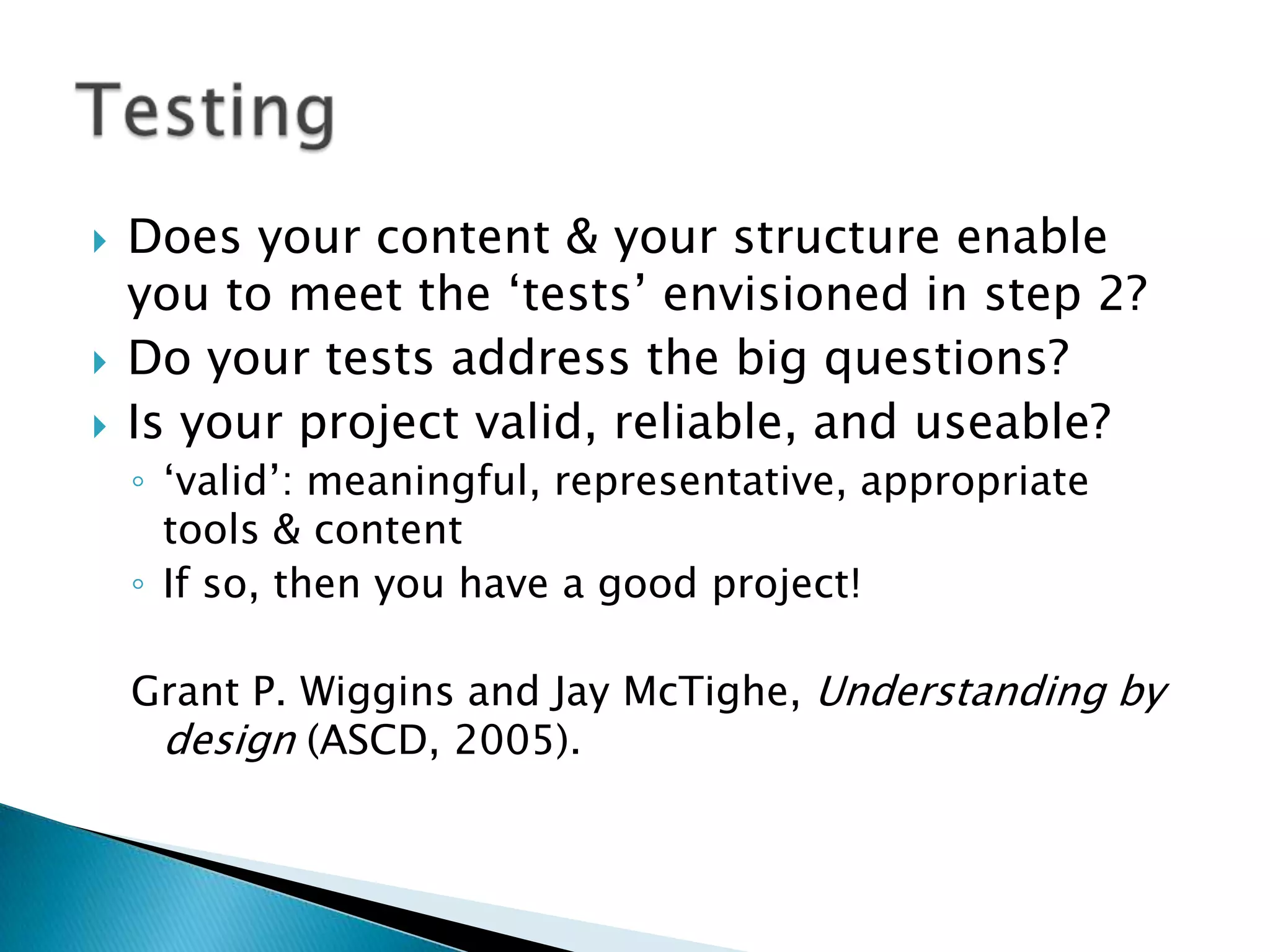
Does your content & your structure enable you to meet the ‘tests’ envisioned in step 2? Do your tests address the big questions?Is your project valid, reliable, and useable?‘valid’: meaningful, representative, appropriate tools & contentIf so, then you have a good project! Grant P. Wiggins and Jay McTighe, Understanding by design (ASCD, 2005).  Testing
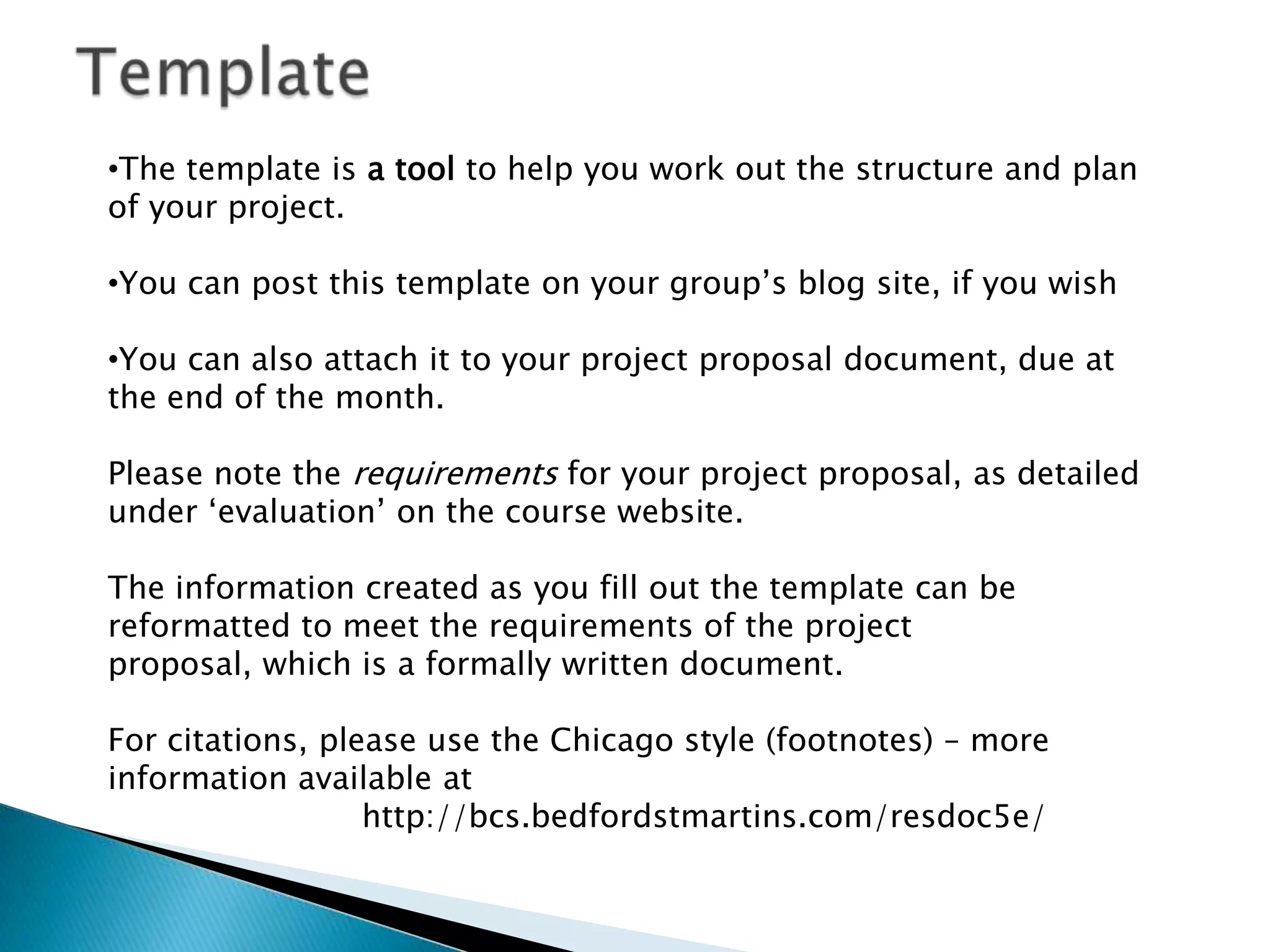
TemplateThe template is a tool to help you work out the structure and plan of your project.

1405a oct22 planning your project

  • 1.
  • 2.
    You’ve already suggestedvarious areas, in your group contractsRemember, Ottawa, the Valley, the Outaouais generally> but narrow it down> bytown.net a good place to look: what strikes you on that site? What leaves you asking questions?What is the broad subject area?
  • 3.
    Step One: DesiredOutcomeWhat do you want users of your project to know after using it?Example: “We want visitors to understand the role of the Irish in building the Rideau Canal”Backwards-design
  • 4.
    What are thebig ideas?Irish immigration; labour relations; nature of the geography; the larger geo-political situation...?What specific understandings about them are desired?Exs?What misunderstandings are predictable?“We want visitors to understand the role of the Irish in building the Rideau Canal”
  • 5.
    Your responses arethe ‘essential questions’ that visitors to your project will be able to answer as a result of visiting your project!
  • 6.
    You want yourvisitors to be able to demonstrate (if only to themselves), in some fashion, that they have understood your messageWhat kinds of activities might a visitor to your site be able to do, as a result of visiting it?This could be something internal: an on-site quiz; it might be something externalYou need to imagine the activities that might be done.These are ‘assessing’ whether or not the visitor has learned somethingStep 2: Assessing whether the outcome is reached
  • 7.
    Perhaps you providea ‘self-test’ at the end of the projectLike in Cosmo and other magazines, a series of multiple choice questions about the content. If you answered 8-10 questions correctly, you’re practically a historian! ..etc.You might envision that the successful visitor would be able to look at a portion of the Rideau Canal and be able to ‘read’ its history from the structureIn which case, your content should be tailored to teach them how to do that. And that’s ...step 3.In our Rideau Example...
  • 8.
    Hook: how doyou draw your visitor in?Explore the data (visualizations, etc)Provide some sort of narrative arcProvide content & structure to meet your assessment goals defined in step 2.7 basic plots: Quest; Voyage & Return; Rebirth; Comedy; Tragedy; Overcoming the Monster; Rags to RichesStep 3: Implementation
  • 9.
    Quest: the driveof the Irish for a new life Voyage & Return: the Billings family as they travel up and down the RideauRebirth: the decline of the Rideau as a commercial waterway and its rebirth as a recreational corridorComedy (in proper sense meaning confusion and its resolution, ie, not necessarily funny): the funding of the Canal & the British PublicTragedy: the Fall of Colonel ByOvercoming the monster: the triumph of engineering over the wildernessRags to riches: the rise to respectability of the Ottawa IrishStory arcs for Rideau Example?
  • 10.
    Does your content& your structure enable you to meet the ‘tests’ envisioned in step 2? Do your tests address the big questions?Is your project valid, reliable, and useable?‘valid’: meaningful, representative, appropriate tools & contentIf so, then you have a good project! Grant P. Wiggins and Jay McTighe, Understanding by design (ASCD, 2005).  Testing
  • 11.
    TemplateThe template isa tool to help you work out the structure and plan of your project.
  • 12.
    You can postthis template on your group’s blog site, if you wish
  • 13.
    You can alsoattach it to your project proposal document, due at the end of the month. Please note the requirements for your project proposal, as detailed under ‘evaluation’ on the course website.The information created as you fill out the template can be reformatted to meet the requirements of the project proposal, which is a formally written document.For citations, please use the Chicago style (footnotes) – more information available at http://bcs.bedfordstmartins.com/resdoc5e/