Siebel Clinical
Best Practices
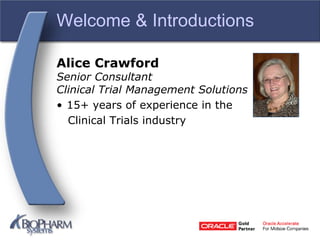
Alice Crawford
Welcome & Introductions
Alice Crawford
Senior Consultant
Clinical Trial Management Solutions
• 15+ years of experience in the
Clinical Trials industry
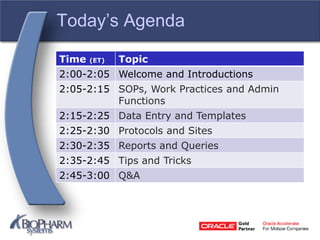
Today’s Agenda
Time (ET) Topic
2:00-2:05 Welcome and Introductions
2:05-2:15 SOPs, Work Practices and Admin
Functions
2:15-2:25 Data Entry and Templates
2:25-2:30 Protocols and Sites
2:30-2:35 Reports and Queries
2:35-2:45 Tips and Tricks
2:45-3:00 Q&A
What is a Best Practice?
 A method, process, activity, incentive, or reward that is
believed to be more effective at delivering a particular
outcome than any other technique, method, process, etc.
when applied to a particular condition or circumstance.
en.wikipedia.org/wiki/Best_practice
 A way or method of accomplishing a business function or
process that is considered to be superior to all other known
methods.
www.qaproject.org/methods/resglossary
 A best practice is a business process with demonstrated
ability to achieve superior results. Best practices
represent proven methodologies for consistently and
effectively achieving a business objective.
www.hrsdc.gc.ca/eng/workplaceskills/oles/2009/glossary
Standard Operating Procedures
Best Practices:
 Finalize system related SOPs and guidelines
prior to system go-live.
 Train users on the SOPs as part as part of
system training.
 Recommended SOPs:
 Siebel Clinical Administration and Maintenance
SOP
 Siebel Clinical Access and Use SOP
SOPs associated with Siebel Clinical typically include information
about the setup and use of the application in conjunction with the
day-to-day management of clinical trials.
Work Instructions
Best Practices:
 Finalize work instructions prior to go-live.
 Train users on the work instructions as part of
system training.
 Create quick reference cards for various
purposes:
 Navigation tips and tricks
 Rarely used functions
 Complicated functions
 Etc…
Work Instructions provide detailed steps on how to
perform a specific task or function in Siebel Clinical
User Responsibilities
Best Practices:
 Perform a user group/responsibility analysis prior
to entering any responsibilities into the system.
 Keep the total number of responsibilities to a
minimum to reduce administrative maintenance
issues.
 If two user groups perform similar functions
consider having single responsibility for both user
groups.
 Balance the availability of data with the need to
control data access.
Responsibilities in Siebel Clinical control access to the
screens and views that are visible to each logged in user.
User Positions
Best Practices:
 A position assignment must be unique to each
user.
 Name positions in a manner that eases
transitions associated with employee turnover.
 Positions should correspond to the organizational
chart.
Positions in Siebel Clinical control access to data (records).
User Positions (cont.)
Best Practices (cont.)
 Never assign multiple users the same position.
 Assign a user only one position if possible.
Users should never be deleted; only disabled
 Remove all responsibilities associated to user
 Disassociate them from their old Position and
associate them to a generic “Inactive”
Position
Lists of Values
Best Practices:
 Create guidelines and controls for modifying LOVs.
 Be aware that modifying some LOVs can adversely
impact standard Siebel functionality:
 Do not modify lists of values that are used
internally by the Siebel application.
 Do not change the Language Independent
Code value from the Siebel standard value even if
the associated display value is modified
Lists of Values (LOVs) in Siebel Clinical are the selection
options available in the dropdown menu for a specific field
Lists of Values (cont.)
Best Practices (cont.):
 Avoid LOV modifications that could result in
values being displayed improperly or not at all.
 Do not assume that modifying a display value will
automatically update all records that have been
populated with the old value.
 Example: Account Type ‘Central Lab’ to ‘Reference
Lab’ in the display value field:
 LOVs should never be deleted; only deactivated
by unchecking the Active flag
Home Screen
Best Practices
 Encourage each user to edit their Home Screen
layout in a manner that works best for them.
 Rearrange the sections so that the ones used
most are in the top area of the Home Page and
any sections that are never used are hidden
 Use hyperlinks on the Home Screen to quickly
navigate to specific areas of the application
Home Screen: The first screen displayed when a user
logs onto the system. It is a convenient way to track and
access the records that are relevant to the logged in user.
List Applets
Best Practices
 Each user should display and rearrange columns in
list applets so that the information most relevant to
their tasks is displayed in a convenient and logical
manner
 Sort records in a column by clicking on the column
header
 Use the Advanced Sorts option to sort a list of
records, based on up to three fields
List Applet: A list of screen specific records
Data Entry
Best Practices:
 Have a single ‘Data Standards’ document that
defines:
 Standard ways to enter and format data
 Standard nomenclature and definitions for
values available in important fields such as
status fields
 Steps to take to avoid duplicate data entries
Record Properties
Best Practices:
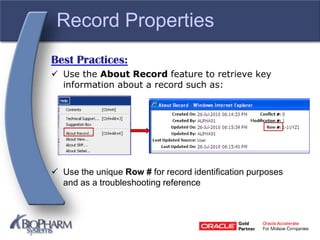
 Use the About Record feature to retrieve key
information about a record such as:
 Use the unique Row # for record identification purposes
and as a troubleshooting reference
Contacts, Accounts and
Addresses
Best Practices:
 The Data Standards document is essential for
reference when entering these records
 Create guidelines, controls and request forms
for the creation, modification and inactivation
of records
 Creation and revision of these records should
be centrally or regionally administered by a few
specially trained individuals
 Contact and account records should not be
deleted; only inactivated
Contacts and Accounts (cont.)
Best Practices (cont.):
If a record deletion is being considered, review the
following options before clicking [Delete]
 Soft Delete: used for accounts or contacts which
were associated to previous studies but will not be
used going forward
 Hard Delete: used only when accounts or contacts
are entered incorrectly and no other data is
associated to the record
 Record Merge: used for duplicate records - two or
more records contain the same information and
need to be merged into a single record to keep the
database accurate
Contacts and Accounts (cont.)
Best Practices (cont.):
 At the contact level, pick a “main” Contact
Type for each contact.
 Create standard Contact and Account
Assessment templates
 Removing the display of Company Employees
from Contact Lists
Record Deletion
Best Practices:
 As a general practice - Do Not Delete Records
 Analyze potential cascading effects that could
be associated with a specific record deletion
 Remember that the deletion of some records
have a more negative impact than the deletion
of others.
 If you do decide to delete records, be sure to
delete from the bottom of the hierarchy to the
top (subjects => site => region => etc…)
Trip Report Templates
Best Practices:
 Refrain from creating protocol or product
specific templates
 Define one generic template per site visit type
(initiation, monitoring, close-out, etc…) to use
as the company standard.
Document and Activity
Templates
Best Practices:
 Make templates as generic as possible.
 For a template to be available for all protocols,
the ‘Protocol Title ‘ field must be blank and the
‘Public’ field must be checked.
Document and Activity Templates are used to standardize
the documents and tasks associated with a clinical trial.
Subject Visit Templates
Best Practices:
 Use visit Lead Times to indicate the time
between one subject visit and the next scheduled
visit.
 Use Min/Max units if the tracking and
maintenance of subject visit windows is
important for the trial
 When creating a new SVT version, copy the
existing version and then edit as necessary
• NEVER delete a SVT that has been applied to a
subject
Subject Visit Templates allow users to set up a subject
visit schedule based on the protocol.
Team Members
Best Practices
 Always ‘save’ the protocol, region or site record
before adding team members
 Remove team members if they should no longer
have access to a protocol, region or site.
 Use the Position Rolldown and Position Rollup
functionality whenever possible
Position Rolldown: When a team member is added to a
protocol, click the Position Rolldown button to add the
user to all regions and all sites under the Protocol.
Position Rollup: When a team member is added to a
site, click the Position Rollup button to add the user to the
region and protocol associated with the site.
Clinical Programs
Best Practices
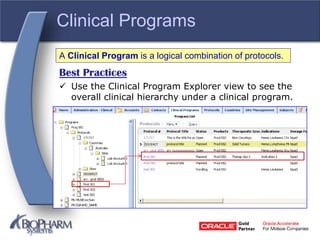
 Use the Clinical Program Explorer view to see the
overall clinical hierarchy under a clinical program.
A Clinical Program is a logical combination of protocols.
Site Management: Site Contacts
Best Practices
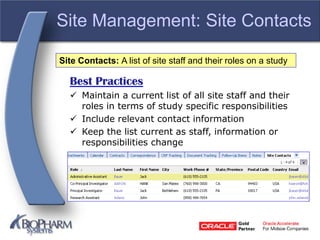
 Maintain a current list of all site staff and their
roles in terms of study specific responsibilities
 Include relevant contact information
 Keep the list current as staff, information or
responsibilities change
Site Contacts: A list of site staff and their roles on a study
Site Management: Site Visits
Best Practice
 Create a list of scheduled site visits as soon as
the information is available to provide metrics
and support scheduling and resourcing
Site Visits: Visits to a site by the clinical research
associate throughout the period of a clinical trial
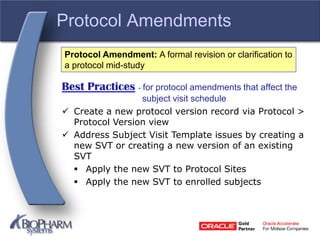
Protocol Amendments
Best Practices - for protocol amendments that affect the
subject visit schedule
 Create a new protocol version record via Protocol >
Protocol Version view
 Address Subject Visit Template issues by creating a
new SVT or creating a new version of an existing
SVT
 Apply the new SVT to Protocol Sites
 Apply the new SVT to enrolled subjects
Protocol Amendment: A formal revision or clarification to
a protocol mid-study
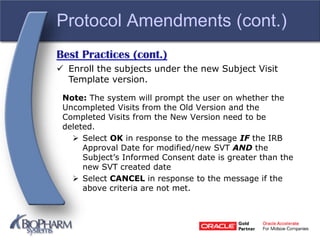
Protocol Amendments (cont.)
Best Practices (cont.)
 Enroll the subjects under the new Subject Visit
Template version.
Note: The system will prompt the user on whether the
Uncompleted Visits from the Old Version and the
Completed Visits from the New Version need to be
deleted.
 Select OK in response to the message IF the IRB
Approval Date for modified/new SVT AND the
Subject’s Informed Consent date is greater than the
new SVT created date
 Select CANCEL in response to the message if the
above criteria are not met.
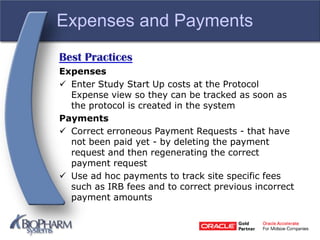
Expenses and Payments
Best Practices
Expenses
 Enter Study Start Up costs at the Protocol
Expense view so they can be tracked as soon as
the protocol is created in the system
Payments
 Correct erroneous Payment Requests - that have
not been paid yet - by deleting the payment
request and then regenerating the correct
payment request
 Use ad hoc payments to track site specific fees
such as IRB fees and to correct previous incorrect
payment amounts
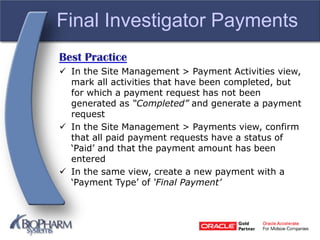
Final Investigator Payments
Best Practice
 In the Site Management > Payment Activities view,
mark all activities that have been completed, but
for which a payment request has not been
generated as “Completed” and generate a payment
request
 In the Site Management > Payments view, confirm
that all paid payment requests have a status of
‘Paid’ and that the payment amount has been
entered
 In the same view, create a new payment with a
‘Payment Type’ of ‘Final Payment’
Queries
Best Practices
 Use the “wild card” operator of an asterisk (*) at
the beginning or end of your search term to bring
back results that end or begin with your search
term.
 Use the “wild card’ asterisk (*) by itself to find all
records that have any value in a certain field.
 Use the operator “IS NULL” to find all records that
have no value in a certain field.
 Search for multiple terms in a single field by using
“AND” or “OR”
Queries: Allows users in to narrow down a list of records
and create ad hoc reports.
Queries (cont.)
Best Practices (cont.)
 After receiving your query results, use the Refine
Query feature if necessary
 To query for documents with specific expiration
dates, create a dynamic query such as: <today()
or <today+30()
 Use the Query Assistant for more complex
queries
Queries (cont.)
Best Practices (cont.)
 Save queries that are complicated or used on a
regular basis
 Instruct an administrator to create a Predefined
Query when a query should be made “public”
and shared with all users
 Clear query results by clicking [Query] and then
[Go] without entering any search terms or
operators.
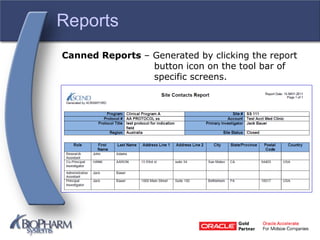
Reports
Canned Reports – Generated by clicking the report
button icon on the tool bar of
specific screens.
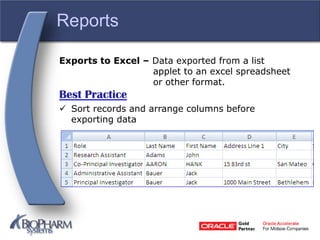
Reports
Exports to Excel – Data exported from a list
applet to an excel spreadsheet
or other format.
Best Practice
 Sort records and arrange columns before
exporting data
Reports (cont.)
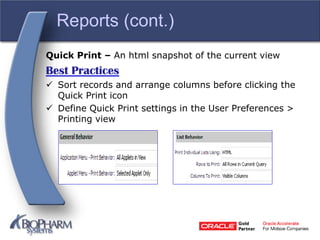
Quick Print – An html snapshot of the current view
Best Practices
 Sort records and arrange columns before clicking the
Quick Print icon
 Define Quick Print settings in the User Preferences >
Printing view
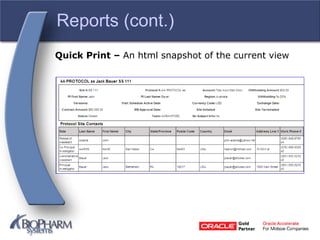
Reports (cont.)
Quick Print – An html snapshot of the current view
Reports (cont.)
Best Practices (cont.)
 Access and review archived BIP reports run in the past
via Reports Icon > My BIP Reports (Note: Only
available in Siebel Clinical 8.1.x)
 Purge BIP reports on a regular basis to conserve server
space.
Change Control
Best Practices
 Maintain an up-to-date change and
enhancement list post go-live
 For proposed changes or enhancements,
consider whether it would be better to
change an existing business practice instead
 Create a prioritization scale and rate each
item on the change and enhancement list
Tips and Tricks
 Multiple email addresses for a contact can be
entered in a single email field if they are
separated by commas
 Remember that you can only ‘undo’ records
that have not been saved
 If you right-click in a form or a list applet, you
can access the same menu of actions provided
by the menu button in that form or list applet.
 Clicking on a hyperlink creates a thread bar
that can be used for ‘back’ navigation purposes
 The thread bar resets when you navigate to
another screen via a screen tab or the Site Map
Tips and Tricks (cont.)
 Sorting records:
 Sorting a large number of records (e.g., All
Contacts) can be very slow. Instead, it is
better to query first and then sort.
 Advanced Sort is the ability to sort records
by up to three criteria via the Menu >
Advanced Sort for the list applet.
 The sort order is reset when you leave the
screen
 Change multiple field values at the same time
via Edit > Change Records in the application
menu toolbar
Tips and Tricks (cont.)
 You can save a Siebel Clinical chart for use
in other applications such as Microsoft
PowerPoint.
 Navigate to the chart you want to copy.
 Select ALT + CTRL + Right-click on the
chart and select ‘Save Picture As’.
 In the Save Picture dialog box, save the
chart as an image file
Tips and Tricks (cont.)
 You can freeze columns in a list applet to maintain a
point of reference when scrolling to the right
 Within the selected list, double-click the column header
of the right-most column you want to freeze.
 The frozen column headers will display with a darker
gray background and a dark gray vertical line appears
to separate the frozen columns from the unfrozen
columns.
 To unfreeze columns, double-click the header of the
right-most frozen column.
 Do not close the browser window to exit the Siebel
application. Instead choose File, then Log Out from
the application-level menu
 Ensures that the most recent changes have been saved
 Avoids hanging sessions in the database which can use
database resources and potentially affect performance
for other users
Tips and Tricks (cont.)
 You can now use the web browser’s back
and forward buttons to navigate in Siebel
Clinical
 You can locate screens and views that you
recently accessed by using the web
browser’s history function.
Siebel Clinical 8.1.x Specific
Questions?
Closing
Thank you for attending!
This webinar will be posted on
www.biopharm.com
within 24 hours
acrawford@biopharm.com
+1 877-654-0033
+44 (0) 1865 910200

Siebel CTMS Best Practices

  • 1.
  • 2.
    Welcome & Introductions AliceCrawford Senior Consultant Clinical Trial Management Solutions • 15+ years of experience in the Clinical Trials industry
  • 3.
    Today’s Agenda Time (ET)Topic 2:00-2:05 Welcome and Introductions 2:05-2:15 SOPs, Work Practices and Admin Functions 2:15-2:25 Data Entry and Templates 2:25-2:30 Protocols and Sites 2:30-2:35 Reports and Queries 2:35-2:45 Tips and Tricks 2:45-3:00 Q&A
  • 4.
    What is aBest Practice?  A method, process, activity, incentive, or reward that is believed to be more effective at delivering a particular outcome than any other technique, method, process, etc. when applied to a particular condition or circumstance. en.wikipedia.org/wiki/Best_practice  A way or method of accomplishing a business function or process that is considered to be superior to all other known methods. www.qaproject.org/methods/resglossary  A best practice is a business process with demonstrated ability to achieve superior results. Best practices represent proven methodologies for consistently and effectively achieving a business objective. www.hrsdc.gc.ca/eng/workplaceskills/oles/2009/glossary
  • 5.
    Standard Operating Procedures BestPractices:  Finalize system related SOPs and guidelines prior to system go-live.  Train users on the SOPs as part as part of system training.  Recommended SOPs:  Siebel Clinical Administration and Maintenance SOP  Siebel Clinical Access and Use SOP SOPs associated with Siebel Clinical typically include information about the setup and use of the application in conjunction with the day-to-day management of clinical trials.
  • 6.
    Work Instructions Best Practices: Finalize work instructions prior to go-live.  Train users on the work instructions as part of system training.  Create quick reference cards for various purposes:  Navigation tips and tricks  Rarely used functions  Complicated functions  Etc… Work Instructions provide detailed steps on how to perform a specific task or function in Siebel Clinical
  • 7.
    User Responsibilities Best Practices: Perform a user group/responsibility analysis prior to entering any responsibilities into the system.  Keep the total number of responsibilities to a minimum to reduce administrative maintenance issues.  If two user groups perform similar functions consider having single responsibility for both user groups.  Balance the availability of data with the need to control data access. Responsibilities in Siebel Clinical control access to the screens and views that are visible to each logged in user.
  • 8.
    User Positions Best Practices: A position assignment must be unique to each user.  Name positions in a manner that eases transitions associated with employee turnover.  Positions should correspond to the organizational chart. Positions in Siebel Clinical control access to data (records).
  • 9.
    User Positions (cont.) BestPractices (cont.)  Never assign multiple users the same position.  Assign a user only one position if possible. Users should never be deleted; only disabled  Remove all responsibilities associated to user  Disassociate them from their old Position and associate them to a generic “Inactive” Position
  • 10.
    Lists of Values BestPractices:  Create guidelines and controls for modifying LOVs.  Be aware that modifying some LOVs can adversely impact standard Siebel functionality:  Do not modify lists of values that are used internally by the Siebel application.  Do not change the Language Independent Code value from the Siebel standard value even if the associated display value is modified Lists of Values (LOVs) in Siebel Clinical are the selection options available in the dropdown menu for a specific field
  • 11.
    Lists of Values(cont.) Best Practices (cont.):  Avoid LOV modifications that could result in values being displayed improperly or not at all.  Do not assume that modifying a display value will automatically update all records that have been populated with the old value.  Example: Account Type ‘Central Lab’ to ‘Reference Lab’ in the display value field:  LOVs should never be deleted; only deactivated by unchecking the Active flag
  • 12.
    Home Screen Best Practices Encourage each user to edit their Home Screen layout in a manner that works best for them.  Rearrange the sections so that the ones used most are in the top area of the Home Page and any sections that are never used are hidden  Use hyperlinks on the Home Screen to quickly navigate to specific areas of the application Home Screen: The first screen displayed when a user logs onto the system. It is a convenient way to track and access the records that are relevant to the logged in user.
  • 13.
    List Applets Best Practices Each user should display and rearrange columns in list applets so that the information most relevant to their tasks is displayed in a convenient and logical manner  Sort records in a column by clicking on the column header  Use the Advanced Sorts option to sort a list of records, based on up to three fields List Applet: A list of screen specific records
  • 14.
    Data Entry Best Practices: Have a single ‘Data Standards’ document that defines:  Standard ways to enter and format data  Standard nomenclature and definitions for values available in important fields such as status fields  Steps to take to avoid duplicate data entries
  • 15.
    Record Properties Best Practices: Use the About Record feature to retrieve key information about a record such as:  Use the unique Row # for record identification purposes and as a troubleshooting reference
  • 16.
    Contacts, Accounts and Addresses BestPractices:  The Data Standards document is essential for reference when entering these records  Create guidelines, controls and request forms for the creation, modification and inactivation of records  Creation and revision of these records should be centrally or regionally administered by a few specially trained individuals  Contact and account records should not be deleted; only inactivated
  • 17.
    Contacts and Accounts(cont.) Best Practices (cont.): If a record deletion is being considered, review the following options before clicking [Delete]  Soft Delete: used for accounts or contacts which were associated to previous studies but will not be used going forward  Hard Delete: used only when accounts or contacts are entered incorrectly and no other data is associated to the record  Record Merge: used for duplicate records - two or more records contain the same information and need to be merged into a single record to keep the database accurate
  • 18.
    Contacts and Accounts(cont.) Best Practices (cont.):  At the contact level, pick a “main” Contact Type for each contact.  Create standard Contact and Account Assessment templates  Removing the display of Company Employees from Contact Lists
  • 19.
    Record Deletion Best Practices: As a general practice - Do Not Delete Records  Analyze potential cascading effects that could be associated with a specific record deletion  Remember that the deletion of some records have a more negative impact than the deletion of others.  If you do decide to delete records, be sure to delete from the bottom of the hierarchy to the top (subjects => site => region => etc…)
  • 20.
    Trip Report Templates BestPractices:  Refrain from creating protocol or product specific templates  Define one generic template per site visit type (initiation, monitoring, close-out, etc…) to use as the company standard.
  • 21.
    Document and Activity Templates BestPractices:  Make templates as generic as possible.  For a template to be available for all protocols, the ‘Protocol Title ‘ field must be blank and the ‘Public’ field must be checked. Document and Activity Templates are used to standardize the documents and tasks associated with a clinical trial.
  • 22.
    Subject Visit Templates BestPractices:  Use visit Lead Times to indicate the time between one subject visit and the next scheduled visit.  Use Min/Max units if the tracking and maintenance of subject visit windows is important for the trial  When creating a new SVT version, copy the existing version and then edit as necessary • NEVER delete a SVT that has been applied to a subject Subject Visit Templates allow users to set up a subject visit schedule based on the protocol.
  • 23.
    Team Members Best Practices Always ‘save’ the protocol, region or site record before adding team members  Remove team members if they should no longer have access to a protocol, region or site.  Use the Position Rolldown and Position Rollup functionality whenever possible Position Rolldown: When a team member is added to a protocol, click the Position Rolldown button to add the user to all regions and all sites under the Protocol. Position Rollup: When a team member is added to a site, click the Position Rollup button to add the user to the region and protocol associated with the site.
  • 24.
    Clinical Programs Best Practices Use the Clinical Program Explorer view to see the overall clinical hierarchy under a clinical program. A Clinical Program is a logical combination of protocols.
  • 25.
    Site Management: SiteContacts Best Practices  Maintain a current list of all site staff and their roles in terms of study specific responsibilities  Include relevant contact information  Keep the list current as staff, information or responsibilities change Site Contacts: A list of site staff and their roles on a study
  • 26.
    Site Management: SiteVisits Best Practice  Create a list of scheduled site visits as soon as the information is available to provide metrics and support scheduling and resourcing Site Visits: Visits to a site by the clinical research associate throughout the period of a clinical trial
  • 27.
    Protocol Amendments Best Practices- for protocol amendments that affect the subject visit schedule  Create a new protocol version record via Protocol > Protocol Version view  Address Subject Visit Template issues by creating a new SVT or creating a new version of an existing SVT  Apply the new SVT to Protocol Sites  Apply the new SVT to enrolled subjects Protocol Amendment: A formal revision or clarification to a protocol mid-study
  • 28.
    Protocol Amendments (cont.) BestPractices (cont.)  Enroll the subjects under the new Subject Visit Template version. Note: The system will prompt the user on whether the Uncompleted Visits from the Old Version and the Completed Visits from the New Version need to be deleted.  Select OK in response to the message IF the IRB Approval Date for modified/new SVT AND the Subject’s Informed Consent date is greater than the new SVT created date  Select CANCEL in response to the message if the above criteria are not met.
  • 29.
    Expenses and Payments BestPractices Expenses  Enter Study Start Up costs at the Protocol Expense view so they can be tracked as soon as the protocol is created in the system Payments  Correct erroneous Payment Requests - that have not been paid yet - by deleting the payment request and then regenerating the correct payment request  Use ad hoc payments to track site specific fees such as IRB fees and to correct previous incorrect payment amounts
  • 30.
    Final Investigator Payments BestPractice  In the Site Management > Payment Activities view, mark all activities that have been completed, but for which a payment request has not been generated as “Completed” and generate a payment request  In the Site Management > Payments view, confirm that all paid payment requests have a status of ‘Paid’ and that the payment amount has been entered  In the same view, create a new payment with a ‘Payment Type’ of ‘Final Payment’
  • 31.
    Queries Best Practices  Usethe “wild card” operator of an asterisk (*) at the beginning or end of your search term to bring back results that end or begin with your search term.  Use the “wild card’ asterisk (*) by itself to find all records that have any value in a certain field.  Use the operator “IS NULL” to find all records that have no value in a certain field.  Search for multiple terms in a single field by using “AND” or “OR” Queries: Allows users in to narrow down a list of records and create ad hoc reports.
  • 32.
    Queries (cont.) Best Practices(cont.)  After receiving your query results, use the Refine Query feature if necessary  To query for documents with specific expiration dates, create a dynamic query such as: <today() or <today+30()  Use the Query Assistant for more complex queries
  • 33.
    Queries (cont.) Best Practices(cont.)  Save queries that are complicated or used on a regular basis  Instruct an administrator to create a Predefined Query when a query should be made “public” and shared with all users  Clear query results by clicking [Query] and then [Go] without entering any search terms or operators.
  • 34.
    Reports Canned Reports –Generated by clicking the report button icon on the tool bar of specific screens.
  • 35.
    Reports Exports to Excel– Data exported from a list applet to an excel spreadsheet or other format. Best Practice  Sort records and arrange columns before exporting data
  • 36.
    Reports (cont.) Quick Print– An html snapshot of the current view Best Practices  Sort records and arrange columns before clicking the Quick Print icon  Define Quick Print settings in the User Preferences > Printing view
  • 37.
    Reports (cont.) Quick Print– An html snapshot of the current view
  • 38.
    Reports (cont.) Best Practices(cont.)  Access and review archived BIP reports run in the past via Reports Icon > My BIP Reports (Note: Only available in Siebel Clinical 8.1.x)  Purge BIP reports on a regular basis to conserve server space.
  • 39.
    Change Control Best Practices Maintain an up-to-date change and enhancement list post go-live  For proposed changes or enhancements, consider whether it would be better to change an existing business practice instead  Create a prioritization scale and rate each item on the change and enhancement list
  • 40.
    Tips and Tricks Multiple email addresses for a contact can be entered in a single email field if they are separated by commas  Remember that you can only ‘undo’ records that have not been saved  If you right-click in a form or a list applet, you can access the same menu of actions provided by the menu button in that form or list applet.  Clicking on a hyperlink creates a thread bar that can be used for ‘back’ navigation purposes  The thread bar resets when you navigate to another screen via a screen tab or the Site Map
  • 41.
    Tips and Tricks(cont.)  Sorting records:  Sorting a large number of records (e.g., All Contacts) can be very slow. Instead, it is better to query first and then sort.  Advanced Sort is the ability to sort records by up to three criteria via the Menu > Advanced Sort for the list applet.  The sort order is reset when you leave the screen  Change multiple field values at the same time via Edit > Change Records in the application menu toolbar
  • 42.
    Tips and Tricks(cont.)  You can save a Siebel Clinical chart for use in other applications such as Microsoft PowerPoint.  Navigate to the chart you want to copy.  Select ALT + CTRL + Right-click on the chart and select ‘Save Picture As’.  In the Save Picture dialog box, save the chart as an image file
  • 43.
    Tips and Tricks(cont.)  You can freeze columns in a list applet to maintain a point of reference when scrolling to the right  Within the selected list, double-click the column header of the right-most column you want to freeze.  The frozen column headers will display with a darker gray background and a dark gray vertical line appears to separate the frozen columns from the unfrozen columns.  To unfreeze columns, double-click the header of the right-most frozen column.  Do not close the browser window to exit the Siebel application. Instead choose File, then Log Out from the application-level menu  Ensures that the most recent changes have been saved  Avoids hanging sessions in the database which can use database resources and potentially affect performance for other users
  • 44.
    Tips and Tricks(cont.)  You can now use the web browser’s back and forward buttons to navigate in Siebel Clinical  You can locate screens and views that you recently accessed by using the web browser’s history function. Siebel Clinical 8.1.x Specific
  • 45.
  • 46.
    Closing Thank you forattending! This webinar will be posted on www.biopharm.com within 24 hours acrawford@biopharm.com +1 877-654-0033 +44 (0) 1865 910200