K to 12 BASIC EDUCATION CURRICULUM
SENIOR HIGH SCHOOL – CONTEXTUALIZED SUBJECT
K to 12 Senior High School Contextualized Subject – Research in Daily Life 2 December 2013 Page 1 of 6
Grade: 12 Semester :First Semester
Common Subject Title: Research in Daily Life 2 No. of Hours/Semester: 80 hours/semester
Prerequisites: Statistics and Probability
Common Subject Description: This course develops critical thinking and problem-solving skills through quantitative research.
CONTENT
CONTENT
STANDARD
PERFORMANCE STANDARD LEARNING COMPETENCIES CODE
Nature of Inquiry and
Research
The learner demonstrates
understanding of:
1. the characteristics,
strengths, weaknesses,
and kinds of quantitative
research
2. the importance of
quantitative research
across fields
3. the nature of variables
The learner is able to:
decide on suitable
quantitative research in
different areas of interest
The learner:
1. describes characteristics, strengths,
weaknesses, and kinds of quantitative research
CS_RS12-Ia-c-1
2. illustrates the importance of quantitative
research across fields
CS_RS12-Ia-c-2
3. differentiates kinds of variables and their uses CS_RS12-Ia-c-3
Identifying the Inquiry
and Stating the
Problem
The learner demonstrates
understanding of:
1. the range of research
topics in the area of
inquiry
2. the value of research in
the area of interest
3. the specificity and
feasibility of the problem
posed
The learner is able to:
formulate clearly the
statement of research problem
The learner:
1. designs a research useful in daily life
CS_RS12-Id-e-1
2. writes a research title CS_RS12-Id-e-2
3. describes background of research CS_RS12-Id-e-3
4. states research questions CS_RS12-Id-e-4
5. indicates scope and delimitation of study CS_RS12-Id-e-5
6. cites benefits and beneficiaries of study CS_RS12-Id-e-6
7. presents written statement of the problem CS_RS12-Id-e-7
K to 12 BASIC EDUCATION CURRICULUM
SENIOR HIGH SCHOOL – CONTEXTUALIZED SUBJECT
K to 12 Senior High School Contextualized Subject – Research in Daily Life 2 December 2013 Page 2 of 6
CONTENT
CONTENT
STANDARD
PERFORMANCE STANDARD LEARNING COMPETENCIES CODE
Learning from Others
and Reviewing the
Literature
The learner demonstrates
understanding of:
1. the criteria in selecting,
citing, and synthesizing
related literature
2. the ethical standards in
writing related literature
3. the formulation of
conceptual framework
4. the research hypotheses
(if appropriate)
5. the definition of terms as
used in the study
The learner is able to:
1. select, cite, and
synthesize judiciously
related literature and use
sources according to
ethical standards
2. formulate clearly
conceptual framework,
research hypotheses (if
appropriate), and define
terms used in study
3. present objectively written
review of related literature
and conceptual framework
The learner:
1. selects relevant literature CS_RS12-If-j-1
2. cites related literature using standard style
(APA, MLA or Chicago Manual of Style)
CS_RS12-If-j-2
3. synthesizes information from relevant literature CS_RS12-If-j-3
4. writes coherent review of literature CS_RS12-If-j-4
5. follows ethical standards in writing related
literature
CS_RS12-If-j-5
6. illustrates and explain conceptual framework CS_RS12-If-j-6
7. defines terms used in study CS_RS12-If-j-7
8. lists research hypotheses (if appropriate)
CS_RS12-If-j-8
9. presents written review of related literature
and conceptual framework
CS_RS12-If-j-9
Understanding Data
and Ways to
Systematically Collect
Data
The learner demonstrates
understanding of:
1. quantitative research
designs
The learner is able to:
describe adequately
quantitative research designs,
sample, instrument used,
The learner:
1. chooses appropriate quantitative research
design
CS_RS12-IIa-c-1
K to 12 BASIC EDUCATION CURRICULUM
SENIOR HIGH SCHOOL – CONTEXTUALIZED SUBJECT
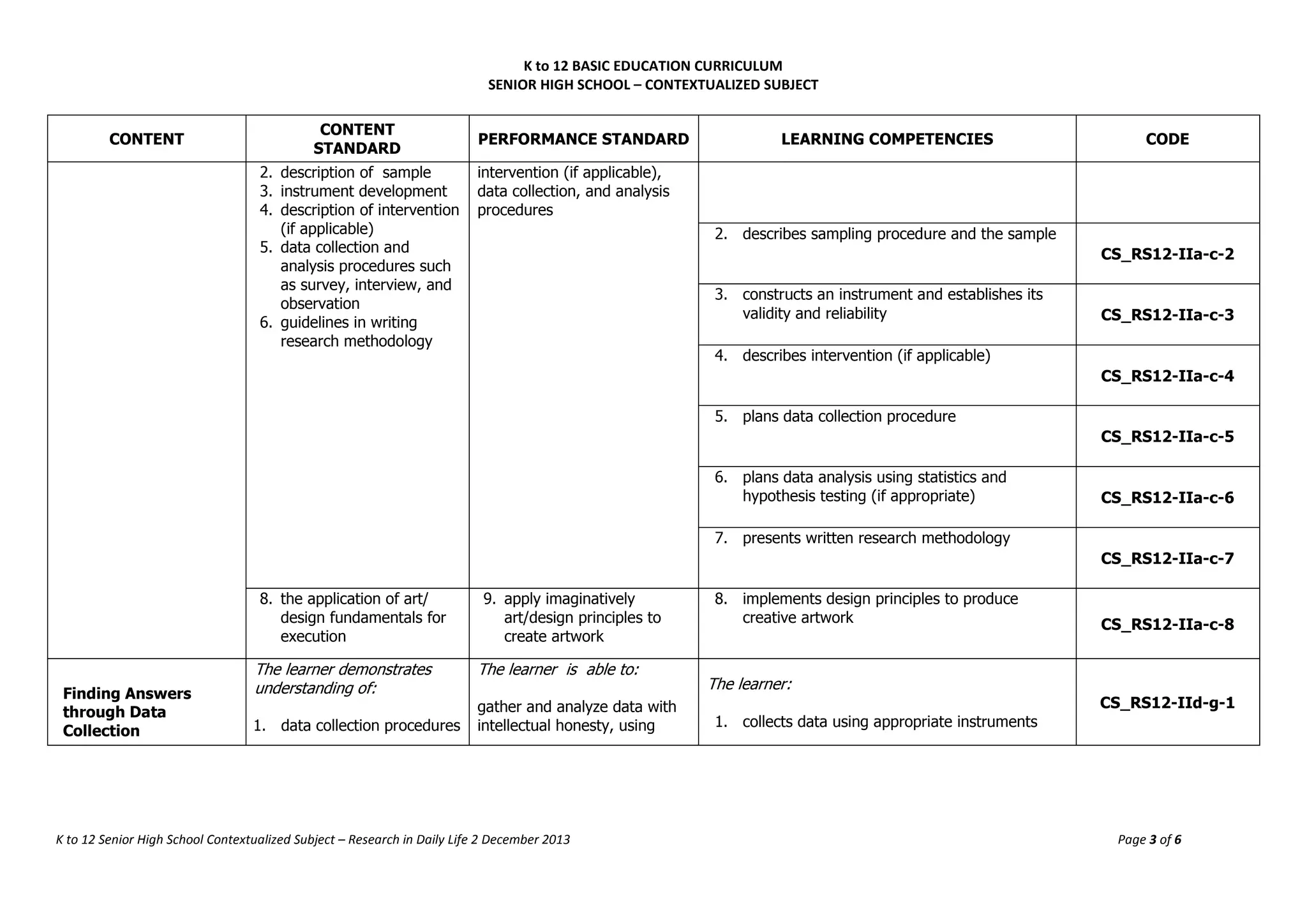
K to 12 Senior High School Contextualized Subject – Research in Daily Life 2 December 2013 Page 3 of 6
CONTENT
CONTENT
STANDARD
PERFORMANCE STANDARD LEARNING COMPETENCIES CODE
2. description of sample
3. instrument development
4. description of intervention
(if applicable)
5. data collection and
analysis procedures such
as survey, interview, and
observation
6. guidelines in writing
research methodology
intervention (if applicable),
data collection, and analysis
procedures
2. describes sampling procedure and the sample
CS_RS12-IIa-c-2
3. constructs an instrument and establishes its
validity and reliability CS_RS12-IIa-c-3
4. describes intervention (if applicable)
CS_RS12-IIa-c-4
5. plans data collection procedure
CS_RS12-IIa-c-5
6. plans data analysis using statistics and
hypothesis testing (if appropriate) CS_RS12-IIa-c-6
7. presents written research methodology
CS_RS12-IIa-c-7
8. the application of art/
design fundamentals for
execution
9. apply imaginatively
art/design principles to
create artwork
8. implements design principles to produce
creative artwork CS_RS12-IIa-c-8
Finding Answers
through Data
Collection
The learner demonstrates
understanding of:
1. data collection procedures
The learner is able to:
gather and analyze data with
intellectual honesty, using
The learner:
1. collects data using appropriate instruments
CS_RS12-IId-g-1
K to 12 BASIC EDUCATION CURRICULUM
SENIOR HIGH SCHOOL – CONTEXTUALIZED SUBJECT
K to 12 Senior High School Contextualized Subject – Research in Daily Life 2 December 2013 Page 4 of 6
CONTENT
CONTENT
STANDARD
PERFORMANCE STANDARD LEARNING COMPETENCIES CODE
and skills using varied
instruments
2. data processing,
organizing, and analysis
suitable techniques
2. presents and interprets data in tabular and
graphical forms
CS_RS12-IId-g-2
3. uses statistical techniques to analyze data—
study of differences and relationships limited
for bivariate analysis
CS_RS12-IId-g-3
Reporting and
Sharing Findings
The learner demonstrates
understanding of:
1. guidelines in making
conclusions and
recommendations
2. the techniques in listing
references
3. the process of report
writing
The learner is able to:
1. form logical conclusions
2. make recommendations
based on conclusions
3. write and present clear
report
The learner:
1. draws conclusions from research findings
CS_RS12-IIh-j-1
2. formulates recommendations CS_RS12-IIh-j-2
3. lists references CS_RS12-IIh-j-3
4. presents written research report CS_RS12-IIh-j-4
4. the selection criteria and
process of best design
4. execute best design 5. finalizes and presents best design CS_RS12-IIh-j-5
6. presents research workbook CS_RS12-IIh-j-6
K to 12 BASIC EDUCATION CURRICULUM
SENIOR HIGH SCHOOL – CONTEXTUALIZED SUBJECT
K to 12 Senior High School Contextualized Subject – Research in Daily Life 2 December 2013 Page 5 of 6
GLOSSARY
Ethics research ethics relate to the standards that should be upheld to guard participants from harm or risk. Ethical considerations should be made
at each stage of the research design and include informed consent, voluntary participation and respect for confidentiality.
(www.kcl.ac.uk/library/nhs/training/glossary.doc)
Intellectual Honesty is an applied method of problem solving in academia, characterized by an unbiased, honest attitude, which can be demonstrated in a
number of different ways, including but not limited to:
 One's personal beliefs do not interfere with the pursuit of truth;
 Relevant facts and information are not purposefully omitted even when such things may contradict one's hypothesis;
 Facts are presented in an unbiased manner, and not twisted to give misleading impressions or to support one view over another;
 References, or earlier work, are acknowledged where possible, and plagiarism is avoided.
(http://en.wikipedia.org/wiki/Intellectual_honesty)
Qualitative Research a method of inquiry employed in many different academic disciplines, traditionally in the social sciences, but also in market research and
further contexts. (http://en.wikipedia.org/wiki/Qualitative_research)
Quantitative Research refers to the systematic empirical investigation of social phenomena via statistical, mathematical or numerical data or computational
techniques. (http://en.wikipedia.org/wiki/Quantitative_research)
K to 12 BASIC EDUCATION CURRICULUM
SENIOR HIGH SCHOOL – CONTEXTUALIZED SUBJECT
K to 12 Senior High School Contextualized Subject – Research in Daily Life 2 December 2013 Page 6 of 6
Code Book Legend
Sample: CS_RS12-Ia-c-1
LEGEND SAMPLE
First Entry
Learning Area and Strand/ Subject or
Specialization
Contextualized Subject_Research
CS_RS12
Grade Level Grade 12
-
Roman Numeral
*Zero if no specific quarter
Quarter First Quarter I
Lowercase Letter/s
*Put a hyphen (-) in between letters to indicate
more than a specific week
Week Weeks one to three a-c
-
Arabic Number Competency
describes characteristics, strengths,
weaknesses, and kinds of quantitative
research
1

SHS Contextualized_Research in Daily Life 2 CG.pdf

  • 1.
    K to 12BASIC EDUCATION CURRICULUM SENIOR HIGH SCHOOL – CONTEXTUALIZED SUBJECT K to 12 Senior High School Contextualized Subject – Research in Daily Life 2 December 2013 Page 1 of 6 Grade: 12 Semester :First Semester Common Subject Title: Research in Daily Life 2 No. of Hours/Semester: 80 hours/semester Prerequisites: Statistics and Probability Common Subject Description: This course develops critical thinking and problem-solving skills through quantitative research. CONTENT CONTENT STANDARD PERFORMANCE STANDARD LEARNING COMPETENCIES CODE Nature of Inquiry and Research The learner demonstrates understanding of: 1. the characteristics, strengths, weaknesses, and kinds of quantitative research 2. the importance of quantitative research across fields 3. the nature of variables The learner is able to: decide on suitable quantitative research in different areas of interest The learner: 1. describes characteristics, strengths, weaknesses, and kinds of quantitative research CS_RS12-Ia-c-1 2. illustrates the importance of quantitative research across fields CS_RS12-Ia-c-2 3. differentiates kinds of variables and their uses CS_RS12-Ia-c-3 Identifying the Inquiry and Stating the Problem The learner demonstrates understanding of: 1. the range of research topics in the area of inquiry 2. the value of research in the area of interest 3. the specificity and feasibility of the problem posed The learner is able to: formulate clearly the statement of research problem The learner: 1. designs a research useful in daily life CS_RS12-Id-e-1 2. writes a research title CS_RS12-Id-e-2 3. describes background of research CS_RS12-Id-e-3 4. states research questions CS_RS12-Id-e-4 5. indicates scope and delimitation of study CS_RS12-Id-e-5 6. cites benefits and beneficiaries of study CS_RS12-Id-e-6 7. presents written statement of the problem CS_RS12-Id-e-7
  • 2.
    K to 12BASIC EDUCATION CURRICULUM SENIOR HIGH SCHOOL – CONTEXTUALIZED SUBJECT K to 12 Senior High School Contextualized Subject – Research in Daily Life 2 December 2013 Page 2 of 6 CONTENT CONTENT STANDARD PERFORMANCE STANDARD LEARNING COMPETENCIES CODE Learning from Others and Reviewing the Literature The learner demonstrates understanding of: 1. the criteria in selecting, citing, and synthesizing related literature 2. the ethical standards in writing related literature 3. the formulation of conceptual framework 4. the research hypotheses (if appropriate) 5. the definition of terms as used in the study The learner is able to: 1. select, cite, and synthesize judiciously related literature and use sources according to ethical standards 2. formulate clearly conceptual framework, research hypotheses (if appropriate), and define terms used in study 3. present objectively written review of related literature and conceptual framework The learner: 1. selects relevant literature CS_RS12-If-j-1 2. cites related literature using standard style (APA, MLA or Chicago Manual of Style) CS_RS12-If-j-2 3. synthesizes information from relevant literature CS_RS12-If-j-3 4. writes coherent review of literature CS_RS12-If-j-4 5. follows ethical standards in writing related literature CS_RS12-If-j-5 6. illustrates and explain conceptual framework CS_RS12-If-j-6 7. defines terms used in study CS_RS12-If-j-7 8. lists research hypotheses (if appropriate) CS_RS12-If-j-8 9. presents written review of related literature and conceptual framework CS_RS12-If-j-9 Understanding Data and Ways to Systematically Collect Data The learner demonstrates understanding of: 1. quantitative research designs The learner is able to: describe adequately quantitative research designs, sample, instrument used, The learner: 1. chooses appropriate quantitative research design CS_RS12-IIa-c-1
  • 3.
    K to 12BASIC EDUCATION CURRICULUM SENIOR HIGH SCHOOL – CONTEXTUALIZED SUBJECT K to 12 Senior High School Contextualized Subject – Research in Daily Life 2 December 2013 Page 3 of 6 CONTENT CONTENT STANDARD PERFORMANCE STANDARD LEARNING COMPETENCIES CODE 2. description of sample 3. instrument development 4. description of intervention (if applicable) 5. data collection and analysis procedures such as survey, interview, and observation 6. guidelines in writing research methodology intervention (if applicable), data collection, and analysis procedures 2. describes sampling procedure and the sample CS_RS12-IIa-c-2 3. constructs an instrument and establishes its validity and reliability CS_RS12-IIa-c-3 4. describes intervention (if applicable) CS_RS12-IIa-c-4 5. plans data collection procedure CS_RS12-IIa-c-5 6. plans data analysis using statistics and hypothesis testing (if appropriate) CS_RS12-IIa-c-6 7. presents written research methodology CS_RS12-IIa-c-7 8. the application of art/ design fundamentals for execution 9. apply imaginatively art/design principles to create artwork 8. implements design principles to produce creative artwork CS_RS12-IIa-c-8 Finding Answers through Data Collection The learner demonstrates understanding of: 1. data collection procedures The learner is able to: gather and analyze data with intellectual honesty, using The learner: 1. collects data using appropriate instruments CS_RS12-IId-g-1
  • 4.
    K to 12BASIC EDUCATION CURRICULUM SENIOR HIGH SCHOOL – CONTEXTUALIZED SUBJECT K to 12 Senior High School Contextualized Subject – Research in Daily Life 2 December 2013 Page 4 of 6 CONTENT CONTENT STANDARD PERFORMANCE STANDARD LEARNING COMPETENCIES CODE and skills using varied instruments 2. data processing, organizing, and analysis suitable techniques 2. presents and interprets data in tabular and graphical forms CS_RS12-IId-g-2 3. uses statistical techniques to analyze data— study of differences and relationships limited for bivariate analysis CS_RS12-IId-g-3 Reporting and Sharing Findings The learner demonstrates understanding of: 1. guidelines in making conclusions and recommendations 2. the techniques in listing references 3. the process of report writing The learner is able to: 1. form logical conclusions 2. make recommendations based on conclusions 3. write and present clear report The learner: 1. draws conclusions from research findings CS_RS12-IIh-j-1 2. formulates recommendations CS_RS12-IIh-j-2 3. lists references CS_RS12-IIh-j-3 4. presents written research report CS_RS12-IIh-j-4 4. the selection criteria and process of best design 4. execute best design 5. finalizes and presents best design CS_RS12-IIh-j-5 6. presents research workbook CS_RS12-IIh-j-6
  • 5.
    K to 12BASIC EDUCATION CURRICULUM SENIOR HIGH SCHOOL – CONTEXTUALIZED SUBJECT K to 12 Senior High School Contextualized Subject – Research in Daily Life 2 December 2013 Page 5 of 6 GLOSSARY Ethics research ethics relate to the standards that should be upheld to guard participants from harm or risk. Ethical considerations should be made at each stage of the research design and include informed consent, voluntary participation and respect for confidentiality. (www.kcl.ac.uk/library/nhs/training/glossary.doc) Intellectual Honesty is an applied method of problem solving in academia, characterized by an unbiased, honest attitude, which can be demonstrated in a number of different ways, including but not limited to:  One's personal beliefs do not interfere with the pursuit of truth;  Relevant facts and information are not purposefully omitted even when such things may contradict one's hypothesis;  Facts are presented in an unbiased manner, and not twisted to give misleading impressions or to support one view over another;  References, or earlier work, are acknowledged where possible, and plagiarism is avoided. (http://en.wikipedia.org/wiki/Intellectual_honesty) Qualitative Research a method of inquiry employed in many different academic disciplines, traditionally in the social sciences, but also in market research and further contexts. (http://en.wikipedia.org/wiki/Qualitative_research) Quantitative Research refers to the systematic empirical investigation of social phenomena via statistical, mathematical or numerical data or computational techniques. (http://en.wikipedia.org/wiki/Quantitative_research)
  • 6.
    K to 12BASIC EDUCATION CURRICULUM SENIOR HIGH SCHOOL – CONTEXTUALIZED SUBJECT K to 12 Senior High School Contextualized Subject – Research in Daily Life 2 December 2013 Page 6 of 6 Code Book Legend Sample: CS_RS12-Ia-c-1 LEGEND SAMPLE First Entry Learning Area and Strand/ Subject or Specialization Contextualized Subject_Research CS_RS12 Grade Level Grade 12 - Roman Numeral *Zero if no specific quarter Quarter First Quarter I Lowercase Letter/s *Put a hyphen (-) in between letters to indicate more than a specific week Week Weeks one to three a-c - Arabic Number Competency describes characteristics, strengths, weaknesses, and kinds of quantitative research 1