FinalYear Project Presentation
on
DESIGN OF STAIRS CLIMBING BOT BASESD ON
ROCKER BOGIE MECHANISM & IoT
Rajkiya Engineering College Banda
Mechanical Engineering Department
FLOW OF
PRESENTATION
Title Page
Stair Climbing Bot
Introduction
Need and Motivation for Project
Literature Survey
History
Methodology
Related Concept &Theories
Traction and Slip
Lateral Stability
Longitudinal Stability
Applications of IoT
Problems in conventional Patrolling
Sensors and Modules used
Block Diagram
Flow Diagram
Project Application
Timeline
PRESENTED
BY
Shreya Srivastava 1907340400058
UNDERTHE GUIDANCE OF
Mr. SaurabhTripathi Mr. Abhijeet Singh
(HOD, M.E.) (Assistant Professor)
Introduction
• NASA presently prefers the rocker-bogie suspension system for rover wheel
suspension because it was initially employed on the Mars Rover.
• The vehicle can navigate over extremely uneven or difficult terrain and even
climb over obstacles thanks to the cleverly engineered wheel suspension.
• The current rocker-bogie rovers have one major issue, that they are slow.
• These robots are mostly utilised for risky and impossible-for-humans tasks.
Need and Motivation for the selection of Project
• This can be used in Smart Security Patrolling Mechanism, that we are doing
in our Project.
• The rocker-bogie suspension system can also be made into a wheelchair so
that patients can be transported from one location to another while
climbing stairs on their own.
• It can also be used for material delivery purposes.This is a wide field of
study and is very less explored.
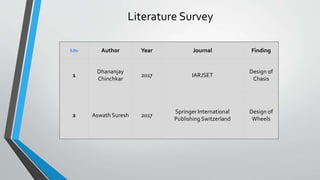
Literature Survey
S.No. Author Year Journal Finding
1
Dhananjay
Chinchkar
2017 IARJSET
Design of
Chasis
2 Aswath Suresh 2017
Springer International
Publishing Switzerland
Design of
Wheels
History
• Since 1976, NASA has been exploring the surface of Mars with rovers,
starting with the dual landing ofViking 1 andViking 2 landers.
• In 1997, The Mars Pathfinder (MPF) lander delivered the Sojourner Rover to
the surface successfully.
• In early 2004, NASA again landed two more rovers on Mars, Spirit and
Opportunity.
• Most Recently in 2011, NASA has launched the Mars Science Laboratory
(MSL) with a rover named Curiosity.
METHODOLOGY
A stepwise description of the methodology adopted by us is summarized as given below:
Step 1: A literature survey of the existing stairs climbing & Security Patrolling bot based on
digital methods and collect the features that are needed in the project.
Step 2: Study the mechanism and define the target.
Step 3: Measure in detail various aspects of the current process.
Step 4: Prepare the general layout of configuration.
Step 5: Find out general parameters with their values.
Step 6: Determine failure modes of bot.
METHODOLOGY
Step 7: Prepare the Physical Mode of bot for representation.
Step 8: Integrating the sound sensor with the microcontroller to enable the pin locking.
Step 9: Integrating the ultrasonic sensor with the microcontroller.
Step 10: Finally integrating the camera with the microcontroller to provide it with remote
location monitoring.
Step 11: Developing an application to give instructions to the system through network
from remote location.
Step 12: Equipping security alert system from CCR to Security control room.
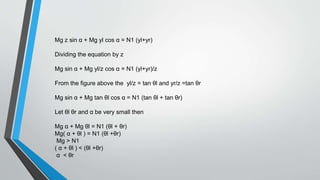
FORCE DIAGRAM
Mg z sin α + Mg yl cos α = N1 (yl+yr)
Dividing the equation by z
Mg sin α + Mg yl/z cos α = N1 (yl+yr)/z
From the figure above the yl/z = tan θl and yr/z =tan θr
Mg sin α + Mg tan θl cos α = N1 (tan θl + tan θr)
Let θl θr and α be very small then
Mg α + Mg θl = N1 (θl + θr)
Mg( α + θl ) = N1 (θl +θr)
Mg > N1
( α + θl ) < (θl +θr)
α < θr
Related Concept &Theories
Traction and Slip
• The rover must maintain good wheel traction in challenging rough terrains.
• If traction is too high, the vehicle consumes a lot of power in order to overcome the force
and move.
• If traction is too low, the rover is not able to climb over obstacles or inclined surfaces.
• Slip occurs when the traction force at a wheel-terrain contact point is larger than the
product of the normal force at the same wheel and the friction coefficient. Hence, no slip
occurs if the condition is satisfied.
T≤ μN
• In reality it is very challenging to determine the precise friction coefficient μ for the
interaction of two surfaces.
Related Concept &Theories
Lateral Stability
• The rover is said to be stable when it is in a quasi-static state in which it does not tilt over.
• The lateral stability of the rover ensures that the rover does not tip sideways. As the rover
has two symmetric sides, the geometric model is used to find the lateral stability of the
vehicle.
• Lateral stability is computed by finding the minimum allowed angle on the slope before
the rover tips over.
Related Concept &Theories
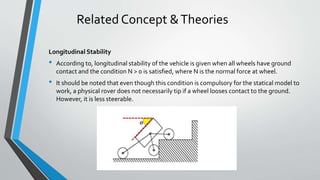
Longitudinal Stability
• According to, longitudinal stability of the vehicle is given when all wheels have ground
contact and the condition N > 0 is satisfied, where N is the normal force at wheel.
• It should be noted that even though this condition is compulsory for the statical model to
work, a physical rover does not necessarily tip if a wheel looses contact to the ground.
However, it is less steerable.
Calculations
Application of IoT in Project
(Security Patrolling)
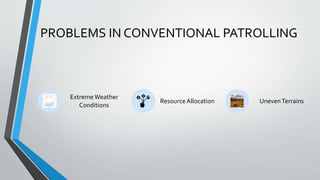
PROBLEMS IN CONVENTIONAL PATROLLING
ExtremeWeather
Conditions
ResourceAllocation UnevenTerrains
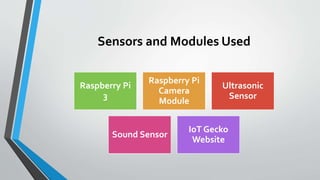
Sensors and Modules Used
Raspberry Pi
3
Raspberry Pi
Camera
Module
Ultrasonic
Sensor
Sound Sensor
IoT Gecko
Website
BLOCK
DIAGRAM
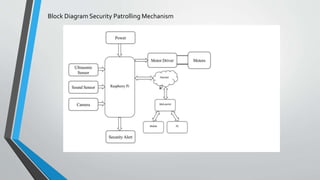
Block Diagram Security Patrolling Mechanism
FLOW
DIAGRAM
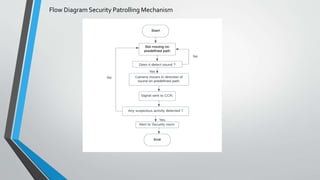
Flow Diagram Security Patrolling Mechanism
PROJECT
APPLICATIONS
• Women Security
• Automated Police Patrolling
• Industry Applications
• College Campus
• Wheel Chair
Timeline
• Sep 22 - Decided ProjectTopic
• Oct 22 - Designing of Bot
• Nov 22 -To complete the designs & finish Structural Part
• Dec 22 -To finish the Structural Part & start working onAutomation
• Jan 22 - To Complete the Bot
• Feb 22 -Testing & Rectification of Error
• Mar 22 -To work on thesis
• Apr 22 – Complete thesis & final Presentation
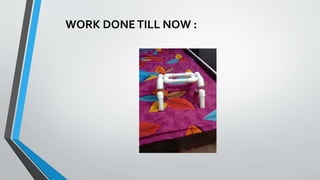
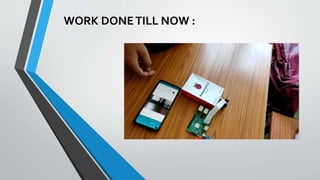
WORK DONETILL NOW :
WORK DONETILL NOW :
THANKYOU

Shreya.pptx

  • 1.
    FinalYear Project Presentation on DESIGNOF STAIRS CLIMBING BOT BASESD ON ROCKER BOGIE MECHANISM & IoT Rajkiya Engineering College Banda Mechanical Engineering Department
  • 2.
    FLOW OF PRESENTATION Title Page StairClimbing Bot Introduction Need and Motivation for Project Literature Survey History Methodology Related Concept &Theories Traction and Slip Lateral Stability Longitudinal Stability Applications of IoT Problems in conventional Patrolling Sensors and Modules used Block Diagram Flow Diagram Project Application Timeline
  • 3.
    PRESENTED BY Shreya Srivastava 1907340400058 UNDERTHEGUIDANCE OF Mr. SaurabhTripathi Mr. Abhijeet Singh (HOD, M.E.) (Assistant Professor)
  • 4.
    Introduction • NASA presentlyprefers the rocker-bogie suspension system for rover wheel suspension because it was initially employed on the Mars Rover. • The vehicle can navigate over extremely uneven or difficult terrain and even climb over obstacles thanks to the cleverly engineered wheel suspension. • The current rocker-bogie rovers have one major issue, that they are slow. • These robots are mostly utilised for risky and impossible-for-humans tasks.
  • 5.
    Need and Motivationfor the selection of Project • This can be used in Smart Security Patrolling Mechanism, that we are doing in our Project. • The rocker-bogie suspension system can also be made into a wheelchair so that patients can be transported from one location to another while climbing stairs on their own. • It can also be used for material delivery purposes.This is a wide field of study and is very less explored.
  • 6.
    Literature Survey S.No. AuthorYear Journal Finding 1 Dhananjay Chinchkar 2017 IARJSET Design of Chasis 2 Aswath Suresh 2017 Springer International Publishing Switzerland Design of Wheels
  • 7.
    History • Since 1976,NASA has been exploring the surface of Mars with rovers, starting with the dual landing ofViking 1 andViking 2 landers. • In 1997, The Mars Pathfinder (MPF) lander delivered the Sojourner Rover to the surface successfully. • In early 2004, NASA again landed two more rovers on Mars, Spirit and Opportunity. • Most Recently in 2011, NASA has launched the Mars Science Laboratory (MSL) with a rover named Curiosity.
  • 8.
    METHODOLOGY A stepwise descriptionof the methodology adopted by us is summarized as given below: Step 1: A literature survey of the existing stairs climbing & Security Patrolling bot based on digital methods and collect the features that are needed in the project. Step 2: Study the mechanism and define the target. Step 3: Measure in detail various aspects of the current process. Step 4: Prepare the general layout of configuration. Step 5: Find out general parameters with their values. Step 6: Determine failure modes of bot.
  • 9.
    METHODOLOGY Step 7: Preparethe Physical Mode of bot for representation. Step 8: Integrating the sound sensor with the microcontroller to enable the pin locking. Step 9: Integrating the ultrasonic sensor with the microcontroller. Step 10: Finally integrating the camera with the microcontroller to provide it with remote location monitoring. Step 11: Developing an application to give instructions to the system through network from remote location. Step 12: Equipping security alert system from CCR to Security control room.
  • 10.
  • 11.
    Mg z sinα + Mg yl cos α = N1 (yl+yr) Dividing the equation by z Mg sin α + Mg yl/z cos α = N1 (yl+yr)/z From the figure above the yl/z = tan θl and yr/z =tan θr Mg sin α + Mg tan θl cos α = N1 (tan θl + tan θr) Let θl θr and α be very small then Mg α + Mg θl = N1 (θl + θr) Mg( α + θl ) = N1 (θl +θr) Mg > N1 ( α + θl ) < (θl +θr) α < θr
  • 12.
    Related Concept &Theories Tractionand Slip • The rover must maintain good wheel traction in challenging rough terrains. • If traction is too high, the vehicle consumes a lot of power in order to overcome the force and move. • If traction is too low, the rover is not able to climb over obstacles or inclined surfaces. • Slip occurs when the traction force at a wheel-terrain contact point is larger than the product of the normal force at the same wheel and the friction coefficient. Hence, no slip occurs if the condition is satisfied. T≤ μN • In reality it is very challenging to determine the precise friction coefficient μ for the interaction of two surfaces.
  • 13.
    Related Concept &Theories LateralStability • The rover is said to be stable when it is in a quasi-static state in which it does not tilt over. • The lateral stability of the rover ensures that the rover does not tip sideways. As the rover has two symmetric sides, the geometric model is used to find the lateral stability of the vehicle. • Lateral stability is computed by finding the minimum allowed angle on the slope before the rover tips over.
  • 14.
    Related Concept &Theories LongitudinalStability • According to, longitudinal stability of the vehicle is given when all wheels have ground contact and the condition N > 0 is satisfied, where N is the normal force at wheel. • It should be noted that even though this condition is compulsory for the statical model to work, a physical rover does not necessarily tip if a wheel looses contact to the ground. However, it is less steerable.
  • 15.
  • 17.
    Application of IoTin Project (Security Patrolling)
  • 18.
    PROBLEMS IN CONVENTIONALPATROLLING ExtremeWeather Conditions ResourceAllocation UnevenTerrains
  • 19.
    Sensors and ModulesUsed Raspberry Pi 3 Raspberry Pi Camera Module Ultrasonic Sensor Sound Sensor IoT Gecko Website
  • 20.
  • 21.
    Block Diagram SecurityPatrolling Mechanism
  • 22.
  • 23.
    Flow Diagram SecurityPatrolling Mechanism
  • 24.
    PROJECT APPLICATIONS • Women Security •Automated Police Patrolling • Industry Applications • College Campus • Wheel Chair
  • 25.
    Timeline • Sep 22- Decided ProjectTopic • Oct 22 - Designing of Bot • Nov 22 -To complete the designs & finish Structural Part • Dec 22 -To finish the Structural Part & start working onAutomation • Jan 22 - To Complete the Bot • Feb 22 -Testing & Rectification of Error • Mar 22 -To work on thesis • Apr 22 – Complete thesis & final Presentation
  • 26.
  • 27.
  • 28.