July, 2020
8x56 Binoculars
GENERAL FEATURES
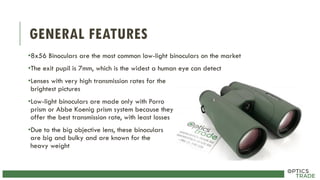
•8x56 Binoculars are the most common low-light binoculars on the market
•The exit pupil is 7mm, which is the widest a human eye can detect
•Lenses with very high transmission rates for the
brightest pictures
•Low-light binoculars are made only with Porro
prism or Abbe Koenig prism system because they
offer the best transmission rate, with least losses
•Due to the big objective lens, these binoculars
are big and bulky and are known for the
heavy weight
MOST COMMON FIELDS OF USE
•Mostly used by hunters
•Popular for raised hide hunting deep into the night
•With high-quality low-light binoculars, animals can be spotted even after they cannot
be detected anymore with naked eyes
•Often such binoculars are also used for astronomy use because of the bright picture
•Due to the heavier weight and bigger construction, users often use these binoculars
fixed on a tripod
8X56 VS 8X42 BINOCULARS
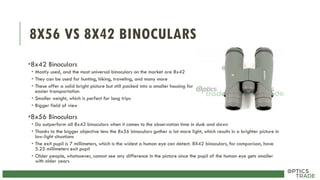
•8x42 Binoculars
• Mostly used, and the most universal binoculars on the market are 8x42
• They can be used for hunting, hiking, traveling, and many more
• These offer a solid bright picture but still packed into a smaller housing for
easier transportation
• Smaller weight, which is perfect for long trips
• Bigger field of view
•8x56 Binoculars
• Do outperform all 8x42 binoculars when it comes to the observation time in dusk and dawn
• Thanks to the bigger objective lens the 8x56 binoculars gather a lot more light, which results in a brighter picture in
low-light situations
• The exit pupil is 7 millimeters, which is the widest a human eye can detect. 8X42 binoculars, for comparison, have
5.25 millimeters exit pupil
• Older people, whatsoever, cannot see any difference in the picture since the pupil of the human eye gets smaller
with older years
8X56 VS 7X50 BINOCULARS
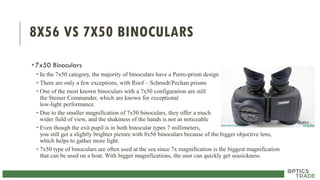
•7x50 Binoculars
• In the 7x50 category, the majority of binoculars have a Porro-prism design
• There are only a few exceptions, with Roof – Schmidt/Pechan prisms
• One of the most known binoculars with a 7x50 configuration are still
the Steiner Commander, which are known for exceptional
low-light performance.
• Due to the smaller magnification of 7x50 binoculars, they offer a much
wider field of view, and the shakiness of the hands is not as noticeable
• Even though the exit pupil is in both binocular types 7 millimeters,
you still get a slightly brighter picture with 8x56 binoculars because of the bigger objective lens,
which helps to gather more light.
• 7x50 type of binoculars are often used at the sea since 7x magnification is the biggest magnification
that can be used on a boat. With bigger magnifications, the user can quickly get seasickness.
ROOF PRISM 8X56 BINOCULARS
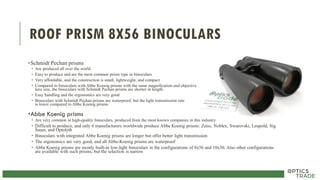
•Schmidt Pechan prisms
• Are produced all over the world
• Easy to produce and are the most common prism type in binoculars
• Very affordable, and the construction is small, lightweight, and compact
• Compared to binoculars with Abbe Koenig prisms with the same magnification and objective
lens size, the binoculars with Schmidt Pechan prisms are shorter in length.
• Easy handling and the ergonomics are very good
• Binoculars with Schmidt Pechan prisms are waterproof, but the light transmission rate
is lower compared to Abbe Koenig prisms
•Abbe Koenig prisms
• Are very common in high-quality binoculars, produced from the most known companies in this industry
• Difficult to produce, and only 6 manufacturers worldwide produce Abbe Koenig prisms: Zeiss, Noblex, Swarovski, Leupold, Sig
Sauer, and Optolyth
• Binoculars with integrated Abbe Koenig prisms are longer but offer better light transmission
• The ergonomics are very good, and all Abbe-Koenig prisms are waterproof
• Abbe Koenig prisms are mostly built-in low-light binoculars in the configurations of 8x56 and 10x56. Also other configurations
are available with such prisms, but the selection is narrow
PORRO PRISM 8X56 BINOCULARS
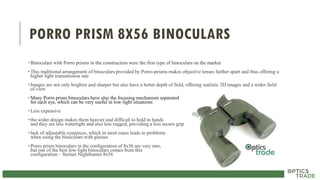
•Binoculars with Porro prisms in the construction were the first type of binoculars on the market
•This traditional arrangement of binoculars provided by Porro-prisms makes objective lenses further apart and thus offering a
higher light transmission rate
•Images are not only brighter and sharper but also have a better depth of field, offering realistic 3D images and a wider field
of view
•Many Porro prism binoculars have also the focusing mechanism separated
for each eye, which can be very useful in low-light situations
•Less expensive
•the wider design makes them heavier and difficult to hold in hands
and they are less watertight and also less rugged, providing a less secure grip
•lack of adjustable eyepieces, which in most cases leads to problems
when using the binoculars with glasses
•Porro prism binoculars in the configuration of 8x56 are very rare,
but one of the best low-light binoculars comes from this
configuration – Steiner Nighthunter 8x56
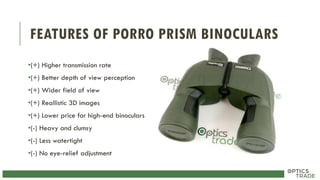
FEATURES OF PORRO PRISM BINOCULARS
•(+) Higher transmission rate
•(+) Better depth of view perception
•(+) Wider field of view
•(+) Reallistic 3D images
•(+) Lower price for high-end binoculars
•(-) Heavy and clumsy
•(-) Less watertight
•(-) No eye-relief adjustment
DIOPTER SETTING SYSTEM ON 8X56
BINOCULARS
•Since the most 8x56 binoculars are made of Schmidt Pechan or Abbe-Koenig prisms, the most common
diopter setting can be found on one of the barrels
•Some exceptions feature the diopter setting on both barrels
•Some that have the diopter setting integrated into the focusing system
•No matter where the diopter setting is located, some binoculars feature a non-locking and some a
locking function for the diopter adjustment wheel
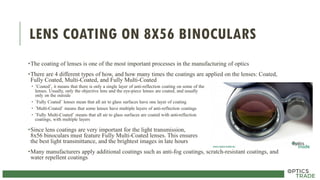
LENS COATING ON 8X56 BINOCULARS
•The coating of lenses is one of the most important processes in the manufacturing of optics
•There are 4 different types of how, and how many times the coatings are applied on the lenses: Coated,
Fully Coated, Multi-Coated, and Fully Multi-Coated
• ˝Coated˝, it means that there is only a single layer of anti-reflection coating on some of the
lenses. Usually, only the objective lens and the eye-piece lenses are coated, and usually
only on the outside
• ˝Fully Coated˝ lenses mean that all air to glass surfaces have one layer of coating
• ˝Multi-Coated˝ means that some lenses have multiple layers of anti-reflection coatings
• ˝Fully Multi-Coated˝ means that all air to glass surfaces are coated with anti-reflection
coatings, with multiple layers
•Since lens coatings are very important for the light transmission,
8x56 binoculars must feature Fully Multi-Coated lenses. This ensures
the best light transmittance, and the brightest images in late hours
•Many manufacturers apply additional coatings such as anti-fog coatings, scratch-resistant coatings, and
water repellent coatings
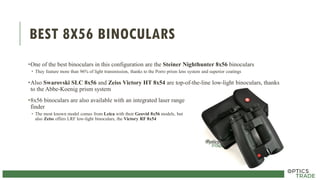
BEST 8X56 BINOCULARS
•One of the best binoculars in this configuration are the Steiner Nighthunter 8x56 binoculars
• They feature more than 96% of light transmission, thanks to the Porro prism lens system and superior coatings
•Also Swarovski SLC 8x56 and Zeiss Victory HT 8x54 are top-of-the-line low-light binoculars, thanks
to the Abbe-Koenig prism system
•8x56 binoculars are also available with an integrated laser range
finder
• The most known model comes from Leica with their Geovid 8x56 models, but
also Zeiss offers LRF low-light binoculars, the Victory RF 8x54
Short Presentation | 8x56 Binoculars | Optics Trade

Short Presentation | 8x56 Binoculars | Optics Trade

  • 1.
  • 2.
    GENERAL FEATURES •8x56 Binocularsare the most common low-light binoculars on the market •The exit pupil is 7mm, which is the widest a human eye can detect •Lenses with very high transmission rates for the brightest pictures •Low-light binoculars are made only with Porro prism or Abbe Koenig prism system because they offer the best transmission rate, with least losses •Due to the big objective lens, these binoculars are big and bulky and are known for the heavy weight
  • 3.
    MOST COMMON FIELDSOF USE •Mostly used by hunters •Popular for raised hide hunting deep into the night •With high-quality low-light binoculars, animals can be spotted even after they cannot be detected anymore with naked eyes •Often such binoculars are also used for astronomy use because of the bright picture •Due to the heavier weight and bigger construction, users often use these binoculars fixed on a tripod
  • 4.
    8X56 VS 8X42BINOCULARS •8x42 Binoculars • Mostly used, and the most universal binoculars on the market are 8x42 • They can be used for hunting, hiking, traveling, and many more • These offer a solid bright picture but still packed into a smaller housing for easier transportation • Smaller weight, which is perfect for long trips • Bigger field of view •8x56 Binoculars • Do outperform all 8x42 binoculars when it comes to the observation time in dusk and dawn • Thanks to the bigger objective lens the 8x56 binoculars gather a lot more light, which results in a brighter picture in low-light situations • The exit pupil is 7 millimeters, which is the widest a human eye can detect. 8X42 binoculars, for comparison, have 5.25 millimeters exit pupil • Older people, whatsoever, cannot see any difference in the picture since the pupil of the human eye gets smaller with older years
  • 5.
    8X56 VS 7X50BINOCULARS •7x50 Binoculars • In the 7x50 category, the majority of binoculars have a Porro-prism design • There are only a few exceptions, with Roof – Schmidt/Pechan prisms • One of the most known binoculars with a 7x50 configuration are still the Steiner Commander, which are known for exceptional low-light performance. • Due to the smaller magnification of 7x50 binoculars, they offer a much wider field of view, and the shakiness of the hands is not as noticeable • Even though the exit pupil is in both binocular types 7 millimeters, you still get a slightly brighter picture with 8x56 binoculars because of the bigger objective lens, which helps to gather more light. • 7x50 type of binoculars are often used at the sea since 7x magnification is the biggest magnification that can be used on a boat. With bigger magnifications, the user can quickly get seasickness.
  • 6.
    ROOF PRISM 8X56BINOCULARS •Schmidt Pechan prisms • Are produced all over the world • Easy to produce and are the most common prism type in binoculars • Very affordable, and the construction is small, lightweight, and compact • Compared to binoculars with Abbe Koenig prisms with the same magnification and objective lens size, the binoculars with Schmidt Pechan prisms are shorter in length. • Easy handling and the ergonomics are very good • Binoculars with Schmidt Pechan prisms are waterproof, but the light transmission rate is lower compared to Abbe Koenig prisms •Abbe Koenig prisms • Are very common in high-quality binoculars, produced from the most known companies in this industry • Difficult to produce, and only 6 manufacturers worldwide produce Abbe Koenig prisms: Zeiss, Noblex, Swarovski, Leupold, Sig Sauer, and Optolyth • Binoculars with integrated Abbe Koenig prisms are longer but offer better light transmission • The ergonomics are very good, and all Abbe-Koenig prisms are waterproof • Abbe Koenig prisms are mostly built-in low-light binoculars in the configurations of 8x56 and 10x56. Also other configurations are available with such prisms, but the selection is narrow
  • 7.
    PORRO PRISM 8X56BINOCULARS •Binoculars with Porro prisms in the construction were the first type of binoculars on the market •This traditional arrangement of binoculars provided by Porro-prisms makes objective lenses further apart and thus offering a higher light transmission rate •Images are not only brighter and sharper but also have a better depth of field, offering realistic 3D images and a wider field of view •Many Porro prism binoculars have also the focusing mechanism separated for each eye, which can be very useful in low-light situations •Less expensive •the wider design makes them heavier and difficult to hold in hands and they are less watertight and also less rugged, providing a less secure grip •lack of adjustable eyepieces, which in most cases leads to problems when using the binoculars with glasses •Porro prism binoculars in the configuration of 8x56 are very rare, but one of the best low-light binoculars comes from this configuration – Steiner Nighthunter 8x56
  • 8.
    FEATURES OF PORROPRISM BINOCULARS •(+) Higher transmission rate •(+) Better depth of view perception •(+) Wider field of view •(+) Reallistic 3D images •(+) Lower price for high-end binoculars •(-) Heavy and clumsy •(-) Less watertight •(-) No eye-relief adjustment
  • 9.
    DIOPTER SETTING SYSTEMON 8X56 BINOCULARS •Since the most 8x56 binoculars are made of Schmidt Pechan or Abbe-Koenig prisms, the most common diopter setting can be found on one of the barrels •Some exceptions feature the diopter setting on both barrels •Some that have the diopter setting integrated into the focusing system •No matter where the diopter setting is located, some binoculars feature a non-locking and some a locking function for the diopter adjustment wheel
  • 10.
    LENS COATING ON8X56 BINOCULARS •The coating of lenses is one of the most important processes in the manufacturing of optics •There are 4 different types of how, and how many times the coatings are applied on the lenses: Coated, Fully Coated, Multi-Coated, and Fully Multi-Coated • ˝Coated˝, it means that there is only a single layer of anti-reflection coating on some of the lenses. Usually, only the objective lens and the eye-piece lenses are coated, and usually only on the outside • ˝Fully Coated˝ lenses mean that all air to glass surfaces have one layer of coating • ˝Multi-Coated˝ means that some lenses have multiple layers of anti-reflection coatings • ˝Fully Multi-Coated˝ means that all air to glass surfaces are coated with anti-reflection coatings, with multiple layers •Since lens coatings are very important for the light transmission, 8x56 binoculars must feature Fully Multi-Coated lenses. This ensures the best light transmittance, and the brightest images in late hours •Many manufacturers apply additional coatings such as anti-fog coatings, scratch-resistant coatings, and water repellent coatings
  • 11.
    BEST 8X56 BINOCULARS •Oneof the best binoculars in this configuration are the Steiner Nighthunter 8x56 binoculars • They feature more than 96% of light transmission, thanks to the Porro prism lens system and superior coatings •Also Swarovski SLC 8x56 and Zeiss Victory HT 8x54 are top-of-the-line low-light binoculars, thanks to the Abbe-Koenig prism system •8x56 binoculars are also available with an integrated laser range finder • The most known model comes from Leica with their Geovid 8x56 models, but also Zeiss offers LRF low-light binoculars, the Victory RF 8x54