₪ Laminated Composites Plate and Shell Structures
₪ Used material: Laminated glass-FRP
₪ Motivation of the present study
₪ Major contributions of this thesis-
► Experimental investigation
► Theoretical investigation
► Parametric study
Chapter I
-: INTRODUCTION :-
6.11.2019
min min
1
max ,
10
h h
R L
 

 
 
1
2
L
R

1
2
L
R

min min
1 1
max ,
20 10
h h
R L
 
 
 
 
Thin shell (Tornabene and Fantuzzi, 2017):
 Moderately thick shell (Tornabene and Fantuzzi, 2017):
 Thick shell condition:
 Shallow shell (Raamachandran, 2013):
 Deep shell:
min min
1
max ,
20
h h
R L
 

 
 
Chapter I
(Contd.)
6.11.2019
Chapter I
(Contd.)
 Application of FRP laminates:
6.11.2019
Review of literature is presented in the following sub heads:
 Free Vibration Analysis of composite plates and shells with and
without cut-outs
 Free vibration analysis of skew composite plates and shells
 Free vibration analysis of skew composite plates and shells with
cut-outs
-: LITERATURE REVIEW :-
Chapter II
6.11.2019
 Free vibration analysis of composite laminates with and without cut-outs:
Reference Type of Laminate Approach Target Response
Olson and
Lindberg
[1971]
Shallow isotropic
shells
Shallow shell theory of
Novozhilo and
Experimental Investigations
Natural frequencies and mode shapes
Jenq et al.
[1993]
GRP cross-ply plates
Shear deformation theory
and Experimental
Investigations
Effects of the size of cut-outs, the
location of defectson the vibration
frequencies
Singh and Kumar
[1996]
Doubly curved
laminated shallow
shells
First order composite
shell theory
Free vibrational characteristics of shells
on quadrangular planforms
Qatu
[1999]
Laminated composite
deep/thick shells
First order shear
deformation theory
Accurate stress resultants
Ganeson and
Kadoli
[2004]
Isotropic
hemispherical shells
First order shear
deformation theory
Thermo-elastic buckling analysis and
free vibration analysis of shells with
cut-out at apex due to uniform
temperature rise
Shi et al.
[2004]
Arbitrarily laminated
plate
Galerkin method Free vibration analysis
Hota and Padhi
[2007]
Plates with cut-outs
First order shear
deformation
Free vibration of plates with arbitrary
shapes of cut-outs
Ulz and
Semercigil [2008]
Plates
ANSYS and Experimental
Investigations
Use of cut-out as a
dynamic vibration absorber
Asadi et al.
[2012]
Thick deep laminated
cylindrical shells
3D and various shear
deformation theories
Static and vibration analysis
Thakur and Ray
[2015]
Deep doubly curved
laminated shell
HSDT
Free vibration analysis
Chapter II
(Contd.)
6.11.2019
Critical Remarks:
Chapter II
(Contd.)
Free vibration analysis of composite plates and shells with and
without cut-outs:
 A good number of numerical investigations on dynamic analysis of
laminated plate and shells have been done using various kind of
approach and formulation to get more accurate result
 Very few studies on laminated composite plates or shells with
multiple cut-outs have been undertaken by the researchers
 A very less amount of experimental work has been conducted on
shells
6.11.2019
Reference Type of Laminate Approach Target Response
Kandasamy
and Singh
[2006]
Isotropic skew open
circular cylindrical
shells
Modified version of the
Rayleigh-Ritz method
Free vibration
analysis
Liew et al.
[2003]
Symmetrically
laminated plates
Moving least squares
differential quadrature
method based on FSDT
Free vibration
analysis
Vimal et al.
[2014]
Moderately thick
functionally graded
skew plates
FSDT
Free vibration
analysis
Park et al.
[2008]
Skew sandwich plates
with laminated
composite faces
HSDT
Dynamic
response
Kumar et al.
[2013]
Laminated composite
skew hypar shells
HSDT
Free vibration
analysis
Dey et al.
[2016]
Composite plates HSDT
Free vibration
analysis
 Free vibration analysis of skew composite plates and shells:
Chapter II
(Contd.)
6.11.2019
 Numerical analysis of laminated skew laminates is limited
 Cylindrical shell was considered for the numerical analysis of
laminated skew shells by majority of the researchers
 Experimental studies on skew composite plates and shells are quite a
few
Chapter II
(Contd.) Critical Remarks:
Free vibration analysis of skew composite plates and shells:
6.11.2019
Reference Type of Laminate Approach Target response
Lee
[2010]
Plate HSDT
Dynamic stability
analysis
Murthy et al.
[2013]
Skew plate with
circular cut-out
ANSYS
Free vibration
analysis
Chapter II
(Contd.)  Free vibration analysis of skew composite plates and shells
with cut-out:
6.11.2019
 A very few research works on the skew laminates with cut-out are
reported so far
 The lack of experimental as well as numerical study on laminated
skew plates with cut-out is also prominent
 Experimental dynamic analysis on laminated skew shell with cut-out
is not reported so far
Chapter II
(Contd.)
Critical Remarks:
Free vibration analysis of skew composite plates and shells
with cut-out:
6.11.2019
 The increasing demand of practical applications necessitates the detailed
analysis of laminated structures to achieve enhanced strength and
improved performance of laminated structures
 To figure out the influence of the physical features like shape, size,
position and number of cut-outs present in regular or skew plates and
shells
 Experimental investigation especially on skew shells with cut-out has
remained unexplored
 Fill the remarkable gap between requirement and very few existing
response experimental output data
 Carried out experiments and a numerical analysis with a simplified but
efficient finite element based model to obtain a realistic dynamic
characteristics of regular and skew laminated structures
Chapter II
(Contd.) Research Goal:
6.11.2019
Assumptions:
 Middle surface of the shell is considered as reference plane
 Effect of shear deformation is incorporated following the
Mindlin’s hypothesis
 The shallow shell theory is used in the present formulation
Chapter III
-: FINITE ELEMENT FORMULATION :-
1 2 3
4
5
6
7
8 9
Fig. 3.1: Plan view of nine
nodded element
9 9
1 1
r r r r
r r
x N x and y N y
 
 
 
where,
Xr , Yr = co-ordinates of the r-th nodal point
Nr = Lagrangian interpolation function
[1]
6.11.2019
Fig. 3.2: Deformation of shell panel in xz - plane
Chapter III
(Contd.) Effect of shear deformation:
x
x
y
y
w
x
w
y





 

 
  
 

   

   


 
 
øx & øy = Average shear rotation
over the entire plate or
shell thickness
θx & θy = Total rotations in bending
[2]
6.11.2019
9 9 9
1 1 1
9 9
1 1
, , ,
r r r r r r
r r r
x r r y r y
r r
u N u v N v w N w
N and N
   
  
 
  
 
  
 
[3]
[4]
[5]
Chapter III
(Contd.) The displacement fields at a point within the element:
The stress resultant-strain relationship:
{F} = [D] {ε}
where,
{F}T = [ Nx N y Nxy Mx My Mxy Qx Qy]
6.11.2019
X
Y
Z Nx
Ny
Nxy
Nyx
Fig. 3.3: In plane membrane normal stresses (Nx, Ny) and
In plane shear stress (Nxy, Nyx)
Chapter III
(Contd.)
6.11.2019
Fig. 3.4: Different forces acting on a rectangular plate during bending
Chapter III
(Contd.)
6.11.2019
 
























































y
x
y
x
y
x
x
y
w
x
w
x
y
y
x
x
v
y
u
R
w
y
v
R
w
x
u
y







/
/
/
/
/
/
/
/
/
/
/
/
and
and,
[6]
[7]
11 12 16 11 12 16
21 22 26 21 22 26
61 62 66 61 62 66
11 12 16 11 12 16
21 22 26 21 22 26
61 62 66 61 62 66
55 54
45 44
0 0
0 0
0 0
0 0
0 0
0 0
0 0 0 0 0 0
0 0 0 0 0 0
A A A B B B
A A A B B B
A A A B B B
B B B D D D
D
B B B D D D
B B B D D D
A A
A A
 
 
 
 
 
 
   

 
   
 
 
 
 
 
 
Chapter III
(Contd.)
6.11.2019
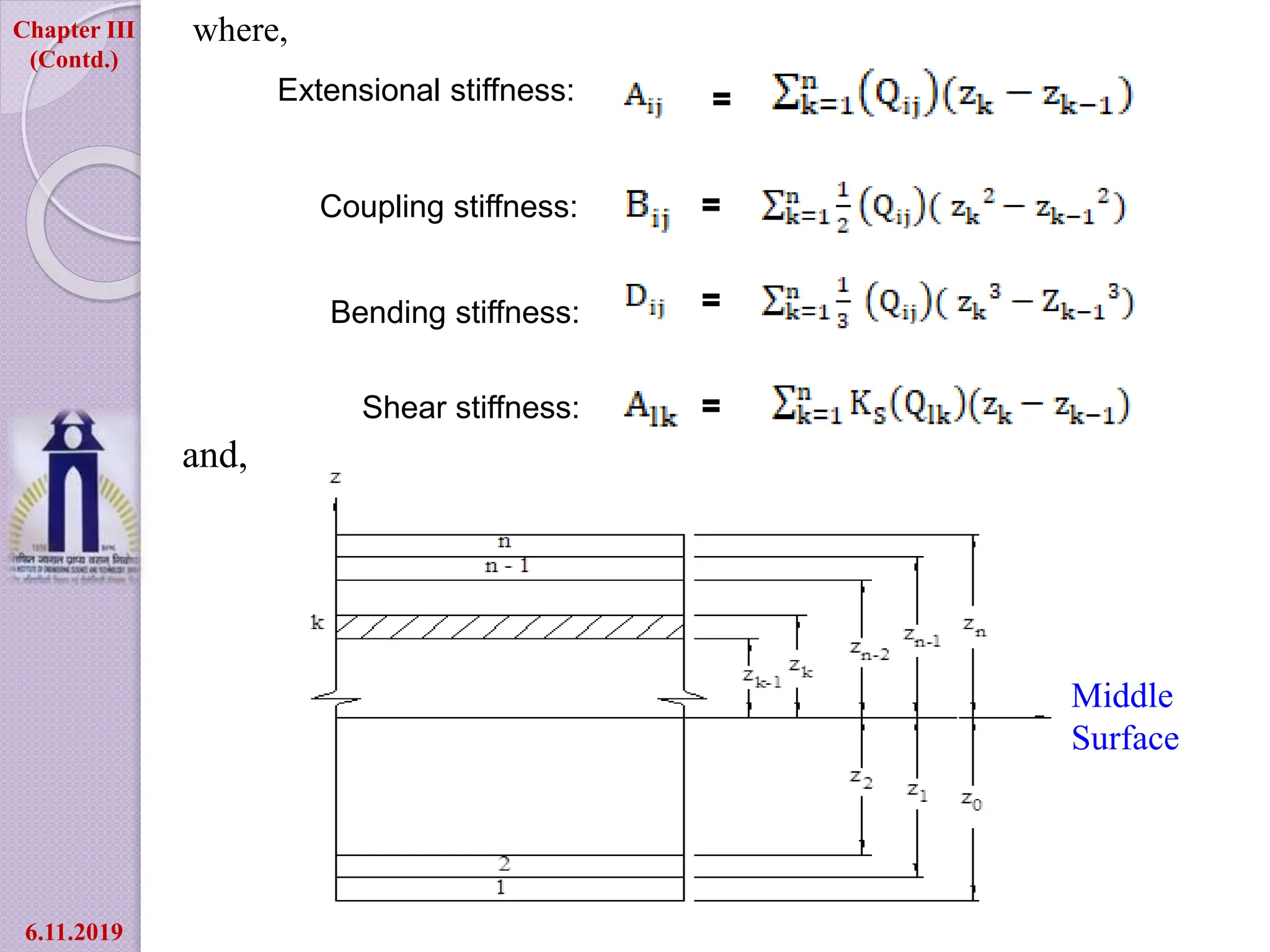
where,
Middle
Surface
and,
Chapter III
(Contd.)
=
=
=
=
Extensional stiffness:
Coupling stiffness:
Bending stiffness:
Shear stiffness:
6.11.2019
or, in short
 
























































































 

yr
xr
r
r
r
r
r
r
r
r
r
r
r
r
r
r
Y
r
x
r
w
v
u
N
y
N
N
x
N
x
N
y
N
y
N
x
N
x
N
y
N
R
y
N
R
x
N



9
1
0
0
0
0
0
0
0
0
0
0
0
0
0
0
0
0
0
0
0
0
0
0
1
0
0
0
1
0
     



9
1
r
e
r
r
B 

    

 B

[9]
[10]
[8]
Chapter III
(Contd.)
6.11.2019
Mass matrix:
      
1 1
1 1
T
e
K B D B J d d
 
 
 
  
The elemental stiffness matrix:
[12]
[11]
MLWORI (mass lumping without rotary inertia)-
(i=1,2,3,6,7,8,11,12,13,16,17,18,21,22,23,
26,27,28,31,32,33,36,37,38,41,42,43)
=
MLWRI (mass lumping with rotary inertia)-
(i=1,2,3,6,7,8,11,12,13,16,17,18,21,
22,23,26,27,28,31,32,33,36,37,38,41,42,43)
=
(i=4,9,14,19,24,29,34,39,44)
=
( i=5,10,15,20,25,30,35,40,45)
=
Chapter III
(Contd.)
[M] = ρh ∫∫ [N]T [N] dx dy
[13]
[14]
[15]
[16]
6.11.2019
The stiffness matrix and mass matrix having an order of 45×45 are
evaluated for all the elements and they are assembled together to
form the overall stiffness matrix [K0] and mass matrix [M0]. Once
[K0] and [M0] are obtained. The equation of motion may be
expressed as-
[K0]{δ} = 2[M0] {δ}
After incorporating the boundary conditions in the above equation it
has been solved to get frequency  for first four modes.
[17]
Chapter III
(Contd.)
6.11.2019

shear deformation theory of shell structure.pptx

  • 1.
    ₪ Laminated CompositesPlate and Shell Structures ₪ Used material: Laminated glass-FRP ₪ Motivation of the present study ₪ Major contributions of this thesis- ► Experimental investigation ► Theoretical investigation ► Parametric study Chapter I -: INTRODUCTION :- 6.11.2019
  • 2.
    min min 1 max , 10 hh R L        1 2 L R  1 2 L R  min min 1 1 max , 20 10 h h R L         Thin shell (Tornabene and Fantuzzi, 2017):  Moderately thick shell (Tornabene and Fantuzzi, 2017):  Thick shell condition:  Shallow shell (Raamachandran, 2013):  Deep shell: min min 1 max , 20 h h R L        Chapter I (Contd.) 6.11.2019
  • 3.
    Chapter I (Contd.)  Applicationof FRP laminates: 6.11.2019
  • 4.
    Review of literatureis presented in the following sub heads:  Free Vibration Analysis of composite plates and shells with and without cut-outs  Free vibration analysis of skew composite plates and shells  Free vibration analysis of skew composite plates and shells with cut-outs -: LITERATURE REVIEW :- Chapter II 6.11.2019
  • 5.
     Free vibrationanalysis of composite laminates with and without cut-outs: Reference Type of Laminate Approach Target Response Olson and Lindberg [1971] Shallow isotropic shells Shallow shell theory of Novozhilo and Experimental Investigations Natural frequencies and mode shapes Jenq et al. [1993] GRP cross-ply plates Shear deformation theory and Experimental Investigations Effects of the size of cut-outs, the location of defectson the vibration frequencies Singh and Kumar [1996] Doubly curved laminated shallow shells First order composite shell theory Free vibrational characteristics of shells on quadrangular planforms Qatu [1999] Laminated composite deep/thick shells First order shear deformation theory Accurate stress resultants Ganeson and Kadoli [2004] Isotropic hemispherical shells First order shear deformation theory Thermo-elastic buckling analysis and free vibration analysis of shells with cut-out at apex due to uniform temperature rise Shi et al. [2004] Arbitrarily laminated plate Galerkin method Free vibration analysis Hota and Padhi [2007] Plates with cut-outs First order shear deformation Free vibration of plates with arbitrary shapes of cut-outs Ulz and Semercigil [2008] Plates ANSYS and Experimental Investigations Use of cut-out as a dynamic vibration absorber Asadi et al. [2012] Thick deep laminated cylindrical shells 3D and various shear deformation theories Static and vibration analysis Thakur and Ray [2015] Deep doubly curved laminated shell HSDT Free vibration analysis Chapter II (Contd.) 6.11.2019
  • 6.
    Critical Remarks: Chapter II (Contd.) Freevibration analysis of composite plates and shells with and without cut-outs:  A good number of numerical investigations on dynamic analysis of laminated plate and shells have been done using various kind of approach and formulation to get more accurate result  Very few studies on laminated composite plates or shells with multiple cut-outs have been undertaken by the researchers  A very less amount of experimental work has been conducted on shells 6.11.2019
  • 7.
    Reference Type ofLaminate Approach Target Response Kandasamy and Singh [2006] Isotropic skew open circular cylindrical shells Modified version of the Rayleigh-Ritz method Free vibration analysis Liew et al. [2003] Symmetrically laminated plates Moving least squares differential quadrature method based on FSDT Free vibration analysis Vimal et al. [2014] Moderately thick functionally graded skew plates FSDT Free vibration analysis Park et al. [2008] Skew sandwich plates with laminated composite faces HSDT Dynamic response Kumar et al. [2013] Laminated composite skew hypar shells HSDT Free vibration analysis Dey et al. [2016] Composite plates HSDT Free vibration analysis  Free vibration analysis of skew composite plates and shells: Chapter II (Contd.) 6.11.2019
  • 8.
     Numerical analysisof laminated skew laminates is limited  Cylindrical shell was considered for the numerical analysis of laminated skew shells by majority of the researchers  Experimental studies on skew composite plates and shells are quite a few Chapter II (Contd.) Critical Remarks: Free vibration analysis of skew composite plates and shells: 6.11.2019
  • 9.
    Reference Type ofLaminate Approach Target response Lee [2010] Plate HSDT Dynamic stability analysis Murthy et al. [2013] Skew plate with circular cut-out ANSYS Free vibration analysis Chapter II (Contd.)  Free vibration analysis of skew composite plates and shells with cut-out: 6.11.2019
  • 10.
     A veryfew research works on the skew laminates with cut-out are reported so far  The lack of experimental as well as numerical study on laminated skew plates with cut-out is also prominent  Experimental dynamic analysis on laminated skew shell with cut-out is not reported so far Chapter II (Contd.) Critical Remarks: Free vibration analysis of skew composite plates and shells with cut-out: 6.11.2019
  • 11.
     The increasingdemand of practical applications necessitates the detailed analysis of laminated structures to achieve enhanced strength and improved performance of laminated structures  To figure out the influence of the physical features like shape, size, position and number of cut-outs present in regular or skew plates and shells  Experimental investigation especially on skew shells with cut-out has remained unexplored  Fill the remarkable gap between requirement and very few existing response experimental output data  Carried out experiments and a numerical analysis with a simplified but efficient finite element based model to obtain a realistic dynamic characteristics of regular and skew laminated structures Chapter II (Contd.) Research Goal: 6.11.2019
  • 12.
    Assumptions:  Middle surfaceof the shell is considered as reference plane  Effect of shear deformation is incorporated following the Mindlin’s hypothesis  The shallow shell theory is used in the present formulation Chapter III -: FINITE ELEMENT FORMULATION :- 1 2 3 4 5 6 7 8 9 Fig. 3.1: Plan view of nine nodded element 9 9 1 1 r r r r r r x N x and y N y       where, Xr , Yr = co-ordinates of the r-th nodal point Nr = Lagrangian interpolation function [1] 6.11.2019
  • 13.
    Fig. 3.2: Deformationof shell panel in xz - plane Chapter III (Contd.) Effect of shear deformation: x x y y w x w y                                øx & øy = Average shear rotation over the entire plate or shell thickness θx & θy = Total rotations in bending [2] 6.11.2019
  • 14.
    9 9 9 11 1 9 9 1 1 , , , r r r r r r r r r x r r y r y r r u N u v N v w N w N and N                    [3] [4] [5] Chapter III (Contd.) The displacement fields at a point within the element: The stress resultant-strain relationship: {F} = [D] {ε} where, {F}T = [ Nx N y Nxy Mx My Mxy Qx Qy] 6.11.2019
  • 15.
    X Y Z Nx Ny Nxy Nyx Fig. 3.3:In plane membrane normal stresses (Nx, Ny) and In plane shear stress (Nxy, Nyx) Chapter III (Contd.) 6.11.2019
  • 16.
    Fig. 3.4: Differentforces acting on a rectangular plate during bending Chapter III (Contd.) 6.11.2019
  • 17.
                                                              y x y x y x x y w x w x y y x x v y u R w y v R w x u y        / / / / / / / / / / / / and and, [6] [7] 11 1216 11 12 16 21 22 26 21 22 26 61 62 66 61 62 66 11 12 16 11 12 16 21 22 26 21 22 26 61 62 66 61 62 66 55 54 45 44 0 0 0 0 0 0 0 0 0 0 0 0 0 0 0 0 0 0 0 0 0 0 0 0 A A A B B B A A A B B B A A A B B B B B B D D D D B B B D D D B B B D D D A A A A                                    Chapter III (Contd.) 6.11.2019
  • 18.
  • 19.
    or, in short                                                                                             yr xr r r r r r r r r r r r r r r Y r x r w v u N y N N x N x N y N y N x N x N y N R y N R x N    9 1 0 0 0 0 0 0 0 0 0 0 0 0 0 0 0 0 0 0 0 0 0 0 1 0 0 0 1 0          9 1 r e r r B          B  [9] [10] [8] Chapter III (Contd.) 6.11.2019
  • 20.
    Mass matrix:       1 1 1 1 T e K B D B J d d          The elemental stiffness matrix: [12] [11] MLWORI (mass lumping without rotary inertia)- (i=1,2,3,6,7,8,11,12,13,16,17,18,21,22,23, 26,27,28,31,32,33,36,37,38,41,42,43) = MLWRI (mass lumping with rotary inertia)- (i=1,2,3,6,7,8,11,12,13,16,17,18,21, 22,23,26,27,28,31,32,33,36,37,38,41,42,43) = (i=4,9,14,19,24,29,34,39,44) = ( i=5,10,15,20,25,30,35,40,45) = Chapter III (Contd.) [M] = ρh ∫∫ [N]T [N] dx dy [13] [14] [15] [16] 6.11.2019
  • 21.
    The stiffness matrixand mass matrix having an order of 45×45 are evaluated for all the elements and they are assembled together to form the overall stiffness matrix [K0] and mass matrix [M0]. Once [K0] and [M0] are obtained. The equation of motion may be expressed as- [K0]{δ} = 2[M0] {δ} After incorporating the boundary conditions in the above equation it has been solved to get frequency  for first four modes. [17] Chapter III (Contd.) 6.11.2019