Research Data Policies in
the FAIRsharing registry:
How, Why and Who?
Joy Davidson, Digital Curation Centre
Allyson Lister, FAIRsharing Content &
Community Lead
FAIR-IMPACT - GA 101057344
Beth Knazook, Project Manager, Research Data
Agenda
12:00-12:30
• Why share research data policies?
• What is FAIRsharing and how to do you use it?
• Who can get involved (& why)?
12:30-13:00
• Hands-on exercise to register or curate a policy record in FAIRsharing
13:00-13:30
• Wrap up and comments/questions
Transparency / Machine-actionability / Comparability / Persistence
Why register your policies?
Benefits to policy sharing
● Researchers are better able to discover and understand institutional, funder
or journal policies
● Policymakers can more easily see how to keep policies up-to-date, and
demonstrate responsiveness to the needs of research communities
● Librarians, data stewards and trainers have an easy place to turn for
resources informing proper adherence to policies
● Policies receive a DOI to improve discoverability
● The metadata describing the policies aligns with the FAIR Principles, and is
used in a number of FAIR evaluation and assessment tools
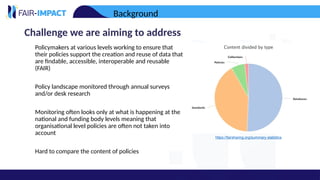
Challenge we are aiming to address
• Policymakers at various levels working to ensure that
their policies support the creation and reuse of data that
are findable, accessible, interoperable and reusable
(FAIR)
• Policy landscape monitored through annual surveys
and/or desk research
• Monitoring often looks only at what is happening at the
national and funding body levels meaning that
organisational level policies are often not taken into
account
• Hard to compare the content of policies
Background
https://fairsharing.org/summary-statistics
FAIR-IMPACT Support Action:
Improve the availability and machine readability of data policies with
FAIRsharing
• Juan Andrés Tutasi Guerrero, Consortium of universities of Catalonia (CSUC)
• Lizette Guzman-Ramirez, Technical University of Eindhoven
• Beth Knazook, Digital Repository of Ireland
• Clara Boavida, Iscte - University Institute of Lisbon
• Anna Wałek, ACC CYFRONET AGH
• Chokri Ben Romdhane, CNUDST
• Matthias Löbe, Institute for Medical Informatics, Statistics and Epidemiology
(IMISE), University of Leipzig; National Research Data Infrastructure for
Personal Health Data (NFDI4Health); Medical Informatics Initiative (MII)
• Adam Partridge, University of Sheffield, UK / UK Reproducibility Network
Background
Solutions we will be working with
• FAIR-enabling data policy checklist to help policy
makers self-assess whether data policies are FAIR-
enabling and develop a structured approach to
improve comparability by both humans and machines
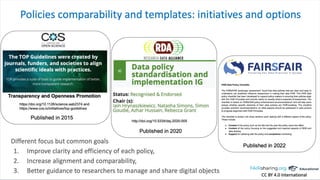
• FAIRsFAIR “FAIR enabling data policy checklist”
https://doi.org/10.5281/zenodo.6225775
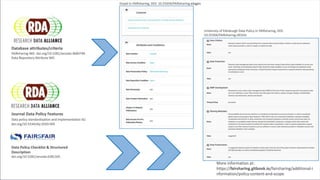
• FAIRsharing Registry website and metadata
(FAIRsharing updated their policy metadata in 2023
to reflect the checklist)
Background
What we hope you’ll get out of participation:
• gain a deeper insight into what components should
be covered in FAIR-enabling data policies
• current and future benefit of machine actionable
and comparable policy records
• increased visibility of your data policies (enriching
our knowledge of the landscape of Irish research)
Background
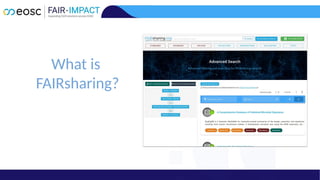
What is
FAIRsharing?
What is a data policy?
A policy can be a document that explains expected behaviours and practices for
employees or members of an organisation.
e.g. Advice to students on how long they will have access to active data storage,
Recommendations for metadata standards in a field of practice, Expectations
by a funder for deposit of research data at the conclusion of a project, etc…
Policies are not Terms of Use/Explanations of Services (but these can be added
to repository records)
Policies do not need to be completed, they might still be in development and
tagged as such
Policies are guidance documents for journals or publishers, ideally which inform
users about expectations for data to support a publication
Activity: Search for data policies
https://assist.fairsharing.
org/
The FAIRsharing Assistant will be
able to use the characteristics of
your policies to inform researchers’
choices of standards and
databases.
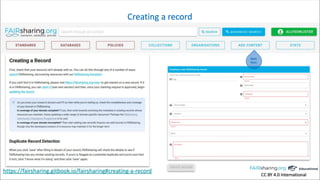
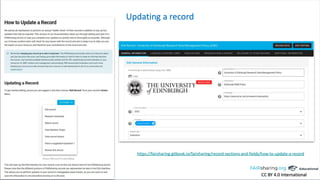
Sign-in to FAIRsharing / Start a new record / Claim an existing record
You’ll need to have on hand: a resource that describes an organisation or project’s
data policies
How to register your policies
Policy makers / Data stewards / Researchers / Helpful community curators!
Who should register policies?
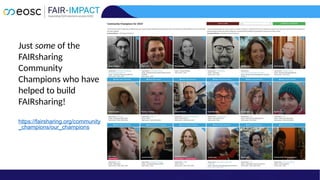
Just some of the
FAIRsharing
Community
Champions who have
helped to build
FAIRsharing!
https://fairsharing.org/community
_champions/our_champions
Q&A
Questions that have come up….
What is the start date of the policy? When did the document come into
effect, not the service or organisation it describes.
Is an EDI policy appropriate to share? It’s a little outside the scope of
FAIRsharing in that those policies typically don’t relate directly to research
data.
What happens if you leave an organisation? Do you cease to have access to
the policies you maintain? No, your organisation will need to designate a new
person to claim the policies or you will need to select ‘no longer maintaining.’
Can multiple people maintain a record? Yes, FAIRsharing allows multiple
maintainers.

Sharing research data policies with FAIRsharing.pptx

  • 1.
    Research Data Policiesin the FAIRsharing registry: How, Why and Who? Joy Davidson, Digital Curation Centre Allyson Lister, FAIRsharing Content & Community Lead FAIR-IMPACT - GA 101057344 Beth Knazook, Project Manager, Research Data
  • 2.
    Agenda 12:00-12:30 • Why shareresearch data policies? • What is FAIRsharing and how to do you use it? • Who can get involved (& why)? 12:30-13:00 • Hands-on exercise to register or curate a policy record in FAIRsharing 13:00-13:30 • Wrap up and comments/questions
  • 3.
    Transparency / Machine-actionability/ Comparability / Persistence Why register your policies?
  • 4.
    Benefits to policysharing ● Researchers are better able to discover and understand institutional, funder or journal policies ● Policymakers can more easily see how to keep policies up-to-date, and demonstrate responsiveness to the needs of research communities ● Librarians, data stewards and trainers have an easy place to turn for resources informing proper adherence to policies ● Policies receive a DOI to improve discoverability ● The metadata describing the policies aligns with the FAIR Principles, and is used in a number of FAIR evaluation and assessment tools
  • 5.
    Challenge we areaiming to address • Policymakers at various levels working to ensure that their policies support the creation and reuse of data that are findable, accessible, interoperable and reusable (FAIR) • Policy landscape monitored through annual surveys and/or desk research • Monitoring often looks only at what is happening at the national and funding body levels meaning that organisational level policies are often not taken into account • Hard to compare the content of policies Background https://fairsharing.org/summary-statistics
  • 6.
    FAIR-IMPACT Support Action: Improvethe availability and machine readability of data policies with FAIRsharing • Juan Andrés Tutasi Guerrero, Consortium of universities of Catalonia (CSUC) • Lizette Guzman-Ramirez, Technical University of Eindhoven • Beth Knazook, Digital Repository of Ireland • Clara Boavida, Iscte - University Institute of Lisbon • Anna Wałek, ACC CYFRONET AGH • Chokri Ben Romdhane, CNUDST • Matthias Löbe, Institute for Medical Informatics, Statistics and Epidemiology (IMISE), University of Leipzig; National Research Data Infrastructure for Personal Health Data (NFDI4Health); Medical Informatics Initiative (MII) • Adam Partridge, University of Sheffield, UK / UK Reproducibility Network Background
  • 7.
    Solutions we willbe working with • FAIR-enabling data policy checklist to help policy makers self-assess whether data policies are FAIR- enabling and develop a structured approach to improve comparability by both humans and machines • FAIRsFAIR “FAIR enabling data policy checklist” https://doi.org/10.5281/zenodo.6225775 • FAIRsharing Registry website and metadata (FAIRsharing updated their policy metadata in 2023 to reflect the checklist) Background
  • 8.
    What we hopeyou’ll get out of participation: • gain a deeper insight into what components should be covered in FAIR-enabling data policies • current and future benefit of machine actionable and comparable policy records • increased visibility of your data policies (enriching our knowledge of the landscape of Irish research) Background
  • 9.
  • 12.
    What is adata policy? A policy can be a document that explains expected behaviours and practices for employees or members of an organisation. e.g. Advice to students on how long they will have access to active data storage, Recommendations for metadata standards in a field of practice, Expectations by a funder for deposit of research data at the conclusion of a project, etc… Policies are not Terms of Use/Explanations of Services (but these can be added to repository records) Policies do not need to be completed, they might still be in development and tagged as such Policies are guidance documents for journals or publishers, ideally which inform users about expectations for data to support a publication
  • 13.
    Activity: Search fordata policies https://assist.fairsharing. org/ The FAIRsharing Assistant will be able to use the characteristics of your policies to inform researchers’ choices of standards and databases.
  • 15.
    Sign-in to FAIRsharing/ Start a new record / Claim an existing record You’ll need to have on hand: a resource that describes an organisation or project’s data policies How to register your policies
  • 19.
    Policy makers /Data stewards / Researchers / Helpful community curators! Who should register policies?
  • 20.
    Just some ofthe FAIRsharing Community Champions who have helped to build FAIRsharing! https://fairsharing.org/community _champions/our_champions
  • 21.
  • 22.
    Questions that havecome up…. What is the start date of the policy? When did the document come into effect, not the service or organisation it describes. Is an EDI policy appropriate to share? It’s a little outside the scope of FAIRsharing in that those policies typically don’t relate directly to research data. What happens if you leave an organisation? Do you cease to have access to the policies you maintain? No, your organisation will need to designate a new person to claim the policies or you will need to select ‘no longer maintaining.’ Can multiple people maintain a record? Yes, FAIRsharing allows multiple maintainers.

Editor's Notes

  • #3 Support action 2: Improve the availability and machine readability of data policies with FAIRsharing
  • #5 Benefits to a wide variety of stakeholder groups, who are the ones you wrote the policies for in the first place. It just makes sense to make them as accessible as possible to these audiences. So why isn’t your organisational website good enough for that purpose? your website might be hard to navigate or use dynamically generated links that can easily change the location of resources stored on the web your website doesn’t support feedback, or remind you to check what version of the policy was last uploaded no one outside your organisation knows you have a policy and people don’t stumble across it when the google
  • #6 The way we share policies, just like the way we share data, has an impact on the usefulness and comparability of those policies. The FAIR data principles were developed not just as an advocacy tool for data sharing, but to guide researchers how to share effectively. The FAIR-IMPACT project proposes that similar guidance around policy sharing needs FAIR-enabling infrastructure to improve the policy sharing landscape, and that means doing all the things we would normally do with data: assign a DOI, use standardised metadata, and provide the policy in a machine-readable format. We also know that there has been a significant ramp-up in the production of data policies in recent years that is not easy to capture at the organisational or even project level. To be able to compare and assess the maturity level of these policies against some FAIR benchmark, we need clear guidance on what makes a policy FAIR or a lot of easy-to-find examples.
  • #7 DRI is one of a handful of organisations working to register policies across Europe, ideally greatly increasing the scope of what is currently available in FAIRsharing. https://dri.ie/news/dri-fair-impact-grant-policies/
  • #8 https://doi.org/10.5281/zenodo.6225775
  • #11 FAIRsharing metadata is informed by a number of international standards and best practices, as mentioned the FAIRsFAIR checklist informs the policy piece but there are other guidelines that underpin the whole conceit of the website.
  • #12 Because there are different aspects of FAIR resources that can be described by FAIRsharing, I want to highlight that depending on the service being described, you might choose to use a different type of record. For instance, DRI as it turns out is not really capable of participating in the Policy registry as our policies are pretty much exclusively about the repository and therefore are expressed as part of that record. The higher level policies that govern how DRI employees engage in research come from our institutions, like the Royal Irish Academy.
  • #13 Policies are instruments that you abide by in your day to day work. If you find yourself referring to a document in order to make a decision or advocate for a benefit, it’s probably a policy document.
  • #14 Keep these as examples to refer back to when working on your own data policy record. https://assist.fairsharing.org/
  • #17 https://fairsharing.org/ https://orcid.org/ https://fairsharing.gitbook.io/fairsharing
  • #19 If you have an existing record, but it wasn’t one that was started by you, you can claim the record to edit it. So let’s go through a couple of these things in real time. Give it 20 minutes or so for you to login, create your account and start a new policy record. Whether or not you’re working with a current policy or you want to try with an imaginary policy, try filling in some of the fields. We can do with this cameras off - if you want to take a quick break and grab a coffee, please feel free to do so. I will be here to answer questions. After 20 minutes, I will restart the meeting and I will be looking for feedback on the experience, your confidence level in working with FAIRsharing going forward, and some feedback for the follow-up webinar to help refine this and make it clearer.
  • #20 The people responsible for the creation of the policy documents are in the best position to describe them appropriately - ideally, they understand the nuance of the policy. But not all organisations have full-time policy officers and it could be beneficial for others to help out. A researcher that frequently refers to a policy document drafted by their colleagues in a research project might volunteer to document and ‘maintain’ that policy online. It will be transparent through FAIRsharing who has made updates to policy documents and when those updates were made. The FAIRsharing Community Curators have added a lot of records relevant to organisations in their fields of expertise, in order to expand the value of the FAIRsharing registry.
  • #21 If you’re interested in becoming a community champion, you can read more about the programme at https://fairsharing.gitbook.io/fairsharing/community-champions/thinking-of-joining-us