William Shakespeare Widely regarded as the greatest writer in English Literature
Shakespeare 1563-1616 Stratford-on-Avon, England wrote 37 plays about 154 sonnets started out as an actor
Stage Celebrity Actor  for Lord Chamberlain’s Men (London theater co.) Also > principal  playwright  for them 1599> Lord Ch. Co. built  Globe Theater  where most of Sh. Play’s were performed
Shakespeare wrote: Comedies Histories Tragedies
Romeo and Juliet Written about 1595 Considered a tragedy West Side Story  (Movie) based on R&J
The Theater Plays produced for the general public Roofless>open air No artificial lighting Courtyard surrounded by 3 levels of galleries
Spectators Wealthy got benches “ Groundlings”>poorer people stood and watched from the courtyard (“pit”) All but wealthy were uneducated/illiterate Much more interaction than today
Staging Areas Stage>platform that extended into the pit Dressing & storage rooms in galleries behind & above stage second-level gallery> upper stage> famous balcony scene in R & J Trap door>ghosts “ Heavens”> angelic beings
Differences No scenery Settings > references in dialogue Elaborate costumes Plenty of props Fast-paced, colorful>2 hours!
Actors Only men and boys Young boys whose voices had not changed play women’s roles Would have been considered indecent for a woman to appear on stage
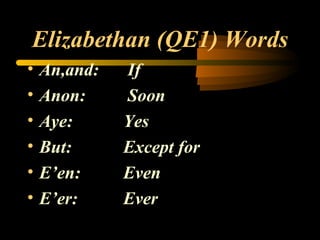
Elizabethan (QE1) Words An,and:  If Anon:  Soon Aye:   Yes But: Except for E’en: Even E’er:  Ever
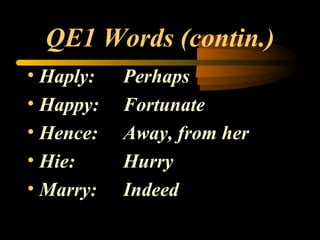
QE1 Words (contin.) Haply: Perhaps Happy: Fortunate Hence: Away, from her Hie: Hurry Marry: Indeed
QE1 Words (contin.) Whence: Where Wilt: Will, will you Withal: In addition to Would: Wish
Blank Verse Much of R & J is written in it: unrhymed verse iambic (unstressed, stressed) pentameter( 5 “feet” to a line) ends up to be 10 syllable lines
Prose Ordinary writing that is not poetry, drama, or song Only characters in the lower social classes speak this way in Shakespeare’s plays Why do you suppose that is?
Plot The sequence of events in a literary work
Exposition The plot usually begins with this: introduces>>>> setting characters basic situation
Inciting Moment Often called “initial incident” the first bit of action that occurs which begins the plot Romeo and Juliet “lock eyes” at the party
Conflict The struggle that develops man vs. man man vs. himself man vs. society man vs. nature
Crisis The point where the protagonist’s situation will either get better or worse protagonist>good guy antagonist>bad guy
Climax The turning point of the story>everything begins to unravel from here  Thus begins the falling action
Resolution The end of the central conflict
Denouement The final explanation or outcome of the plot If this is included in literature, it will occur  after  the resolution.
Tragedy (Shakespearean) Drama where the central character/s suffer disaster/great misfortune In many tragedies, downfall results from> Fate Character flaw/Fatal flaw Combination of the two
Theme Central idea  or >> Insight about life which explain the downfall
Metaphorical Language Comparison of  unlike  things > Paris standing over the “lifeless body” of Juliet, “Sweet flower, with flowers thy bridal bed I strew…” “ Thou detestable maw…”Gorged with the dearest morsel of the earth…” Romeo
Dramatic Foil A character whose purpose is to show off another character Benvolio for Tybalt look for others in R & J
Round characters Characters  who have many personality traits, like real people.
Flat Characters One-dimensional, embodying only a single trait Shakespeare often uses them to provide comic relief even in a tragedy
Static Characters Characters within a story who remain the same.  They do not change.  They do not change their minds,  opinions or character.
Dynamic Character Characters that  change  somehow during the course of the plot.  They generally change for the better.
Monologue One person speaking on stage > may be other character on stage too ex >  the Prince of Verona commanding the Capulets and Montagues to cease feuding
Soliloquy Long speech expressing the  thoughts  of a character alone on stage.  In R & J, Romeo gives a soliloquy after the servant has fled and Paris has died.
Aside Words spoken, usually in an undertone not intended to be heard by all characters
Pun Shakespeare loved to use them!!! Humorous use of a word with two meanings > sometimes missed by the reader because of Elizabethan language and sexual innuendo
Direct Address Words that tell the reader who is being addressed: “ A right fair mark, fair coz, is soonest hit.” “ Ah, my mistresses, which of you all/ Will now deny to dance?”
Dramatic Irony A contradiction between what a character thinks and what the reader/audience knows to be true
Verbal Irony Words  used to suggest the opposite of what is meant
Situational Irony An event occurs that directly contradicts the expectations of the characters, the reader, or the audience
Comic Relief Use of comedy within literature that is NOT comedy to provide “relief” from seriousness or sadness.  In R & J, look for moments of comic relief that help “relieve” the tragedy of the situation

Shake daram

  • 1.
    William Shakespeare Widelyregarded as the greatest writer in English Literature
  • 2.
    Shakespeare 1563-1616 Stratford-on-Avon,England wrote 37 plays about 154 sonnets started out as an actor
  • 3.
    Stage Celebrity Actor for Lord Chamberlain’s Men (London theater co.) Also > principal playwright for them 1599> Lord Ch. Co. built Globe Theater where most of Sh. Play’s were performed
  • 4.
    Shakespeare wrote: ComediesHistories Tragedies
  • 5.
    Romeo and JulietWritten about 1595 Considered a tragedy West Side Story (Movie) based on R&J
  • 6.
    The Theater Playsproduced for the general public Roofless>open air No artificial lighting Courtyard surrounded by 3 levels of galleries
  • 7.
    Spectators Wealthy gotbenches “ Groundlings”>poorer people stood and watched from the courtyard (“pit”) All but wealthy were uneducated/illiterate Much more interaction than today
  • 8.
    Staging Areas Stage>platformthat extended into the pit Dressing & storage rooms in galleries behind & above stage second-level gallery> upper stage> famous balcony scene in R & J Trap door>ghosts “ Heavens”> angelic beings
  • 9.
    Differences No scenerySettings > references in dialogue Elaborate costumes Plenty of props Fast-paced, colorful>2 hours!
  • 10.
    Actors Only menand boys Young boys whose voices had not changed play women’s roles Would have been considered indecent for a woman to appear on stage
  • 11.
    Elizabethan (QE1) WordsAn,and: If Anon: Soon Aye: Yes But: Except for E’en: Even E’er: Ever
  • 12.
    QE1 Words (contin.)Haply: Perhaps Happy: Fortunate Hence: Away, from her Hie: Hurry Marry: Indeed
  • 13.
    QE1 Words (contin.)Whence: Where Wilt: Will, will you Withal: In addition to Would: Wish
  • 14.
    Blank Verse Muchof R & J is written in it: unrhymed verse iambic (unstressed, stressed) pentameter( 5 “feet” to a line) ends up to be 10 syllable lines
  • 15.
    Prose Ordinary writingthat is not poetry, drama, or song Only characters in the lower social classes speak this way in Shakespeare’s plays Why do you suppose that is?
  • 16.
    Plot The sequenceof events in a literary work
  • 17.
    Exposition The plotusually begins with this: introduces>>>> setting characters basic situation
  • 18.
    Inciting Moment Oftencalled “initial incident” the first bit of action that occurs which begins the plot Romeo and Juliet “lock eyes” at the party
  • 19.
    Conflict The strugglethat develops man vs. man man vs. himself man vs. society man vs. nature
  • 20.
    Crisis The pointwhere the protagonist’s situation will either get better or worse protagonist>good guy antagonist>bad guy
  • 21.
    Climax The turningpoint of the story>everything begins to unravel from here Thus begins the falling action
  • 22.
    Resolution The endof the central conflict
  • 23.
    Denouement The finalexplanation or outcome of the plot If this is included in literature, it will occur after the resolution.
  • 24.
    Tragedy (Shakespearean) Dramawhere the central character/s suffer disaster/great misfortune In many tragedies, downfall results from> Fate Character flaw/Fatal flaw Combination of the two
  • 25.
    Theme Central idea or >> Insight about life which explain the downfall
  • 26.
    Metaphorical Language Comparisonof unlike things > Paris standing over the “lifeless body” of Juliet, “Sweet flower, with flowers thy bridal bed I strew…” “ Thou detestable maw…”Gorged with the dearest morsel of the earth…” Romeo
  • 27.
    Dramatic Foil Acharacter whose purpose is to show off another character Benvolio for Tybalt look for others in R & J
  • 28.
    Round characters Characters who have many personality traits, like real people.
  • 29.
    Flat Characters One-dimensional,embodying only a single trait Shakespeare often uses them to provide comic relief even in a tragedy
  • 30.
    Static Characters Characterswithin a story who remain the same. They do not change. They do not change their minds, opinions or character.
  • 31.
    Dynamic Character Charactersthat change somehow during the course of the plot. They generally change for the better.
  • 32.
    Monologue One personspeaking on stage > may be other character on stage too ex > the Prince of Verona commanding the Capulets and Montagues to cease feuding
  • 33.
    Soliloquy Long speechexpressing the thoughts of a character alone on stage. In R & J, Romeo gives a soliloquy after the servant has fled and Paris has died.
  • 34.
    Aside Words spoken,usually in an undertone not intended to be heard by all characters
  • 35.
    Pun Shakespeare lovedto use them!!! Humorous use of a word with two meanings > sometimes missed by the reader because of Elizabethan language and sexual innuendo
  • 36.
    Direct Address Wordsthat tell the reader who is being addressed: “ A right fair mark, fair coz, is soonest hit.” “ Ah, my mistresses, which of you all/ Will now deny to dance?”
  • 37.
    Dramatic Irony Acontradiction between what a character thinks and what the reader/audience knows to be true
  • 38.
    Verbal Irony Words used to suggest the opposite of what is meant
  • 39.
    Situational Irony Anevent occurs that directly contradicts the expectations of the characters, the reader, or the audience
  • 40.
    Comic Relief Useof comedy within literature that is NOT comedy to provide “relief” from seriousness or sadness. In R & J, look for moments of comic relief that help “relieve” the tragedy of the situation