11Saint George’s Magazine Fall-Winter 2015
IB Students
Explore
Creativity,
Activity and
Service
Action & Reflection
C
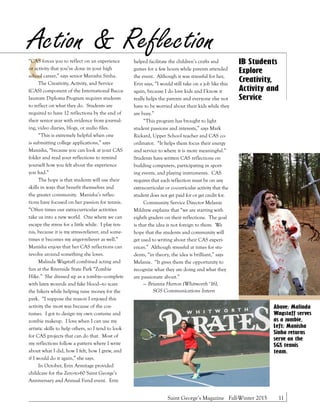
Above: Malinda
Wagstaff serves
as a zombie.
Left: Manisha
Sinha returns
serve on the
SGS tennis
team.
“CAS forces you to reflect on an experience
or activity that you’ve done in your high
school career,” says senior Manisha Sinha.
The Creativity, Activity, and Service
(CAS) component of the International Bacca-
laureate Diploma Program requires students
to reflect on what they do. Students are
required to have 12 reflections by the end of
their senior year with evidence from journal-
ing, video diaries, blogs, or audio files.
“This is extremely helpful when one
is submitting college applications,” says
Manisha, “because you can look at your CAS
folder and read your reflections to remind
yourself how you felt about the experience
you had.”
The hope is that students will use their
skills in ways that benefit themselves and
the greater community. Manisha’s reflec-
tions have focused on her passion for tennis.
“Often times our extra-curricular activities
take us into a new world. One where we can
escape the stress for a little while. I play ten-
nis, because it is my stress-reliever, and some-
times it becomes my anger-reliever as well.”
Manisha enjoys that her CAS reflections can
revolve around something she loves.
Malinda Wagstaff combined acting and
fun at the Riverside State Park “Zombie
Hike.” She dressed up as a zombie—complete
with latex wounds and fake blood—to scare
the hikers while helping raise money for the
park. “I suppose the reason I enjoyed this
activity the most was because of the cos-
tumes. I got to design my own costume and
zombie makeup. I love when I can use my
artistic skills to help others, so I tend to look
for CAS projects that can do that. Most of
my reflections follow a pattern where I write
about what I did, how I felt, how I grew, and
if I would do it again,” she says.
In October, Erin Armitage provided
childcare for the Zero-to-60 Saint George’s
Anniversary and Annual Fund event. Erin
helped facilitate the children’s crafts and
games for a few hours while parents attended
the event. Although it was stressful for her,
Erin says, “I would still take on a job like this
again, because I do love kids and I know it
really helps the parents and everyone else not
have to be worried about their kids while they
are busy.”
“This program has brought to light
student passions and interests,” says Mark
Rickard, Upper School teacher and CAS co-
ordinator. “It helps them focus their energy
and service to where it is more meaningful.”
Students have written CAS reflections on
building computers, participating in sport-
ing events, and playing instruments. CAS
requires that each reflection must be on any
extra-curricular or co-curricular activity that the
student does not get paid for or get credit for.
Community Service Director Melanie
Mildrew explains that “we are starting with
eighth graders on their reflections. The goal
is that the idea is not foreign to them. We
hope that the students and community will
get used to writing about their CAS experi-
ences.” Although stressful at times for stu-
dents, “in theory, the idea is brilliant,” says
Melanie. “It gives them the opportunity to
recognize what they are doing and what they
are passionate about.”
— Brianna Herron (Whitworth ‘16),
	 SGS Communications Intern

SG Mag Fall 2015 - IB Action & Reflection

  • 1.
    11Saint George’s MagazineFall-Winter 2015 IB Students Explore Creativity, Activity and Service Action & Reflection C Above: Malinda Wagstaff serves as a zombie. Left: Manisha Sinha returns serve on the SGS tennis team. “CAS forces you to reflect on an experience or activity that you’ve done in your high school career,” says senior Manisha Sinha. The Creativity, Activity, and Service (CAS) component of the International Bacca- laureate Diploma Program requires students to reflect on what they do. Students are required to have 12 reflections by the end of their senior year with evidence from journal- ing, video diaries, blogs, or audio files. “This is extremely helpful when one is submitting college applications,” says Manisha, “because you can look at your CAS folder and read your reflections to remind yourself how you felt about the experience you had.” The hope is that students will use their skills in ways that benefit themselves and the greater community. Manisha’s reflec- tions have focused on her passion for tennis. “Often times our extra-curricular activities take us into a new world. One where we can escape the stress for a little while. I play ten- nis, because it is my stress-reliever, and some- times it becomes my anger-reliever as well.” Manisha enjoys that her CAS reflections can revolve around something she loves. Malinda Wagstaff combined acting and fun at the Riverside State Park “Zombie Hike.” She dressed up as a zombie—complete with latex wounds and fake blood—to scare the hikers while helping raise money for the park. “I suppose the reason I enjoyed this activity the most was because of the cos- tumes. I got to design my own costume and zombie makeup. I love when I can use my artistic skills to help others, so I tend to look for CAS projects that can do that. Most of my reflections follow a pattern where I write about what I did, how I felt, how I grew, and if I would do it again,” she says. In October, Erin Armitage provided childcare for the Zero-to-60 Saint George’s Anniversary and Annual Fund event. Erin helped facilitate the children’s crafts and games for a few hours while parents attended the event. Although it was stressful for her, Erin says, “I would still take on a job like this again, because I do love kids and I know it really helps the parents and everyone else not have to be worried about their kids while they are busy.” “This program has brought to light student passions and interests,” says Mark Rickard, Upper School teacher and CAS co- ordinator. “It helps them focus their energy and service to where it is more meaningful.” Students have written CAS reflections on building computers, participating in sport- ing events, and playing instruments. CAS requires that each reflection must be on any extra-curricular or co-curricular activity that the student does not get paid for or get credit for. Community Service Director Melanie Mildrew explains that “we are starting with eighth graders on their reflections. The goal is that the idea is not foreign to them. We hope that the students and community will get used to writing about their CAS experi- ences.” Although stressful at times for stu- dents, “in theory, the idea is brilliant,” says Melanie. “It gives them the opportunity to recognize what they are doing and what they are passionate about.” — Brianna Herron (Whitworth ‘16), SGS Communications Intern