PROHIBITION OF SEXUAL HARRASSEMENT (POSH)
• THE SEXUAL HARASSMENT OF WOMEN AT WORKPLACE
• (PREVENTION, PROHIBITION AND REDRESSAL) ACT, 2013
• In 1992, Bhunwari Devi worked as a social worker in the state’s Women Development Programme in
Rajasthan. She was on duty when she tried to prevent a child marriage from taking place. She was brutally
gang raped by a group of men from the dominant caste community who participated in the child marriage
ceremony. A case was filed in the Supreme Court of India in 1997 (Vishaka versus the State of Rajasthan and
others) highlighting this incident.
• The lack of a framework, regarding sexual harassment faced by Indian women in their workplace, was
recognised, and certain guidelines were passed by the Supreme Court that was in effect, until a comprehensive
law regarding sexual harassment in the workplace was implemented. These guidelines were called the
“Vishaka Guidelines” and included the definition of sexual harassment, disciplinary action for sexual
harassment, and the formation of a complaints committee to investigate complaints of sexual harassment.
• The Sexual Harassment of Women at Workplace (Prevention, Prohibition, and Redressal) Act, 2013 (also
referred to as the “POSH Act”) came into existence in 2013. It has its foundations in the Vishaka Guidelines,
and establishes a mechanism for dealing with sexual harassment complaints in the workplace
•Introduction
 A form of discrimination
 UNWELCOME SEXUAL gestures or behavior
 Sexually colored remarks
 Other verbal, non verbal or physical conduct of a sexual nature that tends to create a hostile or
offensive work environment
 It includes a range of behaviours from seemingly mild transgressions and annoyances, to
actual sexual abuse or sexual assault.
 Anyone from either gender can be a victim of sexual harassment, and anybody from either
gender can be a perpetrator..
•What is Sexual Harassment ?
• The term ‘sexual harassment’ includes conduct of associates,
managers, vendors and/or customers who engage in verbally or
physically harassing behaviour, which has the potential for
humiliating or embarrassing an associate of the Company
• IMPACT NOT INTENT IS WHAT MATTERS
What is Sexual Harassment
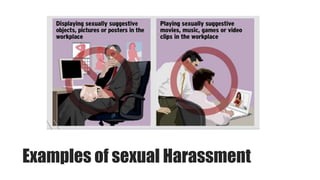
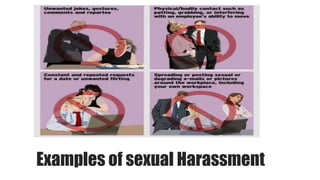
Examples of sexual Harassment
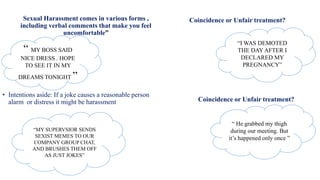
• Intentions aside: If a joke causes a reasonable person
alarm or distress it might be harassment
“ MY BOSS SAID
NICE DRESS . HOPE
TO SEE IT IN MY
DREAMS TONIGHT ”
Coincidence or Unfair treatment?
“I WAS DEMOTED
THE DAY AFTER I
DECLARED MY
PREGNANCY”
Sexual Harassment comes in various forms ,
including verbal comments that make you feel
uncomfortable”
“MY SUPERVSIOR SENDS
SEXIST MEMES TO OUR
COMPANY GROUP CHAT,
AND BRUSHES THEM OFF
AS JUST JOKES”
Coincidence or Unfair treatment?
“ He grabbed my thigh
during our meeting. But
it’s happened only once ”
• Circumstances considered as Sexual Harassment
• Implied /explicit promise of preferential treatment in employment
• Implied /explicit threat of detrimental treatment in employment
• Implied /explicit threat about present and future employment status
• Interference with work or creating intimidating/hostile environment
• Humiliating treatment likely to affect health & safety
Types of sexual Harassment
QUID PRO QUO- “THIS FOR THAT” Seeking sexual favors or advances in exchange for work benefits.
Threatening an associate if he/she does not consent to such sexual advances or favours also amounts to sexual
harassment. The act of ‘asking’ may either be verbal or implied and the ‘sexual conduct’ may be verbal or
physical. But, in either case, it must be unwelcome.
HOSTILE WORK ENVIRONMENT- pervasive form of sexual harassment involving work conditions or
behaviour that make the work environment 'hostile”.
Hostile environment sexual harassment may also include intimidating or harassing conduct that is directed at an
individual, or a group of individuals.
Examples of Quid Pro Quo Sexual Harassment
 A manager informs an associate that he/she would lose their job if he/she does not
give into his/her sexual advances.
 A manager informs an Associate that he/she would get a better rating in the appraisal
or a promotion if he/she gives into his/her sexual advances.
 A manager promises an Associate a particular project or a role in exchange of sexual
favours.
Examples of Conduct that creates a Hostile Environment
 Talking about sex
 Telling obscene jokes
 Using endearments, crude or offensive language
 Unsolicited or unwanted touching of any part of clothing or body or commenting on someone's physical
appearance
 Talking about /spreading rumours about someone’s sexual orientation or sex life
 Showing sexually suggestive pictures, notes, magazines or cartoons
 Using sexually suggestive gestures
 Staring, cornering, following, blocking the pathway, or stalking
 Persistent requests for dates, outings, lunches, dinners etc.
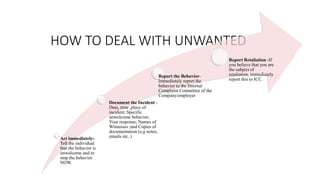
HOW TO DEAL WITH UNWANTED
Act immediately-
Tell the individual
that the behavior is
unwelcome and to
stop the behavior
NOW.
Document the Incident -
Date, time ,place of
incident; Specific
unwelcome behavior;
Your response; Names of
Witnesses ;and Copies of
documentation (e.g notes,
emails etc..)
Report the Behavior-
Immediately report the
behavior to the Internal
Complaint Committee of the
Company/employer
Report Retaliation -If
you believe that you are
the subject of
retaliation, immediately
report this to ICC.
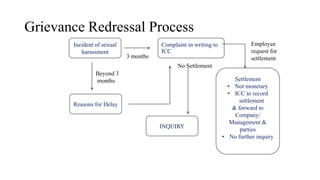
Grievance Redressal Process
Complaint in writing to
ICC
Incident of sexual
harassment
Reasons for Delay
INQUIRY
Settlement
• Not monetary
• ICC to record
settlement
& forward to
Company/
Management &
parties
• No further inquiry
3 months
Beyond 3
months
No Settlement
Employee
request for
settlement
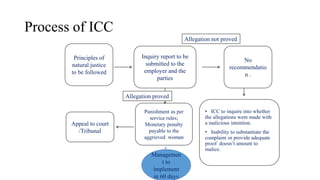
Process of ICC
• ICC to inquire into whether
the allegations were made with
a malicious intention.
• Inability to substantiate the
complaint or provide adequate
proof doesn’t amount to
malice.
Principles of
natural justice
to be followed
Appeal to court
/Tribunal
No
recommendatio
n .
Inquiry report to be
submitted to the
employer and the
parties
Punishment as per
service rules;
Monetary penalty
payable to the
aggrieved woman
Allegation not proved
Allegation proved
Managemen
t to
implement
in 60 days
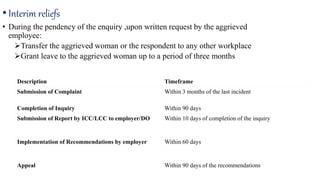
•Interim reliefs
• During the pendency of the enquiry ,upon written request by the aggrieved
employee:
Transfer the aggrieved woman or the respondent to any other workplace
Grant leave to the aggrieved woman up to a period of three months
Description Timeframe
Submission of Complaint Within 3 months of the last incident
Completion of Inquiry Within 90 days
Submission of Report by ICC/LCC to employer/DO Within 10 days of completion of the inquiry
Implementation of Recommendations by employer Within 60 days
Appeal Within 90 days of the recommendations
• Disciplinary action including written apology, reprimand, warning, censure
• withholding of promotion/ pay raise/ increment
• Termination of employment
• Undergo counselling
•Punishments may include:
Care about what you say…..
How you say
Before you say it….
Thank you…..

POSH @R.pptx

  • 1.
    PROHIBITION OF SEXUALHARRASSEMENT (POSH)
  • 2.
    • THE SEXUALHARASSMENT OF WOMEN AT WORKPLACE • (PREVENTION, PROHIBITION AND REDRESSAL) ACT, 2013 • In 1992, Bhunwari Devi worked as a social worker in the state’s Women Development Programme in Rajasthan. She was on duty when she tried to prevent a child marriage from taking place. She was brutally gang raped by a group of men from the dominant caste community who participated in the child marriage ceremony. A case was filed in the Supreme Court of India in 1997 (Vishaka versus the State of Rajasthan and others) highlighting this incident. • The lack of a framework, regarding sexual harassment faced by Indian women in their workplace, was recognised, and certain guidelines were passed by the Supreme Court that was in effect, until a comprehensive law regarding sexual harassment in the workplace was implemented. These guidelines were called the “Vishaka Guidelines” and included the definition of sexual harassment, disciplinary action for sexual harassment, and the formation of a complaints committee to investigate complaints of sexual harassment. • The Sexual Harassment of Women at Workplace (Prevention, Prohibition, and Redressal) Act, 2013 (also referred to as the “POSH Act”) came into existence in 2013. It has its foundations in the Vishaka Guidelines, and establishes a mechanism for dealing with sexual harassment complaints in the workplace
  • 3.
  • 4.
     A formof discrimination  UNWELCOME SEXUAL gestures or behavior  Sexually colored remarks  Other verbal, non verbal or physical conduct of a sexual nature that tends to create a hostile or offensive work environment  It includes a range of behaviours from seemingly mild transgressions and annoyances, to actual sexual abuse or sexual assault.  Anyone from either gender can be a victim of sexual harassment, and anybody from either gender can be a perpetrator.. •What is Sexual Harassment ?
  • 5.
    • The term‘sexual harassment’ includes conduct of associates, managers, vendors and/or customers who engage in verbally or physically harassing behaviour, which has the potential for humiliating or embarrassing an associate of the Company • IMPACT NOT INTENT IS WHAT MATTERS What is Sexual Harassment
  • 7.
  • 8.
  • 9.
    • Intentions aside:If a joke causes a reasonable person alarm or distress it might be harassment “ MY BOSS SAID NICE DRESS . HOPE TO SEE IT IN MY DREAMS TONIGHT ” Coincidence or Unfair treatment? “I WAS DEMOTED THE DAY AFTER I DECLARED MY PREGNANCY” Sexual Harassment comes in various forms , including verbal comments that make you feel uncomfortable” “MY SUPERVSIOR SENDS SEXIST MEMES TO OUR COMPANY GROUP CHAT, AND BRUSHES THEM OFF AS JUST JOKES” Coincidence or Unfair treatment? “ He grabbed my thigh during our meeting. But it’s happened only once ”
  • 10.
    • Circumstances consideredas Sexual Harassment • Implied /explicit promise of preferential treatment in employment • Implied /explicit threat of detrimental treatment in employment • Implied /explicit threat about present and future employment status • Interference with work or creating intimidating/hostile environment • Humiliating treatment likely to affect health & safety
  • 11.
    Types of sexualHarassment QUID PRO QUO- “THIS FOR THAT” Seeking sexual favors or advances in exchange for work benefits. Threatening an associate if he/she does not consent to such sexual advances or favours also amounts to sexual harassment. The act of ‘asking’ may either be verbal or implied and the ‘sexual conduct’ may be verbal or physical. But, in either case, it must be unwelcome. HOSTILE WORK ENVIRONMENT- pervasive form of sexual harassment involving work conditions or behaviour that make the work environment 'hostile”. Hostile environment sexual harassment may also include intimidating or harassing conduct that is directed at an individual, or a group of individuals.
  • 12.
    Examples of QuidPro Quo Sexual Harassment  A manager informs an associate that he/she would lose their job if he/she does not give into his/her sexual advances.  A manager informs an Associate that he/she would get a better rating in the appraisal or a promotion if he/she gives into his/her sexual advances.  A manager promises an Associate a particular project or a role in exchange of sexual favours. Examples of Conduct that creates a Hostile Environment  Talking about sex  Telling obscene jokes  Using endearments, crude or offensive language  Unsolicited or unwanted touching of any part of clothing or body or commenting on someone's physical appearance  Talking about /spreading rumours about someone’s sexual orientation or sex life  Showing sexually suggestive pictures, notes, magazines or cartoons  Using sexually suggestive gestures  Staring, cornering, following, blocking the pathway, or stalking  Persistent requests for dates, outings, lunches, dinners etc.
  • 13.
    HOW TO DEALWITH UNWANTED Act immediately- Tell the individual that the behavior is unwelcome and to stop the behavior NOW. Document the Incident - Date, time ,place of incident; Specific unwelcome behavior; Your response; Names of Witnesses ;and Copies of documentation (e.g notes, emails etc..) Report the Behavior- Immediately report the behavior to the Internal Complaint Committee of the Company/employer Report Retaliation -If you believe that you are the subject of retaliation, immediately report this to ICC.
  • 14.
    Grievance Redressal Process Complaintin writing to ICC Incident of sexual harassment Reasons for Delay INQUIRY Settlement • Not monetary • ICC to record settlement & forward to Company/ Management & parties • No further inquiry 3 months Beyond 3 months No Settlement Employee request for settlement
  • 15.
    Process of ICC •ICC to inquire into whether the allegations were made with a malicious intention. • Inability to substantiate the complaint or provide adequate proof doesn’t amount to malice. Principles of natural justice to be followed Appeal to court /Tribunal No recommendatio n . Inquiry report to be submitted to the employer and the parties Punishment as per service rules; Monetary penalty payable to the aggrieved woman Allegation not proved Allegation proved Managemen t to implement in 60 days
  • 16.
    •Interim reliefs • Duringthe pendency of the enquiry ,upon written request by the aggrieved employee: Transfer the aggrieved woman or the respondent to any other workplace Grant leave to the aggrieved woman up to a period of three months Description Timeframe Submission of Complaint Within 3 months of the last incident Completion of Inquiry Within 90 days Submission of Report by ICC/LCC to employer/DO Within 10 days of completion of the inquiry Implementation of Recommendations by employer Within 60 days Appeal Within 90 days of the recommendations
  • 17.
    • Disciplinary actionincluding written apology, reprimand, warning, censure • withholding of promotion/ pay raise/ increment • Termination of employment • Undergo counselling •Punishments may include:
  • 18.
    Care about whatyou say….. How you say Before you say it…. Thank you…..

Editor's Notes