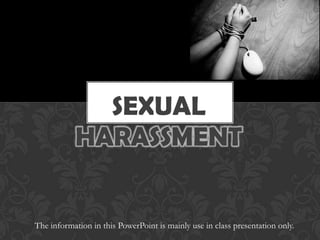
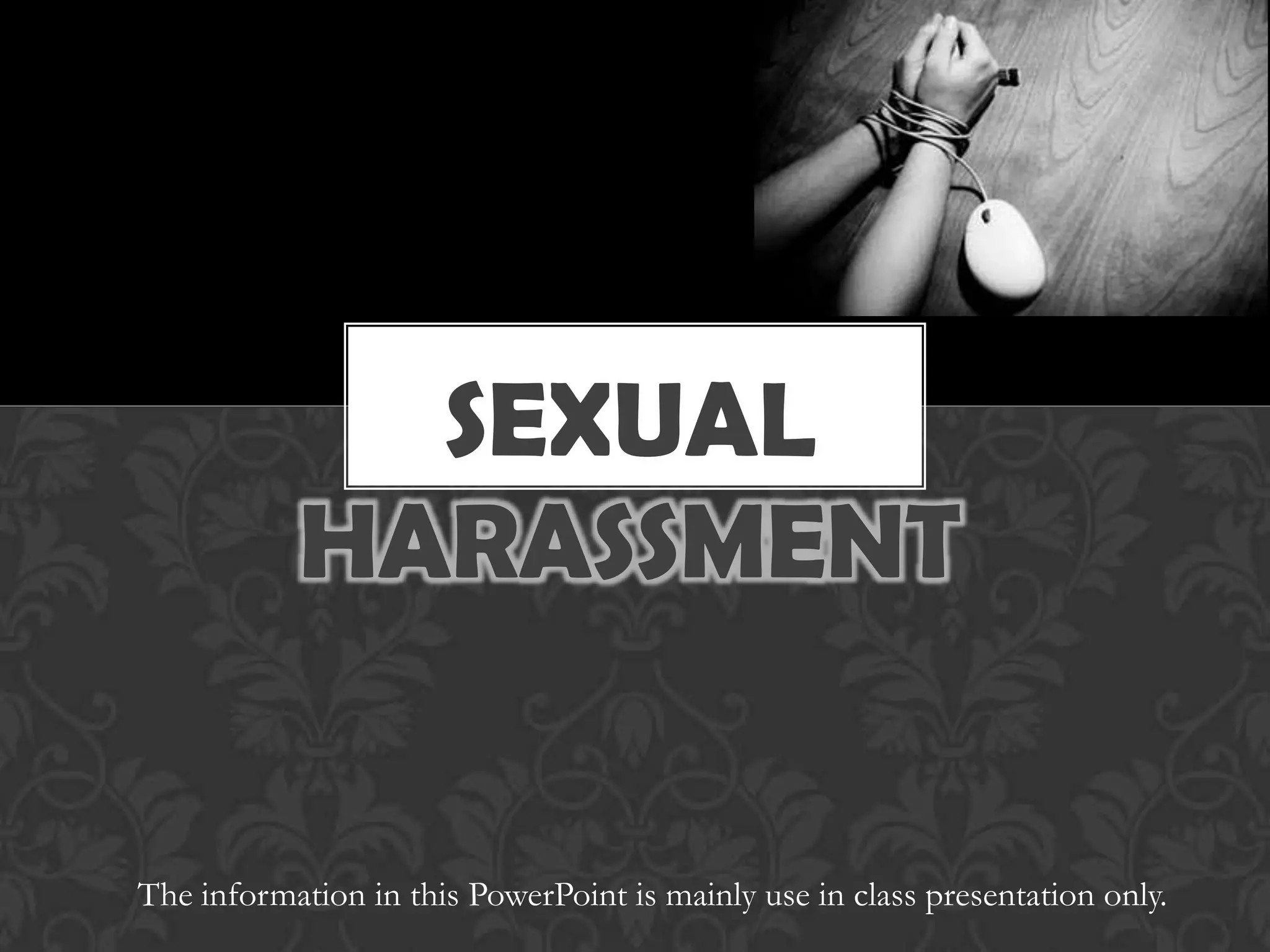
Sexual HarassmentThe information in this PowerPoint is mainly use in class presentation only.
Under the Ontario Human Rights Code, sexual harassment is “engaging in a course of vexatious comment or conduct that is known or ought to be known to be unwelcome.” In some cases, one incident can be serious enough to be sexual harassment. What is sexual harassment?
Sexual harassment does not have to be sexual. It can also mean that someone is bothering you because they think that you don’t act, look or dress in the way that a man (or boy) or woman (or girl) should.What is sexual harassment?
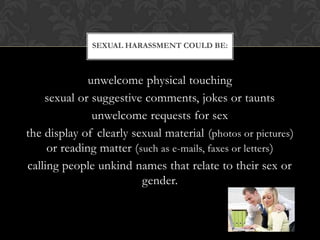
unwelcome physical touchingsexual or suggestive comments, jokes or tauntsunwelcome requests for sexthe display of clearly sexual material (photos or pictures)  or reading matter (such as e-mails, faxes or letters)calling people unkind names that relate to their sex or gender.Sexual harassment could be:
Sexual harassment can happen anywhere  On the street A nightclubAt an interviewIn a shop and often at work.Where does sexual harassment happen?
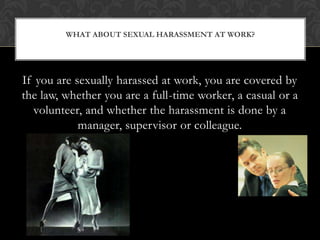
If you are sexually harassed at work, you are covered by the law, whether you are a full-time worker, a casual or a volunteer, and whether the harassment is done by a manager, supervisor or colleague.What about sexual harassment at work?
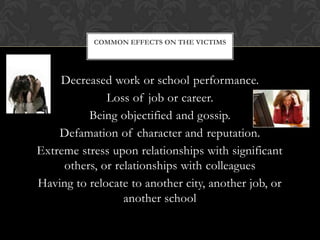
Decreased work or school performance.Loss of job or career.Being objectified and gossip.Defamation of character and reputation.Extreme stress upon relationships with significant others, or relationships with colleaguesHaving to relocate to another city, another job, or another schoolCommon effects on the victims
Firstly, you can talk to the harasser, if you feel comfortable about it. Tell them what you think about what they are doing, and ask them to stop.If the harassment happens at work, think about making a complaint to someone in the organization - perhaps a manager, or a supervisor. How do I make a complaint?
In any case, it's a good idea to take notes on what has happened, when and where it was. What you did in response to the harassment, the person's name and any other information you think might be useful.What else do I need to know?
Thank you
http://www.adcq.qld.gov.au/pubs/sexharr.htmlhttp://www.ohrc.on.ca/en/issues/sexual_harassmenthttp://en.wikipedia.org/wiki/Sexual_harassmenthttp://www.eeoc.gov/laws/types/sexual_harassment.cfmhttp://forum.santabanta.com/showthread.htm?t=177493Credit to:

Sexual harassment

  • 1.
    Sexual HarassmentThe informationin this PowerPoint is mainly use in class presentation only.
  • 2.
    Under the Ontario HumanRights Code, sexual harassment is “engaging in a course of vexatious comment or conduct that is known or ought to be known to be unwelcome.” In some cases, one incident can be serious enough to be sexual harassment. What is sexual harassment?
  • 3.
    Sexual harassment doesnot have to be sexual. It can also mean that someone is bothering you because they think that you don’t act, look or dress in the way that a man (or boy) or woman (or girl) should.What is sexual harassment?
  • 4.
    unwelcome physical touchingsexualor suggestive comments, jokes or tauntsunwelcome requests for sexthe display of clearly sexual material (photos or pictures) or reading matter (such as e-mails, faxes or letters)calling people unkind names that relate to their sex or gender.Sexual harassment could be:
  • 5.
    Sexual harassment canhappen anywhere On the street A nightclubAt an interviewIn a shop and often at work.Where does sexual harassment happen?
  • 6.
    If you aresexually harassed at work, you are covered by the law, whether you are a full-time worker, a casual or a volunteer, and whether the harassment is done by a manager, supervisor or colleague.What about sexual harassment at work?
  • 7.
    Decreased work orschool performance.Loss of job or career.Being objectified and gossip.Defamation of character and reputation.Extreme stress upon relationships with significant others, or relationships with colleaguesHaving to relocate to another city, another job, or another schoolCommon effects on the victims
  • 8.
    Firstly, you cantalk to the harasser, if you feel comfortable about it. Tell them what you think about what they are doing, and ask them to stop.If the harassment happens at work, think about making a complaint to someone in the organization - perhaps a manager, or a supervisor. How do I make a complaint?
  • 9.
    In any case,it's a good idea to take notes on what has happened, when and where it was. What you did in response to the harassment, the person's name and any other information you think might be useful.What else do I need to know?
  • 10.
  • 11.