Submitted By : Submitted To :
NETAJI SUBHAS UNIVERSITY
POKHARI JAMSHEDPUR
DEPARTMENT : IT DEPARTMENT
COURSE : BCA
SEMESTER & SECTION : 1st SEMESTER, SEC ‘A’
Presenting Presentation on
Introduction to Sets & Venn Diagrams,
Operation on Sets
1. Introduction to Sets
2. Example on Sets
3. Description of a set
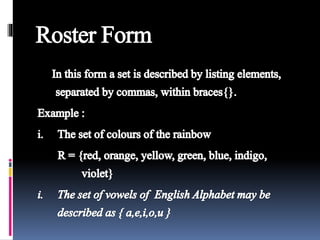
4. Roster form
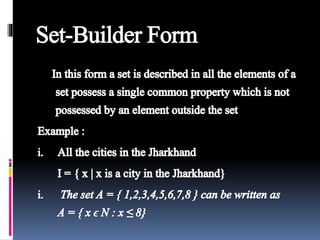
5. Set-Builder form
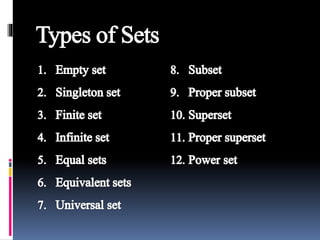
6. Types of Sets
7. Introduction to Venn Diagrams
8. Example on Venn Diagrams
9. Operation on Sets : Union of sets
Intersection of sets
Complement of a sets
Introduction to Venn
Diagrams
A Venn diagram or set diagram is a diagram that
shows all possible logical relation between a finite
collection of sets. Venn diagrams were conceived
around 1880 by John Venn. They are used to teach
elementary set theory, as well as illustrate simple set
relationships in probability, logic, statistic linguistics
and computer science
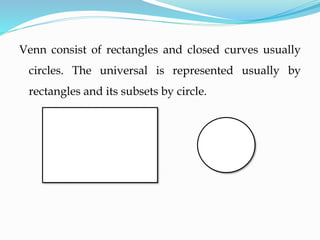
Venn consist of rectangles and closed curves usually
circles. The universal is represented usually by
rectangles and its subsets by circle.
Example on Venn diagram
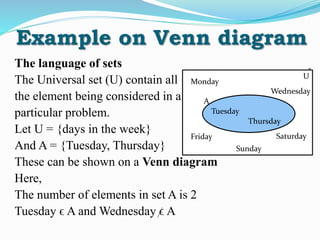
The language of sets
The Universal set (U) contain all
the element being considered in a
particular problem.
Let U = {days in the week}
And A = {Tuesday, Thursday}
These can be shown on a Venn diagram
Here,
The number of elements in set A is 2
Tuesday ϵ A and Wednesday ϵ A
A
Tuesday
Thursday
Monday
Wednesday
Saturday
Sunday
Friday
"
U
Operations on Sets
1. Union of sets
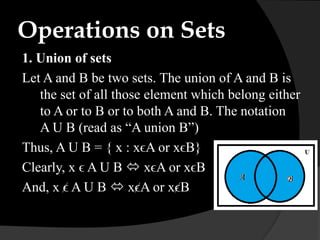
Let A and B be two sets. The union of A and B is
the set of all those element which belong either
to A or to B or to both A and B. The notation
A U B (read as “A union B”)
Thus, A U B = { x : xϵA or xϵB}
Clearly, x ϵ A U B  xϵA or xϵB
And, x ϵ A U B  xϵA or xϵB
2. Intersection of Sets
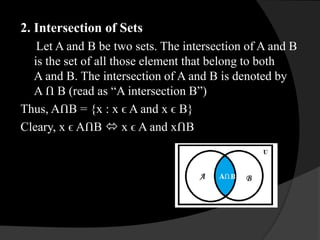
Let A and B be two sets. The intersection of A and B
is the set of all those element that belong to both
A and B. The intersection of A and B is denoted by
A Ո B (read as “A intersection B”)
Thus, AՈB = {x : x ϵ A and x ϵ B}
Cleary, x ϵ AՈB  x ϵ A and xՈB
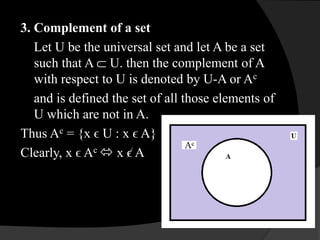
3. Complement of a set
Let U be the universal set and let A be a set
such that A ⸦ U. then the complement of A
with respect to U is denoted by U-A or Ac
and is defined the set of all those elements of
U which are not in A.
Thus Ac = {x ϵ U : x ϵ A}
Clearly, x ϵ Ac  x ϵ A
Thank You
For Your Attention

Sets_Venn-Diagrams_operation.pptx

  • 1.
    Submitted By :Submitted To : NETAJI SUBHAS UNIVERSITY POKHARI JAMSHEDPUR DEPARTMENT : IT DEPARTMENT COURSE : BCA SEMESTER & SECTION : 1st SEMESTER, SEC ‘A’ Presenting Presentation on Introduction to Sets & Venn Diagrams, Operation on Sets
  • 2.
    1. Introduction toSets 2. Example on Sets 3. Description of a set 4. Roster form 5. Set-Builder form 6. Types of Sets 7. Introduction to Venn Diagrams 8. Example on Venn Diagrams 9. Operation on Sets : Union of sets Intersection of sets Complement of a sets
  • 9.
    Introduction to Venn Diagrams AVenn diagram or set diagram is a diagram that shows all possible logical relation between a finite collection of sets. Venn diagrams were conceived around 1880 by John Venn. They are used to teach elementary set theory, as well as illustrate simple set relationships in probability, logic, statistic linguistics and computer science
  • 10.
    Venn consist ofrectangles and closed curves usually circles. The universal is represented usually by rectangles and its subsets by circle.
  • 11.
    Example on Venndiagram The language of sets The Universal set (U) contain all the element being considered in a particular problem. Let U = {days in the week} And A = {Tuesday, Thursday} These can be shown on a Venn diagram Here, The number of elements in set A is 2 Tuesday ϵ A and Wednesday ϵ A A Tuesday Thursday Monday Wednesday Saturday Sunday Friday " U
  • 12.
    Operations on Sets 1.Union of sets Let A and B be two sets. The union of A and B is the set of all those element which belong either to A or to B or to both A and B. The notation A U B (read as “A union B”) Thus, A U B = { x : xϵA or xϵB} Clearly, x ϵ A U B  xϵA or xϵB And, x ϵ A U B  xϵA or xϵB
  • 13.
    2. Intersection ofSets Let A and B be two sets. The intersection of A and B is the set of all those element that belong to both A and B. The intersection of A and B is denoted by A Ո B (read as “A intersection B”) Thus, AՈB = {x : x ϵ A and x ϵ B} Cleary, x ϵ AՈB  x ϵ A and xՈB
  • 14.
    3. Complement ofa set Let U be the universal set and let A be a set such that A ⸦ U. then the complement of A with respect to U is denoted by U-A or Ac and is defined the set of all those elements of U which are not in A. Thus Ac = {x ϵ U : x ϵ A} Clearly, x ϵ Ac  x ϵ A
  • 15.