DOs 10 & 12, s. 2024:
KEY GUIDELINES ON THE
IMPLEMENTATION OF THE REVISED
K TO 10 CURRICULUM
1
June 3, 2025
Baguio City
2
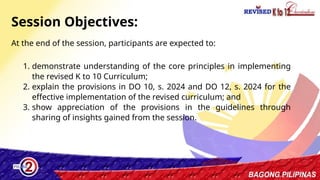
At the end of the session, participants are expected to:
Session Objectives:
1. demonstrate understanding of the core principles in implementing
the revised K to 10 Curriculum;
2. explain the provisions in DO 10, s. 2024 and DO 12, s. 2024 for the
effective implementation of the revised curriculum; and
3. show appreciation of the provisions in the guidelines through
sharing of insights gained from the session.
3
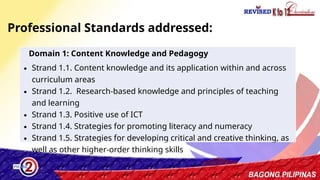
Professional Standards addressed:
Domain 1: Content Knowledge and Pedagogy
∙ Strand 1.1. Content knowledge and its application within and across
curriculum areas
∙ Strand 1.2. Research-based knowledge and principles of teaching
and learning
∙ Strand 1.3. Positive use of ICT
∙ Strand 1.4. Strategies for promoting literacy and numeracy
∙ Strand 1.5. Strategies for developing critical and creative thinking, as
well as other higher-order thinking skills
4
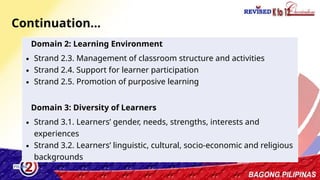
Domain 2: Learning Environment
∙ Strand 2.3. Management of classroom structure and activities
∙ Strand 2.4. Support for learner participation
∙ Strand 2.5. Promotion of purposive learning
Domain 3: Diversity of Learners
∙ Strand 3.1. Learners’ gender, needs, strengths, interests and
experiences
∙ Strand 3.2. Learners’ linguistic, cultural, socio-economic and religious
backgrounds
Continuation…
5
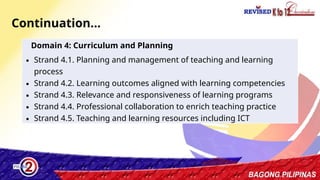
Domain 4: Curriculum and Planning
∙ Strand 4.1. Planning and management of teaching and learning
process
∙ Strand 4.2. Learning outcomes aligned with learning competencies
∙ Strand 4.3. Relevance and responsiveness of learning programs
∙ Strand 4.4. Professional collaboration to enrich teaching practice
∙ Strand 4.5. Teaching and learning resources including ICT
Continuation…
6
Continuation…
Domain 5: Assessment and Reporting
∙ Strand 5.1. Design, selection, organization and utilization of
assessment strategies
∙ Strand 5.2. Monitoring and evaluation of learner progress and
achievement
∙ Strand 5.3. Feedback to improve learning
∙ Strand 5.5. Use of assessment data to enhance teaching and learning
practices and programs
7
1. I am a Kindergarten teacher and I my class schedule is based on ___________________.
2. I am a supervisor and I understand that_____________ is the core principle of the
revised K to 10 curriculum.
3. The Alternative Learning System emphasizes 21st
century skills and addresses the
diverse needs of learners through _______________________.
4. I am a Grade 7 teacher and I Know that ______________ is a comprehensive guide for
teachers in planning lessons which strongly emphasizes learner-centered
education.
5. I am a schools division personnel and I am mandated to provide ______________ to
schools and community learning centers (CLCs) in implementing the revised K to 10
Curriculum.
Activity: I Know, Right!
8
1. I am a Kindergarten teacher and I my class schedule is based on Blocks of Time.
2. I am a supervisor and I understand that Inclusive Education is the core principle of
the revised K to 10 curriculum.
3. The Alternative Learning System emphasizes 21st
century skills and addresses the
diverse needs of learners through contextualization.
4. I am a Grade 7 teacher and I Know that Instructional Design Framework is a
comprehensive guide for teachers in planning lessons which strongly emphasizes
learner-centered education.
5. I am a schools division personnel and I am mandated to provide technical
assistance to schools and community learning centers (CLCs) in implementing the
revised K to 10 Curriculum.
Correct Answers:
9
Source: https://www.linkedin.com/pulse/effective-policy-implementation-building/
10
DO 10, s. 2024
DO 12, s. 2024
11
∙ prescribe minimum standards to all public and private schools, state
universities and colleges, (SUCs), local universities and colleges, (LUCs), and
Philippine Schools in basic education;
∙ provide guidelines to teachers and instructional leaders in the
implementation of the revised K to 10 Curriculum;
Purpose of the Issuance
12
Purpose of the Issuance
∙ amend DepEd Order No. 21, s. 2019 or the Policy Guidelines on the K to 12
Basic Education Program, specifically:
o Annex 1: Elementary Education;
o Secondary Education;
o Annex 4: Guidelines on the Mother Tongue-based Multilingual Education
Program Implementation; and
• inform public on the phased implementation of the revised curriculum
starting from Kindergarten, Grade 1, 4, and 7 beginning the SY 2024-2025.
13
The revised K to 10 Curriculum envisions producing lifelong
and peace-loving Filipino learners who are holistic and future-
ready and embody the core values of Maka-Diyos, Makatao,
Makakalikasan, and Makabansa.
Curriculum Goal
14
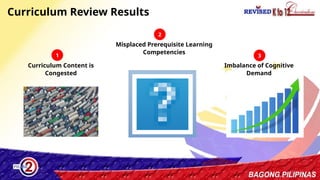
Curriculum Review Results
Curriculum Content is
Congested
Imbalance of Cognitive
Demand
Misplaced Prerequisite Learning
Competencies
1
2
3
15
The revised K to 10 Curriculum incorporates relevant provisions from the
recent basic education reforms:
• RA 10410 – Early Years Act of 2013
• RA 10157 ­
– Kindergarten Act
• RA 10968 – Philippine Qualifications Framework (PQF) Act
• RA 11510 – Alternative Learning System (ALS) Act
• RA 11476 – GMRC and Values Education Act
• RA 11650 – Instituting a Policy of Inclusion and Services for Learners with
Disabilities in Support to Inclusive Education Act
• RA 11713 – Excellence in Teacher Education Act
16
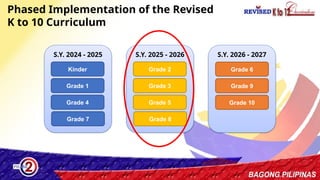
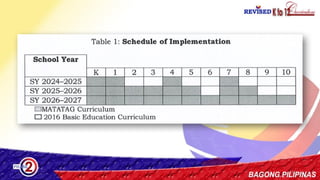
Phased Implementation of the Revised
K to 10 Curriculum
S.Y. 2024 - 2025
Kinder
Grade 1
Grade 4
Grade 7
S.Y. 2025 - 2026
Grade 2
Grade 3
Grade 5
Grade 8
S.Y. 2026 - 2027
Grade 6
Grade 9
Grade 10
17
a.the policy shall be implemented by all schools in the country, including
those in administrative and autonomous region, and those Philippine
Schools Overseas (PSOs) that offer basic education;
b. the revised curriculum shall serve as the fundamental blueprint for
teachers at the classroom level;
c. the policy shall help instructional leaders to create supervisory and
management plans;
Provisions from DO 10, s. 2024
18
Provisons from DO 10, s. 2024
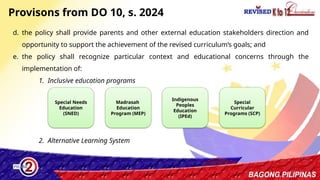
d. the policy shall provide parents and other external education stakeholders direction and
opportunity to support the achievement of the revised curriculum’s goals; and
e. the policy shall recognize particular context and educational concerns through the
implementation of:
1. Inclusive education programs
2. Alternative Learning System
Special Needs
Education
(SNED)
Madrasah
Education
Program (MEP)
Indigenous
Peoples
Education
(IPEd)
Special
Curricular
Programs (SCP)
19
The revised K to 10 Curriculum shall prepare learners for the future by
integrating contemporary themes and issues, fostering 21st
century
skills, promoting inclusivity, and encouraging futures thinking.
Policy Statement
20
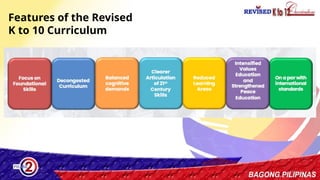
Features of the Revised
K to 10 Curriculum
21
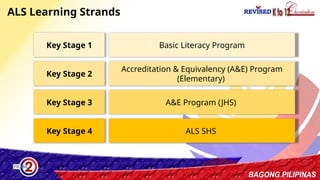
ALS Learning Strands
Key Stage 1 Basic Literacy Program
Key Stage 2
Accreditation & Equivalency (A&E) Program
(Elementary)
Key Stage 3 A&E Program (JHS)
Key Stage 4 ALS SHS
22
Vision for the Filipino Learners under
the Revised Curriculum
equipped with the skills of the future;
prepared to become lifelong learners; and
imbued with strong nationalism and appropriate
Filipino values to make them peace advocates.
23
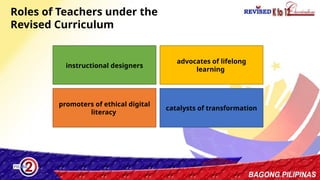
instructional designers
advocates of lifelong
learning
promoters of ethical digital
literacy
catalysts of transformation
Roles of Teachers under the
Revised Curriculum
24
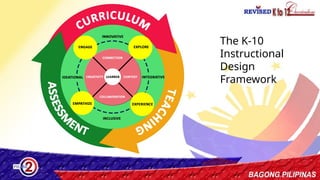
The K-10
Instructional
Design
Framework
25
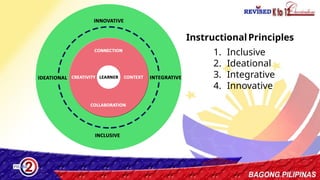
1. Inclusive
2. Ideational
3. Integrative
4. Innovative
InstructionalPrinciples
26
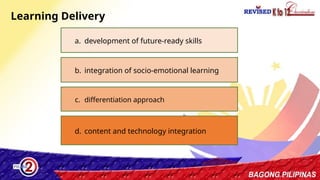
Learning Delivery
a. development of future-ready skills
b. integration of socio-emotional learning
c. differentiation approach
d. content and technology integration
27
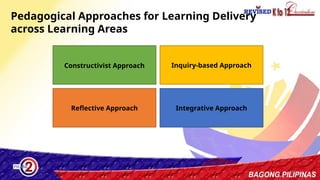
Pedagogical Approaches for Learning Delivery
across Learning Areas
Constructivist Approach Inquiry-based Approach
Reflective Approach Integrative Approach
28
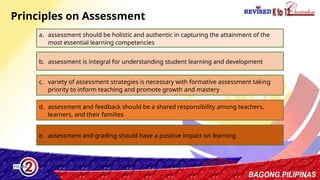
Principles on Assessment
a. assessment should be holistic and authentic in capturing the attainment of the
most essential learning competencies
b. assessment is integral for understanding student learning and development
c. variety of assessment strategies is necessary with formative assessment taking
priority to inform teaching and promote growth and mastery
d. assessment and feedback should be a shared responsibility among teachers,
learners, and their families
e. assessment and grading should have a positive impact on learning
29
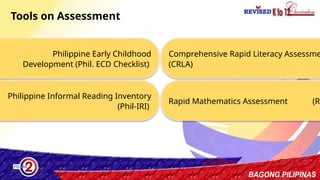
Tools on Assessment
Philippine Early Childhood
Development (Phil. ECD Checklist)
Philippine Informal Reading Inventory
(Phil-IRI)
Comprehensive Rapid Literacy Assessme
(CRLA)
Rapid Mathematics Assessment (RM
30
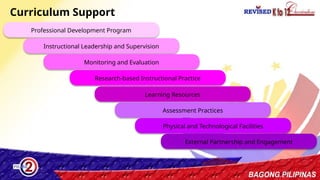
Curriculum Support
Professional Development Program
Instructional Leadership and Supervision
Monitoring and Evaluation
Research-based Instructional Practice
Learning Resources
Assessment Practices
Physical and Technological Facilities
External Partnership and Engagement
31
32
Time Allotment based on
DepEd Order No. 12, s. 2024
a. Schools are given the flexibility in the implementation of the revised K to 10
Curriculum in consideration of the schools’ specific contexts:
∙ All learning areas for 45 minutes a day each for five days, and the Homeroom
Guidance Program for 45 minutes once a week; or
∙ Learning areas may be given uniform time allotments of 50, 55, or 60 per learning
area based on the following:
o Five times a week (English, Mathematics, Science, and GMRC/VE)
o Four times a week (Edukasyong Pantahanan at Pangkabuhayan/Technology and
Livelihood Education, and Music, Arts, Physical Education and Health, Araling
Panlipunan, and Filipino; and
o Once a week (Homeroom Guidance Program).
33
Time Allotment based on
DepEd Order No. 12, s. 2024
b. In circumstances where any of the given options is not applicable, schools may
propose other combinations, provided that:
∙ the learning contact time is at least five hours and 30 minutes a day:
∙ the time allotment for English, Mathematics, Science, and GMRC/VE shall not be less
than 225 minutes per week;
∙ the time allotment for Edukasyong Pantahanan at Pangkabuhayan/Technology and
Livelihood Education, and Music, Arts, Physical Education and Health, Araling
Panlipunan, and Filipino shall not be less than 200 minutes per week; and
∙ the time allotment for the Homeroom Guidance Program shall not be less than 45
minutes per week.
Note that the proposed combination shall be subject to the approval of the
schools division superintendent or authorized representative.
34
Functions of the Offices
Central Office (CO)
CT Strand in coordination with Operations Strand and NEAP
1. Provide the overall policy direction to support the implementation of the MATATAG
Curriculum.
2. Oversee the nationwide pilot and phased implementation of the MATATAG Curriculum.
3. Collaborate with private sector including industry, academic institutions and organizations
in strengthening the curriculum.
4. Assess the achievement of the objectives of the MATATAG Curriculum through monitoring
and evaluation.
35
Continuation…
Central Office (CO)
5. Spearhead the development and implementation of nationally developed tests and
participate in international large-scale assessments (ILSAs) to provide evidence-based
feedback on the MATATAG Curriculum implementation
6. Collaborate with relevant government and non-government agencies and other
stakeholders to ensure that the standards and guidelines that are being implemented are
up-to-date.
7. Spearhead the program designing, development, and quality assurance of training
resource packages (TRPs), and the M&E of the delivery of the MATATAG Curriculum
Implementation Training Program across governance levels.
8. Oversee the conduct of capacity-building activities for teachers and school leaders in
support of the implementation of the MATATAG Curriculum at the regional to the school
level.
36
Continuation…
Central Office (CO)
9. Acquire and provide learning resources to learners and teachers in support of the
implementation of the MATATAG Curriculum.
10. Mobilize resources to meet the implementation requirements of the MATATAG Curriculum.
11. Collaboratively work with other strands on matters concerning thrusts and programs to be
integrated in the curriculum.
12. Regularly report the results of the MATATAG curriculum implementation on learners’
performance to the Secretary.
37
Continuation…
Regional Office (RO)
1. Oversee the implementation of the MATATAG Curriculum in the region.
2. Spearhead the delivery of the MATATAG Training Program and the M&E at the division and school
levels.
3. Mobilize resources to support the delivery of the MATATAG Curriculum.
4. Organize region-wide training on the effective and efficient implementation of the MATATAG
Curriculum.
5. Engage stakeholders and partners in implementing the MATATAG Curriculum.
6. Provide technical assistance to SDOs in implementing the MATATAG Curriculum.
7. Ensure that every Schools Division Office has learning resources.
8. Submit a monitoring and evaluation report on the implementation of the MATATAG Curriculum to the CO.
38
Continuation…
Schools Division Office (SDO)
1. Oversee the implementation of the MATATAG Curriculum in schools and CLCs.
2. Spearhead the delivery of the MATATAG Curriculum Implementation Training
Program and the M&E at the school level.
3. Work with the local school boards to mobilize and utilize resources to improve
learning performance.
4. Organize division-wide training on the effective and efficient implementation of
the MATATAG Curriculum.
5. Ensure that every school has learning resources.
39
Continuation…
Schools Division Office (SDO)
6. Engage stakeholders and partners in supporting the implementation and
assessing the impact of the MATATAG Curriculum on learning performance.
7. Monitor the conduct of professional development activities, (e.g., Collaborative
Expertise Sessions, INSET, LACs).
8. Provide technical assistance to schools and CLCs in implementing the MATATAG
Curriculum.
9. Submit a monitoring and evaluation report on the implementation of the
MATATAG Curriculum to the Regional Office.
40
Continuation…
Schools and Community Learning Centers
1. Boost learners. Performance and achievement through the effective delivery of the
MATATAG Curriculum.
2. Ensure that the MATATAG Curriculum standards and learning competencies are effectively
implemented with the support of teaching-related personnel, parents, school governing
council, and other education stakeholders.
3. Design learning activities that will enable learners to connect with the learning
opportunities in their own communities.
4. Implement school-based professional development activities (e.g., Collaborative Expertise
Sessions, INSET, Lacs) and suggest relevant training for improving teaching competence
that may be provided in support of the effective implementation of the MATATAG
Curriculum.
41
As stipulated in DO 10, s. 2024, the capacity building of school leaders and
teachers in the implementation of the MATATAG Curriculum shall be a
collaboration among the Bureaus of the Curriculum and Teaching (CT) Strand and
the National Educators’ Academy of the Philippines (NEAP), such as but not limited
to the shape of the curriculum, curriculum standards per learning area,
instructional design, collaborative expertise, and school supervision including
school curriculum planning and contextualization across governance levels.
Capacity Building of Implementers
42
Provisions on Learning Resources
∙ For the procurement and quality assurance of textbooks and teacher’s manuals, the BLR shall be
guided by the provisions stipulated in DO 25, s. 2023, Guidelines on the Procurement and Quality
Assurance of Textbooks and Teacher’s Manual.
∙ On matters pertaining to the set standards on the provision of supplementary learning resources
for public schools libraries and library hubs, BLR shall be guided by the provisions of DO, 24, s.
2023, Guidelines on the Provision of Supplementary Learning Resources for Public School
Libraries and Library Hubs.
∙ DO 020, s. 2022, Multi-Year Guidelines of the Decentralization of the Procurement, including the
Quality Assurance, Delivery, Documentation, Storage and Safekeeping of Learning Tools and
Equipment for Science, Mathematics and Technical and Livelihood Education (LTE-SME and TVL),
and the Downloading of Funds Allotted Therefor, shall be the basis for the provision of LTE_SME
and TVL tools and equipment in schools.
43
Monitoring and Evaluation
∙ Establish baseline data and information relative to the implementation of
the MATATAG Curriculum;
∙ Measuring the effectiveness of curriculum implementation; and
∙ Providing evidence for planning, programming, and policy formulation
for efficient and effective curriculum implementation.
44
Key takeaways from the
session
Strategies to implement
right away
Questions in mind
Activity: 3-2-1 Exit Ticket!
3 2
1 Mechanics:
1. Participants will be grouped into
five (5) to brainstorm and share
their answers within 5 minutes.
2. Call one (1) participant to share
answer to the big group.
45
Link: https://www.azquotes.com/author/7659-Carl_Jung?p=22
46
∙ DepEd Order No. 10, s. 2024 – Policy Guidelines on the
Implementation of the MATATAG Curriculum
∙ DepEd Order No. 12, s. 2024 – Amendment to DO 10 s. 2024
References:
47

Session1_Guidelines-K-10.pptxusfuieeilestiyliuse

  • 1.
    DOs 10 &12, s. 2024: KEY GUIDELINES ON THE IMPLEMENTATION OF THE REVISED K TO 10 CURRICULUM 1 June 3, 2025 Baguio City
  • 2.
    2 At the endof the session, participants are expected to: Session Objectives: 1. demonstrate understanding of the core principles in implementing the revised K to 10 Curriculum; 2. explain the provisions in DO 10, s. 2024 and DO 12, s. 2024 for the effective implementation of the revised curriculum; and 3. show appreciation of the provisions in the guidelines through sharing of insights gained from the session.
  • 3.
    3 Professional Standards addressed: Domain1: Content Knowledge and Pedagogy ∙ Strand 1.1. Content knowledge and its application within and across curriculum areas ∙ Strand 1.2. Research-based knowledge and principles of teaching and learning ∙ Strand 1.3. Positive use of ICT ∙ Strand 1.4. Strategies for promoting literacy and numeracy ∙ Strand 1.5. Strategies for developing critical and creative thinking, as well as other higher-order thinking skills
  • 4.
    4 Domain 2: LearningEnvironment ∙ Strand 2.3. Management of classroom structure and activities ∙ Strand 2.4. Support for learner participation ∙ Strand 2.5. Promotion of purposive learning Domain 3: Diversity of Learners ∙ Strand 3.1. Learners’ gender, needs, strengths, interests and experiences ∙ Strand 3.2. Learners’ linguistic, cultural, socio-economic and religious backgrounds Continuation…
  • 5.
    5 Domain 4: Curriculumand Planning ∙ Strand 4.1. Planning and management of teaching and learning process ∙ Strand 4.2. Learning outcomes aligned with learning competencies ∙ Strand 4.3. Relevance and responsiveness of learning programs ∙ Strand 4.4. Professional collaboration to enrich teaching practice ∙ Strand 4.5. Teaching and learning resources including ICT Continuation…
  • 6.
    6 Continuation… Domain 5: Assessmentand Reporting ∙ Strand 5.1. Design, selection, organization and utilization of assessment strategies ∙ Strand 5.2. Monitoring and evaluation of learner progress and achievement ∙ Strand 5.3. Feedback to improve learning ∙ Strand 5.5. Use of assessment data to enhance teaching and learning practices and programs
  • 7.
    7 1. I ama Kindergarten teacher and I my class schedule is based on ___________________. 2. I am a supervisor and I understand that_____________ is the core principle of the revised K to 10 curriculum. 3. The Alternative Learning System emphasizes 21st century skills and addresses the diverse needs of learners through _______________________. 4. I am a Grade 7 teacher and I Know that ______________ is a comprehensive guide for teachers in planning lessons which strongly emphasizes learner-centered education. 5. I am a schools division personnel and I am mandated to provide ______________ to schools and community learning centers (CLCs) in implementing the revised K to 10 Curriculum. Activity: I Know, Right!
  • 8.
    8 1. I ama Kindergarten teacher and I my class schedule is based on Blocks of Time. 2. I am a supervisor and I understand that Inclusive Education is the core principle of the revised K to 10 curriculum. 3. The Alternative Learning System emphasizes 21st century skills and addresses the diverse needs of learners through contextualization. 4. I am a Grade 7 teacher and I Know that Instructional Design Framework is a comprehensive guide for teachers in planning lessons which strongly emphasizes learner-centered education. 5. I am a schools division personnel and I am mandated to provide technical assistance to schools and community learning centers (CLCs) in implementing the revised K to 10 Curriculum. Correct Answers:
  • 9.
  • 10.
    10 DO 10, s.2024 DO 12, s. 2024
  • 11.
    11 ∙ prescribe minimumstandards to all public and private schools, state universities and colleges, (SUCs), local universities and colleges, (LUCs), and Philippine Schools in basic education; ∙ provide guidelines to teachers and instructional leaders in the implementation of the revised K to 10 Curriculum; Purpose of the Issuance
  • 12.
    12 Purpose of theIssuance ∙ amend DepEd Order No. 21, s. 2019 or the Policy Guidelines on the K to 12 Basic Education Program, specifically: o Annex 1: Elementary Education; o Secondary Education; o Annex 4: Guidelines on the Mother Tongue-based Multilingual Education Program Implementation; and • inform public on the phased implementation of the revised curriculum starting from Kindergarten, Grade 1, 4, and 7 beginning the SY 2024-2025.
  • 13.
    13 The revised Kto 10 Curriculum envisions producing lifelong and peace-loving Filipino learners who are holistic and future- ready and embody the core values of Maka-Diyos, Makatao, Makakalikasan, and Makabansa. Curriculum Goal
  • 14.
    14 Curriculum Review Results CurriculumContent is Congested Imbalance of Cognitive Demand Misplaced Prerequisite Learning Competencies 1 2 3
  • 15.
    15 The revised Kto 10 Curriculum incorporates relevant provisions from the recent basic education reforms: • RA 10410 – Early Years Act of 2013 • RA 10157 ­ – Kindergarten Act • RA 10968 – Philippine Qualifications Framework (PQF) Act • RA 11510 – Alternative Learning System (ALS) Act • RA 11476 – GMRC and Values Education Act • RA 11650 – Instituting a Policy of Inclusion and Services for Learners with Disabilities in Support to Inclusive Education Act • RA 11713 – Excellence in Teacher Education Act
  • 16.
    16 Phased Implementation ofthe Revised K to 10 Curriculum S.Y. 2024 - 2025 Kinder Grade 1 Grade 4 Grade 7 S.Y. 2025 - 2026 Grade 2 Grade 3 Grade 5 Grade 8 S.Y. 2026 - 2027 Grade 6 Grade 9 Grade 10
  • 17.
    17 a.the policy shallbe implemented by all schools in the country, including those in administrative and autonomous region, and those Philippine Schools Overseas (PSOs) that offer basic education; b. the revised curriculum shall serve as the fundamental blueprint for teachers at the classroom level; c. the policy shall help instructional leaders to create supervisory and management plans; Provisions from DO 10, s. 2024
  • 18.
    18 Provisons from DO10, s. 2024 d. the policy shall provide parents and other external education stakeholders direction and opportunity to support the achievement of the revised curriculum’s goals; and e. the policy shall recognize particular context and educational concerns through the implementation of: 1. Inclusive education programs 2. Alternative Learning System Special Needs Education (SNED) Madrasah Education Program (MEP) Indigenous Peoples Education (IPEd) Special Curricular Programs (SCP)
  • 19.
    19 The revised Kto 10 Curriculum shall prepare learners for the future by integrating contemporary themes and issues, fostering 21st century skills, promoting inclusivity, and encouraging futures thinking. Policy Statement
  • 20.
    20 Features of theRevised K to 10 Curriculum
  • 21.
    21 ALS Learning Strands KeyStage 1 Basic Literacy Program Key Stage 2 Accreditation & Equivalency (A&E) Program (Elementary) Key Stage 3 A&E Program (JHS) Key Stage 4 ALS SHS
  • 22.
    22 Vision for theFilipino Learners under the Revised Curriculum equipped with the skills of the future; prepared to become lifelong learners; and imbued with strong nationalism and appropriate Filipino values to make them peace advocates.
  • 23.
    23 instructional designers advocates oflifelong learning promoters of ethical digital literacy catalysts of transformation Roles of Teachers under the Revised Curriculum
  • 24.
  • 25.
    25 1. Inclusive 2. Ideational 3.Integrative 4. Innovative InstructionalPrinciples
  • 26.
    26 Learning Delivery a. developmentof future-ready skills b. integration of socio-emotional learning c. differentiation approach d. content and technology integration
  • 27.
    27 Pedagogical Approaches forLearning Delivery across Learning Areas Constructivist Approach Inquiry-based Approach Reflective Approach Integrative Approach
  • 28.
    28 Principles on Assessment a.assessment should be holistic and authentic in capturing the attainment of the most essential learning competencies b. assessment is integral for understanding student learning and development c. variety of assessment strategies is necessary with formative assessment taking priority to inform teaching and promote growth and mastery d. assessment and feedback should be a shared responsibility among teachers, learners, and their families e. assessment and grading should have a positive impact on learning
  • 29.
    29 Tools on Assessment PhilippineEarly Childhood Development (Phil. ECD Checklist) Philippine Informal Reading Inventory (Phil-IRI) Comprehensive Rapid Literacy Assessme (CRLA) Rapid Mathematics Assessment (RM
  • 30.
    30 Curriculum Support Professional DevelopmentProgram Instructional Leadership and Supervision Monitoring and Evaluation Research-based Instructional Practice Learning Resources Assessment Practices Physical and Technological Facilities External Partnership and Engagement
  • 31.
  • 32.
    32 Time Allotment basedon DepEd Order No. 12, s. 2024 a. Schools are given the flexibility in the implementation of the revised K to 10 Curriculum in consideration of the schools’ specific contexts: ∙ All learning areas for 45 minutes a day each for five days, and the Homeroom Guidance Program for 45 minutes once a week; or ∙ Learning areas may be given uniform time allotments of 50, 55, or 60 per learning area based on the following: o Five times a week (English, Mathematics, Science, and GMRC/VE) o Four times a week (Edukasyong Pantahanan at Pangkabuhayan/Technology and Livelihood Education, and Music, Arts, Physical Education and Health, Araling Panlipunan, and Filipino; and o Once a week (Homeroom Guidance Program).
  • 33.
    33 Time Allotment basedon DepEd Order No. 12, s. 2024 b. In circumstances where any of the given options is not applicable, schools may propose other combinations, provided that: ∙ the learning contact time is at least five hours and 30 minutes a day: ∙ the time allotment for English, Mathematics, Science, and GMRC/VE shall not be less than 225 minutes per week; ∙ the time allotment for Edukasyong Pantahanan at Pangkabuhayan/Technology and Livelihood Education, and Music, Arts, Physical Education and Health, Araling Panlipunan, and Filipino shall not be less than 200 minutes per week; and ∙ the time allotment for the Homeroom Guidance Program shall not be less than 45 minutes per week. Note that the proposed combination shall be subject to the approval of the schools division superintendent or authorized representative.
  • 34.
    34 Functions of theOffices Central Office (CO) CT Strand in coordination with Operations Strand and NEAP 1. Provide the overall policy direction to support the implementation of the MATATAG Curriculum. 2. Oversee the nationwide pilot and phased implementation of the MATATAG Curriculum. 3. Collaborate with private sector including industry, academic institutions and organizations in strengthening the curriculum. 4. Assess the achievement of the objectives of the MATATAG Curriculum through monitoring and evaluation.
  • 35.
    35 Continuation… Central Office (CO) 5.Spearhead the development and implementation of nationally developed tests and participate in international large-scale assessments (ILSAs) to provide evidence-based feedback on the MATATAG Curriculum implementation 6. Collaborate with relevant government and non-government agencies and other stakeholders to ensure that the standards and guidelines that are being implemented are up-to-date. 7. Spearhead the program designing, development, and quality assurance of training resource packages (TRPs), and the M&E of the delivery of the MATATAG Curriculum Implementation Training Program across governance levels. 8. Oversee the conduct of capacity-building activities for teachers and school leaders in support of the implementation of the MATATAG Curriculum at the regional to the school level.
  • 36.
    36 Continuation… Central Office (CO) 9.Acquire and provide learning resources to learners and teachers in support of the implementation of the MATATAG Curriculum. 10. Mobilize resources to meet the implementation requirements of the MATATAG Curriculum. 11. Collaboratively work with other strands on matters concerning thrusts and programs to be integrated in the curriculum. 12. Regularly report the results of the MATATAG curriculum implementation on learners’ performance to the Secretary.
  • 37.
    37 Continuation… Regional Office (RO) 1.Oversee the implementation of the MATATAG Curriculum in the region. 2. Spearhead the delivery of the MATATAG Training Program and the M&E at the division and school levels. 3. Mobilize resources to support the delivery of the MATATAG Curriculum. 4. Organize region-wide training on the effective and efficient implementation of the MATATAG Curriculum. 5. Engage stakeholders and partners in implementing the MATATAG Curriculum. 6. Provide technical assistance to SDOs in implementing the MATATAG Curriculum. 7. Ensure that every Schools Division Office has learning resources. 8. Submit a monitoring and evaluation report on the implementation of the MATATAG Curriculum to the CO.
  • 38.
    38 Continuation… Schools Division Office(SDO) 1. Oversee the implementation of the MATATAG Curriculum in schools and CLCs. 2. Spearhead the delivery of the MATATAG Curriculum Implementation Training Program and the M&E at the school level. 3. Work with the local school boards to mobilize and utilize resources to improve learning performance. 4. Organize division-wide training on the effective and efficient implementation of the MATATAG Curriculum. 5. Ensure that every school has learning resources.
  • 39.
    39 Continuation… Schools Division Office(SDO) 6. Engage stakeholders and partners in supporting the implementation and assessing the impact of the MATATAG Curriculum on learning performance. 7. Monitor the conduct of professional development activities, (e.g., Collaborative Expertise Sessions, INSET, LACs). 8. Provide technical assistance to schools and CLCs in implementing the MATATAG Curriculum. 9. Submit a monitoring and evaluation report on the implementation of the MATATAG Curriculum to the Regional Office.
  • 40.
    40 Continuation… Schools and CommunityLearning Centers 1. Boost learners. Performance and achievement through the effective delivery of the MATATAG Curriculum. 2. Ensure that the MATATAG Curriculum standards and learning competencies are effectively implemented with the support of teaching-related personnel, parents, school governing council, and other education stakeholders. 3. Design learning activities that will enable learners to connect with the learning opportunities in their own communities. 4. Implement school-based professional development activities (e.g., Collaborative Expertise Sessions, INSET, Lacs) and suggest relevant training for improving teaching competence that may be provided in support of the effective implementation of the MATATAG Curriculum.
  • 41.
    41 As stipulated inDO 10, s. 2024, the capacity building of school leaders and teachers in the implementation of the MATATAG Curriculum shall be a collaboration among the Bureaus of the Curriculum and Teaching (CT) Strand and the National Educators’ Academy of the Philippines (NEAP), such as but not limited to the shape of the curriculum, curriculum standards per learning area, instructional design, collaborative expertise, and school supervision including school curriculum planning and contextualization across governance levels. Capacity Building of Implementers
  • 42.
    42 Provisions on LearningResources ∙ For the procurement and quality assurance of textbooks and teacher’s manuals, the BLR shall be guided by the provisions stipulated in DO 25, s. 2023, Guidelines on the Procurement and Quality Assurance of Textbooks and Teacher’s Manual. ∙ On matters pertaining to the set standards on the provision of supplementary learning resources for public schools libraries and library hubs, BLR shall be guided by the provisions of DO, 24, s. 2023, Guidelines on the Provision of Supplementary Learning Resources for Public School Libraries and Library Hubs. ∙ DO 020, s. 2022, Multi-Year Guidelines of the Decentralization of the Procurement, including the Quality Assurance, Delivery, Documentation, Storage and Safekeeping of Learning Tools and Equipment for Science, Mathematics and Technical and Livelihood Education (LTE-SME and TVL), and the Downloading of Funds Allotted Therefor, shall be the basis for the provision of LTE_SME and TVL tools and equipment in schools.
  • 43.
    43 Monitoring and Evaluation ∙Establish baseline data and information relative to the implementation of the MATATAG Curriculum; ∙ Measuring the effectiveness of curriculum implementation; and ∙ Providing evidence for planning, programming, and policy formulation for efficient and effective curriculum implementation.
  • 44.
    44 Key takeaways fromthe session Strategies to implement right away Questions in mind Activity: 3-2-1 Exit Ticket! 3 2 1 Mechanics: 1. Participants will be grouped into five (5) to brainstorm and share their answers within 5 minutes. 2. Call one (1) participant to share answer to the big group.
  • 45.
  • 46.
    46 ∙ DepEd OrderNo. 10, s. 2024 – Policy Guidelines on the Implementation of the MATATAG Curriculum ∙ DepEd Order No. 12, s. 2024 – Amendment to DO 10 s. 2024 References:
  • 47.