Nisqually Chinook Recovery  Plan Annual Review Nisqually Wildlife Refuge February 8, 2011
Introduction: Craig Smith! Nisqually Harvest Program Manager Nisqually Chinook STATUS AND TRENDS SESSION 1
Definitions: HORs  – Hatchery Origin Recruits or fish of hatchery origin. NORs - Natural Origin Recruits or fish of natural spawned origin (natural). Marked - A hatchery fish that has the adipose fin clipped. Unmarked - A hatchery fish without the adipose fin clipped OR a natural fish Exploitation Rate -Total mortality in a fishery or aggregate of fisheries divided by the sum of total fishing and natural mortality plus escapement.  Harvest Rate - Total fishing mortality, in some cases of a specific stock divided by the abundance in a given fishing area at the start of a time period.  Rebuilding Exploitation Rate - The impact of harvest that will not significantly impede the opportunity for the population to grow towards the recovery goal . Extreme Terminal Run Size - The number of fish returning to a specific place or river.  Escapement - The fish that escape all fisheries to their respective spawning area such as the hatchery or the natural spawning grounds.
 
Session 1 Past Trends Run size and Composition Hatchery Origin Recruits and Natural Origin Recruits will be referred to as HORs and NORs, respectively Terminal Catch and Composition Escapement and Composition
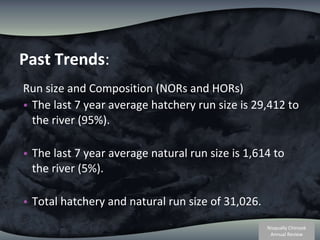
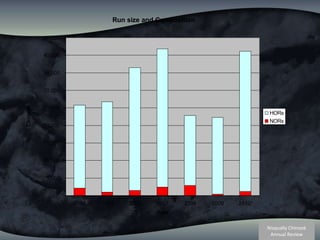
Past Trends : Run size and Composition (NORs and HORs) The last 7 year average hatchery run size is 29,412 to the river (95%). The last 7 year average natural run size is 1,614 to the river (5%).  Total hatchery and natural run size of 31,026.
 
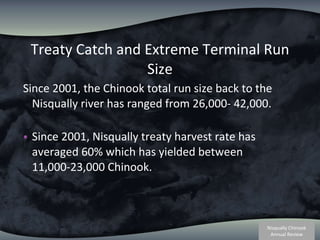
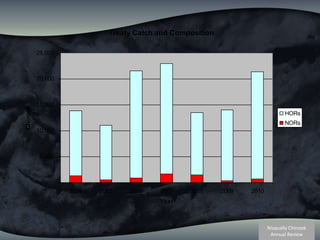
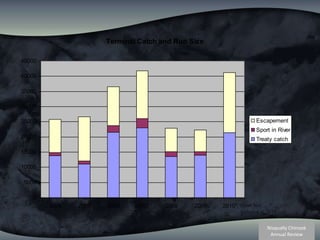
Treaty Catch and Extreme Terminal Run Size Since 2001, the Chinook total run size back to the Nisqually river has ranged from 26,000- 42,000.  Since 2001, Nisqually treaty harvest rate has averaged 60% which has yielded between 11,000-23,000 Chinook.
 
Terminal Catch and Composition  Recent 7 year average Treaty hatchery fish commercially harvested was just under 16,000 fish per year. Recent 7 year average Treaty natural fish commercially harvested was 980:  roughly 5% of the catch  7 year average sport harvest not including 2010 is ~1,500.
Sport Not included in 2010
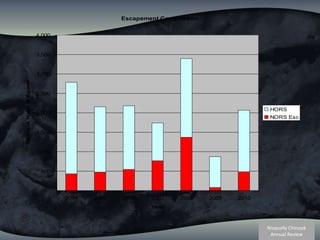
Spawning Ground Escapement and  Composition Recent 7 year average escapement to the spawning grounds:  ~2,200  ~1,600 hatchery strays 73% HORs on the spawning grounds Recovery plan goal is 10% ~600  natural  Chinook  27% NORs on spawning grounds Recovery plan goal is 90% NORs
 
?????????????Questions???????????

Nisqually chinook status and trends

  • 1.
    Nisqually Chinook Recovery Plan Annual Review Nisqually Wildlife Refuge February 8, 2011
  • 2.
    Introduction: Craig Smith!Nisqually Harvest Program Manager Nisqually Chinook STATUS AND TRENDS SESSION 1
  • 3.
    Definitions: HORs – Hatchery Origin Recruits or fish of hatchery origin. NORs - Natural Origin Recruits or fish of natural spawned origin (natural). Marked - A hatchery fish that has the adipose fin clipped. Unmarked - A hatchery fish without the adipose fin clipped OR a natural fish Exploitation Rate -Total mortality in a fishery or aggregate of fisheries divided by the sum of total fishing and natural mortality plus escapement. Harvest Rate - Total fishing mortality, in some cases of a specific stock divided by the abundance in a given fishing area at the start of a time period. Rebuilding Exploitation Rate - The impact of harvest that will not significantly impede the opportunity for the population to grow towards the recovery goal . Extreme Terminal Run Size - The number of fish returning to a specific place or river. Escapement - The fish that escape all fisheries to their respective spawning area such as the hatchery or the natural spawning grounds.
  • 4.
  • 5.
    Session 1 PastTrends Run size and Composition Hatchery Origin Recruits and Natural Origin Recruits will be referred to as HORs and NORs, respectively Terminal Catch and Composition Escapement and Composition
  • 6.
    Past Trends :Run size and Composition (NORs and HORs) The last 7 year average hatchery run size is 29,412 to the river (95%). The last 7 year average natural run size is 1,614 to the river (5%). Total hatchery and natural run size of 31,026.
  • 7.
  • 8.
    Treaty Catch andExtreme Terminal Run Size Since 2001, the Chinook total run size back to the Nisqually river has ranged from 26,000- 42,000. Since 2001, Nisqually treaty harvest rate has averaged 60% which has yielded between 11,000-23,000 Chinook.
  • 9.
  • 10.
    Terminal Catch andComposition Recent 7 year average Treaty hatchery fish commercially harvested was just under 16,000 fish per year. Recent 7 year average Treaty natural fish commercially harvested was 980: roughly 5% of the catch 7 year average sport harvest not including 2010 is ~1,500.
  • 11.
  • 12.
    Spawning Ground Escapementand Composition Recent 7 year average escapement to the spawning grounds: ~2,200 ~1,600 hatchery strays 73% HORs on the spawning grounds Recovery plan goal is 10% ~600 natural Chinook 27% NORs on spawning grounds Recovery plan goal is 90% NORs
  • 13.
  • 14.