IMPACTS OF LOCAL AIR POLLUTION: 
CONSEQUENCES FOR ECONOMIC GROWTH 
Elisa Lanzi 
Environment Directorate, OECD 
CIRCLE Ad-hoc expert workshop 
Paris, 4 October 2014
2 
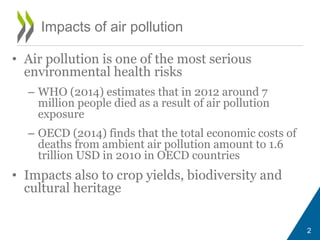
Impacts of air pollution 
• Air pollution is one of the most serious 
environmental health risks 
– WHO (2014) estimates that in 2012 around 7 
million people died as a result of air pollution 
exposure 
– OECD (2014) finds that the total economic costs of 
deaths from ambient air pollution amount to 1.6 
trillion USD in 2010 in OECD countries 
• Impacts also to crop yields, biodiversity and 
cultural heritage
3 
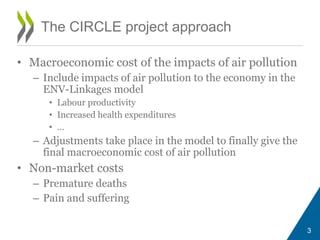
The CIRCLE project approach 
• Macroeconomic cost of the impacts of air pollution 
– Include impacts of air pollution to the economy in the 
ENV-Linkages model 
• Labour productivity 
• Increased health expenditures 
• … 
– Adjustments take place in the model to finally give the 
final macroeconomic cost of air pollution 
• Non-market costs 
– Premature deaths 
– Pain and suffering
4 
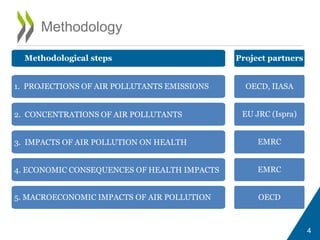
Methodology 
1. PROJECTIONS OF AIR POLLUTANTS EMISSIONS 
2. CONCENTRATIONS OF AIR POLLUTANTS 
3. IMPACTS OF AIR POLLUTION ON HEALTH 
4. ECONOMIC CONSEQUENCES OF HEALTH IMPACTS 
5. MACROECONOMIC IMPACTS OF AIR POLLUTION 
OECD, IIASA 
EU JRC (Ispra) 
EMRC 
EMRC 
Methodological steps Project partners 
OECD
5 
1. Projections of air pollutants emissions 
• Emission data from the sectoral GAINS model (IIASA) 
– SO2, NOx, PM2.5, OC, BC, NH3 
– Projections for Current Policy Scenario of IEA’s WEO 2012 
• Link emissions to production activities in different key 
sectors 
– Combustion of fossil fuels in energy and industrial sectors 
– Production of goods 
• Sector and region specific emission coefficients 
• Projections of coefficients calculated using the WEO 
2012 to 2035 and then linear extrapolation to 2060
• Calculating concentrations requires 
– Downscaling from macro regions to local level 
– Data on regional emissions, climatic and geographical variables 
(e.g. altitude, location of industrial areas, temperatures…) 
• Calculations will be done by the EU JRC (Ispra) 
– FAst Scenario Screening Tool (FASST), which describes relations 
between precursor’s emissions and pollutant’s concentrations 
– Output: 
• Concentrations of PM2.5, including from primary (BC and OC) and 
secondary (SO4 and NO3) emission sources 
• SO2 and NOx 
• Ozone 
6 
2. Concentrations of air pollutants
• Concentrations are used to calculate the 
impacts on health 
• Demographic variables also needed as input 
– Population growth 
– Ageing 
– Fertility rates 
• Impacts that would ideally be included are 
– increased mortality (premature deaths) 
– increased morbidity (number of sick days, 
hospital admissions…) 
7 
3. Impacts of air pollution on health
• Once the health impacts are calculated, they need to be 
evaluated 
• Market impacts 
– Additional health costs (from hospital admissions or healthcare) 
– Changes in labour productivity 
• Non-market impacts 
– Cost of premature deaths 
– Costs of pain and suffering 
• The challenge 
– Break down morbidity costs between market and non-market costs 
8 
4. Valuation of health impacts
9 
5. Macroeconomic impacts of air pollution 
• Health impacts will be modelled directly in the CGE 
model, as much as possible 
• Production function approach 
– increased mortality: loss of labour supply 
– increased morbidity: decreased labour productivity, 
increased demand for healthcare 
• Aspects that cannot be captured in CGE models 
– Presented separately from the macroeconomic impacts 
– Economic costs of premature deaths, costs of ‘pain and 
suffering’ 
– Challenge: how to combine market and non-market 
impacts?
• Policies can improve air quality and reduce the impacts on health 
– Adoption of end-of-pipe technologies 
– Shifting of economic activity away from polluting to less polluting sectors 
– Improvements in production processes, e.g. energy efficiency 
improvements, fuel switching 
• Potential air pollution scenario: Maximum Technically Feasible 
Reduction (MTFR) scenario, which reflects the implementation of the 
best available end-of-pipe technologies to reduce air pollution 
– Need data on the costs of implementation of the policies, i.e. the costs of 
the adoption of new and more efficient technologies 
• Interactions between air pollution and climate change mitigation 
policies 
10 
Benefits of policy action
• Model Marginal Abatement Cost Curves 
– Identify how policies affect technology choice and then specify the 
position on the MACC 
– The MACC reflects investments in abatement as a consequence of 
policies such as 
• mandating specific end-of-pipe techniques 
• incentives to adopt improved technologies 
• road pricing schemes 
• air quality targets 
• Consider other impacts 
– Agricultural yields 
– Biodiversity 
11 
Possible future developments
• Q4 2014 
– Finalise the modelling of air pollutants in ENV-Linkages 
– Calculate concentrations 
– Finalise the methodology to calculate and evaluate impacts 
• Q1 2015 
– Calculate and evaluate impacts 
• Q2 2015 
– Quantitative assessment of the economic consequences of the health 
impacts of air pollution 
– Develop relevant policy scenarios 
• Q3 2015 
– Calculate benefits of policy action 
• Q4 2015 
– Finalise the work and draft a report, which should be ready in early 2016 
• Q1 2016 
– Finalise the report 
12 
Next steps and timeline
THANK YOU! For more information: www.oecd.org/environment/CIRCLE.htm www.oecd.org/environment/modelling elisa.lanzi@oecd.org

SESSION 6_Local Air Pollution-Elisa Lanzi,OECD- CIRCLE workshop Oct. 2014

  • 1.
    IMPACTS OF LOCALAIR POLLUTION: CONSEQUENCES FOR ECONOMIC GROWTH Elisa Lanzi Environment Directorate, OECD CIRCLE Ad-hoc expert workshop Paris, 4 October 2014
  • 2.
    2 Impacts ofair pollution • Air pollution is one of the most serious environmental health risks – WHO (2014) estimates that in 2012 around 7 million people died as a result of air pollution exposure – OECD (2014) finds that the total economic costs of deaths from ambient air pollution amount to 1.6 trillion USD in 2010 in OECD countries • Impacts also to crop yields, biodiversity and cultural heritage
  • 3.
    3 The CIRCLEproject approach • Macroeconomic cost of the impacts of air pollution – Include impacts of air pollution to the economy in the ENV-Linkages model • Labour productivity • Increased health expenditures • … – Adjustments take place in the model to finally give the final macroeconomic cost of air pollution • Non-market costs – Premature deaths – Pain and suffering
  • 4.
    4 Methodology 1.PROJECTIONS OF AIR POLLUTANTS EMISSIONS 2. CONCENTRATIONS OF AIR POLLUTANTS 3. IMPACTS OF AIR POLLUTION ON HEALTH 4. ECONOMIC CONSEQUENCES OF HEALTH IMPACTS 5. MACROECONOMIC IMPACTS OF AIR POLLUTION OECD, IIASA EU JRC (Ispra) EMRC EMRC Methodological steps Project partners OECD
  • 5.
    5 1. Projectionsof air pollutants emissions • Emission data from the sectoral GAINS model (IIASA) – SO2, NOx, PM2.5, OC, BC, NH3 – Projections for Current Policy Scenario of IEA’s WEO 2012 • Link emissions to production activities in different key sectors – Combustion of fossil fuels in energy and industrial sectors – Production of goods • Sector and region specific emission coefficients • Projections of coefficients calculated using the WEO 2012 to 2035 and then linear extrapolation to 2060
  • 6.
    • Calculating concentrationsrequires – Downscaling from macro regions to local level – Data on regional emissions, climatic and geographical variables (e.g. altitude, location of industrial areas, temperatures…) • Calculations will be done by the EU JRC (Ispra) – FAst Scenario Screening Tool (FASST), which describes relations between precursor’s emissions and pollutant’s concentrations – Output: • Concentrations of PM2.5, including from primary (BC and OC) and secondary (SO4 and NO3) emission sources • SO2 and NOx • Ozone 6 2. Concentrations of air pollutants
  • 7.
    • Concentrations areused to calculate the impacts on health • Demographic variables also needed as input – Population growth – Ageing – Fertility rates • Impacts that would ideally be included are – increased mortality (premature deaths) – increased morbidity (number of sick days, hospital admissions…) 7 3. Impacts of air pollution on health
  • 8.
    • Once thehealth impacts are calculated, they need to be evaluated • Market impacts – Additional health costs (from hospital admissions or healthcare) – Changes in labour productivity • Non-market impacts – Cost of premature deaths – Costs of pain and suffering • The challenge – Break down morbidity costs between market and non-market costs 8 4. Valuation of health impacts
  • 9.
    9 5. Macroeconomicimpacts of air pollution • Health impacts will be modelled directly in the CGE model, as much as possible • Production function approach – increased mortality: loss of labour supply – increased morbidity: decreased labour productivity, increased demand for healthcare • Aspects that cannot be captured in CGE models – Presented separately from the macroeconomic impacts – Economic costs of premature deaths, costs of ‘pain and suffering’ – Challenge: how to combine market and non-market impacts?
  • 10.
    • Policies canimprove air quality and reduce the impacts on health – Adoption of end-of-pipe technologies – Shifting of economic activity away from polluting to less polluting sectors – Improvements in production processes, e.g. energy efficiency improvements, fuel switching • Potential air pollution scenario: Maximum Technically Feasible Reduction (MTFR) scenario, which reflects the implementation of the best available end-of-pipe technologies to reduce air pollution – Need data on the costs of implementation of the policies, i.e. the costs of the adoption of new and more efficient technologies • Interactions between air pollution and climate change mitigation policies 10 Benefits of policy action
  • 11.
    • Model MarginalAbatement Cost Curves – Identify how policies affect technology choice and then specify the position on the MACC – The MACC reflects investments in abatement as a consequence of policies such as • mandating specific end-of-pipe techniques • incentives to adopt improved technologies • road pricing schemes • air quality targets • Consider other impacts – Agricultural yields – Biodiversity 11 Possible future developments
  • 12.
    • Q4 2014 – Finalise the modelling of air pollutants in ENV-Linkages – Calculate concentrations – Finalise the methodology to calculate and evaluate impacts • Q1 2015 – Calculate and evaluate impacts • Q2 2015 – Quantitative assessment of the economic consequences of the health impacts of air pollution – Develop relevant policy scenarios • Q3 2015 – Calculate benefits of policy action • Q4 2015 – Finalise the work and draft a report, which should be ready in early 2016 • Q1 2016 – Finalise the report 12 Next steps and timeline
  • 13.
    THANK YOU! Formore information: www.oecd.org/environment/CIRCLE.htm www.oecd.org/environment/modelling elisa.lanzi@oecd.org