LEGAL BASIS FOR IMPLEMENTING 
GRIEVANCE PROCEEDINGS AT 
DEPED 
LEGAL UNIT 
Atty. Ariz Delson Cawilan
DepED ORDER No. 35, s. 2004 
“Revision of the Grievance Machinery 
of the Department of Education”
OOBBJJEECCTTIIVVEESS OOFF GGRRIIEEVVAANNCCEE MMAACCHHIINNEERRYY 
1. Determine or provide the best way to remedy 
the specific cause or causes of the grievance. 
2. Help promote wholesome and desirable 
employee relations in the Department and to 
prevent employee discontent and dissatisfaction. 
3. Create a working atmosphere that is conducive 
to good supervisor-employee relations and 
improved employee morale, the machinery shall 
aim to:
a. activate and strengthen the Department’s existing 
grievance machinery; 
b. settle grievances at the lowest possible level in the 
Department; and 
c. provide a catalyst for the development of 
capabilities of personnel to settle disputes.
BBAASSIICC PPOOLLIICCIIEESS 
1. A grievance shall be resolved expeditiously 
at all times at the lowest level possible. 
However, if not settled at the lowest level 
possible, an aggrieved party shall present 
his/her grievance step by step following the 
hierarchy of positions. 
2. The aggrieved party shall be assured 
freedom from coercion, discrimination, 
reprisal, and biased action on the grievance.
3. Grievance proceedings shall not be 
bound by legal rules and technicalities. 
Even verbal grievance must be acted 
upon expeditiously. The services of a 
legal counsel shall not be allowed. 
4. The head of agency shall ensure equal 
opportunities for men and women to be 
represented in the grievance committee.
DDEEFFIINNIITTIIOONN OOFF TTEERRMMSS 
• GRIEVANCE – refers to a work-related 
discontentment or dissatisfaction which had 
been expressed verbally or in writing and 
which, in the aggrieved employee’s opinion, 
has been ignored or dropped without due 
consideration. 
• GRIEVANCE MACHINERY – a system or 
method of determining and finding the best 
way to address the specific cause or causes 
of a grievance.
Sources of Disputes: 
-Misunderstanding with 
the boss 
-Disputes/ Complaints 
referred by a subordinate, 
bypassing the trouble 
shooter. 
TROUBLE SHOOTER 
-Disputes/ Grievances 
and Complaints 
directly referred by a 
subordinate
SSCCOOPPEE 
The Grievance Machinery shall apply to all 
levels of officials and employees in the 
Department of Education (DepEd), including 
non-career employees whenever applicable.
CCOOVVEERRAAGGEE OOFF GGRRIIEEVVAANNCCEE 
PPRROOCCEEEEDDIINNGGSS:: 
1. Non-implementation of: 
A. Policies 
B. Practices 
C. Procedures 
on economic and financial 
issues and other terms and 
conditions of employment 
fixed by law. 
Including salaries, incentives, 
working hours, leave benefits 
such as delay in the processing 
of overtime pay, unreasonable 
withholding of salaries and 
inaction on application for 
leave.
2. Non-implementation of: 
A. Policies 
B. Practices 
C. Procedures 
which affect employees 
from : 
-recruitment to promotion, 
-detail 
-transfer, 
-retirement, 
-termination, 
-lay-offs, 
-and other related issues 
that affect them such as 
failure to observe selection 
process in appointment and 
undue delay in the 
processing of retirement 
papers
3. Inadequate physical working conditions such as 
lack of proper ventilation in the workplace, and 
insufficient facilities and equipment necessary for the 
safety and protection of employees whose nature and 
place of work are classified as high risk or hazardous; 
4. Poor interpersonal 
relationships 
and linkages;
4. Protest on appointments; 
5. All other matters giving 
rise to employee 
dissatisfaction and 
discontentment outside 
of those cases enumerated 
above.
The following cases shall NOT be 
acted upon through the 
grievance machinery: 
1.Disciplinary cases which shall be resolved 
pursuant to the Revised Rules of Procedures 
on Administrative Disciplinary Cases (DepEd 
Order No. 49 s. 2006); 
-Graft and Corrupt Practices 
-Dishonesty 
-Misconduct 
-Drunkenness 
-Tardiness and Absences 
-Discourtesy 
-Immorality etc…..
GRIEVABLE ISSUE VS. ADMINISTRATIVE ISSUE 
Involves mere dissatisfaction Involves malice and bad faith
3. Sexual harassment 
cases as provided 
for in RA 7877; 
4. Union –related 
issues and concerns; 
5. Child Abuse Cases.
In SAID CASES: 
-The personnel concerned 
should REPORT the same to 
the Division Office. 
-Make preventive measures
ADMINISTRATIVE 
PROCEEDINGS 
GRIEVANCE 
PROCEEDINGS 
JURISDICTION Regional Office Immediate 
Supervisor 
Grievance 
Committees 
PROCESS 
INVOLVED 
Disciplinary 
Proceedings 
Mediation and 
Conciliation 
Proceedings
Consequence of Non-Reporting: 
-May be held liable for Neglect of Duty: 
Publishable by Suspension of 1 month to Dismissal 
from Service. 
Consequence of Acting on Administrative Proceedings without Authority: 
-May be held liable for Grave Misconduct: 
Punishable by Dismissal from Service for the First Offense
GRIEVANCE COMMITTEE 
• The Department shall establish separate grievance 
committees in the central, regional, division and district 
offices and in schools. 
• Only permanent officials and employees shall be 
appointed or elected as members of the grievance 
committee. 
• In the appointment or election of the committee 
members, their integrity, probity, sincerity and credibility 
shall be considered. 
• Officials who refuse to take action on a grievance 
brought to their attention shall be liable for neglect of 
duty in accordance with the civil service laws, rules and 
regulations.
JURISDICTION OF GRIEVANCE 
COMMITTEES 
a. The School GC shall have original jurisdiction over 
grievances of teachers and non-teaching personnel in 
the school that were not orally resolved. 
b. The District GC shall have original jurisdiction over 
grievances of employees in the district that were not 
orally resolved. It shall also have appellate jurisdiction 
over grievances that were not resolved in the Scholl 
GC. 
c. The Schools Division GC shall have original jurisdiction 
over grievances of employees in the division that were 
not orally resolved. It shall also have appellate 
jurisdiction over grievances that were not resolved in 
the District GC.
d. The Regional GC shall have original jurisdiction 
over grievances of employees in the region that 
were not orally resolved. It shall also have 
appellate jurisdiction over grievances that were not 
resolved in the Schools Division GC. 
e.The Department GC shall have original jurisdiction 
over grievances of employees in the different 
bureaus/services/centers and offices in the Central 
Office that were not orally resolved. It shall also 
have appellate jurisdiction over grievances that 
were not resolved by the Regional GC.
COMPOSITION OF THE 
GRIEVANCE COMMITTEE 
A. SCHOOL GRIEVANCE COMMITTEE 
1. Principal or Head Teacher 
2. President of the Faculty Club 
3. A teacher who is acceptable to both the aggrieved 
party and the object of the grievance to be 
appointed by the Principal or Head Teacher. 
B. DISTRICT GRIEVANCE COMMITTEE 
1. District Supervisor/Coordinator or his/her designated 
representative 
2. Principal of the school where the grievance 
originated 
3. President of the District Teacher’s Association or 
his/her designated representative.
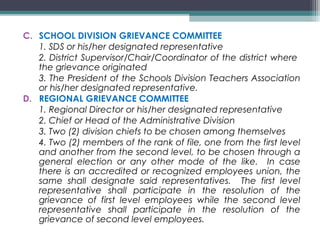
C. SCHOOL DIVISION GRIEVANCE COMMITTEE 
1. SDS or his/her designated representative 
2. District Supervisor/Chair/Coordinator of the district where 
the grievance originated 
3. The President of the Schools Division Teachers Association 
or his/her designated representative. 
D. REGIONAL GRIEVANCE COMMITTEE 
1. Regional Director or his/her designated representative 
2. Chief or Head of the Administrative Division 
3. Two (2) division chiefs to be chosen among themselves 
4. Two (2) members of the rank of file, one from the first level 
and another from the second level, to be chosen through a 
general election or any other mode of the like. In case 
there is an accredited or recognized employees union, the 
same shall designate said representatives. The first level 
representative shall participate in the resolution of the 
grievance of first level employees while the second level 
representative shall participate in the resolution of the 
grievance of second level employees.
The two (2) representatives from the rank and file shall 
serve for a term of two (2) years. 
(5) Designated Bilis Aksyon Partner. 
E.DEPARTMENT GRIEVANCE COMMITTEE 
1. Highest official responsible for Human Resourse 
Management 
2. Two (2) Division Chiefs, one from the OSEC proper and 
one from the bureaus to be chosen from among 
themselves. 
3. Two (2) members of the rank and file, one from the first 
level and another from the second leval, to be 
nominated by the accredited or recognized employees 
union. The first level representative shall participate in 
the resolution of the grievance of first level employees 
while the second level representative shall participate in 
the resolution of the grievance of second level 
employees. The two (2) representatives from the rank 
and file shall serve for a term of two (2) years. 
4. Designated Bilis Aksyon Partner.
GRIEVANCE PROCEDURE 
A. DISCUSSION WITH IMMEDIATE 
SUPERVISOR: 
- The employee/aggrieved party shall present 
his/her grievance orally or in writing to his/her 
immediate supervisor, who shall, within three (3) 
days from the date of presentation, inform the 
employee orally of his or her decision. 
- Provided, however, that where the object of 
the grievance is the immediate supervisor, the 
aggrieved party may bring the grievance to the 
next higher supervisor.
IN THE ORAL DISCUSSION, THE FOLLOWING SHALL BE 
OBSERVED: 
a.The employee/aggrieved party shall be put at ease 
– every effort shall be exerted to make the 
employee who has a grievance feel at ease during 
the oral discussion. 
b.The employee/aggrieved party shall be 
encouraged to talk – the employee shall be 
allowed to tell or explain his/her side during the oral 
discussion.
c. Privacy in discussion – the oral discussion 
shall be held in private in a quiet and 
secluded spot where the conversation 
cannot be interrupted or overheard. 
d. The case shall be heard fully – the 
supervisor shall seek to keep his/her views 
and opinions entirely to himself/herself until 
after the employee has explained his/her 
side during the oral discussion.
e. A definite decision shall be reached – at the end 
of the discussion, the supervisor must be prepared 
to state his/her position clearly and accurately 
based on the merits of the grievance. He/she need 
not immediately give a definite decision, but the 
decision shall be rendered within three (3) days 
from the presentation of the grievance.
B. Appeal to the Higher Supervisor – if the 
aggrieved party is not satisfied with the 
verbal decision, he or she may submit the 
grievance in writing, within five (5) days to 
the next higher supervisor who shall render 
his or her decision within five (5) working 
days from receipt of the grievance.
C. Appeal to the Grievance Committee – the 
decision of the next higher supervisor may be 
elevated to the grievance committee within five (5) 
working days from receipt of the decision of the 
next higher supervisor. 
The grievance committee may conduct an 
investigation and hearing within ten (10) working 
days from receipt of the grievance and render a 
decision within five (5) working days after the 
investigation. Provided, however, that where the 
object of the grievance is the grievance 
committee, the aggrieved party may submit the 
grievance to the Office of the Secretary, through 
the Undersecretary for legal Affairs.
• School Level: School Grievance Committee (SGC) 
• Division Level: Division Grievance Committee (DGC), 
and appealed grievances from the SGC 
• Regional Level: Regional Grievance Committee 
(RGC), and appealed grievances from the DGC 
• Central/Department Level: Department Grievance 
Committee (DGC), and appealed grievances from 
the RGC 
• Civil Service Commission: over appealed 
grievances from the DGC
• Appeal to the Office of the Secretary 
- if the aggrieved party is not satisfied with the decision 
of the grievance committee, he/she may elevate 
his/her grievance within 5 working days from receipt of 
the decision to the Office of the Secretary through the 
Undersecretary for Legal Affairs who shall make the 
decision within 10 working days after the grievance. 
Provided, however, that where the object of the 
grievance is the Secretary, the aggrieved party may 
bring his/her grievance directly to the CSC, Regional 
Office. 
• Appeal to the Civil Service Commission Regional Office 
- If the aggrieved party is not satisfied with the decision 
of top management, he or she may appeal or elevate 
his or her grievance to the CSCRO concerned within 15 
working days from receipt of such decision. The 
aggrieved party shall submit a Certificate on the Final 
Action on the Grievance (CFAG) together with the 
appeal. The CSCRO shall rule on the appeal in 
accordance with existing civil service law, rules and 
regulations.
DECISION OF THE 
GRIEVANCE 
COMMITTEE 
• The decision shall be in writing and shall contain all 
relevant facts and circumstances as well as the law 
or rule that was applied.
RESPONSIBILITIES OF THE GRIEVANCE 
COMMITTEE 
a. Establish its own procedures and strategies. 
Membership in the grievance committee shall be 
considered part of the member’s regular duties. 
b. Develop and implement pro-active measures or 
activities to prevent grievance such as an 
employee assembly which shall be conducted at 
least one every quarter, “talakayan”, counseling 
and other HRD interventions. Minutes of the 
proceedings of these activities must be 
documented.
c. Conduct regular and continuing 
information drive on the Grievance 
Machinery among officials and employees. 
“To avoid confusion and circuitry of action 
as well as to prevent direct complaints to 
the Central, Regional and Division Offices” 
d. Conduct dialogue between and among 
the parties involved.
e. Direct the documentation of the grievance 
including the preparation and signing of written 
agreements reached by the parties involved. 
f. Issue final certification on the Final Action on the 
Grievance (CFAG) which shall contain, among 
other things, the history and final action taken by 
the agency on the grievance. 
g. Submit a quarterly report of its accomplishments 
and status of unresolved grievance to the Civil 
Service Commission Regional Office concerned.
• SUMMARY OF GRIEVANCE PROCEEDINGS: 
• Discussion with Immediate Supervisor 
(3 Days to Decide) (5 Days to Appeal) 
• Discussion with Next Higher Superior 
(5 Days to Decide) (5 Days to Appeal) 
• School Level: School Grievance Committee (SGC) 
(5 Days to Decide) (5 Days to Appeal) 
• Division Level: Division Grievance Committee (DGC), and appealed 
grievances from the SGC 
(5 Days to Decide) (5 Days to Appeal) 
• Regional Level: Regional Grievance Committee (RGC), and 
appealed grievances from the DGC 
(5 Days to Decide) (5 Days to Appeal) 
• Central/Department Level: Department Grievance Committee 
(DGC), and appealed grievances from the RGC 
(10 Days to Decide) (5 Days to Appeal) 
• Civil Service Commission: over appealed grievances from the DGC
• N.B. No portion of this presentation shall be used by anyone without the express 
consent of the author

Session 10 grievance procedure

  • 1.
    LEGAL BASIS FORIMPLEMENTING GRIEVANCE PROCEEDINGS AT DEPED LEGAL UNIT Atty. Ariz Delson Cawilan
  • 2.
    DepED ORDER No.35, s. 2004 “Revision of the Grievance Machinery of the Department of Education”
  • 3.
    OOBBJJEECCTTIIVVEESS OOFF GGRRIIEEVVAANNCCEEMMAACCHHIINNEERRYY 1. Determine or provide the best way to remedy the specific cause or causes of the grievance. 2. Help promote wholesome and desirable employee relations in the Department and to prevent employee discontent and dissatisfaction. 3. Create a working atmosphere that is conducive to good supervisor-employee relations and improved employee morale, the machinery shall aim to:
  • 4.
    a. activate andstrengthen the Department’s existing grievance machinery; b. settle grievances at the lowest possible level in the Department; and c. provide a catalyst for the development of capabilities of personnel to settle disputes.
  • 5.
    BBAASSIICC PPOOLLIICCIIEESS 1.A grievance shall be resolved expeditiously at all times at the lowest level possible. However, if not settled at the lowest level possible, an aggrieved party shall present his/her grievance step by step following the hierarchy of positions. 2. The aggrieved party shall be assured freedom from coercion, discrimination, reprisal, and biased action on the grievance.
  • 6.
    3. Grievance proceedingsshall not be bound by legal rules and technicalities. Even verbal grievance must be acted upon expeditiously. The services of a legal counsel shall not be allowed. 4. The head of agency shall ensure equal opportunities for men and women to be represented in the grievance committee.
  • 7.
    DDEEFFIINNIITTIIOONN OOFF TTEERRMMSS • GRIEVANCE – refers to a work-related discontentment or dissatisfaction which had been expressed verbally or in writing and which, in the aggrieved employee’s opinion, has been ignored or dropped without due consideration. • GRIEVANCE MACHINERY – a system or method of determining and finding the best way to address the specific cause or causes of a grievance.
  • 8.
    Sources of Disputes: -Misunderstanding with the boss -Disputes/ Complaints referred by a subordinate, bypassing the trouble shooter. TROUBLE SHOOTER -Disputes/ Grievances and Complaints directly referred by a subordinate
  • 9.
    SSCCOOPPEE The GrievanceMachinery shall apply to all levels of officials and employees in the Department of Education (DepEd), including non-career employees whenever applicable.
  • 10.
    CCOOVVEERRAAGGEE OOFF GGRRIIEEVVAANNCCEE PPRROOCCEEEEDDIINNGGSS:: 1. Non-implementation of: A. Policies B. Practices C. Procedures on economic and financial issues and other terms and conditions of employment fixed by law. Including salaries, incentives, working hours, leave benefits such as delay in the processing of overtime pay, unreasonable withholding of salaries and inaction on application for leave.
  • 11.
    2. Non-implementation of: A. Policies B. Practices C. Procedures which affect employees from : -recruitment to promotion, -detail -transfer, -retirement, -termination, -lay-offs, -and other related issues that affect them such as failure to observe selection process in appointment and undue delay in the processing of retirement papers
  • 12.
    3. Inadequate physicalworking conditions such as lack of proper ventilation in the workplace, and insufficient facilities and equipment necessary for the safety and protection of employees whose nature and place of work are classified as high risk or hazardous; 4. Poor interpersonal relationships and linkages;
  • 13.
    4. Protest onappointments; 5. All other matters giving rise to employee dissatisfaction and discontentment outside of those cases enumerated above.
  • 14.
    The following casesshall NOT be acted upon through the grievance machinery: 1.Disciplinary cases which shall be resolved pursuant to the Revised Rules of Procedures on Administrative Disciplinary Cases (DepEd Order No. 49 s. 2006); -Graft and Corrupt Practices -Dishonesty -Misconduct -Drunkenness -Tardiness and Absences -Discourtesy -Immorality etc…..
  • 15.
    GRIEVABLE ISSUE VS.ADMINISTRATIVE ISSUE Involves mere dissatisfaction Involves malice and bad faith
  • 16.
    3. Sexual harassment cases as provided for in RA 7877; 4. Union –related issues and concerns; 5. Child Abuse Cases.
  • 17.
    In SAID CASES: -The personnel concerned should REPORT the same to the Division Office. -Make preventive measures
  • 18.
    ADMINISTRATIVE PROCEEDINGS GRIEVANCE PROCEEDINGS JURISDICTION Regional Office Immediate Supervisor Grievance Committees PROCESS INVOLVED Disciplinary Proceedings Mediation and Conciliation Proceedings
  • 19.
    Consequence of Non-Reporting: -May be held liable for Neglect of Duty: Publishable by Suspension of 1 month to Dismissal from Service. Consequence of Acting on Administrative Proceedings without Authority: -May be held liable for Grave Misconduct: Punishable by Dismissal from Service for the First Offense
  • 20.
    GRIEVANCE COMMITTEE •The Department shall establish separate grievance committees in the central, regional, division and district offices and in schools. • Only permanent officials and employees shall be appointed or elected as members of the grievance committee. • In the appointment or election of the committee members, their integrity, probity, sincerity and credibility shall be considered. • Officials who refuse to take action on a grievance brought to their attention shall be liable for neglect of duty in accordance with the civil service laws, rules and regulations.
  • 21.
    JURISDICTION OF GRIEVANCE COMMITTEES a. The School GC shall have original jurisdiction over grievances of teachers and non-teaching personnel in the school that were not orally resolved. b. The District GC shall have original jurisdiction over grievances of employees in the district that were not orally resolved. It shall also have appellate jurisdiction over grievances that were not resolved in the Scholl GC. c. The Schools Division GC shall have original jurisdiction over grievances of employees in the division that were not orally resolved. It shall also have appellate jurisdiction over grievances that were not resolved in the District GC.
  • 22.
    d. The RegionalGC shall have original jurisdiction over grievances of employees in the region that were not orally resolved. It shall also have appellate jurisdiction over grievances that were not resolved in the Schools Division GC. e.The Department GC shall have original jurisdiction over grievances of employees in the different bureaus/services/centers and offices in the Central Office that were not orally resolved. It shall also have appellate jurisdiction over grievances that were not resolved by the Regional GC.
  • 23.
    COMPOSITION OF THE GRIEVANCE COMMITTEE A. SCHOOL GRIEVANCE COMMITTEE 1. Principal or Head Teacher 2. President of the Faculty Club 3. A teacher who is acceptable to both the aggrieved party and the object of the grievance to be appointed by the Principal or Head Teacher. B. DISTRICT GRIEVANCE COMMITTEE 1. District Supervisor/Coordinator or his/her designated representative 2. Principal of the school where the grievance originated 3. President of the District Teacher’s Association or his/her designated representative.
  • 24.
    C. SCHOOL DIVISIONGRIEVANCE COMMITTEE 1. SDS or his/her designated representative 2. District Supervisor/Chair/Coordinator of the district where the grievance originated 3. The President of the Schools Division Teachers Association or his/her designated representative. D. REGIONAL GRIEVANCE COMMITTEE 1. Regional Director or his/her designated representative 2. Chief or Head of the Administrative Division 3. Two (2) division chiefs to be chosen among themselves 4. Two (2) members of the rank of file, one from the first level and another from the second level, to be chosen through a general election or any other mode of the like. In case there is an accredited or recognized employees union, the same shall designate said representatives. The first level representative shall participate in the resolution of the grievance of first level employees while the second level representative shall participate in the resolution of the grievance of second level employees.
  • 25.
    The two (2)representatives from the rank and file shall serve for a term of two (2) years. (5) Designated Bilis Aksyon Partner. E.DEPARTMENT GRIEVANCE COMMITTEE 1. Highest official responsible for Human Resourse Management 2. Two (2) Division Chiefs, one from the OSEC proper and one from the bureaus to be chosen from among themselves. 3. Two (2) members of the rank and file, one from the first level and another from the second leval, to be nominated by the accredited or recognized employees union. The first level representative shall participate in the resolution of the grievance of first level employees while the second level representative shall participate in the resolution of the grievance of second level employees. The two (2) representatives from the rank and file shall serve for a term of two (2) years. 4. Designated Bilis Aksyon Partner.
  • 26.
    GRIEVANCE PROCEDURE A.DISCUSSION WITH IMMEDIATE SUPERVISOR: - The employee/aggrieved party shall present his/her grievance orally or in writing to his/her immediate supervisor, who shall, within three (3) days from the date of presentation, inform the employee orally of his or her decision. - Provided, however, that where the object of the grievance is the immediate supervisor, the aggrieved party may bring the grievance to the next higher supervisor.
  • 27.
    IN THE ORALDISCUSSION, THE FOLLOWING SHALL BE OBSERVED: a.The employee/aggrieved party shall be put at ease – every effort shall be exerted to make the employee who has a grievance feel at ease during the oral discussion. b.The employee/aggrieved party shall be encouraged to talk – the employee shall be allowed to tell or explain his/her side during the oral discussion.
  • 28.
    c. Privacy indiscussion – the oral discussion shall be held in private in a quiet and secluded spot where the conversation cannot be interrupted or overheard. d. The case shall be heard fully – the supervisor shall seek to keep his/her views and opinions entirely to himself/herself until after the employee has explained his/her side during the oral discussion.
  • 29.
    e. A definitedecision shall be reached – at the end of the discussion, the supervisor must be prepared to state his/her position clearly and accurately based on the merits of the grievance. He/she need not immediately give a definite decision, but the decision shall be rendered within three (3) days from the presentation of the grievance.
  • 30.
    B. Appeal tothe Higher Supervisor – if the aggrieved party is not satisfied with the verbal decision, he or she may submit the grievance in writing, within five (5) days to the next higher supervisor who shall render his or her decision within five (5) working days from receipt of the grievance.
  • 31.
    C. Appeal tothe Grievance Committee – the decision of the next higher supervisor may be elevated to the grievance committee within five (5) working days from receipt of the decision of the next higher supervisor. The grievance committee may conduct an investigation and hearing within ten (10) working days from receipt of the grievance and render a decision within five (5) working days after the investigation. Provided, however, that where the object of the grievance is the grievance committee, the aggrieved party may submit the grievance to the Office of the Secretary, through the Undersecretary for legal Affairs.
  • 32.
    • School Level:School Grievance Committee (SGC) • Division Level: Division Grievance Committee (DGC), and appealed grievances from the SGC • Regional Level: Regional Grievance Committee (RGC), and appealed grievances from the DGC • Central/Department Level: Department Grievance Committee (DGC), and appealed grievances from the RGC • Civil Service Commission: over appealed grievances from the DGC
  • 33.
    • Appeal tothe Office of the Secretary - if the aggrieved party is not satisfied with the decision of the grievance committee, he/she may elevate his/her grievance within 5 working days from receipt of the decision to the Office of the Secretary through the Undersecretary for Legal Affairs who shall make the decision within 10 working days after the grievance. Provided, however, that where the object of the grievance is the Secretary, the aggrieved party may bring his/her grievance directly to the CSC, Regional Office. • Appeal to the Civil Service Commission Regional Office - If the aggrieved party is not satisfied with the decision of top management, he or she may appeal or elevate his or her grievance to the CSCRO concerned within 15 working days from receipt of such decision. The aggrieved party shall submit a Certificate on the Final Action on the Grievance (CFAG) together with the appeal. The CSCRO shall rule on the appeal in accordance with existing civil service law, rules and regulations.
  • 34.
    DECISION OF THE GRIEVANCE COMMITTEE • The decision shall be in writing and shall contain all relevant facts and circumstances as well as the law or rule that was applied.
  • 35.
    RESPONSIBILITIES OF THEGRIEVANCE COMMITTEE a. Establish its own procedures and strategies. Membership in the grievance committee shall be considered part of the member’s regular duties. b. Develop and implement pro-active measures or activities to prevent grievance such as an employee assembly which shall be conducted at least one every quarter, “talakayan”, counseling and other HRD interventions. Minutes of the proceedings of these activities must be documented.
  • 36.
    c. Conduct regularand continuing information drive on the Grievance Machinery among officials and employees. “To avoid confusion and circuitry of action as well as to prevent direct complaints to the Central, Regional and Division Offices” d. Conduct dialogue between and among the parties involved.
  • 37.
    e. Direct thedocumentation of the grievance including the preparation and signing of written agreements reached by the parties involved. f. Issue final certification on the Final Action on the Grievance (CFAG) which shall contain, among other things, the history and final action taken by the agency on the grievance. g. Submit a quarterly report of its accomplishments and status of unresolved grievance to the Civil Service Commission Regional Office concerned.
  • 38.
    • SUMMARY OFGRIEVANCE PROCEEDINGS: • Discussion with Immediate Supervisor (3 Days to Decide) (5 Days to Appeal) • Discussion with Next Higher Superior (5 Days to Decide) (5 Days to Appeal) • School Level: School Grievance Committee (SGC) (5 Days to Decide) (5 Days to Appeal) • Division Level: Division Grievance Committee (DGC), and appealed grievances from the SGC (5 Days to Decide) (5 Days to Appeal) • Regional Level: Regional Grievance Committee (RGC), and appealed grievances from the DGC (5 Days to Decide) (5 Days to Appeal) • Central/Department Level: Department Grievance Committee (DGC), and appealed grievances from the RGC (10 Days to Decide) (5 Days to Appeal) • Civil Service Commission: over appealed grievances from the DGC
  • 39.
    • N.B. Noportion of this presentation shall be used by anyone without the express consent of the author