Gold Technical Analysis – How Do
Professionals Trade Gold?
Points To Be Discussed Today:
• How Do Professionals Trade Gold?
• How Gold Is Traded?
• Gold Has A Forward Interest Rate
• Technical Analysis Of The Gold Market
• Moving Average Convergence Divergence
• Gold Market Sentiment
How Do Professionals Trade Gold?
• Professional investors will track the direction of
Treasury yields and the value of the US dollar, which
are the driving forces behind the value of gold.
• Professional money managers use several technical,
fundamental, and sentiment indicators to determine
the future direction of gold prices.
• The Metal is both precious and industrial and is
viewed as both a commodity and a currency.
• The yellow metal, as it is often referred to as, is
generally quoted in US dollars and trades both as an
exchange-traded instrument as well as over the
counter.
How Gold Is Traded?
• Gold is considered a safe-haven asset that
appreciates in value when investors are looking
for an alternative to other currencies that are
depreciating.
• When interest rates are declining around the
world, the demand for a currency that will sustain
its value provides a backdrop for rising gold
prices.
• Gold is traded in the cash, futures, and forward
markets.
Gold Has A Forward Interest Rate
• Gold has a forward interest rate, like dollar rates or Euribor
rates.
• This interest rate called the GOFO rate increases relative to
the US dollar when gold demand rises.
• Officially, the Gold Forward Offer Rate, or GOFO, is the
interest rate at which contributors are prepared to lend gold
on a swap against US dollars, they can use gold as collateral
and potentially pay a much smaller rate of interest to borrow
the cash than otherwise.
• Cash, futures, and forward traders will evaluate three
dimensions that provide them with a view of the gold market.
• These include the technicals, the fundamental backdrop, and
sentiment.
Technical Analysis Of The Gold Market
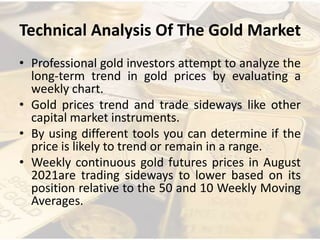
• Professional gold investors attempt to analyze the
long-term trend in gold prices by evaluating a
weekly chart.
• Gold prices trend and trade sideways like other
capital market instruments.
• By using different tools you can determine if the
price is likely to trend or remain in a range.
• Weekly continuous gold futures prices in August
2021are trading sideways to lower based on its
position relative to the 50 and 10 Weekly Moving
Averages.
Moving Average Convergence
Divergence
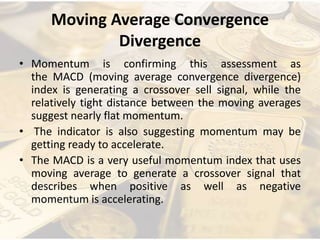
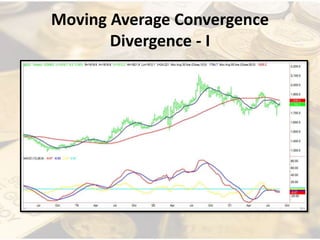
• Momentum is confirming this assessment as
the MACD (moving average convergence divergence)
index is generating a crossover sell signal, while the
relatively tight distance between the moving averages
suggest nearly flat momentum.
• The indicator is also suggesting momentum may be
getting ready to accelerate.
• The MACD is a very useful momentum index that uses
moving average to generate a crossover signal that
describes when positive as well as negative
momentum is accelerating.
Moving Average Convergence
Divergence - I
Momentum Is Important
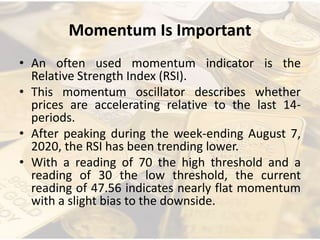
• An often used momentum indicator is the
Relative Strength Index (RSI).
• This momentum oscillator describes whether
prices are accelerating relative to the last 14-
periods.
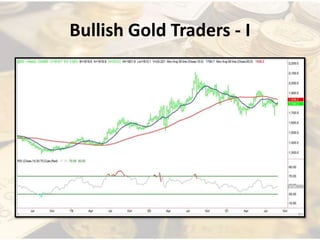
• After peaking during the week-ending August 7,
2020, the RSI has been trending lower.
• With a reading of 70 the high threshold and a
reading of 30 the low threshold, the current
reading of 47.56 indicates nearly flat momentum
with a slight bias to the downside.
Bullish Gold Traders
• Bullish gold traders are now waiting for the market to
cross over to the strong side of the 50 level.
• This will give them an early jump on a shift in
momentum to higher.
• The key to using the RSI is to look at prior highs to
determine how far momentum has accelerated in the
past.
• The weekly RSI has hit levels of 82, 77 and 75 in the
past, which means that positive momentum can still
accelerate over the upper threshold at 70 as gold
prices break out.
Bullish Gold Traders - I
Gold Market Sentiment
• There are several ways to determine market
sentiment within the gold market.
• One of the best indicators is using the
Commitment of Trader’s report released by
the Commodity Futures Trading Commission
(CFTC).
• This report helps traders understand market
dynamics.
Gold Market Sentiment - I
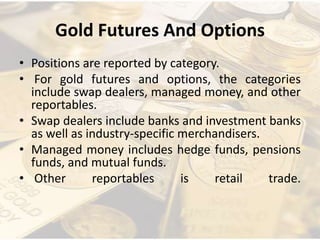
• The COT reports show position data that is
reported by category.
• This information is reported to the CFTC by
brokers and clearing members.
• While the actual reason that a trader has a
position is not reported, experts make certain
assumptions that provide information about
those positions.
Gold Market Sentiment - II
Gold Futures And Options
• Positions are reported by category.
• For gold futures and options, the categories
include swap dealers, managed money, and other
reportables.
• Swap dealers include banks and investment banks
as well as industry-specific merchandisers.
• Managed money includes hedge funds, pensions
funds, and mutual funds.
• Other reportables is retail trade.
Why Positions Are Increasing Or
Decreasing
• The CFTC staff does not know specific reasons
for specific positions and hence this
information does not factor in determining
trader classifications.
• For example, the CFTC does not know if a
swap dealer is taking a speculative position or
hedging risk. What experts need to evaluate is
why positions are increasing or decreasing.
Positions Are Increasing Or
Decreasing
Gold Producers And Refiners
• Professional traders generally assume that all
the swap dealer positions reflect hedges from
deals transacted with gold producers and
refiners.
• Those positions are offset with speculative
positions taken by managed money.
• Managed money takes positions that provide
you with information about sentiment. There
are two concepts that you need to evaluate.
Two Concepts That Needs To Evaluated
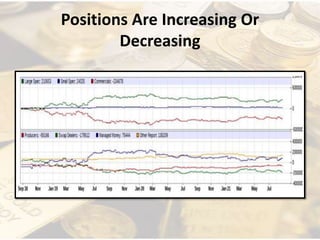
• The first is a trend in place.
• If the COT information shows that managed
money or large specs are increasing their long
positions, sentiment toward gold is increasing.
• If they are increasing their short positions, then
the negative sentiment is increasing.
• The second concept is whether the open long or
short positions in managed money is
overextended.
• If managed money is overextended, sentiment is
too high and prices could snap back quickly.
Gold Technical Analysis – How Do
Professionals Trade Gold?
THANKS FOR LISTENING
Gold Technical Analysis – How Do
Professionals Trade Gold?

September 28 I Session 2 I GBIH

  • 1.
    Gold Technical Analysis– How Do Professionals Trade Gold?
  • 2.
    Points To BeDiscussed Today: • How Do Professionals Trade Gold? • How Gold Is Traded? • Gold Has A Forward Interest Rate • Technical Analysis Of The Gold Market • Moving Average Convergence Divergence • Gold Market Sentiment
  • 3.
    How Do ProfessionalsTrade Gold? • Professional investors will track the direction of Treasury yields and the value of the US dollar, which are the driving forces behind the value of gold. • Professional money managers use several technical, fundamental, and sentiment indicators to determine the future direction of gold prices. • The Metal is both precious and industrial and is viewed as both a commodity and a currency. • The yellow metal, as it is often referred to as, is generally quoted in US dollars and trades both as an exchange-traded instrument as well as over the counter.
  • 4.
    How Gold IsTraded? • Gold is considered a safe-haven asset that appreciates in value when investors are looking for an alternative to other currencies that are depreciating. • When interest rates are declining around the world, the demand for a currency that will sustain its value provides a backdrop for rising gold prices. • Gold is traded in the cash, futures, and forward markets.
  • 5.
    Gold Has AForward Interest Rate • Gold has a forward interest rate, like dollar rates or Euribor rates. • This interest rate called the GOFO rate increases relative to the US dollar when gold demand rises. • Officially, the Gold Forward Offer Rate, or GOFO, is the interest rate at which contributors are prepared to lend gold on a swap against US dollars, they can use gold as collateral and potentially pay a much smaller rate of interest to borrow the cash than otherwise. • Cash, futures, and forward traders will evaluate three dimensions that provide them with a view of the gold market. • These include the technicals, the fundamental backdrop, and sentiment.
  • 6.
    Technical Analysis OfThe Gold Market • Professional gold investors attempt to analyze the long-term trend in gold prices by evaluating a weekly chart. • Gold prices trend and trade sideways like other capital market instruments. • By using different tools you can determine if the price is likely to trend or remain in a range. • Weekly continuous gold futures prices in August 2021are trading sideways to lower based on its position relative to the 50 and 10 Weekly Moving Averages.
  • 7.
    Moving Average Convergence Divergence •Momentum is confirming this assessment as the MACD (moving average convergence divergence) index is generating a crossover sell signal, while the relatively tight distance between the moving averages suggest nearly flat momentum. • The indicator is also suggesting momentum may be getting ready to accelerate. • The MACD is a very useful momentum index that uses moving average to generate a crossover signal that describes when positive as well as negative momentum is accelerating.
  • 8.
  • 9.
    Momentum Is Important •An often used momentum indicator is the Relative Strength Index (RSI). • This momentum oscillator describes whether prices are accelerating relative to the last 14- periods. • After peaking during the week-ending August 7, 2020, the RSI has been trending lower. • With a reading of 70 the high threshold and a reading of 30 the low threshold, the current reading of 47.56 indicates nearly flat momentum with a slight bias to the downside.
  • 10.
    Bullish Gold Traders •Bullish gold traders are now waiting for the market to cross over to the strong side of the 50 level. • This will give them an early jump on a shift in momentum to higher. • The key to using the RSI is to look at prior highs to determine how far momentum has accelerated in the past. • The weekly RSI has hit levels of 82, 77 and 75 in the past, which means that positive momentum can still accelerate over the upper threshold at 70 as gold prices break out.
  • 11.
  • 12.
    Gold Market Sentiment •There are several ways to determine market sentiment within the gold market. • One of the best indicators is using the Commitment of Trader’s report released by the Commodity Futures Trading Commission (CFTC). • This report helps traders understand market dynamics.
  • 13.
    Gold Market Sentiment- I • The COT reports show position data that is reported by category. • This information is reported to the CFTC by brokers and clearing members. • While the actual reason that a trader has a position is not reported, experts make certain assumptions that provide information about those positions.
  • 14.
  • 15.
    Gold Futures AndOptions • Positions are reported by category. • For gold futures and options, the categories include swap dealers, managed money, and other reportables. • Swap dealers include banks and investment banks as well as industry-specific merchandisers. • Managed money includes hedge funds, pensions funds, and mutual funds. • Other reportables is retail trade.
  • 16.
    Why Positions AreIncreasing Or Decreasing • The CFTC staff does not know specific reasons for specific positions and hence this information does not factor in determining trader classifications. • For example, the CFTC does not know if a swap dealer is taking a speculative position or hedging risk. What experts need to evaluate is why positions are increasing or decreasing.
  • 17.
  • 18.
    Gold Producers AndRefiners • Professional traders generally assume that all the swap dealer positions reflect hedges from deals transacted with gold producers and refiners. • Those positions are offset with speculative positions taken by managed money. • Managed money takes positions that provide you with information about sentiment. There are two concepts that you need to evaluate.
  • 19.
    Two Concepts ThatNeeds To Evaluated • The first is a trend in place. • If the COT information shows that managed money or large specs are increasing their long positions, sentiment toward gold is increasing. • If they are increasing their short positions, then the negative sentiment is increasing. • The second concept is whether the open long or short positions in managed money is overextended. • If managed money is overextended, sentiment is too high and prices could snap back quickly.
  • 20.
    Gold Technical Analysis– How Do Professionals Trade Gold?
  • 21.
    THANKS FOR LISTENING GoldTechnical Analysis – How Do Professionals Trade Gold?