Sentence Structure
p. 101-102
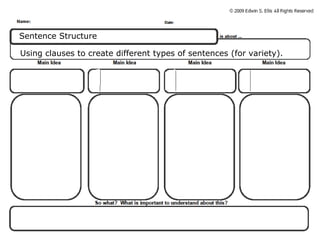
Sentence Structure
Using clauses to create different types of sentences (for variety).
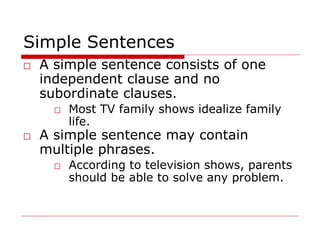
Simple Sentences
□ A simple sentence consists of one
independent clause and no
subordinate clauses.
□ Most TV family shows idealize family
life.
□ A simple sentence may contain
multiple phrases.
□ According to television shows, parents
should be able to solve any problem.
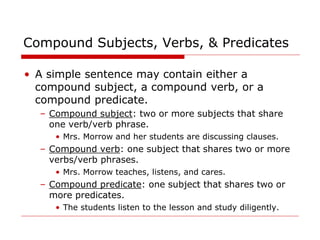
Compound Subjects, Verbs, & Predicates
• A simple sentence may contain either a
compound subject, a compound verb, or a
compound predicate.
– Compound subject: two or more subjects that share
one verb/verb phrase.
• Mrs. Morrow and her students are discussing clauses.
– Compound verb: one subject that shares two or more
verbs/verb phrases.
• Mrs. Morrow teaches, listens, and cares.
– Compound predicate: one subject that shares two or
more predicates.
• The students listen to the lesson and study diligently.
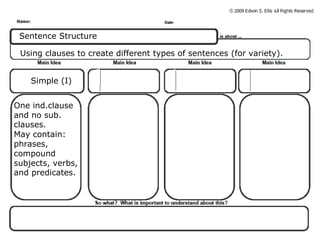
Sentence Structure
Using clauses to create different types of sentences (for variety).
Simple (I)
One ind.clause
and no sub.
clauses.
May contain:
phrases,
compound
subjects, verbs,
and predicates.
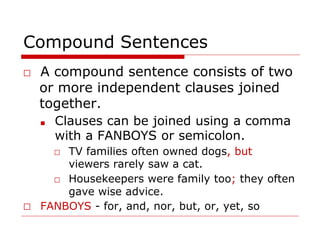
Compound Sentences
□ A compound sentence consists of two
or more independent clauses joined
together.
■ Clauses can be joined using a comma
with a FANBOYS or semicolon.
□ TV families often owned dogs, but
viewers rarely saw a cat.
□ Housekeepers were family too; they often
gave wise advice.
□ FANBOYS - for, and, nor, but, or, yet, so
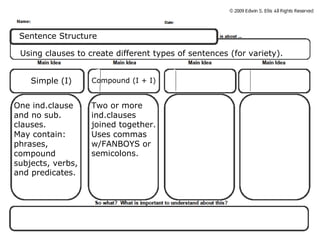
Sentence Structure
Using clauses to create different types of sentences (for variety).
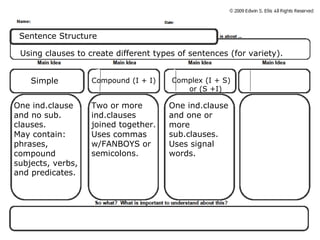
Simple (I) Compound (I + I)
Two or more
ind.clauses
joined together.
Uses commas
w/FANBOYS or
semicolons.
One ind.clause
and no sub.
clauses.
May contain:
phrases,
compound
subjects, verbs,
and predicates.
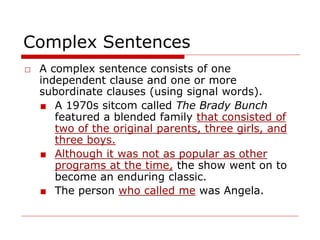
Complex Sentences
□ A complex sentence consists of one
independent clause and one or more
subordinate clauses (using signal words).
■ A 1970s sitcom called The Brady Bunch
featured a blended family that consisted of
two of the original parents, three girls, and
three boys.
■ Although it was not as popular as other
programs at the time, the show went on to
become an enduring classic.
■ The person who called me was Angela.
Sentence Structure
Using clauses to create different types of sentences (for variety).
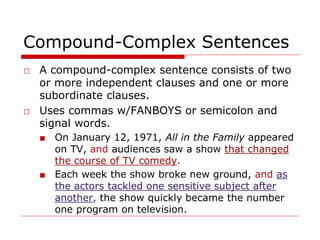
Simple Complex (I + S)
or (S +I)
Compound (I + I)
Two or more
ind.clauses
joined together.
Uses commas
w/FANBOYS or
semicolons.
One ind.clause
and one or
more
sub.clauses.
Uses signal
words.
One ind.clause
and no sub.
clauses.
May contain:
phrases,
compound
subjects, verbs,
and predicates.
Compound-Complex Sentences
□ A compound-complex sentence consists of two
or more independent clauses and one or more
subordinate clauses.
□ Uses commas w/FANBOYS or semicolon and
signal words.
■ On January 12, 1971, All in the Family appeared
on TV, and audiences saw a show that changed
the course of TV comedy.
■ Each week the show broke new ground, and as
the actors tackled one sensitive subject after
another, the show quickly became the number
one program on television.
Sentence Structure
Using clauses to create different types of sentences (for variety).
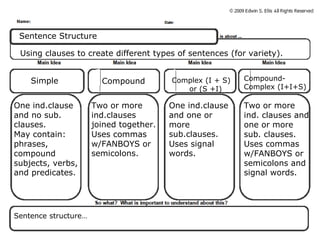
Simple Compound
Two or more
ind.clauses
joined together.
Uses commas
w/FANBOYS or
semicolons.
One ind.clause
and one or
more
sub.clauses.
Uses signal
words.
Compound-
Complex (I+I+S)
Two or more
ind. clauses and
one or more
sub. clauses.
Uses commas
w/FANBOYS or
semicolons and
signal words.
Sentence structure…
One ind.clause
and no sub.
clauses.
May contain:
phrases,
compound
subjects, verbs,
and predicates.
Complex (I + S)
or (S +I)
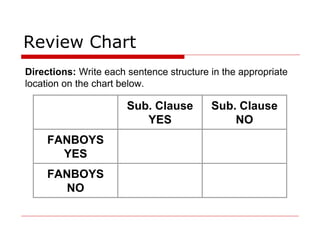
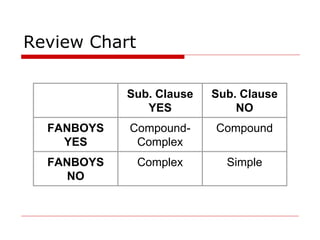
Review Chart
Sub. Clause
YES
Sub. Clause
NO
FANBOYS
YES
FANBOYS
NO
Directions: Write each sentence structure in the appropriate
location on the chart below.
Review Chart
Sub. Clause
YES
Sub. Clause
NO
FANBOYS
YES
Compound-
Complex
Compound
FANBOYS
NO
Complex Simple
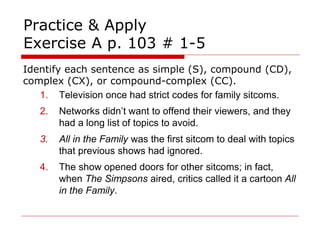
Practice & Apply
Exercise A p. 103 # 1-5
Identify each sentence as simple (S), compound (CD),
complex (CX), or compound-complex (CC).
1. Television once had strict codes for family sitcoms.
2. Networks didn’t want to offend their viewers, and they
had a long list of topics to avoid.
3. All in the Family was the first sitcom to deal with topics
that previous shows had ignored.
4. The show opened doors for other sitcoms; in fact,
when The Simpsons aired, critics called it a cartoon All
in the Family.

Sentence Structure PPT powerpoint p.pptx

  • 1.
  • 2.
    Sentence Structure Using clausesto create different types of sentences (for variety).
  • 3.
    Simple Sentences □ Asimple sentence consists of one independent clause and no subordinate clauses. □ Most TV family shows idealize family life. □ A simple sentence may contain multiple phrases. □ According to television shows, parents should be able to solve any problem.
  • 4.
    Compound Subjects, Verbs,& Predicates • A simple sentence may contain either a compound subject, a compound verb, or a compound predicate. – Compound subject: two or more subjects that share one verb/verb phrase. • Mrs. Morrow and her students are discussing clauses. – Compound verb: one subject that shares two or more verbs/verb phrases. • Mrs. Morrow teaches, listens, and cares. – Compound predicate: one subject that shares two or more predicates. • The students listen to the lesson and study diligently.
  • 5.
    Sentence Structure Using clausesto create different types of sentences (for variety). Simple (I) One ind.clause and no sub. clauses. May contain: phrases, compound subjects, verbs, and predicates.
  • 6.
    Compound Sentences □ Acompound sentence consists of two or more independent clauses joined together. ■ Clauses can be joined using a comma with a FANBOYS or semicolon. □ TV families often owned dogs, but viewers rarely saw a cat. □ Housekeepers were family too; they often gave wise advice. □ FANBOYS - for, and, nor, but, or, yet, so
  • 7.
    Sentence Structure Using clausesto create different types of sentences (for variety). Simple (I) Compound (I + I) Two or more ind.clauses joined together. Uses commas w/FANBOYS or semicolons. One ind.clause and no sub. clauses. May contain: phrases, compound subjects, verbs, and predicates.
  • 8.
    Complex Sentences □ Acomplex sentence consists of one independent clause and one or more subordinate clauses (using signal words). ■ A 1970s sitcom called The Brady Bunch featured a blended family that consisted of two of the original parents, three girls, and three boys. ■ Although it was not as popular as other programs at the time, the show went on to become an enduring classic. ■ The person who called me was Angela.
  • 9.
    Sentence Structure Using clausesto create different types of sentences (for variety). Simple Complex (I + S) or (S +I) Compound (I + I) Two or more ind.clauses joined together. Uses commas w/FANBOYS or semicolons. One ind.clause and one or more sub.clauses. Uses signal words. One ind.clause and no sub. clauses. May contain: phrases, compound subjects, verbs, and predicates.
  • 10.
    Compound-Complex Sentences □ Acompound-complex sentence consists of two or more independent clauses and one or more subordinate clauses. □ Uses commas w/FANBOYS or semicolon and signal words. ■ On January 12, 1971, All in the Family appeared on TV, and audiences saw a show that changed the course of TV comedy. ■ Each week the show broke new ground, and as the actors tackled one sensitive subject after another, the show quickly became the number one program on television.
  • 11.
    Sentence Structure Using clausesto create different types of sentences (for variety). Simple Compound Two or more ind.clauses joined together. Uses commas w/FANBOYS or semicolons. One ind.clause and one or more sub.clauses. Uses signal words. Compound- Complex (I+I+S) Two or more ind. clauses and one or more sub. clauses. Uses commas w/FANBOYS or semicolons and signal words. Sentence structure… One ind.clause and no sub. clauses. May contain: phrases, compound subjects, verbs, and predicates. Complex (I + S) or (S +I)
  • 12.
    Review Chart Sub. Clause YES Sub.Clause NO FANBOYS YES FANBOYS NO Directions: Write each sentence structure in the appropriate location on the chart below.
  • 13.
    Review Chart Sub. Clause YES Sub.Clause NO FANBOYS YES Compound- Complex Compound FANBOYS NO Complex Simple
  • 14.
    Practice & Apply ExerciseA p. 103 # 1-5 Identify each sentence as simple (S), compound (CD), complex (CX), or compound-complex (CC). 1. Television once had strict codes for family sitcoms. 2. Networks didn’t want to offend their viewers, and they had a long list of topics to avoid. 3. All in the Family was the first sitcom to deal with topics that previous shows had ignored. 4. The show opened doors for other sitcoms; in fact, when The Simpsons aired, critics called it a cartoon All in the Family.