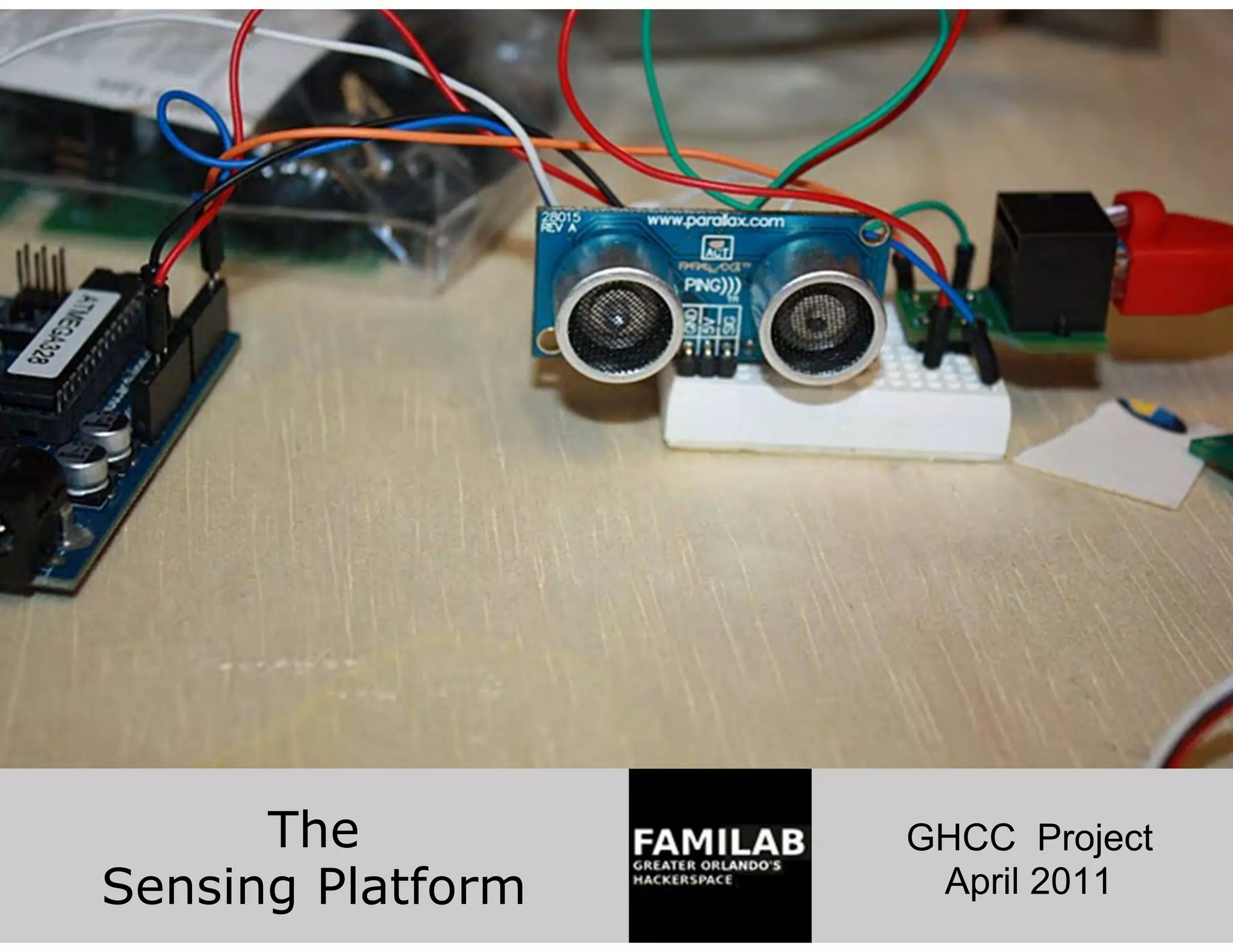
The          GHCC Project
Sensing Platform    April 2011
What is Sensing?
                       “Standing     on the Shoulders of Giants”
In the open source hardware and software ecosystem, several projects have changed the
way that we design, prototype, and build interactive systems; these are Arduino, Fritzing,
Processing, and Wiring. These projects build on each other to simplify prototyping in a way
that benefits the artist, designer, maker, student, and researcher. The Sensing project aims
to follow these projects in spirit, design, and execution by simplifying data acquisition from
common sensors, the networking of multiple sensors, and the capture + display of
information from networked sensors.

The   Sensing Platform contains several open source parts:
 •    The Sensing library for the Arduino platform
 •    The SensingNet protocol for communication between sensor nodes and a sensor hub
 •    The SenseAbles hardware reference implementation for a sensor node
 •    The PlugNLearn kit for getting started with Sensing


The PlugNLearn kit can be built using designs on the Sensing website, purchased in kit form
(future), or purchased preassembled (future). The kit contains the PlugNLearn Sensor Hub,
several SenseAbles sensor modules with common sensors, and the SenseAble Experiments
Lab Notebook.

Sensing was originally developed by the members of the FAMiLab Hackerspace in Orlando, FL
as part of the 2011 Greater Global Hackerspace Challenge sponsored by element14.
                                                                                                 2
About FAMiLab                                (from familab.org)


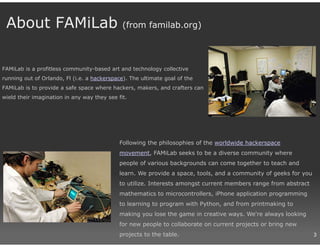
FAMiLab is a profitless community-based art and technology collective
running out of Orlando, Fl (i.e. a hackerspace). The ultimate goal of the
FAMiLab is to provide a safe space where hackers, makers, and crafters can
wield their imagination in any way they see fit.


                                             Following the philosophies of the worldwide hackerspace
                                             movement, FAMiLab seeks to be a diverse community where
                                             people of various backgrounds can come together to teach and
                                             learn. We provide a space, tools, and a community of geeks for you
                                             to utilize. Interests amongst current members range from abstract
                                             mathematics to microcontrollers, iPhone application programming
                                             to learning to program with Python, and from printmaking to
                                             making you lose the game in creative ways. We're always looking
                                             for new people to collaborate on current projects or bring new
                                             projects to the table.                                               3
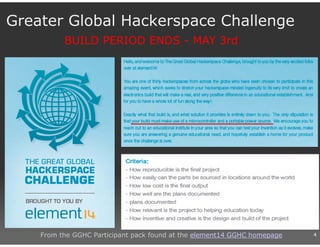
Greater Global Hackerspace Challenge
          BUILD PERIOD ENDS - MAY 3rd


    From the GGHC Participant pack found at the element14 GGHC homepage   4
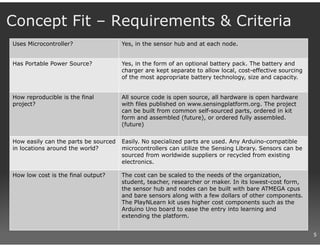
Concept Fit – Requirements & Criteria
Uses Microcontroller?                 Yes, in the sensor hub and at each node.


Has Portable Power Source?            Yes, in the form of an optional battery pack. The battery and
                                      charger are kept separate to allow local, cost-effective sourcing
                                      of the most appropriate battery technology, size and capacity.


How reproducible is the final         All source code is open source, all hardware is open hardware
project?                              with files published on www.sensingplatform.org. The project
                                      can be built from common self-sourced parts, ordered in kit
                                      form and assembled (future), or ordered fully assembled.
                                      (future)


How easily can the parts be sourced   Easily. No specialized parts are used. Any Arduino-compatible
in locations around the world?        microcontrollers can utilize the Sensing Library. Sensors can be
                                      sourced from worldwide suppliers or recycled from existing
                                      electronics.

How low cost is the final output?     The cost can be scaled to the needs of the organization,
                                      student, teacher, researcher or maker. In its lowest-cost form,
                                      the sensor hub and nodes can be built with bare ATMEGA cpus
                                      and bare sensors along with a few dollars of other components.
                                      The PlayNLearn kit uses higher cost components such as the
                                      Arduino Uno board to ease the entry into learning and
                                      extending the platform.


                                                                                                          5
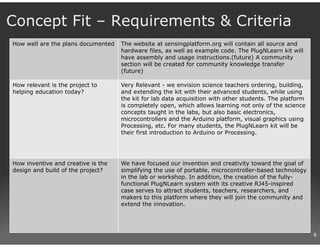
Concept Fit – Requirements & Criteria
How well are the plans documented   The website at sensingplatform.org will contain all source and
                                    hardware files, as well as example code. The PlugNLearn kit will
                                    have assembly and usage instructions.(future) A community
                                    section will be created for community knowledge transfer
                                    (future)

How relevant is the project to      Very Relevant - we envision science teachers ordering, building,
helping education today?            and extending the kit with their advanced students, while using
                                    the kit for lab data acquisition with other students. The platform
                                    is completely open, which allows learning not only of the science
                                    concepts taught in the labs, but also basic electronics,
                                    microcontrollers and the Arduino platform, visual graphics using
                                    Processing, etc. For many students, the PlugNLearn kit will be
                                    their first introduction to Arduino or Processing.


How inventive and creative is the   We have focused our invention and creativity toward the goal of
design and build of the project?    simplifying the use of portable, microcontroller-based technology
                                    in the lab or workshop. In addition, the creation of the fully-
                                    functional PlugNLearn system with its creative RJ45-inspired
                                    case serves to attract students, teachers, researchers, and
                                    makers to this platform where they will join the community and
                                    extend the innovation.


                                                                                                         6
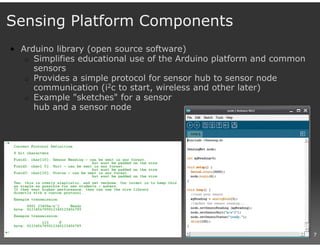
Sensing Platform Components
• Arduino library (open source software)
   o Simplifies educational use of the Arduino platform and common
     sensors
   o Provides a simple protocol for sensor hub to sensor node
     communication (i2c to start, wireless and other later)
   o Example "sketches" for a sensor
     hub and a sensor node


                                                                     7
Sensing Platform Components
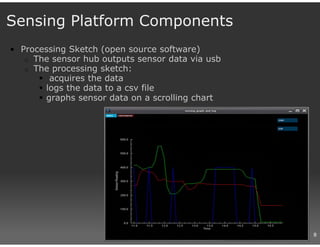
• Processing Sketch (open source software)
   o The sensor hub outputs sensor data via usb
   o The processing sketch:
       acquires the data
       logs the data to a csv file
       graphs sensor data on a scrolling chart


                                                  8
Sensing Platform Components
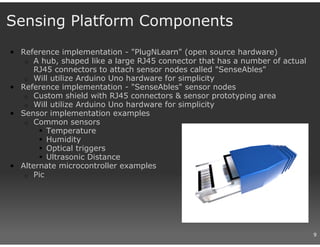
• Reference implementation - "PlugNLearn" (open source hardware)
   o A hub, shaped like a large RJ45 connector that has a number of actual
      RJ45 connectors to attach sensor nodes called "SenseAbles"
   o Will utilize Arduino Uno hardware for simplicity
• Reference implementation - "SenseAbles" sensor nodes
   o Custom shield with RJ45 connectors & sensor prototyping area
   o Will utilize Arduino Uno hardware for simplicity
• Sensor implementation examples
   o Common sensors
        Temperature
        Humidity
        Optical triggers
        Ultrasonic Distance
• Alternate microcontroller examples
   o Pic


                                                                             9
Sensing Platform Documentation

• sensingplatform.org website
   o The home of the Sensing Platform
   o Explanation of the platform
   o Source files for software and hardware
   o Example code
   o Store to purchase PlugNLearn and SenseAbles Kits
     (future) (also linked from plugnlearn.org)
   o Social collaboration tools (future) to encourage:
       Student learning
       Knowledge sharing
       Further development of the platform


                                                     10
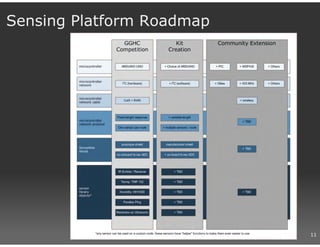
Sensing Platform Roadmap


                           11

Sensing Platform Overview

  • 1.
    The GHCC Project Sensing Platform April 2011
  • 2.
    What is Sensing? “Standing on the Shoulders of Giants” In the open source hardware and software ecosystem, several projects have changed the way that we design, prototype, and build interactive systems; these are Arduino, Fritzing, Processing, and Wiring. These projects build on each other to simplify prototyping in a way that benefits the artist, designer, maker, student, and researcher. The Sensing project aims to follow these projects in spirit, design, and execution by simplifying data acquisition from common sensors, the networking of multiple sensors, and the capture + display of information from networked sensors. The Sensing Platform contains several open source parts: • The Sensing library for the Arduino platform • The SensingNet protocol for communication between sensor nodes and a sensor hub • The SenseAbles hardware reference implementation for a sensor node • The PlugNLearn kit for getting started with Sensing The PlugNLearn kit can be built using designs on the Sensing website, purchased in kit form (future), or purchased preassembled (future). The kit contains the PlugNLearn Sensor Hub, several SenseAbles sensor modules with common sensors, and the SenseAble Experiments Lab Notebook. Sensing was originally developed by the members of the FAMiLab Hackerspace in Orlando, FL as part of the 2011 Greater Global Hackerspace Challenge sponsored by element14. 2
  • 3.
    About FAMiLab (from familab.org) FAMiLab is a profitless community-based art and technology collective running out of Orlando, Fl (i.e. a hackerspace). The ultimate goal of the FAMiLab is to provide a safe space where hackers, makers, and crafters can wield their imagination in any way they see fit. Following the philosophies of the worldwide hackerspace movement, FAMiLab seeks to be a diverse community where people of various backgrounds can come together to teach and learn. We provide a space, tools, and a community of geeks for you to utilize. Interests amongst current members range from abstract mathematics to microcontrollers, iPhone application programming to learning to program with Python, and from printmaking to making you lose the game in creative ways. We're always looking for new people to collaborate on current projects or bring new projects to the table. 3
  • 4.
    Greater Global HackerspaceChallenge BUILD PERIOD ENDS - MAY 3rd From the GGHC Participant pack found at the element14 GGHC homepage 4
  • 5.
    Concept Fit –Requirements & Criteria Uses Microcontroller? Yes, in the sensor hub and at each node. Has Portable Power Source? Yes, in the form of an optional battery pack. The battery and charger are kept separate to allow local, cost-effective sourcing of the most appropriate battery technology, size and capacity. How reproducible is the final All source code is open source, all hardware is open hardware project? with files published on www.sensingplatform.org. The project can be built from common self-sourced parts, ordered in kit form and assembled (future), or ordered fully assembled. (future) How easily can the parts be sourced Easily. No specialized parts are used. Any Arduino-compatible in locations around the world? microcontrollers can utilize the Sensing Library. Sensors can be sourced from worldwide suppliers or recycled from existing electronics. How low cost is the final output? The cost can be scaled to the needs of the organization, student, teacher, researcher or maker. In its lowest-cost form, the sensor hub and nodes can be built with bare ATMEGA cpus and bare sensors along with a few dollars of other components. The PlayNLearn kit uses higher cost components such as the Arduino Uno board to ease the entry into learning and extending the platform. 5
  • 6.
    Concept Fit –Requirements & Criteria How well are the plans documented The website at sensingplatform.org will contain all source and hardware files, as well as example code. The PlugNLearn kit will have assembly and usage instructions.(future) A community section will be created for community knowledge transfer (future) How relevant is the project to Very Relevant - we envision science teachers ordering, building, helping education today? and extending the kit with their advanced students, while using the kit for lab data acquisition with other students. The platform is completely open, which allows learning not only of the science concepts taught in the labs, but also basic electronics, microcontrollers and the Arduino platform, visual graphics using Processing, etc. For many students, the PlugNLearn kit will be their first introduction to Arduino or Processing. How inventive and creative is the We have focused our invention and creativity toward the goal of design and build of the project? simplifying the use of portable, microcontroller-based technology in the lab or workshop. In addition, the creation of the fully- functional PlugNLearn system with its creative RJ45-inspired case serves to attract students, teachers, researchers, and makers to this platform where they will join the community and extend the innovation. 6
  • 7.
    Sensing Platform Components •Arduino library (open source software) o Simplifies educational use of the Arduino platform and common sensors o Provides a simple protocol for sensor hub to sensor node communication (i2c to start, wireless and other later) o Example "sketches" for a sensor hub and a sensor node 7
  • 8.
    Sensing Platform Components •Processing Sketch (open source software) o The sensor hub outputs sensor data via usb o The processing sketch:  acquires the data  logs the data to a csv file  graphs sensor data on a scrolling chart 8
  • 9.
    Sensing Platform Components •Reference implementation - "PlugNLearn" (open source hardware) o A hub, shaped like a large RJ45 connector that has a number of actual RJ45 connectors to attach sensor nodes called "SenseAbles" o Will utilize Arduino Uno hardware for simplicity • Reference implementation - "SenseAbles" sensor nodes o Custom shield with RJ45 connectors & sensor prototyping area o Will utilize Arduino Uno hardware for simplicity • Sensor implementation examples o Common sensors  Temperature  Humidity  Optical triggers  Ultrasonic Distance • Alternate microcontroller examples o Pic 9
  • 10.
    Sensing Platform Documentation •sensingplatform.org website o The home of the Sensing Platform o Explanation of the platform o Source files for software and hardware o Example code o Store to purchase PlugNLearn and SenseAbles Kits (future) (also linked from plugnlearn.org) o Social collaboration tools (future) to encourage:  Student learning  Knowledge sharing  Further development of the platform 10
  • 11.