
Sustainability: What Leadership and Change looks like ??  Philbert Suresh i-FUN (Intelligent Friends in the University Network)
Agenda of this session Examine the interrelated aspects of sustainability, leadership and change Identify the main drivers of change Case of Accenture Leadership in Sustainability  Analyse the impact of leadership on Sustainable Development (SD) Lessons drawn for the future in education
Remember Slide Slide Keys 6 to 10 Slide # 12,13,14 and 15 Slide # 17 Accenture Secrets Revealed Slide # 18Workforce Diversity Slide # 19 New HR Dimensions Slide # 23 Sustainable Development for  21 st  Century Slide # NEW Capabilities Slide # 26 Lesson Applied in the presentation
Drivers of Sustainability in Corporate Sector Environment is just not a public interest activity but a serious commitment to manage resources effectively for the present generation and the next. Accenture is one such company that has  sustainability  practices  embedded into the work ethos and corporate culture of a diverse workforce.. There are six facets of the SD drivers
Understanding Sustainability Leadership & Change in Accenture
Accenture has identified six key drivers of sustainability that are not only reshaping the way businesses and governments operate, but also redefining the value they deliver   KEY # 1 Consumer demand for sustainable products and services: People today are making purchases not only as consumers, but also as responsible world citizens. By rejecting the indiscriminate consumption patterns of the past and becoming more selective in their choices, they are signaling a shift in consumer attitudes and behaviors that may significantly affect business profitability and growth.
KEY # 2 Stakeholder influence:  Globalization and technology have enabled customers and citizens to have a powerful voice. Businesses and public sector organizations need to extend their reach to a new breed of stakeholders that includes non-government organizations, media, academics and the community at large.
KEY # 3 Resource depletion : Economic growth in developing markets, combined with high consumption in Western economies, has depleted natural resources (especially energy and water). Not surprisingly, there’s fierce competition for what remains.
KEY # 4 Employee engagement:  Employees’ commitment and enthusiasm for sustainability are shaping the way we work and live. As the sustainability mandate expands, organizations committed to social and environmental causes are likely to attract the top talent.
KEY # 5 Capital market scrutiny : Sustainability has crept onto the bottom line. Investors now look at sustainability performance when evaluating a company’s potential for future returns.
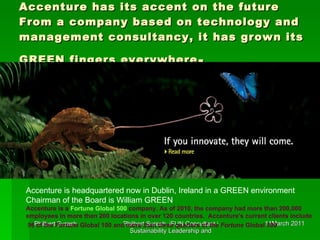
Accenture has its accent on the future From a company based on technology and management consultancy, it has grown its GREEN fingers everywhere . Accenture is headquartered now in Dublin, Ireland in a GREEN environment Chairman of the Board is William GREEN  Accenture is a  Fortune Global 500  company. As of 2010, the company had more than 200,000 employees in more than 200 locations in over 120 countries.  Accenture's current clients include 96 of the  Fortune  Global 100 and more than three quarters of the  Fortune  Global 500
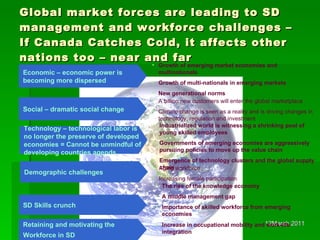
Global market forces are leading to SD  management and workforce challenges – If Canada Catches Cold, it affects other nations too – near and far Economic – economic power is becoming more dispersed Growth of emerging market economies and multinationals Growth of multi-nationals in emerging markets New generational norms Social – dramatic social change A billion new customers will enter the global marketplace Climate change is seen as a reality and is driving changes   in technology, regulation and investment Technology – technological labor is no longer the preserve of developed economies = Cannot be unmindful of developing countries agends  Industrialized world is witnessing a shrinking pool of young skilled employees Governments of emerging economies are aggressively pursuing policies to move up the value chain Emergence of technology clusters and the global supply chain Demographic challenges Aging workforce Increasing female participation Retaining and motivating the  Workforce in SD Increase in occupational mobility and work-life integration Growing polarization of workers SD Skills crunch   The rise of the knowledge economy A middle management gap Importance of skilled workforce from emerging economies
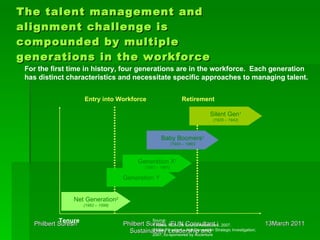
The talent management and alignment challenge is compounded by multiple generations in the workforce For the first time in history, four generations are in the workforce.  Each generation has distinct characteristics and necessitate specific approaches to managing talent. Tenure Silent Gen 1 (1925 – 1942) Baby Boomers 1 (1943 – 1960) Net Generation 2 (1982 – 1998) Retirement Entry into Workforce Source: 1 Howe, Neil; Life Course Associates, 2007.  2 New Paradigm – Net Generation Strategic Investigation;  2007; co-sponsored by Accenture Generation Y Generation X 1 (1961 – 1981)
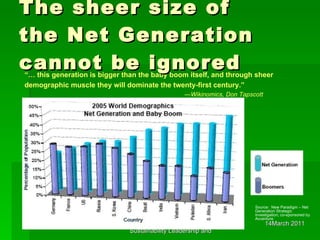
The sheer size of the Net Generation cannot be ignored  “…  this generation is bigger than the baby boom itself, and through sheer demographic muscle they will dominate the twenty-first century.”   — Wikinomics, Don Tapscott Source:  New Paradigm – Net Generation Strategic Investigation; co-sponsored by Accenture
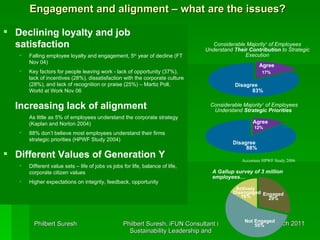
Considerable Majority 1  of Employees Understand  Strategic Priorities  Considerable Majority 1  of Employees Understand  Their Contribution  to Strategic Execution Agree 12% Disagree 88% 6% Agree 17% Disagree 83% A Gallup survey of 3 million employees… Accenture HPWF Study 2006 Declining loyalty and job satisfaction Falling employee loyalty and engagement, 5 th  year of decline (FT Nov 04) Key factors for people leaving work - lack of opportunity (37%), lack of incentives (28%), dissatisfaction with the corporate culture (28%), and lack of recognition or praise (25%) – Martiz Poll, World at Work Nov 06 Increasing lack of alignment  As little as 5% of employees understand the corporate strategy (Kaplan and Norton 2004)  88% don’t believe most employees understand their firms strategic priorities (HPWF Study 2004) Different Values of Generation Y Different value sets – life of jobs vs jobs for life, balance of life, corporate citizen values Higher expectations on integrity, feedback, opportunity Engagement and alignment – what are the issues? Engaged 29% Not Engaged 55% Actively  Disengaged  16%
How well are we doing ? Key findings from the India Sustainable Development Workforce Study of Accenture Talent management  – specifically the ability to attract and manage critical skills and leadership – emerged among the top 2 of 11 capabilities driving high performance Organizations by and large, are not equipped to manage and enable  Change  of the magnitude that is being experienced today Indian CEOs have rated the  HR function as their most important workforce  – but they believe there is a significant need to improve its performance A critical HR challenge -   operation in a silo , with little support offered to and received from key workforces.  HR needs to facilitate solutions to strategic business issues such as SD – Yet, the focus of  HR today is on transactional activities potentially reducing the bandwidth for the transformationa l
Extensive C-Suite involvement in their human capital management initiatives Focus support to workforces in the more strategic talent management areas of Learning and Change management; compensation is not a differentiating factor Leaders are able create burning platforms boosting the “perceived need for change” Leaders use metrics extensively to evaluate HR performance What distinguishes  Human Performance Leaders from the rest of the organizations? (Accenture Guide for YOU)
Greater workforce diversity is the new norm and creates greater alignment challenges Diversity today: Generational values Educational background Social background Ethnic and cultural diversity Geographic dispersion Type and style of working and learning Leading to: Greater challenges for leadership at all levels Greater complexity of engagement Greater challenges for alignment and managing change Importance of alignment of values, measurement and objectives, organization, managing change etc
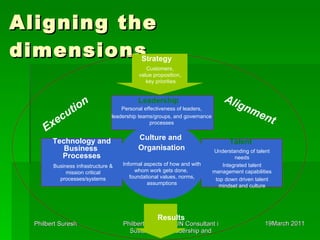
Aligning the dimensions Talent  Leadership   Technology and Business  Processes Culture and  Organisation Execution Alignment Results  Strategy  Informal aspects of how and with whom work gets done,  foundational values, norms, assumptions Business infrastructure & mission critical processes/systems Understanding of talent needs Integrated talent management capabilities top down driven talent mindset and culture Personal effectiveness of leaders, leadership teams/groups, and governance processes Customers,  value proposition,  key priorities
Experience  is the best teacher of leadership Organizations can leverage experience and practice to  grow more leaders, faster Leadership capability, particularly in managing people and diversity  must be developed at all levels These behaviours and practices  must be measured and rewarded [coal] [diamond] Leadership Development
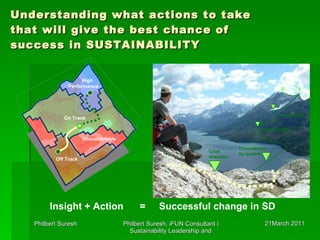
Understanding what actions to take that will give the best chance of success in SUSTAINABILITY Clear  direction Commitment  by leaders Accountability Engaged teams Insight + Action  =   Successful change in SD High  Performance On Track Unsustainable Off Track
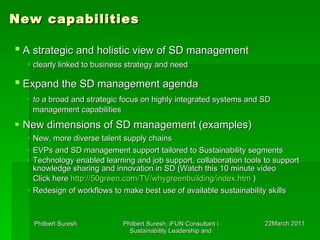
New capabilities A strategic and holistic view of SD management   clearly linked to business strategy and need Expand the SD management agenda   to  a broad and strategic focus on highly integrated systems and SD management capabilities   New dimensions of SD management (examples) New, more diverse talent supply chains  EVPs and SD management support tailored to Sustainability segments Technology enabled learning and job support, collaboration tools to support knowledge sharing and innovation in SD ( Watch this 10 minute video Click here  http://50green.com/TV/whygreenbuilding/index.htm   ) Redesign of workflows to make best use of available sustainability skills
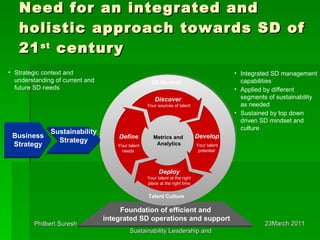
Need for an integrated and holistic approach towards SD of 21 st  century Foundation of efficient and  integrated SD operations and support Discover  Your sources of talent Deploy Your talent at the right place at the right time Define Your talent needs  Develop Your talent potential  Metrics and  Analytics SD Mindset Talent Culture Business Strategy Sustainability Strategy Strategic context and understanding of current and future SD needs Integrated SD management capabilities Applied by different segments of sustainability as needed Sustained by top down driven SD mindset and culture
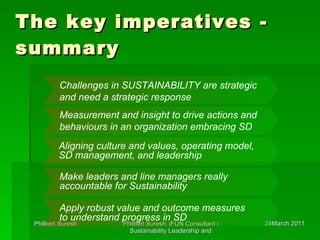
The key imperatives - summary Challenges in SUSTAINABILITY are strategic and need a strategic response Measurement and insight to drive actions and behaviours in an organization embracing SD Aligning culture and values, operating model, SD management, and leadership Make leaders and line managers really accountable for Sustainability Apply robust value and outcome measures to understand progress in SD .
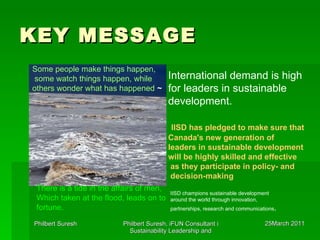
KEY MESSAGE   International demand is high  for leaders in sustainable  development. IISD has pledged to make sure that  Canada's new generation of  leaders in sustainable development  will be highly skilled and effective as they participate in policy- and decision-making Some people make things happen,  some watch things happen, while  others wonder what has happened   ~  IISD champions sustainable development  around the world through innovation,  partnerships, research and communications .  There is a tide in the affairs of men,  Which taken at the flood, leads on to  fortune.
Thanks for  your time
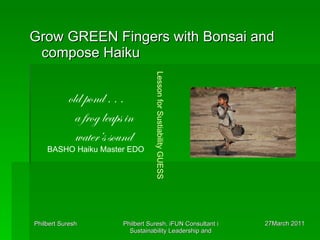
Grow GREEN Fingers with Bonsai and compose Haiku old pond . . . a frog leaps in water’s sound BASHO Haiku Master EDO Lesson for Sustiability GUESS

Seneca green sustaiability symposium march 2011

  • 1.
    Sustainability: What Leadershipand Change looks like ?? Philbert Suresh i-FUN (Intelligent Friends in the University Network)
  • 2.
    Agenda of thissession Examine the interrelated aspects of sustainability, leadership and change Identify the main drivers of change Case of Accenture Leadership in Sustainability Analyse the impact of leadership on Sustainable Development (SD) Lessons drawn for the future in education
  • 3.
    Remember Slide SlideKeys 6 to 10 Slide # 12,13,14 and 15 Slide # 17 Accenture Secrets Revealed Slide # 18Workforce Diversity Slide # 19 New HR Dimensions Slide # 23 Sustainable Development for 21 st Century Slide # NEW Capabilities Slide # 26 Lesson Applied in the presentation
  • 4.
    Drivers of Sustainabilityin Corporate Sector Environment is just not a public interest activity but a serious commitment to manage resources effectively for the present generation and the next. Accenture is one such company that has sustainability practices embedded into the work ethos and corporate culture of a diverse workforce.. There are six facets of the SD drivers
  • 5.
  • 6.
    Accenture has identifiedsix key drivers of sustainability that are not only reshaping the way businesses and governments operate, but also redefining the value they deliver KEY # 1 Consumer demand for sustainable products and services: People today are making purchases not only as consumers, but also as responsible world citizens. By rejecting the indiscriminate consumption patterns of the past and becoming more selective in their choices, they are signaling a shift in consumer attitudes and behaviors that may significantly affect business profitability and growth.
  • 7.
    KEY # 2Stakeholder influence: Globalization and technology have enabled customers and citizens to have a powerful voice. Businesses and public sector organizations need to extend their reach to a new breed of stakeholders that includes non-government organizations, media, academics and the community at large.
  • 8.
    KEY # 3Resource depletion : Economic growth in developing markets, combined with high consumption in Western economies, has depleted natural resources (especially energy and water). Not surprisingly, there’s fierce competition for what remains.
  • 9.
    KEY # 4Employee engagement: Employees’ commitment and enthusiasm for sustainability are shaping the way we work and live. As the sustainability mandate expands, organizations committed to social and environmental causes are likely to attract the top talent.
  • 10.
    KEY # 5Capital market scrutiny : Sustainability has crept onto the bottom line. Investors now look at sustainability performance when evaluating a company’s potential for future returns.
  • 11.
    Accenture has itsaccent on the future From a company based on technology and management consultancy, it has grown its GREEN fingers everywhere . Accenture is headquartered now in Dublin, Ireland in a GREEN environment Chairman of the Board is William GREEN Accenture is a Fortune Global 500 company. As of 2010, the company had more than 200,000 employees in more than 200 locations in over 120 countries. Accenture's current clients include 96 of the Fortune Global 100 and more than three quarters of the Fortune Global 500
  • 12.
    Global market forcesare leading to SD management and workforce challenges – If Canada Catches Cold, it affects other nations too – near and far Economic – economic power is becoming more dispersed Growth of emerging market economies and multinationals Growth of multi-nationals in emerging markets New generational norms Social – dramatic social change A billion new customers will enter the global marketplace Climate change is seen as a reality and is driving changes in technology, regulation and investment Technology – technological labor is no longer the preserve of developed economies = Cannot be unmindful of developing countries agends Industrialized world is witnessing a shrinking pool of young skilled employees Governments of emerging economies are aggressively pursuing policies to move up the value chain Emergence of technology clusters and the global supply chain Demographic challenges Aging workforce Increasing female participation Retaining and motivating the Workforce in SD Increase in occupational mobility and work-life integration Growing polarization of workers SD Skills crunch The rise of the knowledge economy A middle management gap Importance of skilled workforce from emerging economies
  • 13.
    The talent managementand alignment challenge is compounded by multiple generations in the workforce For the first time in history, four generations are in the workforce. Each generation has distinct characteristics and necessitate specific approaches to managing talent. Tenure Silent Gen 1 (1925 – 1942) Baby Boomers 1 (1943 – 1960) Net Generation 2 (1982 – 1998) Retirement Entry into Workforce Source: 1 Howe, Neil; Life Course Associates, 2007. 2 New Paradigm – Net Generation Strategic Investigation; 2007; co-sponsored by Accenture Generation Y Generation X 1 (1961 – 1981)
  • 14.
    The sheer sizeof the Net Generation cannot be ignored “… this generation is bigger than the baby boom itself, and through sheer demographic muscle they will dominate the twenty-first century.” — Wikinomics, Don Tapscott Source: New Paradigm – Net Generation Strategic Investigation; co-sponsored by Accenture
  • 15.
    Considerable Majority 1 of Employees Understand Strategic Priorities Considerable Majority 1 of Employees Understand Their Contribution to Strategic Execution Agree 12% Disagree 88% 6% Agree 17% Disagree 83% A Gallup survey of 3 million employees… Accenture HPWF Study 2006 Declining loyalty and job satisfaction Falling employee loyalty and engagement, 5 th year of decline (FT Nov 04) Key factors for people leaving work - lack of opportunity (37%), lack of incentives (28%), dissatisfaction with the corporate culture (28%), and lack of recognition or praise (25%) – Martiz Poll, World at Work Nov 06 Increasing lack of alignment As little as 5% of employees understand the corporate strategy (Kaplan and Norton 2004) 88% don’t believe most employees understand their firms strategic priorities (HPWF Study 2004) Different Values of Generation Y Different value sets – life of jobs vs jobs for life, balance of life, corporate citizen values Higher expectations on integrity, feedback, opportunity Engagement and alignment – what are the issues? Engaged 29% Not Engaged 55% Actively Disengaged 16%
  • 16.
    How well arewe doing ? Key findings from the India Sustainable Development Workforce Study of Accenture Talent management – specifically the ability to attract and manage critical skills and leadership – emerged among the top 2 of 11 capabilities driving high performance Organizations by and large, are not equipped to manage and enable Change of the magnitude that is being experienced today Indian CEOs have rated the HR function as their most important workforce – but they believe there is a significant need to improve its performance A critical HR challenge - operation in a silo , with little support offered to and received from key workforces. HR needs to facilitate solutions to strategic business issues such as SD – Yet, the focus of HR today is on transactional activities potentially reducing the bandwidth for the transformationa l
  • 17.
    Extensive C-Suite involvementin their human capital management initiatives Focus support to workforces in the more strategic talent management areas of Learning and Change management; compensation is not a differentiating factor Leaders are able create burning platforms boosting the “perceived need for change” Leaders use metrics extensively to evaluate HR performance What distinguishes Human Performance Leaders from the rest of the organizations? (Accenture Guide for YOU)
  • 18.
    Greater workforce diversityis the new norm and creates greater alignment challenges Diversity today: Generational values Educational background Social background Ethnic and cultural diversity Geographic dispersion Type and style of working and learning Leading to: Greater challenges for leadership at all levels Greater complexity of engagement Greater challenges for alignment and managing change Importance of alignment of values, measurement and objectives, organization, managing change etc
  • 19.
    Aligning the dimensionsTalent Leadership Technology and Business Processes Culture and Organisation Execution Alignment Results Strategy Informal aspects of how and with whom work gets done, foundational values, norms, assumptions Business infrastructure & mission critical processes/systems Understanding of talent needs Integrated talent management capabilities top down driven talent mindset and culture Personal effectiveness of leaders, leadership teams/groups, and governance processes Customers, value proposition, key priorities
  • 20.
    Experience isthe best teacher of leadership Organizations can leverage experience and practice to grow more leaders, faster Leadership capability, particularly in managing people and diversity must be developed at all levels These behaviours and practices must be measured and rewarded [coal] [diamond] Leadership Development
  • 21.
    Understanding what actionsto take that will give the best chance of success in SUSTAINABILITY Clear direction Commitment by leaders Accountability Engaged teams Insight + Action = Successful change in SD High Performance On Track Unsustainable Off Track
  • 22.
    New capabilities Astrategic and holistic view of SD management clearly linked to business strategy and need Expand the SD management agenda to a broad and strategic focus on highly integrated systems and SD management capabilities New dimensions of SD management (examples) New, more diverse talent supply chains EVPs and SD management support tailored to Sustainability segments Technology enabled learning and job support, collaboration tools to support knowledge sharing and innovation in SD ( Watch this 10 minute video Click here http://50green.com/TV/whygreenbuilding/index.htm ) Redesign of workflows to make best use of available sustainability skills
  • 23.
    Need for anintegrated and holistic approach towards SD of 21 st century Foundation of efficient and integrated SD operations and support Discover Your sources of talent Deploy Your talent at the right place at the right time Define Your talent needs Develop Your talent potential Metrics and Analytics SD Mindset Talent Culture Business Strategy Sustainability Strategy Strategic context and understanding of current and future SD needs Integrated SD management capabilities Applied by different segments of sustainability as needed Sustained by top down driven SD mindset and culture
  • 24.
    The key imperatives- summary Challenges in SUSTAINABILITY are strategic and need a strategic response Measurement and insight to drive actions and behaviours in an organization embracing SD Aligning culture and values, operating model, SD management, and leadership Make leaders and line managers really accountable for Sustainability Apply robust value and outcome measures to understand progress in SD .
  • 25.
    KEY MESSAGE  International demand is high for leaders in sustainable development. IISD has pledged to make sure that Canada's new generation of leaders in sustainable development will be highly skilled and effective as they participate in policy- and decision-making Some people make things happen, some watch things happen, while others wonder what has happened ~ IISD champions sustainable development around the world through innovation, partnerships, research and communications . There is a tide in the affairs of men, Which taken at the flood, leads on to fortune.
  • 26.
    Thanks for your time
  • 27.
    Grow GREEN Fingerswith Bonsai and compose Haiku old pond . . . a frog leaps in water’s sound BASHO Haiku Master EDO Lesson for Sustiability GUESS