BMS INSTITUTE OF TECHNOLOGY AND MANAGEMENT
DEPARTMENT OF ELECTRONICS AND COMMUNICATION ENGINEERING
Human Augmentation
Past | Present | Future
Submitted by
MOHIT N KAMATH
1BY17EC096
Under the guidance of
Dr. JAGANNATHA KB
Assistance Professor
Dept. of ECE
BMSIT
TITLE
Motivation
• Deformities has taken several lives: Physically challenged born face
tough problems throughout their lives.
• Enhancing Human lives has always been a technical challenge for
years.
• Deformities might have been a consequence of a domestic accident or
in warfare, they could even birth defects line deaf and blind.
• “Human Augmentation” aims to enhance human abilities through
medicine or technology.
1. https://youtu.be/efVdBRpHV18
2. https://youtu.be/_ROUQoLhTMM
INTRODUCTION
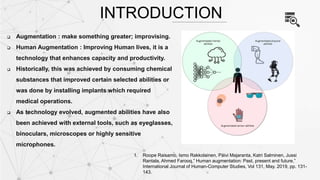
 Augmentation : make something greater; improvising.
 Human Augmentation : Improving Human lives, it is a
technology that enhances capacity and productivity.
 Historically, this was achieved by consuming chemical
substances that improved certain selected abilities or
was done by installing implants which required
medical operations.
 As technology evolved, augmented abilities have also
been achieved with external tools, such as eyeglasses,
binoculars, microscopes or highly sensitive
microphones.
1. Roope Raisamo, Ismo Rakkolainen, Päivi Majaranta, Katri Salminen, Jussi
Rantala, Ahmed Farooq,” Human augmentation: Past, present and future,”
International Journal of Human-Computer Studies, Vol 131, May. 2019, pp. 131-
143.
HUMAN
AUGMENTATION
PAST
&
PRESENT
Tongs
Binoculars
Computers
Smart-watches
Hearing Aids
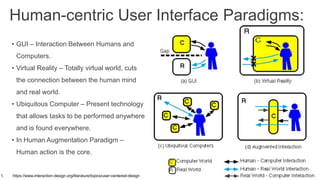
Human-centric User Interface Paradigms:
• GUI – Interaction Between Humans and
Computers.
• Virtual Reality – Totally virtual world, cuts
the connection between the human mind
and real world.
• Ubiquitous Computer – Present technology
that allows tasks to be performed anywhere
and is found everywhere.
• In Human Augmentation Paradigm –
Human action is the core.
1. https://www.interaction-design.org/literature/topics/user-centered-design
MIXED REALITY
• Augmented and Virtual reality
co-exist and humans can
switch between them.
• Augmented Reality will play a
larger role as that is not just
an extension but a major
connection between the real
and virtual world.
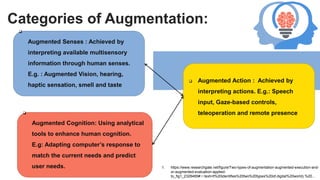
Categories of Augmentation:

Augmented Senses : Achieved by
interpreting available multisensory
information through human senses.
E.g. : Augmented Vision, hearing,
haptic sensation, smell and taste
 Augmented Action : Achieved by
interpreting actions. E.g.: Speech
input, Gaze-based controls,
teleoperation and remote presence

Augmented Cognition: Using analytical
tools to enhance human cognition.
E.g: Adapting computer’s response to
match the current needs and predict
user needs. 1. https://www.researchgate.net/figure/Two-types-of-augmentation-augmented-execution-and-
or-augmented-evaluation-applied-
to_fig1_2328485#:~:text=It%20identifies%20two%20types%20of,digital%20world).%20...
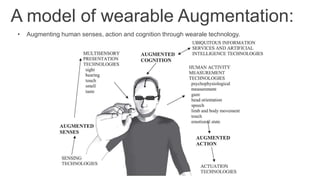
A model of wearable Augmentation:
• Augmenting human senses, action and cognition through wearale technology.
• Sensing Technologies : Detect environment,
objects and events. Computer vision,
multispectral cameras and touch.
• Multisensory presentation Technologies: It
applies human senses like sight, hearing, touch,
olfaction, gustation as channel to mediate
augmentation sensing and feedback to this is
augmented senses.
• Actuation Technologies: Affect the
environment as directed my humans. These can
include different kinds of displays, audio
equipment, haptic actuators and as well as smell
and taste generators.
• Ubiquitous Information Services and
Artificial intelligence Technologies: Provides
access to networked information services, IoT
and AI. This will develop personalized AI
extensions that assist and autonomously support
a variety of tasks.
Translation Device
Nano Bugs
Neuralink
3D Bioprinting
Plastron
Artificial Limbs
Advanced
Applications
https://justtotaltech.com/human-augmentation
Summary
Human Augmentation
Paradigm
FUTURE OF HUMAN AUGMENTATION
01
• The call for research is in the field of Augmentation.
• The innovations are taking place much faster than expected.
• The augmented version of human names – HUMAN 2.0, a cyborg
like creation with the capacity to not just effectively use AI but also
the sense of touch, emotion and taste.
• Other futuristic Implementations are:
Artificial blood cells, which will diminish the age factor.
Healing body with tissue engineering.
Memory chips for brain computer interface
Thank You

Seminar Presentation.pptx

  • 1.
    BMS INSTITUTE OFTECHNOLOGY AND MANAGEMENT DEPARTMENT OF ELECTRONICS AND COMMUNICATION ENGINEERING
  • 2.
    Human Augmentation Past |Present | Future Submitted by MOHIT N KAMATH 1BY17EC096 Under the guidance of Dr. JAGANNATHA KB Assistance Professor Dept. of ECE BMSIT TITLE
  • 4.
    Motivation • Deformities hastaken several lives: Physically challenged born face tough problems throughout their lives. • Enhancing Human lives has always been a technical challenge for years. • Deformities might have been a consequence of a domestic accident or in warfare, they could even birth defects line deaf and blind. • “Human Augmentation” aims to enhance human abilities through medicine or technology. 1. https://youtu.be/efVdBRpHV18 2. https://youtu.be/_ROUQoLhTMM
  • 5.
    INTRODUCTION  Augmentation :make something greater; improvising.  Human Augmentation : Improving Human lives, it is a technology that enhances capacity and productivity.  Historically, this was achieved by consuming chemical substances that improved certain selected abilities or was done by installing implants which required medical operations.  As technology evolved, augmented abilities have also been achieved with external tools, such as eyeglasses, binoculars, microscopes or highly sensitive microphones. 1. Roope Raisamo, Ismo Rakkolainen, Päivi Majaranta, Katri Salminen, Jussi Rantala, Ahmed Farooq,” Human augmentation: Past, present and future,” International Journal of Human-Computer Studies, Vol 131, May. 2019, pp. 131- 143.
  • 6.
  • 7.
  • 8.
    Human-centric User InterfaceParadigms: • GUI – Interaction Between Humans and Computers. • Virtual Reality – Totally virtual world, cuts the connection between the human mind and real world. • Ubiquitous Computer – Present technology that allows tasks to be performed anywhere and is found everywhere. • In Human Augmentation Paradigm – Human action is the core. 1. https://www.interaction-design.org/literature/topics/user-centered-design
  • 9.
    MIXED REALITY • Augmentedand Virtual reality co-exist and humans can switch between them. • Augmented Reality will play a larger role as that is not just an extension but a major connection between the real and virtual world.
  • 10.
    Categories of Augmentation:  AugmentedSenses : Achieved by interpreting available multisensory information through human senses. E.g. : Augmented Vision, hearing, haptic sensation, smell and taste  Augmented Action : Achieved by interpreting actions. E.g.: Speech input, Gaze-based controls, teleoperation and remote presence  Augmented Cognition: Using analytical tools to enhance human cognition. E.g: Adapting computer’s response to match the current needs and predict user needs. 1. https://www.researchgate.net/figure/Two-types-of-augmentation-augmented-execution-and- or-augmented-evaluation-applied- to_fig1_2328485#:~:text=It%20identifies%20two%20types%20of,digital%20world).%20...
  • 11.
    A model ofwearable Augmentation: • Augmenting human senses, action and cognition through wearale technology.
  • 12.
    • Sensing Technologies: Detect environment, objects and events. Computer vision, multispectral cameras and touch. • Multisensory presentation Technologies: It applies human senses like sight, hearing, touch, olfaction, gustation as channel to mediate augmentation sensing and feedback to this is augmented senses. • Actuation Technologies: Affect the environment as directed my humans. These can include different kinds of displays, audio equipment, haptic actuators and as well as smell and taste generators. • Ubiquitous Information Services and Artificial intelligence Technologies: Provides access to networked information services, IoT and AI. This will develop personalized AI extensions that assist and autonomously support a variety of tasks.
  • 13.
    Translation Device Nano Bugs Neuralink 3DBioprinting Plastron Artificial Limbs Advanced Applications https://justtotaltech.com/human-augmentation
  • 14.
  • 15.
    FUTURE OF HUMANAUGMENTATION 01 • The call for research is in the field of Augmentation. • The innovations are taking place much faster than expected. • The augmented version of human names – HUMAN 2.0, a cyborg like creation with the capacity to not just effectively use AI but also the sense of touch, emotion and taste. • Other futuristic Implementations are: Artificial blood cells, which will diminish the age factor. Healing body with tissue engineering. Memory chips for brain computer interface
  • 16.