Submitted to: Submitted By
Seminarppt.com Seminarppt.com
Seminar
On
Web
Technology
SeminarPpt.com
Table of Contents
1. Introduction
2. History of the Web
3. Basic Web Technologies
4. Front-End Frameworks
5. Back-End Technologies
6. Databases
7. Web Development Tools
8. Web Security
9. Future of Web Technology
10. Conclusion
History of the Web
Early Days: Conceptualized by
Tim Berners-Lee in 1989First
website launched in 1991
Milestones:
• Introduction of HTML (1993)
• Rise of JavaScript (1995)
• Advent of CSS (1996)
• Web 2.0 era (2004)
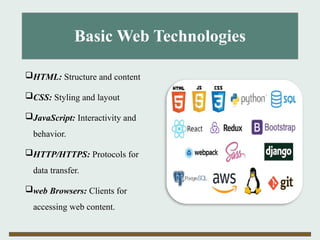
Basic Web Technologies
HTML: Structure and content
CSS: Styling and layout
JavaScript: Interactivity and
behavior.
HTTP/HTTPS: Protocols for
data transfer.
web Browsers: Clients for
accessing web content.
HTML - HyperText Markup
Language
Role: Defines the structure of
web pages using elements and
tags.
Basic Elements:
 <html>: Root element
 <head>: Metadata
 <title>: Document title
 <body>: Document body
• Example:
<!DOCTYPE html>
<html>
<head>
<title>My First Web
Page</title>
</head>
<body>
<h1>Hello, World!</h1>
</body>
</html>
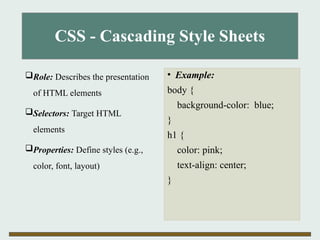
CSS - Cascading Style Sheets
Role: Describes the presentation
of HTML elements
Selectors: Target HTML
elements
Properties: Define styles (e.g.,
color, font, layout)
• Example:
body {
background-color: blue;
}
h1 {
color: pink;
text-align: center;
}
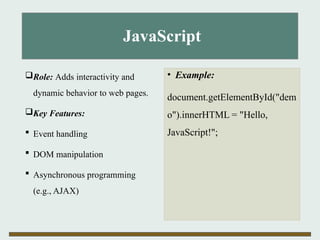
JavaScript
Role: Adds interactivity and
dynamic behavior to web pages.
Key Features:
 Event handling
 DOM manipulation
 Asynchronous programming
(e.g., AJAX)
• Example:
document.getElementById("dem
o").innerHTML = "Hello,
JavaScript!";
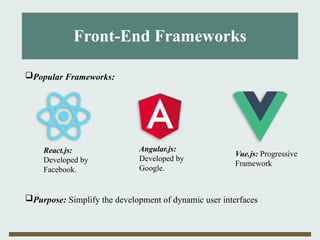
Front-End Frameworks
Popular Frameworks:
Purpose: Simplify the development of dynamic user interfaces
React.js:
Developed by
Facebook.
Angular.js:
Developed by
Google.
Vue.js: Progressive
Framework
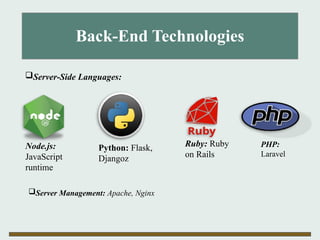
Back-End Technologies
Server-Side Languages:
Node.js:
JavaScript
runtime
Python: Flask,
Djangoz
Ruby: Ruby
on Rails
PHP:
Laravel
Server Management: Apache, Nginx
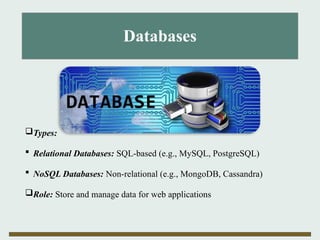
Databases
Types:
 Relational Databases: SQL-based (e.g., MySQL, PostgreSQL)
 NoSQL Databases: Non-relational (e.g., MongoDB, Cassandra)
Role: Store and manage data for web applications
Web Development Tools
Version Control: Git, GitHub
Text Editors: VS Code, Sublime Text
Build Tools: Webpack, Gulp
Package Managers: npm, Yarn
Web Security
Common Threats:
 SQL Injection
 Cross-Site Scripting (XSS)
 Cross-Site Request Forgery (CSRF)
Best Practices:
 Use HTTPS
 Validate and sanitize user inputs
 Implement proper authentication and authorization
Future of Web Technology
Progressive Web Apps (PWAs)
Single Page Applications (SPAs)
Web Assembly
Artificial Intelligence and Machine Learning integration
Conclusion
Summary: Web technology is a dynamic and ever-evolving field,
encompassing a wide range of tools and techniques essential for building
modern web applications.
Final Note: Staying updated with the latest advancements is crucial for
web developers.
References
• Wikipedia.org
• Google.com
• Seminarppt.com
• Studymafia.org
Thanks
To
SeminarPpt.Com

seminar on web technology with cloud service

  • 1.
    Submitted to: SubmittedBy Seminarppt.com Seminarppt.com Seminar On Web Technology SeminarPpt.com
  • 2.
    Table of Contents 1.Introduction 2. History of the Web 3. Basic Web Technologies 4. Front-End Frameworks 5. Back-End Technologies 6. Databases 7. Web Development Tools 8. Web Security 9. Future of Web Technology 10. Conclusion
  • 3.
    History of theWeb Early Days: Conceptualized by Tim Berners-Lee in 1989First website launched in 1991 Milestones: • Introduction of HTML (1993) • Rise of JavaScript (1995) • Advent of CSS (1996) • Web 2.0 era (2004)
  • 4.
    Basic Web Technologies HTML:Structure and content CSS: Styling and layout JavaScript: Interactivity and behavior. HTTP/HTTPS: Protocols for data transfer. web Browsers: Clients for accessing web content.
  • 5.
    HTML - HyperTextMarkup Language Role: Defines the structure of web pages using elements and tags. Basic Elements:  <html>: Root element  <head>: Metadata  <title>: Document title  <body>: Document body • Example: <!DOCTYPE html> <html> <head> <title>My First Web Page</title> </head> <body> <h1>Hello, World!</h1> </body> </html>
  • 6.
    CSS - CascadingStyle Sheets Role: Describes the presentation of HTML elements Selectors: Target HTML elements Properties: Define styles (e.g., color, font, layout) • Example: body { background-color: blue; } h1 { color: pink; text-align: center; }
  • 7.
    JavaScript Role: Adds interactivityand dynamic behavior to web pages. Key Features:  Event handling  DOM manipulation  Asynchronous programming (e.g., AJAX) • Example: document.getElementById("dem o").innerHTML = "Hello, JavaScript!";
  • 8.
    Front-End Frameworks Popular Frameworks: Purpose:Simplify the development of dynamic user interfaces React.js: Developed by Facebook. Angular.js: Developed by Google. Vue.js: Progressive Framework
  • 9.
    Back-End Technologies Server-Side Languages: Node.js: JavaScript runtime Python:Flask, Djangoz Ruby: Ruby on Rails PHP: Laravel Server Management: Apache, Nginx
  • 10.
    Databases Types:  Relational Databases:SQL-based (e.g., MySQL, PostgreSQL)  NoSQL Databases: Non-relational (e.g., MongoDB, Cassandra) Role: Store and manage data for web applications
  • 11.
    Web Development Tools VersionControl: Git, GitHub Text Editors: VS Code, Sublime Text Build Tools: Webpack, Gulp Package Managers: npm, Yarn
  • 12.
    Web Security Common Threats: SQL Injection  Cross-Site Scripting (XSS)  Cross-Site Request Forgery (CSRF) Best Practices:  Use HTTPS  Validate and sanitize user inputs  Implement proper authentication and authorization
  • 13.
    Future of WebTechnology Progressive Web Apps (PWAs) Single Page Applications (SPAs) Web Assembly Artificial Intelligence and Machine Learning integration
  • 14.
    Conclusion Summary: Web technologyis a dynamic and ever-evolving field, encompassing a wide range of tools and techniques essential for building modern web applications. Final Note: Staying updated with the latest advancements is crucial for web developers.
  • 15.
    References • Wikipedia.org • Google.com •Seminarppt.com • Studymafia.org
  • 16.