Chandni Venkataraman
Revisiting
the brief
Concept
Make a D.I.Y/ D.I.W.O
(do it with others) mobile labstudio
that becomes our extended sense
while engaging with a space.
DIY Portable
Labstudio
Make you own
equipment
Extend your
senses
Engage with a
space
Visualizations
and
audioscapes
Experiments, building skill
and inspiration.
Arduino
Arduino 8 key piano
Experimenting with the
ultrasonic sensor
* What did you learn with doing the Arduino?
Why Arduino?
-Arduino allows you to plug in sensors
-it acts as an interface between the sensor and
the computer and outputs values
-you can customise logic, play around.
Explorations
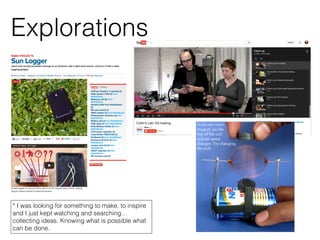
* I was looking for something to make, to inspire
and I just kept watching and searching…
collecting ideas. Knowing what is possible what
can be done.
Explorations
Researched about the DIY spectrometer. Didn’t end up
making….

- frustrated with not being getting the wrong motor
- frustrated about not being able to understand stepper
motor driver.
- turned out that I bought the wrong motor- unipolar motor.
Few Articles
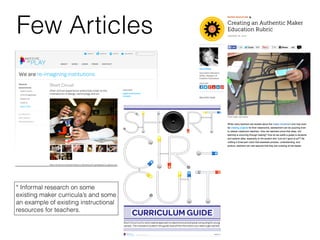
* Informal research on some
existing maker curricula’s and some
an example of existing instructional
resources for teachers.
Readings
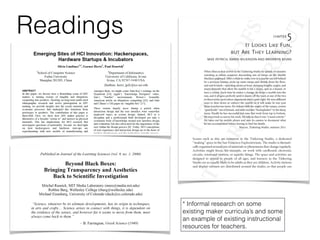
* Informal research on some
existing maker curricula’s and some
an example of existing instructional
resources for teachers.
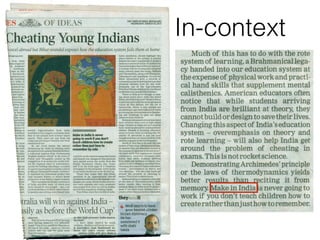
In-context
Constructionism
Constructionism suggests that
people learn best when they make
things.


One is learning by building on
what they know, learning through
experience, discovery and
problem solving.
Bots
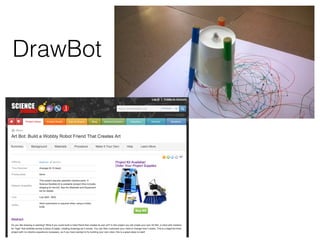
DrawBot
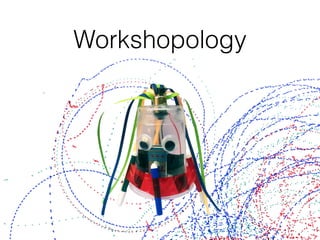
Workshopology
Science
Teacher
Art
Teacher
Children
Personas
Observations
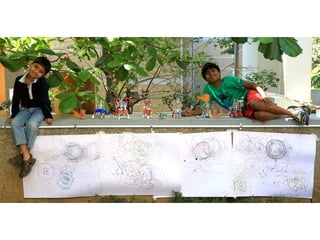
• “this is so cool! I feel like scientist working in a lab!” 

-Rahul while soldering
• Manu (7 years) didn’t want anything to do with the “hot
stuff”. He’d rather I do the hot stuff and he do the cold stuff.
• One child decided to not make both bots but two of the
same bot.
• Joining of tables
• The lab space served as an place for multiple
engagements- music, food as well as working
Insights
• No competition
• Children chose their level of complexity and paced
themselves
• There was lot of problem solving involved with respect to
the drawbot
• Children learn from each other and learn from watching
• Conversations (in and out of context)
• needed facilitation with things unfamiliar to them
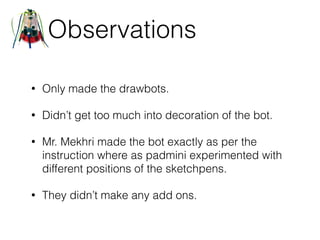
Observations
• Only made the drawbots.
• Didn’t get too much into decoration of the bot.
• Mr. Mekhri made the bot exactly as per the
instruction where as padmini experimented with
different positions of the sketchpens.
• They didn’t make any add ons.
Observations
• Got into decoration of the bot extensively
• Was interested in the various materials she could
use in order to make the bot more expressive.
Challenges
Post Workshop
What is it?
• Light following bot with a two LDRs.
• respective motors move according to the amount of
light information on the respective LDRs
• It can float on water
Troubleshooting
• Need to balance out the weight
• Change the orientation of the LDRs.
Possibilities
• Colour sensitive bots
• Plug-in any sensor - temperature, gas , pressure, humidity
• When floating on water - Microscope, Turbidity sensor,
measure salinity, record underwater sounds.
• Attach a webcam/ IRcam/ Thermal-cam
• Synth Bots
• Use a programmed chip to make it behave in a specific
manner.
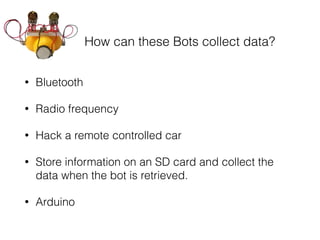
How can these Bots collect data?
• Bluetooth
• Radio frequency
• Hack a remote controlled car
• Store information on an SD card and collect the
data when the bot is retrieved.
• Arduino
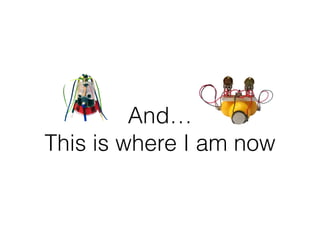
And…

This is where I am now

Seminar 2 Presentation

  • 1.
  • 2.
  • 3.
    Concept Make a D.I.Y/D.I.W.O (do it with others) mobile labstudio that becomes our extended sense while engaging with a space.
  • 4.
    DIY Portable Labstudio Make youown equipment Extend your senses Engage with a space Visualizations and audioscapes
  • 5.
  • 6.
    Arduino Arduino 8 keypiano Experimenting with the ultrasonic sensor * What did you learn with doing the Arduino? Why Arduino? -Arduino allows you to plug in sensors -it acts as an interface between the sensor and the computer and outputs values -you can customise logic, play around.
  • 7.
    Explorations * I waslooking for something to make, to inspire and I just kept watching and searching… collecting ideas. Knowing what is possible what can be done.
  • 8.
    Explorations Researched about theDIY spectrometer. Didn’t end up making….
 - frustrated with not being getting the wrong motor - frustrated about not being able to understand stepper motor driver. - turned out that I bought the wrong motor- unipolar motor.
  • 9.
    Few Articles * Informalresearch on some existing maker curricula’s and some an example of existing instructional resources for teachers.
  • 10.
    Readings * Informal researchon some existing maker curricula’s and some an example of existing instructional resources for teachers.
  • 11.
  • 12.
    Constructionism Constructionism suggests that peoplelearn best when they make things.
 
 One is learning by building on what they know, learning through experience, discovery and problem solving.
  • 13.
  • 14.
  • 16.
  • 18.
  • 19.
    Observations • “this isso cool! I feel like scientist working in a lab!” 
 -Rahul while soldering • Manu (7 years) didn’t want anything to do with the “hot stuff”. He’d rather I do the hot stuff and he do the cold stuff. • One child decided to not make both bots but two of the same bot. • Joining of tables • The lab space served as an place for multiple engagements- music, food as well as working
  • 20.
    Insights • No competition •Children chose their level of complexity and paced themselves • There was lot of problem solving involved with respect to the drawbot • Children learn from each other and learn from watching • Conversations (in and out of context) • needed facilitation with things unfamiliar to them
  • 21.
    Observations • Only madethe drawbots. • Didn’t get too much into decoration of the bot. • Mr. Mekhri made the bot exactly as per the instruction where as padmini experimented with different positions of the sketchpens. • They didn’t make any add ons.
  • 22.
    Observations • Got intodecoration of the bot extensively • Was interested in the various materials she could use in order to make the bot more expressive.
  • 23.
  • 24.
  • 26.
    What is it? •Light following bot with a two LDRs. • respective motors move according to the amount of light information on the respective LDRs • It can float on water
  • 27.
    Troubleshooting • Need tobalance out the weight • Change the orientation of the LDRs.
  • 28.
    Possibilities • Colour sensitivebots • Plug-in any sensor - temperature, gas , pressure, humidity • When floating on water - Microscope, Turbidity sensor, measure salinity, record underwater sounds. • Attach a webcam/ IRcam/ Thermal-cam • Synth Bots • Use a programmed chip to make it behave in a specific manner.
  • 29.
    How can theseBots collect data? • Bluetooth • Radio frequency • Hack a remote controlled car • Store information on an SD card and collect the data when the bot is retrieved. • Arduino
  • 30.