0 | P a g e
BACHELOR OF SCIENCE (HONOURS) IN ARCHITECTURE
THEORIES OF ARCHITECTURE
AND URBANISM
(ARC61303)
MODULE OUTLINE
March 2017
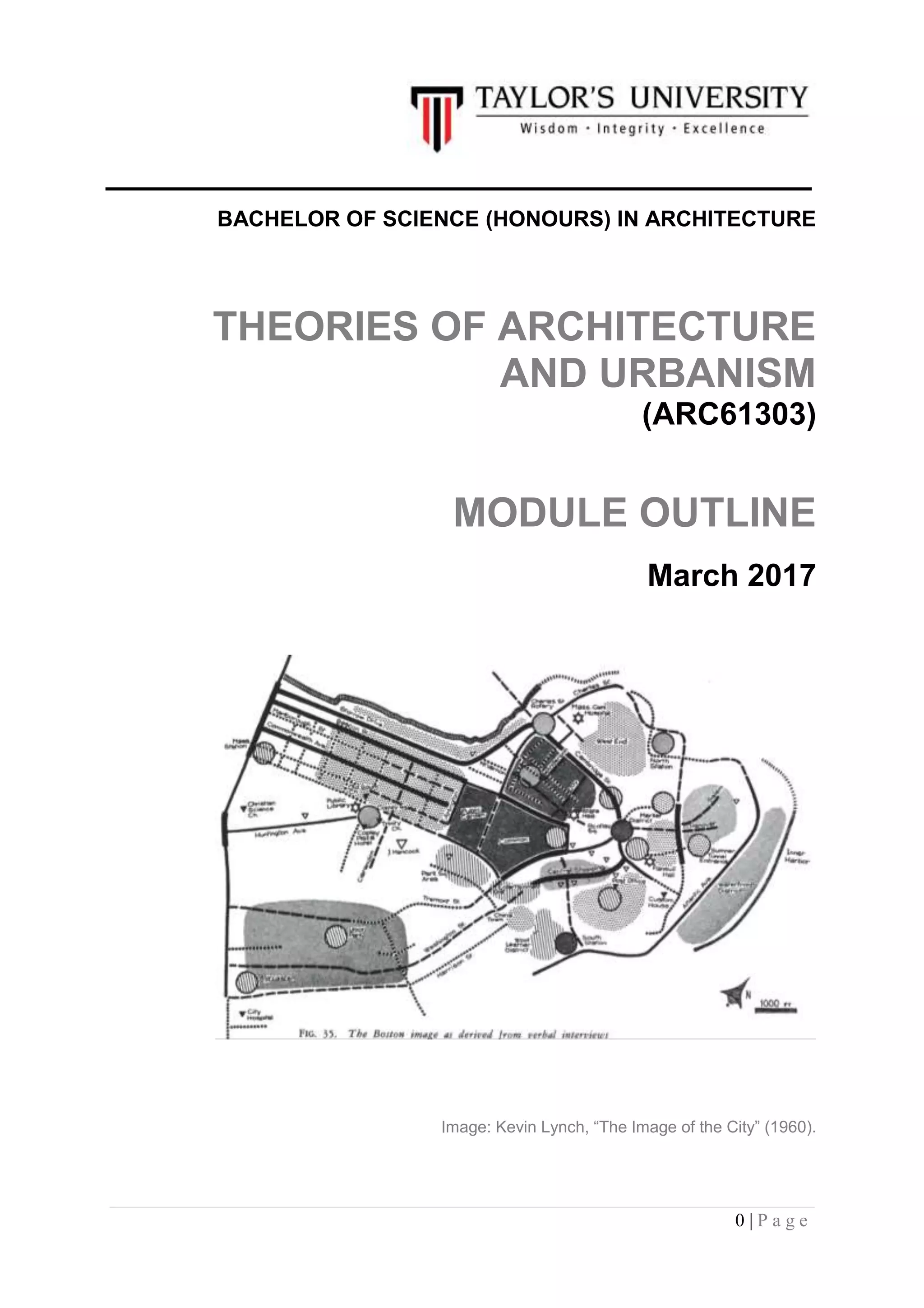
Image: Kevin Lynch, “The Image of the City” (1960).
Theories of Architecture and Urbanism (ARC61303):
March 2017
1
Programme Bachelor of Science (Honours) in Architecture
Module THEORIES OF ARCHITECTURE AND URBANISM
Module Code (ARC61303)
Prerequisite None
Credit Hours 3.0
Classification Core
Instructor Prince Favis Isip (princefavis.isip@taylors.edu.my)
Nicholas Ng (nicholasngkw@gmail.com)
Module Synopsis
The subject offers a thematic inquiry into architectural and urban theory in the broader context of
philosophical schools of thought and cultural and social conditions, which include modernism,
postmodernism, phenomenology, semiotics, post-structuralism, deconstruction and critical
regionalism. These themes will guide the organization of weekly lecture and discussions, which will
proceed from the establishment of a basic theoretical apparatus to the examination of specific
cases. These will supply us with tools for the analysis of specific architectural situations. Students
will develop a written synopsis of a designated reading, and an in-depth and analytical research
paper on the designated topic.
Module Teaching Objectives
The teaching objectives of the module are:
1. To engage students with relevant theories which have shaped cities and experience around
architecture, including its role as mediator between our society and its architecture.
2. To provide critical perspectives on key issues within the contemporary discourse of
architecture, through integration of case-studies and theoretical studies.
3. To enhance the understanding of the complexity of architecture and the ability to undertake
independent research.
Module Learning Outcomes (MLO)
The objectives of the module are translated into a number of Module Learning Outcomes (MLO),
mapped to Programme Learning Outcomes (PLO) and Taylor’s Graduate Capabilities (TGC).
No. MLO PLO TGC
1
Describe the theoretical issues related to design through study of
architecture and urbanism and its related studies
2
1.2
2.3
SCHOOL OF ARCHITECTURE, BUILDING AND DESIGN
Centre for Modern Architecture Studies in Southeast Asia
Theories of Architecture and Urbanism (ARC61303):
March 2017
2
2
Identify the different architectural theories which inform the
development of architecture and urban forms
2
1.2
2.3
3
Analyze and critique the relationship between architecture and its social,
cultural, and intellectual context
2
1.2
2.3
4
Analyze architecture and urban forms in relation to relevant
architectural theories
2
1.2
2.3
2.3
5
Produce, orally and in writing, a critical interpretation of architecture
and urbanism in relation to relevant
theories within the contemporary discourse of architecture
2
2.1
2.2
2.3
Modes of Delivery and TIMeS
This is a 3 credit hour module conducted over a period of 14 weeks. The modes of delivery will be
in the form of lectures, discussion/tutorials, and self-directed study. The breakdown of the contact
hours is as follows:
 Lecture: 2.0 hours per week
 Discussion/Tutorial: 2.0 hours per week
 Self-directed study: 4.0 hours per week
TIMeS will be used as a communication tool and information portal for students to access module
materials, project briefs, assignments and announcements.
Programme Learning Outcomes (PLO)*
The Bachelor of Science (Honours) in Architecture programme has as its objectives that graduates
exemplify the following Programme Learning Outcomes (PLO) that will enable them to:
No. Programme Learning Outcomes (PLO)
1
Produce designs at appropriate complexity and scales up to the schematic level using
appropriate communication tools
2
Demonstrate understanding of cultural, historical and established architectural theories,
philosophies and context
3
Demonstrate creativity, innovation and imagination and translate these into an architectural
design solution
4
Develop design to a level for regulatory application for Building Plan submission that complies
to the requirements of local authorities, including understanding of building regulations, basic
building construction and materials, environmental considerations and building services
5
Translate design into construction drawings with appropriate construction details and use
established architectural drawing convention
6 Work in a team and participate in the design process
*Source: The Manual of Accreditation for Architecture Programmes, Board of Architects Malaysia, 2013
Theories of Architecture and Urbanism (ARC61303):
March 2017
3
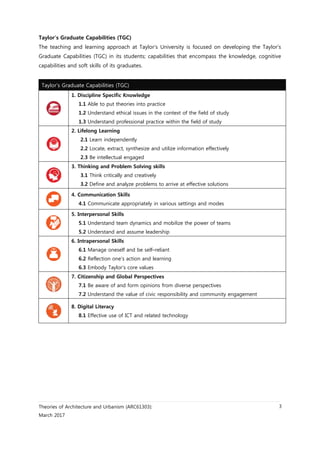
Taylor’s Graduate Capabilities (TGC)
The teaching and learning approach at Taylor’s University is focused on developing the Taylor’s
Graduate Capabilities (TGC) in its students; capabilities that encompass the knowledge, cognitive
capabilities and soft skills of its graduates.
Taylor’s Graduate Capabilities (TGC)
1. Discipline Specific Knowledge
1.1 Able to put theories into practice
1.2 Understand ethical issues in the context of the field of study
1.3 Understand professional practice within the field of study
2. Lifelong Learning
2.1 Learn independently
2.2 Locate, extract, synthesize and utilize information effectively
2.3 Be intellectual engaged
3. Thinking and Problem Solving skills
3.1 Think critically and creatively
3.2 Define and analyze problems to arrive at effective solutions
4. Communication Skills
4.1 Communicate appropriately in various settings and modes
5. Interpersonal Skills
5.1 Understand team dynamics and mobilize the power of teams
5.2 Understand and assume leadership
6. Intrapersonal Skills
6.1 Manage oneself and be self–reliant
6.2 Reflection one’s action and learning
6.3 Embody Taylor’s core values
7. Citizenship and Global Perspectives
7.1 Be aware of and form opinions from diverse perspectives
7.2 Understand the value of civic responsibility and community engagement
8. Digital Literacy
8.1 Effective use of ICT and related technology
Theories of Architecture and Urbanism (ARC61303):
March 2017
4
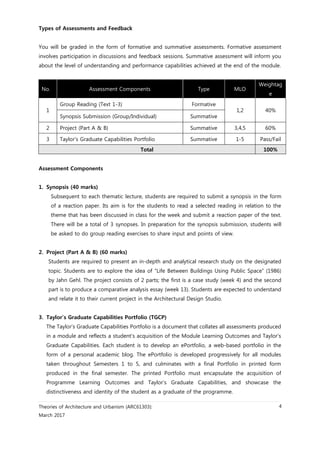
Types of Assessments and Feedback
You will be graded in the form of formative and summative assessments. Formative assessment
involves participation in discussions and feedback sessions. Summative assessment will inform you
about the level of understanding and performance capabilities achieved at the end of the module.
No. Assessment Components Type MLO
Weightag
e
1
Group Reading (Text 1-3) Formative
1,2 40%
Synopsis Submission (Group/Individual) Summative
2 Project (Part A & B) Summative 3,4,5 60%
3 Taylor’s Graduate Capabilities Portfolio Summative 1-5 Pass/Fail
Total 100%
Assessment Components
1. Synopsis (40 marks)
Subsequent to each thematic lecture, students are required to submit a synopsis in the form
of a reaction paper. Its aim is for the students to read a selected reading in relation to the
theme that has been discussed in class for the week and submit a reaction paper of the text.
There will be a total of 3 synopses. In preparation for the synopsis submission, students will
be asked to do group reading exercises to share input and points of view.
2. Project (Part A & B) (60 marks)
Students are required to present an in-depth and analytical research study on the designated
topic. Students are to explore the idea of “Life Between Buildings Using Public Space” (1986)
by Jahn Gehl. The project consists of 2 parts; the first is a case study (week 4) and the second
part is to produce a comparative analysis essay (week 13). Students are expected to understand
and relate it to their current project in the Architectural Design Studio.
3. Taylor’s Graduate Capabilities Portfolio (TGCP)
The Taylor’s Graduate Capabilities Portfolio is a document that collates all assessments produced
in a module and reflects a student’s acquisition of the Module Learning Outcomes and Taylor’s
Graduate Capabilities. Each student is to develop an ePortfolio, a web-based portfolio in the
form of a personal academic blog. The ePortfolio is developed progressively for all modules
taken throughout Semesters 1 to 5, and culminates with a final Portfolio in printed form
produced in the final semester. The printed Portfolio must encapsulate the acquisition of
Programme Learning Outcomes and Taylor’s Graduate Capabilities, and showcase the
distinctiveness and identity of the student as a graduate of the programme.
Theories of Architecture and Urbanism (ARC61303):
March 2017
5
Marks and Grading Table
Assessments and grades will be returned within two weeks of your submission. You will be given
grades and necessary feedback for each submission. The grading system is shown below:
Grade Marks
Grade
Points
Definition Description
A 80 – 100 4.00 Excellent
Evidence of original thinking; demonstrated
outstanding capacity to analyze and synthesize;
outstanding grasp of module matter; evidence of
extensive knowledge base.
A- 75 – 79 3.67 Very Good
Evidence of good grasp of module matter; critical
capacity and analytical ability; understanding of
relevant issues; evidence of familiarity with the
literature.
B+ 70 – 74 3.33
Good
Evidence of grasp of module matter; critical capacity
and analytical ability, reasonable understanding of
relevant issues; evidence of familiarity with the
literature.
B 65 – 69 3.00
B- 60 – 64 2.67
Pass
Evidence of some understanding of the module
matter; ability to develop solutions to simple
problems; benefitting from his/her university
experience.
C+ 55 – 59 2.33
C 50 – 54 2.00
D+ 47 – 49 1.67
Marginal
Fail
Evidence of nearly but not quite acceptable familiarity
with module matter, weak in critical and analytical skills.
D 44 – 46 1.33
D- 40 – 43 1.00
F 0 – 39 0.00 Fail
Insufficient evidence of understanding of the module
matter; weakness in critical and analytical skills; limited
or irrelevant use of the literature.
WD - - Withdrawn
Withdrawn from a module before census date,
typically mid-semester [refer to Description 1 below].
F(W) 0 0.00 Fail
Withdrawn after census date, typically mid-semester
[refer to Description 2 below].
IN - - Incomplete
An interim notation given for a module where a
student has not completed certain requirements
with valid reason or it is not possible to finalise the
grade by the published deadline.
Theories of Architecture and Urbanism (ARC61303):
March 2017
6
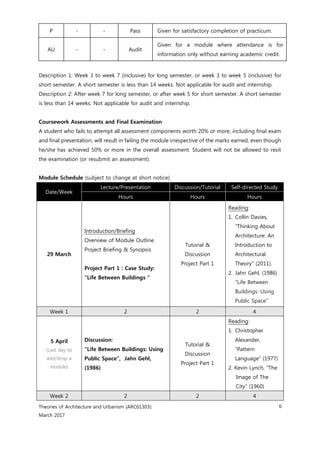
P - - Pass Given for satisfactory completion of practicum.
AU - - Audit
Given for a module where attendance is for
information only without earning academic credit.
Description 1: Week 3 to week 7 (inclusive) for long semester, or week 3 to week 5 (inclusive) for
short semester. A short semester is less than 14 weeks. Not applicable for audit and internship.
Description 2: After week 7 for long semester, or after week 5 for short semester. A short semester
is less than 14 weeks. Not applicable for audit and internship.
Coursework Assessments and Final Examination
A student who fails to attempt all assessment components worth 20% or more, including final exam
and final presentation, will result in failing the module irrespective of the marks earned, even though
he/she has achieved 50% or more in the overall assessment. Student will not be allowed to resit
the examination (or resubmit an assessment).
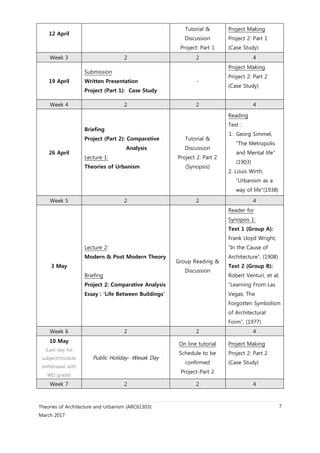
Module Schedule (subject to change at short notice)
Date/Week
Lecture/Presentation Discussion/Tutorial Self-directed Study
Hours Hours Hours
29 March
Introduction/Briefing
Overview of Module Outline
Project Briefing & Synopsis
Project Part 1 : Case Study:
“Life Between Buildings “
Tutorial &
Discussion
Project Part 1
Reading:
1. Collin Davies,
“Thinking About
Architecture: An
Introduction to
Architectural
Theory” (2011).
2. Jahn Gehl, (1986)
“Life Between
Buildings: Using
Public Space”
Week 1 2 2 4
5 April
(Last day to
add/drop a
module)
Discussion:
“Life Between Buildings: Using
Public Space”, Jahn Gehl,
(1986)
Tutorial &
Discussion
Project Part 1
Reading:
1. Christopher
Alexander,
“Pattern
Language” (1977)
2. Kevin Lynch, “The
Image of The
City” (1960)
Week 2 2 2 4
Theories of Architecture and Urbanism (ARC61303):
March 2017
7
12 April
Tutorial &
Discussion
Project: Part 1
Project Making
Project 2: Part 1
(Case Study)
Week 3 2 2 4
19 April
Submission
Written Presentation
Project (Part 1): Case Study
-
Project Making
Project 2: Part 2
(Case Study)
Week 4 2 2 4
26 April
Briefing
Project (Part 2): Comparative
Analysis
Lecture 1:
Theories of Urbanism
Tutorial &
Discussion
Project 2: Part 2
(Synopsis)
Reading
Text :
1. Georg Simmel,
“The Metropolis
and Mental life”
(1903)
2. Louis Wirth,
“Urbanism as a
way of life”(1938)
Week 5 2 2 4
3 May
Lecture 2:
Modern & Post Modern Theory
Briefing
Project 2: Comparative Analysis
Essay : ‘Life Between Buildings’
Group Reading &
Discussion
Reader for
Synopsis 1:
Text 1 (Group A):
Frank Lloyd Wright,
“In the Cause of
Architecture”, (1908)
Text 2 (Group B):
Robert Venturi, et al,
”Learning From Las
Vegas: The
Forgotten Symbolism
of Architectural
Form”, (1977)
Week 6 2 2 4
10 May
(Last day for
subject/module
withdrawal with
WD grade)
Public Holiday- Wesak Day
On line tutorial
Schedule to be
confirmed
Project-Part 2
Project Making
Project 2: Part 2
(Case Study)
Week 7 2 2 4
Theories of Architecture and Urbanism (ARC61303):
March 2017
8
May 15-19
Mid-semester study break
(Non-contact week)
- - 8
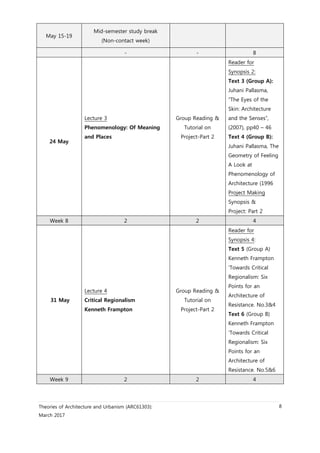
24 May
Lecture 3
Phenomenology: Of Meaning
and Places
Group Reading &
Tutorial on
Project-Part 2
Reader for
Synopsis 2:
Text 3 (Group A):
Juhani Pallasma,
“The Eyes of the
Skin: Architecture
and the Senses”,
(2007), pp40 – 46
Text 4 (Group B):
Juhani Pallasma, The
Geometry of Feeling
A Look at
Phenomenology of
Architecture (1996
Project Making
Synopsis &
Project: Part 2
Week 8 2 2 4
31 May
Lecture 4
Critical Regionalism
Kenneth Frampton
Group Reading &
Tutorial on
Project-Part 2
Reader for
Synopsis 4:
Text 5 (Group A)
Kenneth Frampton
‘Towards Critical
Regionalism: Six
Points for an
Architecture of
Resistance. No.3&4
Text 6 (Group B)
Kenneth Frampton
‘Towards Critical
Regionalism: Six
Points for an
Architecture of
Resistance. No.5&6
Week 9 2 2 4
Theories of Architecture and Urbanism (ARC61303):
March 2017
9
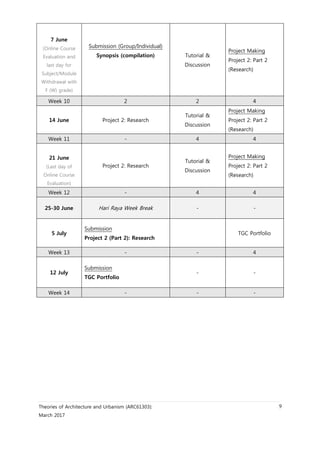
7 June
(Online Course
Evaluation and
last day for
Subject/Module
Withdrawal with
F (W) grade)
Submission (Group/Individual)
Synopsis (compilation) Tutorial &
Discussion
Project Making
Project 2: Part 2
(Research)
Week 10 2 2 4
14 June Project 2: Research
Tutorial &
Discussion
Project Making
Project 2: Part 2
(Research)
Week 11 - 4 4
21 June
(Last day of
Online Course
Evaluation)
Project 2: Research
Tutorial &
Discussion
Project Making
Project 2: Part 2
(Research)
Week 12 - 4 4
25-30 June Hari Raya Week Break - -
5 July
Submission
Project 2 (Part 2): Research
TGC Portfolio
Week 13 - - 4
12 July
Submission
TGC Portfolio
- -
Week 14 - - -
Theories of Architecture and Urbanism (ARC61303):
March 2017
10
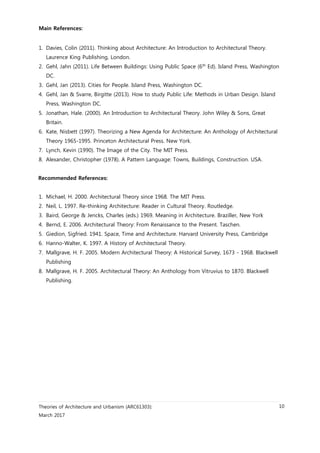
Main References:
1. Davies, Colin (2011). Thinking about Architecture: An Introduction to Architectural Theory.
Laurence King Publishing, London.
2. Gehl, Jahn (2011). Life Between Buildings: Using Public Space (6th
Ed). Island Press, Washington
DC.
3. Gehl, Jan (2013). Cities for People. Island Press, Washington DC.
4. Gehl, Jan & Svarre, Birgitte (2013). How to study Public Life: Methods in Urban Design. Island
Press, Washington DC.
5. Jonathan, Hale. (2000). An Introduction to Architectural Theory. John Wiley & Sons, Great
Britain.
6. Kate, Nisbett (1997). Theorizing a New Agenda for Architecture: An Anthology of Architectural
Theory 1965-1995. Princeton Architectural Press. New York.
7. Lynch, Kevin (1990). The Image of the City. The MIT Press.
8. Alexander, Christopher (1978). A Pattern Language: Towns, Buildings, Construction. USA.
Recommended References:
1. Michael, H. 2000. Architectural Theory since 1968. The MIT Press.
2. Neil, L. 1997. Re-thinking Architecture: Reader in Cultural Theory. Routledge.
3. Baird, George & Jencks, Charles (eds.) 1969. Meaning in Architecture. Braziller, New York
4. Bernd, E. 2006. Architectural Theory: From Renaissance to the Present. Taschen.
5. Giedion, Sigfried. 1941. Space, Time and Architecture. Harvard University Press, Cambridge
6. Hanno-Walter, K. 1997. A History of Architectural Theory.
7. Mallgrave, H. F. 2005. Modern Architectural Theory: A Historical Survey, 1673 - 1968. Blackwell
Publishing
8. Mallgrave, H. F. 2005. Architectural Theory: An Anthology from Vitruvius to 1870. Blackwell
Publishing.
Theories of Architecture and Urbanism (ARC61303):
March 2017
11
GENERAL RULES AND REGULATIONS
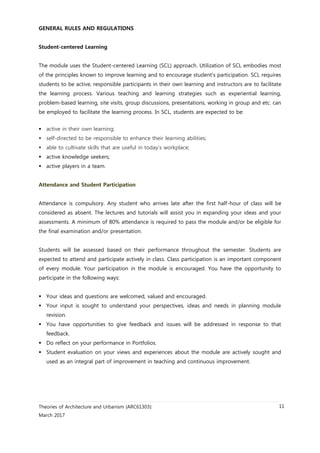
Student-centered Learning
The module uses the Student-centered Learning (SCL) approach. Utilization of SCL embodies most
of the principles known to improve learning and to encourage student’s participation. SCL requires
students to be active, responsible participants in their own learning and instructors are to facilitate
the learning process. Various teaching and learning strategies such as experiential learning,
problem-based learning, site visits, group discussions, presentations, working in group and etc. can
be employed to facilitate the learning process. In SCL, students are expected to be:
 active in their own learning;
 self-directed to be responsible to enhance their learning abilities;
 able to cultivate skills that are useful in today’s workplace;
 active knowledge seekers;
 active players in a team.
Attendance and Student Participation
Attendance is compulsory. Any student who arrives late after the first half-hour of class will be
considered as absent. The lectures and tutorials will assist you in expanding your ideas and your
assessments. A minimum of 80% attendance is required to pass the module and/or be eligible for
the final examination and/or presentation.
Students will be assessed based on their performance throughout the semester. Students are
expected to attend and participate actively in class. Class participation is an important component
of every module. Your participation in the module is encouraged. You have the opportunity to
participate in the following ways:
 Your ideas and questions are welcomed, valued and encouraged.
 Your input is sought to understand your perspectives, ideas and needs in planning module
revision.
 You have opportunities to give feedback and issues will be addressed in response to that
feedback.
 Do reflect on your performance in Portfolios.
 Student evaluation on your views and experiences about the module are actively sought and
used as an integral part of improvement in teaching and continuous improvement.
Theories of Architecture and Urbanism (ARC61303):
March 2017
12
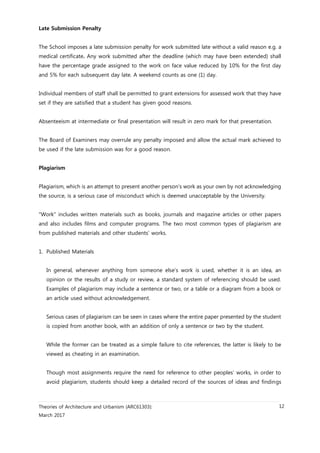
Late Submission Penalty
The School imposes a late submission penalty for work submitted late without a valid reason e.g. a
medical certificate. Any work submitted after the deadline (which may have been extended) shall
have the percentage grade assigned to the work on face value reduced by 10% for the first day
and 5% for each subsequent day late. A weekend counts as one (1) day.
Individual members of staff shall be permitted to grant extensions for assessed work that they have
set if they are satisfied that a student has given good reasons.
Absenteeism at intermediate or final presentation will result in zero mark for that presentation.
The Board of Examiners may overrule any penalty imposed and allow the actual mark achieved to
be used if the late submission was for a good reason.
Plagiarism
Plagiarism, which is an attempt to present another person’s work as your own by not acknowledging
the source, is a serious case of misconduct which is deemed unacceptable by the University.
"Work" includes written materials such as books, journals and magazine articles or other papers
and also includes films and computer programs. The two most common types of plagiarism are
from published materials and other students’ works.
1. Published Materials
In general, whenever anything from someone else’s work is used, whether it is an idea, an
opinion or the results of a study or review, a standard system of referencing should be used.
Examples of plagiarism may include a sentence or two, or a table or a diagram from a book or
an article used without acknowledgement.
Serious cases of plagiarism can be seen in cases where the entire paper presented by the student
is copied from another book, with an addition of only a sentence or two by the student.
While the former can be treated as a simple failure to cite references, the latter is likely to be
viewed as cheating in an examination.
Though most assignments require the need for reference to other peoples’ works, in order to
avoid plagiarism, students should keep a detailed record of the sources of ideas and findings
Theories of Architecture and Urbanism (ARC61303):
March 2017
13
and ensure that these sources are clearly quoted in their assignment. Note that plagiarism also
refers to materials obtained from the Internet too.
2. Other Students’ Works
Circulating relevant articles and discussing ideas before writing an assignment is a common
practice. However, with the exception of group assignments, students should write their own
papers. Plagiarising the work of other students into assignments includes using identical or very
similar sentences, paragraphs or sections. When two students submit papers that are very similar
in tone and content, both are likely to be penalised.
Guide for Writing References:
http://taylorslibrary.taylors.edu.my/user_skills/user_support_students
Prepared by: Checked by: Approved by:
Prince Favis Isip Keith Tan Kay Hin Mohd Adib Ramli
……………………………. ……………………………. …………………………….
Date: 15/3/2017 Date: 24/3/2107 Date: 24/3/2017
Email: princefavis.isip@taylors.edu.my Stream Coordinator Programme Director
Office No.: (Culture, Artistic & Social Studies)
Office Location: C5 Academic Staff Rm.
Remarks:
1. The Module Outline (MO) is to be distributed to the students in the first week of the
semester.
2. Any changes to the Module Outline (MO) shall be communicated (in writing) to the
Programme Director and the approved revised version must be communicated to the
students

SEM 5 : THEORIES URBAN MODULE OUTLINE

  • 1.
    0 | Pa g e BACHELOR OF SCIENCE (HONOURS) IN ARCHITECTURE THEORIES OF ARCHITECTURE AND URBANISM (ARC61303) MODULE OUTLINE March 2017 Image: Kevin Lynch, “The Image of the City” (1960).
  • 2.
    Theories of Architectureand Urbanism (ARC61303): March 2017 1 Programme Bachelor of Science (Honours) in Architecture Module THEORIES OF ARCHITECTURE AND URBANISM Module Code (ARC61303) Prerequisite None Credit Hours 3.0 Classification Core Instructor Prince Favis Isip (princefavis.isip@taylors.edu.my) Nicholas Ng (nicholasngkw@gmail.com) Module Synopsis The subject offers a thematic inquiry into architectural and urban theory in the broader context of philosophical schools of thought and cultural and social conditions, which include modernism, postmodernism, phenomenology, semiotics, post-structuralism, deconstruction and critical regionalism. These themes will guide the organization of weekly lecture and discussions, which will proceed from the establishment of a basic theoretical apparatus to the examination of specific cases. These will supply us with tools for the analysis of specific architectural situations. Students will develop a written synopsis of a designated reading, and an in-depth and analytical research paper on the designated topic. Module Teaching Objectives The teaching objectives of the module are: 1. To engage students with relevant theories which have shaped cities and experience around architecture, including its role as mediator between our society and its architecture. 2. To provide critical perspectives on key issues within the contemporary discourse of architecture, through integration of case-studies and theoretical studies. 3. To enhance the understanding of the complexity of architecture and the ability to undertake independent research. Module Learning Outcomes (MLO) The objectives of the module are translated into a number of Module Learning Outcomes (MLO), mapped to Programme Learning Outcomes (PLO) and Taylor’s Graduate Capabilities (TGC). No. MLO PLO TGC 1 Describe the theoretical issues related to design through study of architecture and urbanism and its related studies 2 1.2 2.3 SCHOOL OF ARCHITECTURE, BUILDING AND DESIGN Centre for Modern Architecture Studies in Southeast Asia
  • 3.
    Theories of Architectureand Urbanism (ARC61303): March 2017 2 2 Identify the different architectural theories which inform the development of architecture and urban forms 2 1.2 2.3 3 Analyze and critique the relationship between architecture and its social, cultural, and intellectual context 2 1.2 2.3 4 Analyze architecture and urban forms in relation to relevant architectural theories 2 1.2 2.3 2.3 5 Produce, orally and in writing, a critical interpretation of architecture and urbanism in relation to relevant theories within the contemporary discourse of architecture 2 2.1 2.2 2.3 Modes of Delivery and TIMeS This is a 3 credit hour module conducted over a period of 14 weeks. The modes of delivery will be in the form of lectures, discussion/tutorials, and self-directed study. The breakdown of the contact hours is as follows:  Lecture: 2.0 hours per week  Discussion/Tutorial: 2.0 hours per week  Self-directed study: 4.0 hours per week TIMeS will be used as a communication tool and information portal for students to access module materials, project briefs, assignments and announcements. Programme Learning Outcomes (PLO)* The Bachelor of Science (Honours) in Architecture programme has as its objectives that graduates exemplify the following Programme Learning Outcomes (PLO) that will enable them to: No. Programme Learning Outcomes (PLO) 1 Produce designs at appropriate complexity and scales up to the schematic level using appropriate communication tools 2 Demonstrate understanding of cultural, historical and established architectural theories, philosophies and context 3 Demonstrate creativity, innovation and imagination and translate these into an architectural design solution 4 Develop design to a level for regulatory application for Building Plan submission that complies to the requirements of local authorities, including understanding of building regulations, basic building construction and materials, environmental considerations and building services 5 Translate design into construction drawings with appropriate construction details and use established architectural drawing convention 6 Work in a team and participate in the design process *Source: The Manual of Accreditation for Architecture Programmes, Board of Architects Malaysia, 2013
  • 4.
    Theories of Architectureand Urbanism (ARC61303): March 2017 3 Taylor’s Graduate Capabilities (TGC) The teaching and learning approach at Taylor’s University is focused on developing the Taylor’s Graduate Capabilities (TGC) in its students; capabilities that encompass the knowledge, cognitive capabilities and soft skills of its graduates. Taylor’s Graduate Capabilities (TGC) 1. Discipline Specific Knowledge 1.1 Able to put theories into practice 1.2 Understand ethical issues in the context of the field of study 1.3 Understand professional practice within the field of study 2. Lifelong Learning 2.1 Learn independently 2.2 Locate, extract, synthesize and utilize information effectively 2.3 Be intellectual engaged 3. Thinking and Problem Solving skills 3.1 Think critically and creatively 3.2 Define and analyze problems to arrive at effective solutions 4. Communication Skills 4.1 Communicate appropriately in various settings and modes 5. Interpersonal Skills 5.1 Understand team dynamics and mobilize the power of teams 5.2 Understand and assume leadership 6. Intrapersonal Skills 6.1 Manage oneself and be self–reliant 6.2 Reflection one’s action and learning 6.3 Embody Taylor’s core values 7. Citizenship and Global Perspectives 7.1 Be aware of and form opinions from diverse perspectives 7.2 Understand the value of civic responsibility and community engagement 8. Digital Literacy 8.1 Effective use of ICT and related technology
  • 5.
    Theories of Architectureand Urbanism (ARC61303): March 2017 4 Types of Assessments and Feedback You will be graded in the form of formative and summative assessments. Formative assessment involves participation in discussions and feedback sessions. Summative assessment will inform you about the level of understanding and performance capabilities achieved at the end of the module. No. Assessment Components Type MLO Weightag e 1 Group Reading (Text 1-3) Formative 1,2 40% Synopsis Submission (Group/Individual) Summative 2 Project (Part A & B) Summative 3,4,5 60% 3 Taylor’s Graduate Capabilities Portfolio Summative 1-5 Pass/Fail Total 100% Assessment Components 1. Synopsis (40 marks) Subsequent to each thematic lecture, students are required to submit a synopsis in the form of a reaction paper. Its aim is for the students to read a selected reading in relation to the theme that has been discussed in class for the week and submit a reaction paper of the text. There will be a total of 3 synopses. In preparation for the synopsis submission, students will be asked to do group reading exercises to share input and points of view. 2. Project (Part A & B) (60 marks) Students are required to present an in-depth and analytical research study on the designated topic. Students are to explore the idea of “Life Between Buildings Using Public Space” (1986) by Jahn Gehl. The project consists of 2 parts; the first is a case study (week 4) and the second part is to produce a comparative analysis essay (week 13). Students are expected to understand and relate it to their current project in the Architectural Design Studio. 3. Taylor’s Graduate Capabilities Portfolio (TGCP) The Taylor’s Graduate Capabilities Portfolio is a document that collates all assessments produced in a module and reflects a student’s acquisition of the Module Learning Outcomes and Taylor’s Graduate Capabilities. Each student is to develop an ePortfolio, a web-based portfolio in the form of a personal academic blog. The ePortfolio is developed progressively for all modules taken throughout Semesters 1 to 5, and culminates with a final Portfolio in printed form produced in the final semester. The printed Portfolio must encapsulate the acquisition of Programme Learning Outcomes and Taylor’s Graduate Capabilities, and showcase the distinctiveness and identity of the student as a graduate of the programme.
  • 6.
    Theories of Architectureand Urbanism (ARC61303): March 2017 5 Marks and Grading Table Assessments and grades will be returned within two weeks of your submission. You will be given grades and necessary feedback for each submission. The grading system is shown below: Grade Marks Grade Points Definition Description A 80 – 100 4.00 Excellent Evidence of original thinking; demonstrated outstanding capacity to analyze and synthesize; outstanding grasp of module matter; evidence of extensive knowledge base. A- 75 – 79 3.67 Very Good Evidence of good grasp of module matter; critical capacity and analytical ability; understanding of relevant issues; evidence of familiarity with the literature. B+ 70 – 74 3.33 Good Evidence of grasp of module matter; critical capacity and analytical ability, reasonable understanding of relevant issues; evidence of familiarity with the literature. B 65 – 69 3.00 B- 60 – 64 2.67 Pass Evidence of some understanding of the module matter; ability to develop solutions to simple problems; benefitting from his/her university experience. C+ 55 – 59 2.33 C 50 – 54 2.00 D+ 47 – 49 1.67 Marginal Fail Evidence of nearly but not quite acceptable familiarity with module matter, weak in critical and analytical skills. D 44 – 46 1.33 D- 40 – 43 1.00 F 0 – 39 0.00 Fail Insufficient evidence of understanding of the module matter; weakness in critical and analytical skills; limited or irrelevant use of the literature. WD - - Withdrawn Withdrawn from a module before census date, typically mid-semester [refer to Description 1 below]. F(W) 0 0.00 Fail Withdrawn after census date, typically mid-semester [refer to Description 2 below]. IN - - Incomplete An interim notation given for a module where a student has not completed certain requirements with valid reason or it is not possible to finalise the grade by the published deadline.
  • 7.
    Theories of Architectureand Urbanism (ARC61303): March 2017 6 P - - Pass Given for satisfactory completion of practicum. AU - - Audit Given for a module where attendance is for information only without earning academic credit. Description 1: Week 3 to week 7 (inclusive) for long semester, or week 3 to week 5 (inclusive) for short semester. A short semester is less than 14 weeks. Not applicable for audit and internship. Description 2: After week 7 for long semester, or after week 5 for short semester. A short semester is less than 14 weeks. Not applicable for audit and internship. Coursework Assessments and Final Examination A student who fails to attempt all assessment components worth 20% or more, including final exam and final presentation, will result in failing the module irrespective of the marks earned, even though he/she has achieved 50% or more in the overall assessment. Student will not be allowed to resit the examination (or resubmit an assessment). Module Schedule (subject to change at short notice) Date/Week Lecture/Presentation Discussion/Tutorial Self-directed Study Hours Hours Hours 29 March Introduction/Briefing Overview of Module Outline Project Briefing & Synopsis Project Part 1 : Case Study: “Life Between Buildings “ Tutorial & Discussion Project Part 1 Reading: 1. Collin Davies, “Thinking About Architecture: An Introduction to Architectural Theory” (2011). 2. Jahn Gehl, (1986) “Life Between Buildings: Using Public Space” Week 1 2 2 4 5 April (Last day to add/drop a module) Discussion: “Life Between Buildings: Using Public Space”, Jahn Gehl, (1986) Tutorial & Discussion Project Part 1 Reading: 1. Christopher Alexander, “Pattern Language” (1977) 2. Kevin Lynch, “The Image of The City” (1960) Week 2 2 2 4
  • 8.
    Theories of Architectureand Urbanism (ARC61303): March 2017 7 12 April Tutorial & Discussion Project: Part 1 Project Making Project 2: Part 1 (Case Study) Week 3 2 2 4 19 April Submission Written Presentation Project (Part 1): Case Study - Project Making Project 2: Part 2 (Case Study) Week 4 2 2 4 26 April Briefing Project (Part 2): Comparative Analysis Lecture 1: Theories of Urbanism Tutorial & Discussion Project 2: Part 2 (Synopsis) Reading Text : 1. Georg Simmel, “The Metropolis and Mental life” (1903) 2. Louis Wirth, “Urbanism as a way of life”(1938) Week 5 2 2 4 3 May Lecture 2: Modern & Post Modern Theory Briefing Project 2: Comparative Analysis Essay : ‘Life Between Buildings’ Group Reading & Discussion Reader for Synopsis 1: Text 1 (Group A): Frank Lloyd Wright, “In the Cause of Architecture”, (1908) Text 2 (Group B): Robert Venturi, et al, ”Learning From Las Vegas: The Forgotten Symbolism of Architectural Form”, (1977) Week 6 2 2 4 10 May (Last day for subject/module withdrawal with WD grade) Public Holiday- Wesak Day On line tutorial Schedule to be confirmed Project-Part 2 Project Making Project 2: Part 2 (Case Study) Week 7 2 2 4
  • 9.
    Theories of Architectureand Urbanism (ARC61303): March 2017 8 May 15-19 Mid-semester study break (Non-contact week) - - 8 24 May Lecture 3 Phenomenology: Of Meaning and Places Group Reading & Tutorial on Project-Part 2 Reader for Synopsis 2: Text 3 (Group A): Juhani Pallasma, “The Eyes of the Skin: Architecture and the Senses”, (2007), pp40 – 46 Text 4 (Group B): Juhani Pallasma, The Geometry of Feeling A Look at Phenomenology of Architecture (1996 Project Making Synopsis & Project: Part 2 Week 8 2 2 4 31 May Lecture 4 Critical Regionalism Kenneth Frampton Group Reading & Tutorial on Project-Part 2 Reader for Synopsis 4: Text 5 (Group A) Kenneth Frampton ‘Towards Critical Regionalism: Six Points for an Architecture of Resistance. No.3&4 Text 6 (Group B) Kenneth Frampton ‘Towards Critical Regionalism: Six Points for an Architecture of Resistance. No.5&6 Week 9 2 2 4
  • 10.
    Theories of Architectureand Urbanism (ARC61303): March 2017 9 7 June (Online Course Evaluation and last day for Subject/Module Withdrawal with F (W) grade) Submission (Group/Individual) Synopsis (compilation) Tutorial & Discussion Project Making Project 2: Part 2 (Research) Week 10 2 2 4 14 June Project 2: Research Tutorial & Discussion Project Making Project 2: Part 2 (Research) Week 11 - 4 4 21 June (Last day of Online Course Evaluation) Project 2: Research Tutorial & Discussion Project Making Project 2: Part 2 (Research) Week 12 - 4 4 25-30 June Hari Raya Week Break - - 5 July Submission Project 2 (Part 2): Research TGC Portfolio Week 13 - - 4 12 July Submission TGC Portfolio - - Week 14 - - -
  • 11.
    Theories of Architectureand Urbanism (ARC61303): March 2017 10 Main References: 1. Davies, Colin (2011). Thinking about Architecture: An Introduction to Architectural Theory. Laurence King Publishing, London. 2. Gehl, Jahn (2011). Life Between Buildings: Using Public Space (6th Ed). Island Press, Washington DC. 3. Gehl, Jan (2013). Cities for People. Island Press, Washington DC. 4. Gehl, Jan & Svarre, Birgitte (2013). How to study Public Life: Methods in Urban Design. Island Press, Washington DC. 5. Jonathan, Hale. (2000). An Introduction to Architectural Theory. John Wiley & Sons, Great Britain. 6. Kate, Nisbett (1997). Theorizing a New Agenda for Architecture: An Anthology of Architectural Theory 1965-1995. Princeton Architectural Press. New York. 7. Lynch, Kevin (1990). The Image of the City. The MIT Press. 8. Alexander, Christopher (1978). A Pattern Language: Towns, Buildings, Construction. USA. Recommended References: 1. Michael, H. 2000. Architectural Theory since 1968. The MIT Press. 2. Neil, L. 1997. Re-thinking Architecture: Reader in Cultural Theory. Routledge. 3. Baird, George & Jencks, Charles (eds.) 1969. Meaning in Architecture. Braziller, New York 4. Bernd, E. 2006. Architectural Theory: From Renaissance to the Present. Taschen. 5. Giedion, Sigfried. 1941. Space, Time and Architecture. Harvard University Press, Cambridge 6. Hanno-Walter, K. 1997. A History of Architectural Theory. 7. Mallgrave, H. F. 2005. Modern Architectural Theory: A Historical Survey, 1673 - 1968. Blackwell Publishing 8. Mallgrave, H. F. 2005. Architectural Theory: An Anthology from Vitruvius to 1870. Blackwell Publishing.
  • 12.
    Theories of Architectureand Urbanism (ARC61303): March 2017 11 GENERAL RULES AND REGULATIONS Student-centered Learning The module uses the Student-centered Learning (SCL) approach. Utilization of SCL embodies most of the principles known to improve learning and to encourage student’s participation. SCL requires students to be active, responsible participants in their own learning and instructors are to facilitate the learning process. Various teaching and learning strategies such as experiential learning, problem-based learning, site visits, group discussions, presentations, working in group and etc. can be employed to facilitate the learning process. In SCL, students are expected to be:  active in their own learning;  self-directed to be responsible to enhance their learning abilities;  able to cultivate skills that are useful in today’s workplace;  active knowledge seekers;  active players in a team. Attendance and Student Participation Attendance is compulsory. Any student who arrives late after the first half-hour of class will be considered as absent. The lectures and tutorials will assist you in expanding your ideas and your assessments. A minimum of 80% attendance is required to pass the module and/or be eligible for the final examination and/or presentation. Students will be assessed based on their performance throughout the semester. Students are expected to attend and participate actively in class. Class participation is an important component of every module. Your participation in the module is encouraged. You have the opportunity to participate in the following ways:  Your ideas and questions are welcomed, valued and encouraged.  Your input is sought to understand your perspectives, ideas and needs in planning module revision.  You have opportunities to give feedback and issues will be addressed in response to that feedback.  Do reflect on your performance in Portfolios.  Student evaluation on your views and experiences about the module are actively sought and used as an integral part of improvement in teaching and continuous improvement.
  • 13.
    Theories of Architectureand Urbanism (ARC61303): March 2017 12 Late Submission Penalty The School imposes a late submission penalty for work submitted late without a valid reason e.g. a medical certificate. Any work submitted after the deadline (which may have been extended) shall have the percentage grade assigned to the work on face value reduced by 10% for the first day and 5% for each subsequent day late. A weekend counts as one (1) day. Individual members of staff shall be permitted to grant extensions for assessed work that they have set if they are satisfied that a student has given good reasons. Absenteeism at intermediate or final presentation will result in zero mark for that presentation. The Board of Examiners may overrule any penalty imposed and allow the actual mark achieved to be used if the late submission was for a good reason. Plagiarism Plagiarism, which is an attempt to present another person’s work as your own by not acknowledging the source, is a serious case of misconduct which is deemed unacceptable by the University. "Work" includes written materials such as books, journals and magazine articles or other papers and also includes films and computer programs. The two most common types of plagiarism are from published materials and other students’ works. 1. Published Materials In general, whenever anything from someone else’s work is used, whether it is an idea, an opinion or the results of a study or review, a standard system of referencing should be used. Examples of plagiarism may include a sentence or two, or a table or a diagram from a book or an article used without acknowledgement. Serious cases of plagiarism can be seen in cases where the entire paper presented by the student is copied from another book, with an addition of only a sentence or two by the student. While the former can be treated as a simple failure to cite references, the latter is likely to be viewed as cheating in an examination. Though most assignments require the need for reference to other peoples’ works, in order to avoid plagiarism, students should keep a detailed record of the sources of ideas and findings
  • 14.
    Theories of Architectureand Urbanism (ARC61303): March 2017 13 and ensure that these sources are clearly quoted in their assignment. Note that plagiarism also refers to materials obtained from the Internet too. 2. Other Students’ Works Circulating relevant articles and discussing ideas before writing an assignment is a common practice. However, with the exception of group assignments, students should write their own papers. Plagiarising the work of other students into assignments includes using identical or very similar sentences, paragraphs or sections. When two students submit papers that are very similar in tone and content, both are likely to be penalised. Guide for Writing References: http://taylorslibrary.taylors.edu.my/user_skills/user_support_students Prepared by: Checked by: Approved by: Prince Favis Isip Keith Tan Kay Hin Mohd Adib Ramli ……………………………. ……………………………. ……………………………. Date: 15/3/2017 Date: 24/3/2107 Date: 24/3/2017 Email: princefavis.isip@taylors.edu.my Stream Coordinator Programme Director Office No.: (Culture, Artistic & Social Studies) Office Location: C5 Academic Staff Rm. Remarks: 1. The Module Outline (MO) is to be distributed to the students in the first week of the semester. 2. Any changes to the Module Outline (MO) shall be communicated (in writing) to the Programme Director and the approved revised version must be communicated to the students