CONTENTS
Problem Statement
Objective of project
Introduction to portable architecture
Literature review on Recycled plastic waste
Case studies
Project illustration
Summary
20XX PRESENTATION TITLE 2
3.
PROBLEM
STATEMENT
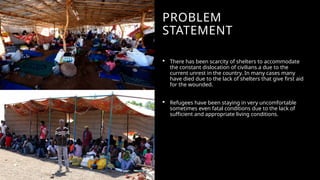
There hasbeen scarcity of shelters to accommodate
the constant dislocation of civilians a due to the
current unrest in the country. In many cases many
have died due to the lack of shelters that give first aid
for the wounded.
Refugees have been staying in very uncomfortable
sometimes even fatal conditions due to the lack of
sufficient and appropriate living conditions.
4.
THE OBJECTIVE OFTHE
PROJECT
20XX PRESENTATION TITLE 4
The aim of the project is to build a cost effective,
mobile (portable) shelter that is light weight and very
is to transport it around in times of emergencies.
Another objective is to use materials that are eco
friendly and use recycled materials to sold the
current global environmental crisis.
5.
INTRODUCTION ON
PORTABLE ARCHITECTURE
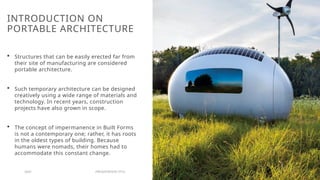
Structures that can be easily erected far from
their site of manufacturing are considered
portable architecture.
Such temporary architecture can be designed
creatively using a wide range of materials and
technology. In recent years, construction
projects have also grown in scope.
The concept of impermanence in Built Forms
is not a contemporary one; rather, it has roots
in the oldest types of building. Because
humans were nomads, their homes had to
accommodate this constant change.
20XX PRESENTATION TITLE 5
6.
20XX PRESENTATION TITLE6
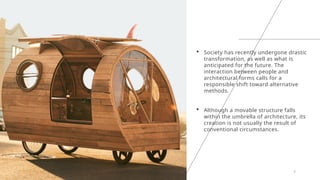
Society has recently undergone drastic
transformation, as well as what is
anticipated for the future. The
interaction between people and
architectural forms calls for a
responsible shift toward alternative
methods.
Although a movable structure falls
within the umbrella of architecture, its
creation is not usually the result of
conventional circumstances.
7.
LITERATURE REVIEW ONMATERIALS
USED: RECYCLED PLASTIC WASTE
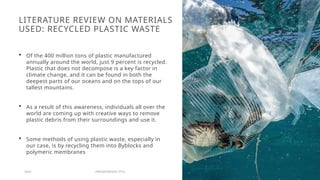
Of the 400 million tons of plastic manufactured
annually around the world, just 9 percent is recycled.
Plastic that does not decompose is a key factor in
climate change, and it can be found in both the
deepest parts of our oceans and on the tops of our
tallest mountains.
As a result of this awareness, individuals all over the
world are coming up with creative ways to remove
plastic debris from their surroundings and use it.
Some methods of using plastic waste, especially in
our case, is by recycling them into Byblocks and
polymeric membranes
20XX PRESENTATION TITLE 7
8.
BY BLOCKS
20XX PRESENTATIONTITLE 8
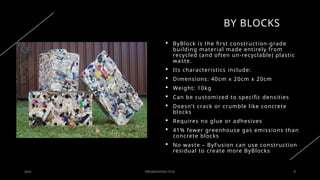
ByBlock is the first construction-grade
building material made entirely from
recycled (and often un-recyclable) plastic
waste.
Its characteristics include:
Dimensions: 40cm x 20cm x 20cm
Weight: 10kg
Can be customized to specific densities
Doesn’t crack or crumble like concrete
blocks
Requires no glue or adhesives
41% fewer greenhouse gas emissions than
concrete blocks
No waste – ByFusion can use construction
residual to create more ByBlocks
9.
PRODUCTION OF BY
BLOCKS
20XXPRESENTATION TITLE 9
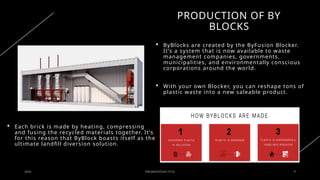
Each brick is made by heating, compressing
and fusing the recycled materials together. It’s
for this reason that ByBlock boasts itself as the
ultimate landfill diversion solution.
ByBlocks are created by the ByFusion Blocker.
It’s a system that is now available to waste
management companies, governments,
municipalities, and environmentally conscious
corporations around the world.
With your own Blocker, you can reshape tons of
plastic waste into a new saleable product.
10.
PRACTICAL APPLICATION OFBY
BLOCKS
20XX PRESENTATION TITLE 10
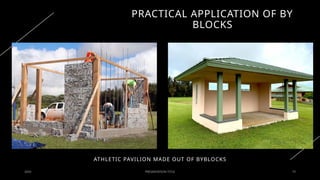
ATHLETIC PAVILION MADE OUT OF BYBLOCKS
11.
POLYMERIC
MEMBRANES
20XX PRESENTATION TITLE11
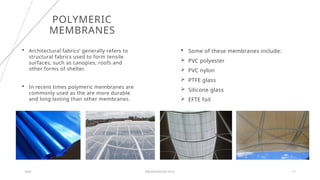
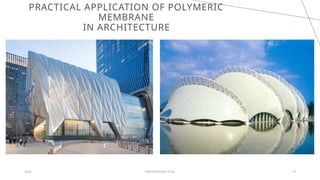
Architectural fabrics’ generally refers to
structural fabrics used to form tensile
surfaces, such as canopies, roofs and
other forms of shelter.
In recent times polymeric membranes are
commonly used as the are more durable
and long lasting than other membranes.
Some of these membranes include:
PVC polyester
PVC nylon
PTFE glass
Silicone glass
EFTE foil
12.
20XX PRESENTATION TITLE12
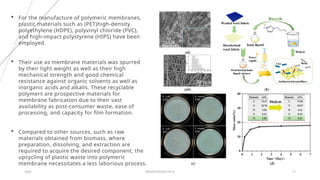
For the manufacture of polymeric membranes,
plastic materials such as (PET)high-density
polyethylene (HDPE), polyvinyl chloride (PVC),
and high-impact polystyrene (HIPS) have been
employed.
Their use as membrane materials was spurred
by their light weight as well as their high
mechanical strength and good chemical
resistance against organic solvents as well as
inorganic acids and alkalis. These recyclable
polymers are prospective materials for
membrane fabrication due to their vast
availability as post-consumer waste, ease of
processing, and capacity for film formation.
Compared to other sources, such as raw
materials obtained from biomass, where
preparation, dissolving, and extraction are
required to acquire the desired component, the
upcycling of plastic waste into polymeric
membrane necessitates a less laborious process.
13.
20XX PRESENTATION TITLE13
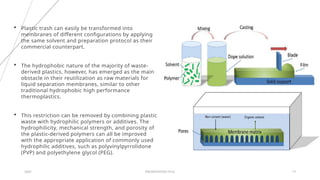
Plastic trash can easily be transformed into
membranes of different configurations by applying
the same solvent and preparation protocol as their
commercial counterpart.
The hydrophobic nature of the majority of waste-
derived plastics, however, has emerged as the main
obstacle in their reutilization as raw materials for
liquid separation membranes, similar to other
traditional hydrophobic high performance
thermoplastics.
This restriction can be removed by combining plastic
waste with hydrophilic polymers or additives. The
hydrophilicity, mechanical strength, and porosity of
the plastic-derived polymers can all be improved
with the appropriate application of commonly used
hydrophilic additives, such as polyvinylpyrrolidone
(PVP) and polyethylene glycol (PEG).
CASE STUDY 1:NOMADIC
ARCHITECTURE OF AFAR
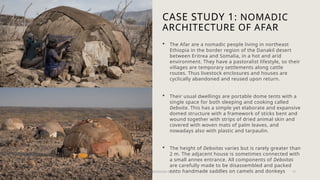
The Afar are a nomadic people living in northeast
Ethiopia in the border region of the Danakil desert
between Eritrea and Somalia, in a hot and arid
environment. They have a pastoralist lifestyle, so their
villages are temporary settlements along cattle
routes. Thus livestock enclosures and houses are
cyclically abandoned and reused upon return.
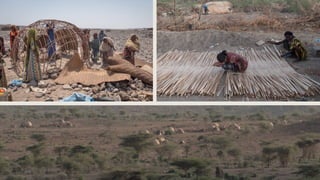
Their usual dwellings are portable dome tents with a
single space for both sleeping and cooking called
Deboita. This has a simple yet elaborate and expansive
domed structure with a framework of sticks bent and
wound together with strips of dried animal skin and
covered with woven mats of palm leaves, and
nowadays also with plastic and tarpaulin.
The height of Deboitas varies but is rarely greater than
2 m. The adjacent house is sometimes connected with
a small annex entrance. All components of Deboitas
are carefully made to be disassembled and packed
onto handmade saddles on camels and donkeys
20XX PRESENTATION TITLE 15
16.
PRESENTATION TITLE 16
20XX
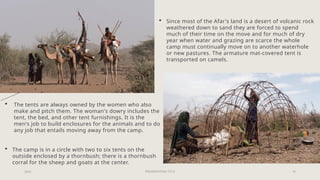
Since most of the Afar's land is a desert of volcanic rock
weathered down to sand they are forced to spend
much of their time on the move and for much of dry
year when water and grazing are scarce the whole
camp must continually move on to another waterhole
or new pastures. The armature mat-covered tent is
transported on camels.
The tents are always owned by the women who also
make and pitch them. The woman's dowry includes the
tent, the bed, and other tent furnishings. It is the
men's job to build enclosures for the animals and to do
any job that entails moving away from the camp.
The camp is in a circle with two to six tents on the
outside enclosed by a thornbush; there is a thornbush
corral for the sheep and goats at the center.
17.
PRESENTATION TITLE 17
20XX
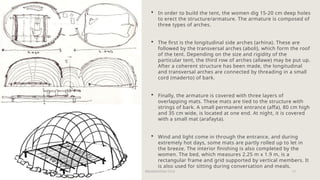
In order to build the tent, the women dig 15-20 cm deep holes
to erect the structure/armature. The armature is composed of
three types of arches.
The first is the longitudinal side arches (arhina). These are
followed by the transversal arches (aboli), which form the roof
of the tent. Depending on the size and rigidity of the
particular tent, the third row of arches (allawe) may be put up.
After a coherent structure has been made, the longitudinal
and transversal arches are connected by threading in a small
cord (maderto) of bark.
Finally, the armature is covered with three layers of
overlapping mats. These mats are tied to the structure with
strings of bark. A small permanent entrance (affa), 80 cm high
and 35 cm wide, is located at one end. At night, it is covered
with a small mat (arafayta).
Wind and light come in through the entrance, and during
extremely hot days, some mats are partly rolled up to let in
the breeze. The interior finishing is also completed by the
women. The bed, which measures 2.25 m x 1.9 m, is a
rectangular frame and grid supported by vertical members. It
is also used for sitting during conversation and meals.
CASE STUDY 2:STEREOTANK’S
TAKU TANKU
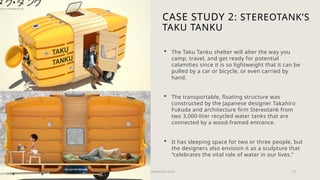
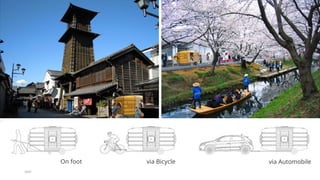
The Taku Tanku shelter will alter the way you
camp, travel, and get ready for potential
calamities since it is so lightweight that it can be
pulled by a car or bicycle, or even carried by
hand.
The transportable, floating structure was
constructed by the Japanese designer Takahiro
Fukuda and architecture firm Stereotank from
two 3,000-liter recycled water tanks that are
connected by a wood-framed entrance.
It has sleeping space for two or three people, but
the designers also envision it as a sculpture that
“celebrates the vital role of water in our lives.”
20XX PRESENTATION TITLE 19
20.
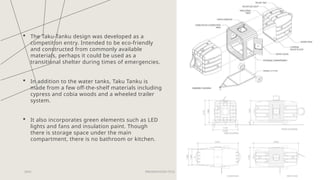
The Taku-Tankudesign was developed as a
competition entry. Intended to be eco-friendly
and constructed from commonly available
materials, perhaps it could be used as a
transitional shelter during times of emergencies.
In addition to the water tanks, Taku Tanku is
made from a few off-the-shelf materials including
cypress and cobia woods and a wheeled trailer
system.
It also incorporates green elements such as LED
lights and fans and insulation paint. Though
there is storage space under the main
compartment, there is no bathroom or kitchen.
20XX PRESENTATION TITLE 20
20XX PRESENTATION TITLE22
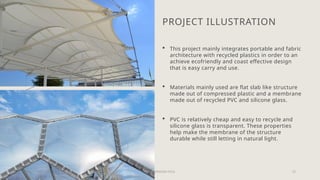
PROJECT ILLUSTRATION
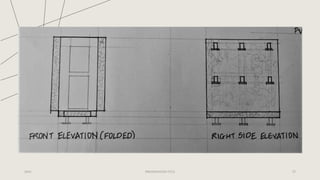
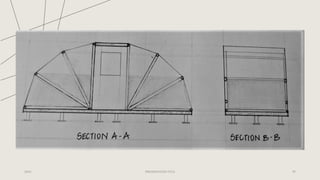
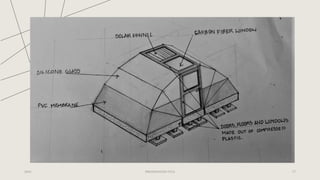
This project mainly integrates portable and fabric
architecture with recycled plastics in order to an
achieve ecofriendly and coast effective design
that is easy carry and use.
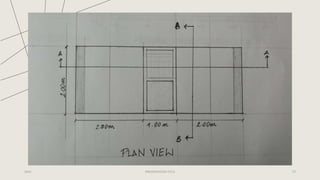
Materials mainly used are flat slab like structure
made out of compressed plastic and a membrane
made out of recycled PVC and silicone glass.
PVC is relatively cheap and easy to recycle and
silicone glass is transparent. These properties
help make the membrane of the structure
durable while still letting in natural light.
20XX PRESENTATION TITLE28
DETAILS
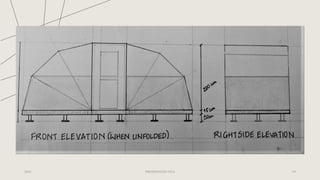
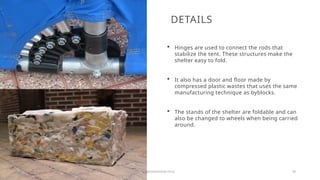
Hinges are used to connect the rods that
stabilize the tent. These structures make the
shelter easy to fold.
It also has a door and floor made by
compressed plastic wastes that uses the same
manufacturing technique as byblocks.
The stands of the shelter are foldable and can
also be changed to wheels when being carried
around.
29.
SUMMARY
Architecture doesn’tnecessarily have to be
permanent to give all the necessary services it is
intended to give when its designed. And while at
it, might as well decrease the negative
environmental impact caused by construction
processes. And through this project I tried to
archive just that.
Portable and sustainable shelter that could be a
great aid at times of emergency and reduce the
carbon print by using recycled plastic.
20XX PRESENTATION TITLE 29