“Girls’ self-esteem peaks when they are
9 years old, then takes a nose dive,”
clinical psychologist, Robin F.
Goodman, writes on the New York
University Child Study Center Web site.
Seventy-five percent of 8 and 9 year-
olds said they liked their looks; that
figure dropped to 56 percent among
girls ages 12 and 13.
At age nine, at least half of all girls
report having been on a diet. Eighty
percent of eighth grade girls say they
are on diets.
Seven million girls and women who
have eating disorders, compared with 1
million boys and men, ten percent
report onset at 10 years or younger; 33
percent ages 11 to 15.
Twenty percent College-aged women in
America are bulimic.
Girls who watch TV commercials
featuring underweight models lose
self-confidence and become more
dissatisfied with their own bodies
(SOURCE: Dove Campaign, “Dove
Campaign for Real Beauty to Help
Foster Self-Esteem in Girls”.
One-third of all girls in grades nine to
12 think they are overweight, and 60
percent are trying to lose weight.
(Quoting the Girl Scout Research
Institute, 2002-2004).
7 in 10 girls believe that they are not
good enough or don’t measure up in
some way, including their looks,
performance in school and
relationships with friends and family
members.
Across the nation, 50% of young girls
are engaged in negative activities like
cutting themselves, or starving
themselves because of self-esteem and
image issues.
62% Girls are insecure about
themselves
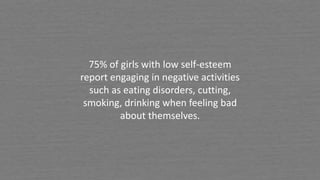
75% of girls with low self-esteem
report engaging in negative activities
such as eating disorders, cutting,
smoking, drinking when feeling bad
about themselves.
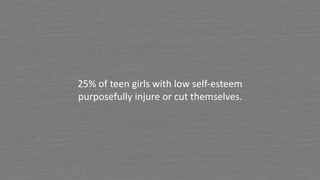
25% of teen girls with low self-esteem
purposefully injure or cut themselves.
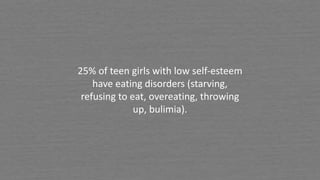
25% of teen girls with low self-esteem
have eating disorders (starving,
refusing to eat, overeating, throwing
up, bulimia).
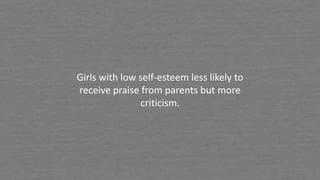
Girls with low self-esteem less likely to
receive praise from parents but more
criticism.
34% of girls with low-self esteem feel
they are not good enough of a
daughter.
57% of girls have mothers who
criticizes her looks .
57% of girls don’t tell mothers things
about them because of they don’t want
them to think bad of them
About 20 percent of teens will
experience depression before they
reach adulthood.
Teen girls that have a negative view of
themselves are four times more likely
to take part in activities with boys that
they’ve ended up regretting later.
The top wish among all teen girls is for
their parents to communicate better
with them. This includes frequent and
more open conversations.
Girls with a high self-esteem are three
times more likely to delay sexual
intercourse than girls with low self-
esteem.
Source:http://www.medicine.indiana.e
du/iu_medicine/02_fall/teenSex.html
Low self-esteem has been linked to
violent behavior, school dropout rates,
teenage pregnancy, suicide, and low
academic achievement.
Source: Alexandra Delis-Abrams, Ph.D.
http://www.selfgrowth.com/articles/A
brams1.html
The World Health Organization (WHO)
in a worldwide research reports that
more deaths are caused by suicide
every year than homicide or war.
Source: Alexandra Delis-Abrams, Ph.D.
http://www.selfgrowth.com/articles/A
brams1.html
Low self-esteem is the universal
common denominator among literally
all people suffering from addictions to
any and all mind altering substances
such as alcohol, not genes.
In a study carried out among some
female students, 80% of them claimed
that their negative body image was
linked to the negative remarks made by
friends and family.
Source: http://selfesteem-
activities.com/statistics-on-self-esteem
A survey carried out by Yong Dai, Ph.D., Rebecca F. Nolan, Ph.D., and
Qing Zeng, Ph.D. revealed that adolescents who attended church or
other religious institutions are more likely to have a higher self esteem
than their peers who have no religious affiliation. It suggests that
religious institutions play a part in teaching people how to have a
positive self esteem and have a healthy view of themselves.
Hayes and Fors (1990) report that lower self esteem is often the
reason why young girls engage in premarital sexual relationships and
is more likely to be responsible for teen pregnancies than any other
single factor. They found that as self-esteem decreases, sexual
attitudes and behavior become more permissive.
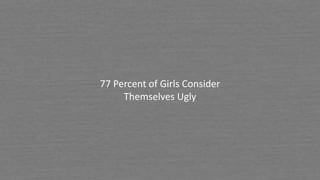
77 Percent of Girls Consider
Themselves Ugly
Self-Esteem Stats
Self-Esteem Stats

Self-Esteem Stats

  • 1.
    “Girls’ self-esteem peakswhen they are 9 years old, then takes a nose dive,” clinical psychologist, Robin F. Goodman, writes on the New York University Child Study Center Web site.
  • 2.
    Seventy-five percent of8 and 9 year- olds said they liked their looks; that figure dropped to 56 percent among girls ages 12 and 13.
  • 3.
    At age nine,at least half of all girls report having been on a diet. Eighty percent of eighth grade girls say they are on diets.
  • 4.
    Seven million girlsand women who have eating disorders, compared with 1 million boys and men, ten percent report onset at 10 years or younger; 33 percent ages 11 to 15.
  • 5.
    Twenty percent College-agedwomen in America are bulimic.
  • 6.
    Girls who watchTV commercials featuring underweight models lose self-confidence and become more dissatisfied with their own bodies (SOURCE: Dove Campaign, “Dove Campaign for Real Beauty to Help Foster Self-Esteem in Girls”.
  • 7.
    One-third of allgirls in grades nine to 12 think they are overweight, and 60 percent are trying to lose weight. (Quoting the Girl Scout Research Institute, 2002-2004).
  • 8.
    7 in 10girls believe that they are not good enough or don’t measure up in some way, including their looks, performance in school and relationships with friends and family members.
  • 9.
    Across the nation,50% of young girls are engaged in negative activities like cutting themselves, or starving themselves because of self-esteem and image issues.
  • 10.
    62% Girls areinsecure about themselves
  • 11.
    75% of girlswith low self-esteem report engaging in negative activities such as eating disorders, cutting, smoking, drinking when feeling bad about themselves.
  • 12.
    25% of teengirls with low self-esteem purposefully injure or cut themselves.
  • 13.
    25% of teengirls with low self-esteem have eating disorders (starving, refusing to eat, overeating, throwing up, bulimia).
  • 14.
    Girls with lowself-esteem less likely to receive praise from parents but more criticism.
  • 15.
    34% of girlswith low-self esteem feel they are not good enough of a daughter.
  • 16.
    57% of girlshave mothers who criticizes her looks .
  • 17.
    57% of girlsdon’t tell mothers things about them because of they don’t want them to think bad of them
  • 18.
    About 20 percentof teens will experience depression before they reach adulthood.
  • 19.
    Teen girls thathave a negative view of themselves are four times more likely to take part in activities with boys that they’ve ended up regretting later.
  • 20.
    The top wishamong all teen girls is for their parents to communicate better with them. This includes frequent and more open conversations.
  • 21.
    Girls with ahigh self-esteem are three times more likely to delay sexual intercourse than girls with low self- esteem. Source:http://www.medicine.indiana.e du/iu_medicine/02_fall/teenSex.html
  • 22.
    Low self-esteem hasbeen linked to violent behavior, school dropout rates, teenage pregnancy, suicide, and low academic achievement. Source: Alexandra Delis-Abrams, Ph.D. http://www.selfgrowth.com/articles/A brams1.html
  • 23.
    The World HealthOrganization (WHO) in a worldwide research reports that more deaths are caused by suicide every year than homicide or war. Source: Alexandra Delis-Abrams, Ph.D. http://www.selfgrowth.com/articles/A brams1.html
  • 24.
    Low self-esteem isthe universal common denominator among literally all people suffering from addictions to any and all mind altering substances such as alcohol, not genes.
  • 25.
    In a studycarried out among some female students, 80% of them claimed that their negative body image was linked to the negative remarks made by friends and family. Source: http://selfesteem- activities.com/statistics-on-self-esteem
  • 26.
    A survey carriedout by Yong Dai, Ph.D., Rebecca F. Nolan, Ph.D., and Qing Zeng, Ph.D. revealed that adolescents who attended church or other religious institutions are more likely to have a higher self esteem than their peers who have no religious affiliation. It suggests that religious institutions play a part in teaching people how to have a positive self esteem and have a healthy view of themselves.
  • 27.
    Hayes and Fors(1990) report that lower self esteem is often the reason why young girls engage in premarital sexual relationships and is more likely to be responsible for teen pregnancies than any other single factor. They found that as self-esteem decreases, sexual attitudes and behavior become more permissive.
  • 28.
    77 Percent ofGirls Consider Themselves Ugly