Selective media
Selective media: used to select (isolate)
specific groups of bacteria;
chemical substances in the media inhibit the
growth of one type of bacteria while permitting
growth of another (MSA, EMB, MacConkey)
MACCONKEY AGAR
A Selective and differential medium used for the cultivation of enterobacteria
Content: peptone,Sodium taurocholate,water, agar ,Neutral red soln,2% in
50% ethanol, Lactose 10% soln
Adjust ph to 7.5
Bile salts and crystal violet inhibit growth of G+ organisms (selective)
Neutral red is a pH indicator that is colorless, but yellow above pH 8 and
red at pH less than 6.8
(differential)
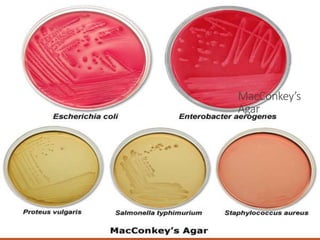
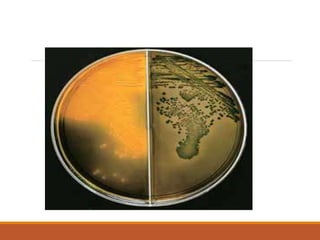
Acid accumulating from lactose fermentation turns the
colorless neutral red to a red color—therefore coliforms
produce a red “halo” on the medium (E.coli,
E.aerogenes)
Lactose nonfermenters will grow, but don’t produce
acid. Therefore, the neutral red remains colorless (P.
vulgaris)
No growth indicates a
Gram + organism
(S.aureus)
Macconkey agar with lactose(left) and non-lactose(right) fermenters
MacConkey’s
Agar
Eosin Methylene Blue Agar
(EMB)
Eosin methylene blue agar is a selective and differential medium
Eosin methylene blue agar is a selective and Typically used for the family
Enterobacteriaceae enteric (gut) bacteria
Selective: EMB contains the dyes methylene blue and eosin which inhibit
Gram + bacteria, thus favoring growth of Gram –
)
Differential: EMB contains lactose, thus allowing for the distinction
between lactose fermenters and nonferments
Large amounts of acid from lactose fermentation cause the dyes to
precipitate on the colony surface, producing a black center or a “green
metallic sheen” (E. coli)
Smaller amounts of acid production result in pink coloration of the growth (E.
aerogenes)
Nonfermenting enterics do not produce acid so their colonies remain colorless
or take on the color of the media (P. vulgaris)
No growth indicates a Gram + organism (S.aureus)
EMB
•Large amounts of acid from lactose fermentation cause the
dyes to precipitate on the colony surface, producing a black
center or a “green metallic sheen” (E. coli)
Mannitol Salt Agar
(MSA)
Mannitol salt agar is both selective and differential
Selective: It favors organisms capable of tolerating high
salt concentrations (7.5 % NaCl)
Differential: It distinguishes bacteria based on their
ability to ferment mannitol
Differentiates Staphylococcus species, by mannitol fermentation .S. aureus ferments,
S. epidermidis and s.lugdunensis does not
Phenol red is the pH indicator. Basic pHred at 7.4 to
8.Acidic ph yellow below 6.8
Positive Results:
The development of “yellow halos” around the bacterial
growth means mannitol has been fermented and acid
end products have been produced (S. aureus)
Negative Results:
No color change in the medium is a negative result (S.
epidermidis,s.lugdunensis)
No growth on the medium indicates a Gram- organism
(E. coli)
Xylose-lysine deoxycholate
agar
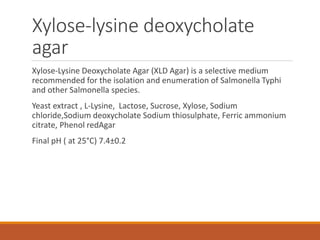
Xylose-Lysine Deoxycholate Agar (XLD Agar) is a selective medium
recommended for the isolation and enumeration of Salmonella Typhi
and other Salmonella species.
Yeast extract , L-Lysine, Lactose, Sucrose, Xylose, Sodium
chloride,Sodium deoxycholate Sodium thiosulphate, Ferric ammonium
citrate, Phenol redAgar
Final pH ( at 25°C) 7.4±0.2
The medium contains yeast extract, which provides nitrogen and
vitamins required for growth.
It utilizes sodium deoxycholate as the selective agent and therefore it is
inhibitory to gram-positive microorganisms
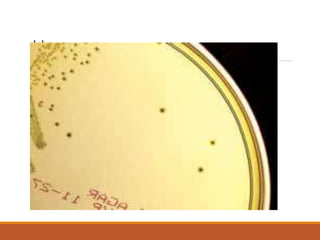
an H2S indicator system, consisting of sodium thiosulphate and ferric
ammonium citrate, is included for the visualization of hydrogen sulphide
produced
. S. Paratyphi A, S.Choleraesuis, S. Pullorum and S. Gallinarum may form
red colonies without H2S, thus resembling Shigella species
Lysine is included to differentiate the Salmonella group from the non-
pathogens. S
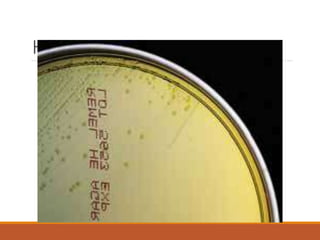
Hektoen enteric agar
Selective media for enteric pathogens
Bile salts,lactose,sucrose,bromothymol blue,acid fuschin,ferric
ammonium citrate
Lactose fermenters appear green colonies
H2s production indicates black color
H e agar
H e agar
Thayer-martin medium
Used to find neisseria.gonorrhoeae
Contains vancomycin,colistin,nystatin
Plates incubated in 3-10% co2
Modified thayer –martin medium include trimethoprim
Thiosulfate citrate bile sucrose (tcbs)
agar
Selective and differential media for vibrio
High ph value of 8.6
Contains peptone,yeast,sucrose,bromothymol blue,sodium citrate,ferric
citrate
Sucrose fermenting vibrio form yellow colonies
Non-fermenters v.parahemolyticus are green
Hoylers tellurite blood agar
For c.diptheria
Contains agar base,lysed blood and tellurite soln( potassium tellurite)
Potassium tellurite inhibits c.albicans ,s.aureus &most oral commensals
Colonies appear as dark slate –grey color and has matt surface
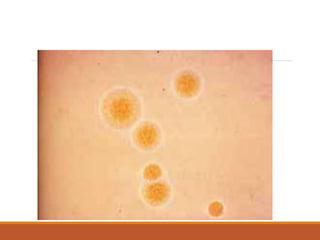
PLET MEDIUM
Selective media for B.anthracis
Contains ethylene diamine tetra acetate,thallous
acetate,polymyxin,lysosyme
Ph should be 7.35
PLET medium inhibits other bacillus series,enterobacteria &
pseudomonas
Buffered charcoal yeast extract
agar
Selective media for Legionellas
Contains N2-acetamino 2-amino ethane sulphonic acid,koh,activated
charcoal,yeast extract,bacto agar,ketoglutarate,l-cysteine,ferric
pyrophosphate,polymyxin,cycloheximide & vancomycin &anisomycin
Charcoal-detoxify,remove co2,modify surface tension
L-cysteine-growth of L.pneumophilia
Antibiotics inhibit G+,G-, yeast and fungi
Colonies appear gray-white to blue-green glistening ,convex, circular
Sp-4 medium
Media for mycoplasma
Contains cmrl 1006 tissue culture media glutamine,yeast
extract,yeasteolate,fetal bovine serum,penicillin,amphotericin –
b,polymyxin –b,phenol red,mycoplasma agar
Thallium acetate-M.pneumoniae
SP4 glucose broth with urea-U.urealyticum
SP4 glucose broth with arginine-M.hominis
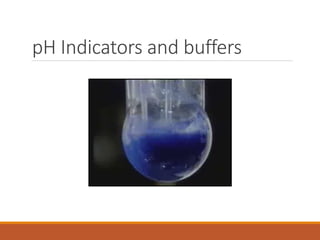
pH Indicators and buffers
Why is pH important in
biology?
pH affects solubility of many substances.
pH affects structure and function of most proteins - including enzymes.
Many cells and organisms (esp. plants and aquatic animals) can only
survive in a specific pH environment.
Important point -
◦ pH is dependent upon temperature
pH Paper
pH 0 1 2 3 4 5 6
pH 7 8 9 10 11 12 13
Common pH Indicators
Zumdahl, Zumdahl, DeCoste, World of Chemistry 2002, page 520
Ways to measure pH
Indicator dyes and test strips
◦ Less precise
◦ Each indicator is only good for a small pH range (1-2 pH units)
◦ But may be good for field usage, or measuring small volumes, or dealing with noxious samples.
Buffers
Definition: a solution that resists change in pH
◦ Typically a mixture of the acid and base form of a chemical
◦ Can be adjusted to a particular pH value
Why use them?
◦ Enzyme reactions and cell functions have optimum pH’s for performance
◦ Important anytime the structure and/or activity of a biological material must
be maintained
How buffers work
Equilibrium between acid and base.
Example: Acetate buffer
◦ CH3COOH  CH3COO- + H+
If more H+ is added to this solution, it simply shifts the equilibrium to
the left, absorbing H+, so the [H+] remains unchanged.
If H+ is removed (e.g. by adding OH-) then the equilibrium shifts to the
right, releasing H+ to keep the pH constant
Factors in choosing a buffer
Be sure it covers the pH range you need
◦ Generally: pKa of acid ± 1 pH unit
◦ Consult tables for ranges or pKa values
Be sure it is not toxic to the cells or organisms you are working with.
Be sure it would not confound the experiment (e.g. avoid phosphate
buffers in experiments on plant mineral nutrition).
Calculating buffer recipes
Henderson-Hasselbach equation
◦ pH = pKa - log10 [acid]/[base]
Rearrange the equation to get
◦ 10(pKa-pH) = [acid]/[base]
Look up pKa for acid in a table. Substitute this and the desired pH into
equation above, and calculate the approximate ratio of acid to base.
Because of the log, you want to pick a buffer with a pKa close to the pH
you want.
Common buffers
Acetate buffer
Citrate buffer
Citrate-phosphate buffer
phosphate buffer
Barbitone buffer
tris HCL buffer
Boric acid-borax buffer
Bicarbonate-co2 buffer
Selective media,types,Composition andpplications

Selective media,types,Composition andpplications

  • 1.
  • 2.
    Selective media: usedto select (isolate) specific groups of bacteria; chemical substances in the media inhibit the growth of one type of bacteria while permitting growth of another (MSA, EMB, MacConkey)
  • 3.
    MACCONKEY AGAR A Selectiveand differential medium used for the cultivation of enterobacteria Content: peptone,Sodium taurocholate,water, agar ,Neutral red soln,2% in 50% ethanol, Lactose 10% soln Adjust ph to 7.5
  • 4.
    Bile salts andcrystal violet inhibit growth of G+ organisms (selective) Neutral red is a pH indicator that is colorless, but yellow above pH 8 and red at pH less than 6.8 (differential)
  • 5.
    Acid accumulating fromlactose fermentation turns the colorless neutral red to a red color—therefore coliforms produce a red “halo” on the medium (E.coli, E.aerogenes) Lactose nonfermenters will grow, but don’t produce acid. Therefore, the neutral red remains colorless (P. vulgaris) No growth indicates a Gram + organism (S.aureus) Macconkey agar with lactose(left) and non-lactose(right) fermenters
  • 6.
  • 7.
    Eosin Methylene BlueAgar (EMB) Eosin methylene blue agar is a selective and differential medium Eosin methylene blue agar is a selective and Typically used for the family Enterobacteriaceae enteric (gut) bacteria Selective: EMB contains the dyes methylene blue and eosin which inhibit Gram + bacteria, thus favoring growth of Gram – )
  • 8.
    Differential: EMB containslactose, thus allowing for the distinction between lactose fermenters and nonferments Large amounts of acid from lactose fermentation cause the dyes to precipitate on the colony surface, producing a black center or a “green metallic sheen” (E. coli)
  • 9.
    Smaller amounts ofacid production result in pink coloration of the growth (E. aerogenes) Nonfermenting enterics do not produce acid so their colonies remain colorless or take on the color of the media (P. vulgaris) No growth indicates a Gram + organism (S.aureus)
  • 10.
  • 11.
    •Large amounts ofacid from lactose fermentation cause the dyes to precipitate on the colony surface, producing a black center or a “green metallic sheen” (E. coli)
  • 12.
    Mannitol Salt Agar (MSA) Mannitolsalt agar is both selective and differential Selective: It favors organisms capable of tolerating high salt concentrations (7.5 % NaCl) Differential: It distinguishes bacteria based on their ability to ferment mannitol Differentiates Staphylococcus species, by mannitol fermentation .S. aureus ferments, S. epidermidis and s.lugdunensis does not Phenol red is the pH indicator. Basic pHred at 7.4 to 8.Acidic ph yellow below 6.8
  • 13.
    Positive Results: The developmentof “yellow halos” around the bacterial growth means mannitol has been fermented and acid end products have been produced (S. aureus) Negative Results: No color change in the medium is a negative result (S. epidermidis,s.lugdunensis) No growth on the medium indicates a Gram- organism (E. coli)
  • 15.
    Xylose-lysine deoxycholate agar Xylose-Lysine DeoxycholateAgar (XLD Agar) is a selective medium recommended for the isolation and enumeration of Salmonella Typhi and other Salmonella species. Yeast extract , L-Lysine, Lactose, Sucrose, Xylose, Sodium chloride,Sodium deoxycholate Sodium thiosulphate, Ferric ammonium citrate, Phenol redAgar Final pH ( at 25°C) 7.4±0.2
  • 16.
    The medium containsyeast extract, which provides nitrogen and vitamins required for growth. It utilizes sodium deoxycholate as the selective agent and therefore it is inhibitory to gram-positive microorganisms an H2S indicator system, consisting of sodium thiosulphate and ferric ammonium citrate, is included for the visualization of hydrogen sulphide produced
  • 17.
    . S. ParatyphiA, S.Choleraesuis, S. Pullorum and S. Gallinarum may form red colonies without H2S, thus resembling Shigella species Lysine is included to differentiate the Salmonella group from the non- pathogens. S
  • 20.
    Hektoen enteric agar Selectivemedia for enteric pathogens Bile salts,lactose,sucrose,bromothymol blue,acid fuschin,ferric ammonium citrate Lactose fermenters appear green colonies H2s production indicates black color
  • 21.
  • 22.
  • 23.
    Thayer-martin medium Used tofind neisseria.gonorrhoeae Contains vancomycin,colistin,nystatin Plates incubated in 3-10% co2 Modified thayer –martin medium include trimethoprim
  • 25.
    Thiosulfate citrate bilesucrose (tcbs) agar Selective and differential media for vibrio High ph value of 8.6 Contains peptone,yeast,sucrose,bromothymol blue,sodium citrate,ferric citrate Sucrose fermenting vibrio form yellow colonies Non-fermenters v.parahemolyticus are green
  • 27.
    Hoylers tellurite bloodagar For c.diptheria Contains agar base,lysed blood and tellurite soln( potassium tellurite) Potassium tellurite inhibits c.albicans ,s.aureus &most oral commensals Colonies appear as dark slate –grey color and has matt surface
  • 29.
    PLET MEDIUM Selective mediafor B.anthracis Contains ethylene diamine tetra acetate,thallous acetate,polymyxin,lysosyme Ph should be 7.35 PLET medium inhibits other bacillus series,enterobacteria & pseudomonas
  • 31.
    Buffered charcoal yeastextract agar Selective media for Legionellas Contains N2-acetamino 2-amino ethane sulphonic acid,koh,activated charcoal,yeast extract,bacto agar,ketoglutarate,l-cysteine,ferric pyrophosphate,polymyxin,cycloheximide & vancomycin &anisomycin Charcoal-detoxify,remove co2,modify surface tension L-cysteine-growth of L.pneumophilia
  • 32.
    Antibiotics inhibit G+,G-,yeast and fungi Colonies appear gray-white to blue-green glistening ,convex, circular
  • 34.
    Sp-4 medium Media formycoplasma Contains cmrl 1006 tissue culture media glutamine,yeast extract,yeasteolate,fetal bovine serum,penicillin,amphotericin – b,polymyxin –b,phenol red,mycoplasma agar Thallium acetate-M.pneumoniae SP4 glucose broth with urea-U.urealyticum SP4 glucose broth with arginine-M.hominis
  • 37.
  • 38.
    Why is pHimportant in biology? pH affects solubility of many substances. pH affects structure and function of most proteins - including enzymes. Many cells and organisms (esp. plants and aquatic animals) can only survive in a specific pH environment. Important point - ◦ pH is dependent upon temperature
  • 39.
    pH Paper pH 01 2 3 4 5 6 pH 7 8 9 10 11 12 13
  • 40.
    Common pH Indicators Zumdahl,Zumdahl, DeCoste, World of Chemistry 2002, page 520
  • 41.
    Ways to measurepH Indicator dyes and test strips ◦ Less precise ◦ Each indicator is only good for a small pH range (1-2 pH units) ◦ But may be good for field usage, or measuring small volumes, or dealing with noxious samples.
  • 42.
    Buffers Definition: a solutionthat resists change in pH ◦ Typically a mixture of the acid and base form of a chemical ◦ Can be adjusted to a particular pH value Why use them? ◦ Enzyme reactions and cell functions have optimum pH’s for performance ◦ Important anytime the structure and/or activity of a biological material must be maintained
  • 43.
    How buffers work Equilibriumbetween acid and base. Example: Acetate buffer ◦ CH3COOH  CH3COO- + H+ If more H+ is added to this solution, it simply shifts the equilibrium to the left, absorbing H+, so the [H+] remains unchanged. If H+ is removed (e.g. by adding OH-) then the equilibrium shifts to the right, releasing H+ to keep the pH constant
  • 44.
    Factors in choosinga buffer Be sure it covers the pH range you need ◦ Generally: pKa of acid ± 1 pH unit ◦ Consult tables for ranges or pKa values Be sure it is not toxic to the cells or organisms you are working with. Be sure it would not confound the experiment (e.g. avoid phosphate buffers in experiments on plant mineral nutrition).
  • 45.
    Calculating buffer recipes Henderson-Hasselbachequation ◦ pH = pKa - log10 [acid]/[base] Rearrange the equation to get ◦ 10(pKa-pH) = [acid]/[base] Look up pKa for acid in a table. Substitute this and the desired pH into equation above, and calculate the approximate ratio of acid to base. Because of the log, you want to pick a buffer with a pKa close to the pH you want.
  • 46.
    Common buffers Acetate buffer Citratebuffer Citrate-phosphate buffer phosphate buffer Barbitone buffer tris HCL buffer Boric acid-borax buffer Bicarbonate-co2 buffer