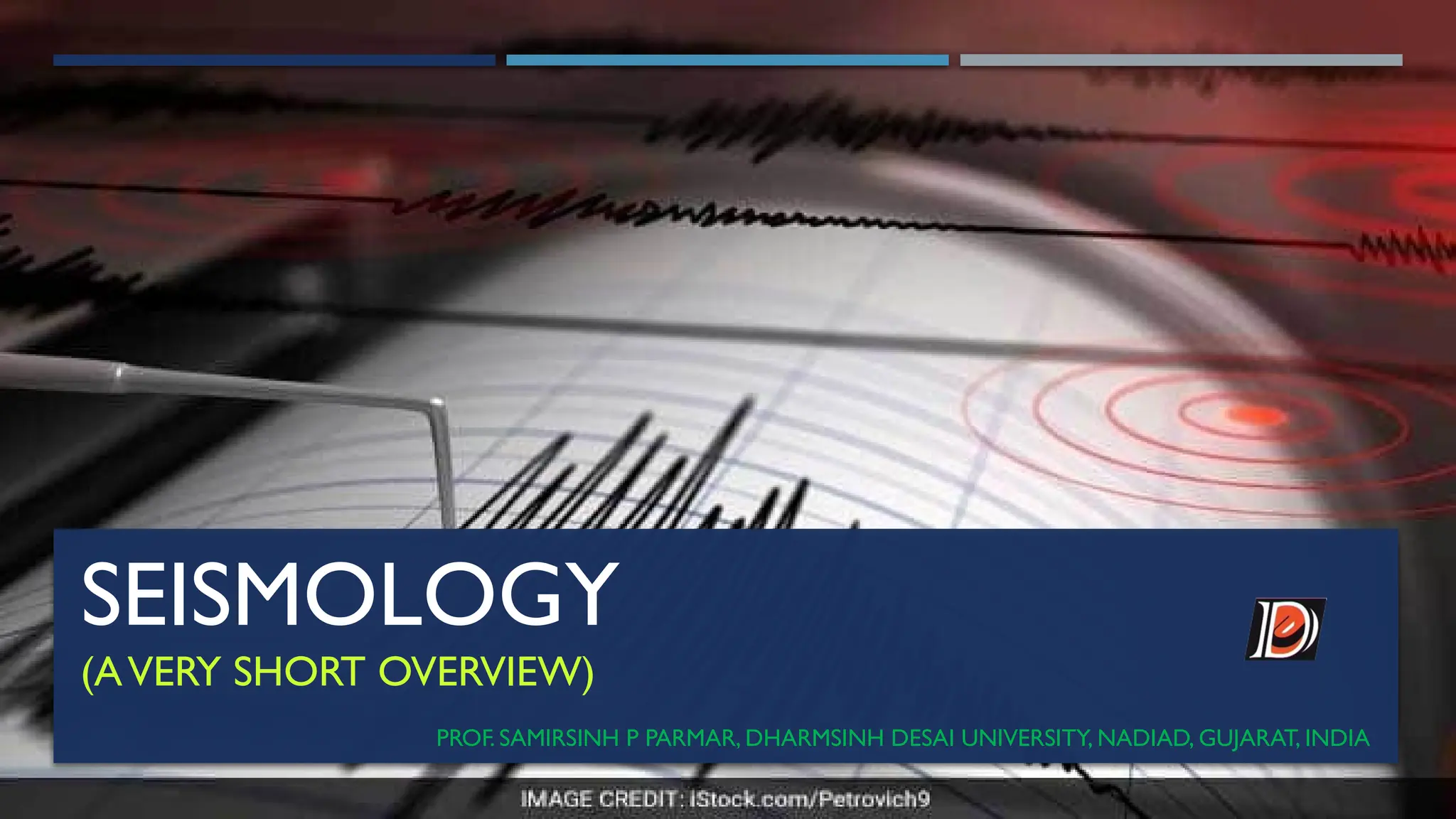
SEISMOLOGY
(AVERY SHORT OVERVIEW)
PROF. SAMIRSINH P PARMAR, DHARMSINH DESAI UNIVERSITY, NADIAD, GUJARAT, INDIA
SEISMOLOGY
(AVERY SHORT OVERVIEW)
SEISMOLOGY, SPP-CL/ DDU-FOT/ NADIAD 3
WHAT IS SEISMOLOGY?
Seismology is science dealing with all
aspects of earthquakes:
 OBSERVATIONAL SEISMOLOGY
 Recording earthquakes (microseismology)
 Cataloguing earthquakes
 Observing earthquake effects
(macroseismology)
 ENGINEERING SEISMOLOGY
 Estimation of seismic hazard and risk
 Aseismic building
‘PHYSICAL’ SEISMOLOGY
 Study of the properties of the
Earth’s interior
 Study of physical characteristics of
seismic sources
EXPLORATIONAL SEISMOLOGY
(Applied seismic methods)...
SEISMOLOGY, SPP-CL/ DDU-FOT/ NADIAD 4
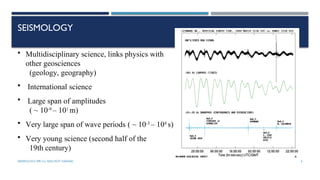
SEISMOLOGY
• Multidisciplinary science, links physics with
other geosciences
(geology, geography)
• International science
• Large span of amplitudes
( ~ 10-9
– 101
m)
• Very large span of wave periods ( ~ 10-3
– 104
s)
• Very young science (second half of the
19th century)
SEISMOLOGY, SPP-CL/ DDU-FOT/ NADIAD 5
MYTHS AND LEGENDS
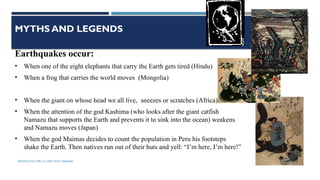
Earthquakes occur:
• When one of the eight elephants that carry the Earth gets tired (Hindu)
• When a frog that carries the world moves (Mongolia)
• When the giant on whose head we all live, sneezes or scratches (Africa)
• When the attention of the god Kashima (who looks after the giant catfish
Namazu that supports the Earth and prevents it to sink into the ocean) weakens
and Namazu moves (Japan)
• When the god Maimas decides to count the population in Peru his footsteps
shake the Earth. Then natives run out of their huts and yell: “I’m here, I’m here!”
SEISMOLOGY, SPP-CL/ DDU-FOT/ NADIAD 6
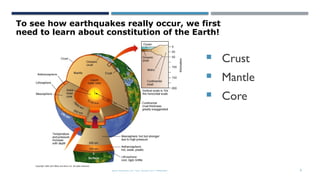
THE THREE MAJOR CHEMICAL RADIAL DIVISIONS
 Crust
 Mantle
 Core
To see how earthquakes really occur, we first
need to learn about constitution of the Earth!
SEISMOLOGY, SPP-CL/ DDU-FOT/ NADIAD 7
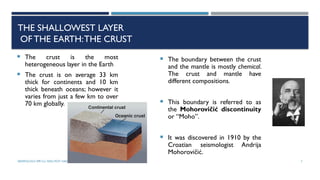
THE SHALLOWEST LAYER
OFTHE EARTH:THE CRUST
 The boundary between the crust
and the mantle is mostly chemical.
The crust and mantle have
different compositions.
 This boundary is referred to as
the Mohorovičić discontinuity
or “Moho”.
 It was discovered in 1910 by the
Croatian seismologist Andrija
Mohorovičić.
 The crust is the most
heterogeneous layer in the Earth
 The crust is on average 33 km
thick for continents and 10 km
thick beneath oceans; however it
varies from just a few km to over
70 km globally.
SEISMOLOGY, SPP-CL/ DDU-FOT/ NADIAD 8
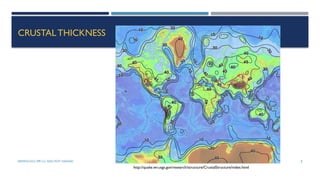
CRUSTALTHICKNESS
http://quake.wr.usgs.gov/research/structure/CrustalStructure/index.html
SEISMOLOGY, SPP-CL/ DDU-FOT/ NADIAD 9
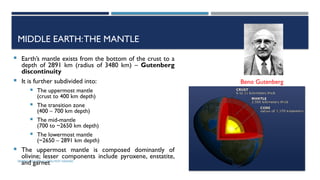
MIDDLE EARTH:THE MANTLE
 Earth’s mantle exists from the bottom of the crust to a
depth of 2891 km (radius of 3480 km) – Gutenberg
discontinuity
 It is further subdivided into:
 The uppermost mantle
(crust to 400 km depth)
 The transition zone
(400 – 700 km depth)
 The mid-mantle
(700 to ~2650 km depth)
 The lowermost mantle
(~2650 – 2891 km depth)
 The uppermost mantle is composed dominantly of
olivine; lesser components include pyroxene, enstatite,
and garnet
Beno Gutenberg
SEISMOLOGY, SPP-CL/ DDU-FOT/ NADIAD 10
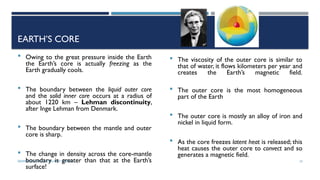
EARTH’S CORE
 Owing to the great pressure inside the Earth
the Earth’s core is actually freezing as the
Earth gradually cools.
 The boundary between the liquid outer core
and the solid inner core occurs at a radius of
about 1220 km – Lehman discontinuity,
after Inge Lehman from Denmark.
 The boundary between the mantle and outer
core is sharp.
 The change in density across the core-mantle
boundary is greater than that at the Earth’s
surface!
 The viscosity of the outer core is similar to
that of water, it flows kilometers per year and
creates the Earth’s magnetic field.
 The outer core is the most homogeneous
part of the Earth
 The outer core is mostly an alloy of iron and
nickel in liquid form.
 As the core freezes latent heat is released; this
heat causes the outer core to convect and so
generates a magnetic field.
SEISMOLOGY, SPP-CL/ DDU-FOT/ NADIAD 11
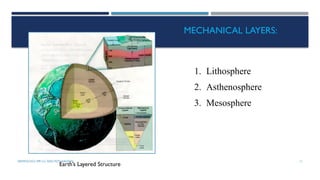
1. Lithosphere
2. Asthenosphere
3. Mesosphere
MECHANICAL LAYERS:
Earth’s Layered Structure
SEISMOLOGY, SPP-CL/ DDU-FOT/ NADIAD 12
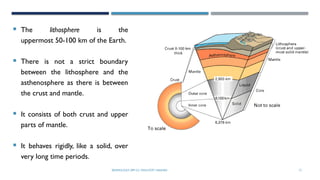
LITOSPHERE
 The lithosphere is the
uppermost 50-100 km of the Earth.
 There is not a strict boundary
between the lithosphere and the
asthenosphere as there is between
the crust and mantle.
 It consists of both crust and upper
parts of mantle.
 It behaves rigidly, like a solid, over
very long time periods.
SEISMOLOGY, SPP-CL/ DDU-FOT/ NADIAD 13
ASTENOSPHERE
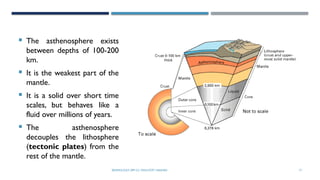
 The asthenosphere exists
between depths of 100-200
km.
 It is the weakest part of the
mantle.
 It is a solid over short time
scales, but behaves like a
fluid over millions of years.
 The asthenosphere
decouples the lithosphere
(tectonic plates) from the
rest of the mantle.
SEISMOLOGY, SPP-CL/ DDU-FOT/ NADIAD 14
TECTONIC FORCES
 The interior of the Earth is dynamic – it cools down and thus provides
energy for convective currents in the outer core and in the
astenosphere.
 Additional energy comes from radioactive decay...
SEISMOLOGY, SPP-CL/ DDU-FOT/ NADIAD 15
CONVECTION
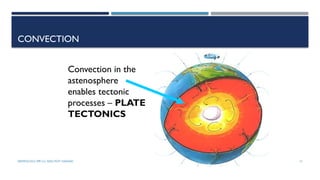
Convection in the
astenosphere
enables tectonic
processes – PLATE
TECTONICS
SEISMOLOGY, SPP-CL/ DDU-FOT/ NADIAD 16
CONTINENTAL DRIFT THEORY
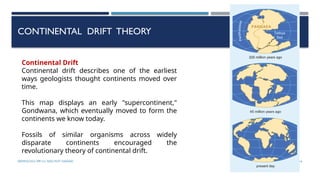
Continental Drift
Continental drift describes one of the earliest
ways geologists thought continents moved over
time.
This map displays an early "supercontinent,"
Gondwana, which eventually moved to form the
continents we know today.
Fossils of similar organisms across widely
disparate continents encouraged the
revolutionary theory of continental drift.
SEISMOLOGY, SPP-CL/ DDU-FOT/ NADIAD 17
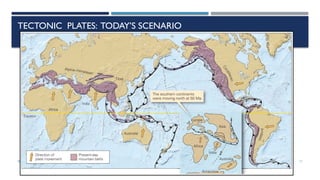
TECTONIC PLATES: TODAY’S SCENARIO
SEISMOLOGY, SPP-CL/ DDU-FOT/ NADIAD 18
PLATETECTONICS
PLATETECTONICS theory is very young (1960-ies)
It provides answers to the most fundamental questions in seismology:
 Why earthquakes occur?
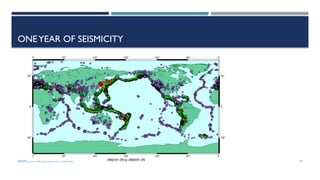
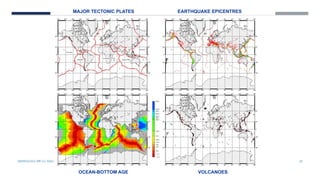
 Why are earthquake epicenters not
uniformly distributed around the globe?
 At what depths are their foci?
SEISMOLOGY, SPP-CL/ DDU-FOT/ NADIAD 19
ONEYEAR OF SEISMICITY
SEISMOLOGY, SPP-CL/ DDU-FOT/ NADIAD 20
MAJOR TECTONIC PLATES EARTHQUAKE EPICENTRES
OCEAN-BOTTOM AGE VOLCANOES
SEISMOLOGY, SPP-CL/ DDU-FOT/ NADIAD 21
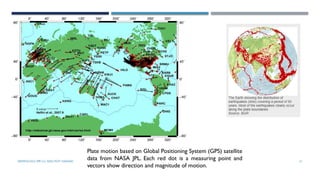
Plate motion based on Global Positioning System (GPS) satellite
data from NASA JPL. Each red dot is a measuring point and
vectors show direction and magnitude of motion.
SEISMOLOGY, SPP-CL/ DDU-FOT/ NADIAD 22
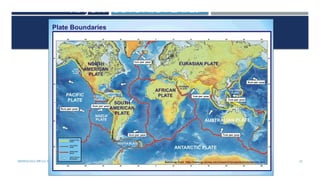
MAJOR TECTONIC PLATES
SEISMOLOGY, SPP-CL/ DDU-FOT/ NADIAD 23
TECTONIC
PLATES
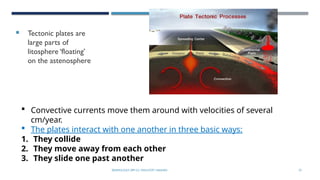
 Tectonic plates are
large parts of
litosphere ‘floating’
on the astenosphere
 Convective currents move them around with velocities of several
cm/year.
 The plates interact with one another in three basic ways:
1. They collide
2. They move away from each other
3. They slide one past another
SEISMOLOGY, SPP-CL/ DDU-FOT/ NADIAD 24
INTERACTING PLATES
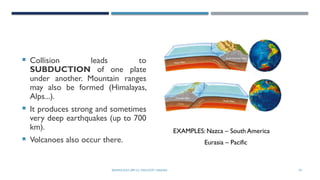
 Collision leads to
SUBDUCTION of one plate
under another. Mountain ranges
may also be formed (Himalayas,
Alps...).
 It produces strong and sometimes
very deep earthquakes (up to 700
km).
 Volcanoes also occur there.
EXAMPLES: Nazca – South America
Eurasia – Pacific
SEISMOLOGY, SPP-CL/ DDU-FOT/ NADIAD 25
INTERACTING PLATES
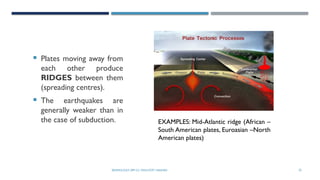
 Plates moving away from
each other produce
RIDGES between them
(spreading centres).
 The earthquakes are
generally weaker than in
the case of subduction. EXAMPLES: Mid-Atlantic ridge (African –
South American plates, Euroasian –North
American plates)
SEISMOLOGY, SPP-CL/ DDU-FOT/ NADIAD 26
INTERACTING
PLATES
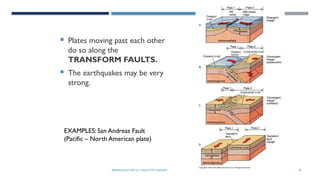
 Plates moving past each other
do so along the
TRANSFORM FAULTS.
 The earthquakes may be very
strong.
EXAMPLES: San Andreas Fault
(Pacific – North American plate)
SEISMOLOGY, SPP-CL/ DDU-FOT/ NADIAD 27
HOW EARTHQUAKES OCCUR?
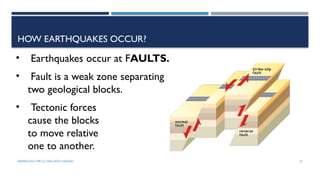
• Earthquakes occur at FAULTS.
• Fault is a weak zone separating
two geological blocks.
• Tectonic forces
cause the blocks
to move relative
one to another.
SEISMOLOGY, SPP-CL/ DDU-FOT/ NADIAD 28
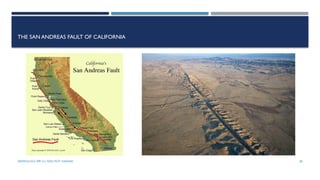
THE SAN ANDREAS FAULT OF CALIFORNIA
SEISMOLOGY, SPP-CL/ DDU-FOT/ NADIAD 29
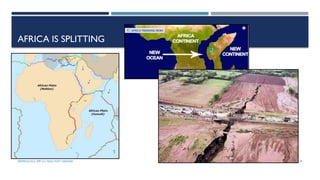
AFRICA IS SPLITTING
SEISMOLOGY, SPP-CL/ DDU-FOT/ NADIAD 30
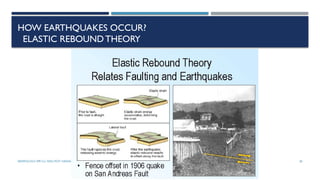
HOW EARTHQUAKES OCCUR?
ELASTIC REBOUNDTHEORY
SEISMOLOGY, SPP-CL/ DDU-FOT/ NADIAD 31
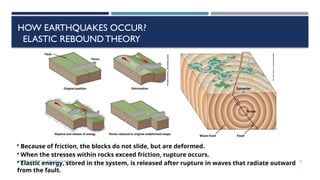
HOW EARTHQUAKES OCCUR?
ELASTIC REBOUNDTHEORY
• Because of friction, the blocks do not slide, but are deformed.
• When the stresses within rocks exceed friction, rupture occurs.
• Elastic energy, stored in the system, is released after rupture in waves that radiate outward
from the fault.
SEISMOLOGY, SPP-CL/ DDU-FOT/ NADIAD 32
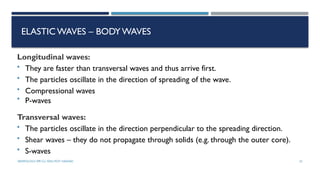
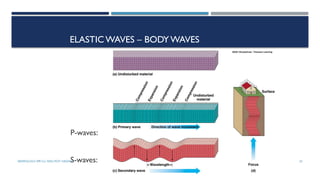
ELASTICWAVES – BODYWAVES
Longitudinal waves:
• They are faster than transversal waves and thus arrive first.
• The particles oscillate in the direction of spreading of the wave.
• Compressional waves
• P-waves
Transversal waves:
• The particles oscillate in the direction perpendicular to the spreading direction.
• Shear waves – they do not propagate through solids (e.g. through the outer core).
• S-waves
SEISMOLOGY, SPP-CL/ DDU-FOT/ NADIAD 33
ELASTICWAVES – BODY WAVES
P-waves:
S-waves:
SEISMOLOGY, SPP-CL/ DDU-FOT/ NADIAD 34
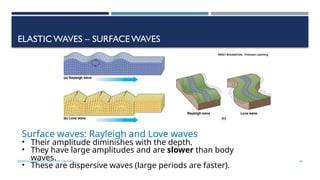
ELASTICWAVES – SURFACE WAVES
Surface waves: Rayleigh and Love waves
• Their amplitude diminishes with the depth.
• They have large amplitudes and are slower than body
waves.
• These are dispersive waves (large periods are faster).
SEISMOLOGY, SPP-CL/ DDU-FOT/ NADIAD 35
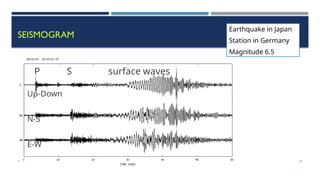
SEISMOGRAM
P S surface waves
Up-Down
N-S
E-W
Earthquake in Japan
Station in Germany
Magnitude 6.5
SEISMOLOGY, SPP-CL/ DDU-FOT/ NADIAD 36
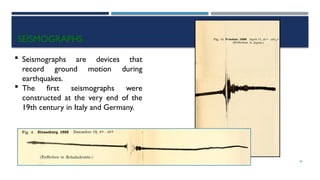
SEISMOGRAPHS
 Seismographs are devices that
record ground motion during
earthquakes.
 The first seismographs were
constructed at the very end of the
19th century in Italy and Germany.
SEISMOLOGY, SPP-CL/ DDU-FOT/ NADIAD 37
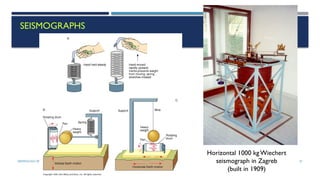
SEISMOGRAPHS
Horizontal 1000 kgWiechert
seismograph in Zagreb
(built in 1909)
SEISMOLOGY, SPP-CL/ DDU-FOT/ NADIAD 38
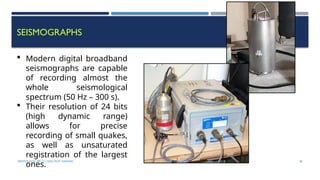
SEISMOGRAPHS
 Modern digital broadband
seismographs are capable
of recording almost the
whole seismological
spectrum (50 Hz – 300 s).
 Their resolution of 24 bits
(high dynamic range)
allows for precise
recording of small quakes,
as well as unsaturated
registration of the largest
ones.
SEISMOLOGY, SPP-CL/ DDU-FOT/ NADIAD 39
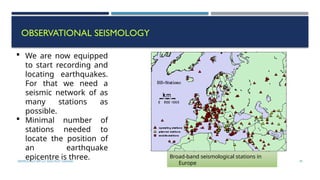
OBSERVATIONAL SEISMOLOGY
 We are now equipped
to start recording and
locating earthquakes.
For that we need a
seismic network of as
many stations as
possible.
 Minimal number of
stations needed to
locate the position of
an earthquake
epicentre is three. Broad-band seismological stations in
Europe
SEISMOLOGY, SPP-CL/ DDU-FOT/ NADIAD 40
OBSERVATIONAL SEISMOLOGY
LOCATING EARTHQUAKES
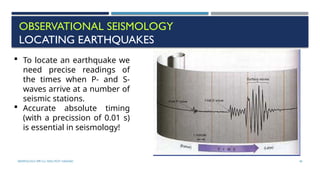
 To locate an earthquake we
need precise readings of
the times when P- and S-
waves arrive at a number of
seismic stations.
 Accurate absolute timing
(with a precission of 0.01 s)
is essential in seismology!
SEISMOLOGY, SPP-CL/ DDU-FOT/ NADIAD 41
OBSERVATIONAL SEISMOLOGY
LOCATING EARTHQUAKES
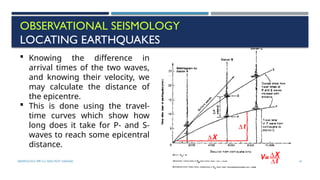
 Knowing the difference in
arrival times of the two waves,
and knowing their velocity, we
may calculate the distance of
the epicentre.
 This is done using the travel-
time curves which show how
long does it take for P- and S-
waves to reach some epicentral
distance.
SEISMOLOGY, SPP-CL/ DDU-FOT/ NADIAD 42
OBSERVATIONAL SEISMOLOGY
LOCATING EARTHQUAKES
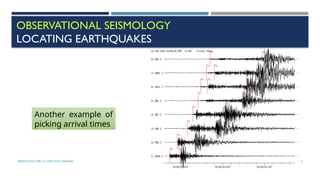
Another example of
picking arrival times
SEISMOLOGY, SPP-CL/ DDU-FOT/ NADIAD 43
OBSERVATIONAL SEISMOLOGY
LOCATING EARTHQUAKES
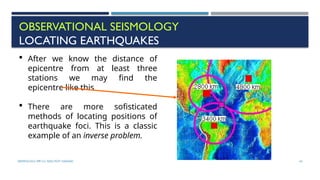
 After we know the distance of
epicentre from at least three
stations we may find the
epicentre like this
 There are more sofisticated
methods of locating positions of
earthquake foci. This is a classic
example of an inverse problem.
SEISMOLOGY, SPP-CL/ DDU-FOT/ NADIAD 44
OBSERVATIONAL SEISMOLOGY
MAGNITUDE DETERMINATION
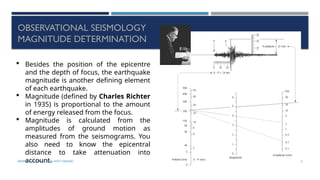
 Besides the position of the epicentre
and the depth of focus, the earthquake
magnitude is another defining element
of each earthquake.
 Magnitude (defined by Charles Richter
in 1935) is proportional to the amount
of energy released from the focus.
 Magnitude is calculated from the
amplitudes of ground motion as
measured from the seismograms. You
also need to know the epicentral
distance to take attenuation into
account.
SEISMOLOGY, SPP-CL/ DDU-FOT/ NADIAD 45
OBSERVATIONAL SEISMOLOGY
MAGNITUDE DETERMINATION
Formula:
M = log(A) + c1 log (D) + c2
Where, A is amplitude of ground motion, D is epicentral distance, and c1, c2 are constants.
 There are many types of magnitude in seismological practice, depending which waves
are used to measure the amplitude: ML, mb, Mc, Ms, Mw, ...
 Increase of 1 magnitude unit means ~32 times more released seismic energy!
SEISMOLOGY, SPP-CL/ DDU-FOT/ NADIAD 46
OBSERVATIONAL SEISMOLOGY
SOME STATISTICS
Magnitude Effects Number per year
–––––––––––––––––––––––––––
less than 2 Not felt by humans. Recorded by instruments
only. Numerous
2 Felt only by the most sensitive.
Suspended objects swing >1 000 000
3 Felt by some people. Vibration like a
passing heavy vehicle 100 000
4 Felt by most people. Hanging objects swing.
Dishes and windows rattle and may break 12 000
5 Felt by all; people frightened.
Chimneys topple; furniture moves 1 400
6 Panic. Buildings may suffer substantial
damage 160
7-8 Widespread panic. Few buildings remain
standing. Large landslides; fissures in ground 20
8-9 Complete devastation. Ground waves ~2
SEISMOLOGY, SPP-CL/ DDU-FOT/ NADIAD 47
OBSERVATIONAL SEISMOLOGY
SOME STATISTICS
Equivalent
Magnitude Event Energy (tons TNT)
––––––––––––––––––––––––––––––––––––––––––––––––––––––––––––––––––
2.0 Large quary blast 1
2.5 Moderate lightning bolt 5
3.5 Large ligtning bolt 75
4.5 Average tornado 5 100
6.0 Hiroshima atomic bomb 20 000
7.0 Largest nuclear test 32 000 000
7.7 Mt. Saint Helens eruption 100 000 000
8.5 Krakatoa eruption 1 000 000 000
9.5 Chilean earthquake 1960 32 000 000 000
SEISMOLOGY, SPP-CL/ DDU-FOT/ NADIAD 48
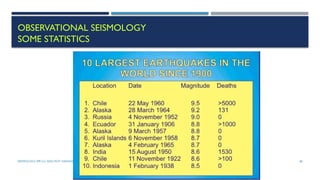
OBSERVATIONAL SEISMOLOGY
SOME STATISTICS
SEISMOLOGY, SPP-CL/ DDU-FOT/ NADIAD 49
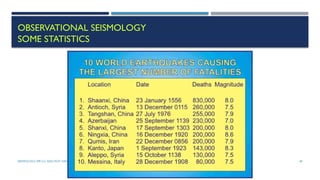
OBSERVATIONAL SEISMOLOGY
SOME STATISTICS
SEISMOLOGY, SPP-CL/ DDU-FOT/ NADIAD 50
OBSERVATIONAL SEISMOLOGY
SOME STATISTICS
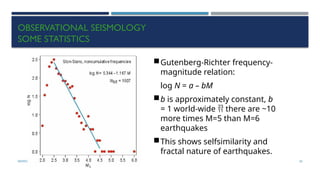
Gutenberg-Richter frequency-
magnitude relation:
log N = a – bM
b is approximately constant, b
= 1 world-wide  there are ~10
more times M=5 than M=6
earthquakes
This shows selfsimilarity and
fractal nature of earthquakes.
SEISMOLOGY, SPP-CL/ DDU-FOT/ NADIAD 51
OBSERVATIONAL SEISMOLOGY
MACROSEISMOLOGY
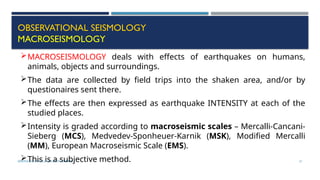
MACROSEISMOLOGY deals with effects of earthquakes on humans,
animals, objects and surroundings.
The data are collected by field trips into the shaken area, and/or by
questionaires sent there.
The effects are then expressed as earthquake INTENSITY at each of the
studied places.
Intensity is graded according to macroseismic scales – Mercalli-Cancani-
Sieberg (MCS), Medvedev-Sponheuer-Karnik (MSK), Modified Mercalli
(MM), European Macroseismic Scale (EMS).
This is a subjective method.
SEISMOLOGY, SPP-CL/ DDU-FOT/ NADIAD 52
OBSERVATIONAL SEISMOLOGY
MACROSEISMOLOGY
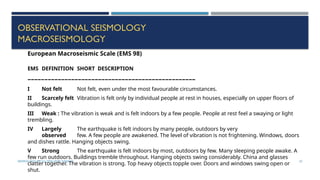
European Macroseismic Scale (EMS 98)
EMS DEFINITION SHORT DESCRIPTION
––––––––––––––––––––––––––––––––––––––––––––––––––
I Not felt Not felt, even under the most favourable circumstances.
II Scarcely felt Vibration is felt only by individual people at rest in houses, especially on upper floors of
buildings.
III Weak : The vibration is weak and is felt indoors by a few people. People at rest feel a swaying or light
trembling.
IV Largely The earthquake is felt indoors by many people, outdoors by very
observed few. A few people are awakened. The level of vibration is not frightening. Windows, doors
and dishes rattle. Hanging objects swing.
V Strong The earthquake is felt indoors by most, outdoors by few. Many sleeping people awake. A
few run outdoors. Buildings tremble throughout. Hanging objects swing considerably. China and glasses
clatter together. The vibration is strong. Top heavy objects topple over. Doors and windows swing open or
shut.
SEISMOLOGY, SPP-CL/ DDU-FOT/ NADIAD 53
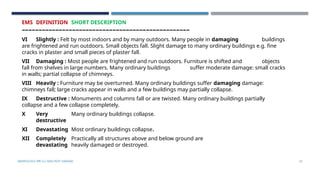
EMS DEFINITION SHORT DESCRIPTION
––––––––––––––––––––––––––––––––––––––––––––––––––
VI Slightly : Felt by most indoors and by many outdoors. Many people in damaging buildings
are frightened and run outdoors. Small objects fall. Slight damage to many ordinary buildings e.g. fine
cracks in plaster and small pieces of plaster fall.
VII Damaging : Most people are frightened and run outdoors. Furniture is shifted and objects
fall from shelves in large numbers. Many ordinary buildings suffer moderate damage: small cracks
in walls; partial collapse of chimneys.
VIII Heavily : Furniture may be overturned. Many ordinary buildings suffer damaging damage:
chimneys fall; large cracks appear in walls and a few buildings may partially collapse.
IX Destructive : Monuments and columns fall or are twisted. Many ordinary buildings partially
collapse and a few collapse completely.
X Very Many ordinary buildings collapse.
destructive
XI Devastating Most ordinary buildings collapse.
XII Completely Practically all structures above and below ground are
devastating heavily damaged or destroyed.
SEISMOLOGY, SPP-CL/ DDU-FOT/ NADIAD 54
OBSERVATIONAL SEISMOLOGY
MACROSEISMOLOGY
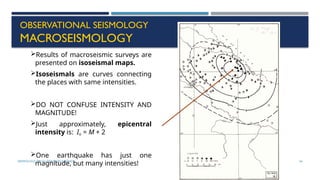
Results of macroseismic surveys are
presented on isoseismal maps.
Isoseismals are curves connecting
the places with same intensities.
DO NOT CONFUSE INTENSITY AND
MAGNITUDE!
Just approximately, epicentral
intensity is: Io = M + 2
One earthquake has just one
magnitude, but many intensities!
SEISMOLOGY, SPP-CL/ DDU-FOT/ NADIAD 55
ENGINEERING SEISMOLOGY
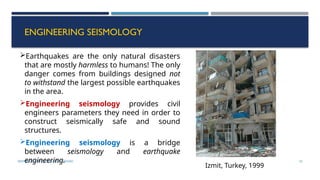
Earthquakes are the only natural disasters
that are mostly harmless to humans! The only
danger comes from buildings designed not
to withstand the largest possible earthquakes
in the area.
Engineering seismology provides civil
engineers parameters they need in order to
construct seismically safe and sound
structures.
Engineering seismology is a bridge
between seismology and earthquake
engineering.
Izmit, Turkey, 1999
SEISMOLOGY, SPP-CL/ DDU-FOT/ NADIAD 56
ENGINEERING SEISMOLOGY
Most common input parameters are:
- maximal expected horizontal ground acceleration
(PGA)
- maximal expected horizontal groundvelocity (PGV)
- maximal expected horizontal grounddisplacement
(PGD)
- response spectra (SA)
- maximal expected intensity (Imax)
- duration of significant shaking
- dominant period of shaking.
 Engineering seismologists mostly use records of
ground acceleration obtained by strong-motion
accelerographs.
Accelerogram of the Ston-Slano
(Croatia, M = 6.0, 1996) event
SEISMOLOGY, SPP-CL/ DDU-FOT/ NADIAD 57
ENGINEERING SEISMOLOGY
In order to estimate the parameters, seismologists need:
 Complete earthquake catalogues that extend well into the past,
 Information on the soil structure and properties at the construction site,
as well as on the path between epicentre and the site,
 Records of strong earthquakes and small events from near-by epicentral
regions,
 Results of geological surveys ...
SEISMOLOGY, SPP-CL/ DDU-FOT/ NADIAD 58
ENGINEERING
SEISMOLOGY
Complete and homogeneous
earthquake catalogues are of
paramount importance in
seismic hazard studies.
Seismicity of Croatia after the
Croatian Earthquake Catalogue that
lists over 15.000 events
SEISMOLOGY, SPP-CL/ DDU-FOT/ NADIAD 59
ENGINEERING SEISMOLOGY
 In estimating the parameters you may use:
1. PROBABILISTIC APPROACH –use statistical methods to assess probability of
exceeding a predefined level of ground motion in some time period (earthquake
return period), based on earthquake history and geological data.
2. DETERMINISTIC APPROACH – use a predefined earthquake and calculate its
effects and parameters of seismic forces on the construction site. This is very
difficult to do because the site is in the near-field (close to the fault) and most of
the approximations you normally use are not valid.
3. A combination of the two
SEISMOLOGY, SPP-CL/ DDU-FOT/ NADIAD 60
ENGINEERING
SEISMOLOGY
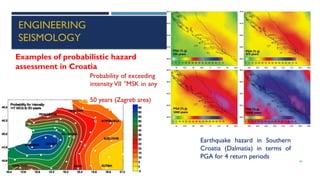
Earthquake hazard in Southern
Croatia (Dalmatia) in terms of
PGA for 4 return periods
Examples of probabilistic hazard
assessment in Croatia
Probability of exceeding
intensity VII °MSK in any
50 years (Zagreb area)
SEISMOLOGY, SPP-CL/ DDU-FOT/ NADIAD 61
ENGINEERING SEISMOLOGY
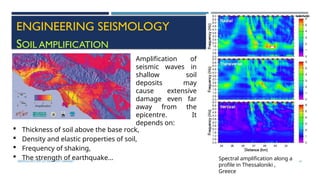
SOIL AMPLIFICATION
Amplification of
seismic waves in
shallow soil
deposits may
cause extensive
damage even far
away from the
epicentre. It
depends on:
 Thickness of soil above the base rock,
 Density and elastic properties of soil,
 Frequency of shaking,
 The strength of earthquake... Spectral amplification along a
profile in Thessaloniki ,
Greece
SEISMOLOGY, SPP-CL/ DDU-FOT/ NADIAD 62
‘PHYSICAL’ SEISMOLOGY
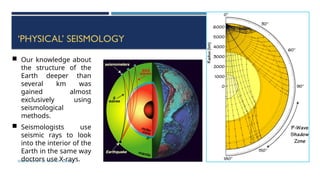
 Our knowledge about
the structure of the
Earth deeper than
several km was
gained almost
exclusively using
seismological
methods.
 Seismologists use
seismic rays to look
into the interior of the
Earth in the same way
doctors use X-rays.
SEISMOLOGY, SPP-CL/ DDU-FOT/ NADIAD 63
‘PHYSICAL’ SEISMOLOGY
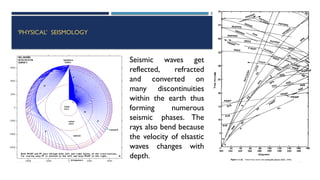
Seismic waves get
reflected, refracted
and converted on
many discontinuities
within the earth thus
forming numerous
seismic phases. The
rays also bend because
the velocity of elsastic
waves changes with
depth.
SEISMOLOGY, SPP-CL/ DDU-FOT/ NADIAD 64
PHYSICAL SEISMOLOGY: FORWARD PROBLEM
 Given the distribution of velocity, density and attenuation
coefficient with depth, and positions of all discontinuities, calculate
travel times and amplitudes of some seismic phase (e.g. pP or
SKS).
This is relatively easy and always gives unique solution.
SEISMOLOGY, SPP-CL/ DDU-FOT/ NADIAD 65
‘PHYSICAL’ SEISMOLOGY INVERSE PROBLEM:
 Given the arrival times and amplitudes of several seismic phases on
a number of stations, compute distribution of velocity, density and
attenuation coefficient with depth, and positions of all discontinuities.
This is very difficult and often does not give a unique solution. Instead,
a range of solutions is offered, each with its own probability of being
correct.The solution is better the more data we have.
SEISMOLOGY, SPP-CL/ DDU-FOT/ NADIAD 66
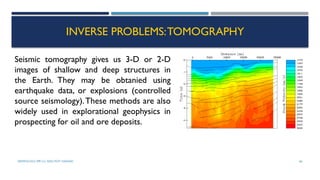
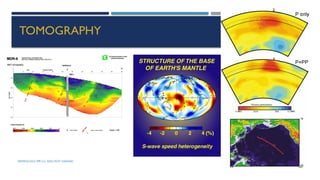
INVERSE PROBLEMS:TOMOGRAPHY
Seismic tomography gives us 3-D or 2-D
images of shallow and deep structures in
the Earth. They may be obtanied using
earthquake data, or explosions (controlled
source seismology).These methods are also
widely used in explorational geophysics in
prospecting for oil and ore deposits.
SEISMOLOGY, SPP-CL/ DDU-FOT/ NADIAD 67
TOMOGRAPHY
SEISMOLOGY, SPP-CL/ DDU-FOT/ NADIAD 68
SOME BASIC THEORETICAL BACKGROUND














i
j
j
i
ij
x
u
x
u
e
2
1










33
32
31
23
22
21
13
12
11









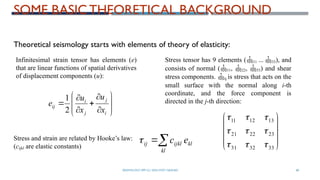
Theoretical seismology starts with elements of theory of elasticity:
Infinitesimal strain tensor has elements (e)
that are linear functions of spatial derivatives
of displacement components (u):
Stress tensor has 9 elements (11 ... 33), and
consists of normal (11, 22, 33) and shear
stress components. ij is stress that acts on the
small surface with the normal along i-th
coordinate, and the force component is
directed in the j-th direction:
Stress and strain are related by Hooke’s law:
(cijkl are elastic constants) 

kl
kl
ijkl
ij e
c

SEISMOLOGY, SPP-CL/ DDU-FOT/ NADIAD 69
SOME BASIC THEORETICAL BACKGROUND
3
,
2
,
1
,
2
2







 i
x
f
t
u
j j
ij
i
i


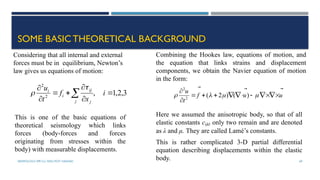
Considering that all internal and external
forces must be in equilibrium, Newton’s
law gives us equations of motion:
This is one of the basic equations of
theoretical seismology which links
forces (body-forces and forces
originating from stresses within the
body) with measurable displacements.
Combining the Hookes law, equations of motion, and
the equation that links strains and displacement
components, we obtain the Navier equation of motion
in the form:
u
u
f
t
u 



















 )
(
)
2
(
2
2
Here we assumed the anisotropic body, so that of all
elastic constants cijkl only two remain and are denoted
as λ and μ. They are called Lamé’s constants.
This is rather complicated 3-D partial differential
equation describing displacements within the elastic
body.
SEISMOLOGY, SPP-CL/ DDU-FOT/ NADIAD 70
SOME BASIC THEORETICAL BACKGROUND









u







2
,
1
2
2 


 

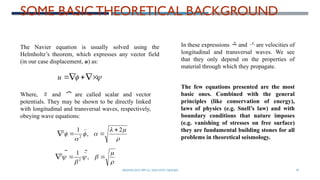
The Navier equation is usually solved using the
Helmholtz’s theorem, which expresses any vector field
(in our case displacement, u) as:
Where,  and  are called scalar and vector
potentials. They may be shown to be directly linked
with longitudinal and transversal waves, respectively,
obeying wave equations:





 

 ,
1
2
2 


In these expressions  and  are velocities of
longitudinal and transversal waves. We see
that they only depend on the properties of
material through which they propagate.
The few equations presented are the most
basic ones. Combined with the general
principles (like conservation of energy),
laws of physics (e.g. Snell’s law) and with
boundary conditions that nature imposes
(e.g. vanishing of stresses on free surface)
they are fundamental building stones for all
problems in theoretical seismology.
SEISMOLOGY, SPP-CL/ DDU-FOT/ NADIAD 71
HIGHLY RECOMENDED
READING
 Aki, K. & Richards, P. G. (2002): Quantitative Seismology – 2nd Edition, University Science
Books, Sausalito, CA.
 Lay, T. and Wallace, T. C. (1995): Modern Global Seismology, Academic press, San Diego.
 Udias, A. (1999): Principles of Seismology, Cambridge Univesity Press, Cambridge.
 Shearer, P. M. (1999): Introduction to Seismology, Cambridge Univesity Press, Cambridge.
 Ben Menahem, A. and Singh, S. J. (1980): Seismic Waves and Sources, Springer-Verlag,
New York.
 Cox, A. and Hart, R.B. (1986): Plate Tectonics - How it Works, Palo Alto, California, Blackwell
Scientific Publications, 392 p.
SEISMOLOGY, SPP-CL/ DDU-FOT/ NADIAD 72
USED SOURCES
 billharlan.com/pub/ tomo/tomoin.gif
 www.earth.ox.ac.uk/research/ seismology.htm
 rayfract.com
 www.exploratorium.edu/ls/ pathfinders/earthquakes/
 www.okgeosurvey1.gov/level2/ok.grams/tide.1994MAY24.JUN01/tide.1994MAY24.JUN01.html
 www.fcs-net.com/biddled/myths_legend.htm
 www.eas.slu.edu/People/KKoper/EASA-193/ 2002/Lecture_01/lecture_01.ppt
 www.uic.edu/classes/geol/eaes102/Lecture%2021-22.ppt
 earthquake.usgs.gov/image_glossary/ crust.html
 www.geneseo.edu/~brennan/ gsci345/crustalT.jpg
 www.nap.edu/readingroom/books/ biomems/bgutenberg.html
SEISMOLOGY, SPP-CL/ DDU-FOT/ NADIAD 73
 paos.colorado.edu/~toohey/fig_70.jpg
 www.geo.uni-bremen.de/FB5/Ozeankruste/ subduction.jpg
 www.exploratorium.edu/faultline/earthquakescience/fault_types.html
 www.geophysik.uni-muenchen.de/Institute/Geophysik/obs_seis.htm
 www.earthquakes.bgs.ac.uk/
 www-geology.ucdavis.edu/~gel161/sp98_burgmann/earthquake1.html
 seismo.unr.edu/ftp/pub/louie/class/100/seismic-waves.html
 geology.asu.edu/research/ deep_earth/de3a.jpg
 www.seismo.com/msop/msop79/rec/fig_1.1.2a.gif
 earthquake.usgs.gov/
 www.iris.washington.edu/pub/userdata/default_maps/yearly.gif
 www.ictp.trieste.it/sand/ Thessaloniki/Fig-8b.jpg
USED SOURCES
SEISMOLOGY, SPP-CL/ DDU-FOT/ NADIAD 74
TECH REQUIREMENTS
NETWORK SATELLITE LINK
SEISMOLOGY, SPP-CL/ DDU-FOT/ NADIAD 75
COMPETITIVE LANDSCAPE
SEISMOLOGY, SPP-CL/ DDU-FOT/ NADIAD 76
DIGITAL COMMUNICATIONS
Cloud
Local
Hybrid
THANKYOU
SOMEONE@EXAMPLE.COM

SEISMOLOGY-Engineering , Physical and Basic Seismology.pptx

  • 1.
    SEISMOLOGY (AVERY SHORT OVERVIEW) PROF.SAMIRSINH P PARMAR, DHARMSINH DESAI UNIVERSITY, NADIAD, GUJARAT, INDIA
  • 2.
  • 3.
    SEISMOLOGY, SPP-CL/ DDU-FOT/NADIAD 3 WHAT IS SEISMOLOGY? Seismology is science dealing with all aspects of earthquakes:  OBSERVATIONAL SEISMOLOGY  Recording earthquakes (microseismology)  Cataloguing earthquakes  Observing earthquake effects (macroseismology)  ENGINEERING SEISMOLOGY  Estimation of seismic hazard and risk  Aseismic building ‘PHYSICAL’ SEISMOLOGY  Study of the properties of the Earth’s interior  Study of physical characteristics of seismic sources EXPLORATIONAL SEISMOLOGY (Applied seismic methods)...
  • 4.
    SEISMOLOGY, SPP-CL/ DDU-FOT/NADIAD 4 SEISMOLOGY • Multidisciplinary science, links physics with other geosciences (geology, geography) • International science • Large span of amplitudes ( ~ 10-9 – 101 m) • Very large span of wave periods ( ~ 10-3 – 104 s) • Very young science (second half of the 19th century)
  • 5.
    SEISMOLOGY, SPP-CL/ DDU-FOT/NADIAD 5 MYTHS AND LEGENDS Earthquakes occur: • When one of the eight elephants that carry the Earth gets tired (Hindu) • When a frog that carries the world moves (Mongolia) • When the giant on whose head we all live, sneezes or scratches (Africa) • When the attention of the god Kashima (who looks after the giant catfish Namazu that supports the Earth and prevents it to sink into the ocean) weakens and Namazu moves (Japan) • When the god Maimas decides to count the population in Peru his footsteps shake the Earth. Then natives run out of their huts and yell: “I’m here, I’m here!”
  • 6.
    SEISMOLOGY, SPP-CL/ DDU-FOT/NADIAD 6 THE THREE MAJOR CHEMICAL RADIAL DIVISIONS  Crust  Mantle  Core To see how earthquakes really occur, we first need to learn about constitution of the Earth!
  • 7.
    SEISMOLOGY, SPP-CL/ DDU-FOT/NADIAD 7 THE SHALLOWEST LAYER OFTHE EARTH:THE CRUST  The boundary between the crust and the mantle is mostly chemical. The crust and mantle have different compositions.  This boundary is referred to as the Mohorovičić discontinuity or “Moho”.  It was discovered in 1910 by the Croatian seismologist Andrija Mohorovičić.  The crust is the most heterogeneous layer in the Earth  The crust is on average 33 km thick for continents and 10 km thick beneath oceans; however it varies from just a few km to over 70 km globally.
  • 8.
    SEISMOLOGY, SPP-CL/ DDU-FOT/NADIAD 8 CRUSTALTHICKNESS http://quake.wr.usgs.gov/research/structure/CrustalStructure/index.html
  • 9.
    SEISMOLOGY, SPP-CL/ DDU-FOT/NADIAD 9 MIDDLE EARTH:THE MANTLE  Earth’s mantle exists from the bottom of the crust to a depth of 2891 km (radius of 3480 km) – Gutenberg discontinuity  It is further subdivided into:  The uppermost mantle (crust to 400 km depth)  The transition zone (400 – 700 km depth)  The mid-mantle (700 to ~2650 km depth)  The lowermost mantle (~2650 – 2891 km depth)  The uppermost mantle is composed dominantly of olivine; lesser components include pyroxene, enstatite, and garnet Beno Gutenberg
  • 10.
    SEISMOLOGY, SPP-CL/ DDU-FOT/NADIAD 10 EARTH’S CORE  Owing to the great pressure inside the Earth the Earth’s core is actually freezing as the Earth gradually cools.  The boundary between the liquid outer core and the solid inner core occurs at a radius of about 1220 km – Lehman discontinuity, after Inge Lehman from Denmark.  The boundary between the mantle and outer core is sharp.  The change in density across the core-mantle boundary is greater than that at the Earth’s surface!  The viscosity of the outer core is similar to that of water, it flows kilometers per year and creates the Earth’s magnetic field.  The outer core is the most homogeneous part of the Earth  The outer core is mostly an alloy of iron and nickel in liquid form.  As the core freezes latent heat is released; this heat causes the outer core to convect and so generates a magnetic field.
  • 11.
    SEISMOLOGY, SPP-CL/ DDU-FOT/NADIAD 11 1. Lithosphere 2. Asthenosphere 3. Mesosphere MECHANICAL LAYERS: Earth’s Layered Structure
  • 12.
    SEISMOLOGY, SPP-CL/ DDU-FOT/NADIAD 12 LITOSPHERE  The lithosphere is the uppermost 50-100 km of the Earth.  There is not a strict boundary between the lithosphere and the asthenosphere as there is between the crust and mantle.  It consists of both crust and upper parts of mantle.  It behaves rigidly, like a solid, over very long time periods.
  • 13.
    SEISMOLOGY, SPP-CL/ DDU-FOT/NADIAD 13 ASTENOSPHERE  The asthenosphere exists between depths of 100-200 km.  It is the weakest part of the mantle.  It is a solid over short time scales, but behaves like a fluid over millions of years.  The asthenosphere decouples the lithosphere (tectonic plates) from the rest of the mantle.
  • 14.
    SEISMOLOGY, SPP-CL/ DDU-FOT/NADIAD 14 TECTONIC FORCES  The interior of the Earth is dynamic – it cools down and thus provides energy for convective currents in the outer core and in the astenosphere.  Additional energy comes from radioactive decay...
  • 15.
    SEISMOLOGY, SPP-CL/ DDU-FOT/NADIAD 15 CONVECTION Convection in the astenosphere enables tectonic processes – PLATE TECTONICS
  • 16.
    SEISMOLOGY, SPP-CL/ DDU-FOT/NADIAD 16 CONTINENTAL DRIFT THEORY Continental Drift Continental drift describes one of the earliest ways geologists thought continents moved over time. This map displays an early "supercontinent," Gondwana, which eventually moved to form the continents we know today. Fossils of similar organisms across widely disparate continents encouraged the revolutionary theory of continental drift.
  • 17.
    SEISMOLOGY, SPP-CL/ DDU-FOT/NADIAD 17 TECTONIC PLATES: TODAY’S SCENARIO
  • 18.
    SEISMOLOGY, SPP-CL/ DDU-FOT/NADIAD 18 PLATETECTONICS PLATETECTONICS theory is very young (1960-ies) It provides answers to the most fundamental questions in seismology:  Why earthquakes occur?  Why are earthquake epicenters not uniformly distributed around the globe?  At what depths are their foci?
  • 19.
    SEISMOLOGY, SPP-CL/ DDU-FOT/NADIAD 19 ONEYEAR OF SEISMICITY
  • 20.
    SEISMOLOGY, SPP-CL/ DDU-FOT/NADIAD 20 MAJOR TECTONIC PLATES EARTHQUAKE EPICENTRES OCEAN-BOTTOM AGE VOLCANOES
  • 21.
    SEISMOLOGY, SPP-CL/ DDU-FOT/NADIAD 21 Plate motion based on Global Positioning System (GPS) satellite data from NASA JPL. Each red dot is a measuring point and vectors show direction and magnitude of motion.
  • 22.
    SEISMOLOGY, SPP-CL/ DDU-FOT/NADIAD 22 MAJOR TECTONIC PLATES
  • 23.
    SEISMOLOGY, SPP-CL/ DDU-FOT/NADIAD 23 TECTONIC PLATES  Tectonic plates are large parts of litosphere ‘floating’ on the astenosphere  Convective currents move them around with velocities of several cm/year.  The plates interact with one another in three basic ways: 1. They collide 2. They move away from each other 3. They slide one past another
  • 24.
    SEISMOLOGY, SPP-CL/ DDU-FOT/NADIAD 24 INTERACTING PLATES  Collision leads to SUBDUCTION of one plate under another. Mountain ranges may also be formed (Himalayas, Alps...).  It produces strong and sometimes very deep earthquakes (up to 700 km).  Volcanoes also occur there. EXAMPLES: Nazca – South America Eurasia – Pacific
  • 25.
    SEISMOLOGY, SPP-CL/ DDU-FOT/NADIAD 25 INTERACTING PLATES  Plates moving away from each other produce RIDGES between them (spreading centres).  The earthquakes are generally weaker than in the case of subduction. EXAMPLES: Mid-Atlantic ridge (African – South American plates, Euroasian –North American plates)
  • 26.
    SEISMOLOGY, SPP-CL/ DDU-FOT/NADIAD 26 INTERACTING PLATES  Plates moving past each other do so along the TRANSFORM FAULTS.  The earthquakes may be very strong. EXAMPLES: San Andreas Fault (Pacific – North American plate)
  • 27.
    SEISMOLOGY, SPP-CL/ DDU-FOT/NADIAD 27 HOW EARTHQUAKES OCCUR? • Earthquakes occur at FAULTS. • Fault is a weak zone separating two geological blocks. • Tectonic forces cause the blocks to move relative one to another.
  • 28.
    SEISMOLOGY, SPP-CL/ DDU-FOT/NADIAD 28 THE SAN ANDREAS FAULT OF CALIFORNIA
  • 29.
    SEISMOLOGY, SPP-CL/ DDU-FOT/NADIAD 29 AFRICA IS SPLITTING
  • 30.
    SEISMOLOGY, SPP-CL/ DDU-FOT/NADIAD 30 HOW EARTHQUAKES OCCUR? ELASTIC REBOUNDTHEORY
  • 31.
    SEISMOLOGY, SPP-CL/ DDU-FOT/NADIAD 31 HOW EARTHQUAKES OCCUR? ELASTIC REBOUNDTHEORY • Because of friction, the blocks do not slide, but are deformed. • When the stresses within rocks exceed friction, rupture occurs. • Elastic energy, stored in the system, is released after rupture in waves that radiate outward from the fault.
  • 32.
    SEISMOLOGY, SPP-CL/ DDU-FOT/NADIAD 32 ELASTICWAVES – BODYWAVES Longitudinal waves: • They are faster than transversal waves and thus arrive first. • The particles oscillate in the direction of spreading of the wave. • Compressional waves • P-waves Transversal waves: • The particles oscillate in the direction perpendicular to the spreading direction. • Shear waves – they do not propagate through solids (e.g. through the outer core). • S-waves
  • 33.
    SEISMOLOGY, SPP-CL/ DDU-FOT/NADIAD 33 ELASTICWAVES – BODY WAVES P-waves: S-waves:
  • 34.
    SEISMOLOGY, SPP-CL/ DDU-FOT/NADIAD 34 ELASTICWAVES – SURFACE WAVES Surface waves: Rayleigh and Love waves • Their amplitude diminishes with the depth. • They have large amplitudes and are slower than body waves. • These are dispersive waves (large periods are faster).
  • 35.
    SEISMOLOGY, SPP-CL/ DDU-FOT/NADIAD 35 SEISMOGRAM P S surface waves Up-Down N-S E-W Earthquake in Japan Station in Germany Magnitude 6.5
  • 36.
    SEISMOLOGY, SPP-CL/ DDU-FOT/NADIAD 36 SEISMOGRAPHS  Seismographs are devices that record ground motion during earthquakes.  The first seismographs were constructed at the very end of the 19th century in Italy and Germany.
  • 37.
    SEISMOLOGY, SPP-CL/ DDU-FOT/NADIAD 37 SEISMOGRAPHS Horizontal 1000 kgWiechert seismograph in Zagreb (built in 1909)
  • 38.
    SEISMOLOGY, SPP-CL/ DDU-FOT/NADIAD 38 SEISMOGRAPHS  Modern digital broadband seismographs are capable of recording almost the whole seismological spectrum (50 Hz – 300 s).  Their resolution of 24 bits (high dynamic range) allows for precise recording of small quakes, as well as unsaturated registration of the largest ones.
  • 39.
    SEISMOLOGY, SPP-CL/ DDU-FOT/NADIAD 39 OBSERVATIONAL SEISMOLOGY  We are now equipped to start recording and locating earthquakes. For that we need a seismic network of as many stations as possible.  Minimal number of stations needed to locate the position of an earthquake epicentre is three. Broad-band seismological stations in Europe
  • 40.
    SEISMOLOGY, SPP-CL/ DDU-FOT/NADIAD 40 OBSERVATIONAL SEISMOLOGY LOCATING EARTHQUAKES  To locate an earthquake we need precise readings of the times when P- and S- waves arrive at a number of seismic stations.  Accurate absolute timing (with a precission of 0.01 s) is essential in seismology!
  • 41.
    SEISMOLOGY, SPP-CL/ DDU-FOT/NADIAD 41 OBSERVATIONAL SEISMOLOGY LOCATING EARTHQUAKES  Knowing the difference in arrival times of the two waves, and knowing their velocity, we may calculate the distance of the epicentre.  This is done using the travel- time curves which show how long does it take for P- and S- waves to reach some epicentral distance.
  • 42.
    SEISMOLOGY, SPP-CL/ DDU-FOT/NADIAD 42 OBSERVATIONAL SEISMOLOGY LOCATING EARTHQUAKES Another example of picking arrival times
  • 43.
    SEISMOLOGY, SPP-CL/ DDU-FOT/NADIAD 43 OBSERVATIONAL SEISMOLOGY LOCATING EARTHQUAKES  After we know the distance of epicentre from at least three stations we may find the epicentre like this  There are more sofisticated methods of locating positions of earthquake foci. This is a classic example of an inverse problem.
  • 44.
    SEISMOLOGY, SPP-CL/ DDU-FOT/NADIAD 44 OBSERVATIONAL SEISMOLOGY MAGNITUDE DETERMINATION  Besides the position of the epicentre and the depth of focus, the earthquake magnitude is another defining element of each earthquake.  Magnitude (defined by Charles Richter in 1935) is proportional to the amount of energy released from the focus.  Magnitude is calculated from the amplitudes of ground motion as measured from the seismograms. You also need to know the epicentral distance to take attenuation into account.
  • 45.
    SEISMOLOGY, SPP-CL/ DDU-FOT/NADIAD 45 OBSERVATIONAL SEISMOLOGY MAGNITUDE DETERMINATION Formula: M = log(A) + c1 log (D) + c2 Where, A is amplitude of ground motion, D is epicentral distance, and c1, c2 are constants.  There are many types of magnitude in seismological practice, depending which waves are used to measure the amplitude: ML, mb, Mc, Ms, Mw, ...  Increase of 1 magnitude unit means ~32 times more released seismic energy!
  • 46.
    SEISMOLOGY, SPP-CL/ DDU-FOT/NADIAD 46 OBSERVATIONAL SEISMOLOGY SOME STATISTICS Magnitude Effects Number per year ––––––––––––––––––––––––––– less than 2 Not felt by humans. Recorded by instruments only. Numerous 2 Felt only by the most sensitive. Suspended objects swing >1 000 000 3 Felt by some people. Vibration like a passing heavy vehicle 100 000 4 Felt by most people. Hanging objects swing. Dishes and windows rattle and may break 12 000 5 Felt by all; people frightened. Chimneys topple; furniture moves 1 400 6 Panic. Buildings may suffer substantial damage 160 7-8 Widespread panic. Few buildings remain standing. Large landslides; fissures in ground 20 8-9 Complete devastation. Ground waves ~2
  • 47.
    SEISMOLOGY, SPP-CL/ DDU-FOT/NADIAD 47 OBSERVATIONAL SEISMOLOGY SOME STATISTICS Equivalent Magnitude Event Energy (tons TNT) –––––––––––––––––––––––––––––––––––––––––––––––––––––––––––––––––– 2.0 Large quary blast 1 2.5 Moderate lightning bolt 5 3.5 Large ligtning bolt 75 4.5 Average tornado 5 100 6.0 Hiroshima atomic bomb 20 000 7.0 Largest nuclear test 32 000 000 7.7 Mt. Saint Helens eruption 100 000 000 8.5 Krakatoa eruption 1 000 000 000 9.5 Chilean earthquake 1960 32 000 000 000
  • 48.
    SEISMOLOGY, SPP-CL/ DDU-FOT/NADIAD 48 OBSERVATIONAL SEISMOLOGY SOME STATISTICS
  • 49.
    SEISMOLOGY, SPP-CL/ DDU-FOT/NADIAD 49 OBSERVATIONAL SEISMOLOGY SOME STATISTICS
  • 50.
    SEISMOLOGY, SPP-CL/ DDU-FOT/NADIAD 50 OBSERVATIONAL SEISMOLOGY SOME STATISTICS Gutenberg-Richter frequency- magnitude relation: log N = a – bM b is approximately constant, b = 1 world-wide  there are ~10 more times M=5 than M=6 earthquakes This shows selfsimilarity and fractal nature of earthquakes.
  • 51.
    SEISMOLOGY, SPP-CL/ DDU-FOT/NADIAD 51 OBSERVATIONAL SEISMOLOGY MACROSEISMOLOGY MACROSEISMOLOGY deals with effects of earthquakes on humans, animals, objects and surroundings. The data are collected by field trips into the shaken area, and/or by questionaires sent there. The effects are then expressed as earthquake INTENSITY at each of the studied places. Intensity is graded according to macroseismic scales – Mercalli-Cancani- Sieberg (MCS), Medvedev-Sponheuer-Karnik (MSK), Modified Mercalli (MM), European Macroseismic Scale (EMS). This is a subjective method.
  • 52.
    SEISMOLOGY, SPP-CL/ DDU-FOT/NADIAD 52 OBSERVATIONAL SEISMOLOGY MACROSEISMOLOGY European Macroseismic Scale (EMS 98) EMS DEFINITION SHORT DESCRIPTION –––––––––––––––––––––––––––––––––––––––––––––––––– I Not felt Not felt, even under the most favourable circumstances. II Scarcely felt Vibration is felt only by individual people at rest in houses, especially on upper floors of buildings. III Weak : The vibration is weak and is felt indoors by a few people. People at rest feel a swaying or light trembling. IV Largely The earthquake is felt indoors by many people, outdoors by very observed few. A few people are awakened. The level of vibration is not frightening. Windows, doors and dishes rattle. Hanging objects swing. V Strong The earthquake is felt indoors by most, outdoors by few. Many sleeping people awake. A few run outdoors. Buildings tremble throughout. Hanging objects swing considerably. China and glasses clatter together. The vibration is strong. Top heavy objects topple over. Doors and windows swing open or shut.
  • 53.
    SEISMOLOGY, SPP-CL/ DDU-FOT/NADIAD 53 EMS DEFINITION SHORT DESCRIPTION –––––––––––––––––––––––––––––––––––––––––––––––––– VI Slightly : Felt by most indoors and by many outdoors. Many people in damaging buildings are frightened and run outdoors. Small objects fall. Slight damage to many ordinary buildings e.g. fine cracks in plaster and small pieces of plaster fall. VII Damaging : Most people are frightened and run outdoors. Furniture is shifted and objects fall from shelves in large numbers. Many ordinary buildings suffer moderate damage: small cracks in walls; partial collapse of chimneys. VIII Heavily : Furniture may be overturned. Many ordinary buildings suffer damaging damage: chimneys fall; large cracks appear in walls and a few buildings may partially collapse. IX Destructive : Monuments and columns fall or are twisted. Many ordinary buildings partially collapse and a few collapse completely. X Very Many ordinary buildings collapse. destructive XI Devastating Most ordinary buildings collapse. XII Completely Practically all structures above and below ground are devastating heavily damaged or destroyed.
  • 54.
    SEISMOLOGY, SPP-CL/ DDU-FOT/NADIAD 54 OBSERVATIONAL SEISMOLOGY MACROSEISMOLOGY Results of macroseismic surveys are presented on isoseismal maps. Isoseismals are curves connecting the places with same intensities. DO NOT CONFUSE INTENSITY AND MAGNITUDE! Just approximately, epicentral intensity is: Io = M + 2 One earthquake has just one magnitude, but many intensities!
  • 55.
    SEISMOLOGY, SPP-CL/ DDU-FOT/NADIAD 55 ENGINEERING SEISMOLOGY Earthquakes are the only natural disasters that are mostly harmless to humans! The only danger comes from buildings designed not to withstand the largest possible earthquakes in the area. Engineering seismology provides civil engineers parameters they need in order to construct seismically safe and sound structures. Engineering seismology is a bridge between seismology and earthquake engineering. Izmit, Turkey, 1999
  • 56.
    SEISMOLOGY, SPP-CL/ DDU-FOT/NADIAD 56 ENGINEERING SEISMOLOGY Most common input parameters are: - maximal expected horizontal ground acceleration (PGA) - maximal expected horizontal groundvelocity (PGV) - maximal expected horizontal grounddisplacement (PGD) - response spectra (SA) - maximal expected intensity (Imax) - duration of significant shaking - dominant period of shaking.  Engineering seismologists mostly use records of ground acceleration obtained by strong-motion accelerographs. Accelerogram of the Ston-Slano (Croatia, M = 6.0, 1996) event
  • 57.
    SEISMOLOGY, SPP-CL/ DDU-FOT/NADIAD 57 ENGINEERING SEISMOLOGY In order to estimate the parameters, seismologists need:  Complete earthquake catalogues that extend well into the past,  Information on the soil structure and properties at the construction site, as well as on the path between epicentre and the site,  Records of strong earthquakes and small events from near-by epicentral regions,  Results of geological surveys ...
  • 58.
    SEISMOLOGY, SPP-CL/ DDU-FOT/NADIAD 58 ENGINEERING SEISMOLOGY Complete and homogeneous earthquake catalogues are of paramount importance in seismic hazard studies. Seismicity of Croatia after the Croatian Earthquake Catalogue that lists over 15.000 events
  • 59.
    SEISMOLOGY, SPP-CL/ DDU-FOT/NADIAD 59 ENGINEERING SEISMOLOGY  In estimating the parameters you may use: 1. PROBABILISTIC APPROACH –use statistical methods to assess probability of exceeding a predefined level of ground motion in some time period (earthquake return period), based on earthquake history and geological data. 2. DETERMINISTIC APPROACH – use a predefined earthquake and calculate its effects and parameters of seismic forces on the construction site. This is very difficult to do because the site is in the near-field (close to the fault) and most of the approximations you normally use are not valid. 3. A combination of the two
  • 60.
    SEISMOLOGY, SPP-CL/ DDU-FOT/NADIAD 60 ENGINEERING SEISMOLOGY Earthquake hazard in Southern Croatia (Dalmatia) in terms of PGA for 4 return periods Examples of probabilistic hazard assessment in Croatia Probability of exceeding intensity VII °MSK in any 50 years (Zagreb area)
  • 61.
    SEISMOLOGY, SPP-CL/ DDU-FOT/NADIAD 61 ENGINEERING SEISMOLOGY SOIL AMPLIFICATION Amplification of seismic waves in shallow soil deposits may cause extensive damage even far away from the epicentre. It depends on:  Thickness of soil above the base rock,  Density and elastic properties of soil,  Frequency of shaking,  The strength of earthquake... Spectral amplification along a profile in Thessaloniki , Greece
  • 62.
    SEISMOLOGY, SPP-CL/ DDU-FOT/NADIAD 62 ‘PHYSICAL’ SEISMOLOGY  Our knowledge about the structure of the Earth deeper than several km was gained almost exclusively using seismological methods.  Seismologists use seismic rays to look into the interior of the Earth in the same way doctors use X-rays.
  • 63.
    SEISMOLOGY, SPP-CL/ DDU-FOT/NADIAD 63 ‘PHYSICAL’ SEISMOLOGY Seismic waves get reflected, refracted and converted on many discontinuities within the earth thus forming numerous seismic phases. The rays also bend because the velocity of elsastic waves changes with depth.
  • 64.
    SEISMOLOGY, SPP-CL/ DDU-FOT/NADIAD 64 PHYSICAL SEISMOLOGY: FORWARD PROBLEM  Given the distribution of velocity, density and attenuation coefficient with depth, and positions of all discontinuities, calculate travel times and amplitudes of some seismic phase (e.g. pP or SKS). This is relatively easy and always gives unique solution.
  • 65.
    SEISMOLOGY, SPP-CL/ DDU-FOT/NADIAD 65 ‘PHYSICAL’ SEISMOLOGY INVERSE PROBLEM:  Given the arrival times and amplitudes of several seismic phases on a number of stations, compute distribution of velocity, density and attenuation coefficient with depth, and positions of all discontinuities. This is very difficult and often does not give a unique solution. Instead, a range of solutions is offered, each with its own probability of being correct.The solution is better the more data we have.
  • 66.
    SEISMOLOGY, SPP-CL/ DDU-FOT/NADIAD 66 INVERSE PROBLEMS:TOMOGRAPHY Seismic tomography gives us 3-D or 2-D images of shallow and deep structures in the Earth. They may be obtanied using earthquake data, or explosions (controlled source seismology).These methods are also widely used in explorational geophysics in prospecting for oil and ore deposits.
  • 67.
    SEISMOLOGY, SPP-CL/ DDU-FOT/NADIAD 67 TOMOGRAPHY
  • 68.
    SEISMOLOGY, SPP-CL/ DDU-FOT/NADIAD 68 SOME BASIC THEORETICAL BACKGROUND               i j j i ij x u x u e 2 1           33 32 31 23 22 21 13 12 11          Theoretical seismology starts with elements of theory of elasticity: Infinitesimal strain tensor has elements (e) that are linear functions of spatial derivatives of displacement components (u): Stress tensor has 9 elements (11 ... 33), and consists of normal (11, 22, 33) and shear stress components. ij is stress that acts on the small surface with the normal along i-th coordinate, and the force component is directed in the j-th direction: Stress and strain are related by Hooke’s law: (cijkl are elastic constants)   kl kl ijkl ij e c 
  • 69.
    SEISMOLOGY, SPP-CL/ DDU-FOT/NADIAD 69 SOME BASIC THEORETICAL BACKGROUND 3 , 2 , 1 , 2 2         i x f t u j j ij i i   Considering that all internal and external forces must be in equilibrium, Newton’s law gives us equations of motion: This is one of the basic equations of theoretical seismology which links forces (body-forces and forces originating from stresses within the body) with measurable displacements. Combining the Hookes law, equations of motion, and the equation that links strains and displacement components, we obtain the Navier equation of motion in the form: u u f t u                      ) ( ) 2 ( 2 2 Here we assumed the anisotropic body, so that of all elastic constants cijkl only two remain and are denoted as λ and μ. They are called Lamé’s constants. This is rather complicated 3-D partial differential equation describing displacements within the elastic body.
  • 70.
    SEISMOLOGY, SPP-CL/ DDU-FOT/NADIAD 70 SOME BASIC THEORETICAL BACKGROUND          u        2 , 1 2 2       The Navier equation is usually solved using the Helmholtz’s theorem, which expresses any vector field (in our case displacement, u) as: Where,  and  are called scalar and vector potentials. They may be shown to be directly linked with longitudinal and transversal waves, respectively, obeying wave equations:          , 1 2 2    In these expressions  and  are velocities of longitudinal and transversal waves. We see that they only depend on the properties of material through which they propagate. The few equations presented are the most basic ones. Combined with the general principles (like conservation of energy), laws of physics (e.g. Snell’s law) and with boundary conditions that nature imposes (e.g. vanishing of stresses on free surface) they are fundamental building stones for all problems in theoretical seismology.
  • 71.
    SEISMOLOGY, SPP-CL/ DDU-FOT/NADIAD 71 HIGHLY RECOMENDED READING  Aki, K. & Richards, P. G. (2002): Quantitative Seismology – 2nd Edition, University Science Books, Sausalito, CA.  Lay, T. and Wallace, T. C. (1995): Modern Global Seismology, Academic press, San Diego.  Udias, A. (1999): Principles of Seismology, Cambridge Univesity Press, Cambridge.  Shearer, P. M. (1999): Introduction to Seismology, Cambridge Univesity Press, Cambridge.  Ben Menahem, A. and Singh, S. J. (1980): Seismic Waves and Sources, Springer-Verlag, New York.  Cox, A. and Hart, R.B. (1986): Plate Tectonics - How it Works, Palo Alto, California, Blackwell Scientific Publications, 392 p.
  • 72.
    SEISMOLOGY, SPP-CL/ DDU-FOT/NADIAD 72 USED SOURCES  billharlan.com/pub/ tomo/tomoin.gif  www.earth.ox.ac.uk/research/ seismology.htm  rayfract.com  www.exploratorium.edu/ls/ pathfinders/earthquakes/  www.okgeosurvey1.gov/level2/ok.grams/tide.1994MAY24.JUN01/tide.1994MAY24.JUN01.html  www.fcs-net.com/biddled/myths_legend.htm  www.eas.slu.edu/People/KKoper/EASA-193/ 2002/Lecture_01/lecture_01.ppt  www.uic.edu/classes/geol/eaes102/Lecture%2021-22.ppt  earthquake.usgs.gov/image_glossary/ crust.html  www.geneseo.edu/~brennan/ gsci345/crustalT.jpg  www.nap.edu/readingroom/books/ biomems/bgutenberg.html
  • 73.
    SEISMOLOGY, SPP-CL/ DDU-FOT/NADIAD 73  paos.colorado.edu/~toohey/fig_70.jpg  www.geo.uni-bremen.de/FB5/Ozeankruste/ subduction.jpg  www.exploratorium.edu/faultline/earthquakescience/fault_types.html  www.geophysik.uni-muenchen.de/Institute/Geophysik/obs_seis.htm  www.earthquakes.bgs.ac.uk/  www-geology.ucdavis.edu/~gel161/sp98_burgmann/earthquake1.html  seismo.unr.edu/ftp/pub/louie/class/100/seismic-waves.html  geology.asu.edu/research/ deep_earth/de3a.jpg  www.seismo.com/msop/msop79/rec/fig_1.1.2a.gif  earthquake.usgs.gov/  www.iris.washington.edu/pub/userdata/default_maps/yearly.gif  www.ictp.trieste.it/sand/ Thessaloniki/Fig-8b.jpg USED SOURCES
  • 74.
    SEISMOLOGY, SPP-CL/ DDU-FOT/NADIAD 74 TECH REQUIREMENTS NETWORK SATELLITE LINK
  • 75.
    SEISMOLOGY, SPP-CL/ DDU-FOT/NADIAD 75 COMPETITIVE LANDSCAPE
  • 76.
    SEISMOLOGY, SPP-CL/ DDU-FOT/NADIAD 76 DIGITAL COMMUNICATIONS Cloud Local Hybrid
  • 77.