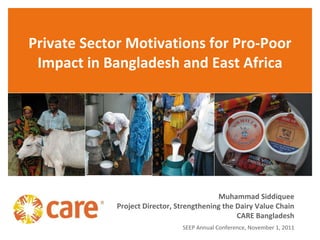
Influencing and Responding to Private Sector Motivations for Pro-Poor Impact in Bangladesh and East Africa
Private Sector Engagement for Inclusive Value Chain Development Kevin McKague  Schulich School of Business, York University, Canada SEEP Annual Conference November 1, 2011
Overview Framework for Understanding Intangibles How they relate to a value chain theory of change Frameworks for Private Sector Engagement Value chain activities most relevant for private sector engagement Distinctions between diverse private sector organizations  Process of understanding, influencing and responding to private sector motivations
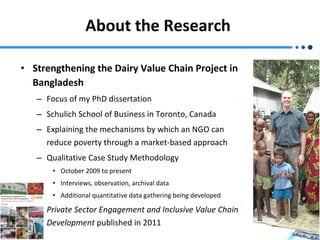
About the Research  Strengthening the Dairy Value Chain Project in Bangladesh Focus of my PhD dissertation  Schulich School of Business in Toronto, Canada Explaining the mechanisms by which an NGO can reduce poverty through a market-based approach Qualitative Case Study Methodology  October 2009 to present Interviews, observation, archival data Additional quantitative data gathering being developed Private Sector Engagement and Inclusive Value Chain Development  published in 2011
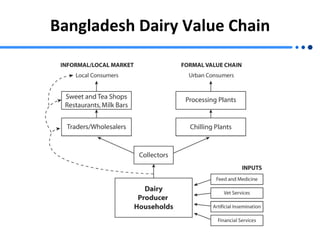
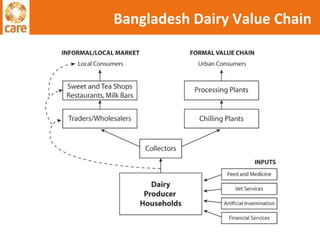
Bangladesh Dairy Value Chain
Challenges Bangladeshi Dairy Sector Unwillingness of private sector to reach the bottom of the pyramid Government ineffective at improving practices and unreliable data on the dairy sector  (Jabbar, 2010) Smallholder farmers account for majority of national production, but rely on subsistence methods 30% of national milk demand met by imported powdered milk Limited access to productivity enhancing inputs and markets Collectors and collection systems reduce trust and milk quality Gender norms
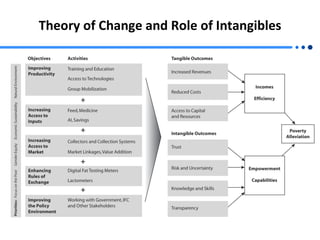
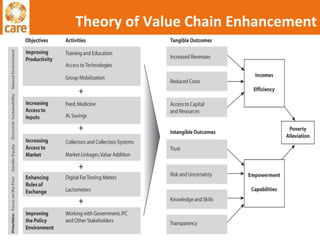
Theory of Change and Role of Intangibles
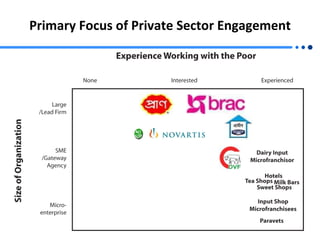
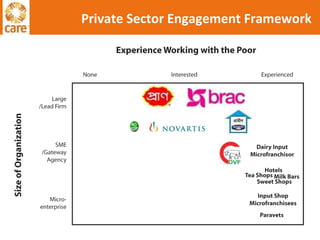
Primary Focus of Private Sector Engagement
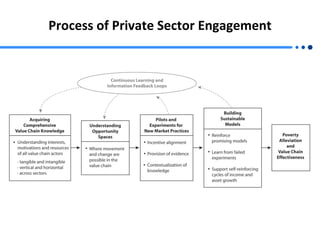
Process of Private Sector Engagement
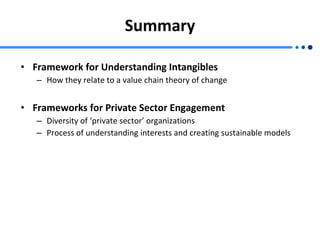
Summary Framework for Understanding Intangibles How they relate to a value chain theory of change Frameworks for Private Sector Engagement Diversity of ‘private sector’ organizations Process of understanding interests and creating sustainable models
Thank you Kevin McKague  kmckague@schulich.yorku.ca  Schulich School of Business, York University, Canada
Private Sector Motivations for Pro-Poor Impact in Bangladesh and East Africa Muhammad Siddiquee Project Director, Strengthening the Dairy Value Chain CARE Bangladesh SEEP Annual Conference, November 1, 2011
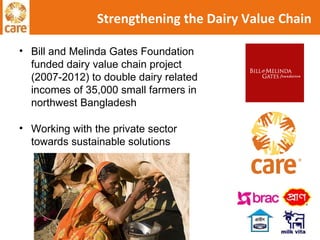
Strengthening the Dairy Value Chain Bill and Melinda Gates Foundation funded dairy value chain project (2007-2012) to double dairy related incomes of 35,000 small farmers in northwest Bangladesh Working with the private sector towards sustainable solutions
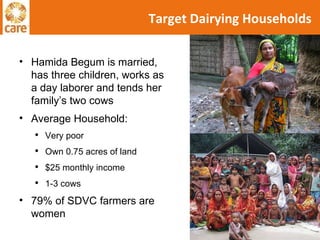
Target Dairying Households Hamida Begum is married, has three children, works as a day laborer and tends her family’s two cows  Average Household: Very poor Own 0.75 acres of land $25 monthly income 1-3 cows 79% of SDVC farmers are women
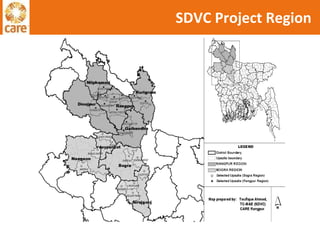
SDVC Project Region
Bangladesh Dairy Value Chain
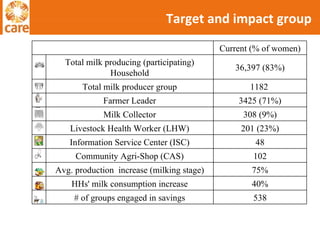
Target and impact group Current (% of women) Total milk producing (participating) Household 36,397 (83%) Total milk producer group 1182 Farmer Leader 3425 (71%) Milk Collector 308 (9%) Livestock Health Worker (LHW) 201 (23%) Information Service Center (ISC) 48 Community Agri-Shop (CAS) 102 Avg. production  increase (milking stage) 75% HHs' milk consumption increase 40% # of groups engaged in savings 538
Theory of Value Chain Enhancement
Private Sector Engagement Framework
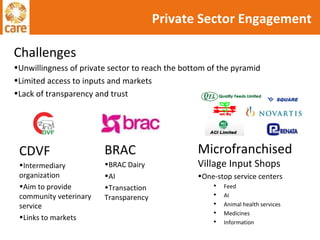
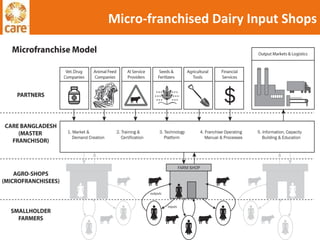
Private Sector Engagement BRAC BRAC Dairy AI Transaction Transparency CDVF Intermediary organization Aim to provide community veterinary service Links to markets Microfranchised  Village Input Shops One-stop service centers  Feed AI Animal health services Medicines Information  Challenges Unwillingness of private sector to reach the bottom of the pyramid Limited access to inputs and markets Lack of transparency and trust
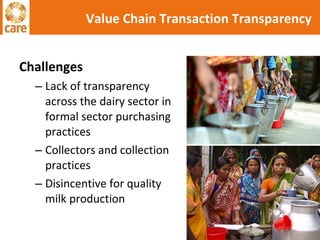
Challenges Lack of transparency across the dairy sector in formal sector purchasing practices Collectors and collection practices Disincentive for quality milk production Value Chain Transaction Transparency
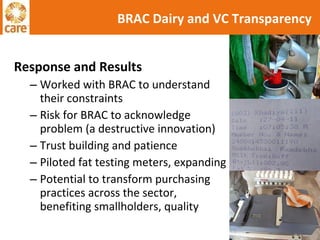
Response and Results Worked with BRAC to understand their constraints Risk for BRAC to acknowledge problem (a destructive innovation) Trust building and patience Piloted fat testing meters, expanding Potential to transform purchasing practices across the sector, benefiting smallholders, quality BRAC Dairy and VC Transparency
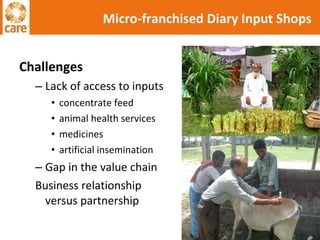
Challenges Lack of access to inputs concentrate feed animal health services medicines artificial insemination Gap in the value chain Business relationship versus partnership Micro-franchised Diary Input Shops
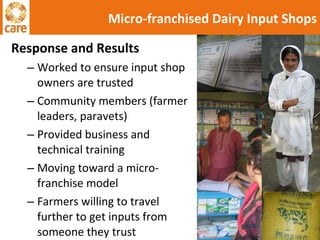
Response and Results Worked to ensure input shop owners are trusted Community members (farmer leaders, paravets) Provided business and technical training Moving toward a micro-franchise model Farmers willing to travel further to get inputs from someone they trust Micro-franchised Dairy Input Shops
Micro-franchised Dairy Input Shops
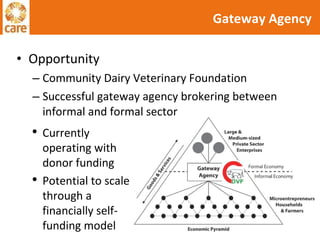
Opportunity Community Dairy Veterinary Foundation Successful gateway agency brokering between informal and formal sector Gateway Agency Currently operating with donor funding Potential to scale through a financially self-funding model
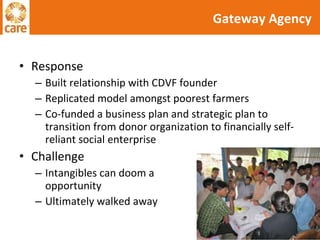
Response Built relationship with CDVF founder Replicated model amongst poorest farmers Co-funded a business plan and strategic plan to transition from donor organization to financially self-reliant social enterprise Challenge Intangibles can doom a  good opportunity Ultimately walked away Gateway Agency
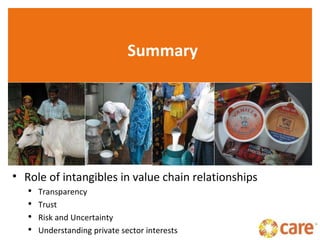
Summary Role of intangibles in value chain relationships Transparency Trust Risk and Uncertainty  Understanding private sector interests
East Africa Dairy Development (EADD): A Heifer International Consortium SEEP Annual Conference Presentation November 1, 2011 Moses Nyabila, EADD (Nairobi) Project Generously Supported by the Bill & Melinda Gates Foundation
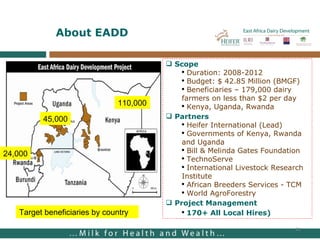
About EADD Scope Duration: 2008-2012  Budget: $ 42.85 Million (BMGF) Beneficiaries – 179,000 dairy farmers on less than $2 per day Kenya, Uganda, Rwanda Partners Heifer International (Lead) Governments of Kenya, Rwanda and Uganda Bill & Melinda Gates Foundation TechnoServe International Livestock Research Institute African Breeders Services - TCM World AgroForestry Project Management 170+ All Local Hires)  110,000 45,000 24,000 Target beneficiaries by country
Rwanda Why East Africa? Over 80% of the region’s population (180 million people) are smallholder farmers. Huge comparative advantages in the livestock and dairy subsector; Urbanization and rapid economic growth are creating demand for high quality milk and milk products.  EADD partners have many years’ experience implementing small-scale  smallholder dairy projects in the region with great success A unique opportunity to overcome rural poverty and malnutrition
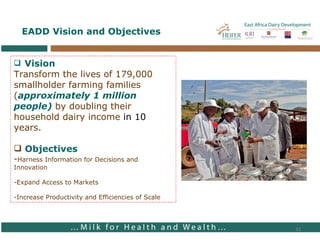
EADD Vision and Objectives Vision Transform the lives of 179,000 smallholder farming families ( approximately 1 million people)  by doubling their household dairy income  in 10  years. Objectives - Harness Information for Decisions and Innovation -Expand Access to Markets -Increase Productivity and Efficiencies of Scale
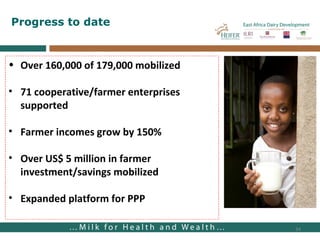
Progress to date Over 160,000 of 179,000 mobilized 71 cooperative/farmer enterprises supported Farmer incomes grow by 150% Over US$ 5 million in farmer investment/savings mobilized Expanded platform for PPP
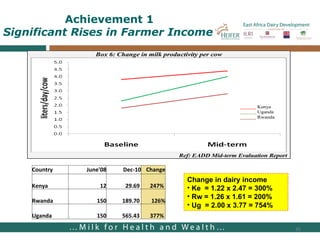
Achievement 1 Significant Rises in Farmer Income Change in dairy income Ke  = 1.22 x 2.47 = 300% Rw = 1.26 x 1.61 = 200% Ug  = 2.00 x 3.77 = 754% Country June'08 Dec-10 Change Kenya  12 29.69  247%  Rwanda 150 189.70  126% Uganda 150 565.43  377%
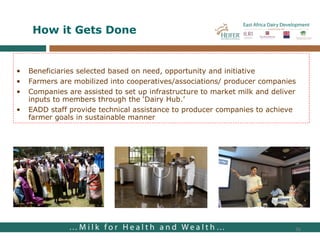
How it Gets Done Beneficiaries selected based on need, opportunity and initiative Farmers are mobilized into cooperatives/associations/ producer companies  Companies are assisted to set up infrastructure to market milk and deliver inputs to members through the ‘Dairy Hub.’ EADD staff provide technical assistance to producer companies to achieve farmer goals in sustainable manner
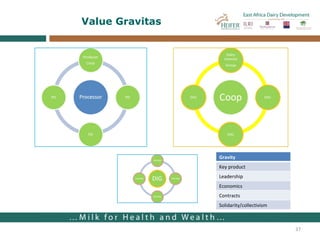
Value Gravitas Gravity  Key product Leadership Economics Contracts Solidarity/collectivism
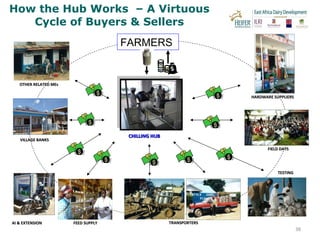
How the Hub Works  – A Virtuous Cycle of Buyers & Sellers TRANSPORTERS TESTING FARMERS FIELD DAYS FEED SUPPLY AI & EXTENSION VILLAGE BANKS OTHER RELATED MEs HARDWARE SUPPLIERS CHILLING HUB
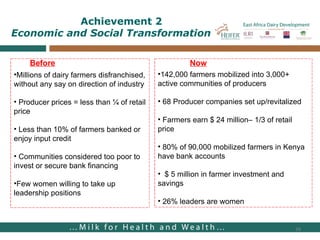
Achievement 2 Economic and Social Transformation 142,000 farmers mobilized into 3,000+  active communities of producers  68 Producer companies set up/revitalized Farmers earn $ 24 million– 1/3 of retail price 80% of 90,000 mobilized farmers in Kenya have bank accounts $ 5 million in farmer investment and savings 26% leaders are women Millions of dairy farmers disfranchised, without any say on direction of industry Producer prices = less than ¼ of retail price Less than 10% of farmers banked or enjoy input credit Communities considered too poor to invest or secure bank financing Few women willing to take up leadership positions Before   Now
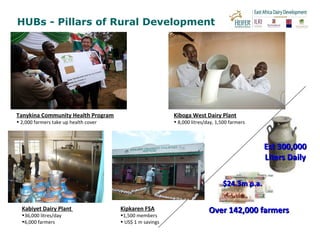
HUBs - Pillars of Rural Development Tanykina Community Health Program 2,000 farmers take up health cover Kiboga West Dairy Plant 8,000 litres/day, 1,500 farmers Kabiyet Dairy Plant  36,000 litres/day 6,000 farmers Kipkaren FSA 1,500 members US$ 1 m savings Over 142,000 farmers $24.3m p.a. Est 300,000 Liters Daily
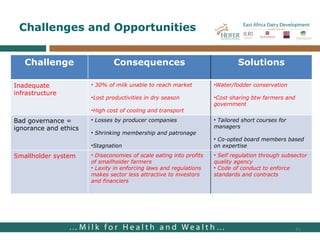
Challenges and Opportunities  Challenge Consequences Solutions Inadequate infrastructure 30% of milk unable to reach market Lost productivities in dry season High cost of cooling and transport Water/fodder conservation Cost sharing btw farmers and government Bad governance = ignorance and ethics Losses by producer companies Shrinking membership and patronage Stagnation Tailored short courses for managers Co-opted board members based on expertise Smallholder system Diseconomies of scale eating into profits of smallholder farmers Laxity in enforcing laws and regulations makes sector less attractive to investors and financiers Self regulation through subsector quality agency Code of conduct to enforce standards and contracts
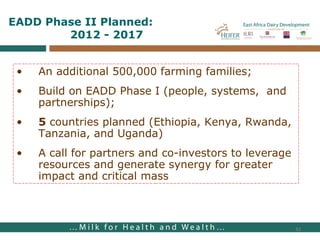
An additional 500,000 farming families; Build on EADD Phase I (people, systems,  and partnerships); 5  countries planned (Ethiopia, Kenya, Rwanda, Tanzania, and Uganda) A call for partners and co-investors to leverage resources and generate synergy for greater impact and critical mass EADD Phase II Planned: 2012 - 2017
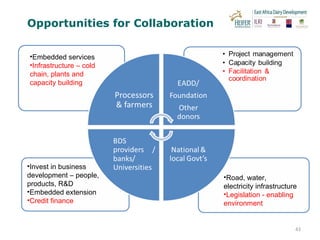
Opportunities for Collaboration Invest in business development – people, products, R&D Embedded extension Credit finance  Road, water, electricity infrastructure Legislation - enabling environment Embedded services Infrastructure – cold  chain, plants and  capacity building
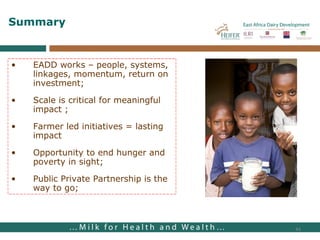
EADD works – people, systems, linkages, momentum, return on investment; Scale is critical for meaningful impact ; Farmer led initiatives = lasting impact Opportunity to end hunger and poverty in sight;  Public Private Partnership is the way to go; Summary
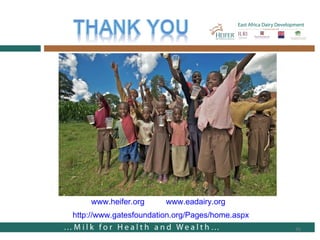
http://www.gatesfoundation.org/Pages/home.aspx   www.heifer.org   www.eadairy.org

Influencing and Responding to Private Sector Motivations for Pro-Poor Impact in Bangladesh and East Africa

  • 1.
  • 2.
    Influencing and Respondingto Private Sector Motivations for Pro-Poor Impact in Bangladesh and East Africa
  • 3.
    Private Sector Engagementfor Inclusive Value Chain Development Kevin McKague Schulich School of Business, York University, Canada SEEP Annual Conference November 1, 2011
  • 4.
    Overview Framework forUnderstanding Intangibles How they relate to a value chain theory of change Frameworks for Private Sector Engagement Value chain activities most relevant for private sector engagement Distinctions between diverse private sector organizations Process of understanding, influencing and responding to private sector motivations
  • 5.
    About the Research Strengthening the Dairy Value Chain Project in Bangladesh Focus of my PhD dissertation Schulich School of Business in Toronto, Canada Explaining the mechanisms by which an NGO can reduce poverty through a market-based approach Qualitative Case Study Methodology October 2009 to present Interviews, observation, archival data Additional quantitative data gathering being developed Private Sector Engagement and Inclusive Value Chain Development published in 2011
  • 6.
  • 7.
    Challenges Bangladeshi DairySector Unwillingness of private sector to reach the bottom of the pyramid Government ineffective at improving practices and unreliable data on the dairy sector (Jabbar, 2010) Smallholder farmers account for majority of national production, but rely on subsistence methods 30% of national milk demand met by imported powdered milk Limited access to productivity enhancing inputs and markets Collectors and collection systems reduce trust and milk quality Gender norms
  • 8.
    Theory of Changeand Role of Intangibles
  • 9.
    Primary Focus ofPrivate Sector Engagement
  • 10.
    Process of PrivateSector Engagement
  • 11.
    Summary Framework forUnderstanding Intangibles How they relate to a value chain theory of change Frameworks for Private Sector Engagement Diversity of ‘private sector’ organizations Process of understanding interests and creating sustainable models
  • 12.
    Thank you KevinMcKague kmckague@schulich.yorku.ca Schulich School of Business, York University, Canada
  • 13.
    Private Sector Motivationsfor Pro-Poor Impact in Bangladesh and East Africa Muhammad Siddiquee Project Director, Strengthening the Dairy Value Chain CARE Bangladesh SEEP Annual Conference, November 1, 2011
  • 14.
    Strengthening the DairyValue Chain Bill and Melinda Gates Foundation funded dairy value chain project (2007-2012) to double dairy related incomes of 35,000 small farmers in northwest Bangladesh Working with the private sector towards sustainable solutions
  • 15.
    Target Dairying HouseholdsHamida Begum is married, has three children, works as a day laborer and tends her family’s two cows Average Household: Very poor Own 0.75 acres of land $25 monthly income 1-3 cows 79% of SDVC farmers are women
  • 16.
  • 17.
  • 18.
    Target and impactgroup Current (% of women) Total milk producing (participating) Household 36,397 (83%) Total milk producer group 1182 Farmer Leader 3425 (71%) Milk Collector 308 (9%) Livestock Health Worker (LHW) 201 (23%) Information Service Center (ISC) 48 Community Agri-Shop (CAS) 102 Avg. production increase (milking stage) 75% HHs' milk consumption increase 40% # of groups engaged in savings 538
  • 19.
    Theory of ValueChain Enhancement
  • 20.
  • 21.
    Private Sector EngagementBRAC BRAC Dairy AI Transaction Transparency CDVF Intermediary organization Aim to provide community veterinary service Links to markets Microfranchised Village Input Shops One-stop service centers Feed AI Animal health services Medicines Information Challenges Unwillingness of private sector to reach the bottom of the pyramid Limited access to inputs and markets Lack of transparency and trust
  • 22.
    Challenges Lack oftransparency across the dairy sector in formal sector purchasing practices Collectors and collection practices Disincentive for quality milk production Value Chain Transaction Transparency
  • 23.
    Response and ResultsWorked with BRAC to understand their constraints Risk for BRAC to acknowledge problem (a destructive innovation) Trust building and patience Piloted fat testing meters, expanding Potential to transform purchasing practices across the sector, benefiting smallholders, quality BRAC Dairy and VC Transparency
  • 24.
    Challenges Lack ofaccess to inputs concentrate feed animal health services medicines artificial insemination Gap in the value chain Business relationship versus partnership Micro-franchised Diary Input Shops
  • 25.
    Response and ResultsWorked to ensure input shop owners are trusted Community members (farmer leaders, paravets) Provided business and technical training Moving toward a micro-franchise model Farmers willing to travel further to get inputs from someone they trust Micro-franchised Dairy Input Shops
  • 26.
  • 27.
    Opportunity Community DairyVeterinary Foundation Successful gateway agency brokering between informal and formal sector Gateway Agency Currently operating with donor funding Potential to scale through a financially self-funding model
  • 28.
    Response Built relationshipwith CDVF founder Replicated model amongst poorest farmers Co-funded a business plan and strategic plan to transition from donor organization to financially self-reliant social enterprise Challenge Intangibles can doom a good opportunity Ultimately walked away Gateway Agency
  • 29.
    Summary Role ofintangibles in value chain relationships Transparency Trust Risk and Uncertainty Understanding private sector interests
  • 30.
    East Africa DairyDevelopment (EADD): A Heifer International Consortium SEEP Annual Conference Presentation November 1, 2011 Moses Nyabila, EADD (Nairobi) Project Generously Supported by the Bill & Melinda Gates Foundation
  • 31.
    About EADD ScopeDuration: 2008-2012 Budget: $ 42.85 Million (BMGF) Beneficiaries – 179,000 dairy farmers on less than $2 per day Kenya, Uganda, Rwanda Partners Heifer International (Lead) Governments of Kenya, Rwanda and Uganda Bill & Melinda Gates Foundation TechnoServe International Livestock Research Institute African Breeders Services - TCM World AgroForestry Project Management 170+ All Local Hires) 110,000 45,000 24,000 Target beneficiaries by country
  • 32.
    Rwanda Why EastAfrica? Over 80% of the region’s population (180 million people) are smallholder farmers. Huge comparative advantages in the livestock and dairy subsector; Urbanization and rapid economic growth are creating demand for high quality milk and milk products. EADD partners have many years’ experience implementing small-scale smallholder dairy projects in the region with great success A unique opportunity to overcome rural poverty and malnutrition
  • 33.
    EADD Vision andObjectives Vision Transform the lives of 179,000 smallholder farming families ( approximately 1 million people) by doubling their household dairy income in 10 years. Objectives - Harness Information for Decisions and Innovation -Expand Access to Markets -Increase Productivity and Efficiencies of Scale
  • 34.
    Progress to dateOver 160,000 of 179,000 mobilized 71 cooperative/farmer enterprises supported Farmer incomes grow by 150% Over US$ 5 million in farmer investment/savings mobilized Expanded platform for PPP
  • 35.
    Achievement 1 SignificantRises in Farmer Income Change in dairy income Ke = 1.22 x 2.47 = 300% Rw = 1.26 x 1.61 = 200% Ug = 2.00 x 3.77 = 754% Country June'08 Dec-10 Change Kenya 12 29.69 247% Rwanda 150 189.70 126% Uganda 150 565.43 377%
  • 36.
    How it GetsDone Beneficiaries selected based on need, opportunity and initiative Farmers are mobilized into cooperatives/associations/ producer companies Companies are assisted to set up infrastructure to market milk and deliver inputs to members through the ‘Dairy Hub.’ EADD staff provide technical assistance to producer companies to achieve farmer goals in sustainable manner
  • 37.
    Value Gravitas Gravity Key product Leadership Economics Contracts Solidarity/collectivism
  • 38.
    How the HubWorks – A Virtuous Cycle of Buyers & Sellers TRANSPORTERS TESTING FARMERS FIELD DAYS FEED SUPPLY AI & EXTENSION VILLAGE BANKS OTHER RELATED MEs HARDWARE SUPPLIERS CHILLING HUB
  • 39.
    Achievement 2 Economicand Social Transformation 142,000 farmers mobilized into 3,000+ active communities of producers 68 Producer companies set up/revitalized Farmers earn $ 24 million– 1/3 of retail price 80% of 90,000 mobilized farmers in Kenya have bank accounts $ 5 million in farmer investment and savings 26% leaders are women Millions of dairy farmers disfranchised, without any say on direction of industry Producer prices = less than ¼ of retail price Less than 10% of farmers banked or enjoy input credit Communities considered too poor to invest or secure bank financing Few women willing to take up leadership positions Before Now
  • 40.
    HUBs - Pillarsof Rural Development Tanykina Community Health Program 2,000 farmers take up health cover Kiboga West Dairy Plant 8,000 litres/day, 1,500 farmers Kabiyet Dairy Plant 36,000 litres/day 6,000 farmers Kipkaren FSA 1,500 members US$ 1 m savings Over 142,000 farmers $24.3m p.a. Est 300,000 Liters Daily
  • 41.
    Challenges and Opportunities Challenge Consequences Solutions Inadequate infrastructure 30% of milk unable to reach market Lost productivities in dry season High cost of cooling and transport Water/fodder conservation Cost sharing btw farmers and government Bad governance = ignorance and ethics Losses by producer companies Shrinking membership and patronage Stagnation Tailored short courses for managers Co-opted board members based on expertise Smallholder system Diseconomies of scale eating into profits of smallholder farmers Laxity in enforcing laws and regulations makes sector less attractive to investors and financiers Self regulation through subsector quality agency Code of conduct to enforce standards and contracts
  • 42.
    An additional 500,000farming families; Build on EADD Phase I (people, systems, and partnerships); 5 countries planned (Ethiopia, Kenya, Rwanda, Tanzania, and Uganda) A call for partners and co-investors to leverage resources and generate synergy for greater impact and critical mass EADD Phase II Planned: 2012 - 2017
  • 43.
    Opportunities for CollaborationInvest in business development – people, products, R&D Embedded extension Credit finance Road, water, electricity infrastructure Legislation - enabling environment Embedded services Infrastructure – cold chain, plants and capacity building
  • 44.
    EADD works –people, systems, linkages, momentum, return on investment; Scale is critical for meaningful impact ; Farmer led initiatives = lasting impact Opportunity to end hunger and poverty in sight; Public Private Partnership is the way to go; Summary
  • 45.

Editor's Notes

  • #6 Almost studied USAID as well UNDP and IFC plus IDRC and CIDA
  • #7 This is the Bangladeshi dairy value chain Primary producing households require inputs… in this case feed, medicine, vet services and AI They need to get their milk to market through collectors and collection systems And the market in Bangaldesh consists of an informal market – tea shops, sweet shops, restaruants, hotels, informal markets – unrefrigerated – where 90% of the milk goes And the formal market of large milk processing organizations who have networks of chilling plants, collect and pasteurize, process and package milk and milk products for sale in larger urban centres
  • #8 Hot climate without village refrigeration infrastructure
  • #9 Animation to circle the three SDVC has a comprehensive theory of change to improve farmer productivity, work to improve the policy environment where opportunities exist and work with private sector organizations from the bottom to the top of the value chain We can think about characterizing project outcomes as either tangible in nature – increased revenues, reduced costs, increased access to material resources and capital – or intangible. Intangible outcomes would include aspects such as increased trust, transparency and capabilities in the value chain as well as reduced risk and uncertainty. The tangibles – economic, money, resources – and the intangibles – aspects of the relationships between value chain actors and the capabilities they possess are interrelated and combine to reduce poverty in a way that recognizes its multidimensional nature. So this is one framework for understanding the role of intangibles in a value chain approach. SDVC has many interventions to overcome obstacles in the value chain, but if we want to explicitly consider where private sector engagement is central, it is in increasing access to inputs, increasing access to markets and enhancing the rules of exchange.
  • #10 When we zoom in on these three critical components of value chain enhancement, in the case of the Bangladeshi dairy sector, we can see there are quite a diversity of organizations. We can differentiate them by size, as illustrated here. They are also diverse in terms of how they are formally constituted They also vary in terms of their experience working with the poor We could organize them in different ways, their experience is another helpful dimension But here we focus on size. Go through the diagram So this is a framework for understanding the various private sector actors in the value chain
  • #11 In terms of HOW SDVC goes about understanding, influencing and responding to private sector motivations The general process is Acquiring a comprehensive knowledge of the value chain, and for our purposes here, the interests, mindsets and resources of various private sector actors. On the inputs and market sides. From this, an understanding of opportunity spaces is developed – where is movement and change possible. By which actors. And an understanding of what it would take to make change – what incentives or resources need to be provided With an experimental, pilot-based, learning-oriented approach SDVC then works at creating sustainable models to overcome the bottlenecks and challenges in the value chain – providing access to inputs, markets and enhancing rules of exchange. With much trial and error, learning from mistakes, feedback from value chain actors, the models that are most likely to be self-sustaining are nurtured and supported
  • #15 Productivity and capacity building also includes Feed and medicine, artificial insemination etc. what we are doing with RSP, possibly in AI research and implementation of access to inputs. Say that the coloured ones was originally thought, the project later on put emphasis on the other capacity building initiative.
  • #16 A small point, but USAID has been mandated by the US Congress to ensure that at least 50% of all USAID micro-enterprise funds benefit the very poor, so good to make the point that all SDVC beneficiaries are in that category.
  • #17 Include total number of 24 upazillas, 494 villages
  • #18 Note that some dairy producers may sell directly to traders/whole sellers or sweetshop. Sweet produced in the rural areas can find urban markets