Spiritual Direction
An Introductory Course for Priests,
Deacons, and Candidates
Community of Jesus Crucified
Our Lady of Sorrows Retreat Center
Fr. Michael Champagne, CJC
Tentative Schedule
 January 22 Introduction to Nature and Need
for Spiritual Direction
 January 29 Some Guiding Principles in
Giving and Seeking Spiritual
Direction
 February 5 Using Well the Means to
Holiness (at Knight Hall Fatima)
 February 12 Understanding the Supernatural
Organism – The Three Ages of
the Spiritual Life
Schedule (cont.)
 February 19 Directing a Person who is
Discerning the Priesthood or
Religious Life (Fr. Joe Palermo)
 February 26 Pastoral Counseling and Spiritual
Direction: Respecting Differences
(Mario Sacasa, Ed.S, LMFT)
 March 5 No Class (Priestly Association)
 March 12 Learning to Pray and Progressing
in Prayer
Schedule (cont.)
 March 19 The Role of Actual Grace in the
Spiritual Life
 March 26 Dealing with Extraordinary
Phenomena in Spiritual Direction
Select Questions
 What is Spiritual Direction?
 Is Spiritual Direction necessary?
 Why does one need Spiritual Direction?
 Is Spiritual Direction spoken of in the Bible?
 What do the Saints say about Spiritual Direction?
 What does the Church say about Spiritual Direction?
 What are the differences between Counseling and
Spiritual Direction?
 Is there a difference between the Office of
Confessor and the Office of Spiritual Director?
 What are the technical qualities of a good
Spiritual Director?
 What are the moral qualities of a good Director?
 What are some of the duties of the Spiritual
Director?
 What are the qualities to be expected in the one
directed?
 What are some classes of directees where good
spiritual direction is crucial?
 How does one choose a Spiritual Director?
 When is it advisable/permissible to change
directors?
 Can one consult a number of spiritual directors?
 Can I do spiritual direction in cyberspace?
 What are some solid resources on Spiritual
Direction?
 What is Spiritual Direction?
 Definition: “the art of leading souls
progressively from the beginning of the
spiritual life to the height of Christian
perfection” (Royo, 593).
 it is an art – a practical science
 it is progressive – according to the
strength and disposition of the soul
directed
 it is oriented toward the perfection of the
Christian life
 Is Spiritual Direction necessary?
 Not absolutely necessary, morally
necessary
 Not needed if one is not serious
about living the spiritual life –
waste of director’s time
 most saints had a director or
someone who gave them
spiritual counsel
Why does one need it?
 Necessity of a “third” person
 To be an observer
 For objectivity
 “Dose of reality”
 God uses mediator
 More knowledge and experience in a guide
 To diagnose where you are
 To lead you to the “next step”
 Part of Prudence to seek counsel
 Merit of humility and obedience
 Protection from the pitfalls of self and the devil
Is it in the Bible?
 Eccl. 4:10 “If the one falls, the other will help the
fallen one. But woe to the solitary person! If that
one should fall, there is no other to help.”
 Tobit 4:18 “Seek counsel from every wise man, and
do not think lightly of any advice that can be
useful.”
 Sirach 32:18-19 “The thoughtful man will not
neglect direction…Do nothing without counsel,
and then you need have no regrets.”
 2 Cor. 5:20 “So we are ambassadors for Christ, as if
God were appealing through us.”
What do the Saints say about Spiritual Direction?
 “To believe that one does not need counsel
is a great pride” St. Basil
 “Do not be your own master and do not set
out upon a way that is entirely new for you
without a guide; otherwise you will soon go
astray” (St. Jerome)
 “As a blind man cannot follow the good
road without a leader, no one can walk
without a guide” (St. Augustine)
 “He who constitutes himself his own director,
becomes the disciple of a fool” (St. Bernard)
 “Our Lord, without whom we can do
nothing, will never grant His grace to one
who, having at his disposition a man capable
of instructing and directing him, neglects this
powerful means of sanctification, believing
that he is sufficient to himself and that he can
by his own powers seek and find the things
useful to salvation” (St. Vincent Ferrer)
 John of the Cross, Living Flame of Love, Cant.
3, n. 56
 Teresa of Avila, Book of Life, c. 4 “I had no
master—I mean, no confessor—who
understood me, though I sought for such a one
for twenty years afterwards: which did me much
harm, in that I frequently went backwards, and
might have been even utterly lost; for, anyhow, a
director would have helped me to escape the
risks I ran of sinning against God.”
 Francis de Sales, Introduction to a Devout Life, Bk. I, c. 4 “A
faithful friend,” we are told in Holy Scripture, “is a strong
defense, and he that hath found such an one hath found a
treasure;” and again: “A faithful friend is the medicine of
life; and they that fear the Lord shall find him.” These
sacred words have chiefly reference, as you see, to the
immortal life, with a view to which we specially need a
faithful friend, who will guide us by his counsel and advice,
thereby guarding us against the deceits and snares of the
Evil One:—he will be as a storehouse of wisdom to us in
our sorrows, trials and falls; he will be as a healing balm to
stay and soothe our heart in the time
of spiritual sickness,—he will shield us from evil, and
confirm that which is good in us, and when we fall through
infirmity, he will avert the deadly nature of the evil, and
raise us up again.”
What about the
Magisterium?
“It is part of the ordinary law that as
God in His Providence has ordained
that men for the most part should be
saved by men, so He has appointed
that those whom He calls to a higher
degree of holiness should be guided
thereto by men” (Pope Leo XIII, Testem
benevolentiae, Jan. 22, 1899)
“Moreover, it should be added that those who
strive to sanctify themselves, by the very fact
that they strive to follow a way that is little
frequented, are more exposed to deceive
themselves and therefore they, more than
others, need a doctor and guide. And this
method of procedure has always been seen in
the Church. This doctrine was unanimously
taught by all those who, in the course of
centuries, flourished in wisdom and sanctity.
And those who reject it shall not do so without
temerity and danger” (Pope Leo XIII, Testem
benevolentiae, Jan. 22, 1899)
Is Spiritual Direction addressed in
Recent Magisterial Documents?
 Optatam Totius (1965) par. 3, 19
 Codex Iuris Canonici (1983) par. 239.2,
240.2
 Pastores Dabo Vobis (1992) par. 40.3,
50.4, 66.1, 66.4, 81.3
 Catechism of the Catholic Church (1992)
par. 1435, 2690, 2695
 Codex Iuris Canonici (1983)
 Can. 239 §2. Every seminary is to have at least one
spiritual director, though the students remain free to
approach other priests who have been designated for
this function by the bishop.
 Can. 240 §2. When decisions are made about
admitting students to orders or dismissing them from
the seminary, the opinion of the spiritual director and
confessors can never be sought.
Catechism of the Catholic Church
 1435 Conversion is accomplished in daily life by
gestures of reconciliation, concern for the poor,
the exercise and defense of justice and right, by
the admission of faults to one's brethren,
fraternal correction, revision of life, examination
of conscience, spiritual direction, acceptance of
suffering, endurance of persecution for the sake
of righteousness. Taking up one's cross each day
and following Jesus is the surest way of penance.
 2690 The Holy Spirit gives to certain of the faithful the
gifts of wisdom, faith and discernment for the sake of
this common good which is prayer (spiritual direction).
Men and women so endowed are true servants of the
living tradition of prayer. According to St. John of the
Cross, the person wishing to advance toward perfection
should "take care into whose hands he entrusts himself,
for as the master is, so will the disciple be, and as the
father is so will be the son." And further: "In addition
to being learned and discreet a director should be
experienced. . . . If the spiritual director has no
experience of the spiritual life, he will be incapable of
leading into it the souls whom God is calling to it, and
he will not even understand them."
Encouragement to Priests and
Deacons to do Spiritual Direction
 “Would it be rash for us to fear that many
priests will receive a frightful shock at the Last
Judgment when they find out that they are, to a
certain extent, responsible for the mediocrity
and even the loss of souls, because they
neglected to study the art of spiritual direction
and would not take the trouble to practice it?”
(Dom Chautard, The Soul of the Apostolate, p. 172)
 “Hardly ten in a thousand called by God to perfection
heed the call; of a hundred called to contemplation,
ninety-nine fail to respond. It must be acknowledged
that one of the principal causes is the lack of spiritual
directors. Under God, they are the pilots who conduct
souls through this unknown ocean of the spiritual life.
If no science, no art, how simple so ever, can be
learned well without a master, much less can anyone
learn this high wisdom of evangelical perfection,
wherein such great mysteries are found. This is the
reason why I hold it morally impossible that a soul
could, without a miracle or without a master, go
through what is the highest and most arduous in the
spiritual life, without running the risk of perishing”
(Godinez, Praxis theologicae mysticae).
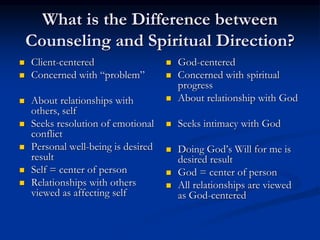
What is the Difference between
Counseling and Spiritual Direction?
 Client-centered
 Concerned with “problem”
 About relationships with
others, self
 Seeks resolution of emotional
conflict
 Personal well-being is desired
result
 Self = center of person
 Relationships with others
viewed as affecting self
 God-centered
 Concerned with spiritual
progress
 About relationship with God
 Seeks intimacy with God
 Doing God’s Will for me is
desired result
 God = center of person
 All relationships are viewed
as God-centered
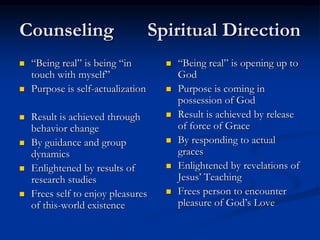
Counseling Spiritual Direction
 “Being real” is being “in
touch with myself”
 Purpose is self-actualization
 Result is achieved through
behavior change
 By guidance and group
dynamics
 Enlightened by results of
research studies
 Frees self to enjoy pleasures
of this-world existence
 “Being real” is opening up to
God
 Purpose is coming in
possession of God
 Result is achieved by release
of force of Grace
 By responding to actual
graces
 Enlightened by revelations of
Jesus’ Teaching
 Frees person to encounter
pleasure of God’s Love
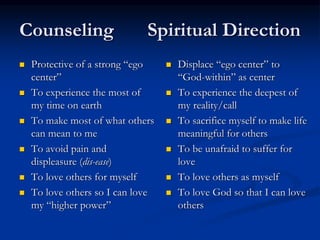
Counseling Spiritual Direction
 Protective of a strong “ego
center”
 To experience the most of
my time on earth
 To make most of what others
can mean to me
 To avoid pain and
displeasure (dis-ease)
 To love others for myself
 To love others so I can love
my “higher power”
 Displace “ego center” to
“God-within” as center
 To experience the deepest of
my reality/call
 To sacrifice myself to make life
meaningful for others
 To be unafraid to suffer for
love
 To love others as myself
 To love God so that I can love
others
Is there a Difference between the
Office of Confessor and the Office
of Spiritual Director?
 judge vs. teacher, guide, and counselor
 fittingness of priest as director
 fittingness of same priest as confessor
and director
 obligation of priest to hear confessions
and freedom of priest to refuse office
of spiritual director for any given soul
What are the Technical Qualities of a
Good Director?
 Learning – knowledge of
spiritual life and souls
 prudence in decisions
 clarity in counseling
 firmness in exacting obedience
 experience
What are the Moral Qualities of a
Good Spiritual Director?
 holiness – nemo dat quod non habet!
 Zeal for souls – Amor Christi urget
nos!
 Humility – readiness to consult
others when needed, to prayerfully
reflect and avoid rash decisions, to
receive graces needed to be apt
director of souls
 Disinterested – “Feed my sheep!”
Essentials for the Direction of Souls
(Charles Doyle, Guidance in Spiritual Direction)
 Adequate Seminary Training
 Manual of Spiritual Theology
 Reading of the Masters
 Practice of the Virtues
What are some of the Duties of a
Spiritual Director?
 to know the soul being directed
 to be a good listener
 to give instruction
 to encourage the soul
 to direct the spiritual life of the soul
 to correct defects
 to direct by progressive stages
 to observe confidentiality
 to practice what he preaches – get direction
for himself
What are Some of the Qualities that Should be
Present in the One Who seeks Direction?
 Qualities necessary for direction
 sincerity – director should know all that pertains
to one’s spiritual life
 there is freedom in choosing the director and
freedom in discontinuing direction, but there
must be obedience with regard to the spiritual
direction received
 vow of obedience – its acceptability and cautions
 Perseverance – give relationship time
 Discretion in revealing content of your spiritual
direction to others – it may not apply to them
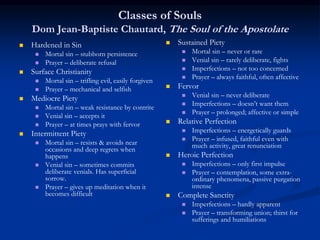
Classes of Souls
Dom Jean-Baptiste Chautard, The Soul of the Apostolate
 Hardened in Sin
 Mortal sin – stubborn persistence
 Prayer – deliberate refusal
 Surface Christianity
 Mortal sin – trifling evil, easily forgiven
 Prayer – mechanical and selfish
 Mediocre Piety
 Mortal sin – weak resistance by contrite
 Venial sin – accepts it
 Prayer – at times prays with fervor
 Intermittent Piety
 Mortal sin – resists & avoids near
occasions and deep regrets when
happens
 Venial sin – sometimes commits
deliberate venials. Has superficial
sorrow.
 Prayer – gives up meditation when it
becomes difficult
 Sustained Piety
 Mortal sin – never or rare
 Venial sin – rarely deliberate, fights
 Imperfections – not too concerned
 Prayer – always faithful, often affective
 Fervor
 Venial sin – never deliberate
 Imperfections – doesn’t want them
 Prayer – prolonged; affective or simple
 Relative Perfection
 Imperfections – energetically guards
 Prayer – infused, faithful even with
much activity, great renunciation
 Heroic Perfection
 Imperfections – only first impulse
 Prayer – contemplation, some extra-
ordinary phenomena, passive purgation
intense
 Complete Sanctity
 Imperfections – hardly apparent
 Prayer – transforming union; thirst for
sufferings and humiliations
Points to be taken up in the
Direction of Beginners
(Dom Chautard, The Soul of the Apostolate, p. 180)
Peace
High Ideal
Prayer
Self-Denial
“All the essentials of direction come
down to these four points”
Peace
 “Find out if the soul has genuine peace, not
simply the peace which the world gives, or the
peace that results from absence of struggle. If it
has none, try to give the soul a relative peace, in
spite of all its difficulties. This is the foundation
of all direction. Calmness, recollection, and
confidence also come in here.”
A High Ideal
 “As soon as you have collected enough material
to clarify the soul and to recognize its weak
points, as well as its strength of character and
temperament and its degree of striving for
perfection, find out the best means of reviving
its desire to live more seriously for Jesus Christ
and of breaking down the obstacles which
hinder the development of grace in it. In a
word, what we want here is to get the soul to
aim higher and higher all the time: always
excelsior.”
Prayer
 “Find out how the soul prays, and in particular,
analyze its degree of fidelity to mental prayer, its
method of mental prayer, the obstacles met
with, and the profit drawn from it. What value
does it get out of the Sacraments, the liturgical
life, particular devotions, ejaculatory prayers, and
the practice of the presence of God?”
Self-Denial
 “Find out on what point, and especially how the
particular examen is made, and in what manner
self-denial is practiced, whether through hatred
of sin or love of God. How well is custody of
the heart kept: in other words, what amount of
vigilance is there in the spiritual combat, and in
preserving the spirit of prayer throughout the
day?”
Some Points for Consideration
 Boundaries
 Not friend, but director
 Recreation, vacations, socialization
 Superior in office
 Appropriate times and places
 Young directors and directing of women
 Use of discretion in assuming direction and
discontinuing direction
Best man, not the Bridegroom
 Jesus to first Pope: “Feed my sheep; tend my lambs”
 Like at Annunciation, action of Holy Spirit essential
on both parties, but relationship is between God and
soul
 Avoid cultivating a dependence
 Limit time and frequency of visits
 Use obedience sparingly yet demand responsivity
 Respect the integrity of the directee’s intellect
 Spiritual Direction Relationship is Mutually Free
 Not all requests should be granted
 Young associate
 Busy pastor
 Retired priest
 Not always a fit
 Need to keep objective in my judgment and giving
direction
 Someone of a different spirituality is often a good fit
 Suggest a 3-month/3-session trial
 Confidentiality
 “The spiritual director is obligated to observe absolute
secrecy in regard to the confidences he has received from the
persons he directs, not only because many of these things are
in some way connected with the internal forum, but also
because the office of spiritual director obligates him to
natural secrecy. The obligation to secrecy is especially
important when it is a question of advanced souls who have
experienced certain extraordinary phenomena and
supernatural charisms. Although a director who comes into
contact with such phenomena may have a strong inclination
to discuss these things, he should remember that, as a rule,
the narration of such things does nothing more than arouse
morbid curiosity in others and dispose the director himself to
feelings of pride and self-complacency” (J. Aumann, Spiritual
Theology).
Catechism on Professional Secrets (CCC 2491)
 Professional secrets - for example, those of political office
holders, soldiers, physicians, and lawyers - or
confidential information given under the seal of secrecy
must be kept, save in exceptional cases where keeping
the secret is bound to cause very grave harm to the one
who confided it, to the one who received it or to a third
party, and where the very grave harm can be avoided
only by divulging the truth. Even if not confided under
the seal of secrecy, private information prejudicial to
another is not to be divulged without a grave and
proportionate reason.
What are some classes of directees
where direction is crucial?
 Young man or woman discerning a vocation
 A beginner in the spiritual life coming off a
conversion retreat or weekend needing help in
entering into the spiritual life
 Person experiencing strong temptations and/or
scruples
 Person in transition toward illuminative way
(passive night of sense)
 Person in transition toward unitive way (passive
night of spirit)
Some Other Related Questions about
Spiritual Direction
 How does one choose a Director?
 Can I change my Director? And if so
when is it permissible/advisable?
 useless direction
 harmful direction (“Bad direction is
worse than no direction”)
 Can one have a number of spiritual
directors?
 Can I do spiritual direction by email?
What are Some Resources on
Spiritual Direction?
 Garrigou-Lagrange, Reginald. The Three Ages of the
Interior Life, vol. I, pp. 256-264.
 Parente, Pascal. Spiritual Direction. Abbey Press, 1950.
 Doyle, Charles. Guidance in Spiritual Direction. Newman
Press, 1959.
 Royo, Antonio and Jordan Aumann. The Theology of
Christian Perfection, pp. 593-614.
 Dubay, Thomas. Seeking Spiritual Direction. Servant
Books, 1993.
 Aumann, Jordan. Spiritual Theology, pp. 380-398.
 Tanquerey, Adolphe. The Spiritual Life, pp. 257-270.

seekingspiritualdirection.ppt

  • 1.
    Spiritual Direction An IntroductoryCourse for Priests, Deacons, and Candidates Community of Jesus Crucified Our Lady of Sorrows Retreat Center Fr. Michael Champagne, CJC
  • 2.
    Tentative Schedule  January22 Introduction to Nature and Need for Spiritual Direction  January 29 Some Guiding Principles in Giving and Seeking Spiritual Direction  February 5 Using Well the Means to Holiness (at Knight Hall Fatima)  February 12 Understanding the Supernatural Organism – The Three Ages of the Spiritual Life
  • 3.
    Schedule (cont.)  February19 Directing a Person who is Discerning the Priesthood or Religious Life (Fr. Joe Palermo)  February 26 Pastoral Counseling and Spiritual Direction: Respecting Differences (Mario Sacasa, Ed.S, LMFT)  March 5 No Class (Priestly Association)  March 12 Learning to Pray and Progressing in Prayer
  • 4.
    Schedule (cont.)  March19 The Role of Actual Grace in the Spiritual Life  March 26 Dealing with Extraordinary Phenomena in Spiritual Direction
  • 5.
    Select Questions  Whatis Spiritual Direction?  Is Spiritual Direction necessary?  Why does one need Spiritual Direction?  Is Spiritual Direction spoken of in the Bible?  What do the Saints say about Spiritual Direction?  What does the Church say about Spiritual Direction?  What are the differences between Counseling and Spiritual Direction?
  • 6.
     Is therea difference between the Office of Confessor and the Office of Spiritual Director?  What are the technical qualities of a good Spiritual Director?  What are the moral qualities of a good Director?  What are some of the duties of the Spiritual Director?  What are the qualities to be expected in the one directed?  What are some classes of directees where good spiritual direction is crucial?
  • 7.
     How doesone choose a Spiritual Director?  When is it advisable/permissible to change directors?  Can one consult a number of spiritual directors?  Can I do spiritual direction in cyberspace?  What are some solid resources on Spiritual Direction?
  • 10.
     What isSpiritual Direction?  Definition: “the art of leading souls progressively from the beginning of the spiritual life to the height of Christian perfection” (Royo, 593).  it is an art – a practical science  it is progressive – according to the strength and disposition of the soul directed  it is oriented toward the perfection of the Christian life
  • 11.
     Is SpiritualDirection necessary?  Not absolutely necessary, morally necessary  Not needed if one is not serious about living the spiritual life – waste of director’s time  most saints had a director or someone who gave them spiritual counsel
  • 12.
    Why does oneneed it?  Necessity of a “third” person  To be an observer  For objectivity  “Dose of reality”  God uses mediator  More knowledge and experience in a guide  To diagnose where you are  To lead you to the “next step”  Part of Prudence to seek counsel  Merit of humility and obedience  Protection from the pitfalls of self and the devil
  • 13.
    Is it inthe Bible?  Eccl. 4:10 “If the one falls, the other will help the fallen one. But woe to the solitary person! If that one should fall, there is no other to help.”  Tobit 4:18 “Seek counsel from every wise man, and do not think lightly of any advice that can be useful.”  Sirach 32:18-19 “The thoughtful man will not neglect direction…Do nothing without counsel, and then you need have no regrets.”  2 Cor. 5:20 “So we are ambassadors for Christ, as if God were appealing through us.”
  • 14.
    What do theSaints say about Spiritual Direction?  “To believe that one does not need counsel is a great pride” St. Basil  “Do not be your own master and do not set out upon a way that is entirely new for you without a guide; otherwise you will soon go astray” (St. Jerome)  “As a blind man cannot follow the good road without a leader, no one can walk without a guide” (St. Augustine)
  • 15.
     “He whoconstitutes himself his own director, becomes the disciple of a fool” (St. Bernard)  “Our Lord, without whom we can do nothing, will never grant His grace to one who, having at his disposition a man capable of instructing and directing him, neglects this powerful means of sanctification, believing that he is sufficient to himself and that he can by his own powers seek and find the things useful to salvation” (St. Vincent Ferrer)  John of the Cross, Living Flame of Love, Cant. 3, n. 56
  • 16.
     Teresa ofAvila, Book of Life, c. 4 “I had no master—I mean, no confessor—who understood me, though I sought for such a one for twenty years afterwards: which did me much harm, in that I frequently went backwards, and might have been even utterly lost; for, anyhow, a director would have helped me to escape the risks I ran of sinning against God.”
  • 17.
     Francis deSales, Introduction to a Devout Life, Bk. I, c. 4 “A faithful friend,” we are told in Holy Scripture, “is a strong defense, and he that hath found such an one hath found a treasure;” and again: “A faithful friend is the medicine of life; and they that fear the Lord shall find him.” These sacred words have chiefly reference, as you see, to the immortal life, with a view to which we specially need a faithful friend, who will guide us by his counsel and advice, thereby guarding us against the deceits and snares of the Evil One:—he will be as a storehouse of wisdom to us in our sorrows, trials and falls; he will be as a healing balm to stay and soothe our heart in the time of spiritual sickness,—he will shield us from evil, and confirm that which is good in us, and when we fall through infirmity, he will avert the deadly nature of the evil, and raise us up again.”
  • 18.
    What about the Magisterium? “Itis part of the ordinary law that as God in His Providence has ordained that men for the most part should be saved by men, so He has appointed that those whom He calls to a higher degree of holiness should be guided thereto by men” (Pope Leo XIII, Testem benevolentiae, Jan. 22, 1899)
  • 19.
    “Moreover, it shouldbe added that those who strive to sanctify themselves, by the very fact that they strive to follow a way that is little frequented, are more exposed to deceive themselves and therefore they, more than others, need a doctor and guide. And this method of procedure has always been seen in the Church. This doctrine was unanimously taught by all those who, in the course of centuries, flourished in wisdom and sanctity. And those who reject it shall not do so without temerity and danger” (Pope Leo XIII, Testem benevolentiae, Jan. 22, 1899)
  • 20.
    Is Spiritual Directionaddressed in Recent Magisterial Documents?  Optatam Totius (1965) par. 3, 19  Codex Iuris Canonici (1983) par. 239.2, 240.2  Pastores Dabo Vobis (1992) par. 40.3, 50.4, 66.1, 66.4, 81.3  Catechism of the Catholic Church (1992) par. 1435, 2690, 2695
  • 21.
     Codex IurisCanonici (1983)  Can. 239 §2. Every seminary is to have at least one spiritual director, though the students remain free to approach other priests who have been designated for this function by the bishop.  Can. 240 §2. When decisions are made about admitting students to orders or dismissing them from the seminary, the opinion of the spiritual director and confessors can never be sought.
  • 22.
    Catechism of theCatholic Church  1435 Conversion is accomplished in daily life by gestures of reconciliation, concern for the poor, the exercise and defense of justice and right, by the admission of faults to one's brethren, fraternal correction, revision of life, examination of conscience, spiritual direction, acceptance of suffering, endurance of persecution for the sake of righteousness. Taking up one's cross each day and following Jesus is the surest way of penance.
  • 23.
     2690 TheHoly Spirit gives to certain of the faithful the gifts of wisdom, faith and discernment for the sake of this common good which is prayer (spiritual direction). Men and women so endowed are true servants of the living tradition of prayer. According to St. John of the Cross, the person wishing to advance toward perfection should "take care into whose hands he entrusts himself, for as the master is, so will the disciple be, and as the father is so will be the son." And further: "In addition to being learned and discreet a director should be experienced. . . . If the spiritual director has no experience of the spiritual life, he will be incapable of leading into it the souls whom God is calling to it, and he will not even understand them."
  • 24.
    Encouragement to Priestsand Deacons to do Spiritual Direction  “Would it be rash for us to fear that many priests will receive a frightful shock at the Last Judgment when they find out that they are, to a certain extent, responsible for the mediocrity and even the loss of souls, because they neglected to study the art of spiritual direction and would not take the trouble to practice it?” (Dom Chautard, The Soul of the Apostolate, p. 172)
  • 25.
     “Hardly tenin a thousand called by God to perfection heed the call; of a hundred called to contemplation, ninety-nine fail to respond. It must be acknowledged that one of the principal causes is the lack of spiritual directors. Under God, they are the pilots who conduct souls through this unknown ocean of the spiritual life. If no science, no art, how simple so ever, can be learned well without a master, much less can anyone learn this high wisdom of evangelical perfection, wherein such great mysteries are found. This is the reason why I hold it morally impossible that a soul could, without a miracle or without a master, go through what is the highest and most arduous in the spiritual life, without running the risk of perishing” (Godinez, Praxis theologicae mysticae).
  • 26.
    What is theDifference between Counseling and Spiritual Direction?  Client-centered  Concerned with “problem”  About relationships with others, self  Seeks resolution of emotional conflict  Personal well-being is desired result  Self = center of person  Relationships with others viewed as affecting self  God-centered  Concerned with spiritual progress  About relationship with God  Seeks intimacy with God  Doing God’s Will for me is desired result  God = center of person  All relationships are viewed as God-centered
  • 27.
    Counseling Spiritual Direction “Being real” is being “in touch with myself”  Purpose is self-actualization  Result is achieved through behavior change  By guidance and group dynamics  Enlightened by results of research studies  Frees self to enjoy pleasures of this-world existence  “Being real” is opening up to God  Purpose is coming in possession of God  Result is achieved by release of force of Grace  By responding to actual graces  Enlightened by revelations of Jesus’ Teaching  Frees person to encounter pleasure of God’s Love
  • 28.
    Counseling Spiritual Direction Protective of a strong “ego center”  To experience the most of my time on earth  To make most of what others can mean to me  To avoid pain and displeasure (dis-ease)  To love others for myself  To love others so I can love my “higher power”  Displace “ego center” to “God-within” as center  To experience the deepest of my reality/call  To sacrifice myself to make life meaningful for others  To be unafraid to suffer for love  To love others as myself  To love God so that I can love others
  • 29.
    Is there aDifference between the Office of Confessor and the Office of Spiritual Director?  judge vs. teacher, guide, and counselor  fittingness of priest as director  fittingness of same priest as confessor and director  obligation of priest to hear confessions and freedom of priest to refuse office of spiritual director for any given soul
  • 30.
    What are theTechnical Qualities of a Good Director?  Learning – knowledge of spiritual life and souls  prudence in decisions  clarity in counseling  firmness in exacting obedience  experience
  • 31.
    What are theMoral Qualities of a Good Spiritual Director?  holiness – nemo dat quod non habet!  Zeal for souls – Amor Christi urget nos!  Humility – readiness to consult others when needed, to prayerfully reflect and avoid rash decisions, to receive graces needed to be apt director of souls  Disinterested – “Feed my sheep!”
  • 32.
    Essentials for theDirection of Souls (Charles Doyle, Guidance in Spiritual Direction)  Adequate Seminary Training  Manual of Spiritual Theology  Reading of the Masters  Practice of the Virtues
  • 33.
    What are someof the Duties of a Spiritual Director?  to know the soul being directed  to be a good listener  to give instruction  to encourage the soul  to direct the spiritual life of the soul  to correct defects  to direct by progressive stages  to observe confidentiality  to practice what he preaches – get direction for himself
  • 34.
    What are Someof the Qualities that Should be Present in the One Who seeks Direction?  Qualities necessary for direction  sincerity – director should know all that pertains to one’s spiritual life  there is freedom in choosing the director and freedom in discontinuing direction, but there must be obedience with regard to the spiritual direction received  vow of obedience – its acceptability and cautions  Perseverance – give relationship time  Discretion in revealing content of your spiritual direction to others – it may not apply to them
  • 35.
    Classes of Souls DomJean-Baptiste Chautard, The Soul of the Apostolate  Hardened in Sin  Mortal sin – stubborn persistence  Prayer – deliberate refusal  Surface Christianity  Mortal sin – trifling evil, easily forgiven  Prayer – mechanical and selfish  Mediocre Piety  Mortal sin – weak resistance by contrite  Venial sin – accepts it  Prayer – at times prays with fervor  Intermittent Piety  Mortal sin – resists & avoids near occasions and deep regrets when happens  Venial sin – sometimes commits deliberate venials. Has superficial sorrow.  Prayer – gives up meditation when it becomes difficult  Sustained Piety  Mortal sin – never or rare  Venial sin – rarely deliberate, fights  Imperfections – not too concerned  Prayer – always faithful, often affective  Fervor  Venial sin – never deliberate  Imperfections – doesn’t want them  Prayer – prolonged; affective or simple  Relative Perfection  Imperfections – energetically guards  Prayer – infused, faithful even with much activity, great renunciation  Heroic Perfection  Imperfections – only first impulse  Prayer – contemplation, some extra- ordinary phenomena, passive purgation intense  Complete Sanctity  Imperfections – hardly apparent  Prayer – transforming union; thirst for sufferings and humiliations
  • 36.
    Points to betaken up in the Direction of Beginners (Dom Chautard, The Soul of the Apostolate, p. 180) Peace High Ideal Prayer Self-Denial “All the essentials of direction come down to these four points”
  • 37.
    Peace  “Find outif the soul has genuine peace, not simply the peace which the world gives, or the peace that results from absence of struggle. If it has none, try to give the soul a relative peace, in spite of all its difficulties. This is the foundation of all direction. Calmness, recollection, and confidence also come in here.”
  • 38.
    A High Ideal “As soon as you have collected enough material to clarify the soul and to recognize its weak points, as well as its strength of character and temperament and its degree of striving for perfection, find out the best means of reviving its desire to live more seriously for Jesus Christ and of breaking down the obstacles which hinder the development of grace in it. In a word, what we want here is to get the soul to aim higher and higher all the time: always excelsior.”
  • 39.
    Prayer  “Find outhow the soul prays, and in particular, analyze its degree of fidelity to mental prayer, its method of mental prayer, the obstacles met with, and the profit drawn from it. What value does it get out of the Sacraments, the liturgical life, particular devotions, ejaculatory prayers, and the practice of the presence of God?”
  • 40.
    Self-Denial  “Find outon what point, and especially how the particular examen is made, and in what manner self-denial is practiced, whether through hatred of sin or love of God. How well is custody of the heart kept: in other words, what amount of vigilance is there in the spiritual combat, and in preserving the spirit of prayer throughout the day?”
  • 41.
    Some Points forConsideration  Boundaries  Not friend, but director  Recreation, vacations, socialization  Superior in office  Appropriate times and places  Young directors and directing of women  Use of discretion in assuming direction and discontinuing direction
  • 42.
    Best man, notthe Bridegroom  Jesus to first Pope: “Feed my sheep; tend my lambs”  Like at Annunciation, action of Holy Spirit essential on both parties, but relationship is between God and soul  Avoid cultivating a dependence  Limit time and frequency of visits  Use obedience sparingly yet demand responsivity  Respect the integrity of the directee’s intellect
  • 43.
     Spiritual DirectionRelationship is Mutually Free  Not all requests should be granted  Young associate  Busy pastor  Retired priest  Not always a fit  Need to keep objective in my judgment and giving direction  Someone of a different spirituality is often a good fit  Suggest a 3-month/3-session trial
  • 44.
     Confidentiality  “Thespiritual director is obligated to observe absolute secrecy in regard to the confidences he has received from the persons he directs, not only because many of these things are in some way connected with the internal forum, but also because the office of spiritual director obligates him to natural secrecy. The obligation to secrecy is especially important when it is a question of advanced souls who have experienced certain extraordinary phenomena and supernatural charisms. Although a director who comes into contact with such phenomena may have a strong inclination to discuss these things, he should remember that, as a rule, the narration of such things does nothing more than arouse morbid curiosity in others and dispose the director himself to feelings of pride and self-complacency” (J. Aumann, Spiritual Theology).
  • 45.
    Catechism on ProfessionalSecrets (CCC 2491)  Professional secrets - for example, those of political office holders, soldiers, physicians, and lawyers - or confidential information given under the seal of secrecy must be kept, save in exceptional cases where keeping the secret is bound to cause very grave harm to the one who confided it, to the one who received it or to a third party, and where the very grave harm can be avoided only by divulging the truth. Even if not confided under the seal of secrecy, private information prejudicial to another is not to be divulged without a grave and proportionate reason.
  • 46.
    What are someclasses of directees where direction is crucial?  Young man or woman discerning a vocation  A beginner in the spiritual life coming off a conversion retreat or weekend needing help in entering into the spiritual life  Person experiencing strong temptations and/or scruples  Person in transition toward illuminative way (passive night of sense)  Person in transition toward unitive way (passive night of spirit)
  • 47.
    Some Other RelatedQuestions about Spiritual Direction  How does one choose a Director?  Can I change my Director? And if so when is it permissible/advisable?  useless direction  harmful direction (“Bad direction is worse than no direction”)  Can one have a number of spiritual directors?  Can I do spiritual direction by email?
  • 48.
    What are SomeResources on Spiritual Direction?  Garrigou-Lagrange, Reginald. The Three Ages of the Interior Life, vol. I, pp. 256-264.  Parente, Pascal. Spiritual Direction. Abbey Press, 1950.  Doyle, Charles. Guidance in Spiritual Direction. Newman Press, 1959.  Royo, Antonio and Jordan Aumann. The Theology of Christian Perfection, pp. 593-614.  Dubay, Thomas. Seeking Spiritual Direction. Servant Books, 1993.  Aumann, Jordan. Spiritual Theology, pp. 380-398.  Tanquerey, Adolphe. The Spiritual Life, pp. 257-270.