


WEL COME
SEED VILLAGE SYSTEM
Prepared by: Manikrao
2016A104MBA
Dept. of Business management
CCS Haryana Agricultural University, Hisar
Content
Introduction
What is seed village
Concept
Features
Establishment of seed village
Advantages
Live examples.
Introduction
Seed is the starting point of agriculture and dictates ultimate productivity of other inputs.
Good quality seed alone increases the yield by 15-20 per cent
The seed village programme includes the participation of state government, SAU system, public
sector, cooperative and private sector institutions
Quality seed is the key input for realizing potential productivity.
Ideally seed should be replaced every year for hybrids and every three to four years for non-hybrids.
The non-availability of quality seeds in oilseeds and pulses is one of the main reasons for its lower
seed replacement rate.
the concept of seed village which advocates village self-sufficiency in production and distribution of
quality seeds is getting momentum.
What is seed village
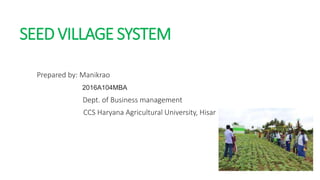
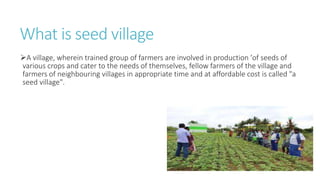
A village, wherein trained group of farmers are involved in production 'of seeds of
various crops and cater to the needs of themselves, fellow farmers of the village and
farmers of neighbouring villages in appropriate time and at affordable cost is called "a
seed village".
Concept
Organizing seed production in cluster (or) compact area
Replacing existing local varieties with new high yielding varieties.
Increasing the seed production
To meet the local demand, timely supply and reasonable cost
Self sufficiency and self reliance of the village
Increasing the seed replacement rate
Features
Seed is available at the door steps of farms at an appropriate time
Seed availability at affordable cost even lesser than market price
Increased confidence among the farmers about the quality because of known
source of production
Producer and consumer are mutually benefited
Facilitates fast spread of new cultivars of different kinds
Establishment of seed village
The present programme of seed village scheme is having two phases
I. Seed production of different crops
II. Establishing seed processing unit
I. Seed production of different crops
Seed village concept is to promote the quality seed production of foundation and
certified seed classes.
The area which is suitable for raising a particular crop will be selected, and raised
with single variety of a kind.
Selection of area
The area with the following facilities will be selected.
1. Irrigation facilities
2. Suitability of climatic conditions to raise the crop for more than one season
3.Labour availability and Knowledge of local farmers on that particular crop
4. Occurrence or out break of pest and diseases
5. Past history of the area for suitability to raise seed crop
6. Average rainfall and distribution
7. Closeness to a urban area for easy movement of seed and other inputs
Seed Supply
Suitable area for seed production will be identified by the Scientists.
The foundation/ certified seeds or University labeled seeds will be supplied by the
University through Krishi Vigyan Kendras (KVKs) and Research Stations at 50% subsidy
cost to the identified farmers in the area.
The farmers will use these quality seeds and take up their own seed production in a
small area (1 acre) for their own use.
The crops are Rice, Pulses and Oilseeds.
Capacity building
In order to harness the synergy between technologies and the community
participation, special emphasis is being given to build farmer's capacity to produce
quality seeds.
A training on seed production and seed technology to the identified farmers for the
seed crops grown in the seed villages will be given for technology empowerment of
farmers.
Training to the farmers
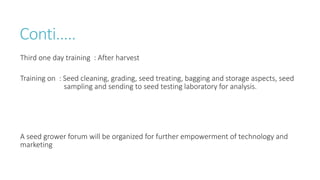
First one day training : At the time of sowing
Training on : Isolation distance, sowing practices, seed treatment, and other
agronomic practices.
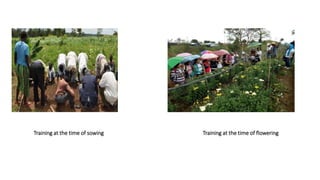
Second one day training : During flowering
Training on : Identifying off types and removal, maintenance of seed plots, plant
protection measures, maturity status and harvesting methods.
Conti…..
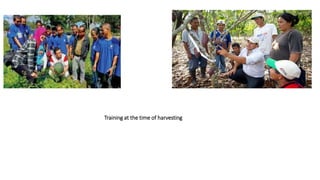
Third one day training : After harvest
Training on : Seed cleaning, grading, seed treating, bagging and storage aspects, seed
sampling and sending to seed testing laboratory for analysis.
A seed grower forum will be organized for further empowerment of technology and
marketing
Training at the time of sowing Training at the time of flowering
Training at the time of harvesting
II. Establishing seed processing unit
Post-harvest seed handling is a vital component of the total technology in marketing
available good quality seeds of improved varieties.
If the seeds are not processed and handled properly, all the past efforts in
production may be lost.
Thus seed processing and packaging is very important aspect in seed production..!
The location of seed processing centres is based on the available infrastructure and
convenience.
Such a place will be well connected with roads and transportation facilities.
Each seed processing centre will have the following
Infrastructure need for seed processing unit
Seed garden cum clearer
Bag closer, trolleys, scales and furniture
Building to house equipment
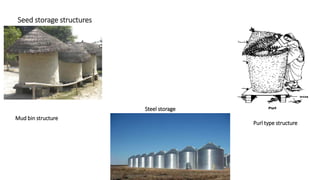
Seed storage structure
Seed threshing and drying yard
Information centre
Seed garden cum clearer
Bag closer
Trolley
Seed storage structures
Mud bin structure
Purl type structure
Steel storage
Advantages
1. Solve the problem of isolation. Mainly in cross pollinated crops like maize, sunflower where it required
more Isolation distance the problem will be solved by raising a single variety in a large area.
2. Mechanization is possible from sowing to harvesting.
3. Post harvest handling of seed is easy.
4. Because of a single variety, the problem of varietal admixture during processing, drying will be avoided
5. Increased food security.
Conti…
5. Seed certification official will cover large area per unit time
6. Totally it reduces the cost of cultivation
7. Seed will be with high genetic, physical purity
Live example
1. Red sorghum :- Ankapur village Nizamabad District
2. Rice seed – Nepal
Seed village ppt