Structure of Technical Writing
• Knowing Your Audience
• Top Down Structure
• Writing Clear Sentences
• Being Concise
• Using the Active Voice
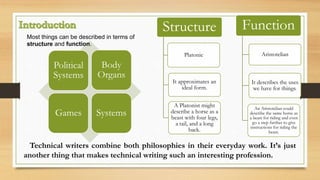
Technical writers combine both philosophies in their everyday work. It’s just
another thing that makes technical writing such an interesting profession.
Political
Systems
Body
Organs
Games Systems
Structure
Platonic
It approximates an
ideal form.
A Platonist might
describe a horse as a
beast with four legs,
a tail, and a long
back.
Function
Aristotelian
It describes the uses
we have for things.
An Aristotelian could
describe the same horse as
a beast for riding and even
go a step further to give
instructions for riding the
beast.
Most things can be described in terms of
structure and function.
Basic Techniques used in Technical Writing
Before ever touching the keyboard or starting to do research, a
technical writer must know for whom they are writing. This is not simply
a matter of saying I’m writing for the end user, but rather, having a
thorough understanding of who will use the document and why.
When defining who the audience is going to be, you must consider the
following points:
• Who and What Level
• Purpose of the Document
• Context
• Organization of the Document
1. Knowing Your Audience
Basic Techniques used in Technical Writing
Who and What Level
Who are you writing for? That is your first question. By knowing who
the audience is, you can immediately start to tailor the information
accordingly.
If you are writing that same manual for someone who does not use
the machine everyday, then steps that the technician would consider
“given” must be included in the manual.
1. Knowing Your Audience
Purpose of the Document. In technical writing, there are three reasons to write a document:
1) To inform
When writing to inform, the writer must convey the required information as quickly and as
concisely as possible. Knowing the target audience helps you decide what information is
required.
2) To complete a task
The user of this type of document wants to complete a task as efficiently as possible and will
not want to know any background information. Repeated reference to the document is
expected.
3) To teach a skill
Teaching a skill means that the end user must have a strong understanding of not only the
actions required but the reasons for them and any other relevant back ground information. Again
what is relevant can be determined by knowing the audience. After reading this document the
end user is able to perform that task with little or no reference to the document.
Determine which of these three your document is going to accomplish.
Basic Techniques used in Technical Writing
Context
Always put the document into a context for the end user. Let them
know why they should read the document and what they will get
out of the reading. They are more likely to actually read the
document if they know what is in it for them. Let’s face it, very few
people read technical manuals for fun.
Chronologically
Order of the tasks to be performed
Order the information appears in the product itself
One layout might be fine for someone try to perform a specific task within a software
suite but might cause anger and frustration in a user trying to perform a different type of
task.
Organization of the Document
Organization of the document refers to the physical layout of the document. The order
the information is presented can change the usability of the document. There are many
different ways to order the information and here are only a few examples:
For example:
A computer user is directed to location “A” within the software.
They are then directed to location “B”, location “C” and then back
to location “A”. Transiting between locations within the software is a
matter of clicking with a mouse. The same layout for a technician
that is trying to shutdown equipment, physically spread out over
four different locations, will not work. The technician will become
frustrated with the manual and stop using it, potentially missing
steps and/or important information.
Ensure that the organization is appropriate for the target audience,
one size does not fit all.
Conclusion
Any technical writer knows that knowing your
audience is the first thing they must do before ever
touching the keyboard, starting the research or
interviewing a subject matter expert. This is the first
and one of the most important steps in technical
writing.
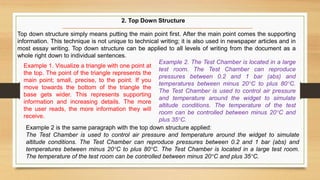
Top down structure simply means putting the main point first. After the main point comes the supporting
information. This technique is not unique to technical writing; it is also used in newspaper articles and in
most essay writing. Top down structure can be applied to all levels of writing from the document as a
whole right down to individual sentences.
Example 2. The Test Chamber is located in a large
test room. The Test Chamber can reproduce
pressures between 0.2 and 1 bar (abs) and
temperatures between minus 20°C to plus 80°C.
The Test Chamber is used to control air pressure
and temperature around the widget to simulate
altitude conditions. The temperature of the test
room can be controlled between minus 20°C and
plus 35°C.
Example 1. Visualize a triangle with one point at
the top. The point of the triangle represents the
main point; small, precise, to the point. If you
move towards the bottom of the triangle the
base gets wider. This represents supporting
information and increasing details. The more
the user reads, the more information they will
receive.
Example 2 is the same paragraph with the top down structure applied:
The Test Chamber is used to control air pressure and temperature around the widget to simulate
altitude conditions. The Test Chamber can reproduce pressures between 0.2 and 1 bar (abs) and
temperatures between minus 20°C to plus 80°C. The Test Chamber is located in a large test room.
The temperature of the test room can be controlled between minus 20°C and plus 35°C.
2. Top Down Structure
1) Easy to navigate
By having the main point first, the user can
quickly scan a section of information and
determine if this is the information they need.
They do not need to read four or five sentences
before they get to the heart of the matter. If they
are scanning large sections of a document, the
four or five sentences can add up quickly. In the
given example, a quick scan would tell the
reader that the paragraph is about the Test
Chamber. If they are not looking for that
information they stop reading after the first
sentence and move on.
chamber was for, they can stop after the first
sentence. If they needed to know the
temperature or pressure ranges of the
chamber, they must read further. If they also
need to know where the test chamber is
located they will read the entire paragraph.
Top down structure is a very simple principle
but it is vital for technical writing. Without this
structure, the end user would be forced to read
entire technical documents to find the
information they need. The reality is that no
one is willing to do that. Your document might
have the best information ever written about a
particular subject but if it isn’t easy to navigate
or if the information is buried under loads of
other information, no one will read the manual.
If no one is going to read the manual, there is
no point in writing the manual.
There are two reasons to use the top down structure in technical writing.
2) Reader only reads what they need
The reader gets to the main point right away and
can stop reading once they have the information
they need. Again, most people do not read
technical documents for fun. In the example, if
the user simply needed to know what the test
Good writing is like sculpting. Sculpting your sentences is like making the
light dance around the curves of your beautiful nude. You eliminate excess
words to create an enjoyable rhythm and a pleasurable reader experience.
You allow your readers to dance through your content, feeling light and airy.
You communicate your message with more clarity and strength.
Sound good?
To practice your sculpting skills, don’t work on a long piece of text. Instead,
work on a headline, an opening or closing paragraph. Consider writing each
sentence on a new line, so focusing your attention on each sentence
becomes easier.
And the key trick?
Instead of trying to spot weak words, focus on meaningful words first.
Here’s how you shall do it.
3. Writing Clear Sentences.
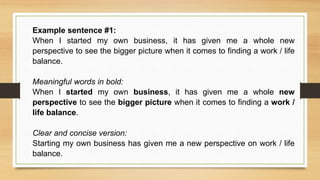
Example sentence #1:
When I started my own business, it has given me a whole new
perspective to see the bigger picture when it comes to finding a work / life
balance.
Meaningful words in bold:
When I started my own business, it has given me a whole new
perspective to see the bigger picture when it comes to finding a work /
life balance.
Clear and concise version:
Starting my own business has given me a new perspective on work / life
balance.
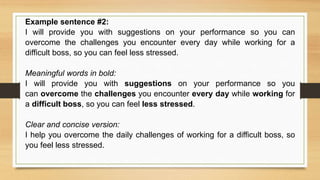
Example sentence #2:
I will provide you with suggestions on your performance so you can
overcome the challenges you encounter every day while working for a
difficult boss, so you can feel less stressed.
Meaningful words in bold:
I will provide you with suggestions on your performance so you
can overcome the challenges you encounter every day while working for
a difficult boss, so you can feel less stressed.
Clear and concise version:
I help you overcome the daily challenges of working for a difficult boss, so
you feel less stressed.
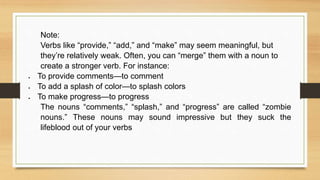
Note:
Verbs like “provide,” “add,” and “make” may seem meaningful, but
they’re relatively weak. Often, you can “merge” them with a noun to
create a stronger verb. For instance:
 To provide comments—to comment
 To add a splash of color—to splash colors
 To make progress—to progress
The nouns “comments,” “splash,” and “progress” are called “zombie
nouns.” These nouns may sound impressive but they suck the
lifeblood out of your verbs
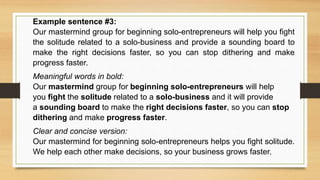
Example sentence #3:
Our mastermind group for beginning solo-entrepreneurs will help you fight
the solitude related to a solo-business and provide a sounding board to
make the right decisions faster, so you can stop dithering and make
progress faster.
Meaningful words in bold:
Our mastermind group for beginning solo-entrepreneurs will help
you fight the solitude related to a solo-business and it will provide
a sounding board to make the right decisions faster, so you can stop
dithering and make progress faster.
Clear and concise version:
Our mastermind for beginning solo-entrepreneurs helps you fight solitude.
We help each other make decisions, so your business grows faster.
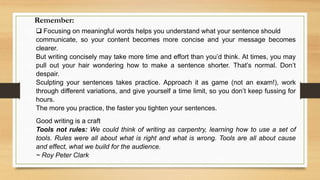
 Focusing on meaningful words helps you understand what your sentence should
communicate, so your content becomes more concise and your message becomes
clearer.
But writing concisely may take more time and effort than you’d think. At times, you may
pull out your hair wondering how to make a sentence shorter. That’s normal. Don’t
despair.
Sculpting your sentences takes practice. Approach it as game (not an exam!), work
through different variations, and give yourself a time limit, so you don’t keep fussing for
hours.
The more you practice, the faster you tighten your sentences.
Good writing is a craft
Tools not rules: We could think of writing as carpentry, learning how to use a set of
tools. Rules were all about what is right and what is wrong. Tools are all about cause
and effect, what we build for the audience.
~ Roy Peter Clark
Remember:
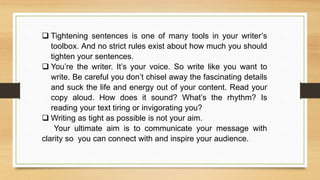
 Tightening sentences is one of many tools in your writer’s
toolbox. And no strict rules exist about how much you should
tighten your sentences.
 You’re the writer. It’s your voice. So write like you want to
write. Be careful you don’t chisel away the fascinating details
and suck the life and energy out of your content. Read your
copy aloud. How does it sound? What’s the rhythm? Is
reading your text tiring or invigorating you?
 Writing as tight as possible is not your aim.
Your ultimate aim is to communicate your message with
clarity so you can connect with and inspire your audience.
4. Being Concise
Being concise involves stating only the important information and avoiding irrelevant
details. Here are a few tips to help you write concisely.
1. Start your letter with a statement that contains the purpose of the letter. Here are
some phrases you can use for specific purposes, such as:
• Asking for information: I would like some more information about …
• Making a request: Please send me …; I would be grateful if you could …
• Responding to a previous message: Thank you for your letter dated March 16, 2010
• Sending an attachment: Please find attached …
2. Use single words instead of phrases with a lot of prepositions. For example:
• Use because instead of as a result of
• Use regarding instead of with regard to
• Use to or for instead of for the purpose of
• Use if instead of in the event that
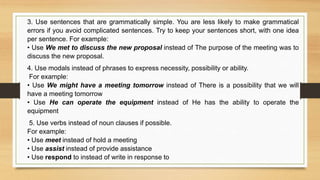
3. Use sentences that are grammatically simple. You are less likely to make grammatical
errors if you avoid complicated sentences. Try to keep your sentences short, with one idea
per sentence. For example:
• Use We met to discuss the new proposal instead of The purpose of the meeting was to
discuss the new proposal.
4. Use modals instead of phrases to express necessity, possibility or ability.
For example:
• Use We might have a meeting tomorrow instead of There is a possibility that we will
have a meeting tomorrow
• Use He can operate the equipment instead of He has the ability to operate the
equipment
5. Use verbs instead of noun clauses if possible.
For example:
• Use meet instead of hold a meeting
• Use assist instead of provide assistance
• Use respond to instead of write in response to
Generally, try to use the active voice whenever possible. Passive voice sentences often
use more words, can be vague, and can lead to a tangle of prepositional phrases.
ACTIVE VS. PASSIVE VOICE
In a sentence written in the active voice, the subject of sentence performs the action.
In a sentence written in the passive voice the subject receives the action.
Active: The candidate believes that Congress must place a ceiling on the budget.
Passive: It is believed by the candidate that a ceiling must be placed on the budget
by Congress.
Active: Researchers earlier showed that high stress can cause heart attacks.
Passive: It was earlier demonstrated that heart attacks can be caused by high
stress.
Active: The dog bit the man.
Passive: The man was bitten by the dog.
5. Use the Active Voice
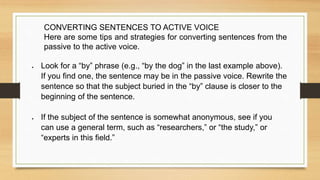
CONVERTING SENTENCES TO ACTIVE VOICE
Here are some tips and strategies for converting sentences from the
passive to the active voice.
 Look for a “by” phrase (e.g., “by the dog” in the last example above).
If you find one, the sentence may be in the passive voice. Rewrite the
sentence so that the subject buried in the “by” clause is closer to the
beginning of the sentence.
 If the subject of the sentence is somewhat anonymous, see if you
can use a general term, such as “researchers,” or “the study,” or
“experts in this field.”
WHEN TO USE PASSIVE VOICE
There are sometimes good reasons to use the passive voice.
1. TO EMPHASIZE THE ACTION RATHER THAN THE ACTOR
After long debate, the proposal was endorsed by the long-range planning committee.
2. TO KEEP THE SUBJECT AND FOCUS CONSISTENT THROUGHOUT A PASSAGE
The data processing department recently presented what proved to be a controversial
proposal to expand its staff. After long debate, the proposal was endorsed by . . . .
3. TO BE TACTFUL BY NOT NAMING THE ACTOR
The procedures were somehow misinterpreted.
4. TO DESCRIBE A CONDITION IN WHICH THE ACTOR IS UNKNOWN OR
UNIMPORTANT
Every year, thousands of people are diagnosed as having cancer.
5. TO CREATE AN AUTHORITATIVE TONE
Visitors are not allowed after 9:00 p.m.
EVALUATION
Change the sentences from active to passive.
1. The Supreme Court reviewed the 1987 Philippine Constitution.
2. Sally took the letter to the mailbox.
3. John painted the house last week.
4. People drink Champagne on New Year’s Eve.
5. Chefs use these machines to mix the ingredients.
REFERENCE
Alcantara, R. D., et al (2003). Teaching Strategies for Teaching the Communication Arts. Katha
Publishing Co., Inc. Makati City.
Brumfit, C.J and Johnson, K. (1979). The Communicative Approach to Language Teaching, London:
Oxford University Press.
DuPuis, T. (2017) Technical Writing for Engineers. University of Colorado
Dutton, J.A. (2014). Effetive Technical Writing in the Information Age. Penn State College of Earth
and Mineral Sciences. Pennsylvania
Morgan, K. (2015). Technical Writing Process. Better On Paper Publications. Downloaded from
books.google.com.ph
Van Aken, D.C. and Hosford, W.F. The Elements of Technical writing. Cambridge University Press

SEE-20-STRUCTURE-OF-Technical writing.pptx

  • 1.
    Structure of TechnicalWriting • Knowing Your Audience • Top Down Structure • Writing Clear Sentences • Being Concise • Using the Active Voice
  • 2.
    Technical writers combineboth philosophies in their everyday work. It’s just another thing that makes technical writing such an interesting profession. Political Systems Body Organs Games Systems Structure Platonic It approximates an ideal form. A Platonist might describe a horse as a beast with four legs, a tail, and a long back. Function Aristotelian It describes the uses we have for things. An Aristotelian could describe the same horse as a beast for riding and even go a step further to give instructions for riding the beast. Most things can be described in terms of structure and function.
  • 3.
    Basic Techniques usedin Technical Writing Before ever touching the keyboard or starting to do research, a technical writer must know for whom they are writing. This is not simply a matter of saying I’m writing for the end user, but rather, having a thorough understanding of who will use the document and why. When defining who the audience is going to be, you must consider the following points: • Who and What Level • Purpose of the Document • Context • Organization of the Document 1. Knowing Your Audience
  • 4.
    Basic Techniques usedin Technical Writing Who and What Level Who are you writing for? That is your first question. By knowing who the audience is, you can immediately start to tailor the information accordingly. If you are writing that same manual for someone who does not use the machine everyday, then steps that the technician would consider “given” must be included in the manual. 1. Knowing Your Audience
  • 5.
    Purpose of theDocument. In technical writing, there are three reasons to write a document: 1) To inform When writing to inform, the writer must convey the required information as quickly and as concisely as possible. Knowing the target audience helps you decide what information is required. 2) To complete a task The user of this type of document wants to complete a task as efficiently as possible and will not want to know any background information. Repeated reference to the document is expected. 3) To teach a skill Teaching a skill means that the end user must have a strong understanding of not only the actions required but the reasons for them and any other relevant back ground information. Again what is relevant can be determined by knowing the audience. After reading this document the end user is able to perform that task with little or no reference to the document. Determine which of these three your document is going to accomplish. Basic Techniques used in Technical Writing
  • 6.
    Context Always put thedocument into a context for the end user. Let them know why they should read the document and what they will get out of the reading. They are more likely to actually read the document if they know what is in it for them. Let’s face it, very few people read technical manuals for fun.
  • 7.
    Chronologically Order of thetasks to be performed Order the information appears in the product itself One layout might be fine for someone try to perform a specific task within a software suite but might cause anger and frustration in a user trying to perform a different type of task. Organization of the Document Organization of the document refers to the physical layout of the document. The order the information is presented can change the usability of the document. There are many different ways to order the information and here are only a few examples:
  • 8.
    For example: A computeruser is directed to location “A” within the software. They are then directed to location “B”, location “C” and then back to location “A”. Transiting between locations within the software is a matter of clicking with a mouse. The same layout for a technician that is trying to shutdown equipment, physically spread out over four different locations, will not work. The technician will become frustrated with the manual and stop using it, potentially missing steps and/or important information. Ensure that the organization is appropriate for the target audience, one size does not fit all.
  • 9.
    Conclusion Any technical writerknows that knowing your audience is the first thing they must do before ever touching the keyboard, starting the research or interviewing a subject matter expert. This is the first and one of the most important steps in technical writing.
  • 10.
    Top down structuresimply means putting the main point first. After the main point comes the supporting information. This technique is not unique to technical writing; it is also used in newspaper articles and in most essay writing. Top down structure can be applied to all levels of writing from the document as a whole right down to individual sentences. Example 2. The Test Chamber is located in a large test room. The Test Chamber can reproduce pressures between 0.2 and 1 bar (abs) and temperatures between minus 20°C to plus 80°C. The Test Chamber is used to control air pressure and temperature around the widget to simulate altitude conditions. The temperature of the test room can be controlled between minus 20°C and plus 35°C. Example 1. Visualize a triangle with one point at the top. The point of the triangle represents the main point; small, precise, to the point. If you move towards the bottom of the triangle the base gets wider. This represents supporting information and increasing details. The more the user reads, the more information they will receive. Example 2 is the same paragraph with the top down structure applied: The Test Chamber is used to control air pressure and temperature around the widget to simulate altitude conditions. The Test Chamber can reproduce pressures between 0.2 and 1 bar (abs) and temperatures between minus 20°C to plus 80°C. The Test Chamber is located in a large test room. The temperature of the test room can be controlled between minus 20°C and plus 35°C. 2. Top Down Structure
  • 11.
    1) Easy tonavigate By having the main point first, the user can quickly scan a section of information and determine if this is the information they need. They do not need to read four or five sentences before they get to the heart of the matter. If they are scanning large sections of a document, the four or five sentences can add up quickly. In the given example, a quick scan would tell the reader that the paragraph is about the Test Chamber. If they are not looking for that information they stop reading after the first sentence and move on. chamber was for, they can stop after the first sentence. If they needed to know the temperature or pressure ranges of the chamber, they must read further. If they also need to know where the test chamber is located they will read the entire paragraph. Top down structure is a very simple principle but it is vital for technical writing. Without this structure, the end user would be forced to read entire technical documents to find the information they need. The reality is that no one is willing to do that. Your document might have the best information ever written about a particular subject but if it isn’t easy to navigate or if the information is buried under loads of other information, no one will read the manual. If no one is going to read the manual, there is no point in writing the manual. There are two reasons to use the top down structure in technical writing. 2) Reader only reads what they need The reader gets to the main point right away and can stop reading once they have the information they need. Again, most people do not read technical documents for fun. In the example, if the user simply needed to know what the test
  • 12.
    Good writing islike sculpting. Sculpting your sentences is like making the light dance around the curves of your beautiful nude. You eliminate excess words to create an enjoyable rhythm and a pleasurable reader experience. You allow your readers to dance through your content, feeling light and airy. You communicate your message with more clarity and strength. Sound good? To practice your sculpting skills, don’t work on a long piece of text. Instead, work on a headline, an opening or closing paragraph. Consider writing each sentence on a new line, so focusing your attention on each sentence becomes easier. And the key trick? Instead of trying to spot weak words, focus on meaningful words first. Here’s how you shall do it. 3. Writing Clear Sentences.
  • 13.
    Example sentence #1: WhenI started my own business, it has given me a whole new perspective to see the bigger picture when it comes to finding a work / life balance. Meaningful words in bold: When I started my own business, it has given me a whole new perspective to see the bigger picture when it comes to finding a work / life balance. Clear and concise version: Starting my own business has given me a new perspective on work / life balance.
  • 14.
    Example sentence #2: Iwill provide you with suggestions on your performance so you can overcome the challenges you encounter every day while working for a difficult boss, so you can feel less stressed. Meaningful words in bold: I will provide you with suggestions on your performance so you can overcome the challenges you encounter every day while working for a difficult boss, so you can feel less stressed. Clear and concise version: I help you overcome the daily challenges of working for a difficult boss, so you feel less stressed.
  • 15.
    Note: Verbs like “provide,”“add,” and “make” may seem meaningful, but they’re relatively weak. Often, you can “merge” them with a noun to create a stronger verb. For instance:  To provide comments—to comment  To add a splash of color—to splash colors  To make progress—to progress The nouns “comments,” “splash,” and “progress” are called “zombie nouns.” These nouns may sound impressive but they suck the lifeblood out of your verbs
  • 16.
    Example sentence #3: Ourmastermind group for beginning solo-entrepreneurs will help you fight the solitude related to a solo-business and provide a sounding board to make the right decisions faster, so you can stop dithering and make progress faster. Meaningful words in bold: Our mastermind group for beginning solo-entrepreneurs will help you fight the solitude related to a solo-business and it will provide a sounding board to make the right decisions faster, so you can stop dithering and make progress faster. Clear and concise version: Our mastermind for beginning solo-entrepreneurs helps you fight solitude. We help each other make decisions, so your business grows faster.
  • 17.
     Focusing onmeaningful words helps you understand what your sentence should communicate, so your content becomes more concise and your message becomes clearer. But writing concisely may take more time and effort than you’d think. At times, you may pull out your hair wondering how to make a sentence shorter. That’s normal. Don’t despair. Sculpting your sentences takes practice. Approach it as game (not an exam!), work through different variations, and give yourself a time limit, so you don’t keep fussing for hours. The more you practice, the faster you tighten your sentences. Good writing is a craft Tools not rules: We could think of writing as carpentry, learning how to use a set of tools. Rules were all about what is right and what is wrong. Tools are all about cause and effect, what we build for the audience. ~ Roy Peter Clark Remember:
  • 18.
     Tightening sentencesis one of many tools in your writer’s toolbox. And no strict rules exist about how much you should tighten your sentences.  You’re the writer. It’s your voice. So write like you want to write. Be careful you don’t chisel away the fascinating details and suck the life and energy out of your content. Read your copy aloud. How does it sound? What’s the rhythm? Is reading your text tiring or invigorating you?  Writing as tight as possible is not your aim. Your ultimate aim is to communicate your message with clarity so you can connect with and inspire your audience.
  • 19.
    4. Being Concise Beingconcise involves stating only the important information and avoiding irrelevant details. Here are a few tips to help you write concisely. 1. Start your letter with a statement that contains the purpose of the letter. Here are some phrases you can use for specific purposes, such as: • Asking for information: I would like some more information about … • Making a request: Please send me …; I would be grateful if you could … • Responding to a previous message: Thank you for your letter dated March 16, 2010 • Sending an attachment: Please find attached … 2. Use single words instead of phrases with a lot of prepositions. For example: • Use because instead of as a result of • Use regarding instead of with regard to • Use to or for instead of for the purpose of • Use if instead of in the event that
  • 20.
    3. Use sentencesthat are grammatically simple. You are less likely to make grammatical errors if you avoid complicated sentences. Try to keep your sentences short, with one idea per sentence. For example: • Use We met to discuss the new proposal instead of The purpose of the meeting was to discuss the new proposal. 4. Use modals instead of phrases to express necessity, possibility or ability. For example: • Use We might have a meeting tomorrow instead of There is a possibility that we will have a meeting tomorrow • Use He can operate the equipment instead of He has the ability to operate the equipment 5. Use verbs instead of noun clauses if possible. For example: • Use meet instead of hold a meeting • Use assist instead of provide assistance • Use respond to instead of write in response to
  • 21.
    Generally, try touse the active voice whenever possible. Passive voice sentences often use more words, can be vague, and can lead to a tangle of prepositional phrases. ACTIVE VS. PASSIVE VOICE In a sentence written in the active voice, the subject of sentence performs the action. In a sentence written in the passive voice the subject receives the action. Active: The candidate believes that Congress must place a ceiling on the budget. Passive: It is believed by the candidate that a ceiling must be placed on the budget by Congress. Active: Researchers earlier showed that high stress can cause heart attacks. Passive: It was earlier demonstrated that heart attacks can be caused by high stress. Active: The dog bit the man. Passive: The man was bitten by the dog. 5. Use the Active Voice
  • 22.
    CONVERTING SENTENCES TOACTIVE VOICE Here are some tips and strategies for converting sentences from the passive to the active voice.  Look for a “by” phrase (e.g., “by the dog” in the last example above). If you find one, the sentence may be in the passive voice. Rewrite the sentence so that the subject buried in the “by” clause is closer to the beginning of the sentence.  If the subject of the sentence is somewhat anonymous, see if you can use a general term, such as “researchers,” or “the study,” or “experts in this field.”
  • 23.
    WHEN TO USEPASSIVE VOICE There are sometimes good reasons to use the passive voice. 1. TO EMPHASIZE THE ACTION RATHER THAN THE ACTOR After long debate, the proposal was endorsed by the long-range planning committee. 2. TO KEEP THE SUBJECT AND FOCUS CONSISTENT THROUGHOUT A PASSAGE The data processing department recently presented what proved to be a controversial proposal to expand its staff. After long debate, the proposal was endorsed by . . . . 3. TO BE TACTFUL BY NOT NAMING THE ACTOR The procedures were somehow misinterpreted. 4. TO DESCRIBE A CONDITION IN WHICH THE ACTOR IS UNKNOWN OR UNIMPORTANT Every year, thousands of people are diagnosed as having cancer. 5. TO CREATE AN AUTHORITATIVE TONE Visitors are not allowed after 9:00 p.m.
  • 24.
    EVALUATION Change the sentencesfrom active to passive. 1. The Supreme Court reviewed the 1987 Philippine Constitution. 2. Sally took the letter to the mailbox. 3. John painted the house last week. 4. People drink Champagne on New Year’s Eve. 5. Chefs use these machines to mix the ingredients.
  • 25.
    REFERENCE Alcantara, R. D.,et al (2003). Teaching Strategies for Teaching the Communication Arts. Katha Publishing Co., Inc. Makati City. Brumfit, C.J and Johnson, K. (1979). The Communicative Approach to Language Teaching, London: Oxford University Press. DuPuis, T. (2017) Technical Writing for Engineers. University of Colorado Dutton, J.A. (2014). Effetive Technical Writing in the Information Age. Penn State College of Earth and Mineral Sciences. Pennsylvania Morgan, K. (2015). Technical Writing Process. Better On Paper Publications. Downloaded from books.google.com.ph Van Aken, D.C. and Hosford, W.F. The Elements of Technical writing. Cambridge University Press