The perception of information security
in a modern business.
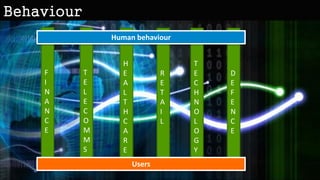
Behaviour
F
I
N
A
N
C
E
T
E
L
E
C
O
M
M
S
H
E
A
L
T
H
C
A
R
E
R
E
T
A
I
L
T
E
C
H
N
O
L
O
G
Y
D
E
F
E
N
C
E
Users
Human behaviour
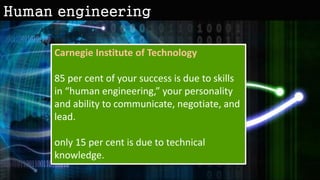
Human engineering
Carnegie Institute of Technology
85 per cent of your success is due to skills
in “human engineering,” your personality
and ability to communicate, negotiate, and
lead.
only 15 per cent is due to technical
knowledge.
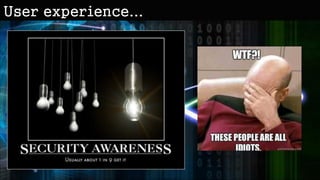
User experience...
5
Effective security changes peoples behaviour in a subtle way. Behavioural
psychology is becoming even more important for security practitioners, helping to
influence executive decisions, and also to change peoples perspectives around
security, and its misconceptions. Ultimately reducing risk, increasing value, and
saving time.
You need to win hearts and minds. To do that, think differently…
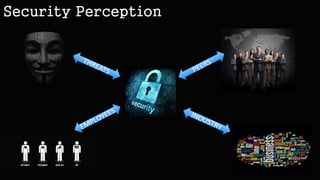
Security Perception
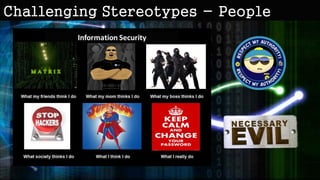
Challenging Stereotypes
7
Survival of the fittest
Information Security just like the business or brand it protects, must evolve and become best
“fitted,” or best “adapted,” to its environment for it to survive, and help the business to grow.
The evolution of security
AGILEFLEXIBLE
ADAPT OR DIE
ADAPTABLE BOLD
Fortress Mentality
STATIC
SLOW
INEFFICIENT
Flexible Framework
AGILE
ADAPTABLE
EVOLVING
Security as a brand
11
Security PR – spin doctors
By making security engaging, it gains more acceptance.
Security should be a positive experience for the majority of people
Acceptance, is not only good for the business, it is good for you.
Try to make security fun for your constituents, while still getting the “message” across.
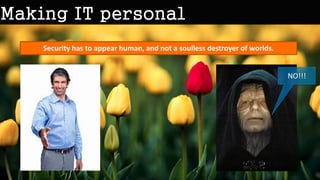
Making IT personal
Security has to appear human, and not a soulless destroyer of worlds.
NO!!!
IT Savvy – only human
I have won a
free iPad!
O’Really…
The Art of
Seduction*
*or, “How Information Security can improve your sex life.”
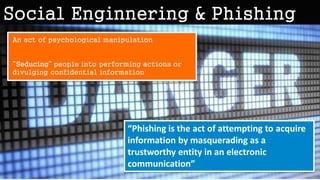
“Phishing is the act of attempting to acquire
information by masquerading as a
trustworthy entity in an electronic
communication”
Social Enginnering & Phishing
16
Who engages in social engineeringWho Uses Social Engineering
We All do.
HACKERS
POLITICIANS
SALESMEN
SPIES
SCAM / CON MEN
PUA
ACTORS
MARKETERS
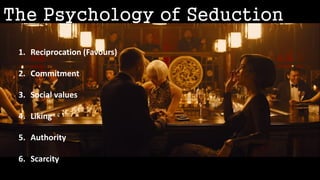
The Psychology of Seduction
1. Reciprocation (Favours)
2. Commitment
3. Social values
4. Liking
5. Authority
6. Scarcity
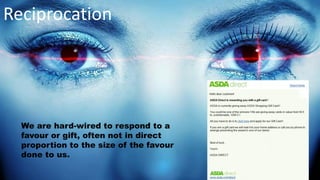
Reciprocation
We are hard-wired to respond to a
favour or gift, often not in direct
proportion to the size of the favour
done to us.
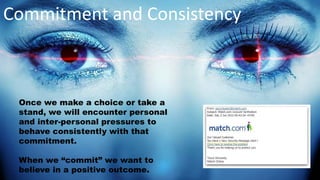
Commitment and Consistency
Once we make a choice or take a
stand, we will encounter personal
and inter-personal pressures to
behave consistently with that
commitment.
When we “commit” we want to
believe in a positive outcome.
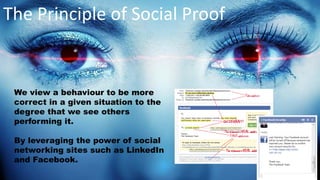
The Principle of Social Proof
We view a behaviour to be more
correct in a given situation to the
degree that we see others
performing it.
By leveraging the power of social
networking sites such as LinkedIn
and Facebook.
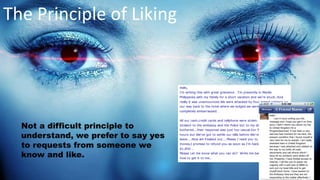
The Principle of Liking
Not a difficult principle to
understand, we prefer to say yes
to requests from someone we
know and like.
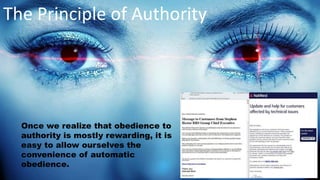
The Principle of Authority
Once we realize that obedience to
authority is mostly rewarding, it is
easy to allow ourselves the
convenience of automatic
obedience.
The Principle of Scarcity
One of the most common tactics
is to build time pressure. The
scarcity of time often makes
people comply with requests in
violation of their policies and their
own common sense.
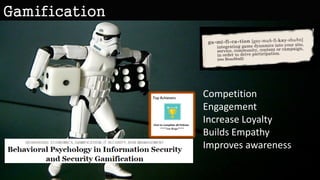
Gamification
Competition
Engagement
Increase Loyalty
Builds Empathy
Improves awareness
Trick or Treat
Positive reinforcement
Negative reinforcement
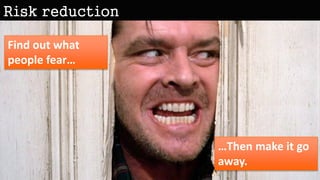
Risk reduction
Find out what
people fear…
…Then make it go
away.
test
Waterhole’s
Social proof = Social behaviour = your social profile
Creatures of habit
Social engineering and phishing
works, as we are programmed to
have “rituals”, and the majority of
things we do day to day are
habitual.
Rituals = Patterns of behaviour
Same websites Favourite food
FriendshipsSocial networks
Waterholes exploit your social
patterns, behaviour and rituals.
Asymmetric warfare
INTERNET
Home network Corporate network
Asymmetric warfare
Friends and Family
The art of Seduction
Seducers draw you in by focused individualised attention
Choose the right victim – study your prey thoroughly and choose
only those susceptible to your charms
Create a false sense of security – if you are too direct early on, you
risk stirring up resistance and that will never be lowered
An object of desire – to draw your victim closer, create an aura of
desirability
Create temptation – find the weakness of theirs, keep it vague and
stimulate curiosity
Pay attention to detail – the details of seduction, subtle gestures,
thoughtful gifts tailored for them
Recap
THANK YOU

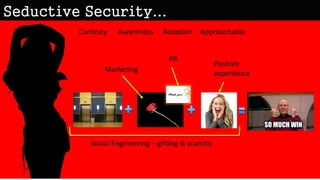
Seductive security - Art of seduction

  • 1.
    The perception ofinformation security in a modern business.
  • 2.
  • 3.
    Human engineering Carnegie Instituteof Technology 85 per cent of your success is due to skills in “human engineering,” your personality and ability to communicate, negotiate, and lead. only 15 per cent is due to technical knowledge.
  • 4.
  • 5.
    5 Effective security changespeoples behaviour in a subtle way. Behavioural psychology is becoming even more important for security practitioners, helping to influence executive decisions, and also to change peoples perspectives around security, and its misconceptions. Ultimately reducing risk, increasing value, and saving time. You need to win hearts and minds. To do that, think differently… Security Perception
  • 6.
  • 7.
    7 Survival of thefittest Information Security just like the business or brand it protects, must evolve and become best “fitted,” or best “adapted,” to its environment for it to survive, and help the business to grow. The evolution of security AGILEFLEXIBLE ADAPT OR DIE ADAPTABLE BOLD
  • 8.
  • 9.
  • 10.
  • 11.
    11 Security PR –spin doctors By making security engaging, it gains more acceptance. Security should be a positive experience for the majority of people Acceptance, is not only good for the business, it is good for you. Try to make security fun for your constituents, while still getting the “message” across.
  • 12.
    Making IT personal Securityhas to appear human, and not a soulless destroyer of worlds. NO!!!
  • 13.
    IT Savvy –only human I have won a free iPad! O’Really…
  • 14.
    The Art of Seduction* *or,“How Information Security can improve your sex life.”
  • 15.
    “Phishing is theact of attempting to acquire information by masquerading as a trustworthy entity in an electronic communication” Social Enginnering & Phishing
  • 16.
    16 Who engages insocial engineeringWho Uses Social Engineering We All do. HACKERS POLITICIANS SALESMEN SPIES SCAM / CON MEN PUA ACTORS MARKETERS
  • 17.
    The Psychology ofSeduction 1. Reciprocation (Favours) 2. Commitment 3. Social values 4. Liking 5. Authority 6. Scarcity
  • 18.
    Reciprocation We are hard-wiredto respond to a favour or gift, often not in direct proportion to the size of the favour done to us.
  • 19.
    Commitment and Consistency Oncewe make a choice or take a stand, we will encounter personal and inter-personal pressures to behave consistently with that commitment. When we “commit” we want to believe in a positive outcome.
  • 20.
    The Principle ofSocial Proof We view a behaviour to be more correct in a given situation to the degree that we see others performing it. By leveraging the power of social networking sites such as LinkedIn and Facebook.
  • 21.
    The Principle ofLiking Not a difficult principle to understand, we prefer to say yes to requests from someone we know and like.
  • 22.
    The Principle ofAuthority Once we realize that obedience to authority is mostly rewarding, it is easy to allow ourselves the convenience of automatic obedience.
  • 23.
    The Principle ofScarcity One of the most common tactics is to build time pressure. The scarcity of time often makes people comply with requests in violation of their policies and their own common sense.
  • 24.
  • 25.
    Trick or Treat Positivereinforcement Negative reinforcement
  • 26.
    Risk reduction Find outwhat people fear… …Then make it go away.
  • 27.
    test Waterhole’s Social proof =Social behaviour = your social profile
  • 28.
    Creatures of habit Socialengineering and phishing works, as we are programmed to have “rituals”, and the majority of things we do day to day are habitual. Rituals = Patterns of behaviour Same websites Favourite food FriendshipsSocial networks Waterholes exploit your social patterns, behaviour and rituals.
  • 29.
  • 30.
  • 31.
    The art ofSeduction Seducers draw you in by focused individualised attention Choose the right victim – study your prey thoroughly and choose only those susceptible to your charms Create a false sense of security – if you are too direct early on, you risk stirring up resistance and that will never be lowered An object of desire – to draw your victim closer, create an aura of desirability Create temptation – find the weakness of theirs, keep it vague and stimulate curiosity Pay attention to detail – the details of seduction, subtle gestures, thoughtful gifts tailored for them
  • 32.