Sedative and hypnotic
• Sedative – Decreases activity
Moderates excitements
Calms the recipient
• Hypnotic – Drug produces drowsiness
Facilitates the onset and maintenance of
a state of sleep
Resembles natural sleep
Sleep
The duration and pattern of sleep varies considerably among individuals. Age has
an important effect on quantity and depth of sleep.
The different phases of sleep and their characteristics are—
Stage 0
Stage 1
Stage 2
Stage 3
Stage 4
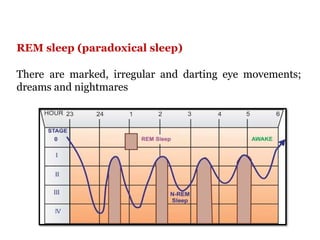
REM sleep (paradoxical sleep)
There are marked, irregular and darting eye movements;
dreams and nightmares
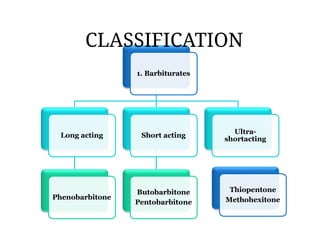
1. Barbiturates
Long acting
Phenobarbitone
Short acting
Butobarbitone
Pentobarbitone
Ultra-
shortacting
Thiopentone
Methohexitone
CLASSIFICATION
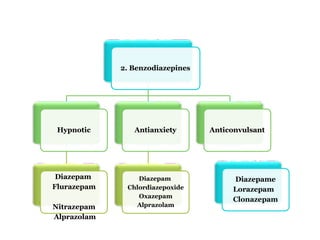
2. Benzodiazepines
Hypnotic
Diazepam
Flurazepam
Nitrazepam
Alprazolam
Antianxiety
Diazepam
Chlordiazepoxide
Oxazepam
Alprazolam
Anticonvulsant
Diazepame
Lorazepam
Clonazepam
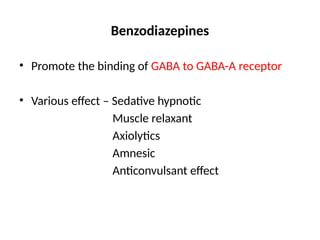
Benzodiazepines
• Promote the binding of GABA to GABA-A receptor
• Various effect – Sedative hypnotic
Muscle relaxant
Axiolytics
Amnesic
Anticonvulsant effect
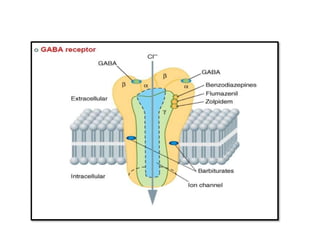
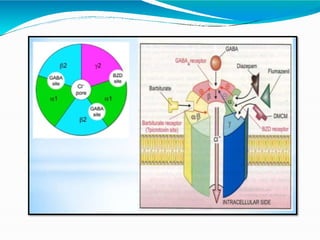
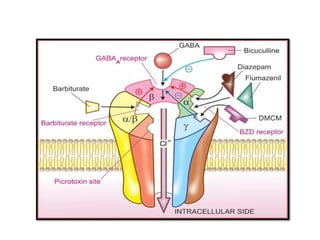
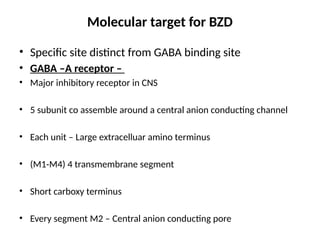
Molecular target for BZD
• Specific site distinct from GABA binding site
• GABA –A receptor –
• Major inhibitory receptor in CNS
• 5 subunit co assemble around a central anion conducting channel
• Each unit – Large extracelluar amino terminus
• (M1-M4) 4 transmembrane segment
• Short carboxy terminus
• Every segment M2 – Central anion conducting pore
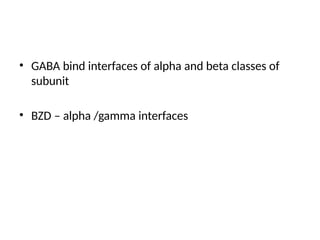
• GABA bind interfaces of alpha and beta classes of
subunit
• BZD – alpha /gamma interfaces
Effects of BZD on GABA –A receptor mediated
events
• Allosteric modulators of GABA-A receptors function
• Increases the affinity of GABA-A receptors for GABA
• Therefore inhance GABA chloride current
Channel Kinetics
• Frequency of opening of channel increase
• Inverse agonist opposite work
Decrease frequency and binding
• Antagonist – Flumazenil
• GABA binding antagonist - Bicuculline
BZD vs Barbiturates at GABA –A receptors
• Barbiturates: Act to enhance GABA A receptors
function at low micromolar con.
• Both enhance GABA stimulated Cl channel function
• Barbiturates – Higher con of barbiturates directly
activate GABA A receptors
Pharmacological properties of BZD
• CNS effect – Sedation ,hypnosis ,dec.
anxiety ,muscle relaxant ,anterograde amnesia
and anticonvulsant activity
• Pheriphery –Coronary vasodilatation
NM Block (inc dose)
• CNS effects –
 Depress activity
 Sedation – Hypnosis – stupor – coma
 Induce hypotonia
 Clonazepam – Non sedative dose cause muscle relaxation
 BZD – Inhibit Sz activity – Pentylenetetrazol,Picrotoxin
Effects on the electroencephalogram and sleep
stages
• Alpha rhythm activity is dec
• Dec sleep latency
• Inc arousal threshold from sleep
• Stage 1 dec
• Stage 3 and 4 dec
• Time spent in REM sleep shortened
• No. of cycle of REM sleep inc
• Inc total sleep time (stage 2 NREM)
Systemic effects
• Respiration – Hypnotic dose – No effect
• Higher doses – Preanesthetic medication or
endoscopy
• Slightly depress alveolar ventilation and cause
respiratory acidosis
• Cause- Alveolar hypoxia
CO2 narcosis
CVS- Dec BP, Inc HR and coronary flow
Pharmacokinetics
• Absorbed completely except clorazepate
• Clorazepate – Decarboxylated rapidly in gastric juice
to N-desmethyldiazepam (nordazepam)
• A/c elimination t1/2 :
• Ultrashort -Remimazolam
• Short acting (t1/2 <6hr) – Midazolam ,triazolam
Non BZD – Zolpidem ,Eszopiclone
• Intermediate –t1/2-6-24hr-
Estazolam
Temazepam
• Long acting t1/2 hr >24hr-
Flurazepam (metabolite –N-des-alkyl flurazepam
t1/2 -47-100hr)
Diazepam
Quazepam
• Cross BBB and secreted into breast milk
• CYP3A4 Inhibitors-
o Erythromycin
o Clarithromycin
o Ritonavir
o Itraconazol
o Ketoconazol
o Nefazolone
o Grapejuice
Metabolism-3 Phases
• Modification or removal of substituent –product-N-
desalkylated compound (biological active)
• Exception – Triazolam,Alprazolam,Estazolam,Midazolam
• 2nd
phase – Hydroxylation at position 3
• 3rd
Phase – Conjugation of 3-0H compound with
glucuronic acid
Therapeutic use
• T/T alcohol withdrawal symptoms
• Hpynotic
• Anticonvulsants
• Antianxiety
Z compound
• Zaleplon
• Zolpidem
• Zopiclone
• Eszopiclone
Barbiturates
• Reversibily depress the activity of all excitable tissues
• Oral
• Cross placenta
• CNS –
o Bind to a distinct allosteric site on GABA a receptor
o Binding leads to an increase in the mean open time of the
GABA activated Cl channel
o At high concentration – Directly activate channel opening even
in absence of GABA
o Inhibit excitatory AMPA/kainate receptors and inhibit glutamate
release via an effect on voltage activated activated Ca channels
Effect on stages of sleep
• Increase the total sleep time
• Alter the stages of sleep in a dose dependent manner
• Decrease sleep latency , the number of awakening ,
and the duration of REM sleep and slow wave sleep
• Discontinuation leads to rebound increase in all the
sleep parameters initially decrease by barbiturates
Other drugs
• Ramelteon (MELATONIN CONGENER)
• Tasimelteon
• Suvorexant –Orexin 1 & 2 inhibitor
• Doxepin
• Propofol
• Pregabalin –bind to Ca at alha 2 delta subunit
• Agomelatine – Melatonin receptor agonist and
5HT2c antagonist
Non prescription drug
• Diphenydramine
• Doxylamine
THANK YOU

sedative and hypnotic.pptx LECTURE FOR mbbs,pg

  • 1.
  • 2.
    • Sedative –Decreases activity Moderates excitements Calms the recipient • Hypnotic – Drug produces drowsiness Facilitates the onset and maintenance of a state of sleep Resembles natural sleep
  • 3.
    Sleep The duration andpattern of sleep varies considerably among individuals. Age has an important effect on quantity and depth of sleep. The different phases of sleep and their characteristics are— Stage 0 Stage 1 Stage 2 Stage 3 Stage 4
  • 4.
    REM sleep (paradoxicalsleep) There are marked, irregular and darting eye movements; dreams and nightmares
  • 5.
    1. Barbiturates Long acting Phenobarbitone Shortacting Butobarbitone Pentobarbitone Ultra- shortacting Thiopentone Methohexitone CLASSIFICATION
  • 6.
  • 7.
    Benzodiazepines • Promote thebinding of GABA to GABA-A receptor • Various effect – Sedative hypnotic Muscle relaxant Axiolytics Amnesic Anticonvulsant effect
  • 11.
    Molecular target forBZD • Specific site distinct from GABA binding site • GABA –A receptor – • Major inhibitory receptor in CNS • 5 subunit co assemble around a central anion conducting channel • Each unit – Large extracelluar amino terminus • (M1-M4) 4 transmembrane segment • Short carboxy terminus • Every segment M2 – Central anion conducting pore
  • 12.
    • GABA bindinterfaces of alpha and beta classes of subunit • BZD – alpha /gamma interfaces
  • 13.
    Effects of BZDon GABA –A receptor mediated events • Allosteric modulators of GABA-A receptors function • Increases the affinity of GABA-A receptors for GABA • Therefore inhance GABA chloride current
  • 14.
    Channel Kinetics • Frequencyof opening of channel increase • Inverse agonist opposite work Decrease frequency and binding • Antagonist – Flumazenil • GABA binding antagonist - Bicuculline
  • 15.
    BZD vs Barbituratesat GABA –A receptors • Barbiturates: Act to enhance GABA A receptors function at low micromolar con. • Both enhance GABA stimulated Cl channel function • Barbiturates – Higher con of barbiturates directly activate GABA A receptors
  • 16.
    Pharmacological properties ofBZD • CNS effect – Sedation ,hypnosis ,dec. anxiety ,muscle relaxant ,anterograde amnesia and anticonvulsant activity • Pheriphery –Coronary vasodilatation NM Block (inc dose)
  • 17.
    • CNS effects–  Depress activity  Sedation – Hypnosis – stupor – coma  Induce hypotonia  Clonazepam – Non sedative dose cause muscle relaxation  BZD – Inhibit Sz activity – Pentylenetetrazol,Picrotoxin
  • 18.
    Effects on theelectroencephalogram and sleep stages • Alpha rhythm activity is dec • Dec sleep latency • Inc arousal threshold from sleep • Stage 1 dec • Stage 3 and 4 dec • Time spent in REM sleep shortened • No. of cycle of REM sleep inc • Inc total sleep time (stage 2 NREM)
  • 19.
    Systemic effects • Respiration– Hypnotic dose – No effect • Higher doses – Preanesthetic medication or endoscopy • Slightly depress alveolar ventilation and cause respiratory acidosis • Cause- Alveolar hypoxia CO2 narcosis CVS- Dec BP, Inc HR and coronary flow
  • 20.
    Pharmacokinetics • Absorbed completelyexcept clorazepate • Clorazepate – Decarboxylated rapidly in gastric juice to N-desmethyldiazepam (nordazepam) • A/c elimination t1/2 : • Ultrashort -Remimazolam • Short acting (t1/2 <6hr) – Midazolam ,triazolam Non BZD – Zolpidem ,Eszopiclone
  • 21.
    • Intermediate –t1/2-6-24hr- Estazolam Temazepam •Long acting t1/2 hr >24hr- Flurazepam (metabolite –N-des-alkyl flurazepam t1/2 -47-100hr) Diazepam Quazepam
  • 22.
    • Cross BBBand secreted into breast milk • CYP3A4 Inhibitors- o Erythromycin o Clarithromycin o Ritonavir o Itraconazol o Ketoconazol o Nefazolone o Grapejuice
  • 23.
    Metabolism-3 Phases • Modificationor removal of substituent –product-N- desalkylated compound (biological active) • Exception – Triazolam,Alprazolam,Estazolam,Midazolam • 2nd phase – Hydroxylation at position 3 • 3rd Phase – Conjugation of 3-0H compound with glucuronic acid
  • 24.
    Therapeutic use • T/Talcohol withdrawal symptoms • Hpynotic • Anticonvulsants • Antianxiety
  • 25.
    Z compound • Zaleplon •Zolpidem • Zopiclone • Eszopiclone
  • 26.
    Barbiturates • Reversibily depressthe activity of all excitable tissues • Oral • Cross placenta • CNS – o Bind to a distinct allosteric site on GABA a receptor o Binding leads to an increase in the mean open time of the GABA activated Cl channel o At high concentration – Directly activate channel opening even in absence of GABA o Inhibit excitatory AMPA/kainate receptors and inhibit glutamate release via an effect on voltage activated activated Ca channels
  • 27.
    Effect on stagesof sleep • Increase the total sleep time • Alter the stages of sleep in a dose dependent manner • Decrease sleep latency , the number of awakening , and the duration of REM sleep and slow wave sleep • Discontinuation leads to rebound increase in all the sleep parameters initially decrease by barbiturates
  • 28.
    Other drugs • Ramelteon(MELATONIN CONGENER) • Tasimelteon • Suvorexant –Orexin 1 & 2 inhibitor • Doxepin • Propofol • Pregabalin –bind to Ca at alha 2 delta subunit • Agomelatine – Melatonin receptor agonist and 5HT2c antagonist
  • 29.
    Non prescription drug •Diphenydramine • Doxylamine
  • 30.