5/26/2012


     Security for Automotive with Multi-
      core-based Embedded Systems


                                     Claudia Eckert
                                     TU München &
                                     Fraunhofer AISEC
                                 1

                                     DATE 2012, 16. March 2012
                                     Dresden

              C. Eckert, AISEC


Outline


1.         Introduction
2.         Security Issues 
3.         Multi‐core architectures: Risks
4.         Multi‐core architectures: Opportunities
5.
5          Research Challenges
           Research Challenges
6.         Take Home Message


©C. Eckert, AISEC,


                                                                        1
5/26/2012


1. Introduction
   Automotive : Today

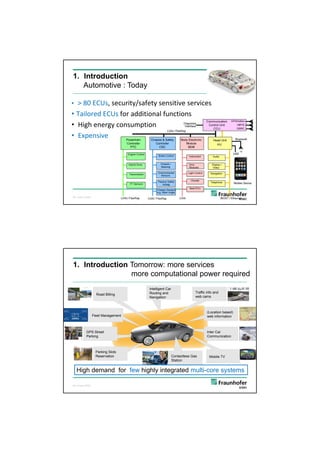
• > 80 ECUs, security/safety sensitive services
• Tailored ECUs for additional functions
• High energy consumption
• Expensive 


©C. Eckert, AISEC,

                                                                                                3


1. Introduction Tomorrow: more services
                more computational power required
                                        Intelligent Car
                                        Routing and                     Traffic info and
                       Road Billing
                                        Navigation
                                        N i ti                          web cams


                                                                                (Location based)
                     Fleet Management                                           web information


            GPS Street                                                          Inter Car
            Parking                                                             Communication


                      Parking Slots
                      Reservation                         Contactless Gas        Mobile TV
                                                          Station


   High demand for few highly integrated multi-core systems

©C. Eckert, AISEC,


                                                                                                           2
5/26/2012


Outline


1.         Introduction
2.         Security Issues 
3.         Multi‐core architectures: Risks
4.         Multi‐core architectures: Opportunities
5.
5          Research Challenges
           Research Challenges
6.         Take Home Message


©C. Eckert, AISEC,


2. Security Issues
   Automotive Security: Today

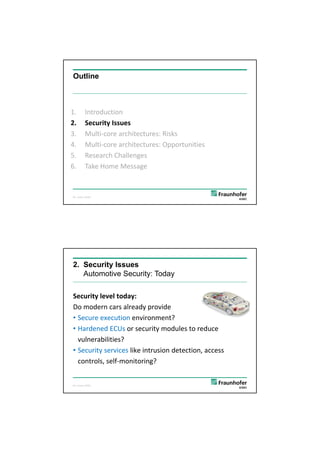
Security level today: 
Security level today:
Do modern cars already provide 
• Secure execution environment?
• Hardened ECUs or security modules to reduce 
  vulnerabilities? 
• Security services like intrusion detection, access 
  controls, self‐monitoring?


©C. Eckert, AISEC,

                                                        6


                                                                   3
5/26/2012


    2. Security Issues
       Automotive: Security Risks

       Vulnerabilities: e.g.
       • ECUs which are not hardened:
         Code injection, data manipulation
       • Software updates via CAN/Ethernet
         insufficient access control (or even missing)
       • External interfaces enable :
         remote access/attacks: NFC, C2C


    ©C. Eckert, AISEC,


    2. Security Issues
       Automotive: Security Risks

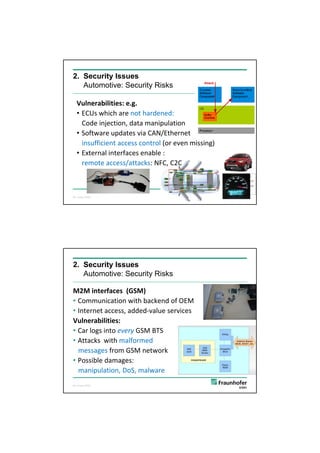
    M2M interfaces (GSM) 
    • Communication with backend of OEM 
    • Internet access, added‐value services
    Vulnerabilities: 
    • Car logs into every GSM BTS
    • Attacks  with malformed  
      messages from GSM network 
    • Possible damages: 
      manipulation, DoS, malware
    ©C. Eckert, AISEC,

8                                                        8


                                                                    4
5/26/2012


2. Security Issues
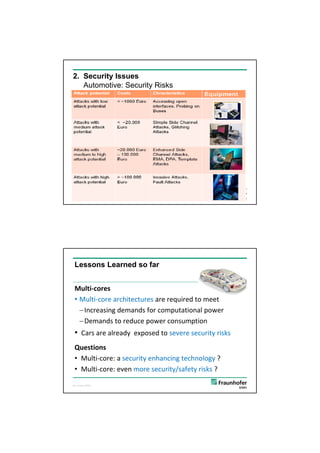
   Automotive: Security Risks


©C. Eckert, AISEC,


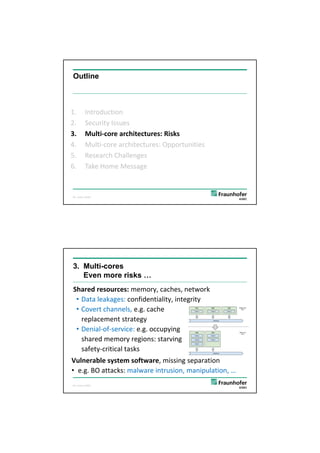
 Lessons Learned so far


 Multi‐cores 
 • Multi‐core architectures are required to meet
       l         h                     d
    Increasing demands for computational power
    Demands to reduce power consumption
 • Cars are already  exposed to severe security risks
 Questions
 Q    i
 • Multi‐core: a security enhancing technology ?
 • Multi‐core: even more security/safety risks ?
©C. Eckert, AISEC,

                                                        10


                                                                    5
5/26/2012


Outline


1.         Introduction
2.         Security Issues
3.         Multi‐core architectures: Risks
4.         Multi‐core architectures: Opportunities
5.
5          Research Challenges
           Research Challenges
6.         Take Home Message


©C. Eckert, AISEC,


3. Multi-cores
   Even more risks …
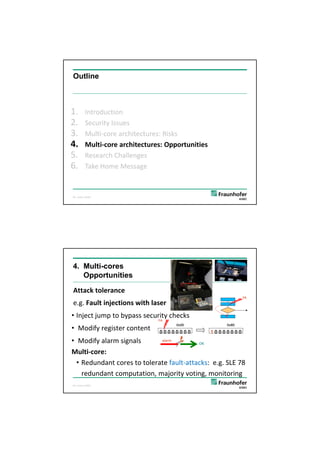
Shared resources: memory, caches, network
 • Data leakages: confidentiality, integrity
        l k             fd     l
 • Covert channels, e.g. cache 
   replacement strategy
 • Denial‐of‐service: e.g. occupying 
   shared memory regions: starving 
   safety‐critical tasks
Vulnerable system software, missing separation
• e.g. BO attacks: malware intrusion, manipulation, …
©C. Eckert, AISEC,

                                                     12


                                                                 6
5/26/2012


Outline


1.         Introduction
2.         Security Issues
3.         Multi‐core architectures: Risks
4.         Multi‐core architectures: Opportunities
5.
5          Research Challenges
           Research Challenges
6.         Take Home Message


©C. Eckert, AISEC,


4. Multi-cores
   Opportunities
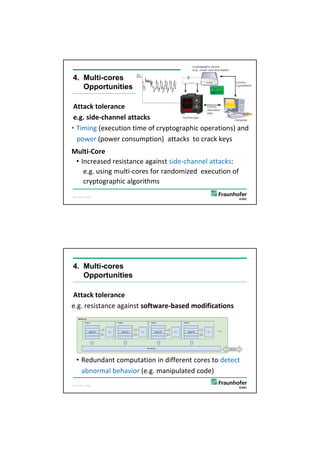
Attack tolerance
                                                                  FA
e.g. Fault injections with laser
                                                                       not auth


• Inject jump to bypass security checks
                                  FA
                                           0x00            0x80
• Modify register content         00000000             10000000
• Modify alarm signals             alarm
                                          OK

Multi‐core:
  • Redundant cores to tolerate fault‐attacks:  e.g. SLE 78 
    redundant computation, majority voting, monitoring
©C. Eckert, AISEC,
                                                  14
                                                             14


                                                                                         7
5/26/2012


4. Multi-cores
   Opportunities

 Attack tolerance
 Attack tolerance
 e.g. side‐channel attacks
• Timing (execution time of cryptographic operations) and 
  power (power consumption)  attacks  to crack keys   
Multi‐Core
 • Increased resistance against side‐channel attacks:
    e.g. using multi‐cores for randomized  execution of 
    cryptographic algorithms
©C. Eckert, AISEC,

                                                     15


4. Multi-cores
   Opportunities

Attack tolerance
Attack tolerance
e.g. resistance against software‐based modifications 


   • Redundant computation in different cores to detect 
     abnormal behavior (e.g. manipulated code) 
©C. Eckert, AISEC,

                                                     16


                                                                    8
5/26/2012


4. Multi-cores
   Opportunities
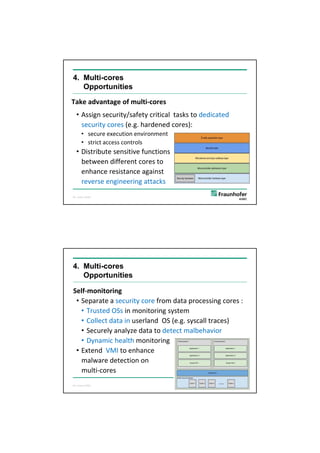
Take advantage of multi‐cores
   • Assign security/safety critical  tasks to dedicated 
     security cores (e.g. hardened cores):
        • secure execution environment
        • strict access controls
   • Distribute sensitive functions 
     between different cores to 
     enhance resistance against  
     reverse engineering attacks
©C. Eckert, AISEC,

                                                            17


4. Multi-cores
   Opportunities

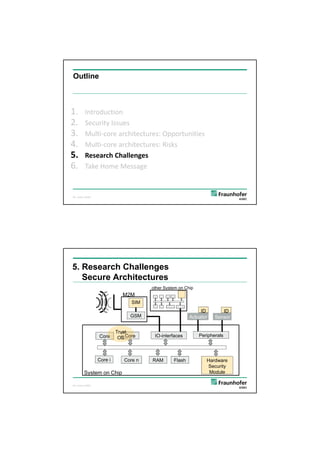
Self‐monitoring
 • Separate a security core from data processing cores :
   • Trusted OSs in monitoring system 
   • Collect data in userland OS (e.g. syscall traces)
   • Securely analyze data to detect malbehavior
   • Dynamic health monitoring
 • Extend  VMI to enhance 
   malware detection on 
   multi‐cores
©C. Eckert, AISEC,

                                                            18


                                                                        9
5/26/2012


Outline


1.         Introduction
2.         Security Issues
3.         Multi‐core architectures: Opportunities
4.         Multi‐core architectures: Risks
5.         Research Challenges
           Research Challenges
6.         Take Home Message


©C. Eckert, AISEC,


5. Research Challenges
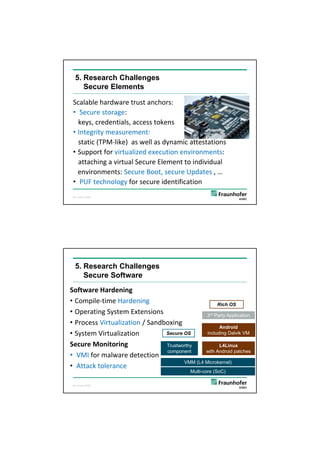
   Secure Architectures
                                          other System on Chip
                                M2M
                                    SIM
                                                                 ID        ID
                                   GSM                      Actuator    Sensor


                              Trust
                     Core      OS Core     IO-interfaces         Peripherals
                      1             2


                     Core i      Core n   RAM       Flash           Hardware
                                                                    Security
          System on Chip                                             Module

©C. Eckert, AISEC,


                                                                                       10
5/26/2012


   5. Research Challenges
      Secure Elements

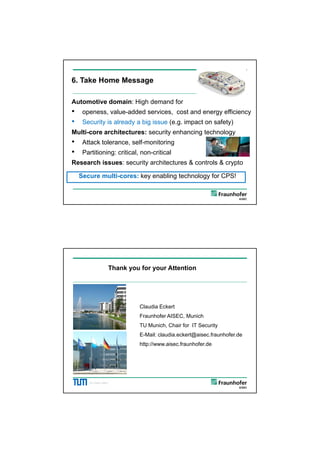
 Scalable hardware trust anchors: 
 • Secure storage: 
   keys, credentials, access tokens
 • Integrity measurement: 
   static (TPM‐like)  as well as dynamic attestations
 • Support for virtualized execution environments:
   attaching a virtual Secure Element to individual 
   environments: Secure Boot, secure Updates , … 
 • PUF technology for secure identification
 ©C. Eckert, AISEC,

                                                                21


   5. Research Challenges
      Secure Software
Software Hardening
• Compile‐time Hardening                             Rich OS
• Operating System Extensions                  3rd Party Application
• Process Virtualization / Sandboxing
                                                      Android
• System Virtualization         Secure OS       including Dalvik VM

Secure Monitoring
Secure Monitoring               Trustworthy           L4Linux
                                component      with Android patches
• VMI for malware detection
                                       VMM (L4 Microkernel)
• Attack tolerance
                                             Multi-core (SoC)

 ©C. Eckert, AISEC,

                                                                22


                                                                             11
5/26/2012


6. Take Home Message

Automotive domain: High demand for
•    openess, value-added services, cost and energy efficiency
•    Security is already a big issue (e.g. impact on safety)
Multi-core architectures: security enhancing technology
•    Attack tolerance, self-monitoring
•    Partitioning: critical, non-critical
Research issues: security architectures & controls & crypto

    Secure multi-cores: key enabling technology for CPS!

        ©C. Eckert, AISEC,


                         Thank you for your Attention


                                   Claudia Eckert
                                   Fraunhofer AISEC, Munich
                                   TU Munich, Chair for IT Security
                                   E-Mail: claudia.eckert@aisec.fraunhofer.de
                                   http://www.aisec.fraunhofer.de
                                   http://www aisec fraunhofer de


        ©C. Eckert, AISEC,


                                                                                      12

Security for Automotive with Multicore-based Embedded Systems

  • 1.
    5/26/2012 Security for Automotive with Multi- core-based Embedded Systems Claudia Eckert TU München & Fraunhofer AISEC 1 DATE 2012, 16. March 2012 Dresden C. Eckert, AISEC Outline 1. Introduction 2. Security Issues  3. Multi‐core architectures: Risks 4. Multi‐core architectures: Opportunities 5. 5 Research Challenges Research Challenges 6. Take Home Message ©C. Eckert, AISEC, 1
  • 2.
    5/26/2012 1. Introduction Automotive : Today • > 80 ECUs, security/safety sensitive services • Tailored ECUs for additional functions • High energy consumption • Expensive  ©C. Eckert, AISEC, 3 1. Introduction Tomorrow: more services more computational power required Intelligent Car Routing and Traffic info and Road Billing Navigation N i ti web cams (Location based) Fleet Management web information GPS Street Inter Car Parking Communication Parking Slots Reservation Contactless Gas Mobile TV Station High demand for few highly integrated multi-core systems ©C. Eckert, AISEC, 2
  • 3.
    5/26/2012 Outline 1. Introduction 2. Security Issues  3. Multi‐core architectures: Risks 4. Multi‐core architectures: Opportunities 5. 5 Research Challenges Research Challenges 6. Take Home Message ©C. Eckert, AISEC, 2. Security Issues Automotive Security: Today Security level today:  Security level today: Do modern cars already provide  • Secure execution environment? • Hardened ECUs or security modules to reduce  vulnerabilities?  • Security services like intrusion detection, access  controls, self‐monitoring? ©C. Eckert, AISEC, 6 3
  • 4.
    5/26/2012 2. Security Issues Automotive: Security Risks Vulnerabilities: e.g. • ECUs which are not hardened: Code injection, data manipulation • Software updates via CAN/Ethernet insufficient access control (or even missing) • External interfaces enable : remote access/attacks: NFC, C2C ©C. Eckert, AISEC, 2. Security Issues Automotive: Security Risks M2M interfaces (GSM)  • Communication with backend of OEM  • Internet access, added‐value services Vulnerabilities:  • Car logs into every GSM BTS • Attacks  with malformed   messages from GSM network  • Possible damages:  manipulation, DoS, malware ©C. Eckert, AISEC, 8 8 4
  • 5.
    5/26/2012 2. Security Issues Automotive: Security Risks ©C. Eckert, AISEC, Lessons Learned so far Multi‐cores  • Multi‐core architectures are required to meet l h d  Increasing demands for computational power  Demands to reduce power consumption • Cars are already  exposed to severe security risks Questions Q i • Multi‐core: a security enhancing technology ? • Multi‐core: even more security/safety risks ? ©C. Eckert, AISEC, 10 5
  • 6.
    5/26/2012 Outline 1. Introduction 2. Security Issues 3. Multi‐core architectures: Risks 4. Multi‐core architectures: Opportunities 5. 5 Research Challenges Research Challenges 6. Take Home Message ©C. Eckert, AISEC, 3. Multi-cores Even more risks … Shared resources: memory, caches, network • Data leakages: confidentiality, integrity l k fd l • Covert channels, e.g. cache  replacement strategy • Denial‐of‐service: e.g. occupying  shared memory regions: starving  safety‐critical tasks Vulnerable system software, missing separation • e.g. BO attacks: malware intrusion, manipulation, … ©C. Eckert, AISEC, 12 6
  • 7.
    5/26/2012 Outline 1. Introduction 2. Security Issues 3. Multi‐core architectures: Risks 4. Multi‐core architectures: Opportunities 5. 5 Research Challenges Research Challenges 6. Take Home Message ©C. Eckert, AISEC, 4. Multi-cores Opportunities Attack tolerance FA e.g. Fault injections with laser not auth • Inject jump to bypass security checks FA 0x00 0x80 • Modify register content 00000000 10000000 • Modify alarm signals alarm OK Multi‐core: • Redundant cores to tolerate fault‐attacks:  e.g. SLE 78  redundant computation, majority voting, monitoring ©C. Eckert, AISEC, 14 14 7
  • 8.
    5/26/2012 4. Multi-cores Opportunities Attack tolerance Attack tolerance e.g. side‐channel attacks • Timing (execution time of cryptographic operations) and  power (power consumption)  attacks  to crack keys    Multi‐Core • Increased resistance against side‐channel attacks: e.g. using multi‐cores for randomized  execution of  cryptographic algorithms ©C. Eckert, AISEC, 15 4. Multi-cores Opportunities Attack tolerance Attack tolerance e.g. resistance against software‐based modifications  • Redundant computation in different cores to detect  abnormal behavior (e.g. manipulated code)  ©C. Eckert, AISEC, 16 8
  • 9.
    5/26/2012 4. Multi-cores Opportunities Take advantage of multi‐cores • Assign security/safety critical  tasks to dedicated  security cores (e.g. hardened cores): • secure execution environment • strict access controls • Distribute sensitive functions  between different cores to  enhance resistance against   reverse engineering attacks ©C. Eckert, AISEC, 17 4. Multi-cores Opportunities Self‐monitoring • Separate a security core from data processing cores : • Trusted OSs in monitoring system  • Collect data in userland OS (e.g. syscall traces) • Securely analyze data to detect malbehavior • Dynamic health monitoring • Extend  VMI to enhance  malware detection on  multi‐cores ©C. Eckert, AISEC, 18 9
  • 10.
    5/26/2012 Outline 1. Introduction 2. Security Issues 3. Multi‐core architectures: Opportunities 4. Multi‐core architectures: Risks 5. Research Challenges Research Challenges 6. Take Home Message ©C. Eckert, AISEC, 5. Research Challenges Secure Architectures other System on Chip M2M SIM ID ID GSM Actuator Sensor Trust Core OS Core IO-interfaces Peripherals 1 2 Core i Core n RAM Flash Hardware Security System on Chip Module ©C. Eckert, AISEC, 10
  • 11.
    5/26/2012 5. Research Challenges Secure Elements Scalable hardware trust anchors:  • Secure storage:  keys, credentials, access tokens • Integrity measurement:  static (TPM‐like)  as well as dynamic attestations • Support for virtualized execution environments: attaching a virtual Secure Element to individual  environments: Secure Boot, secure Updates , …  • PUF technology for secure identification ©C. Eckert, AISEC, 21 5. Research Challenges Secure Software Software Hardening • Compile‐time Hardening Rich OS • Operating System Extensions 3rd Party Application • Process Virtualization / Sandboxing Android • System Virtualization Secure OS including Dalvik VM Secure Monitoring Secure Monitoring Trustworthy L4Linux component with Android patches • VMI for malware detection VMM (L4 Microkernel) • Attack tolerance Multi-core (SoC) ©C. Eckert, AISEC, 22 11
  • 12.
    5/26/2012 6. Take HomeMessage Automotive domain: High demand for • openess, value-added services, cost and energy efficiency • Security is already a big issue (e.g. impact on safety) Multi-core architectures: security enhancing technology • Attack tolerance, self-monitoring • Partitioning: critical, non-critical Research issues: security architectures & controls & crypto Secure multi-cores: key enabling technology for CPS! ©C. Eckert, AISEC, Thank you for your Attention Claudia Eckert Fraunhofer AISEC, Munich TU Munich, Chair for IT Security E-Mail: claudia.eckert@aisec.fraunhofer.de http://www.aisec.fraunhofer.de http://www aisec fraunhofer de ©C. Eckert, AISEC, 12