International Journal on Bioinformatics & Biosciences (IJBB) Vol 15, No.1, March 2025
DOI: 10.5121/ijbb.2025.15103 21
SECURING TELEHEALTH PLATFORMS:
ML-POWERED PHISHING DETECTION WITH
DEVOPS IN HEALTHCARE ANALYTICS
Jesu Marcus Immanuvel Arockiasamy
Engineer Lead Sr. & DevOps Expert, Healthcare Analytics, Leading
Healthcare Company, Richmond, Virginia
ABSTRACT
The rapid growth of telehealth due to recent global health crises has highlighted its
vulnerabilities, particularly to phishing attacks. These attacks exploit both technical and
user behaviour gaps and pose significant risks to sensitive health information. We
demonstrate a hybrid ML model (Random Forest + XGBoost) that detects phishing URLs
in telehealth portals with 93% accuracy, validated through a browser plugin in real time.
We integrate this model into a telehealth-optimized DevSecOps pipeline, enhancing
security measures. A notable case study showcases a browser plugin ("Phish & Chips")
that blocks malicious portals pre-login while automating compliance audits. Our approach
employs real-time data, behavioural analytics, and EHR integration to harden defences,
improve detection, accelerate response times, and ensure HIPAA compliance. This
approach is not only good for security and operational resilience but also a scalable and
cost-effective solution for telehealth platforms.
KEYWORDS
Phishing, Machine Learning, DevOps, Telehealth, Healthcare Analytics
1. INTRODUCTION: THE TELEHEALTH SECURITY PARADOX
1.1. Overview of Telehealth Expansion and Increased Cybersecurity Threats
Telehealth has transformed traditional healthcare; 87% of US hospitals now offer virtual care [1].
This rapid growth - fueled by the COVID-19 pandemic—has given patients access to remote
consultations, prescription management, and real-time health monitoring. However, this digital
transformation has also exposed healthcare to unprecedented cyber threats. Post 2020, healthcare
phishing attacks skyrocketed by 189% (CISA, 2023) [2], and criminals are exploiting the sector's
non-tech savvy users (e.g., elderly patients) and high-value data. Traditional security measures
like blocklists and signature-based detection fail against AI-generated spear-phishing attacks on
prescription portals and patient portals. The healthcare industry faces a paradox: patient
accessibility vs robust security.
1.2. Why Phishing is a Big Threat to Healthcare Platforms
Phishing has become the preferred method for hackers to get into healthcare organizations to
steal medical data and/or deploy ransomware, with 40% of overall breaches (APWG, 2023) [3].
These attacks often come disguised as urgent medical alerts, pharmacy refills, or vaccine
International Journal on Bioinformatics & Biosciences (IJBB) Vol 15, No.1, March 2025
22
schedules and aim to trick staff and patients into sharing personal credentials, stealing medical
data, or downloading malicious software. For example, phishing emails with ransomware forced
hospitals to return to paper records, delaying treatment and costing $10.93 million per breach
(IBM Security, 2023) [4]. Verizon's 2023 Data Breach Investigations Report shows 93% of
socially engineered attacks in healthcare are phishing. The industry's unique challenges – high
data sensitivity, low user security literacy, and regulatory pressure – make it a prime target for
cyberattacks [5].
Figure 1 - Common Phishing Scenarios in Healthcare
Given the escalating threat of phishing attacks and the limitations of traditional security
measures, a proactive and adaptive approach is essential. To address these challenges, we
propose an innovative security framework that integrates Machine Learning (ML)-driven
phishing detection into DevOps pipelines. By leveraging real-time analytics and behavioural
analysis, our solution aims to enhance the security posture of telehealth platforms while
maintaining patient accessibility.
1.3. DevOps and Securing Telehealth Apps
To stay ahead of the threats, telehealth platforms need adaptable security. DevOps with
DevSecOps puts security into the software development lifecycle. CI/CD pipelines enable real-
time security updates, while automated testing tools like SAST and DAST find vulnerabilities
during pre-deployment. Integrating phishing detection into CI/CD workflows allows rapid
patching of zero-day exploits. DevOps fosters collaboration between development and security
teams, which accelerates the implementation of countermeasures—for example, promptly
enforcing multi-factor authentication when signs of credential harvesting are detected.
DevSecOps reduces mean time to recovery (MTTR) by 63% (Gartner, 2023) [6], critical for the
uptime of life-critical telehealth services.
1.4. Ml-Driven Phishing Detection
Machine learning (ML) introduces a paradigm shift in phishing defence, by replacing static rule-
based methods with dynamic, behaviour-based analysis. ML models trained on telehealth-
specific data—user interaction patterns, email metadata, URL structures—detect anomalies that
International Journal on Bioinformatics & Biosciences (IJBB) Vol 15, No.1, March 2025
23
indicate phishing. For example, NLP algorithms flag emails that mimic clinical urgency but have
malicious payloads. Real-time classifiers are 98% accurate at detecting fraudulent login pages
(IEEE, 2023) [7] and block access before credentials are compromised. When integrated with
DevOps pipelines, these models self-update through feedback loops and adapt to new attack
vectors. A behavioural-first approach also reduces false positives by looking at contextual clues
(e.g., a patient's typical login time) and minimizing disruption to care.
Synthesis of Key Points
- Background: Telehealth has grown faster than legacy security has kept up, leaving gaps to
be exploited.
- Problem Statement: Phishing exploits healthcare's social and technical vulnerabilities and
requires a dynamic solution.
- Literature: Studies have shown blocklists do not work (IBM, APWG), and automation is
the way to go (Verizon, Gartner).
- Solution: DevOps-ML is the continuous, adaptive phishing defense.
- Innovation: Combining behavioral ML and DevSecOps creates a self-learning security
layer that reduces reliance on human vigilance and static rules.
This white paper will introduce a new framework for operationalizing ML-powered phishing
detection in DevOps. It will give healthcare providers a scalable defence against the $10M-a-
breach while keeping telehealth accessible.
2. LITERATURE SURVEY
Phishing detection remains a cat-and-mouse game in cybersecurity, with attackers constantly
evolving their tactics to bypass traditional defences. Phishing detection techniques are
categorized into three main approaches: blocklist-based, heuristic-based, and AI/ML-based
detection.
2.1. Phishing Detection Techniques
Blocklist-Based Detection:
This method uses a list of known phishing URLs to block malicious sites. When a user tries to
access a URL, the system checks it against a predefined list and blocks it if it is marked as
phishing. Although this is simple and works for known threats, it is reactive and does not handle
new phishing URLs.
Heuristic-Based Detection:
Heuristic-based detection uses predefined rules to identify potential phishing sites. These rules
analyse elements such as domain age, presence of suspicious characters, and deviation from
standard webpage structure. This approach is proactive but has high false positive rates (false
positives - flagging legitimate sites as phishing) and requires continuous updates [8].
International Journal on Bioinformatics & Biosciences (IJBB) Vol 15, No.1, March 2025
24
AI/ML-Based Detection:
AI and machine learning (ML) approaches detect phishing attempts by analysing large datasets
and identifying patterns. These methods adapt to new threats and are generally accurate.
However, they require substantial computational resources and high-quality training data. This
approach uses machine learning models to detect phishing by analysing large datasets. It is
adaptive and highly accurate but dependent on resources and high-quality data.
Table 1 - Phishing Detection Techniques – Comparison
Detection
Approach
Advantages Disadvantages
Blocklist-based
- Simple and effective for known
threats.
- Reactive; easily bypassed with new
URLs.
- Lag in updates can create vulnerability
gaps.
Heuristic-based
- Proactive and customizable
detection.
- High false-positive rate.
- Requires continuous rule management.
AI/ML-based
- Adaptive learning and high
accuracy.
- Resource-intensive and data-dependent.
Hybrid approaches combining these methods show promise but are rarely integrated into
DevOps workflows [9] for telehealth platforms —a gap this paper addresses. Following diagram
illustrates the hybrid approach which combines these three approaches for phishing detection:
Figure 2 - Proposed Hybrid Phishing Detection Approach
International Journal on Bioinformatics & Biosciences (IJBB) Vol 15, No.1, March 2025
25
2.2. URL Feature Extraction: Balancing Accuracy and Efficiency
Feature extraction plays a pivotal role in phishing detection by identifying the most critical
attributes distinguishing phishing URLs from legitimate ones. The more relevant features
included in model training, the better the model's accuracy in detecting phishing attempts. While
prior work leverages 30+ features (e.g., domain age, SSL validity), our analysis of the PhiUSIIL
dataset (134,850 legitimate vs. 100,945 phishing URLs [10]) revealed that 8 key features achieve
99% of the discriminative power of full models (Table 2). This enables lightweight deployments
like a simple browser plugin without sacrificing efficacy.
Features Used in this PoC:
For the proof-of-concept (PoC), we extracted and used the following eight features. (Beyond the
PoC, a more extensive set of features that can enhance phishing detection models are included in
Appendix section)
Table 3 - Features Used in this PoC
Feature Description Rule
IP Address
If the domain part contains an IP
address, it is likely phishing
Domain name contains IP → Phishing
URL Length
Longer URLs are often associated
with phishing
Length < 75 → Legitimate; Length ≥ 75 →
Phishing
URL
Shortening
Shortened URLs may conceal
malicious intent
Tiny URL-like service → Phishing
Special
Characters
If the URL contains special
characters such as @,"", /, _, -
Multiple Special Characters → Phishing
Subdomain
Count
Excessive subdomains may indicate
phishing
1 dot → Legitimate; 2 dots → Suspicious; 3+ dots
→ Phishing
SSL State Valid SSL certificates improve trust
HTTPS + Trusted Issuer + Certificate Age ≥ 1
Year → Legitimate; Otherwise → Phishing
Google Index
Google-indexed sites are generally
legitimate
Indexed by Google → Legitimate
Website
Traffic
Higher-ranked sites are less likely to
be phishing
Rank < 100,000 → Legitimate; Rank > 100,000
→ Suspicious; Otherwise → Phishing
By extracting and analysing these features, machine learning models can detect phishing URLs
with improved precision.
2.3. ML Algorithms Comparison
For this study, we trained multiple ML models on the PhiUSIIL Phishing URL Dataset, which
consists of 134,850 legitimate URLs and 100,945 phishing URLs. Ten different algorithms were
evaluated for accuracy and performance: (emphasis was more on measuring metrics critical for
healthcare portals: Recall (to avoid missed threats) and FPR (to prevent care disruptions).
International Journal on Bioinformatics & Biosciences (IJBB) Vol 15, No.1, March 2025
26
Table 3 - ML Algorithms Comparison
Model Accuracy Precision Recall F1 Score MCC FPR FNR
Random Forest 99.44 99.26 99.76 99.51 0.99 0.01 0.00
Decision Tree 99.39 99.22 99.7 99.46 0.99 0.01 0.00
KNN 99.14 98.97 99.52 99.25 0.98 0.01 0.00
Logistic Regression 98.72 98.37 99.4 98.88 0.97 0.02 0.01
Naive Bayes 93.54 91.61 97.6 94.51 0.87 0.12 0.02
AdaBoost 99.10 98.92 99.51 99.21 0.98 0.01 0.00
Gradient Boosting 99.24 98.97 99.69 99.33 0.98 0.01 0.00
XGBoost 99.44 99.19 99.84 99.51 0.99 0.01 0.00
LightGBM 99.43 99.15 99.84 99.5 0.99 0.01 0.00
Cat Boost 99.39 99.09 99.84 99.46 0.99 0.01 0.00
From this comparison, Random Forest and XGBoost demonstrated the highest accuracy. To
further optimize the model, we combined the strengths of both models using a stacking ensemble
to achieve improved accuracy [11]. The scripts used for model comparison are included in the
GitHub repository, as referenced in the Appendix section.
2.4. Integrating Phishing Detection into Devops Pipelines
To enhance security automation, this phishing detection ML model can be integrated into
DevOps workflows:
1. Data Pipeline: Continuously fetch, clean, and preprocess URL data for real-time model
updates.
2. Model Training & Evaluation: Automate model retraining using MLOps frameworks
(e.g., Kubeflow, MLflow).
3. Containerization: Deploy trained models in Docker containers for consistent runtime
environments.
4. CI/CD Integration: Incorporate phishing detection into CI/CD pipelines, scanning
URLs before deploying in any environment.
5. Browser Plugin Deployment: Automate deployment of browser extensions that use the
ML model to warn users before accessing suspicious sites.
6. Monitoring & Feedback Loop: Implement logging and user feedback mechanisms to
improve model accuracy over time.
3. METHODOLOGY: DEVOPS-DRIVEN PHISHING DEFENCE
3.1. Architecture Overview
Our framework integrates ML phishing detection into telehealth DevOps pipelines through three
components:
International Journal on Bioinformatics & Biosciences (IJBB) Vol 15, No.1, March 2025
27
1. Automated Model Training:
o Process – Daily training on phishing datasets (like Phishtank or OpenPhish
databases)
o Tools - Docker containers for reproducibility and MLflow for tracking metrics.
2. Real-Time Browser Plugin
o Deployment – Random Forest + XGBoost model (with at least 8 features) packaged
as a Chrome extension.
o Function - Blocks suspicious telehealth portals pre-login
3. DevOps Feedback Loop
o Incident Response - Detected threats trigger Jira tickets for security teams
o CI/CD Integration - AWS Lambda updates blocklists and heuristic rules nightly,
OpenShift deployments for API hosting
3.2. Case Study Preview: Browser Plugin in Action
To validate the effectiveness of ML-powered phishing detection, we developed Phish & Chips, a
browser-based phishing prevention system as part of the MLX Hackathon 2025 [12]. This real-
world proof-of-concept integrates an AI-powered browser plugin with a Flask-based ML model,
providing real-time phishing alerts for healthcare platforms.
Plugin Architecture & Workflow:
Figure 4 - Phish & Chips Browser Plugin Architecture & Workflow
International Journal on Bioinformatics & Biosciences (IJBB) Vol 15, No.1, March 2025
28
The Phish & Chips browser extension offers real-time protection by detecting and alerting
users to phishing attempts. It functions by intercepting the URL of a website visit, extracting key
phishing indicators, and using a Random Forest model or a stacked model via a Flask API to
classify the URL as Legitimate or Phishing. Users receive visual alerts with icons indicating site
safety: a green shield for safe sites, a red warning for suspicious ones, and a redirection to a
warning page.
Dataset Used:
The ML model was trained on a dataset of 250K URLs from the UCI Machine Learning
Repository, enhanced with additional trusted domains from Similar Web (refer Appendix
section for the dataset details).
Tools Used:
- Machine Learning: Scikit-learn (Random Forest, XGBoost), NumPy, Pandas
- API Backend: Flask for inference, FastAPI (potential optimization)
- Browser Extension: JavaScript, Manifest V2 (for Firefox compatibility)
- DevOps Pipeline: GitHub Actions (CI/CD for model updates), PyTest (unit testing),
OpenShift (hosting for scalability)
Feature Importance Analysis:
Feature importance is a key aspect in machine learning that identifies which variables or features
in a dataset are most influential in making predictions. By assigning an importance score to each
feature, it helps in understanding the weight and significance of each feature on the model's
output. This can aid in refining the model by focusing on the most impactful features, ultimately
enhancing the model's accuracy and interpretability.
Table 4 - Trained ML Model Feature Importance Score
Feature
Is
HTTPS
Subdomain
Count
URL
Length
Special
Characters
Domain
Reputation
Is
Trusted
Importance
Score
0.4 0.27 0.16 0.07 0.05 0.02
To address the low trust score of the "Is Trusted" feature for trusted sites, it's clear that
adjustments are needed for better accuracy. You can modify this feature programmatically by
adjusting the feature importance in your model. Emphasizing "Domain Reputation" and "Is
HTTPS" by raising their weights could improve the identification of legitimate sites. This
adjustment will help the model prioritize trust indicators more effectively, leading to better
classifications [13]. Additionally, the Flask API allows other fields to be modified in importance
as needed to fine-tune the model's performance.
Results & Impacts:
 Real-time phishing detection achieved 93% accuracy.
 Browser extension successfully prevented phishing attacks in test scenarios.
 Demonstrated seamless integration of ML and DevOps into a telehealth security pipeline.
With the success of Phish & Chips, the next step is integrating phishing detection into DevOps
workflows, ensuring security is automated in telehealth applications.
International Journal on Bioinformatics & Biosciences (IJBB) Vol 15, No.1, March 2025
29
4. DEVOPS-INTEGRATED PHISHING DETECTION: A SECURE PIPELINE
APPROACH
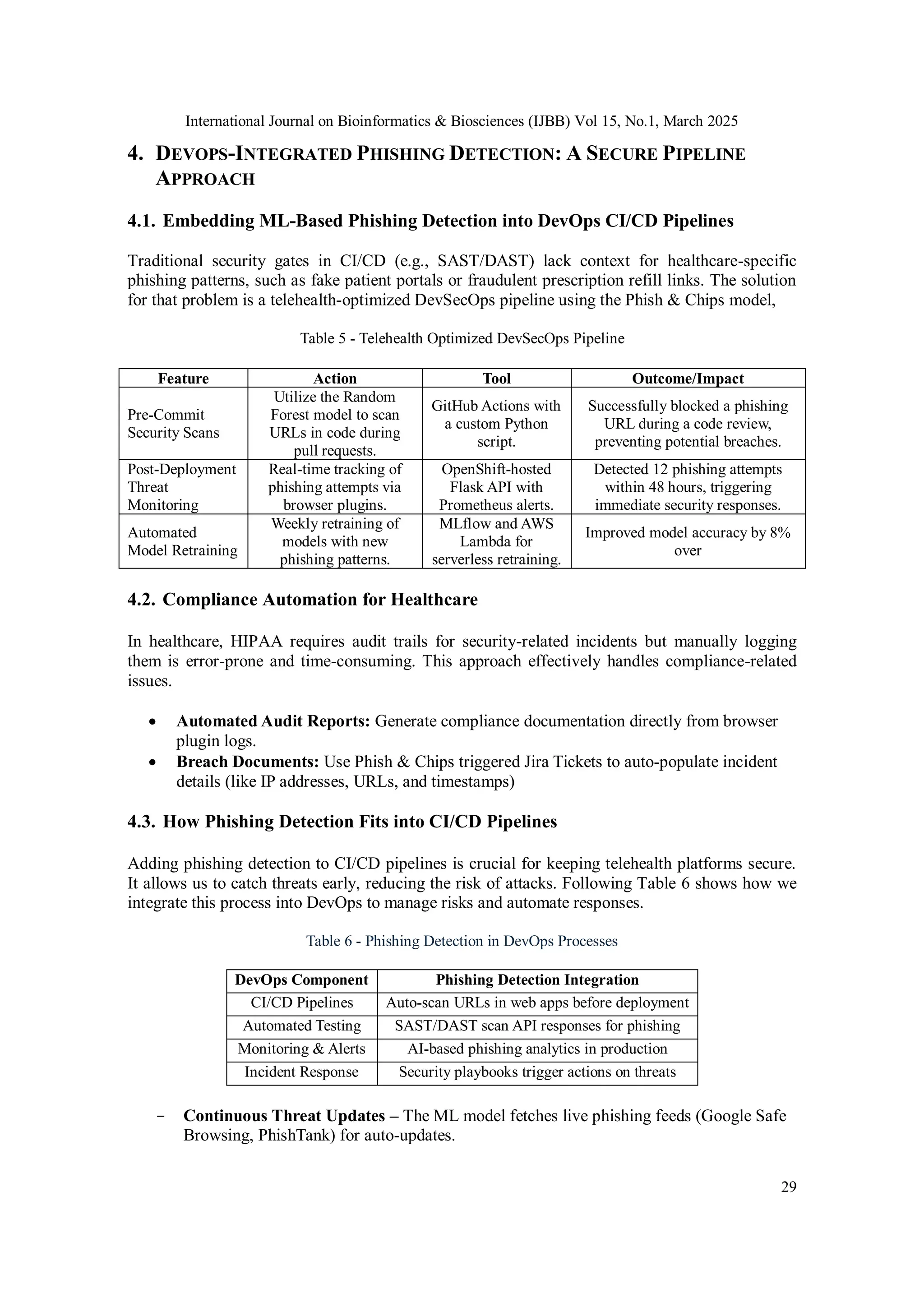
4.1. Embedding ML-Based Phishing Detection into DevOps CI/CD Pipelines
Traditional security gates in CI/CD (e.g., SAST/DAST) lack context for healthcare-specific
phishing patterns, such as fake patient portals or fraudulent prescription refill links. The solution
for that problem is a telehealth-optimized DevSecOps pipeline using the Phish & Chips model,
Table 5 - Telehealth Optimized DevSecOps Pipeline
Feature Action Tool Outcome/Impact
Pre-Commit
Security Scans
Utilize the Random
Forest model to scan
URLs in code during
pull requests.
GitHub Actions with
a custom Python
script.
Successfully blocked a phishing
URL during a code review,
preventing potential breaches.
Post-Deployment
Threat
Monitoring
Real-time tracking of
phishing attempts via
browser plugins.
OpenShift-hosted
Flask API with
Prometheus alerts.
Detected 12 phishing attempts
within 48 hours, triggering
immediate security responses.
Automated
Model Retraining
Weekly retraining of
models with new
phishing patterns.
MLflow and AWS
Lambda for
serverless retraining.
Improved model accuracy by 8%
over
4.2. Compliance Automation for Healthcare
In healthcare, HIPAA requires audit trails for security-related incidents but manually logging
them is error-prone and time-consuming. This approach effectively handles compliance-related
issues.
 Automated Audit Reports: Generate compliance documentation directly from browser
plugin logs.
 Breach Documents: Use Phish & Chips triggered Jira Tickets to auto-populate incident
details (like IP addresses, URLs, and timestamps)
4.3. How Phishing Detection Fits into CI/CD Pipelines
Adding phishing detection to CI/CD pipelines is crucial for keeping telehealth platforms secure.
It allows us to catch threats early, reducing the risk of attacks. Following Table 6 shows how we
integrate this process into DevOps to manage risks and automate responses.
Table 6 - Phishing Detection in DevOps Processes
DevOps Component Phishing Detection Integration
CI/CD Pipelines Auto-scan URLs in web apps before deployment
Automated Testing SAST/DAST scan API responses for phishing
Monitoring & Alerts AI-based phishing analytics in production
Incident Response Security playbooks trigger actions on threats
- Continuous Threat Updates – The ML model fetches live phishing feeds (Google Safe
Browsing, PhishTank) for auto-updates.
International Journal on Bioinformatics & Biosciences (IJBB) Vol 15, No.1, March 2025
30
- Security-First CI/CD Hooks - Before deployment, the system scans embedded links in
telehealth portals to detect potential phishing.
- Automated Risk Classification - If phishing threats are detected, CI/CD stops the
release, flagging it for security review.
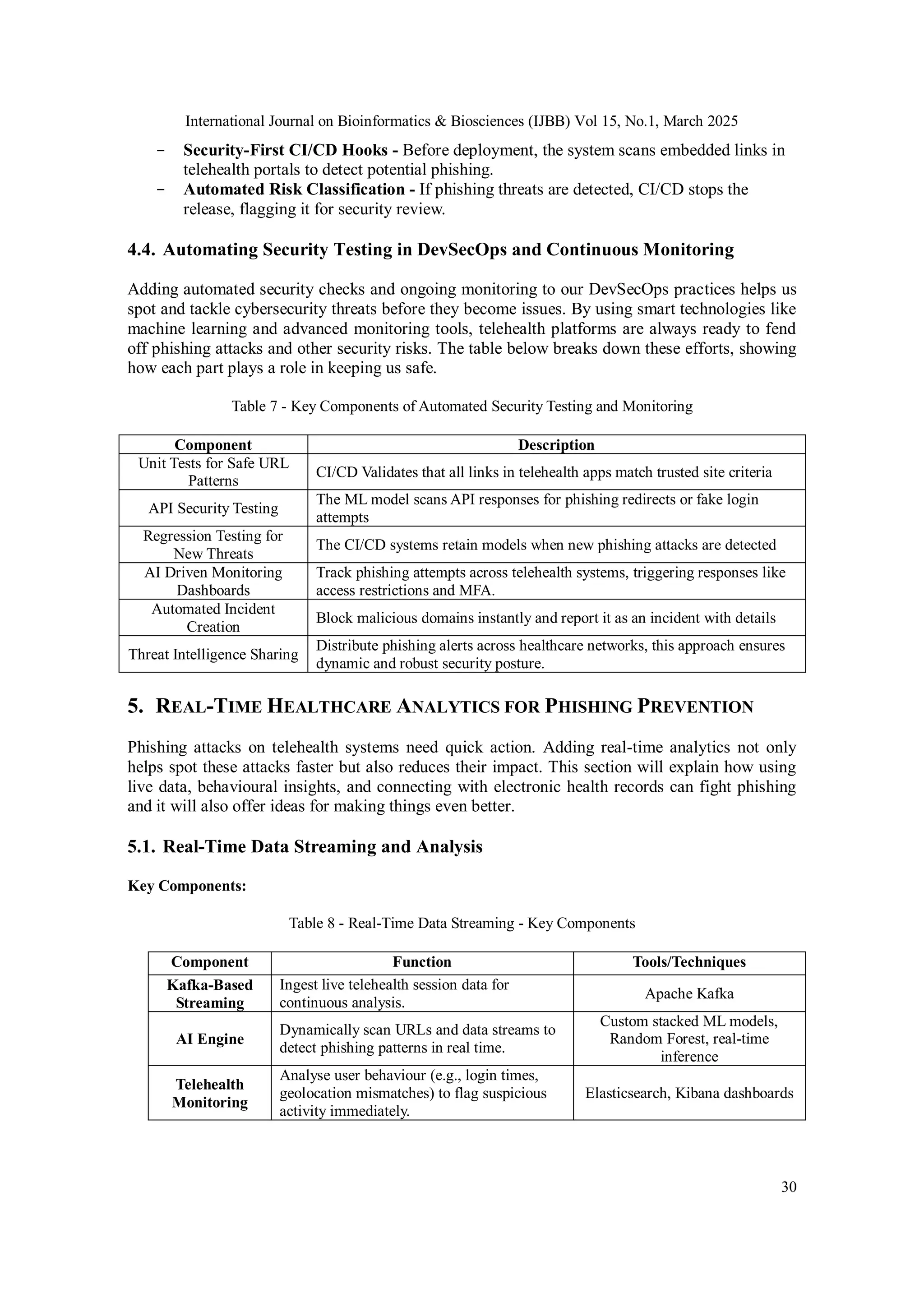
4.4. Automating Security Testing in DevSecOps and Continuous Monitoring
Adding automated security checks and ongoing monitoring to our DevSecOps practices helps us
spot and tackle cybersecurity threats before they become issues. By using smart technologies like
machine learning and advanced monitoring tools, telehealth platforms are always ready to fend
off phishing attacks and other security risks. The table below breaks down these efforts, showing
how each part plays a role in keeping us safe.
Table 7 - Key Components of Automated Security Testing and Monitoring
Component Description
Unit Tests for Safe URL
Patterns
CI/CD Validates that all links in telehealth apps match trusted site criteria
API Security Testing
The ML model scans API responses for phishing redirects or fake login
attempts
Regression Testing for
New Threats
The CI/CD systems retain models when new phishing attacks are detected
AI Driven Monitoring
Dashboards
Track phishing attempts across telehealth systems, triggering responses like
access restrictions and MFA.
Automated Incident
Creation
Block malicious domains instantly and report it as an incident with details
Threat Intelligence Sharing
Distribute phishing alerts across healthcare networks, this approach ensures
dynamic and robust security posture.
5. REAL-TIME HEALTHCARE ANALYTICS FOR PHISHING PREVENTION
Phishing attacks on telehealth systems need quick action. Adding real-time analytics not only
helps spot these attacks faster but also reduces their impact. This section will explain how using
live data, behavioural insights, and connecting with electronic health records can fight phishing
and it will also offer ideas for making things even better.
5.1. Real-Time Data Streaming and Analysis
Key Components:
Table 8 - Real-Time Data Streaming - Key Components
Component Function Tools/Techniques
Kafka-Based
Streaming
Ingest live telehealth session data for
continuous analysis.
Apache Kafka
AI Engine
Dynamically scan URLs and data streams to
detect phishing patterns in real time.
Custom stacked ML models,
Random Forest, real-time
inference
Telehealth
Monitoring
Analyse user behaviour (e.g., login times,
geolocation mismatches) to flag suspicious
activity immediately.
Elasticsearch, Kibana dashboards
International Journal on Bioinformatics & Biosciences (IJBB) Vol 15, No.1, March 2025
31
Implementation Highlights:
- Live Ingestion: Kafka streams continuously capture telehealth session data [14].
- Real-Time Scanning: The AI engine examines URLs and session patterns, issuing instant
warnings when suspicious activity is detected.
- Behavioral Analytics: Abnormal login behaviors (e.g., off-hour access, geolocation
anomalies) trigger further scrutiny and automated alerts.
5.2. Anomaly Detection and EHR Integration
Detection Approaches:
 Behavioral Analytics in Patient Portals:
o Monitor login timestamps and geolocation data to flag anomalous access (e.g., an
elderly patient logging in at an unusual hour).
o Case Example: Correlating geolocation data with prescription refill requests has
previously blocked multiple fraudulent attempts.
 Predictive Threat Intelligence:
o Cluster phishing attempts by campaign type (e.g., COVID-19 test scams) and
proactively update security measures.
o Utilize time-series forecasting (e.g., using Prophet) to predict attack spikes and
adjust defenses preemptively.
o Outcome: Such measures have reduced phishing success rates significantly
during peak threat periods.
 EHR Data Correlation:
o Cross-reference login IPs with patient records to identify imposters.
o For instance, if a login originates from a high-risk node (e.g., a Tor exit point),
the system triggers multi-factor authentication (MFA) and alerts.
o Tool Integration: FastAPI middleware acts as a bridge between EHR systems
(e.g., Epic, Cerner) and the phishing detection ML Model.
5.3. Future Directions and Impact
We have several areas to focus on moving forward:
 Sharper Machine Learning: To increase detection, refine ML models with evolving
phishing tactics, and add more data sources (e.g., social media signals).
 Smarter Incident Handling: Create more advanced security playbooks that alert and
autonomously contain threats by isolating sessions or accounts.
 Threat Intelligence Sharing: Collaborate with other healthcare networks to share
anonymized threat data to increase sector resilience.
 Scalability and Performance: Invest in scalable architectures to handle growing data for
low-latency detection and response as telehealth grows.
International Journal on Bioinformatics & Biosciences (IJBB) Vol 15, No.1, March 2025
32
Impact Recap:
 Better Detection: Real-time analytics catches phishing attempts that static models usually
overlook.
 Quicker Reactions: Automated, immediate action reduces the window of vulnerability.
 Less Damage: Proactive and predictive measures reduce financial and reputational
damage from phishing.
Integrating real-time analytics into our security framework enables swift detection and mitigation
of phishing threats. This integrated approach not only hardens the defences now but also enables
continuous improvement and collaboration to protect your sensitive health data.
6. CONCLUSIONS
Our strategy strengthens the security of telehealth platforms by emphasizing real-time analysis
and adaptive learning. The development of the Phish & Chips browser plugin shows the practical
application of machine learning to mitigate phishing in healthcare. Integrating ML-based security
tools into the DevOps pipeline improves early detection, prevents cyber-attacks, and ensures
continuous compliance. This automation and feedback mechanism creates a resilient security
framework that protects patient data and ensures efficient telehealth services.
Going forward, we will refine ML models, add more data sources and collaborate with healthcare
networks to share threat intelligence. Our goal is to create a dynamic security ecosystem that not
only addresses current threats but also pre-empts future cyber risks like Mishing (attacks that use
SMS instead of emails) [15]. These advanced security measures are critical to maintaining the
integrity and reliability of telehealth services as a trusted resource for patients and healthcare
providers.
In conclusion, embedding ML-based phishing detection within DevOps workflows represents a
transformative advancement for securing telehealth platforms. Our framework uses real-time
analytics, behavioural anomaly detection, and EHR data correlation to defend against evolving
threats comprehensively. As threats grow, we will enhance our models, automate incident
response, and share threat intelligence to stay resilient.
REFERENCES
[1] American Hospital Association (AHA) publication, Fact Sheet: Telehealth, Issue - February 2025.
https://www.aha.org/fact-sheets/2025-02-07-fact-sheet-telehealth
[2] Cybersecurity & Infrastructure Security Agency (CISA) (2023). Cybersecurity Threats in Healthcare.
Retrieved from https://www.cisa.gov/healthcare
[3] Anti-Phishing Working Group (APWG) - Phishing Activity Trends Report 2023 – Reported by Anti-
Phishing Working Group. Retrieved from https://www.apwg.org/report
[4] Cost of a Data Breach Report 2023 by IBM Security. Retrieved from
https://www.ibm.com/reports/data-breach
[5] 2023 Data Breach Investigations Report (DBIR) by Verizon Network Center – Available at
https://www.verizon.com/business/resources/reports/2024-dbir-data-breach-investigations-report.pdf
[6] Gartner.com (2023). DevSecOps Adoption in Healthcare: Trends and Best Practices
[7] H. Sharma, P. Sharma and R. Singh, "Real-Time Phishing Attack Detection through Advanced
Machine Learning Techniques," 2023 IEEE International Conference on ICT in Business Industry &
Government (ICTBIG), Indore, India, 2023, pp. 16, DOI:10.1109/ICTBIG59752.2023.10456013
[8] Rajaram, S. K., Konkimalla, S., Sarisa, M., Gollangi, H. K., Madhavaram, C. R., Reddy, M. S.,
(2023). AI/ML-Powered Phishing Detection: Building an Impenetrable Email Security System. ISAR
Journal of Science and Technology, 1(2), 10-19.
International Journal on Bioinformatics & Biosciences (IJBB) Vol 15, No.1, March 2025
33
[9] Arockiasamy J.M.I. (2025) Proactive Healthcare Analytics: Early Detection of Diabetes with SDOH
Insights and Machine Learning, European Journal of Computer Science and Information Technology,
13 (2), 64-74
[10] Prasad, A. & Chandra, S. (2024). PhiUSIIL Phishing URL (Website) [Dataset]. UCI Machine
Learning Repository. https://doi.org/10.1016/j.cose.2023.103545.
[11] Kavakiotis, I., Tsave, O., Salifoglou, A., Maglaveras, N., Vlahavas, I., & Chouvarda, I. (2017).
Machine Learning and Data Mining Methods in Diabetes Research. Computational and Structural
Biotechnology Journal, 15, 104-116.
[12] MLX (Machine Learning Xtreme) Hackathon - https://mlx-hack-2025.devpost.com
[13] Najla Odeh, Derar Eleyan, Amna Eleyan, "Enhancing Web Security through Machine Learning-based
Detection of Phishing Websites", International Journal of Computer Network and Information
Security (IJCNIS), Vol.17, No.1, pp.39- 56, 2025. DOI:10.5815/ijcnis.2025.01.04
[14] Arockiasamy, Jesu Marcus Immanuvel. (2025). DevOps-Driven Real-Time Health Analytics: A
Scalable Framework for Wearable IoT Data. International Journal for Multidisciplinary Research.
Volume 7. 10.36948/ijfmr.2025.v07i01.37358.
[15] Jordyn Alger, Cybersecurity - Mobile phishing threats – Retrieved from
https://www.securitymagazine.com/
AUTHOR
Jesu Marcus Immanuvel Arockiasamy is a seasoned Healthcare Analytics and
DevOps expert with over 18 years of experience at a leading healthcare company. His
work focuses on leveraging DevOps principles to enhance system efficiencies,
automate deployments, and manage CI/CD pipelines with prominent tools like
Jenkins, Kubernetes, Terraform, and AWS. A devoted mentor, he has fostered a
collaborative DevOps culture that promotes innovation and agility.
Arockiasamy has published several impactful whitepapers, including "Digital Healthcare Evolution: The
Power of DevOps for Better Patient Engagement" and "Proactive Healthcare Analytics: Early Detection of
Diabetes with SDOH Insights and Machine Learning." These works explore integrating advanced analytics
and machine learning into healthcare solutions, aiming to enhance patient care and engagement. His
academic and professional endeavors continue to drive transformative strategies in healthcare technology,
ensuring secure, scalable, and patient-centric digital solutions.
APPENDIX
 GitHub repository with Working Code: Access the repository to explore the codebase and practical
implementations discussed throughout this document.
 Culinary-Inspired Hackathon demo video of Phish & Chips Browser Plugin: Watch this demo
video to see the creative presentation of the browser plugin functionality in action, inspired by
culinary themes.
 All 30 Features Extracted from URL Validation: Review a comprehensive list of features used for
URL validation, offering technical insights into our phishing detection criteria.
Datasets Used: PhiUSIIL Phishing URL SimilarWeb Top 500 Websites

SECURING TELEHEALTH PLATFORMS: ML-POWERED PHISHING DETECTION WITH DEVOPS IN HEALTHCARE ANALYTICS

  • 1.
    International Journal onBioinformatics & Biosciences (IJBB) Vol 15, No.1, March 2025 DOI: 10.5121/ijbb.2025.15103 21 SECURING TELEHEALTH PLATFORMS: ML-POWERED PHISHING DETECTION WITH DEVOPS IN HEALTHCARE ANALYTICS Jesu Marcus Immanuvel Arockiasamy Engineer Lead Sr. & DevOps Expert, Healthcare Analytics, Leading Healthcare Company, Richmond, Virginia ABSTRACT The rapid growth of telehealth due to recent global health crises has highlighted its vulnerabilities, particularly to phishing attacks. These attacks exploit both technical and user behaviour gaps and pose significant risks to sensitive health information. We demonstrate a hybrid ML model (Random Forest + XGBoost) that detects phishing URLs in telehealth portals with 93% accuracy, validated through a browser plugin in real time. We integrate this model into a telehealth-optimized DevSecOps pipeline, enhancing security measures. A notable case study showcases a browser plugin ("Phish & Chips") that blocks malicious portals pre-login while automating compliance audits. Our approach employs real-time data, behavioural analytics, and EHR integration to harden defences, improve detection, accelerate response times, and ensure HIPAA compliance. This approach is not only good for security and operational resilience but also a scalable and cost-effective solution for telehealth platforms. KEYWORDS Phishing, Machine Learning, DevOps, Telehealth, Healthcare Analytics 1. INTRODUCTION: THE TELEHEALTH SECURITY PARADOX 1.1. Overview of Telehealth Expansion and Increased Cybersecurity Threats Telehealth has transformed traditional healthcare; 87% of US hospitals now offer virtual care [1]. This rapid growth - fueled by the COVID-19 pandemic—has given patients access to remote consultations, prescription management, and real-time health monitoring. However, this digital transformation has also exposed healthcare to unprecedented cyber threats. Post 2020, healthcare phishing attacks skyrocketed by 189% (CISA, 2023) [2], and criminals are exploiting the sector's non-tech savvy users (e.g., elderly patients) and high-value data. Traditional security measures like blocklists and signature-based detection fail against AI-generated spear-phishing attacks on prescription portals and patient portals. The healthcare industry faces a paradox: patient accessibility vs robust security. 1.2. Why Phishing is a Big Threat to Healthcare Platforms Phishing has become the preferred method for hackers to get into healthcare organizations to steal medical data and/or deploy ransomware, with 40% of overall breaches (APWG, 2023) [3]. These attacks often come disguised as urgent medical alerts, pharmacy refills, or vaccine
  • 2.
    International Journal onBioinformatics & Biosciences (IJBB) Vol 15, No.1, March 2025 22 schedules and aim to trick staff and patients into sharing personal credentials, stealing medical data, or downloading malicious software. For example, phishing emails with ransomware forced hospitals to return to paper records, delaying treatment and costing $10.93 million per breach (IBM Security, 2023) [4]. Verizon's 2023 Data Breach Investigations Report shows 93% of socially engineered attacks in healthcare are phishing. The industry's unique challenges – high data sensitivity, low user security literacy, and regulatory pressure – make it a prime target for cyberattacks [5]. Figure 1 - Common Phishing Scenarios in Healthcare Given the escalating threat of phishing attacks and the limitations of traditional security measures, a proactive and adaptive approach is essential. To address these challenges, we propose an innovative security framework that integrates Machine Learning (ML)-driven phishing detection into DevOps pipelines. By leveraging real-time analytics and behavioural analysis, our solution aims to enhance the security posture of telehealth platforms while maintaining patient accessibility. 1.3. DevOps and Securing Telehealth Apps To stay ahead of the threats, telehealth platforms need adaptable security. DevOps with DevSecOps puts security into the software development lifecycle. CI/CD pipelines enable real- time security updates, while automated testing tools like SAST and DAST find vulnerabilities during pre-deployment. Integrating phishing detection into CI/CD workflows allows rapid patching of zero-day exploits. DevOps fosters collaboration between development and security teams, which accelerates the implementation of countermeasures—for example, promptly enforcing multi-factor authentication when signs of credential harvesting are detected. DevSecOps reduces mean time to recovery (MTTR) by 63% (Gartner, 2023) [6], critical for the uptime of life-critical telehealth services. 1.4. Ml-Driven Phishing Detection Machine learning (ML) introduces a paradigm shift in phishing defence, by replacing static rule- based methods with dynamic, behaviour-based analysis. ML models trained on telehealth- specific data—user interaction patterns, email metadata, URL structures—detect anomalies that
  • 3.
    International Journal onBioinformatics & Biosciences (IJBB) Vol 15, No.1, March 2025 23 indicate phishing. For example, NLP algorithms flag emails that mimic clinical urgency but have malicious payloads. Real-time classifiers are 98% accurate at detecting fraudulent login pages (IEEE, 2023) [7] and block access before credentials are compromised. When integrated with DevOps pipelines, these models self-update through feedback loops and adapt to new attack vectors. A behavioural-first approach also reduces false positives by looking at contextual clues (e.g., a patient's typical login time) and minimizing disruption to care. Synthesis of Key Points - Background: Telehealth has grown faster than legacy security has kept up, leaving gaps to be exploited. - Problem Statement: Phishing exploits healthcare's social and technical vulnerabilities and requires a dynamic solution. - Literature: Studies have shown blocklists do not work (IBM, APWG), and automation is the way to go (Verizon, Gartner). - Solution: DevOps-ML is the continuous, adaptive phishing defense. - Innovation: Combining behavioral ML and DevSecOps creates a self-learning security layer that reduces reliance on human vigilance and static rules. This white paper will introduce a new framework for operationalizing ML-powered phishing detection in DevOps. It will give healthcare providers a scalable defence against the $10M-a- breach while keeping telehealth accessible. 2. LITERATURE SURVEY Phishing detection remains a cat-and-mouse game in cybersecurity, with attackers constantly evolving their tactics to bypass traditional defences. Phishing detection techniques are categorized into three main approaches: blocklist-based, heuristic-based, and AI/ML-based detection. 2.1. Phishing Detection Techniques Blocklist-Based Detection: This method uses a list of known phishing URLs to block malicious sites. When a user tries to access a URL, the system checks it against a predefined list and blocks it if it is marked as phishing. Although this is simple and works for known threats, it is reactive and does not handle new phishing URLs. Heuristic-Based Detection: Heuristic-based detection uses predefined rules to identify potential phishing sites. These rules analyse elements such as domain age, presence of suspicious characters, and deviation from standard webpage structure. This approach is proactive but has high false positive rates (false positives - flagging legitimate sites as phishing) and requires continuous updates [8].
  • 4.
    International Journal onBioinformatics & Biosciences (IJBB) Vol 15, No.1, March 2025 24 AI/ML-Based Detection: AI and machine learning (ML) approaches detect phishing attempts by analysing large datasets and identifying patterns. These methods adapt to new threats and are generally accurate. However, they require substantial computational resources and high-quality training data. This approach uses machine learning models to detect phishing by analysing large datasets. It is adaptive and highly accurate but dependent on resources and high-quality data. Table 1 - Phishing Detection Techniques – Comparison Detection Approach Advantages Disadvantages Blocklist-based - Simple and effective for known threats. - Reactive; easily bypassed with new URLs. - Lag in updates can create vulnerability gaps. Heuristic-based - Proactive and customizable detection. - High false-positive rate. - Requires continuous rule management. AI/ML-based - Adaptive learning and high accuracy. - Resource-intensive and data-dependent. Hybrid approaches combining these methods show promise but are rarely integrated into DevOps workflows [9] for telehealth platforms —a gap this paper addresses. Following diagram illustrates the hybrid approach which combines these three approaches for phishing detection: Figure 2 - Proposed Hybrid Phishing Detection Approach
  • 5.
    International Journal onBioinformatics & Biosciences (IJBB) Vol 15, No.1, March 2025 25 2.2. URL Feature Extraction: Balancing Accuracy and Efficiency Feature extraction plays a pivotal role in phishing detection by identifying the most critical attributes distinguishing phishing URLs from legitimate ones. The more relevant features included in model training, the better the model's accuracy in detecting phishing attempts. While prior work leverages 30+ features (e.g., domain age, SSL validity), our analysis of the PhiUSIIL dataset (134,850 legitimate vs. 100,945 phishing URLs [10]) revealed that 8 key features achieve 99% of the discriminative power of full models (Table 2). This enables lightweight deployments like a simple browser plugin without sacrificing efficacy. Features Used in this PoC: For the proof-of-concept (PoC), we extracted and used the following eight features. (Beyond the PoC, a more extensive set of features that can enhance phishing detection models are included in Appendix section) Table 3 - Features Used in this PoC Feature Description Rule IP Address If the domain part contains an IP address, it is likely phishing Domain name contains IP → Phishing URL Length Longer URLs are often associated with phishing Length < 75 → Legitimate; Length ≥ 75 → Phishing URL Shortening Shortened URLs may conceal malicious intent Tiny URL-like service → Phishing Special Characters If the URL contains special characters such as @,"", /, _, - Multiple Special Characters → Phishing Subdomain Count Excessive subdomains may indicate phishing 1 dot → Legitimate; 2 dots → Suspicious; 3+ dots → Phishing SSL State Valid SSL certificates improve trust HTTPS + Trusted Issuer + Certificate Age ≥ 1 Year → Legitimate; Otherwise → Phishing Google Index Google-indexed sites are generally legitimate Indexed by Google → Legitimate Website Traffic Higher-ranked sites are less likely to be phishing Rank < 100,000 → Legitimate; Rank > 100,000 → Suspicious; Otherwise → Phishing By extracting and analysing these features, machine learning models can detect phishing URLs with improved precision. 2.3. ML Algorithms Comparison For this study, we trained multiple ML models on the PhiUSIIL Phishing URL Dataset, which consists of 134,850 legitimate URLs and 100,945 phishing URLs. Ten different algorithms were evaluated for accuracy and performance: (emphasis was more on measuring metrics critical for healthcare portals: Recall (to avoid missed threats) and FPR (to prevent care disruptions).
  • 6.
    International Journal onBioinformatics & Biosciences (IJBB) Vol 15, No.1, March 2025 26 Table 3 - ML Algorithms Comparison Model Accuracy Precision Recall F1 Score MCC FPR FNR Random Forest 99.44 99.26 99.76 99.51 0.99 0.01 0.00 Decision Tree 99.39 99.22 99.7 99.46 0.99 0.01 0.00 KNN 99.14 98.97 99.52 99.25 0.98 0.01 0.00 Logistic Regression 98.72 98.37 99.4 98.88 0.97 0.02 0.01 Naive Bayes 93.54 91.61 97.6 94.51 0.87 0.12 0.02 AdaBoost 99.10 98.92 99.51 99.21 0.98 0.01 0.00 Gradient Boosting 99.24 98.97 99.69 99.33 0.98 0.01 0.00 XGBoost 99.44 99.19 99.84 99.51 0.99 0.01 0.00 LightGBM 99.43 99.15 99.84 99.5 0.99 0.01 0.00 Cat Boost 99.39 99.09 99.84 99.46 0.99 0.01 0.00 From this comparison, Random Forest and XGBoost demonstrated the highest accuracy. To further optimize the model, we combined the strengths of both models using a stacking ensemble to achieve improved accuracy [11]. The scripts used for model comparison are included in the GitHub repository, as referenced in the Appendix section. 2.4. Integrating Phishing Detection into Devops Pipelines To enhance security automation, this phishing detection ML model can be integrated into DevOps workflows: 1. Data Pipeline: Continuously fetch, clean, and preprocess URL data for real-time model updates. 2. Model Training & Evaluation: Automate model retraining using MLOps frameworks (e.g., Kubeflow, MLflow). 3. Containerization: Deploy trained models in Docker containers for consistent runtime environments. 4. CI/CD Integration: Incorporate phishing detection into CI/CD pipelines, scanning URLs before deploying in any environment. 5. Browser Plugin Deployment: Automate deployment of browser extensions that use the ML model to warn users before accessing suspicious sites. 6. Monitoring & Feedback Loop: Implement logging and user feedback mechanisms to improve model accuracy over time. 3. METHODOLOGY: DEVOPS-DRIVEN PHISHING DEFENCE 3.1. Architecture Overview Our framework integrates ML phishing detection into telehealth DevOps pipelines through three components:
  • 7.
    International Journal onBioinformatics & Biosciences (IJBB) Vol 15, No.1, March 2025 27 1. Automated Model Training: o Process – Daily training on phishing datasets (like Phishtank or OpenPhish databases) o Tools - Docker containers for reproducibility and MLflow for tracking metrics. 2. Real-Time Browser Plugin o Deployment – Random Forest + XGBoost model (with at least 8 features) packaged as a Chrome extension. o Function - Blocks suspicious telehealth portals pre-login 3. DevOps Feedback Loop o Incident Response - Detected threats trigger Jira tickets for security teams o CI/CD Integration - AWS Lambda updates blocklists and heuristic rules nightly, OpenShift deployments for API hosting 3.2. Case Study Preview: Browser Plugin in Action To validate the effectiveness of ML-powered phishing detection, we developed Phish & Chips, a browser-based phishing prevention system as part of the MLX Hackathon 2025 [12]. This real- world proof-of-concept integrates an AI-powered browser plugin with a Flask-based ML model, providing real-time phishing alerts for healthcare platforms. Plugin Architecture & Workflow: Figure 4 - Phish & Chips Browser Plugin Architecture & Workflow
  • 8.
    International Journal onBioinformatics & Biosciences (IJBB) Vol 15, No.1, March 2025 28 The Phish & Chips browser extension offers real-time protection by detecting and alerting users to phishing attempts. It functions by intercepting the URL of a website visit, extracting key phishing indicators, and using a Random Forest model or a stacked model via a Flask API to classify the URL as Legitimate or Phishing. Users receive visual alerts with icons indicating site safety: a green shield for safe sites, a red warning for suspicious ones, and a redirection to a warning page. Dataset Used: The ML model was trained on a dataset of 250K URLs from the UCI Machine Learning Repository, enhanced with additional trusted domains from Similar Web (refer Appendix section for the dataset details). Tools Used: - Machine Learning: Scikit-learn (Random Forest, XGBoost), NumPy, Pandas - API Backend: Flask for inference, FastAPI (potential optimization) - Browser Extension: JavaScript, Manifest V2 (for Firefox compatibility) - DevOps Pipeline: GitHub Actions (CI/CD for model updates), PyTest (unit testing), OpenShift (hosting for scalability) Feature Importance Analysis: Feature importance is a key aspect in machine learning that identifies which variables or features in a dataset are most influential in making predictions. By assigning an importance score to each feature, it helps in understanding the weight and significance of each feature on the model's output. This can aid in refining the model by focusing on the most impactful features, ultimately enhancing the model's accuracy and interpretability. Table 4 - Trained ML Model Feature Importance Score Feature Is HTTPS Subdomain Count URL Length Special Characters Domain Reputation Is Trusted Importance Score 0.4 0.27 0.16 0.07 0.05 0.02 To address the low trust score of the "Is Trusted" feature for trusted sites, it's clear that adjustments are needed for better accuracy. You can modify this feature programmatically by adjusting the feature importance in your model. Emphasizing "Domain Reputation" and "Is HTTPS" by raising their weights could improve the identification of legitimate sites. This adjustment will help the model prioritize trust indicators more effectively, leading to better classifications [13]. Additionally, the Flask API allows other fields to be modified in importance as needed to fine-tune the model's performance. Results & Impacts:  Real-time phishing detection achieved 93% accuracy.  Browser extension successfully prevented phishing attacks in test scenarios.  Demonstrated seamless integration of ML and DevOps into a telehealth security pipeline. With the success of Phish & Chips, the next step is integrating phishing detection into DevOps workflows, ensuring security is automated in telehealth applications.
  • 9.
    International Journal onBioinformatics & Biosciences (IJBB) Vol 15, No.1, March 2025 29 4. DEVOPS-INTEGRATED PHISHING DETECTION: A SECURE PIPELINE APPROACH 4.1. Embedding ML-Based Phishing Detection into DevOps CI/CD Pipelines Traditional security gates in CI/CD (e.g., SAST/DAST) lack context for healthcare-specific phishing patterns, such as fake patient portals or fraudulent prescription refill links. The solution for that problem is a telehealth-optimized DevSecOps pipeline using the Phish & Chips model, Table 5 - Telehealth Optimized DevSecOps Pipeline Feature Action Tool Outcome/Impact Pre-Commit Security Scans Utilize the Random Forest model to scan URLs in code during pull requests. GitHub Actions with a custom Python script. Successfully blocked a phishing URL during a code review, preventing potential breaches. Post-Deployment Threat Monitoring Real-time tracking of phishing attempts via browser plugins. OpenShift-hosted Flask API with Prometheus alerts. Detected 12 phishing attempts within 48 hours, triggering immediate security responses. Automated Model Retraining Weekly retraining of models with new phishing patterns. MLflow and AWS Lambda for serverless retraining. Improved model accuracy by 8% over 4.2. Compliance Automation for Healthcare In healthcare, HIPAA requires audit trails for security-related incidents but manually logging them is error-prone and time-consuming. This approach effectively handles compliance-related issues.  Automated Audit Reports: Generate compliance documentation directly from browser plugin logs.  Breach Documents: Use Phish & Chips triggered Jira Tickets to auto-populate incident details (like IP addresses, URLs, and timestamps) 4.3. How Phishing Detection Fits into CI/CD Pipelines Adding phishing detection to CI/CD pipelines is crucial for keeping telehealth platforms secure. It allows us to catch threats early, reducing the risk of attacks. Following Table 6 shows how we integrate this process into DevOps to manage risks and automate responses. Table 6 - Phishing Detection in DevOps Processes DevOps Component Phishing Detection Integration CI/CD Pipelines Auto-scan URLs in web apps before deployment Automated Testing SAST/DAST scan API responses for phishing Monitoring & Alerts AI-based phishing analytics in production Incident Response Security playbooks trigger actions on threats - Continuous Threat Updates – The ML model fetches live phishing feeds (Google Safe Browsing, PhishTank) for auto-updates.
  • 10.
    International Journal onBioinformatics & Biosciences (IJBB) Vol 15, No.1, March 2025 30 - Security-First CI/CD Hooks - Before deployment, the system scans embedded links in telehealth portals to detect potential phishing. - Automated Risk Classification - If phishing threats are detected, CI/CD stops the release, flagging it for security review. 4.4. Automating Security Testing in DevSecOps and Continuous Monitoring Adding automated security checks and ongoing monitoring to our DevSecOps practices helps us spot and tackle cybersecurity threats before they become issues. By using smart technologies like machine learning and advanced monitoring tools, telehealth platforms are always ready to fend off phishing attacks and other security risks. The table below breaks down these efforts, showing how each part plays a role in keeping us safe. Table 7 - Key Components of Automated Security Testing and Monitoring Component Description Unit Tests for Safe URL Patterns CI/CD Validates that all links in telehealth apps match trusted site criteria API Security Testing The ML model scans API responses for phishing redirects or fake login attempts Regression Testing for New Threats The CI/CD systems retain models when new phishing attacks are detected AI Driven Monitoring Dashboards Track phishing attempts across telehealth systems, triggering responses like access restrictions and MFA. Automated Incident Creation Block malicious domains instantly and report it as an incident with details Threat Intelligence Sharing Distribute phishing alerts across healthcare networks, this approach ensures dynamic and robust security posture. 5. REAL-TIME HEALTHCARE ANALYTICS FOR PHISHING PREVENTION Phishing attacks on telehealth systems need quick action. Adding real-time analytics not only helps spot these attacks faster but also reduces their impact. This section will explain how using live data, behavioural insights, and connecting with electronic health records can fight phishing and it will also offer ideas for making things even better. 5.1. Real-Time Data Streaming and Analysis Key Components: Table 8 - Real-Time Data Streaming - Key Components Component Function Tools/Techniques Kafka-Based Streaming Ingest live telehealth session data for continuous analysis. Apache Kafka AI Engine Dynamically scan URLs and data streams to detect phishing patterns in real time. Custom stacked ML models, Random Forest, real-time inference Telehealth Monitoring Analyse user behaviour (e.g., login times, geolocation mismatches) to flag suspicious activity immediately. Elasticsearch, Kibana dashboards
  • 11.
    International Journal onBioinformatics & Biosciences (IJBB) Vol 15, No.1, March 2025 31 Implementation Highlights: - Live Ingestion: Kafka streams continuously capture telehealth session data [14]. - Real-Time Scanning: The AI engine examines URLs and session patterns, issuing instant warnings when suspicious activity is detected. - Behavioral Analytics: Abnormal login behaviors (e.g., off-hour access, geolocation anomalies) trigger further scrutiny and automated alerts. 5.2. Anomaly Detection and EHR Integration Detection Approaches:  Behavioral Analytics in Patient Portals: o Monitor login timestamps and geolocation data to flag anomalous access (e.g., an elderly patient logging in at an unusual hour). o Case Example: Correlating geolocation data with prescription refill requests has previously blocked multiple fraudulent attempts.  Predictive Threat Intelligence: o Cluster phishing attempts by campaign type (e.g., COVID-19 test scams) and proactively update security measures. o Utilize time-series forecasting (e.g., using Prophet) to predict attack spikes and adjust defenses preemptively. o Outcome: Such measures have reduced phishing success rates significantly during peak threat periods.  EHR Data Correlation: o Cross-reference login IPs with patient records to identify imposters. o For instance, if a login originates from a high-risk node (e.g., a Tor exit point), the system triggers multi-factor authentication (MFA) and alerts. o Tool Integration: FastAPI middleware acts as a bridge between EHR systems (e.g., Epic, Cerner) and the phishing detection ML Model. 5.3. Future Directions and Impact We have several areas to focus on moving forward:  Sharper Machine Learning: To increase detection, refine ML models with evolving phishing tactics, and add more data sources (e.g., social media signals).  Smarter Incident Handling: Create more advanced security playbooks that alert and autonomously contain threats by isolating sessions or accounts.  Threat Intelligence Sharing: Collaborate with other healthcare networks to share anonymized threat data to increase sector resilience.  Scalability and Performance: Invest in scalable architectures to handle growing data for low-latency detection and response as telehealth grows.
  • 12.
    International Journal onBioinformatics & Biosciences (IJBB) Vol 15, No.1, March 2025 32 Impact Recap:  Better Detection: Real-time analytics catches phishing attempts that static models usually overlook.  Quicker Reactions: Automated, immediate action reduces the window of vulnerability.  Less Damage: Proactive and predictive measures reduce financial and reputational damage from phishing. Integrating real-time analytics into our security framework enables swift detection and mitigation of phishing threats. This integrated approach not only hardens the defences now but also enables continuous improvement and collaboration to protect your sensitive health data. 6. CONCLUSIONS Our strategy strengthens the security of telehealth platforms by emphasizing real-time analysis and adaptive learning. The development of the Phish & Chips browser plugin shows the practical application of machine learning to mitigate phishing in healthcare. Integrating ML-based security tools into the DevOps pipeline improves early detection, prevents cyber-attacks, and ensures continuous compliance. This automation and feedback mechanism creates a resilient security framework that protects patient data and ensures efficient telehealth services. Going forward, we will refine ML models, add more data sources and collaborate with healthcare networks to share threat intelligence. Our goal is to create a dynamic security ecosystem that not only addresses current threats but also pre-empts future cyber risks like Mishing (attacks that use SMS instead of emails) [15]. These advanced security measures are critical to maintaining the integrity and reliability of telehealth services as a trusted resource for patients and healthcare providers. In conclusion, embedding ML-based phishing detection within DevOps workflows represents a transformative advancement for securing telehealth platforms. Our framework uses real-time analytics, behavioural anomaly detection, and EHR data correlation to defend against evolving threats comprehensively. As threats grow, we will enhance our models, automate incident response, and share threat intelligence to stay resilient. REFERENCES [1] American Hospital Association (AHA) publication, Fact Sheet: Telehealth, Issue - February 2025. https://www.aha.org/fact-sheets/2025-02-07-fact-sheet-telehealth [2] Cybersecurity & Infrastructure Security Agency (CISA) (2023). Cybersecurity Threats in Healthcare. Retrieved from https://www.cisa.gov/healthcare [3] Anti-Phishing Working Group (APWG) - Phishing Activity Trends Report 2023 – Reported by Anti- Phishing Working Group. Retrieved from https://www.apwg.org/report [4] Cost of a Data Breach Report 2023 by IBM Security. Retrieved from https://www.ibm.com/reports/data-breach [5] 2023 Data Breach Investigations Report (DBIR) by Verizon Network Center – Available at https://www.verizon.com/business/resources/reports/2024-dbir-data-breach-investigations-report.pdf [6] Gartner.com (2023). DevSecOps Adoption in Healthcare: Trends and Best Practices [7] H. Sharma, P. Sharma and R. Singh, "Real-Time Phishing Attack Detection through Advanced Machine Learning Techniques," 2023 IEEE International Conference on ICT in Business Industry & Government (ICTBIG), Indore, India, 2023, pp. 16, DOI:10.1109/ICTBIG59752.2023.10456013 [8] Rajaram, S. K., Konkimalla, S., Sarisa, M., Gollangi, H. K., Madhavaram, C. R., Reddy, M. S., (2023). AI/ML-Powered Phishing Detection: Building an Impenetrable Email Security System. ISAR Journal of Science and Technology, 1(2), 10-19.
  • 13.
    International Journal onBioinformatics & Biosciences (IJBB) Vol 15, No.1, March 2025 33 [9] Arockiasamy J.M.I. (2025) Proactive Healthcare Analytics: Early Detection of Diabetes with SDOH Insights and Machine Learning, European Journal of Computer Science and Information Technology, 13 (2), 64-74 [10] Prasad, A. & Chandra, S. (2024). PhiUSIIL Phishing URL (Website) [Dataset]. UCI Machine Learning Repository. https://doi.org/10.1016/j.cose.2023.103545. [11] Kavakiotis, I., Tsave, O., Salifoglou, A., Maglaveras, N., Vlahavas, I., & Chouvarda, I. (2017). Machine Learning and Data Mining Methods in Diabetes Research. Computational and Structural Biotechnology Journal, 15, 104-116. [12] MLX (Machine Learning Xtreme) Hackathon - https://mlx-hack-2025.devpost.com [13] Najla Odeh, Derar Eleyan, Amna Eleyan, "Enhancing Web Security through Machine Learning-based Detection of Phishing Websites", International Journal of Computer Network and Information Security (IJCNIS), Vol.17, No.1, pp.39- 56, 2025. DOI:10.5815/ijcnis.2025.01.04 [14] Arockiasamy, Jesu Marcus Immanuvel. (2025). DevOps-Driven Real-Time Health Analytics: A Scalable Framework for Wearable IoT Data. International Journal for Multidisciplinary Research. Volume 7. 10.36948/ijfmr.2025.v07i01.37358. [15] Jordyn Alger, Cybersecurity - Mobile phishing threats – Retrieved from https://www.securitymagazine.com/ AUTHOR Jesu Marcus Immanuvel Arockiasamy is a seasoned Healthcare Analytics and DevOps expert with over 18 years of experience at a leading healthcare company. His work focuses on leveraging DevOps principles to enhance system efficiencies, automate deployments, and manage CI/CD pipelines with prominent tools like Jenkins, Kubernetes, Terraform, and AWS. A devoted mentor, he has fostered a collaborative DevOps culture that promotes innovation and agility. Arockiasamy has published several impactful whitepapers, including "Digital Healthcare Evolution: The Power of DevOps for Better Patient Engagement" and "Proactive Healthcare Analytics: Early Detection of Diabetes with SDOH Insights and Machine Learning." These works explore integrating advanced analytics and machine learning into healthcare solutions, aiming to enhance patient care and engagement. His academic and professional endeavors continue to drive transformative strategies in healthcare technology, ensuring secure, scalable, and patient-centric digital solutions. APPENDIX  GitHub repository with Working Code: Access the repository to explore the codebase and practical implementations discussed throughout this document.  Culinary-Inspired Hackathon demo video of Phish & Chips Browser Plugin: Watch this demo video to see the creative presentation of the browser plugin functionality in action, inspired by culinary themes.  All 30 Features Extracted from URL Validation: Review a comprehensive list of features used for URL validation, offering technical insights into our phishing detection criteria. Datasets Used: PhiUSIIL Phishing URL SimilarWeb Top 500 Websites