According to a June 2014 report by J. Pete Blair, a criminal justice professor
at Texas State University, active shootings are occurring at a rate of more
than one a month. Research numbers show an average of 5 incidents per
year from 2000 to 2008. By 2011, the incidents had more than doubled, with
eleven active shooters trying to murder others that year. In 2012, the number
of active shooting events went up again to fifteen. 2013 had sixteen incidents.
And thus far into 2014, Dr. Blair’s study has already logged 9 active shooting
events and we are only half way through the year!
That puts the nation on pace to top last year’s already sizable
count and end up with 20 active shooting events by the end of
this calendar year!
According to the US Department
of Justice, active shooter scenarios
leave little room for reasoning or
negotiation.
2014 is on track to be the deadliest on record for active shootings in
the US. In this month’s issue of SecurAlert, we thought we would
provide you with the latest information on this horrific crime and
what you can do to help respond to an incident.
An active shooter is defined by
the U.S. Department of Homeland
Security as“an individual actively
engaged in killing or attempting
to kill people in a confined and
populated area.”
Inmostcases,activeshootersusefirearm[s]andthereisnopatternormethodtotheir
selectionofvictims.
Most active shooter cases occur in locations where the shooter has been undeterred and unobstructed from
carrying out their attack. The incident locations have often been described as soft targets with limited active
security measures or armed personnel to provide protection for members of the public. In most instances,
shooters have either taken their own lives, been shot by police, or surrendered when forced with a
confrontation by law enforcement.
According to the US Department of Justice, active shooter scenarios leave little room for reasoning or
negotiation. The agenda of the active shooter is straightforward: kill or harm as many individuals as possible
until cornered or captured by law enforcement. Escape is not typically a priority. In the majority of cases,
active shooters have already decided that they will commit suicide.
Described as “social isolates” who “harbored feelings of hate and anger” active shooters often had some
contact with mental health professionals, according to the FBI. While a common factor, the functional role
that mental illness plays in causing a massacre cannot really be determined, according to FBI analysis. Very
few of the shooters had,“previous arrests for violent crimes, though many had encountered a significant
emotional hardship prior to the attack such as loss of significant relationships, changes in financial status,
loss of a job, changes in living arrangements, major adverse changes to life circumstances, and/or feelings of
humiliation or rejection on the part of the shooter.”
	 Most mass shootings occur where people spend most of their time – work and school – with 48% of
	 active shootings taking place at businesses; 30% at schools; 18% in outdoor places and 12% in other
	 locations, such as shopping malls, movie theaters, churches and military bases. A survey by ABCNews.com 	
	 of the 25 deadliest mass shootings in U.S. history, dating back to the 1966 University of Texas shooting, 	
	 which killed 16, substantiated these statistics by reporting that most active shooter killings also occurred
	 at workplaces or schools.
Considerations when an active
shooter is in your vicinity
n	 Call 911 and building security if 	
	 you can do so safely.
n	 Evacuate the area if there is an 	
	 accessible escape path; leave 	
	 your belongings, laptop, etc.
	 behind; keep hands visible and 	
	 follow the directives of law
	 enforcement.
n	 Once outside, get away from
	 the building and out of the line 	
	 of fire of the shooter and
	 responding police.
n	 As difficult as it is to say, DO 	
	 NOT stop to help injured pesons
	 as you are escaping; this puts 	
	 you in danger and many times a 	
	 shooter will return to the people 	
	 he just shot; but of course that is 	
	 YOUR decision to make.
n If sounds indicating shooter is approaching, call 911
When Hiding
n	 Be out of the shooter’s view
n	 Lock /barricade door
n	 Hide under or behind a large item – stay low
n	 Shut off lights
n	 Shut off computers, radios
n	 Silence cell phones, watch alarms, anything that can beep 	
	 or cause a noise
n	 Unplug any room phone so it won’t ring
n	 Close blinds or other window treatments
n	 Be silent
n	 Stay away from door and windows
	 Never respond to unfamiliar voices/knocks; Never open 		
	 door even if person claims to be the police
	 (leave line open if you can’t talk); hide in office space
n	 If you can’t evacuate, hide out; find a safe place to hide 		
	 where the shooter is less likely to find you
Prevention/Readiness
Considerations
To help prepare you for a
potential active shooter situation, 	
here are some things you can do:
n	 Know the location of the nearest 	
	 emergency exits to you.
n	 Actively participate in your 	
	 building’s annual fire drill to 	
	 make you aware of exits, escape 	
	 routes and assembly areas.
n	 If you hear what sounds like 	
	 gunshots – don’t assume they are 	
	 “fireworks”; call security and 	
	 911 immediately.
n	 Report any strange behavior or 	
	 threats from co-workers – many 	
	 persons who commit workplace 	
	 violence do give signs of their 	
	 distress.
n	 Report suspicious persons or 	
	 behavior to building security, 	
	 management or the police.
n	 Follow your building’s security 	
	 procedures TO THE LETTER – 	
	 never hold open a secured door 	
	 for strangers.
n	 Scope out in advance a safe area 	
	 to hide in an emergency.
	
What to do in an active shooter
scenerio:
RUN:
get away from the danger FAST!
HIDE:
If you can’t get away, find a safe place where you
can hide
FIGHT:
If you are confronted by the shooter, fight to save
your life
(Source: Department of Homeland Defense; FBI)
Download an active shooter training video specifically
made for the general public by going to www.fbi.gov
Considerations for Management and Emergency Planning
There is no 100% method to completely prevent an active shooter situation, but management should
be prepared. Considerations include:
n	 	Regular evacuation and shelter-in-place training exercises
n	 	Creation of an emergency action plan that includes methods for reporting emergencies, an evacuation plan 		
			and an emergency notification system to alert employees and occupants of an emergency situation
n	 	Establish a pre-determined location for a primary and alternate incident command center
n	 	Providing building and floor drawings to your local public safety agencies to use in deploying personnel
n	 	Conducting training exercises for management staff on recognizing the sound of gunshots, how to react to 		
			an active shooter, how to communicate with law enforcement and building occupants, how to interface with 		
			authorities
n	 	Training for management on workplace violence recognition, prevention and mitigation
n		Working with your local police department in vetting any plan and providing training to building occupants 		
			on how to react to a active shooter situation
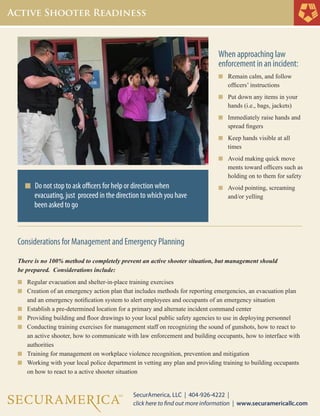
When approaching law
enforcement in an incident:
n	 Remain calm, and follow
	 officers’ instructions
n	 Put down any items in your 	
	 hands (i.e., bags, jackets)
n	 Immediately raise hands and 	
	 spread fingers
n	 Keep hands visible at all 		
	 times
n	 Avoid making quick move	
	 ments toward officers such as 	
	 holding on to them for safety
n	 Avoid pointing, screaming 	
	 and/or yelling
n Do not stop to ask officers for help or direction when
			evacuating, just proceed in the direction to which you have 	
			been asked to go
For more Information on Active
Shooter readiness go to:
n www.dhs.gov
n www.fbi.gov
n www.alerrt.org
		
	IfYOU make the decision to
physically confront the shooter:
n		Act immediately and as
			aggressively as possible
n	 	Do so when the shooter is
			distracted (such as re-loading his 		
			weapon)
n		Be totally committed to your
			actions
n	 	If you do incapacitate the shooter, 	
			try getting his firearm away from 	
			him
n	 	“Use any improvised weapon” – put 	
			that after 3rd bullet, “Be Totally
			committed to your actions)
Active shooter event stats (2000 to 2012)
Median police response time: 3 minutes (very fast!)
Median # of victims shot per event: 5
Single shooters conducted all attacks; 94% were male;
	 diverse racial/ethnic categories; ages varied
Weapon of choice: pistol (59% of events)
In 49% of active shootings, the incident was over before 	
	 police arrive (69% of shooters committed suicide)
	
If Confronted by an Active Shooter
n		Try to remain calm and quiet
n	 	Make eye contact
n	 	Call 911; leave line open (if you can safely do this).
n		Follow shooter’s instructions unless it endangers you or others.
n		Attempt to flee to safe location (doors, windows, etc.) – use 	
			zig-zag motion so it is more difficult for the shooter to aim
			at you
n	 	Attempt to talk with shooter, if possible (“What can I do to 	
			help you?”)
n		Never argue or provoke shooter

SecurAlert July 2014 - Active Shooter

  • 1.
    According to aJune 2014 report by J. Pete Blair, a criminal justice professor at Texas State University, active shootings are occurring at a rate of more than one a month. Research numbers show an average of 5 incidents per year from 2000 to 2008. By 2011, the incidents had more than doubled, with eleven active shooters trying to murder others that year. In 2012, the number of active shooting events went up again to fifteen. 2013 had sixteen incidents. And thus far into 2014, Dr. Blair’s study has already logged 9 active shooting events and we are only half way through the year! That puts the nation on pace to top last year’s already sizable count and end up with 20 active shooting events by the end of this calendar year! According to the US Department of Justice, active shooter scenarios leave little room for reasoning or negotiation. 2014 is on track to be the deadliest on record for active shootings in the US. In this month’s issue of SecurAlert, we thought we would provide you with the latest information on this horrific crime and what you can do to help respond to an incident.
  • 2.
    An active shooteris defined by the U.S. Department of Homeland Security as“an individual actively engaged in killing or attempting to kill people in a confined and populated area.” Inmostcases,activeshootersusefirearm[s]andthereisnopatternormethodtotheir selectionofvictims. Most active shooter cases occur in locations where the shooter has been undeterred and unobstructed from carrying out their attack. The incident locations have often been described as soft targets with limited active security measures or armed personnel to provide protection for members of the public. In most instances, shooters have either taken their own lives, been shot by police, or surrendered when forced with a confrontation by law enforcement. According to the US Department of Justice, active shooter scenarios leave little room for reasoning or negotiation. The agenda of the active shooter is straightforward: kill or harm as many individuals as possible until cornered or captured by law enforcement. Escape is not typically a priority. In the majority of cases, active shooters have already decided that they will commit suicide. Described as “social isolates” who “harbored feelings of hate and anger” active shooters often had some contact with mental health professionals, according to the FBI. While a common factor, the functional role that mental illness plays in causing a massacre cannot really be determined, according to FBI analysis. Very few of the shooters had,“previous arrests for violent crimes, though many had encountered a significant emotional hardship prior to the attack such as loss of significant relationships, changes in financial status, loss of a job, changes in living arrangements, major adverse changes to life circumstances, and/or feelings of humiliation or rejection on the part of the shooter.” Most mass shootings occur where people spend most of their time – work and school – with 48% of active shootings taking place at businesses; 30% at schools; 18% in outdoor places and 12% in other locations, such as shopping malls, movie theaters, churches and military bases. A survey by ABCNews.com of the 25 deadliest mass shootings in U.S. history, dating back to the 1966 University of Texas shooting, which killed 16, substantiated these statistics by reporting that most active shooter killings also occurred at workplaces or schools.
  • 3.
    Considerations when anactive shooter is in your vicinity n Call 911 and building security if you can do so safely. n Evacuate the area if there is an accessible escape path; leave your belongings, laptop, etc. behind; keep hands visible and follow the directives of law enforcement. n Once outside, get away from the building and out of the line of fire of the shooter and responding police. n As difficult as it is to say, DO NOT stop to help injured pesons as you are escaping; this puts you in danger and many times a shooter will return to the people he just shot; but of course that is YOUR decision to make. n If sounds indicating shooter is approaching, call 911 When Hiding n Be out of the shooter’s view n Lock /barricade door n Hide under or behind a large item – stay low n Shut off lights n Shut off computers, radios n Silence cell phones, watch alarms, anything that can beep or cause a noise n Unplug any room phone so it won’t ring n Close blinds or other window treatments n Be silent n Stay away from door and windows Never respond to unfamiliar voices/knocks; Never open door even if person claims to be the police (leave line open if you can’t talk); hide in office space n If you can’t evacuate, hide out; find a safe place to hide where the shooter is less likely to find you
  • 4.
    Prevention/Readiness Considerations To help prepareyou for a potential active shooter situation, here are some things you can do: n Know the location of the nearest emergency exits to you. n Actively participate in your building’s annual fire drill to make you aware of exits, escape routes and assembly areas. n If you hear what sounds like gunshots – don’t assume they are “fireworks”; call security and 911 immediately. n Report any strange behavior or threats from co-workers – many persons who commit workplace violence do give signs of their distress. n Report suspicious persons or behavior to building security, management or the police. n Follow your building’s security procedures TO THE LETTER – never hold open a secured door for strangers. n Scope out in advance a safe area to hide in an emergency. What to do in an active shooter scenerio: RUN: get away from the danger FAST! HIDE: If you can’t get away, find a safe place where you can hide FIGHT: If you are confronted by the shooter, fight to save your life (Source: Department of Homeland Defense; FBI) Download an active shooter training video specifically made for the general public by going to www.fbi.gov
  • 5.
    Considerations for Managementand Emergency Planning There is no 100% method to completely prevent an active shooter situation, but management should be prepared. Considerations include: n Regular evacuation and shelter-in-place training exercises n Creation of an emergency action plan that includes methods for reporting emergencies, an evacuation plan and an emergency notification system to alert employees and occupants of an emergency situation n Establish a pre-determined location for a primary and alternate incident command center n Providing building and floor drawings to your local public safety agencies to use in deploying personnel n Conducting training exercises for management staff on recognizing the sound of gunshots, how to react to an active shooter, how to communicate with law enforcement and building occupants, how to interface with authorities n Training for management on workplace violence recognition, prevention and mitigation n Working with your local police department in vetting any plan and providing training to building occupants on how to react to a active shooter situation When approaching law enforcement in an incident: n Remain calm, and follow officers’ instructions n Put down any items in your hands (i.e., bags, jackets) n Immediately raise hands and spread fingers n Keep hands visible at all times n Avoid making quick move ments toward officers such as holding on to them for safety n Avoid pointing, screaming and/or yelling n Do not stop to ask officers for help or direction when evacuating, just proceed in the direction to which you have been asked to go
  • 6.
    For more Informationon Active Shooter readiness go to: n www.dhs.gov n www.fbi.gov n www.alerrt.org IfYOU make the decision to physically confront the shooter: n Act immediately and as aggressively as possible n Do so when the shooter is distracted (such as re-loading his weapon) n Be totally committed to your actions n If you do incapacitate the shooter, try getting his firearm away from him n “Use any improvised weapon” – put that after 3rd bullet, “Be Totally committed to your actions) Active shooter event stats (2000 to 2012) Median police response time: 3 minutes (very fast!) Median # of victims shot per event: 5 Single shooters conducted all attacks; 94% were male; diverse racial/ethnic categories; ages varied Weapon of choice: pistol (59% of events) In 49% of active shootings, the incident was over before police arrive (69% of shooters committed suicide) If Confronted by an Active Shooter n Try to remain calm and quiet n Make eye contact n Call 911; leave line open (if you can safely do this). n Follow shooter’s instructions unless it endangers you or others. n Attempt to flee to safe location (doors, windows, etc.) – use zig-zag motion so it is more difficult for the shooter to aim at you n Attempt to talk with shooter, if possible (“What can I do to help you?”) n Never argue or provoke shooter