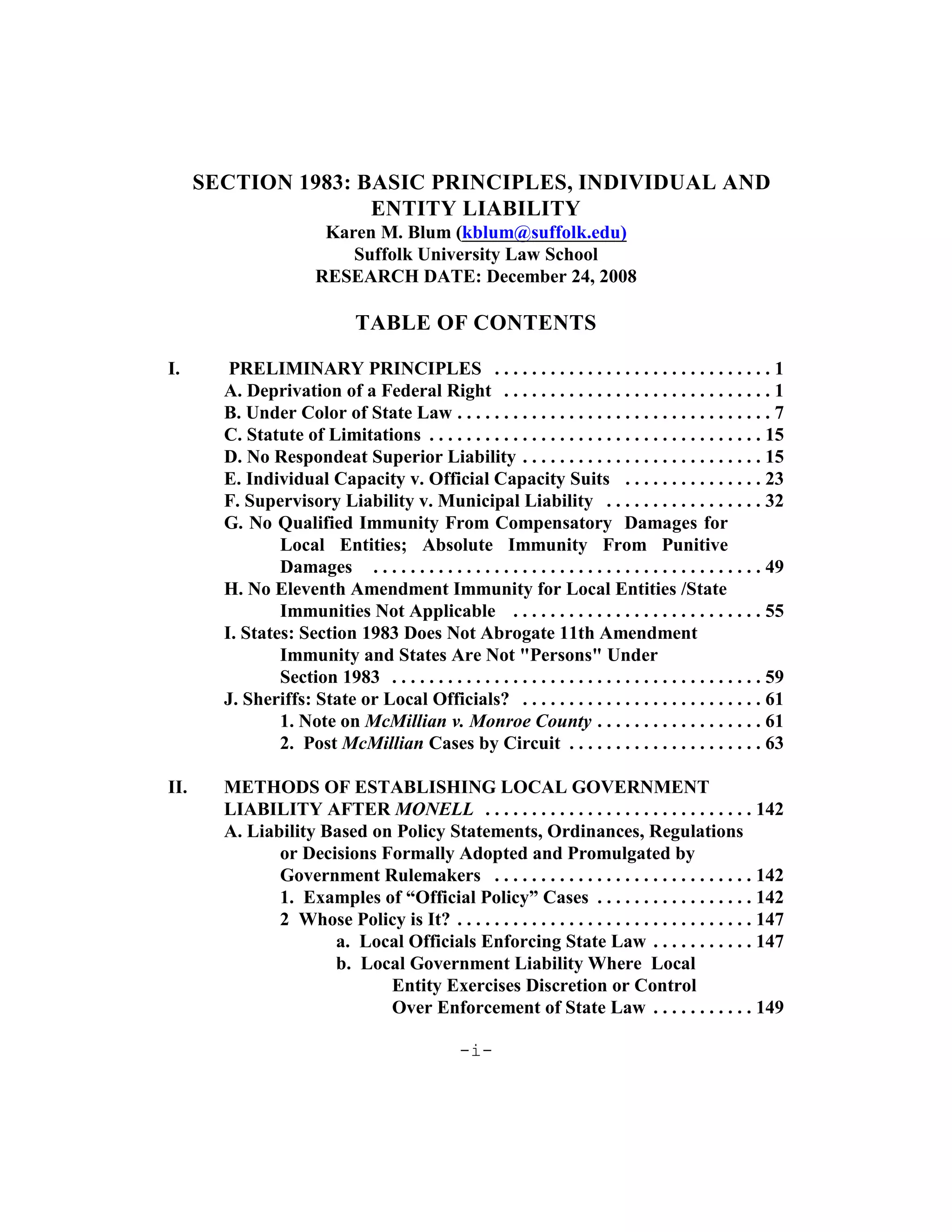
SECTION 1983: BASIC PRINCIPLES, INDIVIDUAL AND
                     ENTITY LIABILITY
                         Karen M. Blum (kblum@suffolk.edu)
                            Suffolk University Law School
                        RESEARCH DATE: December 24, 2008

                                TABLE OF CONTENTS

I.       PRELIMINARY PRINCIPLES . . . . . . . . . . . . . . . . . . . . . . . . . . . . . . 1
        A. Deprivation of a Federal Right . . . . . . . . . . . . . . . . . . . . . . . . . . . . . 1
        B. Under Color of State Law . . . . . . . . . . . . . . . . . . . . . . . . . . . . . . . . . . 7
        C. Statute of Limitations . . . . . . . . . . . . . . . . . . . . . . . . . . . . . . . . . . . . 15
        D. No Respondeat Superior Liability . . . . . . . . . . . . . . . . . . . . . . . . . . 15
        E. Individual Capacity v. Official Capacity Suits . . . . . . . . . . . . . . . 23
        F. Supervisory Liability v. Municipal Liability . . . . . . . . . . . . . . . . . 32
        G. No Qualified Immunity From Compensatory Damages for
                Local Entities; Absolute Immunity From Punitive
                Damages . . . . . . . . . . . . . . . . . . . . . . . . . . . . . . . . . . . . . . . . . . 49
        H. No Eleventh Amendment Immunity for Local Entities /State
                Immunities Not Applicable . . . . . . . . . . . . . . . . . . . . . . . . . . . 55
        I. States: Section 1983 Does Not Abrogate 11th Amendment
                Immunity and States Are Not "Persons" Under
                Section 1983 . . . . . . . . . . . . . . . . . . . . . . . . . . . . . . . . . . . . . . . . 59
        J. Sheriffs: State or Local Officials? . . . . . . . . . . . . . . . . . . . . . . . . . . 61
                1. Note on McMillian v. Monroe County . . . . . . . . . . . . . . . . . . 61
                2. Post McMillian Cases by Circuit . . . . . . . . . . . . . . . . . . . . . 63

II.     METHODS OF ESTABLISHING LOCAL GOVERNMENT
        LIABILITY AFTER MONELL . . . . . . . . . . . . . . . . . . . . . . . . . . . . . 142
        A. Liability Based on Policy Statements, Ordinances, Regulations
               or Decisions Formally Adopted and Promulgated by
               Government Rulemakers . . . . . . . . . . . . . . . . . . . . . . . . . . . . 142
               1. Examples of “Official Policy” Cases . . . . . . . . . . . . . . . . . 142
               2 Whose Policy is It? . . . . . . . . . . . . . . . . . . . . . . . . . . . . . . . . 147
                      a. Local Officials Enforcing State Law . . . . . . . . . . . 147
                      b. Local Government Liability Where Local
                             Entity Exercises Discretion or Control
                             Over Enforcement of State Law . . . . . . . . . . . 149

                                                   -i-
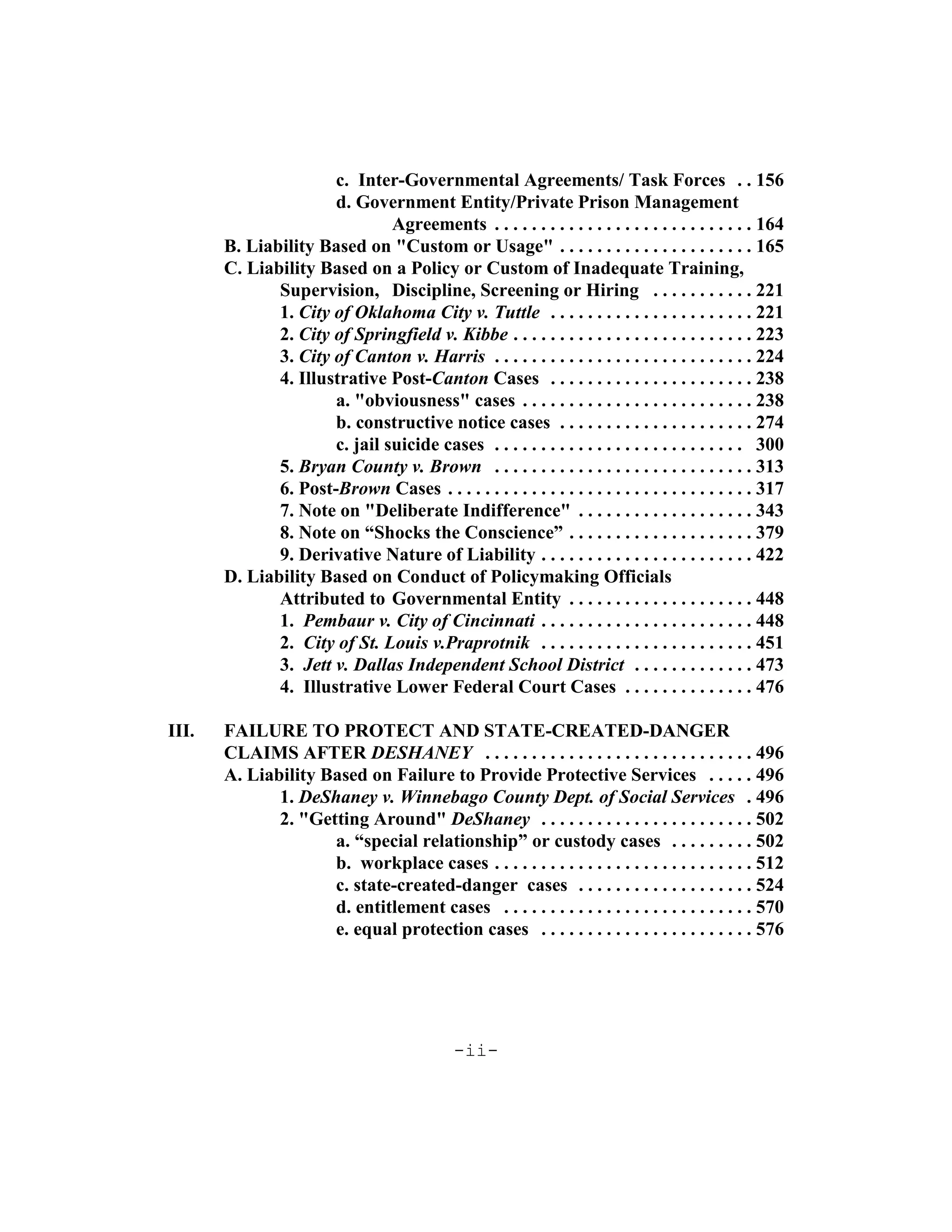
c. Inter-Governmental Agreements/ Task Forces . . 156
                      d. Government Entity/Private Prison Management
                               Agreements . . . . . . . . . . . . . . . . . . . . . . . . . . . . 164
       B. Liability Based on "Custom or Usage" . . . . . . . . . . . . . . . . . . . . . 165
       C. Liability Based on a Policy or Custom of Inadequate Training,
              Supervision, Discipline, Screening or Hiring . . . . . . . . . . . 221
              1. City of Oklahoma City v. Tuttle . . . . . . . . . . . . . . . . . . . . . . 221
              2. City of Springfield v. Kibbe . . . . . . . . . . . . . . . . . . . . . . . . . . 223
              3. City of Canton v. Harris . . . . . . . . . . . . . . . . . . . . . . . . . . . . 224
              4. Illustrative Post-Canton Cases . . . . . . . . . . . . . . . . . . . . . . 238
                      a. "obviousness" cases . . . . . . . . . . . . . . . . . . . . . . . . . 238
                      b. constructive notice cases . . . . . . . . . . . . . . . . . . . . . 274
                      c. jail suicide cases . . . . . . . . . . . . . . . . . . . . . . . . . . . 300
              5. Bryan County v. Brown . . . . . . . . . . . . . . . . . . . . . . . . . . . . 313
              6. Post-Brown Cases . . . . . . . . . . . . . . . . . . . . . . . . . . . . . . . . . 317
              7. Note on "Deliberate Indifference" . . . . . . . . . . . . . . . . . . . 343
              8. Note on “Shocks the Conscience” . . . . . . . . . . . . . . . . . . . . 379
              9. Derivative Nature of Liability . . . . . . . . . . . . . . . . . . . . . . . 422
       D. Liability Based on Conduct of Policymaking Officials
              Attributed to Governmental Entity . . . . . . . . . . . . . . . . . . . . 448
              1. Pembaur v. City of Cincinnati . . . . . . . . . . . . . . . . . . . . . . . 448
              2. City of St. Louis v.Praprotnik . . . . . . . . . . . . . . . . . . . . . . . 451
              3. Jett v. Dallas Independent School District . . . . . . . . . . . . . 473
              4. Illustrative Lower Federal Court Cases . . . . . . . . . . . . . . 476

III.   FAILURE TO PROTECT AND STATE-CREATED-DANGER
       CLAIMS AFTER DESHANEY . . . . . . . . . . . . . . . . . . . . . . . . . . . . . 496
       A. Liability Based on Failure to Provide Protective Services . . . . . 496
              1. DeShaney v. Winnebago County Dept. of Social Services . 496
              2. "Getting Around" DeShaney . . . . . . . . . . . . . . . . . . . . . . . 502
                     a. “special relationship” or custody cases . . . . . . . . . 502
                     b. workplace cases . . . . . . . . . . . . . . . . . . . . . . . . . . . . 512
                     c. state-created-danger cases . . . . . . . . . . . . . . . . . . . 524
                     d. entitlement cases . . . . . . . . . . . . . . . . . . . . . . . . . . . 570
                     e. equal protection cases . . . . . . . . . . . . . . . . . . . . . . . 576


                                              -ii-
I.      PRELIMINARY PRINCIPLES

        A. Deprivation of a Federal Right

        Title 42 U.S.C. § 1983 provides in relevant part:

        Every person who, under color of any statute, ordinance, regulation,
        custom, or usage, of any State or Territory or the District of
        Columbia, subjects, or causes to be subjected, any citizen of the
        United States or other person within the jurisdiction thereof to the
        deprivation of any rights, privileges, or immunities secured by the
        Constitution and laws, shall be liable to the party injured in an action
        at law, suit in equity, or other proper proceeding for redress, except
        that in any action brought against a judicial officer for an act or
        omission taken in such officer's judicial capacity, injunctive relief
        shall not be granted unless a declaratory decree was violated or
        declaratory relief was unavailable.

          Note that a plaintiff must assert the violation or deprivation of a right secured
by federal law. The Supreme Court has made clear, for example, that an officer’s
violation of state law in making an arrest does not make a warrantless arrest
unreasonable under the Fourth Amendment where the arrest was for a crime
committed in the presence of the arresting officer. Virginia v. Moore, 128 S. Ct.
1598, 1607 (2008). See also Taake v. County of Monroe, 530 F.3d 538, 542 (7th
Cir. 2008) (“Our caselaw already explains that mere breaches of contract by the
government do not support substantive due process claims under the Constitution,
. . . but we will explain it again, for the sake of future litigants who may think it a
good idea to bring regular state-law contract claims to federal court via § 1983. When
a state actor breaches a contract it has with a private citizen, and the subject matter
of that contract does not implicate fundamental liberty or property interests, the state
acts just like any other contracting private citizen . . . . [T]he proper tribunal to
adjudicate issues arising from the contract (or alleged contract) is a state court . . . .”);
Wilder v. Turner, 490 F.3d 810, 814(10th Cir.2007) (“Of course a ‘violation of state
law cannot give rise to a claim under Section 1983.’ Marshall v. Columbia Lea
Regional Hosp., 345 F.3d 1157, 1164 (10th Cir.2003). ‘Section 1983 does not ...
provide a basis for redressing violations of state law, but only for those violations of
federal law done under color of state law.’ Jones v. City and County of Denver, 854
F.2d 1206, 1209 (10th Cir.1988). ‘While it is true that state law with respect to arrest

                                           -1-
is looked to for guidance as to the validity of the arrest since the officers are subject
to those local standards, it does not follow that state law governs.’ Wells v. Ward, 470
F.2d 1185, 1187 (10th Cir.1972). Nor, perhaps more importantly, are we bound by
a state court's interpretation of federal law-in this case the Fourth Amendment.”);
Steen v. Myers, 486 F.3d 1017, 1023 (7th Cir. 2007) (“The question of whether
Myers's training indicated that he should stop the pursuit likewise does not raise
questions that implicate the Constitution. Various sections of the pursuit manual are
quoted by both sides to support arguments about whether Myers complied with
department directives. As the Court in Lewis noted, however, a failure to comply
with departmental policy does not implicate the Constitutional protections of the
Fourteenth Amendment.”); Andujar v. Rodriguez, 480 F.3d 1248, 1252 n.4 (11th
Cir. 2007) (“Whether a government official acted in accordance with agency protocol
is not relevant to the Fourteenth Amendment inquiry. . . Thus, Andujar's argument
that a City of Miami Rescue Policy required Newcomb and Barea to transport
Andujar to a treatment facility, even if correct, is without consequence.”); United
States v. Laville, 480 F.3d 187, 196 (3d Cir. 2007) (“[W]e hold that the unlawfulness
of an arrest under state or local law does not make the arrest unreasonable per se
under the Fourth Amendment; at most, the unlawfulness is a factor for federal courts
to consider in evaluating the totality of the circumstances surrounding the arrest.”);
Thompson v. City of Chicago, 472 F.3d 444, 455 (7th Cir. 2006) (“Whether Officer
Hespe's conduct conformed with the internal CPD General Orders concerning the use
of force on an assailant was irrelevant to the jury's determination of whether his
actions on December 5, 2000 were ‘objectively reasonable’ under the Fourth
Amendment. It may be that Officer Hespe's possible violation of the CPD's General
Orders is of interest to his superiors when they are making discipline, promotion or
salary decisions, but that information was immaterial in the proceedings before the
district court and was properly excluded. Instead, the jury in all probability properly
assessed the reasonableness of Officer Hespe's split-second judgment on how much
force to use by considering testimony describing a rapidly evolving scenario in which
Thompson attempted to evade arrest by leading the police on a high speed chase,
crashed his car, and actively resisted arrest.”); Hannon v. Sanner, 441 F.3d 635, 638
(8th Cir. 2006) (“Hannon's action is premised on an alleged violation of the
constitutional rule announced in Miranda and subsequent decisions. The remedy for
any such violation is suppression of evidence, which relief Hannon ultimately
obtained from the Supreme Court of Minnesota. The admission of Hannon's
statements in a criminal case did not cause a deprivation of any ‘right’ secured by the
Constitution, within the meaning of 42 U.S.C. § 1983.”); Bradley v. City of
Ferndale, 148 Fed.Appx. 499, 2005 WL 2173780, at *6 (6th Cir. Sept. 8, 2005)

                                          -2-
(“[T]he violation of city policy is not in and of itself a constitutional violation under
42 U.S.C.§ 1983.”); Waubanascum v. Shawano, 416 F.3d 658, 667 (7th Cir.2005)
(“Waubanascum suggests that Shawano County showed deliberate indifference by
its ‘long-standing custom of granting courtesy licenses without conducting
investigations of the applicants.’ Thus, he argues, ‘Shawano County's policy was
deliberately indifferent to a known risk to foster children.’ Waubanascum seems to
propose that state laws and regulations assume that failure to perform background
checks necessarily will expose foster children to risk, thus constituting deliberate
indifference. This argument misstates the legal standard, because it sidesteps the
requirement that there be knowledge or suspicion of actual risk and substitutes the
possibility of risk arising from the county's custom. Undoubtedly, foster children
would be exposed to a heightened degree of risk if foster license applicants were
subjected to no background checks at all. We may assume that it is this very concern
that underlies Wisconsin's laws and regulations requiring such background checks
before a foster license may be granted. But a failure to abide by a general statutory
requirement for background checks cannot substitute for the requirement of actual
knowledge or suspicion in the foster home context. . . . As noted, it is unclear that
Shawano County actually did violate Wisconsin law in effect at the time that the
county granted Fry the courtesy foster license. But in any event, state law does not
create a duty under the federal constitution, so even if Shawano County failed to
abide by Wisconsin law, this would not by itself amount to a violation of
Waubanascum's due process rights.”); Tanberg v. Sholtis, 401 F.3d 1151, 1164,
1165 (10th Cir. 2005) (“Although plaintiffs frequently wish to use administrative
standards, like the Albuquerque SOPs, to support constitutional damages claims, this
could disserve the objective of protecting civil liberties. Modern police departments
are able--and often willing--to use administrative measures such as reprimands,
salary adjustments, and promotions to encourage a high standard of public service,
in excess of the federal constitutional minima. If courts treated these administrative
standards as evidence of constitutional violations in damages actions under § 1983,
this would create a disincentive to adopt progressive standards. Thus, we decline
Plaintiffs' invitation here to use the Albuquerque Police Department's operating
procedures as evidence of the constitutional standard. The trial court's exclusion of
the SOPs was particularly appropriate because Plaintiffs wished to admit not only
evidence of the SOPs themselves, but also evidence demonstrating that the APD
found that Officer Sholtis violated the SOPs and attempted to discipline him for it.
Explaining the import of these convoluted proceedings to the jury would have been
a confusing, and ultimately needless, task. The Albuquerque Chief of Police followed
the recommendation of an internal affairs investigator to discipline Officer Sholtis

                                          -3-
both for making an impermissible off-duty arrest and for use of excessive force. An
ad hoc committee subsequently reversed this decision. Additional testimony would
have been necessary to help the jury understand the significance of these
determinations and the procedures used to arrive at these contradictory results. This
additional testimony explaining the procedures used at each step in the APD's
investigation and decision-making would have led the jury ever further from the
questions they were required to answer, and embroiled them in the dispute over
whether Officer Sholtis's actions did or did not violate the SOPs. At the end of this
time-consuming detour through a tangential and tendentious issue, the jury would
have arrived at the conclusion that the APD itself seems to have been unable to
resolve satisfactorily the question whether Plaintiffs' arrest violated the APD SOPs.
. . . The similarity of the SOP addressing excessive force to the objective standard
employed by state and federal law would render jury confusion even more likely,
tempting the jury to conclude that if experienced police officers interpreted Officer
Sholtis's actions as a violation of SOPs employing the same standards as the law,
then Officer Sholtis must also have violated legal requirements. When, as here, the
proffered evidence adds nothing but the substantial likelihood of jury confusion, the
trial judge's exclusion of it cannot be an abuse of discretion.”); McGee v. City of
Cincinnati Police Dept., No. 1:06-CV-726, 2007 WL 1169374, at *5 n.4 (S.D. Ohio
Apr. 18, 2007) (“Plaintiff argues that the CCA's finding that Officer Rackley's use of
his taser against Plaintiff violated Cincinnati Police Department procedure on use of
force demonstrates that Officer Rackley used excessive force against Plaintiff. .
.However, the CCA's finding is not dispositive. A city's police department may
choose to hold its officers to a higher standard than that required by the Constitution
without being subject to or subjecting their officers to increased liability under §
1983. Violation of a police policy or procedure does not automatically translate into
a violation of a person's constitutional rights.”); Philpot v. Warren, No.
Civ.A.1:02-CV2511JOF, 2006 WL 463169, at *7 (N.D. Ga. Feb. 24, 2006) (“As an
initial matter, the court notes the fact that Cobb County ultimately terminated
Defendant Warren for his actions in this case would not necessarily preclude a
determination that Defendant Warren is entitled to qualified immunity. Defendant
Warren's supervisors terminated him based upon an analysis of the policies of the
Cobb County Police Department. Plaintiff has not argued that these policies are
coextensive with the constitutional parameters of the Fourth Amendment in the
search and seizure context, or that those parameters were clearly established as a
matter of law at the time of the incident. The fact that the Cobb County Police
Department may hold its officers to a different standard than that constitutionally
mandated in the Eleventh Circuit is not before this court. The role of the Cobb

                                         -4-
County Police Department was to determine whether Defendant Warren violated
department policy and whether his actions warranted punishment. The role of this
court is to determine whether Defendant Warren is entitled to qualified immunity as
a matter of law. See also Durruthy v. Pastor, 351 F.3d 1080, 1092 (11th Cir.2003)
(concluding that officer's violation of department's internal policy does not vitiate
finding of probable cause based on objective facts); Craig v. Singletary,127 F.3d
1030, 1044 (11th Cir.1997) (probable cause involves only constitutional
requirements and not any local policies).”); Chamberlin v. City of Albuquerque,
No. CIV 02-0603 JB/ACT, 2005 WL 2313527, at *4 (D.N.M. July 31,
2005)(Plaintiff barred from introducing as evidence “the Albuquerque Police
Department's SOP's to support its allegation that [officer] acted unreasonably in
directing his police service dog to attack the [plaintiff] in violation of his Fourth
Amendment rights.”); Wilhelm v. Knox County, Ohio, No. 2:03-CV-786, 2005 WL
1126817, at *14 (S.D. Ohio May 12, 2005) (not reported) (“[T]he Court recognizes
that the Sixth Circuit has held that (1) a defendant cannot be liable under §1983
unless he or she violated one of a plaintiff's federal constitutional rights, and (2) a
state right ‘as an alleged misdemeanant to be arrested only when the misdemeanor
is committed in the presence of the arresting officer [is] not grounded in the federal
constitution and will not support a § 1983 claim.’ . . The issue is whether probable
cause to arrest existed, not whether the arrest violated state law. Accordingly,
because probable cause to believe that a crime had occurred existed, Bradley's §1983
false arrest claim under the Fourth Amendment must fail.”).

        See also McAtee v. Warkentin, 2007 WL 4570834, at *4 (S.D. Iowa Dec. 31,
2007) (“The court will admit evidence of the North Liberty pursuit and ramming
policies. They will not be admitted to support any claim that Kyle Wasson was
deprived of Fourth Amendment rights by Chief Warkentin's decision to pursue a
high-speed chase. The Scott decision makes it clear that the decision to engage in a
high-speed chase alone cannot support a Fourth Amendment claim. Similarly, the
plaintiff will not be permitted to argue for responsibility based on the failure of Chief
Warkentin to abandon the pursuit. . . However, the pursuit is part and parcel of the
events giving rise to Kyle Wasson's ultimate death. The extent to which Chief
Warkentin was willing to violate internal policies crafted for the safety of the police
and public may be probative of other issues concerning the chief's judgment and
intent on the evening in question. An appropriate jury instruction will be given, upon
request, to place this evidence in its proper context.”).


                                          -5-
Also note that compliance with state law does not mean there is no
constitutional violation for purposes of liability under Section 1983. See, e.g.,
Gronowski v. Spencer, 424 F.3d 285, 297 (2d Cir. 2005) (“[W]e conclude that
appellants' civil service defense provides no basis to vacate the judgment. We do not
agree that appellants could not have violated §1983 if they complied with a state law
that shares one of §1983's purposes. The fact that City officials had discretion to lay
off Gronowski and did not violate civil service law in failing to reinstate her in the
Consumer Protection Office does not foreclose the possibility that retaliation for the
exercise of her constitutional rights motivated these actions. If there is sufficient
evidence supporting a finding of illegal retaliation, we will not overturn a verdict
arriving at such finding. Regardless of the City officials' conformity with civil service
law, they must still refrain from violating rights protected under the United States
Constitution.”).

        See also Gandara v. Bennett, 528 F.3d 823, 825, 826 (11th Cir. 2008) (“The
question presented in this matter is whether a foreigner who has been arrested and
detained in this country and alleges a violation of the consular notification provisions
of the Vienna Convention on Consular Relations (the "Treaty") can maintain an
action under 42 U.S.C. § 1983. The answer to this question hinges on whether or not
individual rights are bestowed by the Treaty. Although we find the issue a close one
with strong arguments on both sides, we ultimately conclude the answer is ‘no.’. . .
This Circuit has not expressly addressed the issue of whether the Vienna Convention
contains private rights and remedies enforceable in our courts through § 1983 by
individual foreign nationals who are arrested or detained in this country. We have
previously commented, however, on the issue of private rights in the context of
criminal cases and indicated that we would follow the lead of the First and Ninth
Circuits. See United States v. Cordoba-Mosquera, 212 F.3d 1194, 1196 (11th
Cir.2000) (the First and Ninths circuits have indicated that Article 36 does not create
privately enforceable rights).”); Mora v. People of the State of New York, 524 F.3d
183, 203, 204 (2d Cir. 2008) (“In sum, there are a number of ways in which the
drafters of the Vienna Convention, had they intended to provide for an individual
right to be informed about consular access and notification that is enforceable
through a damages action, could have signaled their intentions to do so. . . . That they
chose not to signal any such intent counsels against our recognizing an individual
right that can be vindicated here in a damages action.”).


                                          -6-
B. Under Color of State Law

        In order to establish liability under § 1983, the plaintiff must prove that she
has been deprived of a federal statutory or constitutional right by someone acting
"under color of" state law. Parratt v. Taylor, 451 U.S. 527, 535 (1981). See also
Lugar v. Edmonson Oil Co., 457 U.S. 922 (1982) (“state action” under Fourteenth
Amendment equated with “under color of law” for Section 1983 purposes) and
Brentwood Acad. v. Tennessee Secondary Sch. Athletic Ass'n, 531 U.S. 288
(2001) (discussing different tests for determining whether conduct of private actor
constitutes “state action” and finding state action on basis of “pervasive
entwinement” of state with challenged activity).

        In Monroe v. Pape, 365 U.S. 167, 180 (1961), the Court held that acts
performed by a police officer in his capacity as a police officer, even if illegal or not
authorized by state law, are acts taken “under color of” law. As the Supreme Court
stated in United States v. Classic, 313 U.S. 299, 326 (1941), "[m]isuse of power,
possessed by virtue of state law and made possible only because the wrongdoer is
clothed with the authority of state law, is action taken `under color of' state law."

Examples:

D.C. CIRCUIT

Williams v. United States, 396 F.3d 412, 414 (D.C. Cir. 2005) (federal police officer
who arrested plaintiff for violation of D.C. law did not act under color of state law).

Maniaci v. Georgetown University, 510 F.Supp.2d 50, 62, 70 (D.D.C.,2007) (“[T]he
Court notes that various circuits have applied Section 1983 and its limitations as set
forth in Monell to private institutions such as Georgetown University where such
private institutions employ quasi-state actors. [collecting cases] . . . . Plaintiff's
Amended Complaint contains facts that, if taken as true, sufficiently raise a colorable
claim that the Georgetown Public Safety Officers were acting under the color of law
by exercising their state-granted authority to arrest or actions related thereto. The
Public Safety Officers in this case were not merely verbally conveying a store policy
(and thus functioning in a private capacity) . . . . On several occasions, Plaintiff sets
forth facts that indicate that his physical liberty was restrained and that he was aware
of the power asserted over him by the Public Safety Officers. . . Allegedly, he was
physically grabbed and ‘violently jerked ... from his seat.’. . He was ‘surrounded by

                                          -7-
six campus police offers and was pushed against a glass window.’. . His exit was
blocked, and he was ‘told not to go anywhere.’. . . Accordingly, at this time, the
Court shall not dismiss Plaintiff's Section 1983 claim on the grounds that the Public
Safety Officers were not acting under color of state law, as Plaintiff has alleged facts
sufficient to suggest that an arrest or actions related thereto occurred.”).

FIRST CIRCUIT

Burke v. Town of Walpole, 405 F.3d 66, 88 (1st Cir. 2005) (private forensic
odontologist who rendered bite mark opinon at request of District Attorney’s Office
was acting under color of law and eligible for qualified immunity).

Martinez v. Colon, 54 F.3d 980, 987 (1st Cir. 1995) (an unintended shooting of a
police officer at the police station, during the course of harassment and taunting by
a fellow officer who was on duty and in uniform, did not constitute conduct under
color of law where the court concluded that the behavior of the harassing officer
represented a "singularly personal frolic[,]" and in no way was or purported to be in
furtherance of the exercise of any police power).

Miller v. City of Boston, No. 07-12076-JLT, 2008 WL 4936729, at *1 (D. Mass.
Nov. 19, 2008) (“The City first argues that it is never liable for the misconduct of
special officers. The only authority the City offers for this assertion is the text of the
1898 statute giving the City authority to license these special officers and virtually
identical language in a corresponding police department rule.. . . The statute gives
licensed special officers ‘the power of police officers to preserve order and to enforce
the laws and ordinances of the city.’. . The statute goes on to state that ‘the
corporation or person applying for an appointment under this section shall be liable
for the official misconduct of the officer.’ . . BPD argues that because the statute
makes the special officers' employer liable for their misconduct, the City cannot be
liable. . . The mere fact that the statute holds the employer of special officers liable,
however, does not necessarily mean that the City may not also be held liable for the
misconduct of special officers. Under the terms of the statute, special officers are
granted the ‘power of police officers.’ Inasmuch as the statute grants special officers
the authority of police officers, it seems logical to treat them as such for purposes of
the City's liability. Because Plaintiff's complaint is deficient in other respects,
however, this court assumes without deciding that the City may be held liable for
special officer misconduct to the same extent as it may be liable for the misdeeds of
other city employees.”).

                                          -8-
Shah v. Holloway, No. 07-10352-DPW, 2008 WL 3824788, at *5 (D. Mass. July
28, 2008) (“It is apparent that city and federal authorities were acting in concert with
respect to law enforcement initiatives at the DNC. Given the need for further
discovery to identify whether facts or circumstances justify treating this case as out
of the ‘ordinary’ sufficiently to support a claim pursuant to § 1983 against federal
agents, I decline to dismiss the § 1983 claim against the Agents.”).

Carmack v. MBTA, 465 F.Supp.2d 18, 27 (D. Mass. 2006) (“In evaluating whether
the conduct of an otherwise private actor constitutes indirect state action, courts
conventionally have traveled a trio of analytic avenues, deeming a private entity to
have become a state actor if (1) it assumes a traditional public function when it
undertakes to perform the challenged conduct, or (2) an elaborate financial or
regulatory nexus ties the challenged conduct to the State, or (3) a symbiotic
relationship exists between the private entity and the State. . . The satisfaction of any
one of these tests requires a finding of indirect state action. . . In addition, where
‘[t]he nominally private character of [an organization] is overborne by the pervasive
entwinement of public institutions and public officials in its composition and
workings, and there is no substantial reason to claim unfairness in applying
constitutional standards to it,’ the conclusion is that there is state action. . . The
inquiry, under any of these theories, is necessarily fact-intensive, and the ultimate
conclusion regarding state action must be based on the particular facts and
circumstances of the case. . . This court finds that Mr. Carmack has alleged enough
facts to support a claim that MBCR [Massachusetts Bay Commuter Railroad
Company] was a state actor based on the traditional public function and symbiotic
relationship theories.”)

SECOND CIRCUIT

Jocks v. Tavernier, 316 F.3d 128, 134 (2d Cir. 2003) (“[W]hen an officer identifies
himself as a police officer and uses his service pistol, he acts under color of law.”).

THIRD CIRCUIT

Marcus v. McCollum, 394 F.3d 813, 818 (3d Cir. 2004) (noting Circuit agreement
that officers are not state actors during private repossession if they act only to keep
the peace).


                                          -9-
FOURTH CIRCUIT

Rossignol v. Voorhaar, 316 F.3d 516, 523, 524, 527 (4th Cir. 2003) (“Defendants
executed a systematic, carefully-organized plan to suppress the distribution of St.
Mary's Today. And they did so to retaliate against those who questioned their fitness
for public office and who challenged many of them in the conduct of their official
duties. The defendants' scheme was thus a classic example of the kind of suppression
of political criticism which the First Amendment was intended to prohibit. The fact
that these law enforcement officers acted after hours and after they had taken off their
badges cannot immunize their efforts to shield themselves from adverse comment
and to stifle public scrutiny of their performance. . . .We would thus lose sight of the
entire purpose of § 1983 if we held that defendants were not acting under color of
state law. Here, a local sheriff, joined by a candidate for State's Attorney, actively
encouraged and sanctioned the organized censorship of his political opponents by his
subordinates, contributed money to support that censorship, and placed the blanket
of his protection over the perpetrators. Sheriffs who removed their uniforms and
acted as members of the Klan were not immune from § 1983; the conduct here,
while different, also cannot be absolved by the simple expedient of removing the
badge.”).

FIFTH CIRCUIT

Barkley v. Dillard Dept. Stores, Inc., No. 07-20482, 2008 WL 1924178, at *3 (5th
Cir. May 2, 2008) (not published) (“Although Dillard's notified Wilkinson of the
shoplifter, Wilkinson made an independent decision to chase after and attempt to
apprehend the suspect. These facts are in contrast with those in Smith v. Brookshire
Brothers, Inc., 519 F.2d 93 (5th Cir.1975) (per curiam), in which we found that
Brookshire was a state actor because ‘the police and [Brookshire] maintained a
pre-conceived policy by which shoplifters would be arrested based solely on the
complaint of the merchant.’. . There is no evidence of a pre-conceived policy in this
case. Therefore, based on the facts described above, we conclude that the district
court did not err in deciding that Dillard's was not a state actor. Consequently, we
affirm summary judgment for Dillard's.”).

Cornish v. Correctional Services Corp., 402 F.3d 545, 550, 551 (5th Cir. 2005)
(CSC’s decision to terminate plaintiff’s employment was made in its role as private
prison management employer and could not be attributed to Dallas County or State
of Texas).

                                        -10-
Rosborough v. Management & Training Corporation, 350 F.3d 459, 461 (5th Cir.
2003) (agreeing with Sixth Circuit and with district courts “that have found that
private prison-management corporations and their employees may be sued under §
1983 by a prisoner who has suffered a constitutional injury.”).

SIXTH CIRCUIT

Powers v. Hamilton County Public Defender Com'n, 501 F.3d 592, 613, 614 (6th
Cir. 2007) (“Powers alleges that the Public Defender engages in an across-the-board
policy or custom of doing nothing to protect its indigent clients' constitutional rights
not to be jailed as a result of their inability to pay court-ordered fines. Unlike the
plaintiff in Polk County, Powers does not seek to recover on the basis of the failures
of his individual counsel, but on the basis of an alleged agency-wide policy or custom
of routinely ignoring the issue of indigency in the context of non-payment of fines.
Although we acknowledge that requesting indigency hearings is within a lawyer's
‘traditional functions,’ the conduct complained of is nonetheless ‘administrative’ in
character for the reasons already described: Powers maintains that the Public
Defender's inaction is systemic and therefore carries the imprimatur of administrative
approval. . . .He argues that the Public Defender systematically violates class
members' constitutional rights by failing to represent them on the question of
indigency. Given the reasoning of Polk County, it makes sense to treat this alleged
policy or custom as state action for purposes of § 1983. The existence of such a
policy, if proven, will show that the adversarial relationship between the State and
the Public Defender--upon which the Polk County Court relied heavily in
determining that the individual public defender there was not a state actor--has
broken down such that the Public Defender is serving the State's interest in exacting
punishment, rather than the interests of its clients, or society's interest in fair judicial
proceedings.”).

Lindsey v. Detroit Entertainment, L.L.C., 484 F.3d 824, 830, 831 (6th Cir. 2007)
(where security personnel were not licensed by state, detention of plaintiffs could not
be attributed to state action)

Swiecicki v. Delgado, 463 F.3d 489, 496, 497 (6th Cir. 2006) (“Here, we believe the
record establishes that Delgado was a state actor from the beginning of the incident
in question because he ‘presented himself as a police officer.’. . Our conclusion is
based not only on Delgado's attire, badge, and weapons, but also on the fact that
Delgado told Swiecicki that ‘[w]e can either do this the easy way or the hard way.’.


                                          -11-
. .Rather than calmly asking Swiecicki to leave the stadium, Delgado, while wearing
his uniform and carrying his official weapons, threatened Swiecicki and forcibly
removed him from the bleachers. This evidence, combined with the fact that Delgado
was hired by Jacobs Field to intervene ‘in cases requiring police action’ suggests that
his warning to Swiecicki amounted to a threat of arrest. Delgado apparently believed,
moreover, that the incident was one requiring ‘police action’ because he approached
Swiecicki before Labrie had a chance to further investigate. In sum, this was more
than a case in which a civilian employed by the Indians peaceably ejected an unruly
fan from a baseball game--a procedure clearly contemplated by the rules and
regulations of Jacobs Field. Delgado, in full police uniform, forcibly removed
Swiecicki in the escort position. All of this evidence, when considered together,
indicates that Delgado was acting under color of state law at the time he removed
Swiecicki from the bleachers.”)

Durante v. Fairlane Town Center, 201 Fed. Appx. 338, 2006 WL 2986452, at *2,
*3 (6th Cir. Oct. 18, 2006) (“The term ‘public function’ is a bit of a misnomer, at
least in the context of private actors. As explained by the First Circuit, ‘[i]n order for
a private actor to be deemed to have acted under color of state law, it is not enough
to show that the private actor performed a public function.’ Rockwell v. Cape Cod
Hosp., 26 F.3d 254, 258 (1st Cir.1994). Rather, the private actor must perform a
public function which has traditionally and exclusively been reserved to the State.
Jackson v. Metro. Edison Co., 419 U.S. 345, 352 (1974). This test is difficult to
satisfy. ‘While many functions have been traditionally performed by governments,
very few have been exclusively reserved to the State.’ . . . There are instances,
however, when the performance of certain functions by a private security officer
crosses the line from private action to state action. For example, the Seventh Circuit
has held that private police officers licensed to make arrests could be state actors
under the public function test. Payton v. Rush-Presbyterian-St. Luke's Med. Ctr., 184
F.3d 623, 627-30 (7th Cir.1999). The key distinction lies in whether the private
defendant's police powers delegated by the State are plenary, or merely police-like.
In the latter instance, the private action is not one considered exclusively reserved to
the State, and is thus not undertaken under color of law. There is no evidence before
us that the FTC security guards were licensed under M.C.L. S 338.1079. The fact
that the they were security guards does not, in itself, imply that they were licensed--
M.C.L. S 338.1079(2) expressly provides that private security guards are not required
to be licensed. Durante did not allege that they were so licensed, nor did he take any
depositions or seek discovery on this issue. Accordingly, Romanski lends Durante no
support. Nor does Durante find support elsewhere under federal or state law. First,

                                         -12-
a plaintiff who argues that a private actor acted under color of state law must offer
some historical analysis on whether the power exercised is one that is traditionally
the exclusive prerogative of the state. . . Durante has offered no historical analysis of
a merchant's arrest and transport powers (if any) for criminal trespass under Michigan
law. . . . Moreover, even if Durante had offered some historical analysis, he has not
shown that the FTC defendants exercised a power exclusively left to the State of
Michigan, and delegated to them by the State. Numerous cases decline to find that
a private security guard acted under color of state law based on the authority of the
common law shopkeeper's privilege.”).

Chapman v. Higbee Company, 319 F.3d 825, 834, 835 (6th Cir. 2003) (en banc)
(“Here, the Dillard's security officer who stopped and searched Chapman was an off-
duty sheriff's deputy, wearing his official sheriff's department uniform, badge, and
sidearm. . . Moreover, the Dillard's security officer was obligated to obey Dillard's
policies and regulations while on-duty at the store. Although the state played no part
in the promulgation of these policies, their strip searching provision directly
implicates the state: ‘Strip searches are prohibited. If you suspect that stolen objects
are hidden on [the shopper's] person, call the police.’ During the incident at issue, the
Dillard's security officer did not represent himself as a police officer, threaten to
arrest Chapman, wave his badge or weapon, or establish any contact with the sheriff's
department. He did however initiate a strip search by requiring Chapman to enter a
fitting room with the sales manager to inspect her clothing. Because Dillard's policy
mandates police intervention in strip search situations, a reasonable jury could very
well find that the initiation of a strip search by an armed, uniformed sheriff's deputy
constituted an act that may fairly be attributed to the state. Additionally, if Chapman
did not feel free to leave, as a result of the security officer's sheriff's uniform, his
badge, or his sidearm, a reasonable jury could find the detention was a tacit arrest and
fairly attributable to the state.”).

Neuens v. City of Columbus, 303 F.3d 667, 670, 671 (6th Cir. 2003) (“[T]he
district court erred when it accepted Bridges' stipulation that he was acting under
color of law and considered only the second prong of § 1983 analysis. Because there
is no indication in the record that Defendant- Appellant was acting under color of law
at the time of the incident, we also conclude that the district court erred in denying
Officer Bridges' summary judgment motion. . . . The record clearly demonstrates that
Bridges was acting in his private capacity on the morning of December 26, 1998.
Bridges was not in uniform, he was not driving in a police car, and he did not display
a badge to Neuens or anyone else at the Waffle House restaurant. Bridges was not

                                         -13-
at the Waffle House pursuant to official duties; rather, he was out with his personal
friends for social reasons. Neither Bridges nor his friends made any suggestions that
Bridges was a police officer. . . . If after its independent review the district court
concludes that Bridges did not act under color of state law, we instruct the district
court to dismiss the complaint for failure to state a claim upon which relief may
granted..”)

SEVENTH CIRCUIT

Johnson v. LaRabida Children’s Hospital, 372 F.3d 894, 897 (7th Cir. 2004)
(privately employed special police officer not entrusted with full powers possessed
by the police does not act under color of state law).

EIGHTH CIRCUIT

Americans United for Separation of Church and State v. Prison Fellowship
Ministries, Inc., 509 F.3d 406, 423 (8th Cir. 2007) (“In this case, the state
effectively gave InnerChange its 24- hour power to incarcerate, treat, and discipline
inmates. InnerChange teachers and counselors are authorized to issue inmate
disciplinary reports, and progressive discipline is effectuated in concert with the
DOC. Prison Fellowship and InnerChange acted jointly with the DOC and can be
classified as state actors under § 1983 .”).

Wickersham v. City of Columbia, 481 F.3d 591, 598, 599 (8th Cir. 2007) (“To be
sure, the mere invocation of state legal procedures, including police assistance, does
not convert a private party into a state actor. . . . The contributions of the Columbia
police go beyond the kind of neutral assistance that would normally be offered to
private citizens in enforcing the law of trespass. . . . When a private entity has acted
jointly and intentionally with the police pursuant to a ‘customary plan,’ it is proper
to hold that entity accountable for the actions which it helped bring about. . . . Since
Salute and the city were knowingly and pervasively entangled in the enforcement of
the challenged speech restrictions, we conclude that Salute was a state actor when it
interfered with appellees' expressive activities. The district court did therefore not err
in holding that Salute's curtailment of appellees' freedom of expression constituted
state action and was actionable under § 1983.”).

 Moore v. Carpenter, 404 F.3d 1043, 1046 (8th Cir. 2005) (“When a police officer
is involved in a private party's repossession of property, there is no state action if the

                                         -14-
officer merely keeps the peace, but there is state action if the officer affirmatively
intervenes to aid the repossessor enough that the repossession would not have
occurred without the officer's help. . . .”).

NINTH CIRCUIT

Ibrahim v. Department of Homeland Sec., 538 F.3d 1250, 1257 (9th Cir. 2008)
(“Ibrahim reads our decision in Cabrera as making an exception to this rule where,
as here, federal officials recruit local police to help enforce federal law. But we
created no such exception in Cabrera; instead, we reaffirmed the long-standing
principle that federal officials can only be liable under section 1983 where there is
a ‘sufficiently close nexus between the State and the challenged action of the[federal
actors] so that the action of the latter may be fairly treated as that of the State itself.’
. . . California had nothing to do with the federal government's decision to put
Ibrahim on the No-Fly List, nothing to do with the Transportation Security
Administration's Security Directives that told United Air Lines what to do when
confronted with a passenger on the No-Fly List, and nothing to do with Bondanella's
decision to order the San Francisco police to detain Ibrahim.”).

        C. Statute of Limitations

Wallace v. Kato, 127 S. Ct. 1091, 1094, 1095 (2007) (“Section 1983 provides a
federal cause of action, but in several respects relevant here federal law looks to the
law of the State in which the cause of action arose. This is so for the length of the
statute of limitations: It is that which the State provides for personal-injury torts.
Owens v. Okure, 488 U.S. 235, 249-250, 109 S.Ct. 573, 102 L.Ed.2d 594 (1989);
Wilson v. Garcia, 471 U.S. 261, 279-280, 105 S.Ct. 1938, 85 L.Ed.2d 254 (1985) .
. . . While we have never stated so expressly, the accrual date of a § 1983 cause of
action is a question of federal law that is not resolved by reference to state law.”).

        D. No Respondeat Superior Liability

       In Monell v. Dept. of Social Services, 436 U.S. 658, 690-91 (1978), the
Supreme Court overruled Monroe v. Pape, 365 U.S. 167 (1961), to the extent that
Monroe had held that local governments could not be sued as "persons" under §
1983. Monell holds that local governments may be sued for damages, as well as
declaratory and injunctive relief, whenever


                                          -15-
the action that is alleged to be unconstitutional implements or
        executes a policy statement, ordinance, regulation, or decision
        officially adopted and promulgated by that body's officers. Moreover.
        . . local governments . . . may be sued for constitutional deprivations
        visited pursuant to governmental 'custom' even though such a custom
        has not received formal approval through the body's decisionmaking
        channels.

         Monell rejects government liability based on the doctrine of respondeat
superior. Thus, a government body cannot be held liable under § 1983 merely
because it employs a tortfeasor. 436 U.S. at 691-92. See also Johnson v. Dossey,
515 F.3d 778, 782 (7th Cir. 2008) (“Like public municipal corporations, they cannot
be sued solely on that basis: a ‘private corporation is not vicariously liable under §
1983 for its employees' deprivations of others' civil rights.’. . However, like a
municipality, a private corporation can be liable if the injury alleged is the result of
a policy or practice, or liability can be ‘demonstrated indirectly “by showing a series
of bad acts and inviting the court to infer from them that the policy-making level of
government was bound to have noticed what was going on and by failing to do
anything must have encouraged or at least condoned ... the misconduct of subordinate
officers.”’”); Smedley v. Corrections Corporation of America, No. 04-5113, 2005
WL 3475806, at *2, *3 (10th Cir. Dec. 20, 2005) (not reported) (“While it is quite
clear that Monell itself applied to municipal governments and not private entities
acting under color of state law, it is now well settled that Monell also extends to
private defendants sued under § 1983. See e.g., Dubbs v. Head Start, Inc., 336 F.3d
1194, 1216 (10th Cir.2003) (collecting circuit court cases). As such, a private actor
such as CCA ‘cannot be held liable solely because it employs a tortfeasor--or, in
other words ... cannot be held liable under §1983 on a respondeat superior theory.’
. . . As we understand it, Ms. Smedley appears to argue that because corporations
could be held liable under 42 U.S.C. § 1983 both before and after Monell, it ‘simply
defies logic to state that the traditional liability that existed for corporations prior to’
Monell ‘should somehow be abrogated as a result of the Supreme Court extending
liability under § 1983 to municipalities where no such liability existed before.’. . We
disagree. The Tenth Circuit, along with many of our sister circuits, has rejected
vicarious liability in a § 1983 case for private actors based upon Monell. . . As Ms.
Smedley has failed to provide any evidence that CCA had an official policy that was
the ‘direct cause’ of her alleged injuries, summary judgment for CCA was
appropriate.”); Austin v. Paramount Parks, Inc., 195 F.3d 715, 728 (4th Cir. 1999)
(“We have recognized, as has the Second Circuit, that the principles of § 1983

                                          -16-
municipal liability articulated in Monell and its progeny apply equally to a private
corporation that employs special police officers. Specifically, a private corporation
is not liable under § 1983 for torts committed by special police officers when such
liability is predicated solely upon a theory of respondeat superior.”); Buckner v.
Toro, 116 F.3d 450, 452 (11th Cir. 1997) ("We conclude that the Supreme Court's
decision in Wyatt has not affected our decision in Howell v. Evans. The policy or
custom requirement is not a type of immunity from liability but is instead an element
of a § 1983 claim. Accordingly, we affirm the district court's finding that the Monell
policy or custom requirement applies in suits against private entities performing
functions traditionally within the exclusive prerogative of the state, such as the
provision of medical care to inmates."); Deese v. City of Jacksonville, Fla., No.
3:06-cv-733-J-34HTS, 2008 WL 5158289, at *15 (M.D. Fla. Dec. 9, 2008) (“When
a private entity like [CMS] contracts with a county to provide medical services to
inmates, it performs a function traditionally within the exclusive prerogative of the
state. . . In so doing, it becomes the functional equivalent of the municipality. . .Thus,
the standard applicable for imposing liability in this § 1983 action on the COJ is
equally applicable to CMS.”); Lassoff v. New Jersey, 414 F.Supp.2d 483, 494, 495
(D.N.J. 2006) (“The Amended Complaint alleges that Bally's security personnel
conspired with Trooper Nepi to deprive him of his constitutional rights. . . In
particular, Lassoff asserts that Bally's security personnel acted in concert with
Trooper Nepi, denying Lassoff the assistance of counsel during their joint custodial
questioning of Lassoff. . . He further alleges that he was in the custody and control
of Bally's security personnel when Trooper Nepi beat him. . . ‘Although not an agent
of the state, a private party who willfully participates in a joint conspiracy with state
officials to deprive a person of a constitutional right acts 'under color of state law' for
purposes of S 1983.’ . . Thus, Defendants Flemming and Denmead do not escape
potential liability by virtue of being private security guards.. . . Bally's motion to
dismiss, however, requires further analysis. Bally's, the corporate entity, is not
alleged to have acted in concert or conspired with Trooper Nepi. Instead, Lassoff
seeks judgment from Bally's on a vicarious liability theory. Neither the Third Circuit
nor the Supreme Court has answered whether a private corporation may be held
liable under a theory of respondeat superior in S 1983 actions. However, the
Supreme Court's decision in Monell v. Department of Social Services provides
guidance. . . Monell held that municipalities could not be held vicariously liable in
S 1983 actions. Extrapolating the Court's reasoning in that case, other courts,
including this one, have ruled that private corporations may not be held vicariously
liable. See Taylor v. Plousis, 101 F.Supp.2d 255, 263 & n. 4 (D.N.J.2000). . . . The
same result should obtain here. Accordingly, the S 1983 claims against Bally's will

                                          -17-
be dismissed.”); Olivas v. Corrections Corporation of America, No.
Civ.A.4:04-CV-511-BE, 2006 WL 66464, at *3 (N.D. Tex. Jan. 12, 2006) (“It is
appropriate to apply the common law standards that have evolved to determine §
1983 liability for a municipal corporation to a private corporation; thus, a private
corporation performing a government function is liable under §1983 only if three
elements are found. . . The first is the presence of a policymaker who could be held
responsible, through actual or constructive knowledge, for enforcing a policy or
custom that caused the claimed injury. . . Second, the corporation must have an
official custom or policy which could subject it to § 1983 liability. . . And third, a
claimant must demonstrate that the corporate action was taken with the requisite
degree of culpability, and show a direct causal link between the action and the
deprivation of federal rights.”); Wall v. Dion, 257 F. Supp.2d 316, 319 (D. Me.
2003) (“Though, it does not appear to me that the First Circuit has addressed this
question head on, Courts of Appeal in other circuits have expressly concluded that
when a private entity contracts with a county to provide jail inmates with medical
services that entity is performing a function that is traditionally reserved to the state;
because they provide services that are municipal in nature the entity is functionally
equivalent to a municipality for purposes of 42 U.S.C. § 1983 suits. . . . Following
the majority view that equates private contractors with municipalities when providing
services traditionally charged to the state, Wall's claims against these movants will
only be successful if they were responsible for an unconstitutional municipal custom
or policy.”); Mejia v. City of New York, 119 F. Supp.2d 232, 276 (E.D.N.Y. 2000)
(noting that Second Circuit and other circuits have held “that a private corporation
cannot be held liable in the absence of the showing of an official policy, practice,
usage, or custom.”).

         But see Cortlessa v. County of Chester, No. Civ.A. 04-1039, 2006 WL
1490145, at *3, *4 (E.D. Pa. May 24, 2006) (“Count IX alleges that Primecare is
liable, pursuant to 42 U.S.C. § 1983, for violations of Plaintiff's Eighth Amendment
right to medical treatment while incarcerated. Stated differently, Plaintiff claims that
Primecare is responsible, on the basis of respondeat superior liability, for the
deliberate indifference of its employees towards Plaintiff's serious medical needs.
Primecare has argued that it cannot be held liable under a theory of respondeat
superior liability because it is an independent contractor for a municipality and, as
such, should enjoy protection from vicarious liability similar to that granted to
municipalities in Monell . . . . Primecare cites to Natale v. Camden County
Correctional Facility, 318 F.3d 575 (3d Cir.2003) and a variety of decisions from
other Circuit Courts and District Courts, for the proposition that private corporations

                                         -18-
such as Primecare cannot be held liable under Section 1983 on the basis of
respondeat superior. . . . The Court has analyzed this issue and reaches the following
conclusions. First, the issue of whether immunity from respondeat superior liability
under Section 1983 extends to private contractors was not one of the two issues
presented to the Natale Court. . . The language relied on by Primecare is therefore
merely dicta. As such, there is currently no Third Circuit authority requiring a
decision in favor of Primecare. Second, the Court finds that there is clear
disagreement among the federal courts concerning this issue. Both parties have cited
persuasive authority for different conclusions. . . . Third, even if Primecare is correct
and a Monell-type immunity applies to it, an entity entitled to such immunity can still
potentially be held liable under Section 1983 based on a theory of failure to train its
employees, which Plaintiff alleges. . . At this stage, therefore, the Court is not
prepared to conclude that Primecare is entitled to summary judgment on this claim.”);
Hutchison v. Brookshire Brothers, Ltd., 284 F.Supp.2d 459,472, 473 (E.D.Tex.
2003) (“The court now turns to the question of Brookshire Brothers' liability.
Defendants' argue that, even if Plaintiff succeeds in proving concert of action
between McCown and Shelton, Plaintiff's Fourth Amendment claim against
Brookshire Brothers ought to be dismissed because ‘[o]bviously there is no
respondeat superior for §1983 purposes.’. . Where Defendants brush aside Plaintiff's
claim in a single sentence, the court finds a more complicated issue. What is clear is
that Defendants have cited the wrong precedent to support their statement of law.
Collins v. City of Harker Heights stands for the proposition that a municipality (and
not a private employer) generally ‘is not vicariously liable under §1983 for the
constitutional torts of its agents.’. . .It is not so clear, however, that a private
employer cannot be held vicariously liable under §1983 when its employees act under
color of law to deprive customers of constitutional rights. The court can find no case
that supports this proposition, and the language of §1983 does not lend itself to
Defendants' reading. . . . Though the Supreme Court has stated that §1983 ‘cannot
be easily read to impose liability vicariously on governing bodies solely on the basis
of the existence of an employer-employee relationship with a tortfeasor,’ . . . the
Court has made no similar statement regarding private employers. Indeed, there
would be no textual basis for such a statement. Additionally, the court finds no
persuasive policy justification for shielding private employers from vicarious
liability. While the Supreme Court has found that Congress did not want to create a
‘federal law of respondeat superior ‘ imposing liability in municipalities in the §
1983 context because of ‘all the constitutional problems associated with the
obligation to keep the peace,’. . . this court cannot find any similar concerns
implicated in the private context. Imposing liability on private corporations affects

                                         -19-
neither the state's police power nor its ability to regulate its municipalities. Instead,
allowing the imposition of vicarious liability would seem to keep Congress within
its broad power to regulate interstate commerce. Thus, no significant federalism
issues are raised when private employers are held liable for the constitutional torts
of their employees. For these reasons, the court holds that neither Monell nor its
progeny can be read to shield private corporations from vicarious liability when their
employees have committed a §1983 violation while acting within the scope of their
employment. If Plaintiff can demonstrate that Shelton committed a Fourth
Amendment violation in the course of his employment, Brookshire Brothers may be
held liable. Such a violation would be ‘within the scope of employment’ if it were ‘
'actuated, at least in part, by a purpose to serve the [employer],' even if it is forbidden
by the employer.’ . . The court infers that the scope of Shelton's responsibilities to
Brookshire Brothers includes handling customer disputes and ensuring that
customers pay for their gas; this may be reasonably inferred from Plaintiffs
deposition testimony and Hill's statement that Plaintiff had to talk to her manager. .
. Shelton's actions, as alleged by Plaintiff, allow the further inference that he was
motivated at least in part by a desire to serve Brookshire Brothers. Though Shelton
allegedly placed the siphoned gasoline into his own gas tank and collected no money
for Brookshire Brothers, there is some evidence that Shelton first tried to collect on
the alleged debt and resolve the dispute in favor of his employer. . .Thus Plaintiff has
succeeded in demonstrating a genuine issue of material fact with regard to whether
Shelton was acting within the scope of his employment. Defendants' motion for
summary judgment is DENIED with respect to Brookshire Brothers on this claim.”);
Taylor v. Plousis, 101 F. Supp.2d 255, 263 & n.4 (D.N.J. 2000) (“Neither the
Supreme Court nor the Third Circuit has yet determined whether a private
corporation performing a municipal function is subject to the holding in Monell.
However, the majority of courts to have considered the issue have determined that
such a corporation may not be held vicariously liable under § 1983. [citing cases] .
. . . Although the majority of courts to have reached this conclusion have done so
with relatively little analysis, treating the proposition as if it were self-evident, the
Court accepts the holdings of these cases as the established view of the law.
However, there remains a lingering doubt whether the public policy considerations
underlying the Supreme Court's decision in Monell should apply when a
governmental entity chooses to discharge a public obligation by contract with a
private corporation. . . . An argument can be made that voluntarily contracting to
perform a government service should not free a corporation from the ordinary
respondeat superior liability. A parallel argument involves claims of qualified
immunity which often protect government officials charged with a constitutional

                                          -20-
violation. If a private corporation undertakes a public function, there is still state
action, but individual employees of that corporation do not get qualified immunity.
. . . The policy considerations which prompted the Supreme Court to reject qualified
immunity for private prison guards are the same considerations which suggest that
private corporations providing public services, such as prison medical care, should
not be immune from respondeat superior liability under § 1983. In the context of a
claim that the deprivation of medical care amounted to a constitutional violation,
proof of such claim would almost certainly prove a case of ordinary state law
malpractice where respondeat superior would apply. It seems odd that the more
serious conduct necessary to prove a constitutional violation would not impose
corporate liability when a lesser misconduct under state law would impose corporate
liability.”).

         There is conflicting authority as to whether Monell applies to claims for only
prospective relief. See, e.g., Reynolds v. Giuliani, 506 F.3d 183, 191 (2d Cir. 2007)
(“To the extent Chaloux proposes to exempt all claims for prospective relief from
Monell's policy or custom requirement, we are not persuaded by its logic. Monell
draws no distinction between injunctive and other forms of relief and, by its own
terms, requires attribution of misconduct to a municipal policy or custom in suits
seeking monetary, declaratory or injunctive relief. . . We join several of our sister
circuits in adopting the view that Monell's bar on respondeat superior liability under
§ 1983 applies regardless of the category of relief sought.”); Gernetzke v. Kernosha
Unified School District No. 1, 274 F.3d 464, 468 (7th Cir. 2001) (“The predominant
though not unanimous view is that Monell's holding applies regardless of the nature
of the relief sought.”). Compare Truth v. Kent School Dist., 542 F.3d 634, 644 (9th
Cir. 2008) (“Monell's requirements do not apply where the plaintiffs only seek
prospective relief, which is the case here. See Chaloux v. Killeen, 886 F.2d 247,
250-51 (9th Cir.1989). The District acknowledges the controlling effect of Chaloux,
but argues that it should be overruled because it ‘rests on shaky grounds.’It is well
established in our circuit that while a three judge panel normally cannot overrule a
decision of a prior panel on a controlling question of law, we may overrule prior
circuit authority without taking the case en banc when an intervening Supreme Court
decision undermines an existing precedent of the Ninth Circuit, and both cases are
closely on point. . . The District argues that two Supreme Court cases, Board of
County Commissioners of Bryan County v. Brown, 520 U.S. 397 (1997), and
McMillian v. Monroe County , 520 U.S. 781 (1997), show that the ‘Supreme Court
has re-emphasized the importance and vitality of the doctrine that requires a
municipal policy as a precondition to a lawsuit under § 1983.’ Neither of these cases

                                        -21-
addresses whether Monell applies to actions only seeking prospective relief. We have
no authority to overrule Chaloux. Chaloux applies, and the district court's Monell
ruling is reversed.”) and Los Angeles Police Protective League v. Gates, 995 F.2d
1469, 1472 (9th Cir. 1993) ("City can be subject to prospective injunctive relief even
if the constitutional violation was not the result of an ‘official custom or policy'."
[citing Chaloux v. Killeen, 886 F.2d 247, 251 (9th Cir. 1989)]) with Dirrane v.
Brookline Police Dept., 315 F.3d 65, 70 (1st Cir. 2002) (“On appeal, Dirrane argues
that Monell does not bar a federal claim for prospective injunctive relief (as opposed
to damages) against the town. However, the Supreme Court, in imposing the
precondition of an unconstitutional ‘official municipal policy,’ was directly
addressing ‘monetary, declaratory, or injunctive relief.’ Monell, 436 U.S. at 690
(emphasis added). Thus, the Ninth Circuit's contrary position in Chaloux v. Killeen,
886 F.2d 247, 250 (9th Cir.1989), is on its face at odds with Monell itself. Several
other circuits have assumed that the Chaloux interpretation is incorrect. [footnote
citing cases]”), Los Angeles Police Protective League, supra, 995 F.2d at 1477
(Fletcher, J., concurring) ("Chaloux held that the official policy or custom
requirement of Monell does not apply to suits against municipalities that seek only
prospective relief . . . This holding is in conflict with Monell.") and Nix v. Norman,
879 F.2d 429, 433 (8th Cir. 1989) (insisting that plaintiff in official capacity
injunctive relief action satisfy Monell policy or custom requirement).

         See also Carbella v. Clark County School District, No. 97-15755, 1998 WL
141182, *3 (9th Cir. Mar. 27, 1998) (Table) ("[T]he School District argues that even
if the district court erred in granting summary judgment, this court nonetheless must
grant partial summary judgment in its favor on the ground that the court cannot order
it to reinstate Carbella. . . This argument is without merit. The district court properly
held that the School District, like any municipal defendant, could be held liable for
‘prospective injunctive relief even if the constitutional violation was not the result
of an "official custom or policy." ' Los Angeles Police Protective League v. Gates .
. . The School District's assertion that Gates is no longer good law in light of the
Supreme Court's holding in Board of County Comm'rs v. Brown . . . is unpersuasive.
Brown involved only a § 1983 plaintiff's right to obtain damages from a municipality,
not the right to obtain prospective injunctive relief. The former, but not the latter, is
subject to the ‘official custom or policy' requirement described in Monell . . . . ").

       See also Felton v. Polles, 315 F.3d 470, 482 (5th Cir. 2002) (“[R]equiring
§1981 claims against state actors to be pursued through § 1983 is not a mere pleading
formality. One of the reasons why the §1981 claim in this situation must be asserted

                                         -22-
through § 1983 follows. Although respondeat superior liability may be available
through § 1981, . . . it is not available through §1983 . . . .”); United States v. City of
Columbus, No. CIV.A.2;99CV1097, 2000 WL 1133166, at *8 (S.D. Ohio Aug. 3,
2000) (“In City of Canton . . ., the Supreme Court reaffirmed its rejection of liability
under § 1983 based on a theory of vicarious liability because federal courts ‘are ill-
suited to undertake’ the resultant wholesale supervision of municipal employment
practices; to do so, moreover, ‘would implicate serious questions of federalism.’ This
Court concludes that [42 U.S.C.] § 14141 is properly construed to similar effect. Its
language does not unambiguously contemplate the possibility of vicarious liability
and such legislative history as exists manifests a congressional intent to conform its
substantive provisions to the standards of § 1983. . . . The Court therefore construes
§ 14141 to require the same level of proof as is required against municipalities and
local governments in actions under § 1983.”).

NOTE: In Barbara Z. v. Obradovich, 937 F. Supp. 710, 722 (N.D. Ill. 1996), the
court addressed the issue of "whether a political subdivision of a state, such as the
School District, can sue (as opposed to being sued) under section 1983." The court
concluded that a school district is not an "other person" that can sue within the
meaning of section 1983. Id. Accord Housing Authority of Kaw Tribe of Indians of
Oklahoma v. City of Ponca City, 952 F.2d 1183, 1192 (10th Cir.1991); School Dist.
of Philadelphia v. Pennsylvania Milk Marketing Bd., 877 F.Supp. 245, 251 n. 3.
(E.D.Pa.1995); Contra South Macomb Disposal Authority v. Washington Tp., 790
F.2d 500, 503 (6th Cir.1986); Santiago Collazo v. Franqui Acosta, 721 F.Supp. 385,
393 (D.Puerto Rico 1989).

        See also Rural Water District No. 1 v. City of Wilson, 243 F.3d 1263, 1274
(10th Cir. 2001) (agreeing with Sixth Circuit in South Macomb and holding that
water district, a quasi-municipality, could sue under § 1983 to enforce federal
statutory rights).

        E. Individual Capacity v. Official Capacity Suits

       When a plaintiff names an official in his individual capacity, the plaintiff is
seeking "to impose personal liability upon a government official for actions he takes
under color of state law." Kentucky v. Graham, 473 U.S. 159, 165 (1985). Failure
to expressly state that the official is being sued in his individual capacity may be
construed as an intent to sue the defendant only in his official capacity. See, e.g.,
Murphy v. Arkansas, 127 F.3d 750, 755 (8th Cir. 1997) ("[W]e do not require that

                                          -23-
personal capacity claims be clearly-pleaded simply to ensure adequate notice to
defendants. We also strictly enforce this pleading requirement because ‘[t]he
Eleventh Amendment presents a jurisdictional limit on federal courts in civil rights
cases against states and their employees.' Nix v. Norman, 879 F.2d 429, 431 (8th
Cir.1989); see Wells v. Brown, 891 F.2d 591, 593 (6th Cir.1989). Although other
circuits have adopted a more lenient pleading rule, see Biggs v. Meadows, 66 F.3d
56, 59-60 (4th Cir.1995), we believe that our rule is more consistent with the
Supreme Court's Eleventh Amendment jurisprudence."); Williams v. City of Beverly
Hills, Mo., No. 4:04-CV-631 CAS, 2006 WL 897155, at *8, *9 (E.D. Mo. Mar. 31,
2006) (“The Court does not reach the issue of the reasonableness of the seizure or
issues concerning substantive due process, because a threshold issue is dispositive
of plaintiff's claims against defendants Thiel and Fox. As the Eighth Circuit has
explained, the capacity in which public servants such as Thiel and Fox are sued is
extremely significant. . . . The complaint does not specify in what capacity plaintiff
is suing defendants Thiel and Fox, who are named in the caption as ‘Police Officer
James Thiel’ and ‘Police Officer Josh Fox,’ and described in the body of the
complaint as residents of the State of Missouri and police officers employed by
Beverly Hills and Pine Lawn, respectively. . . .Because of plaintiff's failure to specify
the capacity in which Thiel and Fox are sued, the Court must assume these
defendants are sued only in their official capacities. . . As a result, the Court must
construe the section 1983 claims against Thiel and Fox as being brought against their
municipal employers, Beverly Hills and Pine Lawn. . . .Plaintiff's section 1983
claims against Fox and Thiel in Counts III and VIII based on the Fourth and
Fourteenth Amendments should therefore be dismissed.”); Ware v. Moe, No.
Civ.03-2504 ADM/JSM, 2004 WL 848204, at *5 (D. Minn. Apr. 19, 2004) (“The
Second Amended Complaint does not explain whether Defendants are being sued as
individuals or officials. The caption merely lists Defendants' names. Further, the
Complaint itself states that certain Defendants ‘acted as peace officers employed by
the City of Appleton,’ and others ‘acted as social workers employed by ... Swift
County,’ suggesting that Defendants are being sued in their official capacities. . .
Plaintiffs' assertion that its prayer for relief meets the requirement this Court
discussed in Lopez-Buric v. Notch, 168 F.Supp.2d 1046 (D.Minn.2001), misconstrues
that case's holding and Eighth Circuit precedent. In Lopez-Buric, we explained that
a § 1983 plaintiff can easily meet the Eighth Circuit's pleading requirement by
indicating that she ‘sues each and all defendants in both their individual and official
capacities.’. . Simply adding ‘jointly and severally’ to a damages request does not
provide sufficient clarity to meet the pleading standard. . . Therefore, because
Plaintiffs allege official capacity claims only against Defendants in count one, and

                                         -24-
have stipulated that count one does not state a Monell claim, Defendants' Motions for
Summary Judgment are granted.”); Landsdown v. Chadwick, 152 F. Supp.2d 1128,
1138 (W.D. Ark. 2000) (“The Eighth Circuit has consistently advised plaintiffs to
specifically plead whether government agents are being sued in their official or
individual capacities to ensure prompt notice of potential personal liability. . . When
the plaintiff fails to state whether he is suing an official in his individual capacity, the
Eighth Circuit has construed the claim as against the official in his official capacity
only.”).

        But see Young Apartments, Inc. v. Town of Jupiter, Fla., 529 F.3d 1027,
1047 (11th Cir. 2008) (“The main concern of a court in determining whether a
plaintiff is suing defendants in their official or individual capacity is to ensure the
defendants in question receive sufficient notice with respect to the capacity in which
they are being sued. . . . [W]hile it is ‘clearly preferable’ that a plaintiff state
explicitly in what capacity defendants are being sued, ‘failure to do so is not fatal if
the course of proceedings otherwise indicates that the defendant received sufficient
notice.’ Moore v. City of Harriman, 272 F.3d 769, 772 (6th Cir.2001). In looking at
the course of proceedings, courts consider such factors as the nature of plaintiff's
claims, requests for compensatory or punitive damages, and the nature of any
defenses raised in response to the complaint, particularly claims of qualified
immunity which serve as an indicator that the defendant had actual knowledge of the
potential for individual liability. . . In examining the course of proceedings in this
case, we are persuaded that Young Apartments raised claims against the individual
defendants in their personal capacities, and that the individual defendants were aware
of their potential individual liability.”); Powell v. Alexander, 391 F.3d 1, 22 (1st
Cir. 2004) (“We now join the multitude of circuits employing the ‘course of
proceedings’ test, which appropriately balances a defendant's need for fair notice of
potential personal liability against a plaintiff's need for the flexibility to develop his
or her case as the unfolding events of litigation warrant. In doing so, we decline to
adopt a formalistic ‘bright-line’ test requiring a plaintiff to use specific words in his
or her complaint in order to pursue a particular defendant in a particular capacity.
However, we do not encourage the filing of complaints which do not clearly specify
that a defendant is sued in an individual capacity. To the contrary, it is a far better
practice for the allegations in the complaint to be specific. A plaintiff who leaves the
issue murky in the complaint runs considerable risks under the doctrine we adopt
today. Under the ‘course of proceedings’ test, courts are not limited by the presence
or absence of language identifying capacity to suit on the face of the complaint alone.
Rather, courts may examine ‘the substance of the pleadings and the course of

                                          -25-
proceedings in order to determine whether the suit is for individual or official
liability.’”); Moore v. City of Harriman, 272 F.3d 769, 773, 775 (6th Cir. 2001) (en
banc) (“The officers in this case urge us to read Wells as adopting the Eighth Circuit's
rule presuming an official capacity suit absent an express statement to the contrary.
They argue that to withstand a motion to dismiss, Wells requires complaints seeking
damages for alleged violations of §1983 to contain the words ‘individual capacity,’
regardless of whether the defendants actually receive notice that they are being sued
individually. Although we acknowledge that Wells contains language supporting this
reading, we find the more reasonable interpretation to be that §1983 plaintiffs must
clearly notify defendants of the potential for individual liability and must clearly
notify the court of its basis for jurisdiction. When a §1983 plaintiff fails to
affirmatively plead capacity in the complaint, we then look to the course of
proceedings to determine whether Wells 's first concern about notice has been
satisfied. . . . In conclusion, we reaffirm Wells 's requirement that §1983 plaintiffs
must clearly notify any defendants of their intent to seek individual liability, and we
clarify that reviewing the course of proceedings is the most appropriate way to
determine whether such notice has been given and received . . . . “); Biggs v.
Meadows, 66 F.3d 56, 59-60 (4th Cir. 1995) (adopting the view of the majority of
circuits, including the Second, Third, Fifth, Seventh, Ninth, Tenth and Eleventh, that
looks to "the substance of the plaintiff's claim, the relief sought, and the course of
proceedings to determine the nature of a § 1983 suit when a plaintiff fails to allege
capacity. [citing cases] . . . . Because we find the majority view to be more
persuasive, we hold today that a plaintiff need not plead expressly the capacity in
which he is suing a defendant in order to state a cause of action under § 1983."). See
also Daskalea v. District of Columbia, 227 F.3d 443, 448 (D.C. Cir. 2000)
(“Neither the complaint nor any other pleading filed by plaintiff indicates whether
Moore was charged in her official or her individual capacity. In some circuits, that
would be the end of the matter, as they require a plaintiff who seeks personal liability
to plead specifically that the suit is brought against the defendant in her individual
capacity. . . Although it has not definitively resolved the issue, . . . the Supreme
Court has typically looked instead to the ‘course of proceedings’ to determine the
nature of an action. . . Following the Supreme Court's lead, this circuit has joined
those of its sisters that employ the ‘course of proceedings’ approach.”); Rodriguez
v. Phillips, 66 F.3d 470, 482 (2d Cir. 1995) ("Where, as here, doubt may exist as to
whether an official is sued personally, in his official capacity or in both capacities,
the course of proceedings ordinarily resolves the nature of the liability sought to be
imposed."); Hill v. Shelander, 924 F.2d 1370, 1374 (7th Cir. 1991) ("[W]here the
complaint alleges the tortious conduct of an individual acting under color of state

                                        -26-
law, an individual capacity suit plainly lies, even if the plaintiff failed to spell out the
defendant's capacity in the complaint."). Accord Miller v. Smith, 220 F.3d 491, 494
(7th Cir. 2000); Shabazz v. Coughlin, 852 F.2d 697, 700 (2d Cir.1988)
("Notwithstanding the complaint's ambiguous language, ... Shabazz's request for
punitive and compensatory damages, coupled with the defendants' summary
judgment motion on qualified immunity but not Eleventh Amendment grounds,
suggests that the parties believed that this action is a personal capacity suit.");
Pollock v. City of Astoria, No. CV 06-845, 2008 WL 2278462, at *5, *6 (D. Or.
May 28, 2008) ("Here, the complaint does not expressly allege in which capacity
Plaintiffs intend to sue Defendant Officers, but its construction gives the court no
reason to depart from this circuit's controlling presumption in favor of personal
capacity § 1983 claims. First, Plaintiffs separate their claims against the City of
Astoria and Defendant Officers into two discrete sections . . . Construing Plaintiffs'
claims against Defendant Officers as official capacity claims would render this
intentional division superfluous. It would also render the claims themselves, as
recited in the complaint, otherwise superfluous. Second, Plaintiffs name Defendant
Officers personally in the complaint and seek money damages. . . . Third, the
complaint does not explicitly allege that the claims against Defendant Officers are
made in their official capacity. This activates the presumption that Plaintiffs' claims
against Defendant Officers are personal capacity claims . . . . Therefore, Plaintiffs'
claims against Defendant Officers are made in their personal capacity and not barred
by the Eleventh Amendment prohibition against official capacity suits.”).

        See also Garcia v. Dykstra, 260 Fed. Appx. 887, 895 (6th Cir. 2008) (“That
Smutz and Pavlige asserted a qualified immunity defense in both the answer and the
amended answer distinguishes this case from Shepherd, making it more factually
similar to Moore. The qualified immunity defense shows that they were in fact on
notice of the possibility of an individual capacity § 1983 claim by the time they filed
both the original and the amended answer.”); Rodgers v. Banks, 344 F.3d 587, 594,
595(6th Cir. 2003) (“Like the plaintiff in Moore, Plaintiff did request compensatory
and punitive damages in the original complaint, which we have held provides some
notice of her intent to hold Defendant personally liable. . . However, unlike the
plaintiff in Moore, the caption on Plaintiff's complaint listed Defendant's name and
her official title, and specifically stated that Defendant was being sued in her ‘official
capacity as the representative of the State of Ohio department of Mental Health.’. .
.The amended complaint's caption still lists Defendant's name and official title, and
the amended complaint incorporates by reference paragraphs 2-7 of the original
complaint, including the statement that Defendant was being sued in her official

                                          -27-
capacity. The amended complaint is otherwise silent as to whether Defendant is being
sued in her official or individual capacity. Moreover, Defendant has not moved for
summary judgment on the issue of qualified immunity, yet another indication that
Defendant was not adequately notified that she was being sued in her individual
capacity. . . Having applied the course of proceedings test, we hold that insufficient
indicia exists in the original complaint and amended complaint suggesting that
Defendant was on notice that she was being sued in her individual capacity.
Therefore, the Eleventh Amendment bars Plaintiff's suit to the extent that she seeks
money damages. Plaintiff's claim is hereafter limited to seeking other relief arising
under 42 U.S.C. § 1983.”); Shepherd v. Wellman, 313 F.3d 963, 966-69 (6th Cir.
2002) (“Where no explicit statement appears in the pleadings, this Circuit uses a
‘course of proceedings’ test to determine whether the §1983 defendants have
received notice of the plaintiff's intent to hold them personally liable. . . Under this
test, we consider the nature of the plaintiff's claims, requests for compensatory or
punitive damages, and the nature of any defenses raised in response to the complaint,
particularly claims for qualified immunity, to determine whether the defendant had
actual knowledge of the potential for individual liability. . .We also consider whether
subsequent pleadings put the defendant on notice of the capacity in which he or she
is being sued. . . . In the instant matter, the plaintiffs failed to specify in their
complaint that they were suing Wellman as an individual, rather than in his official
capacity. The plaintiffs later amended their complaint, but the amended complaint
also failed to specify the capacity in which the plaintiffs were suing Wellman. The
plaintiffs filed a second motion to amend, in which they specified that they were
suing Wellman as an individual. The magistrate judge denied the motion to amend,
and the district court affirmed. . . .We think the magistrate judge had good reason to
deny leave to file a second amended complaint, and that the denial was not an abuse
of discretion. . . . [T]he plaintiffs' request for monetary damages is the only indication
that they might be suing Wellman in his individual capacity. Although Moore
recognizes that the request for monetary damages is one factor that might place an
individual on notice that he is being sued in his individual capacity, we do not read
that case as holding that a request for money damages is alone sufficient to place a
state official on notice that he is being sued in his individual capacity. To so hold
would be inappropriate, because the rest of the complaint so strongly suggests an
official capacity suit. Furthermore, unlike in Moore, there were no subsequent
pleadings in this case that put the defendant on notice that he was being sued as an
individual. For these reasons, we conclude that the district court's dismissal of the §
1983 action against Wellman was proper.”); Brown v. Karnes, No. 2:05-CV-555,
2005 WL 2230206, at *3 (S.D. Ohio Sept. 13, 2005) (“Plaintiff's Complaint does not

                                         -28-
specify whether he is suing Sheriff Karnes in his official capacity or his individual
capacity. . . However, because neither the face of the Complaint nor the ‘course of
proceedings’ indicates that Plaintiff is suing the Sheriff in his individual capacity, the
Court finds that the Sheriff has been sued only in his official capacity. . . As such,
the § 1983 claim against Sheriff Karnes is the equivalent of a claim against Franklin
County, and is governed by [Monell].”).

         Naming a government official in his official capacity is the equivalent of
naming the government entity itself as the defendant, and requires the plaintiff to
make out Monell-type proof of an official policy or custom as the cause of the
constitutional violation. See, e.g., Potochney v. Doe, No. 02 C 1484, 2002 WL
31628214, at *3 (N.D. Ill. Nov. 21, 2002) (not reported) (“[A] suit against a Sheriff
in his official capacity is a suit against the Sheriff's Department itself. . . Plaintiffs are
not required to show any personal involvement of Sheriff Ramsey in such an official
capacity case.”). While qualified immunity is available to an official sued in his
personal capacity, there is no qualified immunity available in an official capacity suit.

         See Hafer v. Melo, 112 S. Ct. 358, 361-62 (1991) (personal and official
capacity suits distinguished). See also Petty v. County of Franklin, Ohio, 478 F.3d
341, 349 (6th Cir. 2007) (“There simply is no evidence that Sheriff Karnes was in
any way directly involved in what happened to Petty, either initially when he was
beaten in the jail cell, or later when his surgery was delayed and his requests for
liquid food were allegedly not met. . . . Thus, if Petty's suit is against Karnes in his
personal capacity, Petty fails to meet the causation requirements laid out in Taylor.
To the extent that Petty's suit is against Karnes in his official capacity, it is nothing
more than a suit against Franklin County itself. . . And as Defendants point out, Petty
was unable to come forward with evidence--beyond the bare allegations in his
complaint--showing that a Franklin County custom or policy was the moving force
behind the violation of his constitutional rights.”); Med Corp., Inc. v. City of Lima,
296 F.3d 404, 417 (6th Cir. 2002) (“The district court reasoned that an individual
capacity suit could not be maintained against the Mayor ‘because 1) the Mayor never
acted in his individual capacity, and 2) the Fourteenth Amendment does not apply to
individual actions’ because ‘[t]he Fourteenth Amendment protects property
interest[s] only from a deprivation by state action.’. . . [T]he fact that Mayor Berger
acted in his official capacity as mayor does not immunize him from being sued as an
individual under § 1983. The district court's second reason for rejecting the
individual capacity suit--that the Fourteenth Amendment protects only against actions
of the state--also conflicts with Hafer. The state action requirement of the Fourteenth

                                           -29-
Amendment is satisfied by showing that a state official acted ‘under color of’ state
law, as when the official exercises authority conferred by a state office. . . The state
action requirement does not limit civil rights plaintiffs to suits against only
government entities. The district court's interpretation of ‘state action’ would
eliminate all § 1983 suits against individual state officers.”); Ritchie v. Wickstrom,
938 F.2d 689 (6th Cir. 1991) (clarifying confusion between official capacity and
individual capacity). The official capacity suit is seeking to recover compensatory
damages from the government body itself. See Brandon v. Holt, 469 U.S. 464, 471-
72 (1985); Kentucky v. Graham, 473 U.S. 159 (1985); Letcher v. Town of
Merrillville, No. 2:05 cv 401, 2008 WL 2074144, at *6 (N.D. Ind. May 13, 2008)
(“In the case of law enforcement defendants, meeting the under color of law
requirement invariably will include similar allegations that the defendants were
performing official duties, in uniform, or driving marked cars. . . The defendants'
argument improperly conflates the requirement that a plaintiff allege that the
defendants acted under color of law with the determination of their capacity in the
suit. Accordingly, the court concludes that the defendants have been sued in their
individual capacities.”); Chute v. City of Cambridge, 201 F.R.D. 27, 29 (D. Mass.
2001) (“It is well settled that filing a civil action against a city official in that person's
official capacity is simply another way of suing the city itself. When a plaintiff
brings a civil action against a governmental agency, and against a person who is an
official of the agency in that person's official capacity, it is critical that the parties be
properly identified to provide complete clarity as to who the parties are and in what
capacity they are being sued.”).

        To avoid confusion, where the intended defendant is the government body,
plaintiff should name the entity itself, rather than the individual official in his official
capacity. See, e.g., Leach v. Shelby County Sheriff, 891 F.2d 1241, 1245 (6th Cir.
1989) (prudent course for plaintiff who seeks to hold government entity liable for
damages would be to name government entity itself to ensure requisite notice and
opportunity to respond), cert. denied, 495 U.S. 932 (1990); Johnson v. Kegans, 870
F.2d 992, 998 n.5 (5th Cir. 1989) (implying plaintiffs must expressly name
governmental entity as defendant to pursue Monell-type claim), cert. denied, 492
U.S. 921 (1989); Pennington v. Hobson, 719 F. Supp. 760, 773 (S.D. Ind. 1989)
("better practice is to make the municipal liability action unmistakably clear in the
caption, by expressly naming the municipality as a defendant.").


                                           -30-
Compare Asociacion De Subscripcion Conjunta Del Seguro
DeResponsabilidad Obligatorio v. Flores Galarza, 484 F.3d 1, 26 (1st Cir. 2007),
reh’g and reh’g en banc denied (1st Cir. 2007) (“Here, the complaint, in
combination with the course of proceedings . . . establishes that Flores Galarza is
being sued for damages in his personal capacity. If the JUA [Compulsory Liability
Joint Underwriting Association of Puerto Rico, a Commonwealth-created entity]
wishes to seek a personal judgment against Flores Galarza in a ruinous and probably
uncollectible amount for actions that he took as the Commonwealth Treasurer to
serve the interests of the Commonwealth, they are entitled to do that. . . . If such a
judgment might induce the Commonwealth to indemnify Flores Galarza from the
Commonwealth Treasury to spare him from ruin, that likelihood is irrelevant to the
personal-capacity determination.”) with Asociacion De Subscripcion Conjunta Del
Seguro DeResponsabilidad Obligatorio v. Flores Galarza, 484 F.3d 1, 37 (1st Cir.
2007), reh’g and reh’g en banc denied (1st Cir. 2007) (Howard, J., concurring)
(“The lead opinion concludes that a viable takings claim may exist against state
officials acting in their individual capacities, but that Flores Galarza is entitled to
qualified immunity because his withholding funds was reasonable in light of the
unique circumstances present. . . I am not entirely convinced that federal takings
claims may ever properly lie against state officials acting in their individual
capacities.”).

        See also Andrews v. Daw, 201 F.3d 521, 523 (4th Cir. 2000) (“[A]
government employee in his official capacity is not in privity with himself in his
individual capacity for purposes of res judicata.”); Wishom v. Hill, No. Civ.A. 01-
3035-KHV, 2004 WL 303571, at *8 & n.6 (D. Kan. Feb. 13, 2004) (“Plaintiff
brings official capacity claims against former Sheriff Hill. Suit against a person in his
former official capacity, however, has no meaning. . . When a sheriff is replaced or
ceases to hold office pending final resolution of an official capacity claim, his
successor is automatically substituted as the party. Kentucky v. Graham, 473 U.S.
159, 166 n. 11 (1985) (citations omitted). Sheriff Steed replaced Sheriff Hill in
January of 2001, and plaintiff brings suit against him in his official capacity.
Substitution is not necessary and plaintiff's official capacity claim against the former
Sheriff is redundant. The Court therefore dismisses plaintiff's official capacity claims
against Sheriff Hill. . . . In addressing plaintiff's official capacity claim against
current Sheriff Steed (a claim against the county), the Court still analyzes Sheriff
Hill's conduct.”).


                                         -31-
F. Supervisory Liability v. Municipal Liability

         Supervisory liability can be imposed without a determination of municipal
liability. Supervisory liability runs against the individual, is based on his or her
personal responsibility for the constitutional violation and does not require any proof
of official policy or custom as the "moving force," City of Oklahoma City v. Tuttle,
471 U.S. 808 (1985) (quoting Polk County v. Dodson, 454 U.S. 312, 326 (1981)),
behind the conduct.

         "[W]hen supervisory liability is imposed, it is imposed against the
supervisory official in his individual capacity for his own culpable action or inaction
in the training, supervision, or control of his subordinates." Clay v. Conlee, 815 F.2d
1164, 1170 (8th Cir. 1987). See also McGrath v. Scott, 250 F. Supp.2d 1218, 1222,
1223 (D.Ariz. 2003) (“[M]unicipal and supervisory liability present distinct and
separate questions that are treated and analyzed as such. . . . Supervisory liability
concerns whether supervisory officials' own action or inaction subjected the Plaintiff
to the deprivation of her federally protected rights. Generally, liability exists for
supervisory officials if they personally participated in the wrongful conduct or
breached a duty imposed by law. . .In contrast, municipal liability depends upon
enforcement by individuals of a municipal policy, practice, or decision of a
policymaker that causes the violation of the Plaintiffs federally protected rights. .
. Typically, claims asserted against supervisory officials in both their individual and
official capacities provide bases for imposing both supervisory liability (the
individual claim) and municipality liability (the official capacity claim) if the
supervisor constitutes a policymaker.”).

        As with a local government defendant, a supervisor cannot be held liable
under § 1983 on a respondeat superior basis, Monell v. Dept. of Social Services, 436
U.S. 658, 694 n.58 (1978), although a supervisory official may be liable even where
not directly involved in the constitutional violation. The misconduct of the
subordinate must be "affirmatively link[ed]" to the action or inaction of the
supervisor. Rizzo v. Goode, 423 U.S. 362, 371 (1976). See, e.g., Iqbal v. Hasty, 490
F.3d 143,152 (2d Cir. 2007) (“The personal involvement of a supervisor may be
established by showing that he (1) directly participated in the violation, (2) failed to
remedy the violation after being informed of it by report or appeal, (3) created a
policy or custom under which the violation occurred, (4) was grossly negligent in
supervising subordinates who committed the violation, or (5) was deliberately
indifferent to the rights of others by failing to act on information that constitutional

                                        -32-
rights were being violated.”), cert. granted sub nom Ashcroft v. Iqbal, 128 S. Ct.
2931 (2008).

         Since supervisory liability based on inaction is separate and distinct from the
liability imposed on the subordinate employees for the underlying constitutional
violation, the level of culpability that must be alleged to make out the supervisor's
liability may not be the same as the level of culpability mandated by the particular
constitutional right involved.

        While § 1983 itself contains no independent state of mind requirement,
Parratt v. Taylor, 451 U.S. 527, 535 (1981), overruled in part on other grounds,
Daniels v. Williams, 474 U.S. 327 (1986), lower federal courts consistently require
plaintiffs to show something more than mere negligence yet less than actual intent
in order to establish supervisory liability. See e.g., Blankenhorn v. City of Orange,
485 F.3d 463, 486 (9th Cir. 2007) (“While Chief Romero did not personally dismiss
complaints against Nguyen, as was the case in Larez and Watkins, he did approve
Nguyen's personnel evaluations despite repeated and serious complaints against him
for use of excessive force. That approval, together with the expert testimony
regarding the ineffectiveness of Nguyen's discipline for those complaints, could lead
a rational factfinder to conclude that Romero knowingly condoned and ratified
actions by Nguyen that he reasonably should have known would cause constitutional
injuries like the ones Blankenhorn may have suffered.”); Whitfield v. Melendez-
Rivera, 431 F.3d 1, 14 (1st Cir. 2005) (“Supervisors may only be held liable under
§ 1983 on the basis of their own acts or omissions. . . Supervisory liability can be
grounded on either the supervisor's direct participation in the unconstitutional
conduct, or through conduct that amounts to condonation or tacit authorization. . .
Absent direct participation, a supervisor may only be held liable where ‘(1) the
behavior of [his] subordinates results in a constitutional violation and (2) the
[supervisor's] action or inaction was “affirmatively link [ed]” to the behavior in the
sense that it could be characterized as “supervisory encouragement, condonation or
acquiescence” or “gross negligence ... amounting to deliberate indifference.”’. .Our
holding with respect to Fajardo's municipal liability informs our analysis of the
mayor's and the police commissioner's supervisory liability. Because the plaintiffs
failed to provide sufficient evidence establishing that Fajardo's police officers were
inadequately trained, it follows that the plaintiffs failed to prove that the mayor and
the police commissioner were deliberately, recklessly or callously indifferent to the
constitutional rights of the citizens of Fajardo. The plaintiffs failed to show that there
were any training deficiencies, much less that the mayor or the police

                                         -33-
commissioner‘should have known that there were ... training problems.’ . .
Moreover, as discussed above, the evidence was insufficient to support the theory
that the mayor or the police commissioner had condoned an unconstitutional
custom.”); Atteberry v. Nocona General Hospital, 430 F.3d 245, 254, 256 (5th Cir.
2005) (“Ordinarily, supervisors may not be held vicariously liable for constitutional
violations committed by subordinate employees. . . . Deliberate indifference in this
context ‘describes a state of mind more blameworthy than negligence.’[citing Farmer
and Estelle] Accordingly, to prevail against either Norris or Perry, the Plaintiffs must
allege, inter alia, that Norris or Perry, as the case may be, had subjective knowledge
of a serious risk of harm to the patients. . . . In sum, the Plaintiffs alleged that Norris
and Perry knew both that a dangerous drug was missing and that patients were dying
at an unusually high rate. They also alleged that although Norris and Perry should and
could have investigated the deaths and missing drugs or changed hospital policy, they
did nothing for a considerable period of time. For Rule 12(b)(6) purposes, the
requisite deliberate indifference is sufficiently alleged.”); Doe v. City of Roseville,
296 F.3d 431, 441 (6th Cir. 2002) (Discussing standards of supervisory liability
among the Circuits and concluding that “[a]lthough Jane had a constitutional right
to be free from sexual abuse at the hands of a school teacher or official, she did not
have a constitutional right to be free from negligence in the supervision of the teacher
who is alleged to have actually abused her. Negligence is not enough to impose
section 1983 liability on a supervisor.”); Carter v. Morris, 164 F.3d 215, 221 (4th
Cir. 1999)(“A plaintiff must show actual or constructive knowledge of a risk of
constitutional injury, deliberate indifference to that risk, and ‘an “affirmative causal
link” between the supervisor's inaction and the particular constitutional injury
suffered by the plaintiff.’ [citing Shaw v. Stroud]”); Camilo-Robles v. Hoyos, 151
F.3d 1, 7 (1st Cir. 1998) ("Notice is a salient consideration in determining the
existence of supervisory liability. . . . Nonetheless, supervisory liability does not
require a showing that the supervisor had actual knowledge of the offending
behavior; he ‘may be liable for the foreseeable consequences of such conduct if he
would have known of it but for his deliberate indifference or willful blindness.'
Maldonado-Denis v. Castillo- Rodriquez, 23 F.3d 576, 582 (1st Cir.1994). To
demonstrate deliberate indifference a plaintiff must show (1) a grave risk of harm,
(2) the defendant's actual or constructive knowledge of that risk, and (3) his failure
to take easily available measures to address the risk. . . . [T]he plaintiff must
‘affirmatively connect the supervisor's conduct to the subordinate's violative act or
omission.'. . This affirmative connection need not take the form of knowing sanction,
but may include tacit approval of, acquiescence in, or purposeful disregard of,
rights-violating conduct."); Lankford v. City of Hobart, 73 F.3d 283, 287 (10th Cir.

                                          -34-
1996) (following Third Circuit approach and requiring personal direction or actual
knowledge for supervisory liability); Baker v. Monroe Township, 50 F.3d 1186,
1194 & n.5 (3d Cir. 1995) (applying Third Circuit standard which requires "actual
knowledge and acquiescence" and noting that other circuits have broader standards
for supervisory liability); Howard v. Adkison, 887 F.2d 134, 137,138 (8th Cir. 1989)
(supervisors liable when inaction amounts to reckless disregard, deliberate
indifference to or tacit authorization of constitutional violations); Gutierrez-
Rodriguez v. Cartagena, 882 F.2d 553, 562 (1st Cir. 1989) (supervisor's conduct or
inaction must be shown to amount to deliberate, reckless or callous indifference to
constitutional rights of others); Meriwether v. Coughlin, 879 F.2d 1037, 1048 (2d
Cir. 1989) ("[S]upervisory liability may be imposed when an official has actual or
constructive notice of unconstitutional practices and demonstrates 'gross negligence'
or 'deliberate indifference' by failing to act."); Rascon v. Hardiman, 803 F.2d 269,
274 (7th Cir. 1986) (supervisory liability requires showing that "official knowingly,
willfully, or at least recklessly caused the alleged deprivation by his action or failure
to act."); Salvador v. Brown, No. Civ. 04-3908(JBS), 2005 WL 2086206, at *4
(D.N.J. Aug. 24, 2005) (“The Third Circuit Court of Appeals has articulated a
standard for establishing supervisory liability which requires ‘actual knowledge and
acquiescence.’ Baker v. Monroe Township, 50 F.3d 1186, 1194 & n. 5 (3d Cir.1995).
. . . Plaintiff has not alleged that Defendants Brown or MacFarland had any direct
participation in the alleged retaliation by corrections officers. It appears that Plaintiff
bases Commissioner Brown and Administrator MacFarland's alleged liability solely
on their respective job titles, rather than any specific action alleged to have been
taken by them adverse to Plaintiff.”).

        In Greason v. Kemp, 891 F.2d 829 (11th Cir. 1990), the court found the
Supreme Court's analysis in City of Canton v. Harris, 489 U.S. 378 (1989), provided
a helpful analogy in determining whether a supervisory official was deliberately
indifferent to an inmate's psychiatric needs. The court held that a three-prong test
must be applied in determining a supervisor's liability: "(1) whether, in failing
adequately to train and supervise subordinates, he was deliberately indifferent to an
inmate's mental health care needs; (2) whether a reasonable person in the supervisor's
position would know that his failure to train and supervise reflected deliberate
indifference; and (3) whether his conduct was causally related to the constitutional
infringement by his subordinate." 891 F.2d at 836-37.

       See also Ontha v. Rutherford County, Tennessee, 2007 WL 776898, at *5,
*6 (6th Cir. Mar. 13, 2007) (not published)(“Sheriff Jones acknowledged in his

                                          -35-
affidavit that the Rutherford County Sheriff's Office ‘does not have a written policy
specifically prohibiting’ the use of a patrol car to strike a person who is fleeing on
foot. . . Plaintiffs posit that this lack of training served as implicit authorization of or
knowing acquiescence in Deputy Emslie's allegedly inappropriate use of his patrol
car to chase and strike Tommy Ontha as he attempted to flee. Yet, to establish
supervisory liability, it is not enough to point after the fact to a particular sort of
training which, if provided, might have prevented the harm suffered in a given case.
Rather, such liability attaches only if a constitutional violation is ‘part of a pattern’
of misconduct, or ‘where there is essentially a complete failure to train the police
force, or training that is so reckless or grossly negligent that future police misconduct
is almost inevitable or would properly be characterized as substantially certain to
occur.’ . . . In this case, Plaintiffs do not contend that Deputy Emslie's purported
misuse of his patrol car was part of a pattern of comparable violations, as opposed
to an isolated occurrence. Neither have Plaintiffs suggested any basis for us to
conclude that the tragic events of this case were an ‘almost inevitable’ or
‘substantially certain’ byproduct of a lack of training as to the proper operation of a
patrol car when pursuing an individual traveling on foot. . . . Under this record, we
find as a matter of law that Plaintiffs cannot sustain their § 1983 claims against
Sheriff Jones in his individual capacity.”); Vaughn v. Greene County, Arkansas,
438 F.3d 845, 851 (8th Cir. 2006) (“Vaughn further contends Sheriff Langston's
failure to train Jail personnel on providing care for ill inmates and his policy or
custom of deliberately avoiding information regarding the medical conditions and
needs of inmates evidences Sheriff Langston's deliberate indifference to Blount's
serious medical needs. Again, we disagree. A supervisor ‘may be held individually
liable ... if a failure to properly supervise and train the offending employee caused a
deprivation of constitutional rights.’ . . Under this theory of liability, Vaughn must
demonstrate Sheriff Langston ‘was deliberately indifferent to or tacitly authorized the
offending acts.’. . Vaughn fails to do so. We cannot say Sheriff Langston's practice
of delegating to others such duties as reading mail and responding to communications
regarding Jail inmates amounts to deliberate indifference. Moreover, there is no
indication from the record Sheriff Langston had notice his policies, training
procedures, or supervision ‘were inadequate and likely to result in a constitutional
violation.’”); Sargent v. City of Toledo Police Department, No. 04-4143, 2005 WL
2470830, at *3 (6th Cir. Oct. 6, 2005) (not published) (“We disagree with Sargent's
argument that Taylor is vicariously liable for all of Whatmore's allegedly illegal
actions. Certainly, supervisory officers who order a subordinate officer to violate a
person's constitutional rights and non-supervisory officers present during a violation
of person's civil rights who fail to stop the violation can be liable under §1983. . .

                                          -36-
Additionally, the supervising officer can neither encourage the specific act of
misconduct nor otherwise directly participate in it. . . Whether Whatmore committed
a Fourth Amendment violation when he entered Sargent's home, Taylor is not
vicariously liable for any alleged violation because there is no indication either that
Taylor ordered Whatmore to enter the house illegally or that Taylor knew that
Whatmore entered the home without consent. Thus, Taylor never ordered nor
participated in a violation of Sargent's rights.”); Loy v. Sexton, No. 04-3971, 2005
WL 1285705, at *2 (6th Cir. May 23, 2005) (unpublished) (“First, the Loys contend
that Sexton ratified Elliott's unconstitutional behavior by failing to investigate or to
take any remedial measures following Mr. Loy's arrest. . . Although the failure to
investigate may give rise to § 1983 supervisory liability, . . . no sua sponte
investigation by Sexton was warranted here. The reports describing the arrest,
including statements by Deputy Elliott and the two Children's Services workers, do
not indicate that Elliott used excessive force or unlawfully entered the Loy residence.
. . In the absence of a ‘strong’ indication of unconstitutional conduct, Sexton's failure
to conduct an investigation was reasonable and he cannot be liable as a supervisor
under § 1983.”); Mercado v. City of Orlando, 407 F.3d 1152, 1157, 1158 (11th Cir.
2005) (“All of the factors articulated in Graham weigh in favor of Mercado. Because
he was not committing a crime, resisting arrest, or posing an immediate threat to the
officers at the time he was shot in the head, if Padilla aimed for Mercado's head, he
used excessive force when apprehending Mercado. At this point, we must assume
that Padilla was aiming for Mercado's head based on the evidence that Padilla was
trained to use the Sage Launcher, that the weapon accurately hit targets from
distances up to five yards, and that Mercado suffered injuries to his head. Padilla was
aware that the Sage Launcher was a lethal force if he shot at a subject from close
range. The officers were also aware that alternative actions, such as utilizing a crisis
negotiation team, were available means of resolving the situation. This is especially
true in light of the fact that Mercado had not made any threatening moves toward
himself or the officers. Thus, in the light most favorable to Mercado, Padilla violated
his Fourth Amendment rights when he intentionally aimed at and shot Mercado in
the head with the Sage Launcher. . .We further conclude, however, that Officer Rouse
did not violate Mercado's Fourth Amendment rights. Although Officer Rouse did not
fire the Sage Launcher, Mercado contends that she should be held responsible under
a theory of supervisory liability. . . Officer Rouse was in another room during the
incident, and did not see Padilla aim or fire the gun. She did not tell Padilla to fire the
Sage Launcher at Mercado's head. Given that Padilla was trained in the proper use
of the launcher, that the Department's guidelines prohibited firing the launcher at a
suspect's head or neck except in deadly force situations, and that . . . there is no

                                          -37-
evidence that Padilla has used similarly excessive force in the past-all of which are
undisputed facts in the record-Rouse could not reasonably have anticipated that
Padilla was likely to shoot Mercado in the head either intentionally or
unintentionally. Even under the ‘failure to stop’ standard for supervisory liability,
Rouse cannot be held liable.”); Randall v. Prince George’s County, Maryland, 302
F.3d 188, 207 (4th Cir. 2002) (“Because supervisors ‘cannot be expected to
promulgate rules and procedures covering every conceivable occurrence,’ and
because they may be powerless to prevent deliberate unlawful acts by subordinates,
the courts have appropriately required proof of multiple instances of misconduct
before permitting supervisory liability to attach.”); Sutton v. Utah State School for
the Deaf and Blind, 173 F.3d 1226, 1240, 1241 (10th Cir. 1999) (“Where a
superior's failure to train amounts to deliberate indifference to the rights of persons
with whom his subordinates come into contact, the inadequacy of training may serve
as the basis for § 1983 liability. . . . We are persuaded that plaintiff-appellant Sutton's
allegations cannot be dismissed as inadequate in light of the repeated notification to
Moore, as pled, of notice that James, with all his impairments, had been subjected to
repeated sexual assaults by the much larger boy. In light of James's severe
impairments, and the notification to Moore as alleged of danger to James, and the
averment of Moore's failure to take action to prevent James being repeatedly
molested, App. at 5, we are persuaded that a viable claim that would ‘shock the
conscience of federal judges’ was stated.”); Barreto-Rivera v. Medina-Vargas, 168
F.3d 42, 49 (1st Cir.1999) (“Officer Medina-Vargas's history in the police
department was troubled at best. Despite failing the psychological component of the
police academy entrance exam, he was admitted to the school. Over the course of his
twenty- five year career, Officer Medina-Vargas was disciplined thirty times for
abuse of power, unlawful use of physical force and/or physical assaults; six incidents
led to recommendations that he be dismissed from the force. Toledo-Davila's first
review of Officer Medina-Vargas's file came in 1992, when an investigating officer
recommended his dismissal because he had an extensive record of physical assaults
and there had been no apparent change in his behavior despite sanctions. Ignoring the
recommendation, Toledo-Davila imposed a fifteen day suspension. Two weeks later,
Toledo-Davila reviewed another disciplinary action taken against Officer Medina-
Vargas for the improper use of his firearm three years earlier. Following this review,
Toledo-Davila reduced Officer Medina-Vargas's sanction from a thirty day
suspension imposed by the former superintendent to a two day suspension. There is
clearly sufficient evidence in this record to allow a jury to reasonably conclude that
Toledo-Davila displayed deliberate indifference to Officer Medina-Vargas's
propensity toward violent conduct, and that there was a causal connection between

                                          -38-
this deliberate indifference and Officer Medina- Vargas's fatal confrontation with
Ortega-Barreto.”); Spencer v. Doe, 139 F.3d 107, 112 (2d Cir. 1998) ("We have long
recognized that supervisors may be ‘personally involved' in the constitutional torts
of their supervisees if: (1) the supervisory official, after learning of the violation,
failed to remedy the wrong; (2) the supervisory official created a policy or custom
under which unconstitutional practices occurred or allowed such policy or custom to
continue; or (3) the supervisory official was grossly negligent in managing
subordinates who caused the unlawful condition or event."); Doe v. Taylor
Independent School District, 15 F.3d 443, 453 (5th Cir. 1994) (en banc) ("The most
significant difference between City of Canton and this case is that the former dealt
with a municipality's liability whereas the latter deals with an individual supervisor's
liability. The legal elements of an individual's supervisory liability and a political
subdivision's liability, however, are similar enough that the same standards of fault
and causation should govern."), cert. denied sub nom Lankford v. Doe, 115 S. Ct. 70
(1994); Shaw v. Stroud, 13 F.3d 791, 798 (4th Cir. 1994) ("We have set forth three
elements necessary to establish supervisory liability under § 1983: (1) that the
supervisor had actual or constructive knowledge that his subordinate was engaged in
conduct that posed ‘a pervasive and unreasonable risk' of constitutional injury to
citizens like the plaintiff; (2) that the supervisor's response to that knowledge was
so inadequate as to show ‘deliberate indifference to or tacit authorization of the
alleged offensive practices,' and (3) that there was an ‘affirmative causal link'
between the supervisor's inaction and the particular constitutional injury suffered by
the plaintiff." citing Miltier v. Beorn, 896 F.2d 848, 854 (4th Cir. 1990)), cert.
denied, 115 S. Ct. 68 (1994); Walker v. Norris, 917 F.2d 1449, 1455-56 (1990)
(applying City of Canton analysis to issue of supervisory liability); Sample v. Diecks,
885 F.2d 1099, 1116-1117 (3d Cir. 1989) (same).

        Compare Rosenberg v. Vangelo, No. 02-2176, 2004 WL 491864, at *5 (3d
Cir. Mar. 12, 2004) (unpublished) (“[W]e respectfully disagree with the Ricker
Court's decision to cite and rely on the ‘direct and active’ language from Grabowski.
We also conclude that the deliberate indifference standard had been clearly
established prior to 1999 and no reasonable official could claim a higher showing
would be required to establish supervisory liability.”) with Ricker v. Weston, No.
00-4322, 2002 WL 99807, at *5, *6 (3d Cir. Jan. 14, 2002) (unpublished) (“A
supervisor may be liable under 42 U.S.C. § 1983 for his or her subordinate's unlawful
conduct if he or she directed, encouraged, tolerated, or acquiesced in that conduct.
. . . For liability to attach, however, there must exist a causal link between the
supervisor's action or inaction and the plaintiff's injury. . . .[E]ven assuming,

                                        -39-
arguendo, that the K-9 officers were not disciplined as a result of Zukasky's
investigation, that investigation did not in any way cause Freeman's injuries. . . . We
reach the same conclusion as to Palmer and Goldsmith. The undisputed facts indicate
that they knew about Schlegel's prior misconduct but nonetheless promoted him to
Captain of Field Services. They also knew of Remaley's violent episodes but
permitted him to be a member of the K-9 Unit. These acts are, as a matter of law,
insufficient to constitute the requisite direct involvement in appellees' injuries. . . .
Importantly, neither Palmer nor Goldsmith were aware of the attacks in question until
after they occurred. At that time, they ordered an investigation but ultimately chose
not to discipline the officers involved, even though it appears that Zukasky had
recommended that at least certain of the officers be disciplined. This decision not to
discipline the officers does not amount to active involvement in appellees' injuries
given that all of the injuries occurred before the decision. There is simply no causal
link between those injuries and what Palmer and Goldsmith did or did not do.”).

        Compare Lynn v. City of Detroit, 98 Fed. Appx. 381, 386 (6th Cir. 2004)
(“According to several witnesses from within the department, police supervisors in
Detroit are neither trained nor instructed to look for evidence of criminality when
reviewing officers' activities. Supervisors are expected to keep their eyes open for
‘anything amiss,’ but they focus on ensuring that reports are complete and accurate
and that officers' time has been spent efficiently and productively. Discovery of
criminal activity by subordinate officers is ordinarily made through the receipt of
complaints from citizens. A supervisor's responsibility upon receiving a complaint
is to report it to the Internal Affairs Division; Internal Affairs then handles the
investigation. Investigation by Internal Affairs--not by supervisors--is the tool by
which the Department attempts to uncover criminality on the part of its officers.
Given these facts, we do not think the defendants' failure to investigate the corrupt
officers amounts to acquiescence in the officers' misconduct or reflects indifference
to violations of the plaintiffs' rights. The defendants were entitled to rely on Internal
Affairs to perform its assigned function. The defendants' responsibility was to report
specific complaints of criminality or misconduct that they themselves observed. None
of the defendants personally observed any misconduct. Ferency and Tate received
specific complaints and duly reported them. Ferency also reported generalized rumors
of criminal activity. It was the reports to Internal Affairs that led, in time, to the
officers' prosecution.”) with Lynn v. City of Detroit, 98 Fed. Appx. 381, 388 (6th
Cir. 2004) (Clay, J., dissenting) (“The majority opinion suggests that Defendants,
based on the record in this case, had no duty to respond to the widespread, commonly
known criminal conduct that permeated the walls of the City of Detroit's sixth police

                                         -40-
precinct's third platoon, other than to sporadically report a few citizen complaints of
police misconduct to either Internal Affairs or other officers. What is not disputed is
that Defendants, who directly supervised the rogue officers responsible for violations
of Plaintiffs' constitutional rights, acted with deliberate indifference when confronted
with daily rumors and discussion of their subordinates' criminal behavior. By looking
the other way, or by failing to act when faced with apparently reliable reports of
police corruption, Defendants actually contributed to the lawlessness of the third
platoon by permitting its officers to continue to violate citizens' rights with
impunity.”).

        See also Tardiff v. Knox County, 397 F.Supp.2d 115, 141-43 (D.Me.
2005)(“Unlike individual officer liability, the liability of supervisory officials does
not depend on their personal participation in the acts of their subordinates which
immediately brought about the violation of the plaintiff's constitutional rights. . .
Liability can result from Sheriff Davey's acquiescence to Knox County Jail's ongoing
practice of strip searching all detainees charged with misdemeanors. . . Some
evidence in the record points to Sheriff Davey's actual knowledge of this ongoing
practice. . . . However, Sheriff Davey disputes that he had actual knowledge of the
unlawful custom and practice of strip searching detainees charged with
misdemeanors without reasonable suspicion of concealing contraband or weapons.
. . Regardless of his actual knowledge, the Court concludes that based on the
undisputed evidence in the record he should have known that the practice was
ongoing, and that, despite the change to the written policy in 1994 and the institution
of new procedures in 2001, the practice had not been eliminated. The issue then
becomes whether Plaintiffs have established that Sheriff Davey's conduct amounts
to deliberate indifference or willful blindness to an unconstitutional practice of his
subordinates. . . Finally, Plaintiffs must establish a causal connection between Sheriff
Davey's conduct and the corrections officers' unconstitutional actions. . . . The
widespread practice was sufficient to alert Sheriff Davey that the unlawful strip
search practice persisted. On the evidence presented in the summary judgment
record, the Court concludes that Sheriff Davey's failure to take any corrective action
directed at eradicating this pervasive practice--even in the face of official Department
of Corrections' reports and the incontrovertible record evidence that the practice
persisted--amounts to a reckless indifference of the constitutional rights of class
members arrested on misdemeanor charges. Sheriff Davey's reckless indifference
allowed the practice to persist for years and caused the violation of the constitutional
rights of Plaintiffs arrested on misdemeanor charges. For the foregoing reasons, the
Court will grant Plaintiffs' Motion for Partial Summary Judgment with respect to that

                                        -41-
part of Count II alleging that Sheriff Davey is responsible, in his personal capacity,
for the Knox County Jail's unconstitutional custom and practice of strip searching
detainees charged with misdemeanors.”); McAllister v. City of Memphis, No. 01-
2925 DV, 2005 WL 948762, at *4, *5 (W.D. Tenn. Feb. 22, 2005) (not reported)
(“Young conducted the hearing. However, Young did not consider the statements of
the witnesses. He did not interview the three police officers who were present at the
time the incident occurred. This is true despite the fact that Charnes had determined
that Polk's statement deserved considerable weight because it is unusual for an officer
to admit that he believes that another officer struck a citizen. Although the IAB is not
permitted to consider previous complaints against the officer being investigated, a
hearing officer is allowed to consider them. Thus, Young knew that Hunt had six
prior complaints against him. Moreover, although Young was permitted to subpoena
anyone he believed would be helpful, the only person he subpoenaed was Hunt.
Young never spoke with Plaintiff, and Plaintiff was not allowed to attend the hearing.
Additionally, the MPD's policy states that a presumption of guilt is established when
the IAB sustains a charge against an officer. In spite of this seemingly overwhelming
evidence against Hunt, Young dismissed the complaint. Following the hearing, the
City sent Plaintiff a letter informing him that there was sufficient evidence to sustain
Plaintiff's allegations and that the appropriate action had been taken. Deputy Chief
Pilot admitted in her deposition that the tone of the letter was misleading. . . This
could be evidence that Defendant's actions may have been a result of deliberate
indifference to the Plaintiff's rights. Furthermore, as it is IAB's policy to send a letter
to every complainant stating that appropriate action was taken, even when no action
at all was taken, . . . such a practice may indicate Defendant's ratification of its
officers' misconduct. . . . Therefore, the Court finds that a genuine issue of material
fact exists as to whether a meaningful investigation was conducted. Additionally,
based on the IAB investigation a genuine issue of material fact exists as to whether
Defendant's decision not to discipline Officer Hunt indicates deliberate indifference
on the part of the City, as envisioned by the Supreme Court in City of Canton....”).

        See also Otero v. Wood, 316 F.Supp.2d 612, 623-26 (S.D. Ohio 2004) (“The
involvement of Zoretic, Wood, and Curmode . . . cannot be characterized as ‘mere
presence’ or ‘mere backup.’ Zoretic was virtually looking over Brintlinger's shoulder
when Brintlinger fired the gas gun. Wood was directing the firing of the knee
knockers in a hands-on and immediate way. Curmode was the ‘prime mover’ of the
entire operation, responsible for planning and initiating all action. None of these
Defendants was a remote, desk-bound supervisor; rather, all three were direct
participants in the firing of the knee knockers on April 29, 2001. Similarly, taking all

                                          -42-
of Plaintiff's factual allegations as true, there is a direct causal connection between
the supervision provided by Zoretic, Wood, and Curmode and the failure of any
officers to provide medical assistance to Plaintiff. Indeed, Zoretic, Wood, and
Curmode may all be said to have directly participated in this alleged constitutional
violation since they were present in Plaintiff's immediate vicinity and they, too, failed
to help and were arguably deliberately indifferent to her need. . . . A reasonable jury
could find, based on the facts as presented by Plaintiff, that the use of wooden baton
rounds here was objectively unreasonable and that Defendants Zoretic, Wood, and
Curmode each played a significant role in this use of force and thus should be liable
to Plaintiff under § 1983. While Defendants unquestionably had a legitimate interest
in dispersing the crowd that had gathered along Norwich Avenue, a reasonable jury
could find that they did so more harshly than was necessary”); McGrath v. Scott,
250 F. Supp.2d 1218, 1226 & n.4 (D.Ariz. 2003) (“[T]he Court finds that the
deliberately indifferent standard adopted in L.W. applies generally to all supervisory
liability claims under § 1983. A supervisor can be liable in his individual capacity for
(1) his own culpable action or inaction in the training, supervision, or control of his
subordinates; (2) for his acquiescence in the constitutional deprivation; or (3) for
conduct that shows a deliberate indifference to the rights of others. Deliberate
indifference encompasses recklessness. . . . The Court does not decide if the
recklessness standard is objective or subjective, as in either case Plaintiffs Complaint
adequately states a claim.”); Classroom Teachers of Dallas/Texas State Teachers
Ass’n/National Education Ass’n v. Dallas Independent School District, 164
F.Supp.2d 839, 851 (N.D. Tex. 2001) (“Deliberate indifference to violations of
constitutional rights is sufficient for supervisory liability under §1983. There is no
principle of superiors' liability, either in tort law generally or in the law of
constitutional torts. To be held liable for conduct of their subordinates, supervisors
must have been personally involved in that conduct. That is a vague standard. We can
make it more precise by noting that supervisors who are merely negligent in failing
to detect and prevent subordinates' misconduct are not liable, because negligence is
no longer culpable under section 1983. Gross negligence is not enough either. The
supervisors must know about the conduct and facilitate it, approve it, condone it, or
turn a blind eye for fear of what they might see. They must in other words act either
knowingly or with deliberate, reckless indifference.”); Comfort v. Town of
Pittsfield, 924 F. Supp. 1219, 1231 (D. Me. 1996) ("Supervisory liability may attach
despite any direct involvement by [police chief] in the unconstitutional activity.
Lawrence, however, may only be held liable under § 1983 on the basis of his own
acts or omissions. Supervisory personnel are liable under § 1983, upon a showing
of a constitutional violation, when: (I) the supervisor's conduct or inaction amounts

                                         -43-
to either deliberate, reckless or callous indifference to the constitutional rights of
others, and (2) an affirmative link exists between the street-level constitutional
violation and the acts or omissions of the supervisory officials." cites omitted).

        Although the courts do not differ significantly as to the level of culpability
required for supervisory liability, there is some split on the question of whether the
requisite culpability for supervisory inaction can be established on the basis of a
single incident of subordinates' misconduct or whether a pattern or practice of
constitutional violations must be shown.

         See International Action Center v. United States, 365 F.3d 20, 26-28 (D.C.
Cir. 2004) (“The MPD supervisors do not seek a ruling on whether they enjoy
qualified immunity from a supervisory inaction claim based on past transgressions
under Haynesworth. . . . . What was being appealed, counsel explained, was any
effort to base liability on a duty to actively supervise and to train without regard to
anything, any other aspect, or any prior history. That merely because these four
individuals are supervisors, they had an obligation to anticipate that constitutional
torts were highly likely and to take steps to prevent them regardless of any other facts
in the case. . . . Plaintiffs do wish to pursue such a theory of liability. At oral
argument, they argued that the duty to supervise arose generally from the potential
for constitutional violations, even absent proof that the MPD supervisors had
knowledge of a pre-existing pattern of violations by either Cumba or Worrell.
Plaintiffs contend that the general duty to supervise ‘arises in the ordinary course of
taking responsibility where the police intervene in the context of mass demonstration
activity,’. . .because of the ‘substantial risk’ of constitutional violations. . . .
Plaintiffs also contend that ‘[t]he duty to supervise does not require proof of a
pre-existing pattern of violations.’. . Such a theory represents a significant expansion
of Haynesworth -- one we are unwilling to adopt. The broad wording of the district
court opinion, and its failure to focus on what ‘circumstances’ gave rise to a duty on
the part of the supervisors to act, pose the prospect that a claim of the sort described
by plaintiffs' counsel could proceed. The district court, in denying qualified immunity
on the inaction claim, simply noted that ‘it is undisputed that the MPD Supervisors
were overseeing the activities of many uniformed and plain-clothes MPD officers
present at the Navy Memorial for crowd control purposes during the Inaugural Parade
and that those officers included ... Cumba and Worrell,’ and that plaintiffs ‘allege
that in this context, there could be a substantial risk of violating protestors' free
speech or Fourth Amendment rights.’. . Without focusing on which allegations
sufficed to give rise to a claim for supervisory inaction, the court concluded that

                                        -44-
immunity was not available because plaintiffs ‘have sufficiently alleged a set of
circumstances at the Navy Memorial on January 20, 2001, which did indeed make
it 'highly likely' that MPD officers would violate citizens' constitutional rights.’. .
The district court's analysis failed to link the likelihood of particular constitutional
violations to any past transgressions, and failed to link these particular supervisors
to those past practices or any familiarity with them. In the absence of any such
‘affirmative links,’ the supervisors cannot be shown to have the requisite ‘direct
responsibility’ or to have given ‘their authorization or approval of such misconduct,’.
. . and the effort to hold them personally liable fades into respondeat superior or
vicarious liability, clearly barred under Section 1983. . . . The question thus reduces
to the personal liability of these four individuals for alleged inadequate training and
supervision of Cumba and Worrell -- in the absence of any claim that these
supervisors were responsible for the training received by Cumba and Worrell, or
were aware of any demonstrated deficiencies in that training. That leaves inaction
liability for supervision, apart from ‘active participation’ (defined to include failure
to intervene upon allegedly becoming aware of the tortious conduct) and apart from
any duty to act arising from past transgressions highly likely to continue in the
absence of supervisory action. Keeping in mind that there can be no respondeat
superior liability under Section 1983, what is left is plaintiffs' theory that the
supervisors' duty to act here arose simply because of ‘the context of mass
demonstration activity.’ . . . We accordingly reject plaintiffs' theory of liability for
general inaction, mindful not only of the hazards of reducing the standard for
pleading the deprivation of a constitutional right in the qualified immunity context,
but also of the degree of fault necessary to implicate supervisory liability under
Section 1983.”).

         Compare Braddy v. Florida Dep't of Labor and Employment Security, 133
F.3d 797, 802 (11th Cir. 1998) ("The standard by which a supervisor is held liable
in her individual capacity for the actions of a subordinate is extremely rigorous. The
causal connection between Lynch's offensive behavior and Davis's liability as his
supervisor for such behavior can only be established if the harassment was
sufficiently widespread so as to put Davis on notice of the need to act and she failed
to do so. A few isolated instances of harassment will not suffice, the ‘deprivations
that constitute widespread abuse sufficient to notify the supervising official must be
obvious, flagrant, rampant, and of continued duration.'"); Howard v. Adikson, 887
F.2d 134, 138 (8th Cir. 1989) ("A single incident, or a series of isolated incidents,
usually provides an insufficient basis upon which to assign supervisory liability.");
Meriwether v. Coughlin, 879 F.2d 1037, 1048 (2d Cir. 1989) (impliedly accepting

                                        -45-
defendants' argument that more than one incident is needed to impose supervisory
liability); Garrett v. Unified Government of Athens-Clarke County, 246 F.
Supp.2d 1262, 1283 (M.D. Ga. 2003) (“[T]he standard for imposing supervisory
liability differs slightly from the standard for municipal liability. Specifically, an
individual can be held liable on the basis of supervisory liability either ‘when the
supervisor personally participates in the alleged constitutional violation or when there
is a causal connection between the actions of the supervising official and the alleged
constitutional deprivation.’ Brown, 906 F.2d at 671. Here, there are no allegations
that Lumpkin personally participated in Irby's arrest. Thus, the Court turns to the
question of whether there was a causal connection between Lumpkin's actions and
the deprivation of Irby's constitutional rights. . . . [I]n the case at bar, a causal
connection can only be established if the unconstitutional use of the hog-tie restraint
was sufficiently widespread so as to put Lumpkin on notice of the need to act and he
failed to do so. . . . The Court finds that Plaintiff has failed to present evidence of a
history of unconstitutional, widespread abuse of the hog-tie restraint sufficient to put
Lumpkin on notice. As the Court noted earlier, a finding that there was widespread
use of the hog-tie restraint does not automatically equate with a finding of
widespread abuse. Plaintiff has not presented any evidence of previous complaints
or injuries resulting from suspects being hog-tied by Athens-Clarke County police
officers. Simply put, Plaintiff has failed to present sufficient evidence of flagrant,
rampant, and continued abuse of the hog-tie restraint so as to impose supervisory
liability.”), reversed and remanded on other grounds, 378 F.3d 1274 (11th Cir. 2004)
and Williams v. Garrett, 722 F. Supp. 254, 259 (W.D. Va. 1989) ("[P]laintiff. . . .
may not rely on evidence of a single incident or isolated incidents to impose
supervisory liability . . . must demonstrate 'continued inaction in the face of
documented widespread abuses.'") with Gutierrez-Rodriguez v. Cartagena, 882 F.2d
553, 567 (1st Cir. 1989) ("An inquiry into whether there has been a pattern of past
abuses or official condonation thereof is only required when a plaintiff has sued a
municipality. Where . . . plaintiff has brought suit against the defendants as
individuals . . . plaintiff need only establish that the defendants' acts or omissions
were the product of reckless or callous indifference to his constitutional rights and
that they, in fact, caused his constitutional deprivations.").

        See also Murphy v. New York Racing Ass’n, Inc., 76 F. Supp.2d 489, 501
n.8 (S.D.N.Y. 1999) (“As Plaintiff's reliance on Camilo-Robles, a First Circuit
opinion, indicates, the Second Circuit has yet to adopt this ‘transitive’ theory of
deliberate indifference, whereby a supervisor's actual or constructive notice of
constitutional torts against one plaintiff can serve as the basis of a finding of

                                         -46-
deliberate indifference to the rights of a subsequent plaintiff. We note, however, that
this theory is consistent with the holding of one of the Second Circuit's leading
‘deliberate indifference’ cases, viz., Meriwether v. Coughlin, 879 F.2d 1037
(1989).”).

         See also Poe v. Leonard, 282 F.3d 123, 144, 146 (2d Cir. 2002) (“One Circuit
. . . found a supervisor ineligible for qualified immunity because he failed to conduct
a background check on an applicant. See Parker v. Williams, 862 F.2d 1471, 1477,
1480 (11th Cir.1989) (finding that a sheriff was ineligible for qualified immunity
because he failed to conduct a background check on a mentally unstable person he
hired, who then kidnapped and raped a pre-trial detainee), overruled on other
grounds by Turquitt v. Jefferson County, 137 F.3d 1285, 1291 (11th Cir.1998) (en
banc ). Parker is distinguishable because it involved a supervisor's failure to screen
a job applicant with a problematic history, rather than his failure to re-screen a
problematic officer who was part of a pre-existing staff. In the case at bar, Leonard
did not hire Pearl, but instead began to supervise him as part of the staff Leonard
inherited from his predecessor. It is not unreasonable for a subsequent supervisor to
rely on his predecessor to inform him of subordinates with problematic behaviors or
histories. Supervisors cannot be expected to reinvent the wheel with every decision,
for that is administratively unfeasible; rather, they are entitled to rely upon the
decisions of their predecessors or subordinates so long as those decisions do not
appear to be obviously invalid, illegal or otherwise inadequate. . . . Reasonable
supervisors confronted with the circumstances faced by Leonard could disagree as
to the legality of his inaction. Indeed, even different circuits disagree about whether
it is objectively reasonable for a supervisor, upon assuming his new post, to neglect
to review his subordinates' personnel histories.”); Watkins v. City of Oakland, 145
F.3d 1087, 1093 (9th Cir. 1998) (denying qualified immunity to Chief of Police
where he "signed an internal affairs report dismissing [Plaintiff's] complaint despite
evidence of Officer Chew's use of excessive force contained in the report and
evidence of Officer Chew's involvement in other police dog bite incidents, and
apparently without ascertaining whether the circumstances of those cases required
some ameliorative action to avoid or reduce serious injuries to individuals from dogs
biting them[,]" and where the Chief "did not establish new procedures, such as
including the use of police dogs within the OPD's policy governing the use of
nonlethal force, despite evidence of numerous injuries to suspects apprehended by
the use of police dogs."); Diaz v. Martinez, 112 F.3d 1, 4 (1st Cir. 1997) (holding,
in context of interlocutory appeal on question of qualified immunity, that "a
reasonable police supervisor, charged with the duties that Vazquez bore, would have

                                        -47-
understood that he could be held constitutionally liable for failing to identify and take
remedial action concerning an officer with demonstrably dangerous predilections and
a checkered history of grave disciplinary problems."); Wilson v. City Of Norwich,
507 F.Supp.2d 199, 209, 210 (D. Conn. 2007) (“In this case, Wilson has shown only
that Fusaro was aware of one set of photographs taken years earlier by Daigle of a
consenting female colleague. Even drawing all reasonable inferences in Wilson's
favor, this history was not enough to make it plainly obvious to Fusaro, or to
Norwich, that Daigle might abuse his position of authority in running the liquor sting
operation or in fabricating a child pornography ‘investigation’ to cause young women
to pose for nude and semi-nude photographs. It thus fails the Poe test that the
information known to the supervisor be sufficient to put a reasonable supervisor on
notice that there was a high risk that the subordinate would violate another person's
constitutional rights.”); Sanchez v. Figueroa, 996 F. Supp. 143, 148-49 (D.P.R.
1998) ("In the Court's estimation, where Plaintiff alleges failure to implement a
satisfactory screening and/or supervision mechanism as a basis for supervisory
liability, deliberate indifference encompasses three separate elements. . . First,
Plaintiff must demonstrate that the current screening/supervision mechanisms
utilized by the police department are deficient. . . . That is, Plaintiff must
demonstrate that candidates whose reasonably observable qualities demonstrate an
abnormal likelihood that they will violate the constitutional rights of citizens are
being hired and/or active officers whose reasonably observable conduct demonstrates
a similar likelihood are not being screened for dismissal or (re)training. . . . Second,
in order to demonstrate deliberate indifference, Plaintiff will be required to
demonstrate that Toledo knew or should have known that the above-discussed
deficiencies exist. . . . Proving knowledge or wilful blindness will require the proffer
of evidence that was known or should have been known to Toledo and that put him
on notice or should have put him on notice that a problem existed. . . . Third,
assuming Plaintiff can successfully demonstrate that a deficiency in the screening
and/or supervision mechanisms used by the police existed and that Toledo knew of
it, Plaintiff will then have to show that Toledo failed to reasonably address the
problem. . . . Toledo can only have acted with deliberate indifference if he failed to
address the known problem at all when he became aware of it (or should have
become aware of it) or if he addressed it in a manner so unreasonable as to be
reckless.").

       See also Smith v. Gates, No. CV97-1286CBMRJGX, 2002 WL 226736, at
**3-5 (C.D. Cal. Feb. 5, 2002) (not reported) (“Defendants argue that Police
Commissioners cannot be held personally liable under § 1983 because they act by

                                         -48-
majority rule and therefore have no authority to unilaterally control LAPD policy or
supervise officers. . . . The Ninth Circuit has not directly addressed whether
individual members of a police commission or other supervisory body may be held
liable, pursuant to the authority granted to them, when they act by majority vote.
However, the Ninth Circuit implicitly recognizes that members of a council or board,
which acts by majority vote, may be held individually liable for their conduct. . . .
The Court therefore rejects the Commissioners' argument that they have no individual
liability as supervisors by virtue of the fact they act by majority vote.”).

       G. No Qualified Immunity From Compensatory Damages for Local
Entities ; Absolute Immunity From Punitive Damages

        Although certain individual officials may have a qualified immunity available
to them in suits brought against them for damages, see generally Harlow v.
Fitzgerald, 457 U.S. 800 (1982) and Anderson v. Creighton, 483 U.S. 635 (1987),
the Court has held that a government defendant has no qualified immunity from
compensatory damages liability. Owen v. City of Independence, 445 U.S. 622
(1980). See also Beedle v. Wilson, 422 F.3d 1059, 1068 (10th Cir. 2005) (“The
Hospital nonetheless contends it is not liable because at the time it filed its state suit
and opposed Mr. Beedle's various motions to dismiss, the Hospital had a good-faith
basis for believing it was not a governmental entity for §1983 purposes and thus was
not precluded from bringing a libel action. . . This contention approximates a
qualified immunity defense in that the Hospital claims a reasonable official would
not have known its actions violated a clearly established federal right. . . Such an
argument is misplaced because a governmental entity may not assert qualified
immunity from a suit for damages. . . A qualified immunity defense is only available
to parties sued in their individual capacity.”); Langford v. City of Atlantic City, 235
F.3d 845, 850 (3d Cir. 2000) (“[W]e are satisfied and accordingly hold, as do Monell
and Carver, that a municipality (in this case, Atlantic City) can be held liable for its
unconstitutional acts in formulating and passing its annual budget.”); Berkley v.
Common Council of City of Charleston, 63 F.3d 295, 302 (4th Cir. 1995) (en banc)
(holding "that a municipality is not entitled to an absolute immunity for the actions
of its legislature in suits brought under 42 U.S.C. § 1983."). Accord Carver v.
Foerster, 102 F.3d 96, 105 (3d Cir. 1996) ("We know of no circuit that currently
accepts the doctrine of municipal legislative immunity under Section 1983.");
Goldberg v. Town of Rocky Hill, 973 F.2d 70, 74 (2d Cir.1992); Kessler v. City of
Providence, 167 F. Supp.2d 482, 490, 491 (D.R.I. 2001) (“In this case, Plaintiff is
not seeking damages against Defendants Prignano and Partington; instead she seeks

                                         -49-
one day's wages from the Police Department that she lost from the suspension.
Therefore, Defendants can not assert the doctrine of qualified immunity as an
affirmative defense. For this reason, the individual Defendants' motion for summary
judgment is denied; and therefore, the Defendant City of Providence's motion to
dismiss, which is inexorably tied to Prignano and Parrington's motion for summary
judgment, is also denied.”).

         On the other hand, while punitive damages may be awarded against
individual defendants under § 1983, see Smith v. Wade, 461 U.S. 30 (1983), local
governments are immune from punitive damages. City of Newport v. Fact Concerts,
453 U.S. 247 (1981). Note, however, that "City of Newport does not establish a
federal policy prohibiting a city from paying punitive damages when the city finds
its employees to have acted without malice and when the city deems it in its own best
interest to pay." Cornwell v. City of Riverside, 896 F.2d 398, 399 (9th Cir. 1990),
cert. denied, 497 U.S. 1026 (1990).. See also Trevino v. Gates, 99 F.3d 911, 921
(9th Cir. 1996) ("Councilmembers' vote to pay punitive damages does not amount to
ratification [of constitutional violation].").

        See also Chestnut v. City of Lowell, 305 F.3d 18, 21, 22 (1st Cir. 2002) (en
banc) (vacating award of punitive damages against City, remanding and giving
plaintiff option of having new trial on issue of actual damages against City);
Schultzen v. Woodbury Central Community School District, 187 F. Supp.2d 1099,
1128 (N.D. Iowa 2002) (After an exhaustive survey of the case law and a
comprehensive discussion of the issue, the court concludes : “In light of the well-
settled presumption of municipal immunity from punitive damages and the absence
of any indicia of congressional intent to the contrary, the court finds that punitive
damages are unavailable against local governmental entities under Title IX.”);
Saldana-Sanchez v. Lopez-Gerena, 256 F.3d 1, 12, 13 (1st Cir. 2001) (discussing
cases where waiver of City of Newport immunity has been found).

        The Supreme Court had granted certiorari to address the following question:
"Whether, when a decedent's death is alleged to have resulted from a deprivation of
federal rights occurring in Alabama, the Alabama Wrongful Death Act, Section
6-5-410 (Ala. 1975), governs the recovery by the representative of the decedent's
estate under 42 U.S.C. Section 1983?" In City of Tarrant v. Jefferson, 682 So.2d 29
(Ala. 1996), cert. dismissed, 118 S. Ct. 481 (1997), plaintiff sued individually and
as a personal representative for the estate of his mother, alleging that Tarrant
firefighters, based upon a policy of selectively denying fire protection to minorities,

                                        -50-
purposefully refused to attempt to rescue and revive his mother. On appeal from an
interlocutory order in which the trial court held that the question of the survivability
of Ms. Jefferson's cause of action for compensatory damages under section 1983 was
governed by federal common law rather than by Alabama's Wrongful Death Act, the
Supreme Court of Alabama reversed, holding that Alabama law governed plaintiff's
claim. Under the Alabama wrongful death statute, compensatory damages are not
available. The statute allows only punitive damages.

         A municipality may still be subject to Monell liability where the individual
officer is able to invoke qualified immunity. See, e.g., Palmerin v. City of Riverside,
794 F.2d 1409, 1415 (9th Cir. 1986).

         Courts sometimes confuse the consequences that flow from two very different
determinations. If the court concludes that there is no underlying constitutional
violation, then City of Los Angeles v. Heller, 475 U.S. 796 (1986), would dictate no
liability on the part of any defendant. (See discussion of “Derivative Nature of
Liability,” infra) If, however, the determination is that there is no liability on the part
of the individual official because of the applicability of qualified immunity, it does
not necessarily follow that there has been no constitutional violation and that the
municipality cannot be liable.

         See, e.g., International Ground Transportation v. Mayor and City Council
of Ocean City, 475 F.3d 214, 220 (4th Cir. 2007) (“In this case, the verdict form
shows that the jury found that the City deprived IGT of procedural and substantive
due process but that the individual defendants did not. The City argues that these
findings trigger application of the Heller rule and require that judgment as a matter
of law be entered in its favor. However, the jury was instructed that it could find the
individual defendants not liable based on qualified immunity. Thus, the jury could
have found that constitutional violations were committed but that the individual
defendants were entitled to immunity. Indeed, this is the only way the jury's verdict
may be read consistently, and we must ‘harmonize seemingly inconsistent verdicts
if there is any reasonable way to do so.’. . The jury was specifically instructed that
it could find the individual defendants not liable based on qualified immunity.
However, the verdict form submitted to the jury allowed the jury to find that the
individual defendants committed constitutional violations but were entitled to
qualified immunity only by checking the ‘No’ answers to the questions asked
regarding the individual defendants (e.g. ‘Do you find that the following persons
deprived White's Taxi of procedural due process?’). The City, in fact, conceded at

                                          -51-
oral argument that there was no way for the jury to find that qualified immunity
applied except by answering ‘No’ to the questions asking whether the individual
defendants had committed constitutional violations. Moreover, because the jury made
specific findings that the City had committed constitutional violations, the only way
to read the jury's verdict consistently is to read the questions asked of the individual
defendants as encompassing qualified immunity. As we are required ‘to determine
whether a jury verdict can be sustained, on any reasonable theory,’. . . we must
conclude that the language of the verdict form permitted the jury to find that the
individual defendants committed constitutional violations but were entitled to
qualified immunity.”); Roberts v. City of Shreveport, 397 F.3d 287, 292 (5th Cir.
2005) (“Plaintiffs allege that Chief Prator failed to train Officer Rivet sufficiently.
Chief Prator responds that this issue is foreclosed in his favor because the jury verdict
in Officer Rivet's trial found Rivet's conduct objectively reasonable. Chief Prator is
incorrect. The jury, after all, found that Officer Rivet violated Carter's constitutional
rights, even though it also accepted Officer Rivet's defense that his conduct was
objectively reasonable. Under such circumstances, Chief Prator remains vulnerable
to a failure to train claim because the plaintiffs may be able to demonstrate that by
his failure to train or supervise adequately, he both caused Carter's injuries and acted
deliberately indifferent to violations of Fourth Amendment rights by Shreveport
police officers, including Officer Rivet. . . . Nevertheless, even assuming that lack
of training ‘caused’ Carter's injuries, the plaintiffs have not provided sufficient
evidence of either Prator's failure to train (the first requirement) or his deliberate
indifference to Carter's constitutional rights (the third requirement) to create a triable
fact issue. . . A plaintiff seeking recovery under a failure to train or supervise
rationale must prove that the police chief failed to control an officer's ‘known
propensity for the improper use of force.’ . . Moreover, to prove deliberate
indifference, a plaintiff must demonstrate ‘at least a pattern of similar violations
arising from training that is so clearly inadequate as to be obviously likely to result
in a constitutional violation.’”); Scott v. Clay County, Tenn., 205 F.3d 867, 879 (6th
Cir.2000) ("[I]f the legal requirements of municipal or county civil rights liability are
satisfied, qualified immunity will not automatically excuse a municipality or county
from constitutional liability, even where the municipal or county actors were
personally absolved by qualified immunity, if those agents in fact had invaded the
plaintiff's constitutional rights."[emphasis in original, footnote omitted]); Myers v.
Oklahoma County Board of County Commissioners, 151 F.3d 1313, 1317-18 (10th
Cir. 1998) ("[I]f a jury returns a general verdict for an individual officer premised on
qualified immunity, there is no inherent inconsistency in allowing suit against the
municipality to proceed since the jury's verdict has not answered the question

                                         -52-
whether the officer actually committed the alleged constitutional violation. . . In this
case, the defendants moved for summary judgment on the basis of qualified
immunity, but the district court denied that motion. . . The defendants may have
attempted to raise the issue at trial as well. . . On the record before us, we are unable
to determine the grounds for the jury's decision. The jury verdict form was a general
one. The form instructed the jury only to declare the defendants ‘liable' or ‘not liable'
on the use of excessive force claim. In addition, neither party placed a copy of the
jury instruction in the record. Therefore, it is possible that the jury based its decision
on qualified immunity. With that ambiguity lurking, the Heller rule does not
foreclose the suit against the County."); Doe v. Sullivan County, Tenn., 956 F.2d
545, 554 (6th Cir. 1992) ("To read Heller as implying that a municipality is immune
from liability regardless of whether the plaintiff suffered a constitutional deprivation
simply because an officer was entitled to qualified immunity would . . . represent a
misconstruction of its holding and rationale."); Sunn v. City & County of Honolulu,
852 F. Supp. 903, 907 (D. Haw. 1994) ("[T]he circuits which have considered the
issue have held that Heller is inapplicable to cases where police officers are exempt
from suit on qualified immunity grounds." citing cases); Munz v. Ryan, 752 F. Supp.
1537, 1551 (D. Kan. 1990) (no inconsistency in granting official qualified immunity,
while holding municipality liable for constitutional violations if caused by final
policymaker).

         But see Jiron v. City of Lakewood, 392 F.3d 410, 419 n.8 (10th Cir. 2004)
(“Plaintiff argues that dismissal of the claims against the remaining defendants was
improper because summary judgment was granted to Officer Halpin on the basis of
qualified immunity. Plaintiff is correct that some dismissals against the officer on the
basis of qualified immunity do not preclude a suit against the municipality. . .
However, when a finding of qualified immunity is based on a conclusion that the
officer has committed no constitutional violation--i.e., the first step of the qualified
immunity analysis--a finding of qualified immunity does preclude the imposition of
municipal liability.”); Turpin v. County of Rock, 262 F.3d 789, 794 (8th Cir. 2001)
(“Having concluded that the district court properly granted Officer Svoboda and
Deputy Anderson summary judgment on qualified-immunity grounds, we likewise
conclude that the county was entitled to summary judgment. See Abbott v. City of
Crocker, 30 F.3d 994, 998 (8th Cir.1994) (municipality cannot be liable unless
officer is found liable on underlying substantive claim).”); Mattox v. City of Forest
Park, 183 F.3d 515, 523 (6th Cir. 1999) (exercising pendent appellate jurisdiction
over City’s interlocutory appeal on grounds that “[i]f the plaintiffs have failed to state
a claim for violation of a constitutional right at all, then the City of Forest Park

                                         -53-
cannot be held liable for violating that right any more than the individual defendants
can.”); Strain v. Borough of Sharpsburg, Pa., 2007 WL 1630363, at *7 n.9 (W.D.
Pa. June 4, 2007) (“The Supreme Court has held that qualified immunity section
1983 does not extend to municipalities. . . This is true even where the individual
officers of the municipality are entitled to qualified immunity because the law that
they are alleged to have violated was not clearly established at the time. . . Where,
however, qualified immunity is granted to individual officers on the ground that there
was no constitutional violation, the grant of qualified immunity precludes municipal
liability.”); Martin v. City of Oceanside, 205 F. Supp.2d 1142, 1154, 1155
(S.D.Cal. 2002) (“If a court finds the officers acted constitutionally, the city has no
liability under §1983. Here, the Court has already concluded that the officers' conduct
was not unconstitutional. It is true that the Court has answered the first Saucier
question, whether plaintiff alleges facts that show a constitutional violation by the
officers, in the affirmative. However, it is equally clear from the Court's analysis
above that in answering the second Saucier question, in the course of which the
Court is permitted to review both parties' summary judgment papers, rather than just
plaintiff's complaint, the Court has determined that the uncontradicted facts show the
officers did not violate plaintiff's constitutional rights. First, the Court has determined
that the officers' entry into plaintiff's home was justified by the ‘emergency aid’
exception to the Fourth Amendment's warrant requirement. Second, the Court has
found that the officers' alleged failure to announce their presence and purpose, even
if true, did not make their search of plaintiff's home unreasonable under the Fourth
Amendment. Third, the Court has determined that the officers' pointing guns at
plaintiff did not constitute excessive force under the circumstances. Therefore,
because the officers' conduct did not violate plaintiff's constitutional rights, there is
no unconstitutional action which can be charged against the City, and plaintiff's
Monell claim against the City fails.”), aff’d, 360 F.3d 1078 (9th Cir. 2004);
VanVorous v. Burmeister, No. 2:01-CV-02, 2001 WL 1699200, at *10 (W.D. Mich.
Dec. 26, 2001) (not reported) (“The Court has determined that the Individual
Defendants, including Burmeister, are entitled to qualified immunity. Unlike the
court in Doe v. Sullivan County, however, this conclusion was not based solely on
the reasonableness of the officers' belief that their conduct was lawful. Under
Saucier, the Court was first required to determine whether VanVorous suffered a
constitutional violation at all before asking whether that right was clearly established.
The Court concluded that the Individual Defendants acted reasonably in using deadly
force and did not violate VanVorous' Fourth Amendment rights. More recent Sixth
Circuit opinions have made clear that a determination that the individual defendants
committed no constitutional violation, whether by a court on summary judgment or

                                          -54-
by a jury, precludes municipal liability under §1983. [citing cases] When there is no
underlying constitutional violation by individual officers, there can be no municipal
liability either.Therefore, the Court will grant the City of Menominee's motion for
summary judgment of Plaintiff's claims.”).

         In Hegarty v. Somerset County, 53 F.3d 1367, 1380 (1st Cir. 1995), the court
noted:

         The determination that a subordinate law enforcement officer is
         entitled to qualified immunity from suit under section 1983 is not
         necessarily dispositive of the supervisor's immunity claim.
         Nevertheless, it does increase the weight of the burden plaintiff must
         bear in demonstrating not only a deficiency in supervision but also the
         essential causal connection or "affirmative linkage" between any such
         deficiency in supervision and the alleged deprivation of rights.

     H. No Eleventh Amendment Immunity for Local Entities/State
Immunities Not Applicable

        Political subdivisions of the state have no Eleventh Amendment protection
from suit in federal court. Moor v. County of Alameda, 411 U.S. 693, 717-21 (1973).
See also Northern Ins. Co. of New York v. Chatham County, Ga., 126 S. Ct. 1689,
1693 (2006) (“A consequence of this Court's recognition of preratification
sovereignty as the source of immunity from suit is that only States and arms of the
State possess immunity from suits authorized by federal law. . . Accordingly, this
Court has repeatedly refused to extend sovereign immunity to counties. [citing Lake
Country Estates, Inc. v. Tahoe Regional Planning Agency, 440 U.S. 391, 401 (1979);
Workman v. New York City, 179 U.S. 552, 565 (1900); Lincoln County v. Luning,
133 U.S. 529, 530 (1890)] See also Jinks v. Richland County, 538 U.S. 456, 466,
123 S.Ct. 1667, 155 L.Ed.2d 631 (2003) ("[M]unicipalities, unlike States, do not
enjoy a constitutionally protected immunity from suit"). This is true even when, as
respondent alleges here, ‘such entities exercise a “slice of state power.”’ Lake
Country Estates, supra, at 401, 99 S.Ct. 1171.”).

        Furthermore, a state court may not refuse to entertain a § 1983 action against
a school board on the ground that common law sovereign immunity barred the suit.
Howlett v. Rose, 496 U.S. 356, 110 S. Ct. 2430 (1990). See also Martinez v.
California, 444 U.S. 277, 284 (1980) ("Conduct by persons acting under color of

                                         -55-
state law which is wrongful under 42 U.S.C. § 1983 ... cannot be immunized by state
law."). But see Haywood v. Drown, 9 N.Y. 3d 481, 881 N.E.2d 180 (N.Y. 2007)
(State Correction Law provision that precluded suits for damages, including § 1983
actions, against correction officers in their personal capacity, arising out of acts or
failures to act within scope of their employment, did not violate Supremacy Clause;
statute did not discriminate against § 1983 actions, but rather created neutral
jurisdictional barrier to all such claims, state and federal), cert. granted, 128 S. Ct.
2938 (2008).

       In Hess v. Port Authority Trans-Hudson Corp., 115 S. Ct. 394 (1994), the
Court held that injured railroad workers could assert a federal statutory right, under
the FELA, to recover damages against the Port Authority and that concerns
underlying the Eleventh Amendment-"the States' solvency and dignity"- were not
touched. The Court explained, id. at 406:

       The proper focus is not on the use of profits or surplus, but rather is
       on losses and debts. If the expenditures of the enterprise exceed
       receipts, is the State in fact obligated to bear and pay the resulting
       indebtedness of the enterprise? When the answer is "No" . . . then the
       Eleventh Amendment's core concern is not implicated.

        See also Cash v. Hamilton County Dept. of Adult Probation, 388 F.3d 539,
545 (6th Cir. 2004) (“The County argues that it is entitled to Eleventh Amendment
immunity from suit because the Hamilton County Department of Adult Probation is
an arm of the common pleas and municipal courts of the state of Ohio. To support
this contention, the County cites a number of Ohio statutes. . . . The bald assertion
that the Department is an arm of the common pleas and municipal courts is
insufficient by itself to garner Eleventh Amendment immunity. . . Rather, this
argument is one of many factors that must be considered by the district court. We
have recognized that the most important factor is ‘will a State pay if the defendant
loses?’ . . . The County raised the issue of Eleventh Amendment immunity in its
motion for summary judgment. Although the district court granted the County's
motion, the order provides no findings or analysis pertaining to the Eleventh
Amendment. A final resolution of this issue will turn on factual findings regarding
whether the Department of Adult Probation is part of the Ohio court system and
whether the State or the County would pay damages for a constitutional violation
perpetrated by the Department. We therefore remand this issue to the district court
for further development.”); Manders v. Lee, 338 F.3d 1304, 1328 n.51 (11th Cir.

                                        -56-
2003) (en banc) (“Hess says that the state treasury factor is a ‘core concern’ of
Eleventh Amendment jurisprudence. . . . It is true that the presence of a state
treasury drain alone may trigger Eleventh Amendment immunity and make
consideration of the other factors unnecessary. Thus, this is why some decisions
focus on the treasury factor. If the State footed the entire bill here, there would be
no issue to decide.The Eleventh Amendment, however, does not turn a blind eye to
the state's sovereignty simply because the state treasury is not directly affected.
Moreover, the United States Supreme Court has never said that the absence of the
treasury factor alone defeats immunity and precludes consideration of other factors,
such as how state law defines the entity or what degree of control the State has over
the entity. As mentioned earlier, although the state treasury was not affected, the
Hess Court spent considerable time pointing out how that lawsuit in federal court did
not affect the dignity of the two States because they had ceded a part of their
sovereignty to the federal government as one of the creator-controllers of the
Compact Clause entity in issue. If the state-treasury-drain element were always
determinative in itself, this discussion, as well as the other control discussion, would
have been unnecessary.”); Endres v. Indiana State Police, 334 F.3d 618, 627 (7th
Cir. 2003) (“Sharing of authority among units of government complicates both
practical administration and legal characterization. Even if as a matter of state law
the counties act as agents of the state in raising and remitting revenues, it remains a
matter of federal law whether this makes each county's department part of the state.
. . The dispositive question is more ‘who pays?’ than ‘who raised the money?’. . . .
The combination of J.A.W. and the 2000 legislation leads us to conclude that county
offices of family and children in Indiana now must be classified as part of the state
for purposes of the eleventh amendment. This does not require the overruling of
Baxter, which dealt with superseded legislation. It is enough to say that the statutes
now in force make county offices part of the state, as J.A.W. held and as the formal
organization chart now shows them.”); Alkire v. Irving, 330 F.3d 802, 813 (6th Cir.
2003) (“Unfortunately, we find ourselves with virtually no evidence on the most
important point--who is responsible for a monetary judgment against the Holmes
County Court--as it was not briefed by the parties, who assumed Mumford [v.
Basinski, 105 F.3d 264, 268 (6th Cir.), cert. denied, 522 U.S. 914 (1997)] was
binding precedent. As we shall hold that a remand is in order in any event, we choose
to remand this issue to the district court. The district court can make the initial
determination whether Ohio would be legally liable for a judgment against the
Holmes County Court, as well as an evaluation of the other factors that may bear on
whether the Holmes County Court should receive sovereign immunity.”); Hudson
v. City of New Orleans, 174 F.3d 677, 683 (5th Cir. 1999) (“Ultimately we are most

                                        -57-
persuaded by the fact that the state treasury will in all likelihood be left untouched
if damages were to be levied against the Orleans Parish District Attorney's office. It
is well established that this . . . factor is crucial to our Eleventh Amendment arm of
the state analysis. . . . In sum, we conclude that the Orleans Parish District Attorney's
office is not protected from suit in federal court by the Eleventh Amendment.”);
Harter v. Vernon, 101 F.3d 334, 340 (4th Cir. 1996) ("In sum, when determining if
an officer or entity enjoys Eleventh Amendment immunity a court must first establish
whether the state treasury will be affected by the law suit. If the answer is yes, the
officer or entity is immune under the Eleventh Amendment."). But see Sales v.
Grant, 224 F.3d 293, 298 (4th Cir. 2000) (concluding that a promise of
indemnification does not alter the non-immune status of state officers sued in their
individual capacities).

        See also Cash v. Granville County Bd. of Educ., 242 F.3d 219, 226, 227 (4th
Cir. 2001) (“[W]e conclude that upon our consideration of each of the factors
identified for determining whether a governmental entity is an arm of the State and
therefore one of the United States within the meaning of the Eleventh Amendment,
the Granville County Board of Education appears much more akin to a county in
North Carolina than to an arm of the State. . . . . In reaching our conclusion in this
case, we continue to follow our jurisprudence, as stated in Harter, Gray, Bockes, and
Ram Ditta, and in doing so, we believe that we are faithfully applying the relevant
Eleventh Amendment jurisprudence announced by the Supreme Court in Regents,
Hess, Lake Country Estates, and Mt. Healthy. We therefore reject the district court's
view that the Supreme Court's recent decisions in Regents and McMillian overruled
our decisions in Harter, Gray, Bockes, and Ram Ditta.”); Belanger v. Madera
Unified School District, 963 F.2d 248, 251 (9th Cir. 1992) (holding school districts
in California are state agencies for purposes of the Eleventh Amendment). See
generally Eason v. Clark County School Dist., 303 F.3d 1137, 1141 n.2, 1144 (9th
Cir. 2002) (holding school district in Nevada is local or county agency, not state
agency and collecting cases from circuits); Stevenson v. Owens State Community
College, 562 F.Supp.2d 965, 968 (N.D. Ohio 2008) (“With regard to how the state
courts treat the entity for state sovereign immunity purposes, Ohio courts have held
that state community colleges organized under Ohio Rev.Code Chapter 3358, like
Owens, are state entities protected by Ohio's sovereign immunity.[collecting cases]
This Court agrees with that analysis and accepts these cases as authority that Ohio
courts treat community colleges as arms of the state.”).


                                         -58-
In Regents of the University of California v. Doe, 117 S. Ct. 900, 905
(1997), the Court held that "[t]he Eleventh Amendment protects the State from the
risk of adverse judgments even though the State may be indemnified by a third
party."

      I. States: Section 1983 Does Not Abrogate 11th Amendment Immunity
and States Are Not "Persons" Under Section 1983

         In the absence of consent to suit or waiver of immunity, a state is shielded
from suit in federal court by virtue of the Eleventh Amendment. The state may raise
sovereign immunity as a defense to a federal claim in state court as well. See Alden
v. Maine, 527 U.S. 706 (1999). A damages action against a state official, in her
official capacity, is tantamount to a suit against the state itself and, absent waiver or
consent, would be barred by the Eleventh Amendment. A state may waive its 11th
Amendment immunity by removing to federal court state law claims as to which it
has surrendered its sovereign immunity in state courts. See Lapides v. Bd. of
Regents, 535 U.S. 613 (2002). Congress may expressly abrogate a state's sovereign
immunity pursuant to its enforcement power under the Fourteenth Amendment.
Pennhurst State School and Hospital v. Halderman, 465 U.S. 89, 98-100 (1984).
See also United States v. Georgia, 126 S. Ct. 877 (2006); Tennessee v. Lane, 124
S. Ct. 1978 (2004); Nevada Dep’t of Human Resources v. Hibbs, 538 U.S. 721
(2003). The Court has held that Section 1983 does not abrogate Eleventh
Amendment immunity of state governments. Quern v. Jordan, 440 U.S. 332, 345
(1979).

        See also Wisconsin Dep't of Corrections v. Schacht, 118 S. Ct. 2047, 2051-
52 (1998) ("We now conclude, contrary to the Seventh Circuit, that the presence in
an otherwise removable case of a claim that the Eleventh Amendment may bar does
not destroy removal jurisdiction that would otherwise exist. . . . The Eleventh
Amendment. . . does not automatically destroy original jurisdiction. Rather, the
Eleventh Amendment grants the State a legal power to assert a sovereign immunity
defense should it choose to do so. The State can waive the defense. . . Nor need a
court raise the defect on its own. Unless the State raises the matter, a court can ignore
it."); Constantine v. Rectors and Visitors of George Mason University, 411 F.3d
474, 482 (4th Cir. 2005) (noting that Eleventh Amendment immunity is not strictly
an issue of subject-matter jurisdiction but that court should address issue promptly
once the State asserts its immunity); Parella v. Retirement Board of the Rhode
Island Employees’ Retirement System, 173 F.3d 46, 55 (1st Cir. 1999) (“[T]he

                                         -59-
Supreme Court has now clearly stated that courts are free to ignore possible Eleventh
Amendment concerns if a defendant chooses not to press them.”). Compare David
B. v. McDonald, 156 F.3d 780, 783 (7th Cir. 1998) (With no reference to Schacht,
holding "the eleventh amendment, extended in Hans v. Louisiana . . . to
federal-question cases, deprives the court of jurisdiction.") with Endres v. Indiana
State Police, 334 F.3d 618, 623 (7th Cir. 2003) (“Because the eleventh amendment
does not curtail subject-matter jurisdiction (if it did, states could not consent to
litigate in federal court, as Lapides holds that they may), a court is free to tackle the
issues in this order, when it makes sense to do so, without violating the rule that
jurisdictional issues must be resolved ahead of the merits.”).

         In Will v. Michigan Dep't of State Police, 491 U.S. 58 (1989), the Court held
that neither a state nor a state official in his official capacity is a "person" for
purposes of a section 1983 damages action. Thus, even if a state is found to have
waived its Eleventh Amendment immunity in federal court, or even if a § 1983 action
is brought in state court, where the Eleventh Amendment has no applicability, Will
precludes a damages action against the state governmental entity. This holding does
not apply when a state official is sued in his official capacity for injunctive relief. 491
U.S. at 71 n. 10. See also Harper v. Colorado State Bd. of Land Commissioners,
2007 WL 2430122, at *4 (10th Cir. Aug. 29, 2007) (not published) (“The Harpers
maintain that ‘[t]he reason a state agency (or a state itself) is generally not a “person”
for purposes of a suit for damages under [§ 1983] is because of the 11th Amendment
..., which immunizes states from federal court suits for damages.’. . This argument
is not persuasive. The Supreme Court has recognized a distinction between the
immunity afforded by the Eleventh Amendment and the limitations in the scope of
§ 1983 arising from the terms of the statute. . . Accordingly, because the § 1983
claims at issue in this appeal are asserted against the Land Board, an entity that is not
a ‘person’ under that statute, the district court's grant of summary judgment was
proper.”); Manders v. Lee, 338 F.3d 1304, 1328 n.53 (11th Cir. 2003) (en banc) (“If
sheriffs in their official capacity are arms of the state when exercising certain
functions, then an issue arises whether Manders's § 1983 suit is subject to dismissal
on the independent ground that they are not ‘persons’ for purposes of § 1983. [citing
Will] This statutory issue, however, is not before us as it was neither briefed nor
argued on appeal.”); Gean v. Hattaway, 330 F.3d 758, 766 (6th Cir. 2003) (“[T]he
need for this court to undertake a broad sovereign immunity analysis with respect to
the § 1983 claims is obviated by the fact that the defendants in their official
capacities are not recognized as ‘persons’ under § 1983. Even if Tennessee's
sovereign immunity has been properly waived or abrogated for the purposes of the

                                          -60-
federal statute the defendants allegedly violated, a § 1983 claim against the
defendants in their official capacities cannot proceed because, by definition, those
officials are not persons under the terms of § 1983.”); Tower v. Leslie-Brown, 167
F. Supp.2d 399, 403 (D. Me. 2001) (“Defendants Peary and Leslie-Brown therefore
enjoy the same immunity from suit in their official capacities that their employing
agencies do.”).

        See also Inyo County v. Paiute-Shoshone Indians of the Bishop Community
of the Bishop Colony, 123 S. Ct. 1887, 1892 (2003) (“Although this case does not
squarely present the question, the parties agree, and we will assume for purposes of
this opinion, that Native American tribes, like States of the Union, are not subject to
suit under § 1983.”) and Inyo County v. Paiute-Shoshone Indians of the Bishop
Community of the Bishop Colony, 123 S. Ct. 1887, 1894 (2003) (“[W]e hold that
the Tribe may not sue under § 1983 to vindicate the sovereign right it here claims.”).

         A state official sued in her individual capacity for damages is a "person"
under § 1983. See Hafer v. Melo, 502 U.S. 21 (1991). Hafer eliminates any
ambiguity Will may have created by clarifying that "[T]he phrase 'acting in their
official capacities' is best understood as a reference to the capacity in which the state
officer is sued, not the capacity in which the officer inflicts the alleged injury." Id. at
26.

         See also Ritchie v. Wickstrom, 938 F.2d 689, 692 (6th Cir. 1991) (Eleventh
Amendment did not bar suit against individual sued as policymaker for state
institution, even "[i]f the State should voluntarily pay the judgment or commit itself
to pay as a result of a negotiated collective bargaining agreement...."); Kroll v. Bd.
of Trustees of Univ. of Ill., 934 F.2d 904, 907 (7th Cir. 1991) ("Personal capacity
suits raise no eleventh amendment issues."), cert. denied, 112 S. Ct. 377 (1991).

        J. Sheriffs: State or Local Officials?

                1. Note on McMillian v. Monroe County

 An official may be a state official for some purposes and a local government official
for others.

       In McMillian v. Monroe County, 520 U.S. 781 (1997), a five member
majority of the Supreme Court affirmed the decision of the Court of Appeals for the

                                          -61-
Eleventh Circuit that a County Sheriff in Alabama is not a final policymaker for the
County in the area of law enforcement, because Counties have no law enforcement
authority under state law. Id. at 786.

        The Court in McMillian noted that

        the question is not whether Sheriff Tate acts for Alabama or Monroe
        County in some categorical, ‘all or nothing' manner. Our cases on the
        liability of local governments under § 1983 instruct us to ask whether
        governmental officials are final policymakers for the local
        government in a particular area, or on a particular issue. . . . Thus, we
        are not seeking to make a characterization of Alabama sheriffs that
        will hold true for every type of official action they engage in. We
        simply ask whether Sheriff Tate represents the State or the county
        when he acts in a law enforcement capacity.

520 U.S. at 785, 786. The Court found the following factors insufficient to tip the
balance in favor of the petitioners: (1) the sheriff's salary is paid out of the county
treasury; (2) the county provides the sheriff with equipment, including cruisers; (3)
the sheriff's jurisdiction is limited to the borders of his county; and (4) the sheriff is
elected locally by the voters in his county. Id. at 791.

        In dissent, Justice Ginsburg wrote:

         A sheriff locally elected, paid, and equipped, who autonomously sets
        and implements law enforcement policies operative within the
        geographic confines of a county, is ordinarily just what he seems to
        be: a county official. . . . The Court does not appear to question that
        an Alabama sheriff may still be a county policymaker for some
        purposes, such as hiring the county's chief jailor. . . . And, as the
        Court acknowledges, under its approach sheriffs may be policymakers
        for certain purposes in some States and not in others. . . The Court's
        opinion does not call into question the numerous Court of Appeals
        decisions, some of them decades old, ranking sheriffs as county, not
        state, policymakers.

Id. at 804, 805 (Ginsburg, J., joined by Stevens, Souter, and Breyer, JJ., dissenting).


                                         -62-
See generally Karen M. Blum, Support Your Local Sheriff: Suing Sheriffs Under
Section 1983, 34 Stet. L. Rev. 623 (Spring 2005)

                       2. Post-McMillian Cases by Circuit:

FIRST CIRCUIT

Massachusetts

Broner v. Flynn, 311 F.Supp.2d 227, 233 (D. Mass. 2004) (“Effective July 1, 1998,
the government of Worcester County was abolished. Effective September 1, 1998,
the Sheriff of Worcester County, who was then and continues to be, John M. Flynn,
became an officer and employee of the Commonwealth of Massachusetts and all of
the ‘functions, duties and responsibilities for the operation and management of’ the
WCJHC were transferred to the Commonwealth. Mass. Gen. Laws ch. 34(B), §§ 1,
12 (2004). Therefore, a Section 1983 suit against Sheriff Flynn in his official capacity
is deemed to be a suit against the Commonwealth. Since a state is not a ‘person’ for
purposes, all claims against Sheriff Flynn in his official capacity are barred.”).

New Hampshire

Ramsay v. McCormack, No. CIV. 98-408-JD, 1999 WL 814366, at *6 (D.N.H. June
29, 1999) (not reported) (“The court concludes that New Hampshire Supreme Court
precedent concerning the authority of the attorney general, establishing the county
attorney as the deputy of the attorney general in local criminal proceedings, its
expansive interpretation of section 7:11, and the second clause of section 7:6 which
broadly states ‘the attorney general shall enforce the criminal laws of the state,’
compels the conclusion that the county attorney functions under the authority of the
attorney general in criminal prosecution in the district courts. Therefore, the court
rules that in fulfilling his criminal prosecutorial duties, the county attorney acts
pursuant to authority vested by state law in the attorney general and under the control
of the attorney general, and does not function as a final policy maker for the county.
Moreover, it has previously been determined by this court that county attorneys,
when fulfilling their criminal prosecutorial duties under the direction and control of
the attorney general, do not act as final policymakers for section 1983 liability
purposes.”).


                                        -63-
SECOND CIRCUIT

New York

Jeffes v. Barnes, 208 F.3d 49, 57, 58, 60, 61 (2d Cir. 2000) (“In sum, the question
of whether a given official is the municipality's final policymaking official in a given
area is a matter of law to be decided by the court. Where a plaintiff relies not on a
formally declared or ratified policy, but rather on the theory that the conduct of a
given official represents official policy, it is incumbent on the plaintiff to establish
that element as a matter of law. We thus reject plaintiffs' contention that the district
court erred in imposing that burden on them; and we turn to the question of whether,
as to the particular area at issue here, the burden was met. . . . The principal area in
question in this suit involves the duties and obligations of the sheriff's staff members
toward each other with respect to their exercise of First Amendment rights in breach
of the Jail's code of silence. The following review of New York State ("State") law
leads us to the conclusion that the Schenectady County sheriff was the County's final
policymaker with respect to most of the conduct that plaintiffs challenge. . . . In sum,
State law requires that the Schenectady County sheriff be elected; County law
provides that elected officials are not subject to supervision or control by the
County's chief executive officer; there is only routine civil service supervision over
the sheriff's appointments; State law places the sheriff in charge of the Jail; and the
County's chief executive officer, advised by the County's attorneys, treats the sheriff,
insofar as Jail operations are concerned, as "autonomous." . . . . The County has
pointed us to no provision of State or local law that requires a sheriff to answer to any
other entity in the management of his jail staff with respect to the existence or
enforcement of a code of silence. We conclude that Sheriff Barnes was, as a matter
of law, the County's final policymaking official with respect to the conduct of his
staff members toward fellow officers who exercise their First Amendment rights to
speak publicly or to inform government investigators of their co-workers'
wrongdoing.”).

Walker v. City of New York, 974 F.2d 293, 301 (2d Cir. 1992) (explaining that when
prosecuting a criminal matter, a district attorney represents the State not the county,
but that in managing the district attorney's office, the district attorney acts as a county
policymaker).


                                          -64-
Vermont

Huminski v. Corsones, 396 F.3d 53, 70-73 (2d Cir. 2005) (as amended on rehearing)
(“Whether a defendant is a state or local official depends on whether the defendant
represented a state or a local government entity when engaged in the events at issue.
[citing McMillian] To answer that question here, we must determine, inter alia,
whether it was the State of Vermont or Rutland County that controlled Elrick in his
involvement in the events leading up to and culminating in his serving Huminski
with the trespass notices. . . . We agree with the district court that an analysis of the
relevant factors indicates that Sheriff Elrick was a state official with regard to his
involvement in the events related to the issuance of the trespass notices. The Rutland
County Sheriff's Department, for whom Elrick was employed, had a contract with the
State of Vermont through the Vermont Court Administrator's Office to manage
security at the Rutland District Court. We think that Elrick was acting as a state
official while doing so and when he played a role in the issuance and service of the
trespass notices. First, when Elrick was performing the contract, he was acting as a
supervisory policymaker for the State of Vermont, irrespective of what his status was
when he performed his other duties as a sheriff. Second, it is undisputed that Elrick
acted as a state official when he signed the May 27 Notice as the agent of the
Commissioner, himself a state official. Third, although it is not necessary to decide
the broader issue, we think that in light of the statutory structure under which Elrick
acted, he was likely a state official when he was performing his general duties for the
sheriff's department, particularly when he was acting pursuant to state law, as he was
with respect to the Huminski incident. State statute establishes the most important
factor in this inquiry, see McMillian, 520 U.S. at 790: Elrick had the authority to
investigate and enforce the State of Vermont's criminal law in Rutland County. He
was therefore acting for the state when he engaged in the behavior that is at issue
here. It follows that Elrick is immune in his official capacity from suit for
retrospective relief. Because Elrick is entitled to sovereign immunity, we also affirm
the district court's holding that the Rutland County Sheriff's Department is similarly
immune.” [footnotes omitted])

Poleo-Keefe v. Bergeron, No. 2:06-CV-221, 2008 WL 3992636, at *3 (D. Vt. Aug.
28, 2008) (“While Vermont sheriffs have been held to be state actors in other cases,
their roles as state actors have been limited to law enforcement and security duties.
. . Sheriff Bergeron's supervisory duties here were different in nature from his law
enforcement duties. He was not performing the traditional state role of keeping the


                                         -65-
peace; rather, he was acting as a employee supervisor. . . .Therefore, Sheriff Bergeron
acted as a County official and sovereign immunity does not apply.”).

THIRD CIRCUIT

New Jersey

Coleman v. Kaye, 87 F.3d 1491, 1499-1506 (3d Cir.1996) (for § 1983 purposes, New
Jersey county prosecutor made policy for county when refusing to promote
investigator).

Pennsylvania

Benn v. First Judicial District of Pennsylvania, 426 F.3d 233, 240, 241 (3d Cir.
2005) (“Benn recognizes that neither cities nor counties partake of Pennsylvania's
Eleventh Amendment immunity. He thus argues that the Judicial District is ‘merely
a local entity undeserving of the protection of the Eleventh Amendment,’ . . . and
notes that his paycheck was issued by the City of Philadelphia; the union to which
he belonged negotiated its contracts with the City; he was required to live within
Philadelphia city limits; and the car he was given for work assignments was owned
by the City. . . . We noted in Callahan that the statutory funding scheme for state
courts places considerable financial responsibility for the operation of the courts onto
the counties. . . . What is significant in County of Allegheny, for the issue before us,
is that under the Pennsylvania Supreme Court's interpretation of the state
constitution, the Judicial District and its counterparts are state entities. That they are
locally funded may be problematic for a variety of reasons, but it does not transform
them into local entities for Eleventh Amendment purposes. Nor is it decisive of the
Judicial District's entitlement to immunity that the City may have an agreement for
indemnification with the Judicial District, as Benn asserts. That question was
decisively answered by the Supreme Court in Doe, where the Court stated, ‘[t]he
Eleventh Amendment protects the State from the risk of adverse judgments even
though the State may be indemnified by a third party.’. . The Pennsylvania
constitution envisions a unified state judicial system, of which the Judicial District
is an integral component. From a holistic analysis of the Judicial District's
relationship with the state, it is undeniable that Pennsylvania is the real party in
interest in Benn's suit and would be subjected to both indignity and an impermissible
risk of legal liability if the suit were allowed to proceed. We agree with the District
Court that the Judicial District has Eleventh Amendment immunity which functions

                                         -66-
as an absolute bar to Benn's ADA claim. We therefore will affirm the order granting
summary judgment.”).

Carter v. City of Philadelphia, 181 F.3d 339, 352 (3d Cir. 1999) (observing that
other courts have noted the hybrid nature of the district attorney’s office and
concluding that “[t]he recurring theme that emerges from these cases is that county
or municipal law enforcement officials may be State officials when they prosecute
crimes or otherwise carry out policies established by the State, but serve as local
policy makers when they manage or administer their own offices.”).

Jakomas v. McFalls, 229 F. Supp.2d 412, 430 (W.D. Pa. 2002) (“We have no
difficulty deciding, under Pennsylvania law, that Judge McFalls was not acting as a
policymaker for the County when he discharged his staff. Judge McFalls' authority
to hire, supervise, and discharge his personal employees came from the Pennsylvania
Supreme Court. It did not--and could not--come from the County because the County
has no policymaking authority over the Pennsylvania courts.”).

Williams v. Fedor, 69 F. Supp.2d 649, 660, 663 (M.D. Pa. 1999) (“As in McMillian,
there is some evidence in this case to support the proposition that a Pennsylvania
district attorney is a county policy maker when engaged in his law enforcement
capacity. Indeed, the constitutional designation of the Pennsylvania district attorney
as a county officer is a factor not present in McMillian that supports Williams'
position. But that factor does not tip the scales in Williams' favor. The historical
foundation for the office of district attorney--serving as a replacement for state
deputy attorneys' general, with the obligation to perform the duties that had been
performed by those deputy attorney's general--coupled with the district attorneys'
subordinate relationship to the state's chief law enforcement officer, the Attorney
General, compel the conclusion that when engaged in his or her ‘basic function--
enforcement of the Commonwealth's penal statutes,’ . . . a district attorney in
Pennsylvania represents the interests of the Commonwealth and not the County. . .
. [But] when the focus of the plaintiff's civil rights claims are on the administration
of the district attorney's office, the district attorney is regarded as an official of the
county so that the county may be held liable where the facts establish a failure to train
or supervise that evidences a deliberate indifference to the rights of the plaintiff.”),
aff’d, 211 F.3d 1263 (3d Cir. 2000).

Morgan v. Rossi, No. Civ. A. 96-1536, 1998175604, **9-12 (E.D. Pa. Apr. 15,
1998) (not reported) ("The parties agree that Rossi has ‘final policymaking authority'


                                         -67-
with respect to his decisions regarding the employment of his deputies. The parties,
however, disagree about whether he is a policymaker for the Commonwealth of
Pennsylvania or for Lehigh County. . . . The question here is whether sheriffs in
Pennsylvania act as county or state officials when they decide to dismiss deputies.
In contrast to the Alabama Constitution, the Pennsylvania Constitution explicitly
states that sheriffs are county officers. . . . Sheriffs and deputies are County
employees paid by the County, and the sheriff's office (i.e., equipment, staffing, etc.)
is also funded by the County. Sheriffs are elected locally and their jurisdiction is
limited to the County in which they serve. . . . As to the actual hiring and firing of
individual deputies, neither the Commonwealth nor the County have much input or
control over the sheriff's decisions. Both the State and the County, however, have
provisions concerning the employment of deputies. . . . [W]hile there are State and
County provisions related to the hiring of deputies, there are no such provisions
constraining sheriffs' discretion in dismissing deputy sheriffs. . . . After balancing the
respective roles of Lehigh County and the Commonwealth of Pennsylvania in Rossi's
decision to dismiss plaintiffs, as required by McMillian, I conclude that Rossi was
acting as a policymaker for the County rather than the Commonwealth. The
Pennsylvania Constitution explicitly lists sheriffs as County officials, and they act
within their respective counties and on behalf of the County in all respects. They are
elected by the County's citizens, and it is those citizens who pay their salaries, buy
their patrol cars and fund their offices. In addition, it is the governing body of Lehigh
County--the Board of Commissioners--which decides how many deputies are
required and what their salaries will be. By contrast, the Commonwealth's
connection to Sheriff Rossi is remote, and it has no proactive supervisory role
whatsoever. The County contends that because it has no control over the sheriff's
decision to dismiss deputies and because it had no policy about dismissing political
opponents it cannot be held liable. This argument, however, misinterprets the
teaching of McMillian. In McMillian, Alabama did not have a policy of intimidating
witnesses or suppressing exculpatory evidence and it had no control over the sheriff's
murder investigation, yet the Count concluded that the Monroe County Sheriff was
a State policymaker. McMillian does not ask whether either the County or the State
has a policy that plaintiff claims violated his constitutional rights or whether the
County or State had control over the action alleged to have violated plaintiff's
constitutional rights. Rather, it asks whether the policymaker's actions that are alleged
to form the basis for plaintiff's claim are more fairly attributable to the State or to the
County based on state law. I conclude, based on my review of Pennsylvania law, that
Rossi's dismissal of plaintiffs is more fairly described as an action on behalf of the
County rather than the State.").

                                          -68-
FOURTH CIRCUIT

Maryland [decision by Delaware Supreme Court]]

Kent County v. Shepherd, 713 A.2d 290, 294, 295 (Del. 1998) (In accordance with
McMillian, we have analyzed the law of Maryland with regard of the facts of this
case. In Rucker v. Harford County, [558 A.2d 399, 405 (1989)] the highest court in
the State of Maryland held unequivocally, as a matter of Maryland law, that county
sheriffs and deputy sheriffs who are engaged in law enforcement activities are
‘officials and/or employees of the State of Maryland,’ rather than the county. . . . We
have concluded that, under Maryland law, the State of Maryland alone is vicariously
responsible for Kent County Deputy Sheriff Knapp's negligent conduct because it
occurred during the course of his law enforcement duties, while he was operating a
motor vehicle within the State of Delaware.”)

Maryland [federal]

Dotson v. Chester, 937 F.2d 920 (4th Cir. 1991) (accepting plaintiff's argument that
even if Sheriff was state officer in certain capacities, he was final policymaker for
county when operating county jail).

Rossignol v. Voorhaar, 321 F.Supp.2d 642, 650, 651 (D. Md. May 5, 2004)
(“Both Plaintiff and the County Defendants agree that for purposes of a Monell
analysis, Sheriff Voorhaar is the final policymaker concerning law enforcement in
St. Mary's County. The County Defendants assert, however, that Sheriff Voorhaar
and Deputy Alioto are state, not county, officers. See Md.Code Ann., State Gov't S
12-101(a)(6) (defining county sheriffs and deputy sheriffs as state personnel for
purposes of the Maryland Tort Claims Act). If the Court were to agree, then the
§1983 claims against Voorhaar and Alioto in their official capacities would be barred
by Eleventh Amendment immunity. . . . In concluding that the Monroe County
sheriff was a state official when acting in his law enforcement capacity, the Supreme
Court minimized the importance of state law provisions establishing that: (1) the
sheriff's salary was paid out of the county treasury; (2) the county provided the sheriff
with materials and reimbursed him for reasonable expenses; (3) the sheriff's
jurisdiction was limited to the county's borders; and (4) the sheriff was elected by
county voters. . . In contrast, heavy emphasis was placed on the fact that state
officials maintained a degree of control over the Alabama sheriffs while the counties,
lacking any law enforcement powers of their own, could not ‘instruct the sheriff how

                                         -69-
to ferret out crime, how to arrest a criminal, or how to secure evidence of a crime.’.
. Finally, the McMillian Court had the benefit of a persuasive Alabama Supreme
Court opinion considering similar issues which held that sheriffs were state officers.
. . Here, Maryland county sheriffs are also designated state constitutional officials for
purposes of state law, Md. Const. art. IV S 44, with their salaries set by the state
rather than the individual counties. . . Maryland's highest court has previously
engaged in a detailed analysis of Maryland's Constitution and Code to conclude that
a sheriff and his deputies are state employees. Rucker v. Harford County, 316 Md.
275 (1989). The same factors pointing toward the sheriff's status as a county official
(compensation from country treasury, limitations on some aspects of their
jurisdiction, election by county voters, etc.) may be present, but have already been
all but discounted by the Supreme Court. The major difference propounded by
Plaintiff between McMillian and the instant case is that St. Mary's County retains a
degree of law enforcement power through its ability ‘to provide for the appointment
of county police and to prescribe their duties and fix their compensation.’ . . This
unexercised authority, however, does nothing to change the County's basic impotence
to ‘directly abridge the functions and duties of a sheriff under the common law and
enactments of the General Assembly.’ Rucker, 316 Md. at 288. Instead, direct control
over the sheriff in St. Mary's and other Maryland counties remains solidly with the
State General Assembly and the judiciary. . . Accordingly, this Court concludes that
the St. Mary's County Sheriff and his Deputies are state officials when acting in their
law enforcement capacities.”).

McCauley v. Doe, No. Civ. L-02-684, 2002 WL 32325676, at *4 (D. Md. July 12,
2002) (not reported) (“Defendant Frederick County Sheriff's Office moves to dismiss
on the grounds that it is not an entity capable of being sued. Suit must be filed
against an entity capable of being sued. Fed.R.Civ.P. 17(b). The capacity of a
governmental entity to sue or be sued is determined in accordance with the laws
under which it is organized. Id. Maryland law did not establish an entity known as
the ‘Frederick County Sheriff's Office’ that is capable of being sued. See Boyer v.
State, 323 Md. 558, 594 A.2d 121, 128 n. 9 (1991). Accordingly, McCauley's suit
against the Frederick County Sheriff's Office cannot be maintained and is hereby
DISMISSED.”), aff’d., 56 Fed.Appx. 616, 2003 WL 932480 (4th Cir. March 10,
2003).

Mason v. Mayor and City Council of Baltimore, No. CIV. A. HAR 95-41, 1995 WL
168037, *3 (D.Md. March 24, 1995) (not reported) ("[T]he City argues that the
designation of the Baltimore City Police Department as a state agency shields it from

                                         -70-
suit. As the Maryland Court of Appeals itself recognized, however, the General
Assembly's designation of the Baltimore City Police Department as a state agency
would not be controlling for all purposes. For example, with regard to federal law
liability under 42 U.S.C. § 1983, the state law classification of the Baltimore City
Police Department would not be decisive, and the Baltimore City Police Department
might well be regarded as a local government agency. [cite omitted] . . . . Based on
the detailed factual analysis contained in [prior cases] over the involvement of the
city in the conduct of the Baltimore City Police Department and its Commissioner,
this Court concludes that the City maintains sufficient practical knowledge of and
control over the Police Department to withstand dismissal of this § 1983 action.").

Kennedy v. Widdowson, 804 F. Supp. 737, 741, 742 (D. Md. 1992) ("Several federal
courts have stated that a sheriff may be considered as a state or local official
depending on whether his challenged actions arise out of his traditional law
enforcement functions, which are considered statewide in nature." (citing cases)).

North Carolina [state]

Boyd v. Robeson County, 621 S.E.2d 1 (N.C. App. 2005) (impugning reasoning of
Buchanan and holding “that a North Carolina sheriff is a ‘person’ subject to suit
under 42 U.S.C. § 1983.”)

Buchanan v. Hight, 515 S.E.2d 225, 229 (N.C.App. 1999) (Sheriff acting within his
statutory authority in terminating employees was a "state official," not a "person"
who could be sued for money damages under § 1983)

North Carolina [federal]

Henderson Amusement, Inc. v. Good, No. 01-2462, 2003 WL 932463, at *5 (4th
Cir. Mar. 10, 2003) (unpublished) (“Because we conclude that Henderson
Amusement's §1983 claim against Sheriff Good in his personal capacity fails because
Henderson Amusement has not adequately alleged the deprivation of a constitutional
right, it follows that the complaint does not state a claim against the sheriff in his
official capacity. We therefore do not reach the issue of whether the Eleventh
Amendment bars the claim against Sheriff Good in his official capacity.”)

Cash v. Granville County Bd. of Educ., 242 F.3d 219, 226, 227 (4th Cir. 2001)
(“[W]e conclude that upon our consideration of each of the factors identified for

                                       -71-
determining whether a governmental entity is an arm of the State and therefore one
of the United States within the meaning of the Eleventh Amendment, the Granville
County Board of Education appears much more akin to a county in North Carolina
than to an arm of the State. . . . . In reaching our conclusion in this case, we continue
to follow our jurisprudence, as stated in Harter, Gray, Bockes, and Ram Ditta, and
in doing so, we believe that we are faithfully applying the relevant Eleventh
Amendment jurisprudence announced by the Supreme Court in Regents, Hess, Lake
Country Estates, and Mt. Healthy. We therefore reject the district court's view that
the Supreme Court's recent decisions in Regents and McMillian overruled our
decisions in Harter, Gray, Bockes, and Ram Ditta.”).

Carter v. Barker, 225 F.3d 653 (Table), 2000 WL 1008794, at *6 (4th Cir. 2000)
(indicating that Harter v. Vernon, 101 F.3d 334 (4th Cir. 1996), holding North
Carolina sheriff sued in official capacity is not entitled to Eleventh Amendment
immunity, is still good law after McMillian).

Knight v. Vernon, 214 F.3d 544, 552, 553 (4th Cir. 2000) (“North Carolina law vests
the sheriff, not the county, with authority over the personnel decisions of his office.
Although the county board of commissioners may fix the number of salaried
employees within the sheriff's office, the sheriff ‘has the exclusive right’ under N.C.
Gen.Stat. § 153A-103 (1998) ‘to hire, discharge, and supervise the employees in his
office.’ North Carolina courts interpret this statute to preclude county liability for
personnel decisions made by sheriffs. . . . Because Sheriff Vernon, and not
Rockingham County, had exclusive responsibility for discharging Ms. Knight, the
district court properly granted summary judgment for the county on the §1983
claims.”).

Worrell v. Bedsole, 110 F.3d 62 (Table), No. 95-2816, 1997 WL 153830, *5 (4th
Cir. Apr. 3, 1997) ("In North Carolina, the Office of Sheriff is a legal entity separate
and distinct from the Board of County Commissioners because a sheriff is elected by
the people, not employed by the county. N.C. Gen.Stat. § 162-1. The sheriff, not the
county, has final policymaking authority over the personnel decisions in his office.
[cites omitted] N.C. Gen.Stat. § 153A-103 provides that each elected sheriff ‘has the
exclusive right to hire, discharge, and supervise the employees in his office.' This
authority may not be delegated to another person or entity. N.C. Gen.Stat. § 162-24.
We agree with the district court's conclusion that ‘Bedsole's final policy-making
authority over his personnel decisions in the Sheriff's Department is his alone and is
not attributable to Cumberland County.'").

                                         -72-
Parker v. Bladen County, No. 7:08-CV-69-D, 2008 WL 2597654, at **2-4 & n.2
(E.D.N.C. June 27, 2008) (“Data downloaded from the officers' tasers indicated that
the officers triggered their tasers a total of 38 times. . . Additionally, the officers had
recently been certified to use the tasers, and use of their tasers upon Cook was the
first time any of the officers had used the tasers in a non-training situation. . . .
Defendants Bladen County and the Bladen County Sheriff's Department move to
dismiss the complaint against them pursuant to Federal Rule of Civil Procedure
12(b)(6). . . . Under North Carolina law, sheriffs have substantial independence from
county government. Sheriffs are directly elected, hold office for four-year terms, and
are not employed by the Board of County Commissioners. . . Each elected sheriff
‘has the exclusive right to hire, discharge, and supervise the employees in his office.’
. . The sheriff may not delegate this authority to another person or entity. . . Thus,
under North Carolina law, the sheriff, not the county encompassing his jurisdiction,
has final policymaking authority over hiring, supervising, and discharging personnel
in the sheriff's office. . . . In other words, under North Carolina law, a sheriff's
deputy ‘is an employee of the sheriff, not the county,’ . . . and ‘the control of
employees hired by the sheriff is vested exclusively in the sheriff.’. . Here, plaintiff
alleges that Sergeant Edwards and Deputies Nelson and Smith of the Bladen County
Sheriff's Department used excessive force in attempting to detain Cook. Plaintiff also
alleges that Sheriff Bunn, Bladen County, and the Bladen County Sheriff's
Department failed to train and supervise these employees and acted negligently and
in violation of Cook's constitutional rights in failing to have a policy on the use of
tasers. These allegations are employment- and training related, and constitute
personnel decisions or other law enforcement polices over which the Bladen County
Sheriff (not Bladen County) maintains exclusive authority. . . That authority (and any
resulting liability) is not attributable to Bladen County. . . Accordingly, defendants'
motion to dismiss the amended complaint as to Bladen County is granted. . . .
Plaintiff's reliance on Flood v. Hardy, 868 F.Supp. 809 (E.D.N.C.1994), which in
turn relies on Dotson v. Chester, 937 F.2d 920 (4th Cir.1991), is misplaced. Dotson
and Flood held that where a county sheriff serves as the final county policymaker for
operating the county-funded county jail, the county may be liable under section 1983.
.v.vThis case, of course, is distinguishable. See, e.g., Harter v. Vernon, 953 F.Supp.
685, 693 & n. 8 (M.D.N.C.) (drawing distinction between county sheriff's
policymaking authority over running a county-funded county jail and sheriff's
policymaking authority over employment decisions within the sheriff's office), aff'd,
101 F.3d 334 (4th Cir.1996).”)


                                          -73-
Blair v. County of Davidson, No. 1:05CV00011, 2006 WL 1367420, at *7, *12, *13
(M.D.N.C. May 10, 2006) (“Under state law, it is the sheriff, not the county, that has
final decision making authority over the law enforcement policies and personnel of
his office, and the sheriff's deputies ‘are appointed by and act for the sheriff, who
alone is responsible for their conduct.’ . . In addition, under North Carolina law, the
sheriff has exclusive custody and control of the jail in his county. . . In the present
case, all of Plaintiff's allegations relate to alleged conduct by the Sheriff or his
Detention Officers while Plaintiff was in their custody at the Davidson County
Detention Center. Neither the Sheriff nor his Detention Officers report to the County
or County Manager Hyatt, and Plaintiff has not alleged any unconstitutional policy
or conduct by the County or County Manager Hyatt. Therefore, the Motion to
Dismiss as to Davidson County and County Manager Hyatt will be granted, and all
of the claims against Davidson County and County Manager Hyatt will be dismissed.
. . . In the present case, Plaintiff brings claims against Sheriff Hedrick in his official
capacity based on, inter alia, his failure to adequately supervise and train his
Detention Officers and failure to prevent known constitutional violations. As noted
above, North Carolina law establishes that the Sheriff is the sole law-enforcement
policymaker for the county, and no other individuals have policy-making or training
authority over the Sheriff or his deputies. . . Thus, Sheriff Hedrick, as the Sheriff, is
the responsible policymaker who could be held liable for adopting unconstitutional
policies or for failing to adopt proper policies or training if that failure amounts to
deliberate indifference to the rights of citizens. In this case, viewing the allegations
in the Complaint in the light most favorable to Plaintiff, and taking the allegations
in the Complaint as a whole, Plaintiff appears to allege that Sheriff Hedrick
inadequately trained his deputies and sanctioned unconstitutional conduct with
deliberate indifference to the rights of citizens, particularly with regard to the use of
tasers and the use of strip searches. Plaintiff also alleges that Sheriff Hedrick was
aware of the constitutional violations and refused to prevent them. It will be
Plaintiff's burden to establish that this was actually the case, but, at this stage in the
litigation, the Court concludes that Plaintiff has sufficiently alleged official capacity
claims against Sheriff Hedrick, and those claims will not be dismissed. . . . Finally,
with respect to the claims for punitive damages, the Sheriff's Office Defendants
contend that Plaintiff's claims for punitive damages should be dismissed because
punitive damages are not available from an official capacity or municipal defendant,
such as the Sheriff's Office. Defendants also note that under state law, punitive
damages may not be awarded against a municipality absent statutory authorization.
Having reviewed these contentions, the Court finds that Plaintiff may not recover
punitive damages on her ‘official capacity’ claims, because those claims are

                                         -74-
analogous to a claim against a municipality or other local government unit, for which
punitive damages are not available.”).

Davis v. Durham Mental Health Developmental Disabilities Substance Abuse
Area Authority, 320 F.Supp.2d 378, 398 n.16 (M.D.N.C. 2004) (In holding was not
an arm of the state for Eleventh Amendment purposes, the court observed “that after
the United States Supreme Court's decisions in Regents of Univ. of Cal. v. Doe, 519
U.S. 425, 117 S.Ct. 900, 137 L.Ed.2d 55 (1997), and McMillian v. Monroe County,
520 U.S. 781, 117 S.Ct. 1734, 138 L.Ed.2d 1 (1997), several district courts in this
circuit suggested that the impact of a judgment on a State's treasury is no longer the
dominant factor in determining Eleventh Amendment immunity. See, e.g., Conlin
v. Southwestern Cmty. College, No. 2:99CV247-C, 2001 WL 1019918, at *1
(W.D.N.C. Jan. 24, 2001); Sampson v. Maynor, No. 7:99- CV-51-F (E.D.N.C. Oct.
6, 1999). In Cash v. Granville County Board of Education, however, this circuit's
court of appeals expressly rejected the district courts' interpretation of Regents and
McMillian and held that the impact of a judgment on a State treasury is still the
dominant factor in determining Eleventh Amendment immunity. 242 F.3d 219, 223-
24 (4th Cir.2001).”).

Layman v. Alexander, 294 F.Supp.2d 784, 791, 792 (W.D.N.C. 2003) (“While the
undersigned has held previously, and remains convinced, that the creation of the
office of sheriff and the historical role of the sheriff in North Carolina in the exercise
of his duties of governance and the enforcement of state law is more properly
considered an office of the State of North Carolina, entitled to all of the privileges
and immunities bestowed upon any office of the State, see, e.g., Henderson
Amusement, Inc. v. Good, 172 F.Supp.2d 751 (W.D.N.C.2001), aff'd, 59 Fed.Appx.
536, 2003 WL 932463 (4th Cir.2003), as explained in two recent decisions, see
Harmon v. Buchanan, No. 1:00cv28 (W.D.N.C. Aug. 27, 2003); Jones v. Buchanan,
No. 1:00cv27 (W.D.N.C. Oct. 9, 2003), the Fourth Circuit held in 1996 and has since
reaffirmed that ‘the Eleventh Amendment does not bar a suit against a North
Carolina sheriff in his official capacity,’ Harter v. Vernon, 101 F.3d 334, 343 (4th
Cir.1996); see also Cash v. Granville County Bd. of Educ., 242 F.3d 219, 227 (4th
Cir.2001). In light of the Fourth Circuit's decision in Harter and its clear and
unequivocal reaffirmation of its Harter decision--both its analysis and its judgment--
in Cash, this Court is bound to adhere to that decision and, therefore, concludes that
North Carolina sheriffs are not entitled to immunity under the Eleventh Amendment,
but rather, are subject to suit in federal court.”).


                                         -75-
North Carolina ex rel Wellington v. Antonelli, No. 1:01CV01088, 2002 WL
31875504, at *3 (M.D.N.C. Dec. 20, 2002) (not reported) (“Where a local
government does not have final authority over a particular policy carried out by a
sheriff, it cannot be held liable under §1983 for alleged constitutional violations
committed by the sheriff or his deputies. . . Because Guilford County did not have
final policymaking authority in the area of law enforcement, it cannot be held liable
for the conduct of Sheriff Barnes or Deputies Antonelli and Caliendo.”).

Gantt v. Whitaker, 203 F. Supp.2d 503, 508, 509 (M.D. N.C. 2002) (“Defendants
also raise the defense of sovereign immunity to the claim against Whitaker, asserting
that North Carolina sheriffs are state officials and consequently immune from suit
under the Eleventh Amendment. In support of this argument, Defendants offer the
recently-decided case of Henderson Amusement, Inc. v. Good, 172 F.Supp.2d 751
(W.D.N.C.2001). While the Henderson Amusement court did grant immunity to a
North Carolina sheriff, see id. at 763, it did so in spite of clear Fourth Circuit
precedent affirming that North Carolina sheriffs are local, not state, officials and lack
Eleventh Amendment immunity. See Harter v. Vernon, 101 F.3d 334, 343 (4th
Cir.1996). The Henderson Amusement court justified its departure from this
controlling precedent by citing two post-Harter Supreme Court decisions which it
argued have overruled the immunity analysis employed by the Court of Appeals in
Harter. [FN3] However, after examining these Supreme Court decisions in a
subsequent case, Cash v. Granville County Bd. of Educ., 242 F.3d 219 (4th
Cir.2001), the Fourth Circuit reaffirmed the validity of Harter in no uncertain terms.
. . . Therefore, in accordance with these controlling authorities, the court hereby finds
that Sheriff Whitaker, as a local official, is not entitled to Eleventh Amendment
immunity from Plaintiff's official capacity § 1983 claim.”), aff’d on other grounds,
57 Fed.Appx. 141, 2003 WL 152856 (4th Cir. Jan. 23, 2003) (unpublished).

Henderson Amusement, Inc. v. Good, 172 F. Supp.2d 751, 763 (W.D.N.C. 2001)
(“As this court can discern, a decisional rift is growing between state and federal
courts in North Carolina in Section 1983 actions, which are actionable in either
forum. The potential for inconsistency is most real in such circumstances, inasmuch
as federal and state courts share Section 1983 jurisdiction. . . The difficulty arises
when on one side of the street (in federal court) a Section 1983 claim against a sheriff
is viable, while on the other side (in state court) it is not. Compounding this problem,
there is no method in North Carolina for a federal court to certify an issue of state law
(whether a sheriff is considered by the state to be a state official) so that a federal
forum can determine the ultimate federal issue (whether eleventh-amendment


                                         -76-
immunity can be extended to such official). With due deference and the utmost
respect for decisions which have reached opposite conclusions in this district, see
Olvera v. Edmundson, supra, and Ramsey v. Schauble, 141 F.Supp.2d 584 (W
.D.N.C.2001) (Horn, M.J.), and based upon all the information and precedent
available to this court, including the decision of the Supreme Court in McMillian, this
court finds that the Section 1983 official-capacity claim lodged against the sheriff is
not viable, inasmuch as it is a suit against the State of North Carolina, which enjoys
eleventh-amendment immunity.”), aff’d on other grounds, Henderson Amusement,
Inc. v. Good, No. 01-2462, 2003 WL 932463, at *5 (4th Cir. Mar. 10, 2003)
(unpublished).

Harmon v. Buchanan, 164 F. Supp.2d 649, 656 (W.D.N.C. 2001) (“The court notes
a growing dichotomy between federal and state jurisprudence in North Carolina
concerning the role of a sheriff--the state courts find, with little explanation, that a
sheriff and his deputies are state officials who enjoy the state's eleventh-amendment
immunity in Section 1983 actions; however, federal courts, with much explanation,
find that they are local officials, who enjoy no immunity. The parties have indicated
to the court that they do not wish to enter the fray on such issue. The undersigned is
on the record in a number of cases as finding that a North Carolina sheriff is, by
mandate of the North Carolina Constitution, which has its origin in English common
law, a representative of the state who is now elected locally. The dichotomy that is
growing between the federal and state courts in North Carolina could lead to a
lessening in the confidence of the judiciary for one reason--federal and state courts
have concurrent jurisdiction over Section 1983 actions, and, as it now stands, a
plaintiff cannot bring an action in state court against a sheriff under Section 1983, but
can walk across the street and do so in the federal forum. Such issue needs resolution
by either the highest state court or by legislative action. This court, therefore, does
not reach such issue.” [footnotes omitted]).

Wilkerson v. Hester, 114 F. Supp.2d 446, 464, 465 (W.D.N.C. 2000) (“Based upon
all the information and law available, including the decision of the Supreme Court
in McMillian, the undersigned must recommend that the official-capacity claims
lodged against the sheriff and his deputy be dismissed, inasmuch as a suit against a
North Carolina sheriff and/or his deputy is a suit against the State of North Carolina,
which enjoys eleventh- amendment immunity.”).

Little v. Smith, 114 F. Supp.2d 437, 446 (W.D.N.C. 2000) (“In North Carolina, the
Office of Sheriff is a legal entity, established by the state constitution and state


                                         -77-
statutes, separate and distinct from the Board of County Commissioners because a
sheriff is elected by the people, not employed by the county. . . The sheriff, not the
county, has final policymaking authority over the personnel decisions in his office.
. . . [I]t is Sheriff Sellers, not Anson County, who has the final decision making
authority over law enforcement policies of his office. Indeed, Anson County does not
have the power to exercise supervision or control over the law enforcement officers
who work for the sheriff who ‘are appointed by and act for the sheriff, who alone is
responsible for their conduct.’ . . . . In short, Anson County has no authority to
control law enforcement policies of the Anson County Sheriff's Office or to control
its personnel.”).

Flood v. Hardy, 868 F. Supp. 809, 812-13 (E.D.N.C. 1994)("[T]he parties in this
action do not dispute that the Sheriff has . . . final policymaking authority. Thus the
only question in dispute is whether the Sheriff's policymaking decisions can be
imputed to the County. According to the Dotson court, where state law makes a
county sheriff the final policymaker, with regard to some particular aspect of county
operation, his actions can serve to bind the county. [cite omitted] In North Carolina,
where the Sheriff is given exclusive control over the supervision of his employees,
including deputies and jailers, the Sheriff may bind the county by his actions. The
defendant asserts that since the Sheriff is an elected official, the County cannot be
bound by his decisions. This assertion is without merit. The fact that the Sheriff is
an elected official does not exonerate the County.").

South Carolina

Wall v. Sloan, 135 F.3d 771 (Table), 1998 WL 54938, *1 (4th Cir. Feb. 11, 1998)
("[A] South Carolina sheriff such as Sloan is a state official and therefore is not
subject to suit for monetary damages in his official capacity. . . . Wall primarily
contends on appeal that because he seeks monetary relief from the county rather than
the state, Sloan should not be entitled to Eleventh Amendment immunity. We find
this claim unavailing. While the extent of the state treasury's liability is the main
consideration in determining immunity, a party cannot file suit under § 1983 and
specifically seek money from the county and not the state in an effort to circumvent
an official's entitlement to Eleventh Amendment protection. An individual who
brings a § 1983 action under these circumstances cannot choose which entity will
satisfy any resulting judgment. Accordingly, the district court properly concluded
that Sloan is a state official entitled to immunity in his official capacity.").


                                        -78-
Virginia

Grayson v. Peed, 195 F.3d 692, 697 (4th Cir. 1999) (“[T]here can be no county
liability here because under Virginia law Fairfax County has no control over the
internal administration of the ADC [Adult Detention Center]. . . Rather, the State
Board of Corrections tells Sheriff Peed what he has to do in running the jail, and the
State Department of Criminal Justice Services tells the Sheriff what he must do to
train his employees. . . As the county has no control over policy within the jail, it
bears no concomitant responsibility.”).

Bockes v. Fields, 999 F.2d 788, 791 (4th Cir. 1993) ("In Virginia, neither the County
nor the local boards have authority to set ‘general goals and programs' for social
services personnel; that authority is reserved for the State Board. . . . the Grayson
County Board enjoyed its discretion to fire [plaintiff] at the prerogative of and within
the constraints imposed by the Commonwealth. Such bounded, state-conferred
discretion is not the ‘policymaking authority' for which a county may be held
responsible under § 1983.").

Strickler v. Waters, 989 F.2d 1375, 1390 (4th Cir.), cert. denied, 114 S. Ct. 393
(1993) ("The City of Portsmouth is not liable under section 1983 for the actions of
its Sheriff in the administration of its jail, because under the law of Virginia those
actions do not embody an official policy of the City of Portsmouth. That the city
apparently is charged with keeping the jail ‘in good order' in no way alters this
conclusion. The cited statute at most obligates the city to provide for the jail's
physical plant, not to oversee the activities within.").

Willis v. Oakes, No. 2:06CV00015, 2006 WL 1589600, at *2 (W.D. Va. June 9,
2006) (“In Virginia, contrary to the plaintiffs' assertions, it is well-established that
sheriffs are state officers. Thus, a suit against a sheriff or his deputies in their official
capacities is a suit against the state itself. . . . Likewise, the plaintiffs' claims against
Wise County are barred. . . . Under Virginia law, sheriffs are independent
constitutional officers whose duties and authorities are controlled by statute and who
serve independently of the municipal government. . . . Accordingly, a county cannot
be held liable for a sheriff's actions.”)

Brown v. Mitchell, 308 F.Supp.2d 682, 698 & n.19 (E.D. Va. 2004) (“[A]s a
constitutional officer, a Virginia sheriff is separate and distinct from the municipal
or local government in which she may operate. . . . The question then becomes what

                                           -79-
are Mitchell's statutory powers, obligations, and duties respecting the Jail. To begin,
it appears that the design, the construction, and apparently the structural maintenance
of local jails in Virginia are the responsibilities of local governments--in this case,
the City. . . . In other words, those responsibilities are not statutorily allocated to the
sheriff. By statute, however, the sheriff is ‘the keeper of the local jail, and the legal
custodian of those who are lawfully confined in it.’ . . . Thus, ‘the final policymaking
decision maker in the [daily] operation of the jail’ is the sheriff. . . . It is worth noting
that even though a Virginia sheriff is a state employee, in the sheriff's operation of
a local jail, ‘the [locality] may be liable for [the sheriff's] policies where they violate
constitutional standards.’”). The court, later in the opinion notes that “Whether,
under the decision in May v. Newhart, 822 F.Supp. 1233 (E.D.Va.1993), the
potential liability under Count I is that of the Sheriff or the City must await further
factual development.” 308 F.Supp.2d 682, 701 n.22 (E.D. Va. 2004).

Hussein v. Miller, 232 F. Supp.2d 653, 655 (E.D. Va. 2002) (“Upon consideration
of the parties' pleadings, the relevant provisions of the Virginia Code and the Virginia
Constitution, and binding case law, the Court holds that the Commissioner of the
Revenue for the City of Falls Church is protected by sovereign immunity from claims
against him in an official capacity, because any adverse judgment against the
Commissioner would be paid in full by the State treasury, and because
Commissioners of Revenue are not local officers; rather they are constitutional
officers. As such, claims against constitutional officers are essentially claims against
the Commonwealth of Virginia, and the Commonwealth has not waived Eleventh
Amendment immunity.”).

Keathley v. Vitale, 866 F. Supp. 272, 276 (E.D. Va. 1994) ("[W]hile [plaintiff] does
provide a lengthy list of state statutes which demonstrate a relationship between local
municipalities in Virginia and their respective sheriff departments, he offers no
specific provisions of the Virginia Code which would support his contention that the
hiring and firing of VBSD employees should be attributed to Virginia Beach . . . .
Plaintiff proffers no authority to support the proposition that the electoral process is
a sufficient basis upon which to attribute Drew's acts with respect to employment
decisions to Virginia Beach. [footnote omitted] . . . . In essence, [Plaintiff] asks that
this Court create a vast "elected official" exception to Monell. We decline any such
expansion.").


                                           -80-
Olivo v. Mapp, 838 F. Supp. 259, 261 (E.D. Va. 1993) ("[T]he employment practices
of a sheriff do not involve the exercise of any policymaking authority on behalf of a
locality.").

FIFTH CIRCUIT

Louisiana

Cozzo v. Tangipahoa-Parish Council-President Government, 279 F.3d 273, 281-83
(5th Cir. 2002) (concluding Sheriff in Louisiana is not an “arm of the state” and not
entitled to Eleventh Amendment immunity).

Burge v. Parish of St. Tammany, 187 F.3d 452, 470 (5th Cir. 1999) (Burge III)
(“Considering the Louisiana constitutional and statutory law and tort cases, we
conclude that, in a suit against a district attorney in his official capacity under § 1983
for constitutional torts caused by the district attorney's policies regarding the
acquisition, security, and disclosure of Brady material, a victory for the plaintiff
imposes liability on the district attorney's office as an independent local entity.
Accordingly, a district attorney cannot be held personally liable in an ‘official
capacity’ suit, and any judgment against a district attorney in his official capacity
must be recovered from his liability insurer or the public funds controlled by him or
his successor in office.”).

Hebert v. Maxwell, No. CV-03-1739-A, 2005 WL 2429174, at *4 (W.D. La. Sept.
30, 2005) (“A sheriff's office is not a state agency under Louisiana state law. La. R.S.
13:5102. Rather, it is a political subdivision. La. R.S. 13:5102. Further, the Sheriff
is an ‘autonomous local government official separate and apart from the parish he
serves.’. . Therefore, a suit against a sheriff is not a suit against the state, but a suit
against a political subdivision, the sheriff's office. Because of the unusual treatment
given to sheriffs and sheriffs' offices under Louisiana law, when a sheriff is sued in
his official capacity, the judgment can only be recovered from the sheriff's liability
insurer or the public funds controlled by the sheriff. . . The state of Louisiana is not
liable for any damages arising from a sheriff's actions taken within the scope of his
official duties. La. R.S. 42:1441. Additionally, a sheriff sued in his official capacity
is not personally liable for any damages assessed.”).

Porche v. St. Tammany Parish Sheriff’s Office, 67 F. Supp.2d 631, 634, 636 (E.D.
La. 1999) (“This case calls upon the court to assess whether the sheriffs of Louisiana

                                          -81-
are arms of the state and thereby entitled to the protection of the Eleventh
Amendment. Courts in several other states have resolved this issue with mixed
results. [collecting cases] . . . . [A] sheriff in Louisiana may not be properly
characterized as an arm of the state and, therefore, the Eleventh Amendment affords
a sheriff in Louisiana no protection against being sued.”).

Mississippi

Waltman v. Payne, 535 F.3d 342, 350 (5th Cir. 2008) (“The district court failed to
recognize the single-incident exception to the general rule: a single decision by an
individual with ‘final policy-making authority’ can in certain instances be grounds
for liability under § 1983. . . In Mississippi, sheriffs are final policymakers for their
respective department's law enforcement decisions made within their counties.”).

Hamilton v. Stafford, No. 1:96CV265- S-D, 1997 WL 786768, at *1 (N.D. Miss.
Nov. 26, 1997) (not reported) ("The holding in McMillian is quite narrow and limited
to Alabama sheriffs, as pointed out in the majority opinion, . . . and indeed, does not
even apply to Alabama sheriffs in every instance. . . . In light of the narrow holding
in McMillian, the validity of prior decisions within the Fifth Circuit regarding
Mississippi sheriffs and their status as county officials under section 1983 remain
unaffected. . . . Indeed, every court outside of the Eleventh Circuit to address the
issue has determined that sheriffs, other than those in Alabama, remain county
officials for section 1983 purposes.").

Texas

Williams v. Kaufman County, 352 F.3d 994, 1013, 1014 (5th Cir. 2003) (“We have.
. . held that sheriffs in Texas are final policymakers in the area of law enforcement.
Therefore, it is clear that the County can be held liable for Harris's intentional
conduct, to the extent it constitutes the ‘moving force’ behind the alleged injury.
Harris testified that he is the final policymaker for law enforcement matters in the
County. Harris and others have testified as well that both the strip search and lengthy
detention of the plaintiffs were conducted according to the Sheriff Department's
unwritten policy for executing ‘hazardous’ warrants. As a result, Harris's actions as
policymaker were undeniably the moving force behind, and the direct cause of, the
violation of plaintiffs' constitutional rights, thereby establishing the County's
municipal liability. Finally, we note that the County has not expressly contested its
municipal liability, but rather argued only that it is not liable for actions that do not

                                         -82-
amount to constitutional violations, a truism that none contests.” [footnotes
omitted]).

Skelton v. Camp, 234 F.3d 292, 296 (5th Cir. 2000) (concluding that in removal
proceeding, alderman represented the municipality, not the State of Texas).

Brady v. Fort Bend County, 145 F.3d 691, 700, 702 (5th Cir. 1998) ("Sheriffs under
Texas law are unlike the hypothetical sheriff discussed in Pembaur because a Texas
sheriff is not merely granted ‘discretion to hire and fire employees' by the
commissioners court. . . Rather, the Texas legislature has vested sheriffs with such
discretion, and the sheriff's exercise of that discretion is unreviewable by any other
official or governmental body in the county. Texas sheriffs therefore exercise final
policymaking authority with respect to the determination of how to fill employment
positions in the county sheriff's department. . . . [T]he fact that under Texas law, no
other official or governmental entity of the county exerts any control over the sheriff's
discretion in filling available deputy positions is what indicates that the sheriff
constitutes the county's final policymaker in this area.").

Roach v. Bandera County, No. Civ.A.SA-02-CA-106XR, 2004 WL 1304952, at
*9 (W.D. Tex. June 9, 2004) (“To the extent that the defendants sued in their official
capacities assert immunity under the Eleventh Amendment, the Court concludes that
the County and the Sheriff's Department are not arms of the state and thus are not
entitled to Eleventh Amendment immunity from suit. . . .Sheriff MacMillan is the
County's official policymaker with regard to county-related law enforcement. . .
Thus, the County can be held liable for MacMillan's intentional conduct, to the extent
it constitutes the ‘moving force’ behind the alleged injury. . . However, Plaintiff has
offered no summary judgment evidence regarding any conduct or policy by Sheriff
MacMillan, much less any conduct that was a moving force behind his injuries.
Accordingly, summary judgment for Bandera County and the Bandera County
Sheriff's Department is granted.”).

SIXTH CIRCUIT

Kentucky

Johnson v. Karnes, 398 F.3d 868, 877 (6th Cir. 2005)(“A suit against Sheriff Karnes
in his official capacity is permissible under § 1983, and is equivalent to a suit against
the entity on whose behalf he acts--Franklin County.”[footnote omitted] ).

                                         -83-
Johnson v. Fink, No. 1:99-CV-35-R, 1999 WL 33603131, at *3 (W.D. Ky. Sept.
17, 1999) (not reported) (“Whether a public employee is a state or county
government official is a matter of federal law, informed by provisions of state law
involving sheriffs. . . The Court should look at several factors, including ‘how state
law defines the entity, what degree of control the state maintains over the entity,
where funds for the entity are derived, and who is responsible for judgment against
the entity.’ . . Analyzing these factors, the Court concludes that the sheriffs act as
local government officials rather than acting as an arm of the state in their daily
operations. The Kentucky Constitution defines sheriffs as county officials. . . The
sheriffs are elected by county residents. They act autonomously with little or no state
oversight. The sheriffs' autonomy from the county does not preclude county liability.
. . Because sheriffs receive most of their funding from the county and its residents,
. . . the county presumably will bear financial responsibility for the judgment. . . .
There is no evidence that a judgment would be paid from the state treasury.
Furthermore, the sheriffs are not defended by attorneys from the state. Kentucky
sheriffs are county officials. However, the particular actions at issue are attributable
to the state, and thus, the sheriffs were acting as state officials when they were
executing the search warrant. ‘Where county officials are sued simply for complying
with state mandates that afford no discretion, they act as an arm of the state.’
Brotherton at 566. In this case, the sheriffs' deputies were executing a search warrant
signed by a state judge which stated ‘you are commanded to make immediate search
of the premises.’ . . By acting under the direct order of a state court, the sheriffs and
their deputies in this case were acting as state officials. . . Since the deputies were
acting as arms of the state, they are entitled to Eleventh Amendment immunity in
their official capacities.”).

Michigan

Beck v. Haik, 234 F.3d 1267, 2000 WL 1597942, at *4 (6th Cir. Oct. 17, 2000)
(Table) (“As a matter of well-settled Michigan law, Sheriff Haik's policies are those
of the County.”).

Bergeron v. Fischer, No. 02-10298-BC, 2004 WL 350577, at *5 (E.D. Mich. Feb.
19, 2004) (not reported) (“The plaintiff here alleges that defendant Fischer, in his
official capacity as sheriff of Iosco County and in his individual capacity, was
deliberately indifferent to his needs as a diabetic, and that he ‘almost died as a result
thereof because of the acts and omissions of the jail Booking Officer, and indirectly
as the result of Fischer's inaction.’. . The plaintiff also alleges that Fischer failed to

                                         -84-
enforce county jail policies regarding medical treatment for prisoners and failed to
properly supervise his jail staff. . . As the magistrate judge correctly stated, in an
official-capacity suit against a local governmental official, the real party in interest
is not the named official but the local government entity of which the official is an
agent. . . Therefore, the claims asserted against Fischer in his official capacity are
duplicative of the claims asserted against Iosco County and these claims will be
dismissed. The Court also agrees with the magistrate judge that Fischer is entitled to
summary judgment on the claims brought against him in his individual capacity.
Fischer has submitted an affidavit in which he avers that not only was he not present
at the Iosco County Jail on December 27, 2000, the day the plaintiff arrived, he was
not even the county sheriff on that date.”).

HRSS, Inc. v. Wayne County Treasurer, 279 F. Supp.2d 846, 857, 858 (E.D.
Mich. 2003) (“The Sixth Circuit has looked at several factors to determine whether
a local government and its officials acted as arms of the state, and are thus entitled
to sovereign immunity from § 1983 claims. . . .These factors include: ‘how state law
defines the entity, what degree of control the state maintains over the entity, where
funds for the entity are derived, and who is responsible for judgment against the
entity.’ . . The most important factor is whether the county or the state would be
financially liable for any judgment that could result from the suit. . . Analyzing the
above factors, the court finds that the County, including its Treasurer and Sheriff,
acted as a local government in this case rather than an arm of the state. First, under
the Michigan Constitution, the Sheriff and Treasurer are treated as elected officials
for the county. . . Further, the Sheriff and Treasurer are to hold their principal offices
in the county seat. . . Thus, Michigan law clearly contemplates that the county
Sheriff and Treasurer are to be treated as local, rather than state, officials. Second,
there is no evidence that the state maintained control over the Sheriff or Treasurer.
Although the foreclosure sales are governed by state law, the Sheriff and Treasurer
still can act autonomously under the law, just as any other local official that is bound
and/or guided by state law. Further, as discussed above, state law is silent with
respect to the interest earned on overbid surpluses. Thus, the county officials were
not required by the statute to retain the interest. Third, the county pays the salary of
the Sheriff and Treasurer from the county treasury. . . Finally, and most importantly,
the county will presumably bear financial responsibility for any judgment that may
result in this case. Inasmuch as the above factors weigh against treating the County
or its officials as arms of the state, Defendants will not be granted sovereign
immunity.”).


                                         -85-
Ohio

Petty v. County of Franklin, Ohio, 478 F.3d 341, 347 (6th Cir. 2007) (“Unlike a
county sheriff's office, the sheriff himself may be considered a proper legal entity for
purposes of suit under § 1983. In fact, that is exactly what the district court did in
allowing Petty's suit against Sheriff Karnes to proceed at least to the summary
judgment stage. There is no merit, therefore, to Petty's argument that the Franklin
County Sheriff's Office be implicated as a separate legal entity in this suit. See also
Batchik v. Summit County Sheriff's Dep't, No. 13783, 1989 WL 26084, at * 1 (Ohio
Ct.App. Mar. 15, 1989) (unreported) (noting that the Summit County Sheriff, but not
the Summit County Sheriff's Department, was an entity capable of being sued).”)

Loy v. Sexton, No. 04-3971, 2005 WL 1285705, at *2 (6th Cir. May 23, 2005)
(unpublished) ([U]nlike Marchese, 758 F.2d at 188, where we held that a sheriff,
sued in his official capacity, had ‘a duty to both know and act,’ Sexton is being sued
here in his individual capacity. . . Indeed, the Loys could not sue Sexton in his
official capacity for money damages. See Will v. Mich. Dep't of State Police, 491
U.S. 58, 71, 109 S.Ct. 2304, 2312, 105 L.Ed.2d 45, 58 (1989) (holding that state
employees acting in their official capacities are insulated from liability for money
damages). Accordingly, the Loys' claim against Sexton based on ratification fails.”).

Brown v. Karnes, No. 2:05-CV-555, 2005 WL 2230206, at *3 (S.D. Ohio Sept. 13,
2005) (not reported) (“Ohio courts have determined that ‘[u]nder Ohio law, a county
sheriff's office is not a legal entity that is capable of being sued .’ [citing cases] The
Court finds that Defendants have correctly stated the law and that dismissal of
Plaintiff's §1983 claim against the Franklin County Sheriff's Office is appropriate.”).

Tennessee [state]

Spurlock v. Sumner County, 42 S.W.3d 75, 80, 81 (Tenn. 2001) (“Because we find
the legislature's statutory grant of law enforcement authority to the sheriff to be of
limited significance, we conclude that this argument fails to outweigh the support
found in the Tennessee Constitution, case law, and statutes in favor of the proposition
that a sheriff acts as a county officer when enforcing the state's laws.”)


                                         -86-
Tennessee [federal]

Buchanan v. Williams, 434 F.Supp.2d 521, 531 (M.D. Tenn. 2006) (“Under
Tennessee law, the county sheriff has the statutory duty to ‘[e]xecute and return
according to law, the process and orders of the courts of record of this state and of
officers of competent authority, with due diligence, when delivered to the Sheriff for
that purpose.’. . Yet, this authority extends to execute writs ‘within the county.’ . .
Any legal liability arising out of a deputy sheriff's performance of his duties is legally
attributable to the County. Tenn.Code Ann. § 8-8- 302. . . As applied here, the writ
of execution was issued to the Smith County Sheriff's Department. Williams, as a
deputy sheriff, executed the writ and his subsequent seizure of Plaintiff's automobile
and its contents was an act for the County. Thus, the Court concludes that under state
law, Williams' acts were the acts of Smith County and qualify him as the County's
decisionmaker in this instance. This single act of a sheriff is sufficient to represent
a decision of the County under federal law.”).

SEVENTH CIRCUIT

Illinois [State]

Carver v. Sheriff of La Salle County, 787 N.E.2d 127, 515, 516, 522 (Ill. 2003)
(“[P]ursuant to section 9-102 of the Tort Immunity Act, a county sheriff, in his or her
official capacity, is vested by the General Assembly with the authority to settle
litigation filed against the sheriff's office and to direct the office to pay that
settlement. However, the dilemma noted by the Seventh Circuit in its opinion in
Carver II remains: although the sheriff has authority to settle claims filed against the
sheriff's office pursuant to section 9-102, the statute is silent with respect to the
specific mechanism for funding the judgment. As stated, although the office of
sheriff is constitutionally created (Ill. Const.1970, art. VII, § 4(c)), and the sheriff is
an independently elected county officer, the county sheriff lacks the authority to levy
taxes or establish a budget. Instead, the General Assembly has determined that the
sheriff's office is to be financed by public funds appropriated to it by the county
board. See 55 ILCS 5/4-6003 (West 2000); 55 ILCS 5/5-1106 (West 2000). We
conclude that, under this statutory scheme, the county is obligated to provide funds
to the county sheriff to pay official capacity judgments entered against the sheriff's
office. . . . For the foregoing reasons, we answer the question certified to us by the
United States Court of Appeals for the Seventh Circuit as follows: we hold that
under Illinois law a sheriff, in his or her official capacity, has the authority to settle

                                          -87-
and compromise claims brought against the sheriff's office. Because the office of the
sheriff is funded by the county, the county is therefore required to pay a judgment
entered against a sheriff's office in an official capacity. We further hold that this
conclusion is not affected by whether the case was settled or litigated.”).

Alencastro v. Sheahan, 698 N.E.2d 1095, 1099, 1100 (Ill.App. 1998) (sheriff acts
as an arm of the State of Illinois when engaged in nondiscretionary execution of court
order for possession)

Illinois [Federal]

DeGenova v. Sheriff of DuPage County, 209 F.3d 973, 975-77 (7th Cir. 2000) (“In
Franklin, we concluded that the Sheriff is not a State agent when he performs general
law enforcement duties. But we have also recognized that sometimes the Sheriff may
act on behalf of the State, as when he executes a judicial Writ of Assistance. Scott,
975 F.2d at 371. Here, we must decide whether the Sheriff is an officer for the State
or a local entity when he manages the jail. . . . Illinois sheriffs have final
policymaking authority over jail operations. . . . Illinois statutes make it clear . . . that
when the Sheriff manages the jail, he is a county officer. . . . The Sheriff . . . argues
that because we have held that Illinois sheriffs are not county employees, by default
they must be agents of the State. We rejected this argument in Franklin, and do so
again today. . . . In conclusion, since Illinois sheriffs are county officers when they
manage the jail, the Eleventh Amendment does not bar this official capacity suit.”).

Franklin v. Zaruba, 150 F.3d 682, 684-86 (7th Cir. 1998) ("The Sheriff asserted
Eleventh Amendment immunity, which the district court refused to grant on the basis
that sheriffs in Illinois are county officials, not state officials. The sole issue in this
appeal is whether Sheriff Doria was acting as an agent of the state, in which case the
Eleventh Amendment would bar the plaintiff's suit, or as the agent of some other
governmental entity, in which case the Eleventh Amendment does not apply. . . . We
have previously held that sheriffs in Illinois are county officials and therefore
generally do not receive immunity under the Eleventh Amendment. . . . Eleventh
Amendment immunity will extend to county sheriffs, however, when the sheriff
(although a county officer) exercises duties on behalf of the state. . . . In this case,
however, the Sheriff does not argue that the deputies who exercised custody over the
plaintiffs were executing a state judicial order or performing any similar function for
the state that would render them state agents for the limited purposes of that action.
Nor does the Sheriff argue that formulating policies to govern the conduct of deputies

                                           -88-
in their law enforcement functions is an action on behalf of the state akin to enforcing
a judicial writ. Rather, the Sheriff contests the general proposition established by
Scott that sheriffs in Illinois are county officers, not state officers, when performing
law enforcement functions. . . . There are numerous differences between the law of
Alabama and the law of Illinois, and we point to one that is particularly significant
in distinguishing Alabama sheriffs from their Illinois counterparts: the treatment of
those officials under the relevant state constitutions, as interpreted by the respective
state supreme courts. . . . Indeed, as we noted in Scott, . . . a sheriff's status as a
county officer is explicitly stated in the Illinois constitution. . . One wrinkle in this
analysis is that the Illinois Supreme Court, like the Alabama Supreme Court in
Parker v. Amerson, has held that counties may not be held liable under respondeat
superior for the actions of their sheriffs even though Illinois sheriffs are county
officers. See Moy, 203 Ill. Dec. 776, 640 N.E.2d at 931. According to the defendant,
if sheriffs in Illinois are not agents of the county for purposes of holding the county
liable under respondeat superior, then sheriffs must therefore be agents of the state.
This argument overlooks a crucial third possibility that we have found to be
dispositive in other cases--namely, that the sheriff is an agent of the county sheriff's
department, an independently-elected office that is not subject to the control of the
county in most respects. . . . Admittedly, sheriffs occupy a somewhat unique position
under Illinois law. As Moy indicates, sheriffs are agents of the county, but they are
separate from the county boards to such a degree that the county boards cannot be
held liable for their actions under respondeat superior. Furthermore, as Ryan held, the
lack of identity between the county sheriff's department and the general county
government indicates that § 1983 suits against sheriffs in their official capacities are
in reality suits against the county sheriff's department rather than the county board.
Although the relationship between county boards and county sheriffs is a complicated
one, the relevant feature of that relationship for purposes of this case is the lack of
any suggestion that the sheriff is an agent of the state in performing general law
enforcement duties.").

Ryan v. County of DuPage, 45 F.3d 1090, 1092 (7th Cir. 1995) (although sheriff was
policymaker for the county sheriff's office, county was properly dismissed because
"Illinois sheriffs are independently elected officials not subject to the control of the
county.").

McGrath v. Gillis, 44 F.3d 567, 572 (7th Cir. 1995) ("Employees of the state
government are not transformed into county employees simply because the county
government participates in budgeting and paying of their salaries. . . . that State's

                                         -89-
Attorneys are elected for and perform their duties within one county does not suggest
that they are county employees.").

Ruehman v. Sheahan, 34 F.3d 525, 529 (7th Cir. 1994) ("Sheriff Sheahan contends
that in designing and implementing the SPWA system [computer warrant-tracking
system] he is equally an agent of Illinois. Well, would holding him liable for errors
in the design and operation of the warrant-tracking system interfere with state policy
(as opposed to county policy)? . . . . A county agency, under the president of the
county board, specified the design of SPWA. The system, then, is designed and
supervised from top to bottom by the Sheriff and the county government. State law
requires the Sheriff to arrest the right people but says nothing about how he should
do it. Design and auditing decisions have been left entirely to him. He could junk
SPWA tomorrow, or alter its every detail, without thwarting any state policy or law
. . . . It follows that in designing and implementing SPWA the Sheriff is not acting
as the State of Illinois.").

Scott v. O'Grady, 975 F.2d 366, 371 (7th Cir. 1992) ("[W]hen a county sheriff in
Illinois performs his duties as the principal executive officer or chief law
enforcement officer of the county, he acts as a county official and does not get the
benefit of the Eleventh Amendment. But this conclusion does not end our inquiry.
. . . The county sheriff acts as an arm of the Illinois state judicial system in executing
Writs of Assistance and other state court orders. When fulfilling this statutory duty,
the sheriff and his deputies must be deemed state officials for the purposes of
Eleventh Amendment immunity.").

Moore v. Sheahan, No. 06 C 5443, 2007 WL 461320, at *3, *4 (N.D. Ill. Feb. 8,
2007) (“Moore seeks to hold Cook County liable under §1983 as the public employer
of Sheahan and the John Doe Sheriffs. However, Sheahan is independently elected
and his office is not under the control of the Cook County Board of Commissioners.
. . Cook County does not control Sheahan or his department, and because it has no
authority to train or set policies for the department, it cannot be liable for the Cook
County sheriffs' alleged constitutional wrongs. However, Cook County cannot
entirely escape involvement in this lawsuit. The Seventh Circuit has held that,
because under state law counties must pay damages or settlements entered into or
levied against sheriffs' offices, a county in Illinois is a necessary party in any suit
seeking damages from an independently elected county officer in an official capacity.
. . Accordingly, although Cook County is not directly liable under 42 U.S.C. S 1983,
we cannot dismiss it from this lawsuit.”).

                                         -90-
Knapp v. County of Jefferson, Ill., No. 06-cv-4028-JPG, 2006 WL 1663740, at *3
(S.D. Ill. June 13, 2006) (“As a matter of law, a sheriff in Illinois is not a policymaker
for the county in which he works, so his decisions cannot be construed as decisions
by the county that could subject the county to liability under Monell. . . . The
Jefferson County Sheriff's Department, however, is a different story. First, because
Mulch is a final policymaker for the Jefferson County Sheriff's Department, . . .the
Jefferson County Sheriff's Department can be liable under Monell for Mulch's
personal involvement discussed in the prior section of this order. Knapp has also
alleged a set of facts under which he could prove that the Jefferson County Sheriff's
Department had a policy or custom of not adequately investigating officers before
hiring them and not adequately training and supervising them once they were hired.
Such failures can amount to a constitutional violation. . . Thus, Knapp has stated a
claim against the Jefferson County Sheriff's Department.”).

Wallace v. Masterson, 345 F.Supp.2d 917, 925-27 (N.D. Ill. 2004) (“The question
in this case, then, is whether the Carver cases mandate that the County must pay for
a tort judgment entered against Masterson for which the Sheriff is directed to pay by
§ 9-102 or is found vicariously liable under the doctrine respondeat superior. If so,
the County is a necessary party to the litigation and should not be dismissed from the
suit. Defendants seek to distinguish the case at bar from the Carver cases because,
rather than suing the Sheriff in his official capacity directly, Plaintiff sues Masterson
in his personal capacity, seeking compensation by the Sheriff and the County under
principles of indirect liability. Ultimately, . . . Plaintiff's argument that Carver should
apply to this case prevails. Plaintiff urges the Court to apply Carver because a suit
or theory imposing liability on the Sheriff for Masterson's actions (whether under §
9-102 or through respondeat superior as to the Sheriff) cannot be anything other than
a suit or liability against the Sheriff in his official capacity. . . . . Once one concludes
that Count V seeks recovery against the Sheriff in his official capacity, the Court
cannot, with principle, distinguish Carver. The Illinois Supreme Court explicitly held
that § 9-102 operates to require the county to pay for judgments entered against a
sheriff in his official capacity. Indeed, other courts in this district have already held
that Carver applies to respondeat superior suits against a sheriff. . . .[T]o the extent
that Cook County remains in the lawsuit only for the purpose of paying any judgment
that may be entered against the Sheriff in his official capacity, the Court grants the
County's request that it not be subject to discovery.”).

Cooper v. Office of the Sheriff of Will County, 333 F.Supp.2d 728, 736, 737 (N.D.
Ill. 2004) (“Defendants argue that although Will County may be a named defendant

                                          -91-
because it has a financial interest in the outcome of the judgment, it cannot be held
liable for respondeat superior liability arising from claims against the Sheriff's Office
or the Deputies. Defendants are correct that Will County is a proper defendant in the
instant suit. In an answer to a certified question from the Seventh Circuit, the Illinois
Supreme Court determined that, ‘[b]ecause the office of the sheriff is funded by the
county, the county is therefore required to pay a judgment entered against a sheriff's
office in an official capacity.’ [citing Carver I] After the court's ruling, the Seventh
Circuit additionally noted that the Supreme Court of Illinois' answer ‘implie[d] an
additional point of federal law: that a county in Illinois is a necessary party in any
suit seeking damages from an independently elected county officer (sheriff, assessor,
clerk of court, and so on) in an official capacity.’. . Based on Carver I, Will County
will be obligated to provide funds to pay any judgments that may be entered against
the Sheriff's Office. Because Will County has a financial interest in the outcome of
the litigation, it is a necessary party to the litigation and must not be dismissed. . . .
Although Will County must be a named party, it cannot be liable for claims against
the Sheriff's Office on the basis of the respondeat superior doctrine, however.”)

McRoy v. Sheahan, No. 03 C 4718, 2004 WL 1375527, at *6 (N.D. Ill. June 17,
2004) (“Under Illinois law, sheriffs are classified as county officials, and when the
sheriff ‘performs his duties as the principal executive officer or chief law
enforcement officer of the county.’ he is a suable entity under §1983.”).

Fairley v. Andrews, 300 F.Supp.2d 660, 669, 670 (N.D. Ill. 2004) (“The Cook
County Jail, and the Cook County Department of Corrections, are solely under the
supervision and control of the Sheriff of Cook County. . . The Sheriff is an
independently-elected constitutional officer who answers only to the electorate, not
to the Cook County Board of Commissioners. . . . Thus, we find that Thompson
remains controlling Seventh Circuit law and hold that Cook County cannot be
directly liable because it has no authority over the Cook County Sheriff or his
deputies.”).

Horstman v. County of Dupage, 284 F.Supp.2d 1125, 1130 (N.D. Ill. 2003) (“Mr.
Horstman alleges that his injuries came about because the sheriff and state's attorney
followed a policy of harassing and arresting law-abiding gun owners. However, even
if true, this would not render the county liable. While a sheriff is a county officer, a
‘county is given no authority to control the office of the sheriff,’ and the Illinois
Supreme Court has ruled that the status of sheriffs in relation to their counties is
analogous to that of an independent contractor. Moy v. County of Cook, 640 N.E.2d

                                         -92-
926, 929 (Ill.1994). The Seventh Circuit has explicitly ruled that Illinois counties are
not liable for their sheriffs' actions under Monell, stating that ‘Illinois sheriffs are
independently elected officials not subject to the control of the county.’ [citing Ryan
v. County of DuPage]”).

Potochney v. Doe, No. 02 C 1484, 2002 WL 31628214, at *2 & n.3 (N.D. Ill. Nov.
21, 2002) (not reported) (“Plaintiffs allege that the County had a policy of failing to
train (deputy) sheriffs. This argument fails to state a claim against the County
because the Seventh Circuit has ruled that in most circumstances Illinois sheriffs,
while agents of the county for which they work, are independently elected officials
not subject to a county's respective control. . . . While there may be an argument for
liability against the County, the court declines to construct it for the plaintiffs. Rather,
it applies the established principle that the Sheriff's Department is a separate entity
from the County for purposes of § 1983.”).

DeGenova v. Sheriff of Dupage County, No. 97 C 7208, 2001 WL 1345991, at *8
n.8 (N.D. Ill. Oct. 31, 2001) (not reported) (“Plaintiff sues the Sheriff of DuPage
County (Richard P. Doria was the sheriff at the time of the incidents in question) in
his official capacity. Claims against government officers in their official capacities
are actually claims against the government entity for which they work. . . Thus, a suit
against the Sheriff of DuPage County in his official capacity is a suit against the
Sheriff's Office. Defendant argues, however, that plaintiff cannot sue the Sheriff's
Office because it is not a suable entity. As pointed out by plaintiff, though, the
Seventh Circuit already held in this case that ‘the Sheriff's office has a legal existence
separate from the county and the State, and is thus a suable entity.’ DeGenova v.
Sheriff of DuPage County, 209 F.3d 973, 977 n. 2 (7th Cir.2000) . . . Defendant
apparently confuses the Seventh Circuit's recognition that Illinois courts have not yet
decided whether a judgment against the Sheriff's Office is collectible (which is a
matter of first impression for Illinois courts), see id., with whether the entity is
suable. The question of whether a judgment is collectible has been certified to the
Illinois Supreme Court. See Carver v. Sheriff of LaSalle County, Illinois, 243 F.3d
379, 386 (7 th Cir.2001).”)

Stewart v. Rouse, No. 97 C 8141, 1999 WL 102774, at *7 (N.D. Ill. Feb. 22, 1999)
(not reported) (“Together, Ruehman and McCurdy indicate that the Eleventh
Amendment does not shield the sheriff from liability where a deputy exercising
discretion in the execution of a state court warrant exceeds the scope of delegated
state authority.”)

                                          -93-
Buckley v. County of DuPage, No. 88 C 1939, 1997 WL 587594, *5, *6 & n.4 (N.D.
Ill. Sept. 17, 1997) (not reported) ("Given that sheriffs are the final policymakers for
their counties with respect to their law enforcement functions, the next question is
for whom is the sheriff the final policymaker--the state, the county, or the office of
the sheriff? Stated differently, may an Illinois county be liable under § 1983 for
actions of its sheriff? Two decisions of the Seventh Circuit Court of Appeals have
concluded that they cannot. See Ryan v. County of DuPage, 45 F.3d 1090, 1092 (7th
Cir.1995) (holding that county was properly dismissed from § 1983 complaint
because it was not responsible for complained-of conduct of sheriff's employees);
Thompson v. Duke, 882 F.2d 1180, 1187 (7th Cir.1989) (holding that plaintiff could
not maintain § 1983 action against Cook County for policies, practices, and customs
of Sheriff of Cook County related to Cook County Jail), cert. denied, 495 U.S. 929,
110 S.Ct. 2167, 109 L.Ed.2d 496 (1990). . . . [A]fter consideration of the Supreme
Court's recent decision in McMillian v. Monroe County, Ala., --- U.S. ----, 117 S.Ct.
1734, 138 L.Ed.2d 1 (1997), the court concludes that the question of whether an
Illinois sheriff is the final policymaker for the county must be subjected to a more
searching analysis than was apparently applied in Ryan and Thompson. . . . In
McMillian, it was undisputed that the sheriff was a ‘policymaker' for purposes of §
1983; the question before the Court was whether he was a policymaker for the State
of Alabama or for Monroe County. Based on an examination of Alabama law, the
Court concluded that the sheriff represented the State of Alabama and was not a
policymaker for the county. . . . Applying the McMillian Court's analysis to Illinois'
treatment of the office of county sheriff, the court concludes that Illinois' sheriffs are
county officials and that counties are therefore liable for the actions of those sheriffs
and their departments. . . . While the court cannot say that Illinois counties exercise
a great deal of control over county sheriffs, they clearly exercise more control over
county sheriffs than do counties in Alabama. Moreover, the fact that the County
Board has little or no direct control over an Illinois sheriff underscores the latter's
role as final policymaker on law enforcement issues. It provides little help on
answering the corollary question as to whether he is the final policymaker for the
County or for some other entity. The overall organization of the county system in
Illinois suggests that sheriffs, as county officials, make policy for the county and not
for the State nor simply for their own departments. For these reasons, the court
concludes that, based on Illinois law, a sheriff is the final policymaker (on law
enforcement issues) for the county in which she is elected. . . . The court reads
McMillian to hold that the proper analysis relates to whether the State or the County
is the entity liable for the complained-of acts of the Sheriff, and not whether an
independent third party (i.e., the Sheriff) is the proper Monell defendant.").

                                         -94-
Woodget v. Cook County Department of Corrections, No. 94 C 3410, 1994 WL
695453, *5 (N.D. Ill. Dec. 10, 1994) (not reported) ("In Ruehman v. Village of Palos
Park,. . . the court noted that, as the clerk of a circuit court is defined by state law as
being an employee of the state, a damages suit against the Clerk of the Circuit Court
in her official capacity is essentially a suit against the state despite the fact that Cook
County may be required to pay any liability incurred. As the state is not a person
suable under § 1983, [cite omitted], the Ruehman court concluded that the plaintiff's
damages claim against the Circuit Court Clerk was not permitted. . . Given the
reasoning of Ruehman, this Court grants Defendants' Motion to Dismiss the § 1983
claim for damages against Defendant Pucinski in her official capacity.").

Indiana

Kujawski v. Bd. Of Commissioners of Bartholomew County, 183 F.3d 734, 738 (7th
Cir. 1999) (“[W]hen Officer Parker promulgated a policy about the confiscation of
weapons from those detained at home, he was acting on authority delegated by the
court which is part of the state government. By contrast, here, we must focus on
Officer Parker's decisions relating to the employment of community corrections
officers. Because the County has personnel authority over community corrections
officers, we believe that the district court concluded correctly that, when Officer
Parker made employment decisions concerning these employees, he acted as a
decisionmaker for the County.”).

Luck v. Rovenstine, 168 F.3d 323, 326 (7th Cir. 1999) (“We first address Luck's
claim that Sheriff Rovenstine may be liable in his official capacity for the violation
of Luck's constitutional rights. This is, in essence, a claim against the office of
sheriff rather than a claim against Sheriff Rovenstine himself, and we therefore
understand the claim to be directed against the county. . . . Indiana Code § 36-2-13-
5(a) provides without further qualification that it is the sheriff's duty to take care of
the jail and its prisoners. Thus, the sheriff's actions are not subject to any further
scrutiny or ratification by the county, and the sheriff serves as the county's official
decision-maker in matters involving the county jail.”)

McCurdy v. Sheriff of Madison County, 128 F.3d 1144, 1145-46 (7th Cir. 1997)
("[T]he sheriff was acting as the agent of the state court system, which is, of course,
a part of the state for purposes of the Eleventh Amendment. The warrant was issued
by a state court, and merely served by the sheriff. It could as well have been served
by a bailiff or other court employee, for the sheriff's duty to serve the warrant was

                                          -95-
mandatory. . . so the county was not interposed as a decision-making body between
the state and him. Lancaster v. Monroe County, 116 F.3d 1419, 1429-30 (11th Cir.
1997). As an agent of the state, though not an employee, the sheriff's office . . . was
a part of state government rather than county government when serving the state
court's warrant. . . . The added wrinkle here, however, is that by delaying the service
of the arrest warrant for so long, the sheriff's office may have exceeded the scope of
its delegated state authority, may have ceased, therefore, to be an arm of the state .
. . . If that is what happened here, this suit would probably be against the deputy in
his personal capacity; but it would be (also or instead) against the sheriff in his
official capacity if the deputy had been acting pursuant to a policy of the sheriff. . .
Conceivably, therefore, if improbably, the delay in serving the warrant on McCurdy
was pursuant to official policy, and if so he would have an official-capacity suit that
was not barred by the Eleventh Amendment.").

Argandona v. Lake County Sheriff’s Department, No. 2:06 cv 259, 2007 WL
518799, at *5, *6 (N.D. Ind. Feb. 13, 2007) (“The court concludes that the Lake
County Sheriff's Department, when acting in its law enforcement capacity, is neither
an arm of the State nor a mere extension of Lake County. Rather, the Department is
a separate municipal entity and subject to suit under §1983. . . . In his response to
Lake County's Motion to Dismiss, Argandona admits that Lake County is not liable
for the actions of the Sheriff's Department. Rather, he argues that Lake County is a
necessary party because it is responsible for paying any judgment awarded to the
plaintiff pursuant to I.C. S 34-13-4-1. Argandona makes the argument without
reference to Federal Rule of Civil Procedure 19 or any case applying the rule
regarding necessary parties. The section of the Indiana Code cited by Argandona does
not create obligations that require Lake County to remain a defendant in this matter.
The section states in pertinent part that when a public employee is subject to civil
liability, ‘the governmental entity ... shall ... pay any judgment ... if ... the governing
body of the political subdivision ... determines that paying the judgment ... is in the
best interests of the governmental entity.’ I.C. S 34-13-4-1 (2006) This section,
formerly I.C. S 34-4-16.7-1, makes the grant of indemnity voluntary on the part of
the governmental entity. . . Argandona's reliance on this statute is misplaced. First,
the application of the statute regards only the indemnification of an individual
employee. The liability that may arise from Mikulich in his official capacity, or any
liability otherwise placed on the Sheriff's Department, is outside the scope of this
provision. In addition, the statute requires that a decision to indemnify an employee
must be made by the ‘governing body of the political subdivision.’ I.C. S
34-13-4-1(2) As the court already has discussed, the Sheriff's Department is a

                                          -96-
separate entity. Any decision to indemnify Mikulich under this provision necessarily
would be made by the governing body of the Sheriff's Department. Further, the
provision regards indemnity for acts or omissions that violate the ‘civil rights laws
of the United States.’ The statute creates no apparent obligation on any political
subdivision to indemnify Mikulich from liability he may face under Argandona's
state law claims. This indemnity, similar to that described under I .C. S 34-13-4-1,
is a product of the Indiana Tort Claims Act and also leaves indemnity to the
discretion of the governmental entity. . . Not only do these statutes have limited
application to this matter, there is no evidence in the record that Lake County has
agreed to indemnification. Because Argandona has admitted there is no other basis
for leaving Lake County in this case, the county's motion to dismiss is GRANTED.”)

Bibbs v. Newman, 997 F. Supp. 1174, 1176, 1181 (S.D. Ind. 1998) ("[W]hen an
Indiana prosecuting attorney makes employment decisions concerning deputy
prosecuting attorneys, the prosecuting attorney acts as a state official for purposes of
the Eleventh Amendment to the United States Constitution and 42 U.S.C. § 1983. .
. . In Indiana, a prosecuting attorney does not exercise county power and does not
answer to county authorities except for seeking ‘necessary' funds to operate the
office. Weighing against the limited significance of the county appropriations for
office operations are the prosecuting attorney's role as a state official under the state
constitution, as well as the significant fact that any judgment in a lawsuit against a
prosecutor would be paid by the State of Indiana. The decision to hire or fire a
deputy prosecuting attorney is more of a state action than a county action. Although
it is clear that a prosecuting attorney in Indiana does not act as a county official in
this situation, it might be possible to argue that the prosecuting attorney holds neither
a state nor a county office, but acts as a ‘circuit official' for the relevant judicial
circuit. A political subdivision cannot invoke a state's sovereign immunity under the
Eleventh Amendment. A political subdivision, however, maintains a status
independent of the state and generally has the power to levy taxes, pay judgments,
and issue bonds. . . A judicial circuit in Indiana has none of these attributes. Plaintiff
therefore cannot avoid the Eleventh Amendment problem here by treating the
prosecutor as a ‘circuit' official.").

Wisconsin

Aleman v. Milwaukee County, 35 F. Supp.2d 710, 717 n.7, 721 (E.D. Wis. 1999)
(“The court notes that Judge Adelman of this district court, in a well- reasoned
opinion, recently addressed the issue of Wisconsin sheriffs' immunity under the

                                         -97-
Eleventh Amendment. See Abraham v. Piechowski, 13 F.Supp.2d 870
(E.D.Wis.1998). While this court concurs in much of Judge Adelman's reasoning, the
sheriff's functions at issue here are distinct from those in Abraham, and thus require
a separate analysis. . . . If plaintiffs prove their damages, Milwaukee County will
have to pick up the Sheriff's share of the judgment. The County Defendants have not
presented the court with any evidence that the State of Wisconsin may incur any
financial liability for a judgment against the Sheriff. Accordingly, the court finds that
the Sheriff is not entitled to Eleventh Amendment immunity for the claims in this
action”).

 Abraham v. Piechowski, 13 F. Supp.2d 870, 871-79 (E.D. Wis. 1998) (concluding
that "in view of Wisconsin constitutional and statutory changes, the Seventh Circuit's
last pronouncement on the issue [in Soderbeck v. Burnett County, Wis., 821 F.2d 446
(7th Cir.1987) (Soderbeck II)] [no longer] has continuing force[,]" and "that when
sheriffs perform law enforcement functions they represent the county not the state,
and that sovereign immunity, therefore, does not bar this lawsuit.").

EIGHTH CIRCUIT

Iowa

Shepard v. Wapello County, 303 F.Supp.2d 1004, 1017, 1018 (S.D. Iowa 2003)
(“The Sheriff's statutory authority over the removal of sheriff's department
employees, the comprehensive policies adopted by Sheriff Kirkendall with respect
to the retention, discipline and discharge of employees of his department, and the
testimony of Supervisor Parker and Sheriff Kirkendall establish that the Sheriff was
the final policy maker for his department with respect to the discharge of employees.
Consequently the retaliatory discharge in violation of Shepard's rights under the First
Amendment was, in light of the jury's answer to the special interrogatory, the policy
of Wapello County subjecting it to §1983 liability for the decision.”).

Minnesota

Butler v. Fletcher, 465 F.3d 340, 342 (8th Cir. 2006) (“Butler sued Sheriff Fletcher
in his official capacity, so in essence, this is a suit against Ramsey County. ‘A county
is liable [under S 1983] if an action or policy itself violated federal law, or if the
action or policy was lawful on its face but led an employee to violate a plaintiff's


                                         -98-
rights and was taken with deliberate indifference as to its known or obvious
consequences.’”).

St. James v. City of Minneapolis, No. 05-2348 (DWF/JJG), 2006 WL 2591016, at
*3, *4 (D. Minn. June 13, 2006) (“Whether HCAO's prosecutorial decisions
represent official County policy for § 1983 purposes is a question of first impression
in the District of Minnesota and Eighth Circuit. . . . Applying the McMillian
framework to the facts of this case, the Court finds that the Hennepin County
Attorney, when acting in its prosecutorial role, is a state actor and not a local
government entity subject to §1983 liability. The office of the county attorney,
although identified as a county office by statute, functions as an arm of the state when
prosecuting felonies. Minnesota law supports this conclusion. . . . The prosecutorial
role of the county attorney, which is independent from the county board, outweighs
the fact that the county pays the salaries of the county attorney's employees.
Additionally, the fact that the Minnesota constitution does not identify HCAO as a
member of the executive department is not determinative of whether county attorneys
are state actors when prosecuting cases. The Minnesota Supreme Court has held that
the obligation of the county attorney to prosecute criminal cases does, indeed, arise
from the Minnesota Constitution.”).

Nebraska

Poor Bear v. Nesbitt, 300 F.Supp.2d 904, 916, 917 (D. Neb. 2004) (“Nebraska law
does not grant authority to counties or county sheriffs like Robbins to set policy
regarding apprehension of individuals who violate the state's criminal laws.
Neb.Rev.Stat. Ann. §§ 23-103 to -145, 23-1701 to -1737 (LexisNexis 1999 & Cum
Supp.2003). To the contrary, county sheriffs like defendant Robbins are bound by
state law to exercise only those powers and duties ‘conferred and imposed upon him
or her by other statutes and by the common law,’ including the duty to ‘apprehend,
on view or warrant, and bring to the court all felons and disturbers and violators of
the criminal laws of this state, to suppress all riots, affrays, and unlawful assemblies
which may come to his or her knowledge, and generally to keep the peace in his or
her proper city.’ Neb.Rev.Stat. Ann. §§ 23-1701.02 & 23-1701.03. See also
Neb.Rev.Stat. Ann. § 23-1710 (sheriff has duty to preserve peace, ferret out crime,
apprehend and arrest all criminals, secure evidence of crimes committed, present
evidence to county attorney and grand jury, and file informations ‘against all persons
who he knows, or has reason to believe, have violated the laws of the state.’) In this
case, Poor Bear essentially alleges that Robbins violated Poor Bear's constitutional

                                        -99-
rights when Robbins participated in issuing an order preventing Poor Bear and others
from engaging in a protest march down the main street of Whiteclay after having
observed violence and destruction during a similar protest just a week earlier,
apprehending Poor Bear when he violated such order, and pursuing prosecution for
violation of the order, yet failing to zealously pursue crimes that have been
committed against the Lakota people. The policies Sheriff Robbins is charged with
carrying out--keeping peace, apprehending and arresting violators of the law, and
pursuing prosecution of those who have violated state law--are set by the state
legislature, and the implementation of these policies by a municipal official does not
constitute formulation by a final policy-making body sufficient to impose liability
upon the municipality. . . . In short, a ‘county sheriff acts pursuant to state-enacted
restrictions in enforcing the criminal laws of Nebraska and is not himself a policy
maker for the county for which he is sheriff.’ Branting v. Schneiderheinz, 1996 WL
580457, at *3 (D.Neb.1996). Accordingly, I shall grant defendant Robbins' motion
to dismiss the causes of action asserted against him for failure to state a claim.”).

NINTH CIRCUIT

Arizona [state]

Flanders v. Maricopa County, 54 P.3d 837, 847 (Ariz.App.Div. 2002) (“The Sheriff
set the conditions of Flanders' confinement by establishing policies in his role as
chief administrator for County jails. That the Sheriff may also be individually liable
for conditions he established at this facility does not negate the County's liability for
his actions as the person who exercises the County's governmental authority. . .
.Because the judgment against the Sheriff was for constitutional violations committed
in his official capacity, the County is liable as a matter of law. . .Such a judgment
imposes liability upon the public entity that the official represents, whether or not
that entity is joined as a party, provided the public entity received notice and an
opportunity to respond.”)

California [state]

Venegas v. County of Los Angeles, 11 Cal.Rptr.3d 692, 717, 723 (2004)
(Werdegar, J., concurring and dissenting) (“Today's decision creates a direct conflict
between this court and the federal Court of Appeals on the immunity of California
sheriffs from liability on a federal cause of action. [citing Brewster v. Shasta County,
275 F.3d 803 (9th Cir.2001)] Both positions have some support in precedent and

                                        -100-
logic, suggesting that the anomaly of conflicting decisions is likely to endure until
resolved by a higher authority. Although dependent on an understanding of sheriffs'
functions under state law, immunity from section 1983 liability is of course a federal
question. . . The conflict created today can, therefore, be resolved effectively only
by the United States Supreme Court. . . .[T]he disputed point is the relevance and
weight, under federal law, to be given a particular aspect of state law defining the
relationship of California sheriffs to the state and county governments. Until this
question is resolved, federal district courts in California will be required to follow
one rule, permitting section 1983 suits against sheriffs' departments, while California
superior courts will be required to follow the opposite rule, prohibiting such actions.
I urge the United States Supreme Court to consider removing this anomaly by
deciding the underlying issue of federal law.”)

Venegas v. County of Los Angeles, 11 Cal.Rptr.3d 692, 716 (2004) (Kennard, J.,
concurring and dissenting) (“Because the Ninth Circuit considers California sheriffs
performing law enforcement functions to be county officers, the majority's contrary
conclusion here creates a split that results in immunizing sheriffs from section 1983
liability in actions brought in state court while exposing them to liability in identical
actions filed in federal court. This effectively drives California civil rights plaintiffs
with actions against a county sheriff out of our court system and into federal court.
To ensure uniformity in the enforcement of federal civil rights law in both state and
federal courts in California, the United States Supreme Court should decide which
view is correct.”)

California [federal]

Ceballos v. Garcetti, 361 F.3d 1168, 1182, 1183 (9th Cir. 2004) (“Ordinarily, an
official designated as an official of a county--as is the District Attorney of the County
of Los Angeles--is a county official for all purposes. Some officials, however, serve
two masters. Among them are California's 58 district attorneys: While these officers
are elected by and for the counties, they prosecute cases on behalf of the state. In such
mixed circumstances, we determine whether the officer is a state or a county official
by examining state law to determine whether the particular acts the official is alleged
to have committed fall within the range of his state or county functions. [citing
McMillian] The California Supreme Court has held that a district attorney is a state
official when he acts as a public prosecutor, while in other functions he acts on behalf
of the county . . . . Whether the District Attorney acted on behalf of the county or the
state thus turns on whether the personnel actions alleged by Ceballos are part of the

                                        -101-
District Attorney's prosecutorial functions or whether he was performing
administrative or other non-prosecutorial duties. The California courts have not
defined the precise characteristics that distinguish a district attorney's prosecutorial
function from his other functions. As Bishop Paiute Tribe noted, however, a similar
issue as to whether a prosecutor was acting in his prosecutorial capacity, as opposed
to an administrative or investigative capacity, arises in determining whether he is
entitled to absolute or qualified immunity under § 1983; we may look for guidance
to cases addressing that issue. . . . The individual defendants, including Garcetti, do
not seek dismissal on the basis of absolute immunity for the acts they allegedly took
against Ceballos. Instead, they seek qualified immunity, implicitly acknowledging
that the actions were not prosecutorial, but administrative. In sum, the District
Attorney's Office and its thenhead, Garcetti, were carrying out their county functions
when they allegedly engaged in the retaliatory acts Ceballos describes. Garcetti is,
therefore, not entitled to Eleventh Amendment immunity, and thus the County may
not seek summary adjudication on the ground that he was acting on behalf of the
state.”), rev’d on other grounds and remanded, 126 S. Ct. 1951 (2006).

Cortez v. County of Los Angeles, 294 F.3d 1186, 1191 (9th Cir. 2002) (“Brewster
and Bishop Paiute Tribe demonstrate that California sheriffs are final policymakers
for the county not only when managing the local jail, but also when performing some
law enforcement functions. Therefore, even if we characterized the Sheriff's actions
as taken in his law enforcement capacity to keep the peace, we could conclude that
the County is subject to § 1983 liability for his actions. However, as previously
discussed, we find that the Sheriff was acting in his administrative capacity, rather
than as a law enforcement officer. Specifically, we find that the Sheriff's actions were
taken pursuant to his policy of segregating inmates identified as gang members,
which he established pursuant to his authority as the administrator of the county jail
and custodian of the inmates within it. Accordingly, the County can be held liable for
his decision to keep Avalos in the gang unit of the jail.”).

Bishop Paiute Tribe v. County of Inyo, 291 F.3d 549, 564-66 (9th Cir. 2002)
(“[T]o allow the Attorney General's supervisory role to be dispositive on the issue of
whether a law enforcement officer acts as a state official would prove too much. The
California Constitution grants the Attorney General supervisory authority over all
‘other law enforcement officers as may be designated by law.’ CAL. CONST. art. V,
§ 13. Under this provision, if taken to its logical extreme, all local law enforcement
agencies in California would be immune from prosecution for civil rights violation,
thereby rendering meaningless the decision in Monell, which preserves § 1983

                                       -102-
actions against local governments. . . . Whether a district attorney engages in
prosecutorial conduct when obtaining and executing a search warrant has not been
addressed by this Circuit in the context of whether a district attorney is a state or
county officer. However, the Ninth Circuit has addressed whether this constitutes
prosecutorial conduct as opposed to investigatory conduct in the context of a
prosecutor's absolute versus qualified immunity. By analogy, these cases inform our
decision . . . . Relying on Fletcher and Buckley, and recognizing the significant
factual distinctions between this case and Pitts, we find that the District Attorney was
engaging in investigatory, and not prosecutorial, acts when he obtained and executed
a search warrant over the Tribe. This conclusion compels our finding that the District
Attorney acted as a county officer when obtaining and executing a search warrant
against the Tribe. . . . [In addition] we conclude that the Sheriff acted as a county
officer when obtaining and executing a search warrant against the Tribe.”), vacated
and remanded, 123 S. Ct. 1887 (2003).

Brewster v. Shasta County, 275 F.3d 803, 807, 808 (9th Cir. 2001) (“It requires
little extension of Streit for us to conclude that the Shasta County Sheriff acts for the
County, not the state, when investigating crime in the county. . . .[T]he fact that the
state legislature has determined that all county officials are to be indemnified by the
county government--including the sheriff and the sheriff's department employees, and
without exception for their crime investigation functions--indicates that the sheriff
is considered a county actor. Further, unlike in McMillian, where Alabama sheriffs
were required to attend all courts in the state, California sheriffs are required to attend
only those courts within their respective counties. . . . We also note that unlike in
McMillian, in which the Alabama Constitution made a county sheriff subject to
impeachment on the authority of the Alabama Supreme Court, not the county, . . .
impeachment proceedings against a California county sheriff, as with other county
officials, are initiated by a county grand jury, and the sheriff is not included among
those officials identified in the California Constitution as subject to impeachment by
the state Legislature . . . While this factor may be of somewhat limited weight
because a state court appoints the prosecutor to conduct the impeachment
proceedings, . . . it nonetheless weighs toward the conclusion that the sheriff acts for
the county when investigating crime as well as when administering the jails.”).

Streit v. County of Los Angeles, 236 F.3d 552, 564, 565 (9th Cir. 2001) (“ Upon
examining the precise function at issue in conjunction with the state constitution,
codes, and case law, we conclude that the LASD [Los Angeles County Sheriff’s
Department] acts as the final policymaker for the county when administering the

                                         -103-
County's release policy and not in its state law enforcement capacity. We therefore
affirm the district court's holding that the LASD, when functioning as the
administrator of the local jail, is a County actor, and that the County may therefore
be subject to liability under 42 U.S.C. § 1983.”).

Weiner v. San Diego County, 210 F.3d 1025, 1030, 1031 (9th Cir. 2000)
(“Balancing the foregoing constitutional and statutory factors leads us toward the
conclusion that under California law a county district attorney acts as a state official
when deciding whether to prosecute an individual. The fact that California statutory
law lists district attorneys as county officers is not dispositive because, as discussed
in McMillian, the function of the district attorney, including who can control the
district attorney's conduct is the issue. . . . [T]he only significant differences between
California law applicable in this case and Alabama law applicable in McMillian are
that under California law the county sets the district attorney's salary and the district
attorney can be removed from office in a fashion similar to other county employees.
These differences are not sufficient to produce a result in this case different from the
result in McMillian. . . . Although a California district attorney is a state officer when
deciding whether to prosecute an individual, this is not to say that district attorneys
in California are state officers for all purposes. To the contrary, California law
suggests that a district attorney is a county officer for some purposes.”).

Miller v. Butte County, No. 2:06-CV-0489 JAM KJM, 2008 WL 4287665, at *4
(E.D. Cal. Sept. 17, 2008) (“To the extent Defendants urge this Court to follow
Venegas instead of Ninth Circuit precedent, the Court declines to do so. Federal, not
state law, controls the ultimate issue of whether California sheriff's are subject to
liability under § 1983. Accordingly, because under Ninth Circuit precedent Sheriff
Reniff was acting on behalf of the County with respect to Miller's incarceration at the
Butte County Jail, the County is subject to § 1983 liability for his actions.”).

Galati v. County of San Mateo, 2008 WL 1886033, at *6 (N.D.Cal. 2008) (“[O]n
this issue of federal law, the Court is bound by the decision of the Ninth Circuit in
Brewster. Thus, the Court will not grant summary judgment on Plaintiff's claims
against the County of San Mateo, the San Mateo County Sheriff's Department or the
current and former Sheriffs of San Mateo County, in their official capacities, on the
basis of Eleventh Amendment immunity.”)

Armstrong v. Siskiyou County Sheriff's Dept., No. CIV-S-07-1046 GEB GGH PS,
2008 WL 686888, at *6 (E.D. Cal. Mar. 13, 2008) (“Notwithstanding their reliance

                                        -104-
on Venegas, defendants acknowledge the Ninth Circuit earlier reached the opposite
conclusion in Brewster v. Shasta County, 275 F.3d 803 (9th Cir.2001), which held
that California sheriffs, their departments and deputies, act on behalf of the county
when investigating crimes and enforcing state criminal statutes. . . . Defendants'
argument that Venegas should control because decided after Brewster is without
merit. Although the Ninth Circuit has not revisited this matter since Venegas, it is
clear that federal claims must be ruled by federal law, i.e., that Brewster must control
in this federal § 1983 action, thus rendering the Siskiyou County Sheriff's
Department, its Sheriff and deputies, county actors without Eleventh Amendment
immunity.”).

Womack v. County of Amador, No. Civ. S-02-1063 RRB DAD, 2008 WL 669811,
at *6, *7 (E.D. Cal. Mar. 7, 2008) (“In the present case, the County argues that it is
immune from liability under the Eleventh Amendment on the basis that in California,
a district attorney and his investigators act on behalf of the state rather than the
county when engaged in investigating crime. Womack, for his part, maintains that the
County is not immune from liability under the Eleventh Amendment because, under
Ninth Circuit precedent, a district attorney (as a policymaker for the County with
respect to obtaining and executing warrants) and/or his deputies and investigators
(policymakers through delegation) act on behalf of the county rather than the state
when investigating crime. Because the County does not dispute that the District
Attorney has final policymaking authority over obtaining and executing warrants, .
. . the County's § 1983 liability, turns, in part, on whether district attorneys and their
investigators, when investigating crime, act on behalf of the state (which would
immunize the County from § 1983 liability), or on behalf of the county (which would
subject the County to § 1983 liability). Presently, as noted by the parties, there is a
split in authority between the Ninth Circuit and the California Supreme Court with
respect to whether a district attorney acts on behalf of the state or the county when
investigating crime. . . . Following Bishop, the California Supreme Court clarified its
holding in Pitts by explaining that a district attorney represents the state, and is not
considered a policymaker for the county, when prosecuting crimes and when
preparing to prosecute crimes, including investigating crimes in advance of
prosecution. . . . In Pitts, Bishop and Venegas, both the Ninth Circuit and the
California Supreme Court applied the analytical framework set forth in McMillian,
but nonetheless reached conflicting conclusions. Thus, the question becomes which
analysis the court should follow. In the present case, the court finds the Ninth
Circuit's reasoning in Bishop to be persuasive. . . Although the Ninth Circuit's
McMillian analysis in Bishop pre-dated the California Supreme Court's analysis in

                                        -105-
Venegas, and therefore lacked the benefit of the analysis by the state's highest court,
ultimately the holding in Venegas is only binding on state courts because the ultimate
issue-whether or not California district attorney's are subject to liability under § 1983
when investigating crime-is a question of federal law even though it requires the
application of some principles of state law to resolve it. . . Thus, while Venegas and
Pitts are relevant in this court's ‘analysis of state law’ as required by McMillian, these
cases do not overturn the Ninth Circuit's reasoning in Bishop on the ultimate question
under the federal statute. Accordingly, until Bishop is overturned by a panel of the
Ninth Circuit or the United States Supreme Court, the Ninth Circuit's reasoning in
Bishop is persuasive authority for this court. Therefore, because the Ninth Circuit in
Bishop squarely addressed the issue of whether a district attorney acts on behalf of
the state rather than the county when investigating crimes, and concluded, after
applying the McMillian analytical framework, that a district attorney acts for the
county when engaging in investigatory acts, . . . the court concludes that the district
attorneys and the district attorney investigator in this action are not immune from
liability under the Eleventh Amendment and the doctrine of sovereign immunity for
their acts in connection with obtaining and executing the search warrants at issue. .
. As such, the County is not immune from § 1983 liability.”)

Brown v. County of Kern, 2008 WL 544565, at *12 (E.D. Cal. Feb. 26, 2008) (‘The
Venegas decision does not overturn Ninth Circuit precedent on this issue regarding
a federal statute and does not control on issues of federal law. . . . Until the Ninth
Circuit addresses this issue and abrogates the Brewster decision, this Court is bound
by Ninth Circuit precedent.”).

McNeely v. County of Sacramento, 2008 WL 489893, *4-5 (E.D. Cal. Feb. 20,
2008) (“Whether or not local officials, like Sheriff Blanas, act for the locality of the
state in a particular area or on a particular issue depends on an analysis of state law.
. . California law deems elected sheriffs as state actors with respect to their law
enforcement activities. [citing Venegas]While the Ninth Circuit has treated the sheriff
as a county actor where his administrative or investigative responsibilities are under
scrutiny, those cases are distinguishable from the present case, which concerns
conduct arising from simply detaining Plaintiff in jail pending the outcome of
ongoing criminal proceedings in Sacramento and Placer Counties. . . . Here, there can
be no question that Sheriff Blanas, as well as Sheriff Bonner, were acting in
accordance with both facially valid warrants as well as duly authorized criminal
proceedings instituted by the District Attorneys of their respective counties and
pending before their courts. . . . It follows that both Defendants Blanas and Bonner

                                        -106-
are entitled to immunity, in their official capacities as Sheriffs of Sacramento County
and Placer County, with respect to the issues raised by Plaintiff's lawsuit with regard
to his incarceration. Moreover, because the Court has determined that those issues
arise from the sheriffs' status as state, rather than county actors, neither the County
of Sacramento or the County of Placer are proper parties to this lawsuit.”)

Smith v. County of Los Angeles, 535 F.Supp.2d 1033, 1035-38 (C.D.Cal. 2008)
(“On several occasions, after examining California constitutional and statutory
authority, the Ninth Circuit has held that ‘the Sheriff acts for the County’ and not the
State when he performs his functions of ‘oversight and management of the local
jail.’[citing Streit and Cortez ] Oversight and management of a local jail, with respect
specifically to the promulgation and application of policies regarding inmate medical
care, are the practices challenged in this case. As this Court is bound by Ninth Circuit
precedent, these holdings should end the inquiry. Defendant argues, however, that an
intervening California Supreme Court decision reveals that the Ninth Circuit's
interpretation of California law was incorrect. In Venegas v. County of Los Angeles,
32 Cal.4th 820, 839 (2004), the California Supreme Court held that ‘California
sheriffs act as state officers while performing state law enforcement duties such as
investigating possible criminal activity.’. . . Venegas misconstrued federal
constitutional law. Contrary to Defendant's contention, the question of whether the
sheriff is a county or state official is not purely one of state law. Rather, at bottom the
question is one of federal law regarding the meaning Eleventh Amendment immunity
and section 1983. . . . In elucidating the standard for Eleventh Amendment immunity
from section 1983 suits, the Supreme Court has emphasized that a State's financial
liability for county torts is a critical factor in justifying an extension of the immunity
to a county sheriff. . . . The importance of financial liability as an indicator
supporting immunity is confirmed by a string of United States Supreme Court cases
holding that protecting the state coffers is of paramount importance in the immunity
analysis. . . . As a matter of federal law, this Court finds that California's lack of
liability for county torts is dispositive, and rejects the Venegas opinion's contrary
holding. . . . Accordingly, the Court finds that, under the correct federal framework,
even after Venegas, California law reveals that sheriffs are county--not
state--representatives. . . . There are practical as well as legal reasons for the
California Supreme Court to reconsider Venegas. A State that claims Eleventh
Amendment immunity for county officials may well reap what it sows. If sheriffs and
their departments are state actors, then by all logic the state, not the county, should
absorb the liability relating to these cases. In California, public entities . . . are often
responsible through respondeat superior liability for actions which could otherwise

                                         -107-
be charged as federal constitutional violations. There are many such cases. . . .
Because Venegas misapplied federal law, the Court declines to follow its holding and
finds instead that Plaintiffs' claims are not barred by the Eleventh Amendment. In so
holding, the Court urges the California Supreme Court to reconsider Venegas to
conform with the federal standard.”).

Brockmeier v. Solano County Sheriff’s Dep’t., No. CIV-S-05-2090 MCE EFB PS,
2006 WL 3760276, at *5, *6, *9, *10 (E.D. Cal. Dec. 18, 2006) (“Defendants have
identified Solano County Sheriff Stanton as having final policymaking authority over
the actions at issue. . . Plaintiff does not dispute that contention. Thus, the issue of
the county's section 1983 liability turns on whether the sheriff, when investigating
crimes in that role as policymaker, acts on behalf of the state (which would immunize
the county from section 1983 liability) or on behalf of the county (which would
subject the county to section 1983 liability). While the question appears to have an
intuitively obvious answer, the Ninth Circuit and the California Supreme Court have
squarely addressed this issue and their decisions are in direct conflict. . . . In
California, the issue of whether a sheriff is a state or county actor is less clear than
in Alabama. There are several provisions, both under the California constitution and
the California code, that lend themselves to dueling interpretations under the
analytical framework established in McMillian. This is evidenced by the California
Supreme Court's recent decision in Venegas, which directly conflicts with the Ninth
Circuit's interpretation of California law in Brewster. The question reduces to which
forum's law controls here. The Ninth Circuit's interpretation pre-dated the California
Supreme Court's analysis in Venegas. Thus, it lacked the benefit of the analysis by
the state's highest court on what superficially appears to be a question of state law.
Although the holding in Venegas might be viewed as dispositive state law under
McMillian, the decision concerns an issue that is ultimately federal in nature. That
is, the ultimate issue is whether or not California sheriffs are subject to liability under
42 U.S.C. §1983 when executing their law enforcement duties. This is an ultimate
question of federal law even though it requires the application of some principles of
state law to resolve it. . . . Thus, while Venegas is relevant in this court's ‘analysis of
state law’ as required by McMillian, it does not overturn Ninth Circuit precedent on
the ultimate question under the federal statute. Unless overturned by a panel of the
Ninth Circuit or the United States Supreme Court, the Ninth Circuit's holding in
Brewster binds this court. Furthermore, an independent analysis of the issue reveals
that the Brewster decision reflects a stricter adherence to the McMillian framework
than the Venegas decision, whose holding is based largely on two state court
decisions that the Brewster court rejected. . . . Even though the Ninth Circuit has yet

                                         -108-
to reexamine the issue of a California sheriff's official capacity for purposes of
section 1983 liability in light of Venegas, this court finds that Brewster is still
controlling within the Ninth Circuit. Therefore, the court declines to follow the
holding in Walker v. County of Santa Clara, 2005 U.S. Dist. LEXIS 42118 (N.D.Cal.
Sept. 30, 2005), as defendants request. . . . This court has duly considered the
Venegas decision, but finds that it does not militate in favor of a decision contrary to
the holding in Brewster. . . . Accordingly, this court finds Brewster controlling on the
issue of whether California sheriffs are subject to section 1983 liability. Consistent
with the holding in that case, the court finds that the Solano County Sheriff's
Department acts on behalf of the county when investigating crimes, and that the
county is therefore subject to section 1983 liability.”).

Faulkner v. County of Kern, No. 1:04-CV-05964 OWWTAG, 2006 WL 1795107,
at *15, *16 (E.D. Cal. June 28, 2006) (“The County argues that it cannot be liable for
the allegedly unlawful official acts of those Defendants who are County Sheriffs,
because, according to the County, County Sheriffs in California act on behalf of the
State, not the County when investigating crime. The County's defense is based on a
recent California Supreme Court case, Venegas v. County of Los Angeles, 32 Cal.4th
820, 11 Cal.Rptr.3d 692, 87 P.3d 1 (2004), which examined whether a county sheriff
acted as an agent of the state when conducting a criminal investigation. The Venegas
court examined applicable provisions of the California Constitution, several relevant
California statutes, and prior California cases to reach the conclusion that ‘sheriffs
act on behalf of the state when performing law enforcement duties.’ Application of
this seemingly straightforward holding is complicated by the fact that Ninth Circuit
decisions do not follow and squarely contradict Venegas. . . . Weiner cautions against
the blind acceptance of the Venegas holding, given the existence of a contrary Ninth
Circuit rule in Brewster, which is binding upon this court. . . .For purposes of this
section 1983 case, a federal claim brought in a federal court within the Ninth Circuit,
the County of Kern may be liable for the law enforcement-related acts of Sheriff
Sparks. It remains to be determined, however, whether any official capacity claim
against him (i.e., against the County) survives summary judgment.”).

Walker v. County of Santa Clara, No. C 04-02211 RMW, 2005 WL 2437037, at
*4 (N.D. Cal. Sept. 30, 2005) (“Plaintiffs contend that the Ninth Circuit's holding in
Brewster v. Shasta County controls, and therefore that the sheriff, when investigating
crime, acts as a final policymaker for the County when investigating crime within the
County. . . Defendants counter that Venegas v. County of Los Angeles is controlling.
. . In Venegas, the California Supreme Court expressly disagreed with the Ninth

                                       -109-
Circuit's decision in Brewster, and held that ‘California sheriffs act as state officers
while performing state law enforcement duties such as investigating possible criminal
activity.’. . Thus, there appears to be a split of authority. . . . Here, the Ninth Circuit's
decision in Brewster is directly at odds with the California Supreme Court's
subsequent holding in Venegas that California sheriffs are state officers while
performing law enforcement duties, and although this court need not ‘blindly accept’
the Venegas court's decision, . . . the California Supreme Court's decision comports
with this court's understanding of the function of California sheriffs.”).

Thomas v. Baca, No. CV 04-008448 DDP, 2005 WL 1030247, at *3, *4 (C.D. Cal.
May 2, 2005) (not reported) (“The supervisors first argue that the Sheriff is a state
actor under California law, and that he is thus removed from the supervisory
authority of the County Board. They rely on a line of California cases culminating
with Venegas v. County of Los Angeles, 32 Cal.4th 820, 11 Cal.Rptr.3d 692, 87 P.3d
1 (2004). In Venegas, the California Supreme Court held that, for § 1983 purposes,
the Los Angeles County Sheriff is a state actor protected by the Eleventh Amendment
when he acts in his law enforcement capacity. . . While this is contrary to prior Ninth
Circuit holdings that a California county sheriff acts on behalf of the county, see, e.g.,
Brewster v. Shasta County, 275 F.3d 803 (9th Cir.2001), the supervisors point out
that those federal court holdings were decided without the benefit of the California
Supreme Court's decision in Venegas. The framework for determining whether an
official qualifies for Eleventh Amendment immunity in §1983 claims was set forth
by the United States Supreme Court in McMillian v. Monroe County, Alabama. . . .
First, a court should ‘ask whether governmental officials are final policymakers for
the local government in a particular area, or on a particular issue.’ . . Second, the
actual function of a governmental official, in a particular area, depends ‘on the
definition of the official's functions under relevant state law.’ . . While state law
serves as valuable evidence for this determination, federal courts need not blindly
accept the California Supreme Court's ‘balancing of the different provisions of state
law in determining liability under § 1983.’ Weiner v. San Diego County, 210 F.3d
1025, 1029 (9th Cir.2000). McMillian instructs that state law cannot ‘answer the
question for us by, for example, simply labeling as a state official an official who
clearly makes county policy.’ . . The federal analysis of state law to determine § 1983
liability includes an inquiry into the ‘state's constitution, statutes, and case law.’ . .
Therefore, this Court is not bound by the California Supreme Court's recent
interpretation of state law regarding §1983 liability. However, as relevant case law,
it is an important part of the analysis. McMillian requires courts to inquire ‘whether
governmental officials are final policymakers for the local government in a particular

                                          -110-
area or on a particular issue.’. . McMillian ‘clearly instructs’ that resolution of
whether a sheriff acts as a state or county official depends on an ‘analysis of the
precise function at issue.’ . . Applying the McMillian analysis, the Ninth Circuit held
that when administering the county's policy for release from local jails, the Los
Angeles County Sheriff acts as an official for the county. ‘[E]ven if we view the
function more broadly as the oversight and management of the local jail, we are
compelled to agree with the district court that the Sheriff acts for the County in this
management function.’ Streit v. County of Los Angeles, 236 F.3d 552, 561 (9th
Cir.2001). While the California Supreme Court arrived at a different answer in
Venegas, that case involved a search of the plaintiffs' home and vehicle, acts which
clearly fall within the Sheriff's law enforcement authority. The facts in the instant
case involve the Sheriff's release and housing practices at the county jails. Given this,
the Court finds Brewster and Streit controlling, the Sheriff is not a state actor for
purposes of this §1983 suit, and the supervisors cannot preclude the plaintiffs' theory
of liability with this argument.”).

Green v. Baca, 306 F.Supp.2d 903, 907 n.31 (C.D. Cal. 2004) (“Because a state is
not amenable to suit under §1983, an official acting pursuant to a policy of the state
government cannot be held liable under the statute. . . The Ninth Circuit has held
that, in exercising control of the county jail, the Sheriff acts as an official
policy-maker for the County of Los Angeles, not for the state of California. [citing
Streit and Cortez] The California Court of Appeal has reached a contrary result,
concluding that the sheriff is not a ‘person’ under §1983 because he acts as a state
officer in exercising responsibility over the jail. [citing County of Los Angeles v.
Superior Court, 68 Cal.App.4th 1166, 1176, 80 Cal.Rptr.2d 860 (1998)] The court,
however, is bound by the Ninth Circuit's interpretation.”).

Benas v. Baca, No. CV-00-11507 LGB (SHX), 2001 WL 485168, at *7 (C.D. Cal.
April 23, 2001) (not reported) (“While case law in this area is inconsistent, the Ninth
Circuit, both before and after McMillian, has found a California sheriff to be a local
law enforcement agent, and therefore subject to section 1983 liability.”).

Montana

Eggar v. City of Livingston, 40 F.3d 312, 315 (9th Cir. 1994) ("Officials can act on
behalf of more than one government entity. [cite omitted] That [municipal judge]
allegedly performed his duty to advise indigents of their rights in a way that makes
a mockery of those rights does not make that duty administrative. The Judge's failure

                                        -111-
to follow state law or federal constitutional law does not transform his ‘cattle-call'
method of counseling into municipal policymaking. As state law makes clear, the
Judge's obligation to address the rights of defendants arises from his membership in
the state judiciary. It is lamentable, but irrelevant, that he failed miserably to meet
this obligation under both state and federal standards: he simply is not a municipal
decision maker in this context.").

Nevada

Botello v. Gammick, 413 F.3d 971, 979 (9th Cir. 2005) (“[T]he County claims that
under Nevada law, when Gammick made the decision not to prosecute cases initiated
by Botello, he was acting as a policymaker on behalf of the state and not the County.
The County's argument is unavailing in two respects. First, it is foreclosed by our
holding in Webb v. Sloan that, under Nevada law, ‘principal district attorneys are
final policymakers for the municipality with respect to the conduct of criminal
prosecutions.’. . Accordingly, Gammick was a policymaker for the County when he
decided not to prosecute Botello's cases. Second, Botello alleges that other than
adopting the nonprosecution policy, Gammick's conduct was administrative, not
judicial, in nature. The County offers no argument to rebut the proposition that a
district attorney acting in his administrative and investigative capacity is a County
policy-maker.”).

Webb v. Sloan, 330 F.3d 1158, 1165, 1166 (9th Cir. 2003) (“Nevada district
attorneys are final policymakers in the particular area or particular issue relevant
here: the decision to continue to imprison and to prosecute. The state attorney general
exercises supervisory power over county district attorneys, but this does not remove
final policymaking authority even from principal district attorneys. . . . Both this
court and the Nevada Supreme Court, however, have emphasized the discretionary
and permissive nature of that [supervisory power]. . . . and in the absence of any
evidence in the record that the attorney general in fact ever exercises that supervisory
power, we hold that principal district attorneys are final policymakers for the
municipality with respect to the conduct of criminal prosecutions. . . . [T]he Nevada
legislature confers the same final policymaking authority on deputy district attorneys.
. . . Because of the distinctions between Nevada's deputy district attorneys and the
Hawaiian deputy prosecutors in Christie, Christie does not control the outcome of
this case. The district court correctly held that deputy district attorneys in Nevada are
final policymakers whose actions can be the acts of the municipality for the purposes
of attaching liability under § 1983.”).

                                        -112-
Oregon

Kleinman v.Multnomah County, No. 03-1723-KI, 2004 WL 2359959, at *5 (D.
Ore. Oct. 15, 2004) (“In Bishop, the Circuit analyzed the California constitution,
statutes and case law to determine whether the Inyo County District Attorney was a
state or a county official. The court concluded that the district attorney is a county
officer when doing certain activities. Notwithstanding the Ninth Circuit's ultimate
conclusion in the case, there are several differences between California law and
Oregon law that support defendants' position. For example, the California
constitution and statutes designate district attorneys as local government officials. .
.California district attorneys may not be removed by the legislature, as other
California officials are. . . California law gives the counties the authority to supervise
the district attorneys' conduct and the use of public funds. . . Under California law,
the county sets the salaries for district attorneys. . .These factors cut the other way in
Oregon. Plaintiff argues that the court must recognize the dual nature of the district
attorneys' offices in both state and county affairs in Oregon and consider the nature
of the suit here. Plaintiff contends that the District Attorney's Office in this case is
being sued not for prosecutorial functions, but instead in its administrative role of
supervising and training county employees. In other words, plaintiff argues that he
brings claims against the District Attorney's office in its ‘county capacity.’ There is
some validity to plaintiff's point in that the case law on state immunity and
prosecutorial immunity often focuses on the acts at issue, not just on the entity being
sued. However, I believe this argument is quite strained under Oregon law,
particularly given the lack of authority for this proposition. I conclude that the
Multnomah County District Attorney's Office is a state entity. As such, it is entitled
to sovereign immunity. Defendants' motion to dismiss is granted and the Multnomah
County District Attorney's Office is dismissed from this action. . . . If the District
Attorney's office is deemed a state entity, plaintiff cannot sustain a claim for damages
against District Attorney Schrunk in his official capacity.”)

Washington [state]

Whatcom County v. State of Washington, 993 P.2d 273, 277, 278, 280
(Wash.App.Div. 2000) (involves county prosecutor, but relevant) (“The McMillian
and Pitts decisions provide us with guidance in determining whether the State or the
County is responsible for Graham's defense and indemnification. However, there
are two notable differences between those cases and the case at bar. First, in
McMillian and Pitts, the issue was whether counties could be held liable under §

                                        -113-
1983 for the actions of certain government officials. Thus, the question of whether
the officials acted with ‘final policymaking authority’ was relevant to the decision.
 Here, we are not concerned with the ultimate question of which government entity
(if any) is liable for Graham's acts, but only with the narrow issue of whether Graham
is a state officer or employee entitled to a state defense and indemnification.
Second, in McMillian and Pitts, the question of how to properly characterize the
officials' functions was not at issue. However, in this case the parties disagree sharply
on whether Graham's actions constituted ‘advice to a county official’ or ‘prosecution
under state law.’ . . . We conclude that (1) Graham was ‘prosecuting state law’ when
he advised Weisenburger that Monroe could be released from jail, and, (2) county
prosecutors in Washington represent the State, not their counties, when prosecuting
violations of state law. Thus, we hold that Graham is a ‘state officer’ or ‘state
employee’ employee" under RCW 4.92.060, .070, .075, and .130, entitling him to
defense and indemnification from the State. . . . Lastly, we note that Graham should
not be deprived of state defense and indemnification merely because there may be
questions as to which state fund
should be used for that purpose.”)

TENTH CIRCUIT

Colorado

Gonzales v. Martinez, 403 F.3d 1179, 1182 n.7 (10th Cir. 2005) (“Curiously, neither
the district court nor defendants have challenged Ms. Gonzales' designating
‘Huerfano County’ as defendant. Under Colo.Rev.Stat. S 30-11-105, ‘the name in
which the county shall sue or be sued shall be, “The board of county commissioners
of the county of ...........”’ This statutory provision provides the exclusive method by
which jurisdiction over a county can be obtained. An action attempted to be brought
under any other designation is a nullity, and no valid judgment can enter in such a
case.’ . . Were we to overlook this jurisdictional flaw, we are still guided by Bristol
v. Bd. of County Comm'rs of Clear Creek, 312 F.3d 1213, 1215 (10th Cir.2002)
(under the Colorado constitution, the County Sheriff is a distinct position, separate
from the Board of County Commissioners). The only claims Plaintiff made against
the County were based on a faulty premise. She asserted the County owed her a duty
‘to employ competent law enforcement officers and to supervise the conduct of its
sheriff and Chief Jail Administrator.’ That is not a valid premise under Colorado law.
. . Had Plaintiff claimed the Sheriff set official policy of the County or was following
policy established by the County in the operation of the jail, we might have to reach

                                        -114-
a different conclusion. See id. at 1221 (‘counties can be held liable for the misdeeds
of Sheriffs and their employees when the Sheriff is held to set 'official policy' for the
county.’). Yet, whether because of the plain language of the statute or the Plaintiff's
failure to state a valid claim, the action cannot lie against Huerfano County.”).

Kansas

Wilson v. Sedgwick County Bd. of County Com’s, No. 05-1210-MLB, 2006 WL
2850326, at *4 (D. Kan. Oct. 3, 2006) (“It is clear therefore, that only the sheriff, not
the commissioners, has the power to set policy and train under Kansas law. . . Thus,
plaintiff's claim against defendant based on an execution of policy by defendant that
allegedly caused his injuries must fail. Defendant had no authority to make such a
policy.”).

Gaston v. Ploeger, 399 F.Supp.2d 1211, 1224, 1225 (D. Kan. 2005) (“In conjunction
with these allegations, Plaintiff contends the Commissioners are responsible for the
funding of the Brown County Jail and its operations, and thus it is incumbent upon
the Commissioners to see that the facilities and funding are proper to provide an
environment where the inmates of the Brown County Jail are safe and secure. .
.Relying on these allegations and contentions, Plaintiff ultimately argues the
Commissioners failed to provide adequate funding for the Brown County Jail as
demonstrated by the fact that on the day Belden committed suicide, the sole
corrections officer at the Brown County Jail was by himself and thus unable to take
appropriate action in removing the paper barrier from Belden's cell window for
approximately two hours. The Court is not persuaded by Plaintiff's argument. As a
preliminary matter, Plaintiff's reliance on K.S.A. 19-1919 to impose section 1983
liability on the County Commissioners is misplaced. This Kansas statute is simply
the funding mechanism for the state's county jails. There is no evidence to
demonstrate that the responsibility for funding includes any authority for the running
of jails or that the County Commissioners have any connection with the operation of
the jail other than with respect to funding. Simply put, Plaintiff identifies no
evidence connecting the Brown County Commissioners with Belden's suicide or with
any policy bearing on his suicide. Because Plaintiff fails to identify a legal or factual
basis for imposing section 1983 liability on the Brown County Commissioners, the
Court will enter summary judgment in favor of these Defendants in their official
capacity on Plaintiff's section 1983 claims. . . . [T]he Court finds the suit against
Shoemaker in his official capacity as Brown County Sheriff must be construed to be
a suit against the governing body of Brown County: the Brown County

                                        -115-
Commissioners. Because the Court already has determined that there is no legal or
factual basis for imposing section 1983 liability on the Brown County
Commissioners, the Court similarly will enter judgment on Plaintiff's section 1983
claim in favor of Defendant Shoemaker in his official capacity as Sheriff of Brown
County.”).

Lowery v. County of Riley, No. 04-3101-JTM, 2005 WL 1242376, at **7-9 (D. Kan.
May 25, 2005) (not reported) (“Although consolidated into one entity, the RCPD
[Riley County Police Department] maintains some of the hallmarks of a city or
county law enforcement department. Prior to the consolidation, the RCPD was three
separate institutions--the Riley County Sheriff's Office, the Manhattan, Kansas Police
Department and the Ogden County Police Department. By state statute, the individual
sheriffs and deputies sheriff were relieved of all their powers and authorities, and
these powers were vested in the RCPD and its director. . . In essence, the RCPD is
the equivalent of a sheriff's department, and the director serves in a capacity
commensurate with a sheriff. Since the director stands in the shoes of the sheriff, he
or she assumes the sheriff's powers and responsibilities, which by implication
includes the power to be sued. See Sparks v. Reno County Sheriff's Department, No.
04-3034, 2004 WL 1664007, at *4 (D.Kan. Jan. 26, 2004) (noting that a sheriff is an
entity that is subject to suit though the Reno County Sheriff's Department was not
subject to suit). Although the RCPD is a subordinate entity to the Law Board, the
RCPD director has the implied power to sue based on his freedom to control and
supervise the RCPD agents. As a result, plaintiff may not bring suit against the
RCPD as a separate legal entity, thought it may bring suit against the director, who
serves in a capacity equivalent to a sheriff. In the alternative, plaintiff argues that the
RCPD is an unincorporated association that may be sued under Federal Rule of Civil
Procedure 17(b). Since the court has already found that the RCPD is a subordinate
agency to the Law Board, the RCPD is more appropriately classified as part of a
greater municipal entity. Federal Rule of Civil Procedure 17(b) is not applicable here.
. . . The Law Board and RCPD have complimentary roles, though structured
hierarchically. As already noted, the Law Board is responsible for the adoption of
rules and regulations. Yet, the RCPD ‘shall be under the exclusive supervision and
control of the director and no member of the agency shall interfere by individual
action with the operation of the department or the conduct of any of the officers or
other personnel of such department.’. . Although largely autonomous, the director is
responsible to the agency for providing police protection ‘in conformance with rules
and regulations adopted by such agency.’ . . The statutory structure simultaneously
creates both autonomy and accountability in the RCPD. While the Law Board may

                                         -116-
create the official policy, the RCPD director has exclusive supervision and control
of its members and directs the customs and practices of the RCPD. The interrelation
creates potential Monell liability for both the Law Board and the RCPD.”).

Schroeder v. Kochanowski, 311 F.Supp.2d 1241, 1250 n.23 (D. Kan. 2004) (“The
Court disagrees with the Saline County defendants' argument that a county sheriff is
a ‘state official’ and thus plaintiff's claim is barred by the Eleventh Amendment.
Defendants fail to cite, nor was the Court able to find, Tenth Circuit cases holding
that a county sheriff was a state official.”)

Wishom v. Hill, No. Civ.A. 01-3035-KHV, 2004 WL 303571, at *5 (D. Kan. Feb.
13, 2004) (“Defendants admit that plaintiff may sue former Sheriff Hill and current
Sheriff Steed, but correctly note that plaintiff may not sue the SCDF because it is a
subordinate governmental agency. Fuguate v. Unified Gov't of Wyandotte
County/Kan. City, Kan., 161 F.Supp.2d 1261, 1266 (D.Kan.2001) (absent specific
statue, subordinate governmental agencies lack capacity to sue or be sued); Wright
v. Wyandotte County Sheriff's Dep't, 963 F.Supp. 1029, 1034 (D.Kan.1997) (county
sheriff's department is agency of county and not capable of being sued); Murphy v.
City of Topeka, 6 Kan.App.2d 488, 491, 630 P.2d 186, 190 (1981) (absent express
statutory or ordinance authority, agency does not have capacity to sue or be sued).
The SCDF lacks the capacity to sue or be sued. The Court therefore sustains
defendants' motion for summary judgment as to plaintiff's claims against the SCDF.”)

Wishom v. Hill, No. Civ.A. 01-3035-KHV, 2004 WL 303571, at *8, *9 (D. Kan.
Feb. 13, 2004) (“In seeking summary judgment on plaintiff's official capacity claims,
defendant argues that at the time of plaintiff's arrest, the county had a policy and
practice which afforded detainees a probable cause hearing within 48 hours of
incarceration, as required by McLaughlin, 500 U.S. 44. As stated above, however,
liability may also arise from the act of an ultimate county decision-maker. Pembaur,
475 U.S. at 480. Plaintiff's official capacity claims can therefore survive summary
judgment if he can show a genuine issue of material fact that an ultimate county
decision-maker caused the violation of his right to be free from unconstitutional
detention under the Fourth Amendment. Under Kansas law, the sheriff is responsible
for taking care of the jail of his county and its prisoners. K.S.A § 19-811. He
therefore serves as an ultimate county decision-maker in matters involving the county
jail. . . . To prevail on his official capacity claim, plaintiff must show a genuine issue
of material fact whether Sheriff Hill caused him to be detained without a probable
cause hearing. Viewing the evidence in the light most favorable to plaintiff, a

                                        -117-
reasonable jury could so find. As stated above, the record indicates that Sheriff Hill
incarcerated plaintiff for six days without a probable cause hearing or bond.”).

Oklahoma

Winton v. Bd of Commissioners of Tulsa County, 88 F. Supp.2d 1247, 1268 (N.D.
Okla. 2000) (“The Court finds that there is evidence in the record from which a
reasonable jury could conclude that the County's action or inaction in response to the
risk of harm present in the Jail was not reasonable. . . . There is evidence in the
record from which a jury could conclude that the only practical way for the County
to have significantly abated the risk of violence at the Jail was to build a new facility.
There is also evidence in the record that the County was hampered in its efforts to
build a new jail by the voters of Tulsa County, who refused to pass bond issues prior
to September 1995. While the Court recognizes the plight of the County, ‘[t]he lack
of funding is no excuse for depriving inmates of their constitutional rights.’ Ramos,
639 F.2d at 573, n. 19 (citing several cases). The voters of Tulsa County had a
choice. The County could pay on the front end to protect the constitutional rights of
inmates by building a new jail, or the County could pay on the back end by satisfying
judgments in meritorious civil rights actions based on unconstitutional conditions at
the Jail. Until a new jail was built in 1999, the voters in Tulsa County had necessarily
chosen the second of these options as the County's response to violence at the Jail.
. . . A reasonable jury could find that the County's inaction or ineffective action was
the moving force behind the conditions at the Jail which caused or permitted a
serious risk of inmate harm to exist in the Jail. A jury could find that overcrowding,
under-staffing, lack of adequate inmate supervision, lack of inmate segregation and
classification, lack of inmate exercise time, dormitory-style housing, all of which
existed over a long period of time, were all de facto policies of inaction by the
County which created and or contributed to the conditions which created a serious
risk of harm in the Jail.”).

Reid v. Hamby, 124 F.3d 217 (Table), 1997 WL 537909, at *5 n.1, *6 (10th Cir.
Sept. 2, 1997) (“We conclude, even under the McMillian standard, that an Oklahoma
sheriff is the policymaker for his county for law enforcement purposes. . . .We now
hold that an Oklahoma ‘sheriff's department’ is not a proper entity for purposes of a
§ 1983 suit.”).

Buchanan v. Bd. of County Commissioners of Muskogee County, No.
CV-05-356-JHP, 2006 WL 1705257, at *4 (E.D. Okla. June 16, 2006) (“It is well

                                        -118-
settled in Oklahoma that the Board of County Commissioners and the Sheriff's office
operate autonomously. . . Where the Board does not--and indeed, cannot--enact or
enforce law enforcement policy, it cannot be held liable for violations of such
policy.”).

Beers v. Ballard, No. 04-CV-0860-CVE SAJ, 2005 WL 3578131, at *6 (N.D. Okla.
Dec. 29, 2005) (“In his official capacity, Sheriff Ballard represents Washington
County. See Meade [v. Grubbs, 841 F.2d 1512 (10th Cir.1988)] , 841 F.2d at 1529.
It is well-settled law that a municipal entity, such as Sheriff Ballard in his official
capacity, may be held responsible ‘when execution of a government's policy or
custom, whether made by its lawmakers or by those whose edicts or acts may fairly
be said to represent official policy, inflicts the injury.’”).

Wyoming

Ginest v. Bd. of County Commissioners of Carbon County, 333 F.Supp.2d 1190,
1195 (D. Wyo. 2004) (“Carbon County is a named defendant in this action for two
reasons. First, although the Board's role regarding the jail is quite limited, it has fiscal
obligations under state law to adequately fund the jail. . . In addition, Carbon County
is a proper defendant whenever one of its policymakers, such as its sheriff, is alleged
to have engaged in unconstitutional activity for which the county would bear
responsibility. . . . In the present case, the sheriff of Carbon County is such a
policymaker, and he is empowered to establish policies that are binding on the
County. The Court persists in its conclusion that the Carbon County Board of
Commissioners is a proper defendant in this action.”)

ELEVENTH CIRCUIT

Alabama

Turquitt v. Jefferson County, 137 F.3d 1285, 1288, 1291 (11th Cir. 1998) (en banc)
("Alabama law provides that it is the sheriff who has the duty to ensure that inmates
do not come to harm, to develop a policy of controlling inmate violence, and to staff
the jail with appropriately trained jailors. . .Because the parties agree that the sheriff
possesses the authority to make final policy with respect to these actions, the
contested issue is whether the sheriff functions as the County's policymaker when he
takes those actions. Our answer to this question turns on state law, including state
and local positive law, as well as custom and usage having the force of law. . . . Our

                                         -119-
review of Alabama law persuades us that an Alabama sheriff acts exclusively for the
state rather than for the county in operating a county jail. . . . Parker is not in accord
with controlling § 1983 jurisprudence, and we hereby overrule that decision, and any
subsequent decisions following it, insofar as they held that Alabama sheriffs in their
daily operation of county jails act as policymakers for the county.").

McClure v. Houston County, 306 F.Supp.2d 1160, 1163, 1166 (M.D. Ala. 2003)
(“[T]he specific question in this case is whether the Houston County Sheriff and the
Sheriff's Department are 'policymakers' for Houston County in the area of hiring,
training, and supervising deputy sheriffs. Under Alabama law, sheriffs are state, and
not county, officers. . . . McClure argues that, before granting summary judgment on
Eleventh Amendment grounds, the court must determine whether the state or county
would pay any damages awarded in this case. See Carr v. City of Florence, 916 F.2d
1521, 1527 (11th Cir.1990) (Clark, J., specially concurring). Even if the court were
to find McClure's legal argument persuasive, however, summary judgment in Sheriff
Glover's favor would still be appropriate because McClure has not offered any
evidence to show that Houston County, and not the State, would be liable for any
judgment against Sheriff Glover.”).

Florida [state]

Jenne v. Maranto, 825 So.2d 409, 416 (Fla.App. 2002) (“Florida is divided into
political subdivisions, the several Counties, and the Sheriff is a constitutional officer
in each County. Art. VIII, S 1(a), (d), Fla. Const. The Counties are political
subdivisions but they are not the State itself. The Florida Constitution names the
Sheriff as a county official, not as an official of the State. Art. VIII, S 1(d), Fla.
Const. Although the Sheriff performs many functions--e.g., the Sheriff is responsible
for serving process within the County -his budget is made up by the County from
taxes levied only within the County. Moreover, the Sheriff is authorized to purchase
liability insurance for, among other things, ‘claims arising out of the performance of
the duties of the Sheriff....’ Thus any money judgment in this case will be paid from
the local county budget or by insurance purchased therefrom by the Sheriff. On
balance therefore the Sheriff is an official of local government, rather than an arm of
the State. We thus hold for purposes of this case that Sheriff Jenne is not an arm of
the State and is not entitled to claim the constitutional immunity protected by the
Eleventh Amendment.” footnotes omitted )


                                        -120-
Florida [federal]

Abusaid v. Hillsborough County Bd. of County Commissioners, 405 F.3d 1298,
1304 (11th Cir. 2005) (Florida sheriff acts for county and is not arm of the state when
enforcing a county ordinance)

Cook v. Sheriff of Monroe County, 402 F.3d 1092, 1115 (11th Cir. 2005) (“When,
as here, the defendant is the county sheriff, the suit is effectively an action against the
governmental entity he represents--in this case, Monroe County.”).

Brown v. Neumann, 188 F.3d 1289, 1290 n.2 (11th Cir. 1999) (“We recognize that
our decisions have not been entirely consistent on whether the relevant entity in an
official-capacity suit against a sheriff in Florida is the County or the Sheriff's
Department (as a unit operating autonomously from the County). Compare Lucas v.
O'Loughlin, 831 F.2d 232, 235 (11th Cir.1987) (County). . . with Wright v.
Sheppard, 919 F.2d 665, 674 (11th Cir.1990) (implying that the Sheriff's Department
would be the relevant entity). We do not address this point because our holding today
is that whatever the relevant entity was, it is not liable under Monell.”).

Hufford v. Rodgers, 912 F.2d 1338, 1341-42 (11th Cir. 1990), cert. denied, 111 S.
Ct. 1312 (1991) (suit against Florida sheriff not barred by Eleventh Amendment
because the Florida state constitution designates the sheriff as a county officer and
the sheriff's budget, salary and any judgment against him is paid by the county).

Gray v. Kohl, 568 F.Supp.2d 1378, 1393 & n.3, 1394 (S.D. Fla. 2008) (“A Deputy
or Officer in one of Florida's county Sheriff departments does not constitute a final
policymaking authority for the county because he does not stand in the shoes of the
Sheriff and is under the chain of command of the Sheriff. . . Therefore, a
discretionary act by a Deputy or Officer, of which the County Sheriff does not know
about, ratify or consent to, cannot constitute a final policy of the county. . . Here,
there is no evidence that Sheriff Roth directed Officer Perez to arrest the individuals
handing out Bibles, or that Sheriff Roth knew about or consented to the arrests
beforehand. In the absence of any such knowledge by Sheriff Roth, the arrests were
a purely discretionary act of Officer Perez, and any chilling of Plaintiff's First
Amendment rights must also be attributed to Officer Perez. As such, Officer Perez's
decision to enforce the School Safety Zone Statute against the individuals handing
out bibles does not constitute a policy of Monroe County. . . . The holding in
Abusaid that a County Sheriff enforcing a county statute is not entitled to Eleventh

                                         -121-
Amendment immunity applies with equal force to a County Sheriff enforcing a state
statute. Abusaid's application of the four-factor test in Hufford leaves no room for
distinguishing between a County Sheriff's enforcement of a county versus a state
statute. . . . However, Officer Perez's arrest of the Gideons could become an act
attributable to the County if the arrests were ratified by Sheriff Roth after the fact. If
an authorized policymaker ratifies a subordinate's decision and the reasons for
making the decision, the decision is chargeable to the municipality. . . . Here, there
is no evidence that Sheriff Roth, the final policymaking authority in matters of law
enforcement for Monroe County , ratified Officer Perez's arrests of the Gideons based
on the fact that they were distributing Bibles within the school safety zone. When
Sheriff Roth was asked if he thought that handing out Bibles in the school safety zone
constitutes ‘legitimate business,’ he responded that as long as traffic was not
disrupted and there were no other safety issues, handing out Bibles would be
‘legitimate business.’. . Hence, Monroe County cannot be said to have a policy of
arresting citizens handing out Bibles within a school safety zone.”).

Jones ex rel. Albert v. Lamberti, No. 07-60839-CIV, 2008 WL 4070293, at *5 (S.D.
Fla. Aug. 28, 2008) (“The Sheriff is the final policymaker for the operation of the
jails. The County does not control the Sheriff with respect to this function; therefore,
the County cannot be liable under § 1983.”).

Jeffries v. Sullivan, No. 3:06cv344/MCR/MD, 2008 WL 703818, at *21 (N.D. Fla.
Mar. 12, 2008) (“In summary, all four factors yield the conclusion that neither the
Escambia County Sheriff nor PHS acts as an arm of the state in providing health care
services to county jail inmates.”)

White v. Polk County, No. 8:04-cv-1227-T-26EAJ, 2006 WL 1063336, at *4, *5
(M.D. Fla. Apr. 21, 2006) (“Generally, as set forth in great detail in Abusaid, Florida
law gives sheriffs great independence and counties retain the ‘substantial discretion
over how to utilize that office’ including the constitutional grant of power to the
county to decide to abolish the office of sheriff if so desired. . . . If the sheriff,
however, is carrying out any one of the enumerated functions listed under section
30.15 of the Florida Statutes, then the sheriff may be acting as an arm of the state, but
‘[t]he key question is not what arrest and force powers sheriffs have, but for whom
sheriffs exercise that power.’ . . A review of section 30.15 reveals that the sheriff
acts on behalf of the county when executing process of county courts and the board
of county commissioners and when maintaining ‘the peace in their counties.’. .
Nothing in section 30.15 or any other provision of Florida law dictates that the

                                        -122-
training and supervising of deputies falls under a function required by the state, as
opposed to the county. Thus, the actions complained of in this case do not fall under
the category of law enforcement for the state, but rather fall under the category of
policymaking for the county. . . . Having considered all four factors as dictated by
Abusaid, the Court concludes at this juncture, that the Sheriff was about the business
of the county government in the alleged inadequate training and supervision of his
deputies with respect to pursuits, or ‘surveillance’ if that be the case. In other words,
the aspects of policies regarding training and supervision may be considered more
along the lines of local, administrative duties as opposed to broad state duties of law
enforcement.”).

Parilla v. Eslinger, No. 6:05-CV-850-ORL, 2005 WL 3288760, at *8, *9 (M.D.Fla.
Dec. 5, 2005) (“The Plaintiffs allege that the County ‘has delegated the management
and operations of the Jail where the wrongs complained of herein occurred to the
Defendant Sheriff of Seminole County.’ . . Apparently in response to this alleged
delegation, the County complains that the Sheriff is an independent constitutional
officer, that he, his deputies, and the corrections officials at the Jail are not employees
of the County, and that the County cannot be held responsible for their actions.
However, the statutes cited by the County--which mostly deal with the Sheriff's
authority to run his office and oversee his deputies--do nothing to establish that the
Seminole County Sheriff is ‘independent’ of Seminole County, at least insofar as it
comes to operation of the Seminole County Jail. The County also cites to a Supreme
Court decision that found that an Alabama county was not liable under Section 1983
for the actions of the county sheriff. . . . However, McMillian was decided on the
basis of various provisions of Alabama law, such as a constitutional provision stating
that ‘[t]he executive department shall consist of a governor, lieutenant governor,
attorney-general, state auditor, secretary of state, state treasurer, superintendent of
education, commissioner of agriculture and industries, and a sheriff for each county.’
. . The County points to no similar constitutional or statutory provisions, instead
simply reciting that ‘under Florida's statutory framework, the Sheriff is a
Constitutionally independent officer who acts independent of the County.’. . This is
not sufficient. Moreover, a statutory provision cited by the County at the hearing in
this matter-- Florida Statute S 951.061--suggests that Eslinger represents the County
in regard to jail operations. The statute provides that a county commission may adopt
an ordinance designating the sheriff to be the chief correctional officer of the county
correctional system, . . .after which the sheriff would operate and maintain the
county's jails. Fla. Stat. S 951.061(1). The statute strongly suggests that, at least in
regard to jail operations, a Florida sheriff acts as a county decisionmaker, and his

                                         -123-
decisions therefore establish the County's policy for purposes of Section 1983. Even
in the absence of this statute, however, the County has not shown that, as a matter of
law, it cannot be held liable for the actions of the Individual Defendants in operating
the Jail.”)

Samarco v. Neumann, 44 F. Supp.2d 1276, 1287 (S.D. Fla. 1999) (“In light of
Florida statutory authority, which designates county sheriffs as independent
constitutional officials, the Court finds that Sheriff Neumann, as the county's chief
law enforcement officer, was the final policymaker for matters concerning the Palm
Beach County Sheriff's Office. . . Thus, acts of Sheriff Neumann found violative of
§ 1983 are capable of imputing liability upon the Palm Beach County Sheriff's
Office.”).

Georgia (state)

Nichols v. Prather, 650 S.E.2d 380, 384, 385 (Ga. App. 2007) (“The appellants
argue that, pursuant to Brown and the Eleventh Circuit cases, Georgia's sheriffs are
always state actors, not county actors. Brown and the federal cases are inapplicable
to the instant case, however, because they involved the issue of immunity from
liability for a sheriff's violations of the federal civil rights statute, 42 USC § 1983 .
In contrast, this case involves the sheriff's liability under the doctrine of respondeat
superior for his deputy's negligence under Georgia's tort laws, as well as the county's
liability under an agency theory. Further, contrary to the appellants' arguments, the
cases upon which they rely do not hold that Georgia's sheriffs are always state
officers, but stand for the proposition that, depending on the circumstances, sheriffs
may be deemed state agents for the purpose of determining liability for constitutional
violations under § 1983 . None of the cases hold that Georgia's sheriffs and their
employees are ‘state officer[s] or employee[s]’ under the GTCA. Instead, under the
plain language of the Georgia Constitution and the GTCA, sheriffs are county
officials, not state officers or employees.”)

Brown v. Dorsey, 625 S.E.2d 16, 20-23 (Ga. App.2005) (“No Georgia appellate court
has squarely addressed the issue of whether the sheriff acts with final policymaking
authority for the county or for the state in the context of a § 1983 action. However,
in Grech v. Clayton County. . . an exhaustive 6-6 plurality opinion, the Eleventh
Circuit Court of Appeals held that although Ga. Const. of 1983, Art. IX, Sec. I, Par.
III(a)- (b) designates the sheriff as a ‘county officer,’ the same paragraph grants the
state legislature the exclusive authority to establish and control a sheriff's powers,

                                        -124-
duties, qualifications, and minimum salary. . . The court also noted that in
interpreting this constitutional provision, the Georgia Supreme Court has stated that
‘[t]he sheriff is an elected, constitutional officer; he is subject to the charge of the
General Assembly and is not an employee of the county commission.’ . . .Although
Grech is not binding precedent, we find its reasoning very persuasive. Moreover, the
Georgia Supreme Court has recently reaffirmed that ‘[t]he sheriff is an elected
constitutional county officer and not an employee of the county commission.’. . .
Nevertheless, the question of whether the sheriff has final policymaking authority for
the County for §1983 purposes must be examined in light of the particular function
at issue. . . We thus reexamine the allegations in the complaint. Mrs. Brown asserts
that Dorsey was the final policymaker for the county in matters concerning the use
of deadly force by sheriff's department personnel, the direction and control of
deputies and jailors, and the direction, control, and use of sheriff's department
materials, equipment and resources. But, as noted above, the County has no control
over the sheriff's department personnel, including its deputies and jailors. Therefore,
the County cannot be held liable under § 1983 for Dorsey's use of those personnel
in connection with his heinous plot to kill Derwin Brown. Finally, even though the
County commission approves the sheriff's budget, . . .and the sheriff has the duty to
preserve county property from injury or waste, . . . the county cannot control how the
sheriff spends the budget. . . In the absence of the ability to control the funds after
they have been allocated, the County cannot be held liable for the sheriff's use of
departmental resources to commit a §1983 violation. It follows that the trial court did
not err in dismissing the County as a party to Mrs. Brown's action for the reason that
Dorsey was not a final policymaker for the County when he used departmental
personnel and resources to kill her husband.. . . We agree with the dissent in
Pembaur v. City of Cincinnati that the majority's reasoning in that decision is
circular. . . Pembaur seems to hold that policy is what policymakers make and that
policymakers are those who have the authority to make policy; therefore, any
decision made by a policymaker is a policy. . . In the case at bar, Mrs. Brown argues
that Dorsey was a policymaker for the County and, therefore, his ad hoc decision to
murder his rival was a policy of the County. We would reject Mrs. Brown's assertion
and affirm on this ground the trial court's dismissal of the claims against the County,
but Pembaur is binding precedent and is squarely on point. . . . Because Sheriff
Dorsey had final authority to make policy regarding the use of deadly force by his
subordinates, we are prevented by Pembaur from affirming the dismissal on the
ground that Dorsey's decision to murder Brown was one discrete decision and not a
policy. As argued by the dissent in Pembaur, that controlling federal precedent in
effect imposes respondeat superior liability on local governments for the intentional

                                       -125-
acts of ‘a certain category of employees, i.e., those with final authority to make
policy.’. . If Dorsey had had the final authority to make policy on behalf of the
County, then the pleadings filed by Mrs. Brown, including the amended complaint,
would be sufficient to withstand a motion to dismiss brought by the County. . .
However, as explained in Division 1 infra, Dorsey was a policymaker for the state
and not for the County with regard to the particular functions at issue. For that
reason, the trial court properly dismissed the claims against the County.”)

Georgia (federal)

Gary v. Modena, No. 05-16973, 2006 WL 3741364, at *11 (11th Cir. Nov. 21, 2006)
(“While the Georgia Constitution does indicate that a Sheriff occupies a separate
constitutional office in the state's governmental hierarchy, Ga. CONST. art. IX, S 2,
and that the Georgia legislature alone controls the Sheriff's Office, Ga. CONST. art
IX, S 1, P 3(a)(b), Georgia statute requires that governmental units provide medical
care to all inmates in their physical custody. O.C.G.A. S 42-5-2 (2006) . . . . Georgia
statute imposes the same affirmative duty upon sheriffs, requiring that the sheriff take
custody of all inmates in the jail of his county, O.C.G.A. S 42-4-4(a)(1) (2006), and
furnish them with medical aid, heat and blankets, to be reimbursed if necessary from
the county treasury. O.C.G.A. S 42-4-4(a)(2) (2006). Given that county governments
have a statutory obligation to provide inmates in county jails with access to medical
care, Bibb County cannot avoid liability under S 1983 simply by arguing that the
Sheriff is subject to the exclusive control of the state. See Manders, 338 F.3d 1323
n. 43. If Gary could show that Bibb County implemented a policy which promoted
deliberate indifference to the medical care of inmates, and that the policy caused
Butts death, she could hold the County liable, and we stress the word ‘if.’ Gary has
failed to articulate a County policy that promoted deliberate indifference, and as we
have noted previously, she has not provided any evidence from which we could infer
that Deputy Hilliard failed to note an obviously serious medical condition on Butts'
screening form and that this omission led to Butts' death. Accordingly, we affirm the
district court's decision to award Bibb County summary judgment.”).

Purcell ex rel. Estate of Morgan v. Toombs County, 400 F.3d 1313, 1325 (11th
Cir. 2005) (“Although we declined to determine that a Georgia sheriff wears a ‘state
hat’ for all functions, we decided that a sheriff's ‘authority and duty to administer the
jail in his jurisdiction flows from the State, not [the] County.’. . Thus Manders
controls our determination here; Sheriff Kight functions as an arm of the State--not
of Toombs County--when promulgating policies and procedures governing

                                        -126-
conditions of confinement at the Toombs County Jail. Accordingly, even if Purcell
had established a constitutional violation, Sheriff Kight would be entitled to Eleventh
Amendment immunity from suit in his official capacity.”).

Manders v. Lee, 338 F.3d 1304, 1328 & n.54 (11th Cir. 2003) (en banc) (“Having
applied the Eleventh Amendment factors, we conclude that Sheriff Peterson in his
official capacity is an arm of the State, not Clinch County, in establishing use-of-
force policy at the jail and in training and disciplining his deputies in that
regard.[footnote omitted] Therefore, Sheriff Peterson is entitled to Eleventh
Amendment immunity in this case. [footnote omitted] We need not answer, and do
not answer, today whether Sheriff Peterson wears a ‘state hat’ for any other functions
he performs. . . . It has been suggested that the sheriff's office is an independent,
constitutional, elected office that is neither the State nor the county. . . Throughout
this litigation the parties have briefed and framed the legal issue in this case solely
as whether Sheriff Peterson in his official capacity acts on behalf of the State or
Clinch County in the context of the Eleventh Amendment. Thus, we decide that
controversy. No other issue is before us. In addition, while we agree that the
sheriff's office is independent from and not controlled by the county, we conclude
today only that the sheriff acts for the State in performing the particular functions at
issue in this case.”).

Manders v. Lee, 338 F.3d 1304, 1331, 1332 (11th Cir. 2003) (en banc) (Anderson,
J., joined by Tjoflat, Birch and Wilson, J.J., dissenting)(“I submit that the proper
question is whether the sheriff has carried his burden of proving that he is an arm of
the state. In other words, the issue is not the state versus the county; rather, the issue
is whether the sheriff is an arm of the state vel non. The mere fact that the sheriff is
not the policymaker for the county commission, is not controlled by the county
commission, and the fact that the county has no respondeat superior liability for
judgments against the sheriff, do not, either singly or in combination, go very far
toward establishing that a Georgia sheriff is an arm of the state. The Seventh Circuit
recognized this in Franklin v. Zaruba, 150 F.3d 682 (7 th Cir.1998).”).

Manders v. Lee, 338 F.3d 1304, 1347, 1348 (11th Cir. 2003) (en banc) (Barkett, J.,
joined by Tjoflat, Birch and Wilson, J.J., and joined in part by Anderson, J.)(“In
this case, each of the factors we normally apply to determine whether a defendant is
entitled to Eleventh Amendment immunity weighs against extending such protection
to Sheriff Peterson. Georgia law clearly defines Sheriff Peterson as a county officer
and jails as county institutions; the state's corrections authorities exercise no control

                                        -127-
over Sheriff Peterson in his operation of the county jail; Clinch County appropriates
Sheriff Peterson's operating budget and pays for the jail's construction and upkeep;
and there is no indication that a judgment against Sheriff Peterson would operate
against the state of Georgia. . . . A correct reading of Georgia law shows that county
sheriffs operate county jails for the counties in which they serve. In every sense, a
suit under 42 U.S.C. § 1983 against a county sheriff alleging mistreatment in a
county jail is a suit against a local government. The Eleventh Amendment, which
protects states, is inapplicable, and the decision of the district court should therefore
be affirmed.”).

Grech v. Clayton County, Georgia, 335 F.3d 1326, 1331, 1332, 1347 & n.46 (11th
Cir. 2003) (en banc) (plurality opinion) (“[T]he appropriate § 1983 inquiry under
federal law is whether defendant Clayton County, under Georgia law, has control
over the Sheriff in his law enforcement function, particularly for the entry and
validation of warrants on the CJIS systems and the training and supervision of his
employees in that regard. . . . In Georgia, a county has no authority and control over
the sheriff's law enforcement function. Clayton County does not, and cannot, direct
the Sheriff how to arrest a criminal, how to hire, train, supervise, or discipline his
deputies, what polices to adopt, or how to operate his office, much less how to record
criminal information on, or remove it from, the CJIS systems involved in this case.
Instead, the sheriff acts on behalf of the State in his function as a law enforcement
officer and keeper of the peace in general and in relation to the CJIS systems in
particular. . . . Judge Anderson's concurring opinion more narrowly concludes that
as ‘to the particular function at issue in this case, the Sheriff is acting on behalf of the
state, and thus ... Clayton County is not liable in this case.’ . . Because no opinion
obtained a majority of the Court, ‘the holding of the Court may be viewed as that
position taken by those Members who concurred in the judgments on the narrowest
grounds.’”).

Youngs v. Johnson, No. 4:06-CV-19 (CDL), 2008 WL 4816731, at *6 n.7 (M.D.
Ga. Oct. 30, 2008) (“Plaintiff contends that the Muscogee County Sheriff traded his
state hat for a county hat in the operation of the jail when he along with the County
entered into an agreement in 1999 with the United States Department of Justice
regarding conditions at MCJ. . . The Agreement provides that the ‘City/County’ shall,
inter alia, ‘develop and implement[ ] appropriate, comprehensive policies and
procedures for Jail Operations.’. . Plaintiff argues that this provision establishes that
the Sheriff is an ‘arm of the county’ because the agreement provides Muscogee
County with the authority and obligation to promulgate jail policies and procedures-a

                                         -128-
function that is normally reserved to the Sheriff acting under powers derived directly
from the State. However, the Agreement also provides that the Sheriff in his official
capacity is primarily responsible for developing MCJ policies and procedures. . . The
Court finds that the Sheriff has not, through this Agreement, sufficiently relinquished
to Muscogee County his state-derived authority for the operation of the jail to the
extent that he loses his Eleventh Amendment immunity.”)

Youngs v. Johnson, No. 4:06-CV-19 (CDL), 2008 WL 4816731, at **6-8 (M.D. Ga.
Oct. 30, 2008) (“Sheriff Johnson contends that he is also entitled to Eleventh
Amendment immunity as to Plaintiff's § 1983 claim regarding the diagnosis and
treatment of Plaintiff's injury. The Eleventh Circuit has not addressed whether a
Georgia sheriff wears a ‘state hat’ or a ‘county hat’ when providing medical services
to county jail inmates. . . The Sheriff suggests that he wears a state for all functions
at the jail. The Eleventh Circuit, however, has declined to find that a Georgia sheriff
wears a ‘state hat’ for all functions. Therefore, it does not follow that just because the
Sheriff acts as an arm of the State with respect to the placement and classification of
inmates, he automatically also acts as an arm of the State with respect to the
provision of medical care. Instead, the Court reads Manders to require it to analyze
the four Manders factors to determine whether Sheriff Johnson is entitled to Eleventh
Amendment immunity as to Plaintiff's § 1983 claim regarding the provision of
medical care. . . . Although the sheriff's obligation to provide county inmates with
medical services is directly derived from the State, the provision of medical care is
directly delegated through the county entity. ‘[I]t shall be the responsibility of the
governmental unit, subdivision, or agency having the physical custody of an inmate
to maintain the inmate, furnishing him food, clothing, and any needed medical and
hospital attention[.]’ O.C.G.A. § 42-5-2(a) . . . . Thus, because the provision of
medical care is directly delegated through the county entity, the Court concludes that
the first factor favors a finding that the provision of medical care in county jails is a
county function. . . . The second factor in the Eleventh Amendment analysis
examines where Georgia law vests control. . . . Because of the county's direct
involvement in and responsibility for providing medical care for county jail inmates,
the Court concludes that this factor also weighs in favor of finding that the provision
of medical care in county jails is a county function. . . . The third factor in the
Eleventh Amendment analysis is the source of the entity's funds. The Eleventh
Circuit, in Manders, noted that State funds were involved in the particular function
of force policy in county jails because the State provided funding for training of
sheriffs, funded the Governor's disciplinary procedure over sheriffs, and paid for
certain state offenders assigned to the county jails under the sheriff's supervision. .

                                        -129-
. However, in this case, examining the particular function of the provision of medical
care in county jails, O.C.G.A. § 42-5-2(a) provides that the county has an obligation
to provide funding for jail necessities. Although the Eleventh Circuit, in Manders,
found that this statute was not dispositive on the issue of force policy, it stressed the
fact that the case did not involve medical care. . . Therefore, given this caveat and
the clear language of O.C.G.A. § 42-5-2, the Court concludes that this factor weighs
in favor of a finding that the provision of medical care to county jail inmates is a
county function. . . . The final factor in the Eleventh Amendment analysis is
determining who is responsible for judgments against the entity. In Manders, the
Eleventh Circuit determined that ‘although the State and the county are not required
to pay an adverse judgment against the sheriff, both county and state funds indirectly
are implicated.’ . . The Eleventh Circuit, however, determined that this factor did not
defeat immunity presumably because the first three factors weighed in favor of
immunity. . . Here, however, the first three factors weigh heavily in favor of finding
that the sheriff is an arm of the county. Thus, the Court finds that the fourth factor
does not defeat a finding that the sheriff is an arm of the county when providing
medical care to inmates in county jails. Because the Court finds that the sheriff is an
arm of the county in providing medical care in a county jail, Sheriff Johnson is not
entitled to Eleventh Amendment immunity. . . Therefore, the Court denies his motion
for summary judgment as to Plaintiff's § 1983 inadequate medical care claim.”).

Youngs v. Johnson, No. 4:06-CV-19 (CDL), 2008 WL 4816731, at *9 (M.D. Ga.
Oct. 30, 2008) (“As explained in the Court's previous Eleventh Amendment
discussion, the relationship between the County and the Sheriff regarding inmate
medical care is different from their relationship regarding inmate classification and
placement. Although the Sheriff may be the ‘final decisionmaker’ at the jail for all
aspects of the jail operation, he acts on behalf of the County when making decisions
regarding medical care for the county inmates. Under Georgia law, the provision of
medical care to county inmates is a county function. The County can certainly
delegate that function to the Sheriff, which the record establishes was done here, but
when it does so, it does not relinquish its ultimate responsibility for that function.
The Sheriff simply becomes the final policymaker for the County regarding the
promulgation of appropriate policies and procedures for providing adequate medical
care to inmates at the county jail. . . Therefore, Muscogee County is not entitled to
summary judgment as to Plaintiff's § 1983 inadequate medical care claim.”)

Mia Luna, Inc. v. Hill, No. 1:08-CV-585-TWT, 2008 WL 4002964, at *2, *4 (N.D.
Ga. Aug. 22, 2008) (“This case, although it also involves roadblocks, differs because

                                        -130-
the Plaintiff alleges that the Defendant is not exercising authority derived from the
state. The Georgia Constitution forbids any county from exercising the power of
police protection within a municipality except by contract with that municipality. .
. .The Plaintiff claims that the Defendant Hill has no such contract with the City of
Forest Park--and therefore no written consent--allowing his department to conduct
law enforcement activities in Forest Park. . . . I fail to see how the narrow holding of
Manders does not compel immunity in this case. The Manders court cautioned
against categorically granting Georgia sheriffs Eleventh Amendment immunity in
their official capacities. In application, the analysis in Manders is so strong it forces
a logical conclusion that Eleventh Amendment immunity almost automatically
attaches for a Georgia sheriff (even where that sheriff's actions were allegedly ultra
vires).”).

Rylee v. Chapman, No. 2:06-CV-0158-RWS, 2008 WL 3538559, at *6 (N.D. Ga.
Aug. 11, 2008) (“[T]he Court concludes that Sheriff Chapman acted as an arm of the
State of Georgia--and not Banks County--in both his capacity as a law enforcement
officer enacting policies applicable to Plaintiff's arrest and in his capacity as an
administrator of the Banks County Jail.”).

Bennett v. Chatham County Sheriff's Dept., 2008 WL 628908, at *5 n.2 (S.D. Ga.
Mar. 5, 2008) (“Though the Court hesitates to hold that sheriffs and their employees
always act as arms of the state, it is clear that in the context of employment decisions
sheriffs and their employees are state officers.”).

Lewis v. Wilcox, 2007 WL 3102189, at *9 (M.D. Ga. Oct. 23, 2007) (“[T]his Court
finds that Defendant Chapman was acting as an ‘arm of the State’ when promulgating
use-of-force and seizure policies in the context of ordinary law enforcement. States,
and arms of States, are not ‘persons’ who can be sued under § 1983. . . . Moreover,
while it appears that the Eleventh Circuit has not confirmed that deputy sheriffs in
Georgia are immune from suit under Eleventh Amendment principles, a line of
district court cases has ‘determined that when a sheriff is acting as an arm of the
state, his deputies are also entitled to Eleventh Amendment Immunity.’”)

Hooks v. Brogdon, 2007 WL 2904009, at *2 (M.D. Ga .Sept. 29, 2007) (“The
Northern District of Georgia's decision in Dukes, as well as the Eleventh Circuit's
decision in Manders, suggest that in providing medical care for jail inmates, a sheriff
acts as an arm of the county. . . Therefore, insofar as Plaintiff brings this action
against Sheriff Brogdon in his official capacity as Sheriff of Lanier County, Plaintiff

                                        -131-
must allege and establish that the alleged deprivations resulted from a custom or
policy set by Lanier County. . . In making the determination of whether the
deprivation resulted from a County's custom or policy, the Eleventh Circuit has held
that a single act may be county policy if the action is performed by a county official
who is ‘the final policymaker ... with respect to the subject matter in question.’. . To
determine whether an official is the ‘final policymaker,’ the court should look to the
relevant positive law, including ordinances, rules, and regulations, as well as the
relevant customs and practices having the force of law. . . Here, it is clear that under
Georgia law Sheriff Brogdon was the final policymaker with respect to providing
medical care to inmates at Lanier County Jail.”)

Slaughter v. Dooly County, 2007 WL 2908648, at *6, *7 (M.D.Ga. Sept. 28, 2007)
(“Here, Plaintiff contends the deprivation of her constitutional rights arising from her
placement in the restraint chair was caused by the Jail's official Restraint Chair
Policy. However, Dooly County neither adopted nor was permitted to adopt or
implement policies concerning use of force or the restraint chair. Dooly County is
constitutionally and legally prohibited from performing these law enforcement
functions that are specifically delineated by Georgia law as duties of the sheriff . . .
. Georgia sheriffs, when acting in the areas of law enforcement, duties in the courts,
and corrections, are "state actors," not "county actors." . . Plaintiff also contends
Dooly County violated her constitutional rights by failing to provide training and
supervision to jail officials. . . . Because Plaintiff's claims against Dooly County
involve the corrections/detentions function of the office of the sheriff , which are
state, not county, functions, Plaintiff's § 1983 direct liability claims against Dooly
County fail. . . . Plaintiff's claims that the County is liable for Plaintiff's inadequate
medical treatment during her incarceration must also fail. The provision of medical
treatment to inmates and detainees is a function of the sheriffs, not counties. . . .
Because the sheriff's " authority and duty to administer the jail in his jurisdiction
flows from the State, not [the] County," the County cannot be liable for Plaintiff's
claim that she was provided inadequate medical treatment.”)

Kicklighter v. Herrin, 2007 WL 2248089, at *8 (S.D.Ga. July 31, 2007) (“The
Manders decision only considered the narrow function of ‘establishing use-of-force
policy at the jail,’ and the Eleventh Circuit explicitly declined to decide whether
county sheriffs are arms of the state for any of their other specific duties. . . The
Eleventh Circuit has not extended Manders to all sheriff functions. . . The Georgia
Constitution designates the sheriff as a ‘county officer,’ and the Georgia Supreme
Court has held that a county sheriff is a separate constitutional entity. . . Therefore,

                                        -132-
without clear guidance from the Eleventh Circuit, this Court is unwilling to extend
Manders and hold that a Georgia Sheriff is an ‘arm of the state’ for the general law
enforcement functions at issue in this case.”)

 Morgan v. Fulton County Sheriff's Dept., 2007 WL 1810217, at *6 (N.D. Ga. June
21, 2007) ([T]he court cannot simply assume that because a county sheriff acts as an
arm of the State with respect to conditions of confinement at the jail, he necessarily
acts as an arm of the State with respect to the provision of medical care at the jail as
well. Indeed, the Manders court took great pains to limit its holding to the particular
functions at issue in that case and to distinguish those functions from the provision
of medical care . . . . In looking at the test set out in Manders, two district courts have
determined that a Georgia sheriff acts as an arm of the county in providing medical
care to inmates. See Dukes v. Georgia, 428 F.Supp.2d 1298, 1319-22 (N.D.Ga.,
2006) (Forrester J.); Green v. Glynn County, 2006 WL 156873, *3 (S.D.Ga. Jan. 16,
2006) (Alaimo, J.). As a sheriff acts as an arm of the county in providing medical
care to inmates, his deputies are also arms of the county with regard to medical care
claims. Therefore, the court finds that Defendant King is not immune to suit in his
official capacity under the Eleventh Amendment with regard to Plaintiff's medical
care claim.”).

United States v. Terrell County, No. 1:04-CV-76 (WLS 2006 WL 2850069, at *8 n.1
& n.3 (M.D. Ga. Sept. 30, 2006) (“Both sets of Defendants have illustrated the
unique position that Georgia Counties and Sheriffs find themselves in when it comes
to enforcing federal constitutional rights. According to the Eleventh Circuit, the two
are separate distinct entities under state law and have no overlapping control over the
actions of the other. . . It is argued by the Defendants that the result is that the County
cannot enforce policy over the Sheriff and the Sheriff cannot secure funding, and
neither takes responsibility for any alleged constitutional violations of the County
Jail. The Court notes, however, that the Eleventh Circuit confined the Manders
decision, and its progeny. It specifically limited the decision/holding to the issue of
Eleventh Amendment immunity in the context of Sheriffs being sued for the alleged
specific unconstitutional misconduct directed towards an individual or small group
usually involving one incident. The Manders' court pointed out that it was not
deciding the broader question of liability between a Sheriff and County when it came
to certain issues such as jail conditions. Neither is the question specifically before the
Court at this time, nor does this Court intimate or decide how or if Manders will
effect [sic] such a question. . . . While funding of the Jail and control of policy are
legitimate issues raised by all of the parties, Bowens ignores his responsibilities as

                                         -133-
Sheriff and Jailor of Terrell County. See O.C.G.A. §§ 42-4-1 through 42-4-71
(statutory duties of sheriff as it relates to jails). For example, the Sheriff is
responsible for staffing the jail in a manner to ensure the safety of the inmates. If he
concludes it takes a POST certified officer to open a cell door, then he must adjust
the scheduling of his POST officers to be on duty at the jail at all times. As argued
correctly by the Government, there is no excuse for an inmate to suffer serious harm
because the jailor on duty was not authorized to open a cell door to provide
assistance. The Government's statement of facts contains a plethora of examples
where Bowens could have exercised his duties irrespective of funding issues. . . .
Accordingly, the Court finds that the Government has carried its burden of proof of
showing (1) the existence of objectively serious and dangerous conditions; (2) that
both sets of Defendants (Bowens and TCBOC) have subjective knowledge of these
substantial risks to the inmates; and (3) that both sets of Defendants have disregarded
these risks in more than a negligent manner. As such, the Court finds that there is no
genuine issue of material fact concerning whether the conditions at the Terrell
County Jail are unconstitutional and the Government is entitled to judgment as a
matter of law. Therefore, the Government's motion for summary judgment for
violation of the inmates' rights to be free from serious risks of harm while
incarcerated at the Terrell County Jail (Doc. No. 46) is GRANTED. The Court by
separate order, shall issue instructions to the parties concerning further proceedings,
briefing and hearing on the issues of: (1) the Sheriff's and/or the TCBOC's liability
or responsibility for the unconstitutional conduct; (2) the proper remedy; and (3) if
necessary, the Sheriff's and/or the TOBOC responsibilities in implementing the
Court's remedy, other subsequent necessary orders or appropriate relief.”).

Scruggs v. Lee, No. 7:05-cv-95(HL), 2006 WL 2850427, *4, *5 (M.D. Ga. Sept. 30,
2006) (“In this case, Scruggs has not brought a challenge to the use-of-force policies
at the Clinch County jail. Thus, the conclusion in Manders--that Sheriff Peterson was
entitled to Eleventh Amendment immunity--is not directly applicable to this case.
Nevertheless, in the Court's view, the same result obtains. Scruggs contends that law
enforcement officials violated his rights when they unlawfully seized him at the
roadblock, subjected him to a search without a warrant or probable cause and then
unlawfully arrested and detained him without due process of the law. These
allegations implicate Sheriff Peterson's policies concerning the execution of
roadblocks, the use of canine units, and the arrest and booking procedures employed
by his deputies at the scene and at the jail. This Court finds that the establishment of
policies regarding each of these activities were undertaken by the Sheriff in his
capacity as an arm of the state. . . . While the decision in Manders does not

                                       -134-
conclusively compel this Court to find that Sheriff Peterson was acting as an arm of
the state in implementing policies pertaining to roadblocks, canine units, searches,
seizures, arrests, and detention, it appears to the Court that the policies at issue here
flow from the powers granted to sheriffs under state law, rather than from any
authority or control derived from Clinch County. Beginning with the policies that led
to the initiation of the roadblock and concluding with the policies that resulted in
Scruggs' continued detention following his arrest, Sheriff Peterson was acting as an
arm of the state. Accordingly, as to any claims against Sheriff Peterson in his official
capacity stemming from these activities, he would be entitled to Eleventh
Amendment immunity.”).

Beaulah v. Muscogee County Sheriff’s Deputies, 447 F.Supp.2d 1342, 1356 (M.D.
Ga. 2006) (“Plaintiffs have pointed to no evidence suggesting that the sheriff's law
enforcement power is controlled by the Columbus Consolidated Government--or any
entity other than the State--simply because the sheriff entered into an agreement to
participate in a multi-jurisdictional task force or because some of his deputies were
assigned to work on that task force. Moreover, there is no evidence that, in joining
Metro, the sheriff was delegated law enforcement powers or duties beyond those
delegated to him by the State. Rather, the record establishes that Metro provides a
framework for exercising the sheriff's State-delegated law enforcement powers and
duties in cooperation with law enforcement officers from other jurisdictions, who are
deputized as Muscogee County deputy sheriffs. For these reasons, there is nothing
in the record to distinguish this case from Manders and Mladek. Based upon the
rationale of Manders and Mladek, the Court finds the Muscogee County sheriff's
deputies were wearing a ‘state hat’ when they stopped the Yukon and detained its
occupants. Therefore, the sheriff and his deputies are considered to be arms of the
state and are thus entitled to Eleventh Amendment immunity in this case.”).

 Redding v. Tuggle, No. 1:05-cv-2899-WSD, 2006 WL 2166726, at **6-8 (N.D. Ga.
July 31, 2006) (“In the instant case, Clayton County's § 1983 liability under federal
law hinges on whether under state law Clayton County wields control over the sheriff
and CCSO in their employment decision-making functions. . . The Court finds it does
not. The Georgia Constitution has established the sheriff and CCSO as independent
of the County itself. Structurally, the sheriff's office is not a division or subunit of the
county in which it resides or of that county's governing body. . . .Although another
provision, § 36-1-21, allows sheriffs to place their employees under the county civil
service system, such a placement does not vest the county with such control over the
employment decisions of the sheriff's office as to incur municipal liability. . . .

                                         -135-
Indeed, civil service rules do not authorize Clayton County to hire, fire, or discipline
employees. . . . Absent control over the employment decisions of the sheriff or
CCSO, Clayton County cannot be said to be responsible for those decisions and
actions and cannot be held liable under § 1983. Plaintiffs, nonetheless, argue that
Clayton County is an indispensable party to this lawsuit, because a judgment against
the sheriff would make the County financially liable. . . Georgia courts have
concluded, however, that ‘counties are not liable for, and not required to give sheriffs
money to pay judgments against sheriffs in civil rights actions.’ Grech, 335 F.3d at
1138 (citing Wayne County Bd. of Comm'rs v.. Warren, 223 S.E.2d 133, 134
(Ga.1976) . . . In Warren, the Georgia Supreme Court explained the county was not
liable for the payment of a civil rights violation judgment against a county sheriff,
because by state statute ‘[a] county is not liable to suit for any cause of action unless
made so by statute.’. . The Georgia Supreme Court concluded that ‘there is no duty
of the county to furnish the sheriff with money to settle a civil rights judgment
against him.’ Id. Accordingly, Plaintiffs have failed to show that Clayton County is
an indispensable party.”).

Bell v. Houston County, Ga., No. 5:04-CV-390 (DF), 2006 WL 1804582, at *12 &
n.14 (M.D. Ga. June 27, 2006) (“Consistent with the reasoning of Manders, the Court
concludes that Sheriff Talton acts as an ‘arm of the State’ when he promulgates and
administers the jail's intake procedures. . . . This Court has determined that, under the
reasoning of Manders, Talton would be considered an ‘arm of the State’ for purposes
of the Eleventh Amendment. Thus, Bell's official-capacity claim against Talton is in
reality a claim against the State of Georgia, which, under the authority of Will, is not
a ‘person’ within the meaning of § 1983 and is therefore not subject to suit for an
alleged violation of the statute. . . . The Eleventh Circuit has never held that Georgia
deputy sheriffs or jail officials are ‘arms of the State’ for Eleventh Amendment
purposes, but the reasoning underlying Carr and Lancaster--that deputies and jailers
should be viewed as such because the elected sheriff (himself an ‘arm of the state’)
has the power to hire them, fire them, discipline them, and otherwise control their job
duties--would appear to apply with equal force in Georgia, given the Eleventh
Circuit's discussion in Manders about the relationship between Georgia sheriffs and
their deputies.”).

Dukes v. State of Georgia, No. Civ.A. 1:03-CV-0406J, 2006 WL 839403, at *18
(N.D. Ga. Mar. 30, 2006) (“Here, unlike the situation in Manders, the court finds that
as to a sheriff's duty to provide medical necessities to inmates, the first three factors
do not suggest that he is acting as an arm of the state. This court's application of all

                                        -136-
four factors used to determine if an entity is an ‘arm of the state’ for Eleventh
Amendment purposes, coupled with the Manders court's strong reservations
regarding medical necessity cases, lead this court to conclude that Defendant Yeager
was not acting as an ‘arm of the state’ when caring for the medical needs of Plaintiff.
Therefore, the sheriff is not entitled to sovereign immunity in his official capacity.”)

Sanders v. Langley, No. 1:03-CV-1631-WSD, 2006 WL 826399, at *9, *10 (N.D.
Ga. Mar. 29, 2006) (“The Individual Defendants argue dismissal of Plaintiff's claims
against Defendant Langley in his official capacity is warranted because, as in
Manders and Purcell, his claims are based on Defendant Langley's and his deputies'
exercise of their law enforcement authority derived from the State of Georgia, not
Carroll County. . . With respect to Plaintiff's allegations concerning overcrowding at
the Carroll County Jail and his physical assault at the hands of other inmates, the
Court agrees. This claim relates to conditions of confinement at the Carroll County
Jail. In performing his duties related to conditions of confinement at the jail,
Defendant Langley acted as an arm of the State, not of Carroll County. Accordingly,
Plaintiff's claim against Defendant Langley in his official capacity regarding
conditions of confinement at the jail are barred by the Eleventh Amendment. With
respect to Plaintiff's claim for deliberate indifference to serious medical needs,
however, the Court is not persuaded that Defendant Langley is entitled to Eleventh
Amendment immunity. . . . [A]t least one court has addressed this precise issue under
Manders and determined that a Georgia sheriff acts as an arm of the county in
providing medical care to pre-trial detainees and training jail deputies with respect
to medical care. [citing Green v. Glynn County]In view of the incomplete record
before the Court regarding the four factors identified in Manders, and the existing
case law adverse to the Individual Defendants' position, the Court cannot conclude
that Eleventh Amendment immunity bars Plaintiff's Section 1983 claim against
Defendant Langley for deliberate indifference to serious medical needs.”).

Green v. Glynn County, No. Civ.A. CV201-52, 2006 WL 156873, at *3 (S.D. Ga.
Jan. 19, 2006)(“Glynn County contends that the relevant inquiry is control and urges
the Court to extend the holdings in Grech and Manders to the administering of
medical care to pretrial detainees. Were the court to adopt the position urged by
Glynn County, however, a county sheriff would wear a ‘state hat’ when performing
virtually all functions. Such a position is not supported by the Eleventh Circuit
decisions. The Manders court specifically rejected this position in noting that it ‘need
not, and d[id] not, decide today whether Georgia sheriffs wear a “state hat” for
Eleventh Amendment purposes for all of the many specific duties assigned directly

                                       -137-
by the State.’ . . . The Eleventh Circuit's en banc decision in Manders and the
Supreme Court's related decision in McMillian make clear that the arm of the state
determination must be made on a function-by-function basis. . . The relevant
‘function’ in the instant case is the duty to provide medical care to pretrial detainees
and train jail personnel in that regard. Although the sheriff has a duty to provide an
inmate with access to medical aid pursuant to O.C.G.A. S 42-4-4, ‘ O.C.G.A. S 42-5-
2(a) imposes the duty and the cost for medical care of inmates in the custody of a
county upon the county.’. . Thus, as recognized by the Manders decision, the function
in the instant case is distinguishable from the law enforcement functions at issue in
Grech and Manders. In light of the county's statutory obligation with regard to
providing medical care to inmates in the custody of the county, the Court concludes
that, unlike the functions in Grech and Manders, Sheriff Bennett was acting on
behalf of Glynn County with regard to providing medical care to pretrial detainees
and training to jail personnel in regard to such care.”).

Young v. Graham, No. CV 304-066, 2005 WL 2237634, at *7 (S.D. Ga. Aug. 11,
2005) (concluding “that the Sheriff of Dodge County acts as an agent of the State in
establishing and implementing policy and procedure respecting pretrial detention and
conditions of confinement. Thus, Sheriff Lawton in his official capacity is entitled
to Eleventh Amendment immunity.”).

2025 Emery Highway, L.L.C. v. Bibb County, Georgia, 377 F.Supp.2d 1310, 1360,
1361 (M.D. Ga. 2005) ( In this suit, Sheriff Modena is named as a defendant solely
in his official capacity; as such, all claims against Sheriff Modena are in actuality
claims against the Bibb County Sheriff's Office. . . Such claims would not necessarily
implicate Bibb County; in many instances, a county sheriff is deemed to actually be
acting as an arm of the State. . . Moreover, in Manders, the Eleventh Circuit Court
of Appeals held that a county sheriff is entitled to Eleventh Amendment sovereign
immunity when sued in his official capacity for acting as an ‘arm of the state.’ . .
Here, evidence before the Court suggests that Sheriff's Modena's decision to conduct
the raid and warrantless search of Club Exotica's premises arose not out of his duty
to enforce the County's ordinances but out of his power to enforce state law. . . All
dancers arrested were in fact charged with violations of the Georgia criminal code;
none were issued ordinance citations. . . . This indicates that Sheriff Modena may
have been acting as an ‘arm of the State’ rather than an agent of the County at the
time the raid and search were conducted and that he and the State would therefore be
entitled to immunity for claims arising out this conduct.”).


                                       -138-
Bunyon v. Burke County, 306 F.Supp.2d 1240, 1251-55 (S.D. Ga. 2004) (“Even
if Burke County may be directly liable for its practice of failing to bring detainees
before a judicial officer within three days and of not accepting bail from detainees in
violation of Bunyon's constitutional rights, it may be immune from suit under the
Eleventh Amendment for Sheriff Coursey's and his deputies' actions. . . . In this case,
the relevant inquiry is whether Sheriff Coursey and his deputies and jailers were
acting as agents of the State in establishing and implementing bail and release
procedures for inmates being held on charges pending in a municipality . . . .Whether
a defendant is an ‘arm of the state’ is determined by examining his or her function
in a particular context. Id. This entails analyzing four factors: 1) how state law
defines the entity; 2) what degree of control the state maintains over the entity; 3)
where the entity derives its funds; and 4) who is responsible for judgments against
the entity. Id. (citations omitted). After a lengthy review of these factors, the Eleventh
Circuit has recently held that Georgia sheriffs act as ‘state officers’ in a variety of
functions. Id. In this case, the relevant inquiry is whether Sheriff Coursey and his
deputies and jailers were acting as agents of the State in establishing and
implementing bail and release procedures for inmates being held on charges pending
in a municipality. . . . Based on the fact that Sheriff Coursey's authority over inmates
such as Bunyon flow from the State and not Burke County, and those functions and
duties pertain chiefly to affairs of the State, see Manders, 338 F.3d at 1319 n. 35, I
conclude that this first factor weighs strongly in favor of Eleventh Amendment
immunity. . . . Because of Georgia's direct control over Sheriff Coursey's duty to
accept bail and bring a detainee before a judicial officer within seventy-two hours,
and Burke County's total lack thereof, this control factor weighs heavily in favor of
Eleventh Amendment immunity. . . . In this case, Bunyon was not a convicted state
offender, so state funds would not have been directly involved. Instead, he was a pre-
trial offender and detained pursuant to an agreement with the City of Midville
whereby Midville paid Burke County a per diem rate for his incarceration. . . . As
Burke County has failed to show whether it actually spent any of its own funds on
Bunyon's incarceration, as mandated by the state, I am hesitant to find any state
involvement as it pertains to this aspect of the Manders analysis. . . . The final factor
in the Eleventh Amendment analysis is the source of funds that will pay any adverse
judgment against Sheriff Coursey or his deputies in their official capacities. . . .
Apparently, Sheriff Coursey would have to pay any adverse judgment out of the
sheriff's office budget, and as a result, both county and state funds would be
implicated by an adverse judgment. Sheriff Coursey would need an increased budget
from the county for his office and an increased daily per diem rate for convicted
detainees held in the Burke County Jail from Georgia. . . When faced with this dual

                                        -139-
county/state obligation, the Eleventh Circuit noted that the State's sovereignty and
integrity are affected when lawsuits interfere with a state function, and therefore, ‘at
a minimum, the liability-for-adverse-judgment factor does not defeat [Sheriff
Coursey's] immunity claim.’. . . Although not a bright line decision, weighing all of
the factors discussed above, I find that Sheriff Coursey is entitled to Eleventh
Amendment immunity. His authority over Bunyon flowed directly from the state, his
functions and duties pertained chiefly to affairs of the state, and the state directly
controlled his duty to accept bail and release prisoners within seventy-two hours of
arrest. That the state may not have provided funds for Bunyon's incarceration and
may not provide much money for a judgment against him does not preclude this
finding. Sheriff Coursey, in his official capacity, was acting as an arm of the state in
establishing bail and release policies at the jail, and is therefore entitled to Eleventh
Amendment immunity. Like Sheriff Coursey, his deputies are also entitled to
Eleventh Amendment immunity. Although Manders involved only the immunity of
the Sheriff in his official capacity, its factors are similarly applicable to deputy
sheriffs as well. . . . Based upon the foregoing, Sheriff Coursey and his deputies are
entitled to Eleventh Amendment immunity. Even if Burke County is directly liable
for its unconstitutional policy and practice of denying bail and release to detainees,
it is not liable for any constitutional violations related to these policies committed by
Sheriff Coursey and the other Burke County defendants.”)

Bunyon v. Burke County, 285 F.Supp.2d 1310, 1328, 1329 & n.12 (S.D. Ga. 2003)
(“Federal Rule of Civil Procedure 17 states, in pertinent part, the following: (b)
Capacity to Sue or Be Sued. The capacity of an individual, other than one acting in
a representative capacity, to sue or be sued should be determined by the law of the
individual's domicile. The capacity of a corporation to sue or be sued shall be
determined by the law under which it was organized. In all other cases capacity to sue
or be sued shall be determined by the law of the state in which the district court is
held.... Fed.R.Civ.P. 17(b). In Georgia Insurers Insolvency Pool v. Elbert County,
368 S.E.2d 500 (Ga.1988), the Georgia Supreme Court set forth the following
explanation of which entities could sue and be sued in Georgia courts: ‘[T]his court
[has] said, in every suit there must be a legal entity as the real plaintiff and the real
defendant. This state recognizes only three classes as legal entities, namely: (1)
natural persons; (2) an artificial person (a corporation); and (3) such quasi-artificial
persons as the law recognizes as being capable to sue.’ Georgia Insurers Insolvency
Pool, 368 S.E.2d at 502 (quoting Cravey v. Southeastern Underwriters Ass'n, 105
S.E.2d 497, 500 (Ga.1958)). The Eleventh Circuit has advised that ‘[s]heriff's
departments and police departments are not usually considered legal entities subject

                                        -140-
to suit....’ Dean v. Barber, 951 F.2d 1210, 1214 (11th Cir.1992). In Shelby v. City of
Atlanta, the Northern District of Georgia stated that a claim could not be brought
against a police department: Plaintiff cannot state a claim against the City of Atlanta
Police Department because the Department is not a proper party defendant. The
Department is an integral part of the City of Atlanta government and is merely the
vehicle through which the City government fulfills its policing functions. For this
reason, the Department is not an entity subject to suit and plaintiff's claim against it
is hereby dismissed. . .Based upon Georgia law and cases from this circuit, the Court
can find no basis for allowing Plaintiff to sue the Midville Police Department.
Therefore, it is DISMISSED. . . . . The Court dismissed the Burke County Sheriff's
Department on June 6, 2002 because it is not a legal entity amenable to suit.”).

Mladek v. Day, 293 F.Supp.2d 1297, 1304 (M.D. Ga. 2003) (“The Eleventh Circuit
has recently held in a divided decision that Georgia sheriffs and their deputies are
entitled to official immunity under the Eleventh Amendment to the Constitution for
claims arising from their use of ‘force policies’ in the operation of county jails.
Manders v. Lee, 338 F.3d 1304 (11th Cir.2003). The Eleventh Circuit's ruling,
however, is clearly not limited to the operation of jails. Based upon an exhaustive
review of Georgia law, the Eleventh Circuit found that Georgia sheriffs act as ‘state
officers’ in a variety of functions and when they ‘wear these state hats,’ they are
entitled to official immunity. The Eleventh Circuit explained that the proper inquiry
is whether the Sheriff (or his deputy) acted for the state in the particular function at
issue in the case. Id. at 1308-09. Although the precise function at issue in Manders
was the implementation of a force policy in the operation of a county jail, the
Eleventh Circuit made it clear that it found no distinction between that function and
the law enforcement function performed by sheriffs when they arrest citizens for
violations of the law. Id. at 1310, 1313. Therefore, the Court finds in this case that,
based upon the rationale of Manders, Defendant Day was wearing a ‘state hat’ at the
time of Mr. Mladek's arrest and subsequent detention. The Court further finds that,
insofar as Plaintiffs allege that Sheriff Yarbrough is liable for the manner in which
Mr. Mladek was treated by Deputy Day, Sheriff Yarbrough was likewise wearing a
‘state hat.’ Therefore, both Day and Yarbrough are entitled to official immunity
under the Eleventh Amendment for any claims brought against them in their official
capacity. Moreover, the Court finds that Walton County is likewise entitled to such
immunity based upon the rationale expressed in Manders. 338 F.3d at 1308-09.
Accordingly, Defendant Walton County's motion to dismiss Plaintiff Michael
Mladek's Fourth Amendment claim against it is granted. Plaintiff Michael Mladek's


                                       -141-
Fourth Amendment claims against Deputy Day and Sheriff Yarbrough in their
official capacities are likewise dismissed.”).

Neville v. Classic Gardens, 141 F. Supp.2d 1377, 1382 (S.D. Ga. 2001) (“Engaging
in a prosecutorial function is the act of a State, not a county, official. . . .
Accordingly, Neville's claims against Higgins in her official capacity, and thus, the
county, face dismissal.”).

Frazier v. Smith, 12 F. Supp.2d 1362, 1369 (S.D. Ga. 1998) ("Under Georgia law,
sheriffs are vested with ultimate authority in employment decisions. . . . There is no
evidence before the Court to support the conclusion that Sheriff Smith is an agent of
Camden County, or that the County ultimately is liable for his misconduct.
Construing the facts in the light most favorable to Plaintiff, the actions brought
against Sheriff Smith, in his official capacity, and the Camden County Board of
Commissioners are not redundant, and both should proceed.").

II. METHODS OF ESTABLISHING LOCAL GOVERNMENT
LIABILITY AFTER MONELL

       A. Liability Based on Policy Statements, Ordinances, Regulations or
Decisions Formally Adopted and Promulgated by Government Rulemakers

       The clearest case for government liability under Monell is the case like
Monell itself, where an unconstitutional policy statement, ordinance, regulation or
decision is formally adopted and promulgated by the governing body or a department
or agency thereof. In Monell, the Department of Social Services and the Board of
Education had officially adopted a policy requiring pregnant employees to take
unpaid maternity leaves before medically necessary. See also City of Newport v. Fact
Concerts, Inc., 453 U.S. 247 (1981) (vote of City Council to cancel license for rock
concert); Owen v. City of Independence, 445 U.S. 622 (1980) (personnel decision
made by City Council constitutes official city policy). Note that in both Fact
Concerts and Owen, decisions officially adopted by the government body itself need
not have general or recurring application to constitute official "policy."

               1. Examples of “Official Policy” Cases

Lanier v. City of Woodburn, 518 F.3d 1147, 1148 (9th Cir. 2008) (“This appeal
requires us to decide whether the City of Woodburn's policy requiring candidates of

                                       -142-
choice for city positions to pass a pre-employment drug test as a condition of the job
offer is constitutional, facially or as applied to Janet Lynn Lanier, the preferred
applicant for a part-time position as a page at the Woodburn Library. The district
court held that it was not. We agree that Woodburn's policy is unconstitutional as
applied because the City failed to demonstrate a special need to screen a prospective
page for drugs, and affirm on this basis. By the same token, Lanier did not show that
the policy could never be constitutionally applied to any City position. We reverse
the district court's order to the extent it implies otherwise, and remand for its
declaratory judgment to be clarified so that it is consistent with our holding.”).

Maddux v. Officer One, No. 01-20881, 2004 WL 436000, at *19 (5th Cir. Mar.
9, 2004) (unpublished) (“The written policy condoned forcible entry of a third-party
premises despite the absence of the Steagald exceptions, and certain testimony in the
record causes us to question whether the City in practice went any further in
protecting the privacy interests of third parties caught in the melee.”)

O'Brien v. City of Grand Rapids, 23 F.3d 990, 1004 (6th Cir. 1994) ("Grand Rapids
followed the routine practice of not securing warrants during the management of
critical incidents. The trouble is that this policy was illegal.")

Luke v. Brown, No. 1:05-CV-264-CAP, 2007 WL 4730648, at **14-16 (N.D.Ga.
Feb. 23, 2007) (“[T]he court concludes that DeKalb County's policy of training its
officers to shoot twice in rapid succession when confronted with a suspect who is
wielding an edged weapon in a threatening manner and the suspect is approaching
the officer at a distance of 21 feet or less from the officer is not facially
unconstitutional. . . . Luke has cited no binding precedent establishing that the firing
of a second shot immediately after the first shot renders the second shot
unconstitutional under the circumstances described in DeKalb County's policy. . . .
In support of her deliberate indifference argument, Luke has presented expert
testimony from Tate that the generally accepted standard in contemporary law
enforcement is for police departments to train officers to ‘Evaluate and Shoot,
Evaluate and Shoot.’. . Luke contends that the lack of evaluation between shots
constituted deliberate indifference by DeKalb County. However, ‘an expert's
conclusory testimony does not control this court's legal analysis of whether any need
to train and/or supervise was obvious enough to trigger municipal liability without
any evidence of prior incidents putting the municipality on notice of that need.’. .
Likewise, Luke's presentation of an expert's conclusory testimony cannot control the
court's legal analysis of whether the alleged inadequacies of DeKalb County's policy

                                       -143-
was obvious enough to trigger municipal liability. The Eleventh Circuit has
repeatedly held ‘that without notice of a need to train or supervise in a particular area,
a municipality is not liable as a matter of law for any failure to train or supervise.’.
. Although there is clearly a need to train officers with respect to the constitutional
limitations regarding the use of deadly force, . . . it is undisputed that DeKalb County
does provide training with respect to the use of deadly force. Luke, moreover, has
failed to present any evidence that DeKalb County's decision to train its officers to
use the double-tap method when a suspect is advancing on them from a distance of
21 feet or less wielding a knife in a threatening manner has led to prior constitutional
violations or illegal use of excessive force. Aside from Bates' experience, Luke
presented no evidence of a single prior incident in which a DeKalb County police
officer caused an injury by excessive force because of the double-tap method.
Although Bates' circumstances are unfortunate, Luke has failed to present any
evidence from which the jury could find that the DeKalb County created a municipal
policy with deliberate indifference as to Luke's constitutional rights. For this reason,
DeKalb County is entitled to summary judgment on Luke's § 1983 claim.”)

Richards v. Janis, 2007 WL 3046252, at *7 (E.D.Wash. Oct. 17, 2007) (“Plaintiffs
presented sufficient evidence to establish a genuine issue of material fact as to
whether the City of Yakima had a policy or custom serving as the moving force
behind Officer Cavin's taser usage. As stated earlier, the Yakima Police Department's
taser policy provides in pertinent part: ‘Extra caution shall be given when considering
use of a Taser on the following individuals: juveniles under 16 years of age, pregnant
females, elderly subjects, handcuffed persons, and persons in elevated positions.’ .
. Chief Granato interpreted the Department's taser policy as allowing tasering
suspects who are handcuffed as long as they are not standing. . . Officer Cavin cannot
recall any YPD restrictions on tasering handcuffed individuals . . . By contrast, the
National Law Enforcement Policy Center's model policy prohibits tasering a
handcuffed prisoner ‘absent overtly assaultive behavior.’ . . . Based on Officer
Cavin's taser usage history, the Department's apparent acquiescence to Officer
Cavin's taser usage, and the Department's broad taser policy, the Court concludes a
genuine issue of material fact exists regarding whether the Department had a
well-settled policy serving as the moving force behind Officer Cavin's taser use.
There is also evidence the City of Yakima ratified the officers' conduct toward Mr.
Richards. Yakima Detective Feuhrer received statements of eye witnesses Mick
Edvalson, Carli Edvalson, Jennifer Sharp, Sherrie Mathers, Tammie West, and Mike
Fairbairn. Declarations of these witnesses to this Court stated Mr. Richards never
resisted arrest and the officers' conduct was generally abhorrent. Nevertheless,

                                        -144-
Detective Fueherer did not request an internal investigation and did not give the
witness statements to the prosecuting attorney. . . Failure to conduct an internal
investigation demonstrates the Department may condone or has ratified the officers'
conduct. . . For this reason, the Court also concludes a genuine issue of material fact
exists regarding whether the Department has ratified the officers' conduct.”).

Platte v. Thomas Tp., 504 F.Supp.2d 227, 241 (E.D.Mich. 2007) (“[T]here is a
sufficient connection between the conduct described in the complaint and the State's
policy encouraging the use of PBTs upon minors in the absence of a warrant or an
excuse for not obtaining one to subject the state defendants to the prospective relief
sought against them by the plaintiffs.”)

Meir v. McCormick, 2007 WL 1725701, at *9 (D. Minn. June 15, 2007) (“Policy
No. 1.01.22.09 sets forth specific characteristics to help an officer to limit his or her
exposure to liability. . . The specific characteristics include ‘prepare all official
reports with your legal risks in mind,’ ‘provide information that counters the tactics
of adversarial attorneys,’ ‘articulate details and perceptions that defend your
position,’ and ‘do and say things that will make you win on the street and in court.’.
. The Court concludes that, accepting the facts alleged by Meir as true, a reasonable
jury could find that McCormick's use of unreasonable force and subsequent
‘cover-up’ that included naming Derouin as a victim, omitting Koons as a witness,
including untruths in an official report, and overcharging Meir with criminal offenses
flowed directly from the City's unconstitutional policy. The City's argument that
another portion of the policy directs officers not to violate the constitutional rights
of citizens does not cure the deficiencies of the policy directives clearly placing
officer liability concerns above accuracy in report writing.”)

Rauen v. City of Miami, No. 06-21182-CIV, 2007 WL 686609, at *10 (S.D. Fla.
Mar. 2, 2007) (written and unwritten “plans and agreements, the purpose of which
was to stifle protest at the FTAA.”)

Tardiff v. Knox County, 397 F.Supp.2d 115, 131 (D.Me. 2005) (holding
unconstitutional written policy of strip searching all felony detainees charged with
non-violent, non-weapon, or non-drug offenses)

Rose v. Saginaw County, 353 F.Supp.2d 900, 923 (E.D. Mich. 2005) (“The Court
finds, therefore, that the plaintiffs have shown that the defendants' policy of taking
all the clothing from detainees confined in administrative segregation violates the


                                        -145-
Fourth and Fourteenth Amendments of the Constitution based on the undisputed
facts.”)

Hanno v. Sheahan, No. 01 C 4677, 2004 WL 2967442, at *11, *12 (N.D. Ill. Nov.
29, 2004) (“[D]epartment policy of conducting warrantless searches during evictions
is sufficient to establish municipal liability under section 1983 in regard to the Fourth
Amendment unreasonable search claims.”).

But see

Johannes v. Alameda County Sheriff Dept., No. 06-16739, 2008 WL 740305 (9th
Cir. Mar. 18, 2008) ((upholding blanket strip search policy of jail “providing for
visual strip searches of ‘inmates who have been ... outside of the secured facility ...
upon return to the facility or housing unit.’”)

Campbell v. Miller, 499 F.3d 711, 720 (7th Cir. 2007) (“There is nothing in this
record indicating that the decision to strip-search Campbell in public was influenced
in any way by the City's policy or practice. That decision appears to have been made
by Officers Miller and Lamle alone, which precludes finding the City liable under §
1983.”)

Szabla v. City of Brooklyn Park, 486 F.3d 385, 395, 396 (8th Cir. 2007) (en
banc)(“[A] claim for municipal liability premised on actions taken pursuant to an
official municipal policy must demonstrate that the policy itself is unconstitutional”)

Mitchell v. McNeil, 487 F.3d 374, 378 (6th Cir. 2007) (policy of allowing informants
to drive an officer's private vehicle is not unconstitutional)

Victoria W. v. Larpenter, 369 F.3d 475, 477-79, 489 (5th Cir. 2004) (“prison's
policy of requiring an inmate to obtain a court order to receive an elective medical
procedure” not unconstitutional)

Burrell v. Hampshire County, 307 F.3d 1, 10 (1st Cir. 2002) (“Hampshire Jail's
policy of not screening and then segregating potentially violent prisoners from
non-violent prisoners is not itself a facial violation of the Eighth Amendment.”)

Ruvalcaba v. City of Los Angeles, 167 F.3d 514, 523 (9th Cir. 1999) (Plaintiff
alleged as unconstitutional the LAPD's dog-bite policy”)

                                        -146-
Sharp v. Fisher, 2007 WL 2177123, at *3 (S.D.Ga July 26, 2007) (“Whether a
policy encouraged or discouraged PIT maneuvers, it simply does not matter in this
context. See Abney v. Coe, --- F.3d ----, 2007 WL 1893378 at * 7 (4th Cir.7/3/07).
A policy that leaves individual officers the discretion to perform PIT maneuvers does
not violate the Fourth Amendment because whether such a maneuver can legally be
performed depends on the circumstances surrounding a given chase, Scott, 127 S.Ct.
at 1777-78, which will only be known by the officer involved in the chase.”)

Ott v. City of Mobile, 169 F. Supp.2d 1301, 1313 (S.D.Ala. 2001) (“The City has a
formal policy requiring off duty officers to carry a firearm. . . The City has another
formal policy prohibiting off duty officers subject to department recall or
mobilization from consuming alcohol to an extent that would render them incapable
of proper performance if called to duty. . . The plaintiffs argue that these policies
allow off duty police officers to drink and require them to carry firearms while doing
so. The plaintiffs further argue that these policies were the ‘moving force’ behind
Gamble's allegedly unconstitutional actions. . . . The plaintiffs have not asserted,
much less established, that the City's firearms and alcohol policies, separately or in
tandem, are themselves unconstitutional.”)

               2. Whose Policy is It?

                       a. Local Officials Enforcing State Law

         It is important that the challenged policy statement, ordinance, regulation, or
decision be adopted or promulgated by the local entity. A local government's mere
enforcement of state law, as opposed to express incorporation or adoption of state law
into local regulations or codes, has been found insufficient to establish Monell
liability. Surplus Store and Exchange, Inc. v. City of Delphi, 928 F.2d 788, 793 (7th
Cir. 1991). See also Gottfried v. Medical Planning Services, Inc., 280 F.3d 684, 693
(6th Cir. 2002) (“Sheriff Alexander's obligations under the state court injunction
clearly flow from the State. He did not have any discretionary authority regarding the
state court injunction. Rather, he was bound to enforce it by its terms and there is no
evidence that it was ever enforced otherwise. As such, any action taken in connection
with the injunction would be action taken as an arm of the State for which Sheriff
Alexander would be entitled to Eleventh Amendment immunity. . . . Indeed, it is the
state court injunction that allegedly caused [Plaintiff’s] injury, not any ‘policy’ or
‘custom’ of the state, city or county, and the Sheriff acted as an arm of the state in
enforcing it.”); Bethesda Lutheran Homes and Services, Inc. v. Leean, 154 F.3d

                                       -147-
716, 718 (7th Cir. 1998) ("When the municipality is acting under compulsion of state
or federal law, it is the policy contained in that state or federal law, rather than
anything devised or adopted by the municipality, that is responsible for the injury.
Apart from this rather formalistic point, our position has the virtue of minimizing the
occasions on which federal constitutional law, enforced through section 1983, puts
local government at war with state government. . . . [T]he state of mind of local
officials who enforce or comply with state or federal regulations is immaterial to
whether the local government is violating the Constitution if the local officials could
not act otherwise without violating state or federal law. The spirit, the mindset, the
joy or grief of local officials has no consequences for the plaintiffs if these officials
have no discretion that they could exercise in the plaintiffs' favor."); Pusey v. City of
Youngstown, 11 F.3d 652, 657 (6th Cir. 1993) ("City prosecutors are responsible for
prosecuting state criminal charges ... Clearly, state criminal laws and state victim
impact laws represent the policy of the state. Thus, a city official pursues her duties
as a state agent when enforcing state law or policy."), cert. denied, 114 S. Ct. 2742
(1994); Woods v. City of Michigan City, Indiana, 940 F.2d 275, 279 (7th Cir. 1991)
(state judge's bond directive was not policy of City or County); Echols v. Parker, 909
F.2d 795, 801 (5th Cir. 1990) ("county official pursues his duties as a state agent
when he is enforcing state law or policy"); Lui v. Commission on Adult
Entertainment Establishments of the State of Delaware, 213 F.R.D. 166, 174, 175
(D. Del. 2003) (“Under Delaware constitutional, statutory, and decisional law, the
County acts only as an agency of the State in exercising its zoning authority. . . . The
County simply has no alternative but to maintain and enforce the State's policy in this
regard. It would be a strange and unfair result, then, to hold that the State is immune
from suit for imposing the 2,800 foot restriction but to simultaneously allow the
County to be sued for following a State mandate that requires the same restriction.”),
aff’d on other grounds, 369 F.3d 319 (3d Cir. 2004); Johnson v. Fink, No. 1:99-
CV-35-R, 1999 WL 33603131, at *3 (W.D. Ky. Sept. 17, 1999) (not reported)
(“Kentucky sheriffs are county officials. However, the particular actions at issue are
attributable to the state, and thus, the sheriffs were acting as state officials when they
were executing the search warrant.”); West v. Congemi, 28 F. Supp.2d 385, 394, 395
(E.D. La. 1998) (“The Fifth Circuit has long recognized that simply following the
mandatory dictates of state law cannot form a predicate for Monell liability. . . . Chief
Congemi was enforcing a constitutional Louisiana state statute, the terms of which
mandate termination in the situation at issue. Once it was found that the actions of
the plaintiff fell under the definition of proscribed ‘direct or indirect' political
activity, then the plaintiffs' § 1983 claims against the City of Kenner must necessarily
fail."); Hill v. Franklin County, Ky., 757 F. Supp. 29, 32 (E.D. Ky. 1991) (decision

                                        -148-
to release intoxicated arrestee was not result of county policy where arrest and release
policy was governed by state statutes), aff'd, 948 F.2d 1289 (6th Cir. 1991) (Table).

                         b. Local Government Liability Where Local Entity
Exercises Discretion or Control Over Enforcement of State Law
.
         See Cooper v. Dillon, 403 F.3d 1208, 1222, 1223 (11th Cir. 2005)
(“Similarly, we reject Dillon's argument that, based on the reasoning in Surplus Store
& Exchange, Inc. v. City of Delphi, 928 F.2d 788, 791 (7th Cir.1991), Key West
cannot be liable for enforcing an unconstitutional state statute which the municipality
did not promulgate or adopt. First,§ 1983 liability is appropriate because Key West
did adopt the unconstitutional proscriptions in Fla. Stat. ch. 112.533(4) as its own.
See Key West, Fla., Code of Ordinances §42-1 (‘It shall be unlawful for any person
to commit, within the city limits, any act which is or shall be recognized by the laws
of the state as an offense.’). Second, Surplus Store is inapposite because it involved
the enforcement of a state statute by a municipal police officer who was not in a
policymaking position. . . In this case, by contrast, Dillon was clothed with final
policymaking authority for law enforcement matters in Key West and in this capacity
he chose to enforce the statute against Cooper. While the unconstitutional statute
authorized Dillon to act, it was his deliberate decision to enforce the statute that
ultimately deprived Cooper of constitutional rights and therefore triggered municipal
liability. . . Thus, Dillon's decision to enforce an unconstitutional statute against
Cooper constituted a ‘deliberate choice to follow a course of action ... made from
among various alternatives by the official or officials responsible for establishing
final policy.’ . . Accordingly, we find that the City of Key West, through the actions
of Dillon, adopted a policy that caused the deprivation of Cooper's constitutional
rights which rendered the municipality liable under §1983.”); Denton v. Bedinghaus,
No. 00-4072, 2002 WL 1611472, at *4 (6th Cir. July 19, 2002) (unpublished)
(“Whether a local government official or entity acts as an alter ego of the state for
Eleventh Amendment purposes depends on the state-law definition of that official's
or entity's functions. . . .Here, defendants argue that when they were enforcing the
orders of a state court, they acted as alter egos of the state and were entitled to
Eleventh Amendment immunity. Defendants' argument comes undone before we
can fully address the merits of their Eleventh Amendment defense. The amended
complaint alleges that defendants initiated and carried out the confiscation policy at
issue. As explained above, based on those allegations, defendants were acting
independently of a state-court order.”); Richman v. Sheahan,270 F.3d 430, 439, 440
(7th Cir. 2001) (“In determining whether the sheriff is an agent of Illinois

                                       -149-
government when performing particular functions, we have looked to the degree of
control exercised by Illinois over the conduct at issue and whether the Eleventh
Amendment policy of avoiding interference with state (as opposed to county) policy
is offended by the lawsuit. . . . Richman's claim against the sheriff's office is based
on its alleged unconstitutional policy (its failure adequately to train and supervise the
deputies in deliberate indifference to the plaintiff's rights) regarding the use of force
when arresting persons in the courtroom pursuant to a judge's order. Therefore, we
must determine whether that alleged policy represents state policy or instead county
policy. . . . The sheriff has no discretion in whether to obey a judge's orders, but we
are aware of no state policy directing the sheriff's actions regarding the training and
supervision of deputies in the use of force in carrying out state court orders. The
evidence may show otherwise, but at this stage of the proceedings, we cannot
conclude as a matter of law that the alleged unconstitutional policy represents state
policy.”); DePiero v. City of Macedonia, 180 F.3d 770, 786, 787 (6th Cir. 1999)
(“Municipalities that meet the requirements of Ohio Rev.Code § 1905.01 are
authorized to convene mayor's courts. The statute does not, however, require a
municipal corporation or its mayor to establish or maintain a mayor's court. . . . In
this case, the Mayor of Macedonia is undeniably vested with the authority to make
official policy regarding whether to hold and how to structure a mayor's court. . . . A
mayor's decision whether to hold a mayor's court at all, and if so, whether to preside
over it one's self, appoint a magistrate, or perhaps do both, are policy decisions
addressing the administration of the municipality. We therefore hold that the City
of Macedonia is not immune from liability for plaintiff's deprivation of due
process.”); Brotherton v. Cleveland, 173 F.3d 552, 563-67 (6th Cir. 1999) (“Ohio
law permitted Dr. Cleveland to harvest corneas, but it did not prescribe a specific
policy, especially not one which sought to prevent eye bank technicians from
inquiring about objections to corneal removal. [footnote omitted] We see this case
as controlled more by our decision in Garner v. Memphis Police Department. . . than
by Pusey. . . .Ohio law allowed Dr. Cleveland to harvest corneas in the course of his
actions as a county coroner, but it did not dictate a method. Dr. Cleveland, acting
without state compulsion, chose to harvest corneas, and he selected a policy for
Hamilton County; he thus acted as an agent of Hamilton County, not of Ohio.”);
Doby v. DeCrescenzo, 171 F.3d 858, 868, 869 (3d Cir. 1999) (“The Dobys'
suggestion that the enforcement procedures should be considered a municipal or
county, rather than a state, policy has merit; because the statute itself does not specify
how the county delegate is to receive information and issue warrants, LVF and the
county presumably have some discretion in deciding how to implement the warrant
application procedure. The Garner court found the existence of such discretion

                                        -150-
determinative in deciding that a municipality could be held liable for enforcing the
use of deadly force by its police officers. Ultimately, however, we believe that we
need not decide whether a county or state policy is at issue because we conclude that
the enforcement policy adopted by LVF and the county is constitutional.”);
McKusick v. City of Melbourne, 96 F.3d 478, 484 (11th Cir. 1996) ("We agree with
McKusick that the development and implementation of an administrative
enforcement procedure, going beyond the terms of the [state court] injunction itself,
leading to the arrest of all antiabortion protestors found within the buffer zone,
including persons not named in the injunction nor shown by probable cause to be
acting in concert with named parties, would amount to a cognizable policy
choice.");Garner v. Memphis Police Dep't, 8 F.3d 358, 364 (6th Cir. 1993) (court
rejects defendants' argument that they had no choice but to follow state fleeing felon
policy, holding that "[d]efendants' decision to authorize use of deadly force to
apprehend nondangerous fleeing burglary suspects was, . . . a deliberate choice from
among various alternatives...."), cert. denied, 114 S. Ct. 1219 (1994); O’Donnell
v. Brown, 335 F.Supp.2d 787, 816, 817 (W.D. Mich. 2004) (“The City Defendants
inaptly depict the policies or customs that the police followed in entering the
O'Donnell home and removing the children as those of Child Protective Services (a
state agency), not of the Police Department (an entity of the City of Lansing). They
contend that no Police Department policies or customs were the moving force behind
the alleged violations of Plaintiff's constitutional rights. Rather, they argue, they acted
based on the CPS policy that verbal authorization by a referee was adequate for entry
and removal of the children. The Court rejects this characterization. There can be no
question that the Lansing Police Department officers worked according to and under
the authority of the Lansing Police Department's policies, and not CPS's. It is true
that the family court issued orders relating to the removal of children and that CPS
workers took children into custody. But it was police officers who actually performed
the act of forcibly entering the home to assist in executing the court order. In fact,
CPS social workers, as they themselves acknowledge, cannot go into a home to
remove children unless the police lead them in. The family court may have had a
‘policy’ of issuing verbal orders, but it was the Police Department's ‘policy’ to assist
CPS in carrying out those orders--and it was that departmental policy that resulted
in constitutional harms to Plaintiffs in this case and thus implicates the City
Defendants.”); Laurie Q. v. Contra Costa County, 304 F.Supp.2d 1185, 1199-1202
(N.D. Cal. 2004) (“Defendant has failed to recognize the distinction between a
government actor who correctly and faithfully carries out a policy set by the state,
and one who commits non-state-sanctioned violations of law in the course of her
duties under a state program. When the County accurately applies the state's

                                         -151-
mandatory foster care payment schedule (or when a law enforcement officer serves
a warrant pursuant to a mandate from a state court), it acts as the former, and a
plaintiff may seek recourse only against the state for establishing the policy.
However, if the County incorrectly calculates benefits or embezzles funds from
foster children (or when a law enforcement officer unlawfully assaults a suspect
taken into custody pursuant to a mandate from state court), it acts as the latter, and
a plaintiff may seek recourse against the County. . . . The court finds that the County
acts as an independent policymaker (rather than a state instrumentality) for the
purposes of section 1983 when it misapplies, miscalculates, or otherwise fails to
distribute foster care benefits in violation of state and federal law.”); Hale O Kaula
Church v. Maui Planning Commission, 229 F.3d 1056, 1069 (D. Haw.2002) (“The
State of Hawaii has delegated its discretionary power to grant or deny special use
permits for small lots. Nothing, however, indicates it will pay or indemnify for
money judgments against counties for damages for the counties' unconstitutional
exercise of such discretion. The government function at issue is a County function,
even if done pursuant to the State Land Use Law.“); Allen v. Leis, 154 F. Supp.2d
1240, 1263, 1264 (S.D. Ohio 2001) (“Where county officials are sued simply for
complying with state mandates that afford no discretion, they act as an arm of the
State. . . . In contrast, this case implicates Sheriff Leis and the Commissioners in
their official policymaking capacity. . . Rather than merely enforcing prescribed Ohio
law, the County Defendants voluntarily implemented a Pay-for-Stay Program and
they chose the means of enforcing this Program using the Book-in-Fee guidelines.
. . Therefore, all of the named Defendants acted as agents of Hamilton County, not
of the State of Ohio.”); Community Health Care Association of New York v.
DeParle, 69 F. Supp.2d 463, 475, 476 (S.D.N.Y. 1999) (“The question posed on this
motion is whether the County can be held responsible for the violation of federal law
where its RFP [request for proposal] was approved by the HCFA [Health Care
Financing Administration]. . . . Our Court of Appeals has not addressed the issue of
what effect, if any, the federal government's mandate or authorization of a municipal
policy has on that municipality's liability for the policy under § 1983. The Court in
Caminero, however, conducted an extensive examination of this issue to hold that
in cases in which a plaintiff alleges that a municipality violated a constitutional right
by adopting an unconstitutional policy that was in some way authorized or mandated
by state law, the municipality can be held liable under § 1983. . . . Likewise, where,
as here, the County is responsible for administration of the Medicaid managed care
program, a finding of liability on the part of the County is not inappropriate despite
the Federal government's supervisory role. Here, County defendant adopted a policy,
authorized by the HCFA, which did not guarantee reasonable cost reimbursement in

                                        -152-
Medicaid managed care contracts and did not allow for its election.”); Smith v. City
of Dayton, 68 F. Supp.2d 911, 917, 918 (S.D. Ohio 1999) (“In Kallstrom, the Sixth
Circuit held the City of Columbus could be liable despite the fact that it, like the City
of Dayton here, was carrying out an unconstitutional state-created policy, rather than
its own policy. While it seems anomalous to hold a city liable for following a
mandatory state law which had not yet been declared unconstitutional, the Sixth
Circuit did not pause on this question. This Court accordingly assumes a municipality
may be held liable under § 1983 for carrying out an unconstitutional state law, even
though the law has not yet been held unconstitutional.”); Rossi v. Town of Pelham,
No. CIV. 96-139-SD, 1997 WL 816160, *20 (D.N.H. Sept. 29, 1997) (not reported)
("Rossi claims that Pelham officials enforced New Hampshire Revised Statutes
Annotated (RSA) 41:36, which requires the outgoing tax collector's documents to be
surrendered to the board of selectmen, in an unconstitutional manner by deploying
Officer Cunha to perform a warrantless search of Rossi's office. Thus, the ‘policy'
is constituted by the unconstitutional manner that Pelham officials chose to enforce
state law, rather than, as in Surplus Store, the ‘innocuous' act of enforcing state law.
This Pelham policy was the moving force behind the constitutional violation, not the
otherwise lawful RSA 41:36."); Davis v. City of Camden, 657 F.Supp. 396, 402-04
(D.N.J.1987) (defendant county could be held liable under Section 1983 for its
official adoption of an unconstitutional policy of strip searching persons in county
jail even though that policy was mandated by state law).

        See generally Caminero v. Rand, 882 F. Supp. 1319, 1325 (S.D.N.Y. 1995)
(reviewing cases in this area and concluding that cases "suggest a reasoned
distinction between (1) cases in which a plaintiff alleges that a municipality inflicted
a constitutional deprivation by adopting an unconstitutional policy that was in some
way authorized or mandated by state law and (2) cases in which a plaintiff alleges
that a municipality, which adopted no specific policy in the area at issue, caused a
constitutional deprivation by simply enforcing state law. While allegations of the
former type have been found to provide a basis for Section 1983 liability, [cites
omitted] allegations of the latter variety may not [footnote omitted] provide a remedy
against the municipality[. cites omitted]").

        See also Vives v. City of New York, 524 F.3d 346, 349-58 (2d Cir. 2008)
(“Where a plaintiff claims a constitutional violation as a consequence of the decision
of a municipality to enforce an unconstitutional state statute, blame could
theoretically be allocated three ways: first, to the state that enacted the
unconstitutional statute; second, to the municipality that chose to enforce it; and

                                        -153-
third, to the individual employees who directly violated plaintiff's rights. As a
practical matter, however, damages are not available against the state because it is not
a person within the meaning of Section 1983. Will v. Mich. Dep't of State Police, 491
U.S. 58, 64 (1989). Moreover, like the individual defendants in this case, individual
employees will often be able to successfully assert qualified immunity. Thus, the
plaintiff will often be left to assert his damages claim only against the municipality.
. . . The crux of the City's argument is that although it has a ‘policy in fact’ of
enforcing the Penal Law, it is the State's enactment of Section 240.30(1) that caused
Vives's constitutional violation. The City contends that ‘[a] municipality does not
implement or execute a policy officially adopted and promulgated by its officers
when it merely enforces the Penal Law of the State that created it.’. . . The issue of
whether--and under what circumstances--a municipality can be liable for enforcing
a state law is one of first impression in this circuit. It is also one of great significance
both to injured citizens, who may be able to recover against a municipality when
other avenues of recovery are cut off if we rule in favor of Vives, and to
municipalities, which may incur significant and unanticipated liability in the same
event. Like the district court, we look to the decisions of other circuits for guidance,
but we bear in mind that these decisions are useful only insofar as they illuminate the
foundational question of whether a municipal policymaker has made a meaningful
and conscious choice that caused a constitutional injury. Three circuits--the Sixth,
Ninth, and Eleventh--have issued decisions that, to varying degrees, support
plaintiff's contention that a municipality engages in policy making when it determines
to enforce a state law that authorizes it to perform certain actions but does not
mandate that it do so. . . . While these decisions can be read to suggest that a
distinction should be made between a state law mandating municipal action and one
that merely authorizes it, in each case the policymaker was alleged to have gone
beyond merely enforcing the state statute. . . . The City's position is supported--again
to varying degrees--by Fourth, Seventh, and Tenth Circuit authority. . . . As with the
cases supporting plaintiff's position, none of these decisions is squarely on point. . .
. Freedom to act is inherent in the concept of ‘choice.’ Therefore, in addressing the
conscious choice requirement, we agree with all circuits to address state laws
mandating enforcement by municipal police officers that a municipality's decision to
honor this obligation is not a conscious choice. As a result, the municipality cannot
be liable under Monell in this circumstance. . . On the other hand, if a municipality
decides to enforce a statute that it is authorized, but not required, to enforce, it may
have created a municipal policy. However, we do not believe that a mere municipal
directive to enforce all state and municipal laws constitutes a city policy to enforce
a particular unconstitutional statute. In our view, the ‘conscious’ portion of the

                                         -154-
‘conscious choice’ requirement may be lacking in these circumstances. While it is not
required that a municipality know that the statute it decides to enforce as a matter of
municipal policy is an unconstitutional statute, . . . it is necessary, at a minimum, that
a municipal policymaker have focused on the particular statute in question. We,
therefore, hold that there must have been conscious decision making by the City's
policymakers before the City can be held to have made a conscious choice. . .
Evidence of a conscious choice may, of course, be direct or circumstantial. . . These
conclusions lead us to two subsidiary questions, neither of which can be resolved on
the record before us: (1) whether the City had a meaningful choice as to whether it
would enforce Section 240.30(1); and (2) if so, whether the City adopted a discrete
policy to enforce Section 240.30(1) that represented a conscious choice by a
municipal policymaker. . . . Among the questions on remand is whether the City had
the power to instruct its officers not to enforce a portion of Section 240.30(1) because
it was unconstitutional or a waste of resources, or for some other reason. . . . We
found no precedent addressing the issue we believe to be controlling: whether the
Police Department's policy makers can instruct its officers not to enforce a given
section-or portion thereof--of the penal law. . . . In an effort to resolve our
uncertainty concerning the existence of a state mandate to enforce state penal law, we
directed the parties to consider whether New York City Charter § 435(a) constitutes
such a mandate. It provides: The police department and force shall have the power
and it shall be their duty to ... enforce and prevent the violation of all laws and
ordinances in force in the city; and for these purposes to arrest all persons guilty of
violating any law or ordinance for the suppression or punishment of crimes or
offenses. . . . The City argues that because Section 435(a) derives from state-enacted
Section 315, it ‘is ... a generalized State policy, not a municipal enactment.’. .
However, the City also steadfastly refuses to deny that it lacks case-by-case discretion
in determining whether to enforce any particular penal statute and suggests that it can
make policy decisions about which statutes to enforce in the course of allocating its
resources. Focusing on the charter provision as it exists today and not on its history,
Vives contends that it cannot be viewed as a mandate from the state because it was
adopted by the voters of the City. . . . In light of the unclear case law and the parties'
differing positions on Section 435(a), the central question of whether the City is
mandated by New York State to enforce all penal laws remains unresolved. We
would benefit--and we believe the district court would as well--from the New York
Solicitor General's view of the obligation of the New York Police Department to
enforce the Penal Law. Further, the state has an interest in this question that is not
adequately represented by either of the parties. Vives, of course, seeks to maximize
the City's permissible discretion. And, while it may be in the City's interest in this

                                        -155-
case to claim that it has an overall duty to enforce the penal law, it might not be in
its interest generally to argue that its discretion is constrained. Since the City's
apparent concession on this point may not be definitive, we expect on remand that
the district court as well as the parties would welcome the views of the New York
Solicitor General on this issue. . . . We have held today that a municipality cannot be
held liable simply for choosing to enforce the entire Penal Law. . . In light of that
holding, we must know whether the City went beyond a general policy of enforcing
the Penal Law to focus on Section 240.30(1). Section 435(a) on its face establishes
that the City has a general policy of enforcing state penal law. This is not enough.
However, there is some evidence--albeit not conclusive evidence--that the City did
make a conscious choice to enforce Section 240.30(1) in an unconstitutional manner.
This evidence is in the form of examples of how an individual can violate Section
240.30(1) that are contained in police department training manuals issued to
prospective police officers. . . . Resolution of the policy issue should also resolve the
issue of causation. Relying principally on Board of County Commissioners of Bryan
County v. Brown, 520 U.S. 397 (1997), the City urges that the violation of Vives's
constitutional rights was not caused by its intentional act. Rather, the City contends,
the injury to Vives was a result of actions taken by the actors who have immunity in
this case--the state, which enacted Section 240.30, and the individual officers. While
we agree that Bryan County sets out the appropriate test for determining whether a
municipal action caused a constitutional injury, we disagree with the City's claim that
application of the Bryan County test to the facts of this case does not allow a finding
that the City's policy caused Vives's injury. . . . In light of Bryan County and Amnesty
America, the answer to the causation inquiry must flow from the district court's
unappealed holding that Section 240.30 is unconstitutional, and the
determination--yet to be definitively made--of whether a City policymaker made a
conscious choice to instruct officers to enforce Section 240.30(1) when the City was
not required to do so.”).

                        c.    Inter-Governmental Agreements/ Task Forces

Willis v. Neal, 2007 WL 2616918, at *9 n.9 (6th Cir. 2007) (Dowd, J., dissenting)
(“[T]he Interlocal Cooperation and Mutual Aid Agreement, under which the Twelfth
Judicial District Drug Task Force had enlisted the aid of the officers of these various
governmental entities for this takedown, recognizes that officers do not relinquish
any responsibility simply by participating in the Task Force activities. The
Agreement provides, in part, as follows: 12. LIABILITIES. Officers Assigned to the
Drug Task Force Remain Employees of Their Hiring Agency. Each law enforcement

                                        -156-
officer assigned to the Drug Task Force will remain an employee of the local
government by which the officer was employed prior to the assignment. The conduct
and actions of such officer will remain the responsibility of the local government
employing the officer. Any civil liability arising from the actions of a law
enforcement officer engaged in Drug Task Force activities will be assumed by the
employing local government in the same manner and to the same extent as if the
actions were committed within the jurisdiction of the employing local government
during the normal course of the officer's employment, independent of the Drug Task
Force....”); Johnson v. Deep East Texas Regional Narcotics Trafficking Task
Force, 379 F.3d 293, 310, 311 (5th Cir. 2004) (“ What happened at 419 Otis Street
starting at about 9 a.m. on March 9, 2001, was entirely determined by DEA agent
Marshall, who was in charge and whose directions all officers present were required
to and did follow. . . . Marshall's decision to force entry, rather than seek entry by
consent, and to do so without further information, was entirely his own decision.
There is no evidence suggesting that Marshall made that decision for any reason
related to any County policy or any understanding thereof which he may have had,
or for any reason other than that he thought that decision to be appropriate in the light
of his own training and experience as a DEA agent and DEA policy and procedures.
Indeed the uncontradicted evidenced is that Marshall's decision in this respect was
contrary to County policy and practice. If there was causative fault on the part of the
authorities, the fault was Marshall's and/or the DEA's, not the County's.” (footnotes
omitted) ); Young v. City of Little Rock, 249 F.3d 730, 736 (8th Cir. 2001) (“As the
City points out, it does not operate the jail. The City of Little Rock has no jail of its
own. It contracts with the County for the housing of City prisoners. What the County
does with prisoners, therefore, the City says, is not its problem, and there is no
vicarious liability under § 1983. Although this line of argument has some surface
appeal, we do not believe that the jury had to accept it. City employees were aware
of the custom of chaining prisoners, and they knew that Ms. Young was being taken
back to the jail. Strip searching of prisoners is routine procedure, and the jury could
reasonably infer that the City knew that a person entering the jail, in jail clothing with
a group of other detainees, would be strip searched. In these circumstances, it is far
from unfair to attribute to the City the policies routinely used by the County jail in
the housing and processing of City prisoners.”); Eversole v. Steele, 59 F.3d 710,
716, 717 (7th Cir. 1995) (“The law enforcement officers involved in the RUFF Drug
Task Force, including Detectives McQuinley and Sherck, were acting pursuant to the
rules and regulations of their respective law enforcement agencies, in this instance
the Fayette County Sheriff's Department and the Connersville Police Department but
were not acting pursuant to any policies established by the RUFF Drug Task Force.

                                        -157-
The RUFF Drug Task Force was simply a multi-jurisdictional effort of law
enforcement agencies joined together in a coordinated effort to stop or at least control
drug activity in the four-county area. Each participant in the Task Force remained
obliged to follow the rules and regulations of his or her respective law enforcement
agency. . . . Because the Task Force was nothing more than a joint effort of four
counties in the State of Indiana to implement existing law enforcement policies, no
new or unique policies were needed.”); Cutter v. Metro Fugitive Squad, No.
CIV-06-1158-GKF, 2008 WL 4068188, at *12 (W.D. Okla. Aug. 29, 2008) (“[A]n
intergovernmental task force made up of various local, county and state agencies may
be subject to suit under § 1983 if the parties that created it intended to create a
separate legal entity. . .It is premature to determine at this stage of the proceedings
whether MFS is subject to suit under § 1983. There is no record evidence regarding
the creation of MFS, whether the creators of MFS intended to establish a separate
legal entity subject to suit, whether there is a joint operating agreement among the
government entities, whether MFS has an independent operating budget, whether its
member entities retain responsibility for the employment, salary, benefits, and terms
and conditions of all employees, whether MFS is vested with policymaking authority
or has promulgated any rules or regulations for the law enforcement activities of its
members, or whether the MFS participants remain obliged to follow the rules and
regulations of his or her respective law enforcement agency. . . Thus, MFS's motion
to dismiss on the basis that it is not an entity subject to suit under § 1983 is denied
without prejudice to reassertion in a motion for summary judgment.”); Pettiford v.
City of Greensboro, No. 1:06cv1057, 2008 WL 2276962, at *13, *17, *23
(M.D.N.C. May 30, 2008) (“The City argues that Plaintiffs could not ‘establish that
the municipality actually caused the alleged constitutional deprivation’ because any
harm suffered by Plaintiffs occurred at the direction of the Federal Parties rather than
pursuant to its own official policy or custom. . . . At oral argument, the City was
hard-pressed to identify a legal framework for analyzing whether its employees acted
as federal agents during the underlying investigation of the Pettifords and whether
such a determination, if found, compels dismissal for want of subject matter
jurisdiction based on derivative federal immunity. . . . The court has conducted
independent research, which demonstrates that other courts have articulated at least
four frameworks to determine whether a local law enforcement officer or official may
be deemed a federal agent for purposes of tort liability: (1) statutory cross-deputation;
(2) totality of the circumstances; (3) borrowed servant doctrine; and (4) government
contractor defense. Although these frameworks arise in different contexts, they share
common principles, especially the emphasis on day-to-day control or supervision of
the employee(s) in question. [The court engages is a lengthy discussion of each.] . .

                                        -158-
. . In sum, on the present record the City continues to face legal and factual hurdles
in its quest to benefit from derivative federal sovereign immunity. Cooperation
between federal and local authorities is critical to effective law enforcement, and the
court is sensitive to the need to encourage, not hinder, such efforts. It is for this
reason that the court engaged in the lengthy analysis above based on research
independent from the parties' briefing. . . . The above analysis reveals that the City's
motion as styled is misdirected. The question is not whether the City, the sole
defendant, is immune because it was acting as a federal agent. Rather, because no
liability lies under section 1983 for actions taken under color of federal law, . . . the
real issue for the City is whether it can show that Plaintiffs cannot prove an element
of their section 1983 claim--that the City acted under ‘color of state law’--because
all the GSO PD officers involved were allegedly acting as federal agents. The City's
motion, therefore, is more properly made on summary judgment, after discovery and
based on a more fully developed record. Accordingly, the City's motion to dismiss
the section 1983 claim for want of subject matter and personal jurisdiction based on
derivative sovereign and prosecutorial immunities is DENIED, without prejudice to
its being raised on summary judgment.”); Arias v. U.S. Immigration and Customs
Enforcement Div. of Dept. of Homeland Sec, Civ. No. 07-1959 ADM/JSM, 2008
WL 1827604, at *13-*15 (D. Minn. Apr. 23, 2008) (“The City Defendants contend
that Plaintiffs' individual-capacity § 1983 claims against them must be dismissed. As
a threshold matter, the Court must consider whether § 1983 even applies in this case.
The City Defendants assert they were assisting ICE agents in enforcing the
immigration laws. . . Congress has addressed this situation in 8 U.S.C. § 1357, which
‘specifically empower[s] the Attorney General ... to contract with state and local
agencies for assistance in enforcing immigration laws and incarcerating illegal
aliens.’ . . A formal agreement is unnecessary for a state or local officer ‘to
communicate with the Attorney General regarding the immigration status of any
individual ... or otherwise to cooperate with the Attorney General in the
identification, apprehension, detention, or removal of aliens not lawfully present in
the United States.’ 8 U.S.C. § 1357(g)(10). ‘In performing a function under this
subsection, an officer or employee of a State or political subdivision of a State shall
be subject to the direction and supervision of the Attorney General.’ 8 U.S.C. §
1357(g)(3). Significantly, Congress has provided that ‘[a]n officer or employee of a
State or political subdivision of a State acting under color of authority under this
subsection, or any agreement entered into under this subsection, shall be considered
to be acting under color of Federal authority for purposes of determining the liability,
and immunity from suit, of the officer or employee in a civil action brought under
Federal or State law.’ 8 U.S.C. § 1357(g)(8). The Second Amended Complaint

                                        -159-
alleges that the City Defendants assisted in the planning and execution of Operation
Cross Check, which is a DHS operation implemented by ICE. Although the City
Defendants apparently assume that § 1983 applies, it is difficult to discern how their
participation in Operation Cross Check occurred under color of state law. Instead, it
appears from Plaintiffs' allegations that the City Defendants acted under color of
federal authority pursuant to 8 U.S.C. § 1357(g)(8). If so, then Plaintiffs' § 1983
claims should be construed as Bivens claims. . . . Although the parties have not
briefed the issue, Congress's statutory directive in § 1357(g)(8) is clear. Accordingly,
assuming Plaintiffs' allegations are true, the Court finds that the City Defendants
were acting under color of federal authority . . . . [T]o the extent Plaintiffs are
asserting that Kulset and Reed Schmidt are liable as supervisors, the Court finds
Plaintiffs' allegations fail to state a claim. Under 8 U.S.C. § 1357(g)(3), any Willmar
or Atwater officers who assisted ICE in executing Operation Cross Check did so
under ‘the direction and supervision of the Attorney General.’ Because officers of the
federal government supervised the Willmar and Atwater police officers during
Operation Cross Check, Kulset and Reed Schmidt cannot be liable as supervisors. .
. . Although the City Defendants do not address the full implication of 8 U.S.C. §
1357(g), the Court finds that the statute bars Plaintiffs' Monell claims against the City
Defendants in their official capacities. Plaintiffs seek to hold the City Defendants
liable in their official capacities for assisting ICE in implementing Operation Cross
Check, which is a federal immigration initiative executed pursuant to federal policy.
The City Defendants' assistance falls squarely within the ambit of § 1357(g).
Accordingly, the City Defendants are considered to be acting under color of federal
authority and under the supervision of the Attorney General and the DHS Secretary.
. . Therefore, Plaintiffs cannot assert a 42 U.S.C. § 1983 Monell claim because the
City Defendants were not acting under color of state law, and they were not the final
policymakers regarding Operation Cross Check. Alternatively, even if § 1357(g) does
not apply, Plaintiffs have still failed to allege a city policy that was the moving force
behind the alleged constitutional violations. Plaintiffs' claims arise from the federal
policies embodied in the planning and implementation of Operation Cross Check,
and not from any city or county policies. . . The Court grants the City Defendants'
motion to dismiss the official-capacity Bivens claims against them.”); Howell v.
Polk, No. 04-CV-2280-PHX-FJM, 2006 WL 463192, at *1, *8 & n.8, *14 (D. Ariz.
Feb. 24, 2006) (“The Prescott Area Narcotics Task Force ("PANT") is an
intergovernmental organization comprised of Yavapai County area municipalities
and aimed to reduce unlawful narcotics activities. . . . The PANT Board governs the
PANT. . . Plaintiffs claim that the PANT Board is responsible for training all PANT
officers, and that all Board Defendants are liable for failing to adequately train all

                                        -160-
PANT Defendants with regard to the execution of search warrants. There is no
evidence to show that PANT Board members were only responsible for the
functioning of the PANT with regard to PANT officers employed by a common
municipality. . . .The intergovernmental agreement which established the PANT
states that "each [municipality] shall be solely responsible for its own acts or
omission and those of its officers and employees by reason of its operations under
this agreement." . . . While this provision may affect the distribution of ultimate
liability among the parties to the agreement, it cannot supplant federal constitutional
law with regard to supervisor liability. . . . Therefore, with regard to this claim, it is
irrelevant whether Board Defendants and PANT Defendants are employed by the
same municipality. . . . Plaintiffs also claim that all defendants are liable in their
official capacities, by which plaintiffs claim that the municipalities for which each
defendant works failed to properly train PANT defendants with regard to the
execution of search warrants. . . . As with regard to plaintiffs' claims against Board
Defendants, there is insufficient evidence from which to conclude that the need for
more or different training was so obvious, and the inadequacy so likely to result in
the violation of constitutional rights, that the municipalities for which each defendant
worked were deliberately indifferent to the need for training.”); Johnson v. Bd. of
Police Commissioners, 370 F.Supp.2d 892, 902 (E.D. Mo. 2005) (“Plaintiffs allege
that Defendants City of St. Louis and Police Board acted in concert pursuant to a
‘policy or persistent, common, and well-settled practice and custom of intimidating
and driving homeless and homeless appearing people from downtown St. Louis,’
which has resulted in a pattern of misconduct by Defendant City of St. Louis and its
employees. . . . Defendant City of St. Louis claims it has no legal authority to create
policy for Defendant Police Board. Without legal authority, the City of St. Louis
argues that there is no ‘legal tie’ between Defendants City of St. Louis and Police
Board, and Defendant City of St. Louis cannot be liable for alleged actions taken by
police officers. Notwithstanding this assertion, the Court finds that the fact that the
Defendants are separate legal entities does not prevent them from acting in concert
to deprive constitutional rights pursuant to a joint policy or custom, as alleged in the
Complaint. . . Plaintiffs have alleged that Defendant City of St. Louis developed, and
acted together with Defendant Board of Police, to implement the policies responsible
for the alleged unconstitutional conduct at issue in this case. The fact that Defendant
Police Board and Defendant City of St. Louis are separate legal entities does not
warrant dismissal. Plaintiffs have adequately alleged the elements of municipal
liability.); Pond v. Bd. of Trustees, No. 1:03-CV-755-LJM-VSS, 2003 WL
23220730, at *4 (S.D. Ind. Nov. 25, 2003) (“Because the Muncie Police Department
did not have the authority to set policy for the Ball State officers, Pond cannot argue

                                        -161-
that action pursuant to a Muncie Police Department policy caused the Fourth
Amendment violation. In addition, the jurisdiction extension Agreement between the
Muncie Police Department and Ball State did not give Muncie policymaking
authority over Ball State's Police Department. Indiana law limits the jurisdiction of
university police officers to a university's real property, but allows municipal police
chiefs like Chief Winkle to grant them additional jurisdiction. . . In accordance with
§ 20-12-3.5-2, Chief Winkle granted the Ball State police officers jurisdiction
throughout Muncie. The additional jurisdiction provision is contained in the same
chapter of the Indiana Code that grants the board of trustees the ability to appoint and
set policy for university police officers, and nothing in the chapter indicates that a
grant of additional jurisdiction by the relevant law enforcement agency would divest
the board of trustees of policymaking authority over the university officers.”); Tyson
v. Willauer, No. 301CV01917(GLG), 2003 WL 22519876, at *2 n.4 (D.Conn.
Nov. 1, 2003)(not reported) (“[A]t all times relevant to plaintiffs' complaint,
Willauer was acting in his capacity as a deputized DEA Task Force Agent, not as a
Bloomfield police officer. It is highly questionable as to whether plaintiffs could
establish any causal link between any policy of the Town and the actions of Willauer
that resulted in their alleged constitutional deprivations.”); Silberberg v. Lynberg,
186 F.Supp.2d 157, 170 n.11 (D. Conn. 2002) (“The court notes that the town
defendants can be liable, in cases such as this, as the ‘real parties in interest’ behind
the VSCU [Valley Street Crime Unit]. . . As the court indicated when it dismissed
the VSCU as a party, the formation of an interlocal agreement does not create an
independent legal entity capable of being sued. . . But that does not mean that simply
by acting jointly, the towns can escape all liability for their actions. Several of the
town defendants have argued that because no officer from that particular town was
involved in the arrest or prosecution of Silberberg, the town can not be liable.
However, the towns, as the ‘real parties in interest’, may be liable for any unlawful
actions taken by the VSCU.”); Ford v. City of Boston, 154 F. Supp.2d 131, 148-50
(D. Mass. 2001) (“City liability for the Jail searches of BPD arrestees poses an
interesting question of institutional responsibility. . . . The plaintiffs point to an
express agreement between the City and the County Sheriff, under which the County
agreed to ‘take custody of and house’ BPD arrestees at the Jail. This case is thus best
analyzed as involving a subcontract between the City and the County, under which
Jail employees, acting as agents of the City, supervised and cared for City arrestees.
. . As such, the City had an affirmative obligation--as is present in the more standard
models for municipal liability--to ensure that the policy of the Jail officials did not
lead to widespread violation of BPD arrestees' constitutional rights. . . . Having
established that the City had an affirmative obligation to monitor conditions for BPD

                                        -162-
arrestees housed at the Jail, I must next assess whether the City failed to meet that
obligation. In so doing, I find the ‘deliberate indifference’ standard of City of Canton
readily applicable. . . . [T]he City effectively used the County Jail as its own facility
for almost a decade. To permit the City to escape liability in this case would be to
sanction willful disregard of municipal obligations. The City presumably could have
chosen to build a municipal facility for women, or to hold arrestees in one of the ten
existing City police station lockups. . . That it chose instead to contract with the
County to house female arrestees did not entitle it to bury its head in the sand and
ignore the manner in which the County treated those arrestees. . . . Under these
circumstances, there can be no question that the City's liability in damages for Jail
violations of BPD arrestees' Fourth Amendment rights is coextensive with that of the
County.”).

But see Deaton v. Montgomery County, Ohio, 989 F.2d 885, 888-90 (6th Cir.1993)
(“The duty to manage and operate the facility belongs to the City and the custom or
policy it chooses to implement does not become that of the County because the City
has separate statutory authority to house prisoners. Therefore, any constitutional
violations of the plaintiffs' rights were the result of City, not County, policy. . . . The
interdependence in this instance does not make the County a joint participant since
each governmental entity is required to be in compliance with Ohio law. Moreover,
because each entity is required to be in compliance with Ohio law, we do not believe
the County adopts the City's policy by default absent a showing of deliberate
indifference. . . . We do not believe that the Sheriff of Montgomery County has an
affirmative duty to discover whether the city is following state law. There are no
facts presented indicating that the sheriff knew or should have known that strip
searches were conducted in violation of state law. In other cases where deliberate
indifference has been found, the county was held liable for its own action or inaction,
or that of a private entity. The instant case deals with another governmental entity
governed by the same laws as the County. The City has independent statutory
authority to house prisoners and in doing so was required to comply with Ohio law.
 It is for this reason that we find that Montgomery County is not liable.”); Hinckley
v. Thurston County, No. C05-5458 RJB, 2006 WL 1705897, at *4(W.D. Wash.
June 14, 2006) (“Plaintiff's argument is insufficient because Thurston County's policy
of transferring inmates to another jail governed by the same constitutional, statutory,
and regulatory standards it faces has no causal relationship with Plaintiff's injuries.
Since the record is devoid of any evidence that Thurston County should have known
Yakima County ran a constitutionally deficient jail, if indeed that is determined at


                                         -163-
another stage of this case, the simple decision to transfer an inmate under a contract
sanctioned by State law cannot be said to establish direct liability.”).

                        d.    Government Entity/Private Prison Management
Agreements

Sumlin v. Gibson, 2008 WL 150687, at *4 (N.D.Ga. Jan. 8, 2008) (“Because the
Fulton County Jail relied on the contracted medical provider, the Defendants argue,
they never had a duty or responsibility to see that the Plaintiff's medical care was
handled appropriately. However, the government's duty to ensure that a prisoner
receives appropriate medical care is non-delegable. Ancata, 769 F.2d at 705. Liability
may still attach for non-medical defendants even though § 1983 does not allow
claims based on respondeat superior. . .For instance, a governmental body could be
liable in the event that it or the private health care provider (because it operates under
color of state law) adopted a policy or custom of improper treatment of prisoners. .
. .Additionally, government defendants could be liable if the private health care
provider makes final decisions regarding medical treatment. . . At that point, ‘their
acts, policies and customs become official policy.’”); Daniels v. Prison Health
Services, Inc., No. 8:05CV1392T30TBM, 2006 WL 319260, at *4 (M.D. Fla. Feb.
10, 2006) (“Although Prison Health Services has contracted to perform an obligation
owed by the county, the county itself remains liable for any constitutional
deprivations caused by the policies or customs of a health service company. . . In this
sense, the county's duty is non-delegable”); Martin v. Corrections Corporation of
America, No. 05-2181 M1/P, 2006 WL 181966, at *4 (W.D. Tenn. Jan. 17, 2006)
(“[T]he parties dispute whether Defendant Shelby County may be held liable for
actions that occurred at the Shelby Training Center while it was operated by CCA.
. . . A municipality is not relieved of its obligations to provide adequate medical care
simply by contracting out its duties.”); ; Herrera v. County of Santa Fe, 213 F.
Supp.2d 1288, 1291, 1292 (D.N.M. 2002) (“Very few, if any, courts have addressed
the specific issue of municipal or county liability, under § 1983, for the actions of a
private company operating a jail or detention center. The Court was able to locate
only one case suggesting an appropriate analysis. In Ancata v. Prison Health Servs.,
Inc., 769 F.2d 700 (11th Cir.1985), the estate of a deceased county jail prisoner filed
a § 1983 action against the county and a private health care provider, among others.
The Eleventh Circuit, while holding that the plaintiff had adequately alleged the
possibility that the county's own actions or policies contributed to the prisoner's
death, made the following observations: (1) if a constitutional tort committed by an
eployee of the private health care provider was not a result of the policy or custom

                                        -164-
of that private entity, the county would not be liable for the constitutional tort; to hold
the county liable would require application of the respondeat superior doctrine, which
is not permitted under § 1983; (2) however, where the county has delegated final
authority to make decisions to a private entity such as the health care provider in that
case, the policies and customs of the private entity become the policies and customs
of the county; and (3) if the county, expressly or by default, permitted others to
determine policy, the county is liable for their actions if the policy proves
unconstitutional. . . The Ancata court based these observations on the fact that,
where a county turns over final decision-making or policymaking authority to a
certain employee, the county is liable for any decisions or policies of that employee.
Similarly, the court reasoned, where the county turns over a government function
such as providing inmate health care to a private company, and also grants that
company the authority to make decisions concerning the level of care to be provided,
the county has in effect delegated final policymaking authority to the private
company and is liable for any policies established by the company. . . . This Court
need not resolve the conflict between Deaton and Ford, since this case does not
involve one governmental entity contracting with another. [footnote omitted]
Instead, this case presents the type of case as to which Ancata, Deaton, and Ford all
appear to agree--under the rationales of all three of these cases, the county may be
held liable for a custom or policy established by Cornell, because the county has
contracted with Cornell to perform a significant public function. Furthermore, this
conclusion makes sense under traditional municipal-liability analysis. As noted in
Ancata, if a local government delegates final policy-making authority to a particular
employee, any custom or policy created by that employee is the custom or policy of
the local government as well. Here, by contracting with Cornell to take over
management and operation of the detention center, the county delegated final
policy-making authority for the operation of the detention center to Cornell. [footnote
omitted] Any custom or policy established by Cornell with respect to such operation,
therefore, constitutes a custom or policy of the county for purposes of § 1983
liability.”).

        B. Liability Based on "Custom or Usage"

        Monell allows the imposition of government liability not only when the
challenged conduct executes or implements a formally adopted policy, but also when
that conduct reflects "practices of state officials so permanent and well settled as to
constitute a 'custom or usage' with the force of law." 436 U.S. at 691. Compare
Bouman v. Block, 940 F.2d 1211 (9th Cir. 1991) ("If a practice is so permanent and

                                         -165-
well settled as to constitute a 'custom or usage' with the force of law, a plaintiff may
proceed. . .despite the absence of written authorization or express municipal policy.")
and Denno v. School Board of Volusia County, 218 F.3d 1267, 1278 (11th Cir.
2000) (“Given the lack of evidence with respect to the prohibition of the Confederate
flag at Pine Ridge or at other schools within the district, we agree with the district
court that Denno failed to adduce evidence creating a genuine issue of fact as to a
pervasive and well-settled custom of banning the Confederate flag so as to make the
Board potentially liable under Monell.”).

        The 'custom or usage' in question will be attributed to the government body
when the "duration and frequency of the practices warrants a finding of either actual
or constructive knowledge by the...governing body [or policymaker with
responsibility for oversight and supervision] that the practices have become
customary among its employees." Spell v. McDaniel, 824 F.2d 1380. 1387 (4th Cir.
1987). See also Britton v. Maloney, 901 F. Supp. 444, 450 (D. Mass. 1995) ("Unlike
a ‘policy', which comes into existence because of the top-down affirmative decision
of a policymaker, a custom develops from the bottom-up. Thus, the liability of the
municipality for customary constitutional violations derives not from its creation of
the custom, but from its tolerance of or acquiescence in it.").

         Compare Brass v. County of Los Angeles, 328 F.3d 1192, 1201, 1202 (9th
Cir. 2003) (“To the extent Brass's claim rests on the County's policy or custom of not
starting to process a particular day's releases until it has received all information,
including wants and holds, relating to the prisoners scheduled for release, we cannot
say the County thereby violated Brass's constitutional rights. To the contrary, we
think that that aspect of the County's release program was justified and reasonable in
light of the County's problems and responsibilities in processing the large number of
prisoner releases it handles. . . . It is unclear, however, whether the 48-hour period
applied to probable cause determinations is appropriate for effectuating the release
of prisoners whose basis for confinement has ended. One might conclude that when
a court orders a prisoner released--or when, for example, a prisoner's sentence has
been completed--the outer bounds for releasing the prisoner should be less than 48
hours. We need not determine that question here, however, since we have concluded
that in the circumstances of this case, the 39-hour delay in releasing Brass was
reasonable and did not violate his constitutional rights.”) with Berry v. Baca, 379
F.3d 764, 768, 770, 771 (9th Cir. 2004) (“Here, in contrast to Brass, the plaintiffs do
not limit their challenge to the County's specific policies. Rather, as argued in their
briefs to this Court, they challenge the policy ‘in toto ... that simply delays all releases

                                         -166-
until the system, in its sweet time, and with the resources it chooses ... is ready to
make releases.’ Stated another way, the plaintiffs in this case challenge the
implementation of the County's policies, rather than the specific policies themselves.
They claim that the County's unreasonably inefficient implementation of its
administrative policies amounts to a policy of deliberate indifference to their
constitutional rights. . . . [T]he plaintiffs here contend that they were over-detained
for twenty-six to twenty-nine hours because the County's policies are being
implemented in a manner that is deliberately indifferent to their right to freedom from
incarceration. We cannot determine whether the County's implementation of its
policies is in fact reasonably efficient based solely on the defendants' self-serving
declarations. This would be an improper basis for summary judgment, as the
County's explanations and defenses ‘depend on disputed facts and inferences’ that are
proper for jury determination. . . Based on the County's declarations, a juror could
find that its explanations reasonably justify a twenty-nine hour delay in release from
jail. On the other hand, a juror could also find that the time each necessary
administrative task reasonably requires simply does not add up to twenty-nine hours.
. . . While the County in both Brass and the instant cases has provided some
explanation of the steps necessary prior to release, its declarations offer only general
assertions as to why these steps would reasonably take up to forty-eight hours. In
order to determine if this length of time is, in fact, reasonable, the jury must be
presented with the administrative processes, the volume of bookings and releases, as
well as other considerations that affect the County's ability to process releases. It may
very well be that a reasonable juror would conclude that, given the necessary
administrative tasks and voluminous demands on the county, the delays at issue were
justified. However, we conclude that this is a factual determination that is
appropriately left to the jury to decide.”).

         Compare Price v. Sery, 513 F.3d 962, 971, 973-74 (9th Cir. 2008) (“We are
satisfied that our case law does not support Price's contention that ‘reasonable belief’
is a lesser standard than ‘probable cause’ as a matter of law. Both standards are
objective and turn upon the circumstances confronting the officer rather than on the
officer's mere subjective beliefs or intentions, however sincere. Our case law requires
that a reasonable officer under the circumstances believe herself or others to face a
threat of serious physical harm before using deadly force. Moreover, as the Supreme
Court clarified in Scott, the touchstone of the inquiry is ‘reasonableness,’ which does
not admit of an ‘easy-to-apply legal test.’. . The City's policy requires that an officer
have a reasonable belief in an ‘immediate threat of death or serious physical injury’
and thus comports with the requirement. Accordingly, the district court correctly

                                        -167-
concluded that the City's policy governing the use of deadly force was not, as written,
contrary to the requirements of the Fourth Amendment. . . . [W]e agree with the
district court that the City's official policy concerning the use of deadly force, as
written, does not violate the requirements of the Constitution. Further, we agree with
the district court that Price has not made a sufficient showing of a failure to train on
the part of the City to survive summary judgment. We conclude, however, that a
genuine issue of material fact exists as to whether a ‘longstanding’ practice or custom
of the City might in fact have deprived Perez of his constitutional rights.”) with Price
v. Sery, 513 F.3d 962, 981(9th Cir. 2008) (Fisher, J., concurring in part, dissenting
in part and concurring in the judgment) (“A reasonable jury could conclude on the
basis of this evidence, viewed in the light most favorable to Price, that the City
‘disregarded a known or obvious consequence’ of its training practices. . . The
Streed Declaration reasonably supports the inference that, quite apart from the letter
of the City's deadly force policy, officers were being instilled with a ‘shoot first’
mindset that foreseeably would result in unjustified applications of deadly force. . .
In addition, a logical inference from Chief Foxworth's admission--as the City's
highest ranking police officer and head of the Portland Police Bureau-- that he
erroneously thought that reasonable belief embodied a lesser standard than probable
cause within the context of the City's deadly force policy is that the training of the
police force also reflected this mistaken understanding. A reasonable jury could
conclude training based on this misconception constituted a failure to train.
Therefore, I would permit Price also to pursue that theory of liability on remand.”).

         See also Gregory v. City of Louisville, 444 F.3d 725, 754, 755, 757 (6th Cir.
2006) (“Plaintiff also alleges that the City had a custom of using overly suggestive
show-ups and that the City failed to train its officers in proper identification
techniques. The district court dismissed this claim, finding that Plaintiff had failed
to make a showing of other complaints about the City's use of show-ups. In so
holding, the district court overlooked both facts in this case and a significant prong
of this Court's jurisprudence. First, Plaintiff need not present evidence of a pattern
of complaints consistent with his own if he presents evidence of a written policy
unconstitutional on its face. . . The facts of this case show that the City's written
line-up ‘waiver’ form is direct evidence of a custom or practice, obviating the need
for circumstantial evidence a court might otherwise seek. . . Second, Plaintiff need
not present evidence of other complaints if he can show that the City failed to train
its officers in proper identification techniques, and that such failure to train had the
‘obvious consequences’ of leading to constitutional violations of the sort experienced
by Plaintiff. . . . The remaining question for this Court is whether the evidence, when

                                       -168-
viewed in the light most favorable to Plaintiff, is such that a reasonable jury could
conclude that the City had a custom or practice of using show-ups without
consideration of the circumstances, and that pursuant to this custom, Tarter employed
a show-up with Plaintiff without consideration of Plaintiff's due process rights.
Plaintiff puts forth evidence that the City had a custom of using show-ups in lieu of
line-ups in non-exigent circumstances. Plaintiff's evidence includes affidavits from
two police practice experts who opined that there existed systematic deficiencies in
police officer training; that supervising LDP officers found it ‘perfectly acceptable’
to conduct non-exigent show-ups days after a crime if an officer could get a suspect
to sign a ‘waiver;’ and that it was established practice to ask suspects in for a line-up,
fail to take affirmative actions to constitute a line-up, and request consent to a
show-up. . . Plaintiff presents further evidence that using such show-ups was
expressly approved through the existence of pre-printed waiver forms. . . Such forms
are evidence of established practice. . . Given this evidence, we cannot say that a
reasonable jury could not conclude that the City had a custom or practice of
conducting show-ups without consideration of the constitutional implications of such
show-ups, and thus that the City was ‘deliberately indifferent’ to the due process
rights of its citizens. Accordingly, we reverse the district court's grant of summary
judgment to the City.”); Baron v. Suffolk County Sheriff’s Dep’t, 402 F.3d 225,
239 (1st Cir. 2005) (“This is not a case, then, of attributing liability to the
municipality based on a single incident of isolated employee conduct. Rather, the
record demonstrates a pattern of ongoing harassment that the jury could have found
high-ranking Department officials were aware of and did not stop. . . .The
Department was therefore not entitled to judgment as a matter of law or a new trial
on the basis of insufficient evidence of the code of silence.”); Monistere v. City of
Memphis, 115 Fed. Appx. 845, 2004 WL 2913348, at *4 (6th Cir. Dec. 17, 2004)
(City's practice of allowing its police investigators to conduct administrative
investigations into complaints against its police officers without any defined
parameters was a “custom” that had the “force of law” for purpose of establishing
city's liability under § 1983 for investigator's conduct in ordering strip search of two
officers, in response to a motorist's complaint that officers stole from him during a
traffic stop”); Cash v. Hamilton County Dept. of Adult Probation, 388 F.3d 539,
543, 544 (6th Cir. 2004) (“Contrary to the declaration of the district court that the
supervising police officers' testimony was ‘undisputed,’ the plaintiffs presented
substantial evidence suggesting that the City [of Cincinnati] and County had a
custom and practice of hauling to the dump all unattended property found at the sites
in question. . . . Smith [Field Supervisor for the Hamilton County Adult Probation
Department] testified that the standard cleanup procedure was that a Cincinnati

                                        -169-
police officer would direct the probationers to put all of the items in bags and then
place the bags into a sanitation truck. In direct opposition to the testimony that the
district court relied upon, Smith testified that he never observed a Cincinnati police
officer segregating any of the items and saying that some should be saved. Smith
stated that the items are all ‘hauled off to the trash, to the dump.’ Testimony from
Cincinnati Police Officer Thomas J. Branigan also supports the plaintiffs' contention
that the City had a custom of destroying homeless individuals' property without
notice or the right to reclaim the items taken. . . . [A] genuine issue of material fact
exists as to whether the property of homeless persons like the plaintiffs was being
discarded as part of the City's official policy. The district court therefore erred in
granting summary judgment to the City and County on the basis that the relevant
testimony was uncontested. A genuine issue of material fact also exists over whether
adequate notice was provided to homeless individuals like the plaintiffs. The
established precedent is that individuals whose property interests are at stake are
entitled to a ‘notice and opportunity to be heard.’. . The key inquiry in such
circumstances is whether the notice is ‘reasonably calculated, in all the
circumstances, to appraise interested parties of the pendency of the action and afford
them an opportunity to present their objections.’ . . The City submits that it published
a notice in the local newspaper, which was available for anyone in the Cincinnati area
to pick up and read. By contrast, the plaintiffs contend that such a notice is per se
insufficient, particularly when the educational and financial restraints of the homeless
community are considered. This is an issue for the district court to resolve on
remand.”); Alkire v. Irving, 330 F.3d 802, 815 (6th Cir. 2003) (“Alkire asserts that,
after the new Holmes County jail opened in 1994, Sheriff Zimmerly established a
policy of detaining persons who could not post immediate bail until their initial
appearance, because they now had adequate jail space. The record also reflects that,
as a matter of course or custom, because the Holmes County Court is a part-time
court, the first- available court date was often not until Tuesday mornings; court was
never held on weekends or holidays. . . . Thus, the record reflects that, after 1994,
any warrantless arrest from late afternoon Friday through Sunday morning, where the
defendant did not post bond, would very likely run afoul of the forty-eight hour time
limit established in Riverside. These policies or customs of the Holmes County Jail
are the very sort of ‘policy or custom’ referred to by Monell. It is not necessary that
Holmes County officially endorsed these policies or customs through legislative
action for it to carry its imprimatur.”); In the Matter of Foust v. McNeill, 310 F.3d
849, 862 (5th Cir. 2002) (“Thigpen and McNeill testified that the sheriff's office
routinely seized a debtor's entire premises to secure personal property and fixtures.
Neither the bankruptcy court nor the district court mentioned this testimony, and the

                                       -170-
defendants do not address it. If the department repeatedly went beyond the scope of
the writs to seize real property, its policy may have violated the Fourth and
Fourteenth Amendments. The department was deliberately indifferent to those
results, i.e., the seizure of the real property and exceeding the scope of the writ, even
if unaware of the unlawfulness of the actions. The Fousts have created a fact question
about whether the department's policy of seizing the premises violated the Fourth and
Fourteenth Amendments, so this portion of the district court opinion is reversed.”);
Daskalea v. District of Columbia, 227 F.3d 433, 442, 443 (D.C. Cir. 2000) (“[A]
‘paper’ policy [against sexual harassment] cannot insulate a municipality from
liability where there is evidence, as there was here, that the municipality was
deliberately indifferent to the policy's violation. . . That evidence included not only
the continued blatant violation of the policy, but also the fact that the policy was
never posted, that some guards did not recall receiving it, that inmates never received
it, and that there was no evidence of the training that was supposed to accompany
it.”); Stauch v. City of Columbia Heights, 212 F.3d 425, 432 (8th Cir. 2000) (“The
City argues that the Stauches cannot prove that a municipal policy or custom caused
their injury. Specifically, it asserts that the Stauches' allegation that city officials
failed to follow the procedures set forth in the Code for license renewal is tantamount
to saying that the officials acted contrary to City policy. We disagree. The City
argued at trial and in its brief on appeal that the Stauches could not claim a protected
property interest in license renewal because they knew that the City's practice was to
require property to pass inspection prior to renewal. . .The City cannot
simultaneously argue that it required a property to pass inspection prior to license
renewal but yet characterize the actions of its officials in implementing this
requirement as being ‘contrary to City policy.’"); Blair v. City of Pomona, 223 F.3d
1074, 1080, 1081 (9th Cir. 2000) (as amended) (“Th[e] evidence, if believed by the
jury, would be sufficient to establish that the Department had the custom of
chastising whistleblowers. It would also be sufficient to establish that the Department
had failed to train its members not to retaliate against whistleblowers and/or that the
Department had failed to discipline those members of the Department who retaliated
against whistleblowers. It would be open to the jury to conclude that one or more of
these customs or policies was made by those in charge of the Department who were
aware of the police code of silence; that the custom or policy amounted to at least
deliberate indifference to Blair's right to speak; and that the policy was the moving
force resulting in the constitutional deprivation suffered by Blair. . . . The evidence
presented to the district court, if believed at trial, and the inferences if drawn by the
jury, would justify the conclusion that the Department had a custom, approved by its
policy-makers, of at the very least deliberate indifference to the right of a member of

                                        -171-
the Department to report to a superior the misconduct of a fellow officer. The
seriousness of such a custom and the need of a civil rights remedy for it is underlined
by what has been observed around the country as to the code of silence in police
departments.”); Sharp v. City of Houston, 164 F.3d 923, 935 (5th Cir. 1999) (“Sharp
relies on retaliations for violations of the ‘code of silence’ as the city's custom and
practice. She presented ample evidence that a code of silence exists. . . . Furthermore,
the code can be perpetuated only if there is retaliation for violations of it. The jury
instructions, to which the city did not object, included retaliation as part of what
defines a code of silence. The city argues that it does not condone the code of silence
and has taken actions to discourage it. Based on the evidence presented at trial,
however, the jury could have decided that the HPD tolerated and even fostered an
attitude of fierce loyalty and protectiveness within its ranks, to the point that officers
refused to address or report each others' misconduct. A jury further could conclude
that the city's steps to eliminate the code were merely cosmetic or came too slowly
and too late to rebut tacit encouragement. The jury could have surmised that Sharp's
co-workers and supervisors enforced this HPD-wide ‘code of silence’ by retaliatory
acts. As we have noted, any officer who violated the code would suffer such a pattern
of social ostracism and professional disapprobation that he or she likely would
sacrifice a career in HPD. . . . Furthermore, the failure of Sharp's supervisors all the
way up the chain of command, including Nuchia, to take any real action when made
aware of the retaliation supports a conclusion by the jury that the HPD had a policy,
custom, or practice of enforcing the code of silence.”); Ware v. Jackson County, 150
F.3d 873, 886 (8th Cir. 1998) ("The jury was entitled to infer that a pattern of
unconstitutional conduct existed from the evidence of CO Toomer's sexual
misconduct, which spanned five months and involved extortion, deception, and
repeated sexual acts with an inmate of limited mental capacity, culminating in the
rape of Ware. The pattern is also evidenced by the Stone, White, and Jackson
incidents. That there was a gap of three years between CO Toomer's misconduct and
that of other officers does not amount to a series of isolated incidents so far apart in
time that CO Toomer's misconduct may be considered a single act upon which
custom or usage cannot be based."); McNabola v. Chicago Transit Authority, 10
F.3d 501, 510-11 (7th Cir. 1993) (jury could reasonably conclude that "the CTA had
a custom or policy of terminating white per diems" and replacing them with African-
Americans); Gentile v. County of Suffolk, 926 F.2d 142, 152 & n. 5, 153 (2d Cir.
1991) (malicious prosecution causally linked to County's long history of negligent
disciplinary practices and cover-ups as to law enforcement personnel); Bordanaro
v. McLeod, 871 F.2d 1151, 1155-58 (1st Cir. 1989) (City police department had
longstanding, wide-spread, unconstitutional practice of breaking down doors without

                                        -172-
a warrant when arresting a felon); Watson v. City of Kansas City, Kansas, 857 F.2d
690, 695-96 (10th Cir. 1988) (reversing grant of summary judgment in favor of City
where plaintiff alleged policy or custom of affording less protection to victims of
domestic violence than to victims of nondomestic attacks); Jones v. City of Chicago,
856 F.2d 985, 995-96 (7th Cir. 1988) (custom of keeping "street files" was
department wide and long standing, entitling jury "to conclude that it had been
consciously approved at the highest policymaking level for decisions involving the
police department..."); Portis v. City of Chicago, No. 02 C 3139, 2008 WL 4211558,
at *1 (N.D. Ill. Sept. 9, 2008) (summary judgment on liability issue for Plaintiffs
challenging practice and custom of City of detaining persons arrested for non-
jailable ordinance violations “for more than two hours (and in some cases for as long
as 16 hours or more) after it completed all of the administrative steps necessary to
determine that they were eligible for release.”); Brazier v. Oxford County, No.
07-CV-54-B-W, 2008 WL 2065842, at *8, *9 (D. Me. May 13, 2008) (“Other
courts have concluded that a well-settled, widespread custom cannot be established
on the basis of two or three incidents involving a solitary officer. . . . [W]hen a
particular officer engages in misconduct in the field, on his or her own, the inference
that there is an underlying custom giving rise to the conduct is not logically drawn
based exclusively on the incident itself, unless and until it is shown that the conduct
is participated in by multiple officers or by the same officer on multiple occasions
that have come to the attention of policymakers who have not addressed the
misconduct through training or discipline. On the other hand, when a particular
officer repeatedly engages in unlawful conduct during a routine procedure like
processing a misdemeanor arrestee who fails to make bail or a misdemeanor detainee
returning from court in shackles who is entitled to immediate release by court order,
it is relatively difficult to understand how it would happen, or why any rational
corrections officer would wish to perform such a search, in the absence of a
customary practice that has somehow endured despite the existence of a contrary
written policy. . . . Ultimately, my recommendation is to deny summary judgment
to Oxford County on count I due, essentially, to the fact that the processing that
resulted in the alleged strip searches presumably followed a routine jail procedure,
because Arlene Kerr's alleged conduct was similar under two separate and distinct
scenarios, neither of which should have resulted in a strip search, and because of the
potential finding that Arlene Kerr admitted to Brazier that her conduct conformed to
the Jail's practice. This evidence appears minimally sufficient to support a finding
that Brazier was subjected to unconstitutional strip searches arising from an
established custom that could not or should not have gone unnoticed and would not
have existed without the acquiescence of policymaking officials and, by extension,

                                       -173-
without an awareness of an obvious need for additional or different training.”);
Estate of Fields v. Nawotka, No. 03-CV-1450, 2008 WL 746704, at *8, *9 (E.D.
Wis. Mar. 18, 2008) (“The plaintiffs set forth that their claims are not based upon
a failure to train; rather, they are based upon the failure of the Milwaukee Police
Department's policy makers to formulate and execute an internal administrative
review of officer shootings and discipline those that have been found to unreasonably
use deadly force. . . The court determines that, based upon this theory, there is a
genuine issue of material fact that precludes summary judgment. Viewing the
evidence in the light most favorable to the plaintiffs, the court determines that there
is a material factual issue regarding the police department customs. Unlike this
court's previous decisions relating to Monell claims for a failure to investigate, the
plaintiffs articulate and present evidence about Milwaukee Police Department's
investigation practices that could establish their inadequacy. [relying on statements
in Lou Reiter’s expert affidavit]. . . . [T]he court finds that the plaintiffs' record
evidence and supporting affidavits create genuine issues of material fact as to
whether or not the investigation process did create a de facto policy of ratifying
officer use of deadly force; the court further finds that the plaintiffs' submissions
create a genuine issue for trial regarding the causal link between the review process
and the fatal shootings.”); Lopez v. City of Houston, 2008 WL 437056, at *9, *10
(S.D.Tex. Feb. 14, 2008) (“In light of the severity, duration, and frequency of the
alleged violations, as well as ‘other evidence,’ . . . the Court concludes there is a
genuine fact issue as to the existence of an HPD custom in 2002 of using mass
detention without individualized suspicion as a law enforcement tool. The following,
viewed in the light most favorable to Plaintiffs, support this conclusion: (1) mass
detentions without individualized suspicion occurred on three nights over a two
month period; . . . . (2) HPD was focused on street racing during the summer of 2002,
and created and vetted several plans to combat the racing, with the last plans (the
Jackson and Game Plans) expressly incorporating mass detentions into the operation;
. . . . (3) the operations on August 16 and 17 were extensively pre-planned by HPD;
and (4) the HPD officers assigned to carry out Operation ERACER believed that
mass detentions were acceptable and had been approved by high-ranking HPD
officials. . . . Viewed together, and drawing all inferences in Plaintiffs' favor, the
incidents within the summer of 2002 are sufficient to demonstrate a fact question as
to whether HPD had a custom of mass detention without individualized reasonable
suspicion. . . . When this evidence is viewed in the light most favorable to Plaintiffs,
a jury could reasonably conclude that Chief Bradford had actual or constructive
knowledge of an HPD custom of mass detention without individualized reasonable
suspicion.”); Monaco v. City of Camden, 2008 WL 408423, at *14, *15 (D.N.J.

                                       -174-
Feb. 13, 2008) (“[A] reasonable jury could find, based on the evidence in the record,
that it was the ‘well settled’ custom of the City and the Police Department not only
to fail to conduct timely investigations into allegations of excessive force, . . . but that
when such investigations were ultimately performed, they were directed less toward
detecting and correcting misconduct than toward shoring up the Department's and the
officers' defenses. A jury could reasonably find that such inattention to the question
of whether police misconduct actually occurred was ‘so likely to result in the
violation of constitutional rights’ as to evidence the City's deliberate indifference to
its officers' use of excessive force. There is, moreover, a strong ‘connection between
the ... [allegedly inadequate policy identified] and the specific constitutional
violation’ Plaintiff alleges took place. . . That is, Plaintiff's evidence, if proved at
trial, indicates that the City was indifferent to the risk that its officers would use
excessive force, which is, according to Plaintiff, precisely what allegedly took place
on May 31, 2002.”); Henderson v. City and County of San Francisco, 2007 WL
2778682, at *2 n.2 (N.D. Cal. Sept.21, 2007) (“Defendant contends that, in addition
to proving that the custom was the moving force behind their injuries, Plaintiffs must
also show that it constitutes deliberate indifference on the part of the government
entity in order to establish municipal liability. . . Not so. A plaintiff must demonstrate
deliberate indifference when it seeks to hold a municipality liable for ‘failing to
prevent a deprivation of federal rights.’. . Here, by contrast, Plaintiffs argue that an
affirmative custom exists of requiring pre-trial and post-conviction detainees to sleep
on the floor. ‘Where a plaintiff claims that a particular municipal action itself violates
federal law, or directs an employee to do so, ... [s]ection 1983 itself contains no
state-of-mind requirement independent of that necessary to state a violation of the
underlying federal right.’. . Therefore, Plaintiffs need not show deliberate
indifference to establish a threshold of potential liability under Monell. However,
Plaintiffs must nonetheless ‘establish the state of mind required to prove the
underlying violation.’”); Thomas v. Baca, 514 F.3d 1201, 1215, 1218, 1219 (C.D.
Cal. 2007) (“Plaintiffs seek summary adjudication of whether this custom of floor
sleeping is unconstitutional. . . The Court finds that the practice of requiring inmates
to sleep on the floor of LASD jails violates the Eighth Amendment. . . . Allowing a
cost defense to neutralize constitutional requirements would permit jails to maintain
the most objectively abhorrent and inhumane conditions simply because eliminating
them would require additional resources. Of course, any inquiry into conditions of
confinement ‘spring[s] from constitutional requirements and ... judicial answers to
them must reflect that fact rather than a court's idea of how best to operate a detention
facility.’. . Los Angeles County Jail is the largest jail in the country. Providing the
basic necessities of 19,500 inmates spread across eight custody facilities, numerous

                                         -175-
patrol stations, and at least 40 courthouses, as well as addressing serious medical,
mental health, and security issues, is a complicated enterprise. Therefore, the Court
understands that in the case of exigent circumstances, such as a ‘genuine emergency
situation, like a fire or a riot,’. . . providing each inmate with a bed may be
impossible. . . However, while the Court has no desire to inject itself in the
management of the jail, ‘ “federal courts [must nonetheless] discharge their duty to
protect constitutional rights.”’. . Accordingly, the Court holds as follows:In the
absence of exigent circumstances, the objective prong of the Eighth Amendment
requires LASD facilities to assign and provide each inmate with a bunk for the night
immediately following the inmate's initial processing within the facility or transfer
to a medical center or other place of screening or treatment, and for every night
thereafter. Inmates must be processed within a reasonable amount of time. . . A
sudden, extreme rise in inmate population caused by an acute event, such as a civil
disturbance, may affect the length of time that is reasonable for processing. . .
However, overcrowding or regular classification considerations do not constitute
exigent circumstances that would justify floor-sleeping. In general, the Court expects
that processing, including any initial medical evaluation, should not take more than
twenty-four hours, and, as technology improves, the time should decrease.”);
Mitchell v. CCA of Tennessee, Inc., No. 04-1031-A, 2007 WL 837293, at *6 (W.D.
La. Mar. 15, 2007) (“In the present case, Plaintiff alleges that CCA has a ‘custom’
of ignoring inmates' complaints directed toward their employees. . . . Warden Todd
and Chief Maxwell's failure to report or investigate Mitchell's complaint of sexual
harassment, if true, creates a genuine issue of material fact as to whether CCA
maintained an official custom of ignoring prisoner complaints against their
employees. Moreover, proof of such a custom would suffice to show a direct causal
link between CCA's policy and the deprivation of Plaintiff's federal rights. That is,
absent CCA's failure to report or investigate Mitchell's allegation of sexual
harassment in April of 2003, the sexual assault on Plaintiff in May 2003 would not
have likely occurred.”); Marcavage v. City of Chicago, 467 F.Supp.2d 823, 829
(N.D. Ill. 2006) (“To establish as a matter of law that Chicago could not possibly
have any such official policy that ran afoul of the First Amendment, Chicago points
to the decades-old consent decree (‘Decree’) entered into by Chicago as reported in
Alliance To End Repression v. City of Chicago, 561 F.Supp. 537 (N.D.Ill.1982).
That Decree, which generally forbids Chicago officials from infringing First
Amendment rights, has been recognized by various courts (including this one) as
reflecting official Chicago policy . . . .Given that Decree's prohibitions, Chicago
argues that any Chicago police officer (or even Mayor Daley) who did anything that
could be construed as violating plaintiffs' First Amendment rights would necessarily

                                       -176-
be acting in violation--not in furtherance--of Chicago policy, so that Chicago cannot
be liable for those actions under Monell. That argument goes too far. Simply having
that prohibition on the books cannot shield Chicago from the possibility that it has
adopted other official policies that in fact violate an individual's First Amendment
rights and would thus be actionable under Monell.”); Hogan v. City of Easton, No.
04-759, 2006 WL 3702637, at *9, *10 (E.D. Pa. Dec. 12, 2006) (“ The City argues
that the Hogans have presented absolutely no evidence of a pattern of similar prior
violations, which, as stated, they seek to limit to ‘complaints or lawsuits in the prior
ten years in which an EPD officer unjustifiably fired his weapon and/or was
permitted to do so by EPD officials,’ . . so as to support a policy or custom. Citing
several decisions applying Eleventh Circuit law, they contend that the law requires
evidence be ‘of a specific nature and of prior incidents of similar alleged misconduct’
to support the finding of a policy or custom. . . . There is no basis in our own Circuit
law to limit the ‘similar alleged conduct’ in this case to only shooting incidents, when
the Hogans' complaint alleges a more general policy and custom claim on the use of
excessive force. It is clear that when a plaintiff alleges that an officer violated his
constitutional rights by using excessive force, municipal liability may be imposed
under S 1983 if that same officer has a history of excessive force conduct.[citing
Beck] To establish deliberate indifference on the part of supervisors and the
municipality, a plaintiff also may point to evidence of deficient treatment of prior,
similar complaints against that officer. . . . Even without consideration of the Chiefs'
Evaluation and the Keystone Study, the Hogans have come forward with sufficient
evidence that, if believed, would establish a claim of deliberate indifference by the
City Defendants to the use of excessive force by the officers involved in the Hogan
shooting. They have shown that Defendant Beitler was involved in three excessive
force incidents before the Hogan standoff, but was appointed to the SWAT Team and
later to the Criminal Investigation Division. Defendant Marraccini was involved in
two excessive force incidents before the Hogan standoff, but was appointed to the
SWAT Team, and was involved in other incidents thereafter. Captain Mazzeo
allegedly has an extensive record of excessive force complaints filed against him
during his career, resulting in substantial monetary settlements. The Hogans have
identified at least 12 incidents of excessive force involving Mazzeo, 22 incidents of
excessive force involving defendant Michael Orchulli, 6 incidents involving
defendant Lawrence Palmer, and 2 involving defendant John Remaley. Combined
with the Grand Jury Report--which found that, at the time of the Hogan incident, the
City had no Code of Conduct, written safety rules, or recognized manual of policies,
and that the command structure failed to identify and remedy obvious safety
deficiencies--and the report of plaintiffs' expert Clark--who opined that the use of

                                       -177-
force here was excessive--the Hogans have satisfied their summary judgment burden
of coming forward with sufficient evidence to establish the existence of a policy or
custom of deliberate indifference to the use of excessive force by EPD members.”);
Mayes v. City of Hammond, No. 2:03-CV-379-PRC, 2006 WL 1876979, 2006 WL
1876979, at *53 (N.D. Ind. July 5, 2006) (Plaintiff offered sufficient evidence that
the HPD had a widespread policy or custom of failing to train its detectives in
minimally acceptable police practices and of failing to supervise such that the City
had not adopted an adequate policy regarding the preservation and production of
exculpatory evidence.”); Marriott v. County of Montgomery, 426 F.Supp.2d 1, 9
(N.D.N.Y. 2006) (“Defendants' argument is seriously flawed. First, constitutional
analysis of a procedure does not stop with analysis of the written policy. Both parties
here have provided ample evidence that whatever the written policy stated, the
procedure that was followed in fact by the COs required all admittees to remove their
clothes, submit to a visual examination by the CO conducting the ‘change out,’ and
shower, without the CO making any individual determination that the arrestee
possessed contraband. Constitutional words cannot erase unconstitutional conduct.”);
Fairley v. Andrews, No. 03 C 5207, 2006 WL 1215405, at **14-16 (N.D. Ill. May
4, 2006) (“There are two routes Plaintiffs may take to establish that the code of
silence has the force of law. . . First, municipal customs have the force of law if the
custom itself is unconstitutional. . . Second, Plaintiffs may indirectly establish that
the custom or policy has the force of law ‘by showing a series of bad acts and inviting
the court to infer from them that the policymaking level of government was bound
to have noticed what was going on and by failing to do anything must have
encouraged or at least condoned, thus in either event adopting, the misconduct of
subordinate officers.’ . . Plaintiffs choose the second route, and therefore, must
establish that Sheriff Sheahan was deliberately indifferent to the fact that the code of
silence's known or obvious consequences would result in the deprivation of a
constitutional right. . . In other words, this ‘culpability’ standard requires a showing
of the Sheriff's conscious disregard of the policy's known or obvious dangers. . . .
Plaintiffs need not show that Sheriff Sheahan had actual knowledge of the danger
concerning the code of silence to establish their claim under Monell. . . . Viewing the
facts and all reasonable inferences in favor of Plaintiffs, there is a genuine issue of
material fact that Sheriff Sheahan was deliberately indifferent that the code of
silence's known or obvious consequences would result in the deprivation of a
constitutional right based on the inadequacy of the reporting mechanisms within the
CCDOC.”); Castillo v. City and County of San Francisco, No. C 05-00284 WHA,
2006 WL 194709, at *9 (N.D. Cal. Jan. 23, 2006) (“Given the facts of this case, the
thrust of the inquiry is whether it was likely that arrestees would be hurt

                                       -178-
unnecessarily because the city told its officers to handcuff them behind their backs
unless the prisoners needed immediate medical care, even if they were otherwise
complaining of pain. . . . San Francisco's policy, when seen in the light most
favorable to plaintiff, is to refuse to adjust handcuffs for anyone who does not have
an immediate need for medical attention. As in Alexander, there was no appearance
in the instant case of an immediate need for medical attention at the time plaintiff
asked to have the handcuffs adjusted. The Ninth Circuit held that, in those
circumstances, police had used excessive force. A reasonable jury, fully crediting
plaintiff's evidence, similarly could conclude that San Francisco's policy obviously
was inadequate to prevent such a tort and that the city thereby exhibited deliberate
indifference. This Court therefore cannot hold that the City and County of San
Francisco is entitled to summary judgment on the Monell excessive-force claim.”);
Hare v. Zitek, No. 02 C 3973, 2005 WL 3470307, at *25 (N.D. Ill. Dec. 15, 2005)
(“In an effort to show that the Village's retaliation was inflicted consistent with the
Village's widespread practice of retaliation, Mr. Hare has presented testimony from
numerous Stickney Police officers, who cooperated with the SAO [State’s Attorney’s
Office]. These officers all testified that they were passed over for promotions,
reprimanded, or terminated as a result of their cooperation. This testimony is
sufficient to establish a series of violations and create a factual dispute on the issue
of whether the Village had a widespread practice of retaliation against those who
spoke against the alleged Village corruption.”); Jackson v. Marion County Sheriff’s
Dep’t., No. 103CV0879 DFHTAB, 2005 WL 3358876, at *8 (S.D. Ind. Dec. 9,
2005) (“On the overcrowding issue, however, there is sufficient evidence to present
to a jury. Jackson has come forward with evidence of extreme overcrowding of the
Lock-Up that was so prolonged as to amount to a government custom or policy
reflecting deliberate indifference to likely violations of the constitutional rights of
detainees. A jury could reasonably find on this record that the overcrowding
presented a substantial risk of serious injury to detainees, that the Sheriff failed to
take appropriate steps to protect inmates in this situation, and that the failure caused
the beating of Jackson. The Sheriff is not entitled to summary judgment on this
claim. Jackson has put forth evidence showing that at least as of May 1999 (27 years
after the lead lawsuit was filed), the Sheriff was on notice that the overcrowded
conditions of the Lock-Up led directly to inmate-on-inmate violence in violation of
constitutional protections. In May 1999, for example, Judge Dillin found that due to
overcrowding in the Lock-Up, ‘fights in the cellblocks are commonplace, supervision
within the cellblocks is minimal, fortuitous, or nonexistent, and injuries from the
conflicts are an everyday occurrence.... These are conditions of 'current and ongoing'
constitutional violations, and in this court's view are the result of the overcrowding

                                       -179-
in the Lockup.’. . .Three days before Jackson was beaten, the Sheriff was served with
a Verified Petition for Contempt asserting that the overcrowding continued. The
Sheriff responded to this petition by moving for a continuance of the contempt
proceedings to determine if interim measures would resolve ‘the overpopulation
problems in the Marion County Lockup.’. . The Sheriff points to some of these
interim measures as evidence of his efforts to alleviate the overcrowding and to
improve conditions in the Lock-Up. However, Jackson has put forth evidence that on
the day he was beaten, the Lock-Up was packed far beyond its 213 detainee
population cap, and that the specific cell block where Jackson was kept was filled far
beyond its capacity as well. Though evidence of Jackson's mental illness is incapable
of supporting an independent claim for relief, it is still relevant to the issue of
whether the overcrowding presented a substantial risk of serious injury to Jackson.
Likewise, the Sheriff's intake and segregation policies may indeed be relevant to
determining whether the Sheriff took appropriate steps to protect detainees from the
substantial risk of serious harm posed by overcrowding.”); Tardiff v. Knox County,
397 F.Supp.2d 115, 131, 132 , 135, 136 (D.Me. 2005)(“While Knox County Policies
C-120 and D-220 have clearly stated, since October 1994, that misdemeanor
detainees are not to be strip searched without reasonable suspicion, the record
presents undisputed evidence that substantial numbers of persons arrested for
misdemeanor offenses were routinely strip searched without reasonable suspicion at
the Knox County Jail. The reports generated by the Department of Corrections
following the 1994 Jail Inspection and the 2000 Jail Inspection find, based on staff
statements made at those times, that corrections officers at the jail were strip
searching all detainees charged with misdemeanors. . . . Based on the undisputed
evidence presented in the summary judgment record, the record shows, without cavil,
that the practice by corrections officers of strip searching misdemeanor detainees was
so widespread that the policymaking officials of the municipality had constructive
knowledge of it. Moreover, the Court concludes that Knox County personnel with
policy-making authority had actual notice that the corrections officers were
unlawfully strip searching misdemeanor detainees without reasonable suspicion. . .
. Even though it failed to promulgate new written procedures to eliminate the
unconstitutional practice, Knox County could have employed a training regime
directed at correcting the unconstitutional practice. . . . However, even if new
officers' initial training on strip searches was conducted in accord with the written
policy, such training was not aimed at stopping the corrections officers who were
engaged in institutionally entrenched unconstitutional practice of strip searching all
misdemeanor detainees brought to the Knox County Jail. The result was an ongoing
practice that was far removed from the written policy. . . .The record before the Court

                                       -180-
contains no evidence that any official from Knox County directed, by way of written
policy or procedure, training, or other means, that the unconstitutional practice stop.
It could be argued that the direction to stop strip searching all misdemeanor detainees
was implicit in the new procedures and training. Given the strong evidence of the
persistence of the unconstitutional practice even after the 2001 procedural changes,
no reasonable person could conclude that the actions of Knox County were directed
at stopping the practice. At some point, it must have been evident to Knox County
officials that the corrections staff had not gotten the message. Yet, there is no
evidence that, even after the 2000 Jail Inspection Report indicated that the practice
of strip searching all misdemeanor detainees who were housed continued, Sheriff
Davey or any other official from Knox County promulgated any procedures,
conducted any training, or engaged in any closer oversight, directed at eliminating the
unconstitutional misdemeanor search practices of the corrections officers at the Knox
County Jail. . . .The Court will, therefore, grant Plaintiffs' Motion for Partial
Summary Judgment against Knox County on that part of Count I as to liability
alleging that Plaintiffs' constitutional rights were violated as a result of the custom
and practice of strip searching all misdemeanor detainees without reasonable
suspicion.”); Santiago v. Feeney, 379 F.Supp.2d 150, 159 (D. Mass. 2005)
(“Plaintiff does not argue that the City's strip search policy is unconstitutional.
Plaintiff contends that the City promotes a custom of illegal strip searches because
its policy is ambiguous regarding how non-custodial strip searches must be
authorized and conducted. . . While it can be argued that the City's strip search policy
is ambiguous concerning whether a warrant must expressly authorize a strip search,
it cannot be said that the City promoted a custom of unconstitutional strip
searches.”);Lingenfelter v. Bd. of County Commissioners of Reno County, 359
F.Supp.2d 1163, 1170, 1171 (D. Kan. 2005) (“Although he acknowledges his status
as a county decision-maker and the jail's caretaker, Sheriff Rovenstine contends that
he has no duty to ensure that detainees arrested without a warrant receive a probable
cause hearing or gain release. Sheriff Rovenstine believes that someone else, perhaps
the arresting officer or the prosecutor, is responsible for the period of confinement
between a warrantless arrest and a judicial determination of probable cause. We find
unconvincing the sheriff's attempt to shrug off his federal constitutional
responsibilities toward detainees confined in the Kosciusko County Jail who have not
yet had a probable cause hearing. . . . In the final analysis, the sheriff is the custodian
of the persons incarcerated in the jail, and as such, it is he who is answerable for the
legality of their custody. . . . Although it is true that the custodian of an arrestee does
not have authority to force a judge to make a determination of probable cause, the
custodian does have the power to release an arrestee if no timely probable cause

                                         -181-
finding has been made. Moreover, a failure by a custodian to notify a court of the
need for a probable cause determination or a failure to ascertain whether a judicial
determination of probable cause has been made are situations in which a custodian's
actions could be found to be a proximate cause of a Gerstein violation. And if such
actions are the result of a municipal policy or custom, as is alleged here, the
municipality itself could be liable for having caused the violation.”); Gremo v.
Karlin, 363 F.Supp.2d 771, 792 (E.D. Pa. 2005) (“In the present case, plaintiff has
sufficiently alleged that Gremo's harm was caused by a constitutional violation and
that the municipal defendants, the City of Philadelphia and the School District of
Philadelphia, may be held responsible for that constitutional violation because of
their policies and/or customs. The municipal defendants' policies and/or customs
alleged in the amended complaint included concealing information about violence,
failing to address safety concerns, failing to train employees to avoid violations of
constitutional rights, and cultivating an atmosphere where employees of the
municipal defendants would fail to report incidents of violence. Gremo has
satisfactorily stated a claim that defendants the City of Philadelphia and the School
District of Philadelphia can be held constitutionally liable under 42 U.S.C. § 1983
for violating plaintiff's substantive due process right to bodily integrity secured by the
Fourteenth Amendments to the United States Constitution.”); Panaderia La Diana,
Inc. v. Salt Lake City Corp., 342 F.Supp.2d 1013, 1036 (D. Utah 2004) (“A city
cannot shield itself from all liability for potential constitutional violations by the
simple expedient of enacting a general policy statement that it is the city's policy to
not violate constitutional rights.”); Otero v. Wood, 316 F.Supp.2d 612, 627 (S.D.
Ohio 2004) (“There are two distinct bases that support municipal liability in this case.
First, liability may be based on the City policy that allows the use of wooden baton
rounds as a ‘first resort’--before the use of less dangerous alternatives. Plaintiff has
presented evidence that the City has a policy of discouraging the use of tear gas.
Curmode testified that she was ordered by the Deputy Chief of the CDP to discourage
the SWAT unit's use of tear gas. This order originated from the policy level of the
City and therefore represents City policy, even though it is an unwritten policy. This
order was a moving force behind the decision to use wooden baton rounds, or at least
to use wooden baton rounds as the first resort, so soon after providing a warning. The
Court has already held that the mere use of knee knocker rounds under the
circumstances here was excessive force, at least under the facts as presented by
Plaintiff. Whatever policy the City had regarding the use of riot guns loaded with
wooden baton rounds allowed those guns to be used before extensive warnings,
warning shots, or tear gas--all of which would have decreased the risk of serious
bodily injury. The City therefore had a policy that caused the excessive force, thereby

                                        -182-
causing Plaintiff's injury. The second ground for municipal liability here is based
on the City's ratification of the unlawful conduct. Defendants are correct that,
generally speaking, evidence of later events cannot establish that a given violation
was caused by an official custom or policy. . . A municipality may, however, ratify
its employees' acts--thereby subjecting itself to § 1983 liability--by failing
meaningfully to investigate those acts. . . Viewed in this light, evidence that a
municipality inadequately investigated an alleged constitutional violation can be seen
as evidence of a policy that would condone the conduct at issue.”); Barry v. New
York City Police Department, No. 01 Civ.10627 CBM, 2004 WL 758299, at *13
(S.D.N.Y. Apr. 7, 2004) (not reported) (“Unlike other cases in which courts have
found insufficient evidence of a custom of retaliation, plaintiff's witnesses speak from
firsthand experience about the blue wall of silence and plaintiff alleges to have
suffered a wide range of retaliatory acts as opposed to one discrete instance of
retaliation. . . . Moreover, in contradistinction to the cases defendants cite in defense
of their claim that the court should disregard the factual findings of the Mollen
Report, here, plaintiff complains of acts that are of the precise nature as the customs
and practices described in the Report. As such, the Report is admissible with regard
to its factual findings. . . . On balance, in light of the evidence before the court, a
reasonable jury could find that a widespread custom of retaliating against officers
who expose police misconduct, with officials willfully ignoring if not facilitating the
practice, pervades the NYPD.”); Fairley v. Andrews, 300 F. Supp.2d 660, 668 (N.D.
Ill. 2004) (complaint withstood motion to dismiss where it alleged “a policy, custom,
or final policymaking decision to harass and retaliate against correctional officers
who speak out against the excessive use of force.”); Leisure v. City of Cincinnati,
267 F. Supp.2d 848, 857, 858 (S.D. Ohio 2003) (“Though the City runs through a
laundry list of ‘constitutionally adequate policies and procedures’ it has on the books,
Plaintiffs' Second Amended Complaint, as explained above, can be read to attack an
unwritten custom articulated by the Chief of Police. That unwritten custom, Plaintiffs
allege, makes a game of pursuits, that ‘cops like a good foot pursuit...the thrill of
victory the agony of defeat’ . . Defendant correctly cites to Doe v. Tennessee, 103
F.3d 495 (6th Cir.1996) for authority on unconstitutional custom, including the
proposition that such custom ‘must be so permanent and well settled as to constitute
a custom or usage with the force of law’ . . . Plaintiffs' Second Amended Complaint
alleges that an unwritten custom has persisted for many years, citing to events and
history that Defendant challenged as ‘unrelated’ and ‘irrelevant’ to Plaintiffs' injury.
The Court finds that Plaintiffs' Second Amended Complaint adequately pleads that
the City has had unconstitutional customs so permanent and well settled as to meet
the Sixth Circuit's definition in Doe.”); Garcia v. City of Chicago, No. 01 C 8945,

                                        -183-
2003 WL 1845397, at **3-5 (N.D. Ill. Apr. 8, 2003) (not reported) (“The relevant
question is whether Garcia's injury would have been avoided had the City adequately
investigated, disciplined, and prosecuted its police officer employees, instead of
protecting them from taking responsibility for their misconduct. . . . In Latuszkin,
after concluding that there was no basis to find that any city policymakers' were
directly involved in the acts at issue, which is a finding under the third method of
establishing a municipal policy, the Seventh Circuit went on to find that furthermore,
‘nothing in Mr. Latuszkin's complaint suggests that a few parties held in a police
department parking lot should have come to the attention of City policymakers.’. .
This determination constitutes a finding under to the second method of proving a
municipal policy existed, whether there was a widespread practice. In this case, it is
true that Garcia did not present evidence that the final policymaker for the City of
Chicago, the City Council, directly participated in the failure to investigate and
discipline Chicago Police officers who allegedly committed acts of excessive force.
Instead, this court's denial of summary judgment was based upon Garcia's
presentation of evidence that the failure to investigate and discipline was ‘so
persistent and widespread that the City policymakers should have known about the
behavior.’ . . . evaluating all the facts in the light most favorable to Garcia, and
drawing all reasonable inferences in Garcia's favor, a reasonable juror could conclude
that a custom or policy of not investigating alleged misconduct of police officers,
whether they are acting under color of law or as private citizens, would result in
police officers, such as Oshana, believing they could use excessive force against
civilians, such as Garcia, with impunity.”); Garrett v. Unified Government of
Athens-Clarke County, 246 F. Supp.2d 1262, 1279, 1280 (M.D. Ga. 2003) (“[T]he
Unified Government had no formal, written policy instructing officers to hog-tie
suspects in a manner that would violate their constitutional rights. Therefore, the
Court must now determine whether the Unified Government had informally adopted
a custom of unconstitutionally hog-tying suspects . . . .The Court finds that Plaintiff
has presented sufficient evidence to show that the Unified Government had a
widespread custom of using the hog-tie restraint on suspects. . . . However, a finding
that there was widespread use of the hog-tie restraint does not automatically equate
to a finding that there was widespread unconstitutional use of the hog-tie restraint so
as to impose municipal liability. . . . Although Plaintiff has presented evidence that
Athens-Clarke County officers regularly used the hog-tie restraint, she has not
presented any evidence from which a reasonable jury could infer that the hog-tie
restraint was persistently employed in an unconstitutional manner so as to constitute
a custom of the Unified Government.”), reversed and remanded on other grounds,
378 F.3d 1274 (11th Cir. 2004); Sarnicola v. County of Westchester, 229 F.

                                       -184-
Supp.2d 259, 276 (S.D.N.Y. 2002) (“Sgt. McGurn's actions did not accord with the
written strip search/body cavity search policy of Westchester County, which requires
reasonable suspicion based on the circumstances of the case. . . However, while the
search was a violation of the written policy of Westchester County, it may have been
undertaken pursuant to the actual practices and usual customs of the Westchester
County police. The deposition testimony of both Sgt. McGurn and Officer Beckley
suggest that stip searching all felony narcotics arrestees (possibly including a visual
body cavity search) was a routine practice of the County Police. . . The potential
contradiction between the policy and the practices of the Westchester County Police
preclude summary judgement.”); Williams v. Payne, 73 F. Supp.2d 785, 798 (E.D.
Mich. 1999) (“One clear and reasonable conclusion that can be drawn from these
admissions is that the City of Pontiac, through its police department, maintained a
widespread practice to take suspects whom they believed to have ingested narcotic
evidence to a hospital for a stomach pumping procedure. These admissions also
suggest that one of the ordinary, foreseeable tasks of a police officer is to confront
people who are suspected of engaging in the illicit drug market, and that such people
commonly ingest drug-related evidence. The facts, when taken in the light most
favorable to the opponent of the motion, are sufficient to create a genuine issue of a
material fact as to whether a claimed unconstitutional police practice was so
widespread as to evince deliberate indifference on the part of the City which resulted
in a violation of Williams' constitutional rights.”); Flores v. City of Mount Vernon,
41 F. Supp.2d 439, 446 (S.D.N.Y. 1999) (“No Monell motion has been made by the
municipal defendants here, and none would lie, since the search was conducted
pursuant to an admitted policy of strip searching everyone who was arrested for
narcotics activity.”); Open Inns, Ltd. v. Chester County Sheriff's Dep't, 24 F.
Supp.2d 410, 429, 430 (E.D. Pa. 1998) ("[W]e find that the Chester County Sheriff's
Department has an admitted unconstitutional custom or practice of authorizing its
officers, at any hour of the day or night, to be hired by private parties to accompany
and assist them in serving process in civil actions and then to remain on the premises
at the behest (and expense) of the private parties while those private parties carry out
seizures, without any inquiry into the legality of such actions, such as whether the
seizures are taken pursuant to an antecedent court order or writ."); Gary v. Sheahan,
No. 96 C 7294, 1998 WL 547116, *6 (N.D. Ill. Aug. 20, 1998) (not reported)
("[T]his court finds that there is no issue of material fact regarding whether a
municipal policy existed that required the routine strip searching of women while
men were not routinely subjected to such a strip search in the receiving room upon
returning from court. The fact that such a policy is not a written policy or, indeed
conflicts with a written statement of policy, does not defeat the plaintiffs' claim that

                                       -185-
such a policy existed. This court finds that the practice under review was so
widespread so as to constitute a de facto policy."); Brown v. City of Margate, 842
F. Supp. 515, 518 (S.D. Fla. 1993) ("[A] smaller number of incidents where the
investigation and resulting disciplinary actions were inadequate may be more
indicative of a pattern than a larger number of incidents where the department fully
and satisfactorily addressed the matter and responded appropriately. . . . While the
six incidents of alleged excessive use of force in Carter [v. District of Columbia]
may not have been statistically significant in Washington, D.C., three such incidents
may be sufficient to establish a pattern in Margate."), aff’d, 56 F.3d 1390 (11th Cir.
1995); Pottinger v. City of Miami, 810 F. Supp. 1551, 1561 (S.D. Fla. 1992) (Class
of homeless persons established that unconstitutional arrests and property seizures
by city police were executed pursuant to city custom or policy, so as to make city
liable under section 1983.); Gomez v. Metro Dade County, Fla., 801 F. Supp. 674,
679 (S.D. Fla. 1992) ("In order to impose liability under a 'custom or usage' theory
of municipal liability, [plaintiff] must prove a longstanding and widespread practice
that is deemed authorized by policymaking officials because they must have known
about it and failed to stop it."); McDonald v. Dunning, 760 F. Supp. 1156, 1170
(E.D. Va. 1991) (policy of incarcerating persons arrested on warrant for failure to
appear to serve sentence previously imposed without permitting such persons
appearance before judicial officer).

         See also McDowell v. District of Columbia, 233 F.R.D. 192, 200, 201, 204
(D.D.C. 2006) (“Plaintiff's theory of the case is that Officer S. Williams (‘Williams’)
of the Metropolitan Police Department violated her rights by conducting an illegal
strip search and body cavity search. Plaintiff is suing both the District of Columbia
and Williams, in her individual capacity. As a result of the difficulties faced by
plaintiff in trying to obtain discovery in this case, plaintiff seeks an order granting
summary judgment against the District as to the ‘practice of allowing in the field strip
searches or searches that involve viewing or touching inside the clothes searches’ as
well as costs and attorneys' fees incurred by plaintiff as a result of defendants' failure
to produce the requested discovery materials, namely, the spreadsheet and PD 163's.
. . Plaintiff moves under Rule 37 of the Federal Rules of Civil Procedure. . . . By
requesting that the court granted summary judgment as to her claim that defendants
engage in a practice of allowing improper strip searches, plaintiff is in essence
seeking a default judgment. In general, courts favor disposing of cases on their
merits. . . Thus, courts must take care, especially when contemplating a
litigation-ending sanction, to ensure that it is proportional to the underlying conduct.
. .This care requires consideration of three factors: 1) the resulting prejudice to the

                                        -186-
opposing party, 2) the resulting prejudice to the judicial system, and 3) the need to
deter such behavior in the future. . . . As in Caldwell, an award of attorneys fees is
indeed warranted here. But for the inefficiencies in defendants' filing system, taken
as a whole, discovery in this case would never have dragged on as it has. Such an
award, therefore, coupled with a carefully worded instruction to the jury, explaining
that a negative inference may be drawn from defendants' inability to locate
information within its possession, will more than suffice. . . . Defendants' conduct in
this case, while exasperating, in no way suggests any underlying bad faith. The
resulting prejudice to the court is not as great as it could have been, because trial
dates have not yet been set. On the other hand, the resulting prejudice to plaintiff, the
probable inability to obtain the discovery necessary to make out her Monell claim,
is significant. However, this resulting prejudice, coupled with the need to deter such
behavior in the future, can be adequately remedied by the imposition of attorneys'
fees and costs against defendants and the possibility of a jury instruction that
addresses plaintiff's lack of evidence as to her Monell claim.”).

         Note that liability is attributed to the government unit in custom type cases
through a policymaker's actual or constructive knowledge of and acquiescence in the
unconstitutional custom or practice. See, e.g., Baron v. Suffolk County Sheriff’s
Dep’t, 402 F.3d 225, 240-43(1st Cir. 2005) (The Department assigns error to the
district court's identification of ‘the Department’ as the relevant policymaker, arguing
that the failure to identify a specific final policymaker within the Department was
erroneous because it allowed the jury to find municipal liability if any Department
employee knew of Baron's harassment claims. . . Although the district court's
instruction would be error if understood this way, . . . it must be read as qualified by
the court's later statement that liability could be imposed only if ‘Department
policymakers’ were aware of the custom of retaliation and Baron's situation. It is
highly unlikely that the jury interpreted the phrase ‘Department policymakers’ to
mean ‘any Department employee,’ particularly in light of evidence that the
Department superintendent, not just ‘any’ employee, was aware of Baron's
complaints. Yet, even this qualified version of the court's statement might be too
broad under the case law because it is only a policy made by the final policymaker
that exposes a municipality to liability . . . . Therefore, in a case alleging an
affirmative wrongful policy (as opposed to a custom acquiesced in), the court would
have to identify an individual or body as the final policymaker, and the jury would
have to determine whether the policy at issue could be attributed to that policymaker.
. . However, Baron claims not that an individual or body adopted an unconstitutional
policy but that the Department had a custom tolerated by policymakers who should

                                        -187-
have intervened to correct it. In this custom context, our past language has sometimes
referred to policymakers in the plural, rather than to a final policymaker. . . The
requirement in the affirmative policy cases that the district court identify a final
policymaker may therefore not apply in those cases based on custom. . . . We need
not resolve this question here; under the plain error standard, it is enough that any
error in the district court's reference to ‘Department policymakers’ without
identification of a specific final policymaker is not clear. Moreover, even if the
district court should have identified a final policymaker in this custom case, the
Department is not entitled to a new trial because it cannot show prejudice resulting
from the error. In a post-trial ruling, the district court concluded without explanation
that the superintendent and deputy superintendent set policy for the jail in the
relevant areas, implying that it believed Feeney was the relevant policymaker. . . If
Feeney did set final policy for the House of Correction, the Department was not
prejudiced by the verdict because he admitted that he knew that the code of silence
existed, that there could be consequences for violating it, and that Baron had
complained of harassment. In other words, the jury could have found that Feeney had
knowledge of the custom that resulted in a deprivation of Baron's constitutional rights
and that he acquiesced in the custom by failing to take actions to stop it. The
Department asserts, however, that Sheriff Rouse, not Feeney, was the final
policymaker under state law. Although there is no evidence on this issue in the
record, it seems self-evident that the sheriff is the final policymaker within the
Department as a matter of law. . . Emphasizing that Baron did not present any
evidence regarding the Sheriff's actual knowledge of the code of silence and
retaliatory harassment, the Department contends that a legal determination that the
Sheriff was the final policymaker conclusively establishes prejudice. On this point,
the Department is wrong. It is true that Baron did not demonstrate that the Sheriff
actually knew of the custom that led to his constructive discharge. Although Rouse
may not have had actual knowledge of the custom, however, municipal liability can
also be based on a policymaker's constructive knowledge -- that is, if the custom is
so widespread that municipal policymakers should have known of it. . . If the jury
had been instructed that Rouse was the policymaker, it might have agreed that there
was insufficient evidence to establish that he acquiesced in or condoned enforcement
of the code of silence. On the other hand, the jury might also have concluded that if
Superintendent Feeney was aware of the code of silence as third-in-command in the
Department, constructive knowledge was also attributable to Rouse. . . . In short, the
code of silence charged by Baron was real and pervasive. Viewing the verdict against
this background, we conclude that the jury instruction's failure to identify a
policymaker was not an error (if an error at all) that ‘seriously affect[s] the fairness,

                                        -188-
integrity, or public reputation of judicial proceedings.’”); Jeffes v. Barnes, 208 F.3d
49, 64 (2d Cir. 2000)(“In sum, a jury could permissibly find that the code of silence
was part of Barnes's standard operating procedure at the Jail and that his affirmative
actions were a direct cause of the violations of plaintiffs' First Amendment rights. In
light of the scope, duration, openness, and pervasiveness of the retaliation against
officers who broke the code of silence, the jury could find that Barnes was well aware
of the existence and thrust of those acts of retaliation. Based on his failure to make
any effort to forestall, halt, or redress the retaliatory conduct, the jury could well find
that, even if Barnes did not directly cause the retaliation, he either acquiesced in it or
was deliberately indifferent to the reprisals against officers who exercised their First
Amendment rights in breach of the code of silence. Given our conclusion as a matter
of law that Barnes was the County's final policymaker with respect to the conduct of
his staff members toward one another in this area, any of these findings would suffice
for the imposition of liability on the County.”); McNabola v. Chicago Transit
Authority, 10 F.3d 501, 511 (7th Cir. 1993) ("A municipal ‘custom' may be
established by proof of the knowledge of policymaking officials and their
acquiescence in the established practice."); Sorlucco v. New York City Police
Department, 971 F.2d 864, 871 (2d Cir. 1992) ("[A] § 1983 plaintiff may establish
a municipality's liability by demonstrating that the actions of subordinate officers are
sufficiently widespread to constitute the constructive acquiescence of senior
policymakers."); Brown v. City of Fort Lauderdale, 923 F.2d 1474 (11th Cir. 1991)
("[A] longstanding and widespread practice is deemed authorized by the
policymaking officials because they must have known about it but failed to stop it.");
M.N.O. v. MaganaNos. Civ. 03-6393-TC, Civ. 04-1021-TC, Civ. 04-6017-TC, Civ.
04-6018-TC, Civ.04-6183-TC, Civ. 04-6443-TC, 2006 WL 559214, at *11, *12 (D.
Ore. Mar. 6, 2006) (“When the Chief learned in April 2002 of Magana's stop of
Dean, and everyone from the IA investigator, to the auditor, to the Chief himself
believed Magana was probably lying about what happened, the need for more or
different action was obvious, as the existent policy of dealing with the supervision
of officers and the handling of reports of sexual misconduct was clearly likely to
result in the violation of someone's constitutional rights. Although defendant alleges
that the Chief could not have known from the Dean report the ultimate extent of
Magana and Lara's activities, and that they were going to deprive women of their
rights to be free from sexual assault from officers, it is quite clear that the Chief was
aware that Magana was likely stopping Dean without a reasonable basis to do so,
which is a constitutional violation itself. Further, a factfinder could reasonably
conclude that an obvious possible conclusion of these sorts of stops would carry into
the realm of sexual assault. A police officer who ‘hits’ on women he encounters

                                         -189-
while on duty and lies about his conduct is a flagrant and transparent concern. At a
minimum, the incident should have alerted the Chief to the need for greater
supervision of Magana's contacts with women while on patrol. In sum, a factfinder
could find that the Chiefs' collective failure to do anything, even after Buchanan
learned of the Dean incident, constituted deliberate indifference. Finally, it is an easy
call that whether such deliberate indifference was a causal factor in causing plaintiffs'
constitutional injuries is a jury question. If the jury concludes that policymakers were
deliberately indifferent in their failure to act to protect plaintiffs' constitutional rights
and that such amounted to an official policy or custom of inaction, that jury could
conclude that such policy of inaction was a direct causal link in causing the injuries.
For the above reasons, defendant's motion for summary judgment on plaintiffs'
claims alleging Monell liability against the City is denied.”); Brown v. Mitchell, 327
F.Supp.2d 615, 634, 635, 646 (E.D. Va. 2004) (“In sum, therefore, at least as respects
capital improvements and the Jail, as a matter of local law, although the City
Manager certainly has the duty to advise and to make recommendations, Dr.
Jamison's office is not the repository of final policymaking authority. . . Rather, the
City Charter vests that role in the City Council. As a matter of law, the Court holds
that, as respects Brown's Section 1983 suit against the City, the City Council
constitutes the final policymaking entity. That holding, however, is not fatal to
Brown's Section 1983 case against the City because the record contains substantial
evidence that, when construed in the light most favorable to the nonmoving party,
would permit the jury to conclude that the City Council itself had knowledge of the
conditions at the Jail and engaged in an official policy or custom of inaction towards
the Jail in the period leading up to Stevenson's death. . . And, because the City
Council constitutes the final policymaking authority respecting the Jail, this evidence
is sufficient for purposes of summary judgment and the Monell ‘custom or policy’
requirement. . . . Taken as a whole, the record would permit a reasonable jury to find
that the City Council, and hence the City, was aware of the long history of
overcrowding, poor ventilation, and structural defects at the Jail and the risks that
those conditions posed, including the risk of spreading infectious disease. Moreover,
a jury could conclude that the Jail's conditions violated established federal
constitutional rights. And, the record clearly would permit a reasonable jury to
conclude that the well-established custom and policy of the City was to be
deliberately indifferent to the rights allegedly violated. . . . Simply put, the record
here would support a finding that Mitchell, who is statutorily responsible for the safe
housing of the City's inmates, knowingly maintained a dangerously overcrowded
facility. And, when construed in the light most favorable to the nonmoving party, the
fact that Mitchell, by bringing the overcrowding issue to the attention of various City

                                          -190-
officials, took some steps to alleviate this serious problem does not eliminate the
prospect that a jury would so conclude. To be sure, Mitchell can offer that evidence
to establish her state of mind. But, that evidence, considered with the record as a
whole, merely creates a disputed issue of fact. It does not keep the case from the
jury.”); Blair v. City of Cleveland, 148 F. Supp.2d 894, 915 (N.D. Ohio
2000)(“Plaintiffs in the case sub judice cannot establish that there was a persistent,
pervasive practice, attributable to a course deliberately pursued by official policy-
makers, which caused the deprivation of Pipkins' constitutional rights. Absent such
a course of conduct on the part of the City of Cleveland, to hold the City liable under
a failure to investigate theory would be to hold the City liable solely for the actions
of its employees. Accordingly, with regard to Plaintiffs' failure to investigate theory,
the City of Cleveland is entitled to judgment as a matter of law.”); Smith v. Blue,
67 F. Supp.2d 686, 689 (S.D. Tex. 1999) (“Throughout the Complaint, Plaintiffs
specifically allege that the practice of pre-recording and then avoiding visual checks
was so pervasive as to constitute a custom or policy, and that such a practice was the
result of inadequate training. While municipal liability based on inadequate training
is difficult to establish, Plaintiffs have alleged facts that support such a theory.
Specifically, individual Defendants' admission that it was a routine practice to fill out
inspection records beforehand, to save time on paperwork, and evidence that
Defendants had lied about the visual checks even after the discovery of Justin's death
provide support for that theory.”); Culberson v. Doan, 65 F. Supp.2d 701, 716 (S.D.
Ohio 1999) (“[W]e conclude that Plaintiffs sufficiently allege in their Complaint that
Defendants intentionally engaged in the activity of ‘selective enforcement’ in
violation of § 1983 by failing to act upon her reports of abuse and beatings by
Defendant Doan. Such actions of ‘selective enforcement’ based on race, nationality,
religion, or gender can give rise to a claim under § 1983. . . Plaintiffs also
sufficiently allege in their Complaint that Defendant Payton, the Chief of the
Blanchester Police Department, acted under a policy or custom of the Blanchester
Police Department to engage in ‘selective enforcement’ in this case.”); Bielevicz v.
Dubinon, 915 F.2d 845, 854 (3d Cir. 1990) (jury could infer that policymakers knew
of custom of using charge of public drunkenness to incarcerate individuals who were
not intoxicated); Jones v. Thompson, 818 F. Supp. 1263, 1269 (S.D. Ind. 1993)
("Defendants' actions and inaction were the result of both policymakers of Madison
County . . . and of the custom and practice to apply restraints without medical
consultations and keep them on for extended and undocumented periods without
review."); McLin v. City of Chicago, 742 F. Supp. 994, 1002 (N.D. Ill. 1990)
(plaintiffs' allegations "that the code of silence is widespread and that policymaking
individuals knew of the code of silence but failed to take steps to eliminate it...are

                                        -191-
sufficient to state a claim against the City for a policy or custom."). Accord Myatt v.
City of Chicago, 1991 WL 94036 (N.D. Ill. May 23, 1991) (not reported) (finding
significant the alleged admission of high-ranking police officials that a code of
silence exists).

        See also Myers v. County of Orange, 157 F.3d 66, 69, 77 (2d Cir. 1998)
("We hold that a policy by a police department or district attorney's ("DA") office
favoring an initial complainant over a later one without giving primary regard to the
particular facts involved in the case violates the Equal Protection Clause of the
Fourteenth Amendment. We also hold that, where a district attorney in New York
implements a policy directing a police department and assistant district attorneys not
to entertain cross-complaints, that policy is imputed to the county, not the State of
New York, for purposes of 42 U.S.C. § 1983 liability. . . . In the instant case, the
County was found liable not for ADA Brock's decision to prosecute Myers, but for
a DA policy that directed the Port Jervis police and county ADAs to engage in
investigative procedures that violated Myers' equal protection rights. Orange
County's liability for the DA's managerial decision to implement the cross-complaint
policy is on a par with a DA's ‘direct[ion to] the police to arrest and detain [plaintiff]
without a warrant,’ Claude H., 626 N.Y.S.2d at 935-36, a DA's ‘long practice of
ignoring evidence of police misconduct and sanctioning and covering up
wrongdoing,’ Walker, 974 F.2d at 301 (citing Gentile, 926 F.2d at 152 n. 5), and a
DA's ‘decision not to supervise or train ADAs on Brady and perjury issues,’ id., all
of which would result in county liability. Thus, Orange County was properly found
liable.").

        See also Grieveson v. Anderson, 538 F.3d 763, 773-75 (7th Cir. 2008)
(“Grieveson has not presented any evidence showing that the Marion County Jail's
grievance procedure--the formal policy itself and the allegedly ‘sham’ manner in
which it was carried out--caused his injuries. . . . Likewise, Grieveson's evidence of
four incidents that he alone experienced ‘fails to meet the test of a widespread
unconstitutional practice by the Jail's staff that is so well settled that it constitutes a
custom or usage with the force of law.’. . This simply is not enough to foster a
genuine issue of material fact that the practice was widespread--from that evidence
alone an inference does not arise that the county itself approved, acquiesced, or
encouraged the disbursement of entire prescriptions at once.”); Gates v. Texas Dept.
Of Protective And Regulatory Services, 537 F.3d 404, 437 (5th Cir. 2008)
(“Although there was testimony from several TDPRS employees that they never
obtain court orders before removing children from their homes, there was a lack of

                                         -192-
corresponding evidence that those prior entries and removals were not made on the
basis of parental consent or exigent circumstances. Therefore, the only case in which
we can say with certainty that a constitutional violation may have occurred is the
present one--when the TDPRS employees and Fort Bend deputies allegedly entered
the Gateses' home without consent. . . . . Because it is permissible in some
circumstances to remove a child from his home without a court order, the Gateses
needed to present evidence that the prior removals were not based on consent or
exigency before an unconstitutional custom can be shown. Therefore, the Gateses
have failed to present evidence of a policy or custom that caused their alleged
constitutional deprivation with respect to the entry into their home. The analysis
regarding the seizure of Travis and Alexis from their schools is similar. The Gateses
present no evidence that children were routinely or customarily removed from school
in the absence of a court order or a reasonable belief of abuse. Thus, we are left with
two instances of unconstitutional conduct. We conclude that this is not sufficient to
support a finding that TDPRS customarily and unconstitutionally seized children
from their schools in order to interview them at a central location. Therefore, the
Gateses' claim fails on this count as well.”); Alexander v. City of South Bend, 433
F.3d 550, 557, 558 (7th Cir.2006) (“The sum total of Alexander's accusations is that
South Bend's police manual had no information on how to conduct proper witness
interviews, photo arrays, or lineups, and that South Bend made several errors
handling his case. Allegations about what is not in the manual hardly establish that
South Bend adopted a policy or had a custom of suggestive interviews, photo arrays,
or lineups, or that it was indifferent to people's rights. In addition, the shortcomings
in this investigation are not indicative of a custom or policy; rather, they are
indicative of one flawed investigation. Alexander cites to no other suggestive lineups
or photo arrays, no other conspiracies against blacks, and no other incidents of
destroyed evidence. Alexander's Monell claim fails for a complete absence of
evidentiary support.”); Thomas v. City of Chattanooga, 398 F.3d 426, 433, 434 (6th
Cir. 2005) (“Appellants' best argument is that the Department has a custom of
mishandling investigations of excessive force complaints. . . . All this aside,
appellants must show not only that the investigation was inadequate, but that the
flaws in this particular investigation were representative of (1) a clear and persistent
pattern of illegal activity, (2) which the Department knew or should have known
about, (3) yet remained deliberately indifferent about, and (4) that the Department's
custom was the cause of the shooting here. . . . As this Court noted in Doe, deliberate
indifference ‘does not mean a collection of sloppy, or even reckless oversights; it
means evidence showing an obvious, deliberate indifference’ to the alleged violation.
. . The Doe Court found that even where a school board had some information that

                                       -193-
one of its teachers may have sexually abused students in the past and the board failed
to remove him before he abused the plaintiff, the school board could not be found
liable for having a policy, custom, or practice of condoning such abuse because there
was no evidence that the school board failed to act regarding other teachers in similar
circumstances; thus there was no evidence of any deliberate pattern. . .Doe makes
clear that the plaintiff bears a heavy burden in proving municipal liability, and he
cannot rely solely on a single instance to infer a policy of deliberate indifference.
Despite the extreme circumstances here, appellants have not met their burden of
showing that there is a genuine issue of whether an illegal Police Department policy
exists. Appellants' expert inferred an illegal municipal policy from the Department's
potentially insufficient investigation of Thomas's case, just as the plaintiff in Doe
attempted to infer an illegal municipal policy from the school board's failure to
remove the dangerous teacher at issue. Appellants' expert did not reach beyond the
facts of this case to show any possibility of a pattern. Appellants point to this Court's
finding in Leach v. Sheriff of Shelby County, 891 F.2d 1241 (6th Cir.1989), in
support of the notion that deliberate indifference can be demonstrated by a
municipality's failure to adequately investigate claims. However, in Leach, this Court
was convinced that the municipality had a policy of deliberate indifference to
prisoners' medical needs based on the fact that there were several separate instances
where the prison failed to investigate prisoner mistreatment. . . Unlike the plaintiffs
in Leach, appellants have failed to show several separate instances of the alleged
rights violation. Furthermore, the fact that Crumley stated that she would find officer
Abernathy ‘justified’ in his shooting if she had to make the same decision again, does
not show a pattern of deliberate indifference that goes beyond the facts of appellants'
own case. Rather, Crumley's statement was about a hypothetical situation that was
based entirely on the facts of Thomas's own case. Therefore, appellants' argument
falls prey to the problem of collapsing the municipal liability standard into a
respondeat superior standard.”); Milam v. Ctiy of San Antonio, Nos. 03-50862, 03-
50937, 2004 WL 2469572, at *1, *2, *5 (5th Cir. Nov. 3, 2004) (unpublished)
(“Milam sought to hold the City liable for its employees' illegal conduct by
introducing evidence that City policymakers were aware of and were indifferent to
a pattern of illegal arrests by park rangers, that the rangers were inadequately trained
and supervised, and that the City failed to respond meaningfully to Milam's
complaints. The City moved for judgment as a matter of law at the close of Milam's
case and again at the close of the evidence, but the court denied the motions and sent
the case to the jury. The jury found that the arrest was illegal, and the City does not
challenge that finding. For purposes of the present appeal, two of the questions on the
verdict form--both relating to municipal liability for the illegal arrest--are relevant.

                                        -194-
In Question 2, the jury was asked the following:Do you find from a preponderance
of the evidence that the city of San Antonio was consciously and deliberately
indifferent to intentional and illegal arrests of individuals without probable cause by
its park rangers, condoning a pattern or practice of such arrests by its park rangers?
In Question 3, the jury was asked the following:Do you find from a preponderance
of the evidence that the City's policy-making authority, ratified the wrongful conduct
of its officers in violation of Mr. Milam's constitutional rights? The jury answered
‘no’ to Question 2 and ‘yes’ to Question 3. Pursuant to the verdict form's directive
that the jury should proceed to consider damages if it answered ‘yes’ to either
Question 2 or Question 3, the jury awarded $100,000. The evidence adduced at trial
might have provided a legally sufficient basis for the jury to determine that the City's
policymakers had tolerated a pattern of illegal arrests that rose to the level of
customary policy. The jury, though, specifically rejected a pattern-and-practice theory
in its negative answer to Question 2. Milam is therefore left with the task of trying
to hang the evidence presented at trial onto the doctrinal hooks of the ratification
theory. It is not an easy fit because, at least facially, an illegal arrest that is completed
without the involvement of any policymaker does not look like the typical situation
in which a policymaker could ‘approve[ ] [the employee's] decision and the basis for
it’ such that municipal policy can be said to have caused the harm. . . Milam attempts
in a few different ways to provide evidentiary support for the ratification verdict, but
we conclude that the evidence does not support this theory of liability. . . . Milam's
primary argument is that his ratification theory is aimed at situations in which
policymakers have tacitly permitted informal practices to rise to the level of official
municipal policy. It is certainly true, as we discussed above, that Monell recognizes
that informal customs and usages, no less than formally promulgated
pronouncements and ordinances, can come to represent a type of municipal policy.
. . Actions taken pursuant to such a customary policy can then subject the
municipality to § 1983 liability. Nonetheless, this does not help Milam's case. If
Question 2 on the verdict form had limited the jury to considering whether the City
had a policy of the formal-pronouncement type, then perhaps Milam's evidence that
the City had allowed a pattern of illegal arrests could be shoe-horned into Question
3, the ratification interrogatory. But Question 2 was not so limited; rather, it fully
contemplated the possibility that the City had tacitly adopted a customary policy. It
did not ask the jury whether the City had promulgated ordinances or the like, but it
instead asked them whether the City had ‘condon[ed] a pattern and practice’ of illegal
arrests. The jury answered that it had not. Milam's attempt to equate ratification with
liability for customary policy strips the ratification theory of any independent content
within the circumstances of this case. . . . To be clear, we do not say that lackluster

                                          -195-
disciplinary responses are never relevant in a Monell case and can never cause
constitutional injuries. First, municipal policymakers who fail to supervise and to
discipline their police officers, acting with deliberate indifference to the citizens'
rights, could create municipal liability if the lack of supervision then caused a
deprivation. . . Second, even though a policymaker's response to a particular incident
may not cause the injury, the response might provide evidence of the content of a
municipality's policies. That is, the failure to take disciplinary action in response to
an illegal arrest, when combined with other evidence, could tend to support an
inference that there was a preexisting de facto policy of making illegal arrests: the
policymaker did not discipline the employee because, in the policymakers' eyes, the
employee's illegal conduct actually conformed with municipal policy.”); Burge v.
St. Tammany Parish, 336 F.3d 363, 369, 370 (5th Cir. 2003) (Burge IV) (“Burge
maintains that the constitutional violation he suffered resulted from two claimed
deficiencies in the St. Tammany Parish Sheriff's Office, namely: (1) an alleged
longstanding practice of failing to deliver all material information uncovered during
the course of an investigation to the District Attorney; and (2) assertedly inadequate
training in the maintenance and transfer of sheriff's records. . . . Knowledge on the
part of a policymaker that a constitutional violation will most likely result from a
given official custom or policy is a sine qua non of municipal liability under section
1983. . . . The knowledge requirement applies with equal force where a section 1983
claim is premised on a failure to train or to act affirmatively. . . . Both of Burge's
theories, therefore, required proof of deliberate indifference. . . . There is no question
in this case that the Sheriff of St. Tammany Parish is a final policymaker or that
Burge suffered a Brady violation in his original trial and conviction for the 1980
murder of Douglas Frierson. . . . The issue on appeal is thus narrowed to whether
Burge presented sufficient evidence to establish knowledge or deliberate indifference
to the likelihood of a constitutional violation on the part of the Sheriff. We conclude
that he did not.”); Pineda v. City of Houston, 291 F.3d 325, 329-331 (5th Cir. 2002)
(“Eleven incidents each ultimately offering equivocal evidence of compliance with
the Fourth Amendment cannot support a pattern of illegality in one of the Nation's
largest cities and police forces. The extrapolation fails both because the inference of
illegality is truly uncompelling--giving presumptive weight as it does to the absence
of a warrant--and because the sample of alleged unconstitutional events is just too
small. Opinion evidence resting heavily on this data added little if anything. Left
without legs, the opinions were little more than suspicion, albeit by informed
persons. The weakness in the approach is apparent in its practical effects. It requires
the City to defend ‘cases within cases’ from historical records to justify searches
conduced without a warrant. . . . . Even if this proof was, contrary to our view,

                                        -196-
sufficient to create a disputed issue of fact on custom, there remains the burden of
demonstrating actual or constructive knowledge of the policy-making official for the
municipality. . . . The plaintiffs do not allege that the policymakers for the City, the
Police Chief and his Assistant Chiefs, had actual knowledge of the pattern of
unconstitutional searches relied upon by the district court. Instead they argue that the
pattern of unconstitutional searches by the SWGTF [Southwest Gang Task Force] is
sufficient to survive summary judgment because it was widespread enough to impute
constructive knowledge to the policymakers. We are not persuaded. First, the
weakness in proof of any pattern of illegalities aside, the plaintiffs provided no
evidence that the incidents were the ‘subject of prolonged public discussion or of a
high degree of publicity.’ Rather they urge that any municipality that collects
numerous offense reports, a small proportion of which include warrantless searches
ostensibly, from the investigating officer's perspective, within an exception to the
Fourth Amendment's warrant requirement, maintains not only a custom of
unconstitutional searches, but that knowledge of this should be imputed to the
municipal policymakers. This is functionally the respondeat superior regime the
Supreme Court has repeatedly rejected. . . Second, the plaintiffs provide opinion
evidence that the offense reports and number of warrantless searches performed by
the SWGTF sent a clear signal to supervisors and policymakers that a pattern of
unconstitutional behavior existed within the SWGTF. Such opinions as to whether
or not policymakers had constructive knowledge do not create a fact issue, as the
‘experts’ were unable to muster more than vague attributions of knowledge to
unidentified individuals in ‘management’ or the ‘chain of command.’ In fact, the
offense reports were summarized and presented in digest form and the plaintiffs'
experts failed to demonstrate how the unconstitutionality of the reported searches
could be gleaned from these summary reports. All of this assumes that policymakers
may not rely on the representations of police officers as to the existence of an
exception to the warrant requirement. These offense reports are insufficient to
establish actual knowledge of a pattern even in the hypothetical case that the
plaintiffs provided proof that the policymakers had read the individual reports. It
follows, then, that there can be no constructive knowledge of an unconstitutional
custom from the reports passing through the ‘chain of command’ in summary form.
[footnotes omitted]); Latuszkin v. City of Chicago, 250 F.3d 502, 505 (7th Cir.
2001) (“Mr. Latuszkin's complaint must be dismissed . . . because he claimed no
more than a policy or custom of the CPD [Chicago Police Department]. Nowhere did
he claim a policy or custom of the City. A municipality may only be held liable
where it is the moving force behind the injury because some policymaker made a
deliberate choice to act or not act in a certain way. . . The City correctly notes that the

                                         -197-
complaint only alleges that the CPD and its supervisory officials turned a blind eye
to the parties. The complaint does not allege any facts tending to show that City
policymakers were aware of the behavior of the officers, or that the activity was so
persistent and widespread that City policymakers should have known about the
behavior.”); Gregory v. Shelby County, 220 F.3d 433, 440-42 (6th Cir. 2000) (“No
one disputes that the written policy for J-Pod was that only one cell door could be
opened at a time. . . . While any rational trier of fact could find that the written policy
was not followed on more than one occasion, Appellant has wholly failed to point to
evidence in the record suggesting that this lapse of compliance with the written
policy was so well settled as to constitute a custom thereby attaching liability to
Shelby County. . . Appellant contends that the County's responsibility is embodied
in its toleration of the custom of leaving cell doors randomly open. Appellant's
argument that the custom was tolerated suggests that the County must have either
actual or constructive notice of that alleged custom. There is no evidence, however,
that the County or any authorized decisionmaker was on notice that two or more cell
doors were open at the same time.”); Floyd v. Waiters, 133 F.3d 786, 795 (11th Cir.
1998) ("[Plaintiffs] contend that the longstanding and widespread custom was that
male security guards transported female students from school campuses to the
‘Playhouse,' which was operated by the security department for the purposes of
engaging in illicit sex. [footnote omitted] We conclude, however, that this conduct
does not constitute a school district ‘custom' that could support section 1983 liability.
. . . [A] ‘custom' requires that policymaking officials knew about the widespread
practice but failed to stop it. . . Here, Plaintiffs have provided no evidence that
policymaking officials--the BOE [Board of Public Education and Orphanage for Bibb
County]--knew about the Playhouse or the activities that occurred there."); Jane Doe
A v. Special School District, 901 F.2d 642, 646 (8th Cir. 1990) (no liability on the
basis of custom could be attributed to school district where individual defendants had
no notice of pattern of unconstitutional acts and did not display deliberate
indifference to or tacitly authorize the violation of plaintiffs' constitutional rights);
 Johnson v. City of Atlanta, No. 1:06-CV-1706-AJB, 2007 WL 4580027, at *14
(N.D.Ga. Dec. 20, 2008) (“[E]ven if Plaintiff's evidence concerning the inadequacies
in the excessive force investigation was sufficient to identify a pattern of improper
training or investigation, Plaintiff has not shown that the City was aware of these
inadequacies in training. For instance, Plaintiff has not identified a history of
widespread prior abuse by APD officers to put the City on notice. . . Plaintiff
identifies seven complaints against Payne, but none of these complaints were
sustained . . . . As the City notes, the mere accusation of misconduct is not
necessarily relevant. . . Also, Plaintiff has not identified the specific factual

                                         -198-
allegations concerning these complaints, so he has not shown that these other
incidents involved similar facts to place Atlanta on notice of deficiencies in its use
of force training. . . As a result, the Court concludes that Plaintiff cannot hold the
City liable for Payne's excessive force because there was no policy or custom that
would have permitted Payne to engage in excessive force and caused Plaintiff's
injury.”); Washburn v. Fagan, No. C 03-0869 MJJ, C 03-1194 MJJ, 2006 WL
1072057, at *6 (N.D. Cal. Apr. 21, 2006) (“The Court finds that Plaintiffs'
ratification theory fails for the simple reason that Plaintiffs have produced no
evidence demonstrating which municipal officers have final policymaking authority
for the City. . . In Plaintiffs' opposition brief, they contend that Sergeant Stansberry,
Officer Kristal, and Assistant Police Chief Alex Fagan Sr. were aware of Fagan's
alleged misconduct. Plaintiffs also assert that ‘Fagan's conduct was widely known to
other members of the SFPD.’. . However, there is no evidence to support the
conclusion that any of these individuals were authorized policymakers for the City.
Accordingly, Plaintiffs have not established a genuine issue of material fact as to the
question of whether City policymakers ratified Fagan's actions.”); Barnett v. City of
Columbus, No. 2:04-CV-1113, 2006 WL 406614, at *11 (S.D. Ohio Feb. 17, 2006)
(“In the Court's view, the evidence proffered with respect to allegations of a pattern
or policy of use of excessive force by Columbus police officers falls far short of the
foregoing standard. The incidents do not serve to show that the City of Columbus
condoned conduct amounting to excessive force or that it acted with deliberate
indifference so as to amount to the City having an official policy of inaction.’. . All
of the thirteen incidents cited by Plaintiff were investigated and found to be without
merit. While these incidents involved differing versions of the facts, this Court has
no record or factual basis from which to conclude that the Internal Affairs Bureau
acted illegally or otherwise condoned unconstitutional behavior.”); Martin v. City
of Columbus, No. 2:03CV161, 2005 WL 2671372, at *4, *5 (S.D. Ohio Oct. 19,
2005) (“Here, there was an investigation of Martin's allegations against Officer Haas.
However, because Martin's allegations were brought more than sixty days after the
incident, the Internal Affairs Bureau determined that Martin's allegations were
unfounded. . .Under Article 8.12 of the collective bargaining agreement between the
City and the Fraternal Order of Police a citizen complaint must be received by the
City within sixty days after the date of the alleged event giving rise to the complaint.
The exceptions to this rule are: (1) allegations of conduct which is criminal on its
face; (2) allegations of conduct that could reasonably lead to criminal prosecution;
and (3) allegations of non-criminal conduct that is the same or similar to conduct that
resulted in the recent termination of a member, and the termination was upheld by an
arbitrator or the Civil Service Commission. This provision of the CBA has come

                                        -199-
under this Court's scrutiny before. In Otero v. Wood, 316 F.Supp.2d 612, 629
(S.D.Ohio 2004) (Marbley, J.), the officer who took the plaintiff's complaint filled
out an ‘incident report’ (used to inform the police of any unlawful incident) instead
of a ‘citizen complaint’ (used to complain to the police department about the conduct
of an officer). The incident report was not converted to a citizen complaint until after
the 60-day time period had already run. . . The plaintiff alleged that the use of an
incident report rather than a citizen complaint was not an accident, but was
deliberately done as a part of the City's policy to insulate officers from discipline. .
.This Court found that if the plaintiff's claims were true, the City had a policy of
dealing with citizen complaints in such a way as to virtually ensure that offending
officers will not be disciplined for their misconduct. . . Here, Martin states that he
did not file his citizen complaint because there were criminal charges pending against
him. Martin filed his complaint on May 15, 2002. Yet, Martin's charges were not
dismissed until December 30, 2002. Regardless of the reason for the delay, this case
is factually distinguishable from Otero. It was Martin himself who caused the
complaint to be filed outside the 60-day time period, not the City. As this Court has
previously recognized, in general, one does not have a constitutional right to have a
police investigation conducted in a particular manner, or to have one conducted at all.
. . The CBA provision does not preclude all investigation, it only precludes
investigation of complaints which are brought outside the 60-day time period and do
not meet one of the listed exceptions.”); Perrin v. City of Elberton, Georgia, No.
3:03-CV-106(CDL), 2005 WL 1563530, at *10 (M.D. Ga. July 1, 2005) (“In this
case, the evidence viewed in the light most favorable to Plaintiff establishes that City
of Elberton police officers regularly applied for arrest warrants without providing a
sworn statement to the issuing judge. Instead, the officers submitted unsworn warrant
applications and unsworn police reports and expected the judge to make a probable
cause determination based solely upon these documents. As discussed supra, a
probable cause determination cannot legally be predicated upon unsworn statements,
so this process is not constitutionally sound. The officers followed this process
hundreds of times over a period of at least eight years. This history of widespread use
of the unsworn warrant application process was sufficient to notify Welsh of the need
to take corrective action. Furthermore, there is evidence that Welsh had firsthand
knowledge of the process. However, Welsh failed to correct it. Genuine issues of
material fact exist as to whether Welsh's supervisory conduct violated Plaintiff's
constitutional rights. . . . [I]t is reasonable to conclude that Welsh, the City's Chief
of Police, authorized the unsworn warrant application process. It is also reasonable
to conclude that Welsh knew of a need to train the City's officers in this area and
made a deliberate choice not to take any action to train the officers differently. . . For

                                        -200-
these reasons, the City of Elberton is not entitled to summary judgment with regard
to its alleged unsworn warrant application process.”); Mosser v. Haney, No.
Civ.A.3:03CV2260-B, 2005 WL 1421440, at *4 (N.D. Tex. June 17, 2005) (not
reported) (“Here, the Dallas City Charter states that, while the Chief of Police has
immediate control over the police department, the Chief of Police is still subject to
the supervision of the City Manager. . . Thus, the Chief of Police is not the
policymaker for Dallas's police department, as he remains subject to the rules and
supervision of the City Manager. . . . Because the General Orders were not issued by
a policymaker, the Court cannot find that the General Orders constitute the policy of
the City of Dallas. For the same reason, the Court also finds that the General Orders
do not constitute a custom of the City of Dallas. As noted above, proof of a custom
requires the plaintiff to demonstrate actual or constructive knowledge of the custom
to the governing body or a policymaker. . . Mosser has not produced any evidence
connecting the General Orders with the City Manager or City Council or even
showing that the City Manager or City Council were aware of the General Orders. As
such, the Court finds that Mosser has failed to demonstrate that the General Orders
of the Dallas Police Department are a policy or custom of the City.”); Lewis v. City
of Chicago, No. 04 C 3904, 2005 WL 1026692, at *8 (N.D. Ill. Apr. 26, 2005) (not
reported) (“Lewis argues CPD intentionally covered up Hicks' homicide. He points
to obvious omissions in Detective Galbreth's report, and OPS' failure to conduct a
thorough investigation. . . . He presents no evidence that the city was deliberately
indifferent to excessive force complaints prior to Hicks' death. He relies exclusively
on evidence relating to CPD's and OPS' deficiencies in investigating Hicks' death.
His evidence falls far short of a practice, custom or policy with respect to
investigations or discipline. . . Lewis presents no evidence that CPD's alleged failure
to investigate excessive force allegations and discipline officers proximately caused
Hicks' constitutional injury. Absent evidence of a causal link between the alleged
failure to investigate and discipline and Hicks' death, Lewis' § 1983 claim cannot
stand.”); Allen v. York County Jail, Nos. Civ. 01-224-P-C, Civ. 02-158-P-C,
2003 WL 221842, at *9 (D. Me. Jan. 30, 2003)(“In order for a ‘custom or usage’
to become the basis of municipal liability, the duration and frequency of the practice
must be so widespread and longstanding that the decision making officials' actual or
constructive knowledge of the custom can be established. . . . Applying this analysis
to Allen's two complaints, it becomes apparent that the serious constitutional
deprivations that he alleges were committed by corrections officers who took pains
to engage in schemes and conspiracies to keep their conduct hidden. Allen does not
actually allege that pretrial detainees were routinely raped and abused by fellow
inmates at the behest of correctional officers. He describes in detail a series of events

                                        -201-
that happened to him personally and a number of corrections officers, some named
and some unnamed, who acted improperly vis-a-vis his detention. The apparent
theory is that a number of officers intentionally conspired together to deprive an
individual of his constitutional rights and they then devised schemes to keep their
conduct secret, pursuant to an established 'custom' that was known or should have
been known by York county's official decision makers (presumptively Sheriff Cote).
While this complaint alleges a significant number of officers conspired to deprive
Allen of his rights, it simply does not allege that sort of behavior was so widespread
that the official decision maker can be said to have acquiesced in it . . . .”); Burns
v. Goodman, No. CIV. A. 3:99CV0313-L, 2001 WL 498231, at *6, *7, *9 (N.D.
Tex. May 8, 2001)(not reported) (“A pervasive, widespread practice . . . is
insufficient to constitute official policy for purposes of imposing municipal liability
under § 1983 unless policymakers had actual or constructive knowledge of the
practice. . . . The court concludes that Burns has not established a genuine issue of
material fact as to the City's constructive knowledge of a pervasive, widespread
practice of illegal strip searches on the night shift at the Garland jail. . . . Because of
a lack of evidence as to constructive notice of the alleged practices, the City has
dodged a bullet. . . . Although the City escapes liability in this case, it is now on
notice. If there are any future incidents under such circumstances, the City will not
be able to shield itself from liability by asserting lack of notice.”); Samarco v.
Neumann, 44 F. Supp.2d 1276, 1289 (S.D. Fla. 1999) (“Like the policy issue,
Samarco has not presented any evidence of a widespread custom of using its canine
force in an unconstitutional manner, and which was known and ratified by Sheriff
Neumann, the final policymaker for the Sheriff's Office. Moreover, Samarco has not
shown the existence of an illicit custom that was so widespread as to constitute the
force of law. He merely points to some incidents where other fleeing felony suspects
were injured. Such isolated episodes, dispersed over several years, are insufficient to
substantiate the existence of a widespread custom violative of § 1983.”); Doe v. New
Philadelphia Public Schools Bd. of Ed., 996 F. Supp. 741, 747 (N.D. Ohio 1998)
("[I]n the present case, the court is not of the opinion that Plaintiffs have established
a custom on the part of New Philadelphia regarding the intentional, deliberate, or
even reckless dismissal of allegations of sexual misconduct on behalf of its
employees. To be sure, with the clarity of 20-20 hindsight it can be said that Ms.
Banks and Ms. Potosky's investigative and preventative measures in response to the
allegations against Ms. McCune were grossly insufficient. It can even be said in light
of J.T. Milius' prior allegations that Ms. Banks was reckless for not raising an
antenna when she heard that Ms. McCune was leaving the building with a minor
student. These two incidents of neglectful conduct on the part of two New

                                         -202-
Philadelphia officials are troubling, but they do not rise to the level of a custom
within the district, and certainly do not implicate the School Board in any way.
Plaintiff is therefore unable to make out a crucial element of a 1983 claim under
these circumstances, and summary judgment must be awarded to Defendant New
Philadelphia.").

         Acts of omission may serve as the predicate for a finding of municipal
liability based on deliberate indifference to violations of constitutional rights. See,
e.g., Johnson v. Holmes, 455 F.3d 1133, 1145 (10th Cir. 2006) (“Villareal argues
that extreme short-staffing at the Department is the cause of any failures on her part
during this period. Undisputed testimony shows that Villareal was both covering the
large number of cases Perez left behind and serving as a supervisor to other social
workers. . . . However, Villareal does not present evidence that budgetary problems
at the Department caused her complete failure to investigate. Existence of budgetary
problems is not an automatic free pass for unprofessional behavior, and the record
is not clear about whether Villareal's workload, and not some less benign
explanation, made her unable to investigate the questionable situation in Bogey's
home. Summary judgment on this issue was therefore inappropriate.”); Long v.
County of Los Angeles, 442 F.3d 1178, 1187, 1188, 1190 (9th Cir.2006) (“The
County argues that, as a matter of law, a policy of reliance upon the trained
professional doctors and nurses who worked in the MSB [Medical Services Bureau]
cannot amount to deliberate indifference because the alleged deficiencies identified
by Appellant fall within the province of medical and nursing schools, and nothing in
the record suggests that the County had reason to believe the professional medical
training received by the MSB doctors and nurses was deficient. This argument is
contrary to this court's case law, which holds that, even where trained professionals
are involved, a plaintiff is not foreclosed from raising a genuine issue of triable fact
regarding municipal liability when evidence is presented which shows that the
municipality's failure to train its employees amounts to deliberate indifference.
Indeed, the County's argument would allow municipalities to insulate themselves
from liability for failing to adopt needed policies by delegating to trained personnel
the authority to decide all such matters on a case by case basis, and would absolve
the governmental agencies of any responsibility for providing their licensed or
certified teachers, nurses, police officers and other professionals with the necessary
additional training required to perform their particular assignments or to implement
the agency's specific policies. . . . The evidence creates a triable issue of fact
regarding whether the County's policy of relying on medical professionals without
training them how to implement proper procedures for documenting, monitoring and

                                       -203-
assessing patients for medical instability within the confines of the MSB amounted
to deliberate indifference. . . . We conclude that Appellant has presented evidence
that creates a triable issue regarding whether the County's failure to implement a
policy for responding to the fall of a medically unstable patient, a policy providing
for prompt medical assessment if an MSB patient refuses necessary treatment, and
a transfer policy, directing MSB staff immediately to transfer patients no longer
medically stable, amounted to deliberate indifference to Mr. Idlet's constitutional
rights.”); Calhoun v. Ramsey, 408 F.3d 375, 379-81 (7th Cir. 2005) (“The express
policy theory applies, as the name suggests, where a policy explicitly violates a
constitutional right when enforced. . . . A second way of complaining about an
express policy is to object to omissions in the policy. This, as we understand the
argument, is what Calhoun is doing. In fact, we think that it is more confusing than
useful to distinguish between claims about express policies that fail to address certain
issues, and claims about widespread practices that are not tethered to a particular
written policy. In both of these situations, the claim requires more evidence than a
single incident to establish liability. . . This is because it is necessary to understand
what the omission means. No government has, or could have, policies about virtually
everything that might happen. The absence of a policy might thus mean only that the
government sees no need to address the point at all, or that it believes that
case-by-case decisions are best, or that it wants to accumulate some experience
before selecting a regular course of action. At times, the absence of a policy might
reflect a decision to act unconstitutionally, but the Supreme Court has repeatedly told
us to be cautious about drawing that inference. . . Both in the ‘widespread practice’
implicit policy cases and in the cases attacking gaps in express policies, what is
needed is evidence that there is a true municipal policy at issue, not a random event.
If the same problem has arisen many times and the municipality has acquiesced in the
outcome, it is possible (though not necessary) to infer that there is a policy at work,
not the kind of isolated incident that Brown held cannot support municipal liability.
. . . Whether we look at this case as one in which Calhoun was complaining about
the failure of the County's express policy to make provision for advance verification
of medications, or if we look at it as one in which Calhoun is arguing that the County
has an implicit policy reflected in an alleged widespread practice of impeding
detainee access to medication (a distinction Calhoun has discussed at length), the
result is the same. Because he cannot point to any language in the jail's policy that is
constitutionally suspect, he must provide enough evidence of custom and practice to
permit an inference that the County has chosen an impermissible way of operating.
. . . Having argued that the jail had a ‘practice of refusing’ to pre-verify medication,
Calhoun cannot now turn around and argue that the district court erred by instructing

                                        -204-
the jury on a custom or usage theory. Indeed, the instructions were consistent with
Calhoun's proposed instructions and provided an alternative theory for his claim. His
effort to hold Kane County liable on the basis of this single incident is inconsistent
with Brown, and the district court was correct to reject instructions that would have
misstated the law.”); Garretson v. City of Madison Heights, 407 F.3d 789, 796 (6th
Cir. 2005) (“Garretson argues that Madison Heights's conduct, and that of its police
officers, was premised on an unwritten custom of not providing medical attention to
pre-trial detainees prior to arraignment[,] a policy or custom of inaction. She refers
to the ‘Madison Heights Policy on Medical Care while in Custody’ to support her
position. Such an alleged policy of inaction ‘must reflect some degree of fault before
it may be considered a policy upon which §1983 liability may be based.’ . . .
Garretson must show: (1) a clear and persistent pattern of mishandled medical
emergencies for pre-arraignment detainees; (2) notice, or constructive notice of such
pattern, to Madison Heights; (3) tacit approval of the deliberate indifference and
failure to act amounting to an official policy of inaction; and (4) that the custom or
policy of inaction was the ‘moving force,’ or direct causal link, behind the
constitutional injury. . . Here, there is no evidence that Madison Heights, or its Police
Department, had a custom of denying medical treatment to pre-arraignment
detainees. Nor is there evidence that Madison Heights had notice of a ‘clear and
persistent pattern’ of such treatment demonstrating the existence of a policy of
inaction. Nor, as the district court noted, is there evidence that Madison Heights was
the ‘moving force’ behind Garretson's injuries. Therefore, the decision of the district
court that the City, and its Police Department, are entitled to summary judgment on
the§1983 claims is AFFIRMED.”); Williams v. Paint Valley Local School District,
400 F.3d 360, 369 (6th Cir. 2005) (“To state a municipal liability claim under an
‘inaction’ theory, Doe must establish: (1) the existence of a clear and persistent
pattern of sexual abuse by school employees; (2) notice or constructive notice on
the part of the School Board; (3) the School Board's tacit approval of the
unconstitutional conduct, such that their deliberate indifference in their failure to act
can be said to amount to an official policy of inaction; and (4) that the School
Board's custom was the ‘moving force’ or direct causal link in the constitutional
deprivation. . . The Monell custom requirement is an essential element of this claim.
The evidence must show that the need to act is so obvious that the School Board's
‘conscious’ decision not to act can be said to amount to a ‘policy’ of deliberate
indifference to Doe's constitutional rights.” emphasis original); Blackmore v.
Kalamazoo, 390 F.3d 890, 900 (6th Cir. 2004) (“A review of the record reveals that
Blackmore presented evidence that the County did not have a formal written policy
on how to deal with prisoner illnesses, and that the jail's practice was not to provide

                                        -205-
a substitute nurse if the on-duty nurse calls in sick, resulting in times when a nurse
is not on duty. Because we hold that verifying medical evidence is not required to
state a claim for deliberate indifference where, as here, the seriousness of prisoner's
need for medical care is obvious, and because the record presents an issue of fact
regarding the total lack of any County policies, practices, and adequate training for
this type of constitutional claim, and regarding whether the harm complained of
resulted from the County policies, or lack thereof, we reverse the district court's grant
of summary judgment for the County.”); Hayes v. Faulkner County, Arkansas, 388
F.3d 669, 674 (8th Cir. 2004) (“The County's policy was to submit the names of
confinees to the court and then wait for the court to schedule a hearing. That policy
attempts to delegate the responsibility of taking arrestees promptly before a court. In
Oviatt v. Pearce, 954 F.2d 1470 (9th Cir.1992), a policy was deliberately indifferent
where the jail had no internal procedures to track whether inmates had been
arraigned. . . Because the County's policy here attempts to delegate the responsibility
of bringing detainees to court for a first appearance and ignores the jail's authority for
long-term confinement, the policy is deliberately indifferent to detainees' due process
rights.”); A.M. v. Luzerne County Juvenile Detention Center, 372 F.3d 572, 583 (3d
Cir. 2004) (“Although this issue presents a close question on whether the Center's
failure to establish a written policy and procedure for reviewing and following up on
incident reports amounts to deliberate indifference, we conclude that a reasonable
jury could conclude from the evidence that by failing to establish such a policy the
Center disregarded an obvious consequence of its action, namely, that residents of
the Center could be at risk if information gleaned from the incident reports was not
reviewed and acted upon.”); Natale v. Camden County Correctional Facilitiy, 318
F.3d 575, 585 (3d Cir. 2003) (“A reasonable jury could conclude that the failure to
establish a policy to address the immediate medication needs of inmates with serious
medical conditions creates a risk that is sufficiently obvious as to constitute
deliberate indifference to those inmates' medical needs. The failure to establish such
a policy is a ‘particular[ly] glaring omission’ in a program of medical care . . . PHS
[Prison Health Services] ‘disregarded a known or obvious’ consequence of its
actions, i.e., the likelihood that the medical conditions of some inmates may require
that medication be administered within the first 72 hours of their incarceration.”);
Gibson v. County of Washoe, 290 F.3d 1175, 1195, 1196 (9th Cir. 2002) (“County
officials actually knew that some detainees who arrived at the jail would have urgent
medical and mental health needs requiring immediate hospitalization. The
policymakers also knew that people suffering from mental illness are sometimes
combative. In addition, the County had created a mental health screening position,
so policymakers knew that jail employees needed to identify and address mental

                                        -206-
illnesses in order not to neglect the medical needs of prisoners. Given that the County
policymakers actually knew that the jail staff would regularly have to respond to
detainee mental health needs, it should have been obvious that the County's omission
could well result in a constitutional violation. . . Because county policy forbids
medical evaluations on incoming detainees who are combative and uncooperative,
it was obvious that someone who had a mental illness that made them combative and
uncooperative would not be evaluated. If, however, a combative detainee arrives with
prescription psychotropic medication in their own name, there is an alternative way
to identify those with medical needs. Although a jury could conclude that the nurse
actually did identify Gibson as a person in need of mental health treatment, the
County's medication policy did not instruct her to act upon this realization. When
policymakers know that their medical staff members will encounter those with urgent
mental health needs yet fail to provide for the identification of those needs, it is
obvious that a constitutional violation could well result”); Fairley v. Luman, 281
F.3d 913, 918 (9th Cir. 2002) (per curiam) (“John presented evidence sufficient to
establish the City's warrant procedures constituted a ‘policy.’ Chief Luman testified
at trial that he was ‘the chief policymaker for law enforcement matters for the City
of Long Beach.’ His decision not to instigate any procedures to alleviate the problem
of detaining individuals on the wrong warrant could constitute a policy in light of his
testimony he knew it was ‘not uncommon’ that individuals were arrested on the
wrong warrant, and that the problem was particularly acute where twins were
involved. As in Oviatt, where the city failed to implement internal procedures for
tracking inmate arraignments, the policy was one of inaction: wait and see if someone
complains.”); Griffin v. City of Opa-Locka, 261 F.3d 1295, 1308, 1314 (11th Cir.
2001) (“After reviewing the record in full and taking all inferences in favor of
Griffin, the evidence establishes without any question that sexual harassment was the
on-going, accepted practice at the City and that the City Commission, Mayor, and
other high ranking City officials knew of, ignored, and tolerated the harassment. As
such, we are persuaded that the jury's conclusion that sexual harassment was so
persistent and widespread as to amount to a unconstitutional policy or custom is
amply supported by the evidence. . . . We believe it fair to say that the City's
tolerance of gross sexual harassment, its failure to take remedial action despite actual
and constructive knowledge of the problem and its complete lack of any sexual
harassment policy or complaint procedure taken together clearly constitute a ‘moving
force’ behind the rampant sexual harassment at the City. As such, we uphold the
jury's conclusion that the City had a policy or custom of ignoring or tolerating gross
sexual harassment.”); Munger v. City of Glasgow Police Dep’t, 227 F.3d 1082,
1088 (9th Cir. 2000) (“The unconstitutional policy or custom the Mungers allege. .

                                       -207-
. is not the failure to offer assistance to intoxicated persons, but rather the failure to
train officers regarding appropriate assistance and treatment of intoxicated persons.
In our view, a custom and policy of helping intoxicated individuals could be in place
and yet the departments could have failed to implement the policy because they did
not train their officers adequately.”); Arias v. Allegretti, No. 05 C 5940, 2008 WL
191185, at *4, *5 (N.D.Ill. Jan. 22, 2008) (“Whether the City's actions in 1997 and
1998 requiring simply a contract change without taking any legislative action shows
a lack of deliberate indifference should be left for the trier of fact. The evidence in
the instant case shows that in January 2000 Alderman Beavers submitted an official
resolution recognizing that ‘Chicago police officers who do not carry out their
responsibility in a professional manner have ample reason to believe that they will
not be held accountable, even in instances of egregious misconduct.’ A committee
hearing was held, but nothing was done. In 2003, a jury returned a $1 million verdict
against the City, finding a plaintiff's injuries were directly caused by the City's
custom and practice of not adequately investigating, disciplining or prosecuting off
duty police officers who used excessive force. Garcia v. City of Chicago, 2003 WL
22175618 (N.D.Ill.2003). Although that $1 million damage award was later reduced
by remittitur, the City Council was certainly made aware that its so-called efforts to
correct the problems of inadequate investigation and discipline was failing. Yet,
nothing more was done at that time. Finally, in 2005 a proposal to amend the
Municipal Code was introduced that would have addressed many of the issues raised
by Alderman Beavers. The proposal called for sweeping changes in the investigation
process. That proposal failed to pass the City Council, and the Chicago Police
Department's disciplinary system remains unchanged to date. Based on the evidence
plaintiffs have presented, they are entitled to argue to a jury that the City Council has
been deliberately indifferent to the problem of police sexual misconduct, resulting
in plaintiffs' injuries. Accordingly, the City's motion for summary judgment on Count
I is denied.”); Samples v. Logan County, Ohio, No. C2-03-847, 2006 WL 39265,
at *10 & n.6 (S.D. Ohio Jan. 6, 2006) (“As a matter of law, the Court cannot say one
way or another whether the outcome would have been different had the jail's
screening policy involved asking questions about alcohol history. . . However, it is
not unreasonable to think that, considering the symptoms Susan was exhibiting in the
night, and considering the special precautions the jail takes when an inmate has a
known risk of withdrawal, placing Susan in a special observation cell could have
made a difference. The Court therefore finds plaintiffs have alleged sufficient facts
to establish that the accident happened because of the County's policy. Accordingly,
defendants' motion is denied on this claim. . . . The jail has since changed its policy
to now include questions about alcohol use. . . Plaintiff's expert, Dr. Gottula,

                                        -208-
testified that it is common practice at other prisons to ask specific questions at intake
about the risk of alcohol withdrawal. These questions have been routinely asked since
the late 1990s.”); Brown v. Mitchell, 327 F.Supp.2d 615, 631(E.D. Va. 2004) (“In
sum, on this record, a reasonable jury could find a pattern or practice for purposes of
Monell by finding that the City Manager's Office, in its long-standing failure to act
in the face of the known conditions at the Jail, acted with deliberate indifference to
a known constitutional deprivation.”); Solis v. City of Columbus, 319 F.Supp.2d
797, 809-11 (S.D. Ohio 2004) (“Because, under a no-knock warrant, a citizen loses
the protection that would prevent the wrong house from being raided, the city should
provide the citizen with the alternative protection of greater care being taken to
ensure that the targeted address is correct before the warrant issues. The
governmental interest in not having in place some sort of procedural safeguards to
prevent terrifying and potentially tragic invasions of the wrong homes seems to this
Court to be slight. When compared with the interest of innocent citizens in not
undergoing the sort of ordeal experienced by Nicole and Carmen Solis, . . . the Court
has no problem in concluding that a jury could find the City to have been deliberately
indifferent to the rights of its inhabitants by failing to have such a policy. . . . The
evidence reveals that Cox simply was not, in several small ways, as careful as he
could have been. But why should he have been more careful, when there was no City
policy requiring it? A reasonable jury also could find that, had such a policy been in
place, Cox would have given the additional attention to accuracy that would have led
to a different result. For the foregoing reasons, Defendants' Motion for Summary
Judgment is DENIED as to the City and the individual Defendants in their official
capacities based on the City's failure to have in place an operational policy that would
require more than usual care to be taken in the interests of obtaining an accurate
address for the no-knock search warrant that led to the violation of Plaintiffs'
rights.”); Brown v. Mitchell, 308 F.Supp.2d 682, 693, 694 (E.D. Va. 2004) (“[T]he
housing of inmates in a grossly overcrowded, poorly ventilated, and unsanitary jail
facility such as is described in the Complaint is so likely to result in inmate sickness
and suffering that there is an obvious likelihood of constitutional deprivations to an
identifiable group of persons having a special relationship to the municipality. And,
that likelihood of deprivation to those persons is so apparent and obvious that, under
Milligan, municipal inaction, even standing alone and without a pattern of actual
sickness or disease transmissions, can constitute a cognizable ‘official policy or
custom’ for purposes of Monell.”); Kelsay v. Hamilton County, Tennessee, No.
1:02-CV-054, 2003 WL 23721334, at *11 (E.D. Tenn. Dec. 9, 2003) (“Kelsay
contends that the Hamilton County Sheriff's Department has a higher than normal use
of force at the jail against prisoners and there is a history or pattern of ignoring

                                        -209-
complaints by prisoners of excessive force. There is a dispute whether the Sheriff's
Department conducted a meaningful investigation of the incident involving Kelsay,
even though Kelsay's mother made jail supervisors aware of his serious injuries.
According to Kelsay, no officer submitted an incident report about his injuries even
though the Sheriff's Department's manual required an officer to notify the nurse and
prepare an incident report upon learning that a prisoner has been injured. Kelsay also
asserts that Coppinger had been named in two or three other civil suits involving
assaults at the jail but Hamilton County had not conducted an investigation of
Coppinger. Furthermore, Kelsay asserts that officers who use excessive force in the
jail are not investigated and disciplined. Other jail officers who witness the use of
excessive force against prisoners are not disciplined for failing to report it to the
proper authorities. Kelsay argues that this lack of training, supervision and control
over corrections officers adds up to and constitutes a policy or custom of deliberate
indifference toward the constitutional rights of prisoners at the jail, and that this
policy or custom of allowing excessive force at the jail was a proximate cause of the
violation of Kelsay's constitutional rights. There are genuine issues of material fact
in dispute concerning whether Hamilton County can be held liable under 42 U.S.C.
§ 1983 for the assault committed upon Kelsay in his jail cell. . . . Kelsay may proceed
to trial on his claim that Hamilton County failed to adequately train and supervise its
corrections officers.”); Murvin v. Jennings, 259 F. Supp.2d 180, 186, 187 (D.
Conn. 2003) (“Murvin contends that the Town is liable for its police officers' failure
to insure that the exculpatory information pertaining to the charges against him was
actually transmitted to the prosecuting authority. Murvin claims that the Town's
liability can be based on its failure to have an official policy that insures that
exculpatory material is properly transmitted to prosecuting authorities as required by
state statute. The court agrees. . . . Here, the Town cannot avoid liability as a matter
of law merely because it does not have a policy, custom or practice that governs the
transmittal of exculpatory material to prosecuting officials. To the contrary, as the
foregoing case law clearly establishes, the Town may be liable under § 1983 for its
failure to take action to insure that the constitutional rights of criminal suspects are
not violated and that its police officers abide by the statutorily-imposed duty to
disclose exculpatory information to prosecuting authorities.”); Terry v. Rice, No. IP
00-0600-C H/K, 2003 WL 1921818, at *20, *22, *23 (S.D. Ind. Apr. 18, 2003)
(not reported) (“Plaintiff does not argue that there was an application of a policy that
resulted in a constitutional violation or that as a policymaker, Sheriff Rice made a
decision concerning Donald's treatment that resulted in a constitutional violation.
Rather, plaintiff argues that the relevant policy was the absence of a policy--the
failure to implement proper procedures for dealing with inmates who are mentally

                                       -210-
ill or suicidal, as well as a failure to implement proper procedures for obtaining
inmates' medical records who were transferred to the jail from RDC. . . . The
Montgomery County Jail had no official suicide watch policy. . .The policy for
dealing with mentally ill inmates that was in place during the relevant time period
dealt only with inmates as they were booked into the jail and did not provide any kind
of screening mechanism or address the needs of established inmates, such as Donald.
. . . Furthermore, there is little to no evidence concerning what training, if any, the jail
officers received as a part of their job. The record evidence does indicate that, at a
minimum, jailers were supposed to receive first-aid and CPR training. . . However,
there is no indication that any of the jail officers, who would have had the most
opportunity to observe the inmates, were ever ‘trained regarding recognition of
symptoms of mental illness’ pursuant to 210 Ind. Admin. Code S 3-1-11(j) (1998)
. . . Not having such policies concerning mentally ill inmates effectively allows jail
officers to remain blissfully ignorant to a known and serious threat, and can lead
directly to the harm of inmates. A reasonable juror could conclude that whatever
procedures were in place concerning a suicide watch option were so inadequate as
to amount to deliberate indifference.”); McDermott v. Town of Windham, 204 F.
Supp.2d 54, 67-69 (D. Me. 2002) (“The Court finds sufficient evidence in the
summary judgment record to demonstrate that Chief Lewsen established a policy or
custom of encouraging officers to handcuff all suspects in the course of arresting
them. Nevertheless, Plaintiff has not established that this policy is violative of any
clearly established federal right. Plaintiff has not shown that she had a clearly
established right not to be handcuffed incident to her arrest. . . . The fact that the
police department had no specific written policy dictating precisely when the use of
handcuffs is justified does not amount to a deliberate choice to follow a course of
action likely to lead to a constitutional violation or to deliberate indifference on
Lewsen's part. To the contrary, Lewsen and the Town provided guidance to officers
in effectuating arrests, including with regard to the use of force. Accordingly, the
Court will grant summary judgment on the basis of qualified immunity to Defendant
Lewsen on Plaintiff's claim of excessive force. . . . The Windham police department's
custom, encouraged by Chief Lewsen, to handcuff suspects in the ordinary course of
an arrest is not such as to condone constitutional violations.”); Booker v. City of
Boston, No. CIV.A.97-CV-12534MEL, CIV.A.97-CV-12675MEL, CIV.A.97-CV-
12691MEL, 2000 WL 1868180, at *3 (D. Mass. Dec. 12, 2000) (“The city policy in
question is its policy for dealing with allegations of sexual molestation. In a school
setting such a policy is of course of vital importance . . . .Under the circumstances,
the city enacted what appeared to be a constitutional policy. The crux of the plaintiffs'
allegations is that the city utterly failed to distribute copies of the policy to its

                                         -211-
employees or to train them as to the action the policy required. They have provided
evidence which could support a finding that the city did little more than develop the
policy, distribute it to its principals in the middle of almost 1000 pages of other
documents, and assume that from these actions its employees would understand their
mandatory reporting obligations under § 51A. Not surprisingly, this expectation was
not met when the girls complained in the Spring of 1995. As would be expected,
under such a ‘paper tiger’ system, all four school employees (three of whom were
administrators) who should have reported the incidents under § 51A failed to do so.
As a result, a jury could conclude that the city was a ‘moving force’ behind any
violation occurring after the girls first reported the incident to Hill.”); Connors v.
Town of Brunswick, No. 99-331-P-C, 2000 WL 1175641, at *9, *10 (D. Me. Aug.
16, 2000) (“[T]he fact that the Town considered batons important enough to mandate
that they be carried but then failed to enforce that policy could support a conclusion
that the Town was deliberately indifferent to the need to ensure that its officers were
adequately equipped to avoid the usage of unnecessary deadly force. . . . In view of
the plaintiff's evidence that failure to carry an impact weapon deprives an officer of
a necessary weapon in the continuum of force and that Cap-Stun is an inadequate
substitute, one could also infer that Hinton acted recklessly, taking the risk that lack
of an impact weapon or an adequate substitute would result in his officers' use of
unjustified deadly force. Such an omission by Hinton could, in turn, be linked to what
a jury could find to have been the unreasonable use of deadly force against
Weymouth.”); Andrews v. Camden County, 95 F. Supp.2d 217, 229, 230 (D.N.J.
2000) (“It is well established that in § 1983 suits, a municipality may be held liable
for not having in place a policy that is necessary to safeguard the rights of its citizens,
or for failure to act where inaction amounts to deliberate indifference to the rights of
persons affected. . . . [I]if defendants knowingly failed to enforce the requirements
that a Medical Director be in place and that medical rounds be conducted daily to
visit segregated prisoners, this is evidence of reckless disregard of a condition
creating an unreasonable risk of violation of inmates' Eighth Amendment rights . .
. .”); Winton v. Bd of Commissioners of Tulsa County, 88 F. Supp.2d 1247, 1268
(N.D. Okla. 2000) (“The Court finds that there is evidence in the record from which
a reasonable jury could conclude that the County's action or inaction in response to
the risk of harm present in the Jail was not reasonable. . . . There is evidence in the
record from which a jury could conclude that the only practical way for the County
to have significantly abated the risk of violence at the Jail was to build a new facility.
There is also evidence in the record that the County was hampered in its efforts to
build a new jail by the voters of Tulsa County, who refused to pass bond issues prior
to September 1995. While the Court recognizes the plight of the County, ‘[t]he lack

                                         -212-
of funding is no excuse for depriving inmates of their constitutional rights.’ Ramos,
639 F.2d at 573, n. 19 (citing several cases). The voters of Tulsa County had a
choice. The County could pay on the front end to protect the constitutional rights of
inmates by building a new jail, or the County could pay on the back end by satisfying
judgments in meritorious civil rights actions based on unconstitutional conditions at
the Jail. Until a new jail was built in 1999, the voters in Tulsa County had necessarily
chosen the second of these options as the County's response to violence at the Jail.
. . . A reasonable jury could find that the County's inaction or ineffective action was
the moving force behind the conditions at the Jail which caused or permitted a
serious risk of inmate harm to exist in the Jail. A jury could find that overcrowding,
under-staffing, lack of adequate inmate supervision, lack of inmate segregation and
classification, lack of inmate exercise time, dormitory-style housing, all of which
existed over a long period of time, were all de facto policies of inaction by the
County which created and or contributed to the conditions which created a serious
risk of harm in the Jail.”); Simmons v. Justice, 87 F. Supp.2d 524, 533 n.11
(W.D.N.C. 2000) (“Defendants cite City of Canton v. Harris . . . in support of their
argument that Plaintiff has not shown any ‘deliberate indifference’ on the part of the
City of Spindale as is required to show a viable § 1983 claim. . . However, this
requirement applies only to a ‘failure to train’ allegation. . . . Because Plaintiff is not
alleging ‘failure to train,’ this authority is not applicable to his § 1983 claim. For
liability to attach to the City of Spindale, Plaintiff will have to prove the city
irresponsibly failed ‘to put a stop to or correct a widespread pattern of
unconstitutional conduct by police officers of which the specific violation is simply
an example.’ Kopf, at 262.”); Massey v. Akron City Bd. of Education, 82 F.
Supp.2d 735, 746, 747 (N.D. Ohio 2000) (“The plaintiffs do not say that the
Defendant Akron Board of Education had an explicit policy of condoning sexual
abuse. No school board could have such a policy. Because the plaintiffs do not claim
that the Akron Board adopted an official policy, they must show that a ‘custom’ was
adopted through the decision making process that led to Bennett abusing them. . .
The plaintiffs say the Board of Education had a custom of failing to prevent sexual
abuse by teachers after repeated notice of trouble with the teacher that should have
suggested the teacher was a pedophile. . . . Here, a reasonable jury could find the
Akron Board of Education manifested a ‘policy’ of deliberate indifference to sexual
abuse of students by teachers or counselors. . . There are facts sufficient to support
a jury in finding a deliberate indifference to Bennett's sexual abuse and harassment
of students. These facts are sufficient to support a jury finding that such deliberate
indifference reflects a custom of inaction that was a ‘moving force’ in the
constitutional deprivation. The plaintiffs show evidence that the Defendant Akron

                                         -213-
Board of Education tolerated a pervasive custom, which directly caused the
deprivation at issue.”); Oviatt v. Pearce, 954 F.2d 1470, 1477 (9th Cir. 1992)
(decision not to take any action to alleviate the problem of detecting missed
arraignments constitutes a policy for purposes of § 1983 municipal liability); Rivas
v. Freeman, 940 F.2d 1491, 1495 (11th Cir. 1991) (liability for failure to establish
sufficient and appropriate procedures and policies regarding identification of
arrestees, warrantless searches, and computer checks for information); Leach v.
Shelby County Sheriff, 891 F.2d 1241, 1247 (6th Cir. 1989) (policy of deliberate
indifference to medical needs of paraplegic and physically incapacitated prisoners),
cert. denied, 495 U.S. 932 (1990); Wright v. City of Canton, 138 F. Supp.2d 955,
966 (N.D. Ohio 2001) (“Based on Marchese and Leach, Wright can establish his
municipal liability claim by showing (1) a final municipal policymaker approved an
investigation into Jackson and Vinesky's conduct (2) that was so inadequate as to
constitute a ratification of their alleged use of excessive force. Wright offers
sufficient evidence to make this showing. The parties do not dispute that Canton
Police Chief Thomas Wyatt approved the internal affairs investigation into the
incident that led to Wright's injuries. Under Ohio Revised Code § 737.12, the chief
of police is the final policymaker with regard to investigations that do not result in
disciplinary action. Because the investigation into Jackson and Vinesky's conduct did
not result in their discipline, Wyatt's approval of the investigation constitutes
municipal policy.”); Weaver v. Tipton County, 41 F. Supp.2d 779, 789 (W.D. Tenn.
1999) (“In general, to state a municipal liability claim under an ‘inaction’ theory,
Weaver must establish the existence of a clear and persistent pattern of
unconstitutional conduct by municipal employees and notice or constructive notice
of that pattern on the part of the municipality. . . Weaver must then demonstrate that
the municipality's inaction reflected deliberate indifference such that its failure to act
reflects an official policy of inaction, and that this policy is the moving force behind
the constitutional violation at issue.”); Cox v. District of Columbia, 821 F. Supp. 1,
13 (D.D.C. 1993) ("[T]he District of Columbia's maintenance of a patently
inadequate system of investigation of excessive force complaints constitutes a custom
or practice of deliberate indifference to the rights of persons who come in contact
with District police officers."), aff’d, 40 F.3d 475 (D.C. Cir. 1994); Rubeck v.
Sheriff of Wabash County, 824 F. Supp. 1291, 1301, 1302 (N.D. Ind. 1993) ("[I]n
situations that call for procedures, rules, or regulations, the failure to make a policy
itself may be actionable."); Timberlake by Timberlake v. Benton, 786 F. Supp. 676,
696 (M.D. Tenn. 1992) ("A local governing body does not shield itself from liability
by acting through omission. Thus, when a city provides no guidance to its officers


                                        -214-
regarding such intrusive actions as strip searches, it must face the consequences of
its inaction by being subject to suit.").

         See also Linthicum v. Johnson, No. 1:02-CV-480, 2006 WL 1489616, at
*29, **32-34 (S.D. Ohio May 26, 2006) (“Linthicum argues that the City's
disciplinary code must be evaluated not in the abstract, but rather as applied . . . in
the Officers' arbitrations. . . She reasons that as such, the City must be held
accountable for the arbitrators' decisions to reinstate the Officers with (in Johnson's
case) a non-disciplinary corrective action and (in Kidd's case) three days' unpaid
leave. . . She also suggests the City had--but failed to use--ultimate authority over
whether to let the Officers return to work, because the City did not ‘exercise its right
to appeal’ the arbitrators' reinstatements. . . . Because Linthicum's allegations that
Kidd and Johnson were inadequately disciplined hinge largely on the Officers'
reinstatements by arbitrators after their terminations, an important threshold issue is
the extent to which the City may be held liable, under§ 1983, for the arbitrators'
applications of the police disciplinary code. . .Unfortunately, neither party offers any
specific legal authority on this point. The City reasons that it should not be bound by
interpretations of the disciplinary code that are ‘poorly reasoned’ and in conflict with
the police department's own interpretations during the Officers' initial disciplinary
proceedings. . . Linthicum responds that the City must be held accountable for the
arbitrators' applications of the code as a matter of contract law or general public
policy, because the City should not able to shield itself from liability for police
misconduct ‘simply by negotiating and delegating away its authority to terminate’
police officers in a collective bargaining agreement. . .While Linthicum's contractual
privity theory has considerable logical appeal, the Supreme Court has suggested that
it applies in the§ 1983 context only to the extent that a defendant municipality has
delegated its authority to make disciplinary policy along with its authority to
terminate individual employees pursuant to that policy. . . . Linthicum has not set
forth any facts which suggest that the independent arbitrators who reinstated Officers
Kidd and Johnson under the City's official disciplinary code were delegated
responsibility for promulgating that code in the first instance. . . The Court is
sympathetic to Linthicum's argument that constructions of §1983 like the one cited
above may allow municipalities to limit their § 1983 liability for inadequate
discipline by contracting their enforcement authority, under facially constitutional
policies, to independent entities. Nonetheless, on the facts of this case, the Court feels
itself bound by the authority above. The Court thus concludes that the City cannot be
liable for the arbitrators' applications of the police disciplinary code, because
Linthicum has not established a genuine dispute of material fact as to whether the

                                        -215-
arbitrators actually made or adopted that code--as opposed to simply applying it in
individual disciplinary appeals. . . . While the City is not accountable under § 1983
for the arbitrators' direct applications of the disciplinary code to reinstate Officers
Kidd and Johnson, it remains accountable for failing to exercise any discretion it
retained to override or otherwise challenge those reinstatements. As Linthicum
observes in her papers, it appears ‘the City did not even exercise its right to appeal’
the arbitrators' decisions reinstating Kidd and Johnson. . . A reasonable jury could
construe this apparent neglect of an opportunity to keep the Officers off the police
force as evidence of the City's indifference to police discipline. However, because the
failure to appeal concerns only Officers Kidd and Johnson, it is not independently
sufficient to establish ‘deliberate indifference’ under§ 1983. . . Therefore, the Court
must consider whether Linthicum has shown at least a genuine dispute of material
fact as to whether the City has inadequately disciplined other officers. . . .While the
City emphasizes that it initially terminated Underwood and Ewing for their
misconduct, it also does not dispute Linthicum's assertion that it did not attempt to
preserve those terminations by appealing Underwood and Ewing's reinstatements by
arbitrators--or sixteen of the seventeen other reinstatements between 1994 and
2004--to a court of law. The Cincinnati Police Chief has testified that in his
experience, ‘100 percent’ of police terminations are appealed to arbitration. . . The
Chief has also testified that the City Manager and legal department decide--with
input from the Chief--whether to appeal arbitrators' reinstatements of terminated
officers like Kidd and Johnson. . . These facts could reasonably be construed to
suggest that the City has exhibited ‘deliberate indifference’ to police discipline, either
because it terminated officers with the expectation that they would be reinstated by
arbitrators, or because it acquiesced in the arbitrators' reinstatements by failing to
exercise its discretion to appeal to a court of law. . . . [I]t appears that a reasonable
jury armed only with the present statistics and other cited evidence could, in
reviewing the evidence in the light most favorable to Linthicum, conclude that the
City has engaged in an unofficial custom or policy of ‘deliberate indifference’ to
police discipline. The City's claim for summary judgment as to this issue is therefore
DENIED.”).

         But see Brumfield v. Hollins, No. 07-61023, 2008 WL 5063881, at * (5th
Cir. Dec. 2, 2008) (“Brumfield has failed to raise a genuine issue of material fact
demonstrating that Sheriff Stringer is not entitled to qualified immunity on the basis
of failing to promulgate policies … concerning inmate supervision and medical care.
Brumfield places great weight on the fact that Sheriff Stringer had no written policies
and procedures at the Old Jail similar to the ones at a nearby facility known as the

                                        -216-
‘New Jail.’ From this, she concludes that Sheriff Stringer implemented no policies
at all. But we have acknowledged that ‘the validity of prison policies is not dependent
on whether they are written or verbal. A policy is a policy....’ Talib v. Gilley, 138
F.3d 211, 215 (5th Cir.1998). Indeed, verbal policies existed concerning inmate
supervision and medical care, and Sheriff Stringer, Bryant, Louge, Hollins, and
Thornhill all testified to that effect.”); Szabla v. City of Brooklyn Park, 486 F.3d
385, 392 (8th Cir. 2007) (en banc) (“Brooklyn Park's written policy concerning the
use of dogs is lawful on its face. . . . Brooklyn Park's directives do not affirmatively
sanction the use of the dogs in an unconstitutional manner. The policy is simply silent
concerning the circumstances under which an officer should provide a warning
before a canine is directed to bite and hold a suspect. The directives do not reflect a
deliberate choice by policymakers to refrain from warning citizens about the use of
dogs. . . .[A] written policy that is facially constitutional, but fails to give detailed
guidance that might have averted a constitutional violation by an employee, does not
itself give rise to municipal liability. There is still potential for municipal liability
based on a policy in that situation, but only where a city's inaction reflects a
deliberate indifference to the constitutional rights of the citizenry, such that
inadequate training or supervision actually represents the city's ‘policy.’. . . The
evidence presented on this record is insufficient to make a submissible case of
deliberate indifference. The evidence does not show that Brooklyn Park had a history
of police officers unreasonably using canines to apprehend suspects without advance
warning, such that the need for additional training or supervision was plain. . . So far
as the record reveals, this was a one-time incident, and there is no evidence of a
pattern of constitutional violations making it ‘obvious’ that additional training or
safeguards were necessary.”); Doe v. Dallas Independent School District, 153 F.3d
211, 217 (5th Cir. 1998) ("Plaintiffs . . . contend that DISD's failure to adopt an
official policy should subject them to liability. . . . Plaintiffs point to no evidence
suggesting that, at the time of the sexual abuse, the lack of an official policy on this
issue was the result of an intentional choice on the part of the board of trustees.
Moreover, in Spann v. Tyler Independent School District, we held that a school
board's decision to vest school principals with complete discretion to address
allegations of sexual abuse was a ‘perfectly reasonable policy for dealing with
reported instances of sexual abuse.'. . . If an explicit policy delegating the matter to
principals was ‘perfectly reasonable,' and thus did not constitute deliberate
indifference on the part of the school district, then we cannot say that a custom
tantamount to such a policy was not also reasonable. [footnote omitted] Thus, the
district court was correct in granting summary judgment in favor of DISD."); Logan
v. City of Pullman, No. CV-04-214-FVS, 2006 WL 120031, at **2-4 (E.D. Wash.

                                        -217-
Jan. 13, 2006) (“To impose liability against the City by liability through omission,
Plaintiffs must demonstrate that (1) a City employee violated Plaintiffs' constitutional
rights; (2) the City has customs or policies that amount to deliberate indifference; and
(3) these policies were the moving force behind the employee's violation of Plaintiffs'
constitutional rights. . . As the Court ruled previously in its Order Re: Qualified
Immunity, Plaintiffs have already set forth evidence establishing that their
constitutional rights under the Fourth and Fourteenth Amendments were violated by
the individual Defendant Officers' on the night in question. Thus, the first prong of
the Gibson test has been satisfied and the focus shifts to the second and third prongs.
Under the second prong of the Gibson test, Plaintiffs must present evidence showing
the City has a policy that amounts to deliberate indifference to the Plaintiffs'
constitutional rights. . . Plaintiffs contend their constitutional rights to be free from
excessive force were violated because Chief Weatherly approved a facially
unconstitutional policy directive equating the use of O.C. spray with the same level
of force as a peaceful escort. . . .However, assuming, without deciding, that equating
the use of O.C. spray with an escort does constitute an official ‘policy’ approved by
Chief Weatherly, to establish liability, Plaintiffs must still demonstrate this policy
amounts to deliberate indifference. . . . Moreover, even if Plaintiffs had presented
sufficient evidence to create an issue of material fact as to whether the portion of the
City's PPD Manual that equates the use of O.C. spray with an escort was deliberately
indifferent to the Plaintiffs' constitutional right to be free from excessive force,
Plaintiffs have not satisfied the third prong of Gibson. Plaintiff have not presented
any evidence illustrating that such policy was the ‘moving force’ behind the
Plaintiffs' constitutional deprivations.”); Brown v. Mitchell, 308 F.Supp.2d 682,
700, 701 (E.D.Va. 2004) (“Considering the . . . fact that a Virginia sheriff has no
authority to construct or modify local jail facilities, Mitchell argues that, because she
is required to accept ‘all persons’ committed to the Jail, she cannot have been
deliberately indifferent or grossly negligent as to the alleged overcrowding conditions
at the Jail. It is true that, by statute, the locality, not the sheriff, is required to build
and maintain a jail of a reasonable size to house the inmate population. . . . A
Virginia sheriff, by contrast, has no duty or ability to build, expand, or otherwise
improve the structural facilities of a jail. As discussed above, as a constitutional
officer, Mitchell's duties and responsibilities are created solely by statute.. . Her
statutory duties include maintaining records on all prisoners, formulating and
enforcing jail rules, providing security in the jail, and keeping inmates clothed and
fed. . . There is no statute, however, requiring or allowing a sheriff to build, add to,
or otherwise improve the physical structure of a jail. Thus, Mitchell is correct
respecting her inability to remedy the problem of overcrowding by building a new jail

                                          -218-
or modifying the existing one. Her failure, therefore, to build a new jail or remedy the
existing one cannot be considered gross negligence or deliberate indifference.
However, Mitchell's argument that, as a matter of law, she is exonerated from either
a state-law wrongful death action or an action under Section 1983 by virtue of
Va.Code Ann. S 53.1-119 et seq. is misplaced because the argument simply ignores
the remainder of the statutory scheme of which Va.Code Ann. S 53.1-119 et seq. is
a part. . . . Under S 53.1-74, which also is a part of Chapter 3 of Title 53: ‘When a
... city is without an adequate jail ... the circuit court thereof shall adopt as its jail, the
jail of another county or city until it can obtain an adequate jail.’ The ensuing
sections of Chapter 3 provide for the procedures that are to be followed after such an
adoption and set forth mechanisms for providing payment to the adopted jurisdiction.
Thus, the General Assembly has provided a means for eliminating overcrowding
when overcrowding would render a jail inadequate other than the structural remedies
of constructing a new jail facility or expanding an existing one. And, although the
authority for arranging for the use of other facilities lies in the local circuit courts, .
. . Chapter 3 requires the sheriff to know, and keep records reflecting, the population
of the local jail. . . Indeed, the sheriff must report thereon to the Compensation
Board and, if asked, to the local circuit court. . . Thus, when a Virginia sheriff knows
that a local jail is so overcrowded as to render it inadequate, that sheriff is not,
contrary to Mitchell's arguments, without recourse or ability to remedy the
overcrowding because, under Virginia's statutory scheme, alternate arrangements can
be made by informing the local circuit court of the fact of overcrowding. Indeed, the
Virginia legislature provides, quite clearly, that when so informed, the circuit court
‘shall adopt as its jail, the jail of another county or city until it can obtain an adequate
jail.’ . . . Additionally, under another section of the statute, the circuit court can, upon
Petition for Writ of Mandamus, command a governing body to put its own jail in
good repair and be made otherwise adequate. . . Mitchell, whose job includes the
operation of the Jail in accord with the dictates of Title 53, is charged with
knowledge of these statutes. And, she is charged with knowledge of conditions in the
Jail over which she has charge. Her failure to use these statutory mechanisms in the
face of known overcrowding to the extent of the inadequacy as alleged in the
Complaint certainly can be considered ‘deliberate indifference’ within the meaning
of Eighth Amendment jurisprudence or gross negligence under Virginia's wrongful
death jurisprudence.”); Ivory v. City of Minneapolis, No. Civ. 02-4364JRTFLN,
2004 WL 1765460, at *7 (D. Minn. Aug. 4, 2004) (“Plaintiff asserts that defendants'
actions violated numerous department rules, and that these violations were not
investigated by the Minneapolis Police Department. Specifically, plaintiff claims that
Morrison, Ramsdell, and Kaneko violated a number of Minneapolis Police

                                           -219-
Department Manual Rules that, taken together, detail the appropriate use of force,
including deadly force, by police officers and prescribe reporting and review
requirements related to the use of force. Plaintiff seems to contend that the alleged
lack of an investigation into violation of these rules indicates that such violations are
commonplace and condoned by the City and Department. The Court disagrees.
Plaintiff has not identified any official policy that arguably played a role in his getting
shot. To the contrary, the department rules identified by plaintiff, if followed, help
to protect plaintiff from unconstitutional behavior by the police. Further, there is
insufficient evidence from which a jury could find that the City and Department had
a custom of encouraging or permitting unconstitutional violation of these rules. A
single incident of unlawful behavior cannot establish a custom of permitting such
behavior, and cannot give rise to municipal liability. . . Further, it is undisputed that
the St. Paul police department investigated the use of deadly force during this
incident and determined that the officers acted appropriately. The Minneapolis police
department reviewed the St. Paul report and on that basis determined that the officers
had followed all necessary rules and procedures. Thus, the City did not fail to
investigate the alleged violation of plaintiff's constitutional rights, and there is no
evidence of a custom of either deliberate indifference to or tacit authorization of such
conduct. The City is entitled to summary judgment on this claim.”[footnote
omitted]); La v. Hayducka, 269 F.Supp.2d 566, 586 (D.N.J. 2003) (“In contrast to
the blatantly damaging evidence uncovered in Russo, plaintiffs rely solely on the fact
that the SBPD [South Brunswick Police Department] did not have a written policy
regarding use of force against EDPs. To implicate a municipality, a plaintiff must
‘demonstrate that, through its deliberate conduct, the municipality was the moving
force behind the injury alleged.’. . . Although the officers acknowledged that they did
not receive specific EDP training, Hayduka testified that he had received training
regarding the practice of contacting the UMDNJ and accompanying mental health
evaluators to on-site screenings. . . . Furthermore, the officers each testified that they
were trained in a variety of situations and in using several methods of dealing with
people of varying psychological states. When asked if he received training regarding
use of force against mentally disturbed individuals, Hayduka stated he received
extensive on-the-job training, as well as training on handling people with Alzheimer's
Disease. . .Officer Schwarz stated that in continuum of force training, topics included
discussions of rational as well as irrational persons. . . Moreover, unlike in Russo,
plaintiffs have not offered any internal documentation that would establish that the
SBPD was aware of a lack of training in dealing with EDPs, or that there existed the
potential for rampant injustice as a result of alleged lack of training.”); Goodwin v.
Furr, 25 F. Supp.2d 713, 717 (M.D.N.C. 1998) ("[P]laintiff's complaint is deficient

                                         -220-
because it never alleges that the County officially sanctioned or ordered the seizure.
It never identifies (1) what ‘illegal custom’ compelled, much less allowed seizure,
(2) any county official who was involved in the seizure, and (3) why the sheriff or
deputies may be considered the county's final policymaker with respect to the seized
vehicles. The complaint merely states that the County failed to correct
unconstitutional practices of the Sheriff and as a result created a custom of illegal
practices. Unlike the situation in Dotson v. Chester,. . . plaintiff makes no claim that
under North Carolina law, the County had either a right or obligation to fund,
maintain or operate the seizure program and that it appointed the sheriff to carry out
the program.").

      C. Liability Based on a Policy or Custom of Inadequate Training,
Supervision, Discipline, Screening or Hiring

                 1. In City of Oklahoma City v. Tuttle, 471 U.S. 808, 813 (1985), the
Court disapproved a jury instruction to the effect that "a single, unusually excessive
use of force may ... warrant an inference that it was attributable to inadequate training
or supervision amounting to 'deliberate indifference' or 'gross negligence' on the part
of the officials in charge."

         Chief Justice Rehnquist questioned whether there could be a "policy" of
"inadequate training" at all for Monell purposes, if the word "policy" implies some
deliberate, conscious choice of a course of action. Id. at 823. He also raised doubts
as to "whether a policy that itself was not unconstitutional . . . can ever meet the
'policy' requirement of Monell." Id. at 823 n.7.

        Even assuming such a policy could satisfy Monell, the plurality concluded
that "considerably more proof than the single incident will be necessary in every case
to establish both the requisite fault on the part of the municipality, and the causal
connection between the 'policy' and the constitutional deprivation." Id. at 823.

         Justice Brennan agreed that a government policy of inadequate training could
not be inferred from a single incident of excessive use of force by a police officer. He
did not share the plurality's doubts about whether inadequate training could be
viewed as a "policy" under Monell, nor did he think that Monell required the policy
itself to be unconstitutional in order to find government liability. So long as the
government policy caused an individual to be subjected to a deprivation of a
constitutional right, Monell-type liability could attach. Id. at 833 n.8 (Brennan, J.,

                                        -221-
concurring in part and concurring in the judgment). The only clear consensus reached
in Tuttle was that municipal liability based on a policy of inadequate training cannot
be derived from a single incident of police misconduct. See also Robinson v.
District of Columbia, 403 F.Supp.2d 39, 54, 55 (D.D.C. 2005) (“Perhaps recognizing
the need for more than a single incident, but providing no analysis whatsoever,
Plaintiff attaches a letter summarizing and referencing a Memorandum of Agreement
(‘MOA’) between the United States Department of Justice (‘DOJ’), the District of
Columbia, and the MPD, and relies entirely on this document as proof of a pattern
or practice by the District of failing to investigate and discipline officers for their
excessive use of force. . . Having conducted a searching review of this letter, the
Court joins with the Byrd court in rejecting Plaintiff's lame attempt to transform the
mere existence of a MOA into a policy or custom of deliberate indifference, for the
MOA does not provide any evidence of specific instances of the District's failure to
discipline, and if anything, it demonstrates not deliberate indifference, but rather, an
effort to improve its practices and procedures relating to the investigation and
discipline of police misconduct. . . . As Plaintiff seems to suggest, . . .it may be fair
to infer that the MOA reflects an awareness by the District of serious allegations
relating to its use of excessive force and its investigations of such use of force.
However, a mere awareness of a problem in January 1999 and a need for
improvement is not, as a matter of law, sufficient to impose municipal liability for
an incident that occurred in October 2000. When analyzing the introductory letter
attached by Plaintiff and descriptions of the MOA, two important legal points
become obvious. First, and perhaps most significantly, the MOA conclusively
demonstrates that the District was not indifferent to the problems with the MPD, as
suggested by Plaintiff. Rather, the District was taking affirmative steps as early as
January 1999 to remedy the situation. Indeed, the DOJ itself commended the
District's ‘unprecedented request’ for the DOJ's investigation and recommendations
and notes that this request ‘indicated the City and the Chief's commitment to
minimizing the risk of excessive use of force in [MPD] and to promoting police
integrity.’ . . . Plaintiff's reliance on the existence of the MOA to support her claims
is inherently illogical. Under Plaintiff's approach, ‘a municipality would be
ill-advised to evaluate its operational practices or to institute reforms lest its efforts
be labeled as a policy or custom of deliberate indifference.’”); Byrd v. District of
Columbia, 297 F.Supp.2d 136, 139, 140 (D.D.C. 2003)(“In support of his claim,
plaintiff recounts the facts surrounding his claim of excessive force and then, without
citation, claims that ‘it is without question a fact that no real investigation of the facts
surrounding his beating ever took place.’. . While the District appears not to dispute
plaintiff's claim that the incident at issue here was not properly investigated, that does

                                         -222-
not resolve the matter. For, even assuming the truth of plaintiff's claim, which one
must do at this stage, that is not sufficient under the law for purposes of imposing
liability on a municipality, since a single incident is clearly insufficient to establish
the existence of a policy amounting to ‘deliberate indifference.’. . Recognizing the
need for more than a single incident, plaintiff cites to a Memorandum of Agreement
(MOA) between the United States Department of Justice (DOJ), the District of
Columbia, and the MPD, and relies entirely on this document as proof of a pattern
or practice by the District of failing to investigate and discipline officers for their
excessive use of force. . . Having reviewed this MOA, [footnote omitted] the Court
must reject plaintiff's lame attempt to transform the mere existence of a MOA into
a policy or custom of deliberate indifference, for the MOA does not provide any
evidence of specific instances of the District's failure to discipline, and if anything,
it demonstrates not deliberate indifference, but rather, an effort to improve its
practices and procedures relating to investigation and discipline of police
misconduct. . . . From the MOA, it is clear that the District was adopting a proactive
remedial approach, and it was, as early as 1999, attempting to reform its practices to
eliminate the problems of the past.”), aff’d. by Byrd v. Gainer, 2004 WL 885228
(D.C. Cir. 2004).

                2. In City of Springfield, Mass. v. Kibbe, 480 U.S. 257, 107 S. Ct.
1114 (1987), the Court had granted certiorari to decide the question of whether a
municipality could be held liable under section 1983 for the inadequate training of
its employees. The Court, however, dismissed the writ as improvidently granted
because of an inability to reach and decide the closely related question of "whether
more than negligence in training is required in order to establish such liability." 107
S. Ct. at 1115.

        Four members of the Court dissented from the dismissal of the writ of
certiorari. Justice O'Connor (joined by C.J. Rehnquist, and JJ. White and Powell)
took the position that inadequate training could serve as a basis for imposing section
1983 liability on a local government, but "only where the failure to train amounts to
a reckless disregard for or deliberate indifference to the rights of persons within the
[government's] domain." Id. at 1121 (O'Connor, J., dissenting). The plaintiff in an
"inadequate training" case must show reckless disregard or deliberate indifference in
the inadequacy of the training program in order to establish the requisite "causal
connection between omissions in a police training program and affirmative
misconduct by individual officers in a particular instance . . . ." Id.


                                        -223-
3. In City of Canton v. Harris, 489 U.S. 378 (1989), the Supreme
Court addressed the questions left unresolved in Tuttle and Kibbe. In City of Canton,
the plaintiff claimed a deprivation of her right to receive necessary medical care
while in police custody. She asserted a claim of municipal liability for this
deprivation based on a theory of "grossly inadequate training." The plaintiff
presented evidence of a policy that gave police shift commanders complete discretion
to make decisions as to whether prisoners were in need of medical care, accompanied
by evidence that such commanders received no training or guidelines to assist in
making such judgments. Id. at 382.

        The Sixth Circuit upheld the adequacy of the district court's jury instructions
on the issue of municipal liability for inadequate training, stating that the plaintiff
could succeed on her failure-to-train claim " [where] the plaintiff . . . prove[s] that
the municipality acted recklessly, intentionally, or with gross negligence." Id.

        In an opinion written by Justice White, the Court unanimously rejected the
City's argument that municipal liability can be imposed only where the challenged
policy is itself unconstitutional and concluded that "there are limited circumstances
in which an allegation of a 'failure to train' can be the basis for liability under §
1983." Id. at 387. Noting the substantial disagreement among the lower courts as to
the level of culpability required in "failure to train" cases, the Court went on to hold
that "the inadequacy of training policy may serve as the basis for § 1983 liability only
where the failure to train amounts to deliberate indifference to the rights of persons
with whom the police come into contact." Id. at 388. The Court observed, id. at 390,
that:

       [I]t may happen that in light of the duties assigned to specific officers
       or employees the need for more or different training is so obvious,
       and the inadequacy so likely to result in the violation of constitutional
       rights, that the policymakers of the city can reasonably be said to have
       been deliberately indifferent to the need. In that event, the failure to
       provide proper training may fairly be said to represent a policy for
       which the city is responsible, and for which the city may be held
       liable if it actually causes injury. [footnotes omitted]


       The "deliberate indifference" standard has nothing to do with the level of
culpability that may be required to make out the underlying constitutional wrong, but

                                       -224-
rather has to do with what is required to establish the municipal policy as the
"moving force" behind the constitutional violation. Id. at 388 n.8.

        The Court made it clear that on remand the plaintiff would have to identify
a particular deficiency in the training program and prove that the identified deficiency
was the actual cause of plaintiff's constitutional injury. It would not be enough to
establish that the particular officer was inadequately trained, nor that there was
negligent administration of an otherwise adequate program, nor that the conduct
resulting in the injury could have been avoided by more or better training. The federal
courts are not to become involved "in an endless exercise of second-guessing
municipal employee-training programs." Id. at 390-91.

        Justice O'Connor elaborated on how a plaintiff could show that a municipality
was deliberately indifferent under City of Canton. First, where there is "a clear
constitutional duty implicated in recurrent situations that a particular employee is
certain to face, .... failure to inform city personnel of that duty will create an
extremely high risk that constitutional violations will ensue." Id. at 396 (O'Connor,
J., concurring in part and dissenting in part).

        For example, all of the Justices agreed that there is an obvious need to train
police officers as to the constitutional limitations on the use of deadly force, see
Tennessee v. Garner, 471 U.S. 1 (1985), and that a failure to so train would be so
certain to result in constitutional violations as to reflect the "deliberate indifference"
to constitutional rights required for the imposition of municipal liability. 489 U.S. at
390 n.10.

         Justice O'Connor was also willing to recognize that municipal liability on a
"failure to train" theory might be established "where it can be shown that
policymakers were aware of, and acquiesced in, a pattern of constitutional violations
involving the exercise of police discretion, ... [which pattern] could put the
municipality on notice that its officers confront the particular situations on a regular
basis, and that they often react in a manner contrary to constitutional requirements."
Id. at 397 (O'Connor, J., concurring in part and dissenting in part). See also Spell v.
McDaniel, 824 F.2d 1380 (4th Cir. 1987).

        Thus, City of Canton provides a plaintiff with two different approaches to a
failure-to-train case. First, a plaintiff may establish deliberate indifference by
demonstrating a failure to train officials in a specific area where there is an obvious

                                        -225-
need for training to avoid violations of citizens' constitutional rights. Second,
plaintiff may rely on a pattern of unconstitutional conduct so pervasive as to imply
actual or constructive knowledge on the part of policymakers, whose deliberate
indifference, evidenced by a failure to correct once the need for training became
obvious, would be attributable to the municipality.

         See, e.g., Sornberger v. City of Knowville, 434 F.3d 1006, 1029, 1030 (7th
Cir.2006) (“Establishing Monell liability based on evidence of inadequate training
or supervision requires proof of ‘deliberate indifference’ on the part of the local
government. . . This proof can take the form of either (1) failure to provide adequate
training in light of foreseeable consequences; or (2) failure to act in response to
repeated complaints of constitutional violations by its officers. . . . Here, Teresa's
proferred evidence suffices to create triable issues with respect to both forms of
deliberate indifference. Teresa first cites evidence that Galesburg had a policy of
coercing confessions out of female suspects by threatening to have DCFS take away
their children. . . . This evidence gives rise to triable issues with respect to
Galesburg's municipal liability on theories of both failure to train and refusing to
correct complained-of behavior. On this record, summary judgment dismissing the
City of Galesburg was therefore improper.”); Dunn v. City of Elgin, 347 F.3d 641,
646 (7th Cir. 2003) (“Deliberate indifference may be shown in one of two ways.
First, a municipality shows deliberate indifference when it fails to train its employees
to handle a recurring situation that presents an obvious potential for a constitutional
violation and this failure to train results in a constitutional violation. . . . Second, a
municipality shows deliberate indifference if it fails to provide further training after
learning of a pattern of constitutional violations by the police.”); Cherrington v.
Skeeter, 344 F.3d 631, 646, 647 (6th Cir. 2003) (“Given the dearth of case law
addressing the issue, it cannot be said that police officers routinely confront the
question of what to do with children upon arresting their parent or guardian. Thus,
the Defendant City cannot be deemed deliberately indifferent to an obvious need for
officer training in this area. [footnote omitted] Likewise, Plaintiffs have failed to
identify any similar incidents or prior complaints that might have alerted the
Defendant City to the need to cover this topic in its officer training. Absent some
form of notice that its officers might confront such a situation, the Defendant City
cannot be held liable under a ‘failure to train’ theory for any alleged deprivation of
Daija King's constitutional rights.”); Brown v. Shaner, 172 F.3d 927, 931 (6th Cir.
1999) (“The Court [in Canton] indicated at least two types of situations that would
justify a conclusion of deliberate indifference in the failure to train police officers.
One is failure to provide adequate training in light of foreseeable consequences that

                                        -226-
could result from the lack of instruction. . . . A second type of situation justifying a
conclusion of deliberate indifference is where the city fails to act in response to
repeated complaints of constitutional violations by its officers.”); Cornfield v.
Consolidated High School District No. 230, 991 F.2d 1316, 1327 (7th Cir. 1993)
("[I]t may be that a municipality could fail to train its employees with respect to a
clear constitutional duty implicated in recurrent situations that a particular employee
is certain to face. [cite omitted] Given the nebulous standards governing student
searches, school districts and school district administrators cannot be held
accountable on this ground because the particular constitutional duty at issue is not
clear. Alternately, municipal liability would be proper for a failure to train when the
need is not necessarily obvious from the outset, but the pattern or frequency of
constitutional violations would put the municipality on notice that its employees'
responses to a recurring situation are insufficient to protect the constitutional rights
involved. [cite omitted] In other words, the policymakers had acquiesced in a
pattern of constitutional violations."); Thelma D. v. Board of Education of the City
of St. Louis, 934 F.2d 929, 934-45 (8th Cir.1991) (analysis clearly illustrates the two
different methods of establishing City of Canton deliberate indifference.). See also
Palmquist v. Selvik, 111 F.3d 1332 (7th Cir. 1997); Young v. City of Augusta,
Georgia, 59 F.3d 1160, 1172 (11th Cir. 1995) (same).

          See also Brown v. Mitchell, 308 F.Supp.2d 682, 706 (E.D.Va. 2004) (“At
bottom, as Justice O'Connor's separate opinion in Harris makes clear, there are, in
fact, two categories of failure to train cases, one involving a pattern of constitutional
deprivations and one involving singular deprivations of more obvious rights. And,
due to the fair notice requirements of Monell, each category proceeds somewhat
differently as respects what must be pleaded and proved to establish deliberate
indifference. Mitchell, who contends that the Complaint fails to state a claim because
it fails to allege a pattern of constitutional deprivations at the Jail, is really asking the
Court to place this action in the second O'Connor category, i.e., the category at- issue
in Lytle. If, however, the Complaint concerns ‘a clear constitutional duty implicated
in recurrent situations that a particular employee is certain to face,’ . . . it does not
need to allege a pattern of constitutional deprivation to state a legally cognizable
claim. . . Count II resonates in that category of failure to train cases involving
singular violations of clear and recurrent rights rather than in the pattern- mode
category of failure to train cases. The Complaint alleges that Mitchell had a duty to
ensure that her subordinates were adequately trained to recognize and adequately
respond to serious medical conditions presented by inmates under their charge. The
constitutional requirements imposed by the Eighth Amendment on the individual

                                          -227-
employee guards is clear: they must not be deliberately indifferent to a serious
medical situation. Moreover, that Eighth Amendment duty is implicated in recurrent
situations because, during his or her tenure, every Jail guard is almost certain to be
in charge of inmates with serious medical conditions. Thus, as a case implicating a
clear and recurrent constitutional right, Brown's Complaint is a cognizable failure to
train claim under Harris.”).

       Note that the second method of establishing government liability was
recognized by courts prior to City of Canton. See,e.g., Eddy v. City of Miami, 715
F. Supp. 1553, 1555 (S.D. Fla. 1989) ("A municipality's continuing failure to remedy
known unconstitutional conduct of police officers is a type of informal policy or
custom that is amenable to suit under [§ 1983].").

        In Spell v. McDaniel, 824 F.2d 1380 (4th Cir. 1987), a pre-City of Canton
case, the court drew a similar distinction between government liability based on a
policy of deficient training and liability based on a pattern or custom of
unconstitutional conduct condoned by government policymakers. Id. at 1389. The
court noted an important substantive distinction between the two theories. While
government liability can attach for the first constitutional injury that is caused by a
proven policy of inadequate or deficient training, there must be some pattern of
unconstitutional conduct actually or constructively known to policymakers before
government liability can be based on a theory of condoned custom or usage. Id.

         Compare Whitfield v. Melendez-Rivera, 431 F.3d 1, 13, 14 (1st Cir. 2005)
(“[T]he fact that neither Lebron nor Mangome was disciplined for this incident . . .
does not provide a sufficient basis by itself to support the jury's verdict. . . . In this
case. . . there was an investigation into the shooting incident. According to
Mangome, the investigation concluded that Lebron and Mangome had been justified
in their use of force. Given that the question of whether Lebron and Mangome were
justified in firing at Whitfield was fact-based and was hinged on competing versions
of the events, it is not surprising that two different fact-finders (the police
investigators and the jury in this case) came to two different conclusions. Standing
alone, the lack of any disciplinary charges against Lebron and Mangome is not
probative of a ‘well settled and widespread’ policy or custom.. . Nor does it establish
deliberate indifference by the city.”); Estate of Davis by and through Dyann v. City
of North Richland Hills, 406 F.3d 375, 385, 386 (5th Cir. 2005) (“We do not suggest
that a single incident, as opposed to a pattern of violations, can never suffice to
demonstrate deliberate indifference.. . It is true that there is a so-called ‘single

                                        -228-
incident exception,’ but it is inherently ‘a narrow one, and one that we have been
reluctant to expand.’ . . ‘To rely on this exception, a plaintiff must prove that the
'highly predictable' consequence of a failure to train would result in the specific
injury suffered, and that the failure to train represented the 'moving force' behind the
constitutional violation.’”); Burge v. St. Tammany Parish, 336 F.3d 363, 373 (5th
Cir. 2003) (Burge IV) (“The single incident exception . . is a narrow one, and one
that we have been reluctant to expand. . . Accordingly, the exception will apply only
where the facts giving rise to the violation are such that it should have been apparent
to the policymaker that a constitutional violation was the highly predictable
consequence of a particular policy or failure to train. . . It is not reasonably inferable
[sic] from the evidence in this case that a Brady violation was a highly probable
consequence of the Sheriff's policies. Unlike the facts of Bryan County, there is no
evidence in the present case that the employees of the Sheriff's records room had a
reputation for recklessness, or that the on-the-job training those employees received
was inadequate. Nor do we accept Burge's argument that the single-incident
exception should be expanded based on the latent nature of a Brady claim. . . . We
decline, therefore, to extend the single-incident exception to the present case, and
Burge is accordingly left with the burden of showing deliberate indifference by
establishing proof of a pattern of similar violations, a burden he has been unable to
carry.”); Pineda v. City of Houston, 291 F.3d 325, 335 (5th Cir. 2002) (“In the only
case in this circuit to apply the single incident exception to a failure to train claim,
Bryan County, we stressed the requirements of notice and causation. . . Assuming
arguendo that the plaintiffs have raised a fact issue with respect to whether or not
GTF officers were performing specialized narcotics operations, the void in the record
remains: the summary judgment record sheds no light on any lack of training in the
application of the rules of search and seizure or any evidence of a causal relationship
between a lack of training and the death of Oregon. The plaintiffs' single incident
argument proves too much, as it essentially requires, again, that any Fourth
Amendment violation be sufficient to satisfy the exception.”); Piotrowski v. City of
Houston (Piotrowski II), 237 F.3d 567, 582 (5th Cir. 2001) (“As is the case with
allegations of failure to adequately screen prospective police officers, it is nearly
impossible to impute lax disciplinary policy to the City without showing a pattern of
abuses that transcends the error made in a single case. . . . A pattern could evidence
not only the existence of a policy but also official deliberate indifference.”); Estate
of Novack ex rel. Turbin v. County of Wood, 226 F.3d 525, 531 (7th Cir. 2000)
(“[P]laintiffs may prove their allegation that the County was deliberately indifferent
to the constitutional violations WCJ personnel were inflicting on mentally ill inmates
by presenting either a series of unconstitutional acts from which it may be inferred

                                        -229-
that the County knew WCJ officers were violating the constitutional rights of WCJ
inmates and did nothing or by direct evidence that the WCJ policies, practices or
training methods were unconstitutional. Plaintiffs have not shown that there was a
pattern of suicide at WCJ from which we can draw the inference that the County was
aware that WCJ policies for treating mentally ill inmates at risk for suicide were
inadequate and chose to do nothing in the face of this knowledge. Even if we were
to find that Novack's suicide itself was a result of unconstitutional conduct, a single
instance of allegedly unconstitutional conduct does not demonstrate a municipality's
deliberate indifference to the constitutional rights of its inhabitants. . . . In the
absence of a series of constitutional violations from which deliberate indifference can
be inferred, the plaintiffs must show that the policy itself is unconstitutional.”);
Gabriel v. City of Plano, 202 F.3d 741, 745 (5th Cir. 2000) (“In failure to train
cases, the plaintiff can prove the existence of a municipal custom or policy of
deliberate indifference to individuals' rights in two ways. First, he can show that a
municipality deliberately or consciously chose not to train its officers despite being
on notice that its current training regimen had failed to prevent tortious conduct by
its officers. . . Second, under the ‘single incident exception’ a single violation of
federal rights may be sufficient to prove deliberate indifference. . . The single
incident exception requires proof of the possibility of recurring situations that present
an obvious potential for violation of constitutional rights and the need for additional
or different police training. . . We have consistently rejected application of the single
incident exception and have noted that ‘proof of a single violent incident ordinarily
is insufficient to hold a municipality liable for inadequate training.’ Snyder v.
Trepagnier, 142 F.3d 791, 798 (5th Cir.1998 . . . .”) and Hanno v. Sheahan, No. 01
C 4677, 2004 WL 2967442, at *13 (N.D. Ill. Nov. 29, 2004) (“Plaintiffs invite the
court to conclude that the Sheriff's failure to discipline the deputies is sufficient to
establish a liability. The court declines the invitation. Although some Circuits have
held that a policy of inadequate discipline of police officers could evidence deliberate
indifference to the constitutional rights of citizens, those courts have emphasized that
‘it is nearly impossible to impute lax disciplinary policy to [a municipality] without
showing a pattern of abuses that transcends the error made in a single case.’ . . The
Seventh Circuit has held that in order to establish municipal liability in the absence
of an express policy, a plaintiff must establish ‘a widespread practice that, although
not authorized by written law or express municipal policy, is so permanent and well
settled as to constitute a custom or usage with the force of law.’ . . With respect to
the wrongful seizure or excessive force bases of their Fourth Amendment claims, no
such evidence is offered. The wrongful seizure and excessive force claims against
Sheriff Sheahan are, therefore, dismissed.”) with Brown v. Bryan County, 219 F.3d

                                        -230-
450, 458-60 (5th Cir. 2000) (“[I]f Monell liability is to be imposed, it must be done
on the grounds of the single decision by Sheriff Moore to require no training of Burns
before placing him on the street to make arrests. . . . . We think it is clear from the
Court's decisions in City of Canton . . .and Bryan County, that, under certain
circumstances, § 1983 liability can attach for a single decision not to train an
individual officer even where there has been no pattern of previous constitutional
violations. . . . Liability of the county depends upon whether it should have been
obvious to Sheriff Moore--or stated differently, whether Sheriff Moore had sufficient
notice--that the failure to train Burns in his task of making arrests was likely to lead
to a violation of the Fourth Amendment rights of those he would encounter.
Furthermore, liability attaches only if there is direct causation between the policy and
the injury. The City of Canton also suggests that a single incident of an alleged
constitutional violation resulting from the policy may serve as a basis for liability so
long as that violation was an obvious consequence of the policy. Thus, City of
Canton is persuasive that a pattern of misconduct is not required to establish
obviousness or notice to the policymaker of the likely consequences of his
decision.”). See also Brown v. Mitchell, 308 F.Supp.2d 682, 704, 706 (E.D. Va.
2004) (“[U]nder Harris, the absence of an allegation of a pattern is not necessarily
fatal to a failure to train claim. . . . [A]s a majority of justices in Harris held, a failure
to train claim also can be based on a municipality's failure to train its employees
concerning an obvious constitutional duty that the particular employees are certain
to face. . . Thus, when a failure to train claim posits the deprivation of a clear
constitutional right that is implicated in recurrent situations, the presence of a pattern
is not an element of the claim. . . . The Complaint's lack of an allegation respecting
a pattern of constitutional deprivations, therefore, contrary to Mitchell's argument,
is not fatal. Construed liberally in favor of the plaintiff, . .. the Complaint alleges that
Mitchell was deliberately indifferent by failing to institute a proper training program
respecting the clear and recurrent Eighth Amendment right of inmates to have their
serious medical needs attended to. Thus, Count II fairly alleges that Mitchell acted
with deliberate indifference, hence satisfying the second element of a Section 1983
failure to train claim.”).

        See also McClendon v. City of Columbia (McClendon I), 258 F.3d 432, 442,
443 (5th Cir. 2001) (“We find this case distinguishable from Bryan. Although there
is no evidence that disputes McClendon's claim that the City of Columbia does not
provide specific training for its officers regarding the use of informants, there is a
difference between a complete failure to train, as in Bryan, and a failure to train in
one limited area. Even if this failure to train is considered sufficiently culpable

                                          -231-
conduct, however, McClendon has failed to prove a causal connection between this
failure to train and his injury. He points to no evidence demonstrating that any
training on behalf of the City with regards to the use of informants would have
prevented Carney from providing Loftin with the gun used in this case.”), portion
of opinion reinstated by McClendon v. City of Columbia (McClendon II), 305 F.3d
314, 321 n.3 (5th Cir. 2002) (en banc).

        See also Walker v. City of New York, 974 F.2d 293, 299 (2d Cir. 1992), cert.
denied, 113 S. Ct. 1387 (1993), where plaintiff, who spent nineteen years in prison
for a crime he did not commit, claimed the police department was deliberately
indifferent to his rights by failing to train and supervise officers "not to commit
perjury or aid in the prosecution of the innocent."

        The plaintiff argued in Walker that the duty to train in the area of not
committing perjury was just like the duty to train in the use of deadly force, that "city
policymakers know to a moral certainty that police officers will be presented with
opportunities to commit perjury or proceed against the innocent . . . [and that] a
failure . . . to resist these opportunities will almost certainly result in injuries to
citizens." Id.

        The Court of Appeals rejected plaintiff's "obviousness" claim, however,
noting that plaintiff's argument had "misse[d] a crucial step":

        It is not enough to show that a situation will arise and that taking the
        wrong course in that situation will result in injuries to citizens . . .
        City of Canton also requires a likelihood that the failure to train or
        supervise will result in the officer making the wrong decision. Where
        the proper response . . . is obvious to all without training or
        supervision, then the failure to train or supervise is generally not 'so
        likely' to produce a wrong decision as to support an inference of
        deliberate indifference by city policymakers to the need to train or
        supervise.

Id. at 299-300. See also Lewis v. Pugh, No. 07-40662, 2008 WL 3842922, at *6
(5th Cir. Aug. 18, 2008) (not published) (“The actions of Pugh in raping and
assaulting Lewis in March 2005 were entirely caused by Pugh. There is simply no
evidence in the record that Pugh made the decision to rape Lewis for any reason
related to any City policy or custom or understanding thereof which he may have had,

                                        -232-
or for any reason other than his own motivations for assaulting Lewis. In fact, Lewis
herself has referred to Pugh as a ‘rogue’ police officer. In sum, the evidence shows
no causal connection between the City's allegedly unconstitutional policy and the
actions of Pugh.”); Atkins v. County of Riverside, 151 Fed.Appx. 501, 508 (9th Cir.
2005) (“There is no indication that the County needed to train officers to not lie on
a police report, or to suppress a lie once told. Atkins has not explained how a failure
to train or supervise on Brady obligations was the ‘moving force’ behind Miller's
alleged fabrication and concealment.”); Carr v. Castle, 337 F.3d 1221, 1232 (10th
Cir. 2003)(“Even if Carr is viewed from the most favorable perspective in terms of
the Officers not having been trained to know how to react exactly to an individual
who had just thrown a four-inch piece of concrete, one thing is certain: They were not
trained by the City to shoot him repeatedly in the back after he no longer posed a
threat. In sum, even if some inadequacy in training had been shown, Carr cannot
demonstrate how it was a direct cause of the Officers' actions and of Randall's
consequent death.”); Hernandez v. Borough of Palisades Park Police Dep’t., 58
Fed. Appx. 909, 914 (3d Cir. 2003) (“Here, it was hardly obvious that police officers,
sworn to uphold the law, would burglarize the homes of the very citizens whom they
were duty-bound to protect because they lacked training that instructed them that
such activity was unlawful. . . . Here, there is nothing to suggest that there is an
inherently high risk that police officers will commit robberies absent ethics training.
Thus, the failure to train police officers that they should not commit burglaries, or the
failure to supervise them to ensure that they do not commit such felonies, is not so
likely to result in a violation of a constitutional right as to demonstrate deliberate
indifference by Borough policymakers.”); Kitzman-Kelley v. Warner, 203 F.3d 454,
459 (7th Cir. 2000) (“Kitzman-Kelley must show one of two things: that there is a
history of child welfare employees molesting the children in their care; or that
someone inclined to commit child abuse could be deterred through proper training.
In considering this latter question, it is necessary to determine, of course, whether the
sort of sexual assault alleged here can be avoided by ‘training’ the perpetrator.”);
Barney v. Pulsipher, 143 F.3d 1299, 1308 (10th Cir. 1998) ("Even if the courses
concerning gender issues and inmates' rights were less than adequate, we are not
persuaded that a plainly obvious consequence of a deficient training program would
be the sexual assault of inmates. Specific or extensive training hardly seems
necessary for a jailer to know that sexually assaulting inmates is inappropriate
behavior."); Hayden v. Grayson, 134 F.3d 449, 457 n.14 (1st Cir. 1998) ("[T]here
has been no showing that whatever training was not provided to Grayson could have
thwarted any such purposeful discrimination. Whereas law enforcement training
might inform an officer about the proper methods to be used in mediating and

                                        -233-
diffusing crimes of domestic violence, for example, it does not necessarily follow
that an officer intent on discriminating against a particular class of crime victims
would be deterred from doing so by ‘enlightenment' training, especially given the
contraindications implicit in plaintiffs' other evidence that the challenged
decisionmaking by Grayson resulted from alcohol abuse, lassitude, or personal
animosity toward individuals."); Floyd v. Waiters, 133 F.3d 786, 796 (11th Cir.
1998) ("Applying the reasoning of Sewell and Walker to the facts of this case, we
conclude that the BOE [Board of Public Education and Orphanage for Bibb County]
did not act with deliberate indifference to the training and supervision of the security
department. Booker's conduct and the operation of the Playhouse were clearly
against the basic norms of human conduct. The pertinent conduct was a crime in
Georgia. Without notice to the contrary, the BOE was entitled to rely on the common
sense of its employees not to engage in wicked and criminal conduct. The record
contains no evidence that this reliance ever rose to the level of deliberate indifference
by policymaking officials."); Sewell v. Town of Lake Hamilton, 117 F.3d 488, 490
(11th Cir. 1997) (rejecting plaintiff's claim that officer's sexual molestation of
arrestee resulted from deliberate indifference in training and supervision); Andrews
v. Fowler, 98 F.3d 1069, 1077 (8th Cir. 1996) ("In light of the regular law
enforcement duties of a police officer, we cannot conclude that there was a patently
obvious need for the city to specifically train officers not to rape young women.");
Breland v. City of Centerville, Georgia, 2008 WL 2233595, at *3 -*4 (M.D. Ga.
2008) (“Plaintiff's argument regarding inadequate training fails because the offense
Ware committed against Plaintiff was obviously wrong and was not connected to any
training he received or should have received. For liability to attach to Centerville
based on deficient training, ‘the identified deficiency in [its] training program must
be closely related to the ultimate injury.’. . No training is required to teach police
officers not to commit sexual assaults. Sexual assault is illegal, and police officers
can reasonably be expected to know, without training, that they are not allowed to
take sexual advantage of their prisoners. Ware knew that what he was doing was
improper and unlawful. . . . An officer does not need to be trained not to commit
sexual assault, and even the best training program will not stop an officer who has
a criminal intent from committing a crime.”); Ejchorszt v. Daigle, No.
3:02CV1350(CFD), 2007 WL 879132, at *7, *8 (D. Conn. Mar. 21, 2007) (“Here
Fusaro arguably knew that Daigle was likely to work with young female volunteers
during his alcohol sting operations. However, there is no evidence, and it cannot
reasonably be argued, that Daigle was faced with a difficult choice in deciding
whether or not to abuse his position of authority to take partially nude photos of
Ejchorszt. Further, even if Daigle's acts reflect a mistake in judgment rather than

                                        -234-
wilful misconduct, there is no evidence that his mistake was the result of a faulty
training program. Daigle did not need more training to convince him that this conduct
was wrong; any reasonable person--or police officer--would likely know that this
conduct was entirely inappropriate and could not be justified. Thus there is no
genuine issue of fact about whether Daigle's conduct was caused by a faulty training
program.”); Santiago v. City of Hartford, No. 3:00 CV 2386 WIG, 2005 WL
2234505, at *5 (D. Conn. Sept. 12, 2005) (not reported) (“In the instant case, Plaintiff
Santiago, like the plaintiffs in Amnesty America, has failed to proffer any evidence
concerning the City's training programs and has failed to identify any specific training
deficiency. Other than proffering evidence that the sexual assault occurred and that,
over a six-year period, there had been reports of fourteen other incidents involving
Hartford police officers, which complaints were investigated with discipline imposed
against certain individuals, Plaintiff has failed to offer any evidence in support of her
claim that the City's training program was deficient in any manner whatsoever and
that such deficiency amounted to a deliberate indifference by the City to the rights
of people with whom the police would come into contact. Additionally, even if
specific deficiencies in training had been identified by Plaintiff, she has failed to
advance any theory as to how those training deficiencies, as opposed to some
unrelated circumstance not implicating liability on the part of the City, caused Officer
Camacho to sexually assault her. The proper conduct for a police officer, refraining
from sexual assault and rape of an arrestee, is patently obvious. It is difficult to
conceive of how additional training could have prevented the intentional sexual
assault of Plaintiff by Officer Camacho so as to justify a finding of liability on the
part of the City.”); Ice v. Dixon, No. 4:03CV2281, 2005 WL 1593899, at *9 (N.D.
Ohio July 6, 2005) (not reported) (“[V]arious courts have found that causation and
culpability of municipal entities are lacking based merely upon an absence of specific
training or deficient training of jailers not to sexually assault inmates as ‘the proper
course of conduct--refraining from sexual assault and rape--is patent and obvious;
structured training programs are not required to instill it. Consequently, the absence
of such programs (even if such absence was proven) is not so likely to cause
improper conduct so as to justify a finding of liability.’”); Harmon v. Grizzel, No.
1:03CV169, 2005 WL 1106975, at *8 (S.D. Ohio Apr. 21, 2005) (not reported)
(“Harmon also argues that the training recruits receive regarding sexual misconduct
is inadequate. Regardless of the adequacy of the City's training program, the Court
finds it difficult to believe that the lack of training was a ‘moving force’ in the
deprivation of the Harmon's rights. Grizzel did not need to be instructed that luring
a female into a parking lot under false pretenses, getting into her car, grabbing her
nipple without her consent and masturbating was inappropriate and potentially

                                        -235-
illegal.”); Johnson v. CHA Security Officers, No. 97 C 3746, 1998 WL 474138, *6
(N.D. Ill. Aug. 6, 1998) (not reported) ("In this case, CHA was not constitutionally
deficient for failing to train its officers not to sexually assault tenants and visitors of
CHA complexes since such assaults were clearly contrary to the basic duties of CHA
officers and fundamental norms of human conduct. In this type of situation we follow
the sound reasoning of our sister circuits and find that a municipal entity cannot be
liable under § 1983 for the failure to train its employees not to engage in actions
which are so repugnant to the common standards of human decency that common
sense should serve as a sufficient deterrent.").

         But see Drake v. City of Haltom, 106 Fed. Appx. 897, 900 (5th Cir. 2004)
(per curiam) (“The City cites Barney v. Pulsipher, 143 F.3d 1299 (10th Cir.1998),
for the proposition that sexual assault of detainees is not an obvious consequence of
a City's failure to train or to supervise its jailers. Barney, however, was decided on
a motion for summary judgment, not a motion to dismiss, and the summary-judgment
record in Barney showed that the jailer who committed the assaults had received
instruction on ‘offenders' rights, staff/inmate relations, sexual harassment, and cross-
gender search and supervision.’ Id. at 1308. We are unwilling to say, at this point,
that it is not obvious that male jailers who receive no training and who are left
virtually unsupervised might abuse female detainees. Thus, we hold that Appellants
have stated cognizable claims against the City under § 1983.”); Parrish v. Fite, No.
06-6024, 2008 WL 4495704, at *5 (W.D. Ark. Oct. 7, 2008) (“ In this case, Fite
received no training in constitutional rights or the law and had not been through a
training program. Despite being tasked to enforce the law, Fite received no training
as to what the law was. Fite was given a badge, a gun, and a vehicle with no more
idea of the laws he was enforcing or the rights he was protecting than he did when
he worked for the sausage company. The Court finds Sheriff Ball's decision to place
a Deputy on duty with no meaningful training is both shocking and alarming. The
need to train Deputies in the basics of the law is so obvious that not doing so
constitutes deliberate indifference to constitutional rights. The need to specifically
train Sheriff's Deputies not to sexually assault the recently arrested is not immediately
obvious. Indeed, Fite said that he knew what he did was wrong. However, the Court
has been presented no evidence that suggests that working as a Sheriff's Deputy was
anything other than another job for Fite. Fite worked as a jailer for some three months
and about the same time as a Deputy, which reflects that he was less experienced in
criminal justice than in his previous work of building cabinets, loading trucks, or
selling sausage. If during Fite's time as a sausage salesman, he convinced a woman
to expose herself and then touched her, that would not be a constitutional violation.

                                         -236-
Fite said he was not aware at the time that what he did was a felony. After hearing
Fite's testimony, the Court is convinced that if Fite had received training in dealing
with arrestees, constitutional rights, and the law in general, he would not have
sexually assaulted the Plaintiff. Accordingly, the Court can only conclude that the
failure to train Deputy Fite caused the deprivation of Parrish's constitutional rights.”).

        See also Sallenger v. City of Springfield, No. 03-3093, 2005 WL 2001502,
at *24(C.D. Ill. Aug. 4, 2005) (not reported) (“A City can be guilty of deliberate
indifference if it fails to train its employees to handle a recurring situation that
presents an obvious potential for a constitutional violation. The City's hobble policy
called for the use of hobbles on ‘combative prisoners’, a situation officers can be
expected to face recurrently. . . The parties agree that training in positional
asphyxiation ‘is especially important where [the] department allows the use of
hobbles and hog ties’. . . Thus, the obvious potential for a constitutional violation
resulting from the use of a hobble is acknowledged. On the third prong, however,
Plaintiff has not presented evidence to show that the lack of training in the
application of the hobble was closely related to or actually caused Andrew's death.
Even though the City had not trained the officers in the proper use of the hobble with
respect to guarding against positional asphyxiation, at least one officer who was
involved with hobbling Andrew was aware of it. Sergeant Zimmerman stated that he
knew it was important to roll a hobbled individual onto his side to enable breathing.
Since an officer knew this, any lack of training in this instance did not cause
Andrew's injury. The officers may have failed to do what they knew to do under such
circumstances, but their failure was not due to a lack of training. There is no nexus
in this case between the failure to train and the injury to Andrew. Therefore, the
City's Motion with regard to Plaintiff's claim for failure to train officers in the use of
a hobble must also be allowed, and Count I against the City is dismissed.”)

        The plaintiff in Walker did state a claim against the City based on "a
complete failure by the DA in 1971 to train ADAs on fulfilling Brady obligations."
Id. at 300. The Brady standard was not so obvious or easy to apply as to require no
training. Id. But see Burge v. Parish of St. Tammany, 187 F.3d 452, 475 (5th Cir.
1999)(Burge III) (“Under the record evidence, however, the cause of the violation
cannot be attributed reasonably to the District Attorney's failure to adequately
supervise or train his personnel or to diligently seek Brady material from the Sheriff's
Office. The undisclosed evidence favorable to the defense was of such a quality and
quantity that any reasonably qualified and experienced prosecuting attorney would
have recognized it as Brady material that he was required to disclose. The assistant

                                        -237-
district attorneys who reviewed the Burge file possessed credentials even superior to
those reasonably required by their positions. Thus, there was no obvious need for
more or different training to enable them to recognize the particular undisclosed
Brady material in this case and know that they were required to disclose it.”).

        Although the court rejected plaintiff's "obviousness" theory as to the New
York City Police Department defendants, it concluded that the claim could withstand
summary judgment if plaintiff could "produce some evidence that policymakers were
aware of a pattern of perjury by police officers but failed to institute appropriate
training or supervision. . . . " Id. Accord Carter v. City of Philadelphia, 181 F.3d
339, 357 (3d Cir. 1999).

        See also Davis v. Schule, 1993 WL 58408, *2 (E.D.N.Y. March 4, 1993) (not
reported) ("Under the 'duty to train' theory as explicated in City of Canton v. Harris
[cite omitted], a plaintiff's claim against a municipality with respect to perjured
evidence might survive summary judgment, despite the fact that the duty not to
commit perjury is obvious to all without training and supervision, if a plaintiff could
produce evidence that 'policymakers were aware of a pattern of perjury by police
officers but failed to institute appropriate training or supervision.").

                4. Illustrative Post-Canton Cases

                        a. "obviousness" cases

        For examples of cases in which courts have found the evidence sufficient to
put to a jury the issue of municipal liability based on a failure to train in an area
where the need for training is obvious, see, e.g.,Thompson v. Connick, No. 07-
30443, 2008 WL 5265197, at * (5th Cir. Dec. 19, 2008) (“[T]he Supreme Court has
made it clear that a pattern of constitutional violations is not always a prerequisite to
a showing of deliberate indifference. However, the Court has limited those situations
to circumstances in which the need for training is ‘obvious’ and when the violation
of rights is a ‘highly predictable consequence’ of the failure to train.Fifth Circuit case
law is not to the contrary. None of the cases cited by Defendants in support of the
pattern requirement states that evidence of a pattern is always necessary. Instead, the
cases all qualify the requirement by stating that a pattern is ‘generally’ or ‘usually’
necessary. . . . This court's precedent is thus consistent with the Supreme Court's
limitation of single-incident liability to the narrow circumstances in which the need
for training is ‘obvious’ and when the violation of rights is a ‘highly predictable

                                        -238-
consequence’ of the failure to train. . . . Further, the evidence developed at trial
clearly demonstrates that this case falls within the Supreme Court's description of the
narrow range of situations that do not require a pattern of misconduct before
deliberate indifference can be shown. Here, there was evidence that Connick was
aware that the attorneys in the DA's Office would be required to confront Brady
issues on a regular basis and that failure to properly handle those issues would result
in constitutional violations for criminal defendants. . . . No pattern of similar
violations was necessary to put Connick on notice that training on Brady's
requirements was needed. . . Therefore, under the tests set out in City of Canton and
Board of the County Commissioners v. Brown, Thompson did not need to prove a
pattern of Brady violations to demonstrate that the failure to train was deliberately
indifferent, and the district court did not err in denying Thompson's motion for
judgment as a matter of law on that ground. See Walker v. City of New York, 974
F.2d 293, 300 (2d Cir.1992) (finding that a plaintiff sufficiently alleged deliberate
indifference in failing to train on Brady even though no pattern of violations was mentioned).”);
Gregory v. City of Louisville, 444 F.3d 725, 754 (6th Cir. 2006) (“This Court finds
that the district court erred when it failed to consider that evidence of failure to train
on the proper handling of exculpatory materials has the ‘highly predictable
consequence’ of constitutional violations. . . A custom of failing to train its officers
on the handling of exculpatory materials is sufficient to establish the requisite fault
on the part of the City and the causal connection to the constitutional violations
experienced by Plaintiff. . . Plaintiff has carried his burden for summary judgment.
. . . We therefore reverse the district court's grant on summary judgment to the City
on Plaintiff's Monell liability theory for failure to train on the handling of exculpatory
materials.”); Young v. City of Providence, 404 F.3d 4, 28, 29 (1st Cir. 2005)
(“Although there was no evidence of a prior friendly fire shooting, a jury could find
from the testimony of Commissioner Partington, Melaragno, and Boehm that the
department knew that there was a high risk that absent particularized training on
avoiding off-duty misidentifications, and given the department's always
armed/always on-duty policy, friendly fire shootings were likely to occur. A jury
could conclude that the severity of the consequences of a friendly fire shooting forced
the department to take notice of the high risk despite the rarity of such an incident.
Dr. Fyfe's report could lead the jury to conclude that it was common knowledge
within the police community that the risk of friendly fire shootings with an always
armed/always on-duty policy was substantial, and it was also common knowledge
that particularized training on on-duty/off-duty interactions (and particularly on the
risk of misidentifications) was required to lessen this risk. . . We think, in short, that
the jury could find that the department knew that a friendly fire shooting in violation

                                            -239-
of the Fourth Amendment was a predictable consequence of the PPD's failure to train
on on-duty/off-duty interactions, and therefore that the department was deliberately
indifferent to Cornel's constitutional rights.”); A.M. v. Luzerne County Juvenile
Detention Center, 372 F.3d 572, 583 (3d Cir. 2004) (In our view, the evidence
supports an inference that the potential for conflict between residents of the Center
was high. Taken as a whole, we believe the evidence concerning the Center's failure
to train its child-care workers in areas that would reduce the risk of a resident being
deprived of his constitutional right to security and well-being was sufficient to
prevent the grant of summary judgment.”); Flores v. Morgan Hill Unified School
District, 324 F.3d 1130, 1136 (9th Cir. 2003) (“The plaintiffs have also produced
sufficient evidence that the defendants failed to adequately train teachers, students,
and campus monitors about the District's policies prohibiting harassment on the basis
of sexual orientation. The record contains evidence that training regarding sexual
harassment was limited and did not specifically deal with sexual orientation
discrimination. The defendants also inadequately communicated District anti-
harassment policies to students despite defendants' awareness of hostility toward
homosexual students at the schools, and in some cases despite plaintiffs' requests to
do so. A jury may conclude, based on this evidence, that there was an obvious need
for training and that the discrimination the plaintiffs faced was a highly predictable
consequence of the defendants not providing that training.”); Miranda v. Clark
County, Nevada, 319 F.3d 465, 471 (9th Cir. 2003) (en banc) (“The complaint . . .
construed liberally, alleges not merely an isolated assignment of an inexperienced
lawyer, but a deliberate pattern and policy of refusing to train lawyers for capital
cases known to the county administrators to exert unusual demands on attorneys.
Under pleading standards now applicable, see Galbraith, 307 F.3d at 1125, the
allegations are sufficient to create a claim of ‘deliberate indifference to constitutional
rights’ in the failure to train lawyers to represent clients accused of capital
offenses.”); Sell v. City of Columbus, No. 00-4467, 2002 WL 2027113, at *9 (6th
Cir. Aug. 23, 2002) (unpublished) (“If Columbus failed to instruct or train the
officers responsible for emergency evictions about their constitutional responsibility
to provide a hearing in all but ‘extraordinary situations’ where exigent circumstances
preclude them from doing so, . . . that shortcoming is one that is so likely to lead a
violation of the constitutional right to due process as to be deliberate indifference to
citizens' constitutional rights, and give rise to municipal liability under § 1983.”);
Brown v. Gray, 227 F.3d 1278, 1290 (10th Cir. 2000) (“The always armed/always
on duty policy was part of the Department's written regulations. Expert testimony
established that always armed/always on duty policies present serious safety risks, to
officers and to the public, if officers are not trained in off-shift implementation.

                                        -240-
Captain O'Neill knew to a moral certainty that the policy would result in some
officers taking police action while off-shift, yet he pursued a training program that
did not adequately prepare the officers to do so. The failure to train officers in
implementing this policy was, by Captain O'Neill's own admission, a conscious
decision based on the perception that on-and-off-shift situations were the same. The
jury was thus presented with sufficient information to conclude that Denver
policymakers were aware of and deliberately indifferent to the risks presented by the
training program's deficiencies.”); Allen v. Muskogee, 119 F.3d 837, 843, 844 (10th
Cir. 1997) ("When read as a whole and viewed in the light most favorable to the
plaintiff as the party opposing summary judgment, the record supports an inference
that the City trained its officers to leave cover and approach armed suicidal,
emotionally disturbed persons and to try to disarm them, a practice contrary to proper
police procedures and tactical principles. . . . The evidence is sufficient to support an
inference that the need for different training was so obvious and the inadequacy so
likely to result in violation of constitutional rights that the policymakers of the City
could reasonably be said to have been deliberately indifferent to the need."); Zuchel
v. City and County of Denver, 997 F.2d 730, 741 (10th Cir. 1993) (finding evidence
clearly sufficient to permit jury reasonably to infer that Denver's failure to implement
recommended periodic live "shoot--don't shoot" range training constituted deliberate
indifference to the constitutional rights of Denver citizens.); Davis v. Mason
County, 927 F.2d 1473, 1483 (9th Cir. 1991) ("Mason County's failure to train its
officers in the legal limits of the use of force constituted 'deliberate indifference' to
the safety of its inhabitants as a matter of law."), cert. denied, 112 S. Ct. 275 (1991);
Bibbins v. City of Baton Rouge, 489 F.Supp.2d 562, 583 (M.D. La. May 2007)
(“There is no dispute that identifications are routinely used in the vast majority of
criminal investigations. The City is quick to point out that the Louisiana Law
Enforcement Handbook in 1986 explained how to conduct a proper identification.
However in this case, the summary judgment evidence shows that the City provided
its officers with practically no training whatsoever in conducting identifications. The
reasonable inferences drawn from the evidence . . . can support a finding that Officers
Remington and Davis showed Canty proceeds of the crime (the broken radio) before
asking Canty to make an identification of Bibbins. This is the exact sort of conduct
that is avoidable with proper training. The court therefore holds that a reasonable jury
could find that the total lack of training was the moving force that made it ‘highly
predictable’ that an unconstitutionally suggestive show-up would occur.”); LeBlanc
v. City of Los Angeles, 2006 WL 4752614, at *18 (C.D.Cal. Aug. 16, 2006)
(“Here, the LAPD training materials in the record provide no guidance on how and
whether Taser should be used when dealing with narcotically intoxicated individuals,

                                        -241-
even though LAPD officers probably confront such individuals on a routine basis.
Given the testimony of Plaintiff's experts that Taser is highly dangerous when used
against such individuals, a reasonable jury can find that the LAPD's failure to instruct
officers on Taser use against intoxicated individuals amounts to a deliberate
indifference to likely constitutional violations in such circumstances. This is
particularly so in light of Colomey's deposition testimony that he was not
reprimanded for this incident, and would handle the situation in exactly the same way
if confronted with it again. . . . Plaintiff also alleges that the LAPD failed to supervise
or audit Taser use by LAPD officers. Each Taser unit contains a digital
microprocessor that records every discharge, and the recorded data can be
downloaded for audit and examination. After the LeBlanc incident, the Taser unit
used against him was sent by the LAPD to Taser Inc. for audit and analysis.
However, Taser Inc. could not recover an audit trail for the discharges on LeBlanc,
because the device's internal clock battery died and prevented the chip from recording
the charges. Taser Inc.'s analysis showed that the last recorded discharge occurred
two months before the LeBlanc incident. Plaintiff argues that the fact that the LAPD
had to send the unit to Taser Inc. for analysis rather than download the data on its
own, and the fact that the unit was not properly maintained, demonstrates a custom
of deliberate indifference to the abusive use of Taser in the field. In Plaintiff's view,
if the LAPD properly maintains Taser clock batteries, the present of an audit trail
would deter its officers from using the weapon in abusive ways. The absence of an
audit trail on a single weapon is not, by itself, sufficient to establish a failure to
supervise. If the challenged municipal practice is not a formal policy, Plaintiff must
show the existence of a custom that is ‘so persistent and widespread that it constitutes
a permanent and well-settled city policy.’. . That said, the lack of an audit trail on the
specific Taser unit at issue can still support an inference of deliberate indifference on
Plaintiff's failure-to-train theory.”); Estate of Harvey v. Jones, 2006 WL 909980, at
*12 (W.D. Wash. Apr. 6, 2006) (“In the instant case, both Officer Jones and Officer
Kalich state that they never received any training on how to interact with mentally
disturbed persons or persons under the influence of drugs. At the same time, Officer
Jones notes that he had been coming in contact with a lot of mentally ill people ‘on
the streets.’ In addition, plaintiff submits evidence that the City of Everett failed to
so train police officers even after a similar incident had occurred in 1996, in which
a man by the name of Douglas Reagan was arrested while naked and agitated,
struggled with police officers, and ultimately died. The Court finds that this evidence
creates a genuine issue of material fact as to whether the City of Everett's failure to
train its police officers on how to deal with mentally disturbed persons or persons
under the influence of drugs amounted to a deliberate indifference to Mr. Harvey's

                                         -242-
constitutional rights. Accordingly, the Court agrees with plaintiff that summary
judgment on this issue is not appropriate.”); Allison v. Michigan State University,
No. 5:03-CV-156, 2005 WL 2123852, at *12 (W.D. Mich. Aug. 31, 2005)(not
reported) (“Although the ELFD's [East Lansing Fire Department] decontamination
policy addressed the need for privacy, the evidence of how the procedure was
actually conducted is sufficient to raise an issue of fact for trial as to whether the
privacy training received by the ELFD was adequate. Because there is no evidence
of prior complaints of privacy violations by the ELFD that would put the City on
notice that its officers needed additional training in decontamination procedures, the
focus of this Court's analysis must be on whether the City provided adequate training
in light of foreseeable consequences that could result from the lack of instruction. A
wet decontamination procedure requires detainees to take off their clothes and to be
washed off. Such a procedure necessarily implicates privacy issues. Because privacy
concerns are foreseeable, a reasonable jury could find that an agency that undertakes
responsibility for conducting wet decontaminations must train its employees on how
to address privacy concerns and that the failure to provide adequate privacy training
amounts to deliberate indifference. There is also evidence in this case from which a
jury could find that the privacy training was inadequate. There is evidence that all of
the detainees were women, that little effort was made to address the detainees'
concern for having a female decontamination officer, that windows from the outside
were not covered, that males who were not involved in the decontamination
procedure were milling around the decontamination area, that there were no privacy
curtains around the decontamination pools, and that some of the detainees were
treated in a sexually derogatory manner. These facts are sufficient to create an issue
for trial on the adequacy of the training provided by the City of East Lansing to its
Fire Department employees who were assigned to carry out this procedure.”);
Freedman v. America Online, Inc., 412 F.Supp.2d 174, 194 (D. Conn. 2005) (“This
Court is persuaded that Plaintiff has established a genuine issue of material fact as
to whether the Town had an unconstitutional official policy permitting its officers to
send unsigned warrants to ISPs for subscriber information. Plaintiff has proffered
evidence that Young understood that the Town, although not having a formal rule,
had adopted a particular course of action-sending unsigned search warrants to
ISPs-which, according to the testimony of Young and Sambrook, had been followed
consistently over time. . . .[T]he Town reasonably should have known to a moral
certainty that the officers would confront situations in which they would need to
execute a warrant for an individual's ISP subscriber information. The fact that police
officers routinely execute search warrants, combined with the proliferation of internet
use, makes it evident that the officers would increasingly confront the situation

                                       -243-
presented in this case. . . .Defendants point out that the Town provided its officers
with training. The most recent training provided to either Young or Bensey, however,
occurred more than ten years before the incident involved in this case. Second, the
situation presented the Defendant officers with a difficult choice of the sort that
training or supervision would make less difficult. The choice in this case was not
difficult by way of degree. Rather, it was a choice in which Young, with the proper
training, could have presented the warrant application to a judge before sending it to
the ISP. It was therefore a situation that would have made Young's decision less
difficult by guiding him as to the proper procedure. . . . Although there is no history
of employees mishandling the situation, a single action taken by a municipality is
sufficient to expose it to liability, and repeated complaints are not a prerequisite to
establishing that a policymaker's inaction was the result of a 'conscious choice,' and
not mere negligence. . . . Lastly, Young's decision to send the unsigned warrant to
AOL is a wrong choice that would frequently cause the deprivation of a citizen's
constitutional rights. As previously stated, police officers routinely execute warrants
to ascertain the identity of an anonymous internet speaker. Consequently, the failure
to obtain any level of judicial review of the request before it is submitted to an ISP
may potentially result in violations of the First and Fourth Amendments.”); Watkins
v. New Castle County, 374 F.Supp.2d 379, 386, 387 (D. Del. 2005) (“Plaintiffs may
be able to establish that the County acted with ‘deliberate indifference,’ under City
of Canton, by the fact that it included discussions of positional asphyxia and
cocaine-induced excited delirium in its training materials for new officers but
allegedly did not require its veteran officers to undergo similar training. . . In a case
based on similar facts and evidence, the United States District Court for the Southern
District of Ohio held that ‘a reasonable jury could find that the City had notice of the
potential hazards of agitated delirium with restraint and that the City was deliberately
indifferent in failing to adequately train the police and firefighters on how to deal
with “at risk” persons.’ Johnson v. City of Cincinnati, 39 F.Supp.2d 1013, 1020
(S.D.Ohio 1999) (internal citation omitted). Thus, Plaintiffs' have presented evidence
to adequately establish that genuine issues of material fact preclude a grant of
summary judgment for the County on Plaintiffs' ‘failure to train’ claims. . . . The
Plaintiffs have failed to present similar evidence of ‘deliberate indifference’ with
regard to the Town. They have not argued that the Town possessed information
regarding the risks of excited delirium or prone restraint and then failed to train its
officers in such matters. Therefore, the defendants' Motion for Summary Judgment
. . . will be granted insofar as it pertains to the Town.”); Lewis v. City of Chicago,
No. 04 C 3904, 2005 WL 1026692, at **5-7 (N.D. Ill. Apr. 26, 2005) (“The city
argues Lewis cannot demonstrate deliberate indifference because CPD trains its

                                        -244-
police recruits not to use choke holds and neck restraints. The city's argument misses
the point because it relies on CPD's current training program. The current training
program is not at issue. The issue is whether CPD adequately retrained officers who
were originally trained to use neck restraints. Lewis presents evidence that CPD
taught neck restraints, including a choke hold or sleeper hold, in the police academy
until at least 1983. Officer Soto attended the police academy in 1977. For purposes
of this motion, the present training program is irrelevant. The court must focus on
Officer Soto's training. Lewis presents evidence the city stopped teaching choke
holds after Officer Soto left the police academy, presumably due to risk of injury or
death. According to Lieutenant Mealer, CPD stopped teaching choke holds in
response to public concern raised over their use. . . . There is no evidence CPD
provided any written directive or order to police officers to stop using neck restraints.
Indeed, the evidence is to the contrary. . . Although Officer Soto testified he was told
not to use choke holds, he could not remember when, how or by whom. There is no
evidence he or other police officers trained to use neck restraints were later provided
retraining on alternative restraint tactics. Lewis presents evidence that police officers
received no retraining on restraint tactics after police academy training. Based on
this evidence, a jury could reasonably find the need for retraining was so obvious and
the failure to provide it so likely to result in a constitutional violation that the city's
failure to provide retraining amounts to deliberate indifference. CPD is aware police
officers are required to arrest fleeing suspects. CPD taught its officers control and
restraint tactics, in part, to allow them to accomplish this task. CPD determined
choke holds were too dangerous to use, trained new police recruits not to use them,
but failed to retrain officers who were originally taught to use choke holds in
alternative restraint methods. Even though Officer Soto acknowledged he was later
instructed not to use a choke hold, a reasonable jury could conclude that he used the
choke hold because CPD failed to train him in alternative restraints. . . .The city relies
on Latuszkin v. City of Chicago. . . to argue that Lewis has not shown policymakers
were aware of the alleged training deficiencies. . . . Latuszkin is distinguishable on
many grounds. First, Latuszkin was not a failure to train case. Thus, it did not involve
a policy decision to prohibit use of choke holds because of the known associated
risks. Second, unlike Latuszkin, Lewis presents evidence that city policymakers
should have known of the risk of injury if police officers trained to use choke holds
were not retrained in alternative restraint methods. Lewis presents evidence that a
policy decision was made to prohibit choke holds in response to public concern over
the risk of using neck restraints. . . Neither party identifies the policymaker. Under
§ 2-84-030 of the Chicago Municipal Code, the Police Board has the power to adopt
rules and regulations governing CPD. It is reasonable to infer that the Police Board

                                         -245-
knew or should have known of the policy change and the reasons for it. Lewis' expert
testified that the need to retrain police officers in restraint techniques is obvious
because those skills diminish over time. . . Several high ranking CPD officials
acknowledged that restraint skills fade over time. . . A jury could reasonably
conclude from this evidence that CPD policymakers were deliberately indifferent to
the need to retrain police officers on restraint techniques.”); Solis v. City of
Columbus, 319 F.Supp.2d 797, 812, 813 (S.D. Ohio 2004) (“In addition to being
subject to § 1983 liability based on its deficient operational policy, as outlined
above, the City also may be liable, for the same reasons, based on its failure to train
officers to comply with that policy. In other words, the jury may find the City liable
for its failure to train officers to exercise something more than ordinary care when
obtaining addresses for no-knock search warrants. . . .The need occasionally to have
another officer complete the visual verification of a search warrant address is a
recurring situation in law enforcement. The constitutional violation that occurred
here is a predictable result of the failure to give officers the tools to handle this
situation by training them in how to insure that information is fully and accurately
transmitted and that the final address obtained is correct.”); Foster v. City of
Philadelphia, No. Civ.A. 01-CV-3810, 2004 WL 225041, at **13-15 (E.D. Pa. Jan.
30, 2004) (not reported) (“In conclusion, the record reveals that the City has proven
the existence of comprehensive written policies regarding the handling detainees who
are high-risk for suicide. The City, however, has offered insufficient evidence to
refute the Plaintiffs contention that the content of the City's training program was
inadequate. . . Thus, the adequacy of the content of the City's training program
remains a disputed issue of material fact. . . Inadequacy of training in the area of
suicide detection and reduction may be viewed as ‘so likely to result in the violation
of constitutional rights, that the policymakers of the city can reasonably be said to
have been deliberately indifferent to the need.’ . . . On the whole, the record of this
particular incident, viewed in a light most favorable to Plaintiff, as it must be on
summary judgment, would support a fact-finder in drawing an inference that many
of the officers involved failed to follow the City's policies. To be sure, the Supreme
Court has cautioned against creating an inference of a failure to train from an isolated
incident. ‘The existence of a patterns [sic] of tortious conduct by inadequately trained
employees may tend to show that the lack of proper training, rather than a one-time
negligent administration of the program or factors peculiar to the officer involved in
a particular incident, is the 'moving force' behind the plaintiff's injury.’ . . This record
would amply support a conclusion by a reasonable jury that the performance
shortcomings were a result of constitutionally inadequate training practices, and were
not simply the result of isolated negligence. Ultimately, however, the constitutional

                                         -246-
adequacy of the City's training program for suicide risk reduction among detainees
is a matter for determination in light of all of the facts and circumstances presented
at trial, when a full evidentiary record can be developed. At the summary judgment
stage, however, the City has not established, as a matter of law, the absence of
disputed issues of material fact as to the adequacy of the content of training programs
for the identification and handling of high-risk potential suicidal detainees.
Therefore, summary judgment must be denied..”); Estate of Carpenter v. City of
Cincinnati, No. C-1-99-227, 2003 WL 23415143, at *12 (S.D. Ohio, Apr. 17,
2003) (“Plaintiff's evidence creates a dispute of material fact, however, as to whether
the City's police department had policies of 1) not asking subjects of traffic stops to
put their cars in park and turn off the engines and 2) dealing with obstinate subjects
by pulling them out of their cars, even when their engines are running. At the very
least, the evidence raises an issue as to whether the City failed to train its officers
with respect to disabling cars and reaching into cars during traffic stops. During
CPRP's investigation of the Timothy Blair incident, Chief Streicher told CPRP that
the City had no policy on disabling automobiles at traffic stops. Yet, the Curriculum
that the City purports to follow instructs that officers tell every subject of a traffic
stop to turn off his engine. Also, Officer Miller testified that the City never trained
him to ask a suspect to put the car in park during a routine traffic stop, and Officer
McCurley, Officer Miller's field training officer, testified that he never told Officer
Miller to ask Mr. Carpenter to turn the engine off or put the car in park because he
trusted Officer Miller's judgment. These statements together suggest that, despite the
dictates of the official curriculum, the official custom of the City's police department
was not to train officers to disable automobiles at the beginning of every traffic stop
but to give them wide latitude on this front. In addition, Officer Carder's statement
to the CPRP during its investigation of the Timothy Blair shooting that he had once
been commended by the City for an extraction similar to that which he attempted on
Mr. Blair raises an issue of fact as to whether the City's official policy was for
officers to try to yank suspects out of running cars during traffic stops. This analysis
all begs the question of whether such policies would create liability for the City under
§ 1983. If the City failed to train Officer Miller to ask the subject of a traffic stop to
put his car in park and turn off the engine and had a policy whereby officers were to
reach into running cars to extricate recalcitrant suspects, this might have been a
moving force behind a constitutional violation--the use of deadly force against Mr.
Carpenter. If the officers shot Mr. Carpenter dead because his car moved forward or
backward, then the City's failure to train Officer Miller regarding the proper disabling
of a car during a traffic stop was a proximate cause and, thus, a ‘moving force’
behind the deadly excessive force violation. Surely it would be foreseeable to the

                                        -247-
City that if it did not train its officers to disable vehicles at the beginning of a traffic
stop and did not train their officers to refrain from reaching in to those running
vehicles, officers would reach into moving vehicles, struggles would ensue, drivers
would lose control of their vehicles, and officers would feel compelled to escalate
their use of force in response. A failure to train its officers on easy ways to avoid
such tragic events would evince ‘deliberate indifferen[ce]’ on the part of the City.
The City's motion for summary judgment on Plaintiff's § 1983 claim against the City
is DENIED.”); Fakorzi v. Dillard’s, Inc.,252 F. Supp.2d 819, 831 (S.D. Iowa
2003) (“The reasoning of Harris applies with equal force to the case at bar. The City
of Coralville gives its officers handcuffs with the expectation that they will use them
in arresting suspected criminals when necessary. Just as the officers in Harris were
‘certain to be required on occasion to use force in apprehending felons,’. . . Coralville
police officers have recurring occasions to make arrests and must frequently
determine whether to handcuff potential suspects. The Court finds that a failure to
train officers in the appropriate use of handcuffs is ‘so likely to result in a violation
of constitutional rights that the need for training is patently obvious.’. . Therefore,
notice to the City is implied in this case.”); Keeney v. City of New London, 196
F.Supp.2d 190, 201 (D. Conn. 2002) (“Keeney did submit an expert report . . . that
noted Persi's comments about an increased population of mentally ill individuals in
New London and statements by Mugovero and Persi that they did not receive any
training on how to handle mentally compromised persons. Further, the expert report
concluded that common police policies recognized the futility of standard techniques
of intimidation and force against mentally ill individuals. The court concludes that
the expert's report raises material issues of fact for each Walker factor--whether
municipal officials knew to a moral certainty that officers would encounter mentally
ill individuals, whether those encounters presented officers with a difficult choice
regarding the use of force, and whether the wrong choice would lead to a deprivation
of citizen's rights--that preclude summary judgment on this ground for municipal
liability.”); Smartt v. Grundy County, Tennessee, No. 4:01-CV-32, 2002 WL
32058965, at *3 (E.D. Tenn. Mar. 26, 2002) (not reported) (“[P]laintiff provides the
Court with deposition testimony of defendants Womack and Meeks indicating that
neither of them knew or were trained about the proper legal standard for the use of
deadly force. Deputy Womack testified that the use of deadly force is appropriate
when valuable personal property is in danger. . . . He further stated that this belief
was consistent with his in-service training. . . Similarly, Sheriff Meeks explained
during his deposition that personal property could appropriately be protected with
deadly force. . . . He further stated that he had not discussed the appropriate use of
deadly force with his officers. . . Tennessee law clearly provides that deadly force is

                                         -248-
not appropriate to protect personal property. . . The statements of Womack and
Meeks might support a finding that Grundy County is liable for a failure to train that
amounted to deliberate indifference.”); Blair v. City of Cleveland, 148 F. Supp.2d
894, 908-10 (N.D. Ohio 2000) (“Plaintiffs seek to hold the City of Cleveland liable
based upon its alleged failure to adequately train its officers in the use of choke holds
and neck restraints. In order to hold a municipality liable for its officers' alleged use
of excessive force on a theory of failure to adequately train its officers, Plaintiffs
must first show that the City's officers were, in fact, inadequately trained. Second,
Plaintiffs must establish that the City's failure to adequately train its officers directly
caused Pipkins' injuries. Finally, Plaintiffs must establish that the City was
deliberately indifferent to a clear need for such training. . . . [R]easonable jurors
could find that the City of Cleveland knew that situations such as the instant case
would arise, in which officers were faced with struggling arrestees, and were forced
to decide just what amount and what type of force would be reasonable under the
circumstances. . . . Viewing the evidence presented in a light most favorable to
Plaintiffs, this court holds that a reasonable juror could find that the City of
Cleveland failed to adequately train its officers in the use and/or advisability of neck
restraints.”); Hockenberry v. Village of Carrollton, 110 F. Supp.2d 597, 602 (N.D.
Ohio 2000) (denying Village’s motion for summary judgment where plaintiff
offerered evidence “suggesting that the Village provides relatively little training
regarding the policies and procedures associated with pursuing a suspect.”); Weaver
v. Tipton County, 41 F. Supp.2d 779, 790, 792 (W.D. Tenn. 1999) (“The court must
thus determine whether in light of the duties assigned to employees at the Tipton
County Jail the need for increased staffing, training, or supervision was ‘so obvious,
and the inadequacy so likely to result in the violation of constitutional rights, that the
policymakers of the [municipality] can reasonably be said to have been deliberately
indifferent to the need.’. . . Based on the evidence before it, the court finds a
reasonable juror could conclude that Tipton County's failure to ensure that adequate
staffing, training, and/or supervision polices were in place and enforced would so
obviously result in the violation of prisoners' constitutional rights that Tipton County
could be found deliberately indifferent. Furthermore, it is possible that plaintiff's
evidence could convince a reasonable juror that but for the inadequate policies,
Weaver would not have had his constitutional rights violated. Accordingly, Tipton
County's motion for summary judgment is denied.”); Johnson v. City of Cincinnati,
39 F. Supp.2d 1013, 1019, 1020 (S.D. Ohio 1999) (“Plaintiff provides evidence from
which a reasonable jury could infer that dealing with highly agitated persons was a
recurring situation for law enforcement officials nationwide and in Cincinnati and
that a violation of civil rights is predictable result of being inadequately trained to

                                         -249-
handle such persons. Plaintiff provides evidence that City officials knew of the
potential danger of the prone restraint before Wilder's death. . . . On the basis of this
evidence the Court believes that a reasonable jury could find that the City had notice
of the potential hazards of agitated delirium with restraint and that the City was
deliberately indifferent in failing to adequately train the police and firefighters on
how to deal with ‘at risk’ persons.”); Tazioly v. City of Philadelphia, No. CIV. A.
97-CV-1219, 1998 WL 633747, *15 (E.D. Pa. Sept. 10, 1998) (not reported) ("With
respect to the claim that Defendants failed to rectify a dangerous situation, the Court
finds that given the nature of the duties assigned to caseworkers, the need for training
and supervision is so obvious, and an inadequacy in this regard so likely to result in
a violation of a child's constitutional right, that the DHS policymakers can reasonably
be said to have been deliberately indifferent to the consequences of employing
untrained, overworked, and unsupervised caseworkers."); Doe v. Estes, 926 F. Supp.
979, 988 (D. Nev. 1996) ("Certain situations present a potential for constitutional
violations that is so obvious and so clearly likely to occur, that a local government
entity's failure to take prophylactic measures may well rise to the level of deliberate
indifference even before any particular violation has been brought to the attention of
the entity's policymakers. . . . It is the judgment of the court that a reasonable jury
could find from the evidence in the record on summary judgment that the danger of
children being sexually abused at school is so obvious that a school district's failure
to take action to prevent sexual abuse of its students by its teachers--even in the
absence of actual knowledge of such abuse--constitutes deliberate indifference,
especially where the school district took no steps to encourage the reporting of
incidents of such abuse."); Hurst v. Finley, 857 F. Supp. 1517, 1523 (M.D. Ala.
1994) ("The court now finds that the City's failure to train its law enforcement
personnel in the proper procedures to be followed when arresting an individual
suspected of driving under the influence of alcohol was closely related to plaintiff
Hurst's alleged injury, which was the deprivation of her Fourth Amendment right to
be free of search and seizure without probable cause. Furthermore, the court finds
that the City's lack of policy requiring that one or a battery of field sobriety tests be
administered before placing a suspected driver under arrest was the motivating force
behind the alleged violation of Hurst's Fourth Amendment right. . . . As a result, the
court finds that Hurst has submitted sufficient evidence from which a jury could find.
. . deliberate indifference to the constitutional rights of plaintiff Hurst."), aff’d, 63
F.3d 1112 (11th Cir. 1995); McClain v. Milligan, 847 F. Supp. 970, 979 (D. Me.
1994) ("If, as Plaintiff asserts, an optional videotape and a written policy on the use
of force are the only materials dealing with the proper use of force that a Rumford
police officer might be exposed to, these facts could establish an inadequate training

                                        -250-
policy sufficient for a finding of municipal liability under section 1983."); Simpkins
v. Bellevue Hospital, 832 F. Supp. 69, 75 (S.D.N.Y. 1993) (City of Canton "is
equally applicable to claims concerning training of medical personnel and hiring and
supervision of medical personnel. . . . [C]laim that plaintiff's injuries were caused by
the city's failure to assure proper hiring or supervision or training of surgeons
assigned to perform operations on inmates is one that should not be dismissed at this
stage."); Feerick v. Sudolnik, 816 F. Supp. 879, 887 (S.D.N.Y. 1993) (motion to
dismiss by police dept. defendants denied where plaintiffs alleged that "the NYPD
failed to train or supervise its officers regarding the handling of P.G. 118-9
interrogations and the need to separate the investigative and interrogative agencies
within the NYPD and the DAO."), aff'd, 2 F.2d 403 (2d Cir. 1993) (Table); Frye v.
Town of Akron, 759 F. Supp. 1320, 1325 (N.D. Ind. 1991) (town's complete failure
to train officers on subject of high speed pursuits can be characterized as deliberate
indifference); Doe v. Calumet City, 754 F. Supp. 1211, 1225 (N.D. Ill. 1990) (City
was deliberately indifferent to the need to train officers in the constitutional limits of
strip searches).

         See also Mitchell v. City of Cleveland, No. 1:03CV2179, 2005 WL 2233226,
at *6 (N.D. Ohio Sept. 12, 2005) (not reported) (“Whether the officers were trained
according to general minimum standards set forth by the state for police officers is
largely irrelevant, however, because Plaintiff's injuries were not the result of her
arrest. Rather, Plaintiff's injuries were the result of the behavior of certain IG's during
her booking and detention. The question of whether training is adequate must be
assessed by considering the extent of ‘jail training.’ The Defendants fail to
specifically state what ‘jail training’ the IG's received or even to explain what
policies were in place for IG's. The Defendants do not describe, for instance, whether
and to what extent training was provided to IG's regarding treatment of injured or
disabled prisoners, the removal of personal property from an uncooperative prisoner,
or the administration of medical treatment. Given that the Plaintiff required two
separate surgeries, ‘[s]uch undisciplined conduct on the part of law enforcement
officers speaks ab initio of a lack of training and discipline.’ . . While Plaintiff's
showing in response to Defendant's motion for summary judgment is certainly not
strong, Defendants bore the burden in the first instance of coming forward with a
‘well supported’ motion under Rule 56. On the question of IG training, they simply
have not done so. Accordingly, the Court finds that questions of fact exist regarding
the adequacy of the training provided to the IG's, and whether any inadequacies in
that training were a moving force behind Plaintiff's injuries.”); Johnson v. City of
Richmond, Virginia, No. Civ.A.3:04 CV 340, 2005 WL 1793778, at *9, *10 (E.D.

                                         -251-
Va. June 24, 2005) (not reported) (“Relying on expert testimony, the Plaintiff has
presented evidence that, although the City's training program appears adequate on the
surface, a more thorough review of the training program reveals that it is not
consistent with nationally accepted police standards and practices. In that regard, the
Plaintiff points to evidence that there is no mandated use of force training that
officers must receive after graduating from the Academy, and that there is no
evidence that officers are given regular use of force training following graduation.
Plaintiff's expert explained that national standards require training on the agency's
use-of-deadly force policies at least annually. As further evidence on this issue, the
Plaintiff quotes from the depositions of several current officers who demonstrated
ignorance of the use of force policies outlined in the General Order on which the City
so heavily relies to show that it provides adequate training in the use of force. The
expert witness offered by the Plaintiff has opined that, when the City does provide
use of force training, it is limited and ineffective. In that regard, the expert explains
that the City fails to train its officers on a Use of Force Continuum, which is
recommended by DCJS. This continuum teaches the several steps, ranging from less
to more lethal alternatives, which are to be taken before using deadly force. The
current Richmond Chief of Police, Chief Monroe, acknowledged publicly that there
was a gap in the City's training when it came to alternatives to deadly force. There
is evidence that, according to generally accepted practice, use of force training must
include so-called ‘shoot/no shoot’ scenarios, to train officers when it is proper to
shoot and when it is not. The City's training in this area is limited to the use of
simulation machines, which, according to the Plaintiff's expert, is not in keeping with
accepted practices and standards. Further, the City keeps no record on the simulation
training and thus does not know whether Melvin received this training or how well
he did. Without this critical information, the City, according to the Plaintiff's expert,
is unable to show that its training is adequate. Again, the new Chief of Police recently
has confirmed that adequate training should include both live ‘shoot/no shoot’
scenarios and situational training as part of the use of force training. To that general
evidence, the Plaintiff offered testimony tending to show that the City did not provide
adequate training on arrest procedures implicating the use of deadly force. For
instance, all of the police officers who were deposed in this case said they did not
receive any post-Academy training on arrest and the use of force. And, several
officers were unaware of the City's putative policy of the use of force. Through her
expert witness, the Plaintiff also offered evidence about four key areas of arrest
procedure that are lacking in the City's training program. In each instance, the expert
will opine that the deficiency offends general standards or practices. First, the expert
opined that Richmond police officers are inappropriately trained on how to respond

                                        -252-
to suspects who put their hands in their pockets. The expert noted that there is a
standard police practice, which has been given to Richmond police officers by an FBI
agent, and which calls for the officer to instruct the suspect to keep his hands in his
pocket until they can be safely removed upon arrest. Instead of following that
procedure, the City teaches its officers to instruct suspects to remove their hands
immediately, which, according to the expert, increases the likelihood that force must
be used. Second, the expert opined that the City fails adequately to train its officers
in the use of cover and lighting, which also increases the likelihood of the use of
force. The Academy provides training on these issues, but there is no evidence of
training on lighting in nighttime operations or any post-Academy training on the use
of cover. Third, the expert opined that the City fails adequately to train its officers on
how to handle high-risk operations. The City has training on ‘raids,’ but only requires
this training for officers who execute search warrants, and not for officers who serve
arrest warrants at a suspect's home. Melvin, for example, did not receive this training
until after Johnson's death. Fourth, the expert opined that the City fails adequately
to train specialized units like the Task Force in high-risk situations. While City policy
requires that ‘specialized units’ receive training on high-risk situations that the unit
is likely to encounter, this Task Force received no such training, although it was
labeled a ‘specialized unit.’ The evidence offered by the Plaintiff concerning the
deficiencies in the City's training program, particularly with respect to use of force,
is disputed by the City and its expert. However, a reasonable jury could conclude that
the City acted with deliberate indifference as to adequate training in the use of force,
which is an essential part of any training program.”).

        In Doe v. Borough of Barrington, 729 F. Supp. 376 (D.N.J. 1990), plaintiff
sued on her own behalf and on behalf of her children, for harm suffered as a result
of an invasion of their constitutional right to privacy. The court found that disclosure
by a police officer to neighbors that plaintiffs' husband and father had AIDS, was
disclosure of a "personal matter" protected from government disclosure by the
Fourteenth Amendment. Id. at 382.

         Plaintiffs' assertion of liability against the Borough was based on a theory of
failure to train its employees about AIDS and the importance of keeping the identity
of AIDS carriers confidential. In granting summary judgment in favor of the plaintiffs
on the issue of municipal liability, the court held that "[t]he need to train officers
about AIDS and its transmission and about the constitutional limitations on the
disclosure of the identity of AIDS carriers is so obvious that failure to do so is
properly characterized as deliberate indifference." Id. at 390.

                                        -253-
The court rejected the Borough's defense that there was no deliberate
indifference where no other municipality or state agency had adopted a policy on
AIDS. "That other municipalities do not have policies regarding AIDS is not material
to the analysis set forth in City of Canton v. Harris...." Id. The court expressly noted
that it was not deciding whether the municipality could disclose a person's affliction
with AIDS to someone actually at risk of contracting the disease from the identified
AIDS carrier. Id. Finally, the court was careful to restrict the municipality's liability
to failure to train about the disease AIDS. Id.

       Compare Doe v. City of Cleveland, 788 F. Supp. 979, 986 (N.D. Ohio 1991)
(where City's AIDS policy reflected sufficient awareness of need for confidentiality,
City could not be held liable where one officer circumvented the policy); Soucie v.
County of Monroe, 736 F. Supp. 33, 38 (W.D.N.Y. 1990) (claim against county
based on failure to train probation personnel as to the confidentiality of juvenile pre-
sentence reports failed to satisfy City of Canton where there were no allegations that
County repeatedly ignored or failed to investigate prior disclosures).

        For examples of cases where plaintiffs have alleged specific deficiencies in
training and courts have found no deliberate indifference under City of Canton, see,
e.g., Beard v. Whitmore Lake School Dist., 2007 WL 1748139, at *1, *4, *5 (6th
Cir. June 19, 2007) (“This case concerning the unconstitutional strip search on May
24, 2000, of 24 students in the Whitmore Lake High School District reaches this
court for the second time. See Beard v. Whitmore Lake Sch. Dist., 402 F.3d 598, 601
(6th Cir.2005). In the first appeal, this court found that qualified immunity protected
the school teachers who engaged in the illegal search. . . This appeal, in contrast,
concerns the liability of the District for the conduct of the teachers. . . . [T]he need
for additional training was not ‘so obvious’ to establish the District's deliberate
indifference for several reasons. First, it is not inherently foreseeable that teachers
would have ignored the District's policy and guidelines and engaged in an excessive
and unconstitutional search. The District, as discussed above, provided teachers with
the relevant policies and guidelines and could reasonably expect them to review the
policies. . . . The teachers disregarded the District's written policies and engaged in
a search that this court has found to have been unconstitutional. Second, while the
need to have some policy on unconstitutional searches might be obvious, the need to
have a training program above and beyond the policy is not obvious in this case.
Clearly, the District recognized that there was a risk that teachers might engage in
unconstitutional searches and that having a policy was an appropriate course of
action. The risk that unconstitutional searches might occur, however, is distinct from

                                        -254-
the risk that unconstitutional searches might occur despite the existence of the
District's policy limiting such searches. . . . Third, and relatedly, the District's
decision not to give a higher priority to search training is consistent with the District's
position that the need for additional training was not obvious. . . . . Fourth, the
students did not present evidence that teachers routinely encountered situations in
which the teachers might have engaged in unconstitutional searches of students
without proper training. . . . Fifth, this court previously found that the ‘law, at the
time the searches were conducted, did not clearly establish that the searches were
unreasonable under the particular circumstances present in this case.’. . Given that
it was not clear at the time that the search at issue in this case was unconstitutional,
it is unlikely that the need for training to prevent the unconstitutional search was ‘so
obvious’ that the District was deliberately indifferent to the need to prevent the
search. . . Finally, it is important not to conflate our ex post view of the District's
policy from the District's ex ante decision not to engage in additional training. . . .
The District has numerous policies and guidelines and it would be impossible to
provide sufficient training to cover every possible contingency; a decision to have
training on one issue might inevitably lead to insufficient training on another. The
Supreme Court in City of Canton only required districts to focus on ‘obvious’ risks;
it did not require them to account for every possible risk.”); Gray ex rel Alexander
v. Bostic, 458 F.3d 1295, 1308, 1309 (11th Cir. 2006) (“Gray emphasizes that Deputy
Bostic received no training specifically addressing the detention of students. She
contends that Sheriff Sexton should have foreseen that unwarranted handcuffed
detentions of students were ‘bound to happen’ without such training. Thus, Gray is
arguing that the need to train was ‘so obvious’ that the failure to do so constituted
deliberate indifference without prior notice. . . . We . . . conclude that the need for
training regarding the detention of students specifically is not obvious in the abstract
and that a lack of such training is a ‘possible imperfection,’ but not a ‘glaring
omission’ from a training regimen. Deputy Bostic received training, at both the police
academy and the Tuscaloosa County Sheriff's Department, on the proper use of force
and the principles of probable cause. The failure to provide specific training
regarding the detention of students, in addition to general training regarding use of
force during detention and arrest, was not ‘so likely’ to result in the violation of
students' Fourth Amendment rights that Sheriff Sexton reasonably can be said to have
been deliberately indifferent to the need for this particularized training without any
prior notice.”); Ciminillo v. Streicher, 434 F.3d 461, 469, 470 (6th Cir. 2006) (“In
arguing that the City of Cincinnati violated his constitutional rights by failing to train
its officers in the use of beanbag propellants, Ciminillo points to an agreement
entered into between the City of Cincinnati, the Cincinnati Police Department, and

                                         -255-
the United States Department of Justice regarding, among other things, the use of
beanbag propellants. That agreement was entered into less than one month before the
events that underlie this action. Furthermore, Ciminillo points to Knight's affidavit,
in which Knight states:
         I was trained in use of the bean bag shotgun in the Police Academy
         consecutively every year at the Police firing range. Part of training is
         review of Department Policy and Procedure about when you can and
         can't deploy bean bag shotguns, distances that are safe to deploy the
         weapon at a subject, and appropriate areas of the body to aim for.
Although Ciminillo argues that a jury could infer from that agreement and Knight's
affidavit that the City had not completed the training of its officers, nothing in the
record supports such an inference. To the contrary, both the agreement itself and
Knight's affidavit suggest that the City was affirmatively taking steps to train officers
in the use of beanbag propellants. Furthermore, Ciminillo has submitted no additional
evidence regarding the number of incidents of beanbag misuse, delays in the
implementation of the Department of Justice agreement, or any other evidence that
suggests that the City's training of officers in the use of beanbags is, or ever was,
constitutionally defective.”); Whitfield v. Melendez-Rivera, 431 F.3d 1, 10, 11 (1st
Cir. 2005) (“The parties agree that the Puerto Rico Police Department had
promulgated regulations governing the proper use of deadly force and that these
regulations were applicable to the municipal police as well as to the Commonwealth
police. . . The district court, however, found that there was a factual dispute as to
whether Fajardo had adopted these regulations and trained police officers in
accordance with them. The plaintiffs' primary evidence establishing this claim was
testimony by the mayor and the police commissioner to the effect that there were no
municipal regulations concerning the use of deadly force. According to the court, the
jury could infer from this evidence, and from Whitfield's testimony concerning the
officers' conduct in violating his constitutional rights, that the officers had not been
properly trained in the use of deadly force. Such an inference was not warranted on
the undisputed facts of this case. The undisputed evidence is that both officers were
in fact trained by the Puerto Rico Police according to the policies of the Puerto Rico
Police Department. . . . The defendants' evidence included diplomas certifying that
both officers had successfully completed the intensive preparatory course
administered by the Puerto Rico Police Department, certificates of training received
by both officers establishing that they had participated in ongoing training in the
proper handling and use of firearms, and the testimony of Mangome and Lebron that
they had been trained concerning the constitutional standard for employing deadly
force. . . . Whether Fajardo promulgated its own regulations is irrelevant to the lack

                                        -256-
of training claim, and the plaintiffs' evidence does not otherwise rebut or contradict
the evidence that Lebron and Mangome were trained in accordance with the
Municipal Police Act and the related Police Department regulations governing the
use of force. The testimony of the mayor and the police commissioner does not
create a factual dispute as to whether Fajardo had actually adopted or enforced these
regulations.”); St. John v. Hickey, 411 F.3d 762, 776 (6th Cir. 2005) (“While St.
John can point to evidence in the record tending to show that Sheriff Hickey did not
provide specific training on the issue of detaining and transporting disabled and/or
wheelchair-bound persons,. . . this in and of itself does not support the conclusion
that the need for such training was obvious in order to prevent violations of citizens'
constitutional rights. St. John does not argue that the Sheriff failed to provide training
on the core constitutional obligations of arresting officers, such as the requirement
that an arrest be supported by probable cause and that it be carried out in a reasonable
manner under the circumstances. A complete lack of training on concepts so
fundamental as these may enable a plaintiff to survive summary judgment ‘without
showing a pattern of constitutional violations.’ . . But such a case is very rare; indeed,
the plaintiff must show that a violation of constitutional rights is ‘a highly predictable
consequence of a failure to equip law enforcement officers with specific tools to
handle recurring situations.’ . . Although it is reasonable, as St. John contends, to
assume that arresting officers in Vinton County will encounter disabled and/or
wheelchair-bound persons, this assumption alone does not support the conclusion
required for §1983 liability to attach--i.e., that officers' general training on the
manner of effectuating an arrest and using ‘common sense’ is so insufficient that a
‘highly predictable consequence’ will be recurring violations of the rights of disabled
and/or wheelchair-bound persons. . .Because St. John did not produce evidence that
Sheriff Hickey ignored a pattern of constitutional violations, nor that the failure to
train on the specific issue of arresting and transporting wheelchair-bound persons was
highly likely to result in widespread violations of constitutional rights, this Court
must affirm the district court's grant of summary judgment to Defendants in their
official capacities.”); Larkin v. St. Louis Housing Authority Development
Corporation, 355 F.3d 1114, 1117, 1118 (8th Cir. 2004) (“Because the Constitution
may require more training for some officers than for others, the Authority may not
be protected from liability simply by relying on the requirements of the licensing
agency. . . But the burden is on Larkin to proffer evidence establishing that
conditions were such that the officers at Cochran Gardens needed additional training.
She has failed to meet this burden. Johnson testified at his deposition that his duties
at Cochran Gardens included patrolling in the complex's buildings and facilities,
interdicting drug activities, and protecting tenants from harmful situations. He stated

                                        -257-
that he had the authority to arrest those who committed crimes, to search for and
seize evidence in connection with an arrest, and to use lethal force where there
‘would be bodily harm or more serious’ harm. But there was no evidence that these
tasks were any different from those which all armed security guards are expected to
be able to perform, and are, in fact, trained to perform. . . . Conclusory statements
about the conditions at Cochran Gardens and the duties of its security guards are not
sufficient for Larkin to meet her burden at summary judgment. Accordingly, we
conclude that a reasonable juror could not find that the Authority's reliance on the
training provided for licensure was inadequate, given the lack of evidence that
Cochran Gardens' officers were required to perform unusually challenging duties
under unusually challenging conditions. . . . A reasonable juror could not find, from
the evidence provided, that a violation of constitutional rights was inevitably going
to occur at Cochran Gardens. Although Dr. Fyfe did testify that the three days of
training Johnson received, when coupled with the type of situations he could expect
to see at Cochran Gardens, made ‘it inevitable that those situations will be
mishandled and that a tragedy will occur,’ he never testified that the inevitability
would have been patently obvious to the Authority. Thus, no reasonable juror could
find, after considering the evidence regarding the nature of the property and the
circumstances regularly faced by the security guards, that the Authority had actual or
constructive notice of any inadequacy of the training it provided to the guards.”);
Dunn v. City of Elgin, 347 F.3d 641, 646 (7th Cir. 2003) (“Plaintiffs contend that
the City of Elgin showed deliberate indifference by failing to provide any training
regarding standby service. They argue that because child custody disputes implicate
protected constitutional rights, the City had a responsibility to instruct its officers on
how to proceed with regard to custody orders. However, Plaintiffs' argument cannot
succeed because the City did adequately train its officers regarding standby service.
. . . The fact that two police officers did not follow the policy set forth by the City of
Elgin is not enough to prove deliberate indifference by the City. Rather, Plaintiffs had
to show that the City was aware that unless further training was given the officers
would undermine the constitutional rights of others.”); Lytle v. Doyle, 326 F.3d
463, 473, 474 (4th Cir. 2003) (“[T]he Lytles argue that the City should be liable
because it showed deliberate indifference to their rights by failing to adequately train
Norfolk police officers in citizens' First and Fourteenth Amendment rights. . . . The
training provided to officers in the Norfolk Police Department is extensive, varied,
and on-going. The officers must attend basic recruit school, receive four months of
field training, and attend inservice training and regular seminars on special topics.
The Lytles have not provided any evidence that additional training would have
resulted in Lieutenant Brewer or the other Norfolk police officers responding any

                                        -258-
differently. Officers cannot be expected to analyze the complex issues of law
surrounding every statute they are required to enforce and then to decide whether the
statute is constitutional. And the City cannot be required to anticipate every situation
that officers will face. . . The situation here was hardly one that occurred with
sufficient frequency such that a failure to properly train officers to handle it reflected
a reckless indifference to the Lytles' rights.”); S.J. v. Kansas City Missouri Public
School Dist., 294 F.3d 1025, 1029 (8th Cir. 2002) (“[T]here was no showing of a
‘pattern of misconduct,’ and there is, in our view, no ‘patently obvious’ need for
public schools to train volunteers not to commit felonies at home and in their private
lives. We are aware of no authority suggesting that public schools have any such
obligation, and we do not believe that the evidence can reasonably support a
conclusion that Mr. Robertson's crimes can be attributed in any way to a lack of
proper training from the school district.”); Pineda v. City of Houston, 291 F.3d 325,
333, 334 (5th Cir. 2002) (“The summary judgment record cannot support the
plaintiffs' assertion that the training the SWGTF officers received was inadequate.
The plaintiffs presented no evidence regarding additional training the SWGTF
officers should have received that would have prevented the incident here--they only
repeat that ‘specialized narcotics training’ was required, without ever defining the
content of that statement. This conflates the issue of whether GTF officers were
performing certain types of unauthorized investigations with whether they were
properly trained in Fourth Amendment law. The plaintiffs must create a fact issue as
to the inadequacy of the Fourth Amendment training received by GTF officers. The
plaintiffs do not allege, and do not provide evidence, that the officers were so
untrained as to be unaware that warrantless searches of residences absent an
applicable Fourth Amendment exception, such as consent, were unconstitutional.
And we think that ignorance of such basic rules is most unlikely. This stands in
marked contrast to Brown v. Bryan County and City of Canton v. Harris. In Bryan
County the deputy who caused the plaintiff's injury had received no training in proper
pursuit and arrest techniques. In City of Canton the officer had received rudimentary
first-aid training, but allegedly not enough to recognize a detainee's serious illness.
There is no evidence in the summary judgment record to indicate that the SWGTF
officers' Fourth Amendment instruction was deficient as to when warrantless
searches could be performed. Without this evidence plaintiffs cannot survive
summary judgment. . . . In this case, the plaintiffs' experts do not reference the Fourth
Amendment training the officers had received prior to the shooting. Even assuming
the plaintiffs have created a genuine issue of material fact as to whether or not GTF
officers were performing narcotics investigations in violation of HPD policy, and that
GTF officers were not adequately trained to perform such investigations, that does

                                        -259-
not mean that their lack of training caused the injury to Oregon, which for these
purposes we assume was the result of a warrantless search of a residence in violation
of the Fourth Amendment. There is no competent summary judgment evidence of
any causal relationship between any shortcoming of the officers' training regarding
warrantless searches of residences and the injury complained of. Viewing the
evidence in the light most favorable to the plaintiffs, the record fails to put at issue
whether additional training would have avoided the accident.” [footnotes omitted));
Cozzo v. Tangipahoa-Parish Council-President Government, 279 F.3d 273, 288.
289 (5th Cir. 2002) (“Although we agree with the district court that the testimony of
Ms. Cozzo's expert witness, stating that Joiner never attended Louisiana's 320-hour
peace officer training course, provided evidence sufficient for the jury to infer that
Sheriff Layrison failed to train Deputy Joiner, we emphasize that proffering this
testimony did not end Ms. Cozzo's evidentiary burden. Even taking the evidence in
the light most favorable to the jury's verdict that Sheriff Layrisson's failure to train
Deputy Joiner actually caused Ms. Cozzo's injury, Ms. Cozzo still bore the onus to
prove that this failure to train constituted deliberate indifference to her right not to
be unconstitutionally dispossessed of her property. Kent's testimony alone is,
however, insufficient to meet this burden. See Conner, 209 F.3d at 798 (stating that
plaintiffs generally cannot show deliberate indifference through the opinion of only
a single expert). Moreover, Captain Peoples's attestation that, in nineteen years of
working for the Sheriff's Department, he had received and was aware of no citizens'
complaints against any employee regarding the manner in which orders are served
cuts against Ms. Cozzo's failure to train supervisory liability claim. Specifically, the
elapsing of almost two decades without any such complaint being lodged suggests
that the inadequate training was not ‘obvious and obviously likely to result in a
constitutional violation.’ . . Ms. Cozzo pointed to no other evictions based on TROs
or any such similar events in the Sheriff Department's history and therefore neglected
to proffer proof of the possibility of recurring situations that present an obvious
potential for violation of constitutional rights and the need for additional or different
training. As such, Ms. Cozzo adduced evidence legally insufficient to support the
jury's finding of deliberate indifference. Accordingly, this case does not fit within the
single incident exception, and Sheriff Layrisson has persuasively argued that the
district court erred in concluding that Ms. Cozzo demonstrated failure to train
supervisory liability.”); Isbell v. Ray, 208 F.3d 213 (Table), 2000 WL 282463, at
*8 (6th Cir. Mar. 8, 2000) (“ We hold that Isbell has failed to demonstrate that
Dekalb County had a policy or custom of inadequately training its law enforcement
officers with respect to strip searches. There was a policy. . . that strip searches were
to be conducted only upon ‘reasonable belief that a person could have drugs, any kind

                                        -260-
of contraband or weapons.’ . . . Although the jailer Tom Lassiter, who allegedly
participated in the search, expressed ignorance about the rules for conducting a strip
search and stated that he had never been given a policy statement on this subject, this
fact alone is not enough to show a deliberate policy of inadequate training on the part
of the county. . . . Isbell has not pointed to any other cases of inappropriate strip
searches conducted by Dekalb County officers. . . Nor has he shown that his case fits
into that narrow class of circumstances in which the risk of injury is so obvious, and
constitutional violations are so predictable, that the failure to train officers in strip
search procedure is, without more, evidence of deliberate indifference. . . Isbell's
conclusory statement that the risk of constitutional violation is particularly obvious
because Dekalb County deputies are authorized to conduct strip searches in a
recurring set of circumstances is not sufficient to meet this test. He has pointed to
nothing unique about the nature of strip search procedure that would put it in this
narrow category of cases.”); Conner v. Travis County, 209 F.3d 794, 797 (5th Cir.
2000) (“The Conners did not attempt to prove that the County's failure to train its
staff in distinguishing between emergency and non-emergency conditions was
deliberately indifferent by showing that prior incidents gave the County or Keel
notice of the need for specific training. Instead, they rely on the single episode with
Mr. Conner and on their experts' statements about the need for more training. We
have previously noted the difficulty plaintiffs face in attempting to show deliberate
indifference on the basis of a single incident. . . .We can reasonably expect--if the
need for training in this area was ‘so obvious’ and the failure to train was ‘so likely
to result in the violation of constitutional rights’--that the Connors would be able to
identify other instances of harm arising from the failure to train. The fact that they did
not do so undercuts their deliberate indifference claim.”); Lewis v. City of West
Palm Beach, No. 06-81139-CIV, 2008 WL 763250, at *9, *10 (S.D. Fla. Mar. 19,
2008) (“Plaintiff's main argument is that the danger of constitutional violations from
the city's failure to adequately train its officers in the proper use of hobble restraints
was so obvious that the city should be deemed deliberately indifferent to the risk of
those violations. The court cannot agree. Where the city is unaware of any pattern of
constitutional violations, the plaintiff bears an extremely heavy burden to
demonstrate the city's deliberate indifference. The plaintiff must show that the city
knew ‘to a moral certainty’ that constitutional violations would occur in the absence
of additional or revamped training. . . Any causal connection between deficiencies
in the city's training programs and the alleged constitutional violation in this case is
simply too remote. No policymaking official could reasonably be said to have
known--certainly not ‘to a moral certainty’--that without training specifically directed
to the use of hobble restraints, or to the appropriate use of officer's knees in

                                        -261-
restraining a struggling person, the city's police officers were likely to commit
constitutional violations. Nor did the city's training policy with respect to
confrontations with mentally ill persons reflect a conscious choice to ignore a risk ‘so
obvious’ that the city should be deemed deliberately indifferent, even without having
been aware of any past constitutional violations. . . Plaintiff has thus not produced
sufficient evidence showing that the city was deliberately indifferent to the risk of
constitutional violations.”); Pickens v. Harris County, Civil Action No. H-05-2978,
2006 WL 3175079, at *18 (S.D. Tex. Nov. 2, 2006) (“The inability to show a causal
link between the training Jones received and his failure to identify Pickens as an
off-duty officer is not the only basis to distinguish Young. As noted, in Young, the
off-duty officers operated under a more rigid ‘always on, always armed’ policy than
was present in this case. In Young, the First Circuit applied a different standard for
deliberate indifference than the Fifth Circuit follows. . . .[I]n the Fifth Circuit, . . . a
plaintiff ‘usually must demonstrate a pattern of violations and that the inadequacy of
the training is obvious and obviously likely to result in a constitutional violation.’ .
. . The record does not show a pattern of misidentification that would put Harris
County on notice of an obvious need for additional, particularized training, so as to
make the failure to provide it deliberate indifference. The defendants offer evidence
of three previous friendly-fire incidents, two involving plainclothes on-duty officers,
and one involving a uniformed on-duty officer. . . Pickens is the first off-duty
law-enforcement officer in Harris County to be shot by on-duty officers. . . The
plaintiffs did not produce any additional evidence of friendly-fire shootings. . . . The
plaintiffs offer no evidence that inadequate training in on-duty/off-duty officer
encounters caused Jones to shoot Pickens. The plaintiffs offer suggestions as to
additional training for off-duty officers like Pickens, not on-duty officers like Jones.
. . . The record does not support a finding that a particular defect in Jones's training
caused him to act in an objectively unreasonable way. In this case, unlike Young, the
record does not raise a fact issue as to whether, had Jones received specific additional
or different training, he would have recognized Pickens as an officer and the shooting
would not have occurred. Summary judgment is granted on the failure-to-train and
related claims.”); Williams v. City of Beverly Hills, Mo., No. 4:04-CV-631 CAS,
2006 WL 897155, at *16 (E.D. Mo. Mar. 31, 2006) (“Plaintiff's contention that the
municipalities should have offered their officers training in ramming or PIT
maneuvers does not establish a genuine issue of material fact on his failure to train
claims. Plaintiff has cited no cases in which courts have held that failure to train in
ramming or PIT maneuvers resulted in a violation of constitutional rights where
officers were trained in pursuits and defensive driving tactics. In addition, there is no
evidence in the record that Beverly Hills or Pine Lawn had notice that their

                                         -262-
procedures were inadequate or likely to result in a violation of constitutional rights.
There is no evidence that prior instances of ramming occurred in either municipality,
or that any complaints concerning ramming were made to either municipality. Thus,
it cannot be said that the need for more or different training is so obvious, and the
inadequacy so likely to result in the violation of constitutional rights, that the
municipalities were deliberately indifferent to the need.”); Logan v. City of Pullman,
No. CV-04-214-FVS, 2006 WL 120031, at *5 (E.D. Wash. Jan. 13, 2006) (“Here,
Plaintiffs argue that in failing to provide ‘meaningful, substantive, and practical
training regarding the use of O.C. spray in indoor locations, the use of non-violent
techniques, and the limits of constitutional force,’ the City acted with deliberate
indifference to Plaintiffs' constitutional right to be free from excessive force. . . To
succeed on this cause of action, Plaintiffs must show the need to train the officers on
using O.C. spray indoors was so obvious and the failure to adopt such a specific
training program was so egregious that it rose to the level of deliberate indifference.
. . . Plaintiffs have produced no evidence showing the alleged inadequacy of the
City's training was the result of a ‘deliberate’ or ‘conscious’ choice, which, under
Canton, is necessary to establish a municipal policy. Absent any evidence showing
the alleged inadequacy in the officers' training was the result of a ‘conscious’ or
‘deliberate’ choice, any shortcomings in the training can only be classified as
negligence on the part of the City, which is a much lower standard than deliberate
indifference standard adopted by the Supreme Court in Canton.”); Atak v. Siem,
No. Civ. 04-2720DSDSRN, 2005 WL 2105545, at *5 (D. Minn. Aug. 31, 2005) (not
reported) (“Plaintiff's claim against the City is based upon the single incident with
defendant Siem. To support his claim, plaintiff points only to an expert's testimony
that the need to train officers ‘is so obvious’ that the City's failure to adequately train
officials ‘can only be seen as deliberate indifference.’ . . Plaintiff's expert emphasizes
that the City failed to train officers to carry the Taser on the weak side of their body.
However, plaintiff must show that the training deficiency was ‘so likely to result in
the violation of constitutional rights, that the policymakers of the city can reasonably
be said to have been deliberately indifferent to the need.’. . Plaintiff has failed to
make such a showing or to offer any evidence of recurring situations that alerted or
should have alerted the City to any obvious need to further train its officers.
Therefore, summary judgment in favor of the City is appropriate.”); Sallenger v. City
of Springfield, No. 03-3093, 2005 WL 2001502, at *22, *23 (C.D. Ill. Aug. 4, 2005)
(not reported) (“Plaintiff argues that two of the City's express policies caused
Andrew's death: (1) the City's policy of treating all persons alike and correspondingly
failing to train police officers in how to deal with the mentally ill, and (2) the City's
policy of using hobbles on combative arrestees without training officers how to

                                         -263-
properly administer a hobble. . . . Conspicuously absent from Plaintiff's case is
evidence regarding the type of training Department officers did receive. The record
indicates that Sergeant Zimmerman, Officer Oakes, and Officer Oliver had no special
training in dealing with the mentally ill. However, the degree of training of particular
officers is not at issue here. Instead, Plaintiff must show that the Department's
training program itself was deficient. To do that, one must first demonstrate what the
training program was. It is possible that an existing training program that entails
training officers in how to handle or approach other difficult or intoxicated subjects
would have application to the mentally ill as well. The absence of proof on what the
training actually provided is critical. . . . There is evidence that Department officers
encountered the mentally ill on a regular basis. Yet the fact that better policies were
available to the City does not prove a constitutional violation. . . . The City's policy
of treating the mentally ill the same as every other citizen is not the type of policy
that, on its face, presents an obvious potential for a constitutional violation. Further,
Plaintiff presents no evidence to show that the Department's officers engaged in a
pattern of constitutional violations involving the mentally disabled, which the City
learned about but ignored. Without more, the Court cannot conclude that an issue of
fact exists tending to show that the need for more or different training was so
obvious, and the inadequacy of the officers' training so likely to result in a violation
of constitutional rights, that the City was deliberately indifferent to the needs of the
mentally ill. Therefore, the City's Motion for Summary Judgment on Plaintiff's claim
for failure to train officers with regard to the mentally ill is allowed. Likewise, the
claim that the City engaged in a pattern and practice of discriminating against the
mentally ill fails.”); Santiago v. Feeney, 379 F.Supp.2d 150, 160 (D. Mass. 2005)
(“Plaintiff contends that the risk of officers conducting unconstitutional searches and
strip searches was ‘so obvious’ that the City's failure to train was the moving force
behind the violation of Plaintiff's rights. . . This court disagrees. Plaintiff fails to
present evidence that when Eddings and Feeney were hired there was a need for
increased training in proper search and strip search techniques. Additionally, Plaintiff
does not present evidence of a serious recurrence that required the City to provide its
officers with increased training.”); Leonard v. Compton, No. 1:03CV1838, 2005
WL 1460165, at *8 (N.D. Ohio June 17, 2005)(not reported) (“Other than relying
on the constitutional violation itself to establish the existence of inadequate training,
plaintiffs have presented no evidence to suggest that the City of Cleveland
disregarded an obvious need for training or that such disregard culminated with Ms.
Leonard's injury. Although plaintiffs argue that the City of Cleveland has failed to
properly train officers on the enforcement of Civil Domestic Relations Orders, they
have not pointed to any evidence in the record which actually demonstrates whether

                                        -264-
or not the City of Cleveland specifically conducts training on this issue. . . Even
assuming that the City of Cleveland provides no specific training on this issue,
plaintiffs' claim would still fail as they have provided nothing to suggest that the
failure to conduct training in this area constitutes a deliberate choice to disregard an
obvious risk of constitutional violations. On the contrary, the evidence in this case
does not suggest the need for such training to avoid the constitutional injury suffered
by Ms. Leonard. Indeed, Officer Durbin testified that this incident was the first time
in his ten-year career that he arrested someone when effectuating a parent's
court-ordered visitation rights. . . . Because plaintiffs have failed to provide
sufficient evidence that the City of Cleveland's deliberate indifference to an obvious
need for training led to Ms. Leonard's constitutional injury, the City of Cleveland is
entitled to summary judgment on plaintiffs' Section 1983 claim.”); Perez v. Miami-
Dade County, 348 F.Supp.2d 1343, 1352, 1353 (S.D. Fla. 2004) (“A court must look
to the ‘particular area’ of need to determine whether training was so obviously
necessary that failure to provide training constituted deliberate indifference. . . Thus,
in City of Miami, the Court determined that a claim of inadequate training in the use
of handcuffs failed because the Plaintiff ‘presented no evidence of a single prior
incident in which a City police officer caused an injury by excessive force in
handcuffing.’ . . Similarly, here, Plaintiff has provided no evidence of any incident
where Defendant's police officer unlawfully used a vehicle as a deadly weapon. On
the other hand, Defendant has presented evidence that it has a training program that
teaches its officers not to use their vehicles in a deadly manner except when
necessary to protect their life or the lives of others. In such a case, the Court must
find that the County did not inadequately train its officers in the use of vehicles as a
deadly weapon or systematically cover-up the improper use of vehicles by its
officers.”); Brown v. City of Milwaukee, 288 F.Supp.2d 962, 980, 981 (E.D. Wis.
2003) (“The City does not dispute that it had an express policy that, under certain
circumstances, officers stopping vehicles for investigative purposes were to surround
the vehicle and order the driver out at gunpoint while shouting commands laced with
profanities. The City admits that it trained police officers to use this tactic. Plaintiff
does not contend that the City's policy was facially unconstitutional but, rather, that
it was unconstitutional as applied to the stop of her vehicle. . . . . Plaintiff argues that
the City failed to provide any supervision, monitoring or oversight of police officers
who implemented the policy, and that such failure amounted to deliberate
indifference to the policy's obvious consequences. The City does not dispute that, at
the time of the incident, the policy contained no mechanism to review its use. The
policy did not require officers who used the sensory overload tactic to advise their
superiors of such use or document their actions and the results in reports. Plaintiff

                                         -265-
argues that it should have been obvious to the City that without supervision and
monitoring the consequences of a policy endorsing such highly intrusive conduct
would be that individuals' constitutional rights would be violated. However, under
Seventh Circuit law, a City cannot be held liable for deliberate indifference unless
the plaintiff establishes that the City was or should have been aware of a pattern of
constitutional violations caused by its policy. . . Here, plaintiff does not present
evidence of a pattern of constitutional violations caused by the use of the sensory
overload tactic; she refers only to her own experience. Thus, plaintiff may not prevail
on her theory that the City was deliberately indifferent to the known or obvious
consequences of its policy approving of the use of this tactic.”); Pliakos v. City of
Manchester, No. 01-461-M., 2003 WL 21687543, at *17 (D.N.H. July 15, 2003)
(not reported) (“The fact that the Manchester Police Department produced a training
video discussing the risk factors associated with positional asphyxia suggests that it
was engaged in a reasonable effort to keep its officers informed of the latest
information available concerning safe methods by which subjects might be
restrained. That the individual defendants in this case may not have seen the training
video until after the events at issue here, or that they saw but did not benefit from it,
does not, without more, amount to ‘deliberate indifference’ on the part of the
municipality.”); But see Gray v. City of Columbus, No. IP98-1395-C H/G, 2000 WL
683394, at *4 (S.D. Ind. Jan. 31, 2000) (“The written policy plays a critical role in
shaping the legal issues in this case. Both Officers Yentz and Darnall testified they
were aware of no such policy. Chief Latimer was also not aware of the policy, or else
his memory of it was buried so deeply that he did not remember it even when he was
personally responding to a document request for policies on searches in a case
alleging unconstitutional strip searches and body cavity searches. On this record, a
jury could reasonably conclude that the city went to the trouble of formulating a
policy on this subject but was deliberately indifferent to the need to provide officers
with at least some minimal guidance or training on the subject.”).

        See also Ross v. Town of Austin, 343 F.3d 915, 918, 919 (7th Cir. 2003)
(“42 U.S.C. § 1983 imposes upon municipalities no constitutional duty to provide
law enforcement officers with advanced, specialized training based upon a general
history of criminal activity in the community. Here, the fact that APD officers had
dealt with armed felons in the past did not obligate Appellees to anticipate the utility
of hostage negotiation or tactical combat training. In the context of a failure-to-train
claim, deliberate indifference does not equate with a lack of strategic prescience. The
fact that Noble, a police officer in a town with a population of fewer than 5000,
completed training from the Indiana Law Enforcement Academy and had met all

                                        -266-
other statutorily mandated training standards, is further evidence that, as a matter of
law, it was not the policy of Appellees inadequately to train police officers. By
creating a law requiring municipalities to exceed the standards for police training
established by state law, not only would this court exceed the scope of our judicial
authority by usurping the policy-making authority of state legislators, but we would
also impose upon smaller municipalities such as Austin, the untenable burden of
maintaining the same standards of law enforcement training specialization as those
of large cities or even national armies. Even were it within the province of this court
to establish such a policy, it seems neither wise nor practical. Finally, neither
Richey's preference for ‘street’ training of police officers nor his failure to attend a
mandatory state training program for chiefs of police evinces an official policy of
inadequately training APD officers or a deliberate indifference to the constitutional
rights of the citizens of Austin. It does not follow logically from Richey's more
favorable opinion of the value of on-the-job experience that he or the APD eschewed
formal training as a matter of policy. Nor does his own failure to attend the
mandatory training program demonstrate that he, the APD, or the Town had adopted
a policy of failing to train Noble or other officers. Tamra does not suggest, and we
do not discern, what constitutional harm might have been avoided by Richey's
attendance of the training program.”); Pena v. Leombruni, 200 F.3d 1031, 1033 (7th
Cir. 1999) (“[F]ailing merely to instruct police on the handling of dangerous people
who appear to be irrational cannot amount to deliberate indifference, at least on the
facts presented in this case. The sheriff had announced a policy that . . . the deputies
were not to use deadly force unless they (or other persons) were threatened by death
or great bodily harm, and this policy covered the case of the crazy assailant, giving
him all the protection to which constitutional law entitled him. Maybe despite what
we have just said it would be desirable to take special measures to render such a
person harmless without killing or wounding him, . . . but if so the failure to adopt
those measures would not be more than negligence, which is not actionable under
section 1983.”); Gold v. City of Miami, 151 F.3d 1346, 1351, 1352 (11th Cir. 1998)
("This Court repeatedly has held that without notice of a need to train or supervise
in a particular area, a municipality is not liable as a matter of law for any failure to
train and supervise. . . . In City of Canton v. Harris, . . . the Supreme Court in dictum
left open the possibility that a need to train could be ‘so obvious,' resulting in a City's
being liable without a pattern of prior constitutional violations. . . . [T]o date, the
Supreme Court has given only a hypothetical example of a need to train being ‘so
obvious' without prior constitutional violations: the use of deadly force where
firearms are provided to police officers."); Febus-Rodriguez v. Betancourt-Lebron,
14 F.3d 87, 93 n.6 (1st Cir. 1994) ("[W]e do not find that the need to extensively

                                         -267-
train officers about how to identify and deal with mentally handicapped persons is
so obvious, that failure to give this training supports a finding of reckless or callous
indifference to constitutional rights."); Benavides v. County of Wilson, 955 F.2d
968, 975 (5th Cir. 1992) (no deliberate indifference based on Sheriff's failure to
conduct further investigations of his deputies, beyond good-faith investigation of
applicant's known arrest record), cert. denied sub. nom. Bassler v. County of Wilson,
113 S. Ct. 79 (1992); Graham v. Sauk Prairie Police Commission, 915 F.2d 1085,
1104 (7th Cir. 1990) (where villages had taken a number of reasonable steps to
investigate police applicant's background, failure to take additional screening steps
was not so obvious as to constitute deliberate indifference to constitutional rights);
Dorman v. District of Columbia, 888 F.2d 159, 164 (D.C. Cir. 1989) (need for
specific training in suicide prevention beyond what officers received, in contrast with
need for training in use of deadly force, was not so obvious that city's policy could
be characterized as deliberately indifferent); Holiday v. City of Kalamazoo, 255 F.
Supp.2d 732, 738, 739 (W.D. Mich. 2003) (“The deficiency in KDPS' training that
Holiday alleges is a failure to specifically instruct the officers in situation where the
canine handler is incapacitated and not present at the scene of a canine apprehension.
While such a situation occurred in the instant case, it is nonetheless a very unlikely
scenario. Under Harris, KDPS is only required to adequately train its officers ‘to
respond properly to the usual and recurring situations which they must deal,’ not
every remotely-possible situation the imagination can conjure. . . KDPS' training
program was adequate to train its officers to deal with routine apprehensions
involving police dogs and their handlers.”); Owens v. City of Fort Lauderdale, 174
F. Supp.2d 1282, 1297, 1298 (S.D. Fla. 2001) (“The plaintiffs also contend that this
case fits into the narrow range of circumstances in which the need to train was so
obvious that the failure to do so can be said to have been deliberately indifferent. .
. The only hypothetical example the Supreme Court has given of a need to train that
is ‘so obvious’ without prior constitutional violations is the use of deadly force when
officers are provided with firearms. . . . The plaintiffs contend that this case falls
within the ‘narrow range of circumstances, [when] a violation of federal rights may
be a highly predictable consequence of a failure to equip law enforcement officers
with specific tools to handle recurring situations.’ . . . The plaintiffs analogize the
failure to train officers specifically in the use of neck restraints to the failure to train
officers in the use of firearms. I do not think the analogy is apt. This is simply not the
type of case in which Byron's injury was ‘a highly predictable consequenc’ of a
failure to train regarding neck restraints. . . . The plaintiffs can simply not show that
the likelihood that officers will be forced to restrain citizens--and especially mental
patients such as Byron--using choke holds, or lateral vascular neck restraints is so

                                         -268-
obvious, and constitutional violations so likely to result that the failure of the City to
train on the use of choke holds was deliberately indifferent.”); Tennant v. Florida,
111 F. Supp.2d 1326, 1335 (S.D. Fla. 2000) (“The court concludes that this case is
like Gold, where the Eleventh Circuit concluded that the need to train police in the
proper response to handcuff complaints is not so obvious that it would support a
finding of deliberate indifference without proof of prior incidents.”); Bullard v. City
of Mobile, No. CIV. A. 00-0114-CB-M, 2000 WL 33156407, at *8 n.6 (S.D. Ala.
Dec. 11, 2000) (“It can hardly be said . . . that failure to train every police officer in
negotiating tactics or in the use of a bean bag gun or to pick up a knife within thirty
seconds would so obviously lead to the violation of a constitutional right that the City
could be considered deliberately indifferent.”); Guseman v. Martinez, 1 F. Supp.2d
1240, 1261 (D. Kan. 1998) ("It would not have been ‘known or obvious' to a
reasonable policymaker that a failure to provide immediate further training would
likely result in a deprivation of constitutional rights. Such an eventuality would have
seemed remote prior to this incident. Despite the fact that the city had no policy
prohibiting restraint techniques of the type challenged, no person had ever before
died of positional asphyxiation while in Wichita police custody. There were no
known court decisions finding that the use of prone restraint techniques on a person
who had resisted arrest was a violation of the person's constitutional rights. The
materials in the record indicate that positional asphyxiation is a relatively rare event
brought on by a unique combination of circumstances. Plaintiffs cite no evidence
that the dangers of positional asphyxiation were widely understood prior to this
incident or that police departments in general considered such information to be an
essential part of their training regimens."); Barber v. Guay, 910 F. Supp. 790, 801
(D. Me. 1995) ("A failure to train claim must establish deliberate indifference. Here
there is no evidence that [Sheriff] Havey knew of any poor police work on the part
of Guay to the extent that Havey's failure to supplement Guay's training would
necessarily lead to the violation of constitutional rights."); Dansby v. Borough of
Paulsboro, No. CIV. A. 92-4558(JEI), 1995 WL 352995, *16 (D.N.J. June 7, 1995)
(not reported) ("While plaintiff has adduced evidence that the Paulsboro police
received no training on the enforcement of municipal ordinances or the sign-posting
statute, this Court simply cannot believe that a small municipality must provide each
police officer with extensive training on every obscure state statute and local
ordinance. Indeed, plaintiff's assertion that the statutes at issue were rarely, if ever,
enforced undercuts his argument that municipal policymakers were deliberately
indifferent to the rights of citizens that were violated by the enforcement of these
laws."); Anderson v. City of Glenwood, 893 F. Supp. 1086, 1090 (S.D. Ga. 1995)
("The State training is modelled on minimum legal standards under Georgia law, and

                                        -269-
without other evidence to support a finding of deliberate indifference, the fact that
an officer received most of his training through the State and not from his small town
police force is not nearly enough to accuse that town of deliberate indifference to the
needs of its citizenry. [cites omitted] Anderson also has failed to reveal a direct
causal link between not studying the Glenwood policies and procedures (as opposed
to general State procedures) and the shooting in this case."); Wyche v. City of
Franklinton, 837 F. Supp. 137, 144-45 (E.D.N.C. 1993) ("As evidence that the
Town of Franklinton displayed deliberate indifference, the plaintiff relies on the fact
that the Town of Franklinton had no written policy on training, responding to
‘abnormal mental behavior' calls, hiring, supervision, or equipping officers. In
further support of her contention, the plaintiff submitted documents showing that the
Town of Franklinton spent less than 1% of its annual budget on police training; that
only one officer was on duty during the 8:00 p.m. to 8:00 a.m. shift; that the Town
of Franklinton had no specific policy or procedure for investigating complaints
against police officers; and, that alternative forms of restraint, such as chemical
sprays or stun guns, were not available to [defendant]. The defendants do not dispute
that the above facts are true. However, these facts do not aid the plaintiff in meeting
her burden of showing deliberate indifference. The plaintiff has not shown that
Franklinton police officers needed additional training in the use of force or had a
history of using excessive force."); Fittanto v. Children's Advocacy Center, 836 F.
Supp. 1406, 1418 (N.D. Ill. 1993) ("Absent any evidence that the Village should have
been on notice of the need for specialized training [in investigation of child sexual
abuse], a reasonable jury could not conclude that the need was so obvious and the
inadequacy so likely to result in constitutional violation that the Village could be said
to have been consciously indifferent."); Behrens v. Sharp, CIV. A. No. 92-1498,
1993 WL 205078, *4 (E.D. La. June 8, 1993) (not reported) ("There is no evidence
that the alleged inadequate training of detectives to investigate cases of alleged
sexual abuse of a child was 'so obvious ... and likely to result in violations of
constitutional rights' that Sheriff Canulette can be said to have been deliberately
indifferent to such rights in adopting his training policy."), aff'd, 15 F.3d 180 (5th
Cir. 1994)(Table), cert. denied, 114 S. Ct. 2711 (1994); Fulkerson v. City of
Lancaster, 801 F. Supp. 1476, 1486 (E.D. Pa. 1992) (no "obvious need" for
specialized training in high-speed pursuits, beyond what was given), aff’d, 993 F.2d
876 (3d Cir. 1993); Brown v. City of Elba, 754 F. Supp. 1551, 1558 (M.D. Ala.
1990) (failure to train officers in handling of domestic disputes is not so obviously
likely to result in constitutional violations as to satisfy deliberate indifference
standard); East v. City of Chicago, 719 F. Supp. 683, 694 (N.D. Ill. 1989) (unlike use


                                        -270-
of force problem, ingestion of drugs by arrestees was not so common or obvious that
City should have recognized need for training in that area).

         Compare Carswell v. Borough of Homestead, 381 F.3d 235, 245 (3d Cir.
2004) (“[W]e have never recognized municipal liability for a constitutional violation
because of failure to equip police officers with non-lethal weapons. We decline to do
so on the record before us. . . . Mandating the type of equipment that police officers
might find useful in the performance of their myriad duties in frequently
unanticipated circumstances is a formidable task indeed. It is better assigned to
municipalities than federal courts. We conclude that the judgment as a matter of law
in favor of the Borough and Chief Zuger as well as that in favor of Snyder must be
affirmed.”) with Carswell v. Borough of Homestead, 381 F.3d 235, 246-50 (3d Cir.
2004) (McKee, J., concurring in part and dissenting in part) (“As the majority ably
discusses, the fact that a jury could conclude that Snyder used excessive force to
subdue Carswell and thus violated Carswell's Fourth Amendment rights is not
enough, standing alone, to deprive him of qualified immunity. It is, however, enough
to support a finding that the use of excessive force resulted from the Borough's policy
and custom of providing police officers only with guns, i.e. lethal weapons.[footnote
omitted] The jury could conclude from Snyder's testimony that, at the very moment
he fired the fatal shot, he believed that he was using excessive deadly force where
non-lethal force would suffice. Indeed, if the jury accepted his testimony as true, it
would have been hard to conclude anything else. The jury could therefore reason that
the officer had to resort to excessive force solely because the Borough left him no
alternative but to use his gun in a situation where non-lethal force could reasonably
have been employed to subdue Carswell. . . . I believe that a jury could reasonably
conclude that this record establishes such deliberate indifference because the
Borough's training left Officer Snyder with no reasonable alternative to the use of
deadly force. . . . Police Chief Zuger compiled the policy manual for the Borough's
police department pursuant to his authority as police chief. . . The manual contains
the Borough's official policy for the police department, and all police officers in the
Borough were required to familiarize themselves with it and attest to having read it.
It prescribes an official policy of ‘progressive force’ for the Borough's police, stating
that ‘[t]he use of force will be progressive in nature, and may include verbal, physical
force, the use of non-lethal weapons or any other means at the officer's disposal,
provided they are reasonable under the circumstances.’ . . Chief Zuger testified
further that ‘[t]he policy of the Homestead Police Department is to use only the
amount of force which is necessary in making an arrest or subduing an attacker. In
all cases, this will be the minimum amount of force that is necessary.’ . . . [footnote

                                        -271-
omitted] However, as the majority notes, the Borough provided only guns to its
officers. It did not equip them with any non-lethal weapons. Rather, an officer had
to request any non-lethal weapon he/she might wish to carry and the request had to
be approved by Zuger. If the request was approved, the officer then had to undergo
additional training with the new weapon and become certified to use it. . . Although
Chief Zuger was not asked about training in lethal force, the fact that officers were
equipped with a gun and had to be trained in any approved non-lethal weapon they
may have carried certainly supports the inference that the Borough only trained
officers in the use of lethal force unless the Borough approved an individual request
for a non-lethal weapon. It is obviously foreseeable that an officer who is equipped
only with a lethal weapon, and trained only in the use of lethal force, will sooner or
later have to resort to lethal force in situations that officer believes could be safely
handled using only non-lethal force under the Borough's own ‘progressive force’
policy. This record therefore presents that ‘narrow range of circumstances, [where]
the violation of federal rights [is] a highly predictable consequence of a failure to
equip law enforcement officers with specific tools to handle recurring situations.’ .
. . [D]efining our inquiry in terms of whether the Constitution creates an approved
‘equipment list’ for police is both misleading and counterproductive. That is simply
not the issue, and that formulation of the issue obfuscates our inquiry rather than
advancing it. Given the duties of a police officer, it was certainly foreseeable that the
Borough's policy of equipping officers only with guns and training them only in the
use of deadly force would sooner or later result in the use of unjustifiable deadly
force. . . . The result is. . .not a mandated equipment list, but a mandated alternative
to using deadly force in those situations where an officer does not believe it is
necessary to use deadly force. . . . Moreover, interpreting the Fourth Amendment as
requiring municipalities to provide reasonable alternatives to the use of deadly force
imposes no undue burden. In fact, here, it would do nothing more than effectuate the
Borough's own announced policy of ‘progressive force.’ My colleagues imply that
the Borough can not be liable under a failure to train theory because its police
officers were properly trained in the use of deadly force. . . . However, plaintiff never
argued that liability should be imposed on the basis of a failure to train in the use of
deadly force. Rather, plaintiff argues that the Borough should be liable because its
policy of requiring training only in using deadly force and equipping officers only
with a lethal weapon, caused Officer Snyder to use lethal force even though he did
not think it reasonable or necessary to do so. Moreover, as I have already noted,
given the duties of a police officer, it does not require a ‘pattern of underlying
constitutional violations’ to alert the Borough to the fact that its policies would cause
police to unnecessarily use deadly force. Rather, as I have argued above, this record

                                        -272-
satisfies the teachings of Brown because plaintiffs have established that ‘narrow
range of circumstances, [where] a violation of federal rights may be a highly
predictable consequence of a failure to equip law enforcement officers with specific
tools to handle recurring situations.’. . Thus, even without a pattern of abuse, ‘[t]he
likelihood that the situation will recur and the predictability that an officer lacking
specific tools to handle that situation will violate citizens' rights could justify a
finding that policymakers' decision ... reflected “deliberate indifference” to the
obvious consequence of the policymakers' choice.’”).

        See also Estate of Larsen v. Murr, No. 03 CV 02589 MSK OES, 2006 WL
322602, at *6 (D. Colo. Feb. 10, 2006) (“The Estate also contends that, at the time
of Mr. Larsen's death, the City engaged in a custom of not arming officers with
‘less-lethal’ weapons. In 2000, the City assembled a committee to address whether
to provide ‘less-lethal’ weapons to patrol officers, but the committee had not finished
its work by the time of Mr. Larsen's death. ‘Less-lethal’ weapons such as Tasers, the
‘less-lethal’ shotgun, and the pepper ball were available at the time of Mr. Larsen's
death but had not been provided to patrol officers. It was not until April 2003 that the
City began deploying Tasers to patrol officers. It did not deploy the less-lethal
shotgun or pepper ball to patrol officers until later that year. It is unclear that the City
engaged in a deliberate decision not to deploy ‘less-lethal’ weapons between 2000
and 2003. However, assuming it did and that such behavior amounts to a ‘custom or
policy’, there is no evidence in the record that Officer Murr would have acted any
differently had he been equipped with a ‘less lethal’ weapon. He testified that he
believed that Mr. Larsen was going to kill him. The Court cannot speculate that if
Officer Murr had been issued a ‘less-lethal’ weapon, he would have chose to use it
in these circumstances. Thus, the Court cannot conclude that the failure to issue
‘less-lethal’ weapons caused Mr. Larsen's death.”).

        Under some circumstances, having no policy may constitute deliberate
indifference. See, e.g., Vineyard v. County of Murray, Georgia, 990 F.2d 1207, 1212
(11th Cir. 1993) ("The evidence demonstrates that the Sheriff's Department had
inadequate procedures for recording and following up complaints against individual
officers. . . . no policies and procedures manual. . . . [and] inadequate policies of
supervision, discipline and training of deputies in the Murray County Sheriff's
Department. . . ."); Oviatt v. Pearce, 954 F.2d 1470, 1477-78 (9th Cir. 1992)
(decision not to take any action to alleviate the problem of detecting missed
arraignments constitutes a policy of deliberate indifference to the obvious likelihood
of prolonged and unjustified incarcerations); Reynolds v. Borough of Avalon, 799

                                         -273-
F. Supp. 442, 447 (D.N.J. 1992) ("We hold that a reasonable jury might find that the
risk of sexual harassment in the workplace is so obvious that an employer's failure
to take action to prevent or stop it from occurring--even in the absence of actual
knowledge of its occurrence--constitutes deliberate indifference, where the employer
has also failed to take any steps to encourage the reporting of such incidents.");
DiLoreto v. Borough of Oaklyn, 744 F. Supp. 610, 623-24 (D.N.J. 1990) ("By not
creating and implementing a policy and not training its employees regarding
accompanying detainees to the bathroom, the Borough has expressed deliberate
indifference to the fourth amendment rights of detainees....").

       Note also that at least one court of appeals has rejected the notion "that a
municipality may shield itself from liability for failure to train its police officers in
a given area simply by offering a course nominally covering the subject, regardless
of how substandard the content and quality of that training is." Russo v. City of
Cincinnati, 953 F.2d 1036, 1047 (6th Cir. 1992) (simple fact that officers received
some training in course entitled "Disturbed-Distressed Persons" and that Department
had policy of handling barricaded persons, did not necessitate finding that training
was adequate as matter of law).

                        b. constructive notice cases

        In Kerr v. City of West Palm Beach, 875 F.2d 1546 (11th Cir. 1989), the
court of appeals reinstated a verdict against the City, concluding that there was
sufficient evidence from which the jury could have found that the plaintiffs' injuries
were caused by the failure of the City and the former police chief to adequately train
and supervise performance of the police department's canine unit, and that this failure
constituted deliberate indifference to the constitutional rights of the plaintiffs. Id. at
1555-56. The evidence introduced included the following:

        *officers in City's canine unit resorted to use of canine force more frequently
than did officers in other cities
        *the high ratio of bites to apprehensions was viewed in other canine units as
a sign of irresponsible use of force
        *officers in the canine unit often used excessive force when subduing
individuals suspected of minor misdemeanor offenses
        *reports were filed by officers whenever apprehensions resulted in bites; such
reports were reviewed by the police chief


                                        -274-
* City was aware of the deficiencies in the training and supervision of the canine
unit

The jury could reasonably conclude the City's failure to take any remedial action
amounted to deliberate indifference. Id. at 1557.

         But see Samarco v. Neumann, 44 F. Supp.2d 1276, 1288 (S.D. Fla. 1999)
(“Evidence of a pattern or series of incidents is required to subject a government
entity to liability. . . Proof of one or two incidents is not enough. . . Samarco must
submit evidence of deficiencies on the Sheriff Office's general training of all its
canine deputies, which he has failed to do. . .Thus, he has not produced evidence
creating a genuine issue of material fact that the Sheriff's Office has a policy of
failing to train its canine units on the proper use and limits of force. Absent a policy
to use the canine teams in an unconstitutional manner or evidence that Sheriff
Neumann was deliberately indifferent regarding the training of these teams, summary
judgment in favor of Sheriff Neumann in his official capacity is warranted.”).

         See also Arledge v. Franklin County, Ohio, 509 F.3d 258, 264 (6th Cir.
2007) (“Plaintiffs claim that Franklin County inadequately trained its caseworkers
such that they were not required to contact law enforcement agencies in the county
of placement to insure that prospective care givers did not have criminal
backgrounds. This failure resulted in Daniel's placement with Mr. Powers despite Mr.
Powers's conviction for aggravated menacing, which would have precluded his
eligibility as a possible residence for Daniel.As the district court held, in order to
meet the deliberate indifference standard outlined in Berry and City of Canton v.
Harris, the failure to train must reflect a deliberate or conscious choice made by the
municipality. . . The County may be held liable only if ‘the need for more or
different training is so obvious, and the inadequacy so likely to result in the violation
of constitutional rights, that the policy makers of the city can reasonably be said to
have been deliberately indifferent to the need.’ . . We agree with the district court that
plaintiffs have not established deliberate indifference; rather, the plaintiffs have
shown only negligence. As discussed earlier, it is obvious that more could have been
done, and that better training and procedures may have helped to prevent Daniel's
death. But it cannot be said that the inadequacy of the training provided by the county
was so obviously inadequate as to likely result in a violation of constitutional rights.
There was no history of this type of violence in Franklin County; only Daniel's tragic
incident is presented as evidence of the alleged unconstitutional policy and practice.
Accordingly, it cannot be said that Franklin County was deliberately indifferent to the

                                        -275-
need for more or different training in this context.”); Pena v. Leombruni, 200 F.3d
1031, 1033, 1034 (7th Cir. 1999) (“If Winnebago County had seen a rash of police
killings of crazy people and it was well understood that these killings could have
been avoided by the adoption of measures that would adequately protect the
endangered police, then the failure to take these measures might, we may assume
without having to decide, be found to manifest deliberate indifference to the rights
of such people.”); Chew v. Gates, 27 F.3d 1432, 1445 (9th Cir. 1994) ("Where the
city equips its police officers with potentially dangerous animals, and evidence is
adduced that those animals inflict injury in a significant percentage of the cases in
which they are used, a failure to adopt a departmental policy governing their use, or
to implement rules or regulations regarding the constitutional limits of that use,
evidences a ‘deliberate indifference' to constitutional rights. Under such
circumstances, a jury could, and should, find that Chew's injury was caused by the
city's failure to engage in any oversight whatsoever of an important departmental
practice involving the use of force.").

         In Bordanaro v. McLeod, 871 F.2d 1151 (1st Cir. 1989), cert. denied, 110
S. Ct. 75 (1989), plaintiffs, severely beaten by police officers of the City of Everett,
claimed that their injuries "were the direct result of an unconstitutional police
department custom of breaking down doors without a warrant whenever its officers
were apprehending a felon. Second, the plaintiffs maintained that their injuries had
been caused by a custom or policy of gross negligence amounting to deliberate
indifference in the recruitment, training, supervision or discipline of Everett's police
officers." 871 F.2d at 1155. The First Circuit affirmed the jury's imposition of
liability on the City on both theories.

        Based on testimonial evidence (uncontradicted version of arrest practice) and
inference from the event itself (involvement of entire night watch acting in concert
demonstrated shared set of rules, customs and pre-existing practices), the existence
of the unconstitutional custom was established. Id. at 1156. Furthermore, the court
found that the custom was so widespread that the Chief of Police, a policymaker for
the police department, should have known of the unconstitutional practice. Allowing
the practice to continue amounted to deliberate indifference to the constitutional
rights of the citizens of Everett.

       The court concluded that the Chief's "failure to eradicate this facially
unconstitutional practice from the police department attributes that custom to the
municipality." Id. at 1157.

                                       -276-
In affirming the jury's finding that the City failed to provide minimally
acceptable standards of recruitment, training, supervision and discipline of its police
force, the First Circuit noted the substantial evidence presented to the jury on this
issue. This was not a case where the jurors were asked to infer a policy of inadequate
training from a single, though egregious, incident. The evidence included:

        * the City was operating under a 1951 set of rules and regulations
        * officers received little or no training after initial police academy course
        * City discouraged officers from seeking supplementary training
        * no supervisory or command training was required upon promotion to a
higher rank
        * too much discretion existed at all operating levels
        * background checks of prospective officers were superficial
        * discipline meted out inconsistently and infrequently
        * no disciplinary action had been taken against officers involved in this
incident until after they had been indicted
        * a full, internal investigation by Everett Police Department did not occur
until over one year after incident

871 F.2d at 1159-60.

        The court also concluded that it was reasonable for the jury to attribute the
established inadequacies to the municipality by finding that the Chief of Police and
Mayor had express knowledge of the inadequacies and were deliberately indifferent
to these failings. Id. at 1161-62. Finally, the jury could have found that the
inadequacies in training, supervision and discipline "led directly to the constitutional
violations . . . . " Id. at 1162.

        In Bordanaro, the First Circuit upheld the trial court's admission of post-
event evidence (lack of proper internal investigation and failure to discipline officers
involved) for the purpose of establishing what customs were in effect in the City
before the King Arthur incident. Id. at 1166. "Post-event evidence can shed some
light on what policies existed in the city on the date of an alleged deprivation of
constitutional right." Id. at 1167. Accord Beck v. City of Pittsburgh, 89 F.3d 966,
973 (3d Cir. 1996) (recognizing that post-event incident "may have evidentiary value
for a jury's consideration whether the City and policymakers had a pattern of tacitly
approving the use of excessive force."); Foley v. City of Lowell, 948 F.2d 10, 13-15
(1st Cir. 1991); Grandstaff v. City of Borger, 767 F.2d 161, 171 (5th Cir. 1985),

                                       -277-
cert. denied, 480 U.S. 916 (1987). See also Willis v. Mullins, No. CV F 04 6542
AWILJO, 2006 WL 302343, at *3, *4 (E.D. Cal. Feb. 8, 2006) (“Plaintiff argues that
he should be able to find out about payment of punitive damages--after the incident
‘because this would be evidence to support plaintiff's Monell claims.’ . . He argues
he should not be limited to evidence of pre-incident punitive damages payments.
Plaintiff is correct, as a general proposition, that post incident events may prove that
a policy or custom existed pre-incident. Plaintiff cites to numerous cases in support
of his argument. [discussing cases] Thus, post-incident indemnification of punitive
damages is probative of the existence that the policy existed pre-incident. From this
post-incident evidence, which the jury may imply the existence of a pre-incident
policy, the evidence may also infer knowledge and moving force. Although tenuous,
plaintiff would be able to argue from this evidence that the officers were aware of the
pre-incident policy, and was therefore a moving factor in their conduct. To be the
moving force, the ‘identified deficiency’ in the County's policies must be ‘closely
related to the ultimate injury.’. . In other words, a plaintiff must show that his or her
constitutional ‘injury would have been avoided’ had the governmental entity not
indemnified officers. . .Post-incident evidence is relevant to the existence of a custom
or policy, from which a plaintiff may argue it was the moving force in the alleged
unconstitutional violation. Therefore, post-incident indemnification of police officers
is relevant and probative.”).

         But see Barkley v. Dillard Dept. Stores, Inc., No. 07-20482, 2008 WL
1924178, at *6, *7 (5th Cir. May 2, 2008) (not published) (“Barkley bases part of his
argument on the theory of ratification that we used in Grandstaff v. City of Borger,
767 F.2d 161 (5th Cir.1985), which concerned allegations that the police shot an
innocent man. . . . Grandstaff, however, has not enjoyed wide application in our
circuit. . . We have limited its ratification theory to ‘extreme factual situations.’ . . .
The instant situation is not an extreme factual situation as in Grandstaff, but is more
like Snyder, in which a single officer was involved in shooting a fleeing suspect.
Consequently, we decline to apply the theory used by the court in Grandstaff.”);
Escobedo v. City of Redwood City, No. C 03-3204-MJJ., 2005 WL 226158, at *11,
*12, *14 (N.D. Cal. Jan. 28, 2005) (not reported) (“While these cases--Henry,
McRorie, Larez, and Grandstaff--stand for the proposition that the failure to
reprimand may support a finding of a municipal policy of deliberate indifference to
constitutional violations, none stands for the proposition that ‘whenever [a
municipality's] investigation fails to lead to a reprimand or discharge of an
employee,’ the municipality is deemed to have a policy or custom giving rise to
§1983 liability. . . Indeed, the Ninth Circuit (and the Fifth) appears to require more

                                         -278-
than a failure to reprimand to establish a municipal policy or ratification of
unconstitutional conduct. . . . In the case at bar, the Court finds that the City's (or its
decision-makers') post-event conduct (failure to reprimand and attempts to persuade
the coroner not to classify Mr. Escobedo's death a homicide) does not rise to the level
of post-event ratification described in the Henry, Grandstaff, Larez, and McRorie
cases. Plaintiffs here present no evidence of other instances like this one where no
post-event action was taken by the City of Redwood City. Plaintiffs present no
evidence that the City of Redwood City routinely exonerates its officers of
wrongdoing. While the force used by the officers here may very well have been
excessive and unconstitutional,. . . Plaintiffs present no evidence that the officers'
conduct rose to the Grandstaff or McRorie levels of gross disregard for human life
such that the municipality's failure to reprimand can be found to constitute a policy
of deliberate indifference. For these reasons, the Court finds that Plaintiffs have
failed to demonstrate that a triable fact exists as to whether the City's post-event
conduct evidences a preexisting municipal policy of deliberate indifference to its
police officers' unconstitutional treatment of detainees. . . . The Hopkins and Davis
cases are substantially different from the case at bar where there is neither evidence
of a department-wide practice of failing to adequately train police officers on the use
of nunchucks nor of any perception that the training program in existence is a sham.
The defendant officers may have used the nunchucks improperly but this does not
itself evidence a widespread policy that subjects the City to § 1983 liability. With no
other evidence to support a custom or policy, Plaintiffs' argument fails. The Court
finds no municipal liability on an inadequacy of training theory for Plaintiffs' claim
of excessive force.”).

           See also Young v. City of Providence, 404 F.3d 4, 28 (1st Cir. 2005) (“Young
presented evidence that the general policy of the PPD was to document training, and
yet for unclear reasons any on-duty/off-duty training was evidently undocumented.
. . . In short, there are substantial unresolved issues of fact with respect to the amount
of training that the PPD actually gave to officers, including Solitro, on avoiding
misidentifications of off-duty officers. The jury could find that there was, at best,
very minimal training on these issues, and no real program of training on them at all.
A finding of deliberate indifference requires also that the City have disregarded a
known or obvious risk of serious harm from its failure to develop a training program
that dealt with off-duty identifications in the context of its always armed/always on-
duty policy. We think the jury could reasonably make such a finding here. Such
knowledge can be imputed to a municipality through a pattern of prior constitutional
violations. . . Young does not rely primarily on this sort of notice, although she does

                                         -279-
have some evidence from which a jury could find that it was common knowledge
within the PPD that misidentifications of off-duty officers responding to an incident
often occurred in Providence, particularly misidentification of minority officers. It
is clear that a jury could find a pattern of knowledge of prior misidentifications and
that this was likely to pose a significant risk of harm.”); Amnesty America v. Town
of West Hartford, 361 F.3d 113, 128 (2d Cir. 2004) (“The Town argues . . .that the
district court correctly concluded that plaintiffs failed to raise a genuine issue of
material fact as to McCue's failure to supervise because they have not proffered
evidence that the demonstrators repeatedly complained about the excessive force
after the demonstrations, or that McCue repeatedly failed to investigate such
complaints. This argument is misplaced. While we have held that proof of a
policymaker's failure to respond to repeated complaints of civil rights violations
would be sufficient to establish deliberate indifference, . . . we have never required
such a showing. The means of establishing deliberate indifference will vary given the
facts of the case and need not rely on any particular factual showing. The operative
inquiry is whether the facts suggest that the policymaker's inaction was the result of
a ‘conscious choice’ rather than mere negligence. . . . Thus, plaintiffs' evidence must
establish only that a policymaking official had notice of a potentially serious problem
of unconstitutional conduct, such that the need for corrective action or supervision
was ‘obvious,’ . . .and the policymaker's failure to investigate or rectify the situation
evidences deliberate indifference, rather than mere negligence or bureaucratic
inaction. Considered under this standard, plaintiffs' proffered affidavits are sufficient
to withstand summary judgment, because the evidence allows the inference that
[Police Chief] McCue himself witnessed (and perhaps encouraged) the
unconstitutional conduct, and that the conduct was so blatantly unconstitutional that
McCue's inaction could be the result of deliberate indifference to the protesters'
constitutional rights.”); Olsen v. Layton Hills Mall, 312 F.3d 1304, 1319, 1320
(10th Cir. 2002) (“We reverse the district court's grant of summary judgment to
Davis County because Appellant has alleged the necessary facts that may establish
that Davis County manifested deliberate indifference by failing to train its jail's
prebooking officers to recognize OCD and handle sufferers appropriately. . . . Given
the frequency of the disorder, Davis County's scant procedures on dealing with
mental illness and the prebooking officers' apparent ignorance to his requests for
medication, a violation of federal rights is quite possibly a ' “plainly obvious”
consequence’of Davis County's failure to train its prebooking officers to address the
symptoms. . . . And this is for a jury to decide. That OCD is relatively common and
that the county had procedures in place for dealing with inmates with psychiatric
disorders suggest that the municipality may have had constructive notice of the

                                        -280-
illness' prevalence and consequences. Accordingly, Appellant has raised a genuine
issue of material fact as to whether the county had notice of and was deliberately
indifferent in its failure to train prebooking officers on OCD.”); Henry v. County
of Shasta, 132 F.3d 512, 518-20 (9th Cir. 1997), amended on denial of rehearing,
137 F.3d 1372 (9th Cir. 1998) ("Here, factual issues were presented that the county
acted in accordance with an established policy or deliberate indifference to violation
of rights by stripping and detaining in rubber rooms persons stopped for minor,
non-jailable traffic offenses who refuse to sign a notice to appear, or demand to be
taken before a magistrate. There was evidence that the county permitted an almost
identical incident as that complained of by Henry to occur after the county was sued
and after being put on notice unequivocally of its deputies' and nurses'
unconstitutional treatment of Henry. . . . In holding that the May and Burns
declarations may be used to establish municipal liability although the events related
therein occurred after the series of incidents that serves as the basis for Henry's
claims, we reiterate our rule that post-event evidence is not only admissible for
purposes of proving the existence of a municipal defendant's policy or custom, but
may be highly probative with respect to that inquiry. . . When a county continues to
turn a blind eye to severe violations of inmates' constitutional rights--despite having
received notice of such violations--a rational fact finder may properly infer the
existence of a previous policy or custom of deliberate indifference. . . . If a municipal
defendant's failure to fire or reprimand officers evidences a policy of deliberate
indifference to their misconduct, surely its failure even after being sued to correct a
blatantly unconstitutional course of treatment-- stripping persons who have
committed minor traffic infractions, throwing them naked into a ‘rubber room' and
holding them there for ten hours or more for failing to sign a traffic ticket or asserting
their legal right to be brought before a magistrate--is even more persuasive evidence
of deliberate indifference or of a policy encouraging such official misconduct. May's
and Burns' declarations are sufficient to show for purposes of summary judgment that
such abuse of people who commit minor infractions is ‘the way things are done and
have been done' in Shasta County, and thus would allow a jury to make a finding as
to the existence of a policy or custom.").

        In Beck v. City of Pittsburgh, 89 F.3d 966, 973-74 (3d Cir. 1996), "the
plaintiff offered in evidence a series of actual written civilian complaints of similar
nature, most of them before and some after [the incident in question], containing
specific information pertaining to the use of excessive force and verbal abuse by
Officer Williams." The court determined that "[w]ithout more, these written
complaints were sufficient for a reasonable jury to infer that the Chief of Police of

                                        -281-
Pittsburgh and his department knew, or should have known, of Officer Williams's
violent behavior in arresting citizens, even when the arrestee behaved peacefully, in
orderly fashion, complied with all of the Officer's demands, and offered no
resistance." Furthermore, the court "reject[ed] the district court's suggestion that
mere Department procedures to receive and investigate complaints shield the City
from liability. It is not enough that an investigative process be in place . . . ‘The
investigative process must be real. It must have some teeth. It must answer to the
citizen by providing at least a rudimentary chance of redress when injustice is done.
The mere fact of investigation for the sake of investigation does not fulfill a city's
obligation to its citizens.' . . . Formalism is often the last refuge of scoundrels."
(quoting from appellant's brief).

         See also Escobar v. City of Houston, 2007 WL 2900581, at **37-40 (S.D.
Tex. Sept. 29, 2007) (“Certainly, as the City states, no amount of training can
eliminate the possibility of an accident. Nor can any amount of indexing training
ensure that an officer will ‘index’ his weapon properly each time it is drawn. There
are disputed issues, however, as to whether HPD adequately trained officers in
safe-weapons handling. The evidence raises fact issues as to whether Officer
Carbonneau had been properly instructed and trained on indexing his weapon before
a decision to shoot was made. The evidence shows that Officer Carbonneau was not
required to take additional training on indexing and related gun-safety issues in the
seventeen months after he graduated from the academy. The evidence raises fact
issues as to whether this training was inadequate and was a cause of Escobar's death.
. . . The Noteworthy incidents raise a fact issue as to whether there is a pattern of
weapons mishandling by HPD officers, particularly involving a failure to use
weapons-handling techniques--including indexing--intended to prevent accidental
discharges. . . . The pattern evidence here is not presented to show the existence of
a custom or practice, but rather to show the City's knowledge of the need for
additional training in firearms handling, especially indexing. Moreover, the facts
described in the Noteworthies are ‘fairly similar to what ultimately transpired.’. . .
There is a fact issue as to whether the City faced and ignored a pattern of similar
incidents. . . . The City argues that its training requirements met and in some respects
exceeded the standards set by the State of Texas. . . . Meeting the State's standard,
however, does not equate to a finding that as a matter of law, there is no
constitutional violation. . . . The evidence shows that HPD's Police Chief receives the
Noteworthy and internal affairs investigation of each incident. The relevant
comparison is not with the number of times an HPD officer gets through a day
without accidentally discharging his or her weapon at or in close proximity to other

                                       -282-
people, including those in physical encounters. Rather, the issue is whether the
number and nature of incidents reveals a pattern showing deficient training that is
‘obvious and obviously likely to result in a constitutional violation.’ . . . The
evidence of twenty-six similar incidents of accidental discharges in five years,
coupled with the various inquiries, memos, and letters about HPD's weapons and
use-of-force training, the inconsistent evidence as to what training HPD in fact
provided on indexing and related techniques, and the obviousness of the risk created
if officers are not trained on indexing, raises fact issues that preclude summary
judgment.”); Hogan v. City of Easton, No. 04-759, 2006 WL 3702637, at *12, *13
(E.D. Pa. Dec. 12, 2006) (“The City Defendants argue that they are entitled to
summary judgment on the failure to train claim because the summary judgment
record establishes that all EPD members involved in the Hogan incident received the
required firearms and deadly force training required by the Pennsylvania Municipal
Police Officers Education and Training Commission, 53 Pa.C.S.A. S 2161, et seq
("PMOETC"). . . . We find that the City Defendants reliance on the officers'
PMOETC certifications to defeat the failure to train claim is misplaced. The City
Defendants do not cite--and the Court has not located--any authority from the Third
Circuit to the effect that compliance with firearms training absolutely bars any
finding of a policy or custom of deliberate indifference to the need for training on
SWAT Team tactics in barricade situations. . . Moreover, the City Defendants again
read the Hogans' claim too narrowly. The Hogans do not claim that the officers did
not receive firearms and deadly force training. Rather, their complaint pled generally
that the City had a policy or custom to inadequately train officers, and the Hogans
argue in their response to the summary judgment motion, that the City Defendants
had a policy or custom of indifference to the need to adequately train the SWAT team
on how to respond to an incident requiring that a distraught man be subdued without
the use of deadly force. . . . The Hogans have met their burden of proof of a pattern
of underlying constitutional violations and the existence of an issue of material fact
as to whether the need for more or different training was so obvious that the
policymaker's failure to respond amounted to deliberate indifference. The evidence
they adduced on the failure to train issue includes their expert's report that the EPD
lacked adequate policies and training regarding mentally ill individuals, that the
SWAT Team was operating without any written standards, and that permitting
non-SWAT officers who had not trained with the SWAT Team to participate in the
situation proximately caused the use of excessive force when the SAGE weapon was
deployed. As the Hogans have identified these specific failures in the training
practices that the City Defendants failed to remedy, they have satisfied their burden
of showing evidence that, if believed, would show that the need for more or different

                                       -283-
training was so obvious that the policymaker's failure to respond amounted to
deliberate indifference. Thus, they have created a jury issue on whether the
policymaker's failure to respond amounts to deliberate indifference to the EPD
SWAT Team's lack of adequate training.”); Perrin v. Gentner, 177 F.Supp.2d 1115,
1124, 1125 (D. Nev. 2001) (“From the statements of those who worked with and
came in contact with Officer Gentner, it appears that Officer Gentner has a tendency
not only to use excessive force, but to misperceive potential safety threats. If Officer
Gentner's own fellow officers were afraid to work with him, surely Metro was on
constructive notice that Gentner was not only a potential threat to public safety, but
that he regularly flaunted constitutional safeguards intended to protect citizens
against the use of excessive force. . . . Plaintiff has presented sufficient evidence to
demonstrate that she could present proof of a Metro policy tolerating the use of
excessive force through inadequate training and supervision. . . . Finally, there is
evidence to show that Metro's policy of tolerating the use of excessive force was the
"moving force" behind Officer Gentner's killing of Perrin. . . . Here there is evidence
that Metro employed inadequate training procedures and failed to reprimand its
officers for using excessive force, actions which Metro should have known would
cause its officers to inflict constitutional injuries on citizens. Plaintiff has presented
sufficient evidence that Metro's policy of inadequate training and supervision was the
moving force behind Officer Gentner's use of deadly force against an unarmed
jaywalker. . . . Here Metro should have known of the potential for constitutional
violations when it placed a gun in the hands of Officer Gentner and should have
taken prophylactic measures to ensure that Gentner did not use deadly force without
taking constitutionally mandated precautions. The Court concludes that a reasonable
jury could find that Metro's failure to train and supervise its officers constituted a
policy which led to an unreasonable use of deadly force against Perrin.”).

         But see Peet v. City of Detroit, 502 F.3d 557, 568 (6th Cir. 2007) (“All told,
the plaintiffs have produced only the arrests of Peet, Williams, and Latham as
admissible evidence of a city-wide custom of arresting witnesses without probable
cause. But that is not enough to create a genuine issue of material fact. A custom or
policy must be shown by ‘a clear and persistent pattern,’ and three discrete instances
in one investigation is simply not enough to reasonably draw such a conclusion. . .
.Just as this court held in Thomas that no reasonable juror could ‘infer a
municipal-wide policy based solely on one instance of potential misconduct,’. . . no
reasonable juror could infer such a custom or policy based on a mere three instances
that are limited to one police investigation.”); Beard v. Whitmore Lake School Dist.,
2007 WL 1748139, at *6 (6th Cir. June 19, 2007) (“The students are also unable to

                                        -284-
show that the District failed to act in response to ‘repeated complaints of
constitutional violations by its officers.’. . The students seek to establish a pattern of
unconstitutional searches by pointing to a January 6, 2000, incident in which District
officials searched student's backpacks and pockets. The district court was correct to
conclude as a matter of law that the January 6, 2000, incident does not establish a
pattern.”); Jenkins v. Bartlett, 487 F.3d 482, 492, 493 (7th Cir. 2007) (“The jury
found that Mr. Jenkins' constitutional rights were not violated when Officer Bartlett
fired upon him, thus the City cannot be held liable for any failure to train. . . . The
evidence Ms. Jenkins presents shows only that four individuals were shot by MPD
officers while in a vehicle; it does not show that each or any of these shootings
amounted to a constitutional violation. . . This is not enough to provide the City or
Chief Jones with actual or constructive knowledge that ‘the police ... so often violate
constitutional rights that the need for further training must have been plainly
obvious.’”); Green v. City of New York, 465 F.3d 65, 81, 82 (2d Cir. 2006) (“We
also conclude that plaintiffs offered insufficient evidence to reach the jury on a
failure-to-train theory; however, this issue is closer. Although plaintiffs offered no
evidence of the number of people in New York who are disabled by their inability to
communicate verbally, it is likely true, given the City's enormous population, that
there are a substantial number of such people and that a significant subset of that
population will, at some point in their lives, experience medical emergencies
potentially calling for transportation to a medical facility. Further, emergency medical
personnel who respond to a medical emergency involving a person who refuses to
accept medical treatment do face a difficult choice between honoring the person's
refusal and offering treatment or transportation for treatment that they feel is
necessary. Because medical professionals are trained to heal, absent proper training,
they may well believe they should override the ill or injured person's refusal. Finally,
proper training would increase the likelihood of a constitutionally appropriate
response. . . . Two factors, however, cause us to conclude that a reasonable jury could
not find for plaintiffs on a failure-to-train theory. First, despite the likelihood of a
significant problem, there is no admissible evidence in the record of any problem.
Second, and more important, the City did not fail to fulfill any training obligation it
may have had. It provided personnel with guidelines that specifically and clearly
informed them that they had to evaluate non-verbal refusals of medical treatment.
Without evidence that these provisions were ignored prior to the incident at issue in
this lawsuit, a reasonable jury could not find that the City had a further training
obligation. Therefore, the district court correctly dismissed all Section 1983 claims
against the City.”); Williams v. Limestone County, Alabama, 198 Fed. Appx. 893,
897, 898 (11th Cir. 2006) (“First, Williams fails to provide any evidence--or even

                                        -285-
allege--that there was a history or pattern of jail personnel's deliberate indifference
to inmates' serious medical needs that would render obvious the need for additional
or different medical training. In fact, Williams cites only the incident involving
himself. On these facts, this is insufficient to establish Sheriff Blakely's liability for
a failure to train the jail staff. . . . Second, there is no indication from the record that
Sheriff Blakely had notice his policies, training procedures, or supervision were
‘likely to result in the violation of a constitutional right.’. . The contract between
Naphcare and Limestone County provided for 24-hour care at the jail, and jail
personnel were trained to call Naphcare's on-call nurse should a medical emergency
arise outside of the nurses' standard work hours. . . . In this case, Sheriff Blakely
promulgated general procedures for dealing with emergency situations, which
procedures relied primarily on the medical expertise Naphcare was obligated by
contract to provide. The fact that alternative procedures, such as providing jail
personnel with additional medical training, might have better addressed Williams'
particular needs does not show that Sheriff Blakely was deliberately indifferent to
Williams' medical needs.”); Ellis ex rel. Pendergrass v. Cleveland Municipal
School District, 455 F.3d 690, 701 (6th Cir. 2006) (“Thus, the School District had
notice of only two incidents of possible constitutional violations. Pendergrass has not
shown how two incidents, over a two-year period, could put the School District on
notice of a problem when the School District operated 127 schools with over 69,000
students. To establish deliberate indifference through these reports, Pendergrass
would have had to allege and put on some evidence that two incidents of abuse over
two years is an excessive number. . . Such a conclusion is compelled by our decision
in Thomas v. City of Chattanooga, 398 F.3d 426, 431 (6th Cir.2005). In Thomas, the
plaintiff introduced evidence of forty-five suits of excessive force against the
Chattanooga Police Department to establish that the department had a custom of
condoning excessive force by its officers. . .This court held that such evidence was
‘conclusory’ because the plaintiff ‘did not produce any data showing what a “normal”
number of excessive force complaints would be.’. .Similarly, because Pendergrass
has not presented any evidence that two incidents of substitute-teacher abuse is more
than what the normal number of incidents would be, she cannot show that the School
District had notice of a problem requiring additional training or supervision. Thus,
as a matter of law, her claim of failure to train or supervise fails because a reasonable
jury could not find the School District deliberately indifferent.”); Phillips v. Stevens,
2007 WL 2359758, at *14 (S.D.Ohio Aug. 16, 2007) (“Mollette submitted copies of
intra-divisional memos sent by the Internal Affairs Bureau (‘IAB’) to Paden's
supervising commanders on March 1, 2003, July 3, 2003, August 7, 2003, and
September 1, 2003. Each memo noted that Paden had been the subject of three or

                                         -286-
more citizen complaints within the previous 12 months. The memos directed the
commanders to bring the information to the attention of Paden's immediate
supervisor to determine whether there was a problem developing that needed to be
addressed. . . Mollette has submitted two memos sent by Sergeant Thomas Miller to
Chief of Police James Jackson in response to the IAB memos. The first memo, dated
March 15, 2003, reviewed six citizen complaints stemming from incidents that
occurred between February 8, 2002 and November 10, 2002. Some complained of
rude or discourteous behavior; others complained of excessive force. While Sergeant
Miller concluded that the complaints were unfounded, he nevertheless found that ‘the
number of complaints within the specified time period warrant some action.’. . Miller
ordered Paden to attend classes on the ‘Art of Listening’ and ‘Dealing with Difficult
Customers.’ Miller also stated that he would ‘continue to monitor Officer Paden
closely and try to help him reduce these complaints.’. .The second memo, dated
March 19, 2003, reviewed three additional citizen complaints involving a use of
force. . . Miller concluded that the uses of force were within departmental policy and
that he did ‘not see a pattern that would reveal a concern of Officer Paden's discretion
to use physical force at this time.’ . . These memos are proof that the City is not
deliberately indifferent to citizen complaints involving use of excessive force. The
City reviewed each complaint and each self-reported use of force to determine
whether the officer engaged in wrongdoing. In addition, once a certain number of
complaints were filed against a particular officer, a more in-depth investigation was
conducted to determine whether there was a problem that needed to be addressed. In
Paden's case, after investigating some of the citizen complaints, Sergeant Miller
determined that Paden would benefit from classes to improve his interpersonal
communication skills. Although Miller also concluded that there was no need to be
concerned that Paden was engaged in a pattern of use of excessive force, the fact that
he was alerted to a potential problem and conducted an investigation counsels against
a finding of deliberate indifference. Based on the evidence presented, no reasonable
jury could find that the City was deliberately indifferent to the alleged problem.”);
Wolfanger v. Laurel County, Ky., No. 6: 06-358-DCR, 2008 WL 169804, at *10
(E.D.Ky. Jan. 17, 2008) (“While Dr. Alpert suggests that the County was
‘deliberately indifferent’ in its failure to provide its deputies with specialized training
in handling mentally ill and/or suicidal individuals, the mere fact that Laurel County
did not offer any specialized training in this area does not necessitate a finding that
the County acted unconstitutionally. As noted above, a plaintiff's allegations of
inadequate training will not trigger § 1983 liability, unless the situation causing the
injury is recurring such that the Court may impute prior knowledge and deliberate
indifference to the municipality. Here, the Plaintiff has not suggested that this set of

                                         -287-
circumstances has ever arisen before, let alone occurred with frequency so as to
impute liability to the County. Likewise, the Plaintiff has not shown that Deputy
Poynter had a history of using excessive force against mentally ill individuals.”);
Morrison v. Board of Trustees of Green Tp., No. 1:03cv755, 2007 WL 4246277, at
*9, *10 (S.D.Ohio Nov. 29,,2007) (“Dr. Kirkham, relying on deposition transcripts
of Sergeant Eagle and Lieutenant Coyle concerning the lack of standard practices for
handling emotionally disturbed persons, opined that the Defendants' ‘failure ... to
provide regular in-service training to their sworn personnel regarding the proper
reaction to emotionally disturbed individuals and the importance of avoiding
unnecessary physical force during such encounters was a significant and proximate
cause of the injuries suffered by the plaintiffs in the instant case.’. . Conspicuously
absent from Plaintiffs's pool of evidence are complaints by other persons against the
Hamilton County Sheriff's Department or the Green Township Police Department
with respect to their responses to Code 9s. Taken together, the officers' testimony that
the Defendant Departments do not provide specialized training to the officers
regarding Code 9s and Dr. Kirkham's opinion that this lack of regular training on the
subject caused Plaintiffs' injuries are insufficient under Sixth Circuit precedent to
create a genuine issue for trial. . . Plaintiffs' proffered proof does not demonstrate
either ‘a history of [constitutional rights] violations’ or an obvious ‘likelihood ... that
[constitutional rights] violations were likely to result absent better training.’ . .
Therefore, Plaintiffs have failed to demonstrate a triable issue of fact that any
inadequacies in training were the result of the Hamilton County Sheriff's
Department's and the Green Township Police Department's deliberate indifference
to the rights of the Plaintiffs.”); Santiago v. City of Hartford, No. 3:00 CV 2386
WIG, 2005 WL 2234505, at *10 (D. Conn. Sept. 12, 2005) (“Although eight of the
fourteen complaints of sexual misconduct by police officers occurred prior to
December 1997, when Plaintiff was sexually assaulted, . . . all were investigated,
with two of the eight resulting in the arrest of the officer. . . To the extent that
Plaintiff disagrees with the level of discipline imposed or deficiencies in the citizen
complaint process, that does not demonstrate deliberate indifference to serious acts
of misconduct, rising to the level of unconstitutional acts. . . . Plaintiff Santiago has
produced no evidence that a policymaker had notice of a potentially serious problem
involving unconstitutional conduct, such that the need for additional supervision was
obvious, and then made a conscious choice not to investigate or rectify the situation.
. . . The Court finds that Plaintiff has failed to present any evidence that a
policymaker consciously ignored the need for additional supervision or that the lack
of supervision caused her injury. Given this lack of evidence to support her claim, the
City is entitled to summary judgment as a matter of law on her failure to supervise

                                         -288-
theory of liability. . . .”); Sauceda v. Dailey, No. 97-2278-JWL, 1998 WL 422811,
*12 (D. Kan. June 12, 1998) (not reported) ("Unlike the plaintiff in Beck, Mr.
Sauceda has not presented evidence sufficient for a jury to conclude that the county
has a custom of dismissing meritorious excessive force complaints. Mr. Sauceda has
presented evidence that the county has no system for formally tracking complaints
against individual officers, that it treats each complaint as an individual event with
no consideration of prior complaints, and that it does not maintain statistics on
excessive force complaints. What Mr. Sauceda is missing that the Beck plaintiff had,
however, is evidence that the county's investigative system had failed in the past and
that it effectively amounted to no investigative system at all. Wyandotte County has
presented uncontroverted evidence that Sheriff Dailey has terminated at least one
officer on his relatively small staff for employing excessive force, and that he has
disciplined other officers for misconduct. While the sheriff's office does not formally
track complaints against officers, internal affairs officers do keep informal track of
such complaints. The picture painted by this evidence is much different from the
picture painted by the evidence in Beck, where excessive force complainants had
virtually no chance of having their claims sustained. Accordingly, there is no room
here for a jury to conclude that the prior complaints against Lt. Melton or any other
officer should have put the county on notice of a substantial risk that its officers
would inflict constitutional harm.").

         See also Franklin v. Messmer, No. 03-5184, 2004 WL 2203592, at *5, *6
(6th Cir. Sept. 14, 2004) (Cole, J., dissenting) (unpublished) (“Franklin points to
statistics which demonstrated--as to Messmer specifically and the police force
generally--that the introduction of pepper spray into the police officers' arsenal
resulted in a significant increase in the total uses of force. In rejecting Franklin's
reliance on these statistics, the district court concluded, and the City now argues, that
‘[t]he alleged increase in the uses of force ... reflects merely a change in the reporting
of uses of force.’ This assertion, though superficially appealing, misunderstands the
statistics. It is true that with the Department's introduction of pepper spray came the
requirement that all uses of pepper spray be reported. But the subsequent conclusion-
-that the statistics reflected only a change in reporting, not a change in actual use--
would suffice only if the use of pepper spray had always been legal and the City
simply added the requirement that the use of pepper spray be reported. Here, in
contrast, there had never been pepper spray use unaccompanied by reporting. Any
increase in the reported use of force, therefore, would have reflected an actual
increase in the use of force. How big an increase? Following the introduction of
pepper spray, overall use of force by the City's police officers increased by forty to

                                        -289-
fifty incidents per month. (And as I noted above, Messmer's statistics mirrored this
trend.) Thus, the City's rationale--that the introduction of pepper spray allowed
officers to restrain hostile individuals with less dangerous means--defies the
evidence. Moreover, the use of other types of force decreased by only about six
incidents per month following the introduction of pepper spray, belying the City's
claim that the use of pepper spray would result in markedly fewer uses of more
dangerous force. Of course, another inference from the large increase in the overall
use of force following the introduction of pepper spray is that prior to the allowance
of pepper spray, the officers were taking too many risks with their own safety. It may
have been that there were hundreds of incidents each year in which a police officer
used, say, wrist control or verbal commands when even greater force was necessary.
And the City might have further supported that inference by introducing evidence
about the number of excessive force complaints that had been filed since pepper
spray was introduced. On summary judgment, however, we are required to give all
inferences to the nonmoving party, Franklin. In any event, the City's failure to
investigate the increased use of force by its officers was itself a dereliction of its
responsibilities: it was confronted with data that revealed (at the very least) a
potential problem and chose to assume that everything was just fine. A reasonable
jury could have concluded, therefore, that the City's lack of response to the new data
constituted a deliberate indifference to the protection of its citizens from the
excessive use of pepper spray by its police officers.”); Wallis by and through Wallis
v. Spencer, 202 F.3d 1126, 1143 (9th Cir. 2000) (“A reasonable jury could readily
conclude . . . that the moving force behind the removal of the children from the
parents' custody was the policy of accepting telephonic representations from CPS
without any procedure for checking on the accuracy or validity of the supposed
orders. . . . Similarly, a reasonable jury could conclude that the investigatory vaginal
and anal examinations were performed on the children pursuant to a Police
Department custom and practice of instigating body cavity examinations without first
notifying the parents and without seeking prior court authorization whenever its
officers place children in protective custody.”); Vann v. City of New York, 72 F.3d
1040, 1049, 1051 (2d Cir. 1995) ("An obvious need [for more or better supervision]
may be demonstrated through proof of repeated complaints of civil rights violations;
deliberate indifference may be inferred if the complaints are followed by no
meaningful attempt on the part of the municipality to investigate or to forestall
further incidents. . . . [A] rational jury could find that where an officer had been
identified by the police department as a ‘violent prone' individual who had a
personality disorder manifested by frequent quick-tempered demands for ‘respect,'
escalating into physical confrontations for which he always disavowed responsibility,

                                       -290-
the need to be alert for new civilian complaints filed after his reinstatement to full-
duty status was obvious."); Lasher v. City of Schenectady, No. 02-CV-1395, 2004
WL 1732006, at *11 (N.D.N.Y. 2004) (“Plaintiff provides circumstantial evidence
that ranking members of the City police department had notice of incidents of officer
misconduct and consciously chose not to take any disciplinary action. Former
Schenectady Police Department internal affairs officer Eric Yager stated in an
affidavit that he informed Schenectady Police Department Chief Gregory Kaczmarek
that some patrol division officers were entering into investigations without proper
training, that the officers were not following proper procedures and policies, and that
the officers were acting in an illegal manner towards citizens. Yager stated that
Kaczmarek did not believe the information and refused to open an investigation.
Furthermore, former Schenectady Police Department internal affairs officer Daniel
Johnson stated that the chief requested that complaints regarding certain officers be
referred to assistant chiefs, but not to Johnson, for investigation. Taking this evidence
in the light most favorable Plaintiff, a fair minded trier of fact could reasonably
conclude that the City had notice that its officers engaged in illegal activities with
citizens, including the excessive use of force, but exhibited deliberate indifference
by declining to properly investigate or impose disciplinary measures.”); Hayward v.
City of New Orleans, No. Civ.A. 02-3532, 2004 WL 258116, at *6, *7 (E.D. La.
Feb. 12, 2004) (“In most cases, the deficient training of one officer in one aspect of
law enforcement does not evidence deliberate indifference to civil rights. . . Nor does
the failure to discipline officers in a single case trigger municipal liability. . . The
present case involves a single officer with multiple abuse complaints. Recent cases
have left unresolved the question of whether a city's failure to discipline a single
officer in light of multiple official abuse complaints can evidence an official policy
of deliberate indifference to civil rights. Although Monell liability has yet to be
imposed under this factual scenario, prior precedent indicates that a policy maker's
failure to discipline an officer conduct could result in municipal liability. The Fifth
Circuit recently indicated that in certain circumstances a repeated pattern of lax
discipline in light of official abuse complaints may evidence official deliberate
indifference to civil rights. Piotrowski, 237 F.3d at 582. Moreover, proof of such a
constitutionally inadequate official policy toward officer discipline might be
supported by ‘a purely formalistic investigation in which little evidence was taken,
the file was bare, and the conclusions of the investigator was perfunctory.’. . .
Hayward presents evidence of many previous abuse complaints against Philibert and
suggests that the investigations of those complaints were formalistic and inadequate.
. . Hayward alleges that city officials, such as Superintendent Pennington, were aware
that the investigations were cursory and insufficient. She suggests that the prior

                                        -291-
investigations reveal a systematic inattention to official police complaints by city
policy makers. The need to provide ‘specific officers’ with more or different training
can be so obvious and the inadequacy of existing supervision ‘so likely to result in
a violation of constitutional rights that the city can reasonably be said to have been
deliberately indifferent to the need for training.’. . . In the present case questions of
fact exist on whether city policy makers had notice of the abuse complaints against
Philibert, whether the city was deliberately indifferent to abuse complaints against
Philibert, and--if the city was deliberately indifferent in its investigation of previous
civil rights claims--whether the city's failure to train or discipline Philibert was the
moving force behind Ms. Hayward's injuries. Accordingly, the Defendants are not
entitled to summary judgment on the Plaintiff's Monell claim for the city's failure to
train or failure to discipline Philibert.” [footnotes omitted]); Fultz v. Whittaker, 261
F. Supp.2d 767, 780, 781 (W.D. Ky. 2003) (“In part, Plaintiff relies on the absence
of specific language regarding the use of neck restraints in the Oldham County Police
Department's Policy Manual to establish ‘deliberate indifference’ by the municipality.
Admittedly the policy is rather general. . . As a practical matter, however, it would
impossible for a single manual to cover the advisability of every police maneuver an
officer may elect to use in the field and the precise circumstances under which such
maneuvers can be used. The manual itself instructs the police officers to avoid the
use of unnecessary force. Given the fairly particularized training police officers
receive at the police academy in the use of neck restraints and other specific defense
tactics, Oldham County's force policy is reasonable and certainly does not exhibit a
deliberate indifference to the rights of Oldham County's citizenry. Had Plaintiff
presented specific evidence that the municipality received complaints from its
citizens about the use of neck restraints then Plaintiff would certainly have a much
stronger argument that the municipality should have taken action or given its officers
some clear instruction on the use of this specific defense tactic. The policy standing
alone, however, is simply insufficient to establish that Oldham County disregarded
a known risk that its officers would ignore their training at the police academy and
improperly utilize neck restraints while in action on the field.”); Kurilla v. Callahan,
68 F. Supp.2d 556, 568, 569 (M.D. Pa. 1999) (“In this case, there were three (3)
incidents involving Callahan in less than one year. There is no evidence of any
independent investigation by the School District of any of these incidents. No
disciplinary action was taken against Callahan. Even following Callahan's
convictions of the summary offense of harassment in connection with his physical
abuse of students, no disciplinary action was taken against Callahan. While
Callahan's assault on Kurilla was preceded by only one incident, the failure to take
any disciplinary action against Callahan following the three incidents in the span of

                                        -292-
less than one year is probative of the question of whether the School District had a
policy or custom to tolerate or be deliberately indifferent to excessive use of force by
teachers.”); Johnson v. CHA Security Officers, No. 97 C 3746, 1998 WL 474138,
*5 (N.D. Ill. Aug. 6, 1998) (not reported) ("Contrary to CHA's position, plaintiff's
complaint contains more than bare allegations. She alleges a pattern of sexual
misconduct by CHA officers that persisted for a year prior to the incident in question,
without a meaningful investigative or disciplinary response by CHA. She also alleges
that she was injured as a result of CHA's failure to investigate, causing Pate and
Grady to believe that they could get away with their actions. This is therefore not a
case where the plaintiff has pled facts that relate only to the specific incident in
question and therefore should be dismissed. . . Instead, plaintiff alleges a pattern of
misconduct which the CHA failed to investigate. We think that these allegations are
sufficient to state a claim that CHA was deliberately indifferent to the citizens with
whom its officers came in contact."); Burnell v. Williams, 997 F. Supp. 886, 893
(N.D. Ohio 1998) ("Plaintiff Burnell does not claim that the individuals or the School
Board had a custom of affirmatively condoning sexual abuse. Clearly, none exists.
Instead, Burnell claims that defendants failed to act to prevent the sexual abuse. To
state a claim under an ‘inaction' theory, Burnell must establish: (1) the existence of
a clear and persistent pattern of sexual abuse by school employees; (2) notice or
constructive notice of the School Board; (3) the School Board's tacit approval of the
unconstitutional conduct, such that a court can say that their deliberate indifference
amounted to an official policy of inaction; and (4) that the School Board's custom
was the ‘moving force' or direct causal link in the constitutional deprivation." citing
Clairborne.); Cox v. District of Columbia, 821 F. Supp. 1, 13 (D.D.C. 1993) ("[T]he
District of Columbia's maintenance of a patently inadequate system of investigation
of excessive force complaints constitutes a custom or practice of deliberate
indifference to the rights of persons who come in contact with District police
officers."); Czajkowski v. City of Chicago, 810 F. Supp. 1428, 1440 (N.D. Ill. 1992)
("It was . . . known in the Department that there was a serious problem of domestic
violence against wives of police officers. Plaintiffs present sufficient evidence from
which a jury could find that police officers would have understood that excessive
force and domestic violence would not necessarily be punished. Plaintiffs also
present sufficient evidence from which it could be found that a code of silence
existed within the Department. . . . it could also be found that there was deliberate
indifference to the fact that failure to discipline officers for such conduct did or could
result in additional such incidents. There is a sufficient basis for a jury to find that
the City was deliberately indifferent or that it tacitly authorized or condoned the
conduct that was occurring."); Scott v. Lewis, 1991 WL 71810, *2 (N.D. Ill. April

                                        -293-
26, 1991) (not reported) ("[T]he facts are sufficient to allege that the CHA [Chicago
Housing Authority] knew of multiple incidents of unconstitutional conduct by
privately hired security guards, and failed to adequately supervise or train the guards,
or investigate shootings by them."); Doe v. Calumet City, 754 F. Supp. 1211, 1225
(N.D. Ill. 1990) (unconstitutional strip searches were "part of a consistent pattern of
behavior that simply would not have occurred in the department-wide manner that
it did if the training had been adequate . . . .").

          But see Reynolds v. Giuliani, 506 F.3d 183, 194-97 (2d Cir. 2007)
(“Although plaintiffs decline to state the argument so bluntly, and speak instead in
terms of ‘ultimate responsibility,’ we understand their position to be that the statutes
themselves render the states vicariously liable to plaintiffs. We see no support in the
language of the Acts or our case law for the proposition that § 1983 claims arising
under the Food Stamp or Medicaid Acts are exempt from the standards governing all
other § 1983 claims. . . . Plaintiffs contend state defendants were deliberately
indifferent under the test set out in Walker because they had knowledge of an obvious
need for supervision and the risk of harm to plaintiffs. . . .State defendants did not sit
on their hands in the face of an obvious need to act. . . They did not, as did the
municipal defendant in Amnesty, stand idly by, let alone encourage, the City's
non-compliance. . . In short, there is little evidence showing the state to be
deliberately indifferent. Nonetheless, we do not hold that any action taken by a local
government insulates it from supervisory liability. If a supervisor's steps are proven
so meaningless or blatantly inadequate to the task that he may be said to be
deliberately indifferent notwithstanding his nominal supervisory efforts, liability will
lie. . . Here, however, there is no evidence to suggest that the state's phased efforts
were meaningless or obviously inadequate, except the fact of the City's continued
failure to comply with certain provisions of law. Contrary to the district court's and
plaintiffs' suggestion, the extent of state defendants' ultimate success in averting
injury cannot be the legal measure of its efforts to do so, as such a standard is
tantamount to vicarious liability. . . .Our view that state defendants' efforts to foster
compliance preclude a finding of deliberate indifference finds support in our cases
and those of our sister circuits addressing claims against supervisors who tried, but
failed, to prevent injury to plaintiffs. [citing cases] The rationale underlying these
cases is clear. A local government's liability under § 1983 must be based on its policy
or custom under Monell. Where, as here, that policy incorporates the defendants'
deliberate efforts to protect plaintiffs' rights, it cannot, at the same time, be deemed
deliberately indifferent to those rights. . . A natural presumption arises in such cases
that any supervisory inadequacies are the result of negligence rather than deliberate

                                        -294-
choice.”); Olsen v. Layton Hills Mall, 312 F.3d 1304, 1328, 1329 (10th Cir. 2002)
(Hartz, J., concurring in part and dissenting in part) (“I assume that ‘constructive
notice’ of a fact can arise when the fact is widely known by those in the particular
field of endeavor. . . In Allen itself the plaintiff had properly relied on an expert who
testified that the municipality's procedures were ‘out of synch with the rest of the
police profession.’ . . . If this is a proper interpretation of ‘constructive notice,’ then
Davis County could have constructive notice of an OCD problem (so that the
problem is ‘obvious’) based on information from outside the experience of its own
jail. The record before us, however, contains no evidence of ‘best practices’ in other
prisons with respect to treating persons with OCD, nor does it refer to literature on
the subject directed to prison administrators or other law enforcement personnel. All
the record contains is medical literature. But a matter cannot be considered ‘obvious’
to jail administrators simply because it is well known to medical professionals or
families of those affected by a particular disorder. Prison officials do not have
constructive notice of what appears in medical literature. Because Olsen relies only
on medical literature, and provides no evidence regarding what was known by Davis
County jail administrators or by jail administrators in general, or even what happens
in jails in general, he has not established the obviousness required for liability of
Davis County.”); Hernandez v. Borough of Palisades Park Police Dep’t., No.
02-2210, 2003 WL 202441, at * (3d Cir. Jan. 29, 2003) (unpublished) (“Appellant
first argues that the existence of a widespread pattern of prior robberies was enough
for a reasonable fact-finder to conclude that the policymaker should have known
about the constitutional violations. A reasonable fact-finder may conclude that a
Police Chief has constructive knowledge of constitutional violations where they are
repeatedly reported in writing to the Police Department. [citing Beck] In addition,
‘constructive knowledge may be evidenced by the fact that the practices have been
so widespread or flagrant that in the proper exercise of [their] official responsibilities
the [municipal policymakers] should have known of them.’ [citing Bordanaro].
Unlike Beck, where written complaints clearly alleged that a police officer was acting
unconstitutionally, or Bordanaro, where officers made no attempt to hide the fact that
they would regularly break doors down without warrants, the mere existence of past
robberies in the Borough is insufficient to establish that the Police Chief had
constructive knowledge that the robberies were being committed by police
officers.”); Christie v. Iopa, 176 F.3d 1231, 1235 (9th Cir. 1999) (“Plaintiffs cannot
satisfy the requirement of a longstanding practice or custom, because they allege to
the contrary that a county official has singled them out for unique treatment. A single
constitutional deprivation ordinarily is insufficient to establish a longstanding
practice or custom.”); Snyder v. Trepagnier, 142 F.3d 791, 799 (5th Cir. 1998)

                                         -295-
("Even if we accept that this evidence proves Trepagnier was dangerously stressed,
there was no probative evidence concerning the stress level in the NOPD as a whole.
There was no evidence of a pattern or practice of constitutional violations committed
by overstressed New Orleans police officers. There was no evidence showing that
the city was aware of the supposedly high stress levels in the NOPD or knew that the
absence of a stress management program was likely to endanger the constitutional
rights of its citizens. In short, the totality of the evidence does not even approach the
City of Canton standard: that the inadequacy be ‘so obvious' and ‘so likely to result
in the violation of constitutional rights,' 489 U.S. at 390, that the city can be said to
have been deliberately indifferent."), cert. dism’d, 119 S. Ct. 1493 (1999); Andrews
v. Fowler, 98 F.3d 1069, 1076 (8th Cir. 1996) (where there was "no evidence that the
city ever had received, or had been deliberately indifferent to, complaints of violence
or sexual assault on the part of an officer prior to the time [Defendant] raped
[Plaintiff,] . . . we conclude that the district court did not err by granting summary
judgment to the city on Andrews' failure to investigate . . . claim."); Sargi v. Kent
City Board of Education, 70 F.3d 907, 912 (6th Cir. 1995) ("Without notice that
students suffering from seizures on school buses were harmed by school bus drivers'
lack of ‘seizure management training,' the Board's failure to conduct such a training
program cannot rise to the level of deliberate indifference."); Donovan v. City of
Milwaukee, 17 F.3d 944, 956 (7th Cir. 1994) ("The record is devoid of evidence that
the failure to supplement its high speed chase policy with an exhortation to consider
the safety of fleeing drivers and their passengers has led to frequent constitutional
violations. Even if this case were such an instance, we could not find the City
deliberately indifferent. There must be a ‘pattern of violations' sufficient to put the
City on notice of potential harm to the fleeing drivers."); Wilson v. City of Chicago,
6 F.3d 1233, 1240 (7th Cir. 1993) ("A rational jury could have inferred from the
frequency of the abuse, the number officers involved in the torture of [plaintiff], and
the number of complaints from the black community, that [the Superintendent of
Police] knew that officers in Area 2 were prone to beat up suspected cop killers.
Even so, if he took steps to eliminate the practice, the fact that the steps were not
effective would not establish that he had acquiesced in it and by doing so adopted it
as a policy of the city . . . . Deliberate or reckless indifference to complaints must be
proved in order to establish that an abusive practice has actually been condoned and
therefore can be said to have been adopted by those responsible for making municipal
policy."); Woods v. City of Wellston, No. 2:02 CV 762, 2005 WL 1406105, at **12-
14 (S.D. Ohio June 15, 2005) (not reported) (“As the Court understands Plaintiff's
claim, Plaintiff alleges that: (1) the City failed to adequately investigate his own
complaint of excessive use of force and failed to discipline the arresting officers; and

                                        -296-
(2) the City had a policy of ignoring citizen complaints involving an excessive use
of force, and of failing to discipline officers who engaged in an excessive use of
force. Plaintiff first contends that the City failed to conduct an adequate investigation
into his complaint of excessive force. . . . Even if Defendants failed to conduct a
meaningful investigation into Plaintiff's complaint, this is not enough, standing alone,
to establish municipal liability. Once an individual's rights have been violated, a
subsequent failure to conduct a meaningful investigation cannot logically be the
‘moving force’ behind the alleged constitutional deprivation. . .Therefore, to the
extent that Plaintiff's claim against the City is based on the City's alleged failure to
investigate his own complaint of excessive use of force, the City is entitled to
summary judgment. Plaintiff also claims that the City had a policy or custom of
ignoring citizen complaints involving an excessive use of force, and of failing to
discipline officers who engaged in an excessive use of force. . . . In this case, there
is simply no evidence that previous complaints of excessive use of force were
ignored by the City of Wellston, or that officers that should have been disciplined
were not. Absent any evidence of previous widespread abuse, Plaintiff cannot
establish deliberate indifference or the requisite causal connection.”); Reed v. City
of Lavonia, 390 F.Supp.2d 1347, 1367, 1368 (M.D. Ga. 2005) (“In this case,
Plaintiffs fail to point to any specific evidence to suggest that the City was somehow
on notice that additional baton training for Officer Masionet was needed. There is no
evidence of previous complaints about baton abuse or other claims that Masionet was
excessively abusive to arrestees while working for the City of Lavonia. Plaintiffs only
vaguely allege that Masionet's previous employment history placed Chief Shirley on
notice that Masionet was more inclined to use excessive force during an arrest. The
Eleventh Circuit has held, however, that a city is not deemed to have notice of past
police misconduct if the plaintiff ‘never demonstrated that past complaints of police
misconduct had any merit.’. . The panel even added that ‘the number of complaints
bears no relation to their validity.’. . Here, Plaintiffs apparently rely on the fact that
Officer Masionet was accused of using excessive force prior to his employment with
the City of Lavonia. Even so, the undisputed record establishes that neither of these
excessive force complaints were found to have any merit at the time they were
investigated, and no disciplinary action was taken against Masionet as a result of
these allegations. Moreover, neither of these previous complaints involved the use
of an ASP baton. Such allegations may not serve as notice to the City of a need to
re-train Officer Masionet in ASP baton use. This Court thus finds that Plaintiffs have
further failed to provide any evidence suggesting that Chief Shirley had knowledge
that baton training was needed but deliberately chose not to provide it. The City is
accordingly entitled to summary judgment on Reed's failure to train claim.”); Beal

                                        -297-
v. Blache, No. Civ.A.02-CV-12447-RG, 2005 WL 352861, at *7, *8 (D. Mass. Feb.
14, 2005) (not reported) (“There are distinctions between this case and McCabe. In
McCabe, the allegations involved repeated instances of misconduct. Blache was
accused in a single, albeit very serious, incident. The investigation in McCabe had
confirmed the allegations against the Trooper. The investigation into S.T.'s
allegations against Blache had come to no firm conclusions. The Trooper in McCabe
was suspended without pay for six months. Blache was suspended without pay for
a year. While both the Trooper and Blache were required to submit to a psychological
examination, the Trooper was virtually guaranteed reinstatement. Blache was not. His
reinstatement was conditioned on his not committing ‘any criminal act or acts which
in the opinion of the Chief would be unbecoming conduct.’ While MacDougall might
be faulted for not investigating S.T.'s claims further on his own, rather than relying
on the State Police investigation, or for having mistakenly believed that the
punishment and conditions that he imposed were sufficient to insure the protection
of the public, such fault as there was cannot reasonably be seen to constitute
deliberate indifference. . . . As much as one might lament the failure of Chief
MacDougall to fully apprehend Blache's potential dangerousness, or his failure to
discipline Blache more severely, these failures simply do not rise to the level of a
conscience shocking and callous disregard for the rights of others, as a finding of
deliberate indifference would require.”); Ferguson v. Leiter, 220 F. Supp.2d 875,
885 (N.D. Ohio 2002)(“Plaintiffs do not dispute or refute Leitter's testimony
regarding his training as to various restraint techniques, including neckholds, yet
Plaintiffs provide no evidence suggesting that Leitter or any other officer's training
was so deficient as to constitute deliberate indifference on the part of the city. Nor
do Plaintiffs provide any evidence that as of 1998, the city was on notice that the
Fostoria officers' training at that time was constitutionally deficient. There is no
evidence in the record of any incidents prior to 1998 regarding neckholds, and thus
it cannot be said that as of 1998, Fostoria knew or should have known of a problem
regarding its officers' training yet failed to implement corrective measures.”); Owens
v. City of Fort Lauderdale, 174 F. Supp.2d 1282, 1297 (S.D. Fla. 2001) (“[T]he
failure of the City to provide specific training on neck restraints is not
unconstitutional such that the single incident with Byron can be said to have been the
result of a municipal policy . . . . Given that the plaintiffs have presented only two
similar previous incidents, and given that both incidents were unsubstantiated, the
plaintiffs have failed to present the kind of pattern or series of violations which
would place the City on notice that its training program was inadequate.”); Tofano
v. Reidel, 61 F. Supp.2d 289, 306 (D.N.J. 1999) (“Plaintiff has presented absolutely
nothing which would establish that Ramsey was deliberately indifferent to the rights

                                       -298-
of its citizens by failing to properly train its officers to deal with mentally unstable
individuals. The record is devoid of any evidence of interactions in the past between
Ramsey police officers and mentally unstable individuals which would have placed
the municipality on notice that its training was inadequate. . . In addition, nothing in
the record establishes that it would have been known or ‘obvious’ to a reasonable
policymaker that the training provided to Ramsey police officers concerning
interaction with mentally unstable individuals would likely result in the deprivation
of constitutional rights.”); Guseman v. Martinez, 1 F. Supp.2d 1240, 1260 (D. Kan.
1998) ("There is no evidence here of any similar prior incident in which an individual
in custody of Wichita police officers suddenly suffered serious injury or death as a
result of positional asphyxia. Thus, the City cannot be said to have been on notice
of an inadequate training program by virtue of a history of constitutional violations
by its officers."); Triest v. Gilbert, No. Civ. A. 95-1984, 1997 WL 255668, *14
(E.D.Pa. May 8, 1997) (not reported) ("An obvious need for additional or different
training is not established by one accident, however horrifying it may be. Plaintiff
has adduced no evidence of prior incidents or citizen complaints which might have
put the municipal defendants on notice that officers improperly use their police
vehicles when responding to emergency situations in general, when responding to
domestic disputes in particular, or otherwise."); Hanrahan v. City of Norwich, 959
F. Supp. 118, 124-25 (D. Conn. 1997) ("Plaintiff might be able to establish liability
on the part of the City based on police suicides elsewhere if the experience in other
jurisdictions made it obvious that more training was needed in Norwich. . . However,
the affidavits of plaintiff's proposed experts fall far short of providing a sufficient
evidentiary basis for that theory of liability. Plaintiff has presented no proof
concerning the number of police suicides in other jurisdictions, the circumstances in
which the suicides occurred or the policies and procedures of other police
departments for preventing police suicide. On this record, no reasonable juror could
find that the City failed to train its police officers in suicide prevention, despite an
obvious need for more training, because of deliberate indifference to the need.");
Ringuette v. City of Fall River, 888 F. Supp. 258, 271 (D. Mass. 1995) (finding no
obvious need for higher level training in signs of drug overdoses); Mendoza v. City
of Rome, 872 F. Supp. 1110, 1118 (N.D.N.Y. 1995) ("[T]he mere fact that [Notices
of Claims] had been filed against the City of Rome, standing alone, does not establish
a pattern, policy, or practice which was causally related to the false arrest and use of
excessive force upon the plaintiff."); Jones v. Chieffo, 833 F. Supp. 498, 510 (E.D.
Pa. 1993) ("[P]laintiffs have shown no evidence that policymakers in the City or
Department knew of or acquiesced in a custom of using police vehicles without
sirens in pursuits."), aff’d, 22 F.3d 301 (3d Cir. 1994).

                                       -299-
c. jail suicide cases

        In a number of jail suicide cases, plaintiffs have relied on City of Canton in
an attempt to impose liability upon the governmental entity for a failure to train
officers in the detection and prevention of potential suicides or for acquiescence in
a policy or custom which is deliberately indifferent to the medical needs of
potentially suicidal detainees or inmates.

         See e.g., Wever v. Lincoln County, Nebraska, 388 F.3d 601, 607 (8th Cir.
2004) (“Wever's complaint alleges that Carmen was aware of two prior suicides in
the Lincoln County jail, one occurring in 1999 while he was sheriff, and one
occurring in 1996, prior to his tenure. [footnote omitted] Carmen argues that as a
matter of law, one or two suicides are insufficient to put a sheriff on notice that his
training and supervision is constitutionally inadequate. Under his proposed rule, a
sheriff may sit idly by until at least a third inmate known to be suicidal takes a
blanket from an officer and hangs himself, only then ordering his officers not to place
a suicidal person in an isolation cell and hand him a blanket. We decline to so hold.
We have previously stated that, in most circumstances, a single incident does not
provide a supervisor with notice of deficient training or supervision . . . . However,
as indicated, this calculus is not rigid, and must change depending on the seriousness
of the incident and its likelihood of discovery. In Howard, the alleged constitutional
violation was caused by an unsanitary cell. Id. at 136. A supervisor is not expected
to be put on notice of constitutionally deficient sanitation training by a single instance
of a dirty cell. But we cannot equate death with dirty cells. Our case law reflects this
flexible calculus. In Andrews, the plaintiff sued a police chief for failing to supervise
an officer who ultimately raped two women. . . We held that the chief's knowledge
of two prior complaints against the officer for making inappropriate sexual advances
to women during traffic stops was sufficient to create an issue of material fact as to
notice, rendering summary judgment improper. . . In some circumstances, one or two
suicides may be sufficient to put a sheriff on notice that his suicide prevention
training needs revision. In the present case, Wever has alleged that Carmen was
placed on notice by two previous suicides, and we cannot say this is insufficient as
a matter of law.”); Woodward v. Correctional Medical Services of Illinois, Inc.,
368 F.3d 917, 927, 928 (7th Cir. 2004) (“[W]e find that there was enough evidence
for the jury to conclude that CMS's actual practice (as opposed to its written policy)
towards the treatment of its mentally ill inmates was so inadequate that CMS was on
notice at the time Farver was incarcerated that there was a substantial risk that he
would be deprived of necessary care in violation of his Eighth Amendment rights. .

                                        -300-
. . [A] reasonable jury could find that CMS's custom of repeatedly failing to follow
proper procedures led to Farver's successful suicide attempt. . . . The reality is that
CMS's actual policy and practice caused its employees to be deliberately indifferent
to Farver's serious health needs. . . . Finally, we cannot leave unaddressed CMS's
claim that ‘the plaintiff's failure to introduce evidence of any suicide at the Lake
County jail besides Farver's dooms plaintiff's efforts to prove a custom or practice.’
CMS does not get a ‘one free suicide’ pass. The Supreme Court has expressly
acknowledged that evidence of a single violation of federal rights can trigger
municipal liability if the violation was a ‘highly predictable consequence’ of the
municipality's failure to act. . . Here, there was a direct link between CMS's policies
and Farver's suicide. That no one in the past committed suicide simply shows that
CMS was fortunate, not that it wasn't deliberately indifferent. Moreover, we note that
CMS's liability is based on much more than a single instance of flawed conduct, such
as one poorly trained nurse. It was based on repeated failures to ensure Farver's
safety--by Dean, by Mollner, and by Dr. Fernando--as well as a culture that permitted
and condoned violations of policies that were designed to protect inmates like
Farver.”); Cabrales v. County of Los Angeles, 864 F.2d 1454, 1461 (9th Cir. 1988)
(in detainee suicide case, plaintiff prevailed against County on ground that County's
policy of understaffing its jail with psychiatrists was itself an unconstitutional policy
or custom of deliberate indifference to inmates' medical and psychological needs),
vacated, 490 U.S. 1087 (1989) (remanded for consideration in light of City of
Canton v. Harris, 109 S. Ct. 1197 (1989)), 886 F.2d 235 (9th Cir. 1989) (reinstating
prior decision) (City of Canton does not alter previous opinion which was based on
finding of unconstitutional policy), cert. denied, 494 U.S. 1091 (1990);
Mombourquette v. Amundson, 469 F.Supp.2d 624, 651-53 (W.D. Wis. 2007) (“I
have little difficulty in concluding that a reasonable jury could find that there is an
‘affirmative link’ between Amundson's failings and the failure to prevent plaintiff
from attempting to commit suicide. At least two related problems with the general
operation of the jail contributed to defendants' failure to stop plaintiff's attempted
suicide: (1) the lack of a clear delineation of authority with respect to assessing risks
of suicide; and (2) inadequate means of staff communication. . . . The likely reason
that each party denies responsibility is that the jail's policy does not squarely place
responsibility on anyone. Again, all jail staff are equally responsible under the policy,
which not surprisingly means that all staff attempt to fix the blame on someone else.
Closely related, effective communication was also sorely lacking at the jail. . . . If
the jury believes plaintiff's assessment of the jail under defendant Amundson's tenure,
with staff essentially running amok without any supervision from Amundson, it could
find reasonably that he was deliberately indifferent to a risk that an inmate like

                                        -301-
plaintiff would seriously harm herself.”); Wilson v. Genessee County, No. 00-
CV73637, 2002 WL 745975, at *11, *14 (E.D.Mich. March 26, 2002) (not
reported) (“[A] reasonable juror could find that the City of Flint's policy of verbally
communicating an individual's suicide risk is inadequate and/or that the City of Flint
does not adequately train its police officers regarding its policy, that this failure was
the result of the City of Flint's deliberate indifference to Wilson's right to be
reasonably protected against taking his own life, and that the inadequacies were
closely related to Wilson's eventual suicide. . . . In essence, this case is about a
failure to communicate and/or to have policies in place for adequately accessing and
communicating an individual's suicide risk at all levels, and especially when
transporting an individual from one facility to another. The evidence of record is
sufficient to have this issue submitted to a jury to determine whether the individual
defendant's actions, and the City of Flint and Genesee County's policies and training
amounted to deliberate indifference to Wilson's serious medical need to be
adequately screened for suicidal tendencies and to be protected against taking his
own life.”).

        In Dorman v. District of Columbia, 888 F.2d 159 (D.C. Cir. 1989), the court
of appeals reversed the district court's judgment for the plaintiff in a detainee suicide
case, and remanded with instructions to enter judgment for the defendant District in
accordance with defendant's motion for a judgment n.o.v. Id. at 160. The court found
the evidence insufficient under City of Canton to establish § 1983 liability on the
part of the District.

        The court rejected plaintiff's attempt to establish municipal liability by
pointing to an obvious need for training, concluding that "the need for specific
training in suicide prevention beyond what the officers received ...[was] not 'so
obvious' that the city's policy may be characterized as 'deliberately indifferent.'" Id.
at 164. In addition, the court could find no evidence of a pattern of constitutional
violations acquiesced in by municipal policymakers. Id. at 165.

        See also Whitt v. Stephens County, 529 F.3d 278, 284 (5th Cir. 2008) (“In
the absence of ‘manifest signs’ of suicidal tendencies, a city may not be held liable
for a detainee's suicide in a § 1983 suit based on a failure to train.”); Evans v. City
of Marlin, 986 F.2d 104, 108 (5th Cir. 1993) (City's failure to train police personnel
to detect potential suicidal impulses did not give rise to deprivation of constitutional
rights of prisoner who committed suicide in city jail cell, absent any manifest signs
that prisoner was danger to herself.); Rhyne v. Henderson County, 973 F.2d 386,

                                        -302-
393 (5th Cir. 1992) (evidence was insufficient to support finding that county acted
with deliberate indifference in adopting policies regarding care of pretrial detainees
known to be suicidal); Colburn v. Upper Darby Township, 946 F.2d 1017, 1030 (3d
Cir. 1991) (Colburn II) ("In a prison suicide case . . . . plaintiff must (1) identify
specific training not provided that could reasonably be expected to prevent the
suicide that occurred, and (2) must demonstrate that the risk reduction associated
with the proposed training is so great and so obvious that the failure of those
responsible for the content of the training program to provide it can reasonably be
attributed to a deliberate indifference to whether the detainees succeed in taking their
lives."); Buffington v. Baltimore County, Maryland, 913 F.2d 113, 123 (4th Cir.
1990) (evidence was insufficient under Canton to permit jury to find policy of failure
to train officers in suicide prevention actually and proximately caused particular
harm), cert. denied, 111 S. Ct. 1106 (1991); Camps v. City of Warner Robins, 822
F. Supp. 724, 737, 738 (M.D. Ga. 1993) ("[P]laintiffs have not shown that any
alleged need for further training in suicide prevention was plainly obvious to County
policymakers. There is no evidence that the training program in place in 1989
resulted in any suicides prior to the incident involving the decedent. Thus, there is
no pattern of similar incidents upon which to base a claim for failure to train.");
Smith v. City of Joliet, 1993 WL 18981, *7, *8 (N.D. Ill. Jan. 28, 1993) (not
reported) (Even where training was "non-existent or at least inadequate," court
concluded "the need for more or different training was not so obvious and the
inadequacy of current training not so likely to result in a violation of constitutional
rights, that the policymakers of the City of Joliet can be said to have been deliberately
indifferent to the need to train police officers in recognizing the signs and symptoms
of potential suicide victims among its detainees.).

         A common problem for plaintiffs attempting to impose § 1983 liability on a
government entity in jail suicide cases is making out the underlying constitutional
deprivation that is necessary before a remedy will be available against any defendant
under § 1983. See, e.g., Short v. Smoot, 436 F.3d 422, 427-30 (4th Cir. 2006) (“ The
right in question here, defined at the appropriate level of specificity, is the right of a
detainee, whose jailers know that he is suicidal, to have his jailers take precautions
against his suicide beyond merely placing him in a cell under video surveillance. We
hold that Brown v. Harris, 240 F.3d 383 (4th Cir.2001), demonstrates that no such
right derives from the Eighth Amendment. . . . Importantly, a prison official ‘who
actually [knows] of a substantial risk to inmate health or safety may be found free
from liability if [he] responded reasonably to the risk, even if the harm ultimately was
not averted.’. . . Brown demonstrates that the first-shift officers' response to Short's

                                        -303-
risk of suicide was objectively reasonable and therefore sufficient to prevent liability
under the Eighth Amendment. . . . Here, the first-shift officers' response to the risk
that Short would kill himself was the same as Ogden's response in Brown: they
placed the detainee in a cell under video surveillance. Thus, under Brown, this
response was sufficient under the Cruel and Unusual Punishments Clause regardless
of whether additional precautions might also have been advisable. . . . The critical
point is that despite the actual failure of the officers' measures to prevent the
detainees' suicides, and despite possible inattentiveness of the officers whose duty it
was at the time of the suicides to watch the monitors, in both Brown and the present
case the officers placed their detainees in video-monitored cells, knowing that
someone would be responsible for watching the monitors. . . . Appellants do not
dispute that it was clearly established on the day of Short's death that the conscious
failure by a jailer to make any attempt to stop an ongoing suicide attempt by one of
his detainees would constitute deliberate indifference.”); Gray v. City of Detroit, 399
F.3d 612, 616 (6th Cir. 2005) (“Barber confirmed an earlier holding that there is no
general constitutional right of detainees to receive suicide screenings or to be placed
in suicide safe facilities, unless the detainee has somehow demonstrated a strong
likelihood of committing suicide. . . . Here, plaintiff has presented no evidence to
support his claim that Officer Gross actually knew that Gray was at risk of
committing suicide. All of Gray's complaints had been of a physical nature, and none
of his behavior had been self-injurious. He did not demonstrate a ‘strong likelihood’
of committing suicide. The only conceivable way that any individual officer could
have possibly concluded that Gray was a suicide risk was to have obtained and
appropriately pieced together the knowledge of every other officer involved in the
case. And as the District Court said, ‘[t]he test for deliberate indifference is a
subjective test ... not an objective test or collective knowledge.’ Because Gray's
conduct and statements did not give rise to a constitutional duty on the part of his
jailors to screen or monitor him for suicide, there is no evidence that Officer Gross
violated Gray's constitutional rights in any way.”); Crocker v. County of Macomb,
No. 03-2423, 2005 WL 19473, at *4, *5 (6th Cir. Jan. 4, 2005) (unpublished) (“Jail
officials cannot be charged with knowledge of a particular detainee's high suicide risk
based solely on the fact that the detainee fits a profile of individuals who purportedly
are more likely to commit suicide than those who do not fit the profile in all respects.
This is particularly true since if past suicide attempts are factored out, the profile
described by plaintiff casts a very wide net, and there is no evidence that the majority
of detainees who fit the profile in those respects that would be apparent to an
observer are at risk for attempting suicide. Thus, absent evidence that any individual
defendant knew Tarzwell had a serious medical need manifesting itself in suicidal

                                       -304-
tendencies or that such need was obvious, plaintiff cannot prevail on the Fourteenth
Amendment claim against the individual defendants under the Estelle analysis. As
in another jail suicide case decided by this court, because there is no evidence that
the individual defendants knew Tarzwell was at risk of attempting suicide, ‘[t]he
“right” that is truly at issue here is the right of a detainee to be screened correctly for
suicidal tendencies and the right to have steps taken that would have prevented
suicide.’ . . Indeed, plaintiff identifies the right which forms the basis for the alleged
constitutional violation in this manner by arguing that although Officer Murphy knew
that Tarzwell met certain criteria for a suicide risk, Murphy failed to take steps to
confirm the risk, such as checking law enforcement records or asking Tarzwell about
his suicidal ideation, and did not conduct any screening of Tarzwell when he was
delivered to the jail. We found in Danese that a right to be screened correctly for
suicidal tendencies and to have steps taken to prevent suicide was not clearly
established as of the date of that decision, noting that, ‘[i]t is one thing to ignore
someone who has a serious injury and is asking for medical help; it is another to be
required to screen prisoners correctly to find out if they need help.’. .Plaintiff has not
cited any case decided by the United States Supreme Court or by this Circuit since
Danese finding a constitutional right to be screened for suicidal tendencies on the
part of either a pretrial detainee or a prisoner entitled to the protections of the Eighth
Amendment. Consistent with our prior decisions addressing this issue, we hold that
the individual defendants' failure to screen Tarzwell for suicidal tendencies or
ideation and to take measures that would have prevented his suicide are not
tantamount to punishment under the circumstances of this case and cannot serve as
the basis for imposing liability on the individual defendants under § 1983.
Accordingly, the district court did not err by granting summary judgment in favor of
the individual defendants.”); Matos ex rel Matos v.. O'Sullivan, 335 F.3d 553, 557
(7th Cir.2003) (defendant must have had actual knowledge of detainee's risk of
suicide); Cagle v. Sutherland, 334 F.3d 980, 987(11th Cir. 2003) (per curiam)
(“Cagle concedes, in her brief, that consent decrees can neither create nor expand
constitutional rights. She says, however, that the consent decree can still be relevant
to a section 1983 action. She claims that the Praytor order put Winston County on
notice of the understaffing problem and, in this sense, that the violation of the order
establishes deliberate indifference to the risk of jail suicide. We disagree. . . . The
Praytor order derived from a jail-condition class action. Suicide was no factor in that
litigation. The word ‘suicide’ appears nowhere in the Praytor complaint and
nowhere in the Praytor order. Sheriff Sutherland's requests for an additional
nighttime jailer were based on his concerns about escape. His requests make no
mention of a risk of suicide. These facts fall short of establishing that the County

                                         -305-
was aware of a strong likelihood of suicide. In addition, no evidence shows that,
before Butler, any prisoner had ever committed suicide in Winston County Jail.
Nothing in the record required County officials to conclude that commonly prisoners
in the Winston County Jail were substantially likely to attempt suicide.”); Boncher
v. Brown County, 272 F.3d 484, 488 (7th Cir. 2001) (“The plaintiff is left to argue
that the defendants exhibited deliberate indifference to suicide risk by failing to train
the intake officers or adopt a better intake questionnaire. It is not clear what good the
better training would have done, at least in this case; the basic judgment the intake
officers had to make was whether Boncher was joking, and that is not a judgment
likely to be much assisted by special training. . . . The form is defective, but because
of a rather subtle problem--the failure to specify probing follow-up questions for
inmates who indicate mental or emotional problems. That is a serious deficiency and
one that ought to be corrected, if only to shield the defendants from liability for
commonlaw negligence in suits under state law. But like other courts to consider the
issue, we don't see how such a slip, at worst careless, could be proof evidence of
something much worse, a deliberate failure to deal with a known high risk of
death.”); Payne v. Churchich, 161 F.3d 1030, 1041, 1042 (7th Cir. 1998) (“When
the § 1983 claim is based on a jail suicide, the degree of protection accorded a
detainee is the same that an inmate receives when raising an inadequate medical
attention claim under the Eighth Amendment-- deliberate indifference. . . . [O]ur
cases dealing with § 1983 claims based on a pretrial detainee's suicide have held that
a state actor like Deputy Papa can be held liable for a detainee's suicide only if the
defendant was deliberately indifferent to a substantial suicide risk. . . . We have held
that knowledge of a substantial risk of suicide can be inferred from the obviousness
of the risk. . . However, we do not believe that the allegations in the complaint about
Mr. Hicks' conduct and tattoo message, without more, indicate an obvious,
substantial risk of suicide. There is no allegation of Mr. Hicks' suicidal tendencies,
no claim or evidence of past suicide attempts or warnings from family members of
a mental disturbance and suicidal condition. . .None of the facts alleged in this
case--Mr. Hicks' intoxication, cursing and tattoo--raises an issue of whether Deputy
Papa had knowledge of, or even particular reason to suspect, a substantial risk of
suicide on Mr. Hicks' part.”); Liebe v. Norton, 157 F.3d 574, 578 (8th Cir. 1998)
("The facts of this case are strikingly similar to those in Rellergert. In both cases, the
prisons had policies in place for the protection of inmates classified as suicide risks.
Tragically, in both cases, despite those preventive policies, inmates were successful
in committing suicide. . . . While Norton may have been negligent in not checking
on Liebe more often, or in failing to notice the exposed electrical conduit in the
temporary holding cell, we cannot say as a matter of law that his actions were

                                        -306-
indifferent. To the contrary, Norton's actions constituted affirmative, deliberate steps
to prevent Liebe's suicide. Despite Norton's ultimate failure to prevent that suicide,
Norton did not act with deliberate indifference."); Barrie v. Grand County, 119 F.3d
862, 868, 869 (10th Cir. 1997) ("[W]e conclude that in this circuit a prisoner,
whether he be an inmate in a penal institution after conviction or a pre-trial detainee
in a county jail, does not have a claim against his custodian for failure to provide
adequate medical attention unless the custodian knows of the risk involved, and is
‘deliberately indifferent' thereto. Whether the detainee has been taken before a
magistrate judge or other judicial officer to determine the legality of his arrest is not
material, the custodian's duty is the same in either event. And the same standard
applies to a claim based on jail suicide, i.e., the custodian must be ‘deliberately
indifferent' to a substantial risk of suicide."); Estate of Hocker by Hocker v. Walsh,
22 F.3d 995, 1000 (10th Cir. 1994) ("Here, no facts suggest that the Detention Center
staff had knowledge of the specific risk that Ms. Hocker would commit suicide. Nor
do the facts suggest that Ms. Hocker's risk of suicide was so substantial or pervasive
that knowledge can be inferred. Though the staff obviously knew that Ms. Hocker
was intoxicated or under the influence of drugs, intoxication with its accompanying
incoherence does not, by itself, give the Detention Center staff knowledge that Ms.
Hocker posed a specific risk of suicide." footnote omitted); Bowen v. City of
Manchester, 966 F.2d 13, 18, 19 (1st Cir. 1992) ("In cases involving the
psychological needs of a potentially suicidal detainee, courts have found officials to
have acted with deliberate indifference only when the detainee shows clear signs of
suicidal tendencies and the officials had actual knowledge, or were willfully blind,
to the large risk that the detainee would take his life."); Manarite v. City of
Springfield, 957 F.2d 953, 954 (1st Cir. 1992) ("where police departments have
promulgated commonplace suicide-prevention policies, courts ordinarily have found
supervisors not liable . . . even if officers did not always follow the department's
policy and even if other, better policies might have diminished suicide risks."), cert.
denied, 113 S. Ct. 113 (1992); Hall v. Ryan, 957 F.2d 402, 405 (7th Cir. 1992)
(prison officials not entitled to qualified immunity if they actually knew inmate was
serious suicide risk, yet failed to take appropriate steps to protect inmate); Schmelz
v. Monroe County, 954 F.2d 1540, 1545 (11th Cir. 1992) (no liability for suicide of
prisoner who had never threatened or attempted suicide and who was never viewed
as suicide risk); Barber v. City of Salem, 953 F.2d 232, 239-40 (6th Cir. 1992)
("[W]e adopt the Eleventh Circuit's holding in Popham that the proper inquiry
concerning the liability of a City and its employees in both their official and
individual capacities under section 1983 for a jail detainee's suicide is: whether the
decedent showed a strong likelihood that he would attempt to take his own life in

                                        -307-
such a manner that failure to take adequate precautions amounted to deliberate
indifference to the decedent's serious medical needs."); Colburn, supra, 946 F.2d at
1023, ("[P]laintiff in a prison suicide case has the burden of establishing three
elements: (1) the detainee had a 'particular vulnerability to suicide,' (2) the custodial
officer or officers knew or should have known of that vulnerability, and (3) those
officers 'acted with reckless indifference' to the detainee's particular vulnerability.");
Elliott v. Cheshire County, N.H., 940 F.2d 7, 10-11 (1st Cir. 1991) ("The key to
deliberate indifference in a prison suicide case is whether the defendants knew, or
reasonably should have known, of the detainee's suicidal tendencies . . . . Moreover,
the risk must be ‘large,'. . . and ‘strong,'. . . in order for constitutional (as opposed to
tort) liability to attach." cites omitted); Popham v. City of Talladega, 908 F.2d 1561,
1564 (11th Cir. 1990) (absent knowledge of detainee's suicidal tendencies, cases have
consistently held failure to prevent suicide does not constitute deliberate
indifference); Burns v. City of Galveston, Texas, 905 F.2d 100, 104 (5th Cir. 1990)
(constitutional right of detainees to adequate medical care does not include absolute
right to psychological screening in order to detect suicidal tendencies); Belcher v.
Oliver, 898 F.2d 32, 36 (4th Cir. 1990) (plaintiffs' attempt to turn case into one for
inadequate training is unavailing where no underlying constitutional infraction);
Williams v. Borough of West Chester, 891 F.2d 458, 464-467 (3d Cir. 1990) (not
enough evidence to prove that officers knew of arrestee's suicidal tendencies).

        See also Hare v. City of Corinth, 949 F. Supp. 456, 462-63 (N.D. Miss.
1996) (on remand) ("The subjective nature of the Farmer and Hare IV analyses are
relevant when determining whether or not the officer had actual knowledge of the
existence of the risk, but not at all dispositive of whether or not the risk itself was in
fact a substantial one of serious harm. An officer cannot escape liability by being
actually aware of an objectively substantial risk of serious harm which he
subjectively believes is not substantial. To do so would only protect detainees and
inmates from risks of harm that prison officials deem substantial. This portion of the
deliberate indifference inquiry focuses upon subjective knowledge, not subjective
seriousness."), rev'd on other grounds, 135 F.3d 320 (5th Cir. 1998).

         See also Cook v. Sheriff of Monroe County, 402 F.3d 1092, 1115-17 (11th
Cir. 2005) (“[T]o succeed on her § 1983 claim, Cook must establish that the Sheriff
himself, as representative of Monroe County, was deliberately indifferent to the
possibility of Tessier's suicide, since neither respondeat superior nor vicarious
liability exists under § 1983. . . . Accordingly, ‘our first inquiry ... is the question
whether there is a direct causal link between a municipal policy or custom and the

                                         -308-
alleged constitutional deprivation.’ . . . After thorough review of the entire record in
this case, we conclude that there is not. Cook in essence offers two municipal
policies or customs that she believes establish such a link: first, the County's
allegedly deficient procedures for processing and responding to inmate medical
requests; and second, the County's failure to adequately train MCDC employees in
suicide prevention. However, we need look no further than Cook's failure to
establish that the County should have foreseen Tessier's suicide to conclude that any
deficiencies that may exist in MCDC polices do not rise to the level of deliberate
indifference. Foreseeability, for the purpose of establishing deliberate indifference,
requires that the defendant have had ‘subjective knowledge of a risk of serious harm,’
meaning, in a prison suicide case, knowledge of ‘a strong likelihood rather than a
mere possibility that the self-infliction of harm will occur.’ . . Moreover, because
respondeat superior liability does not attach under § 1983, the defendant himself--in
this case, the Sheriff (as representative of the County)--must have had this
knowledge. The record in this case is devoid of any evidence that the Sheriff had any
such knowledge. As we have explained previously, ‘[n]o matter how defendants'
actions might be viewed, the law of this circuit makes clear that they cannot be liable
under § 1983 for the suicide of a prisoner who never had threatened or attempted
suicide and who had never been considered a suicide risk.’. . Cook has presented no
evidence that Tessier had previously attempted suicide or had ever been considered
a suicide risk. . . . Cook argues that the MCDC's allegedly defective procedures
amount to ‘deliberate indifference toward a class of suicidal detainees to which
Tessier belongs, and that the deliberate indifference toward that class caused
constitutional harm to Tessier individually.’. . However, as we have explained
previously, under our precedent, the defendant must have had ‘notice of the suicidal
tendency of the individual whose rights are at issue in order to be held liable for the
suicide of that individual.’ . . Deliberate indifference, in the jail suicide context, is not
a question of the defendant's indifference to suicidal inmates or suicide indicators
generally, but rather it ‘is a question of whether a defendant was deliberately
indifferent to an individual's mental condition and the likely consequences of that
condition.’ . . For this reason, ‘[a]bsent knowledge of a detainee's suicidal
tendencies, [our] cases have consistently held that failure to prevent suicide has never
been held to constitute deliberate indifference.’ . . Thus, even if Cook had established
the Sheriff's deliberate indifference toward suicidal inmates in general--and, on this
record, precious little evidence points to such a conclusion--this would not suffice to
demonstrate the foreseeability of Tessier's suicide and to hold the Sheriff liable under
§ 1983. . . Because Cook has failed to demonstrate that Tessier's suicide was
foreseeable to the Sheriff, the sole defendant in this case, ‘there is no legally

                                          -309-
sufficient evidentiary basis for a reasonable jury to find’ deliberate indifference. . .
Accordingly, the district court properly entered judgment as a matter of law for the
Sheriff on Cook's § 1983 claim.”); Tittle v. Jefferson County Commission, 10 F.3d
1535, 1539 (11th Cir. 1994) (en banc) ("[I]n this circuit a finding of deliberate
indifference requires that officials have notice of the suicidal tendency of the
individual whose rights are at issue in order to be held liable for the suicide of that
individual.").

          But see Cavalieri v. Shepard, 321 F.3d 616, 623, 624 (7th Cir. 2003) (“Of
course, the law did not require Shepard to sit by the telephone all day,
communicating with the CCCF about transferred prisoners. The question is what he
was supposed to do in the face of the knowledge of a life-threatening situation that
he actually had. He made several telephone calls to the CCCF, but he passed by the
opportunity to mention that he had been informed that Steven was a suicide risk, and
that the jail itself had recognized this only a month earlier. If Shepard had known that
a detainee had an illness that required life-saving medication, he would also have had
a duty to inform the CCCF, or any other entity that next held custody over the
detainee. . . . We conclude that the law as it existed at the time of Steven's suicide
attempt provided Shepard with fair notice that his conduct was unconstitutional. The
rule that officials, including police officers, will be ‘liable under section 1983 for a
pre-trial detainee's suicide if they were deliberately indifferent to a substantial suicide
risk,’ . . . was clearly established prior to 1998. The fact that several state agencies
were working together on his case, and that Steven happened to attempt suicide in
the county's facility rather than at the police station, does not change this analysis.”);
Tittle, supra, 10 F.3d at 1541 (Kravitch, J., concurring in part and concurring in the
judgment) ("The majority today announces a per se rule: ‘Deliberate indifference, in
the context of a jail suicide case, is [solely] a question of whether a defendant was
deliberately indifferent to an individual's mental condition and the likely
consequences of that condition.' [cite omitted] Hence, deliberate indifference to a
dangerous jail condition that invited and facilitated the decedent's suicide cannot
itself form the basis of an Eighth Amendment claim. This holding absolves jail
authorities of responsibility for features of their jails which they know contribute
substantially to detainee suicides.").

       See also Bowens v. City of Atmore, 171 F. Supp.2d 1244, 1253, 1254 (S.D.
Ala. 2001) (“Because Farmer requires that the defendant's knowledge of the facts
and appreciation of the resulting risk be actual, Eleventh Circuit cases suggesting that
merely constructive knowledge is sufficient [footnote reference to Popham v. City

                                         -310-
of Talladega, 908 F.2d 1561, 1564 (11 th Cir.1990)] are no longer good law. While
the defendant's mere denial of subjective awareness is not dispositive, the plaintiff
must provide sufficient circumstantial evidence, including the obviousness of the
facts and of the resulting inference of risk, to support a finding of subjective
awareness and appreciation. . . . The only circumstance recognized as providing a
sufficiently strong likelihood of an imminent suicide attempt is a prior attempt or
threat.”), aff’d, 275 F.3d 57 (11th Cir. 2001), aff’d, 275 F.3d 57 (11th Cir. 2001);
Vinson v. Clarke County, 10 F. Supp.2d 1282, 1301 (S.D. Ala. 1998) ("[T]he
liability of an Alabama county in this context can only properly be based on an
indifference to the obvious needs of detainees in general, or of certain defined classes
of detainees. . . . Accordingly, the court finds that, in jail suicide cases involving
conditions of confinement, the appropriate inquiry is whether jail conditions and past
events made it so obvious that suicide would result from the county's failure to
modify its jail facilities that the county could be seen as deliberately indifferent to the
interests of all detainees and/or intoxicated detainees.").

         The issue of municipal liability for a prison suicide has received extensive
consideration by the Third Circuit in Simmons v. City of Philadelphia, 947 F.2d
1042 (3d Cir. 1991). Plaintiff, the mother and administratrix of the estate of the
decedent, brought suit under § 1983 against the City and the individual officer who
was the "turnkey" on duty when her son hanged himself after being taken into
custody for public intoxication.          Municipal liability was predicated upon two
theories: First, "that the City violated Simmons' constitutional right to due process
through a policy or custom of inattention amounting to deliberate indifference to the
serious medical needs of intoxicated and potentially suicidal detainees" and second
"that the City violated Simmons' due process rights through a deliberately indifferent
failure to train its officers to detect and to meet those serious needs." Id. at 1050.

        The jury in Simmons found that the individual officer, although negligent, did
not violate Simmons' constitutional rights, but that the City was liable under § 1983.
One of the many issues raised on appeal was whether, in light of City of Los Angeles
v. Heller, 475 U.S. 796 (1986), the City could be held liable under § 1983 where the
individual, low-level official was found not to have violated decedent's constitutional
rights.

        In affirming the verdict against the City, Judge Becker engaged in a lengthy
analysis of municipal liability based on a custom, policy, or failure to train,
concluding that to establish municipal liability, principles set forth by the Supreme

                                         -311-
Court in its "Pembaur trio" must be satisfied. Plaintiff must both identify a
particular official with policymaking authority in the area and adduce "scienter-like"
evidence with respect to that policymaker.

         Judge Becker drew support for the imposition of a "scienter-like" evidence
requirement not only from the Pembaur trio, but also from Wilson v. Seiter, 111 S.
Ct. 2321 (1991), in which the Supreme Court held that a prisoner challenging
conditions of confinement under the Eighth Amendment must establish "a culpable
state of mind" on the part of particular prison officials. 947 F.2d at 1062-63. Finding
the level of care owed to pretrial detainees to be at least the same as that owed to
convicted prisoners under the Eighth Amendment, Judge Becker determined that
Wilson supported his conclusion that plaintiff was required to adduce "scienter-like"
evidence of deliberate indifference of identified policymakers. 947 F.2d at 1064 n.20.

        Judge Becker noted that plaintiff need not name the specific policymaker as
a defendant, nor obtain a verdict against him to prevail against the municipality.
Plaintiff must only present evidence of the policymaker's "knowledge and his
decisionmaking or acquiescence." Id. at 1065 n.21. See also Brown v. City of
Margate, 842 F. Supp. 515, 519 (S.D. Fla. 1993) ("Defendant argues that because a
municipality can only act through natural persons, the City of Margate could not be
found liable unless one or more of the individual named Defendants had also been
found liable. Defendants do not cite any authority for this argument, and it merits no
more than brief consideration here. . . . The jury may not have been able to decide
which official was ultimately responsible for the City's policies, and therefore
declined to find any particular individual liable. This is not necessarily inconsistent
with a finding that someone or some combination of policymakers had implicitly or
explicitly condoned a policy of tolerance toward the excessive use of force.").

       Judge Becker concluded, 947 F.2d at 1064, that:

       In order to establish the City's liability under her theory that Simmons'
       rights were violated as a result of a municipal policy or custom of
       deliberate indifference to the serious medical needs of intoxicated and
       potentially suicidal detainees, plaintiff must have shown that the
       officials determined by the district court to be the responsible
       policymakers were aware of the number of suicides in City lockups
       and of the alternatives for preventing them, but either deliberately
       chose not to pursue these alternatives or acquiesced in a longstanding

                                       -312-
policy or custom of inaction in this regard. [footnote omitted] As a
        predicate to establishing her concomitant theory that the City violated
        Simmons' rights by means of a deliberately indifferent failure to train,
        plaintiff must similarly have shown that such policymakers, likewise
        knowing of the number of suicides in City lockups, either deliberately
        chose not to provide officers with training in suicide prevention or
        acquiesced in a longstanding practice or custom of providing no
        training in this area.

        See also Plasko v. City of Pottsville, 852 F. Supp. 1258, 1266 (E.D. Pa. 1994)
("[T]o find the City of Pottsville liable for the death of detainee, plaintiff must
include in the complaint some allegations indicating that responsible policymakers
either deliberately chose not to pursue a policy of securing the personal effects of
detainees prior to incarceration or acquiesced in a long-standing policy or custom of
inaction in light of a prior pattern of similar incidents."); Herman v. Clearfield
County, Pa., 836 F. Supp. 1178, 1188 (W.D. Pa. 1993) ("[A] plaintiff must show that
the decedent's rights were violated as a result of a[n] . . . official policy or custom not
to train correctional officers, which policy or custom . . . was the product of a
conscious decision not to act on a known risk of prison suicides despite the
availability of alternatives for preventing such suicides."), aff’d, 30 F.3d 1486 (3d
Cir. 1994).

                5. Bryan County v. Brown

        In Board of County Commissioners of Bryan County v. Brown, 520 U.S.
397 (1997), the Supreme Court revisited the issue of municipal liability under section
1983 in the context of a single bad hiring decision made by a County Sheriff who was
stipulated to be the final policymaker for the County in matters of law enforcement.

       Plaintiff was injured when she was forcibly extracted from a vehicle driven
by her husband. Mr. Brown was avoiding a police checkpoint and was eventually
stopped by a squad car in which Reserve Deputy Burns was riding. Burns removed
Mrs. Brown from the vehicle with such force that he caused severe injury to her
knees.

        Plaintiff sued both Burns and the County under section 1983. A panel of the
Fifth Circuit affirmed the district court's entry of judgment on the jury's verdict
against Burns for excessive force, false arrest, and false imprisonment. The majority

                                         -313-
of the panel also affirmed the judgment against the County based on the decision of
Sheriff Moore to hire Burns without adequately investigating his background. The
Fifth Circuit concluded that Moore's inadequate screening and hiring of Burns
demonstrated "deliberate indifference to the public's welfare." Brown v. Bryan
County, 67 F.3d 1174, 1185 (5th Cir. 1995), rev'd 520 U.S. 397 (1997).

        Burns, the son of Sheriff Moore's nephew, had an extensive "rap sheet," but
the numerous violations and arrests included no felonies. State law prohibited the
Sheriff's hiring of an individual convicted of a felony, but did not proscribe the hiring
of someone like Burns.

        The Supreme Court, in a five-four opinion written by Justice O'Connor,
reversed the Court of Appeals, distinguishing Brown's case, involving a claim that
a single lawful hiring decision ultimately resulted in a constitutional violation, from
a case where plaintiff claims that "a particular municipal action itself violates federal
law, or directs an employee to do so." 520 U.S. at 404. As the Court noted, its prior
cases recognizing municipal liability based on a single act or decision attributed to
the government entity involved decisions of local legislative bodies or policymakers
that directly effected or ordered someone to effect a constitutional deprivation. See,
e.g., Pembaur, discussed infra; Fact Concerts, supra; Owen v. City of
Independence, supra. In such cases, there are no real problems with respect to the
issues of fault or causation.

         See also Looper Maintenance Service, Inc. v. City of Indianapolis, 197
F.3d 908, 913 (7th Cir. 1999) (“Looper's counsel claimed at oral argument that a
single act motivated by the intent to deny Looper equal bidding access because of his
race could constitute municipal policy within the meaning of 42 U. S.C. § 1983. . .
While we agree that this is an accurate statement of the law, it is true only when the
act complained of is accomplished by a defendant with final policymaking authority.
. . . As previously stated, Looper's third amended complaint names only the City and
IPHA as defendants. The City and IPHA are municipal entities, not individuals with
final policymaking authority. Accordingly, Looper has failed to allege that any named
individual possessed final policymaking authority and that such an individual denied
him a constitutional right within the meaning of 42 U.S.C. § 1983.”); Bennett v.
Pippin, 74 F.3d 578, 586 & n.5 (5th Cir. 1996) (County held liable for Sheriff's rape
of murder suspect, where Sheriff was final policymaker in matters of law
enforcement); Gonzales v. Westbrook, 118 F. Supp.2d 728, 735 (W.D. Tex. 2000)
(“In this circuit, then, a single unconstitutional act by a local governmental entity's

                                        -314-
final policymaker may subject that governmental entity to liability under section
1983. . . However, that act must reflect an intentional, deliberate, decision by a final
policymaker and, where the act or omission of the final policymaker personally did
not directly cause the violation of a constitutional right, only decisions of the final
municipal policymaker which constitute a conscious disregard for a high risk of
unconstitutional conduct by others can give rise to municipal liability.”). See also
Williams v. Kaufman County, 352 F.3d 994, 1014 n.66 (5th Cir. 2003) (“The
district court did not need to determine whether Harris's conduct also amounted to
deliberate indifference, because that element must be shown only when there is a
claim that the municipality's facially lawful action caused an employee to inflict the
injury, not when the municipality (through its policymaker) has directly caused the
injury, as has occurred here. Thus, it is unnecessary to examine the deliberate
indifference issue to establish liability in this instance.”).

        Because there was no pattern of "bad hires" alleged by the plaintiff in Brown,
the argument for County liability was based on Sheriff Moore's alleged deliberate
indifference in failing to investigate Burns' background, on the theory that "Burns'
use of excessive force was the plainly obvious consequence of Sheriff Moore's failure
to screen Burns' record." 520 U.S. at 409.

       The majority, however, rejected plaintiff's effort to analogize her inadequate
screening case to a failure-to-train case. Justice O'Connor noted:

       In attempting to import the reasoning of Canton into the hiring
       context, respondent ignores the fact that predicting the consequence
       of a single hiring decision, even one based on an inadequate
       assessment of a record, is far more difficult than predicting what
       might flow from the failure to train a single law enforcement officer
       as to a specific skill necessary to the discharge of his duties. As our
       decision in Canton makes clear, ‘deliberate indifference' is a stringent
       standard of fault, requiring proof that a municipal actor disregarded
       a known or obvious consequence of his action. Unlike the risk from
       a particular glaring omission in a training regimen, the risk from a
       single instance of inadequate screening of an applicant's background
       is not ‘obvious' in the abstract; rather, it depends upon the
       background of the applicant. A lack of scrutiny may increase the
       likelihood that an unfit officer will be hired, and that the unfit officer
       will, when placed in a particular position to affect the rights of

                                       -315-
citizens, act improperly. But that is only a generalized showing of
        risk. The fact that inadequate scrutiny of an applicant's background
        would make a violation of rights more likely cannot alone give rise
        to an inference that a policymaker's failure to scrutinize the record of
        a particular applicant produced a specific constitutional violation.

Id. at 410, 411.

The majority opinion concluded that

        Only where adequate scrutiny of an applicant's background would
        lead a reasonable policymaker to conclude that the plainly obvious
        consequence of the decision to hire the applicant would be the
        deprivation of a third party's federally protected right can the official's
        failure to adequately scrutinize the applicant's background constitute
        ‘deliberate indifference.'

Id. at 411.

        Thus, the majority insisted on evidence from which a jury could find that had
Sheriff Moore adequately screened Deputy Burns' background, he "should have
concluded that Burns' use of excessive force would be a plainly obvious consequence
of the hiring decision." Id. at 412. In the view of the majority, scrutiny of Burns'
record produced insufficient evidence from which a jury could have found that
Sheriff Moore's hiring decision reflected deliberate indifference to an obvious risk
that Burns would use excessive force. Id. at 415.

         Justice Souter, joined by Justices Breyer and Stevens, dissented in Brown,
characterizing the majority opinion as an expression of "deep skepticism" that
"converts a newly-demanding formulation of the standard of fault into a virtually
categorical impossibility of showing it in a case like this." 520 U.S. at 421 (Souter,
J., dissenting).

         Justice Breyer, joined by Justices Ginsburg and Stevens, authored a dissent
that criticizes the "highly complex body of interpretive law" that has developed to
maintain and perpetuate the distinction adopted in Monell between direct and
vicarious liability, and calls for a reexamination of "the legal soundness of that basic
distinction itself." 520 U.S. at 430.

                                         -316-
6. Post-Brown Cases

         See, e.g., Hardeman v. Kerr County, Tex., 244 Fed. Appx. 593, 2007 WL
2264113, at *2, *3 (5th Cir. Aug. 8, 2007) (“There must be a strong connection
between the background of the particular applicant and the specific violation alleged.
Accordingly, plaintiffs cannot succeed in defeating summary judgment merely
because there was a probability that a poorly-screened officer would violate their
protected rights; instead, they must show that the hired officer was highly likely to
inflict the particular type of injury suffered by them. . . It is obvious that Kerr County
should have done a better job screening Marrero. His omission of answers to key
questions, such as whether he had previously been fired, alone should have been
cause for alarm. Furthermore, had the County contacted Harlandale ISD it likely
would have learned that the district fired Marrero for making improper advances
towards female students. Such information may have prompted the County to rethink
hiring him for a position that would place him in close proximity to female inmates
on a regular basis. Even if the County was negligent in hiring him, however, that still
is not sufficient to hold the County liable for the constitutional violation. . . . There
are no grounds to find that the alleged rape in question was a ‘plainly obvious
consequence’ of hiring him. Id. Even if the County had done a thorough job of
investigating Marrero, there was absolutely no history of violence, sexual or
otherwise, to be found. While the grounds for his discharge from Harlandale ISD
were troubling, especially in retrospect, it requires an enormous leap to connect
‘improper advances’ towards female students to the sexual assault at issue here.”);
Perez v. Oakland County, 466 F.3d 416, 431 (6th Cir. 2006) (“ It does not seem
‘obvious,’ as Perez Sr. argues (Pl.'s Br. 59), that allowing a caseworker well-trained
in mental health needs and suicide [footnote omitted] to occasionally make housing
decisions that affect the mental health of inmates would result in a suicide, and the
lack of statistics to support this conclusion furthers the argument that there was a lack
of foreseeability. . . We agree with the district court that supplying expert testimony
that the County's practice is inadequate and poses a risk to inmates does not support
the conclusion that the County acted with deliberate indifference to Perez's mental
health needs, though it might support the conclusion that the County was negligent.
A finding of negligence does not satisfy the deliberate indifference standard.”);
Whitewater v. Goss, 192 Fed.Appx. 794, 799 (10th Cir. 2006) (“Plaintiffs have
pointed to no evidence that Sheriff Goss was put on notice by information that the
SWAT team had employed excessive force against children on prior occasions or that
such abuse is to be expected absent some training not given to SWAT-team
members. Plaintiffs' bald allegations of training failures contrast with the evidence

                                        -317-
presented in Allen v. Muskogee, . . . in which we reversed a grant of summary
judgment on such a claim. In Allen the plaintiffs had presented expert testimony that
‘the training was out of synch with the entire United States in terms of what police
are being trained to do.’ . . The evidence here establishes only that the SWAT-team
members were trained, and no evidence was presented that the training was deficient
under prevailing norms. Nor are the supervisory failures referenced by Plaintiffs
such that their ‘highly predictable or plainly obvious consequence’ would be holding
a 12-year-old at gunpoint without justification.”); Doe v. Magoffin County Fiscal
Court, 174 Fed.Appx. 962, 968 (6th Cir. 2006) (“Like the municipality in Brown, the
fiscal court is not liable because Doe cannot demonstrate that any policy or custom
of the fiscal court in its hiring practices caused her constitutional injury. . . Adequate
scrutiny of Patton's criminal record would not reveal that it was highly likely that
Patton would sexually assault a juvenile or lock her in a room against her will. First,
the defendants submitted evidence, which Doe does not challenge with any record
evidence, that Patton's criminal record does not reveal violent crimes. Second, the
crimes with which Patton was allegedly charged do not demonstrate any propensity
to commit sex crimes or to imprison someone. At most, the record demonstrates that
Patton was convicted of vote fraud, attempted arson, and battery against a male
politician while Patton was drunk. As in Brown, Patton may have been an ‘extremely
poor candidate’ for his job as custodian or even supervisor, . . . but his convictions
do not make it ‘plainly obvious’ that Patton would commit sexual assault or falsely
imprison someone. . . . Doe's case is not salvaged by the fact that the fiscal court and
the county judge executives never performed criminal-background checks on
potential employees. . . . . Doe has not pointed to any other instance in which the
Magoffin County Fiscal Court's failure to perform background checks caused another
to be deprived of his or her constitutional rights. Moreover, both Dr. Hardin and
Salyer testified in their depositions that background checks were unnecessary because
everyone knows everyone else in the county. The mere fact that one employee
committed a crime does not demonstrate that Magoffin County's custom of not
performing background checks was sure to lead to constitutional deprivations,
especially when scrutiny of Patton's record would not have revealed that he was
highly likely to commit rape or imprison someone. Because Doe has failed to
demonstrate that any custom of the Magoffin County Fiscal Court was the ‘moving
force’ behind the injury alleged, Doe's federal hiring-practices claims against the
Magoffin County Fiscal Court and Salyer in his official capacity fail as a matter of
law.”); Crete v. City of Lowell, 418 F.3d 54, 66 (1st Cir. 2005) (“In this case, the
City's hiring decision was itself legal, and the City did not authorize Ciavola to use
excessive force. The process used to investigate the background of Ciavola was

                                        -318-
reasonable: it revealed the past conduct which Crete asserts links the hiring of
Ciavola with his use of excessive force. The department made its hiring decision with
knowledge of Ciavola's background and assurances from Ciavola's probation officer
that Ciavola would ‘make an excellent police officer’ despite his assault and battery
conviction. But ‘[e]ven when an applicant's background contains complaints of
physical violence, including acts of aggression and assault, this may still be
insufficient to make a City liable for inadequate screening of an officer who then uses
excessive force.’. . And such is the case here: Crete simply cannot meet his heavy
burden. There was insufficient evidence on which a jury could base a finding that a
‘plainly obvious consequence’ of the City's decision to hire Ciavola was the violation
of Crete's constitutional rights. . .Summary judgment was proper.”); Estate of Davis
by and through Dyann v. City of North Richland Hills, 406 F.3d 375, 381-85 (5th
Cir. 2005) (“When, as here, a plaintiff alleges a failure to train or supervise, ‘the
plaintiff must show that: (1) the supervisor either failed to supervise or train the
subordinate official; (2) a causal link exists between the failure to train or supervise
and the violation of the plaintiff's rights; and (3) the failure to train or supervise
amounts to deliberate indifference.’. . . We are persuaded that there is no material
issue on the record before us with respect to the question of whether Appellants were
deliberately indifferent. Because this case falters on the requirement of deliberate
indifference, we need not address the other two prongs of supervisory liability. . . .
We are persuaded that these facts do not demonstrate a prior pattern by Hill of
violating constitutional rights by employing excessive force. We have stressed that
a single incident is usually insufficient to demonstrate deliberate indifference. Prior
indications cannot simply be for any and all ‘bad’ or unwise acts, but rather must
point to the specific violation in question. . . That is, notice of a pattern of similar
violations is required. While the specificity required should not be exaggerated, our
cases require that the prior acts be fairly similar to what ultimately transpired and, in
the case of excessive use of force, that the prior act have involved injury to a third
party. None of the facts highlighted by the district court indicated use of excessive
force against a third party resulting in injury. First, while Hill's over-‘exposed’
photography stunt and his earned nickname collectively demonstrate lack of
judgment, crudity, and, perhaps illegalities, they do not point to past use of excessive
force. Similarly, the traffic stop, while perhaps improper in its own right, did not
involve excessive force with a deadly weapon resulting in harm to a citizen in a
context similar to the present case. By comparison, in Roberts v. City of Shreveport,
we recently held that a habit of displaying a firearm during traffic stops does not
constitute a relevant pattern with respect to using deadly force during a traffic stop.
Here, there is no evidence that Hill had previously improperly displayed his weapon

                                        -319-
to a third party, or used excessive force. Second, Hill's inappropriate use of his gun
during training is, at first blush, more troubling. Hill inappropriately fired his weapon
in mock settings apparently much like the scene in which Hill ultimately shot Davis.
However, because it was a training exercise it is undisputed that no one's
constitutional rights were violated and that Hill never used excessive force against
a third party. Furthermore, we hesitate in analyzing supervisory liability to place too
much emphasis on mistakes during training. We are wary of creating incentives to
conduct less training so as to minimize the chance that a subordinate will make a
training mistake that can be used against the supervisor if that subordinate later
makes a mistake in the course of duty. More to the point, in training mistakes are the
fodder and ‘adequately trained officers occasionally make mistakes; the fact that they
do says little about the training program or the legal basis’ for holding a supervisor
liable. Even if a fact finder were to infer that Hill's training did not stick or that he
resisted it, the incidents in training did not effect a violation of a third party's rights.
On this record, Appellants cannot be deemed deliberately indifferent by failing to
supervise or train differently.” footnotes omitted); Estate of Sowards v. City of
Trenton, No. 03-2036, 2005 WL 434577, at * 10 (6th Cir. Feb. 24, 2005) (not
published) (“In order for liability to attach in this type of circumstance, ‘the identified
deficiency in a city's training program must be closely related to the ultimate injury.’
. . A plaintiff must ‘prove that the deficiency in training actually caused the police
officers' indifference’ to the rights or needs of the person harmed. . . For this reason,
the injuries based on the inadequacy of training claim, if any, are those stemming
from the illegal entry, not the shooting. Again, the district court correctly found that
the failure to adequately train was not the proximate cause of the shooting and
appropriately limited the damages recoverable to those stemming from the illegal
entry, not Sowards's death. The City, then, can only be held liable to the extent its
failure to train caused Corporal O'Connor and Officer Scheffler to act with deliberate
indifference toward Sowards's rights by entering the apartment without a warrant.”);
McDowell v. Brown, 392 F.3d 1283, 1291, 1292 (11th Cir. 2004) (“Mr. McDowell
traces the County's liability to its failure to properly fund the resources necessary to
staff the Jail. The Supreme Court has recognized that inadequate training may impose
§ 1983 liability on a municipality in ‘limited circumstances.’ . . The Court, however,
refused to extend liability to inadequate hiring practices. . . McDowell is asking this
Court to extend liability to inadequate budgeting practices, but does not identify any
‘pattern of injuries’ linked to the County's budgetary decisions, nor does he insist that
its accounting practices are ‘defective.’ . . McDowell's claim rests upon one incident,
which he attempts to trace back to a single decision; a decision that does not
represent a violation of federal law on its face. Our precedent does not permit such

                                         -320-
an attenuated link. If it did, the ‘danger that a municipality would be held liable
without fault is high. . . The County's decision impacted this single case; it had no
notice of the consequences ‘based on previous violations of federally protected
rights.’. . McDowell cannot establish that a reasonable member of the Board would
conclude that the County's budget decisions would lead to events that occurred here.
. . Although the record reflects that several deputies testified that the field division
lacked the personnel to move inmates to Grady, no evidence was presented that the
County's Board was aware of the health consequences involved. Moreover, the
record demonstrated that the field division accomplished non-emergency transfers
to Grady within a one-to-two hour window. Finally, the County's policy directed the
field division to send all emergency cases to Grady by ambulance, and even
non-emergency cases, if transport could not be effected in a timely manner. It was
a clear, simple directive that said if you cannot transport with your resources you are
to call an ambulance for needed medical transportation. With such practices in place,
McDowell cannot establish or seriously dispute that the Board would anticipate that
inmates would not receive timely medical attention. The alleged constitutional
violation here was not a ‘highly predictable consequence’ of the County's failure to
budget (and hence, adequately staff) the Sheriff's Office.”); J.H. ex rel Higgin v.
Johnson, 346 F.3d 788, 794 (7th Cir. 2003) (“Our decision in Kitzman-Kelley v.
Warner, 203 F.3d 454 (7th Cir.2000) addresses the importance that an adequate link
exist between the danger known to state officials and the alleged harm suffered by
the plaintiff in cases falling within the ‘special relationship’ exception to the
DeShaney doctrine, as does this case. In Kitzman-Kelley, a DCFS intern subjected a
seven-year-old foster child to a pattern of sexual abuse. It was alleged that the DCFS
defendants violated the child's due process rights by failing to provide adequate
screening, training and supervision of the intern. We found that the deliberate
indifference standard could not be met by merely showing that hiring officials
engaged in less than careful scrutiny of the applicant resulting in a generalized risk
of harm, but rather the standard ‘require[d] a strong connection between the
background of the particular applicant and the specific constitutional violation
alleged.’ . . Accordingly, proving a general risk of minor dangers is insufficient to
warrant liability. It must be shown that there were known or suspected risks of child
abuse or serious neglect in particular. . . . Against this backdrop, we cannot conclude
in this case that the placement of a child with an individual who had two past
accusations of child abuse that were investigated and determined to be unfounded
warrants imposing liability on these defendants.”); Cousin v. Small, 325 F.3d 627,
638 (5th Cir. 2003) (“Cousin also failed to demonstrate that the training or
supervision obviously was inadequate and plainly would result in violations of

                                       -321-
constitutional rights. As Cousin concedes, Connick's policy and training program was
adequate. Therefore, it is his failure to impose sanctions on prosecutors responsible
for Brady violations that must be shown to render his supervision inadequate.
Connick's enforcement of the policy was not patently inadequate or likely to result
in constitutional violations. Where prosecutors commit Brady violations, convictions
may be overturned. That could be a sufficient deterrent, such that the imposition of
additional sanctions by Connick is unnecessary. Further, prosecutors exercise
independent judgment in trying a case, and they have the legal and ethical obligation
to comply with Brady. It is not apparent that these prosecutors, who, Cousin
concedes, are adequately trained with respect to Brady requirements, are so likely to
violate their individual obligations that the threat of additional sanctions is
required.”); Morris v. Crawford County, 299 F.3d 919, 923-25 (8th Cir. 2002)
(“Bryan County teaches us that liability may not be imposed unless a plaintiff directly
links the applicant's background with the risk that, if hired, that applicant would use
excessive force. In other words, a plaintiff must show that the hiring decision and the
plaintiff's alleged constitutional injury are closely connected--an applicant's
background is that causal link. What then must an applicant's background reveal for
a plaintiff's alleged injury to be the plainly obvious consequence of the hiring
decision? . . .In sum, to avoid summary judgment, a plaintiff must point to prior
complaints in an applicant's background that are nearly identical to the type of
misconduct that causes the constitutional deprivation allegedly suffered by the
plaintiff. This is a rigorous test to be sure. . . . Deputy Ruiz's background does not
reveal that he knee-dropped an inmate (or anyone for that matter), nor does it reveal
a single complaint of excessive force. Deputy Ruiz's record includes slapping an
inmate at the Sebastian County Detention Center in 1996; mishandling inmates'
money and property; ‘mouthing off’ to two fellow deputies at Sebastian County and
‘invit[ing] [one of them] to the gym any day, any time ... to take care of it’ in 1997;
disobeying a nurse during which the nurse overheard Deputy Ruiz say ‘he was going
to knock that bitch out’; and acting insubordinate at work, disobeying orders, cursing
other employees, failing to adhere to rules. . . . There are also accusations by Deputy
Ruiz's ex-wife that, in 1997, he ran her off the road, tore a necklace off her neck, and
pushed her, as well as accusations by Deputy Ruiz's girlfriend that, in 1999, he
grabbed her arm and threw her, and threatened to assault her. Morris emphasizes
Deputy Ruiz's past incidents of domestic violence, arguing such acts portend violence
in the workplace. Both Deputy Ruiz's ex-wife and girlfriend obtained ex parte
protective orders against him, but none of their claims were ever substantiated.
Morris relies on Parrish v. Luckie, 963 F.2d 201 (8th Cir.1992), for the proposition
that violent or abusive behavior of any kind indicates a strong potential for violent

                                       -322-
behavior against persons in custody. We need not decide whether Parrish stands for
such a proposition, however, because even if it did, Bryan County implicitly rejected
such an argument in the context of municipal liability based on a single hiring
decision.”); Riddick v. School Board of the City of Portsmouth, 238 F.3d 518, 525,
526 (4th Cir. 2000) (“When Crute was investigated in 1989 for openly filming fully-
clothed female students, it was not plainly obvious that he would videotape other
students with a hidden camera nearly three years later. . . . . Put simply, the causal
connection between the 1989 incident and the alleged constitutional deprivation is
simply too attenuated to impose municipal liability on the Board. . . . Admittedly, in
light of his subsequent reprehensible behavior, the failure to terminate Crute in 1989
was unfortunate and perhaps ill-advised. However, short-sightedness does not suffice
to establish ‘deliberate indifference.’”); Gros v. City of Grand Prairie (Gros IV),
209 F.3d 431, 434, 435 (5th Cir. 2000) (“[P]laintiffs cannot succeed in defeating
summary judgment merely because there was a probability that a poorly-screened
officer would violate their protected rights; instead, they must show that the hired
officer was highly likely to inflict the particular type of injury suffered by them. . .
. Rogers had never sexually assaulted, sexually harassed, falsely arrested, improperly
searched or seized, or used excessive force against any third party. Indeed, the record
reflects that he never committed a serious crime. Just as in Aguillard, the incident in
Rogers's past that was potentially most damaging to his record--the complaint for an
alleged improper drawing of his weapon during a traffic stop--was not sustained by
UTA. And the reprimands and complaints that were sustained do not meet Brown's
requirement of a ‘strong’ causal connection between Rogers's background and the
specific constitutional violations alleged.”); Aguillard v. McGowen, 207 F.3d 226,
230, 231 (5th Cir. 2000) (“Here, the record is far less suggestive of McGowen
committing homicide than the record in Bryan County was of Burns committing
battery. The record shows that McGowen threatened the mother of a juvenile with
arrest, that he meddled in this mother's supervision of the child while he was off duty,
and that the mother ultimately hired an attorney and threatened to obtain a restraining
order against him. Colleagues at the Houston Police Department reported that
McGowen wanted to ‘ride where the women were,’ and a female colleague stated
that she did not want to ride with him under any circumstances. The record also
discloses a report that in March 1990, McGowen assaulted and pistol-whipped a
teenage boy who was driving his car around McGowen's apartment complex.
Significantly, McGowen was neither arrested for nor convicted of the alleged assault.
But while all of this may indicate that McGowen was ‘an extremely poor candidate’
for the County's police force, . . . the record shows not one shred of solid evidence
foreshadowing McGowen's tragic killing of White. McGowen had never been

                                       -323-
formally disciplined, and his informal discipline record included only the infractions
of using the police radio for broadcasting personal messages and refusing to convey
information to one party in a vehicular accident. McGowen had never wrongfully
shot anyone before, nor did his record reveal him to be likely to use excessive force
in general or possess a trigger-happy nature in particular. Certainly, the evidence of
deliberate indifference in this case falls short of the quantum and quality of evidence
presented in Bryan County, which the Supreme Court determined to be insufficient.
In short, even when viewing the evidence, as we must, in the light most favorable to
Aguillard, the record is bereft of evidence sufficient to impose liability on the County
for wrongfully hiring McGowen. While the County may have been negligent in its
employment decision, the magnitude of its error does not reach constitutional
cognizance. We therefore hold that the district court erred in denying the County's
Rule 50 motion for judgment as a matter of law, and we dismiss the County from this
case.”); Kitzman-Kelley v. Warner, 203 F.3d 454, 458, 459 (7th Cir. 2000)
(“[A]lthough it is permissible to base a sec. 1983 claim on a failure to screen properly
a candidate for a public position, our case law makes clear that the plaintiff must
allege and establish that the defendants went about the hiring process with ‘deliberate
indifference.’ As our colleagues in the Tenth Circuit have noted, the ‘deliberate
indifference’ standard is not met by a showing that hiring officials engaged in less
than careful scrutiny of an applicant resulting in a generalized risk of harm. The
requisite showing of culpability ‘requires a strong connection between the
background of the particular applicant and the specific constitutional violation
alleged.’ [citing Barney v. Pulsipher]”); Kitzman-Kelley v. Warner, 203 F.3d 454,
461, 462 (7th Cir. 2000) (Posner, C.J., dissenting) (“The supervisory employees of
the state's welfare department who are sued in this case hired Philip Heiden, a college
student, as an intern and assigned him to work with the caseworker assigned to
Melissa. . . Heiden was hired on the recommendation of one of his professors, and
the defendants did not bother to investigate his background; had they done so, they
would have discovered that he had a history of mental illness and drug abuse. After
he was hired, on several occasions he took Melissa to his home and there sexually
abused her. The defendants did not monitor his work with Melissa. He kept detailed
notes of his sessions with her and turned them into his supervisors, but they didn't
bother to read them. Had they done so, they would have discovered that he was
taking her to his home, though not that he was sexually abusing her. The defendants
were negligent in failing to investigate Heiden's background and to monitor his work
with Melissa, but negligence, as the plaintiff fails to understand but my colleagues
rightly emphasize, is not a basis for liability under 42 U.S.C. sec.1983. . . . The
defendants doubtless should have been more careful and not relied entirely on a

                                       -324-
professor's recommendation, but the failure to exercise due care is precisely what the
law means by negligence. It is not as if they had entrusted Melissa to someone whom
they knew to have a record as a child molester; that would be an example of
conscious indifference to an obvious danger, . . .but it is a far cry from hiring an
intern on a professor's recommendation and then neglecting to monitor the intern. If
that is reckless indifference, I do not know what it means to say that negligent
misconduct is not actionable under section 1983.”); Lopez v. LeMaster, 172 F.3d
756, 760 (10th Cir. 1999) (“It is not enough, however, for appellant to show that
there were general deficiencies in the county's training program for jailers. Rather,
he must identify a specific deficiency in the county's training program closely related
to his ultimate injury, and must prove that the deficiency in training actually caused
his jailer to act with deliberate indifference to his safety. . . Appellant did not meet
that burden here. Appellant not only did not name his jailer as a defendant in this suit,
he failed to identify him at all. That omission seriously undermines his attempt to
hold the county liable for any actions deliberately taken by the jailer. Appellant has
presented no evidence concerning deficiencies in training of the particular jailer
involved in his case. Nor has he shown that the county had a uniform policy of
providing its jailers with insufficient training in the areas closely related to his
ultimate injury from which we might infer that his particular jailer's training also was
insufficient.”); Carter v. Morris, 164 F.3d 215, 218, 219 (4th Cir.1999) (“[A]
plaintiff cannot rely upon scattershot accusations of unrelated constitutional
violations to prove either that a municipality was indifferent to the risk of her specific
injury or that it was the moving force behind her deprivation. . . . Section 1983 does
not grant courts a roving commission to root out and correct whatever municipal
transgressions they might discover--our role is to decide concrete cases. Unfocused
evidence of unrelated constitutional violations is simply not relevant to the question
of whether a municipal decisionmaker caused the violation of the specific federal
rights of the plaintiff before the court. Permitting plaintiffs to splatter-paint a picture
of scattered violations also squanders scarce judicial and municipal time and
resources. As a practical matter, a case involving inquiries into various loosely
related incidents can be an unruly one to try. . . In this case, Carter does not allege
that the City of Danville promulgated any formal unconstitutional policy. Rather, she
asserts that the City has remained deliberately indifferent to or has actively condoned
a long and widespread history of violations of the federal rights of citizens on the part
of its police department. But Carter's proffered evidence, mainly allegations of prior
instances of excessive force and the discouragement of citizen complaints, ranges far
a field of her own alleged constitutional injuries. Her approach is insufficiently
precise to establish the existence of a municipal policy or custom that actually could

                                         -325-
have caused her specific injuries. On the record before us, Carter's only plausible
federal claims are that Danville police officers subjected her to an unreasonable
search and seizure and to an unlawful arrest. [footnote omitted] The bulk of her
evidence, however, is not relevant to those claims. . . . Past incidents of excessive
force do not make unlawful arrests or unreasonable searches or seizures ‘almost
bound to happen, sooner or later, rather than merely likely to happen in the long run.’
. . Carter in essence claims that past generalized bad police behavior led to future
generalized bad police behavior, of which her specific deprivations are an example.
This nebulous chain fails the ‘rigorous standards of culpability and causation’
required for municipal liability under section 1983. [citing Brown].”); Barney v.
Pulsipher, 143 F.3d 1299, 1308 & n.7, 1309 (10th Cir. 1998) ("Merely showing that
a municipal officer engaged in less than careful scrutiny of an applicant resulting in
a generalized risk of harm is not enough to meet the rigorous requirements of
‘deliberate indifference.'. . Culpability requires a strong connection between the
background of the particular applicant and the specific constitutional violation
alleged. Establishing municipal liability in the hiring context requires a finding that
‘this officer was highly likely to inflict the particular injury suffered by the plaintiff.'
. . . Mr. Pulsipher's background investigation revealed an arrest at age seventeen for
possession of alcohol and several speeding tickets. He completed a state certified
basic training program, to which he would have been denied admission had he been
convicted of any crimes involving unlawful sexual conduct or physical violence.
Plaintiffs have presented no evidence that Mr. Pulsipher's background could have led
Sheriff Limb to conclude Mr. Pulsipher was highly likely to inflict sexual assault on
female inmates if hired as a correctional officer. . . . We note that the focus of the
inquiry in determining when a single poor hiring decision is sufficient to constitute
deliberate indifference appears to be on the actual background of the individual
applicant and not on the thoroughness or adequacy of the municipality's review of the
application itself. . . . Whether or not an unsuitable applicant is ultimately hired
depends more on his actual history than the actions or inactions of the municipality.
Take, for example, a situation in which a hiring official completely fails to screen an
application and hires an applicant, but the applicant actually has a spotless
background. In such cases, the Court has stated that the hiring official cannot be said
to have consciously disregarded an obvious risk that the applicant would inflict
constitutional harm on the citizens of the municipality when even a thorough
investigation would have revealed no cause for concern."); Snyder v. Trepagnier,
142 F.3d 791, 797 (5th Cir. 1998) ("Trepagnier had admitted to two nonviolent
offenses: stealing a jacket and smoking marihuana. On this evidence, Snyder's claim
that the city's screening policies were inadequate fails the Bryan County test: that the

                                         -326-
plaintiff's injury be the ‘plainly obvious consequence' of the hiring decision."), cert.
dism’d, 119 S. Ct. 1493 (1999); Allen v. Muskogee, 119 F.3d 837, 845 (10th Cir.
1997) ("The case before us is within the ‘narrow range of circumstances' recognized
by Canton and left intact by Brown, under which a single violation of federal rights
may be a highly predictable consequence of failure to train officers to handle
recurring situations with an obvious potential for such a violation. The likelihood
that officers will frequently have to deal with armed emotionally upset persons, and
the predictability that officers trained to leave cover, approach, and attempt to disarm
such persons will provoke a violent response, could justify a finding that the City's
failure to properly train its officers reflected deliberate indifference to the obvious
consequence of the City's choice. The likelihood of a violent response to this type
of police action also may support an inference of causation--that the City's
indifference led directly to the very consequence that was so predictable.");
Lancaster v. Monroe County, 116 F.3d 1419, 1428-29 & n.10 (11th Cir. 1997)
(noting that holding of Parker, that County could be held liable for hiring policies of
Sheriff that resulted in rape of female arrestee, may no longer be good law after
Brown.); Doe v. Hillsboro Independent School District, 113 F.3d 1412, 1416 (5th
Cir. 1997) (en banc) ("When the district court afforded Doe the opportunity to amend
his complaint, he could not even allege that the custodian who assaulted his daughter
either had a prior record of violent crime or previously had been reported to the
officials for sexual misbehavior towards students. Even in the context of resisting
a Rule 12 motion to dismiss, plaintiffs have demonstrated an inability to show a
nexus between any failure to check criminal background and this assault."); M.C. v.
Pavlovich, No. 4:07-cv-2060, 2008 WL 2944886, at * 6 (M.D. Pa. July 25, 2008)
(“In this case, the allegations of the plaintiff's complaint, assumed to be true, suffice
to meet the admittedly high burden of establishing deliberate indifference and
causation. The complaint alleges a pattern of similar violations that began before
Pavlovich's employment with the Marysville Police Department and continued
thereafter. Pavlovich's continuing pattern of conduct involved not just M.C., but
fourteen other minor girls. Pavlovich used Borough equipment and his position as a
police officer to directly accomplish his illegal ends. M.C. alleges that, prior to hiring
Pavlovich, the Borough and Chief Stoss were aware of this pattern, which had
resulted in his prior termination from two other police departments. Further, the
complaint alleges that the Borough and Chief Stoss personally became aware of
Pavlovich's continuing pattern of conduct through the complaints of the parents of
at least three of the minor victims. These facts establish that the defendants were
confronted with information which made it obvious that Pavlovich would likely
inflict the particular injury suffered by M.C., and yet made the decision to hire

                                        -327-
Pavlovich. In the face of this clear and unreasonable risk, the defendants took no
action to adequately supervise Pavlovich despite his repeated misconduct and the
multiple complaints which should have made his constitutional violations obvious.
Accordingly, M.C. has stated a claim under § 1983 against the Borough and Chief
Stoss in his personal capacity.”); Teasley v. Forler, No. 4:06-CV-773 (JCH), 2008
WL 686322, at * 10 (E.D. Mo. Mar. 10, 2008) (“The Eighth Circuit notes that Courts
have closely adhered to the requirements of Bryan County. . . It held that a county
is not liable for the excessive force of its officer where his employment records from
a prior law enforcement job indicated that he had slapped an inmate, disobeyed
orders, cursed at other employees, and been accused of beating his wife. . .
Specifically, the Court found that the nature of these complaints did not satisfy the
‘strong’ causal connection needed to find that it was obvious risk that he would use
excessive force. . . Other circuits also closely adhere to the requirements of Bryan
County. [collecting cases] . . . . Upon consideration, the Court finds that Plaintiffs'
evidence does not satisfy the strong causal connection required by Bryan County and
its progeny. Here, an adequate investigation into Forler's past would have uncovered
his convictions for driving while intoxicated and minor in possession of alcohol as
well as his assault arrest. Many courts have held that prior incidents involving assault
and alcohol do not make it plainly obvious that an officer would improperly use
deadly force. [citing cases] An adequate investigation would have also uncovered
that he failed the Academy psychological exam because he showed a willingness to
disregard safety procedures. Complaints about ignoring safety protocols do not make
it obvious that an officer will use excessive force. . . Similarly, prior issues
concerning communicating with the public, as well as earning poor grades in college,
do not satisfy the strong causal connection required by Bryan County. As such,
Lincoln County and Torres cannot be liable based on the decision to hire Forler.”);
Wilhelm v. Clemens, No. 3:04 CV 7562, 2006 WL 2619995, at *9 (N.D. Ohio Sept.
13, 2006) (“In the instant action, Plaintiff claims that Carr failed to contact George
Clemens's former employer, the Village of Paulding, which terminated his
employment as a police officer after eight separate occasions of discipline. . .
Plaintiff, however, fails to provide any evidence that had Carr contacted the Village
of Paulding, she would have discovered that George Clemens would likely use
excessive force or otherwise violate the constitutional rights of the citizens of
Antwerp. It does not appear that Clemens was ever disciplined for the use or misuse
of force. Plaintiff further contends that George Clemens's prior convictions for
misdemeanor assault, criminal trespass, and driving under the influence of alcohol
should have ‘tipped off’ Carr. While his prior convictions may make George
Clemens a peculiar choice for a position as a police officer, they are not sufficient to

                                       -328-
impose liability on the Village. . . . Here, George Clemens's criminal record is
similar to the deputy in Brown. Just as the deputy's assault conviction was not
sufficient to impose liability in Brown, Clemens's record is not sufficient to impose
liability here. Had Joyce Carr adequately reviewed George Clemens's criminal record,
it would not have been ‘plainly obvious’ that he would use excessive force.
Accordingly, Joyce Carr did not act with deliberate indifference to Plaintiff's right to
be free from excessive force, and summary judgment is granted as to Plaintiff's
failure-to-screen claim.”); Atwood v. Town of Ellington, 427 F.Supp.2d 136, 148,
149 (D. Conn. 2006) (“The evidence in this case cannot reasonably support a finding
that the Town was deliberately indifferent to the likelihood that Nieliwocki would
violate plaintiff's constitutional rights by sexually assaulting her. A report of the
August 2001 complaints from the two female ambulance staff members was placed
in Nieliwocki's personnel file by the investigating state trooper. While it is perplexing
why Stupinski failed to review the file before reappointing Nieliwocki in November
2001, particularly as he acknowledged ‘he would have taken [the report] into
consideration’ in his reappointment decision, . . .mere negligence does not amount
to deliberate indifference to plaintiff Atwood's constitutional right against
unreasonable force or substantive due process violations. It is clear that Stupinski did
not know about Nieliwocki's troubling behavior toward females in the preceding
months when he decided to reappoint Nieliwocki. Additionally, the misconduct
reported in August 2001--which may have been suggestive of aggressive or violent
tendencies toward women--was factually distinct from the February 2002 incident
and would not necessarily have made it ‘plainly obvious’ to the Town at the time that
Nieliwocki might have had sexually abusive propensities. . . Plaintiff has profferred
no expert or other testimony linking the previous incident of what Nieliwocki
characterized as ‘mutual horse play’ to a future likelihood to commit sexual assault.
Moreover, plaintiff has proffered no evidence that Stupinski's practice of not
reviewing personnel files when reappointing constables ever led to previous
deprivations of the constitutional rights at issue here, and therefore plaintiff cannot
show that the Town was deliberately indifferent to the consequences of Stupinski's
hiring practices.”); Estate of Smith v. Silvas, 414 F.Supp.2d 1015, 1019-21 (D. Colo.
2006) (“In addition to their failure to train claim, the Estate also asserts that the city
is liable for failure to properly supervise Officer Silvas throughout his career. This
claim requires essentially the same showing of deliberate indifference and direct
causation as discussed above. . . In support of its claim, the Estate argues that Officer
Silvas has engaged in numerous acts of misconduct throughout his long
career..However, the issue always remains whether, viewing the evidence in the light
most favorable to the Estate, does it give rise to a reasonable inference that the City

                                        -329-
was deliberately indifferent to the risk that Silvas would improperly shoot the
decedent in the circumstances. . . Specifically, the issue is whether the City had
notice that its actions or inactions will likely result in the constitutional violation,
namely an unconstitutional or improper shooting, not simply a shooting. . . Officer
Silvas has an extensive history of incidents involving guns. Plaintiff provides a litany
of various events which bear repeating to the extent they are acknowledged by
defendants or are supported by appropriate Rule 56(c) evidence: [court lists nine
incidents involving guns, five of which resulted in deaths] . . . . With particular
regard to the incidents involving shootings, the defense emphasizes that the Estate
does not make any claim that the Silvas's decision to shoot in any case was
unwarranted and there is no admissible evidence that any constituted an improper or
unconstitutional use of deadly force. This factual background in a summary judgment
context presents a difficult issue: Can a reasonable jury infer that the City was
deliberately indifferent to the risk that Officer Silvas would use constitutionally
excessive force by improperly shooting Mr. Smith? On the one hand it is undisputed
that the City has institutional knowledge of Silvas's history of at least eight shootings,
resulting in five deaths, in four separate events, as well as a record of threats and
abuse. On the other hand, it is also undisputed that: (1) no shooting was ever found
to be improper; (2) Silvas was disciplined; (3) he was required to take additional
training concerning the use of firearms; (4) he had a history of commendable restraint
in the face of two serious threats; and (5) several years had passed since his last
discharge of a firearm. The bar for such supervisory liability is quite high. In City of
Canton, Ohio v. Harris, Justice White noted that a showing concerning the need for
more or different training must be ‘so obvious, and the inadequacy so likely to result
in the violation of constitutional rights, that the policymakers of the City can
reasonably be said to have been deliberately indifferent to the need.’ . . The same
standard would be applicable as to the need for more or different supervisory action
in this case. . . .The issue can thus be restated: did the City of Denver have notice that
its failure to further supervise was substantially certain to result in an unconstitutional
shooting and choose to consciously or deliberately disregard that risk? Certainly a
reasonable jury could conclude from Officer Silvas's history of shooting (and killing)
individuals in the course of his police service that the City had notice that he may use
deadly force. Beyond that, however, can a reasonable juror infer that the City had
notice that Silvas's use of force would be so excessive as to be unconstitutional?
There is no evidence that he ever improperly fired his weapon. Further, considering
the discipline imposed, additional training required, and the significant temporal
separation from the last shooting involving Officer Silvas, evidence is lacking to
show a ‘direct causal link’ between the shooting and inadequate supervision. I find

                                         -330-
that, considering the evidence as a whole and drawing all reasonable inferences in
favor of the Estate, the City did not have notice that it was substantially certain that
a constitutional violation would occur.” [footnotes omitted]); Ice v. Dixon, No.
4:03CV2281, 2005 WL 1593899, at *9 (N.D. Ohio July 6, 2005) (“Plaintiff presents
no legal support for a finding that knowledge of an investigation into the possible use
of excessive force against a male inmate suffices to establish knowledge and
indifference to unknown risks of sexual assault or sexual contact with female
inmates. As previously stated, a finding of municipal liability ‘must depend on a
finding that this officer was highly likely to inflict the particular injury suffered by
the plaintiff.’”); Perrin v. City of Elberton, Georgia, No. 3:03-CV-106(CDL), 2005
WL 1563530, at *11 (M.D. Ga. July 1, 2005) (not reported) (“For the decision to
hire Kupkowski to give rise to a §1983 claim, Plaintiff must show that Kupkowski
was highly likely to inflict the particular injury suffered by Plaintiff. . . This
connection must be strong--the specific constitutional violation must be a ‘plainly
obvious consequence of the hiring decision.’ . . In this case, Plaintiff has accused
Kupkowski of violating his federal rights by applying for the warrant using an
unsworn warrant application. No reasonable juror could find that Plaintiff's evidence
regarding Kupkowski's prior employment establishes that the specific constitutional
violation alleged by Plaintiff would be an obvious consequence of hiring Kupkowski.
Therefore, municipal liability cannot be based upon Welsh's decision to hire
Kupkowski, and Defendants' Motion for Summary Judgment is granted as to
Plaintiff's federal claims based upon the decision to hire Kupkowski.”); Christopher
v. Nestlerode, 373 F.Supp.2d 503, 522 (M.D. Pa. 2005) (“Nothing in these officers'
personnel records would put a supervisor on notice that Nestlerode or Kerr were
likely to effect stops without probable cause or to engage in racial profiling. . . It may
be true, as noted in plaintiff's briefs, that Nestlerode has a less than exemplary law
enforcement record. He was admonished by his previous employer, a municipal
police department, for misusing resources for his own benefit and for misconduct
during citizen encounters. He lost property of a Hispanic individual who was taken
into custody. . . He admitted during testimony that, if stopped by another officer, he
would ‘flash his badge’ to avoid a citation, in violation of standard policy.
Nevertheless, Hose was not informed of these incidents. . . Even if he had been, this
misconduct is indicative of a propensity to violate standard procedures, not to violate
the Fourth and Fourteenth Amendment rights of citizens. However unfavorably these
infractions reflect on Nestlerode's professionalism, none of them would have alerted
Hose to the potential for biased policing. . . Hose had no reason to assume that
officials in the department were prone to engage in such conduct, particularly in light
of the training requirements relating to cultural diversity and his admonitions

                                        -331-
concerning the need for equal treatment under the law. . . . The record does not
reflect a history of similar violations in the sheriff's department, the presence of racial
animus among deputies, or reports of race-based offenses in the personnel records of
Nestlerode and Kerr. Deputy sheriffs were trained on issues of cultural diversity, and
were taught to enforce laws equally regardless of ethnicity or race. Neither Hose nor
the County of York had any reason to suspect that an incident of this type would arise
or that additional training was necessary.”); Crumes v. Myers Protective Services,
Inc., No. 1:03CV1135DFHTAB, 2005 WL 1025784, at *1, **6-8 (S.D. Ind. Apr.
22, 2005) (not reported) (“Constitutional claims of improper hiring or appointment
like this are difficult to prove. They require the plaintiff to meet ‘rigorous
requirements of culpability and causation.’ Board of County Comm'rs of Bryan
County v. Brown, 520 U.S. 397, 415 (1997). . . . The information actually known to
Sheriff Cottey and his department showed that Myers had a prior felony conviction
for theft that had later been reduced to a misdemeanor. That information was not
sufficient to signal, in the words of Brown, ‘that this officer was highly likely to
inflict the particular injury suffered by the plaintiff.’ . . Crumes' arguments to the
contrary amount to a sweeping indictment of Myers' character for honesty and
obeying the law. The evidence still lacks a sufficiently specific link between Myers'
background and the particular injuries suffered by Crumes. . . . In this case, Myers'
appointment was contrary to state law. Myers was convicted of felony theft in 1995,
which was changed to misdemeanor theft in 1996. Crumes has come forward with
evidence showing that the sheriff's appointment of Myers was contrary to state law
and to the local written policy. Even giving effect to the post hoc discount of the theft
conviction from felony to misdemeanor, the misdemeanor conviction was still for a
crime of moral turpitude. . . . The alleged violations of both state law and the sheriff's
written policy are not conclusive on the federal constitutional question, but they are
evidence that tends to support plaintiff's claim of deliberate indifference to the threat
Myers posed to constitutional rights. . . . Sheriff Cottey appointed Myers as a special
deputy in the face of a state law prohibiting the appointment, and despite the terms
of his own policy prohibiting the appointment. From this evidence, a reasonable jury
could find that Sheriff Cottey acted with deliberate indifference to the public welfare
and to the general risk that Myers would violate constitutional rights. . . . The
information known to the Sheriff's Department in this case--Myers' theft conviction
and the events reported in the arrest report--presents a weaker case for causation than
the evidence in Brown . In Brown, the reserve deputy was accused of excessive force.
His prior criminal record included at least misdemeanor convictions for assault,
battery, and resisting arrest (all in connection with a fight on a college campus). . .
In other words, there was at least the common thread of force or violence linking the

                                         -332-
criminal history to the events in suit. Here, even that modest and insufficient thread
is lacking. Here, the sheriff's department knew that Myers had stolen property from
a store and had pursued a fraudulent scheme to exchange it for cash. That crime bears
no specific connection to the constitutional violations in this case: unreasonable
seizure of the person, use of excessive force, and causing unfounded criminal charges
to be filed. . . . A reasonable jury could not find that an ‘obvious consequence’ of
deputizing a shoplifter would be that the shoplifter would eventually use excessive
force in the course of an invalid arrest. As a matter of law, the evidence of the special
deputy's prior criminal conduct was not tied sufficiently to the use of excessive force
against Crumes to allow a reasonable jury to find municipal liability.”); Doggett v.
Perez, 348 F.Supp.2d 1179, 1195 (E.D. Wash. 2004)(“In sum, plaintiffs' evidence
does not establish that Perez was less than forthright with the Wenatchee Police
Department about his previous encounters with the law. Furthermore, a reckless
driving conviction, a petty theft conviction later expunged, and a charge of
possession of amphetamine would not have made it ‘plainly obvious’ to Badgley and
the City of Wenatchee that 25 years later Perez might deliberately fabricate evidence
against criminal defendants.”); Perez v. Miami-Dade County, 348 F.Supp.2d 1343,
1353, 1354 (S.D. Fla. 2004) (“Bd. of County Comm'rs. of Bryan County is illustrative
of the difficulty of proving deliberate indifference based on one single action and the
rigorous standards applied. . . . Plaintiff cannot establish that it was highly likely that
Defendant's failure to terminate Alsbury would lead to Plaintiff's injury even if it is
assumed Alsbury struck Plaintiff on purpose. First, Plaintiff's attempt to argue that
Alsbury's actions were racially motivated does not further his burden of proof.
Certainly Alsbury was a racist who disliked African-Americans. He admitted this.
Also, Plaintiff has presented adequate evidence demonstrating that some fellow
officers in the force knew that Plaintiff was a racist. However, the Court cannot
assume that persons with policy-making authority in Defendant's Police Department
knew he was a racist; leap from the fact of racism to the conclusion that Alsbury
intentionally hit African-American suspects with his car; or find that Defendant
should have known Alsbury was likely to hit African-American suspects with his car.
Simply put, while it might be unwise policy to permit racists to serve as County
officers, Plaintiff has not presented evidence that a ‘plainly obvious consequence’ of
employing Alsbury would be the intentional unlawful use of force against
African-Americans. If such a consequence were really so obvious, one would expect
Plaintiff to have evidence of multiple racially motivated incidences of unlawful force
over the course of Alsbury's twenty-five-plus year career.”); Adams v. City of
Balcones Heights, No. Civ.A.SA-03-CA-0219-, 2004 WL 1925444, at *6 (W.D.
Tex. Aug. 27, 2004) (“The Plaintiffs' complaint has not alleged the requisite strong

                                         -333-
connection between Guidry's or Trevino's background and the particular injury
suffered. In Plaintiffs' Third Amended Original Complaint, the Plaintiffs allege that
the Defendants were aware that Guidry's employment file showed that he had been
‘rough with inmates’ and had ‘got friendly with’ female inmates at his previous job.
The Plaintiffs fail, however, to allege anything in either Guidry's. . .background along
the same lines as the background of the lieutenant in Kesler. In fact, the allegations
as to Guidry's record fall short of what the Fifth Circuit found insufficient to support
liability in Gros. The Plaintiffs' allegations as to Guidry show that, at the time of the
decision to hire him, Guidry may not have been the perfect candidate for a police
officer. The allegations do not, however, state a claim against the Defendants for
liability based on the decision to hire Guidry. . . There are no allegations that would
make it plainly obvious to an official screening his background that Guidry would be
likely to commit the acts in question.”); Cain v. Rock, 67 F. Supp.2d 544, 549-50 (D.
Md. 1999) (“Given that the policy of cross-gender guarding did not violate Cain's
constitutional rights, Cain will need to follow the more typical route to proving a
Section 1983 violation. . . First she must point to an underlying violation of her
constitutional rights. For present purposes, the court assumes arguendo that if Rock
sexually assaulted Cain, that act would suffice as a violation of Cain's constitutional
rights as a prisoner. . . Second, Cain must meet the strict standards of fault and
causation to link the facially constitutional municipal policy to the alleged assault.
. . . In this case, Cain has failed to demonstrate that the County's policy was the direct
cause of the alleged assault. Indeed, Cain has provided little more than allegations
and legal conclusions about how the policy made her more vulnerable to assaults.
It is simply not sufficient, for § 1983 purposes, to show that a municipal policy put
an employee in the position to commit a constitutional tort. More evidence of
causation is necessary. . . . In sum, the Court finds that the County's official policies
were not the cause of Rock's alleged sexual assault on the Plaintiff, and the County
did not act with deliberate indifference toward violations of this type. It follows that
Cain has failed to establish municipal liability for the County's official policy of
cross-gender guarding.”); Doe v. Granbury ISD, 19 F. Supp.2d 667, 676 & n.4
(N.D. Tex. 1998) ("To prevail on their negligent hiring theory, plaintiffs must show
that Granbury ISD was deliberately indifferent to the risk that a violation of the
particular constitutional rights at issue here would follow the decision to hire
Talmage and Lee. . . . The only summary judgment evidence offered by plaintiffs to
support this claim is hearsay testimony of Jane Doe that, at some unidentified point
in time, Granbury ISD had a policy not to check into the background of employment
candidates prior to hiring them. They present no competent summary judgment
evidence with regard to any policy, much less any evidence that adequate scrutiny of

                                        -334-
the backgrounds of Talmage and Lee would have led to the conclusion that they
would have violated Jane Doe II's rights in the manner alleged in this lawsuit. . . .
Although plaintiffs present evidence that Talmage sexually abused students in
Mansfield, they present no evidence that a background check of Talmage would have
revealed such conduct."); Doe I v. Bd. of Educ. of Consolidated School District 230,
18 F. Supp.2d 954, 960, 961 (N.D. Ill. 1998) ("In discussing the elements of
culpability and causation, the Court stated that although inadequate screening of an
applicant's record may reflect indifference to an applicant's background, that is not
the indifference relevant for purposes of a legal inquiry into municipal liability under
§ 1983. To establish such liability, a plaintiff must demonstrate that a municipal
decision reflects deliberate indifference to the risk that a violation of a particular
constitutional or statutory right will follow the decision. Only where adequate
scrutiny of an applicant's background would lead a reasonable policymaker to
conclude that the plainly obvious consequence of a decision to hire the applicant
would constitute the deprivation of a third party's federally protected right can the
official's failure to adequately scrutinize the applicant's background constitute
deliberate indifference. . . Therefore, for municipal liability there must be a definite
connection between the background of the applicant and the specific constitutional
violation alleged. . . . In the instant case, there is evidence in the record to suggest
that the District decided to rehire Vasquez with some knowledge that he may have
engaged in an extramarital sexual relationship with a student (Amy). If plaintiffs can
prove that to be true, Vasquez would have been violating Amy's constitutional rights.
From that, a jury could conclude that a decision to ignore Vasquez' relationship with
Amy would reflect more than just an indifference to Vasquez' record, but a deliberate
indifference to plaintiffs' constitutional rights, and that it was highly likely that
Vasquez would do the same thing with other students that he had done with Amy.
Thus, as alleged by plaintiffs, this instructor was highly likely to inflict the particular
injury suffered by plaintiffs. What exactly the District knew about Vasquez's
relationship with Amy when it rehired him is in dispute. Both Vasquez and Amy
have denied having a sexual relationship while Amy was a student. Nevertheless, if
plaintiffs can prove that upon proper inquiry the District could have discovered that
Vasquez had abused Amy, it may be able to establish that his abuse of plaintiffs
would have been a plainly obvious consequence of the hiring decision. Accordingly,
the District's motion for summary judgment on Count II is denied."); Mirelez v. Bay
City Independent School Dist., 992 F. Supp. 916, 920 (S.D. Tex. 1998) ("Plaintiff
argues that Defendant's policies violate § 1983 because they do not require a
background check for substitute teachers. However, it is undisputed in this case that,
even if it were checked, no information could have been garnered from Garcia's

                                         -335-
criminal record that would have prevented his employment. Without such causation,
Plaintiff's argument is fatally flawed."); Morrissey v. City of New York, 963 F. Supp.
270, 275-76 (S.D.N.Y. 1997) ("While there is certainly a genuine issue of material
fact as to whether a failure to supervise cooperators could conceivably lead to a
deprivation similar to that which plaintiff allegedly suffered, it is clear that such a
deprivation is not ‘highly predictable.' There can be little doubt that cooperators are
under some stress, but it cannot be said that such stress is in any way closely linked
to the arbitrary shooting of other individuals. This is particularly so where
defendants already had a policy of not permitting officers known for violent behavior
to become cooperators. . . . While training an officer not to shoot other officers may
not be particularly useful, supervising him while he is in a situation generally
acknowledged as stressful could prevent him from making choices which might
deprive others of their constitutional rights. However, in this case, . . . there is a great
deal of evidence that such supervision was undertaken. . . . [E]ven if the court were
to assume that there was a pervasive failure by defendants to train and supervise their
officers properly, no liability could attach to their conduct in this instance because
even an extraordinary amount of supervision could not have prevented the shooting
of plaintiff.").

         But see Griffin v. City of Opa-Locka, 261 F.3d 1295, 1313 (11th Cir. 2001)
(“Construing all inferences in favor of Griffin, we believe the evidence was sufficient
for a finding that the City's inadequate screening of Neal's background was so likely
to result in sexual harassment that the City could reasonably be said to have been
deliberately indifferent to Griffin's constitutional rights.”); Abdi v. Karnes, No.
C2-06-971, 2008 WL 2222073, at *14, *15 (S.D. Ohio May 27, 2008) (“As
explained in Soward, proof of a constitutional violation does not establish that the
deprivation caused injury. 125 Fed. Appx. at 42. The Soward decision cited as an
example a hypothetical situation in which officers enter a house without a warrant
thereby violating the Constitution. The suspect is found in the house, breaks away,
shoots one of the officers and is then killed by a second officer. The antecedent
unlawful entry was wholly superceded by the intervening conduct of the suspect,
thereby breaking any causal link to the original entry. . . Likewise, in Soward, the
decedent pointed a gun at the officers, who responded with deadly force. The
decedent's conduct broke any causal link connecting his death to any failure to
adequately train the officers. Put another way, the plaintiffs could not demonstrate
that a properly trained officer would not have also responded with deadly force had
the decedent pointed a gun at him or her.In this Court's view, Plaintiff must show that
the deficiency in a city's training actually caused the death of Abdi. . . All of the Sixth

                                         -336-
Circuit cases following Russo, involved an unexpected, potentially lethal attack upon
an officer. . . The common thread in these cases is that a sudden, unprovoked,
unanticipated violent assault by a mentally ill person breaks any casual link between
resulting injury or death and a claim of inadequate training. All of these cases
involved patrol-type officers or deputies. All were responding to exigent
circumstances. In this case, the deputies routinely arrested mentally ill individuals
and had reason to take precaution. Unlike the officers in the cases described, the
deputies in this case had time to plan for the encounter with a mentally ill individual.
This opportunity to actually use specialized techniques in encountering Abdi was
absent in the other cases. As noted in City of Canton, 489 U.S. at 391, the issue of
proximate cause is a question of fact and not law. The trier of fact must determine
from a review of all the evidence whether the failure to train was closely related to’
or ‘actually caused the ... injury.’. . At this juncture, the Plaintiff has produced
sufficient evidence demonstrating a genuine issue of material fact as to the issue of
causation.”); Pirolozzi v. Stanbro, No. 5:07-CV-798, 2008 WL 1977504, at *9-*11
(N.D. Ohio May 1, 2008) (“In this case, the Court finds that the Plaintiff has
presented sufficient evidence to show that the City of Canton's police training
program is inadequate to the tasks that its officers must perform. The City of Canton
requires its new police officers to complete the state-mandated Ohio Peace Officer's
Training curriculum and requires all of its officers to attend an annual 40-hour
in-service training program, with the content to be determined by the City. . . Despite
this general instructional program, however, it is undisputed that the City of Canton
does not train its police officers regarding the existence of, or the risks and dangers
associated with, positional asphyxia. David Clouse (‘Clouse’), one of the City's
police training officers, testified that, at least since 1998, Canton police officers have
not been trained about positional or compression asphyxia. . . Rather than arguing
that the City was unaware of this cause of death in police custody cases, Clouse
attempted to justify this lack of training by stating, ‘[W]e don't recognize it. It's not
a recognized problem. There's documentation that says there's other things going on
out there, and it's not because they're in the position or it's not because officers are
putting weight on them. . . . Positional asphyxia is a well-known cause of death in
many police custody cases throughout the nation. . . . Courts in the Sixth Circuit have
also repeatedly dealt with several cases involving compression or positional
asphyxia. . . . Finally, the Court concludes that there is sufficient evidence that a jury
could find that the inadequacy of the City of Canton's police training regarding the
forcible restraint and its association with positional asphyxia is closely related to or
actually caused Pirolozzi's death. The Defendant Officers testified as to their lack of
awareness that the manner in which they restrained and held Pirolozzi, even without

                                        -337-
additional force, may have caused his death. . . .The Court therefore denies summary
judgment to the City of Canton as to the Plaintiff's § 1983 failure to train claim.”);
Gaston v. Ploeger, 399 F.Supp.2d 1211, 1219, 1220 (D. Kan. 2005) (“To the extent
that Plaintiff argues Shoemaker failed to adequately train jail personnel, Plaintiff (1)
must identify a specific deficiency in Shoemaker's training that is closely related to
Belden's ultimate injury; and (2) must prove that the deficiency in training actually
caused jail personnel to act with deliberate indifference to Belden's safety. In this
case, the Court finds Plaintiff has presented sufficient evidence that a jury could find
an affirmative link between the constitutional deprivation alleged and Shoemaker's
training practices and general exercise of control over the jail. Sheriff Shoemaker is
responsible for all aspects of the Brown County Jail. Brandon Roberts testified that
he did not receive any formal training of any type at the Brown County Jail and he
specifically did not receive any formal suicide prevention training. Roberts further
states that he was never given any training formally or informally relating to clues to
look for to determine if an inmate was at risk for suicide. Roberts indicated that any
information he did learn about suicide prevention and actions, he learned from other
officers at the jail while on the job. Roberts testified that he was informally told that
suicidal inmates might act depressed. Other than depression, however, Brandon
Roberts does not remember any other signs to look for to determine if an inmate is
suicidal. In this case, Plaintiff has presented sufficient evidence of constitutional
violations by Sergeant Hollister and Brandon Roberts. Moreover, Plaintiff has
presented sufficient evidence to demonstrate that the policies and practices
promulgated by Sheriff Shoemaker with regard to training could very well have been
the moving force behind these alleged constitutional violations. In other words, a
jury could find from the evidence presented that Sheriff Shoemaker's policies,
procedures, and practices reflect deliberate indifference to the . . . known risk that the
jail will inevitably house suicidal inmates.”); Cahill v. Walker, No. 3:03-CV-00257,
2005 WL 1566494, at *5 (E.D. Tenn. July 5, 2005) (not reported) (“Here, the five
prior complaints against Officer Walker alleging misconduct of a sexual nature
arguably establish a ‘clear and persistent pattern of sexual misconduct.’ . . A material
issue of fact exists as to whether the City of Gatlinburg had actual or constructive
notice of this misconduct. Because the court cannot determine whether the city
government was ‘deliberately indifferent’ without first deciding whether the
government knew of the sexual nature of the complaints, the City of Gatlinburg is not
entitled to summary judgment on the issue of its alleged failure to investigate.”);
Jones v. James, No. Civ.02-4131 JNE/RLE, 2005 WL 459652, at *4 (D. Minn. Feb.
24, 2005) (not reported) (“Considering the Affidavits, and viewing this evidence in
the light most favorable to Jones, the Court concludes that there is a genuine issue

                                        -338-
of material fact with respect to whether Sheriff Fisher acted with deliberate
indifference by hiring Stoneking to transport female prisoners without conducting
any further background check into Stoneking's past and whether Jones's alleged
injuries were caused by Cass County's inadequate hiring. A reasonable juror could
find that the plainly obvious consequence of hiring Stoneking would be the
deprivation of Jones's rights.”); Kesler v. King, 29 F. Supp.2d 356, 369 (S.D. Tex.
1998) ("An official may be subject to liability under § 1983 for an employment
decision that ‘reflects deliberate indifference to the risk that a violation of a particular
constitutional or statutory right will follow the decision.' [citing Bryan County] In
Defendant King's case, the decision to ‘recommend' the hiring of Lieutenant Wallace,
a former Texas Department of Corrections officer who had actually been convicted
of beating an inmate in violation of his civil rights, carried a substantial risk that
some inmate's right to be free from excessive force would be violated. No reasonable,
similarly situated official in Defendant King's position would believe that hiring a
man who had been convicted for beating an inmate is an acceptable risk in this
context. Accordingly, the Court concludes that Defendant King is not entitled to
qualified immunity with respect to Plaintiffs' allegation of failure to screen."); Raby
v. Baptist Medical Center, 21 F. Supp.2d 1341, 1354, 1355 (M.D. Ala. 1998) ("The
evidence indicates that Alford failed to investigate [defendant officer's] background
even though he was told the police department would not again hire [officer] and
even though he knew that [officer] had been terminated and that complaints, whether
substantiated or not, had been made against him, and even though he had access to
[officer's] personnel files. Beyond showing that Alford failed to fully look into
Mangum's background, however, Raby has also pointed to evidence that Mangum
had been confronted about his allegedly aggressive behavior and that a person
Mangum had arrested in the past needed hospitalization. Evidence of aggressiveness,
especially in the context of a suspect who required hospitalization, is tied to the
constitutional right at issue here. . . . The court concludes that the evidence provided
by Raby meets the causal connection requirement to impose liability upon Baptist
Medical Center based on deliberate indifference under [Brown]. . . . [T]he court
concludes that the evidence presented as to Alford's deliberate indifference for
purposes of holding Baptist Medical Center responsible for Mangum's actions is also
evidence which supports a claim against Alford individually."); Owens v. City of
Philadelphia, 6 F. Supp.2d 373, 391-92 (E.D. Pa. 1998) ("On the whole, the record
of this particular incident, viewed, as it must be on summary judgment, in plaintiffs'
favor, would support a fact-finder in drawing an inference that a systemic problem
existed: that is, the record would lend support to a finding that none of the officers
involved, either before or after the incident, followed the instructions contained in the

                                         -339-
training materials proffered by the City. At the very least, these failures suggest the
possibility that the 1988 memorandum and the academy training had not been
deployed in an effective manner. To be sure, the Supreme Court has cautioned
against creating an inference of failure to train from an isolated incident. [citing
Bryan County and City of Canton] However, the record in this case would support
an inference that the events leading up to and following Gaudreau's suicide amounted
to a good deal more than an isolated instance that could be attributed to the
negligence of, or the failure to train, one employee. . . . Plaintiffs' unrebutted expert
testimony and the very course of events in this case would permit a reasonable
fact-finder to conclude that the City, although aware of the problem of suicide within
City correctional facilities, failed to do more than go through the motions of training
its correctional officers in suicide prevention and in administering first aid to a
person found hanging."); Foote v. Spiegel, 995 F. Supp. 1347, 1357-58 (D. Utah
1998) (on remand) ("Throughout the deposition testimony quoted above, not one
person believed the policy required, as a prerequisite to a strip search, that a jailer
possess reasonable suspicion of concealed contraband that would not be discovered
through a rub search. And the reason that none of the jailers ever considers the
constitutional touchstone of reasonable suspicion is that the policy clearly does not
require it. There is simply no mention of ‘reasonable suspicion' as a factor to be
considered by jailers prior to commencing a strip search of a detainee who is not
entering the general jail population. This glaring omission is, in itself, a policy
decision made by the county which is sufficient to subject it to liability in this case.
. . . In this case, there is a basis for municipal liability under both the prior
occurrences theory articulated in Canton and the first occurrence theory advanced in
Brown. The constitutional flaws with the County's strip search policy were known
as early as the Cottrell decision in 1993. That case put the County on warning that
gross constitutional violations were occurring under the strip search policy then in
existence. Despite this knowledge, the County refused to change the policy, thereby
exhibiting ‘deliberate indifference' to the likelihood of future violations. In truth,
however, the court believes that the County should have been aware of potential
problems with its strip search policy even prior to the Cottrell case. Jail officials
must search detainees many times every day. The temptation to strip search each and
every such detainee is great because it may provide marginal increases in jail
security. Such blanket policies are also attractive to jail administrators because they
make it unnecessary to determine the existence of reasonable suspicion on a
case-by-case basis. . . Davis County should therefore have realized that, if it did not
explicitly forbid strip searches of detainees absent reasonable suspicion of drugs or
other contraband, that sooner or later the constitutional rights of detainees would be

                                        -340-
violated. The court therefore holds Davis County liable for its failure to formulate
a detainee strip search policy which incorporates the constitutional imperatives
identified by each and every Court of Appeals to date.").

        See also Rossi v. Town of Pelham, No. CIV. 96-139-SD, 1997 WL 816160,
at *16, *17, *21 n.* (D.N.H. Sept. 29, 1997) (not reported) ("This court believes that
Brown has no application to the facts of this case. Rather, Brown was intended to
govern cases where the municipal policy is not itself unconstitutional, but rather is
said to cause a downstream constitutional violation. . . . The heightened deliberate
indifference standard enunciated by the Brown court was intended to ensure that a
strong causal link existed between a municipal policy, by itself constitutional, and the
underlying constitutional violation in order to preclude a pure respondeat superior
theory of the municipality's liability. When, as here, the policymaker specifically
directs or orders the conduct resulting in deprivation of constitutional rights, there is
a straightforward causal connection between the municipal policy and the
constitutional violation. The municipal policymakers in this case, the selectmen and
Police Chief Rowell, directed Officer Cunha to engage in the conduct that constituted
a violation of Rossi's constitutional rights. Even under the most rigorous standards
of causation, the causal connection between the municipal policy and violation of
Rossi's constitutional rights is plain and obvious; therefore, there is no need to
inquire whether the heightened deliberate indifference standard enunciated by the
Brown court is met. . . . [F]or municipal policy that is either facially unlawful or
directs unlawful conduct, plaintiffs need not further establish ‘deliberate
indifference.'. . The ‘deliberate indifference' standard is a mens rea requirement that
is unnecessary and redundant when a plaintiff establishes an intentional constitutional
violation caused by facially unlawful policy."); Richardson v. City of Leeds, 990 F.
Supp. 1331, 1336 (N.D. Ala. 1997) (concluding that "[t]he majority in Board of
Commissioners definitely intended drastically to narrow the Pembaur opening.").

         Compare Sassak v. City of Park Ridge, No. 05 C 3029, 2006 WL 560579,
at **3-5 (N.D. Ill. Mar. 2, 2006) (“Lake Zurich argues that plaintiffs cannot state a
claim based on a failure-to-train theory because on the night McGannon arrested
plaintiffs he was a Park Ridge, not a Lake Zurich, police officer. Thus, Lake Zurich
continues, it had no obligation or ability to train, control or discipline McGannon,
and it cannot be held responsible for actions taken by former officers who are in the
employ of other police departments. . . . [E]even though no Lake Zurich police
officer came into contact with plaintiffs, Lake Zurich could still face municipal
liability. . . However, under the facts alleged, plaintiffs fail to state a claim based on

                                        -341-
the alleged policies, customs and practices of failing to properly train, discipline, and
control officers engaged in illegal conduct. . . . With respect to the failure-to-train
allegations, any link between Lake Zurich's failure to train and McGannon's arrest of
plaintiffs was severed by McGannon's subsequent employment by Park Ridge. . . .
Lake Zurich and Park Ridge are distinct municipalities and it cannot be said that the
policies and customs of the former motivated plaintiff when he was employed by the
latter. Lake Zurich's failure to discipline and control its police officers could provide
no incentives for McGannon to engage in illegal activity as a Park Ridge police
officer. Further, Lake Zurich could not ratify or condone McGannon's arrest of
plaintiffs. . . . In contrast, even if Lake Zurich adequately trained or disciplined its
police officers, that training would not prevent an officer from committing acts of
abuse when subsequently employed by another jurisdiction. . . . Unlike the first
alleged policy, plaintiffs' second policy, which involved Lake Zurich's concealing of
criminal conduct and providing false job references to prospective employers, states
a claim upon which relief can be granted. According to plaintiffs, had Lake Zurich
fired McGannon, which it allegedly had ample cause to do, instead of hiding his
criminal and disciplinary record, he would not have been in a position to violate their
rights as a Park Ridge police officer. As alleged, Lake Zurich's manipulation of
McGannon's employment record and false statements to Park Ridge and other
prospective employers is more severe than official inaction in the face of a known
danger. . . . Plaintiffs have adequately alleged that the Lake Zurich defendants' policy,
custom or practice of concealing its officers' criminal conduct, misrepresenting their
employment records and providing knowingly false job references, caused their
injuries. . . . The passing of time between the effectuating of the municipal policy and
the constitutional deprivation may be so great that it severs the causal link between
policy and harm, but the impact of that time presents questions of degree and fact that
cannot be answered on a motion to dismiss. . . In sum, plaintiffs do state a Monell
claim against Lake Zurich, but only to the extent that they allege Lake Zurich hid
information about officers' known misconduct and provided positive references on
behalf of those officers.”) with Roach v. Schutze, No. CIV.A.7:02-CV-110-R, 2003
WL 21210445, at *3 (N.D. Tex. Mar. 21, 2003) (not reported) (“Here, the plaintiffs
allege that the City of Iowa Park ‘knew or should have known’ that withholding
information about McGuinn in accord with the [Settlement] Agreement would allow
him to gain employment in the future. . . The plaintiffs allege that this constituted a
policy of the City of Iowa Park and was a proximate cause of their injuries. Plaintiffs
fail, however, to cite any case law in support of their position that a former employer
of a police officer can be held liable for constitutional violations that allegedly
occurred after the police officer resigned from that department and was hired by

                                        -342-
another law enforcement agency. At most, Plaintiffs are alleging a negligence claim
against Iowa Park. Plaintiffs have not stated facts sufficient to support a claim for
deliberate indifference. Moreover, McGuinn was no longer employed by Iowa Park
when the Plaintiffs allege that their constitutional rights were violated; McGuinn was
employed by Electra at that time.”).

         See also Pascocciello v. Interboro School District, No. 05-5039, 2006 WL
1284964, at *6 (E.D. Pa. May 8, 2006) (“Plaintiffs argue that Interboro clearly
created a danger to Michael by concealing Friedrichs's pedophilia and aiding
Friedrichs in finding a new teaching position. In the complaint, Plaintiffs allege that
the Fayette County school district relied upon the 1974 and 1975 correspondence
from Interboro to hire Friedrichs. That correspondence failed to disclose Friedrichs's
prior pedophilia. Plaintiffs argue that, if Interboro had revealed Friedrichs's
pedophilia, Friedrichs would not have been hired by the Fayette County school
district, let alone any other school district. In the Court's view, the allegations in the
complaint allow for the reasonable inference that Friedrichs was hired by the Fayette
County school district because Interboro concealed his past pedophilia. Whether the
Fayette County school district actually would have hired Friedrichs if Interboro had
revealed his past pedophilia seems unlikely but it is an issue that may be pursued i
Section 1983   basic principles, individual and entity liability, by  karen blum, esq

Section 1983 basic principles, individual and entity liability, by karen blum, esq

  • 1.
    SECTION 1983: BASICPRINCIPLES, INDIVIDUAL AND ENTITY LIABILITY Karen M. Blum (kblum@suffolk.edu) Suffolk University Law School RESEARCH DATE: December 24, 2008 TABLE OF CONTENTS I. PRELIMINARY PRINCIPLES . . . . . . . . . . . . . . . . . . . . . . . . . . . . . . 1 A. Deprivation of a Federal Right . . . . . . . . . . . . . . . . . . . . . . . . . . . . . 1 B. Under Color of State Law . . . . . . . . . . . . . . . . . . . . . . . . . . . . . . . . . . 7 C. Statute of Limitations . . . . . . . . . . . . . . . . . . . . . . . . . . . . . . . . . . . . 15 D. No Respondeat Superior Liability . . . . . . . . . . . . . . . . . . . . . . . . . . 15 E. Individual Capacity v. Official Capacity Suits . . . . . . . . . . . . . . . 23 F. Supervisory Liability v. Municipal Liability . . . . . . . . . . . . . . . . . 32 G. No Qualified Immunity From Compensatory Damages for Local Entities; Absolute Immunity From Punitive Damages . . . . . . . . . . . . . . . . . . . . . . . . . . . . . . . . . . . . . . . . . . 49 H. No Eleventh Amendment Immunity for Local Entities /State Immunities Not Applicable . . . . . . . . . . . . . . . . . . . . . . . . . . . 55 I. States: Section 1983 Does Not Abrogate 11th Amendment Immunity and States Are Not "Persons" Under Section 1983 . . . . . . . . . . . . . . . . . . . . . . . . . . . . . . . . . . . . . . . . 59 J. Sheriffs: State or Local Officials? . . . . . . . . . . . . . . . . . . . . . . . . . . 61 1. Note on McMillian v. Monroe County . . . . . . . . . . . . . . . . . . 61 2. Post McMillian Cases by Circuit . . . . . . . . . . . . . . . . . . . . . 63 II. METHODS OF ESTABLISHING LOCAL GOVERNMENT LIABILITY AFTER MONELL . . . . . . . . . . . . . . . . . . . . . . . . . . . . . 142 A. Liability Based on Policy Statements, Ordinances, Regulations or Decisions Formally Adopted and Promulgated by Government Rulemakers . . . . . . . . . . . . . . . . . . . . . . . . . . . . 142 1. Examples of “Official Policy” Cases . . . . . . . . . . . . . . . . . 142 2 Whose Policy is It? . . . . . . . . . . . . . . . . . . . . . . . . . . . . . . . . 147 a. Local Officials Enforcing State Law . . . . . . . . . . . 147 b. Local Government Liability Where Local Entity Exercises Discretion or Control Over Enforcement of State Law . . . . . . . . . . . 149 -i-
  • 2.
    c. Inter-Governmental Agreements/Task Forces . . 156 d. Government Entity/Private Prison Management Agreements . . . . . . . . . . . . . . . . . . . . . . . . . . . . 164 B. Liability Based on "Custom or Usage" . . . . . . . . . . . . . . . . . . . . . 165 C. Liability Based on a Policy or Custom of Inadequate Training, Supervision, Discipline, Screening or Hiring . . . . . . . . . . . 221 1. City of Oklahoma City v. Tuttle . . . . . . . . . . . . . . . . . . . . . . 221 2. City of Springfield v. Kibbe . . . . . . . . . . . . . . . . . . . . . . . . . . 223 3. City of Canton v. Harris . . . . . . . . . . . . . . . . . . . . . . . . . . . . 224 4. Illustrative Post-Canton Cases . . . . . . . . . . . . . . . . . . . . . . 238 a. "obviousness" cases . . . . . . . . . . . . . . . . . . . . . . . . . 238 b. constructive notice cases . . . . . . . . . . . . . . . . . . . . . 274 c. jail suicide cases . . . . . . . . . . . . . . . . . . . . . . . . . . . 300 5. Bryan County v. Brown . . . . . . . . . . . . . . . . . . . . . . . . . . . . 313 6. Post-Brown Cases . . . . . . . . . . . . . . . . . . . . . . . . . . . . . . . . . 317 7. Note on "Deliberate Indifference" . . . . . . . . . . . . . . . . . . . 343 8. Note on “Shocks the Conscience” . . . . . . . . . . . . . . . . . . . . 379 9. Derivative Nature of Liability . . . . . . . . . . . . . . . . . . . . . . . 422 D. Liability Based on Conduct of Policymaking Officials Attributed to Governmental Entity . . . . . . . . . . . . . . . . . . . . 448 1. Pembaur v. City of Cincinnati . . . . . . . . . . . . . . . . . . . . . . . 448 2. City of St. Louis v.Praprotnik . . . . . . . . . . . . . . . . . . . . . . . 451 3. Jett v. Dallas Independent School District . . . . . . . . . . . . . 473 4. Illustrative Lower Federal Court Cases . . . . . . . . . . . . . . 476 III. FAILURE TO PROTECT AND STATE-CREATED-DANGER CLAIMS AFTER DESHANEY . . . . . . . . . . . . . . . . . . . . . . . . . . . . . 496 A. Liability Based on Failure to Provide Protective Services . . . . . 496 1. DeShaney v. Winnebago County Dept. of Social Services . 496 2. "Getting Around" DeShaney . . . . . . . . . . . . . . . . . . . . . . . 502 a. “special relationship” or custody cases . . . . . . . . . 502 b. workplace cases . . . . . . . . . . . . . . . . . . . . . . . . . . . . 512 c. state-created-danger cases . . . . . . . . . . . . . . . . . . . 524 d. entitlement cases . . . . . . . . . . . . . . . . . . . . . . . . . . . 570 e. equal protection cases . . . . . . . . . . . . . . . . . . . . . . . 576 -ii-
  • 3.
    I. PRELIMINARY PRINCIPLES A. Deprivation of a Federal Right Title 42 U.S.C. § 1983 provides in relevant part: Every person who, under color of any statute, ordinance, regulation, custom, or usage, of any State or Territory or the District of Columbia, subjects, or causes to be subjected, any citizen of the United States or other person within the jurisdiction thereof to the deprivation of any rights, privileges, or immunities secured by the Constitution and laws, shall be liable to the party injured in an action at law, suit in equity, or other proper proceeding for redress, except that in any action brought against a judicial officer for an act or omission taken in such officer's judicial capacity, injunctive relief shall not be granted unless a declaratory decree was violated or declaratory relief was unavailable. Note that a plaintiff must assert the violation or deprivation of a right secured by federal law. The Supreme Court has made clear, for example, that an officer’s violation of state law in making an arrest does not make a warrantless arrest unreasonable under the Fourth Amendment where the arrest was for a crime committed in the presence of the arresting officer. Virginia v. Moore, 128 S. Ct. 1598, 1607 (2008). See also Taake v. County of Monroe, 530 F.3d 538, 542 (7th Cir. 2008) (“Our caselaw already explains that mere breaches of contract by the government do not support substantive due process claims under the Constitution, . . . but we will explain it again, for the sake of future litigants who may think it a good idea to bring regular state-law contract claims to federal court via § 1983. When a state actor breaches a contract it has with a private citizen, and the subject matter of that contract does not implicate fundamental liberty or property interests, the state acts just like any other contracting private citizen . . . . [T]he proper tribunal to adjudicate issues arising from the contract (or alleged contract) is a state court . . . .”); Wilder v. Turner, 490 F.3d 810, 814(10th Cir.2007) (“Of course a ‘violation of state law cannot give rise to a claim under Section 1983.’ Marshall v. Columbia Lea Regional Hosp., 345 F.3d 1157, 1164 (10th Cir.2003). ‘Section 1983 does not ... provide a basis for redressing violations of state law, but only for those violations of federal law done under color of state law.’ Jones v. City and County of Denver, 854 F.2d 1206, 1209 (10th Cir.1988). ‘While it is true that state law with respect to arrest -1-
  • 4.
    is looked tofor guidance as to the validity of the arrest since the officers are subject to those local standards, it does not follow that state law governs.’ Wells v. Ward, 470 F.2d 1185, 1187 (10th Cir.1972). Nor, perhaps more importantly, are we bound by a state court's interpretation of federal law-in this case the Fourth Amendment.”); Steen v. Myers, 486 F.3d 1017, 1023 (7th Cir. 2007) (“The question of whether Myers's training indicated that he should stop the pursuit likewise does not raise questions that implicate the Constitution. Various sections of the pursuit manual are quoted by both sides to support arguments about whether Myers complied with department directives. As the Court in Lewis noted, however, a failure to comply with departmental policy does not implicate the Constitutional protections of the Fourteenth Amendment.”); Andujar v. Rodriguez, 480 F.3d 1248, 1252 n.4 (11th Cir. 2007) (“Whether a government official acted in accordance with agency protocol is not relevant to the Fourteenth Amendment inquiry. . . Thus, Andujar's argument that a City of Miami Rescue Policy required Newcomb and Barea to transport Andujar to a treatment facility, even if correct, is without consequence.”); United States v. Laville, 480 F.3d 187, 196 (3d Cir. 2007) (“[W]e hold that the unlawfulness of an arrest under state or local law does not make the arrest unreasonable per se under the Fourth Amendment; at most, the unlawfulness is a factor for federal courts to consider in evaluating the totality of the circumstances surrounding the arrest.”); Thompson v. City of Chicago, 472 F.3d 444, 455 (7th Cir. 2006) (“Whether Officer Hespe's conduct conformed with the internal CPD General Orders concerning the use of force on an assailant was irrelevant to the jury's determination of whether his actions on December 5, 2000 were ‘objectively reasonable’ under the Fourth Amendment. It may be that Officer Hespe's possible violation of the CPD's General Orders is of interest to his superiors when they are making discipline, promotion or salary decisions, but that information was immaterial in the proceedings before the district court and was properly excluded. Instead, the jury in all probability properly assessed the reasonableness of Officer Hespe's split-second judgment on how much force to use by considering testimony describing a rapidly evolving scenario in which Thompson attempted to evade arrest by leading the police on a high speed chase, crashed his car, and actively resisted arrest.”); Hannon v. Sanner, 441 F.3d 635, 638 (8th Cir. 2006) (“Hannon's action is premised on an alleged violation of the constitutional rule announced in Miranda and subsequent decisions. The remedy for any such violation is suppression of evidence, which relief Hannon ultimately obtained from the Supreme Court of Minnesota. The admission of Hannon's statements in a criminal case did not cause a deprivation of any ‘right’ secured by the Constitution, within the meaning of 42 U.S.C. § 1983.”); Bradley v. City of Ferndale, 148 Fed.Appx. 499, 2005 WL 2173780, at *6 (6th Cir. Sept. 8, 2005) -2-
  • 5.
    (“[T]he violation ofcity policy is not in and of itself a constitutional violation under 42 U.S.C.§ 1983.”); Waubanascum v. Shawano, 416 F.3d 658, 667 (7th Cir.2005) (“Waubanascum suggests that Shawano County showed deliberate indifference by its ‘long-standing custom of granting courtesy licenses without conducting investigations of the applicants.’ Thus, he argues, ‘Shawano County's policy was deliberately indifferent to a known risk to foster children.’ Waubanascum seems to propose that state laws and regulations assume that failure to perform background checks necessarily will expose foster children to risk, thus constituting deliberate indifference. This argument misstates the legal standard, because it sidesteps the requirement that there be knowledge or suspicion of actual risk and substitutes the possibility of risk arising from the county's custom. Undoubtedly, foster children would be exposed to a heightened degree of risk if foster license applicants were subjected to no background checks at all. We may assume that it is this very concern that underlies Wisconsin's laws and regulations requiring such background checks before a foster license may be granted. But a failure to abide by a general statutory requirement for background checks cannot substitute for the requirement of actual knowledge or suspicion in the foster home context. . . . As noted, it is unclear that Shawano County actually did violate Wisconsin law in effect at the time that the county granted Fry the courtesy foster license. But in any event, state law does not create a duty under the federal constitution, so even if Shawano County failed to abide by Wisconsin law, this would not by itself amount to a violation of Waubanascum's due process rights.”); Tanberg v. Sholtis, 401 F.3d 1151, 1164, 1165 (10th Cir. 2005) (“Although plaintiffs frequently wish to use administrative standards, like the Albuquerque SOPs, to support constitutional damages claims, this could disserve the objective of protecting civil liberties. Modern police departments are able--and often willing--to use administrative measures such as reprimands, salary adjustments, and promotions to encourage a high standard of public service, in excess of the federal constitutional minima. If courts treated these administrative standards as evidence of constitutional violations in damages actions under § 1983, this would create a disincentive to adopt progressive standards. Thus, we decline Plaintiffs' invitation here to use the Albuquerque Police Department's operating procedures as evidence of the constitutional standard. The trial court's exclusion of the SOPs was particularly appropriate because Plaintiffs wished to admit not only evidence of the SOPs themselves, but also evidence demonstrating that the APD found that Officer Sholtis violated the SOPs and attempted to discipline him for it. Explaining the import of these convoluted proceedings to the jury would have been a confusing, and ultimately needless, task. The Albuquerque Chief of Police followed the recommendation of an internal affairs investigator to discipline Officer Sholtis -3-
  • 6.
    both for makingan impermissible off-duty arrest and for use of excessive force. An ad hoc committee subsequently reversed this decision. Additional testimony would have been necessary to help the jury understand the significance of these determinations and the procedures used to arrive at these contradictory results. This additional testimony explaining the procedures used at each step in the APD's investigation and decision-making would have led the jury ever further from the questions they were required to answer, and embroiled them in the dispute over whether Officer Sholtis's actions did or did not violate the SOPs. At the end of this time-consuming detour through a tangential and tendentious issue, the jury would have arrived at the conclusion that the APD itself seems to have been unable to resolve satisfactorily the question whether Plaintiffs' arrest violated the APD SOPs. . . . The similarity of the SOP addressing excessive force to the objective standard employed by state and federal law would render jury confusion even more likely, tempting the jury to conclude that if experienced police officers interpreted Officer Sholtis's actions as a violation of SOPs employing the same standards as the law, then Officer Sholtis must also have violated legal requirements. When, as here, the proffered evidence adds nothing but the substantial likelihood of jury confusion, the trial judge's exclusion of it cannot be an abuse of discretion.”); McGee v. City of Cincinnati Police Dept., No. 1:06-CV-726, 2007 WL 1169374, at *5 n.4 (S.D. Ohio Apr. 18, 2007) (“Plaintiff argues that the CCA's finding that Officer Rackley's use of his taser against Plaintiff violated Cincinnati Police Department procedure on use of force demonstrates that Officer Rackley used excessive force against Plaintiff. . .However, the CCA's finding is not dispositive. A city's police department may choose to hold its officers to a higher standard than that required by the Constitution without being subject to or subjecting their officers to increased liability under § 1983. Violation of a police policy or procedure does not automatically translate into a violation of a person's constitutional rights.”); Philpot v. Warren, No. Civ.A.1:02-CV2511JOF, 2006 WL 463169, at *7 (N.D. Ga. Feb. 24, 2006) (“As an initial matter, the court notes the fact that Cobb County ultimately terminated Defendant Warren for his actions in this case would not necessarily preclude a determination that Defendant Warren is entitled to qualified immunity. Defendant Warren's supervisors terminated him based upon an analysis of the policies of the Cobb County Police Department. Plaintiff has not argued that these policies are coextensive with the constitutional parameters of the Fourth Amendment in the search and seizure context, or that those parameters were clearly established as a matter of law at the time of the incident. The fact that the Cobb County Police Department may hold its officers to a different standard than that constitutionally mandated in the Eleventh Circuit is not before this court. The role of the Cobb -4-
  • 7.
    County Police Departmentwas to determine whether Defendant Warren violated department policy and whether his actions warranted punishment. The role of this court is to determine whether Defendant Warren is entitled to qualified immunity as a matter of law. See also Durruthy v. Pastor, 351 F.3d 1080, 1092 (11th Cir.2003) (concluding that officer's violation of department's internal policy does not vitiate finding of probable cause based on objective facts); Craig v. Singletary,127 F.3d 1030, 1044 (11th Cir.1997) (probable cause involves only constitutional requirements and not any local policies).”); Chamberlin v. City of Albuquerque, No. CIV 02-0603 JB/ACT, 2005 WL 2313527, at *4 (D.N.M. July 31, 2005)(Plaintiff barred from introducing as evidence “the Albuquerque Police Department's SOP's to support its allegation that [officer] acted unreasonably in directing his police service dog to attack the [plaintiff] in violation of his Fourth Amendment rights.”); Wilhelm v. Knox County, Ohio, No. 2:03-CV-786, 2005 WL 1126817, at *14 (S.D. Ohio May 12, 2005) (not reported) (“[T]he Court recognizes that the Sixth Circuit has held that (1) a defendant cannot be liable under §1983 unless he or she violated one of a plaintiff's federal constitutional rights, and (2) a state right ‘as an alleged misdemeanant to be arrested only when the misdemeanor is committed in the presence of the arresting officer [is] not grounded in the federal constitution and will not support a § 1983 claim.’ . . The issue is whether probable cause to arrest existed, not whether the arrest violated state law. Accordingly, because probable cause to believe that a crime had occurred existed, Bradley's §1983 false arrest claim under the Fourth Amendment must fail.”). See also McAtee v. Warkentin, 2007 WL 4570834, at *4 (S.D. Iowa Dec. 31, 2007) (“The court will admit evidence of the North Liberty pursuit and ramming policies. They will not be admitted to support any claim that Kyle Wasson was deprived of Fourth Amendment rights by Chief Warkentin's decision to pursue a high-speed chase. The Scott decision makes it clear that the decision to engage in a high-speed chase alone cannot support a Fourth Amendment claim. Similarly, the plaintiff will not be permitted to argue for responsibility based on the failure of Chief Warkentin to abandon the pursuit. . . However, the pursuit is part and parcel of the events giving rise to Kyle Wasson's ultimate death. The extent to which Chief Warkentin was willing to violate internal policies crafted for the safety of the police and public may be probative of other issues concerning the chief's judgment and intent on the evening in question. An appropriate jury instruction will be given, upon request, to place this evidence in its proper context.”). -5-
  • 8.
    Also note thatcompliance with state law does not mean there is no constitutional violation for purposes of liability under Section 1983. See, e.g., Gronowski v. Spencer, 424 F.3d 285, 297 (2d Cir. 2005) (“[W]e conclude that appellants' civil service defense provides no basis to vacate the judgment. We do not agree that appellants could not have violated §1983 if they complied with a state law that shares one of §1983's purposes. The fact that City officials had discretion to lay off Gronowski and did not violate civil service law in failing to reinstate her in the Consumer Protection Office does not foreclose the possibility that retaliation for the exercise of her constitutional rights motivated these actions. If there is sufficient evidence supporting a finding of illegal retaliation, we will not overturn a verdict arriving at such finding. Regardless of the City officials' conformity with civil service law, they must still refrain from violating rights protected under the United States Constitution.”). See also Gandara v. Bennett, 528 F.3d 823, 825, 826 (11th Cir. 2008) (“The question presented in this matter is whether a foreigner who has been arrested and detained in this country and alleges a violation of the consular notification provisions of the Vienna Convention on Consular Relations (the "Treaty") can maintain an action under 42 U.S.C. § 1983. The answer to this question hinges on whether or not individual rights are bestowed by the Treaty. Although we find the issue a close one with strong arguments on both sides, we ultimately conclude the answer is ‘no.’. . . This Circuit has not expressly addressed the issue of whether the Vienna Convention contains private rights and remedies enforceable in our courts through § 1983 by individual foreign nationals who are arrested or detained in this country. We have previously commented, however, on the issue of private rights in the context of criminal cases and indicated that we would follow the lead of the First and Ninth Circuits. See United States v. Cordoba-Mosquera, 212 F.3d 1194, 1196 (11th Cir.2000) (the First and Ninths circuits have indicated that Article 36 does not create privately enforceable rights).”); Mora v. People of the State of New York, 524 F.3d 183, 203, 204 (2d Cir. 2008) (“In sum, there are a number of ways in which the drafters of the Vienna Convention, had they intended to provide for an individual right to be informed about consular access and notification that is enforceable through a damages action, could have signaled their intentions to do so. . . . That they chose not to signal any such intent counsels against our recognizing an individual right that can be vindicated here in a damages action.”). -6-
  • 9.
    B. Under Colorof State Law In order to establish liability under § 1983, the plaintiff must prove that she has been deprived of a federal statutory or constitutional right by someone acting "under color of" state law. Parratt v. Taylor, 451 U.S. 527, 535 (1981). See also Lugar v. Edmonson Oil Co., 457 U.S. 922 (1982) (“state action” under Fourteenth Amendment equated with “under color of law” for Section 1983 purposes) and Brentwood Acad. v. Tennessee Secondary Sch. Athletic Ass'n, 531 U.S. 288 (2001) (discussing different tests for determining whether conduct of private actor constitutes “state action” and finding state action on basis of “pervasive entwinement” of state with challenged activity). In Monroe v. Pape, 365 U.S. 167, 180 (1961), the Court held that acts performed by a police officer in his capacity as a police officer, even if illegal or not authorized by state law, are acts taken “under color of” law. As the Supreme Court stated in United States v. Classic, 313 U.S. 299, 326 (1941), "[m]isuse of power, possessed by virtue of state law and made possible only because the wrongdoer is clothed with the authority of state law, is action taken `under color of' state law." Examples: D.C. CIRCUIT Williams v. United States, 396 F.3d 412, 414 (D.C. Cir. 2005) (federal police officer who arrested plaintiff for violation of D.C. law did not act under color of state law). Maniaci v. Georgetown University, 510 F.Supp.2d 50, 62, 70 (D.D.C.,2007) (“[T]he Court notes that various circuits have applied Section 1983 and its limitations as set forth in Monell to private institutions such as Georgetown University where such private institutions employ quasi-state actors. [collecting cases] . . . . Plaintiff's Amended Complaint contains facts that, if taken as true, sufficiently raise a colorable claim that the Georgetown Public Safety Officers were acting under the color of law by exercising their state-granted authority to arrest or actions related thereto. The Public Safety Officers in this case were not merely verbally conveying a store policy (and thus functioning in a private capacity) . . . . On several occasions, Plaintiff sets forth facts that indicate that his physical liberty was restrained and that he was aware of the power asserted over him by the Public Safety Officers. . . Allegedly, he was physically grabbed and ‘violently jerked ... from his seat.’. . He was ‘surrounded by -7-
  • 10.
    six campus policeoffers and was pushed against a glass window.’. . His exit was blocked, and he was ‘told not to go anywhere.’. . . Accordingly, at this time, the Court shall not dismiss Plaintiff's Section 1983 claim on the grounds that the Public Safety Officers were not acting under color of state law, as Plaintiff has alleged facts sufficient to suggest that an arrest or actions related thereto occurred.”). FIRST CIRCUIT Burke v. Town of Walpole, 405 F.3d 66, 88 (1st Cir. 2005) (private forensic odontologist who rendered bite mark opinon at request of District Attorney’s Office was acting under color of law and eligible for qualified immunity). Martinez v. Colon, 54 F.3d 980, 987 (1st Cir. 1995) (an unintended shooting of a police officer at the police station, during the course of harassment and taunting by a fellow officer who was on duty and in uniform, did not constitute conduct under color of law where the court concluded that the behavior of the harassing officer represented a "singularly personal frolic[,]" and in no way was or purported to be in furtherance of the exercise of any police power). Miller v. City of Boston, No. 07-12076-JLT, 2008 WL 4936729, at *1 (D. Mass. Nov. 19, 2008) (“The City first argues that it is never liable for the misconduct of special officers. The only authority the City offers for this assertion is the text of the 1898 statute giving the City authority to license these special officers and virtually identical language in a corresponding police department rule.. . . The statute gives licensed special officers ‘the power of police officers to preserve order and to enforce the laws and ordinances of the city.’. . The statute goes on to state that ‘the corporation or person applying for an appointment under this section shall be liable for the official misconduct of the officer.’ . . BPD argues that because the statute makes the special officers' employer liable for their misconduct, the City cannot be liable. . . The mere fact that the statute holds the employer of special officers liable, however, does not necessarily mean that the City may not also be held liable for the misconduct of special officers. Under the terms of the statute, special officers are granted the ‘power of police officers.’ Inasmuch as the statute grants special officers the authority of police officers, it seems logical to treat them as such for purposes of the City's liability. Because Plaintiff's complaint is deficient in other respects, however, this court assumes without deciding that the City may be held liable for special officer misconduct to the same extent as it may be liable for the misdeeds of other city employees.”). -8-
  • 11.
    Shah v. Holloway,No. 07-10352-DPW, 2008 WL 3824788, at *5 (D. Mass. July 28, 2008) (“It is apparent that city and federal authorities were acting in concert with respect to law enforcement initiatives at the DNC. Given the need for further discovery to identify whether facts or circumstances justify treating this case as out of the ‘ordinary’ sufficiently to support a claim pursuant to § 1983 against federal agents, I decline to dismiss the § 1983 claim against the Agents.”). Carmack v. MBTA, 465 F.Supp.2d 18, 27 (D. Mass. 2006) (“In evaluating whether the conduct of an otherwise private actor constitutes indirect state action, courts conventionally have traveled a trio of analytic avenues, deeming a private entity to have become a state actor if (1) it assumes a traditional public function when it undertakes to perform the challenged conduct, or (2) an elaborate financial or regulatory nexus ties the challenged conduct to the State, or (3) a symbiotic relationship exists between the private entity and the State. . . The satisfaction of any one of these tests requires a finding of indirect state action. . . In addition, where ‘[t]he nominally private character of [an organization] is overborne by the pervasive entwinement of public institutions and public officials in its composition and workings, and there is no substantial reason to claim unfairness in applying constitutional standards to it,’ the conclusion is that there is state action. . . The inquiry, under any of these theories, is necessarily fact-intensive, and the ultimate conclusion regarding state action must be based on the particular facts and circumstances of the case. . . This court finds that Mr. Carmack has alleged enough facts to support a claim that MBCR [Massachusetts Bay Commuter Railroad Company] was a state actor based on the traditional public function and symbiotic relationship theories.”) SECOND CIRCUIT Jocks v. Tavernier, 316 F.3d 128, 134 (2d Cir. 2003) (“[W]hen an officer identifies himself as a police officer and uses his service pistol, he acts under color of law.”). THIRD CIRCUIT Marcus v. McCollum, 394 F.3d 813, 818 (3d Cir. 2004) (noting Circuit agreement that officers are not state actors during private repossession if they act only to keep the peace). -9-
  • 12.
    FOURTH CIRCUIT Rossignol v.Voorhaar, 316 F.3d 516, 523, 524, 527 (4th Cir. 2003) (“Defendants executed a systematic, carefully-organized plan to suppress the distribution of St. Mary's Today. And they did so to retaliate against those who questioned their fitness for public office and who challenged many of them in the conduct of their official duties. The defendants' scheme was thus a classic example of the kind of suppression of political criticism which the First Amendment was intended to prohibit. The fact that these law enforcement officers acted after hours and after they had taken off their badges cannot immunize their efforts to shield themselves from adverse comment and to stifle public scrutiny of their performance. . . .We would thus lose sight of the entire purpose of § 1983 if we held that defendants were not acting under color of state law. Here, a local sheriff, joined by a candidate for State's Attorney, actively encouraged and sanctioned the organized censorship of his political opponents by his subordinates, contributed money to support that censorship, and placed the blanket of his protection over the perpetrators. Sheriffs who removed their uniforms and acted as members of the Klan were not immune from § 1983; the conduct here, while different, also cannot be absolved by the simple expedient of removing the badge.”). FIFTH CIRCUIT Barkley v. Dillard Dept. Stores, Inc., No. 07-20482, 2008 WL 1924178, at *3 (5th Cir. May 2, 2008) (not published) (“Although Dillard's notified Wilkinson of the shoplifter, Wilkinson made an independent decision to chase after and attempt to apprehend the suspect. These facts are in contrast with those in Smith v. Brookshire Brothers, Inc., 519 F.2d 93 (5th Cir.1975) (per curiam), in which we found that Brookshire was a state actor because ‘the police and [Brookshire] maintained a pre-conceived policy by which shoplifters would be arrested based solely on the complaint of the merchant.’. . There is no evidence of a pre-conceived policy in this case. Therefore, based on the facts described above, we conclude that the district court did not err in deciding that Dillard's was not a state actor. Consequently, we affirm summary judgment for Dillard's.”). Cornish v. Correctional Services Corp., 402 F.3d 545, 550, 551 (5th Cir. 2005) (CSC’s decision to terminate plaintiff’s employment was made in its role as private prison management employer and could not be attributed to Dallas County or State of Texas). -10-
  • 13.
    Rosborough v. Management& Training Corporation, 350 F.3d 459, 461 (5th Cir. 2003) (agreeing with Sixth Circuit and with district courts “that have found that private prison-management corporations and their employees may be sued under § 1983 by a prisoner who has suffered a constitutional injury.”). SIXTH CIRCUIT Powers v. Hamilton County Public Defender Com'n, 501 F.3d 592, 613, 614 (6th Cir. 2007) (“Powers alleges that the Public Defender engages in an across-the-board policy or custom of doing nothing to protect its indigent clients' constitutional rights not to be jailed as a result of their inability to pay court-ordered fines. Unlike the plaintiff in Polk County, Powers does not seek to recover on the basis of the failures of his individual counsel, but on the basis of an alleged agency-wide policy or custom of routinely ignoring the issue of indigency in the context of non-payment of fines. Although we acknowledge that requesting indigency hearings is within a lawyer's ‘traditional functions,’ the conduct complained of is nonetheless ‘administrative’ in character for the reasons already described: Powers maintains that the Public Defender's inaction is systemic and therefore carries the imprimatur of administrative approval. . . .He argues that the Public Defender systematically violates class members' constitutional rights by failing to represent them on the question of indigency. Given the reasoning of Polk County, it makes sense to treat this alleged policy or custom as state action for purposes of § 1983. The existence of such a policy, if proven, will show that the adversarial relationship between the State and the Public Defender--upon which the Polk County Court relied heavily in determining that the individual public defender there was not a state actor--has broken down such that the Public Defender is serving the State's interest in exacting punishment, rather than the interests of its clients, or society's interest in fair judicial proceedings.”). Lindsey v. Detroit Entertainment, L.L.C., 484 F.3d 824, 830, 831 (6th Cir. 2007) (where security personnel were not licensed by state, detention of plaintiffs could not be attributed to state action) Swiecicki v. Delgado, 463 F.3d 489, 496, 497 (6th Cir. 2006) (“Here, we believe the record establishes that Delgado was a state actor from the beginning of the incident in question because he ‘presented himself as a police officer.’. . Our conclusion is based not only on Delgado's attire, badge, and weapons, but also on the fact that Delgado told Swiecicki that ‘[w]e can either do this the easy way or the hard way.’. -11-
  • 14.
    . .Rather thancalmly asking Swiecicki to leave the stadium, Delgado, while wearing his uniform and carrying his official weapons, threatened Swiecicki and forcibly removed him from the bleachers. This evidence, combined with the fact that Delgado was hired by Jacobs Field to intervene ‘in cases requiring police action’ suggests that his warning to Swiecicki amounted to a threat of arrest. Delgado apparently believed, moreover, that the incident was one requiring ‘police action’ because he approached Swiecicki before Labrie had a chance to further investigate. In sum, this was more than a case in which a civilian employed by the Indians peaceably ejected an unruly fan from a baseball game--a procedure clearly contemplated by the rules and regulations of Jacobs Field. Delgado, in full police uniform, forcibly removed Swiecicki in the escort position. All of this evidence, when considered together, indicates that Delgado was acting under color of state law at the time he removed Swiecicki from the bleachers.”) Durante v. Fairlane Town Center, 201 Fed. Appx. 338, 2006 WL 2986452, at *2, *3 (6th Cir. Oct. 18, 2006) (“The term ‘public function’ is a bit of a misnomer, at least in the context of private actors. As explained by the First Circuit, ‘[i]n order for a private actor to be deemed to have acted under color of state law, it is not enough to show that the private actor performed a public function.’ Rockwell v. Cape Cod Hosp., 26 F.3d 254, 258 (1st Cir.1994). Rather, the private actor must perform a public function which has traditionally and exclusively been reserved to the State. Jackson v. Metro. Edison Co., 419 U.S. 345, 352 (1974). This test is difficult to satisfy. ‘While many functions have been traditionally performed by governments, very few have been exclusively reserved to the State.’ . . . There are instances, however, when the performance of certain functions by a private security officer crosses the line from private action to state action. For example, the Seventh Circuit has held that private police officers licensed to make arrests could be state actors under the public function test. Payton v. Rush-Presbyterian-St. Luke's Med. Ctr., 184 F.3d 623, 627-30 (7th Cir.1999). The key distinction lies in whether the private defendant's police powers delegated by the State are plenary, or merely police-like. In the latter instance, the private action is not one considered exclusively reserved to the State, and is thus not undertaken under color of law. There is no evidence before us that the FTC security guards were licensed under M.C.L. S 338.1079. The fact that the they were security guards does not, in itself, imply that they were licensed-- M.C.L. S 338.1079(2) expressly provides that private security guards are not required to be licensed. Durante did not allege that they were so licensed, nor did he take any depositions or seek discovery on this issue. Accordingly, Romanski lends Durante no support. Nor does Durante find support elsewhere under federal or state law. First, -12-
  • 15.
    a plaintiff whoargues that a private actor acted under color of state law must offer some historical analysis on whether the power exercised is one that is traditionally the exclusive prerogative of the state. . . Durante has offered no historical analysis of a merchant's arrest and transport powers (if any) for criminal trespass under Michigan law. . . . Moreover, even if Durante had offered some historical analysis, he has not shown that the FTC defendants exercised a power exclusively left to the State of Michigan, and delegated to them by the State. Numerous cases decline to find that a private security guard acted under color of state law based on the authority of the common law shopkeeper's privilege.”). Chapman v. Higbee Company, 319 F.3d 825, 834, 835 (6th Cir. 2003) (en banc) (“Here, the Dillard's security officer who stopped and searched Chapman was an off- duty sheriff's deputy, wearing his official sheriff's department uniform, badge, and sidearm. . . Moreover, the Dillard's security officer was obligated to obey Dillard's policies and regulations while on-duty at the store. Although the state played no part in the promulgation of these policies, their strip searching provision directly implicates the state: ‘Strip searches are prohibited. If you suspect that stolen objects are hidden on [the shopper's] person, call the police.’ During the incident at issue, the Dillard's security officer did not represent himself as a police officer, threaten to arrest Chapman, wave his badge or weapon, or establish any contact with the sheriff's department. He did however initiate a strip search by requiring Chapman to enter a fitting room with the sales manager to inspect her clothing. Because Dillard's policy mandates police intervention in strip search situations, a reasonable jury could very well find that the initiation of a strip search by an armed, uniformed sheriff's deputy constituted an act that may fairly be attributed to the state. Additionally, if Chapman did not feel free to leave, as a result of the security officer's sheriff's uniform, his badge, or his sidearm, a reasonable jury could find the detention was a tacit arrest and fairly attributable to the state.”). Neuens v. City of Columbus, 303 F.3d 667, 670, 671 (6th Cir. 2003) (“[T]he district court erred when it accepted Bridges' stipulation that he was acting under color of law and considered only the second prong of § 1983 analysis. Because there is no indication in the record that Defendant- Appellant was acting under color of law at the time of the incident, we also conclude that the district court erred in denying Officer Bridges' summary judgment motion. . . . The record clearly demonstrates that Bridges was acting in his private capacity on the morning of December 26, 1998. Bridges was not in uniform, he was not driving in a police car, and he did not display a badge to Neuens or anyone else at the Waffle House restaurant. Bridges was not -13-
  • 16.
    at the WaffleHouse pursuant to official duties; rather, he was out with his personal friends for social reasons. Neither Bridges nor his friends made any suggestions that Bridges was a police officer. . . . If after its independent review the district court concludes that Bridges did not act under color of state law, we instruct the district court to dismiss the complaint for failure to state a claim upon which relief may granted..”) SEVENTH CIRCUIT Johnson v. LaRabida Children’s Hospital, 372 F.3d 894, 897 (7th Cir. 2004) (privately employed special police officer not entrusted with full powers possessed by the police does not act under color of state law). EIGHTH CIRCUIT Americans United for Separation of Church and State v. Prison Fellowship Ministries, Inc., 509 F.3d 406, 423 (8th Cir. 2007) (“In this case, the state effectively gave InnerChange its 24- hour power to incarcerate, treat, and discipline inmates. InnerChange teachers and counselors are authorized to issue inmate disciplinary reports, and progressive discipline is effectuated in concert with the DOC. Prison Fellowship and InnerChange acted jointly with the DOC and can be classified as state actors under § 1983 .”). Wickersham v. City of Columbia, 481 F.3d 591, 598, 599 (8th Cir. 2007) (“To be sure, the mere invocation of state legal procedures, including police assistance, does not convert a private party into a state actor. . . . The contributions of the Columbia police go beyond the kind of neutral assistance that would normally be offered to private citizens in enforcing the law of trespass. . . . When a private entity has acted jointly and intentionally with the police pursuant to a ‘customary plan,’ it is proper to hold that entity accountable for the actions which it helped bring about. . . . Since Salute and the city were knowingly and pervasively entangled in the enforcement of the challenged speech restrictions, we conclude that Salute was a state actor when it interfered with appellees' expressive activities. The district court did therefore not err in holding that Salute's curtailment of appellees' freedom of expression constituted state action and was actionable under § 1983.”). Moore v. Carpenter, 404 F.3d 1043, 1046 (8th Cir. 2005) (“When a police officer is involved in a private party's repossession of property, there is no state action if the -14-
  • 17.
    officer merely keepsthe peace, but there is state action if the officer affirmatively intervenes to aid the repossessor enough that the repossession would not have occurred without the officer's help. . . .”). NINTH CIRCUIT Ibrahim v. Department of Homeland Sec., 538 F.3d 1250, 1257 (9th Cir. 2008) (“Ibrahim reads our decision in Cabrera as making an exception to this rule where, as here, federal officials recruit local police to help enforce federal law. But we created no such exception in Cabrera; instead, we reaffirmed the long-standing principle that federal officials can only be liable under section 1983 where there is a ‘sufficiently close nexus between the State and the challenged action of the[federal actors] so that the action of the latter may be fairly treated as that of the State itself.’ . . . California had nothing to do with the federal government's decision to put Ibrahim on the No-Fly List, nothing to do with the Transportation Security Administration's Security Directives that told United Air Lines what to do when confronted with a passenger on the No-Fly List, and nothing to do with Bondanella's decision to order the San Francisco police to detain Ibrahim.”). C. Statute of Limitations Wallace v. Kato, 127 S. Ct. 1091, 1094, 1095 (2007) (“Section 1983 provides a federal cause of action, but in several respects relevant here federal law looks to the law of the State in which the cause of action arose. This is so for the length of the statute of limitations: It is that which the State provides for personal-injury torts. Owens v. Okure, 488 U.S. 235, 249-250, 109 S.Ct. 573, 102 L.Ed.2d 594 (1989); Wilson v. Garcia, 471 U.S. 261, 279-280, 105 S.Ct. 1938, 85 L.Ed.2d 254 (1985) . . . . While we have never stated so expressly, the accrual date of a § 1983 cause of action is a question of federal law that is not resolved by reference to state law.”). D. No Respondeat Superior Liability In Monell v. Dept. of Social Services, 436 U.S. 658, 690-91 (1978), the Supreme Court overruled Monroe v. Pape, 365 U.S. 167 (1961), to the extent that Monroe had held that local governments could not be sued as "persons" under § 1983. Monell holds that local governments may be sued for damages, as well as declaratory and injunctive relief, whenever -15-
  • 18.
    the action thatis alleged to be unconstitutional implements or executes a policy statement, ordinance, regulation, or decision officially adopted and promulgated by that body's officers. Moreover. . . local governments . . . may be sued for constitutional deprivations visited pursuant to governmental 'custom' even though such a custom has not received formal approval through the body's decisionmaking channels. Monell rejects government liability based on the doctrine of respondeat superior. Thus, a government body cannot be held liable under § 1983 merely because it employs a tortfeasor. 436 U.S. at 691-92. See also Johnson v. Dossey, 515 F.3d 778, 782 (7th Cir. 2008) (“Like public municipal corporations, they cannot be sued solely on that basis: a ‘private corporation is not vicariously liable under § 1983 for its employees' deprivations of others' civil rights.’. . However, like a municipality, a private corporation can be liable if the injury alleged is the result of a policy or practice, or liability can be ‘demonstrated indirectly “by showing a series of bad acts and inviting the court to infer from them that the policy-making level of government was bound to have noticed what was going on and by failing to do anything must have encouraged or at least condoned ... the misconduct of subordinate officers.”’”); Smedley v. Corrections Corporation of America, No. 04-5113, 2005 WL 3475806, at *2, *3 (10th Cir. Dec. 20, 2005) (not reported) (“While it is quite clear that Monell itself applied to municipal governments and not private entities acting under color of state law, it is now well settled that Monell also extends to private defendants sued under § 1983. See e.g., Dubbs v. Head Start, Inc., 336 F.3d 1194, 1216 (10th Cir.2003) (collecting circuit court cases). As such, a private actor such as CCA ‘cannot be held liable solely because it employs a tortfeasor--or, in other words ... cannot be held liable under §1983 on a respondeat superior theory.’ . . . As we understand it, Ms. Smedley appears to argue that because corporations could be held liable under 42 U.S.C. § 1983 both before and after Monell, it ‘simply defies logic to state that the traditional liability that existed for corporations prior to’ Monell ‘should somehow be abrogated as a result of the Supreme Court extending liability under § 1983 to municipalities where no such liability existed before.’. . We disagree. The Tenth Circuit, along with many of our sister circuits, has rejected vicarious liability in a § 1983 case for private actors based upon Monell. . . As Ms. Smedley has failed to provide any evidence that CCA had an official policy that was the ‘direct cause’ of her alleged injuries, summary judgment for CCA was appropriate.”); Austin v. Paramount Parks, Inc., 195 F.3d 715, 728 (4th Cir. 1999) (“We have recognized, as has the Second Circuit, that the principles of § 1983 -16-
  • 19.
    municipal liability articulatedin Monell and its progeny apply equally to a private corporation that employs special police officers. Specifically, a private corporation is not liable under § 1983 for torts committed by special police officers when such liability is predicated solely upon a theory of respondeat superior.”); Buckner v. Toro, 116 F.3d 450, 452 (11th Cir. 1997) ("We conclude that the Supreme Court's decision in Wyatt has not affected our decision in Howell v. Evans. The policy or custom requirement is not a type of immunity from liability but is instead an element of a § 1983 claim. Accordingly, we affirm the district court's finding that the Monell policy or custom requirement applies in suits against private entities performing functions traditionally within the exclusive prerogative of the state, such as the provision of medical care to inmates."); Deese v. City of Jacksonville, Fla., No. 3:06-cv-733-J-34HTS, 2008 WL 5158289, at *15 (M.D. Fla. Dec. 9, 2008) (“When a private entity like [CMS] contracts with a county to provide medical services to inmates, it performs a function traditionally within the exclusive prerogative of the state. . . In so doing, it becomes the functional equivalent of the municipality. . .Thus, the standard applicable for imposing liability in this § 1983 action on the COJ is equally applicable to CMS.”); Lassoff v. New Jersey, 414 F.Supp.2d 483, 494, 495 (D.N.J. 2006) (“The Amended Complaint alleges that Bally's security personnel conspired with Trooper Nepi to deprive him of his constitutional rights. . . In particular, Lassoff asserts that Bally's security personnel acted in concert with Trooper Nepi, denying Lassoff the assistance of counsel during their joint custodial questioning of Lassoff. . . He further alleges that he was in the custody and control of Bally's security personnel when Trooper Nepi beat him. . . ‘Although not an agent of the state, a private party who willfully participates in a joint conspiracy with state officials to deprive a person of a constitutional right acts 'under color of state law' for purposes of S 1983.’ . . Thus, Defendants Flemming and Denmead do not escape potential liability by virtue of being private security guards.. . . Bally's motion to dismiss, however, requires further analysis. Bally's, the corporate entity, is not alleged to have acted in concert or conspired with Trooper Nepi. Instead, Lassoff seeks judgment from Bally's on a vicarious liability theory. Neither the Third Circuit nor the Supreme Court has answered whether a private corporation may be held liable under a theory of respondeat superior in S 1983 actions. However, the Supreme Court's decision in Monell v. Department of Social Services provides guidance. . . Monell held that municipalities could not be held vicariously liable in S 1983 actions. Extrapolating the Court's reasoning in that case, other courts, including this one, have ruled that private corporations may not be held vicariously liable. See Taylor v. Plousis, 101 F.Supp.2d 255, 263 & n. 4 (D.N.J.2000). . . . The same result should obtain here. Accordingly, the S 1983 claims against Bally's will -17-
  • 20.
    be dismissed.”); Olivasv. Corrections Corporation of America, No. Civ.A.4:04-CV-511-BE, 2006 WL 66464, at *3 (N.D. Tex. Jan. 12, 2006) (“It is appropriate to apply the common law standards that have evolved to determine § 1983 liability for a municipal corporation to a private corporation; thus, a private corporation performing a government function is liable under §1983 only if three elements are found. . . The first is the presence of a policymaker who could be held responsible, through actual or constructive knowledge, for enforcing a policy or custom that caused the claimed injury. . . Second, the corporation must have an official custom or policy which could subject it to § 1983 liability. . . And third, a claimant must demonstrate that the corporate action was taken with the requisite degree of culpability, and show a direct causal link between the action and the deprivation of federal rights.”); Wall v. Dion, 257 F. Supp.2d 316, 319 (D. Me. 2003) (“Though, it does not appear to me that the First Circuit has addressed this question head on, Courts of Appeal in other circuits have expressly concluded that when a private entity contracts with a county to provide jail inmates with medical services that entity is performing a function that is traditionally reserved to the state; because they provide services that are municipal in nature the entity is functionally equivalent to a municipality for purposes of 42 U.S.C. § 1983 suits. . . . Following the majority view that equates private contractors with municipalities when providing services traditionally charged to the state, Wall's claims against these movants will only be successful if they were responsible for an unconstitutional municipal custom or policy.”); Mejia v. City of New York, 119 F. Supp.2d 232, 276 (E.D.N.Y. 2000) (noting that Second Circuit and other circuits have held “that a private corporation cannot be held liable in the absence of the showing of an official policy, practice, usage, or custom.”). But see Cortlessa v. County of Chester, No. Civ.A. 04-1039, 2006 WL 1490145, at *3, *4 (E.D. Pa. May 24, 2006) (“Count IX alleges that Primecare is liable, pursuant to 42 U.S.C. § 1983, for violations of Plaintiff's Eighth Amendment right to medical treatment while incarcerated. Stated differently, Plaintiff claims that Primecare is responsible, on the basis of respondeat superior liability, for the deliberate indifference of its employees towards Plaintiff's serious medical needs. Primecare has argued that it cannot be held liable under a theory of respondeat superior liability because it is an independent contractor for a municipality and, as such, should enjoy protection from vicarious liability similar to that granted to municipalities in Monell . . . . Primecare cites to Natale v. Camden County Correctional Facility, 318 F.3d 575 (3d Cir.2003) and a variety of decisions from other Circuit Courts and District Courts, for the proposition that private corporations -18-
  • 21.
    such as Primecarecannot be held liable under Section 1983 on the basis of respondeat superior. . . . The Court has analyzed this issue and reaches the following conclusions. First, the issue of whether immunity from respondeat superior liability under Section 1983 extends to private contractors was not one of the two issues presented to the Natale Court. . . The language relied on by Primecare is therefore merely dicta. As such, there is currently no Third Circuit authority requiring a decision in favor of Primecare. Second, the Court finds that there is clear disagreement among the federal courts concerning this issue. Both parties have cited persuasive authority for different conclusions. . . . Third, even if Primecare is correct and a Monell-type immunity applies to it, an entity entitled to such immunity can still potentially be held liable under Section 1983 based on a theory of failure to train its employees, which Plaintiff alleges. . . At this stage, therefore, the Court is not prepared to conclude that Primecare is entitled to summary judgment on this claim.”); Hutchison v. Brookshire Brothers, Ltd., 284 F.Supp.2d 459,472, 473 (E.D.Tex. 2003) (“The court now turns to the question of Brookshire Brothers' liability. Defendants' argue that, even if Plaintiff succeeds in proving concert of action between McCown and Shelton, Plaintiff's Fourth Amendment claim against Brookshire Brothers ought to be dismissed because ‘[o]bviously there is no respondeat superior for §1983 purposes.’. . Where Defendants brush aside Plaintiff's claim in a single sentence, the court finds a more complicated issue. What is clear is that Defendants have cited the wrong precedent to support their statement of law. Collins v. City of Harker Heights stands for the proposition that a municipality (and not a private employer) generally ‘is not vicariously liable under §1983 for the constitutional torts of its agents.’. . .It is not so clear, however, that a private employer cannot be held vicariously liable under §1983 when its employees act under color of law to deprive customers of constitutional rights. The court can find no case that supports this proposition, and the language of §1983 does not lend itself to Defendants' reading. . . . Though the Supreme Court has stated that §1983 ‘cannot be easily read to impose liability vicariously on governing bodies solely on the basis of the existence of an employer-employee relationship with a tortfeasor,’ . . . the Court has made no similar statement regarding private employers. Indeed, there would be no textual basis for such a statement. Additionally, the court finds no persuasive policy justification for shielding private employers from vicarious liability. While the Supreme Court has found that Congress did not want to create a ‘federal law of respondeat superior ‘ imposing liability in municipalities in the § 1983 context because of ‘all the constitutional problems associated with the obligation to keep the peace,’. . . this court cannot find any similar concerns implicated in the private context. Imposing liability on private corporations affects -19-
  • 22.
    neither the state'spolice power nor its ability to regulate its municipalities. Instead, allowing the imposition of vicarious liability would seem to keep Congress within its broad power to regulate interstate commerce. Thus, no significant federalism issues are raised when private employers are held liable for the constitutional torts of their employees. For these reasons, the court holds that neither Monell nor its progeny can be read to shield private corporations from vicarious liability when their employees have committed a §1983 violation while acting within the scope of their employment. If Plaintiff can demonstrate that Shelton committed a Fourth Amendment violation in the course of his employment, Brookshire Brothers may be held liable. Such a violation would be ‘within the scope of employment’ if it were ‘ 'actuated, at least in part, by a purpose to serve the [employer],' even if it is forbidden by the employer.’ . . The court infers that the scope of Shelton's responsibilities to Brookshire Brothers includes handling customer disputes and ensuring that customers pay for their gas; this may be reasonably inferred from Plaintiffs deposition testimony and Hill's statement that Plaintiff had to talk to her manager. . . Shelton's actions, as alleged by Plaintiff, allow the further inference that he was motivated at least in part by a desire to serve Brookshire Brothers. Though Shelton allegedly placed the siphoned gasoline into his own gas tank and collected no money for Brookshire Brothers, there is some evidence that Shelton first tried to collect on the alleged debt and resolve the dispute in favor of his employer. . .Thus Plaintiff has succeeded in demonstrating a genuine issue of material fact with regard to whether Shelton was acting within the scope of his employment. Defendants' motion for summary judgment is DENIED with respect to Brookshire Brothers on this claim.”); Taylor v. Plousis, 101 F. Supp.2d 255, 263 & n.4 (D.N.J. 2000) (“Neither the Supreme Court nor the Third Circuit has yet determined whether a private corporation performing a municipal function is subject to the holding in Monell. However, the majority of courts to have considered the issue have determined that such a corporation may not be held vicariously liable under § 1983. [citing cases] . . . . Although the majority of courts to have reached this conclusion have done so with relatively little analysis, treating the proposition as if it were self-evident, the Court accepts the holdings of these cases as the established view of the law. However, there remains a lingering doubt whether the public policy considerations underlying the Supreme Court's decision in Monell should apply when a governmental entity chooses to discharge a public obligation by contract with a private corporation. . . . An argument can be made that voluntarily contracting to perform a government service should not free a corporation from the ordinary respondeat superior liability. A parallel argument involves claims of qualified immunity which often protect government officials charged with a constitutional -20-
  • 23.
    violation. If aprivate corporation undertakes a public function, there is still state action, but individual employees of that corporation do not get qualified immunity. . . . The policy considerations which prompted the Supreme Court to reject qualified immunity for private prison guards are the same considerations which suggest that private corporations providing public services, such as prison medical care, should not be immune from respondeat superior liability under § 1983. In the context of a claim that the deprivation of medical care amounted to a constitutional violation, proof of such claim would almost certainly prove a case of ordinary state law malpractice where respondeat superior would apply. It seems odd that the more serious conduct necessary to prove a constitutional violation would not impose corporate liability when a lesser misconduct under state law would impose corporate liability.”). There is conflicting authority as to whether Monell applies to claims for only prospective relief. See, e.g., Reynolds v. Giuliani, 506 F.3d 183, 191 (2d Cir. 2007) (“To the extent Chaloux proposes to exempt all claims for prospective relief from Monell's policy or custom requirement, we are not persuaded by its logic. Monell draws no distinction between injunctive and other forms of relief and, by its own terms, requires attribution of misconduct to a municipal policy or custom in suits seeking monetary, declaratory or injunctive relief. . . We join several of our sister circuits in adopting the view that Monell's bar on respondeat superior liability under § 1983 applies regardless of the category of relief sought.”); Gernetzke v. Kernosha Unified School District No. 1, 274 F.3d 464, 468 (7th Cir. 2001) (“The predominant though not unanimous view is that Monell's holding applies regardless of the nature of the relief sought.”). Compare Truth v. Kent School Dist., 542 F.3d 634, 644 (9th Cir. 2008) (“Monell's requirements do not apply where the plaintiffs only seek prospective relief, which is the case here. See Chaloux v. Killeen, 886 F.2d 247, 250-51 (9th Cir.1989). The District acknowledges the controlling effect of Chaloux, but argues that it should be overruled because it ‘rests on shaky grounds.’It is well established in our circuit that while a three judge panel normally cannot overrule a decision of a prior panel on a controlling question of law, we may overrule prior circuit authority without taking the case en banc when an intervening Supreme Court decision undermines an existing precedent of the Ninth Circuit, and both cases are closely on point. . . The District argues that two Supreme Court cases, Board of County Commissioners of Bryan County v. Brown, 520 U.S. 397 (1997), and McMillian v. Monroe County , 520 U.S. 781 (1997), show that the ‘Supreme Court has re-emphasized the importance and vitality of the doctrine that requires a municipal policy as a precondition to a lawsuit under § 1983.’ Neither of these cases -21-
  • 24.
    addresses whether Monellapplies to actions only seeking prospective relief. We have no authority to overrule Chaloux. Chaloux applies, and the district court's Monell ruling is reversed.”) and Los Angeles Police Protective League v. Gates, 995 F.2d 1469, 1472 (9th Cir. 1993) ("City can be subject to prospective injunctive relief even if the constitutional violation was not the result of an ‘official custom or policy'." [citing Chaloux v. Killeen, 886 F.2d 247, 251 (9th Cir. 1989)]) with Dirrane v. Brookline Police Dept., 315 F.3d 65, 70 (1st Cir. 2002) (“On appeal, Dirrane argues that Monell does not bar a federal claim for prospective injunctive relief (as opposed to damages) against the town. However, the Supreme Court, in imposing the precondition of an unconstitutional ‘official municipal policy,’ was directly addressing ‘monetary, declaratory, or injunctive relief.’ Monell, 436 U.S. at 690 (emphasis added). Thus, the Ninth Circuit's contrary position in Chaloux v. Killeen, 886 F.2d 247, 250 (9th Cir.1989), is on its face at odds with Monell itself. Several other circuits have assumed that the Chaloux interpretation is incorrect. [footnote citing cases]”), Los Angeles Police Protective League, supra, 995 F.2d at 1477 (Fletcher, J., concurring) ("Chaloux held that the official policy or custom requirement of Monell does not apply to suits against municipalities that seek only prospective relief . . . This holding is in conflict with Monell.") and Nix v. Norman, 879 F.2d 429, 433 (8th Cir. 1989) (insisting that plaintiff in official capacity injunctive relief action satisfy Monell policy or custom requirement). See also Carbella v. Clark County School District, No. 97-15755, 1998 WL 141182, *3 (9th Cir. Mar. 27, 1998) (Table) ("[T]he School District argues that even if the district court erred in granting summary judgment, this court nonetheless must grant partial summary judgment in its favor on the ground that the court cannot order it to reinstate Carbella. . . This argument is without merit. The district court properly held that the School District, like any municipal defendant, could be held liable for ‘prospective injunctive relief even if the constitutional violation was not the result of an "official custom or policy." ' Los Angeles Police Protective League v. Gates . . . The School District's assertion that Gates is no longer good law in light of the Supreme Court's holding in Board of County Comm'rs v. Brown . . . is unpersuasive. Brown involved only a § 1983 plaintiff's right to obtain damages from a municipality, not the right to obtain prospective injunctive relief. The former, but not the latter, is subject to the ‘official custom or policy' requirement described in Monell . . . . "). See also Felton v. Polles, 315 F.3d 470, 482 (5th Cir. 2002) (“[R]equiring §1981 claims against state actors to be pursued through § 1983 is not a mere pleading formality. One of the reasons why the §1981 claim in this situation must be asserted -22-
  • 25.
    through § 1983follows. Although respondeat superior liability may be available through § 1981, . . . it is not available through §1983 . . . .”); United States v. City of Columbus, No. CIV.A.2;99CV1097, 2000 WL 1133166, at *8 (S.D. Ohio Aug. 3, 2000) (“In City of Canton . . ., the Supreme Court reaffirmed its rejection of liability under § 1983 based on a theory of vicarious liability because federal courts ‘are ill- suited to undertake’ the resultant wholesale supervision of municipal employment practices; to do so, moreover, ‘would implicate serious questions of federalism.’ This Court concludes that [42 U.S.C.] § 14141 is properly construed to similar effect. Its language does not unambiguously contemplate the possibility of vicarious liability and such legislative history as exists manifests a congressional intent to conform its substantive provisions to the standards of § 1983. . . . The Court therefore construes § 14141 to require the same level of proof as is required against municipalities and local governments in actions under § 1983.”). NOTE: In Barbara Z. v. Obradovich, 937 F. Supp. 710, 722 (N.D. Ill. 1996), the court addressed the issue of "whether a political subdivision of a state, such as the School District, can sue (as opposed to being sued) under section 1983." The court concluded that a school district is not an "other person" that can sue within the meaning of section 1983. Id. Accord Housing Authority of Kaw Tribe of Indians of Oklahoma v. City of Ponca City, 952 F.2d 1183, 1192 (10th Cir.1991); School Dist. of Philadelphia v. Pennsylvania Milk Marketing Bd., 877 F.Supp. 245, 251 n. 3. (E.D.Pa.1995); Contra South Macomb Disposal Authority v. Washington Tp., 790 F.2d 500, 503 (6th Cir.1986); Santiago Collazo v. Franqui Acosta, 721 F.Supp. 385, 393 (D.Puerto Rico 1989). See also Rural Water District No. 1 v. City of Wilson, 243 F.3d 1263, 1274 (10th Cir. 2001) (agreeing with Sixth Circuit in South Macomb and holding that water district, a quasi-municipality, could sue under § 1983 to enforce federal statutory rights). E. Individual Capacity v. Official Capacity Suits When a plaintiff names an official in his individual capacity, the plaintiff is seeking "to impose personal liability upon a government official for actions he takes under color of state law." Kentucky v. Graham, 473 U.S. 159, 165 (1985). Failure to expressly state that the official is being sued in his individual capacity may be construed as an intent to sue the defendant only in his official capacity. See, e.g., Murphy v. Arkansas, 127 F.3d 750, 755 (8th Cir. 1997) ("[W]e do not require that -23-
  • 26.
    personal capacity claimsbe clearly-pleaded simply to ensure adequate notice to defendants. We also strictly enforce this pleading requirement because ‘[t]he Eleventh Amendment presents a jurisdictional limit on federal courts in civil rights cases against states and their employees.' Nix v. Norman, 879 F.2d 429, 431 (8th Cir.1989); see Wells v. Brown, 891 F.2d 591, 593 (6th Cir.1989). Although other circuits have adopted a more lenient pleading rule, see Biggs v. Meadows, 66 F.3d 56, 59-60 (4th Cir.1995), we believe that our rule is more consistent with the Supreme Court's Eleventh Amendment jurisprudence."); Williams v. City of Beverly Hills, Mo., No. 4:04-CV-631 CAS, 2006 WL 897155, at *8, *9 (E.D. Mo. Mar. 31, 2006) (“The Court does not reach the issue of the reasonableness of the seizure or issues concerning substantive due process, because a threshold issue is dispositive of plaintiff's claims against defendants Thiel and Fox. As the Eighth Circuit has explained, the capacity in which public servants such as Thiel and Fox are sued is extremely significant. . . . The complaint does not specify in what capacity plaintiff is suing defendants Thiel and Fox, who are named in the caption as ‘Police Officer James Thiel’ and ‘Police Officer Josh Fox,’ and described in the body of the complaint as residents of the State of Missouri and police officers employed by Beverly Hills and Pine Lawn, respectively. . . .Because of plaintiff's failure to specify the capacity in which Thiel and Fox are sued, the Court must assume these defendants are sued only in their official capacities. . . As a result, the Court must construe the section 1983 claims against Thiel and Fox as being brought against their municipal employers, Beverly Hills and Pine Lawn. . . .Plaintiff's section 1983 claims against Fox and Thiel in Counts III and VIII based on the Fourth and Fourteenth Amendments should therefore be dismissed.”); Ware v. Moe, No. Civ.03-2504 ADM/JSM, 2004 WL 848204, at *5 (D. Minn. Apr. 19, 2004) (“The Second Amended Complaint does not explain whether Defendants are being sued as individuals or officials. The caption merely lists Defendants' names. Further, the Complaint itself states that certain Defendants ‘acted as peace officers employed by the City of Appleton,’ and others ‘acted as social workers employed by ... Swift County,’ suggesting that Defendants are being sued in their official capacities. . . Plaintiffs' assertion that its prayer for relief meets the requirement this Court discussed in Lopez-Buric v. Notch, 168 F.Supp.2d 1046 (D.Minn.2001), misconstrues that case's holding and Eighth Circuit precedent. In Lopez-Buric, we explained that a § 1983 plaintiff can easily meet the Eighth Circuit's pleading requirement by indicating that she ‘sues each and all defendants in both their individual and official capacities.’. . Simply adding ‘jointly and severally’ to a damages request does not provide sufficient clarity to meet the pleading standard. . . Therefore, because Plaintiffs allege official capacity claims only against Defendants in count one, and -24-
  • 27.
    have stipulated thatcount one does not state a Monell claim, Defendants' Motions for Summary Judgment are granted.”); Landsdown v. Chadwick, 152 F. Supp.2d 1128, 1138 (W.D. Ark. 2000) (“The Eighth Circuit has consistently advised plaintiffs to specifically plead whether government agents are being sued in their official or individual capacities to ensure prompt notice of potential personal liability. . . When the plaintiff fails to state whether he is suing an official in his individual capacity, the Eighth Circuit has construed the claim as against the official in his official capacity only.”). But see Young Apartments, Inc. v. Town of Jupiter, Fla., 529 F.3d 1027, 1047 (11th Cir. 2008) (“The main concern of a court in determining whether a plaintiff is suing defendants in their official or individual capacity is to ensure the defendants in question receive sufficient notice with respect to the capacity in which they are being sued. . . . [W]hile it is ‘clearly preferable’ that a plaintiff state explicitly in what capacity defendants are being sued, ‘failure to do so is not fatal if the course of proceedings otherwise indicates that the defendant received sufficient notice.’ Moore v. City of Harriman, 272 F.3d 769, 772 (6th Cir.2001). In looking at the course of proceedings, courts consider such factors as the nature of plaintiff's claims, requests for compensatory or punitive damages, and the nature of any defenses raised in response to the complaint, particularly claims of qualified immunity which serve as an indicator that the defendant had actual knowledge of the potential for individual liability. . . In examining the course of proceedings in this case, we are persuaded that Young Apartments raised claims against the individual defendants in their personal capacities, and that the individual defendants were aware of their potential individual liability.”); Powell v. Alexander, 391 F.3d 1, 22 (1st Cir. 2004) (“We now join the multitude of circuits employing the ‘course of proceedings’ test, which appropriately balances a defendant's need for fair notice of potential personal liability against a plaintiff's need for the flexibility to develop his or her case as the unfolding events of litigation warrant. In doing so, we decline to adopt a formalistic ‘bright-line’ test requiring a plaintiff to use specific words in his or her complaint in order to pursue a particular defendant in a particular capacity. However, we do not encourage the filing of complaints which do not clearly specify that a defendant is sued in an individual capacity. To the contrary, it is a far better practice for the allegations in the complaint to be specific. A plaintiff who leaves the issue murky in the complaint runs considerable risks under the doctrine we adopt today. Under the ‘course of proceedings’ test, courts are not limited by the presence or absence of language identifying capacity to suit on the face of the complaint alone. Rather, courts may examine ‘the substance of the pleadings and the course of -25-
  • 28.
    proceedings in orderto determine whether the suit is for individual or official liability.’”); Moore v. City of Harriman, 272 F.3d 769, 773, 775 (6th Cir. 2001) (en banc) (“The officers in this case urge us to read Wells as adopting the Eighth Circuit's rule presuming an official capacity suit absent an express statement to the contrary. They argue that to withstand a motion to dismiss, Wells requires complaints seeking damages for alleged violations of §1983 to contain the words ‘individual capacity,’ regardless of whether the defendants actually receive notice that they are being sued individually. Although we acknowledge that Wells contains language supporting this reading, we find the more reasonable interpretation to be that §1983 plaintiffs must clearly notify defendants of the potential for individual liability and must clearly notify the court of its basis for jurisdiction. When a §1983 plaintiff fails to affirmatively plead capacity in the complaint, we then look to the course of proceedings to determine whether Wells 's first concern about notice has been satisfied. . . . In conclusion, we reaffirm Wells 's requirement that §1983 plaintiffs must clearly notify any defendants of their intent to seek individual liability, and we clarify that reviewing the course of proceedings is the most appropriate way to determine whether such notice has been given and received . . . . “); Biggs v. Meadows, 66 F.3d 56, 59-60 (4th Cir. 1995) (adopting the view of the majority of circuits, including the Second, Third, Fifth, Seventh, Ninth, Tenth and Eleventh, that looks to "the substance of the plaintiff's claim, the relief sought, and the course of proceedings to determine the nature of a § 1983 suit when a plaintiff fails to allege capacity. [citing cases] . . . . Because we find the majority view to be more persuasive, we hold today that a plaintiff need not plead expressly the capacity in which he is suing a defendant in order to state a cause of action under § 1983."). See also Daskalea v. District of Columbia, 227 F.3d 443, 448 (D.C. Cir. 2000) (“Neither the complaint nor any other pleading filed by plaintiff indicates whether Moore was charged in her official or her individual capacity. In some circuits, that would be the end of the matter, as they require a plaintiff who seeks personal liability to plead specifically that the suit is brought against the defendant in her individual capacity. . . Although it has not definitively resolved the issue, . . . the Supreme Court has typically looked instead to the ‘course of proceedings’ to determine the nature of an action. . . Following the Supreme Court's lead, this circuit has joined those of its sisters that employ the ‘course of proceedings’ approach.”); Rodriguez v. Phillips, 66 F.3d 470, 482 (2d Cir. 1995) ("Where, as here, doubt may exist as to whether an official is sued personally, in his official capacity or in both capacities, the course of proceedings ordinarily resolves the nature of the liability sought to be imposed."); Hill v. Shelander, 924 F.2d 1370, 1374 (7th Cir. 1991) ("[W]here the complaint alleges the tortious conduct of an individual acting under color of state -26-
  • 29.
    law, an individualcapacity suit plainly lies, even if the plaintiff failed to spell out the defendant's capacity in the complaint."). Accord Miller v. Smith, 220 F.3d 491, 494 (7th Cir. 2000); Shabazz v. Coughlin, 852 F.2d 697, 700 (2d Cir.1988) ("Notwithstanding the complaint's ambiguous language, ... Shabazz's request for punitive and compensatory damages, coupled with the defendants' summary judgment motion on qualified immunity but not Eleventh Amendment grounds, suggests that the parties believed that this action is a personal capacity suit."); Pollock v. City of Astoria, No. CV 06-845, 2008 WL 2278462, at *5, *6 (D. Or. May 28, 2008) ("Here, the complaint does not expressly allege in which capacity Plaintiffs intend to sue Defendant Officers, but its construction gives the court no reason to depart from this circuit's controlling presumption in favor of personal capacity § 1983 claims. First, Plaintiffs separate their claims against the City of Astoria and Defendant Officers into two discrete sections . . . Construing Plaintiffs' claims against Defendant Officers as official capacity claims would render this intentional division superfluous. It would also render the claims themselves, as recited in the complaint, otherwise superfluous. Second, Plaintiffs name Defendant Officers personally in the complaint and seek money damages. . . . Third, the complaint does not explicitly allege that the claims against Defendant Officers are made in their official capacity. This activates the presumption that Plaintiffs' claims against Defendant Officers are personal capacity claims . . . . Therefore, Plaintiffs' claims against Defendant Officers are made in their personal capacity and not barred by the Eleventh Amendment prohibition against official capacity suits.”). See also Garcia v. Dykstra, 260 Fed. Appx. 887, 895 (6th Cir. 2008) (“That Smutz and Pavlige asserted a qualified immunity defense in both the answer and the amended answer distinguishes this case from Shepherd, making it more factually similar to Moore. The qualified immunity defense shows that they were in fact on notice of the possibility of an individual capacity § 1983 claim by the time they filed both the original and the amended answer.”); Rodgers v. Banks, 344 F.3d 587, 594, 595(6th Cir. 2003) (“Like the plaintiff in Moore, Plaintiff did request compensatory and punitive damages in the original complaint, which we have held provides some notice of her intent to hold Defendant personally liable. . . However, unlike the plaintiff in Moore, the caption on Plaintiff's complaint listed Defendant's name and her official title, and specifically stated that Defendant was being sued in her ‘official capacity as the representative of the State of Ohio department of Mental Health.’. . .The amended complaint's caption still lists Defendant's name and official title, and the amended complaint incorporates by reference paragraphs 2-7 of the original complaint, including the statement that Defendant was being sued in her official -27-
  • 30.
    capacity. The amendedcomplaint is otherwise silent as to whether Defendant is being sued in her official or individual capacity. Moreover, Defendant has not moved for summary judgment on the issue of qualified immunity, yet another indication that Defendant was not adequately notified that she was being sued in her individual capacity. . . Having applied the course of proceedings test, we hold that insufficient indicia exists in the original complaint and amended complaint suggesting that Defendant was on notice that she was being sued in her individual capacity. Therefore, the Eleventh Amendment bars Plaintiff's suit to the extent that she seeks money damages. Plaintiff's claim is hereafter limited to seeking other relief arising under 42 U.S.C. § 1983.”); Shepherd v. Wellman, 313 F.3d 963, 966-69 (6th Cir. 2002) (“Where no explicit statement appears in the pleadings, this Circuit uses a ‘course of proceedings’ test to determine whether the §1983 defendants have received notice of the plaintiff's intent to hold them personally liable. . . Under this test, we consider the nature of the plaintiff's claims, requests for compensatory or punitive damages, and the nature of any defenses raised in response to the complaint, particularly claims for qualified immunity, to determine whether the defendant had actual knowledge of the potential for individual liability. . .We also consider whether subsequent pleadings put the defendant on notice of the capacity in which he or she is being sued. . . . In the instant matter, the plaintiffs failed to specify in their complaint that they were suing Wellman as an individual, rather than in his official capacity. The plaintiffs later amended their complaint, but the amended complaint also failed to specify the capacity in which the plaintiffs were suing Wellman. The plaintiffs filed a second motion to amend, in which they specified that they were suing Wellman as an individual. The magistrate judge denied the motion to amend, and the district court affirmed. . . .We think the magistrate judge had good reason to deny leave to file a second amended complaint, and that the denial was not an abuse of discretion. . . . [T]he plaintiffs' request for monetary damages is the only indication that they might be suing Wellman in his individual capacity. Although Moore recognizes that the request for monetary damages is one factor that might place an individual on notice that he is being sued in his individual capacity, we do not read that case as holding that a request for money damages is alone sufficient to place a state official on notice that he is being sued in his individual capacity. To so hold would be inappropriate, because the rest of the complaint so strongly suggests an official capacity suit. Furthermore, unlike in Moore, there were no subsequent pleadings in this case that put the defendant on notice that he was being sued as an individual. For these reasons, we conclude that the district court's dismissal of the § 1983 action against Wellman was proper.”); Brown v. Karnes, No. 2:05-CV-555, 2005 WL 2230206, at *3 (S.D. Ohio Sept. 13, 2005) (“Plaintiff's Complaint does not -28-
  • 31.
    specify whether heis suing Sheriff Karnes in his official capacity or his individual capacity. . . However, because neither the face of the Complaint nor the ‘course of proceedings’ indicates that Plaintiff is suing the Sheriff in his individual capacity, the Court finds that the Sheriff has been sued only in his official capacity. . . As such, the § 1983 claim against Sheriff Karnes is the equivalent of a claim against Franklin County, and is governed by [Monell].”). Naming a government official in his official capacity is the equivalent of naming the government entity itself as the defendant, and requires the plaintiff to make out Monell-type proof of an official policy or custom as the cause of the constitutional violation. See, e.g., Potochney v. Doe, No. 02 C 1484, 2002 WL 31628214, at *3 (N.D. Ill. Nov. 21, 2002) (not reported) (“[A] suit against a Sheriff in his official capacity is a suit against the Sheriff's Department itself. . . Plaintiffs are not required to show any personal involvement of Sheriff Ramsey in such an official capacity case.”). While qualified immunity is available to an official sued in his personal capacity, there is no qualified immunity available in an official capacity suit. See Hafer v. Melo, 112 S. Ct. 358, 361-62 (1991) (personal and official capacity suits distinguished). See also Petty v. County of Franklin, Ohio, 478 F.3d 341, 349 (6th Cir. 2007) (“There simply is no evidence that Sheriff Karnes was in any way directly involved in what happened to Petty, either initially when he was beaten in the jail cell, or later when his surgery was delayed and his requests for liquid food were allegedly not met. . . . Thus, if Petty's suit is against Karnes in his personal capacity, Petty fails to meet the causation requirements laid out in Taylor. To the extent that Petty's suit is against Karnes in his official capacity, it is nothing more than a suit against Franklin County itself. . . And as Defendants point out, Petty was unable to come forward with evidence--beyond the bare allegations in his complaint--showing that a Franklin County custom or policy was the moving force behind the violation of his constitutional rights.”); Med Corp., Inc. v. City of Lima, 296 F.3d 404, 417 (6th Cir. 2002) (“The district court reasoned that an individual capacity suit could not be maintained against the Mayor ‘because 1) the Mayor never acted in his individual capacity, and 2) the Fourteenth Amendment does not apply to individual actions’ because ‘[t]he Fourteenth Amendment protects property interest[s] only from a deprivation by state action.’. . . [T]he fact that Mayor Berger acted in his official capacity as mayor does not immunize him from being sued as an individual under § 1983. The district court's second reason for rejecting the individual capacity suit--that the Fourteenth Amendment protects only against actions of the state--also conflicts with Hafer. The state action requirement of the Fourteenth -29-
  • 32.
    Amendment is satisfiedby showing that a state official acted ‘under color of’ state law, as when the official exercises authority conferred by a state office. . . The state action requirement does not limit civil rights plaintiffs to suits against only government entities. The district court's interpretation of ‘state action’ would eliminate all § 1983 suits against individual state officers.”); Ritchie v. Wickstrom, 938 F.2d 689 (6th Cir. 1991) (clarifying confusion between official capacity and individual capacity). The official capacity suit is seeking to recover compensatory damages from the government body itself. See Brandon v. Holt, 469 U.S. 464, 471- 72 (1985); Kentucky v. Graham, 473 U.S. 159 (1985); Letcher v. Town of Merrillville, No. 2:05 cv 401, 2008 WL 2074144, at *6 (N.D. Ind. May 13, 2008) (“In the case of law enforcement defendants, meeting the under color of law requirement invariably will include similar allegations that the defendants were performing official duties, in uniform, or driving marked cars. . . The defendants' argument improperly conflates the requirement that a plaintiff allege that the defendants acted under color of law with the determination of their capacity in the suit. Accordingly, the court concludes that the defendants have been sued in their individual capacities.”); Chute v. City of Cambridge, 201 F.R.D. 27, 29 (D. Mass. 2001) (“It is well settled that filing a civil action against a city official in that person's official capacity is simply another way of suing the city itself. When a plaintiff brings a civil action against a governmental agency, and against a person who is an official of the agency in that person's official capacity, it is critical that the parties be properly identified to provide complete clarity as to who the parties are and in what capacity they are being sued.”). To avoid confusion, where the intended defendant is the government body, plaintiff should name the entity itself, rather than the individual official in his official capacity. See, e.g., Leach v. Shelby County Sheriff, 891 F.2d 1241, 1245 (6th Cir. 1989) (prudent course for plaintiff who seeks to hold government entity liable for damages would be to name government entity itself to ensure requisite notice and opportunity to respond), cert. denied, 495 U.S. 932 (1990); Johnson v. Kegans, 870 F.2d 992, 998 n.5 (5th Cir. 1989) (implying plaintiffs must expressly name governmental entity as defendant to pursue Monell-type claim), cert. denied, 492 U.S. 921 (1989); Pennington v. Hobson, 719 F. Supp. 760, 773 (S.D. Ind. 1989) ("better practice is to make the municipal liability action unmistakably clear in the caption, by expressly naming the municipality as a defendant."). -30-
  • 33.
    Compare Asociacion DeSubscripcion Conjunta Del Seguro DeResponsabilidad Obligatorio v. Flores Galarza, 484 F.3d 1, 26 (1st Cir. 2007), reh’g and reh’g en banc denied (1st Cir. 2007) (“Here, the complaint, in combination with the course of proceedings . . . establishes that Flores Galarza is being sued for damages in his personal capacity. If the JUA [Compulsory Liability Joint Underwriting Association of Puerto Rico, a Commonwealth-created entity] wishes to seek a personal judgment against Flores Galarza in a ruinous and probably uncollectible amount for actions that he took as the Commonwealth Treasurer to serve the interests of the Commonwealth, they are entitled to do that. . . . If such a judgment might induce the Commonwealth to indemnify Flores Galarza from the Commonwealth Treasury to spare him from ruin, that likelihood is irrelevant to the personal-capacity determination.”) with Asociacion De Subscripcion Conjunta Del Seguro DeResponsabilidad Obligatorio v. Flores Galarza, 484 F.3d 1, 37 (1st Cir. 2007), reh’g and reh’g en banc denied (1st Cir. 2007) (Howard, J., concurring) (“The lead opinion concludes that a viable takings claim may exist against state officials acting in their individual capacities, but that Flores Galarza is entitled to qualified immunity because his withholding funds was reasonable in light of the unique circumstances present. . . I am not entirely convinced that federal takings claims may ever properly lie against state officials acting in their individual capacities.”). See also Andrews v. Daw, 201 F.3d 521, 523 (4th Cir. 2000) (“[A] government employee in his official capacity is not in privity with himself in his individual capacity for purposes of res judicata.”); Wishom v. Hill, No. Civ.A. 01- 3035-KHV, 2004 WL 303571, at *8 & n.6 (D. Kan. Feb. 13, 2004) (“Plaintiff brings official capacity claims against former Sheriff Hill. Suit against a person in his former official capacity, however, has no meaning. . . When a sheriff is replaced or ceases to hold office pending final resolution of an official capacity claim, his successor is automatically substituted as the party. Kentucky v. Graham, 473 U.S. 159, 166 n. 11 (1985) (citations omitted). Sheriff Steed replaced Sheriff Hill in January of 2001, and plaintiff brings suit against him in his official capacity. Substitution is not necessary and plaintiff's official capacity claim against the former Sheriff is redundant. The Court therefore dismisses plaintiff's official capacity claims against Sheriff Hill. . . . In addressing plaintiff's official capacity claim against current Sheriff Steed (a claim against the county), the Court still analyzes Sheriff Hill's conduct.”). -31-
  • 34.
    F. Supervisory Liabilityv. Municipal Liability Supervisory liability can be imposed without a determination of municipal liability. Supervisory liability runs against the individual, is based on his or her personal responsibility for the constitutional violation and does not require any proof of official policy or custom as the "moving force," City of Oklahoma City v. Tuttle, 471 U.S. 808 (1985) (quoting Polk County v. Dodson, 454 U.S. 312, 326 (1981)), behind the conduct. "[W]hen supervisory liability is imposed, it is imposed against the supervisory official in his individual capacity for his own culpable action or inaction in the training, supervision, or control of his subordinates." Clay v. Conlee, 815 F.2d 1164, 1170 (8th Cir. 1987). See also McGrath v. Scott, 250 F. Supp.2d 1218, 1222, 1223 (D.Ariz. 2003) (“[M]unicipal and supervisory liability present distinct and separate questions that are treated and analyzed as such. . . . Supervisory liability concerns whether supervisory officials' own action or inaction subjected the Plaintiff to the deprivation of her federally protected rights. Generally, liability exists for supervisory officials if they personally participated in the wrongful conduct or breached a duty imposed by law. . .In contrast, municipal liability depends upon enforcement by individuals of a municipal policy, practice, or decision of a policymaker that causes the violation of the Plaintiffs federally protected rights. . . Typically, claims asserted against supervisory officials in both their individual and official capacities provide bases for imposing both supervisory liability (the individual claim) and municipality liability (the official capacity claim) if the supervisor constitutes a policymaker.”). As with a local government defendant, a supervisor cannot be held liable under § 1983 on a respondeat superior basis, Monell v. Dept. of Social Services, 436 U.S. 658, 694 n.58 (1978), although a supervisory official may be liable even where not directly involved in the constitutional violation. The misconduct of the subordinate must be "affirmatively link[ed]" to the action or inaction of the supervisor. Rizzo v. Goode, 423 U.S. 362, 371 (1976). See, e.g., Iqbal v. Hasty, 490 F.3d 143,152 (2d Cir. 2007) (“The personal involvement of a supervisor may be established by showing that he (1) directly participated in the violation, (2) failed to remedy the violation after being informed of it by report or appeal, (3) created a policy or custom under which the violation occurred, (4) was grossly negligent in supervising subordinates who committed the violation, or (5) was deliberately indifferent to the rights of others by failing to act on information that constitutional -32-
  • 35.
    rights were beingviolated.”), cert. granted sub nom Ashcroft v. Iqbal, 128 S. Ct. 2931 (2008). Since supervisory liability based on inaction is separate and distinct from the liability imposed on the subordinate employees for the underlying constitutional violation, the level of culpability that must be alleged to make out the supervisor's liability may not be the same as the level of culpability mandated by the particular constitutional right involved. While § 1983 itself contains no independent state of mind requirement, Parratt v. Taylor, 451 U.S. 527, 535 (1981), overruled in part on other grounds, Daniels v. Williams, 474 U.S. 327 (1986), lower federal courts consistently require plaintiffs to show something more than mere negligence yet less than actual intent in order to establish supervisory liability. See e.g., Blankenhorn v. City of Orange, 485 F.3d 463, 486 (9th Cir. 2007) (“While Chief Romero did not personally dismiss complaints against Nguyen, as was the case in Larez and Watkins, he did approve Nguyen's personnel evaluations despite repeated and serious complaints against him for use of excessive force. That approval, together with the expert testimony regarding the ineffectiveness of Nguyen's discipline for those complaints, could lead a rational factfinder to conclude that Romero knowingly condoned and ratified actions by Nguyen that he reasonably should have known would cause constitutional injuries like the ones Blankenhorn may have suffered.”); Whitfield v. Melendez- Rivera, 431 F.3d 1, 14 (1st Cir. 2005) (“Supervisors may only be held liable under § 1983 on the basis of their own acts or omissions. . . Supervisory liability can be grounded on either the supervisor's direct participation in the unconstitutional conduct, or through conduct that amounts to condonation or tacit authorization. . . Absent direct participation, a supervisor may only be held liable where ‘(1) the behavior of [his] subordinates results in a constitutional violation and (2) the [supervisor's] action or inaction was “affirmatively link [ed]” to the behavior in the sense that it could be characterized as “supervisory encouragement, condonation or acquiescence” or “gross negligence ... amounting to deliberate indifference.”’. .Our holding with respect to Fajardo's municipal liability informs our analysis of the mayor's and the police commissioner's supervisory liability. Because the plaintiffs failed to provide sufficient evidence establishing that Fajardo's police officers were inadequately trained, it follows that the plaintiffs failed to prove that the mayor and the police commissioner were deliberately, recklessly or callously indifferent to the constitutional rights of the citizens of Fajardo. The plaintiffs failed to show that there were any training deficiencies, much less that the mayor or the police -33-
  • 36.
    commissioner‘should have knownthat there were ... training problems.’ . . Moreover, as discussed above, the evidence was insufficient to support the theory that the mayor or the police commissioner had condoned an unconstitutional custom.”); Atteberry v. Nocona General Hospital, 430 F.3d 245, 254, 256 (5th Cir. 2005) (“Ordinarily, supervisors may not be held vicariously liable for constitutional violations committed by subordinate employees. . . . Deliberate indifference in this context ‘describes a state of mind more blameworthy than negligence.’[citing Farmer and Estelle] Accordingly, to prevail against either Norris or Perry, the Plaintiffs must allege, inter alia, that Norris or Perry, as the case may be, had subjective knowledge of a serious risk of harm to the patients. . . . In sum, the Plaintiffs alleged that Norris and Perry knew both that a dangerous drug was missing and that patients were dying at an unusually high rate. They also alleged that although Norris and Perry should and could have investigated the deaths and missing drugs or changed hospital policy, they did nothing for a considerable period of time. For Rule 12(b)(6) purposes, the requisite deliberate indifference is sufficiently alleged.”); Doe v. City of Roseville, 296 F.3d 431, 441 (6th Cir. 2002) (Discussing standards of supervisory liability among the Circuits and concluding that “[a]lthough Jane had a constitutional right to be free from sexual abuse at the hands of a school teacher or official, she did not have a constitutional right to be free from negligence in the supervision of the teacher who is alleged to have actually abused her. Negligence is not enough to impose section 1983 liability on a supervisor.”); Carter v. Morris, 164 F.3d 215, 221 (4th Cir. 1999)(“A plaintiff must show actual or constructive knowledge of a risk of constitutional injury, deliberate indifference to that risk, and ‘an “affirmative causal link” between the supervisor's inaction and the particular constitutional injury suffered by the plaintiff.’ [citing Shaw v. Stroud]”); Camilo-Robles v. Hoyos, 151 F.3d 1, 7 (1st Cir. 1998) ("Notice is a salient consideration in determining the existence of supervisory liability. . . . Nonetheless, supervisory liability does not require a showing that the supervisor had actual knowledge of the offending behavior; he ‘may be liable for the foreseeable consequences of such conduct if he would have known of it but for his deliberate indifference or willful blindness.' Maldonado-Denis v. Castillo- Rodriquez, 23 F.3d 576, 582 (1st Cir.1994). To demonstrate deliberate indifference a plaintiff must show (1) a grave risk of harm, (2) the defendant's actual or constructive knowledge of that risk, and (3) his failure to take easily available measures to address the risk. . . . [T]he plaintiff must ‘affirmatively connect the supervisor's conduct to the subordinate's violative act or omission.'. . This affirmative connection need not take the form of knowing sanction, but may include tacit approval of, acquiescence in, or purposeful disregard of, rights-violating conduct."); Lankford v. City of Hobart, 73 F.3d 283, 287 (10th Cir. -34-
  • 37.
    1996) (following ThirdCircuit approach and requiring personal direction or actual knowledge for supervisory liability); Baker v. Monroe Township, 50 F.3d 1186, 1194 & n.5 (3d Cir. 1995) (applying Third Circuit standard which requires "actual knowledge and acquiescence" and noting that other circuits have broader standards for supervisory liability); Howard v. Adkison, 887 F.2d 134, 137,138 (8th Cir. 1989) (supervisors liable when inaction amounts to reckless disregard, deliberate indifference to or tacit authorization of constitutional violations); Gutierrez- Rodriguez v. Cartagena, 882 F.2d 553, 562 (1st Cir. 1989) (supervisor's conduct or inaction must be shown to amount to deliberate, reckless or callous indifference to constitutional rights of others); Meriwether v. Coughlin, 879 F.2d 1037, 1048 (2d Cir. 1989) ("[S]upervisory liability may be imposed when an official has actual or constructive notice of unconstitutional practices and demonstrates 'gross negligence' or 'deliberate indifference' by failing to act."); Rascon v. Hardiman, 803 F.2d 269, 274 (7th Cir. 1986) (supervisory liability requires showing that "official knowingly, willfully, or at least recklessly caused the alleged deprivation by his action or failure to act."); Salvador v. Brown, No. Civ. 04-3908(JBS), 2005 WL 2086206, at *4 (D.N.J. Aug. 24, 2005) (“The Third Circuit Court of Appeals has articulated a standard for establishing supervisory liability which requires ‘actual knowledge and acquiescence.’ Baker v. Monroe Township, 50 F.3d 1186, 1194 & n. 5 (3d Cir.1995). . . . Plaintiff has not alleged that Defendants Brown or MacFarland had any direct participation in the alleged retaliation by corrections officers. It appears that Plaintiff bases Commissioner Brown and Administrator MacFarland's alleged liability solely on their respective job titles, rather than any specific action alleged to have been taken by them adverse to Plaintiff.”). In Greason v. Kemp, 891 F.2d 829 (11th Cir. 1990), the court found the Supreme Court's analysis in City of Canton v. Harris, 489 U.S. 378 (1989), provided a helpful analogy in determining whether a supervisory official was deliberately indifferent to an inmate's psychiatric needs. The court held that a three-prong test must be applied in determining a supervisor's liability: "(1) whether, in failing adequately to train and supervise subordinates, he was deliberately indifferent to an inmate's mental health care needs; (2) whether a reasonable person in the supervisor's position would know that his failure to train and supervise reflected deliberate indifference; and (3) whether his conduct was causally related to the constitutional infringement by his subordinate." 891 F.2d at 836-37. See also Ontha v. Rutherford County, Tennessee, 2007 WL 776898, at *5, *6 (6th Cir. Mar. 13, 2007) (not published)(“Sheriff Jones acknowledged in his -35-
  • 38.
    affidavit that theRutherford County Sheriff's Office ‘does not have a written policy specifically prohibiting’ the use of a patrol car to strike a person who is fleeing on foot. . . Plaintiffs posit that this lack of training served as implicit authorization of or knowing acquiescence in Deputy Emslie's allegedly inappropriate use of his patrol car to chase and strike Tommy Ontha as he attempted to flee. Yet, to establish supervisory liability, it is not enough to point after the fact to a particular sort of training which, if provided, might have prevented the harm suffered in a given case. Rather, such liability attaches only if a constitutional violation is ‘part of a pattern’ of misconduct, or ‘where there is essentially a complete failure to train the police force, or training that is so reckless or grossly negligent that future police misconduct is almost inevitable or would properly be characterized as substantially certain to occur.’ . . . In this case, Plaintiffs do not contend that Deputy Emslie's purported misuse of his patrol car was part of a pattern of comparable violations, as opposed to an isolated occurrence. Neither have Plaintiffs suggested any basis for us to conclude that the tragic events of this case were an ‘almost inevitable’ or ‘substantially certain’ byproduct of a lack of training as to the proper operation of a patrol car when pursuing an individual traveling on foot. . . . Under this record, we find as a matter of law that Plaintiffs cannot sustain their § 1983 claims against Sheriff Jones in his individual capacity.”); Vaughn v. Greene County, Arkansas, 438 F.3d 845, 851 (8th Cir. 2006) (“Vaughn further contends Sheriff Langston's failure to train Jail personnel on providing care for ill inmates and his policy or custom of deliberately avoiding information regarding the medical conditions and needs of inmates evidences Sheriff Langston's deliberate indifference to Blount's serious medical needs. Again, we disagree. A supervisor ‘may be held individually liable ... if a failure to properly supervise and train the offending employee caused a deprivation of constitutional rights.’ . . Under this theory of liability, Vaughn must demonstrate Sheriff Langston ‘was deliberately indifferent to or tacitly authorized the offending acts.’. . Vaughn fails to do so. We cannot say Sheriff Langston's practice of delegating to others such duties as reading mail and responding to communications regarding Jail inmates amounts to deliberate indifference. Moreover, there is no indication from the record Sheriff Langston had notice his policies, training procedures, or supervision ‘were inadequate and likely to result in a constitutional violation.’”); Sargent v. City of Toledo Police Department, No. 04-4143, 2005 WL 2470830, at *3 (6th Cir. Oct. 6, 2005) (not published) (“We disagree with Sargent's argument that Taylor is vicariously liable for all of Whatmore's allegedly illegal actions. Certainly, supervisory officers who order a subordinate officer to violate a person's constitutional rights and non-supervisory officers present during a violation of person's civil rights who fail to stop the violation can be liable under §1983. . . -36-
  • 39.
    Additionally, the supervisingofficer can neither encourage the specific act of misconduct nor otherwise directly participate in it. . . Whether Whatmore committed a Fourth Amendment violation when he entered Sargent's home, Taylor is not vicariously liable for any alleged violation because there is no indication either that Taylor ordered Whatmore to enter the house illegally or that Taylor knew that Whatmore entered the home without consent. Thus, Taylor never ordered nor participated in a violation of Sargent's rights.”); Loy v. Sexton, No. 04-3971, 2005 WL 1285705, at *2 (6th Cir. May 23, 2005) (unpublished) (“First, the Loys contend that Sexton ratified Elliott's unconstitutional behavior by failing to investigate or to take any remedial measures following Mr. Loy's arrest. . . Although the failure to investigate may give rise to § 1983 supervisory liability, . . . no sua sponte investigation by Sexton was warranted here. The reports describing the arrest, including statements by Deputy Elliott and the two Children's Services workers, do not indicate that Elliott used excessive force or unlawfully entered the Loy residence. . . In the absence of a ‘strong’ indication of unconstitutional conduct, Sexton's failure to conduct an investigation was reasonable and he cannot be liable as a supervisor under § 1983.”); Mercado v. City of Orlando, 407 F.3d 1152, 1157, 1158 (11th Cir. 2005) (“All of the factors articulated in Graham weigh in favor of Mercado. Because he was not committing a crime, resisting arrest, or posing an immediate threat to the officers at the time he was shot in the head, if Padilla aimed for Mercado's head, he used excessive force when apprehending Mercado. At this point, we must assume that Padilla was aiming for Mercado's head based on the evidence that Padilla was trained to use the Sage Launcher, that the weapon accurately hit targets from distances up to five yards, and that Mercado suffered injuries to his head. Padilla was aware that the Sage Launcher was a lethal force if he shot at a subject from close range. The officers were also aware that alternative actions, such as utilizing a crisis negotiation team, were available means of resolving the situation. This is especially true in light of the fact that Mercado had not made any threatening moves toward himself or the officers. Thus, in the light most favorable to Mercado, Padilla violated his Fourth Amendment rights when he intentionally aimed at and shot Mercado in the head with the Sage Launcher. . .We further conclude, however, that Officer Rouse did not violate Mercado's Fourth Amendment rights. Although Officer Rouse did not fire the Sage Launcher, Mercado contends that she should be held responsible under a theory of supervisory liability. . . Officer Rouse was in another room during the incident, and did not see Padilla aim or fire the gun. She did not tell Padilla to fire the Sage Launcher at Mercado's head. Given that Padilla was trained in the proper use of the launcher, that the Department's guidelines prohibited firing the launcher at a suspect's head or neck except in deadly force situations, and that . . . there is no -37-
  • 40.
    evidence that Padillahas used similarly excessive force in the past-all of which are undisputed facts in the record-Rouse could not reasonably have anticipated that Padilla was likely to shoot Mercado in the head either intentionally or unintentionally. Even under the ‘failure to stop’ standard for supervisory liability, Rouse cannot be held liable.”); Randall v. Prince George’s County, Maryland, 302 F.3d 188, 207 (4th Cir. 2002) (“Because supervisors ‘cannot be expected to promulgate rules and procedures covering every conceivable occurrence,’ and because they may be powerless to prevent deliberate unlawful acts by subordinates, the courts have appropriately required proof of multiple instances of misconduct before permitting supervisory liability to attach.”); Sutton v. Utah State School for the Deaf and Blind, 173 F.3d 1226, 1240, 1241 (10th Cir. 1999) (“Where a superior's failure to train amounts to deliberate indifference to the rights of persons with whom his subordinates come into contact, the inadequacy of training may serve as the basis for § 1983 liability. . . . We are persuaded that plaintiff-appellant Sutton's allegations cannot be dismissed as inadequate in light of the repeated notification to Moore, as pled, of notice that James, with all his impairments, had been subjected to repeated sexual assaults by the much larger boy. In light of James's severe impairments, and the notification to Moore as alleged of danger to James, and the averment of Moore's failure to take action to prevent James being repeatedly molested, App. at 5, we are persuaded that a viable claim that would ‘shock the conscience of federal judges’ was stated.”); Barreto-Rivera v. Medina-Vargas, 168 F.3d 42, 49 (1st Cir.1999) (“Officer Medina-Vargas's history in the police department was troubled at best. Despite failing the psychological component of the police academy entrance exam, he was admitted to the school. Over the course of his twenty- five year career, Officer Medina-Vargas was disciplined thirty times for abuse of power, unlawful use of physical force and/or physical assaults; six incidents led to recommendations that he be dismissed from the force. Toledo-Davila's first review of Officer Medina-Vargas's file came in 1992, when an investigating officer recommended his dismissal because he had an extensive record of physical assaults and there had been no apparent change in his behavior despite sanctions. Ignoring the recommendation, Toledo-Davila imposed a fifteen day suspension. Two weeks later, Toledo-Davila reviewed another disciplinary action taken against Officer Medina- Vargas for the improper use of his firearm three years earlier. Following this review, Toledo-Davila reduced Officer Medina-Vargas's sanction from a thirty day suspension imposed by the former superintendent to a two day suspension. There is clearly sufficient evidence in this record to allow a jury to reasonably conclude that Toledo-Davila displayed deliberate indifference to Officer Medina-Vargas's propensity toward violent conduct, and that there was a causal connection between -38-
  • 41.
    this deliberate indifferenceand Officer Medina- Vargas's fatal confrontation with Ortega-Barreto.”); Spencer v. Doe, 139 F.3d 107, 112 (2d Cir. 1998) ("We have long recognized that supervisors may be ‘personally involved' in the constitutional torts of their supervisees if: (1) the supervisory official, after learning of the violation, failed to remedy the wrong; (2) the supervisory official created a policy or custom under which unconstitutional practices occurred or allowed such policy or custom to continue; or (3) the supervisory official was grossly negligent in managing subordinates who caused the unlawful condition or event."); Doe v. Taylor Independent School District, 15 F.3d 443, 453 (5th Cir. 1994) (en banc) ("The most significant difference between City of Canton and this case is that the former dealt with a municipality's liability whereas the latter deals with an individual supervisor's liability. The legal elements of an individual's supervisory liability and a political subdivision's liability, however, are similar enough that the same standards of fault and causation should govern."), cert. denied sub nom Lankford v. Doe, 115 S. Ct. 70 (1994); Shaw v. Stroud, 13 F.3d 791, 798 (4th Cir. 1994) ("We have set forth three elements necessary to establish supervisory liability under § 1983: (1) that the supervisor had actual or constructive knowledge that his subordinate was engaged in conduct that posed ‘a pervasive and unreasonable risk' of constitutional injury to citizens like the plaintiff; (2) that the supervisor's response to that knowledge was so inadequate as to show ‘deliberate indifference to or tacit authorization of the alleged offensive practices,' and (3) that there was an ‘affirmative causal link' between the supervisor's inaction and the particular constitutional injury suffered by the plaintiff." citing Miltier v. Beorn, 896 F.2d 848, 854 (4th Cir. 1990)), cert. denied, 115 S. Ct. 68 (1994); Walker v. Norris, 917 F.2d 1449, 1455-56 (1990) (applying City of Canton analysis to issue of supervisory liability); Sample v. Diecks, 885 F.2d 1099, 1116-1117 (3d Cir. 1989) (same). Compare Rosenberg v. Vangelo, No. 02-2176, 2004 WL 491864, at *5 (3d Cir. Mar. 12, 2004) (unpublished) (“[W]e respectfully disagree with the Ricker Court's decision to cite and rely on the ‘direct and active’ language from Grabowski. We also conclude that the deliberate indifference standard had been clearly established prior to 1999 and no reasonable official could claim a higher showing would be required to establish supervisory liability.”) with Ricker v. Weston, No. 00-4322, 2002 WL 99807, at *5, *6 (3d Cir. Jan. 14, 2002) (unpublished) (“A supervisor may be liable under 42 U.S.C. § 1983 for his or her subordinate's unlawful conduct if he or she directed, encouraged, tolerated, or acquiesced in that conduct. . . . For liability to attach, however, there must exist a causal link between the supervisor's action or inaction and the plaintiff's injury. . . .[E]ven assuming, -39-
  • 42.
    arguendo, that theK-9 officers were not disciplined as a result of Zukasky's investigation, that investigation did not in any way cause Freeman's injuries. . . . We reach the same conclusion as to Palmer and Goldsmith. The undisputed facts indicate that they knew about Schlegel's prior misconduct but nonetheless promoted him to Captain of Field Services. They also knew of Remaley's violent episodes but permitted him to be a member of the K-9 Unit. These acts are, as a matter of law, insufficient to constitute the requisite direct involvement in appellees' injuries. . . . Importantly, neither Palmer nor Goldsmith were aware of the attacks in question until after they occurred. At that time, they ordered an investigation but ultimately chose not to discipline the officers involved, even though it appears that Zukasky had recommended that at least certain of the officers be disciplined. This decision not to discipline the officers does not amount to active involvement in appellees' injuries given that all of the injuries occurred before the decision. There is simply no causal link between those injuries and what Palmer and Goldsmith did or did not do.”). Compare Lynn v. City of Detroit, 98 Fed. Appx. 381, 386 (6th Cir. 2004) (“According to several witnesses from within the department, police supervisors in Detroit are neither trained nor instructed to look for evidence of criminality when reviewing officers' activities. Supervisors are expected to keep their eyes open for ‘anything amiss,’ but they focus on ensuring that reports are complete and accurate and that officers' time has been spent efficiently and productively. Discovery of criminal activity by subordinate officers is ordinarily made through the receipt of complaints from citizens. A supervisor's responsibility upon receiving a complaint is to report it to the Internal Affairs Division; Internal Affairs then handles the investigation. Investigation by Internal Affairs--not by supervisors--is the tool by which the Department attempts to uncover criminality on the part of its officers. Given these facts, we do not think the defendants' failure to investigate the corrupt officers amounts to acquiescence in the officers' misconduct or reflects indifference to violations of the plaintiffs' rights. The defendants were entitled to rely on Internal Affairs to perform its assigned function. The defendants' responsibility was to report specific complaints of criminality or misconduct that they themselves observed. None of the defendants personally observed any misconduct. Ferency and Tate received specific complaints and duly reported them. Ferency also reported generalized rumors of criminal activity. It was the reports to Internal Affairs that led, in time, to the officers' prosecution.”) with Lynn v. City of Detroit, 98 Fed. Appx. 381, 388 (6th Cir. 2004) (Clay, J., dissenting) (“The majority opinion suggests that Defendants, based on the record in this case, had no duty to respond to the widespread, commonly known criminal conduct that permeated the walls of the City of Detroit's sixth police -40-
  • 43.
    precinct's third platoon,other than to sporadically report a few citizen complaints of police misconduct to either Internal Affairs or other officers. What is not disputed is that Defendants, who directly supervised the rogue officers responsible for violations of Plaintiffs' constitutional rights, acted with deliberate indifference when confronted with daily rumors and discussion of their subordinates' criminal behavior. By looking the other way, or by failing to act when faced with apparently reliable reports of police corruption, Defendants actually contributed to the lawlessness of the third platoon by permitting its officers to continue to violate citizens' rights with impunity.”). See also Tardiff v. Knox County, 397 F.Supp.2d 115, 141-43 (D.Me. 2005)(“Unlike individual officer liability, the liability of supervisory officials does not depend on their personal participation in the acts of their subordinates which immediately brought about the violation of the plaintiff's constitutional rights. . . Liability can result from Sheriff Davey's acquiescence to Knox County Jail's ongoing practice of strip searching all detainees charged with misdemeanors. . . Some evidence in the record points to Sheriff Davey's actual knowledge of this ongoing practice. . . . However, Sheriff Davey disputes that he had actual knowledge of the unlawful custom and practice of strip searching detainees charged with misdemeanors without reasonable suspicion of concealing contraband or weapons. . . Regardless of his actual knowledge, the Court concludes that based on the undisputed evidence in the record he should have known that the practice was ongoing, and that, despite the change to the written policy in 1994 and the institution of new procedures in 2001, the practice had not been eliminated. The issue then becomes whether Plaintiffs have established that Sheriff Davey's conduct amounts to deliberate indifference or willful blindness to an unconstitutional practice of his subordinates. . . Finally, Plaintiffs must establish a causal connection between Sheriff Davey's conduct and the corrections officers' unconstitutional actions. . . . The widespread practice was sufficient to alert Sheriff Davey that the unlawful strip search practice persisted. On the evidence presented in the summary judgment record, the Court concludes that Sheriff Davey's failure to take any corrective action directed at eradicating this pervasive practice--even in the face of official Department of Corrections' reports and the incontrovertible record evidence that the practice persisted--amounts to a reckless indifference of the constitutional rights of class members arrested on misdemeanor charges. Sheriff Davey's reckless indifference allowed the practice to persist for years and caused the violation of the constitutional rights of Plaintiffs arrested on misdemeanor charges. For the foregoing reasons, the Court will grant Plaintiffs' Motion for Partial Summary Judgment with respect to that -41-
  • 44.
    part of CountII alleging that Sheriff Davey is responsible, in his personal capacity, for the Knox County Jail's unconstitutional custom and practice of strip searching detainees charged with misdemeanors.”); McAllister v. City of Memphis, No. 01- 2925 DV, 2005 WL 948762, at *4, *5 (W.D. Tenn. Feb. 22, 2005) (not reported) (“Young conducted the hearing. However, Young did not consider the statements of the witnesses. He did not interview the three police officers who were present at the time the incident occurred. This is true despite the fact that Charnes had determined that Polk's statement deserved considerable weight because it is unusual for an officer to admit that he believes that another officer struck a citizen. Although the IAB is not permitted to consider previous complaints against the officer being investigated, a hearing officer is allowed to consider them. Thus, Young knew that Hunt had six prior complaints against him. Moreover, although Young was permitted to subpoena anyone he believed would be helpful, the only person he subpoenaed was Hunt. Young never spoke with Plaintiff, and Plaintiff was not allowed to attend the hearing. Additionally, the MPD's policy states that a presumption of guilt is established when the IAB sustains a charge against an officer. In spite of this seemingly overwhelming evidence against Hunt, Young dismissed the complaint. Following the hearing, the City sent Plaintiff a letter informing him that there was sufficient evidence to sustain Plaintiff's allegations and that the appropriate action had been taken. Deputy Chief Pilot admitted in her deposition that the tone of the letter was misleading. . . This could be evidence that Defendant's actions may have been a result of deliberate indifference to the Plaintiff's rights. Furthermore, as it is IAB's policy to send a letter to every complainant stating that appropriate action was taken, even when no action at all was taken, . . . such a practice may indicate Defendant's ratification of its officers' misconduct. . . . Therefore, the Court finds that a genuine issue of material fact exists as to whether a meaningful investigation was conducted. Additionally, based on the IAB investigation a genuine issue of material fact exists as to whether Defendant's decision not to discipline Officer Hunt indicates deliberate indifference on the part of the City, as envisioned by the Supreme Court in City of Canton....”). See also Otero v. Wood, 316 F.Supp.2d 612, 623-26 (S.D. Ohio 2004) (“The involvement of Zoretic, Wood, and Curmode . . . cannot be characterized as ‘mere presence’ or ‘mere backup.’ Zoretic was virtually looking over Brintlinger's shoulder when Brintlinger fired the gas gun. Wood was directing the firing of the knee knockers in a hands-on and immediate way. Curmode was the ‘prime mover’ of the entire operation, responsible for planning and initiating all action. None of these Defendants was a remote, desk-bound supervisor; rather, all three were direct participants in the firing of the knee knockers on April 29, 2001. Similarly, taking all -42-
  • 45.
    of Plaintiff's factualallegations as true, there is a direct causal connection between the supervision provided by Zoretic, Wood, and Curmode and the failure of any officers to provide medical assistance to Plaintiff. Indeed, Zoretic, Wood, and Curmode may all be said to have directly participated in this alleged constitutional violation since they were present in Plaintiff's immediate vicinity and they, too, failed to help and were arguably deliberately indifferent to her need. . . . A reasonable jury could find, based on the facts as presented by Plaintiff, that the use of wooden baton rounds here was objectively unreasonable and that Defendants Zoretic, Wood, and Curmode each played a significant role in this use of force and thus should be liable to Plaintiff under § 1983. While Defendants unquestionably had a legitimate interest in dispersing the crowd that had gathered along Norwich Avenue, a reasonable jury could find that they did so more harshly than was necessary”); McGrath v. Scott, 250 F. Supp.2d 1218, 1226 & n.4 (D.Ariz. 2003) (“[T]he Court finds that the deliberately indifferent standard adopted in L.W. applies generally to all supervisory liability claims under § 1983. A supervisor can be liable in his individual capacity for (1) his own culpable action or inaction in the training, supervision, or control of his subordinates; (2) for his acquiescence in the constitutional deprivation; or (3) for conduct that shows a deliberate indifference to the rights of others. Deliberate indifference encompasses recklessness. . . . The Court does not decide if the recklessness standard is objective or subjective, as in either case Plaintiffs Complaint adequately states a claim.”); Classroom Teachers of Dallas/Texas State Teachers Ass’n/National Education Ass’n v. Dallas Independent School District, 164 F.Supp.2d 839, 851 (N.D. Tex. 2001) (“Deliberate indifference to violations of constitutional rights is sufficient for supervisory liability under §1983. There is no principle of superiors' liability, either in tort law generally or in the law of constitutional torts. To be held liable for conduct of their subordinates, supervisors must have been personally involved in that conduct. That is a vague standard. We can make it more precise by noting that supervisors who are merely negligent in failing to detect and prevent subordinates' misconduct are not liable, because negligence is no longer culpable under section 1983. Gross negligence is not enough either. The supervisors must know about the conduct and facilitate it, approve it, condone it, or turn a blind eye for fear of what they might see. They must in other words act either knowingly or with deliberate, reckless indifference.”); Comfort v. Town of Pittsfield, 924 F. Supp. 1219, 1231 (D. Me. 1996) ("Supervisory liability may attach despite any direct involvement by [police chief] in the unconstitutional activity. Lawrence, however, may only be held liable under § 1983 on the basis of his own acts or omissions. Supervisory personnel are liable under § 1983, upon a showing of a constitutional violation, when: (I) the supervisor's conduct or inaction amounts -43-
  • 46.
    to either deliberate,reckless or callous indifference to the constitutional rights of others, and (2) an affirmative link exists between the street-level constitutional violation and the acts or omissions of the supervisory officials." cites omitted). Although the courts do not differ significantly as to the level of culpability required for supervisory liability, there is some split on the question of whether the requisite culpability for supervisory inaction can be established on the basis of a single incident of subordinates' misconduct or whether a pattern or practice of constitutional violations must be shown. See International Action Center v. United States, 365 F.3d 20, 26-28 (D.C. Cir. 2004) (“The MPD supervisors do not seek a ruling on whether they enjoy qualified immunity from a supervisory inaction claim based on past transgressions under Haynesworth. . . . . What was being appealed, counsel explained, was any effort to base liability on a duty to actively supervise and to train without regard to anything, any other aspect, or any prior history. That merely because these four individuals are supervisors, they had an obligation to anticipate that constitutional torts were highly likely and to take steps to prevent them regardless of any other facts in the case. . . . Plaintiffs do wish to pursue such a theory of liability. At oral argument, they argued that the duty to supervise arose generally from the potential for constitutional violations, even absent proof that the MPD supervisors had knowledge of a pre-existing pattern of violations by either Cumba or Worrell. Plaintiffs contend that the general duty to supervise ‘arises in the ordinary course of taking responsibility where the police intervene in the context of mass demonstration activity,’. . .because of the ‘substantial risk’ of constitutional violations. . . . Plaintiffs also contend that ‘[t]he duty to supervise does not require proof of a pre-existing pattern of violations.’. . Such a theory represents a significant expansion of Haynesworth -- one we are unwilling to adopt. The broad wording of the district court opinion, and its failure to focus on what ‘circumstances’ gave rise to a duty on the part of the supervisors to act, pose the prospect that a claim of the sort described by plaintiffs' counsel could proceed. The district court, in denying qualified immunity on the inaction claim, simply noted that ‘it is undisputed that the MPD Supervisors were overseeing the activities of many uniformed and plain-clothes MPD officers present at the Navy Memorial for crowd control purposes during the Inaugural Parade and that those officers included ... Cumba and Worrell,’ and that plaintiffs ‘allege that in this context, there could be a substantial risk of violating protestors' free speech or Fourth Amendment rights.’. . Without focusing on which allegations sufficed to give rise to a claim for supervisory inaction, the court concluded that -44-
  • 47.
    immunity was notavailable because plaintiffs ‘have sufficiently alleged a set of circumstances at the Navy Memorial on January 20, 2001, which did indeed make it 'highly likely' that MPD officers would violate citizens' constitutional rights.’. . The district court's analysis failed to link the likelihood of particular constitutional violations to any past transgressions, and failed to link these particular supervisors to those past practices or any familiarity with them. In the absence of any such ‘affirmative links,’ the supervisors cannot be shown to have the requisite ‘direct responsibility’ or to have given ‘their authorization or approval of such misconduct,’. . . and the effort to hold them personally liable fades into respondeat superior or vicarious liability, clearly barred under Section 1983. . . . The question thus reduces to the personal liability of these four individuals for alleged inadequate training and supervision of Cumba and Worrell -- in the absence of any claim that these supervisors were responsible for the training received by Cumba and Worrell, or were aware of any demonstrated deficiencies in that training. That leaves inaction liability for supervision, apart from ‘active participation’ (defined to include failure to intervene upon allegedly becoming aware of the tortious conduct) and apart from any duty to act arising from past transgressions highly likely to continue in the absence of supervisory action. Keeping in mind that there can be no respondeat superior liability under Section 1983, what is left is plaintiffs' theory that the supervisors' duty to act here arose simply because of ‘the context of mass demonstration activity.’ . . . We accordingly reject plaintiffs' theory of liability for general inaction, mindful not only of the hazards of reducing the standard for pleading the deprivation of a constitutional right in the qualified immunity context, but also of the degree of fault necessary to implicate supervisory liability under Section 1983.”). Compare Braddy v. Florida Dep't of Labor and Employment Security, 133 F.3d 797, 802 (11th Cir. 1998) ("The standard by which a supervisor is held liable in her individual capacity for the actions of a subordinate is extremely rigorous. The causal connection between Lynch's offensive behavior and Davis's liability as his supervisor for such behavior can only be established if the harassment was sufficiently widespread so as to put Davis on notice of the need to act and she failed to do so. A few isolated instances of harassment will not suffice, the ‘deprivations that constitute widespread abuse sufficient to notify the supervising official must be obvious, flagrant, rampant, and of continued duration.'"); Howard v. Adikson, 887 F.2d 134, 138 (8th Cir. 1989) ("A single incident, or a series of isolated incidents, usually provides an insufficient basis upon which to assign supervisory liability."); Meriwether v. Coughlin, 879 F.2d 1037, 1048 (2d Cir. 1989) (impliedly accepting -45-
  • 48.
    defendants' argument thatmore than one incident is needed to impose supervisory liability); Garrett v. Unified Government of Athens-Clarke County, 246 F. Supp.2d 1262, 1283 (M.D. Ga. 2003) (“[T]he standard for imposing supervisory liability differs slightly from the standard for municipal liability. Specifically, an individual can be held liable on the basis of supervisory liability either ‘when the supervisor personally participates in the alleged constitutional violation or when there is a causal connection between the actions of the supervising official and the alleged constitutional deprivation.’ Brown, 906 F.2d at 671. Here, there are no allegations that Lumpkin personally participated in Irby's arrest. Thus, the Court turns to the question of whether there was a causal connection between Lumpkin's actions and the deprivation of Irby's constitutional rights. . . . [I]n the case at bar, a causal connection can only be established if the unconstitutional use of the hog-tie restraint was sufficiently widespread so as to put Lumpkin on notice of the need to act and he failed to do so. . . . The Court finds that Plaintiff has failed to present evidence of a history of unconstitutional, widespread abuse of the hog-tie restraint sufficient to put Lumpkin on notice. As the Court noted earlier, a finding that there was widespread use of the hog-tie restraint does not automatically equate with a finding of widespread abuse. Plaintiff has not presented any evidence of previous complaints or injuries resulting from suspects being hog-tied by Athens-Clarke County police officers. Simply put, Plaintiff has failed to present sufficient evidence of flagrant, rampant, and continued abuse of the hog-tie restraint so as to impose supervisory liability.”), reversed and remanded on other grounds, 378 F.3d 1274 (11th Cir. 2004) and Williams v. Garrett, 722 F. Supp. 254, 259 (W.D. Va. 1989) ("[P]laintiff. . . . may not rely on evidence of a single incident or isolated incidents to impose supervisory liability . . . must demonstrate 'continued inaction in the face of documented widespread abuses.'") with Gutierrez-Rodriguez v. Cartagena, 882 F.2d 553, 567 (1st Cir. 1989) ("An inquiry into whether there has been a pattern of past abuses or official condonation thereof is only required when a plaintiff has sued a municipality. Where . . . plaintiff has brought suit against the defendants as individuals . . . plaintiff need only establish that the defendants' acts or omissions were the product of reckless or callous indifference to his constitutional rights and that they, in fact, caused his constitutional deprivations."). See also Murphy v. New York Racing Ass’n, Inc., 76 F. Supp.2d 489, 501 n.8 (S.D.N.Y. 1999) (“As Plaintiff's reliance on Camilo-Robles, a First Circuit opinion, indicates, the Second Circuit has yet to adopt this ‘transitive’ theory of deliberate indifference, whereby a supervisor's actual or constructive notice of constitutional torts against one plaintiff can serve as the basis of a finding of -46-
  • 49.
    deliberate indifference tothe rights of a subsequent plaintiff. We note, however, that this theory is consistent with the holding of one of the Second Circuit's leading ‘deliberate indifference’ cases, viz., Meriwether v. Coughlin, 879 F.2d 1037 (1989).”). See also Poe v. Leonard, 282 F.3d 123, 144, 146 (2d Cir. 2002) (“One Circuit . . . found a supervisor ineligible for qualified immunity because he failed to conduct a background check on an applicant. See Parker v. Williams, 862 F.2d 1471, 1477, 1480 (11th Cir.1989) (finding that a sheriff was ineligible for qualified immunity because he failed to conduct a background check on a mentally unstable person he hired, who then kidnapped and raped a pre-trial detainee), overruled on other grounds by Turquitt v. Jefferson County, 137 F.3d 1285, 1291 (11th Cir.1998) (en banc ). Parker is distinguishable because it involved a supervisor's failure to screen a job applicant with a problematic history, rather than his failure to re-screen a problematic officer who was part of a pre-existing staff. In the case at bar, Leonard did not hire Pearl, but instead began to supervise him as part of the staff Leonard inherited from his predecessor. It is not unreasonable for a subsequent supervisor to rely on his predecessor to inform him of subordinates with problematic behaviors or histories. Supervisors cannot be expected to reinvent the wheel with every decision, for that is administratively unfeasible; rather, they are entitled to rely upon the decisions of their predecessors or subordinates so long as those decisions do not appear to be obviously invalid, illegal or otherwise inadequate. . . . Reasonable supervisors confronted with the circumstances faced by Leonard could disagree as to the legality of his inaction. Indeed, even different circuits disagree about whether it is objectively reasonable for a supervisor, upon assuming his new post, to neglect to review his subordinates' personnel histories.”); Watkins v. City of Oakland, 145 F.3d 1087, 1093 (9th Cir. 1998) (denying qualified immunity to Chief of Police where he "signed an internal affairs report dismissing [Plaintiff's] complaint despite evidence of Officer Chew's use of excessive force contained in the report and evidence of Officer Chew's involvement in other police dog bite incidents, and apparently without ascertaining whether the circumstances of those cases required some ameliorative action to avoid or reduce serious injuries to individuals from dogs biting them[,]" and where the Chief "did not establish new procedures, such as including the use of police dogs within the OPD's policy governing the use of nonlethal force, despite evidence of numerous injuries to suspects apprehended by the use of police dogs."); Diaz v. Martinez, 112 F.3d 1, 4 (1st Cir. 1997) (holding, in context of interlocutory appeal on question of qualified immunity, that "a reasonable police supervisor, charged with the duties that Vazquez bore, would have -47-
  • 50.
    understood that hecould be held constitutionally liable for failing to identify and take remedial action concerning an officer with demonstrably dangerous predilections and a checkered history of grave disciplinary problems."); Wilson v. City Of Norwich, 507 F.Supp.2d 199, 209, 210 (D. Conn. 2007) (“In this case, Wilson has shown only that Fusaro was aware of one set of photographs taken years earlier by Daigle of a consenting female colleague. Even drawing all reasonable inferences in Wilson's favor, this history was not enough to make it plainly obvious to Fusaro, or to Norwich, that Daigle might abuse his position of authority in running the liquor sting operation or in fabricating a child pornography ‘investigation’ to cause young women to pose for nude and semi-nude photographs. It thus fails the Poe test that the information known to the supervisor be sufficient to put a reasonable supervisor on notice that there was a high risk that the subordinate would violate another person's constitutional rights.”); Sanchez v. Figueroa, 996 F. Supp. 143, 148-49 (D.P.R. 1998) ("In the Court's estimation, where Plaintiff alleges failure to implement a satisfactory screening and/or supervision mechanism as a basis for supervisory liability, deliberate indifference encompasses three separate elements. . . First, Plaintiff must demonstrate that the current screening/supervision mechanisms utilized by the police department are deficient. . . . That is, Plaintiff must demonstrate that candidates whose reasonably observable qualities demonstrate an abnormal likelihood that they will violate the constitutional rights of citizens are being hired and/or active officers whose reasonably observable conduct demonstrates a similar likelihood are not being screened for dismissal or (re)training. . . . Second, in order to demonstrate deliberate indifference, Plaintiff will be required to demonstrate that Toledo knew or should have known that the above-discussed deficiencies exist. . . . Proving knowledge or wilful blindness will require the proffer of evidence that was known or should have been known to Toledo and that put him on notice or should have put him on notice that a problem existed. . . . Third, assuming Plaintiff can successfully demonstrate that a deficiency in the screening and/or supervision mechanisms used by the police existed and that Toledo knew of it, Plaintiff will then have to show that Toledo failed to reasonably address the problem. . . . Toledo can only have acted with deliberate indifference if he failed to address the known problem at all when he became aware of it (or should have become aware of it) or if he addressed it in a manner so unreasonable as to be reckless."). See also Smith v. Gates, No. CV97-1286CBMRJGX, 2002 WL 226736, at **3-5 (C.D. Cal. Feb. 5, 2002) (not reported) (“Defendants argue that Police Commissioners cannot be held personally liable under § 1983 because they act by -48-
  • 51.
    majority rule andtherefore have no authority to unilaterally control LAPD policy or supervise officers. . . . The Ninth Circuit has not directly addressed whether individual members of a police commission or other supervisory body may be held liable, pursuant to the authority granted to them, when they act by majority vote. However, the Ninth Circuit implicitly recognizes that members of a council or board, which acts by majority vote, may be held individually liable for their conduct. . . . The Court therefore rejects the Commissioners' argument that they have no individual liability as supervisors by virtue of the fact they act by majority vote.”). G. No Qualified Immunity From Compensatory Damages for Local Entities ; Absolute Immunity From Punitive Damages Although certain individual officials may have a qualified immunity available to them in suits brought against them for damages, see generally Harlow v. Fitzgerald, 457 U.S. 800 (1982) and Anderson v. Creighton, 483 U.S. 635 (1987), the Court has held that a government defendant has no qualified immunity from compensatory damages liability. Owen v. City of Independence, 445 U.S. 622 (1980). See also Beedle v. Wilson, 422 F.3d 1059, 1068 (10th Cir. 2005) (“The Hospital nonetheless contends it is not liable because at the time it filed its state suit and opposed Mr. Beedle's various motions to dismiss, the Hospital had a good-faith basis for believing it was not a governmental entity for §1983 purposes and thus was not precluded from bringing a libel action. . . This contention approximates a qualified immunity defense in that the Hospital claims a reasonable official would not have known its actions violated a clearly established federal right. . . Such an argument is misplaced because a governmental entity may not assert qualified immunity from a suit for damages. . . A qualified immunity defense is only available to parties sued in their individual capacity.”); Langford v. City of Atlantic City, 235 F.3d 845, 850 (3d Cir. 2000) (“[W]e are satisfied and accordingly hold, as do Monell and Carver, that a municipality (in this case, Atlantic City) can be held liable for its unconstitutional acts in formulating and passing its annual budget.”); Berkley v. Common Council of City of Charleston, 63 F.3d 295, 302 (4th Cir. 1995) (en banc) (holding "that a municipality is not entitled to an absolute immunity for the actions of its legislature in suits brought under 42 U.S.C. § 1983."). Accord Carver v. Foerster, 102 F.3d 96, 105 (3d Cir. 1996) ("We know of no circuit that currently accepts the doctrine of municipal legislative immunity under Section 1983."); Goldberg v. Town of Rocky Hill, 973 F.2d 70, 74 (2d Cir.1992); Kessler v. City of Providence, 167 F. Supp.2d 482, 490, 491 (D.R.I. 2001) (“In this case, Plaintiff is not seeking damages against Defendants Prignano and Partington; instead she seeks -49-
  • 52.
    one day's wagesfrom the Police Department that she lost from the suspension. Therefore, Defendants can not assert the doctrine of qualified immunity as an affirmative defense. For this reason, the individual Defendants' motion for summary judgment is denied; and therefore, the Defendant City of Providence's motion to dismiss, which is inexorably tied to Prignano and Parrington's motion for summary judgment, is also denied.”). On the other hand, while punitive damages may be awarded against individual defendants under § 1983, see Smith v. Wade, 461 U.S. 30 (1983), local governments are immune from punitive damages. City of Newport v. Fact Concerts, 453 U.S. 247 (1981). Note, however, that "City of Newport does not establish a federal policy prohibiting a city from paying punitive damages when the city finds its employees to have acted without malice and when the city deems it in its own best interest to pay." Cornwell v. City of Riverside, 896 F.2d 398, 399 (9th Cir. 1990), cert. denied, 497 U.S. 1026 (1990).. See also Trevino v. Gates, 99 F.3d 911, 921 (9th Cir. 1996) ("Councilmembers' vote to pay punitive damages does not amount to ratification [of constitutional violation]."). See also Chestnut v. City of Lowell, 305 F.3d 18, 21, 22 (1st Cir. 2002) (en banc) (vacating award of punitive damages against City, remanding and giving plaintiff option of having new trial on issue of actual damages against City); Schultzen v. Woodbury Central Community School District, 187 F. Supp.2d 1099, 1128 (N.D. Iowa 2002) (After an exhaustive survey of the case law and a comprehensive discussion of the issue, the court concludes : “In light of the well- settled presumption of municipal immunity from punitive damages and the absence of any indicia of congressional intent to the contrary, the court finds that punitive damages are unavailable against local governmental entities under Title IX.”); Saldana-Sanchez v. Lopez-Gerena, 256 F.3d 1, 12, 13 (1st Cir. 2001) (discussing cases where waiver of City of Newport immunity has been found). The Supreme Court had granted certiorari to address the following question: "Whether, when a decedent's death is alleged to have resulted from a deprivation of federal rights occurring in Alabama, the Alabama Wrongful Death Act, Section 6-5-410 (Ala. 1975), governs the recovery by the representative of the decedent's estate under 42 U.S.C. Section 1983?" In City of Tarrant v. Jefferson, 682 So.2d 29 (Ala. 1996), cert. dismissed, 118 S. Ct. 481 (1997), plaintiff sued individually and as a personal representative for the estate of his mother, alleging that Tarrant firefighters, based upon a policy of selectively denying fire protection to minorities, -50-
  • 53.
    purposefully refused toattempt to rescue and revive his mother. On appeal from an interlocutory order in which the trial court held that the question of the survivability of Ms. Jefferson's cause of action for compensatory damages under section 1983 was governed by federal common law rather than by Alabama's Wrongful Death Act, the Supreme Court of Alabama reversed, holding that Alabama law governed plaintiff's claim. Under the Alabama wrongful death statute, compensatory damages are not available. The statute allows only punitive damages. A municipality may still be subject to Monell liability where the individual officer is able to invoke qualified immunity. See, e.g., Palmerin v. City of Riverside, 794 F.2d 1409, 1415 (9th Cir. 1986). Courts sometimes confuse the consequences that flow from two very different determinations. If the court concludes that there is no underlying constitutional violation, then City of Los Angeles v. Heller, 475 U.S. 796 (1986), would dictate no liability on the part of any defendant. (See discussion of “Derivative Nature of Liability,” infra) If, however, the determination is that there is no liability on the part of the individual official because of the applicability of qualified immunity, it does not necessarily follow that there has been no constitutional violation and that the municipality cannot be liable. See, e.g., International Ground Transportation v. Mayor and City Council of Ocean City, 475 F.3d 214, 220 (4th Cir. 2007) (“In this case, the verdict form shows that the jury found that the City deprived IGT of procedural and substantive due process but that the individual defendants did not. The City argues that these findings trigger application of the Heller rule and require that judgment as a matter of law be entered in its favor. However, the jury was instructed that it could find the individual defendants not liable based on qualified immunity. Thus, the jury could have found that constitutional violations were committed but that the individual defendants were entitled to immunity. Indeed, this is the only way the jury's verdict may be read consistently, and we must ‘harmonize seemingly inconsistent verdicts if there is any reasonable way to do so.’. . The jury was specifically instructed that it could find the individual defendants not liable based on qualified immunity. However, the verdict form submitted to the jury allowed the jury to find that the individual defendants committed constitutional violations but were entitled to qualified immunity only by checking the ‘No’ answers to the questions asked regarding the individual defendants (e.g. ‘Do you find that the following persons deprived White's Taxi of procedural due process?’). The City, in fact, conceded at -51-
  • 54.
    oral argument thatthere was no way for the jury to find that qualified immunity applied except by answering ‘No’ to the questions asking whether the individual defendants had committed constitutional violations. Moreover, because the jury made specific findings that the City had committed constitutional violations, the only way to read the jury's verdict consistently is to read the questions asked of the individual defendants as encompassing qualified immunity. As we are required ‘to determine whether a jury verdict can be sustained, on any reasonable theory,’. . . we must conclude that the language of the verdict form permitted the jury to find that the individual defendants committed constitutional violations but were entitled to qualified immunity.”); Roberts v. City of Shreveport, 397 F.3d 287, 292 (5th Cir. 2005) (“Plaintiffs allege that Chief Prator failed to train Officer Rivet sufficiently. Chief Prator responds that this issue is foreclosed in his favor because the jury verdict in Officer Rivet's trial found Rivet's conduct objectively reasonable. Chief Prator is incorrect. The jury, after all, found that Officer Rivet violated Carter's constitutional rights, even though it also accepted Officer Rivet's defense that his conduct was objectively reasonable. Under such circumstances, Chief Prator remains vulnerable to a failure to train claim because the plaintiffs may be able to demonstrate that by his failure to train or supervise adequately, he both caused Carter's injuries and acted deliberately indifferent to violations of Fourth Amendment rights by Shreveport police officers, including Officer Rivet. . . . Nevertheless, even assuming that lack of training ‘caused’ Carter's injuries, the plaintiffs have not provided sufficient evidence of either Prator's failure to train (the first requirement) or his deliberate indifference to Carter's constitutional rights (the third requirement) to create a triable fact issue. . . A plaintiff seeking recovery under a failure to train or supervise rationale must prove that the police chief failed to control an officer's ‘known propensity for the improper use of force.’ . . Moreover, to prove deliberate indifference, a plaintiff must demonstrate ‘at least a pattern of similar violations arising from training that is so clearly inadequate as to be obviously likely to result in a constitutional violation.’”); Scott v. Clay County, Tenn., 205 F.3d 867, 879 (6th Cir.2000) ("[I]f the legal requirements of municipal or county civil rights liability are satisfied, qualified immunity will not automatically excuse a municipality or county from constitutional liability, even where the municipal or county actors were personally absolved by qualified immunity, if those agents in fact had invaded the plaintiff's constitutional rights."[emphasis in original, footnote omitted]); Myers v. Oklahoma County Board of County Commissioners, 151 F.3d 1313, 1317-18 (10th Cir. 1998) ("[I]f a jury returns a general verdict for an individual officer premised on qualified immunity, there is no inherent inconsistency in allowing suit against the municipality to proceed since the jury's verdict has not answered the question -52-
  • 55.
    whether the officeractually committed the alleged constitutional violation. . . In this case, the defendants moved for summary judgment on the basis of qualified immunity, but the district court denied that motion. . . The defendants may have attempted to raise the issue at trial as well. . . On the record before us, we are unable to determine the grounds for the jury's decision. The jury verdict form was a general one. The form instructed the jury only to declare the defendants ‘liable' or ‘not liable' on the use of excessive force claim. In addition, neither party placed a copy of the jury instruction in the record. Therefore, it is possible that the jury based its decision on qualified immunity. With that ambiguity lurking, the Heller rule does not foreclose the suit against the County."); Doe v. Sullivan County, Tenn., 956 F.2d 545, 554 (6th Cir. 1992) ("To read Heller as implying that a municipality is immune from liability regardless of whether the plaintiff suffered a constitutional deprivation simply because an officer was entitled to qualified immunity would . . . represent a misconstruction of its holding and rationale."); Sunn v. City & County of Honolulu, 852 F. Supp. 903, 907 (D. Haw. 1994) ("[T]he circuits which have considered the issue have held that Heller is inapplicable to cases where police officers are exempt from suit on qualified immunity grounds." citing cases); Munz v. Ryan, 752 F. Supp. 1537, 1551 (D. Kan. 1990) (no inconsistency in granting official qualified immunity, while holding municipality liable for constitutional violations if caused by final policymaker). But see Jiron v. City of Lakewood, 392 F.3d 410, 419 n.8 (10th Cir. 2004) (“Plaintiff argues that dismissal of the claims against the remaining defendants was improper because summary judgment was granted to Officer Halpin on the basis of qualified immunity. Plaintiff is correct that some dismissals against the officer on the basis of qualified immunity do not preclude a suit against the municipality. . . However, when a finding of qualified immunity is based on a conclusion that the officer has committed no constitutional violation--i.e., the first step of the qualified immunity analysis--a finding of qualified immunity does preclude the imposition of municipal liability.”); Turpin v. County of Rock, 262 F.3d 789, 794 (8th Cir. 2001) (“Having concluded that the district court properly granted Officer Svoboda and Deputy Anderson summary judgment on qualified-immunity grounds, we likewise conclude that the county was entitled to summary judgment. See Abbott v. City of Crocker, 30 F.3d 994, 998 (8th Cir.1994) (municipality cannot be liable unless officer is found liable on underlying substantive claim).”); Mattox v. City of Forest Park, 183 F.3d 515, 523 (6th Cir. 1999) (exercising pendent appellate jurisdiction over City’s interlocutory appeal on grounds that “[i]f the plaintiffs have failed to state a claim for violation of a constitutional right at all, then the City of Forest Park -53-
  • 56.
    cannot be heldliable for violating that right any more than the individual defendants can.”); Strain v. Borough of Sharpsburg, Pa., 2007 WL 1630363, at *7 n.9 (W.D. Pa. June 4, 2007) (“The Supreme Court has held that qualified immunity section 1983 does not extend to municipalities. . . This is true even where the individual officers of the municipality are entitled to qualified immunity because the law that they are alleged to have violated was not clearly established at the time. . . Where, however, qualified immunity is granted to individual officers on the ground that there was no constitutional violation, the grant of qualified immunity precludes municipal liability.”); Martin v. City of Oceanside, 205 F. Supp.2d 1142, 1154, 1155 (S.D.Cal. 2002) (“If a court finds the officers acted constitutionally, the city has no liability under §1983. Here, the Court has already concluded that the officers' conduct was not unconstitutional. It is true that the Court has answered the first Saucier question, whether plaintiff alleges facts that show a constitutional violation by the officers, in the affirmative. However, it is equally clear from the Court's analysis above that in answering the second Saucier question, in the course of which the Court is permitted to review both parties' summary judgment papers, rather than just plaintiff's complaint, the Court has determined that the uncontradicted facts show the officers did not violate plaintiff's constitutional rights. First, the Court has determined that the officers' entry into plaintiff's home was justified by the ‘emergency aid’ exception to the Fourth Amendment's warrant requirement. Second, the Court has found that the officers' alleged failure to announce their presence and purpose, even if true, did not make their search of plaintiff's home unreasonable under the Fourth Amendment. Third, the Court has determined that the officers' pointing guns at plaintiff did not constitute excessive force under the circumstances. Therefore, because the officers' conduct did not violate plaintiff's constitutional rights, there is no unconstitutional action which can be charged against the City, and plaintiff's Monell claim against the City fails.”), aff’d, 360 F.3d 1078 (9th Cir. 2004); VanVorous v. Burmeister, No. 2:01-CV-02, 2001 WL 1699200, at *10 (W.D. Mich. Dec. 26, 2001) (not reported) (“The Court has determined that the Individual Defendants, including Burmeister, are entitled to qualified immunity. Unlike the court in Doe v. Sullivan County, however, this conclusion was not based solely on the reasonableness of the officers' belief that their conduct was lawful. Under Saucier, the Court was first required to determine whether VanVorous suffered a constitutional violation at all before asking whether that right was clearly established. The Court concluded that the Individual Defendants acted reasonably in using deadly force and did not violate VanVorous' Fourth Amendment rights. More recent Sixth Circuit opinions have made clear that a determination that the individual defendants committed no constitutional violation, whether by a court on summary judgment or -54-
  • 57.
    by a jury,precludes municipal liability under §1983. [citing cases] When there is no underlying constitutional violation by individual officers, there can be no municipal liability either.Therefore, the Court will grant the City of Menominee's motion for summary judgment of Plaintiff's claims.”). In Hegarty v. Somerset County, 53 F.3d 1367, 1380 (1st Cir. 1995), the court noted: The determination that a subordinate law enforcement officer is entitled to qualified immunity from suit under section 1983 is not necessarily dispositive of the supervisor's immunity claim. Nevertheless, it does increase the weight of the burden plaintiff must bear in demonstrating not only a deficiency in supervision but also the essential causal connection or "affirmative linkage" between any such deficiency in supervision and the alleged deprivation of rights. H. No Eleventh Amendment Immunity for Local Entities/State Immunities Not Applicable Political subdivisions of the state have no Eleventh Amendment protection from suit in federal court. Moor v. County of Alameda, 411 U.S. 693, 717-21 (1973). See also Northern Ins. Co. of New York v. Chatham County, Ga., 126 S. Ct. 1689, 1693 (2006) (“A consequence of this Court's recognition of preratification sovereignty as the source of immunity from suit is that only States and arms of the State possess immunity from suits authorized by federal law. . . Accordingly, this Court has repeatedly refused to extend sovereign immunity to counties. [citing Lake Country Estates, Inc. v. Tahoe Regional Planning Agency, 440 U.S. 391, 401 (1979); Workman v. New York City, 179 U.S. 552, 565 (1900); Lincoln County v. Luning, 133 U.S. 529, 530 (1890)] See also Jinks v. Richland County, 538 U.S. 456, 466, 123 S.Ct. 1667, 155 L.Ed.2d 631 (2003) ("[M]unicipalities, unlike States, do not enjoy a constitutionally protected immunity from suit"). This is true even when, as respondent alleges here, ‘such entities exercise a “slice of state power.”’ Lake Country Estates, supra, at 401, 99 S.Ct. 1171.”). Furthermore, a state court may not refuse to entertain a § 1983 action against a school board on the ground that common law sovereign immunity barred the suit. Howlett v. Rose, 496 U.S. 356, 110 S. Ct. 2430 (1990). See also Martinez v. California, 444 U.S. 277, 284 (1980) ("Conduct by persons acting under color of -55-
  • 58.
    state law whichis wrongful under 42 U.S.C. § 1983 ... cannot be immunized by state law."). But see Haywood v. Drown, 9 N.Y. 3d 481, 881 N.E.2d 180 (N.Y. 2007) (State Correction Law provision that precluded suits for damages, including § 1983 actions, against correction officers in their personal capacity, arising out of acts or failures to act within scope of their employment, did not violate Supremacy Clause; statute did not discriminate against § 1983 actions, but rather created neutral jurisdictional barrier to all such claims, state and federal), cert. granted, 128 S. Ct. 2938 (2008). In Hess v. Port Authority Trans-Hudson Corp., 115 S. Ct. 394 (1994), the Court held that injured railroad workers could assert a federal statutory right, under the FELA, to recover damages against the Port Authority and that concerns underlying the Eleventh Amendment-"the States' solvency and dignity"- were not touched. The Court explained, id. at 406: The proper focus is not on the use of profits or surplus, but rather is on losses and debts. If the expenditures of the enterprise exceed receipts, is the State in fact obligated to bear and pay the resulting indebtedness of the enterprise? When the answer is "No" . . . then the Eleventh Amendment's core concern is not implicated. See also Cash v. Hamilton County Dept. of Adult Probation, 388 F.3d 539, 545 (6th Cir. 2004) (“The County argues that it is entitled to Eleventh Amendment immunity from suit because the Hamilton County Department of Adult Probation is an arm of the common pleas and municipal courts of the state of Ohio. To support this contention, the County cites a number of Ohio statutes. . . . The bald assertion that the Department is an arm of the common pleas and municipal courts is insufficient by itself to garner Eleventh Amendment immunity. . . Rather, this argument is one of many factors that must be considered by the district court. We have recognized that the most important factor is ‘will a State pay if the defendant loses?’ . . . The County raised the issue of Eleventh Amendment immunity in its motion for summary judgment. Although the district court granted the County's motion, the order provides no findings or analysis pertaining to the Eleventh Amendment. A final resolution of this issue will turn on factual findings regarding whether the Department of Adult Probation is part of the Ohio court system and whether the State or the County would pay damages for a constitutional violation perpetrated by the Department. We therefore remand this issue to the district court for further development.”); Manders v. Lee, 338 F.3d 1304, 1328 n.51 (11th Cir. -56-
  • 59.
    2003) (en banc)(“Hess says that the state treasury factor is a ‘core concern’ of Eleventh Amendment jurisprudence. . . . It is true that the presence of a state treasury drain alone may trigger Eleventh Amendment immunity and make consideration of the other factors unnecessary. Thus, this is why some decisions focus on the treasury factor. If the State footed the entire bill here, there would be no issue to decide.The Eleventh Amendment, however, does not turn a blind eye to the state's sovereignty simply because the state treasury is not directly affected. Moreover, the United States Supreme Court has never said that the absence of the treasury factor alone defeats immunity and precludes consideration of other factors, such as how state law defines the entity or what degree of control the State has over the entity. As mentioned earlier, although the state treasury was not affected, the Hess Court spent considerable time pointing out how that lawsuit in federal court did not affect the dignity of the two States because they had ceded a part of their sovereignty to the federal government as one of the creator-controllers of the Compact Clause entity in issue. If the state-treasury-drain element were always determinative in itself, this discussion, as well as the other control discussion, would have been unnecessary.”); Endres v. Indiana State Police, 334 F.3d 618, 627 (7th Cir. 2003) (“Sharing of authority among units of government complicates both practical administration and legal characterization. Even if as a matter of state law the counties act as agents of the state in raising and remitting revenues, it remains a matter of federal law whether this makes each county's department part of the state. . . The dispositive question is more ‘who pays?’ than ‘who raised the money?’. . . . The combination of J.A.W. and the 2000 legislation leads us to conclude that county offices of family and children in Indiana now must be classified as part of the state for purposes of the eleventh amendment. This does not require the overruling of Baxter, which dealt with superseded legislation. It is enough to say that the statutes now in force make county offices part of the state, as J.A.W. held and as the formal organization chart now shows them.”); Alkire v. Irving, 330 F.3d 802, 813 (6th Cir. 2003) (“Unfortunately, we find ourselves with virtually no evidence on the most important point--who is responsible for a monetary judgment against the Holmes County Court--as it was not briefed by the parties, who assumed Mumford [v. Basinski, 105 F.3d 264, 268 (6th Cir.), cert. denied, 522 U.S. 914 (1997)] was binding precedent. As we shall hold that a remand is in order in any event, we choose to remand this issue to the district court. The district court can make the initial determination whether Ohio would be legally liable for a judgment against the Holmes County Court, as well as an evaluation of the other factors that may bear on whether the Holmes County Court should receive sovereign immunity.”); Hudson v. City of New Orleans, 174 F.3d 677, 683 (5th Cir. 1999) (“Ultimately we are most -57-
  • 60.
    persuaded by thefact that the state treasury will in all likelihood be left untouched if damages were to be levied against the Orleans Parish District Attorney's office. It is well established that this . . . factor is crucial to our Eleventh Amendment arm of the state analysis. . . . In sum, we conclude that the Orleans Parish District Attorney's office is not protected from suit in federal court by the Eleventh Amendment.”); Harter v. Vernon, 101 F.3d 334, 340 (4th Cir. 1996) ("In sum, when determining if an officer or entity enjoys Eleventh Amendment immunity a court must first establish whether the state treasury will be affected by the law suit. If the answer is yes, the officer or entity is immune under the Eleventh Amendment."). But see Sales v. Grant, 224 F.3d 293, 298 (4th Cir. 2000) (concluding that a promise of indemnification does not alter the non-immune status of state officers sued in their individual capacities). See also Cash v. Granville County Bd. of Educ., 242 F.3d 219, 226, 227 (4th Cir. 2001) (“[W]e conclude that upon our consideration of each of the factors identified for determining whether a governmental entity is an arm of the State and therefore one of the United States within the meaning of the Eleventh Amendment, the Granville County Board of Education appears much more akin to a county in North Carolina than to an arm of the State. . . . . In reaching our conclusion in this case, we continue to follow our jurisprudence, as stated in Harter, Gray, Bockes, and Ram Ditta, and in doing so, we believe that we are faithfully applying the relevant Eleventh Amendment jurisprudence announced by the Supreme Court in Regents, Hess, Lake Country Estates, and Mt. Healthy. We therefore reject the district court's view that the Supreme Court's recent decisions in Regents and McMillian overruled our decisions in Harter, Gray, Bockes, and Ram Ditta.”); Belanger v. Madera Unified School District, 963 F.2d 248, 251 (9th Cir. 1992) (holding school districts in California are state agencies for purposes of the Eleventh Amendment). See generally Eason v. Clark County School Dist., 303 F.3d 1137, 1141 n.2, 1144 (9th Cir. 2002) (holding school district in Nevada is local or county agency, not state agency and collecting cases from circuits); Stevenson v. Owens State Community College, 562 F.Supp.2d 965, 968 (N.D. Ohio 2008) (“With regard to how the state courts treat the entity for state sovereign immunity purposes, Ohio courts have held that state community colleges organized under Ohio Rev.Code Chapter 3358, like Owens, are state entities protected by Ohio's sovereign immunity.[collecting cases] This Court agrees with that analysis and accepts these cases as authority that Ohio courts treat community colleges as arms of the state.”). -58-
  • 61.
    In Regents ofthe University of California v. Doe, 117 S. Ct. 900, 905 (1997), the Court held that "[t]he Eleventh Amendment protects the State from the risk of adverse judgments even though the State may be indemnified by a third party." I. States: Section 1983 Does Not Abrogate 11th Amendment Immunity and States Are Not "Persons" Under Section 1983 In the absence of consent to suit or waiver of immunity, a state is shielded from suit in federal court by virtue of the Eleventh Amendment. The state may raise sovereign immunity as a defense to a federal claim in state court as well. See Alden v. Maine, 527 U.S. 706 (1999). A damages action against a state official, in her official capacity, is tantamount to a suit against the state itself and, absent waiver or consent, would be barred by the Eleventh Amendment. A state may waive its 11th Amendment immunity by removing to federal court state law claims as to which it has surrendered its sovereign immunity in state courts. See Lapides v. Bd. of Regents, 535 U.S. 613 (2002). Congress may expressly abrogate a state's sovereign immunity pursuant to its enforcement power under the Fourteenth Amendment. Pennhurst State School and Hospital v. Halderman, 465 U.S. 89, 98-100 (1984). See also United States v. Georgia, 126 S. Ct. 877 (2006); Tennessee v. Lane, 124 S. Ct. 1978 (2004); Nevada Dep’t of Human Resources v. Hibbs, 538 U.S. 721 (2003). The Court has held that Section 1983 does not abrogate Eleventh Amendment immunity of state governments. Quern v. Jordan, 440 U.S. 332, 345 (1979). See also Wisconsin Dep't of Corrections v. Schacht, 118 S. Ct. 2047, 2051- 52 (1998) ("We now conclude, contrary to the Seventh Circuit, that the presence in an otherwise removable case of a claim that the Eleventh Amendment may bar does not destroy removal jurisdiction that would otherwise exist. . . . The Eleventh Amendment. . . does not automatically destroy original jurisdiction. Rather, the Eleventh Amendment grants the State a legal power to assert a sovereign immunity defense should it choose to do so. The State can waive the defense. . . Nor need a court raise the defect on its own. Unless the State raises the matter, a court can ignore it."); Constantine v. Rectors and Visitors of George Mason University, 411 F.3d 474, 482 (4th Cir. 2005) (noting that Eleventh Amendment immunity is not strictly an issue of subject-matter jurisdiction but that court should address issue promptly once the State asserts its immunity); Parella v. Retirement Board of the Rhode Island Employees’ Retirement System, 173 F.3d 46, 55 (1st Cir. 1999) (“[T]he -59-
  • 62.
    Supreme Court hasnow clearly stated that courts are free to ignore possible Eleventh Amendment concerns if a defendant chooses not to press them.”). Compare David B. v. McDonald, 156 F.3d 780, 783 (7th Cir. 1998) (With no reference to Schacht, holding "the eleventh amendment, extended in Hans v. Louisiana . . . to federal-question cases, deprives the court of jurisdiction.") with Endres v. Indiana State Police, 334 F.3d 618, 623 (7th Cir. 2003) (“Because the eleventh amendment does not curtail subject-matter jurisdiction (if it did, states could not consent to litigate in federal court, as Lapides holds that they may), a court is free to tackle the issues in this order, when it makes sense to do so, without violating the rule that jurisdictional issues must be resolved ahead of the merits.”). In Will v. Michigan Dep't of State Police, 491 U.S. 58 (1989), the Court held that neither a state nor a state official in his official capacity is a "person" for purposes of a section 1983 damages action. Thus, even if a state is found to have waived its Eleventh Amendment immunity in federal court, or even if a § 1983 action is brought in state court, where the Eleventh Amendment has no applicability, Will precludes a damages action against the state governmental entity. This holding does not apply when a state official is sued in his official capacity for injunctive relief. 491 U.S. at 71 n. 10. See also Harper v. Colorado State Bd. of Land Commissioners, 2007 WL 2430122, at *4 (10th Cir. Aug. 29, 2007) (not published) (“The Harpers maintain that ‘[t]he reason a state agency (or a state itself) is generally not a “person” for purposes of a suit for damages under [§ 1983] is because of the 11th Amendment ..., which immunizes states from federal court suits for damages.’. . This argument is not persuasive. The Supreme Court has recognized a distinction between the immunity afforded by the Eleventh Amendment and the limitations in the scope of § 1983 arising from the terms of the statute. . . Accordingly, because the § 1983 claims at issue in this appeal are asserted against the Land Board, an entity that is not a ‘person’ under that statute, the district court's grant of summary judgment was proper.”); Manders v. Lee, 338 F.3d 1304, 1328 n.53 (11th Cir. 2003) (en banc) (“If sheriffs in their official capacity are arms of the state when exercising certain functions, then an issue arises whether Manders's § 1983 suit is subject to dismissal on the independent ground that they are not ‘persons’ for purposes of § 1983. [citing Will] This statutory issue, however, is not before us as it was neither briefed nor argued on appeal.”); Gean v. Hattaway, 330 F.3d 758, 766 (6th Cir. 2003) (“[T]he need for this court to undertake a broad sovereign immunity analysis with respect to the § 1983 claims is obviated by the fact that the defendants in their official capacities are not recognized as ‘persons’ under § 1983. Even if Tennessee's sovereign immunity has been properly waived or abrogated for the purposes of the -60-
  • 63.
    federal statute thedefendants allegedly violated, a § 1983 claim against the defendants in their official capacities cannot proceed because, by definition, those officials are not persons under the terms of § 1983.”); Tower v. Leslie-Brown, 167 F. Supp.2d 399, 403 (D. Me. 2001) (“Defendants Peary and Leslie-Brown therefore enjoy the same immunity from suit in their official capacities that their employing agencies do.”). See also Inyo County v. Paiute-Shoshone Indians of the Bishop Community of the Bishop Colony, 123 S. Ct. 1887, 1892 (2003) (“Although this case does not squarely present the question, the parties agree, and we will assume for purposes of this opinion, that Native American tribes, like States of the Union, are not subject to suit under § 1983.”) and Inyo County v. Paiute-Shoshone Indians of the Bishop Community of the Bishop Colony, 123 S. Ct. 1887, 1894 (2003) (“[W]e hold that the Tribe may not sue under § 1983 to vindicate the sovereign right it here claims.”). A state official sued in her individual capacity for damages is a "person" under § 1983. See Hafer v. Melo, 502 U.S. 21 (1991). Hafer eliminates any ambiguity Will may have created by clarifying that "[T]he phrase 'acting in their official capacities' is best understood as a reference to the capacity in which the state officer is sued, not the capacity in which the officer inflicts the alleged injury." Id. at 26. See also Ritchie v. Wickstrom, 938 F.2d 689, 692 (6th Cir. 1991) (Eleventh Amendment did not bar suit against individual sued as policymaker for state institution, even "[i]f the State should voluntarily pay the judgment or commit itself to pay as a result of a negotiated collective bargaining agreement...."); Kroll v. Bd. of Trustees of Univ. of Ill., 934 F.2d 904, 907 (7th Cir. 1991) ("Personal capacity suits raise no eleventh amendment issues."), cert. denied, 112 S. Ct. 377 (1991). J. Sheriffs: State or Local Officials? 1. Note on McMillian v. Monroe County An official may be a state official for some purposes and a local government official for others. In McMillian v. Monroe County, 520 U.S. 781 (1997), a five member majority of the Supreme Court affirmed the decision of the Court of Appeals for the -61-
  • 64.
    Eleventh Circuit thata County Sheriff in Alabama is not a final policymaker for the County in the area of law enforcement, because Counties have no law enforcement authority under state law. Id. at 786. The Court in McMillian noted that the question is not whether Sheriff Tate acts for Alabama or Monroe County in some categorical, ‘all or nothing' manner. Our cases on the liability of local governments under § 1983 instruct us to ask whether governmental officials are final policymakers for the local government in a particular area, or on a particular issue. . . . Thus, we are not seeking to make a characterization of Alabama sheriffs that will hold true for every type of official action they engage in. We simply ask whether Sheriff Tate represents the State or the county when he acts in a law enforcement capacity. 520 U.S. at 785, 786. The Court found the following factors insufficient to tip the balance in favor of the petitioners: (1) the sheriff's salary is paid out of the county treasury; (2) the county provides the sheriff with equipment, including cruisers; (3) the sheriff's jurisdiction is limited to the borders of his county; and (4) the sheriff is elected locally by the voters in his county. Id. at 791. In dissent, Justice Ginsburg wrote: A sheriff locally elected, paid, and equipped, who autonomously sets and implements law enforcement policies operative within the geographic confines of a county, is ordinarily just what he seems to be: a county official. . . . The Court does not appear to question that an Alabama sheriff may still be a county policymaker for some purposes, such as hiring the county's chief jailor. . . . And, as the Court acknowledges, under its approach sheriffs may be policymakers for certain purposes in some States and not in others. . . The Court's opinion does not call into question the numerous Court of Appeals decisions, some of them decades old, ranking sheriffs as county, not state, policymakers. Id. at 804, 805 (Ginsburg, J., joined by Stevens, Souter, and Breyer, JJ., dissenting). -62-
  • 65.
    See generally KarenM. Blum, Support Your Local Sheriff: Suing Sheriffs Under Section 1983, 34 Stet. L. Rev. 623 (Spring 2005) 2. Post-McMillian Cases by Circuit: FIRST CIRCUIT Massachusetts Broner v. Flynn, 311 F.Supp.2d 227, 233 (D. Mass. 2004) (“Effective July 1, 1998, the government of Worcester County was abolished. Effective September 1, 1998, the Sheriff of Worcester County, who was then and continues to be, John M. Flynn, became an officer and employee of the Commonwealth of Massachusetts and all of the ‘functions, duties and responsibilities for the operation and management of’ the WCJHC were transferred to the Commonwealth. Mass. Gen. Laws ch. 34(B), §§ 1, 12 (2004). Therefore, a Section 1983 suit against Sheriff Flynn in his official capacity is deemed to be a suit against the Commonwealth. Since a state is not a ‘person’ for purposes, all claims against Sheriff Flynn in his official capacity are barred.”). New Hampshire Ramsay v. McCormack, No. CIV. 98-408-JD, 1999 WL 814366, at *6 (D.N.H. June 29, 1999) (not reported) (“The court concludes that New Hampshire Supreme Court precedent concerning the authority of the attorney general, establishing the county attorney as the deputy of the attorney general in local criminal proceedings, its expansive interpretation of section 7:11, and the second clause of section 7:6 which broadly states ‘the attorney general shall enforce the criminal laws of the state,’ compels the conclusion that the county attorney functions under the authority of the attorney general in criminal prosecution in the district courts. Therefore, the court rules that in fulfilling his criminal prosecutorial duties, the county attorney acts pursuant to authority vested by state law in the attorney general and under the control of the attorney general, and does not function as a final policy maker for the county. Moreover, it has previously been determined by this court that county attorneys, when fulfilling their criminal prosecutorial duties under the direction and control of the attorney general, do not act as final policymakers for section 1983 liability purposes.”). -63-
  • 66.
    SECOND CIRCUIT New York Jeffesv. Barnes, 208 F.3d 49, 57, 58, 60, 61 (2d Cir. 2000) (“In sum, the question of whether a given official is the municipality's final policymaking official in a given area is a matter of law to be decided by the court. Where a plaintiff relies not on a formally declared or ratified policy, but rather on the theory that the conduct of a given official represents official policy, it is incumbent on the plaintiff to establish that element as a matter of law. We thus reject plaintiffs' contention that the district court erred in imposing that burden on them; and we turn to the question of whether, as to the particular area at issue here, the burden was met. . . . The principal area in question in this suit involves the duties and obligations of the sheriff's staff members toward each other with respect to their exercise of First Amendment rights in breach of the Jail's code of silence. The following review of New York State ("State") law leads us to the conclusion that the Schenectady County sheriff was the County's final policymaker with respect to most of the conduct that plaintiffs challenge. . . . In sum, State law requires that the Schenectady County sheriff be elected; County law provides that elected officials are not subject to supervision or control by the County's chief executive officer; there is only routine civil service supervision over the sheriff's appointments; State law places the sheriff in charge of the Jail; and the County's chief executive officer, advised by the County's attorneys, treats the sheriff, insofar as Jail operations are concerned, as "autonomous." . . . . The County has pointed us to no provision of State or local law that requires a sheriff to answer to any other entity in the management of his jail staff with respect to the existence or enforcement of a code of silence. We conclude that Sheriff Barnes was, as a matter of law, the County's final policymaking official with respect to the conduct of his staff members toward fellow officers who exercise their First Amendment rights to speak publicly or to inform government investigators of their co-workers' wrongdoing.”). Walker v. City of New York, 974 F.2d 293, 301 (2d Cir. 1992) (explaining that when prosecuting a criminal matter, a district attorney represents the State not the county, but that in managing the district attorney's office, the district attorney acts as a county policymaker). -64-
  • 67.
    Vermont Huminski v. Corsones,396 F.3d 53, 70-73 (2d Cir. 2005) (as amended on rehearing) (“Whether a defendant is a state or local official depends on whether the defendant represented a state or a local government entity when engaged in the events at issue. [citing McMillian] To answer that question here, we must determine, inter alia, whether it was the State of Vermont or Rutland County that controlled Elrick in his involvement in the events leading up to and culminating in his serving Huminski with the trespass notices. . . . We agree with the district court that an analysis of the relevant factors indicates that Sheriff Elrick was a state official with regard to his involvement in the events related to the issuance of the trespass notices. The Rutland County Sheriff's Department, for whom Elrick was employed, had a contract with the State of Vermont through the Vermont Court Administrator's Office to manage security at the Rutland District Court. We think that Elrick was acting as a state official while doing so and when he played a role in the issuance and service of the trespass notices. First, when Elrick was performing the contract, he was acting as a supervisory policymaker for the State of Vermont, irrespective of what his status was when he performed his other duties as a sheriff. Second, it is undisputed that Elrick acted as a state official when he signed the May 27 Notice as the agent of the Commissioner, himself a state official. Third, although it is not necessary to decide the broader issue, we think that in light of the statutory structure under which Elrick acted, he was likely a state official when he was performing his general duties for the sheriff's department, particularly when he was acting pursuant to state law, as he was with respect to the Huminski incident. State statute establishes the most important factor in this inquiry, see McMillian, 520 U.S. at 790: Elrick had the authority to investigate and enforce the State of Vermont's criminal law in Rutland County. He was therefore acting for the state when he engaged in the behavior that is at issue here. It follows that Elrick is immune in his official capacity from suit for retrospective relief. Because Elrick is entitled to sovereign immunity, we also affirm the district court's holding that the Rutland County Sheriff's Department is similarly immune.” [footnotes omitted]) Poleo-Keefe v. Bergeron, No. 2:06-CV-221, 2008 WL 3992636, at *3 (D. Vt. Aug. 28, 2008) (“While Vermont sheriffs have been held to be state actors in other cases, their roles as state actors have been limited to law enforcement and security duties. . . Sheriff Bergeron's supervisory duties here were different in nature from his law enforcement duties. He was not performing the traditional state role of keeping the -65-
  • 68.
    peace; rather, hewas acting as a employee supervisor. . . .Therefore, Sheriff Bergeron acted as a County official and sovereign immunity does not apply.”). THIRD CIRCUIT New Jersey Coleman v. Kaye, 87 F.3d 1491, 1499-1506 (3d Cir.1996) (for § 1983 purposes, New Jersey county prosecutor made policy for county when refusing to promote investigator). Pennsylvania Benn v. First Judicial District of Pennsylvania, 426 F.3d 233, 240, 241 (3d Cir. 2005) (“Benn recognizes that neither cities nor counties partake of Pennsylvania's Eleventh Amendment immunity. He thus argues that the Judicial District is ‘merely a local entity undeserving of the protection of the Eleventh Amendment,’ . . . and notes that his paycheck was issued by the City of Philadelphia; the union to which he belonged negotiated its contracts with the City; he was required to live within Philadelphia city limits; and the car he was given for work assignments was owned by the City. . . . We noted in Callahan that the statutory funding scheme for state courts places considerable financial responsibility for the operation of the courts onto the counties. . . . What is significant in County of Allegheny, for the issue before us, is that under the Pennsylvania Supreme Court's interpretation of the state constitution, the Judicial District and its counterparts are state entities. That they are locally funded may be problematic for a variety of reasons, but it does not transform them into local entities for Eleventh Amendment purposes. Nor is it decisive of the Judicial District's entitlement to immunity that the City may have an agreement for indemnification with the Judicial District, as Benn asserts. That question was decisively answered by the Supreme Court in Doe, where the Court stated, ‘[t]he Eleventh Amendment protects the State from the risk of adverse judgments even though the State may be indemnified by a third party.’. . The Pennsylvania constitution envisions a unified state judicial system, of which the Judicial District is an integral component. From a holistic analysis of the Judicial District's relationship with the state, it is undeniable that Pennsylvania is the real party in interest in Benn's suit and would be subjected to both indignity and an impermissible risk of legal liability if the suit were allowed to proceed. We agree with the District Court that the Judicial District has Eleventh Amendment immunity which functions -66-
  • 69.
    as an absolutebar to Benn's ADA claim. We therefore will affirm the order granting summary judgment.”). Carter v. City of Philadelphia, 181 F.3d 339, 352 (3d Cir. 1999) (observing that other courts have noted the hybrid nature of the district attorney’s office and concluding that “[t]he recurring theme that emerges from these cases is that county or municipal law enforcement officials may be State officials when they prosecute crimes or otherwise carry out policies established by the State, but serve as local policy makers when they manage or administer their own offices.”). Jakomas v. McFalls, 229 F. Supp.2d 412, 430 (W.D. Pa. 2002) (“We have no difficulty deciding, under Pennsylvania law, that Judge McFalls was not acting as a policymaker for the County when he discharged his staff. Judge McFalls' authority to hire, supervise, and discharge his personal employees came from the Pennsylvania Supreme Court. It did not--and could not--come from the County because the County has no policymaking authority over the Pennsylvania courts.”). Williams v. Fedor, 69 F. Supp.2d 649, 660, 663 (M.D. Pa. 1999) (“As in McMillian, there is some evidence in this case to support the proposition that a Pennsylvania district attorney is a county policy maker when engaged in his law enforcement capacity. Indeed, the constitutional designation of the Pennsylvania district attorney as a county officer is a factor not present in McMillian that supports Williams' position. But that factor does not tip the scales in Williams' favor. The historical foundation for the office of district attorney--serving as a replacement for state deputy attorneys' general, with the obligation to perform the duties that had been performed by those deputy attorney's general--coupled with the district attorneys' subordinate relationship to the state's chief law enforcement officer, the Attorney General, compel the conclusion that when engaged in his or her ‘basic function-- enforcement of the Commonwealth's penal statutes,’ . . . a district attorney in Pennsylvania represents the interests of the Commonwealth and not the County. . . . [But] when the focus of the plaintiff's civil rights claims are on the administration of the district attorney's office, the district attorney is regarded as an official of the county so that the county may be held liable where the facts establish a failure to train or supervise that evidences a deliberate indifference to the rights of the plaintiff.”), aff’d, 211 F.3d 1263 (3d Cir. 2000). Morgan v. Rossi, No. Civ. A. 96-1536, 1998175604, **9-12 (E.D. Pa. Apr. 15, 1998) (not reported) ("The parties agree that Rossi has ‘final policymaking authority' -67-
  • 70.
    with respect tohis decisions regarding the employment of his deputies. The parties, however, disagree about whether he is a policymaker for the Commonwealth of Pennsylvania or for Lehigh County. . . . The question here is whether sheriffs in Pennsylvania act as county or state officials when they decide to dismiss deputies. In contrast to the Alabama Constitution, the Pennsylvania Constitution explicitly states that sheriffs are county officers. . . . Sheriffs and deputies are County employees paid by the County, and the sheriff's office (i.e., equipment, staffing, etc.) is also funded by the County. Sheriffs are elected locally and their jurisdiction is limited to the County in which they serve. . . . As to the actual hiring and firing of individual deputies, neither the Commonwealth nor the County have much input or control over the sheriff's decisions. Both the State and the County, however, have provisions concerning the employment of deputies. . . . [W]hile there are State and County provisions related to the hiring of deputies, there are no such provisions constraining sheriffs' discretion in dismissing deputy sheriffs. . . . After balancing the respective roles of Lehigh County and the Commonwealth of Pennsylvania in Rossi's decision to dismiss plaintiffs, as required by McMillian, I conclude that Rossi was acting as a policymaker for the County rather than the Commonwealth. The Pennsylvania Constitution explicitly lists sheriffs as County officials, and they act within their respective counties and on behalf of the County in all respects. They are elected by the County's citizens, and it is those citizens who pay their salaries, buy their patrol cars and fund their offices. In addition, it is the governing body of Lehigh County--the Board of Commissioners--which decides how many deputies are required and what their salaries will be. By contrast, the Commonwealth's connection to Sheriff Rossi is remote, and it has no proactive supervisory role whatsoever. The County contends that because it has no control over the sheriff's decision to dismiss deputies and because it had no policy about dismissing political opponents it cannot be held liable. This argument, however, misinterprets the teaching of McMillian. In McMillian, Alabama did not have a policy of intimidating witnesses or suppressing exculpatory evidence and it had no control over the sheriff's murder investigation, yet the Count concluded that the Monroe County Sheriff was a State policymaker. McMillian does not ask whether either the County or the State has a policy that plaintiff claims violated his constitutional rights or whether the County or State had control over the action alleged to have violated plaintiff's constitutional rights. Rather, it asks whether the policymaker's actions that are alleged to form the basis for plaintiff's claim are more fairly attributable to the State or to the County based on state law. I conclude, based on my review of Pennsylvania law, that Rossi's dismissal of plaintiffs is more fairly described as an action on behalf of the County rather than the State."). -68-
  • 71.
    FOURTH CIRCUIT Maryland [decisionby Delaware Supreme Court]] Kent County v. Shepherd, 713 A.2d 290, 294, 295 (Del. 1998) (In accordance with McMillian, we have analyzed the law of Maryland with regard of the facts of this case. In Rucker v. Harford County, [558 A.2d 399, 405 (1989)] the highest court in the State of Maryland held unequivocally, as a matter of Maryland law, that county sheriffs and deputy sheriffs who are engaged in law enforcement activities are ‘officials and/or employees of the State of Maryland,’ rather than the county. . . . We have concluded that, under Maryland law, the State of Maryland alone is vicariously responsible for Kent County Deputy Sheriff Knapp's negligent conduct because it occurred during the course of his law enforcement duties, while he was operating a motor vehicle within the State of Delaware.”) Maryland [federal] Dotson v. Chester, 937 F.2d 920 (4th Cir. 1991) (accepting plaintiff's argument that even if Sheriff was state officer in certain capacities, he was final policymaker for county when operating county jail). Rossignol v. Voorhaar, 321 F.Supp.2d 642, 650, 651 (D. Md. May 5, 2004) (“Both Plaintiff and the County Defendants agree that for purposes of a Monell analysis, Sheriff Voorhaar is the final policymaker concerning law enforcement in St. Mary's County. The County Defendants assert, however, that Sheriff Voorhaar and Deputy Alioto are state, not county, officers. See Md.Code Ann., State Gov't S 12-101(a)(6) (defining county sheriffs and deputy sheriffs as state personnel for purposes of the Maryland Tort Claims Act). If the Court were to agree, then the §1983 claims against Voorhaar and Alioto in their official capacities would be barred by Eleventh Amendment immunity. . . . In concluding that the Monroe County sheriff was a state official when acting in his law enforcement capacity, the Supreme Court minimized the importance of state law provisions establishing that: (1) the sheriff's salary was paid out of the county treasury; (2) the county provided the sheriff with materials and reimbursed him for reasonable expenses; (3) the sheriff's jurisdiction was limited to the county's borders; and (4) the sheriff was elected by county voters. . . In contrast, heavy emphasis was placed on the fact that state officials maintained a degree of control over the Alabama sheriffs while the counties, lacking any law enforcement powers of their own, could not ‘instruct the sheriff how -69-
  • 72.
    to ferret outcrime, how to arrest a criminal, or how to secure evidence of a crime.’. . Finally, the McMillian Court had the benefit of a persuasive Alabama Supreme Court opinion considering similar issues which held that sheriffs were state officers. . . Here, Maryland county sheriffs are also designated state constitutional officials for purposes of state law, Md. Const. art. IV S 44, with their salaries set by the state rather than the individual counties. . . Maryland's highest court has previously engaged in a detailed analysis of Maryland's Constitution and Code to conclude that a sheriff and his deputies are state employees. Rucker v. Harford County, 316 Md. 275 (1989). The same factors pointing toward the sheriff's status as a county official (compensation from country treasury, limitations on some aspects of their jurisdiction, election by county voters, etc.) may be present, but have already been all but discounted by the Supreme Court. The major difference propounded by Plaintiff between McMillian and the instant case is that St. Mary's County retains a degree of law enforcement power through its ability ‘to provide for the appointment of county police and to prescribe their duties and fix their compensation.’ . . This unexercised authority, however, does nothing to change the County's basic impotence to ‘directly abridge the functions and duties of a sheriff under the common law and enactments of the General Assembly.’ Rucker, 316 Md. at 288. Instead, direct control over the sheriff in St. Mary's and other Maryland counties remains solidly with the State General Assembly and the judiciary. . . Accordingly, this Court concludes that the St. Mary's County Sheriff and his Deputies are state officials when acting in their law enforcement capacities.”). McCauley v. Doe, No. Civ. L-02-684, 2002 WL 32325676, at *4 (D. Md. July 12, 2002) (not reported) (“Defendant Frederick County Sheriff's Office moves to dismiss on the grounds that it is not an entity capable of being sued. Suit must be filed against an entity capable of being sued. Fed.R.Civ.P. 17(b). The capacity of a governmental entity to sue or be sued is determined in accordance with the laws under which it is organized. Id. Maryland law did not establish an entity known as the ‘Frederick County Sheriff's Office’ that is capable of being sued. See Boyer v. State, 323 Md. 558, 594 A.2d 121, 128 n. 9 (1991). Accordingly, McCauley's suit against the Frederick County Sheriff's Office cannot be maintained and is hereby DISMISSED.”), aff’d., 56 Fed.Appx. 616, 2003 WL 932480 (4th Cir. March 10, 2003). Mason v. Mayor and City Council of Baltimore, No. CIV. A. HAR 95-41, 1995 WL 168037, *3 (D.Md. March 24, 1995) (not reported) ("[T]he City argues that the designation of the Baltimore City Police Department as a state agency shields it from -70-
  • 73.
    suit. As theMaryland Court of Appeals itself recognized, however, the General Assembly's designation of the Baltimore City Police Department as a state agency would not be controlling for all purposes. For example, with regard to federal law liability under 42 U.S.C. § 1983, the state law classification of the Baltimore City Police Department would not be decisive, and the Baltimore City Police Department might well be regarded as a local government agency. [cite omitted] . . . . Based on the detailed factual analysis contained in [prior cases] over the involvement of the city in the conduct of the Baltimore City Police Department and its Commissioner, this Court concludes that the City maintains sufficient practical knowledge of and control over the Police Department to withstand dismissal of this § 1983 action."). Kennedy v. Widdowson, 804 F. Supp. 737, 741, 742 (D. Md. 1992) ("Several federal courts have stated that a sheriff may be considered as a state or local official depending on whether his challenged actions arise out of his traditional law enforcement functions, which are considered statewide in nature." (citing cases)). North Carolina [state] Boyd v. Robeson County, 621 S.E.2d 1 (N.C. App. 2005) (impugning reasoning of Buchanan and holding “that a North Carolina sheriff is a ‘person’ subject to suit under 42 U.S.C. § 1983.”) Buchanan v. Hight, 515 S.E.2d 225, 229 (N.C.App. 1999) (Sheriff acting within his statutory authority in terminating employees was a "state official," not a "person" who could be sued for money damages under § 1983) North Carolina [federal] Henderson Amusement, Inc. v. Good, No. 01-2462, 2003 WL 932463, at *5 (4th Cir. Mar. 10, 2003) (unpublished) (“Because we conclude that Henderson Amusement's §1983 claim against Sheriff Good in his personal capacity fails because Henderson Amusement has not adequately alleged the deprivation of a constitutional right, it follows that the complaint does not state a claim against the sheriff in his official capacity. We therefore do not reach the issue of whether the Eleventh Amendment bars the claim against Sheriff Good in his official capacity.”) Cash v. Granville County Bd. of Educ., 242 F.3d 219, 226, 227 (4th Cir. 2001) (“[W]e conclude that upon our consideration of each of the factors identified for -71-
  • 74.
    determining whether agovernmental entity is an arm of the State and therefore one of the United States within the meaning of the Eleventh Amendment, the Granville County Board of Education appears much more akin to a county in North Carolina than to an arm of the State. . . . . In reaching our conclusion in this case, we continue to follow our jurisprudence, as stated in Harter, Gray, Bockes, and Ram Ditta, and in doing so, we believe that we are faithfully applying the relevant Eleventh Amendment jurisprudence announced by the Supreme Court in Regents, Hess, Lake Country Estates, and Mt. Healthy. We therefore reject the district court's view that the Supreme Court's recent decisions in Regents and McMillian overruled our decisions in Harter, Gray, Bockes, and Ram Ditta.”). Carter v. Barker, 225 F.3d 653 (Table), 2000 WL 1008794, at *6 (4th Cir. 2000) (indicating that Harter v. Vernon, 101 F.3d 334 (4th Cir. 1996), holding North Carolina sheriff sued in official capacity is not entitled to Eleventh Amendment immunity, is still good law after McMillian). Knight v. Vernon, 214 F.3d 544, 552, 553 (4th Cir. 2000) (“North Carolina law vests the sheriff, not the county, with authority over the personnel decisions of his office. Although the county board of commissioners may fix the number of salaried employees within the sheriff's office, the sheriff ‘has the exclusive right’ under N.C. Gen.Stat. § 153A-103 (1998) ‘to hire, discharge, and supervise the employees in his office.’ North Carolina courts interpret this statute to preclude county liability for personnel decisions made by sheriffs. . . . Because Sheriff Vernon, and not Rockingham County, had exclusive responsibility for discharging Ms. Knight, the district court properly granted summary judgment for the county on the §1983 claims.”). Worrell v. Bedsole, 110 F.3d 62 (Table), No. 95-2816, 1997 WL 153830, *5 (4th Cir. Apr. 3, 1997) ("In North Carolina, the Office of Sheriff is a legal entity separate and distinct from the Board of County Commissioners because a sheriff is elected by the people, not employed by the county. N.C. Gen.Stat. § 162-1. The sheriff, not the county, has final policymaking authority over the personnel decisions in his office. [cites omitted] N.C. Gen.Stat. § 153A-103 provides that each elected sheriff ‘has the exclusive right to hire, discharge, and supervise the employees in his office.' This authority may not be delegated to another person or entity. N.C. Gen.Stat. § 162-24. We agree with the district court's conclusion that ‘Bedsole's final policy-making authority over his personnel decisions in the Sheriff's Department is his alone and is not attributable to Cumberland County.'"). -72-
  • 75.
    Parker v. BladenCounty, No. 7:08-CV-69-D, 2008 WL 2597654, at **2-4 & n.2 (E.D.N.C. June 27, 2008) (“Data downloaded from the officers' tasers indicated that the officers triggered their tasers a total of 38 times. . . Additionally, the officers had recently been certified to use the tasers, and use of their tasers upon Cook was the first time any of the officers had used the tasers in a non-training situation. . . . Defendants Bladen County and the Bladen County Sheriff's Department move to dismiss the complaint against them pursuant to Federal Rule of Civil Procedure 12(b)(6). . . . Under North Carolina law, sheriffs have substantial independence from county government. Sheriffs are directly elected, hold office for four-year terms, and are not employed by the Board of County Commissioners. . . Each elected sheriff ‘has the exclusive right to hire, discharge, and supervise the employees in his office.’ . . The sheriff may not delegate this authority to another person or entity. . . Thus, under North Carolina law, the sheriff, not the county encompassing his jurisdiction, has final policymaking authority over hiring, supervising, and discharging personnel in the sheriff's office. . . . In other words, under North Carolina law, a sheriff's deputy ‘is an employee of the sheriff, not the county,’ . . . and ‘the control of employees hired by the sheriff is vested exclusively in the sheriff.’. . Here, plaintiff alleges that Sergeant Edwards and Deputies Nelson and Smith of the Bladen County Sheriff's Department used excessive force in attempting to detain Cook. Plaintiff also alleges that Sheriff Bunn, Bladen County, and the Bladen County Sheriff's Department failed to train and supervise these employees and acted negligently and in violation of Cook's constitutional rights in failing to have a policy on the use of tasers. These allegations are employment- and training related, and constitute personnel decisions or other law enforcement polices over which the Bladen County Sheriff (not Bladen County) maintains exclusive authority. . . That authority (and any resulting liability) is not attributable to Bladen County. . . Accordingly, defendants' motion to dismiss the amended complaint as to Bladen County is granted. . . . Plaintiff's reliance on Flood v. Hardy, 868 F.Supp. 809 (E.D.N.C.1994), which in turn relies on Dotson v. Chester, 937 F.2d 920 (4th Cir.1991), is misplaced. Dotson and Flood held that where a county sheriff serves as the final county policymaker for operating the county-funded county jail, the county may be liable under section 1983. .v.vThis case, of course, is distinguishable. See, e.g., Harter v. Vernon, 953 F.Supp. 685, 693 & n. 8 (M.D.N.C.) (drawing distinction between county sheriff's policymaking authority over running a county-funded county jail and sheriff's policymaking authority over employment decisions within the sheriff's office), aff'd, 101 F.3d 334 (4th Cir.1996).”) -73-
  • 76.
    Blair v. Countyof Davidson, No. 1:05CV00011, 2006 WL 1367420, at *7, *12, *13 (M.D.N.C. May 10, 2006) (“Under state law, it is the sheriff, not the county, that has final decision making authority over the law enforcement policies and personnel of his office, and the sheriff's deputies ‘are appointed by and act for the sheriff, who alone is responsible for their conduct.’ . . In addition, under North Carolina law, the sheriff has exclusive custody and control of the jail in his county. . . In the present case, all of Plaintiff's allegations relate to alleged conduct by the Sheriff or his Detention Officers while Plaintiff was in their custody at the Davidson County Detention Center. Neither the Sheriff nor his Detention Officers report to the County or County Manager Hyatt, and Plaintiff has not alleged any unconstitutional policy or conduct by the County or County Manager Hyatt. Therefore, the Motion to Dismiss as to Davidson County and County Manager Hyatt will be granted, and all of the claims against Davidson County and County Manager Hyatt will be dismissed. . . . In the present case, Plaintiff brings claims against Sheriff Hedrick in his official capacity based on, inter alia, his failure to adequately supervise and train his Detention Officers and failure to prevent known constitutional violations. As noted above, North Carolina law establishes that the Sheriff is the sole law-enforcement policymaker for the county, and no other individuals have policy-making or training authority over the Sheriff or his deputies. . . Thus, Sheriff Hedrick, as the Sheriff, is the responsible policymaker who could be held liable for adopting unconstitutional policies or for failing to adopt proper policies or training if that failure amounts to deliberate indifference to the rights of citizens. In this case, viewing the allegations in the Complaint in the light most favorable to Plaintiff, and taking the allegations in the Complaint as a whole, Plaintiff appears to allege that Sheriff Hedrick inadequately trained his deputies and sanctioned unconstitutional conduct with deliberate indifference to the rights of citizens, particularly with regard to the use of tasers and the use of strip searches. Plaintiff also alleges that Sheriff Hedrick was aware of the constitutional violations and refused to prevent them. It will be Plaintiff's burden to establish that this was actually the case, but, at this stage in the litigation, the Court concludes that Plaintiff has sufficiently alleged official capacity claims against Sheriff Hedrick, and those claims will not be dismissed. . . . Finally, with respect to the claims for punitive damages, the Sheriff's Office Defendants contend that Plaintiff's claims for punitive damages should be dismissed because punitive damages are not available from an official capacity or municipal defendant, such as the Sheriff's Office. Defendants also note that under state law, punitive damages may not be awarded against a municipality absent statutory authorization. Having reviewed these contentions, the Court finds that Plaintiff may not recover punitive damages on her ‘official capacity’ claims, because those claims are -74-
  • 77.
    analogous to aclaim against a municipality or other local government unit, for which punitive damages are not available.”). Davis v. Durham Mental Health Developmental Disabilities Substance Abuse Area Authority, 320 F.Supp.2d 378, 398 n.16 (M.D.N.C. 2004) (In holding was not an arm of the state for Eleventh Amendment purposes, the court observed “that after the United States Supreme Court's decisions in Regents of Univ. of Cal. v. Doe, 519 U.S. 425, 117 S.Ct. 900, 137 L.Ed.2d 55 (1997), and McMillian v. Monroe County, 520 U.S. 781, 117 S.Ct. 1734, 138 L.Ed.2d 1 (1997), several district courts in this circuit suggested that the impact of a judgment on a State's treasury is no longer the dominant factor in determining Eleventh Amendment immunity. See, e.g., Conlin v. Southwestern Cmty. College, No. 2:99CV247-C, 2001 WL 1019918, at *1 (W.D.N.C. Jan. 24, 2001); Sampson v. Maynor, No. 7:99- CV-51-F (E.D.N.C. Oct. 6, 1999). In Cash v. Granville County Board of Education, however, this circuit's court of appeals expressly rejected the district courts' interpretation of Regents and McMillian and held that the impact of a judgment on a State treasury is still the dominant factor in determining Eleventh Amendment immunity. 242 F.3d 219, 223- 24 (4th Cir.2001).”). Layman v. Alexander, 294 F.Supp.2d 784, 791, 792 (W.D.N.C. 2003) (“While the undersigned has held previously, and remains convinced, that the creation of the office of sheriff and the historical role of the sheriff in North Carolina in the exercise of his duties of governance and the enforcement of state law is more properly considered an office of the State of North Carolina, entitled to all of the privileges and immunities bestowed upon any office of the State, see, e.g., Henderson Amusement, Inc. v. Good, 172 F.Supp.2d 751 (W.D.N.C.2001), aff'd, 59 Fed.Appx. 536, 2003 WL 932463 (4th Cir.2003), as explained in two recent decisions, see Harmon v. Buchanan, No. 1:00cv28 (W.D.N.C. Aug. 27, 2003); Jones v. Buchanan, No. 1:00cv27 (W.D.N.C. Oct. 9, 2003), the Fourth Circuit held in 1996 and has since reaffirmed that ‘the Eleventh Amendment does not bar a suit against a North Carolina sheriff in his official capacity,’ Harter v. Vernon, 101 F.3d 334, 343 (4th Cir.1996); see also Cash v. Granville County Bd. of Educ., 242 F.3d 219, 227 (4th Cir.2001). In light of the Fourth Circuit's decision in Harter and its clear and unequivocal reaffirmation of its Harter decision--both its analysis and its judgment-- in Cash, this Court is bound to adhere to that decision and, therefore, concludes that North Carolina sheriffs are not entitled to immunity under the Eleventh Amendment, but rather, are subject to suit in federal court.”). -75-
  • 78.
    North Carolina exrel Wellington v. Antonelli, No. 1:01CV01088, 2002 WL 31875504, at *3 (M.D.N.C. Dec. 20, 2002) (not reported) (“Where a local government does not have final authority over a particular policy carried out by a sheriff, it cannot be held liable under §1983 for alleged constitutional violations committed by the sheriff or his deputies. . . Because Guilford County did not have final policymaking authority in the area of law enforcement, it cannot be held liable for the conduct of Sheriff Barnes or Deputies Antonelli and Caliendo.”). Gantt v. Whitaker, 203 F. Supp.2d 503, 508, 509 (M.D. N.C. 2002) (“Defendants also raise the defense of sovereign immunity to the claim against Whitaker, asserting that North Carolina sheriffs are state officials and consequently immune from suit under the Eleventh Amendment. In support of this argument, Defendants offer the recently-decided case of Henderson Amusement, Inc. v. Good, 172 F.Supp.2d 751 (W.D.N.C.2001). While the Henderson Amusement court did grant immunity to a North Carolina sheriff, see id. at 763, it did so in spite of clear Fourth Circuit precedent affirming that North Carolina sheriffs are local, not state, officials and lack Eleventh Amendment immunity. See Harter v. Vernon, 101 F.3d 334, 343 (4th Cir.1996). The Henderson Amusement court justified its departure from this controlling precedent by citing two post-Harter Supreme Court decisions which it argued have overruled the immunity analysis employed by the Court of Appeals in Harter. [FN3] However, after examining these Supreme Court decisions in a subsequent case, Cash v. Granville County Bd. of Educ., 242 F.3d 219 (4th Cir.2001), the Fourth Circuit reaffirmed the validity of Harter in no uncertain terms. . . . Therefore, in accordance with these controlling authorities, the court hereby finds that Sheriff Whitaker, as a local official, is not entitled to Eleventh Amendment immunity from Plaintiff's official capacity § 1983 claim.”), aff’d on other grounds, 57 Fed.Appx. 141, 2003 WL 152856 (4th Cir. Jan. 23, 2003) (unpublished). Henderson Amusement, Inc. v. Good, 172 F. Supp.2d 751, 763 (W.D.N.C. 2001) (“As this court can discern, a decisional rift is growing between state and federal courts in North Carolina in Section 1983 actions, which are actionable in either forum. The potential for inconsistency is most real in such circumstances, inasmuch as federal and state courts share Section 1983 jurisdiction. . . The difficulty arises when on one side of the street (in federal court) a Section 1983 claim against a sheriff is viable, while on the other side (in state court) it is not. Compounding this problem, there is no method in North Carolina for a federal court to certify an issue of state law (whether a sheriff is considered by the state to be a state official) so that a federal forum can determine the ultimate federal issue (whether eleventh-amendment -76-
  • 79.
    immunity can beextended to such official). With due deference and the utmost respect for decisions which have reached opposite conclusions in this district, see Olvera v. Edmundson, supra, and Ramsey v. Schauble, 141 F.Supp.2d 584 (W .D.N.C.2001) (Horn, M.J.), and based upon all the information and precedent available to this court, including the decision of the Supreme Court in McMillian, this court finds that the Section 1983 official-capacity claim lodged against the sheriff is not viable, inasmuch as it is a suit against the State of North Carolina, which enjoys eleventh-amendment immunity.”), aff’d on other grounds, Henderson Amusement, Inc. v. Good, No. 01-2462, 2003 WL 932463, at *5 (4th Cir. Mar. 10, 2003) (unpublished). Harmon v. Buchanan, 164 F. Supp.2d 649, 656 (W.D.N.C. 2001) (“The court notes a growing dichotomy between federal and state jurisprudence in North Carolina concerning the role of a sheriff--the state courts find, with little explanation, that a sheriff and his deputies are state officials who enjoy the state's eleventh-amendment immunity in Section 1983 actions; however, federal courts, with much explanation, find that they are local officials, who enjoy no immunity. The parties have indicated to the court that they do not wish to enter the fray on such issue. The undersigned is on the record in a number of cases as finding that a North Carolina sheriff is, by mandate of the North Carolina Constitution, which has its origin in English common law, a representative of the state who is now elected locally. The dichotomy that is growing between the federal and state courts in North Carolina could lead to a lessening in the confidence of the judiciary for one reason--federal and state courts have concurrent jurisdiction over Section 1983 actions, and, as it now stands, a plaintiff cannot bring an action in state court against a sheriff under Section 1983, but can walk across the street and do so in the federal forum. Such issue needs resolution by either the highest state court or by legislative action. This court, therefore, does not reach such issue.” [footnotes omitted]). Wilkerson v. Hester, 114 F. Supp.2d 446, 464, 465 (W.D.N.C. 2000) (“Based upon all the information and law available, including the decision of the Supreme Court in McMillian, the undersigned must recommend that the official-capacity claims lodged against the sheriff and his deputy be dismissed, inasmuch as a suit against a North Carolina sheriff and/or his deputy is a suit against the State of North Carolina, which enjoys eleventh- amendment immunity.”). Little v. Smith, 114 F. Supp.2d 437, 446 (W.D.N.C. 2000) (“In North Carolina, the Office of Sheriff is a legal entity, established by the state constitution and state -77-
  • 80.
    statutes, separate anddistinct from the Board of County Commissioners because a sheriff is elected by the people, not employed by the county. . . The sheriff, not the county, has final policymaking authority over the personnel decisions in his office. . . . [I]t is Sheriff Sellers, not Anson County, who has the final decision making authority over law enforcement policies of his office. Indeed, Anson County does not have the power to exercise supervision or control over the law enforcement officers who work for the sheriff who ‘are appointed by and act for the sheriff, who alone is responsible for their conduct.’ . . . . In short, Anson County has no authority to control law enforcement policies of the Anson County Sheriff's Office or to control its personnel.”). Flood v. Hardy, 868 F. Supp. 809, 812-13 (E.D.N.C. 1994)("[T]he parties in this action do not dispute that the Sheriff has . . . final policymaking authority. Thus the only question in dispute is whether the Sheriff's policymaking decisions can be imputed to the County. According to the Dotson court, where state law makes a county sheriff the final policymaker, with regard to some particular aspect of county operation, his actions can serve to bind the county. [cite omitted] In North Carolina, where the Sheriff is given exclusive control over the supervision of his employees, including deputies and jailers, the Sheriff may bind the county by his actions. The defendant asserts that since the Sheriff is an elected official, the County cannot be bound by his decisions. This assertion is without merit. The fact that the Sheriff is an elected official does not exonerate the County."). South Carolina Wall v. Sloan, 135 F.3d 771 (Table), 1998 WL 54938, *1 (4th Cir. Feb. 11, 1998) ("[A] South Carolina sheriff such as Sloan is a state official and therefore is not subject to suit for monetary damages in his official capacity. . . . Wall primarily contends on appeal that because he seeks monetary relief from the county rather than the state, Sloan should not be entitled to Eleventh Amendment immunity. We find this claim unavailing. While the extent of the state treasury's liability is the main consideration in determining immunity, a party cannot file suit under § 1983 and specifically seek money from the county and not the state in an effort to circumvent an official's entitlement to Eleventh Amendment protection. An individual who brings a § 1983 action under these circumstances cannot choose which entity will satisfy any resulting judgment. Accordingly, the district court properly concluded that Sloan is a state official entitled to immunity in his official capacity."). -78-
  • 81.
    Virginia Grayson v. Peed,195 F.3d 692, 697 (4th Cir. 1999) (“[T]here can be no county liability here because under Virginia law Fairfax County has no control over the internal administration of the ADC [Adult Detention Center]. . . Rather, the State Board of Corrections tells Sheriff Peed what he has to do in running the jail, and the State Department of Criminal Justice Services tells the Sheriff what he must do to train his employees. . . As the county has no control over policy within the jail, it bears no concomitant responsibility.”). Bockes v. Fields, 999 F.2d 788, 791 (4th Cir. 1993) ("In Virginia, neither the County nor the local boards have authority to set ‘general goals and programs' for social services personnel; that authority is reserved for the State Board. . . . the Grayson County Board enjoyed its discretion to fire [plaintiff] at the prerogative of and within the constraints imposed by the Commonwealth. Such bounded, state-conferred discretion is not the ‘policymaking authority' for which a county may be held responsible under § 1983."). Strickler v. Waters, 989 F.2d 1375, 1390 (4th Cir.), cert. denied, 114 S. Ct. 393 (1993) ("The City of Portsmouth is not liable under section 1983 for the actions of its Sheriff in the administration of its jail, because under the law of Virginia those actions do not embody an official policy of the City of Portsmouth. That the city apparently is charged with keeping the jail ‘in good order' in no way alters this conclusion. The cited statute at most obligates the city to provide for the jail's physical plant, not to oversee the activities within."). Willis v. Oakes, No. 2:06CV00015, 2006 WL 1589600, at *2 (W.D. Va. June 9, 2006) (“In Virginia, contrary to the plaintiffs' assertions, it is well-established that sheriffs are state officers. Thus, a suit against a sheriff or his deputies in their official capacities is a suit against the state itself. . . . Likewise, the plaintiffs' claims against Wise County are barred. . . . Under Virginia law, sheriffs are independent constitutional officers whose duties and authorities are controlled by statute and who serve independently of the municipal government. . . . Accordingly, a county cannot be held liable for a sheriff's actions.”) Brown v. Mitchell, 308 F.Supp.2d 682, 698 & n.19 (E.D. Va. 2004) (“[A]s a constitutional officer, a Virginia sheriff is separate and distinct from the municipal or local government in which she may operate. . . . The question then becomes what -79-
  • 82.
    are Mitchell's statutorypowers, obligations, and duties respecting the Jail. To begin, it appears that the design, the construction, and apparently the structural maintenance of local jails in Virginia are the responsibilities of local governments--in this case, the City. . . . In other words, those responsibilities are not statutorily allocated to the sheriff. By statute, however, the sheriff is ‘the keeper of the local jail, and the legal custodian of those who are lawfully confined in it.’ . . . Thus, ‘the final policymaking decision maker in the [daily] operation of the jail’ is the sheriff. . . . It is worth noting that even though a Virginia sheriff is a state employee, in the sheriff's operation of a local jail, ‘the [locality] may be liable for [the sheriff's] policies where they violate constitutional standards.’”). The court, later in the opinion notes that “Whether, under the decision in May v. Newhart, 822 F.Supp. 1233 (E.D.Va.1993), the potential liability under Count I is that of the Sheriff or the City must await further factual development.” 308 F.Supp.2d 682, 701 n.22 (E.D. Va. 2004). Hussein v. Miller, 232 F. Supp.2d 653, 655 (E.D. Va. 2002) (“Upon consideration of the parties' pleadings, the relevant provisions of the Virginia Code and the Virginia Constitution, and binding case law, the Court holds that the Commissioner of the Revenue for the City of Falls Church is protected by sovereign immunity from claims against him in an official capacity, because any adverse judgment against the Commissioner would be paid in full by the State treasury, and because Commissioners of Revenue are not local officers; rather they are constitutional officers. As such, claims against constitutional officers are essentially claims against the Commonwealth of Virginia, and the Commonwealth has not waived Eleventh Amendment immunity.”). Keathley v. Vitale, 866 F. Supp. 272, 276 (E.D. Va. 1994) ("[W]hile [plaintiff] does provide a lengthy list of state statutes which demonstrate a relationship between local municipalities in Virginia and their respective sheriff departments, he offers no specific provisions of the Virginia Code which would support his contention that the hiring and firing of VBSD employees should be attributed to Virginia Beach . . . . Plaintiff proffers no authority to support the proposition that the electoral process is a sufficient basis upon which to attribute Drew's acts with respect to employment decisions to Virginia Beach. [footnote omitted] . . . . In essence, [Plaintiff] asks that this Court create a vast "elected official" exception to Monell. We decline any such expansion."). -80-
  • 83.
    Olivo v. Mapp,838 F. Supp. 259, 261 (E.D. Va. 1993) ("[T]he employment practices of a sheriff do not involve the exercise of any policymaking authority on behalf of a locality."). FIFTH CIRCUIT Louisiana Cozzo v. Tangipahoa-Parish Council-President Government, 279 F.3d 273, 281-83 (5th Cir. 2002) (concluding Sheriff in Louisiana is not an “arm of the state” and not entitled to Eleventh Amendment immunity). Burge v. Parish of St. Tammany, 187 F.3d 452, 470 (5th Cir. 1999) (Burge III) (“Considering the Louisiana constitutional and statutory law and tort cases, we conclude that, in a suit against a district attorney in his official capacity under § 1983 for constitutional torts caused by the district attorney's policies regarding the acquisition, security, and disclosure of Brady material, a victory for the plaintiff imposes liability on the district attorney's office as an independent local entity. Accordingly, a district attorney cannot be held personally liable in an ‘official capacity’ suit, and any judgment against a district attorney in his official capacity must be recovered from his liability insurer or the public funds controlled by him or his successor in office.”). Hebert v. Maxwell, No. CV-03-1739-A, 2005 WL 2429174, at *4 (W.D. La. Sept. 30, 2005) (“A sheriff's office is not a state agency under Louisiana state law. La. R.S. 13:5102. Rather, it is a political subdivision. La. R.S. 13:5102. Further, the Sheriff is an ‘autonomous local government official separate and apart from the parish he serves.’. . Therefore, a suit against a sheriff is not a suit against the state, but a suit against a political subdivision, the sheriff's office. Because of the unusual treatment given to sheriffs and sheriffs' offices under Louisiana law, when a sheriff is sued in his official capacity, the judgment can only be recovered from the sheriff's liability insurer or the public funds controlled by the sheriff. . . The state of Louisiana is not liable for any damages arising from a sheriff's actions taken within the scope of his official duties. La. R.S. 42:1441. Additionally, a sheriff sued in his official capacity is not personally liable for any damages assessed.”). Porche v. St. Tammany Parish Sheriff’s Office, 67 F. Supp.2d 631, 634, 636 (E.D. La. 1999) (“This case calls upon the court to assess whether the sheriffs of Louisiana -81-
  • 84.
    are arms ofthe state and thereby entitled to the protection of the Eleventh Amendment. Courts in several other states have resolved this issue with mixed results. [collecting cases] . . . . [A] sheriff in Louisiana may not be properly characterized as an arm of the state and, therefore, the Eleventh Amendment affords a sheriff in Louisiana no protection against being sued.”). Mississippi Waltman v. Payne, 535 F.3d 342, 350 (5th Cir. 2008) (“The district court failed to recognize the single-incident exception to the general rule: a single decision by an individual with ‘final policy-making authority’ can in certain instances be grounds for liability under § 1983. . . In Mississippi, sheriffs are final policymakers for their respective department's law enforcement decisions made within their counties.”). Hamilton v. Stafford, No. 1:96CV265- S-D, 1997 WL 786768, at *1 (N.D. Miss. Nov. 26, 1997) (not reported) ("The holding in McMillian is quite narrow and limited to Alabama sheriffs, as pointed out in the majority opinion, . . . and indeed, does not even apply to Alabama sheriffs in every instance. . . . In light of the narrow holding in McMillian, the validity of prior decisions within the Fifth Circuit regarding Mississippi sheriffs and their status as county officials under section 1983 remain unaffected. . . . Indeed, every court outside of the Eleventh Circuit to address the issue has determined that sheriffs, other than those in Alabama, remain county officials for section 1983 purposes."). Texas Williams v. Kaufman County, 352 F.3d 994, 1013, 1014 (5th Cir. 2003) (“We have. . . held that sheriffs in Texas are final policymakers in the area of law enforcement. Therefore, it is clear that the County can be held liable for Harris's intentional conduct, to the extent it constitutes the ‘moving force’ behind the alleged injury. Harris testified that he is the final policymaker for law enforcement matters in the County. Harris and others have testified as well that both the strip search and lengthy detention of the plaintiffs were conducted according to the Sheriff Department's unwritten policy for executing ‘hazardous’ warrants. As a result, Harris's actions as policymaker were undeniably the moving force behind, and the direct cause of, the violation of plaintiffs' constitutional rights, thereby establishing the County's municipal liability. Finally, we note that the County has not expressly contested its municipal liability, but rather argued only that it is not liable for actions that do not -82-
  • 85.
    amount to constitutionalviolations, a truism that none contests.” [footnotes omitted]). Skelton v. Camp, 234 F.3d 292, 296 (5th Cir. 2000) (concluding that in removal proceeding, alderman represented the municipality, not the State of Texas). Brady v. Fort Bend County, 145 F.3d 691, 700, 702 (5th Cir. 1998) ("Sheriffs under Texas law are unlike the hypothetical sheriff discussed in Pembaur because a Texas sheriff is not merely granted ‘discretion to hire and fire employees' by the commissioners court. . . Rather, the Texas legislature has vested sheriffs with such discretion, and the sheriff's exercise of that discretion is unreviewable by any other official or governmental body in the county. Texas sheriffs therefore exercise final policymaking authority with respect to the determination of how to fill employment positions in the county sheriff's department. . . . [T]he fact that under Texas law, no other official or governmental entity of the county exerts any control over the sheriff's discretion in filling available deputy positions is what indicates that the sheriff constitutes the county's final policymaker in this area."). Roach v. Bandera County, No. Civ.A.SA-02-CA-106XR, 2004 WL 1304952, at *9 (W.D. Tex. June 9, 2004) (“To the extent that the defendants sued in their official capacities assert immunity under the Eleventh Amendment, the Court concludes that the County and the Sheriff's Department are not arms of the state and thus are not entitled to Eleventh Amendment immunity from suit. . . .Sheriff MacMillan is the County's official policymaker with regard to county-related law enforcement. . . Thus, the County can be held liable for MacMillan's intentional conduct, to the extent it constitutes the ‘moving force’ behind the alleged injury. . . However, Plaintiff has offered no summary judgment evidence regarding any conduct or policy by Sheriff MacMillan, much less any conduct that was a moving force behind his injuries. Accordingly, summary judgment for Bandera County and the Bandera County Sheriff's Department is granted.”). SIXTH CIRCUIT Kentucky Johnson v. Karnes, 398 F.3d 868, 877 (6th Cir. 2005)(“A suit against Sheriff Karnes in his official capacity is permissible under § 1983, and is equivalent to a suit against the entity on whose behalf he acts--Franklin County.”[footnote omitted] ). -83-
  • 86.
    Johnson v. Fink,No. 1:99-CV-35-R, 1999 WL 33603131, at *3 (W.D. Ky. Sept. 17, 1999) (not reported) (“Whether a public employee is a state or county government official is a matter of federal law, informed by provisions of state law involving sheriffs. . . The Court should look at several factors, including ‘how state law defines the entity, what degree of control the state maintains over the entity, where funds for the entity are derived, and who is responsible for judgment against the entity.’ . . Analyzing these factors, the Court concludes that the sheriffs act as local government officials rather than acting as an arm of the state in their daily operations. The Kentucky Constitution defines sheriffs as county officials. . . The sheriffs are elected by county residents. They act autonomously with little or no state oversight. The sheriffs' autonomy from the county does not preclude county liability. . . Because sheriffs receive most of their funding from the county and its residents, . . . the county presumably will bear financial responsibility for the judgment. . . . There is no evidence that a judgment would be paid from the state treasury. Furthermore, the sheriffs are not defended by attorneys from the state. Kentucky sheriffs are county officials. However, the particular actions at issue are attributable to the state, and thus, the sheriffs were acting as state officials when they were executing the search warrant. ‘Where county officials are sued simply for complying with state mandates that afford no discretion, they act as an arm of the state.’ Brotherton at 566. In this case, the sheriffs' deputies were executing a search warrant signed by a state judge which stated ‘you are commanded to make immediate search of the premises.’ . . By acting under the direct order of a state court, the sheriffs and their deputies in this case were acting as state officials. . . Since the deputies were acting as arms of the state, they are entitled to Eleventh Amendment immunity in their official capacities.”). Michigan Beck v. Haik, 234 F.3d 1267, 2000 WL 1597942, at *4 (6th Cir. Oct. 17, 2000) (Table) (“As a matter of well-settled Michigan law, Sheriff Haik's policies are those of the County.”). Bergeron v. Fischer, No. 02-10298-BC, 2004 WL 350577, at *5 (E.D. Mich. Feb. 19, 2004) (not reported) (“The plaintiff here alleges that defendant Fischer, in his official capacity as sheriff of Iosco County and in his individual capacity, was deliberately indifferent to his needs as a diabetic, and that he ‘almost died as a result thereof because of the acts and omissions of the jail Booking Officer, and indirectly as the result of Fischer's inaction.’. . The plaintiff also alleges that Fischer failed to -84-
  • 87.
    enforce county jailpolicies regarding medical treatment for prisoners and failed to properly supervise his jail staff. . . As the magistrate judge correctly stated, in an official-capacity suit against a local governmental official, the real party in interest is not the named official but the local government entity of which the official is an agent. . . Therefore, the claims asserted against Fischer in his official capacity are duplicative of the claims asserted against Iosco County and these claims will be dismissed. The Court also agrees with the magistrate judge that Fischer is entitled to summary judgment on the claims brought against him in his individual capacity. Fischer has submitted an affidavit in which he avers that not only was he not present at the Iosco County Jail on December 27, 2000, the day the plaintiff arrived, he was not even the county sheriff on that date.”). HRSS, Inc. v. Wayne County Treasurer, 279 F. Supp.2d 846, 857, 858 (E.D. Mich. 2003) (“The Sixth Circuit has looked at several factors to determine whether a local government and its officials acted as arms of the state, and are thus entitled to sovereign immunity from § 1983 claims. . . .These factors include: ‘how state law defines the entity, what degree of control the state maintains over the entity, where funds for the entity are derived, and who is responsible for judgment against the entity.’ . . The most important factor is whether the county or the state would be financially liable for any judgment that could result from the suit. . . Analyzing the above factors, the court finds that the County, including its Treasurer and Sheriff, acted as a local government in this case rather than an arm of the state. First, under the Michigan Constitution, the Sheriff and Treasurer are treated as elected officials for the county. . . Further, the Sheriff and Treasurer are to hold their principal offices in the county seat. . . Thus, Michigan law clearly contemplates that the county Sheriff and Treasurer are to be treated as local, rather than state, officials. Second, there is no evidence that the state maintained control over the Sheriff or Treasurer. Although the foreclosure sales are governed by state law, the Sheriff and Treasurer still can act autonomously under the law, just as any other local official that is bound and/or guided by state law. Further, as discussed above, state law is silent with respect to the interest earned on overbid surpluses. Thus, the county officials were not required by the statute to retain the interest. Third, the county pays the salary of the Sheriff and Treasurer from the county treasury. . . Finally, and most importantly, the county will presumably bear financial responsibility for any judgment that may result in this case. Inasmuch as the above factors weigh against treating the County or its officials as arms of the state, Defendants will not be granted sovereign immunity.”). -85-
  • 88.
    Ohio Petty v. Countyof Franklin, Ohio, 478 F.3d 341, 347 (6th Cir. 2007) (“Unlike a county sheriff's office, the sheriff himself may be considered a proper legal entity for purposes of suit under § 1983. In fact, that is exactly what the district court did in allowing Petty's suit against Sheriff Karnes to proceed at least to the summary judgment stage. There is no merit, therefore, to Petty's argument that the Franklin County Sheriff's Office be implicated as a separate legal entity in this suit. See also Batchik v. Summit County Sheriff's Dep't, No. 13783, 1989 WL 26084, at * 1 (Ohio Ct.App. Mar. 15, 1989) (unreported) (noting that the Summit County Sheriff, but not the Summit County Sheriff's Department, was an entity capable of being sued).”) Loy v. Sexton, No. 04-3971, 2005 WL 1285705, at *2 (6th Cir. May 23, 2005) (unpublished) ([U]nlike Marchese, 758 F.2d at 188, where we held that a sheriff, sued in his official capacity, had ‘a duty to both know and act,’ Sexton is being sued here in his individual capacity. . . Indeed, the Loys could not sue Sexton in his official capacity for money damages. See Will v. Mich. Dep't of State Police, 491 U.S. 58, 71, 109 S.Ct. 2304, 2312, 105 L.Ed.2d 45, 58 (1989) (holding that state employees acting in their official capacities are insulated from liability for money damages). Accordingly, the Loys' claim against Sexton based on ratification fails.”). Brown v. Karnes, No. 2:05-CV-555, 2005 WL 2230206, at *3 (S.D. Ohio Sept. 13, 2005) (not reported) (“Ohio courts have determined that ‘[u]nder Ohio law, a county sheriff's office is not a legal entity that is capable of being sued .’ [citing cases] The Court finds that Defendants have correctly stated the law and that dismissal of Plaintiff's §1983 claim against the Franklin County Sheriff's Office is appropriate.”). Tennessee [state] Spurlock v. Sumner County, 42 S.W.3d 75, 80, 81 (Tenn. 2001) (“Because we find the legislature's statutory grant of law enforcement authority to the sheriff to be of limited significance, we conclude that this argument fails to outweigh the support found in the Tennessee Constitution, case law, and statutes in favor of the proposition that a sheriff acts as a county officer when enforcing the state's laws.”) -86-
  • 89.
    Tennessee [federal] Buchanan v.Williams, 434 F.Supp.2d 521, 531 (M.D. Tenn. 2006) (“Under Tennessee law, the county sheriff has the statutory duty to ‘[e]xecute and return according to law, the process and orders of the courts of record of this state and of officers of competent authority, with due diligence, when delivered to the Sheriff for that purpose.’. . Yet, this authority extends to execute writs ‘within the county.’ . . Any legal liability arising out of a deputy sheriff's performance of his duties is legally attributable to the County. Tenn.Code Ann. § 8-8- 302. . . As applied here, the writ of execution was issued to the Smith County Sheriff's Department. Williams, as a deputy sheriff, executed the writ and his subsequent seizure of Plaintiff's automobile and its contents was an act for the County. Thus, the Court concludes that under state law, Williams' acts were the acts of Smith County and qualify him as the County's decisionmaker in this instance. This single act of a sheriff is sufficient to represent a decision of the County under federal law.”). SEVENTH CIRCUIT Illinois [State] Carver v. Sheriff of La Salle County, 787 N.E.2d 127, 515, 516, 522 (Ill. 2003) (“[P]ursuant to section 9-102 of the Tort Immunity Act, a county sheriff, in his or her official capacity, is vested by the General Assembly with the authority to settle litigation filed against the sheriff's office and to direct the office to pay that settlement. However, the dilemma noted by the Seventh Circuit in its opinion in Carver II remains: although the sheriff has authority to settle claims filed against the sheriff's office pursuant to section 9-102, the statute is silent with respect to the specific mechanism for funding the judgment. As stated, although the office of sheriff is constitutionally created (Ill. Const.1970, art. VII, § 4(c)), and the sheriff is an independently elected county officer, the county sheriff lacks the authority to levy taxes or establish a budget. Instead, the General Assembly has determined that the sheriff's office is to be financed by public funds appropriated to it by the county board. See 55 ILCS 5/4-6003 (West 2000); 55 ILCS 5/5-1106 (West 2000). We conclude that, under this statutory scheme, the county is obligated to provide funds to the county sheriff to pay official capacity judgments entered against the sheriff's office. . . . For the foregoing reasons, we answer the question certified to us by the United States Court of Appeals for the Seventh Circuit as follows: we hold that under Illinois law a sheriff, in his or her official capacity, has the authority to settle -87-
  • 90.
    and compromise claimsbrought against the sheriff's office. Because the office of the sheriff is funded by the county, the county is therefore required to pay a judgment entered against a sheriff's office in an official capacity. We further hold that this conclusion is not affected by whether the case was settled or litigated.”). Alencastro v. Sheahan, 698 N.E.2d 1095, 1099, 1100 (Ill.App. 1998) (sheriff acts as an arm of the State of Illinois when engaged in nondiscretionary execution of court order for possession) Illinois [Federal] DeGenova v. Sheriff of DuPage County, 209 F.3d 973, 975-77 (7th Cir. 2000) (“In Franklin, we concluded that the Sheriff is not a State agent when he performs general law enforcement duties. But we have also recognized that sometimes the Sheriff may act on behalf of the State, as when he executes a judicial Writ of Assistance. Scott, 975 F.2d at 371. Here, we must decide whether the Sheriff is an officer for the State or a local entity when he manages the jail. . . . Illinois sheriffs have final policymaking authority over jail operations. . . . Illinois statutes make it clear . . . that when the Sheriff manages the jail, he is a county officer. . . . The Sheriff . . . argues that because we have held that Illinois sheriffs are not county employees, by default they must be agents of the State. We rejected this argument in Franklin, and do so again today. . . . In conclusion, since Illinois sheriffs are county officers when they manage the jail, the Eleventh Amendment does not bar this official capacity suit.”). Franklin v. Zaruba, 150 F.3d 682, 684-86 (7th Cir. 1998) ("The Sheriff asserted Eleventh Amendment immunity, which the district court refused to grant on the basis that sheriffs in Illinois are county officials, not state officials. The sole issue in this appeal is whether Sheriff Doria was acting as an agent of the state, in which case the Eleventh Amendment would bar the plaintiff's suit, or as the agent of some other governmental entity, in which case the Eleventh Amendment does not apply. . . . We have previously held that sheriffs in Illinois are county officials and therefore generally do not receive immunity under the Eleventh Amendment. . . . Eleventh Amendment immunity will extend to county sheriffs, however, when the sheriff (although a county officer) exercises duties on behalf of the state. . . . In this case, however, the Sheriff does not argue that the deputies who exercised custody over the plaintiffs were executing a state judicial order or performing any similar function for the state that would render them state agents for the limited purposes of that action. Nor does the Sheriff argue that formulating policies to govern the conduct of deputies -88-
  • 91.
    in their lawenforcement functions is an action on behalf of the state akin to enforcing a judicial writ. Rather, the Sheriff contests the general proposition established by Scott that sheriffs in Illinois are county officers, not state officers, when performing law enforcement functions. . . . There are numerous differences between the law of Alabama and the law of Illinois, and we point to one that is particularly significant in distinguishing Alabama sheriffs from their Illinois counterparts: the treatment of those officials under the relevant state constitutions, as interpreted by the respective state supreme courts. . . . Indeed, as we noted in Scott, . . . a sheriff's status as a county officer is explicitly stated in the Illinois constitution. . . One wrinkle in this analysis is that the Illinois Supreme Court, like the Alabama Supreme Court in Parker v. Amerson, has held that counties may not be held liable under respondeat superior for the actions of their sheriffs even though Illinois sheriffs are county officers. See Moy, 203 Ill. Dec. 776, 640 N.E.2d at 931. According to the defendant, if sheriffs in Illinois are not agents of the county for purposes of holding the county liable under respondeat superior, then sheriffs must therefore be agents of the state. This argument overlooks a crucial third possibility that we have found to be dispositive in other cases--namely, that the sheriff is an agent of the county sheriff's department, an independently-elected office that is not subject to the control of the county in most respects. . . . Admittedly, sheriffs occupy a somewhat unique position under Illinois law. As Moy indicates, sheriffs are agents of the county, but they are separate from the county boards to such a degree that the county boards cannot be held liable for their actions under respondeat superior. Furthermore, as Ryan held, the lack of identity between the county sheriff's department and the general county government indicates that § 1983 suits against sheriffs in their official capacities are in reality suits against the county sheriff's department rather than the county board. Although the relationship between county boards and county sheriffs is a complicated one, the relevant feature of that relationship for purposes of this case is the lack of any suggestion that the sheriff is an agent of the state in performing general law enforcement duties."). Ryan v. County of DuPage, 45 F.3d 1090, 1092 (7th Cir. 1995) (although sheriff was policymaker for the county sheriff's office, county was properly dismissed because "Illinois sheriffs are independently elected officials not subject to the control of the county."). McGrath v. Gillis, 44 F.3d 567, 572 (7th Cir. 1995) ("Employees of the state government are not transformed into county employees simply because the county government participates in budgeting and paying of their salaries. . . . that State's -89-
  • 92.
    Attorneys are electedfor and perform their duties within one county does not suggest that they are county employees."). Ruehman v. Sheahan, 34 F.3d 525, 529 (7th Cir. 1994) ("Sheriff Sheahan contends that in designing and implementing the SPWA system [computer warrant-tracking system] he is equally an agent of Illinois. Well, would holding him liable for errors in the design and operation of the warrant-tracking system interfere with state policy (as opposed to county policy)? . . . . A county agency, under the president of the county board, specified the design of SPWA. The system, then, is designed and supervised from top to bottom by the Sheriff and the county government. State law requires the Sheriff to arrest the right people but says nothing about how he should do it. Design and auditing decisions have been left entirely to him. He could junk SPWA tomorrow, or alter its every detail, without thwarting any state policy or law . . . . It follows that in designing and implementing SPWA the Sheriff is not acting as the State of Illinois."). Scott v. O'Grady, 975 F.2d 366, 371 (7th Cir. 1992) ("[W]hen a county sheriff in Illinois performs his duties as the principal executive officer or chief law enforcement officer of the county, he acts as a county official and does not get the benefit of the Eleventh Amendment. But this conclusion does not end our inquiry. . . . The county sheriff acts as an arm of the Illinois state judicial system in executing Writs of Assistance and other state court orders. When fulfilling this statutory duty, the sheriff and his deputies must be deemed state officials for the purposes of Eleventh Amendment immunity."). Moore v. Sheahan, No. 06 C 5443, 2007 WL 461320, at *3, *4 (N.D. Ill. Feb. 8, 2007) (“Moore seeks to hold Cook County liable under §1983 as the public employer of Sheahan and the John Doe Sheriffs. However, Sheahan is independently elected and his office is not under the control of the Cook County Board of Commissioners. . . Cook County does not control Sheahan or his department, and because it has no authority to train or set policies for the department, it cannot be liable for the Cook County sheriffs' alleged constitutional wrongs. However, Cook County cannot entirely escape involvement in this lawsuit. The Seventh Circuit has held that, because under state law counties must pay damages or settlements entered into or levied against sheriffs' offices, a county in Illinois is a necessary party in any suit seeking damages from an independently elected county officer in an official capacity. . . Accordingly, although Cook County is not directly liable under 42 U.S.C. S 1983, we cannot dismiss it from this lawsuit.”). -90-
  • 93.
    Knapp v. Countyof Jefferson, Ill., No. 06-cv-4028-JPG, 2006 WL 1663740, at *3 (S.D. Ill. June 13, 2006) (“As a matter of law, a sheriff in Illinois is not a policymaker for the county in which he works, so his decisions cannot be construed as decisions by the county that could subject the county to liability under Monell. . . . The Jefferson County Sheriff's Department, however, is a different story. First, because Mulch is a final policymaker for the Jefferson County Sheriff's Department, . . .the Jefferson County Sheriff's Department can be liable under Monell for Mulch's personal involvement discussed in the prior section of this order. Knapp has also alleged a set of facts under which he could prove that the Jefferson County Sheriff's Department had a policy or custom of not adequately investigating officers before hiring them and not adequately training and supervising them once they were hired. Such failures can amount to a constitutional violation. . . Thus, Knapp has stated a claim against the Jefferson County Sheriff's Department.”). Wallace v. Masterson, 345 F.Supp.2d 917, 925-27 (N.D. Ill. 2004) (“The question in this case, then, is whether the Carver cases mandate that the County must pay for a tort judgment entered against Masterson for which the Sheriff is directed to pay by § 9-102 or is found vicariously liable under the doctrine respondeat superior. If so, the County is a necessary party to the litigation and should not be dismissed from the suit. Defendants seek to distinguish the case at bar from the Carver cases because, rather than suing the Sheriff in his official capacity directly, Plaintiff sues Masterson in his personal capacity, seeking compensation by the Sheriff and the County under principles of indirect liability. Ultimately, . . . Plaintiff's argument that Carver should apply to this case prevails. Plaintiff urges the Court to apply Carver because a suit or theory imposing liability on the Sheriff for Masterson's actions (whether under § 9-102 or through respondeat superior as to the Sheriff) cannot be anything other than a suit or liability against the Sheriff in his official capacity. . . . . Once one concludes that Count V seeks recovery against the Sheriff in his official capacity, the Court cannot, with principle, distinguish Carver. The Illinois Supreme Court explicitly held that § 9-102 operates to require the county to pay for judgments entered against a sheriff in his official capacity. Indeed, other courts in this district have already held that Carver applies to respondeat superior suits against a sheriff. . . .[T]o the extent that Cook County remains in the lawsuit only for the purpose of paying any judgment that may be entered against the Sheriff in his official capacity, the Court grants the County's request that it not be subject to discovery.”). Cooper v. Office of the Sheriff of Will County, 333 F.Supp.2d 728, 736, 737 (N.D. Ill. 2004) (“Defendants argue that although Will County may be a named defendant -91-
  • 94.
    because it hasa financial interest in the outcome of the judgment, it cannot be held liable for respondeat superior liability arising from claims against the Sheriff's Office or the Deputies. Defendants are correct that Will County is a proper defendant in the instant suit. In an answer to a certified question from the Seventh Circuit, the Illinois Supreme Court determined that, ‘[b]ecause the office of the sheriff is funded by the county, the county is therefore required to pay a judgment entered against a sheriff's office in an official capacity.’ [citing Carver I] After the court's ruling, the Seventh Circuit additionally noted that the Supreme Court of Illinois' answer ‘implie[d] an additional point of federal law: that a county in Illinois is a necessary party in any suit seeking damages from an independently elected county officer (sheriff, assessor, clerk of court, and so on) in an official capacity.’. . Based on Carver I, Will County will be obligated to provide funds to pay any judgments that may be entered against the Sheriff's Office. Because Will County has a financial interest in the outcome of the litigation, it is a necessary party to the litigation and must not be dismissed. . . . Although Will County must be a named party, it cannot be liable for claims against the Sheriff's Office on the basis of the respondeat superior doctrine, however.”) McRoy v. Sheahan, No. 03 C 4718, 2004 WL 1375527, at *6 (N.D. Ill. June 17, 2004) (“Under Illinois law, sheriffs are classified as county officials, and when the sheriff ‘performs his duties as the principal executive officer or chief law enforcement officer of the county.’ he is a suable entity under §1983.”). Fairley v. Andrews, 300 F.Supp.2d 660, 669, 670 (N.D. Ill. 2004) (“The Cook County Jail, and the Cook County Department of Corrections, are solely under the supervision and control of the Sheriff of Cook County. . . The Sheriff is an independently-elected constitutional officer who answers only to the electorate, not to the Cook County Board of Commissioners. . . . Thus, we find that Thompson remains controlling Seventh Circuit law and hold that Cook County cannot be directly liable because it has no authority over the Cook County Sheriff or his deputies.”). Horstman v. County of Dupage, 284 F.Supp.2d 1125, 1130 (N.D. Ill. 2003) (“Mr. Horstman alleges that his injuries came about because the sheriff and state's attorney followed a policy of harassing and arresting law-abiding gun owners. However, even if true, this would not render the county liable. While a sheriff is a county officer, a ‘county is given no authority to control the office of the sheriff,’ and the Illinois Supreme Court has ruled that the status of sheriffs in relation to their counties is analogous to that of an independent contractor. Moy v. County of Cook, 640 N.E.2d -92-
  • 95.
    926, 929 (Ill.1994).The Seventh Circuit has explicitly ruled that Illinois counties are not liable for their sheriffs' actions under Monell, stating that ‘Illinois sheriffs are independently elected officials not subject to the control of the county.’ [citing Ryan v. County of DuPage]”). Potochney v. Doe, No. 02 C 1484, 2002 WL 31628214, at *2 & n.3 (N.D. Ill. Nov. 21, 2002) (not reported) (“Plaintiffs allege that the County had a policy of failing to train (deputy) sheriffs. This argument fails to state a claim against the County because the Seventh Circuit has ruled that in most circumstances Illinois sheriffs, while agents of the county for which they work, are independently elected officials not subject to a county's respective control. . . . While there may be an argument for liability against the County, the court declines to construct it for the plaintiffs. Rather, it applies the established principle that the Sheriff's Department is a separate entity from the County for purposes of § 1983.”). DeGenova v. Sheriff of Dupage County, No. 97 C 7208, 2001 WL 1345991, at *8 n.8 (N.D. Ill. Oct. 31, 2001) (not reported) (“Plaintiff sues the Sheriff of DuPage County (Richard P. Doria was the sheriff at the time of the incidents in question) in his official capacity. Claims against government officers in their official capacities are actually claims against the government entity for which they work. . . Thus, a suit against the Sheriff of DuPage County in his official capacity is a suit against the Sheriff's Office. Defendant argues, however, that plaintiff cannot sue the Sheriff's Office because it is not a suable entity. As pointed out by plaintiff, though, the Seventh Circuit already held in this case that ‘the Sheriff's office has a legal existence separate from the county and the State, and is thus a suable entity.’ DeGenova v. Sheriff of DuPage County, 209 F.3d 973, 977 n. 2 (7th Cir.2000) . . . Defendant apparently confuses the Seventh Circuit's recognition that Illinois courts have not yet decided whether a judgment against the Sheriff's Office is collectible (which is a matter of first impression for Illinois courts), see id., with whether the entity is suable. The question of whether a judgment is collectible has been certified to the Illinois Supreme Court. See Carver v. Sheriff of LaSalle County, Illinois, 243 F.3d 379, 386 (7 th Cir.2001).”) Stewart v. Rouse, No. 97 C 8141, 1999 WL 102774, at *7 (N.D. Ill. Feb. 22, 1999) (not reported) (“Together, Ruehman and McCurdy indicate that the Eleventh Amendment does not shield the sheriff from liability where a deputy exercising discretion in the execution of a state court warrant exceeds the scope of delegated state authority.”) -93-
  • 96.
    Buckley v. Countyof DuPage, No. 88 C 1939, 1997 WL 587594, *5, *6 & n.4 (N.D. Ill. Sept. 17, 1997) (not reported) ("Given that sheriffs are the final policymakers for their counties with respect to their law enforcement functions, the next question is for whom is the sheriff the final policymaker--the state, the county, or the office of the sheriff? Stated differently, may an Illinois county be liable under § 1983 for actions of its sheriff? Two decisions of the Seventh Circuit Court of Appeals have concluded that they cannot. See Ryan v. County of DuPage, 45 F.3d 1090, 1092 (7th Cir.1995) (holding that county was properly dismissed from § 1983 complaint because it was not responsible for complained-of conduct of sheriff's employees); Thompson v. Duke, 882 F.2d 1180, 1187 (7th Cir.1989) (holding that plaintiff could not maintain § 1983 action against Cook County for policies, practices, and customs of Sheriff of Cook County related to Cook County Jail), cert. denied, 495 U.S. 929, 110 S.Ct. 2167, 109 L.Ed.2d 496 (1990). . . . [A]fter consideration of the Supreme Court's recent decision in McMillian v. Monroe County, Ala., --- U.S. ----, 117 S.Ct. 1734, 138 L.Ed.2d 1 (1997), the court concludes that the question of whether an Illinois sheriff is the final policymaker for the county must be subjected to a more searching analysis than was apparently applied in Ryan and Thompson. . . . In McMillian, it was undisputed that the sheriff was a ‘policymaker' for purposes of § 1983; the question before the Court was whether he was a policymaker for the State of Alabama or for Monroe County. Based on an examination of Alabama law, the Court concluded that the sheriff represented the State of Alabama and was not a policymaker for the county. . . . Applying the McMillian Court's analysis to Illinois' treatment of the office of county sheriff, the court concludes that Illinois' sheriffs are county officials and that counties are therefore liable for the actions of those sheriffs and their departments. . . . While the court cannot say that Illinois counties exercise a great deal of control over county sheriffs, they clearly exercise more control over county sheriffs than do counties in Alabama. Moreover, the fact that the County Board has little or no direct control over an Illinois sheriff underscores the latter's role as final policymaker on law enforcement issues. It provides little help on answering the corollary question as to whether he is the final policymaker for the County or for some other entity. The overall organization of the county system in Illinois suggests that sheriffs, as county officials, make policy for the county and not for the State nor simply for their own departments. For these reasons, the court concludes that, based on Illinois law, a sheriff is the final policymaker (on law enforcement issues) for the county in which she is elected. . . . The court reads McMillian to hold that the proper analysis relates to whether the State or the County is the entity liable for the complained-of acts of the Sheriff, and not whether an independent third party (i.e., the Sheriff) is the proper Monell defendant."). -94-
  • 97.
    Woodget v. CookCounty Department of Corrections, No. 94 C 3410, 1994 WL 695453, *5 (N.D. Ill. Dec. 10, 1994) (not reported) ("In Ruehman v. Village of Palos Park,. . . the court noted that, as the clerk of a circuit court is defined by state law as being an employee of the state, a damages suit against the Clerk of the Circuit Court in her official capacity is essentially a suit against the state despite the fact that Cook County may be required to pay any liability incurred. As the state is not a person suable under § 1983, [cite omitted], the Ruehman court concluded that the plaintiff's damages claim against the Circuit Court Clerk was not permitted. . . Given the reasoning of Ruehman, this Court grants Defendants' Motion to Dismiss the § 1983 claim for damages against Defendant Pucinski in her official capacity."). Indiana Kujawski v. Bd. Of Commissioners of Bartholomew County, 183 F.3d 734, 738 (7th Cir. 1999) (“[W]hen Officer Parker promulgated a policy about the confiscation of weapons from those detained at home, he was acting on authority delegated by the court which is part of the state government. By contrast, here, we must focus on Officer Parker's decisions relating to the employment of community corrections officers. Because the County has personnel authority over community corrections officers, we believe that the district court concluded correctly that, when Officer Parker made employment decisions concerning these employees, he acted as a decisionmaker for the County.”). Luck v. Rovenstine, 168 F.3d 323, 326 (7th Cir. 1999) (“We first address Luck's claim that Sheriff Rovenstine may be liable in his official capacity for the violation of Luck's constitutional rights. This is, in essence, a claim against the office of sheriff rather than a claim against Sheriff Rovenstine himself, and we therefore understand the claim to be directed against the county. . . . Indiana Code § 36-2-13- 5(a) provides without further qualification that it is the sheriff's duty to take care of the jail and its prisoners. Thus, the sheriff's actions are not subject to any further scrutiny or ratification by the county, and the sheriff serves as the county's official decision-maker in matters involving the county jail.”) McCurdy v. Sheriff of Madison County, 128 F.3d 1144, 1145-46 (7th Cir. 1997) ("[T]he sheriff was acting as the agent of the state court system, which is, of course, a part of the state for purposes of the Eleventh Amendment. The warrant was issued by a state court, and merely served by the sheriff. It could as well have been served by a bailiff or other court employee, for the sheriff's duty to serve the warrant was -95-
  • 98.
    mandatory. . .so the county was not interposed as a decision-making body between the state and him. Lancaster v. Monroe County, 116 F.3d 1419, 1429-30 (11th Cir. 1997). As an agent of the state, though not an employee, the sheriff's office . . . was a part of state government rather than county government when serving the state court's warrant. . . . The added wrinkle here, however, is that by delaying the service of the arrest warrant for so long, the sheriff's office may have exceeded the scope of its delegated state authority, may have ceased, therefore, to be an arm of the state . . . . If that is what happened here, this suit would probably be against the deputy in his personal capacity; but it would be (also or instead) against the sheriff in his official capacity if the deputy had been acting pursuant to a policy of the sheriff. . . Conceivably, therefore, if improbably, the delay in serving the warrant on McCurdy was pursuant to official policy, and if so he would have an official-capacity suit that was not barred by the Eleventh Amendment."). Argandona v. Lake County Sheriff’s Department, No. 2:06 cv 259, 2007 WL 518799, at *5, *6 (N.D. Ind. Feb. 13, 2007) (“The court concludes that the Lake County Sheriff's Department, when acting in its law enforcement capacity, is neither an arm of the State nor a mere extension of Lake County. Rather, the Department is a separate municipal entity and subject to suit under §1983. . . . In his response to Lake County's Motion to Dismiss, Argandona admits that Lake County is not liable for the actions of the Sheriff's Department. Rather, he argues that Lake County is a necessary party because it is responsible for paying any judgment awarded to the plaintiff pursuant to I.C. S 34-13-4-1. Argandona makes the argument without reference to Federal Rule of Civil Procedure 19 or any case applying the rule regarding necessary parties. The section of the Indiana Code cited by Argandona does not create obligations that require Lake County to remain a defendant in this matter. The section states in pertinent part that when a public employee is subject to civil liability, ‘the governmental entity ... shall ... pay any judgment ... if ... the governing body of the political subdivision ... determines that paying the judgment ... is in the best interests of the governmental entity.’ I.C. S 34-13-4-1 (2006) This section, formerly I.C. S 34-4-16.7-1, makes the grant of indemnity voluntary on the part of the governmental entity. . . Argandona's reliance on this statute is misplaced. First, the application of the statute regards only the indemnification of an individual employee. The liability that may arise from Mikulich in his official capacity, or any liability otherwise placed on the Sheriff's Department, is outside the scope of this provision. In addition, the statute requires that a decision to indemnify an employee must be made by the ‘governing body of the political subdivision.’ I.C. S 34-13-4-1(2) As the court already has discussed, the Sheriff's Department is a -96-
  • 99.
    separate entity. Anydecision to indemnify Mikulich under this provision necessarily would be made by the governing body of the Sheriff's Department. Further, the provision regards indemnity for acts or omissions that violate the ‘civil rights laws of the United States.’ The statute creates no apparent obligation on any political subdivision to indemnify Mikulich from liability he may face under Argandona's state law claims. This indemnity, similar to that described under I .C. S 34-13-4-1, is a product of the Indiana Tort Claims Act and also leaves indemnity to the discretion of the governmental entity. . . Not only do these statutes have limited application to this matter, there is no evidence in the record that Lake County has agreed to indemnification. Because Argandona has admitted there is no other basis for leaving Lake County in this case, the county's motion to dismiss is GRANTED.”) Bibbs v. Newman, 997 F. Supp. 1174, 1176, 1181 (S.D. Ind. 1998) ("[W]hen an Indiana prosecuting attorney makes employment decisions concerning deputy prosecuting attorneys, the prosecuting attorney acts as a state official for purposes of the Eleventh Amendment to the United States Constitution and 42 U.S.C. § 1983. . . . In Indiana, a prosecuting attorney does not exercise county power and does not answer to county authorities except for seeking ‘necessary' funds to operate the office. Weighing against the limited significance of the county appropriations for office operations are the prosecuting attorney's role as a state official under the state constitution, as well as the significant fact that any judgment in a lawsuit against a prosecutor would be paid by the State of Indiana. The decision to hire or fire a deputy prosecuting attorney is more of a state action than a county action. Although it is clear that a prosecuting attorney in Indiana does not act as a county official in this situation, it might be possible to argue that the prosecuting attorney holds neither a state nor a county office, but acts as a ‘circuit official' for the relevant judicial circuit. A political subdivision cannot invoke a state's sovereign immunity under the Eleventh Amendment. A political subdivision, however, maintains a status independent of the state and generally has the power to levy taxes, pay judgments, and issue bonds. . . A judicial circuit in Indiana has none of these attributes. Plaintiff therefore cannot avoid the Eleventh Amendment problem here by treating the prosecutor as a ‘circuit' official."). Wisconsin Aleman v. Milwaukee County, 35 F. Supp.2d 710, 717 n.7, 721 (E.D. Wis. 1999) (“The court notes that Judge Adelman of this district court, in a well- reasoned opinion, recently addressed the issue of Wisconsin sheriffs' immunity under the -97-
  • 100.
    Eleventh Amendment. SeeAbraham v. Piechowski, 13 F.Supp.2d 870 (E.D.Wis.1998). While this court concurs in much of Judge Adelman's reasoning, the sheriff's functions at issue here are distinct from those in Abraham, and thus require a separate analysis. . . . If plaintiffs prove their damages, Milwaukee County will have to pick up the Sheriff's share of the judgment. The County Defendants have not presented the court with any evidence that the State of Wisconsin may incur any financial liability for a judgment against the Sheriff. Accordingly, the court finds that the Sheriff is not entitled to Eleventh Amendment immunity for the claims in this action”). Abraham v. Piechowski, 13 F. Supp.2d 870, 871-79 (E.D. Wis. 1998) (concluding that "in view of Wisconsin constitutional and statutory changes, the Seventh Circuit's last pronouncement on the issue [in Soderbeck v. Burnett County, Wis., 821 F.2d 446 (7th Cir.1987) (Soderbeck II)] [no longer] has continuing force[,]" and "that when sheriffs perform law enforcement functions they represent the county not the state, and that sovereign immunity, therefore, does not bar this lawsuit."). EIGHTH CIRCUIT Iowa Shepard v. Wapello County, 303 F.Supp.2d 1004, 1017, 1018 (S.D. Iowa 2003) (“The Sheriff's statutory authority over the removal of sheriff's department employees, the comprehensive policies adopted by Sheriff Kirkendall with respect to the retention, discipline and discharge of employees of his department, and the testimony of Supervisor Parker and Sheriff Kirkendall establish that the Sheriff was the final policy maker for his department with respect to the discharge of employees. Consequently the retaliatory discharge in violation of Shepard's rights under the First Amendment was, in light of the jury's answer to the special interrogatory, the policy of Wapello County subjecting it to §1983 liability for the decision.”). Minnesota Butler v. Fletcher, 465 F.3d 340, 342 (8th Cir. 2006) (“Butler sued Sheriff Fletcher in his official capacity, so in essence, this is a suit against Ramsey County. ‘A county is liable [under S 1983] if an action or policy itself violated federal law, or if the action or policy was lawful on its face but led an employee to violate a plaintiff's -98-
  • 101.
    rights and wastaken with deliberate indifference as to its known or obvious consequences.’”). St. James v. City of Minneapolis, No. 05-2348 (DWF/JJG), 2006 WL 2591016, at *3, *4 (D. Minn. June 13, 2006) (“Whether HCAO's prosecutorial decisions represent official County policy for § 1983 purposes is a question of first impression in the District of Minnesota and Eighth Circuit. . . . Applying the McMillian framework to the facts of this case, the Court finds that the Hennepin County Attorney, when acting in its prosecutorial role, is a state actor and not a local government entity subject to §1983 liability. The office of the county attorney, although identified as a county office by statute, functions as an arm of the state when prosecuting felonies. Minnesota law supports this conclusion. . . . The prosecutorial role of the county attorney, which is independent from the county board, outweighs the fact that the county pays the salaries of the county attorney's employees. Additionally, the fact that the Minnesota constitution does not identify HCAO as a member of the executive department is not determinative of whether county attorneys are state actors when prosecuting cases. The Minnesota Supreme Court has held that the obligation of the county attorney to prosecute criminal cases does, indeed, arise from the Minnesota Constitution.”). Nebraska Poor Bear v. Nesbitt, 300 F.Supp.2d 904, 916, 917 (D. Neb. 2004) (“Nebraska law does not grant authority to counties or county sheriffs like Robbins to set policy regarding apprehension of individuals who violate the state's criminal laws. Neb.Rev.Stat. Ann. §§ 23-103 to -145, 23-1701 to -1737 (LexisNexis 1999 & Cum Supp.2003). To the contrary, county sheriffs like defendant Robbins are bound by state law to exercise only those powers and duties ‘conferred and imposed upon him or her by other statutes and by the common law,’ including the duty to ‘apprehend, on view or warrant, and bring to the court all felons and disturbers and violators of the criminal laws of this state, to suppress all riots, affrays, and unlawful assemblies which may come to his or her knowledge, and generally to keep the peace in his or her proper city.’ Neb.Rev.Stat. Ann. §§ 23-1701.02 & 23-1701.03. See also Neb.Rev.Stat. Ann. § 23-1710 (sheriff has duty to preserve peace, ferret out crime, apprehend and arrest all criminals, secure evidence of crimes committed, present evidence to county attorney and grand jury, and file informations ‘against all persons who he knows, or has reason to believe, have violated the laws of the state.’) In this case, Poor Bear essentially alleges that Robbins violated Poor Bear's constitutional -99-
  • 102.
    rights when Robbinsparticipated in issuing an order preventing Poor Bear and others from engaging in a protest march down the main street of Whiteclay after having observed violence and destruction during a similar protest just a week earlier, apprehending Poor Bear when he violated such order, and pursuing prosecution for violation of the order, yet failing to zealously pursue crimes that have been committed against the Lakota people. The policies Sheriff Robbins is charged with carrying out--keeping peace, apprehending and arresting violators of the law, and pursuing prosecution of those who have violated state law--are set by the state legislature, and the implementation of these policies by a municipal official does not constitute formulation by a final policy-making body sufficient to impose liability upon the municipality. . . . In short, a ‘county sheriff acts pursuant to state-enacted restrictions in enforcing the criminal laws of Nebraska and is not himself a policy maker for the county for which he is sheriff.’ Branting v. Schneiderheinz, 1996 WL 580457, at *3 (D.Neb.1996). Accordingly, I shall grant defendant Robbins' motion to dismiss the causes of action asserted against him for failure to state a claim.”). NINTH CIRCUIT Arizona [state] Flanders v. Maricopa County, 54 P.3d 837, 847 (Ariz.App.Div. 2002) (“The Sheriff set the conditions of Flanders' confinement by establishing policies in his role as chief administrator for County jails. That the Sheriff may also be individually liable for conditions he established at this facility does not negate the County's liability for his actions as the person who exercises the County's governmental authority. . . .Because the judgment against the Sheriff was for constitutional violations committed in his official capacity, the County is liable as a matter of law. . .Such a judgment imposes liability upon the public entity that the official represents, whether or not that entity is joined as a party, provided the public entity received notice and an opportunity to respond.”) California [state] Venegas v. County of Los Angeles, 11 Cal.Rptr.3d 692, 717, 723 (2004) (Werdegar, J., concurring and dissenting) (“Today's decision creates a direct conflict between this court and the federal Court of Appeals on the immunity of California sheriffs from liability on a federal cause of action. [citing Brewster v. Shasta County, 275 F.3d 803 (9th Cir.2001)] Both positions have some support in precedent and -100-
  • 103.
    logic, suggesting thatthe anomaly of conflicting decisions is likely to endure until resolved by a higher authority. Although dependent on an understanding of sheriffs' functions under state law, immunity from section 1983 liability is of course a federal question. . . The conflict created today can, therefore, be resolved effectively only by the United States Supreme Court. . . .[T]he disputed point is the relevance and weight, under federal law, to be given a particular aspect of state law defining the relationship of California sheriffs to the state and county governments. Until this question is resolved, federal district courts in California will be required to follow one rule, permitting section 1983 suits against sheriffs' departments, while California superior courts will be required to follow the opposite rule, prohibiting such actions. I urge the United States Supreme Court to consider removing this anomaly by deciding the underlying issue of federal law.”) Venegas v. County of Los Angeles, 11 Cal.Rptr.3d 692, 716 (2004) (Kennard, J., concurring and dissenting) (“Because the Ninth Circuit considers California sheriffs performing law enforcement functions to be county officers, the majority's contrary conclusion here creates a split that results in immunizing sheriffs from section 1983 liability in actions brought in state court while exposing them to liability in identical actions filed in federal court. This effectively drives California civil rights plaintiffs with actions against a county sheriff out of our court system and into federal court. To ensure uniformity in the enforcement of federal civil rights law in both state and federal courts in California, the United States Supreme Court should decide which view is correct.”) California [federal] Ceballos v. Garcetti, 361 F.3d 1168, 1182, 1183 (9th Cir. 2004) (“Ordinarily, an official designated as an official of a county--as is the District Attorney of the County of Los Angeles--is a county official for all purposes. Some officials, however, serve two masters. Among them are California's 58 district attorneys: While these officers are elected by and for the counties, they prosecute cases on behalf of the state. In such mixed circumstances, we determine whether the officer is a state or a county official by examining state law to determine whether the particular acts the official is alleged to have committed fall within the range of his state or county functions. [citing McMillian] The California Supreme Court has held that a district attorney is a state official when he acts as a public prosecutor, while in other functions he acts on behalf of the county . . . . Whether the District Attorney acted on behalf of the county or the state thus turns on whether the personnel actions alleged by Ceballos are part of the -101-
  • 104.
    District Attorney's prosecutorialfunctions or whether he was performing administrative or other non-prosecutorial duties. The California courts have not defined the precise characteristics that distinguish a district attorney's prosecutorial function from his other functions. As Bishop Paiute Tribe noted, however, a similar issue as to whether a prosecutor was acting in his prosecutorial capacity, as opposed to an administrative or investigative capacity, arises in determining whether he is entitled to absolute or qualified immunity under § 1983; we may look for guidance to cases addressing that issue. . . . The individual defendants, including Garcetti, do not seek dismissal on the basis of absolute immunity for the acts they allegedly took against Ceballos. Instead, they seek qualified immunity, implicitly acknowledging that the actions were not prosecutorial, but administrative. In sum, the District Attorney's Office and its thenhead, Garcetti, were carrying out their county functions when they allegedly engaged in the retaliatory acts Ceballos describes. Garcetti is, therefore, not entitled to Eleventh Amendment immunity, and thus the County may not seek summary adjudication on the ground that he was acting on behalf of the state.”), rev’d on other grounds and remanded, 126 S. Ct. 1951 (2006). Cortez v. County of Los Angeles, 294 F.3d 1186, 1191 (9th Cir. 2002) (“Brewster and Bishop Paiute Tribe demonstrate that California sheriffs are final policymakers for the county not only when managing the local jail, but also when performing some law enforcement functions. Therefore, even if we characterized the Sheriff's actions as taken in his law enforcement capacity to keep the peace, we could conclude that the County is subject to § 1983 liability for his actions. However, as previously discussed, we find that the Sheriff was acting in his administrative capacity, rather than as a law enforcement officer. Specifically, we find that the Sheriff's actions were taken pursuant to his policy of segregating inmates identified as gang members, which he established pursuant to his authority as the administrator of the county jail and custodian of the inmates within it. Accordingly, the County can be held liable for his decision to keep Avalos in the gang unit of the jail.”). Bishop Paiute Tribe v. County of Inyo, 291 F.3d 549, 564-66 (9th Cir. 2002) (“[T]o allow the Attorney General's supervisory role to be dispositive on the issue of whether a law enforcement officer acts as a state official would prove too much. The California Constitution grants the Attorney General supervisory authority over all ‘other law enforcement officers as may be designated by law.’ CAL. CONST. art. V, § 13. Under this provision, if taken to its logical extreme, all local law enforcement agencies in California would be immune from prosecution for civil rights violation, thereby rendering meaningless the decision in Monell, which preserves § 1983 -102-
  • 105.
    actions against localgovernments. . . . Whether a district attorney engages in prosecutorial conduct when obtaining and executing a search warrant has not been addressed by this Circuit in the context of whether a district attorney is a state or county officer. However, the Ninth Circuit has addressed whether this constitutes prosecutorial conduct as opposed to investigatory conduct in the context of a prosecutor's absolute versus qualified immunity. By analogy, these cases inform our decision . . . . Relying on Fletcher and Buckley, and recognizing the significant factual distinctions between this case and Pitts, we find that the District Attorney was engaging in investigatory, and not prosecutorial, acts when he obtained and executed a search warrant over the Tribe. This conclusion compels our finding that the District Attorney acted as a county officer when obtaining and executing a search warrant against the Tribe. . . . [In addition] we conclude that the Sheriff acted as a county officer when obtaining and executing a search warrant against the Tribe.”), vacated and remanded, 123 S. Ct. 1887 (2003). Brewster v. Shasta County, 275 F.3d 803, 807, 808 (9th Cir. 2001) (“It requires little extension of Streit for us to conclude that the Shasta County Sheriff acts for the County, not the state, when investigating crime in the county. . . .[T]he fact that the state legislature has determined that all county officials are to be indemnified by the county government--including the sheriff and the sheriff's department employees, and without exception for their crime investigation functions--indicates that the sheriff is considered a county actor. Further, unlike in McMillian, where Alabama sheriffs were required to attend all courts in the state, California sheriffs are required to attend only those courts within their respective counties. . . . We also note that unlike in McMillian, in which the Alabama Constitution made a county sheriff subject to impeachment on the authority of the Alabama Supreme Court, not the county, . . . impeachment proceedings against a California county sheriff, as with other county officials, are initiated by a county grand jury, and the sheriff is not included among those officials identified in the California Constitution as subject to impeachment by the state Legislature . . . While this factor may be of somewhat limited weight because a state court appoints the prosecutor to conduct the impeachment proceedings, . . . it nonetheless weighs toward the conclusion that the sheriff acts for the county when investigating crime as well as when administering the jails.”). Streit v. County of Los Angeles, 236 F.3d 552, 564, 565 (9th Cir. 2001) (“ Upon examining the precise function at issue in conjunction with the state constitution, codes, and case law, we conclude that the LASD [Los Angeles County Sheriff’s Department] acts as the final policymaker for the county when administering the -103-
  • 106.
    County's release policyand not in its state law enforcement capacity. We therefore affirm the district court's holding that the LASD, when functioning as the administrator of the local jail, is a County actor, and that the County may therefore be subject to liability under 42 U.S.C. § 1983.”). Weiner v. San Diego County, 210 F.3d 1025, 1030, 1031 (9th Cir. 2000) (“Balancing the foregoing constitutional and statutory factors leads us toward the conclusion that under California law a county district attorney acts as a state official when deciding whether to prosecute an individual. The fact that California statutory law lists district attorneys as county officers is not dispositive because, as discussed in McMillian, the function of the district attorney, including who can control the district attorney's conduct is the issue. . . . [T]he only significant differences between California law applicable in this case and Alabama law applicable in McMillian are that under California law the county sets the district attorney's salary and the district attorney can be removed from office in a fashion similar to other county employees. These differences are not sufficient to produce a result in this case different from the result in McMillian. . . . Although a California district attorney is a state officer when deciding whether to prosecute an individual, this is not to say that district attorneys in California are state officers for all purposes. To the contrary, California law suggests that a district attorney is a county officer for some purposes.”). Miller v. Butte County, No. 2:06-CV-0489 JAM KJM, 2008 WL 4287665, at *4 (E.D. Cal. Sept. 17, 2008) (“To the extent Defendants urge this Court to follow Venegas instead of Ninth Circuit precedent, the Court declines to do so. Federal, not state law, controls the ultimate issue of whether California sheriff's are subject to liability under § 1983. Accordingly, because under Ninth Circuit precedent Sheriff Reniff was acting on behalf of the County with respect to Miller's incarceration at the Butte County Jail, the County is subject to § 1983 liability for his actions.”). Galati v. County of San Mateo, 2008 WL 1886033, at *6 (N.D.Cal. 2008) (“[O]n this issue of federal law, the Court is bound by the decision of the Ninth Circuit in Brewster. Thus, the Court will not grant summary judgment on Plaintiff's claims against the County of San Mateo, the San Mateo County Sheriff's Department or the current and former Sheriffs of San Mateo County, in their official capacities, on the basis of Eleventh Amendment immunity.”) Armstrong v. Siskiyou County Sheriff's Dept., No. CIV-S-07-1046 GEB GGH PS, 2008 WL 686888, at *6 (E.D. Cal. Mar. 13, 2008) (“Notwithstanding their reliance -104-
  • 107.
    on Venegas, defendantsacknowledge the Ninth Circuit earlier reached the opposite conclusion in Brewster v. Shasta County, 275 F.3d 803 (9th Cir.2001), which held that California sheriffs, their departments and deputies, act on behalf of the county when investigating crimes and enforcing state criminal statutes. . . . Defendants' argument that Venegas should control because decided after Brewster is without merit. Although the Ninth Circuit has not revisited this matter since Venegas, it is clear that federal claims must be ruled by federal law, i.e., that Brewster must control in this federal § 1983 action, thus rendering the Siskiyou County Sheriff's Department, its Sheriff and deputies, county actors without Eleventh Amendment immunity.”). Womack v. County of Amador, No. Civ. S-02-1063 RRB DAD, 2008 WL 669811, at *6, *7 (E.D. Cal. Mar. 7, 2008) (“In the present case, the County argues that it is immune from liability under the Eleventh Amendment on the basis that in California, a district attorney and his investigators act on behalf of the state rather than the county when engaged in investigating crime. Womack, for his part, maintains that the County is not immune from liability under the Eleventh Amendment because, under Ninth Circuit precedent, a district attorney (as a policymaker for the County with respect to obtaining and executing warrants) and/or his deputies and investigators (policymakers through delegation) act on behalf of the county rather than the state when investigating crime. Because the County does not dispute that the District Attorney has final policymaking authority over obtaining and executing warrants, . . . the County's § 1983 liability, turns, in part, on whether district attorneys and their investigators, when investigating crime, act on behalf of the state (which would immunize the County from § 1983 liability), or on behalf of the county (which would subject the County to § 1983 liability). Presently, as noted by the parties, there is a split in authority between the Ninth Circuit and the California Supreme Court with respect to whether a district attorney acts on behalf of the state or the county when investigating crime. . . . Following Bishop, the California Supreme Court clarified its holding in Pitts by explaining that a district attorney represents the state, and is not considered a policymaker for the county, when prosecuting crimes and when preparing to prosecute crimes, including investigating crimes in advance of prosecution. . . . In Pitts, Bishop and Venegas, both the Ninth Circuit and the California Supreme Court applied the analytical framework set forth in McMillian, but nonetheless reached conflicting conclusions. Thus, the question becomes which analysis the court should follow. In the present case, the court finds the Ninth Circuit's reasoning in Bishop to be persuasive. . . Although the Ninth Circuit's McMillian analysis in Bishop pre-dated the California Supreme Court's analysis in -105-
  • 108.
    Venegas, and thereforelacked the benefit of the analysis by the state's highest court, ultimately the holding in Venegas is only binding on state courts because the ultimate issue-whether or not California district attorney's are subject to liability under § 1983 when investigating crime-is a question of federal law even though it requires the application of some principles of state law to resolve it. . . Thus, while Venegas and Pitts are relevant in this court's ‘analysis of state law’ as required by McMillian, these cases do not overturn the Ninth Circuit's reasoning in Bishop on the ultimate question under the federal statute. Accordingly, until Bishop is overturned by a panel of the Ninth Circuit or the United States Supreme Court, the Ninth Circuit's reasoning in Bishop is persuasive authority for this court. Therefore, because the Ninth Circuit in Bishop squarely addressed the issue of whether a district attorney acts on behalf of the state rather than the county when investigating crimes, and concluded, after applying the McMillian analytical framework, that a district attorney acts for the county when engaging in investigatory acts, . . . the court concludes that the district attorneys and the district attorney investigator in this action are not immune from liability under the Eleventh Amendment and the doctrine of sovereign immunity for their acts in connection with obtaining and executing the search warrants at issue. . . As such, the County is not immune from § 1983 liability.”) Brown v. County of Kern, 2008 WL 544565, at *12 (E.D. Cal. Feb. 26, 2008) (‘The Venegas decision does not overturn Ninth Circuit precedent on this issue regarding a federal statute and does not control on issues of federal law. . . . Until the Ninth Circuit addresses this issue and abrogates the Brewster decision, this Court is bound by Ninth Circuit precedent.”). McNeely v. County of Sacramento, 2008 WL 489893, *4-5 (E.D. Cal. Feb. 20, 2008) (“Whether or not local officials, like Sheriff Blanas, act for the locality of the state in a particular area or on a particular issue depends on an analysis of state law. . . California law deems elected sheriffs as state actors with respect to their law enforcement activities. [citing Venegas]While the Ninth Circuit has treated the sheriff as a county actor where his administrative or investigative responsibilities are under scrutiny, those cases are distinguishable from the present case, which concerns conduct arising from simply detaining Plaintiff in jail pending the outcome of ongoing criminal proceedings in Sacramento and Placer Counties. . . . Here, there can be no question that Sheriff Blanas, as well as Sheriff Bonner, were acting in accordance with both facially valid warrants as well as duly authorized criminal proceedings instituted by the District Attorneys of their respective counties and pending before their courts. . . . It follows that both Defendants Blanas and Bonner -106-
  • 109.
    are entitled toimmunity, in their official capacities as Sheriffs of Sacramento County and Placer County, with respect to the issues raised by Plaintiff's lawsuit with regard to his incarceration. Moreover, because the Court has determined that those issues arise from the sheriffs' status as state, rather than county actors, neither the County of Sacramento or the County of Placer are proper parties to this lawsuit.”) Smith v. County of Los Angeles, 535 F.Supp.2d 1033, 1035-38 (C.D.Cal. 2008) (“On several occasions, after examining California constitutional and statutory authority, the Ninth Circuit has held that ‘the Sheriff acts for the County’ and not the State when he performs his functions of ‘oversight and management of the local jail.’[citing Streit and Cortez ] Oversight and management of a local jail, with respect specifically to the promulgation and application of policies regarding inmate medical care, are the practices challenged in this case. As this Court is bound by Ninth Circuit precedent, these holdings should end the inquiry. Defendant argues, however, that an intervening California Supreme Court decision reveals that the Ninth Circuit's interpretation of California law was incorrect. In Venegas v. County of Los Angeles, 32 Cal.4th 820, 839 (2004), the California Supreme Court held that ‘California sheriffs act as state officers while performing state law enforcement duties such as investigating possible criminal activity.’. . . Venegas misconstrued federal constitutional law. Contrary to Defendant's contention, the question of whether the sheriff is a county or state official is not purely one of state law. Rather, at bottom the question is one of federal law regarding the meaning Eleventh Amendment immunity and section 1983. . . . In elucidating the standard for Eleventh Amendment immunity from section 1983 suits, the Supreme Court has emphasized that a State's financial liability for county torts is a critical factor in justifying an extension of the immunity to a county sheriff. . . . The importance of financial liability as an indicator supporting immunity is confirmed by a string of United States Supreme Court cases holding that protecting the state coffers is of paramount importance in the immunity analysis. . . . As a matter of federal law, this Court finds that California's lack of liability for county torts is dispositive, and rejects the Venegas opinion's contrary holding. . . . Accordingly, the Court finds that, under the correct federal framework, even after Venegas, California law reveals that sheriffs are county--not state--representatives. . . . There are practical as well as legal reasons for the California Supreme Court to reconsider Venegas. A State that claims Eleventh Amendment immunity for county officials may well reap what it sows. If sheriffs and their departments are state actors, then by all logic the state, not the county, should absorb the liability relating to these cases. In California, public entities . . . are often responsible through respondeat superior liability for actions which could otherwise -107-
  • 110.
    be charged asfederal constitutional violations. There are many such cases. . . . Because Venegas misapplied federal law, the Court declines to follow its holding and finds instead that Plaintiffs' claims are not barred by the Eleventh Amendment. In so holding, the Court urges the California Supreme Court to reconsider Venegas to conform with the federal standard.”). Brockmeier v. Solano County Sheriff’s Dep’t., No. CIV-S-05-2090 MCE EFB PS, 2006 WL 3760276, at *5, *6, *9, *10 (E.D. Cal. Dec. 18, 2006) (“Defendants have identified Solano County Sheriff Stanton as having final policymaking authority over the actions at issue. . . Plaintiff does not dispute that contention. Thus, the issue of the county's section 1983 liability turns on whether the sheriff, when investigating crimes in that role as policymaker, acts on behalf of the state (which would immunize the county from section 1983 liability) or on behalf of the county (which would subject the county to section 1983 liability). While the question appears to have an intuitively obvious answer, the Ninth Circuit and the California Supreme Court have squarely addressed this issue and their decisions are in direct conflict. . . . In California, the issue of whether a sheriff is a state or county actor is less clear than in Alabama. There are several provisions, both under the California constitution and the California code, that lend themselves to dueling interpretations under the analytical framework established in McMillian. This is evidenced by the California Supreme Court's recent decision in Venegas, which directly conflicts with the Ninth Circuit's interpretation of California law in Brewster. The question reduces to which forum's law controls here. The Ninth Circuit's interpretation pre-dated the California Supreme Court's analysis in Venegas. Thus, it lacked the benefit of the analysis by the state's highest court on what superficially appears to be a question of state law. Although the holding in Venegas might be viewed as dispositive state law under McMillian, the decision concerns an issue that is ultimately federal in nature. That is, the ultimate issue is whether or not California sheriffs are subject to liability under 42 U.S.C. §1983 when executing their law enforcement duties. This is an ultimate question of federal law even though it requires the application of some principles of state law to resolve it. . . . Thus, while Venegas is relevant in this court's ‘analysis of state law’ as required by McMillian, it does not overturn Ninth Circuit precedent on the ultimate question under the federal statute. Unless overturned by a panel of the Ninth Circuit or the United States Supreme Court, the Ninth Circuit's holding in Brewster binds this court. Furthermore, an independent analysis of the issue reveals that the Brewster decision reflects a stricter adherence to the McMillian framework than the Venegas decision, whose holding is based largely on two state court decisions that the Brewster court rejected. . . . Even though the Ninth Circuit has yet -108-
  • 111.
    to reexamine theissue of a California sheriff's official capacity for purposes of section 1983 liability in light of Venegas, this court finds that Brewster is still controlling within the Ninth Circuit. Therefore, the court declines to follow the holding in Walker v. County of Santa Clara, 2005 U.S. Dist. LEXIS 42118 (N.D.Cal. Sept. 30, 2005), as defendants request. . . . This court has duly considered the Venegas decision, but finds that it does not militate in favor of a decision contrary to the holding in Brewster. . . . Accordingly, this court finds Brewster controlling on the issue of whether California sheriffs are subject to section 1983 liability. Consistent with the holding in that case, the court finds that the Solano County Sheriff's Department acts on behalf of the county when investigating crimes, and that the county is therefore subject to section 1983 liability.”). Faulkner v. County of Kern, No. 1:04-CV-05964 OWWTAG, 2006 WL 1795107, at *15, *16 (E.D. Cal. June 28, 2006) (“The County argues that it cannot be liable for the allegedly unlawful official acts of those Defendants who are County Sheriffs, because, according to the County, County Sheriffs in California act on behalf of the State, not the County when investigating crime. The County's defense is based on a recent California Supreme Court case, Venegas v. County of Los Angeles, 32 Cal.4th 820, 11 Cal.Rptr.3d 692, 87 P.3d 1 (2004), which examined whether a county sheriff acted as an agent of the state when conducting a criminal investigation. The Venegas court examined applicable provisions of the California Constitution, several relevant California statutes, and prior California cases to reach the conclusion that ‘sheriffs act on behalf of the state when performing law enforcement duties.’ Application of this seemingly straightforward holding is complicated by the fact that Ninth Circuit decisions do not follow and squarely contradict Venegas. . . . Weiner cautions against the blind acceptance of the Venegas holding, given the existence of a contrary Ninth Circuit rule in Brewster, which is binding upon this court. . . .For purposes of this section 1983 case, a federal claim brought in a federal court within the Ninth Circuit, the County of Kern may be liable for the law enforcement-related acts of Sheriff Sparks. It remains to be determined, however, whether any official capacity claim against him (i.e., against the County) survives summary judgment.”). Walker v. County of Santa Clara, No. C 04-02211 RMW, 2005 WL 2437037, at *4 (N.D. Cal. Sept. 30, 2005) (“Plaintiffs contend that the Ninth Circuit's holding in Brewster v. Shasta County controls, and therefore that the sheriff, when investigating crime, acts as a final policymaker for the County when investigating crime within the County. . . Defendants counter that Venegas v. County of Los Angeles is controlling. . . In Venegas, the California Supreme Court expressly disagreed with the Ninth -109-
  • 112.
    Circuit's decision inBrewster, and held that ‘California sheriffs act as state officers while performing state law enforcement duties such as investigating possible criminal activity.’. . Thus, there appears to be a split of authority. . . . Here, the Ninth Circuit's decision in Brewster is directly at odds with the California Supreme Court's subsequent holding in Venegas that California sheriffs are state officers while performing law enforcement duties, and although this court need not ‘blindly accept’ the Venegas court's decision, . . . the California Supreme Court's decision comports with this court's understanding of the function of California sheriffs.”). Thomas v. Baca, No. CV 04-008448 DDP, 2005 WL 1030247, at *3, *4 (C.D. Cal. May 2, 2005) (not reported) (“The supervisors first argue that the Sheriff is a state actor under California law, and that he is thus removed from the supervisory authority of the County Board. They rely on a line of California cases culminating with Venegas v. County of Los Angeles, 32 Cal.4th 820, 11 Cal.Rptr.3d 692, 87 P.3d 1 (2004). In Venegas, the California Supreme Court held that, for § 1983 purposes, the Los Angeles County Sheriff is a state actor protected by the Eleventh Amendment when he acts in his law enforcement capacity. . . While this is contrary to prior Ninth Circuit holdings that a California county sheriff acts on behalf of the county, see, e.g., Brewster v. Shasta County, 275 F.3d 803 (9th Cir.2001), the supervisors point out that those federal court holdings were decided without the benefit of the California Supreme Court's decision in Venegas. The framework for determining whether an official qualifies for Eleventh Amendment immunity in §1983 claims was set forth by the United States Supreme Court in McMillian v. Monroe County, Alabama. . . . First, a court should ‘ask whether governmental officials are final policymakers for the local government in a particular area, or on a particular issue.’ . . Second, the actual function of a governmental official, in a particular area, depends ‘on the definition of the official's functions under relevant state law.’ . . While state law serves as valuable evidence for this determination, federal courts need not blindly accept the California Supreme Court's ‘balancing of the different provisions of state law in determining liability under § 1983.’ Weiner v. San Diego County, 210 F.3d 1025, 1029 (9th Cir.2000). McMillian instructs that state law cannot ‘answer the question for us by, for example, simply labeling as a state official an official who clearly makes county policy.’ . . The federal analysis of state law to determine § 1983 liability includes an inquiry into the ‘state's constitution, statutes, and case law.’ . . Therefore, this Court is not bound by the California Supreme Court's recent interpretation of state law regarding §1983 liability. However, as relevant case law, it is an important part of the analysis. McMillian requires courts to inquire ‘whether governmental officials are final policymakers for the local government in a particular -110-
  • 113.
    area or ona particular issue.’. . McMillian ‘clearly instructs’ that resolution of whether a sheriff acts as a state or county official depends on an ‘analysis of the precise function at issue.’ . . Applying the McMillian analysis, the Ninth Circuit held that when administering the county's policy for release from local jails, the Los Angeles County Sheriff acts as an official for the county. ‘[E]ven if we view the function more broadly as the oversight and management of the local jail, we are compelled to agree with the district court that the Sheriff acts for the County in this management function.’ Streit v. County of Los Angeles, 236 F.3d 552, 561 (9th Cir.2001). While the California Supreme Court arrived at a different answer in Venegas, that case involved a search of the plaintiffs' home and vehicle, acts which clearly fall within the Sheriff's law enforcement authority. The facts in the instant case involve the Sheriff's release and housing practices at the county jails. Given this, the Court finds Brewster and Streit controlling, the Sheriff is not a state actor for purposes of this §1983 suit, and the supervisors cannot preclude the plaintiffs' theory of liability with this argument.”). Green v. Baca, 306 F.Supp.2d 903, 907 n.31 (C.D. Cal. 2004) (“Because a state is not amenable to suit under §1983, an official acting pursuant to a policy of the state government cannot be held liable under the statute. . . The Ninth Circuit has held that, in exercising control of the county jail, the Sheriff acts as an official policy-maker for the County of Los Angeles, not for the state of California. [citing Streit and Cortez] The California Court of Appeal has reached a contrary result, concluding that the sheriff is not a ‘person’ under §1983 because he acts as a state officer in exercising responsibility over the jail. [citing County of Los Angeles v. Superior Court, 68 Cal.App.4th 1166, 1176, 80 Cal.Rptr.2d 860 (1998)] The court, however, is bound by the Ninth Circuit's interpretation.”). Benas v. Baca, No. CV-00-11507 LGB (SHX), 2001 WL 485168, at *7 (C.D. Cal. April 23, 2001) (not reported) (“While case law in this area is inconsistent, the Ninth Circuit, both before and after McMillian, has found a California sheriff to be a local law enforcement agent, and therefore subject to section 1983 liability.”). Montana Eggar v. City of Livingston, 40 F.3d 312, 315 (9th Cir. 1994) ("Officials can act on behalf of more than one government entity. [cite omitted] That [municipal judge] allegedly performed his duty to advise indigents of their rights in a way that makes a mockery of those rights does not make that duty administrative. The Judge's failure -111-
  • 114.
    to follow statelaw or federal constitutional law does not transform his ‘cattle-call' method of counseling into municipal policymaking. As state law makes clear, the Judge's obligation to address the rights of defendants arises from his membership in the state judiciary. It is lamentable, but irrelevant, that he failed miserably to meet this obligation under both state and federal standards: he simply is not a municipal decision maker in this context."). Nevada Botello v. Gammick, 413 F.3d 971, 979 (9th Cir. 2005) (“[T]he County claims that under Nevada law, when Gammick made the decision not to prosecute cases initiated by Botello, he was acting as a policymaker on behalf of the state and not the County. The County's argument is unavailing in two respects. First, it is foreclosed by our holding in Webb v. Sloan that, under Nevada law, ‘principal district attorneys are final policymakers for the municipality with respect to the conduct of criminal prosecutions.’. . Accordingly, Gammick was a policymaker for the County when he decided not to prosecute Botello's cases. Second, Botello alleges that other than adopting the nonprosecution policy, Gammick's conduct was administrative, not judicial, in nature. The County offers no argument to rebut the proposition that a district attorney acting in his administrative and investigative capacity is a County policy-maker.”). Webb v. Sloan, 330 F.3d 1158, 1165, 1166 (9th Cir. 2003) (“Nevada district attorneys are final policymakers in the particular area or particular issue relevant here: the decision to continue to imprison and to prosecute. The state attorney general exercises supervisory power over county district attorneys, but this does not remove final policymaking authority even from principal district attorneys. . . . Both this court and the Nevada Supreme Court, however, have emphasized the discretionary and permissive nature of that [supervisory power]. . . . and in the absence of any evidence in the record that the attorney general in fact ever exercises that supervisory power, we hold that principal district attorneys are final policymakers for the municipality with respect to the conduct of criminal prosecutions. . . . [T]he Nevada legislature confers the same final policymaking authority on deputy district attorneys. . . . Because of the distinctions between Nevada's deputy district attorneys and the Hawaiian deputy prosecutors in Christie, Christie does not control the outcome of this case. The district court correctly held that deputy district attorneys in Nevada are final policymakers whose actions can be the acts of the municipality for the purposes of attaching liability under § 1983.”). -112-
  • 115.
    Oregon Kleinman v.Multnomah County,No. 03-1723-KI, 2004 WL 2359959, at *5 (D. Ore. Oct. 15, 2004) (“In Bishop, the Circuit analyzed the California constitution, statutes and case law to determine whether the Inyo County District Attorney was a state or a county official. The court concluded that the district attorney is a county officer when doing certain activities. Notwithstanding the Ninth Circuit's ultimate conclusion in the case, there are several differences between California law and Oregon law that support defendants' position. For example, the California constitution and statutes designate district attorneys as local government officials. . .California district attorneys may not be removed by the legislature, as other California officials are. . . California law gives the counties the authority to supervise the district attorneys' conduct and the use of public funds. . . Under California law, the county sets the salaries for district attorneys. . .These factors cut the other way in Oregon. Plaintiff argues that the court must recognize the dual nature of the district attorneys' offices in both state and county affairs in Oregon and consider the nature of the suit here. Plaintiff contends that the District Attorney's Office in this case is being sued not for prosecutorial functions, but instead in its administrative role of supervising and training county employees. In other words, plaintiff argues that he brings claims against the District Attorney's office in its ‘county capacity.’ There is some validity to plaintiff's point in that the case law on state immunity and prosecutorial immunity often focuses on the acts at issue, not just on the entity being sued. However, I believe this argument is quite strained under Oregon law, particularly given the lack of authority for this proposition. I conclude that the Multnomah County District Attorney's Office is a state entity. As such, it is entitled to sovereign immunity. Defendants' motion to dismiss is granted and the Multnomah County District Attorney's Office is dismissed from this action. . . . If the District Attorney's office is deemed a state entity, plaintiff cannot sustain a claim for damages against District Attorney Schrunk in his official capacity.”) Washington [state] Whatcom County v. State of Washington, 993 P.2d 273, 277, 278, 280 (Wash.App.Div. 2000) (involves county prosecutor, but relevant) (“The McMillian and Pitts decisions provide us with guidance in determining whether the State or the County is responsible for Graham's defense and indemnification. However, there are two notable differences between those cases and the case at bar. First, in McMillian and Pitts, the issue was whether counties could be held liable under § -113-
  • 116.
    1983 for theactions of certain government officials. Thus, the question of whether the officials acted with ‘final policymaking authority’ was relevant to the decision. Here, we are not concerned with the ultimate question of which government entity (if any) is liable for Graham's acts, but only with the narrow issue of whether Graham is a state officer or employee entitled to a state defense and indemnification. Second, in McMillian and Pitts, the question of how to properly characterize the officials' functions was not at issue. However, in this case the parties disagree sharply on whether Graham's actions constituted ‘advice to a county official’ or ‘prosecution under state law.’ . . . We conclude that (1) Graham was ‘prosecuting state law’ when he advised Weisenburger that Monroe could be released from jail, and, (2) county prosecutors in Washington represent the State, not their counties, when prosecuting violations of state law. Thus, we hold that Graham is a ‘state officer’ or ‘state employee’ employee" under RCW 4.92.060, .070, .075, and .130, entitling him to defense and indemnification from the State. . . . Lastly, we note that Graham should not be deprived of state defense and indemnification merely because there may be questions as to which state fund should be used for that purpose.”) TENTH CIRCUIT Colorado Gonzales v. Martinez, 403 F.3d 1179, 1182 n.7 (10th Cir. 2005) (“Curiously, neither the district court nor defendants have challenged Ms. Gonzales' designating ‘Huerfano County’ as defendant. Under Colo.Rev.Stat. S 30-11-105, ‘the name in which the county shall sue or be sued shall be, “The board of county commissioners of the county of ...........”’ This statutory provision provides the exclusive method by which jurisdiction over a county can be obtained. An action attempted to be brought under any other designation is a nullity, and no valid judgment can enter in such a case.’ . . Were we to overlook this jurisdictional flaw, we are still guided by Bristol v. Bd. of County Comm'rs of Clear Creek, 312 F.3d 1213, 1215 (10th Cir.2002) (under the Colorado constitution, the County Sheriff is a distinct position, separate from the Board of County Commissioners). The only claims Plaintiff made against the County were based on a faulty premise. She asserted the County owed her a duty ‘to employ competent law enforcement officers and to supervise the conduct of its sheriff and Chief Jail Administrator.’ That is not a valid premise under Colorado law. . . Had Plaintiff claimed the Sheriff set official policy of the County or was following policy established by the County in the operation of the jail, we might have to reach -114-
  • 117.
    a different conclusion.See id. at 1221 (‘counties can be held liable for the misdeeds of Sheriffs and their employees when the Sheriff is held to set 'official policy' for the county.’). Yet, whether because of the plain language of the statute or the Plaintiff's failure to state a valid claim, the action cannot lie against Huerfano County.”). Kansas Wilson v. Sedgwick County Bd. of County Com’s, No. 05-1210-MLB, 2006 WL 2850326, at *4 (D. Kan. Oct. 3, 2006) (“It is clear therefore, that only the sheriff, not the commissioners, has the power to set policy and train under Kansas law. . . Thus, plaintiff's claim against defendant based on an execution of policy by defendant that allegedly caused his injuries must fail. Defendant had no authority to make such a policy.”). Gaston v. Ploeger, 399 F.Supp.2d 1211, 1224, 1225 (D. Kan. 2005) (“In conjunction with these allegations, Plaintiff contends the Commissioners are responsible for the funding of the Brown County Jail and its operations, and thus it is incumbent upon the Commissioners to see that the facilities and funding are proper to provide an environment where the inmates of the Brown County Jail are safe and secure. . .Relying on these allegations and contentions, Plaintiff ultimately argues the Commissioners failed to provide adequate funding for the Brown County Jail as demonstrated by the fact that on the day Belden committed suicide, the sole corrections officer at the Brown County Jail was by himself and thus unable to take appropriate action in removing the paper barrier from Belden's cell window for approximately two hours. The Court is not persuaded by Plaintiff's argument. As a preliminary matter, Plaintiff's reliance on K.S.A. 19-1919 to impose section 1983 liability on the County Commissioners is misplaced. This Kansas statute is simply the funding mechanism for the state's county jails. There is no evidence to demonstrate that the responsibility for funding includes any authority for the running of jails or that the County Commissioners have any connection with the operation of the jail other than with respect to funding. Simply put, Plaintiff identifies no evidence connecting the Brown County Commissioners with Belden's suicide or with any policy bearing on his suicide. Because Plaintiff fails to identify a legal or factual basis for imposing section 1983 liability on the Brown County Commissioners, the Court will enter summary judgment in favor of these Defendants in their official capacity on Plaintiff's section 1983 claims. . . . [T]he Court finds the suit against Shoemaker in his official capacity as Brown County Sheriff must be construed to be a suit against the governing body of Brown County: the Brown County -115-
  • 118.
    Commissioners. Because theCourt already has determined that there is no legal or factual basis for imposing section 1983 liability on the Brown County Commissioners, the Court similarly will enter judgment on Plaintiff's section 1983 claim in favor of Defendant Shoemaker in his official capacity as Sheriff of Brown County.”). Lowery v. County of Riley, No. 04-3101-JTM, 2005 WL 1242376, at **7-9 (D. Kan. May 25, 2005) (not reported) (“Although consolidated into one entity, the RCPD [Riley County Police Department] maintains some of the hallmarks of a city or county law enforcement department. Prior to the consolidation, the RCPD was three separate institutions--the Riley County Sheriff's Office, the Manhattan, Kansas Police Department and the Ogden County Police Department. By state statute, the individual sheriffs and deputies sheriff were relieved of all their powers and authorities, and these powers were vested in the RCPD and its director. . . In essence, the RCPD is the equivalent of a sheriff's department, and the director serves in a capacity commensurate with a sheriff. Since the director stands in the shoes of the sheriff, he or she assumes the sheriff's powers and responsibilities, which by implication includes the power to be sued. See Sparks v. Reno County Sheriff's Department, No. 04-3034, 2004 WL 1664007, at *4 (D.Kan. Jan. 26, 2004) (noting that a sheriff is an entity that is subject to suit though the Reno County Sheriff's Department was not subject to suit). Although the RCPD is a subordinate entity to the Law Board, the RCPD director has the implied power to sue based on his freedom to control and supervise the RCPD agents. As a result, plaintiff may not bring suit against the RCPD as a separate legal entity, thought it may bring suit against the director, who serves in a capacity equivalent to a sheriff. In the alternative, plaintiff argues that the RCPD is an unincorporated association that may be sued under Federal Rule of Civil Procedure 17(b). Since the court has already found that the RCPD is a subordinate agency to the Law Board, the RCPD is more appropriately classified as part of a greater municipal entity. Federal Rule of Civil Procedure 17(b) is not applicable here. . . . The Law Board and RCPD have complimentary roles, though structured hierarchically. As already noted, the Law Board is responsible for the adoption of rules and regulations. Yet, the RCPD ‘shall be under the exclusive supervision and control of the director and no member of the agency shall interfere by individual action with the operation of the department or the conduct of any of the officers or other personnel of such department.’. . Although largely autonomous, the director is responsible to the agency for providing police protection ‘in conformance with rules and regulations adopted by such agency.’ . . The statutory structure simultaneously creates both autonomy and accountability in the RCPD. While the Law Board may -116-
  • 119.
    create the officialpolicy, the RCPD director has exclusive supervision and control of its members and directs the customs and practices of the RCPD. The interrelation creates potential Monell liability for both the Law Board and the RCPD.”). Schroeder v. Kochanowski, 311 F.Supp.2d 1241, 1250 n.23 (D. Kan. 2004) (“The Court disagrees with the Saline County defendants' argument that a county sheriff is a ‘state official’ and thus plaintiff's claim is barred by the Eleventh Amendment. Defendants fail to cite, nor was the Court able to find, Tenth Circuit cases holding that a county sheriff was a state official.”) Wishom v. Hill, No. Civ.A. 01-3035-KHV, 2004 WL 303571, at *5 (D. Kan. Feb. 13, 2004) (“Defendants admit that plaintiff may sue former Sheriff Hill and current Sheriff Steed, but correctly note that plaintiff may not sue the SCDF because it is a subordinate governmental agency. Fuguate v. Unified Gov't of Wyandotte County/Kan. City, Kan., 161 F.Supp.2d 1261, 1266 (D.Kan.2001) (absent specific statue, subordinate governmental agencies lack capacity to sue or be sued); Wright v. Wyandotte County Sheriff's Dep't, 963 F.Supp. 1029, 1034 (D.Kan.1997) (county sheriff's department is agency of county and not capable of being sued); Murphy v. City of Topeka, 6 Kan.App.2d 488, 491, 630 P.2d 186, 190 (1981) (absent express statutory or ordinance authority, agency does not have capacity to sue or be sued). The SCDF lacks the capacity to sue or be sued. The Court therefore sustains defendants' motion for summary judgment as to plaintiff's claims against the SCDF.”) Wishom v. Hill, No. Civ.A. 01-3035-KHV, 2004 WL 303571, at *8, *9 (D. Kan. Feb. 13, 2004) (“In seeking summary judgment on plaintiff's official capacity claims, defendant argues that at the time of plaintiff's arrest, the county had a policy and practice which afforded detainees a probable cause hearing within 48 hours of incarceration, as required by McLaughlin, 500 U.S. 44. As stated above, however, liability may also arise from the act of an ultimate county decision-maker. Pembaur, 475 U.S. at 480. Plaintiff's official capacity claims can therefore survive summary judgment if he can show a genuine issue of material fact that an ultimate county decision-maker caused the violation of his right to be free from unconstitutional detention under the Fourth Amendment. Under Kansas law, the sheriff is responsible for taking care of the jail of his county and its prisoners. K.S.A § 19-811. He therefore serves as an ultimate county decision-maker in matters involving the county jail. . . . To prevail on his official capacity claim, plaintiff must show a genuine issue of material fact whether Sheriff Hill caused him to be detained without a probable cause hearing. Viewing the evidence in the light most favorable to plaintiff, a -117-
  • 120.
    reasonable jury couldso find. As stated above, the record indicates that Sheriff Hill incarcerated plaintiff for six days without a probable cause hearing or bond.”). Oklahoma Winton v. Bd of Commissioners of Tulsa County, 88 F. Supp.2d 1247, 1268 (N.D. Okla. 2000) (“The Court finds that there is evidence in the record from which a reasonable jury could conclude that the County's action or inaction in response to the risk of harm present in the Jail was not reasonable. . . . There is evidence in the record from which a jury could conclude that the only practical way for the County to have significantly abated the risk of violence at the Jail was to build a new facility. There is also evidence in the record that the County was hampered in its efforts to build a new jail by the voters of Tulsa County, who refused to pass bond issues prior to September 1995. While the Court recognizes the plight of the County, ‘[t]he lack of funding is no excuse for depriving inmates of their constitutional rights.’ Ramos, 639 F.2d at 573, n. 19 (citing several cases). The voters of Tulsa County had a choice. The County could pay on the front end to protect the constitutional rights of inmates by building a new jail, or the County could pay on the back end by satisfying judgments in meritorious civil rights actions based on unconstitutional conditions at the Jail. Until a new jail was built in 1999, the voters in Tulsa County had necessarily chosen the second of these options as the County's response to violence at the Jail. . . . A reasonable jury could find that the County's inaction or ineffective action was the moving force behind the conditions at the Jail which caused or permitted a serious risk of inmate harm to exist in the Jail. A jury could find that overcrowding, under-staffing, lack of adequate inmate supervision, lack of inmate segregation and classification, lack of inmate exercise time, dormitory-style housing, all of which existed over a long period of time, were all de facto policies of inaction by the County which created and or contributed to the conditions which created a serious risk of harm in the Jail.”). Reid v. Hamby, 124 F.3d 217 (Table), 1997 WL 537909, at *5 n.1, *6 (10th Cir. Sept. 2, 1997) (“We conclude, even under the McMillian standard, that an Oklahoma sheriff is the policymaker for his county for law enforcement purposes. . . .We now hold that an Oklahoma ‘sheriff's department’ is not a proper entity for purposes of a § 1983 suit.”). Buchanan v. Bd. of County Commissioners of Muskogee County, No. CV-05-356-JHP, 2006 WL 1705257, at *4 (E.D. Okla. June 16, 2006) (“It is well -118-
  • 121.
    settled in Oklahomathat the Board of County Commissioners and the Sheriff's office operate autonomously. . . Where the Board does not--and indeed, cannot--enact or enforce law enforcement policy, it cannot be held liable for violations of such policy.”). Beers v. Ballard, No. 04-CV-0860-CVE SAJ, 2005 WL 3578131, at *6 (N.D. Okla. Dec. 29, 2005) (“In his official capacity, Sheriff Ballard represents Washington County. See Meade [v. Grubbs, 841 F.2d 1512 (10th Cir.1988)] , 841 F.2d at 1529. It is well-settled law that a municipal entity, such as Sheriff Ballard in his official capacity, may be held responsible ‘when execution of a government's policy or custom, whether made by its lawmakers or by those whose edicts or acts may fairly be said to represent official policy, inflicts the injury.’”). Wyoming Ginest v. Bd. of County Commissioners of Carbon County, 333 F.Supp.2d 1190, 1195 (D. Wyo. 2004) (“Carbon County is a named defendant in this action for two reasons. First, although the Board's role regarding the jail is quite limited, it has fiscal obligations under state law to adequately fund the jail. . . In addition, Carbon County is a proper defendant whenever one of its policymakers, such as its sheriff, is alleged to have engaged in unconstitutional activity for which the county would bear responsibility. . . . In the present case, the sheriff of Carbon County is such a policymaker, and he is empowered to establish policies that are binding on the County. The Court persists in its conclusion that the Carbon County Board of Commissioners is a proper defendant in this action.”) ELEVENTH CIRCUIT Alabama Turquitt v. Jefferson County, 137 F.3d 1285, 1288, 1291 (11th Cir. 1998) (en banc) ("Alabama law provides that it is the sheriff who has the duty to ensure that inmates do not come to harm, to develop a policy of controlling inmate violence, and to staff the jail with appropriately trained jailors. . .Because the parties agree that the sheriff possesses the authority to make final policy with respect to these actions, the contested issue is whether the sheriff functions as the County's policymaker when he takes those actions. Our answer to this question turns on state law, including state and local positive law, as well as custom and usage having the force of law. . . . Our -119-
  • 122.
    review of Alabamalaw persuades us that an Alabama sheriff acts exclusively for the state rather than for the county in operating a county jail. . . . Parker is not in accord with controlling § 1983 jurisprudence, and we hereby overrule that decision, and any subsequent decisions following it, insofar as they held that Alabama sheriffs in their daily operation of county jails act as policymakers for the county."). McClure v. Houston County, 306 F.Supp.2d 1160, 1163, 1166 (M.D. Ala. 2003) (“[T]he specific question in this case is whether the Houston County Sheriff and the Sheriff's Department are 'policymakers' for Houston County in the area of hiring, training, and supervising deputy sheriffs. Under Alabama law, sheriffs are state, and not county, officers. . . . McClure argues that, before granting summary judgment on Eleventh Amendment grounds, the court must determine whether the state or county would pay any damages awarded in this case. See Carr v. City of Florence, 916 F.2d 1521, 1527 (11th Cir.1990) (Clark, J., specially concurring). Even if the court were to find McClure's legal argument persuasive, however, summary judgment in Sheriff Glover's favor would still be appropriate because McClure has not offered any evidence to show that Houston County, and not the State, would be liable for any judgment against Sheriff Glover.”). Florida [state] Jenne v. Maranto, 825 So.2d 409, 416 (Fla.App. 2002) (“Florida is divided into political subdivisions, the several Counties, and the Sheriff is a constitutional officer in each County. Art. VIII, S 1(a), (d), Fla. Const. The Counties are political subdivisions but they are not the State itself. The Florida Constitution names the Sheriff as a county official, not as an official of the State. Art. VIII, S 1(d), Fla. Const. Although the Sheriff performs many functions--e.g., the Sheriff is responsible for serving process within the County -his budget is made up by the County from taxes levied only within the County. Moreover, the Sheriff is authorized to purchase liability insurance for, among other things, ‘claims arising out of the performance of the duties of the Sheriff....’ Thus any money judgment in this case will be paid from the local county budget or by insurance purchased therefrom by the Sheriff. On balance therefore the Sheriff is an official of local government, rather than an arm of the State. We thus hold for purposes of this case that Sheriff Jenne is not an arm of the State and is not entitled to claim the constitutional immunity protected by the Eleventh Amendment.” footnotes omitted ) -120-
  • 123.
    Florida [federal] Abusaid v.Hillsborough County Bd. of County Commissioners, 405 F.3d 1298, 1304 (11th Cir. 2005) (Florida sheriff acts for county and is not arm of the state when enforcing a county ordinance) Cook v. Sheriff of Monroe County, 402 F.3d 1092, 1115 (11th Cir. 2005) (“When, as here, the defendant is the county sheriff, the suit is effectively an action against the governmental entity he represents--in this case, Monroe County.”). Brown v. Neumann, 188 F.3d 1289, 1290 n.2 (11th Cir. 1999) (“We recognize that our decisions have not been entirely consistent on whether the relevant entity in an official-capacity suit against a sheriff in Florida is the County or the Sheriff's Department (as a unit operating autonomously from the County). Compare Lucas v. O'Loughlin, 831 F.2d 232, 235 (11th Cir.1987) (County). . . with Wright v. Sheppard, 919 F.2d 665, 674 (11th Cir.1990) (implying that the Sheriff's Department would be the relevant entity). We do not address this point because our holding today is that whatever the relevant entity was, it is not liable under Monell.”). Hufford v. Rodgers, 912 F.2d 1338, 1341-42 (11th Cir. 1990), cert. denied, 111 S. Ct. 1312 (1991) (suit against Florida sheriff not barred by Eleventh Amendment because the Florida state constitution designates the sheriff as a county officer and the sheriff's budget, salary and any judgment against him is paid by the county). Gray v. Kohl, 568 F.Supp.2d 1378, 1393 & n.3, 1394 (S.D. Fla. 2008) (“A Deputy or Officer in one of Florida's county Sheriff departments does not constitute a final policymaking authority for the county because he does not stand in the shoes of the Sheriff and is under the chain of command of the Sheriff. . . Therefore, a discretionary act by a Deputy or Officer, of which the County Sheriff does not know about, ratify or consent to, cannot constitute a final policy of the county. . . Here, there is no evidence that Sheriff Roth directed Officer Perez to arrest the individuals handing out Bibles, or that Sheriff Roth knew about or consented to the arrests beforehand. In the absence of any such knowledge by Sheriff Roth, the arrests were a purely discretionary act of Officer Perez, and any chilling of Plaintiff's First Amendment rights must also be attributed to Officer Perez. As such, Officer Perez's decision to enforce the School Safety Zone Statute against the individuals handing out bibles does not constitute a policy of Monroe County. . . . The holding in Abusaid that a County Sheriff enforcing a county statute is not entitled to Eleventh -121-
  • 124.
    Amendment immunity applieswith equal force to a County Sheriff enforcing a state statute. Abusaid's application of the four-factor test in Hufford leaves no room for distinguishing between a County Sheriff's enforcement of a county versus a state statute. . . . However, Officer Perez's arrest of the Gideons could become an act attributable to the County if the arrests were ratified by Sheriff Roth after the fact. If an authorized policymaker ratifies a subordinate's decision and the reasons for making the decision, the decision is chargeable to the municipality. . . . Here, there is no evidence that Sheriff Roth, the final policymaking authority in matters of law enforcement for Monroe County , ratified Officer Perez's arrests of the Gideons based on the fact that they were distributing Bibles within the school safety zone. When Sheriff Roth was asked if he thought that handing out Bibles in the school safety zone constitutes ‘legitimate business,’ he responded that as long as traffic was not disrupted and there were no other safety issues, handing out Bibles would be ‘legitimate business.’. . Hence, Monroe County cannot be said to have a policy of arresting citizens handing out Bibles within a school safety zone.”). Jones ex rel. Albert v. Lamberti, No. 07-60839-CIV, 2008 WL 4070293, at *5 (S.D. Fla. Aug. 28, 2008) (“The Sheriff is the final policymaker for the operation of the jails. The County does not control the Sheriff with respect to this function; therefore, the County cannot be liable under § 1983.”). Jeffries v. Sullivan, No. 3:06cv344/MCR/MD, 2008 WL 703818, at *21 (N.D. Fla. Mar. 12, 2008) (“In summary, all four factors yield the conclusion that neither the Escambia County Sheriff nor PHS acts as an arm of the state in providing health care services to county jail inmates.”) White v. Polk County, No. 8:04-cv-1227-T-26EAJ, 2006 WL 1063336, at *4, *5 (M.D. Fla. Apr. 21, 2006) (“Generally, as set forth in great detail in Abusaid, Florida law gives sheriffs great independence and counties retain the ‘substantial discretion over how to utilize that office’ including the constitutional grant of power to the county to decide to abolish the office of sheriff if so desired. . . . If the sheriff, however, is carrying out any one of the enumerated functions listed under section 30.15 of the Florida Statutes, then the sheriff may be acting as an arm of the state, but ‘[t]he key question is not what arrest and force powers sheriffs have, but for whom sheriffs exercise that power.’ . . A review of section 30.15 reveals that the sheriff acts on behalf of the county when executing process of county courts and the board of county commissioners and when maintaining ‘the peace in their counties.’. . Nothing in section 30.15 or any other provision of Florida law dictates that the -122-
  • 125.
    training and supervisingof deputies falls under a function required by the state, as opposed to the county. Thus, the actions complained of in this case do not fall under the category of law enforcement for the state, but rather fall under the category of policymaking for the county. . . . Having considered all four factors as dictated by Abusaid, the Court concludes at this juncture, that the Sheriff was about the business of the county government in the alleged inadequate training and supervision of his deputies with respect to pursuits, or ‘surveillance’ if that be the case. In other words, the aspects of policies regarding training and supervision may be considered more along the lines of local, administrative duties as opposed to broad state duties of law enforcement.”). Parilla v. Eslinger, No. 6:05-CV-850-ORL, 2005 WL 3288760, at *8, *9 (M.D.Fla. Dec. 5, 2005) (“The Plaintiffs allege that the County ‘has delegated the management and operations of the Jail where the wrongs complained of herein occurred to the Defendant Sheriff of Seminole County.’ . . Apparently in response to this alleged delegation, the County complains that the Sheriff is an independent constitutional officer, that he, his deputies, and the corrections officials at the Jail are not employees of the County, and that the County cannot be held responsible for their actions. However, the statutes cited by the County--which mostly deal with the Sheriff's authority to run his office and oversee his deputies--do nothing to establish that the Seminole County Sheriff is ‘independent’ of Seminole County, at least insofar as it comes to operation of the Seminole County Jail. The County also cites to a Supreme Court decision that found that an Alabama county was not liable under Section 1983 for the actions of the county sheriff. . . . However, McMillian was decided on the basis of various provisions of Alabama law, such as a constitutional provision stating that ‘[t]he executive department shall consist of a governor, lieutenant governor, attorney-general, state auditor, secretary of state, state treasurer, superintendent of education, commissioner of agriculture and industries, and a sheriff for each county.’ . . The County points to no similar constitutional or statutory provisions, instead simply reciting that ‘under Florida's statutory framework, the Sheriff is a Constitutionally independent officer who acts independent of the County.’. . This is not sufficient. Moreover, a statutory provision cited by the County at the hearing in this matter-- Florida Statute S 951.061--suggests that Eslinger represents the County in regard to jail operations. The statute provides that a county commission may adopt an ordinance designating the sheriff to be the chief correctional officer of the county correctional system, . . .after which the sheriff would operate and maintain the county's jails. Fla. Stat. S 951.061(1). The statute strongly suggests that, at least in regard to jail operations, a Florida sheriff acts as a county decisionmaker, and his -123-
  • 126.
    decisions therefore establishthe County's policy for purposes of Section 1983. Even in the absence of this statute, however, the County has not shown that, as a matter of law, it cannot be held liable for the actions of the Individual Defendants in operating the Jail.”) Samarco v. Neumann, 44 F. Supp.2d 1276, 1287 (S.D. Fla. 1999) (“In light of Florida statutory authority, which designates county sheriffs as independent constitutional officials, the Court finds that Sheriff Neumann, as the county's chief law enforcement officer, was the final policymaker for matters concerning the Palm Beach County Sheriff's Office. . . Thus, acts of Sheriff Neumann found violative of § 1983 are capable of imputing liability upon the Palm Beach County Sheriff's Office.”). Georgia (state) Nichols v. Prather, 650 S.E.2d 380, 384, 385 (Ga. App. 2007) (“The appellants argue that, pursuant to Brown and the Eleventh Circuit cases, Georgia's sheriffs are always state actors, not county actors. Brown and the federal cases are inapplicable to the instant case, however, because they involved the issue of immunity from liability for a sheriff's violations of the federal civil rights statute, 42 USC § 1983 . In contrast, this case involves the sheriff's liability under the doctrine of respondeat superior for his deputy's negligence under Georgia's tort laws, as well as the county's liability under an agency theory. Further, contrary to the appellants' arguments, the cases upon which they rely do not hold that Georgia's sheriffs are always state officers, but stand for the proposition that, depending on the circumstances, sheriffs may be deemed state agents for the purpose of determining liability for constitutional violations under § 1983 . None of the cases hold that Georgia's sheriffs and their employees are ‘state officer[s] or employee[s]’ under the GTCA. Instead, under the plain language of the Georgia Constitution and the GTCA, sheriffs are county officials, not state officers or employees.”) Brown v. Dorsey, 625 S.E.2d 16, 20-23 (Ga. App.2005) (“No Georgia appellate court has squarely addressed the issue of whether the sheriff acts with final policymaking authority for the county or for the state in the context of a § 1983 action. However, in Grech v. Clayton County. . . an exhaustive 6-6 plurality opinion, the Eleventh Circuit Court of Appeals held that although Ga. Const. of 1983, Art. IX, Sec. I, Par. III(a)- (b) designates the sheriff as a ‘county officer,’ the same paragraph grants the state legislature the exclusive authority to establish and control a sheriff's powers, -124-
  • 127.
    duties, qualifications, andminimum salary. . . The court also noted that in interpreting this constitutional provision, the Georgia Supreme Court has stated that ‘[t]he sheriff is an elected, constitutional officer; he is subject to the charge of the General Assembly and is not an employee of the county commission.’ . . .Although Grech is not binding precedent, we find its reasoning very persuasive. Moreover, the Georgia Supreme Court has recently reaffirmed that ‘[t]he sheriff is an elected constitutional county officer and not an employee of the county commission.’. . . Nevertheless, the question of whether the sheriff has final policymaking authority for the County for §1983 purposes must be examined in light of the particular function at issue. . . We thus reexamine the allegations in the complaint. Mrs. Brown asserts that Dorsey was the final policymaker for the county in matters concerning the use of deadly force by sheriff's department personnel, the direction and control of deputies and jailors, and the direction, control, and use of sheriff's department materials, equipment and resources. But, as noted above, the County has no control over the sheriff's department personnel, including its deputies and jailors. Therefore, the County cannot be held liable under § 1983 for Dorsey's use of those personnel in connection with his heinous plot to kill Derwin Brown. Finally, even though the County commission approves the sheriff's budget, . . .and the sheriff has the duty to preserve county property from injury or waste, . . . the county cannot control how the sheriff spends the budget. . . In the absence of the ability to control the funds after they have been allocated, the County cannot be held liable for the sheriff's use of departmental resources to commit a §1983 violation. It follows that the trial court did not err in dismissing the County as a party to Mrs. Brown's action for the reason that Dorsey was not a final policymaker for the County when he used departmental personnel and resources to kill her husband.. . . We agree with the dissent in Pembaur v. City of Cincinnati that the majority's reasoning in that decision is circular. . . Pembaur seems to hold that policy is what policymakers make and that policymakers are those who have the authority to make policy; therefore, any decision made by a policymaker is a policy. . . In the case at bar, Mrs. Brown argues that Dorsey was a policymaker for the County and, therefore, his ad hoc decision to murder his rival was a policy of the County. We would reject Mrs. Brown's assertion and affirm on this ground the trial court's dismissal of the claims against the County, but Pembaur is binding precedent and is squarely on point. . . . Because Sheriff Dorsey had final authority to make policy regarding the use of deadly force by his subordinates, we are prevented by Pembaur from affirming the dismissal on the ground that Dorsey's decision to murder Brown was one discrete decision and not a policy. As argued by the dissent in Pembaur, that controlling federal precedent in effect imposes respondeat superior liability on local governments for the intentional -125-
  • 128.
    acts of ‘acertain category of employees, i.e., those with final authority to make policy.’. . If Dorsey had had the final authority to make policy on behalf of the County, then the pleadings filed by Mrs. Brown, including the amended complaint, would be sufficient to withstand a motion to dismiss brought by the County. . . However, as explained in Division 1 infra, Dorsey was a policymaker for the state and not for the County with regard to the particular functions at issue. For that reason, the trial court properly dismissed the claims against the County.”) Georgia (federal) Gary v. Modena, No. 05-16973, 2006 WL 3741364, at *11 (11th Cir. Nov. 21, 2006) (“While the Georgia Constitution does indicate that a Sheriff occupies a separate constitutional office in the state's governmental hierarchy, Ga. CONST. art. IX, S 2, and that the Georgia legislature alone controls the Sheriff's Office, Ga. CONST. art IX, S 1, P 3(a)(b), Georgia statute requires that governmental units provide medical care to all inmates in their physical custody. O.C.G.A. S 42-5-2 (2006) . . . . Georgia statute imposes the same affirmative duty upon sheriffs, requiring that the sheriff take custody of all inmates in the jail of his county, O.C.G.A. S 42-4-4(a)(1) (2006), and furnish them with medical aid, heat and blankets, to be reimbursed if necessary from the county treasury. O.C.G.A. S 42-4-4(a)(2) (2006). Given that county governments have a statutory obligation to provide inmates in county jails with access to medical care, Bibb County cannot avoid liability under S 1983 simply by arguing that the Sheriff is subject to the exclusive control of the state. See Manders, 338 F.3d 1323 n. 43. If Gary could show that Bibb County implemented a policy which promoted deliberate indifference to the medical care of inmates, and that the policy caused Butts death, she could hold the County liable, and we stress the word ‘if.’ Gary has failed to articulate a County policy that promoted deliberate indifference, and as we have noted previously, she has not provided any evidence from which we could infer that Deputy Hilliard failed to note an obviously serious medical condition on Butts' screening form and that this omission led to Butts' death. Accordingly, we affirm the district court's decision to award Bibb County summary judgment.”). Purcell ex rel. Estate of Morgan v. Toombs County, 400 F.3d 1313, 1325 (11th Cir. 2005) (“Although we declined to determine that a Georgia sheriff wears a ‘state hat’ for all functions, we decided that a sheriff's ‘authority and duty to administer the jail in his jurisdiction flows from the State, not [the] County.’. . Thus Manders controls our determination here; Sheriff Kight functions as an arm of the State--not of Toombs County--when promulgating policies and procedures governing -126-
  • 129.
    conditions of confinementat the Toombs County Jail. Accordingly, even if Purcell had established a constitutional violation, Sheriff Kight would be entitled to Eleventh Amendment immunity from suit in his official capacity.”). Manders v. Lee, 338 F.3d 1304, 1328 & n.54 (11th Cir. 2003) (en banc) (“Having applied the Eleventh Amendment factors, we conclude that Sheriff Peterson in his official capacity is an arm of the State, not Clinch County, in establishing use-of- force policy at the jail and in training and disciplining his deputies in that regard.[footnote omitted] Therefore, Sheriff Peterson is entitled to Eleventh Amendment immunity in this case. [footnote omitted] We need not answer, and do not answer, today whether Sheriff Peterson wears a ‘state hat’ for any other functions he performs. . . . It has been suggested that the sheriff's office is an independent, constitutional, elected office that is neither the State nor the county. . . Throughout this litigation the parties have briefed and framed the legal issue in this case solely as whether Sheriff Peterson in his official capacity acts on behalf of the State or Clinch County in the context of the Eleventh Amendment. Thus, we decide that controversy. No other issue is before us. In addition, while we agree that the sheriff's office is independent from and not controlled by the county, we conclude today only that the sheriff acts for the State in performing the particular functions at issue in this case.”). Manders v. Lee, 338 F.3d 1304, 1331, 1332 (11th Cir. 2003) (en banc) (Anderson, J., joined by Tjoflat, Birch and Wilson, J.J., dissenting)(“I submit that the proper question is whether the sheriff has carried his burden of proving that he is an arm of the state. In other words, the issue is not the state versus the county; rather, the issue is whether the sheriff is an arm of the state vel non. The mere fact that the sheriff is not the policymaker for the county commission, is not controlled by the county commission, and the fact that the county has no respondeat superior liability for judgments against the sheriff, do not, either singly or in combination, go very far toward establishing that a Georgia sheriff is an arm of the state. The Seventh Circuit recognized this in Franklin v. Zaruba, 150 F.3d 682 (7 th Cir.1998).”). Manders v. Lee, 338 F.3d 1304, 1347, 1348 (11th Cir. 2003) (en banc) (Barkett, J., joined by Tjoflat, Birch and Wilson, J.J., and joined in part by Anderson, J.)(“In this case, each of the factors we normally apply to determine whether a defendant is entitled to Eleventh Amendment immunity weighs against extending such protection to Sheriff Peterson. Georgia law clearly defines Sheriff Peterson as a county officer and jails as county institutions; the state's corrections authorities exercise no control -127-
  • 130.
    over Sheriff Petersonin his operation of the county jail; Clinch County appropriates Sheriff Peterson's operating budget and pays for the jail's construction and upkeep; and there is no indication that a judgment against Sheriff Peterson would operate against the state of Georgia. . . . A correct reading of Georgia law shows that county sheriffs operate county jails for the counties in which they serve. In every sense, a suit under 42 U.S.C. § 1983 against a county sheriff alleging mistreatment in a county jail is a suit against a local government. The Eleventh Amendment, which protects states, is inapplicable, and the decision of the district court should therefore be affirmed.”). Grech v. Clayton County, Georgia, 335 F.3d 1326, 1331, 1332, 1347 & n.46 (11th Cir. 2003) (en banc) (plurality opinion) (“[T]he appropriate § 1983 inquiry under federal law is whether defendant Clayton County, under Georgia law, has control over the Sheriff in his law enforcement function, particularly for the entry and validation of warrants on the CJIS systems and the training and supervision of his employees in that regard. . . . In Georgia, a county has no authority and control over the sheriff's law enforcement function. Clayton County does not, and cannot, direct the Sheriff how to arrest a criminal, how to hire, train, supervise, or discipline his deputies, what polices to adopt, or how to operate his office, much less how to record criminal information on, or remove it from, the CJIS systems involved in this case. Instead, the sheriff acts on behalf of the State in his function as a law enforcement officer and keeper of the peace in general and in relation to the CJIS systems in particular. . . . Judge Anderson's concurring opinion more narrowly concludes that as ‘to the particular function at issue in this case, the Sheriff is acting on behalf of the state, and thus ... Clayton County is not liable in this case.’ . . Because no opinion obtained a majority of the Court, ‘the holding of the Court may be viewed as that position taken by those Members who concurred in the judgments on the narrowest grounds.’”). Youngs v. Johnson, No. 4:06-CV-19 (CDL), 2008 WL 4816731, at *6 n.7 (M.D. Ga. Oct. 30, 2008) (“Plaintiff contends that the Muscogee County Sheriff traded his state hat for a county hat in the operation of the jail when he along with the County entered into an agreement in 1999 with the United States Department of Justice regarding conditions at MCJ. . . The Agreement provides that the ‘City/County’ shall, inter alia, ‘develop and implement[ ] appropriate, comprehensive policies and procedures for Jail Operations.’. . Plaintiff argues that this provision establishes that the Sheriff is an ‘arm of the county’ because the agreement provides Muscogee County with the authority and obligation to promulgate jail policies and procedures-a -128-
  • 131.
    function that isnormally reserved to the Sheriff acting under powers derived directly from the State. However, the Agreement also provides that the Sheriff in his official capacity is primarily responsible for developing MCJ policies and procedures. . . The Court finds that the Sheriff has not, through this Agreement, sufficiently relinquished to Muscogee County his state-derived authority for the operation of the jail to the extent that he loses his Eleventh Amendment immunity.”) Youngs v. Johnson, No. 4:06-CV-19 (CDL), 2008 WL 4816731, at **6-8 (M.D. Ga. Oct. 30, 2008) (“Sheriff Johnson contends that he is also entitled to Eleventh Amendment immunity as to Plaintiff's § 1983 claim regarding the diagnosis and treatment of Plaintiff's injury. The Eleventh Circuit has not addressed whether a Georgia sheriff wears a ‘state hat’ or a ‘county hat’ when providing medical services to county jail inmates. . . The Sheriff suggests that he wears a state for all functions at the jail. The Eleventh Circuit, however, has declined to find that a Georgia sheriff wears a ‘state hat’ for all functions. Therefore, it does not follow that just because the Sheriff acts as an arm of the State with respect to the placement and classification of inmates, he automatically also acts as an arm of the State with respect to the provision of medical care. Instead, the Court reads Manders to require it to analyze the four Manders factors to determine whether Sheriff Johnson is entitled to Eleventh Amendment immunity as to Plaintiff's § 1983 claim regarding the provision of medical care. . . . Although the sheriff's obligation to provide county inmates with medical services is directly derived from the State, the provision of medical care is directly delegated through the county entity. ‘[I]t shall be the responsibility of the governmental unit, subdivision, or agency having the physical custody of an inmate to maintain the inmate, furnishing him food, clothing, and any needed medical and hospital attention[.]’ O.C.G.A. § 42-5-2(a) . . . . Thus, because the provision of medical care is directly delegated through the county entity, the Court concludes that the first factor favors a finding that the provision of medical care in county jails is a county function. . . . The second factor in the Eleventh Amendment analysis examines where Georgia law vests control. . . . Because of the county's direct involvement in and responsibility for providing medical care for county jail inmates, the Court concludes that this factor also weighs in favor of finding that the provision of medical care in county jails is a county function. . . . The third factor in the Eleventh Amendment analysis is the source of the entity's funds. The Eleventh Circuit, in Manders, noted that State funds were involved in the particular function of force policy in county jails because the State provided funding for training of sheriffs, funded the Governor's disciplinary procedure over sheriffs, and paid for certain state offenders assigned to the county jails under the sheriff's supervision. . -129-
  • 132.
    . However, inthis case, examining the particular function of the provision of medical care in county jails, O.C.G.A. § 42-5-2(a) provides that the county has an obligation to provide funding for jail necessities. Although the Eleventh Circuit, in Manders, found that this statute was not dispositive on the issue of force policy, it stressed the fact that the case did not involve medical care. . . Therefore, given this caveat and the clear language of O.C.G.A. § 42-5-2, the Court concludes that this factor weighs in favor of a finding that the provision of medical care to county jail inmates is a county function. . . . The final factor in the Eleventh Amendment analysis is determining who is responsible for judgments against the entity. In Manders, the Eleventh Circuit determined that ‘although the State and the county are not required to pay an adverse judgment against the sheriff, both county and state funds indirectly are implicated.’ . . The Eleventh Circuit, however, determined that this factor did not defeat immunity presumably because the first three factors weighed in favor of immunity. . . Here, however, the first three factors weigh heavily in favor of finding that the sheriff is an arm of the county. Thus, the Court finds that the fourth factor does not defeat a finding that the sheriff is an arm of the county when providing medical care to inmates in county jails. Because the Court finds that the sheriff is an arm of the county in providing medical care in a county jail, Sheriff Johnson is not entitled to Eleventh Amendment immunity. . . Therefore, the Court denies his motion for summary judgment as to Plaintiff's § 1983 inadequate medical care claim.”). Youngs v. Johnson, No. 4:06-CV-19 (CDL), 2008 WL 4816731, at *9 (M.D. Ga. Oct. 30, 2008) (“As explained in the Court's previous Eleventh Amendment discussion, the relationship between the County and the Sheriff regarding inmate medical care is different from their relationship regarding inmate classification and placement. Although the Sheriff may be the ‘final decisionmaker’ at the jail for all aspects of the jail operation, he acts on behalf of the County when making decisions regarding medical care for the county inmates. Under Georgia law, the provision of medical care to county inmates is a county function. The County can certainly delegate that function to the Sheriff, which the record establishes was done here, but when it does so, it does not relinquish its ultimate responsibility for that function. The Sheriff simply becomes the final policymaker for the County regarding the promulgation of appropriate policies and procedures for providing adequate medical care to inmates at the county jail. . . Therefore, Muscogee County is not entitled to summary judgment as to Plaintiff's § 1983 inadequate medical care claim.”) Mia Luna, Inc. v. Hill, No. 1:08-CV-585-TWT, 2008 WL 4002964, at *2, *4 (N.D. Ga. Aug. 22, 2008) (“This case, although it also involves roadblocks, differs because -130-
  • 133.
    the Plaintiff allegesthat the Defendant is not exercising authority derived from the state. The Georgia Constitution forbids any county from exercising the power of police protection within a municipality except by contract with that municipality. . . .The Plaintiff claims that the Defendant Hill has no such contract with the City of Forest Park--and therefore no written consent--allowing his department to conduct law enforcement activities in Forest Park. . . . I fail to see how the narrow holding of Manders does not compel immunity in this case. The Manders court cautioned against categorically granting Georgia sheriffs Eleventh Amendment immunity in their official capacities. In application, the analysis in Manders is so strong it forces a logical conclusion that Eleventh Amendment immunity almost automatically attaches for a Georgia sheriff (even where that sheriff's actions were allegedly ultra vires).”). Rylee v. Chapman, No. 2:06-CV-0158-RWS, 2008 WL 3538559, at *6 (N.D. Ga. Aug. 11, 2008) (“[T]he Court concludes that Sheriff Chapman acted as an arm of the State of Georgia--and not Banks County--in both his capacity as a law enforcement officer enacting policies applicable to Plaintiff's arrest and in his capacity as an administrator of the Banks County Jail.”). Bennett v. Chatham County Sheriff's Dept., 2008 WL 628908, at *5 n.2 (S.D. Ga. Mar. 5, 2008) (“Though the Court hesitates to hold that sheriffs and their employees always act as arms of the state, it is clear that in the context of employment decisions sheriffs and their employees are state officers.”). Lewis v. Wilcox, 2007 WL 3102189, at *9 (M.D. Ga. Oct. 23, 2007) (“[T]his Court finds that Defendant Chapman was acting as an ‘arm of the State’ when promulgating use-of-force and seizure policies in the context of ordinary law enforcement. States, and arms of States, are not ‘persons’ who can be sued under § 1983. . . . Moreover, while it appears that the Eleventh Circuit has not confirmed that deputy sheriffs in Georgia are immune from suit under Eleventh Amendment principles, a line of district court cases has ‘determined that when a sheriff is acting as an arm of the state, his deputies are also entitled to Eleventh Amendment Immunity.’”) Hooks v. Brogdon, 2007 WL 2904009, at *2 (M.D. Ga .Sept. 29, 2007) (“The Northern District of Georgia's decision in Dukes, as well as the Eleventh Circuit's decision in Manders, suggest that in providing medical care for jail inmates, a sheriff acts as an arm of the county. . . Therefore, insofar as Plaintiff brings this action against Sheriff Brogdon in his official capacity as Sheriff of Lanier County, Plaintiff -131-
  • 134.
    must allege andestablish that the alleged deprivations resulted from a custom or policy set by Lanier County. . . In making the determination of whether the deprivation resulted from a County's custom or policy, the Eleventh Circuit has held that a single act may be county policy if the action is performed by a county official who is ‘the final policymaker ... with respect to the subject matter in question.’. . To determine whether an official is the ‘final policymaker,’ the court should look to the relevant positive law, including ordinances, rules, and regulations, as well as the relevant customs and practices having the force of law. . . Here, it is clear that under Georgia law Sheriff Brogdon was the final policymaker with respect to providing medical care to inmates at Lanier County Jail.”) Slaughter v. Dooly County, 2007 WL 2908648, at *6, *7 (M.D.Ga. Sept. 28, 2007) (“Here, Plaintiff contends the deprivation of her constitutional rights arising from her placement in the restraint chair was caused by the Jail's official Restraint Chair Policy. However, Dooly County neither adopted nor was permitted to adopt or implement policies concerning use of force or the restraint chair. Dooly County is constitutionally and legally prohibited from performing these law enforcement functions that are specifically delineated by Georgia law as duties of the sheriff . . . . Georgia sheriffs, when acting in the areas of law enforcement, duties in the courts, and corrections, are "state actors," not "county actors." . . Plaintiff also contends Dooly County violated her constitutional rights by failing to provide training and supervision to jail officials. . . . Because Plaintiff's claims against Dooly County involve the corrections/detentions function of the office of the sheriff , which are state, not county, functions, Plaintiff's § 1983 direct liability claims against Dooly County fail. . . . Plaintiff's claims that the County is liable for Plaintiff's inadequate medical treatment during her incarceration must also fail. The provision of medical treatment to inmates and detainees is a function of the sheriffs, not counties. . . . Because the sheriff's " authority and duty to administer the jail in his jurisdiction flows from the State, not [the] County," the County cannot be liable for Plaintiff's claim that she was provided inadequate medical treatment.”) Kicklighter v. Herrin, 2007 WL 2248089, at *8 (S.D.Ga. July 31, 2007) (“The Manders decision only considered the narrow function of ‘establishing use-of-force policy at the jail,’ and the Eleventh Circuit explicitly declined to decide whether county sheriffs are arms of the state for any of their other specific duties. . . The Eleventh Circuit has not extended Manders to all sheriff functions. . . The Georgia Constitution designates the sheriff as a ‘county officer,’ and the Georgia Supreme Court has held that a county sheriff is a separate constitutional entity. . . Therefore, -132-
  • 135.
    without clear guidancefrom the Eleventh Circuit, this Court is unwilling to extend Manders and hold that a Georgia Sheriff is an ‘arm of the state’ for the general law enforcement functions at issue in this case.”) Morgan v. Fulton County Sheriff's Dept., 2007 WL 1810217, at *6 (N.D. Ga. June 21, 2007) ([T]he court cannot simply assume that because a county sheriff acts as an arm of the State with respect to conditions of confinement at the jail, he necessarily acts as an arm of the State with respect to the provision of medical care at the jail as well. Indeed, the Manders court took great pains to limit its holding to the particular functions at issue in that case and to distinguish those functions from the provision of medical care . . . . In looking at the test set out in Manders, two district courts have determined that a Georgia sheriff acts as an arm of the county in providing medical care to inmates. See Dukes v. Georgia, 428 F.Supp.2d 1298, 1319-22 (N.D.Ga., 2006) (Forrester J.); Green v. Glynn County, 2006 WL 156873, *3 (S.D.Ga. Jan. 16, 2006) (Alaimo, J.). As a sheriff acts as an arm of the county in providing medical care to inmates, his deputies are also arms of the county with regard to medical care claims. Therefore, the court finds that Defendant King is not immune to suit in his official capacity under the Eleventh Amendment with regard to Plaintiff's medical care claim.”). United States v. Terrell County, No. 1:04-CV-76 (WLS 2006 WL 2850069, at *8 n.1 & n.3 (M.D. Ga. Sept. 30, 2006) (“Both sets of Defendants have illustrated the unique position that Georgia Counties and Sheriffs find themselves in when it comes to enforcing federal constitutional rights. According to the Eleventh Circuit, the two are separate distinct entities under state law and have no overlapping control over the actions of the other. . . It is argued by the Defendants that the result is that the County cannot enforce policy over the Sheriff and the Sheriff cannot secure funding, and neither takes responsibility for any alleged constitutional violations of the County Jail. The Court notes, however, that the Eleventh Circuit confined the Manders decision, and its progeny. It specifically limited the decision/holding to the issue of Eleventh Amendment immunity in the context of Sheriffs being sued for the alleged specific unconstitutional misconduct directed towards an individual or small group usually involving one incident. The Manders' court pointed out that it was not deciding the broader question of liability between a Sheriff and County when it came to certain issues such as jail conditions. Neither is the question specifically before the Court at this time, nor does this Court intimate or decide how or if Manders will effect [sic] such a question. . . . While funding of the Jail and control of policy are legitimate issues raised by all of the parties, Bowens ignores his responsibilities as -133-
  • 136.
    Sheriff and Jailorof Terrell County. See O.C.G.A. §§ 42-4-1 through 42-4-71 (statutory duties of sheriff as it relates to jails). For example, the Sheriff is responsible for staffing the jail in a manner to ensure the safety of the inmates. If he concludes it takes a POST certified officer to open a cell door, then he must adjust the scheduling of his POST officers to be on duty at the jail at all times. As argued correctly by the Government, there is no excuse for an inmate to suffer serious harm because the jailor on duty was not authorized to open a cell door to provide assistance. The Government's statement of facts contains a plethora of examples where Bowens could have exercised his duties irrespective of funding issues. . . . Accordingly, the Court finds that the Government has carried its burden of proof of showing (1) the existence of objectively serious and dangerous conditions; (2) that both sets of Defendants (Bowens and TCBOC) have subjective knowledge of these substantial risks to the inmates; and (3) that both sets of Defendants have disregarded these risks in more than a negligent manner. As such, the Court finds that there is no genuine issue of material fact concerning whether the conditions at the Terrell County Jail are unconstitutional and the Government is entitled to judgment as a matter of law. Therefore, the Government's motion for summary judgment for violation of the inmates' rights to be free from serious risks of harm while incarcerated at the Terrell County Jail (Doc. No. 46) is GRANTED. The Court by separate order, shall issue instructions to the parties concerning further proceedings, briefing and hearing on the issues of: (1) the Sheriff's and/or the TCBOC's liability or responsibility for the unconstitutional conduct; (2) the proper remedy; and (3) if necessary, the Sheriff's and/or the TOBOC responsibilities in implementing the Court's remedy, other subsequent necessary orders or appropriate relief.”). Scruggs v. Lee, No. 7:05-cv-95(HL), 2006 WL 2850427, *4, *5 (M.D. Ga. Sept. 30, 2006) (“In this case, Scruggs has not brought a challenge to the use-of-force policies at the Clinch County jail. Thus, the conclusion in Manders--that Sheriff Peterson was entitled to Eleventh Amendment immunity--is not directly applicable to this case. Nevertheless, in the Court's view, the same result obtains. Scruggs contends that law enforcement officials violated his rights when they unlawfully seized him at the roadblock, subjected him to a search without a warrant or probable cause and then unlawfully arrested and detained him without due process of the law. These allegations implicate Sheriff Peterson's policies concerning the execution of roadblocks, the use of canine units, and the arrest and booking procedures employed by his deputies at the scene and at the jail. This Court finds that the establishment of policies regarding each of these activities were undertaken by the Sheriff in his capacity as an arm of the state. . . . While the decision in Manders does not -134-
  • 137.
    conclusively compel thisCourt to find that Sheriff Peterson was acting as an arm of the state in implementing policies pertaining to roadblocks, canine units, searches, seizures, arrests, and detention, it appears to the Court that the policies at issue here flow from the powers granted to sheriffs under state law, rather than from any authority or control derived from Clinch County. Beginning with the policies that led to the initiation of the roadblock and concluding with the policies that resulted in Scruggs' continued detention following his arrest, Sheriff Peterson was acting as an arm of the state. Accordingly, as to any claims against Sheriff Peterson in his official capacity stemming from these activities, he would be entitled to Eleventh Amendment immunity.”). Beaulah v. Muscogee County Sheriff’s Deputies, 447 F.Supp.2d 1342, 1356 (M.D. Ga. 2006) (“Plaintiffs have pointed to no evidence suggesting that the sheriff's law enforcement power is controlled by the Columbus Consolidated Government--or any entity other than the State--simply because the sheriff entered into an agreement to participate in a multi-jurisdictional task force or because some of his deputies were assigned to work on that task force. Moreover, there is no evidence that, in joining Metro, the sheriff was delegated law enforcement powers or duties beyond those delegated to him by the State. Rather, the record establishes that Metro provides a framework for exercising the sheriff's State-delegated law enforcement powers and duties in cooperation with law enforcement officers from other jurisdictions, who are deputized as Muscogee County deputy sheriffs. For these reasons, there is nothing in the record to distinguish this case from Manders and Mladek. Based upon the rationale of Manders and Mladek, the Court finds the Muscogee County sheriff's deputies were wearing a ‘state hat’ when they stopped the Yukon and detained its occupants. Therefore, the sheriff and his deputies are considered to be arms of the state and are thus entitled to Eleventh Amendment immunity in this case.”). Redding v. Tuggle, No. 1:05-cv-2899-WSD, 2006 WL 2166726, at **6-8 (N.D. Ga. July 31, 2006) (“In the instant case, Clayton County's § 1983 liability under federal law hinges on whether under state law Clayton County wields control over the sheriff and CCSO in their employment decision-making functions. . . The Court finds it does not. The Georgia Constitution has established the sheriff and CCSO as independent of the County itself. Structurally, the sheriff's office is not a division or subunit of the county in which it resides or of that county's governing body. . . .Although another provision, § 36-1-21, allows sheriffs to place their employees under the county civil service system, such a placement does not vest the county with such control over the employment decisions of the sheriff's office as to incur municipal liability. . . . -135-
  • 138.
    Indeed, civil servicerules do not authorize Clayton County to hire, fire, or discipline employees. . . . Absent control over the employment decisions of the sheriff or CCSO, Clayton County cannot be said to be responsible for those decisions and actions and cannot be held liable under § 1983. Plaintiffs, nonetheless, argue that Clayton County is an indispensable party to this lawsuit, because a judgment against the sheriff would make the County financially liable. . . Georgia courts have concluded, however, that ‘counties are not liable for, and not required to give sheriffs money to pay judgments against sheriffs in civil rights actions.’ Grech, 335 F.3d at 1138 (citing Wayne County Bd. of Comm'rs v.. Warren, 223 S.E.2d 133, 134 (Ga.1976) . . . In Warren, the Georgia Supreme Court explained the county was not liable for the payment of a civil rights violation judgment against a county sheriff, because by state statute ‘[a] county is not liable to suit for any cause of action unless made so by statute.’. . The Georgia Supreme Court concluded that ‘there is no duty of the county to furnish the sheriff with money to settle a civil rights judgment against him.’ Id. Accordingly, Plaintiffs have failed to show that Clayton County is an indispensable party.”). Bell v. Houston County, Ga., No. 5:04-CV-390 (DF), 2006 WL 1804582, at *12 & n.14 (M.D. Ga. June 27, 2006) (“Consistent with the reasoning of Manders, the Court concludes that Sheriff Talton acts as an ‘arm of the State’ when he promulgates and administers the jail's intake procedures. . . . This Court has determined that, under the reasoning of Manders, Talton would be considered an ‘arm of the State’ for purposes of the Eleventh Amendment. Thus, Bell's official-capacity claim against Talton is in reality a claim against the State of Georgia, which, under the authority of Will, is not a ‘person’ within the meaning of § 1983 and is therefore not subject to suit for an alleged violation of the statute. . . . The Eleventh Circuit has never held that Georgia deputy sheriffs or jail officials are ‘arms of the State’ for Eleventh Amendment purposes, but the reasoning underlying Carr and Lancaster--that deputies and jailers should be viewed as such because the elected sheriff (himself an ‘arm of the state’) has the power to hire them, fire them, discipline them, and otherwise control their job duties--would appear to apply with equal force in Georgia, given the Eleventh Circuit's discussion in Manders about the relationship between Georgia sheriffs and their deputies.”). Dukes v. State of Georgia, No. Civ.A. 1:03-CV-0406J, 2006 WL 839403, at *18 (N.D. Ga. Mar. 30, 2006) (“Here, unlike the situation in Manders, the court finds that as to a sheriff's duty to provide medical necessities to inmates, the first three factors do not suggest that he is acting as an arm of the state. This court's application of all -136-
  • 139.
    four factors usedto determine if an entity is an ‘arm of the state’ for Eleventh Amendment purposes, coupled with the Manders court's strong reservations regarding medical necessity cases, lead this court to conclude that Defendant Yeager was not acting as an ‘arm of the state’ when caring for the medical needs of Plaintiff. Therefore, the sheriff is not entitled to sovereign immunity in his official capacity.”) Sanders v. Langley, No. 1:03-CV-1631-WSD, 2006 WL 826399, at *9, *10 (N.D. Ga. Mar. 29, 2006) (“The Individual Defendants argue dismissal of Plaintiff's claims against Defendant Langley in his official capacity is warranted because, as in Manders and Purcell, his claims are based on Defendant Langley's and his deputies' exercise of their law enforcement authority derived from the State of Georgia, not Carroll County. . . With respect to Plaintiff's allegations concerning overcrowding at the Carroll County Jail and his physical assault at the hands of other inmates, the Court agrees. This claim relates to conditions of confinement at the Carroll County Jail. In performing his duties related to conditions of confinement at the jail, Defendant Langley acted as an arm of the State, not of Carroll County. Accordingly, Plaintiff's claim against Defendant Langley in his official capacity regarding conditions of confinement at the jail are barred by the Eleventh Amendment. With respect to Plaintiff's claim for deliberate indifference to serious medical needs, however, the Court is not persuaded that Defendant Langley is entitled to Eleventh Amendment immunity. . . . [A]t least one court has addressed this precise issue under Manders and determined that a Georgia sheriff acts as an arm of the county in providing medical care to pre-trial detainees and training jail deputies with respect to medical care. [citing Green v. Glynn County]In view of the incomplete record before the Court regarding the four factors identified in Manders, and the existing case law adverse to the Individual Defendants' position, the Court cannot conclude that Eleventh Amendment immunity bars Plaintiff's Section 1983 claim against Defendant Langley for deliberate indifference to serious medical needs.”). Green v. Glynn County, No. Civ.A. CV201-52, 2006 WL 156873, at *3 (S.D. Ga. Jan. 19, 2006)(“Glynn County contends that the relevant inquiry is control and urges the Court to extend the holdings in Grech and Manders to the administering of medical care to pretrial detainees. Were the court to adopt the position urged by Glynn County, however, a county sheriff would wear a ‘state hat’ when performing virtually all functions. Such a position is not supported by the Eleventh Circuit decisions. The Manders court specifically rejected this position in noting that it ‘need not, and d[id] not, decide today whether Georgia sheriffs wear a “state hat” for Eleventh Amendment purposes for all of the many specific duties assigned directly -137-
  • 140.
    by the State.’. . . The Eleventh Circuit's en banc decision in Manders and the Supreme Court's related decision in McMillian make clear that the arm of the state determination must be made on a function-by-function basis. . . The relevant ‘function’ in the instant case is the duty to provide medical care to pretrial detainees and train jail personnel in that regard. Although the sheriff has a duty to provide an inmate with access to medical aid pursuant to O.C.G.A. S 42-4-4, ‘ O.C.G.A. S 42-5- 2(a) imposes the duty and the cost for medical care of inmates in the custody of a county upon the county.’. . Thus, as recognized by the Manders decision, the function in the instant case is distinguishable from the law enforcement functions at issue in Grech and Manders. In light of the county's statutory obligation with regard to providing medical care to inmates in the custody of the county, the Court concludes that, unlike the functions in Grech and Manders, Sheriff Bennett was acting on behalf of Glynn County with regard to providing medical care to pretrial detainees and training to jail personnel in regard to such care.”). Young v. Graham, No. CV 304-066, 2005 WL 2237634, at *7 (S.D. Ga. Aug. 11, 2005) (concluding “that the Sheriff of Dodge County acts as an agent of the State in establishing and implementing policy and procedure respecting pretrial detention and conditions of confinement. Thus, Sheriff Lawton in his official capacity is entitled to Eleventh Amendment immunity.”). 2025 Emery Highway, L.L.C. v. Bibb County, Georgia, 377 F.Supp.2d 1310, 1360, 1361 (M.D. Ga. 2005) ( In this suit, Sheriff Modena is named as a defendant solely in his official capacity; as such, all claims against Sheriff Modena are in actuality claims against the Bibb County Sheriff's Office. . . Such claims would not necessarily implicate Bibb County; in many instances, a county sheriff is deemed to actually be acting as an arm of the State. . . Moreover, in Manders, the Eleventh Circuit Court of Appeals held that a county sheriff is entitled to Eleventh Amendment sovereign immunity when sued in his official capacity for acting as an ‘arm of the state.’ . . Here, evidence before the Court suggests that Sheriff's Modena's decision to conduct the raid and warrantless search of Club Exotica's premises arose not out of his duty to enforce the County's ordinances but out of his power to enforce state law. . . All dancers arrested were in fact charged with violations of the Georgia criminal code; none were issued ordinance citations. . . . This indicates that Sheriff Modena may have been acting as an ‘arm of the State’ rather than an agent of the County at the time the raid and search were conducted and that he and the State would therefore be entitled to immunity for claims arising out this conduct.”). -138-
  • 141.
    Bunyon v. BurkeCounty, 306 F.Supp.2d 1240, 1251-55 (S.D. Ga. 2004) (“Even if Burke County may be directly liable for its practice of failing to bring detainees before a judicial officer within three days and of not accepting bail from detainees in violation of Bunyon's constitutional rights, it may be immune from suit under the Eleventh Amendment for Sheriff Coursey's and his deputies' actions. . . . In this case, the relevant inquiry is whether Sheriff Coursey and his deputies and jailers were acting as agents of the State in establishing and implementing bail and release procedures for inmates being held on charges pending in a municipality . . . .Whether a defendant is an ‘arm of the state’ is determined by examining his or her function in a particular context. Id. This entails analyzing four factors: 1) how state law defines the entity; 2) what degree of control the state maintains over the entity; 3) where the entity derives its funds; and 4) who is responsible for judgments against the entity. Id. (citations omitted). After a lengthy review of these factors, the Eleventh Circuit has recently held that Georgia sheriffs act as ‘state officers’ in a variety of functions. Id. In this case, the relevant inquiry is whether Sheriff Coursey and his deputies and jailers were acting as agents of the State in establishing and implementing bail and release procedures for inmates being held on charges pending in a municipality. . . . Based on the fact that Sheriff Coursey's authority over inmates such as Bunyon flow from the State and not Burke County, and those functions and duties pertain chiefly to affairs of the State, see Manders, 338 F.3d at 1319 n. 35, I conclude that this first factor weighs strongly in favor of Eleventh Amendment immunity. . . . Because of Georgia's direct control over Sheriff Coursey's duty to accept bail and bring a detainee before a judicial officer within seventy-two hours, and Burke County's total lack thereof, this control factor weighs heavily in favor of Eleventh Amendment immunity. . . . In this case, Bunyon was not a convicted state offender, so state funds would not have been directly involved. Instead, he was a pre- trial offender and detained pursuant to an agreement with the City of Midville whereby Midville paid Burke County a per diem rate for his incarceration. . . . As Burke County has failed to show whether it actually spent any of its own funds on Bunyon's incarceration, as mandated by the state, I am hesitant to find any state involvement as it pertains to this aspect of the Manders analysis. . . . The final factor in the Eleventh Amendment analysis is the source of funds that will pay any adverse judgment against Sheriff Coursey or his deputies in their official capacities. . . . Apparently, Sheriff Coursey would have to pay any adverse judgment out of the sheriff's office budget, and as a result, both county and state funds would be implicated by an adverse judgment. Sheriff Coursey would need an increased budget from the county for his office and an increased daily per diem rate for convicted detainees held in the Burke County Jail from Georgia. . . When faced with this dual -139-
  • 142.
    county/state obligation, theEleventh Circuit noted that the State's sovereignty and integrity are affected when lawsuits interfere with a state function, and therefore, ‘at a minimum, the liability-for-adverse-judgment factor does not defeat [Sheriff Coursey's] immunity claim.’. . . Although not a bright line decision, weighing all of the factors discussed above, I find that Sheriff Coursey is entitled to Eleventh Amendment immunity. His authority over Bunyon flowed directly from the state, his functions and duties pertained chiefly to affairs of the state, and the state directly controlled his duty to accept bail and release prisoners within seventy-two hours of arrest. That the state may not have provided funds for Bunyon's incarceration and may not provide much money for a judgment against him does not preclude this finding. Sheriff Coursey, in his official capacity, was acting as an arm of the state in establishing bail and release policies at the jail, and is therefore entitled to Eleventh Amendment immunity. Like Sheriff Coursey, his deputies are also entitled to Eleventh Amendment immunity. Although Manders involved only the immunity of the Sheriff in his official capacity, its factors are similarly applicable to deputy sheriffs as well. . . . Based upon the foregoing, Sheriff Coursey and his deputies are entitled to Eleventh Amendment immunity. Even if Burke County is directly liable for its unconstitutional policy and practice of denying bail and release to detainees, it is not liable for any constitutional violations related to these policies committed by Sheriff Coursey and the other Burke County defendants.”) Bunyon v. Burke County, 285 F.Supp.2d 1310, 1328, 1329 & n.12 (S.D. Ga. 2003) (“Federal Rule of Civil Procedure 17 states, in pertinent part, the following: (b) Capacity to Sue or Be Sued. The capacity of an individual, other than one acting in a representative capacity, to sue or be sued should be determined by the law of the individual's domicile. The capacity of a corporation to sue or be sued shall be determined by the law under which it was organized. In all other cases capacity to sue or be sued shall be determined by the law of the state in which the district court is held.... Fed.R.Civ.P. 17(b). In Georgia Insurers Insolvency Pool v. Elbert County, 368 S.E.2d 500 (Ga.1988), the Georgia Supreme Court set forth the following explanation of which entities could sue and be sued in Georgia courts: ‘[T]his court [has] said, in every suit there must be a legal entity as the real plaintiff and the real defendant. This state recognizes only three classes as legal entities, namely: (1) natural persons; (2) an artificial person (a corporation); and (3) such quasi-artificial persons as the law recognizes as being capable to sue.’ Georgia Insurers Insolvency Pool, 368 S.E.2d at 502 (quoting Cravey v. Southeastern Underwriters Ass'n, 105 S.E.2d 497, 500 (Ga.1958)). The Eleventh Circuit has advised that ‘[s]heriff's departments and police departments are not usually considered legal entities subject -140-
  • 143.
    to suit....’ Deanv. Barber, 951 F.2d 1210, 1214 (11th Cir.1992). In Shelby v. City of Atlanta, the Northern District of Georgia stated that a claim could not be brought against a police department: Plaintiff cannot state a claim against the City of Atlanta Police Department because the Department is not a proper party defendant. The Department is an integral part of the City of Atlanta government and is merely the vehicle through which the City government fulfills its policing functions. For this reason, the Department is not an entity subject to suit and plaintiff's claim against it is hereby dismissed. . .Based upon Georgia law and cases from this circuit, the Court can find no basis for allowing Plaintiff to sue the Midville Police Department. Therefore, it is DISMISSED. . . . . The Court dismissed the Burke County Sheriff's Department on June 6, 2002 because it is not a legal entity amenable to suit.”). Mladek v. Day, 293 F.Supp.2d 1297, 1304 (M.D. Ga. 2003) (“The Eleventh Circuit has recently held in a divided decision that Georgia sheriffs and their deputies are entitled to official immunity under the Eleventh Amendment to the Constitution for claims arising from their use of ‘force policies’ in the operation of county jails. Manders v. Lee, 338 F.3d 1304 (11th Cir.2003). The Eleventh Circuit's ruling, however, is clearly not limited to the operation of jails. Based upon an exhaustive review of Georgia law, the Eleventh Circuit found that Georgia sheriffs act as ‘state officers’ in a variety of functions and when they ‘wear these state hats,’ they are entitled to official immunity. The Eleventh Circuit explained that the proper inquiry is whether the Sheriff (or his deputy) acted for the state in the particular function at issue in the case. Id. at 1308-09. Although the precise function at issue in Manders was the implementation of a force policy in the operation of a county jail, the Eleventh Circuit made it clear that it found no distinction between that function and the law enforcement function performed by sheriffs when they arrest citizens for violations of the law. Id. at 1310, 1313. Therefore, the Court finds in this case that, based upon the rationale of Manders, Defendant Day was wearing a ‘state hat’ at the time of Mr. Mladek's arrest and subsequent detention. The Court further finds that, insofar as Plaintiffs allege that Sheriff Yarbrough is liable for the manner in which Mr. Mladek was treated by Deputy Day, Sheriff Yarbrough was likewise wearing a ‘state hat.’ Therefore, both Day and Yarbrough are entitled to official immunity under the Eleventh Amendment for any claims brought against them in their official capacity. Moreover, the Court finds that Walton County is likewise entitled to such immunity based upon the rationale expressed in Manders. 338 F.3d at 1308-09. Accordingly, Defendant Walton County's motion to dismiss Plaintiff Michael Mladek's Fourth Amendment claim against it is granted. Plaintiff Michael Mladek's -141-
  • 144.
    Fourth Amendment claimsagainst Deputy Day and Sheriff Yarbrough in their official capacities are likewise dismissed.”). Neville v. Classic Gardens, 141 F. Supp.2d 1377, 1382 (S.D. Ga. 2001) (“Engaging in a prosecutorial function is the act of a State, not a county, official. . . . Accordingly, Neville's claims against Higgins in her official capacity, and thus, the county, face dismissal.”). Frazier v. Smith, 12 F. Supp.2d 1362, 1369 (S.D. Ga. 1998) ("Under Georgia law, sheriffs are vested with ultimate authority in employment decisions. . . . There is no evidence before the Court to support the conclusion that Sheriff Smith is an agent of Camden County, or that the County ultimately is liable for his misconduct. Construing the facts in the light most favorable to Plaintiff, the actions brought against Sheriff Smith, in his official capacity, and the Camden County Board of Commissioners are not redundant, and both should proceed."). II. METHODS OF ESTABLISHING LOCAL GOVERNMENT LIABILITY AFTER MONELL A. Liability Based on Policy Statements, Ordinances, Regulations or Decisions Formally Adopted and Promulgated by Government Rulemakers The clearest case for government liability under Monell is the case like Monell itself, where an unconstitutional policy statement, ordinance, regulation or decision is formally adopted and promulgated by the governing body or a department or agency thereof. In Monell, the Department of Social Services and the Board of Education had officially adopted a policy requiring pregnant employees to take unpaid maternity leaves before medically necessary. See also City of Newport v. Fact Concerts, Inc., 453 U.S. 247 (1981) (vote of City Council to cancel license for rock concert); Owen v. City of Independence, 445 U.S. 622 (1980) (personnel decision made by City Council constitutes official city policy). Note that in both Fact Concerts and Owen, decisions officially adopted by the government body itself need not have general or recurring application to constitute official "policy." 1. Examples of “Official Policy” Cases Lanier v. City of Woodburn, 518 F.3d 1147, 1148 (9th Cir. 2008) (“This appeal requires us to decide whether the City of Woodburn's policy requiring candidates of -142-
  • 145.
    choice for citypositions to pass a pre-employment drug test as a condition of the job offer is constitutional, facially or as applied to Janet Lynn Lanier, the preferred applicant for a part-time position as a page at the Woodburn Library. The district court held that it was not. We agree that Woodburn's policy is unconstitutional as applied because the City failed to demonstrate a special need to screen a prospective page for drugs, and affirm on this basis. By the same token, Lanier did not show that the policy could never be constitutionally applied to any City position. We reverse the district court's order to the extent it implies otherwise, and remand for its declaratory judgment to be clarified so that it is consistent with our holding.”). Maddux v. Officer One, No. 01-20881, 2004 WL 436000, at *19 (5th Cir. Mar. 9, 2004) (unpublished) (“The written policy condoned forcible entry of a third-party premises despite the absence of the Steagald exceptions, and certain testimony in the record causes us to question whether the City in practice went any further in protecting the privacy interests of third parties caught in the melee.”) O'Brien v. City of Grand Rapids, 23 F.3d 990, 1004 (6th Cir. 1994) ("Grand Rapids followed the routine practice of not securing warrants during the management of critical incidents. The trouble is that this policy was illegal.") Luke v. Brown, No. 1:05-CV-264-CAP, 2007 WL 4730648, at **14-16 (N.D.Ga. Feb. 23, 2007) (“[T]he court concludes that DeKalb County's policy of training its officers to shoot twice in rapid succession when confronted with a suspect who is wielding an edged weapon in a threatening manner and the suspect is approaching the officer at a distance of 21 feet or less from the officer is not facially unconstitutional. . . . Luke has cited no binding precedent establishing that the firing of a second shot immediately after the first shot renders the second shot unconstitutional under the circumstances described in DeKalb County's policy. . . . In support of her deliberate indifference argument, Luke has presented expert testimony from Tate that the generally accepted standard in contemporary law enforcement is for police departments to train officers to ‘Evaluate and Shoot, Evaluate and Shoot.’. . Luke contends that the lack of evaluation between shots constituted deliberate indifference by DeKalb County. However, ‘an expert's conclusory testimony does not control this court's legal analysis of whether any need to train and/or supervise was obvious enough to trigger municipal liability without any evidence of prior incidents putting the municipality on notice of that need.’. . Likewise, Luke's presentation of an expert's conclusory testimony cannot control the court's legal analysis of whether the alleged inadequacies of DeKalb County's policy -143-
  • 146.
    was obvious enoughto trigger municipal liability. The Eleventh Circuit has repeatedly held ‘that without notice of a need to train or supervise in a particular area, a municipality is not liable as a matter of law for any failure to train or supervise.’. . Although there is clearly a need to train officers with respect to the constitutional limitations regarding the use of deadly force, . . . it is undisputed that DeKalb County does provide training with respect to the use of deadly force. Luke, moreover, has failed to present any evidence that DeKalb County's decision to train its officers to use the double-tap method when a suspect is advancing on them from a distance of 21 feet or less wielding a knife in a threatening manner has led to prior constitutional violations or illegal use of excessive force. Aside from Bates' experience, Luke presented no evidence of a single prior incident in which a DeKalb County police officer caused an injury by excessive force because of the double-tap method. Although Bates' circumstances are unfortunate, Luke has failed to present any evidence from which the jury could find that the DeKalb County created a municipal policy with deliberate indifference as to Luke's constitutional rights. For this reason, DeKalb County is entitled to summary judgment on Luke's § 1983 claim.”) Richards v. Janis, 2007 WL 3046252, at *7 (E.D.Wash. Oct. 17, 2007) (“Plaintiffs presented sufficient evidence to establish a genuine issue of material fact as to whether the City of Yakima had a policy or custom serving as the moving force behind Officer Cavin's taser usage. As stated earlier, the Yakima Police Department's taser policy provides in pertinent part: ‘Extra caution shall be given when considering use of a Taser on the following individuals: juveniles under 16 years of age, pregnant females, elderly subjects, handcuffed persons, and persons in elevated positions.’ . . Chief Granato interpreted the Department's taser policy as allowing tasering suspects who are handcuffed as long as they are not standing. . . Officer Cavin cannot recall any YPD restrictions on tasering handcuffed individuals . . . By contrast, the National Law Enforcement Policy Center's model policy prohibits tasering a handcuffed prisoner ‘absent overtly assaultive behavior.’ . . . Based on Officer Cavin's taser usage history, the Department's apparent acquiescence to Officer Cavin's taser usage, and the Department's broad taser policy, the Court concludes a genuine issue of material fact exists regarding whether the Department had a well-settled policy serving as the moving force behind Officer Cavin's taser use. There is also evidence the City of Yakima ratified the officers' conduct toward Mr. Richards. Yakima Detective Feuhrer received statements of eye witnesses Mick Edvalson, Carli Edvalson, Jennifer Sharp, Sherrie Mathers, Tammie West, and Mike Fairbairn. Declarations of these witnesses to this Court stated Mr. Richards never resisted arrest and the officers' conduct was generally abhorrent. Nevertheless, -144-
  • 147.
    Detective Fueherer didnot request an internal investigation and did not give the witness statements to the prosecuting attorney. . . Failure to conduct an internal investigation demonstrates the Department may condone or has ratified the officers' conduct. . . For this reason, the Court also concludes a genuine issue of material fact exists regarding whether the Department has ratified the officers' conduct.”). Platte v. Thomas Tp., 504 F.Supp.2d 227, 241 (E.D.Mich. 2007) (“[T]here is a sufficient connection between the conduct described in the complaint and the State's policy encouraging the use of PBTs upon minors in the absence of a warrant or an excuse for not obtaining one to subject the state defendants to the prospective relief sought against them by the plaintiffs.”) Meir v. McCormick, 2007 WL 1725701, at *9 (D. Minn. June 15, 2007) (“Policy No. 1.01.22.09 sets forth specific characteristics to help an officer to limit his or her exposure to liability. . . The specific characteristics include ‘prepare all official reports with your legal risks in mind,’ ‘provide information that counters the tactics of adversarial attorneys,’ ‘articulate details and perceptions that defend your position,’ and ‘do and say things that will make you win on the street and in court.’. . The Court concludes that, accepting the facts alleged by Meir as true, a reasonable jury could find that McCormick's use of unreasonable force and subsequent ‘cover-up’ that included naming Derouin as a victim, omitting Koons as a witness, including untruths in an official report, and overcharging Meir with criminal offenses flowed directly from the City's unconstitutional policy. The City's argument that another portion of the policy directs officers not to violate the constitutional rights of citizens does not cure the deficiencies of the policy directives clearly placing officer liability concerns above accuracy in report writing.”) Rauen v. City of Miami, No. 06-21182-CIV, 2007 WL 686609, at *10 (S.D. Fla. Mar. 2, 2007) (written and unwritten “plans and agreements, the purpose of which was to stifle protest at the FTAA.”) Tardiff v. Knox County, 397 F.Supp.2d 115, 131 (D.Me. 2005) (holding unconstitutional written policy of strip searching all felony detainees charged with non-violent, non-weapon, or non-drug offenses) Rose v. Saginaw County, 353 F.Supp.2d 900, 923 (E.D. Mich. 2005) (“The Court finds, therefore, that the plaintiffs have shown that the defendants' policy of taking all the clothing from detainees confined in administrative segregation violates the -145-
  • 148.
    Fourth and FourteenthAmendments of the Constitution based on the undisputed facts.”) Hanno v. Sheahan, No. 01 C 4677, 2004 WL 2967442, at *11, *12 (N.D. Ill. Nov. 29, 2004) (“[D]epartment policy of conducting warrantless searches during evictions is sufficient to establish municipal liability under section 1983 in regard to the Fourth Amendment unreasonable search claims.”). But see Johannes v. Alameda County Sheriff Dept., No. 06-16739, 2008 WL 740305 (9th Cir. Mar. 18, 2008) ((upholding blanket strip search policy of jail “providing for visual strip searches of ‘inmates who have been ... outside of the secured facility ... upon return to the facility or housing unit.’”) Campbell v. Miller, 499 F.3d 711, 720 (7th Cir. 2007) (“There is nothing in this record indicating that the decision to strip-search Campbell in public was influenced in any way by the City's policy or practice. That decision appears to have been made by Officers Miller and Lamle alone, which precludes finding the City liable under § 1983.”) Szabla v. City of Brooklyn Park, 486 F.3d 385, 395, 396 (8th Cir. 2007) (en banc)(“[A] claim for municipal liability premised on actions taken pursuant to an official municipal policy must demonstrate that the policy itself is unconstitutional”) Mitchell v. McNeil, 487 F.3d 374, 378 (6th Cir. 2007) (policy of allowing informants to drive an officer's private vehicle is not unconstitutional) Victoria W. v. Larpenter, 369 F.3d 475, 477-79, 489 (5th Cir. 2004) (“prison's policy of requiring an inmate to obtain a court order to receive an elective medical procedure” not unconstitutional) Burrell v. Hampshire County, 307 F.3d 1, 10 (1st Cir. 2002) (“Hampshire Jail's policy of not screening and then segregating potentially violent prisoners from non-violent prisoners is not itself a facial violation of the Eighth Amendment.”) Ruvalcaba v. City of Los Angeles, 167 F.3d 514, 523 (9th Cir. 1999) (Plaintiff alleged as unconstitutional the LAPD's dog-bite policy”) -146-
  • 149.
    Sharp v. Fisher,2007 WL 2177123, at *3 (S.D.Ga July 26, 2007) (“Whether a policy encouraged or discouraged PIT maneuvers, it simply does not matter in this context. See Abney v. Coe, --- F.3d ----, 2007 WL 1893378 at * 7 (4th Cir.7/3/07). A policy that leaves individual officers the discretion to perform PIT maneuvers does not violate the Fourth Amendment because whether such a maneuver can legally be performed depends on the circumstances surrounding a given chase, Scott, 127 S.Ct. at 1777-78, which will only be known by the officer involved in the chase.”) Ott v. City of Mobile, 169 F. Supp.2d 1301, 1313 (S.D.Ala. 2001) (“The City has a formal policy requiring off duty officers to carry a firearm. . . The City has another formal policy prohibiting off duty officers subject to department recall or mobilization from consuming alcohol to an extent that would render them incapable of proper performance if called to duty. . . The plaintiffs argue that these policies allow off duty police officers to drink and require them to carry firearms while doing so. The plaintiffs further argue that these policies were the ‘moving force’ behind Gamble's allegedly unconstitutional actions. . . . The plaintiffs have not asserted, much less established, that the City's firearms and alcohol policies, separately or in tandem, are themselves unconstitutional.”) 2. Whose Policy is It? a. Local Officials Enforcing State Law It is important that the challenged policy statement, ordinance, regulation, or decision be adopted or promulgated by the local entity. A local government's mere enforcement of state law, as opposed to express incorporation or adoption of state law into local regulations or codes, has been found insufficient to establish Monell liability. Surplus Store and Exchange, Inc. v. City of Delphi, 928 F.2d 788, 793 (7th Cir. 1991). See also Gottfried v. Medical Planning Services, Inc., 280 F.3d 684, 693 (6th Cir. 2002) (“Sheriff Alexander's obligations under the state court injunction clearly flow from the State. He did not have any discretionary authority regarding the state court injunction. Rather, he was bound to enforce it by its terms and there is no evidence that it was ever enforced otherwise. As such, any action taken in connection with the injunction would be action taken as an arm of the State for which Sheriff Alexander would be entitled to Eleventh Amendment immunity. . . . Indeed, it is the state court injunction that allegedly caused [Plaintiff’s] injury, not any ‘policy’ or ‘custom’ of the state, city or county, and the Sheriff acted as an arm of the state in enforcing it.”); Bethesda Lutheran Homes and Services, Inc. v. Leean, 154 F.3d -147-
  • 150.
    716, 718 (7thCir. 1998) ("When the municipality is acting under compulsion of state or federal law, it is the policy contained in that state or federal law, rather than anything devised or adopted by the municipality, that is responsible for the injury. Apart from this rather formalistic point, our position has the virtue of minimizing the occasions on which federal constitutional law, enforced through section 1983, puts local government at war with state government. . . . [T]he state of mind of local officials who enforce or comply with state or federal regulations is immaterial to whether the local government is violating the Constitution if the local officials could not act otherwise without violating state or federal law. The spirit, the mindset, the joy or grief of local officials has no consequences for the plaintiffs if these officials have no discretion that they could exercise in the plaintiffs' favor."); Pusey v. City of Youngstown, 11 F.3d 652, 657 (6th Cir. 1993) ("City prosecutors are responsible for prosecuting state criminal charges ... Clearly, state criminal laws and state victim impact laws represent the policy of the state. Thus, a city official pursues her duties as a state agent when enforcing state law or policy."), cert. denied, 114 S. Ct. 2742 (1994); Woods v. City of Michigan City, Indiana, 940 F.2d 275, 279 (7th Cir. 1991) (state judge's bond directive was not policy of City or County); Echols v. Parker, 909 F.2d 795, 801 (5th Cir. 1990) ("county official pursues his duties as a state agent when he is enforcing state law or policy"); Lui v. Commission on Adult Entertainment Establishments of the State of Delaware, 213 F.R.D. 166, 174, 175 (D. Del. 2003) (“Under Delaware constitutional, statutory, and decisional law, the County acts only as an agency of the State in exercising its zoning authority. . . . The County simply has no alternative but to maintain and enforce the State's policy in this regard. It would be a strange and unfair result, then, to hold that the State is immune from suit for imposing the 2,800 foot restriction but to simultaneously allow the County to be sued for following a State mandate that requires the same restriction.”), aff’d on other grounds, 369 F.3d 319 (3d Cir. 2004); Johnson v. Fink, No. 1:99- CV-35-R, 1999 WL 33603131, at *3 (W.D. Ky. Sept. 17, 1999) (not reported) (“Kentucky sheriffs are county officials. However, the particular actions at issue are attributable to the state, and thus, the sheriffs were acting as state officials when they were executing the search warrant.”); West v. Congemi, 28 F. Supp.2d 385, 394, 395 (E.D. La. 1998) (“The Fifth Circuit has long recognized that simply following the mandatory dictates of state law cannot form a predicate for Monell liability. . . . Chief Congemi was enforcing a constitutional Louisiana state statute, the terms of which mandate termination in the situation at issue. Once it was found that the actions of the plaintiff fell under the definition of proscribed ‘direct or indirect' political activity, then the plaintiffs' § 1983 claims against the City of Kenner must necessarily fail."); Hill v. Franklin County, Ky., 757 F. Supp. 29, 32 (E.D. Ky. 1991) (decision -148-
  • 151.
    to release intoxicatedarrestee was not result of county policy where arrest and release policy was governed by state statutes), aff'd, 948 F.2d 1289 (6th Cir. 1991) (Table). b. Local Government Liability Where Local Entity Exercises Discretion or Control Over Enforcement of State Law . See Cooper v. Dillon, 403 F.3d 1208, 1222, 1223 (11th Cir. 2005) (“Similarly, we reject Dillon's argument that, based on the reasoning in Surplus Store & Exchange, Inc. v. City of Delphi, 928 F.2d 788, 791 (7th Cir.1991), Key West cannot be liable for enforcing an unconstitutional state statute which the municipality did not promulgate or adopt. First,§ 1983 liability is appropriate because Key West did adopt the unconstitutional proscriptions in Fla. Stat. ch. 112.533(4) as its own. See Key West, Fla., Code of Ordinances §42-1 (‘It shall be unlawful for any person to commit, within the city limits, any act which is or shall be recognized by the laws of the state as an offense.’). Second, Surplus Store is inapposite because it involved the enforcement of a state statute by a municipal police officer who was not in a policymaking position. . . In this case, by contrast, Dillon was clothed with final policymaking authority for law enforcement matters in Key West and in this capacity he chose to enforce the statute against Cooper. While the unconstitutional statute authorized Dillon to act, it was his deliberate decision to enforce the statute that ultimately deprived Cooper of constitutional rights and therefore triggered municipal liability. . . Thus, Dillon's decision to enforce an unconstitutional statute against Cooper constituted a ‘deliberate choice to follow a course of action ... made from among various alternatives by the official or officials responsible for establishing final policy.’ . . Accordingly, we find that the City of Key West, through the actions of Dillon, adopted a policy that caused the deprivation of Cooper's constitutional rights which rendered the municipality liable under §1983.”); Denton v. Bedinghaus, No. 00-4072, 2002 WL 1611472, at *4 (6th Cir. July 19, 2002) (unpublished) (“Whether a local government official or entity acts as an alter ego of the state for Eleventh Amendment purposes depends on the state-law definition of that official's or entity's functions. . . .Here, defendants argue that when they were enforcing the orders of a state court, they acted as alter egos of the state and were entitled to Eleventh Amendment immunity. Defendants' argument comes undone before we can fully address the merits of their Eleventh Amendment defense. The amended complaint alleges that defendants initiated and carried out the confiscation policy at issue. As explained above, based on those allegations, defendants were acting independently of a state-court order.”); Richman v. Sheahan,270 F.3d 430, 439, 440 (7th Cir. 2001) (“In determining whether the sheriff is an agent of Illinois -149-
  • 152.
    government when performingparticular functions, we have looked to the degree of control exercised by Illinois over the conduct at issue and whether the Eleventh Amendment policy of avoiding interference with state (as opposed to county) policy is offended by the lawsuit. . . . Richman's claim against the sheriff's office is based on its alleged unconstitutional policy (its failure adequately to train and supervise the deputies in deliberate indifference to the plaintiff's rights) regarding the use of force when arresting persons in the courtroom pursuant to a judge's order. Therefore, we must determine whether that alleged policy represents state policy or instead county policy. . . . The sheriff has no discretion in whether to obey a judge's orders, but we are aware of no state policy directing the sheriff's actions regarding the training and supervision of deputies in the use of force in carrying out state court orders. The evidence may show otherwise, but at this stage of the proceedings, we cannot conclude as a matter of law that the alleged unconstitutional policy represents state policy.”); DePiero v. City of Macedonia, 180 F.3d 770, 786, 787 (6th Cir. 1999) (“Municipalities that meet the requirements of Ohio Rev.Code § 1905.01 are authorized to convene mayor's courts. The statute does not, however, require a municipal corporation or its mayor to establish or maintain a mayor's court. . . . In this case, the Mayor of Macedonia is undeniably vested with the authority to make official policy regarding whether to hold and how to structure a mayor's court. . . . A mayor's decision whether to hold a mayor's court at all, and if so, whether to preside over it one's self, appoint a magistrate, or perhaps do both, are policy decisions addressing the administration of the municipality. We therefore hold that the City of Macedonia is not immune from liability for plaintiff's deprivation of due process.”); Brotherton v. Cleveland, 173 F.3d 552, 563-67 (6th Cir. 1999) (“Ohio law permitted Dr. Cleveland to harvest corneas, but it did not prescribe a specific policy, especially not one which sought to prevent eye bank technicians from inquiring about objections to corneal removal. [footnote omitted] We see this case as controlled more by our decision in Garner v. Memphis Police Department. . . than by Pusey. . . .Ohio law allowed Dr. Cleveland to harvest corneas in the course of his actions as a county coroner, but it did not dictate a method. Dr. Cleveland, acting without state compulsion, chose to harvest corneas, and he selected a policy for Hamilton County; he thus acted as an agent of Hamilton County, not of Ohio.”); Doby v. DeCrescenzo, 171 F.3d 858, 868, 869 (3d Cir. 1999) (“The Dobys' suggestion that the enforcement procedures should be considered a municipal or county, rather than a state, policy has merit; because the statute itself does not specify how the county delegate is to receive information and issue warrants, LVF and the county presumably have some discretion in deciding how to implement the warrant application procedure. The Garner court found the existence of such discretion -150-
  • 153.
    determinative in decidingthat a municipality could be held liable for enforcing the use of deadly force by its police officers. Ultimately, however, we believe that we need not decide whether a county or state policy is at issue because we conclude that the enforcement policy adopted by LVF and the county is constitutional.”); McKusick v. City of Melbourne, 96 F.3d 478, 484 (11th Cir. 1996) ("We agree with McKusick that the development and implementation of an administrative enforcement procedure, going beyond the terms of the [state court] injunction itself, leading to the arrest of all antiabortion protestors found within the buffer zone, including persons not named in the injunction nor shown by probable cause to be acting in concert with named parties, would amount to a cognizable policy choice.");Garner v. Memphis Police Dep't, 8 F.3d 358, 364 (6th Cir. 1993) (court rejects defendants' argument that they had no choice but to follow state fleeing felon policy, holding that "[d]efendants' decision to authorize use of deadly force to apprehend nondangerous fleeing burglary suspects was, . . . a deliberate choice from among various alternatives...."), cert. denied, 114 S. Ct. 1219 (1994); O’Donnell v. Brown, 335 F.Supp.2d 787, 816, 817 (W.D. Mich. 2004) (“The City Defendants inaptly depict the policies or customs that the police followed in entering the O'Donnell home and removing the children as those of Child Protective Services (a state agency), not of the Police Department (an entity of the City of Lansing). They contend that no Police Department policies or customs were the moving force behind the alleged violations of Plaintiff's constitutional rights. Rather, they argue, they acted based on the CPS policy that verbal authorization by a referee was adequate for entry and removal of the children. The Court rejects this characterization. There can be no question that the Lansing Police Department officers worked according to and under the authority of the Lansing Police Department's policies, and not CPS's. It is true that the family court issued orders relating to the removal of children and that CPS workers took children into custody. But it was police officers who actually performed the act of forcibly entering the home to assist in executing the court order. In fact, CPS social workers, as they themselves acknowledge, cannot go into a home to remove children unless the police lead them in. The family court may have had a ‘policy’ of issuing verbal orders, but it was the Police Department's ‘policy’ to assist CPS in carrying out those orders--and it was that departmental policy that resulted in constitutional harms to Plaintiffs in this case and thus implicates the City Defendants.”); Laurie Q. v. Contra Costa County, 304 F.Supp.2d 1185, 1199-1202 (N.D. Cal. 2004) (“Defendant has failed to recognize the distinction between a government actor who correctly and faithfully carries out a policy set by the state, and one who commits non-state-sanctioned violations of law in the course of her duties under a state program. When the County accurately applies the state's -151-
  • 154.
    mandatory foster carepayment schedule (or when a law enforcement officer serves a warrant pursuant to a mandate from a state court), it acts as the former, and a plaintiff may seek recourse only against the state for establishing the policy. However, if the County incorrectly calculates benefits or embezzles funds from foster children (or when a law enforcement officer unlawfully assaults a suspect taken into custody pursuant to a mandate from state court), it acts as the latter, and a plaintiff may seek recourse against the County. . . . The court finds that the County acts as an independent policymaker (rather than a state instrumentality) for the purposes of section 1983 when it misapplies, miscalculates, or otherwise fails to distribute foster care benefits in violation of state and federal law.”); Hale O Kaula Church v. Maui Planning Commission, 229 F.3d 1056, 1069 (D. Haw.2002) (“The State of Hawaii has delegated its discretionary power to grant or deny special use permits for small lots. Nothing, however, indicates it will pay or indemnify for money judgments against counties for damages for the counties' unconstitutional exercise of such discretion. The government function at issue is a County function, even if done pursuant to the State Land Use Law.“); Allen v. Leis, 154 F. Supp.2d 1240, 1263, 1264 (S.D. Ohio 2001) (“Where county officials are sued simply for complying with state mandates that afford no discretion, they act as an arm of the State. . . . In contrast, this case implicates Sheriff Leis and the Commissioners in their official policymaking capacity. . . Rather than merely enforcing prescribed Ohio law, the County Defendants voluntarily implemented a Pay-for-Stay Program and they chose the means of enforcing this Program using the Book-in-Fee guidelines. . . Therefore, all of the named Defendants acted as agents of Hamilton County, not of the State of Ohio.”); Community Health Care Association of New York v. DeParle, 69 F. Supp.2d 463, 475, 476 (S.D.N.Y. 1999) (“The question posed on this motion is whether the County can be held responsible for the violation of federal law where its RFP [request for proposal] was approved by the HCFA [Health Care Financing Administration]. . . . Our Court of Appeals has not addressed the issue of what effect, if any, the federal government's mandate or authorization of a municipal policy has on that municipality's liability for the policy under § 1983. The Court in Caminero, however, conducted an extensive examination of this issue to hold that in cases in which a plaintiff alleges that a municipality violated a constitutional right by adopting an unconstitutional policy that was in some way authorized or mandated by state law, the municipality can be held liable under § 1983. . . . Likewise, where, as here, the County is responsible for administration of the Medicaid managed care program, a finding of liability on the part of the County is not inappropriate despite the Federal government's supervisory role. Here, County defendant adopted a policy, authorized by the HCFA, which did not guarantee reasonable cost reimbursement in -152-
  • 155.
    Medicaid managed carecontracts and did not allow for its election.”); Smith v. City of Dayton, 68 F. Supp.2d 911, 917, 918 (S.D. Ohio 1999) (“In Kallstrom, the Sixth Circuit held the City of Columbus could be liable despite the fact that it, like the City of Dayton here, was carrying out an unconstitutional state-created policy, rather than its own policy. While it seems anomalous to hold a city liable for following a mandatory state law which had not yet been declared unconstitutional, the Sixth Circuit did not pause on this question. This Court accordingly assumes a municipality may be held liable under § 1983 for carrying out an unconstitutional state law, even though the law has not yet been held unconstitutional.”); Rossi v. Town of Pelham, No. CIV. 96-139-SD, 1997 WL 816160, *20 (D.N.H. Sept. 29, 1997) (not reported) ("Rossi claims that Pelham officials enforced New Hampshire Revised Statutes Annotated (RSA) 41:36, which requires the outgoing tax collector's documents to be surrendered to the board of selectmen, in an unconstitutional manner by deploying Officer Cunha to perform a warrantless search of Rossi's office. Thus, the ‘policy' is constituted by the unconstitutional manner that Pelham officials chose to enforce state law, rather than, as in Surplus Store, the ‘innocuous' act of enforcing state law. This Pelham policy was the moving force behind the constitutional violation, not the otherwise lawful RSA 41:36."); Davis v. City of Camden, 657 F.Supp. 396, 402-04 (D.N.J.1987) (defendant county could be held liable under Section 1983 for its official adoption of an unconstitutional policy of strip searching persons in county jail even though that policy was mandated by state law). See generally Caminero v. Rand, 882 F. Supp. 1319, 1325 (S.D.N.Y. 1995) (reviewing cases in this area and concluding that cases "suggest a reasoned distinction between (1) cases in which a plaintiff alleges that a municipality inflicted a constitutional deprivation by adopting an unconstitutional policy that was in some way authorized or mandated by state law and (2) cases in which a plaintiff alleges that a municipality, which adopted no specific policy in the area at issue, caused a constitutional deprivation by simply enforcing state law. While allegations of the former type have been found to provide a basis for Section 1983 liability, [cites omitted] allegations of the latter variety may not [footnote omitted] provide a remedy against the municipality[. cites omitted]"). See also Vives v. City of New York, 524 F.3d 346, 349-58 (2d Cir. 2008) (“Where a plaintiff claims a constitutional violation as a consequence of the decision of a municipality to enforce an unconstitutional state statute, blame could theoretically be allocated three ways: first, to the state that enacted the unconstitutional statute; second, to the municipality that chose to enforce it; and -153-
  • 156.
    third, to theindividual employees who directly violated plaintiff's rights. As a practical matter, however, damages are not available against the state because it is not a person within the meaning of Section 1983. Will v. Mich. Dep't of State Police, 491 U.S. 58, 64 (1989). Moreover, like the individual defendants in this case, individual employees will often be able to successfully assert qualified immunity. Thus, the plaintiff will often be left to assert his damages claim only against the municipality. . . . The crux of the City's argument is that although it has a ‘policy in fact’ of enforcing the Penal Law, it is the State's enactment of Section 240.30(1) that caused Vives's constitutional violation. The City contends that ‘[a] municipality does not implement or execute a policy officially adopted and promulgated by its officers when it merely enforces the Penal Law of the State that created it.’. . . The issue of whether--and under what circumstances--a municipality can be liable for enforcing a state law is one of first impression in this circuit. It is also one of great significance both to injured citizens, who may be able to recover against a municipality when other avenues of recovery are cut off if we rule in favor of Vives, and to municipalities, which may incur significant and unanticipated liability in the same event. Like the district court, we look to the decisions of other circuits for guidance, but we bear in mind that these decisions are useful only insofar as they illuminate the foundational question of whether a municipal policymaker has made a meaningful and conscious choice that caused a constitutional injury. Three circuits--the Sixth, Ninth, and Eleventh--have issued decisions that, to varying degrees, support plaintiff's contention that a municipality engages in policy making when it determines to enforce a state law that authorizes it to perform certain actions but does not mandate that it do so. . . . While these decisions can be read to suggest that a distinction should be made between a state law mandating municipal action and one that merely authorizes it, in each case the policymaker was alleged to have gone beyond merely enforcing the state statute. . . . The City's position is supported--again to varying degrees--by Fourth, Seventh, and Tenth Circuit authority. . . . As with the cases supporting plaintiff's position, none of these decisions is squarely on point. . . . Freedom to act is inherent in the concept of ‘choice.’ Therefore, in addressing the conscious choice requirement, we agree with all circuits to address state laws mandating enforcement by municipal police officers that a municipality's decision to honor this obligation is not a conscious choice. As a result, the municipality cannot be liable under Monell in this circumstance. . . On the other hand, if a municipality decides to enforce a statute that it is authorized, but not required, to enforce, it may have created a municipal policy. However, we do not believe that a mere municipal directive to enforce all state and municipal laws constitutes a city policy to enforce a particular unconstitutional statute. In our view, the ‘conscious’ portion of the -154-
  • 157.
    ‘conscious choice’ requirementmay be lacking in these circumstances. While it is not required that a municipality know that the statute it decides to enforce as a matter of municipal policy is an unconstitutional statute, . . . it is necessary, at a minimum, that a municipal policymaker have focused on the particular statute in question. We, therefore, hold that there must have been conscious decision making by the City's policymakers before the City can be held to have made a conscious choice. . . Evidence of a conscious choice may, of course, be direct or circumstantial. . . These conclusions lead us to two subsidiary questions, neither of which can be resolved on the record before us: (1) whether the City had a meaningful choice as to whether it would enforce Section 240.30(1); and (2) if so, whether the City adopted a discrete policy to enforce Section 240.30(1) that represented a conscious choice by a municipal policymaker. . . . Among the questions on remand is whether the City had the power to instruct its officers not to enforce a portion of Section 240.30(1) because it was unconstitutional or a waste of resources, or for some other reason. . . . We found no precedent addressing the issue we believe to be controlling: whether the Police Department's policy makers can instruct its officers not to enforce a given section-or portion thereof--of the penal law. . . . In an effort to resolve our uncertainty concerning the existence of a state mandate to enforce state penal law, we directed the parties to consider whether New York City Charter § 435(a) constitutes such a mandate. It provides: The police department and force shall have the power and it shall be their duty to ... enforce and prevent the violation of all laws and ordinances in force in the city; and for these purposes to arrest all persons guilty of violating any law or ordinance for the suppression or punishment of crimes or offenses. . . . The City argues that because Section 435(a) derives from state-enacted Section 315, it ‘is ... a generalized State policy, not a municipal enactment.’. . However, the City also steadfastly refuses to deny that it lacks case-by-case discretion in determining whether to enforce any particular penal statute and suggests that it can make policy decisions about which statutes to enforce in the course of allocating its resources. Focusing on the charter provision as it exists today and not on its history, Vives contends that it cannot be viewed as a mandate from the state because it was adopted by the voters of the City. . . . In light of the unclear case law and the parties' differing positions on Section 435(a), the central question of whether the City is mandated by New York State to enforce all penal laws remains unresolved. We would benefit--and we believe the district court would as well--from the New York Solicitor General's view of the obligation of the New York Police Department to enforce the Penal Law. Further, the state has an interest in this question that is not adequately represented by either of the parties. Vives, of course, seeks to maximize the City's permissible discretion. And, while it may be in the City's interest in this -155-
  • 158.
    case to claimthat it has an overall duty to enforce the penal law, it might not be in its interest generally to argue that its discretion is constrained. Since the City's apparent concession on this point may not be definitive, we expect on remand that the district court as well as the parties would welcome the views of the New York Solicitor General on this issue. . . . We have held today that a municipality cannot be held liable simply for choosing to enforce the entire Penal Law. . . In light of that holding, we must know whether the City went beyond a general policy of enforcing the Penal Law to focus on Section 240.30(1). Section 435(a) on its face establishes that the City has a general policy of enforcing state penal law. This is not enough. However, there is some evidence--albeit not conclusive evidence--that the City did make a conscious choice to enforce Section 240.30(1) in an unconstitutional manner. This evidence is in the form of examples of how an individual can violate Section 240.30(1) that are contained in police department training manuals issued to prospective police officers. . . . Resolution of the policy issue should also resolve the issue of causation. Relying principally on Board of County Commissioners of Bryan County v. Brown, 520 U.S. 397 (1997), the City urges that the violation of Vives's constitutional rights was not caused by its intentional act. Rather, the City contends, the injury to Vives was a result of actions taken by the actors who have immunity in this case--the state, which enacted Section 240.30, and the individual officers. While we agree that Bryan County sets out the appropriate test for determining whether a municipal action caused a constitutional injury, we disagree with the City's claim that application of the Bryan County test to the facts of this case does not allow a finding that the City's policy caused Vives's injury. . . . In light of Bryan County and Amnesty America, the answer to the causation inquiry must flow from the district court's unappealed holding that Section 240.30 is unconstitutional, and the determination--yet to be definitively made--of whether a City policymaker made a conscious choice to instruct officers to enforce Section 240.30(1) when the City was not required to do so.”). c. Inter-Governmental Agreements/ Task Forces Willis v. Neal, 2007 WL 2616918, at *9 n.9 (6th Cir. 2007) (Dowd, J., dissenting) (“[T]he Interlocal Cooperation and Mutual Aid Agreement, under which the Twelfth Judicial District Drug Task Force had enlisted the aid of the officers of these various governmental entities for this takedown, recognizes that officers do not relinquish any responsibility simply by participating in the Task Force activities. The Agreement provides, in part, as follows: 12. LIABILITIES. Officers Assigned to the Drug Task Force Remain Employees of Their Hiring Agency. Each law enforcement -156-
  • 159.
    officer assigned tothe Drug Task Force will remain an employee of the local government by which the officer was employed prior to the assignment. The conduct and actions of such officer will remain the responsibility of the local government employing the officer. Any civil liability arising from the actions of a law enforcement officer engaged in Drug Task Force activities will be assumed by the employing local government in the same manner and to the same extent as if the actions were committed within the jurisdiction of the employing local government during the normal course of the officer's employment, independent of the Drug Task Force....”); Johnson v. Deep East Texas Regional Narcotics Trafficking Task Force, 379 F.3d 293, 310, 311 (5th Cir. 2004) (“ What happened at 419 Otis Street starting at about 9 a.m. on March 9, 2001, was entirely determined by DEA agent Marshall, who was in charge and whose directions all officers present were required to and did follow. . . . Marshall's decision to force entry, rather than seek entry by consent, and to do so without further information, was entirely his own decision. There is no evidence suggesting that Marshall made that decision for any reason related to any County policy or any understanding thereof which he may have had, or for any reason other than that he thought that decision to be appropriate in the light of his own training and experience as a DEA agent and DEA policy and procedures. Indeed the uncontradicted evidenced is that Marshall's decision in this respect was contrary to County policy and practice. If there was causative fault on the part of the authorities, the fault was Marshall's and/or the DEA's, not the County's.” (footnotes omitted) ); Young v. City of Little Rock, 249 F.3d 730, 736 (8th Cir. 2001) (“As the City points out, it does not operate the jail. The City of Little Rock has no jail of its own. It contracts with the County for the housing of City prisoners. What the County does with prisoners, therefore, the City says, is not its problem, and there is no vicarious liability under § 1983. Although this line of argument has some surface appeal, we do not believe that the jury had to accept it. City employees were aware of the custom of chaining prisoners, and they knew that Ms. Young was being taken back to the jail. Strip searching of prisoners is routine procedure, and the jury could reasonably infer that the City knew that a person entering the jail, in jail clothing with a group of other detainees, would be strip searched. In these circumstances, it is far from unfair to attribute to the City the policies routinely used by the County jail in the housing and processing of City prisoners.”); Eversole v. Steele, 59 F.3d 710, 716, 717 (7th Cir. 1995) (“The law enforcement officers involved in the RUFF Drug Task Force, including Detectives McQuinley and Sherck, were acting pursuant to the rules and regulations of their respective law enforcement agencies, in this instance the Fayette County Sheriff's Department and the Connersville Police Department but were not acting pursuant to any policies established by the RUFF Drug Task Force. -157-
  • 160.
    The RUFF DrugTask Force was simply a multi-jurisdictional effort of law enforcement agencies joined together in a coordinated effort to stop or at least control drug activity in the four-county area. Each participant in the Task Force remained obliged to follow the rules and regulations of his or her respective law enforcement agency. . . . Because the Task Force was nothing more than a joint effort of four counties in the State of Indiana to implement existing law enforcement policies, no new or unique policies were needed.”); Cutter v. Metro Fugitive Squad, No. CIV-06-1158-GKF, 2008 WL 4068188, at *12 (W.D. Okla. Aug. 29, 2008) (“[A]n intergovernmental task force made up of various local, county and state agencies may be subject to suit under § 1983 if the parties that created it intended to create a separate legal entity. . .It is premature to determine at this stage of the proceedings whether MFS is subject to suit under § 1983. There is no record evidence regarding the creation of MFS, whether the creators of MFS intended to establish a separate legal entity subject to suit, whether there is a joint operating agreement among the government entities, whether MFS has an independent operating budget, whether its member entities retain responsibility for the employment, salary, benefits, and terms and conditions of all employees, whether MFS is vested with policymaking authority or has promulgated any rules or regulations for the law enforcement activities of its members, or whether the MFS participants remain obliged to follow the rules and regulations of his or her respective law enforcement agency. . . Thus, MFS's motion to dismiss on the basis that it is not an entity subject to suit under § 1983 is denied without prejudice to reassertion in a motion for summary judgment.”); Pettiford v. City of Greensboro, No. 1:06cv1057, 2008 WL 2276962, at *13, *17, *23 (M.D.N.C. May 30, 2008) (“The City argues that Plaintiffs could not ‘establish that the municipality actually caused the alleged constitutional deprivation’ because any harm suffered by Plaintiffs occurred at the direction of the Federal Parties rather than pursuant to its own official policy or custom. . . . At oral argument, the City was hard-pressed to identify a legal framework for analyzing whether its employees acted as federal agents during the underlying investigation of the Pettifords and whether such a determination, if found, compels dismissal for want of subject matter jurisdiction based on derivative federal immunity. . . . The court has conducted independent research, which demonstrates that other courts have articulated at least four frameworks to determine whether a local law enforcement officer or official may be deemed a federal agent for purposes of tort liability: (1) statutory cross-deputation; (2) totality of the circumstances; (3) borrowed servant doctrine; and (4) government contractor defense. Although these frameworks arise in different contexts, they share common principles, especially the emphasis on day-to-day control or supervision of the employee(s) in question. [The court engages is a lengthy discussion of each.] . . -158-
  • 161.
    . . Insum, on the present record the City continues to face legal and factual hurdles in its quest to benefit from derivative federal sovereign immunity. Cooperation between federal and local authorities is critical to effective law enforcement, and the court is sensitive to the need to encourage, not hinder, such efforts. It is for this reason that the court engaged in the lengthy analysis above based on research independent from the parties' briefing. . . . The above analysis reveals that the City's motion as styled is misdirected. The question is not whether the City, the sole defendant, is immune because it was acting as a federal agent. Rather, because no liability lies under section 1983 for actions taken under color of federal law, . . . the real issue for the City is whether it can show that Plaintiffs cannot prove an element of their section 1983 claim--that the City acted under ‘color of state law’--because all the GSO PD officers involved were allegedly acting as federal agents. The City's motion, therefore, is more properly made on summary judgment, after discovery and based on a more fully developed record. Accordingly, the City's motion to dismiss the section 1983 claim for want of subject matter and personal jurisdiction based on derivative sovereign and prosecutorial immunities is DENIED, without prejudice to its being raised on summary judgment.”); Arias v. U.S. Immigration and Customs Enforcement Div. of Dept. of Homeland Sec, Civ. No. 07-1959 ADM/JSM, 2008 WL 1827604, at *13-*15 (D. Minn. Apr. 23, 2008) (“The City Defendants contend that Plaintiffs' individual-capacity § 1983 claims against them must be dismissed. As a threshold matter, the Court must consider whether § 1983 even applies in this case. The City Defendants assert they were assisting ICE agents in enforcing the immigration laws. . . Congress has addressed this situation in 8 U.S.C. § 1357, which ‘specifically empower[s] the Attorney General ... to contract with state and local agencies for assistance in enforcing immigration laws and incarcerating illegal aliens.’ . . A formal agreement is unnecessary for a state or local officer ‘to communicate with the Attorney General regarding the immigration status of any individual ... or otherwise to cooperate with the Attorney General in the identification, apprehension, detention, or removal of aliens not lawfully present in the United States.’ 8 U.S.C. § 1357(g)(10). ‘In performing a function under this subsection, an officer or employee of a State or political subdivision of a State shall be subject to the direction and supervision of the Attorney General.’ 8 U.S.C. § 1357(g)(3). Significantly, Congress has provided that ‘[a]n officer or employee of a State or political subdivision of a State acting under color of authority under this subsection, or any agreement entered into under this subsection, shall be considered to be acting under color of Federal authority for purposes of determining the liability, and immunity from suit, of the officer or employee in a civil action brought under Federal or State law.’ 8 U.S.C. § 1357(g)(8). The Second Amended Complaint -159-
  • 162.
    alleges that theCity Defendants assisted in the planning and execution of Operation Cross Check, which is a DHS operation implemented by ICE. Although the City Defendants apparently assume that § 1983 applies, it is difficult to discern how their participation in Operation Cross Check occurred under color of state law. Instead, it appears from Plaintiffs' allegations that the City Defendants acted under color of federal authority pursuant to 8 U.S.C. § 1357(g)(8). If so, then Plaintiffs' § 1983 claims should be construed as Bivens claims. . . . Although the parties have not briefed the issue, Congress's statutory directive in § 1357(g)(8) is clear. Accordingly, assuming Plaintiffs' allegations are true, the Court finds that the City Defendants were acting under color of federal authority . . . . [T]o the extent Plaintiffs are asserting that Kulset and Reed Schmidt are liable as supervisors, the Court finds Plaintiffs' allegations fail to state a claim. Under 8 U.S.C. § 1357(g)(3), any Willmar or Atwater officers who assisted ICE in executing Operation Cross Check did so under ‘the direction and supervision of the Attorney General.’ Because officers of the federal government supervised the Willmar and Atwater police officers during Operation Cross Check, Kulset and Reed Schmidt cannot be liable as supervisors. . . . Although the City Defendants do not address the full implication of 8 U.S.C. § 1357(g), the Court finds that the statute bars Plaintiffs' Monell claims against the City Defendants in their official capacities. Plaintiffs seek to hold the City Defendants liable in their official capacities for assisting ICE in implementing Operation Cross Check, which is a federal immigration initiative executed pursuant to federal policy. The City Defendants' assistance falls squarely within the ambit of § 1357(g). Accordingly, the City Defendants are considered to be acting under color of federal authority and under the supervision of the Attorney General and the DHS Secretary. . . Therefore, Plaintiffs cannot assert a 42 U.S.C. § 1983 Monell claim because the City Defendants were not acting under color of state law, and they were not the final policymakers regarding Operation Cross Check. Alternatively, even if § 1357(g) does not apply, Plaintiffs have still failed to allege a city policy that was the moving force behind the alleged constitutional violations. Plaintiffs' claims arise from the federal policies embodied in the planning and implementation of Operation Cross Check, and not from any city or county policies. . . The Court grants the City Defendants' motion to dismiss the official-capacity Bivens claims against them.”); Howell v. Polk, No. 04-CV-2280-PHX-FJM, 2006 WL 463192, at *1, *8 & n.8, *14 (D. Ariz. Feb. 24, 2006) (“The Prescott Area Narcotics Task Force ("PANT") is an intergovernmental organization comprised of Yavapai County area municipalities and aimed to reduce unlawful narcotics activities. . . . The PANT Board governs the PANT. . . Plaintiffs claim that the PANT Board is responsible for training all PANT officers, and that all Board Defendants are liable for failing to adequately train all -160-
  • 163.
    PANT Defendants withregard to the execution of search warrants. There is no evidence to show that PANT Board members were only responsible for the functioning of the PANT with regard to PANT officers employed by a common municipality. . . .The intergovernmental agreement which established the PANT states that "each [municipality] shall be solely responsible for its own acts or omission and those of its officers and employees by reason of its operations under this agreement." . . . While this provision may affect the distribution of ultimate liability among the parties to the agreement, it cannot supplant federal constitutional law with regard to supervisor liability. . . . Therefore, with regard to this claim, it is irrelevant whether Board Defendants and PANT Defendants are employed by the same municipality. . . . Plaintiffs also claim that all defendants are liable in their official capacities, by which plaintiffs claim that the municipalities for which each defendant works failed to properly train PANT defendants with regard to the execution of search warrants. . . . As with regard to plaintiffs' claims against Board Defendants, there is insufficient evidence from which to conclude that the need for more or different training was so obvious, and the inadequacy so likely to result in the violation of constitutional rights, that the municipalities for which each defendant worked were deliberately indifferent to the need for training.”); Johnson v. Bd. of Police Commissioners, 370 F.Supp.2d 892, 902 (E.D. Mo. 2005) (“Plaintiffs allege that Defendants City of St. Louis and Police Board acted in concert pursuant to a ‘policy or persistent, common, and well-settled practice and custom of intimidating and driving homeless and homeless appearing people from downtown St. Louis,’ which has resulted in a pattern of misconduct by Defendant City of St. Louis and its employees. . . . Defendant City of St. Louis claims it has no legal authority to create policy for Defendant Police Board. Without legal authority, the City of St. Louis argues that there is no ‘legal tie’ between Defendants City of St. Louis and Police Board, and Defendant City of St. Louis cannot be liable for alleged actions taken by police officers. Notwithstanding this assertion, the Court finds that the fact that the Defendants are separate legal entities does not prevent them from acting in concert to deprive constitutional rights pursuant to a joint policy or custom, as alleged in the Complaint. . . Plaintiffs have alleged that Defendant City of St. Louis developed, and acted together with Defendant Board of Police, to implement the policies responsible for the alleged unconstitutional conduct at issue in this case. The fact that Defendant Police Board and Defendant City of St. Louis are separate legal entities does not warrant dismissal. Plaintiffs have adequately alleged the elements of municipal liability.); Pond v. Bd. of Trustees, No. 1:03-CV-755-LJM-VSS, 2003 WL 23220730, at *4 (S.D. Ind. Nov. 25, 2003) (“Because the Muncie Police Department did not have the authority to set policy for the Ball State officers, Pond cannot argue -161-
  • 164.
    that action pursuantto a Muncie Police Department policy caused the Fourth Amendment violation. In addition, the jurisdiction extension Agreement between the Muncie Police Department and Ball State did not give Muncie policymaking authority over Ball State's Police Department. Indiana law limits the jurisdiction of university police officers to a university's real property, but allows municipal police chiefs like Chief Winkle to grant them additional jurisdiction. . . In accordance with § 20-12-3.5-2, Chief Winkle granted the Ball State police officers jurisdiction throughout Muncie. The additional jurisdiction provision is contained in the same chapter of the Indiana Code that grants the board of trustees the ability to appoint and set policy for university police officers, and nothing in the chapter indicates that a grant of additional jurisdiction by the relevant law enforcement agency would divest the board of trustees of policymaking authority over the university officers.”); Tyson v. Willauer, No. 301CV01917(GLG), 2003 WL 22519876, at *2 n.4 (D.Conn. Nov. 1, 2003)(not reported) (“[A]t all times relevant to plaintiffs' complaint, Willauer was acting in his capacity as a deputized DEA Task Force Agent, not as a Bloomfield police officer. It is highly questionable as to whether plaintiffs could establish any causal link between any policy of the Town and the actions of Willauer that resulted in their alleged constitutional deprivations.”); Silberberg v. Lynberg, 186 F.Supp.2d 157, 170 n.11 (D. Conn. 2002) (“The court notes that the town defendants can be liable, in cases such as this, as the ‘real parties in interest’ behind the VSCU [Valley Street Crime Unit]. . . As the court indicated when it dismissed the VSCU as a party, the formation of an interlocal agreement does not create an independent legal entity capable of being sued. . . But that does not mean that simply by acting jointly, the towns can escape all liability for their actions. Several of the town defendants have argued that because no officer from that particular town was involved in the arrest or prosecution of Silberberg, the town can not be liable. However, the towns, as the ‘real parties in interest’, may be liable for any unlawful actions taken by the VSCU.”); Ford v. City of Boston, 154 F. Supp.2d 131, 148-50 (D. Mass. 2001) (“City liability for the Jail searches of BPD arrestees poses an interesting question of institutional responsibility. . . . The plaintiffs point to an express agreement between the City and the County Sheriff, under which the County agreed to ‘take custody of and house’ BPD arrestees at the Jail. This case is thus best analyzed as involving a subcontract between the City and the County, under which Jail employees, acting as agents of the City, supervised and cared for City arrestees. . . As such, the City had an affirmative obligation--as is present in the more standard models for municipal liability--to ensure that the policy of the Jail officials did not lead to widespread violation of BPD arrestees' constitutional rights. . . . Having established that the City had an affirmative obligation to monitor conditions for BPD -162-
  • 165.
    arrestees housed atthe Jail, I must next assess whether the City failed to meet that obligation. In so doing, I find the ‘deliberate indifference’ standard of City of Canton readily applicable. . . . [T]he City effectively used the County Jail as its own facility for almost a decade. To permit the City to escape liability in this case would be to sanction willful disregard of municipal obligations. The City presumably could have chosen to build a municipal facility for women, or to hold arrestees in one of the ten existing City police station lockups. . . That it chose instead to contract with the County to house female arrestees did not entitle it to bury its head in the sand and ignore the manner in which the County treated those arrestees. . . . Under these circumstances, there can be no question that the City's liability in damages for Jail violations of BPD arrestees' Fourth Amendment rights is coextensive with that of the County.”). But see Deaton v. Montgomery County, Ohio, 989 F.2d 885, 888-90 (6th Cir.1993) (“The duty to manage and operate the facility belongs to the City and the custom or policy it chooses to implement does not become that of the County because the City has separate statutory authority to house prisoners. Therefore, any constitutional violations of the plaintiffs' rights were the result of City, not County, policy. . . . The interdependence in this instance does not make the County a joint participant since each governmental entity is required to be in compliance with Ohio law. Moreover, because each entity is required to be in compliance with Ohio law, we do not believe the County adopts the City's policy by default absent a showing of deliberate indifference. . . . We do not believe that the Sheriff of Montgomery County has an affirmative duty to discover whether the city is following state law. There are no facts presented indicating that the sheriff knew or should have known that strip searches were conducted in violation of state law. In other cases where deliberate indifference has been found, the county was held liable for its own action or inaction, or that of a private entity. The instant case deals with another governmental entity governed by the same laws as the County. The City has independent statutory authority to house prisoners and in doing so was required to comply with Ohio law. It is for this reason that we find that Montgomery County is not liable.”); Hinckley v. Thurston County, No. C05-5458 RJB, 2006 WL 1705897, at *4(W.D. Wash. June 14, 2006) (“Plaintiff's argument is insufficient because Thurston County's policy of transferring inmates to another jail governed by the same constitutional, statutory, and regulatory standards it faces has no causal relationship with Plaintiff's injuries. Since the record is devoid of any evidence that Thurston County should have known Yakima County ran a constitutionally deficient jail, if indeed that is determined at -163-
  • 166.
    another stage ofthis case, the simple decision to transfer an inmate under a contract sanctioned by State law cannot be said to establish direct liability.”). d. Government Entity/Private Prison Management Agreements Sumlin v. Gibson, 2008 WL 150687, at *4 (N.D.Ga. Jan. 8, 2008) (“Because the Fulton County Jail relied on the contracted medical provider, the Defendants argue, they never had a duty or responsibility to see that the Plaintiff's medical care was handled appropriately. However, the government's duty to ensure that a prisoner receives appropriate medical care is non-delegable. Ancata, 769 F.2d at 705. Liability may still attach for non-medical defendants even though § 1983 does not allow claims based on respondeat superior. . .For instance, a governmental body could be liable in the event that it or the private health care provider (because it operates under color of state law) adopted a policy or custom of improper treatment of prisoners. . . .Additionally, government defendants could be liable if the private health care provider makes final decisions regarding medical treatment. . . At that point, ‘their acts, policies and customs become official policy.’”); Daniels v. Prison Health Services, Inc., No. 8:05CV1392T30TBM, 2006 WL 319260, at *4 (M.D. Fla. Feb. 10, 2006) (“Although Prison Health Services has contracted to perform an obligation owed by the county, the county itself remains liable for any constitutional deprivations caused by the policies or customs of a health service company. . . In this sense, the county's duty is non-delegable”); Martin v. Corrections Corporation of America, No. 05-2181 M1/P, 2006 WL 181966, at *4 (W.D. Tenn. Jan. 17, 2006) (“[T]he parties dispute whether Defendant Shelby County may be held liable for actions that occurred at the Shelby Training Center while it was operated by CCA. . . . A municipality is not relieved of its obligations to provide adequate medical care simply by contracting out its duties.”); ; Herrera v. County of Santa Fe, 213 F. Supp.2d 1288, 1291, 1292 (D.N.M. 2002) (“Very few, if any, courts have addressed the specific issue of municipal or county liability, under § 1983, for the actions of a private company operating a jail or detention center. The Court was able to locate only one case suggesting an appropriate analysis. In Ancata v. Prison Health Servs., Inc., 769 F.2d 700 (11th Cir.1985), the estate of a deceased county jail prisoner filed a § 1983 action against the county and a private health care provider, among others. The Eleventh Circuit, while holding that the plaintiff had adequately alleged the possibility that the county's own actions or policies contributed to the prisoner's death, made the following observations: (1) if a constitutional tort committed by an eployee of the private health care provider was not a result of the policy or custom -164-
  • 167.
    of that privateentity, the county would not be liable for the constitutional tort; to hold the county liable would require application of the respondeat superior doctrine, which is not permitted under § 1983; (2) however, where the county has delegated final authority to make decisions to a private entity such as the health care provider in that case, the policies and customs of the private entity become the policies and customs of the county; and (3) if the county, expressly or by default, permitted others to determine policy, the county is liable for their actions if the policy proves unconstitutional. . . The Ancata court based these observations on the fact that, where a county turns over final decision-making or policymaking authority to a certain employee, the county is liable for any decisions or policies of that employee. Similarly, the court reasoned, where the county turns over a government function such as providing inmate health care to a private company, and also grants that company the authority to make decisions concerning the level of care to be provided, the county has in effect delegated final policymaking authority to the private company and is liable for any policies established by the company. . . . This Court need not resolve the conflict between Deaton and Ford, since this case does not involve one governmental entity contracting with another. [footnote omitted] Instead, this case presents the type of case as to which Ancata, Deaton, and Ford all appear to agree--under the rationales of all three of these cases, the county may be held liable for a custom or policy established by Cornell, because the county has contracted with Cornell to perform a significant public function. Furthermore, this conclusion makes sense under traditional municipal-liability analysis. As noted in Ancata, if a local government delegates final policy-making authority to a particular employee, any custom or policy created by that employee is the custom or policy of the local government as well. Here, by contracting with Cornell to take over management and operation of the detention center, the county delegated final policy-making authority for the operation of the detention center to Cornell. [footnote omitted] Any custom or policy established by Cornell with respect to such operation, therefore, constitutes a custom or policy of the county for purposes of § 1983 liability.”). B. Liability Based on "Custom or Usage" Monell allows the imposition of government liability not only when the challenged conduct executes or implements a formally adopted policy, but also when that conduct reflects "practices of state officials so permanent and well settled as to constitute a 'custom or usage' with the force of law." 436 U.S. at 691. Compare Bouman v. Block, 940 F.2d 1211 (9th Cir. 1991) ("If a practice is so permanent and -165-
  • 168.
    well settled asto constitute a 'custom or usage' with the force of law, a plaintiff may proceed. . .despite the absence of written authorization or express municipal policy.") and Denno v. School Board of Volusia County, 218 F.3d 1267, 1278 (11th Cir. 2000) (“Given the lack of evidence with respect to the prohibition of the Confederate flag at Pine Ridge or at other schools within the district, we agree with the district court that Denno failed to adduce evidence creating a genuine issue of fact as to a pervasive and well-settled custom of banning the Confederate flag so as to make the Board potentially liable under Monell.”). The 'custom or usage' in question will be attributed to the government body when the "duration and frequency of the practices warrants a finding of either actual or constructive knowledge by the...governing body [or policymaker with responsibility for oversight and supervision] that the practices have become customary among its employees." Spell v. McDaniel, 824 F.2d 1380. 1387 (4th Cir. 1987). See also Britton v. Maloney, 901 F. Supp. 444, 450 (D. Mass. 1995) ("Unlike a ‘policy', which comes into existence because of the top-down affirmative decision of a policymaker, a custom develops from the bottom-up. Thus, the liability of the municipality for customary constitutional violations derives not from its creation of the custom, but from its tolerance of or acquiescence in it."). Compare Brass v. County of Los Angeles, 328 F.3d 1192, 1201, 1202 (9th Cir. 2003) (“To the extent Brass's claim rests on the County's policy or custom of not starting to process a particular day's releases until it has received all information, including wants and holds, relating to the prisoners scheduled for release, we cannot say the County thereby violated Brass's constitutional rights. To the contrary, we think that that aspect of the County's release program was justified and reasonable in light of the County's problems and responsibilities in processing the large number of prisoner releases it handles. . . . It is unclear, however, whether the 48-hour period applied to probable cause determinations is appropriate for effectuating the release of prisoners whose basis for confinement has ended. One might conclude that when a court orders a prisoner released--or when, for example, a prisoner's sentence has been completed--the outer bounds for releasing the prisoner should be less than 48 hours. We need not determine that question here, however, since we have concluded that in the circumstances of this case, the 39-hour delay in releasing Brass was reasonable and did not violate his constitutional rights.”) with Berry v. Baca, 379 F.3d 764, 768, 770, 771 (9th Cir. 2004) (“Here, in contrast to Brass, the plaintiffs do not limit their challenge to the County's specific policies. Rather, as argued in their briefs to this Court, they challenge the policy ‘in toto ... that simply delays all releases -166-
  • 169.
    until the system,in its sweet time, and with the resources it chooses ... is ready to make releases.’ Stated another way, the plaintiffs in this case challenge the implementation of the County's policies, rather than the specific policies themselves. They claim that the County's unreasonably inefficient implementation of its administrative policies amounts to a policy of deliberate indifference to their constitutional rights. . . . [T]he plaintiffs here contend that they were over-detained for twenty-six to twenty-nine hours because the County's policies are being implemented in a manner that is deliberately indifferent to their right to freedom from incarceration. We cannot determine whether the County's implementation of its policies is in fact reasonably efficient based solely on the defendants' self-serving declarations. This would be an improper basis for summary judgment, as the County's explanations and defenses ‘depend on disputed facts and inferences’ that are proper for jury determination. . . Based on the County's declarations, a juror could find that its explanations reasonably justify a twenty-nine hour delay in release from jail. On the other hand, a juror could also find that the time each necessary administrative task reasonably requires simply does not add up to twenty-nine hours. . . . While the County in both Brass and the instant cases has provided some explanation of the steps necessary prior to release, its declarations offer only general assertions as to why these steps would reasonably take up to forty-eight hours. In order to determine if this length of time is, in fact, reasonable, the jury must be presented with the administrative processes, the volume of bookings and releases, as well as other considerations that affect the County's ability to process releases. It may very well be that a reasonable juror would conclude that, given the necessary administrative tasks and voluminous demands on the county, the delays at issue were justified. However, we conclude that this is a factual determination that is appropriately left to the jury to decide.”). Compare Price v. Sery, 513 F.3d 962, 971, 973-74 (9th Cir. 2008) (“We are satisfied that our case law does not support Price's contention that ‘reasonable belief’ is a lesser standard than ‘probable cause’ as a matter of law. Both standards are objective and turn upon the circumstances confronting the officer rather than on the officer's mere subjective beliefs or intentions, however sincere. Our case law requires that a reasonable officer under the circumstances believe herself or others to face a threat of serious physical harm before using deadly force. Moreover, as the Supreme Court clarified in Scott, the touchstone of the inquiry is ‘reasonableness,’ which does not admit of an ‘easy-to-apply legal test.’. . The City's policy requires that an officer have a reasonable belief in an ‘immediate threat of death or serious physical injury’ and thus comports with the requirement. Accordingly, the district court correctly -167-
  • 170.
    concluded that theCity's policy governing the use of deadly force was not, as written, contrary to the requirements of the Fourth Amendment. . . . [W]e agree with the district court that the City's official policy concerning the use of deadly force, as written, does not violate the requirements of the Constitution. Further, we agree with the district court that Price has not made a sufficient showing of a failure to train on the part of the City to survive summary judgment. We conclude, however, that a genuine issue of material fact exists as to whether a ‘longstanding’ practice or custom of the City might in fact have deprived Perez of his constitutional rights.”) with Price v. Sery, 513 F.3d 962, 981(9th Cir. 2008) (Fisher, J., concurring in part, dissenting in part and concurring in the judgment) (“A reasonable jury could conclude on the basis of this evidence, viewed in the light most favorable to Price, that the City ‘disregarded a known or obvious consequence’ of its training practices. . . The Streed Declaration reasonably supports the inference that, quite apart from the letter of the City's deadly force policy, officers were being instilled with a ‘shoot first’ mindset that foreseeably would result in unjustified applications of deadly force. . . In addition, a logical inference from Chief Foxworth's admission--as the City's highest ranking police officer and head of the Portland Police Bureau-- that he erroneously thought that reasonable belief embodied a lesser standard than probable cause within the context of the City's deadly force policy is that the training of the police force also reflected this mistaken understanding. A reasonable jury could conclude training based on this misconception constituted a failure to train. Therefore, I would permit Price also to pursue that theory of liability on remand.”). See also Gregory v. City of Louisville, 444 F.3d 725, 754, 755, 757 (6th Cir. 2006) (“Plaintiff also alleges that the City had a custom of using overly suggestive show-ups and that the City failed to train its officers in proper identification techniques. The district court dismissed this claim, finding that Plaintiff had failed to make a showing of other complaints about the City's use of show-ups. In so holding, the district court overlooked both facts in this case and a significant prong of this Court's jurisprudence. First, Plaintiff need not present evidence of a pattern of complaints consistent with his own if he presents evidence of a written policy unconstitutional on its face. . . The facts of this case show that the City's written line-up ‘waiver’ form is direct evidence of a custom or practice, obviating the need for circumstantial evidence a court might otherwise seek. . . Second, Plaintiff need not present evidence of other complaints if he can show that the City failed to train its officers in proper identification techniques, and that such failure to train had the ‘obvious consequences’ of leading to constitutional violations of the sort experienced by Plaintiff. . . . The remaining question for this Court is whether the evidence, when -168-
  • 171.
    viewed in thelight most favorable to Plaintiff, is such that a reasonable jury could conclude that the City had a custom or practice of using show-ups without consideration of the circumstances, and that pursuant to this custom, Tarter employed a show-up with Plaintiff without consideration of Plaintiff's due process rights. Plaintiff puts forth evidence that the City had a custom of using show-ups in lieu of line-ups in non-exigent circumstances. Plaintiff's evidence includes affidavits from two police practice experts who opined that there existed systematic deficiencies in police officer training; that supervising LDP officers found it ‘perfectly acceptable’ to conduct non-exigent show-ups days after a crime if an officer could get a suspect to sign a ‘waiver;’ and that it was established practice to ask suspects in for a line-up, fail to take affirmative actions to constitute a line-up, and request consent to a show-up. . . Plaintiff presents further evidence that using such show-ups was expressly approved through the existence of pre-printed waiver forms. . . Such forms are evidence of established practice. . . Given this evidence, we cannot say that a reasonable jury could not conclude that the City had a custom or practice of conducting show-ups without consideration of the constitutional implications of such show-ups, and thus that the City was ‘deliberately indifferent’ to the due process rights of its citizens. Accordingly, we reverse the district court's grant of summary judgment to the City.”); Baron v. Suffolk County Sheriff’s Dep’t, 402 F.3d 225, 239 (1st Cir. 2005) (“This is not a case, then, of attributing liability to the municipality based on a single incident of isolated employee conduct. Rather, the record demonstrates a pattern of ongoing harassment that the jury could have found high-ranking Department officials were aware of and did not stop. . . .The Department was therefore not entitled to judgment as a matter of law or a new trial on the basis of insufficient evidence of the code of silence.”); Monistere v. City of Memphis, 115 Fed. Appx. 845, 2004 WL 2913348, at *4 (6th Cir. Dec. 17, 2004) (City's practice of allowing its police investigators to conduct administrative investigations into complaints against its police officers without any defined parameters was a “custom” that had the “force of law” for purpose of establishing city's liability under § 1983 for investigator's conduct in ordering strip search of two officers, in response to a motorist's complaint that officers stole from him during a traffic stop”); Cash v. Hamilton County Dept. of Adult Probation, 388 F.3d 539, 543, 544 (6th Cir. 2004) (“Contrary to the declaration of the district court that the supervising police officers' testimony was ‘undisputed,’ the plaintiffs presented substantial evidence suggesting that the City [of Cincinnati] and County had a custom and practice of hauling to the dump all unattended property found at the sites in question. . . . Smith [Field Supervisor for the Hamilton County Adult Probation Department] testified that the standard cleanup procedure was that a Cincinnati -169-
  • 172.
    police officer woulddirect the probationers to put all of the items in bags and then place the bags into a sanitation truck. In direct opposition to the testimony that the district court relied upon, Smith testified that he never observed a Cincinnati police officer segregating any of the items and saying that some should be saved. Smith stated that the items are all ‘hauled off to the trash, to the dump.’ Testimony from Cincinnati Police Officer Thomas J. Branigan also supports the plaintiffs' contention that the City had a custom of destroying homeless individuals' property without notice or the right to reclaim the items taken. . . . [A] genuine issue of material fact exists as to whether the property of homeless persons like the plaintiffs was being discarded as part of the City's official policy. The district court therefore erred in granting summary judgment to the City and County on the basis that the relevant testimony was uncontested. A genuine issue of material fact also exists over whether adequate notice was provided to homeless individuals like the plaintiffs. The established precedent is that individuals whose property interests are at stake are entitled to a ‘notice and opportunity to be heard.’. . The key inquiry in such circumstances is whether the notice is ‘reasonably calculated, in all the circumstances, to appraise interested parties of the pendency of the action and afford them an opportunity to present their objections.’ . . The City submits that it published a notice in the local newspaper, which was available for anyone in the Cincinnati area to pick up and read. By contrast, the plaintiffs contend that such a notice is per se insufficient, particularly when the educational and financial restraints of the homeless community are considered. This is an issue for the district court to resolve on remand.”); Alkire v. Irving, 330 F.3d 802, 815 (6th Cir. 2003) (“Alkire asserts that, after the new Holmes County jail opened in 1994, Sheriff Zimmerly established a policy of detaining persons who could not post immediate bail until their initial appearance, because they now had adequate jail space. The record also reflects that, as a matter of course or custom, because the Holmes County Court is a part-time court, the first- available court date was often not until Tuesday mornings; court was never held on weekends or holidays. . . . Thus, the record reflects that, after 1994, any warrantless arrest from late afternoon Friday through Sunday morning, where the defendant did not post bond, would very likely run afoul of the forty-eight hour time limit established in Riverside. These policies or customs of the Holmes County Jail are the very sort of ‘policy or custom’ referred to by Monell. It is not necessary that Holmes County officially endorsed these policies or customs through legislative action for it to carry its imprimatur.”); In the Matter of Foust v. McNeill, 310 F.3d 849, 862 (5th Cir. 2002) (“Thigpen and McNeill testified that the sheriff's office routinely seized a debtor's entire premises to secure personal property and fixtures. Neither the bankruptcy court nor the district court mentioned this testimony, and the -170-
  • 173.
    defendants do notaddress it. If the department repeatedly went beyond the scope of the writs to seize real property, its policy may have violated the Fourth and Fourteenth Amendments. The department was deliberately indifferent to those results, i.e., the seizure of the real property and exceeding the scope of the writ, even if unaware of the unlawfulness of the actions. The Fousts have created a fact question about whether the department's policy of seizing the premises violated the Fourth and Fourteenth Amendments, so this portion of the district court opinion is reversed.”); Daskalea v. District of Columbia, 227 F.3d 433, 442, 443 (D.C. Cir. 2000) (“[A] ‘paper’ policy [against sexual harassment] cannot insulate a municipality from liability where there is evidence, as there was here, that the municipality was deliberately indifferent to the policy's violation. . . That evidence included not only the continued blatant violation of the policy, but also the fact that the policy was never posted, that some guards did not recall receiving it, that inmates never received it, and that there was no evidence of the training that was supposed to accompany it.”); Stauch v. City of Columbia Heights, 212 F.3d 425, 432 (8th Cir. 2000) (“The City argues that the Stauches cannot prove that a municipal policy or custom caused their injury. Specifically, it asserts that the Stauches' allegation that city officials failed to follow the procedures set forth in the Code for license renewal is tantamount to saying that the officials acted contrary to City policy. We disagree. The City argued at trial and in its brief on appeal that the Stauches could not claim a protected property interest in license renewal because they knew that the City's practice was to require property to pass inspection prior to renewal. . .The City cannot simultaneously argue that it required a property to pass inspection prior to license renewal but yet characterize the actions of its officials in implementing this requirement as being ‘contrary to City policy.’"); Blair v. City of Pomona, 223 F.3d 1074, 1080, 1081 (9th Cir. 2000) (as amended) (“Th[e] evidence, if believed by the jury, would be sufficient to establish that the Department had the custom of chastising whistleblowers. It would also be sufficient to establish that the Department had failed to train its members not to retaliate against whistleblowers and/or that the Department had failed to discipline those members of the Department who retaliated against whistleblowers. It would be open to the jury to conclude that one or more of these customs or policies was made by those in charge of the Department who were aware of the police code of silence; that the custom or policy amounted to at least deliberate indifference to Blair's right to speak; and that the policy was the moving force resulting in the constitutional deprivation suffered by Blair. . . . The evidence presented to the district court, if believed at trial, and the inferences if drawn by the jury, would justify the conclusion that the Department had a custom, approved by its policy-makers, of at the very least deliberate indifference to the right of a member of -171-
  • 174.
    the Department toreport to a superior the misconduct of a fellow officer. The seriousness of such a custom and the need of a civil rights remedy for it is underlined by what has been observed around the country as to the code of silence in police departments.”); Sharp v. City of Houston, 164 F.3d 923, 935 (5th Cir. 1999) (“Sharp relies on retaliations for violations of the ‘code of silence’ as the city's custom and practice. She presented ample evidence that a code of silence exists. . . . Furthermore, the code can be perpetuated only if there is retaliation for violations of it. The jury instructions, to which the city did not object, included retaliation as part of what defines a code of silence. The city argues that it does not condone the code of silence and has taken actions to discourage it. Based on the evidence presented at trial, however, the jury could have decided that the HPD tolerated and even fostered an attitude of fierce loyalty and protectiveness within its ranks, to the point that officers refused to address or report each others' misconduct. A jury further could conclude that the city's steps to eliminate the code were merely cosmetic or came too slowly and too late to rebut tacit encouragement. The jury could have surmised that Sharp's co-workers and supervisors enforced this HPD-wide ‘code of silence’ by retaliatory acts. As we have noted, any officer who violated the code would suffer such a pattern of social ostracism and professional disapprobation that he or she likely would sacrifice a career in HPD. . . . Furthermore, the failure of Sharp's supervisors all the way up the chain of command, including Nuchia, to take any real action when made aware of the retaliation supports a conclusion by the jury that the HPD had a policy, custom, or practice of enforcing the code of silence.”); Ware v. Jackson County, 150 F.3d 873, 886 (8th Cir. 1998) ("The jury was entitled to infer that a pattern of unconstitutional conduct existed from the evidence of CO Toomer's sexual misconduct, which spanned five months and involved extortion, deception, and repeated sexual acts with an inmate of limited mental capacity, culminating in the rape of Ware. The pattern is also evidenced by the Stone, White, and Jackson incidents. That there was a gap of three years between CO Toomer's misconduct and that of other officers does not amount to a series of isolated incidents so far apart in time that CO Toomer's misconduct may be considered a single act upon which custom or usage cannot be based."); McNabola v. Chicago Transit Authority, 10 F.3d 501, 510-11 (7th Cir. 1993) (jury could reasonably conclude that "the CTA had a custom or policy of terminating white per diems" and replacing them with African- Americans); Gentile v. County of Suffolk, 926 F.2d 142, 152 & n. 5, 153 (2d Cir. 1991) (malicious prosecution causally linked to County's long history of negligent disciplinary practices and cover-ups as to law enforcement personnel); Bordanaro v. McLeod, 871 F.2d 1151, 1155-58 (1st Cir. 1989) (City police department had longstanding, wide-spread, unconstitutional practice of breaking down doors without -172-
  • 175.
    a warrant whenarresting a felon); Watson v. City of Kansas City, Kansas, 857 F.2d 690, 695-96 (10th Cir. 1988) (reversing grant of summary judgment in favor of City where plaintiff alleged policy or custom of affording less protection to victims of domestic violence than to victims of nondomestic attacks); Jones v. City of Chicago, 856 F.2d 985, 995-96 (7th Cir. 1988) (custom of keeping "street files" was department wide and long standing, entitling jury "to conclude that it had been consciously approved at the highest policymaking level for decisions involving the police department..."); Portis v. City of Chicago, No. 02 C 3139, 2008 WL 4211558, at *1 (N.D. Ill. Sept. 9, 2008) (summary judgment on liability issue for Plaintiffs challenging practice and custom of City of detaining persons arrested for non- jailable ordinance violations “for more than two hours (and in some cases for as long as 16 hours or more) after it completed all of the administrative steps necessary to determine that they were eligible for release.”); Brazier v. Oxford County, No. 07-CV-54-B-W, 2008 WL 2065842, at *8, *9 (D. Me. May 13, 2008) (“Other courts have concluded that a well-settled, widespread custom cannot be established on the basis of two or three incidents involving a solitary officer. . . . [W]hen a particular officer engages in misconduct in the field, on his or her own, the inference that there is an underlying custom giving rise to the conduct is not logically drawn based exclusively on the incident itself, unless and until it is shown that the conduct is participated in by multiple officers or by the same officer on multiple occasions that have come to the attention of policymakers who have not addressed the misconduct through training or discipline. On the other hand, when a particular officer repeatedly engages in unlawful conduct during a routine procedure like processing a misdemeanor arrestee who fails to make bail or a misdemeanor detainee returning from court in shackles who is entitled to immediate release by court order, it is relatively difficult to understand how it would happen, or why any rational corrections officer would wish to perform such a search, in the absence of a customary practice that has somehow endured despite the existence of a contrary written policy. . . . Ultimately, my recommendation is to deny summary judgment to Oxford County on count I due, essentially, to the fact that the processing that resulted in the alleged strip searches presumably followed a routine jail procedure, because Arlene Kerr's alleged conduct was similar under two separate and distinct scenarios, neither of which should have resulted in a strip search, and because of the potential finding that Arlene Kerr admitted to Brazier that her conduct conformed to the Jail's practice. This evidence appears minimally sufficient to support a finding that Brazier was subjected to unconstitutional strip searches arising from an established custom that could not or should not have gone unnoticed and would not have existed without the acquiescence of policymaking officials and, by extension, -173-
  • 176.
    without an awarenessof an obvious need for additional or different training.”); Estate of Fields v. Nawotka, No. 03-CV-1450, 2008 WL 746704, at *8, *9 (E.D. Wis. Mar. 18, 2008) (“The plaintiffs set forth that their claims are not based upon a failure to train; rather, they are based upon the failure of the Milwaukee Police Department's policy makers to formulate and execute an internal administrative review of officer shootings and discipline those that have been found to unreasonably use deadly force. . . The court determines that, based upon this theory, there is a genuine issue of material fact that precludes summary judgment. Viewing the evidence in the light most favorable to the plaintiffs, the court determines that there is a material factual issue regarding the police department customs. Unlike this court's previous decisions relating to Monell claims for a failure to investigate, the plaintiffs articulate and present evidence about Milwaukee Police Department's investigation practices that could establish their inadequacy. [relying on statements in Lou Reiter’s expert affidavit]. . . . [T]he court finds that the plaintiffs' record evidence and supporting affidavits create genuine issues of material fact as to whether or not the investigation process did create a de facto policy of ratifying officer use of deadly force; the court further finds that the plaintiffs' submissions create a genuine issue for trial regarding the causal link between the review process and the fatal shootings.”); Lopez v. City of Houston, 2008 WL 437056, at *9, *10 (S.D.Tex. Feb. 14, 2008) (“In light of the severity, duration, and frequency of the alleged violations, as well as ‘other evidence,’ . . . the Court concludes there is a genuine fact issue as to the existence of an HPD custom in 2002 of using mass detention without individualized suspicion as a law enforcement tool. The following, viewed in the light most favorable to Plaintiffs, support this conclusion: (1) mass detentions without individualized suspicion occurred on three nights over a two month period; . . . . (2) HPD was focused on street racing during the summer of 2002, and created and vetted several plans to combat the racing, with the last plans (the Jackson and Game Plans) expressly incorporating mass detentions into the operation; . . . . (3) the operations on August 16 and 17 were extensively pre-planned by HPD; and (4) the HPD officers assigned to carry out Operation ERACER believed that mass detentions were acceptable and had been approved by high-ranking HPD officials. . . . Viewed together, and drawing all inferences in Plaintiffs' favor, the incidents within the summer of 2002 are sufficient to demonstrate a fact question as to whether HPD had a custom of mass detention without individualized reasonable suspicion. . . . When this evidence is viewed in the light most favorable to Plaintiffs, a jury could reasonably conclude that Chief Bradford had actual or constructive knowledge of an HPD custom of mass detention without individualized reasonable suspicion.”); Monaco v. City of Camden, 2008 WL 408423, at *14, *15 (D.N.J. -174-
  • 177.
    Feb. 13, 2008)(“[A] reasonable jury could find, based on the evidence in the record, that it was the ‘well settled’ custom of the City and the Police Department not only to fail to conduct timely investigations into allegations of excessive force, . . . but that when such investigations were ultimately performed, they were directed less toward detecting and correcting misconduct than toward shoring up the Department's and the officers' defenses. A jury could reasonably find that such inattention to the question of whether police misconduct actually occurred was ‘so likely to result in the violation of constitutional rights’ as to evidence the City's deliberate indifference to its officers' use of excessive force. There is, moreover, a strong ‘connection between the ... [allegedly inadequate policy identified] and the specific constitutional violation’ Plaintiff alleges took place. . . That is, Plaintiff's evidence, if proved at trial, indicates that the City was indifferent to the risk that its officers would use excessive force, which is, according to Plaintiff, precisely what allegedly took place on May 31, 2002.”); Henderson v. City and County of San Francisco, 2007 WL 2778682, at *2 n.2 (N.D. Cal. Sept.21, 2007) (“Defendant contends that, in addition to proving that the custom was the moving force behind their injuries, Plaintiffs must also show that it constitutes deliberate indifference on the part of the government entity in order to establish municipal liability. . . Not so. A plaintiff must demonstrate deliberate indifference when it seeks to hold a municipality liable for ‘failing to prevent a deprivation of federal rights.’. . Here, by contrast, Plaintiffs argue that an affirmative custom exists of requiring pre-trial and post-conviction detainees to sleep on the floor. ‘Where a plaintiff claims that a particular municipal action itself violates federal law, or directs an employee to do so, ... [s]ection 1983 itself contains no state-of-mind requirement independent of that necessary to state a violation of the underlying federal right.’. . Therefore, Plaintiffs need not show deliberate indifference to establish a threshold of potential liability under Monell. However, Plaintiffs must nonetheless ‘establish the state of mind required to prove the underlying violation.’”); Thomas v. Baca, 514 F.3d 1201, 1215, 1218, 1219 (C.D. Cal. 2007) (“Plaintiffs seek summary adjudication of whether this custom of floor sleeping is unconstitutional. . . The Court finds that the practice of requiring inmates to sleep on the floor of LASD jails violates the Eighth Amendment. . . . Allowing a cost defense to neutralize constitutional requirements would permit jails to maintain the most objectively abhorrent and inhumane conditions simply because eliminating them would require additional resources. Of course, any inquiry into conditions of confinement ‘spring[s] from constitutional requirements and ... judicial answers to them must reflect that fact rather than a court's idea of how best to operate a detention facility.’. . Los Angeles County Jail is the largest jail in the country. Providing the basic necessities of 19,500 inmates spread across eight custody facilities, numerous -175-
  • 178.
    patrol stations, andat least 40 courthouses, as well as addressing serious medical, mental health, and security issues, is a complicated enterprise. Therefore, the Court understands that in the case of exigent circumstances, such as a ‘genuine emergency situation, like a fire or a riot,’. . . providing each inmate with a bed may be impossible. . . However, while the Court has no desire to inject itself in the management of the jail, ‘ “federal courts [must nonetheless] discharge their duty to protect constitutional rights.”’. . Accordingly, the Court holds as follows:In the absence of exigent circumstances, the objective prong of the Eighth Amendment requires LASD facilities to assign and provide each inmate with a bunk for the night immediately following the inmate's initial processing within the facility or transfer to a medical center or other place of screening or treatment, and for every night thereafter. Inmates must be processed within a reasonable amount of time. . . A sudden, extreme rise in inmate population caused by an acute event, such as a civil disturbance, may affect the length of time that is reasonable for processing. . . However, overcrowding or regular classification considerations do not constitute exigent circumstances that would justify floor-sleeping. In general, the Court expects that processing, including any initial medical evaluation, should not take more than twenty-four hours, and, as technology improves, the time should decrease.”); Mitchell v. CCA of Tennessee, Inc., No. 04-1031-A, 2007 WL 837293, at *6 (W.D. La. Mar. 15, 2007) (“In the present case, Plaintiff alleges that CCA has a ‘custom’ of ignoring inmates' complaints directed toward their employees. . . . Warden Todd and Chief Maxwell's failure to report or investigate Mitchell's complaint of sexual harassment, if true, creates a genuine issue of material fact as to whether CCA maintained an official custom of ignoring prisoner complaints against their employees. Moreover, proof of such a custom would suffice to show a direct causal link between CCA's policy and the deprivation of Plaintiff's federal rights. That is, absent CCA's failure to report or investigate Mitchell's allegation of sexual harassment in April of 2003, the sexual assault on Plaintiff in May 2003 would not have likely occurred.”); Marcavage v. City of Chicago, 467 F.Supp.2d 823, 829 (N.D. Ill. 2006) (“To establish as a matter of law that Chicago could not possibly have any such official policy that ran afoul of the First Amendment, Chicago points to the decades-old consent decree (‘Decree’) entered into by Chicago as reported in Alliance To End Repression v. City of Chicago, 561 F.Supp. 537 (N.D.Ill.1982). That Decree, which generally forbids Chicago officials from infringing First Amendment rights, has been recognized by various courts (including this one) as reflecting official Chicago policy . . . .Given that Decree's prohibitions, Chicago argues that any Chicago police officer (or even Mayor Daley) who did anything that could be construed as violating plaintiffs' First Amendment rights would necessarily -176-
  • 179.
    be acting inviolation--not in furtherance--of Chicago policy, so that Chicago cannot be liable for those actions under Monell. That argument goes too far. Simply having that prohibition on the books cannot shield Chicago from the possibility that it has adopted other official policies that in fact violate an individual's First Amendment rights and would thus be actionable under Monell.”); Hogan v. City of Easton, No. 04-759, 2006 WL 3702637, at *9, *10 (E.D. Pa. Dec. 12, 2006) (“ The City argues that the Hogans have presented absolutely no evidence of a pattern of similar prior violations, which, as stated, they seek to limit to ‘complaints or lawsuits in the prior ten years in which an EPD officer unjustifiably fired his weapon and/or was permitted to do so by EPD officials,’ . . so as to support a policy or custom. Citing several decisions applying Eleventh Circuit law, they contend that the law requires evidence be ‘of a specific nature and of prior incidents of similar alleged misconduct’ to support the finding of a policy or custom. . . . There is no basis in our own Circuit law to limit the ‘similar alleged conduct’ in this case to only shooting incidents, when the Hogans' complaint alleges a more general policy and custom claim on the use of excessive force. It is clear that when a plaintiff alleges that an officer violated his constitutional rights by using excessive force, municipal liability may be imposed under S 1983 if that same officer has a history of excessive force conduct.[citing Beck] To establish deliberate indifference on the part of supervisors and the municipality, a plaintiff also may point to evidence of deficient treatment of prior, similar complaints against that officer. . . . Even without consideration of the Chiefs' Evaluation and the Keystone Study, the Hogans have come forward with sufficient evidence that, if believed, would establish a claim of deliberate indifference by the City Defendants to the use of excessive force by the officers involved in the Hogan shooting. They have shown that Defendant Beitler was involved in three excessive force incidents before the Hogan standoff, but was appointed to the SWAT Team and later to the Criminal Investigation Division. Defendant Marraccini was involved in two excessive force incidents before the Hogan standoff, but was appointed to the SWAT Team, and was involved in other incidents thereafter. Captain Mazzeo allegedly has an extensive record of excessive force complaints filed against him during his career, resulting in substantial monetary settlements. The Hogans have identified at least 12 incidents of excessive force involving Mazzeo, 22 incidents of excessive force involving defendant Michael Orchulli, 6 incidents involving defendant Lawrence Palmer, and 2 involving defendant John Remaley. Combined with the Grand Jury Report--which found that, at the time of the Hogan incident, the City had no Code of Conduct, written safety rules, or recognized manual of policies, and that the command structure failed to identify and remedy obvious safety deficiencies--and the report of plaintiffs' expert Clark--who opined that the use of -177-
  • 180.
    force here wasexcessive--the Hogans have satisfied their summary judgment burden of coming forward with sufficient evidence to establish the existence of a policy or custom of deliberate indifference to the use of excessive force by EPD members.”); Mayes v. City of Hammond, No. 2:03-CV-379-PRC, 2006 WL 1876979, 2006 WL 1876979, at *53 (N.D. Ind. July 5, 2006) (Plaintiff offered sufficient evidence that the HPD had a widespread policy or custom of failing to train its detectives in minimally acceptable police practices and of failing to supervise such that the City had not adopted an adequate policy regarding the preservation and production of exculpatory evidence.”); Marriott v. County of Montgomery, 426 F.Supp.2d 1, 9 (N.D.N.Y. 2006) (“Defendants' argument is seriously flawed. First, constitutional analysis of a procedure does not stop with analysis of the written policy. Both parties here have provided ample evidence that whatever the written policy stated, the procedure that was followed in fact by the COs required all admittees to remove their clothes, submit to a visual examination by the CO conducting the ‘change out,’ and shower, without the CO making any individual determination that the arrestee possessed contraband. Constitutional words cannot erase unconstitutional conduct.”); Fairley v. Andrews, No. 03 C 5207, 2006 WL 1215405, at **14-16 (N.D. Ill. May 4, 2006) (“There are two routes Plaintiffs may take to establish that the code of silence has the force of law. . . First, municipal customs have the force of law if the custom itself is unconstitutional. . . Second, Plaintiffs may indirectly establish that the custom or policy has the force of law ‘by showing a series of bad acts and inviting the court to infer from them that the policymaking level of government was bound to have noticed what was going on and by failing to do anything must have encouraged or at least condoned, thus in either event adopting, the misconduct of subordinate officers.’ . . Plaintiffs choose the second route, and therefore, must establish that Sheriff Sheahan was deliberately indifferent to the fact that the code of silence's known or obvious consequences would result in the deprivation of a constitutional right. . . In other words, this ‘culpability’ standard requires a showing of the Sheriff's conscious disregard of the policy's known or obvious dangers. . . . Plaintiffs need not show that Sheriff Sheahan had actual knowledge of the danger concerning the code of silence to establish their claim under Monell. . . . Viewing the facts and all reasonable inferences in favor of Plaintiffs, there is a genuine issue of material fact that Sheriff Sheahan was deliberately indifferent that the code of silence's known or obvious consequences would result in the deprivation of a constitutional right based on the inadequacy of the reporting mechanisms within the CCDOC.”); Castillo v. City and County of San Francisco, No. C 05-00284 WHA, 2006 WL 194709, at *9 (N.D. Cal. Jan. 23, 2006) (“Given the facts of this case, the thrust of the inquiry is whether it was likely that arrestees would be hurt -178-
  • 181.
    unnecessarily because thecity told its officers to handcuff them behind their backs unless the prisoners needed immediate medical care, even if they were otherwise complaining of pain. . . . San Francisco's policy, when seen in the light most favorable to plaintiff, is to refuse to adjust handcuffs for anyone who does not have an immediate need for medical attention. As in Alexander, there was no appearance in the instant case of an immediate need for medical attention at the time plaintiff asked to have the handcuffs adjusted. The Ninth Circuit held that, in those circumstances, police had used excessive force. A reasonable jury, fully crediting plaintiff's evidence, similarly could conclude that San Francisco's policy obviously was inadequate to prevent such a tort and that the city thereby exhibited deliberate indifference. This Court therefore cannot hold that the City and County of San Francisco is entitled to summary judgment on the Monell excessive-force claim.”); Hare v. Zitek, No. 02 C 3973, 2005 WL 3470307, at *25 (N.D. Ill. Dec. 15, 2005) (“In an effort to show that the Village's retaliation was inflicted consistent with the Village's widespread practice of retaliation, Mr. Hare has presented testimony from numerous Stickney Police officers, who cooperated with the SAO [State’s Attorney’s Office]. These officers all testified that they were passed over for promotions, reprimanded, or terminated as a result of their cooperation. This testimony is sufficient to establish a series of violations and create a factual dispute on the issue of whether the Village had a widespread practice of retaliation against those who spoke against the alleged Village corruption.”); Jackson v. Marion County Sheriff’s Dep’t., No. 103CV0879 DFHTAB, 2005 WL 3358876, at *8 (S.D. Ind. Dec. 9, 2005) (“On the overcrowding issue, however, there is sufficient evidence to present to a jury. Jackson has come forward with evidence of extreme overcrowding of the Lock-Up that was so prolonged as to amount to a government custom or policy reflecting deliberate indifference to likely violations of the constitutional rights of detainees. A jury could reasonably find on this record that the overcrowding presented a substantial risk of serious injury to detainees, that the Sheriff failed to take appropriate steps to protect inmates in this situation, and that the failure caused the beating of Jackson. The Sheriff is not entitled to summary judgment on this claim. Jackson has put forth evidence showing that at least as of May 1999 (27 years after the lead lawsuit was filed), the Sheriff was on notice that the overcrowded conditions of the Lock-Up led directly to inmate-on-inmate violence in violation of constitutional protections. In May 1999, for example, Judge Dillin found that due to overcrowding in the Lock-Up, ‘fights in the cellblocks are commonplace, supervision within the cellblocks is minimal, fortuitous, or nonexistent, and injuries from the conflicts are an everyday occurrence.... These are conditions of 'current and ongoing' constitutional violations, and in this court's view are the result of the overcrowding -179-
  • 182.
    in the Lockup.’.. .Three days before Jackson was beaten, the Sheriff was served with a Verified Petition for Contempt asserting that the overcrowding continued. The Sheriff responded to this petition by moving for a continuance of the contempt proceedings to determine if interim measures would resolve ‘the overpopulation problems in the Marion County Lockup.’. . The Sheriff points to some of these interim measures as evidence of his efforts to alleviate the overcrowding and to improve conditions in the Lock-Up. However, Jackson has put forth evidence that on the day he was beaten, the Lock-Up was packed far beyond its 213 detainee population cap, and that the specific cell block where Jackson was kept was filled far beyond its capacity as well. Though evidence of Jackson's mental illness is incapable of supporting an independent claim for relief, it is still relevant to the issue of whether the overcrowding presented a substantial risk of serious injury to Jackson. Likewise, the Sheriff's intake and segregation policies may indeed be relevant to determining whether the Sheriff took appropriate steps to protect detainees from the substantial risk of serious harm posed by overcrowding.”); Tardiff v. Knox County, 397 F.Supp.2d 115, 131, 132 , 135, 136 (D.Me. 2005)(“While Knox County Policies C-120 and D-220 have clearly stated, since October 1994, that misdemeanor detainees are not to be strip searched without reasonable suspicion, the record presents undisputed evidence that substantial numbers of persons arrested for misdemeanor offenses were routinely strip searched without reasonable suspicion at the Knox County Jail. The reports generated by the Department of Corrections following the 1994 Jail Inspection and the 2000 Jail Inspection find, based on staff statements made at those times, that corrections officers at the jail were strip searching all detainees charged with misdemeanors. . . . Based on the undisputed evidence presented in the summary judgment record, the record shows, without cavil, that the practice by corrections officers of strip searching misdemeanor detainees was so widespread that the policymaking officials of the municipality had constructive knowledge of it. Moreover, the Court concludes that Knox County personnel with policy-making authority had actual notice that the corrections officers were unlawfully strip searching misdemeanor detainees without reasonable suspicion. . . . Even though it failed to promulgate new written procedures to eliminate the unconstitutional practice, Knox County could have employed a training regime directed at correcting the unconstitutional practice. . . . However, even if new officers' initial training on strip searches was conducted in accord with the written policy, such training was not aimed at stopping the corrections officers who were engaged in institutionally entrenched unconstitutional practice of strip searching all misdemeanor detainees brought to the Knox County Jail. The result was an ongoing practice that was far removed from the written policy. . . .The record before the Court -180-
  • 183.
    contains no evidencethat any official from Knox County directed, by way of written policy or procedure, training, or other means, that the unconstitutional practice stop. It could be argued that the direction to stop strip searching all misdemeanor detainees was implicit in the new procedures and training. Given the strong evidence of the persistence of the unconstitutional practice even after the 2001 procedural changes, no reasonable person could conclude that the actions of Knox County were directed at stopping the practice. At some point, it must have been evident to Knox County officials that the corrections staff had not gotten the message. Yet, there is no evidence that, even after the 2000 Jail Inspection Report indicated that the practice of strip searching all misdemeanor detainees who were housed continued, Sheriff Davey or any other official from Knox County promulgated any procedures, conducted any training, or engaged in any closer oversight, directed at eliminating the unconstitutional misdemeanor search practices of the corrections officers at the Knox County Jail. . . .The Court will, therefore, grant Plaintiffs' Motion for Partial Summary Judgment against Knox County on that part of Count I as to liability alleging that Plaintiffs' constitutional rights were violated as a result of the custom and practice of strip searching all misdemeanor detainees without reasonable suspicion.”); Santiago v. Feeney, 379 F.Supp.2d 150, 159 (D. Mass. 2005) (“Plaintiff does not argue that the City's strip search policy is unconstitutional. Plaintiff contends that the City promotes a custom of illegal strip searches because its policy is ambiguous regarding how non-custodial strip searches must be authorized and conducted. . . While it can be argued that the City's strip search policy is ambiguous concerning whether a warrant must expressly authorize a strip search, it cannot be said that the City promoted a custom of unconstitutional strip searches.”);Lingenfelter v. Bd. of County Commissioners of Reno County, 359 F.Supp.2d 1163, 1170, 1171 (D. Kan. 2005) (“Although he acknowledges his status as a county decision-maker and the jail's caretaker, Sheriff Rovenstine contends that he has no duty to ensure that detainees arrested without a warrant receive a probable cause hearing or gain release. Sheriff Rovenstine believes that someone else, perhaps the arresting officer or the prosecutor, is responsible for the period of confinement between a warrantless arrest and a judicial determination of probable cause. We find unconvincing the sheriff's attempt to shrug off his federal constitutional responsibilities toward detainees confined in the Kosciusko County Jail who have not yet had a probable cause hearing. . . . In the final analysis, the sheriff is the custodian of the persons incarcerated in the jail, and as such, it is he who is answerable for the legality of their custody. . . . Although it is true that the custodian of an arrestee does not have authority to force a judge to make a determination of probable cause, the custodian does have the power to release an arrestee if no timely probable cause -181-
  • 184.
    finding has beenmade. Moreover, a failure by a custodian to notify a court of the need for a probable cause determination or a failure to ascertain whether a judicial determination of probable cause has been made are situations in which a custodian's actions could be found to be a proximate cause of a Gerstein violation. And if such actions are the result of a municipal policy or custom, as is alleged here, the municipality itself could be liable for having caused the violation.”); Gremo v. Karlin, 363 F.Supp.2d 771, 792 (E.D. Pa. 2005) (“In the present case, plaintiff has sufficiently alleged that Gremo's harm was caused by a constitutional violation and that the municipal defendants, the City of Philadelphia and the School District of Philadelphia, may be held responsible for that constitutional violation because of their policies and/or customs. The municipal defendants' policies and/or customs alleged in the amended complaint included concealing information about violence, failing to address safety concerns, failing to train employees to avoid violations of constitutional rights, and cultivating an atmosphere where employees of the municipal defendants would fail to report incidents of violence. Gremo has satisfactorily stated a claim that defendants the City of Philadelphia and the School District of Philadelphia can be held constitutionally liable under 42 U.S.C. § 1983 for violating plaintiff's substantive due process right to bodily integrity secured by the Fourteenth Amendments to the United States Constitution.”); Panaderia La Diana, Inc. v. Salt Lake City Corp., 342 F.Supp.2d 1013, 1036 (D. Utah 2004) (“A city cannot shield itself from all liability for potential constitutional violations by the simple expedient of enacting a general policy statement that it is the city's policy to not violate constitutional rights.”); Otero v. Wood, 316 F.Supp.2d 612, 627 (S.D. Ohio 2004) (“There are two distinct bases that support municipal liability in this case. First, liability may be based on the City policy that allows the use of wooden baton rounds as a ‘first resort’--before the use of less dangerous alternatives. Plaintiff has presented evidence that the City has a policy of discouraging the use of tear gas. Curmode testified that she was ordered by the Deputy Chief of the CDP to discourage the SWAT unit's use of tear gas. This order originated from the policy level of the City and therefore represents City policy, even though it is an unwritten policy. This order was a moving force behind the decision to use wooden baton rounds, or at least to use wooden baton rounds as the first resort, so soon after providing a warning. The Court has already held that the mere use of knee knocker rounds under the circumstances here was excessive force, at least under the facts as presented by Plaintiff. Whatever policy the City had regarding the use of riot guns loaded with wooden baton rounds allowed those guns to be used before extensive warnings, warning shots, or tear gas--all of which would have decreased the risk of serious bodily injury. The City therefore had a policy that caused the excessive force, thereby -182-
  • 185.
    causing Plaintiff's injury.The second ground for municipal liability here is based on the City's ratification of the unlawful conduct. Defendants are correct that, generally speaking, evidence of later events cannot establish that a given violation was caused by an official custom or policy. . . A municipality may, however, ratify its employees' acts--thereby subjecting itself to § 1983 liability--by failing meaningfully to investigate those acts. . . Viewed in this light, evidence that a municipality inadequately investigated an alleged constitutional violation can be seen as evidence of a policy that would condone the conduct at issue.”); Barry v. New York City Police Department, No. 01 Civ.10627 CBM, 2004 WL 758299, at *13 (S.D.N.Y. Apr. 7, 2004) (not reported) (“Unlike other cases in which courts have found insufficient evidence of a custom of retaliation, plaintiff's witnesses speak from firsthand experience about the blue wall of silence and plaintiff alleges to have suffered a wide range of retaliatory acts as opposed to one discrete instance of retaliation. . . . Moreover, in contradistinction to the cases defendants cite in defense of their claim that the court should disregard the factual findings of the Mollen Report, here, plaintiff complains of acts that are of the precise nature as the customs and practices described in the Report. As such, the Report is admissible with regard to its factual findings. . . . On balance, in light of the evidence before the court, a reasonable jury could find that a widespread custom of retaliating against officers who expose police misconduct, with officials willfully ignoring if not facilitating the practice, pervades the NYPD.”); Fairley v. Andrews, 300 F. Supp.2d 660, 668 (N.D. Ill. 2004) (complaint withstood motion to dismiss where it alleged “a policy, custom, or final policymaking decision to harass and retaliate against correctional officers who speak out against the excessive use of force.”); Leisure v. City of Cincinnati, 267 F. Supp.2d 848, 857, 858 (S.D. Ohio 2003) (“Though the City runs through a laundry list of ‘constitutionally adequate policies and procedures’ it has on the books, Plaintiffs' Second Amended Complaint, as explained above, can be read to attack an unwritten custom articulated by the Chief of Police. That unwritten custom, Plaintiffs allege, makes a game of pursuits, that ‘cops like a good foot pursuit...the thrill of victory the agony of defeat’ . . Defendant correctly cites to Doe v. Tennessee, 103 F.3d 495 (6th Cir.1996) for authority on unconstitutional custom, including the proposition that such custom ‘must be so permanent and well settled as to constitute a custom or usage with the force of law’ . . . Plaintiffs' Second Amended Complaint alleges that an unwritten custom has persisted for many years, citing to events and history that Defendant challenged as ‘unrelated’ and ‘irrelevant’ to Plaintiffs' injury. The Court finds that Plaintiffs' Second Amended Complaint adequately pleads that the City has had unconstitutional customs so permanent and well settled as to meet the Sixth Circuit's definition in Doe.”); Garcia v. City of Chicago, No. 01 C 8945, -183-
  • 186.
    2003 WL 1845397,at **3-5 (N.D. Ill. Apr. 8, 2003) (not reported) (“The relevant question is whether Garcia's injury would have been avoided had the City adequately investigated, disciplined, and prosecuted its police officer employees, instead of protecting them from taking responsibility for their misconduct. . . . In Latuszkin, after concluding that there was no basis to find that any city policymakers' were directly involved in the acts at issue, which is a finding under the third method of establishing a municipal policy, the Seventh Circuit went on to find that furthermore, ‘nothing in Mr. Latuszkin's complaint suggests that a few parties held in a police department parking lot should have come to the attention of City policymakers.’. . This determination constitutes a finding under to the second method of proving a municipal policy existed, whether there was a widespread practice. In this case, it is true that Garcia did not present evidence that the final policymaker for the City of Chicago, the City Council, directly participated in the failure to investigate and discipline Chicago Police officers who allegedly committed acts of excessive force. Instead, this court's denial of summary judgment was based upon Garcia's presentation of evidence that the failure to investigate and discipline was ‘so persistent and widespread that the City policymakers should have known about the behavior.’ . . . evaluating all the facts in the light most favorable to Garcia, and drawing all reasonable inferences in Garcia's favor, a reasonable juror could conclude that a custom or policy of not investigating alleged misconduct of police officers, whether they are acting under color of law or as private citizens, would result in police officers, such as Oshana, believing they could use excessive force against civilians, such as Garcia, with impunity.”); Garrett v. Unified Government of Athens-Clarke County, 246 F. Supp.2d 1262, 1279, 1280 (M.D. Ga. 2003) (“[T]he Unified Government had no formal, written policy instructing officers to hog-tie suspects in a manner that would violate their constitutional rights. Therefore, the Court must now determine whether the Unified Government had informally adopted a custom of unconstitutionally hog-tying suspects . . . .The Court finds that Plaintiff has presented sufficient evidence to show that the Unified Government had a widespread custom of using the hog-tie restraint on suspects. . . . However, a finding that there was widespread use of the hog-tie restraint does not automatically equate to a finding that there was widespread unconstitutional use of the hog-tie restraint so as to impose municipal liability. . . . Although Plaintiff has presented evidence that Athens-Clarke County officers regularly used the hog-tie restraint, she has not presented any evidence from which a reasonable jury could infer that the hog-tie restraint was persistently employed in an unconstitutional manner so as to constitute a custom of the Unified Government.”), reversed and remanded on other grounds, 378 F.3d 1274 (11th Cir. 2004); Sarnicola v. County of Westchester, 229 F. -184-
  • 187.
    Supp.2d 259, 276(S.D.N.Y. 2002) (“Sgt. McGurn's actions did not accord with the written strip search/body cavity search policy of Westchester County, which requires reasonable suspicion based on the circumstances of the case. . . However, while the search was a violation of the written policy of Westchester County, it may have been undertaken pursuant to the actual practices and usual customs of the Westchester County police. The deposition testimony of both Sgt. McGurn and Officer Beckley suggest that stip searching all felony narcotics arrestees (possibly including a visual body cavity search) was a routine practice of the County Police. . . The potential contradiction between the policy and the practices of the Westchester County Police preclude summary judgement.”); Williams v. Payne, 73 F. Supp.2d 785, 798 (E.D. Mich. 1999) (“One clear and reasonable conclusion that can be drawn from these admissions is that the City of Pontiac, through its police department, maintained a widespread practice to take suspects whom they believed to have ingested narcotic evidence to a hospital for a stomach pumping procedure. These admissions also suggest that one of the ordinary, foreseeable tasks of a police officer is to confront people who are suspected of engaging in the illicit drug market, and that such people commonly ingest drug-related evidence. The facts, when taken in the light most favorable to the opponent of the motion, are sufficient to create a genuine issue of a material fact as to whether a claimed unconstitutional police practice was so widespread as to evince deliberate indifference on the part of the City which resulted in a violation of Williams' constitutional rights.”); Flores v. City of Mount Vernon, 41 F. Supp.2d 439, 446 (S.D.N.Y. 1999) (“No Monell motion has been made by the municipal defendants here, and none would lie, since the search was conducted pursuant to an admitted policy of strip searching everyone who was arrested for narcotics activity.”); Open Inns, Ltd. v. Chester County Sheriff's Dep't, 24 F. Supp.2d 410, 429, 430 (E.D. Pa. 1998) ("[W]e find that the Chester County Sheriff's Department has an admitted unconstitutional custom or practice of authorizing its officers, at any hour of the day or night, to be hired by private parties to accompany and assist them in serving process in civil actions and then to remain on the premises at the behest (and expense) of the private parties while those private parties carry out seizures, without any inquiry into the legality of such actions, such as whether the seizures are taken pursuant to an antecedent court order or writ."); Gary v. Sheahan, No. 96 C 7294, 1998 WL 547116, *6 (N.D. Ill. Aug. 20, 1998) (not reported) ("[T]his court finds that there is no issue of material fact regarding whether a municipal policy existed that required the routine strip searching of women while men were not routinely subjected to such a strip search in the receiving room upon returning from court. The fact that such a policy is not a written policy or, indeed conflicts with a written statement of policy, does not defeat the plaintiffs' claim that -185-
  • 188.
    such a policyexisted. This court finds that the practice under review was so widespread so as to constitute a de facto policy."); Brown v. City of Margate, 842 F. Supp. 515, 518 (S.D. Fla. 1993) ("[A] smaller number of incidents where the investigation and resulting disciplinary actions were inadequate may be more indicative of a pattern than a larger number of incidents where the department fully and satisfactorily addressed the matter and responded appropriately. . . . While the six incidents of alleged excessive use of force in Carter [v. District of Columbia] may not have been statistically significant in Washington, D.C., three such incidents may be sufficient to establish a pattern in Margate."), aff’d, 56 F.3d 1390 (11th Cir. 1995); Pottinger v. City of Miami, 810 F. Supp. 1551, 1561 (S.D. Fla. 1992) (Class of homeless persons established that unconstitutional arrests and property seizures by city police were executed pursuant to city custom or policy, so as to make city liable under section 1983.); Gomez v. Metro Dade County, Fla., 801 F. Supp. 674, 679 (S.D. Fla. 1992) ("In order to impose liability under a 'custom or usage' theory of municipal liability, [plaintiff] must prove a longstanding and widespread practice that is deemed authorized by policymaking officials because they must have known about it and failed to stop it."); McDonald v. Dunning, 760 F. Supp. 1156, 1170 (E.D. Va. 1991) (policy of incarcerating persons arrested on warrant for failure to appear to serve sentence previously imposed without permitting such persons appearance before judicial officer). See also McDowell v. District of Columbia, 233 F.R.D. 192, 200, 201, 204 (D.D.C. 2006) (“Plaintiff's theory of the case is that Officer S. Williams (‘Williams’) of the Metropolitan Police Department violated her rights by conducting an illegal strip search and body cavity search. Plaintiff is suing both the District of Columbia and Williams, in her individual capacity. As a result of the difficulties faced by plaintiff in trying to obtain discovery in this case, plaintiff seeks an order granting summary judgment against the District as to the ‘practice of allowing in the field strip searches or searches that involve viewing or touching inside the clothes searches’ as well as costs and attorneys' fees incurred by plaintiff as a result of defendants' failure to produce the requested discovery materials, namely, the spreadsheet and PD 163's. . . Plaintiff moves under Rule 37 of the Federal Rules of Civil Procedure. . . . By requesting that the court granted summary judgment as to her claim that defendants engage in a practice of allowing improper strip searches, plaintiff is in essence seeking a default judgment. In general, courts favor disposing of cases on their merits. . . Thus, courts must take care, especially when contemplating a litigation-ending sanction, to ensure that it is proportional to the underlying conduct. . .This care requires consideration of three factors: 1) the resulting prejudice to the -186-
  • 189.
    opposing party, 2)the resulting prejudice to the judicial system, and 3) the need to deter such behavior in the future. . . . As in Caldwell, an award of attorneys fees is indeed warranted here. But for the inefficiencies in defendants' filing system, taken as a whole, discovery in this case would never have dragged on as it has. Such an award, therefore, coupled with a carefully worded instruction to the jury, explaining that a negative inference may be drawn from defendants' inability to locate information within its possession, will more than suffice. . . . Defendants' conduct in this case, while exasperating, in no way suggests any underlying bad faith. The resulting prejudice to the court is not as great as it could have been, because trial dates have not yet been set. On the other hand, the resulting prejudice to plaintiff, the probable inability to obtain the discovery necessary to make out her Monell claim, is significant. However, this resulting prejudice, coupled with the need to deter such behavior in the future, can be adequately remedied by the imposition of attorneys' fees and costs against defendants and the possibility of a jury instruction that addresses plaintiff's lack of evidence as to her Monell claim.”). Note that liability is attributed to the government unit in custom type cases through a policymaker's actual or constructive knowledge of and acquiescence in the unconstitutional custom or practice. See, e.g., Baron v. Suffolk County Sheriff’s Dep’t, 402 F.3d 225, 240-43(1st Cir. 2005) (The Department assigns error to the district court's identification of ‘the Department’ as the relevant policymaker, arguing that the failure to identify a specific final policymaker within the Department was erroneous because it allowed the jury to find municipal liability if any Department employee knew of Baron's harassment claims. . . Although the district court's instruction would be error if understood this way, . . . it must be read as qualified by the court's later statement that liability could be imposed only if ‘Department policymakers’ were aware of the custom of retaliation and Baron's situation. It is highly unlikely that the jury interpreted the phrase ‘Department policymakers’ to mean ‘any Department employee,’ particularly in light of evidence that the Department superintendent, not just ‘any’ employee, was aware of Baron's complaints. Yet, even this qualified version of the court's statement might be too broad under the case law because it is only a policy made by the final policymaker that exposes a municipality to liability . . . . Therefore, in a case alleging an affirmative wrongful policy (as opposed to a custom acquiesced in), the court would have to identify an individual or body as the final policymaker, and the jury would have to determine whether the policy at issue could be attributed to that policymaker. . . However, Baron claims not that an individual or body adopted an unconstitutional policy but that the Department had a custom tolerated by policymakers who should -187-
  • 190.
    have intervened tocorrect it. In this custom context, our past language has sometimes referred to policymakers in the plural, rather than to a final policymaker. . . The requirement in the affirmative policy cases that the district court identify a final policymaker may therefore not apply in those cases based on custom. . . . We need not resolve this question here; under the plain error standard, it is enough that any error in the district court's reference to ‘Department policymakers’ without identification of a specific final policymaker is not clear. Moreover, even if the district court should have identified a final policymaker in this custom case, the Department is not entitled to a new trial because it cannot show prejudice resulting from the error. In a post-trial ruling, the district court concluded without explanation that the superintendent and deputy superintendent set policy for the jail in the relevant areas, implying that it believed Feeney was the relevant policymaker. . . If Feeney did set final policy for the House of Correction, the Department was not prejudiced by the verdict because he admitted that he knew that the code of silence existed, that there could be consequences for violating it, and that Baron had complained of harassment. In other words, the jury could have found that Feeney had knowledge of the custom that resulted in a deprivation of Baron's constitutional rights and that he acquiesced in the custom by failing to take actions to stop it. The Department asserts, however, that Sheriff Rouse, not Feeney, was the final policymaker under state law. Although there is no evidence on this issue in the record, it seems self-evident that the sheriff is the final policymaker within the Department as a matter of law. . . Emphasizing that Baron did not present any evidence regarding the Sheriff's actual knowledge of the code of silence and retaliatory harassment, the Department contends that a legal determination that the Sheriff was the final policymaker conclusively establishes prejudice. On this point, the Department is wrong. It is true that Baron did not demonstrate that the Sheriff actually knew of the custom that led to his constructive discharge. Although Rouse may not have had actual knowledge of the custom, however, municipal liability can also be based on a policymaker's constructive knowledge -- that is, if the custom is so widespread that municipal policymakers should have known of it. . . If the jury had been instructed that Rouse was the policymaker, it might have agreed that there was insufficient evidence to establish that he acquiesced in or condoned enforcement of the code of silence. On the other hand, the jury might also have concluded that if Superintendent Feeney was aware of the code of silence as third-in-command in the Department, constructive knowledge was also attributable to Rouse. . . . In short, the code of silence charged by Baron was real and pervasive. Viewing the verdict against this background, we conclude that the jury instruction's failure to identify a policymaker was not an error (if an error at all) that ‘seriously affect[s] the fairness, -188-
  • 191.
    integrity, or publicreputation of judicial proceedings.’”); Jeffes v. Barnes, 208 F.3d 49, 64 (2d Cir. 2000)(“In sum, a jury could permissibly find that the code of silence was part of Barnes's standard operating procedure at the Jail and that his affirmative actions were a direct cause of the violations of plaintiffs' First Amendment rights. In light of the scope, duration, openness, and pervasiveness of the retaliation against officers who broke the code of silence, the jury could find that Barnes was well aware of the existence and thrust of those acts of retaliation. Based on his failure to make any effort to forestall, halt, or redress the retaliatory conduct, the jury could well find that, even if Barnes did not directly cause the retaliation, he either acquiesced in it or was deliberately indifferent to the reprisals against officers who exercised their First Amendment rights in breach of the code of silence. Given our conclusion as a matter of law that Barnes was the County's final policymaker with respect to the conduct of his staff members toward one another in this area, any of these findings would suffice for the imposition of liability on the County.”); McNabola v. Chicago Transit Authority, 10 F.3d 501, 511 (7th Cir. 1993) ("A municipal ‘custom' may be established by proof of the knowledge of policymaking officials and their acquiescence in the established practice."); Sorlucco v. New York City Police Department, 971 F.2d 864, 871 (2d Cir. 1992) ("[A] § 1983 plaintiff may establish a municipality's liability by demonstrating that the actions of subordinate officers are sufficiently widespread to constitute the constructive acquiescence of senior policymakers."); Brown v. City of Fort Lauderdale, 923 F.2d 1474 (11th Cir. 1991) ("[A] longstanding and widespread practice is deemed authorized by the policymaking officials because they must have known about it but failed to stop it."); M.N.O. v. MaganaNos. Civ. 03-6393-TC, Civ. 04-1021-TC, Civ. 04-6017-TC, Civ. 04-6018-TC, Civ.04-6183-TC, Civ. 04-6443-TC, 2006 WL 559214, at *11, *12 (D. Ore. Mar. 6, 2006) (“When the Chief learned in April 2002 of Magana's stop of Dean, and everyone from the IA investigator, to the auditor, to the Chief himself believed Magana was probably lying about what happened, the need for more or different action was obvious, as the existent policy of dealing with the supervision of officers and the handling of reports of sexual misconduct was clearly likely to result in the violation of someone's constitutional rights. Although defendant alleges that the Chief could not have known from the Dean report the ultimate extent of Magana and Lara's activities, and that they were going to deprive women of their rights to be free from sexual assault from officers, it is quite clear that the Chief was aware that Magana was likely stopping Dean without a reasonable basis to do so, which is a constitutional violation itself. Further, a factfinder could reasonably conclude that an obvious possible conclusion of these sorts of stops would carry into the realm of sexual assault. A police officer who ‘hits’ on women he encounters -189-
  • 192.
    while on dutyand lies about his conduct is a flagrant and transparent concern. At a minimum, the incident should have alerted the Chief to the need for greater supervision of Magana's contacts with women while on patrol. In sum, a factfinder could find that the Chiefs' collective failure to do anything, even after Buchanan learned of the Dean incident, constituted deliberate indifference. Finally, it is an easy call that whether such deliberate indifference was a causal factor in causing plaintiffs' constitutional injuries is a jury question. If the jury concludes that policymakers were deliberately indifferent in their failure to act to protect plaintiffs' constitutional rights and that such amounted to an official policy or custom of inaction, that jury could conclude that such policy of inaction was a direct causal link in causing the injuries. For the above reasons, defendant's motion for summary judgment on plaintiffs' claims alleging Monell liability against the City is denied.”); Brown v. Mitchell, 327 F.Supp.2d 615, 634, 635, 646 (E.D. Va. 2004) (“In sum, therefore, at least as respects capital improvements and the Jail, as a matter of local law, although the City Manager certainly has the duty to advise and to make recommendations, Dr. Jamison's office is not the repository of final policymaking authority. . . Rather, the City Charter vests that role in the City Council. As a matter of law, the Court holds that, as respects Brown's Section 1983 suit against the City, the City Council constitutes the final policymaking entity. That holding, however, is not fatal to Brown's Section 1983 case against the City because the record contains substantial evidence that, when construed in the light most favorable to the nonmoving party, would permit the jury to conclude that the City Council itself had knowledge of the conditions at the Jail and engaged in an official policy or custom of inaction towards the Jail in the period leading up to Stevenson's death. . . And, because the City Council constitutes the final policymaking authority respecting the Jail, this evidence is sufficient for purposes of summary judgment and the Monell ‘custom or policy’ requirement. . . . Taken as a whole, the record would permit a reasonable jury to find that the City Council, and hence the City, was aware of the long history of overcrowding, poor ventilation, and structural defects at the Jail and the risks that those conditions posed, including the risk of spreading infectious disease. Moreover, a jury could conclude that the Jail's conditions violated established federal constitutional rights. And, the record clearly would permit a reasonable jury to conclude that the well-established custom and policy of the City was to be deliberately indifferent to the rights allegedly violated. . . . Simply put, the record here would support a finding that Mitchell, who is statutorily responsible for the safe housing of the City's inmates, knowingly maintained a dangerously overcrowded facility. And, when construed in the light most favorable to the nonmoving party, the fact that Mitchell, by bringing the overcrowding issue to the attention of various City -190-
  • 193.
    officials, took somesteps to alleviate this serious problem does not eliminate the prospect that a jury would so conclude. To be sure, Mitchell can offer that evidence to establish her state of mind. But, that evidence, considered with the record as a whole, merely creates a disputed issue of fact. It does not keep the case from the jury.”); Blair v. City of Cleveland, 148 F. Supp.2d 894, 915 (N.D. Ohio 2000)(“Plaintiffs in the case sub judice cannot establish that there was a persistent, pervasive practice, attributable to a course deliberately pursued by official policy- makers, which caused the deprivation of Pipkins' constitutional rights. Absent such a course of conduct on the part of the City of Cleveland, to hold the City liable under a failure to investigate theory would be to hold the City liable solely for the actions of its employees. Accordingly, with regard to Plaintiffs' failure to investigate theory, the City of Cleveland is entitled to judgment as a matter of law.”); Smith v. Blue, 67 F. Supp.2d 686, 689 (S.D. Tex. 1999) (“Throughout the Complaint, Plaintiffs specifically allege that the practice of pre-recording and then avoiding visual checks was so pervasive as to constitute a custom or policy, and that such a practice was the result of inadequate training. While municipal liability based on inadequate training is difficult to establish, Plaintiffs have alleged facts that support such a theory. Specifically, individual Defendants' admission that it was a routine practice to fill out inspection records beforehand, to save time on paperwork, and evidence that Defendants had lied about the visual checks even after the discovery of Justin's death provide support for that theory.”); Culberson v. Doan, 65 F. Supp.2d 701, 716 (S.D. Ohio 1999) (“[W]e conclude that Plaintiffs sufficiently allege in their Complaint that Defendants intentionally engaged in the activity of ‘selective enforcement’ in violation of § 1983 by failing to act upon her reports of abuse and beatings by Defendant Doan. Such actions of ‘selective enforcement’ based on race, nationality, religion, or gender can give rise to a claim under § 1983. . . Plaintiffs also sufficiently allege in their Complaint that Defendant Payton, the Chief of the Blanchester Police Department, acted under a policy or custom of the Blanchester Police Department to engage in ‘selective enforcement’ in this case.”); Bielevicz v. Dubinon, 915 F.2d 845, 854 (3d Cir. 1990) (jury could infer that policymakers knew of custom of using charge of public drunkenness to incarcerate individuals who were not intoxicated); Jones v. Thompson, 818 F. Supp. 1263, 1269 (S.D. Ind. 1993) ("Defendants' actions and inaction were the result of both policymakers of Madison County . . . and of the custom and practice to apply restraints without medical consultations and keep them on for extended and undocumented periods without review."); McLin v. City of Chicago, 742 F. Supp. 994, 1002 (N.D. Ill. 1990) (plaintiffs' allegations "that the code of silence is widespread and that policymaking individuals knew of the code of silence but failed to take steps to eliminate it...are -191-
  • 194.
    sufficient to statea claim against the City for a policy or custom."). Accord Myatt v. City of Chicago, 1991 WL 94036 (N.D. Ill. May 23, 1991) (not reported) (finding significant the alleged admission of high-ranking police officials that a code of silence exists). See also Myers v. County of Orange, 157 F.3d 66, 69, 77 (2d Cir. 1998) ("We hold that a policy by a police department or district attorney's ("DA") office favoring an initial complainant over a later one without giving primary regard to the particular facts involved in the case violates the Equal Protection Clause of the Fourteenth Amendment. We also hold that, where a district attorney in New York implements a policy directing a police department and assistant district attorneys not to entertain cross-complaints, that policy is imputed to the county, not the State of New York, for purposes of 42 U.S.C. § 1983 liability. . . . In the instant case, the County was found liable not for ADA Brock's decision to prosecute Myers, but for a DA policy that directed the Port Jervis police and county ADAs to engage in investigative procedures that violated Myers' equal protection rights. Orange County's liability for the DA's managerial decision to implement the cross-complaint policy is on a par with a DA's ‘direct[ion to] the police to arrest and detain [plaintiff] without a warrant,’ Claude H., 626 N.Y.S.2d at 935-36, a DA's ‘long practice of ignoring evidence of police misconduct and sanctioning and covering up wrongdoing,’ Walker, 974 F.2d at 301 (citing Gentile, 926 F.2d at 152 n. 5), and a DA's ‘decision not to supervise or train ADAs on Brady and perjury issues,’ id., all of which would result in county liability. Thus, Orange County was properly found liable."). See also Grieveson v. Anderson, 538 F.3d 763, 773-75 (7th Cir. 2008) (“Grieveson has not presented any evidence showing that the Marion County Jail's grievance procedure--the formal policy itself and the allegedly ‘sham’ manner in which it was carried out--caused his injuries. . . . Likewise, Grieveson's evidence of four incidents that he alone experienced ‘fails to meet the test of a widespread unconstitutional practice by the Jail's staff that is so well settled that it constitutes a custom or usage with the force of law.’. . This simply is not enough to foster a genuine issue of material fact that the practice was widespread--from that evidence alone an inference does not arise that the county itself approved, acquiesced, or encouraged the disbursement of entire prescriptions at once.”); Gates v. Texas Dept. Of Protective And Regulatory Services, 537 F.3d 404, 437 (5th Cir. 2008) (“Although there was testimony from several TDPRS employees that they never obtain court orders before removing children from their homes, there was a lack of -192-
  • 195.
    corresponding evidence thatthose prior entries and removals were not made on the basis of parental consent or exigent circumstances. Therefore, the only case in which we can say with certainty that a constitutional violation may have occurred is the present one--when the TDPRS employees and Fort Bend deputies allegedly entered the Gateses' home without consent. . . . . Because it is permissible in some circumstances to remove a child from his home without a court order, the Gateses needed to present evidence that the prior removals were not based on consent or exigency before an unconstitutional custom can be shown. Therefore, the Gateses have failed to present evidence of a policy or custom that caused their alleged constitutional deprivation with respect to the entry into their home. The analysis regarding the seizure of Travis and Alexis from their schools is similar. The Gateses present no evidence that children were routinely or customarily removed from school in the absence of a court order or a reasonable belief of abuse. Thus, we are left with two instances of unconstitutional conduct. We conclude that this is not sufficient to support a finding that TDPRS customarily and unconstitutionally seized children from their schools in order to interview them at a central location. Therefore, the Gateses' claim fails on this count as well.”); Alexander v. City of South Bend, 433 F.3d 550, 557, 558 (7th Cir.2006) (“The sum total of Alexander's accusations is that South Bend's police manual had no information on how to conduct proper witness interviews, photo arrays, or lineups, and that South Bend made several errors handling his case. Allegations about what is not in the manual hardly establish that South Bend adopted a policy or had a custom of suggestive interviews, photo arrays, or lineups, or that it was indifferent to people's rights. In addition, the shortcomings in this investigation are not indicative of a custom or policy; rather, they are indicative of one flawed investigation. Alexander cites to no other suggestive lineups or photo arrays, no other conspiracies against blacks, and no other incidents of destroyed evidence. Alexander's Monell claim fails for a complete absence of evidentiary support.”); Thomas v. City of Chattanooga, 398 F.3d 426, 433, 434 (6th Cir. 2005) (“Appellants' best argument is that the Department has a custom of mishandling investigations of excessive force complaints. . . . All this aside, appellants must show not only that the investigation was inadequate, but that the flaws in this particular investigation were representative of (1) a clear and persistent pattern of illegal activity, (2) which the Department knew or should have known about, (3) yet remained deliberately indifferent about, and (4) that the Department's custom was the cause of the shooting here. . . . As this Court noted in Doe, deliberate indifference ‘does not mean a collection of sloppy, or even reckless oversights; it means evidence showing an obvious, deliberate indifference’ to the alleged violation. . . The Doe Court found that even where a school board had some information that -193-
  • 196.
    one of itsteachers may have sexually abused students in the past and the board failed to remove him before he abused the plaintiff, the school board could not be found liable for having a policy, custom, or practice of condoning such abuse because there was no evidence that the school board failed to act regarding other teachers in similar circumstances; thus there was no evidence of any deliberate pattern. . .Doe makes clear that the plaintiff bears a heavy burden in proving municipal liability, and he cannot rely solely on a single instance to infer a policy of deliberate indifference. Despite the extreme circumstances here, appellants have not met their burden of showing that there is a genuine issue of whether an illegal Police Department policy exists. Appellants' expert inferred an illegal municipal policy from the Department's potentially insufficient investigation of Thomas's case, just as the plaintiff in Doe attempted to infer an illegal municipal policy from the school board's failure to remove the dangerous teacher at issue. Appellants' expert did not reach beyond the facts of this case to show any possibility of a pattern. Appellants point to this Court's finding in Leach v. Sheriff of Shelby County, 891 F.2d 1241 (6th Cir.1989), in support of the notion that deliberate indifference can be demonstrated by a municipality's failure to adequately investigate claims. However, in Leach, this Court was convinced that the municipality had a policy of deliberate indifference to prisoners' medical needs based on the fact that there were several separate instances where the prison failed to investigate prisoner mistreatment. . . Unlike the plaintiffs in Leach, appellants have failed to show several separate instances of the alleged rights violation. Furthermore, the fact that Crumley stated that she would find officer Abernathy ‘justified’ in his shooting if she had to make the same decision again, does not show a pattern of deliberate indifference that goes beyond the facts of appellants' own case. Rather, Crumley's statement was about a hypothetical situation that was based entirely on the facts of Thomas's own case. Therefore, appellants' argument falls prey to the problem of collapsing the municipal liability standard into a respondeat superior standard.”); Milam v. Ctiy of San Antonio, Nos. 03-50862, 03- 50937, 2004 WL 2469572, at *1, *2, *5 (5th Cir. Nov. 3, 2004) (unpublished) (“Milam sought to hold the City liable for its employees' illegal conduct by introducing evidence that City policymakers were aware of and were indifferent to a pattern of illegal arrests by park rangers, that the rangers were inadequately trained and supervised, and that the City failed to respond meaningfully to Milam's complaints. The City moved for judgment as a matter of law at the close of Milam's case and again at the close of the evidence, but the court denied the motions and sent the case to the jury. The jury found that the arrest was illegal, and the City does not challenge that finding. For purposes of the present appeal, two of the questions on the verdict form--both relating to municipal liability for the illegal arrest--are relevant. -194-
  • 197.
    In Question 2,the jury was asked the following:Do you find from a preponderance of the evidence that the city of San Antonio was consciously and deliberately indifferent to intentional and illegal arrests of individuals without probable cause by its park rangers, condoning a pattern or practice of such arrests by its park rangers? In Question 3, the jury was asked the following:Do you find from a preponderance of the evidence that the City's policy-making authority, ratified the wrongful conduct of its officers in violation of Mr. Milam's constitutional rights? The jury answered ‘no’ to Question 2 and ‘yes’ to Question 3. Pursuant to the verdict form's directive that the jury should proceed to consider damages if it answered ‘yes’ to either Question 2 or Question 3, the jury awarded $100,000. The evidence adduced at trial might have provided a legally sufficient basis for the jury to determine that the City's policymakers had tolerated a pattern of illegal arrests that rose to the level of customary policy. The jury, though, specifically rejected a pattern-and-practice theory in its negative answer to Question 2. Milam is therefore left with the task of trying to hang the evidence presented at trial onto the doctrinal hooks of the ratification theory. It is not an easy fit because, at least facially, an illegal arrest that is completed without the involvement of any policymaker does not look like the typical situation in which a policymaker could ‘approve[ ] [the employee's] decision and the basis for it’ such that municipal policy can be said to have caused the harm. . . Milam attempts in a few different ways to provide evidentiary support for the ratification verdict, but we conclude that the evidence does not support this theory of liability. . . . Milam's primary argument is that his ratification theory is aimed at situations in which policymakers have tacitly permitted informal practices to rise to the level of official municipal policy. It is certainly true, as we discussed above, that Monell recognizes that informal customs and usages, no less than formally promulgated pronouncements and ordinances, can come to represent a type of municipal policy. . . Actions taken pursuant to such a customary policy can then subject the municipality to § 1983 liability. Nonetheless, this does not help Milam's case. If Question 2 on the verdict form had limited the jury to considering whether the City had a policy of the formal-pronouncement type, then perhaps Milam's evidence that the City had allowed a pattern of illegal arrests could be shoe-horned into Question 3, the ratification interrogatory. But Question 2 was not so limited; rather, it fully contemplated the possibility that the City had tacitly adopted a customary policy. It did not ask the jury whether the City had promulgated ordinances or the like, but it instead asked them whether the City had ‘condon[ed] a pattern and practice’ of illegal arrests. The jury answered that it had not. Milam's attempt to equate ratification with liability for customary policy strips the ratification theory of any independent content within the circumstances of this case. . . . To be clear, we do not say that lackluster -195-
  • 198.
    disciplinary responses arenever relevant in a Monell case and can never cause constitutional injuries. First, municipal policymakers who fail to supervise and to discipline their police officers, acting with deliberate indifference to the citizens' rights, could create municipal liability if the lack of supervision then caused a deprivation. . . Second, even though a policymaker's response to a particular incident may not cause the injury, the response might provide evidence of the content of a municipality's policies. That is, the failure to take disciplinary action in response to an illegal arrest, when combined with other evidence, could tend to support an inference that there was a preexisting de facto policy of making illegal arrests: the policymaker did not discipline the employee because, in the policymakers' eyes, the employee's illegal conduct actually conformed with municipal policy.”); Burge v. St. Tammany Parish, 336 F.3d 363, 369, 370 (5th Cir. 2003) (Burge IV) (“Burge maintains that the constitutional violation he suffered resulted from two claimed deficiencies in the St. Tammany Parish Sheriff's Office, namely: (1) an alleged longstanding practice of failing to deliver all material information uncovered during the course of an investigation to the District Attorney; and (2) assertedly inadequate training in the maintenance and transfer of sheriff's records. . . . Knowledge on the part of a policymaker that a constitutional violation will most likely result from a given official custom or policy is a sine qua non of municipal liability under section 1983. . . . The knowledge requirement applies with equal force where a section 1983 claim is premised on a failure to train or to act affirmatively. . . . Both of Burge's theories, therefore, required proof of deliberate indifference. . . . There is no question in this case that the Sheriff of St. Tammany Parish is a final policymaker or that Burge suffered a Brady violation in his original trial and conviction for the 1980 murder of Douglas Frierson. . . . The issue on appeal is thus narrowed to whether Burge presented sufficient evidence to establish knowledge or deliberate indifference to the likelihood of a constitutional violation on the part of the Sheriff. We conclude that he did not.”); Pineda v. City of Houston, 291 F.3d 325, 329-331 (5th Cir. 2002) (“Eleven incidents each ultimately offering equivocal evidence of compliance with the Fourth Amendment cannot support a pattern of illegality in one of the Nation's largest cities and police forces. The extrapolation fails both because the inference of illegality is truly uncompelling--giving presumptive weight as it does to the absence of a warrant--and because the sample of alleged unconstitutional events is just too small. Opinion evidence resting heavily on this data added little if anything. Left without legs, the opinions were little more than suspicion, albeit by informed persons. The weakness in the approach is apparent in its practical effects. It requires the City to defend ‘cases within cases’ from historical records to justify searches conduced without a warrant. . . . . Even if this proof was, contrary to our view, -196-
  • 199.
    sufficient to createa disputed issue of fact on custom, there remains the burden of demonstrating actual or constructive knowledge of the policy-making official for the municipality. . . . The plaintiffs do not allege that the policymakers for the City, the Police Chief and his Assistant Chiefs, had actual knowledge of the pattern of unconstitutional searches relied upon by the district court. Instead they argue that the pattern of unconstitutional searches by the SWGTF [Southwest Gang Task Force] is sufficient to survive summary judgment because it was widespread enough to impute constructive knowledge to the policymakers. We are not persuaded. First, the weakness in proof of any pattern of illegalities aside, the plaintiffs provided no evidence that the incidents were the ‘subject of prolonged public discussion or of a high degree of publicity.’ Rather they urge that any municipality that collects numerous offense reports, a small proportion of which include warrantless searches ostensibly, from the investigating officer's perspective, within an exception to the Fourth Amendment's warrant requirement, maintains not only a custom of unconstitutional searches, but that knowledge of this should be imputed to the municipal policymakers. This is functionally the respondeat superior regime the Supreme Court has repeatedly rejected. . . Second, the plaintiffs provide opinion evidence that the offense reports and number of warrantless searches performed by the SWGTF sent a clear signal to supervisors and policymakers that a pattern of unconstitutional behavior existed within the SWGTF. Such opinions as to whether or not policymakers had constructive knowledge do not create a fact issue, as the ‘experts’ were unable to muster more than vague attributions of knowledge to unidentified individuals in ‘management’ or the ‘chain of command.’ In fact, the offense reports were summarized and presented in digest form and the plaintiffs' experts failed to demonstrate how the unconstitutionality of the reported searches could be gleaned from these summary reports. All of this assumes that policymakers may not rely on the representations of police officers as to the existence of an exception to the warrant requirement. These offense reports are insufficient to establish actual knowledge of a pattern even in the hypothetical case that the plaintiffs provided proof that the policymakers had read the individual reports. It follows, then, that there can be no constructive knowledge of an unconstitutional custom from the reports passing through the ‘chain of command’ in summary form. [footnotes omitted]); Latuszkin v. City of Chicago, 250 F.3d 502, 505 (7th Cir. 2001) (“Mr. Latuszkin's complaint must be dismissed . . . because he claimed no more than a policy or custom of the CPD [Chicago Police Department]. Nowhere did he claim a policy or custom of the City. A municipality may only be held liable where it is the moving force behind the injury because some policymaker made a deliberate choice to act or not act in a certain way. . . The City correctly notes that the -197-
  • 200.
    complaint only allegesthat the CPD and its supervisory officials turned a blind eye to the parties. The complaint does not allege any facts tending to show that City policymakers were aware of the behavior of the officers, or that the activity was so persistent and widespread that City policymakers should have known about the behavior.”); Gregory v. Shelby County, 220 F.3d 433, 440-42 (6th Cir. 2000) (“No one disputes that the written policy for J-Pod was that only one cell door could be opened at a time. . . . While any rational trier of fact could find that the written policy was not followed on more than one occasion, Appellant has wholly failed to point to evidence in the record suggesting that this lapse of compliance with the written policy was so well settled as to constitute a custom thereby attaching liability to Shelby County. . . Appellant contends that the County's responsibility is embodied in its toleration of the custom of leaving cell doors randomly open. Appellant's argument that the custom was tolerated suggests that the County must have either actual or constructive notice of that alleged custom. There is no evidence, however, that the County or any authorized decisionmaker was on notice that two or more cell doors were open at the same time.”); Floyd v. Waiters, 133 F.3d 786, 795 (11th Cir. 1998) ("[Plaintiffs] contend that the longstanding and widespread custom was that male security guards transported female students from school campuses to the ‘Playhouse,' which was operated by the security department for the purposes of engaging in illicit sex. [footnote omitted] We conclude, however, that this conduct does not constitute a school district ‘custom' that could support section 1983 liability. . . . [A] ‘custom' requires that policymaking officials knew about the widespread practice but failed to stop it. . . Here, Plaintiffs have provided no evidence that policymaking officials--the BOE [Board of Public Education and Orphanage for Bibb County]--knew about the Playhouse or the activities that occurred there."); Jane Doe A v. Special School District, 901 F.2d 642, 646 (8th Cir. 1990) (no liability on the basis of custom could be attributed to school district where individual defendants had no notice of pattern of unconstitutional acts and did not display deliberate indifference to or tacitly authorize the violation of plaintiffs' constitutional rights); Johnson v. City of Atlanta, No. 1:06-CV-1706-AJB, 2007 WL 4580027, at *14 (N.D.Ga. Dec. 20, 2008) (“[E]ven if Plaintiff's evidence concerning the inadequacies in the excessive force investigation was sufficient to identify a pattern of improper training or investigation, Plaintiff has not shown that the City was aware of these inadequacies in training. For instance, Plaintiff has not identified a history of widespread prior abuse by APD officers to put the City on notice. . . Plaintiff identifies seven complaints against Payne, but none of these complaints were sustained . . . . As the City notes, the mere accusation of misconduct is not necessarily relevant. . . Also, Plaintiff has not identified the specific factual -198-
  • 201.
    allegations concerning thesecomplaints, so he has not shown that these other incidents involved similar facts to place Atlanta on notice of deficiencies in its use of force training. . . As a result, the Court concludes that Plaintiff cannot hold the City liable for Payne's excessive force because there was no policy or custom that would have permitted Payne to engage in excessive force and caused Plaintiff's injury.”); Washburn v. Fagan, No. C 03-0869 MJJ, C 03-1194 MJJ, 2006 WL 1072057, at *6 (N.D. Cal. Apr. 21, 2006) (“The Court finds that Plaintiffs' ratification theory fails for the simple reason that Plaintiffs have produced no evidence demonstrating which municipal officers have final policymaking authority for the City. . . In Plaintiffs' opposition brief, they contend that Sergeant Stansberry, Officer Kristal, and Assistant Police Chief Alex Fagan Sr. were aware of Fagan's alleged misconduct. Plaintiffs also assert that ‘Fagan's conduct was widely known to other members of the SFPD.’. . However, there is no evidence to support the conclusion that any of these individuals were authorized policymakers for the City. Accordingly, Plaintiffs have not established a genuine issue of material fact as to the question of whether City policymakers ratified Fagan's actions.”); Barnett v. City of Columbus, No. 2:04-CV-1113, 2006 WL 406614, at *11 (S.D. Ohio Feb. 17, 2006) (“In the Court's view, the evidence proffered with respect to allegations of a pattern or policy of use of excessive force by Columbus police officers falls far short of the foregoing standard. The incidents do not serve to show that the City of Columbus condoned conduct amounting to excessive force or that it acted with deliberate indifference so as to amount to the City having an official policy of inaction.’. . All of the thirteen incidents cited by Plaintiff were investigated and found to be without merit. While these incidents involved differing versions of the facts, this Court has no record or factual basis from which to conclude that the Internal Affairs Bureau acted illegally or otherwise condoned unconstitutional behavior.”); Martin v. City of Columbus, No. 2:03CV161, 2005 WL 2671372, at *4, *5 (S.D. Ohio Oct. 19, 2005) (“Here, there was an investigation of Martin's allegations against Officer Haas. However, because Martin's allegations were brought more than sixty days after the incident, the Internal Affairs Bureau determined that Martin's allegations were unfounded. . .Under Article 8.12 of the collective bargaining agreement between the City and the Fraternal Order of Police a citizen complaint must be received by the City within sixty days after the date of the alleged event giving rise to the complaint. The exceptions to this rule are: (1) allegations of conduct which is criminal on its face; (2) allegations of conduct that could reasonably lead to criminal prosecution; and (3) allegations of non-criminal conduct that is the same or similar to conduct that resulted in the recent termination of a member, and the termination was upheld by an arbitrator or the Civil Service Commission. This provision of the CBA has come -199-
  • 202.
    under this Court'sscrutiny before. In Otero v. Wood, 316 F.Supp.2d 612, 629 (S.D.Ohio 2004) (Marbley, J.), the officer who took the plaintiff's complaint filled out an ‘incident report’ (used to inform the police of any unlawful incident) instead of a ‘citizen complaint’ (used to complain to the police department about the conduct of an officer). The incident report was not converted to a citizen complaint until after the 60-day time period had already run. . . The plaintiff alleged that the use of an incident report rather than a citizen complaint was not an accident, but was deliberately done as a part of the City's policy to insulate officers from discipline. . .This Court found that if the plaintiff's claims were true, the City had a policy of dealing with citizen complaints in such a way as to virtually ensure that offending officers will not be disciplined for their misconduct. . . Here, Martin states that he did not file his citizen complaint because there were criminal charges pending against him. Martin filed his complaint on May 15, 2002. Yet, Martin's charges were not dismissed until December 30, 2002. Regardless of the reason for the delay, this case is factually distinguishable from Otero. It was Martin himself who caused the complaint to be filed outside the 60-day time period, not the City. As this Court has previously recognized, in general, one does not have a constitutional right to have a police investigation conducted in a particular manner, or to have one conducted at all. . . The CBA provision does not preclude all investigation, it only precludes investigation of complaints which are brought outside the 60-day time period and do not meet one of the listed exceptions.”); Perrin v. City of Elberton, Georgia, No. 3:03-CV-106(CDL), 2005 WL 1563530, at *10 (M.D. Ga. July 1, 2005) (“In this case, the evidence viewed in the light most favorable to Plaintiff establishes that City of Elberton police officers regularly applied for arrest warrants without providing a sworn statement to the issuing judge. Instead, the officers submitted unsworn warrant applications and unsworn police reports and expected the judge to make a probable cause determination based solely upon these documents. As discussed supra, a probable cause determination cannot legally be predicated upon unsworn statements, so this process is not constitutionally sound. The officers followed this process hundreds of times over a period of at least eight years. This history of widespread use of the unsworn warrant application process was sufficient to notify Welsh of the need to take corrective action. Furthermore, there is evidence that Welsh had firsthand knowledge of the process. However, Welsh failed to correct it. Genuine issues of material fact exist as to whether Welsh's supervisory conduct violated Plaintiff's constitutional rights. . . . [I]t is reasonable to conclude that Welsh, the City's Chief of Police, authorized the unsworn warrant application process. It is also reasonable to conclude that Welsh knew of a need to train the City's officers in this area and made a deliberate choice not to take any action to train the officers differently. . . For -200-
  • 203.
    these reasons, theCity of Elberton is not entitled to summary judgment with regard to its alleged unsworn warrant application process.”); Mosser v. Haney, No. Civ.A.3:03CV2260-B, 2005 WL 1421440, at *4 (N.D. Tex. June 17, 2005) (not reported) (“Here, the Dallas City Charter states that, while the Chief of Police has immediate control over the police department, the Chief of Police is still subject to the supervision of the City Manager. . . Thus, the Chief of Police is not the policymaker for Dallas's police department, as he remains subject to the rules and supervision of the City Manager. . . . Because the General Orders were not issued by a policymaker, the Court cannot find that the General Orders constitute the policy of the City of Dallas. For the same reason, the Court also finds that the General Orders do not constitute a custom of the City of Dallas. As noted above, proof of a custom requires the plaintiff to demonstrate actual or constructive knowledge of the custom to the governing body or a policymaker. . . Mosser has not produced any evidence connecting the General Orders with the City Manager or City Council or even showing that the City Manager or City Council were aware of the General Orders. As such, the Court finds that Mosser has failed to demonstrate that the General Orders of the Dallas Police Department are a policy or custom of the City.”); Lewis v. City of Chicago, No. 04 C 3904, 2005 WL 1026692, at *8 (N.D. Ill. Apr. 26, 2005) (not reported) (“Lewis argues CPD intentionally covered up Hicks' homicide. He points to obvious omissions in Detective Galbreth's report, and OPS' failure to conduct a thorough investigation. . . . He presents no evidence that the city was deliberately indifferent to excessive force complaints prior to Hicks' death. He relies exclusively on evidence relating to CPD's and OPS' deficiencies in investigating Hicks' death. His evidence falls far short of a practice, custom or policy with respect to investigations or discipline. . . Lewis presents no evidence that CPD's alleged failure to investigate excessive force allegations and discipline officers proximately caused Hicks' constitutional injury. Absent evidence of a causal link between the alleged failure to investigate and discipline and Hicks' death, Lewis' § 1983 claim cannot stand.”); Allen v. York County Jail, Nos. Civ. 01-224-P-C, Civ. 02-158-P-C, 2003 WL 221842, at *9 (D. Me. Jan. 30, 2003)(“In order for a ‘custom or usage’ to become the basis of municipal liability, the duration and frequency of the practice must be so widespread and longstanding that the decision making officials' actual or constructive knowledge of the custom can be established. . . . Applying this analysis to Allen's two complaints, it becomes apparent that the serious constitutional deprivations that he alleges were committed by corrections officers who took pains to engage in schemes and conspiracies to keep their conduct hidden. Allen does not actually allege that pretrial detainees were routinely raped and abused by fellow inmates at the behest of correctional officers. He describes in detail a series of events -201-
  • 204.
    that happened tohim personally and a number of corrections officers, some named and some unnamed, who acted improperly vis-a-vis his detention. The apparent theory is that a number of officers intentionally conspired together to deprive an individual of his constitutional rights and they then devised schemes to keep their conduct secret, pursuant to an established 'custom' that was known or should have been known by York county's official decision makers (presumptively Sheriff Cote). While this complaint alleges a significant number of officers conspired to deprive Allen of his rights, it simply does not allege that sort of behavior was so widespread that the official decision maker can be said to have acquiesced in it . . . .”); Burns v. Goodman, No. CIV. A. 3:99CV0313-L, 2001 WL 498231, at *6, *7, *9 (N.D. Tex. May 8, 2001)(not reported) (“A pervasive, widespread practice . . . is insufficient to constitute official policy for purposes of imposing municipal liability under § 1983 unless policymakers had actual or constructive knowledge of the practice. . . . The court concludes that Burns has not established a genuine issue of material fact as to the City's constructive knowledge of a pervasive, widespread practice of illegal strip searches on the night shift at the Garland jail. . . . Because of a lack of evidence as to constructive notice of the alleged practices, the City has dodged a bullet. . . . Although the City escapes liability in this case, it is now on notice. If there are any future incidents under such circumstances, the City will not be able to shield itself from liability by asserting lack of notice.”); Samarco v. Neumann, 44 F. Supp.2d 1276, 1289 (S.D. Fla. 1999) (“Like the policy issue, Samarco has not presented any evidence of a widespread custom of using its canine force in an unconstitutional manner, and which was known and ratified by Sheriff Neumann, the final policymaker for the Sheriff's Office. Moreover, Samarco has not shown the existence of an illicit custom that was so widespread as to constitute the force of law. He merely points to some incidents where other fleeing felony suspects were injured. Such isolated episodes, dispersed over several years, are insufficient to substantiate the existence of a widespread custom violative of § 1983.”); Doe v. New Philadelphia Public Schools Bd. of Ed., 996 F. Supp. 741, 747 (N.D. Ohio 1998) ("[I]n the present case, the court is not of the opinion that Plaintiffs have established a custom on the part of New Philadelphia regarding the intentional, deliberate, or even reckless dismissal of allegations of sexual misconduct on behalf of its employees. To be sure, with the clarity of 20-20 hindsight it can be said that Ms. Banks and Ms. Potosky's investigative and preventative measures in response to the allegations against Ms. McCune were grossly insufficient. It can even be said in light of J.T. Milius' prior allegations that Ms. Banks was reckless for not raising an antenna when she heard that Ms. McCune was leaving the building with a minor student. These two incidents of neglectful conduct on the part of two New -202-
  • 205.
    Philadelphia officials aretroubling, but they do not rise to the level of a custom within the district, and certainly do not implicate the School Board in any way. Plaintiff is therefore unable to make out a crucial element of a 1983 claim under these circumstances, and summary judgment must be awarded to Defendant New Philadelphia."). Acts of omission may serve as the predicate for a finding of municipal liability based on deliberate indifference to violations of constitutional rights. See, e.g., Johnson v. Holmes, 455 F.3d 1133, 1145 (10th Cir. 2006) (“Villareal argues that extreme short-staffing at the Department is the cause of any failures on her part during this period. Undisputed testimony shows that Villareal was both covering the large number of cases Perez left behind and serving as a supervisor to other social workers. . . . However, Villareal does not present evidence that budgetary problems at the Department caused her complete failure to investigate. Existence of budgetary problems is not an automatic free pass for unprofessional behavior, and the record is not clear about whether Villareal's workload, and not some less benign explanation, made her unable to investigate the questionable situation in Bogey's home. Summary judgment on this issue was therefore inappropriate.”); Long v. County of Los Angeles, 442 F.3d 1178, 1187, 1188, 1190 (9th Cir.2006) (“The County argues that, as a matter of law, a policy of reliance upon the trained professional doctors and nurses who worked in the MSB [Medical Services Bureau] cannot amount to deliberate indifference because the alleged deficiencies identified by Appellant fall within the province of medical and nursing schools, and nothing in the record suggests that the County had reason to believe the professional medical training received by the MSB doctors and nurses was deficient. This argument is contrary to this court's case law, which holds that, even where trained professionals are involved, a plaintiff is not foreclosed from raising a genuine issue of triable fact regarding municipal liability when evidence is presented which shows that the municipality's failure to train its employees amounts to deliberate indifference. Indeed, the County's argument would allow municipalities to insulate themselves from liability for failing to adopt needed policies by delegating to trained personnel the authority to decide all such matters on a case by case basis, and would absolve the governmental agencies of any responsibility for providing their licensed or certified teachers, nurses, police officers and other professionals with the necessary additional training required to perform their particular assignments or to implement the agency's specific policies. . . . The evidence creates a triable issue of fact regarding whether the County's policy of relying on medical professionals without training them how to implement proper procedures for documenting, monitoring and -203-
  • 206.
    assessing patients formedical instability within the confines of the MSB amounted to deliberate indifference. . . . We conclude that Appellant has presented evidence that creates a triable issue regarding whether the County's failure to implement a policy for responding to the fall of a medically unstable patient, a policy providing for prompt medical assessment if an MSB patient refuses necessary treatment, and a transfer policy, directing MSB staff immediately to transfer patients no longer medically stable, amounted to deliberate indifference to Mr. Idlet's constitutional rights.”); Calhoun v. Ramsey, 408 F.3d 375, 379-81 (7th Cir. 2005) (“The express policy theory applies, as the name suggests, where a policy explicitly violates a constitutional right when enforced. . . . A second way of complaining about an express policy is to object to omissions in the policy. This, as we understand the argument, is what Calhoun is doing. In fact, we think that it is more confusing than useful to distinguish between claims about express policies that fail to address certain issues, and claims about widespread practices that are not tethered to a particular written policy. In both of these situations, the claim requires more evidence than a single incident to establish liability. . . This is because it is necessary to understand what the omission means. No government has, or could have, policies about virtually everything that might happen. The absence of a policy might thus mean only that the government sees no need to address the point at all, or that it believes that case-by-case decisions are best, or that it wants to accumulate some experience before selecting a regular course of action. At times, the absence of a policy might reflect a decision to act unconstitutionally, but the Supreme Court has repeatedly told us to be cautious about drawing that inference. . . Both in the ‘widespread practice’ implicit policy cases and in the cases attacking gaps in express policies, what is needed is evidence that there is a true municipal policy at issue, not a random event. If the same problem has arisen many times and the municipality has acquiesced in the outcome, it is possible (though not necessary) to infer that there is a policy at work, not the kind of isolated incident that Brown held cannot support municipal liability. . . . Whether we look at this case as one in which Calhoun was complaining about the failure of the County's express policy to make provision for advance verification of medications, or if we look at it as one in which Calhoun is arguing that the County has an implicit policy reflected in an alleged widespread practice of impeding detainee access to medication (a distinction Calhoun has discussed at length), the result is the same. Because he cannot point to any language in the jail's policy that is constitutionally suspect, he must provide enough evidence of custom and practice to permit an inference that the County has chosen an impermissible way of operating. . . . Having argued that the jail had a ‘practice of refusing’ to pre-verify medication, Calhoun cannot now turn around and argue that the district court erred by instructing -204-
  • 207.
    the jury ona custom or usage theory. Indeed, the instructions were consistent with Calhoun's proposed instructions and provided an alternative theory for his claim. His effort to hold Kane County liable on the basis of this single incident is inconsistent with Brown, and the district court was correct to reject instructions that would have misstated the law.”); Garretson v. City of Madison Heights, 407 F.3d 789, 796 (6th Cir. 2005) (“Garretson argues that Madison Heights's conduct, and that of its police officers, was premised on an unwritten custom of not providing medical attention to pre-trial detainees prior to arraignment[,] a policy or custom of inaction. She refers to the ‘Madison Heights Policy on Medical Care while in Custody’ to support her position. Such an alleged policy of inaction ‘must reflect some degree of fault before it may be considered a policy upon which §1983 liability may be based.’ . . . Garretson must show: (1) a clear and persistent pattern of mishandled medical emergencies for pre-arraignment detainees; (2) notice, or constructive notice of such pattern, to Madison Heights; (3) tacit approval of the deliberate indifference and failure to act amounting to an official policy of inaction; and (4) that the custom or policy of inaction was the ‘moving force,’ or direct causal link, behind the constitutional injury. . . Here, there is no evidence that Madison Heights, or its Police Department, had a custom of denying medical treatment to pre-arraignment detainees. Nor is there evidence that Madison Heights had notice of a ‘clear and persistent pattern’ of such treatment demonstrating the existence of a policy of inaction. Nor, as the district court noted, is there evidence that Madison Heights was the ‘moving force’ behind Garretson's injuries. Therefore, the decision of the district court that the City, and its Police Department, are entitled to summary judgment on the§1983 claims is AFFIRMED.”); Williams v. Paint Valley Local School District, 400 F.3d 360, 369 (6th Cir. 2005) (“To state a municipal liability claim under an ‘inaction’ theory, Doe must establish: (1) the existence of a clear and persistent pattern of sexual abuse by school employees; (2) notice or constructive notice on the part of the School Board; (3) the School Board's tacit approval of the unconstitutional conduct, such that their deliberate indifference in their failure to act can be said to amount to an official policy of inaction; and (4) that the School Board's custom was the ‘moving force’ or direct causal link in the constitutional deprivation. . . The Monell custom requirement is an essential element of this claim. The evidence must show that the need to act is so obvious that the School Board's ‘conscious’ decision not to act can be said to amount to a ‘policy’ of deliberate indifference to Doe's constitutional rights.” emphasis original); Blackmore v. Kalamazoo, 390 F.3d 890, 900 (6th Cir. 2004) (“A review of the record reveals that Blackmore presented evidence that the County did not have a formal written policy on how to deal with prisoner illnesses, and that the jail's practice was not to provide -205-
  • 208.
    a substitute nurseif the on-duty nurse calls in sick, resulting in times when a nurse is not on duty. Because we hold that verifying medical evidence is not required to state a claim for deliberate indifference where, as here, the seriousness of prisoner's need for medical care is obvious, and because the record presents an issue of fact regarding the total lack of any County policies, practices, and adequate training for this type of constitutional claim, and regarding whether the harm complained of resulted from the County policies, or lack thereof, we reverse the district court's grant of summary judgment for the County.”); Hayes v. Faulkner County, Arkansas, 388 F.3d 669, 674 (8th Cir. 2004) (“The County's policy was to submit the names of confinees to the court and then wait for the court to schedule a hearing. That policy attempts to delegate the responsibility of taking arrestees promptly before a court. In Oviatt v. Pearce, 954 F.2d 1470 (9th Cir.1992), a policy was deliberately indifferent where the jail had no internal procedures to track whether inmates had been arraigned. . . Because the County's policy here attempts to delegate the responsibility of bringing detainees to court for a first appearance and ignores the jail's authority for long-term confinement, the policy is deliberately indifferent to detainees' due process rights.”); A.M. v. Luzerne County Juvenile Detention Center, 372 F.3d 572, 583 (3d Cir. 2004) (“Although this issue presents a close question on whether the Center's failure to establish a written policy and procedure for reviewing and following up on incident reports amounts to deliberate indifference, we conclude that a reasonable jury could conclude from the evidence that by failing to establish such a policy the Center disregarded an obvious consequence of its action, namely, that residents of the Center could be at risk if information gleaned from the incident reports was not reviewed and acted upon.”); Natale v. Camden County Correctional Facilitiy, 318 F.3d 575, 585 (3d Cir. 2003) (“A reasonable jury could conclude that the failure to establish a policy to address the immediate medication needs of inmates with serious medical conditions creates a risk that is sufficiently obvious as to constitute deliberate indifference to those inmates' medical needs. The failure to establish such a policy is a ‘particular[ly] glaring omission’ in a program of medical care . . . PHS [Prison Health Services] ‘disregarded a known or obvious’ consequence of its actions, i.e., the likelihood that the medical conditions of some inmates may require that medication be administered within the first 72 hours of their incarceration.”); Gibson v. County of Washoe, 290 F.3d 1175, 1195, 1196 (9th Cir. 2002) (“County officials actually knew that some detainees who arrived at the jail would have urgent medical and mental health needs requiring immediate hospitalization. The policymakers also knew that people suffering from mental illness are sometimes combative. In addition, the County had created a mental health screening position, so policymakers knew that jail employees needed to identify and address mental -206-
  • 209.
    illnesses in ordernot to neglect the medical needs of prisoners. Given that the County policymakers actually knew that the jail staff would regularly have to respond to detainee mental health needs, it should have been obvious that the County's omission could well result in a constitutional violation. . . Because county policy forbids medical evaluations on incoming detainees who are combative and uncooperative, it was obvious that someone who had a mental illness that made them combative and uncooperative would not be evaluated. If, however, a combative detainee arrives with prescription psychotropic medication in their own name, there is an alternative way to identify those with medical needs. Although a jury could conclude that the nurse actually did identify Gibson as a person in need of mental health treatment, the County's medication policy did not instruct her to act upon this realization. When policymakers know that their medical staff members will encounter those with urgent mental health needs yet fail to provide for the identification of those needs, it is obvious that a constitutional violation could well result”); Fairley v. Luman, 281 F.3d 913, 918 (9th Cir. 2002) (per curiam) (“John presented evidence sufficient to establish the City's warrant procedures constituted a ‘policy.’ Chief Luman testified at trial that he was ‘the chief policymaker for law enforcement matters for the City of Long Beach.’ His decision not to instigate any procedures to alleviate the problem of detaining individuals on the wrong warrant could constitute a policy in light of his testimony he knew it was ‘not uncommon’ that individuals were arrested on the wrong warrant, and that the problem was particularly acute where twins were involved. As in Oviatt, where the city failed to implement internal procedures for tracking inmate arraignments, the policy was one of inaction: wait and see if someone complains.”); Griffin v. City of Opa-Locka, 261 F.3d 1295, 1308, 1314 (11th Cir. 2001) (“After reviewing the record in full and taking all inferences in favor of Griffin, the evidence establishes without any question that sexual harassment was the on-going, accepted practice at the City and that the City Commission, Mayor, and other high ranking City officials knew of, ignored, and tolerated the harassment. As such, we are persuaded that the jury's conclusion that sexual harassment was so persistent and widespread as to amount to a unconstitutional policy or custom is amply supported by the evidence. . . . We believe it fair to say that the City's tolerance of gross sexual harassment, its failure to take remedial action despite actual and constructive knowledge of the problem and its complete lack of any sexual harassment policy or complaint procedure taken together clearly constitute a ‘moving force’ behind the rampant sexual harassment at the City. As such, we uphold the jury's conclusion that the City had a policy or custom of ignoring or tolerating gross sexual harassment.”); Munger v. City of Glasgow Police Dep’t, 227 F.3d 1082, 1088 (9th Cir. 2000) (“The unconstitutional policy or custom the Mungers allege. . -207-
  • 210.
    . is notthe failure to offer assistance to intoxicated persons, but rather the failure to train officers regarding appropriate assistance and treatment of intoxicated persons. In our view, a custom and policy of helping intoxicated individuals could be in place and yet the departments could have failed to implement the policy because they did not train their officers adequately.”); Arias v. Allegretti, No. 05 C 5940, 2008 WL 191185, at *4, *5 (N.D.Ill. Jan. 22, 2008) (“Whether the City's actions in 1997 and 1998 requiring simply a contract change without taking any legislative action shows a lack of deliberate indifference should be left for the trier of fact. The evidence in the instant case shows that in January 2000 Alderman Beavers submitted an official resolution recognizing that ‘Chicago police officers who do not carry out their responsibility in a professional manner have ample reason to believe that they will not be held accountable, even in instances of egregious misconduct.’ A committee hearing was held, but nothing was done. In 2003, a jury returned a $1 million verdict against the City, finding a plaintiff's injuries were directly caused by the City's custom and practice of not adequately investigating, disciplining or prosecuting off duty police officers who used excessive force. Garcia v. City of Chicago, 2003 WL 22175618 (N.D.Ill.2003). Although that $1 million damage award was later reduced by remittitur, the City Council was certainly made aware that its so-called efforts to correct the problems of inadequate investigation and discipline was failing. Yet, nothing more was done at that time. Finally, in 2005 a proposal to amend the Municipal Code was introduced that would have addressed many of the issues raised by Alderman Beavers. The proposal called for sweeping changes in the investigation process. That proposal failed to pass the City Council, and the Chicago Police Department's disciplinary system remains unchanged to date. Based on the evidence plaintiffs have presented, they are entitled to argue to a jury that the City Council has been deliberately indifferent to the problem of police sexual misconduct, resulting in plaintiffs' injuries. Accordingly, the City's motion for summary judgment on Count I is denied.”); Samples v. Logan County, Ohio, No. C2-03-847, 2006 WL 39265, at *10 & n.6 (S.D. Ohio Jan. 6, 2006) (“As a matter of law, the Court cannot say one way or another whether the outcome would have been different had the jail's screening policy involved asking questions about alcohol history. . . However, it is not unreasonable to think that, considering the symptoms Susan was exhibiting in the night, and considering the special precautions the jail takes when an inmate has a known risk of withdrawal, placing Susan in a special observation cell could have made a difference. The Court therefore finds plaintiffs have alleged sufficient facts to establish that the accident happened because of the County's policy. Accordingly, defendants' motion is denied on this claim. . . . The jail has since changed its policy to now include questions about alcohol use. . . Plaintiff's expert, Dr. Gottula, -208-
  • 211.
    testified that itis common practice at other prisons to ask specific questions at intake about the risk of alcohol withdrawal. These questions have been routinely asked since the late 1990s.”); Brown v. Mitchell, 327 F.Supp.2d 615, 631(E.D. Va. 2004) (“In sum, on this record, a reasonable jury could find a pattern or practice for purposes of Monell by finding that the City Manager's Office, in its long-standing failure to act in the face of the known conditions at the Jail, acted with deliberate indifference to a known constitutional deprivation.”); Solis v. City of Columbus, 319 F.Supp.2d 797, 809-11 (S.D. Ohio 2004) (“Because, under a no-knock warrant, a citizen loses the protection that would prevent the wrong house from being raided, the city should provide the citizen with the alternative protection of greater care being taken to ensure that the targeted address is correct before the warrant issues. The governmental interest in not having in place some sort of procedural safeguards to prevent terrifying and potentially tragic invasions of the wrong homes seems to this Court to be slight. When compared with the interest of innocent citizens in not undergoing the sort of ordeal experienced by Nicole and Carmen Solis, . . . the Court has no problem in concluding that a jury could find the City to have been deliberately indifferent to the rights of its inhabitants by failing to have such a policy. . . . The evidence reveals that Cox simply was not, in several small ways, as careful as he could have been. But why should he have been more careful, when there was no City policy requiring it? A reasonable jury also could find that, had such a policy been in place, Cox would have given the additional attention to accuracy that would have led to a different result. For the foregoing reasons, Defendants' Motion for Summary Judgment is DENIED as to the City and the individual Defendants in their official capacities based on the City's failure to have in place an operational policy that would require more than usual care to be taken in the interests of obtaining an accurate address for the no-knock search warrant that led to the violation of Plaintiffs' rights.”); Brown v. Mitchell, 308 F.Supp.2d 682, 693, 694 (E.D. Va. 2004) (“[T]he housing of inmates in a grossly overcrowded, poorly ventilated, and unsanitary jail facility such as is described in the Complaint is so likely to result in inmate sickness and suffering that there is an obvious likelihood of constitutional deprivations to an identifiable group of persons having a special relationship to the municipality. And, that likelihood of deprivation to those persons is so apparent and obvious that, under Milligan, municipal inaction, even standing alone and without a pattern of actual sickness or disease transmissions, can constitute a cognizable ‘official policy or custom’ for purposes of Monell.”); Kelsay v. Hamilton County, Tennessee, No. 1:02-CV-054, 2003 WL 23721334, at *11 (E.D. Tenn. Dec. 9, 2003) (“Kelsay contends that the Hamilton County Sheriff's Department has a higher than normal use of force at the jail against prisoners and there is a history or pattern of ignoring -209-
  • 212.
    complaints by prisonersof excessive force. There is a dispute whether the Sheriff's Department conducted a meaningful investigation of the incident involving Kelsay, even though Kelsay's mother made jail supervisors aware of his serious injuries. According to Kelsay, no officer submitted an incident report about his injuries even though the Sheriff's Department's manual required an officer to notify the nurse and prepare an incident report upon learning that a prisoner has been injured. Kelsay also asserts that Coppinger had been named in two or three other civil suits involving assaults at the jail but Hamilton County had not conducted an investigation of Coppinger. Furthermore, Kelsay asserts that officers who use excessive force in the jail are not investigated and disciplined. Other jail officers who witness the use of excessive force against prisoners are not disciplined for failing to report it to the proper authorities. Kelsay argues that this lack of training, supervision and control over corrections officers adds up to and constitutes a policy or custom of deliberate indifference toward the constitutional rights of prisoners at the jail, and that this policy or custom of allowing excessive force at the jail was a proximate cause of the violation of Kelsay's constitutional rights. There are genuine issues of material fact in dispute concerning whether Hamilton County can be held liable under 42 U.S.C. § 1983 for the assault committed upon Kelsay in his jail cell. . . . Kelsay may proceed to trial on his claim that Hamilton County failed to adequately train and supervise its corrections officers.”); Murvin v. Jennings, 259 F. Supp.2d 180, 186, 187 (D. Conn. 2003) (“Murvin contends that the Town is liable for its police officers' failure to insure that the exculpatory information pertaining to the charges against him was actually transmitted to the prosecuting authority. Murvin claims that the Town's liability can be based on its failure to have an official policy that insures that exculpatory material is properly transmitted to prosecuting authorities as required by state statute. The court agrees. . . . Here, the Town cannot avoid liability as a matter of law merely because it does not have a policy, custom or practice that governs the transmittal of exculpatory material to prosecuting officials. To the contrary, as the foregoing case law clearly establishes, the Town may be liable under § 1983 for its failure to take action to insure that the constitutional rights of criminal suspects are not violated and that its police officers abide by the statutorily-imposed duty to disclose exculpatory information to prosecuting authorities.”); Terry v. Rice, No. IP 00-0600-C H/K, 2003 WL 1921818, at *20, *22, *23 (S.D. Ind. Apr. 18, 2003) (not reported) (“Plaintiff does not argue that there was an application of a policy that resulted in a constitutional violation or that as a policymaker, Sheriff Rice made a decision concerning Donald's treatment that resulted in a constitutional violation. Rather, plaintiff argues that the relevant policy was the absence of a policy--the failure to implement proper procedures for dealing with inmates who are mentally -210-
  • 213.
    ill or suicidal,as well as a failure to implement proper procedures for obtaining inmates' medical records who were transferred to the jail from RDC. . . . The Montgomery County Jail had no official suicide watch policy. . .The policy for dealing with mentally ill inmates that was in place during the relevant time period dealt only with inmates as they were booked into the jail and did not provide any kind of screening mechanism or address the needs of established inmates, such as Donald. . . . Furthermore, there is little to no evidence concerning what training, if any, the jail officers received as a part of their job. The record evidence does indicate that, at a minimum, jailers were supposed to receive first-aid and CPR training. . . However, there is no indication that any of the jail officers, who would have had the most opportunity to observe the inmates, were ever ‘trained regarding recognition of symptoms of mental illness’ pursuant to 210 Ind. Admin. Code S 3-1-11(j) (1998) . . . Not having such policies concerning mentally ill inmates effectively allows jail officers to remain blissfully ignorant to a known and serious threat, and can lead directly to the harm of inmates. A reasonable juror could conclude that whatever procedures were in place concerning a suicide watch option were so inadequate as to amount to deliberate indifference.”); McDermott v. Town of Windham, 204 F. Supp.2d 54, 67-69 (D. Me. 2002) (“The Court finds sufficient evidence in the summary judgment record to demonstrate that Chief Lewsen established a policy or custom of encouraging officers to handcuff all suspects in the course of arresting them. Nevertheless, Plaintiff has not established that this policy is violative of any clearly established federal right. Plaintiff has not shown that she had a clearly established right not to be handcuffed incident to her arrest. . . . The fact that the police department had no specific written policy dictating precisely when the use of handcuffs is justified does not amount to a deliberate choice to follow a course of action likely to lead to a constitutional violation or to deliberate indifference on Lewsen's part. To the contrary, Lewsen and the Town provided guidance to officers in effectuating arrests, including with regard to the use of force. Accordingly, the Court will grant summary judgment on the basis of qualified immunity to Defendant Lewsen on Plaintiff's claim of excessive force. . . . The Windham police department's custom, encouraged by Chief Lewsen, to handcuff suspects in the ordinary course of an arrest is not such as to condone constitutional violations.”); Booker v. City of Boston, No. CIV.A.97-CV-12534MEL, CIV.A.97-CV-12675MEL, CIV.A.97-CV- 12691MEL, 2000 WL 1868180, at *3 (D. Mass. Dec. 12, 2000) (“The city policy in question is its policy for dealing with allegations of sexual molestation. In a school setting such a policy is of course of vital importance . . . .Under the circumstances, the city enacted what appeared to be a constitutional policy. The crux of the plaintiffs' allegations is that the city utterly failed to distribute copies of the policy to its -211-
  • 214.
    employees or totrain them as to the action the policy required. They have provided evidence which could support a finding that the city did little more than develop the policy, distribute it to its principals in the middle of almost 1000 pages of other documents, and assume that from these actions its employees would understand their mandatory reporting obligations under § 51A. Not surprisingly, this expectation was not met when the girls complained in the Spring of 1995. As would be expected, under such a ‘paper tiger’ system, all four school employees (three of whom were administrators) who should have reported the incidents under § 51A failed to do so. As a result, a jury could conclude that the city was a ‘moving force’ behind any violation occurring after the girls first reported the incident to Hill.”); Connors v. Town of Brunswick, No. 99-331-P-C, 2000 WL 1175641, at *9, *10 (D. Me. Aug. 16, 2000) (“[T]he fact that the Town considered batons important enough to mandate that they be carried but then failed to enforce that policy could support a conclusion that the Town was deliberately indifferent to the need to ensure that its officers were adequately equipped to avoid the usage of unnecessary deadly force. . . . In view of the plaintiff's evidence that failure to carry an impact weapon deprives an officer of a necessary weapon in the continuum of force and that Cap-Stun is an inadequate substitute, one could also infer that Hinton acted recklessly, taking the risk that lack of an impact weapon or an adequate substitute would result in his officers' use of unjustified deadly force. Such an omission by Hinton could, in turn, be linked to what a jury could find to have been the unreasonable use of deadly force against Weymouth.”); Andrews v. Camden County, 95 F. Supp.2d 217, 229, 230 (D.N.J. 2000) (“It is well established that in § 1983 suits, a municipality may be held liable for not having in place a policy that is necessary to safeguard the rights of its citizens, or for failure to act where inaction amounts to deliberate indifference to the rights of persons affected. . . . [I]if defendants knowingly failed to enforce the requirements that a Medical Director be in place and that medical rounds be conducted daily to visit segregated prisoners, this is evidence of reckless disregard of a condition creating an unreasonable risk of violation of inmates' Eighth Amendment rights . . . .”); Winton v. Bd of Commissioners of Tulsa County, 88 F. Supp.2d 1247, 1268 (N.D. Okla. 2000) (“The Court finds that there is evidence in the record from which a reasonable jury could conclude that the County's action or inaction in response to the risk of harm present in the Jail was not reasonable. . . . There is evidence in the record from which a jury could conclude that the only practical way for the County to have significantly abated the risk of violence at the Jail was to build a new facility. There is also evidence in the record that the County was hampered in its efforts to build a new jail by the voters of Tulsa County, who refused to pass bond issues prior to September 1995. While the Court recognizes the plight of the County, ‘[t]he lack -212-
  • 215.
    of funding isno excuse for depriving inmates of their constitutional rights.’ Ramos, 639 F.2d at 573, n. 19 (citing several cases). The voters of Tulsa County had a choice. The County could pay on the front end to protect the constitutional rights of inmates by building a new jail, or the County could pay on the back end by satisfying judgments in meritorious civil rights actions based on unconstitutional conditions at the Jail. Until a new jail was built in 1999, the voters in Tulsa County had necessarily chosen the second of these options as the County's response to violence at the Jail. . . . A reasonable jury could find that the County's inaction or ineffective action was the moving force behind the conditions at the Jail which caused or permitted a serious risk of inmate harm to exist in the Jail. A jury could find that overcrowding, under-staffing, lack of adequate inmate supervision, lack of inmate segregation and classification, lack of inmate exercise time, dormitory-style housing, all of which existed over a long period of time, were all de facto policies of inaction by the County which created and or contributed to the conditions which created a serious risk of harm in the Jail.”); Simmons v. Justice, 87 F. Supp.2d 524, 533 n.11 (W.D.N.C. 2000) (“Defendants cite City of Canton v. Harris . . . in support of their argument that Plaintiff has not shown any ‘deliberate indifference’ on the part of the City of Spindale as is required to show a viable § 1983 claim. . . However, this requirement applies only to a ‘failure to train’ allegation. . . . Because Plaintiff is not alleging ‘failure to train,’ this authority is not applicable to his § 1983 claim. For liability to attach to the City of Spindale, Plaintiff will have to prove the city irresponsibly failed ‘to put a stop to or correct a widespread pattern of unconstitutional conduct by police officers of which the specific violation is simply an example.’ Kopf, at 262.”); Massey v. Akron City Bd. of Education, 82 F. Supp.2d 735, 746, 747 (N.D. Ohio 2000) (“The plaintiffs do not say that the Defendant Akron Board of Education had an explicit policy of condoning sexual abuse. No school board could have such a policy. Because the plaintiffs do not claim that the Akron Board adopted an official policy, they must show that a ‘custom’ was adopted through the decision making process that led to Bennett abusing them. . . The plaintiffs say the Board of Education had a custom of failing to prevent sexual abuse by teachers after repeated notice of trouble with the teacher that should have suggested the teacher was a pedophile. . . . Here, a reasonable jury could find the Akron Board of Education manifested a ‘policy’ of deliberate indifference to sexual abuse of students by teachers or counselors. . . There are facts sufficient to support a jury in finding a deliberate indifference to Bennett's sexual abuse and harassment of students. These facts are sufficient to support a jury finding that such deliberate indifference reflects a custom of inaction that was a ‘moving force’ in the constitutional deprivation. The plaintiffs show evidence that the Defendant Akron -213-
  • 216.
    Board of Educationtolerated a pervasive custom, which directly caused the deprivation at issue.”); Oviatt v. Pearce, 954 F.2d 1470, 1477 (9th Cir. 1992) (decision not to take any action to alleviate the problem of detecting missed arraignments constitutes a policy for purposes of § 1983 municipal liability); Rivas v. Freeman, 940 F.2d 1491, 1495 (11th Cir. 1991) (liability for failure to establish sufficient and appropriate procedures and policies regarding identification of arrestees, warrantless searches, and computer checks for information); Leach v. Shelby County Sheriff, 891 F.2d 1241, 1247 (6th Cir. 1989) (policy of deliberate indifference to medical needs of paraplegic and physically incapacitated prisoners), cert. denied, 495 U.S. 932 (1990); Wright v. City of Canton, 138 F. Supp.2d 955, 966 (N.D. Ohio 2001) (“Based on Marchese and Leach, Wright can establish his municipal liability claim by showing (1) a final municipal policymaker approved an investigation into Jackson and Vinesky's conduct (2) that was so inadequate as to constitute a ratification of their alleged use of excessive force. Wright offers sufficient evidence to make this showing. The parties do not dispute that Canton Police Chief Thomas Wyatt approved the internal affairs investigation into the incident that led to Wright's injuries. Under Ohio Revised Code § 737.12, the chief of police is the final policymaker with regard to investigations that do not result in disciplinary action. Because the investigation into Jackson and Vinesky's conduct did not result in their discipline, Wyatt's approval of the investigation constitutes municipal policy.”); Weaver v. Tipton County, 41 F. Supp.2d 779, 789 (W.D. Tenn. 1999) (“In general, to state a municipal liability claim under an ‘inaction’ theory, Weaver must establish the existence of a clear and persistent pattern of unconstitutional conduct by municipal employees and notice or constructive notice of that pattern on the part of the municipality. . . Weaver must then demonstrate that the municipality's inaction reflected deliberate indifference such that its failure to act reflects an official policy of inaction, and that this policy is the moving force behind the constitutional violation at issue.”); Cox v. District of Columbia, 821 F. Supp. 1, 13 (D.D.C. 1993) ("[T]he District of Columbia's maintenance of a patently inadequate system of investigation of excessive force complaints constitutes a custom or practice of deliberate indifference to the rights of persons who come in contact with District police officers."), aff’d, 40 F.3d 475 (D.C. Cir. 1994); Rubeck v. Sheriff of Wabash County, 824 F. Supp. 1291, 1301, 1302 (N.D. Ind. 1993) ("[I]n situations that call for procedures, rules, or regulations, the failure to make a policy itself may be actionable."); Timberlake by Timberlake v. Benton, 786 F. Supp. 676, 696 (M.D. Tenn. 1992) ("A local governing body does not shield itself from liability by acting through omission. Thus, when a city provides no guidance to its officers -214-
  • 217.
    regarding such intrusiveactions as strip searches, it must face the consequences of its inaction by being subject to suit."). See also Linthicum v. Johnson, No. 1:02-CV-480, 2006 WL 1489616, at *29, **32-34 (S.D. Ohio May 26, 2006) (“Linthicum argues that the City's disciplinary code must be evaluated not in the abstract, but rather as applied . . . in the Officers' arbitrations. . . She reasons that as such, the City must be held accountable for the arbitrators' decisions to reinstate the Officers with (in Johnson's case) a non-disciplinary corrective action and (in Kidd's case) three days' unpaid leave. . . She also suggests the City had--but failed to use--ultimate authority over whether to let the Officers return to work, because the City did not ‘exercise its right to appeal’ the arbitrators' reinstatements. . . . Because Linthicum's allegations that Kidd and Johnson were inadequately disciplined hinge largely on the Officers' reinstatements by arbitrators after their terminations, an important threshold issue is the extent to which the City may be held liable, under§ 1983, for the arbitrators' applications of the police disciplinary code. . .Unfortunately, neither party offers any specific legal authority on this point. The City reasons that it should not be bound by interpretations of the disciplinary code that are ‘poorly reasoned’ and in conflict with the police department's own interpretations during the Officers' initial disciplinary proceedings. . . Linthicum responds that the City must be held accountable for the arbitrators' applications of the code as a matter of contract law or general public policy, because the City should not able to shield itself from liability for police misconduct ‘simply by negotiating and delegating away its authority to terminate’ police officers in a collective bargaining agreement. . .While Linthicum's contractual privity theory has considerable logical appeal, the Supreme Court has suggested that it applies in the§ 1983 context only to the extent that a defendant municipality has delegated its authority to make disciplinary policy along with its authority to terminate individual employees pursuant to that policy. . . . Linthicum has not set forth any facts which suggest that the independent arbitrators who reinstated Officers Kidd and Johnson under the City's official disciplinary code were delegated responsibility for promulgating that code in the first instance. . . The Court is sympathetic to Linthicum's argument that constructions of §1983 like the one cited above may allow municipalities to limit their § 1983 liability for inadequate discipline by contracting their enforcement authority, under facially constitutional policies, to independent entities. Nonetheless, on the facts of this case, the Court feels itself bound by the authority above. The Court thus concludes that the City cannot be liable for the arbitrators' applications of the police disciplinary code, because Linthicum has not established a genuine dispute of material fact as to whether the -215-
  • 218.
    arbitrators actually madeor adopted that code--as opposed to simply applying it in individual disciplinary appeals. . . . While the City is not accountable under § 1983 for the arbitrators' direct applications of the disciplinary code to reinstate Officers Kidd and Johnson, it remains accountable for failing to exercise any discretion it retained to override or otherwise challenge those reinstatements. As Linthicum observes in her papers, it appears ‘the City did not even exercise its right to appeal’ the arbitrators' decisions reinstating Kidd and Johnson. . . A reasonable jury could construe this apparent neglect of an opportunity to keep the Officers off the police force as evidence of the City's indifference to police discipline. However, because the failure to appeal concerns only Officers Kidd and Johnson, it is not independently sufficient to establish ‘deliberate indifference’ under§ 1983. . . Therefore, the Court must consider whether Linthicum has shown at least a genuine dispute of material fact as to whether the City has inadequately disciplined other officers. . . .While the City emphasizes that it initially terminated Underwood and Ewing for their misconduct, it also does not dispute Linthicum's assertion that it did not attempt to preserve those terminations by appealing Underwood and Ewing's reinstatements by arbitrators--or sixteen of the seventeen other reinstatements between 1994 and 2004--to a court of law. The Cincinnati Police Chief has testified that in his experience, ‘100 percent’ of police terminations are appealed to arbitration. . . The Chief has also testified that the City Manager and legal department decide--with input from the Chief--whether to appeal arbitrators' reinstatements of terminated officers like Kidd and Johnson. . . These facts could reasonably be construed to suggest that the City has exhibited ‘deliberate indifference’ to police discipline, either because it terminated officers with the expectation that they would be reinstated by arbitrators, or because it acquiesced in the arbitrators' reinstatements by failing to exercise its discretion to appeal to a court of law. . . . [I]t appears that a reasonable jury armed only with the present statistics and other cited evidence could, in reviewing the evidence in the light most favorable to Linthicum, conclude that the City has engaged in an unofficial custom or policy of ‘deliberate indifference’ to police discipline. The City's claim for summary judgment as to this issue is therefore DENIED.”). But see Brumfield v. Hollins, No. 07-61023, 2008 WL 5063881, at * (5th Cir. Dec. 2, 2008) (“Brumfield has failed to raise a genuine issue of material fact demonstrating that Sheriff Stringer is not entitled to qualified immunity on the basis of failing to promulgate policies … concerning inmate supervision and medical care. Brumfield places great weight on the fact that Sheriff Stringer had no written policies and procedures at the Old Jail similar to the ones at a nearby facility known as the -216-
  • 219.
    ‘New Jail.’ Fromthis, she concludes that Sheriff Stringer implemented no policies at all. But we have acknowledged that ‘the validity of prison policies is not dependent on whether they are written or verbal. A policy is a policy....’ Talib v. Gilley, 138 F.3d 211, 215 (5th Cir.1998). Indeed, verbal policies existed concerning inmate supervision and medical care, and Sheriff Stringer, Bryant, Louge, Hollins, and Thornhill all testified to that effect.”); Szabla v. City of Brooklyn Park, 486 F.3d 385, 392 (8th Cir. 2007) (en banc) (“Brooklyn Park's written policy concerning the use of dogs is lawful on its face. . . . Brooklyn Park's directives do not affirmatively sanction the use of the dogs in an unconstitutional manner. The policy is simply silent concerning the circumstances under which an officer should provide a warning before a canine is directed to bite and hold a suspect. The directives do not reflect a deliberate choice by policymakers to refrain from warning citizens about the use of dogs. . . .[A] written policy that is facially constitutional, but fails to give detailed guidance that might have averted a constitutional violation by an employee, does not itself give rise to municipal liability. There is still potential for municipal liability based on a policy in that situation, but only where a city's inaction reflects a deliberate indifference to the constitutional rights of the citizenry, such that inadequate training or supervision actually represents the city's ‘policy.’. . . The evidence presented on this record is insufficient to make a submissible case of deliberate indifference. The evidence does not show that Brooklyn Park had a history of police officers unreasonably using canines to apprehend suspects without advance warning, such that the need for additional training or supervision was plain. . . So far as the record reveals, this was a one-time incident, and there is no evidence of a pattern of constitutional violations making it ‘obvious’ that additional training or safeguards were necessary.”); Doe v. Dallas Independent School District, 153 F.3d 211, 217 (5th Cir. 1998) ("Plaintiffs . . . contend that DISD's failure to adopt an official policy should subject them to liability. . . . Plaintiffs point to no evidence suggesting that, at the time of the sexual abuse, the lack of an official policy on this issue was the result of an intentional choice on the part of the board of trustees. Moreover, in Spann v. Tyler Independent School District, we held that a school board's decision to vest school principals with complete discretion to address allegations of sexual abuse was a ‘perfectly reasonable policy for dealing with reported instances of sexual abuse.'. . . If an explicit policy delegating the matter to principals was ‘perfectly reasonable,' and thus did not constitute deliberate indifference on the part of the school district, then we cannot say that a custom tantamount to such a policy was not also reasonable. [footnote omitted] Thus, the district court was correct in granting summary judgment in favor of DISD."); Logan v. City of Pullman, No. CV-04-214-FVS, 2006 WL 120031, at **2-4 (E.D. Wash. -217-
  • 220.
    Jan. 13, 2006)(“To impose liability against the City by liability through omission, Plaintiffs must demonstrate that (1) a City employee violated Plaintiffs' constitutional rights; (2) the City has customs or policies that amount to deliberate indifference; and (3) these policies were the moving force behind the employee's violation of Plaintiffs' constitutional rights. . . As the Court ruled previously in its Order Re: Qualified Immunity, Plaintiffs have already set forth evidence establishing that their constitutional rights under the Fourth and Fourteenth Amendments were violated by the individual Defendant Officers' on the night in question. Thus, the first prong of the Gibson test has been satisfied and the focus shifts to the second and third prongs. Under the second prong of the Gibson test, Plaintiffs must present evidence showing the City has a policy that amounts to deliberate indifference to the Plaintiffs' constitutional rights. . . Plaintiffs contend their constitutional rights to be free from excessive force were violated because Chief Weatherly approved a facially unconstitutional policy directive equating the use of O.C. spray with the same level of force as a peaceful escort. . . .However, assuming, without deciding, that equating the use of O.C. spray with an escort does constitute an official ‘policy’ approved by Chief Weatherly, to establish liability, Plaintiffs must still demonstrate this policy amounts to deliberate indifference. . . . Moreover, even if Plaintiffs had presented sufficient evidence to create an issue of material fact as to whether the portion of the City's PPD Manual that equates the use of O.C. spray with an escort was deliberately indifferent to the Plaintiffs' constitutional right to be free from excessive force, Plaintiffs have not satisfied the third prong of Gibson. Plaintiff have not presented any evidence illustrating that such policy was the ‘moving force’ behind the Plaintiffs' constitutional deprivations.”); Brown v. Mitchell, 308 F.Supp.2d 682, 700, 701 (E.D.Va. 2004) (“Considering the . . . fact that a Virginia sheriff has no authority to construct or modify local jail facilities, Mitchell argues that, because she is required to accept ‘all persons’ committed to the Jail, she cannot have been deliberately indifferent or grossly negligent as to the alleged overcrowding conditions at the Jail. It is true that, by statute, the locality, not the sheriff, is required to build and maintain a jail of a reasonable size to house the inmate population. . . . A Virginia sheriff, by contrast, has no duty or ability to build, expand, or otherwise improve the structural facilities of a jail. As discussed above, as a constitutional officer, Mitchell's duties and responsibilities are created solely by statute.. . Her statutory duties include maintaining records on all prisoners, formulating and enforcing jail rules, providing security in the jail, and keeping inmates clothed and fed. . . There is no statute, however, requiring or allowing a sheriff to build, add to, or otherwise improve the physical structure of a jail. Thus, Mitchell is correct respecting her inability to remedy the problem of overcrowding by building a new jail -218-
  • 221.
    or modifying theexisting one. Her failure, therefore, to build a new jail or remedy the existing one cannot be considered gross negligence or deliberate indifference. However, Mitchell's argument that, as a matter of law, she is exonerated from either a state-law wrongful death action or an action under Section 1983 by virtue of Va.Code Ann. S 53.1-119 et seq. is misplaced because the argument simply ignores the remainder of the statutory scheme of which Va.Code Ann. S 53.1-119 et seq. is a part. . . . Under S 53.1-74, which also is a part of Chapter 3 of Title 53: ‘When a ... city is without an adequate jail ... the circuit court thereof shall adopt as its jail, the jail of another county or city until it can obtain an adequate jail.’ The ensuing sections of Chapter 3 provide for the procedures that are to be followed after such an adoption and set forth mechanisms for providing payment to the adopted jurisdiction. Thus, the General Assembly has provided a means for eliminating overcrowding when overcrowding would render a jail inadequate other than the structural remedies of constructing a new jail facility or expanding an existing one. And, although the authority for arranging for the use of other facilities lies in the local circuit courts, . . . Chapter 3 requires the sheriff to know, and keep records reflecting, the population of the local jail. . . Indeed, the sheriff must report thereon to the Compensation Board and, if asked, to the local circuit court. . . Thus, when a Virginia sheriff knows that a local jail is so overcrowded as to render it inadequate, that sheriff is not, contrary to Mitchell's arguments, without recourse or ability to remedy the overcrowding because, under Virginia's statutory scheme, alternate arrangements can be made by informing the local circuit court of the fact of overcrowding. Indeed, the Virginia legislature provides, quite clearly, that when so informed, the circuit court ‘shall adopt as its jail, the jail of another county or city until it can obtain an adequate jail.’ . . . Additionally, under another section of the statute, the circuit court can, upon Petition for Writ of Mandamus, command a governing body to put its own jail in good repair and be made otherwise adequate. . . Mitchell, whose job includes the operation of the Jail in accord with the dictates of Title 53, is charged with knowledge of these statutes. And, she is charged with knowledge of conditions in the Jail over which she has charge. Her failure to use these statutory mechanisms in the face of known overcrowding to the extent of the inadequacy as alleged in the Complaint certainly can be considered ‘deliberate indifference’ within the meaning of Eighth Amendment jurisprudence or gross negligence under Virginia's wrongful death jurisprudence.”); Ivory v. City of Minneapolis, No. Civ. 02-4364JRTFLN, 2004 WL 1765460, at *7 (D. Minn. Aug. 4, 2004) (“Plaintiff asserts that defendants' actions violated numerous department rules, and that these violations were not investigated by the Minneapolis Police Department. Specifically, plaintiff claims that Morrison, Ramsdell, and Kaneko violated a number of Minneapolis Police -219-
  • 222.
    Department Manual Rulesthat, taken together, detail the appropriate use of force, including deadly force, by police officers and prescribe reporting and review requirements related to the use of force. Plaintiff seems to contend that the alleged lack of an investigation into violation of these rules indicates that such violations are commonplace and condoned by the City and Department. The Court disagrees. Plaintiff has not identified any official policy that arguably played a role in his getting shot. To the contrary, the department rules identified by plaintiff, if followed, help to protect plaintiff from unconstitutional behavior by the police. Further, there is insufficient evidence from which a jury could find that the City and Department had a custom of encouraging or permitting unconstitutional violation of these rules. A single incident of unlawful behavior cannot establish a custom of permitting such behavior, and cannot give rise to municipal liability. . . Further, it is undisputed that the St. Paul police department investigated the use of deadly force during this incident and determined that the officers acted appropriately. The Minneapolis police department reviewed the St. Paul report and on that basis determined that the officers had followed all necessary rules and procedures. Thus, the City did not fail to investigate the alleged violation of plaintiff's constitutional rights, and there is no evidence of a custom of either deliberate indifference to or tacit authorization of such conduct. The City is entitled to summary judgment on this claim.”[footnote omitted]); La v. Hayducka, 269 F.Supp.2d 566, 586 (D.N.J. 2003) (“In contrast to the blatantly damaging evidence uncovered in Russo, plaintiffs rely solely on the fact that the SBPD [South Brunswick Police Department] did not have a written policy regarding use of force against EDPs. To implicate a municipality, a plaintiff must ‘demonstrate that, through its deliberate conduct, the municipality was the moving force behind the injury alleged.’. . . Although the officers acknowledged that they did not receive specific EDP training, Hayduka testified that he had received training regarding the practice of contacting the UMDNJ and accompanying mental health evaluators to on-site screenings. . . . Furthermore, the officers each testified that they were trained in a variety of situations and in using several methods of dealing with people of varying psychological states. When asked if he received training regarding use of force against mentally disturbed individuals, Hayduka stated he received extensive on-the-job training, as well as training on handling people with Alzheimer's Disease. . .Officer Schwarz stated that in continuum of force training, topics included discussions of rational as well as irrational persons. . . Moreover, unlike in Russo, plaintiffs have not offered any internal documentation that would establish that the SBPD was aware of a lack of training in dealing with EDPs, or that there existed the potential for rampant injustice as a result of alleged lack of training.”); Goodwin v. Furr, 25 F. Supp.2d 713, 717 (M.D.N.C. 1998) ("[P]laintiff's complaint is deficient -220-
  • 223.
    because it neveralleges that the County officially sanctioned or ordered the seizure. It never identifies (1) what ‘illegal custom’ compelled, much less allowed seizure, (2) any county official who was involved in the seizure, and (3) why the sheriff or deputies may be considered the county's final policymaker with respect to the seized vehicles. The complaint merely states that the County failed to correct unconstitutional practices of the Sheriff and as a result created a custom of illegal practices. Unlike the situation in Dotson v. Chester,. . . plaintiff makes no claim that under North Carolina law, the County had either a right or obligation to fund, maintain or operate the seizure program and that it appointed the sheriff to carry out the program."). C. Liability Based on a Policy or Custom of Inadequate Training, Supervision, Discipline, Screening or Hiring 1. In City of Oklahoma City v. Tuttle, 471 U.S. 808, 813 (1985), the Court disapproved a jury instruction to the effect that "a single, unusually excessive use of force may ... warrant an inference that it was attributable to inadequate training or supervision amounting to 'deliberate indifference' or 'gross negligence' on the part of the officials in charge." Chief Justice Rehnquist questioned whether there could be a "policy" of "inadequate training" at all for Monell purposes, if the word "policy" implies some deliberate, conscious choice of a course of action. Id. at 823. He also raised doubts as to "whether a policy that itself was not unconstitutional . . . can ever meet the 'policy' requirement of Monell." Id. at 823 n.7. Even assuming such a policy could satisfy Monell, the plurality concluded that "considerably more proof than the single incident will be necessary in every case to establish both the requisite fault on the part of the municipality, and the causal connection between the 'policy' and the constitutional deprivation." Id. at 823. Justice Brennan agreed that a government policy of inadequate training could not be inferred from a single incident of excessive use of force by a police officer. He did not share the plurality's doubts about whether inadequate training could be viewed as a "policy" under Monell, nor did he think that Monell required the policy itself to be unconstitutional in order to find government liability. So long as the government policy caused an individual to be subjected to a deprivation of a constitutional right, Monell-type liability could attach. Id. at 833 n.8 (Brennan, J., -221-
  • 224.
    concurring in partand concurring in the judgment). The only clear consensus reached in Tuttle was that municipal liability based on a policy of inadequate training cannot be derived from a single incident of police misconduct. See also Robinson v. District of Columbia, 403 F.Supp.2d 39, 54, 55 (D.D.C. 2005) (“Perhaps recognizing the need for more than a single incident, but providing no analysis whatsoever, Plaintiff attaches a letter summarizing and referencing a Memorandum of Agreement (‘MOA’) between the United States Department of Justice (‘DOJ’), the District of Columbia, and the MPD, and relies entirely on this document as proof of a pattern or practice by the District of failing to investigate and discipline officers for their excessive use of force. . . Having conducted a searching review of this letter, the Court joins with the Byrd court in rejecting Plaintiff's lame attempt to transform the mere existence of a MOA into a policy or custom of deliberate indifference, for the MOA does not provide any evidence of specific instances of the District's failure to discipline, and if anything, it demonstrates not deliberate indifference, but rather, an effort to improve its practices and procedures relating to the investigation and discipline of police misconduct. . . . As Plaintiff seems to suggest, . . .it may be fair to infer that the MOA reflects an awareness by the District of serious allegations relating to its use of excessive force and its investigations of such use of force. However, a mere awareness of a problem in January 1999 and a need for improvement is not, as a matter of law, sufficient to impose municipal liability for an incident that occurred in October 2000. When analyzing the introductory letter attached by Plaintiff and descriptions of the MOA, two important legal points become obvious. First, and perhaps most significantly, the MOA conclusively demonstrates that the District was not indifferent to the problems with the MPD, as suggested by Plaintiff. Rather, the District was taking affirmative steps as early as January 1999 to remedy the situation. Indeed, the DOJ itself commended the District's ‘unprecedented request’ for the DOJ's investigation and recommendations and notes that this request ‘indicated the City and the Chief's commitment to minimizing the risk of excessive use of force in [MPD] and to promoting police integrity.’ . . . Plaintiff's reliance on the existence of the MOA to support her claims is inherently illogical. Under Plaintiff's approach, ‘a municipality would be ill-advised to evaluate its operational practices or to institute reforms lest its efforts be labeled as a policy or custom of deliberate indifference.’”); Byrd v. District of Columbia, 297 F.Supp.2d 136, 139, 140 (D.D.C. 2003)(“In support of his claim, plaintiff recounts the facts surrounding his claim of excessive force and then, without citation, claims that ‘it is without question a fact that no real investigation of the facts surrounding his beating ever took place.’. . While the District appears not to dispute plaintiff's claim that the incident at issue here was not properly investigated, that does -222-
  • 225.
    not resolve thematter. For, even assuming the truth of plaintiff's claim, which one must do at this stage, that is not sufficient under the law for purposes of imposing liability on a municipality, since a single incident is clearly insufficient to establish the existence of a policy amounting to ‘deliberate indifference.’. . Recognizing the need for more than a single incident, plaintiff cites to a Memorandum of Agreement (MOA) between the United States Department of Justice (DOJ), the District of Columbia, and the MPD, and relies entirely on this document as proof of a pattern or practice by the District of failing to investigate and discipline officers for their excessive use of force. . . Having reviewed this MOA, [footnote omitted] the Court must reject plaintiff's lame attempt to transform the mere existence of a MOA into a policy or custom of deliberate indifference, for the MOA does not provide any evidence of specific instances of the District's failure to discipline, and if anything, it demonstrates not deliberate indifference, but rather, an effort to improve its practices and procedures relating to investigation and discipline of police misconduct. . . . From the MOA, it is clear that the District was adopting a proactive remedial approach, and it was, as early as 1999, attempting to reform its practices to eliminate the problems of the past.”), aff’d. by Byrd v. Gainer, 2004 WL 885228 (D.C. Cir. 2004). 2. In City of Springfield, Mass. v. Kibbe, 480 U.S. 257, 107 S. Ct. 1114 (1987), the Court had granted certiorari to decide the question of whether a municipality could be held liable under section 1983 for the inadequate training of its employees. The Court, however, dismissed the writ as improvidently granted because of an inability to reach and decide the closely related question of "whether more than negligence in training is required in order to establish such liability." 107 S. Ct. at 1115. Four members of the Court dissented from the dismissal of the writ of certiorari. Justice O'Connor (joined by C.J. Rehnquist, and JJ. White and Powell) took the position that inadequate training could serve as a basis for imposing section 1983 liability on a local government, but "only where the failure to train amounts to a reckless disregard for or deliberate indifference to the rights of persons within the [government's] domain." Id. at 1121 (O'Connor, J., dissenting). The plaintiff in an "inadequate training" case must show reckless disregard or deliberate indifference in the inadequacy of the training program in order to establish the requisite "causal connection between omissions in a police training program and affirmative misconduct by individual officers in a particular instance . . . ." Id. -223-
  • 226.
    3. In Cityof Canton v. Harris, 489 U.S. 378 (1989), the Supreme Court addressed the questions left unresolved in Tuttle and Kibbe. In City of Canton, the plaintiff claimed a deprivation of her right to receive necessary medical care while in police custody. She asserted a claim of municipal liability for this deprivation based on a theory of "grossly inadequate training." The plaintiff presented evidence of a policy that gave police shift commanders complete discretion to make decisions as to whether prisoners were in need of medical care, accompanied by evidence that such commanders received no training or guidelines to assist in making such judgments. Id. at 382. The Sixth Circuit upheld the adequacy of the district court's jury instructions on the issue of municipal liability for inadequate training, stating that the plaintiff could succeed on her failure-to-train claim " [where] the plaintiff . . . prove[s] that the municipality acted recklessly, intentionally, or with gross negligence." Id. In an opinion written by Justice White, the Court unanimously rejected the City's argument that municipal liability can be imposed only where the challenged policy is itself unconstitutional and concluded that "there are limited circumstances in which an allegation of a 'failure to train' can be the basis for liability under § 1983." Id. at 387. Noting the substantial disagreement among the lower courts as to the level of culpability required in "failure to train" cases, the Court went on to hold that "the inadequacy of training policy may serve as the basis for § 1983 liability only where the failure to train amounts to deliberate indifference to the rights of persons with whom the police come into contact." Id. at 388. The Court observed, id. at 390, that: [I]t may happen that in light of the duties assigned to specific officers or employees the need for more or different training is so obvious, and the inadequacy so likely to result in the violation of constitutional rights, that the policymakers of the city can reasonably be said to have been deliberately indifferent to the need. In that event, the failure to provide proper training may fairly be said to represent a policy for which the city is responsible, and for which the city may be held liable if it actually causes injury. [footnotes omitted] The "deliberate indifference" standard has nothing to do with the level of culpability that may be required to make out the underlying constitutional wrong, but -224-
  • 227.
    rather has todo with what is required to establish the municipal policy as the "moving force" behind the constitutional violation. Id. at 388 n.8. The Court made it clear that on remand the plaintiff would have to identify a particular deficiency in the training program and prove that the identified deficiency was the actual cause of plaintiff's constitutional injury. It would not be enough to establish that the particular officer was inadequately trained, nor that there was negligent administration of an otherwise adequate program, nor that the conduct resulting in the injury could have been avoided by more or better training. The federal courts are not to become involved "in an endless exercise of second-guessing municipal employee-training programs." Id. at 390-91. Justice O'Connor elaborated on how a plaintiff could show that a municipality was deliberately indifferent under City of Canton. First, where there is "a clear constitutional duty implicated in recurrent situations that a particular employee is certain to face, .... failure to inform city personnel of that duty will create an extremely high risk that constitutional violations will ensue." Id. at 396 (O'Connor, J., concurring in part and dissenting in part). For example, all of the Justices agreed that there is an obvious need to train police officers as to the constitutional limitations on the use of deadly force, see Tennessee v. Garner, 471 U.S. 1 (1985), and that a failure to so train would be so certain to result in constitutional violations as to reflect the "deliberate indifference" to constitutional rights required for the imposition of municipal liability. 489 U.S. at 390 n.10. Justice O'Connor was also willing to recognize that municipal liability on a "failure to train" theory might be established "where it can be shown that policymakers were aware of, and acquiesced in, a pattern of constitutional violations involving the exercise of police discretion, ... [which pattern] could put the municipality on notice that its officers confront the particular situations on a regular basis, and that they often react in a manner contrary to constitutional requirements." Id. at 397 (O'Connor, J., concurring in part and dissenting in part). See also Spell v. McDaniel, 824 F.2d 1380 (4th Cir. 1987). Thus, City of Canton provides a plaintiff with two different approaches to a failure-to-train case. First, a plaintiff may establish deliberate indifference by demonstrating a failure to train officials in a specific area where there is an obvious -225-
  • 228.
    need for trainingto avoid violations of citizens' constitutional rights. Second, plaintiff may rely on a pattern of unconstitutional conduct so pervasive as to imply actual or constructive knowledge on the part of policymakers, whose deliberate indifference, evidenced by a failure to correct once the need for training became obvious, would be attributable to the municipality. See, e.g., Sornberger v. City of Knowville, 434 F.3d 1006, 1029, 1030 (7th Cir.2006) (“Establishing Monell liability based on evidence of inadequate training or supervision requires proof of ‘deliberate indifference’ on the part of the local government. . . This proof can take the form of either (1) failure to provide adequate training in light of foreseeable consequences; or (2) failure to act in response to repeated complaints of constitutional violations by its officers. . . . Here, Teresa's proferred evidence suffices to create triable issues with respect to both forms of deliberate indifference. Teresa first cites evidence that Galesburg had a policy of coercing confessions out of female suspects by threatening to have DCFS take away their children. . . . This evidence gives rise to triable issues with respect to Galesburg's municipal liability on theories of both failure to train and refusing to correct complained-of behavior. On this record, summary judgment dismissing the City of Galesburg was therefore improper.”); Dunn v. City of Elgin, 347 F.3d 641, 646 (7th Cir. 2003) (“Deliberate indifference may be shown in one of two ways. First, a municipality shows deliberate indifference when it fails to train its employees to handle a recurring situation that presents an obvious potential for a constitutional violation and this failure to train results in a constitutional violation. . . . Second, a municipality shows deliberate indifference if it fails to provide further training after learning of a pattern of constitutional violations by the police.”); Cherrington v. Skeeter, 344 F.3d 631, 646, 647 (6th Cir. 2003) (“Given the dearth of case law addressing the issue, it cannot be said that police officers routinely confront the question of what to do with children upon arresting their parent or guardian. Thus, the Defendant City cannot be deemed deliberately indifferent to an obvious need for officer training in this area. [footnote omitted] Likewise, Plaintiffs have failed to identify any similar incidents or prior complaints that might have alerted the Defendant City to the need to cover this topic in its officer training. Absent some form of notice that its officers might confront such a situation, the Defendant City cannot be held liable under a ‘failure to train’ theory for any alleged deprivation of Daija King's constitutional rights.”); Brown v. Shaner, 172 F.3d 927, 931 (6th Cir. 1999) (“The Court [in Canton] indicated at least two types of situations that would justify a conclusion of deliberate indifference in the failure to train police officers. One is failure to provide adequate training in light of foreseeable consequences that -226-
  • 229.
    could result fromthe lack of instruction. . . . A second type of situation justifying a conclusion of deliberate indifference is where the city fails to act in response to repeated complaints of constitutional violations by its officers.”); Cornfield v. Consolidated High School District No. 230, 991 F.2d 1316, 1327 (7th Cir. 1993) ("[I]t may be that a municipality could fail to train its employees with respect to a clear constitutional duty implicated in recurrent situations that a particular employee is certain to face. [cite omitted] Given the nebulous standards governing student searches, school districts and school district administrators cannot be held accountable on this ground because the particular constitutional duty at issue is not clear. Alternately, municipal liability would be proper for a failure to train when the need is not necessarily obvious from the outset, but the pattern or frequency of constitutional violations would put the municipality on notice that its employees' responses to a recurring situation are insufficient to protect the constitutional rights involved. [cite omitted] In other words, the policymakers had acquiesced in a pattern of constitutional violations."); Thelma D. v. Board of Education of the City of St. Louis, 934 F.2d 929, 934-45 (8th Cir.1991) (analysis clearly illustrates the two different methods of establishing City of Canton deliberate indifference.). See also Palmquist v. Selvik, 111 F.3d 1332 (7th Cir. 1997); Young v. City of Augusta, Georgia, 59 F.3d 1160, 1172 (11th Cir. 1995) (same). See also Brown v. Mitchell, 308 F.Supp.2d 682, 706 (E.D.Va. 2004) (“At bottom, as Justice O'Connor's separate opinion in Harris makes clear, there are, in fact, two categories of failure to train cases, one involving a pattern of constitutional deprivations and one involving singular deprivations of more obvious rights. And, due to the fair notice requirements of Monell, each category proceeds somewhat differently as respects what must be pleaded and proved to establish deliberate indifference. Mitchell, who contends that the Complaint fails to state a claim because it fails to allege a pattern of constitutional deprivations at the Jail, is really asking the Court to place this action in the second O'Connor category, i.e., the category at- issue in Lytle. If, however, the Complaint concerns ‘a clear constitutional duty implicated in recurrent situations that a particular employee is certain to face,’ . . . it does not need to allege a pattern of constitutional deprivation to state a legally cognizable claim. . . Count II resonates in that category of failure to train cases involving singular violations of clear and recurrent rights rather than in the pattern- mode category of failure to train cases. The Complaint alleges that Mitchell had a duty to ensure that her subordinates were adequately trained to recognize and adequately respond to serious medical conditions presented by inmates under their charge. The constitutional requirements imposed by the Eighth Amendment on the individual -227-
  • 230.
    employee guards isclear: they must not be deliberately indifferent to a serious medical situation. Moreover, that Eighth Amendment duty is implicated in recurrent situations because, during his or her tenure, every Jail guard is almost certain to be in charge of inmates with serious medical conditions. Thus, as a case implicating a clear and recurrent constitutional right, Brown's Complaint is a cognizable failure to train claim under Harris.”). Note that the second method of establishing government liability was recognized by courts prior to City of Canton. See,e.g., Eddy v. City of Miami, 715 F. Supp. 1553, 1555 (S.D. Fla. 1989) ("A municipality's continuing failure to remedy known unconstitutional conduct of police officers is a type of informal policy or custom that is amenable to suit under [§ 1983]."). In Spell v. McDaniel, 824 F.2d 1380 (4th Cir. 1987), a pre-City of Canton case, the court drew a similar distinction between government liability based on a policy of deficient training and liability based on a pattern or custom of unconstitutional conduct condoned by government policymakers. Id. at 1389. The court noted an important substantive distinction between the two theories. While government liability can attach for the first constitutional injury that is caused by a proven policy of inadequate or deficient training, there must be some pattern of unconstitutional conduct actually or constructively known to policymakers before government liability can be based on a theory of condoned custom or usage. Id. Compare Whitfield v. Melendez-Rivera, 431 F.3d 1, 13, 14 (1st Cir. 2005) (“[T]he fact that neither Lebron nor Mangome was disciplined for this incident . . . does not provide a sufficient basis by itself to support the jury's verdict. . . . In this case. . . there was an investigation into the shooting incident. According to Mangome, the investigation concluded that Lebron and Mangome had been justified in their use of force. Given that the question of whether Lebron and Mangome were justified in firing at Whitfield was fact-based and was hinged on competing versions of the events, it is not surprising that two different fact-finders (the police investigators and the jury in this case) came to two different conclusions. Standing alone, the lack of any disciplinary charges against Lebron and Mangome is not probative of a ‘well settled and widespread’ policy or custom.. . Nor does it establish deliberate indifference by the city.”); Estate of Davis by and through Dyann v. City of North Richland Hills, 406 F.3d 375, 385, 386 (5th Cir. 2005) (“We do not suggest that a single incident, as opposed to a pattern of violations, can never suffice to demonstrate deliberate indifference.. . It is true that there is a so-called ‘single -228-
  • 231.
    incident exception,’ butit is inherently ‘a narrow one, and one that we have been reluctant to expand.’ . . ‘To rely on this exception, a plaintiff must prove that the 'highly predictable' consequence of a failure to train would result in the specific injury suffered, and that the failure to train represented the 'moving force' behind the constitutional violation.’”); Burge v. St. Tammany Parish, 336 F.3d 363, 373 (5th Cir. 2003) (Burge IV) (“The single incident exception . . is a narrow one, and one that we have been reluctant to expand. . . Accordingly, the exception will apply only where the facts giving rise to the violation are such that it should have been apparent to the policymaker that a constitutional violation was the highly predictable consequence of a particular policy or failure to train. . . It is not reasonably inferable [sic] from the evidence in this case that a Brady violation was a highly probable consequence of the Sheriff's policies. Unlike the facts of Bryan County, there is no evidence in the present case that the employees of the Sheriff's records room had a reputation for recklessness, or that the on-the-job training those employees received was inadequate. Nor do we accept Burge's argument that the single-incident exception should be expanded based on the latent nature of a Brady claim. . . . We decline, therefore, to extend the single-incident exception to the present case, and Burge is accordingly left with the burden of showing deliberate indifference by establishing proof of a pattern of similar violations, a burden he has been unable to carry.”); Pineda v. City of Houston, 291 F.3d 325, 335 (5th Cir. 2002) (“In the only case in this circuit to apply the single incident exception to a failure to train claim, Bryan County, we stressed the requirements of notice and causation. . . Assuming arguendo that the plaintiffs have raised a fact issue with respect to whether or not GTF officers were performing specialized narcotics operations, the void in the record remains: the summary judgment record sheds no light on any lack of training in the application of the rules of search and seizure or any evidence of a causal relationship between a lack of training and the death of Oregon. The plaintiffs' single incident argument proves too much, as it essentially requires, again, that any Fourth Amendment violation be sufficient to satisfy the exception.”); Piotrowski v. City of Houston (Piotrowski II), 237 F.3d 567, 582 (5th Cir. 2001) (“As is the case with allegations of failure to adequately screen prospective police officers, it is nearly impossible to impute lax disciplinary policy to the City without showing a pattern of abuses that transcends the error made in a single case. . . . A pattern could evidence not only the existence of a policy but also official deliberate indifference.”); Estate of Novack ex rel. Turbin v. County of Wood, 226 F.3d 525, 531 (7th Cir. 2000) (“[P]laintiffs may prove their allegation that the County was deliberately indifferent to the constitutional violations WCJ personnel were inflicting on mentally ill inmates by presenting either a series of unconstitutional acts from which it may be inferred -229-
  • 232.
    that the Countyknew WCJ officers were violating the constitutional rights of WCJ inmates and did nothing or by direct evidence that the WCJ policies, practices or training methods were unconstitutional. Plaintiffs have not shown that there was a pattern of suicide at WCJ from which we can draw the inference that the County was aware that WCJ policies for treating mentally ill inmates at risk for suicide were inadequate and chose to do nothing in the face of this knowledge. Even if we were to find that Novack's suicide itself was a result of unconstitutional conduct, a single instance of allegedly unconstitutional conduct does not demonstrate a municipality's deliberate indifference to the constitutional rights of its inhabitants. . . . In the absence of a series of constitutional violations from which deliberate indifference can be inferred, the plaintiffs must show that the policy itself is unconstitutional.”); Gabriel v. City of Plano, 202 F.3d 741, 745 (5th Cir. 2000) (“In failure to train cases, the plaintiff can prove the existence of a municipal custom or policy of deliberate indifference to individuals' rights in two ways. First, he can show that a municipality deliberately or consciously chose not to train its officers despite being on notice that its current training regimen had failed to prevent tortious conduct by its officers. . . Second, under the ‘single incident exception’ a single violation of federal rights may be sufficient to prove deliberate indifference. . . The single incident exception requires proof of the possibility of recurring situations that present an obvious potential for violation of constitutional rights and the need for additional or different police training. . . We have consistently rejected application of the single incident exception and have noted that ‘proof of a single violent incident ordinarily is insufficient to hold a municipality liable for inadequate training.’ Snyder v. Trepagnier, 142 F.3d 791, 798 (5th Cir.1998 . . . .”) and Hanno v. Sheahan, No. 01 C 4677, 2004 WL 2967442, at *13 (N.D. Ill. Nov. 29, 2004) (“Plaintiffs invite the court to conclude that the Sheriff's failure to discipline the deputies is sufficient to establish a liability. The court declines the invitation. Although some Circuits have held that a policy of inadequate discipline of police officers could evidence deliberate indifference to the constitutional rights of citizens, those courts have emphasized that ‘it is nearly impossible to impute lax disciplinary policy to [a municipality] without showing a pattern of abuses that transcends the error made in a single case.’ . . The Seventh Circuit has held that in order to establish municipal liability in the absence of an express policy, a plaintiff must establish ‘a widespread practice that, although not authorized by written law or express municipal policy, is so permanent and well settled as to constitute a custom or usage with the force of law.’ . . With respect to the wrongful seizure or excessive force bases of their Fourth Amendment claims, no such evidence is offered. The wrongful seizure and excessive force claims against Sheriff Sheahan are, therefore, dismissed.”) with Brown v. Bryan County, 219 F.3d -230-
  • 233.
    450, 458-60 (5thCir. 2000) (“[I]f Monell liability is to be imposed, it must be done on the grounds of the single decision by Sheriff Moore to require no training of Burns before placing him on the street to make arrests. . . . . We think it is clear from the Court's decisions in City of Canton . . .and Bryan County, that, under certain circumstances, § 1983 liability can attach for a single decision not to train an individual officer even where there has been no pattern of previous constitutional violations. . . . Liability of the county depends upon whether it should have been obvious to Sheriff Moore--or stated differently, whether Sheriff Moore had sufficient notice--that the failure to train Burns in his task of making arrests was likely to lead to a violation of the Fourth Amendment rights of those he would encounter. Furthermore, liability attaches only if there is direct causation between the policy and the injury. The City of Canton also suggests that a single incident of an alleged constitutional violation resulting from the policy may serve as a basis for liability so long as that violation was an obvious consequence of the policy. Thus, City of Canton is persuasive that a pattern of misconduct is not required to establish obviousness or notice to the policymaker of the likely consequences of his decision.”). See also Brown v. Mitchell, 308 F.Supp.2d 682, 704, 706 (E.D. Va. 2004) (“[U]nder Harris, the absence of an allegation of a pattern is not necessarily fatal to a failure to train claim. . . . [A]s a majority of justices in Harris held, a failure to train claim also can be based on a municipality's failure to train its employees concerning an obvious constitutional duty that the particular employees are certain to face. . . Thus, when a failure to train claim posits the deprivation of a clear constitutional right that is implicated in recurrent situations, the presence of a pattern is not an element of the claim. . . . The Complaint's lack of an allegation respecting a pattern of constitutional deprivations, therefore, contrary to Mitchell's argument, is not fatal. Construed liberally in favor of the plaintiff, . .. the Complaint alleges that Mitchell was deliberately indifferent by failing to institute a proper training program respecting the clear and recurrent Eighth Amendment right of inmates to have their serious medical needs attended to. Thus, Count II fairly alleges that Mitchell acted with deliberate indifference, hence satisfying the second element of a Section 1983 failure to train claim.”). See also McClendon v. City of Columbia (McClendon I), 258 F.3d 432, 442, 443 (5th Cir. 2001) (“We find this case distinguishable from Bryan. Although there is no evidence that disputes McClendon's claim that the City of Columbia does not provide specific training for its officers regarding the use of informants, there is a difference between a complete failure to train, as in Bryan, and a failure to train in one limited area. Even if this failure to train is considered sufficiently culpable -231-
  • 234.
    conduct, however, McClendonhas failed to prove a causal connection between this failure to train and his injury. He points to no evidence demonstrating that any training on behalf of the City with regards to the use of informants would have prevented Carney from providing Loftin with the gun used in this case.”), portion of opinion reinstated by McClendon v. City of Columbia (McClendon II), 305 F.3d 314, 321 n.3 (5th Cir. 2002) (en banc). See also Walker v. City of New York, 974 F.2d 293, 299 (2d Cir. 1992), cert. denied, 113 S. Ct. 1387 (1993), where plaintiff, who spent nineteen years in prison for a crime he did not commit, claimed the police department was deliberately indifferent to his rights by failing to train and supervise officers "not to commit perjury or aid in the prosecution of the innocent." The plaintiff argued in Walker that the duty to train in the area of not committing perjury was just like the duty to train in the use of deadly force, that "city policymakers know to a moral certainty that police officers will be presented with opportunities to commit perjury or proceed against the innocent . . . [and that] a failure . . . to resist these opportunities will almost certainly result in injuries to citizens." Id. The Court of Appeals rejected plaintiff's "obviousness" claim, however, noting that plaintiff's argument had "misse[d] a crucial step": It is not enough to show that a situation will arise and that taking the wrong course in that situation will result in injuries to citizens . . . City of Canton also requires a likelihood that the failure to train or supervise will result in the officer making the wrong decision. Where the proper response . . . is obvious to all without training or supervision, then the failure to train or supervise is generally not 'so likely' to produce a wrong decision as to support an inference of deliberate indifference by city policymakers to the need to train or supervise. Id. at 299-300. See also Lewis v. Pugh, No. 07-40662, 2008 WL 3842922, at *6 (5th Cir. Aug. 18, 2008) (not published) (“The actions of Pugh in raping and assaulting Lewis in March 2005 were entirely caused by Pugh. There is simply no evidence in the record that Pugh made the decision to rape Lewis for any reason related to any City policy or custom or understanding thereof which he may have had, -232-
  • 235.
    or for anyreason other than his own motivations for assaulting Lewis. In fact, Lewis herself has referred to Pugh as a ‘rogue’ police officer. In sum, the evidence shows no causal connection between the City's allegedly unconstitutional policy and the actions of Pugh.”); Atkins v. County of Riverside, 151 Fed.Appx. 501, 508 (9th Cir. 2005) (“There is no indication that the County needed to train officers to not lie on a police report, or to suppress a lie once told. Atkins has not explained how a failure to train or supervise on Brady obligations was the ‘moving force’ behind Miller's alleged fabrication and concealment.”); Carr v. Castle, 337 F.3d 1221, 1232 (10th Cir. 2003)(“Even if Carr is viewed from the most favorable perspective in terms of the Officers not having been trained to know how to react exactly to an individual who had just thrown a four-inch piece of concrete, one thing is certain: They were not trained by the City to shoot him repeatedly in the back after he no longer posed a threat. In sum, even if some inadequacy in training had been shown, Carr cannot demonstrate how it was a direct cause of the Officers' actions and of Randall's consequent death.”); Hernandez v. Borough of Palisades Park Police Dep’t., 58 Fed. Appx. 909, 914 (3d Cir. 2003) (“Here, it was hardly obvious that police officers, sworn to uphold the law, would burglarize the homes of the very citizens whom they were duty-bound to protect because they lacked training that instructed them that such activity was unlawful. . . . Here, there is nothing to suggest that there is an inherently high risk that police officers will commit robberies absent ethics training. Thus, the failure to train police officers that they should not commit burglaries, or the failure to supervise them to ensure that they do not commit such felonies, is not so likely to result in a violation of a constitutional right as to demonstrate deliberate indifference by Borough policymakers.”); Kitzman-Kelley v. Warner, 203 F.3d 454, 459 (7th Cir. 2000) (“Kitzman-Kelley must show one of two things: that there is a history of child welfare employees molesting the children in their care; or that someone inclined to commit child abuse could be deterred through proper training. In considering this latter question, it is necessary to determine, of course, whether the sort of sexual assault alleged here can be avoided by ‘training’ the perpetrator.”); Barney v. Pulsipher, 143 F.3d 1299, 1308 (10th Cir. 1998) ("Even if the courses concerning gender issues and inmates' rights were less than adequate, we are not persuaded that a plainly obvious consequence of a deficient training program would be the sexual assault of inmates. Specific or extensive training hardly seems necessary for a jailer to know that sexually assaulting inmates is inappropriate behavior."); Hayden v. Grayson, 134 F.3d 449, 457 n.14 (1st Cir. 1998) ("[T]here has been no showing that whatever training was not provided to Grayson could have thwarted any such purposeful discrimination. Whereas law enforcement training might inform an officer about the proper methods to be used in mediating and -233-
  • 236.
    diffusing crimes ofdomestic violence, for example, it does not necessarily follow that an officer intent on discriminating against a particular class of crime victims would be deterred from doing so by ‘enlightenment' training, especially given the contraindications implicit in plaintiffs' other evidence that the challenged decisionmaking by Grayson resulted from alcohol abuse, lassitude, or personal animosity toward individuals."); Floyd v. Waiters, 133 F.3d 786, 796 (11th Cir. 1998) ("Applying the reasoning of Sewell and Walker to the facts of this case, we conclude that the BOE [Board of Public Education and Orphanage for Bibb County] did not act with deliberate indifference to the training and supervision of the security department. Booker's conduct and the operation of the Playhouse were clearly against the basic norms of human conduct. The pertinent conduct was a crime in Georgia. Without notice to the contrary, the BOE was entitled to rely on the common sense of its employees not to engage in wicked and criminal conduct. The record contains no evidence that this reliance ever rose to the level of deliberate indifference by policymaking officials."); Sewell v. Town of Lake Hamilton, 117 F.3d 488, 490 (11th Cir. 1997) (rejecting plaintiff's claim that officer's sexual molestation of arrestee resulted from deliberate indifference in training and supervision); Andrews v. Fowler, 98 F.3d 1069, 1077 (8th Cir. 1996) ("In light of the regular law enforcement duties of a police officer, we cannot conclude that there was a patently obvious need for the city to specifically train officers not to rape young women."); Breland v. City of Centerville, Georgia, 2008 WL 2233595, at *3 -*4 (M.D. Ga. 2008) (“Plaintiff's argument regarding inadequate training fails because the offense Ware committed against Plaintiff was obviously wrong and was not connected to any training he received or should have received. For liability to attach to Centerville based on deficient training, ‘the identified deficiency in [its] training program must be closely related to the ultimate injury.’. . No training is required to teach police officers not to commit sexual assaults. Sexual assault is illegal, and police officers can reasonably be expected to know, without training, that they are not allowed to take sexual advantage of their prisoners. Ware knew that what he was doing was improper and unlawful. . . . An officer does not need to be trained not to commit sexual assault, and even the best training program will not stop an officer who has a criminal intent from committing a crime.”); Ejchorszt v. Daigle, No. 3:02CV1350(CFD), 2007 WL 879132, at *7, *8 (D. Conn. Mar. 21, 2007) (“Here Fusaro arguably knew that Daigle was likely to work with young female volunteers during his alcohol sting operations. However, there is no evidence, and it cannot reasonably be argued, that Daigle was faced with a difficult choice in deciding whether or not to abuse his position of authority to take partially nude photos of Ejchorszt. Further, even if Daigle's acts reflect a mistake in judgment rather than -234-
  • 237.
    wilful misconduct, thereis no evidence that his mistake was the result of a faulty training program. Daigle did not need more training to convince him that this conduct was wrong; any reasonable person--or police officer--would likely know that this conduct was entirely inappropriate and could not be justified. Thus there is no genuine issue of fact about whether Daigle's conduct was caused by a faulty training program.”); Santiago v. City of Hartford, No. 3:00 CV 2386 WIG, 2005 WL 2234505, at *5 (D. Conn. Sept. 12, 2005) (not reported) (“In the instant case, Plaintiff Santiago, like the plaintiffs in Amnesty America, has failed to proffer any evidence concerning the City's training programs and has failed to identify any specific training deficiency. Other than proffering evidence that the sexual assault occurred and that, over a six-year period, there had been reports of fourteen other incidents involving Hartford police officers, which complaints were investigated with discipline imposed against certain individuals, Plaintiff has failed to offer any evidence in support of her claim that the City's training program was deficient in any manner whatsoever and that such deficiency amounted to a deliberate indifference by the City to the rights of people with whom the police would come into contact. Additionally, even if specific deficiencies in training had been identified by Plaintiff, she has failed to advance any theory as to how those training deficiencies, as opposed to some unrelated circumstance not implicating liability on the part of the City, caused Officer Camacho to sexually assault her. The proper conduct for a police officer, refraining from sexual assault and rape of an arrestee, is patently obvious. It is difficult to conceive of how additional training could have prevented the intentional sexual assault of Plaintiff by Officer Camacho so as to justify a finding of liability on the part of the City.”); Ice v. Dixon, No. 4:03CV2281, 2005 WL 1593899, at *9 (N.D. Ohio July 6, 2005) (not reported) (“[V]arious courts have found that causation and culpability of municipal entities are lacking based merely upon an absence of specific training or deficient training of jailers not to sexually assault inmates as ‘the proper course of conduct--refraining from sexual assault and rape--is patent and obvious; structured training programs are not required to instill it. Consequently, the absence of such programs (even if such absence was proven) is not so likely to cause improper conduct so as to justify a finding of liability.’”); Harmon v. Grizzel, No. 1:03CV169, 2005 WL 1106975, at *8 (S.D. Ohio Apr. 21, 2005) (not reported) (“Harmon also argues that the training recruits receive regarding sexual misconduct is inadequate. Regardless of the adequacy of the City's training program, the Court finds it difficult to believe that the lack of training was a ‘moving force’ in the deprivation of the Harmon's rights. Grizzel did not need to be instructed that luring a female into a parking lot under false pretenses, getting into her car, grabbing her nipple without her consent and masturbating was inappropriate and potentially -235-
  • 238.
    illegal.”); Johnson v.CHA Security Officers, No. 97 C 3746, 1998 WL 474138, *6 (N.D. Ill. Aug. 6, 1998) (not reported) ("In this case, CHA was not constitutionally deficient for failing to train its officers not to sexually assault tenants and visitors of CHA complexes since such assaults were clearly contrary to the basic duties of CHA officers and fundamental norms of human conduct. In this type of situation we follow the sound reasoning of our sister circuits and find that a municipal entity cannot be liable under § 1983 for the failure to train its employees not to engage in actions which are so repugnant to the common standards of human decency that common sense should serve as a sufficient deterrent."). But see Drake v. City of Haltom, 106 Fed. Appx. 897, 900 (5th Cir. 2004) (per curiam) (“The City cites Barney v. Pulsipher, 143 F.3d 1299 (10th Cir.1998), for the proposition that sexual assault of detainees is not an obvious consequence of a City's failure to train or to supervise its jailers. Barney, however, was decided on a motion for summary judgment, not a motion to dismiss, and the summary-judgment record in Barney showed that the jailer who committed the assaults had received instruction on ‘offenders' rights, staff/inmate relations, sexual harassment, and cross- gender search and supervision.’ Id. at 1308. We are unwilling to say, at this point, that it is not obvious that male jailers who receive no training and who are left virtually unsupervised might abuse female detainees. Thus, we hold that Appellants have stated cognizable claims against the City under § 1983.”); Parrish v. Fite, No. 06-6024, 2008 WL 4495704, at *5 (W.D. Ark. Oct. 7, 2008) (“ In this case, Fite received no training in constitutional rights or the law and had not been through a training program. Despite being tasked to enforce the law, Fite received no training as to what the law was. Fite was given a badge, a gun, and a vehicle with no more idea of the laws he was enforcing or the rights he was protecting than he did when he worked for the sausage company. The Court finds Sheriff Ball's decision to place a Deputy on duty with no meaningful training is both shocking and alarming. The need to train Deputies in the basics of the law is so obvious that not doing so constitutes deliberate indifference to constitutional rights. The need to specifically train Sheriff's Deputies not to sexually assault the recently arrested is not immediately obvious. Indeed, Fite said that he knew what he did was wrong. However, the Court has been presented no evidence that suggests that working as a Sheriff's Deputy was anything other than another job for Fite. Fite worked as a jailer for some three months and about the same time as a Deputy, which reflects that he was less experienced in criminal justice than in his previous work of building cabinets, loading trucks, or selling sausage. If during Fite's time as a sausage salesman, he convinced a woman to expose herself and then touched her, that would not be a constitutional violation. -236-
  • 239.
    Fite said hewas not aware at the time that what he did was a felony. After hearing Fite's testimony, the Court is convinced that if Fite had received training in dealing with arrestees, constitutional rights, and the law in general, he would not have sexually assaulted the Plaintiff. Accordingly, the Court can only conclude that the failure to train Deputy Fite caused the deprivation of Parrish's constitutional rights.”). See also Sallenger v. City of Springfield, No. 03-3093, 2005 WL 2001502, at *24(C.D. Ill. Aug. 4, 2005) (not reported) (“A City can be guilty of deliberate indifference if it fails to train its employees to handle a recurring situation that presents an obvious potential for a constitutional violation. The City's hobble policy called for the use of hobbles on ‘combative prisoners’, a situation officers can be expected to face recurrently. . . The parties agree that training in positional asphyxiation ‘is especially important where [the] department allows the use of hobbles and hog ties’. . . Thus, the obvious potential for a constitutional violation resulting from the use of a hobble is acknowledged. On the third prong, however, Plaintiff has not presented evidence to show that the lack of training in the application of the hobble was closely related to or actually caused Andrew's death. Even though the City had not trained the officers in the proper use of the hobble with respect to guarding against positional asphyxiation, at least one officer who was involved with hobbling Andrew was aware of it. Sergeant Zimmerman stated that he knew it was important to roll a hobbled individual onto his side to enable breathing. Since an officer knew this, any lack of training in this instance did not cause Andrew's injury. The officers may have failed to do what they knew to do under such circumstances, but their failure was not due to a lack of training. There is no nexus in this case between the failure to train and the injury to Andrew. Therefore, the City's Motion with regard to Plaintiff's claim for failure to train officers in the use of a hobble must also be allowed, and Count I against the City is dismissed.”) The plaintiff in Walker did state a claim against the City based on "a complete failure by the DA in 1971 to train ADAs on fulfilling Brady obligations." Id. at 300. The Brady standard was not so obvious or easy to apply as to require no training. Id. But see Burge v. Parish of St. Tammany, 187 F.3d 452, 475 (5th Cir. 1999)(Burge III) (“Under the record evidence, however, the cause of the violation cannot be attributed reasonably to the District Attorney's failure to adequately supervise or train his personnel or to diligently seek Brady material from the Sheriff's Office. The undisclosed evidence favorable to the defense was of such a quality and quantity that any reasonably qualified and experienced prosecuting attorney would have recognized it as Brady material that he was required to disclose. The assistant -237-
  • 240.
    district attorneys whoreviewed the Burge file possessed credentials even superior to those reasonably required by their positions. Thus, there was no obvious need for more or different training to enable them to recognize the particular undisclosed Brady material in this case and know that they were required to disclose it.”). Although the court rejected plaintiff's "obviousness" theory as to the New York City Police Department defendants, it concluded that the claim could withstand summary judgment if plaintiff could "produce some evidence that policymakers were aware of a pattern of perjury by police officers but failed to institute appropriate training or supervision. . . . " Id. Accord Carter v. City of Philadelphia, 181 F.3d 339, 357 (3d Cir. 1999). See also Davis v. Schule, 1993 WL 58408, *2 (E.D.N.Y. March 4, 1993) (not reported) ("Under the 'duty to train' theory as explicated in City of Canton v. Harris [cite omitted], a plaintiff's claim against a municipality with respect to perjured evidence might survive summary judgment, despite the fact that the duty not to commit perjury is obvious to all without training and supervision, if a plaintiff could produce evidence that 'policymakers were aware of a pattern of perjury by police officers but failed to institute appropriate training or supervision."). 4. Illustrative Post-Canton Cases a. "obviousness" cases For examples of cases in which courts have found the evidence sufficient to put to a jury the issue of municipal liability based on a failure to train in an area where the need for training is obvious, see, e.g.,Thompson v. Connick, No. 07- 30443, 2008 WL 5265197, at * (5th Cir. Dec. 19, 2008) (“[T]he Supreme Court has made it clear that a pattern of constitutional violations is not always a prerequisite to a showing of deliberate indifference. However, the Court has limited those situations to circumstances in which the need for training is ‘obvious’ and when the violation of rights is a ‘highly predictable consequence’ of the failure to train.Fifth Circuit case law is not to the contrary. None of the cases cited by Defendants in support of the pattern requirement states that evidence of a pattern is always necessary. Instead, the cases all qualify the requirement by stating that a pattern is ‘generally’ or ‘usually’ necessary. . . . This court's precedent is thus consistent with the Supreme Court's limitation of single-incident liability to the narrow circumstances in which the need for training is ‘obvious’ and when the violation of rights is a ‘highly predictable -238-
  • 241.
    consequence’ of thefailure to train. . . . Further, the evidence developed at trial clearly demonstrates that this case falls within the Supreme Court's description of the narrow range of situations that do not require a pattern of misconduct before deliberate indifference can be shown. Here, there was evidence that Connick was aware that the attorneys in the DA's Office would be required to confront Brady issues on a regular basis and that failure to properly handle those issues would result in constitutional violations for criminal defendants. . . . No pattern of similar violations was necessary to put Connick on notice that training on Brady's requirements was needed. . . Therefore, under the tests set out in City of Canton and Board of the County Commissioners v. Brown, Thompson did not need to prove a pattern of Brady violations to demonstrate that the failure to train was deliberately indifferent, and the district court did not err in denying Thompson's motion for judgment as a matter of law on that ground. See Walker v. City of New York, 974 F.2d 293, 300 (2d Cir.1992) (finding that a plaintiff sufficiently alleged deliberate indifference in failing to train on Brady even though no pattern of violations was mentioned).”); Gregory v. City of Louisville, 444 F.3d 725, 754 (6th Cir. 2006) (“This Court finds that the district court erred when it failed to consider that evidence of failure to train on the proper handling of exculpatory materials has the ‘highly predictable consequence’ of constitutional violations. . . A custom of failing to train its officers on the handling of exculpatory materials is sufficient to establish the requisite fault on the part of the City and the causal connection to the constitutional violations experienced by Plaintiff. . . Plaintiff has carried his burden for summary judgment. . . . We therefore reverse the district court's grant on summary judgment to the City on Plaintiff's Monell liability theory for failure to train on the handling of exculpatory materials.”); Young v. City of Providence, 404 F.3d 4, 28, 29 (1st Cir. 2005) (“Although there was no evidence of a prior friendly fire shooting, a jury could find from the testimony of Commissioner Partington, Melaragno, and Boehm that the department knew that there was a high risk that absent particularized training on avoiding off-duty misidentifications, and given the department's always armed/always on-duty policy, friendly fire shootings were likely to occur. A jury could conclude that the severity of the consequences of a friendly fire shooting forced the department to take notice of the high risk despite the rarity of such an incident. Dr. Fyfe's report could lead the jury to conclude that it was common knowledge within the police community that the risk of friendly fire shootings with an always armed/always on-duty policy was substantial, and it was also common knowledge that particularized training on on-duty/off-duty interactions (and particularly on the risk of misidentifications) was required to lessen this risk. . . We think, in short, that the jury could find that the department knew that a friendly fire shooting in violation -239-
  • 242.
    of the FourthAmendment was a predictable consequence of the PPD's failure to train on on-duty/off-duty interactions, and therefore that the department was deliberately indifferent to Cornel's constitutional rights.”); A.M. v. Luzerne County Juvenile Detention Center, 372 F.3d 572, 583 (3d Cir. 2004) (In our view, the evidence supports an inference that the potential for conflict between residents of the Center was high. Taken as a whole, we believe the evidence concerning the Center's failure to train its child-care workers in areas that would reduce the risk of a resident being deprived of his constitutional right to security and well-being was sufficient to prevent the grant of summary judgment.”); Flores v. Morgan Hill Unified School District, 324 F.3d 1130, 1136 (9th Cir. 2003) (“The plaintiffs have also produced sufficient evidence that the defendants failed to adequately train teachers, students, and campus monitors about the District's policies prohibiting harassment on the basis of sexual orientation. The record contains evidence that training regarding sexual harassment was limited and did not specifically deal with sexual orientation discrimination. The defendants also inadequately communicated District anti- harassment policies to students despite defendants' awareness of hostility toward homosexual students at the schools, and in some cases despite plaintiffs' requests to do so. A jury may conclude, based on this evidence, that there was an obvious need for training and that the discrimination the plaintiffs faced was a highly predictable consequence of the defendants not providing that training.”); Miranda v. Clark County, Nevada, 319 F.3d 465, 471 (9th Cir. 2003) (en banc) (“The complaint . . . construed liberally, alleges not merely an isolated assignment of an inexperienced lawyer, but a deliberate pattern and policy of refusing to train lawyers for capital cases known to the county administrators to exert unusual demands on attorneys. Under pleading standards now applicable, see Galbraith, 307 F.3d at 1125, the allegations are sufficient to create a claim of ‘deliberate indifference to constitutional rights’ in the failure to train lawyers to represent clients accused of capital offenses.”); Sell v. City of Columbus, No. 00-4467, 2002 WL 2027113, at *9 (6th Cir. Aug. 23, 2002) (unpublished) (“If Columbus failed to instruct or train the officers responsible for emergency evictions about their constitutional responsibility to provide a hearing in all but ‘extraordinary situations’ where exigent circumstances preclude them from doing so, . . . that shortcoming is one that is so likely to lead a violation of the constitutional right to due process as to be deliberate indifference to citizens' constitutional rights, and give rise to municipal liability under § 1983.”); Brown v. Gray, 227 F.3d 1278, 1290 (10th Cir. 2000) (“The always armed/always on duty policy was part of the Department's written regulations. Expert testimony established that always armed/always on duty policies present serious safety risks, to officers and to the public, if officers are not trained in off-shift implementation. -240-
  • 243.
    Captain O'Neill knewto a moral certainty that the policy would result in some officers taking police action while off-shift, yet he pursued a training program that did not adequately prepare the officers to do so. The failure to train officers in implementing this policy was, by Captain O'Neill's own admission, a conscious decision based on the perception that on-and-off-shift situations were the same. The jury was thus presented with sufficient information to conclude that Denver policymakers were aware of and deliberately indifferent to the risks presented by the training program's deficiencies.”); Allen v. Muskogee, 119 F.3d 837, 843, 844 (10th Cir. 1997) ("When read as a whole and viewed in the light most favorable to the plaintiff as the party opposing summary judgment, the record supports an inference that the City trained its officers to leave cover and approach armed suicidal, emotionally disturbed persons and to try to disarm them, a practice contrary to proper police procedures and tactical principles. . . . The evidence is sufficient to support an inference that the need for different training was so obvious and the inadequacy so likely to result in violation of constitutional rights that the policymakers of the City could reasonably be said to have been deliberately indifferent to the need."); Zuchel v. City and County of Denver, 997 F.2d 730, 741 (10th Cir. 1993) (finding evidence clearly sufficient to permit jury reasonably to infer that Denver's failure to implement recommended periodic live "shoot--don't shoot" range training constituted deliberate indifference to the constitutional rights of Denver citizens.); Davis v. Mason County, 927 F.2d 1473, 1483 (9th Cir. 1991) ("Mason County's failure to train its officers in the legal limits of the use of force constituted 'deliberate indifference' to the safety of its inhabitants as a matter of law."), cert. denied, 112 S. Ct. 275 (1991); Bibbins v. City of Baton Rouge, 489 F.Supp.2d 562, 583 (M.D. La. May 2007) (“There is no dispute that identifications are routinely used in the vast majority of criminal investigations. The City is quick to point out that the Louisiana Law Enforcement Handbook in 1986 explained how to conduct a proper identification. However in this case, the summary judgment evidence shows that the City provided its officers with practically no training whatsoever in conducting identifications. The reasonable inferences drawn from the evidence . . . can support a finding that Officers Remington and Davis showed Canty proceeds of the crime (the broken radio) before asking Canty to make an identification of Bibbins. This is the exact sort of conduct that is avoidable with proper training. The court therefore holds that a reasonable jury could find that the total lack of training was the moving force that made it ‘highly predictable’ that an unconstitutionally suggestive show-up would occur.”); LeBlanc v. City of Los Angeles, 2006 WL 4752614, at *18 (C.D.Cal. Aug. 16, 2006) (“Here, the LAPD training materials in the record provide no guidance on how and whether Taser should be used when dealing with narcotically intoxicated individuals, -241-
  • 244.
    even though LAPDofficers probably confront such individuals on a routine basis. Given the testimony of Plaintiff's experts that Taser is highly dangerous when used against such individuals, a reasonable jury can find that the LAPD's failure to instruct officers on Taser use against intoxicated individuals amounts to a deliberate indifference to likely constitutional violations in such circumstances. This is particularly so in light of Colomey's deposition testimony that he was not reprimanded for this incident, and would handle the situation in exactly the same way if confronted with it again. . . . Plaintiff also alleges that the LAPD failed to supervise or audit Taser use by LAPD officers. Each Taser unit contains a digital microprocessor that records every discharge, and the recorded data can be downloaded for audit and examination. After the LeBlanc incident, the Taser unit used against him was sent by the LAPD to Taser Inc. for audit and analysis. However, Taser Inc. could not recover an audit trail for the discharges on LeBlanc, because the device's internal clock battery died and prevented the chip from recording the charges. Taser Inc.'s analysis showed that the last recorded discharge occurred two months before the LeBlanc incident. Plaintiff argues that the fact that the LAPD had to send the unit to Taser Inc. for analysis rather than download the data on its own, and the fact that the unit was not properly maintained, demonstrates a custom of deliberate indifference to the abusive use of Taser in the field. In Plaintiff's view, if the LAPD properly maintains Taser clock batteries, the present of an audit trail would deter its officers from using the weapon in abusive ways. The absence of an audit trail on a single weapon is not, by itself, sufficient to establish a failure to supervise. If the challenged municipal practice is not a formal policy, Plaintiff must show the existence of a custom that is ‘so persistent and widespread that it constitutes a permanent and well-settled city policy.’. . That said, the lack of an audit trail on the specific Taser unit at issue can still support an inference of deliberate indifference on Plaintiff's failure-to-train theory.”); Estate of Harvey v. Jones, 2006 WL 909980, at *12 (W.D. Wash. Apr. 6, 2006) (“In the instant case, both Officer Jones and Officer Kalich state that they never received any training on how to interact with mentally disturbed persons or persons under the influence of drugs. At the same time, Officer Jones notes that he had been coming in contact with a lot of mentally ill people ‘on the streets.’ In addition, plaintiff submits evidence that the City of Everett failed to so train police officers even after a similar incident had occurred in 1996, in which a man by the name of Douglas Reagan was arrested while naked and agitated, struggled with police officers, and ultimately died. The Court finds that this evidence creates a genuine issue of material fact as to whether the City of Everett's failure to train its police officers on how to deal with mentally disturbed persons or persons under the influence of drugs amounted to a deliberate indifference to Mr. Harvey's -242-
  • 245.
    constitutional rights. Accordingly,the Court agrees with plaintiff that summary judgment on this issue is not appropriate.”); Allison v. Michigan State University, No. 5:03-CV-156, 2005 WL 2123852, at *12 (W.D. Mich. Aug. 31, 2005)(not reported) (“Although the ELFD's [East Lansing Fire Department] decontamination policy addressed the need for privacy, the evidence of how the procedure was actually conducted is sufficient to raise an issue of fact for trial as to whether the privacy training received by the ELFD was adequate. Because there is no evidence of prior complaints of privacy violations by the ELFD that would put the City on notice that its officers needed additional training in decontamination procedures, the focus of this Court's analysis must be on whether the City provided adequate training in light of foreseeable consequences that could result from the lack of instruction. A wet decontamination procedure requires detainees to take off their clothes and to be washed off. Such a procedure necessarily implicates privacy issues. Because privacy concerns are foreseeable, a reasonable jury could find that an agency that undertakes responsibility for conducting wet decontaminations must train its employees on how to address privacy concerns and that the failure to provide adequate privacy training amounts to deliberate indifference. There is also evidence in this case from which a jury could find that the privacy training was inadequate. There is evidence that all of the detainees were women, that little effort was made to address the detainees' concern for having a female decontamination officer, that windows from the outside were not covered, that males who were not involved in the decontamination procedure were milling around the decontamination area, that there were no privacy curtains around the decontamination pools, and that some of the detainees were treated in a sexually derogatory manner. These facts are sufficient to create an issue for trial on the adequacy of the training provided by the City of East Lansing to its Fire Department employees who were assigned to carry out this procedure.”); Freedman v. America Online, Inc., 412 F.Supp.2d 174, 194 (D. Conn. 2005) (“This Court is persuaded that Plaintiff has established a genuine issue of material fact as to whether the Town had an unconstitutional official policy permitting its officers to send unsigned warrants to ISPs for subscriber information. Plaintiff has proffered evidence that Young understood that the Town, although not having a formal rule, had adopted a particular course of action-sending unsigned search warrants to ISPs-which, according to the testimony of Young and Sambrook, had been followed consistently over time. . . .[T]he Town reasonably should have known to a moral certainty that the officers would confront situations in which they would need to execute a warrant for an individual's ISP subscriber information. The fact that police officers routinely execute search warrants, combined with the proliferation of internet use, makes it evident that the officers would increasingly confront the situation -243-
  • 246.
    presented in thiscase. . . .Defendants point out that the Town provided its officers with training. The most recent training provided to either Young or Bensey, however, occurred more than ten years before the incident involved in this case. Second, the situation presented the Defendant officers with a difficult choice of the sort that training or supervision would make less difficult. The choice in this case was not difficult by way of degree. Rather, it was a choice in which Young, with the proper training, could have presented the warrant application to a judge before sending it to the ISP. It was therefore a situation that would have made Young's decision less difficult by guiding him as to the proper procedure. . . . Although there is no history of employees mishandling the situation, a single action taken by a municipality is sufficient to expose it to liability, and repeated complaints are not a prerequisite to establishing that a policymaker's inaction was the result of a 'conscious choice,' and not mere negligence. . . . Lastly, Young's decision to send the unsigned warrant to AOL is a wrong choice that would frequently cause the deprivation of a citizen's constitutional rights. As previously stated, police officers routinely execute warrants to ascertain the identity of an anonymous internet speaker. Consequently, the failure to obtain any level of judicial review of the request before it is submitted to an ISP may potentially result in violations of the First and Fourth Amendments.”); Watkins v. New Castle County, 374 F.Supp.2d 379, 386, 387 (D. Del. 2005) (“Plaintiffs may be able to establish that the County acted with ‘deliberate indifference,’ under City of Canton, by the fact that it included discussions of positional asphyxia and cocaine-induced excited delirium in its training materials for new officers but allegedly did not require its veteran officers to undergo similar training. . . In a case based on similar facts and evidence, the United States District Court for the Southern District of Ohio held that ‘a reasonable jury could find that the City had notice of the potential hazards of agitated delirium with restraint and that the City was deliberately indifferent in failing to adequately train the police and firefighters on how to deal with “at risk” persons.’ Johnson v. City of Cincinnati, 39 F.Supp.2d 1013, 1020 (S.D.Ohio 1999) (internal citation omitted). Thus, Plaintiffs' have presented evidence to adequately establish that genuine issues of material fact preclude a grant of summary judgment for the County on Plaintiffs' ‘failure to train’ claims. . . . The Plaintiffs have failed to present similar evidence of ‘deliberate indifference’ with regard to the Town. They have not argued that the Town possessed information regarding the risks of excited delirium or prone restraint and then failed to train its officers in such matters. Therefore, the defendants' Motion for Summary Judgment . . . will be granted insofar as it pertains to the Town.”); Lewis v. City of Chicago, No. 04 C 3904, 2005 WL 1026692, at **5-7 (N.D. Ill. Apr. 26, 2005) (“The city argues Lewis cannot demonstrate deliberate indifference because CPD trains its -244-
  • 247.
    police recruits notto use choke holds and neck restraints. The city's argument misses the point because it relies on CPD's current training program. The current training program is not at issue. The issue is whether CPD adequately retrained officers who were originally trained to use neck restraints. Lewis presents evidence that CPD taught neck restraints, including a choke hold or sleeper hold, in the police academy until at least 1983. Officer Soto attended the police academy in 1977. For purposes of this motion, the present training program is irrelevant. The court must focus on Officer Soto's training. Lewis presents evidence the city stopped teaching choke holds after Officer Soto left the police academy, presumably due to risk of injury or death. According to Lieutenant Mealer, CPD stopped teaching choke holds in response to public concern raised over their use. . . . There is no evidence CPD provided any written directive or order to police officers to stop using neck restraints. Indeed, the evidence is to the contrary. . . Although Officer Soto testified he was told not to use choke holds, he could not remember when, how or by whom. There is no evidence he or other police officers trained to use neck restraints were later provided retraining on alternative restraint tactics. Lewis presents evidence that police officers received no retraining on restraint tactics after police academy training. Based on this evidence, a jury could reasonably find the need for retraining was so obvious and the failure to provide it so likely to result in a constitutional violation that the city's failure to provide retraining amounts to deliberate indifference. CPD is aware police officers are required to arrest fleeing suspects. CPD taught its officers control and restraint tactics, in part, to allow them to accomplish this task. CPD determined choke holds were too dangerous to use, trained new police recruits not to use them, but failed to retrain officers who were originally taught to use choke holds in alternative restraint methods. Even though Officer Soto acknowledged he was later instructed not to use a choke hold, a reasonable jury could conclude that he used the choke hold because CPD failed to train him in alternative restraints. . . .The city relies on Latuszkin v. City of Chicago. . . to argue that Lewis has not shown policymakers were aware of the alleged training deficiencies. . . . Latuszkin is distinguishable on many grounds. First, Latuszkin was not a failure to train case. Thus, it did not involve a policy decision to prohibit use of choke holds because of the known associated risks. Second, unlike Latuszkin, Lewis presents evidence that city policymakers should have known of the risk of injury if police officers trained to use choke holds were not retrained in alternative restraint methods. Lewis presents evidence that a policy decision was made to prohibit choke holds in response to public concern over the risk of using neck restraints. . . Neither party identifies the policymaker. Under § 2-84-030 of the Chicago Municipal Code, the Police Board has the power to adopt rules and regulations governing CPD. It is reasonable to infer that the Police Board -245-
  • 248.
    knew or shouldhave known of the policy change and the reasons for it. Lewis' expert testified that the need to retrain police officers in restraint techniques is obvious because those skills diminish over time. . . Several high ranking CPD officials acknowledged that restraint skills fade over time. . . A jury could reasonably conclude from this evidence that CPD policymakers were deliberately indifferent to the need to retrain police officers on restraint techniques.”); Solis v. City of Columbus, 319 F.Supp.2d 797, 812, 813 (S.D. Ohio 2004) (“In addition to being subject to § 1983 liability based on its deficient operational policy, as outlined above, the City also may be liable, for the same reasons, based on its failure to train officers to comply with that policy. In other words, the jury may find the City liable for its failure to train officers to exercise something more than ordinary care when obtaining addresses for no-knock search warrants. . . .The need occasionally to have another officer complete the visual verification of a search warrant address is a recurring situation in law enforcement. The constitutional violation that occurred here is a predictable result of the failure to give officers the tools to handle this situation by training them in how to insure that information is fully and accurately transmitted and that the final address obtained is correct.”); Foster v. City of Philadelphia, No. Civ.A. 01-CV-3810, 2004 WL 225041, at **13-15 (E.D. Pa. Jan. 30, 2004) (not reported) (“In conclusion, the record reveals that the City has proven the existence of comprehensive written policies regarding the handling detainees who are high-risk for suicide. The City, however, has offered insufficient evidence to refute the Plaintiffs contention that the content of the City's training program was inadequate. . . Thus, the adequacy of the content of the City's training program remains a disputed issue of material fact. . . Inadequacy of training in the area of suicide detection and reduction may be viewed as ‘so likely to result in the violation of constitutional rights, that the policymakers of the city can reasonably be said to have been deliberately indifferent to the need.’ . . . On the whole, the record of this particular incident, viewed in a light most favorable to Plaintiff, as it must be on summary judgment, would support a fact-finder in drawing an inference that many of the officers involved failed to follow the City's policies. To be sure, the Supreme Court has cautioned against creating an inference of a failure to train from an isolated incident. ‘The existence of a patterns [sic] of tortious conduct by inadequately trained employees may tend to show that the lack of proper training, rather than a one-time negligent administration of the program or factors peculiar to the officer involved in a particular incident, is the 'moving force' behind the plaintiff's injury.’ . . This record would amply support a conclusion by a reasonable jury that the performance shortcomings were a result of constitutionally inadequate training practices, and were not simply the result of isolated negligence. Ultimately, however, the constitutional -246-
  • 249.
    adequacy of theCity's training program for suicide risk reduction among detainees is a matter for determination in light of all of the facts and circumstances presented at trial, when a full evidentiary record can be developed. At the summary judgment stage, however, the City has not established, as a matter of law, the absence of disputed issues of material fact as to the adequacy of the content of training programs for the identification and handling of high-risk potential suicidal detainees. Therefore, summary judgment must be denied..”); Estate of Carpenter v. City of Cincinnati, No. C-1-99-227, 2003 WL 23415143, at *12 (S.D. Ohio, Apr. 17, 2003) (“Plaintiff's evidence creates a dispute of material fact, however, as to whether the City's police department had policies of 1) not asking subjects of traffic stops to put their cars in park and turn off the engines and 2) dealing with obstinate subjects by pulling them out of their cars, even when their engines are running. At the very least, the evidence raises an issue as to whether the City failed to train its officers with respect to disabling cars and reaching into cars during traffic stops. During CPRP's investigation of the Timothy Blair incident, Chief Streicher told CPRP that the City had no policy on disabling automobiles at traffic stops. Yet, the Curriculum that the City purports to follow instructs that officers tell every subject of a traffic stop to turn off his engine. Also, Officer Miller testified that the City never trained him to ask a suspect to put the car in park during a routine traffic stop, and Officer McCurley, Officer Miller's field training officer, testified that he never told Officer Miller to ask Mr. Carpenter to turn the engine off or put the car in park because he trusted Officer Miller's judgment. These statements together suggest that, despite the dictates of the official curriculum, the official custom of the City's police department was not to train officers to disable automobiles at the beginning of every traffic stop but to give them wide latitude on this front. In addition, Officer Carder's statement to the CPRP during its investigation of the Timothy Blair shooting that he had once been commended by the City for an extraction similar to that which he attempted on Mr. Blair raises an issue of fact as to whether the City's official policy was for officers to try to yank suspects out of running cars during traffic stops. This analysis all begs the question of whether such policies would create liability for the City under § 1983. If the City failed to train Officer Miller to ask the subject of a traffic stop to put his car in park and turn off the engine and had a policy whereby officers were to reach into running cars to extricate recalcitrant suspects, this might have been a moving force behind a constitutional violation--the use of deadly force against Mr. Carpenter. If the officers shot Mr. Carpenter dead because his car moved forward or backward, then the City's failure to train Officer Miller regarding the proper disabling of a car during a traffic stop was a proximate cause and, thus, a ‘moving force’ behind the deadly excessive force violation. Surely it would be foreseeable to the -247-
  • 250.
    City that ifit did not train its officers to disable vehicles at the beginning of a traffic stop and did not train their officers to refrain from reaching in to those running vehicles, officers would reach into moving vehicles, struggles would ensue, drivers would lose control of their vehicles, and officers would feel compelled to escalate their use of force in response. A failure to train its officers on easy ways to avoid such tragic events would evince ‘deliberate indifferen[ce]’ on the part of the City. The City's motion for summary judgment on Plaintiff's § 1983 claim against the City is DENIED.”); Fakorzi v. Dillard’s, Inc.,252 F. Supp.2d 819, 831 (S.D. Iowa 2003) (“The reasoning of Harris applies with equal force to the case at bar. The City of Coralville gives its officers handcuffs with the expectation that they will use them in arresting suspected criminals when necessary. Just as the officers in Harris were ‘certain to be required on occasion to use force in apprehending felons,’. . . Coralville police officers have recurring occasions to make arrests and must frequently determine whether to handcuff potential suspects. The Court finds that a failure to train officers in the appropriate use of handcuffs is ‘so likely to result in a violation of constitutional rights that the need for training is patently obvious.’. . Therefore, notice to the City is implied in this case.”); Keeney v. City of New London, 196 F.Supp.2d 190, 201 (D. Conn. 2002) (“Keeney did submit an expert report . . . that noted Persi's comments about an increased population of mentally ill individuals in New London and statements by Mugovero and Persi that they did not receive any training on how to handle mentally compromised persons. Further, the expert report concluded that common police policies recognized the futility of standard techniques of intimidation and force against mentally ill individuals. The court concludes that the expert's report raises material issues of fact for each Walker factor--whether municipal officials knew to a moral certainty that officers would encounter mentally ill individuals, whether those encounters presented officers with a difficult choice regarding the use of force, and whether the wrong choice would lead to a deprivation of citizen's rights--that preclude summary judgment on this ground for municipal liability.”); Smartt v. Grundy County, Tennessee, No. 4:01-CV-32, 2002 WL 32058965, at *3 (E.D. Tenn. Mar. 26, 2002) (not reported) (“[P]laintiff provides the Court with deposition testimony of defendants Womack and Meeks indicating that neither of them knew or were trained about the proper legal standard for the use of deadly force. Deputy Womack testified that the use of deadly force is appropriate when valuable personal property is in danger. . . . He further stated that this belief was consistent with his in-service training. . . Similarly, Sheriff Meeks explained during his deposition that personal property could appropriately be protected with deadly force. . . . He further stated that he had not discussed the appropriate use of deadly force with his officers. . . Tennessee law clearly provides that deadly force is -248-
  • 251.
    not appropriate toprotect personal property. . . The statements of Womack and Meeks might support a finding that Grundy County is liable for a failure to train that amounted to deliberate indifference.”); Blair v. City of Cleveland, 148 F. Supp.2d 894, 908-10 (N.D. Ohio 2000) (“Plaintiffs seek to hold the City of Cleveland liable based upon its alleged failure to adequately train its officers in the use of choke holds and neck restraints. In order to hold a municipality liable for its officers' alleged use of excessive force on a theory of failure to adequately train its officers, Plaintiffs must first show that the City's officers were, in fact, inadequately trained. Second, Plaintiffs must establish that the City's failure to adequately train its officers directly caused Pipkins' injuries. Finally, Plaintiffs must establish that the City was deliberately indifferent to a clear need for such training. . . . [R]easonable jurors could find that the City of Cleveland knew that situations such as the instant case would arise, in which officers were faced with struggling arrestees, and were forced to decide just what amount and what type of force would be reasonable under the circumstances. . . . Viewing the evidence presented in a light most favorable to Plaintiffs, this court holds that a reasonable juror could find that the City of Cleveland failed to adequately train its officers in the use and/or advisability of neck restraints.”); Hockenberry v. Village of Carrollton, 110 F. Supp.2d 597, 602 (N.D. Ohio 2000) (denying Village’s motion for summary judgment where plaintiff offerered evidence “suggesting that the Village provides relatively little training regarding the policies and procedures associated with pursuing a suspect.”); Weaver v. Tipton County, 41 F. Supp.2d 779, 790, 792 (W.D. Tenn. 1999) (“The court must thus determine whether in light of the duties assigned to employees at the Tipton County Jail the need for increased staffing, training, or supervision was ‘so obvious, and the inadequacy so likely to result in the violation of constitutional rights, that the policymakers of the [municipality] can reasonably be said to have been deliberately indifferent to the need.’. . . Based on the evidence before it, the court finds a reasonable juror could conclude that Tipton County's failure to ensure that adequate staffing, training, and/or supervision polices were in place and enforced would so obviously result in the violation of prisoners' constitutional rights that Tipton County could be found deliberately indifferent. Furthermore, it is possible that plaintiff's evidence could convince a reasonable juror that but for the inadequate policies, Weaver would not have had his constitutional rights violated. Accordingly, Tipton County's motion for summary judgment is denied.”); Johnson v. City of Cincinnati, 39 F. Supp.2d 1013, 1019, 1020 (S.D. Ohio 1999) (“Plaintiff provides evidence from which a reasonable jury could infer that dealing with highly agitated persons was a recurring situation for law enforcement officials nationwide and in Cincinnati and that a violation of civil rights is predictable result of being inadequately trained to -249-
  • 252.
    handle such persons.Plaintiff provides evidence that City officials knew of the potential danger of the prone restraint before Wilder's death. . . . On the basis of this evidence the Court believes that a reasonable jury could find that the City had notice of the potential hazards of agitated delirium with restraint and that the City was deliberately indifferent in failing to adequately train the police and firefighters on how to deal with ‘at risk’ persons.”); Tazioly v. City of Philadelphia, No. CIV. A. 97-CV-1219, 1998 WL 633747, *15 (E.D. Pa. Sept. 10, 1998) (not reported) ("With respect to the claim that Defendants failed to rectify a dangerous situation, the Court finds that given the nature of the duties assigned to caseworkers, the need for training and supervision is so obvious, and an inadequacy in this regard so likely to result in a violation of a child's constitutional right, that the DHS policymakers can reasonably be said to have been deliberately indifferent to the consequences of employing untrained, overworked, and unsupervised caseworkers."); Doe v. Estes, 926 F. Supp. 979, 988 (D. Nev. 1996) ("Certain situations present a potential for constitutional violations that is so obvious and so clearly likely to occur, that a local government entity's failure to take prophylactic measures may well rise to the level of deliberate indifference even before any particular violation has been brought to the attention of the entity's policymakers. . . . It is the judgment of the court that a reasonable jury could find from the evidence in the record on summary judgment that the danger of children being sexually abused at school is so obvious that a school district's failure to take action to prevent sexual abuse of its students by its teachers--even in the absence of actual knowledge of such abuse--constitutes deliberate indifference, especially where the school district took no steps to encourage the reporting of incidents of such abuse."); Hurst v. Finley, 857 F. Supp. 1517, 1523 (M.D. Ala. 1994) ("The court now finds that the City's failure to train its law enforcement personnel in the proper procedures to be followed when arresting an individual suspected of driving under the influence of alcohol was closely related to plaintiff Hurst's alleged injury, which was the deprivation of her Fourth Amendment right to be free of search and seizure without probable cause. Furthermore, the court finds that the City's lack of policy requiring that one or a battery of field sobriety tests be administered before placing a suspected driver under arrest was the motivating force behind the alleged violation of Hurst's Fourth Amendment right. . . . As a result, the court finds that Hurst has submitted sufficient evidence from which a jury could find. . . deliberate indifference to the constitutional rights of plaintiff Hurst."), aff’d, 63 F.3d 1112 (11th Cir. 1995); McClain v. Milligan, 847 F. Supp. 970, 979 (D. Me. 1994) ("If, as Plaintiff asserts, an optional videotape and a written policy on the use of force are the only materials dealing with the proper use of force that a Rumford police officer might be exposed to, these facts could establish an inadequate training -250-
  • 253.
    policy sufficient fora finding of municipal liability under section 1983."); Simpkins v. Bellevue Hospital, 832 F. Supp. 69, 75 (S.D.N.Y. 1993) (City of Canton "is equally applicable to claims concerning training of medical personnel and hiring and supervision of medical personnel. . . . [C]laim that plaintiff's injuries were caused by the city's failure to assure proper hiring or supervision or training of surgeons assigned to perform operations on inmates is one that should not be dismissed at this stage."); Feerick v. Sudolnik, 816 F. Supp. 879, 887 (S.D.N.Y. 1993) (motion to dismiss by police dept. defendants denied where plaintiffs alleged that "the NYPD failed to train or supervise its officers regarding the handling of P.G. 118-9 interrogations and the need to separate the investigative and interrogative agencies within the NYPD and the DAO."), aff'd, 2 F.2d 403 (2d Cir. 1993) (Table); Frye v. Town of Akron, 759 F. Supp. 1320, 1325 (N.D. Ind. 1991) (town's complete failure to train officers on subject of high speed pursuits can be characterized as deliberate indifference); Doe v. Calumet City, 754 F. Supp. 1211, 1225 (N.D. Ill. 1990) (City was deliberately indifferent to the need to train officers in the constitutional limits of strip searches). See also Mitchell v. City of Cleveland, No. 1:03CV2179, 2005 WL 2233226, at *6 (N.D. Ohio Sept. 12, 2005) (not reported) (“Whether the officers were trained according to general minimum standards set forth by the state for police officers is largely irrelevant, however, because Plaintiff's injuries were not the result of her arrest. Rather, Plaintiff's injuries were the result of the behavior of certain IG's during her booking and detention. The question of whether training is adequate must be assessed by considering the extent of ‘jail training.’ The Defendants fail to specifically state what ‘jail training’ the IG's received or even to explain what policies were in place for IG's. The Defendants do not describe, for instance, whether and to what extent training was provided to IG's regarding treatment of injured or disabled prisoners, the removal of personal property from an uncooperative prisoner, or the administration of medical treatment. Given that the Plaintiff required two separate surgeries, ‘[s]uch undisciplined conduct on the part of law enforcement officers speaks ab initio of a lack of training and discipline.’ . . While Plaintiff's showing in response to Defendant's motion for summary judgment is certainly not strong, Defendants bore the burden in the first instance of coming forward with a ‘well supported’ motion under Rule 56. On the question of IG training, they simply have not done so. Accordingly, the Court finds that questions of fact exist regarding the adequacy of the training provided to the IG's, and whether any inadequacies in that training were a moving force behind Plaintiff's injuries.”); Johnson v. City of Richmond, Virginia, No. Civ.A.3:04 CV 340, 2005 WL 1793778, at *9, *10 (E.D. -251-
  • 254.
    Va. June 24,2005) (not reported) (“Relying on expert testimony, the Plaintiff has presented evidence that, although the City's training program appears adequate on the surface, a more thorough review of the training program reveals that it is not consistent with nationally accepted police standards and practices. In that regard, the Plaintiff points to evidence that there is no mandated use of force training that officers must receive after graduating from the Academy, and that there is no evidence that officers are given regular use of force training following graduation. Plaintiff's expert explained that national standards require training on the agency's use-of-deadly force policies at least annually. As further evidence on this issue, the Plaintiff quotes from the depositions of several current officers who demonstrated ignorance of the use of force policies outlined in the General Order on which the City so heavily relies to show that it provides adequate training in the use of force. The expert witness offered by the Plaintiff has opined that, when the City does provide use of force training, it is limited and ineffective. In that regard, the expert explains that the City fails to train its officers on a Use of Force Continuum, which is recommended by DCJS. This continuum teaches the several steps, ranging from less to more lethal alternatives, which are to be taken before using deadly force. The current Richmond Chief of Police, Chief Monroe, acknowledged publicly that there was a gap in the City's training when it came to alternatives to deadly force. There is evidence that, according to generally accepted practice, use of force training must include so-called ‘shoot/no shoot’ scenarios, to train officers when it is proper to shoot and when it is not. The City's training in this area is limited to the use of simulation machines, which, according to the Plaintiff's expert, is not in keeping with accepted practices and standards. Further, the City keeps no record on the simulation training and thus does not know whether Melvin received this training or how well he did. Without this critical information, the City, according to the Plaintiff's expert, is unable to show that its training is adequate. Again, the new Chief of Police recently has confirmed that adequate training should include both live ‘shoot/no shoot’ scenarios and situational training as part of the use of force training. To that general evidence, the Plaintiff offered testimony tending to show that the City did not provide adequate training on arrest procedures implicating the use of deadly force. For instance, all of the police officers who were deposed in this case said they did not receive any post-Academy training on arrest and the use of force. And, several officers were unaware of the City's putative policy of the use of force. Through her expert witness, the Plaintiff also offered evidence about four key areas of arrest procedure that are lacking in the City's training program. In each instance, the expert will opine that the deficiency offends general standards or practices. First, the expert opined that Richmond police officers are inappropriately trained on how to respond -252-
  • 255.
    to suspects whoput their hands in their pockets. The expert noted that there is a standard police practice, which has been given to Richmond police officers by an FBI agent, and which calls for the officer to instruct the suspect to keep his hands in his pocket until they can be safely removed upon arrest. Instead of following that procedure, the City teaches its officers to instruct suspects to remove their hands immediately, which, according to the expert, increases the likelihood that force must be used. Second, the expert opined that the City fails adequately to train its officers in the use of cover and lighting, which also increases the likelihood of the use of force. The Academy provides training on these issues, but there is no evidence of training on lighting in nighttime operations or any post-Academy training on the use of cover. Third, the expert opined that the City fails adequately to train its officers on how to handle high-risk operations. The City has training on ‘raids,’ but only requires this training for officers who execute search warrants, and not for officers who serve arrest warrants at a suspect's home. Melvin, for example, did not receive this training until after Johnson's death. Fourth, the expert opined that the City fails adequately to train specialized units like the Task Force in high-risk situations. While City policy requires that ‘specialized units’ receive training on high-risk situations that the unit is likely to encounter, this Task Force received no such training, although it was labeled a ‘specialized unit.’ The evidence offered by the Plaintiff concerning the deficiencies in the City's training program, particularly with respect to use of force, is disputed by the City and its expert. However, a reasonable jury could conclude that the City acted with deliberate indifference as to adequate training in the use of force, which is an essential part of any training program.”). In Doe v. Borough of Barrington, 729 F. Supp. 376 (D.N.J. 1990), plaintiff sued on her own behalf and on behalf of her children, for harm suffered as a result of an invasion of their constitutional right to privacy. The court found that disclosure by a police officer to neighbors that plaintiffs' husband and father had AIDS, was disclosure of a "personal matter" protected from government disclosure by the Fourteenth Amendment. Id. at 382. Plaintiffs' assertion of liability against the Borough was based on a theory of failure to train its employees about AIDS and the importance of keeping the identity of AIDS carriers confidential. In granting summary judgment in favor of the plaintiffs on the issue of municipal liability, the court held that "[t]he need to train officers about AIDS and its transmission and about the constitutional limitations on the disclosure of the identity of AIDS carriers is so obvious that failure to do so is properly characterized as deliberate indifference." Id. at 390. -253-
  • 256.
    The court rejectedthe Borough's defense that there was no deliberate indifference where no other municipality or state agency had adopted a policy on AIDS. "That other municipalities do not have policies regarding AIDS is not material to the analysis set forth in City of Canton v. Harris...." Id. The court expressly noted that it was not deciding whether the municipality could disclose a person's affliction with AIDS to someone actually at risk of contracting the disease from the identified AIDS carrier. Id. Finally, the court was careful to restrict the municipality's liability to failure to train about the disease AIDS. Id. Compare Doe v. City of Cleveland, 788 F. Supp. 979, 986 (N.D. Ohio 1991) (where City's AIDS policy reflected sufficient awareness of need for confidentiality, City could not be held liable where one officer circumvented the policy); Soucie v. County of Monroe, 736 F. Supp. 33, 38 (W.D.N.Y. 1990) (claim against county based on failure to train probation personnel as to the confidentiality of juvenile pre- sentence reports failed to satisfy City of Canton where there were no allegations that County repeatedly ignored or failed to investigate prior disclosures). For examples of cases where plaintiffs have alleged specific deficiencies in training and courts have found no deliberate indifference under City of Canton, see, e.g., Beard v. Whitmore Lake School Dist., 2007 WL 1748139, at *1, *4, *5 (6th Cir. June 19, 2007) (“This case concerning the unconstitutional strip search on May 24, 2000, of 24 students in the Whitmore Lake High School District reaches this court for the second time. See Beard v. Whitmore Lake Sch. Dist., 402 F.3d 598, 601 (6th Cir.2005). In the first appeal, this court found that qualified immunity protected the school teachers who engaged in the illegal search. . . This appeal, in contrast, concerns the liability of the District for the conduct of the teachers. . . . [T]he need for additional training was not ‘so obvious’ to establish the District's deliberate indifference for several reasons. First, it is not inherently foreseeable that teachers would have ignored the District's policy and guidelines and engaged in an excessive and unconstitutional search. The District, as discussed above, provided teachers with the relevant policies and guidelines and could reasonably expect them to review the policies. . . . The teachers disregarded the District's written policies and engaged in a search that this court has found to have been unconstitutional. Second, while the need to have some policy on unconstitutional searches might be obvious, the need to have a training program above and beyond the policy is not obvious in this case. Clearly, the District recognized that there was a risk that teachers might engage in unconstitutional searches and that having a policy was an appropriate course of action. The risk that unconstitutional searches might occur, however, is distinct from -254-
  • 257.
    the risk thatunconstitutional searches might occur despite the existence of the District's policy limiting such searches. . . . Third, and relatedly, the District's decision not to give a higher priority to search training is consistent with the District's position that the need for additional training was not obvious. . . . . Fourth, the students did not present evidence that teachers routinely encountered situations in which the teachers might have engaged in unconstitutional searches of students without proper training. . . . Fifth, this court previously found that the ‘law, at the time the searches were conducted, did not clearly establish that the searches were unreasonable under the particular circumstances present in this case.’. . Given that it was not clear at the time that the search at issue in this case was unconstitutional, it is unlikely that the need for training to prevent the unconstitutional search was ‘so obvious’ that the District was deliberately indifferent to the need to prevent the search. . . Finally, it is important not to conflate our ex post view of the District's policy from the District's ex ante decision not to engage in additional training. . . . The District has numerous policies and guidelines and it would be impossible to provide sufficient training to cover every possible contingency; a decision to have training on one issue might inevitably lead to insufficient training on another. The Supreme Court in City of Canton only required districts to focus on ‘obvious’ risks; it did not require them to account for every possible risk.”); Gray ex rel Alexander v. Bostic, 458 F.3d 1295, 1308, 1309 (11th Cir. 2006) (“Gray emphasizes that Deputy Bostic received no training specifically addressing the detention of students. She contends that Sheriff Sexton should have foreseen that unwarranted handcuffed detentions of students were ‘bound to happen’ without such training. Thus, Gray is arguing that the need to train was ‘so obvious’ that the failure to do so constituted deliberate indifference without prior notice. . . . We . . . conclude that the need for training regarding the detention of students specifically is not obvious in the abstract and that a lack of such training is a ‘possible imperfection,’ but not a ‘glaring omission’ from a training regimen. Deputy Bostic received training, at both the police academy and the Tuscaloosa County Sheriff's Department, on the proper use of force and the principles of probable cause. The failure to provide specific training regarding the detention of students, in addition to general training regarding use of force during detention and arrest, was not ‘so likely’ to result in the violation of students' Fourth Amendment rights that Sheriff Sexton reasonably can be said to have been deliberately indifferent to the need for this particularized training without any prior notice.”); Ciminillo v. Streicher, 434 F.3d 461, 469, 470 (6th Cir. 2006) (“In arguing that the City of Cincinnati violated his constitutional rights by failing to train its officers in the use of beanbag propellants, Ciminillo points to an agreement entered into between the City of Cincinnati, the Cincinnati Police Department, and -255-
  • 258.
    the United StatesDepartment of Justice regarding, among other things, the use of beanbag propellants. That agreement was entered into less than one month before the events that underlie this action. Furthermore, Ciminillo points to Knight's affidavit, in which Knight states: I was trained in use of the bean bag shotgun in the Police Academy consecutively every year at the Police firing range. Part of training is review of Department Policy and Procedure about when you can and can't deploy bean bag shotguns, distances that are safe to deploy the weapon at a subject, and appropriate areas of the body to aim for. Although Ciminillo argues that a jury could infer from that agreement and Knight's affidavit that the City had not completed the training of its officers, nothing in the record supports such an inference. To the contrary, both the agreement itself and Knight's affidavit suggest that the City was affirmatively taking steps to train officers in the use of beanbag propellants. Furthermore, Ciminillo has submitted no additional evidence regarding the number of incidents of beanbag misuse, delays in the implementation of the Department of Justice agreement, or any other evidence that suggests that the City's training of officers in the use of beanbags is, or ever was, constitutionally defective.”); Whitfield v. Melendez-Rivera, 431 F.3d 1, 10, 11 (1st Cir. 2005) (“The parties agree that the Puerto Rico Police Department had promulgated regulations governing the proper use of deadly force and that these regulations were applicable to the municipal police as well as to the Commonwealth police. . . The district court, however, found that there was a factual dispute as to whether Fajardo had adopted these regulations and trained police officers in accordance with them. The plaintiffs' primary evidence establishing this claim was testimony by the mayor and the police commissioner to the effect that there were no municipal regulations concerning the use of deadly force. According to the court, the jury could infer from this evidence, and from Whitfield's testimony concerning the officers' conduct in violating his constitutional rights, that the officers had not been properly trained in the use of deadly force. Such an inference was not warranted on the undisputed facts of this case. The undisputed evidence is that both officers were in fact trained by the Puerto Rico Police according to the policies of the Puerto Rico Police Department. . . . The defendants' evidence included diplomas certifying that both officers had successfully completed the intensive preparatory course administered by the Puerto Rico Police Department, certificates of training received by both officers establishing that they had participated in ongoing training in the proper handling and use of firearms, and the testimony of Mangome and Lebron that they had been trained concerning the constitutional standard for employing deadly force. . . . Whether Fajardo promulgated its own regulations is irrelevant to the lack -256-
  • 259.
    of training claim,and the plaintiffs' evidence does not otherwise rebut or contradict the evidence that Lebron and Mangome were trained in accordance with the Municipal Police Act and the related Police Department regulations governing the use of force. The testimony of the mayor and the police commissioner does not create a factual dispute as to whether Fajardo had actually adopted or enforced these regulations.”); St. John v. Hickey, 411 F.3d 762, 776 (6th Cir. 2005) (“While St. John can point to evidence in the record tending to show that Sheriff Hickey did not provide specific training on the issue of detaining and transporting disabled and/or wheelchair-bound persons,. . . this in and of itself does not support the conclusion that the need for such training was obvious in order to prevent violations of citizens' constitutional rights. St. John does not argue that the Sheriff failed to provide training on the core constitutional obligations of arresting officers, such as the requirement that an arrest be supported by probable cause and that it be carried out in a reasonable manner under the circumstances. A complete lack of training on concepts so fundamental as these may enable a plaintiff to survive summary judgment ‘without showing a pattern of constitutional violations.’ . . But such a case is very rare; indeed, the plaintiff must show that a violation of constitutional rights is ‘a highly predictable consequence of a failure to equip law enforcement officers with specific tools to handle recurring situations.’ . . Although it is reasonable, as St. John contends, to assume that arresting officers in Vinton County will encounter disabled and/or wheelchair-bound persons, this assumption alone does not support the conclusion required for §1983 liability to attach--i.e., that officers' general training on the manner of effectuating an arrest and using ‘common sense’ is so insufficient that a ‘highly predictable consequence’ will be recurring violations of the rights of disabled and/or wheelchair-bound persons. . .Because St. John did not produce evidence that Sheriff Hickey ignored a pattern of constitutional violations, nor that the failure to train on the specific issue of arresting and transporting wheelchair-bound persons was highly likely to result in widespread violations of constitutional rights, this Court must affirm the district court's grant of summary judgment to Defendants in their official capacities.”); Larkin v. St. Louis Housing Authority Development Corporation, 355 F.3d 1114, 1117, 1118 (8th Cir. 2004) (“Because the Constitution may require more training for some officers than for others, the Authority may not be protected from liability simply by relying on the requirements of the licensing agency. . . But the burden is on Larkin to proffer evidence establishing that conditions were such that the officers at Cochran Gardens needed additional training. She has failed to meet this burden. Johnson testified at his deposition that his duties at Cochran Gardens included patrolling in the complex's buildings and facilities, interdicting drug activities, and protecting tenants from harmful situations. He stated -257-
  • 260.
    that he hadthe authority to arrest those who committed crimes, to search for and seize evidence in connection with an arrest, and to use lethal force where there ‘would be bodily harm or more serious’ harm. But there was no evidence that these tasks were any different from those which all armed security guards are expected to be able to perform, and are, in fact, trained to perform. . . . Conclusory statements about the conditions at Cochran Gardens and the duties of its security guards are not sufficient for Larkin to meet her burden at summary judgment. Accordingly, we conclude that a reasonable juror could not find that the Authority's reliance on the training provided for licensure was inadequate, given the lack of evidence that Cochran Gardens' officers were required to perform unusually challenging duties under unusually challenging conditions. . . . A reasonable juror could not find, from the evidence provided, that a violation of constitutional rights was inevitably going to occur at Cochran Gardens. Although Dr. Fyfe did testify that the three days of training Johnson received, when coupled with the type of situations he could expect to see at Cochran Gardens, made ‘it inevitable that those situations will be mishandled and that a tragedy will occur,’ he never testified that the inevitability would have been patently obvious to the Authority. Thus, no reasonable juror could find, after considering the evidence regarding the nature of the property and the circumstances regularly faced by the security guards, that the Authority had actual or constructive notice of any inadequacy of the training it provided to the guards.”); Dunn v. City of Elgin, 347 F.3d 641, 646 (7th Cir. 2003) (“Plaintiffs contend that the City of Elgin showed deliberate indifference by failing to provide any training regarding standby service. They argue that because child custody disputes implicate protected constitutional rights, the City had a responsibility to instruct its officers on how to proceed with regard to custody orders. However, Plaintiffs' argument cannot succeed because the City did adequately train its officers regarding standby service. . . . The fact that two police officers did not follow the policy set forth by the City of Elgin is not enough to prove deliberate indifference by the City. Rather, Plaintiffs had to show that the City was aware that unless further training was given the officers would undermine the constitutional rights of others.”); Lytle v. Doyle, 326 F.3d 463, 473, 474 (4th Cir. 2003) (“[T]he Lytles argue that the City should be liable because it showed deliberate indifference to their rights by failing to adequately train Norfolk police officers in citizens' First and Fourteenth Amendment rights. . . . The training provided to officers in the Norfolk Police Department is extensive, varied, and on-going. The officers must attend basic recruit school, receive four months of field training, and attend inservice training and regular seminars on special topics. The Lytles have not provided any evidence that additional training would have resulted in Lieutenant Brewer or the other Norfolk police officers responding any -258-
  • 261.
    differently. Officers cannotbe expected to analyze the complex issues of law surrounding every statute they are required to enforce and then to decide whether the statute is constitutional. And the City cannot be required to anticipate every situation that officers will face. . . The situation here was hardly one that occurred with sufficient frequency such that a failure to properly train officers to handle it reflected a reckless indifference to the Lytles' rights.”); S.J. v. Kansas City Missouri Public School Dist., 294 F.3d 1025, 1029 (8th Cir. 2002) (“[T]here was no showing of a ‘pattern of misconduct,’ and there is, in our view, no ‘patently obvious’ need for public schools to train volunteers not to commit felonies at home and in their private lives. We are aware of no authority suggesting that public schools have any such obligation, and we do not believe that the evidence can reasonably support a conclusion that Mr. Robertson's crimes can be attributed in any way to a lack of proper training from the school district.”); Pineda v. City of Houston, 291 F.3d 325, 333, 334 (5th Cir. 2002) (“The summary judgment record cannot support the plaintiffs' assertion that the training the SWGTF officers received was inadequate. The plaintiffs presented no evidence regarding additional training the SWGTF officers should have received that would have prevented the incident here--they only repeat that ‘specialized narcotics training’ was required, without ever defining the content of that statement. This conflates the issue of whether GTF officers were performing certain types of unauthorized investigations with whether they were properly trained in Fourth Amendment law. The plaintiffs must create a fact issue as to the inadequacy of the Fourth Amendment training received by GTF officers. The plaintiffs do not allege, and do not provide evidence, that the officers were so untrained as to be unaware that warrantless searches of residences absent an applicable Fourth Amendment exception, such as consent, were unconstitutional. And we think that ignorance of such basic rules is most unlikely. This stands in marked contrast to Brown v. Bryan County and City of Canton v. Harris. In Bryan County the deputy who caused the plaintiff's injury had received no training in proper pursuit and arrest techniques. In City of Canton the officer had received rudimentary first-aid training, but allegedly not enough to recognize a detainee's serious illness. There is no evidence in the summary judgment record to indicate that the SWGTF officers' Fourth Amendment instruction was deficient as to when warrantless searches could be performed. Without this evidence plaintiffs cannot survive summary judgment. . . . In this case, the plaintiffs' experts do not reference the Fourth Amendment training the officers had received prior to the shooting. Even assuming the plaintiffs have created a genuine issue of material fact as to whether or not GTF officers were performing narcotics investigations in violation of HPD policy, and that GTF officers were not adequately trained to perform such investigations, that does -259-
  • 262.
    not mean thattheir lack of training caused the injury to Oregon, which for these purposes we assume was the result of a warrantless search of a residence in violation of the Fourth Amendment. There is no competent summary judgment evidence of any causal relationship between any shortcoming of the officers' training regarding warrantless searches of residences and the injury complained of. Viewing the evidence in the light most favorable to the plaintiffs, the record fails to put at issue whether additional training would have avoided the accident.” [footnotes omitted)); Cozzo v. Tangipahoa-Parish Council-President Government, 279 F.3d 273, 288. 289 (5th Cir. 2002) (“Although we agree with the district court that the testimony of Ms. Cozzo's expert witness, stating that Joiner never attended Louisiana's 320-hour peace officer training course, provided evidence sufficient for the jury to infer that Sheriff Layrison failed to train Deputy Joiner, we emphasize that proffering this testimony did not end Ms. Cozzo's evidentiary burden. Even taking the evidence in the light most favorable to the jury's verdict that Sheriff Layrisson's failure to train Deputy Joiner actually caused Ms. Cozzo's injury, Ms. Cozzo still bore the onus to prove that this failure to train constituted deliberate indifference to her right not to be unconstitutionally dispossessed of her property. Kent's testimony alone is, however, insufficient to meet this burden. See Conner, 209 F.3d at 798 (stating that plaintiffs generally cannot show deliberate indifference through the opinion of only a single expert). Moreover, Captain Peoples's attestation that, in nineteen years of working for the Sheriff's Department, he had received and was aware of no citizens' complaints against any employee regarding the manner in which orders are served cuts against Ms. Cozzo's failure to train supervisory liability claim. Specifically, the elapsing of almost two decades without any such complaint being lodged suggests that the inadequate training was not ‘obvious and obviously likely to result in a constitutional violation.’ . . Ms. Cozzo pointed to no other evictions based on TROs or any such similar events in the Sheriff Department's history and therefore neglected to proffer proof of the possibility of recurring situations that present an obvious potential for violation of constitutional rights and the need for additional or different training. As such, Ms. Cozzo adduced evidence legally insufficient to support the jury's finding of deliberate indifference. Accordingly, this case does not fit within the single incident exception, and Sheriff Layrisson has persuasively argued that the district court erred in concluding that Ms. Cozzo demonstrated failure to train supervisory liability.”); Isbell v. Ray, 208 F.3d 213 (Table), 2000 WL 282463, at *8 (6th Cir. Mar. 8, 2000) (“ We hold that Isbell has failed to demonstrate that Dekalb County had a policy or custom of inadequately training its law enforcement officers with respect to strip searches. There was a policy. . . that strip searches were to be conducted only upon ‘reasonable belief that a person could have drugs, any kind -260-
  • 263.
    of contraband orweapons.’ . . . Although the jailer Tom Lassiter, who allegedly participated in the search, expressed ignorance about the rules for conducting a strip search and stated that he had never been given a policy statement on this subject, this fact alone is not enough to show a deliberate policy of inadequate training on the part of the county. . . . Isbell has not pointed to any other cases of inappropriate strip searches conducted by Dekalb County officers. . . Nor has he shown that his case fits into that narrow class of circumstances in which the risk of injury is so obvious, and constitutional violations are so predictable, that the failure to train officers in strip search procedure is, without more, evidence of deliberate indifference. . . Isbell's conclusory statement that the risk of constitutional violation is particularly obvious because Dekalb County deputies are authorized to conduct strip searches in a recurring set of circumstances is not sufficient to meet this test. He has pointed to nothing unique about the nature of strip search procedure that would put it in this narrow category of cases.”); Conner v. Travis County, 209 F.3d 794, 797 (5th Cir. 2000) (“The Conners did not attempt to prove that the County's failure to train its staff in distinguishing between emergency and non-emergency conditions was deliberately indifferent by showing that prior incidents gave the County or Keel notice of the need for specific training. Instead, they rely on the single episode with Mr. Conner and on their experts' statements about the need for more training. We have previously noted the difficulty plaintiffs face in attempting to show deliberate indifference on the basis of a single incident. . . .We can reasonably expect--if the need for training in this area was ‘so obvious’ and the failure to train was ‘so likely to result in the violation of constitutional rights’--that the Connors would be able to identify other instances of harm arising from the failure to train. The fact that they did not do so undercuts their deliberate indifference claim.”); Lewis v. City of West Palm Beach, No. 06-81139-CIV, 2008 WL 763250, at *9, *10 (S.D. Fla. Mar. 19, 2008) (“Plaintiff's main argument is that the danger of constitutional violations from the city's failure to adequately train its officers in the proper use of hobble restraints was so obvious that the city should be deemed deliberately indifferent to the risk of those violations. The court cannot agree. Where the city is unaware of any pattern of constitutional violations, the plaintiff bears an extremely heavy burden to demonstrate the city's deliberate indifference. The plaintiff must show that the city knew ‘to a moral certainty’ that constitutional violations would occur in the absence of additional or revamped training. . . Any causal connection between deficiencies in the city's training programs and the alleged constitutional violation in this case is simply too remote. No policymaking official could reasonably be said to have known--certainly not ‘to a moral certainty’--that without training specifically directed to the use of hobble restraints, or to the appropriate use of officer's knees in -261-
  • 264.
    restraining a strugglingperson, the city's police officers were likely to commit constitutional violations. Nor did the city's training policy with respect to confrontations with mentally ill persons reflect a conscious choice to ignore a risk ‘so obvious’ that the city should be deemed deliberately indifferent, even without having been aware of any past constitutional violations. . . Plaintiff has thus not produced sufficient evidence showing that the city was deliberately indifferent to the risk of constitutional violations.”); Pickens v. Harris County, Civil Action No. H-05-2978, 2006 WL 3175079, at *18 (S.D. Tex. Nov. 2, 2006) (“The inability to show a causal link between the training Jones received and his failure to identify Pickens as an off-duty officer is not the only basis to distinguish Young. As noted, in Young, the off-duty officers operated under a more rigid ‘always on, always armed’ policy than was present in this case. In Young, the First Circuit applied a different standard for deliberate indifference than the Fifth Circuit follows. . . .[I]n the Fifth Circuit, . . . a plaintiff ‘usually must demonstrate a pattern of violations and that the inadequacy of the training is obvious and obviously likely to result in a constitutional violation.’ . . . The record does not show a pattern of misidentification that would put Harris County on notice of an obvious need for additional, particularized training, so as to make the failure to provide it deliberate indifference. The defendants offer evidence of three previous friendly-fire incidents, two involving plainclothes on-duty officers, and one involving a uniformed on-duty officer. . . Pickens is the first off-duty law-enforcement officer in Harris County to be shot by on-duty officers. . . The plaintiffs did not produce any additional evidence of friendly-fire shootings. . . . The plaintiffs offer no evidence that inadequate training in on-duty/off-duty officer encounters caused Jones to shoot Pickens. The plaintiffs offer suggestions as to additional training for off-duty officers like Pickens, not on-duty officers like Jones. . . . The record does not support a finding that a particular defect in Jones's training caused him to act in an objectively unreasonable way. In this case, unlike Young, the record does not raise a fact issue as to whether, had Jones received specific additional or different training, he would have recognized Pickens as an officer and the shooting would not have occurred. Summary judgment is granted on the failure-to-train and related claims.”); Williams v. City of Beverly Hills, Mo., No. 4:04-CV-631 CAS, 2006 WL 897155, at *16 (E.D. Mo. Mar. 31, 2006) (“Plaintiff's contention that the municipalities should have offered their officers training in ramming or PIT maneuvers does not establish a genuine issue of material fact on his failure to train claims. Plaintiff has cited no cases in which courts have held that failure to train in ramming or PIT maneuvers resulted in a violation of constitutional rights where officers were trained in pursuits and defensive driving tactics. In addition, there is no evidence in the record that Beverly Hills or Pine Lawn had notice that their -262-
  • 265.
    procedures were inadequateor likely to result in a violation of constitutional rights. There is no evidence that prior instances of ramming occurred in either municipality, or that any complaints concerning ramming were made to either municipality. Thus, it cannot be said that the need for more or different training is so obvious, and the inadequacy so likely to result in the violation of constitutional rights, that the municipalities were deliberately indifferent to the need.”); Logan v. City of Pullman, No. CV-04-214-FVS, 2006 WL 120031, at *5 (E.D. Wash. Jan. 13, 2006) (“Here, Plaintiffs argue that in failing to provide ‘meaningful, substantive, and practical training regarding the use of O.C. spray in indoor locations, the use of non-violent techniques, and the limits of constitutional force,’ the City acted with deliberate indifference to Plaintiffs' constitutional right to be free from excessive force. . . To succeed on this cause of action, Plaintiffs must show the need to train the officers on using O.C. spray indoors was so obvious and the failure to adopt such a specific training program was so egregious that it rose to the level of deliberate indifference. . . . Plaintiffs have produced no evidence showing the alleged inadequacy of the City's training was the result of a ‘deliberate’ or ‘conscious’ choice, which, under Canton, is necessary to establish a municipal policy. Absent any evidence showing the alleged inadequacy in the officers' training was the result of a ‘conscious’ or ‘deliberate’ choice, any shortcomings in the training can only be classified as negligence on the part of the City, which is a much lower standard than deliberate indifference standard adopted by the Supreme Court in Canton.”); Atak v. Siem, No. Civ. 04-2720DSDSRN, 2005 WL 2105545, at *5 (D. Minn. Aug. 31, 2005) (not reported) (“Plaintiff's claim against the City is based upon the single incident with defendant Siem. To support his claim, plaintiff points only to an expert's testimony that the need to train officers ‘is so obvious’ that the City's failure to adequately train officials ‘can only be seen as deliberate indifference.’ . . Plaintiff's expert emphasizes that the City failed to train officers to carry the Taser on the weak side of their body. However, plaintiff must show that the training deficiency was ‘so likely to result in the violation of constitutional rights, that the policymakers of the city can reasonably be said to have been deliberately indifferent to the need.’. . Plaintiff has failed to make such a showing or to offer any evidence of recurring situations that alerted or should have alerted the City to any obvious need to further train its officers. Therefore, summary judgment in favor of the City is appropriate.”); Sallenger v. City of Springfield, No. 03-3093, 2005 WL 2001502, at *22, *23 (C.D. Ill. Aug. 4, 2005) (not reported) (“Plaintiff argues that two of the City's express policies caused Andrew's death: (1) the City's policy of treating all persons alike and correspondingly failing to train police officers in how to deal with the mentally ill, and (2) the City's policy of using hobbles on combative arrestees without training officers how to -263-
  • 266.
    properly administer ahobble. . . . Conspicuously absent from Plaintiff's case is evidence regarding the type of training Department officers did receive. The record indicates that Sergeant Zimmerman, Officer Oakes, and Officer Oliver had no special training in dealing with the mentally ill. However, the degree of training of particular officers is not at issue here. Instead, Plaintiff must show that the Department's training program itself was deficient. To do that, one must first demonstrate what the training program was. It is possible that an existing training program that entails training officers in how to handle or approach other difficult or intoxicated subjects would have application to the mentally ill as well. The absence of proof on what the training actually provided is critical. . . . There is evidence that Department officers encountered the mentally ill on a regular basis. Yet the fact that better policies were available to the City does not prove a constitutional violation. . . . The City's policy of treating the mentally ill the same as every other citizen is not the type of policy that, on its face, presents an obvious potential for a constitutional violation. Further, Plaintiff presents no evidence to show that the Department's officers engaged in a pattern of constitutional violations involving the mentally disabled, which the City learned about but ignored. Without more, the Court cannot conclude that an issue of fact exists tending to show that the need for more or different training was so obvious, and the inadequacy of the officers' training so likely to result in a violation of constitutional rights, that the City was deliberately indifferent to the needs of the mentally ill. Therefore, the City's Motion for Summary Judgment on Plaintiff's claim for failure to train officers with regard to the mentally ill is allowed. Likewise, the claim that the City engaged in a pattern and practice of discriminating against the mentally ill fails.”); Santiago v. Feeney, 379 F.Supp.2d 150, 160 (D. Mass. 2005) (“Plaintiff contends that the risk of officers conducting unconstitutional searches and strip searches was ‘so obvious’ that the City's failure to train was the moving force behind the violation of Plaintiff's rights. . . This court disagrees. Plaintiff fails to present evidence that when Eddings and Feeney were hired there was a need for increased training in proper search and strip search techniques. Additionally, Plaintiff does not present evidence of a serious recurrence that required the City to provide its officers with increased training.”); Leonard v. Compton, No. 1:03CV1838, 2005 WL 1460165, at *8 (N.D. Ohio June 17, 2005)(not reported) (“Other than relying on the constitutional violation itself to establish the existence of inadequate training, plaintiffs have presented no evidence to suggest that the City of Cleveland disregarded an obvious need for training or that such disregard culminated with Ms. Leonard's injury. Although plaintiffs argue that the City of Cleveland has failed to properly train officers on the enforcement of Civil Domestic Relations Orders, they have not pointed to any evidence in the record which actually demonstrates whether -264-
  • 267.
    or not theCity of Cleveland specifically conducts training on this issue. . . Even assuming that the City of Cleveland provides no specific training on this issue, plaintiffs' claim would still fail as they have provided nothing to suggest that the failure to conduct training in this area constitutes a deliberate choice to disregard an obvious risk of constitutional violations. On the contrary, the evidence in this case does not suggest the need for such training to avoid the constitutional injury suffered by Ms. Leonard. Indeed, Officer Durbin testified that this incident was the first time in his ten-year career that he arrested someone when effectuating a parent's court-ordered visitation rights. . . . Because plaintiffs have failed to provide sufficient evidence that the City of Cleveland's deliberate indifference to an obvious need for training led to Ms. Leonard's constitutional injury, the City of Cleveland is entitled to summary judgment on plaintiffs' Section 1983 claim.”); Perez v. Miami- Dade County, 348 F.Supp.2d 1343, 1352, 1353 (S.D. Fla. 2004) (“A court must look to the ‘particular area’ of need to determine whether training was so obviously necessary that failure to provide training constituted deliberate indifference. . . Thus, in City of Miami, the Court determined that a claim of inadequate training in the use of handcuffs failed because the Plaintiff ‘presented no evidence of a single prior incident in which a City police officer caused an injury by excessive force in handcuffing.’ . . Similarly, here, Plaintiff has provided no evidence of any incident where Defendant's police officer unlawfully used a vehicle as a deadly weapon. On the other hand, Defendant has presented evidence that it has a training program that teaches its officers not to use their vehicles in a deadly manner except when necessary to protect their life or the lives of others. In such a case, the Court must find that the County did not inadequately train its officers in the use of vehicles as a deadly weapon or systematically cover-up the improper use of vehicles by its officers.”); Brown v. City of Milwaukee, 288 F.Supp.2d 962, 980, 981 (E.D. Wis. 2003) (“The City does not dispute that it had an express policy that, under certain circumstances, officers stopping vehicles for investigative purposes were to surround the vehicle and order the driver out at gunpoint while shouting commands laced with profanities. The City admits that it trained police officers to use this tactic. Plaintiff does not contend that the City's policy was facially unconstitutional but, rather, that it was unconstitutional as applied to the stop of her vehicle. . . . . Plaintiff argues that the City failed to provide any supervision, monitoring or oversight of police officers who implemented the policy, and that such failure amounted to deliberate indifference to the policy's obvious consequences. The City does not dispute that, at the time of the incident, the policy contained no mechanism to review its use. The policy did not require officers who used the sensory overload tactic to advise their superiors of such use or document their actions and the results in reports. Plaintiff -265-
  • 268.
    argues that itshould have been obvious to the City that without supervision and monitoring the consequences of a policy endorsing such highly intrusive conduct would be that individuals' constitutional rights would be violated. However, under Seventh Circuit law, a City cannot be held liable for deliberate indifference unless the plaintiff establishes that the City was or should have been aware of a pattern of constitutional violations caused by its policy. . . Here, plaintiff does not present evidence of a pattern of constitutional violations caused by the use of the sensory overload tactic; she refers only to her own experience. Thus, plaintiff may not prevail on her theory that the City was deliberately indifferent to the known or obvious consequences of its policy approving of the use of this tactic.”); Pliakos v. City of Manchester, No. 01-461-M., 2003 WL 21687543, at *17 (D.N.H. July 15, 2003) (not reported) (“The fact that the Manchester Police Department produced a training video discussing the risk factors associated with positional asphyxia suggests that it was engaged in a reasonable effort to keep its officers informed of the latest information available concerning safe methods by which subjects might be restrained. That the individual defendants in this case may not have seen the training video until after the events at issue here, or that they saw but did not benefit from it, does not, without more, amount to ‘deliberate indifference’ on the part of the municipality.”); But see Gray v. City of Columbus, No. IP98-1395-C H/G, 2000 WL 683394, at *4 (S.D. Ind. Jan. 31, 2000) (“The written policy plays a critical role in shaping the legal issues in this case. Both Officers Yentz and Darnall testified they were aware of no such policy. Chief Latimer was also not aware of the policy, or else his memory of it was buried so deeply that he did not remember it even when he was personally responding to a document request for policies on searches in a case alleging unconstitutional strip searches and body cavity searches. On this record, a jury could reasonably conclude that the city went to the trouble of formulating a policy on this subject but was deliberately indifferent to the need to provide officers with at least some minimal guidance or training on the subject.”). See also Ross v. Town of Austin, 343 F.3d 915, 918, 919 (7th Cir. 2003) (“42 U.S.C. § 1983 imposes upon municipalities no constitutional duty to provide law enforcement officers with advanced, specialized training based upon a general history of criminal activity in the community. Here, the fact that APD officers had dealt with armed felons in the past did not obligate Appellees to anticipate the utility of hostage negotiation or tactical combat training. In the context of a failure-to-train claim, deliberate indifference does not equate with a lack of strategic prescience. The fact that Noble, a police officer in a town with a population of fewer than 5000, completed training from the Indiana Law Enforcement Academy and had met all -266-
  • 269.
    other statutorily mandatedtraining standards, is further evidence that, as a matter of law, it was not the policy of Appellees inadequately to train police officers. By creating a law requiring municipalities to exceed the standards for police training established by state law, not only would this court exceed the scope of our judicial authority by usurping the policy-making authority of state legislators, but we would also impose upon smaller municipalities such as Austin, the untenable burden of maintaining the same standards of law enforcement training specialization as those of large cities or even national armies. Even were it within the province of this court to establish such a policy, it seems neither wise nor practical. Finally, neither Richey's preference for ‘street’ training of police officers nor his failure to attend a mandatory state training program for chiefs of police evinces an official policy of inadequately training APD officers or a deliberate indifference to the constitutional rights of the citizens of Austin. It does not follow logically from Richey's more favorable opinion of the value of on-the-job experience that he or the APD eschewed formal training as a matter of policy. Nor does his own failure to attend the mandatory training program demonstrate that he, the APD, or the Town had adopted a policy of failing to train Noble or other officers. Tamra does not suggest, and we do not discern, what constitutional harm might have been avoided by Richey's attendance of the training program.”); Pena v. Leombruni, 200 F.3d 1031, 1033 (7th Cir. 1999) (“[F]ailing merely to instruct police on the handling of dangerous people who appear to be irrational cannot amount to deliberate indifference, at least on the facts presented in this case. The sheriff had announced a policy that . . . the deputies were not to use deadly force unless they (or other persons) were threatened by death or great bodily harm, and this policy covered the case of the crazy assailant, giving him all the protection to which constitutional law entitled him. Maybe despite what we have just said it would be desirable to take special measures to render such a person harmless without killing or wounding him, . . . but if so the failure to adopt those measures would not be more than negligence, which is not actionable under section 1983.”); Gold v. City of Miami, 151 F.3d 1346, 1351, 1352 (11th Cir. 1998) ("This Court repeatedly has held that without notice of a need to train or supervise in a particular area, a municipality is not liable as a matter of law for any failure to train and supervise. . . . In City of Canton v. Harris, . . . the Supreme Court in dictum left open the possibility that a need to train could be ‘so obvious,' resulting in a City's being liable without a pattern of prior constitutional violations. . . . [T]o date, the Supreme Court has given only a hypothetical example of a need to train being ‘so obvious' without prior constitutional violations: the use of deadly force where firearms are provided to police officers."); Febus-Rodriguez v. Betancourt-Lebron, 14 F.3d 87, 93 n.6 (1st Cir. 1994) ("[W]e do not find that the need to extensively -267-
  • 270.
    train officers abouthow to identify and deal with mentally handicapped persons is so obvious, that failure to give this training supports a finding of reckless or callous indifference to constitutional rights."); Benavides v. County of Wilson, 955 F.2d 968, 975 (5th Cir. 1992) (no deliberate indifference based on Sheriff's failure to conduct further investigations of his deputies, beyond good-faith investigation of applicant's known arrest record), cert. denied sub. nom. Bassler v. County of Wilson, 113 S. Ct. 79 (1992); Graham v. Sauk Prairie Police Commission, 915 F.2d 1085, 1104 (7th Cir. 1990) (where villages had taken a number of reasonable steps to investigate police applicant's background, failure to take additional screening steps was not so obvious as to constitute deliberate indifference to constitutional rights); Dorman v. District of Columbia, 888 F.2d 159, 164 (D.C. Cir. 1989) (need for specific training in suicide prevention beyond what officers received, in contrast with need for training in use of deadly force, was not so obvious that city's policy could be characterized as deliberately indifferent); Holiday v. City of Kalamazoo, 255 F. Supp.2d 732, 738, 739 (W.D. Mich. 2003) (“The deficiency in KDPS' training that Holiday alleges is a failure to specifically instruct the officers in situation where the canine handler is incapacitated and not present at the scene of a canine apprehension. While such a situation occurred in the instant case, it is nonetheless a very unlikely scenario. Under Harris, KDPS is only required to adequately train its officers ‘to respond properly to the usual and recurring situations which they must deal,’ not every remotely-possible situation the imagination can conjure. . . KDPS' training program was adequate to train its officers to deal with routine apprehensions involving police dogs and their handlers.”); Owens v. City of Fort Lauderdale, 174 F. Supp.2d 1282, 1297, 1298 (S.D. Fla. 2001) (“The plaintiffs also contend that this case fits into the narrow range of circumstances in which the need to train was so obvious that the failure to do so can be said to have been deliberately indifferent. . . The only hypothetical example the Supreme Court has given of a need to train that is ‘so obvious’ without prior constitutional violations is the use of deadly force when officers are provided with firearms. . . . The plaintiffs contend that this case falls within the ‘narrow range of circumstances, [when] a violation of federal rights may be a highly predictable consequence of a failure to equip law enforcement officers with specific tools to handle recurring situations.’ . . . The plaintiffs analogize the failure to train officers specifically in the use of neck restraints to the failure to train officers in the use of firearms. I do not think the analogy is apt. This is simply not the type of case in which Byron's injury was ‘a highly predictable consequenc’ of a failure to train regarding neck restraints. . . . The plaintiffs can simply not show that the likelihood that officers will be forced to restrain citizens--and especially mental patients such as Byron--using choke holds, or lateral vascular neck restraints is so -268-
  • 271.
    obvious, and constitutionalviolations so likely to result that the failure of the City to train on the use of choke holds was deliberately indifferent.”); Tennant v. Florida, 111 F. Supp.2d 1326, 1335 (S.D. Fla. 2000) (“The court concludes that this case is like Gold, where the Eleventh Circuit concluded that the need to train police in the proper response to handcuff complaints is not so obvious that it would support a finding of deliberate indifference without proof of prior incidents.”); Bullard v. City of Mobile, No. CIV. A. 00-0114-CB-M, 2000 WL 33156407, at *8 n.6 (S.D. Ala. Dec. 11, 2000) (“It can hardly be said . . . that failure to train every police officer in negotiating tactics or in the use of a bean bag gun or to pick up a knife within thirty seconds would so obviously lead to the violation of a constitutional right that the City could be considered deliberately indifferent.”); Guseman v. Martinez, 1 F. Supp.2d 1240, 1261 (D. Kan. 1998) ("It would not have been ‘known or obvious' to a reasonable policymaker that a failure to provide immediate further training would likely result in a deprivation of constitutional rights. Such an eventuality would have seemed remote prior to this incident. Despite the fact that the city had no policy prohibiting restraint techniques of the type challenged, no person had ever before died of positional asphyxiation while in Wichita police custody. There were no known court decisions finding that the use of prone restraint techniques on a person who had resisted arrest was a violation of the person's constitutional rights. The materials in the record indicate that positional asphyxiation is a relatively rare event brought on by a unique combination of circumstances. Plaintiffs cite no evidence that the dangers of positional asphyxiation were widely understood prior to this incident or that police departments in general considered such information to be an essential part of their training regimens."); Barber v. Guay, 910 F. Supp. 790, 801 (D. Me. 1995) ("A failure to train claim must establish deliberate indifference. Here there is no evidence that [Sheriff] Havey knew of any poor police work on the part of Guay to the extent that Havey's failure to supplement Guay's training would necessarily lead to the violation of constitutional rights."); Dansby v. Borough of Paulsboro, No. CIV. A. 92-4558(JEI), 1995 WL 352995, *16 (D.N.J. June 7, 1995) (not reported) ("While plaintiff has adduced evidence that the Paulsboro police received no training on the enforcement of municipal ordinances or the sign-posting statute, this Court simply cannot believe that a small municipality must provide each police officer with extensive training on every obscure state statute and local ordinance. Indeed, plaintiff's assertion that the statutes at issue were rarely, if ever, enforced undercuts his argument that municipal policymakers were deliberately indifferent to the rights of citizens that were violated by the enforcement of these laws."); Anderson v. City of Glenwood, 893 F. Supp. 1086, 1090 (S.D. Ga. 1995) ("The State training is modelled on minimum legal standards under Georgia law, and -269-
  • 272.
    without other evidenceto support a finding of deliberate indifference, the fact that an officer received most of his training through the State and not from his small town police force is not nearly enough to accuse that town of deliberate indifference to the needs of its citizenry. [cites omitted] Anderson also has failed to reveal a direct causal link between not studying the Glenwood policies and procedures (as opposed to general State procedures) and the shooting in this case."); Wyche v. City of Franklinton, 837 F. Supp. 137, 144-45 (E.D.N.C. 1993) ("As evidence that the Town of Franklinton displayed deliberate indifference, the plaintiff relies on the fact that the Town of Franklinton had no written policy on training, responding to ‘abnormal mental behavior' calls, hiring, supervision, or equipping officers. In further support of her contention, the plaintiff submitted documents showing that the Town of Franklinton spent less than 1% of its annual budget on police training; that only one officer was on duty during the 8:00 p.m. to 8:00 a.m. shift; that the Town of Franklinton had no specific policy or procedure for investigating complaints against police officers; and, that alternative forms of restraint, such as chemical sprays or stun guns, were not available to [defendant]. The defendants do not dispute that the above facts are true. However, these facts do not aid the plaintiff in meeting her burden of showing deliberate indifference. The plaintiff has not shown that Franklinton police officers needed additional training in the use of force or had a history of using excessive force."); Fittanto v. Children's Advocacy Center, 836 F. Supp. 1406, 1418 (N.D. Ill. 1993) ("Absent any evidence that the Village should have been on notice of the need for specialized training [in investigation of child sexual abuse], a reasonable jury could not conclude that the need was so obvious and the inadequacy so likely to result in constitutional violation that the Village could be said to have been consciously indifferent."); Behrens v. Sharp, CIV. A. No. 92-1498, 1993 WL 205078, *4 (E.D. La. June 8, 1993) (not reported) ("There is no evidence that the alleged inadequate training of detectives to investigate cases of alleged sexual abuse of a child was 'so obvious ... and likely to result in violations of constitutional rights' that Sheriff Canulette can be said to have been deliberately indifferent to such rights in adopting his training policy."), aff'd, 15 F.3d 180 (5th Cir. 1994)(Table), cert. denied, 114 S. Ct. 2711 (1994); Fulkerson v. City of Lancaster, 801 F. Supp. 1476, 1486 (E.D. Pa. 1992) (no "obvious need" for specialized training in high-speed pursuits, beyond what was given), aff’d, 993 F.2d 876 (3d Cir. 1993); Brown v. City of Elba, 754 F. Supp. 1551, 1558 (M.D. Ala. 1990) (failure to train officers in handling of domestic disputes is not so obviously likely to result in constitutional violations as to satisfy deliberate indifference standard); East v. City of Chicago, 719 F. Supp. 683, 694 (N.D. Ill. 1989) (unlike use -270-
  • 273.
    of force problem,ingestion of drugs by arrestees was not so common or obvious that City should have recognized need for training in that area). Compare Carswell v. Borough of Homestead, 381 F.3d 235, 245 (3d Cir. 2004) (“[W]e have never recognized municipal liability for a constitutional violation because of failure to equip police officers with non-lethal weapons. We decline to do so on the record before us. . . . Mandating the type of equipment that police officers might find useful in the performance of their myriad duties in frequently unanticipated circumstances is a formidable task indeed. It is better assigned to municipalities than federal courts. We conclude that the judgment as a matter of law in favor of the Borough and Chief Zuger as well as that in favor of Snyder must be affirmed.”) with Carswell v. Borough of Homestead, 381 F.3d 235, 246-50 (3d Cir. 2004) (McKee, J., concurring in part and dissenting in part) (“As the majority ably discusses, the fact that a jury could conclude that Snyder used excessive force to subdue Carswell and thus violated Carswell's Fourth Amendment rights is not enough, standing alone, to deprive him of qualified immunity. It is, however, enough to support a finding that the use of excessive force resulted from the Borough's policy and custom of providing police officers only with guns, i.e. lethal weapons.[footnote omitted] The jury could conclude from Snyder's testimony that, at the very moment he fired the fatal shot, he believed that he was using excessive deadly force where non-lethal force would suffice. Indeed, if the jury accepted his testimony as true, it would have been hard to conclude anything else. The jury could therefore reason that the officer had to resort to excessive force solely because the Borough left him no alternative but to use his gun in a situation where non-lethal force could reasonably have been employed to subdue Carswell. . . . I believe that a jury could reasonably conclude that this record establishes such deliberate indifference because the Borough's training left Officer Snyder with no reasonable alternative to the use of deadly force. . . . Police Chief Zuger compiled the policy manual for the Borough's police department pursuant to his authority as police chief. . . The manual contains the Borough's official policy for the police department, and all police officers in the Borough were required to familiarize themselves with it and attest to having read it. It prescribes an official policy of ‘progressive force’ for the Borough's police, stating that ‘[t]he use of force will be progressive in nature, and may include verbal, physical force, the use of non-lethal weapons or any other means at the officer's disposal, provided they are reasonable under the circumstances.’ . . Chief Zuger testified further that ‘[t]he policy of the Homestead Police Department is to use only the amount of force which is necessary in making an arrest or subduing an attacker. In all cases, this will be the minimum amount of force that is necessary.’ . . . [footnote -271-
  • 274.
    omitted] However, asthe majority notes, the Borough provided only guns to its officers. It did not equip them with any non-lethal weapons. Rather, an officer had to request any non-lethal weapon he/she might wish to carry and the request had to be approved by Zuger. If the request was approved, the officer then had to undergo additional training with the new weapon and become certified to use it. . . Although Chief Zuger was not asked about training in lethal force, the fact that officers were equipped with a gun and had to be trained in any approved non-lethal weapon they may have carried certainly supports the inference that the Borough only trained officers in the use of lethal force unless the Borough approved an individual request for a non-lethal weapon. It is obviously foreseeable that an officer who is equipped only with a lethal weapon, and trained only in the use of lethal force, will sooner or later have to resort to lethal force in situations that officer believes could be safely handled using only non-lethal force under the Borough's own ‘progressive force’ policy. This record therefore presents that ‘narrow range of circumstances, [where] the violation of federal rights [is] a highly predictable consequence of a failure to equip law enforcement officers with specific tools to handle recurring situations.’ . . . [D]efining our inquiry in terms of whether the Constitution creates an approved ‘equipment list’ for police is both misleading and counterproductive. That is simply not the issue, and that formulation of the issue obfuscates our inquiry rather than advancing it. Given the duties of a police officer, it was certainly foreseeable that the Borough's policy of equipping officers only with guns and training them only in the use of deadly force would sooner or later result in the use of unjustifiable deadly force. . . . The result is. . .not a mandated equipment list, but a mandated alternative to using deadly force in those situations where an officer does not believe it is necessary to use deadly force. . . . Moreover, interpreting the Fourth Amendment as requiring municipalities to provide reasonable alternatives to the use of deadly force imposes no undue burden. In fact, here, it would do nothing more than effectuate the Borough's own announced policy of ‘progressive force.’ My colleagues imply that the Borough can not be liable under a failure to train theory because its police officers were properly trained in the use of deadly force. . . . However, plaintiff never argued that liability should be imposed on the basis of a failure to train in the use of deadly force. Rather, plaintiff argues that the Borough should be liable because its policy of requiring training only in using deadly force and equipping officers only with a lethal weapon, caused Officer Snyder to use lethal force even though he did not think it reasonable or necessary to do so. Moreover, as I have already noted, given the duties of a police officer, it does not require a ‘pattern of underlying constitutional violations’ to alert the Borough to the fact that its policies would cause police to unnecessarily use deadly force. Rather, as I have argued above, this record -272-
  • 275.
    satisfies the teachingsof Brown because plaintiffs have established that ‘narrow range of circumstances, [where] a violation of federal rights may be a highly predictable consequence of a failure to equip law enforcement officers with specific tools to handle recurring situations.’. . Thus, even without a pattern of abuse, ‘[t]he likelihood that the situation will recur and the predictability that an officer lacking specific tools to handle that situation will violate citizens' rights could justify a finding that policymakers' decision ... reflected “deliberate indifference” to the obvious consequence of the policymakers' choice.’”). See also Estate of Larsen v. Murr, No. 03 CV 02589 MSK OES, 2006 WL 322602, at *6 (D. Colo. Feb. 10, 2006) (“The Estate also contends that, at the time of Mr. Larsen's death, the City engaged in a custom of not arming officers with ‘less-lethal’ weapons. In 2000, the City assembled a committee to address whether to provide ‘less-lethal’ weapons to patrol officers, but the committee had not finished its work by the time of Mr. Larsen's death. ‘Less-lethal’ weapons such as Tasers, the ‘less-lethal’ shotgun, and the pepper ball were available at the time of Mr. Larsen's death but had not been provided to patrol officers. It was not until April 2003 that the City began deploying Tasers to patrol officers. It did not deploy the less-lethal shotgun or pepper ball to patrol officers until later that year. It is unclear that the City engaged in a deliberate decision not to deploy ‘less-lethal’ weapons between 2000 and 2003. However, assuming it did and that such behavior amounts to a ‘custom or policy’, there is no evidence in the record that Officer Murr would have acted any differently had he been equipped with a ‘less lethal’ weapon. He testified that he believed that Mr. Larsen was going to kill him. The Court cannot speculate that if Officer Murr had been issued a ‘less-lethal’ weapon, he would have chose to use it in these circumstances. Thus, the Court cannot conclude that the failure to issue ‘less-lethal’ weapons caused Mr. Larsen's death.”). Under some circumstances, having no policy may constitute deliberate indifference. See, e.g., Vineyard v. County of Murray, Georgia, 990 F.2d 1207, 1212 (11th Cir. 1993) ("The evidence demonstrates that the Sheriff's Department had inadequate procedures for recording and following up complaints against individual officers. . . . no policies and procedures manual. . . . [and] inadequate policies of supervision, discipline and training of deputies in the Murray County Sheriff's Department. . . ."); Oviatt v. Pearce, 954 F.2d 1470, 1477-78 (9th Cir. 1992) (decision not to take any action to alleviate the problem of detecting missed arraignments constitutes a policy of deliberate indifference to the obvious likelihood of prolonged and unjustified incarcerations); Reynolds v. Borough of Avalon, 799 -273-
  • 276.
    F. Supp. 442,447 (D.N.J. 1992) ("We hold that a reasonable jury might find that the risk of sexual harassment in the workplace is so obvious that an employer's failure to take action to prevent or stop it from occurring--even in the absence of actual knowledge of its occurrence--constitutes deliberate indifference, where the employer has also failed to take any steps to encourage the reporting of such incidents."); DiLoreto v. Borough of Oaklyn, 744 F. Supp. 610, 623-24 (D.N.J. 1990) ("By not creating and implementing a policy and not training its employees regarding accompanying detainees to the bathroom, the Borough has expressed deliberate indifference to the fourth amendment rights of detainees...."). Note also that at least one court of appeals has rejected the notion "that a municipality may shield itself from liability for failure to train its police officers in a given area simply by offering a course nominally covering the subject, regardless of how substandard the content and quality of that training is." Russo v. City of Cincinnati, 953 F.2d 1036, 1047 (6th Cir. 1992) (simple fact that officers received some training in course entitled "Disturbed-Distressed Persons" and that Department had policy of handling barricaded persons, did not necessitate finding that training was adequate as matter of law). b. constructive notice cases In Kerr v. City of West Palm Beach, 875 F.2d 1546 (11th Cir. 1989), the court of appeals reinstated a verdict against the City, concluding that there was sufficient evidence from which the jury could have found that the plaintiffs' injuries were caused by the failure of the City and the former police chief to adequately train and supervise performance of the police department's canine unit, and that this failure constituted deliberate indifference to the constitutional rights of the plaintiffs. Id. at 1555-56. The evidence introduced included the following: *officers in City's canine unit resorted to use of canine force more frequently than did officers in other cities *the high ratio of bites to apprehensions was viewed in other canine units as a sign of irresponsible use of force *officers in the canine unit often used excessive force when subduing individuals suspected of minor misdemeanor offenses *reports were filed by officers whenever apprehensions resulted in bites; such reports were reviewed by the police chief -274-
  • 277.
    * City wasaware of the deficiencies in the training and supervision of the canine unit The jury could reasonably conclude the City's failure to take any remedial action amounted to deliberate indifference. Id. at 1557. But see Samarco v. Neumann, 44 F. Supp.2d 1276, 1288 (S.D. Fla. 1999) (“Evidence of a pattern or series of incidents is required to subject a government entity to liability. . . Proof of one or two incidents is not enough. . . Samarco must submit evidence of deficiencies on the Sheriff Office's general training of all its canine deputies, which he has failed to do. . .Thus, he has not produced evidence creating a genuine issue of material fact that the Sheriff's Office has a policy of failing to train its canine units on the proper use and limits of force. Absent a policy to use the canine teams in an unconstitutional manner or evidence that Sheriff Neumann was deliberately indifferent regarding the training of these teams, summary judgment in favor of Sheriff Neumann in his official capacity is warranted.”). See also Arledge v. Franklin County, Ohio, 509 F.3d 258, 264 (6th Cir. 2007) (“Plaintiffs claim that Franklin County inadequately trained its caseworkers such that they were not required to contact law enforcement agencies in the county of placement to insure that prospective care givers did not have criminal backgrounds. This failure resulted in Daniel's placement with Mr. Powers despite Mr. Powers's conviction for aggravated menacing, which would have precluded his eligibility as a possible residence for Daniel.As the district court held, in order to meet the deliberate indifference standard outlined in Berry and City of Canton v. Harris, the failure to train must reflect a deliberate or conscious choice made by the municipality. . . The County may be held liable only if ‘the need for more or different training is so obvious, and the inadequacy so likely to result in the violation of constitutional rights, that the policy makers of the city can reasonably be said to have been deliberately indifferent to the need.’ . . We agree with the district court that plaintiffs have not established deliberate indifference; rather, the plaintiffs have shown only negligence. As discussed earlier, it is obvious that more could have been done, and that better training and procedures may have helped to prevent Daniel's death. But it cannot be said that the inadequacy of the training provided by the county was so obviously inadequate as to likely result in a violation of constitutional rights. There was no history of this type of violence in Franklin County; only Daniel's tragic incident is presented as evidence of the alleged unconstitutional policy and practice. Accordingly, it cannot be said that Franklin County was deliberately indifferent to the -275-
  • 278.
    need for moreor different training in this context.”); Pena v. Leombruni, 200 F.3d 1031, 1033, 1034 (7th Cir. 1999) (“If Winnebago County had seen a rash of police killings of crazy people and it was well understood that these killings could have been avoided by the adoption of measures that would adequately protect the endangered police, then the failure to take these measures might, we may assume without having to decide, be found to manifest deliberate indifference to the rights of such people.”); Chew v. Gates, 27 F.3d 1432, 1445 (9th Cir. 1994) ("Where the city equips its police officers with potentially dangerous animals, and evidence is adduced that those animals inflict injury in a significant percentage of the cases in which they are used, a failure to adopt a departmental policy governing their use, or to implement rules or regulations regarding the constitutional limits of that use, evidences a ‘deliberate indifference' to constitutional rights. Under such circumstances, a jury could, and should, find that Chew's injury was caused by the city's failure to engage in any oversight whatsoever of an important departmental practice involving the use of force."). In Bordanaro v. McLeod, 871 F.2d 1151 (1st Cir. 1989), cert. denied, 110 S. Ct. 75 (1989), plaintiffs, severely beaten by police officers of the City of Everett, claimed that their injuries "were the direct result of an unconstitutional police department custom of breaking down doors without a warrant whenever its officers were apprehending a felon. Second, the plaintiffs maintained that their injuries had been caused by a custom or policy of gross negligence amounting to deliberate indifference in the recruitment, training, supervision or discipline of Everett's police officers." 871 F.2d at 1155. The First Circuit affirmed the jury's imposition of liability on the City on both theories. Based on testimonial evidence (uncontradicted version of arrest practice) and inference from the event itself (involvement of entire night watch acting in concert demonstrated shared set of rules, customs and pre-existing practices), the existence of the unconstitutional custom was established. Id. at 1156. Furthermore, the court found that the custom was so widespread that the Chief of Police, a policymaker for the police department, should have known of the unconstitutional practice. Allowing the practice to continue amounted to deliberate indifference to the constitutional rights of the citizens of Everett. The court concluded that the Chief's "failure to eradicate this facially unconstitutional practice from the police department attributes that custom to the municipality." Id. at 1157. -276-
  • 279.
    In affirming thejury's finding that the City failed to provide minimally acceptable standards of recruitment, training, supervision and discipline of its police force, the First Circuit noted the substantial evidence presented to the jury on this issue. This was not a case where the jurors were asked to infer a policy of inadequate training from a single, though egregious, incident. The evidence included: * the City was operating under a 1951 set of rules and regulations * officers received little or no training after initial police academy course * City discouraged officers from seeking supplementary training * no supervisory or command training was required upon promotion to a higher rank * too much discretion existed at all operating levels * background checks of prospective officers were superficial * discipline meted out inconsistently and infrequently * no disciplinary action had been taken against officers involved in this incident until after they had been indicted * a full, internal investigation by Everett Police Department did not occur until over one year after incident 871 F.2d at 1159-60. The court also concluded that it was reasonable for the jury to attribute the established inadequacies to the municipality by finding that the Chief of Police and Mayor had express knowledge of the inadequacies and were deliberately indifferent to these failings. Id. at 1161-62. Finally, the jury could have found that the inadequacies in training, supervision and discipline "led directly to the constitutional violations . . . . " Id. at 1162. In Bordanaro, the First Circuit upheld the trial court's admission of post- event evidence (lack of proper internal investigation and failure to discipline officers involved) for the purpose of establishing what customs were in effect in the City before the King Arthur incident. Id. at 1166. "Post-event evidence can shed some light on what policies existed in the city on the date of an alleged deprivation of constitutional right." Id. at 1167. Accord Beck v. City of Pittsburgh, 89 F.3d 966, 973 (3d Cir. 1996) (recognizing that post-event incident "may have evidentiary value for a jury's consideration whether the City and policymakers had a pattern of tacitly approving the use of excessive force."); Foley v. City of Lowell, 948 F.2d 10, 13-15 (1st Cir. 1991); Grandstaff v. City of Borger, 767 F.2d 161, 171 (5th Cir. 1985), -277-
  • 280.
    cert. denied, 480U.S. 916 (1987). See also Willis v. Mullins, No. CV F 04 6542 AWILJO, 2006 WL 302343, at *3, *4 (E.D. Cal. Feb. 8, 2006) (“Plaintiff argues that he should be able to find out about payment of punitive damages--after the incident ‘because this would be evidence to support plaintiff's Monell claims.’ . . He argues he should not be limited to evidence of pre-incident punitive damages payments. Plaintiff is correct, as a general proposition, that post incident events may prove that a policy or custom existed pre-incident. Plaintiff cites to numerous cases in support of his argument. [discussing cases] Thus, post-incident indemnification of punitive damages is probative of the existence that the policy existed pre-incident. From this post-incident evidence, which the jury may imply the existence of a pre-incident policy, the evidence may also infer knowledge and moving force. Although tenuous, plaintiff would be able to argue from this evidence that the officers were aware of the pre-incident policy, and was therefore a moving factor in their conduct. To be the moving force, the ‘identified deficiency’ in the County's policies must be ‘closely related to the ultimate injury.’. . In other words, a plaintiff must show that his or her constitutional ‘injury would have been avoided’ had the governmental entity not indemnified officers. . .Post-incident evidence is relevant to the existence of a custom or policy, from which a plaintiff may argue it was the moving force in the alleged unconstitutional violation. Therefore, post-incident indemnification of police officers is relevant and probative.”). But see Barkley v. Dillard Dept. Stores, Inc., No. 07-20482, 2008 WL 1924178, at *6, *7 (5th Cir. May 2, 2008) (not published) (“Barkley bases part of his argument on the theory of ratification that we used in Grandstaff v. City of Borger, 767 F.2d 161 (5th Cir.1985), which concerned allegations that the police shot an innocent man. . . . Grandstaff, however, has not enjoyed wide application in our circuit. . . We have limited its ratification theory to ‘extreme factual situations.’ . . . The instant situation is not an extreme factual situation as in Grandstaff, but is more like Snyder, in which a single officer was involved in shooting a fleeing suspect. Consequently, we decline to apply the theory used by the court in Grandstaff.”); Escobedo v. City of Redwood City, No. C 03-3204-MJJ., 2005 WL 226158, at *11, *12, *14 (N.D. Cal. Jan. 28, 2005) (not reported) (“While these cases--Henry, McRorie, Larez, and Grandstaff--stand for the proposition that the failure to reprimand may support a finding of a municipal policy of deliberate indifference to constitutional violations, none stands for the proposition that ‘whenever [a municipality's] investigation fails to lead to a reprimand or discharge of an employee,’ the municipality is deemed to have a policy or custom giving rise to §1983 liability. . . Indeed, the Ninth Circuit (and the Fifth) appears to require more -278-
  • 281.
    than a failureto reprimand to establish a municipal policy or ratification of unconstitutional conduct. . . . In the case at bar, the Court finds that the City's (or its decision-makers') post-event conduct (failure to reprimand and attempts to persuade the coroner not to classify Mr. Escobedo's death a homicide) does not rise to the level of post-event ratification described in the Henry, Grandstaff, Larez, and McRorie cases. Plaintiffs here present no evidence of other instances like this one where no post-event action was taken by the City of Redwood City. Plaintiffs present no evidence that the City of Redwood City routinely exonerates its officers of wrongdoing. While the force used by the officers here may very well have been excessive and unconstitutional,. . . Plaintiffs present no evidence that the officers' conduct rose to the Grandstaff or McRorie levels of gross disregard for human life such that the municipality's failure to reprimand can be found to constitute a policy of deliberate indifference. For these reasons, the Court finds that Plaintiffs have failed to demonstrate that a triable fact exists as to whether the City's post-event conduct evidences a preexisting municipal policy of deliberate indifference to its police officers' unconstitutional treatment of detainees. . . . The Hopkins and Davis cases are substantially different from the case at bar where there is neither evidence of a department-wide practice of failing to adequately train police officers on the use of nunchucks nor of any perception that the training program in existence is a sham. The defendant officers may have used the nunchucks improperly but this does not itself evidence a widespread policy that subjects the City to § 1983 liability. With no other evidence to support a custom or policy, Plaintiffs' argument fails. The Court finds no municipal liability on an inadequacy of training theory for Plaintiffs' claim of excessive force.”). See also Young v. City of Providence, 404 F.3d 4, 28 (1st Cir. 2005) (“Young presented evidence that the general policy of the PPD was to document training, and yet for unclear reasons any on-duty/off-duty training was evidently undocumented. . . . In short, there are substantial unresolved issues of fact with respect to the amount of training that the PPD actually gave to officers, including Solitro, on avoiding misidentifications of off-duty officers. The jury could find that there was, at best, very minimal training on these issues, and no real program of training on them at all. A finding of deliberate indifference requires also that the City have disregarded a known or obvious risk of serious harm from its failure to develop a training program that dealt with off-duty identifications in the context of its always armed/always on- duty policy. We think the jury could reasonably make such a finding here. Such knowledge can be imputed to a municipality through a pattern of prior constitutional violations. . . Young does not rely primarily on this sort of notice, although she does -279-
  • 282.
    have some evidencefrom which a jury could find that it was common knowledge within the PPD that misidentifications of off-duty officers responding to an incident often occurred in Providence, particularly misidentification of minority officers. It is clear that a jury could find a pattern of knowledge of prior misidentifications and that this was likely to pose a significant risk of harm.”); Amnesty America v. Town of West Hartford, 361 F.3d 113, 128 (2d Cir. 2004) (“The Town argues . . .that the district court correctly concluded that plaintiffs failed to raise a genuine issue of material fact as to McCue's failure to supervise because they have not proffered evidence that the demonstrators repeatedly complained about the excessive force after the demonstrations, or that McCue repeatedly failed to investigate such complaints. This argument is misplaced. While we have held that proof of a policymaker's failure to respond to repeated complaints of civil rights violations would be sufficient to establish deliberate indifference, . . . we have never required such a showing. The means of establishing deliberate indifference will vary given the facts of the case and need not rely on any particular factual showing. The operative inquiry is whether the facts suggest that the policymaker's inaction was the result of a ‘conscious choice’ rather than mere negligence. . . . Thus, plaintiffs' evidence must establish only that a policymaking official had notice of a potentially serious problem of unconstitutional conduct, such that the need for corrective action or supervision was ‘obvious,’ . . .and the policymaker's failure to investigate or rectify the situation evidences deliberate indifference, rather than mere negligence or bureaucratic inaction. Considered under this standard, plaintiffs' proffered affidavits are sufficient to withstand summary judgment, because the evidence allows the inference that [Police Chief] McCue himself witnessed (and perhaps encouraged) the unconstitutional conduct, and that the conduct was so blatantly unconstitutional that McCue's inaction could be the result of deliberate indifference to the protesters' constitutional rights.”); Olsen v. Layton Hills Mall, 312 F.3d 1304, 1319, 1320 (10th Cir. 2002) (“We reverse the district court's grant of summary judgment to Davis County because Appellant has alleged the necessary facts that may establish that Davis County manifested deliberate indifference by failing to train its jail's prebooking officers to recognize OCD and handle sufferers appropriately. . . . Given the frequency of the disorder, Davis County's scant procedures on dealing with mental illness and the prebooking officers' apparent ignorance to his requests for medication, a violation of federal rights is quite possibly a ' “plainly obvious” consequence’of Davis County's failure to train its prebooking officers to address the symptoms. . . . And this is for a jury to decide. That OCD is relatively common and that the county had procedures in place for dealing with inmates with psychiatric disorders suggest that the municipality may have had constructive notice of the -280-
  • 283.
    illness' prevalence andconsequences. Accordingly, Appellant has raised a genuine issue of material fact as to whether the county had notice of and was deliberately indifferent in its failure to train prebooking officers on OCD.”); Henry v. County of Shasta, 132 F.3d 512, 518-20 (9th Cir. 1997), amended on denial of rehearing, 137 F.3d 1372 (9th Cir. 1998) ("Here, factual issues were presented that the county acted in accordance with an established policy or deliberate indifference to violation of rights by stripping and detaining in rubber rooms persons stopped for minor, non-jailable traffic offenses who refuse to sign a notice to appear, or demand to be taken before a magistrate. There was evidence that the county permitted an almost identical incident as that complained of by Henry to occur after the county was sued and after being put on notice unequivocally of its deputies' and nurses' unconstitutional treatment of Henry. . . . In holding that the May and Burns declarations may be used to establish municipal liability although the events related therein occurred after the series of incidents that serves as the basis for Henry's claims, we reiterate our rule that post-event evidence is not only admissible for purposes of proving the existence of a municipal defendant's policy or custom, but may be highly probative with respect to that inquiry. . . When a county continues to turn a blind eye to severe violations of inmates' constitutional rights--despite having received notice of such violations--a rational fact finder may properly infer the existence of a previous policy or custom of deliberate indifference. . . . If a municipal defendant's failure to fire or reprimand officers evidences a policy of deliberate indifference to their misconduct, surely its failure even after being sued to correct a blatantly unconstitutional course of treatment-- stripping persons who have committed minor traffic infractions, throwing them naked into a ‘rubber room' and holding them there for ten hours or more for failing to sign a traffic ticket or asserting their legal right to be brought before a magistrate--is even more persuasive evidence of deliberate indifference or of a policy encouraging such official misconduct. May's and Burns' declarations are sufficient to show for purposes of summary judgment that such abuse of people who commit minor infractions is ‘the way things are done and have been done' in Shasta County, and thus would allow a jury to make a finding as to the existence of a policy or custom."). In Beck v. City of Pittsburgh, 89 F.3d 966, 973-74 (3d Cir. 1996), "the plaintiff offered in evidence a series of actual written civilian complaints of similar nature, most of them before and some after [the incident in question], containing specific information pertaining to the use of excessive force and verbal abuse by Officer Williams." The court determined that "[w]ithout more, these written complaints were sufficient for a reasonable jury to infer that the Chief of Police of -281-
  • 284.
    Pittsburgh and hisdepartment knew, or should have known, of Officer Williams's violent behavior in arresting citizens, even when the arrestee behaved peacefully, in orderly fashion, complied with all of the Officer's demands, and offered no resistance." Furthermore, the court "reject[ed] the district court's suggestion that mere Department procedures to receive and investigate complaints shield the City from liability. It is not enough that an investigative process be in place . . . ‘The investigative process must be real. It must have some teeth. It must answer to the citizen by providing at least a rudimentary chance of redress when injustice is done. The mere fact of investigation for the sake of investigation does not fulfill a city's obligation to its citizens.' . . . Formalism is often the last refuge of scoundrels." (quoting from appellant's brief). See also Escobar v. City of Houston, 2007 WL 2900581, at **37-40 (S.D. Tex. Sept. 29, 2007) (“Certainly, as the City states, no amount of training can eliminate the possibility of an accident. Nor can any amount of indexing training ensure that an officer will ‘index’ his weapon properly each time it is drawn. There are disputed issues, however, as to whether HPD adequately trained officers in safe-weapons handling. The evidence raises fact issues as to whether Officer Carbonneau had been properly instructed and trained on indexing his weapon before a decision to shoot was made. The evidence shows that Officer Carbonneau was not required to take additional training on indexing and related gun-safety issues in the seventeen months after he graduated from the academy. The evidence raises fact issues as to whether this training was inadequate and was a cause of Escobar's death. . . . The Noteworthy incidents raise a fact issue as to whether there is a pattern of weapons mishandling by HPD officers, particularly involving a failure to use weapons-handling techniques--including indexing--intended to prevent accidental discharges. . . . The pattern evidence here is not presented to show the existence of a custom or practice, but rather to show the City's knowledge of the need for additional training in firearms handling, especially indexing. Moreover, the facts described in the Noteworthies are ‘fairly similar to what ultimately transpired.’. . . There is a fact issue as to whether the City faced and ignored a pattern of similar incidents. . . . The City argues that its training requirements met and in some respects exceeded the standards set by the State of Texas. . . . Meeting the State's standard, however, does not equate to a finding that as a matter of law, there is no constitutional violation. . . . The evidence shows that HPD's Police Chief receives the Noteworthy and internal affairs investigation of each incident. The relevant comparison is not with the number of times an HPD officer gets through a day without accidentally discharging his or her weapon at or in close proximity to other -282-
  • 285.
    people, including thosein physical encounters. Rather, the issue is whether the number and nature of incidents reveals a pattern showing deficient training that is ‘obvious and obviously likely to result in a constitutional violation.’ . . . The evidence of twenty-six similar incidents of accidental discharges in five years, coupled with the various inquiries, memos, and letters about HPD's weapons and use-of-force training, the inconsistent evidence as to what training HPD in fact provided on indexing and related techniques, and the obviousness of the risk created if officers are not trained on indexing, raises fact issues that preclude summary judgment.”); Hogan v. City of Easton, No. 04-759, 2006 WL 3702637, at *12, *13 (E.D. Pa. Dec. 12, 2006) (“The City Defendants argue that they are entitled to summary judgment on the failure to train claim because the summary judgment record establishes that all EPD members involved in the Hogan incident received the required firearms and deadly force training required by the Pennsylvania Municipal Police Officers Education and Training Commission, 53 Pa.C.S.A. S 2161, et seq ("PMOETC"). . . . We find that the City Defendants reliance on the officers' PMOETC certifications to defeat the failure to train claim is misplaced. The City Defendants do not cite--and the Court has not located--any authority from the Third Circuit to the effect that compliance with firearms training absolutely bars any finding of a policy or custom of deliberate indifference to the need for training on SWAT Team tactics in barricade situations. . . Moreover, the City Defendants again read the Hogans' claim too narrowly. The Hogans do not claim that the officers did not receive firearms and deadly force training. Rather, their complaint pled generally that the City had a policy or custom to inadequately train officers, and the Hogans argue in their response to the summary judgment motion, that the City Defendants had a policy or custom of indifference to the need to adequately train the SWAT team on how to respond to an incident requiring that a distraught man be subdued without the use of deadly force. . . . The Hogans have met their burden of proof of a pattern of underlying constitutional violations and the existence of an issue of material fact as to whether the need for more or different training was so obvious that the policymaker's failure to respond amounted to deliberate indifference. The evidence they adduced on the failure to train issue includes their expert's report that the EPD lacked adequate policies and training regarding mentally ill individuals, that the SWAT Team was operating without any written standards, and that permitting non-SWAT officers who had not trained with the SWAT Team to participate in the situation proximately caused the use of excessive force when the SAGE weapon was deployed. As the Hogans have identified these specific failures in the training practices that the City Defendants failed to remedy, they have satisfied their burden of showing evidence that, if believed, would show that the need for more or different -283-
  • 286.
    training was soobvious that the policymaker's failure to respond amounted to deliberate indifference. Thus, they have created a jury issue on whether the policymaker's failure to respond amounts to deliberate indifference to the EPD SWAT Team's lack of adequate training.”); Perrin v. Gentner, 177 F.Supp.2d 1115, 1124, 1125 (D. Nev. 2001) (“From the statements of those who worked with and came in contact with Officer Gentner, it appears that Officer Gentner has a tendency not only to use excessive force, but to misperceive potential safety threats. If Officer Gentner's own fellow officers were afraid to work with him, surely Metro was on constructive notice that Gentner was not only a potential threat to public safety, but that he regularly flaunted constitutional safeguards intended to protect citizens against the use of excessive force. . . . Plaintiff has presented sufficient evidence to demonstrate that she could present proof of a Metro policy tolerating the use of excessive force through inadequate training and supervision. . . . Finally, there is evidence to show that Metro's policy of tolerating the use of excessive force was the "moving force" behind Officer Gentner's killing of Perrin. . . . Here there is evidence that Metro employed inadequate training procedures and failed to reprimand its officers for using excessive force, actions which Metro should have known would cause its officers to inflict constitutional injuries on citizens. Plaintiff has presented sufficient evidence that Metro's policy of inadequate training and supervision was the moving force behind Officer Gentner's use of deadly force against an unarmed jaywalker. . . . Here Metro should have known of the potential for constitutional violations when it placed a gun in the hands of Officer Gentner and should have taken prophylactic measures to ensure that Gentner did not use deadly force without taking constitutionally mandated precautions. The Court concludes that a reasonable jury could find that Metro's failure to train and supervise its officers constituted a policy which led to an unreasonable use of deadly force against Perrin.”). But see Peet v. City of Detroit, 502 F.3d 557, 568 (6th Cir. 2007) (“All told, the plaintiffs have produced only the arrests of Peet, Williams, and Latham as admissible evidence of a city-wide custom of arresting witnesses without probable cause. But that is not enough to create a genuine issue of material fact. A custom or policy must be shown by ‘a clear and persistent pattern,’ and three discrete instances in one investigation is simply not enough to reasonably draw such a conclusion. . . .Just as this court held in Thomas that no reasonable juror could ‘infer a municipal-wide policy based solely on one instance of potential misconduct,’. . . no reasonable juror could infer such a custom or policy based on a mere three instances that are limited to one police investigation.”); Beard v. Whitmore Lake School Dist., 2007 WL 1748139, at *6 (6th Cir. June 19, 2007) (“The students are also unable to -284-
  • 287.
    show that theDistrict failed to act in response to ‘repeated complaints of constitutional violations by its officers.’. . The students seek to establish a pattern of unconstitutional searches by pointing to a January 6, 2000, incident in which District officials searched student's backpacks and pockets. The district court was correct to conclude as a matter of law that the January 6, 2000, incident does not establish a pattern.”); Jenkins v. Bartlett, 487 F.3d 482, 492, 493 (7th Cir. 2007) (“The jury found that Mr. Jenkins' constitutional rights were not violated when Officer Bartlett fired upon him, thus the City cannot be held liable for any failure to train. . . . The evidence Ms. Jenkins presents shows only that four individuals were shot by MPD officers while in a vehicle; it does not show that each or any of these shootings amounted to a constitutional violation. . . This is not enough to provide the City or Chief Jones with actual or constructive knowledge that ‘the police ... so often violate constitutional rights that the need for further training must have been plainly obvious.’”); Green v. City of New York, 465 F.3d 65, 81, 82 (2d Cir. 2006) (“We also conclude that plaintiffs offered insufficient evidence to reach the jury on a failure-to-train theory; however, this issue is closer. Although plaintiffs offered no evidence of the number of people in New York who are disabled by their inability to communicate verbally, it is likely true, given the City's enormous population, that there are a substantial number of such people and that a significant subset of that population will, at some point in their lives, experience medical emergencies potentially calling for transportation to a medical facility. Further, emergency medical personnel who respond to a medical emergency involving a person who refuses to accept medical treatment do face a difficult choice between honoring the person's refusal and offering treatment or transportation for treatment that they feel is necessary. Because medical professionals are trained to heal, absent proper training, they may well believe they should override the ill or injured person's refusal. Finally, proper training would increase the likelihood of a constitutionally appropriate response. . . . Two factors, however, cause us to conclude that a reasonable jury could not find for plaintiffs on a failure-to-train theory. First, despite the likelihood of a significant problem, there is no admissible evidence in the record of any problem. Second, and more important, the City did not fail to fulfill any training obligation it may have had. It provided personnel with guidelines that specifically and clearly informed them that they had to evaluate non-verbal refusals of medical treatment. Without evidence that these provisions were ignored prior to the incident at issue in this lawsuit, a reasonable jury could not find that the City had a further training obligation. Therefore, the district court correctly dismissed all Section 1983 claims against the City.”); Williams v. Limestone County, Alabama, 198 Fed. Appx. 893, 897, 898 (11th Cir. 2006) (“First, Williams fails to provide any evidence--or even -285-
  • 288.
    allege--that there wasa history or pattern of jail personnel's deliberate indifference to inmates' serious medical needs that would render obvious the need for additional or different medical training. In fact, Williams cites only the incident involving himself. On these facts, this is insufficient to establish Sheriff Blakely's liability for a failure to train the jail staff. . . . Second, there is no indication from the record that Sheriff Blakely had notice his policies, training procedures, or supervision were ‘likely to result in the violation of a constitutional right.’. . The contract between Naphcare and Limestone County provided for 24-hour care at the jail, and jail personnel were trained to call Naphcare's on-call nurse should a medical emergency arise outside of the nurses' standard work hours. . . . In this case, Sheriff Blakely promulgated general procedures for dealing with emergency situations, which procedures relied primarily on the medical expertise Naphcare was obligated by contract to provide. The fact that alternative procedures, such as providing jail personnel with additional medical training, might have better addressed Williams' particular needs does not show that Sheriff Blakely was deliberately indifferent to Williams' medical needs.”); Ellis ex rel. Pendergrass v. Cleveland Municipal School District, 455 F.3d 690, 701 (6th Cir. 2006) (“Thus, the School District had notice of only two incidents of possible constitutional violations. Pendergrass has not shown how two incidents, over a two-year period, could put the School District on notice of a problem when the School District operated 127 schools with over 69,000 students. To establish deliberate indifference through these reports, Pendergrass would have had to allege and put on some evidence that two incidents of abuse over two years is an excessive number. . . Such a conclusion is compelled by our decision in Thomas v. City of Chattanooga, 398 F.3d 426, 431 (6th Cir.2005). In Thomas, the plaintiff introduced evidence of forty-five suits of excessive force against the Chattanooga Police Department to establish that the department had a custom of condoning excessive force by its officers. . .This court held that such evidence was ‘conclusory’ because the plaintiff ‘did not produce any data showing what a “normal” number of excessive force complaints would be.’. .Similarly, because Pendergrass has not presented any evidence that two incidents of substitute-teacher abuse is more than what the normal number of incidents would be, she cannot show that the School District had notice of a problem requiring additional training or supervision. Thus, as a matter of law, her claim of failure to train or supervise fails because a reasonable jury could not find the School District deliberately indifferent.”); Phillips v. Stevens, 2007 WL 2359758, at *14 (S.D.Ohio Aug. 16, 2007) (“Mollette submitted copies of intra-divisional memos sent by the Internal Affairs Bureau (‘IAB’) to Paden's supervising commanders on March 1, 2003, July 3, 2003, August 7, 2003, and September 1, 2003. Each memo noted that Paden had been the subject of three or -286-
  • 289.
    more citizen complaintswithin the previous 12 months. The memos directed the commanders to bring the information to the attention of Paden's immediate supervisor to determine whether there was a problem developing that needed to be addressed. . . Mollette has submitted two memos sent by Sergeant Thomas Miller to Chief of Police James Jackson in response to the IAB memos. The first memo, dated March 15, 2003, reviewed six citizen complaints stemming from incidents that occurred between February 8, 2002 and November 10, 2002. Some complained of rude or discourteous behavior; others complained of excessive force. While Sergeant Miller concluded that the complaints were unfounded, he nevertheless found that ‘the number of complaints within the specified time period warrant some action.’. . Miller ordered Paden to attend classes on the ‘Art of Listening’ and ‘Dealing with Difficult Customers.’ Miller also stated that he would ‘continue to monitor Officer Paden closely and try to help him reduce these complaints.’. .The second memo, dated March 19, 2003, reviewed three additional citizen complaints involving a use of force. . . Miller concluded that the uses of force were within departmental policy and that he did ‘not see a pattern that would reveal a concern of Officer Paden's discretion to use physical force at this time.’ . . These memos are proof that the City is not deliberately indifferent to citizen complaints involving use of excessive force. The City reviewed each complaint and each self-reported use of force to determine whether the officer engaged in wrongdoing. In addition, once a certain number of complaints were filed against a particular officer, a more in-depth investigation was conducted to determine whether there was a problem that needed to be addressed. In Paden's case, after investigating some of the citizen complaints, Sergeant Miller determined that Paden would benefit from classes to improve his interpersonal communication skills. Although Miller also concluded that there was no need to be concerned that Paden was engaged in a pattern of use of excessive force, the fact that he was alerted to a potential problem and conducted an investigation counsels against a finding of deliberate indifference. Based on the evidence presented, no reasonable jury could find that the City was deliberately indifferent to the alleged problem.”); Wolfanger v. Laurel County, Ky., No. 6: 06-358-DCR, 2008 WL 169804, at *10 (E.D.Ky. Jan. 17, 2008) (“While Dr. Alpert suggests that the County was ‘deliberately indifferent’ in its failure to provide its deputies with specialized training in handling mentally ill and/or suicidal individuals, the mere fact that Laurel County did not offer any specialized training in this area does not necessitate a finding that the County acted unconstitutionally. As noted above, a plaintiff's allegations of inadequate training will not trigger § 1983 liability, unless the situation causing the injury is recurring such that the Court may impute prior knowledge and deliberate indifference to the municipality. Here, the Plaintiff has not suggested that this set of -287-
  • 290.
    circumstances has everarisen before, let alone occurred with frequency so as to impute liability to the County. Likewise, the Plaintiff has not shown that Deputy Poynter had a history of using excessive force against mentally ill individuals.”); Morrison v. Board of Trustees of Green Tp., No. 1:03cv755, 2007 WL 4246277, at *9, *10 (S.D.Ohio Nov. 29,,2007) (“Dr. Kirkham, relying on deposition transcripts of Sergeant Eagle and Lieutenant Coyle concerning the lack of standard practices for handling emotionally disturbed persons, opined that the Defendants' ‘failure ... to provide regular in-service training to their sworn personnel regarding the proper reaction to emotionally disturbed individuals and the importance of avoiding unnecessary physical force during such encounters was a significant and proximate cause of the injuries suffered by the plaintiffs in the instant case.’. . Conspicuously absent from Plaintiffs's pool of evidence are complaints by other persons against the Hamilton County Sheriff's Department or the Green Township Police Department with respect to their responses to Code 9s. Taken together, the officers' testimony that the Defendant Departments do not provide specialized training to the officers regarding Code 9s and Dr. Kirkham's opinion that this lack of regular training on the subject caused Plaintiffs' injuries are insufficient under Sixth Circuit precedent to create a genuine issue for trial. . . Plaintiffs' proffered proof does not demonstrate either ‘a history of [constitutional rights] violations’ or an obvious ‘likelihood ... that [constitutional rights] violations were likely to result absent better training.’ . . Therefore, Plaintiffs have failed to demonstrate a triable issue of fact that any inadequacies in training were the result of the Hamilton County Sheriff's Department's and the Green Township Police Department's deliberate indifference to the rights of the Plaintiffs.”); Santiago v. City of Hartford, No. 3:00 CV 2386 WIG, 2005 WL 2234505, at *10 (D. Conn. Sept. 12, 2005) (“Although eight of the fourteen complaints of sexual misconduct by police officers occurred prior to December 1997, when Plaintiff was sexually assaulted, . . . all were investigated, with two of the eight resulting in the arrest of the officer. . . To the extent that Plaintiff disagrees with the level of discipline imposed or deficiencies in the citizen complaint process, that does not demonstrate deliberate indifference to serious acts of misconduct, rising to the level of unconstitutional acts. . . . Plaintiff Santiago has produced no evidence that a policymaker had notice of a potentially serious problem involving unconstitutional conduct, such that the need for additional supervision was obvious, and then made a conscious choice not to investigate or rectify the situation. . . . The Court finds that Plaintiff has failed to present any evidence that a policymaker consciously ignored the need for additional supervision or that the lack of supervision caused her injury. Given this lack of evidence to support her claim, the City is entitled to summary judgment as a matter of law on her failure to supervise -288-
  • 291.
    theory of liability.. . .”); Sauceda v. Dailey, No. 97-2278-JWL, 1998 WL 422811, *12 (D. Kan. June 12, 1998) (not reported) ("Unlike the plaintiff in Beck, Mr. Sauceda has not presented evidence sufficient for a jury to conclude that the county has a custom of dismissing meritorious excessive force complaints. Mr. Sauceda has presented evidence that the county has no system for formally tracking complaints against individual officers, that it treats each complaint as an individual event with no consideration of prior complaints, and that it does not maintain statistics on excessive force complaints. What Mr. Sauceda is missing that the Beck plaintiff had, however, is evidence that the county's investigative system had failed in the past and that it effectively amounted to no investigative system at all. Wyandotte County has presented uncontroverted evidence that Sheriff Dailey has terminated at least one officer on his relatively small staff for employing excessive force, and that he has disciplined other officers for misconduct. While the sheriff's office does not formally track complaints against officers, internal affairs officers do keep informal track of such complaints. The picture painted by this evidence is much different from the picture painted by the evidence in Beck, where excessive force complainants had virtually no chance of having their claims sustained. Accordingly, there is no room here for a jury to conclude that the prior complaints against Lt. Melton or any other officer should have put the county on notice of a substantial risk that its officers would inflict constitutional harm."). See also Franklin v. Messmer, No. 03-5184, 2004 WL 2203592, at *5, *6 (6th Cir. Sept. 14, 2004) (Cole, J., dissenting) (unpublished) (“Franklin points to statistics which demonstrated--as to Messmer specifically and the police force generally--that the introduction of pepper spray into the police officers' arsenal resulted in a significant increase in the total uses of force. In rejecting Franklin's reliance on these statistics, the district court concluded, and the City now argues, that ‘[t]he alleged increase in the uses of force ... reflects merely a change in the reporting of uses of force.’ This assertion, though superficially appealing, misunderstands the statistics. It is true that with the Department's introduction of pepper spray came the requirement that all uses of pepper spray be reported. But the subsequent conclusion- -that the statistics reflected only a change in reporting, not a change in actual use-- would suffice only if the use of pepper spray had always been legal and the City simply added the requirement that the use of pepper spray be reported. Here, in contrast, there had never been pepper spray use unaccompanied by reporting. Any increase in the reported use of force, therefore, would have reflected an actual increase in the use of force. How big an increase? Following the introduction of pepper spray, overall use of force by the City's police officers increased by forty to -289-
  • 292.
    fifty incidents permonth. (And as I noted above, Messmer's statistics mirrored this trend.) Thus, the City's rationale--that the introduction of pepper spray allowed officers to restrain hostile individuals with less dangerous means--defies the evidence. Moreover, the use of other types of force decreased by only about six incidents per month following the introduction of pepper spray, belying the City's claim that the use of pepper spray would result in markedly fewer uses of more dangerous force. Of course, another inference from the large increase in the overall use of force following the introduction of pepper spray is that prior to the allowance of pepper spray, the officers were taking too many risks with their own safety. It may have been that there were hundreds of incidents each year in which a police officer used, say, wrist control or verbal commands when even greater force was necessary. And the City might have further supported that inference by introducing evidence about the number of excessive force complaints that had been filed since pepper spray was introduced. On summary judgment, however, we are required to give all inferences to the nonmoving party, Franklin. In any event, the City's failure to investigate the increased use of force by its officers was itself a dereliction of its responsibilities: it was confronted with data that revealed (at the very least) a potential problem and chose to assume that everything was just fine. A reasonable jury could have concluded, therefore, that the City's lack of response to the new data constituted a deliberate indifference to the protection of its citizens from the excessive use of pepper spray by its police officers.”); Wallis by and through Wallis v. Spencer, 202 F.3d 1126, 1143 (9th Cir. 2000) (“A reasonable jury could readily conclude . . . that the moving force behind the removal of the children from the parents' custody was the policy of accepting telephonic representations from CPS without any procedure for checking on the accuracy or validity of the supposed orders. . . . Similarly, a reasonable jury could conclude that the investigatory vaginal and anal examinations were performed on the children pursuant to a Police Department custom and practice of instigating body cavity examinations without first notifying the parents and without seeking prior court authorization whenever its officers place children in protective custody.”); Vann v. City of New York, 72 F.3d 1040, 1049, 1051 (2d Cir. 1995) ("An obvious need [for more or better supervision] may be demonstrated through proof of repeated complaints of civil rights violations; deliberate indifference may be inferred if the complaints are followed by no meaningful attempt on the part of the municipality to investigate or to forestall further incidents. . . . [A] rational jury could find that where an officer had been identified by the police department as a ‘violent prone' individual who had a personality disorder manifested by frequent quick-tempered demands for ‘respect,' escalating into physical confrontations for which he always disavowed responsibility, -290-
  • 293.
    the need tobe alert for new civilian complaints filed after his reinstatement to full- duty status was obvious."); Lasher v. City of Schenectady, No. 02-CV-1395, 2004 WL 1732006, at *11 (N.D.N.Y. 2004) (“Plaintiff provides circumstantial evidence that ranking members of the City police department had notice of incidents of officer misconduct and consciously chose not to take any disciplinary action. Former Schenectady Police Department internal affairs officer Eric Yager stated in an affidavit that he informed Schenectady Police Department Chief Gregory Kaczmarek that some patrol division officers were entering into investigations without proper training, that the officers were not following proper procedures and policies, and that the officers were acting in an illegal manner towards citizens. Yager stated that Kaczmarek did not believe the information and refused to open an investigation. Furthermore, former Schenectady Police Department internal affairs officer Daniel Johnson stated that the chief requested that complaints regarding certain officers be referred to assistant chiefs, but not to Johnson, for investigation. Taking this evidence in the light most favorable Plaintiff, a fair minded trier of fact could reasonably conclude that the City had notice that its officers engaged in illegal activities with citizens, including the excessive use of force, but exhibited deliberate indifference by declining to properly investigate or impose disciplinary measures.”); Hayward v. City of New Orleans, No. Civ.A. 02-3532, 2004 WL 258116, at *6, *7 (E.D. La. Feb. 12, 2004) (“In most cases, the deficient training of one officer in one aspect of law enforcement does not evidence deliberate indifference to civil rights. . . Nor does the failure to discipline officers in a single case trigger municipal liability. . . The present case involves a single officer with multiple abuse complaints. Recent cases have left unresolved the question of whether a city's failure to discipline a single officer in light of multiple official abuse complaints can evidence an official policy of deliberate indifference to civil rights. Although Monell liability has yet to be imposed under this factual scenario, prior precedent indicates that a policy maker's failure to discipline an officer conduct could result in municipal liability. The Fifth Circuit recently indicated that in certain circumstances a repeated pattern of lax discipline in light of official abuse complaints may evidence official deliberate indifference to civil rights. Piotrowski, 237 F.3d at 582. Moreover, proof of such a constitutionally inadequate official policy toward officer discipline might be supported by ‘a purely formalistic investigation in which little evidence was taken, the file was bare, and the conclusions of the investigator was perfunctory.’. . . Hayward presents evidence of many previous abuse complaints against Philibert and suggests that the investigations of those complaints were formalistic and inadequate. . . Hayward alleges that city officials, such as Superintendent Pennington, were aware that the investigations were cursory and insufficient. She suggests that the prior -291-
  • 294.
    investigations reveal asystematic inattention to official police complaints by city policy makers. The need to provide ‘specific officers’ with more or different training can be so obvious and the inadequacy of existing supervision ‘so likely to result in a violation of constitutional rights that the city can reasonably be said to have been deliberately indifferent to the need for training.’. . . In the present case questions of fact exist on whether city policy makers had notice of the abuse complaints against Philibert, whether the city was deliberately indifferent to abuse complaints against Philibert, and--if the city was deliberately indifferent in its investigation of previous civil rights claims--whether the city's failure to train or discipline Philibert was the moving force behind Ms. Hayward's injuries. Accordingly, the Defendants are not entitled to summary judgment on the Plaintiff's Monell claim for the city's failure to train or failure to discipline Philibert.” [footnotes omitted]); Fultz v. Whittaker, 261 F. Supp.2d 767, 780, 781 (W.D. Ky. 2003) (“In part, Plaintiff relies on the absence of specific language regarding the use of neck restraints in the Oldham County Police Department's Policy Manual to establish ‘deliberate indifference’ by the municipality. Admittedly the policy is rather general. . . As a practical matter, however, it would impossible for a single manual to cover the advisability of every police maneuver an officer may elect to use in the field and the precise circumstances under which such maneuvers can be used. The manual itself instructs the police officers to avoid the use of unnecessary force. Given the fairly particularized training police officers receive at the police academy in the use of neck restraints and other specific defense tactics, Oldham County's force policy is reasonable and certainly does not exhibit a deliberate indifference to the rights of Oldham County's citizenry. Had Plaintiff presented specific evidence that the municipality received complaints from its citizens about the use of neck restraints then Plaintiff would certainly have a much stronger argument that the municipality should have taken action or given its officers some clear instruction on the use of this specific defense tactic. The policy standing alone, however, is simply insufficient to establish that Oldham County disregarded a known risk that its officers would ignore their training at the police academy and improperly utilize neck restraints while in action on the field.”); Kurilla v. Callahan, 68 F. Supp.2d 556, 568, 569 (M.D. Pa. 1999) (“In this case, there were three (3) incidents involving Callahan in less than one year. There is no evidence of any independent investigation by the School District of any of these incidents. No disciplinary action was taken against Callahan. Even following Callahan's convictions of the summary offense of harassment in connection with his physical abuse of students, no disciplinary action was taken against Callahan. While Callahan's assault on Kurilla was preceded by only one incident, the failure to take any disciplinary action against Callahan following the three incidents in the span of -292-
  • 295.
    less than oneyear is probative of the question of whether the School District had a policy or custom to tolerate or be deliberately indifferent to excessive use of force by teachers.”); Johnson v. CHA Security Officers, No. 97 C 3746, 1998 WL 474138, *5 (N.D. Ill. Aug. 6, 1998) (not reported) ("Contrary to CHA's position, plaintiff's complaint contains more than bare allegations. She alleges a pattern of sexual misconduct by CHA officers that persisted for a year prior to the incident in question, without a meaningful investigative or disciplinary response by CHA. She also alleges that she was injured as a result of CHA's failure to investigate, causing Pate and Grady to believe that they could get away with their actions. This is therefore not a case where the plaintiff has pled facts that relate only to the specific incident in question and therefore should be dismissed. . . Instead, plaintiff alleges a pattern of misconduct which the CHA failed to investigate. We think that these allegations are sufficient to state a claim that CHA was deliberately indifferent to the citizens with whom its officers came in contact."); Burnell v. Williams, 997 F. Supp. 886, 893 (N.D. Ohio 1998) ("Plaintiff Burnell does not claim that the individuals or the School Board had a custom of affirmatively condoning sexual abuse. Clearly, none exists. Instead, Burnell claims that defendants failed to act to prevent the sexual abuse. To state a claim under an ‘inaction' theory, Burnell must establish: (1) the existence of a clear and persistent pattern of sexual abuse by school employees; (2) notice or constructive notice of the School Board; (3) the School Board's tacit approval of the unconstitutional conduct, such that a court can say that their deliberate indifference amounted to an official policy of inaction; and (4) that the School Board's custom was the ‘moving force' or direct causal link in the constitutional deprivation." citing Clairborne.); Cox v. District of Columbia, 821 F. Supp. 1, 13 (D.D.C. 1993) ("[T]he District of Columbia's maintenance of a patently inadequate system of investigation of excessive force complaints constitutes a custom or practice of deliberate indifference to the rights of persons who come in contact with District police officers."); Czajkowski v. City of Chicago, 810 F. Supp. 1428, 1440 (N.D. Ill. 1992) ("It was . . . known in the Department that there was a serious problem of domestic violence against wives of police officers. Plaintiffs present sufficient evidence from which a jury could find that police officers would have understood that excessive force and domestic violence would not necessarily be punished. Plaintiffs also present sufficient evidence from which it could be found that a code of silence existed within the Department. . . . it could also be found that there was deliberate indifference to the fact that failure to discipline officers for such conduct did or could result in additional such incidents. There is a sufficient basis for a jury to find that the City was deliberately indifferent or that it tacitly authorized or condoned the conduct that was occurring."); Scott v. Lewis, 1991 WL 71810, *2 (N.D. Ill. April -293-
  • 296.
    26, 1991) (notreported) ("[T]he facts are sufficient to allege that the CHA [Chicago Housing Authority] knew of multiple incidents of unconstitutional conduct by privately hired security guards, and failed to adequately supervise or train the guards, or investigate shootings by them."); Doe v. Calumet City, 754 F. Supp. 1211, 1225 (N.D. Ill. 1990) (unconstitutional strip searches were "part of a consistent pattern of behavior that simply would not have occurred in the department-wide manner that it did if the training had been adequate . . . ."). But see Reynolds v. Giuliani, 506 F.3d 183, 194-97 (2d Cir. 2007) (“Although plaintiffs decline to state the argument so bluntly, and speak instead in terms of ‘ultimate responsibility,’ we understand their position to be that the statutes themselves render the states vicariously liable to plaintiffs. We see no support in the language of the Acts or our case law for the proposition that § 1983 claims arising under the Food Stamp or Medicaid Acts are exempt from the standards governing all other § 1983 claims. . . . Plaintiffs contend state defendants were deliberately indifferent under the test set out in Walker because they had knowledge of an obvious need for supervision and the risk of harm to plaintiffs. . . .State defendants did not sit on their hands in the face of an obvious need to act. . . They did not, as did the municipal defendant in Amnesty, stand idly by, let alone encourage, the City's non-compliance. . . In short, there is little evidence showing the state to be deliberately indifferent. Nonetheless, we do not hold that any action taken by a local government insulates it from supervisory liability. If a supervisor's steps are proven so meaningless or blatantly inadequate to the task that he may be said to be deliberately indifferent notwithstanding his nominal supervisory efforts, liability will lie. . . Here, however, there is no evidence to suggest that the state's phased efforts were meaningless or obviously inadequate, except the fact of the City's continued failure to comply with certain provisions of law. Contrary to the district court's and plaintiffs' suggestion, the extent of state defendants' ultimate success in averting injury cannot be the legal measure of its efforts to do so, as such a standard is tantamount to vicarious liability. . . .Our view that state defendants' efforts to foster compliance preclude a finding of deliberate indifference finds support in our cases and those of our sister circuits addressing claims against supervisors who tried, but failed, to prevent injury to plaintiffs. [citing cases] The rationale underlying these cases is clear. A local government's liability under § 1983 must be based on its policy or custom under Monell. Where, as here, that policy incorporates the defendants' deliberate efforts to protect plaintiffs' rights, it cannot, at the same time, be deemed deliberately indifferent to those rights. . . A natural presumption arises in such cases that any supervisory inadequacies are the result of negligence rather than deliberate -294-
  • 297.
    choice.”); Olsen v.Layton Hills Mall, 312 F.3d 1304, 1328, 1329 (10th Cir. 2002) (Hartz, J., concurring in part and dissenting in part) (“I assume that ‘constructive notice’ of a fact can arise when the fact is widely known by those in the particular field of endeavor. . . In Allen itself the plaintiff had properly relied on an expert who testified that the municipality's procedures were ‘out of synch with the rest of the police profession.’ . . . If this is a proper interpretation of ‘constructive notice,’ then Davis County could have constructive notice of an OCD problem (so that the problem is ‘obvious’) based on information from outside the experience of its own jail. The record before us, however, contains no evidence of ‘best practices’ in other prisons with respect to treating persons with OCD, nor does it refer to literature on the subject directed to prison administrators or other law enforcement personnel. All the record contains is medical literature. But a matter cannot be considered ‘obvious’ to jail administrators simply because it is well known to medical professionals or families of those affected by a particular disorder. Prison officials do not have constructive notice of what appears in medical literature. Because Olsen relies only on medical literature, and provides no evidence regarding what was known by Davis County jail administrators or by jail administrators in general, or even what happens in jails in general, he has not established the obviousness required for liability of Davis County.”); Hernandez v. Borough of Palisades Park Police Dep’t., No. 02-2210, 2003 WL 202441, at * (3d Cir. Jan. 29, 2003) (unpublished) (“Appellant first argues that the existence of a widespread pattern of prior robberies was enough for a reasonable fact-finder to conclude that the policymaker should have known about the constitutional violations. A reasonable fact-finder may conclude that a Police Chief has constructive knowledge of constitutional violations where they are repeatedly reported in writing to the Police Department. [citing Beck] In addition, ‘constructive knowledge may be evidenced by the fact that the practices have been so widespread or flagrant that in the proper exercise of [their] official responsibilities the [municipal policymakers] should have known of them.’ [citing Bordanaro]. Unlike Beck, where written complaints clearly alleged that a police officer was acting unconstitutionally, or Bordanaro, where officers made no attempt to hide the fact that they would regularly break doors down without warrants, the mere existence of past robberies in the Borough is insufficient to establish that the Police Chief had constructive knowledge that the robberies were being committed by police officers.”); Christie v. Iopa, 176 F.3d 1231, 1235 (9th Cir. 1999) (“Plaintiffs cannot satisfy the requirement of a longstanding practice or custom, because they allege to the contrary that a county official has singled them out for unique treatment. A single constitutional deprivation ordinarily is insufficient to establish a longstanding practice or custom.”); Snyder v. Trepagnier, 142 F.3d 791, 799 (5th Cir. 1998) -295-
  • 298.
    ("Even if weaccept that this evidence proves Trepagnier was dangerously stressed, there was no probative evidence concerning the stress level in the NOPD as a whole. There was no evidence of a pattern or practice of constitutional violations committed by overstressed New Orleans police officers. There was no evidence showing that the city was aware of the supposedly high stress levels in the NOPD or knew that the absence of a stress management program was likely to endanger the constitutional rights of its citizens. In short, the totality of the evidence does not even approach the City of Canton standard: that the inadequacy be ‘so obvious' and ‘so likely to result in the violation of constitutional rights,' 489 U.S. at 390, that the city can be said to have been deliberately indifferent."), cert. dism’d, 119 S. Ct. 1493 (1999); Andrews v. Fowler, 98 F.3d 1069, 1076 (8th Cir. 1996) (where there was "no evidence that the city ever had received, or had been deliberately indifferent to, complaints of violence or sexual assault on the part of an officer prior to the time [Defendant] raped [Plaintiff,] . . . we conclude that the district court did not err by granting summary judgment to the city on Andrews' failure to investigate . . . claim."); Sargi v. Kent City Board of Education, 70 F.3d 907, 912 (6th Cir. 1995) ("Without notice that students suffering from seizures on school buses were harmed by school bus drivers' lack of ‘seizure management training,' the Board's failure to conduct such a training program cannot rise to the level of deliberate indifference."); Donovan v. City of Milwaukee, 17 F.3d 944, 956 (7th Cir. 1994) ("The record is devoid of evidence that the failure to supplement its high speed chase policy with an exhortation to consider the safety of fleeing drivers and their passengers has led to frequent constitutional violations. Even if this case were such an instance, we could not find the City deliberately indifferent. There must be a ‘pattern of violations' sufficient to put the City on notice of potential harm to the fleeing drivers."); Wilson v. City of Chicago, 6 F.3d 1233, 1240 (7th Cir. 1993) ("A rational jury could have inferred from the frequency of the abuse, the number officers involved in the torture of [plaintiff], and the number of complaints from the black community, that [the Superintendent of Police] knew that officers in Area 2 were prone to beat up suspected cop killers. Even so, if he took steps to eliminate the practice, the fact that the steps were not effective would not establish that he had acquiesced in it and by doing so adopted it as a policy of the city . . . . Deliberate or reckless indifference to complaints must be proved in order to establish that an abusive practice has actually been condoned and therefore can be said to have been adopted by those responsible for making municipal policy."); Woods v. City of Wellston, No. 2:02 CV 762, 2005 WL 1406105, at **12- 14 (S.D. Ohio June 15, 2005) (not reported) (“As the Court understands Plaintiff's claim, Plaintiff alleges that: (1) the City failed to adequately investigate his own complaint of excessive use of force and failed to discipline the arresting officers; and -296-
  • 299.
    (2) the Cityhad a policy of ignoring citizen complaints involving an excessive use of force, and of failing to discipline officers who engaged in an excessive use of force. Plaintiff first contends that the City failed to conduct an adequate investigation into his complaint of excessive force. . . . Even if Defendants failed to conduct a meaningful investigation into Plaintiff's complaint, this is not enough, standing alone, to establish municipal liability. Once an individual's rights have been violated, a subsequent failure to conduct a meaningful investigation cannot logically be the ‘moving force’ behind the alleged constitutional deprivation. . .Therefore, to the extent that Plaintiff's claim against the City is based on the City's alleged failure to investigate his own complaint of excessive use of force, the City is entitled to summary judgment. Plaintiff also claims that the City had a policy or custom of ignoring citizen complaints involving an excessive use of force, and of failing to discipline officers who engaged in an excessive use of force. . . . In this case, there is simply no evidence that previous complaints of excessive use of force were ignored by the City of Wellston, or that officers that should have been disciplined were not. Absent any evidence of previous widespread abuse, Plaintiff cannot establish deliberate indifference or the requisite causal connection.”); Reed v. City of Lavonia, 390 F.Supp.2d 1347, 1367, 1368 (M.D. Ga. 2005) (“In this case, Plaintiffs fail to point to any specific evidence to suggest that the City was somehow on notice that additional baton training for Officer Masionet was needed. There is no evidence of previous complaints about baton abuse or other claims that Masionet was excessively abusive to arrestees while working for the City of Lavonia. Plaintiffs only vaguely allege that Masionet's previous employment history placed Chief Shirley on notice that Masionet was more inclined to use excessive force during an arrest. The Eleventh Circuit has held, however, that a city is not deemed to have notice of past police misconduct if the plaintiff ‘never demonstrated that past complaints of police misconduct had any merit.’. . The panel even added that ‘the number of complaints bears no relation to their validity.’. . Here, Plaintiffs apparently rely on the fact that Officer Masionet was accused of using excessive force prior to his employment with the City of Lavonia. Even so, the undisputed record establishes that neither of these excessive force complaints were found to have any merit at the time they were investigated, and no disciplinary action was taken against Masionet as a result of these allegations. Moreover, neither of these previous complaints involved the use of an ASP baton. Such allegations may not serve as notice to the City of a need to re-train Officer Masionet in ASP baton use. This Court thus finds that Plaintiffs have further failed to provide any evidence suggesting that Chief Shirley had knowledge that baton training was needed but deliberately chose not to provide it. The City is accordingly entitled to summary judgment on Reed's failure to train claim.”); Beal -297-
  • 300.
    v. Blache, No.Civ.A.02-CV-12447-RG, 2005 WL 352861, at *7, *8 (D. Mass. Feb. 14, 2005) (not reported) (“There are distinctions between this case and McCabe. In McCabe, the allegations involved repeated instances of misconduct. Blache was accused in a single, albeit very serious, incident. The investigation in McCabe had confirmed the allegations against the Trooper. The investigation into S.T.'s allegations against Blache had come to no firm conclusions. The Trooper in McCabe was suspended without pay for six months. Blache was suspended without pay for a year. While both the Trooper and Blache were required to submit to a psychological examination, the Trooper was virtually guaranteed reinstatement. Blache was not. His reinstatement was conditioned on his not committing ‘any criminal act or acts which in the opinion of the Chief would be unbecoming conduct.’ While MacDougall might be faulted for not investigating S.T.'s claims further on his own, rather than relying on the State Police investigation, or for having mistakenly believed that the punishment and conditions that he imposed were sufficient to insure the protection of the public, such fault as there was cannot reasonably be seen to constitute deliberate indifference. . . . As much as one might lament the failure of Chief MacDougall to fully apprehend Blache's potential dangerousness, or his failure to discipline Blache more severely, these failures simply do not rise to the level of a conscience shocking and callous disregard for the rights of others, as a finding of deliberate indifference would require.”); Ferguson v. Leiter, 220 F. Supp.2d 875, 885 (N.D. Ohio 2002)(“Plaintiffs do not dispute or refute Leitter's testimony regarding his training as to various restraint techniques, including neckholds, yet Plaintiffs provide no evidence suggesting that Leitter or any other officer's training was so deficient as to constitute deliberate indifference on the part of the city. Nor do Plaintiffs provide any evidence that as of 1998, the city was on notice that the Fostoria officers' training at that time was constitutionally deficient. There is no evidence in the record of any incidents prior to 1998 regarding neckholds, and thus it cannot be said that as of 1998, Fostoria knew or should have known of a problem regarding its officers' training yet failed to implement corrective measures.”); Owens v. City of Fort Lauderdale, 174 F. Supp.2d 1282, 1297 (S.D. Fla. 2001) (“[T]he failure of the City to provide specific training on neck restraints is not unconstitutional such that the single incident with Byron can be said to have been the result of a municipal policy . . . . Given that the plaintiffs have presented only two similar previous incidents, and given that both incidents were unsubstantiated, the plaintiffs have failed to present the kind of pattern or series of violations which would place the City on notice that its training program was inadequate.”); Tofano v. Reidel, 61 F. Supp.2d 289, 306 (D.N.J. 1999) (“Plaintiff has presented absolutely nothing which would establish that Ramsey was deliberately indifferent to the rights -298-
  • 301.
    of its citizensby failing to properly train its officers to deal with mentally unstable individuals. The record is devoid of any evidence of interactions in the past between Ramsey police officers and mentally unstable individuals which would have placed the municipality on notice that its training was inadequate. . . In addition, nothing in the record establishes that it would have been known or ‘obvious’ to a reasonable policymaker that the training provided to Ramsey police officers concerning interaction with mentally unstable individuals would likely result in the deprivation of constitutional rights.”); Guseman v. Martinez, 1 F. Supp.2d 1240, 1260 (D. Kan. 1998) ("There is no evidence here of any similar prior incident in which an individual in custody of Wichita police officers suddenly suffered serious injury or death as a result of positional asphyxia. Thus, the City cannot be said to have been on notice of an inadequate training program by virtue of a history of constitutional violations by its officers."); Triest v. Gilbert, No. Civ. A. 95-1984, 1997 WL 255668, *14 (E.D.Pa. May 8, 1997) (not reported) ("An obvious need for additional or different training is not established by one accident, however horrifying it may be. Plaintiff has adduced no evidence of prior incidents or citizen complaints which might have put the municipal defendants on notice that officers improperly use their police vehicles when responding to emergency situations in general, when responding to domestic disputes in particular, or otherwise."); Hanrahan v. City of Norwich, 959 F. Supp. 118, 124-25 (D. Conn. 1997) ("Plaintiff might be able to establish liability on the part of the City based on police suicides elsewhere if the experience in other jurisdictions made it obvious that more training was needed in Norwich. . . However, the affidavits of plaintiff's proposed experts fall far short of providing a sufficient evidentiary basis for that theory of liability. Plaintiff has presented no proof concerning the number of police suicides in other jurisdictions, the circumstances in which the suicides occurred or the policies and procedures of other police departments for preventing police suicide. On this record, no reasonable juror could find that the City failed to train its police officers in suicide prevention, despite an obvious need for more training, because of deliberate indifference to the need."); Ringuette v. City of Fall River, 888 F. Supp. 258, 271 (D. Mass. 1995) (finding no obvious need for higher level training in signs of drug overdoses); Mendoza v. City of Rome, 872 F. Supp. 1110, 1118 (N.D.N.Y. 1995) ("[T]he mere fact that [Notices of Claims] had been filed against the City of Rome, standing alone, does not establish a pattern, policy, or practice which was causally related to the false arrest and use of excessive force upon the plaintiff."); Jones v. Chieffo, 833 F. Supp. 498, 510 (E.D. Pa. 1993) ("[P]laintiffs have shown no evidence that policymakers in the City or Department knew of or acquiesced in a custom of using police vehicles without sirens in pursuits."), aff’d, 22 F.3d 301 (3d Cir. 1994). -299-
  • 302.
    c. jail suicidecases In a number of jail suicide cases, plaintiffs have relied on City of Canton in an attempt to impose liability upon the governmental entity for a failure to train officers in the detection and prevention of potential suicides or for acquiescence in a policy or custom which is deliberately indifferent to the medical needs of potentially suicidal detainees or inmates. See e.g., Wever v. Lincoln County, Nebraska, 388 F.3d 601, 607 (8th Cir. 2004) (“Wever's complaint alleges that Carmen was aware of two prior suicides in the Lincoln County jail, one occurring in 1999 while he was sheriff, and one occurring in 1996, prior to his tenure. [footnote omitted] Carmen argues that as a matter of law, one or two suicides are insufficient to put a sheriff on notice that his training and supervision is constitutionally inadequate. Under his proposed rule, a sheriff may sit idly by until at least a third inmate known to be suicidal takes a blanket from an officer and hangs himself, only then ordering his officers not to place a suicidal person in an isolation cell and hand him a blanket. We decline to so hold. We have previously stated that, in most circumstances, a single incident does not provide a supervisor with notice of deficient training or supervision . . . . However, as indicated, this calculus is not rigid, and must change depending on the seriousness of the incident and its likelihood of discovery. In Howard, the alleged constitutional violation was caused by an unsanitary cell. Id. at 136. A supervisor is not expected to be put on notice of constitutionally deficient sanitation training by a single instance of a dirty cell. But we cannot equate death with dirty cells. Our case law reflects this flexible calculus. In Andrews, the plaintiff sued a police chief for failing to supervise an officer who ultimately raped two women. . . We held that the chief's knowledge of two prior complaints against the officer for making inappropriate sexual advances to women during traffic stops was sufficient to create an issue of material fact as to notice, rendering summary judgment improper. . . In some circumstances, one or two suicides may be sufficient to put a sheriff on notice that his suicide prevention training needs revision. In the present case, Wever has alleged that Carmen was placed on notice by two previous suicides, and we cannot say this is insufficient as a matter of law.”); Woodward v. Correctional Medical Services of Illinois, Inc., 368 F.3d 917, 927, 928 (7th Cir. 2004) (“[W]e find that there was enough evidence for the jury to conclude that CMS's actual practice (as opposed to its written policy) towards the treatment of its mentally ill inmates was so inadequate that CMS was on notice at the time Farver was incarcerated that there was a substantial risk that he would be deprived of necessary care in violation of his Eighth Amendment rights. . -300-
  • 303.
    . . [A]reasonable jury could find that CMS's custom of repeatedly failing to follow proper procedures led to Farver's successful suicide attempt. . . . The reality is that CMS's actual policy and practice caused its employees to be deliberately indifferent to Farver's serious health needs. . . . Finally, we cannot leave unaddressed CMS's claim that ‘the plaintiff's failure to introduce evidence of any suicide at the Lake County jail besides Farver's dooms plaintiff's efforts to prove a custom or practice.’ CMS does not get a ‘one free suicide’ pass. The Supreme Court has expressly acknowledged that evidence of a single violation of federal rights can trigger municipal liability if the violation was a ‘highly predictable consequence’ of the municipality's failure to act. . . Here, there was a direct link between CMS's policies and Farver's suicide. That no one in the past committed suicide simply shows that CMS was fortunate, not that it wasn't deliberately indifferent. Moreover, we note that CMS's liability is based on much more than a single instance of flawed conduct, such as one poorly trained nurse. It was based on repeated failures to ensure Farver's safety--by Dean, by Mollner, and by Dr. Fernando--as well as a culture that permitted and condoned violations of policies that were designed to protect inmates like Farver.”); Cabrales v. County of Los Angeles, 864 F.2d 1454, 1461 (9th Cir. 1988) (in detainee suicide case, plaintiff prevailed against County on ground that County's policy of understaffing its jail with psychiatrists was itself an unconstitutional policy or custom of deliberate indifference to inmates' medical and psychological needs), vacated, 490 U.S. 1087 (1989) (remanded for consideration in light of City of Canton v. Harris, 109 S. Ct. 1197 (1989)), 886 F.2d 235 (9th Cir. 1989) (reinstating prior decision) (City of Canton does not alter previous opinion which was based on finding of unconstitutional policy), cert. denied, 494 U.S. 1091 (1990); Mombourquette v. Amundson, 469 F.Supp.2d 624, 651-53 (W.D. Wis. 2007) (“I have little difficulty in concluding that a reasonable jury could find that there is an ‘affirmative link’ between Amundson's failings and the failure to prevent plaintiff from attempting to commit suicide. At least two related problems with the general operation of the jail contributed to defendants' failure to stop plaintiff's attempted suicide: (1) the lack of a clear delineation of authority with respect to assessing risks of suicide; and (2) inadequate means of staff communication. . . . The likely reason that each party denies responsibility is that the jail's policy does not squarely place responsibility on anyone. Again, all jail staff are equally responsible under the policy, which not surprisingly means that all staff attempt to fix the blame on someone else. Closely related, effective communication was also sorely lacking at the jail. . . . If the jury believes plaintiff's assessment of the jail under defendant Amundson's tenure, with staff essentially running amok without any supervision from Amundson, it could find reasonably that he was deliberately indifferent to a risk that an inmate like -301-
  • 304.
    plaintiff would seriouslyharm herself.”); Wilson v. Genessee County, No. 00- CV73637, 2002 WL 745975, at *11, *14 (E.D.Mich. March 26, 2002) (not reported) (“[A] reasonable juror could find that the City of Flint's policy of verbally communicating an individual's suicide risk is inadequate and/or that the City of Flint does not adequately train its police officers regarding its policy, that this failure was the result of the City of Flint's deliberate indifference to Wilson's right to be reasonably protected against taking his own life, and that the inadequacies were closely related to Wilson's eventual suicide. . . . In essence, this case is about a failure to communicate and/or to have policies in place for adequately accessing and communicating an individual's suicide risk at all levels, and especially when transporting an individual from one facility to another. The evidence of record is sufficient to have this issue submitted to a jury to determine whether the individual defendant's actions, and the City of Flint and Genesee County's policies and training amounted to deliberate indifference to Wilson's serious medical need to be adequately screened for suicidal tendencies and to be protected against taking his own life.”). In Dorman v. District of Columbia, 888 F.2d 159 (D.C. Cir. 1989), the court of appeals reversed the district court's judgment for the plaintiff in a detainee suicide case, and remanded with instructions to enter judgment for the defendant District in accordance with defendant's motion for a judgment n.o.v. Id. at 160. The court found the evidence insufficient under City of Canton to establish § 1983 liability on the part of the District. The court rejected plaintiff's attempt to establish municipal liability by pointing to an obvious need for training, concluding that "the need for specific training in suicide prevention beyond what the officers received ...[was] not 'so obvious' that the city's policy may be characterized as 'deliberately indifferent.'" Id. at 164. In addition, the court could find no evidence of a pattern of constitutional violations acquiesced in by municipal policymakers. Id. at 165. See also Whitt v. Stephens County, 529 F.3d 278, 284 (5th Cir. 2008) (“In the absence of ‘manifest signs’ of suicidal tendencies, a city may not be held liable for a detainee's suicide in a § 1983 suit based on a failure to train.”); Evans v. City of Marlin, 986 F.2d 104, 108 (5th Cir. 1993) (City's failure to train police personnel to detect potential suicidal impulses did not give rise to deprivation of constitutional rights of prisoner who committed suicide in city jail cell, absent any manifest signs that prisoner was danger to herself.); Rhyne v. Henderson County, 973 F.2d 386, -302-
  • 305.
    393 (5th Cir.1992) (evidence was insufficient to support finding that county acted with deliberate indifference in adopting policies regarding care of pretrial detainees known to be suicidal); Colburn v. Upper Darby Township, 946 F.2d 1017, 1030 (3d Cir. 1991) (Colburn II) ("In a prison suicide case . . . . plaintiff must (1) identify specific training not provided that could reasonably be expected to prevent the suicide that occurred, and (2) must demonstrate that the risk reduction associated with the proposed training is so great and so obvious that the failure of those responsible for the content of the training program to provide it can reasonably be attributed to a deliberate indifference to whether the detainees succeed in taking their lives."); Buffington v. Baltimore County, Maryland, 913 F.2d 113, 123 (4th Cir. 1990) (evidence was insufficient under Canton to permit jury to find policy of failure to train officers in suicide prevention actually and proximately caused particular harm), cert. denied, 111 S. Ct. 1106 (1991); Camps v. City of Warner Robins, 822 F. Supp. 724, 737, 738 (M.D. Ga. 1993) ("[P]laintiffs have not shown that any alleged need for further training in suicide prevention was plainly obvious to County policymakers. There is no evidence that the training program in place in 1989 resulted in any suicides prior to the incident involving the decedent. Thus, there is no pattern of similar incidents upon which to base a claim for failure to train."); Smith v. City of Joliet, 1993 WL 18981, *7, *8 (N.D. Ill. Jan. 28, 1993) (not reported) (Even where training was "non-existent or at least inadequate," court concluded "the need for more or different training was not so obvious and the inadequacy of current training not so likely to result in a violation of constitutional rights, that the policymakers of the City of Joliet can be said to have been deliberately indifferent to the need to train police officers in recognizing the signs and symptoms of potential suicide victims among its detainees.). A common problem for plaintiffs attempting to impose § 1983 liability on a government entity in jail suicide cases is making out the underlying constitutional deprivation that is necessary before a remedy will be available against any defendant under § 1983. See, e.g., Short v. Smoot, 436 F.3d 422, 427-30 (4th Cir. 2006) (“ The right in question here, defined at the appropriate level of specificity, is the right of a detainee, whose jailers know that he is suicidal, to have his jailers take precautions against his suicide beyond merely placing him in a cell under video surveillance. We hold that Brown v. Harris, 240 F.3d 383 (4th Cir.2001), demonstrates that no such right derives from the Eighth Amendment. . . . Importantly, a prison official ‘who actually [knows] of a substantial risk to inmate health or safety may be found free from liability if [he] responded reasonably to the risk, even if the harm ultimately was not averted.’. . . Brown demonstrates that the first-shift officers' response to Short's -303-
  • 306.
    risk of suicidewas objectively reasonable and therefore sufficient to prevent liability under the Eighth Amendment. . . . Here, the first-shift officers' response to the risk that Short would kill himself was the same as Ogden's response in Brown: they placed the detainee in a cell under video surveillance. Thus, under Brown, this response was sufficient under the Cruel and Unusual Punishments Clause regardless of whether additional precautions might also have been advisable. . . . The critical point is that despite the actual failure of the officers' measures to prevent the detainees' suicides, and despite possible inattentiveness of the officers whose duty it was at the time of the suicides to watch the monitors, in both Brown and the present case the officers placed their detainees in video-monitored cells, knowing that someone would be responsible for watching the monitors. . . . Appellants do not dispute that it was clearly established on the day of Short's death that the conscious failure by a jailer to make any attempt to stop an ongoing suicide attempt by one of his detainees would constitute deliberate indifference.”); Gray v. City of Detroit, 399 F.3d 612, 616 (6th Cir. 2005) (“Barber confirmed an earlier holding that there is no general constitutional right of detainees to receive suicide screenings or to be placed in suicide safe facilities, unless the detainee has somehow demonstrated a strong likelihood of committing suicide. . . . Here, plaintiff has presented no evidence to support his claim that Officer Gross actually knew that Gray was at risk of committing suicide. All of Gray's complaints had been of a physical nature, and none of his behavior had been self-injurious. He did not demonstrate a ‘strong likelihood’ of committing suicide. The only conceivable way that any individual officer could have possibly concluded that Gray was a suicide risk was to have obtained and appropriately pieced together the knowledge of every other officer involved in the case. And as the District Court said, ‘[t]he test for deliberate indifference is a subjective test ... not an objective test or collective knowledge.’ Because Gray's conduct and statements did not give rise to a constitutional duty on the part of his jailors to screen or monitor him for suicide, there is no evidence that Officer Gross violated Gray's constitutional rights in any way.”); Crocker v. County of Macomb, No. 03-2423, 2005 WL 19473, at *4, *5 (6th Cir. Jan. 4, 2005) (unpublished) (“Jail officials cannot be charged with knowledge of a particular detainee's high suicide risk based solely on the fact that the detainee fits a profile of individuals who purportedly are more likely to commit suicide than those who do not fit the profile in all respects. This is particularly true since if past suicide attempts are factored out, the profile described by plaintiff casts a very wide net, and there is no evidence that the majority of detainees who fit the profile in those respects that would be apparent to an observer are at risk for attempting suicide. Thus, absent evidence that any individual defendant knew Tarzwell had a serious medical need manifesting itself in suicidal -304-
  • 307.
    tendencies or thatsuch need was obvious, plaintiff cannot prevail on the Fourteenth Amendment claim against the individual defendants under the Estelle analysis. As in another jail suicide case decided by this court, because there is no evidence that the individual defendants knew Tarzwell was at risk of attempting suicide, ‘[t]he “right” that is truly at issue here is the right of a detainee to be screened correctly for suicidal tendencies and the right to have steps taken that would have prevented suicide.’ . . Indeed, plaintiff identifies the right which forms the basis for the alleged constitutional violation in this manner by arguing that although Officer Murphy knew that Tarzwell met certain criteria for a suicide risk, Murphy failed to take steps to confirm the risk, such as checking law enforcement records or asking Tarzwell about his suicidal ideation, and did not conduct any screening of Tarzwell when he was delivered to the jail. We found in Danese that a right to be screened correctly for suicidal tendencies and to have steps taken to prevent suicide was not clearly established as of the date of that decision, noting that, ‘[i]t is one thing to ignore someone who has a serious injury and is asking for medical help; it is another to be required to screen prisoners correctly to find out if they need help.’. .Plaintiff has not cited any case decided by the United States Supreme Court or by this Circuit since Danese finding a constitutional right to be screened for suicidal tendencies on the part of either a pretrial detainee or a prisoner entitled to the protections of the Eighth Amendment. Consistent with our prior decisions addressing this issue, we hold that the individual defendants' failure to screen Tarzwell for suicidal tendencies or ideation and to take measures that would have prevented his suicide are not tantamount to punishment under the circumstances of this case and cannot serve as the basis for imposing liability on the individual defendants under § 1983. Accordingly, the district court did not err by granting summary judgment in favor of the individual defendants.”); Matos ex rel Matos v.. O'Sullivan, 335 F.3d 553, 557 (7th Cir.2003) (defendant must have had actual knowledge of detainee's risk of suicide); Cagle v. Sutherland, 334 F.3d 980, 987(11th Cir. 2003) (per curiam) (“Cagle concedes, in her brief, that consent decrees can neither create nor expand constitutional rights. She says, however, that the consent decree can still be relevant to a section 1983 action. She claims that the Praytor order put Winston County on notice of the understaffing problem and, in this sense, that the violation of the order establishes deliberate indifference to the risk of jail suicide. We disagree. . . . The Praytor order derived from a jail-condition class action. Suicide was no factor in that litigation. The word ‘suicide’ appears nowhere in the Praytor complaint and nowhere in the Praytor order. Sheriff Sutherland's requests for an additional nighttime jailer were based on his concerns about escape. His requests make no mention of a risk of suicide. These facts fall short of establishing that the County -305-
  • 308.
    was aware ofa strong likelihood of suicide. In addition, no evidence shows that, before Butler, any prisoner had ever committed suicide in Winston County Jail. Nothing in the record required County officials to conclude that commonly prisoners in the Winston County Jail were substantially likely to attempt suicide.”); Boncher v. Brown County, 272 F.3d 484, 488 (7th Cir. 2001) (“The plaintiff is left to argue that the defendants exhibited deliberate indifference to suicide risk by failing to train the intake officers or adopt a better intake questionnaire. It is not clear what good the better training would have done, at least in this case; the basic judgment the intake officers had to make was whether Boncher was joking, and that is not a judgment likely to be much assisted by special training. . . . The form is defective, but because of a rather subtle problem--the failure to specify probing follow-up questions for inmates who indicate mental or emotional problems. That is a serious deficiency and one that ought to be corrected, if only to shield the defendants from liability for commonlaw negligence in suits under state law. But like other courts to consider the issue, we don't see how such a slip, at worst careless, could be proof evidence of something much worse, a deliberate failure to deal with a known high risk of death.”); Payne v. Churchich, 161 F.3d 1030, 1041, 1042 (7th Cir. 1998) (“When the § 1983 claim is based on a jail suicide, the degree of protection accorded a detainee is the same that an inmate receives when raising an inadequate medical attention claim under the Eighth Amendment-- deliberate indifference. . . . [O]ur cases dealing with § 1983 claims based on a pretrial detainee's suicide have held that a state actor like Deputy Papa can be held liable for a detainee's suicide only if the defendant was deliberately indifferent to a substantial suicide risk. . . . We have held that knowledge of a substantial risk of suicide can be inferred from the obviousness of the risk. . . However, we do not believe that the allegations in the complaint about Mr. Hicks' conduct and tattoo message, without more, indicate an obvious, substantial risk of suicide. There is no allegation of Mr. Hicks' suicidal tendencies, no claim or evidence of past suicide attempts or warnings from family members of a mental disturbance and suicidal condition. . .None of the facts alleged in this case--Mr. Hicks' intoxication, cursing and tattoo--raises an issue of whether Deputy Papa had knowledge of, or even particular reason to suspect, a substantial risk of suicide on Mr. Hicks' part.”); Liebe v. Norton, 157 F.3d 574, 578 (8th Cir. 1998) ("The facts of this case are strikingly similar to those in Rellergert. In both cases, the prisons had policies in place for the protection of inmates classified as suicide risks. Tragically, in both cases, despite those preventive policies, inmates were successful in committing suicide. . . . While Norton may have been negligent in not checking on Liebe more often, or in failing to notice the exposed electrical conduit in the temporary holding cell, we cannot say as a matter of law that his actions were -306-
  • 309.
    indifferent. To thecontrary, Norton's actions constituted affirmative, deliberate steps to prevent Liebe's suicide. Despite Norton's ultimate failure to prevent that suicide, Norton did not act with deliberate indifference."); Barrie v. Grand County, 119 F.3d 862, 868, 869 (10th Cir. 1997) ("[W]e conclude that in this circuit a prisoner, whether he be an inmate in a penal institution after conviction or a pre-trial detainee in a county jail, does not have a claim against his custodian for failure to provide adequate medical attention unless the custodian knows of the risk involved, and is ‘deliberately indifferent' thereto. Whether the detainee has been taken before a magistrate judge or other judicial officer to determine the legality of his arrest is not material, the custodian's duty is the same in either event. And the same standard applies to a claim based on jail suicide, i.e., the custodian must be ‘deliberately indifferent' to a substantial risk of suicide."); Estate of Hocker by Hocker v. Walsh, 22 F.3d 995, 1000 (10th Cir. 1994) ("Here, no facts suggest that the Detention Center staff had knowledge of the specific risk that Ms. Hocker would commit suicide. Nor do the facts suggest that Ms. Hocker's risk of suicide was so substantial or pervasive that knowledge can be inferred. Though the staff obviously knew that Ms. Hocker was intoxicated or under the influence of drugs, intoxication with its accompanying incoherence does not, by itself, give the Detention Center staff knowledge that Ms. Hocker posed a specific risk of suicide." footnote omitted); Bowen v. City of Manchester, 966 F.2d 13, 18, 19 (1st Cir. 1992) ("In cases involving the psychological needs of a potentially suicidal detainee, courts have found officials to have acted with deliberate indifference only when the detainee shows clear signs of suicidal tendencies and the officials had actual knowledge, or were willfully blind, to the large risk that the detainee would take his life."); Manarite v. City of Springfield, 957 F.2d 953, 954 (1st Cir. 1992) ("where police departments have promulgated commonplace suicide-prevention policies, courts ordinarily have found supervisors not liable . . . even if officers did not always follow the department's policy and even if other, better policies might have diminished suicide risks."), cert. denied, 113 S. Ct. 113 (1992); Hall v. Ryan, 957 F.2d 402, 405 (7th Cir. 1992) (prison officials not entitled to qualified immunity if they actually knew inmate was serious suicide risk, yet failed to take appropriate steps to protect inmate); Schmelz v. Monroe County, 954 F.2d 1540, 1545 (11th Cir. 1992) (no liability for suicide of prisoner who had never threatened or attempted suicide and who was never viewed as suicide risk); Barber v. City of Salem, 953 F.2d 232, 239-40 (6th Cir. 1992) ("[W]e adopt the Eleventh Circuit's holding in Popham that the proper inquiry concerning the liability of a City and its employees in both their official and individual capacities under section 1983 for a jail detainee's suicide is: whether the decedent showed a strong likelihood that he would attempt to take his own life in -307-
  • 310.
    such a mannerthat failure to take adequate precautions amounted to deliberate indifference to the decedent's serious medical needs."); Colburn, supra, 946 F.2d at 1023, ("[P]laintiff in a prison suicide case has the burden of establishing three elements: (1) the detainee had a 'particular vulnerability to suicide,' (2) the custodial officer or officers knew or should have known of that vulnerability, and (3) those officers 'acted with reckless indifference' to the detainee's particular vulnerability."); Elliott v. Cheshire County, N.H., 940 F.2d 7, 10-11 (1st Cir. 1991) ("The key to deliberate indifference in a prison suicide case is whether the defendants knew, or reasonably should have known, of the detainee's suicidal tendencies . . . . Moreover, the risk must be ‘large,'. . . and ‘strong,'. . . in order for constitutional (as opposed to tort) liability to attach." cites omitted); Popham v. City of Talladega, 908 F.2d 1561, 1564 (11th Cir. 1990) (absent knowledge of detainee's suicidal tendencies, cases have consistently held failure to prevent suicide does not constitute deliberate indifference); Burns v. City of Galveston, Texas, 905 F.2d 100, 104 (5th Cir. 1990) (constitutional right of detainees to adequate medical care does not include absolute right to psychological screening in order to detect suicidal tendencies); Belcher v. Oliver, 898 F.2d 32, 36 (4th Cir. 1990) (plaintiffs' attempt to turn case into one for inadequate training is unavailing where no underlying constitutional infraction); Williams v. Borough of West Chester, 891 F.2d 458, 464-467 (3d Cir. 1990) (not enough evidence to prove that officers knew of arrestee's suicidal tendencies). See also Hare v. City of Corinth, 949 F. Supp. 456, 462-63 (N.D. Miss. 1996) (on remand) ("The subjective nature of the Farmer and Hare IV analyses are relevant when determining whether or not the officer had actual knowledge of the existence of the risk, but not at all dispositive of whether or not the risk itself was in fact a substantial one of serious harm. An officer cannot escape liability by being actually aware of an objectively substantial risk of serious harm which he subjectively believes is not substantial. To do so would only protect detainees and inmates from risks of harm that prison officials deem substantial. This portion of the deliberate indifference inquiry focuses upon subjective knowledge, not subjective seriousness."), rev'd on other grounds, 135 F.3d 320 (5th Cir. 1998). See also Cook v. Sheriff of Monroe County, 402 F.3d 1092, 1115-17 (11th Cir. 2005) (“[T]o succeed on her § 1983 claim, Cook must establish that the Sheriff himself, as representative of Monroe County, was deliberately indifferent to the possibility of Tessier's suicide, since neither respondeat superior nor vicarious liability exists under § 1983. . . . Accordingly, ‘our first inquiry ... is the question whether there is a direct causal link between a municipal policy or custom and the -308-
  • 311.
    alleged constitutional deprivation.’. . . After thorough review of the entire record in this case, we conclude that there is not. Cook in essence offers two municipal policies or customs that she believes establish such a link: first, the County's allegedly deficient procedures for processing and responding to inmate medical requests; and second, the County's failure to adequately train MCDC employees in suicide prevention. However, we need look no further than Cook's failure to establish that the County should have foreseen Tessier's suicide to conclude that any deficiencies that may exist in MCDC polices do not rise to the level of deliberate indifference. Foreseeability, for the purpose of establishing deliberate indifference, requires that the defendant have had ‘subjective knowledge of a risk of serious harm,’ meaning, in a prison suicide case, knowledge of ‘a strong likelihood rather than a mere possibility that the self-infliction of harm will occur.’ . . Moreover, because respondeat superior liability does not attach under § 1983, the defendant himself--in this case, the Sheriff (as representative of the County)--must have had this knowledge. The record in this case is devoid of any evidence that the Sheriff had any such knowledge. As we have explained previously, ‘[n]o matter how defendants' actions might be viewed, the law of this circuit makes clear that they cannot be liable under § 1983 for the suicide of a prisoner who never had threatened or attempted suicide and who had never been considered a suicide risk.’. . Cook has presented no evidence that Tessier had previously attempted suicide or had ever been considered a suicide risk. . . . Cook argues that the MCDC's allegedly defective procedures amount to ‘deliberate indifference toward a class of suicidal detainees to which Tessier belongs, and that the deliberate indifference toward that class caused constitutional harm to Tessier individually.’. . However, as we have explained previously, under our precedent, the defendant must have had ‘notice of the suicidal tendency of the individual whose rights are at issue in order to be held liable for the suicide of that individual.’ . . Deliberate indifference, in the jail suicide context, is not a question of the defendant's indifference to suicidal inmates or suicide indicators generally, but rather it ‘is a question of whether a defendant was deliberately indifferent to an individual's mental condition and the likely consequences of that condition.’ . . For this reason, ‘[a]bsent knowledge of a detainee's suicidal tendencies, [our] cases have consistently held that failure to prevent suicide has never been held to constitute deliberate indifference.’ . . Thus, even if Cook had established the Sheriff's deliberate indifference toward suicidal inmates in general--and, on this record, precious little evidence points to such a conclusion--this would not suffice to demonstrate the foreseeability of Tessier's suicide and to hold the Sheriff liable under § 1983. . . Because Cook has failed to demonstrate that Tessier's suicide was foreseeable to the Sheriff, the sole defendant in this case, ‘there is no legally -309-
  • 312.
    sufficient evidentiary basisfor a reasonable jury to find’ deliberate indifference. . . Accordingly, the district court properly entered judgment as a matter of law for the Sheriff on Cook's § 1983 claim.”); Tittle v. Jefferson County Commission, 10 F.3d 1535, 1539 (11th Cir. 1994) (en banc) ("[I]n this circuit a finding of deliberate indifference requires that officials have notice of the suicidal tendency of the individual whose rights are at issue in order to be held liable for the suicide of that individual."). But see Cavalieri v. Shepard, 321 F.3d 616, 623, 624 (7th Cir. 2003) (“Of course, the law did not require Shepard to sit by the telephone all day, communicating with the CCCF about transferred prisoners. The question is what he was supposed to do in the face of the knowledge of a life-threatening situation that he actually had. He made several telephone calls to the CCCF, but he passed by the opportunity to mention that he had been informed that Steven was a suicide risk, and that the jail itself had recognized this only a month earlier. If Shepard had known that a detainee had an illness that required life-saving medication, he would also have had a duty to inform the CCCF, or any other entity that next held custody over the detainee. . . . We conclude that the law as it existed at the time of Steven's suicide attempt provided Shepard with fair notice that his conduct was unconstitutional. The rule that officials, including police officers, will be ‘liable under section 1983 for a pre-trial detainee's suicide if they were deliberately indifferent to a substantial suicide risk,’ . . . was clearly established prior to 1998. The fact that several state agencies were working together on his case, and that Steven happened to attempt suicide in the county's facility rather than at the police station, does not change this analysis.”); Tittle, supra, 10 F.3d at 1541 (Kravitch, J., concurring in part and concurring in the judgment) ("The majority today announces a per se rule: ‘Deliberate indifference, in the context of a jail suicide case, is [solely] a question of whether a defendant was deliberately indifferent to an individual's mental condition and the likely consequences of that condition.' [cite omitted] Hence, deliberate indifference to a dangerous jail condition that invited and facilitated the decedent's suicide cannot itself form the basis of an Eighth Amendment claim. This holding absolves jail authorities of responsibility for features of their jails which they know contribute substantially to detainee suicides."). See also Bowens v. City of Atmore, 171 F. Supp.2d 1244, 1253, 1254 (S.D. Ala. 2001) (“Because Farmer requires that the defendant's knowledge of the facts and appreciation of the resulting risk be actual, Eleventh Circuit cases suggesting that merely constructive knowledge is sufficient [footnote reference to Popham v. City -310-
  • 313.
    of Talladega, 908F.2d 1561, 1564 (11 th Cir.1990)] are no longer good law. While the defendant's mere denial of subjective awareness is not dispositive, the plaintiff must provide sufficient circumstantial evidence, including the obviousness of the facts and of the resulting inference of risk, to support a finding of subjective awareness and appreciation. . . . The only circumstance recognized as providing a sufficiently strong likelihood of an imminent suicide attempt is a prior attempt or threat.”), aff’d, 275 F.3d 57 (11th Cir. 2001), aff’d, 275 F.3d 57 (11th Cir. 2001); Vinson v. Clarke County, 10 F. Supp.2d 1282, 1301 (S.D. Ala. 1998) ("[T]he liability of an Alabama county in this context can only properly be based on an indifference to the obvious needs of detainees in general, or of certain defined classes of detainees. . . . Accordingly, the court finds that, in jail suicide cases involving conditions of confinement, the appropriate inquiry is whether jail conditions and past events made it so obvious that suicide would result from the county's failure to modify its jail facilities that the county could be seen as deliberately indifferent to the interests of all detainees and/or intoxicated detainees."). The issue of municipal liability for a prison suicide has received extensive consideration by the Third Circuit in Simmons v. City of Philadelphia, 947 F.2d 1042 (3d Cir. 1991). Plaintiff, the mother and administratrix of the estate of the decedent, brought suit under § 1983 against the City and the individual officer who was the "turnkey" on duty when her son hanged himself after being taken into custody for public intoxication. Municipal liability was predicated upon two theories: First, "that the City violated Simmons' constitutional right to due process through a policy or custom of inattention amounting to deliberate indifference to the serious medical needs of intoxicated and potentially suicidal detainees" and second "that the City violated Simmons' due process rights through a deliberately indifferent failure to train its officers to detect and to meet those serious needs." Id. at 1050. The jury in Simmons found that the individual officer, although negligent, did not violate Simmons' constitutional rights, but that the City was liable under § 1983. One of the many issues raised on appeal was whether, in light of City of Los Angeles v. Heller, 475 U.S. 796 (1986), the City could be held liable under § 1983 where the individual, low-level official was found not to have violated decedent's constitutional rights. In affirming the verdict against the City, Judge Becker engaged in a lengthy analysis of municipal liability based on a custom, policy, or failure to train, concluding that to establish municipal liability, principles set forth by the Supreme -311-
  • 314.
    Court in its"Pembaur trio" must be satisfied. Plaintiff must both identify a particular official with policymaking authority in the area and adduce "scienter-like" evidence with respect to that policymaker. Judge Becker drew support for the imposition of a "scienter-like" evidence requirement not only from the Pembaur trio, but also from Wilson v. Seiter, 111 S. Ct. 2321 (1991), in which the Supreme Court held that a prisoner challenging conditions of confinement under the Eighth Amendment must establish "a culpable state of mind" on the part of particular prison officials. 947 F.2d at 1062-63. Finding the level of care owed to pretrial detainees to be at least the same as that owed to convicted prisoners under the Eighth Amendment, Judge Becker determined that Wilson supported his conclusion that plaintiff was required to adduce "scienter-like" evidence of deliberate indifference of identified policymakers. 947 F.2d at 1064 n.20. Judge Becker noted that plaintiff need not name the specific policymaker as a defendant, nor obtain a verdict against him to prevail against the municipality. Plaintiff must only present evidence of the policymaker's "knowledge and his decisionmaking or acquiescence." Id. at 1065 n.21. See also Brown v. City of Margate, 842 F. Supp. 515, 519 (S.D. Fla. 1993) ("Defendant argues that because a municipality can only act through natural persons, the City of Margate could not be found liable unless one or more of the individual named Defendants had also been found liable. Defendants do not cite any authority for this argument, and it merits no more than brief consideration here. . . . The jury may not have been able to decide which official was ultimately responsible for the City's policies, and therefore declined to find any particular individual liable. This is not necessarily inconsistent with a finding that someone or some combination of policymakers had implicitly or explicitly condoned a policy of tolerance toward the excessive use of force."). Judge Becker concluded, 947 F.2d at 1064, that: In order to establish the City's liability under her theory that Simmons' rights were violated as a result of a municipal policy or custom of deliberate indifference to the serious medical needs of intoxicated and potentially suicidal detainees, plaintiff must have shown that the officials determined by the district court to be the responsible policymakers were aware of the number of suicides in City lockups and of the alternatives for preventing them, but either deliberately chose not to pursue these alternatives or acquiesced in a longstanding -312-
  • 315.
    policy or customof inaction in this regard. [footnote omitted] As a predicate to establishing her concomitant theory that the City violated Simmons' rights by means of a deliberately indifferent failure to train, plaintiff must similarly have shown that such policymakers, likewise knowing of the number of suicides in City lockups, either deliberately chose not to provide officers with training in suicide prevention or acquiesced in a longstanding practice or custom of providing no training in this area. See also Plasko v. City of Pottsville, 852 F. Supp. 1258, 1266 (E.D. Pa. 1994) ("[T]o find the City of Pottsville liable for the death of detainee, plaintiff must include in the complaint some allegations indicating that responsible policymakers either deliberately chose not to pursue a policy of securing the personal effects of detainees prior to incarceration or acquiesced in a long-standing policy or custom of inaction in light of a prior pattern of similar incidents."); Herman v. Clearfield County, Pa., 836 F. Supp. 1178, 1188 (W.D. Pa. 1993) ("[A] plaintiff must show that the decedent's rights were violated as a result of a[n] . . . official policy or custom not to train correctional officers, which policy or custom . . . was the product of a conscious decision not to act on a known risk of prison suicides despite the availability of alternatives for preventing such suicides."), aff’d, 30 F.3d 1486 (3d Cir. 1994). 5. Bryan County v. Brown In Board of County Commissioners of Bryan County v. Brown, 520 U.S. 397 (1997), the Supreme Court revisited the issue of municipal liability under section 1983 in the context of a single bad hiring decision made by a County Sheriff who was stipulated to be the final policymaker for the County in matters of law enforcement. Plaintiff was injured when she was forcibly extracted from a vehicle driven by her husband. Mr. Brown was avoiding a police checkpoint and was eventually stopped by a squad car in which Reserve Deputy Burns was riding. Burns removed Mrs. Brown from the vehicle with such force that he caused severe injury to her knees. Plaintiff sued both Burns and the County under section 1983. A panel of the Fifth Circuit affirmed the district court's entry of judgment on the jury's verdict against Burns for excessive force, false arrest, and false imprisonment. The majority -313-
  • 316.
    of the panelalso affirmed the judgment against the County based on the decision of Sheriff Moore to hire Burns without adequately investigating his background. The Fifth Circuit concluded that Moore's inadequate screening and hiring of Burns demonstrated "deliberate indifference to the public's welfare." Brown v. Bryan County, 67 F.3d 1174, 1185 (5th Cir. 1995), rev'd 520 U.S. 397 (1997). Burns, the son of Sheriff Moore's nephew, had an extensive "rap sheet," but the numerous violations and arrests included no felonies. State law prohibited the Sheriff's hiring of an individual convicted of a felony, but did not proscribe the hiring of someone like Burns. The Supreme Court, in a five-four opinion written by Justice O'Connor, reversed the Court of Appeals, distinguishing Brown's case, involving a claim that a single lawful hiring decision ultimately resulted in a constitutional violation, from a case where plaintiff claims that "a particular municipal action itself violates federal law, or directs an employee to do so." 520 U.S. at 404. As the Court noted, its prior cases recognizing municipal liability based on a single act or decision attributed to the government entity involved decisions of local legislative bodies or policymakers that directly effected or ordered someone to effect a constitutional deprivation. See, e.g., Pembaur, discussed infra; Fact Concerts, supra; Owen v. City of Independence, supra. In such cases, there are no real problems with respect to the issues of fault or causation. See also Looper Maintenance Service, Inc. v. City of Indianapolis, 197 F.3d 908, 913 (7th Cir. 1999) (“Looper's counsel claimed at oral argument that a single act motivated by the intent to deny Looper equal bidding access because of his race could constitute municipal policy within the meaning of 42 U. S.C. § 1983. . . While we agree that this is an accurate statement of the law, it is true only when the act complained of is accomplished by a defendant with final policymaking authority. . . . As previously stated, Looper's third amended complaint names only the City and IPHA as defendants. The City and IPHA are municipal entities, not individuals with final policymaking authority. Accordingly, Looper has failed to allege that any named individual possessed final policymaking authority and that such an individual denied him a constitutional right within the meaning of 42 U.S.C. § 1983.”); Bennett v. Pippin, 74 F.3d 578, 586 & n.5 (5th Cir. 1996) (County held liable for Sheriff's rape of murder suspect, where Sheriff was final policymaker in matters of law enforcement); Gonzales v. Westbrook, 118 F. Supp.2d 728, 735 (W.D. Tex. 2000) (“In this circuit, then, a single unconstitutional act by a local governmental entity's -314-
  • 317.
    final policymaker maysubject that governmental entity to liability under section 1983. . . However, that act must reflect an intentional, deliberate, decision by a final policymaker and, where the act or omission of the final policymaker personally did not directly cause the violation of a constitutional right, only decisions of the final municipal policymaker which constitute a conscious disregard for a high risk of unconstitutional conduct by others can give rise to municipal liability.”). See also Williams v. Kaufman County, 352 F.3d 994, 1014 n.66 (5th Cir. 2003) (“The district court did not need to determine whether Harris's conduct also amounted to deliberate indifference, because that element must be shown only when there is a claim that the municipality's facially lawful action caused an employee to inflict the injury, not when the municipality (through its policymaker) has directly caused the injury, as has occurred here. Thus, it is unnecessary to examine the deliberate indifference issue to establish liability in this instance.”). Because there was no pattern of "bad hires" alleged by the plaintiff in Brown, the argument for County liability was based on Sheriff Moore's alleged deliberate indifference in failing to investigate Burns' background, on the theory that "Burns' use of excessive force was the plainly obvious consequence of Sheriff Moore's failure to screen Burns' record." 520 U.S. at 409. The majority, however, rejected plaintiff's effort to analogize her inadequate screening case to a failure-to-train case. Justice O'Connor noted: In attempting to import the reasoning of Canton into the hiring context, respondent ignores the fact that predicting the consequence of a single hiring decision, even one based on an inadequate assessment of a record, is far more difficult than predicting what might flow from the failure to train a single law enforcement officer as to a specific skill necessary to the discharge of his duties. As our decision in Canton makes clear, ‘deliberate indifference' is a stringent standard of fault, requiring proof that a municipal actor disregarded a known or obvious consequence of his action. Unlike the risk from a particular glaring omission in a training regimen, the risk from a single instance of inadequate screening of an applicant's background is not ‘obvious' in the abstract; rather, it depends upon the background of the applicant. A lack of scrutiny may increase the likelihood that an unfit officer will be hired, and that the unfit officer will, when placed in a particular position to affect the rights of -315-
  • 318.
    citizens, act improperly.But that is only a generalized showing of risk. The fact that inadequate scrutiny of an applicant's background would make a violation of rights more likely cannot alone give rise to an inference that a policymaker's failure to scrutinize the record of a particular applicant produced a specific constitutional violation. Id. at 410, 411. The majority opinion concluded that Only where adequate scrutiny of an applicant's background would lead a reasonable policymaker to conclude that the plainly obvious consequence of the decision to hire the applicant would be the deprivation of a third party's federally protected right can the official's failure to adequately scrutinize the applicant's background constitute ‘deliberate indifference.' Id. at 411. Thus, the majority insisted on evidence from which a jury could find that had Sheriff Moore adequately screened Deputy Burns' background, he "should have concluded that Burns' use of excessive force would be a plainly obvious consequence of the hiring decision." Id. at 412. In the view of the majority, scrutiny of Burns' record produced insufficient evidence from which a jury could have found that Sheriff Moore's hiring decision reflected deliberate indifference to an obvious risk that Burns would use excessive force. Id. at 415. Justice Souter, joined by Justices Breyer and Stevens, dissented in Brown, characterizing the majority opinion as an expression of "deep skepticism" that "converts a newly-demanding formulation of the standard of fault into a virtually categorical impossibility of showing it in a case like this." 520 U.S. at 421 (Souter, J., dissenting). Justice Breyer, joined by Justices Ginsburg and Stevens, authored a dissent that criticizes the "highly complex body of interpretive law" that has developed to maintain and perpetuate the distinction adopted in Monell between direct and vicarious liability, and calls for a reexamination of "the legal soundness of that basic distinction itself." 520 U.S. at 430. -316-
  • 319.
    6. Post-Brown Cases See, e.g., Hardeman v. Kerr County, Tex., 244 Fed. Appx. 593, 2007 WL 2264113, at *2, *3 (5th Cir. Aug. 8, 2007) (“There must be a strong connection between the background of the particular applicant and the specific violation alleged. Accordingly, plaintiffs cannot succeed in defeating summary judgment merely because there was a probability that a poorly-screened officer would violate their protected rights; instead, they must show that the hired officer was highly likely to inflict the particular type of injury suffered by them. . . It is obvious that Kerr County should have done a better job screening Marrero. His omission of answers to key questions, such as whether he had previously been fired, alone should have been cause for alarm. Furthermore, had the County contacted Harlandale ISD it likely would have learned that the district fired Marrero for making improper advances towards female students. Such information may have prompted the County to rethink hiring him for a position that would place him in close proximity to female inmates on a regular basis. Even if the County was negligent in hiring him, however, that still is not sufficient to hold the County liable for the constitutional violation. . . . There are no grounds to find that the alleged rape in question was a ‘plainly obvious consequence’ of hiring him. Id. Even if the County had done a thorough job of investigating Marrero, there was absolutely no history of violence, sexual or otherwise, to be found. While the grounds for his discharge from Harlandale ISD were troubling, especially in retrospect, it requires an enormous leap to connect ‘improper advances’ towards female students to the sexual assault at issue here.”); Perez v. Oakland County, 466 F.3d 416, 431 (6th Cir. 2006) (“ It does not seem ‘obvious,’ as Perez Sr. argues (Pl.'s Br. 59), that allowing a caseworker well-trained in mental health needs and suicide [footnote omitted] to occasionally make housing decisions that affect the mental health of inmates would result in a suicide, and the lack of statistics to support this conclusion furthers the argument that there was a lack of foreseeability. . . We agree with the district court that supplying expert testimony that the County's practice is inadequate and poses a risk to inmates does not support the conclusion that the County acted with deliberate indifference to Perez's mental health needs, though it might support the conclusion that the County was negligent. A finding of negligence does not satisfy the deliberate indifference standard.”); Whitewater v. Goss, 192 Fed.Appx. 794, 799 (10th Cir. 2006) (“Plaintiffs have pointed to no evidence that Sheriff Goss was put on notice by information that the SWAT team had employed excessive force against children on prior occasions or that such abuse is to be expected absent some training not given to SWAT-team members. Plaintiffs' bald allegations of training failures contrast with the evidence -317-
  • 320.
    presented in Allenv. Muskogee, . . . in which we reversed a grant of summary judgment on such a claim. In Allen the plaintiffs had presented expert testimony that ‘the training was out of synch with the entire United States in terms of what police are being trained to do.’ . . The evidence here establishes only that the SWAT-team members were trained, and no evidence was presented that the training was deficient under prevailing norms. Nor are the supervisory failures referenced by Plaintiffs such that their ‘highly predictable or plainly obvious consequence’ would be holding a 12-year-old at gunpoint without justification.”); Doe v. Magoffin County Fiscal Court, 174 Fed.Appx. 962, 968 (6th Cir. 2006) (“Like the municipality in Brown, the fiscal court is not liable because Doe cannot demonstrate that any policy or custom of the fiscal court in its hiring practices caused her constitutional injury. . . Adequate scrutiny of Patton's criminal record would not reveal that it was highly likely that Patton would sexually assault a juvenile or lock her in a room against her will. First, the defendants submitted evidence, which Doe does not challenge with any record evidence, that Patton's criminal record does not reveal violent crimes. Second, the crimes with which Patton was allegedly charged do not demonstrate any propensity to commit sex crimes or to imprison someone. At most, the record demonstrates that Patton was convicted of vote fraud, attempted arson, and battery against a male politician while Patton was drunk. As in Brown, Patton may have been an ‘extremely poor candidate’ for his job as custodian or even supervisor, . . . but his convictions do not make it ‘plainly obvious’ that Patton would commit sexual assault or falsely imprison someone. . . . Doe's case is not salvaged by the fact that the fiscal court and the county judge executives never performed criminal-background checks on potential employees. . . . . Doe has not pointed to any other instance in which the Magoffin County Fiscal Court's failure to perform background checks caused another to be deprived of his or her constitutional rights. Moreover, both Dr. Hardin and Salyer testified in their depositions that background checks were unnecessary because everyone knows everyone else in the county. The mere fact that one employee committed a crime does not demonstrate that Magoffin County's custom of not performing background checks was sure to lead to constitutional deprivations, especially when scrutiny of Patton's record would not have revealed that he was highly likely to commit rape or imprison someone. Because Doe has failed to demonstrate that any custom of the Magoffin County Fiscal Court was the ‘moving force’ behind the injury alleged, Doe's federal hiring-practices claims against the Magoffin County Fiscal Court and Salyer in his official capacity fail as a matter of law.”); Crete v. City of Lowell, 418 F.3d 54, 66 (1st Cir. 2005) (“In this case, the City's hiring decision was itself legal, and the City did not authorize Ciavola to use excessive force. The process used to investigate the background of Ciavola was -318-
  • 321.
    reasonable: it revealedthe past conduct which Crete asserts links the hiring of Ciavola with his use of excessive force. The department made its hiring decision with knowledge of Ciavola's background and assurances from Ciavola's probation officer that Ciavola would ‘make an excellent police officer’ despite his assault and battery conviction. But ‘[e]ven when an applicant's background contains complaints of physical violence, including acts of aggression and assault, this may still be insufficient to make a City liable for inadequate screening of an officer who then uses excessive force.’. . And such is the case here: Crete simply cannot meet his heavy burden. There was insufficient evidence on which a jury could base a finding that a ‘plainly obvious consequence’ of the City's decision to hire Ciavola was the violation of Crete's constitutional rights. . .Summary judgment was proper.”); Estate of Davis by and through Dyann v. City of North Richland Hills, 406 F.3d 375, 381-85 (5th Cir. 2005) (“When, as here, a plaintiff alleges a failure to train or supervise, ‘the plaintiff must show that: (1) the supervisor either failed to supervise or train the subordinate official; (2) a causal link exists between the failure to train or supervise and the violation of the plaintiff's rights; and (3) the failure to train or supervise amounts to deliberate indifference.’. . . We are persuaded that there is no material issue on the record before us with respect to the question of whether Appellants were deliberately indifferent. Because this case falters on the requirement of deliberate indifference, we need not address the other two prongs of supervisory liability. . . . We are persuaded that these facts do not demonstrate a prior pattern by Hill of violating constitutional rights by employing excessive force. We have stressed that a single incident is usually insufficient to demonstrate deliberate indifference. Prior indications cannot simply be for any and all ‘bad’ or unwise acts, but rather must point to the specific violation in question. . . That is, notice of a pattern of similar violations is required. While the specificity required should not be exaggerated, our cases require that the prior acts be fairly similar to what ultimately transpired and, in the case of excessive use of force, that the prior act have involved injury to a third party. None of the facts highlighted by the district court indicated use of excessive force against a third party resulting in injury. First, while Hill's over-‘exposed’ photography stunt and his earned nickname collectively demonstrate lack of judgment, crudity, and, perhaps illegalities, they do not point to past use of excessive force. Similarly, the traffic stop, while perhaps improper in its own right, did not involve excessive force with a deadly weapon resulting in harm to a citizen in a context similar to the present case. By comparison, in Roberts v. City of Shreveport, we recently held that a habit of displaying a firearm during traffic stops does not constitute a relevant pattern with respect to using deadly force during a traffic stop. Here, there is no evidence that Hill had previously improperly displayed his weapon -319-
  • 322.
    to a thirdparty, or used excessive force. Second, Hill's inappropriate use of his gun during training is, at first blush, more troubling. Hill inappropriately fired his weapon in mock settings apparently much like the scene in which Hill ultimately shot Davis. However, because it was a training exercise it is undisputed that no one's constitutional rights were violated and that Hill never used excessive force against a third party. Furthermore, we hesitate in analyzing supervisory liability to place too much emphasis on mistakes during training. We are wary of creating incentives to conduct less training so as to minimize the chance that a subordinate will make a training mistake that can be used against the supervisor if that subordinate later makes a mistake in the course of duty. More to the point, in training mistakes are the fodder and ‘adequately trained officers occasionally make mistakes; the fact that they do says little about the training program or the legal basis’ for holding a supervisor liable. Even if a fact finder were to infer that Hill's training did not stick or that he resisted it, the incidents in training did not effect a violation of a third party's rights. On this record, Appellants cannot be deemed deliberately indifferent by failing to supervise or train differently.” footnotes omitted); Estate of Sowards v. City of Trenton, No. 03-2036, 2005 WL 434577, at * 10 (6th Cir. Feb. 24, 2005) (not published) (“In order for liability to attach in this type of circumstance, ‘the identified deficiency in a city's training program must be closely related to the ultimate injury.’ . . A plaintiff must ‘prove that the deficiency in training actually caused the police officers' indifference’ to the rights or needs of the person harmed. . . For this reason, the injuries based on the inadequacy of training claim, if any, are those stemming from the illegal entry, not the shooting. Again, the district court correctly found that the failure to adequately train was not the proximate cause of the shooting and appropriately limited the damages recoverable to those stemming from the illegal entry, not Sowards's death. The City, then, can only be held liable to the extent its failure to train caused Corporal O'Connor and Officer Scheffler to act with deliberate indifference toward Sowards's rights by entering the apartment without a warrant.”); McDowell v. Brown, 392 F.3d 1283, 1291, 1292 (11th Cir. 2004) (“Mr. McDowell traces the County's liability to its failure to properly fund the resources necessary to staff the Jail. The Supreme Court has recognized that inadequate training may impose § 1983 liability on a municipality in ‘limited circumstances.’ . . The Court, however, refused to extend liability to inadequate hiring practices. . . McDowell is asking this Court to extend liability to inadequate budgeting practices, but does not identify any ‘pattern of injuries’ linked to the County's budgetary decisions, nor does he insist that its accounting practices are ‘defective.’ . . McDowell's claim rests upon one incident, which he attempts to trace back to a single decision; a decision that does not represent a violation of federal law on its face. Our precedent does not permit such -320-
  • 323.
    an attenuated link.If it did, the ‘danger that a municipality would be held liable without fault is high. . . The County's decision impacted this single case; it had no notice of the consequences ‘based on previous violations of federally protected rights.’. . McDowell cannot establish that a reasonable member of the Board would conclude that the County's budget decisions would lead to events that occurred here. . . Although the record reflects that several deputies testified that the field division lacked the personnel to move inmates to Grady, no evidence was presented that the County's Board was aware of the health consequences involved. Moreover, the record demonstrated that the field division accomplished non-emergency transfers to Grady within a one-to-two hour window. Finally, the County's policy directed the field division to send all emergency cases to Grady by ambulance, and even non-emergency cases, if transport could not be effected in a timely manner. It was a clear, simple directive that said if you cannot transport with your resources you are to call an ambulance for needed medical transportation. With such practices in place, McDowell cannot establish or seriously dispute that the Board would anticipate that inmates would not receive timely medical attention. The alleged constitutional violation here was not a ‘highly predictable consequence’ of the County's failure to budget (and hence, adequately staff) the Sheriff's Office.”); J.H. ex rel Higgin v. Johnson, 346 F.3d 788, 794 (7th Cir. 2003) (“Our decision in Kitzman-Kelley v. Warner, 203 F.3d 454 (7th Cir.2000) addresses the importance that an adequate link exist between the danger known to state officials and the alleged harm suffered by the plaintiff in cases falling within the ‘special relationship’ exception to the DeShaney doctrine, as does this case. In Kitzman-Kelley, a DCFS intern subjected a seven-year-old foster child to a pattern of sexual abuse. It was alleged that the DCFS defendants violated the child's due process rights by failing to provide adequate screening, training and supervision of the intern. We found that the deliberate indifference standard could not be met by merely showing that hiring officials engaged in less than careful scrutiny of the applicant resulting in a generalized risk of harm, but rather the standard ‘require[d] a strong connection between the background of the particular applicant and the specific constitutional violation alleged.’ . . Accordingly, proving a general risk of minor dangers is insufficient to warrant liability. It must be shown that there were known or suspected risks of child abuse or serious neglect in particular. . . . Against this backdrop, we cannot conclude in this case that the placement of a child with an individual who had two past accusations of child abuse that were investigated and determined to be unfounded warrants imposing liability on these defendants.”); Cousin v. Small, 325 F.3d 627, 638 (5th Cir. 2003) (“Cousin also failed to demonstrate that the training or supervision obviously was inadequate and plainly would result in violations of -321-
  • 324.
    constitutional rights. AsCousin concedes, Connick's policy and training program was adequate. Therefore, it is his failure to impose sanctions on prosecutors responsible for Brady violations that must be shown to render his supervision inadequate. Connick's enforcement of the policy was not patently inadequate or likely to result in constitutional violations. Where prosecutors commit Brady violations, convictions may be overturned. That could be a sufficient deterrent, such that the imposition of additional sanctions by Connick is unnecessary. Further, prosecutors exercise independent judgment in trying a case, and they have the legal and ethical obligation to comply with Brady. It is not apparent that these prosecutors, who, Cousin concedes, are adequately trained with respect to Brady requirements, are so likely to violate their individual obligations that the threat of additional sanctions is required.”); Morris v. Crawford County, 299 F.3d 919, 923-25 (8th Cir. 2002) (“Bryan County teaches us that liability may not be imposed unless a plaintiff directly links the applicant's background with the risk that, if hired, that applicant would use excessive force. In other words, a plaintiff must show that the hiring decision and the plaintiff's alleged constitutional injury are closely connected--an applicant's background is that causal link. What then must an applicant's background reveal for a plaintiff's alleged injury to be the plainly obvious consequence of the hiring decision? . . .In sum, to avoid summary judgment, a plaintiff must point to prior complaints in an applicant's background that are nearly identical to the type of misconduct that causes the constitutional deprivation allegedly suffered by the plaintiff. This is a rigorous test to be sure. . . . Deputy Ruiz's background does not reveal that he knee-dropped an inmate (or anyone for that matter), nor does it reveal a single complaint of excessive force. Deputy Ruiz's record includes slapping an inmate at the Sebastian County Detention Center in 1996; mishandling inmates' money and property; ‘mouthing off’ to two fellow deputies at Sebastian County and ‘invit[ing] [one of them] to the gym any day, any time ... to take care of it’ in 1997; disobeying a nurse during which the nurse overheard Deputy Ruiz say ‘he was going to knock that bitch out’; and acting insubordinate at work, disobeying orders, cursing other employees, failing to adhere to rules. . . . There are also accusations by Deputy Ruiz's ex-wife that, in 1997, he ran her off the road, tore a necklace off her neck, and pushed her, as well as accusations by Deputy Ruiz's girlfriend that, in 1999, he grabbed her arm and threw her, and threatened to assault her. Morris emphasizes Deputy Ruiz's past incidents of domestic violence, arguing such acts portend violence in the workplace. Both Deputy Ruiz's ex-wife and girlfriend obtained ex parte protective orders against him, but none of their claims were ever substantiated. Morris relies on Parrish v. Luckie, 963 F.2d 201 (8th Cir.1992), for the proposition that violent or abusive behavior of any kind indicates a strong potential for violent -322-
  • 325.
    behavior against personsin custody. We need not decide whether Parrish stands for such a proposition, however, because even if it did, Bryan County implicitly rejected such an argument in the context of municipal liability based on a single hiring decision.”); Riddick v. School Board of the City of Portsmouth, 238 F.3d 518, 525, 526 (4th Cir. 2000) (“When Crute was investigated in 1989 for openly filming fully- clothed female students, it was not plainly obvious that he would videotape other students with a hidden camera nearly three years later. . . . . Put simply, the causal connection between the 1989 incident and the alleged constitutional deprivation is simply too attenuated to impose municipal liability on the Board. . . . Admittedly, in light of his subsequent reprehensible behavior, the failure to terminate Crute in 1989 was unfortunate and perhaps ill-advised. However, short-sightedness does not suffice to establish ‘deliberate indifference.’”); Gros v. City of Grand Prairie (Gros IV), 209 F.3d 431, 434, 435 (5th Cir. 2000) (“[P]laintiffs cannot succeed in defeating summary judgment merely because there was a probability that a poorly-screened officer would violate their protected rights; instead, they must show that the hired officer was highly likely to inflict the particular type of injury suffered by them. . . . Rogers had never sexually assaulted, sexually harassed, falsely arrested, improperly searched or seized, or used excessive force against any third party. Indeed, the record reflects that he never committed a serious crime. Just as in Aguillard, the incident in Rogers's past that was potentially most damaging to his record--the complaint for an alleged improper drawing of his weapon during a traffic stop--was not sustained by UTA. And the reprimands and complaints that were sustained do not meet Brown's requirement of a ‘strong’ causal connection between Rogers's background and the specific constitutional violations alleged.”); Aguillard v. McGowen, 207 F.3d 226, 230, 231 (5th Cir. 2000) (“Here, the record is far less suggestive of McGowen committing homicide than the record in Bryan County was of Burns committing battery. The record shows that McGowen threatened the mother of a juvenile with arrest, that he meddled in this mother's supervision of the child while he was off duty, and that the mother ultimately hired an attorney and threatened to obtain a restraining order against him. Colleagues at the Houston Police Department reported that McGowen wanted to ‘ride where the women were,’ and a female colleague stated that she did not want to ride with him under any circumstances. The record also discloses a report that in March 1990, McGowen assaulted and pistol-whipped a teenage boy who was driving his car around McGowen's apartment complex. Significantly, McGowen was neither arrested for nor convicted of the alleged assault. But while all of this may indicate that McGowen was ‘an extremely poor candidate’ for the County's police force, . . . the record shows not one shred of solid evidence foreshadowing McGowen's tragic killing of White. McGowen had never been -323-
  • 326.
    formally disciplined, andhis informal discipline record included only the infractions of using the police radio for broadcasting personal messages and refusing to convey information to one party in a vehicular accident. McGowen had never wrongfully shot anyone before, nor did his record reveal him to be likely to use excessive force in general or possess a trigger-happy nature in particular. Certainly, the evidence of deliberate indifference in this case falls short of the quantum and quality of evidence presented in Bryan County, which the Supreme Court determined to be insufficient. In short, even when viewing the evidence, as we must, in the light most favorable to Aguillard, the record is bereft of evidence sufficient to impose liability on the County for wrongfully hiring McGowen. While the County may have been negligent in its employment decision, the magnitude of its error does not reach constitutional cognizance. We therefore hold that the district court erred in denying the County's Rule 50 motion for judgment as a matter of law, and we dismiss the County from this case.”); Kitzman-Kelley v. Warner, 203 F.3d 454, 458, 459 (7th Cir. 2000) (“[A]lthough it is permissible to base a sec. 1983 claim on a failure to screen properly a candidate for a public position, our case law makes clear that the plaintiff must allege and establish that the defendants went about the hiring process with ‘deliberate indifference.’ As our colleagues in the Tenth Circuit have noted, the ‘deliberate indifference’ standard is not met by a showing that hiring officials engaged in less than careful scrutiny of an applicant resulting in a generalized risk of harm. The requisite showing of culpability ‘requires a strong connection between the background of the particular applicant and the specific constitutional violation alleged.’ [citing Barney v. Pulsipher]”); Kitzman-Kelley v. Warner, 203 F.3d 454, 461, 462 (7th Cir. 2000) (Posner, C.J., dissenting) (“The supervisory employees of the state's welfare department who are sued in this case hired Philip Heiden, a college student, as an intern and assigned him to work with the caseworker assigned to Melissa. . . Heiden was hired on the recommendation of one of his professors, and the defendants did not bother to investigate his background; had they done so, they would have discovered that he had a history of mental illness and drug abuse. After he was hired, on several occasions he took Melissa to his home and there sexually abused her. The defendants did not monitor his work with Melissa. He kept detailed notes of his sessions with her and turned them into his supervisors, but they didn't bother to read them. Had they done so, they would have discovered that he was taking her to his home, though not that he was sexually abusing her. The defendants were negligent in failing to investigate Heiden's background and to monitor his work with Melissa, but negligence, as the plaintiff fails to understand but my colleagues rightly emphasize, is not a basis for liability under 42 U.S.C. sec.1983. . . . The defendants doubtless should have been more careful and not relied entirely on a -324-
  • 327.
    professor's recommendation, butthe failure to exercise due care is precisely what the law means by negligence. It is not as if they had entrusted Melissa to someone whom they knew to have a record as a child molester; that would be an example of conscious indifference to an obvious danger, . . .but it is a far cry from hiring an intern on a professor's recommendation and then neglecting to monitor the intern. If that is reckless indifference, I do not know what it means to say that negligent misconduct is not actionable under section 1983.”); Lopez v. LeMaster, 172 F.3d 756, 760 (10th Cir. 1999) (“It is not enough, however, for appellant to show that there were general deficiencies in the county's training program for jailers. Rather, he must identify a specific deficiency in the county's training program closely related to his ultimate injury, and must prove that the deficiency in training actually caused his jailer to act with deliberate indifference to his safety. . . Appellant did not meet that burden here. Appellant not only did not name his jailer as a defendant in this suit, he failed to identify him at all. That omission seriously undermines his attempt to hold the county liable for any actions deliberately taken by the jailer. Appellant has presented no evidence concerning deficiencies in training of the particular jailer involved in his case. Nor has he shown that the county had a uniform policy of providing its jailers with insufficient training in the areas closely related to his ultimate injury from which we might infer that his particular jailer's training also was insufficient.”); Carter v. Morris, 164 F.3d 215, 218, 219 (4th Cir.1999) (“[A] plaintiff cannot rely upon scattershot accusations of unrelated constitutional violations to prove either that a municipality was indifferent to the risk of her specific injury or that it was the moving force behind her deprivation. . . . Section 1983 does not grant courts a roving commission to root out and correct whatever municipal transgressions they might discover--our role is to decide concrete cases. Unfocused evidence of unrelated constitutional violations is simply not relevant to the question of whether a municipal decisionmaker caused the violation of the specific federal rights of the plaintiff before the court. Permitting plaintiffs to splatter-paint a picture of scattered violations also squanders scarce judicial and municipal time and resources. As a practical matter, a case involving inquiries into various loosely related incidents can be an unruly one to try. . . In this case, Carter does not allege that the City of Danville promulgated any formal unconstitutional policy. Rather, she asserts that the City has remained deliberately indifferent to or has actively condoned a long and widespread history of violations of the federal rights of citizens on the part of its police department. But Carter's proffered evidence, mainly allegations of prior instances of excessive force and the discouragement of citizen complaints, ranges far a field of her own alleged constitutional injuries. Her approach is insufficiently precise to establish the existence of a municipal policy or custom that actually could -325-
  • 328.
    have caused herspecific injuries. On the record before us, Carter's only plausible federal claims are that Danville police officers subjected her to an unreasonable search and seizure and to an unlawful arrest. [footnote omitted] The bulk of her evidence, however, is not relevant to those claims. . . . Past incidents of excessive force do not make unlawful arrests or unreasonable searches or seizures ‘almost bound to happen, sooner or later, rather than merely likely to happen in the long run.’ . . Carter in essence claims that past generalized bad police behavior led to future generalized bad police behavior, of which her specific deprivations are an example. This nebulous chain fails the ‘rigorous standards of culpability and causation’ required for municipal liability under section 1983. [citing Brown].”); Barney v. Pulsipher, 143 F.3d 1299, 1308 & n.7, 1309 (10th Cir. 1998) ("Merely showing that a municipal officer engaged in less than careful scrutiny of an applicant resulting in a generalized risk of harm is not enough to meet the rigorous requirements of ‘deliberate indifference.'. . Culpability requires a strong connection between the background of the particular applicant and the specific constitutional violation alleged. Establishing municipal liability in the hiring context requires a finding that ‘this officer was highly likely to inflict the particular injury suffered by the plaintiff.' . . . Mr. Pulsipher's background investigation revealed an arrest at age seventeen for possession of alcohol and several speeding tickets. He completed a state certified basic training program, to which he would have been denied admission had he been convicted of any crimes involving unlawful sexual conduct or physical violence. Plaintiffs have presented no evidence that Mr. Pulsipher's background could have led Sheriff Limb to conclude Mr. Pulsipher was highly likely to inflict sexual assault on female inmates if hired as a correctional officer. . . . We note that the focus of the inquiry in determining when a single poor hiring decision is sufficient to constitute deliberate indifference appears to be on the actual background of the individual applicant and not on the thoroughness or adequacy of the municipality's review of the application itself. . . . Whether or not an unsuitable applicant is ultimately hired depends more on his actual history than the actions or inactions of the municipality. Take, for example, a situation in which a hiring official completely fails to screen an application and hires an applicant, but the applicant actually has a spotless background. In such cases, the Court has stated that the hiring official cannot be said to have consciously disregarded an obvious risk that the applicant would inflict constitutional harm on the citizens of the municipality when even a thorough investigation would have revealed no cause for concern."); Snyder v. Trepagnier, 142 F.3d 791, 797 (5th Cir. 1998) ("Trepagnier had admitted to two nonviolent offenses: stealing a jacket and smoking marihuana. On this evidence, Snyder's claim that the city's screening policies were inadequate fails the Bryan County test: that the -326-
  • 329.
    plaintiff's injury bethe ‘plainly obvious consequence' of the hiring decision."), cert. dism’d, 119 S. Ct. 1493 (1999); Allen v. Muskogee, 119 F.3d 837, 845 (10th Cir. 1997) ("The case before us is within the ‘narrow range of circumstances' recognized by Canton and left intact by Brown, under which a single violation of federal rights may be a highly predictable consequence of failure to train officers to handle recurring situations with an obvious potential for such a violation. The likelihood that officers will frequently have to deal with armed emotionally upset persons, and the predictability that officers trained to leave cover, approach, and attempt to disarm such persons will provoke a violent response, could justify a finding that the City's failure to properly train its officers reflected deliberate indifference to the obvious consequence of the City's choice. The likelihood of a violent response to this type of police action also may support an inference of causation--that the City's indifference led directly to the very consequence that was so predictable."); Lancaster v. Monroe County, 116 F.3d 1419, 1428-29 & n.10 (11th Cir. 1997) (noting that holding of Parker, that County could be held liable for hiring policies of Sheriff that resulted in rape of female arrestee, may no longer be good law after Brown.); Doe v. Hillsboro Independent School District, 113 F.3d 1412, 1416 (5th Cir. 1997) (en banc) ("When the district court afforded Doe the opportunity to amend his complaint, he could not even allege that the custodian who assaulted his daughter either had a prior record of violent crime or previously had been reported to the officials for sexual misbehavior towards students. Even in the context of resisting a Rule 12 motion to dismiss, plaintiffs have demonstrated an inability to show a nexus between any failure to check criminal background and this assault."); M.C. v. Pavlovich, No. 4:07-cv-2060, 2008 WL 2944886, at * 6 (M.D. Pa. July 25, 2008) (“In this case, the allegations of the plaintiff's complaint, assumed to be true, suffice to meet the admittedly high burden of establishing deliberate indifference and causation. The complaint alleges a pattern of similar violations that began before Pavlovich's employment with the Marysville Police Department and continued thereafter. Pavlovich's continuing pattern of conduct involved not just M.C., but fourteen other minor girls. Pavlovich used Borough equipment and his position as a police officer to directly accomplish his illegal ends. M.C. alleges that, prior to hiring Pavlovich, the Borough and Chief Stoss were aware of this pattern, which had resulted in his prior termination from two other police departments. Further, the complaint alleges that the Borough and Chief Stoss personally became aware of Pavlovich's continuing pattern of conduct through the complaints of the parents of at least three of the minor victims. These facts establish that the defendants were confronted with information which made it obvious that Pavlovich would likely inflict the particular injury suffered by M.C., and yet made the decision to hire -327-
  • 330.
    Pavlovich. In theface of this clear and unreasonable risk, the defendants took no action to adequately supervise Pavlovich despite his repeated misconduct and the multiple complaints which should have made his constitutional violations obvious. Accordingly, M.C. has stated a claim under § 1983 against the Borough and Chief Stoss in his personal capacity.”); Teasley v. Forler, No. 4:06-CV-773 (JCH), 2008 WL 686322, at * 10 (E.D. Mo. Mar. 10, 2008) (“The Eighth Circuit notes that Courts have closely adhered to the requirements of Bryan County. . . It held that a county is not liable for the excessive force of its officer where his employment records from a prior law enforcement job indicated that he had slapped an inmate, disobeyed orders, cursed at other employees, and been accused of beating his wife. . . Specifically, the Court found that the nature of these complaints did not satisfy the ‘strong’ causal connection needed to find that it was obvious risk that he would use excessive force. . . Other circuits also closely adhere to the requirements of Bryan County. [collecting cases] . . . . Upon consideration, the Court finds that Plaintiffs' evidence does not satisfy the strong causal connection required by Bryan County and its progeny. Here, an adequate investigation into Forler's past would have uncovered his convictions for driving while intoxicated and minor in possession of alcohol as well as his assault arrest. Many courts have held that prior incidents involving assault and alcohol do not make it plainly obvious that an officer would improperly use deadly force. [citing cases] An adequate investigation would have also uncovered that he failed the Academy psychological exam because he showed a willingness to disregard safety procedures. Complaints about ignoring safety protocols do not make it obvious that an officer will use excessive force. . . Similarly, prior issues concerning communicating with the public, as well as earning poor grades in college, do not satisfy the strong causal connection required by Bryan County. As such, Lincoln County and Torres cannot be liable based on the decision to hire Forler.”); Wilhelm v. Clemens, No. 3:04 CV 7562, 2006 WL 2619995, at *9 (N.D. Ohio Sept. 13, 2006) (“In the instant action, Plaintiff claims that Carr failed to contact George Clemens's former employer, the Village of Paulding, which terminated his employment as a police officer after eight separate occasions of discipline. . . Plaintiff, however, fails to provide any evidence that had Carr contacted the Village of Paulding, she would have discovered that George Clemens would likely use excessive force or otherwise violate the constitutional rights of the citizens of Antwerp. It does not appear that Clemens was ever disciplined for the use or misuse of force. Plaintiff further contends that George Clemens's prior convictions for misdemeanor assault, criminal trespass, and driving under the influence of alcohol should have ‘tipped off’ Carr. While his prior convictions may make George Clemens a peculiar choice for a position as a police officer, they are not sufficient to -328-
  • 331.
    impose liability onthe Village. . . . Here, George Clemens's criminal record is similar to the deputy in Brown. Just as the deputy's assault conviction was not sufficient to impose liability in Brown, Clemens's record is not sufficient to impose liability here. Had Joyce Carr adequately reviewed George Clemens's criminal record, it would not have been ‘plainly obvious’ that he would use excessive force. Accordingly, Joyce Carr did not act with deliberate indifference to Plaintiff's right to be free from excessive force, and summary judgment is granted as to Plaintiff's failure-to-screen claim.”); Atwood v. Town of Ellington, 427 F.Supp.2d 136, 148, 149 (D. Conn. 2006) (“The evidence in this case cannot reasonably support a finding that the Town was deliberately indifferent to the likelihood that Nieliwocki would violate plaintiff's constitutional rights by sexually assaulting her. A report of the August 2001 complaints from the two female ambulance staff members was placed in Nieliwocki's personnel file by the investigating state trooper. While it is perplexing why Stupinski failed to review the file before reappointing Nieliwocki in November 2001, particularly as he acknowledged ‘he would have taken [the report] into consideration’ in his reappointment decision, . . .mere negligence does not amount to deliberate indifference to plaintiff Atwood's constitutional right against unreasonable force or substantive due process violations. It is clear that Stupinski did not know about Nieliwocki's troubling behavior toward females in the preceding months when he decided to reappoint Nieliwocki. Additionally, the misconduct reported in August 2001--which may have been suggestive of aggressive or violent tendencies toward women--was factually distinct from the February 2002 incident and would not necessarily have made it ‘plainly obvious’ to the Town at the time that Nieliwocki might have had sexually abusive propensities. . . Plaintiff has profferred no expert or other testimony linking the previous incident of what Nieliwocki characterized as ‘mutual horse play’ to a future likelihood to commit sexual assault. Moreover, plaintiff has proffered no evidence that Stupinski's practice of not reviewing personnel files when reappointing constables ever led to previous deprivations of the constitutional rights at issue here, and therefore plaintiff cannot show that the Town was deliberately indifferent to the consequences of Stupinski's hiring practices.”); Estate of Smith v. Silvas, 414 F.Supp.2d 1015, 1019-21 (D. Colo. 2006) (“In addition to their failure to train claim, the Estate also asserts that the city is liable for failure to properly supervise Officer Silvas throughout his career. This claim requires essentially the same showing of deliberate indifference and direct causation as discussed above. . . In support of its claim, the Estate argues that Officer Silvas has engaged in numerous acts of misconduct throughout his long career..However, the issue always remains whether, viewing the evidence in the light most favorable to the Estate, does it give rise to a reasonable inference that the City -329-
  • 332.
    was deliberately indifferentto the risk that Silvas would improperly shoot the decedent in the circumstances. . . Specifically, the issue is whether the City had notice that its actions or inactions will likely result in the constitutional violation, namely an unconstitutional or improper shooting, not simply a shooting. . . Officer Silvas has an extensive history of incidents involving guns. Plaintiff provides a litany of various events which bear repeating to the extent they are acknowledged by defendants or are supported by appropriate Rule 56(c) evidence: [court lists nine incidents involving guns, five of which resulted in deaths] . . . . With particular regard to the incidents involving shootings, the defense emphasizes that the Estate does not make any claim that the Silvas's decision to shoot in any case was unwarranted and there is no admissible evidence that any constituted an improper or unconstitutional use of deadly force. This factual background in a summary judgment context presents a difficult issue: Can a reasonable jury infer that the City was deliberately indifferent to the risk that Officer Silvas would use constitutionally excessive force by improperly shooting Mr. Smith? On the one hand it is undisputed that the City has institutional knowledge of Silvas's history of at least eight shootings, resulting in five deaths, in four separate events, as well as a record of threats and abuse. On the other hand, it is also undisputed that: (1) no shooting was ever found to be improper; (2) Silvas was disciplined; (3) he was required to take additional training concerning the use of firearms; (4) he had a history of commendable restraint in the face of two serious threats; and (5) several years had passed since his last discharge of a firearm. The bar for such supervisory liability is quite high. In City of Canton, Ohio v. Harris, Justice White noted that a showing concerning the need for more or different training must be ‘so obvious, and the inadequacy so likely to result in the violation of constitutional rights, that the policymakers of the City can reasonably be said to have been deliberately indifferent to the need.’ . . The same standard would be applicable as to the need for more or different supervisory action in this case. . . .The issue can thus be restated: did the City of Denver have notice that its failure to further supervise was substantially certain to result in an unconstitutional shooting and choose to consciously or deliberately disregard that risk? Certainly a reasonable jury could conclude from Officer Silvas's history of shooting (and killing) individuals in the course of his police service that the City had notice that he may use deadly force. Beyond that, however, can a reasonable juror infer that the City had notice that Silvas's use of force would be so excessive as to be unconstitutional? There is no evidence that he ever improperly fired his weapon. Further, considering the discipline imposed, additional training required, and the significant temporal separation from the last shooting involving Officer Silvas, evidence is lacking to show a ‘direct causal link’ between the shooting and inadequate supervision. I find -330-
  • 333.
    that, considering theevidence as a whole and drawing all reasonable inferences in favor of the Estate, the City did not have notice that it was substantially certain that a constitutional violation would occur.” [footnotes omitted]); Ice v. Dixon, No. 4:03CV2281, 2005 WL 1593899, at *9 (N.D. Ohio July 6, 2005) (“Plaintiff presents no legal support for a finding that knowledge of an investigation into the possible use of excessive force against a male inmate suffices to establish knowledge and indifference to unknown risks of sexual assault or sexual contact with female inmates. As previously stated, a finding of municipal liability ‘must depend on a finding that this officer was highly likely to inflict the particular injury suffered by the plaintiff.’”); Perrin v. City of Elberton, Georgia, No. 3:03-CV-106(CDL), 2005 WL 1563530, at *11 (M.D. Ga. July 1, 2005) (not reported) (“For the decision to hire Kupkowski to give rise to a §1983 claim, Plaintiff must show that Kupkowski was highly likely to inflict the particular injury suffered by Plaintiff. . . This connection must be strong--the specific constitutional violation must be a ‘plainly obvious consequence of the hiring decision.’ . . In this case, Plaintiff has accused Kupkowski of violating his federal rights by applying for the warrant using an unsworn warrant application. No reasonable juror could find that Plaintiff's evidence regarding Kupkowski's prior employment establishes that the specific constitutional violation alleged by Plaintiff would be an obvious consequence of hiring Kupkowski. Therefore, municipal liability cannot be based upon Welsh's decision to hire Kupkowski, and Defendants' Motion for Summary Judgment is granted as to Plaintiff's federal claims based upon the decision to hire Kupkowski.”); Christopher v. Nestlerode, 373 F.Supp.2d 503, 522 (M.D. Pa. 2005) (“Nothing in these officers' personnel records would put a supervisor on notice that Nestlerode or Kerr were likely to effect stops without probable cause or to engage in racial profiling. . . It may be true, as noted in plaintiff's briefs, that Nestlerode has a less than exemplary law enforcement record. He was admonished by his previous employer, a municipal police department, for misusing resources for his own benefit and for misconduct during citizen encounters. He lost property of a Hispanic individual who was taken into custody. . . He admitted during testimony that, if stopped by another officer, he would ‘flash his badge’ to avoid a citation, in violation of standard policy. Nevertheless, Hose was not informed of these incidents. . . Even if he had been, this misconduct is indicative of a propensity to violate standard procedures, not to violate the Fourth and Fourteenth Amendment rights of citizens. However unfavorably these infractions reflect on Nestlerode's professionalism, none of them would have alerted Hose to the potential for biased policing. . . Hose had no reason to assume that officials in the department were prone to engage in such conduct, particularly in light of the training requirements relating to cultural diversity and his admonitions -331-
  • 334.
    concerning the needfor equal treatment under the law. . . . The record does not reflect a history of similar violations in the sheriff's department, the presence of racial animus among deputies, or reports of race-based offenses in the personnel records of Nestlerode and Kerr. Deputy sheriffs were trained on issues of cultural diversity, and were taught to enforce laws equally regardless of ethnicity or race. Neither Hose nor the County of York had any reason to suspect that an incident of this type would arise or that additional training was necessary.”); Crumes v. Myers Protective Services, Inc., No. 1:03CV1135DFHTAB, 2005 WL 1025784, at *1, **6-8 (S.D. Ind. Apr. 22, 2005) (not reported) (“Constitutional claims of improper hiring or appointment like this are difficult to prove. They require the plaintiff to meet ‘rigorous requirements of culpability and causation.’ Board of County Comm'rs of Bryan County v. Brown, 520 U.S. 397, 415 (1997). . . . The information actually known to Sheriff Cottey and his department showed that Myers had a prior felony conviction for theft that had later been reduced to a misdemeanor. That information was not sufficient to signal, in the words of Brown, ‘that this officer was highly likely to inflict the particular injury suffered by the plaintiff.’ . . Crumes' arguments to the contrary amount to a sweeping indictment of Myers' character for honesty and obeying the law. The evidence still lacks a sufficiently specific link between Myers' background and the particular injuries suffered by Crumes. . . . In this case, Myers' appointment was contrary to state law. Myers was convicted of felony theft in 1995, which was changed to misdemeanor theft in 1996. Crumes has come forward with evidence showing that the sheriff's appointment of Myers was contrary to state law and to the local written policy. Even giving effect to the post hoc discount of the theft conviction from felony to misdemeanor, the misdemeanor conviction was still for a crime of moral turpitude. . . . The alleged violations of both state law and the sheriff's written policy are not conclusive on the federal constitutional question, but they are evidence that tends to support plaintiff's claim of deliberate indifference to the threat Myers posed to constitutional rights. . . . Sheriff Cottey appointed Myers as a special deputy in the face of a state law prohibiting the appointment, and despite the terms of his own policy prohibiting the appointment. From this evidence, a reasonable jury could find that Sheriff Cottey acted with deliberate indifference to the public welfare and to the general risk that Myers would violate constitutional rights. . . . The information known to the Sheriff's Department in this case--Myers' theft conviction and the events reported in the arrest report--presents a weaker case for causation than the evidence in Brown . In Brown, the reserve deputy was accused of excessive force. His prior criminal record included at least misdemeanor convictions for assault, battery, and resisting arrest (all in connection with a fight on a college campus). . . In other words, there was at least the common thread of force or violence linking the -332-
  • 335.
    criminal history tothe events in suit. Here, even that modest and insufficient thread is lacking. Here, the sheriff's department knew that Myers had stolen property from a store and had pursued a fraudulent scheme to exchange it for cash. That crime bears no specific connection to the constitutional violations in this case: unreasonable seizure of the person, use of excessive force, and causing unfounded criminal charges to be filed. . . . A reasonable jury could not find that an ‘obvious consequence’ of deputizing a shoplifter would be that the shoplifter would eventually use excessive force in the course of an invalid arrest. As a matter of law, the evidence of the special deputy's prior criminal conduct was not tied sufficiently to the use of excessive force against Crumes to allow a reasonable jury to find municipal liability.”); Doggett v. Perez, 348 F.Supp.2d 1179, 1195 (E.D. Wash. 2004)(“In sum, plaintiffs' evidence does not establish that Perez was less than forthright with the Wenatchee Police Department about his previous encounters with the law. Furthermore, a reckless driving conviction, a petty theft conviction later expunged, and a charge of possession of amphetamine would not have made it ‘plainly obvious’ to Badgley and the City of Wenatchee that 25 years later Perez might deliberately fabricate evidence against criminal defendants.”); Perez v. Miami-Dade County, 348 F.Supp.2d 1343, 1353, 1354 (S.D. Fla. 2004) (“Bd. of County Comm'rs. of Bryan County is illustrative of the difficulty of proving deliberate indifference based on one single action and the rigorous standards applied. . . . Plaintiff cannot establish that it was highly likely that Defendant's failure to terminate Alsbury would lead to Plaintiff's injury even if it is assumed Alsbury struck Plaintiff on purpose. First, Plaintiff's attempt to argue that Alsbury's actions were racially motivated does not further his burden of proof. Certainly Alsbury was a racist who disliked African-Americans. He admitted this. Also, Plaintiff has presented adequate evidence demonstrating that some fellow officers in the force knew that Plaintiff was a racist. However, the Court cannot assume that persons with policy-making authority in Defendant's Police Department knew he was a racist; leap from the fact of racism to the conclusion that Alsbury intentionally hit African-American suspects with his car; or find that Defendant should have known Alsbury was likely to hit African-American suspects with his car. Simply put, while it might be unwise policy to permit racists to serve as County officers, Plaintiff has not presented evidence that a ‘plainly obvious consequence’ of employing Alsbury would be the intentional unlawful use of force against African-Americans. If such a consequence were really so obvious, one would expect Plaintiff to have evidence of multiple racially motivated incidences of unlawful force over the course of Alsbury's twenty-five-plus year career.”); Adams v. City of Balcones Heights, No. Civ.A.SA-03-CA-0219-, 2004 WL 1925444, at *6 (W.D. Tex. Aug. 27, 2004) (“The Plaintiffs' complaint has not alleged the requisite strong -333-
  • 336.
    connection between Guidry'sor Trevino's background and the particular injury suffered. In Plaintiffs' Third Amended Original Complaint, the Plaintiffs allege that the Defendants were aware that Guidry's employment file showed that he had been ‘rough with inmates’ and had ‘got friendly with’ female inmates at his previous job. The Plaintiffs fail, however, to allege anything in either Guidry's. . .background along the same lines as the background of the lieutenant in Kesler. In fact, the allegations as to Guidry's record fall short of what the Fifth Circuit found insufficient to support liability in Gros. The Plaintiffs' allegations as to Guidry show that, at the time of the decision to hire him, Guidry may not have been the perfect candidate for a police officer. The allegations do not, however, state a claim against the Defendants for liability based on the decision to hire Guidry. . . There are no allegations that would make it plainly obvious to an official screening his background that Guidry would be likely to commit the acts in question.”); Cain v. Rock, 67 F. Supp.2d 544, 549-50 (D. Md. 1999) (“Given that the policy of cross-gender guarding did not violate Cain's constitutional rights, Cain will need to follow the more typical route to proving a Section 1983 violation. . . First she must point to an underlying violation of her constitutional rights. For present purposes, the court assumes arguendo that if Rock sexually assaulted Cain, that act would suffice as a violation of Cain's constitutional rights as a prisoner. . . Second, Cain must meet the strict standards of fault and causation to link the facially constitutional municipal policy to the alleged assault. . . . In this case, Cain has failed to demonstrate that the County's policy was the direct cause of the alleged assault. Indeed, Cain has provided little more than allegations and legal conclusions about how the policy made her more vulnerable to assaults. It is simply not sufficient, for § 1983 purposes, to show that a municipal policy put an employee in the position to commit a constitutional tort. More evidence of causation is necessary. . . . In sum, the Court finds that the County's official policies were not the cause of Rock's alleged sexual assault on the Plaintiff, and the County did not act with deliberate indifference toward violations of this type. It follows that Cain has failed to establish municipal liability for the County's official policy of cross-gender guarding.”); Doe v. Granbury ISD, 19 F. Supp.2d 667, 676 & n.4 (N.D. Tex. 1998) ("To prevail on their negligent hiring theory, plaintiffs must show that Granbury ISD was deliberately indifferent to the risk that a violation of the particular constitutional rights at issue here would follow the decision to hire Talmage and Lee. . . . The only summary judgment evidence offered by plaintiffs to support this claim is hearsay testimony of Jane Doe that, at some unidentified point in time, Granbury ISD had a policy not to check into the background of employment candidates prior to hiring them. They present no competent summary judgment evidence with regard to any policy, much less any evidence that adequate scrutiny of -334-
  • 337.
    the backgrounds ofTalmage and Lee would have led to the conclusion that they would have violated Jane Doe II's rights in the manner alleged in this lawsuit. . . . Although plaintiffs present evidence that Talmage sexually abused students in Mansfield, they present no evidence that a background check of Talmage would have revealed such conduct."); Doe I v. Bd. of Educ. of Consolidated School District 230, 18 F. Supp.2d 954, 960, 961 (N.D. Ill. 1998) ("In discussing the elements of culpability and causation, the Court stated that although inadequate screening of an applicant's record may reflect indifference to an applicant's background, that is not the indifference relevant for purposes of a legal inquiry into municipal liability under § 1983. To establish such liability, a plaintiff must demonstrate that a municipal decision reflects deliberate indifference to the risk that a violation of a particular constitutional or statutory right will follow the decision. Only where adequate scrutiny of an applicant's background would lead a reasonable policymaker to conclude that the plainly obvious consequence of a decision to hire the applicant would constitute the deprivation of a third party's federally protected right can the official's failure to adequately scrutinize the applicant's background constitute deliberate indifference. . . Therefore, for municipal liability there must be a definite connection between the background of the applicant and the specific constitutional violation alleged. . . . In the instant case, there is evidence in the record to suggest that the District decided to rehire Vasquez with some knowledge that he may have engaged in an extramarital sexual relationship with a student (Amy). If plaintiffs can prove that to be true, Vasquez would have been violating Amy's constitutional rights. From that, a jury could conclude that a decision to ignore Vasquez' relationship with Amy would reflect more than just an indifference to Vasquez' record, but a deliberate indifference to plaintiffs' constitutional rights, and that it was highly likely that Vasquez would do the same thing with other students that he had done with Amy. Thus, as alleged by plaintiffs, this instructor was highly likely to inflict the particular injury suffered by plaintiffs. What exactly the District knew about Vasquez's relationship with Amy when it rehired him is in dispute. Both Vasquez and Amy have denied having a sexual relationship while Amy was a student. Nevertheless, if plaintiffs can prove that upon proper inquiry the District could have discovered that Vasquez had abused Amy, it may be able to establish that his abuse of plaintiffs would have been a plainly obvious consequence of the hiring decision. Accordingly, the District's motion for summary judgment on Count II is denied."); Mirelez v. Bay City Independent School Dist., 992 F. Supp. 916, 920 (S.D. Tex. 1998) ("Plaintiff argues that Defendant's policies violate § 1983 because they do not require a background check for substitute teachers. However, it is undisputed in this case that, even if it were checked, no information could have been garnered from Garcia's -335-
  • 338.
    criminal record thatwould have prevented his employment. Without such causation, Plaintiff's argument is fatally flawed."); Morrissey v. City of New York, 963 F. Supp. 270, 275-76 (S.D.N.Y. 1997) ("While there is certainly a genuine issue of material fact as to whether a failure to supervise cooperators could conceivably lead to a deprivation similar to that which plaintiff allegedly suffered, it is clear that such a deprivation is not ‘highly predictable.' There can be little doubt that cooperators are under some stress, but it cannot be said that such stress is in any way closely linked to the arbitrary shooting of other individuals. This is particularly so where defendants already had a policy of not permitting officers known for violent behavior to become cooperators. . . . While training an officer not to shoot other officers may not be particularly useful, supervising him while he is in a situation generally acknowledged as stressful could prevent him from making choices which might deprive others of their constitutional rights. However, in this case, . . . there is a great deal of evidence that such supervision was undertaken. . . . [E]ven if the court were to assume that there was a pervasive failure by defendants to train and supervise their officers properly, no liability could attach to their conduct in this instance because even an extraordinary amount of supervision could not have prevented the shooting of plaintiff."). But see Griffin v. City of Opa-Locka, 261 F.3d 1295, 1313 (11th Cir. 2001) (“Construing all inferences in favor of Griffin, we believe the evidence was sufficient for a finding that the City's inadequate screening of Neal's background was so likely to result in sexual harassment that the City could reasonably be said to have been deliberately indifferent to Griffin's constitutional rights.”); Abdi v. Karnes, No. C2-06-971, 2008 WL 2222073, at *14, *15 (S.D. Ohio May 27, 2008) (“As explained in Soward, proof of a constitutional violation does not establish that the deprivation caused injury. 125 Fed. Appx. at 42. The Soward decision cited as an example a hypothetical situation in which officers enter a house without a warrant thereby violating the Constitution. The suspect is found in the house, breaks away, shoots one of the officers and is then killed by a second officer. The antecedent unlawful entry was wholly superceded by the intervening conduct of the suspect, thereby breaking any causal link to the original entry. . . Likewise, in Soward, the decedent pointed a gun at the officers, who responded with deadly force. The decedent's conduct broke any causal link connecting his death to any failure to adequately train the officers. Put another way, the plaintiffs could not demonstrate that a properly trained officer would not have also responded with deadly force had the decedent pointed a gun at him or her.In this Court's view, Plaintiff must show that the deficiency in a city's training actually caused the death of Abdi. . . All of the Sixth -336-
  • 339.
    Circuit cases followingRusso, involved an unexpected, potentially lethal attack upon an officer. . . The common thread in these cases is that a sudden, unprovoked, unanticipated violent assault by a mentally ill person breaks any casual link between resulting injury or death and a claim of inadequate training. All of these cases involved patrol-type officers or deputies. All were responding to exigent circumstances. In this case, the deputies routinely arrested mentally ill individuals and had reason to take precaution. Unlike the officers in the cases described, the deputies in this case had time to plan for the encounter with a mentally ill individual. This opportunity to actually use specialized techniques in encountering Abdi was absent in the other cases. As noted in City of Canton, 489 U.S. at 391, the issue of proximate cause is a question of fact and not law. The trier of fact must determine from a review of all the evidence whether the failure to train was closely related to’ or ‘actually caused the ... injury.’. . At this juncture, the Plaintiff has produced sufficient evidence demonstrating a genuine issue of material fact as to the issue of causation.”); Pirolozzi v. Stanbro, No. 5:07-CV-798, 2008 WL 1977504, at *9-*11 (N.D. Ohio May 1, 2008) (“In this case, the Court finds that the Plaintiff has presented sufficient evidence to show that the City of Canton's police training program is inadequate to the tasks that its officers must perform. The City of Canton requires its new police officers to complete the state-mandated Ohio Peace Officer's Training curriculum and requires all of its officers to attend an annual 40-hour in-service training program, with the content to be determined by the City. . . Despite this general instructional program, however, it is undisputed that the City of Canton does not train its police officers regarding the existence of, or the risks and dangers associated with, positional asphyxia. David Clouse (‘Clouse’), one of the City's police training officers, testified that, at least since 1998, Canton police officers have not been trained about positional or compression asphyxia. . . Rather than arguing that the City was unaware of this cause of death in police custody cases, Clouse attempted to justify this lack of training by stating, ‘[W]e don't recognize it. It's not a recognized problem. There's documentation that says there's other things going on out there, and it's not because they're in the position or it's not because officers are putting weight on them. . . . Positional asphyxia is a well-known cause of death in many police custody cases throughout the nation. . . . Courts in the Sixth Circuit have also repeatedly dealt with several cases involving compression or positional asphyxia. . . . Finally, the Court concludes that there is sufficient evidence that a jury could find that the inadequacy of the City of Canton's police training regarding the forcible restraint and its association with positional asphyxia is closely related to or actually caused Pirolozzi's death. The Defendant Officers testified as to their lack of awareness that the manner in which they restrained and held Pirolozzi, even without -337-
  • 340.
    additional force, mayhave caused his death. . . .The Court therefore denies summary judgment to the City of Canton as to the Plaintiff's § 1983 failure to train claim.”); Gaston v. Ploeger, 399 F.Supp.2d 1211, 1219, 1220 (D. Kan. 2005) (“To the extent that Plaintiff argues Shoemaker failed to adequately train jail personnel, Plaintiff (1) must identify a specific deficiency in Shoemaker's training that is closely related to Belden's ultimate injury; and (2) must prove that the deficiency in training actually caused jail personnel to act with deliberate indifference to Belden's safety. In this case, the Court finds Plaintiff has presented sufficient evidence that a jury could find an affirmative link between the constitutional deprivation alleged and Shoemaker's training practices and general exercise of control over the jail. Sheriff Shoemaker is responsible for all aspects of the Brown County Jail. Brandon Roberts testified that he did not receive any formal training of any type at the Brown County Jail and he specifically did not receive any formal suicide prevention training. Roberts further states that he was never given any training formally or informally relating to clues to look for to determine if an inmate was at risk for suicide. Roberts indicated that any information he did learn about suicide prevention and actions, he learned from other officers at the jail while on the job. Roberts testified that he was informally told that suicidal inmates might act depressed. Other than depression, however, Brandon Roberts does not remember any other signs to look for to determine if an inmate is suicidal. In this case, Plaintiff has presented sufficient evidence of constitutional violations by Sergeant Hollister and Brandon Roberts. Moreover, Plaintiff has presented sufficient evidence to demonstrate that the policies and practices promulgated by Sheriff Shoemaker with regard to training could very well have been the moving force behind these alleged constitutional violations. In other words, a jury could find from the evidence presented that Sheriff Shoemaker's policies, procedures, and practices reflect deliberate indifference to the . . . known risk that the jail will inevitably house suicidal inmates.”); Cahill v. Walker, No. 3:03-CV-00257, 2005 WL 1566494, at *5 (E.D. Tenn. July 5, 2005) (not reported) (“Here, the five prior complaints against Officer Walker alleging misconduct of a sexual nature arguably establish a ‘clear and persistent pattern of sexual misconduct.’ . . A material issue of fact exists as to whether the City of Gatlinburg had actual or constructive notice of this misconduct. Because the court cannot determine whether the city government was ‘deliberately indifferent’ without first deciding whether the government knew of the sexual nature of the complaints, the City of Gatlinburg is not entitled to summary judgment on the issue of its alleged failure to investigate.”); Jones v. James, No. Civ.02-4131 JNE/RLE, 2005 WL 459652, at *4 (D. Minn. Feb. 24, 2005) (not reported) (“Considering the Affidavits, and viewing this evidence in the light most favorable to Jones, the Court concludes that there is a genuine issue -338-
  • 341.
    of material factwith respect to whether Sheriff Fisher acted with deliberate indifference by hiring Stoneking to transport female prisoners without conducting any further background check into Stoneking's past and whether Jones's alleged injuries were caused by Cass County's inadequate hiring. A reasonable juror could find that the plainly obvious consequence of hiring Stoneking would be the deprivation of Jones's rights.”); Kesler v. King, 29 F. Supp.2d 356, 369 (S.D. Tex. 1998) ("An official may be subject to liability under § 1983 for an employment decision that ‘reflects deliberate indifference to the risk that a violation of a particular constitutional or statutory right will follow the decision.' [citing Bryan County] In Defendant King's case, the decision to ‘recommend' the hiring of Lieutenant Wallace, a former Texas Department of Corrections officer who had actually been convicted of beating an inmate in violation of his civil rights, carried a substantial risk that some inmate's right to be free from excessive force would be violated. No reasonable, similarly situated official in Defendant King's position would believe that hiring a man who had been convicted for beating an inmate is an acceptable risk in this context. Accordingly, the Court concludes that Defendant King is not entitled to qualified immunity with respect to Plaintiffs' allegation of failure to screen."); Raby v. Baptist Medical Center, 21 F. Supp.2d 1341, 1354, 1355 (M.D. Ala. 1998) ("The evidence indicates that Alford failed to investigate [defendant officer's] background even though he was told the police department would not again hire [officer] and even though he knew that [officer] had been terminated and that complaints, whether substantiated or not, had been made against him, and even though he had access to [officer's] personnel files. Beyond showing that Alford failed to fully look into Mangum's background, however, Raby has also pointed to evidence that Mangum had been confronted about his allegedly aggressive behavior and that a person Mangum had arrested in the past needed hospitalization. Evidence of aggressiveness, especially in the context of a suspect who required hospitalization, is tied to the constitutional right at issue here. . . . The court concludes that the evidence provided by Raby meets the causal connection requirement to impose liability upon Baptist Medical Center based on deliberate indifference under [Brown]. . . . [T]he court concludes that the evidence presented as to Alford's deliberate indifference for purposes of holding Baptist Medical Center responsible for Mangum's actions is also evidence which supports a claim against Alford individually."); Owens v. City of Philadelphia, 6 F. Supp.2d 373, 391-92 (E.D. Pa. 1998) ("On the whole, the record of this particular incident, viewed, as it must be on summary judgment, in plaintiffs' favor, would support a fact-finder in drawing an inference that a systemic problem existed: that is, the record would lend support to a finding that none of the officers involved, either before or after the incident, followed the instructions contained in the -339-
  • 342.
    training materials profferedby the City. At the very least, these failures suggest the possibility that the 1988 memorandum and the academy training had not been deployed in an effective manner. To be sure, the Supreme Court has cautioned against creating an inference of failure to train from an isolated incident. [citing Bryan County and City of Canton] However, the record in this case would support an inference that the events leading up to and following Gaudreau's suicide amounted to a good deal more than an isolated instance that could be attributed to the negligence of, or the failure to train, one employee. . . . Plaintiffs' unrebutted expert testimony and the very course of events in this case would permit a reasonable fact-finder to conclude that the City, although aware of the problem of suicide within City correctional facilities, failed to do more than go through the motions of training its correctional officers in suicide prevention and in administering first aid to a person found hanging."); Foote v. Spiegel, 995 F. Supp. 1347, 1357-58 (D. Utah 1998) (on remand) ("Throughout the deposition testimony quoted above, not one person believed the policy required, as a prerequisite to a strip search, that a jailer possess reasonable suspicion of concealed contraband that would not be discovered through a rub search. And the reason that none of the jailers ever considers the constitutional touchstone of reasonable suspicion is that the policy clearly does not require it. There is simply no mention of ‘reasonable suspicion' as a factor to be considered by jailers prior to commencing a strip search of a detainee who is not entering the general jail population. This glaring omission is, in itself, a policy decision made by the county which is sufficient to subject it to liability in this case. . . . In this case, there is a basis for municipal liability under both the prior occurrences theory articulated in Canton and the first occurrence theory advanced in Brown. The constitutional flaws with the County's strip search policy were known as early as the Cottrell decision in 1993. That case put the County on warning that gross constitutional violations were occurring under the strip search policy then in existence. Despite this knowledge, the County refused to change the policy, thereby exhibiting ‘deliberate indifference' to the likelihood of future violations. In truth, however, the court believes that the County should have been aware of potential problems with its strip search policy even prior to the Cottrell case. Jail officials must search detainees many times every day. The temptation to strip search each and every such detainee is great because it may provide marginal increases in jail security. Such blanket policies are also attractive to jail administrators because they make it unnecessary to determine the existence of reasonable suspicion on a case-by-case basis. . . Davis County should therefore have realized that, if it did not explicitly forbid strip searches of detainees absent reasonable suspicion of drugs or other contraband, that sooner or later the constitutional rights of detainees would be -340-
  • 343.
    violated. The courttherefore holds Davis County liable for its failure to formulate a detainee strip search policy which incorporates the constitutional imperatives identified by each and every Court of Appeals to date."). See also Rossi v. Town of Pelham, No. CIV. 96-139-SD, 1997 WL 816160, at *16, *17, *21 n.* (D.N.H. Sept. 29, 1997) (not reported) ("This court believes that Brown has no application to the facts of this case. Rather, Brown was intended to govern cases where the municipal policy is not itself unconstitutional, but rather is said to cause a downstream constitutional violation. . . . The heightened deliberate indifference standard enunciated by the Brown court was intended to ensure that a strong causal link existed between a municipal policy, by itself constitutional, and the underlying constitutional violation in order to preclude a pure respondeat superior theory of the municipality's liability. When, as here, the policymaker specifically directs or orders the conduct resulting in deprivation of constitutional rights, there is a straightforward causal connection between the municipal policy and the constitutional violation. The municipal policymakers in this case, the selectmen and Police Chief Rowell, directed Officer Cunha to engage in the conduct that constituted a violation of Rossi's constitutional rights. Even under the most rigorous standards of causation, the causal connection between the municipal policy and violation of Rossi's constitutional rights is plain and obvious; therefore, there is no need to inquire whether the heightened deliberate indifference standard enunciated by the Brown court is met. . . . [F]or municipal policy that is either facially unlawful or directs unlawful conduct, plaintiffs need not further establish ‘deliberate indifference.'. . The ‘deliberate indifference' standard is a mens rea requirement that is unnecessary and redundant when a plaintiff establishes an intentional constitutional violation caused by facially unlawful policy."); Richardson v. City of Leeds, 990 F. Supp. 1331, 1336 (N.D. Ala. 1997) (concluding that "[t]he majority in Board of Commissioners definitely intended drastically to narrow the Pembaur opening."). Compare Sassak v. City of Park Ridge, No. 05 C 3029, 2006 WL 560579, at **3-5 (N.D. Ill. Mar. 2, 2006) (“Lake Zurich argues that plaintiffs cannot state a claim based on a failure-to-train theory because on the night McGannon arrested plaintiffs he was a Park Ridge, not a Lake Zurich, police officer. Thus, Lake Zurich continues, it had no obligation or ability to train, control or discipline McGannon, and it cannot be held responsible for actions taken by former officers who are in the employ of other police departments. . . . [E]even though no Lake Zurich police officer came into contact with plaintiffs, Lake Zurich could still face municipal liability. . . However, under the facts alleged, plaintiffs fail to state a claim based on -341-
  • 344.
    the alleged policies,customs and practices of failing to properly train, discipline, and control officers engaged in illegal conduct. . . . With respect to the failure-to-train allegations, any link between Lake Zurich's failure to train and McGannon's arrest of plaintiffs was severed by McGannon's subsequent employment by Park Ridge. . . . Lake Zurich and Park Ridge are distinct municipalities and it cannot be said that the policies and customs of the former motivated plaintiff when he was employed by the latter. Lake Zurich's failure to discipline and control its police officers could provide no incentives for McGannon to engage in illegal activity as a Park Ridge police officer. Further, Lake Zurich could not ratify or condone McGannon's arrest of plaintiffs. . . . In contrast, even if Lake Zurich adequately trained or disciplined its police officers, that training would not prevent an officer from committing acts of abuse when subsequently employed by another jurisdiction. . . . Unlike the first alleged policy, plaintiffs' second policy, which involved Lake Zurich's concealing of criminal conduct and providing false job references to prospective employers, states a claim upon which relief can be granted. According to plaintiffs, had Lake Zurich fired McGannon, which it allegedly had ample cause to do, instead of hiding his criminal and disciplinary record, he would not have been in a position to violate their rights as a Park Ridge police officer. As alleged, Lake Zurich's manipulation of McGannon's employment record and false statements to Park Ridge and other prospective employers is more severe than official inaction in the face of a known danger. . . . Plaintiffs have adequately alleged that the Lake Zurich defendants' policy, custom or practice of concealing its officers' criminal conduct, misrepresenting their employment records and providing knowingly false job references, caused their injuries. . . . The passing of time between the effectuating of the municipal policy and the constitutional deprivation may be so great that it severs the causal link between policy and harm, but the impact of that time presents questions of degree and fact that cannot be answered on a motion to dismiss. . . In sum, plaintiffs do state a Monell claim against Lake Zurich, but only to the extent that they allege Lake Zurich hid information about officers' known misconduct and provided positive references on behalf of those officers.”) with Roach v. Schutze, No. CIV.A.7:02-CV-110-R, 2003 WL 21210445, at *3 (N.D. Tex. Mar. 21, 2003) (not reported) (“Here, the plaintiffs allege that the City of Iowa Park ‘knew or should have known’ that withholding information about McGuinn in accord with the [Settlement] Agreement would allow him to gain employment in the future. . . The plaintiffs allege that this constituted a policy of the City of Iowa Park and was a proximate cause of their injuries. Plaintiffs fail, however, to cite any case law in support of their position that a former employer of a police officer can be held liable for constitutional violations that allegedly occurred after the police officer resigned from that department and was hired by -342-
  • 345.
    another law enforcementagency. At most, Plaintiffs are alleging a negligence claim against Iowa Park. Plaintiffs have not stated facts sufficient to support a claim for deliberate indifference. Moreover, McGuinn was no longer employed by Iowa Park when the Plaintiffs allege that their constitutional rights were violated; McGuinn was employed by Electra at that time.”). See also Pascocciello v. Interboro School District, No. 05-5039, 2006 WL 1284964, at *6 (E.D. Pa. May 8, 2006) (“Plaintiffs argue that Interboro clearly created a danger to Michael by concealing Friedrichs's pedophilia and aiding Friedrichs in finding a new teaching position. In the complaint, Plaintiffs allege that the Fayette County school district relied upon the 1974 and 1975 correspondence from Interboro to hire Friedrichs. That correspondence failed to disclose Friedrichs's prior pedophilia. Plaintiffs argue that, if Interboro had revealed Friedrichs's pedophilia, Friedrichs would not have been hired by the Fayette County school district, let alone any other school district. In the Court's view, the allegations in the complaint allow for the reasonable inference that Friedrichs was hired by the Fayette County school district because Interboro concealed his past pedophilia. Whether the Fayette County school district actually would have hired Friedrichs if Interboro had revealed his past pedophilia seems unlikely but it is an issue that may be pursued i