SUBMITTED TO:
Dr. Vivek Rastogi
SUBMITTED BY:
Rishita Singh
MBA 1st year Sem 2
IIMT COLLEGE
OF ENGINEERING
SEARCH
ENGINE
OPTIMIZATIO
N
CONTENT
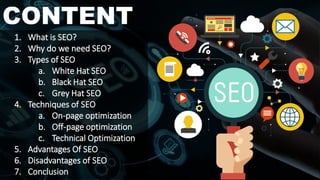
1. What is SEO?
2. Why do we need SEO?
3. Types of SEO
a. White Hat SEO
b. Black Hat SEO
c. Grey Hat SEO
4. Techniques of SEO
a. On-page optimization
b. Off-page optimization
c. Technical Optimization
5. Advantages Of SEO
6. Disadvantages of SEO
7. Conclusion
WHAT IS SEO ?
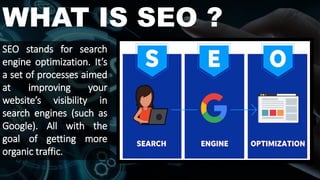
SEO stands for search
engine optimization. It’s
a set of processes aimed
at improving your
website’s visibility in
search engines (such as
Google). All with the
goal of getting more
organic traffic.
WHY DO WE NEED
SEO ?
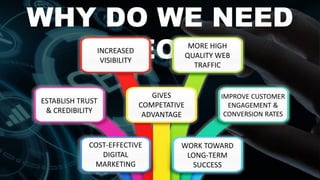
INCREASED
VISIBILITY
MORE HIGH
QUALITY WEB
TRAFFIC
ESTABLISH TRUST
& CREDIBILITY
GIVES
COMPETATIVE
ADVANTAGE
IMPROVE CUSTOMER
ENGAGEMENT &
CONVERSION RATES
COST-EFFECTIVE
DIGITAL
MARKETING
WORK TOWARD
LONG-TERM
SUCCESS
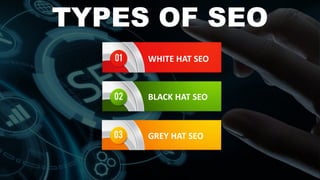
TYPES OF SEO
WHITE HAT SEO
BLACK HAT SEO
GREY HAT SEO
WHITE HAT SEO
White hat SEO refers to the use of ethical, best-practice techniques to optimize a website for
search engines.
Techniques Used in White Hat SEO:
•Content Optimization: It refers to the creation of high-quality, relevant, and unique content for
the website.
•Keyword Research: It refers to identifying the right set of keywords that reflect the website’s
offerings.
•On-Page Optimization: It means optimizing page titles, meta descriptions, and header tags.
•Link Building: It refers to building high-quality, relevant, and natural links to the website.
•Social Media Marketing: It means promoting website content on social media platforms to
increase engagement.
BLACK HAT SEO
Black hat SEO refers to the use of unethical, manipulative techniques to boost a website’s search
engine rankings.
Techniques used in black hat SEO:
•Keyword Stuffing: It means overusing keywords on a page to manipulate search engine
rankings.
•Hidden Text and Links: It refers to concealing keywords or links within a page’s content to trick
search engines.
•Cloaking: It means showing different content to users and search engines to manipulate
rankings.
•Link Farms: It refers to creating a network of websites solely for the purpose of linking to one’s
own website.
•Article Spinning: It means creating deceitful new content from the content that already exists.
This content is then published on various websites to generate backlinks.
GREY HAT SEO
Grey hat SEO refers to the use of techniques that are not entirely ethical but are not as
manipulative as black hat SEO.
Techniques used in grey hat SEO:
•Paid Links: It refers to paying for links from high authority websites to boost a website’s search
engine rankings.
•Duplicate Content: It means repurposing content from other websites to save time and effort.
•Link Exchanges: It refers to exchanging links with other websites to increase backlinks.
•Clickbait: It means creating headlines or content that are sensational or misleading to increase
click-through rates.
•Private Blog Networks: It refers to creating a network of blogs solely for the purpose of linking
to one’s own website.
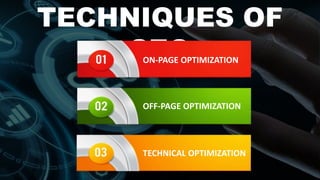
TECHNIQUES OF
SEO
ON-PAGE OPTIMIZATION
OFF-PAGE OPTIMIZATION
TECHNICAL OPTIMIZATION
ON-PAGE OPTIMIZATION
On-page SEO is the technique of improving various components of a website to increase its relevance and authority
for specified keywords. These aspects include the website’s content, structure, and HTML source code. The purpose
of on-page SEO is to make the website more user-friendly and search engine-friendly by offering high-quality
material that is relevant to the user’s search query.
Techniques for On-Page Optimization:
Some of the most frequent approaches used in on-page optimization include:
•Keyword Research: It refers to identifying and employing the most relevant and high-traffic keywords in the
website content.
•Meta Tags Optimization: It means optimizing meta tags such as title tags, meta descriptions, and header tags with
relevant keywords and descriptions.
•Material Optimization: It refers to creating high-quality, distinctive, and relevant content that attracts users and
integrates target keywords.
•Image Optimization: It means optimizing images using appropriate file names, alt tags, and descriptions to
improve website accessibility and load speeds.
•Internal Linking: It refers to creating internal links to pertinent pages inside the website to increase user navigation
and search engine crawlers’ ability to locate pages.
•User Experience(UX) Optimization: It means ensuring the website’s appearance and functionality suit user
demands and preferences to boost user engagement.
OFF-PAGE OPTIMIZATION
Off-page optimization refers to the operations that are conducted outside the website to
increase its authority and reputation. The fundamental purpose of off-page SEO is to boost the
website’s popularity, trustworthiness, and relevancy in the eyes of search engines.
Techniques for Off-Page Optimization:
Some of the most frequent approaches used in off-page optimization include:
•Link Building: It refers to creating backlinks to the website from other high-quality and relevant
websites to boost its authority and trustworthiness.
•Social Media Marketing: It means promoting website content and connecting with people
through various social media platforms.
•Online Reputation Management (ORM): It refers to monitoring and managing online
evaluations and mentions of the website to improve its reputation and reliability.
•Influencer Marketing: It means collaborating with influencers in the industry to promote the
website and its content.
•Guest Blogging: It refers to contributing high-quality material to other websites to obtain
backlinks and visibility.
TECHNICAL OPTIMIZATION
Technical optimization refers to the practice of upgrading the website’s technical components to
make it more user-friendly and search engine-friendly. It encompasses several technical
elements such as website performance, mobile-friendliness, and website structure.
Techniques for Technical Optimization:
Some of the most frequent strategies used in technical optimization include:
•Website Speed Optimization: It refers to optimizing website speed by lowering file sizes,
minimizing HTTP requests, and optimizing server response time.
•Mobile-Friendly Optimization: It refers to optimizing the website’s design and functionality to
guarantee it is accessible and user-friendly on mobile devices.
•Website Structure Optimization: It means ensuring the website’s structure is easy to browse
and comprehend by people and search engines.
•Crawlability and Indexability Optimization: It means ensuring that search engine crawlers can
access and index all relevant pages on the website.
•Schema Markup: It refers to using structured data to offer context and information to search
engines about the website’s content.
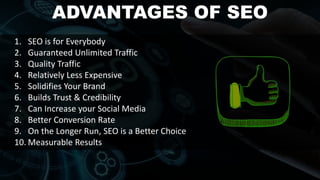
ADVANTAGES OF SEO
1. SEO is for Everybody
2. Guaranteed Unlimited Traffic
3. Quality Traffic
4. Relatively Less Expensive
5. Solidifies Your Brand
6. Builds Trust & Credibility
7. Can Increase your Social Media
8. Better Conversion Rate
9. On the Longer Run, SEO is a Better Choice
10. Measurable Results
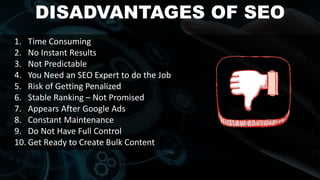
DISADVANTAGES OF SEO
1. Time Consuming
2. No Instant Results
3. Not Predictable
4. You Need an SEO Expert to do the Job
5. Risk of Getting Penalized
6. Stable Ranking – Not Promised
7. Appears After Google Ads
8. Constant Maintenance
9. Do Not Have Full Control
10. Get Ready to Create Bulk Content
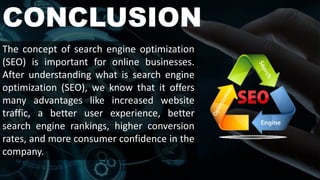
CONCLUSION
The concept of search engine optimization
(SEO) is important for online businesses.
After understanding what is search engine
optimization (SEO), we know that it offers
many advantages like increased website
traffic, a better user experience, better
search engine rankings, higher conversion
rates, and more consumer confidence in the
company.
THANK YOU

Search engines optimization in digital marketing

  • 1.
    SUBMITTED TO: Dr. VivekRastogi SUBMITTED BY: Rishita Singh MBA 1st year Sem 2 IIMT COLLEGE OF ENGINEERING SEARCH ENGINE OPTIMIZATIO N
  • 2.
    CONTENT 1. What isSEO? 2. Why do we need SEO? 3. Types of SEO a. White Hat SEO b. Black Hat SEO c. Grey Hat SEO 4. Techniques of SEO a. On-page optimization b. Off-page optimization c. Technical Optimization 5. Advantages Of SEO 6. Disadvantages of SEO 7. Conclusion
  • 3.
    WHAT IS SEO? SEO stands for search engine optimization. It’s a set of processes aimed at improving your website’s visibility in search engines (such as Google). All with the goal of getting more organic traffic.
  • 4.
    WHY DO WENEED SEO ? INCREASED VISIBILITY MORE HIGH QUALITY WEB TRAFFIC ESTABLISH TRUST & CREDIBILITY GIVES COMPETATIVE ADVANTAGE IMPROVE CUSTOMER ENGAGEMENT & CONVERSION RATES COST-EFFECTIVE DIGITAL MARKETING WORK TOWARD LONG-TERM SUCCESS
  • 5.
    TYPES OF SEO WHITEHAT SEO BLACK HAT SEO GREY HAT SEO
  • 6.
    WHITE HAT SEO Whitehat SEO refers to the use of ethical, best-practice techniques to optimize a website for search engines. Techniques Used in White Hat SEO: •Content Optimization: It refers to the creation of high-quality, relevant, and unique content for the website. •Keyword Research: It refers to identifying the right set of keywords that reflect the website’s offerings. •On-Page Optimization: It means optimizing page titles, meta descriptions, and header tags. •Link Building: It refers to building high-quality, relevant, and natural links to the website. •Social Media Marketing: It means promoting website content on social media platforms to increase engagement.
  • 7.
    BLACK HAT SEO Blackhat SEO refers to the use of unethical, manipulative techniques to boost a website’s search engine rankings. Techniques used in black hat SEO: •Keyword Stuffing: It means overusing keywords on a page to manipulate search engine rankings. •Hidden Text and Links: It refers to concealing keywords or links within a page’s content to trick search engines. •Cloaking: It means showing different content to users and search engines to manipulate rankings. •Link Farms: It refers to creating a network of websites solely for the purpose of linking to one’s own website. •Article Spinning: It means creating deceitful new content from the content that already exists. This content is then published on various websites to generate backlinks.
  • 8.
    GREY HAT SEO Greyhat SEO refers to the use of techniques that are not entirely ethical but are not as manipulative as black hat SEO. Techniques used in grey hat SEO: •Paid Links: It refers to paying for links from high authority websites to boost a website’s search engine rankings. •Duplicate Content: It means repurposing content from other websites to save time and effort. •Link Exchanges: It refers to exchanging links with other websites to increase backlinks. •Clickbait: It means creating headlines or content that are sensational or misleading to increase click-through rates. •Private Blog Networks: It refers to creating a network of blogs solely for the purpose of linking to one’s own website.
  • 9.
    TECHNIQUES OF SEO ON-PAGE OPTIMIZATION OFF-PAGEOPTIMIZATION TECHNICAL OPTIMIZATION
  • 10.
    ON-PAGE OPTIMIZATION On-page SEOis the technique of improving various components of a website to increase its relevance and authority for specified keywords. These aspects include the website’s content, structure, and HTML source code. The purpose of on-page SEO is to make the website more user-friendly and search engine-friendly by offering high-quality material that is relevant to the user’s search query. Techniques for On-Page Optimization: Some of the most frequent approaches used in on-page optimization include: •Keyword Research: It refers to identifying and employing the most relevant and high-traffic keywords in the website content. •Meta Tags Optimization: It means optimizing meta tags such as title tags, meta descriptions, and header tags with relevant keywords and descriptions. •Material Optimization: It refers to creating high-quality, distinctive, and relevant content that attracts users and integrates target keywords. •Image Optimization: It means optimizing images using appropriate file names, alt tags, and descriptions to improve website accessibility and load speeds. •Internal Linking: It refers to creating internal links to pertinent pages inside the website to increase user navigation and search engine crawlers’ ability to locate pages. •User Experience(UX) Optimization: It means ensuring the website’s appearance and functionality suit user demands and preferences to boost user engagement.
  • 11.
    OFF-PAGE OPTIMIZATION Off-page optimizationrefers to the operations that are conducted outside the website to increase its authority and reputation. The fundamental purpose of off-page SEO is to boost the website’s popularity, trustworthiness, and relevancy in the eyes of search engines. Techniques for Off-Page Optimization: Some of the most frequent approaches used in off-page optimization include: •Link Building: It refers to creating backlinks to the website from other high-quality and relevant websites to boost its authority and trustworthiness. •Social Media Marketing: It means promoting website content and connecting with people through various social media platforms. •Online Reputation Management (ORM): It refers to monitoring and managing online evaluations and mentions of the website to improve its reputation and reliability. •Influencer Marketing: It means collaborating with influencers in the industry to promote the website and its content. •Guest Blogging: It refers to contributing high-quality material to other websites to obtain backlinks and visibility.
  • 12.
    TECHNICAL OPTIMIZATION Technical optimizationrefers to the practice of upgrading the website’s technical components to make it more user-friendly and search engine-friendly. It encompasses several technical elements such as website performance, mobile-friendliness, and website structure. Techniques for Technical Optimization: Some of the most frequent strategies used in technical optimization include: •Website Speed Optimization: It refers to optimizing website speed by lowering file sizes, minimizing HTTP requests, and optimizing server response time. •Mobile-Friendly Optimization: It refers to optimizing the website’s design and functionality to guarantee it is accessible and user-friendly on mobile devices. •Website Structure Optimization: It means ensuring the website’s structure is easy to browse and comprehend by people and search engines. •Crawlability and Indexability Optimization: It means ensuring that search engine crawlers can access and index all relevant pages on the website. •Schema Markup: It refers to using structured data to offer context and information to search engines about the website’s content.
  • 13.
    ADVANTAGES OF SEO 1.SEO is for Everybody 2. Guaranteed Unlimited Traffic 3. Quality Traffic 4. Relatively Less Expensive 5. Solidifies Your Brand 6. Builds Trust & Credibility 7. Can Increase your Social Media 8. Better Conversion Rate 9. On the Longer Run, SEO is a Better Choice 10. Measurable Results
  • 14.
    DISADVANTAGES OF SEO 1.Time Consuming 2. No Instant Results 3. Not Predictable 4. You Need an SEO Expert to do the Job 5. Risk of Getting Penalized 6. Stable Ranking – Not Promised 7. Appears After Google Ads 8. Constant Maintenance 9. Do Not Have Full Control 10. Get Ready to Create Bulk Content
  • 15.
    CONCLUSION The concept ofsearch engine optimization (SEO) is important for online businesses. After understanding what is search engine optimization (SEO), we know that it offers many advantages like increased website traffic, a better user experience, better search engine rankings, higher conversion rates, and more consumer confidence in the company.
  • 16.