SEAFLOOR
SPREADING
• PREPARED BY: GROUP 1
1. Discuss the process of seafloor spreading;
and
2. Determine how the convection currents in
the Earth interior make the seafloor spread
;
3. describe the three evidence that seafloor
is continuously spreading.
OBJECTIVES :
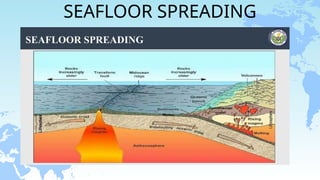
Seafloor spreading is a geological process that
occurs at mid-ocean ridges, where tectonic plates
move apart from each other. As the plates diverge,
magma from the mantle rises to fill the gap,
creating new oceanic crust. This process not only
adds to the seafloor but also causes the ocean
basins to expand over time.
SEAFLOOR SPREADING
SEAFLOOR SPREADING
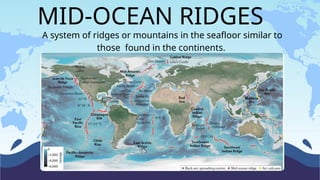
MID-OCEAN RIDGES
A system of ridges or mountains in the seafloor similar to
those found in the continents.
⚬ TO UNDERSTAND THE TOPOGRAPHY
OF THE SEAFLOOR.
⚬ TO FIND HIDING PLACES FOR BOTH
ALLIED AND ENEMY SUBMARINES
PURPOSE OF SEA FLOOR STUDIES
DURING WORLD WAR II
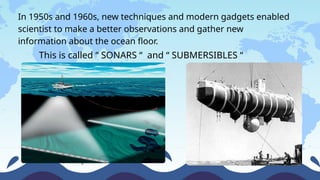
In 1950s and 1960s, new techniques and modern gadgets enabled
scientist to make a better observations and gather new
information about the ocean floor.
This is called “ SONARS “ and “ SUBMERSIBLES “
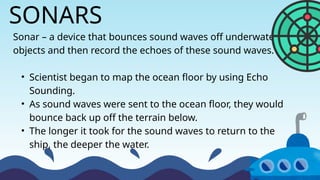
Sonar – a device that bounces sound waves off underwater
objects and then record the echoes of these sound waves.
• Scientist began to map the ocean floor by using Echo
Sounding.
• As sound waves were sent to the ocean floor, they would
bounce back up off the terrain below.
• The longer it took for the sound waves to return to the
ship, the deeper the water.
SONARS
HARRY HESS
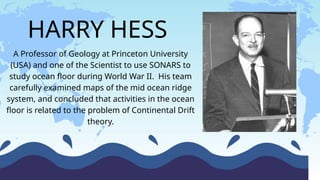
A Professor of Geology at Princeton University
(USA) and one of the Scientist to use SONARS to
study ocean floor during World War II. His team
carefully examined maps of the mid ocean ridge
system, and concluded that activities in the ocean
floor is related to the problem of Continental Drift
theory.
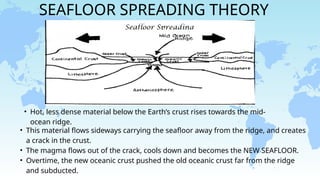
SEAFLOOR SPREADING THEORY
• Hot, less dense material below the Earth’s crust rises towards the mid-
ocean ridge.
• This material flows sideways carrying the seafloor away from the ridge, and creates
a crack in the crust.
• The magma flows out of the crack, cools down and becomes the NEW SEAFLOOR.
• Overtime, the new oceanic crust pushed the old oceanic crust far from the ridge
and subducted.
EVIDENCE OF SEAFLOOR SPREADING :
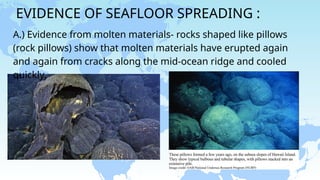
A.) Evidence from molten materials- rocks shaped like pillows
(rock pillows) show that molten materials have erupted again
and again from cracks along the mid-ocean ridge and cooled
quickly.
EVIDENCE OF SEAFLOOR SPREADING :
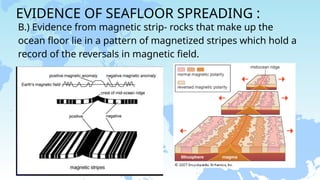
B.) Evidence from magnetic strip- rocks that make up the
ocean floor lie in a pattern of magnetized stripes which hold a
record of the reversals in magnetic field.
EVIDENCE OF SEAFLOOR SPREADING :
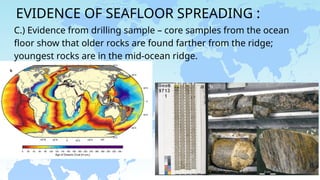
C.) Evidence from drilling sample – core samples from the ocean
floor show that older rocks are found farther from the ridge;
youngest rocks are in the mid-ocean ridge.

THANK
YOU!!

SEAFLOOR SPREADING EARTH SCIENCE TOPICSS

  • 1.
  • 2.
    1. Discuss theprocess of seafloor spreading; and 2. Determine how the convection currents in the Earth interior make the seafloor spread ; 3. describe the three evidence that seafloor is continuously spreading. OBJECTIVES :
  • 3.
    Seafloor spreading isa geological process that occurs at mid-ocean ridges, where tectonic plates move apart from each other. As the plates diverge, magma from the mantle rises to fill the gap, creating new oceanic crust. This process not only adds to the seafloor but also causes the ocean basins to expand over time. SEAFLOOR SPREADING
  • 4.
  • 5.
    MID-OCEAN RIDGES A systemof ridges or mountains in the seafloor similar to those found in the continents.
  • 6.
    ⚬ TO UNDERSTANDTHE TOPOGRAPHY OF THE SEAFLOOR. ⚬ TO FIND HIDING PLACES FOR BOTH ALLIED AND ENEMY SUBMARINES PURPOSE OF SEA FLOOR STUDIES DURING WORLD WAR II
  • 7.
    In 1950s and1960s, new techniques and modern gadgets enabled scientist to make a better observations and gather new information about the ocean floor. This is called “ SONARS “ and “ SUBMERSIBLES “
  • 8.
    Sonar – adevice that bounces sound waves off underwater objects and then record the echoes of these sound waves. • Scientist began to map the ocean floor by using Echo Sounding. • As sound waves were sent to the ocean floor, they would bounce back up off the terrain below. • The longer it took for the sound waves to return to the ship, the deeper the water. SONARS
  • 9.
    HARRY HESS A Professorof Geology at Princeton University (USA) and one of the Scientist to use SONARS to study ocean floor during World War II. His team carefully examined maps of the mid ocean ridge system, and concluded that activities in the ocean floor is related to the problem of Continental Drift theory.
  • 10.
    SEAFLOOR SPREADING THEORY •Hot, less dense material below the Earth’s crust rises towards the mid- ocean ridge. • This material flows sideways carrying the seafloor away from the ridge, and creates a crack in the crust. • The magma flows out of the crack, cools down and becomes the NEW SEAFLOOR. • Overtime, the new oceanic crust pushed the old oceanic crust far from the ridge and subducted.
  • 11.
    EVIDENCE OF SEAFLOORSPREADING : A.) Evidence from molten materials- rocks shaped like pillows (rock pillows) show that molten materials have erupted again and again from cracks along the mid-ocean ridge and cooled quickly.
  • 12.
    EVIDENCE OF SEAFLOORSPREADING : B.) Evidence from magnetic strip- rocks that make up the ocean floor lie in a pattern of magnetized stripes which hold a record of the reversals in magnetic field.
  • 13.
    EVIDENCE OF SEAFLOORSPREADING : C.) Evidence from drilling sample – core samples from the ocean floor show that older rocks are found farther from the ridge; youngest rocks are in the mid-ocean ridge.
  • 14.