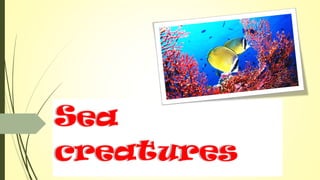
- Sea creatures are organisms that live in
the ocean.
- Sea creatures include animals, plants and
other various organisms.
❑ Jellyfish have been around for more than
650 million years, which means that they
outdate both dinosaurs and sharks.
❑ Jellyfish can be very colorful.
❑ Jellyfish eat small fish, shrimp, tiny plants
and other marine based animals.
❑ Jellyfish are invertebrates, which
means they aren’t fish.
❑ Jellyfish have no brain, heart, bones or
eyes. They are made up of a smooth,
bag-like body and tentacles armed with
tiny, stinging cells.
❑ Seahorses are tiny fishes that are
named for the shape of their head,
which looks like the head of a tiny
horse. There are at least 25 species of
seahorses.
❑ In fact, they eat almost constantly. Since they
have neither teeth nor stomachs, food passes
through their small bodies very quickly. Their
digestive systems work so quickly that food
moves too rapidly through their bodies to
absorb much nutrition.
❑ A seahorse can live between around four to six
years in the wild. The larger ones tend to live
longer than the small.
❑ Sea horses have a big appetite.
❑ Male and female seahorses spend time
courting, the female deposits her eggs inside
the male's pouch. The male then fertilizes the
eggs inside the pouch. Seahorse dads carry
their babies in a pouch.
❑ Whales are the largest animals on Earth.
❑ Whales are warm blooded species.
❑ They breathe air into their lungs. They cannot
breathe underwater like fish; they do not have
gills. They breathe through nostrils, called a
blowhole, located right on top of their heads.
❑
Largest animal ever to live on Earth is an
ocean mammal called ‘The Blue Whale’
as long as two school buses!
❑ Whales are mammals, just like us!
Toothed
Whales
Baleen
Whales
Baleen
Whales
Baleen whales that has plates of whalebone in
the mouth for straining plankton from the
water. Baleen whales include the rorqual,
humpback, right whale, and grey whale. Also
called whalebone whale.
Toothed
Whales
Toothed whales is a predatory whale having
teeth rather than baleen plates. Toothed whales
include sperm whales, killer whales, beaked
whales, narwhals, dolphins, and porpoises.
❑ Whale love to eat krill, fish, zooplankton,
phytoplankton, and algae.
❑ Average lifespan is estimated at around 80
to 90 years.
❑ At 188 decibels, the call of blue whales is the
loudest sound made by any animal on the
planet.
❑ Octopus has 8 arms and bulbous head.
❑ Octopus has 3 hearts and blue blood.
❑ Octopus love to eat crabs, shrimps and
lobsters.
❑ If threatened, octopuses shoot an inky fluid
from their body.
❑ Seals, whales and large fishes prey on
octopuses.
❑ Octopuses may also change color as a way to
communicate with other octopuses.
❑ 8 arms for defend and protect themselves.
“Do you know why octopus has eight
arms”?
❑ Octopus are cephalopods, invertebrates
that also include squid and cattle fish.
❑ They can match the colors and even
textures of their surroundings, allowing them
to hide in plain sight.
❑ There around 300 species of octopus and
they are found in every ocean.
Sea Creature-Part 1
Sea Creature-Part 1

Sea Creature-Part 1

  • 2.
    - Sea creaturesare organisms that live in the ocean. - Sea creatures include animals, plants and other various organisms.
  • 5.
    ❑ Jellyfish havebeen around for more than 650 million years, which means that they outdate both dinosaurs and sharks.
  • 6.
    ❑ Jellyfish canbe very colorful. ❑ Jellyfish eat small fish, shrimp, tiny plants and other marine based animals. ❑ Jellyfish are invertebrates, which means they aren’t fish.
  • 7.
    ❑ Jellyfish haveno brain, heart, bones or eyes. They are made up of a smooth, bag-like body and tentacles armed with tiny, stinging cells.
  • 9.
    ❑ Seahorses aretiny fishes that are named for the shape of their head, which looks like the head of a tiny horse. There are at least 25 species of seahorses.
  • 10.
    ❑ In fact,they eat almost constantly. Since they have neither teeth nor stomachs, food passes through their small bodies very quickly. Their digestive systems work so quickly that food moves too rapidly through their bodies to absorb much nutrition.
  • 11.
    ❑ A seahorsecan live between around four to six years in the wild. The larger ones tend to live longer than the small. ❑ Sea horses have a big appetite.
  • 12.
    ❑ Male andfemale seahorses spend time courting, the female deposits her eggs inside the male's pouch. The male then fertilizes the eggs inside the pouch. Seahorse dads carry their babies in a pouch.
  • 14.
    ❑ Whales arethe largest animals on Earth. ❑ Whales are warm blooded species. ❑ They breathe air into their lungs. They cannot breathe underwater like fish; they do not have gills. They breathe through nostrils, called a blowhole, located right on top of their heads.
  • 15.
    ❑ Largest animal everto live on Earth is an ocean mammal called ‘The Blue Whale’ as long as two school buses! ❑ Whales are mammals, just like us!
  • 16.
  • 17.
    Baleen Whales Baleen whales thathas plates of whalebone in the mouth for straining plankton from the water. Baleen whales include the rorqual, humpback, right whale, and grey whale. Also called whalebone whale.
  • 18.
    Toothed Whales Toothed whales isa predatory whale having teeth rather than baleen plates. Toothed whales include sperm whales, killer whales, beaked whales, narwhals, dolphins, and porpoises.
  • 19.
    ❑ Whale loveto eat krill, fish, zooplankton, phytoplankton, and algae. ❑ Average lifespan is estimated at around 80 to 90 years. ❑ At 188 decibels, the call of blue whales is the loudest sound made by any animal on the planet.
  • 21.
    ❑ Octopus has8 arms and bulbous head. ❑ Octopus has 3 hearts and blue blood. ❑ Octopus love to eat crabs, shrimps and lobsters.
  • 22.
    ❑ If threatened,octopuses shoot an inky fluid from their body. ❑ Seals, whales and large fishes prey on octopuses. ❑ Octopuses may also change color as a way to communicate with other octopuses.
  • 23.
    ❑ 8 armsfor defend and protect themselves. “Do you know why octopus has eight arms”?
  • 24.
    ❑ Octopus arecephalopods, invertebrates that also include squid and cattle fish. ❑ They can match the colors and even textures of their surroundings, allowing them to hide in plain sight. ❑ There around 300 species of octopus and they are found in every ocean.