Understanding the SDLC
(Software Development Life
Cycle)
An Overview of Key Models and Their
Importance
Introduction to SDLC
• The Software Development Life Cycle (SDLC) is
a systematic process for building software that
ensures the quality and correctness of the
software built. It includes a detailed plan
describing how to develop, maintain, replace
and alter or enhance specific software. The
SDLC process aims to produce high-quality
software that meets or exceeds customer
expectations, reaches completion within times
and cost estimates.
Waterfall Model
• The Waterfall Model is a linear sequential
flow. In this model, the outcome of one phase
acts as the input for the next phase. Phases:
Requirements, Design, Implementation,
Verification, Maintenance.
• Advantages: Simple and easy to understand
and use.
• Disadvantages: Not suitable for complex
projects or projects with changing
requirements.
Spiral Model
• The Spiral Model combines the idea of
iterative development with the systematic
aspects of the Waterfall Model. This model
focuses on risk assessment and mitigation.
Phases: Planning, Risk Analysis, Engineering,
Evaluation.
• Advantages: Good for large, complex, and
high-risk projects.
• Disadvantages: Can be costly and time-
consuming.
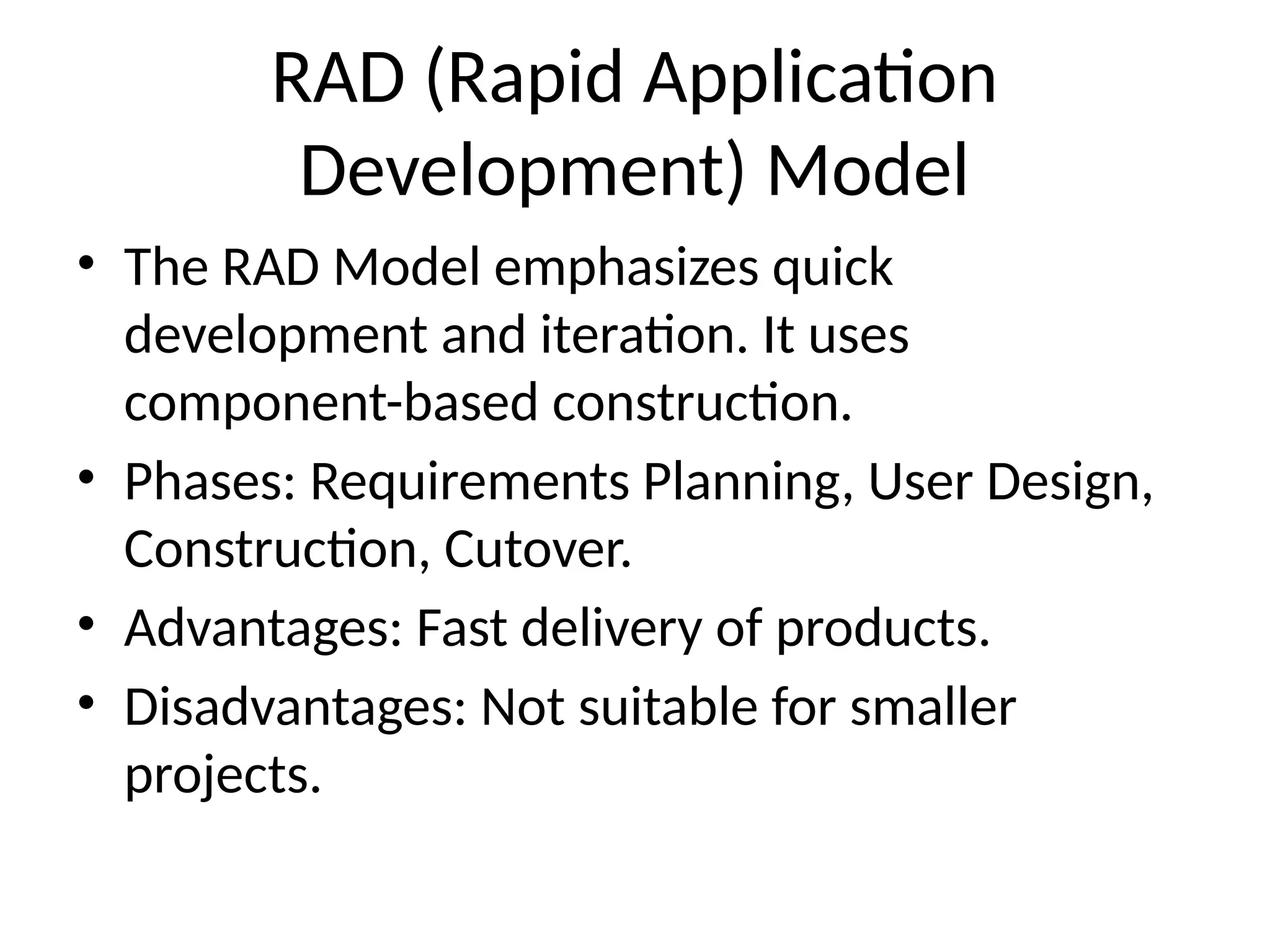
RAD (Rapid Application
Development) Model
• The RAD Model emphasizes quick
development and iteration. It uses
component-based construction.
• Phases: Requirements Planning, User Design,
Construction, Cutover.
• Advantages: Fast delivery of products.
• Disadvantages: Not suitable for smaller
projects.
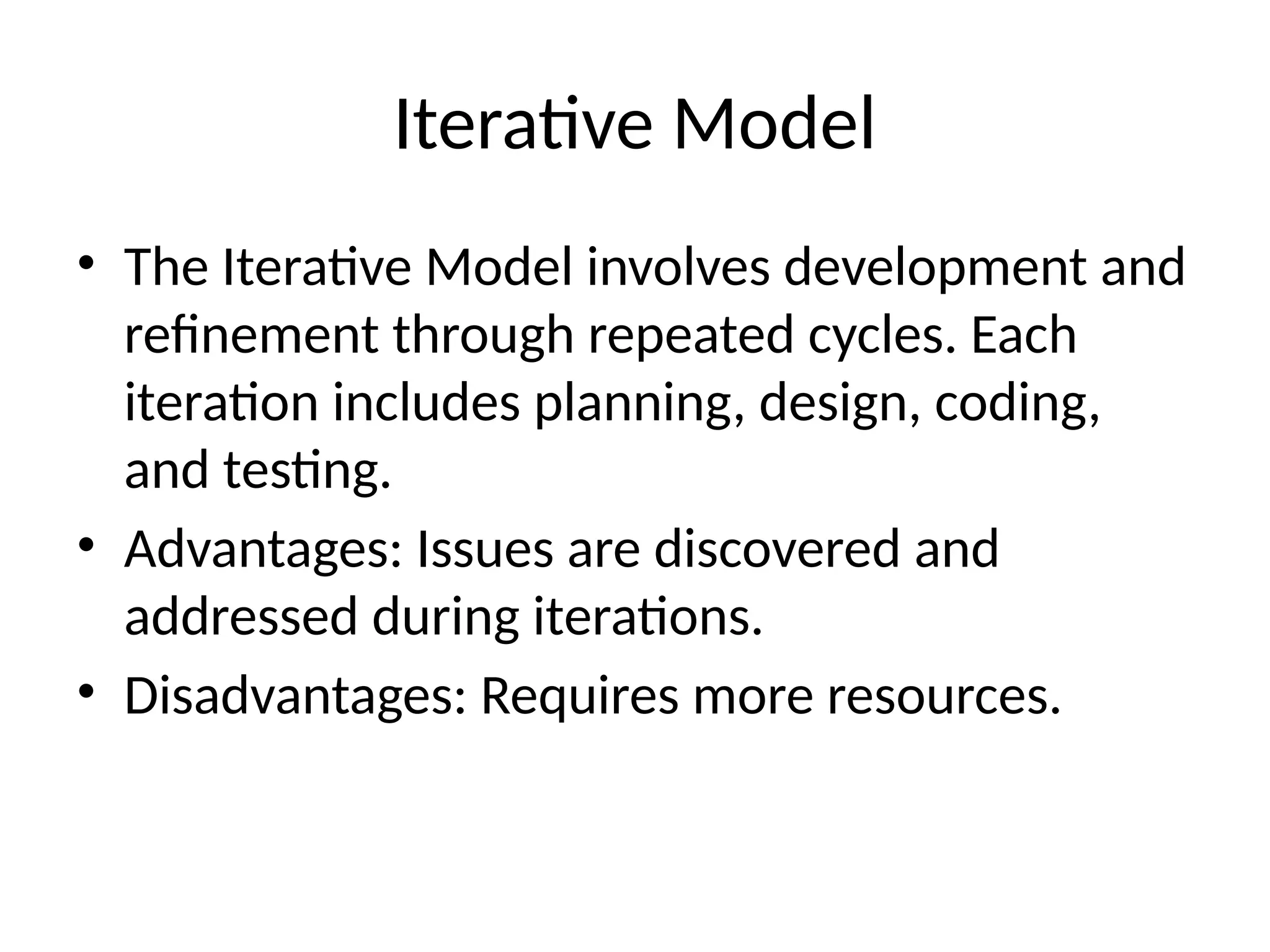
Iterative Model
• The Iterative Model involves development and
refinement through repeated cycles. Each
iteration includes planning, design, coding,
and testing.
• Advantages: Issues are discovered and
addressed during iterations.
• Disadvantages: Requires more resources.
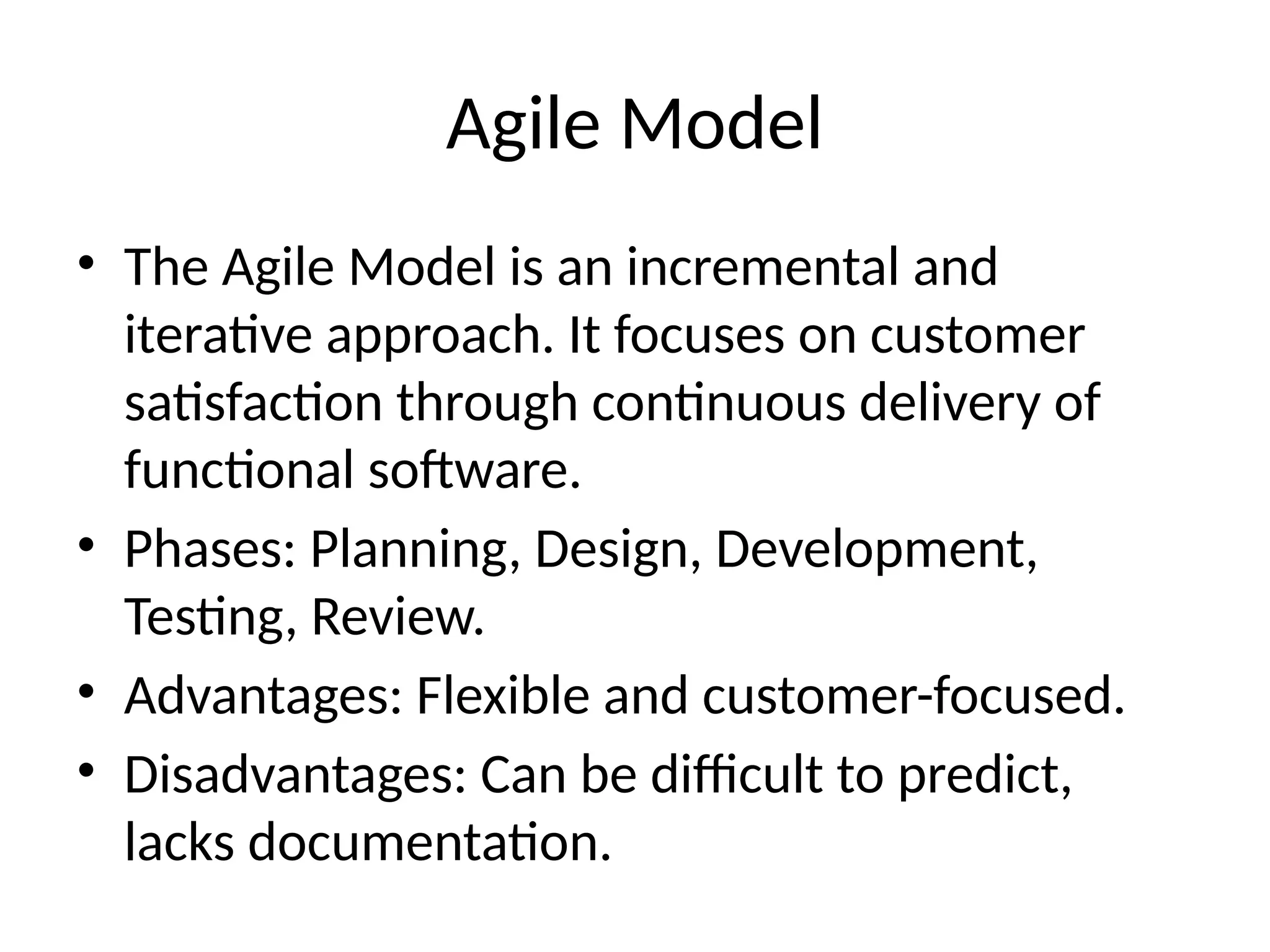
Agile Model
• The Agile Model is an incremental and
iterative approach. It focuses on customer
satisfaction through continuous delivery of
functional software.
• Phases: Planning, Design, Development,
Testing, Review.
• Advantages: Flexible and customer-focused.
• Disadvantages: Can be difficult to predict,
lacks documentation.
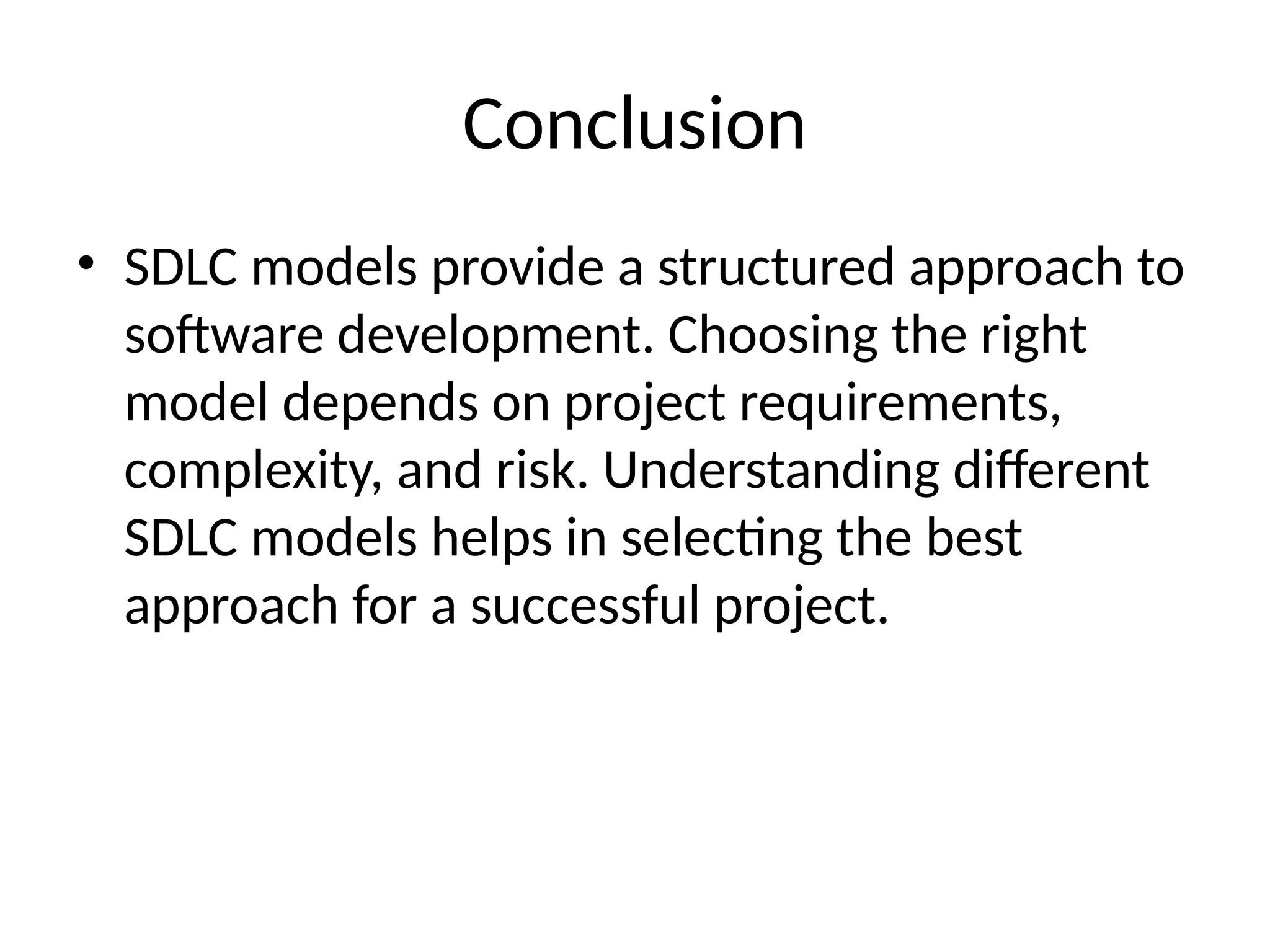
Conclusion
• SDLC models provide a structured approach to
software development. Choosing the right
model depends on project requirements,
complexity, and risk. Understanding different
SDLC models helps in selecting the best
approach for a successful project.

SDLC Presentation in briefly and understanding

  • 1.
    Understanding the SDLC (SoftwareDevelopment Life Cycle) An Overview of Key Models and Their Importance
  • 2.
    Introduction to SDLC •The Software Development Life Cycle (SDLC) is a systematic process for building software that ensures the quality and correctness of the software built. It includes a detailed plan describing how to develop, maintain, replace and alter or enhance specific software. The SDLC process aims to produce high-quality software that meets or exceeds customer expectations, reaches completion within times and cost estimates.
  • 3.
    Waterfall Model • TheWaterfall Model is a linear sequential flow. In this model, the outcome of one phase acts as the input for the next phase. Phases: Requirements, Design, Implementation, Verification, Maintenance. • Advantages: Simple and easy to understand and use. • Disadvantages: Not suitable for complex projects or projects with changing requirements.
  • 4.
    Spiral Model • TheSpiral Model combines the idea of iterative development with the systematic aspects of the Waterfall Model. This model focuses on risk assessment and mitigation. Phases: Planning, Risk Analysis, Engineering, Evaluation. • Advantages: Good for large, complex, and high-risk projects. • Disadvantages: Can be costly and time- consuming.
  • 5.
    RAD (Rapid Application Development)Model • The RAD Model emphasizes quick development and iteration. It uses component-based construction. • Phases: Requirements Planning, User Design, Construction, Cutover. • Advantages: Fast delivery of products. • Disadvantages: Not suitable for smaller projects.
  • 6.
    Iterative Model • TheIterative Model involves development and refinement through repeated cycles. Each iteration includes planning, design, coding, and testing. • Advantages: Issues are discovered and addressed during iterations. • Disadvantages: Requires more resources.
  • 7.
    Agile Model • TheAgile Model is an incremental and iterative approach. It focuses on customer satisfaction through continuous delivery of functional software. • Phases: Planning, Design, Development, Testing, Review. • Advantages: Flexible and customer-focused. • Disadvantages: Can be difficult to predict, lacks documentation.
  • 8.
    Conclusion • SDLC modelsprovide a structured approach to software development. Choosing the right model depends on project requirements, complexity, and risk. Understanding different SDLC models helps in selecting the best approach for a successful project.