6'/7XWRULDO

                                         Prof. J. Fischer
                                         Dr. E. Holz


                                         Humboldt-Universität zu Berlin


     SAM 2000 Workshop Grenoble


 SAM 2000, Grenoble


                                   6'/
       • is a major revision of SDL
              – removal of outdated concepts
              – alignment of existing concepts
              – introduction of new concepts
       • is completely based on object-orientation
       • has a new formal semantics
       • is accompanied by a new standard Z.109
         SDL-UML-Profil


                                                                   2
© Humboldt-Universität zu Berlin


                                                                          1
SAM 2000, Grenoble


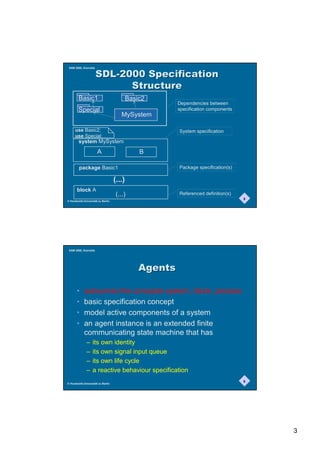
                        'LIIHUHQFHVWR6'/
       • document structure of standard has been reorganized
       • SDL-2000 is case-sensitive
              – two spellings for keywords all uppercase or all lowercase
              – removed keywords
                   all, axioms, constant, endgenerator,endnewtype, endrefinement,
                   endservice, error, fpar, generator, imported, literal, map, newtype,
                   noequal, ordering, refinement, returns, reveal, reverse, service,
                   signalroute, view, viewed
              – new keywords in SDL-2000
                   abstract, aggregation, association, break, choice, composition,
                   continue, endexceptionhandler, endmethod, endobject, endvalue,
                   exception, exceptionhandler, handle, method, object, onexception,
                   ordered, private, protected, public, raise, value

                                                                                      3
© Humboldt-Universität zu Berlin


 SAM 2000, Grenoble


       • not available constructs in SDL-2000
              – signal routes - replaced by non-delaying channels
              – view expression - deleted (import concept, “global” variables)
              – generators - generalized by parameterized types
              – block substructures - replaced by nested agents
              – channel substructures - deleted
              – signal refinement - deleted
              – axiomatic definition of data - deleted
              – macro diagrams - deleted
              – services - deleted (agents and state aggregations)


                                                                                      4
© Humboldt-Universität zu Berlin


                                                                                          2
SAM 2000, Grenoble


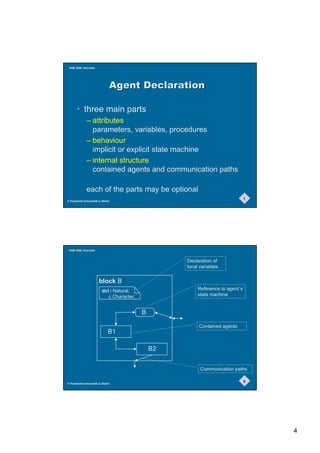
                      6'/6SHFLILFDWLRQ
                            6WUXFWXUH
        Basic1                             Basic2
                                                        Dependencies between
        Special                                         specification components
                                       MySystem

     use Basic2;                                        System specification
     use Special;
        system MySystem
                      A                        B

        package Basic1                                  Package specification(s)

                                   (...)
       block A
                                    (...)               Referenced definition(s)
                                                                                   5
© Humboldt-Universität zu Berlin


 SAM 2000, Grenoble


                                               $JHQWV

       •    subsumes the concepts system, block, process
       •    basic specification concept
       •    model active components of a system
       •    an agent instance is an extended finite
            communicating state machine that has
              –    its own identity
              –    its own signal input queue
              –    its own life cycle
              –    a reactive behaviour specification
                                                                                   6
© Humboldt-Universität zu Berlin


                                                                                       3
SAM 2000, Grenoble


                               $JHQW'HFODUDWLRQ

       • three main parts
              – attributes
                parameters, variables, procedures
              – behaviour
                implicit or explicit state machine
              – internal structure
                contained agents and communication paths

              each of the parts may be optional
                                                                                 7
© Humboldt-Universität zu Berlin


 SAM 2000, Grenoble


                                                     Declaration of
                                                     local variables


                       block B
                          dcl i Natural,                  Reference to agent´s
                             c Character;                 state machine


                                            B

                                                          Contained agents
                              B1

                                                B2


                                                           Communication paths

                                                                                 8
© Humboldt-Universität zu Berlin


                                                                                     4
SAM 2000, Grenoble


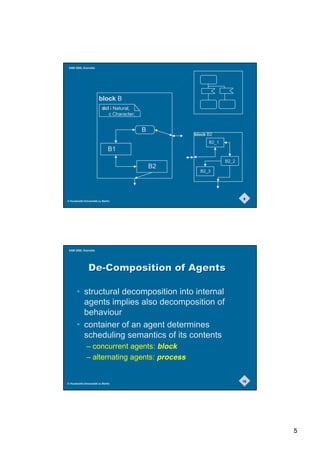
                       block B
                          dcl i Natural,
                             c Character;


                                            B
                                                     block B2
                                                           B2_1
                              B1
                                                                  B2_2
                                                B2
                                                       B2_3


                                                                         9
© Humboldt-Universität zu Berlin


 SAM 2000, Grenoble


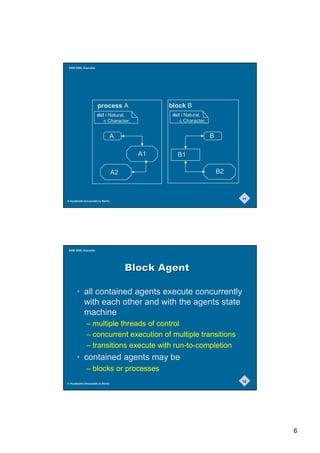
               'HRPSRVLWLRQRI$JHQWV

       • structural decomposition into internal
         agents implies also decomposition of
         behaviour
       • container of an agent determines
         scheduling semantics of its contents
              – concurrent agents: block
              – alternating agents: process


                                                                         10
© Humboldt-Universität zu Berlin


                                                                              5
SAM 2000, Grenoble


                      process A                block B
                      dcl i Natural,            dcl i Natural,
                         c Character;              c Character;


                               A                                  B

                                          A1      B1

                                   A2                                 B2


                                                                           11
© Humboldt-Universität zu Berlin


 SAM 2000, Grenoble


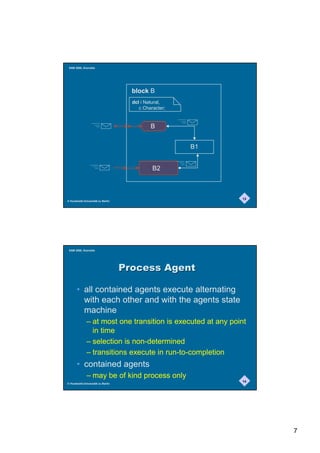
                                        %ORFN$JHQW

       • all contained agents execute concurrently
         with each other and with the agents state
         machine
              – multiple threads of control
              – concurrent execution of multiple transitions
              – transitions execute with run-to-completion
       • contained agents may be
              – blocks or processes
                                                                           12
© Humboldt-Universität zu Berlin


                                                                                6
SAM 2000, Grenoble


                                     block B
                                     dcl i Natural,
                                        c Character;


                                             B


                                                       B1


                                              B2


                                                             13
© Humboldt-Universität zu Berlin


 SAM 2000, Grenoble


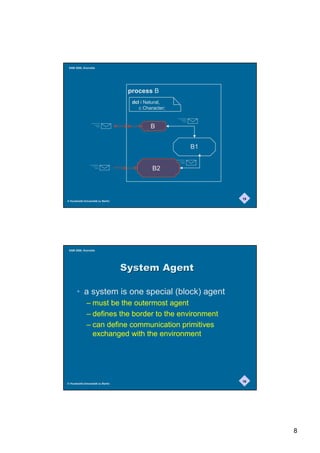
                                   3URFHVV$JHQW

       • all contained agents execute alternating
         with each other and with the agents state
         machine
              – at most one transition is executed at any point
                in time
              – selection is non-determined
              – transitions execute in run-to-completion
       • contained agents
              – may be of kind process only
                                                             14
© Humboldt-Universität zu Berlin


                                                                  7
SAM 2000, Grenoble


                                    process B
                                     dcl i Natural,
                                        c Character;


                                             B


                                                       B1


                                              B2


                                                            15
© Humboldt-Universität zu Berlin


 SAM 2000, Grenoble


                                   6VWHP$JHQW

       • a system is one special (block) agent
              – must be the outermost agent
              – defines the border to the environment
              – can define communication primitives
                exchanged with the environment


                                                            16
© Humboldt-Universität zu Berlin


                                                                 8
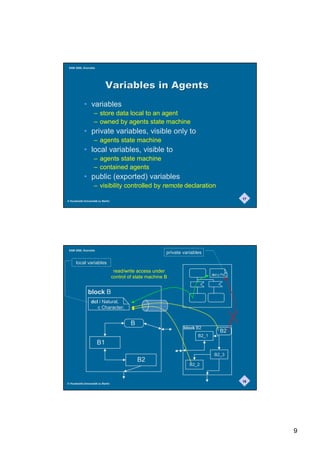
SAM 2000, Grenoble


                            9DULDEOHVLQ$JHQWV
            • variables
                    – store data local to an agent
                    – owned by agents state machine
            • private variables, visible only to
                    – agents state machine
            • local variables, visible to
                    – agents state machine
                    – contained agents
            • public (exported) variables
                    – visibility controlled by remote declaration
                                                                                                  17
© Humboldt-Universität zu Berlin


 SAM 2000, Grenoble
                                                            private variables

      local variables
                                    read/write access under
                                   control of state machine B
                                                                                  dcl p Pid   ;

               block B
                 dcl i Natural,
                    c Character;


                                            B
                                                                    block B2
                                                                                       B2
                                                                           B2_1
                      B1
                                                                                   B2_3
                                                B2
                                                                       B2_2


                                                                                                  18
© Humboldt-Universität zu Berlin


                                                                                                       9
SAM 2000, Grenoble


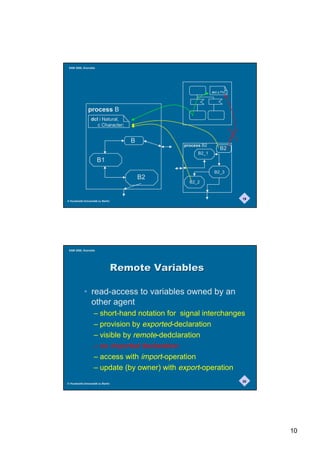
                                                            dcl p Pid   ;

               process B
                 dcl i Natural,
                    c Character;


                                      B
                                               process B2
                                                                 B2
                                                     B2_1
                      B1
                                                             B2_3
                                          B2
                                                 B2_2


                                                                            19
© Humboldt-Universität zu Berlin


 SAM 2000, Grenoble


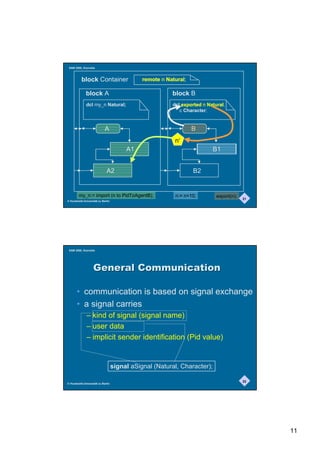
                                   5HPRWH9DULDEOHV

            • read-access to variables owned by an
              other agent
                    – short-hand notation for signal interchanges
                    – provision by exported-declaration
                    – visible by remote-dedclaration
                    – no imported declaration
                    – access with import-operation
                    – update (by owner) with export-operation
                                                                            20
© Humboldt-Universität zu Berlin


                                                                                 10
SAM 2000, Grenoble


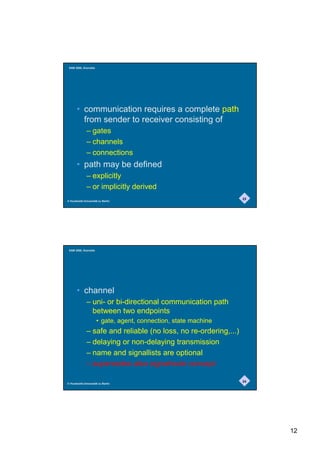
          block Container                     remote n Natural;

              block A                                    block B
              dcl my_n Natural;                          dcl exported n Natural
                                                                        Natural,
                                                            c Character;


                            A                                     B
                                                          n‘
                                        A1                                B1
                                                                          I1


                             A2                                   B2


        my_n:= import (n to PidToAgentB);                 n:= n+10;         export(n);   21
© Humboldt-Universität zu Berlin


 SAM 2000, Grenoble


                   *HQHUDORPPXQLFDWLRQ

       • communication is based on signal exchange
       • a signal carries
              – kind of signal (signal name)
              – user data
              – implicit sender identification (Pid value)


                                   signal aSignal (Natural, Character);

                                                                                         22
© Humboldt-Universität zu Berlin


                                                                                              11
SAM 2000, Grenoble


       • communication requires a complete path
         from sender to receiver consisting of
              – gates
              – channels
              – connections
       • path may be defined
              – explicitly
              – or implicitly derived
                                                                  23
© Humboldt-Universität zu Berlin


 SAM 2000, Grenoble


       • channel
              – uni- or bi-directional communication path
                between two endpoints
                      • gate, agent, connection, state machine
              – safe and reliable (no loss, no re-ordering,...)
              – delaying or non-delaying transmission
              – name and signallists are optional
              – supersedes also signalroute concept

                                                                  24
© Humboldt-Universität zu Berlin


                                                                       12
SAM 2000, Grenoble


                                   channel aChannel nodelay
                                         from block1 to block2
                                                 with sig1, sig2;
                                         from block2 to block1
                                                 with sig1, sig3;
                                   endchannel;
                                   channel nodelay
                                         from block1 to block2;
                                         from block2 to block1;
                                   endchannel;

                                           aChannel
                        block1                                      block2
                                     [sig1,sig3]   [sig1,sig2]


                                                                             25
© Humboldt-Universität zu Berlin


 SAM 2000, Grenoble


       • gate
              – potential named endpoint for a channel at an
                agent, agent type or a state machine
              – uni- or bi-directional
              – possibly constrained by set of signals or by
                interface
       • connection
              – joining/splitting of channels at implicit gate
                                                                             26
© Humboldt-Universität zu Berlin


                                                                                  13
SAM 2000, Grenoble


                                              block B;
                        block B               gate g1 in with sig2;
                                                       out with sig1;
                         dcl i Natural,       gate g2 in with sig3,sig4;
                            c Character;
                                              state B referenced;
              g1                              block B2 referenced;
                         c1
                                    B
[sig1] [sig2]                                 channel c1       from env via g1 to this;
                                                               from this to env via g1;
                          c4                  endchannel;
                                         c2   channel c2       from this to B2;
                                                               from B2 to this;
              g2                              endchannel;
                                    B2        channel c3       from env via g2
  [sig3,sig4]                  g3
                                                               to B2 via g3;
                       c3
                                              endchannel;
                                              channel c4       from env via g2 to this;
                                              endchannel;
                                              endblock B;
                                                                                     27
 © Humboldt-Universität zu Berlin


  SAM 2000, Grenoble


        • implicit signal lists on gates and channels
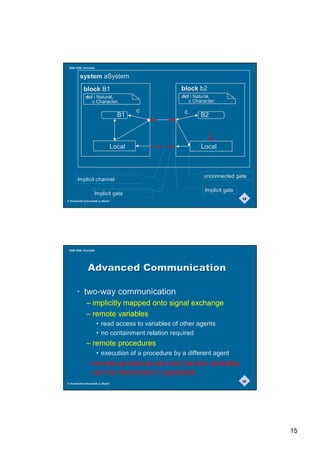
        • implicit gates
               – introduced for connections
               – introduced for unconnected channel endpoints
               – signal lists derived from channel signal lists
        • implicit channels
               – introduced for unconnected gates
               – gates have to have matching constraints
                                                                                     28
 © Humboldt-Universität zu Berlin


                                                                                          14
SAM 2000, Grenoble


         system aSystem
            block B1                                block b2
             dcl i Natural,                         dcl i Natural,
                c Character;                           c Character;

                                           c         c
                                     B1                     B2


                                   Local                    Local


                                                             unconnected gate
       Implicit channel

                                                              Implicit gate
                    Implicit gate
                                                                              29
© Humboldt-Universität zu Berlin


 SAM 2000, Grenoble


               $GYDQFHGRPPXQLFDWLRQ

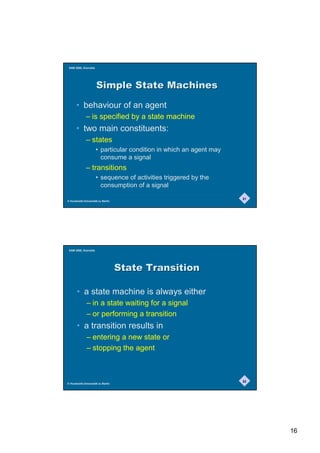
       • two-way communication
              – implicitly mapped onto signal exchange
              – remote variables
                      • read access to variables of other agents
                      • no containment relation required
              – remote procedures
                      • execution of a procedure by a different agent
              – remote procedure and and remote variables
                can be mentioned in signallists
                                                                              30
© Humboldt-Universität zu Berlin


                                                                                   15
SAM 2000, Grenoble


                      6LPSOH6WDWH0DFKLQHV

      • behaviour of an agent
              – is specified by a state machine
      • two main constituents:
              – states
                      • particular condition in which an agent may
                        consume a signal
              – transitions
                      • sequence of activities triggered by the
                        consumption of a signal
                                                                     31
© Humboldt-Universität zu Berlin


 SAM 2000, Grenoble


                                   6WDWH7UDQVLWLRQ

       • a state machine is always either
              – in a state waiting for a signal
              – or performing a transition
       • a transition results in
              – entering a new state or
              – stopping the agent


                                                                     32
© Humboldt-Universität zu Berlin


                                                                          16
SAM 2000, Grenoble


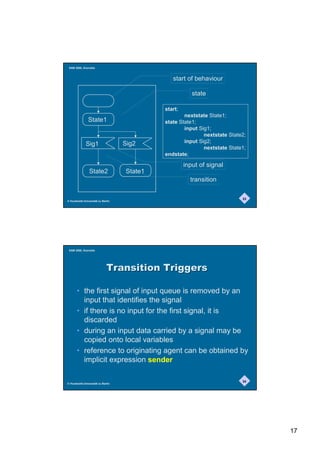
                                               start of behaviour

                                                        state

                                            start;
                                                    nextstate State1;
               State1                       state State1;
                                                    input Sig1;
                                                            nextstate State2;
                                   Sig2             input Sig2;
             Sig1
                                                            nextstate State1;
                                            endstate;

                                                     input of signal
                State2             State1
                                                       transition

                                                                           33
© Humboldt-Universität zu Berlin


 SAM 2000, Grenoble


                             7UDQVLWLRQ7ULJJHUV

       • the first signal of input queue is removed by an
         input that identifies the signal
       • if there is no input for the first signal, it is
         discarded
       • during an input data carried by a signal may be
         copied onto local variables
       • reference to originating agent can be obtained by
         implicit expression sender

                                                                           34
© Humboldt-Universität zu Berlin


                                                                                17
SAM 2000, Grenoble

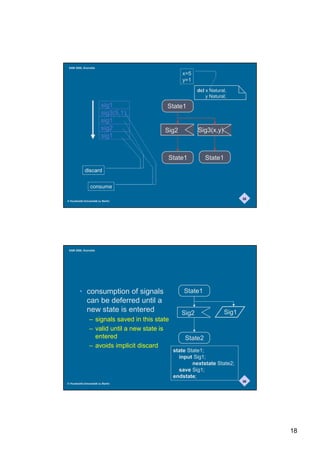
                                                   x=5
                                                   y=1
                                                          dcl x Natural,
                                                              y Natural;
                         sig1               State1
                         sig3(5,1)
                         sig1
                         sig2              Sig2           Sig3(x,y)
                         sig1


                                            State1           State1
             discard


                 consume

                                                                             35
© Humboldt-Universität zu Berlin


 SAM 2000, Grenoble


         • consumption of signals                   State1
           can be deferred until a
           new state is entered                    Sig2               Sig1
                – signals saved in this state
                – valid until a new state is
                  entered                           State2
                – avoids implicit discard
                                                state State1;
                                                  input Sig1;
                                                        nextstate State2;
                                                  save Sig1;
                                                endstate;
                                                                             36
© Humboldt-Universität zu Berlin


                                                                                  18
SAM 2000, Grenoble


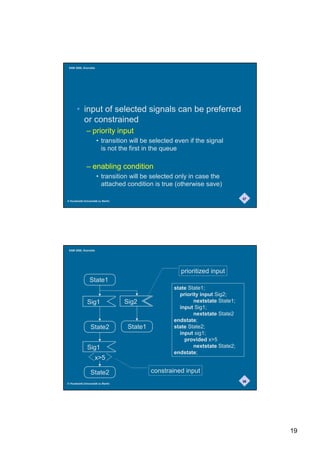
       • input of selected signals can be preferred
         or constrained
              – priority input
                      • transition will be selected even if the signal
                        is not the first in the queue

              – enabling condition
                      • transition will be selected only in case the
                        attached condition is true (otherwise save)

                                                                                37
© Humboldt-Universität zu Berlin


 SAM 2000, Grenoble


                                                       prioritized input
                State1
                                                    state State1;
                                                      priority input Sig2;
               Sig1                Sig2                     nextstate State1;
                                                      input Sig1;
                                                            nextstate State2
                                                    endstate;
                 State2             State1          state State2;
                                                      input sig1;
                                                        provided x5
               Sig1                                         nextstate State2;
                                                    endstate;
                    x5

                 State2                      constrained input
                                                                                38
© Humboldt-Universität zu Berlin


                                                                                     19
SAM 2000, Grenoble


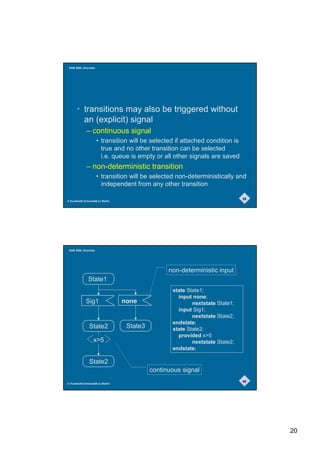
       • transitions may also be triggered without
         an (explicit) signal
              – continuous signal
                      • transition will be selected if attached condition is
                        true and no other transition can be selected
                        i.e. queue is empty or all other signals are saved
              – non-deterministic transition
                      • transition will be selected non-deterministically and
                        independent from any other transition

                                                                                39
© Humboldt-Universität zu Berlin


 SAM 2000, Grenoble


                                                   non-deterministic input
               State1
                                                    state State1;
                                                      input none;
              Sig1                 none                     nextstate State1;
                                                      input Sig1;
                                                            nextstate State2;
                                                    endstate;
                State2              State3          state State2;
                                                      provided x5
                   x5                                      nextstate State2;
                                                    endstate;

                State2
                                             continuous signal
                                                                                40
© Humboldt-Universität zu Berlin


                                                                                     20
SAM 2000, Grenoble


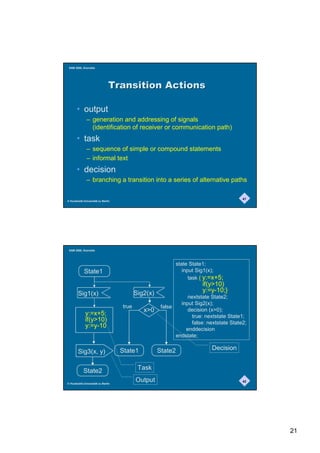
                               7UDQVLWLRQ$FWLRQV

       • output
              – generation and addressing of signals
                (identification of receiver or communication path)
       • task
              – sequence of simple or compound statements
              – informal text
       • decision
              – branching a transition into a series of alternative paths

                                                                                       41
© Humboldt-Universität zu Berlin


 SAM 2000, Grenoble


                                                           state State1;
            State1                                            input Sig1(x);
                                                                 task { y:=x+5;
                                                                      if(y10)
                                          Sig2(x)                     y:=y-10;}
        Sig1(x)                                                 nextstate State2;
                                                             input Sig2(x);
                                   true              false
                                             x0                decision (x0);
             y:=x+5;                                              true: nextstate State1;
             if(y10)                                            false: nextstate State2;
             y:=y-10                                           enddecision
                                                           endstate;

                                   State1           State2                Decision
        Sig3(x, y)

            State2                         Task

© Humboldt-Universität zu Berlin
                                          Output                                       42


                                                                                            21
SAM 2000, Grenoble


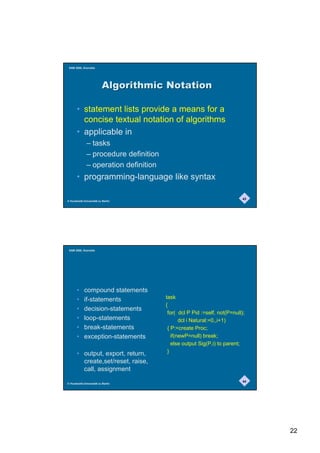
                          $OJRULWKPLF1RWDWLRQ

       • statement lists provide a means for a
         concise textual notation of algorithms
       • applicable in
              – tasks
              – procedure definition
              – operation definition
       • programming-language like syntax

                                                                          43
© Humboldt-Universität zu Berlin


 SAM 2000, Grenoble


       •    compound statements
       •    if-statements              task
                                       {
       •    decision-statements
                                        for( dcl P Pid :=self, not(P=null);
       •    loop-statements                   dcl i Natural:=0,,i+1)
       •    break-statements            { P:=create Proc;
       •    exception-statements          if(newP=null) break;
                                          else output Sig(P,i) to parent;
       • output, export, return,        }
         create,set/reset, raise,
         call, assignment
                                                                          44
© Humboldt-Universität zu Berlin


                                                                               22
SAM 2000, Grenoble


                                   UHDWHDQG6WRS

       • performance of a create-request action
         results in the existence of a new agent
         instance in the indicated agent set
              – creators implicit offspring expression refers to
                new createe
              – createe´s implicit parent expression refers to
                creator
       • initial internal structure will be created too
                                                                          45
© Humboldt-Universität zu Berlin


 SAM 2000, Grenoble


     block container (1,1)
           block B (1,5)
            dcl i Natural,
                  Natural,                       block A(1,1);
               c Character;            parent    offspring
                                   B
                                                          A
                B1

                                       B2


                                                State1

                                                Sig2             create

             stop                                  B


© Humboldt-Universität zu Berlin
                                                 State2                   46


                                                                               23
SAM 2000, Grenoble


       • create request can also be based on a
         type definition
       • new instance will either be created in
              – existing instance set based on that type and
                defined in the same agent as the creator
              – or implicit instance set based on that type and
                located in the same agent as the creator


                                                                     47
© Humboldt-Universität zu Berlin


 SAM 2000, Grenoble


          system MySystem
                                             BT1          BT2

             block container                         block A(1,1);

                         B :BT1
                                                             A

                    implicitname :BT2


                                   State1          State1

                                   Sig1            Sig2

                                    BT1             BT2


© Humboldt-Universität zu Berlin
                                    State2          State2           48


                                                                          24
SAM 2000, Grenoble


       • the execution of a stop results in entering
         a special implicit stopping-state
              – no further execution of transitions
              – if agent contains no further agent instances,
                it will cease to exist
              – otherwise
                it will the access to the agents variables


                                                                49
© Humboldt-Universität zu Berlin


 SAM 2000, Grenoble


                2EMHFW2ULHQWDWLRQLQ6'/

   • structural typing concepts allow to define the
     properties of a set of specification elements
   • kinds of structural types
          – agent type
          – state type
          – signal (type)
          – procedures (type)
          – data types and interfaces
                                                                50
© Humboldt-Universität zu Berlin


                                                                     25
SAM 2000, Grenoble


       • type concept corresponds to class concept
         in other OO languages and notations
              – inheritance
              – virtuality
              – abstraction
              – instance definition  creation
       • all instance definitions in SDL are either
         explicitly or implicitly based on a type
                                                       51
© Humboldt-Universität zu Berlin


 SAM 2000, Grenoble


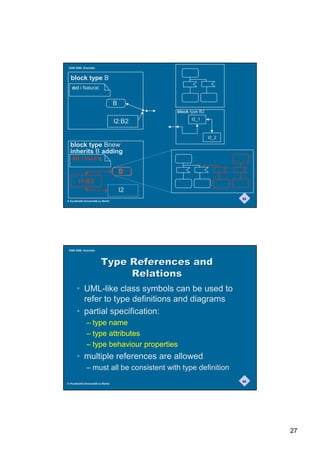
       • inheritance allows the definition of a type
         basing on another (super-) type of the
         same kind
              – addition of new structural elements
              – addition of new behavioural elements
              – redefinition of virtual elements
       • single inheritance supported by all types
       • multiple inheritance supported by interface
                                                       52
© Humboldt-Universität zu Berlin


                                                            26
SAM 2000, Grenoble


  block type B
   dcl i Natural;


                                   B
                                            block type B2
                                                  I2_1
                                   I2:B2

                                                            I2_2
  block type Bnew
  inherits B adding
   dcl c Natural;

                                       B
        I1:B3
                                       I2
                                                                   53
© Humboldt-Universität zu Berlin


 SAM 2000, Grenoble


                         7SH5HIHUHQFHVDQG
                              5HODWLRQV
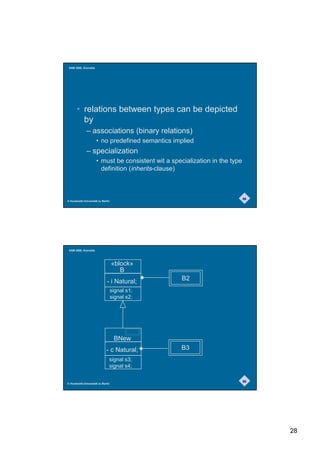
       • UML-like class symbols can be used to
         refer to type definitions and diagrams
       • partial specification:
              – type name
              – type attributes
              – type behaviour properties
       • multiple references are allowed
              – must all be consistent with type definition
                                                                   54
© Humboldt-Universität zu Berlin


                                                                        27
SAM 2000, Grenoble


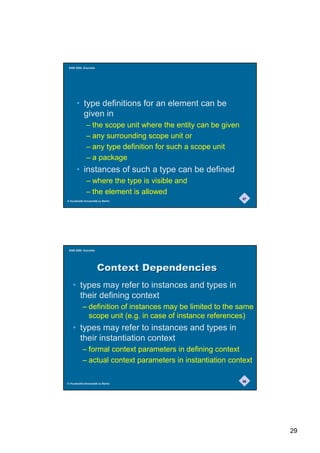
       • relations between types can be depicted
         by
              – associations (binary relations)
                      • no predefined semantics implied
              – specialization
                      • must be consistent wit a specialization in the type
                        definition (inherits-clause)


                                                                              55
© Humboldt-Universität zu Berlin


 SAM 2000, Grenoble


                                   «block»
                                      B
                              - i Natural;           B2
                                   signal s1;
                                   signal s2;


                                    BNew
                             - c Natural;           B3
                               signal s3;
                               signal s4;

                                                                              56
© Humboldt-Universität zu Berlin


                                                                                   28
SAM 2000, Grenoble


       • type definitions for an element can be
         given in
              – the scope unit where the entity can be given
              – any surrounding scope unit or
              – any type definition for such a scope unit
              – a package
       • instances of such a type can be defined
              – where the type is visible and
              – the element is allowed
                                                               57
© Humboldt-Universität zu Berlin


 SAM 2000, Grenoble


                      RQWH[W'HSHQGHQFLHV
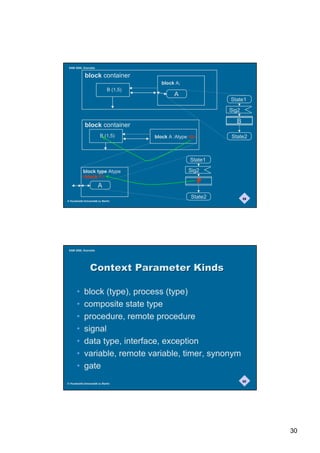
    • types may refer to instances and types in
      their defining context
           – definition of instances may be limited to the same
             scope unit (e.g. in case of instance references)
    • types may refer to instances and types in
      their instantiation context
           – formal context parameters in defining context
           – actual context parameters in instantiation context

                                                               58
© Humboldt-Universität zu Berlin


                                                                    29
SAM 2000, Grenoble


             block container
                                         block A;
                             B (1,5)
                                               A
                                                                State1
                                                                Sig2

                                                                  B
             block container
                        B (1,5)        block A :Atype B       State2


                                                      State1

           block type Atype                          Sig2
           block P
                                                            P
                                                            ?
                       A
                                                      State2           59
© Humboldt-Universität zu Berlin


 SAM 2000, Grenoble


                 RQWH[W3DUDPHWHU.LQGV

       •    block (type), process (type)
       •    composite state type
       •    procedure, remote procedure
       •    signal
       •    data type, interface, exception
       •    variable, remote variable, timer, synonym
       •    gate
                                                                       60
© Humboldt-Universität zu Berlin


                                                                            30
SAM 2000, Grenoble


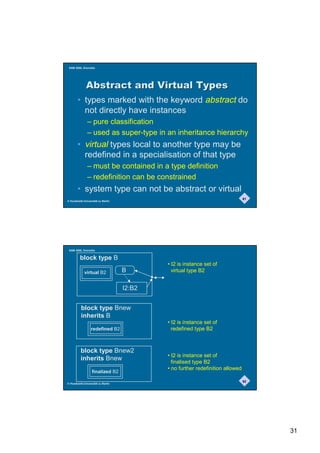
              $EVWUDFWDQG9LUWXDO7SHV
       • types marked with the keyword abstract do
         not directly have instances
               – pure classification
               – used as super-type in an inheritance hierarchy
       • virtual types local to another type may be
         redefined in a specialisation of that type
               – must be contained in a type definition
               – redefinition can be constrained
       • system type can not be abstract or virtual
                                                                               61
© Humboldt-Universität zu Berlin


 SAM 2000, Grenoble


         block type B
                                           • I2 is instance set of
            virtual B2             B         virtual type B2


                                   I2:B2


          block type Bnew
          inherits B
                                           • I2 is instance set of
                 redefined B2                redefined type B2


          block type Bnew2
                                           • I2 is instance set of
          inherits Bnew                      finalised type B2
                                           • no further redefinition allowed
                  finalized B2
                                                                               62
© Humboldt-Universität zu Berlin


                                                                                    31
SAM 2000, Grenoble


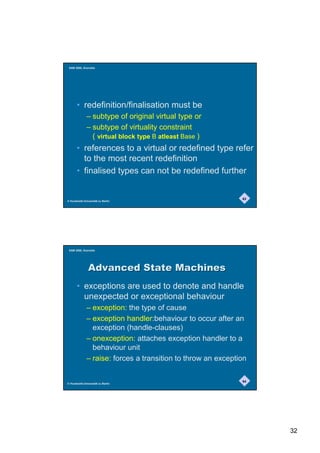
       • redefinition/finalisation must be
              – subtype of original virtual type or
              – subtype of virtuality constraint
                ( virtual block type B atleast Base )
       • references to a virtual or redefined type refer
         to the most recent redefinition
       • finalised types can not be redefined further


                                                              63
© Humboldt-Universität zu Berlin


 SAM 2000, Grenoble


               $GYDQFHG6WDWH0DFKLQHV
       • exceptions are used to denote and handle
         unexpected or exceptional behaviour
              – exception: the type of cause
              – exception handler:behaviour to occur after an
                exception (handle-clauses)
              – onexception: attaches exception handler to a
                behaviour unit
              – raise: forces a transition to throw an exception

                                                              64
© Humboldt-Universität zu Berlin


                                                                   32
SAM 2000, Grenoble

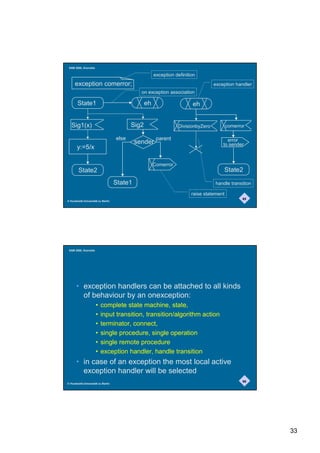
                                                      exception definition
     exception comerror;                                                          exception handler
                                              on exception association

       State1                                    eh                     eh


   Sig1(x)                                Sig2                   DivisionbyZero           comerror

                                   else                parent                           error
                                            sender                                    to sender
       y:=5/x

                                                      Comerror
        State2                                                                         State2
                                   State1                                          handle transition

                                                                        raise statement
                                                                                                 65
© Humboldt-Universität zu Berlin


 SAM 2000, Grenoble


      • exception handlers can be attached to all kinds
        of behaviour by an onexception:
                      •   complete state machine, state,
                      •   input transition, transition/algorithm action
                      •   terminator, connect,
                      •   single procedure, single operation
                      •   single remote procedure
                      •   exception handler, handle transition
      • in case of an exception the most local active
        exception handler will be selected
                                                                                                 66
© Humboldt-Universität zu Berlin


                                                                                                       33
SAM 2000, Grenoble


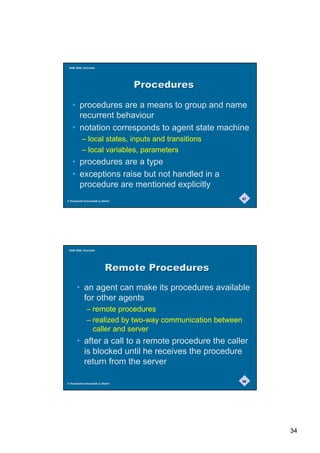
                                   3URFHGXUHV

   • procedures are a means to group and name
     recurrent behaviour
   • notation corresponds to agent state machine
           – local states, inputs and transitions
           – local variables, parameters
   • procedures are a type
   • exceptions raise but not handled in a
     procedure are mentioned explicitly
                                                            67
© Humboldt-Universität zu Berlin


 SAM 2000, Grenoble


                            5HPRWH3URFHGXUHV
       • an agent can make its procedures available
         for other agents
              – remote procedures
              – realized by two-way communication between
                caller and server
       • after a call to a remote procedure the caller
         is blocked until he receives the procedure
         return from the server

                                                            68
© Humboldt-Universität zu Berlin


                                                                 34
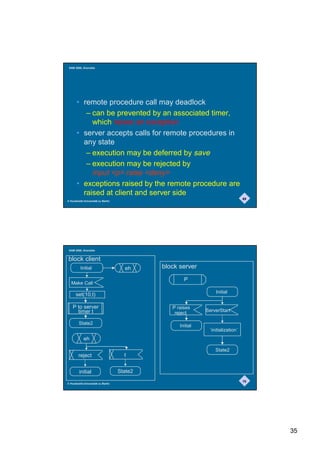
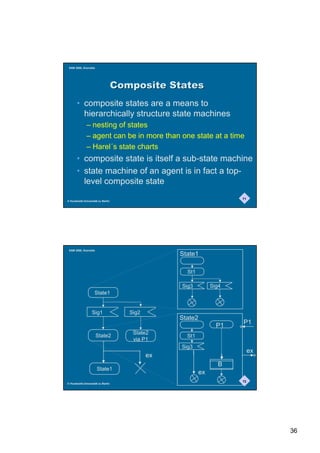
SAM 2000, Grenoble


      • remote procedure call may deadlock
         – can be prevented by an associated timer,
           which raises an exception
      • server accepts calls for remote procedures in
        any state
         – execution may be deferred by save
         – execution may be rejected by
           input p raise deny
      • exceptions raised by the remote procedure are
        raised at client and server side
                                                                                69
© Humboldt-Universität zu Berlin


 SAM 2000, Grenoble


block client
         Initial                     eh     block server
                                                    P
  Make Call
                                                                Initial
      set(10,t)

    P to server                                P raises
      timer t                                               ServerStart
                                                reject

        State2
                                                  Initial
                                                             ´initialization´
            eh

                                                                State2
        reject                       t


        initial                    State2
                                                                                70
© Humboldt-Universität zu Berlin


                                                                                     35
SAM 2000, Grenoble


                                   RPSRVLWH6WDWHV
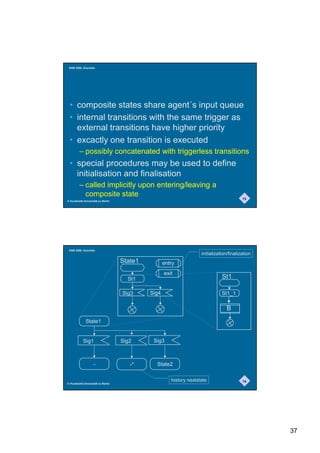
       • composite states are a means to
         hierarchically structure state machines
              – nesting of states
              – agent can be in more than one state at a time
              – Harel´s state charts
       • composite state is itself a sub-state machine
       • state machine of an agent is in fact a top-
         level composite state
                                                                      71
© Humboldt-Universität zu Berlin


 SAM 2000, Grenoble
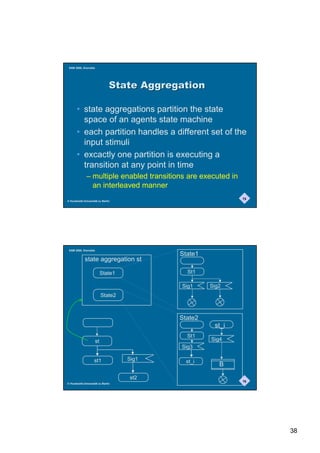
                                                  State1

                                                    St1

                                                  Sig3         Sig4
                    State1


                  Sig1                Sig2
                                                  State2
                                                                      P1
                                                                 P1
                                       State2
                      State2                        St1
                                       via P1
                                                  Sig3
                                                                           ex
                                             ex
                                                                  B
                      State1
                                                          ex
                                                                      72
© Humboldt-Universität zu Berlin


                                                                                36
SAM 2000, Grenoble


 • composite states share agent´s input queue
 • internal transitions with the same trigger as
   external transitions have higher priority
 • excactly one transition is executed
         – possibly concatenated with triggerless transitions
 • special procedures may be used to define
   initialisation and finalisation
         – called implicitly upon entering/leaving a
           composite state                                                                73
© Humboldt-Universität zu Berlin


 SAM 2000, Grenoble
                                                                    initialization/finalization
                                   State1          entry
                                                   exit
                                     St1                                       St1

                                   Sig3     Sig4                               St1_1

                                                                                 B
             State1


           Sig1                    Sig2      Sig3


                   -                  -*      State2

                                                      history nextstate                   74
© Humboldt-Universität zu Berlin


                                                                                                  37
SAM 2000, Grenoble


                               6WDWH$JJUHJDWLRQ

       • state aggregations partition the state
         space of an agents state machine
       • each partition handles a different set of the
         input stimuli
       • excactly one partition is executing a
         transition at any point in time
              – multiple enabled transitions are executed in
                an interleaved manner
                                                               75
© Humboldt-Universität zu Berlin


 SAM 2000, Grenoble
                                           State1
             state aggregation st

                           State1            St1

                                           Sig1     Sig2
                           State2


                                           State2
                                                     st_i
                                             St1
                      st                            Sig4
                                           Sig3

                    st1             Sig1     st_i
                                                       B

                                    st2
                                                               76
© Humboldt-Universität zu Berlin


                                                                    38
SAM 2000, Grenoble


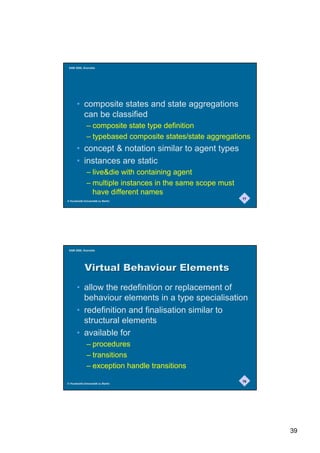
       • composite states and state aggregations
         can be classified
              – composite state type definition
              – typebased composite states/state aggregations
       • concept  notation similar to agent types
       • instances are static
              – livedie with containing agent
              – multiple instances in the same scope must
                have different names
                                                            77
© Humboldt-Universität zu Berlin


 SAM 2000, Grenoble


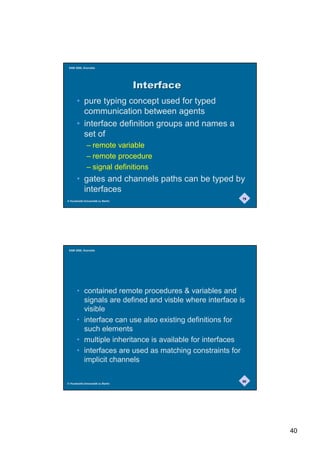
             9LUWXDO%HKDYLRXU(OHPHQWV
       • allow the redefinition or replacement of
         behaviour elements in a type specialisation
       • redefinition and finalisation similar to
         structural elements
       • available for
              – procedures
              – transitions
              – exception handle transitions
                                                            78
© Humboldt-Universität zu Berlin


                                                                 39
SAM 2000, Grenoble


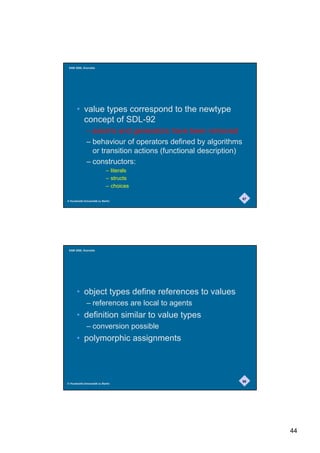
                                   ,QWHUIDFH
       • pure typing concept used for typed
         communication between agents
       • interface definition groups and names a
         set of
              – remote variable
              – remote procedure
              – signal definitions
       • gates and channels paths can be typed by
         interfaces
                                                         79
© Humboldt-Universität zu Berlin


 SAM 2000, Grenoble


       • contained remote procedures  variables and
         signals are defined and visble where interface is
         visible
       • interface can use also existing definitions for
         such elements
       • multiple inheritance is available for interfaces
       • interfaces are used as matching constraints for
         implicit channels

                                                         80
© Humboldt-Universität zu Berlin


                                                              40
SAM 2000, Grenoble


       interface if1;                      interface if3
              signal sig1;                     inherits if1,if2;
              procedure P;
              dcl I Natural;
       endinterface;

                                   [if1]    [if2]   block type b
       signal sig2,sig3;
       interface if2;                        g
              use sig2, sig3;               if3
       endinterface;

                                                                   81
© Humboldt-Universität zu Berlin


 SAM 2000, Grenoble


                    $JHQW,PSOLFLW,QWHUIDFH
       • each agent and agent type introduces an
         implicit interface
              – same name as agent (type)
       • contains all
              – signals accepted by the agents state machine
              – remote variables/procedures provided by
                agents state machine
       • inherits all interfaces on gates connected
         to agents state machine
                                                                   82
© Humboldt-Universität zu Berlin


                                                                        41
SAM 2000, Grenoble


                           block type B
                  g1       c1
                                B                 interface B
   [sig1] [sig2]
                             [sig4]                   use sig2,sig4;
                            c4               c2   endinterface

                  g2
       [sig3,sig4]                 g3   B2
                          c3

                          block type C            interface C
                  g1      inherits B              inherits B, if1;
               [sig3]                                 use sig3;
                                        B
               if1                                endinterface


                                                                       83
© Humboldt-Universität zu Berlin


 SAM 2000, Grenoble


       • each (explicit or implicit) interface implies a
         specialization of the Pid-type
       • can be used to refer to agent instances in
              – variables, expressions
              – output, imports or remote procedure calls
              – assignment attempt
       • dynamic type check tests
              – provision of remote variables/procedures
              – acceptance of signals
              – may raise an exception (InvalidReference)
                                                                       84
© Humboldt-Universität zu Berlin


                                                                            42
SAM 2000, Grenoble


                       block B                     assignment attempt

                        dcl myb2 B2,
                            mybt BT;

             g1         c1
                                    B
[sig1] [sig2]
                         c4                           B2
                                        c2
                                                mybt:=offspring
              g2
                                g B2:BT
   [sig3,sig4]
                       c3
                                                  Sig3(x, y)
                                                   to mybt


                                                    State2


 © Humboldt-Universität zu Berlin               compatibility check     85


  SAM 2000, Grenoble


                                         'DWD7SHV
        • two main kinds of data types
               – value types
               – object types (references)
               conversion possible
        • data type definition specifies
               – data elements and structure
               – operators and methods for data manipulation
        • package Predefined contains a set of
          general data type definitions
                                                                        86
 © Humboldt-Universität zu Berlin


                                                                             43
SAM 2000, Grenoble


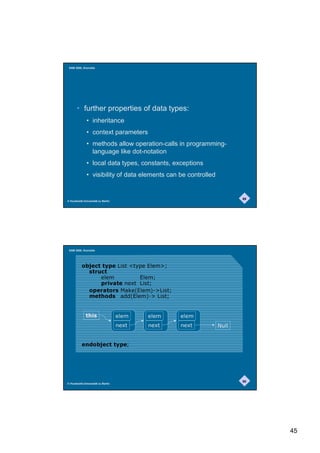
       • value types correspond to the newtype
         concept of SDL-92
              – axioms and generators have been removed
              – behaviour of operators defined by algorithms
                or transition actions (functional description)
              – constructors:
                             – literals
                             – structs
                             – choices

                                                                 87
© Humboldt-Universität zu Berlin


 SAM 2000, Grenoble


       • object types define references to values
              – references are local to agents
       • definition similar to value types
              – conversion possible
       • polymorphic assignments


                                                                 88
© Humboldt-Universität zu Berlin


                                                                      44
SAM 2000, Grenoble


       • further properties of data types:
              • inheritance
              • context parameters
              • methods allow operation-calls in programming-
                language like dot-notation
              • local data types, constants, exceptions
              • visibility of data elements can be controlled


                                                                       89
© Humboldt-Universität zu Berlin


 SAM 2000, Grenoble


          REMHFW WSH              /LVW WSH (OHP!

            VWUXFW
                         HOHP               (OHP

                   SULYDWH           QH[W   /LVW

                RSHUDWRUV           0DNH(OHP
!/LVW

                PHWKRGV             DGG(OHP
! /LVW


             WKLV                  HOHP        HOHP     HOHP


                                   QH[W        QH[W     QH[W    1XOO


          HQGREMHFW WSH              


                                                                       90
© Humboldt-Universität zu Berlin


                                                                            45
SAM 2000, Grenoble


            REMHFW WSH               /LVW WSH (OHP!


                WKLV                 HOHP            HOHP           HOHP


                                     QH[W            QH[W           QH[W           1XOO


                  RSHUDWRU             0DNHH (OHP
^        UHWXUQ     H1XOO
`

                  PHWKRG               DGGH (OHP

SDL 2000 Tutorial

  • 1.
    6'/7XWRULDO Prof. J. Fischer Dr. E. Holz Humboldt-Universität zu Berlin SAM 2000 Workshop Grenoble SAM 2000, Grenoble 6'/ • is a major revision of SDL – removal of outdated concepts – alignment of existing concepts – introduction of new concepts • is completely based on object-orientation • has a new formal semantics • is accompanied by a new standard Z.109 SDL-UML-Profil 2 © Humboldt-Universität zu Berlin 1
  • 2.
    SAM 2000, Grenoble 'LIIHUHQFHVWR6'/ • document structure of standard has been reorganized • SDL-2000 is case-sensitive – two spellings for keywords all uppercase or all lowercase – removed keywords all, axioms, constant, endgenerator,endnewtype, endrefinement, endservice, error, fpar, generator, imported, literal, map, newtype, noequal, ordering, refinement, returns, reveal, reverse, service, signalroute, view, viewed – new keywords in SDL-2000 abstract, aggregation, association, break, choice, composition, continue, endexceptionhandler, endmethod, endobject, endvalue, exception, exceptionhandler, handle, method, object, onexception, ordered, private, protected, public, raise, value 3 © Humboldt-Universität zu Berlin SAM 2000, Grenoble • not available constructs in SDL-2000 – signal routes - replaced by non-delaying channels – view expression - deleted (import concept, “global” variables) – generators - generalized by parameterized types – block substructures - replaced by nested agents – channel substructures - deleted – signal refinement - deleted – axiomatic definition of data - deleted – macro diagrams - deleted – services - deleted (agents and state aggregations) 4 © Humboldt-Universität zu Berlin 2
  • 3.
    SAM 2000, Grenoble 6'/6SHFLILFDWLRQ 6WUXFWXUH Basic1 Basic2 Dependencies between Special specification components MySystem use Basic2; System specification use Special; system MySystem A B package Basic1 Package specification(s) (...) block A (...) Referenced definition(s) 5 © Humboldt-Universität zu Berlin SAM 2000, Grenoble $JHQWV • subsumes the concepts system, block, process • basic specification concept • model active components of a system • an agent instance is an extended finite communicating state machine that has – its own identity – its own signal input queue – its own life cycle – a reactive behaviour specification 6 © Humboldt-Universität zu Berlin 3
  • 4.
    SAM 2000, Grenoble $JHQW'HFODUDWLRQ • three main parts – attributes parameters, variables, procedures – behaviour implicit or explicit state machine – internal structure contained agents and communication paths each of the parts may be optional 7 © Humboldt-Universität zu Berlin SAM 2000, Grenoble Declaration of local variables block B dcl i Natural, Reference to agent´s c Character; state machine B Contained agents B1 B2 Communication paths 8 © Humboldt-Universität zu Berlin 4
  • 5.
    SAM 2000, Grenoble block B dcl i Natural, c Character; B block B2 B2_1 B1 B2_2 B2 B2_3 9 © Humboldt-Universität zu Berlin SAM 2000, Grenoble 'HRPSRVLWLRQRI$JHQWV • structural decomposition into internal agents implies also decomposition of behaviour • container of an agent determines scheduling semantics of its contents – concurrent agents: block – alternating agents: process 10 © Humboldt-Universität zu Berlin 5
  • 6.
    SAM 2000, Grenoble process A block B dcl i Natural, dcl i Natural, c Character; c Character; A B A1 B1 A2 B2 11 © Humboldt-Universität zu Berlin SAM 2000, Grenoble %ORFN$JHQW • all contained agents execute concurrently with each other and with the agents state machine – multiple threads of control – concurrent execution of multiple transitions – transitions execute with run-to-completion • contained agents may be – blocks or processes 12 © Humboldt-Universität zu Berlin 6
  • 7.
    SAM 2000, Grenoble block B dcl i Natural, c Character; B B1 B2 13 © Humboldt-Universität zu Berlin SAM 2000, Grenoble 3URFHVV$JHQW • all contained agents execute alternating with each other and with the agents state machine – at most one transition is executed at any point in time – selection is non-determined – transitions execute in run-to-completion • contained agents – may be of kind process only 14 © Humboldt-Universität zu Berlin 7
  • 8.
    SAM 2000, Grenoble process B dcl i Natural, c Character; B B1 B2 15 © Humboldt-Universität zu Berlin SAM 2000, Grenoble 6VWHP$JHQW • a system is one special (block) agent – must be the outermost agent – defines the border to the environment – can define communication primitives exchanged with the environment 16 © Humboldt-Universität zu Berlin 8
  • 9.
    SAM 2000, Grenoble 9DULDEOHVLQ$JHQWV • variables – store data local to an agent – owned by agents state machine • private variables, visible only to – agents state machine • local variables, visible to – agents state machine – contained agents • public (exported) variables – visibility controlled by remote declaration 17 © Humboldt-Universität zu Berlin SAM 2000, Grenoble private variables local variables read/write access under control of state machine B dcl p Pid ; block B dcl i Natural, c Character; B block B2 B2 B2_1 B1 B2_3 B2 B2_2 18 © Humboldt-Universität zu Berlin 9
  • 10.
    SAM 2000, Grenoble dcl p Pid ; process B dcl i Natural, c Character; B process B2 B2 B2_1 B1 B2_3 B2 B2_2 19 © Humboldt-Universität zu Berlin SAM 2000, Grenoble 5HPRWH9DULDEOHV • read-access to variables owned by an other agent – short-hand notation for signal interchanges – provision by exported-declaration – visible by remote-dedclaration – no imported declaration – access with import-operation – update (by owner) with export-operation 20 © Humboldt-Universität zu Berlin 10
  • 11.
    SAM 2000, Grenoble block Container remote n Natural; block A block B dcl my_n Natural; dcl exported n Natural Natural, c Character; A B n‘ A1 B1 I1 A2 B2 my_n:= import (n to PidToAgentB); n:= n+10; export(n); 21 © Humboldt-Universität zu Berlin SAM 2000, Grenoble *HQHUDORPPXQLFDWLRQ • communication is based on signal exchange • a signal carries – kind of signal (signal name) – user data – implicit sender identification (Pid value) signal aSignal (Natural, Character); 22 © Humboldt-Universität zu Berlin 11
  • 12.
    SAM 2000, Grenoble • communication requires a complete path from sender to receiver consisting of – gates – channels – connections • path may be defined – explicitly – or implicitly derived 23 © Humboldt-Universität zu Berlin SAM 2000, Grenoble • channel – uni- or bi-directional communication path between two endpoints • gate, agent, connection, state machine – safe and reliable (no loss, no re-ordering,...) – delaying or non-delaying transmission – name and signallists are optional – supersedes also signalroute concept 24 © Humboldt-Universität zu Berlin 12
  • 13.
    SAM 2000, Grenoble channel aChannel nodelay from block1 to block2 with sig1, sig2; from block2 to block1 with sig1, sig3; endchannel; channel nodelay from block1 to block2; from block2 to block1; endchannel; aChannel block1 block2 [sig1,sig3] [sig1,sig2] 25 © Humboldt-Universität zu Berlin SAM 2000, Grenoble • gate – potential named endpoint for a channel at an agent, agent type or a state machine – uni- or bi-directional – possibly constrained by set of signals or by interface • connection – joining/splitting of channels at implicit gate 26 © Humboldt-Universität zu Berlin 13
  • 14.
    SAM 2000, Grenoble block B; block B gate g1 in with sig2; out with sig1; dcl i Natural, gate g2 in with sig3,sig4; c Character; state B referenced; g1 block B2 referenced; c1 B [sig1] [sig2] channel c1 from env via g1 to this; from this to env via g1; c4 endchannel; c2 channel c2 from this to B2; from B2 to this; g2 endchannel; B2 channel c3 from env via g2 [sig3,sig4] g3 to B2 via g3; c3 endchannel; channel c4 from env via g2 to this; endchannel; endblock B; 27 © Humboldt-Universität zu Berlin SAM 2000, Grenoble • implicit signal lists on gates and channels • implicit gates – introduced for connections – introduced for unconnected channel endpoints – signal lists derived from channel signal lists • implicit channels – introduced for unconnected gates – gates have to have matching constraints 28 © Humboldt-Universität zu Berlin 14
  • 15.
    SAM 2000, Grenoble system aSystem block B1 block b2 dcl i Natural, dcl i Natural, c Character; c Character; c c B1 B2 Local Local unconnected gate Implicit channel Implicit gate Implicit gate 29 © Humboldt-Universität zu Berlin SAM 2000, Grenoble $GYDQFHGRPPXQLFDWLRQ • two-way communication – implicitly mapped onto signal exchange – remote variables • read access to variables of other agents • no containment relation required – remote procedures • execution of a procedure by a different agent – remote procedure and and remote variables can be mentioned in signallists 30 © Humboldt-Universität zu Berlin 15
  • 16.
    SAM 2000, Grenoble 6LPSOH6WDWH0DFKLQHV • behaviour of an agent – is specified by a state machine • two main constituents: – states • particular condition in which an agent may consume a signal – transitions • sequence of activities triggered by the consumption of a signal 31 © Humboldt-Universität zu Berlin SAM 2000, Grenoble 6WDWH7UDQVLWLRQ • a state machine is always either – in a state waiting for a signal – or performing a transition • a transition results in – entering a new state or – stopping the agent 32 © Humboldt-Universität zu Berlin 16
  • 17.
    SAM 2000, Grenoble start of behaviour state start; nextstate State1; State1 state State1; input Sig1; nextstate State2; Sig2 input Sig2; Sig1 nextstate State1; endstate; input of signal State2 State1 transition 33 © Humboldt-Universität zu Berlin SAM 2000, Grenoble 7UDQVLWLRQ7ULJJHUV • the first signal of input queue is removed by an input that identifies the signal • if there is no input for the first signal, it is discarded • during an input data carried by a signal may be copied onto local variables • reference to originating agent can be obtained by implicit expression sender 34 © Humboldt-Universität zu Berlin 17
  • 18.
    SAM 2000, Grenoble x=5 y=1 dcl x Natural, y Natural; sig1 State1 sig3(5,1) sig1 sig2 Sig2 Sig3(x,y) sig1 State1 State1 discard consume 35 © Humboldt-Universität zu Berlin SAM 2000, Grenoble • consumption of signals State1 can be deferred until a new state is entered Sig2 Sig1 – signals saved in this state – valid until a new state is entered State2 – avoids implicit discard state State1; input Sig1; nextstate State2; save Sig1; endstate; 36 © Humboldt-Universität zu Berlin 18
  • 19.
    SAM 2000, Grenoble • input of selected signals can be preferred or constrained – priority input • transition will be selected even if the signal is not the first in the queue – enabling condition • transition will be selected only in case the attached condition is true (otherwise save) 37 © Humboldt-Universität zu Berlin SAM 2000, Grenoble prioritized input State1 state State1; priority input Sig2; Sig1 Sig2 nextstate State1; input Sig1; nextstate State2 endstate; State2 State1 state State2; input sig1; provided x5 Sig1 nextstate State2; endstate; x5 State2 constrained input 38 © Humboldt-Universität zu Berlin 19
  • 20.
    SAM 2000, Grenoble • transitions may also be triggered without an (explicit) signal – continuous signal • transition will be selected if attached condition is true and no other transition can be selected i.e. queue is empty or all other signals are saved – non-deterministic transition • transition will be selected non-deterministically and independent from any other transition 39 © Humboldt-Universität zu Berlin SAM 2000, Grenoble non-deterministic input State1 state State1; input none; Sig1 none nextstate State1; input Sig1; nextstate State2; endstate; State2 State3 state State2; provided x5 x5 nextstate State2; endstate; State2 continuous signal 40 © Humboldt-Universität zu Berlin 20
  • 21.
    SAM 2000, Grenoble 7UDQVLWLRQ$FWLRQV • output – generation and addressing of signals (identification of receiver or communication path) • task – sequence of simple or compound statements – informal text • decision – branching a transition into a series of alternative paths 41 © Humboldt-Universität zu Berlin SAM 2000, Grenoble state State1; State1 input Sig1(x); task { y:=x+5; if(y10) Sig2(x) y:=y-10;} Sig1(x) nextstate State2; input Sig2(x); true false x0 decision (x0); y:=x+5; true: nextstate State1; if(y10) false: nextstate State2; y:=y-10 enddecision endstate; State1 State2 Decision Sig3(x, y) State2 Task © Humboldt-Universität zu Berlin Output 42 21
  • 22.
    SAM 2000, Grenoble $OJRULWKPLF1RWDWLRQ • statement lists provide a means for a concise textual notation of algorithms • applicable in – tasks – procedure definition – operation definition • programming-language like syntax 43 © Humboldt-Universität zu Berlin SAM 2000, Grenoble • compound statements • if-statements task { • decision-statements for( dcl P Pid :=self, not(P=null); • loop-statements dcl i Natural:=0,,i+1) • break-statements { P:=create Proc; • exception-statements if(newP=null) break; else output Sig(P,i) to parent; • output, export, return, } create,set/reset, raise, call, assignment 44 © Humboldt-Universität zu Berlin 22
  • 23.
    SAM 2000, Grenoble UHDWHDQG6WRS • performance of a create-request action results in the existence of a new agent instance in the indicated agent set – creators implicit offspring expression refers to new createe – createe´s implicit parent expression refers to creator • initial internal structure will be created too 45 © Humboldt-Universität zu Berlin SAM 2000, Grenoble block container (1,1) block B (1,5) dcl i Natural, Natural, block A(1,1); c Character; parent offspring B A B1 B2 State1 Sig2 create stop B © Humboldt-Universität zu Berlin State2 46 23
  • 24.
    SAM 2000, Grenoble • create request can also be based on a type definition • new instance will either be created in – existing instance set based on that type and defined in the same agent as the creator – or implicit instance set based on that type and located in the same agent as the creator 47 © Humboldt-Universität zu Berlin SAM 2000, Grenoble system MySystem BT1 BT2 block container block A(1,1); B :BT1 A implicitname :BT2 State1 State1 Sig1 Sig2 BT1 BT2 © Humboldt-Universität zu Berlin State2 State2 48 24
  • 25.
    SAM 2000, Grenoble • the execution of a stop results in entering a special implicit stopping-state – no further execution of transitions – if agent contains no further agent instances, it will cease to exist – otherwise it will the access to the agents variables 49 © Humboldt-Universität zu Berlin SAM 2000, Grenoble 2EMHFW2ULHQWDWLRQLQ6'/ • structural typing concepts allow to define the properties of a set of specification elements • kinds of structural types – agent type – state type – signal (type) – procedures (type) – data types and interfaces 50 © Humboldt-Universität zu Berlin 25
  • 26.
    SAM 2000, Grenoble • type concept corresponds to class concept in other OO languages and notations – inheritance – virtuality – abstraction – instance definition creation • all instance definitions in SDL are either explicitly or implicitly based on a type 51 © Humboldt-Universität zu Berlin SAM 2000, Grenoble • inheritance allows the definition of a type basing on another (super-) type of the same kind – addition of new structural elements – addition of new behavioural elements – redefinition of virtual elements • single inheritance supported by all types • multiple inheritance supported by interface 52 © Humboldt-Universität zu Berlin 26
  • 27.
    SAM 2000, Grenoble block type B dcl i Natural; B block type B2 I2_1 I2:B2 I2_2 block type Bnew inherits B adding dcl c Natural; B I1:B3 I2 53 © Humboldt-Universität zu Berlin SAM 2000, Grenoble 7SH5HIHUHQFHVDQG 5HODWLRQV • UML-like class symbols can be used to refer to type definitions and diagrams • partial specification: – type name – type attributes – type behaviour properties • multiple references are allowed – must all be consistent with type definition 54 © Humboldt-Universität zu Berlin 27
  • 28.
    SAM 2000, Grenoble • relations between types can be depicted by – associations (binary relations) • no predefined semantics implied – specialization • must be consistent wit a specialization in the type definition (inherits-clause) 55 © Humboldt-Universität zu Berlin SAM 2000, Grenoble «block» B - i Natural; B2 signal s1; signal s2; BNew - c Natural; B3 signal s3; signal s4; 56 © Humboldt-Universität zu Berlin 28
  • 29.
    SAM 2000, Grenoble • type definitions for an element can be given in – the scope unit where the entity can be given – any surrounding scope unit or – any type definition for such a scope unit – a package • instances of such a type can be defined – where the type is visible and – the element is allowed 57 © Humboldt-Universität zu Berlin SAM 2000, Grenoble RQWH[W'HSHQGHQFLHV • types may refer to instances and types in their defining context – definition of instances may be limited to the same scope unit (e.g. in case of instance references) • types may refer to instances and types in their instantiation context – formal context parameters in defining context – actual context parameters in instantiation context 58 © Humboldt-Universität zu Berlin 29
  • 30.
    SAM 2000, Grenoble block container block A; B (1,5) A State1 Sig2 B block container B (1,5) block A :Atype B State2 State1 block type Atype Sig2 block P P ? A State2 59 © Humboldt-Universität zu Berlin SAM 2000, Grenoble RQWH[W3DUDPHWHU.LQGV • block (type), process (type) • composite state type • procedure, remote procedure • signal • data type, interface, exception • variable, remote variable, timer, synonym • gate 60 © Humboldt-Universität zu Berlin 30
  • 31.
    SAM 2000, Grenoble $EVWUDFWDQG9LUWXDO7SHV • types marked with the keyword abstract do not directly have instances – pure classification – used as super-type in an inheritance hierarchy • virtual types local to another type may be redefined in a specialisation of that type – must be contained in a type definition – redefinition can be constrained • system type can not be abstract or virtual 61 © Humboldt-Universität zu Berlin SAM 2000, Grenoble block type B • I2 is instance set of virtual B2 B virtual type B2 I2:B2 block type Bnew inherits B • I2 is instance set of redefined B2 redefined type B2 block type Bnew2 • I2 is instance set of inherits Bnew finalised type B2 • no further redefinition allowed finalized B2 62 © Humboldt-Universität zu Berlin 31
  • 32.
    SAM 2000, Grenoble • redefinition/finalisation must be – subtype of original virtual type or – subtype of virtuality constraint ( virtual block type B atleast Base ) • references to a virtual or redefined type refer to the most recent redefinition • finalised types can not be redefined further 63 © Humboldt-Universität zu Berlin SAM 2000, Grenoble $GYDQFHG6WDWH0DFKLQHV • exceptions are used to denote and handle unexpected or exceptional behaviour – exception: the type of cause – exception handler:behaviour to occur after an exception (handle-clauses) – onexception: attaches exception handler to a behaviour unit – raise: forces a transition to throw an exception 64 © Humboldt-Universität zu Berlin 32
  • 33.
    SAM 2000, Grenoble exception definition exception comerror; exception handler on exception association State1 eh eh Sig1(x) Sig2 DivisionbyZero comerror else parent error sender to sender y:=5/x Comerror State2 State2 State1 handle transition raise statement 65 © Humboldt-Universität zu Berlin SAM 2000, Grenoble • exception handlers can be attached to all kinds of behaviour by an onexception: • complete state machine, state, • input transition, transition/algorithm action • terminator, connect, • single procedure, single operation • single remote procedure • exception handler, handle transition • in case of an exception the most local active exception handler will be selected 66 © Humboldt-Universität zu Berlin 33
  • 34.
    SAM 2000, Grenoble 3URFHGXUHV • procedures are a means to group and name recurrent behaviour • notation corresponds to agent state machine – local states, inputs and transitions – local variables, parameters • procedures are a type • exceptions raise but not handled in a procedure are mentioned explicitly 67 © Humboldt-Universität zu Berlin SAM 2000, Grenoble 5HPRWH3URFHGXUHV • an agent can make its procedures available for other agents – remote procedures – realized by two-way communication between caller and server • after a call to a remote procedure the caller is blocked until he receives the procedure return from the server 68 © Humboldt-Universität zu Berlin 34
  • 35.
    SAM 2000, Grenoble • remote procedure call may deadlock – can be prevented by an associated timer, which raises an exception • server accepts calls for remote procedures in any state – execution may be deferred by save – execution may be rejected by input p raise deny • exceptions raised by the remote procedure are raised at client and server side 69 © Humboldt-Universität zu Berlin SAM 2000, Grenoble block client Initial eh block server P Make Call Initial set(10,t) P to server P raises timer t ServerStart reject State2 Initial ´initialization´ eh State2 reject t initial State2 70 © Humboldt-Universität zu Berlin 35
  • 36.
    SAM 2000, Grenoble RPSRVLWH6WDWHV • composite states are a means to hierarchically structure state machines – nesting of states – agent can be in more than one state at a time – Harel´s state charts • composite state is itself a sub-state machine • state machine of an agent is in fact a top- level composite state 71 © Humboldt-Universität zu Berlin SAM 2000, Grenoble State1 St1 Sig3 Sig4 State1 Sig1 Sig2 State2 P1 P1 State2 State2 St1 via P1 Sig3 ex ex B State1 ex 72 © Humboldt-Universität zu Berlin 36
  • 37.
    SAM 2000, Grenoble • composite states share agent´s input queue • internal transitions with the same trigger as external transitions have higher priority • excactly one transition is executed – possibly concatenated with triggerless transitions • special procedures may be used to define initialisation and finalisation – called implicitly upon entering/leaving a composite state 73 © Humboldt-Universität zu Berlin SAM 2000, Grenoble initialization/finalization State1 entry exit St1 St1 Sig3 Sig4 St1_1 B State1 Sig1 Sig2 Sig3 - -* State2 history nextstate 74 © Humboldt-Universität zu Berlin 37
  • 38.
    SAM 2000, Grenoble 6WDWH$JJUHJDWLRQ • state aggregations partition the state space of an agents state machine • each partition handles a different set of the input stimuli • excactly one partition is executing a transition at any point in time – multiple enabled transitions are executed in an interleaved manner 75 © Humboldt-Universität zu Berlin SAM 2000, Grenoble State1 state aggregation st State1 St1 Sig1 Sig2 State2 State2 st_i St1 st Sig4 Sig3 st1 Sig1 st_i B st2 76 © Humboldt-Universität zu Berlin 38
  • 39.
    SAM 2000, Grenoble • composite states and state aggregations can be classified – composite state type definition – typebased composite states/state aggregations • concept notation similar to agent types • instances are static – livedie with containing agent – multiple instances in the same scope must have different names 77 © Humboldt-Universität zu Berlin SAM 2000, Grenoble 9LUWXDO%HKDYLRXU(OHPHQWV • allow the redefinition or replacement of behaviour elements in a type specialisation • redefinition and finalisation similar to structural elements • available for – procedures – transitions – exception handle transitions 78 © Humboldt-Universität zu Berlin 39
  • 40.
    SAM 2000, Grenoble ,QWHUIDFH • pure typing concept used for typed communication between agents • interface definition groups and names a set of – remote variable – remote procedure – signal definitions • gates and channels paths can be typed by interfaces 79 © Humboldt-Universität zu Berlin SAM 2000, Grenoble • contained remote procedures variables and signals are defined and visble where interface is visible • interface can use also existing definitions for such elements • multiple inheritance is available for interfaces • interfaces are used as matching constraints for implicit channels 80 © Humboldt-Universität zu Berlin 40
  • 41.
    SAM 2000, Grenoble interface if1; interface if3 signal sig1; inherits if1,if2; procedure P; dcl I Natural; endinterface; [if1] [if2] block type b signal sig2,sig3; interface if2; g use sig2, sig3; if3 endinterface; 81 © Humboldt-Universität zu Berlin SAM 2000, Grenoble $JHQW,PSOLFLW,QWHUIDFH • each agent and agent type introduces an implicit interface – same name as agent (type) • contains all – signals accepted by the agents state machine – remote variables/procedures provided by agents state machine • inherits all interfaces on gates connected to agents state machine 82 © Humboldt-Universität zu Berlin 41
  • 42.
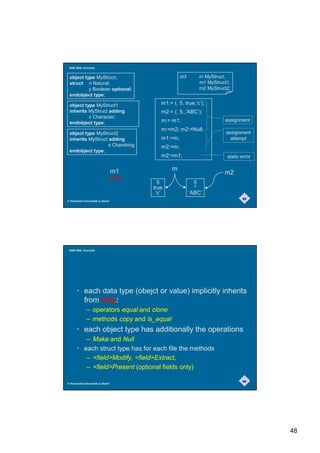
    SAM 2000, Grenoble block type B g1 c1 B interface B [sig1] [sig2] [sig4] use sig2,sig4; c4 c2 endinterface g2 [sig3,sig4] g3 B2 c3 block type C interface C g1 inherits B inherits B, if1; [sig3] use sig3; B if1 endinterface 83 © Humboldt-Universität zu Berlin SAM 2000, Grenoble • each (explicit or implicit) interface implies a specialization of the Pid-type • can be used to refer to agent instances in – variables, expressions – output, imports or remote procedure calls – assignment attempt • dynamic type check tests – provision of remote variables/procedures – acceptance of signals – may raise an exception (InvalidReference) 84 © Humboldt-Universität zu Berlin 42
  • 43.
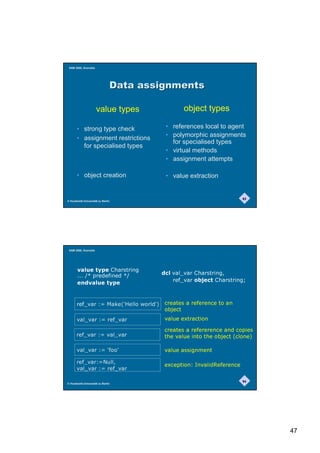
    SAM 2000, Grenoble block B assignment attempt dcl myb2 B2, mybt BT; g1 c1 B [sig1] [sig2] c4 B2 c2 mybt:=offspring g2 g B2:BT [sig3,sig4] c3 Sig3(x, y) to mybt State2 © Humboldt-Universität zu Berlin compatibility check 85 SAM 2000, Grenoble 'DWD7SHV • two main kinds of data types – value types – object types (references) conversion possible • data type definition specifies – data elements and structure – operators and methods for data manipulation • package Predefined contains a set of general data type definitions 86 © Humboldt-Universität zu Berlin 43
  • 44.
    SAM 2000, Grenoble • value types correspond to the newtype concept of SDL-92 – axioms and generators have been removed – behaviour of operators defined by algorithms or transition actions (functional description) – constructors: – literals – structs – choices 87 © Humboldt-Universität zu Berlin SAM 2000, Grenoble • object types define references to values – references are local to agents • definition similar to value types – conversion possible • polymorphic assignments 88 © Humboldt-Universität zu Berlin 44
  • 45.
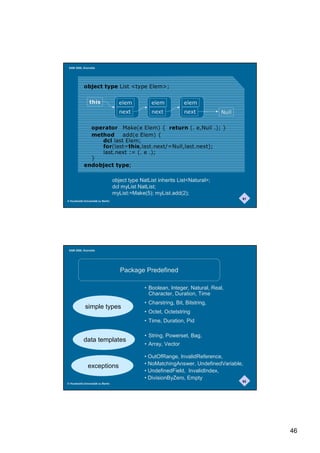
    SAM 2000, Grenoble • further properties of data types: • inheritance • context parameters • methods allow operation-calls in programming- language like dot-notation • local data types, constants, exceptions • visibility of data elements can be controlled 89 © Humboldt-Universität zu Berlin SAM 2000, Grenoble REMHFW WSH /LVW WSH (OHP! VWUXFW HOHP (OHP SULYDWH QH[W /LVW RSHUDWRUV 0DNH(OHP
  • 46.
    !/LVW PHWKRGV DGG(OHP
  • 47.
    ! /LVW WKLV HOHP HOHP HOHP QH[W QH[W QH[W 1XOO HQGREMHFW WSH 90 © Humboldt-Universität zu Berlin 45
  • 48.
    SAM 2000, Grenoble REMHFW WSH /LVW WSH (OHP! WKLV HOHP HOHP HOHP QH[W QH[W QH[W 1XOO RSHUDWRU 0DNHH (OHP
  • 49.
    ^ UHWXUQ H1XOO
  • 50.
    ` PHWKRG DGGH (OHP