SUMMARY
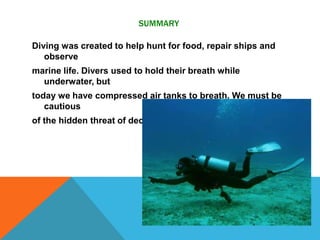
Diving was created to help hunt for food, repair ships and
observe
marine life. Divers used to hold their breath while
underwater, but
today we have compressed air tanks to breath. We must be
cautious
of the hidden threat of decompression sickness.
SUMMARY
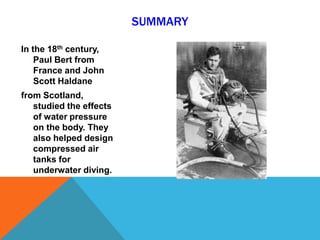
In the 18th century,
Paul Bert from
France and John
Scott Haldane
from Scotland,
studied the effects
of water pressure
on the body. They
also helped design
compressed air
tanks for
underwater diving.
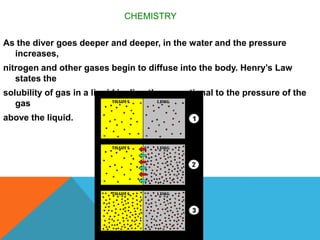
As the diver goes deeper and deeper, in the water and the pressure
increases,
nitrogen and other gases begin to diffuse into the body. Henry’s Law
states the
solubility of gas in a liquid is directly proportional to the pressure of the
gas
above the liquid.
CHEMISTRY
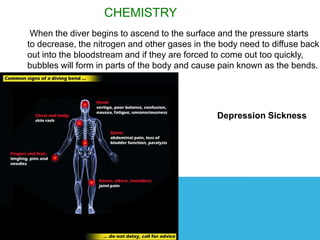
Depression Sickness
CHEMISTRY
When the diver begins to ascend to the surface and the pressure starts
to decrease, the nitrogen and other gases in the body need to diffuse back
out into the bloodstream and if they are forced to come out too quickly,
bubbles will form in parts of the body and cause pain known as the bends.
CHEMISTRY
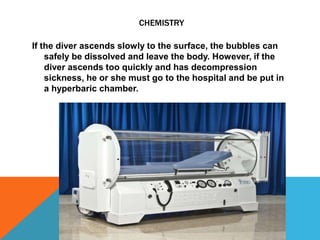
If the diver ascends slowly to the surface, the bubbles can
safely be dissolved and leave the body. However, if the
diver ascends too quickly and has decompression
sickness, he or she must go to the hospital and be put in
a hyperbaric chamber.
IMPLICTIONS
Divers must always be cautious and understand all the
dangers of SCUBA diving.
WORKS CITED
The Physical Chemistry of SCUBA Diving with Compressed Air. New York: W.H.
Freeman and Company., n.d. Web. 11 Apr. 2013.
<http://www.chem.uwec.edu/Chem405_S01/peterson/scuba.htm>.
Inkling. N.p., n.d. Web. 11 Apr. 2013. <https://www.inkling.com/read/ textbook-of-
medical-physiology-guyton-hall-12th/chapter-44/effect-of-high-partial>.
Chemistry Daily. N.p., n.d. Web. 11 Apr. 2013. <http://www.chemistrydaily.com/
chemistry/Decompression_sickness>.
Marinebio. N.p., n.d. Web. 28 Apr. 2013.
<http://marinebio.org/oceans/scuba/index.asp>.
Marine Medical Systems. N.p., n.d. Web. 29 Apr. 2013.
<http://www.marinemedical.com/articles/diving.htm>.

Scuba diving 1

  • 2.
    SUMMARY Diving was createdto help hunt for food, repair ships and observe marine life. Divers used to hold their breath while underwater, but today we have compressed air tanks to breath. We must be cautious of the hidden threat of decompression sickness.
  • 3.
    SUMMARY In the 18thcentury, Paul Bert from France and John Scott Haldane from Scotland, studied the effects of water pressure on the body. They also helped design compressed air tanks for underwater diving.
  • 4.
    As the divergoes deeper and deeper, in the water and the pressure increases, nitrogen and other gases begin to diffuse into the body. Henry’s Law states the solubility of gas in a liquid is directly proportional to the pressure of the gas above the liquid. CHEMISTRY
  • 5.
    Depression Sickness CHEMISTRY When thediver begins to ascend to the surface and the pressure starts to decrease, the nitrogen and other gases in the body need to diffuse back out into the bloodstream and if they are forced to come out too quickly, bubbles will form in parts of the body and cause pain known as the bends.
  • 6.
    CHEMISTRY If the diverascends slowly to the surface, the bubbles can safely be dissolved and leave the body. However, if the diver ascends too quickly and has decompression sickness, he or she must go to the hospital and be put in a hyperbaric chamber.
  • 7.
    IMPLICTIONS Divers must alwaysbe cautious and understand all the dangers of SCUBA diving.
  • 8.
    WORKS CITED The PhysicalChemistry of SCUBA Diving with Compressed Air. New York: W.H. Freeman and Company., n.d. Web. 11 Apr. 2013. <http://www.chem.uwec.edu/Chem405_S01/peterson/scuba.htm>. Inkling. N.p., n.d. Web. 11 Apr. 2013. <https://www.inkling.com/read/ textbook-of- medical-physiology-guyton-hall-12th/chapter-44/effect-of-high-partial>. Chemistry Daily. N.p., n.d. Web. 11 Apr. 2013. <http://www.chemistrydaily.com/ chemistry/Decompression_sickness>. Marinebio. N.p., n.d. Web. 28 Apr. 2013. <http://marinebio.org/oceans/scuba/index.asp>. Marine Medical Systems. N.p., n.d. Web. 29 Apr. 2013. <http://www.marinemedical.com/articles/diving.htm>.