ICRA Management Consulting Services Limited
Security Level Valuation
Methodology
Mumbai September 27, 2013
© IMaCS 2012
Printed 27-Sep-13
2
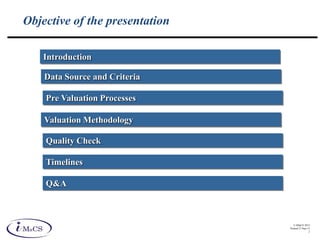
Objective of the presentation
Data Source and Criteria
Valuation Methodology
Introduction
Quality Check
Pre Valuation Processes
Timelines
Q&A
© IMaCS 2012
Printed 27-Sep-13
3
Current Valuation Mechanism
 Yield matrix comprising of 8 excel sheets which are segregated based on
MD, tenor, sector, credit rating and type of instrument, are provided by
two valuation agencies on a daily basis.
 The following are the list of benchmark yield curves across all rating
categories
 CD and CP (other than NBFCs)
 CPs of NBFC
 Bonds issued by NBFC, PTCs and real estate companies
 Bonds issued by companies other than NBFC, PTC and real estate
companies
 Fund managers have a leeway in the form of a mark-up/down on the
average YTM, which they can use to price each security in their
portfolio.
© IMaCS 2012
Printed 27-Sep-13
4
Security Level Valuation
 Independent valuation agencies will send clean prices of all securities
held in the portfolio of mutual funds on a daily basis for securities of
tenor greater than 60 days
 For securities of tenor less than 61 days, yield matrices will be provided.
 Prices provided by both valuation agencies will be averaged to calculate
the final price for that security.
 Prices will be provided for all days including holidays assuming a
settlement of (T+1). The prices for holidays will be sent on previous
working day.
© IMaCS 2012
Printed 27-Sep-13
5
Data Sources
1. Primary Trades – Polling, AMC Trade data, Bloomberg, Reuters
2. Secondary Trades – F-TRAC, NSE, BSE, AMC trade data,
Reuters, Bloomberg, polling
3. Security Details- Term Sheets, Data from AMCs, NSDL
4. Hierarchy of data source considered.
1. Primary trade data, secondary trade data, polling
2. FTRAC, NSE, BSE, AMC trade data
© IMaCS 2012
Printed 27-Sep-13
6
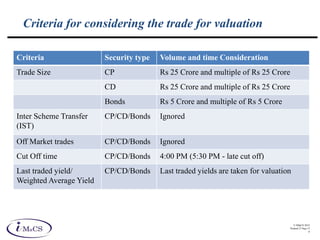
Criteria for considering the trade for valuation
Criteria Security type Volume and time Consideration
Trade Size CP Rs 25 Crore and multiple of Rs 25 Crore
CD Rs 25 Crore and multiple of Rs 25 Crore
Bonds Rs 5 Crore and multiple of Rs 5 Crore
Inter Scheme Transfer
(IST)
CP/CD/Bonds Ignored
Off Market trades CP/CD/Bonds Ignored
Cut Off time CP/CD/Bonds 4:00 PM (5:30 PM - late cut off)
Last traded yield/
Weighted Average Yield
CP/CD/Bonds Last traded yields are taken for valuation
© IMaCS 2012
Printed 27-Sep-13
7
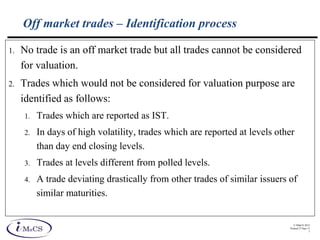
Off market trades – Identification process
1. No trade is an off market trade but all trades cannot be considered
for valuation.
2. Trades which would not be considered for valuation purpose are
identified as follows:
1. Trades which are reported as IST.
2. In days of high volatility, trades which are reported at levels other
than day end closing levels.
3. Trades at levels different from polled levels.
4. A trade deviating drastically from other trades of similar issuers of
similar maturities.
© IMaCS 2012
Printed 27-Sep-13
8
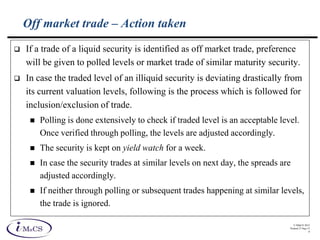
Off market trade – Action taken
 If a trade of a liquid security is identified as off market trade, preference
will be given to polled levels or market trade of similar maturity security.
 In case the traded level of an illiquid security is deviating drastically from
its current valuation levels, following is the process which is followed for
inclusion/exclusion of trade.
 Polling is done extensively to check if traded level is an acceptable level.
Once verified through polling, the levels are adjusted accordingly.
 The security is kept on yield watch for a week.
 In case the security trades at similar levels on next day, the spreads are
adjusted accordingly.
 If neither through polling or subsequent trades happening at similar levels,
the trade is ignored.
© IMaCS 2012
Printed 27-Sep-13
9
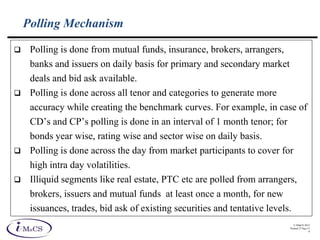
Polling Mechanism
 Polling is done from mutual funds, insurance, brokers, arrangers,
banks and issuers on daily basis for primary and secondary market
deals and bid ask available.
 Polling is done across all tenor and categories to generate more
accuracy while creating the benchmark curves. For example, in case of
CD’s and CP’s polling is done in an interval of 1 month tenor; for
bonds year wise, rating wise and sector wise on daily basis.
 Polling is done across the day from market participants to cover for
high intra day volatilities.
 Illiquid segments like real estate, PTC etc are polled from arrangers,
brokers, issuers and mutual funds at least once a month, for new
issuances, trades, bid ask of existing securities and tentative levels.
© IMaCS 2012
Printed 27-Sep-13
10
Clustering – Why is it required
 All securities issued by various issuers do not trade on a daily
basis.
 In case of no trade in a security of a particular issuer, the
valuation of that security become a concern.
 There are certain group of issuers which either trade at same
levels or move in similar fashion.
 These securities can be clustered together.
 Cluster of the security is dependent on change of credit
quality and liquidity.
© IMaCS 2012
Printed 27-Sep-13
11
Clustering – The process
1. Securities are clustered into groups based on the issuer, rating and maturity
profile. Eg for CDs Canara, PNB, Corporation, BoB will form a single cluster.
In case of NBFC Sundaram Finance, Tata Capital, L&T Finance etc form the
cluster.
2. Securities in a cluster would be treated as follows
a. The spreads of all securities of an issuer in a particular maturity bucket would be
adjusted if there is a trade of security of the same issuer in the same bucket. i.e. all
securities will be valued at same yield in a particular maturity bucket of the same
issuer.
b. In case of non-availability of information for the cluster, the spreads would remain
constant and would move according to the movement in the benchmark curve.
© IMaCS 2012
Printed 27-Sep-13
12
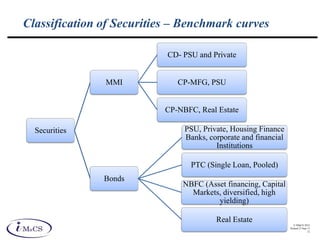
Classification of Securities – Benchmark curves
Securities
MMI
CD- PSU and Private
CP-MFG, PSU
CP-NBFC, Real Estate
Bonds
PSU, Private, Housing Finance
Banks, corporate and financial
Institutions
PTC (Single Loan, Pooled)
NBFC (Asset financing, Capital
Markets, diversified, high
yielding)
Real Estate
© IMaCS 2012
Printed 27-Sep-13
13
Benchmark Curves
 We prepare four benchmark curves for the following categories of securities
a. Benchmark CD curve
b. Benchmark curve of CPs issued by NBFCs
c. Benchmark curve for bonds issued by PSUs
d. Benchmark curve for bonds issued by NBFCs
 There are rating based benchmark curves across all ratings for all the above
mentioned categories.
 These benchmark curves are updated on daily basis, based on trades and bid
ask quotes taken from reporting platforms and polling through market
participants.
© IMaCS 2012
Printed 27-Sep-13
14
Methodology…1
 The CD benchmark curve is derived based on yields of securities which are traded
frequently (AAA rated PSU banks CD).
 The benchmark curve are derived with an interval of a month; i.e. there are 12
maturity buckets.
 The benchmark CD curve for a particular day is derived based on the following
order of priority
a. Primary issuances
b. Secondary trades of quantum of Rs. 25 Crore and multiple of 25 Crore.
c. Polling
d. Bid/Ask
e. Interpolation
 Last traded yield is used for generation of benchmark curve.
 CD benchmark curve is used for all CDs and CPs except CPs issued by NBFC and
real estate.
CD Benchmark Curve
© IMaCS 2012
Printed 27-Sep-13
15
Methodology…2
 Spreads in yields of all issuers over the CD benchmark curve are derived for each of
the following buckets based on common days of trade
a. 2-3 months
b. 3-6 months
c. 6-9 months
d. 9-12 months
 The spreads are derived from historical trade data based on common days of trade
for the last 1 year of quantum of Rs 25 Crore and multiple of Rs 25 Crore.
 All off market trades, intraday movements and inter-scheme transfers are ignored for
analysis.
Spread Analysis
© IMaCS 2012
Printed 27-Sep-13
16
Methodology…3
 The benchmark NBFC CP curve will be derived based on yields of benchmark
securities in the NBFC sector with an interval of a month; i.e. there will be 12
maturity buckets
 The benchmark curve for a particular day would be based on the following order
of priority
a. Primary issuances
b. Secondary trades of quantum of Rs. 25 Crore and multiple of 25 Crore.
c. Polling
d. Bid/Ask
e. Interpolation
 All off market trades and intraday movements and inter-scheme transfers will be
ignored.
 Last traded yields are used for generation of benchmark curves.
 NBFC CP curve is used as benchmark for all NBFC and Real Estate CPs
CP - NBFC: Benchmark curve
© IMaCS 2012
Printed 27-Sep-13
17
Methodology…4
 Issuer specific spreads will be derived for each company for each of the
following buckets based on common days of trade
a. 2-3 months
b. 3-6 months
c. 6-9 months
d. 9-12 months
 The spreads of individual issuers over the benchmark NBFC CP curve will be
derived from historical trade data based on common days of trade for the last 1
year of quantum of Rs 25 Crore and multiple of 25 Crore. In case of non
availability of information the spreads would be polled from market participants
Spread Analysis
© IMaCS 2012
Printed 27-Sep-13
18
Methodology…5
1. The issuer specific spread over the benchmark curve will be modified on a daily
basis based on
a. Trades in the primary market
b. Secondary market trades of volume Rs 25 Crore and multiple of Rs 25 Crore
c. Polling
2. Last traded yields will be used for mark to market purposes.
3. All off market trades, IST and intra day volatilities will be ignored.
4. In case of non availability of information, securities would move according to the
movement in the benchmark curve, keeping the spreads constant.
5. Levels of high yielding CPs will remain more stickier and will not move with the
benchmark curve.
6. Periodic (monthly) adjustment of spreads of highly illiquid CPs will be done
based on polling if no trades are available
MTM and daily movement in YTM – CP/CD
© IMaCS 2012
Printed 27-Sep-13
19
Methodology…6
 The benchmark curve will be derived based on yields of most liquid securities in
the PSU segment with buckets at annual intervals.
 The PSU benchmark curve for a particular day would be based on the following
order of priority
a. Primary issuances
b. Secondary trades of quantum of Rs. 5 Crore and multiple of Rs 5 Crore
c. Polling
d. Bid/Ask
e. Interpolation
 All off market trades, intraday volatilities and IST will be ignored.
 Last traded yield will be used for creation of benchmark curves.
 PSU benchmark curve will be used for all issuers excluding NBFC, PTC and
real estate.
Bonds - PSU, Private, FI, HFC and Banks: PSU Benchmark curve
© IMaCS 2012
Printed 27-Sep-13
20
Methodology…7
 Company specific spread of all companies would be derived for each bucket
over the PSU Bond benchmark curve.
 Issuer specific spreads will be derived from historical trade data for the last 2
year based on the traded spread of quantum of Rs 5 Crore and multiple of 5
Crore. The spreads would be computed based on common days of trade. The
issuer specific spread will be derived based on
a. Trades in the primary market
b. Secondary market trades of volume Rs. 5 Crore and multiple of 5 Crore
c. Polling
d. Spread at the time of issuance of the security
e. Spread of securities issued by companies of the same sector and rating
 The spreads will be adjusted on a daily basis based on primary, secondary
market trade data bid/ask yield and polling of quantum Rs 5 Crore and multiple
of 5 Crore, .
Bonds - PSU, Private, FI, HFC and Banks: Spread Analysis
© IMaCS 2012
Printed 27-Sep-13
21
Methodology…8
 The NBFC Bond benchmark curve will be derived based on yields of
benchmark securities in the NBFC sector bucketed at monthly intervals.
 The NBFC benchmark curve for a particular day would be based on the
following order of priority
a. Primary issuances
b. Secondary trades of quantum of Rs. 5 Crore and multiple of 5 Crore
c. Polling
d. Bid/Ask
e. Interpolation
 All off market trades, intraday movements and IST will be ignored.
 Last traded yield will be used for creation of benchmark curves.
 NBFC benchmark curve will be used for all issuers of NBFC, PTC and real
estate.
Bonds - NBFC: Benchmark Curve
© IMaCS 2012
Printed 27-Sep-13
22
Methodology…9
 Company specific spreads for each bucket would be derived for each company
over the NBFC Bond benchmark curve.
 Issuer specific spreads will be derived from historical trade data for the last 2
year based on the traded spread of quantum of Rs 5 Crore or multiple of 5
Crore. The spreads would be computed based on common days of trade. The
issuer spread will be derived based on
a. Trades in the primary market
b. Secondary market trades of volume Rs 5 Crore or multiple of 5 Crore
c. Polling
d. Spread at the time of issuance of the security
e. Spread of securities issued by companies of similar nature (rating, business
operations, etc)
Bonds - NBFC: Spread Analysis
© IMaCS 2012
Printed 27-Sep-13
23
Methodology…10
1. The spread of individual issuers over the benchmark curve will be
changed on a daily basis based on the following order of priority
a. Trades in the primary market
b. Secondary market trades of volume Rs. 5 Crore and multiple
of 5 Crore
c. Polling
2. Last traded yields will be used for mark to market purposes.
3. All off market trades, IST and intra day volatilities will be ignored.
4. In case of non availability of information, securities would move
according to the movement in the benchmark curve, keeping the
spreads constant.
MTM and daily movement in yields
© IMaCS 2012
Printed 27-Sep-13
24
Methodology…11
 The benchmark curve used is the corresponding CP/CD curve which is plotted
at monthly intervals.
 All securities are valued using a spread over the benchmark curve.
 All securities of same issuer and maturity month are valued at same levels.
Higher spread is used for bonds with deemed maturity (put/call on same date)
falling in less than 1 year period as compared to plain vanilla bonds of similar
maturity
 The issuer spread will be derived based on
a. Trades in the primary market
b. Secondary market trades of volume Rs 5 Crore or multiple of Rs 5 Crore
c. Polling
d. Spread at the time of issuance of the security
e. Spread of securities issued by companies of similar nature (rating, business
operations, etc)
Bonds – Maturity Less Than 1 year
© IMaCS 2012
Printed 27-Sep-13
25
Methodology…12
1. Single loan PTC would be valued at a spread over the yield of security issued by
the borrower in the PTC of similar maturity
2. Spread in yield of the PTC would be calculated at the time of issuance of the
security over the yield of a security issued by the borrower of similar maturity
3. This spread would remain constant till there is another trade of the security of
quantum of Rs 5 Crore and above, this would exclude inter scheme transfers
4. The spreads would also be adjusted on a periodic basis, preferably on a monthly
basis; based on polling from the following entities mentioned below:
a. Issuers
b. Arrangers
c. Mutual Funds
5. The yield would move with respect to the movement in yields of securities
issued by the borrower of similar maturity
Single Loan PTC
© IMaCS 2012
Printed 27-Sep-13
26
Methodology…13
1. Pooled PTC would be valued at a spread over the yield of security of similar
rating of the PTC (e.g. if the rating of PTC is AA (SO), then the spread would be
computed on spread over AA rated NBFC) of similar maturity
2. Spread in yield of the PTC would be calculated at the time of issuance over the
benchmark rating curve of same rating as PTC
3. This spread would remain constant till there is another trade of the security of
quantum of Rs 5 Crore and above, this would exclude inter scheme transfers
4. The spreads would also be adjusted once a month; based on polling from the
following entities mentioned below:
a. Issuers
b. Arrangers
c. Mutual Funds
5. The yield would move with respect to the movement in yields of the NBFC
Bond Benchmark curve of similar maturity
Pooled - PTC
© IMaCS 2012
Printed 27-Sep-13
27
Methodology…14
 Yields of securities issued by real estate companies are sticker in nature as
compared to other sectors.
 Spreads of individual securities over the NBFC Bond Benchmark Curve would
be computed from historical trade data analysis and polling. The order of
priority of selection and adjustment of spread on a daily basis would be as
follows:
a. Primary issuance of similar tenor securities by the same issuer
b. Secondary market trades of quantum of Rs 5 Crore and multiples of 5 Crore
for bonds and 25 crore and multiple of 25 Crore for CP
c. Polling from issuers, arranges and market participants. Polling would be
done on a fortnightly basis
d. Spread at the time of primary issuance.
e. In case of absence of trades, spreads will be polled once a month.
CP & Bonds: Real Estate
© IMaCS 2012
Printed 27-Sep-13
28
Exceptions
1. In buckets where benchmark yield curve is very steep (where the difference in
yields between the two extremes of a tenor/duration bucket is more than 20
bps), interpolations may be used to value the securities.
 All securities issued by the same company in a particular maturity/duration
bucket would be valued at the same spread over the benchmark curve, except
for some exceptions, given below
a. Securities which are secured and unsecured
b. Taxable and non taxable securities
c. Difference in tier classification of securities.
d. Bonds with option and plain vanilla bonds (valid only for securities with
deemed maturity of less than 1 year).
e. Securities with guarantees like SBLC in case of CPs.
© IMaCS 2012
Printed 27-Sep-13
29
Rating Issues
1. In case of difference in ratings issued by different rating agencies for any
instrument, lower of the two ratings would be considered.
2. In case of downgrades the yields of the securities issued by the entity would be
notched up to at least the benchmark yield for the new rating. This would be fine
tuned gradually based on:
 Daily trades
 Polling
3. In case of MMI, if the issuer does not have a long term rating for NCD, any
other rating available for the issuer like Issuer rating, Bank Facility rating etc
will be used as Long term rating.
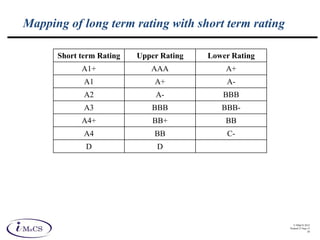
4. In case no long term rating available for a particular issuer, we would assume
the rating to be the lowest long term rating corresponding to a given short term
rating (mapping of long and short term ratings are provided in the next slide).
© IMaCS 2012
Printed 27-Sep-13
30
Mapping of long term rating with short term rating
Short term Rating Upper Rating Lower Rating
A1+ AAA A+
A1 A+ A-
A2 A- BBB
A3 BBB BBB-
A4+ BB+ BB
A4 BB C-
D D
© IMaCS 2012
Printed 27-Sep-13
31
Quality Check
 All valuation files are checked by managers before
dissemination.
 Daily Valuations
1. The valuations are compared with previous days valuations to
identify any unusual movement.
2. The difference in yields of two days valuations and modified
duration are used to check the price movement for the day.
3. Valuation is compared again with traded/polled prices.
 Formatting and data related issues
1. The ISINs, number of securities, maturity dates etc will be matched
by both valuation agencies on a daily basis.
2. Majority of the processes are automated to avoid any manual errors.
© IMaCS 2012
Printed 27-Sep-13
32
Resolution process
1. Issues like formatting issues will be revised and sent on the same day.
2. In case of feedback from market participants on discrepancies in prices
sent in the daily valuation file,
a. We would poll for that security from market participants.
b. If necessary the prices would be adjusted by next working day.
3. All feedback on prices should be sent through formal email only with
proposed market level for the security.
4. In case of issues related to cash flows/security details, the security details
would be required along with the IM/term sheet.
© IMaCS 2012
Printed 27-Sep-13
33
IMaCS Bond Valuer
 IMaCS uses its proprietary Bond Valuer software for valuation
of all securities (Corporate bonds, CP, CDs, G-Secs and SDLs).
 Tool can create zero curves and forward curves required for
valuation of FRBs.
 Bond Valuer has a yield import facility along with the basic
feature of matrix import.
 Valuation reports can be customized based on users
requirements.
 The valuation is carried out in accordance to AMFI Fair
valuation guidelines and SEBI circular.
© IMaCS 2012
Printed 27-Sep-13
34
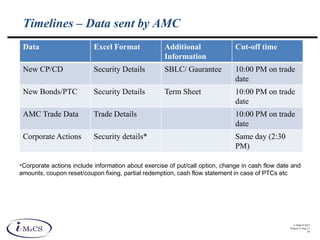
Timelines – Data sent by AMC
Data Excel Format Additional
Information
Cut-off time
New CP/CD Security Details SBLC/ Gaurantee 10:00 PM on trade
date
New Bonds/PTC Security Details Term Sheet 10:00 PM on trade
date
AMC Trade Data Trade Details 10:00 PM on trade
date
Corporate Actions Security details* Same day (2:30
PM)
*Corporate actions include information about exercise of put/call option, change in cash flow date and
amounts, coupon reset/coupon fixing, partial redemption, cash flow statement in case of PTCs etc
© IMaCS 2012
Printed 27-Sep-13
35
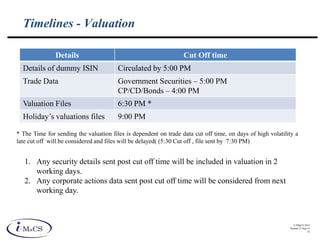
Timelines - Valuation
Details Cut Off time
Details of dummy ISIN Circulated by 5:00 PM
Trade Data Government Securities – 5:00 PM
CP/CD/Bonds – 4:00 PM
Valuation Files 6:30 PM *
Holiday’s valuations files 9:00 PM
* The Time for sending the valuation files is dependent on trade data cut off time, on days of high volatility a
late cut off will be considered and files will be delayed( (5:30 Cut off , file sent by 7:30 PM)
1. Any security details sent post cut off time will be included in valuation in 2
working days.
2. Any corporate actions data sent post cut off time will be considered from next
working day.
© IMaCS 2012
Printed 27-Sep-13
36
Thank You

Scrip level valuation methodology_IMaCS_27 sep 13

  • 1.
    ICRA Management ConsultingServices Limited Security Level Valuation Methodology Mumbai September 27, 2013
  • 2.
    © IMaCS 2012 Printed27-Sep-13 2 Objective of the presentation Data Source and Criteria Valuation Methodology Introduction Quality Check Pre Valuation Processes Timelines Q&A
  • 3.
    © IMaCS 2012 Printed27-Sep-13 3 Current Valuation Mechanism  Yield matrix comprising of 8 excel sheets which are segregated based on MD, tenor, sector, credit rating and type of instrument, are provided by two valuation agencies on a daily basis.  The following are the list of benchmark yield curves across all rating categories  CD and CP (other than NBFCs)  CPs of NBFC  Bonds issued by NBFC, PTCs and real estate companies  Bonds issued by companies other than NBFC, PTC and real estate companies  Fund managers have a leeway in the form of a mark-up/down on the average YTM, which they can use to price each security in their portfolio.
  • 4.
    © IMaCS 2012 Printed27-Sep-13 4 Security Level Valuation  Independent valuation agencies will send clean prices of all securities held in the portfolio of mutual funds on a daily basis for securities of tenor greater than 60 days  For securities of tenor less than 61 days, yield matrices will be provided.  Prices provided by both valuation agencies will be averaged to calculate the final price for that security.  Prices will be provided for all days including holidays assuming a settlement of (T+1). The prices for holidays will be sent on previous working day.
  • 5.
    © IMaCS 2012 Printed27-Sep-13 5 Data Sources 1. Primary Trades – Polling, AMC Trade data, Bloomberg, Reuters 2. Secondary Trades – F-TRAC, NSE, BSE, AMC trade data, Reuters, Bloomberg, polling 3. Security Details- Term Sheets, Data from AMCs, NSDL 4. Hierarchy of data source considered. 1. Primary trade data, secondary trade data, polling 2. FTRAC, NSE, BSE, AMC trade data
  • 6.
    © IMaCS 2012 Printed27-Sep-13 6 Criteria for considering the trade for valuation Criteria Security type Volume and time Consideration Trade Size CP Rs 25 Crore and multiple of Rs 25 Crore CD Rs 25 Crore and multiple of Rs 25 Crore Bonds Rs 5 Crore and multiple of Rs 5 Crore Inter Scheme Transfer (IST) CP/CD/Bonds Ignored Off Market trades CP/CD/Bonds Ignored Cut Off time CP/CD/Bonds 4:00 PM (5:30 PM - late cut off) Last traded yield/ Weighted Average Yield CP/CD/Bonds Last traded yields are taken for valuation
  • 7.
    © IMaCS 2012 Printed27-Sep-13 7 Off market trades – Identification process 1. No trade is an off market trade but all trades cannot be considered for valuation. 2. Trades which would not be considered for valuation purpose are identified as follows: 1. Trades which are reported as IST. 2. In days of high volatility, trades which are reported at levels other than day end closing levels. 3. Trades at levels different from polled levels. 4. A trade deviating drastically from other trades of similar issuers of similar maturities.
  • 8.
    © IMaCS 2012 Printed27-Sep-13 8 Off market trade – Action taken  If a trade of a liquid security is identified as off market trade, preference will be given to polled levels or market trade of similar maturity security.  In case the traded level of an illiquid security is deviating drastically from its current valuation levels, following is the process which is followed for inclusion/exclusion of trade.  Polling is done extensively to check if traded level is an acceptable level. Once verified through polling, the levels are adjusted accordingly.  The security is kept on yield watch for a week.  In case the security trades at similar levels on next day, the spreads are adjusted accordingly.  If neither through polling or subsequent trades happening at similar levels, the trade is ignored.
  • 9.
    © IMaCS 2012 Printed27-Sep-13 9 Polling Mechanism  Polling is done from mutual funds, insurance, brokers, arrangers, banks and issuers on daily basis for primary and secondary market deals and bid ask available.  Polling is done across all tenor and categories to generate more accuracy while creating the benchmark curves. For example, in case of CD’s and CP’s polling is done in an interval of 1 month tenor; for bonds year wise, rating wise and sector wise on daily basis.  Polling is done across the day from market participants to cover for high intra day volatilities.  Illiquid segments like real estate, PTC etc are polled from arrangers, brokers, issuers and mutual funds at least once a month, for new issuances, trades, bid ask of existing securities and tentative levels.
  • 10.
    © IMaCS 2012 Printed27-Sep-13 10 Clustering – Why is it required  All securities issued by various issuers do not trade on a daily basis.  In case of no trade in a security of a particular issuer, the valuation of that security become a concern.  There are certain group of issuers which either trade at same levels or move in similar fashion.  These securities can be clustered together.  Cluster of the security is dependent on change of credit quality and liquidity.
  • 11.
    © IMaCS 2012 Printed27-Sep-13 11 Clustering – The process 1. Securities are clustered into groups based on the issuer, rating and maturity profile. Eg for CDs Canara, PNB, Corporation, BoB will form a single cluster. In case of NBFC Sundaram Finance, Tata Capital, L&T Finance etc form the cluster. 2. Securities in a cluster would be treated as follows a. The spreads of all securities of an issuer in a particular maturity bucket would be adjusted if there is a trade of security of the same issuer in the same bucket. i.e. all securities will be valued at same yield in a particular maturity bucket of the same issuer. b. In case of non-availability of information for the cluster, the spreads would remain constant and would move according to the movement in the benchmark curve.
  • 12.
    © IMaCS 2012 Printed27-Sep-13 12 Classification of Securities – Benchmark curves Securities MMI CD- PSU and Private CP-MFG, PSU CP-NBFC, Real Estate Bonds PSU, Private, Housing Finance Banks, corporate and financial Institutions PTC (Single Loan, Pooled) NBFC (Asset financing, Capital Markets, diversified, high yielding) Real Estate
  • 13.
    © IMaCS 2012 Printed27-Sep-13 13 Benchmark Curves  We prepare four benchmark curves for the following categories of securities a. Benchmark CD curve b. Benchmark curve of CPs issued by NBFCs c. Benchmark curve for bonds issued by PSUs d. Benchmark curve for bonds issued by NBFCs  There are rating based benchmark curves across all ratings for all the above mentioned categories.  These benchmark curves are updated on daily basis, based on trades and bid ask quotes taken from reporting platforms and polling through market participants.
  • 14.
    © IMaCS 2012 Printed27-Sep-13 14 Methodology…1  The CD benchmark curve is derived based on yields of securities which are traded frequently (AAA rated PSU banks CD).  The benchmark curve are derived with an interval of a month; i.e. there are 12 maturity buckets.  The benchmark CD curve for a particular day is derived based on the following order of priority a. Primary issuances b. Secondary trades of quantum of Rs. 25 Crore and multiple of 25 Crore. c. Polling d. Bid/Ask e. Interpolation  Last traded yield is used for generation of benchmark curve.  CD benchmark curve is used for all CDs and CPs except CPs issued by NBFC and real estate. CD Benchmark Curve
  • 15.
    © IMaCS 2012 Printed27-Sep-13 15 Methodology…2  Spreads in yields of all issuers over the CD benchmark curve are derived for each of the following buckets based on common days of trade a. 2-3 months b. 3-6 months c. 6-9 months d. 9-12 months  The spreads are derived from historical trade data based on common days of trade for the last 1 year of quantum of Rs 25 Crore and multiple of Rs 25 Crore.  All off market trades, intraday movements and inter-scheme transfers are ignored for analysis. Spread Analysis
  • 16.
    © IMaCS 2012 Printed27-Sep-13 16 Methodology…3  The benchmark NBFC CP curve will be derived based on yields of benchmark securities in the NBFC sector with an interval of a month; i.e. there will be 12 maturity buckets  The benchmark curve for a particular day would be based on the following order of priority a. Primary issuances b. Secondary trades of quantum of Rs. 25 Crore and multiple of 25 Crore. c. Polling d. Bid/Ask e. Interpolation  All off market trades and intraday movements and inter-scheme transfers will be ignored.  Last traded yields are used for generation of benchmark curves.  NBFC CP curve is used as benchmark for all NBFC and Real Estate CPs CP - NBFC: Benchmark curve
  • 17.
    © IMaCS 2012 Printed27-Sep-13 17 Methodology…4  Issuer specific spreads will be derived for each company for each of the following buckets based on common days of trade a. 2-3 months b. 3-6 months c. 6-9 months d. 9-12 months  The spreads of individual issuers over the benchmark NBFC CP curve will be derived from historical trade data based on common days of trade for the last 1 year of quantum of Rs 25 Crore and multiple of 25 Crore. In case of non availability of information the spreads would be polled from market participants Spread Analysis
  • 18.
    © IMaCS 2012 Printed27-Sep-13 18 Methodology…5 1. The issuer specific spread over the benchmark curve will be modified on a daily basis based on a. Trades in the primary market b. Secondary market trades of volume Rs 25 Crore and multiple of Rs 25 Crore c. Polling 2. Last traded yields will be used for mark to market purposes. 3. All off market trades, IST and intra day volatilities will be ignored. 4. In case of non availability of information, securities would move according to the movement in the benchmark curve, keeping the spreads constant. 5. Levels of high yielding CPs will remain more stickier and will not move with the benchmark curve. 6. Periodic (monthly) adjustment of spreads of highly illiquid CPs will be done based on polling if no trades are available MTM and daily movement in YTM – CP/CD
  • 19.
    © IMaCS 2012 Printed27-Sep-13 19 Methodology…6  The benchmark curve will be derived based on yields of most liquid securities in the PSU segment with buckets at annual intervals.  The PSU benchmark curve for a particular day would be based on the following order of priority a. Primary issuances b. Secondary trades of quantum of Rs. 5 Crore and multiple of Rs 5 Crore c. Polling d. Bid/Ask e. Interpolation  All off market trades, intraday volatilities and IST will be ignored.  Last traded yield will be used for creation of benchmark curves.  PSU benchmark curve will be used for all issuers excluding NBFC, PTC and real estate. Bonds - PSU, Private, FI, HFC and Banks: PSU Benchmark curve
  • 20.
    © IMaCS 2012 Printed27-Sep-13 20 Methodology…7  Company specific spread of all companies would be derived for each bucket over the PSU Bond benchmark curve.  Issuer specific spreads will be derived from historical trade data for the last 2 year based on the traded spread of quantum of Rs 5 Crore and multiple of 5 Crore. The spreads would be computed based on common days of trade. The issuer specific spread will be derived based on a. Trades in the primary market b. Secondary market trades of volume Rs. 5 Crore and multiple of 5 Crore c. Polling d. Spread at the time of issuance of the security e. Spread of securities issued by companies of the same sector and rating  The spreads will be adjusted on a daily basis based on primary, secondary market trade data bid/ask yield and polling of quantum Rs 5 Crore and multiple of 5 Crore, . Bonds - PSU, Private, FI, HFC and Banks: Spread Analysis
  • 21.
    © IMaCS 2012 Printed27-Sep-13 21 Methodology…8  The NBFC Bond benchmark curve will be derived based on yields of benchmark securities in the NBFC sector bucketed at monthly intervals.  The NBFC benchmark curve for a particular day would be based on the following order of priority a. Primary issuances b. Secondary trades of quantum of Rs. 5 Crore and multiple of 5 Crore c. Polling d. Bid/Ask e. Interpolation  All off market trades, intraday movements and IST will be ignored.  Last traded yield will be used for creation of benchmark curves.  NBFC benchmark curve will be used for all issuers of NBFC, PTC and real estate. Bonds - NBFC: Benchmark Curve
  • 22.
    © IMaCS 2012 Printed27-Sep-13 22 Methodology…9  Company specific spreads for each bucket would be derived for each company over the NBFC Bond benchmark curve.  Issuer specific spreads will be derived from historical trade data for the last 2 year based on the traded spread of quantum of Rs 5 Crore or multiple of 5 Crore. The spreads would be computed based on common days of trade. The issuer spread will be derived based on a. Trades in the primary market b. Secondary market trades of volume Rs 5 Crore or multiple of 5 Crore c. Polling d. Spread at the time of issuance of the security e. Spread of securities issued by companies of similar nature (rating, business operations, etc) Bonds - NBFC: Spread Analysis
  • 23.
    © IMaCS 2012 Printed27-Sep-13 23 Methodology…10 1. The spread of individual issuers over the benchmark curve will be changed on a daily basis based on the following order of priority a. Trades in the primary market b. Secondary market trades of volume Rs. 5 Crore and multiple of 5 Crore c. Polling 2. Last traded yields will be used for mark to market purposes. 3. All off market trades, IST and intra day volatilities will be ignored. 4. In case of non availability of information, securities would move according to the movement in the benchmark curve, keeping the spreads constant. MTM and daily movement in yields
  • 24.
    © IMaCS 2012 Printed27-Sep-13 24 Methodology…11  The benchmark curve used is the corresponding CP/CD curve which is plotted at monthly intervals.  All securities are valued using a spread over the benchmark curve.  All securities of same issuer and maturity month are valued at same levels. Higher spread is used for bonds with deemed maturity (put/call on same date) falling in less than 1 year period as compared to plain vanilla bonds of similar maturity  The issuer spread will be derived based on a. Trades in the primary market b. Secondary market trades of volume Rs 5 Crore or multiple of Rs 5 Crore c. Polling d. Spread at the time of issuance of the security e. Spread of securities issued by companies of similar nature (rating, business operations, etc) Bonds – Maturity Less Than 1 year
  • 25.
    © IMaCS 2012 Printed27-Sep-13 25 Methodology…12 1. Single loan PTC would be valued at a spread over the yield of security issued by the borrower in the PTC of similar maturity 2. Spread in yield of the PTC would be calculated at the time of issuance of the security over the yield of a security issued by the borrower of similar maturity 3. This spread would remain constant till there is another trade of the security of quantum of Rs 5 Crore and above, this would exclude inter scheme transfers 4. The spreads would also be adjusted on a periodic basis, preferably on a monthly basis; based on polling from the following entities mentioned below: a. Issuers b. Arrangers c. Mutual Funds 5. The yield would move with respect to the movement in yields of securities issued by the borrower of similar maturity Single Loan PTC
  • 26.
    © IMaCS 2012 Printed27-Sep-13 26 Methodology…13 1. Pooled PTC would be valued at a spread over the yield of security of similar rating of the PTC (e.g. if the rating of PTC is AA (SO), then the spread would be computed on spread over AA rated NBFC) of similar maturity 2. Spread in yield of the PTC would be calculated at the time of issuance over the benchmark rating curve of same rating as PTC 3. This spread would remain constant till there is another trade of the security of quantum of Rs 5 Crore and above, this would exclude inter scheme transfers 4. The spreads would also be adjusted once a month; based on polling from the following entities mentioned below: a. Issuers b. Arrangers c. Mutual Funds 5. The yield would move with respect to the movement in yields of the NBFC Bond Benchmark curve of similar maturity Pooled - PTC
  • 27.
    © IMaCS 2012 Printed27-Sep-13 27 Methodology…14  Yields of securities issued by real estate companies are sticker in nature as compared to other sectors.  Spreads of individual securities over the NBFC Bond Benchmark Curve would be computed from historical trade data analysis and polling. The order of priority of selection and adjustment of spread on a daily basis would be as follows: a. Primary issuance of similar tenor securities by the same issuer b. Secondary market trades of quantum of Rs 5 Crore and multiples of 5 Crore for bonds and 25 crore and multiple of 25 Crore for CP c. Polling from issuers, arranges and market participants. Polling would be done on a fortnightly basis d. Spread at the time of primary issuance. e. In case of absence of trades, spreads will be polled once a month. CP & Bonds: Real Estate
  • 28.
    © IMaCS 2012 Printed27-Sep-13 28 Exceptions 1. In buckets where benchmark yield curve is very steep (where the difference in yields between the two extremes of a tenor/duration bucket is more than 20 bps), interpolations may be used to value the securities.  All securities issued by the same company in a particular maturity/duration bucket would be valued at the same spread over the benchmark curve, except for some exceptions, given below a. Securities which are secured and unsecured b. Taxable and non taxable securities c. Difference in tier classification of securities. d. Bonds with option and plain vanilla bonds (valid only for securities with deemed maturity of less than 1 year). e. Securities with guarantees like SBLC in case of CPs.
  • 29.
    © IMaCS 2012 Printed27-Sep-13 29 Rating Issues 1. In case of difference in ratings issued by different rating agencies for any instrument, lower of the two ratings would be considered. 2. In case of downgrades the yields of the securities issued by the entity would be notched up to at least the benchmark yield for the new rating. This would be fine tuned gradually based on:  Daily trades  Polling 3. In case of MMI, if the issuer does not have a long term rating for NCD, any other rating available for the issuer like Issuer rating, Bank Facility rating etc will be used as Long term rating. 4. In case no long term rating available for a particular issuer, we would assume the rating to be the lowest long term rating corresponding to a given short term rating (mapping of long and short term ratings are provided in the next slide).
  • 30.
    © IMaCS 2012 Printed27-Sep-13 30 Mapping of long term rating with short term rating Short term Rating Upper Rating Lower Rating A1+ AAA A+ A1 A+ A- A2 A- BBB A3 BBB BBB- A4+ BB+ BB A4 BB C- D D
  • 31.
    © IMaCS 2012 Printed27-Sep-13 31 Quality Check  All valuation files are checked by managers before dissemination.  Daily Valuations 1. The valuations are compared with previous days valuations to identify any unusual movement. 2. The difference in yields of two days valuations and modified duration are used to check the price movement for the day. 3. Valuation is compared again with traded/polled prices.  Formatting and data related issues 1. The ISINs, number of securities, maturity dates etc will be matched by both valuation agencies on a daily basis. 2. Majority of the processes are automated to avoid any manual errors.
  • 32.
    © IMaCS 2012 Printed27-Sep-13 32 Resolution process 1. Issues like formatting issues will be revised and sent on the same day. 2. In case of feedback from market participants on discrepancies in prices sent in the daily valuation file, a. We would poll for that security from market participants. b. If necessary the prices would be adjusted by next working day. 3. All feedback on prices should be sent through formal email only with proposed market level for the security. 4. In case of issues related to cash flows/security details, the security details would be required along with the IM/term sheet.
  • 33.
    © IMaCS 2012 Printed27-Sep-13 33 IMaCS Bond Valuer  IMaCS uses its proprietary Bond Valuer software for valuation of all securities (Corporate bonds, CP, CDs, G-Secs and SDLs).  Tool can create zero curves and forward curves required for valuation of FRBs.  Bond Valuer has a yield import facility along with the basic feature of matrix import.  Valuation reports can be customized based on users requirements.  The valuation is carried out in accordance to AMFI Fair valuation guidelines and SEBI circular.
  • 34.
    © IMaCS 2012 Printed27-Sep-13 34 Timelines – Data sent by AMC Data Excel Format Additional Information Cut-off time New CP/CD Security Details SBLC/ Gaurantee 10:00 PM on trade date New Bonds/PTC Security Details Term Sheet 10:00 PM on trade date AMC Trade Data Trade Details 10:00 PM on trade date Corporate Actions Security details* Same day (2:30 PM) *Corporate actions include information about exercise of put/call option, change in cash flow date and amounts, coupon reset/coupon fixing, partial redemption, cash flow statement in case of PTCs etc
  • 35.
    © IMaCS 2012 Printed27-Sep-13 35 Timelines - Valuation Details Cut Off time Details of dummy ISIN Circulated by 5:00 PM Trade Data Government Securities – 5:00 PM CP/CD/Bonds – 4:00 PM Valuation Files 6:30 PM * Holiday’s valuations files 9:00 PM * The Time for sending the valuation files is dependent on trade data cut off time, on days of high volatility a late cut off will be considered and files will be delayed( (5:30 Cut off , file sent by 7:30 PM) 1. Any security details sent post cut off time will be included in valuation in 2 working days. 2. Any corporate actions data sent post cut off time will be considered from next working day.
  • 36.
    © IMaCS 2012 Printed27-Sep-13 36 Thank You