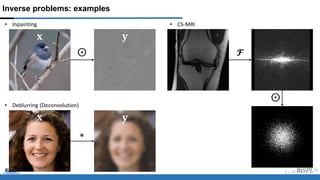
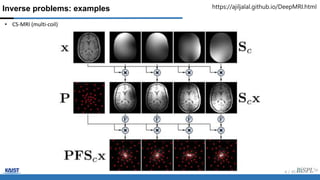
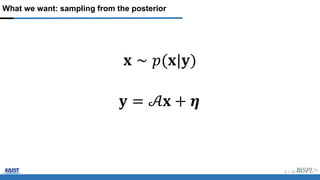
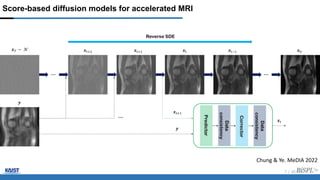
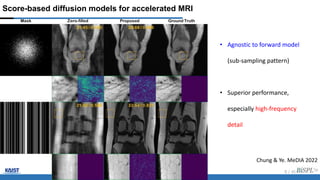
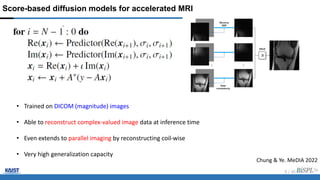
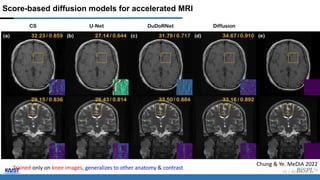
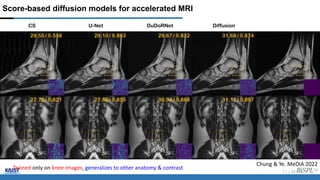
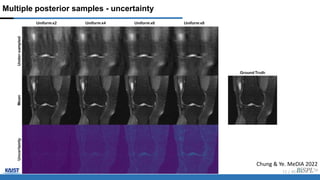
This document discusses using score-based diffusion models for accelerated MRI. It proposes training diffusion models on magnitude MRI images to reconstruct complex-valued images and even extend to parallel imaging. The models are agnostic to sub-sampling patterns and show superior performance, especially for high-frequency detail. They also demonstrate high generalization capacity, trained only on knee images but able to generalize to other anatomies and contrasts. The models can also provide multiple posterior samples to estimate reconstruction uncertainty.




![ONFH[AVN HIP] -TRIPLE REGIME -A NOVAL SURGICAL CONCEPT .pptx](https://cdn.slidesharecdn.com/ss_thumbnails/onfhavnhip2026koaconcalicutdrgokuldevdrmashraf-260210064517-213ec005-thumbnail.jpg?width=640&height=640&fit=bounds)


![PERI-PROSTHETIC FRACTURE NAIL-PLATE CONSTRUCT [NPC].pptx](https://cdn.slidesharecdn.com/ss_thumbnails/drarunkumardrmohamedashrafperiprostheticfrasturenail-plateconstructnpc-260209164459-7e9d15a1-thumbnail.jpg?width=640&height=640&fit=bounds)


