VERSION 12.0
APICS
Supply Chain Operations Reference Model
SCOR
Version 12.0
Visit apics.org/scor for more information regarding the SCOR framework. The SCOR v12 framework is
available via free digital download to all APICS members on the APICS website at apics.org/myapics.
©2017 APICS
8430 West Bryn Mawr Avenue, Suite 1000
Chicago, IL 60631-3439 USA
Phone: 1-800-444-2742 or +1-773-867-1777
Fax: +1-773-639-3000
No portion of this document may be reproduced under any circumstances. SCOR is a registered
trademark of APICS.
Stock #21000-V12
© APICS 2017. All rights reserved. SCOR Version 12.0
This SCOR® Model License Agreement (“Agreement”) is a legal agreement between the
user (“Licensee”) and APICS Inc., 8430 West Bryn Mawr Avenue, Suite 1000, Chicago,
Illinois 60631 U.S.A. Before using the SCOR® Model, Licensee must read and accept this
Agreement. By reading or using any of the SCOR® Model, Licensee accepts and agrees to
be bound by all terms and conditions set forth in this Agreement. If any term is
unacceptable, Licensee must, prior to any use, immediately return all materials to APICS
for a refund, if applicable, or to the APICS Chapter Representative or an APICS authorized
education provider or associate (“Associate”) from whom Licensee received the materials.
1. This Agreement governs the SCOR®
Model delivered with this Agreement and
any updates or modifications thereto.
2. Subject to the terms and conditions
herein, Licensee is granted a non-exclusive,
non-transferable, limited and revocable right
to use the SCOR® Model solely for your
personal, educational purposes. Any
additional license rights may be granted by
APICS only through a separate written
agreement.
3. All materials in the SCOR® Model are
produced, distributed, owned and
copyrighted by APICS. APICS shall have
sole and exclusive ownership of all right,
title, and interest in and to the SCOR®
Model and all modifications and updates
thereof (including ownership of all content,
copyrights, trademarks, and other
intellectual property rights pertaining
thereto), subject only to the non-exclusive
rights expressly granted to Licensee herein
by APICS. This non-exclusive license is
granted to Licensee for good and valuable
consideration, and does not provide
Licensee with title or ownership of the
SCOR® Model, but only a right of limited
use. Licensee must keep the SCOR® Model
free and clear of all claims, liens, and
encumbrances.
4. Licensee may not copy, duplicate, modify,
revise, distribute (electronically or
otherwise), upload, download, electronically
display (including without limitation, display
over the Internet, Intranet, webcast or video-
conferencing), record (including without
limitation, creation or CD, DVD, or other
recordings), translate, or create derivative
works of the SCOR® Model or any copy,
adaptation, transcription, portion, or merged
portion thereof, except as expressly
authorized in writing by APICS.
If Licensee engages in any of the foregoing
prohibited activities without express written
authorization by APICS, Licensee shall be in
breach of this Agreement, its license shall
automatically terminate, and APICS
reserves all rights to pursue remedies under
this Agreement and/or under applicable law.
5. Licensee may not sublicense, assign or
transfer the SCOR® Model for any reason.
6. APICS is not responsible for
obsolescence of the SCOR® Model that
may result from changes in the Licensee’s
requirements. APICS assumes no
responsibility for Licensee’s use of
superseded, out-of-date, or uncorrected
versions of the SCOR® Model.
7. APICS may periodically update, revise, or
otherwise modify the SCOR® Model.
However, APICS shall not be obligated to
notify Licensee of any such updates,
revisions, or modifications.
8. Licensee is solely responsible for the
payment of any taxes, duties, or other
charges resulting from Licensee’s
acceptance of this Agreement and
Licensee’s possession or use of the SCOR®
Model. Licensee agrees to indemnify and
hold harmless APICS for all claims, liability,
damages, and expenses (including
attorneys’ fees) resulting from Licensee’s
failure to report or pay such taxes, duties,
and other charges.
9. APICS shall have no obligation for any
claim against Licensee based on Licensee’s
misuse of the SCOR® Model, or its
combination, operation, or use with any
product, data, or apparatus not specified or
provided by APICS.
SCOR® LICENSE AGREEMENT
© APICS 2017. All rights reserved. SCOR Version 12.0
10. In the event that any term of this
Agreement is, becomes, or is declared to be
invalid or void by any court or tribunal of
competent jurisdiction, such term shall be
null and void and shall be deemed severed
from this Agreement, and all the remaining
terms of this Agreement shall remain in full
force and effect.
11. Licensee acknowledges and agrees that,
in the event of Licensee’s breach or
threatened breach of any of the provisions of
this Agreement, APICS will not have an
adequate remedy in money or damages.
APICS therefore shall be entitled to obtain
an injunction against such breach or
threatened breach from any court of
competent jurisdiction immediately upon
request. APICS’ right to obtain injunctive
relief shall not limit its rights to seek further
remedies.
12. If Licensee breaches or threatens to
breach this Agreement, APICS shall have
the right to terminate the Agreement and
retrieve the SCOR® Model from Licensee at
Licensee’s expense. APICS may seek to
obtain legal remedy for violation of copyright
law or any term of this Agreement. Licensee
agrees that if Licensee breaches or
threatens to breach this Agreement, APICS
also will be entitled to its attorneys’ fees
incurred in enforcing the Agreement or
seeking relief hereunder. Licensee consents
to personal and subject matter jurisdiction in
the state and federal courts of the State of
Illinois in connection with any action
commenced by APICS to enforce this
Agreement.
13. Upon termination of this Agreement for
any reason, Licensee shall immediately
return to APICS all copies of the SCOR®
Model as well as all other materials
pertaining to the SCOR® Model. Licensee
agrees to certify in writing its compliance
with this requirement upon APICS’ request.
14. No modification of this Agreement shall
be binding unless it is in writing and is
signed by an authorized representative of
APICS.
15. This Agreement is a complete and
exclusive statement of APICS’ obligations
and responsibilities to Licensee and
supersedes any other proposal,
representation, or other communication by
or on behalf of APICS relating to the subject
matter thereof.
16. APICS disclaims any and all warranties
relating to the SCOR® Model, whether
expressed or implied, including, without
limitation, any implied warranties of
merchantability or fitness for a particular
purpose, and licenses this SCOR® Model to
Licensee “as is.”
17. In no event shall APICS be liable for any
damage to any software, hardware, or
equipment which may result from Licensee’s
use of the SCOR® Model. Further, in no
event shall APICS be liable for any claims or
demands brought against Licensee, or for
any indirect, consequential, special, or
exemplary damages or lost profits. This
limitation upon damages and claims shall
apply without regard to whether any
provision of this Agreement has been
breached or proven ineffective.
18. Licensee agrees that by proceeding
beyond this page of this License Agreement,
Licensee accepts and agrees to fully comply
with all terms and conditions herein.
Licensee shall direct any questions to
APICS Customer Support at 800.444-2742.
© APICS 2017. All rights reserved. SCOR Version 12.0
Table of Contents
Introduction .................................................................................................................... i
Performance / Metrics..................................................................................................1
Reliability.................................................................................................................1.1
Responsiveness......................................................................................................1.2
Agility........................................................................................................................1.3
Cost..........................................................................................................................1.4
Asset Management Efficiencey..............................................................................1.5
Processes.......................................................................................................................2
Plan..........................................................................................................................2.1
Source......................................................................................................................2.2
Make........................................................................................................................2.3
Deliver......................................................................................................................2.4
Return......................................................................................................................2.5
Enable......................................................................................................................2.6
Practices ........................................................................................................................3
Emerging..................................................................................................................3.1
Best..........................................................................................................................3.2
Standard..................................................................................................................3.3
People ............................................................................................................................4
Skills.........................................................................................................................4.1
Special Applications......................................................................................................5
SustainableSCOR....................................................................................................5.1
© APICS 2017. All rights reserved. SCOR Version 12.0
Introduction
© APICS 2017. All rights reserved. ii SCOR Version 12.0
Introduction to SCOR
The Supply Chain Operations Reference model (SCOR) provides methodology, diagnostic and
benchmarking tools that help organizations make dramatic and rapid improvements in supply chain
processes. The world of supply chain management never stops advancing, and nor do supply chain
professionals and their organizations. Supply chains require savvy operators, supervisors and leaders
with the knowledge and know-how on the global standards and practices that move the needle on
supply chain performance. APICS is the industry authority that develops supply chain talent and
elevates end-to-end supply chain performance. From education and certification, to benchmarking and
best practices, APICS sets the industry standard.
SCOR is a part of the APICS body of knowledge used to foster the advancement of end-to-end supply
chain management.
APICS Frameworks
The SCOR model is part of an enterprise portfolio describing the critical elements in a value chain.
Including SCOR, the APICS framework portfolio consists of the Product Life Cycle Operations
Reference model (PLCOR), Customer Chain Operations Reference model (CCOR), Design Chain
Operations Reference model (DCOR), and Managing for Supply Chain Performance (M4SC). For more
information, services, and training related to these frameworks, please contact APICS Corporate
Development at corporatedevelopment@apics.org.
Graphic 1: APICS Frameworks and relationships; credit: Ericsson, Lars Magnusson
© APICS 2017. All rights reserved. iii SCOR Version 12.0
The key focus of the APICS frameworks are:
• Product Life Cycle Operations Reference model – PLCOR
o Manages the activities for product innovation and product & portfolio management –
idea-to-portfolio
o Key capabilities: Plan, Enable, Ideate, Develop, Launch, Revise
• Customer Chain Operations Reference model – CCOR
o Manages the customer interaction process – lead-to-contract
o Key capabilities: Plan, Relate, Sell, Contract, Assist
• Design Chain Operations Reference model - DCOR
o Manages the product and service development process – portfolio-to-solution
o Key capabilities: Plan, Research, Design, Integrate, Amend
• Supply Chain Operations Reference model - SCOR
o Manages the business activities associated with all phases of satisfying a customer’s
demand – opportunity-to-payment
o Key capabilities: Plan, Source, Make, Deliver, Return, Enable
• Managing for Supply Chain Performance – M4SC
o The process that translates business strategies into supply chain execution plans and
policies – strategies-to-plans and procedures
o Key capabilities: Align Strategy, Networks, Processes, Resources
Graphic 2: This graphic illustrates the Level 1 processes for APICS frameworks
© APICS 2017. All rights reserved. iv SCOR Version 12.0
SCOR Summary
The Supply Chain Operations Reference model (SCOR) is the product of APICS following the
merger between Supply Chain Council and APICS in 2014. The SCOR model was established in
1996 and updated regularly to adapt to changes in supply chain business practices. SCOR
remains a powerful tool for evaluating and comparing supply chain activities and performance.
SCOR captures a consensus view of supply chain management. It provides a unique framework
that links business process, metrics, best practices and technology into a unified structure to
support communication among supply chain partners and to improve the effectiveness of supply
chain management and related supply chain improvement activities.
The APICS member base represents a broad cross-section of industries, including manufacturers,
distributors, and retailers. The vast APICS network is also comprised of technology suppliers and
implementers, academics, and government organizations that participate in APICS activities and
the development and maintenance of the SCORmodel.
APICS is interested in providing the widest possible dissemination of SCOR, as the wide-spread
use of the model enables communication using common definitions and measurements, results in
better customer-supplier relationships, software systems that better support members through
the use of common measurements and terms, and the ability to rapidly adopt common
practices.
Specific changes in Version 12.0 from 11.0 are outlined later in this Introduction.
Scope of SCOR
The SCOR model has been developed to describe the business activities associated with all
phases of satisfying customer demand. The model itself contains multiple tabbed sections and
is organized around the six primary management processes of Plan, Source, Make, Deliver,
Return and Enable (shown in Graphic 3). By describing supply chains using these process building
blocks, the model can be used to describe supply chains that are very simple or very complex
using a common set of definitions. As a result, disparate industries can be linked to describe
the depth and breadth of nearly any supply chain. The model has been able to successfully
describe and provide a basis for supply chain improvement for global projects as well as site-
specific projects.
© APICS 2017. All rights reserved. v SCOR Version 12.0
SCOR Process
Graphic 3 - SCOR is organized around six major management processes
SCOR spans: all customer interactions (order entry through paid invoice), all physical material
transactions (supplier's supplier to customer's customer, including equipment, supplies,
spare parts, bulk product, software, etc.) and all market interactions (from the understanding of
aggregate demand to the fulfillment of each order). It does not attempt to describe every
business process or activity. Specifically, SCOR does not address: sales and marketing
(demand generation), product development, research and development, however, these areas
are covered in detail in the other APICS frameworks.
As shown in Graphic 4, the model is designed to support supply chain analysis at multiple
levels. APICS has focused on the top three process levels, which are industry neutral.
SCOR does not attempt to prescribe how an organization should conduct its business or tailor its
systems/information flow. Every organization that implements supply chain improvements using
SCOR will need to extend the model, at least to Level-4, using industry, organization, and/or
location-specific processes, systems, and practices.
© APICS 2017. All rights reserved. vi SCOR Version 12.0
SCOR Process Hierarchy
Graphic 4 - SCOR is a hierarchical process model
It is important to note that this model describes processes not functions. In other words, the model
focuses on the activity involved; not the person or organizational element that performs the
activity.
SCOR Structure
SCOR is a process reference model. The purpose of a process reference model, or business
process framework, is to define process architecture in a way that aligns with key business
functions and goals. Architecture here references how processes interact and perform, how these
processes are configured, and the requirements (skills) on staff operating the processes.
The SCOR reference model consists of 4 major sections:
• Performance: Standard metrics to describe process performance and define strategic goals
• Processes: Standard descriptions of management processes and process relationships
• Practices: Management practices that produce significant better process performance
• People: Standard definitions for skills required to perform supply chain processes.
The SCOR model also contains a section for special applications. Section 5, Special Applications,
is used for suggested SCOR additions that have not yet been tested thoroughly for integration into
the model, but that APICS believes would be beneficial for SCOR users.
© APICS 2017. All rights reserved. vii SCOR Version 12.0
Performance
The performance section of SCOR focuses on the measurement and assessment of the
outcomes of supply chain process execution. A comprehensive approach to understanding,
evaluating, and diagnosing supply chain performance consists of three elements: Performance
Attributes, Metrics, and Process / Practice Maturity. Elements, as distinct from the Levels in the
Process and Metrics hierarchies, describe different aspects or dimensions of performance:
• Performance Attributes: Strategic characteristics of supply chain performance used to
prioritize and align the supply chain’s performance with the business strategy
• Metrics: Discrete performance measures, themselves comprised of levels of connected
hierarchy
• Process/Practice Maturity: Objective, specific descriptions used a reference tool to
evaluate how well supply chain processes and practices incorporate and execute accepted
best-practice process models and leading practices.
Reliability The ability to perform tasks as expected. Reliability focuses on the
predictability of the outcome of a process. Typical metrics for the
reliability attribute include: On-time, the right quantity, the rightquality.
Responsiveness The speed at which tasks are performed. The speed at which asupply
chain provides products to the customer. Examples include cycle-time
metrics.
Agility The ability to respond to external influences, the ability to respond to
marketplace changes to gain or maintain competitive advantage. SCOR
Agility metrics include Adaptability and Overall Value at Risk
Costs The cost of operating the supply chain processes. This includeslabor
costs, material costs, and management and transportation costs. A
typical cost metric is Cost of GoodsSold.
Asset
Management
Efficiency
(Assets)
The ability to efficiently utilize assets. Asset management
strategies in a supply chain include inventory reduction and in-
sourcing vs. outsourcing. Metrics include: Inventory days of supply
and capacity utilization.
Table 1 - The SCOR Performance Attributes
Reliability, Responsiveness, and Agility are considered customer-focused. Cost and Asset
Management Efficiency are considered internal-focused. All SCOR metrics are grouped within
one of the performanceattributes.
Each Performance Attribute has one or more level-1/strategic metrics. These level-1 metrics
are the calculations by which an organization can measure how successful it is in achieving its
desired positioning within the competitive marketspace.
© APICS 2017. All rights reserved. viii SCOR Version 12.0
Reliability • Perfect Order Fulfillment (RL.1.1)
Responsiveness • Order Fulfillment Cycle Time (RS.1.1)
Agility • Upside Supply Chain Adaptability (AG.1.1)
• Downside Supply Chain Adaptability (AG.1.2)
• Overall Value at Risk (AG.1.3)
Cost • Total Supply Chain Management Costs (CO.1.1)
• Cost of Goods Sold (COGS) (CO.1.2)
Asset Management
Efficiency
• Cash-to-Cash Cycle Time (AM.1.1)
• Return on Supply Chain Fixed Assets (AM.1.2)
• Return on Working Capital (AM.1.3)
Table 2 - The SCOR Level-1 Metrics
The SCOR metrics are organized in a hierarchical structure. SCOR describes level-1, level-2 and
level-3 metrics. The relationships between these levels is diagnostic. Level-2 metrics serve as
diagnostics for level-1 metrics. This means that by looking at the performances of the level-2
metrics; performance gaps or improvements for level-1 metrics can be explained. This type of analysis
of the performance of a supply chain is referred to as metric decomposition or root-causing.
Similarly, level-3 metrics serve as diagnostics for level-2 metrics. The level of a metric is included in
the codification of the metricitself.
Metrics codification starts with the performance attributes: Reliability - RL, Responsiveness - RS,
Agility - AG, Cost - CO, and Asset Management - AM. Each metric starts with this two-letter code,
followed by a number to indicate the level, followed by a unique identifier. For example: Perfect
Order Fulfillment is RL.1.1 - a level-1 metric within the Reliability attribute. Perfect Condition is RL.2.4,
a Reliability metric at level-2.
Process / Practice Maturity provides a qualitative comparison of supply chain processes and practices
to descriptive representations of different levels of process and practice adoption and implementation.
This evaluation measurement of supply chain process and practice effectiveness typically follows
widely used models for Practice Maturity (sometimes referred to as Capability Maturity Models).
Numerous maturity models exist for supply chain management, which typically follow a “Stages of
Maturity” scale where “High Maturity” processes employ, and often extend, best practice and are
implemented with a high degree of discipline and compliance, while “Low Maturity” processes are
characterized by outdated practices and/or lack of discipline and consistency. SCOR does not
currently embed a prescribed maturity model framework and content directly into the SCOR model
document. The Performance section provides an overview of this important element of Supply Chain
Performance, and the SCOR user is encouraged to draw upon existing maturity models to develop
and tailor the content to their industry and company.
© APICS 2017. All rights reserved. ix SCOR Version 12.0
Processes
The Process section in SCOR provides a set of pre-defined descriptions for activities most
companies perform to effectively execute their supply chains. The six macro-level SCOR processes
Plan, Source, Make, Deliver, Return and Enable are well-known and widely adopted. SCOR identifies
2 more levels of process. Level here indicates the span of the process: A level-3 process is focused
on a more detailed activity. A level-1 process spans multiple level-3 processes. Graphic 4 shows the
levels within the SCOR model processes.
Level-2 process categories determine the capabilities within the level-1 processes. The key level-2
processes are Make-to-Stock vs. Make-to-Order vs. Engineer-to-Order for Source, Make and
Deliver processes and Defective vs. MRO vs. Excess for the Return process. Level-3 processes are
process steps that are performed in a certain sequence in order to plan supply chain activities, source
materials, make products, deliver goods and services and handle product returns.
Companies may develop standard process descriptions of activities within the level-3 processes
-- so called level-4 processes. Level-4 processes are generally industry, product, location and/ or
technology specific. For example: Most if not all companies need to perform a task known as
"receive, enter and validate a customer order". This is a level-3 process (for example sD1.2). The
level-4 processes would describe the steps how the order was received. Examples would beEDI,
fax, telephone, and walk-in. Each of these may require a unique level-4 process description. Another
step you would describe how the order was entered. EDI maybe automatically loaded by certain
software, fax and phone orders are entered by the order desk, walk-ins are processed at the checkout
counter. And soon.
The level at which processes need to be described depends on the project. For most projects
level-2 process diagrams help identify structural issues in the supply chain: "Why do we have a
warehouse feeding a warehouse, feeding a warehouse?" or "Lead-time are long due to wherewe
source some of these materials". Level-3 process diagrams help identify decision points, triggers
and process disconnects. For example: A sourcing model where I only take inventory ownership
after I shipped it to my customer -- a.k.a. "consignment inventory" -- is described at level-3. Another
sourcing alternative vendor managed inventory is also defined at level-3. Both need the standard
level-3 processes, but the way these processes are sequenced and who performs them is the
differentiator.
Process codification differs by level. Level-1 processes are represented by a capital letter preceded
by the letter “s” (stands for SCOR): sP for Plan, sS for Source, sM for Make, sD for Deliver and sR
for Return. Level-2 processes add a number for most level-2 processes: sD1 for Deliver Stocked
Products, sP3 for Plan Make. Level-3 processes add a period followed by a unique number: sD1.1
for Process Inquiry and Quote, sD1.2 for Receive, Enter and Validate Order. Exceptions exist for
Return processes: Level-2 Return processes are split into Source Return (sSRx) and Deliver
Return (sDRx) processes to acknowledge the difference between returning something yourself or
receiving a return from your customer. The level-3 processes are aligned with these codes:
sDR1.1 is Authorize Defective Product Return.
© APICS 2017. All rights reserved. x SCOR Version 12.0
Practices
The practices section, formerly known as 'best practices', provides a collection of industry-neutral
practices companies have recognized for their value. A practice is a unique way to configure a
process or a set of processes. The uniqueness can be related to the automation of the process, a
technology applied in the process, special skills applied to the process, a unique sequence for
performing the process, or a unique method for distributing and connecting processes between
organizations.
SCOR recognizes that several different qualifications of practices exist within any organization
(SCOR ID):
• Emerging practices (BP.E)
• Best practices (BP.B)
• Standard practices (BP.S)
SCOR recognizes the qualification of a practice may vary by industry or geography. For some
industries a practice may be standard, whereas the same practice may be considered an emerging or
best practice in another industry. The SCOR classification of practices has been established based
on input from practitioners and experts from a diverse range of industries. All SCOR practices
have been mapped to one or more classifications. SCOR 12 recognizes 21 classifications.
Classifications help identify practices by focus area, for example: inventory management or new
productintroduction.
People
The People section of SCOR was introduced in SCOR 10 and provides a standard for describing
skills required to perform tasks and manage processes. Generally, these skills are supply chain
specific. Some skills identified may be applicable outside the supply chain process domain.
Skills are described by a standard definition and association to other People aspects: Experiences,
Trainings and Competency level. Competency level is not included in the framework descriptions.
SCOR recognizes 5 commonly accepted competency levels:
• Novice: Untrained beginner, no experience, requires and follows detaileddocumentation
• Beginner: Performs the work, with limited situational perception.
• Competent: Understands the work and can determine priorities to reach goals.
• Proficient: Oversees all aspects of the work and can prioritize based on situational aspects.
• Expert: Intuitive understanding. Experts can apply experience patterns to new situations.
These competency levels are used similarly as process or practice maturity levels. The person or
job specification is evaluated on the found (person) or desired (job specification) level of
competency.
Codification within the People section consists of coding of the Skills as well as the Experiences
and Training that define the Skills. All People elements start with a capital letter H followed by a
capital letter representing the element: S for Skills, E for Experiences and T for Trainings. These are
followed by a period and a four-digit number. For example, HS.0046 is the code for “ERP Systems”
skill, HT.0007 is the code for APICS CSCP training.
© APICS 2017. All rights reserved. xi SCOR Version 12.0
SCOR Improvement Program and SCOR Racetrack
The SCOR Racetrack model describes how to organize a SCOR improvement program using the
SCOR process and supporting methodologies
The methodology is described in 5 distinct steps:
• Pre-SCOR Program Steps: Prepare the organization for the mission critical SCOR
improvement program
• Set the Scope: Understand the business environment and define the scope of the supply
chain for a SCOR improvement program
• Configure the Supply Chain: Determine the performance metrics and processes of the
SCOR improvement program
• Optimize Projects: Establish the project portfolio including process scope, priority, and
anticipated benefits.
• Ready for Implementation: Implement projects in the portfolio and commence benefits
realization.
Please see Graphic 5 on the next page to see the SCOR Racetrack model in detail. The SCOR
Improvement methodology is currently described in full in the SCOR-P Training material.
© APICS 2017. All rights reserved. xii SCOR Version 12.0
Graphic 5 - SCOR Racetrack
© APICS 2017. All rights reserved. xiii SCOR Version 12.0
SCOR v12 Updates
The SCOR model is developed and maintained by the voluntary efforts of APICS members and
supply chain industry subject matter experts. APICS depends on the contributions of its members
to actively advance the state of knowledge in supply chain by identifying required model changes,
researching and validating those changes, and developing the consensus regarding the proposed
changes. Similar to the Job Task Analysis (JTA) process that is used to update APICS certification
content, a research survey was distributed to nearly 60,000 supply chain professionals worldwide
to gauge wide-spread industry acceptance and/or adoption for new business process
methodologies and their associated activities. All SCOR framework updates were determined as a
direct result of the field’s importance ratings and the combined efforts of the subject matter expert
task force.
The following updates were included in this revision of the SCOR framework.
Performance
Reliability
• Perfect Order Fulfillment, RL.1.1, was definitionally updated to align with APICS Dictionary
Responsiveness
• Return Cycle Time, RS.2.5, was added as a Level 2 metric
Agility
The SCOR Agility Attribute hierarchy was updated due to duplicative nature in measuring agility
as a percentage as well as in a time frame.
• Upside Supply Chain Flexibility and supporting Level 2 metrics were omitted
• New Agility hierarchy now consists of:
o AG.1.1 Upside Supply Chain Adaptability
o AG.1.2 Downside Supply Chain Adaptability
o AG.1.3 Overall Value at Risk
• Time to Recovery, AG.2.15 was added as a Level 2 metric under Overall Value at Risk
(VaR), AG.1.3
Cost
The SCOR Cost Attribute hierarchy was updated due to the complexity of accurately measuring
Total Cost to Serve and its elements in a consistent fashion as cost allocations can significantly
differ by company.
• Total Cost to Serve was replaced with Total Supply Chain Management Costs
• New Cost hierarchy now consists of:
o CO.1.1 Total Supply Chain Management Costs
o CO.1.2 Costs of Goods Sold (COGS)
© APICS 2017. All rights reserved. xiv SCOR Version 12.0
Process
All SCOR processes now have process workflows developed by the SCOR BPM Accelerator,
powered by ARIS and Visual Enterprise Architecture (VEA). This ensures all inputs, outputs, and
objects are accurately mapped. These new workflows will also now be included in the BPM
Accelerator. For more information on the BPM Accelerator, please contact APICS Corporate
Development at corporatedevelopment@apics.org.
sM - Make
• Section definitions were updated to better align with the service industry and digital
environment
sD - Deliver
• New Best Practice, Omni-channel – BP.176, was aligned with all Deliver Process
activities under the associated Process hierarchy tables
sE – Enable
• Manage Supply Chain Network, sE7, was updated to include suppliers as a network
element
• Enable Supply Chain Procurement, sE10, was developed in in conjunction with
procurement standards outlined by the Chartered Institute of Procurement & Supply
(CIPS). For more information on globally recognized procurement and supply
practices please visit the CIPS website at www.cips.org
• Enable Supply Chain Technology, sE11, was developed to define, deploy, and
manage technology enablement in the supply chain.
Practices
All practices listed in v11 were carefully reviewed and rearranged into the appropriate section –
Emerging, Best, or Standard. Some practices were determined to be “declining” and were deleted
for the SCOR v12 update. All changes were validated by fielding supply chain subject matter
experts.
The following new practices were introduced in this version update:
Emerging Practice
BP.176 Omni-channel
BP.177 Additive Manufacturing
BP.178 Block Chain
BP.179 Demand Driven MRP
BP.180 Demand Driven S&OP
BP.181 Digital Supply Chain
BP.182 Internet of Things
BP.183 Integrated Business Planning
BP.184 Scenario Planning
BP.188 SCM Object Synchronization – “3/4-way Match”
Best Practice
BP.173 Supply Chain Risk Monitoring
BP.174 Supply Chain Risk Assessment
BP.175 Metadata
BP.185 Cost of Quality
BP.186 Data / Analytics
BP.187 Supply Chain Finance
© APICS 2017. All rights reserved. xv SCOR Version 12.0
People
Major updates in the SCOR People section include:
• Removal of Aptitudes
• Numerological lists were created for Experiences and Trainings
• Skills associated with the APICS CLTD body of knowledge adopted
• Additional APICS Certifications and Trainings adopted:
o APICS CLTD – Certified in Logistic, Transportation and Distribution
o APICS Principles trainings
▪ Distribution and Logistics
▪ Inventory Management
▪ Managing Operations
▪ Manufacturing Management
▪ Operations Planning
© APICS 2017. All rights reserved. xvi SCOR Version 12.0
Special Application Update
GreenSCOR replaced by SustainableSCOR
SustainableSCOR is based upon The Global Reporting Initiative’s (GRI) Sustainability Reporting
Standards (GRI Standards) that are within scope of the SCOR model. The GRI Standards were chosen
as a reference because GRI has created a common language for organizations and stakeholders, with
which the economic, environmental, and social impacts of organizations can be communicated and
understood. The GRI Standards are designed to enhance the global comparability and quality of
information on these impacts, thereby enabling greater transparency and accountability of organizations.
GRI Standards are free to use and are available to the public at - www.globalreporting.org/standards.
SustainableSCOR uses the GRI definitions and measures when dealing with the sustainability
environmental topics (GRI 300 series topic-specific Standards). This approach is being used to help
supply chain professionals gain visibility of the environmental topics that are in their supply chain network
and value chain network, and enable them to model and manage these impacts. A value chain covers the
full range of an organization’s upstream and downstream activities, which encompass the full life cycle of
a product or service, from its conception to its end use.
Only GRI metrics that are within the realm of supply chain management, sourcing, and managing the risk
related to supply chain operations will be included in the scope of the SCOR model.
When the SCOR model uses an element that aligns with a GRI disclosure, the specific GRI disclosure
number will be cross-referenced. Please note that the GRI reporting guidelines shall be followed when
making any reporting claims by organizations.
SCOR 12.0 replaces GreenSCOR with an updated and expanded environmental accounting framework
(SustainableSCOR) that is based upon the GRI Standards. Care should be taken when transitioning from
GreenSCOR to SustainableSCOR.
The only metric that directly links from one framework to the other is Total Air Emissions. However,
GreenSCOR’s definition was not as precise as the SustainableSCOR definition for Total Air Emissions.
Other metrics to pay close attention to are as follows:
The Carbon footprint metric from the GreenSCOR model is similar to GHG emissions, but not completely
the same. SustainableSCOR, following the GRI Standards, has scope 1, 2 and 3 GHG emissions.
Additionally, there are also emissions of ozone-depleting substances (ODS).
GreenSCOR uses a % recycled metric. Recycled and reclaimed definitions that are used in
SustainableSCOR are very different than GreenSCOR and follow the GRI Standards.
GreenSCOR has liquid emissions. SustainableSCOR, following GRI, liquid emissions can be in the form
of water discharge, hazardous or non-hazardous emissions.
GreenSCOR measures solid emissions. SustainableSCOR, following the GRI Standards, measures
hazardous or non-hazardous emissions.
© APICS 2017. All rights reserved. xvii SCOR Version 12.0
Contributors to SCOR v12.0
The development of SCOR depends on the support and input from SCOR practitioners, subject
matter experts, and APICS members. The following individuals have devoted time and effort to the
development of SCOR v12. Thank you!
Bruno Acosta, CPIM, CSCP, CLTD, SCOR-P, DDP, Jonah Douglas Kent
SAPIX / Technology and Logistics Experts PricewaterhouseCoopers (PwC)
Helen Alder, FCIPS Pamela G. Lindsey, CSCP
Chartered Institute of Procurement & Supply Ciena
David E. Angelow, CIS Lars Magnusson, SCOR-P
McCoy School of Business, Texas State University Ericcson, Sweden
Tracy Cheetham, CPIM, CSCP, SCOR-P, PLS Dave Morrow, CFPIM, SCOR-P
Pathfinder Logistics Solutions, South Africa United States Air Force
Ray Ernenwein, MBA Peter Murray, CIRM, SCOR-P
Walmart Rapid Ratings
Thomas Gaal, CSCP, SCOR-P, CBPMP, PMP Marie-Josée Schoemaker
RFS – Radio Frequency Systems Johnson & Johnson Supply Chain
Joanne Gorski, CFPIM, CSCP, CLTD, SCOR-P Peter Vanderminden, Professor
Sustainable Insights Lally School of Management,
Glenn Heywood Rensselaer Polytechnic Institute
PricewaterhouseCoopers (PwC) Debbie Wallbank, MCIPS
Brad Householder Chartered Institute of Procurement & Supply
B2i Inc.
Valerie Kaminski, MS
Starbucks
APICS Subject Matter Expert Staff Contributors
Carolyn Lawrence, SCOR-P
Melinda Spring, MBA, SCOR-P
A special note of thanks and remembrance is dedicated to Dan Swartwood for his contribution to advancing supply
chains worldwide through his leadership in the development, implementation and delivery of SCOR over the years.
© APICS 2017. All rights reserved. 1 SCOR Version 12.0
Performance
© APICS 2017. All rights reserved. 1-2 SCOR Version 12.0
Introduction to Performance
The performance section of SCOR focuses on the measurement and assessment of the
outcomes of supply chain process execution. A comprehensive approach to understanding,
evaluating, and diagnosing supply chain performance consists of three elements: Performance
Attributes, Metrics, and Process / Practice Maturity. Elements, as distinct from the Levels in the
Process and Metrics hierarchies, describe different aspects or dimensions of performance:
• Performance Attributes: Strategic characteristics of supply chain performance used to
prioritize and align the supply chain’s performance with the business strategy
• Metrics: Discrete performance measures, themselves comprised of levels of connected
hierarchy
• Process/Practice Maturity: Objective, specific descriptions used a reference tool to
evaluate how well supply chain processes and practices incorporate and execute
accepted best-practice process models and leading practices.
Performance Attribute
A performance attribute is a grouping or categorization of metrics used to express a
specific strategy. An attribute itself cannot be measured; it is used to set strategic direction. For
example: "The LX product needs to be leading the competition in reliability" and "The xy-
market requires us to be among the top 10 agile manufacturers". Metrics measure the ability to
achieve these strategic directions. SCOR recognizes 5 performance attributes:
Reliability
The Reliability attribute addresses the ability to perform tasks as required. Reliability focuses
on the predictability of the outcome of a process. Metrics for the Reliability attribute include:
On-time, the right quantity, and with the right documentation. The SCOR key performance
indicator (level-1 metric) is Perfect Order Fulfillment. Reliability is a customer focused attribute.
Responsiveness
The Responsiveness attribute describes the speed at which tasks are performed.
Responsiveness addresses repeated speed of doing business. Examples of Responsiveness
metrics are cycle time metrics related to speed to source, to make, and to deliver. The SCOR
key performance indicator for Responsiveness is Order Fulfillment Cycle Time. Responsiveness
is a customer focused attribute.
Agility
The Agility attribute describes the ability to respond to external influences; the capability and
speed of change. External influences include: Non-forecastable increases or decreases in
demand, suppliers or partners going out of business, natural disasters, acts of (cyber)
terrorism,availability of financial resources (the economy), labor issues. The SCOR key
performance indicators include Adaptability and Value-at-Risk. Agility is a customer focused
attribute.
Cost
The Cost attribute describes the cost of operating the supply chain process. Typical costs
include labor, materials, systems, and transportation costs. The SCOR key performance
indicators for Cost are Total Supply Chain Management Cost and Cost of Goods Sold (COGS).
© APICS 2017. All rights reserved. 1-3 SCOR Version 12.0
Asset Management Efficiency
The Asset Management Efficiency (“Assets”) attribute describes the ability to efficiently
utilize assets. Asset management strategies in supply chain include inventory reduction and in-
source vs. outsource. Example metrics include: Inventory days of supply, capacity utilization.
The SCOR key performance indicators include: Cash-to-Cash Cycle Time, Return on Fixed
Assets. Asset Management Efficiency is an internal focused attribute.
Metric
A metric is a standard for measurement of the performance of a supply chain or process.
SCOR metrics are diagnostic metrics (compare to how a diagnosis is used in a medical
office). SCOR recognizes three levels of pre-definedmetrics:
• Level-1 metrics are diagnostics for the overall health of the supply chain. These metrics
are also known as strategic metrics and key performance indicators (KPI).
Benchmarking level-1 metrics helps establishing realistic targets to support the strategic
directions.
• Level-2 metrics serve as diagnostics for the level-1 metrics. The diagnostic relationship
helps to identify the root cause or causes of a performance gap for a level-1metric.
• Level-3 metrics serve as diagnostics for level-2 metrics.
The analysis of performance of metrics from level-1 through 3 is referred to as metrics
decomposition, performance diagnosis or metrics root cause analysis. Metrics decomposition
i s a first step in identifying the processes that need further investigation. (Processes are
linked to level-1, level-2 and level-3metrics).
SCOR recognizes 10 strategic metrics (level-1metrics):
Reliability RL.1.1 Perfect Order Fulfillment
Responsiveness RS.1.1 Order Fulfillment Cycle Time
Agility AG.1.1 Upside Supply Chain Adaptability
AG.1.2 Downside Supply Chain Adaptability
AG.1.3 OverallValue-at-Risk (VaR)
Cost CO.1.1 Total SC Management Cost
CO.1.2 Cost of Goods Sold (COGS)
Asset Management Efficiency AM.1.1 Cash to Cash Cycle Time
AM.1.2 Return on Fixed Assets
AM.1.3 Return on Working Capital
APICS recommends supply chain scorecards to contain at least one (1) metric for each
performance attribute to ensure balanced decision making and governance.
© APICS 2017. All rights reserved. 1-4 SCOR Version 12.0
Process/Practice Maturity
Research on supply chain performance has repeatedly shown strong correlation between
metrics performance and the effectiveness of supply chain processes, including the use of
recognized best practices. The measurement of supply chain process and practice effectiveness
follows widely used models for Practice Maturity (sometimes referred to as Capability Maturity
Models), which compare actual practice to descriptive representations of different levels of
process and practice adoption and implementation. “High Maturity” processes employ, and often
extend, best practice and are implemented with a high degree of discipline and compliance,
whereas “Low Maturity” processes are characterized by outdated practices and/or lack of
discipline and consistency. Numerous maturity models exist for supply chain management, but
they typically follow a “Stages of Maturity” scale of five levels, e.g.:
Stage 1: Initial; Little or no process structure or consistency, ad hoc.
Stage 2: Managed; Basic functional capabilities with limited cross-functional alignment and
integration.
Stage 3: Defined; Some integration across supply chain functions, but limited integration with
other functions and with supply chain partners.
Stage 4: Quantitatively Managed; Highly integrated supply chain processes across the
enterprise, with selective integration with supply chain partners. General alignment to business
strategy and goals. High use of IT and Digital enablement.
Stage 5: Optimizing; Highly integrated supply chain processes across the enterprise and with
supply chain partners. Closely aligned to business strategy and goals. Extensive use of IT and
Digital enablement and related best practices.
© APICS 2017. All rights reserved. 1.1 SCOR Version 12.0
Reliability
© APICS 2017. All rights reserved. 1.1.2 SCOR Version 12.0
Perfect Order Fulfillment
The percentage of orders meeting delivery performance with complete and accurate documentation
and no delivery damage. Components include all items and quantities on-time using the customer's
definition of on-time, and documentation - packing slips, bills of lading, invoices, etc. The APICS
Dictionary defines Perfect Order as an order in which the "seven Rs" are satisfied: the right product,
the right quantity, the right condition, the right place, the right time, the right customer, and the right
cost. The SCOR model addresses the "seven R's" through a single strategic metric called Perfect
Order Fulfillment (POF) which groups right product and right quantity into one level 2 metric called %
of Orders Delivered in Full, right time and right location (and right customer implicit) are grouped into
one level 2 metric called Delivery Performance to Customer Commit Date, right condition is measured
in level 2 Perfect Condition metric and right cost is measured with the overall Cost strategic attribute.
Calculation
[Total Perfect Orders] / [Total Number of Orders] x100%
Note: an Order is Perfect if the individual line items making up that order are all perfect.
The Perfect Order Fulfillment calculation is based on the performance of each Level 2 component of
the order line to be calculated (product & quantity, date & time & Customer, documentation and
condition). For an order line to be perfect, all of the individual components must be perfect.
• An order is considered perfect if the products ordered are the products provided and the
quantities ordered match the quantities provided (% In Full).
• A delivery is considered perfect if the location, specified customer entity and delivery time
ordered is met upon receipt (Delivery Performance to Customer CommitDate).
• Documentation supporting the order line is considered perfect if it is all accurate, complete,
and on time (Accurate Documentation).
• The product condition is considered perfect if the product is delivered/faultlessly installed (as
applicable) on specification, with the correct configuration, with no damage, customer ready,
and is accepted by the customer (Perfect Condition)
The calculation of line item perfect order line fulfillment is based on the Level 2 components:
• Each component receives a score of 1 if it is judged to be perfect.
• It receives a score of 0 if not perfect.
If the sum of the scores equal the number of components (in this case, 4) the order line is perfectly
fulfilled.
Data collection
Data for the components that are used to drive the calculation of supply chain performance are
primarily taken from Deliver and impact Deliver Enable process elements. These are primarily
associated with the original commitment (Customer Order Processing – D1.2, D 2.2, D3.3) and the
satisfaction of that commitment (Receipt and Installation (as appropriate) – D1.11, D1.13, D1.14,
D1.15, D2.11, D2.13, D2.14, D2.15, D3.11, D3.13, D3.14, D3.15). In addition, the documents
necessary for support of the supply chain process should be scored across the set of Deliver process
elements. The Enable Deliver Process Element - Assess Delivery Performance (ED.2) should be
updated from metricsderived.
RL.1.1
© APICS 2017. All rights reserved. 1.1.3 SCOR Version 12.0
Discussion
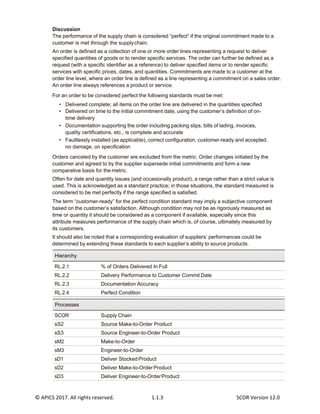
The performance of the supply chain is considered “perfect” if the original commitment made to a
customer is met through the supplychain.
An order is defined as a collection of one or more order lines representing a request to deliver
specified quantities of goods or to render specific services. The order can further be defined as a
request (with a specific identifier as a reference) to deliver specified items or to render specific
services with specific prices, dates, and quantities. Commitments are made to a customer at the
order line level, where an order line is defined as a line representing a commitment on a sales order.
An order line always references a product or service.
For an order to be considered perfect the following standards must be met:
• Delivered complete; all items on the order line are delivered in the quantities specified
• Delivered on time to the initial commitment date, using the customer’s definition of on-
time delivery
• Documentation supporting the order including packing slips, bills of lading, invoices,
quality certifications, etc., is complete and accurate
• Faultlessly installed (as applicable), correct configuration, customer-ready and accepted,
no damage, on specification
Orders canceled by the customer are excluded from the metric. Order changes initiated by the
customer and agreed to by the supplier supersede initial commitments and form a new
comparative basis for the metric.
Often for date and quantity issues (and occasionally product), a range rather than a strict value is
used. This is acknowledged as a standard practice; in those situations, the standard measured is
considered to be met perfectly if the range specified is satisfied.
The term “customer-ready” for the perfect condition standard may imply a subjective component
based on the customer’s satisfaction. Although condition may not be as rigorously measured as
time or quantity it should be considered as a component if available, especially since this
attribute measures performance of the supply chain which is, of course, ultimately measured by
its customers.
It should also be noted that a corresponding evaluation of suppliers’ performances could be
determined by extending these standards to each supplier’s ability to source products.
RL.2.1 % of Orders Delivered In Full
RL.2.2 Delivery Performance to Customer Commit Date
RL.2.3 Documentation Accuracy
RL.2.4 Perfect Condition
SCOR Supply Chain
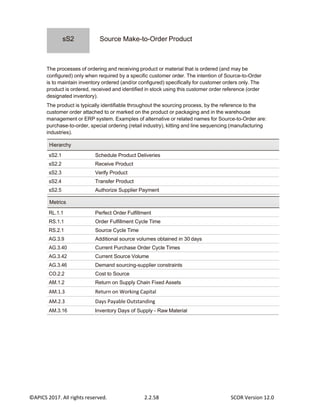
sS2 Source Make-to-Order Product
sS3 Source Engineer-to-Order Product
sM2 Make-to-Order
sM3 Engineer-to-Order
sD1 Deliver Stocked Product
sD2 Deliver Make-to-Order Product
sD3 Deliver Engineer-to-OrderProduct
© APICS 2017. All rights reserved. 1.1.4 SCOR Version 12.0
Perfect Order Fulfillment
BP.159 Electronic Data Interchange(EDI)
BP.014 Demand Planning &Forecasting
BP.019 Demand Planning
BP.020 Demand Management
BP.021 Sales and OperationsPlanning
BP.027 Pull-Based Inventory Replenishment
BP.028 InventoryOptimization
BP.035 Business RuleReview
BP.040 MTO Order FulfillmentStrategy
BP.117 Embed SpecializedServices
BP.119 Generation of Dynamic Bills of Materials
BP.120 3D Print / RapidPrototyping
BP.121 Digital Packaging onDemand
BP.153 Bar coding/RFID
BP.165 Convergence of SCOR with Lean and Six Sigma
BP.183 Integrated Business Planning (IBP)
BP.184 Scenario Planning
RL.1.1
© APICS 2017. All rights reserved. 1.1.5 SCOR Version 12.0
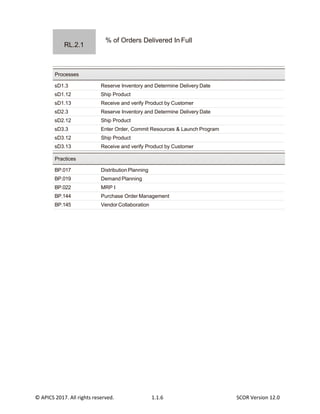
% of Orders Delivered In Full
Percentage of orders which all of the items are received by customer in the quantities committed.
The number of orders that are received by the customer in the quantities committed divided by the
total orders.
Calculation
[Total number of orders delivered in full] / [Total number of orders delivered] x 100%
An order is considered delivered "in full" if:
• All items ordered are the items actually provided, and no extra items are provided
• All quantities received by the customer match the order quantities (within mutually agreed
tolerances)
Data Collection
Data for the components that are used to drive the calculation of % In Full are primarily
associated with the original order processing step of 'Reserve inventory and Determine Delivery
Date' (sD1.3, sD2.3, sD3.3), inventory availability (sM1.1, sM2.1, sM3.1) including inventory location
accuracy (sE2), and the satisfaction of that commitment through the shipment and customer
receiving processes (sD1.12, sD1.13, sD2.12, sD.2.13, sD3.12, sD3.13).
Discussion
Order quantities are based on item / quantity original commitments agreed to by the
customer. Orders canceled by the customer are excluded from the metric. Order changes initiated
by the customer and agreed to by the supplier supersede original commitments and form a
new comparative basis for the metric. This metric has no "timing" element, such that orders
deliberately split by the supplier should still be considered “in full” so long as all metric criteria are
met. In some cases, such as for supplying bulk materials, committed quantities refer to a range that
is acceptable to the customer rather than a strict value.
Several SCOR diagnostic metrics exist that can be used to focus "% In Full" improvement efforts.
Some of theseinclude:
• % Orders Scheduled to Requested Quantity
• Schedule Achievement
• Yield variability
• Planned Shipment Fill Rate (not yet defined)
• % Stock Outs (not yet defined)
• Inventory Cycle Count Accuracy (not yet defined)
Orders may not be filled completely to the customer’s original request quantity due to the inability
to schedule to the initial request. Breakdown may also occur from the inventory availability
(including stock outs for Make-to-Stock and schedule achievement for Make-to-Order and Engineer-
to-Order processes) and inventory location accuracy. Lastly, a deviation from the shipment plan may
lead to inability to fulfill an order completely.
RL.3.33 Delivery Item Accuracy
RL.3.35 Delivery Quantity Accuracy
RL.2.1
© APICS 2017. All rights reserved. 1.1.6 SCOR Version 12.0
% of Orders Delivered In Full
sD1.3 Reserve Inventory and Determine Delivery Date
sD1.12 Ship Product
sD1.13 Receive and verify Product by Customer
sD2.3 Reserve Inventory and Determine Delivery Date
sD2.12 Ship Product
sD3.3 Enter Order, Commit Resources & Launch Program
sD3.12 Ship Product
sD3.13 Receive and verify Product by Customer
BP.017 Distribution Planning
BP.019 Demand Planning
BP.022 MRP I
BP.144 Purchase Order Management
BP.145 Vendor Collaboration
RL.2.1
© APICS 2017. All rights reserved. 1.1.7 SCOR Version 12.0
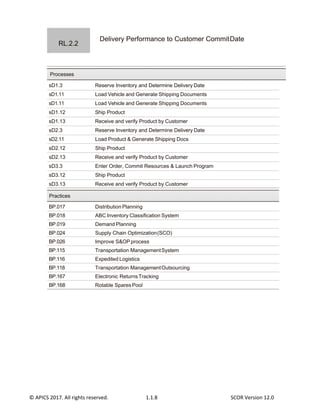
Delivery Performance to Customer CommitDate
The percentage of orders that are fulfilled on the customer's originally committed date.
Calculation
[Total number of orders delivered on the original commitment date] / [Total number of orders
delivered] x 100%
An order is considered delivered to the original Customer commitment date if:
• The order is received on time as defined by the customer
• The delivery is made to the correct location and Customer entity
Data Collection
Data for the components that are used to drive the calculation of Delivery Performance to
Customer Commit Date are primarily associated with the original order processing step of
‘Reserve inventory and Determine Delivery date’ (D1.3, D2.3 & D3.3), and the satisfaction of that
commitment through the shipment and customer receiving processes (D 1.12, D1.13, D2.12,
D2.13, D3.12, D3.13).
Discussion
Order delivery performance from a timing perspective is based on original commitments
agreed to by the customer. The acceptable window for delivering on time should be defined in
the customer’ service level agreement. Orders canceled by the customer are excluded from the
metric.
Order changes impacting the timing of a delivery that are initiated by the customer and agreed to
by the supplier supersede original commitments and form a new comparative basis for the metric.
The original commitment date can refer to a range, rather than a strict date and time, which is
acceptable to the customer (e.g. advanced shipments). This metric has no “In Full” element, such
that partial deliveries can still be considered as meeting the Customer Commit Date so long as all
metric criteria are met. Measuring the frequency of accepting the customer’s original request
date, vs. commit date, can be an important measure of customer satisfaction.
Several SCOR diagnostic metrics exist that can be used to focus delivery performance
improvement efforts. Some of these include:
• % Orders Scheduled to Request
• % Orders Shipped on time (not yet defined)
• Carrier Performance Reliability (not yet defined)
Orders may not be delivered to the Customer Commit Date due to breakdowns in the
order fulfillment and shipment process (e.g. Transportation availability). Orders may also
be delivered late due to carrier delivery performance / issues.
RL.3.32 Customer Commit Date Achievement Time Customer Receiving
RL.3.34 Delivery Location Accuracy
RL.2.2
© APICS 2017. All rights reserved. 1.1.8 SCOR Version 12.0
Delivery Performance to Customer CommitDate
sD1.3 Reserve Inventory and Determine Delivery Date
sD1.11 Load Vehicle and Generate Shipping Documents
sD1.12 Ship Product
sD1.13 Receive and verify Product by Customer
sD2.3 Reserve Inventory and Determine Delivery Date
sD2.11 Load Product & Generate Shipping Docs
sD2.12 Ship Product
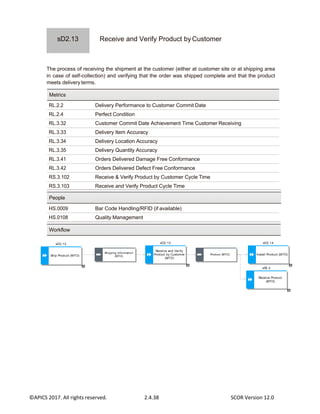
sD2.13 Receive and verify Product by Customer
sD3.3 Enter Order, Commit Resources & Launch Program
sD3.12 Ship Product
sD3.13 Receive and verify Product by Customer
BP.017 Distribution Planning
BP.018 ABC Inventory Classification System
BP.019 Demand Planning
BP.024 Supply Chain Optimization(SCO)
BP.026 Improve S&OP process
BP.115 Transportation ManagementSystem
BP.116 Expedited Logistics
BP.118 Transportation ManagementOutsourcing
BP.167 Electronic ReturnsTracking
BP.168 Rotable Spares Pool
RL.2.2
© APICS 2017. All rights reserved. 1.1.9 SCOR Version 12.0
Documentation Accuracy
Percentage of orders with on time and accurate documentation supporting the order, including
packing slips, bills of lading, invoices, etc.
Calculation
[Total number of orders delivered with accurate documentation] / [Total number of orders delivered]
x 100%
An order is considered to have accurate documentation when the following are accepted by
the customer:
Documentation supporting the order includes:
• Shipping documentation:
• Packing slips (Customers)
• Bill of lading (Carriers)
• Government or Customs documentation / forms
• Payment Documentation:
• Invoice
• Contractual outline agreement
• Compliance documentation
• Material Safety Data Sheets
• Other required documentation
• Quality certification
All documentation must be complete, correct, and readily available when and how expected by
the customer, Government and other supply chain regulatory entities.
Data Collection
Data for the components that are used to drive the calculation of Accurate Documentation
are primarily associated with the Deliver processing step of ‘Load Product & Generate
Shipping Documentation’ (D1.11, D2.11, D3.11), and ‘Invoice’ (D1.15, D2.15, D3.15).
The data collection step is part of Assess Delivery Performance (ED2) and Manage Deliver
Information (ED3)
Discussion
This metric is calculated at the order level. The timeliness and quality of the documentation
is measured from the perspective of the customer, Government, and other regulatory
entities. Documentation may be late or incomplete due to the inability to prepare/process the
correct documentation on time. Inaccurate or late shipping documentation may prevent the product
to be loaded or shipped, increase the customs delay, and delay the customer’s acceptance of the
order. Inaccurate or late invoices may also lead to the inability to fulfill the customer request.
The definition encompasses on time and accurate documentation. However, on-time
documentation implies a scheduled ship date and scheduled invoice date.
Accurate documentation metrics are similar to what exists for SOURCE process metrics
Possible diagnostic metrics that can be used to focus Accurate Documentation improvement
efforts include:
• % orders documentation (shipping and invoice) processed on time
• % faultless invoices
RL.2.3
© APICS 2017. All rights reserved. 1.1.10 SCOR Version 12.0
Documentation Accuracy
RL.3.31 Compliance Documentation Accuracy
RL.3.43 Other Required Documentation Accuracy
RL.3.45 Payment Documentation Accuracy
RL.3.50 Shipping Documentation Accuracy
sD1.11 Load Vehicle and Generate Shipping Documents
sD1.15 Invoice
sD2.11 Load Product & Generate Shipping Docs
sD2.15 Invoice
sD3.11 Load Product & Generate Shipping Docs
sD3.15 Invoice
BP.012 Lot Tracking
BP.030 Inventory RecordAccuracy
BP.062 Master Data Accuracy
BP.147 Receiving GoodsInspection
BP.148 3-Way DeliveryVerification
RL.2.3
© APICS 2017. All rights reserved. 1.1.11 SCOR Version 12.0
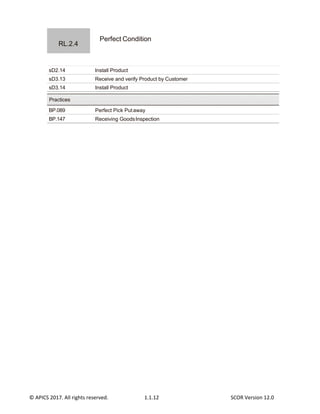
Perfect Condition
Percentage of orders delivered in an undamaged state that meet specification, have the correct
configuration, are faultlessly installed (as applicable) and accepted by the customer.
Calculation
[Number of orders delivered in Perfect Condition] / [Number of orders delivered] x 100%
An order is considered to be delivered in perfect condition if all items meet the following criteria:
• Undamaged
• Meet specification and has correct configuration (as applicable)
• Faultlessly installed (as applicable) and accepted by the customer
• Not returned for repair or replacement (within the warranty period)
Data Collection
Data for the components that are used to drive the calculation of “Perfect Condition” are primarily
associated with the receipt, installation (as applicable) and satisfaction of the order
commitment (D1.13, D1.14, D2.13, D2.14, D3.13, D3.14). The Enable Deliver Process Element -
Assess Delivery Performance (ED.2) should be updated to reflect this metric and its
components. This data is typically available from a complaints, claims, or warranty/returns database.
Discussion
This metric, calculated at the order level, assesses the quality of products delivered through
the supply chain from the customer’s perspective. Justified and non-justified product quality
issues, claims and returns within the warranty period are included and count against this metric.
Improving this metric lowers the supply chain cost associated with claims and returns.
Several SCOR diagnostic metrics exist that can be used to focus Perfect Condition
improvement efforts. Some of these include:
• Cost of Noncompliance
• Damage and Shrinkage
• Scrap Expense
• Warranty Costs
• Yield Variability
RL.3.12 % of Faultless Installations
RL.3.24 % Orders/lines received damage free
RL.3.41 Orders Delivered Damage Free Conformance
RL.3.42 Orders Delivered Defect Free Conformance
RL.3.55 Warranty and Returns
sD1.13 Receive and verify Product by Customer
sD1.14 Install Product
sD2.13 Receive and verify Product by Customer
RL.2.4
© APICS 2017. All rights reserved. 1.1.12 SCOR Version 12.0
Perfect Condition
sD2.14 Install Product
sD3.13 Receive and verify Product by Customer
sD3.14 Install Product
BP.089 Perfect Pick Putaway
BP.147 Receiving GoodsInspection
RL.2.4
© APICS 2017. All rights reserved. 1.1.13 SCOR Version 12.0
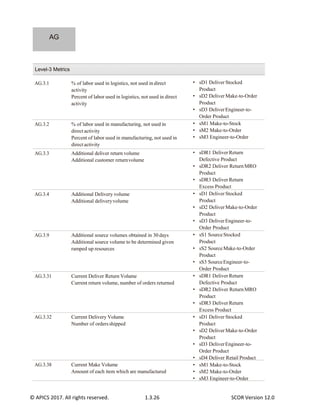
RL.3.1 # of complaints regarding missing environmental
documentation
The number of products released withoutproper
environmental documentation as a percent of total
products released
RL.3.2 # of recordkeeping related NOVs
The number of recordkeeping relatedregulatory
violations received per year
RL.3.4 % correct material documentation
The percent of total shipments that include the correct
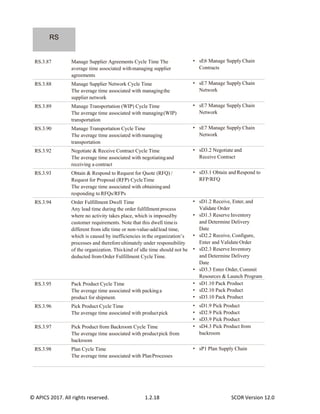
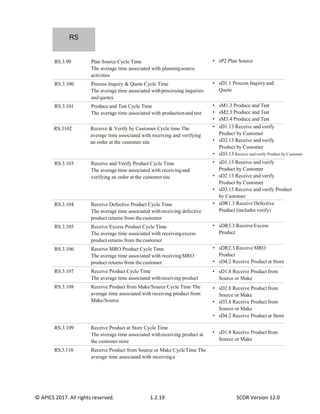
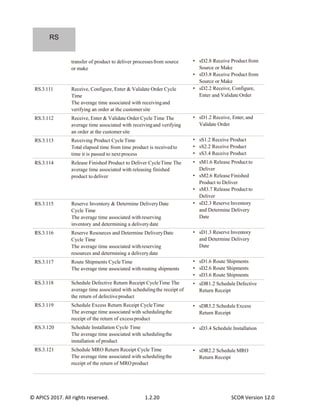
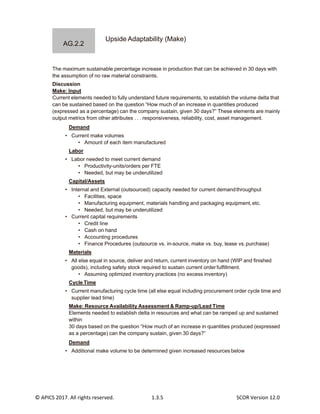
environmentaldocumentation
RL.3.5 % Error-free Returns Shipped
% Error-free ReturnsShipped
RL.3.6 % Identified MRO Products Returned To Service
% Identified MRO Products Returned To Service
RL.3.7 % Item Location Accuracy
% Item LocationAccuracy
RL.3.10 % of Excess Product Returns Delivered Complete to
the Designated ReturnCenter
Correct destination, according to the schedule, with
the correct part and documentation
RL.3.11 % of FaultlessInvoices
The number of invoices processed withoutissues and or
errors divided by the total numberof invoices.
Examples of potential invoice defects are: Change from
customer purchase orderwithout proper customer
involvement WrongCustomer Information (e.g., name,
address, telephone number) Wrong Product Information
(e.g.,part number, product description) Wrong Price
(e.g., discounts not applied) Wrong Quantity orWrong
Terms or Wrong Date
RL.3.12 % of Faultless Installations
Number of Faultless Installations divided by Total
Number of UnitsInstalled.
RL.3.13 % of MRO returns delivered to the correct
service provider location
• sM1.6 Release Product to
Deliver
• sM1.6 Release Product to
Deliver
• sD1.10 Pack Product
• sD2.9 Pick Product
• sD3.8 Receive Productfrom
Source or Make
• sSR1.5 ReturnDefective
Product
• sSR2.5 Return MRO
Product
• sSR3.5 Return Excess
Product
• sSR2.2 DispositionMRO
Product
• sD4.5 Fill Shopping Cart
• sSR3 Source Return
Excess Product
• sDR3 Deliver Return
Excess Product
• sD1.15 Invoice
• sD2.15 Invoice
• sD3.15 Invoice
• sD1.14 Install Product
• sDR2 Deliver ReturnMRO
Product
RL
© APICS 2017. All rights reserved. 1.1.14 SCOR Version 12.0
% of MRO returns delivered to the correct service
provider location, within schedule, with the correct part
anddocumentation
RL.3.14 % of products meeting specified environmental
performancerequirements
The number of products that meet desired
environmental performance specifications as a per cent
of total productsproduced
RL.3.15 % of products with proper environmental labeling (if
required)
The number of products with proper environmental
labels in place as a per cent of totalproducts produced
RL.3.16 % of suppliers meeting environmental metrics/
criteria
Number of suppliers that completely meet agreement
environmental criteria divided by the total number of
suppliersused.
RL.3.17 % of suppliers with an EMS or ISO 14001
certification
Percent of suppliers used that have avalidated
Environmental Management System or ISO 14000
certification
RL.3.18 % Orders/ Lines Processed Complete
The number of orders / lines that are processed
complete divided by the total orders /lines processed
within the measurementperiod
RL.3.19 % Orders/ Lines Received Defect Free
The number of orders / lines that are received
defect free divided by the total orders /lines
processed in the measurementperiod.
RL.3.20 % Orders/ Lines Received On-Time toDemand
Requirement
The number of orders / lines that are received on- time
to the demand requirements divided bythe total orders /
lines for the demand requirements in the measurement
period
RL.3.21 % Orders/ lines received with correct content Percent
of orders or lines received that havethe correct material
content as specified in the product design specs and
supplieragreements.
RL.3.22 % Orders/ lines received with correct packaging
Percent of orders or lines received thatare packaged
correctly with the right type and quantity of packaging
material.
• sM2.6 ReleaseFinished
Product to Deliver
• sM2.6 ReleaseFinished
Product to Deliver
• sD1.7 Select Carriersand
Rate Shipments
• sD2.7 Select Carriersand
Rate Shipments
• sS3.2 Select FinalSupplier
and Negotiate
• sS1.2 Receive Product
• sS2.2 Receive Product
• sS3.4 Receive Product
• sS1.3 Verify Product
• sS2.3 Verify Product
• sS3.5 Verify Product
• sS1.2 Receive Product
• sS2.2 Receive Product
• sS3.4 Receive Product
• sS1.3 Verify Product
• sS2.3 Verify Product
• sS3.5 Verify Product
• sS1.2 Receive Product
• sS2.2 Receive Product
• sS3.4 Receive Product
RL
© APICS 2017. All rights reserved. 1.1.15 SCOR Version 12.0
RL.3.23 % Orders/ Lines Received with Correct Shipping
Documents
The number of orders / lines that are received on- time
with correct shipping documents dividedby the total
orders / lines processed in the measurement period
RL.3.24 % Orders/lines received damage free
The number of orders / lines that are processed
damage free divided by the total orders /lines
processed in the measurementperiod
RL.3.25 % Product Transferred On-Time to Demand
Requirement
The number of product orders / lines thatare
transferred on-time to demand requirements divided by
the total orders / lines transferred in the measurement
period
RL.3.26 % Product Transferred without Transaction Errors The
number of transactions processedwithout error divided
by the total transactions processed in the measurement
period.
RL.3.27 % Schedules Changed within Supplier's Lead Time The
number of schedules that are changedwithin the
suppliers lead-time divided by the total number of
schedules generated within themeasurement period
RL.3.28 % Shipping Schedules that Support Customer
Required Return byDate
% Shipping Schedules that Support Customer
Required Return byDate
RL.3.31 Compliance Documentation Accuracy Percentage of
compliance documentations are complete, correct, and
readily available whenand how expected by customer,
Government and other supply chain regulatory entities.
Compliance documentation includes material safety
data sheets.
RL.3.32 Customer Commit Date Achievement Time Customer
Receiving Percentage of orders which is received on
time as defined by thecustomer
• sS1.2 Receive Product
• sS2.2 Receive Product
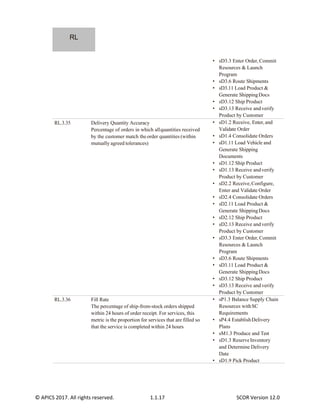
• sS3.4 Receive Product
• sS1.3 Verify Product
• sS2.3 Verify Product
• sS3.5 Verify Product
• sS1.4 Transfer Product
• sS2.4 Transfer Product
• sS3.6 Transfer Product
• sS1.4 Transfer Product
• sS2.4 Transfer Product
• sS3.6 Transfer Product
• sS1.1 Schedule Product
Deliveries
• sS2.1 Schedule Product
Deliveries
• sS3.3 Schedule Product
Deliveries
• sSR1.4 ScheduleDefective
Product Shipment
• sSR2.4 Schedule MRO
Shipment
• sSR3.4 Schedule Excess
Product Shipment
• sM1.4 Package
• sM2.4 Package
• sM3.5 Package
• sD1.11 Load Vehicle and
Generate Shipping
Documents
• sD2.11 Load Product &
Generate ShippingDocs
• sD3.11 Load Product &
Generate ShippingDocs
• sD1.13 Receive andverify
Product by Customer
• sD2.13 Receive andverify
Product by Customer
RL
© APICS 2017. All rights reserved. 1.1.16 SCOR Version 12.0
RL.3.33 Delivery Item Accuracy
Percentage of orders in which all items ordered are the
items actually provided, and no extra items are provided
RL.3.34 Delivery Location Accuracy
Percentage of orders which is delivered to the correct
location and customerentity
• sD3.13 Receive andverify
Product by Customer
• sD1.2 Receive, Enter,and
Validate Order
• sD1.4 Consolidate Orders
• sD1.11 Load Vehicle and
Generate Shipping
Documents
• sD1.12 Ship Product
• sD1.13 Receive andverify
Product by Customer
• sD2.2 Receive,Configure,
Enter and Validate Order
• sD2.4 Consolidate Orders
• sD2.11 Load Product &
Generate ShippingDocs
• sD2.12 Ship Product
• sD2.13 Receive andverify
Product by Customer
• sD3.3 Enter Order, Commit
Resources & Launch
Program
• sD3.6 Route Shipments
• sD3.11 Load Product &
Generate ShippingDocs
• sD3.12 Ship Product
• sD3.13 Receive andverify
Product by Customer
• sD1.2 Receive, Enter,and
Validate Order
• sD1.4 Consolidate Orders
• sD1.11 Load Vehicle and
Generate Shipping
Documents
• sD1.12 Ship Product
• sD1.13 Receive andverify
Product by Customer
• sD2.2 Receive,Configure,
Enter and Validate Order
• sD2.4 Consolidate Orders
• sD2.11 Load Product &
Generate ShippingDocs
• sD2.12 Ship Product
• sD2.13 Receive andverify
Product by Customer
RL
© APICS 2017. All rights reserved. 1.1.17 SCOR Version 12.0
RL.3.35 Delivery Quantity Accuracy
Percentage of orders in which allquantities received
by the customer match theorder quantities (within
mutually agreed tolerances)
RL.3.36 Fill Rate
The percentage of ship-from-stock orders shipped
within 24 hours of order receipt. For services, this
metric is the proportion for services that are filled so
that the service is completed within 24 hours
• sD3.3 Enter Order, Commit
Resources & Launch
Program
• sD3.6 Route Shipments
• sD3.11 Load Product &
Generate ShippingDocs
• sD3.12 Ship Product
• sD3.13 Receive andverify
Product by Customer
• sD1.2 Receive, Enter,and
Validate Order
• sD1.4 Consolidate Orders
• sD1.11 Load Vehicle and
Generate Shipping
Documents
• sD1.12 Ship Product
• sD1.13 Receive andverify
Product by Customer
• sD2.2 Receive,Configure,
Enter and Validate Order
• sD2.4 Consolidate Orders
• sD2.11 Load Product &
Generate ShippingDocs
• sD2.12 Ship Product
• sD2.13 Receive andverify
Product by Customer
• sD3.3 Enter Order, Commit
Resources & Launch
Program
• sD3.6 Route Shipments
• sD3.11 Load Product &
Generate ShippingDocs
• sD3.12 Ship Product
• sD3.13 Receive andverify
Product by Customer
• sP1.3 Balance Supply Chain
Resources withSC
Requirements
• sP4.4 EstablishDelivery
Plans
• sM1.3 Produce and Test
• sD1.3 ReserveInventory
and Determine Delivery
Date
• sD1.9 Pick Product
RL
© APICS 2017. All rights reserved. 1.1.18 SCOR Version 12.0
RL.3.37 Forecast Accuracy
Forecast accuracy is calculated for products and/or
families for markets/distribution channels, inunit
measurement. Common calculation (Sum Actuals- Sum
of Variance) / Sum Actuals to determine percentage
error. *monitoring the delta of Forecast Accuracy over
measured time periods can determine successrates.
RL.3.39 Number of occurrences of incorrect designated
return center
Number of occurrences of incorrect designated return
center
RL.3.40 Number of occurrences where excessive inventory is
returned andfollowed
Number of occurrences where excessive inventory is
returned andfollowed
RL.3.41 Orders Delivered Damage Free Conformance
Percentage of orders which is delivered without
damage.
RL.3.42 Orders Delivered Defect Free Conformance
Percentage of orders which is delivered without
defect
RL.3.43 Other Required Documentation Accuracy Percentage
of other requireddocumentations (besides of
compliance documentation,payment documentation
and shipping documentation) are
• sP1.1 Identify, Prioritize and
Aggregate Supply Chain
Requirements
• sP2.1 Identify, Prioritize and
Aggregate Product
Requirements
• sP3.1 Identify, Prioritize and
Aggregate Production
Requirements
• sP4.1 Identify, Prioritize and
Aggregate Delivery
Requirements
• sP4.2 Identify, Assess and
Aggregate Delivery
Resources
• sE4 Manage SupplyChain
Human Resources
• sE5 Manage SupplyChain
Assets
• sE6 Manage SupplyChain
Contracts
• sE7 Manage SupplyChain Network
• sSR3.2 DispositionExcess
Product
• sSR3.1 IdentifyExcess
Product Condition
• sD1.13 Receive andverify
Product by Customer
• sD2.13 Receive andverify
Product by Customer
• sD3.13 Receive andverify
Product by Customer
• sD1.13 Receive andverify
Product by Customer
• sD2.13 Receive andverify
Product by Customer
• sD3.13 Receive andverify
Product by Customer
• sD1.11 Load Vehicle and
Generate Shipping
Documents
RL
© APICS 2017. All rights reserved. 1.1.19 SCOR Version 12.0
complete, correct, and readily available whenand how
expected by customer, Government and other supply
chain regulatory entities. This kind of documentations
includes quality certification
RL.3.45 Payment Documentation Accuracy
Percentage of payment documentations are complete,
correct, and readily available whenand how expected
by customer, Government and other supply chain
regulatory entities. Payment documentations includes
invoice, contractual outlineagreement
RL.3.47 Return Shipments Shipped onTime
RL.3.49 Schedule Achievement
The percentage of time that a plant achievesits
production schedule. This calculation is basedon the
number of scheduled end-items or total volume for a
specific period. Note: over-shipments do not make up
forunder-shipments.
RL.3.50 Shipping Documentation Accuracy
Percentage of shipping documentations are complete,
correct, and readily available whenand how expected
by customer, Government and other supply chain
regulatory entities. Shipping documentations includes
packing slips (customers), bill of lading (carriers) and
government or customs documentation/forms
RL.3.55 Warranty and Returns
Number of returns within the warrantyperiod.
Warranty is a commitment, either expressedor implied
that a certain fact regarding thesubject matter of a
contract is presently true or will be true.
RL.3.56 Warranty Costs
Warranty costs include materials, labor and problem
diagnosis for product defects.
RL.3.57 Waste Processing Errors
Number of errors in waste transactions as a percent of
total wastetransactions
• sD2.11 Load Product &
Generate ShippingDocs
• sD3.11 Load Product &
Generate ShippingDocs
• sD1.11 Load Vehicle and
Generate Shipping
Documents
• sD2.11 Load Product &
Generate ShippingDocs
• sD3.11 Load Product &
Generate ShippingDocs
• sSR1.5 ReturnDefective
Product
• sSR2.5 Return MRO
Product
• sSR3.5 Return Excess Product
• sM1.1 Schedule Production
Activities
• sM2.1 Schedule Production
Activities
• sM3.2 Schedule Production
Activities
• sD1.11 Load Vehicle and
Generate Shipping
Documents
• sD2.11 Load Product &
Generate ShippingDocs
• sD3.11 Load Product &
Generate ShippingDocs
• sM1.3 Produce and Test
• sM1.4 Package
• sM1.3 Produce and Test
• sM1.4 Package
• sM2.3 Produce and Test
• sM2.4 Package
• sM3.4 Produce and Test
• sM3.5 Package
• sM1.7 Waste Disposal
• sM2.7 Waste Disposal
• sM3.8 Waste Disposal
RL
© APICS 2017. All rights reserved. 1.1.20 SCOR Version 12.0
RL.3.58 Yield
The ratio of usable output from a process to its input.
RL.3.59 Yield Variability
The condition that occurs when the output of a
process is not consistently repeatable either in
quantity, quality, or combination of these.
• sM1 Make-to-Stock
• sM1.3 Produce and Test
• sM1.4 Package
• sM2 Make-to-Order
• sM2.3 Produce and Test
• sM2.4 Package
• sM3 Engineer-to-Order
• sM3.4 Produce and Test
• sM3.5 Package
• sM1.3 Produce and Test
• sM2.3 Produce and Test
• sM3.4 Produce and Test
RL
© APICS 2017. All rights reserved. 1.1.2 SCOR Version 12.0
© APICS 2017. All rights reserved. 1.2 SCOR Version 12.0
Responsiveness
© APICS 2017. All rights reserved. 1.2.2 SCOR Version 12.0
Order Fulfillment Cycle Time
The average actual cycle time consistently achieved to fulfill customer orders. For each individual
order, this cycle time starts from the order receipt and ends with customer acceptance of the order.
Calculation
[Sum Actual Cycle Times for All Orders Delivered] / [Total Number of Orders Delivered] in days
Data collection
Data for the components that are used to drive the calculation of responsiveness are taken from
the Source, Make and Deliver process elements.
Discussion
The order fulfillment cycle time as captured from the moment a customer places the order to the
moment the order is fulfilled is considered to be a 'gross' cycle time. It represents all the time
passed between these two events, regardless of whether this represented cycle time for the
activities performed by the organization to fulfill the order (both value-add and non-value-add) or
dwell time because the order was placed well in advance by the customer. As such, this gross
order fulfillment cycle time does not truly reflect the responsiveness of the organization. Take for
examplean organization that needs six days to fulfill a certain customer order. If the customer
places the order one day in advance, the gross order fulfillment cycle time will be seven days. If
the customer places the order 3 months ahead (pre-ordering), the gross fulfillment cycle time will
be 96 days. However, the fact that the customer pre-orders does not reduce the responsiveness of
the organization. On the contrary, one can argue that it may increase the ability of the organization
to meet that order as it allows the organization to plan ahead and fulfill the order in a more optimal
way.
The responsiveness of the organization is determined by the cumulative cycle time for all activities
that are required to fulfill the order, but should exclude any dwell time where no activity takes
place.
Therefore, the definition of Order Fulfillment Cycle Time consists of a 'gross' component and a
'net' component named Order Fulfillment Process Time, according to the following formula Order
Fulfillment Cycle Time = Order Fulfillment Process Time + Order Fulfillment Dwell Time. Note that
dwell time will equal O for companies who do not utilize this metric, so Order Fulfillment Cycle Time
will equal Order Fulfillment ProcessTime.
Order fulfillment dwell time is defined as 'any lead time during the order fulfillment process where
no activity takes place, which is imposed by customer requirements'. Note that this dwell timeis
different from 'idle time' or 'non-value-add lead time', which is caused by inefficiencies in the
organization's processes and therefore ultimately under responsibility of the organization. This
kind of idle time should not be deducted from the gross order fulfillment cycle time.
Dwell time is mostly associated with the ordering process, where a customer may place an order
in advance to reserve capacity/materials etc., but where the actual steps in the order fulfillment
process take place later on. It is also common in the delivery process where the organization may
be in principle ready to ship the product/service, but is requested by the customer to wait (for
example to follow a certain shipment schedule).
RS.1.1
© APICS 2017. All rights reserved. 1.2.3 SCOR Version 12.0
Note: that for those organizations where dwell time does not play a role, the dwell time can be taken
as zero days which results in the net order fulfillment cycle time to be equal to the gross order
fulfillment cycle time.
For benchmarking purposes, it is recommended to use the Order Fulfillment Process Time, as
this is the cycle time reflecting most accurately the responsiveness of the organization. It will also
ensure that those organizations in industries where dwell time is a factor can be benchmarked
against organizations in industries where dwell time does not play arole.
The concept of dwell time applies not only to the level 1 metric, but also to all lower level metrics.
This means that each lower level metric can have a gross component, consisting of thenet
component and dwell time. Because the lower level metrics are hierarchical (the cumulative sum
of cycle times at level 2 or 3 should be equal to the cycle time at level 1.) The cumulative sum of
dwell times at level 2 or 3 should total up to the dwell time at level 1.
RS.2.1 Source Cycle Time
RS.2.2 Make Cycle Time
RS.2.3 Deliver Cycle Time
RS.2.4 Delivery Retail Cycle Time
SCOR Supply Chain
sP1 Plan Supply Chain
sP2 Plan Source
sP3 Plan Make
sP4 Plan Deliver
sP5 Plan Return
sS1 Source Stocked Product
sS2 Source Make-to-Order Product
sS3 Source Engineer-to-Order Product
sM1 Make-to-Stock
sM3 Engineer-to-Order
sD1 Deliver Stocked Product
sD2 Deliver Make-to-Order Product
sD3 Deliver Engineer-to-Order Product
sD4 Deliver Retail Product
sSR1 Source Return Defective Product
sDR1 Deliver Return Defective Product
sSR2 Return MRO Product
sDR2 Deliver Return MRO Product
sSR3 Source Return Excess Product
sDR3 Deliver Return Excess Product
© APICS 2017. All rights reserved. 1.2.4 SCOR Version 12.0
Order Fulfillment Cycle Time
BP.138 Theory of Constraints
BP.016 Supply Network Planning
BP.021 Sales and Operations Planning
BP.035 Business Rule Review
BP.086 Supply Network Planning
BP.153 Bar coding/RFID
BP.165 Convergence of SCOR with Lean and SixSigma
BP.168 Rotable Spares Pool
BP.183 Integrated Business Planning (IBP)
BP.184 Scenario Planning
RS.1.1
© APICS 2017. All rights reserved. 1.2.5 SCOR Version 12.0
Source Cycle Time
The average time associated with Source Processes. (Processes: sS1, sS2, sS3)
Calculation
Source Cycle Time - (Identify Sources of Supply Cycle Time + Select Supplier and Negotiate
Cycle Time) + Schedule Product Deliveries Cycle Time + Receive Product Cycle Time + Verify
Product Cycle Time + Transfer Product Cycle Time + Authorize Supplier Payment Cycle Time
Discussion
Metrics in Level-3 that are used to drive the calculation of 'Source Cycle time' are taken from
the Source process elements, depending on the possible strategies deployed by companies
to fulfill orders such as make-to-stock, make-to-order or engineer-to-order. When make-to-
stock or make-to order strategy is deployed, the dashed optional metrics 'Identify Sources of
Supply Cycle Time' and 'Select Supplier and Negotiate Cycle Time' are not used in the
calculation.
RS.3.8 Authorize Supplier Payment Cycle Time
RS.3.35 Identify Sources of Supply Cycle Time
RS.3.107 Receive Product Cycle Time
RS.3.122 Schedule Product Deliveries Cycle Time
RS.3.125 Select Supplier and Negotiate Cycle Time
RS.3.139 Transfer Product Cycle Time
RS.3.140 Verify Product Cycle Time
sS1 Source Stocked Product
sS2 Source Make-to-Order Product
sS3 Source Engineer-to-Order Product
BP.158 Make-to-Stock Goods Receipt
BP.162 Long Term Supplier Agreement/Partnership
BP.029 Inventory Management Using Supply Chain NetworkOptimization
BP.055 Freight Carrier Delivery PerformanceEvaluation
BP.144 Purchase Order Management
BP.161 Enterprise Level Spend Analysis
BP.037 Manufacturing Direct/Drop Shipment
BP.041 Transportation Optimization
BP.045 Delay Inbound Supplier Shipments
BP.046 Expedite Outbound CustomerShipments
RS.2.1
© APICS 2017. All rights reserved. 1.2.6 SCOR Version 12.0
Make Cycle Time
The average time associated with MakeProcesses
Calculation
Make Cycle Time - (Finalize Production Engineering Cycle Time) + Schedule Production
Activities Cycle Time + Issue Material/Product Cycle Time + Produce and Test Cycle Time +
Package Cycle Time + Stage Finished Product Cycle Time + Release Finished Product to Deliver
Cycle Time
Discussion
Metrics in Level 3 that are used to drive the calculation of 'Make Cycle time' are taken from the
Make process elements, depending on the possible strategies deployed by companies to fulfill
orders such as make-to-stock, make-to-order or engineer-to-order. When make-to-stock or make-to-
order strategy is deployed, the dashed optional metric 'Finalize Production Engineering Cycle Time'
is not used in the calculation. And also, the data for the calculation of Level 3 metrics may also
depends on different make strategies, e.g., when make-to-stock strategy is deployed, the metric
'Issue Material/Product Cycle Time' means the time for issuing material; while when make-to-order
or engineer-to-order is deployed, it will be a measure for calculating the cycle time forissuing
sourced or in-process product.
In Make Cycle Time, there may be overlaps in the processes, so the "least amount of time" should
be applied rather than the total sum.
RS.3.33 Finalize Production Engineering Cycle Time
RS.3.49 Issue Material Cycle Time
RS.3.101 Produce and Test Cycle Time
RS.3.114 Release Finished Product to Deliver CycleTime
RS.3.123 Schedule Production Activities Cycle Time
RS.3.128 Stage Finished Product Cycle Time
RS.3.142 Package Cycle Time
sM1 Make-to-Stock
sM2 Make-to-Order
sM3 Engineer-to-Order
BP.159 Electronic Data Interchange (EDI)
BP.003 Single-Minute Exchange of Die (SMED)
BP.038 Batch Size Reduction
BP.039 Right Size Frequency of ProductionWheel
RS.2.2
© APICS 2017. All rights reserved. 1.2.7 SCOR Version 12.0
Deliver Cycle Time
The average time associated with DeliverProcesses
Calculation
Delivery Cycle Time = MAX {[Reserve Resources & Determine Delivery Date Cycle Time +
(Consolidate Orders Cycle Time + Schedule Installation Cycle Time) + Build Loads Cycle
Time + Route Shipments Cycle Time + Select Carriers and Rate Shipments Cycle Time], +
Receive Product from Make/Source Cycle Time} + Pick Product Cycle Time + Pack Product
Cycle Time + Load Vehicle & Generate Shipping Documentation Cycle Time + Ship Product
Cycle Time + (Receive & Verify Product Cycle Time) + (Install Product Cycle Time)
*The MAX function above is to indicate that sDx.3-sDx.7 may be in parallel with sDx.8
and whichever takes longer should determine the cycletime.
Discussion
Metrics in Level 3 that are used to drive the calculation of 'Deliver Cycle time' are taken
from the Deliver process elements, depending on the possible strategies deployed by
companies to fulfill orders such as make-to-stock, make-to-order or engineer-to-order.
When make-to-stockor make-to-order strategy is deployed, the optional metric
'Schedule Installation Cycle Time' is not used in the calculation, otherwise the metric
'Consolidate Orders Cycle Time' will not be used.
And also, the data for the calculation of Level-3 metrics may also depends on different
make strategies, e.g., when make-to-stock strategy is deployed, the metric 'Receive,
Configure, Enter and Validate Order Cycle Time' may not include the Configureprocess.
RS.3.16 Build Loads Cycle Time
RS.3.18 Consolidate Orders Cycle Time
RS.3.46 Install Product Cycle Time
RS.3.51 Load Product & Generate Shipping Documentation Cycle Time
RS.3.95 Pack Product Cycle Time
RS.3.96 Pick Product Cycle Time
RS.3.102 Receive & Verify Product by Customer Cycle Time
RS.3.110 Receive Product from Source or Make CycleTime
RS.3.111 Receive, Configure, Enter & Validate Order Cycle Time
RS.3.116 Reserve Resources and Determine Delivery Date CycleTime
RS.3.117 Route Shipments Cycle Time
RS.3.120 Schedule Installation Cycle Time
RS.3.124 Select Carriers & Rate Shipments Cycle Time
RS.3.126 Ship Product Cycle Time
RS.2.3
© APICS 2017. All rights reserved. 1.2.8 SCOR Version 12.0
Deliver Cycle Time
sD1 Deliver Stocked Product
sD2 Deliver Make-to-Order Product
sD3 Deliver Engineer-to-Order Product
sD4 Deliver Retail Product
BP.089 Perfect Pick Put away
BP.115 Transportation ManagementSystem
BP.168 Rotable Spares Pool
RS.2.3
© APICS 2017. All rights reserved. 1.2.9 SCOR Version 12.0
Delivery Retail Cycle Time
The average cycle time of the processes used to acquire, merchandise, and sell finished
goods at a retail store.
Calculation
Delivery Retail Cycle Time = Generate Stocking Schedule Cycle Time + Receive Product
Cycle Time + Pick Product Cycle Time + Stock Shelf Cycle Time + Fill Shopping Cart Cycle
Time + Checkout Cycle Time + Install Cycle Time.
RS.3.17 Checkout Cycle Time
RS.3.32 Fill Shopping Cart Cycle Time
RS.3.34 Generate Stocking Schedule Cycle Time
RS.3.97 Pick Product from Backroom Cycle Time
RS.3.109 Receive Product at Store Cycle Time
RS.3.129 Stock Shelf Cycle Time
sD4 Deliver Retail Product
RS.2.4
© APICS 2017. All rights reserved. 1.2.10 SCOR Version 12.0
Return Cycle Time
The average time associated with ReturnProcesses.
Calculation
Return Cycle Time = (Identify need for Return + Coordinate and Schedule Return + Return Transit
time + Receive Return Product Time + Verify and Transfer Return Product Time).
sSR1 Source Return Defective Product
sSR2 Source Return MRO Product
sSR3 Source Return Excess Product
sDR1 Deliver Return Defective Product
sDR2 Deliver Return MRO Product
sDR3 Deliver Return Excess Product
BP.025 Self-Service Warranty Claim Submittal
BP.072 Inbound RMA-enabled Processing
BP.073 Return Tracking
BP.075 Web-based Return Material Authorization (RMA)
BP.077 Prepaid Return Shipping Label
BP.108 Return Policy Conformance Integration
BP.109 Carcass Prepositioning
BP.129 Return Policy included with Shipping Document
BP.135 Return Authorization
BP.141 Proactive Return Authorization
BP.142 Remote Return Authorization
BP.167 Electronic Returns Tracking
BP.169 Beyond Economic Repair (BER) Management
RS.2.5
© APICS 2017. All rights reserved. 1.2.11 SCOR Version 12.0
RS.3.2 Assess Delivery Performance Cycle Time
The average time associated with assessingthe
performance of deliver processes.
RS.3.3 Assess Supplier Performance Cycle Time
The average time associated with assessingthe
performance of supplier processes.
RS.3.4 Asset Turns
Total gross product revenue/Total net assets
RS.3.5 Authorize Defective Product Return Cycle Time The
average time associated with authorizingthe return of
defective product.
RS.3.6 Authorize Excess Product Return Cycle Time
The average time associated with authorizingthe
return of excess product.
RS.3.7 Authorize MRO Product Return Cycle Time
The average time associated with authorizingthe
return of MRO product.
RS.3.8 Authorize Supplier Payment Cycle Time
The average time associated withauthorizing
payment to suppliers.
RS.3.9 Average Days per Engineering Change
# of days each engineering change impactsthe
delivery date divided by the total # ofchanges.
RS.3.10 Average Days per Schedule Change
# of days each schedule change impacts the delivery
date divided by the total # ofchanges.
RS.3.11 Average Release Cycle ofChanges
Cycle time for implementing changenotices divided
by total number of changes.
• sE2 Manage Performance
• sM1.3 Produce and Test
• sM1.4 Package
• sM2.3 Produce and Test
• sM2.4 Package
• sM3.4 Produce and Test
• sM3.5 Package
• sDR1.1 Authorize Defective
Product Return
• sDR3.1 Authorize Excess
Product Return
• sDR2.1 Authorize MRO
Product Return
• sS1.5 Authorize Supplier
Payment
• sS2.5 Authorize Supplier
Payment
• sS3.7 Authorize Supplier
Payment
• sS1.1 Schedule Product
Deliveries
• sS2.1 Schedule Product
Deliveries
• sS3.3 Schedule Product
Deliveries
• sS1.1 Schedule Product
Deliveries
• sS2.1 Schedule Product
Deliveries
• sS3.3 Schedule Product
Deliveries
• sS1.1 Schedule Product
Deliveries
• sS2.1 Schedule Product
Deliveries
RS
© APICS 2017. All rights reserved. 1.2.12 SCOR Version 12.0
RS.3.12 Balance Product Resources with Product
Requirements CycleTime
The average time associated with balancing product
resources and productrequirements.
RS.3.13 Balance Production Resources with Production
Requirements CycleTime
The average time associated with theidentifying,
prioritizing, and aggregating productrequirements.
RS.3.14 Balance Return Resources with Return
Requirements CycleTime
The average time associated with balancingreturn
resources and return requirements.
RS.3.15 Balance Supply Chain Resources with Supply
Chain Requirements CycleTime
The average time associated with balancingsupply
chain resources and supply chainrequirements.
RS.3.16 Build Loads Cycle Time
The average time associated withbuilding shipment
loads.
RS.3.17 Checkout Cycle Time
The average time required for customercheckout.
RS.3.18 Consolidate Orders Cycle Time
The average time required for customerorder
consolidation.
RS.3.19 Current customer return order cycle time
Current return order cycle time, includingcustomer
return order processing cycle time, transit time, return
processing and disposition cycle time,etc.
RS.3.20 Current logistics order cycle time
Current logistics order cycle time, including customer
order processing cycle time,dock-to- stock cycle
time, pick-to-ship cycle, transittime, etc.
RS.3.21 Current manufacturing order cycle time
Current manufacturing cycle time
RS.3.22 Current supplier return order cycle time
Current supplier return order cycle time,including
supplier return order processing cycle time,pick- to-
ship cycle time, transit timeetc.
• sS3.3 Schedule Product
Deliveries
• sP2.3 Balance Product
Resources with Product
Requirements
• sP3.3 Balance Production
Resources with Production
Requirements
• sP5.3 Balance Return
Resources with Return
Requirements
• sP1.3 Balance Supply
Chain Resources with SC
Requirements
• sD1.5 Build Loads
• sD2.5 Build Loads
• sD3.5 Build Loads
• sD4.6 Checkout
• sD1.4 Consolidate Orders
• sDR1 Deliver Return
Defective Product
• sDR2 Deliver Return MRO
Product
• sDR3 Deliver Return
Excess Product
• sD1 Deliver Stocked
Product
• sD2 Deliver Make-to-Order
Product
• sD3 Deliver Engineer-to-
Order Product
• sM1 Make-to-Stock
• sM2 Make-to-Order
• sM3 Engineer-to-Order
• sSR1 Source Return
Defective Product
RS
© APICS 2017. All rights reserved. 1.2.13 SCOR Version 12.0
RS.3.24 Deliver and/or Install Cycle Time
The average time required to deliver andinstall
product.
RS.3.25 Enter Order, Commit Resources & Launch
Program Cycle Time
The average time associated with entering an order,
committing resources and programlaunch
RS.3.26 Establish and Communicate Return Plans Cycle
Time
The average time associated with establishingand
communicating return plans
RS.3.27 Establish Delivery Plans Cycle Time
The average time associated with establishingand
communicating deliver plans
RS.3.28 Establish Production Plans Cycle Time
The average time associated with establishingand
communicating production plans
RS.3.29 Establish Sourcing Plans Cycle Time
The average time associated with establishingand
communicating source plans
RS.3.30 Establish Supply Chain Plans Cycle Time
Five point annual average of the sum of allgross
inventories (raw materials & WIP, plant FG, field FG,
field samples, other) I (COGS I 365).Total gross value
of inventory at standard costbefore reserves for excess
and obsolescence. Only includes inventory on company
books, future liabilities should not be included.
RS.3.32 Fill Shopping Cart Cycle Time
The average time associated with 'fillingthe shopping
cart'
RS.3.33 Finalize Production Engineering Cycle Time
The average time associated with thefinalization of
production engineering
RS.3.34 Generate Stocking Schedule Cycle Time
The average time associated with the generatinga
stocking schedule
RS.3.35 Identify Sources of Supply Cycle Time
The average time associated with theidentification of
sources of supply
RS.3.36 Identify, Assess and Aggregate Production
Resources Cycle Time
The average time associated with theidentifying,
prioritizing, and aggregating productrequirements.
• sD4.7 Deliver and/or install
• sD3.3 Enter Order, Commit
Resources & Launch
Program
• sP5.4 Establish and
Communicate Return Plans
• sP4.4 Establish Delivery
Plans
• sP3.4 Establish Production
Plans
• sP2.4 Establish Sourcing
Plans
• sP1.4 Establish and
Communicate Supply Chain
Plans
• sD4.5 Fill Shopping Cart
• sM3.1 Finalize Production
Engineering
• sD4.1 Generate Stocking
Schedule
• sS3.1 Identify Sources of
Supply
• sP3.2 Identify, Assess and
Aggregate Production
Resources
RS
© APICS 2017. All rights reserved. 1.2.14 SCOR Version 12.0
RS.3.37 Identify, Assess, and Aggregate Delivery
Resources Cycle Time
The average time associated with theidentifying,
• sP4.2 Identify, Assess and
Aggregate Delivery
Resources
assessing, and aggregating deliveryresource
availability
RS.3.38 Identify, Assess, and Aggregate Product
Resources Cycle Time
The average time associated with theidentifying,
• sP2.2 Identify, Assess and
Aggregate Product
Resources
assessing, and aggregating productresource
availability
RS.3.39 Identify, Assess, and Aggregate Supply Chain
Resources Cycle Time
The average time associated with theidentifying,
• sP1.2 Identify, Prioritize and
Aggregate Supply Chain
Resources
assessing, and aggregating supply chainresource
availability
RS.3.40 Identify, Prioritize, and Aggregate Delivery
Requirements CycleTime
The average time associated with theidentifying,
• sP4.1 Identify, Prioritize and
Aggregate Delivery
Requirements
prioritizing, and aggregating deliveryrequirements
RS.3.41 Identify, Prioritize, and Aggregate Product
Requirements CycleTime
The average time associated with theidentifying,
• sP2.1 Identify, Prioritize and
Aggregate Product
Requirements
prioritizing, and aggregating productrequirements
RS.3.42 Identify, Prioritize, and Aggregate Production
Requirements CycleTime
The average time associated with theidentifying,
• sP3.1 Identify, Prioritize and
Aggregate Production
Requirements
prioritizing, and aggregatingproduction
requirements
RS.3.43 Identify, Prioritize, and Aggregate Return
Requirements CycleTime
The average time associated with theidentifying,
• sP5.1 Assess and
Aggregate Return
Requirements
prioritizing, and aggregating returnrequirements
RS.3.44 Identify, Prioritize, and Aggregate Supply Chain
Requirements CycleTime
The average time associated with theidentifying,
• sP1.1 Identify, Prioritize and
Aggregate Supply Chain
Requirements
prioritizing, and aggregating supplychain
requirements
RS.3.46 Install Product CycleTime
The average time associated withproduct
installation
• sD1.14 Install Product
• sD2.14 Install Product
• sD3.14 Install Product
RS.3.47 In-stock % • sD4.4 Stock Shelf
Percentage of materials, components, orfinished
goods that are there when needed.
© APICS 2017. All rights reserved. 1.2.15 SCOR Version 12.0
RS.3.48 Invoice Cycle Time
The average time associated with thegeneration and
issuance of an invoice
RS.3.49 Issue Material Cycle Time
The average time associated with the issuanceof
material to production
RS.3.50 Issue Sourced/In-Process Product Cycle Time The
average time associated with the issuanceof material
to production
RS.3.51 Load Product & Generate Shipping Documentation
Cycle Time
The average time associated with productloading and
the generation of shippingdocumentation
RS.3.53 Maintain Source Data Cycle Time
The average time associated withmaintaining source
data
RS.3.54 Manage Business Rules for PLAN Processes
Cycle Time
The average time associated with managingplan
business rules
RS.3.55 Manage Business Rules for Return Processes
Cycle Time
The average time associated with managingrules for
returns
RS.3.56 Manage Capital Assets Cycle Time
The average time associated withmanaging capital
assets
RS.3.57 Manage Deliver Business Rules Cycle Time The
average time associated with managing deliver
business rules
RS.3.58 Manage Deliver Capital Assets Cycle Time The
average time associated withmanaging deliver
capital assets
• sD1.15 Invoice
• sM1.2 Issue Material
• sM2.2 Issue Sourced/In-
Process Product
• sD1.11 Load Vehicle and
Generate Shipping
Documents
• sD2.11 Load Product &
Generate Shipping Docs
• sD3.11 Load Product &
Generate Shipping Docs
• sE3 Manage Data and
Information
• sE1 Manage Supply Chain
Business Rules
• sE1 Manage Supply Chain
Business Rules
• sE5.1 Schedule Asset
Management Activities
• sE5.2 Take Asset Off-line
• sE5.3 Inspect and
Troubleshoot
• sE5.4 Install and Configure
• sE5.5 Clean, Maintain and
Repair
• sE5.7 Inspect Maintenance
• sE5.8 Reinstate Asset
• sE1 Manage Supply Chain
Business Rules
• sE5.1 Schedule Asset
Management Activities
• sE5.2 Take Asset Off-line
• sE5.3 Inspect and
Troubleshoot
RS
© APICS 2017. All rights reserved. 1.2.16 SCOR Version 12.0
• sE5.4 Install and Configure
• sE5.5 Clean, Maintain and
Repair
• sE5.7 Inspect Maintenance
• sE5.8 Reinstate Asset
RS.3.59 Manage Deliver Information CycleTime
The average time associated withmanaging
• sE3 Manage Data and
Information
deliver information
RS.3.61 Manage Import/Export Requirements CycleTime
The average time associated withmanaging
• sE8 Manage Regulatory
Compliance
import/export requirements
RS.3.64 Manage Integrated Supply Chain CapitalAssets
Cycle Time
The average time associated withmanaging
integrated supply chain capitalassets
• sE5 Manage Supply Chain
Assets
• sE5.1 Schedule Asset
Management Activities
• sE5.2 Take Asset Off-line
• sE5.3 Inspect and
Troubleshoot
• sE5.4 Install and Configure
• sE5.5 Clean, Maintain and
Repair
• sE5.7 Inspect Maintenance
• sE5.8 Reinstate Asset
RS.3.65 Manage Integrated Supply Chain InventoryCycle • sE2 Manage Performance
Time
The average time associated withmanaging
integrated supply chain inventory
RS.3.66 Manage Integrated Supply ChainTransportation
Cycle Time
• sE7 Manage Supply Chain
Network
The average time associated withmanaging
integrated supply chaintransportation
RS.3.67 Manage MAKE Equipment and FacilitiesCycle
Time
The average time associated withmanaging
production equipment and facilities
• sE5.1 Schedule Asset
Management Activities
• sE5.2 Take Asset Off-line
• sE5.3 Inspect and
Troubleshoot
• sE5.4 Install and Configure
• sE5.5 Clean, Maintain and
Repair
• sE5.7 Inspect Maintenance
• sE5.8 Reinstate Asset
RS.3.68 Manage MAKE Information CycleTime
The average time associated withmanaging
• sE3 Manage Data and
Information
production information
RS.3.70 Manage Performance of Return ProcessesCycle • sE2 Manage Performance
Time
© APICS 2017. All rights reserved. 1.2.17 SCOR Version 12.0
The average time associated with managingthe
performance of supply chainactivities
RS.3.71 Manage Performance of Supply Chain Cycle Time The
average time associated with managing the
performance of return activities
RS.3.72 Manage PLAN Data Collection Cycle Time
The average time associated with collectingplan data
RS.3.74 Manage Planning Configuration Cycle Time
The average time associated with managingthe
planning of the supply chainconfiguration
RS.3.77 Manage Production Network Cycle Time
The average time associated with managingthe
production network
RS.3.78 Manage Production Performance Cycle Time The
average time associated withmanaging
production performance
RS.3.79 Manage Production Rules Cycle Time
The average time associated withmanaging production
rules
RS.3.80 Manage Return Capital Assets Cycle Time
The average time associated with managingreturn
capital assets
RS.3.81 Manage Return Data Collection Cycle Time
The average time associated with managingreturn data
collection
RS.3.83 Manage Return Network Configuration Cycle Time
The average time associated with managing the return
network configuration
RS.3.85 Manage Return Transportation Cycle Time
The average time associated with managingreturn
transportation
RS.3.86 Manage Sourcing Business Rules Cycle Time The
average time associated with managing source
business rules
• sE2 Manage Performance
• sE3 Manage Data and
Information
• sE7 Manage Supply Chain
Network
• sE7 Manage Supply Chain
Network
• sE2 Manage Performance
• sE1 Manage Supply Chain
Business Rules
• sE5.1 Schedule Asset
Management Activities
• sE5.2 Take Asset Off-line
• sE5.3 Inspect and
Troubleshoot
• sE5.4 Install and Configure
• sE5.5 Clean, Maintain and
Repair
• sE5.7 Inspect Maintenance
• sE5.8 Reinstate Asset
• sE3 Manage Data and
Information
• sE7 Manage Supply Chain
Network
• sE7 Manage Supply Chain
Network
• sE1 Manage Supply Chain
Business Rules
RS
© APICS 2017. All rights reserved. 1.2.18 SCOR Version 12.0
RS.3.87 Manage Supplier Agreements Cycle Time The
average time associated withmanaging supplier
agreements
RS.3.88 Manage Supplier Network Cycle Time
The average time associated with managingthe
supplier network
RS.3.89 Manage Transportation (WIP) Cycle Time
The average time associated with managing(WIP)
transportation
RS.3.90 Manage Transportation Cycle Time
The average time associated withmanaging
transportation
RS.3.92 Negotiate & Receive Contract Cycle Time
The average time associated with negotiatingand
receiving a contract
RS.3.93 Obtain & Respond to Request for Quote (RFQ) /
Request for Proposal (RFP) CycleTime
The average time associated with obtainingand
responding to RFQs/RFPs
RS.3.94 Order Fulfillment Dwell Time
Any lead time during the order fulfillmentprocess
where no activity takes place, which is imposedby
customer requirements. Note that this dwell timeis
different from idle time or non-value-addlead time,
which is caused by inefficiencies in the organization’s
processes and thereforeultimately under responsibility
of the organization. Thiskind of idle time should not be
deducted fromOrder Fulfillment CycleTime.
RS.3.95 Pack Product Cycle Time
The average time associated with packinga
product for shipment.
RS.3.96 Pick Product Cycle Time
The average time associated with productpick
RS.3.97 Pick Product from Backroom Cycle Time
The average time associated with productpick from
backroom
RS.3.98 Plan Cycle Time
The average time associated with PlanProcesses
• sE6 Manage Supply Chain
Contracts
• sE7 Manage Supply Chain
Network
• sE7 Manage Supply Chain
Network
• sE7 Manage Supply Chain
Network
• sD3.2 Negotiate and
Receive Contract
• sD3.1 Obtain and Respond to
RFP/RFQ
• sD1.2 Receive, Enter, and
Validate Order
• sD1.3 Reserve Inventory
and Determine Delivery
Date
• sD2.2 Receive, Configure,
Enter and Validate Order
• sD2.3 Reserve Inventory
and Determine Delivery
Date
• sD3.3 Enter Order, Commit
Resources & Launch Program
• sD1.10 Pack Product
• sD2.10 Pack Product
• sD3.10 Pack Product
• sD1.9 Pick Product
• sD2.9 Pick Product
• sD3.9 Pick Product
• sD4.3 Pick Product from
backroom
• sP1 Plan Supply Chain
RS
© APICS 2017. All rights reserved. 1.2.19 SCOR Version 12.0
RS.3.99 Plan Source Cycle Time
The average time associated with planningsource
activities
RS.3.100 Process Inquiry & Quote Cycle Time
The average time associated withprocessing inquiries
and quotes
RS.3.101 Produce and Test Cycle Time
The average time associated with productionand test
RS.3102 Receive & Verify by Customer Cycle time The
average time associated with receiving and verifying
an order at the customer site
RS.3.103 Receive and Verify Product Cycle Time
The average time associated with receivingand
verifying an order at the customersite
RS.3.104 Receive Defective Product Cycle Time
The average time associated withreceiving defective
product returns from thecustomer
RS.3.105 Receive Excess Product Cycle Time
The average time associated with receivingexcess
product returns from thecustomer
RS.3.106 Receive MRO Product Cycle Time
The average time associated with receivingMRO
product returns from thecustomer
RS.3.107 Receive Product Cycle Time
The average time associated withreceiving product
RS.3.108 Receive Product from Make/Source Cycle Time The
average time associated with receiving product from
Make/Source
RS.3.109 Receive Product at Store Cycle Time
The average time associated withreceiving product at
the customer store
RS.3.110 Receive Product from Source or Make CycleTime The
average time associated with receivinga
• sP2 Plan Source
• sD1.1 Process Inquiry and
Quote
• sM1.3 Produce and Test
• sM2.3 Produce and Test
• sM3.4 Produce and Test
• sD1.13 Receive and verify
Product by Customer
• sD2.13 Receive and verify
Product by Customer
• sD3.13 Receive and verify Product by Customer
• sD1.13 Receive and verify
Product by Customer
• sD2.13 Receive and verify
Product by Customer
• sD3.13 Receive and verify Product
by Customer
• sDR1.3 Receive Defective
Product (includes verify)
• sDR3.3 Receive Excess
Product
• sDR2.3 Receive MRO
Product
• sD4.2 Receive Product at Store
• sD1.8 Receive Product from
Source or Make
• sD2.8 Receive Product from
Source or Make
• sD3.8 Receive Product from
Source or Make
• sD4.2 Receive Product at Store
• sD1.8 Receive Product from
Source or Make
RS
© APICS 2017. All rights reserved. 1.2.20 SCOR Version 12.0
transfer of product to deliver processesfrom source
or make
RS.3.111 Receive, Configure, Enter & Validate Order Cycle
Time
The average time associated with receivingand
verifying an order at the customersite
RS.3.112 Receive, Enter & Validate Order Cycle Time The
average time associated with receivingand verifying
an order at the customersite
RS.3.113 Receiving Product CycleTime
Total elapsed time from time product is receivedto
time it is passed to next process
RS.3.114 Release Finished Product to Deliver CycleTime The
average time associated with releasing finished
product to deliver
RS.3.115 Reserve Inventory & Determine DeliveryDate
Cycle Time
The average time associated withreserving
inventory and determining a deliverydate
RS.3.116 Reserve Resources and Determine DeliveryDate
Cycle Time
The average time associated withreserving
resources and determining a deliverydate
RS.3.117 Route Shipments CycleTime
The average time associated withrouting shipments
RS.3.118 Schedule Defective Return Receipt CycleTime The
average time associated with schedulingthe receipt of
the return of defectiveproduct
RS.3.119 Schedule Excess Return Receipt CycleTime
The average time associated with schedulingthe
receipt of the return of excessproduct
RS.3.120 Schedule Installation Cycle Time
The average time associated with schedulingthe
installation of product
RS.3.121 Schedule MRO Return Receipt Cycle Time
The average time associated with schedulingthe
receipt of the return of MROproduct
• sD2.8 Receive Product from
Source or Make
• sD3.8 Receive Product from
Source or Make
• sD2.2 Receive, Configure,
Enter and Validate Order
• sD1.2 Receive, Enter, and
Validate Order
• sS1.2 Receive Product
• sS2.2 Receive Product
• sS3.4 Receive Product
• sM1.6 Release Product to
Deliver
• sM2.6 Release Finished
Product to Deliver
• sM3.7 Release Product to
Deliver
• sD2.3 Reserve Inventory
and Determine Delivery
Date
• sD1.3 Reserve Inventory
and Determine Delivery
Date
• sD1.6 Route Shipments
• sD2.6 Route Shipments
• sD3.6 Route Shipments
• sDR1.2 Schedule Defective
Return Receipt
• sDR3.2 Schedule Excess
Return Receipt
• sD3.4 Schedule Installation
• sDR2.2 Schedule MRO
Return Receipt
RS
© APICS 2017. All rights reserved. 1.2.21 SCOR Version 12.0
RS.3.122 Schedule Product Deliveries Cycle Time
The average time associated with schedulingthe
shipment of the return of MROproduct
RS.3.123 Schedule Production Activities Cycle Time The
average time associated withscheduling
production activities
RS.3.124 Select Carriers & Rate Shipments Cycle Time The
average time associated with selecting carriers
and rating shipments
RS.3.125 Select Supplier and Negotiate Cycle Time The
average time associated with selectinga supplier
and negotiating
RS.3.126 Ship Product Cycle Time
The average time associated with shippingproduct
RS.3.127 Source Return Cycle Time
Average time associated with SourcingReturn
RS.3.128 Stage Finished Product Cycle Time
The average time associated with stagingfinished
product
RS.3.129 Stock Shelf Cycle Time
The average time associate with stockingshelves
RS.3.136 Transfer Defective Product Cycle Time
The average time associated transfer untilproduct is
moved to the next process.
RS.3.137 Transfer Excess Product Cycle Time
The average time associated transfer untilproduct is
moved to the next process.
RS.3.138 Transfer MRO Product Cycle Time
The average time associated transfer untilproduct is
moved to the next process.
RS.3.139 Transfer Product Cycle Time
The average time associated transfer untilproduct is
moved to the next process.
• sS1.1 Schedule Product
Deliveries
• sS2.1 Schedule Product
Deliveries
• sS3.3 Schedule Product
Deliveries
• sM1.1 Schedule Production
Activities
• sM2.1 Schedule Production
Activities
• sM3.2 Schedule Production
Activities
• sD3.7 Select Carriers &
Rate Shipments
• sS3.2 Select Final Supplier
and Negotiate
• sD1.12 Ship Product
• sD2.12 Ship Product
• sD3.12 Ship Product
• sSR1 Source Return
Defective Product
• sSR3 Source Return
Excess Product
• sM1.5 Stage Product
• sM2.5 Stage Finished
Product
• sM3.6 Stage Finished
Product
• sD4.4 Stock Shelf
• sDR1.4 TransferDefective
Product
• sDR3.4 TransferExcess
Product
• sDR2.4 Transfer MRO
Product
• sS1.4 Transfer Product
• sS2.4 Transfer Product
• sS3.6 Transfer Product
RS
© APICS 2017. All rights reserved. 1.2.22 SCOR Version 12.0
RS.3.140 Verify Product Cycle Time
The average time associated with verifyingraw
material product
RS.3.141 Waste accumulation time
The time required to collect and properlystore
production waste
RS.3.142 Package Cycle Time
The average time associated with packagingthe
product in the Make process.
• sS1.3 Verify Product
• sS2.3 Verify Product
• sS3.5 Verify Product
• sM1.7 Waste Disposal
• sM2.7 Waste Disposal
• sM3.8 Waste Disposal
• sM1.4 Package
• sM2.4 Package
• sM3.5 Package
RS
© APICS 2017. All rights reserved. 1.3 SCOR Version 12.0
Agility
© APICS 2017. All rights reserved. 1.3.2 SCOR Version 12.0
Upside Supply ChainAdaptability
The maximum sustainable percentage increase in quantity delivered that can be achieved in 30
days.
Note: 30 days is an arbitrary number provided for benchmarking purposes. For some industries
and some organizations 30 days may be in some cases unobtainable or in others too
conservative. Note: Component metrics (Upside Source Adaptability, Upside Make Adaptability,
etc.) can be improved in parallel and as a result, this calculation requires the result to be the
least increase in quantity sustainable in 30 days. The new operating level needs to be achieved
without a significant increase of cost per unit.
Calculation
Supply chain adaptability is the least quantity sustainable when considering Source, Make,
Deliver and Return components.
Data collection
Adaptability measures are assumption based or based on historic events. Some elements can
be measured and taken as a basis for further considerations. Adaptability measures are based
on the actual number of returns compared to the maximum number of returns which can be
achieved within 30 days. The weakest component determines the overall volume.
Discussion
The calculation of Supply Chain Adaptability requires the calculation to be the least quantity
sustainable when considering Source, Make, Deliver and Return components.
• Profit & Loss (Income Statement) Impact
• Revenue
• COGS
• SGA
• Balance Sheet Impact
• Inventory
AG.2.1 Upside Adaptability (Source)
AG.2.2 Upside Adaptability (Make)
AG.2.3 Upside Adaptability (Deliver)
AG.2.4 Upside Return Adaptability (Source)
AG.2.5 Upside Return Adaptability (Deliver)
SCOR Supply Chain
BP.035 Business RuleReview
BP.153 Bar coding/RFID
BP.162 Long Term SupplierAgreement/Partnership
BP.165 Convergence of SCOR with Lean and Six Sigma
BP.183 Integrated Business Planning
BP.184 Scenario Planning
AG.1.1
© APICS 2017. All rights reserved. 1.3.3 SCOR Version 12.0
Upside Adaptability (Source)
The maximum sustainable percentage increase in raw material quantities that can be acquired/
received in 30 days.
Discussion
Source: Input
Current elements needed to fully understand future requirements, to establish the volume delta
that can be sustained based on the question “How much of an increase in quantities sourced
(expressed as a percentage) can the company sustain, given 30 days?” These elements are mainly
output metrics from other attributes... responsiveness, reliability, cost, asset management.
Demand
• Current source volumes
• Amount of each item purchased
Staffing
• Staff needed to meet current demand
• Productivity-purchase orders per FTE
• Needed, but may be underutilized
Capital
• Current capital requirements
• Credit line
• Cash on hand
• Accounting procedures
Materials
• All else equal in make, deliver, return, current inventory on hand (raw material and
purchased finished goods), including safety stock required to sustain current order
fulfillment.
• Assuming optimized inventory practices (no excess inventory)
• Current sourcing/supplier constraints
• Current contract terms.
• Nature of items; commodity/sole source.
Cycle Time
• Current procurement cycle time
• Time to place a purchase order
• Supplier lead time
Source: Resource Availability Assessment & Ramp-up/Lead Time
Elements needed to establish delta in resources and what can be ramped up and sustained
within 30 days based on the question “How much of an increase in quantities sourced (expressed as
a percentage) can the company sustain, given 30 days?”
Demand
• Additional source volume to be determined given ramped up resources below
Staffing
• Staff availability in procurement (underutilized FTE’s)
• How much staff can be recruited/hired and trained fill gap between underutilized FTE’s and
FTE’s needed to increase and sustain quantities sourced given 30days
AG.2.1
© APICS 2017. All rights reserved. 1.3.4 SCOR Version 12.0
Upside Adaptability (Source)
Capital
• Current capital availability
• Credit line
• Cash on hand
• Accounting procedures
• How much capital can be obtained to increase quantities sourced given 30days
Materials
• Sourcing Constraints
• Time required in negotiating new source/volume contracts/terms
• Time required to find/obtain additional sources
• All else equal in make, deliver, return, how much inventory (raw material and
purchased finished goods) can be obtained, delivered and phased in and sustained
for order fulfillment, including safety stock given 30 days.
Cycle Time
• Procurement order cycle time reestablished and sustained for increased quantities
sourced given 30 days.
• Time to place a purchase order
• Supplier lead time
AG.2.1
© APICS 2017. All rights reserved. 1.3.5 SCOR Version 12.0
Upside Adaptability (Make)
The maximum sustainable percentage increase in production that can be achieved in 30 days with
the assumption of no raw material constraints.
Discussion
Make: Input
Current elements needed to fully understand future requirements, to establish the volume delta that
can be sustained based on the question “How much of an increase in quantities produced
(expressed as a percentage) can the company sustain, given 30 days?” These elements are mainly
output metrics from other attributes . . . responsiveness, reliability, cost, asset management.
Demand
• Current make volumes
• Amount of each item manufactured
Labor
• Labor needed to meet current demand
• Productivity-units/orders per FTE
• Needed, but may be underutilized
Capital/Assets
• Internal and External (outsourced) capacity needed for current demandthroughput
• Facilities, space
• Manufacturing equipment, materials handling and packaging equipment,etc.
• Needed, but may be underutilized
• Current capital requirements
• Credit line
• Cash on hand
• Accounting procedures
• Finance Procedures (outsource vs. in-source, make vs. buy, lease vs.purchase)
Materials
• All else equal in source, deliver and return, current inventory on hand (WIP and finished
goods), including safety stock required to sustain current orderfulfillment.
• Assuming optimized inventory practices (no excess inventory)
Cycle Time
• Current manufacturing cycle time (all else equal including procurement order cycle time and
supplier lead time)
Make: Resource Availability Assessment & Ramp-up/Lead Time
Elements needed to establish delta in resources and what can be ramped up and sustained
within
30 days based on the question “How much of an increase in quantities produced (expressed
as a percentage) can the company sustain, given 30 days?”
Demand
• Additional make volume to be determined given increased resources below
AG.2.2
© APICS 2017. All rights reserved. 1.3.6 SCOR Version 12.0
Upside Adaptability (Make)
Labor
• Direct labor availability and percent of labor used in manufacturing, not used in direct
activity (underutilized FTE’s)
• How much labor can be recruited/hired and trained fill gap between underutilized FTE’s
and FTE’s needed to increase and sustain quantities produced given 30days
Capital/Assets
• Current Internal Capacity utilization
• Facilities, space
• Manufacturing equipment, materials handling and packaging equipment, etc.
• Current capital availability
• Credit line
• Cash on hand
• Accounting procedures
• Finance Procedures (outsource vs. in-source, lease vs. purchase)
• How much capital can be obtained to fill gap between underutilized asset capacity
and assets needed to increase and sustain quantities produced given 30days
• How much assets/capacity can be obtained to fill gap between underutilized asset
capacity and assets needed to increase and sustain quantities produced given 30days
• Facilities, space
• Manufacturing equipment, materials handling and packaging equipment, etc.
Outsourcing Alternatives tocapital
• Supplemental Outsource/lease availability
• Facilities, lease building, etc.
• Lease manufacturing equipment, materials handling and packaging equipment,etc.
• Co-packers
• How much supplemental outsourced or leased resources or facilities can be
obtained to increase and sustain quantities produced given 30 days
Materials
• All else equal in source, deliver and return, how much raw material inventory can
be received and phased into manufacturing and produced into WIP and FG
inventory, and sustained for order fulfillment, including safety stock given 30 days.
Cycle Time
• Manufacturing cycle time reestablished and sustained for increased quantities
produced given 30 days.
sM1 Make-to-Stock
sM2 Make-to-Order
sM3 Engineer-to-Order
AG.2.2
© APICS 2017. All rights reserved. 1.3.7 SCOR Version 12.0
Upside Adaptability (Deliver)
The maximum sustainable percentage increase in quantities delivered that can be achieved in 30
days with the assumption of unconstrained finished good availability.
Discussion
Deliver: Input
Current elements needed to fully understand future requirements, to establish the volume delta
that can be sustained based on the question “How much of an increase in quantities delivered
(expressed as a percentage) can the company sustain, given 30 days?” These elements are mainly
output metrics from other attributes ... Responsiveness, reliability, cost, asset management.
Demand
• Current delivery volume
• Number of orders shipped
Labor
• Labor needed to meet current demand
• Productivity-orders per FTE
• Needed, but may beunderutilized
Capital/Assets
• Internal and External (3PL) capacity needed for current demand throughput
• Facilities, space
• Fleet equipment, outside carrier loads, materials handling equipment, etc.
• Needed, but may be underutilized
• Current capital requirements
• Credit line
• Cash on hand
• Accounting procedures
• Finance Procedures (outsource vs. in-source, make vs. buy, lease vs.purchase)
Materials
• All else equal in source, make, return, current finished goods inventory on hand (including
safety stock required to sustain current order fulfillment)
• Assuming optimized inventory practices (no excess inventory)
Cycle Time
• Current logistics order cycle time (all else equal including procurement order cycle time,
supplier lead time, manufacturing cycle time, etc.)
• Customer order processing cycle time (logistics only)
• Dock-to-stock cycle time
• Pick-to-ship cycle time
• Transit time
Deliver: Resource Availability Assessment & Ramp-up/Lead Time
Elements needed to establish delta in resources and what can be ramped up and sustained
within 30 days based on the question “How much of an increase in quantities delivered (expressed
as a percentage) can the company sustain, given 30 days?”
Demand
• Additional delivery volume to be determined given increased resources below
AG.2.3
© APICS 2017. All rights reserved. 1.3.8 SCOR Version 12.0
Upside Adaptability (Deliver)
Labor
• Direct labor availability and percent of labor used in logistics, not used in direct
activity (underutilized FTE’s)
• How much labor can be recruited/hired and trained fill gap between underutilized
FTE’s and FTE’s needed to increase and sustain quantities delivered given 30days
Capital/Assets
• Current Internal Capacity utilization
• Facilities, space
• Fleet equipment, materials handling equipment, etc.
• Current capital availability
• Credit line
• Cash on hand
• Accounting procedures
• Finance Procedures (outsource vs. in-source, lease vs. purchase)
• How much capital can be obtained to fill gap between underutilized asset capacity and
assets needed to increase and sustain quantities delivered given 30 days
• How much assets/capacity can be obtained to fill gap between underutilized asset
capacity and assets needed to increase and sustain quantities delivered given 30
days
• Facilities, space
• Fleet equipment, materials handling equipment, etc.
Outsourcing Alternatives tocapital
• Supplemental Outsource/lease availability
• 3PL facilities, lease building, etc.
• Full service lease fleet, materials handling, etc. equipment
• Outside carriers
• How much supplemental outsourced or leased resources or facilities can be
obtained to increase and sustain quantities delivered given 30 days
Materials
• All else equal in source, make, return, amount of how much finished goods inventory
can be received/stocked, including safety stock to sustain quantities delivered given
30 days
Cycle Time
• Logistics cycle time reestablished and sustained for increased quantities delivered
given 30 days (all else equal including procurement order cycle time, supplier lead time,
manufacturing cycle time, etc.)
• Customer order processing cycle time (logistics only)
• Dock-to-stock cycle time
• Pick-to-ship cycle time
• Transit time
sD1 Deliver Stocked Product
sD2 Deliver Make-to-Order Product
sD3 Deliver Engineer-to-OrderProduct
sD4 Deliver Retail Product
AG.2.3
© APICS 2017. All rights reserved. 1.3.9 SCOR Version 12.0
Upside ReturnAdaptability (Source)
The maximum sustainable percentage increase in returns of raw materials to suppliers that can be
achieved in 30 days.
Discussion
Source Return:Input
Assuming no supplier constraints, current elements needed to fully understand future requirements,
to establish the volume delta that can be sustained based on the question “How much of an increase
in quantities returned to suppliers (expressed as a percentage) can the company sustain, given 30
days?” These elements are mainly output metrics from other attributes . . . responsiveness,
reliability, cost, asset management.
Demand
• Current return volume
• Number of orders returned
Staff / Labor
• Procurement Staff / Logistics Labor needed to meet current returned volume
• Productivity-orders returned per FTE
• Needed, but may be underutilized
Capital/Assets
• Internal and External (3PL) capacity needed for current return throughput
• Facilities, space
• Fleet equipment, outside carrier loads, materials handling equipment,etc.
• Needed, but may be underutilized
• Current capital requirements
• Credit line
• Cash on hand
• Accounting procedures
• Finance Procedures (outsource vs. in-source, lease vs. purchase)
Cycle Time
• Current supplier return order cycle time
• Supplier return order processing cycle time (procurement and logistics)
• Pick-to-ship cycle time
• Transit time
Source Return: Resource Availability Assessment & Ramp-up/Lead Time
Assuming no supplier constraints, elements needed to establish delta in resources and what can
be ramped up and sustained within 30 days based on the question “How much of an increase in
quantities returned to suppliers (expressed as a percentage) can the company sustain, given 30
days”
Demand
• Additional supplier return volume to be determined given increased resourcesbelow
AG.2.4
© APICS 2017. All rights reserved. 1.3.10 SCOR Version 12.0
Upside ReturnAdaptability (Source)
Staff / Labor
• Procurement staff / Logistics labor availability (underutilized FTE’s)
• How much procurement staff/logistics labor can be recruited/hired and trained fill
gap between underutilized FTE’s and FTE’s needed to increase and sustain
quantities returned to suppliers given 30 days
Capital/Assets
• Current Internal Capacity utilization
• Facilities, space
• Fleet equipment, materials handling equipment, etc.
• Current capital availability
• Credit line
• Cash on hand
• Accounting procedures
• Finance Procedures (outsource vs. in-source, lease vs. purchase)
• How much capital can be obtained to fill gap between underutilized asset capacity
and assets needed to increase and sustain quantities returned to suppliers given
30 days
• How much assets/capacity can be obtained to fill gap between underutilized asset
capacity and assets needed to increase and sustain quantities returned to suppliers
given 30 days
• Facilities, space
• Fleet equipment, materials handling equipment, etc.
Outsourcing Alternatives tocapital
• Supplemental Outsource/lease availability
• 3PL facilities, lease building, etc.
• Full service lease fleet, materials handling, etc. equipment
• Outside carriers
• How much supplemental outsourced or leased resources or facilities can be
obtained to increase and sustain quantities returned to suppliers given 30 days
Cycle Time
• Source return cycle time reestablished and sustained for increased quantities
returned to suppliers given 30 days
• Supplier return order processing cycle time (procurement and logistics)
• Pick-to-ship
BP.126 Supply Chain VisibilitySystem
AG.2.4
© APICS 2017. All rights reserved. 1.3.11 SCOR Version 12.0
Upside ReturnAdaptability (Deliver)
The maximum sustainable percentage increase in returns of finished goods from customers that can
be achieved in 30days.
Discussion
Deliver Return:Input
Assuming no customer constraints, current elements needed to fully understand future
requirements, to establish the volume delta that can be sustained based on the question “How
much of an increase in quantities returned from customers (expressed as a percentage) can the
company sustain, given 30 days?” These elements are mainly output metrics from other attributes,
responsiveness, reliability, cost, asset management.
Demand
• Current return volume
• Number of orders returned
Staff / Labor
• Customer Service Staff / Logistics Labor needed to meet current returnedvolume
• Productivity-orders returned per FTE
• Needed, but may be underutilized
Capital/Assets
• Internal and External (3PL) capacity needed for current return throughput
• Facilities, space
• Fleet equipment, outside carrier loads, materials handling equipment,etc.
• Needed, but may be underutilized
• Current capital requirements
• Credit line
• Cash on hand
• Accounting procedures
• Finance Procedures (outsource vs. in-source, lease vs. purchase)
Cycle Time
• Current customer return order cycle time
• Customer return order processing cycle time (customer service andlogistics)
• Transit time
• Return processing and disposition cycle time
Deliver Return: Resource Availability Assessment & Ramp-up/Lead Time
Assuming no customer constraints, elements needed to establish delta in resources and what can
be ramped up and sustained within 30 days based on the question “How much of an increase in
quantities returned from customers (expressed as a percentage) can the company sustain, given 30
days”
Demand
• Additional customer return volume to be determined given increased resources below
AG.2.5
© APICS 2017. All rights reserved. 1.3.12 SCOR Version 12.0
Upside ReturnAdaptability (Deliver)
Staff / Labor
• Customer Service staff / Logistics labor availability (underutilized FTE’s)
• How much customer service staff/logistics labor can be recruited/hired and trained fill gab
between underutilized FTE’s and FTE’s needed to increase and sustain quantities returned
from customers given 30 days
Capital/Assets
• Current Internal Capacity utilization
• Facilities, space
• Fleet equipment, materials handling equipment, etc.
• Current capital availability
• Credit line
• Cash on hand
• Accounting procedures
• Finance Procedures (outsource vs. in-source, lease vs. purchase)
• How much capital can be obtained to fill gap between underutilized asset capacity and
assets needed to increase and sustain quantities returned from customers given 30
days
• How much assets/capacity can be obtained to fill gap between underutilized asset
capacity and assets needed to increase and sustain quantities returned from customers
given 30 days
• Facilities, space
• Fleet equipment, materials handling equipment, etc.
Outsourcing Alternatives tocapital
• Supplemental Outsource/lease availability
• 3PL facilities, lease building, etc.
• Full service lease fleet, materials handling, etc. equipment
• Outside carriers
• How much supplemental outsourced or leased resources or facilities can be obtained
to increase and sustain quantities returned from customers given 30 days
Cycle Time
• Deliver return cycle time reestablished and sustained for increased quantities returned
to suppliers given 30 days
• Customer return order processing cycle time (customer service and logistics)
• Transit time
• Return processing and disposition cycle time
sDR2 Deliver Return MRO Product
sDR3 Deliver Return ExcessProduct
BP.126 Supply Chain VisibilitySystem
AG.2.5
© APICS 2017. All rights reserved. 1.3.13 SCOR Version 12.0
Downside Supply ChainAdaptability
The reduction in quantities ordered sustainable at 30 days prior to delivery with no inventory or cost
penalties.
Note: 30 days is an arbitrary number provided for benchmarking purposes. For some industries
and some organizations 30 days may be in some cases unobtainable or in others too
conservative.
Calculation
Downside Source Adaptability + Downside Make Adaptability + Downside Deliver Adaptability
Downside Supply Chain Adaptability is the least reduction sustainable when considering Source,
Make, Deliver and Returncomponents.
Data collection
Adaptability measures are assumption based on historic events. Some elements can be measured
and taken as a basis for further considerations.
Discussion
The calculation of Supply Chain Adaptability requires the calculation to be the least quantity
sustainable when considering Source, Make, Deliver and Return components.
• Profit & Loss (Income Statement) Impact
• Revenue
• COGS
• SGA
• Balance Sheet Impact
• Inventory
AG.2.6 Downside Adaptability (Source)
AG.2.7 Downside Adaptability (Make)
AG.2.8 Downside Adaptability (Deliver)
SCOR Supply Chain
BP.035 Business RuleReview
BP.153 Bar coding/RFID
BP.165 Convergence of SCOR with Lean and Six Sigma
BP.183 Bar coding/RFID
BP.184 Convergence of SCOR with Lean and Six Sigma
AG.1.2
© APICS 2017. All rights reserved. 1.3.14 SCOR Version 12.0
Downside Adaptability (Source)
The raw material quantity reduction sustainable at 30 days prior to delivery with no inventory or
cost penalties.
Discussion
Source:Input
Current elements needed to fully understand future requirements, to establish the volume
delta that can be sustained based on the question “How much of a reduction in quantities
sourced (expressed as a percentage) can the company sustain, given 30 days?” These
elements are mainly output metrics from other attributes ... responsiveness, reliability, cost,
asset management.
Demand
• Current source volumes
• Amount of each item purchased
Staffing
• Staff needed to meet current demand
• Productivity-purchase orders per FTE
• Needed, but may be underutilized
Capital
• Current capital requirements
• Accounting procedures
Materials
• All else equal in make, deliver, return, current inventory on hand (raw material and
purchased finished goods), including safety stock required to sustain current order
fulfillment.
• Assuming optimized inventory practices (no excess inventory)
• Current sourcing/supplier constraints
• Current contract terms.
• Nature of items; commodity/sole source.
Cycle Time
• Current procurement cycle time
• Time to place a purchase order
• ! Supplier lead time
Source: Resource Availability Assessment & Ramp-down/Lead Time
Elements needed to establish delta in resources and what can be ramped down and sustained
at 30 days prior to delivery based on the question “How much of a decrease in quantities
sourced (expressed as a percentage) can the company sustain without inventory or cost
penalties, given 30 days’ notice prior todelivery”
Demand
• Reduced source volume to be determined given ramped down resources below
Staffing
• Staff availability in procurement (underutilized FTE’s)
• How much staff can be laid-off or diverted to other activities, without cost penalty, to
ramp down to decreased quantities delivered given 30 days’ notice
AG.2.6
© APICS 2017. All rights reserved. 1.3.15 SCOR Version 12.0
Downside Adaptability (Source)
Capital
• Current capital requirements
• Accounting procedures for selling/diverting/recycling assets
Materials
• Sourcing Constraints
• Time required in negotiating new source/volume contracts/terms
• Time required to ramp down supplier inventory
• How much inventory (raw material and purchased finished goods) can be returned, sold or
diverted without cost penalty to ramp down to decreased quantities delivered given 30 days’
notice
Cycle Time
• Procurement order cycle time reestablished and sustained for decreased quantities sourced
given 30 days.
• Time to place a purchase order
• Supplier lead time
AG.2.6
© APICS 2017. All rights reserved. 1.3.16 SCOR Version 12.0
Downside Adaptability (Make)
The production reduction sustainable at 30 days prior to delivery with no inventory or cost penalties.
Discussion
Make: Input
Current elements needed to fully understand future requirements, to establish the volume delta
that can be sustained based on the question "How much of a reduction in quantities produced
(expressed as a percentage) can the company sustain, given 30 days?" These elements are mainly
output metrics from other attributes ... responsiveness, reliability, cost, asset management.
Demand
• Current make volumes
• Amount of each item manufactured
Labor
• Labor needed to meet current demand
• Productivity-units/orders per FTE
• Needed, but may be underutilized
Capital/Assets
• Internal and External (outsourced) capacity needed for current demandthroughput
• Facilities, space
• Manufacturing equipment, materials handling and packaging equipment,etc.
• Needed, but may be underutilized
• Current capital requirements
• Accounting procedures
• Finance Procedures (outsource vs. in-source, make vs. buy, lease vs.purchase)
Materials
• All else equal in source, deliver and return, current inventory on hand (WIP and finished
goods), including safety stock required to sustain current orderfulfillment.
• Assuming optimized inventory practices (no excess inventory)
Cycle Time
• Current manufacturing cycle time (all else equal including procurement order cycle time and
supplier lead time)
Make: Resource Availability Assessment & Ramp-down/Lead Time
Elements needed to establish delta in resources and what can be ramped down and sustained at 30
days prior to delivery based on the question "How much of a decrease in quantities produced
(expressed as a percentage) can the company sustain without inventory or cost penalties, given 30
days’ notice prior to delivery"
Demand
• Reduced make volume to be determined given ramped down resources below
Labor
• Direct labor availability and percent of labor used in manufacturing, not used in direct activity
(underutilized FTE’s)
• How much labor can be laid-off or diverted to other activities, without cost penalty, to ramp
down to decreased quantities delivered given 30 days’ notice
AG.2.7
© APICS 2017. All rights reserved. 1.3.17 SCOR Version 12.0
Downside Adaptability (Make)
Capital/Assets
• Current Internal Capacity utilization
• Facilities, space
• Manufacturing equipment, materials handling and packaging equipment, etc.
• Current capital requirements
• Accounting procedures for selling/diverting/recycling assets
• Finance Procedures (outsource vs. in-source, make vs. buy, lease vs.
purchase) and effect upon ability to terminate leases or sell capital equipment
assets.
• How many capital equipment assets can be recycled, diverted or sold or subleased
without cost penalty, to ramp down to decreased quantities delivered given 30 days’
notice
• Facilities, space
• Manufacturing equipment, materials handling and packaging equipment, etc.
Outsourcing Alternatives tocapital
• Supplemental Outsource/lease availability
• Facilities, lease building, etc.
• Lease manufacturing equipment, materials handling and packaging equipment,
etc.
• Co-packers
• How much supplemental outsourced or leased resources or facilities can be
terminated to ramp down to decreased quantities delivered given 30 days’ notice
Materials
• All else equal in source, deliver and return, how much manufacturing quantities (WIP
and FG inventory), including safety stock can be ramped down to decreased order
fulfillment quantities given 30 days’ notice.
Cycle Time
• Manufacturing cycle time reestablished and sustained for decreased quantities produced
given 30 days.
sM1 Make-to-Stock
sM2 Make-to-Order
sM3 Engineer-to-Order
AG.2.7
© APICS 2017. All rights reserved. 1.3.18 SCOR Version 12.0
Downside Adaptability (Deliver)
Downside Deliver Adaptability = The reduction in delivered quantities sustainable at 30 days prior to
delivery with no inventory or cost penalties.
Discussion
Deliver: InputElements
Current elements needed to fully understand future requirements, to establish what can be
ramped down and sustained at 30 days prior to delivery, based on the question "How much of a
decrease in quantities delivered (expressed as a percentage) can the company sustain without
inventory or cost penalties, given 30 days’ notice prior to delivery?" These elements are mainly
output metrics from other attributes ... responsiveness, reliability, cost, asset management.
Demand
• Current delivery volume
• Number of orders shipped
Labor
• Labor needed to meet current demand
• Productivity-orders per FTE
• Needed, but may be underutilized
Capital/Assets
• Internal and External (3PL) capacity needed for current demand throughput
• Facilities, space
• Fleet equipment, outside carrier loads, materials handling equipment, etc.
• Needed, but may be underutilized
• Current capital requirements
• Accounting procedures
• Finance Procedures (outsource vs. in-source, make vs. buy, lease vs.purchase)
Materials
• All else equal in source, make, return, current finished goods inventory on hand (including
safety stock required to sustain current order fulfillment)
• Assuming optimized inventory practices (no excess inventory)
Cycle Time
• Current logistics order cycle time (all else equal including procurement order cycle time,
supplier lead time, manufacturing cycle time, etc.)
• Customer order processing cycle time (logistics only)
• Dock-to-stock cycle time
• Pick-to-ship cycle time
• Transit time
Deliver: Availability Assessment & Ramp-down/Lead Time
Elements needed to establish delta in resources and what can be ramped down and sustained at 30
days prior to delivery based on the question "How much of a decrease in quantities delivered
(expressed as a percentage) can the company sustain without inventory or cost penalties, given 30
days’ notice prior to delivery"
Demand
• Reduced delivery volume to be determined given ramped down resourcesbelow
AG.2.8
© APICS 2017. All rights reserved. 1.3.19 SCOR Version 12.0
Downside Adaptability (Deliver)
Labor
• Direct labor availability and percent of labor used in logistics, not used in direct
activity (underutilized FTE’s)
• How much labor can be laid-off or diverted to other activities, without cost penalty, to
ramp down to decreased quantities delivered given 30 days’ notice
Capital/Assets
• Current Internal Capacity utilization
• Facilities, space
• Fleet equipment, materials handling equipment, etc.
• Current capital requirements
• Accounting procedures for selling/diverting/recycling assets
• Finance Procedures (outsource vs. in-source, make vs. buy, lease vs. purchase)
and their effect upon ability to terminate leases or sell capital equipment assets.
• How many capital equipment assets can be recycled, diverted or sold without cost
penalty, to ramp down to decreased quantities delivered given 30 days’ notice
• Facilities, space
• Fleet equipment, materials handling equipment, etc.
Outsourcing Alternatives tocapital
• Supplemental Outsource/lease availability
• 3PL facilities, lease building, etc.
• Full service lease fleet, materials handling, etc. equipment
• Outside carriers
• How much supplemental outsourced or leased resources or facilities
agreements can be terminated to ramp down to decreased quantities delivered
given 30 days’ notice
Materials
• All else equal in source, make, return, how much inventory can be shipped or diverted
without cost penalty to ramp down to decreased quantities delivered given 30 days’ notice
(all else equal in source and make, includes safety stock)
• Transit time
Cycle Time
• Logistics cycle time reestablished and sustained for decreased quantities delivered given
30 days (all else equal including procurement order cycle time, supplier lead time,
manufacturing cycle time, etc.)
• Customer order processing cycle time (logistics only)
• Dock-to-stock cycle time
• Pick-to-ship cycle time
sD1 Deliver Stocked Product
sD2 Deliver Make-to-Order Product
sD3 Deliver Engineer-to-OrderProduct
sD4 Deliver Retail Product
AG.2.8
© APICS 2017. All rights reserved. 1.3.20 SCOR Version 12.0
Overall Value at Risk (VaR)
Risk management in organizations traditionally resides within the finance function, due to its inherent
focus on financial impact on the organization. However, most organizations do not assess the supply
chain risk separately. In recent years, supply chain risk management (SCRM) has become the focus
area for finance executives responsible for Enterprise Risk Management. Hence, there is a need to
establish a common language to monetize the supply chain risk. Value at Risk (VaR) is a popular risk
metric widely used by the finance industry to understand the risk exposure of a trading portfolio
based on historic volatility.
Qualitative RelationshipDescription
The supply chain risk definition extends from supplier’s supplier to customer’s customer and the
global environment they operate in. Hence, any event with a potential to disrupt linkages across the
entire supply chain is considered as a Risk Event. Supply Chain Value at Risk – the sum of the
probability of risk events times the monetary impact of the events which can impact any core supply
chain functions (e.g. Plan, Source, Make, Deliver and Return) or key dependencies.
Simple VaRcalculation:
VaR = Probability of Risk Event (P) x Monetized Impact of Risk Event (I)
Advanced VaRcalculation:
More accurate measures of VaR can be attained by applying more complex calculations, use of
distributions and confidence intervals (see best practices section).
Since VaR is an estimate, traditional estimating techniques of describing accuracy can also be used
i.e. + or – 5% (see best practices section).
The use of VaR allows organizations to look at all potential supply chain risks through one metric and
helps prioritize mitigation efforts. All the risk events across supply chain functions Plan, Source,
Make, Deliver, and Return can be rolled up to an overall VaR for the entire supply chain creating a
financial lever to help integrate SCRM into the organization’s overall risk management initiative.
Calculation
Supply Chain Risk VAR ($) = VAR $ (Plan) + VAR $ (Source) + VAR $ (Make) + VAR $ (Deliver)+
VAR $ (Return)
Data Collection
A risk event is categorized as any process failure (below target KPI) or disruption which can
adversely impact supply chain cost & performance. Following data are required for the simple VaR
calculation:
• Probability of process failure – This should be calculated using historical data. Historicaldata
of the specific process metrics (on time delivery, quality failures, supply delays, machine
failures, etc.) to calculate the number of times the event may perform below the target
(probability). Also, the extent to which it is below the target when itfails.
• Probability of external risk event – Probability of disruptions like hurricane, earthquake can be
derived through research data or expert opinions
• Risk Impact – This is a monetary estimate provided by the experts or business function
specialist who can assess the repercussions of the risk event until normalcy is restored
AG.1.3
© APICS 2017. All rights reserved. 1.3.21 SCOR Version 12.0
Overall Value at Risk (VaR)
More accurate measures of VaR can be attained by applying the more complex VaR
calculation with the use of distributions and confidence intervals (see best practice section).
Discussion
VaR is a measure of an organization’s exposure to supply chain risk events. The effort in
measuring VaR on a periodic basis can provide organizations with an ability to mitigate or
respond effectively to external and internal disruption events. Hence, VaR is a measure of
Supply Chain Agility.
Suppliers can be evaluated based upon the VaR and ranked according to the risk of poor
performance. Supply chain risk to customers can also be measured based upon performance
measures (profitability, volume growth, returns, and complaints) as well as products (warranty
claims, etc.). VaR can also be applied to internal supply chain entities such as manufacturing,
distribution or sales locations. Since VaR is a monetized view of the cost of performance
below target, it can be rolled up and examined by any demographic or data cut (by region, by
customer, by supplier, etc.). Many of the mitigation costs captured in a risk management
effort are already included in the Total Supply Chain Management Cost. For this reason,
VaR cannot roll upto TSCMC Level 1 and is used as a diagnostic metric at Level 2 and 3.
Caveats in using VaR:
• VaR calculates the probability of non-adherence to metrics value (expected value)
based on historical data or research data.
• Data accuracy and inherent prediction errors will also impact VaRaccuracy.
• VaR is a retrospective and probabilistic derivation of an event risk, which is applied to
predict the possible cumulative loss in the future due to similar risk events.
• VaR is a downside Risk Metric. It calculates the estimated loss for each level of
probability for an event. There is no credit given for gains (early arrivals, etc.) for an
event therefore itwill differ from the average VaR of an event.
• Calculating VaR from historical data requires a large database of events and metrics,
and it could be computationally intensive.
AG.2.9 Supplier's/Customer's/Product’s Risk Rating
AG.2.10 Value at Risk (Plan)
AG.2.11 Value at Risk (Source)
AG.2.12 Value at Risk (Make)
AG.2.13 Value at Risk (Deliver)
AG.2.14 Value at Risk (Return)
AG.2.15 Time to Recovery
SCOR Supply Chain
sE9 Manage Supply Chain Risk
AG.1.3
© APICS 2017. All rights reserved. 1.3.22 SCOR Version 12.0
Overall Value at Risk (VaR)
BP.001 Supply Chain Risk Management(SCRM)
BP.002 Risk Management Strategies
BP.081 Bowtie Risk Management
BP.035 Business RuleReview
BP.143 Preventive Returns
BP.161 Enterprise Level SpendAnalysis
BP.149 Supply Chain Risk Management Strategy Implementation and Analysis
BP.150 Maintain Supply Chain RiskRegister
BP.173 Supply Chain RiskMonitoring
BP.183 Integrated Business Planning
BP.184 Scenario Planning
AG.1.3
© APICS 2017. All rights reserved. 1.3.23 SCOR Version 12.0
Supplier / Customer / Product Risk Rating
The numerical risk rating for supplier, customer or product. Normalized and used for
comparison purposes.
BP.004 Network Prioritization for Risk Identification
BP.150 Maintain Supply Chain RiskRegister
AG.2.9
© APICS 2017. All rights reserved. 1.3.24 SCOR Version 12.0
Value at Risk (Plan)
The sum of probability of risk events times the monetary impact of the events in all Plan activities.
Risk event here could be defined as the deviation from expected metrics value for the process.
Value at Risk (Source)
The sum of probability of risk events times the monetary impact of the events in all Source
activities. Risk event here could be defined as the deviation from expected metrics value for the
process.
Value at Risk (Make)
The sum of probability of risk events times the monetary impact of the events in all Make activities.
Risk event here could be defined as the deviation from expected metrics value for the process.
Value at Risk (Deliver)
The sum of probability of risk events times the monetary impact of the events in all Deliver
activities. Risk event here could be defined as the deviation from expected metrics value for the
process.
Value at Risk (Return)
The sum of probability of risk events times the monetary impact of the events in all Return
activities. Risk event here could be defined as the deviation from expected metrics value for the
process.
AG.2.10
AG.2.11
AG.2.12
AG.2.13
AG.2.14
© APICS 2017. All rights reserved. 1.3.25 SCOR Version 12.0
Time to Recovery (TTR)
Time to Recovery (TTR) is the aggregate time it would take a network point to become fully
functional after a disruption. This would include the total time to recover, including suppliers' TTR
information combined with the organization's own data to identify risk exposure for each of the
network sites.
SCOR Supply Chain
sE9 Manage Supply Chain Risk
BP.0149 Supply Chain Risk Management Strategy Implementation and Analysis
BP.149 Supply Chain Risk Management Strategy Implementation and Analysis
BP.001 Supply Chain Risk Management(SCRM)
BP.002 Risk Management Strategies
BP.081 Bowtie Risk Management
BP.035 Business RuleReview
BP.143 Preventive Returns
BP.161 Enterprise Level SpendAnalysis
BP.150 Maintain Supply Chain RiskRegister
BP.173 Supply Chain RiskMonitoring
AG.2.15
© APICS 2017. All rights reserved. 1.3.26 SCOR Version 12.0
AG.3.1 % of labor used in logistics, not used in direct
activity
Percent of labor used in logistics, not used in direct
activity
AG.3.2 % of labor used in manufacturing, not used in
direct activity
Percent of labor used in manufacturing, not used in
direct activity
AG.3.3 Additional deliver return volume
Additional customer returnvolume
AG.3.4 Additional Delivery volume
Additional deliveryvolume
AG.3.9 Additional source volumes obtained in 30 days
Additional source volume to be determined given
ramped up resources
AG.3.31 Current Deliver Return Volume
Current return volume, number of orders returned
AG.3.32 Current Delivery Volume
Number of ordersshipped
AG.3.38 Current Make Volume
Amount of each item which are manufactured
• sD1 Deliver Stocked
Product
• sD2 Deliver Make-to-Order
Product
• sD3 DeliverEngineer-to-
Order Product
• sM1 Make-to-Stock
• sM2 Make-to-Order
• sM3 Engineer-to-Order
• sDR1 Deliver Return
Defective Product
• sDR2 Deliver ReturnMRO
Product
• sDR3 Deliver Return
Excess Product
• sD1 Deliver Stocked
Product
• sD2 Deliver Make-to-Order
Product
• sD3 DeliverEngineer-to-
Order Product
• sS1 Source Stocked
Product
• sS2 Source Make-to-Order
Product
• sS3 SourceEngineer-to-
Order Product
• sDR1 Deliver Return
Defective Product
• sDR2 Deliver ReturnMRO
Product
• sDR3 Deliver Return
Excess Product
• sD1 Deliver Stocked
Product
• sD2 Deliver Make-to-Order
Product
• sD3 DeliverEngineer-to-
Order Product
• sD4 Deliver Retail Product
• sM1 Make-to-Stock
• sM2 Make-to-Order
• sM3 Engineer-to-Order
AG
© APICS 2017. All rights reserved. 1.3.27 SCOR Version 12.0
AG.3.40 Current Purchase Order Cycle Times
Sum of time to place a purchase order and supplier lead
time
AG.3.41 Current source return volume
Current return volume, number of orders returned
AG.3.42 Current Source Volume
Amount of each item which are purchased
AG.3.44 Customer return order cycle time reestablished and
sustained in 30days
Customer return order cycle timereestablished and
sustained for increased quantitiesreturned from
customer given 30 days, including customer return
order processing cycle time, transittime, return
processing and disposition cycle time, etc.
AG.3.46 Demand sourcing-supplier constraints Percentage of
orders with on time andaccurate documentation
supporting the order, including packing slips, bills of
lading, invoices, etc.[Total number of orders delivered
with correct and timely documentation] / [Total number
of orders delivered] x 100%
• sS1 Source Stocked
Product
• sS2 Source Make-to-Order
Product
• sS3 SourceEngineer-to-
Order Product
• sSR1 Source Return
Defective Product
• sS1 Source Stocked
Product
• sS2 Source Make-to-Order
Product
• sS3 SourceEngineer-to-
Order Product
• sDR1 Deliver Return
Defective Product
• sDR2 Deliver ReturnMRO
Product
• sDR3 Deliver Return
Excess Product
• sS1 Source Stocked
Product
• sS2 Source Make-to-Order
Product
• sS3 SourceEngineer-to-
Order Product
AG
© APICS 2017. All rights reserved. 1.4 SCOR Version 12.0
Cost
© APICS 2017. All rights reserved. 1.4.2 SCOR Version 12.0
Total Supply Chain Management Cost (TSCMC)
The sum of the costs associated with the SCOR Level 2 processes to Plan, Source, Deliver, and
Return.
Note: Cost of Raw Material and Make Costs are generally accounted for in COGS. It is
recognized that there is likely to be overlap / redundancy between supply chain management
costs and COGS.
Calculation:
TSCMC = Cost to Plan + Cost to Source + Cost to Make + Cost to Deliver + Cost to Return +
Mitigation Costs
Data Collection:
Resource expenses (e.g., salaries, supplies, etc.) are initially captured in the organization’s general
ledger accounting system. Then these expenses are traced and assigned (i.e., distributed) to the
organizations “horizontal” core processes based employee time and non-wage related factors (drivers;
e.g., # of units consumed). Data for these expense distribution assignments are collected from (1)
employee time collection systems (or % split estimates), and (2) operational systems (e.g., enterprise
resource planning [ERP] systems).
Unit of Measure: Total Supply Chain Management Cost is measured in monetaryunits.
Discussion Note:
Collecting transactional information, primarily resource expenses and operational “drivers”, is now
commonplace. The challenging task is to logically transform these expenses into calculated costs of the
“horizontal” processes based on cause-and-effect relationships without the temptation of using
broad averages or arbitrary factors.
CO.2.1 Cost to Plan
CO.2.2 Cost to Source
CO.2.3 Cost to Make
CO.2.4 Cost to Deliver
CO.2.5 Cost to Return
CO.2.6 Mitigation Cost (Cost to mitigate supply chain)
SCOR Supply Chain
sP Plan
sS Source
sM Make
sD Deliver
sR Return
sE Enable
CO.1.1
© APICS 2017. All rights reserved. 1.4.3 SCOR Version 12.0
Total Supply Chain Management Cost (TSCMC)
BP.002 Risk Management Strategies
BP.081 Bowtie Risk Management
BP.086 Supply Network Planning
BP.161 Enterprise Level Spend Analysis
BP.165 Convergence of SCOR with Lean and Six Sigma
BP.183 Integrated Business Planning
BP.184 Scenario Planning
CO.1.1
© APICS 2017. All rights reserved. 1.4.4 SCOR Version 12.0
Cost to Plan
The sum of the costs associated with Plan.
Calculation:
Cost to Plan = Sum of Cost to Plan (Plan + Source + Make + Deliver + Return)
Data collection:
Resource expenses (e.g., salaries, supplies, etc.) are initially captured in the organization’s general ledger
accounting system. Then these expenses are traced and assigned (i.e., distributed) to the organizations
“horizontal” core processes based employee time and non-wage-related factors (drivers; e.g., # of units
consumed). Data for these expense distribution assignments are collected from (1) employee time
collection systems (or % split estimates), and (2) operational systems (e.g., enterprise resource planning
[ERP] systems).
Discussion Note:
Collecting transactional information, primarily resource expenses and operational “drivers”, is now
commonplace. The challenging task is to logically transform these expenses into calculated costs of
the “horizontal” processes based on cause-and-effect relationships without the temptation of using
broad averages or arbitrary factors.
CO.3.1 Cost to Plan Supply Chain
CO.3.2 Cost to Plan Source
CO.3.3 Cost to Plan Make
CO.3.4 Cost to Plan Deliver
CO.3.5 Cost to Plan Return
sP Plan
sP1 Plan Supply Chain
sP2 Plan Source
sP3 Plan Make
sP4 Plan Deliver
sP5 Plan Return
sE Enable
BP.139 Vendor Managed Inventory(VMI)
BP.093 Publish Production Plan
BP.086 Supply Network Planning
BP.094 Characteristics-based Forecasting
BP.161 Enterprise Level Spend Analysis
CO.2.1
© APICS 2017. All rights reserved. 1.4.5 SCOR Version 12.0
Cost to Source
The sum of the costs associated with Source.
Calculation:
Cost to Source = Sum of Cost for (Supplier Management + Material Acquisition Management)
• Supplier Management = material planning + planning procurement staff + supplier negotiation
and qualification + etc.
• Material Acquisition Management = bidding and quotations + ordering + receiving + incoming
material inspection + material storage + payment authorization + sourcing business rules and
rqmts. + inbound freight and duties + etc.
Data collection:
Resource expenses (e.g., salaries, supplies, etc.) are initially captured in the organization’s general
ledger accounting system. Then these expenses are traced and assigned (i.e., distributed) to the
organizations “horizontal” core processes based employee time and non-wage-related factors
(drivers; e.g., # of units consumed). Data for these expense distribution assignments are collected
from (1) employee time collection systems (or % split estimates), and (2) operational systems (e.g.,
enterprise resource planning [ERP] systems).
Discussion Note:
Collecting transactional information, primarily resource expenses and operational “drivers”, is now
commonplace. The challenging task is to logically transform these expenses into calculated costs of
the “horizontal” processes based on cause-and-effect relationships without the temptation of using
broad averages or arbitrary factors.
CO.3.6 Cost to Authorize Supplier Payment
CO.3.7 Cost to Receive Product
CO.3.8 Cost to Schedule Product Deliveries
CO.3.9 Cost to Transfer Product
CO.3.10 Cost to Verify Product
sS1 Source Stocked Product
sS2 Source Make-to-Order Product
sS3 Source Engineer-to-Order Product
CO.2.2
© APICS 2017. All rights reserved. 1.4.6 SCOR Version 12.0
Cost to Make
The sum of the costs associated with Make.
Note: Cost of Raw Material and Make Costs are generally accounted for in COGS. It is recognized
that there is likely to be overlap/ redundancy between supply chain management costs and COGS.
Calculation:
Cost to Make = Sum of Direct Material, Direct Labor, and Direct non-Material Product-related Cost
(equipment) and Indirect Product-related Cost (NOT part of CO.1.2 Cost of Goods Sold.)
Data collection:
Resource expenses (e.g., salaries, supplies, etc.) are initially captured in the organization’s
general ledger accounting system. Then these expenses are traced and assigned (i.e., distributed)
to the organizations “horizontal” core processes based employee time and non wage-related
factors (drivers; e.g., # of units consumed). Data for these expense distribution assignments are
collected from (1) Employee time collection systems (or % split estimates), and (2) Operational
systems (e.g., enterprise resource planning [ERP] systems). In some cases, (1) direct material
data is maintained at the “unit level” in bills of material (BOMs) or recipe formulas; and (2) direct
labor and direct non-material product (equipment) data is maintained at the “unit level” in
labor/machine routings or process sheets.
Discussion Note:
Cost to Make includes all Make related costs NOT included in CO.1.2, Cost of Goods Sold. In
SCOR v12, Cost of Goods Sold and Cost to Make have been clearly separated to avoid confusion.
Total Supply Chain Management costs or CO.1.1 should not include any of the cost included in
CO.1.2, Cost of Goods Sold.
Collecting transactional information, primarily resource expenses and operational “drivers”, is now
commonplace. The challenging task is to logically transform these expenses into calculated costs
of (1) the “horizontal” processes (referenced in Lean environments as “value-stream mapping”),
and (2) products (or intermediate outputs) – with both types of calculations based on cause-and-
effect relationships without the temptation of using broad averages or arbitrary factors.
CO.3.11 Direct Material Cost (Does not include data from COGS)
CO.3.12 Indirect Cost Related to Production (Does not include data from COGS)
CO.3.13 Direct Labor Cost (Does not include data from COGS)
sM1 Make-to-Stock
sM2 Make-to-Order
sM3 Engineer-to-Order
CO.2.3
© APICS 2017. All rights reserved. 1.4.7 SCOR Version 12.0
Cost to Deliver and / or Install
The sum of the costs associated with Deliver and/or Install.
Calculation:
Cost to Deliver = Sum of Cost of (Sales order management + Customer Management)
• Sales order management = inquiry & quotations + order entry & maintenance + channel
management + order fulfillment + distribution + transportation + outbound freight and duties
+ installation + customer invoicing / accounting + new product release / phase-in + etc.
• Customer Management = financing + post-sales customer service + handling disputes +
field repairs + enabling technologies + etc.
Data collection:
Resource expenses (e.g., salaries, supplies, etc.) are initially captured in the organization’s
general ledger accounting system. Then these expenses are traced and assigned (i.e., distributed)
to the organizations “horizontal” core processes based employee time and non wage-related
factors (drivers; e.g., # of units consumed). Data for these expense distribution assignments are
collected from (1) employee time collection systems (or % split estimates), and (2) operational
systems (e.g., enterprise resource planning [ERP] systems).
Discussion Note:
Collecting transactional information, primarily resource expenses and operational “drivers”, is now
commonplace. The challenging task is to logically transform these expenses into calculated costs
of the “horizontal” processes based on cause-and-effect relationships without the temptation of
using broad averages or arbitrary factors.
CO.3.14 Order Management Costs
CO.3.15 Order Delivery Costs
sD1 Deliver Stocked Product
sD2 Deliver Make-to-Order Product
sD3 Deliver Engineer-to-Order Product
BP.159 Electronic Data Interchange (EDI)
BP.099 Data Warehousing/BusinessIntelligence
BP.139 Vendor Managed Inventory(VMI)
CO.2.4
© APICS 2017. All rights reserved. 1.4.8 SCOR Version 12.0
Cost to Return
Cost to Return Defective Product - The sum of the costs associated with returning a defective
product to the supplier. (Processes: sSR1, sDR1) Cost to Return Excess Product - The sum of the
costs associated with returning excess product to the supplier. (Processes: sSR3, sDR3) Cost to
Return MRO Product - The sum of the costs associated with returning MRO product to the supplier.
Calculation:
Cost to Return = Sum of Cost to Return (to Sources + from Customers)
• Cost to Return to Source (sSRx) = Verify Defective Product Costs + Disposition of
Defective Product Costs + Identify MRO Condition Costs + Request MRO Return
Authorization Costs + Schedule MRO Shipment Costs + Return MRO Product Costs + etc.
• Cost to Return From Customer (sDRx) = Authorization Costs + Schedule Return Costs +
Receive Costs + Authorize MRO Return Costs + Schedule MRO Return Costs + Receive
MRO Return Costs + Transfer MRO Product Costs + etc.
Data collection:
Resource expenses (e.g., salaries, supplies, etc.) are initially captured in the organization’s general
ledger accounting system. Then these expenses are traced and assigned (i.e., distributed) to the
organizations “horizontal” core processes based employee time and non-wage related factors
(drivers; e.g., # of units consumed). Data for these expense distribution assignments are collected
from (1) employee time collection systems (or % split estimates), and (2) operational systems (e.g.,
enterprise resource planning [ERP] systems).
Discussion Note:
Collecting transactional information, primarily resource expenses and operational “drivers”, is now
commonplace. The challenging task is to logically transform these expenses into calculated costs
of the “horizontal” processes based on cause-and-effect relationships without the temptation of
using broad averages or arbitrary factors.
CO.3.16 Cost to Source Return
CO.3.17 Cost to Deliver Return
sSR2 Source Return MRO Product
sDR2 Deliver Return MRO Product
CO.2.5
© APICS 2017. All rights reserved. 1.4.9 SCOR Version 12.0
Mitigation Cost (Costs to Mitigate Supply Chain Risk)
Mitigation Cost ($) is a diagnostic metric for CO.1.1: Supply Chain Management Cost (total).
The sum of the costs associated with managing non-systemic risks that arise from special
cause variations within the supply chain (defined as variations which are not predictable; have
an assignable cause; and it’s pattern of occurrence are not inherent to the system’s behavior;
rather are un-natural) (see Discussion section below for more information).
Calculation:
Mitigation Costs (Cost to Mitigate Supply Chain Risk) = Sum of Supply Chain Risk Mitigation
Costs (Plan + Source + Make + Deliver + Return)
Data collection:
The total supply chain risk mitigation cost of all mitigation actions for non-systemic risks in a
specific area, supplier, product, etc. ($)
Discussion Note:
Sourced from the book “Risk Management Essentials - What Every Business Professional
Should Know” by Rai Chowdhary “Determining the costs for risk mitigation can be confusing –
since one could argue much of what gets done in business is to manage risks of one form or
another. How is one to decide between the normal cost of doing business, and the “extra”
cost incurred for risk mitigation?
To address this question, we will draw upon the terms used by Deming and Shewhart to
describe Variation. Two distinct types of variation were defined - Common cause variation,
and Special cause variation.
Common cause variation is that which is inherent to the system, and is predictable via
probabilistic analysis. There are not clear assignable causes – but a multitude of causes
might exist to give rise to such variation. To control common cause variation one needs to
work on improving the system at large.
Special cause variation is that which is not predictable, and has an assignable cause. Its
pattern of occurrence is not inherent to the system’s behavior; rather it is un-natural.
Based on the above, we can say that risks can be categorized into two types – those that are
inherent to the way the system is setup – these we will call Systemic Risks and the costs
associated with the mitigation of these shall be treated as the normal cost of doing business.
The other risks – those that arise out of assignable causes / events and are unpredictable
shall be referred to as Non-Systemic Risks. The costs associated with the management of
these risks should be captured separately - under mitigation costs. Doing so enables the
organization to “see” the costs of such risks, and determine where additional controls and / or
vigilance will be helpful”.
CO.3.18 Risk Mitigation Costs (Deliver)
CO.3.19 Risk Mitigation Costs (Make)
CO.3.20 Risk Mitigation Costs (Plan)
CO.3.21 Risk Mitigation Costs (Return)
CO.3.22 Risk Mitigation Costs (Source)
CO.2.6
© APICS 2017. All rights reserved. 1.4.10 SCOR Version 12.0
Mitigation Cost (Costs to Mitigate Supply Chain Risk)
sE6 Manage Supply Chain Contracts
sE8 Manage Supply Chain Regulatory Compliance
sE9 Manage Supply Chain Risk
BP.149 Supply Chain Risk Management Strategy Implementation and Analysis
BP.001 Supply Chain Risk Management (SCRM)
BP.002 Risk Management Strategies
BP.004 Network Prioritization for RiskIdentification
BP.081 Bowtie Risk Management
BP.035 Business Rule Review
BP.174 Supply Chain Risk Assessment
CO.2.6
© APICS 2017. All rights reserved. 1.4.11 SCOR Version 12.0
Cost of Goods Sold
The cost associated with buying raw materials and producing finished goods. This cost includes direct
costs (labor, materials) and indirect costs (overhead).
Note: Cost of Raw Material and Make Costs are generally accounted for in COGS. It is recognized
that there is likely to be overlap/ redundancy between supply chain management costs and COGS.
Calculation:
Cost of Goods Sold (COGS) = Cost to Make
COGS = direct material costs + direct labor costs + indirect costs related to making product
Data collection:
Resource expenses (e.g., salaries, supplies, etc.) are initially captured in the organization’s general
ledger accounting system. Then these expenses are traced and assigned (i.e., distributed) to the
organizations “horizontal” core processes based employee time and non-wage-related factors
(drivers; e.g., # of units consumed). Data for these expense distribution assignments are collected
from (1) employee time collection systems (or % split estimates), and (2) operational systems (e.g.,
enterprise resource planning [ERP] systems).
Discussion Note:
Collecting transactional information, primarily resource expenses and operational “drivers”, is now
commonplace. The challenging task is to logically transform these expenses into calculated costs
of the “horizontal” processes based on cause-and-effect relationships without the temptation of
using broad averages or arbitrary factors.
CO.2.7 Direct Labor Cost
CO.2.8 Direct Material Cost
CO.2.9 Indirect Cost Related to Production
CO.1.2
© APICS 2017. All rights reserved. 1.4.12 SCOR Version 12.0
Direct Material Cost
Direct cost spent on material for production.
Direct Labor Cost
Direct cost spent on production labor.
Indirect Cost Related to Production
Indirect cost spent incurred in production indirectly.
CO.2.9
CO.2.7
CO.2.8
© APICS 2017. All rights reserved. 1.4.13 SCOR Version 12.0
Level 3 Cost Metrics
ID Metric Name Definition Process
CO.3.1
Cost to Plan Supply
Chain
The sum of the costs associated
with planning supply chain
activities
sP1: Plan
Supply Chain
CO.3.2 Cost to Plan Source
The sum of the costs associated
with planning Source activities
sP2: Plan
Source
CO.3.3 Cost to Plan Make
The sum of the costs associated
with planning the making of
product
sP3: Plan Make
CO.3.4 Cost to Plan Deliver
The sum of the costs associated
with planning the delivery of
product
sP4: Plan
Deliver
CO.3.5 Cost to Plan Return
The sum of the costs associated
with planning the returning of
product
sP5: Plan
Return
CO.3.6
Cost to Authorize
Supplier Payment
The sum of the costs associated
with authorizing supplier
payment
sS1.5; sS2.5,
sS3.7:
Authorize
Supplier
Payment
CO.3.7 Cost to Receive Product
The sum of the costs associated
with receiving product
sS1.2; sS2.2;
sS3.4: Receive
Product
CO.3.8
Cost to Schedule
Product Deliveries
The sum of the costs associated
with scheduling product
deliveries
sS1.1; sS2.1;
sS3.3: Schedule
Product
Deliveries
CO.3.9 Cost to Transfer Product
The sum of the costs associated
with transferring product to
Make or Deliver processes
sS1.4; sS2.4;
sS3.6: Transfer
Product
CO.3.10 Cost to Verify Product
The sum of the costs associated
with raw material verification
sS1.3; sS2.3;
sS3.5: Verify
Product
CO.3.11 Direct Material Cost
Direct cost spent on material for
production (Does not include
COGS)
sEM.2: Manage
Production
Performance
CO.3.12
Indirect Cost Related
to Production
Indirect costs incurred in
production indirectly (Does not
include COGS)
sEM.2: Manage
Production
Performance
CO.3.13 Direct Labor Cost
Direct cost spent on production
labor (Does not include COGS)
sEM.2: Manage
Production
Performance
© APICS 2017. All rights reserved. 1.4.14 SCOR Version 12.0
CO.3.14
Order Management
Costs
The aggregation of the
following cost elements:
(contained in this glossary)
sD1: Deliver
Stocked
Products; sD3:
Deliver
Engineer-to-
Order Products
CO.3.15
Order Delivery and /
or Install Costs
The sum of the costs associated
with deliver and / or install
sD4.7: Deliver
and / or Install
CO.3.16 Cost to Source Return
The sum of the costs associated
with Source Return
sSR1: Source
Return
Defective
Product; sSR3
Source Return
Excess Product
CO.3.17 Cost to Deliver Return
Cost to Return From Customer
(DRx) =
Authorization Costs + Schedule
Return
Costs + Receive Costs +
Authorize MRO
Return Costs + Schedule MRO
Return
Costs + Receive MRO Return
Costs +
Transfer MRO Product Costs +
etc.
sDR1: Deliver
Return
Defective
Product; sDR2:
Deliver Return
MRO Product
CO.3.18
Risk Mitigation Costs
(Plan)
The total supply chain risk
mitigation cost of all PLAN
mitigation actions for a specific
area, supplier, product, etc. ($)
sEP.9: Manage
Supply Chain
Plan Risk
CO.3.19
Risk Mitigation Costs
(Source)
The total supply chain risk
mitigation cost of all PLAN
mitigation actions for a specific
area, supplier, product, etc. ($)
sES.9 Manage
Supply Chain
Source Risk
CO.3.20
Risk Mitigation Costs
(Make)
The total supply chain risk
mitigation cost of all MAKE
mitigation actions for a specific
area, supplier, product, etc. ($)
sEM.9: Manage
Supply Chain
Make Risk
CO.3.21
Risk Mitigation Costs
(Deliver)
The total supply chain risk
mitigation cost of all DELIVER
mitigation actions for a specific
area, supplier, product, etc. ($)
sED.9: Manage
Supply Chain
Deliver Risk
© APICS 2017. All rights reserved. 1.4.15 SCOR Version 12.0
CO.3.22
Risk Mitigation Costs
(Return)
The total supply chain risk
mitigation cost of all RETURN
mitigation actions for a specific
area, supplier, product, etc. ($)
sER.9: Manage
Supply Chain
Return Risk
© APICS 2017. All rights reserved. 1.5 SCOR Version 12.0
Asset Management Efficiency
© APICS 2017. All rights reserved. 1.5.2 SCOR Version 12.0
Cash-To-Cash Cycle Time
The time it takes for an investment made to flow back into a company after it has been spent for raw
materials. For services, this represents the time from the point where a company pays for the
resources consumed in the performance of a service to the time that the company received payment
from the customer for thoseservices.
Calculation
Cash-To-Cash Cycle Time = [Inventory Days of Supply] + [Days Sales Outstanding] - [Days Payable
Outstanding] indays.
Data collection
Unlike other SCOR metrics, where data requirements are specified, typically all of the cash-to-cash
cycle time source data is already captured by business operating systems:
• general ledger system
• accounts receivable system
• accounts payable system
• purchasing system
• production reporting system
• customer relationship management system
As a result, information is ‘calculated’ by importing data from these systems and transforming them
into the prescribed analytics/information. The transformation is accomplished using business rules.
Discussion
Cash-to-cash Cycle Time is a value metric used to measure how efficiently a company manages its
working capital assets. This metric is a generally accepted Supply Chain metric within many
industries and is used to benchmark supply chain asset management performance. The Cash-to-
Cash Cycle time is measured by converting into days the supply of inventory in stock and the
number of days outstanding for accounts receivable and accounts payable. The inventory days of
supply is added to the days outstanding for accounts receivable. The accounts payable days
outstanding is subtracted from this total to determine the cash-to-cash cycle time. The longer the
cash-to-cash cycle, the more current assets needed (relative to current liabilities) since it takes
longer to convert inventories and receivables into cash. In other words, the longer the cash-to-cash
cycle, the more net working capitalrequired.
AM.2.1 Days Sales Outstanding
AM.2.2 Inventory Days of Supply
AM.2.3 Days Payable Outstanding
SCOR Supply Chain
sP1 Plan Supply Chain
sP2 Plan Source
sP3 Plan Make
sP4 Plan Deliver
AM.1.1
© APICS 2017. All rights reserved. 1.5.3 SCOR Version 12.0
Cash-To-Cash Cycle Time
sM1 Make-to-Stock
sM2 Make-to-Order
sM3 Engineer-to-Order
sD1 Deliver Stocked Product
sD2 Deliver Make-to-Order Product
sD3 Deliver Engineer-to-OrderProduct
sD4 Deliver Retail Product
sSR1 Source Return Defective Product
BP.146 Cross-Docking
BP.006 ConsignmentInventory
BP.009 Kanban
BP.010 Min-Max Replenishment
BP.086 Supply NetworkPlanning
BP.087 ABC InventoryClassification
BP.163 Optimized SupplierCount
BP.164 Consignment InventoryManagement
BP.165 Convergence of SCOR with Lean and Six Sigma
BP.183 Integrated Business Planning
BP.184 Scenario Planning
AM.1.1
© APICS 2017. All rights reserved. 1.5.4 SCOR Version 12.0
Days Sales Outstanding
The length of time from when a sale is made until cash for it is received from customers. The amount
of sales outstanding expressed in days.
Calculation
5 point annual average of gross accounts receivable / (total gross annual sales / 365) in days.
sD2.15 Invoice
sE6 Manage Supply Chain Contracts
AM.2.1
© APICS 2017. All rights reserved. 1.5.5 SCOR Version 12.0
Inventory Days of Supply
The amount of inventory (stock) expressed in days of sales.
Calculation
[5 point rolling average of gross value of inventory at standard cost] / [Annual Cost of Goods
Sold (COGS)] / 365 in days
Example: If 2 items a day are sold and 20 items are held in inventory, this represents 10 days
(20/2) sales in inventory. (Other names: Days cost-of-sales in inventory, Days sales in
inventory). Compare to inverse: InventoryTurns.
AM.3.16 Inventory Days of Supply - Raw Material
AM.3.17 Inventory Days of Supply - WIP
AM.3.23 Recycle Days of Supply
AM.3.28 Percentage Defective Inventory
AM.3.37 Percentage Excess Inventory
AM.3.44 Percentage Unserviceable MRO Inventory
AM.3.45 Inventory Days of Supply - Finished Goods
sP1.2 Identify, Prioritize and Aggregate Supply Chain Resources
sP1.3 Balance Supply Chain Resources with SC Requirements
sP1.4 Establish and Communicate Supply Chain Plans
sS1.4 Transfer Product
sS2.4 Transfer Product
sS3.6 Transfer Product
sE7 Manage Supply Chain Network
BP.127 Automated Alerts for MaterialManagement
BP.161 Enterprise Level SpendAnalysis
BP.006 ConsignmentInventory
BP.138 Theory of Constraints
BP.007 Baseline InventoryMonitoring
BP.008 Slow-moving InventoryMonitoring
BP.009 Kanban
BP.010 Min-Max Replenishment
BP.013 ItemRationalization
AM.2.2
© APICS 2017. All rights reserved. 1.5.6 SCOR Version 12.0
Inventory Days of Supply
BP.086 Supply NetworkPlanning
BP.087 ABC InventoryClassification
BP.156 Collaborative Planning, Forecasting and Replenishment (CPFR)
BP.162 Long Term SupplierAgreement/Partnership
BP.164 Consignment InventoryManagement
AM.2.2
© APICS 2017. All rights reserved. 1.5.7 SCOR Version 12.0
Days Payable Outstanding
The length of time from purchasing materials, labor and/or conversion resources until cash
payments must be made expressed in days. (Other names: Average payment period for
materials, Days purchases in accounts payable, Days outstanding in accounts payable)
Calculation
[5 point rolling average of gross accounts payable (AP)] / [total gross annual material
purchases / 365].
The '5 point rolling average' calculation uses a combination of both historical and forward-
looking data. This means that the rolling average value has to be calculated based on the
average over the four previous quarters and the projection for the current or next quarter.
sS1 Source Stocked Product
sS2 Source Make-to-Order Product
sS3 Source Engineer-to-Order Product
sE6 Manage Supply Chain Contracts
BP.005 Self-Invoicing
BP.148 3-Way DeliveryVerification
AM.2.3
© APICS 2017. All rights reserved. 1.5.8 SCOR Version 12.0
Return on Supply Chain FixedAssets
Return on Supply Chain Fixed Assets measures the return an organization receives on its
invested capital in supply chain fixed assets. This includes the fixed assets used in Plan, Source,
Make, Deliver, and Return.
Calculation
Return on Supply Chain Fixed Assets = ([Supply Chain Revenue] – [Total Cost to Serve]) /
[Supply- Chain Fixed Assets]
Data collection
Unlike other SCOR metrics, where data requirements are specified, typically all of the required
source data is already captured by business operating systems:
• general ledger system
• accounts receivable system
• accounts payable system
• purchasing system
• production reporting system
• customer relationship management system
As a result, information is 'calculated' by importing data from these systems and transforming
them into the prescribed analytics/information. The transformation is accomplished using
business rules. In order to measure Return on Supply Chain Fixed Assets, the investment in
supply chain capital assets needs to be known. This requires a clear understanding of what is a
"supply chain fixed asset". The SCOR sE5 process element is used since it is focused on
managing supply chain capital assets. The value of these assets is the denominator of the
metric.
Discussion
The return on supply chain fixed assets is measured by monetizing the supply chain revenue,
cost of goods sold and supply chain management costs to determine the profit from the
respective supply chain. This amount is divided by the supply chain fixed assets to determine the
return generated from the respective supply chain. "Supply Chain Revenue" is used in the metric
rather than just Net Revenue. There is a need for a more specific "revenue" number than "Net
Revenue" for use in the "Supply Chain Revenue" level-2 metric. Net Revenue could include
revenue from sources other than the supply chain, such as investments, leasing real estate, court
settlements, etc.
Supply Chain Revenue will be used and will be only the portion of Net Revenue that is generated
by the specific supply chain being measured and analyzed. Range of fixed assets used in an
organization that have the character of permanency rather than being rapidly replaced (or
expensed); examples include land, warehouse, trucks, buildings, investments, and plant and
machinery. Fixed assets used to operate the Supply Chain in each of the categories (sP, sS, sM,
sD, sR) are managed by the sE5 process. A Revised Capital Plan is an output of the Manage
Supply Chain Fixed Assets (sE5) process and would contain supply chain capital asset
information that could be used in measuring the Supply Chain Fixed Asset Value.
AM.2.4 Supply Chain Revenue
AM.2.5 Supply Chain Fixed Assets
AM.1.2
© APICS 2017. All rights reserved. 1.5.9 SCOR Version 12.0
Return on Supply Chain FixedAssets
SCOR Supply Chain
sP1 Plan Supply Chain
sP2 Plan Source
sP3 Plan Make
sP4 Plan Deliver
sS1 Source Stocked Product
sS2 Source Make-to-Order Product
sS3 Source Engineer-to-Order Product
sM1 Make-to-Stock
sM2 Make-to-Order
sM3 Engineer-to-Order
sD1 Deliver Stocked Product
sD2 Deliver Make-to-Order Product
sD3 Deliver Engineer-to-OrderProduct
sD4 Deliver Retail Product
sSR1 Source Return Defective Product
sDR1 Deliver Return DefectiveProduct
sSR2 Return MRO Product
sDR2 Deliver Return MRO Product
sSR3 Source Return Excess Product
sDR3 Deliver Return ExcessProduct
BP.086 Supply NetworkPlanning
BP.087 ABC InventoryClassification
BP.117 Embed SpecializedServices
BP.165 Convergence of SCOR with Lean and Six Sigma
BP.183 Integrated Business Planning
BP.184 Scenario Planning
AM.1.2
© APICS 2017. All rights reserved. 1.5.10 SCOR Version 12.0
Supply Chain Revenue
Operating revenue generated from a supply chain. This does not include non-operating revenue,
such as leasing real estate, investments, court settlements, sale of office buildings, etc.
BP.050 Customer Incentives / Promotions for Large Inventory Purchases
BP.056 Supplier Raw Material QualityImprovement
BP.058 Inventory ManagementTraining
BP.026 Improve S&OP process
BP.027 Pull-Based Inventory Replenishment
BP.028 InventoryOptimization
BP.029 Inventory Management Using Supply Chain Network Optimization
BP.030 Inventory RecordAccuracy
BP.031 Stock keeping Unit (SKU) Rationalization/Cost of Sales Analysis
BP.032 Reduce / Write-off Slow Moving Inventory
BP.033 Traditional Demand Forecasting Improvement
BP.034 Extend Inventory Planning using Collaboration (Key Suppliers)
BP.036 Consignment Inventory with Key Suppliers
BP.037 Manufacturing Direct/DropShipment
BP.038 Batch Size Reduction
BP.039 Right Size Frequency of ProductionWheel
BP.040 MTO Order FulfillmentStrategy
BP.041 TransportationOptimization
BP.042 Regular Review of Procurement Terms and Conditions
BP.043 Consignment InventoryReduction
BP.044 Inventory FinancingEvaluation
BP.045 Delay Inbound SupplierShipments
BP.046 Expedite Outbound CustomerShipments
BP.047 Finished Goods Inventory Postponement
BP.048 Inventory incentives / promotions for customers
BP.051 Embed Inventory ManagementGoals
BP.052 Design for Logistics (DFL)Management
BP.053 Manufacturing ReliabilityImprovement
BP.054 Manufacturing Quality Improvements for Return Reduction
BP.055 Freight Carrier Delivery Performance Evaluation
BP.059 Employee Incentives for Effective Inventory Management
AM.2.4
© APICS 2017. All rights reserved. 1.5.11 SCOR Version 12.0
Supply Chain Revenue
BP.060 Order Lead Time CorrectiveAction
BP.061 Reduce Non-Strategic Inventory Level
BP.062 Master Data Accuracy
BP.063 Optimize Sourcing Decisions to Local Source Point
BP.064 Safety StockReduction
BP.065 SeasonalPackaging Reduction/Removal
BP.066 Returns Policy to Reduce Returns Inventory
BP.067 Returns InventoryReduction
BP.069 Raw Materials ReceivingProcess
BP.070 Planning/scheduling inventorytraining
BP.071 Freight Costs and Inventory Stocking Optimization
AM.2.4
© APICS 2017. All rights reserved. 1.5.12 SCOR Version 12.0
Supply Chain Fixed Assets
The sum of the costs associated with Plan, Source, Make, Deliver, and Return Fixed Assets
AM.3.11 Deliver Fixed Asset Value
AM.3.18 Make Fixed Asset Value
AM.3.20 Plan Fixed Asset Value
AM.3.24 Return Fixed Asset Value
AM.3.27 Source Fixed Asset Value
BP.130 Identification of Obsolete Capital Assets
AM.2.5
© APICS 2017. All rights reserved. 1.5.13 SCOR Version 12.0
Return on Working Capital
Return on working capital is a measurement which assesses the magnitude of investment relative to
a company's working capital position versus the revenue generated from a supply chain.
Components include accounts receivable, accounts payable, inventory, supply chain revenue, cost
of goods sold and supply chain managementcosts.
Calculation
Return on Working Capital = ([Supply Chain Revenue] – [Total Cost to Serve]) / ([Inventory] +
[Accounts Receivable] – [Accounts Payable])
Data collection
Unlike other SCOR metrics, where data requirements are specified, typically all of the required
source data is already captured by business operating systems:
• general ledger system
• accounts receivable system
• accounts payable system
• purchasing system
• production reporting system
• customer relationship management system
As a result, information is 'calculated' by importing data from these systems and transforming them
into the prescribed analytics/information. The transformation is accomplished using business rules.
Discussion
The return on working capital is measured by monetizing the supply chain profit and dividing into the
calculated amount the supply chain working capital position. "Supply Chain Revenue” is used in the
metric rather than just Net Revenue. There is a need for a more specific "revenue" number than "Net
Revenue" for use in the "Supply Chain Revenue" level-2 metric. Net Revenue could include revenue
from sources other than the supply chain, such as investments, leasing real estate,court
settlements, etc... Supply Chain Revenue will be used and will be only the portion of Net Revenue
that is generated by the specific supply chain being measured and analyzed.
AM.2.6 Accounts Payable (Payables Outstanding)
AM.2.7 Accounts Receivable (Sales Outstanding)
AM.2.8 Inventory
SCOR Supply Chain
sP1 Plan Supply Chain
sP2 Plan Source
sP3 Plan Make
sP4 Plan Deliver
sS1 Source Stocked Product
AM.1.3
© APICS 2017. All rights reserved. 1.5.14 SCOR Version 12.0
Return on Working Capital
sS2 Source Make-to-Order Product
sS3 Source Engineer-to-Order Product
sM1 Make-to-Stock
sM2 Make-to-Order
sM3 Engineer-to-Order
sD1 Deliver Stocked Product
sD2 Deliver Make-to-Order Product
sD3 Deliver Engineer-to-OrderProduct
sD4 Deliver Retail Product
sSR1 Source Return Defective Product
sDR1 Deliver Return DefectiveProduct
sSR2 Return MRO Product
sDR2 Deliver Return MRO Product
sSR3 Source Return Excess Product
sDR3 Deliver Return ExcessProduct
BP.059 Employee Incentives for Effective Inventory Management
BP.050 Customer Incentives / Promotions for Large Inventory Purchases
BP.056 Supplier Raw Material QualityImprovement
BP.058 Inventory ManagementTraining
BP.065 SeasonalPackaging Reduction/Removal
BP.026 Improve S&OP process
BP.027 Pull-Based Inventory Replenishment
BP.028 InventoryOptimization
BP.029 Inventory Management Using Supply Chain Network Optimization
BP.030 Inventory RecordAccuracy
BP.031 Stock keeping Unit (SKU) Rationalization/Cost of Sales Analysis
BP.032 Reduce / Write-off Slow Moving Inventory
BP.033 Traditional Demand Forecasting Improvement
BP.034 Extend Inventory Planning using Collaboration (Key Suppliers)
BP.036 Consignment Inventory with Key Suppliers
BP.037 Manufacturing Direct/DropShipment
BP.038 Batch Size Reduction
BP.039 Right Size Frequency of ProductionWheel
AM.1.3
© APICS 2017. All rights reserved. 1.5.15 SCOR Version 12.0
Return on Working Capital
BP.040 MTO Order FulfillmentStrategy
BP.041 TransportationOptimization
BP.042 Regular Review of Procurement Terms and Conditions
BP.043 Consignment InventoryReduction
BP.044 Inventory FinancingEvaluation
BP.045 Delay Inbound SupplierShipments
BP.046 Expedite Outbound CustomerShipments
BP.047 Finished Goods Inventory Postponement
BP.048 Inventory incentives / promotions for customers
BP.051 Embed Inventory ManagementGoals
BP.052 Design for Logistics (DFL)Management
BP.053 Manufacturing ReliabilityImprovement
BP.054 Manufacturing Quality Improvements for Return Reduction
BP.055 Freight Carrier Delivery Performance Evaluation
BP.060 Order Lead Time CorrectiveAction
BP.061 Reduce Non-Strategic Inventory Level
BP.062 Master Data Accuracy
BP.063 Optimize Sourcing Decisions to Local Source Point
BP.064 Safety StockReduction
BP.066 Returns Policy to Reduce Returns Inventory
BP.067 Returns InventoryReduction
BP.068 Supplier Delivery Performance Analysis
BP.069 Raw Materials ReceivingProcess
BP.070 Planning/scheduling inventorytraining
BP.071 Freight Costs and Inventory Stocking Optimization
BP.086 Supply NetworkPlanning
BP.087 ABC InventoryClassification
BP.165 Convergence of SCOR with Lean and Six Sigma
BP.183 Integrated Business Planning
BP.184 Scenario Planning
AM.1.3
© APICS 2017. All rights reserved. 1.5.16 SCOR Version 12.0
Accounts Payable (PayablesOutstanding)
The amount of purchased materials, labor and/or conversion resources that are to be paid
(accounts payable).
Calculation
The [5 point rolling average of gross accounts payable (A/P)] in $.
Notes
The '5 point rolling average' calculation uses a combination of both historical and forward-
looking data. This means that the rolling average value has to be calculated based on the
average over the four previous quarters and the projection for the current or next quarter. The
5 point rolling average calculation is: [Sum of the 4 previous quarters + projection for next
quarter) / 5]
BP.161 Enterprise Level SpendAnalysis
BP.148 3-Way DeliveryVerification
AM.2.6
© APICS 2017. All rights reserved. 1.5.17 SCOR Version 12.0
Accounts Receivable (SalesOutstanding)
The amount of accounts receivable outstanding expressed in dollars.
Calculation
The [5 point rolling average of gross accounts receivable (AR)] in $.
AM.2.7
© APICS 2017. All rights reserved. 1.5.18 SCOR Version 12.0
Inventory
The amount of inventory (stock) expressed in dollars.
Calculation
The [5 point rolling average of gross value of inventory at standard cost] in $.
BP.055 Freight Carrier Delivery Performance Evaluation
BP.161 Enterprise Level SpendAnalysis
BP.050 Customer Incentives / Promotions for Large Inventory Purchases
BP.056 Supplier Raw Material QualityImprovement
BP.058 Inventory ManagementTraining
BP.026 Improve S&OP process
BP.027 Pull-Based Inventory Replenishment
BP.028 InventoryOptimization
BP.029 Inventory Management Using Supply Chain Network Optimization
BP.030 Inventory RecordAccuracy
BP.031 Stock keeping Unit (SKU) Rationalization/Cost of Sales Analysis
BP.032 Reduce / Write-off Slow Moving Inventory
BP.033 Traditional Demand Forecasting Improvement
BP.034 Extend Inventory Planning using Collaboration (Key Suppliers)
BP.036 Consignment Inventory with Key Suppliers
BP.037 Manufacturing Direct/DropShipment
BP.038 Batch Size Reduction
BP.039 Right Size Frequency of ProductionWheel
BP.040 MTO Order FulfillmentStrategy
BP.041 TransportationOptimization
BP.042 Regular Review of Procurement Terms and Conditions
BP.043 Consignment InventoryReduction
BP.044 Inventory FinancingEvaluation
BP.045 Delay Inbound SupplierShipments
BP.046 Expedite Outbound CustomerShipments
BP.047 Finished Goods Inventory Postponement
BP.048 Inventory incentives / promotions for customers
BP.051 Embed Inventory ManagementGoals
BP.052 Design for Logistics (DFL)Management
BP.053 Manufacturing ReliabilityImprovement
BP.054 Manufacturing Quality Improvements for Return Reduction
AM.2.8
© APICS 2017. All rights reserved. 1.5.19 SCOR Version 12.0
Inventory
BP.059 Employee Incentives for Effective Inventory Management
BP.060 Order Lead Time CorrectiveAction
BP.061 Reduce Non-Strategic Inventory Level
BP.062 Master Data Accuracy
BP.063 Optimize Sourcing Decisions to Local Source Point
BP.064 Safety StockReduction
BP.065 SeasonalPackaging Reduction/Removal
BP.066 Returns Policy to Reduce Returns Inventory
BP.067 Returns InventoryReduction
BP.068 Supplier Delivery Performance Analysis
BP.069 Raw Materials ReceivingProcess
BP.070 Planning/scheduling inventorytraining
BP.071 Freight Costs and Inventory Stocking Optimization
BP.130 Identification of Obsolete Capital Assets
AM.2.8
© APICS 2017. All rights reserved. 1.5.20 SCOR Version 12.0
AM.3.2 % of the product content that has a supplier take- back
program for recycling or reuse.
AM.3.3 % of materials that are recyclable/reusable
% of the product content that is recyclable or reusable
AM.3.4 % of packaging/shipping materials reused
internally
The percent of scrap from packaging thatis
immediately reused in the packaging process
AM.3.5 % of production materials reused
The percent of scrap from production thatis
immediately reused in the production process
AM.3.6 % of products consisting of previously used
components
The weight of recycled material in the product as a
percent of total productweight
AM.3.8 Average age of Excess Inventory
Average age of Excess Inventory in days
AM.3.9 Capacity Utilization
A measure of how intensively a resource is being used
to produce a good or service. Some factors that should
be considered are internal manufacturing capacity,
constrainingprocesses, direct labor availability and
keycomponents/ materials availability.
AM.3.12 Deliver Return Cycle Time
The average time associated with returns.
AM.3.14 Hazardous materials used during production
process as a % of allmaterials
• sS3.1 Identify Sourcesof
Supply
• sS3.1 Identify Sourcesof
Supply
• sM2.4 Package
• sM1.3 Produce and Test
• sM2.3 Produce and Test
• sM3.4 Produce and Test
• sM1.3 Produce and Test
• sM2.3 Produce and Test
• sM3.4 Produce and Test
• sSR3 Source Return
Excess Product
• sM1.1 Schedule Production
Activities
• sM1.3 Produce and Test
• sM1.4 Package
• sM2.1 Schedule Production
Activities
• sM2.3 Produce and Test
• sM2.4 Package
• sM3.2 Schedule Production
Activities
• sM3.4 Produce and Test
• sM3.5 Package
• sE4 Manage SupplyChain
Human Resources
• sE5 Manage SupplyChain
Assets
• sDR1 Deliver Return
Defective Product
• sDR2 Deliver ReturnMRO
Product
• sM1.3 Produce and Test
• sM2.3 Produce and Test
• sM3.4 Produce and Test
AM
© APICS 2017. All rights reserved. 1.5.21 SCOR Version 12.0
The % of material (by weight) issued for production that
is classified as hazardous material
AM.3.15 Hazardous waste as % of total waste
The % of waste (by weight) generated from production
that is classified as hazardous material
AM.3.16 Inventory Days of Supply - Raw Material Value of
raw materials / (COGS / 365) indays.
AM.3.17 Inventory Days of Supply - WIP
Total value of Work in Process / (COGS / 365)in days.
WIP = Work InProcess.
AM.3.19 Packaging as % of total material
The % by weight of packaging material to total raw
material weight
AM.3.21 Rebuild or recycle rate
Number of returned products that are rebuilt or recycled
as a percent of the total numberof productsreturned
AM.3.22 Recyclable waste as % of total waste. The % of
waste (by weight) generated from production
that isrecyclable
AM.3.25 Return for Recycle Rate
Number of returns that are for recycling or re use as a
percent of the total number ofproducts returned
AM.3.26 Return Rate
Weight of products returned divided by the weight of
product shipped
AM.3.28 Percentage Defective Inventory
The value of defective product inventory as a
percentage of the value of total inventory (%)
Calculation [Total Defective Product Inventory
Value] / [Total Inventory Value] x 100%
• sM1.7 Waste Disposal
• sM2.7 Waste Disposal
• sM3.8 Waste Disposal
• sS1 Source Stocked
Product
• sS2 Source Make-to-Order
Product
• sS3 SourceEngineer-to-
Order Product
• sM2 Make-to-Order
• sM3 Engineer-to-Order
• sD1 Deliver Stocked
Product
• sD2 Deliver Make-to-Order
Product
• sD3 DeliverEngineer-to-
Order Product
• sM1.2 Issue Material
• sM2.2 IssueSourced/In-
Process Product
• sM3.3 IssueSourced/In-
Process Product
• sSR1 Source Return
Defective Product
• sSR1.5 ReturnDefective
Product
• sSR2 Return MRO Product
• sM1 Make-to-Stock
• sM2 Make-to-Order
• sM3 Engineer-to-Order
• sDR3 Deliver Return
Excess Product
• sDR1 Deliver Return
Defective Product
• sSR1 Source Return
Defective Product
• sDR1 Deliver Return
Defective Product
AM
© APICS 2017. All rights reserved. 1.5.22 SCOR Version 12.0
AM.3.29 Percentage Defective Inventory in Disposition The
value of defective product awaiting a disposition
decision as a percentage of thevalue of the total
defective product inventory(%) Calculation [Value of
Defective Inventory in Disposition Stage] / [Total
Inventory Value] x100%
AM.3.30 Percentage Defective Inventory in Return
Authorization
The value of defective product awaitingreturn
authorization as a percentage of the total defective
product inventory value (%) Calculation [Valueof
Defective Product Inventory in RequestReturn
Authorization Stage] / [Total Defective Product
Inventory Value] x 100%
AM.3.31 Percentage Defective Product Inventory in
Transportation
The value of defective product inventory in
transportation as a percentage of totaldefective product
inventory (%) Calculation [Value of Defective Product
Inventory in Physical Return and Transportation Stage]
/ [Total Defective Product Inventory Value] x 100%
AM.3.32 Percentage Defective Product Inventory in
Scheduling
The value of defective product inventory awaiting
scheduling as a percentage of the total defective product
inventory value (%) Calculation [Value of Defective
Product in Scheduling Stage] /[Total Defective Product
Inventory Value] x100%
AM.3.33 Percentage Excess Inventory in Disposition Inventory
Awaiting Return in the disposition decision stage.
Calculation [Excess Inventoryin Disposition Stage] /
[Total Inventory Value] x100%
AM.3.34 Percentage Excess Inventory in Transportation Excess
process in physical return and transportation stage as a
percentage oftotal excess product inventory (%)
Calculation [Value of excess product inventory in
physical returnand transportation stage] / [Total excess
inventory value] x 100%
AM.3.35 Percentage Excess Inventory in Request Return
Authorization
Inventory Awaiting Return Authorization (%)
Calculation [Value of excess product inrequest return
authorization stage] / [Value of total excess inventory] x
100%
• sSR1.1 IdentifyDefective
Product Condition
• sSR1.2 Disposition
Defective Product
• sSR2.2 DispositionMRO
Product
• sSR1.3 RequestDefective
Product Return
Authorization
• sSR1.5 ReturnDefective
Product
• sSR1.4 ScheduleDefective
Product Shipment
• sSR3.2 DispositionExcess
Product
• sSR3.5 Return Excess
Product
• sSR3.3 Request Excess
Product Return
Authorization
AM
© APICS 2017. All rights reserved. 1.5.23 SCOR Version 12.0
AM.3.36 Percentage Excess Inventory in Identification Inventory
awaiting return in the identification stage as a
percentage of total excess inventory(%) Calculation
[Value of Excess Inventory in Identification Stage] /
[Total Inventory Value] x 100%
AM.3.37 Percentage Excess Inventory
The value of excess inventory as a percentage of the
value of total inventory (%) Calculation [Value of
Excess Inventory] / [Total Inventory Value]x 100%
AM.3.38 Percentage Excess Inventory in Scheduling
Percentage of excess inventory awaiting scheduling
the return (%) Calculation [Valueof Excess Product
Inventory in Scheduling Stage]/ [Total Excess
Product Inventory Value] x100%
AM.3.39 Percentage Unserviceable MRO Inventory in
Disposition
The value of unserviceable MRO Inventoryin
disposition stage as a percentage of total MRO
inventory value (%) Calculation [Value of
Unserviceable MRO Inventory inDisposition Stage] /
[Total MRO Inventory Value] x100%
AM.3.40 Percentage Unserviceable MRO Inventory in
Transportation
The value of unserviceable MRO inventoryin
transportation as a percentage of the totalMRO
inventory value (%) Calculation [Value of
Unserviceable MRO Inventory in Physical Return and
Transportation Stage] / [Total MROInventory Value] x
100%
AM.3.41 Percentage Unserviceable MRO Inventory in
ReturnAuthorization
The value of unserviceable MRO inventory awaiting
return authorization as a percentage of the total MRO
inventory value (%)Calculation [Value of
Unserviceable MRO Inventory inRequest Return
Authorization Stage] / Total MROInventory Value] x
100%
AM.3.42 Percentage Unserviceable MRO Inventory in
Identification
The value of unserviceable MROInventory awaiting
identification as a percentage of total MRO inventory
value (%) Calculation [Valueof Unserviceable MRO
Inventory inIdentification Stage] / [Total MRO
Inventory Value] x 100%
• sSR3.1 IdentifyExcess
Product Condition
• sSR3 Source Return
Excess Product
• sDR3 Deliver Return
Excess Product
• sSR3.4 Schedule Excess
Product Shipment
• sSR2.2 DispositionMRO
Product
• sDR2 Deliver ReturnMRO
Product
• sSR2.5 Return MRO
Product
• sSR2.3 Request MRO
Return Authorization
• sSR2.1 Identify MRO
Product Condition
AM
© APICS 2017. All rights reserved. 1.5.24 SCOR Version 12.0
AM.3.43 Percentage Unserviceable MRO Inventory in
Scheduling
The value of unserviceable MRO inventory awaiting
scheduling as a percentage of the total MRO
inventory value (%) Calculation [Valueof
Unserviceable MRO inventory in Scheduling Stage]
/ [Total MRO Inventory Value] x100%
AM.3.45 Inventory Days of Supply - Finished Goods
Finished goods inventory days of supplyare
calculated as gross finished goods inventory /
(value of transfers / 365 days) indays.
• sSR2.4 Schedule MRO
Shipment
• sD1 Deliver Stocked
Product
• sD2 Deliver Make-to-Order
Product
• sD3 DeliverEngineer-to-
Order Product
AM
©APICS 2017. All rights reserved. 2
Processes
©APICS 2017. All rights reserved. 2-2 SCOR Version 12.0
Introduction to Processes
A process is a unique activity performed to meet pre-defined outcomes. The processes in
SCOR have been identified as unique processes a supply chain requires to execute in
order to support its primary objective to fulfill customer orders. For each unique
process, SCOR only has one representation †.
SCOR recognizes 6 major processes (level-1processes):
Plan
The Plan processes describe the activities associated with developing plans to operate the
supply chain. The Plan processes include the gathering of requirements, gathering of
information on available resources, balancing requirements and resources to determine
planned capabilities and gaps in demand or resources and identify actions to correct these
gaps.
Source
The Source processes describe the ordering (or scheduling of deliveries) and receipt of
goods and services. The Source process embodies the issuance of purchase orders or
scheduling deliveries, receiving, validation and storage of goods and accepting the
invoice from the supplier. With the exception for Sourcing Engineer-to-Order goods or
services, all supplier identification, qualification and contract negotiation processes are not
described using Source process elements. See APICS DCOR.
Make
The Make processes describe the activities associated with the conversion of materials or
creation of the content for services. Conversion of materials is used rather than
‘production’ or ‘manufacturing’ as Make represents all types of material conversions:
Assembly, Chemical processing, Maintenance, Repair, Overhaul, Recycling,
Refurbishment, Remanufacturing and other common names for material conversion
processes. As a general guideline: These processes are recognized by the fact that 1 or
more item numbers go in and 1 or more different item numbers come out of this process.
Deliver
The Deliver processes describe the activities associated with the creation,
maintenance and fulfillment of customer orders. The Deliver process embodies the receipt,
validation and creation of customer orders, scheduling order delivery, pick, pack and
shipment and invoicing the customer. The sD4 Deliver Retail process provides a
simplified view of Source and Deliver processes operated in a Make-to-Stock retail
operation.
Return
The Return processes describe the activities associated with the reverse flow of goods. The
Return process embodies the identification of the need to return, the disposition
decision making, the scheduling of the return and the shipment and receipt of the
returned goods. Repair, recycling, refurbishment and remanufacturing processes are not
described using Return process elements. See Make.
©APICS 2017. All rights reserved. 2-3 SCOR Version 12.0
Enable
The Enable processes describe the activities associated with the management of the supply
chain. Enable processes include management of business rules, performance management,
data management, resource management, facilities management, contract management, supply
chain network management, managing regulatory compliance, risk management, and supply
chain procurement.
For each level-1 process 3 or more differentiating level-2 process categorizations exist. Each
level-2 process contains level-3 process elements. These hierarchical relationships provide
classification of processes.
It is recognized that some lower level processes, such as those involving sourcing, delivery, and
procurement may be accurately placed and mapped in different locations throughout the Process
sections. Please note, if moving processes to different sections of the model, be cautious to not
duplicate processes. SCOR can serve as a flexible and customizable model that can be applied
to multiple industries and situations, so the framework process locations as published are not
rigid.
SCOR Process Workflows
All SCOR processes now have process workflows developed by the SCOR BPM Accelerator,
powered by ARIS and Visual Enterprise Architecture (VEA). This ensures all inputs, outputs,
and objects are accurately mapped. These new workflows will also now be included in the BPM
Accelerator. For more information on the BPM Accelerator, please contact APICS Corporate
Development at corporatedevelopment@apics.org.
©APICS 2017. All rights reserved. SCOR Version 12.0
©APICS 2017. All rights reserved. 2.1 SCOR Version 12.0
Plan
©APICS 2017. All rights reserved. 2.1.2 SCOR Version 12.0
Plan
The processes associated with determining requirements and corrective actions to achieve
supply chain objectives.
sP1 Plan Supply Chain
sP2 Plan Source
sP3 Plan Make
sP4 Plan Deliver
sP5 Plan Return
AG.1.1 Upside Supply Chain Adaptability
AG.1.2 Downside Supply Chain Adaptability
AG.1.3 Overall Value at Risk (VAR)
AM.1.1 Cash-to-Cash Cycle Time
AM.1.2 Return on Supply Chain Fixed Assets
AM.1.3 Return on Working Capital
CO.1.1 Total Supply Chain Management Costs
CO.1.2 Costs of Goods Sold
RL.1.1 Perfect Order Fulfillment
RS.1.1 Order Fulfillment Cycle Time
Metrics
Hierarchy
sP
©APICS 2017. All rights reserved. 2.1.3 SCOR Version 12.0
Plan Supply Chain
The development and establishment of courses of action over specified time periods that represent a
projected appropriation of supply chain resources to meet supply chain requirements for the longest
time fence constraints of supplyresources.
sP1.1 Identify, Prioritize and Aggregate Supply Chain Requirements
sP1.2 Identify, Prioritize and Aggregate Supply Chain Resources
sP1.3 Balance Supply Chain Resources with SC Requirements
sP1.4 Establish and Communicate Supply Chain Plans
RS.1.1 Order Fulfillment Cycle Time
RS.3.98 Plan Cycle Time
CO.2.1 Cost to Plan
CO.3.1 Cost to Plan Supply Chain
AM.1.1 Cash-To-Cash Cycle Time
AM.1.2 Return on Supply Chain Fixed Assets
AM.1.3 Return on Working Capital
BP.018 ABC Inventory Classification System
BP.013 ItemRationalization
BP.016 Supply NetworkPlanning
BP.019 Demand Planning
BP.020 Demand Management
BP.021 Sales and OperationsPlanning
BP.024 Supply Chain Optimization(SCO)
BP.026 Improve S&OP process
BP.027 Pull-Based Inventory Replenishment
BP.028 InventoryOptimization
BP.029 Inventory Management Using Supply Chain Network Optimization
BP.030 Inventory RecordAccuracy
BP.031 Stock keeping Unit (SKU) Rationalization/Cost of Sales Analysis
BP.032 Reduce / Write-off Slow Moving Inventory
Practices
Metrics
Hierarchy
sP1
©APICS 2017. All rights reserved. 2.1.4 SCOR Version 12.0
Plan Supply Chain
BP.033 Traditional Demand Forecasting Improvement
BP.034 Extend Inventory Planning using Collaboration (Key Suppliers)
BP.035 Business RuleReview
BP.036 Consignment Inventory with Key Suppliers
BP.037 Manufacturing Direct/DropShipment
BP.038 Batch Size Reduction
BP.039 Right Size Frequency of ProductionWheel
BP.040 MTO Order FulfillmentStrategy
BP.041 TransportationOptimization
BP.042 Regular Review of Procurement Terms and Conditions
BP.043 Consignment InventoryReduction
BP.044 Inventory FinancingEvaluation
BP.045 Delay Inbound SupplierShipments
BP.046 Expedite Outbound CustomerShipments
BP.047 Finished Goods Inventory Postponement
BP.048 Inventory incentives / promotions for customers
BP.050 Customer Incentives / Promotions for Large Inventory Purchases
BP.051 Embed Inventory ManagementGoals
BP.052 Design for Logistics (DFL)Management
BP.053 Manufacturing ReliabilityImprovement
BP.054 Manufacturing Quality Improvements for Return Reduction
BP.055 Freight Carrier Delivery Performance Evaluation
BP.056 Supplier Raw Material QualityImprovement
BP.058 Inventory ManagementTraining
BP.059 Employee Incentives for Effective Inventory Management
BP.060 Order Lead Time CorrectiveAction
BP.061 Reduce Non-Strategic Inventory Level
BP.062 Master Data Accuracy
BP.063 Optimize Sourcing Decisions to Local Source Point
BP.064 Safety StockReduction
BP.065 SeasonalPackaging Reduction/Removal
BP.066 Returns Policy to Reduce Returns Inventory
BP.070 Planning/scheduling inventorytraining
BP.071 Freight Costs and Inventory Stocking Optimization
sP1
©APICS 2017. All rights reserved. 2.1.5 SCOR Version 12.0
Plan Supply Chain
BP.086 Supply NetworkPlanning
BP.087 ABC InventoryClassification
BP.098 Mobile Access ofInformation
BP.102 Pick List Generation
BP.105 Task Management
BP.115 Transportation ManagementSystem
BP.116 Expedited Logistics
BP.122 Vendor Managed Inventory (VMI)
BP.145 Vendor Collaboration
BP.153 Bar coding/RFID
BP.183 Integrated Business Planning (IBP)
sP1
©APICS 2017. All rights reserved. 2.1.6 SCOR Version 12.0
Identify, Prioritize & Aggregate Supply ChainRequirements
The process of identifying, aggregating, and prioritizing, all sources of demand for the integrated
supply chain of a product or service at the appropriate level, horizon and interval. The sales forecast
is comprised of the following concepts: sales forecasting level, time horizon, and time interval. The
sales forecasting level is the focal point in the corporate hierarchy where the forecast is needed at
the most generic level. i.e. Corporate forecast, Divisional forecast, Product Line forecast, SKU, SKU
by Location. The sales forecasting time horizon generally coincides with the time frame of the plan
for which it was developed i.e. Annual, 1-5 years, 1- 6 months, Daily, Weekly, Monthly. The sales
forecasting time interval generally coincides with how often the plan is updated, i.e. Daily, Weekly,
Monthly, and Quarterly.
RL.3.37 Forecast Accuracy
RS.3.44 Identify, Prioritize, and Aggregate Supply Chain Requirements Cycle Time
BP.013 ItemRationalization
BP.014 Demand Planning &Forecasting
BP.019 Demand Planning
BP.020 Demand Management
BP.021 Sales and OperationsPlanning
BP.024 Supply Chain Optimization(SCO)
BP.086 Supply NetworkPlanning
BP.090 Days of Supply Based MRP Proposal Management
BP.094 Characteristics-based Forecasting
BP.145 Vendor Collaboration
BP.183 Integrated Business Planning (IBP)
BP.184 Scenario Planning
HS.0029 Customer Relationship Management (CRM)
HS.0037 Demand Management
People
Practices
Metrics
sP1.1
©APICS 2017. All rights reserved. 2.1.7 SCOR Version 12.0
Identify, Prioritize & Aggregate Supply ChainRequirements
sD1.3
Reserve Inventory
and Determine
Delivery Date (MTS)
sD1.11
Load Vehicle &
Generate Shipping
Docs (MTS)
Shipments
Customer
Requirements
sP1.3
Balance Supply
Chain Resources
with SC
Requirements
sD1.3
Reserve Inventory
and Determine
Delivery Date (MTS)
sP1.1
Identify, Prioritize and
Aggregate SC
Requirements
sD3.3
Enter Order, Commit
Resources & Launch
Program
Process Input- Output P1.1 Identify, Prioritize and Aggregate SC Requirements
Supply Chain
Requirements
sD1.11
Load Vehicle &
Generate Shipping
Docs (MTS)
Other (Outside
Framework)
Order Backlog (MTS)
Order Backlog (ETO)
sD3.3
Enter Order, Commit
Resources & Launch
Program
Order Backlog (MTO)
sD2.3
Reserve Inventory
and Determine
Delivery Date (MTO)
Workflow
sP1.1
©APICS 2017. All rights reserved. 2.1.8 SCOR Version 12.0
Practices
Identify, Prioritize & Aggregate Supply ChainResources
The process of identifying, prioritizing, and aggregating, as a whole with constituent parts, all
sources of supply that are required and add value in the supply chain of a product or service at
the appropriate level, horizon and interval.
RS.3.39 Identify, Assess, and Aggregate Supply Chain Resources Cycle Time
AM.2.2 Inventory Days of Supply
BP.013 ItemRationalization
BP.015 Safety StockPlanning
BP.021 Sales and OperationsPlanning
BP.024 Supply Chain Optimization(SCO)
BP.085 Safety StockPlanning
BP.086 Supply NetworkPlanning
BP.087 ABC InventoryClassification
BP.091 Work Center LoadEvaluation
BP.158 Make-to-Stock GoodsReceipt
BP.159 Electronic Data Interchange(EDI)
BP.183 Integrated Business Planning (IBP)
HS.0058 Inventory Management
HS.0077 MPS Methodologies and Techniques
HS.0145 Supply Planning
People
Metrics
sP1.2
©APICS 2017. All rights reserved. 2.1.9 SCOR Version 12.0
sP2.4
Establish Sourcing
Plans
Supply Chain
Resources
sP4.4
Establish Delivery
Plans
sS2.4
Transfer Product
(MTO)
sS3.6
Transfer Product
(ETO)
sP1.3
Balance Supply
Chain Resources
with SC
Requirements
sM3.3
Issue Sourced/ In-
Process Product
(ETO)
sP1.2
Identify, Prioritize
and Aggregate
Supply- Chain
Resources
sM1.2
Issue Material (MTS)
sD1.8
Receive Product
from Source or Make
(MTS)
sP3.4
Establish Production
Plans
Production Plans
sM2.2
Issue Sourced/ In-
Process Product
(MTO)
sS1.4
Transfer Product
(MTS)
Process Input- Output P1.2 Identify, Prioritize and Aggregate Supply- Chain Resources
Inventory Availability
(MTS)
Inventory Availability
(MTO)
Inventory Availability
(ETO)
sD4.2
Receive Product at
the Store
sD4.2
Receive Product at
the Store
Sourcing Plans (ETO)
Sourcing Plans (MTO)
Delivery Plans (MTO)
Delivery Plans (MTS)
Delivery Plans (ETO)
Identify, Prioritize & Aggregate Supply ChainResources
Workflow
sP1.2
©APICS 2017. All rights reserved. 2.1.10 SCOR Version 12.0
Identify, Prioritize & Aggregate Supply ChainResources
sS2.4
Transfer Product
(MTO)
sS3.6
Transfer Product
(ETO)
sM3.3
Issue Sourced/ In-
Process Product
(ETO)
sD4.2
Receive Product at
the Store
Issue Material (MTS)
sM2.2
Issue Sourced/ In-
Process Product
(MTO)
sS1.4
Transfer Product
(MTS)
Inventory Availability
(MTO)
Inventory Availability
(ETO)
sD4.2
Receive Product at
the Store
sD4.2
Receive Product at
the Store
Workflow Continued
sP1.2
©APICS 2017. All rights reserved. 2.1.11 SCOR Version 12.0
Balance Supply Chain Resources with Supply Chain
Requirements
The process of identifying and measuring the gaps and imbalances between demand and
resources in order to determine how to best resolve the variances through marketing, pricing,
packaging, warehousing, outsource plans or some other action that will optimize service,
flexibility, costs, assets, (or other supply chain inconsistencies) in an iterative and collaborative
environment. The process of developing a time-phased course of action that commits supply-
chain resources to meet supply-chain requirements.
RL.3.36 Fill Rate
RS.3.15 Balance Supply Chain Resources with Supply Chain RequirementsCycle
Time
AM.2.2 Inventory Days of Supply
BP.007 Baseline InventoryMonitoring
BP.008 Slow-moving InventoryMonitoring
BP.013 ItemRationalization
BP.015 Safety StockPlanning
BP.021 Sales and OperationsPlanning
BP.049 Lean Planning
BP.085 Safety StockPlanning
BP.086 Supply NetworkPlanning
BP.087 ABC InventoryClassification
BP.092 Balance and firm withinhorizon
BP.183 Integrated Business Planning (IBP)
HS.0037 Demand Management
Supply Chain
Resources
Supply Chain Capacity
Requirement
Balanced Production
Plans
sP1.1
Identify, Prioritize and
Aggregate SC
Requirements
Process Input- Output P1.3 Balance Supply Chain Resources with SC Requirements
sE10.1
Develop Strategy
and Plan
sP1.2
Identify, Prioritize
and Aggregate
Supply- Chain
Resources
Supply Chain
Requirements
sE7.1
Select Scope and
Organization
sP1.3
Balance Supply
Chain Resources
with SC
Requirements
sP1.4
Establish &
Communicate
Supply- Chain Plans
Workflow
People
Practices
Metrics
sP1.3
©APICS 2017. All rights reserved. 2.1.12 SCOR Version 12.0
Practices
Establish and Communicate Supply ChainPlans
The establishment and communication of courses of action over the appropriate time-defined (long-
term, annual, monthly, weekly) planning horizon and interval, representing a projected
appropriation of supply-chain resources to meet supply chainrequirements.
RS.3.30 Establish Supply Chain Plans Cycle Time
AM.2.2 Inventory Days of Supply
BP.016 Supply NetworkPlanning
BP.021 Sales and OperationsPlanning
BP.093 Publish ProductionPlan
BP.115 Transportation ManagementSystem
BP.145 Vendor Collaboration
BP.183 Integrated Business Planning (IBP)
HS.0130 S & OP Plan Communication
sP3.1
Identify, Prioritize
and Aggregate
Production
Requirements
Process Input- Output P1.4 Establish & Communicate Supply- Chain Plans
sP1.4
Establish &
Communicate
Supply- Chain Plans
Supply Chain Plans
sP2.1
Identify, Prioritize
and Aggregate
Product
Requirements
sP5.1
Assess and
Aggregate Return
Requirements
Balanced Production
Plans
sP4.1
Identify, Prioritize
and Aggregate
Delivery
Requirements
sP1.4
Establish &
Communicate
Supply- Chain Plans
Workflow
People
Metrics
sP1.4
©APICS 2017. All rights reserved. 2.1.13 SCOR Version 12.0
Metrics
Plan Source
The development and establishment of courses of action over specified time periods that represent a
projected appropriation of material resources to meet supply chain requirements.
sP2.1 Identify, Prioritize and Aggregate Product Requirements
sP2.2 Identify, Assess and Aggregate Product Resources
sP2.3 Balance Product Resources with Product Requirements
sP2.4 Establish Sourcing Plans
RS.1.1 Order Fulfillment Cycle Time
RS.3.99 Plan Source Cycle Time
CO.2.1 Cost to Plan
CO.3.2 Cost to Plan Source
AM.1.1 Cash-To-Cash Cycle Time
AM.1.2 Return on Supply Chain Fixed Assets
AM.1.3 Return on Working Capital
BP.024 Supply Chain Optimization(SCO)
BP.026 Improve S&OP process
BP.027 Pull-Based Inventory Replenishment
BP.028 InventoryOptimization
BP.029 Inventory Management Using Supply Chain Network Optimization
BP.035 Business RuleReview
BP.037 Manufacturing Direct/DropShipment
BP.041 TransportationOptimization
BP.042 Regular Review of Procurement Terms and Conditions
BP.044 Inventory FinancingEvaluation
BP.055 Freight Carrier Delivery Performance Evaluation
BP.087 ABC InventoryClassification
BP.095 Bill of MaterialAudit/Control
BP.096 Logistics & Warehouse Planning
BP.097 Supplier Research
BP.122 Vendor Managed Inventory (VMI)
Practices
Hierarchy
sP2
©APICS 2017. All rights reserved. 2.1.14 SCOR Version 12.0
Plan Source
BP.146 Cross-Docking
BP.161 Enterprise Level SpendAnalysis
BP.162 Long Term SupplierAgreement/Partnership
BP.163 Optimized SupplierCount
sP2
©APICS 2017. All rights reserved. 2.1.15 SCOR Version 12.0
Identify, Prioritize & Aggregate ProductRequirements
The process of identifying, prioritizing, and considering, as a whole with constituent parts, all sources
of demand for a product or service in the supply chain.
RL.3.37 Forecast Accuracy
RS.3.41 Identify, Prioritize, and Aggregate Product Requirements Cycle Time
BP.024 Supply Chain Optimization(SCO)
BP.090 Days of Supply Based MRP ProposalManagement
BP.095 Bill of MaterialAudit/Control
BP.159 Electronic Data Interchange(EDI)
HS.0011 Basic TransportationManagement
HS.0037 Demand Management
HS.0044 Enterprise Business Process
HS.0050 Import/Export Regulations
HS.0058 Inventory Management
HS.0102 Production Planning Capacity Utilization
HS.0124 Risk and exception management
HS.0139 Supplier Relationship Management (SRM)
People
Practices
Metrics
sP2.1
©APICS 2017. All rights reserved. 2.1.16 SCOR Version 12.0
Identify, Prioritize & Aggregate ProductRequirements
sP1.4
Establish &
Communicate
Supply- Chain Plans
Order Signal
sP5.4
Establish and
Communicate Return
Plans
sP3.4
Establish Production
Plans
Source Return
Requirements
Process Input- Output P2.1 Identify, Prioritize and Aggregate Product Requirements
sE4.6
Approve, Prioritize
and Launch
sD3.3
Enter Order, Commit
Resources & Launch
Program
sD2.3
Reserve Inventory
and Determine
Delivery Date (MTO)
sP2.3
Balance Product
Resources with
Product
Requirements
Supply Chain Plans
(Approved) Staffing
Plan
Product Requirements
sP4.4
Establish Delivery
Plans
sP2.1
Identify, Prioritize
and Aggregate
Product
Requirements
Production Plans (MTS)
Production Plans
(MTO)
Production Plans (ETO)
Delivery Plans (MTO)
Delivery Plans (MTS)
Delivery Plans (ETO)
Workflow
sP2.1
©APICS 2017. All rights reserved. 2.1.17 SCOR Version 12.0
Workflow
Identify, Assess & Aggregate Product Resources
The process of identifying, evaluating, and considering, as a whole with constituent parts, all
material and other resources used to add value in the supply chain for a product or services.
RS.3.38 Identify, Assess, and Aggregate Product Resources Cycle Time
BP.024 Supply Chain Optimization(SCO)
BP.087 ABC InventoryClassification
BP.096 Logistics & Warehouse Planning
HS.0011 Basic TransportationManagement
HS.0050 Import/Export Regulations
HS.0058 Inventory Management
HS.0102 Production Planning Capacity Utilization
HS.0124 Risk and exception management
HS.0139 Supplier Relationship Management (SRM)
sM2.2
Issue Sourced/ In-
Process Product
(MTO)
sP2.3
Balance Product
Resources with
Product
Requirements
sS2.4
Transfer Product
(MTO)
sP2.2
Identify, Assess and
Aggregate Product
Resources
sD4.2
Receive Product at
the Store
Process Input- Output P2.2 Identify, Assess and Aggregate Product Resources
sS1.4
Transfer Product
(MTS)
Product Sources
Product Availability
sM1.2
Issue Material (MTS)
sD1.8
Receive Product
from Source or Make
(MTS)
Other (Outside
Framework)
Inventory Availability
(MTS)
Inventory Availability
(MTO)
sD4.2
Receive Product at
the Store
People
Practices
Metrics
sP2.2
©APICS 2017. All rights reserved. 2.1.18 SCOR Version 12.0
Identify, Assess & Aggregate Product Resources
sM2.2
Issue Sourced/ In-
Process Product
(MTO)
sS2.4
Transfer Product
(MTO)
sS3.6
Transfer Product
(ETO)
sM3.3
Issue Sourced/ In-
Process Product
(ETO)
Receive Product at
the Store
sS3.3
Schedule Product
Deliveries (ETO)
sS1.4
Transfer Product
(MTS)
sS1.1
Schedule Product
Deliveries (MTS)
sM1.2
Issue Material (MTS)
sS2.1
Schedule Product
Deliveries (MTO)
Inventory Availability
(MTO)
Inventory Availability
(ETO)
sD4.2
Receive Product at
the Store
sD4.2
Receive Product at
the Store
Product On Order
(MTS)
Product On Order
(MTO)
Product On Order
(ETO)
Workflow Continued
sP2.2
©APICS 2017. All rights reserved. 2.1.19 SCOR Version 12.0
Workflow
Balance Product Resources with ProductRequirements
The process of developing a time-phased course of action that commits resources to meet
requirements.
RS.3.12 Balance Product Resources with Product Requirements Cycle Time
BP.010 Min-Max Replenishment
BP.013 ItemRationalization
BP.024 Supply Chain Optimization(SCO)
BP.087 ABC InventoryClassification
BP.096 Logistics & Warehouse Planning
BP.097 Supplier Research
HS.0010 Basic Finance
HS.0011 Basic TransportationManagement
HS.0050 Import/Export Regulations
HS.0058 Inventory Management
HS.0102 Production Planning Capacity Utilization
HS.0124 Risk and exception management
HS.0132 Sales and Operations Planning (S&OP)
HS.0139 Supplier Relationship Management (SRM)
Product Sources
sP2.4
Establish Sourcing
Plans
Process Input- Output P2.3 Balance Product Resources with Product Requirements
sP2.2
Identify, Assess and
Aggregate Product
Resources
Balanced Production
Plans
Product Requirements
sP2.1
Identify, Prioritize
and Aggregate
Product
Requirements
sP2.3
Balance Product
Resources with
Product
Requirements
People
Practices
Metrics
sP2.3
©APICS 2017. All rights reserved. 2.1.20 SCOR Version 12.0
Establish Sourcing Plans
The establishment of courses of action over specified time periods that represent a projected
appropriation of supply resources to meet sourcing plan requirements.
RS.3.29 Establish Sourcing Plans Cycle Time
BP.010 Min-Max Replenishment
BP.013 ItemRationalization
BP.093 Publish ProductionPlan
BP.096 Logistics & Warehouse Planning
BP.097 Supplier Research
BP.100 Strategic Sourcing
BP.145 Vendor Collaboration
HS.0011 Basic TransportationManagement
HS.0050 Import/Export Regulations
HS.0058 Inventory Management
HS.0102 Production Planning Capacity Utilization
HS.0124 Risk and exception management
HS.0139 Supplier Relationship Management (SRM)
People
Practices
Metrics
sP2.4
©APICS 2017. All rights reserved. 2.1.21 SCOR Version 12.0
Establish Sourcing Plans
sP1.2
Identify, Prioritize
and Aggregate
Supply- Chain
Resources
sDR1.4
Transfer Defective
Product
Balanced Production
Plans
sE10.1
Develop Strategy
and Plan
sP2.3
Balance Product
Resources with
Product
Requirements
Process Input- Output P2.4 Establish Sourcing Plans
sDR3.4
Transfer Excess
Product
sS1.1
Schedule Product
Deliveries (MTS)
sP5.1
Assess and
Aggregate Return
Requirements
sD3.3
Enter Order, Commit
Resources & Launch
Program
sP3.2
Identify, Assess and
Aggregate
Production
Resources
sP5.2
Identify, Assess, and
Aggregate Return
Resources
sD2.3
Reserve Inventory
and Determine
Delivery Date (MTO)
sE4.1
Identify
Skills/ Resource
Requirement
sDR2.4
Transfer MRO
Product
sS3.1
Identify Sources of
Supply
sP2.4
Establish Sourcing
Plans
sD1.3
Reserve Inventory
and Determine
Delivery Date (MTS)
sP4.2
Identify, Assess and
Aggregate Delivery
Resources
Sourcing Plans (ETO) Sourcing Plans (MTO)
Sourcing Plans (MTS)
sS3.3
Schedule Product
Deliveries (ETO)
sS2.1
Schedule Product
Deliveries (MTO)
sE4.1
Identify
Skills/ Resource
Requirement
sE10.1
Develop Strategy
and Plan
sP4.2
Identify, Assess and
Aggregate Delivery
Resources
sP5.1
Assess and
Aggregate Return
Requirements
sDR1.4
Transfer Defective
Product
sD3.3
Enter Order, Commit
Resources & Launch
Program
sP3.2
Identify, Assess and
Aggregate
Production
Resources
sP5.2
Identify, Assess, and
Aggregate Return
Resources
sDR3.4
Transfer Excess
Product
sS3.1
Identify Sources of
Supply
sP1.2
Identify, Prioritize
and Aggregate
Supply- Chain
Resources
sE4.1
Identify
Skills/ Resource
Requirement
sE10.1
Develop Strategy
and Plan
sP4.2
Identify, Assess and
Aggregate Delivery
Resources
sP5.1
Assess and
Aggregate Return
Requirements
sDR1.4
Transfer Defective
Product
sD3.3
Enter Order, Commit
Resources & Launch
Program
sP3.2
Identify, Assess and
Aggregate
Production
Resources
sP5.2
Identify, Assess, and
Aggregate Return
Resources
sDR3.4
Transfer Excess
Product
sS3.1
Identify Sources of
Supply
sP1.2
Identify, Prioritize
and Aggregate
Supply- Chain
Resources
Workflow
sP2.4
©APICS 2017. All rights reserved. 2.1.22 SCOR Version 12.0
Metrics
Plan Make
The development and establishment of courses of action over specified time periods that represent a
projected appropriation of production resources to meet production requirements.
sP3.1 Identify, Prioritize and Aggregate Production Requirements
sP3.2 Identify, Assess and Aggregate Production Resources
sP3.3 Balance Production Resources with Production Requirements
sP3.4 Establish Production Plans
RS.1.1 Order Fulfillment Cycle Time
CO.2.1 Cost to Plan
CO.3.3 Cost to Plan Make
AM.1.1 Cash-To-Cash Cycle Time
AM.1.2 Return on Supply Chain Fixed Assets
AM.1.3 Return on Working Capital
BP.022 MRP I
BP.026 Improve S&OP process
BP.027 Pull-Based Inventory Replenishment
BP.028 InventoryOptimization
BP.029 Inventory Management Using Supply Chain Network Optimization
BP.035 Business RuleReview
BP.038 Batch Size Reduction
BP.039 Right Size Frequency of ProductionWheel
BP.053 Manufacturing ReliabilityImprovement
BP.054 Manufacturing Quality Improvements for Return Reduction
Practices
Hierarchy
sP3
©APICS 2017. All rights reserved. 2.1.23 SCOR Version 12.0
Identify, Prioritize and Aggregate Production
Requirements
The process of identifying, prioritizing, and considering as a whole with constituent parts, all
sources of demand in the creation of a product or service.
RL.3.37 Forecast Accuracy
RS.3.42 Identify, Prioritize, and Aggregate Production Requirements Cycle Time
BP.090 Days of Supply Based MRP ProposalManagement
BP.159 Electronic Data Interchange(EDI)
BP.088 360 Degree Closure
HS.0058 Inventory Management
HS.0077 MPS Methodologies and Techniques
HS.0102 Production Planning Capacity Utilization
People
Practices
Metrics
sP3.1
©APICS 2017. All rights reserved. 2.1.24 SCOR Version 12.0
Identify, Prioritize and Aggregate Production
Requirements
sP5.4
Establish and
Communicate Return
Plans
sP3.1
Identify, Prioritize
and Aggregate
Production
Requirements
sP3.1
Identify, Prioritize
and Aggregate
Production
Requirements
(Approved) Staffing
Plan
Supply Chain Plans
Process Input- Output P3.1 Identify, Prioritize and Aggregate Production Requirements
Order Signal
sE4.6
Approve, Prioritize
and Launch
sP3.3
Balance Production
Resources with
Production
Requirements
Return Production
Requirements
sD3.3
Enter Order, Commit
Resources & Launch
Program
sP1.4
Establish &
Communicate
Supply- Chain Plans
Production
Requirements
Return Production
Requirements
sP3.1
Identify, Prioritize
and Aggregate
Production
Requirements
sD2.3
Reserve Inventory
and Determine
Delivery Date (MTO)
sP4.4
Establish Delivery
Plans
Delivery Plans (MTO)
Delivery Plans (MTS)
Delivery Plans (ETO)
Workflow
sP3.1
©APICS 2017. All rights reserved. 2.1.25 SCOR Version 12.0
Identify, Assess and Aggregate ProductionResources
The process of identifying, evaluating, and considering, as a whole with constituent parts, all things
that add value in the creation of a product or performance of a service.
RS.3.36 Identify, Assess and Aggregate Production Resources Cycle Time
BP.091 Work Center LoadEvaluation
BP.159 Electronic Data Interchange(EDI)
HS.0102 Production Planning Capacity Utilization
sP3.3
Balance Production
Resources with
Production
Requirements
Production Resources
sS3.6
Transfer Product
(ETO)
sM2.2
Issue Sourced/ In-
Process Product
(MTO)
sM3.3
Issue Sourced/ In-
Process Product
(ETO)
Process Input- Output P3.2 Identify, Assess and Aggregate Production Resources
sP3.2
Identify, Assess and
Aggregate
Production
Resources
sP2.4
Establish Sourcing
Plans
sS1.4
Transfer Product
(MTS)
sS2.4
Transfer Product
(MTO)
sM1.2
Issue Material (MTS)
sD4.2
Receive Product at
the Store
sD1.8
Receive Product
from Source or Make
(MTS)
Inventory Availability
(MTS)
Inventory Availability
(MTO)
Inventory Availability
(ETO)
Sourcing Plans (ETO)
Sourcing Plans (MTO)
Workflow
People
Practices
Metrics
sP3.2
©APICS 2017. All rights reserved. 2.1.26 SCOR Version 12.0
Identify, Assess and Aggregate ProductionResources
sM1.1
Schedule Production
Activities (MTS)
sS3.6
Transfer Product
(ETO)
sM2.1
Schedule Production
Activities (MTO)
sM2.2
Issue Sourced/ In-
Process Product
(MTO)
sM3.3
Issue Sourced/ In-
Process Product
(ETO)
sM3.2
Schedule Production
Activities (ETO)
sP2.4
Establish Sourcing
Plans
(MTS)
sS2.4
Transfer Product
(MTO)
Inventory Availability
(MTO)
Inventory Availability
(ETO)
Sourcing Plans (ETO)
Sourcing Plans (MTO)
Sourcing Plans (MTS)
Production Schedule
(ETO)
Production Schedule
(MTO)
Production Schedule
(MTS)
Workflow Continued
sP3.2
©APICS 2017. All rights reserved. 2.1.27 SCOR Version 12.0
Balance Production Resources with Production
Requirements
The process of developing a time-phased course of action that commits creation and operation
resources to meet creation and operation requirements.
RS.3.13 Balance Production Resources with Production Requirements Cycle Time
BP.013 ItemRationalization
BP.092 Balance and firm withinhorizon
BP.159 Electronic Data Interchange(EDI)
HS.0102 Production Planning Capacity Utilization
Process Input- Output P3.3 Balance Production Resources with Production Requirements
sP3.1
Identify, Prioritize
and Aggregate
Production
Requirements
Production
Requirements
sP3.3
Balance Production
Resources with
Production
Requirements
Production Resources
sP3.4
Establish Production
Plans
Balanced Production
Plans
sP3.2
Identify, Assess and
Aggregate
Production
Resources
Workflow
People
Practices
Metrics
sP3.3
©APICS 2017. All rights reserved. 2.1.28 SCOR Version 12.0
sM3.6
Stage Finished
Product (ETO)
Balanced Production
Plans
sM3.2
Schedule Production
Activities (ETO)
sD2.3
Reserve Inventory
and Determine
Delivery Date (MTO)
sP4.2
Identify, Assess and
Aggregate Delivery
Resources
sP3.3
Balance Production
Resources with
Production
Requirements
sM1.1
Schedule Production
Activities (MTS)
sM2.5
Stage Finished
Product (MTO)
Process Input- Output P3.4 Establish Production Plans
sP5.1
Assess and
Aggregate Return
Requirements
sP1.2
Identify, Prioritize
and Aggregate
Supply- Chain
Resources
sE4.1
Identify
Skills/ Resource
Requirement
sM2.1
Schedule Production
Activities (MTO)
sD3.3
Enter Order, Commit
Resources & Launch
Program
sP5.2
Identify, Assess, and
Aggregate Return
Resources
sP3.4
Establish Production
Plans
sM1.5
Stage Product (MTS)
sD1.3
Reserve Inventory
and Determine
Delivery Date (MTS)
sP2.1
Identify, Prioritize
and Aggregate
Product
Requirements
Production Plans (MTS)
Production Plans
(MTO)
Production Plans (ETO)
sP5.1
Assess and
Aggregate Return
Requirements
sP2.1
Identify, Prioritize
and Aggregate
Product
Requirements
sP4.2
Identify, Assess and
Aggregate Delivery
Resources
sP5.2
Identify, Assess, and
Aggregate Return
Resources
sE4.1
Identify
Skills/ Resource
Requirement
sP1.2
Identify, Prioritize
and Aggregate
Supply- Chain
Resources
sD3.3
Enter Order, Commit
Resources & Launch
Program
sP5.1
Assess and
Aggregate Return
Requirements
sP2.1
Identify, Prioritize
and Aggregate
Product
Requirements
sP4.2
Identify, Assess and
Aggregate Delivery
Resources
sP5.2
Identify, Assess, and
Aggregate Return
Resources
sE4.1
Identify
Skills/ Resource
Requirement
sP1.2
Identify, Prioritize
and Aggregate
Supply- Chain
Resources
sD3.3
Enter Order, Commit
Resources & Launch
Program
Establish Production Plans
The establishment of courses of action over specified time periods that represent a projected
appropriation of supply resources to meet production and operating plan requirements.
RS.3.28 Establish Production Plans Cycle Time
BP.013 ItemRationalization
BP.093 Publish ProductionPlan
HS.0102 Production Planning Capacity Utilization
Workflow
People
Practices
Metrics
sP3.4
©APICS 2017. All rights reserved. 2.1.29 SCOR Version 12.0
Metrics
Plan Deliver
The development and establishment of courses of action over specified time periods that
represent a projected appropriation of delivery resources to meet delivery requirements.
sP4.1 Identify, Prioritize and Aggregate Delivery Requirements
sP4.2 Identify, Assess and Aggregate Delivery Resources
sP4.3 Balance Delivery Resources and Capabilities with DeliveryRequirements
sP4.4 Establish Delivery Plans
RS.1.1 Order Fulfillment Cycle Time
CO.2.1 Cost to Plan
CO.3.4 Cost to Plan Deliver
AM.1.1 Cash-To-Cash Cycle Time
AM.1.2 Return on Supply Chain Fixed Assets
AM.1.3 Return on Working Capital
BP.017 Distribution Planning
BP.024 Supply Chain Optimization(SCO)
BP.035 Business RuleReview
BP.105 Task Management
BP.107 Distributed Order Management
BP.116 Expedited Logistics
BP.118 Transportation ManagementOutsourcing
BP.122 Vendor Managed Inventory (VMI)
BP.146 Cross-Docking
Practices
Hierarchy
sP4
©APICS 2017. All rights reserved. 2.1.30 SCOR Version 12.0
Identify, Prioritize and Aggregate DeliveryRequirements
The process of identifying, prioritizing, and considering, as a whole with constituent parts, all
sources of demand in the delivery of a product or service.
RL.3.37 Forecast Accuracy
RS.3.40 Identify, Prioritize, and Aggregate Delivery Requirements Cycle Time
BP.024 Supply Chain Optimization(SCO)
BP.090 Days of Supply Based MRP ProposalManagement
BP.102 Pick List Generation
BP.115 Transportation ManagementSystem
BP.118 Transportation ManagementOutsourcing
HS.0009 Bar Code Handling/RFID (if available)
HS.0048 Forecasting
HS.0050 Import/Export Regulations
HS.0058 Inventory Management
HS.0070 Logistics network modeling
HS.0091 Planogram usage and strategies
HS.0144 Supply Chain Security
HS.0156 VMI planning and management
sP4.1
Identify, Prioritize
and Aggregate
Delivery
Requirements
Process Input- Output P4.1 Identify, Prioritize and Aggregate Delivery Requirements
sD3.3
Enter Order, Commit
Resources & Launch
Program
Item Stocking
Requirements
sD4.2
Receive Product at
the Store
Delivery Requirements
sP4.3
Balance Delivery
Resources and
Capabilities with
Delivery...
Order Backlog (ETO)
(Approved) Staffing
Plan
sE4.6
Approve, Prioritize
and Launch
Supply Chain Plans
sP1.4
Establish &
Communicate
Supply- Chain Plans
Order Backlog (MTS)
sD1.3
Reserve Inventory
and Determine
Delivery Date (MTS)
sD2.3
Reserve Inventory
and Determine
Delivery Date (MTO)
Order Backlog (MTO)
Order Backlog (MTS)
sD1.11
Load Vehicle &
Generate Shipping
Workflow
People
Practices
Metrics
sP4.1
©APICS 2017. All rights reserved. 2.1.31 SCOR Version 12.0
Identify, Prioritize and Aggregate DeliveryRequirements
Delivery Requirements
Balance Delivery
Resources and
Capabilities with
Delivery...
(Approved) Staffing
Plan
sE4.6
Approve, Prioritize
and Launch
Supply Chain Plans
sP1.4
Establish &
Communicate
Supply- Chain Plans
Order Backlog (MTS)
sD1.3
Reserve Inventory
and Determine
Delivery Date (MTS)
sD2.3
Reserve Inventory
and Determine
Delivery Date (MTO)
Order Backlog (MTO)
Order Backlog (MTS)
sD1.11
Load Vehicle &
Generate Shipping
Docs (MTS)
Store Shelf Inventory
Counts
sD4.4
Stock Shelf
sD4.6
Checkout Point of Sale Data
Actual Shrinkage
DC/ Vendor Lead Time
DC/ Vendor Transit
Time
EOQ/ ESQ
Markdown Plans
Merchandise Grouping
Product Lifecycle
Promotion Plans
Stock Out History
Other (Outside
Framework)
Workflow Continued
sP4.1
©APICS 2017. All rights reserved. 2.1.32 SCOR Version 12.0
Identify, Assess and Aggregate DeliveryResources
The process of identifying, evaluating, and considering, as a whole with constituent parts, all things
that add value in the delivery of a product or service.
RL.3.37 Forecast Accuracy
RS.3.37 Identify, Assess, and Aggregate Delivery Resources Cycle Time
BP.024 Supply Chain Optimization(SCO)
BP.089 Perfect Pick Putaway
BP.107 Distributed Order Management
BP.115 Transportation ManagementSystem
BP.118 Transportation ManagementOutsourcing
HS.0009 Bar Code Handling/RFID (if available)
HS.0048 Forecasting
HS.0050 Import/Export Regulations
HS.0058 Inventory Management
HS.0070 Logistics network modeling
HS.0144 Supply Chain Security
Delivery Resources and
Capabilities
sP4.2
Identify, Assess and
Aggregate Delivery
Resources
sD3.5
Build Loads (ETO)
sP2.4
Establish Sourcing
Plans
sD2.5
Build Loads (MTO)
Process Input- Output P4.2 Identify, Assess and Aggregate Delivery Resources
sD1.5
Build Loads (MTS)
sP3.4
Establish Production
Plans
sP4.3
Balance Delivery
Resources and
Capabilities with
Delivery...
Production Plans (ETO)
Production Plans
(MTO)
Production Plans (MTS)
Load Information
(MTS)
Load Information
(MTO)
Load Information
(ETO)
Sourcing Plans (MTO)
Sourcing Plans (MTS)
Workflow
People
Practices
Metrics
sP4.2
©APICS 2017. All rights reserved. 2.1.33 SCOR Version 12.0
Identify, Assess and Aggregate DeliveryResources
sD2.3
Reserve Inventory
and Determine
Delivery Date (MTO)
sP5.4
Establish and
Communicate Return
Plans
sD3.3
Enter Order, Commit
Resources & Launch
Program
Resources
sD3.5
Build Loads (ETO)
Deliver Return
Requirements
sP2.4
Establish Sourcing
Plans
sD1.3
Reserve Inventory
and Determine
Delivery Date (MTS)
sD2.5
Build Loads (MTO)
sD1.5
Build Loads (MTS)
Inventory
Availability/ Delivery
Date
Resource Availability
Delivery...
Production Plans
(MTO)
Production Plans (MTS)
Load Information
(MTS)
Load Information
(MTO)
Load Information
(ETO)
Sourcing Plans (ETO)
Sourcing Plans (MTO)
Sourcing Plans (MTS)
Workflow Continued
sP4.2
©APICS 2017. All rights reserved. 2.1.34 SCOR Version 12.0
Balance Delivery Resources and Capabilities with Delivery
Requirements
The process of developing a time-phased course of action that commits delivery resources to
meet delivery requirements.
RL.3.37 Forecast Accuracy
BP.105 Task Management
BP.118 Transportation ManagementOutsourcing
HS.0048 Forecasting
HS.0058 Inventory Management
HS.0070 Logistics network modeling
HS.0144 Supply Chain Security
sP4.4
Establish Delivery
Plans
Process Input- Output P4.3 Balance Delivery Resources and Capabilities with Delivery Requirements
Delivery Resources and
Capabilities
sP4.3
Balance Delivery
Resources and
Capabilities with
Delivery...
sP4.2
Identify, Assess and
Aggregate Delivery
Resources
Delivery Requirements
sP4.1
Identify, Prioritize
and Aggregate
Delivery
Requirements
Balanced Delivery
Plans
Workflow
People
Practices
Metrics
sP4.3
©APICS 2017. All rights reserved. 2.1.35 SCOR Version 12.0
Establish Delivery Plans
The establishment of courses of action over specified time periods that represent a projected
appropriation of delivery resources to meet delivery requirements.
RL.3.36 Fill Rate
RS.3.27 Establish Delivery Plans Cycle Time
BP.089 Perfect Pick Putaway
BP.093 Publish Production Plan
BP.107 Distributed Order Management
BP.115 Transportation ManagementSystem
BP.116 Expedited Logistics
BP.118 Transportation ManagementOutsourcing
HS.0009 Bar Code Handling/RFID (if available)
HS.0048 Forecasting
HS.0058 Inventory Management
HS.0070 Logistics network modeling
HS.0156 VMI planning and management
sM2.5
sP5.1
Assess and
Aggregate Return
Requirements
sD3.3
Enter Order, Commit
Resources & Launch
Program
sP2.1
Identify, Prioritize
and Aggregate
Product
Requirements
Stocking Requirements
sP1.2
Identify, Prioritize
and Aggregate
Supply- Chain
Resources
Process Input- Output P4.4 Establish Delivery Plans
sD4.1
Generate Stocking
Schedule
sP4.4
Establish Delivery
Plans
sD2.3
Reserve Inventory
and Determine
Delivery Date (MTO)
sP3.1
Identify, Prioritize
and Aggregate
Production
Requirements
sP5.2
Identify, Assess, and
Aggregate Return
Resources
sM3.6
Stage Finished
Product (ETO)
Delivery Plans (ETO)
Delivery Plans (MTO)
sP5.2
sP5.1
Assess and
Aggregate Return
Requirements
sP2.1
Identify, Prioritize
and Aggregate
Product
Requirements
sP3.1
Identify, Prioritize
sP1.2
Identify, Prioritize
sD3.3
Enter Order, Commit
Resources & Launch
Program
sE4.1
Identify
Skills/ Resource
Requirement
Distribution Plan
Balanced Delivery
Plans
sP4.3
Balance Delivery
Resources and
Capabilities with
Delivery...
Workflow
People
Practices
Metrics
sP4.4
©APICS 2017. All rights reserved. 2.1.36 SCOR Version 12.0
Establish Delivery Plans
sM1.5
Stage Product (MTS)
sM2.5
Stage Finished
Product (MTO)
sP5.1
Assess and
Aggregate Return
Requirements
sD3.3
Enter Order, Commit
Resources & Launch
Program
sP2.1
Identify, Prioritize
and Aggregate
Product
Requirements
sP1.2
Identify, Prioritize
and Aggregate
Supply- Chain
Resources
sD1.3
Reserve Inventory
and Determine
Delivery Date (MTS)
sD2.3
Reserve Inventory
and Determine
Delivery Date (MTO)
sP3.1
Identify, Prioritize
and Aggregate
Production
Requirements
sP5.2
Identify, Assess, and
Aggregate Return
Resources
sM3.6
Stage Finished
Product (ETO)
Delivery Plans (ETO)
Delivery Plans (MTO)
Delivery Plans (MTS)
sP5.2
Identify, Assess, and
Aggregate Return
Resources
sP5.1
Assess and
Aggregate Return
Requirements
sP2.1
Identify, Prioritize
and Aggregate
Product
Requirements
sP3.1
Identify, Prioritize
and Aggregate
Production
Requirements
sP1.2
Identify, Prioritize
and Aggregate
Supply- Chain
Resources
sD3.3
Enter Order, Commit
Resources & Launch
Program
sP5.2
Identify, Assess, and
Aggregate Return
Resources
sP5.1
Assess and
Aggregate Return
Requirements
sP2.1
Identify, Prioritize
and Aggregate
Product
Requirements
sP3.1
Identify, Prioritize
and Aggregate
Production
Requirements
sP1.2
Identify, Prioritize
and Aggregate
Supply- Chain
Resources
sD3.3
Enter Order, Commit
Resources & Launch
Program
sE4.1
Identify
Skills/ Resource
Requirement
Distribution Plan
Delivery...
Workflow Continued
sP4.4
©APICS 2017. All rights reserved. 2.1.37 SCOR Version 12.0
Metrics
Plan Return
A strategic or tactical process to establish and adjust courses of action or tasks over specified time
periods that represent a projected appropriation of return resources and assets to meet anticipated
as well as unanticipated return requirements. The scope includes unplanned returns of sold
merchandise as well as planned returns of rotable products that are refurbished for reissue to
customers.
sP5.1 Assess and Aggregate Return Requirements
sP5.2 Identify, Assess and Aggregate Return Resources
sP5.3 Balance Return Resources with Return Requirements
sP5.4 Establish and Communicate Return Plans
RS.1.1 Order Fulfillment Cycle Time
CO.2.1 Cost to Plan
CO.3.5 Cost to Plan Return
BP.017 Distribution Planning
BP.024 Supply Chain Optimization(SCO)
BP.035 Business RuleReview
BP.118 Transportation ManagementOutsourcing
BP.127 Automated Alerts for MaterialManagement
BP.135 ReturnAuthorization
BP.136 Outsourced ReverseLogistics
Practices
Hierarchy
sP5
©APICS 2017. All rights reserved. 2.1.38 SCOR Version 12.0
sDR2.1
Authorize MRO
Product Return
sSR1.3
Request Defective
Product Return
Authorization
Process Input- Output P5.1 Assess and Aggregate Return Requirements
Return Requirements
sSR3.3
Request Excess
Product Return
sSR2.3
Request MRO Return
Authorization
sP5.1
Assess and
Aggregate Return
Requirements
sDR1.1
Authorize Defective
Product Return
sDR3.1
Authorize Excess
Product Return
sP5.3
Balance Return
Resources with
Return
Requirements
Historical Return Rates
(MRO)
Historical Return Rates
(DP)
Historical Return Rates
(EP)
Assess and Aggregate ReturnRequirements
The process of identifying, evaluating, and considering, as a whole with constituent parts, all
sources of demand for the return of a product.
RS.3.43 Identify, Prioritize, and Aggregate Return Requirements Cycle Time
BP.024 Supply Chain Optimization(SCO)
BP.090 Days of Supply Based MRP ProposalManagement
BP.115 Transportation ManagementSystem
BP.118 Transportation ManagementOutsourcing
BP.127 Automated Alerts for MaterialManagement
BP.135 ReturnAuthorization
BP.136 Outsourced ReverseLogistics
HS.0009 Bar Code Handling/RFID (if available)
HS.0048 Forecasting
HS.0050 Import/Export Regulations
HS.0058 Inventory Management
HS.0070 Logistics network modeling
HS.0133 Six Sigma
HS.0144 Supply Chain Security
HS.0156 VMI planning and management
Workflow
People
Practices
Metrics
sP5.1
©APICS 2017. All rights reserved. 2.1.39 SCOR Version 12.0
sDR2.1
Authorize MRO
Product Return
sD2.2
Receive, Configure,
Enter and Validate
Order (MTO)
sD3.3
Enter Order, Commit
Resources & Launch
Program
sSR1.3
Request Defective
Product Return
Authorization
Supply Chain Plans
sP2.4
Establish Sourcing
Plans
sE4.6
Approve, Prioritize
and Launch
sP3.4
Establish Production
Plans
sSR3.3
Request Excess
Product Return
Authorization
sSR2.3
Request MRO Return
Authorization
sP1.4
Establish &
Communicate
Supply- Chain Plans
sD1.2
Receive, Enter and
Validate Order (MTS)
Contractual
Obligations
sP4.4
Establish Delivery
Plans
sDR3.1
Authorize Excess
Product Return
(Approved) Staffing
Plan
Production Plans (MTS)
Production Plans
(MTO)
Production Plans (ETO)
Other (Outside
Framework)
Actual Sales History
(MTS)
Actual Sales History
(MTO)
Actual Sales History
(ETO)
Sourcing Plans (ETO)
Sourcing Plans (MTO)
Sourcing Plans (MTS)
Delivery Plans (ETO)
Delivery Plans (MTO)
Delivery Plans (MTS)
Historical Return Rates
(MRO)
Historical Return Rates
(EP)
Assess and Aggregate ReturnRequirements
Workflow
sP5.1
©APICS 2017. All rights reserved. 2.1.40 SCOR Version 12.0
Identify, Assess and Aggregate ReturnResources
The process of identifying, evaluating, and consideration for all resources that add value to, execute,
or constrain the processes for the return of a product.
BP.024 Supply Chain Optimization(SCO)
BP.025 Self-Service Warranty Claim Submittal
BP.115 Transportation ManagementSystem
BP.127 Automated Alerts for MaterialManagement
BP.136 Outsourced ReverseLogistics
HS.0016 Capacity Planning/Management
HS.0048 Forecasting
HS.0050 Import/Export Regulations
HS.0058 Inventory Management
HS.0065 Lean Manufacturing
HS.0070 Logistics network modeling
HS.0133 Six Sigma
HS.0144 Supply Chain Security
Workflow
People
Practices
sP5.2
©APICS 2017. All rights reserved. 2.1.41 SCOR Version 12.0
Identify, Assess and Aggregate ReturnResources
Workflow Continued
sP5.2
©APICS 2017. All rights reserved. 2.1.42 SCOR Version 12.0
Balance Return Resources with Return Requirements
The process of developing courses of action that make feasible the commitment the appropriate
return resources and or assets to satisfy return requirements.
RS.3.14 Balance Return Resources with Return Requirements Cycle Time
BP.135 ReturnAuthorization
BP.136 Outsourced ReverseLogistics
HS.0058 Inventory Management
HS.0065 Lean Manufacturing
HS.0067 Linear programming
HS.0121 Returns strategy development
HS.0133 Six Sigma
HS.0144 Supply Chain Security
Return Resources
sP5.4
Establish and
Communicate Return
Plans
Return Requirements
sP5.1
Assess and
Aggregate Return
Requirements
sP5.3
Balance Return
Resources with
Return
Requirements
sP5.2
Identify, Assess, and
Aggregate Return
Resources
Process Input- Output P5.3 Balance Return Resources with Return Requirements
Balanced Return Plans
Workflow
People
Practices
Metrics
sP5.3
©APICS 2017. All rights reserved. 2.1.43 SCOR Version 12.0
Establish and Communicate ReturnPlans
The establishment and communication of courses of action over specified time periods that represent
a projected appropriation of required return resources and or assets to meet return process
requirements.
RS.3.26 Establish and Communicate Return Plans Cycle Time
BP.025 Self-Service Warranty Claim Submittal
BP.093 Publish ProductionPlan
BP.115 Transportation ManagementSystem
BP.135 ReturnAuthorization
BP.136 Outsourced ReverseLogistics
HS.0065 Lean Manufacturing
HS.0069 Logistics Management
HS.0120 Return Plan Aggregation
HS.0133 Six Sigma
sSR3.2
sDR2.1
Authorize MRO
Product Return
sDR1.1
Authorize Defective
Product Return
sSR1.2
Disposition
Defective Product
sSR2.2
Disposition MRO
Product
sP5.3
Balance Return
Resources with
Return
Requirements
sP5.4
Establish and
Communicate Return
Plans
Process Input- Output P5.4 Establish and Communicate Return Plans
sDR3.1
Authorize Excess
Product Return
Return Plans (MRO)
Return Plans (EP)
Return Plans (DP)
sE4.1
Identify
Skills/ Resource
Requirement
sE4.1
Identify
Skills/ Resource
Requirement
Balanced Return Plans
Workflow
People
Practices
Metrics
sP5.4
©APICS 2017. All rights reserved. 2.1.44 SCOR Version 12.0
Establish and Communicate ReturnPlans
sP3.1
Identify, Prioritize
and Aggregate
Production
Requirements
sSR3.2
Disposition Excess
Product
Return Production
Requirements
sP4.2
Identify, Assess and
Aggregate Delivery
Resources
sP2.1
Identify, Prioritize
and Aggregate
Product
Requirements
sDR2.1
Authorize MRO
Product Return
Defective Product
sSR2.2
Disposition MRO
Product
sE4.1
Identify
Skills/ Resource
Requirement
Source Return
Requirements
sDR1.1
Authorize Defective
Product Return
sDR3.1
Authorize Excess
Product Return
Deliver Return
Requirements
sDR2.1
Authorize MRO
Product Return
sDR3.1
Authorize Excess
Product Return
Return Plans (MRO)
Return Plans (EP)
sE4.1
Identify
Skills/ Resource
Requirement
sE4.1
Identify
Skills/ Resource
Requirement
Product Return
Capabilities (MRO)
Product Return
Capabilities (DP)
Product Return
Capabilities (EP)
Workflow Continued
sP5.4
©APICS 2017. All rights reserved. 2.2.45 SCOR Version 12.0
Source
©APICS 2017. All rights reserved. 2.2.46 SCOR Version 12.0
Source
The processes associated with ordering, delivery, receipt and transfer of raw material items,
subassemblies, product and/orservices.
sS1 Source Stocked Product
sS2 Source Make-to-Order Product
sS3 Source Engineer-to-Order Product
AG.1.1 Upside Supply Chain Adaptability
AG.1.2 Downside Supply Chain Adaptability
AG.1.3 Overall Value at Risk
AM.1.1 Cash-to-Cash Cycle Time
AM.1.2 Return on Supply Chain Fixed Assets
AM.1.3 Return on Working Capital
CO.1.1 Total Supply Chain Management Costs
CO.1.2 Costs of Goods Sold
RL.1.1 Perfect Order Fulfillment
RS.1.1 Order Fulfillment Cycle Time
Metrics
Hierarchy
sS
©APICS 2017. All rights reserved. 2.2.47 SCOR Version 12.0
Source Stocked Product
The process of ordering, receiving and transferring raw material items, sub-assemblies, product and
or services based on aggregated demand requirements. The intention of Source-to-Stock is to
maintain a pre-determined level of inventory for these materials, sub-assemblies or products. No
customer reference or customer order detail is exchanged with the supplier, attached to or marked
on the product, or recorded in the warehousing or ERP system for Source-to-Stock products.
Examples of alternative or related names for Source-to-Stock are: replenishment inventory, drip parts,
kan-ban, andon, and bulk or generic stock.
sS1.1 Schedule Product Deliveries
sS1.2 Receive Product
sS1.3 Verify Product
sS1.4 Transfer Product
sS1.5 Authorize Supplier Payment
RS.1.1 Order Fulfillment Cycle Time
RS.2.1 Source Cycle Time
AG.3.9 Additional source volumes obtained in 30 days
AG.3.40 Current Purchase Order Cycle Times
AG.3.42 Current Source Volume
AG.3.46 Demand sourcing-supplier constraints
CO.2.2 Cost to Source
CO.3.6 Cost to Authorize Supplier Payment
CO.3.7 Cost to Receive Product
AM.1.2 Return on Supply Chain Fixed Assets
AM.1.3 Return on Working Capital
AM.2.3 Days Payable Outstanding
AM.3.16 Inventory Days of Supply - Raw Material
Metrics
Hierarchy
sS1
©APICS 2017. All rights reserved. 2.2.48 SCOR Version 12.0
Source Stocked Product
BP.006 ConsignmentInventory
BP.035 Business RuleReview
BP.056 Supplier Raw Material QualityImprovement
BP.131 Alternative SupplierBenchmarking
BP.132 Issue Invitation to Tender(Quote)
BP.134 Supplier Evaluation using Robust Evaluation Tool.
BP.144 Purchase Order Management
BP.145 Vendor Collaboration
BP.147 Receiving GoodsInspection
BP.148 3-Way DeliveryVerification
BP.161 Enterprise Level SpendAnalysis
BP.163 Optimized SupplierCount
Practices
sS1
©APICS 2017. All rights reserved. 2.2.49 SCOR Version 12.0
Practices
Schedule Product Deliveries
Scheduling and managing the execution of the individual deliveries of product against an existing
contract or purchase order. The requirements for product releases are determined based on the
detailed sourcing plan or other types of product pull signals.
RL.3.27 % Schedules Changed within Supplier's Lead Time
RS.3.9 Average Days per Engineering Change
RS.3.10 Average Days per Schedule Change
RS.3.11 Average Release Cycle ofChanges
RS.3.122 Schedule Product Deliveries Cycle Time
BP.009 Kanban
BP.010 Min-Max Replenishment
BP.041 TransportationOptimization
BP.043 Consignment InventoryReduction
BP.122 Vendor Managed Inventory (VMI)
BP.139 Vendor Managed Inventory (VMI)
BP.144 Purchase Order Management
BP.145 Vendor Collaboration
HS.0012 Benchmarking
HS.0035 Delivery Balancing
HS.0048 Forecasting
HS.0069 Logistics Management
HS.0074 Master Scheduling
HS.0080 MSDS/CoC/BoL/Environmental Interpretation
HS.0083 Order Management
HS.0093 Prioritization
HS.0094 Procurement
HS.0103 Production Scheduling
HS.0135 Solicitation/Competitive Bidding Process
HS.0139 Supplier Relationship Management (SRM)
People
Metrics
sS1.1
©APICS 2017. All rights reserved. 2.2.50 SCOR Version 12.0
sDR3.4
Transfer Excess
Product
Deliver Contract Terms
sD3.3
Enter Order, Commit
Resources & Launch
Program
Process Input- Output S1.1 Schedule Product Deliveries (MTS)
sS1.1
Schedule Product
Deliveries (MTS)
Customer Replenish
Signal
sD1.8
Receive Product
from Source or Make
(MTS)
sDR3.3
Receive Excess
Product
sDR1.4
Transfer Defective
Product
sP2.2
Identify, Assess and
Aggregate Product
Resources
sM1.1
Schedule Production
Activities (MTS)
Customer/ Purchase
Order
sD1.3
Reserve Inventory
and Determine
Delivery Date (MTS)
sS1.2
Receive Product
(MTS)
Procurement Signal
(Supplier)
sM1.1
Schedule Production
Activities (MTS)
sP2.4
Establish Sourcing
Plans
sD4.2
Receive Product at
the Store
sM1.2
Issue Material (MTS)
Other (Outside
Framework)
sD1.2
Receive, Enter and
Validate Order (MTS)
Scheduled Receipts
(MTS)
Replenishment Signal
(MTS)
Return Inventory
Transfer Data (MTS)
Production Schedule
(MTS)
Sourcing Plans (MTS)
Product On Order
(MTS)
Schedule Product Deliveries
Workflow
sS1.1
©APICS 2017. All rights reserved. 2.2.51 SCOR Version 12.0
Practices
Receive Product
The process and associated activities of receiving product to contract requirements.
RL.3.18 % Orders/ Lines Processed Complete
RL.3.20 % Orders/ Lines Received On-Time To Demand Requirement
RL.3.22 % Orders/ lines received with correct packaging
RL.3.23 % Orders/ Lines Received with Correct Shipping Documents
RS.3.113 Receiving Product CycleTime
BP.006 ConsignmentInventory
BP.012 Lot Tracking
BP.068 Supplier Delivery Performance Analysis
BP.069 Raw Materials ReceivingProcess
BP.164 Consignment InventoryManagement
HS.0001 3-way Receiving Match
HS.0009 Bar Code Handling/RFID (if available)
HS.0027 Cross Docking
HS.0033 Data management
HS.0034 Discrepancy Reporting and Resolution
HS.0046 ERP Systems
HS.0049 ID & Damage Inspection
HS.0058 Inventory Management
HS.0066 Legislation and Standards
HS.0069 Logistics Management
HS.0071 Logistics/Freight
HS.0080 MSDS/CoC/BoL/Environmental Interpretation
HS.0106 Property Control and Disposition
HS.0119 Return Management
HS.0139 Supplier Relationship Management (SRM)
People
Metrics
sS1.2
©APICS 2017. All rights reserved. 2.2.52 SCOR Version 12.0
Receive Product
sD1.13
Receive and Verify
Product by Customer
(MTS)
sDR3.4
Transfer Excess
Product
sS1.2
Receive Product
(MTS)
Process Input- Output S1.2 Receive Product (MTS)
sS1.3
Verify Product (MTS)
sS1.1
Schedule Product
Deliveries (MTS)
sS1.4
Transfer Product
(MTS)
sDR1.4
Transfer Defective
Product
Receipt Verification
(MTS)
Scheduled Receipts
(MTS)
Product (MTS)
Excess Products (MTS)
Defective Products
(MTS)
MRO Products
sDR2.4
Transfer MRO
Product
Workflow
sS1.2
©APICS 2017. All rights reserved. 2.2.53 SCOR Version 12.0
Verify Product
The process and actions required determining product conformance to requirements and criteria.
RL.3.19 % Orders/ Lines Received Defect Free
RL.3.21 % Orders/ lines received with correct content
RL.3.24 % Orders/lines received damage free
RS.3.140 Verify Product Cycle Time
BP.006 ConsignmentInventory
BP.069 Raw Materials ReceivingProcess
BP.147 Receiving GoodsInspection
BP.164 Consignment InventoryManagement
HS.0002 Acceptance testing
HS.0009 Bar Code Handling/RFID (if available)
HS.0033 Data management
HS.0034 Discrepancy Reporting and Resolution
HS.0049 ID & Damage Inspection
HS.0080 MSDS/CoC/BoL/Environmental Interpretation
HS.0081 Office automation tools
HS.0106 Property Control and Disposition
HS.0108 Quality Management
HS.0112 Requirements acceptancecriteria
HS.0113 Requirementsallocation
HS.0114 Requirements change control & change notification
HS.0115 Requirements criteria, verification methods & tools
HS.0116 Requirements defectnotification
HS.0117 Requirements justification / rationale
HS.0118 Requirements syntax, attributes, & baselines
HS.0119 Return Management
HS.0155 Verification Strategies
People
Practices
Metrics
sS1.3
©APICS 2017. All rights reserved. 2.2.54 SCOR Version 12.0
Verify Product
sS1.3
Verify Product (MTS)
sS1.2
Receive Product
(MTS)
Process Input- Output S1.3 Verify Product (MTS)
sS1.4
Transfer Product
(MTS)
Receipt Verification
(MTS)
Product Verification
(MTS)
Workflow
sS1.3
©APICS 2017. All rights reserved. 2.2.55 SCOR Version 12.0
Transfer Product
The transfer of accepted product to the appropriate stocking location within the supply chain. This
includes all of the activities associated with repackaging, staging, transferring and stocking product.
For service this is the transfer or application of service to the final customer or end user.
RL.3.25 % Product Transferred On-Time to Demand Requirement
RL.3.26 % Product Transferred without Transaction Errors
RS.3.139 Transfer Product Cycle Time
AM.2.2 Inventory Days of Supply
BP.006 ConsignmentInventory
BP.011 Production LineSequencing
BP.069 Raw Materials ReceivingProcess
BP.164 Consignment InventoryManagement
HS.0009 Bar Code Handling/RFID (if available)
HS.0033 Data management
HS.0034 Discrepancy Reporting and Resolution
HS.0046 ERP Systems
HS.0058 Inventory Management
HS.0065 Lean Manufacturing
HS.0066 Legislation and Standards
HS.0069 Logistics Management
HS.0079 MRP Systems
HS.0080 MSDS/CoC/BoL/Environmental Interpretation
HS.0086 Packaging
HS.0106 Property Control and Disposition
HS.0108 Quality Management
HS.0119 Return Management
HS.0139 Supplier Relationship Management (SRM)
People
Practices
Metrics
sS1.4
©APICS 2017. All rights reserved. 2.2.56 SCOR Version 12.0
Transfer Product
Loaded Retail Cart or
Pallet
sS1.3
Verify Product (MTS)
sD1.8
Receive Product
from Source or Make
(MTS)
sD4.1
Generate Stocking
Schedule
sD1.8
Receive Product
from Source or Make
(MTS)
sP1.2
Identify, Prioritize
and Aggregate
Supply- Chain
Resources
sM1.2
Issue Material (MTS)
sD1.3
Reserve Inventory
and Determine
Delivery Date (MTS)
sD1.3
Reserve Inventory
and Determine
Delivery Date (MTS)
Process Input- Output S1.4 Transfer Product (MTS)
sD4.2
Receive Product at
the Store
sD4.4
Stock Shelf
sD3.3
Enter Order, Commit
Resources & Launch
Program
sM1.2
Issue Material (MTS)
sP2.2
Identify, Assess and
Aggregate Product
Resources
Daily Replenishment
Requirements
sS1.5
Authorize Supplier
Payment (MTS)
sP3.2
Identify, Assess and
Aggregate
Production
Resources
sD1.9
Pick Product (MTS)
sS1.4
Transfer Product
(MTS)
Product Verification
(MTS)
Replenishment Signal
(MTS)
Finished Product
Release (MTS)
Transferred Product
(MTS)
Inventory Availability
(MTS)
Workflow
sS1.4
©APICS 2017. All rights reserved. 2.2.57 SCOR Version 12.0
sS1.4
Transfer Product
(MTS)
Process Input- Output S1.5 Authorize Supplier Payment (MTS)
sS1.5
Authorize Supplier
Payment (MTS)
Transferred Product
(MTS)
Payment Information
(MTS)
Other (Outside
Framework)
Authorize Supplier Payment
The process of authorizing payments and paying suppliers for product or services. This process
includes invoice collection, invoice matching and the issuance of checks.
RS.3.8 Authorize Supplier Payment Cycle Time
BP.006 ConsignmentInventory
BP.148 3-Way DeliveryVerification
BP.164 Consignment InventoryManagement
HS.0019 Change Notice Development
HS.0022 Contract Management
HS.0024 Cost/Price Analysis
HS.0034 Discrepancy Reporting and Resolution
HS.0074 Master Scheduling
HS.0139 Supplier Relationship Management (SRM)
Workflow
People
Practices
Metrics
sS1.5
©APICS 2017. All rights reserved. 2.2.58 SCOR Version 12.0
Source Make-to-Order Product
The processes of ordering and receiving product or material that is ordered (and may be
configured) only when required by a specific customer order. The intention of Source-to-Order
is to maintain inventory ordered (and/or configured) specifically for customer orders only. The
product is ordered, received and identified in stock using this customer order reference (order
designated inventory).
The product is typically identifiable throughout the sourcing process, by the reference to the
customer order attached to or marked on the product or packaging and in the warehouse
management or ERP system. Examples of alternative or related names for Source-to-Order are:
purchase-to-order, special ordering (retail industry), kitting and line sequencing (manufacturing
industries).
sS2.1 Schedule Product Deliveries
sS2.2 Receive Product
sS2.3 Verify Product
sS2.4 Transfer Product
sS2.5 Authorize Supplier Payment
RL.1.1 Perfect Order Fulfillment
RS.1.1 Order Fulfillment Cycle Time
RS.2.1 Source Cycle Time
AG.3.9 Additional source volumes obtained in 30 days
AG.3.40 Current Purchase Order Cycle Times
AG.3.42 Current Source Volume
AG.3.46 Demand sourcing-supplier constraints
CO.2.2 Cost to Source
AM.1.2 Return on Supply Chain Fixed Assets
AM.1.3 Return on Working Capital
AM.2.3 Days Payable Outstanding
AM.3.16 Inventory Days of Supply - Raw Material
Metrics
Hierarchy
sS2
©APICS 2017. All rights reserved. 2.2.59 SCOR Version 12.0
Source Make-to-Order Product
BP.013 ItemRationalization
BP.035 Business RuleReview
BP.131 Alternative SupplierBenchmarking
BP.132 Issue Invitation to Tender(Quote)
BP.136 Outsourced ReverseLogistics
BP.144 Purchase Order Management
BP.145 Vendor Collaboration
BP.148 3-Way DeliveryVerification
BP.161 Enterprise Level SpendAnalysis
BP.163 Optimized SupplierCount
Practices
sS2
©APICS 2017. All rights reserved. 2.2.60 SCOR Version 12.0
Practices
Schedule Product Deliveries
Scheduling and managing the execution of the individual deliveries of product against the contract.
The requirements for product deliveries are determined based on the detailed sourcing plan. This
includes all aspects of managing the contract schedule including prototypes, qualifications or service
deployment.
RL.3.27 % Schedules Changed within Supplier's Lead Time
RS.3.9 Average Days per Engineering Change
RS.3.10 Average Days per Schedule Change
RS.3.11 Average Release Cycle ofChanges
RS.3.122 Schedule Product Deliveries Cycle Time
BP.011 Production LineSequencing
BP.041 TransportationOptimization
BP.043 Consignment InventoryReduction
BP.122 Vendor Managed Inventory (VMI)
BP.144 Purchase Order Management
BP.145 Vendor Collaboration
HS.0001 3-way Receiving Match
HS.0012 Benchmarking
HS.0021 Consignment Agreement Development
HS.0022 Contract Management
HS.0034 Discrepancy Reporting and Resolution
HS.0035 Delivery Balancing
HS.0048 Forecasting
HS.0056 Interpreting Specifications
HS.0063 Labor Costs Verification
HS.0065 Lean Manufacturing
HS.0069 Logistics Management
HS.0074 Master Scheduling
HS.0080 MSDS/CoC/BoL/Environmental Interpretation
HS.0083 Order Management
HS.0087 Payment Processing
HS.0093 Prioritization
HS.0094 Procurement
People
Metrics
sS2.1
©APICS 2017. All rights reserved. 2.2.61 SCOR Version 12.0
sP2.2
Identify, Assess and
Aggregate Product
Resources
sD2.3
Reserve Inventory
and Determine
Delivery Date (MTO)
sM2.2
Issue Sourced/ In-
Process Product
(MTO)
sS2.1
Schedule Product
Deliveries (MTO)
sM2.2
Issue Sourced/ In-
Process Product
(MTO)
sDR1.4
Transfer Defective
Product
Source Execution Data
(MTO)
sM2.1
Schedule Production
Activities (MTO)
sM2.1
Schedule Production
Activities (MTO)
sDR3.4
Transfer Excess
Product
sP2.4
Establish Sourcing
Plans
sD3.3
Enter Order, Commit
Resources & Launch
Program
Process Input- Output S2.1 Schedule Product Deliveries (MTO)
Replenishment Signal
(MTO)
Return Inventory
Transfer Data (MTO)
Sourcing Plans (MTO)
Production Schedule
(MTO)
Product On Order
(MTO)
Other (Outside
Framework)
Scheduled Receipts
(MTO)
Procurement Signal
Supplier (MTO)
sS2.2
Receive Product
(MTO)
Schedule Product Deliveries
HS.0103 Production Scheduling
HS.0108 Quality Management
HS.0125 Risk Assessment
HS.0138 Subcontracting Types (FFP, CP, CPAF, Performance Based)
HS.0139 Supplier Relationship Management (SRM)
HS.0154 Vendor Managed Inventory
HS.0158 Warranty Return and Repair
Workflow
sS2.1
©APICS 2017. All rights reserved. 2.2.62 SCOR Version 12.0
Practices
Receive Product
The process and associated activities of receiving product to contract requirements.
RL.3.18 % Orders/ Lines Processed Complete
RL.3.20 % Orders/ Lines Received On-Time To Demand Requirement
RL.3.22 % Orders/ lines received with correct packaging
RL.3.23 % Orders/ Lines Received with Correct Shipping Documents
RS.3.113 Receiving Product CycleTime
BP.011 Production LineSequencing
BP.012 Lot Tracking
BP.068 Supplier Delivery Performance Analysis
BP.069 Raw Materials ReceivingProcess
BP.147 Receiving GoodsInspection
HS.0001 3-way Receiving Match
HS.0009 Bar Code Handling/RFID (if available)
HS.0013 Blanket purchase order process
HS.0020 Competitive Bidding
HS.0027 Cross Docking
HS.0033 Data management
HS.0034 Discrepancy Reporting and Resolution
HS.0046 ERP Systems
HS.0049 ID & Damage Inspection
HS.0058 Inventory Management
HS.0066 Legislation and Standards
HS.0069 Logistics Management
HS.0071 Logistics/Freight
HS.0080 MSDS/CoC/BoL/Environmental Interpretation
HS.0083 Order Management
HS.0106 Property Control and Disposition
HS.0119 Return Management
HS.0139 Supplier Relationship Management (SRM)
People
Metrics
sS2.2
©APICS 2017. All rights reserved. 2.2.63 SCOR Version 12.0
sDR3.4
Transfer Excess
Product
sS2.2
Receive Product
(MTO)
Process Input- Output S2.2 Receive Product (MTO)
sS2.4
Transfer Product
(MTO)
sS2.3
Verify Product (MTO)
sD2.13
Receive and Verify
Product by Customer
(MTO)
sDR1.4
Transfer Defective
Product
Scheduled Receipts
(MTO)
sS2.1
Schedule Product
Deliveries (MTO)
Excess Products (MTO)
Defective Products
(MTO)
Product (MTO)
Receipt Verification
(MTO)
sDR2.4
Transfer MRO
Product
MRO Products
Receive Product
Workflow
sS2.2
©APICS 2017. All rights reserved. 2.2.64 SCOR Version 12.0
Workflow
Verify Product
The process and actions required determining product conformance to requirements and criteria.
RL.3.19 % Orders/ Lines Received Defect Free
RL.3.21 % Orders/ lines received with correct content
RL.3.24 % Orders/lines received damage free
RS.3.140 Verify Product Cycle Time
BP.011 Production LineSequencing
BP.069 Raw Materials ReceivingProcess
BP.147 Receiving GoodsInspection
HS.0002 Acceptance testing
HS.0108 Quality Management
HS.0112 Requirements acceptancecriteria
HS.0115 Requirements criteria, verification methods & tools
HS.0117 Requirements justification / rationale
HS.0118 Requirements syntax, attributes, & baselines
HS.0155 Verification Strategies
sS2.4
Transfer Product
(MTO)
Process Input- Output S2.3 Verify Product (MTO)
sS2.3
Verify Product (MTO)
sS2.2
Receive Product
(MTO)
Product Verification
(MTO)
Receipt Verification
(MTO)
People
Practices
Metrics
sS2.3
©APICS 2017. All rights reserved. 2.2.65 SCOR Version 12.0
Transfer Product
The transfer of accepted product to the appropriate stocking location within the supply chain. This
includes all of the activities associated with repackaging, staging, transferring, and stocking product
and or application ofservice.
RL.3.25 % Product Transferred On-Time to Demand Requirement
RL.3.26 % Product Transferred without Transaction Errors
RS.3.139 Transfer Product Cycle Time
AM.2.2 Inventory Days of Supply
BP.011 Production LineSequencing
BP.069 Raw Materials ReceivingProcess
HS.0009 Bar Code Handling/RFID (if available)
HS.0033 Data management
HS.0034 Discrepancy Reporting and Resolution
HS.0046 ERP Systems
HS.0058 Inventory Management
HS.0065 Lean Manufacturing
HS.0066 Legislation and Standards
HS.0069 Logistics Management
HS.0080 MSDS/CoC/BoL/Environmental Interpretation
HS.0086 Packaging
HS.0106 Property Control and Disposition
HS.0108 Quality Management
HS.0119 Return Management
HS.0139 Supplier Relationship Management (SRM)
People
Practices
Metrics
sS2.4
©APICS 2017. All rights reserved. 2.2.66 SCOR Version 12.0
Transfer Product
sD2.3
Reserve Inventory
and Determine
Delivery Date (MTO)
sM2.2
Issue Sourced/ In-
Process Product
(MTO)
sD2.3
Reserve Inventory
and Determine
Delivery Date (MTO)
sS2.2
Receive Product
(MTO)
sM2.2
Issue Sourced/ In-
Process Product
(MTO)
sD2.9
Pick Product (MTO)
sD3.3
Enter Order, Commit
Resources & Launch
Program
sP1.2
Identify, Prioritize
and Aggregate
Supply- Chain
Resources
sP2.2
Identify, Assess and
Aggregate Product
Resources
sS2.4
Transfer Product
(MTO)
Process Input- Output S2.4 Transfer Product (MTO)
sS2.5
Authorize Supplier
Payment (MTO)
sD2.8
Receive Product
from Source or Make
(MTO)
sP3.2
Identify, Assess and
Aggregate
Production
Resources
Product Verification
(MTO)
Replenishment Signal
(MTO)
Inventory Availability
(MTO)
Transferred Product
(MTO)
Finished Product
Release (MTO)
Return Inventory
Transfer Data (MTO)
sS2.1
Schedule Product
Deliveries (MTO)
Workflow
sS2.4
©APICS 2017. All rights reserved. 2.2.67 SCOR Version 12.0
Workflow
Authorize Supplier Payment
The process of authorizing payments and paying suppliers for product or services. This process
includes invoice collection, invoice matching and the issuance of checks.
RS.3.8 Authorize Supplier Payment Cycle Time
BP.148 3-Way DeliveryVerification
HS.0001 3-way Receiving Match
HS.0002 Acceptance testing
HS.0022 Contract Management
HS.0034 Discrepancy Reporting and Resolution
HS.0036 Delivery Scheduling
HS.0046 ERP Systems
HS.0061 Item Master/BOM/BoL Interpretation
HS.0063 Labor Costs Verification
HS.0069 Logistics Management
HS.0074 Master Scheduling
HS.0087 Payment Processing
HS.0108 Quality Management
HS.0139 Supplier Relationship Management (SRM)
HS.0158 Warranty Return and Repair
sS2.4
Transfer Product
(MTO)
Process Input- Output S2.5 Authorize Supplier Payment (MTO)
sS2.5
Authorize Supplier
Payment (MTO)
Transferred Product
(MTO)
Payment Information
(MTO)
Other (Outside
Framework)
People
Practices
Metrics
sS2.5
©APICS 2017. All rights reserved. 2.2.68 SCOR Version 12.0
Source Engineer-to-Order Product
The processes of identifying and selecting sources of supply, negotiating, validating, scheduling,
ordering and receiving parts, assemblies or specialized products or services that are designed,
ordered and/or built based on the requirements or specifications of a specific customer order.
sS3.1 Identify Sources of Supply
sS3.2 Select Final Supplier and Negotiate
sS3.3 Schedule Product Deliveries
sS3.4 Receive Product
sS3.5 Verify Product
sS3.6 Transfer Product
sS3.7 Authorize Supplier Payment
RL.1.1 Perfect Order Fulfillment
RS.1.1 Order Fulfillment Cycle Time
RS.2.1 Source Cycle Time
AG.3.9 Additional source volumes obtained in 30 days
AG.3.40 Current Purchase Order Cycle Times
AG.3.42 Current Source Volume
AG.3.46 Demand sourcing-supplier constraints
CO.2.2 Cost to Source
CO.3.6 Cost to Authorize Supplier Payment
CO.3.7 Cost to Receive Product
CO.3.10 Cost to Verify Product
CO.3.11 Direct Material Cost
CO.3.14 Order Management Costs
CO.3.19 Risk Mitigation Costs (Source)
AM.1.2 Return on Supply Chain Fixed Assets
AM.1.3 Return on Working Capital
AM.2.3 Days Payable Outstanding
AM.3.16 Inventory Days of Supply - Raw Material
Metrics
Hierarchy
sS3
©APICS 2017. All rights reserved. 2.2.69 SCOR Version 12.0
Source Engineer-to-Order Product
BP.035 Business RuleReview
BP.100 Strategic Sourcing
BP.101 Purchasing/ProcurementStrategy
BP.131 Alternative SupplierBenchmarking
BP.132 Issue Invitation to Tender(Quote)
BP.134 Supplier Evaluation using Robust Evaluation Tool.
BP.144 Purchase Order Management
BP.145 Vendor Collaboration
BP.148 3-Way DeliveryVerification
BP.161 Enterprise Level SpendAnalysis
BP.163 Optimized SupplierCount
Practices
sS3
©APICS 2017. All rights reserved. 2.2.70 SCOR Version 12.0
Identify Sources of Supply
The identification and qualification of potential suppliers capable of designing and delivering product
that will meet all of the required product specifications.
RS.3.35 Identify Sources of Supply Cycle Time
AM.3.2 % of material that has a valid
AM.3.3 % of materials that are recyclable/ reusable
BP.100 Strategic Sourcing
BP.101 Purchasing/ProcurementStrategy
BP.131 Alternative SupplierBenchmarking
BP.132 Issue Invitation to Tender(Quote)
BP.134 Supplier Evaluation using Robust Evaluation Tool.
HS.0004 Advertising Methodologies
HS.0010 Basic Finance
HS.0022 Contract Management
HS.0033 Data management
HS.0042 Enabling Technology
HS.0043 Engineering
HS.0045 Environmental Requirements
HS.0050 Import/Export Regulations
HS.0054 Intellectual Property/Proprietary Data
HS.0076 Milestone/Performance Payments
HS.0094 Procurement
HS.0097 Product Development (PDR, CDR)
HS.0105 Project Management
HS.0108 Quality Management
HS.0125 Risk Assessment
HS.0134 Solicitation Methods
HS.0135 Solicitation/Competitive Bidding Process
HS.0139 Supplier Relationship Management (SRM)
HS.0158 Warranty Return and Repair
People
Practices
Metrics
sS3.1
©APICS 2017. All rights reserved. 2.2.71 SCOR Version 12.0
sP2.4
Establish Sourcing
Plans
Business Rules for
Source Processes
Process Input- Output S3.1 Identify Sources of Supply
sD3.1
Obtain & Respond to
RFP/ RFQ
RFQ/ RFP
sS3.1
Identify Sources of
Supply
ETO Request for
Proposal
ETO Spec or Design
sE1.5
Release/ Publish
Business Rule
Other (Outside
Framework)
Other (Outside
Framework)
Sourcing Plans (ETO)
Identify Sources of Supply
Workflow
sS3.1
©APICS 2017. All rights reserved. 2.2.72 SCOR Version 12.0
Practices
Select Final Supplier andNegotiate
The identification of the final supplier(s) based on the evaluation of RFQs, supplier qualifications
and the generation of a contract defining the costs and terms and conditions of product availability.
RL.3.17 % of suppliers with an EMS or ISO 14001 certification
RS.3.125 Select Supplier and Negotiate Cycle Time
BP.068 Supplier Delivery Performance Analysis
BP.069 Raw Materials ReceivingProcess
BP.134 Supplier Evaluation using Robust Evaluation Tool.
HS.0004 Advertising Methodologies
HS.0010 Basic Finance
HS.0012 Benchmarking
HS.0022 Contract Management
HS.0023 Controls and Compliance
HS.0033 Data management
HS.0036 Delivery Scheduling
HS.0042 Enabling Technology
HS.0045 Environmental Requirements
HS.0050 Import/Export Regulations
HS.0054 Intellectual Property/Proprietary Data
HS.0076 Milestone/Performance Payments
HS.0094 Procurement
HS.0125 Risk Assessment
HS.0135 Solicitation/Competitive Bidding Process
HS.0139 Supplier Relationship Management (SRM)
HS.0147 Technical Evaluation
HS.0158 Warranty Return and Repair
People
Metrics
sS3.2
©APICS 2017. All rights reserved. 2.2.73 SCOR Version 12.0
Select Final Supplier andNegotiate
sE1.5
Release/ Publish
Business Rule
Order Engineering
Data Change
Contract
Process Input- Output S3.2 Select Final Supplier(s) and Negotiate
Supplier Agreement
sS3.3
Schedule Product
Deliveries (ETO)
Business Rules for
Source Processes
ETO Proposal
sE3.1
Receive Maintenance
Request
sS3.2
Select Final
Supplier(s) and
Negotiate
sE6.1
Receive
Contract/ Contract
Updates
Other (Outside
Framework)
Procurement Signal
Supplier (ETO)
Other (Outside
Framework)
Workflow
sS3.2
©APICS 2017. All rights reserved. 2.2.74 SCOR Version 12.0
Practices
Schedule Product Deliveries
Scheduling and managing the execution of the individual deliveries of product against the contract.
The requirements for product deliveries are determined based on the detailed sourcing plan. This
includes all aspects of managing the contract schedule including prototypes and qualifications.
RL.3.27 % Schedules Changed within Supplier's Lead Time
RS.3.9 Average Days per Engineering Change
RS.3.10 Average Days per Schedule Change
RS.3.11 Average Release Cycle ofChanges
RS.3.122 Schedule Product Deliveries Cycle Time
BP.011 Production LineSequencing
BP.041 TransportationOptimization
BP.069 Raw Materials ReceivingProcess
BP.122 Vendor Managed Inventory (VMI)
BP.144 Purchase Order Management
BP.145 Vendor Collaboration
HS.0010 Basic Finance
HS.0012 Benchmarking
HS.0019 Change Notice Development
HS.0021 Consignment Agreement Development
HS.0022 Contract Management
HS.0023 Controls and Compliance
HS.0024 Cost/Price Analysis
HS.0034 Discrepancy Reporting and Resolution
HS.0035 Delivery Balancing
HS.0036 Delivery Scheduling
HS.0048 Forecasting
HS.0050 Import/Export Regulations
HS.0056 Interpreting Specifications
HS.0065 Lean Manufacturing
HS.0069 Logistics Management
HS.0074 Master Scheduling
HS.0076 Milestone/Performance Payments
People
Metrics
sS3.3
©APICS 2017. All rights reserved. 2.2.75 SCOR Version 12.0
Schedule Product Deliveries
HS.0080 MSDS/CoC/BoL/Environmental Interpretation
HS.0083 Order Management
HS.0093 Prioritization
HS.0094 Procurement
HS.0103 Production Scheduling
HS.0108 Quality Management
HS.0125 Risk Assessment
HS.0135 Solicitation/Competitive Bidding Process
HS.0138 Subcontracting Types (FFP, CP, CPAF, Performance Based)
HS.0139 Supplier Relationship Management (SRM)
HS.0154 Vendor Managed Inventory
HS.0158 Warranty Return and Repair
sDR2.4
Transfer MRO
Product
sDR3.4
Supplier Agreement
sM3.3
Issue Sourced/ In-
Process Product
(ETO)
sP2.4
Establish Sourcing
Plans
sS3.2
Select Final
Supplier(s) and
Negotiate
Process Input- Output S3.3 Schedule Product Deliveries (ETO)
sM3.2
Schedule Production
Activities (ETO)
sD3.3
Enter Order, Commit
Resources & Launch
Program
sP2.2
Identify, Assess and
Aggregate Product
Resources
sDR1.4
Transfer Defective
Product
sM3.2
Schedule Production
Activities (ETO)
sS3.3
Schedule Product
Deliveries (ETO)
sS3.4
Receive Product
(ETO)
sDR3.3
Receive Excess
Product
Production Schedule
(ETO)
Replenishment Signal
(ETO)
Sourcing Plans (ETO)
Procurement Signal
Supplier (ETO)
Other (Outside
Framework)
Scheduled Receipts
(ETO)
Product On Order
(ETO)
Return Inventory
Transfer Data (ETO)
Workflow
sS3.3
©APICS 2017. All rights reserved. 2.2.76 SCOR Version 12.0
Schedule Product Deliveries
sDR2.4
Transfer MRO
Product
sDR3.4
Transfer Excess
Product
Supplier Agreement
sM3.3
Issue Sourced/ In-
Process Product
(ETO)
sP2.4
Establish Sourcing
Plans
sS3.2
Select Final
Supplier(s) and
Negotiate
Schedule Production
Activities (ETO)
sDR1.4
Transfer Defective
Product
sS3.4
Receive Product
(ETO)
sDR3.3
Receive Excess
Product
Sourcing Plans (ETO)
Scheduled Receipts
(ETO)
Return Inventory
Transfer Data (ETO)
Defective Products
(ETO)
sDR1.4
Transfer Defective
Product
Workflow Continued
sS3.3
©APICS 2017. All rights reserved. 2.2.77 SCOR Version 12.0
Practices
Receive Product
The process and associated activities of receiving product to contract requirements.
RL.3.18 % Orders/ Lines Processed Complete
RL.3.20 % Orders/ Lines Received On-Time To Demand Requirement
RL.3.22 % Orders/ lines received with correct packaging
RL.3.23 % Orders/ Lines Received with Correct Shipping Documents
RS.3.113 Receiving Product CycleTime
BP.011 Production LineSequencing
BP.069 Raw Materials ReceivingProcess
BP.147 Receiving GoodsInspection
HS.0001 3-way Receiving Match
HS.0009 Bar Code Handling/RFID (if available)
HS.0027 Cross Docking
HS.0033 Data management
HS.0034 Discrepancy Reporting and Resolution
HS.0046 ERP Systems
HS.0049 ID & Damage Inspection
HS.0058 Inventory Management
HS.0066 Legislation and Standards
HS.0069 Logistics Management
HS.0071 Logistics/Freight
HS.0080 MSDS/CoC/BoL/Environmental Interpretation
HS.0106 Property Control and Disposition
HS.0119 Return Management
HS.0139 Supplier Relationship Management (SRM)
People
Metrics
sS3.4
©APICS 2017. All rights reserved. 2.2.78 SCOR Version 12.0
Receive Product
sD3.13
Receive and Verify
Product by Customer
(ETO)
Process Input- Output S3.4 Receive Product (ETO)
sS3.5
Verify Product (ETO)
sS3.3
Schedule Product
Deliveries (ETO)
sS3.4
Receive Product
(ETO)
Scheduled Receipts
(ETO)
Product (ETO)
Receipt Verification
(ETO)
Workflow
sS3.4
©APICS 2017. All rights reserved. 2.2.79 SCOR Version 12.0
Verify Product
The process and actions required determining product conformance to requirements and criteria.
RL.3.19 % Orders/ Lines Received Defect Free
RL.3.21 % Orders/ lines received with correct content
RL.3.24 % Orders/lines received damage free
RS.3.140 Verify Product Cycle Time
BP.011 Production LineSequencing
BP.147 Receiving GoodsInspection
HS.0002 Acceptance testing
HS.0009 Bar Code Handling/RFID (if available)
HS.0033 Data management
HS.0034 Discrepancy Reporting and Resolution
HS.0049 ID & Damage Inspection
HS.0065 Lean Manufacturing
HS.0080 MSDS/CoC/BoL/Environmental Interpretation
HS.0081 Office automation tools
HS.0106 Property Control and Disposition
HS.0108 Quality Management
HS.0112 Requirements acceptancecriteria
HS.0113 Requirementsallocation
HS.0114 Requirements change control & change notification
HS.0115 Requirements criteria, verification methods & tools
HS.0116 Requirements defectnotification
HS.0117 Requirements justification / rationale
HS.0118 Requirements syntax, attributes, & baselines
HS.0119 Return Management
HS.0155 Verification Strategies
sS3.6
Transfer Product
(ETO)
sS3.5
Verify Product (ETO)
Process Input- Output S3.5 Verify Product (ETO)
sS3.4
Receive Product
(ETO)
Receipt Verification
(ETO)
Product Verification
(ETO)
Workflow
People
Practices
Metrics
sS3.5
©APICS 2017. All rights reserved. 2.2.80 SCOR Version 12.0
Transfer Product
The transfer of accepted product to the appropriate stocking location within the supply chain. This
includes all of the activities associated with repackaging, staging, transferring, and stocking product.
RL.3.25 % Product Transferred On-Time to Demand Requirement
RL.3.26 % Product Transferred without Transaction Errors
RS.3.139 Transfer Product Cycle Time
AM.2.2 Inventory Days of Supply
BP.011 Production LineSequencing
HS.0009 Bar Code Handling/RFID (if available)
HS.0033 Data management
HS.0034 Discrepancy Reporting and Resolution
HS.0046 ERP Systems
HS.0058 Inventory Management
HS.0066 Legislation and Standards
HS.0069 Logistics Management
HS.0080 MSDS/CoC/BoL/Environmental Interpretation
HS.0086 Packaging
HS.0106 Property Control and Disposition
HS.0108 Quality Management
HS.0119 Return Management
HS.0139 Supplier Relationship Management (SRM)
People
Practices
Metrics
sS3.6
©APICS 2017. All rights reserved. 2.2.81 SCOR Version 12.0
sP2.2
Identify, Assess and
Aggregate Product
Resources
sD3.3
Enter Order, Commit
Resources & Launch
Program
sS3.7
Authorize Supplier
Payment (ETO)
sD3.9
Pick Product (ETO)
sP3.2
Identify, Assess and
Aggregate
Production
Resources
sM3.3
Issue Sourced/ In-
Process Product
(ETO)
sM3.3
Issue Sourced/ In-
Process Product
(ETO)
Process Input- Output S3.6 Transfer Product (ETO)
sS3.6
Transfer Product
(ETO)
sD3.9
Pick Product (ETO)
sD3.8
Receive Product
from Source or Make
(ETO)
sS3.5
Verify Product (ETO)
sP1.2
Identify, Prioritize
and Aggregate
Supply- Chain
Resources
Product Verification
(ETO)
Replenishment Signal
(ETO)
Inventory Availability
(ETO)
Finished Product
Release (ETO)
Transferred Product
(ETO)
Transfer Product
Workflow
sS3.6
©APICS 2017. All rights reserved. 2.2.82 SCOR Version 12.0
Workflow
Authorize Supplier Payment
The process of authorizing payments and paying suppliers for product or services. This process
includes invoice collection, invoice matching and the issuance of checks.
RS.3.8 Authorize Supplier Payment Cycle Time
BP.005 Self-Invoicing
BP.148 3-Way DeliveryVerification
HS.0001 3-way Receiving Match
HS.0002 Acceptance testing
HS.0022 Contract Management
HS.0034 Discrepancy Reporting and Resolution
HS.0036 Delivery Scheduling
HS.0046 ERP Systems
HS.0061 Item Master/BOM/BoL Interpretation
HS.0063 Labor Costs Verification
HS.0069 Logistics Management
HS.0074 Master Scheduling
HS.0087 Payment Processing
HS.0108 Quality Management
HS.0139 Supplier Relationship Management (SRM)
HS.0158 Warranty Return and Repair
sS3.7
Authorize Supplier
Payment (ETO)
Process Input- Output S3.7 Authorize Supplier Payment (ETO)
sS3.6
Transfer Product
(ETO)
Transferred Product
(ETO)
Payment Information
(ETO)
Other (Outside
Framework)
People
Practices
Metrics
sS3.7
©APICS 2017. All rights reserved. 2.3.83 SCOR Version 12.0
Make
©APICS 2017. All rights reserved. 2.3.2 SCOR Version 12.0
Make
The process of adding value to a deliverable through manufacturing or creation of a product or
deliverable; or in services industries, creation of service deliverables.
sM1 Make-to-Stock
sM2 Make-to-Order
sM3 Engineer-to-Order
AG.1.1 Upside Supply Chain Adaptability
AG.1.2 Downside Supply Chain Adaptability
AG.1.3 Overall Value at Risk (VAR)
AM.1.1 Cash-to-Cash Cycle Time
AM.1.2 Return on Supply Chain Fixed Assets
AM.1.3 Return on Working Capital
CO.1.1 Total Supply Chain Management Costs
CO.1.2 Cost of Goods Sold
RL.1.1 Perfect Order Fulfillment
RS.1.1 Order Fulfillment Cycle Time
Metrics
Hierarchy
sM
©APICS 2017. All rights reserved. 2.3.3 SCOR Version 12.0
Make-to-Stock
The process of adding value to a deliverable, through manufacturing or creation of a product or
deliverable; or in services industries, creation of service deliverables. Make to stock products are
intended to be shipped from finished goods or 'off the shelf' based on a pre-defined product/service
catalogue, they can be completed prior to receipt of a customer order, and are generally produced
to a planned schedule in accordance with a sales forecast. No customer reference or customer
order detail or specification is attached to production or service orders, attached to or marked on
the product, or recorded in the shop floor management or ERP system for Make-to-Stockproducts.
Products or services that are 'configurable' cannot be delivered through the Deliver Stocked
Product process, as configurable products require customer reference or customer order details.
sM1.1 Schedule Production Activities
sM1.2 Issue Material
sM1.3 Produce and Test
sM1.4 Package
sM1.5 Stage Product
sM1.6 Release Product to Deliver
sM1.7 Waste Disposal
RL.3.58 Yield
RS.1.1 Order Fulfillment Cycle Time
RS.2.2 Make Cycle Time
RS.3.21 Current manufacturing order cycle time
AG.2.2 Upside Make Adaptability
AG.2.7 Downside Make Adaptability
AG.3.2 % of labor used in manufacturing, not used in direct activity
AG.3.38 Current Make Volume
CO.2.3 Cost to Make
CO.3.11 Direct Material Cost
CO.3.12 Indirect Cost Related to Production
CO.3.13 Direct Labor Cost
CO.3.20 Risk Mitigation Costs
CO.1.2 Cost of Goods Sold
AM.1.1 Cash-To-Cash Cycle Time
AM.1.2 Return on Supply Chain Fixed Assets
AM.1.3 Return on Working Capital
AM.3.22 Recyclable waste as % of total waste
Metrics
Hierarchy
sM1
©APICS 2017. All rights reserved. 2.3.4 SCOR Version 12.0
Make-to-Stock
BP.003 Single-Minute Exchange of Die(SMED)
BP.035 Business RuleReview
BP.040 MTO Order FulfillmentStrategy
BP.098 Mobile Access ofInformation
BP.153 Bar coding/RFID
Practices
sM1
©APICS 2017. All rights reserved. 2.3.5 SCOR Version 12.0
Practices
Schedule Production Activities
“Production” can be substituted with “Value-add” activities for services. Given plans for the
production of specific parts, products, formulations, or service in specified quantities and planned
availability of required sourced products or services, the scheduling of the operations to be
performed in accordance with these plans. Scheduling includes sequencing, and, depending on
the layout, any standards for setup and run. In general, intermediate production / value-add
activities are coordinated prior to the scheduling of the operations to be performed in producing or
generating a finished product or service.
RL.3.49 Schedule Achievement
RS.3.123 Schedule Production Activities Cycle Time
AM.3.9 Capacity Utilization
BP.011 Production LineSequencing
BP.088 360 Degree Closure
BP.172 Production Scheduling Optimization Using Enabling Technologies
HS.0065 Lean Manufacturing
HS.0082 Optimization
HS.0103 Production Scheduling
People
Metrics
sM1.1
©APICS 2017. All rights reserved. 2.3.6 SCOR Version 12.0
Schedule Production Activities
sD1.3
Reserve Inventory
and Determine
Delivery Date (MTS)
sM1.2
Issue Material (MTS)
sS1.1
Schedule Product
Deliveries (MTS)
Process Input- Output M1.1 Schedule Production Activities (MTS)
sM1.3
Produce and Test
(MTS)
sM1.4
Package (MTS)
sM1.1
Schedule Production
Activities (MTS)
sD3.3
Enter Order, Commit
Resources & Launch
Program
sP3.2
Identify, Assess and
Aggregate
Production
Resources
sM1.5
Stage Product (MTS)
sD1.8
Receive Product
from Source or Make
(MTS)
sP3.4
Establish Production
Plans
sD4.2
Receive Product at
the Store
sS1.1
Schedule Product
Deliveries (MTS)
Production Schedule
(MTS)
Information Feedback
(MTS)
Production Plans (MTS)
Scheduled Receipts
(MTS)
Workflow
sM1.1
©APICS 2017. All rights reserved. 2.3.7 SCOR Version 12.0
Issue Material
The selection and physical movement of sourced/in-process product (e.g., raw materials, fabricated
components, subassemblies, required ingredients, intermediate formulations (available code or
services) from a stocking or resource location (e.g., stockroom, a location on the production floor, a
supplier, data storage or resource pool, to a specific point of use location. Issuing product or
resource includes the corresponding system transaction. The Bill of Materials / Bill of Service and
routing information or recipe/production instructions will determine the products to be issued to
support the productionoperation(s).
RS.3.49 Issue Material Cycle Time
AM.3.19 Packaging as % of total material
BP.009 Kanban
BP.011 Production LineSequencing
BP.012 Lot Tracking
BP.152 Automated Data Capture(ADC)
BP.171 Mixed Mode/Reverse MaterialIssue
HS.0058 Inventory Management
HS.0065 Lean Manufacturing
HS.0088 Physical Capability
People
Practices
Metrics
sM1.2
©APICS 2017. All rights reserved. 2.3.8 SCOR Version 12.0
Issue Material
sS1.1
Schedule Product
Deliveries (MTS)
sP2.2
Identify, Assess and
Aggregate Product
Resources
sD1.8
Receive Product
from Source or Make
(MTS)
sD1.3
Reserve Inventory
and Determine
Delivery Date (MTS)
sM1.2
Issue Material (MTS)
sM1.1
Schedule Production
Activities (MTS)
sD1.8
Receive Product
from Source or Make
(MTS)
sS1.4
Transfer Product
(MTS)
Process Input- Output M1.2 Issue Material (MTS)
sS1.4
Transfer Product
(MTS)
sP3.2
Identify, Assess and
Aggregate
Production
Resources
sM1.3
Produce and Test
(MTS)
sD1.9
Pick Product (MTS)
sP1.2
Identify, Prioritize
and Aggregate
Supply- Chain
Resources
sD4.2
Receive Product at
the Store
sD4.2
Receive Product at
the Store
sD4.3
Pick Product from
Backroom
Inventory Availability
(MTS)
Production Schedule
(MTS)
Inventory Availability
(MTS)
Replenishment Signal
(MTS)
Material Information
(MTS)
Workflow
sM1.2
©APICS 2017. All rights reserved. 2.3.9 SCOR Version 12.0
sM1.4
Package (MTS)
sM1.7
Waste Disposal
(MTS)
sM1.3
Produce and Test
(MTS)
Waste Produced (MTS)
sM1.2
Issue Material (MTS)
Process Input- Output M1.3 Produce and Test (MTS)
sM1.1
Schedule Production
Activities (MTS)
Material Information
(MTS)
Information Feedback
(MTS)
Information Feedback
(MTS)
sM1.1
Schedule Production
Activities (MTS)
Produced and Tested
Product (MTS)
Produce and Test
The series of activities performed upon sourced / in-process products or services to convert it a
lower state (raw or semi-finished) to a state of completion and greater value. The processes associated
with the validation of product performance to ensure conformance to defined specifications and
requirements.
RL.3.36 Fill Rate
RL.3.55 Warranty and Returns
RL.3.56 Warranty Costs
RL.3.58 Yield
RL.3.59 Yield Variability
RS.3.4 Asset Turns
RS.3.101 Produce and Test Cycle Time
AM.3.5 % of production materials reused
AM.3.6 % of products consisting of previously used components
AM.3.9 Capacity Utilization
AM.3.14 Hazardous materials used during production process as a % of all materials
BP.012 Lot Tracking
BP.152 Automated Data Capture(ADC)
HS.0043 Engineering
HS.0065 Lean Manufacturing
HS.0099 Production
Workflow
People
Practices
Metrics
sM1.3
©APICS 2017. All rights reserved. 2.3.10 SCOR Version 12.0
Package product
The series of activities that containerize completed products for storage or sale to end-users. Within
certain industries, packaging may include cleaning or sterilization. Package is not applicable for
Services
RL.3.31 Compliance Documentation Accuracy
RL.3.55 Warranty and Returns
RL.3.56 Warranty Costs
RL.3.58 Yield
RS.3.4 Asset Turns
RS.3.142 Package Cycle Time
AM.3.9 Capacity Utilization
BP.012 Lot Tracking
BP.152 Automated Data Capture(ADC)
HS.0079 MRP Systems
HS.0086 Packaging
sM1.3
Produce and Test
(MTS)
sM1.4
Package (MTS)
sM1.1
Schedule Production
Activities (MTS)
sM1.5
Stage Product (MTS)
Process Input- Output M1.4 Package (MTS)
Information Feedback
(MTS)
Packaged Product
(MTS)
Produced and Tested
Product (MTS)
Workflow
People
Practices
Metrics
sM1.4
©APICS 2017. All rights reserved. 2.3.11 SCOR Version 12.0
sM1.4
Package (MTS)
sP4.4
Establish Delivery
Plans
Process Input- Output M1.5 Stage Product (MTS)
sM1.5
Stage Product (MTS)
sM1.1
Schedule Production
Activities (MTS)
sM1.6
Release Product to
Deliver (MTS)
sP3.4
Establish Production
Plans
Production Plans (MTS)
Delivery Plans (MTS)
Information Feedback
(MTS)
Packaged Product
(MTS)
Staged Product (MTS)
Stage Product
This process could also include “Stage Resources” for services. The movement of packaged
products or services into a temporary holding or waiting location to await movement to a delivery
location. Products that are made to order may remain in the holding location to await shipment or
transfer per the associated customer order. The movement to finished goods is part of the Deliver
process.
RS.3.128 Stage Finished Product Cycle Time
BP.088 360 Degree Closure
HS.0046 ERP Systems
HS.0058 Inventory Management
HS.0065 Lean Manufacturing
HS.0069 Logistics Management
Workflow
People
Practices
Metrics
sM1.5
©APICS 2017. All rights reserved. 2.3.12 SCOR Version 12.0
Release Product to Deliver
Activities associated with post-production documentation, testing, or certification required prior to
delivery of finished product or service to customer. Examples include assembly of batch records for
regulatory agencies, laboratory tests for potency or purity, creating certificate of analysis, or other
quality records and sign-off by the qualityorganization.
RL.3.1 # of complaints regarding missing environmental documentation
RL.3.2 # of recordkeeping related NOVs
RS.3.114 Release Finished Product to Deliver Cycle Time
BP.089 Perfect Pick Putaway
HS.0006 Asset Management
HS.0046 ERP Systems
HS.0058 Inventory Management
HS.0069 Logistics Management
HS.0108 Quality Management
sM1.6
Release Product to
Deliver (MTS)
Finished Product
Release
Process Input- Output M1.6 Release Product to Deliver (MTS)
sM1.5
Stage Product (MTS)
sD1.8
Receive Product
from Source or Make
(MTS)
sD4.2
Receive Product at
the Store
Staged Product (MTS)
Workflow
People
Practices
Metrics
sM1.6
©APICS 2017. All rights reserved. 2.3.13 SCOR Version 12.0
Waste / Surplus Management
Activities associated with collecting and managing waste / surplus produced during the value-add
and test process including scrap material, unused resources and non-conforming products or
deliverables.
RL.3.57 Waste Processing Errors
RS.3.141 Waste accumulation time
AM.3.15 Hazardous waste as % of total waste
BP.012 Lot Tracking
HS.0160 Waste Management
Waste Produced (MTS)
sM1.7
Waste Disposal
(MTS)
sM1.3
Produce and Test
(MTS)
Collected Waste
Process Input- Output M1.7 Waste Disposal (MTS)
Other (Outside
Framework)
Workflow
People
Practices
Metrics
sM1.7
©APICS 2017. All rights reserved. 2.3.14 SCOR Version 12.0
Make-to-Order
The process of adding value to a deliverable either as manufacturing or creation of a product or
deliverable, or in services industries, creation of service deliverables for a specific customer order.
Products and services are completed, built or configured only in response to a customer order, the
customer order reference is attached to the production / service order, attached to or marked on the
product / deliverable upon completion of the make process and referenced when transferring the
product to Deliver. The product is identifiable throughout the value-add process, as made for a
specific customer order.
Examples of alternative or related names for Make-to-Order are: Build-to-Order (BTO), Assemble-
to- Order (ATO), Configure-to-Order (CTO), and postponement.
sM2.1 Schedule Production Activities
sM2.2 Issue Sourced/In-Process Product
sM2.3 Produce and Test
sM2.4 Package
sM2.5 Stage Finished Product
sM2.6 Release Finished Product to Deliver
sM2.7 Waste Disposal
RL.1.1 Perfect Order Fulfillment
RL.3.58 Yield
RS.2.2 Make Cycle Time
RS.3.21 Current manufacturing order cycle time
AG.2.2 Upside Make Adaptability
AG.2.7 Downside Make Adaptability
AG.3.2 % of labor used in manufacturing, not used in direct activity
AG.3.38 Current Make Volume
CO.2.3 Cost to Make
CO.3.11 Direct Material Cost
CO.3.12 Indirect Cost Related to Production
CO.3.13 Direct Labor Cost
CO.3.20 Risk Mitigation Costs
CO.1.2 Cost of Goods Sold
AM.1.1 Cash-To-Cash Cycle Time
AM.1.2 Return on Supply Chain Fixed Assets
AM.1.3 Return on Working Capital
AM.3.17 Inventory Days of Supply - WIP
AM.3.22 Recyclable waste as % of total waste
Metrics
Hierarchy
sM2
©APICS 2017. All rights reserved. 2.3.15 SCOR Version 12.0
Make-to-Order
BP.003 Single-Minute Exchange of Die(SMED)
BP.035 Business RuleReview
BP.040 MTO Order FulfillmentStrategy
BP.098 Mobile Access ofInformation
BP.153 Bar coding/RFID
Practices
sM2
©APICS 2017. All rights reserved. 2.3.16 SCOR Version 12.0
Practices
Schedule Production Activities
Given plans to produce specific parts, products or formulations or service in specified quantities
and planned availability of required sourced products/services, the scheduling of the operations to
be performed in accordance with these plans. Scheduling includes sequencing, and, depending on
the factory layout, any standards for setup and run. In general, intermediate production activities
are coordinated prior to the scheduling of the operations to be performed in producing a finished
product or service.
RL.3.49 Schedule Achievement
RS.3.123 Schedule Production Activities Cycle Time
AM.3.9 Capacity Utilization
BP.011 Production LineSequencing
BP.088 360 Degree Closure
BP.172 Production Scheduling Optimization Using Enabling Technologies
HS.0065 Lean Manufacturing
HS.0082 Optimization
HS.0099 Production
HS.0103 Production Scheduling
People
Metrics
sM2.1
©APICS 2017. All rights reserved. 2.3.17 SCOR Version 12.0
Schedule Production Activities
sD3.3
Enter Order, Commit
Resources & Launch
Program
sD2.9
Pick Product (MTO)
sM2.4
Package (MTO)
sD2.3
Reserve Inventory
and Determine
Delivery Date (MTO)
Process Input- Output M2.1 Schedule Production Activities (MTO)
sP3.4
Establish Production
Plans
sM2.3
Produce and Test
(MTO)
sP3.2
Identify, Assess and
Aggregate
Production
Resources
sM2.5
Stage Finished
Product (MTO)
sD4.2
Receive Product at
the Store
sS2.1
Schedule Product
Deliveries (MTO)
sM2.2
Issue Sourced/ In-
Process Product
(MTO)
sS2.1
Schedule Product
Deliveries (MTO)
sM2.1
Schedule Production
Activities (MTO)
Information Feedback
(MTO)
Scheduled Receipts
(MTO)
Production Plans
(MTO)
Production Schedule
(MTO)
Workflow
sM2.1
©APICS 2017. All rights reserved. 2.3.18 SCOR Version 12.0
Practices
Issue Sourced/In-Process Product / Identify Service
The selection and physical movement of sourced/in-process product (e.g., raw materials, fabricated
components, subassemblies, required ingredients, or intermediate formulations or services) from a
stocking or resource location (e.g., stockroom, a location on the production floor, a supplier or
resource pool) to a specific point of use location. Issuing product/resource includes the
corresponding system transaction. The Bill of Materials/Bill of Service and routing information or
recipe/production instructions will determine the products to be issued to support the production
operation(s).
RS.3.50 Issue Sourced/In-Process Product Cycle Time
AM.3.19 Packaging as % of total material
BP.011 Production LineSequencing
BP.012 Lot Tracking
BP.152 Automated Data Capture(ADC)
BP.171 Mixed Mode/Reverse MaterialIssue
HS.0058 Inventory Management
HS.0065 Lean Manufacturing
HS.0088 Physical Capability
HS.0160 Waste Management
People
Metrics
sM2.2
©APICS 2017. All rights reserved. 2.3.19 SCOR Version 12.0
Issue Sourced/In-Process Product
sD2.9
Pick Product (MTO)
sP2.2
Identify, Assess and
Aggregate Product
Resources
sD4.2
Receive Product at
the Store
sP3.2
Identify, Assess and
Aggregate
Production
Resources
sS2.4
Transfer Product
(MTO)
sM2.2
Issue Sourced/ In-
Process Product
(MTO)
sM2.1
Schedule Production
Activities (MTO)
sD4.3
Pick Product from
Backroom
sD2.3
Reserve Inventory
and Determine
Delivery Date (MTO)
Source Execution Data
(MTO)
sS2.4
Transfer Product
(MTO)
sS2.1
Schedule Product
Deliveries (MTO)
sD4.2
Receive Product at
the Store
sS2.1
Schedule Product
Deliveries (MTO)
sP1.2
Identify, Prioritize
and Aggregate
Supply- Chain
Resources
Process Input- Output M2.2 Issue Sourced/ In- Process Product (MTO)
Inventory Availability
(MTO)
Production Schedule
(MTO)
Replenishment Signal
(MTO)
Inventory Availability
(MTO)
sM2.3
Produce and Test
(MTO)
Sourced/ In- Process
(MTO)
Workflow
sM2.2
©APICS 2017. All rights reserved. 2.3.20 SCOR Version 12.0
Produce and Test
The series of activities performed upon sourced / in-process products or services to convert it from a
lower state (raw or semi-finished) to a state of completion and greater value. The processes
associated with the validation of product performance to ensure conformance to defined specifications
and requirements.
RL.3.56 Warranty Costs
RL.3.58 Yield
RL.3.59 Yield Variability
RS.3.4 Asset Turns
RS.3.101 Produce and Test Cycle Time
AM.3.5 % of production materials reused
AM.3.6 % of products consisting of previously used components
AM.3.9 Capacity Utilization
AM.3.14 Hazardous materials used during production process as a % of all materials
BP.012 Lot Tracking
BP.152 Automated Data Capture(ADC)
HS.0043 Engineering
HS.0065 Lean Manufacturing
HS.0099 Production
sM2.1
Schedule Production
Activities (MTO)
sM2.2
Issue Sourced/ In-
Process Product
(MTO)
sM2.3
Produce and Test
(MTO)
sM2.7
Waste Disposal
(MTO)
Process Input- Output M2.3 Produce and Test (MTO)
Waste Produced (MTO)
Information Feedback
(MTO)
Sourced/ In- Process
(MTO)
Information Feedback
(MTO)
sM2.1
Schedule Production
Activities (MTO)
Produced and Tested
Product (MTO)
sM2.4
Package (MTO)
Workflow
People
Practices
Metrics
sM2.3
©APICS 2017. All rights reserved. 2.3.21 SCOR Version 12.0
Practices
Package
The series of activities that containerize completed products for storage or sale to end-users. Within
certain industries, packaging may include cleaning or sterilization. Package is not applicable for
Services
RL.3.31 Compliance Documentation Accuracy
RL.3.56 Warranty Costs
RL.3.58 Yield
RS.3.4 Asset Turns
RS.3.142 Package Cycle Time
AM.3.4 % of packaging/shipping materials reused internally
AM.3.9 Capacity Utilization
BP.012 Lot Tracking
BP.152 Automated Data Capture(ADC)
HS.0046 ERP Systems
HS.0086 Packaging
sM2.3
Produce and Test
(MTO)
sM2.1
Schedule Production
Activities (MTO)
Process Input- Output M2.4 Package (MTO)
sM2.4
Package (MTO)
sM2.5
Stage Finished
Product (MTO)
Information Feedback
(MTO)
Packaged Product
(MTO)
Produced and Tested
Product (MTO)
Workflow
People
Metrics
sM2.4
©APICS 2017. All rights reserved. 2.3.22 SCOR Version 12.0
Stage Finished Product
The movement of packaged products or services into a temporary holding / waiting location to await
movement delivery location. Products that are made to order may remain in the holding location to
await shipment / transfer per the associated customer order. The actual move transaction is part of the
Deliver process.
RS.3.128 Stage Finished Product Cycle Time
BP.088 360 Degree Closure
HS.0046 ERP Systems
HS.0058 Inventory Management
HS.0065 Lean Manufacturing
HS.0069 Logistics Management
sM2.4
Package (MTO)
sM2.5
Stage Finished
Product (MTO)
sP4.4
Establish Delivery
Plans
Process Input- Output M2.5 Stage Finished Product (MTO)
sM2.1
Schedule Production
Activities (MTO)
sM2.6
Release Finished
Product to Deliver
(MTO)
sP3.4
Establish Production
Plans
Information Feedback
(MTO)
Production Plans
(MTO)
Delivery Plans (MTO)
Packaged Product
(MTO)
Staged Product (MTO)
Workflow
People
Practices
Metrics
sM2.5
©APICS 2017. All rights reserved. 2.3.23 SCOR Version 12.0
Process Input- Output M2.6 Release Finished Product to Deliver (MTO)
sD2.8
Receive Product
from Source or Make
(MTO)
sM2.5
Stage Finished
Product (MTO)
sM2.6
Release Finished
Product to Deliver
(MTO)
Finished Product
Release (MTO)
Staged Product (MTO)
Release Finished Product toDeliver
Activities associated with post-production documentation, testing, or certification required prior to
delivery of finished product or service to customer. Examples include assembly of batch records for
regulatory agencies, laboratory tests for potency or purity, creating certificate of analysis, or other
quality records and sign-off by the qualityorganization.
RL.3.14 % of products meeting specified environmental performance requirements
RL.3.15 % of products with proper environmental labeling (if required)
RS.3.114 Release Finished Product to Deliver Cycle Time
BP.089 Perfect Pick Putaway
HS.0046 ERP Systems
HS.0058 Inventory Management
HS.0069 Logistics Management
HS.0108 Quality Management
Workflow
People
Practices
Metrics
sM2.6
©APICS 2017. All rights reserved. 2.3.24 SCOR Version 12.0
Waste / Surplus Management
Activities associated with collecting and managing waste / surplus produced during the value-add and
test process including scrap material and non-conforming products / deliverables.
RL.3.57 Waste Processing Errors
RS.3.141 Waste accumulation time
AM.3.15 Hazardous waste as % of total waste
BP.012 Lot Tracking
HS.0160 Waste Management
Process Input- Output M2.7 Waste Disposal (MTO)
sM2.7
Waste Disposal
(MTO)
sM2.3
Produce and Test
(MTO) Waste Produced (MTO)
Other (Outside
Framework)
Collected Waste (MTO)
Workflow
People
Practices
Metrics
sM2.7
©APICS 2017. All rights reserved. 2.3.25 SCOR Version 12.0
Engineer-to-Order
The process of adding value to a deliverable either as manufacturing or creation of a product or
deliverable, or in services industries, creation of service deliverables, where the delivery object is
not fully defined at the start of the process
The process of developing, designing, validating, and ultimately using a value adding process to
produce products or services based on the requirements of a specific customer. In general
Engineer- to-Order requires that work instructions may need to be defined or refined and material
routing instructions may need to be added or modified. An example of an alternative or related
name for Make Engineer-to-Order is: Design-to-Order (DTO).
sM3.1 Finalize Production Engineering
sM3.2 Schedule Production Activities
sM3.3 Issue Sourced/In-Process Product
sM3.4 Produce and Test
sM3.5 Package
sM3.6 Stage Finished Product
sM3.7 Release Product to Deliver
sM3.8 Waste Disposal
RL.1.1 Perfect Order Fulfillment
RL.3.58 Yield
RS.1.1 Order Fulfillment Cycle Time
RS.2.2 Make Cycle Time
RS.3.21 Current manufacturing order cycle time
AG.2.2 Upside Make Adaptability
AG.2.7 Downside Make Adaptability
AG.3.2 % of labor used in manufacturing, not used in direct activity
AG.3.38 Current Make Volume
CO.2.3 Cost to Make
CO.3.11 Direct Material Cost
CO.3.12 Indirect Cost Related to Production
CO.3.13 Direct Labor Cost
CO.3.14 Order Management Costs
CO.3.20 Risk Mitigation Costs
CO.1.2 Cost of Goods Sold
AM.1.1 Cash-To-Cash Cycle Time
AM.1.2 Return on Supply Chain Fixed Assets
Metrics
Hierarchy
sM3
©APICS 2017. All rights reserved. 2.3.26 SCOR Version 12.0
Engineer-to-Order
AM.1.3 Return on Working Capital
AM.3.17 Inventory Days of Supply - WIP
AM.3.22 Recyclable waste as % of total waste
BP.003 Single-Minute Exchange of Die(SMED)
BP.035 Business RuleReview
BP.098 Mobile Access ofInformation
BP.153 Bar coding/RFID
Practices
sM3
©APICS 2017. All rights reserved. 2.3.27 SCOR Version 12.0
Workflow
Finalize Production Engineering
Engineering / configuration activities required after acceptance of order, but before deliverable or
product can be produced. May include generation and delivery of final drawings, specifications,
formulas, part programs, etc. In general, the last step in the completion of any preliminary engineering
work done as part of the quotation process.
RS.3.33 Finalize Production Engineering Cycle Time
BP.111 Electronic Technical Orders and ProductSpecifications
BP.119 Generation of Dynamic Bills of Materials
BP.120 3D Print / RapidPrototyping
BP.121 Digital Packaging onDemand
HS.0015 CAD/CAM
HS.0136 Specific fabrication knowledge based on product
HS.0152 Troubleshooting
sM3.1
Finalize Production
Engineering
Process Input- Output M3.1 Finalize Production Engineering
sM3.2
Schedule Production
Activities (ETO)
Methods, Procedures,
Processes
Engineering Design
Order Engineering
Data Change
Order Information
sD3.3
Enter Order, Commit
Resources & Launch
Program
sE3.1
Receive Maintenance
Request
Other (Outside
Framework)
People
Practices
Metrics
sM3.1
©APICS 2017. All rights reserved. 2.3.28 SCOR Version 12.0
Practices
Schedule Production Activities
Given plans for the production of specific parts, products, , or formulations or service in specified
quantities and planned availability of required sourced products/services, the scheduling of the
operations to be performed in accordance with these plans. Scheduling includes sequencing, and,
depending on the factory layout, any standards for setup and run. In general, intermediate
production activities are coordinated prior to the scheduling of the operations to be performed in
producing a finished product or service.
RL.3.49 Schedule Achievement
RS.3.123 Schedule Production Activities Cycle Time
AM.3.9 Capacity Utilization
BP.011 Production LineSequencing
BP.117 Embed SpecializedServices
BP.119 Generation of Dynamic Bills of Materials
BP.121 Digital Packaging onDemand
BP.172 Production Scheduling Optimization Using Enabling Technologies
HS.0046 ERP Systems
HS.0079 MRP Systems
People
Metrics
sM3.2
©APICS 2017. All rights reserved. 2.3.29 SCOR Version 12.0
Schedule Production Activities
sS3.3
Schedule Product
Deliveries (ETO)
Process Input- Output M3.2 Schedule Production Activities (ETO)
sM3.1
Finalize Production
Engineering
sD4.2
Receive Product at
the Store
sM3.2
Schedule Production
Activities (ETO)
sP3.4
Establish Production
Plans
sM3.3
Issue Sourced/ In-
Process Product
(ETO)
sD3.3
Enter Order, Commit
Resources & Launch
Program
sS3.3
Schedule Product
Deliveries (ETO)
sD3.9
Pick Product (ETO)
sM3.7
Release Product to
Deliver (ETO)
sP3.2
Identify, Assess and
Aggregate
Production
Resources
sM3.6
Stage Finished
Product (ETO)
sM3.5
Package (ETO)
sM3.4
Produce and Test
(ETO)
sM3.3
Issue Sourced/ In-
Process Product
(ETO)
Methods, Procedures,
Processes
Scheduled Receipts
(ETO)
Production Plans (ETO)
Information Feedback
(ETO)
Production Schedule
(ETO)
Workflow
sM3.2
©APICS 2017. All rights reserved. 2.3.30 SCOR Version 12.0
Issue Sourced/In-Process Product / Identify Resource
The selection and physical movement of sourced/in-process product (e.g., raw materials, fabricated
components, subassemblies, required ingredients, intermediate formulations or services) from a
stocking or resource location (e.g., stockroom, a location on the production floor, a supplier or
resource pool) to a specific point of use location. Issuing product/resource includes the
corresponding system transaction. The Bill of Materials/Bill of Service and routing information or
recipe/production instructions will determine the products to be issued to support the production
operation(s).
AM.3.19 Packaging as % of total material
BP.011 Production LineSequencing
BP.012 Lot Tracking
BP.117 Embed SpecializedServices
BP.119 Generation of Dynamic Bills of Materials
BP.120 3D Print / RapidPrototyping
BP.121 Digital Packaging onDemand
BP.152 Automated Data Capture(ADC)
BP.171 Mixed Mode/Reverse MaterialIssue
HS.0046 ERP Systems
HS.0079 MRP Systems
People
Practices
Metrics
sM3.3
©APICS 2017. All rights reserved. 2.3.31 SCOR Version 12.0
Issue Sourced/In-Process Product
sD4.2
Receive Product at
the Store
sS3.6
Transfer Product
(ETO)
sM3.3
Issue Sourced/ In-
Process Product
(ETO)
sM3.2
Schedule Production
Activities (ETO)
sD3.9
Pick Product (ETO)
Process Input- Output M3.3 Issue Sourced/ In- Process Product (ETO)
sM3.4
Produce and Test
(ETO)
sP3.2
Identify, Assess and
Aggregate
Production
Resources
sD4.3
Pick Product from
Backroom
sS3.6
Transfer Product
(ETO)
sP1.2
Identify, Prioritize
and Aggregate
Supply- Chain
Resources
sP2.2
Identify, Assess and
Aggregate Product
Resources
sD4.2
Receive Product at
the Store
sM3.2
Schedule Production
Activities (ETO)
Production Schedule
(ETO)
Inventory Availability
(ETO)
Information Feedback
(ETO)
Replenishment Signal
(ETO)
Inventory Availability
(ETO)
Sourced/ In- Process
(ETO)
Workflow
sM3.3
©APICS 2017. All rights reserved. 2.3.32 SCOR Version 12.0
Produce and Test
The series of activities performed upon sourced / in-process products or services to convert it from
a lower state (raw or semi-finished) to a state of completion and greater value. The processes
associated with the validation of product performance to ensure conformance to defined
specifications and requirements.
RL.3.56 Warranty Costs
RL.3.58 Yield
RL.3.59 Yield Variability
RS.3.4 Asset Turns
RS.3.101 Produce and Test Cycle Time
AM.3.5 % of production materials reused
AM.3.6 % of products consisting of previously used components
AM.3.9 Capacity Utilization
AM.3.14 Hazardous materials used during production process as a % of all materials
BP.012 Lot Tracking
BP.117 Embed SpecializedServices
BP.119 Generation of Dynamic Bills of Materials
BP.120 3D Print / RapidPrototyping
BP.121 Digital Packaging onDemand
BP.152 Automated Data Capture(ADC)
HS.0043 Engineering
HS.0065 Lean Manufacturing
HS.0099 Production
sM3.4
Produce and Test
(ETO)
sM3.8
Waste Disposal (ETO)
sM3.3
Issue Sourced/ In-
Process Product
(ETO)
Process Input- Output M3.4 Produce and Test (ETO)
sM3.2
Schedule Production
Activities (ETO)
sM3.5
Package (ETO)
Waste Produced (ETO)
Information Feedback
(ETO)
Sourced/ In- Process
(ETO)
Produced and Tested
Product (ETO)
Workflow
People
Practices
Metrics
sM3.4
©APICS 2017. All rights reserved. 2.3.33 SCOR Version 12.0
Package
The series of activities that containerize completed products for storage or sale to end-users. Within
certain industries, packaging may include cleaning or sterilization. Package is not applicable for
Services
RL.3.31 Compliance Documentation Accuracy
RL.3.56 Warranty Costs
RL.3.58 Yield
RS.3.4 Asset Turns
RS.3.142 Package Cycle Time
AM.3.9 Capacity Utilization
BP.012 Lot Tracking
BP.117 Embed SpecializedServices
BP.119 Generation of Dynamic Bills of Materials
BP.121 Digital Packaging onDemand
BP.152 Automated Data Capture(ADC)
HS.0046 ERP Systems
HS.0086 Packaging
sM3.5
Package (ETO)
sM3.6
Stage Finished
Product (ETO)
sM3.4
Produce and Test
(ETO)
sM3.2
Schedule Production
Activities (ETO)
Process Input- Output M3.5 Package (ETO)
Information Feedback
(ETO)
Produced and Tested
Product (ETO)
Packaged Product
(ETO)
Workflow
People
Practices
Metrics
sM3.5
©APICS 2017. All rights reserved. 2.3.34 SCOR Version 12.0
Stage Finished Product
The movement of packaged products into a temporary holding location to await movement to a
finished goods location. Products that are made to order may remain in the holding location to await
shipment per the associated customer order. The actual move transaction is part of the Deliver
process.
RS.3.128 Stage Finished Product Cycle Time
BP.119 Generation of Dynamic Bills of Materials
BP.121 Digital Packaging onDemand
HS.0046 ERP Systems
HS.0058 Inventory Management
HS.0065 Lean Manufacturing
HS.0069 Logistics Management
sP4.4
Establish Delivery
Plans
Process Input- Output M3.6 Stage Finished Product (ETO)
sM3.5
Package (ETO)
sM3.2
Schedule Production
Activities (ETO)
sM3.7
Release Product to
Deliver (ETO)
sM3.6
Stage Finished
Product (ETO)
sP3.4
Establish Production
Plans
Production Plans (ETO)
Delivery Plans (ETO)
Information Feedback
(ETO)
Packaged Product
(ETO)
Staged Product (ETO)
Workflow
People
Practices
Metrics
sM3.6
©APICS 2017. All rights reserved. 2.3.35 SCOR Version 12.0
Release Configured Product to Deliver
Activities associated with post-production documentation, testing, or certification required prior to
delivery of finished product or service to customer. Examples include assembly of batch records for
regulatory agencies, laboratory tests for potency or purity, creating certificate of analysis, or other
quality records and sign-off by the qualityorganization.
RS.3.114 Release Finished Product to Deliver Cycle Time
BP.119 Generation of Dynamic Bills of Materials
HS.0046 ERP Systems
HS.0058 Inventory Management
HS.0069 Logistics Management
HS.0108 Quality Management
sM3.7
Release Product to
Deliver (ETO)
Process Input- Output M3.7 Release Product to Deliver (ETO)
sD3.8
Receive Product
from Source or Make
(ETO)
sM3.6
Stage Finished
Product (ETO)
Finished Product
Release (ETO)
Staged Product (ETO)
Workflow
People
Practices
Metrics
sM3.7
©APICS 2017. All rights reserved. 2.3.36 SCOR Version 12.0
Waste / Surplus Management
Activities associated with collecting and managing waste/surplus produced during the value-
add and test process including scrap material, unused resources and non-conforming
products/deliverables.
RL.3.57 Waste Processing Errors
RS.3.141 Waste accumulation time
AM.3.15 Hazardous waste as % of total waste
BP.012 Lot Tracking
BP.119 Generation of Dynamic Bills of Materials
BP.121 Digital Packaging onDemand
HS.0160 Waste Management
sM3.8
Waste Disposal (ETO)
Process Input- Output M3.8 Waste Disposal (ETO)
sM3.4
Produce and Test
(ETO)
Waste Produced (ETO) Collected Waste (ETO)
Other (Outside
Framework)
Workflow
People
Practices
Metrics
sM3.8
©APICS 2017. All rights reserved. 2.4 SCOR Version 12.0
Deliver
©APICS 2017. All rights reserved. 2.4.2 SCOR Version 12.0
Deliver
The processes associated with performing customer-facing order management and order fulfillment
activities.
sD1 Deliver Stocked Product
sD2 Deliver Make-to-Order Product
sD3 Deliver Engineer-to-OrderProduct
sD4 Deliver Retail Product
AG.1.1 Upside Supply Chain Adaptability
AG.1.2 Downside Supply Chain Adaptability
AG.1.3 Overall Value at Risk (VAR)
AM.1.1 Cash-to-Cash Cycle Time
AM.1.2 Return on Supply Chain Fixed Assets
AM.1.3 Return on Working Capital
CO.1.1 Total Supply Chain Management Costs
CO.1.2 Costs of Goods Sold
RL.1.1 Perfect Order Fulfillment
RS.1.1 Order Fulfillment Cycle Time
Metrics
Hierarchy
sD
©APICS 2017. All rights reserved. 2.4.3 SCOR Version 12.0
Deliver Stocked Product
The process of delivering product that is sourced or made based on aggregated customer orders,
projected orders/demand and inventory re-ordering parameters. The intention of Deliver Stocked
Product is to have the product available when a customer order arrives (to prevent the customer from
looking elsewhere). For services industries, these are services that are pre-defined and off-the- shelf
(e.g. standard training). Products or services that are 'configurable' cannot be delivered through the
Deliver Stocked Product process, as configurable products require customer reference or customer
orderdetails.
sD1.1 Process Inquiry and Quote
sD1.2 Receive, Enter, and Validate Order
sD1.3 Reserve Inventory and Determine Delivery Date
sD1.4 Consolidate Orders
sD1.5 Build Loads
sD1.6 Route Shipments
sD1.7 Select Carriers and Rate Shipments
sD1.8 Receive Product from Source or Make
sD1.9 Pick Product
sD1.10 Pack Product
sD1.11 Load Vehicle and Generate Shipping Documents
sD1.12 Ship Product
sD1.13 Receive and Verify Product by Customer
sD1.14 Install Product
sD1.15 Invoice
RL.1.1 Perfect Order Fulfillment
RS.1.1 Order Fulfillment Cycle Time
RS.2.3 Deliver Cycle Time
RS.3.20 Current logistics order cycle time
AG.2.3 Upside Deliver Adaptability
AG.2.8 Downside Deliver Adaptability
AG.3.1 % of labor used in logistics, not used in direct activity
AG.3.4 Additional Delivery volume
AG.3.32 Current Delivery Volume
CO.3.14 Order Management Cost
CO.3.15 Order Delivery and / or Install Costs
Metrics
Hierarchy
sD1
©APICS 2017. All rights reserved. 2.4.4 SCOR Version 12.0
Deliver Stocked Product
AM.1.1 Cash-To-Cash Cycle Time
AM.1.2 Return on Supply Chain Fixed Assets
AM.1.3 Return on Working Capital
AM.3.17 Inventory Days of Supply - WIP
AM.3.45 Inventory Days of Supply - Finished Goods
BP.035 Business RuleReview
BP.055 Freight Carrier Delivery Performance Evaluation
BP.098 Mobile Access ofInformation
BP.122 Vendor Managed Inventory (VMI)
BP.153 Bar coding/RFID
BP.176 Omni-channel
Practices
sD1
©APICS 2017. All rights reserved. 2.4.5 SCOR Version 12.0
Practices
Process Inquiry and Quote
Receive and respond to general customer inquiries and requests for quotes
RS.3.100 Process Inquiry & Quote Cycle Time
CO.3.14 Order Management Costs
BP.114 Order Quotation System
BP.176 Omni-channel
HS.0007 Availability Management
HS.0029 Customer Relationship Management (CRM)
HS.0092 Pricing Management
HS.0094 Procurement
HS.0098 Product Information Management (Product Data Management)
sD1.1
Process Inquiry and
Quote (MTS)
Process Input- Output D1.1 Process Inquiry and Quote (MTS)
sD1.2
Receive, Enter and
Validate Order (MTS)
Customer Quote
Customer Inquiry
(MTS)
Other (Outside
Framework)
Workflow
People
Metrics
sD1.1
©APICS 2017. All rights reserved. 2.4.6 SCOR Version 12.0
Receive, Enter, and Validate Order
Receive orders from the customer and enter them into a company's order processing system. Orders
can be received through phone, fax, or electronic media. 'Technically' examine orders to ensure an
orderable configuration and provide accurate price. Check the customer's credit.
Optionally acceptpayment.
RL.3.33 Delivery Item Accuracy
RL.3.34 Delivery Location Accuracy
RL.3.35 Delivery Quantity Accuracy
RS.3.94 Order Fulfillment Dwell Time
RS.3.112 Receive, Enter & Validate Order CycleTime
HS.0026 Credit/Collection Management
HS.0028 Customer Order Management
HS.0029 Customer Relationship Management (CRM)
HS.0064 Lead-time validation
HS.0092 Pricing Management
HS.0095 Product and Configuration Validation
Customer Quote
sD1.1
Process Inquiry and
Quote (MTS)
sP5.1
Assess and
Aggregate Return
Requirements
Validated Order
sD1.3
Reserve Inventory
and Determine
Delivery Date (MTS)
Process Input- Output D1.2 Receive, Enter and Validate Order (MTS)
Actual Sales History
sD1.2
Receive, Enter and
Validate Order (MTS)
Customer Replenish
Signal
sS1.1
Schedule Product
Deliveries (MTS)
Customer/ Purchase
Order
Deliver Contract Terms
Optional Payment
(MTS)
Other (Outside
Framework)
Workflow
People
Metrics
sD1.2
©APICS 2017. All rights reserved. 2.4.7 SCOR Version 12.0
Reserve Inventory and Determine DeliveryDate
Inventory (both on hand and scheduled) is identified and reserved for specific orders and a delivery
date is committed and scheduled.
RL.2.1 % of Orders Delivered In Full
RL.2.2 Delivery Performance to Customer Commit Date
RL.3.36 Fill Rate
RS.3.94 Order Fulfillment Dwell Time
RS.3.116 Reserve Resources and Determine Delivery Date Cycle Time
BP.089 Perfect Pick Putaway
BP.176 Omni-channel
HS.0007 Availability Management
HS.0058 Inventory Management
HS.0083 Order Management
Workflow
People
Practices
Metrics
sD1.3
©APICS 2017. All rights reserved. 2.4.8 SCOR Version 12.0
Reserve Inventory and Determine DeliveryDate
Workflow Continued
sD1.3
©APICS 2017. All rights reserved. 2.4.9 SCOR Version 12.0
Consolidate Orders
The process of analyzing orders to determine the groupings that result in least cost/best service
fulfillment andtransportation.
RL.3.33 Delivery Item Accuracy
RL.3.34 Delivery Location Accuracy
RL.3.35 Delivery Quantity Accuracy
RS.3.18 Consolidate Orders Cycle Time
CO.3.14 Order Management Costs
CO.3.15 Order Deliver and / or Install Costs
HS.0007 Availability Management
HS.0083 Order Management
sD1.5
Build Loads (MTS)
Process Input- Output D1.4 Consolidate Orders (MTS)
sD1.4
Consolidate Orders
(MTS)
sD1.3
Reserve Inventory
and Determine
Delivery Date (MTS)
Daily Shipment
Volume
Delivery Date (MTS)
Workflow
People
Metrics
sD1.4
©APICS 2017. All rights reserved. 2.4.10 SCOR Version 12.0
Build Loads
Transportation modes are selected and efficient loads are built.
RS.3.16 Build Loads Cycle Time
CO.3.14 Order Management Costs
CO.3.15 Order Delivery and / or Install Costs
BP.122 Vendor Managed Inventory (VMI)
BP.176 Omni-channel
HS.0018 Carrier Selection
HS.0068 Load Building
HS.0151 Transport Mode Selection
sD1.4
Consolidate Orders
(MTS)
sD1.6
Route Shipments
(MTS)
sP4.2
Identify, Assess and
Aggregate Delivery
Resources
sSR1.4
Schedule Defective
Product Shipment
sSR3.4
Schedule Excess
Product Shipment
sSR2.4
Schedule MRO
Shipment
Daily Shipment
Volume
Process Input- Output D1.5 Build Loads (MTS)
sD1.5
Build Loads (MTS)
Plan and Build Loads
Information
Load Information
(MTS)
Workflow
People
Practices
Metrics
sD1.5
©APICS 2017. All rights reserved. 2.4.11 SCOR Version 12.0
Route Shipments
Loads are consolidated and routed by mode, lane and location.
RS.3.117 Route Shipments CycleTime
CO.3.14 Order Management Costs
CO.3.15 Order Deliver and / or Install Costs
BP.122 Vendor Managed Inventory (VMI)
BP.176 Omni-channel
HS.0129 Route planning
Process Input- Output D1.6 Route Shipments (MTS)
Rated Carrier Data
sD1.5
Build Loads (MTS)
sD1.7
Select Carriers and
Rate Shipments
(MTS)
sD1.6
Route Shipments
(MTS)
Load Information
(MTS)
Other (Outside
Framework)
Shipment Routes (MTS)
Workflow
People
Practices
Metrics
sD1.6
©APICS 2017. All rights reserved. 2.4.12 SCOR Version 12.0
Select Carriers and RateShipments
Specific carriers are selected by lowest cost per route and shipments are rated and tendered.
RL.3.16 % of suppliers meeting environmental metrics/criteria
CO.3.14 Order Management Costs
CO.3.15 Order Delivery and / or Install Costs
BP.041 TransportationOptimization
BP.044 Inventory FinancingEvaluation
BP.046 Expedite Outbound CustomerShipments
BP.176 Omni-channel
HS.0069 Logistics Management
Process Input- Output D1.7 Select Carriers and Rate Shipments (MTS)
sD1.7
Select Carriers and
Rate Shipments
(MTS)
sD1.6
Route Shipments
(MTS)
sD1.9
Pick Product (MTS)
Shipment Routes (MTS)
Scheduled Deliveries
(MTS)
Workflow
People
Practices
Metrics
sD1.7
©APICS 2017. All rights reserved. 2.4.13 SCOR Version 12.0
Practices
Receive Product from Source or Make
The activities such as receiving product, verifying, recording product receipt, determining put-away
location, putting away and recording location that a company performs at its own warehouses. May
include qualityinspection.
RS.3.108 Receive Product from Make/Source Cycle Time
RS.3.110 Receive Product from Source or Make CycleTime
CO.3.12 Indirect Cost Related to Production
BP.009 Kanban
BP.089 Perfect Pick Putaway
BP.176 Omni-channel
HS.0075 Material handling equipment usage
HS.0104 Progress & performance reporting
Workflow
People
Metrics
sD1.8
©APICS 2017. All rights reserved. 2.4.14 SCOR Version 12.0
Receive Product from Source or Make
Workflow
sD1.8
©APICS 2017. All rights reserved. 2.4.15 SCOR Version 12.0
Pick Product
The series of activities including retrieving orders to pick, determining inventory availability, building
the pick wave, picking the product, recording the pick and delivering product to shipping in response
to an order.
RL.3.36 Fill Rate
RS.3.96 Pick Product Cycle Time
CO.3.12 Indirect Cost Related to Production
BP.009 Kanban
BP.012 Lot Tracking
BP.089 Perfect Pick Putaway
BP.176 Omni-channel
HS.0075 Material handling equipment usage
HS.0104 Progress & performance reporting
HS.0161 Wave/batch picking
Workflow
People
Practices
Metrics
sD1.9
©APICS 2017. All rights reserved. 2.4.16 SCOR Version 12.0
Pack Product
The activities such as sorting / combining the products, packing / kitting the products, paste labels,
barcodes etc. and delivering the products to the shipping area for loading.
RL.3.4 % correct material documentation
RS.3.95 Pack Product Cycle Time
CO.3.12 Indirect Cost Related to Production
BP.012 Lot Tracking
BP.176 Omni-channel
HS.0062 Kitting/Packing
HS.0075 Material handling equipment usage
HS.0104 Progress & performance reporting
sD1.10
Pack Product (MTS)
sD1.11
Load Vehicle &
Generate Shipping
Docs (MTS)
sD1.9
Pick Product (MTS)
Process Input- Output D1.10 Pack Product (MTS)
Production
Information Flow
(MTS)
Production
Information Flow
(MTS)
Workflow
People
Practices
Metrics
sD1.10
©APICS 2017. All rights reserved. 2.4.17 SCOR Version 12.0
Practices
Load Vehicle and Generate ShippingDocuments
The series of tasks including placing/loading product onto modes of transportation, and generating
the documentation necessary to meet internal, customer, carrier and government needs. Shipping
documentation includes the invoice. Optionally verify customer credit.
RL.2.2 Delivery Performance to Customer Commit Date
RL.2.3 Documentation Accuracy
RL.3.31 Compliance Documentation Accuracy
RL.3.33 Delivery Item Accuracy
RL.3.34 Delivery Location Accuracy
RL.3.35 Delivery Quantity Accuracy
RL.3.43 Other Required Documentation Accuracy
RL.3.45 Payment Documentation Accuracy
RL.3.50 Shipping Documentation Accuracy
RS.3.51 Load Product & Generate Shipping Documentation Cycle Time
CO.3.12 Indirect Cost Related to Production
BP.012 Lot Tracking
BP.176 Omni-channel
HS.0028 Customer Order Management
HS.0069 Logistics Management
HS.0075 Material handling equipment usage
People
Metrics
sD1.11
©APICS 2017. All rights reserved. 2.4.18 SCOR Version 12.0
Load Vehicle and Generate ShippingDocuments
sD1.12
Ship Product (MTS)
Load, Shipping, Verify,
and Credit Information
sSR1.5
Return Defective
Product
Process Input- Output D1.11 Load Vehicle & Generate Shipping Docs (MTS)
sD1.11
Load Vehicle &
Generate Shipping
Docs (MTS)
sSR3.5
Return Excess
Product
sP1.1
Identify, Prioritize and
Aggregate SC
Requirements
sSR2.5
Return MRO Product
sD1.10
Pack Product (MTS)
sP1.1
Identify, Prioritize and
Aggregate SC
Requirements
Shipments
Delivered End Items
(MTS)
Other (Outside
Framework)
Shipping Documents
(MTS)
Order Backlog (MTS)
sP4.1
Identify, Prioritize
and Aggregate
Delivery
Requirements
Production
Information Flow
(MTS)
Workflow
sD1.11
©APICS 2017. All rights reserved. 2.4.19 SCOR Version 12.0
Ship Product
The process of shipping the product to the customer site.
RL.2.1 % of Orders Delivered In Full
RL.2.2 Delivery Performance to Customer Commit Date
RL.3.33 Delivery Item Accuracy
RL.3.34 Delivery Location Accuracy
RL.3.35 Delivery Quantity Accuracy
RS.3.126 Ship Product Cycle Time
CO.3.15 Order Delivery and / or Install Costs
CO.3.12 Indirect Cost Related to Production
BP.012 Lot Tracking
BP.046 Expedite Outbound CustomerShipments
BP.176 Omni-channel
HS.0039 Driving certification (according to mode of transportation)
Process Input- Output D1.12 Ship Product (MTS)
sD1.12
Ship Product (MTS)
sD1.13
Receive and Verify
Product by Customer
(MTS)
sD1.11
Load Vehicle &
Generate Shipping
Docs (MTS)
Shipping Documents
(MTS)
Shipping Information
(MTS)
Workflow
People
Practices
Metrics
sD1.12
©APICS 2017. All rights reserved. 2.4.20 SCOR Version 12.0
People
Workflow
Receive and Verify Product by Customer
The process of receiving the shipment by the customer (either at customer site or at shipping area in
case of self-collection) and verifying that the order was shipped complete and that the product meets
delivery terms.
RL.2.1 % of Orders Delivered In Full
RL.2.2 Delivery Performance to Customer Commit Date
RL.2.4 Perfect Condition
RL.3.32 Customer Commit Date Achievement Time Customer Receiving
RL.3.33 Delivery Item Accuracy
RL.3.34 Delivery Location Accuracy
RL.3.35 Delivery Quantity Accuracy
RL.3.41 Orders Delivered Damage Free Conformance
RL.3.42 Orders Delivered Defect Free Conformance
RS.3.102 Receive & Verify Product by Customer Cycle Time
RS.3.103 Receive and Verify Product Cycle Time
HS.0009 Bar Code Handling/RFID (if available)
HS.0108 Quality Management
sD1.12
Ship Product (MTS)
sD1.14
Install Product (MTS)
Process Input- Output D1.13 Receive and Verify Product by Customer (MTS)
sD1.13
Receive and Verify
Product by Customer
(MTS)
sS1.2
Receive Product
(MTS)
Product (MTS)
Shipping Information
(MTS)
Metrics
sD1.13
©APICS 2017. All rights reserved. 2.4.21 SCOR Version 12.0
Install Product
When necessary, the process of preparing, testing and installing the product at the customer site.
The product is fully functional upon completion.
RL.2.4 Perfect Condition
RL.3.12 % Of Faultless Installations
RS.3.46 Install Product Cycle Time
HS.0043 Engineering
HS.0105 Project Management
sD1.14
Install Product (MTS)
sD1.13
Receive and Verify
Product by Customer
(MTS)
Process Input- Output D1.14 Install Product (MTS)
sD1.15
Invoice (MTS)
Product (MTS) Installed Product (MTS)
Workflow
People
Metrics
sD1.14
©APICS 2017. All rights reserved. 2.4.22 SCOR Version 12.0
Invoice
A signal is sent to the financial organization that the order has been shipped and that the billing
process should begin and payment be received or be closed out if payment has already been
received. Payment is received from the customer within the payment terms of the invoice.
RL.2.3 Documentation Accuracy
RL.3.11 % of FaultlessInvoices
RS.3.48 Invoice Cycle Time
CO.3.14 Order Management Costs
BP.012 Lot Tracking
BP.176 Omni-Channel
HS.0003 Accounting
HS.0026 Credit/Collection Management
sD1.14
Install Product (MTS)
sD1.15
Invoice (MTS)
Process Input- Output D1.15 Invoice (MTS)
Installed Product (MTS) Payment (MTS)
Other (Outside
Framework)
Workflow
People
Practices
Metrics
sD1.15
©APICS 2017. All rights reserved. 2.4.23 SCOR Version 12.0
Deliver Make-to-Order Product
The processes of delivering product / service that is sourced, configured, manufactured, and/or
assembled from standard raw materials, parts, ingredients or sub-assemblies, in response to a
specific firm customer order. A reference to the customer order is exchanged with the sourcing or
value-add process and attached to or marked on the product / service. Products in stock are
identifiable by customer order through labeling and inventory data management. Examples include
assigning a serial number, lot number or batch number to a customer order prior to Make or Source,
processes that generate a bill-of-materials for the associated Make process (e.g. configure-to-order
and assemble-to-order) and the 'special order' process in retail.
sD2.1 Process Inquiry and Quote
sD2.2 Receive, Configure, Enter and Validate Order
sD2.3 Reserve Inventory and Determine Delivery Date
sD2.4 Consolidate Orders
sD2.5 Build Loads
sD2.6 Route Shipments
sD2.7 Select Carriers and Rate Shipments
sD2.8 Receive Product from Source or Make
sD2.9 Pick Product
sD2.10 Pack Product
sD2.11 Load Product & Generate Shipping Docs
sD2.12 Ship Product
sD2.13 Receive and Verify Product by Customer
sD2.14 Install Product
sD2.15 Invoice
RL.1.1 Perfect Order Fulfillment
RS.1.1 Order Fulfillment Cycle Time
RS.2.3 Deliver Cycle Time
RS.3.20 Current logistics order cycle time
AG.2.3 Upside Deliver Adaptability
AG.2.8 Downside Deliver Adaptability
AG.3.1 % of labor used in logistics, not used in direct activity
AG.3.4 Additional Delivery volume
AG.3.32 Current Delivery Volume
CO.2.4 Cost to Deliver
CO.3.14 Order Management Costs
Metrics
Hierarchy
sD2
©APICS 2017. All rights reserved. 2.4.24 SCOR Version 12.0
Deliver Make-to-Order Product
CO.3.15 Order Delivery and / or Install Costs
CO.3.21 Risk Mitigation Costs (Deliver)
AM.1.1 Cash-To-Cash Cycle Time
AM.1.2 Return on Supply Chain Fixed Assets
AM.1.3 Return on Working Capital
AM.3.17 Inventory Days of Supply - WIP
AM.3.45 Inventory Days of Supply - Finished Goods
BP.035 Business RuleReview
BP.055 Freight Carrier Delivery Performance Evaluation
BP.098 Mobile Access ofInformation
BP.153 Bar coding/RFID
BP.176 Omni-channel
Practices
sD2
©APICS 2017. All rights reserved. 2.4.25 SCOR Version 12.0
Process Inquiry and Quote
Receive and respond to general customer inquiries and requests for quotes.
CO.3.14 Order Management Costs
HS.0007 Availability Management
HS.0029 Customer Relationship Management (CRM)
HS.0092 Pricing Management
HS.0094 Procurement
HS.0098 Product Information Management (Product Data Management)
sD2.2
Receive, Configure,
Enter and Validate
Order (MTO)
Process Input- Output D2.1 Process Inquiry and Quote (MTO)
sD2.1
Process Inquiry and
Quote (MTO)
Other (Outside
Framework)
Customer Inquiry
(MTO)
Customer Quote
Workflow
People
Metrics
sD2.1
©APICS 2017. All rights reserved. 2.4.26 SCOR Version 12.0
People
Receive, Configure, Enter and ValidateOrder
Receive orders from the customer and enter them into a company's order processing system.
Orders can be received through phone, fax, or through electronic media. Configure your product to
the customer's specific needs, based on standard available parts or options. 'Technically' examine
order to ensure an orderable configuration and provide accurate price. Check the customer's credit.
Optionally acceptpayment.
RL.3.33 Delivery Item Accuracy
RL.3.34 Delivery Location Accuracy
RL.3.35 Delivery Quantity Accuracy
RS.3.94 Order Fulfillment Dwell Time
RS.3.111 Receive, Configure, Enter & Validate Order Cycle Time
CO.3.14 Order Management Costs
HS.0026 Credit/Collection Management
HS.0028 Customer Order Management
HS.0029 Customer Relationship Management (CRM)
HS.0064 Lead-time validation
HS.0092 Pricing Management
HS.0095 Product and Configuration Validation
Optional Payment
Process Input- Output D2.2 Receive, Configure, Enter and Validate Order (MTO)
Credit History
sD2.2
Receive, Configure,
Enter and Validate
Order (MTO)
Contract Terms
sP5.1
Assess and
Aggregate Return
Requirements
sD2.1
Process Inquiry and
Quote (MTO)
Actual Sales History
Booked Order
sD2.3
Reserve Inventory
and Determine
Delivery Date (MTO)
Customer Quote
Other (Outside
Framework)
Other (Outside
Framework)
Workflow
Metrics
sD2.2
©APICS 2017. All rights reserved. 2.4.27 SCOR Version 12.0
Practices
Reserve Inventory and Determine DeliveryDate
Inventory and/or planned capacity is identified and reserved for specific orders, and a delivery
date is committed and scheduled.
RL.2.1 % of Orders Delivered In Full
RL.2.2 Delivery Performance to Customer Commit Date
RS.3.94 Order Fulfillment Dwell Time
RS.3.115 Reserve Inventory & Determine Delivery Date Cycle Time
CO.3.14 Order Management Costs
BP.089 Perfect Pick Putaway
BP.176 Omni-channel
HS.0007 Availability Management
HS.0058 Inventory Management
HS.0083 Order Management
Workflow
People
Metrics
sD2.3
©APICS 2017. All rights reserved. 2.4.28 SCOR Version 12.0
Reserve Inventory and Determine DeliveryDate
Workflow Continued
sD2.3
©APICS 2017. All rights reserved. 2.4.29 SCOR Version 12.0
Consolidate Orders
The process of analyzing orders to determine the groupings that result in least cost/best service
fulfillment andtransportation.
RL.3.33 Delivery Item Accuracy
RL.3.34 Delivery Location Accuracy
RL.3.35 Delivery Quantity Accuracy
CO.3.14 Order Management Costs
CO.3.15 Order Delivery and / or Install Costs
HS.0007 Availability Management
HS.0083 Order Management
Consolidated Orders
sD2.4
Consolidate Orders
(MTO)
Process Input- Output D2.4 Consolidate Orders (MTO)
sD2.3
Reserve Inventory
and Determine
Delivery Date (MTO)
sD2.5
Build Loads (MTO)
Delivery Date (MTO)
Workflow
People
Metrics
sD2.4
©APICS 2017. All rights reserved. 2.4.30 SCOR Version 12.0
Build Loads
Transportation modes are selected and efficient loads are built.
RS.3.16 Build Loads Cycle Time
CO.3.14 Order Management Costs
CO.3.15 Order Delivery and / or Install Costs
BP.122 Vendor Managed Inventory (VMI)
BP.176 Omni-channel
HS.0018 Carrier Selection
HS.0068 Load Building
HS.0151 Transport Mode Selection
sD2.5
Build Loads (MTO)
sP4.2
Identify, Assess and
Aggregate Delivery
Resources
Consolidated Orders
Process Input- Output D2.5 Build Loads (MTO)
sD2.4
Consolidate Orders
(MTO)
sD2.6
Route Shipments
(MTO)
Load Information
(MTO)
Workflow
People
Practices
Metrics
sD2.5
©APICS 2017. All rights reserved. 2.4.31 SCOR Version 12.0
Route Shipments
Loads are consolidated and routed by mode, lane, and location.
RS.3.117 Route Shipments CycleTime
CO.2.4 Cost to Deliver
CO.3.14 Order Management Costs
CO.3.15 Order Delivery and / or Install Costs
BP.122 Vendor Managed Inventory (VMI)
BP.176 Omni-channel
HS.0129 Route planning
sD2.6
Route Shipments
(MTO)
sD2.7
Select Carriers and
Rate Shipments
(MTO)
Rated Carrier Data
Process Input- Output D2.6 Route Shipments (MTO)
sD2.5
Build Loads (MTO)
Load Information
(MTO)
Other (Outside
Framework)
Shipment Routes
(MTO)
Workflow
People
Practices
Metrics
sD2.6
©APICS 2017. All rights reserved. 2.4.32 SCOR Version 12.0
Select Carriers and RateShipments
Specific carriers are selected by lowest cost per route and shipments are rated and tendered.
RL.3.16 % of suppliers meeting environmental metrics/criteria
CO.2.4 Cost to Deliver
CO.3.14 Order Management Costs
CO.3.15 Order Delivery and / or Install Costs
BP.005 Self-Invoicing
BP.046 Expedite Outbound CustomerShipments
BP.044 Inventory FinancingEvaluation
BP.176 Omni-channel
HS.0069 Logistics Management
sD2.6
Route Shipments
(MTO)
sD2.7
Select Carriers and
Rate Shipments
(MTO)
Customer
Order/ Scheduled
Shipment
sD2.9
Pick Product (MTO)
Process Input- Output D2.7 Select Carriers and Rate Shipments (MTO)
Shipment Routes
(MTO)
Workflow
People
Practices
Metrics
sD2.7
©APICS 2017. All rights reserved. 2.4.33 SCOR Version 12.0
Practices
Receive Product from Source or Make
The activities such as receiving product, verifying, recording product receipt, determining put-away
location, putting away and recording location for goods received from either Make or Source. May
include qualityinspection.
RS.3.108 Receive Product from Make/Source Cycle Time
RS.3.110 Receive Product from Source or Make CycleTime
CO.3.10 Cost to Verify Product
CO.3.14 Order Management Costs Cost
BP.041 TransportationOptimization
BP.089 Perfect Pick Putaway
BP.176 Omni-channel
HS.0075 Material handling equipment usage
HS.0104 Progress & performance reporting
sD2.8
Receive Product
from Source or Make
(MTO)
sD2.9
Pick Product (MTO)
sS2.4
Transfer Product
(MTO)
Process Input- Output D2.8 Receive Product from Source or Make (MTO)
sM2.6
Release Finished
Product to Deliver
(MTO)
Finished Product
Release (MTO)
Production
Information Flow
(MTO)
Workflow
People
Metrics
sD2.8
©APICS 2017. All rights reserved. 2.4.34 SCOR Version 12.0
sD2.10
Pack Product (MTO)
sM2.2
Issue Sourced/ In-
Process Product
(MTO)
sS2.4
Transfer Product
(MTO)
Process Input- Output D2.9 Pick Product (MTO)
Customer
Order/ Scheduled
Shipment
sD2.9
Pick Product (MTO)
sD2.7
Select Carriers and
Rate Shipments
(MTO)
sM2.1
Schedule Production
Activities (MTO)
sD2.8
Receive Product
from Source or Make
(MTO)
Inventory Availability
(MTO)
Production
Information Flow
(MTO)
Production Schedule
(MTO)
Production
Information Flow
(MTO)
Pick Product
The series of activities including retrieving orders to pick, verifying inventory availability, building
the pick wave, picking the product, recording the pick and delivering product to packing area in
response to an order.
RL.3.4 % correct material documentation
RS.3.96 Pick Product Cycle Time
CO.3.12 Indirect Cost Related to Production
BP.012 Lot Tracking
BP.089 Perfect Pick Putaway
BP.176 Omni-channel
HS.0075 Material handling equipment usage
HS.0104 Progress & performance reporting
HS.0161 Wave/batch picking
Workflow
People
Practices
Metrics
sD2.9
©APICS 2017. All rights reserved. 2.4.35 SCOR Version 12.0
Pack Product
The activities such as sorting / combining the products, packing / kitting the products, paste labels,
barcodes etc. and delivering the products to the shipping area for loading.
RS.3.95 Pack Product Cycle Time
CO.3.12 Indirect Cost related to Production
BP.012 Lot Tracking
BP.176 Omni-channel
HS.0062 Kitting/Packing
HS.0075 Material handling equipment usage
HS.0104 Progress & performance reporting
sD2.11
Load Product &
Generate Shipping
Docs (MTO)
sD2.9
Pick Product (MTO)
sD2.10
Pack Product (MTO)
Process Input- Output D2.10 Pack Product (MTO)
Production
Information Flow
(MTO)
Production
Information Flow
(MTO)
Workflow
People
Practices
Metrics
sD2.10
©APICS 2017. All rights reserved. 2.4.36 SCOR Version 12.0
Practices
Load Product & Generate ShippingDocs
The series of tasks including placing/loading product onto modes of transportation, and generating
the documentation necessary to meet internal, customer, carrier and government needs. Shipping
documentation includes the invoice. Optionally verify customer credit.
RL.2.2 Delivery Performance to Customer Commit Date
RL.2.3 Documentation Accuracy
RL.3.31 Compliance Documentation Accuracy
RL.3.33 Delivery Item Accuracy
RL.3.34 Delivery Location Accuracy
RL.3.35 Delivery Quantity Accuracy
RL.3.43 Other Required Documentation Accuracy
RL.3.45 Payment Documentation Accuracy
RL.3.50 Shipping Documentation Accuracy
RS.3.51 Load Product & Generate Shipping Documentation Cycle Time
CO.3.12 Indirect Cost Related to Production
BP.012 Lot Tracking
BP.176 Omni-channel
HS.0028 Customer Order Management
HS.0069 Logistics Management
HS.0075 Material handling equipment usage
sD2.11
Load Product &
Generate Shipping
Docs (MTO)
Process Input- Output D2.11 Load Product & Generate Shipping Docs (MTO)
sD2.10
Pack Product (MTO)
Delivered End Items
(MTO)
Other (Outside
Framework)
Customer Order (MTO)
Production
Information Flow
(MTO)
Shipping Documents
(MTO)
sD2.12
Ship Product (MTO)
Workflow
People
Metrics
sD2.11
©APICS 2017. All rights reserved. 2.4.37 SCOR Version 12.0
Ship Product
The process of shipping the product to the customer site.
RL.2.1 % of Orders Delivered In Full
RL.2.2 Delivery Performance to Customer Commit Date
RL.3.33 Delivery Item Accuracy
RL.3.34 Delivery Location Accuracy
RL.3.35 Delivery Quantity Accuracy
RS.3.126 Ship Product Cycle Time
CO.2.4 Cost to Deliver
CO.3.14 Order Management Costs
CO.3.15 Order Delivery and / or Install Costs
BP.012 Lot Tracking
BP.046 Expedite Outbound CustomerShipments
BP.176 Omni-channel
HS.0039 Driving certification (according to mode of transportation)
Process Input- Output D2.12 Ship Product (MTO)
sD2.13
Receive and Verify
Product by Customer
(MTO)
sD2.12
Ship Product (MTO)
Shipping Documents
(MTO)
Customer Order (MTO)
Shipping Information
(MTO)
sD2.11
Load Product &
Generate Shipping
Docs (MTO)
Workflow
People
Practices
Metrics
sD2.12
©APICS 2017. All rights reserved. 2.4.38 SCOR Version 12.0
sD2.14
Install Product (MTO)
sD2.12
Ship Product (MTO)
sD2.13
Receive and Verify
Product by Customer
(MTO)
Process Input- Output D2.13 Receive and Verify Product by Customer (MTO)
sS2.2
Receive Product
(MTO)
Product (MTO)
Shipping Information
(MTO)
People
Workflow
Receive and Verify Product by Customer
The process of receiving the shipment at the customer (either at customer site or at shipping area
in case of self-collection) and verifying that the order was shipped complete and that the product
meets delivery terms.
RL.2.2 Delivery Performance to Customer Commit Date
RL.2.4 Perfect Condition
RL.3.32 Customer Commit Date Achievement Time Customer Receiving
RL.3.33 Delivery Item Accuracy
RL.3.34 Delivery Location Accuracy
RL.3.35 Delivery Quantity Accuracy
RL.3.41 Orders Delivered Damage Free Conformance
RL.3.42 Orders Delivered Defect Free Conformance
RS.3.102 Receive & Verify Product by Customer Cycle Time
RS.3.103 Receive and Verify Product Cycle Time
HS.0009 Bar Code Handling/RFID (if available)
HS.0108 Quality Management
Metrics
sD2.13
©APICS 2017. All rights reserved. 2.4.39 SCOR Version 12.0
Install Product
When necessary, the process of preparing, testing and installing the product at the customer site.
The product is fully functional upon completion.
RL.2.4 Perfect Condition
RS.3.46 Install Product Cycle Time
HS.0043 Engineering
HS.0105 Project Management
sD2.13
Receive and Verify
Product by Customer
(MTO)
Process Input- Output D2.14 Install Product (MTO)
sD2.15
Invoice (MTO)
sD2.14
Install Product (MTO)
Product (MTO)
Installed Product
(MTO)
Workflow
People
Metrics
sD2.14
©APICS 2017. All rights reserved. 2.4.40 SCOR Version 12.0
Invoice
A signal is sent to the financial organization that the order has been shipped and that the billing
process should begin and payment be received or be closed out if payment has already been
received. Payment is received from the customer within the payment terms of the invoice.
RL.2.3 Documentation Accuracy
RL.3.11 % of FaultlessInvoices
CO.3.14 Order Management Costs
AM.2.1 Days Sales Outstanding
BP.012 Lot Tracking
BP.176 Omni-channel
HS.0003 Accounting
HS.0026 Credit/Collection Management
sD2.15
Invoice (MTO)
sD2.14
Install Product (MTO)
Process Input- Output D2.15 Invoice (MTO)
Installed Product
(MTO)
Payment (MTO)
Other (Outside
Framework)
Workflow
People
Practices
Metrics
sD2.15
©APICS 2017. All rights reserved. 2.4.41 SCOR Version 12.0
Deliver Engineer-to-Order Product
The process of obtaining, responding to, and allocating resources for a customer order that has
unique requirements or specifications and delivering a product or service that is partially or fully
designed, redesigned, manufactured, and/or assembled from a bill of materials / bill of service or recipe
that includes one or more custom parts or ingredients. Design will begin only after the receipt and
validation of a firm customer order.
sD3.1 Obtain and Respond to RFP/RFQ
sD3.2 Negotiate and Receive Contract
sD3.3 Enter Order, Commit Resources & Launch Program
sD3.4 Schedule Installation
sD3.5 Build Loads
sD3.6 Route Shipments
sD3.7 Select Carriers & Rate Shipments
sD3.8 Receive Product from Source or Make
sD3.9 Pick Product
sD3.10 Pack Product
sD3.11 Load Product & Generate Shipping Docs
sD3.12 Ship Product
sD3.13 Receive and Verify Product by Customer
sD3.14 Install Product
sD3.15 Invoice
RL.1.1 Perfect Order Fulfillment
RS.1.1 Order Fulfillment Cycle Time
RS.2.3 Deliver Cycle Time
RS.3.20 Current logistics order cycle time
AG.2.3 Upside Deliver Adaptability
AG.2.8 Downside Deliver Adaptability
AG.3.1 % of labor used in logistics, not used in direct activity
AG.3.4 Additional Delivery volume
AG.3.32 Current Delivery Volume
CO.2.4 Cost to Deliver
CO.3.14 Order Management Costs
CO.3.15 Order Delivery and / or Install Costs
Metrics
Hierarchy
sD3
©APICS 2017. All rights reserved. 2.4.42 SCOR Version 12.0
Deliver Engineer-to-Order Product
CO.3.21 Risk Mitigation Costs (Deliver)
AM.1.1 Cash-To-Cash Cycle Time
AM.1.2 Return on Supply Chain Fixed Assets
AM.1.3 Return on Working Capital
AM.3.17 Inventory Days of Supply - WIP
AM.3.45 Inventory Days of Supply - Finished Goods
BP.035 Business RuleReview
BP.055 Freight Carrier Delivery Performance Evaluation
BP.098 Mobile Access ofInformation
BP.153 Bar coding/RFID
BP.170 Engineer to OrderProduction
BP.176 Omni-channel
Practices
sD3
©APICS 2017. All rights reserved. 2.4.43 SCOR Version 12.0
Obtain and Respond to RFP/RFQ
The process of receiving a request for proposal or request for quote, evaluating the request
(estimating the schedule, developing costs estimates, establishing price), and responding to the
potentialcustomer.
RS.3.93 Obtain & Respond to Request for Quote (RFQ) / Request for Proposal (RFP)
Cycle Time
CO.3.14 Order Management Costs
HS.0060 Issue Proposal/Quote
HS.0094 Procurement
HS.0123 RFP/RFQ Management
RFQ/ RFP
Process Input- Output D3.1 Obtain & Respond to RFP/ RFQ
sS3.1
Identify Sources of
Supply
sD3.1
Obtain & Respond to
RFP/ RFQ
sD3.2
Negotiate and
Receive Contract
Completed Proposal
Workflow
People
Metrics
sD3.1
©APICS 2017. All rights reserved. 2.4.44 SCOR Version 12.0
People
Negotiate and Receive Contract
The process of negotiating order details with customer (e.g., price, schedule, and product performance)
and finalizing the contract. Optionally accept payment.
RS.3.92 Negotiate & Receive Contract Cycle Time
CO.3.14 Order Management Costs
HS.0022 Contract Management
Completed Proposal
sD3.2
Negotiate and
Receive Contract
Approved Contract
Optional Payment
Process Input- Output D3.2 Negotiate and Receive Contract
sD3.1
Obtain & Respond to
RFP/ RFQ
sD3.3
Enter Order, Commit
Resources & Launch
Program
Other (Outside
Framework)
Workflow
Metrics
sD3.2
©APICS 2017. All rights reserved. 2.4.45 SCOR Version 12.0
Enter Order, Commit Resources & LaunchProgram
The process of entering/finalizing the customer’s order, approving the planned resources (e.g.,
engineering, manufacturing, etc.) and officially launching the program.
RL.2.1 % of Orders Delivered In Full
RL.2.2 Delivery Performance to Customer Commit Date
RL.3.33 Delivery Item Accuracy
RL.3.34 Delivery Location Accuracy
RL.3.35 Delivery Quantity Accuracy
RS.3.25 Enter Order, Commit Resources & Launch Program Cycle Time
RS.3.94 Order Fulfillment Dwell Time
CO.3.14 Order Management Costs
HS.0043 Engineering
HS.0073 Manufacturing Resource Commitment
HS.0083 Order Management
HS.0105 Project Management
People
Metrics
sD3.3
©APICS 2017. All rights reserved. 2.4.46 SCOR Version 12.0
Enter Order, Commit Resources & LaunchProgram
sP2.4
Establish Sourcing
Plans
sS3.3
Schedule Product
Deliveries (ETO)
sP5.1
Assess and
Aggregate Return
Requirements
Approved Contract
sD4.1
Generate Stocking
Schedule
Actual Sales History
sP1.1
Identify, Prioritize and
Aggregate SC
Requirements
Process Input- Output D3.3 Enter Order, Commit Resources & Launch Program
sM3.1
Finalize Production
Engineering
sP4.4
Establish Delivery
Plans
sD3.2
Negotiate and
Receive Contract
sD3.3
Enter Order, Commit
Resources & Launch
Program
Order Information
sP4.2
Identify, Assess and
Aggregate Delivery
Resources
sP3.1
Identify, Prioritize
and Aggregate
Production
Requirements
sP3.4
Establish Production
Plans
sP2.1
Identify, Prioritize
and Aggregate
Product
Requirements
sS3.6
Transfer Product
(ETO)
Resource Availability
Order Signal
sM3.2
Schedule Production
Activities (ETO)
Production Plans (ETO)
Delivery Plans (ETO)
Sourcing Plans (ETO)
Production Schedule
(ETO)
Replenishment Signal
(ETO)
Customer Order (ETO)
sD3.4
Schedule Installation
Order Backlog (ETO)
Workflow
sD3.3
©APICS 2017. All rights reserved. 2.4.47 SCOR Version 12.0
Workflow
Schedule Installation
The process of evaluating the design and build schedules relative to customer requested installation
date to determine installationschedule.
RS.3.120 Schedule Installation Cycle Time
CO.3.14 Order Management Costs
CO.3.15 Order Delivery and / or Install Costs
HS.0014 Build Schedule Evaluation
HS.0038 Design/Engineering Schedule Development
HS.0052 Installation Scheduling
Process Input- Output D3.4 Schedule Installation
sD3.3
Enter Order, Commit
Resources & Launch
Program
sD3.4
Schedule Installation
sD3.5
Build Loads (ETO)
Scheduled Installation
Customer Order (ETO)
People
Metrics
sD3.4
©APICS 2017. All rights reserved. 2.4.48 SCOR Version 12.0
Build Loads
Transportation modes are selected and efficient loads are built.
RS.3.16 Build Loads Cycle Time
CO.3.14 Order Management Costs
CO.3.15 Order Delivery and / or Install Costs
BP.122 Vendor Managed Inventory (VMI)
BP.176 Omni-channel
HS.0018 Carrier Selection
HS.0068 Load Building
HS.0151 Transport Mode Selection
sD3.6
Route Shipments
(ETO)
Process Input- Output D3.5 Build Loads (ETO)
sD3.4
Schedule Installation
sP4.2
Identify, Assess and
Aggregate Delivery
Resources
sD3.5
Build Loads (ETO)
Scheduled Installation
Load Information
(ETO)
Workflow
People
Practices
Metrics
sD3.5
©APICS 2017. All rights reserved. 2.4.49 SCOR Version 12.0
Route Shipments
Loads are consolidated and routed by mode, lane, and location.
RL.3.33 Delivery Item Accuracy
RL.3.34 Delivery Location Accuracy
RL.3.35 Delivery Quantity Accuracy
RS.3.117 Route Shipments CycleTime
CO.3.14 Order Management Costs
CO.3.15 Order Delivery and / or Install Costs
BP.122 Vendor Managed Inventory (VMI)
BP.176 Omni-channel
HS.0129 Route planning
sD3.6
Route Shipments
(ETO)
sD3.5
Build Loads (ETO)
Process Input- Output D3.6 Route Shipments (ETO)
Rated Carrier Data
sD3.7
Select Carriers &
Rate Shipments
(ETO)
Load Information
(ETO)
Other (Outside
Framework)
Production
Information Flow (ETO)
Workflow
People
Practices
Metrics
sD3.6
©APICS 2017. All rights reserved. 2.4.50 SCOR Version 12.0
Select Carriers & RateShipments
Specific carriers are selected by lowest cost per route and shipments are rated and tendered.
RS.3.124 Select Carriers & Rate Shipments Cycle Time
CO.3.14 Order Management Costs
CO.3.15 Order Delivery and / or Install Costs
BP.041 TransportationOptimization
BP.044 Inventory FinancingEvaluation
BP.176 Omni-channel
HS.0069 Logistics Management
sD3.7
Select Carriers &
Rate Shipments
(ETO)
Process Input- Output D3.7 Select Carriers & Rate Shipments (ETO)
sD3.8
Receive Product
from Source or Make
(ETO)
Production
Information Flow (ETO)
Customer
Order/ Scheduled
Shipment (ETO)
sD3.9
Pick Product (ETO)
Workflow
People
Practices
Metrics
sD3.7
©APICS 2017. All rights reserved. 2.4.51 SCOR Version 12.0
People
Receive Product from Source or Make
The activities such as receiving product, verifying, recording product receipt, determining put-away
location, putting away and recording location for goods received from either Make or Source. May
include qualityinspection.
RL.3.4 % correct material documentation
RS.3.108 Receive Product from Make/Source Cycle Time
RS.3.110 Receive Product from Source or Make CycleTime
CO.3.12 Indirect Cost Related to Production
HS.0075 Material handling equipment usage
HS.0104 Progress & performance reporting
sS3.6
Transfer Product
(ETO)
sD3.8
Receive Product
from Source or Make
(ETO)
sM3.7
Release Product to
Deliver (ETO)
Process Input- Output D3.8 Receive Product from Source or Make (ETO)
Finished Product
Release (ETO)
sD3.9
Pick Product (ETO)
Production
Information Flow (ETO)
Workflow
Metrics
sD3.8
©APICS 2017. All rights reserved. 2.4.52 SCOR Version 12.0
sM3.3
Issue Sourced/ In-
Process Product
(ETO)
sD3.9
Pick Product (ETO)
sM3.2
Schedule Production
Activities (ETO)
sS3.6
Transfer Product
(ETO)
Process Input- Output D3.9 Pick Product (ETO)
sM3.7
Release Product to
Deliver (ETO)
sS3.6
Transfer Product
(ETO)
sD3.10
Pack Product (ETO)
Inventory Availability
(ETO)
Finished Product
Release (ETO)
Production Schedule
(ETO)
Production
Information Flow (ETO)
Pick Product
The series of activities including retrieving orders to pick, verifying inventory availability, building
the pick wave, picking the product, recording the pick and delivering product to packing area in
response to an order.
RS.3.96 Pick Product Cycle Time
CO.3.12 Indirect Cost Related to Production
BP.012 Lot Tracking
BP.176 Omni-channel
HS.0075 Material handling equipment usage
HS.0104 Progress & performance reporting
HS.0161 Wave/batch picking
Workflow
People
Practices
Metrics
sD3.9
©APICS 2017. All rights reserved. 2.4.53 SCOR Version 12.0
Pack Product
The activities such as sorting / combining the products, packing / kitting the products, paste labels,
barcodes etc. and delivering the products to the shipping area for loading.
RS.3.95 Pack Product Cycle Time
CO.3.13 Direct Labor Cost
BP.012 Lot Tracking
BP.176 Omni-channel
HS.0062 Kitting/Packing
HS.0075 Material handling equipment usage
HS.0104 Progress & performance reporting
sD3.10
Pack Product (ETO)
Process Input- Output D3.10 Pack Product (ETO)
sD3.9
Pick Product (ETO)
sD3.11
Load Product &
Generate Shipping
Docs (ETO)
Production
Information Flow (ETO)
Production
Information Flow (ETO)
Workflow
People
Practices
Metrics
sD3.10
©APICS 2017. All rights reserved. 2.4.54 SCOR Version 12.0
Practices
Load Product & Generate ShippingDocs
The series of tasks including placing/loading product onto modes of transportation, and
generating the documentation necessary to meet internal, customer, carrier and government
needs. Shipping documentation includes the invoice. Optionally verify customer credit.
RL.2.3 Documentation Accuracy
RL.3.31 Compliance Documentation Accuracy
RL.3.33 Delivery Item Accuracy
RL.3.34 Delivery Location Accuracy
RL.3.35 Delivery Quantity Accuracy
RL.3.43 Other Required Documentation Accuracy
RL.3.45 Payment Documentation Accuracy
RL.3.50 Shipping Documentation Accuracy
RS.3.51 Load Product & Generate Shipping Documentation Cycle Time
CO.3.13 Direct Labor Cost
BP.012 Lot Tracking
BP.176 Omni-channel
HS.0028 Customer Order Management
HS.0069 Logistics Management
HS.0075 Material handling equipment usage
sD3.11
Load Product &
Generate Shipping
Docs (ETO)
Process Input- Output D3.11 Load Product & Generate Shipping Docs (ETO)
sD3.10
Pack Product (ETO)
sD3.12
Ship Product (ETO)
Shipping Documents
(ETO)
Production
Information Flow (ETO)
Workflow
People
Metrics
sD3.11
©APICS 2017. All rights reserved. 2.4.55 SCOR Version 12.0
Ship Product
The process of shipping the product to the customer site.
RL.2.1 % of Orders Delivered In Full
RL.2.2 Delivery Performance to Customer Commit Date
RL.3.33 Delivery Item Accuracy
RL.3.34 Delivery Location Accuracy
RL.3.35 Delivery Quantity Accuracy
RS.3.126 Ship Product Cycle Time
CO.3.15 Order Delivery and / or Install Costs
CO.3.12 Indirect Cost Related to Production
BP.012 Lot Tracking
BP.176 Omni-channel
HS.0039 Driving certification (according to mode of transportation)
sD3.13
Receive and Verify
Product by Customer
(ETO)
sD3.12
Ship Product (ETO)
sD3.11
Load Product &
Generate Shipping
Docs (ETO)
Process Input- Output D3.12 Ship Product (ETO)
Shipping Documents
(ETO)
Shipping Information
(ETO)
Workflow
People
Practices
Metrics
sD3.12
©APICS 2017. All rights reserved. 2.4.56 SCOR Version 12.0
People
Workflow
Receive and Verify Product by Customer
The process of receiving the shipment (either at customer site or at shipping area in case of self-
collection) and verifying that the order was shipped complete and that the product meets
delivery terms.
RL.2.1 % of Orders Delivered In Full
RL.2.2 Delivery Performance to Customer Commit Date
RL.2.4 Perfect Condition
RL.3.32 Customer Commit Date Achievement Time Customer Receiving
RL.3.33 Delivery Item Accuracy
RL.3.34 Delivery Location Accuracy
RL.3.35 Delivery Quantity Accuracy
RL.3.41 Orders Delivered Damage Free Conformance
RL.3.42 Orders Delivered Defect Free Conformance
RS.3.102 Receive & Verify Product by Customer Cycle Time
RS.3.103 Receive and Verify Product Cycle Time
HS.0009 Bar Code Handling/RFID (if available)
HS.0108 Quality Management
sD3.14
Install Product (ETO)
sD3.13
Receive and Verify
Product by Customer
(ETO)
Process Input- Output D3.13 Receive and Verify Product by Customer (ETO)
sD3.12
Ship Product (ETO)
sS3.4
Receive Product
(ETO)
Product (ETO)
Shipping Information
(ETO)
Metrics
sD3.13
©APICS 2017. All rights reserved. 2.4.57 SCOR Version 12.0
Install Product
The process of preparing, testing and installing the product at the customer site. The product is fully
functional uponcompletion.
RL.2.4 Perfect Condition
RS.3.46 Install Product Cycle Time
HS.0043 Engineering
HS.0105 Project Management
Process Input- Output D3.14 Install Product (ETO)
sD3.15
Invoice (ETO)
sD3.13
Receive and Verify
Product by Customer
(ETO)
sD3.14
Install Product (ETO)
Product (ETO) Installed Product (ETO)
Workflow
People
Metrics
sD3.14
©APICS 2017. All rights reserved. 2.4.58 SCOR Version 12.0
sD3.14
Install Product (ETO)
Process Input- Output D3.15 Invoice (ETO)
sD3.15
Invoice (ETO)
Installed Product (ETO) Payment (ETO)
Other (Outside
Framework)
Invoice
A signal is sent to the financial organization that the order has been shipped and that the billing
process should begin and payment be received or be closed out if payment has already been
received. Payment is received from the customer within the payment terms of the invoice.
RL.2.3 Documentation Accuracy
RL.3.11 % of FaultlessInvoices
CO.3.14 Order Management Costs
BP.012 Lot Tracking
BP.176 Omni-channel
HS.0003 Accounting
HS.0026 Credit/Collection Management
Workflow
People
Practices
Metrics
sD3.15
©APICS 2017. All rights reserved. 2.4.59 SCOR Version 12.0
Deliver Retail Product
Deliver Retail Products are the processes used to acquire, merchandise, and sell finished goods
at a retail store. A retail store is a physical location that sells products (and services) direct to the
consumer using a point of sale process (manual or automated) to collect payment. Merchandising
at a store level is the stocking and restocking of products in designated storage locations to
generate sales in a retail store.
sD4.1 Generate Stocking Schedule
sD4.2 Receive Product at Store
sD4.3 Pick Product from backroom
sD4.4 Stock Shelf
sD4.5 Fill Shopping Cart
sD4.6 Checkout
sD4.7 Deliver and/or install
RS.1.1 Order Fulfillment Cycle Time
RS.2.3 Deliver Cycle Time
RS.2.4 Delivery Retail Cycle Time
AG.2.3 Upside Deliver Adaptability
AG.2.8 Downside Deliver Adaptability
AG.3.32 Current Delivery Volume
CO.2.4 Cost to Deliver
CO.3.14 Order Management Costs
CO.3.15 Order Delivery and / or Install Costs
CO.3.22 Risk Mitigation Costs (Return)
AM.1.1 Cash-To-Cash Cycle Time
AM.1.2 Return on Supply Chain Fixed Assets
AM.1.3 Return on Working Capital
Metrics
Hierarchy
sD4
©APICS 2017. All rights reserved. 2.4.60 SCOR Version 12.0
Deliver Retail Product
BP.035 Business RuleReview
BP.055 Freight Carrier Delivery Performance Evaluation
BP.098 Mobile Access ofInformation
BP.153 Bar coding/RFID
BP.176 Omni-channel
Practices
sD4
©APICS 2017. All rights reserved. 2.4.61 SCOR Version 12.0
Workflow
Generate Stocking Schedule
The process of scheduling resources to support item-stocking requirements.
RS.3.34 Generate Stocking Schedule Cycle Time
CO.3.14 Order Management Costs
CO.3.13 Direct Labor Costs
HS.0069 Logistics Management
HS.0091 Planogram usage and strategies
HS.0131 Safety stock/replenishment calculations
Resource Availability
sD4.1
Generate Stocking
Schedule
sD4.4
Stock Shelf
sP4.4
Establish Delivery
Plans
Stocking Schedule
Shipping Schedules
(internal or 3PL)
Store Allocation
Instructions
On- demand
Replenishment
Requirements
Stocking Requirements
Daily Replenishment
Requirements
Process Input- Output D4.1 Generate Stocking Schedule
Vendor/ DC inventory
availability
sD3.3
Enter Order, Commit
Resources & Launch
Program
sS1.4
Transfer Product
(MTS)
Other (Outside
Framework)
People
Metrics
sD4.1
©APICS 2017. All rights reserved. 2.4.62 SCOR Version 12.0
Inventory Availability
(MTS)
sP2.2
Identify, Assess and
Aggregate Product
Resources
sD4.3
Pick Product from
Backroom
Item Stocking
Requirements
sS1.1
Schedule Product
Deliveries (MTS)
Production Schedule
(MTS)
sM1.2
Issue Material (MTS)
Finished Product
Release (MTS)
sS1.4
Transfer Product
(MTS)
sP3.2
Identify, Assess and
Aggregate
Production
Resources
sD4.2
Receive Product at
the Store
sD1.8
Receive Product
from Source or Make
(MTS)
Scheduled Receipts
(MTS)
Item Pick Sheet for
Stocking Schedule
sM1.6
Release Product to
Deliver (MTS)
sP1.2
Identify, Prioritize
and Aggregate
Supply- Chain
Resources
sS1.4
Transfer Product
(MTS)
sM1.1
Schedule Production
Activities (MTS)
Process Input- Output D4.2 Receive Product at the Store
sP4.1
Identify, Prioritize
and Aggregate
Delivery
Requirements
Retail Inventory
Availability
People
Receive Product at Store
The activities such as receiving product, verifying, recording product receipt, determining put-away
location, putting away and recording location that a company performs at its own stores. May include
qualityinspection.
RS.3.107 Receive Product Cycle Time
RS.3.109 Receive Product at Store Cycle Time
CO.3.13 Direct Labor Costs
HS.0058 Inventory Management
HS.0075 Material handling equipment usage
HS.0108 Quality Management
HS.0110 Receiving
HS.0131 Safety stock/replenishment calculations
Workflow
Metrics
sD4.2
©APICS 2017. All rights reserved. 2.4.63 SCOR Version 12.0
On- Order/ Backorder
sD4.4
Stock Shelf
Loaded Retail Cart or
Pallet
Assorted by Shelf
Order
sD4.2
Receive Product at
the Store
Item Pick Sheet for
Stocking Schedule
Inventory in Stock
Process Input- Output D4.3 Pick Product from Backroom
sD1.8
Receive Product
from Source or Make
(MTS)
sD4.3
Pick Product from
Backroom
Retail Inventory
Availability
Other (Outside
Framework)
PLCOR
People
Workflow
Pick Product from Backroom
The process of retrieving restocking orders to pick, determining inventory availability, building a pick
wave, picking item and quantity from a designated backroom warehouse location, recording the
resulting inventory transaction, and delivering the product to point of stock.
RS.3.97 Pick Product from Backroom Cycle Time
CO.3.13 Direct Labor Cost
HS.0058 Inventory Management
HS.0075 Material handling equipment usage
HS.0090 Picking process / order batching
HS.0131 Safety stock/replenishment calculations
Metrics
sD4.3
©APICS 2017. All rights reserved. 2.4.64 SCOR Version 12.0
Workflow
Stock Shelf
For restocks, the tasks associated with identifying the item location, stocking the shelf according to
merchandise plans, and recording the appropriate inventory transaction. For promotional items and
stock repositioning the tasks associated with shelf and point of sale preparation, stock placement,
and end of saleactivities.
RS.3.47 In-stock %
RS.3.129 Stock Shelf Cycle Time
CO.3.13 Direct Labor Cost
HS.0058 Inventory Management
HS.0075 Material handling equipment usage
HS.0131 Safety stock/replenishment calculations
Vendor Merchandising
/ Co- op advertising
agreements
Process Input- Output D4.4 Stock Shelf
Stocking Schedule Full Shelf Locations
Loaded Retail Cart or
Pallet
Plan- o- gram Data
sD4.3
Pick Product from
Backroom
sD4.5
Fill Shopping Cart
sD4.4
Stock Shelf
Store Shelf Inventory
Counts
sD4.1
Generate Stocking
Schedule
sS1.4
Transfer Product
(MTS)
sP4.1
Identify, Prioritize
and Aggregate
Delivery
Requirements
PLCOR
Other (Outside
Framework)
People
Metrics
sD4.4
©APICS 2017. All rights reserved. 2.4.65 SCOR Version 12.0
Fill Shopping Cart
Typical set of tasks associated with product selection, storage and movement through to checkout.
RL.3.7 % Item Location Accuracy
RS.3.32 Fill Shopping Cart Cycle Time
CO.3.13 Direct Labor Cost
HS.0090 Picking process / order batching
Full Shelf Locations
Full Cart Ready for
Checkout
sD4.4
Stock Shelf
Customer Data
sD4.5
Fill Shopping Cart
Promotional Plan
Lost or Dropped
Shopping Carts
sD4.6
Checkout
Product Data
(linked/ related SKU's)
Process Input- Output D4.5 Fill Shopping Cart
Merchandising Plan
CCOR
Other (Outside
Framework)
Workflow
People
Metrics
sD4.5
©APICS 2017. All rights reserved. 2.4.66 SCOR Version 12.0
Checkout
The processes and tasks associated with product checkout including scanning, method of payment,
credit application and approval, service agreement, order confirmation, and/or invoice or receipt.
RS.3.17 Checkout Cycle Time
CO.3.14 Order Management Costs
BP.012 Lot Tracking
BP.176 Omni-channel
HS.0087 Payment Processing
HS.0096 Product checkout process
Point of Sale Data
Customer Profile/ Data
Promotion Event
Calendar
Cart Ready For
Delivary
sD4.6
Checkout
Process Input- Output D4.6 Checkout
Satisfied Customer
Full Cart Ready for
Checkout
sD4.7
Deliver and/ or
Install
sD4.5
Fill Shopping Cart
Loyalty Customer
Profile Changes
Customer Loyalty /
Recurring Visits
sP4.1
Identify, Prioritize
and Aggregate
Delivery
Requirements
CCOR
CCOR
Workflow
People
Practices
Metrics
sD4.6
©APICS 2017. All rights reserved. 2.4.67 SCOR Version 12.0
People
Deliver and/or install
The process of preparing and installing the product at the customer site. The product is fully
functional uponcompletion.
RS.3.24 Deliver and/or Install Cycle Time
CO.3.15 Order Delivery and / or Install Costs
CO.3.13 Direct Labor Costs
HS.0041 EHS regulations
HS.0051 Installation Requirements
HS.0075 Material handling equipment usage
sD4.6
Checkout
Process Input- Output D4.7 Deliver and/ or Install
sD4.7
Deliver and/ or
Install
Low Rates of Failure
Cart Ready For
Delivary
High Customer
Services Satisfaction
Levels
Consistently High
Adoption Rates
Successful Installation
/ Live System
CCOR
Other (Outside
Framework)
Workflow
Metrics
sD4.7
©APICS 2017. All rights reserved. 2.5.68 SCOR Version 12.0
Return
©APICS 2017. All rights reserved. 2.5.2 SCOR Version 12.0
Return
The processes associated with moving material from a customer back through the supply chain to
address defects in product, ordering, or manufacturing, or to perform upkeep activities.
sSR1 Source Return Defective Product
sDR1 Deliver Return DefectiveProduct
sSR2 Source Return MRO Product
sDR2 Deliver Return MRO Product
sSR3 Source Return Excess Product
sDR3 Deliver Return ExcessProduct
AG.1.1 Upside Supply Chain Adaptability
AG.1.2 Downside Supply Chain Adaptability
AG.1.3 Overall Value at Risk (VAR)
AM.1.1 Cash-to-Cash Cycle Time
AM.1.2 Return on Supply Chain Fixed Assets
AM.1.3 Return on Working Capital
CO.1.1 Total Supply Chain Management Costs
CO.1.2 Costs of Goods Sold
RL.1.1 Perfect Order Fulfillment
RS.1.1 Order Fulfillment Cycle Time
Metrics
Hierarchy
sR
©APICS 2017. All rights reserved. 2.5.3 SCOR Version 12.0
Source Return Defective Product
The return and disposition determination of defective products as defined by the warranty claims,
product recall, non-conforming product and/or other similar policies including appropriate replacement.
The Return Defective Product supports any type of product not conforming to specifications (including
order non-conformance such as late or otherwise improper delivery); company business rules
determine the definition of 'defective'. The physical disposition of the product may not be part of the
return process.
sSR1.1 Identify Defective Product Condition
sSR1.2 Disposition Defective Product
sSR1.3 Request Defective Product Return Authorization
sSR1.4 Schedule Defective Product Shipment
sSR1.5 Return Defective Product
RS.1.1 Order Fulfillment Cycle Time
RS.3.22 Current supplier return order cycle time
RS.3.127 Source Return Cycle Time
AG.3.41 Current source return volume
CO.2.5 Cost to Return
AM.1.1 Cash-To-Cash Cycle Time
AM.1.2 Return on Supply Chain Fixed Assets
AM.1.3 Return on Working Capital
AM.3.21 Rebuild or recycle rate
AM.3.28 Percentage Defective Inventory
BP.098 Mobile Access ofInformation
BP.129 Return Policy included with Shipping Document
BP.153 Bar coding/RFID
Practices
Metrics
Hierarchy
sSR1
©APICS 2017. All rights reserved. 2.5.4 SCOR Version 12.0
People
Identify Defective ProductCondition
The process where the customer utilizes planned policies, business rules and product operating
conditions inspection as criteria to identify and confirm that material is excess to requirements
defective.
AM.3.29 Percentage Defective Inventory in Disposition
BP.012 Lot Tracking
BP.089 Perfect Pick Putaway
BP.110 ProductDevelopment/Engineering/DispositionCollaboration
BP.111 Electronic Technical Orders and ProductSpecifications
HS.0029 Customer Relationship Management (CRM)
HS.0111 Regulatory PolicyManagement
HS.0157 Warranty process and policy
sSR1.1
Identify Defective
Product Condition
Process Input- Output SR1.1 Identify Defective Product Condition
Returned Product (DP)
Defective Product
Condition (DP)
Other (Outside
Framework)
sSR1.2
Disposition
Defective Product
sSR1.4
Schedule Defective
Product Shipment
Returned Product (DP)
Workflow
Practices
Metrics
sSR1.1
©APICS 2017. All rights reserved. 2.5.5 SCOR Version 12.0
Disposition Defective Product
The process of the customer determining whether to return the defective item and the appropriate
source contact for a return authorization.
AM.3.29 Percentage Defective Inventory in Disposition
BP.142 Remote ReturnAuthorization
BP.012 Lot Tracking
HS.0058 Inventory Management
sP5.4
Establish and
Communicate Return
Plans
sSR1.3
Request Defective
Product Return
Authorization
Process Input- Output SR1.2 Disposition Defective Product
Authorization to
Return to Service
sSR1.2
Disposition
Defective Product
Authorization to Scrap
sD1.8
Receive Product
from Source or Make
(MTS)
Return Plans (DP)
Return Inventory
Availability (DP)
sSR1.1
Identify Defective
Product Condition
Defective Product
Condition (DP)
Defective Product
Condition (DP)
Workflow
People
Practices
Metrics
sSR1.2
©APICS 2017. All rights reserved. 2.5.6 SCOR Version 12.0
Workflow
Request Defective Product ReturnAuthorization
The process of a customer requesting and obtaining authorization, from last known holder or
designated return center, for the return of defective product. Additionally, the customer and last
known holder or designated return center would discuss enabling conditions such as return
replacement or credit, packaging, handling, transportation and import / export requirements to
facilitate the efficient return of the defective product.
AM.3.30 Percentage Defective Inventory in Return Authorization
BP.012 Lot Tracking
BP.129 Return Policy included with Shipping Document
BP.140 Return AuthorizationRequired
BP.141 Proactive ReturnAuthorization
BP.142 Remote ReturnAuthorization
BP.143 Preventive Returns
BP.168 Rotable Spares Pool
HS.0031 Customer Repair and Return Policy and Process
HS.0069 Logistics Management
sSR1.2
Disposition
Defective Product
sSR1.4
Schedule Defective
Product Shipment
Return Authorization
Request (DP)
Return Authorization
Response (DP)
sP5.1
Assess and
Aggregate Return
Requirements
sDR1.2
Schedule Defective
Return Receipt
Process Input- Output SR1.3 Request Defective Product Return Authorization
Disposition Request
(DP)
sDR1.1
Authorize Defective
Product Return
sDR1.1
Authorize Defective
Product Return
sSR1.3
Request Defective
Product Return
Authorization
Historical Return Rates
(DP)
Return Schedule
Instructions (DP)
Return Inventory
Availability (DP)
Credit/ Exchange
Options (DP)
Ship- to Data (DP)
Validated Return
Material Authorization
(DP)
Defective Product
Condition (DP)
People
Practices
Metrics
sSR1.3
©APICS 2017. All rights reserved. 2.5.7 SCOR Version 12.0
Practices
Schedule Defective Product Shipment
The process where the customer develops the schedule for a carrier to pick-up for delivery of the
defective product. Activities include selecting the carrier and rates, preparing the item for transfer,
preparing scheduling documentation and managing overall scheduling administration.
RL.3.28 % Shipping Schedules that Support Customer Required Return by Date
AM.3.32 Percentage Defective Product Inventory in Scheduling
BP.167 Electronic ReturnsTracking
BP.142 Remote ReturnAuthorization
BP.140 Return AuthorizationRequired
BP.123 Return LoadOptimization
HS.0069 Logistics Management
sSR1.5
Return Defective
Product
sSR1.3
Request Defective
Product Return
Authorization
sSR1.4
Schedule Defective
Product Shipment
sD1.5
Build Loads (MTS)
Returned Product (DP)
Plan and Build Loads
Information
Scheduled Defective
Product Return
Process Input- Output SR1.4 Schedule Defective Product Shipment
sDR1.1
Authorize Defective
Product Return
Ship- to Data (DP)
Validated Return
Material Authorization
(DP)
Credit/ Exchange
Options (DP)
Returned Product (DP)
sSR1.1
Identify Defective
Product Condition
Workflow
People
Metrics
sSR1.4
©APICS 2017. All rights reserved. 2.5.8 SCOR Version 12.0
Returned Product (DP)
sDR1.3
Receive Defective
Product (includes
verify)
Process Input- Output SR1.5 Return Defective Product
Returned Product (DP)
Shipping Documents
(DP)
sSR1.5
Return Defective
Product
sSR1.4
Schedule Defective
Product Shipment
Load, Shipping, Verify,
and Credit Information
Scheduled Defective
Product Return
sSR1.2
Disposition
Defective Product
sD1.11
Load Vehicle &
Generate Shipping
Docs (MTS)
Return Inventory
Availability (DP)
Return Defective Product
The process where the customer packages, and handles the defective product in preparation for
shipping in accord with pre-determined conditions. The product is then provided by the customer to
the carrier who physically transports the product and its associated documentation to the last known
holder or designated return center.
RL.3.5 % Error-free Returns Shipped
RL.3.47 Return Shipments Shipped on Time
CO.3.15 Order Delivery and / or Install Costs
AM.3.21 Rebuild or recycle rate
AM.3.31 Percentage Defective Product Inventory in Transportation
BP.012 Lot Tracking
BP.128 Vendor Recovery
BP.167 Electronic ReturnsTracking
BP.168 Rotable Spares Pool
HS.0046 ERP Systems
HS.0053 Installed base management
HS.0069 Logistics Management
Workflow
People
Practices
Metrics
sSR1.5
©APICS 2017. All rights reserved. 2.5.9 SCOR Version 12.0
Metrics
Deliver Return Defective Product
The receipt and disposition determination of defective products as defined by the warranty claims,
product recall, non-conforming product and/or other similar policies including appropriate replacement.
The Return Defective Product supports any type of product not conforming to specifications (including
order non-conformance such as late or otherwise improper delivery); company business rules
determine the definition of 'defective'. The physical disposition of the product may not be part of the
return process.
sDR1.1 Authorize Defective Product Return
sDR1.2 Schedule Defective Return Receipt
sDR1.3 Receive Defective Product (includes verify)
sDR1.4 Transfer Defective Product
RS.1.1 Order Fulfillment Cycle Time
RS.3.19 Current customer return order cycle time
AG.3.3 Additional deliver return volume
AG.3.31 Current Deliver Return Volume
AG.3.44 Customer return order cycle time reestablished and sustained in 30 days
CO.2.2 Cost to Source
CO.3.14 Order Management Cost
CO.2.5 Cost to Return
AM.1.2 Return on Supply Chain Fixed Assets
AM.1.3 Return on Working Capital
AM.3.12 Deliver Return Cycle Time
AM.3.26 Return Rate
AM.3.28 Percentage Defective Inventory
BP.012 Lot Tracking
BP.025 Self-Service Warranty Claim Submittal
BP.067 Returns InventoryReduction
BP.129 Return Policy included with Shipping Document
Practices
Hierarchy
sDR1
©APICS 2017. All rights reserved. 2.5.10 SCOR Version 12.0
Authorize Defective ProductReturn
The process where the last known holder or designated return center receives a defective product
return authorization request from a customer, determines if the item can be accepted and
communicates decision to the customer. Accepting the request would include negotiating the
conditions of the return with the customer, including authorizing return replacement or credit.
Rejecting the request would include providing a reason for the rejection to the customer.
RS.3.5 Authorized Defective Return Cycle Time
CO.2.5 Cost to Return
BP.012 Lot Tracking
BP.025 Self-Service Warranty Claim Submittal
BP.075 Web-based Return Material Authorization (RMA)
BP.077 Prepaid Return ShippingLabel
BP.079 Loaner Program
BP.129 Return Policy included with Shipping Document
BP.140 Return AuthorizationRequired
BP.142 Remote ReturnAuthorization
BP.168 Rotable Spares Pool
HS.0031 Customer Repair and Return Policy and Process
HS.0046 ERP Systems
HS.0058 Inventory Management
Return Authorization
Request (DP)
Return Authorization
Response (DP)
sDR1.2
Schedule Defective
Return Receipt
Process Input- Output DR1.1 Authorize Defective Product Return
sDR1.1
Authorize Defective
Product Return
sP5.4
Establish and
Communicate Return
Plans
sSR1.4
Schedule Defective
Product Shipment
sSR1.3
Request Defective
Product Return
Authorization
sSR1.3
Request Defective
Product Return
Authorization
sP5.1
Assess and
Aggregate Return
Requirements
Disposition Request
(DP)
Ship- to Data (DP)
Return Plans (DP)
Product Return
Capabilities (DP)
Valid Returns Request
(DP)
Historical Return Rates
(DP)
Workflow
People
Practices
Metrics
sDR1.1
©APICS 2017. All rights reserved. 2.5.11 SCOR Version 12.0
Schedule Defective Return Receipt
The process where the last known holder or designated return center evaluates the defective product
handling requirements including negotiated conditions and develops a schedule that tells the Customer
when to ship the product. The scheduling activity would also inform Receiving when to expect the
shipment and where to send the product, for disposition, upon receipt.
RS.3.118 Schedule Defective Return Receipt Cycle Time
BP.075 Web-based Return Material Authorization (RMA)
BP.077 Prepaid Return ShippingLabel
BP.078 Return Tracking
BP.079 Loaner Program
BP.123 Return LoadOptimization
BP.140 Return AuthorizationRequired
HS.0058 Inventory Management
HS.0069 Logistics Management
Process Input- Output DR1.2 Schedule Defective Return Receipt
sDR1.3
Receive Defective
Product (includes
verify)
sDR1.2
Schedule Defective
Return Receipt
sSR1.3
Request Defective
Product Return
Authorization
sDR1.1
Authorize Defective
Product Return
Valid Returns Request
(DP)
Return Schedule
Instructions (DP)
Workflow
People
Practices
Metrics
sDR1.2
©APICS 2017. All rights reserved. 2.5.12 SCOR Version 12.0
Receive Defective Product (includes verify)
The process where the last known holder or designated return center receives and verifies the
returned defective product against the return authorization and other documentation and prepares
the item fortransfer.
RS.3.104 Receive Defective Product Cycle Time
BP.072 Inbound RMA-enabled Processing
BP.076 Bar Coding for ReturnedMaterials
BP.077 Prepaid Return ShippingLabel
BP.078 Return Tracking
BP.128 Vendor Recovery
BP.137 CarcassDisassembly
BP.140 Return AuthorizationRequired
BP.167 Electronic ReturnsTracking
BP.168 Rotable Spares Pool
HS.0069 Logistics Management
sDR1.3
Receive Defective
Product (includes
verify)
Receipt Discrepancy
Notification
sDR1.4
Transfer Defective
Product
sSR1.5
Return Defective
Product
Process Input- Output DR1.3 Receive Defective Product (includes verify)
Returned Product (DP)
sDR1.2
Schedule Defective
Return Receipt
Return Schedule
Instructions (DP)
Shipping Documents
(DP)
sSR1.5
Return Defective
Product
Returned Verified
Product (DP)
Other (Outside
Framework)
Shipping Documents
(DP)
Workflow
People
Practices
Metrics
sDR1.3
©APICS 2017. All rights reserved. 2.5.13 SCOR Version 12.0
Transfer Defective Product
The process where the last known holder or designated return center transfers the defective product
to the appropriate process to implement the disposition decision.
RS.3.136 Transfer Defective Product Cycle Time
BP.073 Returns ReceivingRefurbishment
BP.076 Bar Coding for Returned Materials
BP.167 Electronic ReturnsTracking
BP.168 Rotable Spares Pool
HS.0046 ERP Systems
HS.0058 Inventory Management
People
Practices
Metrics
sDR1.4
©APICS 2017. All rights reserved. 2.5.14 SCOR Version 12.0
Transfer Defective Product
sS1.1
Schedule Product
Deliveries (MTS)
sP5.2
Identify, Assess, and
Aggregate Return
Resources
sDR1.4
Transfer Defective
Product
sDR1.3
Receive Defective
Product (includes
verify)
sS2.2
Receive Product
(MTO)
Process Input- Output DR1.4 Transfer Defective Product
sS3.3
Schedule Product
Deliveries (ETO)
sS2.1
Schedule Product
Deliveries (MTO)
sP2.4
Establish Sourcing
Plans
sS1.2
Receive Product
(MTS)
Sourcing Plans (ETO)
Sourcing Plans (MTO)
Sourcing Plans (MTS)
Defective Products
(MTO)
Defective Products
(MTS)
Return Inventory
Transfer Data (MTO)
Return Inventory
Transfer Data (MTS)
Return Inventory
Transfer Data (ETO)
sP5.2
Identify, Assess, and
Aggregate Return
Resources
sP5.2
Identify, Assess, and
Aggregate Return
Resources
Returned Verified
Product (DP)
Defective Products
(ETO)
sS3.3
Schedule Product
Deliveries (ETO)
Shipping Documents
(DP)
Workflow
sDR1.4
©APICS 2017. All rights reserved. 2.5.15 SCOR Version 12.0
Source Return MRO Product
The return of Maintenance, Repair and Overhaul (MRO) products or company assets for the
purpose of servicing, repairing or upgrading it, as defined by Maintenance Plans or the occurrence
or anticipation of risk of failure. Generally, company assets managed through a MRO process are
expected to be refurbished to a useable condition and returned to service. The Return process does
not represent the actual maintenance, repair or overhaul activities; these are generally represented
by Make processes. The physical disposition of the product may not be part of the return process.
sSR2.1 Identify MRO Product Condition
sSR2.2 Disposition MRO Product
sSR2.3 Request MRO Return Authorization
sSR2.4 Schedule MRO Shipment
sSR2.5 Return MRO Product
RS.1.1 Order Fulfillment Cycle Time
CO.2.5 Cost to Return
CO.3.16 Cost to Source Return
CO.3.17 Cost to Deliver Return
AM.1.2 Return on Supply Chain Fixed Assets
AM.1.3 Return on Working Capital
AM.3.21 Rebuild or recycle rate
Metrics
Hierarchy
sSR2
©APICS 2017. All rights reserved. 2.5.16 SCOR Version 12.0
People
Identify MRO Product Condition
The process where the customer utilizes pre-determined MRO policies, business rules and product
operating conditions as criteria to identify and confirm that an item requires maintenance, repair,
overhaul or disposal. Includes operating failures and planned maintenance requirements.
AM.3.42 Percentage Unserviceable MRO Inventory in Identification
BP.111 Electronic Technical Orders and ProductSpecifications
BP.169 Beyond Economic Repair (BER)Management
HS.0108 Quality Management
HS.0148 Technical Manual Reading
HS.0149 Test Stand Operations
MRO Part/ Component/
Product
sSR2.1
Identify MRO
Product Condition
Returned Product
(MRO)
sE1.5
Release/ Publish
Business Rule
Process Input- Output SR2.1 Identify MRO Product Condition
sE5.5
Clean, Maintain and
Repair
sSR2.2
Disposition MRO
Product
Business Rules for
Return Processes
Returned Product
Condition (MRO)
Other (Outside
Framework)
sSR2.4
Schedule MRO
Shipment
Returned Product
(MRO)
Workflow
Practices
Metrics
sSR2.1
©APICS 2017. All rights reserved. 2.5.17 SCOR Version 12.0
People
Disposition MRO Product
The process of the customer determining whether to service the item, what service is required, and
who the appropriate service provider would be to service the item. Outputs include a decision to: (1)
send a return authorization request to a service provider, (2) send the product back into service
without requiring a return authorization request, or (3) discard the item.
RL.3.6 % Identified MRO Products Returned To Service
AM.3.29 Percentage Defective Inventory in Disposition
AM.3.39 Percentage Unserviceable MRO Inventory in Disposition
BP.109 Carcass Prepositioning
BP.110 ProductDevelopment/Engineering/DispositionCollaboration
BP.169 Beyond Economic Repair (BER)Management
HS.0031 Customer Repair and Return Policy and Process
HS.0046 ERP Systems
HS.0058 Inventory Management
HS.0122 Reverse Logistics
HS.0157 Warranty process and policy
sSR2.2
Disposition MRO
Product
sSR2.3
Request MRO Return
Authorization
sP5.4
Establish and
Communicate Return
Plans
Authorization to Scrap
Process Input- Output SR2.2 Disposition MRO Product
sD1.8
Receive Product
from Source or Make
(MTS)
Authorization to
Return to Service
sSR2.1
Identify MRO
Product Condition
Return Plans (MRO)
Return Inventory
Availability (MRO)
Returned Product
Condition (MRO)
Returned Product
Condition (MRO)
Workflow
Practices
Metrics
sSR2.2
©APICS 2017. All rights reserved. 2.5.18 SCOR Version 12.0
Request MRO ReturnAuthorization
The process of a customer requesting and obtaining authorization, from a service provider, for the
return of an MRO product. In addition to discussing the MRO issue, the customer and service
provider would discuss enabling conditions such as return replacement or credit, packaging,
handling, transportation and import / export requirements to facilitate the efficient return of the
MRO product to the service provider. The customer may need to go through several return
authorization iterations with multiple service providers before authorization is received.
AM.3.41 Percentage Unserviceable MRO Inventory in Return Authorization
BP.143 Preventive Returns
BP.168 Rotable Spares Pool
BP.169 Beyond Economic Repair (BER)Management
HS.0031 Customer Repair and Return Policy and
Process HS.0046 ERP Systems
HS.0058 Inventory Management
HS.0069 Logistics Management
HS.0122 Reverse Logistics
Return Authorization
Response (MRO)
sDR2.2
Schedule MRO
Return Receipt
sSR2.2
Disposition MRO
Product
sSR2.3
Request MRO Return
Authorization
Process Input- Output SR2.3 Request MRO Return Authorization
sDR2.1
Authorize MRO
Product Return
sDR2.1
Authorize MRO
Product Return
sP5.1
Assess and
Aggregate Return
Requirements
sSR2.4
Schedule MRO
Shipment
MRO Disposition
Request
Return Authorization
Request (MRO)
Return Inventory
Availability (MRO)
Return Schedule
Instructions (MRO)
Ship- to Data (MRO)
Historical Return Rates
(MRO)
Credit/ Exchange
Options (MRO)
Returned Product
Condition (MRO)
Validated Return
Material Authorization
(MRO)
Workflow
People
Practices
Metrics
sSR2.3
©APICS 2017. All rights reserved. 2.5.19 SCOR Version 12.0
Practices
Schedule MRO Shipment
The process where the customer develops the schedule for a carrier to pick-up and deliver the
MRO product. Activities include selecting the carrier and rates, preparing the item for transfer,
preparing scheduling documentation and managing overall scheduling administration.
RL.3.28 % Shipping Schedules that Support Customer Required Return by Date
AM.3.43 Percentage Unserviceable MRO Inventory in Scheduling
BP.109 Carcass Prepositioning
BP.167 Electronic ReturnsTracking
HS.0069 Logistics Management
HS.0122 Reverse Logistics
sSR2.5
Return MRO Product
Scheduled MRO Return
sDR2.1
Authorize MRO
Product Return
sSR2.1
Identify MRO
Product Condition
sD1.5
Build Loads (MTS)
sSR2.4
Schedule MRO
Shipment
Plan and Build Loads
Information
sSR2.3
Request MRO Return
Authorization
Returned Product
(MRO)
Process Input- Output SR2.4 Schedule MRO Shipment
Ship- to Data (MRO)
Credit/ Exchange
Options (MRO)
Validated Return
Material Authorization
(MRO)
Returned Product
(MRO)
Workflow
People
Metrics
sSR2.4
©APICS 2017. All rights reserved. 2.5.20 SCOR Version 12.0
Return MRO Product
The process where the customer packages, and handles the MRO product in preparation for
shipping in accord with pre-determined conditions. The product is then provided by the customer to
the carrier who physically transports the product and its associated documentation to the service
provider.
RL.3.5 % Error-free Returns Shipped
RL.3.47 Return Shipments Shipped on Time
CO.3.15 Order Deliver and / or Install Costs
AM.3.40 Percentage Unserviceable MRO Inventory in Transportation
BP.167 Electronic ReturnsTracking
BP.168 Rotable Spares Pool
HS.0046 ERP Systems
HS.0069 Logistics Management
HS.0122 Reverse Logistics
sSR2.5
Return MRO Product
sSR2.4
Schedule MRO
Shipment
sSR2.2
Disposition MRO
Product
Process Input- Output SR2.5 Return MRO Product
Load, Shipping, Verify,
and Credit Information
Scheduled MRO Return
sD1.11
Load Vehicle &
Generate Shipping
Docs (MTS)
Returned Product
(MRO)
Return Inventory
Availability (MRO)
sDR2.3
Receive MRO
Product
Returned Product
(MRO)
Shipping Documents
(MRO)
Workflow
People
Practices
Metrics
sSR2.5
©APICS 2017. All rights reserved. 2.5.21 SCOR Version 12.0
Deliver Return MRO Product
The receipt of Maintenance, Repair and Overhaul (MRO) products or company assets for the
purpose of servicing, repairing or upgrading it, as defined by Maintenance Plans or the occurrence
or anticipation of risk of failure. Generally, company assets managed through a MRO process are
expected to be refurbished to a useable condition and returned to service. The Return process does
not represent the actual maintenance, repair or overhaul activities; these are generally represented
by Make processes. The physical disposition of the product may not be part of the return process.
sDR2.1 Authorize MRO Product Return
sDR2.2 Schedule MRO Return Receipt
sDR2.3 Receive MRO Product
sDR2.4 Transfer MRO Product
RL.3.13 % of MRO returns delivered to the correct service provider location
RS.1.1 Order Fulfillment Cycle Time
RS.3.19 Current customer return order cycle time
AG.2.5 Upside Deliver Return Adaptability
AG.3.3 Additional deliver return volume
AG.3.31 Current Deliver Return Volume
AG.3.44 Customer return order cycle time reestablished and sustained in 30 days
CO.2.2 Cost to Source
CO.3.14 Order Management Cost
AM.1.2 Return on Supply Chain Fixed Assets
AM.1.3 Return on Working Capital
AM.3.12 Deliver Return Cycle Time
AM.3.39 Percentage Unserviceable MRO Inventory in Disposition
BP.067 Returns InventoryReduction
Practices
Metrics
Hierarchy
sDR2
©APICS 2017. All rights reserved. 2.5.22 SCOR Version 12.0
Authorize MRO Product Return
The process where a service provider receives an MRO product return authorization request from a
customer, determines if the item can be accepted for MRO and communicates their decision to the
customer. Accepting the request would include negotiating the conditions of the return with the
customer, including authorizing return replacement or credit. Rejecting the request would include
providing a reason for the rejection to the customer.
RS.3.7 Authorize MRO Product Return Cycle Time
BP.168 Rotable Spares Pool
BP.169 Beyond Economic Repair (BER)Management
HS.0029 Customer Relationship Management (CRM)
HS.0058 Inventory Management
HS.0069 Logistics Management
HS.0083 Order Management
HS.0122 Reverse Logistics
HS.0157 Warranty process and policy
sP5.4
Establish and
Communicate Return
Plans
sP5.1
Assess and
Aggregate Return
Requirements
sSR2.3
Request MRO Return
Authorization
Return Authorization
Response (MRO)
Process Input- Output DR2.1 Authorize MRO Product Return
sDR2.1
Authorize MRO
Product Return
sSR2.3
Request MRO Return
Authorization
sDR2.2
Schedule MRO
Return Receipt
MRO Disposition
Request
Return Authorization
Request (MRO)
Return Plans (MRO)
Product Return
Capabilities (MRO)
Historical Return Rates
(MRO)
Valid Returns Request
(MRO)
Workflow
People
Practices
Metrics
sDR2.1
©APICS 2017. All rights reserved. 2.5.23 SCOR Version 12.0
Schedule MRO Return Receipt
The process where the service provider evaluates the MRO service requirements including negotiated
conditions and develops a schedule that tells the Customer when to ship the part. The scheduling
activity would also inform Receiving when to expect the shipment and where to send the part, for
induction or storage, upon receipt.
RS.3.121 Schedule MRO Return Receipt Cycle Time
BP.112 Return ShippingConsolidation
BP.169 Beyond Economic Repair (BER)Management
HS.0029 Customer Relationship Management (CRM)
HS.0069 Logistics Management
HS.0083 Order Management
Process Input- Output DR2.2 Schedule MRO Return Receipt
sDR2.3
Receive MRO
Product
sDR2.1
Authorize MRO
Product Return
sSR2.3
Request MRO Return
Authorization
sDR2.2
Schedule MRO
Return Receipt
Valid Returns Request
(MRO)
Return Schedule
Instructions (MRO)
Workflow
People
Practices
Metrics
sDR2.2
©APICS 2017. All rights reserved. 2.5.24 SCOR Version 12.0
Receive MRO Product
The process where the service provider receives and verifies the returned MRO item against the
return authorization and other documentation and prepares the item for transfer.
RS.3.106 Receive MRO Product Cycle Time
BP.108 Return Policy Conformance Integration
BP.109 Carcass Prepositioning
BP.137 CarcassDisassembly
BP.167 Electronic ReturnsTracking
BP.168 Rotable Spares Pool
HS.0083 Order Management
HS.0108 Quality Management
HS.0110 Receiving
HS.0157 Warranty process and policy
sDR2.2
Schedule MRO
Return Receipt
Process Input- Output DR2.3 Receive MRO Product
sDR2.4
Transfer MRO
Product
sSR2.5
Return MRO Product
Returned Product
(MRO)
Receipt Discrepancy
Notification
sDR2.3
Receive MRO
Product
Shipping Documents
(MRO)
Return Schedule
Instructions (MRO)
Returned Verified
Product (MRO)
Other (Outside
Framework)
Workflow
People
Practices
Metrics
sDR2.3
©APICS 2017. All rights reserved. 2.5.25 SCOR Version 12.0
Transfer MRO Product
The process where the service provider transfers the MRO product to the appropriate process to
implement the disposition decision.
RS.3.138 Transfer MRO Product Cycle Time
BP.108 Return Policy Conformance Integration
BP.109 Carcass Prepositioning
BP.112 Return ShippingConsolidation
BP.167 Electronic ReturnsTracking
BP.168 Rotable Spares Pool
HS.0058 Inventory Management
HS.0075 Material handling equipment usage
HS.0083 Order Management
sP2.4
Establish Sourcing
Plans
sS2.2
Receive Product
(MTO)
sP5.2
Identify, Assess, and
Aggregate Return
Resources
sS1.1
Schedule Product
Deliveries (MTS)
sDR2.3
Receive MRO
Product
sS2.1
Schedule Product
Deliveries (MTO)
MRO Products
sDR2.4
Transfer MRO
Product
Process Input- Output DR2.4 Transfer MRO Product
sS3.3
Schedule Product
Deliveries (ETO)
Sourcing Plans (ETO)
Sourcing Plans (MTO)
Sourcing Plans (MTS)
Return Inventory
Transfer Data (MTO)
Return Inventory
Transfer Data (MTS)
Return Inventory
Transfer Data (ETO)
sP5.2
Identify, Assess, and
Aggregate Return
Resources
sP5.2
Identify, Assess, and
Aggregate Return
Resources
Returned Verified
Product (MRO)
Workflow
People
Practices
Metrics
sDR2.4
©APICS 2017. All rights reserved. 2.5.26 SCOR Version 12.0
Source Return Excess Product
The return of excess or aging inventory or obsolete products as defined by the terms and conditions
of a customer/supplier contract. The intention of excess product returns is to reallocate inventory to
a location or organization that can sell the product that is considered in excess in the current
location. The physical disposition of the product may not be part of the return process.
sSR3.1 Identify Excess Product Condition
sSR3.2 Disposition Excess Product
sSR3.3 Request Excess Product Return Authorization
sSR3.4 Schedule Excess Product Shipment
sSR3.5 Return Excess Product
RL.3.10 % of Excess Product Returns Delivered Complete to the Designated Return
Center
RS.1.1 Order Fulfillment Cycle Time
RS.3.127 Source Return Cycle Time
CO.2.5 Cost to Return
AM.1.2 Return on Supply Chain Fixed Assets
AM.1.3 Return on Working Capital
AM.3.8 Average age of Excess Inventory
AM.3.37 Percentage Excess Inventory
BP.125 Automated Identification/Disposition of Over Shipments
BP.126 Supply Chain VisibilitySystem
BP.127 Automated Alerts for MaterialManagement
BP.129 Return Policy included with Shipping Document
Practices
Metrics
Hierarchy
sSR3
©APICS 2017. All rights reserved. 2.5.27 SCOR Version 12.0
Practices
People
Identify Excess Product Condition
The process where the customer utilizes planned policies, business rules and product inspection
as criteria to identify and confirm that material is in excess of the current requirements.
RL.3.40 Number of occurrences where excessive inventory is returned and followed
AM.3.36 Percentage Excess Inventory in Identification
BP.125 Automated Identification/Disposition of Over Shipments
BP.142 Remote ReturnAuthorization
HS.0029 Customer Relationship Management (CRM)
HS.0101 Production Planning
HS.0157 Warranty process and policy
sSR3.2
Disposition Excess
Product
sSR3.1
Identify Excess
Product Condition
Process Input- Output SR3.1 Identify Excess Product Condition
Returned Product (EP)
Other (Outside
Framework)
Returned Product
Condition (EP)
sSR3.4
Schedule Excess
Product Shipment
Returned Product (EP)
Workflow
Metrics
sSR3.1
©APICS 2017. All rights reserved. 2.5.28 SCOR Version 12.0
People
Disposition Excess Product
The process of the customer determining whether to return the excess material and identification of
a designated return center a return authorization.
RL.3.39 Number of occurrences of incorrect designated return center
AM.3.33 Percentage Excess Inventory in Disposition
BP.112 Return ShippingConsolidation
BP.125 Automated Identification/Disposition of Over Shipments
BP.142 Remote ReturnAuthorization
HS.0058 Inventory Management
Authorization to Scrap
Authorization to
Return to Service
sP5.4
Establish and
Communicate Return
Plans
sD1.8
Receive Product
from Source or Make
(MTS)
Process Input- Output SR3.2 Disposition Excess Product
sSR3.1
Identify Excess
Product Condition
sSR3.2
Disposition Excess
Product
sSR3.3
Request Excess
Product Return
Authorization
Return Plans (EP)
Return Inventory
Availability (EP)
Returned Product
Condition (EP)
Returned Product
Condition (EP)
Workflow
Practices
Metrics
sSR3.2
©APICS 2017. All rights reserved. 2.5.29 SCOR Version 12.0
Workflow
Request Excess Product ReturnAuthorization
The process of a customer requesting and obtaining authorization, from the designated return center,
for the return of excess product. Additionally, the customer and designated return center would
negotiate enabling conditions such as return credit or cash discount, packaging, handling,
transportation and import / export requirements to facilitate the efficient return of the excess product.
AM.3.35 Percentage Excess Inventory in Request Return Authorization
BP.125 Automated Identification/Disposition of Over Shipments
BP.129 Return Policy included with Shipping Document
BP.140 Return AuthorizationRequired
BP.141 Proactive ReturnAuthorization
BP.142 Remote ReturnAuthorization
BP.168 Rotable Spares Pool
HS.0026 Credit/Collection Management
HS.0031 Customer Repair and Return Policy and Process
HS.0069 Logistics Management
sSR3.2
Disposition Excess
Product
sDR3.1
Authorize Excess
Product Return
Return Authorization
Request (EP)
sDR3.2
Schedule Excess
Return Receipt
Disposition Request
(EP)
sSR3.4
Schedule Excess
Product Shipment
sSR3.3
Request Excess
Product Return
Authorization
sDR3.1
Authorize Excess
Product Return
Process Input- Output SR3.3 Request Excess Product Return Authorization
sP5.1
Assess and
Aggregate Return
Requirements
Return Schedule
Instructions (EP)
Return Inventory
Availability (EP)
Ship- to Data (EP)
Credit/ Exchange
Options (EP)
Historical Return Rates
(EP)
Validated Return
Material Authorization
(EP)
Return Authorization
Response (EP)
sDR3.1
Authorize Excess
Product Return
Returned Product
Condition (EP)
People
Practices
Metrics
sSR3.3
©APICS 2017. All rights reserved. 2.5.30 SCOR Version 12.0
Practices
Schedule Excess Product Shipment
The process where the customer develops the schedule for a carrier to pick-up the excess product.
Activities include selecting the carrier and rates, preparing the item for transfer, preparing scheduling
documentation and managing overall scheduling administration.
RL.3.28 % Shipping Schedules that Support Customer Required Return by Date
AM.3.38 Percentage Excess Inventory in Scheduling
BP.112 Return ShippingConsolidation
BP.123 Return LoadOptimization
BP.140 Return AuthorizationRequired
BP.167 Electronic ReturnsTracking
HS.0069 Logistics Management
sSR3.3
Request Excess
Product Return
Authorization
Returned Product (EP)
Scheduled Excess
Product Return
Plan and Build Loads
Information
sD1.5
Build Loads (MTS)
sSR3.4
Schedule Excess
Product Shipment
sSR3.5
Return Excess
Product
Process Input- Output SR3.4 Schedule Excess Product Shipment
sDR3.1
Authorize Excess
Product Return
Credit/ Exchange
Options (EP)
Validated Return
Material Authorization
(EP)
Ship- to Data (EP)
sSR3.1
Identify Excess
Product Condition
Returned Product (EP)
Workflow
People
Metrics
sSR3.4
©APICS 2017. All rights reserved. 2.5.31 SCOR Version 12.0
Return Excess Product
The process where the customer packages, and handles the excess product in preparation for
shipping in accord with pre-determined conditions. The product is then provided by the customer to
the carrier who physically transports the product and its associated documentation to the last known
holder or designated return center.
RL.3.5 % Error-free Returns Shipped
RL.3.47 Return Shipments Shipped on Time
CO.3.15 Order Delivery and / or Install Costs
AM.3.34 Percentage Excess Inventory in Transportation
BP.124 Return ShipmentInsurance
BP.125 Automated Identification/Disposition of Over Shipments
BP.140 Return AuthorizationRequired
BP.167 Electronic ReturnsTracking
BP.168 Rotable Spares Pool
HS.0046 ERP Systems
HS.0058 Inventory Management
HS.0069 Logistics Management
sSR3.2
Disposition Excess
Product
Process Input- Output SR3.5 Return Excess Product
sSR3.5
Return Excess
Product
sDR3.3
Receive Excess
Product
sD1.11
Load Vehicle &
Generate Shipping
Docs (MTS)
Scheduled Excess
Product Return
sSR3.4
Schedule Excess
Product Shipment
Returned Product (EP)
Load, Shipping, Verify,
and Credit Information
Return Inventory
Availability (EP)
Returned Product (EP)
Shipping Documents
(EP)
Workflow
People
Practices
Metrics
sSR3.5
©APICS 2017. All rights reserved. 2.5.32 SCOR Version 12.0
Deliver Return Excess Product
The receipt of excess or aging inventory or obsolete products as defined by the terms and conditions
of a customer/supplier contract. The intention of excess product returns is to reallocate inventory to a
location or organization that can sell the product that is considered in excess in the current location.
The physical disposition of the product may not be part of the return process.
sDR3.1 Authorize Excess Product Return
sDR3.2 Schedule Excess Return Receipt
sDR3.3 Receive Excess Product
sDR3.4 Transfer Excess Product
RL.3.10 % of Excess Product Returns Delivered Complete to the Designated Return
Center
RS.1.1 Order Fulfillment Cycle Time
RS.3.19 Current customer return order cycle time
AG.2.5 Upside Deliver Return Adaptability
AG.3.3 Additional deliver return volume
AG.3.31 Current Deliver Return Volume
AG.3.44 Customer return order cycle time reestablished and sustained in 30 days
CO.2.2 Cost to Source
CO.3.14 Order Management Cost
CO.2.5 Cost to Return
AM.1.2 Return on Supply Chain Fixed Assets
AM.1.3 Return on Working Capital
AM.3.25 Return for Recycle Rate
AM.3.37 Percentage Excess Inventory
BP.067 Returns InventoryReduction
BP.125 Automated Identification/Disposition of Over Shipments
BP.126 Supply Chain VisibilitySystem
BP.127 Automated Alerts for MaterialManagement
BP.129 Return Policy included with Shipping Document
Practices
Metrics
Hierarchy
sDR3
©APICS 2017. All rights reserved. 2.5.33 SCOR Version 12.0
Authorize Excess Product Return
The process where the designated return center receives an excess product return authorization
request from a customer, determines if the item can be accepted and communicates their decision to
the customer. Accepting the request would include negotiating the conditions of the return with the
customer, including authorizing credit or cash discount. Rejecting the request would include providing
a reason for the rejection to the customer.
RS.3.6 Authorize Excess Product Return Cycle Time
BP.125 Automated Identification/Disposition of Over Shipments
BP.129 Return Policy included with Shipping Document
BP.140 Return AuthorizationRequired
BP.142 Remote ReturnAuthorization
BP.168 Rotable Spares Pool
HS.0026 Credit/Collection Management
HS.0031 Customer Repair and Return Policy and Process
HS.0058 Inventory Management
HS.0069 Logistics Management
sP5.1
Assess and
Aggregate Return
Requirements
Return Authorization
Response (EP)
sDR3.2
Schedule Excess
Return Receipt
Disposition Request
(EP)
sDR3.1
Authorize Excess
Product Return
sP5.4
Establish and
Communicate Return
Plans
Process Input- Output DR3.1 Authorize Excess Product Return
sSR3.3
Request Excess
Product Return
Authorization
Return Authorization
Request (EP)
Product Return
Capabilities (EP)
Return Plans (EP)
Ship- to Data (EP)
sSR3.4
Schedule Excess
Product Shipment
Historical Return Rates
(EP)
sSR3.3
Request Excess
Product Return
Authorization
Valid Returns Request
(EP)
Workflow
People
Practices
Metrics
sDR3
sDR3.1
©APICS 2017. All rights reserved. 2.5.34 SCOR Version 12.0
Schedule Excess Return Receipt
The process where the l designated return center evaluates an authorized excess material return
to determine packaging and handling requirements. This assessment will lead to the development
of a return disposition decision and a return schedule with terms and conditions that will tell the
Customer how and when to ship the product. The scheduling activity would also inform the Return
Center’s Receiving department when to expect the shipment and where to send the product, for
disposition, upon receipt.
RS.3.119 Schedule Excess Return Receipt CycleTime
BP.123 Return LoadOptimization
BP.140 Return AuthorizationRequired
BP.167 Electronic ReturnsTracking
HS.0058 Inventory Management
HS.0069 Logistics Management
sDR3.2
Schedule Excess
Return Receipt
Process Input- Output DR3.2 Schedule Excess Return Receipt
sDR3.1
Authorize Excess
Product Return
Valid Returns Request
(EP)
Return Schedule
Instructions (EP)
sSR3.3
Request Excess
Product Return
Authorization
sDR3.3
Receive Excess
Product
Workflow
People
Practices
Metrics
sDR3.2
©APICS 2017. All rights reserved. 2.5.35 SCOR Version 12.0
Receive Excess Product
The process where the designated return center receives and verifies the returned excess product
and associated documentation against the return authorization and other documentation and
prepares the item for transfer. Administrate any discrepancies that arise.
RS.3.105 Receive Excess Product Cycle Time
BP.124 Return ShipmentInsurance
BP.125 Automated Identification/Disposition of Over Shipments
BP.140 Return AuthorizationRequired
BP.167 Electronic ReturnsTracking
BP.168 Rotable Spares Pool
HS.0034 Discrepancy Reporting and Resolution
HS.0058 Inventory Management
HS.0069 Logistics Management
Receipt Discrepancy
Notification
sDR3.4
Transfer Excess
Product
Process Input- Output DR3.3 Receive Excess Product
sSR3.5
Return Excess
Product
sDR3.3
Receive Excess
Product
sDR3.2
Schedule Excess
Return Receipt
Shipment Documents
(EP)
Return Schedule
Instructions (EP)
Returned Product (EP)
Returned Verified
Product (EP)
Other (Outside
Framework)
Workflow
People
Practices
Metrics
sDR3.3
©APICS 2017. All rights reserved. 2.5 SCOR Version 12.0
Transfer Excess Product
The process where the designated return center transfers the excess product to the
appropriate process to implement the disposition decision.
RS.3.137 Transfer Excess Product Cycle Time
BP.167 Electronic ReturnsTracking
BP.168 Rotable Spares Pool
HS.0058 Inventory Management
sS1.1
Schedule Product
Deliveries (MTS)
sP5.2
Identify, Assess, and
Aggregate Return
Resources
sDR3.3
Receive Excess
Product
sDR3.4
Transfer Excess
Product
Excess Products (EP)
sS3.3
Schedule Product
Deliveries (ETO)
sS2.1
Schedule Product
Deliveries (MTO)
Process Input- Output DR3.4 Transfer Excess Product
sS1.2
Receive Product
(MTS)
sP2.4
Establish Sourcing
Plans
sS2.2
Receive Product
(MTO)
Sourcing Plans (ETO)
Sourcing Plans (MTO)
Sourcing Plans (MTS)
Return Inventory
Transfer Data (MTO)
Return Inventory
Transfer Data (MTS)
Return Inventory
Transfer Data (ETO)
sP5.2
Identify, Assess, and
Aggregate Return
Resources
sP5.2
Identify, Assess, and
Aggregate Return
Resources
Returned Verified
Product (EP)
Workflow
People
Practices
Metrics
sDR3.4
©APICS 2017. All rights reserved. 2.6 SCOR Version 12.0
Enable
©APICS 2017. All rights reserved. 2.6.2 SCOR Version 12.0
Enable
The processes associated with establishing, maintaining and monitoring information, relationships,
resources, assets, business rules, compliance and contracts required to operate the supply chain as
well as monitoring and managing the overall performance of the supply chain. Enable processes
provide critical inputs and directions to support the realization and governance of the planning and
execution processes of supply chains.
Enable processes interact and manage alignment with processes in other domains (for example:
Financial processes, HR (Human Resource) processes, I(C)T (Information, Communication &
Technology) processes, facilities management processes, product & portfolio management processes,
product and process design processes and sales and support processes).
sE1 Manage Supply Chain Business Rules
sE2 Manage Supply Chain Performance
sE3 Manage Data and Information
sE4 Manage Supply Chain Human Resources
sE5 Manage Supply Chain Assets
sE6 Manage Supply Chain Contracts
sE7 Manage Supply Chain Network
sE8 Manage Regulatory Compliance
sE9 Manage Supply Chain Risk
sE10 Manage Supply Chain Procurement
sE11 Manage Supply Chain Technology
AG.1.1 Upside Supply Chain Adaptability
AG.1.2 Downside Supply Chain Adaptability
AG.1.3 Overall Value at Risk (VAR)
AM.1.1 Cash-to-Cash Cycle Time
AM.1.2 Return on Supply Chain Fixed Assets
AM.1.3 Return on Working Capital
CO.1.1 Total Supply Chain Management Costs
CO.1.2 Cost of Goods Sold
RL.1.1 Perfect Order Fulfillment
RS.1.1 Order Fulfillment Cycle Time
Metrics
Hierarchy
sE
©APICS 2017. All rights reserved. 2.6.3 SCOR Version 12.0
Manage Supply Chain Business Rules
The process of establishing, documenting, communicating and publishing supply chain business
rules. A business rule is a statement or parameter that defines or constrains some aspect of the
business and is generally used in decision making. Business rules are intended to influence the
outcomes of operating the supply chain. Business rules can apply to people, processes,
corporate behavior and computing systems in an organization, and are put in place to help the
organization achieve its goals while maintaining compliance to internal and external policies and
laws
An example business rule may state "no returns accepted without a return authorization". Types
of supply chain business rulesinclude:
• Performance goals
• Rules to ensure or enforce compliance to regulations and policies (e.g. ITAR)
• Planning rules such as frequency, horizon and level of plans, planningBOMs
• Sourcing rules such as approved suppliers, blacklisted suppliers
• Manufacturing BOMs, equipment maintenance rules
• Customer service and customer segmentation rules such as order fulfillment lead time,
inventory stocking methods and levels, allowable origin/destination combinations
• Logistics rules such as routes and modes, approved transportation, warehousing and 3PL
service providers
• Product return policies, defective product disposition rules, refund/replacement rules
• Collaboration rules to align decision making across organizations
Note: sE1 Manage Business Rules generally does not develop policies, it translates policies into
business rules applied to supply chain processes.
sE1.1 Gather Business Rule Requirements
sE1.2 Interpret Business Rule Requirement
sE1.3 Document Business Rule
sE1.4 Communicate Business Rule
sE1.5 Release/Publish Business Rule
sE1.6 Retire Business Rule
RS.3.54 Manage Business Rules for PLAN Processes Cycle Time
RS.3.55 Manage Business Rules for Return Processes Cycle Time
RS.3.57 Manage Deliver Business Rules Cycle Time
RS.3.79 Manage Production Rules Cycle Time
RS.3.86 Manage Sourcing Business Rules Cycle Time
Metrics
Hierarchy
sE1
©APICS 2017. All rights reserved. 2.6.4 SCOR Version 12.0
Manage Supply Chain Business Rules
BP.023 Business Rule Management
BP.125 Automated Identification/Disposition of Over Shipments
BP.128 Vendor Recovery
BP.129 Return Policy included with Shipping Document
BP.131 Alternative SupplierBenchmarking
BP.132 Issue Invitation to Tender(Quote)
BP.134 Supplier Evaluation using Robust Evaluation Tool.
BP.166 Document ManagementSystem
BP.167 Electronic ReturnsTracking
BP.168 Rotable Spares Pool
BP.035 Business RuleReview
HS.0025 Business Rule/Policy Management
HS.0045 Environmental Requirements
HS.0054 Intellectual Property/Proprietary Data
HS.0061 Item Master/BOM/BoL Interpretation
HS.0149 Test Stand Operations
People
Practices
sE1
©APICS 2017. All rights reserved. 2.6.5 SCOR Version 12.0
Gather Business RuleRequirements
The process of collecting, organizing, prioritizing and scheduling policies and directives requiring
new supply chain business rules, changes to business rules or discontinuation of business rules.
This may include scheduling and assigning activities to responsible individuals, groups or
organizations.
BP.023 Business Rule Management
BP.166 Document ManagementSystem
BP.175 WorkflowAutomation
HS.0023 Controls and Compliance
HS.0025 Business Rule/Policy Management
Process Input- Output E1.1 Gather Business Rule Requirements
Regulatory Directives
sE8.4
Define Remediation
sE1.2
Interpret Business
Rule Requirement
sE1.2
Interpret Business
Rule Requirement
sE1.2
Interpret Business
Rule Requirement
sE1.1
Gather Business Rule
Requirements
Regulatory Directives
Risk Mitigation Plan
Business Rule Changes
Directive
Policy
Business Rule
Requirements
sE6.7
Select, Prioritize and
Distribute
Resolutions
sE9.5
Mitigate Risk
Workflow
People
Practices
sE1.1
©APICS 2017. All rights reserved. 2.6.6 SCOR Version 12.0
Interpret Business RuleRequirement
The process of determining how the policy or directive impacts supply chain processes,
technology and business rules. This includes reviewing existing business rules and determining
the need to add, change or delete business rules. The outcome is one or more of the following:
• Request to Add a Business Rule
• Request to Change a Business Rule
• Request to Delete or Archive a Business Rule
The purpose of this step is to identify the type of activities required and routing the
request if required.
BP.175 WorkflowAutomation
HS.0023 Controls and Compliance
HS.0025 Business Rule/Policy Management
sE1.2
Interpret Business
Rule Requirement
sE1.3
Document Business
Rule
sE1.1
Gather Business Rule
Requirements
sE8.4
Define Remediation
Process Input- Output E1.2 Interpret Business Rule Requirement
Policy
Add Business Rule
Request
Regulatory Directives
Change Business Rule
Request
Directive
Delete/ Archive
Business Rule Request
Workflow
People
Practices
sE1.2
©APICS 2017. All rights reserved. 2.6.7 SCOR Version 12.0
Document Business Rule
The process of writing the business rule in the appropriate system of record. This includes adding,
editing and deleting policy and process documentation. A business rule includes a directive or policy,
scope and effective date. Updates to existing business rules may include discontinuation information.
The final activity of Document Business Rule is obtaining formal approval. The output of this process
step is a fully documented business rule that is signed off by the responsible function.
BP.166 Document ManagementSystem
BP.175 WorkflowAutomation
HS.0023 Controls and Compliance
HS.0025 Business Rule/Policy Management
HS.0041 EHS regulations
HS.0050 Import/Export Regulations
HS.0054 Intellectual Property/Proprietary Data
HS.0055 International Trade
HS.0066 Legislation and Standards
HS.0150 Total Quality Management (TQM)
HS.0157 Warranty process and policy
Change Business Rule
Request
sE3.1
Receive Maintenance
Request
Approved Business
Rule
sE1.4
Communicate
Business Rule
Business Rule Data
Maintenance Request
sE1.2
Interpret Business
Rule Requirement
sE1.5
Release/ Publish
Business Rule
Delete/ Archive
Business Rule Request
Add Business Rule
Request
sE1.3
Document Business
Rule
Process Input- Output E1.3 Document Business Rule
Workflow
People
Practices
sE1.3
©APICS 2017. All rights reserved. 2.6.8 SCOR Version 12.0
Communicate Business Rule
The process of creating awareness in the relevant organization and/or staff of the upcoming
changes. This may include communications, training and education programs. For small or
incremental changes a notice maybe sufficient.
BP.166 Document ManagementSystem
BP.175 WorkflowAutomation
Rule Replacement
Notification
sE1.5
Release/ Publish
Business Rule
Approved Business
Rule
sE1.4
Communicate
Business Rule
sE1.3
Document Business
Rule
Process Input- Output E1.4 Communicate Business Rule
Approved Business
Rule
sE1.6
Retire Business Rule
Workflow
Practices
sE1.4
©APICS 2017. All rights reserved. 2.6.9 SCOR Version 12.0
Release/Publish BusinessRule
The process of activating the business rule. Business rules release may be time-phased --e.g. Bill of
Materials release for newer revisions. This may include activation of a business rule in a software
algorithm and starting to use a new or updated standard operating procedure. For large impact
business rule changes this may include updating external websites, formal notifications to supply
chain partners, etc. For business rules enacted in software and automated systems, this step
should include appropriate modeling and testing prior to full activation in production instances.
BP.166 Document ManagementSystem
BP.175 WorkflowAutomation
Publish Business Rule
Request
sE8.6
Publish Remediation
Business Rule Publish
Request
sE3.5
Publish Information
sS3.2
Select Final
Supplier(s) and
Negotiate
sE1.4
Communicate
Business Rule
Business Rules for
Return Processes
sE1.3
Document Business
Rule
sS3.1
Identify Sources of
Supply
sE1.5
Release/ Publish
Business Rule
Approved Business
Rule
Process Input- Output E1.5 Release/ Publish Business Rule
Business Rules for
Source Processes
sSR2.1
Identify MRO
Product Condition
Workflow
Practices
sE1.5
©APICS 2017. All rights reserved. 2.6.10 SCOR Version 12.0
Retire Business Rule
The process of de-activating the business rule. Business rules retirement may be time-phased --
e.g. Bill of Materials replaced by newer revisions. This may include archiving the business rule
in the associated software to avoid users from inadvertently using it or in order to comply to
regulatory requirements or policies.
BP.166 Document ManagementSystem
BP.175 WorkflowAutomation
sE8.6
Publish Remediation
sE1.4
Communicate
Business Rule
Rule Replacement
Notification
Archive Business Rule
Request
sE1.6
Retire Business Rule
Process Input- Output E1.6 Retire Business Rule
Workflow
Practices
sE1.6
©APICS 2017. All rights reserved. 2.6.11 SCOR Version 12.0
Practices
Manage SupplyChainPerformance
The process of defining performance targets for supply chain metrics that align to overall business
strategy and goals, and for reporting performance, identifying gaps in performance, performing root
cause analysis, and developing and launching corrective actions to close gaps in performance. This
process describes all levels and versions of managing supply chain performance. Examples include:
• Inventory Cycle Counting
• Inventory optimization projects
• Order cycle time reduction efforts
• Production and process quality improvement programs
• Supplier performance assessments
• Process and practice maturity assessments
Note: It is common for organizations to have multiple versions of this process in place, in different
parts of the organization. At level-3 and 4, these processes may differ significantly depending on the
objectives of each of these manage performance processes.
sE2.1 Initiate Reporting
sE2.2 Analyze Reports
sE2.3 Find Root Causes
sE2.4 Prioritize Root Causes
sE2.5 Develop Corrective Actions
sE2.6 Approve & Launch
RS.3.2 Assess Delivery Performance Cycle Time
RS.3.3 Assess Supplier Performance Cycle Time
RS.3.65 Manage Integrated Supply Chain Inventory Cycle Time
RS.3.70 Manage Performance of Return Processes Cycle Time
RS.3.71 Manage Performance of Supply Chain Cycle Time
RS.3.78 Manage Production Performance Cycle Time
CO.1.1 Total Supply Chain Management Costs
BP.007 Baseline InventoryMonitoring
BP.008 Slow-moving InventoryMonitoring
BP.080 Performance Management
BP.082 Continuous Improvement
BP.183 Integrated Business Planning
Metrics
Hierarchy
sE2
©APICS 2017. All rights reserved. 2.6.12 SCOR Version 12.0
Manage SupplyChainPerformance
BP.084 Inventory CycleCounting
BP.083 Project Management
BP.088 360 Degree Closure
BP.089 Perfect Pick Putaway
BP.090 Days of Supply Based MRP ProposalManagement
BP.091 Work Center LoadEvaluation
BP.092 Balance and firm withinhorizon
BP.093 Publish ProductionPlan
BP.103 Customer Data Line Of Responsibility
BP.128 Vendor Recovery
BP.129 Return Policy included with Shipping Document
BP.131 Alternative SupplierBenchmarking
BP.134 Supplier Evaluation using Robust Evaluation Tool.
BP.138 Theory of Constraints
BP.145 Vendor Collaboration
BP.151 Real time PackageTracking
BP.155 Standard OperatingProcedures
BP.157 Just In Time Production
BP.160 Lean
BP.165 Convergence of SCOR with Lean and Six Sigma
BP.167 Electronic ReturnsTracking
BP.013 ItemRationalization
BP.074 Process/Metrics Alignment
HS.0010 Basic Finance
HS.0012 Benchmarking
HS.0065 Lean Manufacturing
HS.0072 Performance Management
HS.0082 Optimization
HS.0108 Quality Management
HS.0133 Six Sigma
HS.0142 Supply Chain Performance Measurements
HS.0150 Total Quality Management (TQM)
People
sE2
©APICS 2017. All rights reserved. 2.6.13 SCOR Version 12.0
Initiate Reporting
The process of scheduling, running reports, collecting and aggregating performance data.
This includes running standard (pre-defined) reports as well as adhoc reporting. Ad hoc
reporting includes developing a data collection plan and organizing data collection through:
• Inspections
• Measurement (e.g. stopwatch to measure duration of activities)
• Sampling
• Self-assessments (e.g. Baldridge Self-Assessment)
Note: Today reports may be delivered (pushed) to the user by electronic media. This process step
represents the delivery of reports to the user in such scenarios.
HS.0072 Performance Management
Process Input- Output E2.1 Initiate Reporting
sE6.4
Review Contractual
Performance
Weekly Reports
Supplier Performance
Reports
Daily Reports
Monthly Reports
sE9.5
Mitigate Risk
sE2.2
Analyze Reports
sE3.1
Receive Maintenance
Request
Annual Reports
Reporting
DATA/ Access
Requirements
sE7.8
Launch Change
Program
sE2.6
Approve & Launch
Risk Monitoring
Requirements
sE2.1
Initiate Reporting
Supplier Escalation
Customer Escalation
Quarterly Reports
Reporting
Requirements
Other (Outside
Framework)
Workflow
People
sE2.1
©APICS 2017. All rights reserved. 2.6.14 SCOR Version 12.0
Analyze Reports
The process of reviewing the reported performance. This includes comparing actual performance
and trends to targets set for each metric. Identify metrics that require root cause analysis and
notification/scheduling of process owners or 'root cause analysis' resources.
HS.0072 Performance Management
HS.0142 Supply Chain Performance Measurements
Annual Reports
sE9.1
Establish Context
sE2.1
Initiate Reporting
Daily Reports
Process Input- Output E2.2 Analyze Reports
Monthly Reports
sE2.3
Find Root Causes
Value- AT- Risk Reports
Detailed Performance
Gap
sE2.2
Analyze Reports
Quarterly Reports
Weekly Reports
Workflow
People
sE2.2
©APICS 2017. All rights reserved. 2.6.15 SCOR Version 12.0
Workflow
Find Root Causes
The process of analyzing the gaps in performance. Example root cause finding methods and
techniques include:
• Adding commentary to reported data
• Metrics decomposition using diagnostic relationships of (SCOR) metrics
• Time studies, sampling, audits, cycle counting
• 5-Whys/Cause & Effect analysis
• Statistical Analysis Techniques: e.g. Histogram, Scatter Plots, ANOVA
All root causes are documented and quantified. Quantification is the calculation or estimation of
the relative contribution to the gap in performance.
HS.0072 Performance Management
HS.0142 Supply Chain Performance Measurements
HS.0152 Troubleshooting
sE2.2
Analyze Reports
Analysis Data/ Access
Requirements
sE2.4
Prioritize Root
Causes
Detailed Performance
Gap
Root Cause
sE2.3
Find Root Causes
sE3.1
Receive Maintenance
Request
Process Input- Output E2.3 Find Root Causes
People
sE2.3
©APICS 2017. All rights reserved. 2.6.16 SCOR Version 12.0
Prioritize Root Causes
The process of sorting root causes by relative contribution and prioritizing root causes. This includes
assigning root causes to resources and scheduling development of corrective actions.
HS.0072 Performance Management
Prioritized Root Cause
sE2.4
Prioritize Root
Causes
Root Cause
Performance Root
Causes
Process Input- Output E2.4 Prioritize Root Causes
sE6.4
Review Contractual
Performance
sE2.5
Develop Corrective
Actions
sE2.3
Find Root Causes
Workflow
People
sE2.4
©APICS 2017. All rights reserved. 2.6.17 SCOR Version 12.0
Develop Corrective Actions
The process of identifying, documenting and testing corrective actions to address the root
cause in order to close the performance gap. Corrections actions include:
• Organizational changes (hiring, redeployment)
• Policy changes (business rules)
• Process improvements (work instructions, training)
• Production equipment repairs/calibration
• Supply chain network reconfiguration
• Software algorithm changes (e.g. planning or scheduling logic)
• Technology introduction (new equipment, tools, software)
Note: This list of corrective actions is a general characterization for example purposes only.
Different root causes may require different corrective actions.
HS.0072 Performance Management
Network
Reconfiguration
Opportunity
sE4.1
Identify
Skills/ Resource
Requirement
Corrective Action
Capacity/ Asset Gap
sE7.1
Select Scope and
Organization
sE4.6
Approve, Prioritize
and Launch
sE7.8
Launch Change
Program
Capacity/ Network Gap
sE2.6
Approve & Launch
Process Input- Output E2.5 Develop Corrective Actions
sE5.1
Schedule Asset
Management
Activities
Prioritized Root Cause
sE2.5
Develop Corrective
Actions
sE4.5
Determine
Training/ Education
Skills/ Resource
Change
Skill/ Resource Gap
sE10.1
Develop Strategy
and Plan
Network Configuration
Change
sE2.4
Prioritize Root
Causes
sE4.4
Determine
Hiring/ Redeploymen
t
Workflow
People
sE2.5
©APICS 2017. All rights reserved. 2.6.18 SCOR Version 12.0
Approve & Launch
The process of obtaining approvals, prioritizing, communicating and launching the corrective actions.
HS.0072 Performance Management
sE2.5
Develop Corrective
Actions
sE2.1
Initiate Reporting
Process Input- Output E2.6 Approve & Launch
Reporting
Requirements
sE2.6
Approve & Launch
Corrective Action
Workflow
People
sE2.6
©APICS 2017. All rights reserved. 2.6.19 SCOR Version 12.0
Practices
Manage Data and Information
The process of collecting, maintaining and publishing data and information required to plan,
operate, measure and manage the supply chain.
Examples of major data element categories include:
• Master Data: Foundational data on customers, suppliers, raw materials, BOMs,
recipes, products, people, processes, and assets needed to operate the supply chain
• Transactional Data: Data associated with purchasing, receiving, material movements,
value add operations, stocking, picking, packing, shipping, and delivery of materials
and products
• Collaboration Data: Data from supply chain partners the provides the cross-
organization supply chain visibility required to plan and execute the supply chain in an
integrated end-to-end manner
• Meta Data: Data that describes and adds information about other data
• Performance Data: Metrics data and the associated raw input data needed to calculate
metrics
• Other: Sensor / Internet of Things (IoT) data, social network data
Activities include adding, changing and deleting (archiving) information, maintaining user access
(grant, revoke) and maintaining availability of the information (activate/deactivate).
sE3.1 Receive Maintenance Request
sE3.2 Determine/Scope Work
sE3.3 Maintain Content/Code
sE3.4 Maintain Access
sE3.5 Publish Information
sE3.6 Verify Information
RS.3.53 Maintain Source Data Cycle Time
RS.3.59 Manage Deliver Information Cycle Time
RS.3.68 Manage MAKE Information Cycle Time
RS.3.72 Manage PLAN Data Collection Cycle Time
RS.3.81 Manage Return Data Collection Cycle Time
CO.3.14 Order Management Costs
BP.030 Inventory RecordAccuracy
BP.007 Baseline InventoryMonitoring
BP.008 Slow-moving InventoryMonitoring
Metrics
Hierarchy
sE3
©APICS 2017. All rights reserved. 2.6.20 SCOR Version 12.0
Manage Data and Information
BP.012 Lot Tracking
BP.025 Self-Service Warranty Claim Submittal
BP.088 360 Degree Closure
BP.093 Publish ProductionPlan
BP.098 Mobile Access ofInformation
BP.099 DataWarehousing/BusinessIntelligence
BP.103 Customer Data Line Of Responsibility
BP.111 Electronic Technical Orders and ProductSpecifications
BP.126 Supply Chain VisibilitySystem
BP.127 Automated Alerts for MaterialManagement
BP.128 Vendor Recovery
BP.145 Vendor Collaboration
BP.160 Lean
BP.167 Electronic ReturnsTracking
HS.0033 Data management
HS.0046 ERP Systems
HS.0053 Installed base management
HS.0056 Interpreting Specifications
HS.0081 Office automation tools
HS.0098 Product Information Management (Product Data Management)
People
sE3
©APICS 2017. All rights reserved. 2.6.21 SCOR Version 12.0
Receive Maintenance Request
The process of receiving, validating and logging the request for information, configuration or system
functionality maintenance. Maintenance request types:
• Add data - creation of new record/document (includes duplicating existing records/documents)
• Change data - modification of an existing record/document
• Delete data - deletion of an existing record (includes archiving and un-publishing
existing records/documents)
• Change configuration (includes creating and maintaining user access)
• Add code - (includes installing software updates and security updates)
• Change code (modification of software code)
• Delete code
This process may include assigning a ticket, tracking or order number and routing the request to the
appropriate resource.
Order Engineering
Data Change
Reporting
DATA/ Access
Requirements
Process Input- Output E3.1 Receive Maintenance Request
sE2.1
Initiate Reporting
sS3.2
Select Final
Supplier(s) and
Negotiate
sE3.5
Publish Information
Business Rule Data
Maintenance Request
sE6.2
Enter and Distribute
Contract
sE3.1
Receive Maintenance
Request
Information
Technology Changes
sE7.8
Launch Change
Program
sM3.1
Finalize Production
Engineering
sE2.3
Find Root Causes
Analysis Data/ Access
Requirements
Maintenance Request
sE3.2
Determine/ Scope
Work
sE1.3
Document Business
Rule
Data Maintenance
Request
Contract Data
Maintenance Request
Workflow
sE3.1
©APICS 2017. All rights reserved. 2.6.22 SCOR Version 12.0
Determine/Scope Work
The activities associated with determining the activities required to perform the requested
maintenance. The requestor may be contacted for additional information. Complex requests may
be setup as projects with appropriate work breakdown structure, milestones, acceptance criteria
and deliverable schedules. This process may include routing the request to the appropriate
resource.
Access Rights Change
Request
sE3.4
Maintain Access
sE3.2
Determine/ Scope
Work
Maintenance Request
sE3.1
Receive Maintenance
Request
sE3.3
Maintain
Content/ Code
Configuration Change
Data Record Change
IT/ Software Projects
Process Input- Output E3.2 Determine/ Scope Work
Other (Outside
Framework)
Workflow
sE3.2
©APICS 2017. All rights reserved. 2.6.23 SCOR Version 12.0
Maintain Content/Code
The process of formatting, entering, loading, editing or deleting the information, software updates
and code changes requested. This includes verification of changes as needed (unit and integration
testing). Typical changes included are:
• Data record maintenance (such as bills-of-materials, shipping routes)
• Configuration (system parameter) changes (such as activating and disabling system
functionality)
• Loading/installing software updates (e.g. code changes from vendors or development groups)
• Loading/installing security updates
This process is not a placeholder for complex software engineering processes. Such processes
would lay outside of the SCOR process framework.
HS.0046 ERP Systems
Data Record Change
sE3.3
Maintain
Content/ Code
sE3.4
Maintain Access
sE3.2
Determine/ Scope
Work
sE6.2
Enter and Distribute
Contract
Process Input- Output E3.3 Maintain Content/ Code
Contract Maintenance
Complete Notification
Access Rights Change
Request
Configuration Change
Workflow
People
sE3.3
©APICS 2017. All rights reserved. 2.6.24 SCOR Version 12.0
Maintain Access
The process of establishing, changing or removing access rights for users.
Process Input- Output E3.4 Maintain Access
sE3.4
Maintain Access
Completed Rights
Change
sE3.3
Maintain
Content/ Code
sE3.2
Determine/ Scope
Work
Access Rights Change
Request
sE3.5
Publish Information
Workflow
sE3.4
©APICS 2017. All rights reserved. 2.6.25 SCOR Version 12.0
Publish Information
The process of activating the changes to information, configuration and/or code and populating the
information to dependent systems, where applicable. For data record maintenance, this is the
activation of the new data and populating dependent systems with the new data. For example,
activating a bill-of-materials (BOM) in the system-of-record* and populating the BOM to dependent
systems that require a copy of this data. This process may be manual, automated or a combination.
*system-of-record = the information storage system, which is the authoritative data source for a
given data element or piece of information.
sE1.5
Release/ Publish
Business Rule
Completed
Maintenance Request
Contract
Activation/ Deactivatio
n Trigger
sE3.1
Receive Maintenance
Request
Process Input- Output E3.5 Publish Information
Completed Rights
Change
Data Maintenance
Request
sE3.5
Publish Information
sE6.3
Activate/ Archive
Contract
Business Rule Publish
Request
sE3.6
Verify Information
sE3.4
Maintain Access
Workflow
sE3.5
©APICS 2017. All rights reserved. 2.6.26 SCOR Version 12.0
Verify Information
The process of verifying the information is properly recorded in the system of record and
populated to dependent systems. This includes verifying information is accessible to users.
sE3.6
Verify Information
Process Input- Output E3.6 Verify Information
sE3.5
Publish Information
Completed
Maintenance Request
Workflow
sE3.6
©APICS 2017. All rights reserved. 2.6.27 SCOR Version 12.0
Manage Supply Chain HumanResources
The process of developing, governing and maintaining an organization of permanent, temporary and
outsourced staff, with the right qualifications, in support of the business objects and supply chain
goals. This includes identifying required and available skills in the organization, determining gaps in
skills and competency levels, identifying training needs, resource gaps and excess resources.
Note: This is a planning process to ensure staff (capacity) is available at the right levels. The actual
training, hiring and redeployment is not part of this process as those are HR processes.
sE4.1 Identify Skills/Resource Requirement
sE4.2 Identify Available Skills/Resources
sE4.3 Match Skills/Resources
sE4.4 Determine Hiring/Redeployment
sE4.5 Determine Training/Education
sE4.6 Approve, Prioritize and Launch
RL.3.37 Forecast Accuracy
CO.2.1 Cost to Plan
CO.2.3 Cost to Make
CO.3.13 Direct Labor Cost
CO.3.14 Order Management Costs
CO.3.12 Indirect Cost Related to Production
AM.3.9 Capacity Utilization
BP.089 Perfect Pick Putaway
BP.167 Electronic ReturnsTracking
BP.168 Rotable Spares Pool
BP.113 Cross Functional Teams
HS.0022 Contract Management
HS.0041 EHS regulations
HS.0066 Legislation and Standards
HS.0072 Performance Management
HS.0085 Outsourcing
People
Practices
Metrics
Hierarchy
sE4
©APICS 2017. All rights reserved. 2.6.28 SCOR Version 12.0
Identify Skills/ResourceRequirement
The activities associated with the collection of the required skills to operate (part of) the supply
chain. Examples of this process are planning meetings, periodic performancereviews,
reorganizations. The data collected should list the required skills and/or number of resources
and is generally organized by entity (supply chain node, department, function or a combination of
these).
sE4.3
Match
Skills/ Resources
Skill/ Resource Gap
List of Required
Skills/ Resources
sP5.4
Establish and
Communicate Return
Plans
sE7.8
Launch Change
Program
sE2.5
Develop Corrective
Actions
sE4.3
Match
Skills/ Resources
Production Plans
Process Input- Output E4.1 Identify Skills/ Resource Requirement
Sourcing Plans
sP3.4
Establish Production
Plans
Skills/ Resource
Change
sP4.4
Establish Delivery
Plans
sE4.1
Identify
Skills/ Resource
Requirement
sE4.6
Approve, Prioritize
and Launch
Return Plans
Distribution Plan
sP2.4
Establish Sourcing
Plans
Workflow
sE4.1
©APICS 2017. All rights reserved. 2.6.29 SCOR Version 12.0
Identify Available Skills/Resources
The activities associated with the collection of skills/resources currently available in the supply chain.
Generally, this information is collected and organized by entity (supply chain node, department,
function or a combination of these). Examples of this process include data collection for standard
headcount reports, but should include temporary staff and outsourced resources.
sE4.2
Identify Available
Skills/ Resources
sE4.3
Match
Skills/ Resources
List of Available
Skills/ Resources
sE4.3
Match
Skills/ Resources
Request for
Skills/ Resource Data
Process Input- Output E4.2 Identify Available Skills/ Resources
Workflow
sE4.2
©APICS 2017. All rights reserved. 2.6.30 SCOR Version 12.0
Match Skills/Resources
The activities associated with the matching of skills or resource demand with the available skills/
resources. The purpose of this process is to determine which skill/resource requirements (demand)
can be met using existing resources, determine which skill/resource requirements are not supported
by current available skills/resources (gap) and determine the skills/resources for which no demand
exists (excess).
For each skill/resource gap or excess, one or more actions need to be identified to close the gap or
address the excess:
• Training/Cross-training (add skills to existing resources)
• Hiring (add resources with existing skills)
• Redeployment (moving staff to different organizations or layoff)
It is important to consider the lead-time of these actions; scarce skills may have longer lead-times for
example. Hiring includes temporary workers and all types of outsourced staff.
sE4.2
Identify Available
Skills/ Resources
Proposed Training Plan
List of Required
Skills/ Resources
sE4.1
Identify
Skills/ Resource
Requirement
Skill/ Resource Gap
sE4.3
Match
Skills/ Resources
Hiring Plan
sE4.4
Determine
Hiring/ Redeploymen
t
sE4.1
Identify
Skills/ Resource
Requirement
Training Plan
sE4.2
Identify Available
Skills/ Resources
sE4.6
Approve, Prioritize
and Launch
List of Available
Skills/ Resources
Process Input- Output E4.3 Match Skills/ Resources
Proposed Staffing Plan
Redeployment Plan
sE4.4
Determine
Hiring/ Redeploymen
t
sE4.5
Determine
Training/ Education
Request for
Skills/ Resource Data
sE4.5
Determine
Training/ Education
Workflow
sE4.3
©APICS 2017. All rights reserved. 2.6.31 SCOR Version 12.0
DetermineHiring/Redeployment
The activities associated with identification of sources of new hires or sources/destinations for
redeployment. The purpose of this process step includes assessing the feasibility of hiring the
required skills/resources within the required time period, assessing the feasibility of redeploying
the excess employees (resources) and assessing the feasibility and impact of possible layoff of
employees.
Note: At this stage this is a planning activity. The actual hiring process is not documented in
SCOR as this is a Human Resources Management (HR) process. Employee in this context
includes temporary workers and employees of service providers.
Skill/ Resource Gap
Process Input- Output E4.4 Determine Hiring/ Redeployment
sE2.5
Develop Corrective
Actions
sE4.3
Match
Skills/ Resources
sE4.3
Match
Skills/ Resources
Budget - Salaries
sE4.4
Determine
Hiring/ Redeploymen
t
Redeployment Plan
Hiring Plan
Other (Outside
Framework)
Workflow
sE4.4
©APICS 2017. All rights reserved. 2.6.32 SCOR Version 12.0
DetermineTraining/Education
The activities associated with the identification of training and education programs to ensure existing
(and newly hired) employees will have the appropriate skills to perform the work allocated to each
individual employee. Employee in this definition may include temporary workers and employees of
service providers.
Process Input- Output E4.5 Determine Training/ Education
sE4.3
Match
Skills/ Resources
Skill/ Resource Gap
sE2.5
Develop Corrective
Actions
sE4.5
Determine
Training/ Education
sE4.3
Match
Skills/ Resources
Training Plan
Other (Outside
Framework)
Budget - Training
Workflow
sE4.5
©APICS 2017. All rights reserved. 2.6.33 SCOR Version 12.0
Approve, Prioritize and Launch
The activities associated with obtaining approvals for hiring, redeployment, training and education
plans, prioritizing and executing these plans. Additional resources and skills will become available
over time, adjusting the labor component of capacity in Plan, Source, Make, Deliver, Return
and/or Enable processes.
sP3.1
Identify, Prioritize
and Aggregate
Production
Requirements
sE4.6
Approve, Prioritize
and Launch
Skills/ Resource
Change
sP2.1
Identify, Prioritize
and Aggregate
Product
Requirements
sE2.5
Develop Corrective
Actions
sP5.1
Assess and
Aggregate Return
Requirements
(Approved) Staffing
Plan
Proposed Staffing Plan
sE4.3
Match
Skills/ Resources
Process Input- Output E4.6 Approve, Prioritize and Launch
sE4.1
Identify
Skills/ Resource
Requirement
Proposed Training Plan
sP4.1
Identify, Prioritize
and Aggregate
Delivery
Requirements
Workflow
sE4.6
©APICS 2017. All rights reserved. 2.6.34 SCOR Version 12.0
Practices
Manage Supply Chain Assets
The process of scheduling, maintaining and dispositioning of supply chain assets developed for supply
chain execution. This includes installation, repair, alteration, calibration and other activities necessary
to sustain supply chain execution.
Discussion: This is more of a scheduling process to ensure assets (capacity) is available at the right
levels at the right time. The actual maintenance, etc. processes are described using standard SCOR
processes. For example: The process to perform routine maintenance on a truck is described using
Return MRO and/or Makeprocesses.
sE5.1 Schedule Asset Management Activities
sE5.2 Take Asset Off-line
sE5.3 Inspect and Troubleshoot
sE5.4 Install and Configure
sE5.5 Clean, Maintain and Repair
sE5.6 Decommission and Dispose
sE5.7 Inspect Maintenance
sE5.8 Reinstate Asset
RL.3.37 Forecast Accuracy
RS.3.64 Manage Integrated Supply Chain Capital Assets Cycle Time
AM.3.9 Capacity Utilization
BP.104 Facility MasterPlanning
BP.106 Predictive Maintenance
BP.122 Vendor Managed Inventory (VMI)
BP.130 Identification of Obsolete Capital Assets
BP.133 Total Preventative Maintenance Program
HS.0006 Asset Management
HS.0022 Contract Management
HS.0043 Engineering
HS.0085 Outsourcing
HS.0106 Property Control and Disposition
People
Metrics
Hierarchy
sE5
©APICS 2017. All rights reserved. 2.6.35 SCOR Version 12.0
Practices
Schedule Asset Management Activities
The activities associated with receiving maintenance requests, receiving repair/replacement/
installation requests, maintaining preventive/regular maintenance tasks, scheduling individual
maintenance tasks and assigning resources to individual maintenance tasks. Scheduling may include
incorporating production and delivery plans and schedules and communication of maintenance
schedules to production and delivery planning and scheduling processes.
RS.3.56 Manage Capital Assets Cycle Time
RS.3.58 Manage Deliver Capital Assets Cycle Time
RS.3.64 Manage Integrated Supply Chain Capital Assets Cycle Time
RS.3.67 Manage MAKE Equipment and Facilities Cycle Time
RS.3.80 Manage Return Capital Assets Cycle Time
BP.106 Predictive Maintenance
BP.133 Total Preventative Maintenance Program
HS.0038 Design/Engineering Schedule Development HS.0043 Engineering
HS.0052 Installation Scheduling
HS.0103 Production Scheduling
HS.0104 Progress & performance reporting
HS.0106 Property Control and Disposition
HS.0108 Quality Management
People
Metrics
sE5.1
©APICS 2017. All rights reserved. 2.6.36 SCOR Version 12.0
Schedule Asset Management Activities
Process Input- Output E5.1 Schedule Asset Management Activities
sE7.8
Launch Change
Program
Approved Asset
Changes
Equipment Changes
Capacity/ Asset Gap
sE5.2
Take Asset Off- line
Work Order
sE2.5
Develop Corrective
Actions
sE5.1
Schedule Asset
Management
Activities
Other (Outside
Framework)
Work Order Status
sE5.2
Take Asset Off- line
sE5.7
Inspect Maintenance
sE5.5
Clean, Maintain and
Repair
sE5.3
Inspect and
Troubleshoot
sE5.4
Install and Configure
sE5.8
Reinstate Asset
Workflow
sE5.1
©APICS 2017. All rights reserved. 2.6.37 SCOR Version 12.0
People
Take Asset Off-line
The activities associated with the preparation of the maintenance tasks. In general, terms this
means the asset or equipment needs to be stopped or put into maintenance mode. Safety
precautions need to be made to ensure the equipment cannot be restarted during maintenance
without active approval of the maintenance operators/engineers. This may include installing safety
barriers, transporting the asset/equipment to a location where the maintenance will take place,
removing deposits/materials from production equipment (cleaning), unloading transportation
equipment and backing up data from the equipment and associated automation systems.
RS.3.56 Manage Capital Assets Cycle Time
RS.3.58 Manage Deliver Capital Assets Cycle Time
RS.3.64 Manage Integrated Supply Chain Capital Assets Cycle Time
RS.3.67 Manage MAKE Equipment and Facilities Cycle Time
RS.3.80 Manage Return Capital Assets Cycle Time
HS.0043 Engineering
HS.0148 Technical Manual Reading
Process Input- Output E5.2 Take Asset Off- line
sE5.2
Take Asset Off- line
Work Order
Work Order
sE5.1
Schedule Asset
Management
Activities
Work Order Status
sE5.3
Inspect and
Troubleshoot
sE5.1
Schedule Asset
Management
Activities
Workflow
Metrics
sE5.2
©APICS 2017. All rights reserved. 2.6.38 SCOR Version 12.0
People
Inspect and Troubleshoot
The activities associated with assessing the overall status of the equipment, performing standard
inspection and detailed troubleshooting if required. This includes identification of repairs, upgrades
and maintenance tasks in order to bring the asset/equipment in optimal or acceptable working
condition. This process may be the identification of readiness for installing new hardware or software
and preparing (documenting) the steps of decommissioning and dispositioning for equipment/assets
installation or de-installation and disposal.
RS.3.56 Manage Capital Assets Cycle Time
RS.3.58 Manage Deliver Capital Assets Cycle Time
RS.3.64 Manage Integrated Supply Chain Capital Assets Cycle Time
RS.3.67 Manage MAKE Equipment and Facilities Cycle Time
RS.3.80 Manage Return Capital Assets Cycle Time
HS.0043 Engineering
HS.0108 Quality Management
HS.0148 Technical Manual Reading
HS.0152 Troubleshooting
sE5.4
Install and Configure
Work Order
sE5.2
Take Asset Off- line
sE5.1
Schedule Asset
Management
Activities
Work Order Status
sE5.3
Inspect and
Troubleshoot
Process Input- Output E5.3 Inspect and Troubleshoot
Inspect and
Troubleshoot Work
Order
sE5.5
Clean, Maintain and
Repair
sE5.6
Decommission and
Dispose
Workflow
Metrics
sE5.3
©APICS 2017. All rights reserved. 2.6.39 SCOR Version 12.0
People
Install and Configure
The activities associated with the installation of new hardware, software or functionality (equipment/
assets). This includes installation and initial testing of the new hardware, software or functionality.
The general purpose of installation is to increase capacity or add/improve capabilities.
Note: This process step may trigger a separate supply chain (depending on the scale of the
installation) building and installing new supply chain assets.
RS.3.56 Manage Capital Assets Cycle Time
RS.3.58 Manage Deliver Capital Assets Cycle Time
RS.3.64 Manage Integrated Supply Chain Capital Assets Cycle Time
RS.3.67 Manage MAKE Equipment and Facilities Cycle Time
RS.3.80 Manage Return Capital Assets Cycle Time
HS.0043 Engineering
sE5.3
Inspect and
Troubleshoot
Process Input- Output E5.4 Install and Configure
sE5.1
Schedule Asset
Management
Activities
Identified
Failure/ Correction
sE5.7
Inspect Maintenance
Work Order Status
sE5.4
Install and Configure
Inspect and
Troubleshoot Work
Order
Install and Configure
Work Order
sE5.7
Inspect Maintenance
Workflow
Metrics
sE5.4
©APICS 2017. All rights reserved. 2.6.40 SCOR Version 12.0
People
Clean, Maintain and Repair
The activities associated with the cleaning, replacement of parts, reconditioning of the equipment/
asset. (The general purpose of this process step is to bring the equipment/asset back in optimal/
acceptable operating condition). This may include measuring and testing of the equipment.
Note: This is a Make process for the function performing the maintenance/repair activities.
RS.3.56 Manage Capital Assets Cycle Time
RS.3.58 Manage Deliver Capital Assets Cycle Time
RS.3.64 Manage Integrated Supply Chain Capital Assets Cycle Time
RS.3.67 Manage MAKE Equipment and Facilities Cycle Time
RS.3.80 Manage Return Capital Assets Cycle Time
HS.0043 Engineering
sE5.5
Clean, Maintain and
Repair
sE5.1
Schedule Asset
Management
Activities
MRO Part/ Component/
Product
sSR2.1
Identify MRO
Product Condition
Process Input- Output E5.5 Clean, Maintain and Repair
sE5.7
Inspect Maintenance
Identified
Failure/ Correction
Work Order Status
Inspect and
Troubleshoot Work
Order
sE5.3
Inspect and
Troubleshoot
CMR Work Order
sE5.7
Inspect Maintenance
Workflow
Metrics
sE5.5
©APICS 2017. All rights reserved. 2.6.41 SCOR Version 12.0
Decommission and Dispose
The activities associated with the de-installation and disposal of existing hardware, software or
functionality (equipment/assets). This includes physical removal from the original point of use.
The general purpose of installation is to replace capacity or remove outdated capabilities.
HS.0043 Engineering
HS.0106 Property Control and Disposition
sE5.6
Decommission and
Dispose
sE5.1
Schedule Asset
Management
Activities
Process Input- Output E5.6 Decommission and Dispose
Work Order Status
Inspect and
Troubleshoot Work
Order
sE5.3
Inspect and
Troubleshoot
Workflow
People
sE5.6
©APICS 2017. All rights reserved. 2.6.42 SCOR Version 12.0
People
Workflow
Inspect Maintenance
The activities associated with the inspection of the maintenance work performed. This may include
performing test runs to assess whether new capacity or functionality is meeting expectations. This
includes documentation of any inspection data, recording any inspection errors and obtaining
approvals. The purpose of Inspect Maintenance is to verify the effectiveness/success of the
maintenanceactivities.
RS.3.56 Manage Capital Assets Cycle Time
RS.3.58 Manage Deliver Capital Assets Cycle Time
RS.3.64 Manage Integrated Supply Chain Capital Assets Cycle Time
RS.3.67 Manage MAKE Equipment and Facilities Cycle Time
RS.3.80 Manage Return Capital Assets Cycle Time
HS.0043 Engineering
HS.0095 Product and Configuration Validation
HS.0148 Technical Manual Reading
sE5.1
Schedule Asset
Management
Activities
sE5.7
Inspect Maintenance
Identified
Failure/ Correction
Process Input- Output E5.7 Inspect Maintenance
sE5.5
Clean, Maintain and
Repair
sE5.5
Clean, Maintain and
Repair
sE5.8
Reinstate Asset
sE5.4
Install and Configure
Work Order Status
sE5.4
Install and Configure
Work Order
CMR Work Order
Inspection Work Order
Metrics
sE5.7
©APICS 2017. All rights reserved. 2.6.43 SCOR Version 12.0
People
Reinstate Asset
The activities associated with completion of the maintenance work and preparing the equipment/
asset to be brought 'on-line'. The general purpose of this process step is to make the asset
available for 'production' (add to capacity). This includes closing work orders and receiving and
approving payment of invoices for work performed by external resources. Upon completion of
this process step the asset is expected to be in full working condition.
RS.3.56 Manage Capital Assets Cycle Time
RS.3.58 Manage Deliver Capital Assets Cycle Time
RS.3.64 Manage Integrated Supply Chain Capital Assets Cycle Time
RS.3.67 Manage MAKE Equipment and Facilities Cycle Time
RS.3.80 Manage Return Capital Assets Cycle Time
HS.0043 Engineering
HS.0148 Technical Manual Reading
sE5.1
Schedule Asset
Management
Activities
sE7.8
Launch Change
Program
Completed Work Order
Process Input- Output E5.8 Reinstate Asset
Work Order Status
sE5.7
Inspect Maintenance
sE5.8
Reinstate Asset
Inspection Work Order
Workflow
Metrics
sE5.8
©APICS 2017. All rights reserved. 2.6.44 SCOR Version 12.0
Manage Supply Chain Contracts / Agreements
The management and communication of contractual and non-contractual agreements in support of
business objectives and supply chain goals. This includes all agreements related to supply chain
operations, including: material and services acquisition, inventory stocking practices and levels,
performance targets, planning and decision making, logistics and delivery, and data exchange and
visibility.
Notes: This covers former sES.10 and parts of sES.6, sEM.6, sED.6, sER.6. The identification and
selection of suppliers and contract negotiations reside in DCOR processes (and partially in sS3).
Customer pursuit and closing customer contracts reside in CCOR processes.
sE6.1 Receive Contract / Agreement Updates
sE6.2 Enter and Distribute Contract / Agreement
sE6.3 Activate/Archive Contract/ Agreement
sE6.4 Review Contractual Performance Agreement
sE6.5 Identify Performance Issues/Opportunities
sE6.6 Identify Resolutions/Improvements
sE6.7 Select, Prioritize and Distribute Resolutions
RL.3.37 Forecast Accuracy
RS.3.87 Manage Supplier Agreements Cycle Time
CO.2.6 Mitigation Costs
CO.3.15 Order Delivery and / or Install Costs
AM.2.1 Days Sales Outstanding
AM.2.3 Days Payable Outstanding
BP.042 Regular Review of Procurement Terms and Conditions
BP.162 Long Term SupplierAgreement/Partnership
BP.124 Return ShipmentInsurance
BP.146 Cross-Docking
BP.153 Bar coding/RFID
BP.160 Lean
BP.167 Electronic ReturnsTracking
BP.168 Rotable Spares Pool
Practices
Metrics
Hierarchy
sE6
©APICS 2017. All rights reserved. 2.6.45 SCOR Version 12.0
Manage Supply Chain Contracts / Agreements
HS.0011 Basic TransportationManagement
HS.0021 Consignment Agreement Development
HS.0022 Contract Management
HS.0032 Customer/Supplier Communication
HS.0054 Intellectual Property/Proprietary Data
HS.0055 International Trade
HS.0072 Performance Management
HS.0085 Outsourcing
HS.0094 Procurement
HS.0138 Subcontracting Types (FFP, CP, CPAF, Performance Based)
HS.0139 Supplier Relationship Management (SRM)
People
sE6
©APICS 2017. All rights reserved. 2.6.46 SCOR Version 12.0
Receive Contract / Agreement Updates
The activities associated with receiving new contracts or changes to existing contracts. These
contract updates may originate in Sales & Support processes (customer contracts) or in Product
and Process Design processes (for material supplier or services providers such as transportation
services, equipment maintenance services, IT services). This includes validation of contracts
against criteria (business rules). A contract needs to include information such as effective date
and duration, customer or supplier address and payment terms and may not be in conflict with
business rules (and regulatory requirements).
sE7.8
Launch Change
Program
sE6.3
Activate/ Archive
Contract
sE6.7
Select, Prioritize and
Distribute
Resolutions
Contract Update
Approved Contract
Changes
Process Input- Output E6.1 Receive Contract/ Contract Updates
sS3.2
Select Final
Supplier(s) and
Negotiate
Validated
Contract/ Contract
Changes
Contract Activation
Request
sE6.1
Receive
Contract/ Contract
Updates
sE6.2
Enter and Distribute
Contract
Contract
Contract Changes
Contract Archiving
Request
DCOR
Signed
Contract/ Agreement
sE10.7
Contract Award and
Implementation
Workflow
sE6.1
©APICS 2017. All rights reserved. 2.6.47 SCOR Version 12.0
Enter and Distribute Contract / Agreement
The activities associated with entering contractual information in document management systems
and ERP systems. This includes the 'translation' of contractual language/information into a format
that the system can comprehend. A final step in this process is to distribute the contract or updates
to an existing contract to the appropriate processes/functions.
BP.166 Document ManagementSystem
sE6.1
Receive
Contract/ Contract
Updates
Contract Data
Maintenance Request
sE6.2
Enter and Distribute
Contract
sE3.1
Receive Maintenance
Request
Process Input- Output E6.2 Enter and Distribute Contract
Contract Maintenance
Complete Notification
Validated
Contract/ Contract
Changes
sE3.3
Maintain
Content/ Code
Workflow
Practices
sE6.2
©APICS 2017. All rights reserved. 2.6.48 SCOR Version 12.0
Activate / Archive Contract / Agreement
The activities associated with activation or de-activation and archiving the contract. This may
include updating statuses of information in document management systems or ERP systems.
This activity may be triggered and performed by the document management system or ERP
system based on parameters entered as part of sE6.2 Enter and Distribute Contract.
BP.166 Document ManagementSystem
Contract
Activation/ Deactivatio
n Trigger
Contract Archiving
Request
sE6.3
Activate/ Archive
Contract
sE6.1
Receive
Contract/ Contract
Updates
Contract Activation
Request
Process Input- Output E6.3 Activate/ Archive Contract
sE3.5
Publish Information
Workflow
Practices
sE6.3
©APICS 2017. All rights reserved. 2.6.49 SCOR Version 12.0
Review ContractualPerformance
The activities associated with reviewing the performance of contractual parties (both supplier and
customer). This includes comparing the contractual service level agreements with the actual service
levels. This process may be triggered by a calendar event - such as annual or quarterly quality
reviews or actual performance issues identified in daily supply chain processes.
BP.131 Alternative SupplierBenchmarking
sE6.4
Review Contractual
Performance
sE6.5
Identify Performance
Issues/ Opportunities
Performance Root
Causes
Process Input- Output E6.4 Review Contractual Performance
sE2.4
Prioritize Root
Causes
Areas Of Concern
Supplier Performance
Reports
sE2.1
Initiate Reporting
Areas of Opportunity
Workflow
Practices
sE6.4
©APICS 2017. All rights reserved. 2.6.50 SCOR Version 12.0
Identify PerformanceIssues / Opportunities
The activities associated with identifying and prioritization of key performance issues or areas of
ongoing process improvement. This includes notifying contractual partners of non-conformance to
contractual agreements or agreed service level agreements. This process addresses both the
non- compliance issues (severe) as well as areas of continuous improvement (non-severe,
common interest).
Non- Conformance
Issue
Process Input- Output E6.5 Identify Performance Issues/ Opportunities
Areas of Opportunity
sE6.5
Identify Performance
Issues/ Opportunities
sE6.4
Review Contractual
Performance
Areas Of Concern
sE6.6
Identify
Resolutions/ Improve
ments
Improvement
Opportunity
Workflow
sE6.5
©APICS 2017. All rights reserved. 2.6.51 SCOR Version 12.0
Identify Resolutions / Improvements
The activities associated with identifying ways to address the non-compliance or how to implement
performance improvements. For non-compliance, this process may have one or a combination of
outcomes:
• Terminate the contract
• Pay/Collect Penalties
• Update contract (service levels, quality levels, terms and conditions)
• Continue as-is (internal process, policy or business rule changes)
Litigation or mediation may be considered in this process. Litigation or mediation is not part of supply
chain processes.
Non- Conformance
Issue
Improvement
Opportunity
Resolutions
Process Input- Output E6.6 Identify Resolutions/ Improvements
sE6.5
Identify Performance
Issues/ Opportunities
sE6.6
Identify
Resolutions/ Improve
ments
Improvements
sE6.7
Select, Prioritize and
Distribute
Resolutions
Workflow
sE6.6
©APICS 2017. All rights reserved. 2.6.52 SCOR Version 12.0
Select, Prioritize and DistributeResolutions
The activities associated with selecting, obtaining approvals and prioritizing the appropriate issue
resolution and distributing the resolution to the appropriate processes/functions.
Litigation or mediation may be the result of decisions made in this process. Litigation or mediation
is not part of supply chainprocesses.
sE6.1
Receive
Contract/ Contract
Updates
Business Rule Changes
Alternative Supplier
Request
Process Input- Output E6.7 Select, Prioritize and Distribute Resolutions
sE10.1
Develop Strategy
and Plan
sE6.7
Select, Prioritize and
Distribute
Resolutions
Contract Changes
Improvements
sE1.1
Gather Business Rule
Requirements
sE6.6
Identify
Resolutions/ Improve
ments
Resolutions
Other (Outside
Framework)
Workflow
sE6.7
©APICS 2017. All rights reserved. 2.6.53 SCOR Version 12.0
Manage Supply Chain Network
The process of defining and managing the geographic and activity footprint of the supply chain. It defines
the location of facilities and assignments of resources, distribution networks, suppliers, customers, materials,
products, capacities, and/or capabilities to those locations.
sE7.1 Select Scope and Organization
sE7.2 Gather Input and Data
sE7.3 Develop Scenarios
sE7.4 Model/Simulate Scenarios
sE7.5 Project Impact
sE7.6 Select and Approve
sE7.7 Develop Change Program
sE7.8 Launch Change Program
RL.3.37 Forecast Accuracy
RS.3.66 Manage Integrated Supply Chain Transportation Cycle Time
RS.3.74 Manage Planning Configuration Cycle Time
RS.3.77 Manage Production Network Cycle Time
RS.3.83 Manage Return Network Configuration Cycle Time
RS.3.85 Manage Return Transportation Cycle Time
RS.3.88 Manage Supplier Network CycleTime
RS.3.89 Manage Transportation (WIP) Cycle Time
RS.3.90 Manage Transportation Cycle Time
CO.1.1 Total Supply Chain Management Costs
CO.1.2 Cost of Goods Sold
AM.2.2 Inventory Days of Supply
BP.016 Supply NetworkPlanning
BP.024 Supply Chain Optimization(SCO)
BP.013 ItemRationalization
BP.122 Vendor Managed Inventory (VMI)
BP.123 Return LoadOptimization
BP.138 Theory of Constraints
BP.145 Vendor Collaboration
Practices
Metrics
Hierarchy
sE7
©APICS 2017. All rights reserved. 2.6.54 SCOR Version 12.0
Manage Supply Chain Network
BP.155 Standard OperatingProcedures
BP.156 Collaborative Planning, Forecasting and Replenishment (CPFR)
BP.157 Just In Time Production
BP.159 Electronic Data Interchange(EDI)
BP.160 Lean
HS.0006 Asset Management
HS.0012 Benchmarking
HS.0016 Capacity Planning/Management
HS.0044 Enterprise Business Process
HS.0070 Logistics network modeling
HS.0072 Performance Management
HS.0082 Optimization
HS.0085 Outsourcing
HS.0093 Prioritization
HS.0141 Supply Chain Management
HS.0142 Supply Chain Performance Measurements
People
sE7
©APICS 2017. All rights reserved. 2.6.55 SCOR Version 12.0
Select Scope and Organization
The activities associated with determining what part of the supply chain network will be assessed
(the scope). Organizations that manage the supply chain network as a project structure will need
to establish a project organization. Organization selection includes identification and securing
availability of sponsor, stakeholders and data/information providers as well as selecting project
team members.
sP1.3
Balance Supply
Chain Resources
with SC
Requirements
sE7.3
Develop Scenarios
Supply Chain Capacity
Requirement
sE7.2
Gather Input and
Data
Process Input- Output E7.1 Select Scope and Organization
Capacity/ Network Gap
Network
Reconfiguration
Opportunity
Project Charter
sE7.1
Select Scope and
Organization
sE2.5
Develop Corrective
Actions
Workflow
sE7.1
©APICS 2017. All rights reserved. 2.6.56 SCOR Version 12.0
Gather Input and Data
The activities associated with identification of the objective of the supply chain ('what strategy does
the supply chain need to support') and collection of data required to describe (model) the supply
chain at the required level. Data collected includes: facilities costs, capacity and locations,
transportation cost, capacity and lead times, customer volumes, order frequency and size and
customer locations.
HS.0033 Data management
HS.0072 Performance Management
Project Charter
sE7.3
Develop Scenarios
Process Input- Output E7.2 Gather Input and Data
sE7.2
Gather Input and
Data
Project Charter
sE7.1
Select Scope and
Organization
Workflow
People
sE7.2
©APICS 2017. All rights reserved. 2.6.57 SCOR Version 12.0
Develop Scenarios
The activities associated with the development of scenarios (what-if) in support of different strategies
and projections. Scenarios may be developed for different detailed strategies, requirements and
potential internal/external changes. Activities include management interview, external transportation
and warehousing studies. Initial review of developed scenarios may result in rejection of the scenario
or proceeding tosimulation.
HS.0082 Optimization
HS.0085 Outsourcing
sE7.2
Gather Input and
Data
Define What- If
Scenario
sE7.4
Model/ Simulate
Scenarios
Process Input- Output E7.3 Develop Scenarios
sE7.3
Develop Scenarios
sE7.1
Select Scope and
Organization
Project Charter
Workflow
People
sE7.3
©APICS 2017. All rights reserved. 2.6.58 SCOR Version 12.0
Model/Simulate Scenarios
The activities associated with the development of models and/or simulation models to run 'what-if'
scenarios through a validation process. Simulation models may use automation, but conference
room pilots or walk-throughs may also serve this purpose. The purpose of simulation is to validate
feasibility of each scenario and find possible network/process design flaws. Automated simulation
tools may also predict the performance of the new network/processes by simulating the processing
of large numbers oforders.
HS.0082 Optimization
sE7.3
Develop Scenarios
Define What- If
Scenario
sE7.5
Project Impact
sE7.4
Model/ Simulate
Scenarios
Tested What- If
Scenario
Process Input- Output E7.4 Model/ Simulate Scenarios
Workflow
People
sE7.4
©APICS 2017. All rights reserved. 2.6.59 SCOR Version 12.0
Project Impact
The activities associated with estimating the effort, risks, results of implementing the scenario.
Effort includes the estimating the risks and duration and the funding, staffing and skills required for
implementing the scenario. Risks includes estimating the impact on the Value-at-Risk for the
supply chain. Results includes determining the changes to the performance of the supply chain on
all relevant metrics.
HS.0003 Accounting
HS.0126 Risk Identification
HS.0127 Risk Mitigation
sE7.4
Model/ Simulate
Scenarios
Process Input- Output E7.5 Project Impact
Documented Change
Proposals
sE7.6
Select and Approve
sE7.5
Project Impact
Tested What- If
Scenario
Workflow
People
sE7.5
©APICS 2017. All rights reserved. 2.6.60 SCOR Version 12.0
Select and Approve
The activities associated with recommending and obtaining approvals for proposed supply chain
network/configuration changes. This includes reviewing the 'what-if' scenarios and impact/benefit
results with key stakeholders. The objective of this process is to identify the optimal solution and
present this recommendation to sponsor and stakeholders and obtain approval to develop network
change program.
Proposed and
Approved Changes
Documented Change
Proposals
Process Input- Output E7.6 Select and Approve
sE7.6
Select and Approve
sE7.7
Develop Change
Program
sE7.5
Project Impact
Workflow
sE7.6
©APICS 2017. All rights reserved. 2.6.61 SCOR Version 12.0
Develop Change Program
The activities associated with developing the roadmap for change. This includes identifying the steps
(or projects) required to implement changes to facilities, contracted parties, staffing, automation and
process. Specific changes are assigned to unique owners. This includes reviewing the specific
change/projects with key stakeholders. The objective of this process is to obtain approval to launch
change projects.
Process Input- Output E7.7 Develop Change Program
sE7.7
Develop Change
Program
Proposed and
Approved Changes
sE7.8
Launch Change
Program
Defined Change
Projects
sE7.6
Select and Approve
Workflow
sE7.7
©APICS 2017. All rights reserved. 2.6.62 SCOR Version 12.0
Launch Change Program
The activities associated with coordinating, starting and monitoring the individual change projects.
This includes support the establishment of change projects, coordinate launch datesand
communicate reporting requirements. Steps may include archiving the supply chainnetwork/
configuration project documentation for future reference and dissolving the project team. Dissolving
the project team requires transfer of responsibilities to monitor progress to appropriate organizations.
HS.0105 Project Management
sE7.7
Develop Change
Program
Approved Asset
Changes
sE2.1
Initiate Reporting
sE5.1
Schedule Asset
Management
Activities
sE7.8
Launch Change
Program
Process Input- Output E7.8 Launch Change Program
sE4.1
Identify
Skills/ Resource
Requirement
Network Configuration
Change
sE2.5
Develop Corrective
Actions
Reporting
Requirements
sE5.8
Reinstate Asset Completed Work Order
Defined Change
Projects
Skills/ Resource
Change
Information
Technology Changes
Approved Contract
Changes
sE3.1
Receive Maintenance
Request
sE6.1
Receive
Contract/ Contract
Updates
sE10.1
Develop Strategy
and Plan
Workflow
People
sE7.8
©APICS 2017. All rights reserved. 2.6.63 SCOR Version 12.0
Manage Regulatory and Voluntary Compliance
The process of identifying, collecting, assessing and integrating regulatory compliance
requirements in standard supply chain processes, policies and business rules. This process also
includes managing voluntary compliance to standards and certifications.
Regulatory Compliance is the term generally used to describe the policies and processes which
organizations have in place to ensure that they comply with laws, rules and regulations put in
place by external bodies (government) which control activity in a given jurisdiction. Often,
organizations choose to go beyond regulatory compliance to meet voluntary compliance standards
and/or pursue voluntary certifications for strategic reasons. Voluntary compliance to standards and
certifications examples include: ISO standards, and optional certifications such as Rain Forest
Alliance Certified, Sustainable Forestry Initiative, etc. A key component of Regulatory/Voluntary
Compliance is establishing policies, business rules and processes to ensure legislative and
regulatory compliance requirements are met. This includes ensuring personnel are aware of and
take steps to comply with relevant laws, regulations, and standards, and the data or records
retention used for compliance validation. Regulatory Compliance examples include: C-TPAT,
Hazardous Materials, Import/Export, Labor, Licensing, Taxes. Note: These are examples, SCOR
does not (attempt to) provide a complete list.
sE8.1 Monitor Regulatory Entities
sE8.2 Assess Regulatory Publications
sE8.3 Identify Regulatory Deficiencies
sE8.4 Define Remediation
sE8.5 Verify/Obtain License
sE8.6 Publish Remediation
RS.3.61 Manage Import/Export Requirements Cycle Time
BP.166 Document ManagementSystem
HS.0023 Controls and Compliance
HS.0025 Business Rule/Policy Management
HS.0041 EHS regulations
HS.0045 Environmental Requirements
People
Practices
Metrics
Hierarchy
sE8
©APICS 2017. All rights reserved. 2.6.64 SCOR Version 12.0
Manage Regulatory Compliance
HS.0050 Import/Export Regulations
HS.0054 Intellectual Property/Proprietary Data
HS.0066 Legislation and Standards
HS.0111 Regulatory PolicyManagement
HS.0157 Warranty process and policy
HS.0160 Waste Management
sE8
©APICS 2017. All rights reserved. 2.6.65 SCOR Version 12.0
Monitor Regulatory Entities
The activities associated with identification regulatory publications, subscribing to publications,
receiving and registering publications of relevant regulatory entities (e.g. government agencies).
sE8.2
Assess Regulatory
Publications
sE8.1
Monitor Regulatory
Entities
Process Input- Output E8.1 Monitor Regulatory Entities
Regulatory Update
Publication by
Regulatory Entity
New Regulation
Other (Outside
Framework)
Workflow
sE8.1
©APICS 2017. All rights reserved. 2.6.66 SCOR Version 12.0
Assess Regulatory Publications
The activities associated with reading, interpreting and researching policies, laws, rules and
regulations. This includes determining if and how these regulatory requirements apply to the supply
chain.
sE8.1
Monitor Regulatory
Entities
Regulatory Update
Process Input- Output E8.2 Assess Regulatory Publications
sE8.2
Assess Regulatory
Publications
Applicable Regulatory
Change
New Regulation
sE8.3
Identify Regulatory
Deficiencies
Workflow
sE8.2
©APICS 2017. All rights reserved. 2.6.67 SCOR Version 12.0
Identify RegulatoryDeficiencies
The activities associated with identification of past, current and future regulatory requirements that
are not or cannot be met using existing processes, business rules and policies. This includes
notification of deficiency status to impacted organizations.
Process Input- Output E8.3 Identify Regulatory Deficiencies
sE8.4
Define Remediation
sE8.2
Assess Regulatory
Publications
sE8.3
Identify Regulatory
Deficiencies
Notice of Non-
Compliance
Prioritized Deficiency
Applicable Regulatory
Change
Other (Outside
Framework)
Workflow
sE8.3
©APICS 2017. All rights reserved. 2.6.68 SCOR Version 12.0
Define Remediation
The activities associated with identification remediation alternatives, selecting and documenting
processes, policies and business rules and setting documentation requirements to remediate a
deficiency.
Process Input- Output E8.4 Define Remediation
sE8.4
Define Remediation
Prioritized Deficiency
sE8.3
Identify Regulatory
Deficiencies
Regulatory Directives
sE1.1
Gather Business Rule
Requirements
sE1.2
Interpret Business
Rule Requirement
Workflow
sE8.4
©APICS 2017. All rights reserved. 2.6.69 SCOR Version 12.0
Verify/Obtain License
The activities associated with verification of the remediation strategy with controlling entities
and/or obtaining a license certifying compliance by the controlling entity.
Filling for License.
Permit or Excemption
Remediation Filing
sE8.6
Publish Remediation
Approved Remediation
License. Permit or
Excemption
sE8.5
Verify/ Obtain
License
Process Input- Output E8.5 Verify/ Obtain License
Other (Outside
Framework)
Other (Outside
Framework)
Workflow
sE8.5
©APICS 2017. All rights reserved. 2.6.70 SCOR Version 12.0
Publish Remediation
The activities associated with approving and implementing changes to processes, policies and
business rules. This may include distributing certification documentation to relevant organizations in
the supply chain.
Approved Remediation
Process Input- Output E8.6 Publish Remediation
Archive Business Rule
Request
sE8.5
Verify/ Obtain
License
Publish Business Rule
Request
sE1.6
Retire Business Rule
sE8.6
Publish Remediation
sE1.5
Release/ Publish
Business Rule
Workflow
sE8.6
©APICS 2017. All rights reserved. 2.6.71 SCOR Version 12.0
Manage Supply Chain Risk
The process of identification and assessment of potential disruptions (risks) in the supply chain
and developing a plan to mitigate these threats to operating the supply chain. Supply chain risks
include:
• Disruptions in demand - e.g. customers going out of business
• Disruptions in supply - e.g. suppliers going out of business, supplier quality/performance
issues
• Environmental disruptions - e.g. weather, flooding, earthquakes
• Financial disruptions - e.g. availability of credit, investors
• Fraud, theft and mismanagement - lack of risk mitigation
• Labor disruption - e.g. employee strikes, availability of qualified staff
• Terrorism and cyber attacks
Risk mitigation strategies include avoiding the risk, reducing the impact or probability of the risk,
transferring the risk to another party and accepting part of the risk. Example changes to the
supply chain network, process and resources include: insurance, relocation, dual/triple sourcing,
outsourcing, insourcing, offshoring, reshoring, security, supply chain redesign, process redesign,
business rule changes, contract renegotiation.
sE9 Manage Supply Chain Risk is closely aligned with section 5 of the ISO 31000 standard. ISO
31000 is a generic risk management standard across the enterprise, sE9 - Manage Supply Chain
Risk is the adaptation for supply chain risk management. Note: ISO 31000 section 5.6 Monitor
and Review is represented in SCOR as sE2 Manage Supply Chain Performance.
Discussion Note:
Risk Handling / Treatment: Once an enterprise understands its supply chain and analyzed its
potential risks, it can implement an effective supply-chain risk management program with its
partners, that is, its suppliers, carriers, and logistics providers. Such a program should have at
least three elements: protecting the supply chain, responding to events, and continuing business
operations while recovering from events.
Continual Monitoring of Risks and Their Treatment: Once an organization has established an
Supply Chain Risk Management (SCRM) program, including processes for identifying and
treating risks, it should implement a monitoring program, evaluating plans, procedures, and
capabilities through periodic review, testing, post-incident reports, and other exercises. It should
check conformity and effectiveness of the program, establish, implement, and maintain
procedures for monitoring and taking corrective action as necessary. This includes reviewing
other organizational changes that may affect SCRM.
Source: Supply Chain Risk Leadership Council
sE9.1 Establish Context
sE9.2 Identify Risk Events
sE9.3 Quantify Risks
sE9.4 Evaluate Risks
sE9.5 Risk Handling Strategy
Hierarchy
sE9
©APICS 2017. All rights reserved. 2.6.72 SCOR Version 12.0
Manage Supply Chain Risk
AG.1.3 Overall Value at Risk (VAR)
AG.2.10 Value at Risk (Plan)
AG.2.11 Value at Risk (Source)
AG.2.12 Value at Risk (Make)
AG.2.13 Value at Risk (Deliver)
AG.2.14 Value at Risk (Return)
AG.2.15 Time to Recovery (TTR)
CO.2.6 Risk / Mitigation Costs
BP.001 Supply Chain Risk Management(SCRM)
BP.002 Risk Management Strategies
BP.004 Network Prioritization for Risk Identification
BP.081 Bowtie Risk Management
BP.093 Publish Production Plan
BP.134 Supplier Evaluation using Robust Evaluation Tool
BP.145 Vendor Collaboration
BP.149 Supply Chain Risk Management Strategy Implementation and Analysis
BP.150 Maintain Supply Chain RiskRegister
BP.173 Supply Chain RiskMonitoring
BP.174 Supply Chain RiskAssessment
HS.0124 Risk and exception management
HS.0125 Risk Assessment
HS.0126 Risk Identification
HS.0127 Risk Mitigation
HS.0128 Risk Response Planning
HS.0142 Supply Chain Performance Measurements
People
Practices
Metrics
sE9
©APICS 2017. All rights reserved. 2.6.73 SCOR Version 12.0
Establish Context
The process of defining and documenting the objectives and scope (internal and external) for
managing risk. This includes developing/maintaining understanding of the internal and external
relationships, internal and external factors that influence the supply chain's ability to achieve its
objectives, and defining and maintaining a risk management organization -- stakeholders,
governance structure, procedures and schedule.
AG.2.10 Value at Risk (Plan)
AG.2.11 Value at Risk (Source)
AG.2.12 Value at Risk (Make)
AG.2.13 Value at Risk (Deliver)
AG.2.14 Value at Risk (Return)
AG.2.15 Time to Recovery (TTR)
BP.001 Supply Chain Risk Management(SCRM)
BP.081 Bowtie Risk Management
HS.0124 Risk and exception management
Process Input- Output E9.1 Establish Context
sE2.2
Analyze Reports
sE9.2
Identify Risk Events
Scope Documentation
sE9.1
Establish Context
Value- AT- Risk Reports
Workflow
People
Practices
Metrics
sE9.1
©APICS 2017. All rights reserved. 2.6.74 SCOR Version 12.0
Identify Risk Events
The process of identifying, collecting and documenting all potential risk events that may impact the
organization from meeting its goals. This includes identification of sources of risks, identification and
discovery of risk events.
This process generates a comprehensive list of all risks that may disrupt the supply chain, including
information which processes in the supply chain will be directly and indirectly impacted by the
occurrence of the risk event. A broad classification of risk types includes:
• Disruptions in demand - e.g. customers going out of business
• Disruptions in supply - e.g. suppliers going out of business, supplier quality/performance issues
• Environmental disruptions - e.g. weather, flooding, earthquakes
• Financial disruptions - e.g. availability of credit, investors
• Fraud, theft and mismanagement - lack of risk mitigation
• Labor disruption - e.g. employee strikes, availability of qualified staff
• Terrorism and cyber attacks
The number of risks within these types may differ by industry.
BP.004 Network Prioritization for Risk Identification
HS.0126 Risk Identification
sE9.1
Establish Context
sE9.2
Identify Risk Events
Process Input- Output E9.2 Identify Risk Events
sE9.3
Quantify Risks
Scope Documentation Risk Events
Workflow
People
Practices
sE9.2
©APICS 2017. All rights reserved. 2.6.75 SCOR Version 12.0
Quantify Risks
The process of collecting and documenting for each potential risk the causes, probability and
consequences. The standard metric for quantification of risk is Value at Risk (VaR):
VaR = Probability of Occurrence x Monetary Impact ofOccurrence
This process generates a comprehensive list of the monetary impact for all risks that may disrupt
the supply chain. For certain types of risk events probability information may be available
through government agencies, insurance companies or research firms. The monetary impact is
determined based on the projected monetary impact for each supply chain for each risk event.
For example:
• For a single sourced material, the supplier going out of business means theproduct
manufactured using this material cannot be produced until a new supplier has been
identified, qualified and integrated in the supply chain. The monetary impact would be the
loss of the projected revenue for these products during the qualification and integration
process of a new supplier.
• For a dual sourced material one of the two suppliers going out of business means the
product manufactured using this material can only be produced for the percentage the
remaining supplier may be able to support until a new supplier has been identified, qualified
and integrated or until the remaining supplier can support 100% of the projectrevenue.
Different risk events may have different monetary impacts: reduction of revenue vs. increase
of cost.
AG.2.10 Value at Risk (Plan)
AG.2.11 Value at Risk (Source)
AG.2.12 Value at Risk (Make)
AG.2.13 Value at Risk (Deliver)
AG.2.14 Value at Risk (Return)
AG.2.15 Time to Recovery (TTR)
HS.0125 Risk Assessment
sE9.4
Evaluate Risks
sE9.3
Quantify Risks Value at Risk by Event
sE9.2
Identify Risk Events Risk Events
Process Input- Output E9.3 Quantify Risks
Workflow
People
Metrics
sE9.3
©APICS 2017. All rights reserved. 2.6.76 SCOR Version 12.0
Evaluate Risks
The process of prioritizing risk events by VaR and determining for each risk whether mitigation
actions are required or the risk is acceptable ('risk of doing business').
BP.004 Network Prioritization for Risk Identification
BP.081 Bowtie Risk Management
Prioritized Risks to
Mitigate
Value at Risk by Event
sE9.3
Quantify Risks
sE9.5
Mitigate Risk
Process Input- Output E9.4 Evaluate Risks
sE9.4
Evaluate Risks
Workflow
Practices
sE9.4
©APICS 2017. All rights reserved. 2.6.77 SCOR Version 12.0
Risk Monitoring
Requirements
sE9.5
Mitigate Risk
sE9.4
Evaluate Risks
Business Rule
Requirements
sE1.1
Gather Business Rule
Requirements
Process Input- Output E9.5 Mitigate Risk
Prioritized Risks to
Mitigate
Risk Mitigation Plan
sE2.1
Initiate Reporting
Mitigate Risk (Risk Handling Strategy)
The process of determining the actions required to eliminate, reduce or accept and monitor the risk
creating, approving, communicating and launching the 'Risk Mitigation Plan'.
BP.002 Risk Management Strategies
Workflow
Practices
sE9.5
©APICS 2017. All rights reserved. 2.6.78 SCOR Version 12.0
Practices
Manage Supply Chain Procurement
The procurement cycle is the cyclical process of key steps when procuring goods or services
The concepts in this section were developed in conjunction with procurement standards outlined
by the Chartered Institute of Procurement & Supply (CIPS). For more information on globally
recognized procurement and supply practices please visit the CIPS website at www.cips.org
Discussion Note:
The following are not considered SCOR v12 metrics but can be utilized when managing supply
chain procurement.
Procurement cycle time: The aggregate time required to identify procurement requirements,
develop the strategy, identify qualified suppliers, issue/evaluate ITT/RFQ, evaluate
bids/proposals from suppliers, and negotiate/sign contract.
% of the Cost of Goods Sold purchased from suppliers
% of purchases that are on strategic/long term contracts
% of purchases that with Strategic Suppliers
% of contracts that are Sole Source
% of contracts that are Competitive (More than one supplier solicited)
% of contracts that are Firm Fixed Price
% of contracts that are Performance/Incentive based
sE10.1 Develop Strategy and Plan
sE10.2 Pre-Procurement / Market Test and Market Engagement
sE10.3 Develop Documentation, PPQ / Detailed Spec/ Combine with 1
sE10.4 Supplier Selection to Participate in ITT / RFQ / Negotiation
sE10.5 Issue ITT / RFQ
sE10.6 Bid / Tender Evaluation and Validation
sE10.7 Contract Award and Implementation
RS.1.1 Order Fulfillment Cycle Time
RS.2.1 Source Cycle Time
BP.131 Alternative Supplier Benchmarking
BP.095 Bill of Material / Audit Control
BP.162 Long Term Supplier Agreement / Partnership
BP.144 Purchase Order Management
BP.101 Purchasing / Procurement Strategy
BP.042 Regular Review of Procurement Terms and Conditions
BP.100 Strategic Sourcing
BP.045 Vendor Collaboration
Metrics
Hierarchy
sE10
©APICS 2017. All rights reserved. 2.6.79 SCOR Version 12.0
Manage Supply Chain Procurement
HS.0162 Analytical Skills
HS.0020 Competitive Billing
HS.0022 Contract Management
HS.0181 Negotiation
HS.0094 Procurement
HS.0123 RFP / RFQ Management
HS.0139 Supplier Relationship Management (SRM)
People
sE10
©APICS 2017. All rights reserved. 2.6.80 SCOR Version 12.0
Develop Strategy and Plan
The process of developing a sourcing strategy/plan needed to procure the products and
services required by the organization. Inputs into this process include specifications, business
requirements and marketplace assessment. Special care must be taken to ensure compliance
with country specific laws and regulations.
In addition, compliance with internal policies and guidelines must be adhered to. Finally, supply
chain risks must be accounted for in this plan.
Procurement
Strategy/ Plan
sE2.5
Develop Corrective
Actions
sE7.8
Launch Change
Program
Supply Chain Capacity
Requirement
sE10.1
Develop Strategy
and Plan
Process Input- Output E10.1 Develop Strategy and Plan
sE10.2
Pre- Procurement /
Market Test and
Market Engagement
Business Rule Changes
sP2.4
Establish Sourcing
Plans
Contract Changes
Sourcing Plans
Network Configuration
Change
sE6.7
Select, Prioritize and
Distribute
Resolutions
Capacity/ Network Gap
sP1.3
Balance Supply
Chain Resources
with SC
Requirements
Workflow
sE10.1
©APICS 2017. All rights reserved. 2.6.81 SCOR Version 12.0
Pre-Procurement / Market Test & Market Engagement
Market development identifies both stakeholder and business needs and the changes required
in order to implement the procurement strategy to meet those needs flexibly. Testing the market
or strategy will help to identify if it is the right time to go into the marketplace and other factors to
consider such as crop cycles, what your competitors are doing, suppliers end of financial year or
new legislation.
sE10.2
Pre- Procurement /
Market Test and
Market Engagement
sE10.1
Develop Strategy
and Plan
Process Input- Output E10.2 Pre- Procurement / Market Test and Market Engagement
Procurement
Strategy/ Plan
sE10.3
Develop
Documentation, PPQ
/ Detailed Spec/
Combine with 1
Detailed Procurement
Plan
Workflow
sE10.2
©APICS 2017. All rights reserved. 2.6.82 SCOR Version 12.0
Develop Procurement Documentation (Pricing, Product,
Quality (PPQ) / Detailed Spec)
Develop the tender (written offer to contract goods or services at a specified cost or rate)
documents including a detailed breakdown of the volumes, service level agreement and terms
and conditions along with a detailed specification to ensure consistency on pricing, product
quality, and operational functionality of products. Ensuring correct product purpose can reduce
the financial impact of incorrect specification further down the supply chain.
Care must be taken to understand the distinction between product requirements and product
preferences, and to build in tolerances for suppliers to adhere to, not restricting the supply or
build cost into the product. The specification will form part of the tender documentation issued to
suppliers to quote on a like-for-like basis.
sE10.2
Pre- Procurement /
Market Test and
Market Engagement
Procurement and
Product Specifications
Process Input- Output E10.3 Develop Documentation, PPQ / Detailed Spec/ Combine with 1
sE10.4
Supplier Selection to
Participate in ITT /
RFQ / Negotiation
sE10.3
Develop
Documentation, PPQ
/ Detailed Spec/
Combine with 1
Detailed Procurement
Plan
Workflow
sE10.3
©APICS 2017. All rights reserved. 2.6.83 SCOR Version 12.0
Supplier Selection to Participate in Invitation to Tender
(ITT) / Request for Quotation (RFQ) Negotiation
Conducting a Request for Information (RFI) to gain insights into suppliers’ size, capabilities,
financials, strengths and weaknesses before assessing whether they should be included in the
tender process.
Ranking the performance qualifiers against the business needs with key stakeholders is
conducted before reviewing the RFI against the selection criteria to select suppliers to
participate in the tender process.
sE10.7
Contract Award and
Implementation
Procurement and
Product Specifications
sE10.3
Develop
Documentation, PPQ
/ Detailed Spec/
Combine with 1
sE10.6
Bid / Tender
Evaluation and
Validation
Selected Supplier(s)
sE10.4
Supplier Selection to
Participate in ITT /
RFQ / Negotiation
sE10.5
Issue ITT / RFQ
Supplier RFI
Response(s)
Process Input- Output E10.4 Supplier Selection to Participate in ITT / RFQ / Negotiation
Other (Outside
Framework)
Workflow
sE10.4
©APICS 2017. All rights reserved. 2.6.84 SCOR Version 12.0
Issue Invitation to Tender (ITT) and Request for
Quotation (RFQ)
Once you have selected the companies to participate a formal ITT and RFQ is sent out to
invited participants. Items to be included are specification and documentation developed
around the business requirements along with clear timescales to respond.
sE10.5
Issue ITT / RFQ
sE10.6
Bid / Tender
Evaluation and
Validation
Selected Supplier(s)
Supplier ITT/ RFQ
Documentation
sE10.4
Supplier Selection to
Participate in ITT /
RFQ / Negotiation
Process Input- Output E10.5 Issue ITT / RFQ
Other (Outside
Framework)
ITT/ RFQ
Documentation
sE10.6
Bid / Tender
Evaluation and
Validation
Workflow
sE10.5
©APICS 2017. All rights reserved. 2.6.85 SCOR Version 12.0
Bid / Tender Evaluation and Validation
Bids and/or proposals are evaluated and validated in order to select the preferred supplier(s).
Whether tendering contracts for the supply of goods or services, tender evaluation should be
carried out in a structured, disciplined and transparent manner. Most evaluations explore price
comparisons alongside technical capability, capacity, quality of service and financial health.
At this stage a post tender negotiation often takes place, along with checking of references and
credit checks or carrying out a supplier visit, technical audit, product sampling or a trial. Whole
life costs should also be considered including decommissioning, removal or disposal costs.
Selected Supplier(s)
Supplier(s) ITT and/ or
RFQ Proposals
sE10.6
Bid / Tender
Evaluation and
Validation
sE10.4
Supplier Selection to
Participate in ITT /
RFQ / Negotiation
ITT/ RFQ
Documentation
Process Input- Output E10.6 Bid / Tender Evaluation and Validation
sE10.7
Contract Award and
Implementation
Other (Outside
Framework)
sE10.5
Issue ITT / RFQ
Final Supplier
Workflow
sE10.6
©APICS 2017. All rights reserved. 2.6.86 SCOR Version 12.0
Contract Award and Implementation
Once the supplier has been selected, a contract is typically developed that allows both parties to
fully understand their obligations and key success criteria as part of the agreement. This forms
the foundation to manage the contract and relationship effectively. The agreed terms and
conditions help to minimize contractual risks and exposure when doing business. Once the
contract and terms are agreed then the communication and implementation process can begin
with clear timescales and parameters set out on both sides, including relevant stakeholder
groups to manage the implementation effectively.
sE10.7
Contract Award and
Implementation
Process Input- Output E10.7 Contract Award and Implementation
Signed
Contract/ Agreement
sE10.6
Bid / Tender
Evaluation and
Validation
Final Supplier
sE6.1
Receive
Contract/ Contract
Updates
Workflow
sE10.7
©APICS 2017. All rights reserved. 2.6.87 SCOR Version 12.0
Manage Supply Chain Technology
The process of defining, deploying, and managing the technology enablement involved in supply
chain planning, execution, and performance management. The scope of technology
enablement in the supply chain goes well beyond foundations ERP and MRP systems to
include:
• Planning systems
• Supplier portals
• Sourcing tools and platforms
• Manufacturing execution systems (MES)
• Supply chain modeling and analytics tools
• Sensors and Internet of Things (IoT) solutions
• Process and activity automation solutions
• Supply chain visibility and collaboration tools and platforms
• Supply chain risk monitoring and management tools and platforms
• Metrics and reporting tools
• Demand sensing technologies (e.g. social network monitoring and analysis)
Discussion: Many organizations have enterprise-wide processes for managing technology. This
process is not intended to duplicate or replace those enterprise processes, but is intended to
reinforce the need for focused attention and participation of the supply chain organization in the
definition of requirements and technology choices for the supply chain. It does not include the
standard IT management activities for testing and implementation of new technology solutions.
sE11.1 Define Supply Chain Technology Requirements
sE11.2 Identify Technology Solution Alternatives
sE11.3 Define/Update Supply Chain IT Roadmap
sE11.4 Select Technology Solution
sE11.5 Deploy Technology Solution
sE11.6 Maintain and Improve Technology Solution
sE11.7 Retire Technology Solution
Hierarchy
sE11
©APICS 2017. All rights reserved. 2.6.88 SCOR Version 12.0
Define Supply Chain Technology Requirements
The activities associated with defining specific business process and information requirements
for the business processes in scope. A comprehensive evaluation of requirements involves
internal and external research to develop robust requirements which consider strategic
performance characteristics and goals, regulatory and compliance requirements, and leading
and emerging practices from within industry and across industries. Requirements definition
should actively resist codifying legacy processes and practices as “requirements” unless they
are compulsory, provide strategically differentiating capability, or are reflective of leading
practices based on external research.
Supply Chain Strategy
sE11.4
Select Technology
Solution
sE2.2
Analyze Reports
sE11.3
Define/ Update Supply
Chain Technology
Roadmap
Supply Chain
Technology Business
Requirements...
sE11.1
Define Supply Chain
Technology
Requirements
sE2.5
Develop Corrective
Actions
Process Input- Output sE11.1 Define Supply Chain Technology Requirements
Workflow
sE11.1
©APICS 2017. All rights reserved. 2.6.89 SCOR Version 12.0
Identify Technology Solution Alternatives
The activities associated with surveying and evaluating available technology options and
capabilities. These activities can and should occur in parallel with sE11.1 so as not to have un-
vetted “requirements” prematurely shape and direct technology/solution research and
evaluation. Best practice is to maintain technology scanning as an ongoing business practice
rather than as an episodic activity. Technology scanning and evaluation should create a clear
understanding of the “art of the possible” as well as the risk profiles of various technology
alternatives.
sE11.2
Identify Technology
Solution Alternatives
Process Input- Output sE11.2 Identify Technology Solution Alternatives
sE11.4
Select Technology
Solution
Other (Outside
Framework)
sE11.3
Define/ Update Supply
Chain Technology
Roadmap
Research activities
Supply Chain
Technology Solution
Profiles
Workflow
sE11.2
©APICS 2017. All rights reserved. 2.6.90 SCOR Version 12.0
Define/Update Supply Chain Technology Roadmap
The activities associated with synthesizing supply chain capability requirements and technology
alternatives into an overarching plan for new technology adoption and implementation.
Transitioning from existing to new technologies is typically a highly complex endeavor, made
more complex as levels of integration continue to increase. With the high degree of interaction
among integrated technology systems and data flows, effective adoption and integration of new
technologies require a carefully constructed, time phased plan, or roadmap. All businesses
should maintain a technology roadmap across the enterprise, with specific, detailed roadmaps
for core business process domains such as supply chain. An effective roadmap shows the time-
phased path from the existing technologies to new technologies, including any transitional and
phased or bridged solutions. Roadmaps should reflect a 3-5 year horizon, but are always
subject to change based on acceleration of emerging technologies, competitor behaviors,
customer requirements, or disruptive changes in the value chain. Adding a technology solution
to the roadmap is not as detailed and specific an exercise as technology selection activities in
sE11.4. Roadmaps are intended to be guidance, subject to detailed evaluation and selection.
sE11.3
Define/ Update Supply
Chain Technology
Roadmap
sE2.2
Analyze Reports
Process Input- Output sE11.3 Define/ Update Supply Chain Technology Roadmap
sE11.2
Identify Technology
Solution Alternatives
Enterprise Technology
Roadmap(s
Supply Chain
Technology Business
Requirements...
sE11.4
Select Technology
Solution
Updated Supply Chain
Technology Roadmap
Current Supply Chain
Technology Roadmap
Supply Chain
Technology Solution
Profiles
sE11.1
Define Supply Chain
Technology
Requirements
sE2.2
Analyze Reports
Workflow
sE11.3
©APICS 2017. All rights reserved. 2.6.91 SCOR Version 12.0
Select Technology Solution
The activities associated with detailed matching of business requirements against technology
alternatives to define the best overall solution, considering fit to requirements, compatibility with
other integrating technologies, risks, and total costs of ownership for the technology.
Technology selection is a cross-functional activity, and is most effective when comprehensive
selection criteria and weightings are defined in advance.
sE11.7
Retire Technology
Solution
sE6.1
Receive
Contract/ Contract
Updates
Technology Solution
Document(s)
sE11.4
Select Technology
Solution
sE11.6
Maintain and Improve
Technology Solution
sE11.5
Define and Deploy
Technology Solution
sE11.3
Define/ Update Supply
Chain Technology
Roadmap
Supply Chain
Technology Business
Requirements...
Process Input- Output sE11.4 Select Technology Solution
Supply Chain
Technology Solution
Profiles
sE11.1
Define Supply Chain
Technology
Requirements
sE11.2
Identify Technology
Solution Alternatives
Updated Supply Chain
Technology Roadmap
Workflow
sE11.4
©APICS 2017. All rights reserved. 2.6.92 SCOR Version 12.0
Deploy Technology Solution
The activities associated with developing, configuring, testing, piloting, and fully deploying new
supply chain technologies. The specific technical activities involved in technology deployment
are represented in IT implementation best practice approaches and models. Supply chain
related activities involve assessing and mitigating supply chain risks associated with
implementation issues and delays, possibly including:
• Incorrect information passing to customers, suppliers, or supply chain partners
• Supply chain delays and missed delivery dates
• Incorrect inventories
• Erroneous plans
• Product quality issues
Supply chain management plays a vital role in understanding and preparing for technology
implementation problems. Technology deployment considerations (e.g. downtime, lost capacity)
and risk mitigations (e.g. inventory buildup) as defined in sE9 become important inputs into
supply chain plans.
Technology Solution
Document(s)
sE11.6
Maintain and Improve
Technology Solution
sE11.4
Select Technology
Solution
Technology Solution
sE6.1
Receive
Contract/ Contract
Updates
sE11.6
Maintain and Improve
Technology Solution
Risk Monitoring
Requirements
Process Input- Output sE11.5 Define and Deploy Technology Solution
sE9.1
Establish Context
sE11.5
Define and Deploy
Technology Solution
Technology Solution
Reports
sE9.5
Mitigate Risk
sE11.7
Retire Technology
Solution
Technology Solution
Document(s)
sP1.1
Identify, Prioritize and
Aggregate SC
Requirements
Workflow
sE11.5
©APICS 2017. All rights reserved. 2.6.93 SCOR Version 12.0
Maintain and Improve Technology Solution
The activities associated with continuous improvement of technology solution performance
through ongoing performance analysis and enhancement of models, algorithms, data quality
and inputs, and configurations. As technology solutions become increasingly sophisticated, it is
unlikely that initial models and configurations used at deployment are optimal. To accelerate
improvement cycles, leading practices include the use of simulation and “digital twins” of supply
chains or supply chain segments to rapidly evaluate and refine models and algorithms off-line
before implementing live in the supply chain.
sE11.6
Maintain and Improve
Technology Solution
sE2.5
Develop Corrective
Actions
Technology Solution
Reports
sE11.4
Select Technology
Solution
sE11.5
Define and Deploy
Technology Solution
sE2.2
Analyze Reports
sE9.5
Mitigate Risk
sP1.1
Identify, Prioritize and
Aggregate SC
Requirements
Technology Solution
Reports
Risk Monitoring
Requirements
sE9.1
Establish Context
Technology Root Causes
and Improvements
Technology Solution
Technology Solution
Document(s)
sE2.3
Find Root Causes
Supply Chain Strategy
sE11.5
Define and Deploy
Technology Solution
Process Input- Output sE11.6 Maintain and Improve Technology Solution
Workflow
sE11.6
©APICS 2017. All rights reserved. 2.6.94 SCOR Version 12.0
Retire Technology Solution
The activities associated with removing a supply chain technology solution from active use. As
with deployment, there are many technology related activities associated with solution
retirement which are best represented in IT management models. Supply chain management’s
focus in solution retirement should focus on supply chain risk identification and mitigation, as
well as ensuring that necessary data and meta-data from the retired system are effectively
preserved. Many supply chain analytics can require significant amounts of historical data
beyond corporate archiving policies, and supply chain managers should clearly identify such
data records and work with IT managers to ensure its continued availability and use.
sE11.5
Define and Deploy
Technology Solution
Retired Technology
Solution
sE11.4
Select Technology
Solution
Process Input- Output sE11.7 Retire Technology Solution
sE11.7
Retire Technology
Solution
Risk Monitoring
Requirements
sP1.1
Identify, Prioritize and
Aggregate SC
Requirements
sE9.5
Mitigate Risk
Technology Solution
Document(s)
Retired Technology
Solution Reports
sE9.1
Establish Context
Workflow
sE11.7
© APICS 2017. All rights reserved. 3 SCOR Version 12.0
Practices
© APICS 2017. All rights reserved. 3-1 SCOR Version 12.0
Introduction to Practices
A practice is a unique way to configure a process or a set of processes. The uniqueness can
be related to the automation of the process, a technology applied in the process, special skills
applied to the process, a unique sequence for performing the process, or a unique method for
distributing and connecting processes between organizations. All practices have links to one or
more processes, one or more metrics and where available one or more skills.
Qualification of Practices
SCOR recognizes that several different types of practices exist within any organization:
• Emerging practices
• Best practices
• Standard practices
These practice categories go by other names as well. What’s important to understand is that
different practices have different performance expectations. The classification of a practice will
vary by industry. For some industries, a practice may be standard, whereas the same
practice may be considered an emerging or best practice in another industry. The SCOR
classification of practices has been established based on input from practitioners and experts from
a diverse range of industries.
Emerging practices
Emerging practices introduce new technology, knowledge or radically different ways of organizing
processes. Emerging practices may yield a step change in performance by 'redefining the playing
field' within an industry. Emerging practices may not be easy to adopt because of proprietary
technology, or special knowledge may prevent wider adoption. Emerging practices generally have
not been proven in a wide variety of environments and industries.
Risk: High, Results: High.
Best practices
Best practices are 'current', 'structured' and 'repeatable' practices that have had a proven and
positive impact on supply chainperformance.
• Current: Not emerging, not outmoded.
• Structured: Feature a clearly stated goal, scope, process, and procedure.
• Proven: Demonstrated in a working environment, and linked to key metrics.
• Repeatable: Proven in multiple organizations and industries.
SCOR best practices have been chosen by SCOR practitioners in diverse industries. It is
understood that not all best practices will yield the same results for all industries or supply chains.
Risk: Moderate, Results: Moderate.
© APICS 2017. All rights reserved. 3-2 SCOR Version 12.0
Standard practices
Standard practices are how a wide range of companies have historically done business by
default or happenstance. These well-established practices do the job, but don’t provide a
significant cost or competitive advantage over other practices (except over declining
practices).
Risk: Low, Results: Low.
Classification of Practices
All practices in SCOR have been classified to simplify finding a practice. The table below
shows the classification categories for the SCOR practices. A practice may be linked to
multiple categories.
Business ProcessAnalysis/Improvement Planning andForecasting
Customer Support Product Lifecycle Management
Distribution Management Production Execution
Information/DataManagement Purchasing/Procurement
Inventory Management Reverse Logistics
Material Handling Risk/Security Management
New Product Introduction Sustainable Supply ChainManagement
Order Engineering(ETO) Transportation Management
Order Management Warehousing People Management (Training)
The practices listed in SCOR are for identification purposes only. Further research and
analysis is generally required to fully understand how to implement a practice. For
example: SCOR recognizes S&OP as a practice and lists which processes and metrics
may be impacted. For detailed process and implementation design, an organization will
need to consult other sources -- such as books, case studies, seminars, and consultancies.
Some practices may be registered by other organizations. APICS does not claim ownership
of these practices but merely recognizes their relevance and value. Some practices may be
copyright of their respective owners but many practices are in the common domain.
Categories
© APICS 2017. All rights reserved. 3-3 SCOR Version 12.0
Practices by Classification
Business ProcessAnalysis/Improvement
Automated Data Capture(ADC) BP.152
Business Rule Management BP.023
Business Rule Review BP.035
Continuous Improvement BP.082
Convergence of SCOR with Lean and Six Sigma BP.165
Electronic ReturnsTracking BP.167
Enterprise Level SpendAnalysis BP.161
Facility MasterPlanning BP.104
Generation of Dynamic Bills of Materials BP.119
Lean BP.160
Performance Management BP.080
Real time PackageTracking BP.151
Standard OperatingProcedures BP.155
Supply Chain Optimization(SCO) BP.024
Supply NetworkPlanning BP.016
Theory of Constraints BP.138
Customer Support
Electronic ReturnsTracking BP.167
Expedite Outbound CustomerShipments BP.046
Generation of Dynamic Bills of Materials BP.119
Demand Shaping BP.048
Order Quotation System BP.114
Process/Metrics Alignment BP.074
Rotable Spares Pool BP.168
Distribution Management
Convergence of SCOR with Lean and Six Sigma BP.165
Distributed Order Management BP.107
Distribution Planning BP.017
Lean BP.160
Logistics & Warehouse Planning BP.096
Manufacturing Direct/DropShipment BP.037
Supply NetworkPlanning BP.016
© APICS 2017. All rights reserved. 3-4 SCOR Version 12.0
Information Management
3-Way DeliveryVerification BP.148
3D Print / RapidPrototyping BP.120
Bar coding BP.153
Business Rule Management BP.023
Business Rule Review BP.035
Convergence of SCOR with Lean and Six Sigma BP.165
Customer Data Line of Responsibility BP.103
DataWarehousing/BusinessIntelligence BP.099
Distribution Planning BP.017
Document Management System BP.166
Electronic Data Interchange(EDI) BP.159
Electronic ReturnsTracking BP.167
Generation of Dynamic Bills of Materials BP.119
Inventory RecordAccuracy BP.030
Lot Tracking BP.012
Master Data Accuracy BP.062
Mobile Access ofInformation BP.098
Performance Management BP.080
Project Management BP.083
Real time PackageTracking BP.151
Standard OperatingProcedures BP.155
Supply NetworkPlanning BP.016
Transportation ManagementSystem BP.115
WorkflowAutomation BP.175
Inventory Management
Safety StockReduction BP.064
3D Print / RapidPrototyping BP.120
ABC InventoryClassification BP.087
ABC Inventory Classification System BP.018
Automated Data Capture(ADC) BP.152
Baseline InventoryMonitoring BP.007
Bill of MaterialAudit/Control BP.095
ConsignmentInventory BP.006
Consignment Inventory with Key Suppliers BP.036
Consignment InventoryManagement BP.164
© APICS 2017. All rights reserved. 3-5 SCOR Version 12.0
Convergence of SCOR with Lean and Six Sigma BP.165
Cross-Docking BP.146
Delay Inbound SupplierShipments BP.045
Design for Logistics (DFL)Management BP.052
Distribution Planning BP.017
Electronic ReturnsTracking BP.167
Expedite Outbound CustomerShipments BP.046
Extend Inventory Planning using Collaboration (Key Suppliers) BP.034
Finished Goods Inventory Postponement BP.047
Modal Optimization BP.071
Identification of Obsolete Capital Assets BP.130
Improve S&OP process BP.026
Inventory CycleCounting BP.084
Demand Shaping BP.048
Inventory ManagementTraining BP.058
Network Optimization BP.029
InventoryOptimization BP.028
Inventory RecordAccuracy BP.030
Kanban BP.009
Lean BP.160
Logistics & Warehouse Planning BP.096
Manufacturing Quality Improvements for Return Reduction BP.054
Manufacturing ReliabilityImprovement BP.053
Min-Max Replenishment BP.010
MTO Order FulfillmentStrategy BP.040
Optimize Sourcing Decisions to Local Source Point BP.063
Perfect Pick Putaway BP.089
Pull-Based InventoryReplenishment BP.027
Purchase Order Management BP.144
Raw Materials ReceivingProcess BP.069
Receiving GoodsInspection BP.147
Reduce / Write-off Slow Moving Inventory BP.032
Reduce Non-Strategic Inventory Level BP.061
Regular Review of Procurement Terms and Conditions BP.042
© APICS 2017. All rights reserved. 3-6 SCOR Version 12.0
Returns InventoryReduction BP.067
Returns Policy to Reduce Returns Inventory BP.066
Rotable Spares Pool BP.168
Safety Stock Planning BP.015
Slow-moving InventoryMonitoring BP.008
Standard OperatingProcedures BP.155
Stock keeping Unit (SKU) Rationalization/Cost of Sales Analysis BP.031
Supplier Delivery Performance Analysis BP.068
Supplier Raw Material QualityImprovement BP.056
TransportationOptimization BP.041
Vendor Collaboration BP.145
Vendor Managed Inventory (VMI) BP.139
Vendor Managed Inventory (VMI) BP.122
Manufacturing/Production
Batch Size Reduction BP.038
Carcass Prepositioning BP.109
Continuous Improvement BP.082
Convergence of SCOR with Lean and Six Sigma BP.165
Cross Functional Teams BP.113
Electronic Technical Orders and ProductSpecifications BP.111
Engineer to OrderProduction BP.170
Generation of Dynamic Bills of Materials BP.119
Just In Time Production BP.157
Lean BP.160
Manufacturing Quality Improvements for Return Reduction BP.054
Manufacturing ReliabilityImprovement BP.053
Mixed Mode/Reverse MaterialIssue BP.171
Predictive Maintenance BP.106
Process/Metrics Alignment BP.074
Production LineSequencing BP.011
Production Scheduling Optimization Using Enabling Technologies BP.172
Right Size Frequency of ProductionWheel BP.039
Single-Minute Exchange of Die(SMED) BP.003
Standard OperatingProcedures BP.155
Total Preventative Maintenance Program BP.133
© APICS 2017. All rights reserved. 3-7 SCOR Version 12.0
Material Handling
Production LineSequencing BP.011
Receiving GoodsInspection BP.147
Rotable Spares Pool BP.168
Task Management BP.105
New Product Introduction
Bill of MaterialAudit/Control BP.095
Design for Logistics (DFL)Management BP.052
Generation of Dynamic Bills of Materials BP.119
Project Management BP.083
Order Engineering(ETO)
3D Print / RapidPrototyping BP.120
Automated Data Capture(ADC) BP.152
Bill of MaterialAudit/Control BP.095
Digital Packaging onDemand BP.121
Embed SpecializedServices BP.117
Engineer to OrderProduction BP.170
Generation of Dynamic Bills of Materials BP.119
Order Management
Automated Data Capture(ADC) BP.152
Bill of MaterialAudit/Control BP.095
Collaborative Planning, Forecasting and Replenishment (CPFR) BP.156
Generation of Dynamic Bills of Materials BP.119
Logistics & Warehouse Planning BP.096
MTO Order FulfillmentStrategy BP.040
Order Quotation System BP.114
Pick List Generation BP.102
Process/Metrics Alignment BP.074
Pull-Based InventoryReplenishment BP.027
Purchase Order Management BP.144
Standard OperatingProcedures BP.155
Task Management BP.105
Vendor Collaboration BP.145
People Management (Incl.Training)
Cross Functional Teams BP.113
© APICS 2017. All rights reserved. 3-8 SCOR Version 12.0
Inventory ManagementTraining BP.058
Planning/scheduling inventorytraining BP.070
Planning andForecasting
ABC InventoryClassification BP.087
Automated Data Capture(ADC) BP.152
Balance and firm withinhorizon BP.092
Bill of MaterialAudit/Control BP.095
Characteristics-based Forecasting BP.094
Collaborative Planning, Forecasting and Replenishment (CPFR) BP.156
Convergence of SCOR with Lean and Six Sigma BP.165
Days of Supply Based MRP ProposalManagement BP.090
Demand Management BP.020
Demand Planning BP.019
Demand Planning &Forecasting BP.014
Facility MasterPlanning BP.104
Improve S&OP process BP.026
Integrated Business Planning BP.184
InventoryOptimization BP.028
Lean Planning BP.049
Logistics & Warehouse Planning BP.096
Long Term SupplierAgreement/Partnership BP.162
Min-Max Replenishment BP.010
MRP I BP.022
Publish Production Plan BP.093
Pull-Based InventoryReplenishment BP.027
Safety Stock Planning BP.015
Safety Stock Planning BP.085
Sales and OperationsPlanning BP.021
Scenario Planning BP.184
Supply NetworkPlanning BP.086
Task Management BP.105
Traditional Demand Forecasting Improvement BP.033
Vendor Collaboration BP.145
Vendor Managed Inventory (VMI) BP.122
Work Center LoadEvaluation BP.091
Product Life Cycle Management
Beyond Economic Repair (BER)Management BP.169
Bill of MaterialAudit/Control BP.095
© APICS 2017. All rights reserved. 3-9 SCOR Version 12.0
Electronic ReturnsTracking BP.167
Electronic Technical Orders and ProductSpecifications BP.111
Identification of Obsolete Capital Assets BP.130
ItemRationalization BP.013
ProductDevelopment/Engineering/DispositionCollaboration BP.110
Project Management BP.083
Return Policy Conformance Integration BP.108
Standard OperatingProcedures BP.155
Purchasing
ABC InventoryClassification BP.087
Alternative SupplierBenchmarking BP.131
Automated Data Capture(ADC) BP.152
Bill of MaterialAudit/Control BP.095
Consignment Inventory with Key Suppliers BP.036
Extend Inventory Planning using Collaboration (Key Suppliers) BP.034
Inventory FinancingEvaluation BP.044
Issue Invitation to Tender(Quote) BP.132
Logistics & Warehouse Planning BP.096
Long Term SupplierAgreement/Partnership BP.162
Maintain Supply Chain RiskRegister BP.150
Make-to-Stock GoodsReceipt BP.158
Supply base rationalization BP.163
Production LineSequencing BP.011
Purchase Order Management BP.144
Purchasing/ProcurementStrategy BP.101
Regular Review of Procurement Terms and Conditions BP.042
Self-Invoicing BP.005
Strategic Sourcing BP.100
Supplier Evaluation using Robust Evaluation Tool. BP.134
Supplier Research BP.097
Vendor Collaboration BP.145
Vendor Managed Inventory (VMI) BP.122
Reverse Logistics
Automated Alerts for MaterialManagement BP.127
Automated Identification/Disposition of Over Shipments BP.125
Bar Coding for ReturnedMaterials BP.076
Beyond Economic Repair (BER)Management BP.169
© APICS 2017. All rights reserved. 3-10 SCOR Version 12.0
Carcass Disassembly BP.137
Carcass Prepositioning BP.109
Convergence of SCOR with Lean and Six Sigma BP.165
Electronic ReturnsTracking BP.167
Electronic Technical Orders and ProductSpecifications BP.111
Inbound RMA-enabled Processing BP.072
Outsourced ReverseLogistics BP.136
Prepaid Return ShippingLabel BP.077
Preventive Returns BP.143
Pre-issued return authorization BP.141
ProductDevelopment/Engineering/DispositionCollaboration BP.110
Remote ReturnAuthorization BP.142
ReturnAuthorization BP.135
Return AuthorizationRequired BP.140
Return LoadOptimization BP.123
Return Policy Conformance Integration BP.108
Return Policy included with Shipping Document BP.129
Return ShipmentInsurance BP.124
Return ShippingConsolidation BP.112
Return Tracking BP.078
Returns ReceivingRefurbishment BP.073
Rotable Spares Pool BP.168
Self-Service Warranty Claim Submittal BP.025
Supply Chain Control Towers BP.126
Return cost recovery BP.128
Web-based Return Material Authorization (RMA) BP.075
Risk/Security Management
Network Prioritization for Risk Identification BP.004
Preventive Returns BP.143
Risk Management Strategies BP.002
Standard OperatingProcedures BP.155
Supply Chain RiskAssessment BP.174
Supply Chain Risk Management(SCRM) BP.001
Supply Chain Risk ManagementStrategy Implementation and Analysis BP.149
Supply Chain RiskMonitoring BP.173
© APICS 2017. All rights reserved. 3-11 SCOR Version 12.0
Total Preventative Maintenance Program BP.133
Sustainable Supply ChainManagement
Carcass Disassembly BP.137
Extend Inventory Planning using Collaboration (Key Suppliers) BP.034
Finished Goods Inventory Postponement BP.047
Improve S&OP process BP.026
Network Optimization BP.029
InventoryOptimization BP.028
Preventive Returns BP.143
Strategic Sourcing BP.100
Total Preventative Maintenance Program BP.133
Vendor Collaboration BP.145
Transportation Management
Convergence of SCOR with Lean and Six Sigma BP.165
Cross-Docking BP.146
Delay Inbound SupplierShipments BP.045
Electronic ReturnsTracking BP.167
Expedite Outbound CustomerShipments BP.046
Expedited Logistics BP.116
Freight Carrier Delivery Performance Evaluation BP.055
Network Optimization BP.029
Logistics & Warehouse Planning BP.096
Maintain Supply Chain RiskRegister BP.150
Manufacturing Direct/DropShipment BP.037
Self-Invoicing BP.005
Transportation ManagementOutsourcing BP.118
Transportation ManagementSystem BP.115
TransportationOptimization BP.041
Warehousing
Cross-Docking BP.146
Network Optimization BP.029
Logistics & Warehouse Planning BP.096
Receiving GoodsInspection BP.147
Rotable Spares Pool BP.168
Task Management BP.105
Vendor Managed Inventory (VMI) BP.122
© APICS 2017. All rights reserved. 3.1 SCOR Version 12.0
Emerging
©APICS 2017. All rights reserved. 3.1.2 SCOR Version 12.0
Emerging Practice
Emerging practices introduce new technology, knowledge or radically different ways of organizing
processes. Emerging practices may yield a step change in performance by 'redefining the playing
field' within an industry. Emerging practices may not be easy to adopt because of proprietary
technology, or special knowledge may prevent wider adoption. Emerging practices generally have
not been proven in a wide variety of environments and industries.
Investment, Risk: High, Results: High.
BP.120 3D Print/RapidPrototyping
BP.121 Digital Packaging onDemand
BP.150 Maintain Supply Chain RiskRegister
BP.176 Omni-channel
BP.177 Additive Manufacturing
BP.178 Block Chain
BP.179 Demand Driven MRP
BP.180 Demand Driven S&OP
BP.181 Digital Supply Chain
BP.182 Internet of Things
BP.183 Integrated Business Planning
BP.184 Scenario Planning
BP.188 SCM Object Synchronization – “3/4-way match”
Hierarchy
BP.E
©APICS 2017. All rights reserved. 3.1.3 SCOR Version 12.0
3D Print/Rapid Prototyping
3D printing is a phrase used to describe the process of creating three dimensional objects from
digital file using a materials printer, in a manner similar to printing images on paper. Using 3D Print /
Rapid Prototyping machines which employ an additive manufacturing process will take designs from
Computer aided design, 3D scans or modeling software to produce a component or product using
successive thin layers ofmaterial.
sM3.1 Finalize Production Engineering
sM3.3 Issue Sourced/In-Process Product
sM3.4 Produce and Test
RL.1.1 Perfect Order Fulfillment
Metrics
Processes
BP.120
©APICS 2017. All rights reserved. 3.1.4 SCOR Version 12.0
Digital Packaging on Demand
The use of digital packaging printing to create custom product packaging unique to the
customer and the product requirements. Packaging is digitally printed and cut to a per order
design. This allows for unique physical and graphics designs to be produced in low quantities.
The ability to produce short run on demand packaging increases efficiency, reduces inventory
management, storage and waste.
sM3.1 Finalize Production Engineering
sM3.2 Schedule Production Activities
sM3.3 Issue Sourced/In-Process Product
sM3.4 Produce and Test
sM3.5 Package
sM3.6 Stage Finished Product
sM3.8 Waste Disposal
RL.1.1 Perfect Order Fulfillment
Metrics
Processes
BP.121
©APICS 2017. All rights reserved. 3.1.5 SCOR Version 12.0
ID Process Risk Identification (Event) Risk Assessment Category
Maintain Supply Chain RiskRegister
A risk register captures all the risk exposure for a supply chain, once the risks are
identified and assessed in terms of probability of occurrence and impact. While developing
this register, organization often follow the practice of grouping of risk like operational
risks, technical risks, financial risks, legal risks, brand risk, environment risk, safety &
health risk etc. and then identify specific supply chain risk and capture the impact of these
specific risks on the key groups.
A risk matrix is then developed by plotting probability of occurrence on one axis and
impact on the other axis. For each supply chain risk identified, populating it on the matrix
will help arriveat a risk rating for each risk which in turn helps in prioritizing.
The following is an example of identifying risk, assessing them and categorizing them into a
Risk Register. The cost impact magnitudes, probability breakdowns and category
assignments can be adjusted based on your company size and risk complexity.
Probability Impact VaR
1 Source Plastic Strip supplier shut down bylabor
strike
10.0% $5,000 $500 Cat 5 (G)
2 Plan Out of stock incidents withthe
distributors
25.0% $1,000 $250 Cat 5 (G)
3 Make Packing EquipmentFailure 85.0% $13,000 $11,050 Cat 3 (B)
4 Deliver Increased delivery costs due to high price
of fuel
95.5% $10,000 $9,550 Cat 2 (O)
Total Risk Magnitude (VAR) $21,350
Risk Categories
Risk Category Million USD
Cat 4 (P) Cat 2 (O) Cat 2 (O) Cat 1 (R) Cat 1 (R) > 500
Cost Impact
Cat 4 (P) Cat 3 (B) Cat 2 (O) Cat 2 (O) Cat 1 (R) 100 – 500
Cat 5 (G) Cat 4 (P) Cat 3 (B) Cat 2 (O) Cat 2 (O) 50 – 100
Cat 5 (G) Cat 4 (P) Cat 3 (B) Cat 3 (B) Cat 2 (O) 10 – 50
Cat 5 (G) Cat 5 (G) Cat 4 (P) Cat 3 (B) Cat 3 (B) 5 – 10
Cat 5 (G) Cat 5 (G) Cat 5 (G) Cat 5 (G) Cat 5 (G) 0.5 – 5
Unlikely Low Moderate High Very High
Probability
BP.150
©APICS 2017. All rights reserved. 3.1.6 SCOR Version 12.0
Maintain Supply Chain RiskRegister
Priority 1 Category 1 Red (R)
Priority 2 Category 2 Orange (O)
Priority 3 Category 3 Blue (B)
Priority 4 Category 4 Purple (P)
Priority 5 Category 5 Green (G)
sE9 Manage Supply Chain Risk
AG.1.3 Overall Value at Risk (VAR)
AG.2.9 Supplier's/Customer's/Product’s Risk Rating
HS.0125 Risk Assessment
HS.0126 Risk Identification
People
Metrics
Processes
Risk Priorities Risk Category Color
BP.150
©APICS 2017. All rights reserved. 3.1.7 SCOR Version 12.0
Omni-channel
The blending of traditional retail business models with e-commerce retail operations has
spawned the omni-channel supply chain operating model, where consumers are able to
leverage all available sources of product information and have if fulfilled through their preferred
channel. In the omni-channel framework, four primary elements exist: a) inventory stocking
locations (or fulfillment origin points); b) customer access points (where the customer orders as
well as where they take receipt of merchandise); c) the specific material flows between a) and
b); and d) order fulfillment speed options.
Typical inventory stocking locations include fulfillment center warehouses, retail stores and
vendors enabled to direct-ship merchandise to the retailer’s customers. Customer access
points include the retail store, his/her home address or a third-party pick-up location. Material
flows connect these origin and destination points with various service speed choices (overnight,
two-day or slower ‘value’ shipping) are offered. Additionally, many retailers are endeavoring to
make sure their digital and physical operations appear to be complimentary and seamless to
their customers. For example, items purchased on-line can be returned to a local store for
credit and frequent-shopper rewards accumulate regardless of whether the items were purchase
in-store or on-line.
sD1 Deliver Stocked product
sD2 Deliver MTO product
sD3 Deliver ETO product
sD4 Deliver Retail product
CO.3.14 Order Management Cost
AM.1.1 Cash to cash cycle time
AM.3.45 Inventory days of supply
Metrics
Processes
BP.176
©APICS 2017. All rights reserved. 3.1.8 SCOR Version 12.0
Additive Manufacturing
Additive Manufacturing is different from traditional manufacturing it that it produces an object by
adding layer upon after layer of material. The American Society for Testing and Materials
defines Additive Manufacturing as the “process of joining materials to make objects from 3-D
model data, usually layer upon layer, as opposed to subtractive manufacturing technologies.”
(www.astm.org)
Additive Manufacturing promises to revolutionize the way we make things and will fundamentally
change the way supply chains work. While this technology is over 30 years old, it is still
changing and evolving. Many Chief Supply Chain Officers see this new technology as
significant and possibly disruptive to their current supply chain network configurations. However,
many of these supply chain leaders have not considered where the technology would best be
utilized. It is important that a plan be thought out on where this technology could be employed
to solve current manufacturing problems and develop plans for how best to leverage it into the
future. The Navy has already deployed Additive Manufacturing machines on their ships to make
needed parts for the ship while still out at sea and the Space Station has embraced Additive
Manufacturing and currently has the technology on board to produce needed parts.
Additive Manufacturing, or 3-D Printing has the ability to produce complex geometries that are
not possible with current manufacturing technologies. It fact, when coupled with computer aided
design; increases in complexity result in minor design changes and add little to the production
cost. However, this not the case with traditional subtractive manufacturing where even minor
changes can result in large increases in production cost. Additive Manufacturing is especially
well suited to low volume of customizable items. In fact, low volume production runs of products
with complex geometries are considered the ‘sweet spot’ for this technology. While this
technology remains vital to the rapid proto-type applications, it is now making inroads into
traditional production of finished goods.
All Additive Manufacturing begins with a three-dimensional rendering of the object in a
computer-generated model. This is achieved by either directly designing the object in a
computer aided design package or by using a three-dimensional scanner to capture the desired
object. Once the design is created, it is then sliced into layers. This technique is called
tessellating and utilizes Standard Tessellation Language to break the design into a series of
polygons and triangles to represent the external and internal structures.
There are currently seven different processes for additive manufacturing as defined by the
American Society for Testing and Materials. The first is Vat Photopolymerization where a liquid
vat of plastic is selectively cured using an ultraviolet light. The second type is Material Jetting
where droplets of build material are selectively deposited on a build platform one layer at a time.
The third method of 3-D printing is Material Extrusion where material is dispensed through a
heated nozzle. The fourth process type is Powder Bed Fusion and uses thermal energy, such
as a laser, to fuse the powdered material together. The fifth type of technology is Binder Jetting
where powdered material is bound together with a type of glue until additional processing can
be performed on the object. The sixth type Sheet Laminating where thin sheets of material are
built by bonding sheet after sheet together to build the object. The seventh type of additive
manufacturing is Direct Energy Deposition and uses thermal energy to fuse the material as it is
being deposited instead of applying it to an existing bed of powder.
BP.177
©APICS 2017. All rights reserved. 3.1.9 SCOR Version 12.0
Additive Manufacturing
Reduction of waste is a fundamental advantage to most Additive Manufacturing. Unlike
traditional manufacturing where material is either cut or drilled away to produce the part;
Additive Manufacturing greatly reduces the waste. This makes Additive Manufacturing
especially attractive to Aerospace and Defense industry due to the high cost of materials like
titanium.
sM1 Make-to-Stock (MTS)
sM2 Make-to-Order (MTO)
sM3 Engineer-to-Order (ETO)
CO.2.3 Cost to Make
CO.1.2 Cost of Goods Sold (COGS)
Metrics
Processes
BP.177
©APICS 2017. All rights reserved. 3.1.10 SCOR Version 12.0
Block Chain
Blockchain is a term used to represent an entire set of technologies. This is an Emerging
Practice that is rapidly capturing the attention of many suppliers and buyers of goods
and services. However, the technology is still in the early stages of its evolution and
development.
On a blockchain, transactions are recorded chronologically, forming an immutable chain, and
can be more or less private or anonymous depending on how the technology is implemented.
The ledger is distributed across many participants in the network — it doesn’t exist in one place.
Instead, copies exist and are simultaneously updated with every fully participating node in the
ecosystem. A block could represent transactions and data of many types — currency, digital
rights, intellectual property, identity, or property titles, to name a few.
This technology can be used to allow every node that participates in the network to verify the
true state of the ledger at a very low cost. This is one step away from a distributed marketplace,
and will enable new types of digital platforms.”
Some see this technology/process as an answer to the internet’s lack of an economic layer that
would facilitate payments, increase spending and allow the acquiring and transfer of digital
content easier. In addition, there is an expressed promise of smart supply chain contracts that
provide greater security and enhanced transparency of actions taken by both the principle and
the agent.
Reference: Blockchain, Explained Monday, http://ide.mit.edu/news-blog/blog/
blockchain-explained
sE1 Manage Business Rules
sE3 Manage Data & Information
sE5 Manage Supply Chain Assets
CO.1.1 Total Supply Chain Management Cost
Metrics
Processes
BP.178
©APICS 2017. All rights reserved. 3.1.11 SCOR Version 12.0
Demand Driven MRP (DDMRP)
DDMRP is Demand Driven Material Requirements Planning: A method to model, plan and
manage supply chains to protect and promote the flow of relevant information and materials.
DDMRP is the supply order generation and management engine of a demand driven operating
model.
sE1 Manage SC Business rules
sE3 Manage Data & Information
sE7 Manage SC network
sE9 Manage SC Risk
AG.1.3 Value at Risk (VaR)
Metrics
Processes
BP.179
©APICS 2017. All rights reserved. 3.1.12 SCOR Version 12.0
Demand Driven S&OP (DDS&OP)
DDS&OP is Demand Driven S&OP which is a bi-directional integration point in a Demand
Driven Adaptive System between the strategic (annual, quarterly and monthly) and tactical
(hourly, daily and weekly) relevant ranges of decision making. DDS&OP sets key parameters of
a Demand Driven Operating Model based on business strategy, market intelligence and key
business objectives (strategic information and requirements). DDS&OP also projects the model
performance based on the strategic information and requirements and various model settings.
Additionally, DDS&OP uses variance analysis based on past model performance (reliability,
stability and velocity) to adapt the key parameters of a Demand Driven Operating Model and/or
recommend strategic alterations to the model and project their respective impact on the
business.
sP1 Plan Supply Chain
sP2 Plan Source
sP3 Plan Make
sP4 Plan Deliver
sP5 Plan Return
sE2 Manage Performance
CO.1.1 Total Supply Chain Management cost
CO.2.1 Cost to Plan
Metrics
Processes
BP.180
©APICS 2017. All rights reserved. 3.1.13 SCOR Version 12.0
Digital Supply Chain
Digital supply chain encompasses the process of the delivery of digital media, be it music or
video, by electronic means, from the point of origin (content provider) to destination (consumer).
In much the same manner, a physical medium must go through a “supply chain” process in
order to mature into a consumable product, digital media must pass through various stages in
processing to get to a point in which the consumer can enjoy the music or video on a computer
or television set.
A broader definition of the term "digital supply chain" is the use of digital technology and content
to improve supply chain performance. Part of this refined definition recognizes that traditional
supply chains configured to distribute goods or services can be enhanced via technology and
digital content. For example, improved supplier support by providing real time inventory usage
or real time monitoring of equipment in order to proactively schedule maintenance/part
replacements. Another example would be enhanced user support via digital content for a
physical item. Digital supply chains are enabled via the Internet of Things, Cloud Based
Computing, Big Data, and Advance Analytics to name a few.
sD Deliver
Processes
BP.181
©APICS 2017. All rights reserved. 3.1.14 SCOR Version 12.0
Internet of Things (IoT)
The Internet of Things refers to the network of physical objects connected through the internet,
as well as the intelligent communication that occurs between them. There are many and far-
reaching opportunities:
Improved Customer Feedback for Product Development: Companies can gain insight into
consumer preferences and product usage that can be utilized to enhance existing products or in
the development of new ones. For example, sensors on equipment could enable access to the
key performance parameters such as time and duration of use, temperature, and operating
conditions. This information then could be used to determine the estimated life remaining on
parts and to plan maintenance activities. This would enhance condition based maintenance and
greatly improve equipment up time.
Improved supply chain performance: IoT can drive performance improvements across the
entire supply chain through automation and dramatically enhanced end-to-end visibility. Using a
combination of sensors (radio frequency identification, or RFID), connected devices and
communication channels (3G/4G, GPS, Bluetooth, Internet, etc.), companies will have the ability
to monitor transit status, including factors such as location, temperature and diagnostics, in real
time. For example, some companies are already using this technology to track real-time transit
information, as well as model ideal routes to optimize the freshness of perishable cargo.
sE1 Manage business rules
sE3 Manage data & information
sE7 Manage SC network
sE2 Manage SC Performance
CO.1.1 Total Supply Chain Management Cost
CO.2.1 Cost to Plan
Metrics
Processes
BP.182
©APICS 2017. All rights reserved. 3.1.15 SCOR Version 12.0
Integrated Business Planning (IBP)
Integrated Business Planning is a business process and capability that seeks to maximize
company profitability by creating an enterprise-wide operating plan. The process drives
decision making across all aspects of the business balancing customer demand, supply and
company resources. The integrated business plan is generated at the level of detail needed for
all participating business functions to execute activities required to achieve the plan. This is
typically at an aggregate planning level with the ability to disaggregate to a more detailed level.
IBP is a mid-term planning process that focuses on month two and beyond, extending out past
the fiscal year typically to 18 months. (Time frames depend on the industry sector). The goal of
the IBP process is to develop consensus on a single business plan that aligns with the Strategy,
Tactics, and Execution plans; and organization and functional Accountabilities, considering and
understanding risk management.
The IBP process is owned by the executive/senior management team and is cross-functional in
nature. Distinct to IBP is the appropriate integration, involvement and commitment of functions
or areas like Product Management, Finance, New Product Introduction, Product Marketing,
Engineering, Service/Support, as well as the more typical S&OP functions of Sales, Demand
Planning/Forecasting, Operations/Manufacturing, and Sourcing/Procurement. An IBP process
typically builds upon the foundation of an established S&OP (BP.021) process with continuous
Review Meetings in each functional area (Product, Demand, Supply, Finance and Executive
Decision Making).
Integrated Business Planning is unique from S&OP as it also includes other advanced
practices, for example:
• Scenario Planning, BP.184
• Product Portfolio Management (including End of Life Planning), PLCOR
• Financial Integration
• Risk Mangement
sP1 Plan Supply Chain
sP1.1 Identify, Prioritize and Aggregate Supply Chain Requirements
sP1.2 Identify, Prioritize and Aggregate Supply Chain Resources
sP1.3 Balance Supply Chain Requirements with Supply Chain Resources
sP1.4 Establish and Communicate Supply Chains
RL.1.1 Perfect Order Fulfillment
RS.1.1 Order Fulfillment Cycle Time
AG.1.1 Upside Supply Chain Adaptability
AG.1.2 Downside Supply Chain Adaptability
Metrics
Processes
BP.183
©APICS 2017. All rights reserved. 3.1.16 SCOR Version 12.0
Integrated Business Planning
AG.1.31 Overall Value-at-Risk
CO.1.1 Total Supply Chain Management Costs
AM.1.1 Cash-to-Cash Cycle Time
AM.1.2 Return on Fixed Assets
AM.1.3 Return on Working Capital
HS.0016 Capacity Planning/Management
HS.0029 Customer Relationship Management (CRM)
HS.0046 ERP Systems
HS.0048 Forecasting
HS.0058 Inventory Management
HS.0067 Linear programming
HS.0070 Logistics network modeling
HS.0074 Master Scheduling
HS.0079 MRP Systems
HS.0102 Production Planning Capacity Utilization
HS.0103 Production Scheduling
HS.0132 Sales and Operations Planning (S&OP)
People
BP.183
©APICS 2017. All rights reserved. 3.1.17 SCOR Version 12.0
Scenario Planning
Scenario Planning, also called What-If Analysis, is a process and analytical capability that
enables real-time event driven decision making. Simulated business and supply chain impacts
are evaluated based on changes to multiple input parameters. Each combination of parameter
changes and outcomes is a scenario.
A robust Scenario provides decision support through identification of consequences or effects
based on probable future events. Ultimately, the result of Scenario Planning is a
recommendation or range of recommendations to be executed that most effectively balances
supply chain trade-offs at the Strategic, Tactical and/or Operational level.
The process steps for conducting scenario planning generally fall within the following activities:
Define the triggering event, Analyze possible outcomes, Develop Recommended Response(s),
Review and Approve Recommended Response(s), Monitor Events and Execute Response.
The outcome of Scenario Planning is a holistic decision with assigned responsibilities and a
specific business result. Scenario Planning is an emerging practice that can be applied in the
S&OP and Integrated Business Planning processes, continuously reviewed relative to leading
and lagging indicators.
sP1.1 Identify, Prioritize and Aggregate Supply Chain Requirements
RL.1.1 Perfect Order Fulfillment
RS.1.1 Order Fulfillment Cycle Time
AG.1.1 Upside Supply Chain Adaptability
AG.1.2 Downside Supply Chain Adaptability
AG.1.3 Overall Value-at-Risk
CO.1.1 Total Supply Chain Management Cost
AM.1.1 Cash-to-Cash Cycle Time
AM.1.2 Return on Fixed Assets
AM.1.3 Return on Working Capital
HS.0016 Capacity Planning/Management
HS.0024 Cost/Price Analysis
HS.0070 Logistics network modeling
HS.0085 Outsourcing
HS.0092 Pricing Management
People
Metrics
Processes
BP.184
©APICS 2017. All rights reserved. 3.1.18 SCOR Version 12.0
Scenario Planning
HS.0093 Prioritization
HS.0102 Production Planning Capacity Utilization
HS.0124 Risk and exception management
HS.0125 Risk Assessment
HS.0126 Risk Identification
HS.0127 Risk Mitigation
HS.0128 Risk Response Planning
HS.0130 S & OP Plan Communication
HS.0132 Sales and Operations Planning
HS.0137 Strategic Planning
HS.0151 Transport Mode Selection
BP.184
©APICS 2017. All rights reserved. 3.1.19 SCOR Version 12.0
SCM Object Synchronization – “3/4-way match”
The ability to follow an object through the entire lifecycle across a supply chain is a
foundational element in creation of visibility in order to gain supply chain control. The
focus is to create object synchronization from Sales to Cash, to enable systems
integration & digitalization.
The method to describe these object linkages is often referred to as 3- or 4-way
match
“3-way match”:
Term used in accounting, which refers to a procedure used when processing an
invoice received from a vendor or supplier.
The purpose of the three-way match is to avoid paying incorrect and perhaps
fraudulent invoices.
The “3-way” refer to:
• Vendor’s Invoice
• Purchase Order
• Receiving Documentation (Goods Received)
“Match” refers to the comparison of the quantities, price per unit, PO description,
etc. appearing on the suppliers/vendor’s invoice to the information on the purchase
order and to the quantities received.
“4-way match”:
For a vendor looking to get paid, it is reasonable to dictate or at least influence the
content of a purchase order so that it can be matched in delivery and billing. Hence
the 4th
dimension preceding the purchase order.
• Supplier quote/product catalogue
For object synchronization, the key element is to start with the matching of Invoice-
and Selling Data. There needs to be clear links between each step of the how the
objects are managed in a value-chain.
BP.188
©APICS 2017. All rights reserved. 3.1.20 SCOR Version 12.0
In the SCOR model the linkages primarily show up in connection with managing the
“Perfect order Fulfillment” metric. This is where the follow up of the quality from all
preceding steps are measured as part of the “Perfect Documentation” follow up.
Successful methods for achieving 3- or 4-way match share the following input:
1. Early cross-functional involvement is crucial when structuring contract, sales
orders and invoices
2. Delivery object naming convention through order, delivery and invoice
3. Customer product descriptions match orderable product descriptions at Seller
4. Customer PO content match orderable bill of quantity in Sellers system
5. Additional customer ordering handled as separate order
6. Set and stick to agreed way of working and business rules
Challenges to implement the solutions often occur in the interfaces between
functional organizations and IT systems. To achieve a “Perfect Invoice” all preceding
process steps, objects and organizational and IT silos need to be aligned
sE1 Manage Data and Information
sE3 Manage Data and Information
RL.1.1 Perfect Order Fulfillment
RL.2.3 Documentation Accuracy
HS.0033 Data Management
People
Metrics
Processes
© APICS 2017. All rights reserved. 3.2 SCOR Version 12.0
Best
©APICS 2017. All rights reserved. 3.2.2 SCOR Version 12.0
Best Practice
Best practices are 'current', 'structured' and 'repeatable' practices that have had a proven and
positive impact on supply chain performance:
• Current: Not emerging, not outmoded.
• Structured: Feature a clearly stated goal, scope, process, and procedure.
• Proven: Demonstrated in a working environment, and linked to key metrics.
• Repeatable: Proven in multiple organizations and industries.
SCOR best practices have been chosen by SCOR practitioners in diverse industries. It is
understood that not all best practices will yield the same results for all industries or supply chains.
Investment, Risk: Moderate, Results: Moderate.
BP.002 Risk Management Strategies
BP.003 Single-Minute Exchange of Die(SMED)
BP.109 Carcass Prepositioning
BP.013 Item Rationalization
BP.016 Supply NetworkPlanning
BP.024 Supply Chain Optimization(SCO)
BP.025 Self-Service Warranty Claim Submittal
BP.026 Improve S&OP process
BP.027 Pull-Based Inventory Replenishment
BP.028 InventoryOptimization
BP.029 Network Optimization
BP.031 Stock keeping Unit (SKU) Rationalization/Cost of Sales Analysis
BP.034 Extend Inventory Planning using Collaboration (Key Suppliers)
BP.036 Consignment Inventory with Key Suppliers
BP.041 TransportationOptimization
BP.049 Lean Planning
BP.052 Design for Logistics (DFL)Management
BP.053 Manufacturing ReliabilityImprovement
BP.055 Freight Carrier Delivery Performance Evaluation
BP.062 Master Data Accuracy
BP.071 Modal Optimization
BP.074 Process/Metrics Alignment
BP.076 Bar Coding for ReturnedMaterials
BP.078 Return Tracking
BP.082 Continuous Improvement
BP.086 Supply NetworkPlanning
Hierarchy
BP.B
©APICS 2017. All rights reserved. 3.2.3 SCOR Version 12.0
Best Practice
BP.097 Supplier Research
BP.098 Mobile Access ofInformation
BP.099 DataWarehousing/BusinessIntelligence
BP.100 Strategic Sourcing
BP.101 Purchasing/ProcurementStrategy
BP.106 Predictive Maintenance
BP.112 Return ShippingConsolidation
BP.113 Cross Functional Teams
BP.115 Transportation ManagementSystem
BP.122 Vendor Managed Inventory (VMI)
BP.123 Return LoadOptimization
BP.125 Automated Identification/Disposition of Over Shipments
BP.126 Supply Chain Control Towers
BP.127 Automated Alerts for MaterialManagement
BP.128 Return cost recovery
BP.129 Return Policy included with Shipping Document
BP.131 Alternative SupplierBenchmarking
BP.133 Total Preventative Maintenance Program
BP.134 Supplier Evaluation using Robust Evaluation Tool
BP.137 CarcassDisassembly
BP.138 Theory of Constraints
BP.139 Vendor Managed Inventory (VMI)
BP.141 Pre-issued return authorization
BP.145 Vendor Collaboration
BP.153 Bar Coding/RFID
BP.156 Collaborative Planning, Forecasting and Replenishment (CPFR)
BP.157 Just In Time Production
BP.160 Lean
BP.161 Enterprise Level Spend Analysis
BP.164 Consignment InventoryManagement
BP.165 Convergence of SCOR with Lean and Six Sigma
BP.172 Production Scheduling Optimization Using Technology
BP.173 Supply Chain RiskMonitoring
BP.174 Supply Chain RiskAssessment
BP.175 Metadata
BP.185 Cost of Quality
BP.186 Data / Analytics
BP.187 Supply Chain Finance
BP.B
©APICS 2017. All rights reserved. 3.2.4 SCOR Version 12.0
People
Risk Management Strategies
Risk management strategies are developed and communicated. Commonly used strategies
are Risk Mitigation, Risk Avoidance, Risk Transfer and also Risk Acceptance.
• Risk Mitigation is a plan to reduce the probability of occurrence or minimize the impact
of the risk.
• Risk Avoidance occurs when the supply chain risks are too high in terms of its
probability of occurrence and impact and beyond the threshold limits of the
organization’s appetite for risk.
• Risk Transfer occurs when part or all the risk can be transferred to another process
where it presents a better prospect of management or mitigation through less costly
actions.
• Risk Acceptance occurs when a risk has low probability of occurrence and low impact
and for which a contingency plan is easily available for deployment if the riskoccurs.
Risk management strategies may differ by supply chain.
sE9 Manage Supply Chain Risk
sE9.5 Mitigate Risk
AG.1.3 Overall Value at Risk (VAR)
CO.1.1 Total Supply Chain Management Cost
HS.0124 Risk and exception management
HS.0125 Risk Assessment
HS.0126 Risk Identification
HS.0127 Risk Mitigation
HS.0128 Risk Response Planning
Metrics
Processes
BP.002
©APICS 2017. All rights reserved. 3.2.5 SCOR Version 12.0
People
Single-Minute Exchange of Die (SMED)
The practice of reducing the time it takes to change a production line, equipment or machine from
running one product to the next. The ability to rapidly change between products is increasingly
important in the situation where lot sizes are reducing. In general there are three focus areas to
reduce changeover time:
• Eliminate. Eliminate non-essential activities. This includes replacing only essential parts and
developing universal parts where possible.
• Prepare. Prepare and setup external to the equipment. Prepare the die (such as heating,
flushing, calibration and alignment) prior to the changeover.
• Simplify. Simplify setup internal to the equipment. This includes the use of single- or limited-
touch fasteners, auto- or self-alignment pins.
Similar to: Single-touch exchange of die.
Note: The single-minute reference is to the speed of exchange not the actual number of minutes it
takes to make the change for each and all applications.
sM1 Make-to-Stock
sM2 Make-to-Order
sM3 Engineer-to-Order
RS.2.2 Make Cycle Time
RS.3.49 Issue Material Cycle Time
RS.3.50 Issue Sourced/In-Process Product Cycle Time
RS.3.101 Produce and Test Cycle Time
HS.0065 Lean Manufacturing
Metrics
Processes
BP.003
©APICS 2017. All rights reserved. 3.2.6 SCOR Version 12.0
Carcass Prepositioning
The practice of making disposition decisions for reparable parts/cores/carcasses early in the
(Return Material Authorization) RMA process. Instructions for those decisions must be included
in the authorization provided to customers responsible for shipping and internal stakeholders
responsible for receiving. Routing decisions are also made and included in those instructions.
Long lead time, high demand or prioritization criteria are applied, resulting in automatic induction
into the Maintenance, Repair and Operations (MRO) process, routing to a storage location or
disposal.
sSR2.2 Disposition MRO Product
sSR2.4 Schedule MRO Shipment
sDR2.3 Receive MRO Product
sDR2.4 Transfer MRO Product
CO.2.5 Cost to Return
CO.3.16 Cost to Source Return
CO.3.17 Cost to Deliver Return
AM.3.39 Percentage Unserviceable MRO Inventory in Disposition
AM.3.43 Percentage Unserviceable MRO Inventory in Scheduling
AM.3.44 Percentage Unserviceable MRO Inventory
Metrics
Processes
BP.109
©APICS 2017. All rights reserved. 3.2.7 SCOR Version 12.0
Item Rationalization
Also, called SKU or product rationalization, item rationalization involves decision-making around
adding, deleting, or retaining products, services, or features within a portfolio offering. Some
strategies call for these decisions to be made at the product family level. Rationalization should
consider at what stage of manufacturing the item becomes customized as well as how close to the
customer order the customization to optimize operational cost and complexity. Given the multiple
factors and tradeoffs implicit in rationalization decisions, Item rationalization should be considered an
element of, but not a substitute for, a more comprehensive supply chain complexity management
approach.
Item rationalization is important as any given product moves through it’s life cycle. After the product
introduction process an item must be periodically under review to identify the point it is in during the
life cycle. A rationalization exercise should identify the most cost effective way to deliver the
product to the market throughout its life cycle while taking into account things like cost-to-serve,
margin, sales projections, as well as what other products and services are better enabled by the
item.
sP1 Plan Supply Chain
sP1.1 Identify, Prioritize and Aggregate Supply Chain Requirements
sP1.2 Identify, Prioritize and Aggregate Supply Chain Resources
sP1.3 Balance Supply Chain Resources with SC Requirements
sP2.3 Balance Product Resources with Product Requirements
sP2.4 Establish Sourcing Plans
sP3.3 Balance Production Resources with Production Requirements
sP3.4 Establish Production Plans
sS2 Source Make-to-Order Product
sE2 Manage Performance
sE7 Manage Supply Chain Network
RS.3.42 Identify, Prioritize, and Aggregate Production Requirements Cycle Time
RS.3.60 Manage Finished Goods Inventories Cycle Time
RS.3.75 Manage Product Inventory Cycle Time
RS.3.76 Manage Product Life Cycle Time
AM.2.2 Inventory Days of Supply
AM.3.45 Inventory Days of Supply - Finished Goods
Metrics
Processes
BP.013
©APICS 2017. All rights reserved. 3.2.8 SCOR Version 12.0
Item Rationalization
HS.0024 Cost/Price Analysis
HS.0032 Customer/Supplier Communication
HS.0037 Demand Management
HS.0058 Inventory Management
HS.0061 Item Master/BOM/BoL Interpretation
HS.0085 Outsourcing
HS.0098 Product Information Management (Product Data Management)
HS.0102 Production Planning Capacity Utilization
HS.0132 Sales and Operations Planning (S&OP)
People
BP.013
©APICS 2017. All rights reserved. 3.2.9 SCOR Version 12.0
People
Supply Network Planning
Simulate and implement comprehensive tactical planning and sourcing decisions based on a single,
globally consistent model.
The Supply Network Planning enables organizations to create a very close match between supply
and demand by integrating purchasing, manufacturing, distribution, and transportation into one
consistent model. By modeling the entire supply network and related constraints, it makes it possible
to synchronize activities and plan material flow throughout the entire supply chain. The results are
feasible plans for purchasing, manufacturing, inventory, and transportation.
The process also includes enabling organizations to dynamically determine how and when inventory
should be distributed. The supporting system optimizes deployment plans based on available
algorithms, as well as user rules and policies.
sP1 Plan Supply Chain
sP1.4 Establish and Communicate Supply Chain Plans
sE7 Manage Supply Chain Network
RS.1.1 Order Fulfillment Cycle Time
RS.3.1 Align Supply Chain Unit Plan with Financial Plan Cycle Time
RS.3.98 Plan Cycle Time
HS.0016 Capacity Planning/Management
HS.0069 Logistics Management
HS.0070 Logistics network modeling
Metrics
Processes
BP.016
©APICS 2017. All rights reserved. 3.2.10 SCOR Version 12.0
Supply Chain Optimization (SCO)
Supply Chain Optimization is a part of the enterprise strategic plan for leading edge companies.
SCO allows top management to redesign the supply chain as part of the enterprise`s overall
strategy, in response to actual or anticipated changes in the marketplace. Based on actual data or
analyst projections (example: Oil will each $120.00 a barrel) companies run multiple computer
simulations, looking for an optimal solution for:
• Vendor locations
• Inventory levels
• Global transportation costs
• Product lifecycle manage (NPI through EOL)
• Distribution hub locations
• Environmental (carbon footprint)
Improvements are planned in a proactive rather than reactive manner, providing financial and
velocity advantage overcompetitors.
The optimized supply chain can provide a reduction in the cash to cash cycle, shorter customer lead
times, lower inventory requirements, lower E&O inventories, and lower transportation costs.
Technology providers offer individual applications and/or the complete set of optimization software
packages in both IT Enterprise and SaaS solutions.
sP1 Plan Supply Chain
sP1.1 Identify, Prioritize and Aggregate Supply Chain Requirements
sP1.2 Identify, Prioritize and Aggregate Supply Chain Resources
sP2 Plan Source
sP2.1 Identify, Prioritize and Aggregate Product Requirements
sP2.2 Identify, Assess and Aggregate Product Resources
sP2.3 Balance Product Resources with Product Requirements
sP4 Plan Deliver
sP4.1 Identify, Prioritize and Aggregate Delivery Requirements
sP4.2 Identify, Assess and Aggregate Delivery Resources
sP5 Plan Return
sP5.1 Assess and Aggregate Return Requirements
sP5.2 Identify, Assess and Aggregate Return Resources
sE7 Manage Supply Chain Network
RL.2.2 Delivery Performance to Customer Commit Date
RS.3.35 Identify Sources of Supply Cycle Time
RS.3.36 Identify, Assess and Aggregate Production Resources Cycle Time
RS.3.37 Identify, Assess, and Aggregate Delivery Resources Cycle Time
Metrics
Processes
BP.024
©APICS 2017. All rights reserved. 3.2.11 SCOR Version 12.0
Supply Chain Optimization (SCO)
RS.3.38 Identify, Assess, and Aggregate Product Resources Cycle Time
RS.3.39 Identify, Assess, and Aggregate Supply Chain Resources Cycle Time
RS.3.40 Identify, Prioritize, and Aggregate Delivery Requirements Cycle Time
RS.3.41 Identify, Prioritize, and Aggregate Product Requirements Cycle Time
RS.3.42 Identify, Prioritize, and Aggregate Production Requirements Cycle Time
RS.3.43 Identify, Prioritize, and Aggregate Return Requirements Cycle Time
RS.3.44 Identify, Prioritize, and Aggregate Supply Chain Requirements Cycle Time
HS.0037 Demand Management
HS.0044 Enterprise Business Process
HS.0045 Environmental Requirements
HS.0069 Logistics Management
HS.0070 Logistics network modeling
HS.0082 Optimization
HS.0124 Risk and exception management
HS.0132 Sales and Operations Planning (S&OP)
People
BP.024
©APICS 2017. All rights reserved. 3.2.12 SCOR Version 12.0
Self-Service Warranty ClaimSubmittal
Self-Service Warranty Claim Submittal enables customers and service providers to submit warranty
claims over the web, reducing internal validation and processing workload. This canbe
accomplished as a batch load of several claims at the same time or individual claims submitted one
at a time. Information captured at time of submittal helps with further analysis and disposition.
Results of the analysis can be made available online based on login access levels, so that the same
information can be submitted to appropriate authorities as needed. Furthermore, auto approval and
payment of certain claims can be considered if they satisfy certain criteria.
sP5.2 Identify, Assess and Aggregate Return Resources
sP5.4 Establish and Communicate Return Plans
sDR1 Deliver Return DefectiveProduct
sDR1.1 Authorize Defective Product Return
sE3 Manage Data and Information
RL.3.55 Warranty and Returns
RL.3.56 Warranty Costs
RS.3.5 Authorize Defective Product Return Cycle Time
RS.3.82 Manage Return Inventory Cycle Time
RS.3.83 Manage Return Network Configuration Cycle Time
RS.3.84 Manage Return Regulatory Requirements and Compliance CycleTime
HS.0031 Customer Repair and Return Policy and Process
HS.0119 Return Management
HS.0122 Reverse Logistics
HS.0157 Warranty process and policy
HS.0158 Warranty Return and Repair
People
Metrics
Processes
BP.025
©APICS 2017. All rights reserved. 3.2.13 SCOR Version 12.0
Improve S&OP process
Establish disciplined monthly cross-functional process to increase accuracy of demand
management (Forecasting), establish biz inventory policy, and agreement on demand and supply
balancing
sP1 Plan Supply Chain
sP2 Plan Source
sP3 Plan Make
RL.2.2 Delivery Performance to Customer Commit Date
RS.3.1 Align Supply Chain Unit Plan with Financial Plan Cycle Time
AM.1.3 Return on Working Capital
AM.2.4 Supply Chain Revenue
AM.2.8 Inventory
Metrics
Processes
BP.026
©APICS 2017. All rights reserved. 3.2.14 SCOR Version 12.0
Pull-Based InventoryReplenishment
Pull-based (Demand) replenishment is an approach that utilizes customer demand (`pull`) to replace
and optimize inventory while reducing total net landed cost. It has been a widely recognized,
effective practice fordecades.
With a pull-based approach, the signal to replenish downstream inventory is driven by actual
demand or usage, rather than by a forecast that pushes products and materials into the supply
chain. Pull-based replenishment uses methodology that uses historical demand variability between
forecasted demand vs. real customer demand to identify the appropriate inventory levels.
sP1 Plan Supply Chain
sP2 Plan Source
sP3 Plan Make
RL.1.1 Perfect Order Fulfillment
AM.1.3 Return on Working Capital
AM.2.4 Supply Chain Revenue
AM.2.8 Inventory
Metrics
Processes
BP.027
©APICS 2017. All rights reserved. 3.2.15 SCOR Version 12.0
Inventory Optimization
Use of multi-echelon (simultaneous across all inventory stocking points in supply chain)
stochastic (random variability) optimization. Traditionally used for replenish to forecast work
process as an alternative to Pull-Based Replenishment, but can also be used to calculate
Reorder Point
sP1 Plan Supply Chain
sP2 Plan Source
sP3 Plan Make
RL.1.1 Perfect Order Fulfillment
AM.1.3 Return on Working Capital
AM.2.4 Supply Chain Revenue
AM.2.8 Inventory
Metrics
Processes
BP.028
©APICS 2017. All rights reserved. 3.2.16 SCOR Version 12.0
Network Optimization
Supply chains and supply networks both describe the flow and movement of materials & information,
by linking organizations together to serve the end-customer. Network Strategy Optimization can be
used to determine optimal manufacturing and warehouse locations based on focusing on reducing
total supply chain costs (typically biased on reducing transportation costs). This is done by reviewing
a supply chain network of product supplying and market facing businesses to consolidate inventory
stocking locations.
sP1 Plan Supply Chain
sP2 Plan Source
sP3 Plan Make
RS.2.1 Source Cycle Time
AM.1.3 Return on Working Capital
AM.2.4 Supply Chain Revenue
AM.2.8 Inventory
Metrics
Processes
BP.029
©APICS 2017. All rights reserved. 3.2.17 SCOR Version 12.0
Stock keeping Unit (SKU) Rationalization/Cost of Sales
Analysis
Inventory reduction practice to determine which SKUs that can be terminated t using SKU Cost of
Sales Analysis. May require working with customers to determine potential to change to another
SKU or decision to abandon SKU due to poor sales.
sP1 Plan Supply Chain
AM.1.3 Return on Working Capital
AM.2.4 Supply Chain Revenue
AM.2.8 Inventory
Metrics
Processes
BP.031
©APICS 2017. All rights reserved. 3.2.18 SCOR Version 12.0
Extend Inventory Planning using Collaboration (Key Suppliers)
Collaborative inventory planning can be used as a way to extend supply chain planning with key
customers. It can be done through a joint (Sales & Operations Planning)
S&OP meeting between each key customer and supplier to discuss how to manage demand and
supply across the extended enterprise (key customers). S&OP will entail review of historical and
future customer demand, demand forecast accuracy, planned outages by customer or supplier, long-
term planning, etc. Collaborative forecasting, the supply chain members jointly maintain and update
a single forecasting process in the system. Hence, forecasting information becomes centralized
sP1 Plan Supply Chain
AM.1.3 Return on Working Capital
AM.2.4 Supply Chain Revenue
AM.2.8 Inventory
Metrics
Processes
BP.034
©APICS 2017. All rights reserved. 3.2.19 SCOR Version 12.0
Consignment Inventory with KeySuppliers
Consignment inventory is a family of business models in which the buyer of a product provides
certain information to a supplier of that product and the supplier takes full responsibility for
maintaining an agreed of the material, usually at the buyer's consumption location (usually a
store). Consignment Inventory can be combined with additional opportunities such as extend
inventory planning across Key Suppliers by using collaboration. Intent is to have suppliers
carry raw material inventory on their balance sheet until consumption.
sP1 Plan Supply Chain
AM.1.3 Return on Working Capital
AM.2.4 Supply Chain Revenue
AM.2.8 Inventory
Metrics
Processes
BP.036
©APICS 2017. All rights reserved. 3.2.20 SCOR Version 12.0
TransportationOptimization
Evaluate potential to change inbound/outbound transportation mode to `faster` mode depending on
freight terms (FOB, etc.) to accelerate transfer of inventory title to customer and/or better match
demand/supply to optimize inventory balances: Can be combined with additional opportunities such
as, change sourcing decision to local stocking points (reduce cycle time), risk pooling
sP1 Plan Supply Chain
sP2 Plan Source
sS1.1 Schedule Product Deliveries
sS2.1 Schedule Product Deliveries
sS3.3 Schedule Product Deliveries
sD1.7 Select Carriers and Rate Shipments
sD2.8 Receive Product from Source or Make
sD3.7 Select Carriers & Rate Shipments
RS.2.1 Source Cycle Time
CO.3.15 Order Delivery and / or Install Costs
AM.1.3 Return on Working Capital
AM.2.4 Supply Chain Revenue
AM.2.8 Inventory
Metrics
Processes
BP.041
©APICS 2017. All rights reserved. 3.2.21 SCOR Version 12.0
Demand Shaping
Balance cost/value of offering discounts for customers to move forward orders on specific
finished good products in inventory. Would require process and tools to identify and analyze
value proposition/trade-off. May be able to leverage off of commercial tools to analyze
payment incentives; can be combined with additional opportunities such as, Embed inventory
management goals in Commercial or Expedite outbound customer shipments
sP1 Plan Supply Chain
AM.1.3 Return on Working Capital
AM.2.4 Supply Chain Revenue
AM.2.8 Inventory
Metrics
Processes
BP.048
©APICS 2017. All rights reserved. 3.2.22 SCOR Version 12.0
Lean Planning
Proper predictive models are the key to being able to proactively manage developing problems
rather than reactively coping with the missed milestones. Lean planning creates real world project
plans which robustly model the project from initiation to final delivery.
Beginning with the end deliverable is the best way to create a tactical plan. Lean planning identifies
information flow between tasks and pushes back this information one task at a time during the
planning process creates a robust project model that identifies ALL the work that must be completed
to accomplish the end deliverable of the project.
Lean planning uses five focusing questions:
• What is this deliverable?
• Who makes this happen?
• What's the last significant thing that he/she does?
• What tangible inputs does he/she need?
• Are these enough?
The result is that each taskhas:
• The resource responsible for the task
• All of the required inputs identified
• The expected time to complete the task (50% confidence level)
• The guaranteed to complete estimate (95% confidence level)
• The quantifiable output that clearly signals the end of the task.
sP1.3 Balance Supply Chain Resources with SC Requirements
RL.3.37 Forecast Accuracy
Metrics
Processes
BP.049
©APICS 2017. All rights reserved. 3.2.23 SCOR Version 12.0
Design for Logistics (DFL) Management
Change new product development process to embed reuse and/or risk assessment around inventory
management (e.g., include check off from supply chain of potential inventory management impact of
proposed new product development). This could include mandatory end of lifecycle for another
product, Commercial`s agreement to potential inventory/working capital exposure, etc.
sP1 Plan Supply Chain
AM.1.3 Return on Working Capital
AM.2.4 Supply Chain Revenue
AM.2.8 Inventory
Metrics
Processes
BP.052
©APICS 2017. All rights reserved. 3.2.24 SCOR Version 12.0
Manufacturing Reliability Improvement
The practice includes use of reliability tools and implementation of work process roles within
manufacturing to address manufacturing reliability. It incorporates analysis and simulation of
the manufacturing process to identify opportunities to increase equipment reliability and
improve manufacturing cost/capacity and service factors.
sP1 Plan Supply Chain
sP3 Plan Make
AM.1.3 Return on Working Capital
AM.2.4 Supply Chain Revenue
AM.2.8 Inventory
Metrics
Processes
BP.053
©APICS 2017. All rights reserved. 3.2.25 SCOR Version 12.0
Freight Carrier Delivery PerformanceEvaluation
The practice of formal freight carrier performance reviews to reduce the risk of landed cost
budget variances. A formal freight carrier performance evaluation is crucial as transportation
partners represent the interface between supplier and customer. The quality of delivery on
time and in good condition has enormous impact on customer satisfaction, return rates and
repeat sales
A carrier evaluation program needs a comprehensive list of evaluation metrics to reflect
overall service performance and cost improvement objectives. Evaluation criteria should
include quantitative as well as qualitative measures. Quantitative criteria may include on-time
delivery performance, claims ratios, billing accuracy, cost performance and other measurable
criteria. Qualitative measures may include driver and sales representative responsiveness,
the quality of customer service, stakeholder surveys, customer complaints or other value-
based assessments
In addition, a freight carrier`s delivery performance and impact related to supply lead-time
variability (due to early and late deliveries) should be evaluated. If a product is shipped to a
customer and it arrives late: then limited/no inventory available. Conversely, if a supplier ships
raw material to a company and the shipment is received prior to the need date - then excess
inventory is carried. This would require a work process that investigates reasons and how to
manage such situations (i.e. situation attributable to supplier purposely shipping product early
to move inventory quickly; receiving company may delay shipment receipt until inventory is
needed; adjust the transit lead time to safeguard against this type of situations which is
causing additional inventory due to carrier deliveryperformance)
sP1 Plan Supply Chain
sP2 Plan Source
sD1 Deliver Stocked Product
sD2 Deliver Make-to-Order Product
sD3 Deliver Engineer-to-OrderProduct
sD4 Deliver Retail Product
RS.2.1 Source Cycle Time
CO.2.4 Cost to Deliver
AM.1.3 Return on Working Capital
AM.2.4 Supply Chain Revenue
AM.2.8 Inventory
Metrics
Processes
BP.055
©APICS 2017. All rights reserved. 3.2.26 SCOR Version 12.0
Master Data Accuracy
Re-validate existing Master Data (order lead times, replenishment times, transit times, etc.) to
ensure it matches current operational capabilities and performance. This information is used
in inventory reorder point and target setting to determine inventory replenishment
size/frequency. This is a critical step in inventory management and requires the monthly
discipline to keep up on this due to the number of processes/systems that rely on this
information as key input variables; Establish clear role/responsibility/accountability for Master
Data Management; Critical prerequisite for a wide range of inventory opportunities; Can be
combined with additional opportunities such as, Pull-based Replenishment
sP1 Plan Supply Chain
RL.2.3 Documentation Accuracy
AM.1.3 Return on Working Capital
AM.2.4 Supply Chain Revenue
AM.2.8 Inventory
Metrics
Processes
BP.062
©APICS 2017. All rights reserved. 3.2.27 SCOR Version 12.0
Modal Optimization
Balance the trade-off between logistics cost reduction and increased capital costs. Factors include
shipment lot size, per-shipment setup costs, consumption/demand of Raw Materials & storage
capacity in order to identify the appropriate storage capacity to minimize freight costs;
sP1 Plan Supply Chain
AM.1.3 Return on Working Capital
AM.2.4 Supply Chain Revenue
AM.2.8 Inventory
Metrics
Processes
BP.071
©APICS 2017. All rights reserved. 3.2.28 SCOR Version 12.0
Competitive Requirements
Process/Metrics Alignment
Metric alignment refers to the organized and deliberate development of metrics across an
organization. The process starts with organizational/business or supply chain metrics then
decomposes to organizational processes at level-2, level-3, and further if desired.
Following are key traits that define goodmetrics:
• Align to supply chain and business strategy
• Have a clear line-of-sight to the customer or business objective
• Provide a balanced view of performance
• Unflinching measure of the truth – data driven
• Are actionable
• Answer the questions
• Where are we now?
• Where do we need to be?
Aligning metrics can be accomplished by following these steps:
• Define supply chains utilizing the SCOR methodology. This typically involves creating a matrix
of product family versus customer group (example)
Geography, Market and/or Customer
Retail Distributors Direct OEM Government
Food products X X X X
Technology Products X X
Durable Products X
• Prioritize supply chain performance attributes as defined in the SCOR model. These are
Reliability, Responsiveness, Agility, Cost, and Asset Management Efficiency (Assets). This
step requires us to clearly document performance priorities by supply chain based on
competitive pressure and customer requirements.
Retail Distributors Direct OEM Government
Reliability Superior Parity Parity Parity Parity
Responsiveness Parity Parity Superior Superior Parity
Agility Advantage Advantage Advantage Advantage Advantage
Cost Advantage Superior Advantage Advantage Superior
Assets Parity Advantage Parity Parity Advantage
Supply Chain Definition Matrix
BP.074
©APICS 2017. All rights reserved. 3.2.29 SCOR Version 12.0
Process/Metrics Alignment
• The next step is to define key metrics for each supply chain. Utilizing the 5
performance attributes as the framework we select appropriate SCOR level-1
supply chain metrics.
Performance Attribute Strategic Metric CurrentPerformance
Reliability Perfect OrderFulfillment 79%
Responsiveness Order Fulfillment Cycle Time 9 days
Agility Upside Flexibility 110 days
Cost Total Cost to Serve 89%
Assets Cash-to-Cash Cycle Time 164 days
• Once metrics are defined at the supply chain level (level-1), then operational metrics
should be selected or derived from this baseline. (See diagram below)
sE2 Manage Performance
Processes
BP.074
©APICS 2017. All rights reserved. 3.2.30 SCOR Version 12.0
Metrics
Bar Coding for ReturnedMaterials
Bar Coding allows faster and more accurate processing of returned materials. Receiving
department can easily identify the materials returned from customer and move them through
the transfer process.
ISO and IEC are the two organizations heavily involved in development of worldwide
standards related with usage of bar codes. The mapping between regular text or data and
barcodes is called a symbology. Initially, barcodes were used to represent any kind of written
text by varying the width and spacing of parallel lines. This type of barcode symbology is
referred to as linear or one- dimensional (1D). Later they evolved into other kinds of geometric
patterns in two dimensions (2D). Although 2D systems use a variety of symbols (such as
rectangles, dots, hexagons, etc.), they are generally referred to as barcodes as well.
Barcodes were initially scanned by special optical scanners called barcode readers. Over
time, additional types of scanner devices and software became available on devices including
desktop printers and smartphones.
Business partners in a reverse logistics supply chain need to agree on type of bar code
symbology, size and location on packaging to facilitate use of bar codes in returns processing.
This agreement is established as result of collaboration between stakeholders, and technology
to support this agreement needs to be acquired and deployed. The implementation includes
bar code printers and readers depending on who will generate the barcode labels, and who will
actually read the bar codes to perform certain tasks such as receiving, shipping, inventory
transfers, etc. Type of information to be included on these labels depends on the process, and
again needs to be agreed upon between stakeholders.
Bar coding on the package or returned item that identifies the products, as well as the original
sales order number usually gets generated at the time the package is produced or shipped to
the customer. However, additional information such as Return Material Authorization number,
quantity, and reason for the return could be included on a new label as part of the return
process.
sDR1.3 Receive Defective Product (includes verify)
sDR1.4 Transfer Defective Product
RL.3.55 Warranty and Returns
Processes
BP.076
©APICS 2017. All rights reserved. 3.2.31 SCOR Version 12.0
Metrics
Return Tracking
Customers can track their shipment using the tracking number assigned by the carrier when
they are returning a defective product. If the same information is provided to the vendor during
Return Material Authorization process, receiving department can better plan for the receipt.
sDR1.2 Schedule Defective Return Receipt
sDR1.3 Receive Defective Product (includes verify)
RL.3.55 Warranty and Returns
Processes
BP.078
©APICS 2017. All rights reserved. 3.2.32 SCOR Version 12.0
Continuous Improvement
The continual improvement practice (CIP or CI) also often called a continuous improvement
process) is an ongoing effort to improve products, services and/or processes. Delivery
(customer valued) processes are constantly evaluated and improved in the light of their
efficiency effectiveness and flexibility.
Successful companies recognize that the path to excellence and competitiveness is best
achieved when the company culture embraces concepts of continuous improvement and
incorporates these into all dailyactivities.
• Feedback -- The core principle of CIP is the (self) reflection ofprocesses
• Efficiency -- The purpose of CIP is the identification, reduction and elimination of
suboptimal processes
• Evolution -- The emphasis of CIP is on incremental continual steps rather than giant leaps
Continuous Improvement efforts seek 'incremental' improvement over time or 'breakthrough'
improvement all atonce.
sE2 Manage Performance
Processes
BP.082
©APICS 2017. All rights reserved. 3.2.33 SCOR Version 12.0
Supply Network Planning
Supply Network Planning is the integrated planning of all products of a supply chain over all
relevant locations. Supply Network planning attempts to fulfill all demand considering all
relevant constraints. For fulfillment, Supply Network Planning assigns available inventory,
propagates demand to sourcing locations, finds substitute products, or explodes Bills-of-
Materials. Using MRP-logic, Supply Network planning creates corresponding orders for supply
such as purchase requests,purchases, transportation orders, or production orders.
Supply Network Planning can consider constraints such as available location inventory,
inventory reservations, preferred vendors, preferred production sites, minimum inventory
levels, preferred routings, bills-of-materials, and durations for sourcing, production, material
handling, and transportation betweenlocations.
In case of shortages, Supply Network planning can consider priorities between different types
of demand such as more or less important orders from customers, demand from forecast, or
replenishment orders, which maintain minimum inventory levels.
Supply Network Planning is a midterm planning practice. Typical planning horizons cover
several weeks or months.
Aggregations:
• Demand, supply, and capacities are often aggregated into time buckets such as days,
weeks, or months. Alternatively demand and supply can be represented as individual
orders.
• Demand and supply for products can be aggregated into demand for product groups.
Machine capacities can be aggregated into machine groups.
Solution methods:
• Multi-plant MRP: This approach executes MRP runs for every location. Dependencies
between locations are resolved by heuristic methods, e.g., pre-defining a specific
sequence or by executing more than one MRP run per location. Capacity constraints
such as production capacity are either ignored or resolved in a second step.
• Linear and non-linear optimization: Demand, supply, and all constraints are translated
into a linear or non-linear optimization problem, which can be solved using
appropriate algorithms. These algorithms typically require a definition of time buckets,
where demand, supply, and constraints are aggregated.
• Capable-to-match: In contrast to bucket-oriented optimization, capable-to-match
prioritizes individual elements of supply and demand and matches them in order of
priority. It allows to plan orders individually along the entire supply chain.
Reference SAP SCM APO or JDA I2 technologies
sP1 Plan Supply Chain
sP1.1 Identify, Prioritize and Aggregate Supply Chain Requirements
sP1.2 Identify, Prioritize and Aggregate Supply Chain Resources
sP1.3 Balance Supply Chain Resources with SC Requirements
Processes
BP.086
©APICS 2017. All rights reserved. 3.2.34 SCOR Version 12.0
Supply Network Planning
RL.3.36 Fill Rate
RS.1.1 Order Fulfillment Cycle Time
RS.3.15 Balance Supply Chain Resources with Supply Chain RequirementsCycle Time
RS.3.39 Identify, Assess, and Aggregate Supply Chain Resources Cycle Time
RS.3.44 Identify, Prioritize, and Aggregate Supply Chain Requirements Cycle Time
RS.3.98 Plan Cycle Time
CO.1.1 Total Supply Chain Management Costs
CO.2.1 Cost to Plan
CO.2.4 Cost to Deliver
AM.1.1 Cash-To-Cash Cycle Time
AM.1.2 Return on Supply Chain Fixed Assets
AM.1.3 Return on Working Capital
AM.2.2 Inventory Days of Supply
Metrics
BP.086
©APICS 2017. All rights reserved. 3.2.35 SCOR Version 12.0
Metrics
0Supplier Research
The practice of identifying suitable suppliers who are able to meet the planned requirements.
Consideration is usually given to the following points;
• Is the supplier approved to supply product (aerospace/wind energy/automotive industry
driven)?
• Does the supplier have the capability (new opportunity)?
• Does the supplier have capacity?
• What are the current supplier lead times?
• Does the supplier have acceptable performance history?
• Will the supplier need to be qualified?
• What are the indicative prices (this is research and assumes nonegotiation)
Once the answers to these questions are determined the purchaser/project team can determine risk
and actions required through the planning phase before formal sourcing actions are implemented.
sP2 Plan Source
sP2.3 Balance Product Resources with Product Requirements
sP2.4 Establish Sourcing Plans
RL.3.16 % of suppliers meeting environmental metrics/criteria
RL.3.17 % of suppliers with an EMS or ISO 14001 certification
RL.3.51 Supplier Mitigation Plans Implemented (percent)
AG.2.9 Supplier's/Customer's/Product’s Risk Rating
AG.3.5 Additional demand sourcing-supplier constraints
AG.3.43 Current Sourcing/Supplier Constraints
AG.3.46 Demand sourcing-supplier constraints
HS.0032 Customer/Supplier Communication
HS.0094 Procurement
HS.0125 Risk Assessment
HS.0139 Supplier Relationship Management (SRM)
HS.0141 Supply Chain Management
HS.0145 Supply Planning
HS.0150 Total Quality Management (TQM)
People
Processes
BP.097
©APICS 2017. All rights reserved. 3.2.36 SCOR Version 12.0
Mobile Access of Information
Mobile access to information in supply chain means information on status metrics supply and
demand are available in the internet smart phones and other similar mobile devices. This requires
integration of heterogeneous hardware and software components that forms the supply chain.
The hardware includes Smartphones RF devices RFID devices Bar codes I-Pads laptops and
other mobile and handheld devices. The software includes ERP (Enterprise Resource Planning)
software various database and middleware network programs and protocols. Java OOPS (Object
oriented programming) and enterprise services forms its core components.
sP1 Plan Supply Chain
sM1 Make-to-Stock
sM2 Make-to-Order
sM3 Engineer-to-Order
sD1 Deliver Stocked Product
sD2 Deliver Make-to-Order Product
sD3 Deliver Engineer-to-OrderProduct
sD4 Deliver Retail Product
sSR1 Source Return Defective Product
sE3 Manage Data and Information
RL.1.1 Perfect Order Fulfillment
RS.1.1 Order Fulfillment Cycle Time
AG.1.1 Upside Supply Chain Adaptability
AG.1.2 Downside Supply Chain Adaptability
CO.1.1 Total Supply Chain Management Cost
Metrics
Processes
BP.098
©APICS 2017. All rights reserved. 3.2.37 SCOR Version 12.0
Data Warehousing/BusinessIntelligence
The practice of collecting and aggregating information required for decision-making, reporting
and analysis. In computing a data warehouse (DW or DWH) is a database used for reporting
and analysis. The data stored in the warehouse are collected from operational systems (such
as marketplace, sales etc.). The data may pass through an operational data store for
additional operations before they are used in the DW for reporting. The advantages of a data
warehouse:
• Maintain data history even if the source transactional systems do not.
• Integrate data from multiple source systems enabling a central view across the
enterprise. This benefit is always valuable but particularly so when the organization has
grown by merger.
• Improve data quality by providing consistent codes and descriptions flagging or even
fixing bad data.
• Present the organization's information consistently.
• Provide a single common data model for all data of interest regardless of the data's
source.
• Restructure the data so that it makes sense to the business users.
• Restructure the data so that it delivers excellent query performance even for complex
analytic queries without impacting the operational systems.
• Add value to operational business applications notably customer relationship
management (CRM) systems.
The typical ETL-based (Extract, Transform, Load) data warehouse uses staging integration
and access layers to house its key functions. The staging layer or staging database stores raw
data extracted from each of the source data systems. The integration layer integrates the
disparate data sets by transforming the data from the staging layer often storing this
transformed data in an operational data store (ODS) database. The integrated data is then
moved to yet another database often called the data warehouse database where the data is
arranged into hierarchal groups often called dimensions and into facts and aggregate facts.
The access layer helps users retrieve data.
sE3 Manage Data and Information
CO.2.1 Cost to Plan
CO.2.2 Cost to Source
CO.2.3 Cost to Make
CO.2.4 Cost to Deliver
CO.3.14 Order Management Costs
Metrics
Processes
BP.099
©APICS 2017. All rights reserved. 3.2.38 SCOR Version 12.0
Strategic Sourcing
Strategic sourcing is an institutional procurement process that continuously improves and re-
evaluates the purchasing activities of a company. Typical steps in a strategic sourcing process are:
• Assessment of a company`s current spend (what is bought where?)
• Assessment of the supply market (who offers what?)
• Total cost analyses (how much does it cost to provide those goods or services?)
• Identification of suitable suppliers
• Development of a procurement/purchasing strategy (where to buy what considering demand
and supply situation, while minimizing risk and costs)
• Multi Source/shared volumes
• Sub Contract
• Supplier change
• In House manufacturing
• Negotiation with suppliers (products, service levels, prices, geographical coverage,etc.)
• Implementation of new supply structure
• Track results and restart assessment (continuous cycle)
Strategic sourcing includes more than the purchasing organization and how they interface with the
markets and suppliers they buy from. The best strategic sourcing efforts include an internal
component that educates the total organization in ways to interact with and derive optimum value
from the supply chain.
Note: This practice sits between supplier research (PLAN) and supplier selection (SOURCE),
therefore the boundaries of this task can sometimes be merged with these other tasks. Options can
be limited due to other constraints; this can lead to a minimal amount of time being spent on this
task. My view is that leading purchasing personnel will always go through this thought process and
evaluation to ensure that new opportunities are not missed
sP2.4 Establish Sourcing Plans
sS3 Source Engineer-to-Order Product
sS3.1 Identify Sources of Supply
RL.1.1 Perfect Order Fulfillment
RL.3.51 Supplier Mitigation Plans Implemented (percent)
AG.2.9 Supplier's/Customer's/Product’s Risk Rating
CO.2.2 Cost to Source
CO.3.11 Direct Material Cost
HS.0094 Procurement
HS.0105 Project Management
People
Metrics
Processes
BP.100
©APICS 2017. All rights reserved. 3.2.39 SCOR Version 12.0
Strategic Sourcing
HS.0108 Quality Management
HS.0126 Risk Identification
HS.0127 Risk Mitigation
HS.0138 Subcontracting Types (FFP, CP, CPAF, Performance Based)
HS.0139 Supplier Relationship Management (SRM)
HS.0141 Supply Chain Management
HS.0143 Supply Chain Planning
HS.0150 Total Quality Management (TQM)
BP.100
©APICS 2017. All rights reserved. 3.2.40 SCOR Version 12.0
Purchasing/Procurement Strategy
A procurement strategy is the planned approach of cost-effectively purchasing a company's required
supplies, taking into consideration elements and factors such as the timeline for procurement, the
funding and budget, the projected risks and opportunities.
To develop a procurement strategy or sourcing strategy, it is necessary to assess business
objectives, available and existing resources and supplies, budget and the timeline. A key is to make
sure that every detail contributes towards attaining the company`s established goals and objectives.
Another key item is to choose to making or creating the materials (or doing procurement
outsourcing).
Note: Influences on this practice will relate to how much time is available for the purchaser to
implement any such strategy.
sS3 Source Engineer-to-Order Product
sS3.1 Identify Sources of Supply
CO.2.2 Cost to Source
CO.3.11 Direct Material Cost
CO.3.14 Order Management Costs
HS.0012 Benchmarking
HS.0020 Competitive Bidding
HS.0022 Contract Management
HS.0024 Cost/Price Analysis
HS.0032 Customer/Supplier Communication
HS.0094 Procurement
HS.0123 RFP/RFQ Management
People
Metrics
Processes
BP.101
©APICS 2017. All rights reserved. 3.2.41 SCOR Version 12.0
Predictive Maintenance
Predictive Maintenance or condition-based maintenance attempts to evaluate the condition of
equipment by performing periodic or continuous (online) equipment condition monitoring. The
ultimate goal of Predictive Maintenance is to perform maintenance at a scheduled point in time
when the maintenance activity is most cost-effective and before the equipment loses
performance within a threshold. This is in contrast to time- and/or operation count-based
maintenance where a piece of equipment gets maintained whether it needs it or not. Time-
based maintenance is labor intensive ineffective in identifying problems that develop between
scheduled inspections and is not cost- effective.
The 'predictive' component of predictive maintenance stems from the goal of predicting the
future trend of the equipment's condition. This approach uses principles of statistical process
control to determine at what point in the future maintenance activities will be appropriate.
Most Predictive Maintenance inspections are performed while equipment is in service thereby
minimizing disruption of normal system operations. Adoption of Predictive Maintenance can
result in substantial cost savings and higher system reliability.
sE5 Manage Supply Chain Assets
sE5.1 Schedule Asset Management Activities
RS.1.1 Order Fulfillment Cycle Time
RS.3.58 Manage Deliver Capital Assets Cycle Time
Metrics
Processes
BP.106
©APICS 2017. All rights reserved. 3.2.42 SCOR Version 12.0
Return ShippingConsolidation
Authorized returns are routed to central consolidation hubs or facilities, such as a 3rd Party
Logistics Provider (3PL), nearest to the customer. `Gatekeeping` function routes product to the
right location, eliminating the need for sorting at the hub. Consolidated shipments of repair and
disposal are transferred to the appropriate location in larger volumes, thus reducing handling,
overall processing time, and associated processing/transportation costs
sDR2.2 Schedule MRO Return Receipt
sDR2.4 Transfer MRO Product
sSR3.2 Disposition Excess Product
sSR3.4 Schedule Excess Product Shipment
RS.3.106 Receive MRO Product Cycle Time
RS.3.138 Transfer MRO Product Cycle Time
Metrics
Processes
BP.112
©APICS 2017. All rights reserved. 3.2.43 SCOR Version 12.0
Cross Functional Teams
A cross-functional team is a group of people with different functional expertise working toward a
common goal. It may include people from sales and marketing, finance, operations, human
resources and IT departments. Typically, it includes employees from all levels of an organization.
Members may also come from outside an organization (in particular from suppliers, key customers
or consultants).
Cross-functional teams often function as self-directed teams responding to broad but not specific
directives. Decision making within a team may depend on consensus but often is led by a manager/
coach/team leader.
sE4 Manage Supply Chain Human Resources
Processes
BP.113
©APICS 2017. All rights reserved. 3.2.44 SCOR Version 12.0
Transportation Management System
Transportation Management System (TMS) applications are used by major corporations to optimize
plans and manage inbound and outbound logistics. The TMS controls and automates the entire
logistics process end to end, reducing errors and assuring the best price and routing are always
selected. TMS capabilitiesinclude:
• Rate and service data base to shop and optimize shipment
• Shipment creation, either manual or electronically directly from ERP system
• Electronically tender shipment to carrier
• Electronically prepare all necessary trade documents
• Real-time shipment visibility across carriers via web-based tracking from shipment acceptance
to final delivery
• Company routing guide instructions
• Centralized data repository for all shipments regardless of carrier or mode
• Coordination of manufacturing scheduling and shipment optimization
• Provide visibility
A Transportation Management System generally is part of or integrated with the ERP (Enterprise
Resource Planning)system.
sP1 Plan Supply Chain
sP1.4 Establish and Communicate Supply Chain Plans
sP4.1 Identify, Prioritize and Aggregate Delivery Requirements
sP4.2 Identify, Assess and Aggregate Delivery Resources
sP4.4 Establish Delivery Plans
sP5.1 Assess and Aggregate Return Requirements
sP5.2 Identify, Assess and Aggregate Return Resources
sP5.4 Establish and Communicate Return Plans
RL.2.2 Delivery Performance to Customer Commit Date
RL.3.32 Customer Commit Date Achievement Time Customer Receiving
RL.3.34 Delivery Location Accuracy
RL.3.50 Shipping Documentation Accuracy
RS.2.3 Deliver Cycle Time
CO.2.4 Cost to Deliver
HS.0069 Logistics Management
HS.0071 Logistics/Freight
HS.0083 Order Management
HS.0151 Transport Mode Selection
HS.0158 Warranty Return and Repair
People
Metrics
Processes
BP.115
©APICS 2017. All rights reserved. 3.2.45 SCOR Version 12.0
Vendor Managed Inventory (VMI)
Vendor-managed inventory (VMI) is a family of business models in which the buyer of a product
provides certain information to a supplier of that product and the supplier takes full responsibility for
maintaining an agreed inventory of the material usually at the buyer's consumption location (usually
a store). A third-party logistics provider can also be involved to make sure that the buyer has the
required level of inventory by adjusting the demand and supply gaps.
VMI makes it less likely that a business will unintentionally become out of stock of a good and
reduces inventory in the supplychain.
One of the keys to making VMI work is shared risk. In some cases, if the inventory does not sell the
vendor (supplier) will repurchase the product from the buyer. In other cases, the product may bein
the possession of the buyer but is not owned by the buyer until the sale takes place meaning that the
buyer simply houses (and assists with the sale of) the product in exchange for a predetermined
commission or profit (sometimes referred to as consignment stock).
VMI helps foster a closer understanding between the supplier and manufacturer by using Electronic
Data Interchange formats EDI software and statistical methodologies to forecast and maintain
correct inventory in the supplychain.
sP1 Plan Supply Chain
sP2 Plan Source
sP4 Plan Deliver
sS1.1 Schedule Product Deliveries
sS2.1 Schedule Product Deliveries
sS3.3 Schedule Product Deliveries
sD1 Deliver Stocked Product
sD1.5 Build Loads
sD1.6 Route Shipments
sD2.5 Build Loads
sD2.6 Route Shipments
sD3.5 Build Loads
sD3.6 Route Shipments
sE5 Manage Supply Chain Assets
sE7 Manage Supply Chain Network
Processes
BP.122
©APICS 2017. All rights reserved. 3.2.46 SCOR Version 12.0
Return Load Optimization
The practice of combining customer deliveries with customer pick-ups for returns or re-
distribution. In high-tech industry, it is common to combine service delivery with pick
up/replacement of defective product at customer site. Additionally, companies may combine
pick up of return materials (defective or excess) or coordinate it with regular customer
shipments, in order to optimize transportation.
sSR1.4 Schedule Defective Product Shipment
sDR1.2 Schedule Defective Return Receipt
sSR3.4 Schedule Excess Product Shipment
sDR3.2 Schedule Excess Return Receipt
sE7 Manage Supply Chain Network
RL.3.5 % Error-free Returns Shipped
RL.3.10 % of Excess Product Returns Delivered Complete to the Designated Return
Center
RL.3.47 Return Shipments Shipped on Time
CO.2.4 Cost to Deliver
Metrics
Processes
BP.123
©APICS 2017. All rights reserved. 3.2.47 SCOR Version 12.0
Automated Identification/Disposition ofOver
Shipments
Automated supply chain management systems allow verification and identification of over
shipped product at time of receiving. Comparison against Purchase Order tolerance levels is
normally done automatically by the system. This information (i.e., the quantity flagged by the
system as excess) can be used to take action based on policies and business rules related
to the return process.
Depending on company policies and agreement between the parties involved, over shipped
product can be shipped back immediately or sent to a return location identified to continue with
the next step in the process.
Note: Over Shipments (receipt of material exceeding the order quantity, inclusive of tolerances
in the PO) are a receiving issue against PO requirements.
sSR3 Source Return Excess Product
sSR3.1 Identify Excess Product Condition
sSR3.2 Disposition Excess Product
sSR3.3 Request Excess Product Return Authorization
sSR3.5 Return Excess Product
sDR3 Deliver Return ExcessProduct
sDR3.1 Authorize Excess Product Return
sDR3.3 Receive Excess Product
sE1 Manage Supply Chain Business Rules
RL.3.10 % of Excess Product Returns Delivered Complete to the Designated Return
Center
CO.3.12 Indirect Cost Related to Production
CO.2.5 Cost to Return
Metrics
Processes
BP.125
©APICS 2017. All rights reserved. 3.2.48 SCOR Version 12.0
Supply Chain Control Towers
Collaboration between supply chain partners can be facilitated using a supply chain control tower.
This allows supplier to see requirements and inventory levels at customer site, highlighting any
potential excess inventory. Similarly, customer can easily identify supply/demand variations and take
necessary action to return excess inventory if needed.
Note: This should be considered a standard, or perhaps declining practice due to its after-the-fact
identification of excess to be returned. It would be emerging if the process involved avoidance of
excess via close linkage of information between supplier and customer. A Kan-Ban approach is one
way to provide just-in-time material while pro-actively minimizing excess inventory exposure.
sSR3 Source Return Excess Product
sDR3 Deliver Return ExcessProduct
sE3 Manage Data and Information
AG.2.4 Upside Source Return Adaptability
AG.2.5 Upside Deliver Return Adaptability
Metrics
Processes
BP.126
©APICS 2017. All rights reserved. 3.2.49 SCOR Version 12.0
Automated Alerts for MaterialManagement
The practice of using web-based or email alerts (containing ERP insights) to inform key supply
chain partners about inventory levels and projected demand for key materials (supply and
demand imbalance). Predetermined thresholds (typically analyzed in terms of days of supply)
need to be identified and agreed upon. Automated alerts can then notify decision makers
when inventory reach upper and lower thresholds until action to correct the supply and
demand imbalance.
sP5 Plan Return
sP5.1 Assess and Aggregate Return Requirements
sP5.2 Identify, Assess and Aggregate Return Resources
sSR3 Source Return Excess Product
sDR3 Deliver Return ExcessProduct
sE3 Manage Data and Information
CO.2.2 Cost to Source
CO.2.3 Cost to Make
AM.2.2 Inventory Days of Supply
Metrics
Processes
BP.127
©APICS 2017. All rights reserved. 3.2.50 SCOR Version 12.0
Return cost recovery
The practice of recovering the cost of materials and incremental cost occurred to return, repair and
resend a return part to the supplier of the failing component. When a defective product is returned by
a customer, an analysis to identify the source of the problem usually takes place. If the defect is
determined to be related with to a component purchased from a vendor, the process of recovering
part or all of the cost from the vendor is typically called 'Return cost recovery'. Further collaboration
with vendor to prevent similar instances in the future, or improve quality can also be considered.
Note: A prerequisite for this practice is a written agreement with affected suppliers that includes
details related to the warrantable conditions, excluded items (if any, such as expendables), the
period of warranty coverage, when such period commences, and the extent in which some or all of
the buyer’s associated direct and indirect costs are reimbursed by the supplier.
sSR1.5 Return Defective Product
sDR1.3 Receive Defective Product (includes verify)
sE1 Manage Supply Chain Business Rules
sE2 Manage Performance
sE3 Manage Data and Information
RL.3.55 Warranty and Returns
RL.3.56 Warranty Costs
CO.2.5 Cost to Return
Metrics
Processes
BP.128
©APICS 2017. All rights reserved. 3.2.51 SCOR Version 12.0
Return Policy included with ShippingDocument
In order to better facilitate return process, and provide additional information about agreed
upon return policies, it is common to include return policy together with the shipping
documentation. This clearly identifies terms and conditions, and what kind of action should be
taken in case of a return.
Note: This practice is probably best suited for shipment of product intended for end customers,
and not component product being shipped to an OEM. Return policies are mow more often
kept on supplier websites and referenced in documentation provided.
sSR1 Source Return Defective Product
sSR1.3 Request Defective Product Return Authorization
sDR1 Deliver Return DefectiveProduct
sDR1.1 Authorize Defective Product Return
sSR3 Source Return Excess Product
sSR3.3 Request Excess Product Return Authorization
sDR3 Deliver Return ExcessProduct
sDR3.1 Authorize Excess Product Return
sE1 Manage Supply Chain Business Rules
sE2 Manage Performance
RS.3.19 Current customer return order cycle time
Metrics
Processes
BP.129
©APICS 2017. All rights reserved. 3.2.52 SCOR Version 12.0
Alternative SupplierBenchmarking
The practice of requesting prices from a number of suppliers for a particular product or service.
The prices are compared to the existing supplier in order to determine whether the current
price paid is representative of the market/industry.
An informal research approach by the purchaser. If an existing supplier contract is for many
different materials/ or service requirements, usually only a sample of those materials/service
requirements are used to test the market price. When agreeing a medium term, formal
contract with a supplier it is useful to include a clause that allows the purchaser the
opportunity to benchmark against the market, which in turn allows the opportunity to discuss
pricing concerns with the existing supplier.
Note: Caution must be taken when undertaking a benchmark exercise as spot rate analysis
based on a selection of products does not always return comparable results.
sS1 Source Stocked Product
sS2 Source Make-to-Order Product
sS3 Source Engineer-to-Order Product
sS3.1 Identify Sources of Supply
sE1 Manage Supply Chain Business Rules
sE2 Manage Performance
sE6.4 Review Contractual Performance
CO.2.1 Cost to Plan
CO1.2 Cost of Goods Sold
HS.0010 Basic Finance
HS.0012 Benchmarking
HS.0024 Cost/Price Analysis
HS.0032 Customer/Supplier Communication
People
Metrics
Processes
BP.131
©APICS 2017. All rights reserved. 3.2.53 SCOR Version 12.0
Total Preventative Maintenance Program
Total Preventive Maintenance (TPM) is a production management approach that placesthe
responsibility for routine maintenance on the workers who operate the machinery rather than
employing separate maintenance personnel for that function. It encompasses both breakdown
maintenance policy that involves dealing with problems as they occur and attempting to reduce
their impact on operations and preventive maintenance policy that involves using such
measures as inspecting cleaning adjusting and replacing worn parts to prevent breakdowns
from occurring in the first place.
Preventive maintenance is performed periodically in order to reduce the incidence of
equipment failure and the costs associated with it. It should be scheduled to avoid interfering
with production. Common methods of planning preventive maintenance are based on the
passage of time on the amount of usage the equipment receives and on an as-needed basis
when problems are uncovered through inspections. Ideally preventive maintenance will take
place just before failure occurs in order to maximize the time that equipment is in use between
scheduled maintenance activities.
The decision of how much maintenance to perform involves the age and condition of the
equipment the complexity of technology used the type of production process and other factors.
For example, managers would tend to perform more preventive maintenance on older
machines because new ones have only a slight risk of breakdown and need less work to stay
in good condition. It is also important to perform routine maintenance prior to beginning a
particularly large or important production run.
In TPM production employees are trained in both operating procedures and routine
maintenance of equipment. They perform regular inspections of the machinery they operate
and replace parts that have become worn through use before they fail. Since the production
employees spend so much time working with the equipment they are likely to pick up small
signals that a machine is in need of maintenance. Among the main benefits of TPM is that
employees gain a more complete understanding of the functioning of the system. TPM also
gives them increased input into their own productivity and the quality of their work.
sE5 Manage Supply Chain Assets
sE5.1 Schedule Asset Management Activities
Processes
BP.133
©APICS 2017. All rights reserved. 3.2.54 SCOR Version 12.0
People
Supplier Evaluation using Robust EvaluationTool.
The practice of evaluating a supplier. A thorough supplier evaluation process will consider pricing,
supplier structure and sustainability, supplier capability, supplier fit with company, acceptable
contract terms andconditions.
A robust evaluation toll should be used which attempts to remove as much subjectivity as possible.
Weighting can be given to certain evaluation criteria based on the importance to the purchaser.
Price, Quality, Culture, Performance, Location etc.
An evaluation committee should jointly agree on the overall evaluation score. Members of the
committee should include key stakeholders, purchasers and individuals who may not have a direct
interest in the outcome but who are able to ask probing questions and challenge the norm.
This task should not be confused with evaluation of supplier materials (trials).
sS1 Source Stocked Product
sS3 Source Engineer-to-Order Product
sS3.1 Identify Sources of Supply
sS3.2 Select Final Supplier and Negotiate
sE1 Manage Supply Chain Business Rules
sE2 Manage Performance
sE9 Manage Supply Chain Risk
CO.2.2 Cost to Source
CO.2.3 Cost to Make
CO.2.6 Mitigation Cost
HS.0010 Basic Finance
HS.0020 Competitive Bidding
HS.0022 Contract Management
HS.0024 Cost/Price Analysis
HS.0032 Customer/Supplier Communication
HS.0092 Pricing Management
HS.0094 Procurement
HS.0126 Risk Identification
HS.0137 Strategic Planning
HS.0139 Supplier Relationship Management (SRM)
Metrics
Processes
BP.134
©APICS 2017. All rights reserved. 3.2.55 SCOR Version 12.0
Metrics
Carcass Disassembly (Industry Specific)
Returned Maintenance, Repair, Operations (MRO) items are disassembled to the bill of material
level and component parts are tested. In accordance with specific business rules, components
that meet or exceed technical performance parameters are placed in storage for use in future
production.
sDR1.3 Receive Defective Product (includes verify)
sDR2.3 Receive MRO Product
CO.2.5 Cost to Return
AM.3.39 Percentage Unserviceable MRO Inventory in Disposition
AM.3.41 Percentage Unserviceable MRO Inventory in Return Authorization
AM.3.44 Percentage Unserviceable MRO Inventory
Processes
BP.137
©APICS 2017. All rights reserved. 3.2.56 SCOR Version 12.0
Theory of Constr’aints
The management approach focused on addressing performance gaps by the identification
and elimination of a limited number of bottlenecks (of a supply chain). Theory of Constraints is
based on the followingparadigms:
• The purpose (goal) of a business is to "make money, now and in the future"
• The rate of goal achievement is limited by at least one constrainingprocess
• A chain is no stronger than its weakest link
Theory of Constraints recommends five focusing steps of continuous improvement:
• Identify the constraint - find the equipment, people or policy that prevents the supply
chain from achieving its goals;
• Decide how to exploit the constraint - how to get the most capacity out of the
constrained process;
• Subordinate all processes to the decision in step 2 - align the whole supply chain to
support the decision;
• Elevate the constraint - make other major changes needed to break theconstraint;
• If, as a result of these steps, the constraint has moved, return to Step1.
Theory of Constraints implements buffers before constraints to avoid the constrained process
is waiting for other processes to complete. Processes with greater variance require larger
buffers. (Combination of six sigma - a methodology focused on reducing variance of
processes - will have synergetic effects). These buffers are mostly inventory of materials
waiting to be processed by the constrained process. In supply chain inserting inventory is
generally a hard sell, however the buffer inventory is significantly less than the inventory
reduction further downstream.
The Drum-Buffer-Rope is the approach to analyze the manufacturing process:
• Drum - the physical constraint of the supply chain
• Buffer - the buffer that ensure the drum has work
• Rope - the scheduling process that releases orders to the drum one buffer time before due
Theory of Constraints was first introduced by Dr. Eliyahu M. Goldratt. Implementation of
Theory of Constraints shifts viewing the whole as dissected silos, to identifying and
maximizing the system's intrinsic flow.
sE2 Manage Performance
sE7 Manage Supply Chain Network
RS.1.1 Order Fulfillment Cycle Time
AM.2.2 Inventory Days of Supply
Metrics
Processes
BP.138
©APICS 2017. All rights reserved. 3.2.57 SCOR Version 12.0
People
Vendor Managed Inventory (VMI)
The practice where the planning of inventory levels and the scheduling of deliveries to the customer
is performed by the supplier of the materials or goods. VMI implementations require a Make-to-Stock
inventory strategy for the goods or materials managed using VMI. Vendor Managed Inventory
requires contractual agreements that stipulate the service level agreements and/or desired inventory
levels.
Trust is a major requirement of VMI, for both supplier and customer in the relationship. Supplier may
need to disclose lead times and VMI processes. Customers may need to disclose historic, current
and future demand - including trends and seasonality. Implementation includes establishing process
documentation, modification of contractual agreements and information technology changes.
Note: VMI by itself does not change the point of ownership transfer, nor does it change the location
of the inventory. VMI changes the responsibility of the process that determines when materials/
goods need to be replenished and the scheduling of the replenishments. The supplier is the
manager of the inventory. Vendor Managed Inventory can be combined with Outsourced
Warehousing and Consignment Inventory to increase benefits. For example, if the supplier is both
manager and owner of the inventory (i.e. VMI plus Consignment Inventory) then it may be referred to
as `Vendor Owned Inventory` orVOI.
Related inventory management practices: Consignment Inventory, Outsourced Warehousing
sS1.1 Schedule Product Deliveries
CO.2.1 Cost to Plan
HS.0156 VMI planning and management
Metrics
Processes
BP.139
©APICS 2017. All rights reserved. 3.2.58 SCOR Version 12.0
Metrics
Pre-issued return authorization
Pre-issued return authorization is the practice where a return authorization number is issued at the
time of ordering or shipment of the goods to the customer. The proactive issuance of a return
authorization number reduces the time, cost and possible errors associated with the process to
receive and validate a return authorization request and issuing the authorization. This practice
requires the policy: "No return without a return authorization number".
Note: The customer does not need to make a request for a return authorization number as the
supplier is providing the number by default or proactively based on a certain logic. E.g. Amazon
shipments include a return authorization and return shipping label.
sSR1.3 Request Defective Product Return Authorization
sSR3.3 Request Excess Product Return Authorization
RS.3.19 Current customer return order cycle time
RS.3.22 Current supplier return order cycle time
CO.3.14 Order Management Cost
HS.0119 Return Management
HS.0122 Reverse Logistics
People
Processes
BP.141
©APICS 2017. All rights reserved. 3.2.59 SCOR Version 12.0
Vendor Collaboration
The practice of issuing a 12-month rolling picture of demand to the supplier. The schedule
usually includes a fixed window of time where no change should be made, a flexible window
where it is acceptable to change +/- qty or delivery time and a forecast window which gives the
supplier an idea of future plans. The schedules are reviewed regularly i.e. monthly. This
collaboration may enable vendors to provide a higher level of service at a lower cost.
Usually a formal contract has been agreed with the supplier on the price, specification and
delivery volumes, and so strategic purchasing focus on the commercial points and an
operational purchaser focuses on managing the order requirements and demands of
production. Proven to be two very different skill sets, but equally important.
The expectation is that lead times become reduced as suppliers are able to forward plan
resources, with less surprises. Used in industries which have regular purchases of product.
Beneficial to those industries that must manage variation andchanges.
sP1 Plan Supply Chain
sP1.1 Identify, Prioritize and Aggregate Supply Chain Requirements
sP1.4 Establish and Communicate Supply Chain Plans
sP2.4 Establish Sourcing Plans
sS1 Source Stocked Product
sS1.1 Schedule Product Deliveries
sS2 Source Make-to-Order Product
sS2.1 Schedule Product Deliveries
sS3 Source Engineer-to-Order Product
sS3.3 Schedule Product Deliveries
sE2 Manage Performance
sE3 Manage Data and Information
sE7 Manage Supply Chain Network
sE9 Manage Supply Chain Risk
RL.2.1 % of Orders Delivered In Full
RL.3.27 % Schedules Changed within Supplier's Lead Time
RL.3.37 Forecast Accuracy
RL.3.49 Schedule Achievement
AG.1.1 Upside Supply Chain Flexibility
CO.3.13 Direct Labor Cost
Metrics
Processes
BP.145
©APICS 2017. All rights reserved. 3.2.60 SCOR Version 12.0
Vendor Collaboration
HS.0013 Blanket purchase order process
HS.0032 Customer/Supplier Communication
HS.0036 Delivery Scheduling
HS.0037 Demand Management
HS.0046 ERP Systems
HS.0048 Forecasting
HS.0058 Inventory Management
HS.0072 Performance Management
HS.0083 Order Management
HS.0139 Supplier Relationship Management (SRM)
HS.0140 Supply Chain Leadership
HS.0141 Supply Chain Management
HS.0142 Supply Chain Performance Measurements
HS.0143 Supply Chain Planning
HS.0145 Supply Planning
People
BP.145
©APICS 2017. All rights reserved. 3.2.61 SCOR Version 12.0
Bar coding
Bar coding is the practice of adding machine readable labels to packaging of goods, in order to
increase reading speed and reducing reading errors. Bar coding requires a standard for bar
coding, a barcode printer and a barcode reader. A barcode reader (or barcode scanner) is an
electronic device for reading printed barcodes. Like a flatbed scanner it consists of a light source
a lens and a light sensor translating optical impulses into electrical ones. The barcode scheme
defines the technical details of a particular type of barcode: the width of the bars character set
method of encoding checksum specificationsetc.
Standards: There are many types of bar codes however most used ones are UCC/EAN128.
This is the most commonly used standard in Retail and other industries. The new development
in this area is RFID tags. In any of these forms it stores information about the product and
passes it to any automated computerized software for further processing.
sP1 Plan Supply Chain
sM1 Make-to-Stock
sM2 Make-to-Order
sM3 Engineer-to-Order
sD1 Deliver Stocked Product
sD2 Deliver Make-to-Order Product
sD3 Deliver Engineer-to-OrderProduct
sD4 Deliver Retail Product
sSR1 Source Return Defective Product
sE6 Manage Supply Chain Contracts
RL.1.1 Perfect Order Fulfillment
RS.1.1 Order Fulfillment Cycle Time
AG.1.1 Upside Supply Chain Adaptability
AG.1.2 Downside Supply Chain Adaptability
CO.3.12 Indirect Cost Related to Production
CO.3.13 Direct Labor Cost
CO.3.14 Order Management Cost
Metrics
Processes
BP.153
©APICS 2017. All rights reserved. 3.2.62 SCOR Version 12.0
Collaborative Planning, Forecasting and Replenishment
(CPFR)
The CPFR® reference model provides a general framework for the collaborative aspects of
planning, forecasting and replenishment processes. The model is considered a 'guideline' for
trading partner collaboration which should be tailored specially for the industry and company
readiness and maturity.
CPFR defines eight collaborationtasks:
• Collaboration Arrangement is the process of setting the business goals for the
relationship defining the scope of collaboration and assigning roles responsibilities
checkpoints and escalation procedures.
• The Joint Business Plan then identifies the significant events that affect supply and
demand in the planning period such as promotions inventory policy changes store
openings/closings and product introductions.
• Sales Forecasting projects consumer demand at the point of sale.
• Order Planning/Forecasting determines future product ordering and delivery
requirements based upon the sales forecast inventory positions transit lead times
and other factors.
• Order Generation transitions forecasts to firm demand.
• Order Fulfillment is the process of producing shipping delivering and stocking
products for consumer purchase.
• Exception Management is the active monitoring of planning and operations for out-of
bounds conditions.
• Performance Assessment calculates key metrics to evaluate the achievement of
business goals uncover trends or develop alternative strategies.
Based on this general framework CPFR addresses collaboration scenarios (such as
replenishment collaboration or collaborative assortment planning), collaboration roles
(assigning responsibilities for the collaboration activities) and organizational implications for
the partnering companies.
CPFR® is a registered trademark of VICS.org
sE7 Manage Supply Chain Network
CO.2.1 Cost to Plan
CO.3.11 Direct Labor Cost
CO.3.12 Indirect Cost Related to Production
AM.2.2 Inventory Days of Supply
AM.3.37 Percentage Excess Inventory
AM.3.45 Inventory Days of Supply - Finished Goods
Metrics
Processes
BP.156
©APICS 2017. All rights reserved. 3.2.63 SCOR Version 12.0
Just In Time Production
Just in time (JIT) is a production strategy that strives to improve a business return on investment by
reducing in-process inventory and associated carrying costs. Just-in-time is also known as the
Toyota Production System. Just-In-Time processes rely on signals or Kanban between different
points in the process which tell production when to make the next part or tell a supplier when to
make the next delivery. Just-In-Time focuses on making materials or products available just before
they are needed.
Kanban are usually 'tickets' but can be simple visual signals such as the presence or absence of a
part on a shelf. Kan-bans are constructed to maximize frequency of delivery and minimize inventory.
Implemented correctly JIT focuses on continuous improvement and can improve a manufacturing
organization's return on investment quality and efficiency. To achieve continuous improvement key
areas of focus could be flow employee involvement and quality.
Note: Just-In-Time like Lean Manufacturing remove inventory buffers from the system. When a
shortage or unpredicted delay occurs JIT opponents say this may negatively impact the Agility of a
JIT production process. In recent years manufacturers have continued to try to hone forecasting
methods such as applying a trailing 13-week average as a better predictor for JIT planning, however
some research demonstrates that basing JIT on the presumption of stability is inherently flawed.
sE2 Manage Performance
sE7 Manage Supply Chain Network
Processes
BP.157
©APICS 2017. All rights reserved. 3.2.64 SCOR Version 12.0
Lean
Lean Manufacturing, Lean Enterprise or Lean Production often simply 'Lean' is a production
practice that considers the expenditure of resources for any goal other than the creation of
value for the end customer to be wasteful and thus a target for elimination. Working from the
perspective of the customer who consumes a product or service 'value' is defined as any
action or process that a customer would be willing to payfor.
Lean activities therefore focus on the elimination of waste. There are 7 types of waste to
consider:
• Overproduction -- making more than is needed
• Transport -- excessive movement of materials
• Motion -- inefficient movement of people or assets
• Waiting -- underutilization of people
• Inventory -- material lying around unused
• Over processing -- manufacturing to a higher quality standard than required by the
customer
• Defects -- time spent correcting defects including the scrap that results and the time
that is wasted
The Lean or TPS (Toyota Production System) concept was developed in large part by
Toyoda Kiichiro Taiichi Ohno and Toyoda Sakichi following WW II.
sE2 Manage Performance
sE3 Manage Data and Information
sE6 Manage Supply Chain Contracts
sE7 Manage Supply Chain Network
Processes
BP.160
©APICS 2017. All rights reserved. 3.2.65 SCOR Version 12.0
Enterprise Level SpendAnalysis
Spend analysis involved collection of data across procures to pay process in an enterprise and
slicing and dicing these data into useful information. It is used for supplier negotiation future
saving forecasting working capital and cash management activities. The various software
available in the industry include: SAAS, ARIBA, SAP-SRM, Oracle-Supply chain. Enterprise Level
Spend Analysis aims at enhancing visibility of the spends in an organization and provides high
value input for operational and strategic decisions.
sP2 Plan Source
sS1 Source Stocked Product
sS2 Source Make-to-Order Product
sS3 Source Engineer-to-Order Product
RS.2.1 Source Cycle Time
AG.1.3 Overall Value at Risk (VAR)
CO.1.1 Total Supply Chain Management Cost
CO.2.1 Cost to Plan
CO.2.3 Cost to Make
CO.3.11 Direct Material Cost
CO.3.14 Order Management Cost
CO.2.5 Cost to Return
CO.1.2 Cost of Goods Sold
AM.2.2 Inventory Days of Supply
AM.2.6 Accounts Payable (Payables Outstanding)
AM.2.8 Inventory
Metrics
Processes
BP.161
©APICS 2017. All rights reserved. 3.2.66 SCOR Version 12.0
Consignment Inventory Management
The practice of making inventory available at the customer premises, while the vendor carries
the cost of ownership and liability of these materials or goods. The customer assumes
ownership and liability at time of consumption or sale of these materials or goods. Payment is
made on the basis of the contractually agreed terms following the moment of assuming
ownership. Generally, the contractual agreement documents both the terms and the
moment/trigger of assuming ownership by the customer.
Consignment (or Vendor Owned Inventory) may be combined with VMI (Vendor Managed
Inventory).
sS1.2 Receive Product
sS1.3 Verify Product
sS1.4 Transfer Product
sS1.5 Authorize Supplier Payment
AM.1.1 Cash-To-Cash Cycle Time
AM.2.2 Inventory Days of Supply
AM.3.16 Inventory Days of Supply - Raw Material
HS.0021 Consignment Agreement Development
HS.0022 Contract Management
HS.0023 Controls and Compliance
People
Metrics
Processes
BP.164
©APICS 2017. All rights reserved. 3.2.67 SCOR Version 12.0
Convergence of SCOR with Lean and SixSigma
The practice of implementing a structured process improvement framework, leveraging the
best tools and techniques applicable to the problem at hand.
Lean Manufacturing, Six Sigma, and SCOR are independent methodologies that are being
applied to help companies improve their operations. The norm for most companies is usually to
choose one of the 3 and exclude the others due to cost, complexity, or familiarity factors.
Choosing only one means however we must deal with tradeoffs since each methodology has
something unique to offer. SCOR is the ideal supply chain analysis tool and offers an efficient
way to identify improvement opportunities. These opportunities can then be used as the input to
Lean or Six Sigma project portfolios and can help ensure results that impact the bottom line.
sE2 Manage Performance
RL.1.1 Perfect Order Fulfillment
RS.1.1 Order Fulfillment Cycle Time
AG.1.1 Upside Supply Chain Adaptability
AG.1.2 Downside Supply Chain Adaptability
CO.1.1 Total Supply Chain Management Costs
AM.1.1 Cash-To-Cash Cycle Time
AM.1.2 Return on Supply Chain Fixed Assets
AM.1.3 Return on Working Capital
Metrics
Processes
BP.165
©APICS 2017. All rights reserved. 3.2.68 SCOR Version 12.0
Production Scheduling Optimization Using Technology
Effective scheduling should not only include production related attributes (e.g.
rated/demonstrated capacity asset loading sequencing changeover constraints etc.) but also
other directly and indirectly related processes. Due to the complexity and data intensity of this
practice this particular process is typically managed by a separate (and possibly dedicated)
module within an ERP system. The objective of production scheduling optimization is to
maximize the throughput on a given asset while optimizing (increasing or decreasing
depending upon the characteristic) the other related processes. Examples of other activities
that should be considered when optimizing a production schedule are as follows:
• Preventative maintenance program schedule and requirements - This information is
typically stored and managed in a separate maintenance management system or EPR
module. A linkage between the requirements of the maintenance program and the
scheduling system is critical to achieve overall optimization.
• Shared resource considerations - While production routings should provide the majority
of requirements for a given production run availability and compatibility of other
resources/assets (either co-located or remote) should be available to the scheduling
tool. Shared resource information would generally be available in an ERP’s advanced
planning module (e.g. network planner etc.) or in the resource management data
tables/modules.
• MRP and DRP requirements - While some scheduling systems might include material
and distribution planning requirements and optimized production schedule must have
access to data regarding in-bound material availabilities as well as out-bound
distribution schedules. If MRP/DRP processes are managed separately from
production scheduling thenthese processes/systems must be integrated to not only to
seamlessly communication requirements but also to ensure that the overall production
schedule is optimized.
• Product quality management considerations - Similar to other processes notedabove
management of product quality can also be managed in a separate process/system. An
effective scheduling system must have real-time access to any product quality
constraints (e.g. products or families on hold etc.) This will ensure that production
capacity is not allocated to defective designs etc.
sM1.1 Schedule Production Activities
sM2.1 Schedule Production Activities
sM3.2 Schedule Production Activities
RL.3.49 Schedule Achievement
RS.3.123 Schedule Production Activities Cycle Time
AM.3.9 Capacity Utilization
Metrics
Processes
BP.172
©APICS 2017. All rights reserved. 3.2.69 SCOR Version 12.0
Supply Chain Risk Monitoring
The practice of establishing a formal process to continuously monitor the changes in
probability or impact of risk events.
Once areas of risk have been identified, an organization needs to monitor their internal and
external environment. Riskmonitoring:
• Helps to predict when risky events are becoming more likely
• Helps identify new risks (link to Supply Chain Risk Identification bestpractice)
• Continuously assesses the effectiveness of a Supply Chain Risk Management
(SCRM) program
Real time metrics and periodic reports provide decision makers knowledge of upcoming risks.
Statistical analysis of key metrics can reveal trends. Visibility into supplier and customer
metrics increases the ability to monitor. Reports on risk monitoring can be combined with
existing management reviews and meetings. Monitoring can also include monitoring
qualitative sources of information such as news or weather reports to identify events that are
precursors to risks.
It is important to monitor indicators that would appear early in a risk event or, better, even
before it occurs by indicating an increasing likelihood. If monitoring only reveals a risk well
after its first occurrence, it will likely be too late to adequately respond to it.
Monitoring can also be used to test the effectiveness of risk controls. If a plan to mitigate or
prevent a risk has been implemented, monitoring can check to see if the corresponding
metrics show no signs of the risk occurring. The effectiveness of the Supply Chain Risk
Management program can be assessed by monitoring three general aspects:
• The risk exposure present in the supply chain - Use Value-at-Risk (VAR)metric
• The portion of risk actively mitigated - Use VAR for risk with active mitigations divided
by total VAR
• The ability to respond and adapt to risk events - Use time to recover (TTR)metric
sE9 Manage Supply Chain Risk
RS.3.31 External Event Response (average days)
AG.1.3 Overall Value at Risk (VAR)
AG.3.55 Internal Event Response (average days)
HS.0124 Risk and exception management
HS.0125 Risk Assessment
HS.0126 Risk Identification
HS.0127 Risk Mitigation
HS.0128 Risk Response Planning
People
Metrics
Processes
BP.173
©APICS 2017. All rights reserved. 3.2.70 SCOR Version 12.0
Supply Chain Risk Assessment
Supply Chain Risk assessment provides management with an understanding of where the
greatest risks may exist in order to prioritize resources for risk mitigation and management.
Performing such assessments will involve clarifying the nature of the risk, understanding
conditions that may lead to the event, knowing how frequently such events have happened or
can be expected to happen, and the potential impact of such events. The team can then prioritize
addressing the risks. Risk assessment is typically made up of two measures: Probability and
Impact.
• Probability measures the likelihood that a supply chain interrupting event will occur. With formal
probability, a probability of 0 means the event will never occur and a probability of 1 means the
event will surely occur. The exact probability may be difficult to determine unless historical data
exists that can be used to find the frequency of the event occurring. Alternatively, an organization
can use a subjective probability, or degree of belief, based on the opinions of experts. A time
horizon is necessary to define the probability in a useful way (e.g., the likelihood that an event
will occur in the next year or the likelihood that the event will occur in the next 50 years).
• Impact measures the consequences on the organization when the event occurs. It can be
measured directly, for example in terms of monetary impact. It can also be measured on a
scale, for example from zero to one with zero being very little negative consequence, 0.5being
a medium amount of consequence, and 1 (one) being a very severe consequence. Methods
for measuring impact include "what-if" simulations, financial models, and opinions of teams of
experts. Impact may also be measured in terms of other SCOR metrics besides financials.
Summary risk score – A summary risk score can be calculated for each risk by multiplying the
Impact times the Probability to get an expected value of the risk. Then risks can be ranked by
risk score. Also, the risks can be shown on a map or graph. An example is shown below.
BP.174
©APICS 2017. All rights reserved. 3.2.71 SCOR Version 12.0
Supply Chain Risk Assessment
Other methods for assessmentinclude:
• Failure Mode Effects Analysis (FMEA)
• Fault Tree Analysis (FTA)
• Event Tree analysis (ETA)
A risk assessment tool in the form of qualitative and quantitative spreadsheet that can be
used by management teams to organize the assessment of risks to an organization. The
tool can also contain information on relevant causes of those risks and their assessment,
mitigation options and the impact of various mitigation plans. This helps establish
standards for the measurement, reporting, and limiting of risk. The tool can contain
risk categories from other known best practices such as COSO.
Quantitative Risk Analysis: Tools and Techniques forAssessment
Data Collection:
• Interviews: Interviewing techniques are used to quantify the likelihood and impact of
risks on project objectives. The information required depends on the type of probability
distributions that will be used. For example, the information would be collected on
optimistic scenarios (low), pessimistic (high) and more likely for some commonly used
distributions, mean and standard deviation for others.
• Probability distributions: The continuous probability distributions represent the
uncertainty in values, such as duration of schedule activities and costs of project
components. The discrete distributions can be used to represent uncertain events, as
the result of a test or a possible scenario in a decision tree.
Risk analysis:
• Sensitivity analysis. The sensitivity analysis helps determine which risks are greatest
potential impacts on supply chain disrupts. It examines the extent to which the
uncertainty of each chain element affects the objective being examined when all other
uncertain elements are held in their baseline values. Operations Research Methods can
use it.
• Decision tree analysis: In general, the decision tree analysis is structured using a
decision tree diagram that describes a situation that is being considered and the
implications of each of the available choices and possible scenarios. It incorporates the
cost of each available choice, the probabilities of each scenario and the return of each
alternative logical path. The resolution of the decision tree provides the Expected
Monetary Value - EMV (or other measure of interest in the organization) for each
alternative, when all the awards and subsequent decisions are quantified.
• Modeling and simulation: A supply chain simulation uses a model that translates the
uncertainties specified at a detailed level for each process potential impact on supply
chain objectives and performance planned. Simulations are usually performed using the
Monte Carlo technique or specific software available on market. In one simulation, the
supply chain model is computed many times and the entries values are randomly chosen
from a probability distribution function (example: cost of transportation elements or
lead time on schedule activities). The probability function is built by each iteration from
the probability distributions of each variable. A probability distribution (example: total cost
or delay) is calculated.
Figure 1 shows the interaction among some suggested tools for risks assessment.
BP.174
©APICS 2017. All rights reserved. 3.2.72 SCOR Version 12.0
Supply Chain Risk Assessment
Figure 1: Interaction tools for risks assessment
Note:
Risk assessment is a tool for quantifying the potential impact of supply chain disruptions and is
a key tool for prioritizing mitigation activities. Risk assessment should be used to increase the
veracity of a supply chain risk management program and better support resource allocations.
Risk management is widely discussed, but practitioners have differing views of the categories,
significance, and how to integrate mitigation plans into the overall project or operational plan.
A frequent issue is that management focuses on the highest impact risks, overlooking more
frequent occurrences. This tool should help standardize risk management vocabulary and
practices within an organization. It can help embed risk management in the operating and project
plan.
A best practice is to have project teams update the assessment/plan as project milestones are
completed (such as file permits, FEL3, etc.), keeping the risk mitigation plan integrated with
overall project by eliminating risk mitigation plans which are no longer pertinent.
BP.174
©APICS 2017. All rights reserved. 3.2.73 SCOR Version 12.0
Supply Chain Risk Assessment
Impact on Supply Chain Performance Attributes/Metrics
Reliability Good risk assessments will identify the most significant risks to be
mitigated and, therefore, decrease the likelihood of disruptions to
reliability.
Improves reliability by facilitating risk mitigationplans.
Responsiveness None Identified
Flexibility Good risk assessments will identify the most significant risks to be
mitigated and, therefore, increase the ability to increase flexibility.
Cost Good risk assessments will identify the most significant risks to be
mitigated and, therefore, best allocate cost resources to mitigate risks.
Improves cost control by identifying factors which can costs to exceed
forecast, and by facilitating risk mitigation plans.
Asset None Identified
Management
Key Best Practice SuccessFactors
• Technology Features - Some more sophisticated methods of risk assessment involve the
use of simulations to derive approximations for the impact of risks. A variety of
different types of supply chain simulation software is available and may be used for this
purpose. Microsoft Excel software, or equivalent.
• Other Success Factors - Procedure for use of this Best Practice in the context of the
firm’s vocabulary and policies.
sE9 Manage Supply Chain Risk
CO.2.1 Cost to Plan
CO.2.6 Mitigation Costs
CO.3.18 Risk Mitigation Costs (Plan)
CO.3.19 Risk Mitigation Costs (Source)
CO.3.20 Risk Mitigation Costs (Make)
CO.3.21 Risk Mitigation Costs (Deliver)
CO.3.22 Risk Mitigation Costs (Return)
Metrics
Processes
Attribute Experienced Impact
BP.174
©APICS 2017. All rights reserved. 3.2.74 SCOR Version 12.0
Supply Chain Risk Assessment
HS.0124 Risk and exception management
HS.0125 Risk Assessment
HS.0126 Risk Identification
HS.0127 Risk Mitigation
HS.0128 Risk Response Planning
People
BP.174
©APICS 2017. All rights reserved. 3.2.75 SCOR Version 12.0
Metadata
Metadata summarizes basic information about data, which can make finding and working with particular
instances of data easier. Having the ability to filter through that metadata makes it much easier for
someone to locate a specific data asset.
Ideally, in an enterprise environment, metadata should be generated whenever data is created, acquired,
added to, deleted from, or updated. Metadata management is designed to ensure that metadata is added
appropriately and that mechanisms are in place to optimize its effectiveness.
Common metadata includes:
• Description: This meta element describes the type of content found. For example, the description
for this page tells this search engine that the page contains a definition of the term metadata.
• Title: This provides a title for the content on the page, which is shown by search engines in results.
For this page, it is: What is Metadata? – from APICS Dictionary
• Keywords: This provides the search engine with additional keywords that are related to the content
that's on the page.
Metadata management is the business discipline for managing the metadata about the information
assets of the organization. Metadata is “information that describes various facets of an information asset
to improve its usability throughout its life cycle.”
Benefits of metadata management include:
• Consistency of definitions of metadata so that terminology variations don't cause data retrieval
problems.
• Less redundancy of effort and greater consistency across multiple instances of data because data
can be reused appropriately.
• Maintenance of information across the organization that is not dependent on a particular
employee's knowledge.
• Greater efficiency leading to faster product and project delivery.
sE1 Manage Supply Chain Business Rules
sE3 Manage Data and Information
sE1 Manage Supply Chain Business Rules
HS.0033 Data Management
People
Metrics
Processes
BP.175
©APICS 2017. All rights reserved. 3.2.76 SCOR Version 12.0
Cost of Quality
Cost of quality is a methodology that allows an organization to determine the extent to which its
resources are used for activities that prevent poor quality, that appraise the quality of the organization’s
products or services, and that result from internal and external failures. Having such information allows
an organization to determine the potential savings to be gained by implementing process improvements.
Quality-related activities that incur costs may be divided into prevention costs, appraisal costs, and
internal and external failure costs.
Prevention costs
Prevention costs are incurred to prevent or avoid quality problems. These costs are associated with the
design, implementation, and maintenance of the quality management system. They are planned and
incurred before actual operation.
Appraisal costs
Appraisal costs are associated with measuring and monitoring activities related to quality. These costs
are associated with the suppliers’ and customers’ evaluation of purchased materials, processes,
products, and services to ensure that they conform to specifications.
Internal failure costs
Internal failure costs are incurred to remedy defects discovered before the product or service is delivered
to the customer. These costs occur when the results of work fail to reach design quality standards and
are detected before they are transferred to the customer.
External failure costs
External failure costs are incurred to remedy defects discovered by customers. These costs occur when
products or services that fail to reach design quality standards are not detected until after transfer to the
customer.
Excerpted from The ASQ Quality Improvement Pocket Guide: Basic History, Concepts, Tools, and
Relationships, Grace L. Duffy, ASQ Quality Press, 2013, pages 62–65.
sP Plan
sS Source
sM Make
sD Deliver
sR Return
CO.1.1 Total Supply Chain Management Costs
Metrics
Processes
BP.185
©APICS 2017. All rights reserved. 3.2.77 SCOR Version 12.0
Data / Analytics
Data and analytics including: descriptive, diagnostic, predictive, prescriptive
Enterprise and external data, which may include enterprise resource planning (ERP), customer
relationship management (CRM), point of sale, social media, etc. is sometimes referred to as business
intelligence (BI) or even Big Data depending on its volume, velocity, and degree of structure. Data may
be structured or unstructured as in images, video, sound, and social media which may challenge more
traditional relational structures. Many applications exist for employing data and analytics including
consumer sentiment analysis, operations troubleshooting, resource utilization improvement, fraud
detection, cost-to-serve, and intelligent movement of goods throughout the value chain.
Levels of maturity exist in how this data is used in relation to the timeframe it will impact. Descriptive
analytics uses data mining to uncover patterns, e.g., in metrics reporting and represents a reporting of
historical occurrences. Diagnostic applications look at past performance and attempt to characterize why
the event happened. In this case an analytics dashboard might be helpful. A classic example of
predictive analytics is forecasting, whether it be for expected maintenance, traffic patterns, demand, or
likelihood of fraud. Machine learning applies automated approaches to constantly evaluate and improve
accuracy of predictive models and algorithms. Prescriptive analytics uses data to create actionable
insights that guide decision-making. Both static and in-line dynamic solutions exist.
sE1 Manage Supply Chain Business Rules
sE2 Manage Supply Chain Performance
sE3 Manage Data & Information
Processes
BP.186
©APICS 2017. All rights reserved. 3.2.78 SCOR Version 12.0
Supply Chain Finance
Supply chain finance is a technology-based set of processes that link the buyer, seller and financing
institution to lower financing costs and improved business efficiency. Specifically, supply chain finance
provides short-term credit the buyer and the seller that that optimizes working capital. Technology is
used to automate transactions and track invoice approval and settlement process.
The purpose of supply chain financing is to increase value, mitigate risk, and improve financial
performance through collaborative relationships that plan, steer, control and manage the supply and
demand of financial resources in the supply network.
While supply chain finance is currently seen as an emerging supply chain practice and is still relatively
new, many see a rapid growth with and market development. One reason seen to be driving this growth
is that many organization’s receivables are under-utilized asset class for raising finance and the need to
improve the productivity of working capital.
Supply Chain Finance has relevance and impact across:
i) Micro-level: individual businesses
ii) Meso-level: total supply chain
iii) Macro-level: national and global economy
sP1 Plan Supply Chain
sE7 Manage Supply Chain Network
sE9 Manage Supply Chain Risk
AM.1.3 Return on Working Capital
AM.2.4 Supply Chain Revenue
Metrics
Processes
BP.187
©APICS 2017. All rights reserved. 3.3 SCOR Version 12.0
Standard
©APICS 2017. All rights reserved. 3.3.2 SCOR Version 12.0
Standard Practice
Standard practices are how a wide range of companies have historically done business by default or
happenstance. These well-established practices do the job, but don’t provide a significant cost or
competitive advantage over other practices (except over declining practices).
Investment, Risk: Low, Results: Low.
BP.001 Supply Chain Risk Management(SCRM)
BP.004 Network Prioritization for Risk Identification
BP.005 Self-Invoicing
BP.006 ConsignmentInventory
BP.007 Baseline Inventory Monitoring
BP.008 Slow-moving InventoryMonitoring
BP.009 Kanban
BP.010 Min-Max Replenishment
BP.011 Production LineSequencing
BP.012 Lot Tracking
BP.014 Demand Planning &Forecasting
BP.015 Safety StockPlanning
BP.017 Distribution Planning
BP.018 ABC Inventory Classification System
BP.019 Demand Planning
BP.020 Demand Management
BP.021 Sales and OperationsPlanning
BP.022 MRP I
BP.023 Business Rule Management
BP.030 Inventory RecordAccuracy
BP.032 Reduce / Write-off Slow Moving Inventory
BP.033 Traditional Demand Forecasting Improvement
BP.035 Business RuleReview
BP.037 Manufacturing Direct/DropShipment
BP.038 Batch Size Reduction
BP.039 Right Size Frequency of ProductionWheel
BP.040 MTO Order FulfillmentStrategy
BP.042 Regular Review of Procurement Terms and Conditions
BP.044 Inventory FinancingEvaluation
BP.045 Delay Inbound SupplierShipments
BP.046 Expedite Outbound CustomerShipments
BP.047 Finished Goods Inventory Postponement
Hierarchy
BP.S
©APICS 2017. All rights reserved. 3.3.3 SCOR Version 12.0
Standard Practice
BP.048 Demand Shaping
BP.054 Manufacturing Quality Improvements for Return Reduction
BP.056 Supplier Raw Material QualityImprovement
BP.058 Inventory ManagementTraining
BP.061 Reduce Non-Strategic Inventory Level
BP.063 Optimize Sourcing Decisions to Local Source Point
BP.064 Safety StockReduction
BP.066 Returns Policy to Reduce Returns Inventory
BP.067 Returns InventoryReduction
BP.068 Supplier Delivery Performance Analysis
BP.069 Raw Materials ReceivingProcess
BP.070 Planning/scheduling inventorytraining
BP.072 Inbound RMA-enabled Processing
BP.073 Returns ReceivingRefurbishment
BP.075 Web-based Return Material Authorization (RMA)
BP.077 Prepaid Return ShippingLabel
BP.080 Performance Management
BP.083 Project Management
BP.084 Inventory CycleCounting
BP.085 Safety StockPlanning
BP.087 ABC Inventory Classification
BP.089 Perfect Pick Putaway
BP.090 Days of Supply Based MRP ProposalManagement
BP.091 Work Center LoadEvaluation
BP.092 Balance and firm within horizon
BP.093 Publish ProductionPlan
BP.094 Characteristics-based Forecasting
BP.095 Bill of MaterialAudit/Control
BP.096 Logistics & Warehouse Planning
BP.102 Pick List Generation
BP.103 Customer Data Line of Responsibility
BP.104 Facility MasterPlanning
BP.105 Task Management
BP.107 Distributed Order Management
BP.108 Return Policy Conformance Integration
BP.110 ProductDevelopment/Engineering/DispositionCollaboration
BP.S
©APICS 2017. All rights reserved. 3.3.4 SCOR Version 12.0
Standard Practice
BP.111 Electronic Technical Orders and ProductSpecifications
BP.114 Order Quotation System
BP.116 Expedited Logistics
BP.117 Embed SpecializedServices
BP.118 Transportation Management Outsourcing
BP.119 Generation of Dynamic Bills of Materials
BP.124 Return ShipmentInsurance
BP.130 Identification of Obsolete Capital Assets
BP.132 Issue Invitation to Tender(Quote)
BP.135 ReturnAuthorization
BP.136 Outsourced ReverseLogistics
BP.140 Return AuthorizationRequired
BP.142 Remote ReturnAuthorization
BP.143 Preventive Returns
BP.144 Purchase Order Management
BP.146 Cross-Docking
BP.147 Receiving GoodsInspection
BP.148 3-Way DeliveryVerification
BP.149 Supply Chain Risk Management Strategy Implementation and Analysis
BP.151 Real time PackageTracking
BP.152 Automated Data Capture(ADC)
BP.155 Standard OperatingProcedures
BP.158 Make-to-Stock GoodsReceipt
BP.159 Electronic Data Interchange (EDI)
BP.162 Long Term SupplierAgreement/Partnership
BP.163 Supply base rationalization
BP.166 Document Management System
BP.167 Electronic Returns Tracking
BP.168 Rotable Spares Pool
BP.169 Beyond Economic Repair (BER)Management
BP.170 Engineer to OrderProduction
BP.171 Mixed Mode/Reverse MaterialIssue
BP.S
©APICS 2017. All rights reserved. 3.3.5 SCOR Version 12.0
Supply Chain Risk Management (SCRM)
Supply chain risk management is the systematic identification, assessment and mitigation of
potential disruptions in logistics networks with the objective to reduce their negative impact on
the logistics network’sperformance.
A high number of potential disruptions can negatively impact supply chain performance. Potential
disruptions can either occur within the supply chain (e.g. insufficient quality, unreliable suppliers,
machine break-down, uncertain demand, etc.) and outside (e.g. flooding, terrorism, labor strikes,
natural disasters, etc.). Both are considered in an integral three-phase approach for supply chain
risk management:
• Risk Identification: What can go wrong? What is uncertain? Based on a description of asupply
chain with SCOR, each single process should be looked at with regards to potential disruptions
that may negatively harm the performance and which countermeasures are already in place.
Result of this phase is a list of the relevant supply chain risks.
• Risk Assessment: How likely is it that a certain potential incident will occur? What is the impact?
The likelihood of occurrence and the negative impact on SCOR performance measures of each
supply chain risk should be qualitatively or quantitatively evaluated. Result of this phase is a
list of serious risks that can be visualized in a risk portfolio with the dimension probability of
occurrence and negative impact.
• Risk Mitigation: How can the risks be controlled and monitored? Mitigation measures (e.g.
improved planning methods, alternative suppliers, response plans, redundant infrastructure,
etc.) should be evaluated for the serious risks. After having checked the cost-efficiency of the
alternative measures, the appropriate measures should be chosen and implemented. A risk can
be mitigated by decreasing the likelihood that it will occur or by decreasing its impact if it does
occur. Alternatives to mitigation include acceptance, transfer, and risk sharing.
Best Practice Need and Suitability Indicators:
Supply chain risk management is suitable especially for supply chains in uncertain environments,
with low redundancies in terms of material and capacity buffers as well as high requirements on
the supply chain performance. Risk management is particularly applicable to organizations that
have a low tolerance for risk in their business strategy.
Additional Comments
Examples for typical supply chain risks are raw material shortage, supplier failures, increased
material price, machine break-down, uncertain demand, inaccurate forecasts, change orders
and transportation failure. Other risks not directly related to the supply chain are for example
product liability risk or strategy risk. Therefore supply chain risks are only a part of all business
risks. Hence, supply chain risk management should be integrated in an enterprise risk
management.
For the implementation of supply chain risk management in organizations the process and
responsibilities have to be clearly defined. The resources, e.g. staff, budget, should be assigned
by the top management. The participating staff members need to be motivated and skilled.
BP.001
©APICS 2017. All rights reserved. 3.3.6 SCOR Version 12.0
People
Supply Chain Risk Management (SCRM)
Impact on Supply Chain Performance Attributes/Metrics
Reliability The over-all objective of SCRM is to increase the reliability of the supply
chain and decrease the variability of the order fulfillment.
Responsiveness The variability of the order fulfillment cycle time is reduced and the recovery
time from disruptions isshortened.
Flexibility Due to the proactive proceeding the supply chain is better prepared for
sudden changes and thus moreflexible.
Cost The logistics costs are reduced in the long run.
Asset The variability of inventories in the supply chain is reduced.
Management
Key Best Practice SuccessFactors
Technology - Features modeling and simulation tools are frequently employed to identify
and assess risks as well as mitigation approaches. Advanced planning tools can be
employed to rapidly reconfigure the supply chain in response to a disruption. Moreover,
software for well- established assessment techniques, e.g. FMEA, FTA, ETA, exists.
Other Success Factors - The risk management process should be carried out cross
functional and - if possible - together with representatives from all companies of the supply
chain.
sE9 Manage Supply Chain Risk
sE9.1 Establish Context
AG.1.3 Overall Value at Risk (VAR)
CO.2.6 Mitigation Costs
CO.3.18 Risk Mitigation Costs (Plan)
CO.3.19 Risk Mitigation Costs (Source)
CO.3.20 Risk Mitigation Costs (Make)
CO.3.21 Risk Mitigation Costs (Deliver)
CO.3.22 Risk Mitigation Costs (Return
HS.0124 Risk and exception management
HS.0125 Risk Assessment
HS.0126 Risk Identification
HS.0127 Risk Mitigation
HS.0128 Risk Response Planning
Metrics
Processes
Attribute Experienced Impact
BP.001
©APICS 2017. All rights reserved. 3.3.7 SCOR Version 12.0
People
Network Prioritization for RiskIdentification
Network prioritization for risk identification is the process of prioritizing parts of a supply chain for
risk analysis based on the overall risk potential in each portion of the supply chain. Prioritization
is typically based on the criticality of the component or product flowing through a portion of the
supply chain to your business and the number of sources for the material flowing through that
portion of the supply chain.
sE9 Manage Supply Chain Risk
sE9.2 Identify Risk Events
sE9.4 Evaluate Risks
RL.3.54 VAR of product/customer performance –
AG.2.9 Supplier's/Customer's/Product’s Risk Rating
CO.2.1 Cost to Plan
CO.2.2 Cost to Source
CO.2.3 Cost to Make
CO.2.4 Cost to Deliver
CO.2.6 Mitigation Costs (Risk)
CO.3.14 Order Management Costs
HS.0124 Risk and exception management
HS.0125 Risk Assessment
HS.0126 Risk Identification
HS.0127 Risk Mitigation
HS.0128 Risk Response Planning
Metrics
Processes
BP.004
©APICS 2017. All rights reserved. 3.3.8 SCOR Version 12.0
Self-Invoicing
The practice where a customer generates the invoices for the products or services it consumed from
a supplier. The advantage of this process for the company that self-invoices is that reconciliation
processes - such as 3-way verification prior to payment of invoices - are no longer required. (The
reconciliation processes are transferred to the supplier.) A common application of this process is
self-invoicing for transportation services and materials consumed from supplier-owned/consignment
inventory. Conditions for self-invoicing:
• Clear service level agreements in place between supplier and customer of the product or
service.
• Clear ways to measure the level and quality at which the services were delivered or materials
were consumed.
• Defined and agreed processes for record-keeping, reporting and claims.
• Standards for electronic data communication between supplier and customer(EDI)
Consignment inventory is not a pre-requisite for self-invoicing. Materials ordered (call-offs) from a
master contract may also qualify forself-invoicing.
Alternative names:Self-billing
sS3.7 Authorize Supplier Payment
sD2.7 Select Carriers and Rate Shipments
CO.2.2 Cost to Source
CO.2.3 Cost to Make
CO.3.11 Direct Material Cost
CO.3.12 Indirect Cost Related to Production
CO.2.4 Cost to Deliver
CO.3.14 Order Management Costs
AM.2.3 Days Payable Outstanding
Metrics
Processes
BP.005
©APICS 2017. All rights reserved. 3.3.9 SCOR Version 12.0
Consignment Inventory
The organization of source processes where the ownership of materials transfers are based
on a signal further down in the supply chain (for example Make or Deliver). Whereas the
ownership transfer for `regular` inventory is triggered by the receipt and/or verification of the
condition of the materials received, the consignment inventory practice is designed to delay the
ownership transfer to the completion of an activity such as assembly, production or shipment to
the customer. Application of consignment inventory does not lower the physical inventory by
default; it impacts ownership of the inventory. Implementation of consignment inventory will
free up cash.
Alternative names: Supplier Owned Inventory (SOI), Vendor Owned Inventory (VOI)
Note: Under Consignment Inventory the responsibility to plan and replenish inventory levels
does not transfer to the supplier (see: vendor managed inventory). Nor does the supplier
perform any warehousing activities. (See: Outsourced Warehousing). Consignment Inventory
can be combined with Outsourced Warehousing and Vendor Managed Inventory to increase
the benefits.
sS1 Source Stocked Product
sS1.2 Receive Product
sS1.3 Verify Product
sS1.4 Transfer Product
sS1.5 Authorize Supplier Payment
Processes
BP.006
©APICS 2017. All rights reserved. 3.3.10 SCOR Version 12.0
Consignment Inventory
AM.1.1 Cash-To-Cash Cycle Time
AM.2.2 Inventory Days of Supply
AM.3.16 Inventory Days of Supply - Raw Material
HS.0058 Inventory Management
People
Metrics
BP.006
©APICS 2017. All rights reserved. 3.3.11 SCOR Version 12.0
Baseline Inventory Monitoring
To avoid overstock situations, we regularly review Baseline inventory levels. Baseline inventory is
defined as the lowest stock level that a particular SKU actually had during the last 12 months. It
means that there will be a baseline inventory for all those items that did not have a stock-out. At
maximum, the baseline inventory should match the safety stock. If it is significantly higher than
the safety stock (the safety stock is never effectively utilized), the planning parameters and
buffers in the system need to be reviewed. To evaluate a whole product range, we calculate the
total aggregate value of baseline inventory. The metric is expressed as total value, number of
items affected, and as
% of overall stock value.
This practice will be most effective in a more stable environment with established products. In a
highly dynamic market environment, an important outcome of S&OP will be the setting of
strategic buffer stocks for key items. To check whether they are on a reasonable level, baseline
evaluation can be used.
sP1.3 Balance Supply Chain Resources with SC Requirements
sE2 Manage Performance
sE3 Manage Data and Information
RS.3.4 Asset Turns
AM.2.2 Inventory Days of Supply
AM.3.45 Inventory Days of Supply - Finished Goods
HS.0033 Data management
HS.0048 Forecasting
HS.0058 Inventory Management
HS.0130 S & OP Plan Communication
HS.0132 Sales and Operations Planning (S&OP)
HS.0142 Supply Chain Performance Measurements
People
Metrics
Processes
BP.007
©APICS 2017. All rights reserved. 3.3.12 SCOR Version 12.0
Slow-moving Inventory Monitoring
To avoid overstock situations, we regularly review Slow-moving inventory levels. Slow-moving
inventory is defined as the value of those SKUs whose stock level is higher than the total
consumption within the last 12months
Slow-moving inventory can result from various reasons. In most cases, there are constraints in
terms of time and quantity of supply which do not match with the demand side of the business
(such as minimum lot sizes, constrained equipment, expected shortage of raw-materials etc.)
To evaluate a whole product range, we calculate the total aggregate value of slow-moving
inventory. The metric is expressed as total value, number of items affected, and as % of overall
stock value.
Then, slow-moving items are classified into three reason codes: opportunistic stock, technical
(supply) reasons, and market (demand) reasons. Newly introduced items are separated from the
measurement.
This practice can be applied for any kind of inventory (raw materials, semi-finished, finished
goods), except newly introduceditems.
sP1.3 Balance Supply Chain Resources with SC Requirements
sE2 Manage Performance
sE3 Manage Data and Information
RS.3.4 Asset Turns
AM.2.2 Inventory Days of Supply
AM.3.45 Inventory Days of Supply - Finished Goods
HS.0033 Data management
HS.0048 Forecasting
HS.0058 Inventory Management
HS.0130 S & OP Plan Communication
HS.0132 Sales and Operations Planning (S&OP)
HS.0142 Supply Chain Performance Measurements
People
Metrics
Processes
BP.008
©APICS 2017. All rights reserved. 3.3.13 SCOR Version 12.0
Kanban
An inventory replenishment technique where a material is replenished based on consumption. Today
Kan-ban can be implemented using different 'technologic solutions' but a classic example of Kan-ban
is the two-bin-system: One bin is at the point of consumption (for example the factory floor), the
second bin is in process to be filled and placed behind the second. Once the first bin is depleted it will
be send to be filled and the second bin now becomes the first bin. See illustration.
Example formula to calculate the bin-size for a two-bin system:
Minimum bin-size = [projected consumption per time unit] * [cycle-time to replenish in time
units] / [number of bins] = 100 per day * 3 days / 2 bins = 150
This formula does not deal with variations in projected consumption or cycle-time but illustrates a
Kan-ban system does not need to be complex. The minimum bin-size compensates for the cycle-
time to refill an empty bin. The number of bins can be increased to reduce the amount of material in
each bin. The bin-system described assumes re-usable bins. Example applications of Kan-ban
today use Kanban-cards to signal the need to replenish stock at the point of use. This may shorten
the cycle- time of the process and thus decrease the bin-size. It may create additional packing
materials that need to be disposed. ERP systems can replace physical Kanban-cards with electronic
signals and dashboards.
Alternative names: Two-bin system, three bin system.
Note:
• Although many sources characterize Kanban as a pull-system it is important to understand that
Kanban in-fact is a to-stock strategy, as the calculation contains a projected demand (read:
forecast). The benefit over other replenishment techniques is that no complexor
comprehensive planning or scheduling algorithms need to run to triggerreplenishment.
• Kanban can be applied in all processes requiring a replenishment signal, this includes Source,
Make and Deliver processes.
sS1.1 Schedule Product Deliveries
sM1.2 Issue Material
sD1.8 Receive Product from Source or Make
sD1.9 Pick Product
AM.1.1 Cash-To-Cash Cycle Time
AM.2.2 Inventory Days of Supply
HS.0058 Inventory Management
People
Metrics
Processes
BP.009
©APICS 2017. All rights reserved. 3.3.14 SCOR Version 12.0
People
Min-Max Replenishment
An inventory replenishment practice where purchase requisitions or purchase orders are
created when inventory for an item drops below the Minimum inventory level. The requisition
or order quantity will bring the inventory back to the Maximum inventory level. Min-Max
Replenishment methods are generally implemented through automation. Different
configuration options exist for Min-Max Replenishment:
• Physical Min-Max Replenishment purely incorporates on-hand inventory, existing
customer orders are not included in the calculations. This has characteristics close to a
Kanban system.
• Logical Min-Max Replenishment nets customer orders from the on-hand inventory. If this
inventory net of orders is less than the minimum order quantity a requisition or order will
be created. This aligns to Available-to-Promise or Capable-to-Promise practices. Further
details may include netting only clean orders or netting all orders. (Clean orders are
orders that are free of customer holds, credit holds, etc.
The calculation of the Min-level includes replenishment cycle-time and a buffer (for variability in
demand and cycle-time). The Max-level is preferably the Min-level plus EOQ (Economic Order
Quantity).
Generally, min-max replenishment requires process automation. Re-ordering is triggered by
running a re-planning program or report.
Alternative name: Order-pointsystem.
Note:
• The Minimum inventory level is not the lowest level the inventory will reach in a min-max
replenishment system, the name re-order point would fit better. Inventory will continue to
drop until the ordered items are received. Similarly, the Maximum inventory level will not be
achieved for the same reason.
• Min-Max Replenishment works best in an environment where inventory reduction is linear
or gradual and replenishment cycle-times have low variability. In environments with large
variability in demand and/or replenishment cycle-times this practice may result in stock-
outs.
• Min-Max Replenishment applies only in a to-stock inventory strategy.
sP2.3 Balance Product Resources with Product Requirements
sP2.4 Establish Sourcing Plans
sS1.1 Schedule Product Deliveries
AM.1.1 Cash-To-Cash Cycle Time
AM.2.2 Inventory Days of Supply
AM.3.16 Inventory Days of Supply - Raw Material
AM.3.17 Inventory Days of Supply - WIP
HS.0058 Inventory Management
Metrics
Processes
BP.010
©APICS 2017. All rights reserved. 3.3.15 SCOR Version 12.0
Production Line Sequencing
The practice where materials are ordered, shipped, received and/or staged in the same sequence as
they will be consumed. The materials generally are configurable or have many variants (an example
variant: shades of color). This practice can be applied in on-site processes and in supplier-to-
manufacturerprocesses.
• On-site processes: The materials are picked from an inventory location (such as raw material
warehouse) in the exact sequence of the production schedule/line and delivered to the point-
of-use (pick-to-sequence). The operator is required to use the materials in the sequence they
were provided. This can apply to materials sourced using S1, S2 and S3 processes.
• Supplier-to-manufacturer processes: The materials are ordered from the supplier in sequence
(order-in-sequence). The supplier processes the order and loads the transportation vehicle in
sequence (ship-to-sequence). The materials are then unloaded and delivered to the point-of-
use (receive-to-sequence). This version applies to S2 and S3 sourcing only.
It is important that order managers, material handlers and operators understand that the materials
should remain in-sequence at all times. Accidental sequencing may cause erroneous products,
dangerous working conditions and rework. Example physical implementations include conveyor
systems but also the use of trays or bins that allow the materials to be kept in sequence during
transportation andhandling.
Alternative names: Just-In-Sequence, In-Line Vehicle Sequencing (ILVS)
Note: This is not FIFO. FIFO addresses using/delivering the oldest materials first. Production Line
Sequencing eliminates the cost, time and inventory needed for searching and sorting through
materials.
sS1.4 Transfer Product
sS2.1 Schedule Product Deliveries
sS2.2 Receive Product
sS2.3 Verify Product
sS2.4 Transfer Product
sS3.3 Schedule Product Deliveries
sS3.4 Receive Product
sS3.5 Verify Product
sS3.6 Transfer Product
sM1.1 Schedule Production Activities
sM1.2 Issue Material
sM2.1 Schedule Production Activities
sM2.2 Issue Sourced/In-Process Product
sM3.2 Schedule Production Activities
sM3.3 Issue Sourced/In-Process Product
Processes
BP.011
©APICS 2017. All rights reserved. 3.3.16 SCOR Version 12.0
Production Line Sequencing
RS.3.49 Issue Material Cycle Time
RS.3.50 Issue Sourced/In-Process Product Cycle Time
RS.3.113 Receiving Product CycleTime
CO.3.12 Indirect Cost Related to Production
CO.3.13 Direct Labor Cost
Metrics
BP.011
©APICS 2017. All rights reserved. 3.3.17 SCOR Version 12.0
Lot Tracking
The practice of storing information about the history and/or genealogy of a product or material. This
may include where it was sourced, the different materials used to make it, the grade of the materials
and other product genealogy type information. Lot tracking has three fundamental requirements:
• A means to identify the lot or serial number (identify)
• A system to record milestones for each lot or serial number (record)
• A process to retrieve information by lot or serial number (display)
Lot tracking may make use of barcoding, RFID tags or other visual or electronic methods to identify
the lot. Modern ERP systems generally offer lot recording and display functionality. Hardware and
operator/handler instructions may be required to read the lot identifiers and communicate the event/
milestone to the recording system(ERP).
To establish a lot tracking system it is important to understand what information needs to be
collected, where and at what level. The scope of where information is collected may extend beyond
the boundaries of your organization. For example: registering users/owners of your products - these
users/owners can be your customers-customer. The need for lot tracking may be dictated by
regulatory requirements, risk mitigation strategies, process excellence initiatives or customer
requirements.
Alternative names: Serial Tracking, Serial/Lot Tracking, Lot History, Lot Tracking & Tracing, Material
Traceability
Note: Lot Tracking is not Electronic Product Coding (EPC) or Universal Product Coding (UPC).
EPC and UPC identify the product or material, not the lot, batch or serial number.
sS1.2 Receive Product
sS2.2 Receive Product
sM1.2 Issue Material
sM1.3 Produce and Test
sM1.4 Package
sM1.7 Waste Disposal
sM2.2 Issue Sourced/In-Process Product
sM2.3 Produce and Test
sM2.4 Package
sM2.7 Waste Disposal
sM3.3 Issue Sourced/In-Process Product
sM3.4 Produce and Test
sM3.5 Package
sM3.8 Waste Disposal
sD1.9 Pick Product
sD1.10 Pack Product
sD1.11 Load Vehicle and Generate Shipping Documents
sD1.12 Ship Product
Processes
BP.012
©APICS 2017. All rights reserved. 3.3.18 SCOR Version 12.0
People
Lot Tracking
sD1.15 Invoice
sD2.9 Pick Product
sD2.10 Pack Product
sD2.11 Load Product & Generate Shipping Docs
sD2.12 Ship Product
sD2.15 Invoice
sD3.9 Pick Product
sD3.10 Pack Product
sD3.11 Load Product & Generate Shipping Docs
sD3.12 Ship Product
sD3.15 Invoice
sD4.6 Checkout
sSR1.1 Identify Defective Product Condition
sSR1.2 Disposition Defective Product
sSR1.3 Request Defective Product Return Authorization
sSR1.5 Return Defective Product
sDR1 Deliver Return DefectiveProduct
sDR1.1 Authorize Defective Product Return
sE3 Manage Data and Information
RL.2.3 Documentation Accuracy
RL.3.11 % of FaultlessInvoices
RL.3.23 % Orders/ Lines Received with Correct Shipping Documents
RL.3.31 Compliance Documentation Accuracy
RL.3.43 Other Required Documentation Accuracy
RL.3.50 Shipping Documentation Accuracy
HS.0006 Asset Management
HS.0009 Bar Code Handling/RFID (if available)
HS.0033 Data management
HS.0034 Discrepancy Reporting and Resolution
HS.0046 ERP Systems
HS.0049 ID & Damage Inspection
HS.0053 Installed base management
HS.0108 Quality Management
Metrics
BP.012
©APICS 2017. All rights reserved. 3.3.19 SCOR Version 12.0
Demand Planning &Forecasting
Demand Planning & Forecasting: Use state-of-the-art forecasting algorithms for product life-cycle
planning and trade promotion planning.
Understanding and predicting customer demand is vital to manufacturers and distributors to
avoid stock-outs and maintain adequate inventory levels. While forecasts are never perfect, they
are necessary to prepare for actual demand. In order to maintain an optimized inventory and
effective supply chain, accurate demand forecasts are imperative together with the most
advanced algorithm. The algorithms are the core of the demand and supply management
solutions. It is what makes it possible to seamlessly work at any level of aggregation and along
any dimension like product, channel or customer with ease and performance yet without rigid
forecast pyramids.
Success measurement: Forecast accuracy in the supply chain is typically measured using the
Mean Absolute Percent Error or MAPE. Statistically MAPE is defined as the average of
percentage errors. Most practitioners, however, define and use the MAPE as the Mean Absolute
Deviation divided by Average Sales. This is in effect a volume weighted MAPE. This is also
referred to as the MAD/Mean ratio.
A simpler and more elegant method to calculate MAPE across all the products forecasted is to
divide the sum of the absolute deviations by the total sales of all products.
sP1.1 Identify, Prioritize and Aggregate Supply Chain Requirements
RL.1.1 Perfect Order Fulfillment
HS.0046 ERP Systems
HS.0048 Forecasting
HS.0067 Linear programming
HS.0070 Logistics network modeling
People
Metrics
Processes
BP.014
©APICS 2017. All rights reserved. 3.3.20 SCOR Version 12.0
Metrics
People
Safety Stock Planning
Meet desired customer service levels while maintaining a minimum amount of safety stock.
The standard methods of safety stock planning are used to build stock on hand according to the
safety stock values that companies define in their location product master, depending on previous
experience. In contrast to model-based safety stock planning, forecast errors are not considered
when they use the standard methods. Safety stock values can be maintained as a static or time-
dependent value.
The advanced methods of safety stock planning are used to calculate the time-dependent safety
stock for finished products and components. In this type of planning, the system takes into account
the demand forecasts and forecast errors within the supply chain.
sP1.2 Identify, Prioritize and Aggregate Supply Chain Resources
sP1.3 Balance Supply Chain Resources with SC Requirements
RS.3.1 Align Supply Chain Unit Plan with Financial Plan Cycle Time
CO.2.1 Cost to Plan
CO.2.3 Cost to Make
CO.2.4 Cost to Deliver
HS.0048 Forecasting
HS.0058 Inventory Management
HS.0069 Logistics Management
HS.0073 Manufacturing Resource Commitment
HS.0079 MRP Systems
HS.0082 Optimization
Processes
BP.015
©APICS 2017. All rights reserved. 3.3.21 SCOR Version 12.0
Distribution Planning
Determine the best short-term strategy to meet demand and to replenish stocking locations.
Distribution Planning enables the user to set certain inventory control parameters (like a
safety stock) and calculate the time-phased inventory requirements. This process is also
commonly referred to as Distribution Requirements Planning (DRP).
DRP uses several variables:
• the on-hand inventory at the end of a period.
• the backordered demand at the end of a period.
• the required quantity of product needed at the beginning of a period.
• the constrained quantity of product available at the beginning of a period.
• the recommended order quantity at the beginning of a period.
DRP needs the following information:
• the demand in a future period.
• the scheduled receipts at the beginning of a period.
• the safety stock requirement for a period.
• the on-hand inventory at the beginning of a period.
sP4 Plan Deliver
sP5 Plan Return
RL.2.1 % of Orders Delivered In Full
RL.2.2 Delivery Performance to Customer Commit Date
RL.3.33 Delivery Item Accuracy
RL.3.34 Delivery Location Accuracy
RL.3.35 Delivery Quantity Accuracy
RL.3.36 Fill Rate
HS.0021 Consignment Agreement Development
HS.0033 Data management
HS.0035 Delivery Balancing
HS.0036 Delivery Scheduling
People
Metrics
Processes
BP.017
©APICS 2017. All rights reserved. 3.3.22 SCOR Version 12.0
ABC Inventory ClassificationSystem
The ABC classification system is the Pareto analysis of a range of inventory items, into three or four
inventory categories. The ABC system requires different levels of inventory control for each of the
categories. A calculation common method is to use standard cost x quantity used per time period.
The system can be structured as simpleas:
• Calculate the 12-month forecasted spend (at standard cost) for all inventory components.
• Rank the items in descending order.
• The "A" items are the top and should account for 70-80% of the totalusage.
• The "B" items make up the next 15-20% of total annual usage.
• The "C" items are the remaining items are the remaining 5-10%
• Excess and Obsolete inventory still on the books can be labeled as "D".
The tables below provide an example for ABC classification.
Table 1 Item Annual Spend
Item Standard Cost QTY/year Total Spend % Annual Spend
98236 0.10 5000 500.00 3.64
76342 30.00 200 6000.00 43.64
92134 12.00 400 4800.00 34.9
37542 .50 2000 1000.00 7.27
67733 3.00 100 300.00 2.22
19534 1.00 400 400 2.9
39866 2.50 500 750 5.45
Table 2 ABC Classification
Item % Annual Spend Classification
76342 43.64 A
92134 34.9 A
37542 7.27 B
39866 5.45 B
98236 3.64 B
67733 2.22 C
19534 2.9 C
ABC classification is used to create the audit sampling tables used during daily cycle counts to
monitor perpetual inventories. Root Cause Analysis and Closed Loop Corrective Action are used to
correct discrepancies found during the cycle counts and improve system reliability and eliminate
stock outs.
BP.018
©APICS 2017. All rights reserved. 3.3.23 SCOR Version 12.0
ABC Inventory ClassificationSystem
sP1 Plan Supply Chain
RL.2.2 Delivery Performance to Customer Commit Date
HS.0003 Accounting
HS.0058 Inventory Management
HS.0124 Risk and exception management
HS.0131 Safety stock/replenishment calculations
People
Metrics
Processes
BP.018
©APICS 2017. All rights reserved. 3.3.24 SCOR Version 12.0
Demand Planning
A key step for the Sales and Operations (S&OP) monthly process. Demand Planning is the
process used for developing an accurate and comprehensive material forecast through
combining statistical forecasting techniques and judgement to construct demand estimates for
products and services (both high and low volume; lumpy and continuous) across the supply chain
from the suppliers’ raw materials to the consumers’ needs. Items can be aggregated by product
family, geographical location, product life cycle, and so forth, to determine an estimate of
consumer demand for finished products, service parts, and services. Numerous forecasting
methods are tested and combined with judgements to determine the best integration of
techniques and judgement to minimize forecast error. The resulting plan is the sum of all inputs
from various stakeholders within the supply chain. Stakeholdersinclude:
• Material planners: provide a statistical view of the plan horizon and inventory analysis
• Suppliers via Buyers: provide inputs on material lead times, problems, and flexibility within
the plan horizon
• Customers via Sales: provide upside or downside analysis of requirements outside
the statistical forecast
• Marketing: provide an analysis of the impact of special marketing programs and incentives
that could impact the forecast
• Engineering and Product Managers: provide the schedules and material requirements for
NPI
• Service: provide the inputs for all service part requirements
• Manufacturing: provides the capacity analysis over the plan horizon
Only after the complete analysis and consensus from stakeholders is achieved are their individual
demands aggregated and a forecast entered into the ERP system.
sP1 Plan Supply Chain
sP1.1 Identify, Prioritize and Aggregate Supply Chain Requirements
RL.1.1 Perfect Order Fulfillment
RL.2.1 % of Orders Delivered In Full
RL.2.2 Delivery Performance to Customer Commit Date
HS.0016 Capacity Planning/Management
HS.0029 Customer Relationship Management (CRM)
HS.0046 ERP Systems
HS.0048 Forecasting
HS.0058 Inventory Management
HS.0074 Master Scheduling
HS.0079 MRP Systems
HS.0102 Production Planning Capacity Utilization
HS.0103 Production Scheduling
HS.0132 Sales and Operations Panning (S&OP)
People
Metrics
Processes
BP.019
©APICS 2017. All rights reserved. 3.3.25 SCOR Version 12.0
Demand Management
Demand Management takes Demand Planning to the next level and integrates the plan up and
down the supply chain as well as across the enterprise. It takes a holistic view of a multi-unit
enterprise, its markets, and its trade partners capabilities. Using sophisticated software tools
and web technologies, supply chain managers are able to aggregate demand, manage
inventories and respond in near real time to changes in demand. Multiple, real time
applications are used within a Demand Management process to analyze and evaluate
changes in demand and the impact on supply. Demand Management establishes priorities
when supply is lacking and facilitates the planning and use of resources for profitable
business results.
In marketing, it’s the process of planning, executing, controlling and monitoring the design,
pricing, promotion, and distribution of products and services to bring about organizational and
individual needs.
Centralized systems and applications, capable of receiving, monitoring and processing
information in real time from various business unit ERPs is used in the Demand Management
process. These applications are O/S and ERP application agnostic and can operate as part of
the enterprise IT infrastructure or as a SAAS application.
sP1 Plan Supply Chain
sP1.1 Identify, Prioritize and Aggregate Supply Chain Requirements
RL.1.1 Perfect Order Fulfillment
RL.3.3 # of staff-related environmental violations
RS.3.4 Asset Turns
HS.0014 Build Schedule Evaluation
HS.0016 Capacity Planning/Management
HS.0029 Customer Relationship Management (CRM)
HS.0032 Customer/Supplier Communication
HS.0033 Data management
HS.0037 Demand Management
HS.0073 Manufacturing Resource Commitment
HS.0074 Master Scheduling
HS.0079 MRP Systems
HS.0082 Optimization
HS.0101 Production Planning
HS.0102 Production Planning Capacity Utilization
HS.0130 S & OP Plan Communication
HS.0132 Sales and Operations Planning (S&OP)
HS.0143 Supply Chain Planning
People
Metrics
Processes
BP.020
©APICS 2017. All rights reserved. 3.3.26 SCOR Version 12.0
Metrics
Sales and OperationsPlanning
Mid to Long Term supply chain planning practice which seeks to compare the forecast sales
plan to the company resources, (production capacity, people, raw materials) and analyze
where any imbalances to the plan mightexist.
A continuous practice undertaken on a monthly basis looking forward on a rolling 12 month
basis. The focus is generally from month two or three as it is assumed the immediate month
is planned. (Time frames will depend on the industrysector)
A strategic tool normally reviewed by the executive/senior management team who are able to
make decisions to remove any imbalance such as change to shift patterns, headcount,
inventory policies.
sP1 Plan Supply Chain
sP1.1 Identify, Prioritize and Aggregate Supply Chain Requirements
sP1.2 Identify, Prioritize and Aggregate Supply Chain Resources
sP1.3 Balance Supply Chain Resources with SC Requirements
sP1.4 Establish and Communicate Supply Chain Plans
RL.1.1 Perfect Order Fulfillment
RL.3.3 # of staff-related environmental violations
RS.1.1 Order Fulfillment Cycle Time
RS.3.1 Align Supply Chain Unit Plan with Financial Plan Cycle Time
RS.3.4 Asset Turns
AG.3.47 Direct Labor Availability
HS.0016 Capacity Planning/Management
HS.0033 Data management
HS.0037 Demand Management
HS.0048 Forecasting
HS.0074 Master Scheduling
HS.0130 S & OP Plan Communication
HS.0137 Strategic Planning
HS.0143 Supply Chain Planning
People
Processes
BP.021
©APICS 2017. All rights reserved. 3.3.27 SCOR Version 12.0
MRP I
A 'plan' scheme of different inventory management practices has been adopted by a company in a
mixed model manufacturing environment (ATO - Assemble-to-Order, MTO - Make-to-Order; MTS -
Make-to-Stock)
Starting from inventory management practices, five inventory management methods according to
type of materials and customer delivery lead time are identified, as shown in the attached excel file.
These practices are respond to inventory optimization and the required service level.
sP3 Plan Make
RL.2.1 % of Orders Delivered In Full
HS.0074 Master Scheduling
HS.0077 MPS Methodologies and Techniques
People
Metrics
Processes
BP.022
©APICS 2017. All rights reserved. 3.3.28 SCOR Version 12.0
Business Rule Management
Business Rules Management is the practice where business rules are in a (human-readable) form
that are used by, but not embedded in, supply chain systems. The business rules should be visible,
easily modified by nonprogrammers, and usable by any application and channel. Business Rules
Management formalizes a supply chain's critical business rules in a language that business and IT
staff understand. Business rules are established to help an organization achieve its goals and are an
unambiguous statement to support decision making. The formal specification of a business rule
becomes information for process and rules engines to run.
Categories of business rules. A statement of a business rule falls into one of four categories:
• Definitions of business terms - The most basic element of a business rule is the language used
to express it. The very definition of a term is itself a business rule that describes how people
think and talk about things. Thus, defining a term is establishing a category of business rule.
Terms have traditionally been documented in glossaries or as entities in a conceptual model.
• Facts relating terms to each other - The nature or operating structure of an organization can be
described in terms of the facts that relate terms to each other. To say that a customer can
place an order is a business rule. Facts can be documented as natural language sentences or
as relationships attributes and generalization structures in a graphical model.
• Constraints (here called 'action assertions') - Every enterprise constrains behavior in some way
and this is closely related to constraints on what data may or may not be updated. To prevent a
record from being made is in many cases to prevent an action from takingplace.
• Derivations - Business rules (including laws of nature) define how knowledge in one form may
be transformed into other knowledge possibly in a different form.
Organizations driving to incorporate business rule development and documentation into its data
stewardship effortsconsider:
• Focus on the major business activities of each subject area to discover the currently relevant
and foremost business rules
• Include the examination of business rules that use human judgment as well as system
activities so that the rules document actions that are not limited by what an application does
('business' rules)
• Examine current workflows processes and new activities to discover essential business rules
that may have been hidden
• Review the process for defining maintaining and enforcing business rules
• Identify other practices within the organization that create business rules (e.g. mandates
policies guidelines etc.)
• Identify a process for retiring ineffective or outdated business rules and the documentation of
this change
• Develop basic business rules during any data definition effort recording the rules and the
associated meta data building from known and established rules to articulating new (or
undefined) business rules.
Guidelines for effective business rules management. Business rules should:
• Be written and made explicit.
• Be expressed in plain language.
• Exist independent of procedures and workflows (e.g. multiple models).
• Build on facts, and facts should build on concepts as represented by terms (e.g. glossaries).
BP.023
©APICS 2017. All rights reserved. 3.3.29 SCOR Version 12.0
Business Rule Management
Guidelines for effective business rules management. Business rules should:
• Be written and made explicit.
• Be expressed in plain language.
• Exist independent of procedures and workflows (e.g. multiple models).
• Build on facts, and facts should build on concepts as represented by terms (e.g. glossaries).
• Guide or influence behavior in desired ways.
• Be motivated by identifiable and important business factors.
• Be accessible to authorized parties (e.g. collective ownership).
• Be single sourced.
• Be specified directly by those people who have relevant knowledge (e.g. active stakeholder
participation).
• Be managed.
Note: Business Rules Management Systems (BRMS) support the automation of the Business Rules
Management practice.
sE1 Manage Supply Chain Business Rules
sE1.1 Gather Business Rule Requirements
Processes
BP.023
©APICS 2017. All rights reserved. 3.3.30 SCOR Version 12.0
Inventory Record Accuracy
Establish disciplined monthly process to ensure timely reporting of accurate inventory (physical
inventory matches ERP inventory & identify sitting inventory not identified by a SKU) at the
manufacturing and terminal locations; Aligns inventory assignment to the downstream consuming
business as the owning business plant
sP1 Plan Supply Chain
sE3 Manage Data and Information
RL.2.3 Documentation Accuracy
AM.1.3 Return on Working Capital
AM.2.4 Supply Chain Revenue
AM.2.8 Inventory
Metrics
Processes
BP.030
©APICS 2017. All rights reserved. 3.3.31 SCOR Version 12.0
Reduce / Write-off Slow MovingInventory
Analyze and determine what inventory can be written off due to age, shelf-life, and/or lack of demand.
This is usually governed by how much the business is willing/able to write-off based on their reserves
and impact to financial statement
sP1 Plan Supply Chain
RL.3.29 Age of Product / Customer Risk Data (months)
AM.1.3 Return on Working Capital
AM.2.4 Supply Chain Revenue
AM.2.8 Inventory
Metrics
Processes
BP.032
©APICS 2017. All rights reserved. 3.3.32 SCOR Version 12.0
Traditional Demand ForecastingImprovement
Use of more sophisticated qualitative and quantitative forecasting processes and tools to
improve customer demand forecast typically at SKU level. This would be an improvement to
traditional forecasting process; can be combined with additional opportunities such as, S&OP,
which uses forecasting modeling.
Examples of Qualitative forecasting methods:
• Informed opinion and judgment
• Delphi method
• Market research
• Historical life-cycle Analogy.
Example of Quantitative forecasting methods:
• Last period demand
• Arithmetic Average
• Simple Moving Average (N-Period)
• Weighted Moving Average (N-period)
• Simple Exponential Smoothing
• Multiplicative Seasonal Index
sP1 Plan Supply Chain
RL.1.1 Perfect Order Fulfillment
AM.1.3 Return on Working Capital
AM.2.4 Supply Chain Revenue
AM.2.8 Inventory
Metrics
Processes
BP.033
©APICS 2017. All rights reserved. 3.3.33 SCOR Version 12.0
Business Rule Review
Business rule review is performed by supply chain middle and upper level management of an
organization. In this process manager ensures that the framework for analysis of the business
rule is in line with the objectives and strategy of the organization. The rule itself needs to be
aligned with the operational aspects it will govern. The rule should be clearly defined and
linked to the respective business process orprocesses.
sP1 Plan Supply Chain
sP2 Plan Source
sP3 Plan Make
sP4 Plan Deliver
sP5 Plan Return
sS1 Source Stocked Product
sS2 Source Make-to-Order Product
sS3 Source Engineer-to-Order Product
sM1 Make-to-Stock
sM2 Make-to-Order
sM3 Engineer-to-Order
sD1 Deliver Stocked Product
sD2 Deliver Make-to-Order Product
sD3 Deliver Engineer-to-OrderProduct
sD4 Deliver Retail Product
sE1 Manage Supply Chain Business Rules
RL.1.1 Perfect Order Fulfillment
RS.1.1 Order Fulfillment Cycle Time
AG.1.1 Upside Supply Chain Adaptability
AG.1.2 Downside Supply Chain Adaptability
AG.1.3 Overall Value at Risk (VAR)
CO.2.1 Cost to Plan
Metrics
Processes
BP.035
©APICS 2017. All rights reserved. 3.3.34 SCOR Version 12.0
Manufacturing Direct/DropShipment
The practice of shipping products and goods directly from the manufacturing plant to the
customer (bypassing consolidation activities in warehouses and/or distribution centers). In Retail,
Direct Shipment (also called Drop Shipment) is a supply chain management technique in which
the retailer does not keep goods in stock, but instead transfers customer orders and shipment
details to either the manufacturer or a wholesaler, who then ships the goods directly to the
customer.
Using direct ship will bypass a distribution network and may reduce distribution finished goods
inventory based on Customer Locations. Direct ship can be combined with additional
opportunities such as Inventory Management by using Network Optimization.
sP1 Plan Supply Chain
sP2 Plan Source
RS.2.1 Source Cycle Time
CO.2.4 Cost to Deliver
AM.1.3 Return on Working Capital
AM.2.4 Supply Chain Revenue
AM.2.8 Inventory
AM.3.9 Capacity Utilization
Metrics
Processes
BP.037
©APICS 2017. All rights reserved. 3.3.35 SCOR Version 12.0
Batch Size Reduction
Use Lean principles to reduce size of manufacturing batch sizes to better match customer
demand vs. asset utilization/quality issues. Historically, manufacturing companies have
operated with large batch sizes in order to maximize machine utilization, assuming that
changeover times were `fixed` and could not be reduced. Because Lean calls for the
production of parts to customer demand, the ideal batch size is ONE. However, a batch size of
one is not always practical, so the goal is to practice continuous improvement to reduce the
batch size as low as possible. Reducing batch sizes reduces the amount of work-in-process
inventory (WIP). Not only does this reduce inventory-carrying costs, but also production lead-
time or cycle time is approximately directly proportional to the amount of WIP. Therefore,
smaller batch sizes shorten the overall production cycle, enabling companies to deliver more
quickly and to invoice sooner (for improved cash flow). Shorter production cycles increases
inventory turns and allows the company to operate profitably at lower margins, which enables
price reductions, which increases sales and market share.
Batch size reduction can be combined with additional opportunities such as, Right size
frequency of production wheel or Reorder Point Production Models (Pull-Based
Replenishment).
sP1 Plan Supply Chain
sP3 Plan Make
RS.2.2 Make Cycle Time
AM.1.3 Return on Working Capital
AM.2.4 Supply Chain Revenue
AM.2.8 Inventory
AM.3.9 Capacity Utilization
Metrics
Processes
BP.038
©APICS 2017. All rights reserved. 3.3.36 SCOR Version 12.0
Right Size Frequency of Production Wheel
Use Lean principles to increase frequency/agility of production wheel, or production cycle in order
to modify production planning and right-size finished goods and work-in-process inventory. This
can be combined with reduction of manufacturing batch sizes and additional opportunities such
as, Right size manuf. batch sizes or Reorder Point Production Models (Pull-Based
Replenishment)
sP1 Plan Supply Chain
sP3 Plan Make
RS.2.2 Make Cycle Time
AM.1.3 Return on Working Capital
AM.2.4 Supply Chain Revenue
AM.2.8 Inventory
AM.3.9 Capacity Utilization
Metrics
Processes
BP.039
©APICS 2017. All rights reserved. 3.3.37 SCOR Version 12.0
MTO Order FulfillmentStrategy
Evaluate potential to change order fulfillment strategy from Make-To-Stock (MTS) to Make-To-
Order (MTO) SKU by SKU to offset need to carry inventory due to infrequent demand or low
demand. Key is the manufacturing flexibility/agility to make this happen in short lead time for
the customer; Can be combined with additional opportunities such as, SKU Rationalization or
postponement
sP1 Plan Supply Chain
sM1 Make-to-Stock
sM2 Make-to-Order
RL.1.1 Perfect Order Fulfillment
AM.1.3 Return on Working Capital
AM.2.4 Supply Chain Revenue
AM.2.8 Inventory
Metrics
Processes
BP.040
©APICS 2017. All rights reserved. 3.3.38 SCOR Version 12.0
Regular Review of Procurement Terms and Conditions
Evaluate monthly/quarterly/annually potential changes to procurement contract terms with
suppliers to focus on potential inventory impacts (early delivery, quality, receipt inspection,
VMI, incentives, technology enablement RFID, barcode, shrink wrap, master pack labels,
shipment notification to carrier ) to minimize raw material inventory levels; Consolidate
internal business purchasing contracts of shared raw material suppliers to one global
purchasing contracts to leverage global buying power; Can be combined with additional
opportunities such as, reducecustomer consignment stock, enable suppliercollaboration
sP1 Plan Supply Chain
sP2 Plan Source
sE6 Manage Supply Chain Contracts
AM.1.3 Return on Working Capital
AM.2.4 Supply Chain Revenue
AM.2.8 Inventory
Metrics
Processes
BP.042
©APICS 2017. All rights reserved. 3.3.39 SCOR Version 12.0
Inventory Financing Evaluation
Evaluate potential to use external finance company to `purchase inventory` while in-transit or
in certain circumstances and sell back to the company prior to delivery to customer. Some of
the other larger 3PLs offers this as a service as part of international transportation
sP1 Plan Supply Chain
sP2 Plan Source
sD1.7 Select Carriers and Rate Shipments
sD2.7 Select Carriers and Rate Shipments
sD3.7 Select Carriers & Rate Shipments
AM.1.3 Return on Working Capital
AM.2.4 Supply Chain Revenue
AM.2.8 Inventory
Metrics
Processes
BP.044
©APICS 2017. All rights reserved. 3.3.40 SCOR Version 12.0
Delay Inbound SupplierShipments
Analyze and execute a delay in inbound supplier raw material shipments to reduce raw
material costs at summer break, end-of-year or other scheduled plant closure. This would
defer any additional raw material inventory (based on plant shutdown & restart timing) to only
when absolutely required at a plantlocation
sP1 Plan Supply Chain
RS.2.1 Source Cycle Time
CO.3.7 Cost to Receive Product
AM.1.3 Return on Working Capital
AM.2.4 Supply Chain Revenue
AM.2.8 Inventory
Metrics
Processes
BP.045
©APICS 2017. All rights reserved. 3.3.41 SCOR Version 12.0
Expedite Outbound CustomerShipments
The practice of analyzing the cost of maintaining inventory vs. the cost of transportation for
opportunities to optimize total cost. Specific opportunities are likely more pronounced for final leg
shipments (more quickly transfer product ownership to customer and higher potential for storage
costs). Total cost should include transport cost, inventory carrying cost, storage cost and throughput
costs (handling costs)
sP1 Plan Supply Chain
sD1.7 Select Carriers and Rate Shipments
sD1.12 Ship Product
sD2.7 Select Carriers and Rate Shipments
sD2.12 Ship Product
RS.2.1 Source Cycle Time
CO.2.4 Cost to Deliver
AM.1.3 Return on Working Capital
AM.2.4 Supply Chain Revenue
AM.2.8 Inventory
Metrics
Processes
BP.046
©APICS 2017. All rights reserved. 3.3.42 SCOR Version 12.0
Finished Goods InventoryPostponement
Provide process to determine and execute optimum placement and volume for Inventory in the
Value Stream (Chain). Requires analysis of Value Stream and identification of opportunities for
Demand Pooling of materials. Requires detailed analysis of required delivery and cumulative lead
time and manufacturing and logistics capabilities; can be combined with additional opportunities
such as, Change order fulfillment strategy, MTS vs. MTO, decoupling point analysis
sP1 Plan Supply Chain
AM.1.3 Return on Working Capital
AM.2.4 Supply Chain Revenue
AM.2.8 Inventory
Metrics
Processes
BP.047
©APICS 2017. All rights reserved. 3.3.43 SCOR Version 12.0
Demand Shaping
Balance cost/value of offering discounts for customers to move forward orders on specific
finished good products in inventory. Would require process and tools to identify and analyze
value proposition/trade-off. May be able to leverage off of commercial tools to analyze payment
incentives; can be combined with additional opportunities such as, Embed inventory
management goals in Commercial or Expedite outbound customer shipments
sP1 Plan Supply Chain
AM.1.3 Return on Working Capital
AM.2.4 Supply Chain Revenue
AM.2.8 Inventory
Metrics
Processes
BP.048
©APICS 2017. All rights reserved. 3.3.44 SCOR Version 12.0
Manufacturing Quality Improvements for ReturnReduction
This consists of efforts to address manufacturing quality & improving manufacturing cost/capacity
and service factor. This would require analysis/simulation of quality losses/returns and opportunities
for inventory reduction. This also includes formulating a process & timeline by which to move off-
grade/ returned product off the books.
sP1 Plan Supply Chain
sP3 Plan Make
AM.1.3 Return on Working Capital
AM.2.4 Supply Chain Revenue
AM.2.8 Inventory
AM.3.9 Capacity Utilization
Metrics
Processes
BP.054
©APICS 2017. All rights reserved. 3.3.45 SCOR Version 12.0
Supplier Raw Material QualityImprovement
Provide analysis of potential value that could be gained from raw material inventory reduction (in
addition to traditional manufacturing quality/capacity and service factors). Would require analysis/
simulation of current impact of raw material quality opportunities for inventory reduction with
improved quality. May add to value proposition for efforts. Can be combined with additional
opportunities such as Embedded Inventory Management goals in Purchasing
sP1 Plan Supply Chain
sS1 Source Stocked Product
AM.1.3 Return on Working Capital
AM.2.4 Supply Chain Revenue
AM.2.8 Inventory
AM.3.9 Capacity Utilization
Metrics
Processes
BP.056
©APICS 2017. All rights reserved. 3.3.46 SCOR Version 12.0
Inventory Management Training
Develop a training curriculum and monitor key employee participation/completion in the areas of
inventory management (particularly with schedulers, planners, SC managers) as well as
exposure to emerging best practices/technology (e.g., inventory optimization, collaboration,
etc.). This can be done with existing training courses via online SC resources and APICS, AMR
Research/Gartner, and other trade organization meetings/events;
sP1 Plan Supply Chain
AM.1.3 Return on Working Capital
AM.2.4 Supply Chain Revenue
AM.2.8 Inventory
Metrics
Processes
BP.058
©APICS 2017. All rights reserved. 3.3.47 SCOR Version 12.0
Reduce Non-Strategic InventoryLevel
Unsold inventory is not `money in the bank`. A company should identify idle assets by analyzing
production records, reviewing stock status reports to isolate inventory that is slow moving or out of
balance, and sell/reduce the nonstrategic inventory. This would include selling of obsolete and
excess inventory by establishing and offering short term discounts to turn inventory to cash.
sP1 Plan Supply Chain
AM.1.3 Return on Working Capital
AM.2.4 Supply Chain Revenue
AM.2.8 Inventory
Metrics
Processes
BP.061
©APICS 2017. All rights reserved. 3.3.48 SCOR Version 12.0
Optimize Sourcing Decisions to Local Source Point
Assess potential to change sourcing decisions to local source point (likely the optimal source point)
to reduce overall replenishment lead time. This would reduce both transportation and inventory
costs. This could impact service level and revenue objectives depending on balance demand and
supply decisions. Consider using advanced planning system to Optimize sourcing decisions. Can
be combined with additional opportunities such as, Network Optimization
Note: Buying less expensive materials from a remote supplier with associated higher inventory
levels might be more economical than sourcing more expensive per unit materials from a nearby
supplier with associated reduced inventory levels. Hence overall effect should be considered.
sP1 Plan Supply Chain
AM.1.3 Return on Working Capital
AM.2.4 Supply Chain Revenue
AM.2.8 Inventory
Metrics
Processes
BP.063
©APICS 2017. All rights reserved. 3.3.49 SCOR Version 12.0
Safety Stock Reduction
Pursue a more aggressive Reorder Point / safety stock target replenishment stance that places
more risk on the chance of a stock out. This can be done quickly to help mitigate a potential
sharp downturn in demand. Also, includes evaluating costs of holding Raw Material; Materials
/Supply compared to the demand needs; Can be combined with additional opportunities such as,
Pull Based Replenishment or Inventory Optimization
Note: Service level targets, balancing inventory with service level and potential sharp upturn in
demand should also beconsidered.
sP1 Plan Supply Chain
AM.1.3 Return on Working Capital
AM.2.4 Supply Chain Revenue
AM.2.8 Inventory
Metrics
Processes
BP.064
©APICS 2017. All rights reserved. 3.3.50 SCOR Version 12.0
Returns Policy to Reduce ReturnsInventory
Evaluate and establish a business returns policy (buyer`s remorse, defectives, warranty,
overstock, Root Cause Investigation to determine & eliminate return cause, etc.) including
determining its impact to overall inventory management. Develop plans for reuse/resale, if
possible. Proactively model potential returns inventory levels, include in projected overall
inventory levels and determine appropriate inventorycosting.
Note: Competitors return policy for the equivalent product should be considered
sP1 Plan Supply Chain
RL.3.40 Number of occurrences where excessive inventory is returned and followed
AM.1.3 Return on Working Capital
AM.2.4 Supply Chain Revenue
AM.2.8 Inventory
AM.3.26 Return Rate
Metrics
Processes
BP.066
©APICS 2017. All rights reserved. 3.3.51 SCOR Version 12.0
Returns Inventory Reduction
Develop a process for efficiently receiving, processing and disposition of returned products. The
cycle time in this returns process can be reduced through the use of an automated ERP system.
This process can be combined with additional opportunities such as, Reduce returns inventory by
returns policydecisions.
sDR1 Deliver Return DefectiveProduct
sDR2 Deliver Return MRO Product
sDR3 Deliver Return ExcessProduct
RL.3.40 Number of occurrences where excessive inventory is returned and followed
AM.1.3 Return on Working Capital
AM.2.4 Supply Chain Revenue
AM.2.8 Inventory
AM.3.26 Return Rate
Metrics
Processes
BP.067
©APICS 2017. All rights reserved. 3.3.52 SCOR Version 12.0
Supplier Delivery PerformanceAnalysis
Track and analyze the on time delivery performance for suppliers. Take action for large
volume/value raw materials to insure that there is no consistent early receipt of raw materials
prior to requested date. Re-enforce through policy and training to planners/manufacturing and
warehouse not to accept early shipments. Establish a penalty to supplier for receipt of early
shipments; can becombined with additional opportunities such as, Embed Inventory
Management goals in Purchasing
sS1.2 Receive Product
sS2.2 Receive Product
sS3.2 Select Final Supplier and Negotiate
AM.1.3 Return on Working Capital
AM.2.8 Inventory
Metrics
Processes
BP.068
©APICS 2017. All rights reserved. 3.3.53 SCOR Version 12.0
Raw Materials Receiving Process
Develop process for efficiently receiving and processing raw materials from suppliers to minimize
receipt of raw materials. Components of this process may include receipt of advanced shipping
notification (ASN), receiving inspections, bar code label scanning, use of master pack labels, shrink
wrap (if applicable), receiving and put away (place in a specific location). This process can be
combined with additional opportunities such as Improve Supplier Early Delivery Performance
sS1.2 Receive Product
sS1.3 Verify Product
sS1.4 Transfer Product
sS2.2 Receive Product
sS2.3 Verify Product
sS2.4 Transfer Product
sS3.2 Select Final Supplier and Negotiate
sS3.3 Schedule Product Deliveries
sS3.4 Receive Product
AM.1.3 Return on Working Capital
AM.2.4 Supply Chain Revenue
AM.2.8 Inventory
Metrics
Processes
BP.069
©APICS 2017. All rights reserved. 3.3.54 SCOR Version 12.0
Planning/scheduling inventory training
Improve employee knowledge of inventory control to increase level of performance in inventory
management. Intent is to increase proficiency to be able to lower the inventory levels by more
effective management vs. reduce headcount; Can be combined with additional opportunities
such as, improve employee knowledge of inventory management
sP1 Plan Supply Chain
AM.1.3 Return on Working Capital
AM.2.4 Supply Chain Revenue
AM.2.8 Inventory
Metrics
Processes
BP.070
©APICS 2017. All rights reserved. 3.3.55 SCOR Version 12.0
Inbound RMA-enabled Processing
This practice of requiring and enforcing a return shipment is accompanied by a company-issued
Return Material (or Merchandise) Authorization (or Agreement) (RMA). Information and data
associated with an RMA, when available at the point of receipt, will allow for expedited receipt
and verification processes. Typical RMA detail includes SKU number(s), description(s),
quantities, return condition, reason for return, and requested next action. Prior to the physical
receipt of the inbound materials, the receiving function would obtain a summary of all anticipated
returns. This summary report would serve as the basis for validation (items, quantities, etc.) as
well as provide direction regarding storage locations and possibly disposition (return to stock,
rework, resell as used, destroy, etc.) after completion of the receipt. Storage/staging locations
could vary depending upon the next required action for the returnmaterials.
sDR1.3 Receive Defective Product (includes verify)
RS.3.104 Receive Defective Product Cycle Time
CO.3.13 Direct Labor Cost
CO.2.5 Cost to Return
HS.0110 Receiving
HS.0119 Return Management
People
Metrics
Processes
BP.072
©APICS 2017. All rights reserved. 3.3.56 SCOR Version 12.0
Returns ReceivingRefurbishment
The practice of refurbishing materials during the receiving processes (i.e. Source processes) for
returned materials.
This practice enables shorter processing cycle times through the refurbishment of materialsthat
have been deemed eligible for rework and return. Specifically, when defective materials are
returned and processed by the receiving function, repairs, modifications, or enhancements are
made by the same receiving personnel (versus resources associated with the Make process
elements) and sent to the shipping function for return to the original recipient. This practice would
only be used for a subset of refurbishment processes (e.g. high volume repair returns, minor
modifications required, etc.) and would require additional training for and capabilities from
receiving personnel. The benefit of this process would be not only shorter overall return
processing time, but also reduced capacity requirements from existing assets/processes related
to the Make process elements.
sDR1.4 Transfer Defective Product
RS.3.136 Transfer Defective Product Cycle Time
CO.3.13 Direct Labor Cost
CO.2.5 Cost to Return
HS.0062 Kitting/Packing
HS.0110 Receiving
HS.0119 Return Management
People
Metrics
Processes
BP.073
©APICS 2017. All rights reserved. 3.3.57 SCOR Version 12.0
Web-based Return Material Authorization(RMA)
BP.075 RMA is also known as "Goods Return Authorization (GRA)" in some countries.'
RMA establishes procedures and policy to clearly identify under which circumstances a return from
a customer will be accepted, and outline the steps to follow in order to process the return.
It is common or standard practice to establish RMA procedures and policy involving paperwork to
be submitted by the Customer using mail, fax or e-mail (and processed?)
Best practice is to enable customers to fill out RMA forms over the web, and submit requests to be
reviewed/processed electronically, cutting down the manual effort, processing time, and risk of
error, resulting in lower processing cost and better customer service.
When an RMA is approved, customer ships the product to the designated location in the specified
manner. Shipment recorded by the customer, acts as the advanced shipping notice for the receiving
department, which is informed about the scheduled delivery.
sDR1.1 Authorize Defective Product Return
sDR1.2 Schedule Defective Return Receipt
RL.3.55 Warranty and Returns
Metrics
Processes
BP.075
©APICS 2017. All rights reserved. 3.3.58 SCOR Version 12.0
Metrics
Prepaid Return Shipping Label
More and more companies are providing prepaid return shipping labels and instructions for return at
the time the product is sold and shipped to the customer. Common examples include: return if
customer is unsatisfied with merchandise, return of the empty container that the new full container
has replaced (e.g., printer cartridges), The return freight cost has been pre-negotiated, the original
shipping package can be re-used for the return, and once the return label is used further tracking is
also available via transportation companies using the tracking number pre-assigned to the label.
sDR1.1 Authorize Defective Product Return
sDR1.2 Schedule Defective Return Receipt
sDR1.3 Receive Defective Product (includes verify)
RL.3.55 Warranty and Returns
Processes
BP.077
©APICS 2017. All rights reserved. 3.3.59 SCOR Version 12.0
Performance Management
Performance management (PM) includes activities that ensure that goals are consistently being met
in an effective and efficient manner. Performance management can focus on the performance of an
organization a department employee or even the processes to build a product or service as well as
many other areas. 3 things are required to achieve effective performance management:
• The organization, department or employee must heave measurements that tell them what
their current performance is
• The organization department or employee must also have a performance goal that is where
do they need to be
• There must exist the means or methodology to adjust performance
Without basic performance management tools managing a supply chain is difficult or impossible.
sE2 Manage Performance
Processes
BP.080
©APICS 2017. All rights reserved. 3.3.60 SCOR Version 12.0
Project Management
Project management is the discipline of planning, organizing, securing, managing, leading and
controlling resources to achieve specific goals. Regardless of the methodology traditional project
management usually includes the following phases:
• Initiation
• Planning or development
• Production or execution
• Monitoring and controlling
• Closing
Common project methodologies include:
• PRINCE2 -- PRINCE2 is a structured approach to project management released in 1996 as a
generic project management method.
• Critical chain project management -- Critical chain project management (CCPM) is a method
of planning and managing project execution designed to deal with uncertainties inherent in
managing projects while taking into consideration limited availability of resources (physical
human skills as well as management & support capacity) needed to executeprojects.
• Event chain methodology -- Event chain methodology is an uncertainty modeling and schedule
network analysis technique that is focused on identifying and managing events and event
chains that affect project schedules.
• Process-based management -- Also furthering the concept of project control isthe
incorporation of process-based management. This area has been driven by the use of Maturity
models such as the CMMI (capability maturity model integration)
• Agile project management -- Agile project management approaches based on the principles of
human interaction management are founded on a process view of human collaboration.
• Lean project management -- Lean project management combines principles from lean
manufacturing with agile project management to focus on delivering more value with less
waste.
Leading project management standards include:
• Capability Maturity Model from the Software Engineering Institute
• GAPPS Global Alliance for Project Performance Standards -- an open source standard
describing COMPETENCIES for project and program managers
• A Guide to the Project Management Body of Knowledge from the Project Management
Institute (PMI)
• HERMES method, Swiss general project management method, selected for use in
Luxembourg and international organizations
• The ISO standards ISO 9000, a family of standards for quality management systems, and the
ISO 10006:2003, for Quality management systems and guidelines for quality management in
projects
• PRINCE2, Projects IN Controlled Environments
• Association for Project Management Body of Knowledge
• Team Software Process (TSP) from the Software Engineering Institute
• Total Cost Management Framework, AACE International's Methodology for Integrated
Portfolio, Program and Project Management
BP.083
©APICS 2017. All rights reserved. 3.3.61 SCOR Version 12.0
Project Management
• V-Model, an original systems development method
• The Logical framework approach, which is popular in international development organizations
• IAPPM, The International Association of Project & Program Management, guide to
project auditing and rescuing troubled projects
This list is not intended to be all-inclusive.
sE2 Manage Performance
Processes
BP.083
©APICS 2017. All rights reserved. 3.3.62 SCOR Version 12.0
Inventory Cycle Counting
A process to regularly comparing the inventory-on-hand with the inventory recorded and reconciling
the differences. The ability to determine root causes of differences in inventory is required for an
effective inventory management. This process is can be conducted while the site is in operation (In
general there is no need to halt operations to support cycle counting).
The following definitions apply to cycle counting:
ABC Analysis: A process where the value of use (unit cost x consumption quantity) or production
(unit cost x production quantity) is used to determine the inventory management practices. Items
with the highest transactional value (A items) have tight inventory control with frequent inventory
verification. Items with the lowest transactional value (C items) have less stringent inventorycontrol
and have less frequent inventory verification.
Hit: A cycle count in which the perpetual inventory record and the physical inventory count is within
tolerances set by this procedure (see section 5).
Miss: A cycle count in which the perpetual inventory record and the physical inventory count is not
within tolerances set by this procedure (see section 5)
Recorder Inventory or Perpetual inventory quantity: The book quantity (the quantity recorded in the
ERP system) of the material at the time of the cycle count.
Physical Inventory or Inventory-On-Hand: A process to compare the perpetual inventory quantity
with the physical inventory quantity of all materials at one time and reconciling the differences. This
process usually requires the operation to be shut down for the duration of the inventory process.
Overview of Process Steps:
• Conduct ABC analysis for all raw materials, semi-finished, and Finished goods based on the
following criteria:
Category % of Transactional Value Typical % ofmaterials
A Top 80% 20%
B Next 15% 30%
C Bottom 5% 50%
Note: This ABC analysis should be conducted annually or more frequently if the nature of the
operation changes significantly between annual reviews.
• Make adjustments to the ABC analysis if business requirements require tighter inventory
control than is determined by the ABC analysis. Only upward adjustments from C to B or Bto
A should be made.
• Assign personnel who will be responsible for the cycle counting process at site/unit. There
must be clear delineation of authority between those who conduct the inventory count, identify
differences, and determine root causes and those who adjust the financial records.
• Start cycle counting process. Cycle counting should be done on a regular basis, preferably
daily. Sites should strongly consider conducting a full physical inventory prior to initiating a
cycle counting process.
BP.084
©APICS 2017. All rights reserved. 3.3.63 SCOR Version 12.0
Inventory Cycle Counting
• For those cycle counts that result in a “miss” or the value of the difference is >$10,000,
financially reconcile differences between perpetual inventory record and physical
inventory. If the cycle count results in a “hit” and the value of the difference is <$10,000,
there is no need to financially reconcile the differences
• If differences result in a “miss” for inventory record accuracy purposes, conduct root
cause analysis in addition to reconciling inventory records. Document the root cause
analysis and any corrective actions that result from the analysis in the site’s corrective
action systems. Document that corrective action was completed. Minimum requirements
for corrective action documentation include the corrective action to be taken, the
person(s) responsible for the corrective action, an expected completion date, a
description of the action taken, and an actual completion date.
• Calculate Inventory Record Accuracy (IRA) metrics monthly and on a 12-month moving
average basis. For those sites where a physical inventory has been completed within
thepast year, calculate the average including only the months since the physical
inventory.
• Report IRA and inventory adjustments made as a result of cycle counting
through line leadership.
sE2 Manage Performance
Processes
BP.084
©APICS 2017. All rights reserved. 3.3.64 SCOR Version 12.0
Metrics
Safety Stock Planning
The practice of safety stock planning defines for every product at every location (strictly
speaking), Safety Stock is established for items that have Independent Demand. Dependent
Demand (such as parts or materials that are used in producing a Finished Good that has
Independent Demand) would not have safety stock. A minimum inventory level in order to protect
from stock-outs. The inventory level can be expressed in quantity of SKUs (static value) or days
of supply (dynamic value). The dynamic value is calculated using anticipated demand figures.
Safety stock planning has two purposes:
• Shield from delays or quality issues on the supply side, which could not be forecast
accurately, or anticipated early enough
• Cover unexpected demand
Safety stock planning balances the cost of stock-outs (in lost sales or expediting costs) with
carrying costs for the safety stock (see above) for a desired service level. Safety stock levels
need to be reviewed if patterns in demand or supply change or inventory carrying costs change.
Safety stock planning is most often applied to sourced material and other products with low
volatility in demand. Safety stock planning typically does not apply to make-to-order or engineer-
to-order products, where Safety Stock Planning would be applied at the to the component level.
Single-level safety stock planning calculates safety stock for every product and location
independently. Multi-level safety stock planning considers interdependencies between location
products along the supply chain:
• Bill-of-Material: Decide whether to keep inventory of a product or its components. Shift
inventory at component level, if few components can be assembled to many products at
short notice.
• Distribution: Shift inventory from distribution centers to the producing plant if there are
many distribution centers with volatile demand whereas the total demand is less volatile,
if distribution centers can be delivered at short notice.
Multi-level safety stock planning minimizes the total inventory for a given service level.
sP1.2 Identify, Prioritize and Aggregate Supply Chain Resources
sP1.3 Balance Supply Chain Resources with SC Requirements
RL.3.36 Fill Rate
RS.3.15 Balance Supply Chain Resources with Supply Chain RequirementsCycle Time
RS.3.39 Identify, Assess, and Aggregate Supply Chain Resources Cycle Time
CO.2.1 Cost to Plan
AM.3.17 Inventory Days of Supply - WIP
Processes
BP.085
©APICS 2017. All rights reserved. 3.3.65 SCOR Version 12.0
Metrics
ABC Inventory Classification
The ABC inventory classification system groups inventory by their turnover. 'A' items are the
top 80% of the total annual usage dollars, 'B' items make up the next 15% of total annual
usage, and 'C' items are the remaining items are the remaining 5%. This analysis serves as a
base for directing a planner’s attention and decision making. E.g., A-parts are planned more
carefully or a company expects more rebates from their suppliers for A-parts.
ABC inventory classification simplifies rules for planning and procurement operationsas
corresponding rules are defined not for individual materials but for all A-parts, B-parts, and C-
parts.
An extension to the ABC classification is the ABX-xyz classification, which in addition groups
inventory items by their demand pattern:
• x: Regular demand, low volatility
• y: Seasonal demand, high volatility
• z: irregular demand
The result is a 3-by-3 matrix with a total of 9 classes, which allows to define business rules for
planning and procurement more individually.
sP1 Plan Supply Chain
sP1.2 Identify, Prioritize and Aggregate Supply Chain Resources
sP1.3 Balance Supply Chain Resources with SC Requirements
sP2 Plan Source
sP2.2 Identify, Assess and Aggregate Product Resources
sP2.3 Balance Product Resources with Product Requirements
RS.3.15 Balance Supply Chain Resources with Supply Chain RequirementsCycle Time
RS.3.36 Identify, Assess and Aggregate Production Resources Cycle Time
RS.3.39 Identify, Assess, and Aggregate Supply Chain Resources Cycle Time
RS.3.41 Identify, Prioritize, and Aggregate Product Requirements Cycle Time
RS.3.44 Identify, Prioritize, and Aggregate Supply Chain Requirements Cycle Time
RS.3.98 Plan Cycle Time
AG.3.30 Current capital requirements (accounting policy)
CO.2.2 Cost to Source
CO.2.3 Cost to Make
AM.1.1 Cash-To-Cash Cycle Time
AM.1.2 Return on Supply Chain Fixed Assets
AM.1.3 Return on Working Capital
AM.2.2 Inventory Days of Supply
Processes
BP.087
©APICS 2017. All rights reserved. 3.3.66 SCOR Version 12.0
Perfect Pick Put away
The practice of 'Perfect Pick' Put away entails ensuring that when finished goods are in a
position to be picked for a Sales Order Delivery they are in the correct quantity in the correct
physical location and in the correct condition for a 'perfect pick'.
• Check that the product is received in the correct quantity and in a Saleable
Condition from Production
• If necessary, check that the relevant Quality Management steps have been
completed e.g. Results have been recorded/a usage decision has been made.
• Ensure that the relevant supporting documentation is available e.g. Certificate of
Analysis.
• Check that the Product has been stored in the correct quantity and in correct Storage
Location or Warehouse Bin and that all relevant Warehouse postings have been
confirmed.
Note: Ensuring that the put away of Finished Goods stock is such that the right quality and
quantity is in the right place means that the downstream pick process for the Customer
Delivery is optimal.
sP4.2 Identify, Assess and Aggregate Delivery Resources
sP4.4 Establish Delivery Plans
sM1.6 Release Product to Deliver
sM2.6 Release Finished Product to Deliver
sD1.3 Reserve Inventory and Determine Delivery Date
sD1.8 Receive Product from Source or Make
sD1.9 Pick Product
sD2.3 Reserve Inventory and Determine Delivery Date
sD2.8 Receive Product from Source or Make
sD2.9 Pick Product
sSR1.1 Identify Defective Product Condition
sE2 Manage Performance
sE4 Manage Supply Chain Human Resources
RL.2.4 Perfect Condition
RL.3.4 % correct material documentation
RL.3.7 % Item Location Accuracy
RL.3.19 % Orders/ Lines Received Defect Free
RL.3.21 % Orders/ lines received with correct content
RL.3.42 Orders Delivered Defect Free Conformance
RL.3.43 Other Required Documentation Accuracy
Metrics
Processes
BP.089
©APICS 2017. All rights reserved. 3.3.67 SCOR Version 12.0
Perfect Pick Put away
RS.2.3 Deliver Cycle Time
RS.3.37 Identify, Assess, and Aggregate Delivery Resources Cycle Time
RS.3.40 Identify, Prioritize, and Aggregate Delivery Requirements Cycle Time
RS.3.47 In-stock %
RS.3.51 Load Product & Generate Shipping Documentation Cycle Time
RS.3.57 Manage Deliver Business Rules Cycle Time
RS.3.59 Manage Deliver Information Cycle Time
RS.3.96 Pick Product Cycle Time
RS.3.108 Receive Product from Make/Source Cycle Time
RS.3.109 Receive Product at Store Cycle Time
RS.3.110 Receive Product from Source or Make CycleTime
RS.3.114 Release Finished Product to Deliver Cycle Time
CO.3.14 Order Management Costs
CO.3.13 Direct Labor Costs
HS.0009 Bar Code Handling/RFID (if available)
HS.0034 Discrepancy Reporting and Resolution
HS.0036 Delivery Scheduling
HS.0046 ERP Systems
HS.0049 ID & Damage Inspection
HS.0058 Inventory Management
HS.0068 Load Building
HS.0071 Logistics/Freight
HS.0083 Order Management
HS.0090 Picking process / order batching
HS.0110 Receiving
HS.0142 Supply Chain Performance Measurements
HS.0150 Total Quality Management (TQM)
HS.0161 Wave/batch picking
People
BP.089
©APICS 2017. All rights reserved. 3.3.68 SCOR Version 12.0
Days of Supply Based MRP Proposal Management
The practice of reviewing and maintaining MRP proposals by days of supply entails
understanding demand and the corresponding MAKE proposals and then monitoring the
exceptions:
• Evaluate Planned Orders for Production as per output from MRP with reference to
oldest demand
• By exception validate MRP proposals matching demand and that business rules are
satisfied
• Reschedule where possible
• Adjust proposal quantities and dates according to business intelligence e.g. S&OP input
Comments: Management by exception when understanding production proposals for a
select number of SKUs in a vast Production Range is key to an efficient planning process
sP1.1 Identify, Prioritize and Aggregate Supply Chain Requirements
sP2.1 Identify, Prioritize and Aggregate Product Requirements
sP3.1 Identify, Prioritize and Aggregate Production Requirements
sP4.1 Identify, Prioritize and Aggregate Delivery Requirements
sP5.1 Assess and Aggregate Return Requirements
sE2 Manage Performance
RL.3.38 Number of notices of violation received
RS.3.42 Identify, Prioritize, and Aggregate Production Requirements Cycle Time
RS.3.44 Identify, Prioritize, and Aggregate Supply Chain Requirements Cycle Time
RS.3.49 Issue Material Cycle Time
RS.3.50 Issue Sourced/In-Process Product Cycle Time
RS.3.54 Manage Business Rules for PLAN Processes Cycle Time
RS.3.55 Manage Business Rules for Return Processes Cycle Time
RS.3.57 Manage Deliver Business Rules Cycle Time
RS.3.72 Manage PLAN Data Collection Cycle Time
RS.3.78 Manage Production Performance Cycle Time
RS.3.79 Manage Production Rules Cycle Time
CO.2.1 Cost to Plan
CO.3.13 Direct Labor Cost
HS.0028 Customer Order Management
HS.0037 Demand Management
HS.0046 ERP Systems
People
Metrics
Processes
BP.090
©APICS 2017. All rights reserved. 3.3.69 SCOR Version 12.0
Days of Supply Based MRP Proposal Management
HS.0074 Master Scheduling
HS.0079 MRP Systems
HS.0083 Order Management
HS.0101 Production Planning
HS.0103 Production Scheduling
HS.0124 Risk and exception management
HS.0132 Sales and Operations Planning (S&OP)
BP.090
©APICS 2017. All rights reserved. 3.3.70 SCOR Version 12.0
Work Center Load Evaluation
The practice of evaluating Work Centre loading entails identifying bottlenecks in operations and
then evaluating the planned loads on these work centers:
• Evaluate work center loading over the optimal horizon(s)
• Evaluate pooled capacities and/or work center hierarchies.
• Record relevant information for input to balancing processes.
• Ensure all shift patterns efficiencies, breakdowns, maintenance shutdowns etc. are
reflected in the available Production resources
sP1.2 Identify, Prioritize and Aggregate Supply Chain Resources
sP3.2 Identify, Assess and Aggregate Production Resources
sE2 Manage Performance
RS.3.36 Identify, Assess and Aggregate Production Resources Cycle Time
RS.3.39 Identify, Assess, and Aggregate Supply Chain Resources Cycle Time
RS.3.78 Manage Production Performance Cycle Time
RS.3.79 Manage Production Rules Cycle Time
CO.3.13 Direct Labor Cost
AM.3.9 Capacity Utilization
HS.0037 Demand Management
HS.0046 ERP Systems
HS.0073 Manufacturing Resource Commitment
HS.0102 Production Planning Capacity Utilization
HS.0124 Risk and exception management
People
Metrics
Processes
BP.091
©APICS 2017. All rights reserved. 3.3.71 SCOR Version 12.0
Metrics
Balance and firm withinhorizon
The practice of balancing and firming up production activities and available resources entails best
satisfying demand given the various resource, material and other restraints:
• Schedule (manual or automatic) MRP Proposals (date and quantity) to optimize the given work
center loads within the agreed firm horizon.
• Delete any proposals that cannot be satisfied within the firm horizon (to be regenerated outside
the firm horizon after next MRP run).
• Record specific extraordinary items for input to S&OP
Comments: The assumption is that run times and available capacity is correct
sP1.3 Balance Supply Chain Resources with SC Requirements
sP3.3 Balance Production Resources with Production Requirements
sE2 Manage Performance
RS.3.13 Balance Production Resources with Production Requirements Cycle Time
RS.3.15 Balance Supply Chain Resources with Supply Chain RequirementsCycle Time
RS.3.78 Manage Production Performance Cycle Time
RS.3.79 Manage Production Rules Cycle Time
CO.2.3 Cost to Make
CO.3.13 Direct Labor Cost
HS.0037 Demand Management
HS.0046 ERP Systems
HS.0073 Manufacturing Resource Commitment
HS.0079 MRP Systems
HS.0101 Production Planning
HS.0103 Production Scheduling
HS.0124 Risk and exception management
People
Processes
BP.092
©APICS 2017. All rights reserved. 3.3.72 SCOR Version 12.0
Publish Production Plan
The practice of sharing the Production Plan with the Sales & Operations Planning Business
Process(es) as well as with any 'systems' e.g. ERP system ensures that the established plan is
clearly visible up and down stream on the Supply Chain
• Publish the Plan to all stakeholders: short term plan for Production Execution, medium
term firm plan for procurement
• Enable S&OP & System visibility of planned incoming receipts in form of released orders
and/ or firm planned orders
Comments: Key to a plan is that all stakeholders have sight of the same plan! The sharing of
the plan through business processes as well as through a system e.g. ERP allows for the
stakeholders and the plan to flex and adapt to changes. Customer demands ensure constant
change.
sP1.4 Establish and Communicate Supply Chain Plans
sP2.4 Establish Sourcing Plans
sP3.4 Establish Production Plans
sP4.4 Establish Delivery Plans
sP5.4 Establish and Communicate Return Plans
sE2 Manage Performance
sE3 Manage Data and Information
sE9 Manage Supply Chain Risk
RL.3.49 Schedule Achievement
RS.3.28 Establish Production Plans Cycle Time
RS.3.30 Establish Supply Chain Plans Cycle Time
RS.3.71 Manage Performance of Supply Chain Cycle Time
RS.3.78 Manage Production Performance Cycle Time
RS.3.79 Manage Production Rules Cycle Time
RS.3.98 Plan Cycle Time
CO.2.1 Cost to Plan
HS.0037 Demand Management
HS.0046 ERP Systems
HS.0073 Manufacturing Resource Commitment
HS.0074 Master Scheduling
HS.0079 MRP Systems
HS.0083 Order Management
People
Metrics
Processes
BP.093
©APICS 2017. All rights reserved. 3.3.73 SCOR Version 12.0
Publish Production Plan
HS.0101 Production Planning
HS.0103 Production Scheduling
HS.0124 Risk and exception management
HS.0132 Sales and Operations Planning (S&OP)
HS.0142 Supply Chain Performance Measurements
HS.0143 Supply Chain Planning
BP.093
©APICS 2017. All rights reserved. 3.3.74 SCOR Version 12.0
Characteristics-basedForecasting
Characteristics-Based Forecasting (CBF) is a powerful tool that enables you to forecast demand
on both the product and the characteristics level. Configurable products have characteristics,
which can take several values. This value assignment is called configuration (of a product
variant). Although there may be many possible combinations, not all of these combinations are
possible or you do not want to produce several combinations. In characteristics-based
forecasting, you can produce demand plans for combinations of characteristic values or for
individual values. You generally restrict the characteristics used in CBF to those that are
important for planning purposes.
Example:
Characteristics and values of a car: Color: White, red, blue, black Transmission: Stick shift,
automatic gear Fuel type: Regular, Diesel There are constraints between characteristic values.
Some combinations are not allowed. In the above car example, there may be no Fuel type =
Diesel allowed, if Transmission = automatic gear is selected, whereas Fuel type = Regular is
allowed for transmissions. Characteristic-based forecast allows forecasting on characteristic
values. Supply is later calculated also based on components derived from these values. Example
of a characteristic- based for the above car: Demand total for cars forecasted for next month:
1000 each Color: White 20%, red 10%, blue 20%, black 50% Transmission: Stick shift: 60%,
automatic gear 40% Fuel type: Regular 80%, Diesel 20% Planning would be inconsistent if
constraints are violated in the percentages. In order to avoid such inconsistencies, characteristic-
based forecast allows optionally defining partial combinations and forecasting them. Example of
a 3 partial combinations for the above car: Stick shift transmission with regular fuel: 40% Stick
shift transmission with Diesel: 20% Automatic gear transmission with regular fuel: 40% Note that
the Color is not part of the combination because it is not constrained by the other characteristics.
Based on the total number forecast and the percentages behind characteristic values and
combinations, supply planning can plan supply of components, reserve machine capacity,etc.
sP1.1 Identify, Prioritize and Aggregate Supply Chain Requirements
RL.3.37 Forecast Accuracy
RS.3.44 Identify, Prioritize, and Aggregate Supply Chain Requirements Cycle Time
CO.2.1 Cost to Plan
Metrics
Processes
BP.094
©APICS 2017. All rights reserved. 3.3.75 SCOR Version 12.0
People
Bill of Material Audit/Control
The accuracy of the bills of material has a major impact on the accuracy of the financial statements.
If the Bill of Materials for products are incorrect the parts assumed to be in the products will be
incorrect which means that product costs will be wrong too.
The best way to implement bill audits is to tie them to the production schedule so that any products
scheduled to be manufactured in the near future are reviewed the most frequently. This focuses
attention on those bills with the highest usage though it is still necessary to review the bills of less
frequently used products from time to time. The engineering staff, the production scheduler, the
warehouse staff and the production staff can conduct the review. The reason for using so many
people is that they all have input into the process. The engineering staff has the best overall
knowledge of the product while the production scheduler is the most aware of production shortages
caused by problems with the bills and the warehouse staff sees components returned to the
warehouse that were listed in the bills but not actually used; the production staff must assemble
products and knows from practical experience which bills are inaccurate. Thus a variety of people
(preferably all of them) can influence the bill of material review process.
Measuring a bill of material includes several steps:
• Ensure that the correct part quantities are listed
• Verify that parts should be included in the product at all
• Ensure correct subassemblies roll up into the final product
Accurately managing your bills of materials (BOMs) confirms that a company is building the right
product with the right parts meaning fewer errors less scrap and rework higher quality and better
cost control.
Note: While this is considered a best practice experience suggests that some manufacturing
organizations do not always adopt routine reviews of BOMs. Errors are usually detected when other
supply chain risks emerge i.e. not enough product ordered incorrect product ordered.
sP2 Plan Source
sP2.1 Identify, Prioritize and Aggregate Product Requirements
RL.1.1 Perfect Order Fulfillment
RL.3.42 Orders Delivered Defect Free Conformance
RL.3.47 Return Shipments Shipped on Time
HS.0005 Assembly Process Design
HS.0033 Data management
HS.0038 Design/Engineering Schedule Development
HS.0043 Engineering
HS.0061 Item Master/BOM/BoL Interpretation
HS.0062 Kitting/Packing
HS.0095 Product and Configuration Validation
HS.0097 Product Development (PDR, CDR)
HS.0098 Product Information Management (Product Data Management)
Metrics
Processes
BP.095
©APICS 2017. All rights reserved. 3.3.76 SCOR Version 12.0
Metrics
Logistics & WarehousePlanning
The practice of considering the following key points at the point of planning rather than at the point
of make; Distribution channels Locations from/to Mode of transport Paperwork required (legislative
e.g. hazardous goods) Any Duties/Taxes (as a cost) Warehouse strategy - is there enough capacity
to stock materials what affect will this have on my purchasing strategy with the supplier. Should I
obtain additional storage?
The Logistics and warehouse planning process need to be a subset of the overall Supply Chain
planning process that includes MRP (Material Requirement Planning) and DRP (Distribution
requirements planning). The input to the warehouse and logistics planning will need to flow from
the overall Supply chainplan.
Note: Additional costs may occur through failure to consider this subject as early on in the
planning phase as possible. Experience to date suggests that many organizations undertake this
practice just before the deliverphase.
sP2 Plan Source
sP2.2 Identify, Assess and Aggregate Product Resources
sP2.3 Balance Product Resources with Product Requirements
sP2.4 Establish Sourcing Plans
RL.3.7 % Item Location Accuracy
RL.3.20 % Orders/ Lines Received On-Time To Demand Requirement
RL.3.24 % Orders/lines received damage free
RL.3.28 % Shipping Schedules that Support Customer Required Return by Date
RS.3.61 Manage Import/Export Requirements Cycle Time
RS.3.62 Manage Incoming Product Cycle Time
RS.3.90 Manage Transportation Cycle Time
RS.3.124 Select Carriers & Rate Shipments Cycle Time
AG.3.51 Internal and External (3PL) storage capacity needed for current delivery volume
AG.3.52 Internal and External (3PL) storage capacity needed for current return volume
AG.3.53 Internal and External facilities/storage capacity needed for current make volume
HS.0002 Acceptance testing
HS.0011 Basic TransportationManagement
HS.0048 Forecasting
HS.0050 Import/Export Regulations
People
Processes
BP.096
©APICS 2017. All rights reserved. 3.3.77 SCOR Version 12.0
Logistics & WarehousePlanning
HS.0058 Inventory Management
HS.0069 Logistics Management
HS.0070 Logistics network modeling
HS.0071 Logistics/Freight
HS.0089 Physical Distribution Systems
HS.0122 Reverse Logistics
HS.0129 Route planning
HS.0143 Supply Chain Planning
HS.0151 Transport Mode Selection
BP.096
©APICS 2017. All rights reserved. 3.3.78 SCOR Version 12.0
People
Pick List Generation
A Pick List is a sequential list of all components and materials required to fill a specific
production, sales or interplant order. It often specifies the location in the warehouse that allows
warehouse personnel to efficiently locate and assemble material for orders ready for shipment
and sometimes consolidates requirements from more than one order. The idea is that you pick
order items into transport bins for the orders, then pack them, and then schedule the
shipments.
A pick list is typically ordered by the location of the items in the warehouse, so that a `picker` is
able to go through the warehouse and retrieve the items in the same sequence as the pick list.
The Pick List can be as simple as a manually created excel spreadsheet or a report
automatically generated by a Warehouse Managementsystem.
sP1 Plan Supply Chain
sP4.1 Identify, Prioritize and Aggregate Delivery Requirements
RL.1.1 Perfect Order Fulfillment
RL.2.1 % of Orders Delivered In Full
RL.2.2 Delivery Performance to Customer Commit Date
RL.2.3 Documentation Accuracy
HS.0083 Order Management
Metrics
Processes
BP.102
©APICS 2017. All rights reserved. 3.3.79 SCOR Version 12.0
Customer Data Line of Responsibility
Principles and process to continuously improve data quality and accuracy are in place that
include clear ownership and accountabilities for data, a defined process executed on a periodic
basis to review data quality and conduct root cause corrective action (RCCA).
Data quality accuracy or other metrics should be tracked to assess performance trends.
Scope includes data standards, master data management standards and system's
application. Roles, responsibilities and ownership of specific data fields identified and
resourced.
• Stage 1- Data quality is non-existent or not an organized field of activity in a business.
Data and data processing is siloed. “Firefighting mode.”
• Stage 2 - Rules for data governance emerge, but the emphasis remains on correcting
data issues emphasis remains on correcting data issues
• Stage 3 - Data governance processes are built into the foundation of the business
• Stage 4 - Real-time activities and preventive data quality rules and processes emerge
• Stage 5 - New initiatives are only approved after careful consideration of how the initiatives
will impact the existing data infrastructure. Automated policies are in place to ensure that
data remains consistent, accurate and reliable throughout the enterprise.
Relevant Metrics (external toSCOR):
# of Master Data Records Correct
Master Data Accuracy % = # of Master Data Records Verified x 100%
# of Required Fields Populated
Data Completion = # of Required Fields Verified x 100%
# of Data Fields Matching Value andFormat
Data Consistency % = # of Data Fields Verified x 100%
sE2 Manage Performance
sE3 Manage Data and Information
Processes
BP.103
©APICS 2017. All rights reserved. 3.3.80 SCOR Version 12.0
Facility Master Planning
A facility master plan is a document that describes an overall physical development concept
through maps and narrative. It provides a framework for the physical environment to include
buildings. The Facilities Master Plan document reflects a strategy to provide the facilities that
support a company’s mission statement. The plan is guided by a vision statement and
supporting goals.
The development of the master plan is in cooperation with strategic facility planning and starts
with the development of scenarios representing different priorities and criteria. It is best
accomplished with input from experts and all stakeholders. Components of a facility master
plan include:
• Regulatory analysis
• Security strategy
• Phasing plans
• Cost projections
• Environmental design
The master plan can include varying levels of detail but usually includes;
• Zoning, regulation, covenant assessments
• Space standards/benchmarks descriptions
• Space use program
• Workflow analysis
• Engineering assessment/plan
• Site plan
• Architectural image concepts
• Long term maintenance plan
• Construction estimates
• Phasing or sequencing plan
The master plan is often summarized as a colored site drawing and/or timeline of projects.
sE5 Manage Supply Chain Assets
AM.1.2 Return on Supply Chain Fixed Assets
AM.1.3 Return on Working Capital
Metrics
Processes
BP.104
©APICS 2017. All rights reserved. 3.3.81 SCOR Version 12.0
Task Management
The task management process is used to determine the resources and sequence of tasks for
complex delivery processes including aggregation and staging of products for shipment. Task
Management allows the company to forecast manpower, skill set and capital equipment needs to
comply with committed shipmentdates.
Effective task management supposes managing all aspects of a task, including its status, priority,
time, human and financial resources assignments, recurrences, and notifications. These can be
lumped together broadly into the basic activities of task management.
• As a discipline, task management embraces several key activities including:
• Creative activities such as task planning, brainstorming, creation, elaboration,
clarification, organization, reduction, targeting and preliminary prioritization.
• Functional activities regarding personnel, sales, quality or other management areas, for
the ultimate purpose of ensuring production of final goods and services for delivery to
customers.
• Project activities pertaining to planning and time and costs reporting.
• Service activities pertain to client and internal company services provision, including
customer relationship management and knowledge management.
• Performance activities pertain to tracking performance and fulfillment of assigned tasks.
• Report activities pertain to the presentation of information regarding the other five
activities listed, including graphical display.
Task management software tools abound in the marketplace. Some are free; others exist for
enterprise-wide deployment purposes. Some boast enterprise-wide task creation, visualization
and notifications capabilities - among others - scalable to small, medium and Fortune 100 size
companies, from individual projects to ongoing corporate task management.
sP1 Plan Supply Chain
sP4 Plan Deliver
sP4.3 Balance Delivery Resources and Capabilities with DeliveryRequirements
RL.1.1 Perfect Order Fulfillment
RL.2.1 % of Orders Delivered In Full
RL.2.2 Delivery Performance to Customer Commit Date
HS.0016 Capacity Planning/Management
HS.0028 Customer Order Management
HS.0036 Delivery Scheduling
People
Metrics
Processes
BP.105
©APICS 2017. All rights reserved. 3.3.82 SCOR Version 12.0
Distributed Order Management
Distributed Order Management plans the shipment of materials and finished goods from multiple
distribution points and/or multiple suppliers to customer locations. Distributed Order Management
helps reduce lead times, lower the cost of transportation and meet non-forecasted demand by
providing multiple delivery options to the planner.
Distributed order management plays key roles in customer experience by centrally brokering and
managing orders from multiple sales channels to ensure customer orders are executed to
customer expectations. The order management system also provides a 360-degree view of all of
the customer`s purchases across all of the seller`s channels which improves supply chain
efficiency as well as an improved customer experience.
sP4 Plan Deliver
sP4.2 Identify, Assess and Aggregate Delivery Resources
sP4.4 Establish Delivery Plans
RL.1.1 Perfect Order Fulfillment
RL.2.1 % of Orders Delivered In Full
RL.2.2 Delivery Performance to Customer Commit Date
HS.0083 Order Management
People
Metrics
Processes
BP.107
©APICS 2017. All rights reserved. 3.3.83 SCOR Version 12.0
Return Policy ConformanceIntegration
The practice of implementing standard procedures and enabling technology to ensure
conformance to return policies. Automated policies and supporting processes collect and share
important failure/ status data with appropriate organizations responsible for repair and overhaul,
disposal, product lifecycle management, component part procurement, production planning
and/or scheduling.
sDR2.3 Receive MRO Product
sDR2.4 Transfer MRO Product
CO.2.5 Cost to Return
AM.3.12 Deliver Return Cycle Time
AM.3.39 Percentage Unserviceable MRO Inventory in Disposition
AM.3.44 Percentage Unserviceable MRO Inventory
Metrics
Processes
BP.108
©APICS 2017. All rights reserved. 3.3.84 SCOR Version 12.0
ProductDevelopment/Engineering/Disposition
Collaboration
Product Development/Engineering groups should be in constant contact and communication
with disposition authority. Product Development/Engineering groups should be alerted of all
disposition decisions through automatic alerts/routings to adjust any technical documentation,
configuration management system, or product specifications if appropriate.
sSR1.1 Identify Defective Product Condition
sSR2.2 Disposition MRO Product
AM.3.12 Deliver Return Cycle Time
AM.3.28 Percentage Defective Inventory
AM.3.29 Percentage Defective Inventory in Disposition
AM.3.39 Percentage Unserviceable MRO Inventory in Disposition
AM.3.44 Percentage Unserviceable MRO Inventory
Metrics
Processes
BP.110
©APICS 2017. All rights reserved. 3.3.85 SCOR Version 12.0
Electronic Technical Orders and ProductSpecifications
The development of technical data is an inherent part of the engineering design, development
and manufacturing of products. New business practices that use digital methodologies and
products have demonstrated cost savings, process improvements, and expanded capabilityfor
interoperability. This include the utilization of Portable Maintenance Aids (PMAs), Integrated
Electronic Technical Manuals (IETMs), Job Performance Aids (JPAs) and other forms of
electronic Technical Orders and Product Specifications to aid in identifying product condition.
These tools should have a tie to the PLM/Configuration Management system to ensure any
changes to product or system specifications are utilized in evaluating the product condition.
sM3.1 Finalize Production Engineering
sSR1.1 Identify Defective Product Condition
sSR2.1 Identify MRO Product Condition
sE3 Manage Data and Information
RS.3.9 Average Days per Engineering Change
RS.3.68 Manage MAKE Information Cycle Time
CO.2.3 Cost to Make
Metrics
Processes
BP.111
©APICS 2017. All rights reserved. 3.3.86 SCOR Version 12.0
Order Quotation System
The functional group responsible for accepting and managing the customer quotation should
have the information and systems that would support the following capabilities:
• Ability to provide immediate pricing and associated pricing discounts for various
quantity breaks (for both similar items and mixed orders, if applicable).
• Ability to provide approximate lead time estimates on all items/order lines. This would
include fulfillment estimates according to original customer requirement, as well as
adjusted/negotiated dates, if applicable.
• Ability to quote pricing and lead time not only on requested items/quantities, but also the
ability to provide alternative quotations without losing or altering the originalquotation.
• Ability to convert initial or subsequent quotations directly into firm orders.
• Ability to identify and provide alternative quotations based on additional
configurations that would provide similar performance at lower cost, etc.
Typically, an organization`s customer service group would manage this practice. However, in
the event that a functional group other than the customer service or order management group
is responsible for this process element (e.g. commercial pricing group, etc.), then the ability to
seamlessly move customer quotes between internal functions is also a critical element of this
practice.
sD1.1 Process Inquiry and Quote
RS.3.100 Process Inquiry & Quote Cycle Time
HS.0083 Order Management
HS.0092 Pricing Management
HS.0095 Product and Configuration Validation
People
Metrics
Processes
BP.114
©APICS 2017. All rights reserved. 3.3.87 SCOR Version 12.0
Expedited Logistics
Expedited logistics (or express logistics) is the process that occurs when delivery plans are
revised as a result of delays in shipments, critical orders inside standard lead times or the
requirement for replacement parts. The standard practiced used in most industries is telephone
or fax individual carriers (ocean, trucking and air) to determine the best price to delivery
combination that fits within the delivery schedule. The change in standard process results in
substantial increases in transportation costs andtime.
sP1 Plan Supply Chain
sP4 Plan Deliver
sP4.4 Establish Delivery Plans
RL.2.2 Delivery Performance to Customer Commit Date
HS.0151 Transport Mode Selection
People
Metrics
Processes
BP.116
©APICS 2017. All rights reserved. 3.3.88 SCOR Version 12.0
Embed Specialized Services
Add additional capability, processes and expertise by embedding specialized packaging, product
completion and pack out services on-site from a 3rd party provider.
By embedding 3rd party services into your manufacturing or distribution operations you can add
significant capabilities to your supply chain while leveraging your existing network and assets
without significant supply chain redesign andre-engineering.
sM3.2 Schedule Production Activities
sM3.3 Issue Sourced/In-Process Product
sM3.4 Produce and Test
sM3.5 Package
RL.1.1 Perfect Order Fulfillment
RS.3.21 Current manufacturing order cycle time
RS.3.28 Establish Production Plans Cycle Time
CO.3.13 Direct Labor Costs
CO.2.4 Cost to Deliver
AM.1.2 Return on Supply Chain Fixed Assets
Metrics
Processes
BP.117
©APICS 2017. All rights reserved. 3.3.89 SCOR Version 12.0
Transportation Management Outsourcing
Small businesses can be at a significant cost disadvantage for both inbound and outbound
freight. Large global corporations have the both the buying power to leverage spend and
capital to invest in sophisticated transportationsoftware.
Outsourcing transportation creates an opportunity for small businesses to combinetheir
transportation spend and get a lower overall tariff rate. The outsourcing partner will pass
through a percentage of the savings to its customers.
sP4 Plan Deliver
sP4.1 Identify, Prioritize and Aggregate Delivery Requirements
sP4.2 Identify, Assess and Aggregate Delivery Resources
sP4.3 Balance Delivery Resources and Capabilities with DeliveryRequirements
sP4.4 Establish Delivery Plans
sP5 Plan Return
sP5.1 Assess and Aggregate Return Requirements
RL.2.2 Delivery Performance to Customer Commit Date
RS.3.66 Manage Integrated Supply Chain Transportation Cycle Time
RS.3.90 Manage Transportation Cycle Time
RS.3.124 Select Carriers & Rate Shipments Cycle Time
CO.3.010 Material Transportation Cost
CO.3.022 Transportation Cost
Metrics
Processes
BP.118
©APICS 2017. All rights reserved. 3.3.90 SCOR Version 12.0
Generation of Dynamic Bills ofMaterials
Production flexibility, and being able to produce different mixes or a variety of products
quickly, without sacrificing efficiency at lower volumes of production, is one of the core tenets
of being make to order. The Generation of Dynamic Bills of Materials (using IT Application)
based on customer order requirements & specification, product and customer rules allows not
only the substitution of different raw material types on the fly, but also allows the flexibility of
complete reinvention for once off production requirement. This Bill of materials drives the
manufacturing/assembly process, shop floor scheduling, inventory planning, resource
allocation and cost calculations and is used for a single order only.
sM3.1 Finalize Production Engineering
sM3.2 Schedule Production Activities
sM3.3 Issue Sourced/In-Process Product
sM3.4 Produce and Test
sM3.5 Package
sM3.6 Stage Finished Product
sM3.7 Release Product to Deliver
sM3.8 Waste Disposal
RL.1.1 Perfect Order Fulfillment
Metrics
Processes
BP.119
©APICS 2017. All rights reserved. 3.3.91 SCOR Version 12.0
Return Shipment Insurance
The practice of buying insurance for high value excess inventory return shipments.
sSR3.5 Return Excess Product
sDR3.3 Receive Excess Product
sE6 Manage Supply Chain Contracts
CO.2.4 Cost to Deliver
CO.2.5 Cost to Return
AM.3.10 Defective product disposition costs as % total Source Return cost
Metrics
Processes
BP.124
©APICS 2017. All rights reserved. 3.3.92 SCOR Version 12.0
Identification of Obsolete CapitalAssets
Products that are deemed obsolete capital assets have typically not sold in some time, and are
at the end of their shelf life. When capital assets become obsolete, wear out or become outdated,
their capital assets should be disposedof.
To identify obsolete inventory, a company should conduct regular inventory review meetings. A
manager and an accounting official to attend a meeting to go over expense reports. They should
review inventory-ordering information on the company’s expense accounts. Payables should be
reviewed to find the listing of products purchased by your company. The payables should be
sorted by “last-used” date or “where used”. Products with no dates listed, or very old dates, are
likely part of obsolete inventory. Also, if the inventory does not have a location under the "where
used" heading, it will also likely be considered obsolete. After finding obsolete inventory, team
members can decide how to move or liquidate the products.
sE5 Manage Supply Chain Assets
AM.2.5 Supply Chain Fixed Assets
AM.2.8 Inventory
AM.3.8 Average age of Excess Inventory
Metrics
Processes
BP.130
©APICS 2017. All rights reserved. 3.3.93 SCOR Version 12.0
Issue Invitation to Tender (Quote)
The practice of issuing an invitation to tender to a number of suppliers who have the capability to
supply a product or service. The tender can also be advertised for any qualified supplier to
participate in, this is more common in the public sector.
This practice creates competition and enables the purchaser the opportunity to compare and
evaluate a number of suppliers on comparable data. Widely used to purchase services and in
some countries to meet competition/purchasing standards. More commonly used where multiple
suppliers exist.
A comprehensive tender document will include the terms and conditions of the tender, the
purchaser’s company terms and conditions, the specification of services or materials required
and a forecast of service quantityrequirements.
A transparent purchasing contract method that demonstrates due diligence to any external
auditor.
Comments: This task can be quite time consuming however investment in this practice is
important if the contract is a medium term contract and of high value.
sS1 Source Stocked Product
sS2 Source Make-to-Order Product
sS3 Source Engineer-to-Order Product
sS3.1 Identify Sources of Supply
sE1 Manage Supply Chain Business Rules
CO.2.2 Cost to Source
CO.1.2 Cost of Goods Sold
HS.0010 Basic Finance
HS.0020 Competitive Bidding
HS.0022 Contract Management
HS.0024 Cost/Price Analysis
HS.0032 Customer/Supplier Communication
HS.0092 Pricing Management
HS.0094 Procurement
HS.0105 Project Management
People
Metrics
Processes
BP.132
©APICS 2017. All rights reserved. 3.3.94 SCOR Version 12.0
Metrics
Return Authorization
The Return Authorization (Return Material Authorization/Return Merchandise
Authorization/Goods Return Authorization) process provides the inputs into the reverse
logistics plan. Customers provide a detailed description on why the part or product is being
returned. Based on the information provided the company can plan in advance one of the
following actions:
• Ship a replacement unit to the customer
• Schedule the return unit for warranty repair
• Schedule the return unit an Out of warranty repair
• Return the unit to stock
• Return the unit to vendor
sP5 Plan Return
sP5.1 Assess and Aggregate Return Requirements
sP5.3 Balance Return Resources with Return Requirements
sP5.4 Establish and Communicate Return Plans
RS.3.43 Identify, Prioritize, and Aggregate Return Requirements Cycle Time
HS.0031 Customer Repair and Return Policy and Process
3.3.22
People
Processes
BP.135
©APICS 2017. All rights reserved. 3.3.95 SCOR Version 12.0
Outsourced Reverse Logistics
Rather than manage returns as part of a service organization or operations many companies turn to
outsourced service providers including Contract Manufacturers, EMS providers and Third Party
Logistics providers for returns management. The outsourcing partner will plan for part or all of the
returns processincluding:
Returns management issue RA/RMA and provides the customer with shipment instructions
Schedule disposition of the returned product (repair, refurbish and upgrade) Return units under
warranty to suppliers Plan repackaging and redistribution
Facilities that are singularly focused on returns management can plan for variation by cross training
personnel and moving them when needed to meet an increase in returns volume for a specific
customer.
sP5 Plan Return
sP5.1 Assess and Aggregate Return Requirements
sP5.2 Identify, Assess and Aggregate Return Resources
sP5.3 Balance Return Resources with Return Requirements
sP5.4 Establish and Communicate Return Plans
sS2 Source Make-to-Order Product
RS.3.43 Identify, Prioritize, and Aggregate Return Requirements Cycle Time
CO.2.4 Cost to Deliver
CO.3.13 Direct Labor Cost
CO.2.5 Cost to Return
HS.0122 Reverse Logistics
People
Metrics
Processes
BP.136
©APICS 2017. All rights reserved. 3.3.96 SCOR Version 12.0
Return AuthorizationRequired
The practice of requiring the issuance and usage of a return authorization number to (ship and
accept the) return of goods or materials. This practice requires the policy: 'No return without a
return authorization number'. The Return Authorization Required practice improveswarranty
reporting, reduces the risk of fraud and improves the overall cost related to return processes and
fraud.
Alternative names: Return Material Authorization, Return Merchandize Authorization, Goods
Return Authorization
Note: The request for a return authorization number is generally made by the customer or
consumer. Return Authorization Required practice can be automated using bar coding
technology.
sSR1.3 Request Defective Product Return Authorization
sSR1.4 Schedule Defective Product Shipment
sDR1.1 Authorize Defective Product Return
sDR1.2 Schedule Defective Return Receipt
sDR1.3 Receive Defective Product (includes verify)
sSR3.3 Request Excess Product Return Authorization
sR3.4 Schedule Excess Product Shipment
sSR3.5 Return Excess Product
sDR3.1 Authorize Excess Product Return
sDR3.2 Schedule Excess Return Receipt
sDR3.3 Receive Excess Product
RS.3.19 Current customer return order cycle time
RS.3.22 Current supplier return order cycle time
RS.3.104 Receive Defective Product Cycle Time
RS.3.105 Receive Excess Product Cycle Time
CO.2.5 Cost to Return
AG.2.14 Value at Risk (Return)
HS.0119 Return Management
HS.0122 Reverse Logistics
People
Metrics
Processes
BP.140
©APICS 2017. All rights reserved. 3.3.97 SCOR Version 12.0
Remote Return Authorization
Remote Return Authorization is the practice where identification of the state of materials/
merchandize and the disposition decision takes place at the customer or in the store (on behalf
of the supplier). Making the disposition decision at the customer or in-store eliminates the cost
of shipping and handling of the materials/merchandize for materials/merchandize do not need to
be returned and/ordisposed.
Implementation of the remote return authorization practice requires the clear establishment and
communication of rules and instructions for the identification, disposition and authorization of
returns, replacement, repair and/or reimbursement. This practice generally imposes reporting
requirements on the party that performs the remote inspection and authorization.
sSR1.2 Disposition Defective Product
sSR1.3 Request Defective Product Return Authorization
sSR1.4 Schedule Defective Product Shipment
sDR1.1 Authorize Defective Product Return
sSR3.1 Identify Excess Product Condition
sSR3.2 Disposition Excess Product
sSR3.3 Request Excess Product Return Authorization
sDR3.1 Authorize Excess Product Return
CO.3.13 Direct Labor Cost
CO.2.4 Cost to Deliver
CO.3.14 Order Management Costs
CO.2.5 Cost to Return
HS.0119 Return Management
HS.0122 Reverse Logistics
People
Metrics
Processes
BP.142
©APICS 2017. All rights reserved. 3.3.98 SCOR Version 12.0
Metrics
Preventive Returns
The practice of issuing notices to consumers/customers requesting the return of goods or
materials due to possible defects or damages to products shipped. This includes notifying
distributors, intermediaries or channel partners that may hold these goods for resale purposes.
The purpose of preventive returns is to protect name brand, avoid injury or disruption of
operations of the supply chain itself or its customers and avoid associated cost.
Examples of preventive returns include recalls in the automotive, electronics and food industries.
Note: This practice may in certain cases be required by law. Not all preventive returns are
required by law though. The severity and risk strategy of the company may determine the
application of preventive returns.
sSR1.3 Request Defective Product Return Authorization
sSR2.3 Request MRO Return Authorization
AG.1.3 Overall Value at Risk (VAR)
AG.2.14 Value at Risk (Return)
CO.3.13 Direct Labor Costs
CO.2.4 Cost to Deliver
CO.2.5 Cost to Return
HS.0125 Risk Assessment
HS.0150 Total Quality Management (TQM)
HS.0158 Warranty Return and Repair
People
Processes
BP.143
©APICS 2017. All rights reserved. 3.3.99 SCOR Version 12.0
Purchase Order Management
The practice of issuing a purchase order for a number of products which are required in the
short to midterm. Such orders take into account the supplier lead time.
Specification of product and price quoted by the supplier are included on the purchase order. If
a formal contract exists, then the buyer’s standard terms and conditions including price and
lead times will be used from it.
As new demand is identified a new purchase order is created after receiving a price. A routine
process usually used to buy products or services that change frequently or are one off
purchases.
sS1 Source Stocked Product
sS1.1 Schedule Product Deliveries
sS2 Source Make-to-Order Product
sS2.1 Schedule Product Deliveries
sS3 Source Engineer-to-Order Product
sS3.3 Schedule Product Deliveries
RL.2.1 % of Orders Delivered In Full
RL.3.20 % Orders/ Lines Received On-Time To Demand Requirement
RS.2.1 Source Cycle Time
RS.3.3 Assess Supplier Performance Cycle Time
CO.3.13 Direct Labor Cost
HS.0010 Basic Finance
HS.0083 Order Management
HS.0094 Procurement
People
Metrics
Processes
BP.144
©APICS 2017. All rights reserved. 3.3.100 SCOR Version 12.0
Cross-Docking
Cross docking is the practice of unloading materials from an incoming vehicle and loading these
materials directly onto outbound vehicles without putting away into the regular storage locations in a
warehouse. It involves little or no storing in between and may involve one or more such transfers
before reaching finaldestination.
Thus, it reduces time to deliver and some material handling and storage cost.
sP2 Plan Source
sP4 Plan Deliver
sE6 Manage Supply Chain Contracts
RS.3.11 Average Release Cycle ofChanges
RS.3.12 Balance Product Resources with Product Requirements Cycle Time
RS.3.109 Receive Product at Store Cycle Time
RS.3.114 Release Finished Product to Deliver Cycle Time
RS.3.122 Schedule Product Deliveries Cycle Time CO.3.13 Direct Labor Cost
CO.2.4 Cost to Deliver
AM.1.1 Cash-To-Cash Cycle Time
Metrics
Processes
BP.146
©APICS 2017. All rights reserved. 3.3.101 SCOR Version 12.0
Receiving Goods Inspection
The practice of inspecting goods upon receipt for any delivery discrepancies such as:
• Damage
• Incorrect quantity to purchase order
• Incorrect quantity to delivery paperwork
• Paperwork is complete and correct
• Tests or samples of some materials are taken
If any check shows a discrepancy the goods may be quarantined or rejected following the returns
process. The return process will need to ensure that Vendor provides credit for goods returned.
sS1 Source Stocked Product
sS1.3 Verify Product
sS2.2 Receive Product
sS2.3 Verify Product
sS3.4 Receive Product
sS3.5 Verify Product
RL.2.3 Documentation Accuracy
RL.2.4 Perfect Condition
RL.3.19 % Orders/ Lines Received Defect Free
RL.3.21 % Orders/ lines received with correct content
RL.3.22 % Orders/ lines received with correct packaging
RL.3.23 % Orders/ Lines Received with Correct Shipping Documents
RL.3.24 % Orders/lines received damage free
CO.3.7 Cost to Receive Product
AM.3.2 % of material that has a valid
AM.3.29 Percentage Defective Inventory in Disposition
AM.3.30 Percentage Defective Inventory in Return Authorization
HS.0023 Controls and Compliance
HS.0034 Discrepancy Reporting and Resolution
HS.0049 ID & Damage Inspection
HS.0058 Inventory Management
HS.0066 Legislation and Standards
HS.0069 Logistics Management
People
Metrics
Processes
BP.147
©APICS 2017. All rights reserved. 3.3.102 SCOR Version 12.0
Receiving Goods Inspection
HS.0108 Quality Management
HS.0110 Receiving
HS.0112 Requirements acceptancecriteria
HS.0116 Requirements defectnotification
HS.0119 Return Management
BP.147
©APICS 2017. All rights reserved. 3.3.103 SCOR Version 12.0
3-Way Delivery Verification
The practice of checking received invoices from suppliers against the quantities received
and against the associated Purchase Order, Contract or Vendor Schedule to ensure that:
• The goods were received
• The correct quantity has been invoiced
• The correct price has been invoiced
sS1 Source Stocked Product
sS1.5 Authorize Supplier Payment
sS2 Source Make-to-Order Product
sS2.5 Authorize Supplier Payment
sS3 Source Engineer-to-Order Product
sS3.7 Authorize Supplier Payment
RL.2.3 Documentation Accuracy
RL.3.11 % of FaultlessInvoices
RL.3.48 Risk Mitigation Plan
CO.3.7 Cost to Receive Product
CO.3.11 Direct Material Cost
CO.1.2 Cost of Goods Sold
AM.2.3 Days Payable Outstanding
AM.2.6 Accounts Payable (Payables Outstanding)
HS.0001 3-way Receiving Match
HS.0003 Accounting
HS.0010 Basic Finance
HS.0087 Payment Processing
HS.0092 Pricing Management
People
Metrics
Processes
BP.148
©APICS 2017. All rights reserved. 3.3.104 SCOR Version 12.0
People
Supply Chain Risk Management Strategy Implementation
and Analysis
Implement the established SCRM Strategies by allocating appropriate budget,
deployment of human resources and utilization of suitable tools. The results of
implementation should be captured and compared against desired outcomes for each
metric.
sE9 Manage Supply Chain Risk
AG.1.3 Overall Value at Risk (VAR)
CO.2.1 Cost to Plan
CO.2.6 Risk Mitigation Costs
HS.0124 Risk and exception management
HS.0125 Risk Assessment
HS.0126 Risk Identification
HS.0127 Risk Mitigation
HS.0128 Risk Response Planning
Metrics
Processes
BP.149
©APICS 2017. All rights reserved. 3.3.105 SCOR Version 12.0
Real time Package Tracking
Real time package tracking refers to technology that allows packages and other types of assets
including vehicles to be tracked utilizing GPS, cellular phone or other networks. A device such as
an RFID or M2M antenna is attached to the package/asset. Typically, customers can login to a
web interface and determine the location of their packages including information such as current
trajectory and travel history vehicle speed package temperature and level of light exposure.
Alerts may be established that notify customers or owners when a package has been picked up is
in transit and has been successfully delivered. Utilizing self-powered GPS trackers placed either
individually in packages sporadically throughout a related shipment or within courier satchels and
vehicles Customers can track the exact location of their shipment at any given time. When GPS
signals are unavailable tracking devices automatically default to the cellular network and relay
their positions through the closest celltower.
sE2 Manage Performance
Processes
BP.151
©APICS 2017. All rights reserved. 3.3.106 SCOR Version 12.0
Automated Data Capture (ADC)
Production-related ADC is an enabler for many of the MAKE level 3 and 4 process elements.
Similar to other types of ADC that support other SCOR processes (e.g. DELIVER RETURN
etc.) the actual data capture format/technology can take many forms. The most common
format includes bar codes associated with a bill of materials (BOM) or production order. The
BOM is scanned at multiple points in the process to track multiple statuses and performance
measures.
Common examples of MAKE process data captured in ADC include the following:
• Inventory issuances/allocations and on-hand levels
• Order completion status - Labor requirements/tracking
• Process cycle and dwell times - Asset efficiency data
• Quality data
Data from this type of ADC is transacted (both transmitted and received) on a real-time/or
near real- time basis in order to support other ERP functionality (e.g. order and inventory
management planning/ scheduling etc.)
sM1.2 Issue Material
sM1.3 Produce and Test
sM1.4 Package
sM2.2 Issue Sourced/In-Process Product
sM2.3 Produce and Test
sM2.4 Package
sM3.3 Issue Sourced/In-Process Product
sM3.4 Produce and Test
sM3.5 Package
RL.3.26 % Product Transferred without Transaction Errors
AM.3.43 Percentage Unserviceable MRO Inventory in Scheduling
Metrics
Processes
BP.152
©APICS 2017. All rights reserved. 3.3.107 SCOR Version 12.0
Standard Operating Procedures
The term standard operating procedure, or SOP, is used in a variety of different contexts,
including healthcare, aviation, education, industry, and military.
The U.S. military sometimes uses the term “Standing” — rather than Standard — Operating
Procedure, because a military SOP refers to a unit's unique procedures, which are not
necessarily standard to another unit. "Standard" could imply that there is a one (standard)
procedure to be used across all units.
An SOP is a written document or instruction detailing all steps and activities of a process or
procedure. An SOP provides employees with a reference to common business practices,
activities, or tasks. New employees use an SOP to answer questions without having to interrupt
supervisors to ask how an operation is performed. The international quality standard ISO 9001
essentially requires the determination of processes (documented as standard operating
procedures) used in any manufacturing process that could affect the quality of the product.
Well-documented SOPs help ensure consistency in process execution and provides an effective
tool for documenting process steps and their sequence, business rules, best practices, and
exception handling, as well as who isresponsible.
sE2 Manage Performance
sE7 Manage Supply Chain Network
Processes
BP.155
©APICS 2017. All rights reserved. 3.3.108 SCOR Version 12.0
Make-to-Stock Goods Receipt
Make to Order approach is utilized in cases of high value and highly customized items. This
approach originated from the high holding cost for raw material WIP and finished goods for
highly technology oriented products like automobile computer servers medical and weather
forecasting machinery and other industries. Make to Order strategy is adopted to deliver
against the specifications of a customerOrder.
It calls for technical skills and know-how to develop a supplier network to identify the
companies suitable for Make to Order and Make to Stock scenario vendors. Besides it is
difficult to identify the point where stock is a part of Make to Order and not included as “make
to Stock” inventory. This point is called decouplingpoint.
Goods Receipt: Made to Order good receipt may be calculated back from the customer
required date of the materials or Supplier delivery dates from the point of view of finished
goods the model may work as like this:
Goods Receiving Date of the raw material in the store = Customer expected date - (Transport
lead time of the finished good + Quality inspection time for the finished goods + Shipping time
of the finished goods + Manufacturing time of the FG + receiving time of Raw materials in the
store)
The point of view of the Raw materials receiving from Supplier delivery dates
Goods Receiving Date of the raw material in the store = (Delivery date on the purchase Order
- Transportation lead time of the Raw materials - GR processing time in the Raw material
store)
Here the inspection of raw materials is considered at raw material supplier firm. Few related
aspects to Goods receipt in Make to Order approach are:
• Production Line Sequencing
• Lot Tracking and Goods Inspection
• Manufacturing and scheduling count on Production Line Sequencing.
The scope of Material requirement planning in all the advanced ERPs like SAP, Oracle, etc.,
give effective ways to schedule manufacturing for Make to Order stocks.
Lot Tracking -- Various industries like biotech/pharmaceuticals foods chemicals and
automobile ancillary track their products with lot/batch numbers. We can find on the foil of a
pharma products a Batch/Lot no. The lot number allows the manufacturer to track a batch of
the product which was produced in a manufacturing run or at a particular time in case there are
quality or warranty issues in future.
All the advanced ERPs like SAP Oracle apps etc. enables the business to create or use lot
numbers and associate them with your inventory items when the inventory is received or
manufactured. It will then track the inventory through sales and shipping and allow business to
search for sales orders shipments receipts deliveries with a batch/ lot number.
BP.158
©APICS 2017. All rights reserved. 3.3.109 SCOR Version 12.0
Make-to-Stock Goods Receipt
Goods Inspection -- Pre shipment inspection forms a part of quality assurance between the
goods supplier firm and ultimate customer. Some of the aspects that is checked are:
• Quantity of the goods/number of packages
• Quality and make of the products.
• Compliance with the order specification at random or 100% quality check.
• Compliance with the destination country standards.
Comments:
The main advantage of Make-to-Order is the ability to meet the customer order specifications
and reduction of risk of raw material, WIP and finished goods stock holding. Demand
fluctuations have adverse effect on products made to customer orders causing a reduction of
capacity utilization.
To mitigate inventory holding risk for finished goods and raw materials a proactive demand
management should be in place to balance Make to Order and Make to stock inventory. There
are effective modes like ABC analysis, 80/20 system to analyze and take a decision to maintain
the inventory levels to cater to future demand.
sP1.2 Identify, Prioritize and Aggregate Supply Chain Resources
RS.2.1 Source Cycle Time
HS.0046 ERP Systems
HS.0048 Forecasting
People
Metrics
Processes
BP.158
©APICS 2017. All rights reserved. 3.3.110 SCOR Version 12.0
Metrics
Electronic Data Interchange (EDI)
The practice of exchanging workflow related documents - such as forecasts, purchase orders,
order confirmations, work orders, inventory adjustments, and invoices - via electronic standard
messages.
EDI stands for Electronic Data Interchange. It is the application-to-application transfer of
business documents between computers. The transfer of files requires that the sender and
receiver agree upon a standard document format for the document that is to be transmitted.
EDI is the electronic communication of business transactions such as orders confirmations
and invoices between organizations. Third parties provide EDI services that enable
organizations with different equipment to connect. Although interactive access may be a part
of it EDI implies direct computer-to-computer transactions into vendors' databases and
ordering systems.
An EDI message contains a string of data elements each of which represents a singular fact
such as a price product model number and so forth separated by delimiter. The entire string is
called a data segment. One or more data segments framed by a header and trailer form a
transaction set which is the EDI unit of transmission (equivalent to a message). A transaction
set often consists of what would usually be contained in a typical business document or form.
The parties who exchange EDI transmissions are referred to as trading partners.
Advantages of EDI:
• Cost savings
• Eliminate repetitive activities
• Time reduction
• Improved customer service
There are a number of key points that makes EDI very different from other forms of paper or
electronic communications. Firstly, EDI happens between companies -- it is cross enterprise.
While the growth in the use of computers and other advanced technologies has been
tremendous during the past decades the same trend is beginning to happen between
companies. While the technology of EDI can be used internally within an organization by
definition EDI is organization to organization.
sP1.2 Identify, Prioritize and Aggregate Supply Chain Resources
sP2.1 Identify, Prioritize and Aggregate Product Requirements
sP3.1 Identify, Prioritize and Aggregate Production Requirements
sP3.2 Identify, Assess and Aggregate Production Resources
sP3.3 Balance Production Resources with Production Requirements
sE7 Manage Supply Chain Network
RL.1.1 Perfect Order Fulfillment
RS.2.2 Make Cycle Time
CO.2.1 Cost to Plan
CO.2.2 Cost to Source
CO.3.13 Direct Labor Cost
Processes
BP.159
©APICS 2017. All rights reserved. 3.3.111 SCOR Version 12.0
Long Term SupplierAgreement/Partnership
The Long Term Supplier Agreement/Partnership is a communication framework of buyerand
supplier relationship. It varies in two continuums from very informal to highly formal such as
bound by strict legal contracts. The other one is from a simple supplier of commodity to a partner
in the value chain. In a very basic level most of the long term agreements replaces the
conventional multiple purchase orders. In the most complex ones involves long term strategic
partnership with sharing of know-how and involvement in early product development.
It aims at total quality management across the value chain.
sP2 Plan Source
sE6 Manage Supply Chain Contracts
CO.2.1 Cost to Plan
RS.2.1 Source Cycle Time
AG.1.1 Upside Supply Chain Adaptability
AM.2.2 Inventory Days of Supply
Metrics
Processes
BP.162
©APICS 2017. All rights reserved. 3.3.112 SCOR Version 12.0
Supply base rationalization
One of the measures of purchasing performance is average purchasing volume per supplier. There
is a balance to be struck between numbers of supplier for a material vs. negotiation power.
Increasing number supplier enhance competition and drive down the prices at the same time too
many suppliers will also have negative effects of reducing purchasing volume which reduces interest
of supplier and quantity based benefits as well needed more effort from purchasing manager to
coordinate with suppliers. Spend analysis is a very good starting point to get a guideline for optimum
number of suppliercount.
sP2 Plan Source
sS1 Source Stocked Product
sS2 Source Make-to-Order Product
sS3 Source Engineer-to-Order Product
CO.2.1 Cost to Plan
AG.1.1 Upside Supply Chain Flexibility
AM.1.1 Cash-To-Cash Cycle Time
Metrics
Processes
BP.163
©APICS 2017. All rights reserved. 3.3.113 SCOR Version 12.0
Document Management System
A Document Management System (DMS) is a computer system (or set of computer programs)
used to track and store electronic documents and/or images of paper documents. Document
Management Systems are generally capable of keeping track of different versions created by
different users (revision control/tracking). Document Management Systems are considered a
componentof Enterprise Content Management (ECM) systems and related to digital asset
management, document imaging, workflow systems and records management systems.
Document Management Systems eliminate the need for managing paper versions of documents
(copies in multiple locations, archiving and document retention).
sE1 Manage Supply Chain Business Rules
sE1.1 Gather Business Rule Requirements
sE1.3 Document Business Rule
sE1.4 Communicate Business Rule
sE1.5 Release/Publish Business Rule
sE1.6 Retire Business Rule
sE6.2 Enter and Distribute Contract
sE6.3 Activate/Archive Contract
sE8 Manage Regulatory Compliance
RL.3.4 % correct material documentation
HS.0025 Business Rule/Policy Management
HS.0098 Product Information Management (Product Data Management)
HS.0114 Requirements change control & change notification
HS.0115 Requirements criteria, verification methods & tools
HS.0116 Requirements defectnotification
HS.0117 Requirements justification / rationale
HS.0118 Requirements syntax, attributes, & baselines
People
Metrics
Processes
BP.166
©APICS 2017. All rights reserved. 3.3.114 SCOR Version 12.0
Electronic Returns Tracking
The practice of using electronic systems to track the location of returns within the supply chain
allows better Turn Around Time for return and repairs, or replacements. In-transit visibility can show
if there are delays or potential shipping issues such as customs, weather delays, or other areas
where the return process may be off schedule.
Different technology can be applied to add electronic tracking. The simplest form is barcoding, 2D
Barcoding and Unique Identification (UID), through to the most sophisticated which Active Radio
Frequency Identification (RFID) and Auto-ID data capture (AIDC). Regardless of item identification
technology used, an Information Technology system must be set up to track item locations as they
are scanned in and display the item location to supply chain analysts.
More sophisticated systems can be set up to do automated analysis of information to immediately
identify potential issues. An example may be reviewing transfer cycle times to see if they fall within a
certain time limit, and if they are outside a limit then a supply chain analyst would be notified to
determine resolution. Setting up business rules and notifications within the tracking systems helps to
automate the return process and reduce required manpower.
sSR1.4 Schedule Defective Product Shipment
sSR1.5 Return Defective Product
sDR1.3 Receive Defective Product (includes verify)
sDR1.4 Transfer Defective Product
sSR2.4 Schedule MRO Shipment
sSR2.5 Return MRO Product
sDR2.3 Receive MRO Product
sDR2.4 Transfer MRO Product
sSR3.4 Schedule Excess Product Shipment
sSR3.5 Return Excess Product
sDR3.2 Schedule Excess Return Receipt
sDR3.3 Receive Excess Product
sDR3.4 Transfer Excess Product
sE1 Manage Supply Chain Business Rules
sE2 Manage Performance
sE3 Manage Data and Information
sE4 Manage Supply Chain Human Resources
sE6 Manage Supply Chain Contracts
Processes
BP.167
©APICS 2017. All rights reserved. 3.3.115 SCOR Version 12.0
Electronic Returns Tracking
RL.2.2 Delivery Performance to Customer Commit Date
RL.3.5 % Error-free Returns Shipped
RL.3.6 % Identified MRO Products Returned To Service
RL.3.10 % of Excess Product Returns Delivered Complete to the Designated
Return Center
RL.3.13 % of MRO returns delivered to the correct service provider location
RL.3.25 % Product Transferred On-Time to Demand Requirement
RL.3.26 % Product Transferred without Transaction Errors
RL.3.47 Return Shipments Shipped on Time
RS.3.7 Authorize MRO Product Return Cycle Time
RS.3.22 Current supplier return order cycle time
HS.0009 Bar Code Handling/RFID (if available)
HS.0029 Customer Relationship Management (CRM)
HS.0031 Customer Repair and Return Policy and Process
HS.0032 Customer/Supplier Communication
HS.0034 Discrepancy Reporting and Resolution
HS.0046 ERP Systems
HS.0119 Return Management
HS.0120 Return Plan Aggregation
HS.0122 Reverse Logistics
HS.0151 Transport Mode Selection
HS.0152 Troubleshooting
People
Metrics
BP.167
©APICS 2017. All rights reserved. 3.3.116 SCOR Version 12.0
Rotable Spares Pool
Rotable Spares Pool is an inventory of serviceable parts that can replace a customer’s broken
part to increase their recovery time. This practice is particularly useful when it is necessary to
minimize customer downtime, especially with complex long lead time repair items.
A challenge with this strategy is ensuring the rotable spares pool is Form, Fit, and Function
replaceable with whatever item is being exchanged. Another challenge is potential technology
obsolescence which would leave any inventory obsolete and be a cost. It is best to use a rotable
spares pool with a high-demand, long lead time item that is not prone to obsolescence (typically
structural items that are frequently broken andrepaired).
sSR1.3 Return Defective Product Return Authorization
sSR1.5 Return Defective Product
sDR1.1 Authorize Defective Product Return
sDR1.3 Receive Defective Product (includes verify)
sDR1.4 Transfer Defective Product
sSR2.3 Request MRO Return Authorization
sSR2.5 Return MRO Product
sDR2.1 Authorize MRO Product Return
sDR2.3 Receive MRO Product
sDR2.4 Transfer MRO Product
sSR3.3 Request Excess Product Return Authorization
sSR3.5 Return Excess Product
sDR3.1 Authorize Excess Product Return
sDR3.3 Receive Excess Product
sDR3.4 Transfer Excess Product
sE1 Manage Supply Chain Business Rules
sE4 Manage Supply Chain Human Resources
sE6 Manage Supply Chain Contracts
RL.2.2 Delivery Performance to Customer Commit Date
RL.3.32 Customer Commit Date Achievement Time Customer Receiving
RS.1.1 Order Fulfillment Cycle Time
RS.2.3 Deliver Cycle Time
RS.3.5 Authorize Defective Product Return Cycle Time
Metrics
Processes
BP.168
©APICS 2017. All rights reserved. 3.3.117 SCOR Version 12.0
Rotable Spares Pool
RS.3.6 Authorize Excess Product Return Cycle Time
RS.3.7 Authorize MRO Product Return Cycle Time
RS.3.14 Balance Return Resources with Return Requirements Cycle Time
HS.0007 Availability Management
HS.0011 Basic TransportationManagement
HS.0028 Customer Order Management
HS.0029 Customer Relationship Management (CRM)
HS.0031 Customer Repair and Return Policy and Process
HS.0032 Customer/Supplier Communication
HS.0033 Data management
HS.0034 Discrepancy Reporting and Resolution
HS.0036 Delivery Scheduling
HS.0037 Demand Management
HS.0058 Inventory Management
HS.0078 MRO Management
HS.0083 Order Management
HS.0095 Product and Configuration Validation
HS.0119 Return Management
HS.0122 Reverse Logistics
HS.0131 Safety stock/replenishment calculations
HS.0157 Warranty process and policy
HS.0158 Warranty Return and Repair
People
BP.168
©APICS 2017. All rights reserved. 3.3.118 SCOR Version 12.0
Beyond Economic Repair (BER) Management
The practice of assessing items as they are removed for Maintenance, Repair and Overhaul to
determine whether repair would cost more than buying a replacement part. Determining this before
shipment of the item for repair can reduce transportation costs. Any salvageable components should
be taken of the item before scrapping it as additional repair parts.
The identification process may require test equipment and other assessment tools or personnel at
the site where BER assessment is being made. Depots are a likely location for this practice to take
place because of the availability of tools and personnel.
sSR2.1 Identify MRO Product Condition
sSR2.2 Disposition MRO Product
sSR2.3 Request MRO Return Authorization
sDR2.1 Authorize MRO Product Return
sDR2.2 Schedule MRO Return Receipt
RS.3.7 Authorize MRO Product Return Cycle Time
RS.3.83 Manage Return Network Configuration Cycle Time
RS.3.84 Manage Return Regulatory Requirements and Compliance CycleTime
RS.3.85 Manage Return Transportation Cycle Time
RS.3.106 Receive MRO Product Cycle Time
RS.3.121 Schedule MRO Return Receipt Cycle Time
RS.3.138 Transfer MRO Product Cycle Time
CO.2.4 Cost to Deliver
CO.2.5 Cost to Return
CO.1.2 Cost of Goods Sold
AM.3.39 Percentage Unserviceable MRO Inventory in Disposition
AM.3.40 Percentage Unserviceable MRO Inventory in Transportation
AM.3.41 Percentage Unserviceable MRO Inventory in Return Authorization
AM.3.42 Percentage Unserviceable MRO Inventory in Identification
AM.3.43 Percentage Unserviceable MRO Inventory in Scheduling
AM.3.44 Percentage Unserviceable MRO Inventory
Metrics
Processes
BP.169
©APICS 2017. All rights reserved. 3.3.119 SCOR Version 12.0
Beyond Economic Repair (BER) Management
HS.0002 Acceptance testing
HS.0019 Change Notice Development
HS.0024 Cost/Price Analysis
HS.0031 Customer Repair and Return Policy and Process
HS.0078 MRO Management
HS.0122 Reverse Logistics
HS.0147 Technical Evaluation
HS.0148 Technical Manual Reading
HS.0149 Test Stand Operations
HS.0158 Warranty Return and Repair
People
BP.169
©APICS 2017. All rights reserved. 3.3.120 SCOR Version 12.0
Engineer to Order Production
ETO is a strategy of manufacturing whereby finished goods are manufactured up to the
specification of customer orders. It calls for higher lead time to design and manufacture as per
exact specifications of the customer. Generally, the technique of identifying materials with
material numbers and bill of material (list of material in FG, WIP and all sublevels), routing
number and concept of work centers are utilized to manufacture these complex and high tech
products. Advanced ERP systems offer the option of utilizing these concepts into the
manufacturing process. Medical detection instruments photo detectors system monitoring
equipment are typical example of ETO products.
sD3 Deliver Engineer-to-OrderProduct
RL.3.35 Delivery Quantity Accuracy
HS.0022 Contract Management
People
Metrics
Processes
BP.170
©APICS 2017. All rights reserved. 3.3.121 SCOR Version 12.0
Mixed Mode/Reverse Material Issue
Back flush is a concept where issuing of the material automatically happens once the finished
product is ready. For example, assume 2 units of Raw Material 'R' is required to make a single
Finished Product 'P'. As soon as 1 unit of 'P' is produced the inventory system reduces 2 units
of 'R'. This concept is very well known in the industry as Back flush. The drawback of this
system is that there is no real-time visibility of Raw material 'R' in the whole process. The
accuracy of the inventory is also dependent on theoretical assumption that 2 'R's are required
to make 1'P'.
However, many industries do not have the luxury of having accurate theoretical inventory
quantity. Mixed Mode Practice (or Reverse Issue Method) is be used in the production lines
where the input quantity varies based on several process parameters. A system can be
enabled where as soon as the first step of the manufacturing process is started the theoretical
raw material quantity is issued against the job. In the example above as soon as the 1st step to
manufacture product 'P' starts in the inventory system 2 units of R are issued. Once the final
step of the manufacturing process is completed the reverse issue method comes into picture.
Based on the process conditions experienced let’s say 1.8 units of Raw Material 'R' are used
up to make 1 quantity of 'P' then the operator enters the Reverse issue quantity in the system
as '-0.2' (1.8 - 2). This is entered at the time of entering the finished quantities produced at the
end of the manufacturing process step.
However, let’s say during manufacturing 2.2 units of Raw Material 'R' is used up to make 1
quantity of 'P' then the operator enters the reverse issue quantity in the system as '+0.2' (2.2 -
2). The advantage in this system is that there is an accurate quantity of raw material in the
inventory system at any point of time.
sM1.2 Issue Material
sM2.2 Issue Sourced/In-Process Product
sM3.3 Issue Sourced/In-Process Product
CO.3.3 Cost to Plan (Make)
AM.3.16 Inventory Days of Supply - Raw Material
HS.0022 Contract Management
People
Metrics
Processes
BP.171
© APICS 2017. All rights reserved. 4 SCOR Version 12.0
People
© APICS 2017. All rights reserved. 4-2 SCOR Version 12.0
Introduction to People
The People section of SCOR introduces standards for managing talent in the supply chain.
This skills management framework within SCOR compliments process reference, metrics
reference, and practice reference components with an integrated view of supply chain skills
in four areas:
• Baseline skills necessary for the overall process area (e.g., Sourcing, or Planning) and
for the individual process.
• Critical skills that differentiate leaders in a particular process area from those who only
perform at a baseline level.
• Performance measures through SCOR metrics that relate to continuous assessment
of job performance in each process area.
• Credentialing of supply chain skills, including training or certification programs, related
to the specific process area that tend to indicate superior job performance.
The key elements of the People section are Skills, Experiences, and Trainings.
Skill
Skill is the capacity to deliver pre-determined results with minimal input of time and energy.
Skills are further defined by Experiences, Trainings and Competency levels. Examples
of supply chain skills include: Master Scheduling, Import/Export Regulations, Production
Planning, and Risk Mitigation. Skills are coded in the SCOR framework as “HS.000”
Experience
Experience is the knowledge or ability acquired by observation or active participation.
Experience is obtained by doing the work in a real life environment and undergoing
different situations that require different actions. Example experiences include: Cycle
Counting, Cross Docking, and Hazardous MaterialsHandling. A full listing of recognized
Experience areas can be found at the end of this section. Experiences are coded in the
SCOR framework as “HE.000”
Training
Training develops a skill or type of behavior through instruction. Examples of training
includes formal trainings such as SCOR-P, but also includes courses and on-the-job
training. A full listing of recognized Trainings can be found at the end of this section.
Trainings are coded in the SCOR framework as “HT.000”
Competency
Competency Level describes the level or state of qualification to perform a certain role or
tasks. SCOR recognizes 5 commonly accepted competencylevels:
• Novice: Untrained beginner, no experience, requires and follows detailed
documentation to be able to perform the work.
• Beginner: Performs the work, with limited situational perception.
• Competent: Understands the work and can determine priorities to reach goals.
• Proficient: Oversees all aspects of the work and can prioritize based on situational aspects.
• Expert: Intuitive understanding. Experts can apply experience patterns to new situations.
Each skill is linked to Experiences and Trainings in SCOR. Competency level is to Skill what
Maturity Level is to Process. SCOR does not list or suggest competency levels by skill.
© APICS 2017. All rights reserved. 4-3 SCOR Version 12.0
SKILLS
3-way Receiving Match HS.0001
Acceptance testing HS.0002
Accounting HS.0003
Advertising Methodologies HS.0004
Analytical Skills HS.0162
Assembly Process Design HS.0005
Asset Management HS.0006
Auditing HS.0163
Automation HS.0164
Availability Management HS.0007
Bar Code Handling/RFID (if available) HS.0009
Basic Finance HS.0010
Basic Transportation Management HS.0011
Benchmarking HS.0012
Blanket purchase order process HS.0013
Build Schedule Evaluation HS.0014
Business Rule/Policy Management HS.0025
CAD/CAM HS.0015
Capacity Planning/Management HS.0016
Carrier Selection HS.0018
Change Management HS.0165
Change Notice Development HS.0019
Classification HS.0166
Competitive Bidding HS.0020
Consignment Agreement Development HS.0021
Contingency Planning HS.0167
Contract Management HS.0022
Controls and Compliance HS.0023
Corporate Strategy HS.0168
Cost to Serve HS.0169
Cost/Price Analysis HS.0024
Credit/Collection Management HS.0026
Cross Docking HS.0027
Customer Expectations HS.0170
Customer Order Management HS.0028
Customer Relationship Management (CRM) HS.0029
Customer Repair and Return Policy and Process HS.0031
Customer Segmentation HS.0171
Customer/Supplier Communication HS.0032
Data management & analytics HS.0033
Delivery Balancing HS.0035
Delivery Scheduling HS.0036
Demand Management HS.0037
Design/Engineering Schedule Development HS.0038
Discrepancy Reporting and Resolution HS.0034
Driving certification (according to mode of transportation) HS.0039
EHS regulations HS.0041
Enabling Technology HS.0042
Engineering HS.0043
Enterprise Business Process HS.0044
© APICS 2017. All rights reserved. 4-4 SCOR Version 12.0
Environmental Requirements HS.0045
ERP Systems HS.0046
Exception Management HS.0172
Financial Management HS.0173
Financial Modeling HS.0174
Fleet/Carrier Capabilities HS.0175
Forecasting HS.0048
Geopolitics HS.0176
Heuristics HS.0177
ID & Damage Inspection HS.0049
Import/Export Regulations HS.0050
Installation Requirements HS.0051
Installation Scheduling HS.0052
Installed base management HS.0053
Intellectual Property/Proprietary Data HS.0054
International Trade HS.0055
Interpreting Specifications HS.0056
Inventory Management HS.0058
Inventory Policy HS.0178
Issue Proposal/Quote HS.0060
Item Master/BOM/BoL Interpretation HS.0061
Key Performance Indicator (KPI) HS.0179
Kitting/Packing HS.0062
Labor Costs Verification HS.0063
Lead-time validation HS.0064
Lean Manufacturing HS.0065
Legislation and Standards HS.0066
Linear programming HS.0067
Load Building HS.0068
Logistics Management HS.0069
Logistics network modeling HS.0070
Logistics/Freight HS.0071
Manufacturing Resource Commitment HS.0073
Master Scheduling HS.0074
Material Classification HS.0180
Material handling equipment usage HS.0075
Milestone/Performance Payments HS.0076
MPS Methodologies and Techniques HS.0077
MRO Management HS.0078
MRP Systems HS.0079
MSDS/CoC/BoL/Environmental Interpretation HS.0080
Negotiation HS.0181
Network Design HS.0182
Office automation tools HS.0081
Optimization HS.0082
Order Management HS.0083
Outsourcing HS.0085
Packaging HS.0086
Payment Processing HS.0087
Performance Management HS.0072
Physical Capability HS.0088
Physical Distribution Systems HS.0089
© APICS 2017. All rights reserved. 4-5 SCOR Version 12.0
Picking process / order batching HS.0090
Planogram usage and strategies HS.0091
Pricing Management HS.0092
Prioritization HS.0093
Process Mapping HS.0183
Procurement HS.0094
Product and Configuration Validation HS.0095
Product checkout process HS.0096
Product Development (PDR, CDR) HS.0097
Product Information Management (Product Data
Management)
HS.0098
Production HS.0099
Production Planning HS.0101
Production Planning Capacity Utilization HS.0102
Production Scheduling HS.0103
Progress & performance reporting HS.0104
Project Management HS.0105
Property Control and Disposition HS.0106
Push Systems HS.0107
Quality Management HS.0108
Receiving HS.0110
Reconciliation HS.0184
Regulatory Policy Management HS.0111
Requirements acceptance criteria HS.0112
Requirements allocation HS.0113
Requirements change control & change notification HS.0114
Requirements criteria, verification methods & tools HS.0115
Requirements defect notification HS.0116
Requirements justification / rationale HS.0117
Requirements syntax, attributes, & baselines HS.0118
Research HS.0185
Return Management HS.0119
Return Plan Aggregation HS.0120
Returns strategy development HS.0121
Reverse Logistics HS.0122
RFP/RFQ Management HS.0123
Risk and exception management HS.0124
Risk Assessment HS.0125
Risk Identification HS.0126
Risk Mitigation HS.0127
Risk Response Planning HS.0128
Route planning HS.0129
S & OP Plan Communication HS.0130
Safety stock/replenishment calculations HS.0131
Sales and Operations Planning (S&OP) HS.0132
Sales Strategy HS.0186
Six Sigma HS.0133
Solicitation Methods HS.0134
Solicitation/Competitive Bidding Process HS.0135
Specific fabrication knowledge based on product HS.0136
Stakeholder Management HS.0187
Stock Strategy HS.0188
© APICS 2017. All rights reserved. 4-6 SCOR Version 12.0
Strategic Planning HS.0137
Subcontracting Types (FFP, CP, CPAF, Performance Based) HS.0138
Supplier Relationship Management (SRM) HS.0139
Supply Chain Leadership HS.0140
Supply Chain Management HS.0141
Supply Chain Mapping HS.0189
Supply Chain Performance Measurements HS.0142
Supply Chain Planning HS.0143
Supply Chain Security HS.0144
Supply Planning HS.0145
Technical Evaluation HS.0147
Technical Manual Reading HS.0148
Test Stand Operations HS.0149
Total Quality Management (TQM) HS.0150
Transport Mode Selection HS.0151
Trend Analysis HS.0190
Triple Bottom Line HS.0191
Troubleshooting HS.0152
Vendor Managed Inventory HS.0154
Verification Strategies HS.0155
VMI planning and management HS.0156
Warehouse Management Systems (WMS) HS.0192
Warranty process and policy HS.0157
Warranty Return and Repair HS.0158
Waste Management HS.0160
Wave/batch picking HS.0161
Yard Management HS.0193
© APICS 2017. All rights reserved. 4.1 SCOR Version 12.0
Skills
© APICS 2017. All rights reserved. 4.1.2 SCOR Version 12.0
3-way Receiving Match
Knowledge of the process of reconciling invoices with purchase orders and goods received notes in
order to authorize payment of invoices.
sS1.2 Receive Product
sS2.1 Schedule Product Deliveries
sS2.2 Receive Product
sS2.5 Authorize Supplier Payment
sS3.4 Receive Product
sS3.7 Authorize Supplier Payment
HE.0009 Bar Coding/RFID
HE.0078 Electronic Data Interchange (EDI) Systems
HE.0083 Enterprise Resource Planning (ERP)
HE.0100 Financial Accounting
HE.0160 Material Resource Planning (MRP)
HT.0006 APICS CPIM
HT.0012 Basic legal process (embargo, black list)
HT.0014 Basic Supply ChainFinance
HT.0016 Business Ethics/Conducttraining
HT.0035 Credit Management
HT.0052 ERP Systems Training
HT.0055 Exception Management
HT.0082 Language skills
HT.0109 Product SpecificTraining
HT.0145 Supply ChainSecurity
BP.148 3-Way DeliveryVerification
Practices
Trainings
Experiences
Processes
HS.0001
© APICS 2017. All rights reserved. 4.1.3 SCOR Version 12.0
Acceptance testing
Working knowledge of Functional and/or Quality Assurance testing of product to ensure it will
perform in accordance with its intended contractual agreement for form, fit and function.
Acceptance testing may in some instances be performed at the supplier's facility and/or at the
customer's final delivery location. Successful product acceptance testing may be a
prerequisite for supplier payment.
sS1.3 Verify Product
sS2.3 Verify Product
sS2.5 Authorize Supplier Payment
sS3.5 Verify Product
sS3.7 Authorize Supplier Payment
HE.0183 Performance Reporting Systems Development/Use
HE.0208 Quality Management Systems
HE.0276 Technical Interface
HT.0006 APICS CPIM
HT.0016 Business Ethics/Conducttraining
HT.0052 ERP Systems Training
HT.0082 Language skills
HT.0102 Negotiation Skills
HT.0109 Product SpecificTraining
HT.0123 Safety and Environmental Management (industry specific, company
specific and country specific)
BP.169 Beyond Economic Repair (BER)Management
Practices
Trainings
Experiences
Processes
HS.0002
© APICS 2017. All rights reserved. 4.1.4 SCOR Version 12.0
Accounting
The process of collecting, analyzing, and communicating financial information about a business
entity to specifiedstakeholders
sD1.15 Invoice
sD2.15 Invoice
sD3.15 Invoice
sE7.5 Project Impact
HE.0002 Accounting
HE.0003 Accounts Receivable
HE.0130 International Financial Reporting Standards
HE.0232 Sarbanes Oxley
HT.0006 APICS CPIM
HT.0012 Basic legal process (embargo, black list)
HT.0013 Basic Science
HT.0014 Basic Supply ChainFinance
HT.0016 Business Ethics/Conducttraining
HT.0052 ERP Systems Training
HT.0082 Language skills
HT.0102 Negotiation Skills
HT.0109 Product SpecificTraining
BP.018 ABC Inventory Classification System
BP.148 3-Way DeliveryVerification
Practices
Trainings
Experiences
Processes
HS.0003
© APICS 2017. All rights reserved. 4.1.5 SCOR Version 12.0
Advertising Methodologies
Knowledge of effective procurement or business development communication techniques to
inform and/or solicit potential suppliers regarding product or service specifications.
sS3.1 Identify Sources of Supply
sS3.2 Select Final Supplier and Negotiate
HE.0011 Basic Procurement
HE.0156 Market Knowledge
HT.0055 Exception Management
HT.0102 Negotiation Skills
HT.0145 Supply ChainSecurity
Trainings
Experiences
Processes
HS.0004
© APICS 2017. All rights reserved. 4.1.6 SCOR Version 12.0
Assembly Process Design
The arrangement of workers, machines, and equipment in which the product being assembled
passes consecutively from operation to operation until completed.
HE.0154 Manufacturing engineering
HE.0155 Manufacturing Management
Experiences
HS.0005
© APICS 2017. All rights reserved. 4.1.7 SCOR Version 12.0
Asset Management
The process (which requires the use of spreadsheets or software) to identify, collect, maintain
and track the company’s assets.
sM1.6 Release Product to Deliver
sE5 Manage Supply Chain Assets
sE7 Manage Supply Chain Network
HE.0002 Accounting
HE.0010 Basic Finance
HE.0046 Cost/Benefit Analysis
HE.0205 Project Management
HE.0298 Utilizing Finance Systems
HE.0311 Written/Verbal Communication
BP.012 Lot Tracking
Practices
Experiences
Processes
HS.0006
© APICS 2017. All rights reserved. 4.1.8 SCOR Version 12.0
Availability Management
The process of managing and allocating available resources and inventory (at various levels)
based on business rules. This would include date, lead time, capacity and inventory management
skills.
sD1.1 Process Inquiry and Quote
sD1.3 Reserve Inventory and Determine Delivery Date
sD1.4 Consolidate Orders
sD2.1 Process Inquiry and Quote
sD2.3 Reserve Inventory and Determine Delivery Date
sD2.4 Consolidate Orders
HE.0008 ATP logic/calculation
HE.0061 Customer Stocking Agreements Management
HE.0083 Enterprise Resource Planning (ERP)
HE.0131 Inventory Management
HE.0140 Knowledge of business rules concerning customer
HE.0171 On time-shipping and delivery metric logic/calculation
HE.0204 Production Planning/Scheduling
HE.0305 Warehouse/Distribution Management
HT.0051 Equipment & Machine usage certification (trucks & lifting equipment)
HT.0069 Import/ExportRegulations
HT.0084 Lean ManufacturingTraining
HT.0109 Product SpecificTraining
HT.0123 Safety and Environmental Management (industry specific, company
specific and country specific)
HT.0145 Supply ChainSecurity
HT.0155 WarehouseManagement
BP.168 Rotable Spares Pool
Practices
Trainings
Experiences
Processes
HS.0007
© APICS 2017. All rights reserved. 4.1.9 SCOR Version 12.0
Bar Code Handling/RFID (ifavailable)
Basic working knowledge of the concept of applying or incorporating onto/into a product an optical
machine-readable representation of data (bar code) and /or using radio waves with radio-frequency
identification tags (RFID) for the purpose of the identification and tracking of that product.
sP4.1 Identify, Prioritize and Aggregate Delivery Requirements
sP4.2 Identify, Assess and Aggregate Delivery Resources
sP4.4 Establish Delivery Plans
sP5.1 Assess and Aggregate Return Requirements
sS1.2 Receive Product
sS1.3 Verify Product
sS1.4 Transfer Product
sS2.2 Receive Product
sS2.4 Transfer Product
sS3.4 Receive Product
sS3.5 Verify Product
sS3.6 Transfer Product
sD1.13 Receive and verify Product by Customer
sD2.13 Receive and verify Product by Customer
sD3.13 Receive and verify Product by Customer
HE.0009 Bar Coding/RFID
HE.0083 Enterprise Resource Planning (ERP)
HE.0094 Exception management tool usage/experience
HE.0115 Identificationmethodologies
HE.0159 Master Data/Document Management
HE.0197 Product Identification System
HE.0208 Quality Management Systems
HE.0212 Receiving and Verifying Product
HE.0293 Transportation/Warehouse Management systems (TMS/WMS)
Experiences
Processes
HS.0009
© APICS 2017. All rights reserved. 4.1.10 SCOR Version 12.0
Bar Code Handling/RFID (ifavailable)
HT.0006 APICS CPIM
HT.0012 Basic legal process (embargo, black list)
HT.0013 Basic Science
HT.0014 Basic Supply ChainFinance
HT.0016 Business Ethics/Conducttraining
HT.0035 Credit Management
HT.0052 ERP Systems Training
HT.0068 IFRS/US GAAP revenuerecognition
HT.0082 Language skills
HT.0096 Microsoft Project
HT.0102 Negotiation Skills
HT.0109 Product SpecificTraining
HT.0112 Project Management
HT.0123 Safety and Environmental Management (industry specific, company
specific and country specific)
HT.0145 Supply ChainSecurity
BP.012 Lot Tracking
BP.089 Perfect Pick Putaway
BP.167 Electronic ReturnsTracking
Practices
Trainings
HS.0009
© APICS 2017. All rights reserved. 4.1.11 SCOR Version 12.0
Basic Finance
Working knowledge and ability to effectively interpret and communicate general financial accounting
practices and principles which maintain company and regulatory compliance.
sP2.3 Balance Product Resources with Product Requirements
sS3.1 Identify Sources of Supply
sS3.2 Select Final Supplier and Negotiate
sS3.3 Schedule Product Deliveries
sE2 Manage Performance
HE.0004 Advanced Financial Accounting Principles
HE.0010 Basic Finance
HE.0047 Cost/Price Analysis
HE.0101 Financial Collaboration
HE.0102 Financial Planning
HE.0230 Sales and Operations Planning (S&OP)
HE.0298 Utilizing Finance Systems
HT.0012 Basic legal process (embargo, black list)
HT.0014 Basic Supply ChainFinance
HT.0016 Business Ethics/Conducttraining
HT.0035 Credit Management
HT.0055 Exception Management
HT.0102 Negotiation Skills
HT.0109 Product SpecificTraining
BP.131 Alternative SupplierBenchmarking
BP.132 Issue Invitation to Tender(Quote)
BP.134 Supplier Evaluation using Robust Evaluation Tool
BP.144 Purchase Order Management
BP.148 3-Way DeliveryVerification
Practices
Trainings
Experiences
Processes
HS.0010
© APICS 2017. All rights reserved. 4.1.12 SCOR Version 12.0
Basic Transportation Management
The management of transportation operations of all types, including tracking and managing
every aspect of vehicle maintenance, fuel costing, routing and mapping, warehousing,
communications, EDI implementations, traveler and cargo handling, carrier selection and
management, accounting
sP2.1 Identify, Prioritize and Aggregate Product Requirements
sP2.2 Identify, Assess and Aggregate Product Resources
sP2.3 Balance Product Resources with Product Requirements
sP2.4 Establish Sourcing Plans
sE6 Manage Supply Chain Contracts
HE.0023 Carrier selection & qualification
HE.0046 Cost/Benefit Analysis
HE.0083 Enterprise Resource Planning (ERP)
HE.0116 Import/Export Logistics
HE.0159 Master Data/Document Management
HE.0162 Materials portfolio and specifications
HE.0205 Project Management
HE.0209 Quality processes related to inventory management (test times, shelf life)
HE.0230 Sales and Operations Planning (S&OP)
HE.0236 Selecting & Scheduling Modes of Transportation
HE.0247 Spreadsheet Management
HE.0265 Supplier Service Strategy Agreements
HE.0281 Transport Outsourcing
HE.0286 Transportation planning
HE.0299 Utilizing Transportation Management Systems
Experiences
Processes
HS.0011
© APICS 2017. All rights reserved. 4.1.13 SCOR Version 12.0
Basic Transportation Management
HT.0006 APICS CPIM
HT.0014 Basic Supply ChainFinance
HT.0016 Business Ethics/Conducttraining
HT.0025 Communicating Customer & Supplier Information
HT.0052 ERP Systems Training
HT.0055 Exception Management
HT.0069 Import/ExportRegulations
HT.0073 Introduction to SupplyChain
HT.0082 Language skills
HT.0090 LogisticsOperations
HT.0102 Negotiation Skills
HT.0109 Product SpecificTraining
HT.0123 Safety and Environmental Management (industry specific, company specific
and country specific)
HT.0126 SCOR
HT.0145 Supply ChainSecurity
HT.0152 Transportationplanning
HT.0155 WarehouseManagement
HT.0157 APICS Principals of Distribution and Logistics
BP.168 Rotable Spares Pool
Practices
Trainings
HS.0011
© APICS 2017. All rights reserved. 4.1.14 SCOR Version 12.0
Benchmarking
Working knowledge of the process of capturing and comparing one's own business processes
and performance metrics to industry peers and/or best practices from other industries. Typical
measures include quality, time, and cost, with the goal of closing performance gaps and doing
things better, faster, and cheaper.
sS1.1 Schedule Product Deliveries
sS2.1 Schedule Product Deliveries
sS3.2 Select Final Supplier and Negotiate
sS3.3 Schedule Product Deliveries
sE2 Manage Performance
sE7 Manage Supply Chain Network
HE.0185 Performance Reporting System/ERP System
HE.0244 Six Sigma
HT.0112 Project Management
HT.0159 APICS Principals of Managing Operations
BP.131 Alternative SupplierBenchmarking
Practices
Trainings
Experiences
Processes
HS.0012
© APICS 2017. All rights reserved. 4.1.15 SCOR Version 12.0
Blanket purchase orderprocess
Working knowledge of the procurement process for soliciting, issuing and administering "open-
ended" (period for performance) type purchase orders or contracts which combine and group
numerous line items of (generally) like products onto a purchase order or contract.
sS2.2 Receive Product
HE.0167 Negotiation
BP.145 Vendor Collaboration
Practices
Experiences
Processes
HS.0013
© APICS 2017. All rights reserved. 4.1.16 SCOR Version 12.0
Build Schedule Evaluation
Analyzing a product installation schedule against the constraints and requirements in order to
ensure feasibility to effectively and efficiently complete the installation process.
sD3.4 Schedule Installation
HE.0008 ATP logic/calculation
HE.0083 Enterprise Resource Planning (ERP)
HE.0204 Production Planning/Scheduling
HT.0068 IFRS/US GAAP revenuerecognition
BP.020 Demand Management
Practices
Trainings
Experiences
Processes
HS.0014
© APICS 2017. All rights reserved. 4.1.17 SCOR Version 12.0
CAD/CAM
The process to use computer technology to aid in the design, analysis, and manufacture of products.
sM3.1 Finalize Production Engineering
HE.0012 Bills of Material/Specs/Fabrication Methodology
Experiences
Processes
HS.0015
© APICS 2017. All rights reserved. 4.1.18 SCOR Version 12.0
Capacity Planning/Management
The process of determining and managing the production capacity needed by an organization
to meet changing demands for itsproducts.
sP5.2 Identify, Assess and Aggregate Return Resources
sE7 Manage Supply Chain Network
HE.0018 Capacity planning
HE.0083 Enterprise Resource Planning (ERP)
HE.0104 Forecasting
HE.0133 Inventory Valuation/Financial Analysis
HE.0159 Master Data/Document Management
HE.0163 Modeling Techniques
HE.0165 MS Office (Excel, PowerPoint, Word, Access)
HE.0230 Sales and Operations Planning (S&OP)
HE.0236 Selecting & Scheduling Modes of Transportation
HE.0247 Spreadsheet Management
HE.0284 Transportation Management - Mode Capabilities/Capacities/LeadTimes
HE.0293 Transportation/Warehouse Management systems (TMS/WMS)
HT.0006 APICS CPIM
HT.0012 Basic legal process (embargo, black list)
HT.0014 Basic Supply ChainFinance
HT.0021 Capacity Management (Aggregate Planning)
HT.0023 Cellular Manufacturing
HT.0035 Credit Management
HT.0149 Techniques of Detailed Capacity PlanningProcess
HT.0160 APICS Principles of Manufacturing Management
HT.0161 APICS Principles of Operations Planning
BP.016 Supply NetworkPlanning
BP.019 Demand Planning
BP.020 Demand Management
BP.021 Sales and OperationsPlanning
BP.183 Integrated Business Planning
BP.184 Scenario Planning
Practices
Trainings
Experiences
Processes
HS.0016
© APICS 2017. All rights reserved. 4.1.19 SCOR Version 12.0
Carrier Selection
Selection of a transportation mode and service provider in order to meet due dates, cost and
service objectives
sD1.5 Build Loads
sD2.5 Build Loads
sD3.5 Build Loads
HE.0141 Knowledge of the company's product/services to offer best fit to the
customer's requirements/packagingconfigurations
HE.0180 Packaging Configuration and Palletizing
HE.0284 Transportation Management - Mode Capabilities/Capacities/LeadTimes
HT.0006 APICS CPIM
HT.0052 ERP Systems Training
HT.0130 Shop Floor-systemspecific
Trainings
Experiences
Processes
HS.0018
© APICS 2017. All rights reserved. 4.1.20 SCOR Version 12.0
Change Notice Development
Working knowledge of the procurement process and the ability to clearly disseminate specific
contractual or technical requirements which have changed to Sourced contractors, suppliers or
vendors.
sS1.5 Authorize Supplier Payment
sS3.3 Schedule Product Deliveries
HE.0005 Advanced Procurement
HE.0011 Basic Procurement
HT.0069 Import/ExportRegulations
BP.169 Beyond Economic Repair (BER)Management
Practices
Trainings
Experiences
Processes
HS.0019
© APICS 2017. All rights reserved. 4.1.21 SCOR Version 12.0
Competitive Bidding
Working knowledge of procurement process for requesting and receiving bids/quotes from
competing contractors, suppliers, or vendors based on product part numbers, scope,
specifications, terms and conditions and in some cases, the criteria by which the bids will be
evaluated.
sS2.2 Receive Product
HE.0005 Advanced Procurement
BP.132 Issue Invitation to Tender(Quote)
BP.134 Supplier Evaluation using Robust Evaluation Tool.
Practices
Experiences
Processes
HS.0020
© APICS 2017. All rights reserved. 4.1.22 SCOR Version 12.0
Consignment AgreementDevelopment
Working knowledge of Consignment Agreements which are when one party provides goods/services
to another party for sale by that other party. The initial party only gets paid when the other party
completes the sale of thegoods/services.
sS2.1 Schedule Product Deliveries
sS3.3 Schedule Product Deliveries
sE6 Manage Supply Chain Contracts
HE.0035 Consignment practices
BP.017 Distribution Planning
BP.164 Consignment InventoryManagement
Practices
Experiences
Processes
HS.0021
© APICS 2017. All rights reserved. 4.1.23 SCOR Version 12.0
Contract Management
Experience in solicitation process, bid/proposal evaluation, contract award and post award
administration, and closeout. Such knowledge for setting up such agreements is required
throughout the Sourcefunctions.
sS1.5 Authorize Supplier Payment
sS2.1 Schedule Product Deliveries
sS2.5 Authorize Supplier Payment
sS3.1 Identify Sources of Supply
sS3.2 Select Final Supplier and Negotiate
sS3.3 Schedule Product Deliveries
sS3.7 Authorize Supplier Payment
sD3.2 Negotiate and Receive Contract
sE4 Manage Supply Chain Human Resources
sE5 Manage Supply Chain Assets
sE6 Manage Supply Chain Contracts
HE.0005 Advanced Procurement
HE.0008 ATP logic/calculation
HE.0010 Basic Finance
HE.0011 Basic Procurement
HE.0014 Business model and sales channel
HE.0028 Collaborative Planning, Forecasting and Replenishment (CPFR)
HE.0030 Company Pricing/Margin Policy
HE.0031 Company terms and conditions
HE.0033 Configuration Management
HE.0041 Contractual Terms & Conditions
HE.0081 Engineering/Design Management
HE.0083 Enterprise Resource Planning (ERP)
HE.0093 Establishing Technical/Contracts Team
HE.0141 Knowledge of the company's product/services to offer best fit to the
customer's requirements/packagingconfigurations
HE.0146 Legal Impact
HE.0153 Managing and Measuring Performance
HE.0167 Negotiation
Experiences
Processes
HS.0022
© APICS 2017. All rights reserved. 4.1.24 SCOR Version 12.0
Contract Management
HE.0177 Order-to-cash process
HE.0188 PLM/PDM knowledge
HE.0205 Project Management
HE.0208 Quality Management Systems
HT.0028 Contract Management
HT.0030 Contracting for SupplyProfessionals
HT.0038 CTL
HT.0051 Equipment & Machine usage certification (trucks & lifting equipment)
HT.0114 Quality Management Systems
HT.0123 Safety and Environmental Management (industry specific, company specific
and country specific)
HT.0145 Supply ChainSecurity
BP.132 Issue Invitation to Tender(Quote)
BP.134 Supplier Evaluation using Robust Evaluation Tool.
BP.164 Consignment InventoryManagement
BP.170 Engineer to OrderProduction
BP.171 Mixed Mode/Reverse MaterialIssue
Practices
Trainings
HS.0022
© APICS 2017. All rights reserved. 4.1.25 SCOR Version 12.0
Controls and Compliance
Awareness of relevant regulations, laws and requirements, whether external or internal, and
the ability to devise, implement and document the relevant and necessary controls in order to
maintain compliance and successfully pass auditing requirements.
sS3.2 Select Final Supplier and Negotiate
sS3.3 Schedule Product Deliveries
sE1.1 Gather Business Rule Requirements
sE1.2 Interpret Business Rule Requirement
sE1.3 Document Business Rule
sE8 Manage Regulatory Compliance
HE.0011 Basic Procurement
BP.147 Receiving GoodsInspection
BP.164 Consignment InventoryManagement
Practices
Experiences
Processes
HS.0023
© APICS 2017. All rights reserved. 4.1.26 SCOR Version 12.0
Cost/Price Analysis
Basic financial understanding of analyzing the costs/prices associated with a bid/proposal/quotation
for a sourced product for the purpose of attaining best cost/price and/or best value for that product.
Also, used to determine general understanding of the requirements by the supplier(s) and price
reasonableness.
sS1.5 Authorize Supplier Payment
sS3.3 Schedule Product Deliveries
HE.0010 Basic Finance
HE.0042 Cost Analysis
HT.0069 Import/ExportRegulations
HT.0155 WarehouseManagement
BP.013 ItemRationalization
BP.088 360 Degree Closure
BP.131 Alternative SupplierBenchmarking
BP.132 Issue Invitation to Tender(Quote)
BP.134 Supplier Evaluation using Robust Evaluation Tool
BP.169 Beyond Economic Repair (BER)Management
BP.184 Scenario Planning
Practices
Trainings
Experiences
Processes
HS.0024
© APICS 2017. All rights reserved. 4.1.27 SCOR Version 12.0
Business Rule/Policy Management
A documented set of basic principles and associated guidelines, formulated and enforced by
the governing body or an assigned committee of an organization that direct and limit a
company's decisions and actions in pursuit of its objectives.
sE1 Manage Supply Chain Business Rules
sE1.1 Gather Business Rule Requirements
sE1.2 Interpret Business Rule Requirement
sE1.3 Document Business Rule
sE8 Manage Regulatory Compliance
HE.0050 Creating/Reviewing/Updating Company Policies
HE.0079 Enforcing Company Policies
HE.0123 Industry Specific Regulatory Knowledge
HE.0205 Project Management
HE.0216 Regulatory Policies/Compliance
HE.0268 Supply Chain Management
BP.166 Document ManagementSystem
Practices
Experiences
Processes
HS.0025
© APICS 2017. All rights reserved. 4.1.28 SCOR Version 12.0
Experiences
Credit/Collection Management
Set of activities to assess and rate the credit risk of a customer (ability to meet their financial
obligations), identify/block non-creditworthy customers, manage outstanding balances, process
credits, and investigate/pursue overdues.
sD1.2 Receive, Enter, and Validate Order
sD1.15 Invoice
sD2.2 Receive, Configure, Enter and Validate Order
sD2.15 Invoice
sD3.15 Invoice
sSR3.3 Request Excess Product Return Authorization
sDR3.1 Authorize Excess Product Return
HE.0003 Accounts Receivable
HE.0024 Cash Application
HE.0029 Collections
HE.0051 Credit Management
HE.0073 Dispute Management
HE.0117 Import/ExportRegulations
HE.0167 Negotiation
HE.0177 Order-to-cash process
HE.0181 Payment methods
HE.0216 Regulatory Policies/Compliance
HT.0006 APICS CPIM
HT.0046 Engineering
HT.0052 ERP Systems Training
HT.0123 Safety and Environmental Management (industry specific, company specific
and country specific)
HT.0133 Six Sigma Greenbelt
Trainings
Processes
HS.0026
© APICS 2017. All rights reserved. 4.1.29 SCOR Version 12.0
Cross Docking
Basic knowledge of linking, staging and moving received sourced products with/to existing open
orders minimizing the need for product inventory or storage.
sS1.2 Receive Product
sS2.2 Receive Product
sS3.4 Receive Product
HE.0054 Cross Docking
HT.0080 ISO Certification
HT.0098 MRP Systems training
HT.0157 APICS Principles of Distribution and Logistics
Trainings
Experiences
Processes
HS.0027
© APICS 2017. All rights reserved. 4.1.30 SCOR Version 12.0
Customer Order Management
The process or the work flow associated with the identification, receipt, acceptance,
picking, packing, delivery and of the packed item(s) to a shipping carrier.
sD1.2 Receive, Enter, and Validate Order
sD1.11 Load Vehicle and Generate Shipping Documents
sD2.2 Receive, Configure, Enter and Validate Order
sD2.11 Load Product & Generate Shipping Docs
sD3.11 Load Product & Generate Shipping Docs
HE.0031 Company terms and conditions
HE.0053 CRM Methods and Tools
HE.0078 Electronic Data Interchange (EDI) Systems
HE.0131 Inventory Management
HT.0006 APICS CPIM
HT.0046 Engineering
HT.0080 ISO Certification
HT.0161 APICS Principles of Operations Planning
BP.090 Days of Supply Based MRP Proposal Management
BP.168 Rotable Spares Pool
Practices
Trainings
Experiences
Processes
HS.0028
© APICS 2017. All rights reserved. 4.1.31 SCOR Version 12.0
Customer Relationship Management (CRM)
The process for managing a company's relations and interactions with clients and sales prospects,
possibly including the synchronization of business processes with the objective of identifying,
attracting, and managing new and existing customers.
sP1.1 Identify, Prioritize and Aggregate Supply Chain Requirements
sD1.1 Process Inquiry and Quote
sD1.2 Receive, Enter, and Validate Order
sD2.1 Process Inquiry and Quote
sD2.2 Receive, Configure, Enter and Validate Order
sSR1.1 Identify Defective Product Condition
sDR2.1 Authorize MRO Product Return
sDR2.2 Schedule MRO Return Receipt
sSR3.1 Identify Excess Product Condition
HE.0002 Accounting
HE.0014 Business model and sales channel
HE.0028 Collaborative Planning, Forecasting and Replenishment (CPFR)
HE.0031 Company terms and conditions
HE.0051 Credit Management
HE.0053 CRM Methods and Tools
HE.0057 Customer Relationship Management (CRM)
HE.0058 Customer Requirements Management
HE.0061 Customer Stocking Agreements Management
HE.0078 Electronic Data Interchange (EDI) Systems
HE.0082 Enterprise Business Process
HE.0083 Enterprise Resource Planning (ERP)
HE.0096 Existing internal metrics and relationships
HE.0122 Industry Specific Knowledge and Experience
HE.0123 Industry Specific Regulatory Knowledge
HE.0127 Internal market/SKU segmentation logic
HE.0159 Master Data/Document Management
HE.0160 Material Resource Planning (MRP)
HE.0163 Modeling Techniques
HE.0165 MS Office (Excel, PowerPoint, Word, Access)
Experiences
Processes
HS.0029
© APICS 2017. All rights reserved. 4.1.32 SCOR Version 12.0
Customer Relationship Management (CRM)
HE.0167 Negotiation
HE.0176 Order Processing System/Enterprise Resource Planning Systems Usage
(ERP) System
HE.0198 Product Life Cycle Management
HE.0199 Product Portfolio understanding
HE.0221 Return Process
HE.0247 Spreadsheet Management
HE.0269 Supply Chain Performance Management/Metrics
HE.0284 Transportation Management - Mode Capabilities/Capacities/LeadTimes
HE.0302 Vendor Managed Inventory
HT.0017 Business model and sales channel
HT.0026 Company Policies, Mission and Strategy, Business Conduct
HT.0046 Engineering
HT.0052 ERP Systems Training
HT.0061 Fork TruckLicensing
HT.0080 ISO Certification
HT.0084 Lean ManufacturingTraining
HT.0089 Logistics Management
HT.0095 Mechanic Certification
HT.0101 NDT
HT.0109 Product SpecificTraining
HT.0133 Six Sigma Greenbelt
HT.0134 Six Sigma Yellow belt
HT.0145 Supply ChainSecurity
HT.0161 APICS Principles of Operations Planning
BP.019 Demand Planning
BP.020 Demand Management
BP.167 Electronic ReturnsTracking
BP.168 Rotable Spares Pool
BP.183 Integrated Business Planning
Practices
Trainings
HS.0029
© APICS 2017. All rights reserved. 4.1.33 SCOR Version 12.0
Customer Repair and Return Policy andProcess
The actions, tasks and responsibilities concerned with the decision to repair all
mechanical/electrical out of order/broken products in line with the internal return rules.
sSR1.3 Request Defective Product Return Authorization
sDR1.1 Authorize Defective Product Return
sSR2.2 Disposition MRO Product
sSR2.3 Request MRO Return Authorization
sSR3.3 Request Excess Product Return Authorization
sDR3.1 Authorize Excess Product Return
HE.0002 Accounting
HE.0017 Business Rules/Regulatory Policy/Company Return Policy
HE.0051 Credit Management
HE.0067 Defective product handling
HE.0095 Excess product handling
HE.0123 Industry Specific Regulatory Knowledge
HE.0167 Negotiation
HE.0221 Return Process
HT.0066 Green systemsengineering
HT.0070 Industry specific regulatorycertification
HT.0080 ISO Certification
HT.0116 RegulatoryCompliance
HT.0129 Scrap Re-Selling
HT.0133 Six Sigma Greenbelt
HT.0134 Six Sigma Yellow belt
BP.025 Self-Service Warranty Claim Submittal
BP.135 ReturnAuthorization
BP.167 Electronic ReturnsTracking
BP.168 Rotable Spares Pool
BP.169 Beyond Economic Repair (BER)Management
BP.135 ReturnAuthorization
BP.167 Electronic ReturnsTracking
BP.168 Rotable Spares Pool
BP.169 Beyond Economic Repair (BER)Management
Practices
Trainings
Experiences
Processes
HS.0031
© APICS 2017. All rights reserved. 4.1.34 SCOR Version 12.0
Customer/SupplierCommunication
Process of transferring customer/supplier information by speech or writing
sE6 Manage Supply Chain Contracts
HT.0025 Communicating Customer & Supplier Information
BP.013 ItemRationalization
BP.020 Demand Management
BP.131 Alternative SupplierBenchmarking
BP.132 Issue Invitation to Tender(Quote)
BP.134 Supplier Evaluation using Robust Evaluation Tool.
BP.145 Vendor Collaboration
BP.167 Electronic ReturnsTracking
BP.168 Rotable Spares Pool
Practices
Trainings
Processes
HS.0032
© APICS 2017. All rights reserved. 4.1.35 SCOR Version 12.0
Data management & analytics
Working knowledge of the processes required to develop, execute and sustain plans, policies,
programs and practices that control, protect, deliver and enhance the value of data and information
systems/assets.
sS1.2 Receive Product
sS1.3 Verify Product
sS1.4 Transfer Product
sS2.2 Receive Product
sS2.4 Transfer Product
sS3.1 Identify Sources of Supply
sS3.2 Select Final Supplier and Negotiate
sS3.4 Receive Product
sS3.5 Verify Product
sS3.6 Transfer Product
sE3 Manage Data and Information
HE.0039 Contract Administration/Management
HE.0066 Data/Document Management
HE.0083 Enterprise Resource Planning (ERP)
HE.0160 Material Resource Planning (MRP)
HE.0205 Project Management
HE.0296 Utilizing Company Specific Business Systems
HE.0297 Utilizing Customer Relationship Management System
HE.0298 Utilizing Finance Systems
HE.0299 Utilizing Transportation Management Systems
HE.0300 Utilizing Warehouse Management Systems
HT.0006 APICS CPIM
HT.0046 Engineering
HT.0052 ERP Systems Training
HT.0080 ISO Certification
HT.0098 MRP Systems training
HT.0133 Six Sigma Greenbelt
HT.0135 Software training programs (depends on software)
Trainings
Experiences
Processes
HS.0033
© APICS 2017. All rights reserved. 4.1.36 SCOR Version 12.0
Data management & analytics
BP.017 Distribution Planning
BP.007 Baseline InventoryMonitoring
BP.008 Slow-moving InventoryMonitoring
BP.012 Lot Tracking
BP.020 Demand Management
BP.021 Sales and OperationsPlanning
BP.168 Rotable Spares Pool
Practices
HS.0033
© APICS 2017. All rights reserved. 4.1.37 SCOR Version 12.0
Discrepancy Reporting andResolution
Knowledge of techniques, systems, tools and human skills required to establish effective procedures
to identify defective and missing product and then report onward, either internally or externally,
ensuring closure on reports and improvements to avoid future repetition.
sS1.2 Receive Product
sS1.3 Verify Product
sS1.4 Transfer Product
sS1.5 Authorize Supplier Payment
sS2.1 Schedule Product Deliveries
sS2.2 Receive Product
sS2.4 Transfer Product
sS2.5 Authorize Supplier Payment
sS3.3 Schedule Product Deliveries
sS3.4 Receive Product
sS3.5 Verify Product
sS3.6 Transfer Product
sS3.7 Authorize Supplier Payment
sDR3.3 Receive Excess Product
HE.0007 Asset Management
HE.0043 Cost Effectiveness
HE.0072 Disposition Resolution
HE.0083 Enterprise Resource Planning (ERP)
HE.0095 Excess product handling
HE.0208 Quality Management Systems
HE.0212 Receiving and Verifying Product
HE.0240 Shelf Life Management
HE.0274 Technical Collaboration
Experiences
Processes
HS.0034
© APICS 2017. All rights reserved. 4.1.38 SCOR Version 12.0
Discrepancy Reporting andResolution
HT.0009 Basic and AdvancedBusiness
HT.0026 Company Policies, Mission and Strategy, Business Conduct
HT.0046 Engineering
HT.0052 ERP Systems Training
HT.0060 Forecasting Techniques
HT.0080 ISO Certification
HT.0095 Mechanic Certification
HT.0101 NDT
HT.0109 Product SpecificTraining
HT.0134 Six Sigma Yellow belt
HT.0145 Supply ChainSecurity
BP.012 Lot Tracking
BP.089 Perfect Pick Putaway
BP.147 Receiving GoodsInspection
BP.167 Electronic ReturnsTracking
BP.168 Rotable Spares Pool
Practices
Trainings
HS.0034
© APICS 2017. All rights reserved. 4.1.39 SCOR Version 12.0
Delivery Balancing
Delivery balancing is one part of Master Scheduling and involves the balancing of deliveries from
suppliers against constrained criteria. These criteria may be opening hours, FLT capacity, docking
facilities etc. The process involves negotiation with suppliers as well as capacity planning internally.
sS1.1 Schedule Product Deliveries
sS2.1 Schedule Product Deliveries
sS3.3 Schedule Product Deliveries
HE.0039 Contract Administration/Management
HE.0305 Warehouse/Distribution Management
BP.017 Distribution Planning
Practices
Experiences
Processes
HS.0035
© APICS 2017. All rights reserved. 4.1.40 SCOR Version 12.0
Delivery Scheduling
Basic knowledge of scheduling and managing sourced product deliveries in order to meet the
requirements of inventory replenishment or scheduled production plans.
sS2.5 Authorize Supplier Payment
sS3.2 Select Final Supplier and Negotiate
sS3.3 Schedule Product Deliveries
sS3.7 Authorize Supplier Payment
HE.0025 CDR
HE.0028 Collaborative Planning, Forecasting and Replenishment (CPFR)
HE.0052 Critical Path
HE.0136 Item Master
HE.0182 PDR
HE.0277 Technical Requirements Understanding
HE.0311 Written/Verbal Communication
HT.0006 APICS CPIM
HT.0026 Company Policies, Mission and Strategy, Business Conduct
HT.0052 ERP Systems Training
HT.0084 Lean ManufacturingTraining
HT.0089 Logistics Management
HT.0109 Product SpecificTraining
HT.0116 RegulatoryCompliance
HT.0145 Supply ChainSecurity
BP.017 Distribution Planning
BP.089 Perfect Pick Putaway
BP.145 Vendor Collaboration
BP.168 Rotable Spares Pool
Practices
Trainings
Experiences
Processes
HS.0036
© APICS 2017. All rights reserved. 4.1.41 SCOR Version 12.0
Experiences
Demand Management
The manufacturing management process by which raw materials and production capacity are
optimally allocated to meetdemand
sP1.1 Identify, Prioritize and Aggregate Supply Chain Requirements
sP1.3 Balance Supply Chain Resources with SC Requirements
sP2.1 Identify, Prioritize and Aggregate Product Requirements
HE.0010 Basic Finance
HE.0017 Business Rules/Regulatory Policy/Company Return Policy
HE.0048 Cost/Service Modeling
HE.0069 Demand Management
HE.0078 Electronic Data Interchange (EDI) Systems
HE.0082 Enterprise Business Process
HE.0083 Enterprise Resource Planning (ERP)
HE.0096 Existing internal metrics and relationships
HE.0104 Forecasting
HE.0122 Industry Specific Knowledge and Experience
HE.0127 Internal market/SKU segmentation logic
HE.0131 Inventory Management
HE.0150 Make/Buy decision analysis
HE.0159 Master Data/DocumentManagement
HE.0160 Material Resource Planning (MRP)
HE.0162 Materials portfolio and specifications
HE.0163 Modeling Techniques
HE.0165 MS Office (Excel, PowerPoint, Word, Access)
HE.0167 Negotiation
HE.0198 Product Life Cycle Management
HE.0199 Product Portfolio understanding
HE.0200 Product Profitability
HE.0204 Production Planning/Scheduling
HE.0209 Quality processes related to inventory management (test times, shelf life)
HE.0229 Safety Stock Management
HE.0230 Sales and Operations Planning (S&OP)
HE.0241 Shipment Planning/ Order Backlog Manipulation
HE.0247 Spreadsheet Management
Processes
HS.0037
© APICS 2017. All rights reserved. 4.1.42 SCOR Version 12.0
Demand Management
HE.0251 Statistical Modeling/Analysis
HE.0263 Supplier production and lead time capabilities
HE.0264 Supplier Relationship Management (SRM)
HE.0265 Supplier Service Strategy Agreements
HE.0269 Supply Chain Performance Management/Metrics
HT.0002 Advanced Excel Techniques
HT.0006 APICS CPIM
HT.0017 Business model and sales channel
HT.0027 Conflict Resolution
HT.0034 CPFR
HT.0060 Forecasting Techniques
HT.0066 Green systemsengineering
HT.0067 IBF Certification
HT.0070 Industry specific regulatorycertification
HT.0080 ISO Certification
HT.0102 Negotiation Skills
HT.0122 S&OP training (Oliver Wight, Tom Wallace or equivalent)
HT.0127 SCOR-PCertification
HT.0129 Scrap Re-Selling
HT.0133 Six Sigma Greenbelt
HT.0134 Six Sigma Yellow belt
HT.0136 Statistics
HT.0142 Supply Chain Management
HT.0145 Supply ChainSecurity
HT.0154 Vendor Managed Inventory
HT.0161 APICS Principles of Operations Planning
Trainings
HS.0037
© APICS 2017. All rights reserved. 4.1.43 SCOR Version 12.0
Demand Management
BP.013 ItemRationalization
BP.020 Demand Management
BP.021 Sales and OperationsPlanning
BP.024 Supply Chain Optimization(SCO)
BP.090 Days of Supply Based MRP ProposalManagement
BP.092 Balance and firm withinhorizon
BP.145 Vendor Collaboration
BP.168 Rotable Spares Pool
BP.091 Work Center LoadEvaluation
Practices
HS.0037
© APICS 2017. All rights reserved. 4.1.44 SCOR Version 12.0
Design/Engineering ScheduleDevelopment
Analyzing the constraints and requirements of a product design cycle in order to
evaluate and ensure the timely availability of the product design for building and
installation of a product.
sD3.4 Schedule Installation
sE5.1 Schedule Asset Management Activities
HE.0033 Configuration Management
HE.0080 Engineering Capacity Management
HE.0081 Engineering/Design Management
Experiences
Processes
HS.0038
© APICS 2017. All rights reserved. 4.1.45 SCOR Version 12.0
Driving certification (according to mode oftransportation)
Ownership of the official, valid (not expired) document stating that the person is authorized and able
to drive (a) class(es) of vehicles.
sD1.12 Ship Product
sD2.12 Ship Product
sD3.12 Ship Product
HE.0061 Customer Stocking Agreements Management
HE.0122 Industry Specific Knowledge and Experience
HE.0211 Reading Maps/UsingNavigator
HT.0002 Advanced Excel Techniques
HT.0006 APICS CPIM
HT.0017 Business model and sales channel
HT.0145 Supply ChainSecurity
Trainings
Experiences
Processes
HS.0039
© APICS 2017. All rights reserved. 4.1.46 SCOR Version 12.0
EHS regulations
The actions, tasks, and responsibilities concerned with the observance and application of the
environment, health, and safety rules and standards.
sD4.7 Deliver and/or install
sE1.3 Document Business Rule
sE4 Manage Supply Chain Human Resources
sE8 Manage Regulatory Compliance
HE.0084 Environmental, Health and Safety Systems
HT.0050 Environmentalregulation
Trainings
Experiences
Processes
HS.0041
© APICS 2017. All rights reserved. 4.1.47 SCOR Version 12.0
Enabling Technology
Working awareness of relevant technology that could/can be used to improve the effectiveness or
efficiency of operations within Source, but also widely across the Supply Chain or the enterprise.
Must be able to deploy with appropriate financial justification using project and change management
support.
sS3.1 Identify Sources of Supply
sS3.2 Select Final Supplier and Negotiate
HE.0009 Bar Coding/RFID
HE.0083 Enterprise Resource Planning (ERP)
HE.0160 Material Resource Planning (MRP)
HT.0002 Advanced Excel Techniques
HT.0006 APICS CPIM
HT.0017 Business model and sales channel
HT.0027 Conflict Resolution
Trainings
Experiences
Processes
HS.0042
© APICS 2017. All rights reserved. 4.1.48 SCOR Version 12.0
Engineering
The discipline, art and profession of acquiring and applying technical, scientific, and
mathematical knowledge to design and implement materials, structures, machines, devices,
systems, and processes that safely realize a desired objective or invention
sS3.1 Identify Sources of Supply
sM1.3 Produce and Test
sM2.3 Produce and Test
sM3.4 Produce and Test
sD1.14 Install Product
sD2.14 Install Product
sD3.3 Enter Order, Commit Resources & Launch Program
sD3.14 Install Product
sE5 Manage Supply Chain Assets
sE5.1 Schedule Asset Management Activities
sE5.2 Take Asset Off-line
sE5.3 Inspect and Troubleshoot
sE5.4 Install and Configure
sE5.5 Clean, Maintain and Repair
sE5.6 Decommission and Dispose
sE5.7 Inspect Maintenance
sE5.8 Reinstate Asset
HE.0033 Configuration Management
HE.0081 Engineering/Design Management
HE.0084 Environmental, Health and Safety Systems
HE.0089 Establishing Engineering and Product Design
HE.0141 Knowledge of the company's product/services to offer best fit to the
customer's requirements/packagingconfigurations
HE.0216 Regulatory Policies/Compliance
HE.0235 Security and compliance
HE.0249 Standards and testing
HE.0274 Technical Collaboration
HE.0275 Technical Data Understanding
HE.0311 Written/Verbal Communication
Experiences
Processes
HS.0043
© APICS 2017. All rights reserved. 4.1.49 SCOR Version 12.0
Engineering
HT.0006 APICS CPIM
HT.0014 Basic Supply ChainFinance
HT.0102 Negotiation Skills
HT.0122 S&OP training (Oliver Wight, Tom Wallace or equivalent)
HT.0127 SCOR-PCertification
HT.0136 Statistics
HT.0142 Supply Chain Management
HT.0145 Supply ChainSecurity
Trainings
HS.0043
© APICS 2017. All rights reserved. 4.1.50 SCOR Version 12.0
Enterprise Business Process
The end-to-end (cross-departmental, and often, cross-company) coordination of work activities
that create and deliver ultimate value to customers
sP2.1 Identify, Prioritize and Aggregate Product Requirements
sE7 Manage Supply Chain Network
HE.0069 Demand Management
HE.0083 Enterprise Resource Planning (ERP)
HE.0104 Forecasting
HE.0268 Supply Chain Management
HT.0002 Advanced Excel Techniques
HT.0006 APICS CPIM
HT.0007 APICS CSCP
BP.024 Supply Chain Optimization(SCO)
Practices
Trainings
Experiences
Processes
HS.0044
© APICS 2017. All rights reserved. 4.1.51 SCOR Version 12.0
Environmental Requirements
Familiarity and understanding of internal and external goals, objectives, rules and laws pertaining to
the operation of the Source function within the organization. Must have the ability to manage those
requirements on behalf of the organization to meet strategic goals
sS3.1 Identify Sources of Supply
sS3.2 Select Final Supplier and Negotiate
sE1 Manage Supply Chain Business Rules
sE8 Manage Regulatory Compliance
HE.0112 Hazardous MaterialsHandling
HT.0060 Forecasting Techniques
HT.0076 Inventory Management
HT.0079 ISM CPSM
HT.0097 Modeling Techniques
BP.024 Supply Chain Optimization(SCO)
Practices
Trainings
Experiences
Processes
HS.0045
© APICS 2017. All rights reserved. 4.1.52 SCOR Version 12.0
ERP Systems
Working awareness of and conversant with installing and operating appropriate Enterprise
Resource Planning (ERP) systems relevant to the organization concerned. ERP is defined as
an integrated computer based system used to manage internal and external resources
including tangible assets, financial resources, materials and human resources.
sS1.2 Receive Product
sS1.4 Transfer Product
sS2.2 Receive Product
sS2.4 Transfer Product
sS2.5 Authorize Supplier Payment
sS3.4 Receive Product
sS3.6 Transfer Product
sS3.7 Authorize Supplier Payment
sM1.5 Stage Product
sM1.6 Release Product to Deliver
sM2.4 Package
sM2.5 Stage Finished Product
sM2.6 Release Finished Product to Deliver
sM3.2 Schedule Production Activities
sM3.3 Issue Sourced/In-Process Product
sM3.5 Package
sM3.6 Stage Finished Product
sM3.7 Release Product to Deliver
sSR1.5 Return Defective Product
sDR1.1 Authorize Defective Product Return
sDR1.4 Transfer Defective Product
sSR2.2 Disposition MRO Product
sSR2.3 Request MRO Return Authorization
sSR2.5 Return MRO Product
sSR3.5 Return Excess Product
sE3 Manage Data and Information
HE.0009 Bar Coding/RFID
HE.0032 Computer Literate
HE.0067 Defective product handling
Experiences
Processes
HS.0046
© APICS 2017. All rights reserved. 4.1.53 SCOR Version 12.0
ERP Systems
HE.0083 Enterprise Resource Planning (ERP)
HE.0086 ERP Software Specific Experience
HE.0131 Inventory Management
HE.0160 Material Resource Planning (MRP)
HE.0176 Order Processing System/Enterprise Resource Planning Systems Usage
(ERP) System
HT.0002 Advanced Excel Techniques
HT.0006 APICS CPIM
HT.0007 APICS CSCP
HT.0027 Conflict Resolution
HT.0060 Forecasting Techniques
HT.0076 Inventory Management
HT.0079 ISM CPSM
HT.0097 Modeling Techniques
HT.0099 MS Office (Excel, PowerPoint, Word, Access)
HT.0102 Negotiation Skills
HT.0136 Statistics
HT.0147 Team skills training
HT.0161 APICS Principles of Operations Planning
BP.012 Lot Tracking
BP.014 Demand Planning &Forecasting
BP.019 Demand Planning
BP.088 360 Degree Closure
BP.089 Perfect Pick Putaway
BP.090 Days of Supply Based MRP ProposalManagement
BP.091 Work Center LoadEvaluation
BP.092 Balance and firm withinhorizon
BP.145 Vendor Collaboration
BP.158 Make-to-Stock GoodsReceipt
BP.167 Electronic ReturnsTracking
BP.183 Integrated Business Planning
Practices
Trainings
HS.0046
© APICS 2017. All rights reserved. 4.1.54 SCOR Version 12.0
Forecasting
The process of predicting production requirements to meet estimated sales in a particular
forecasting period. Considerations include previous sales, the general state of the economy,
consumer preferences, and competitive products. Production forecasting decisions affect
budgetary and scheduling decisions.
sP4.1 Identify, Prioritize and Aggregate Delivery Requirements
sP4.2 Identify, Assess and Aggregate Delivery Resources
sP4.3 Balance Delivery Resources and Capabilities with DeliveryRequirements
sP4.4 Establish Delivery Plans
sP5.1 Assess and Aggregate Return Requirements
sP5.2 Identify, Assess and Aggregate Return Resources
sS1.1 Schedule Product Deliveries
sS2.1 Schedule Product Deliveries
sS3.3 Schedule Product Deliveries
HE.0028 Collaborative Planning, Forecasting and Replenishment (CPFR)
HE.0083 Enterprise Resource Planning (ERP)
HE.0131 Inventory Management
HE.0133 Inventory Valuation/Financial Analysis
HE.0139 Kanban System
HE.0159 Master Data/Document Management
HE.0163 Modeling Techniques
HE.0165 MS Office (Excel, PowerPoint, Word, Access)
HE.0206 Pull Systems
HE.0230 Sales and Operations Planning (S&OP)
HE.0247 Spreadsheet Management
HE.0302 Vendor Managed Inventory
HT.0002 Advanced Excel Techniques
HT.0006 APICS CPIM
Trainings
Experiences
Processes
HS.0048
© APICS 2017. All rights reserved. 4.1.55 SCOR Version 12.0
Forecasting
HT.0007 APICS CSCP
HT.0021 Capacity Management (Aggregate Planning)
HT.0034 CPFR
HT.0060 Forecasting Techniques
HT.0067 IBF Certification
HT.0076 Inventory Management
HT.0079 ISM CPSM
HT.0097 Modeling Techniques
HT.0099 MS Office (Excel, PowerPoint, Word, Access)
HT.0102 Negotiation Skills
HT.0111 Production Plan
HT.0113 Push Systems
HT.0124 Sales and OperationsPlanning
HT.0136 Statistics
HT.0147 Team skills training
HT.0161 APICS Principles of Operations Planning
BP.007 Baseline InventoryMonitoring
BP.008 Slow-moving InventoryMonitoring
BP.014 Demand Planning &Forecasting
BP.015 Safety StockPlanning
BP.019 Demand Planning
BP.021 Sales and OperationsPlanning
BP.145 Vendor Collaboration
BP.158 Make-to-Stock GoodsReceipt
BP.183 Integrated Business Planning
Practices
HS.0048
© APICS 2017. All rights reserved. 4.1.56 SCOR Version 12.0
ID & Damage Inspection
Working knowledge and ability to identify and inspect Sourced products for compliance with
contractual part numbers, specifications, drawings, etc., including quality requirements and
damage- free product receipt.
sS1.2 Receive Product
sS1.3 Verify Product
sS2.2 Receive Product
sS3.4 Receive Product
sS3.5 Verify Product
HE.0208 Quality Management Systems
HE.0240 Shelf Life Management
HT.0002 Advanced Excel Techniques
HT.0006 APICS CPIM
HT.0007 APICS CSCP
HT.0060 Forecasting Techniques
HT.0076 Inventory Management
HT.0079 ISM CPSM
HT.0097 Modeling Techniques
HT.0099 MS Office (Excel, PowerPoint, Word, Access)
BP.012 Lot Tracking
BP.089 Perfect Pick Putaway
BP.147 Receiving GoodsInspection
Practices
Trainings
Experiences
Processes
HS.0049
© APICS 2017. All rights reserved. 4.1.57 SCOR Version 12.0
Import/Export Regulations
The knowledge and understanding of the laws and regulations governing the import and export
requirements of materials including working with the states, other federal agencies, and foreign
governments to ensure compliance with laws governing the import and export of many of these
materials.
sP2.1 Identify, Prioritize and Aggregate Product Requirements
sP2.2 Identify, Assess and Aggregate Product Resources
sP2.3 Balance Product Resources with Product Requirements
sP2.4 Establish Sourcing Plans
sP4.1 Identify, Prioritize and Aggregate Delivery Requirements
sP4.2 Identify, Assess and Aggregate Delivery Resources
sP5.1 Assess and Aggregate Return Requirements
sP5.2 Identify, Assess and Aggregate Return Resources
sS3.1 Identify Sources of Supply
sS3.2 Select Final Supplier and Negotiate
sS3.3 Schedule Product Deliveries
sE1.3 Document Business Rule
sE8 Manage Regulatory Compliance
HE.0017 Business Rules/Regulatory Policy/Company Return Policy
HE.0039 Contract Administration/Management
HE.0083 Enterprise Resource Planning (ERP)
HE.0100 Financial Accounting
HE.0116 Import/Export Logistics
HE.0159 Master Data/Document Management
HE.0162 Materials portfolio and specifications
HE.0167 Negotiation
HE.0180 Packaging Configuration and Palletizing
HE.0209 Quality processes related to inventory management (test times, shelf life)
HE.0230 Sales and Operations Planning (S&OP)
HE.0247 Spreadsheet Management
HE.0265 Supplier Service Strategy Agreements
HE.0281 Transport Outsourcing
HE.0284 Transportation Management - Mode Capabilities/Capacities/LeadTimes
Experiences
Processes
HS.0050
© APICS 2017. All rights reserved. 4.1.58 SCOR Version 12.0
Import/Export Regulations
HT.0002 Advanced Excel Techniques
HT.0006 APICS CPIM
HT.0007 APICS CSCP
HT.0060 Forecasting Techniques
HT.0076 Inventory Management
HT.0079 ISM CPSM
HT.0096 Microsoft Project
HT.0097 Modeling Techniques
HT.0099 MS Office (Excel, PowerPoint, Word, Access)
HT.0102 Negotiation Skills
HT.0136 Statistics
HT.0147 Team skills training
Trainings
HS.0050
© APICS 2017. All rights reserved. 4.1.59 SCOR Version 12.0
Installation Requirements
The information, resources and skills requirements to effectively install purchased products as per
customer requirements.
sD4.7 Deliver and/or install
HE.0066 Data/Document Management
HE.0125 Industry/product-specific installation experience
HE.0141 Knowledge of the company's product/services to offer best fit to the customer's
requirements/packagingconfigurations
HT.0006 APICS CPIM
HT.0037 CSCMP
Trainings
Experiences
Processes
HS.0051
© APICS 2017. All rights reserved. 4.1.60 SCOR Version 12.0
Installation Scheduling
The process of managing requirement and constraints associated with an installation
schedule in order to effectively schedule product installation as per customer requirements.
sD3.4 Schedule Installation
sE5.1 Schedule Asset Management Activities
HE.0205 Project Management
HE.0237 Service / Installation Management
HT.0002 Advanced Excel Techniques
HT.0006 APICS CPIM
Trainings
Experiences
Processes
HS.0052
© APICS 2017. All rights reserved. 4.1.61 SCOR Version 12.0
Installed base management
Actions, tasks and responsibilities concerned with maintenance and update of info related to the
number of units of the company products/platform actually installed and in use around the world.
sSR1.5 Return Defective Product
sE3 Manage Data and Information
HE.0131 Inventory Management
HT.0007 APICS CSCP
BP.012 Lot Tracking
Practices
Trainings
Experiences
Processes
HS.0053
© APICS 2017. All rights reserved. 4.1.62 SCOR Version 12.0
Intellectual Property/Proprietary Data
Conversant with and effectively manage Proprietary Data and Intellectual property on behalf of
the organization. Proprietary Data is defined as internally generated data that contains
technical or other types of information controlled by an organization to safeguard its
competitive edge. Proprietary Data may be protected by copyright, patent or trade secret laws
in which case it is called Intellectual Property
sS3.1 Identify Sources of Supply
sS3.2 Select Final Supplier and Negotiate
sE1 Manage Supply Chain Business Rules
sE1.3 Document Business Rule
sE6 Manage Supply Chain Contracts
sE8 Manage Regulatory Compliance
HE.0126 Intellectual Property Reporting & Restrictions
HT.0060 Forecasting Techniques
HT.0076 Inventory Management
Trainings
Experiences
Processes
HS.0054
© APICS 2017. All rights reserved. 4.1.63 SCOR Version 12.0
International Trade
The exchange of capital, goods, and services across international borders or territories
sE1.3 Document Business Rule
sE6 Manage Supply Chain Contracts
HE.0129 International business
HT.0062 Fundamentals of International Trade
Trainings
Experiences
Processes
HS.0055
© APICS 2017. All rights reserved. 4.1.64 SCOR Version 12.0
InterpretingSpecifications
Basic working knowledge and ability to read, interpret, understand, and effectively
communicate (internally and externally) technical specifications and/or drawings to support
timely design and delivery of products meeting minimum requirements.
sS2.1 Schedule Product Deliveries
sS3.3 Schedule Product Deliveries
sE3 Manage Data and Information
HE.0278 Technical Specifications
HT.0060 Forecasting Techniques
HT.0076 Inventory Management
Trainings
Experiences
Processes
HS.0056
© APICS 2017. All rights reserved. 4.1.65 SCOR Version 12.0
Inventory Management
The formal management of the timing and quantities of goods to be ordered and stocked by an
organization in order that demand can always be satisfied without excess expenditure
sP1.2 Identify, Prioritize and Aggregate Supply Chain Resources
sP2.1 Identify, Prioritize and Aggregate Product Requirements
sP2.2 Identify, Assess and Aggregate Product Resources
sP2.3 Balance Product Resources with Product Requirements
sP2.4 Establish Sourcing Plans
sP3.1 Identify, Prioritize and Aggregate Production Requirements
sP4.1 Identify, Prioritize and Aggregate Delivery Requirements
sP4.2 Identify, Assess and Aggregate Delivery Resources
sP4.3 Balance Delivery Resources and Capabilities with DeliveryRequirements
sP4.4 Establish Delivery Plans
sP5.1 Assess and Aggregate Return Requirements
sP5.2 Identify, Assess and Aggregate Return Resources
sP5.3 Balance Return Resources with Return Requirements
sS1.2 Receive Product
sS1.4 Transfer Product
sS2.2 Receive Product
sS2.4 Transfer Product
sS3.4 Receive Product
sS3.6 Transfer Product
sM1.2 Issue Material
sM1.5 Stage Product
sM1.6 Release Product to Deliver
sM2.2 Issue Sourced/In-Process Product
sM2.5 Stage Finished Product
sM2.6 Release Finished Product to Deliver
sM3.6 Stage Finished Product
sM3.7 Release Product to Deliver
sD1.3 Reserve Inventory and Determine Delivery Date
sD2.3 Reserve Inventory and Determine Delivery Date
sD4.2 Receive Product at Store
sD4.3 Pick Product from backroom
sD4.4 Stock Shelf
Processes
HS.0058
© APICS 2017. All rights reserved. 4.1.66 SCOR Version 12.0
Inventory Management
sSR1.2 Disposition Defective Product
sDR1.1 Authorize Defective Product Return
sDR1.2 Schedule Defective Return Receipt
sDR1.4 Transfer Defective Product
sSR2.2 Disposition MRO Product
sSR2.3 Request MRO Return Authorization
sDR2.1 Authorize MRO Product Return
sDR2.4 Transfer MRO Product
sSR3.2 Disposition Excess Product
sSR3.5 Return Excess Product
sDR3.1 Authorize Excess Product Return
sDR3.2 Schedule Excess Return Receipt
sDR3.3 Receive Excess Product
sDR3.4 Transfer Excess Product
HE.0001 ABC Accounting
HE.0002 Accounting
HE.0006 Allocation rules and strategy
HE.0009 Bar Coding/RFID
HE.0011 Basic Procurement
HE.0012 Bills of Material/Specs/Fabrication Methodology
HE.0017 Business Rules/Regulatory Policy/Company Return Policy
HE.0039 Contract Administration/Management
HE.0059 Customer Service Strategy Agreements
HE.0063 Cycle Counting
HE.0066 Data/Document Management
HE.0067 Defective product handling
HE.0069 Demand Management
HE.0078 Electronic Data Interchange (EDI) Systems
HE.0083 Enterprise Resource Planning (ERP)
HE.0085 EOQ management
HE.0095 Excess product handling
HE.0100 Financial Accounting
HE.0104 Forecasting
Experiences
HS.0058
© APICS 2017. All rights reserved. 4.1.67 SCOR Version 12.0
Inventory Management
HE.0111 Handling Management
HE.0112 Hazardous MaterialsHandling
HE.0119 Industrialengineering
HE.0122 Industry Specific Knowledge and Experience
HE.0131 Inventory Management
HE.0132 Inventory strategy
HE.0133 Inventory Valuation/Financial Analysis
HE.0152 Management of service Strategy agreements with customers
HE.0159 Master Data/Document Management
HE.0160 Material Resource Planning (MRP)
HE.0162 Materials portfolio and specifications
HE.0163 Modeling Techniques
HE.0165 MS Office (Excel, PowerPoint, Word, Access)
HE.0167 Negotiation
HE.0175 Order Management
HE.0176 Order Processing System/Enterprise Resource Planning Systems Usage
(ERP) System
HE.0184 Performance/Cost Trade-offs
HE.0187 Planogram tool usage
HE.0196 Product display management
HE.0198 Product Life Cycle Management
HE.0199 Product Portfolio understanding
HE.0204 Production Planning/Scheduling
HE.0205 Project Management
HE.0209 Quality processes related to inventory management (test times, shelf life)
HE.0214 Regulatory and company return policy
HE.0216 Regulatory Policies/Compliance
HE.0229 Safety Stock Management
HE.0230 Sales and Operations Planning (S&OP)
HE.0234 Scrapping procedure
HE.0247 Spreadsheet Management
HE.0251 Statistical Modeling/Analysis
HE.0263 Supplier production and lead time capabilities
HE.0264 Supplier Relationship Management (SRM)
HE.0265 Supplier Service Strategy Agreements
HE.0300 Utilizing Warehouse Management Systems
HS.0058
© APICS 2017. All rights reserved. 4.1.68 SCOR Version 12.0
Inventory Management
HE.0302 Vendor Managed Inventory
HE.0304 Warehouse Experience
HE.0305 Warehouse/Distribution Management
HE.0307 Waste Disposal Procedure
HE.0311 Written/Verbal Communication
HT.0002 Advanced Excel Techniques
HT.0006 APICS CPIM
HT.0007 APICS CSCP
HT.0011 Basic InventoryConcepts
HT.0038 CTL
HT.0039 CTPAT
HT.0045 Enabling Technology
HT.0060 Forecasting Techniques
HT.0073 Introduction to SupplyChain
HT.0076 Inventory Management
HT.0079 ISM CPSM
HT.0097 Modeling Techniques
HT.0099 MS Office (Excel, PowerPoint, Word, Access)
HT.0102 Negotiation Skills
HT.0127 SCOR-PCertification
HT.0136 Statistics
HT.0140 Supplier Relationship Management(SRM)
HT.0146 Taxes/Duties Education
HT.0147 Team skills training
HT.0158 APICS Principles of Inventory Management
HT.0161 APICS Principles of Operations Planning
BP.006 ConsignmentInventory
BP.018 ABC Inventory Classification System
BP.007 Baseline InventoryMonitoring
BP.008 Slow-moving InventoryMonitoring
BP.009 Kanban
BP.010 Min-Max Replenishment
BP.013 ItemRationalization
Practices
Trainings
HS.0058
© APICS 2017. All rights reserved. 4.1.69 SCOR Version 12.0
Inventory Management
BP.015 Safety StockPlanning
BP.019 Demand Planning
BP.088 360 Degree Closure
BP.089 Perfect Pick Putaway
BP.145 Vendor Collaboration
BP.147 Receiving GoodsInspection
BP.168 Rotable Spares Pool
BP.183 Integrated Business Planning
HS.0058
© APICS 2017. All rights reserved. 4.1.70 SCOR Version 12.0
Issue Proposal/Quote
The compilation of all required specifications and details need to generate and communicate
an RFP/Q.
sD3.1 Obtain and Respond to RFP/RFQ
HE.0210 Quotation/CRM tool
HT.0006 APICS CPIM
Trainings
Experiences
Processes
HS.0060
© APICS 2017. All rights reserved. 4.1.71 SCOR Version 12.0
Item Master/BOM/BoLInterpretation
The ability to understand, interpret and effectively communicate a part master record (item master)
or bill of materials (BOM) of parts lists that details description, unit of measure, dimensions, group/
family classification, production or sourcing data, quality requirements and/or restrictions, and other
pertinent information. Such item masters and BOMs are generally maintained within ERP or MRP
systems.
sS2.5 Authorize Supplier Payment
sS3.7 Authorize Supplier Payment
sE1 Manage Supply Chain Business Rules
HE.0294 Unit of Measure Understanding
HE.0306 Warehousing Min/Max Shelf Life
HT.0127 SCOR-PCertification
BP.013 ItemRationalization
BP.088 360 Degree Closure
Practices
Trainings
Experiences
Processes
HS.0061
© APICS 2017. All rights reserved. 4.1.72 SCOR Version 12.0
Kitting/Packing
The process of aggregating and packing all elements belonging to a customer order.
sD1.10 Pack Product
sD2.10 Pack Product
sD3.10 Pack Product
HE.0066 Data/Document Management
HE.0131 Inventory Management
HE.0180 Packaging Configuration and Palletizing
HE.0202 Product/Supplier Knowledge
HE.0305 Warehouse/Distribution Management
HT.0006 APICS CPIM
HT.0038 CTL
HT.0132 Six SigmaCertification
BP.073 Returns ReceivingRefurbishment
Practices
Trainings
Experiences
Processes
HS.0062
© APICS 2017. All rights reserved. 4.1.73 SCOR Version 12.0
Labor Costs Verification
Capability of calculating, understanding, reporting on, and if necessary, be able to taking corrective
action to control labor costs within one's area of responsibility against budgets or objectives that
have been set. Labor cost is defined as the total expenditure borne by employers in order to
employ workers and goes beyond straight wages or salaries.
sS2.1 Schedule Product Deliveries
sS2.5 Authorize Supplier Payment
sS3.7 Authorize Supplier Payment
HE.0239 Service Provider Agreements
Experiences
Processes
HS.0063
© APICS 2017. All rights reserved. 4.1.74 SCOR Version 12.0
Lead-time validation
The process of analyzing and validating feasibility of customer required lead-times.
sD1.2 Receive, Enter, and Validate Order
sD2.2 Receive, Configure, Enter and Validate Order
HE.0008 ATP logic/calculation
HE.0083 Enterprise Resource Planning (ERP)
HE.0238 Service level calculation tools and metrics
HT.0038 CTL
HT.0039 CTPAT
HT.0127 SCOR-PCertification
Trainings
Experiences
Processes
HS.0064
© APICS 2017. All rights reserved. 4.1.75 SCOR Version 12.0
Lean Manufacturing
The process of identifying processes that impede the optimization of production. By using various
principles (value stream mapping, five s, root cause analysis) identify waste and/or process
inefficiencies with the goal of optimizing production.
sP5.2 Identify, Assess and Aggregate Return Resources
sP5.3 Balance Return Resources with Return Requirements
sP5.4 Establish and Communicate Return Plans
sS1.4 Transfer Product
sS2.1 Schedule Product Deliveries
sS2.4 Transfer Product
sS3.3 Schedule Product Deliveries
sS3.5 Verify Product
sM1.1 Schedule Production Activities
sM1.2 Issue Material
sM1.3 Produce and Test
sM1.5 Stage Product
sM2.1 Schedule Production Activities
sM2.2 Issue Sourced/In-Process Product
sM2.3 Produce and Test
sM2.5 Stage Finished Product
sM3.4 Produce and Test
sM3.6 Stage Finished Product
sE2 Manage Performance
HE.0033 Configuration Management
HE.0038 Continuous learning
HE.0044 Cost Management
HE.0055 Cross training
HE.0065 Data Collection/Input
HE.0083 Enterprise Resource Planning (ERP)
HE.0103 Flow Manufacturing
HE.0114 Hoshin Kanri
HE.0133 Inventory Valuation/Financial Analysis
HE.0138 Just-In-Time Inventory
HE.0139 Kanban System
Experiences
Processes
HS.0065
© APICS 2017. All rights reserved. 4.1.76 SCOR Version 12.0
Lean Manufacturing
HE.0144 Lean Manufacturing
HE.0149 Logistics sourcing strategy and contract management
HE.0159 Master Data/Document Management
HE.0165 MS Office (Excel, PowerPoint, Word, Access)
HE.0190 Point of Use Storage
HE.0191 Preventative Maintenance
HE.0192 Process Engineering
HE.0194 Process management
HE.0206 Pull Systems
HE.0208 Quality Management Systems
HE.0225 Root cause analysis
HE.0230 Sales and Operations Planning (S&OP)
HE.0243 Single Minute Exchange of Dies
HE.0247 Spreadsheet Management
HE.0250 Statistical control techniques
HE.0251 Statistical Modeling/Analysis
HE.0259 Supplier Data Exchange
HE.0284 Transportation Management - Mode Capabilities/Capacities/LeadTimes
HE.0301 Value Stream Mapping
HE.0308 Water Spider
HT.0006 APICS CPIM
HT.0038 CTL
HT.0039 CTPAT
HT.0060 Forecasting Techniques
HT.0084 Lean ManufacturingTraining
HT.0132 Six SigmaCertification
HT.0146 Taxes/Duties Education
HT.0160 APICS Principles of Manufacturing Management
BP.003 Single-Minute Exchange of Die(SMED)
Practices
Trainings
HS.0065
© APICS 2017. All rights reserved. 4.1.77 SCOR Version 12.0
Legislation and Standards
Legislation and Standards affect many parts of the Source activity. The context here is
receiving product and relates to general legislation affecting the product being received as well
as the specific standards or specifications that applies to the product. Knowledge and
experience is required to manage conformance systems and actions to be taken when out of
conformance is detected.
sS1.2 Receive Product
sS1.4 Transfer Product
sS2.2 Receive Product
sS2.4 Transfer Product
sS3.4 Receive Product
sS3.6 Transfer Product
sE1.3 Document Business Rule
sE4 Manage Supply Chain Human Resources
sE8 Manage Regulatory Compliance
HE.0084 Environmental, Health and Safety Systems
HE.0110 GovernmentRegulations
HE.0134 ISO Compliance
HT.0006 APICS CPIM
HT.0038 CTL
HT.0039 CTPAT
HT.0060 Forecasting Techniques
BP.147 Receiving GoodsInspection
Practices
Trainings
Experiences
Processes
HS.0066
© APICS 2017. All rights reserved. 4.1.78 SCOR Version 12.0
Linear programming
The branch of mathematics concerned with the minimization or maximization of a linear function of
several variables and inequalities; used in many branches of industry to minimize costs or maximize
production
sP5.3 Balance Return Resources with Return Requirements
HE.0083 Enterprise Resource Planning (ERP)
HE.0104 Forecasting
HE.0159 Master Data/Document Management
HE.0163 Modeling Techniques
HE.0165 MS Office (Excel, PowerPoint, Word, Access)
HE.0230 Sales and Operations Planning (S&OP)
HE.0247 Spreadsheet Management
HT.0084 Lean ManufacturingTraining
BP.014 Demand Planning &Forecasting
BP.183 Integrated Business Planning
Practices
Trainings
Experiences
Processes
HS.0067
© APICS 2017. All rights reserved. 4.1.79 SCOR Version 12.0
Load Building
The process of order consolidation to meet service, cost, delivery and product specification
requirements.
sD1.5 Build Loads
sD2.5 Build Loads
sD3.5 Build Loads
HE.0071 Dispatch procedures
HE.0112 Hazardous MaterialsHandling
HE.0147 Load building process and control
HE.0167 Negotiation
HT.0006 APICS CPIM
HT.0038 CTL
HT.0060 Forecasting Techniques
BP.089 Perfect Pick Putaway
Practices
Trainings
Experiences
Processes
HS.0068
© APICS 2017. All rights reserved. 4.1.80 SCOR Version 12.0
Logistics Management
The process for planning, implementing, and controlling the efficient, effective, forward, and reverse
flow and storage of goods, services, and related information between the point of origin and the point
of consumption in order to meet customers’ requirements and thus add value for the customer.
sP5.4 Establish and Communicate Return Plans
sS1.1 Schedule Product Deliveries
sS1.2 Receive Product
sS1.4 Transfer Product
sS2.1 Schedule Product Deliveries
sS2.2 Receive Product
sS2.4 Transfer Product
sS2.5 Authorize Supplier Payment
sS3.3 Schedule Product Deliveries
sS3.4 Receive Product
sS3.6 Transfer Product
sS3.7 Authorize Supplier Payment
sM1.5 Stage Product
sM1.6 Release Product to Deliver
sM2.5 Stage Finished Product
sM2.6 Release Finished Product to Deliver
sM3.6 Stage Finished Product
sM3.7 Release Product to Deliver
sD1.7 Select Carriers and Rate Shipments
sD1.11 Load Vehicle and Generate Shipping Documents
sD2.7 Select Carriers and Rate Shipments
sD2.11 Load Product & Generate Shipping Docs
sD3.7 Select Carriers & Rate Shipments
sD3.11 Load Product & Generate Shipping Docs
sD4.1 Generate Stocking Schedule
sSR1.3 Request Defective Product Return Authorization
sSR1.4 Schedule Defective Product Shipment
sSR1.5 Return Defective Product
sDR1.2 Schedule Defective Return Receipt
sDR1.3 Receive Defective Product (includes verify)
sSR2.3 Request MRO Return Authorization
sSR2.4 Schedule MRO Shipment
Processes
HS.0069
© APICS 2017. All rights reserved. 4.1.81 SCOR Version 12.0
Logistics Management
sSR2.5 Return MRO Product
sDR2.1 Authorize MRO Product Return
sDR2.2 Schedule MRO Return Receipt
sSR3.3 Request Excess Product Return Authorization
sSR3.4 Schedule Excess Product Shipment
sSR3.5 Return Excess Product
sDR3.1 Authorize Excess Product Return
sDR3.2 Schedule Excess Return Receipt
sDR3.3 Receive Excess Product
HE.0002 Accounting
HE.0009 Bar Coding/RFID
HE.0017 Business Rules/Regulatory Policy/Company Return Policy
HE.0020 Carrier Agreement Implementation
HE.0021 Carrier performance management
HE.0039 Contract Administration/Management
HE.0044 Cost Management
HE.0046 Cost/Benefit Analysis
HE.0053 CRM Methods and Tools
HE.0068 Delivery Scheduling
HE.0083 Enterprise Resource Planning (ERP)
HE.0095 Excess product handling
HE.0097 External Supplier Systems Interface
HE.0099 Finance
HE.0100 Financial Accounting
HE.0104 Forecasting
HE.0107 Freight Management
HE.0117 Import/ExportRegulations
HE.0123 Industry Specific Regulatory Knowledge
HE.0141 Knowledge of the company's product/services to offer best fit to the
customer's requirements/packagingconfigurations
HE.0152 Management of service Strategy agreements with customers
HE.0159 Master Data/Document Management
HE.0163 Modeling Techniques
HE.0165 MS Office (Excel, PowerPoint, Word, Access)
Experiences
HS.0069
© APICS 2017. All rights reserved. 4.1.82 SCOR Version 12.0
Logistics Management
HE.0167 Negotiation
HE.0184 Performance/Cost Trade-offs
HE.0204 Production Planning/Scheduling
HE.0216 Regulatory Policies/Compliance
HE.0221 Return Process
HE.0230 Sales and Operations Planning (S&OP)
HE.0239 Service Provider Agreements
HE.0242 Shipping Document Creation/Management
HE.0247 Spreadsheet Management
HE.0258 Supplier Certification
HE.0282 Transportation Inbound/Outbound
HE.0283 Transportation Consolidation
HE.0284 Transportation Management - Mode Capabilities/Capacities/LeadTimes
HE.0285 Transportation Paperwork
HE.0287 Transportation Rating/Pricing
HE.0289 Transportation Scheduling
HE.0290 Transportation Tracking
HE.0292 Transportation/Freight Management
HE.0293 Transportation/Warehouse Management systems (TMS/WMS)
HE.0305 Warehouse/Distribution Management
HE.0311 Written/Verbal Communication
HT.0003 AdvancedNegotiations/CollaborativePlanning
HT.0005 Agreement construct/Legalrequirements
HT.0006 APICS CPIM
HT.0008 Automation Tools
HT.0022 CAPS
HT.0024 Certification Schemes
HT.0028 Contract Management
HT.0033 Cost/Price Analysis
HT.0036 Cross Docking
HT.0043 Electronic Data ExchangeSystems
HT.0044 Electronic IdentificationSystems
HT.0046 Engineering
HT.0047 Enterprise & Material Resource Planning Systems
Trainings
HS.0069
© APICS 2017. All rights reserved. 4.1.83 SCOR Version 12.0
Logistics Management
HT.0049 Enterprise Strategic Business Rules
HT.0052 ERP Systems Training
HT.0056 Federal/National/InternationalRegulatoryCompliance
HT.0076 Inventory Management
HT.0080 ISO Certification
HT.0084 Lean ManufacturingTraining
HT.0090 LogisticsOperations
HT.0091 Managing HazardousMaterials
HT.0098 MRP Systems training
HT.0102 Negotiation Skills
HT.0104 Occupational Safety &Health
HT.0106 Packaging andpalletizing
HT.0112 Project Management
HT.0114 Quality Management Systems
HT.0117 Requirements traceability
HT.0123 Safety and Environmental Management (industry specific, company
specific and country specific)
HT.0127 SCOR-PCertification
HT.0128 SCORmark
HT.0132 Six SigmaCertification
HT.0142 Supply Chain Management
HT.0151 Trade-offs in LogisticsCosts
HT.0155 WarehouseManagement
HT.0157 APICS Principles of Distribution and Logistics
BP.015 Safety StockPlanning
BP.016 Supply NetworkPlanning
BP.024 Supply Chain Optimization(SCO)
BP.115 Transportation ManagementSystem
BP.147 Receiving GoodsInspection
Practices
HS.0069
© APICS 2017. All rights reserved. 4.1.84 SCOR Version 12.0
Logistics network modeling
The process of planning, implementing, and controlling the efficient, effective forward and reverse
flow and storage of goods, services, and related information between the point of origin and the
point of consumption in order to meet customers' requirements.
sP4.1 Identify, Prioritize and Aggregate Delivery Requirements
sP4.2 Identify, Assess and Aggregate Delivery Resources
sP4.3 Balance Delivery Resources and Capabilities with DeliveryRequirements
sP4.4 Establish Delivery Plans
sP5.1 Assess and Aggregate Return Requirements
sP5.2 Identify, Assess and Aggregate Return Resources
sE7 Manage Supply Chain Network
HE.0083 Enterprise Resource Planning (ERP)
HE.0159 Master Data/Document Management
HE.0163 Modeling Techniques
HE.0165 MS Office (Excel, PowerPoint, Word, Access)
HE.0180 Packaging Configuration and Palletizing
HE.0247 Spreadsheet Management
HE.0284 Transportation Management - Mode Capabilities/Capacities/LeadTimes
HE.0293 Transportation/Warehouse Management systems (TMS/WMS)
HT.0028 Contract Management
HT.0029 Contract Negotiation
HT.0036 Cross Docking
HT.0043 Electronic Data ExchangeSystems
HT.0044 Electronic IdentificationSystems
HT.0049 Enterprise Strategic Business Rules
HT.0052 ERP Systems Training
HT.0056 Federal/National/InternationalRegulatoryCompliance
HT.0063 General Accounting
HT.0065 Green Procurement
HT.0076 Inventory Management
HT.0084 Lean ManufacturingTraining
HT.0090 LogisticsOperations
HT.0098 MRP Systems training
Trainings
Experiences
Processes
HS.0070
© APICS 2017. All rights reserved. 4.1.85 SCOR Version 12.0
Logistics network modeling
HT.0104 Occupational Safety &Health
HT.0112 Project Management
HT.0114 Quality Management Systems
HT.0120 Risk Management
HT.0127 SCOR-PCertification
HT.0132 Six SigmaCertification
HT.0139 Subcontracting Management
HT.0142 Supply Chain Management
HT.0153 Transportation/Logistics
BP.014 Demand Planning &Forecasting
BP.016 Supply NetworkPlanning
BP.024 Supply Chain Optimization(SCO)
BP.183 Integrated Business Planning
BP.184 Scenario Planning
Practices
HS.0070
© APICS 2017. All rights reserved. 4.1.86 SCOR Version 12.0
Logistics/Freight
Working knowledge of the management and integration of information, sourced
product/material, transportation, inventory, warehousing, material-handling, and packaging,
and occasionally security, between the point of origin and the point of consumption in order to
meet customer requirements.
sS1.2 Receive Product
sS2.2 Receive Product
sS3.4 Receive Product
HE.0284 Transportation Management - Mode Capabilities/Capacities/LeadTimes
HT.0056 Federal/National/InternationalRegulatoryCompliance
HT.0080 ISO Certification
HT.0142 Supply Chain Management
HT.0157 APICS Principles of Distribution and Logistics
BP.089 Perfect Pick Putaway
BP.115 Transportation ManagementSystem
Practices
Trainings
Experiences
Processes
HS.0071
© APICS 2017. All rights reserved. 4.1.87 SCOR Version 12.0
Performance Management
A framework that identifies opportunities for performance improvement through use of performance
measures such as standards and indicators.
sE2 Manage Performance
sE2.1 Initiate Reporting
sE2.2 Analyze Reports
sE2.3 Find Root Causes
sE2.4 Prioritize Root Causes
sE2.5 Develop Corrective Actions
sE2.6 Approve & Launch
sE4 Manage Supply Chain Human Resources
sE6 Manage Supply Chain Contracts
sE7 Manage Supply Chain Network
sE7.2 Gather Input and Data
HE.0153 Managing and Measuring Performance
HE.0172 Operations
HT.0032 Cost ReductionEfforts
HT.0073 Introduction to SupplyChain
HT.0157 APICS Principles of Distribution and Logistics
HT.0158 APICS Principles of Inventory Management
BP.145 Vendor Collaboration
Practices
Trainings
Experiences
Processes
HS.0072
© APICS 2017. All rights reserved. 4.1.88 SCOR Version 12.0
Manufacturing ResourceCommitment
The efficient and effective allocation of an organization's manufacturing resources and
assets with the objective of meeting customer demands/requirements.
sD3.3 Enter Order, Commit Resources & Launch Program
HE.0083 Enterprise Resource Planning (ERP)
HE.0204 Production Planning/Scheduling
BP.015 Safety StockPlanning
BP.020 Demand Management
BP.091 Work Center LoadEvaluation
BP.092 Balance and firm withinhorizon
Practices
Experiences
Processes
HS.0073
© APICS 2017. All rights reserved. 4.1.89 SCOR Version 12.0
Master Scheduling
Knowledge of coordinating and keeping track of all the different components related to the Source
activity. Individual activities e.g. deliveries, orders, clearances, contract negotiations etc. will have
their own schedules but an overall perspective needs to be maintained both for the Source activity
and the smooth operation of the whole Supply Chain
sS1.1 Schedule Product Deliveries
sS1.5 Authorize Supplier Payment
sS2.1 Schedule Product Deliveries
sS2.5 Authorize Supplier Payment
sS3.3 Schedule Product Deliveries
sS3.7 Authorize Supplier Payment
HE.0009 Bar Coding/RFID
HE.0017 Business Rules/Regulatory Policy/Company Return Policy
HE.0032 Computer Literate
HE.0083 Enterprise Resource Planning (ERP)
HE.0084 Environmental, Health and Safety Systems
HE.0160 Material Resource Planning (MRP)
HT.0005 Agreement construct/Legalrequirements
HT.0021 Capacity Management (Aggregate Planning)
HT.0024 Certification Schemes
HT.0029 Contract Negotiation
HT.0044 Electronic IdentificationSystems
HT.0046 Engineering
HT.0049 Enterprise Strategic Business Rules
HT.0052 ERP Systems Training
HT.0056 Federal/National/InternationalRegulatoryCompliance
HT.0076 Inventory Management
HT.0080 ISO Certification
HT.0084 Lean ManufacturingTraining
HT.0090 LogisticsOperations
HT.0091 Managing HazardousMaterials
HT.0098 MRP Systems training
HT.0114 Quality Management Systems
HT.0132 Six SigmaCertification
HT.0161 APICS Principles of Operations Planning
Trainings
Experiences
Processes
HS.0074
© APICS 2017. All rights reserved. 4.1.90 SCOR Version 12.0
Master Scheduling
BP.019 Demand Planning
BP.020 Demand Management
BP.021 Sales and OperationsPlanning
BP.022 MRP I
BP.090 Days of Supply Based MRP ProposalManagement
BP.183 Master Scheduling
Practices
HS.0074
© APICS 2017. All rights reserved. 4.1.91 SCOR Version 12.0
Material handling equipmentusage
The ability to manipulate various types of material handling systems (e.g. forklifts, conveyors,
palletizers, etc.) to pick, pack, and store orders and inventory.
sD1.8 Receive Product from Source or Make
sD1.9 Pick Product
sD1.10 Pack Product
sD1.11 Load Vehicle and Generate Shipping Documents
sD2.8 Receive Product from Source or Make
sD2.9 Pick Product
sD2.10 Pack Product
sD2.11 Load Product & Generate Shipping Docs
sD3.8 Receive Product from Source or Make
sD3.9 Pick Product
sD3.10 Pack Product
sD3.11 Load Product & Generate Shipping Docs
sD4.2 Receive Product at Store
sD4.3 Pick Product from backroom
sD4.4 Stock Shelf
sD4.7 Deliver and/or install
sDR2.4 Transfer MRO Product
HE.0009 Bar Coding/RFID
HE.0066 Data/Document Management
HE.0105 Forklift or Other Material Handling Equipment Experience
HE.0131 Inventory Management
HE.0202 Product/Supplier Knowledge
HE.0227 Safety Requirements
HE.0305 Warehouse/Distribution Management
Experiences
Processes
HS.0075
© APICS 2017. All rights reserved. 4.1.92 SCOR Version 12.0
Material handling equipmentusage
HT.0001 Advanced Accountingprinciples
HT.0004 AdvertisingMethodologies
HT.0006 APICS CPIM
HT.0015 Blanket PurchaseAgreements
HT.0028 Contract Management
HT.0049 Enterprise Strategic Business Rules
HT.0052 ERP Systems Training
HT.0063 General Accounting
HT.0064 General Procurement &Subcontracting
HT.0079 ISM CPSM
HT.0084 Lean ManufacturingTraining
HT.0098 MRP Systems training
HT.0108 Procurement/Subcontracting On JobTraining
HT.0114 Quality Management Systems
HT.0127 SCOR-PCertification
HT.0132 Six SigmaCertification
HT.0142 Supply Chain Management
HT.0153 Transportation/Logistics
HT.0157 APICS Principles of Distribution and Logistics
Trainings
HS.0075
© APICS 2017. All rights reserved. 4.1.93 SCOR Version 12.0
Milestone/Performance Payments
Working knowledge of contractual requirements for the authorization of monetary payments for the
successful completion of pre-defined development or performance milestones
sS3.1 Identify Sources of Supply
sS3.2 Select Final Supplier and Negotiate
sS3.3 Schedule Product Deliveries
HE.0262 Supplier Performance Assessment
HT.0056 Federal/National/InternationalRegulatoryCompliance
HT.0057 Financial Accounting
HT.0065 Green Procurement
HT.0078 IP, Technology patents and copyrights
Trainings
Experiences
Processes
HS.0076
© APICS 2017. All rights reserved. 4.1.94 SCOR Version 12.0
Experiences
MPS Methodologies and Techniques
The techniques used in material requirements planning systems to develop a detailed plan for
product manufacturing. The master production schedule takes account of the requirements of
various departments, including sales (delivery dates), finance (inventory minimization),and
manufacturing (minimization of setup times) to schedules production and the purchasing of
materials within the capacity of and resources available to the production system.
sP1.2 Identify, Prioritize and Aggregate Supply Chain Resources
sP3.1 Identify, Prioritize and Aggregate Production Requirements
HE.0012 Bills of Material/Specs/Fabrication Methodology
HE.0019 Capital planning
HE.0083 Enterprise Resource Planning (ERP)
HE.0096 Existing internal metrics and relationships
HE.0142 Lead time management
HE.0150 Make/Buy decision analysis
HE.0160 Material Resource Planning (MRP)
HE.0165 MS Office (Excel, PowerPoint, Word, Access)
HE.0230 Sales and Operations Planning (S&OP)
HE.0247 Spreadsheet Management
HT.0028 Contract Management
HT.0057 Financial Accounting
HT.0064 General Procurement &Subcontracting
HT.0080 ISO Certification
HT.0108 Procurement/Subcontracting On JobTraining
HT.0127 SCOR-PCertification
HT.0161 APICS Principles of Operations Planning
BP.022 MRP I
Practices
Trainings
Processes
HS.0077
© APICS 2017. All rights reserved. 4.1.95 SCOR Version 12.0
Maintenance, Repair, and Operations (MRO)
Management
All actions which have the objective of retaining or restoring an item in or to a state in which it
can perform its required function. The actions include the combination of all technical and
corresponding administrative, managerial, and supervision actions
HE.0164 MRO management
BP.168 Rotable Spares Pool
BP.169 Beyond Economic Repair (BER)Management
Practices
Experiences
HS.0078
© APICS 2017. All rights reserved. 4.1.96 SCOR Version 12.0
MRP Systems
The process of ensuring materials and products are available for production and delivery to
customers, maintaining the lowest possible level of inventory and planning manufacturing activities,
delivery schedules and purchasing activities.
sS1.4 Transfer Product
sM1.4 Package
sM3.2 Schedule Production Activities
sM3.3 Issue Sourced/In-Process Product
HE.0016 Business plans
HE.0036 Construction reasoning
HE.0075 DOT/EPA
HE.0104 Forecasting
HE.0158 Master build plan
HE.0160 Material Resource Planning (MRP)
HE.0203 Production build process
HT.0001 Advanced Accountingprinciples
HT.0010 Basic and AdvancedFinance
HT.0028 Contract Management
HT.0046 Engineering
HT.0094 Material Planning Process
HT.0116 RegulatoryCompliance
HT.0158 APICS Principles of Inventory Management
HT.0160 APICS Principles of Manufacturing Management
BP.015 Safety StockPlanning
BP.019 Demand Planning
BP.020 Demand Management
BP.088 360 Degree Closure
BP.090 Days of Supply Based MRP ProposalManagement
BP.092 Balance and firm withinhorizon
BP.183 Balance and firm withinhorizon
Practices
Trainings
Experiences
Processes
HS.0079
© APICS 2017. All rights reserved. 4.1.97 SCOR Version 12.0
MSDS/CoC/BoL/Environmental Interpretation
Working knowledge and understanding of strict regulatory adherence to health and
environmental requirements/restrictions associated with particular products as detailed on
Material Safely Data Sheets (MSDS) or Certificates of Compliance CoC), throughout product
ordering, receipt, storage, stage, transport and final delivery.
sS1.1 Schedule Product Deliveries
sS1.2 Receive Product
sS1.3 Verify Product
sS1.4 Transfer Product
sS2.1 Schedule Product Deliveries
sS2.2 Receive Product
sS2.4 Transfer Product
sS3.3 Schedule Product Deliveries
sS3.4 Receive Product
sS3.5 Verify Product
sS3.6 Transfer Product
HE.0112 Hazardous MaterialsHandling
HE.0227 Safety Requirements
HT.0028 Contract Management
HT.0064 General Procurement &Subcontracting
HT.0087 Legal Rules
HT.0108 Procurement/Subcontracting On JobTraining
HT.0132 Six SigmaCertification
Trainings
Experiences
Processes
HS.0080
© APICS 2017. All rights reserved. 4.1.98 SCOR Version 12.0
Office automation tools
Familiarity with relevant Office Automation Tools and be able to deploy against financial justification
as appropriate taking account of project and change management requirements. Office Automation
Tools are defined as all tools and methods that can be applied to office activities which make it
possible to improve effectiveness or efficiency of those activities.
sS1.3 Verify Product
sS3.5 Verify Product
sE3 Manage Data and Information
HE.0165 MS Office (Excel, PowerPoint, Word, Access)
HT.0108 Procurement/Subcontracting On JobTraining
HT.0132 Six SigmaCertification
Trainings
Experiences
Processes
HS.0081
© APICS 2017. All rights reserved. 4.1.99 SCOR Version 12.0
Optimization
The process of improving various aspects of the business resulting in (such as) increased
profits, improved product or greater customer satisfaction.
sM1.1 Schedule Production Activities
sM2.1 Schedule Production Activities
sE2 Manage Performance
sE7 Manage Supply Chain Network
sE7.3 Develop Scenarios
sE7.4 Model/Simulate Scenarios
HE.0018 Capacity planning
HE.0046 Cost/Benefit Analysis
HE.0083 Enterprise Resource Planning (ERP)
HE.0119 Industrialengineering
HE.0122 Industry Specific Knowledge and Experience
HE.0174 Optimization software
HE.0233 SCOR
HE.0268 Supply Chain Management
HT.0048 Enterprise Optimization
HT.0060 Forecasting Techniques
HT.0065 Green Procurement
HT.0084 Lean ManufacturingTraining
HT.0116 RegulatoryCompliance
HT.0149 Techniques of Detailed Capacity PlanningProcess
BP.015 Safety StockPlanning
BP.020 Demand Management
BP.024 Supply Chain Optimization(SCO)
Practices
Trainings
Experiences
Processes
HS.0082
© APICS 2017. All rights reserved. 4.1.100 SCOR Version 12.0
Order Management
The process or the work flow associated with the identification, receipt, acceptance, picking,
packing, delivery and of the packed item(s) to a shipping carrier.
sS1.1 Schedule Product Deliveries
sS2.1 Schedule Product Deliveries
sS2.2 Receive Product
sS3.3 Schedule Product Deliveries
sD1.3 Reserve Inventory and Determine Delivery Date
sD1.4 Consolidate Orders
sD2.3 Reserve Inventory and Determine Delivery Date
sD2.4 Consolidate Orders
sD3.3 Enter Order, Commit Resources & Launch Program
sDR2.1 Authorize MRO Product Return
DR2.2 Schedule MRO Return Receipt
sDR2.3 Receive MRO Product
sDR2.4 Transfer MRO Product
HE.0031 Company terms and conditions
HE.0053 CRM Methods and Tools
HE.0078 Electronic Data Interchange (EDI) Systems HE.0083 Enterprise Resource
Planning (ERP)
HE.0098 Fast track, partial delivery
HE.0106 Forwarder management
HE.0167 Negotiation
HE.0175 Order Management
HE.0204 Production Planning/Scheduling
HE.0238 Service level calculation tools and metrics
HE.0270 Supply chain planning
HE.0284 Transportation Management - Mode Capabilities/Capacities/LeadTimes
HE.0289 Transportation Scheduling
Experiences
Processes
HS.0083
© APICS 2017. All rights reserved. 4.1.101 SCOR Version 12.0
Order Management
HT.0003 AdvancedNegotiations/CollaborativePlanning
HT.0025 Communicating Customer & Supplier Information
HT.0033 Cost/Price Analysis
HT.0047 Enterprise & Material Resource Planning Systems
HT.0049 Enterprise Strategic Business Rules
HT.0056 Federal/National/InternationalRegulatoryCompliance
HT.0084 Lean ManufacturingTraining
HT.0108 Procurement/Subcontracting On JobTraining
HT.0112 Project Management
HT.0127 SCOR-PCertification
HT.0128 SCORmark
HT.0157 APICS Principles of Distribution and Logistics
HT.0161 APICS Principles of Operations Planning
BP.088 360 Degree Closure
BP.089 Perfect Pick Putaway
BP.090 Days of Supply Based MRP ProposalManagement
BP.114 Order Quotation System
BP.115 Transportation ManagementSystem
BP.144 Purchase Order Management
BP.145 Vendor Collaboration
BP.168 Rotable Spares Pool
Practices
Trainings
HS.0083
© APICS 2017. All rights reserved. 4.1.102 SCOR Version 12.0
Outsourcing
A company that contracts with another company to provide services that might otherwise be
performed by in-houseemployees
sE4 Manage Supply Chain Human Resources
sE5 Manage Supply Chain Assets
sE6 Manage Supply Chain Contracts
sE7 Manage Supply Chain Network
sE7.3 Develop Scenarios
HE.0179 Outsourcing
HE.0258 Supplier Certification
HT.0105 Outsourcing
HT.0157 APICS Principles of Distribution and Logistics
BP.013 ItemRationalization
BP.184 Scenario Planning
Practices
Trainings
Experiences
Processes
HS.0085
© APICS 2017. All rights reserved. 4.1.103 SCOR Version 12.0
Packaging
The processes of coordinating a system of preparing goods for transport, warehousing,
logistics, sale, and end use. This process includes any written, electronic, or graphic
communications on the packaging or on a separate but associated label.
sS1.4 Transfer Product
sS2.4 Transfer Product
sS3.6 Transfer Product
sM1.4 Package
sM2.4 Package
sM3.5 Package
HE.0037 Container optimization
HE.0119 Industrialengineering
HE.0148 Local/national/global transportation guidelines
HE.0180 Packaging Configuration and Palletizing
HT.0043 Electronic Data ExchangeSystems
HT.0076 Inventory Management
HT.0080 ISO Certification
HT.0104 Occupational Safety &Health
HT.0108 Procurement/Subcontracting On JobTraining
HT.0112 Project Management
HT.0114 Quality Management Systems
HT.0120 Risk Management
HT.0157 APICS Principles of Distribution and Logistics
Trainings
Experiences
Processes
HS.0086
© APICS 2017. All rights reserved. 4.1.104 SCOR Version 12.0
Payment Processing
Working knowledge of the processes and policies required for contractual authorization of payments
for sourced products and services. This includes basic financial accounting practices.
sS2.1 Schedule Product Deliveries
sS2.5 Authorize Supplier Payment
sS3.7 Authorize Supplier Payment
sD4.6 Checkout
HE.0002 Accounting
HE.0066 Data/Document Management
HE.0083 Enterprise Resource Planning (ERP)
HE.0220 Retail payment management
HT.0010 Basic and AdvancedFinance
HT.0028 Contract Management
HT.0056 Federal/National/InternationalRegulatoryCompliance
HT.0084 Lean ManufacturingTraining
HT.0127 SCOR-PCertification
HT.0139 Subcontracting Management
HT.0142 Supply Chain Management
BP.148 3-Way DeliveryVerification
Practices
Trainings
Experiences
Processes
HS.0087
© APICS 2017. All rights reserved. 4.1.105 SCOR Version 12.0
Physical Capability
The ability to complete a process through the use of dexterity, strength or other capacities.
sM1.2 Issue Material
sM2.2 Issue Sourced/In-Process Product
HE.0105 Forklift or Other Material Handling Equipment Experience
HE.0135 Item crib management
HT.0043 Electronic Data ExchangeSystems
HT.0044 Electronic IdentificationSystems
Trainings
Experiences
Processes
HS.0088
© APICS 2017. All rights reserved. 4.1.106 SCOR Version 12.0
Physical Distribution Systems
The set of activities concerned with efficient movement of finished goods from the end of the
production operation to the consumer.
HE.0023 Carrier selection & qualification
HE.0138 Just-In-Time Inventory
HE.0144 Lean Manufacturing
HE.0157 Marketing
HE.0169 Network Optimization
HE.0205 Project Management
HE.0233 SCOR
HE.0297 Utilizing Customer Relationship Management System
HT.0074 InventoryCentralization
HT.0081 Just - In - Time (JIT)
HT.0084 Lean ManufacturingTraining
HT.0107 Physical DistributionSystems
HT.0126 SCOR
Trainings
Experiences
HS.0089
© APICS 2017. All rights reserved. 4.1.107 SCOR Version 12.0
Picking process / order batching
The process of selecting and collecting SKUs and materials in a specified order and quantity
with the objective of satisfying customers’ orders.
sD4.3 Pick Product from backroom
sD4.5 Fill Shopping Cart
HE.0066 Data/Document Management
HE.0131 Inventory Management
HE.0187 Planogram tool usage
HT.0091 Managing HazardousMaterials
HT.0106 Packaging andpalletizing
HT.0114 Quality Management Systems
HT.0132 Six SigmaCertification
HT.0155 WarehouseManagement
BP.089 Perfect Pick Putaway
Practices
Trainings
Experiences
Processes
HS.0090
© APICS 2017. All rights reserved. 4.1.108 SCOR Version 12.0
Experiences
Planogram usage and strategies
The process of using a planogram to diagram fixtures and products to illustrate how and where retail
products should be displayed, usually on a store shelf in order to increase customer purchases
sP4.1 Identify, Prioritize and Aggregate Delivery Requirements
sD4.1 Generate Stocking Schedule
HE.0131 Inventory Management
HE.0159 Master Data/Document Management
HE.0163 Modeling Techniques
HE.0204 Production Planning/Scheduling
HE.0247 Spreadsheet Management
HE.0253 Stocking plan management
HT.0006 APICS CPIM
HT.0084 Lean ManufacturingTraining
HT.0114 Quality Management Systems
HT.0127 SCOR-PCertification
Trainings
Processes
HS.0091
© APICS 2017. All rights reserved. 4.1.109 SCOR Version 12.0
Pricing Management
The analysis and setting of prices (on a per unit or volume basis) to meet required
characteristics, business rules and/or business performance requirements.
sD1.1 Process Inquiry and Quote
sD1.2 Receive, Enter, and Validate Order
sD2.1 Process Inquiry and Quote
sD2.2 Receive, Configure, Enter and Validate Order
HE.0030 Company Pricing/Margin Policy
HE.0141 Knowledge of the company's product/services to offer best fit to the
customer's requirements/packagingconfigurations
HE.0167 Negotiation
HE.0177 Order-to-cash process
HT.0049 Enterprise Strategic Business Rules
HT.0052 ERP Systems Training
HT.0098 MRP Systems training
BP.114 Order Quotation System
BP.132 Issue Invitation to Tender(Quote)
BP.134 Supplier Evaluation using Robust Evaluation Tool.
BP.148 3-Way DeliveryVerification
BP.184 Scenario Planning
Practices
Trainings
Experiences
Processes
HS.0092
© APICS 2017. All rights reserved. 4.1.110 SCOR Version 12.0
Prioritization
The knowledge and ability to arrange process steps, jobs or orders in queue, or product receipts in
the proper sequence in order to meet product/service production and deliveries as scheduled.
sS1.1 Schedule Product Deliveries
sS2.1 Schedule Product Deliveries
sS3.3 Schedule Product Deliveries
sE7 Manage Supply Chain Network
HE.0017 Business Rules/Regulatory Policy/Company Return Policy
HE.0190 Point of Use Storage
HT.0028 Contract Management
HT.0041 DispositionResolution
HT.0114 Quality Management Systems
BP.184 Scenario Planning
Practices
Trainings
Experiences
Processes
HS.0093
© APICS 2017. All rights reserved. 4.1.111 SCOR Version 12.0
Procurement
Working knowledge of the process for acquiring goods and/or services at the best possible
total cost of ownership, in the right quantity, quality, at the right time and in the right place, with
all required documentation. This may include simple repetitive Make-to-Stock purchases or
more complex Make- to-Order or Engineer-to-Order products.
sS1.1 Schedule Product Deliveries
sS2.1 Schedule Product Deliveries
sS3.1 Identify Sources of Supply
sS3.2 Select Final Supplier and Negotiate
sS3.3 Schedule Product Deliveries
sD1.1 Process Inquiry and Quote
sD2.1 Process Inquiry and Quote
sD3.1 Obtain and Respond to RFP/RFQ
sE6 Manage Supply Chain Contracts
HE.0011 Basic Procurement
HE.0017 Business Rules/Regulatory Policy/Company Return Policy
HE.0083 Enterprise Resource Planning (ERP)
HE.0087 Establishing Commercial Requirements
HE.0088 Establishing Effective SOW, Specifications, and Evaluation Criteria
HE.0092 Establishing Source and Evaluation Criteria
HE.0100 Financial Accounting
HE.0109 Funnel update/ management
HE.0210 Quotation/CRM tool
HE.0275 Technical Data Understanding
HT.0006 APICS CPIM
HT.0015 Blanket PurchaseAgreements
HT.0017 Business model and sales channel
HT.0026 Company Policies, Mission and Strategy, Business Conduct
HT.0028 Contract Management
HT.0049 Enterprise Strategic Business Rules
HT.0063 General Accounting
HT.0079 ISM CPSM
Trainings
Experiences
Processes
HS.0094
© APICS 2017. All rights reserved. 4.1.112 SCOR Version 12.0
Procurement
HT.0084 Lean ManufacturingTraining
HT.0102 Negotiation Skills
HT.0109 Product SpecificTraining
HT.0127 SCOR-PCertification
HT.0132 Six SigmaCertification
HT.0142 Supply Chain Management
HT.0145 Supply ChainSecurity
HT.0153 Transportation/Logistics
HT.0158 APICS Principles of Inventory Management
BP.144 Purchase Order Management
BP.132 Issue Invitation to Tender(Quote)
BP.134 Supplier Evaluation using Robust Evaluation Tool.
Practices
HS.0094
© APICS 2017. All rights reserved. 4.1.113 SCOR Version 12.0
Product and Configuration Validation
The analysis of stated product and configuration specifications against required and feasible
product's performance, functional, and physical requirements.
sD1.2 Receive, Enter, and Validate Order
sD2.2 Receive, Configure, Enter and Validate Order
sE5.7 Inspect Maintenance
HE.0030 Company Pricing/Margin Policy
HE.0033 Configuration Management
HE.0141 Knowledge of the company's product/services to offer best fit to the
customer's requirements/packagingconfigurations
HT.0026 Company Policies, Mission and Strategy, Business Conduct
HT.0116 RegulatoryCompliance
BP.114 Order Quotation System
BP.168 Rotable Spares Pool
Practices
Trainings
Experiences
Processes
HS.0095
© APICS 2017. All rights reserved. 4.1.114 SCOR Version 12.0
Product checkout process
The process of removing a product from inventory and exchanging funds for the value of the product
in a retail supply chain
sD4.6 Checkout
HE.0057 Customer Relationship Management (CRM)
HE.0066 Data/Document Management
HE.0131 Inventory Management
HE.0141 Knowledge of the company's product/services to offer best fit to the customer's
requirements/packagingconfigurations
HT.0102 Negotiation Skills
HT.0109 Product SpecificTraining
HT.0116 RegulatoryCompliance
Trainings
Experiences
Processes
HS.0096
© APICS 2017. All rights reserved. 4.1.115 SCOR Version 12.0
Product Development (PDR, CDR)
Familiarity and awareness of the Product Development process and its key steps and the
interaction with the Source activity. Where Product Development activities fall to suppliers
ensure a seamless process with the product development specialists whilst managing
commercial and logistical demands and expectations. Ensure that risk and reward are
controlled throughout the process with suppliers.
sS3.1 Identify Sources of Supply
HE.0274 Technical Collaboration
HT.0052 ERP Systems Training
Trainings
Experiences
Processes
HS.0097
© APICS 2017. All rights reserved. 4.1.116 SCOR Version 12.0
Product Information Management (Product DataManagement)
The use of software or other tools to capture and maintain information on products and/or services
through their life cycle.
sD1.1 Process Inquiry and Quote
sD2.1 Process Inquiry and Quote
sE3 Manage Data and Information
HE.0033 Configuration Management
HE.0141 Knowledge of the company's product/services to offer best fit to the customer's
requirements/packagingconfigurations
HE.0188 PLM/PDM knowledge
HT.0109 Product SpecificTraining
BP.013 ItemRationalization
BP.166 Document ManagementSystem
Practices
Trainings
Experiences
Processes
HS.0098
© APICS 2017. All rights reserved. 4.1.117 SCOR Version 12.0
Production
The process of using machines, tools, materials and labor to make things for use or sale.
sM1.3 Produce and Test
sM2.1 Schedule Production Activities
sM2.3 Produce and Test
sM3.4 Produce and Test
HE.0122 Industry Specific Knowledge and Experience
HT.0102 Negotiation Skills
HT.0116 RegulatoryCompliance
HT.0159 APICS Principles of Managing Operations
HT.0160 APICS Principles of Manufacturing Management
HT.0161 APICS Principles of Operations Planning
BP.088 360 Degree Closure
Practices
Trainings
Experiences
Processes
HS.0099
© APICS 2017. All rights reserved. 4.1.118 SCOR Version 12.0
Production Planning
Actions, tasks and responsibilities concerned with the planning, scheduling and releasing of
production orders in order to satisfy demand while optimizing the available and planned resources/
capacity.
sSR3.1 Identify Excess Product Condition
HE.0176 Order Processing System/Enterprise Resource Planning Systems Usage
(ERP) System
HT.0020 Capability & OrganizationRisks
HT.0161 APICS Principles of Operations Planning
BP.020 Demand Management
BP.090 Days of Supply Based MRP ProposalManagement
BP.092 Balance and firm withinhorizon
Practices
Trainings
Experiences
Processes
HS.0101
© APICS 2017. All rights reserved. 4.1.119 SCOR Version 12.0
Experiences
Production Planning CapacityUtilization
The process of determining the production capacity, maximum amount of work that an
organization is capable of completing in a given period of time, needed by an organization to
meet changing demands for itsproducts.
sP2.1 Identify, Prioritize and Aggregate Product Requirements
sP2.2 Identify, Assess and Aggregate Product Resources
sP2.3 Balance Product Resources with Product Requirements
sP2.4 Establish Sourcing Plans
sP3.1 Identify, Prioritize and Aggregate Production Requirements
sP3.2 Identify, Assess and Aggregate Production Resources
sP3.3 Balance Production Resources with Production Requirements
sP3.4 Establish Production Plans
HE.0059 Customer Service Strategy Agreements
HE.0083 Enterprise Resource Planning (ERP)
HE.0085 EOQ management
HE.0159 Master Data/Document Management
HE.0160 Material Resource Planning (MRP)
HE.0162 Materials portfolio and specifications
HE.0163 Modeling Techniques
HE.0165 MS Office (Excel, PowerPoint, Word, Access)
HE.0167 Negotiation
HE.0204 Production Planning/Scheduling
HE.0209 Quality processes related to inventory management (test times, shelf life)
HE.0230 Sales and Operations Planning (S&OP)
HE.0247 Spreadsheet Management
HE.0251 Statistical Modeling/Analysis
HE.0263 Supplier production and lead time capabilities
HE.0265 Supplier Service Strategy Agreements
Processes
HS.0102
© APICS 2017. All rights reserved. 4.1.120 SCOR Version 12.0
Production Planning CapacityUtilization
HT.0006 APICS CPIM
HT.0017 Business model and sales channel
HT.0026 Company Policies, Mission and Strategy, Business Conduct
HT.0042 Distribution and warehousing policies
HT.0052 ERP Systems Training
HT.0061 Fork TruckLicensing
HT.0084 Lean ManufacturingTraining
HT.0089 Logistics Management
HT.0102 Negotiation Skills
HT.0109 Product SpecificTraining
HT.0116 RegulatoryCompliance
HT.0118 Return Scheduling
HT.0119 Reverse Logistics
HT.0121 Routing and rating
HT.0127 SCOR-PCertification
HT.0132 Six SigmaCertification
HT.0145 Supply ChainSecurity
HT.0156 Warranty PolicyTraining
BP.013 ItemRationalization
BP.019 Demand Planning
BP.020 Demand Management
BP.091 Work Center LoadEvaluation
BP.183 Integrated Business Planning
BP.184 Scenario Planning
Practices
Trainings
HS.0102
© APICS 2017. All rights reserved. 4.1.121 SCOR Version 12.0
Production Scheduling
The process of efficiently managing the assets to minimize the production time and costs, by
instructing a production facility what to make, when, with which staff, and on which equipment.
sS1.1 Schedule Product Deliveries
sS2.1 Schedule Product Deliveries
sS3.3 Schedule Product Deliveries
sM1.1 Schedule Production Activities
sM2.1 Schedule Production Activities
sE5.1 Schedule Asset Management Activities
HE.0034 Conflict Resolution
HE.0044 Cost Management
HE.0083 Enterprise Resource Planning (ERP)
HE.0119 Industrialengineering
HE.0131 Inventory Management
HE.0160 Material Resource Planning (MRP)
HE.0165 MS Office (Excel, PowerPoint, Word, Access)
HE.0208 Quality Management Systems
HE.0225 Root cause analysis
HE.0230 Sales and Operations Planning (S&OP)
HE.0311 Written/Verbal Communication
HT.0006 APICS CPIM
HT.0017 Business model and sales channel
HT.0026 Company Policies, Mission and Strategy, Business Conduct
HT.0046 Engineering
HT.0052 ERP Systems Training
HT.0071 Industry Specific Test Stand Certification
HT.0084 Lean ManufacturingTraining
HT.0089 Logistics Management
HT.0095 Mechanic Certification
HT.0102 Negotiation Skills
HT.0109 Product SpecificTraining
HT.0116 RegulatoryCompliance
Trainings
Experiences
Processes
HS.0103
© APICS 2017. All rights reserved. 4.1.122 SCOR Version 12.0
Production Scheduling
HT.0119 Reverse Logistics
HT.0132 Six SigmaCertification
HT.0145 Supply ChainSecurity
BP.019 Demand Planning
BP.090 Days of Supply Based MRP ProposalManagement
BP.092 Balance and firm withinhorizon
BP.183 Integrated Business Planning
Practices
HS.0103
© APICS 2017. All rights reserved. 4.1.123 SCOR Version 12.0
Progress & performance reporting
The definition, implementation, and usage of metrics designed to track and improve process
performance
sD1.8 Receive Product from Source or Make
sD1.9 Pick Product
sD1.10 Pack Product
sD2.8 Receive Product from Source or Make
sD2.9 Pick Product
sD2.10 Pack Product
sD3.8 Receive Product from Source or Make
sD3.9 Pick Product
sD3.10 Pack Product
sE5.1 Schedule Asset Management Activities
HE.0065 Data Collection/Input
HE.0305 Warehouse/Distribution Management
HT.0006 APICS CPIM
HT.0017 Business model and sales channel
HT.0026 Company Policies, Mission and Strategy, Business Conduct
HT.0052 ERP Systems Training
HT.0102 Negotiation Skills
HT.0109 Product SpecificTraining
HT.0116 RegulatoryCompliance
HT.0119 Reverse Logistics
HT.0127 SCOR-PCertification
HT.0145 Supply ChainSecurity
HT.0156 Warranty PolicyTraining
Trainings
Experiences
Processes
HS.0104
© APICS 2017. All rights reserved. 4.1.124 SCOR Version 12.0
Project Management
The discipline of planning, organizing, and managing resources to bring about the successful
completion of specific project goals and objectives.
sS3.1 Identify Sources of Supply
sD1.14 Install Product
sD2.14 Install Product
sD3.3 Enter Order, Commit Resources & Launch Program
sD3.14 Install Product
sE7.8 Launch Change Program
HE.0008 ATP logic/calculation
HE.0060 Customer Site Readiness Verification
HE.0090 Establishing Product Life Cycle
HE.0219 Resource and Installation Material Organization
HE.0274 Technical Collaboration
HE.0310 WIP Reporting
HT.0006 APICS CPIM
HT.0017 Business model and sales channel
HT.0026 Company Policies, Mission and Strategy, Business Conduct
HT.0040 Disposal procedure and environmental rules
HT.0052 ERP Systems Training
HT.0076 Inventory Management
HT.0089 Logistics Management
HT.0091 Managing HazardousMaterials
HT.0109 Product SpecificTraining
HT.0114 Quality Management Systems
HT.0116 RegulatoryCompliance
HT.0119 Reverse Logistics
HT.0127 SCOR-PCertification
HT.0145 Supply ChainSecurity
HT.0159 APICS Principles of Managing Operations
BP.132 Issue Invitation to Tender(Quote)
Practices
Trainings
Experiences
Processes
HS.0105
© APICS 2017. All rights reserved. 4.1.125 SCOR Version 12.0
Property Control and Disposition
Working knowledge of policies, procedures and processes required for the purchase, receipt,
transport, usage and safeguarding of all company assets, including inventory and other sourced
products. This includes regulatory requirements for proper disposal or excess.
sS1.2 Receive Product
sS1.3 Verify Product
sS1.4 Transfer Product
sS2.2 Receive Product
sS2.4 Transfer Product
sS3.4 Receive Product
sS3.5 Verify Product
sS3.6 Transfer Product
sE5 Manage Supply Chain Assets
sE5.1 Schedule Asset Management Activities
sE5.6 Decommission and Dispose
HE.0002 Accounting
HE.0084 Environmental, Health and Safety Systems
HE.0227 Safety Requirements
HT.0026 Company Policies, Mission and Strategy, Business Conduct
HT.0088 Load building andPlanning
HT.0102 Negotiation Skills
HT.0109 Product SpecificTraining
HT.0116 RegulatoryCompliance
HT.0121 Routing and rating
HT.0145 Supply ChainSecurity
Trainings
Experiences
Processes
HS.0106
© APICS 2017. All rights reserved. 4.1.126 SCOR Version 12.0
Push Systems
Manufacturing system in which production is based on a projected production plan and where
information flows from management to the market, the same direction in which the materials
flow
HT.0157 APICS Principles of Distribution and Logistics
HT.0160 APICS Principles of Manufacturing Management
Trainings
HS.0107
© APICS 2017. All rights reserved. 4.1.127 SCOR Version 12.0
Quality Management
The organizational structure, procedures, processes and resources needed to implement quality
management.
sS1.3 Verify Product
sS1.4 Transfer Product
sS2.1 Schedule Product Deliveries
sS2.3 Verify Product
sS2.4 Transfer Product
sS2.5 Authorize Supplier Payment
sS3.1 Identify Sources of Supply
sS3.3 Schedule Product Deliveries
sS3.5 Verify Product
sS3.6 Transfer Product
sS3.7 Authorize Supplier Payment
sM1.6 Release Product to Deliver
sM2.6 Release Finished Product to Deliver
sM3.7 Release Product to Deliver
sD1.13 Receive and verify Product by Customer
sD2.13 Receive and verify Product by Customer
sD3.13 Receive and verify Product by Customer
sD4.2 Receive Product at Store
sSR2.1 Identify MRO Product Condition
sDR2.3 Receive MRO Product
sE2 Manage Performance
sE5.1 Schedule Asset Management Activities
sE5.3 Inspect and Troubleshoot
HE.0017 Business Rules/Regulatory Policy/Company Return Policy
HE.0045 Cost Reduction Efforts
HE.0076 Economic Repair Assessment
HE.0091 Establishing Quality Requirements
HE.0144 Lean Manufacturing
HE.0153 Managing and Measuring Performance
HE.0172 Operations
Experiences
Processes
HS.0108
© APICS 2017. All rights reserved. 4.1.128 SCOR Version 12.0
Quality Management
HE.0201 Product Structure
HE.0208 Quality Management Systems
HE.0212 Receiving and Verifying Product
HE.0221 Return Process
HE.0231 Sampling methods
HE.0244 Six Sigma
HE.0252 Statistical Principles
HT.0020 Capability & OrganizationRisks
HT.0021 Capacity Management (Aggregate Planning)
HT.0053 Evaluating Performance of Production Operations
HT.0054 Evaluating Quality ManagementProcess
HT.0114 Quality Management Systems
HT.0149 Techniques of Detailed Capacity PlanningProcess
HT.0150 Total Quality Management (TQM)
HT.0159 APICS Principles of Managing Operations
BP.012 Lot Tracking
BP.088 360 Degree Closure
BP.147 Receiving GoodsInspection
Practices
Trainings
HS.0108
© APICS 2017. All rights reserved. 4.1.129 SCOR Version 12.0
Receiving
The process of systemically and physically moving materials from an in-bound supply source to a
short or long-term intermediate storage location.
sD4.2 Receive Product at Store
sDR2.3 Receive MRO Product
HE.0017 Business Rules/Regulatory Policy/Company Return Policy
HE.0066 Data/Document Management
HE.0131 Inventory Management
HE.0187 Planogram tool usage
HE.0216 Regulatory Policies/Compliance
BP.0157 APICS Principles of Distribution and Logistics
BP.0158 APICS Principles of Inventory Management
BP.088 360 Degree Closure
BP.072 Inbound RMA-enabled Processing
BP.073 Returns ReceivingRefurbishment
BP.089 Perfect Pick Putaway
BP.147 Receiving GoodsInspection
Practices
Trainings
Experiences
Processes
HS.0110
© APICS 2017. All rights reserved. 4.1.130 SCOR Version 12.0
Regulatory Policy Management
Actions, tasks and responsibilities concerned with a set of quality/legal/administrative/internal
rules and standards to be compliedwith
sSR1.1 Identify Defective Product Condition
sE8 Manage Regulatory Compliance
HE.0216 Regulatory Policies/Compliance
Experiences
Processes
HS.0111
© APICS 2017. All rights reserved. 4.1.131 SCOR Version 12.0
Requirements acceptancecriteria
Ability to understand, interpret and effectively communicate to contractors, suppliers, or vendors
product specifications and/or technical data which clearly delineates specific requirements regarding
productacceptance.
sS1.3 Verify Product
sS2.3 Verify Product
sS3.5 Verify Product
HE.0208 Quality Management Systems
BP.147 Receiving GoodsInspection
Practices
Experiences
Processes
HS.0112
© APICS 2017. All rights reserved. 4.1.132 SCOR Version 12.0
Requirements allocation
Manage the allocation of defined specifications to materials and services being procured.
Defined specifications will be straightforward. Generic specifications will require a level of
understanding and liaison if need be with Technicalpersonnel.
sS1.3 Verify Product
sS3.5 Verify Product
HE.0012 Bills of Material/Specs/Fabrication Methodology
Experiences
Processes
HS.0113
© APICS 2017. All rights reserved. 4.1.133 SCOR Version 12.0
Requirements change control & changenotification
Manage a system that ensures up to date specifications are available when required and that an
audit trail back to suppliers and internal Quality exists.
sS1.3 Verify Product
sS3.5 Verify Product
HE.0027 Change management system
BP.166 Document ManagementSystem
Practices
Experiences
Processes
HS.0114
© APICS 2017. All rights reserved. 4.1.134 SCOR Version 12.0
Requirements criteria, verification methods &tools
Ability to manage all aspects of Requirements Criteria, Verification Methods and Tools.
Requirements criteria is a statement of needs, rules, standards or tests that must be
used in evaluating a decision, idea, opportunity, program, project etc. to form a correct
judgment regarding the intendedgoal.
sS1.3 Verify Product
sS2.3 Verify Product
sS3.5 Verify Product
HE.0183 Performance Reporting Systems Development/Use
HE.0208 Quality Management Systems
HE.0218 Requirements verification methods & tools
BP.166 Document ManagementSystem
Practices
Experiences
Processes
HS.0115
© APICS 2017. All rights reserved. 4.1.135 SCOR Version 12.0
Requirements defectnotification
To understand the importance of Requirements Defect Notification and to manage a system to
monitor, analyze, highlight, and then notify for action, defects arising. Trend and pattern analysis is
important as well as the correct flow of information to, and relationships with, suppliers.
sS1.3 Verify Product
sS3.5 Verify Product
HE.0208 Quality Management Systems
BP.147 Receiving GoodsInspection
BP.166 Document ManagementSystem
Practices
Experiences
Processes
HS.0116
© APICS 2017. All rights reserved. 4.1.136 SCOR Version 12.0
Requirements justification /rationale
Ability to assemble and then present internally and externally the Requirements Justification/
Rationale required for your organization concerning for example the quality requirements for a
vital component/material supplied by a third party. Effective justifications/rationale will be linked
to internal as well as external requirements and fulfil short, medium and longer term needs.
sS1.3 Verify Product
sS2.3 Verify Product
sS3.5 Verify Product
HE.0208 Quality Management Systems
BP.166 Document ManagementSystem
Practices
Experiences
Processes
HS.0117
© APICS 2017. All rights reserved. 4.1.137 SCOR Version 12.0
Requirements syntax, attributes, &baselines
Ability to demonstrate familiarity in the use of Requirements Syntax, Attributes & Baselines. For
example, attributes to be considered would include: - feasible, traceable one level higher, complete,
testable, unambiguousetc.
sS1.3 Verify Product
sS2.3 Verify Product
sS3.5 Verify Product
HE.0279 Technical writing of requirements deliverables
BP.166 Document ManagementSystem
Practices
Experiences
Processes
HS.0118
© APICS 2017. All rights reserved. 4.1.138 SCOR Version 12.0
Return Management
Ability to execute the process of identifying and handling products or material which require
return or disposal, regardless if it is a return for warranty repairs, damaged or defective goods
(including expired shelf life), or maintenance, repair and overhaul (MRO). This process
requires to be executed with strict compliance with all contractual terms and conditions,
regulatory, and environmental (and green) restrictions.
sS1.2 Receive Product
sS1.3 Verify Product
sS1.4 Transfer Product
sS2.2 Receive Product
sS2.4 Transfer Product
sS3.4 Receive Product
sS3.5 Verify Product
sS3.6 Transfer Product
HE.0146 Legal Impact
HE.0221 Return Process
HE.0257 Supplier & shipping agreements
BP.073 Returns ReceivingRefurbishment
BP.072 Inbound RMA-enabled Processing
BP.025 Self-Service Warranty Claim Submittal
BP.140 Return AuthorizationRequired
BP.141 Proactive ReturnAuthorization
BP.142 Remote ReturnAuthorization
BP.147 Receiving GoodsInspection
BP.167 Electronic ReturnsTracking
BP.168 Rotable Spares Pool
Practices
Experiences
Processes
HS.0119
© APICS 2017. All rights reserved. 4.1.139 SCOR Version 12.0
Return Plan Aggregation
The process of developing, analyzing, and maintaining an organizational return plan.
sP5.4 Establish and Communicate Return Plans
HE.0083 Enterprise Resource Planning (ERP)
HE.0159 Master Data/Document Management
HE.0165 MS Office (Excel, PowerPoint, Word, Access)
HE.0247 Spreadsheet Management
HE.0293 Transportation/Warehouse Management systems (TMS/WMS)
BP.167 Electronic ReturnsTracking
Practices
Experiences
Processes
HS.0120
© APICS 2017. All rights reserved. 4.1.140 SCOR Version 12.0
Returns strategy development
A system for managing the returns of faulty products.
sP5.3 Balance Return Resources with Return Requirements
HE.0001 ABC Accounting
HE.0083 Enterprise Resource Planning (ERP)
HE.0104 Forecasting
HE.0152 Management of service Strategy agreements with customers
HE.0159 Master Data/Document Management
HE.0163 Modeling Techniques
HE.0165 MS Office (Excel, PowerPoint, Word, Access)
HE.0230 Sales and Operations Planning (S&OP)
HE.0247 Spreadsheet Management
HE.0284 Transportation Management - Mode Capabilities/Capacities/LeadTimes
HE.0293 Transportation/Warehouse Management systems (TMS/WMS)
Experiences
Processes
HS.0121
© APICS 2017. All rights reserved. 4.1.141 SCOR Version 12.0
Reverse Logistics
End-to-end activities, responsibilities and tasks to accept, operationally process and successfully
close the returns of products/materials because of unwanted product, defect, repair, refurbishing,
recycling.
sSR2.2 Disposition MRO Product
sSR2.3 Request MRO Return Authorization
sSR2.4 Schedule MRO Shipment
sSR2.5 Return MRO Product
sDR2.1 Authorize MRO Product Return
HE.0002 Accounting
HE.0076 Economic Repair Assessment
HE.0221 Return Process
HE.0264 Supplier Relationship Management (SRM)
HE.0268 Supply Chain Management
HE.0284 Transportation Management - Mode Capabilities/Capacities/LeadTimes
HT.0157 APICS Principles of Distribution and Logistics
BP.141 Proactive ReturnAuthorization
BP.025 Self-Service Warranty Claim Submittal
BP.136 Outsourced ReverseLogistics
BP.140 Return AuthorizationRequired
BP.142 Remote ReturnAuthorization
BP.167 Electronic ReturnsTracking
BP.168 Rotable Spares Pool
BP.169 Beyond Economic Repair (BER)Management
Practices
Trainings
Experiences
Processes
HS.0122
© APICS 2017. All rights reserved. 4.1.142 SCOR Version 12.0
RFP/RFQ Management
The process by which specification and pricing proposals are evaluated, rated and
accepted/rejected based upon criteria and objectives of the overall sourcing process.
sD3.1 Obtain and Respond to RFP/RFQ
HE.0008 ATP logic/calculation
HE.0014 Business model and sales channel
HE.0030 Company Pricing/Margin Policy
HE.0031 Company terms and conditions
HE.0033 Configuration Management
HE.0053 CRM Methods and Tools
HE.0081 Engineering/Design Management
HE.0083 Enterprise Resource Planning (ERP)
HE.0141 Knowledge of the company's product/services to offer best fit to the
customer's requirements/packagingconfigurations
HE.0167 Negotiation
HE.0177 Order-to-cash process
HE.0188 PLM/PDM knowledge
Experiences
Processes
HS.0123
© APICS 2017. All rights reserved. 4.1.143 SCOR Version 12.0
Risk and exception management
The identification, assessment, and prioritization of risks and exceptions followed by coordinated
and economical application of resources to minimize, monitor, and control the probability and/or
impact of unfortunate events
sP2.1 Identify, Prioritize and Aggregate Product Requirements
sP2.2 Identify, Assess and Aggregate Product Resources
sP2.3 Balance Product Resources with Product Requirements
sP2.4 Establish Sourcing Plans
sE9 Manage Supply Chain Risk
sE9.1 Establish Context
HE.0083 Enterprise Resource Planning (ERP)
HE.0120 Industry Analysis of Supply Markets
HE.0159 Master Data/Document Management
HE.0162 Materials portfolio and specifications
HE.0167 Negotiation
HE.0204 Production Planning/Scheduling
HE.0209 Quality processes related to inventory management (test times, shelf life)
HE.0230 Sales and Operations Planning (S&OP)
HE.0247 Spreadsheet Management
HE.0263 Supplier production and lead time capabilities
HE.0265 Supplier Service Strategy Agreements
HE.0269 Supply Chain Performance Management/Metrics
HE.0270 Supply chain planning
HT.0092 Managing Supply Risk - AMR
HT.0159 APICS Principles of Managing Operations
Trainings
Experiences
Processes
HS.0124
© APICS 2017. All rights reserved. 4.1.144 SCOR Version 12.0
Risk and exception management
BP.001 Supply Chain Risk Management(SCRM)
BP.018 ABC Inventory Classification System
BP.024 Supply Chain Optimization(SCO)
BP.090 Days of Supply Based MRP ProposalManagement
BP.091 Work Center LoadEvaluation
BP.092 Balance and firm withinhorizon
BP.149 Supply Chain Risk Management Strategy Implementation and Analysis
BP.173 Supply Chain RiskMonitoring
BP.174 Supply Chain RiskAssessment
BP.184 Scenario Planning
Practices
HS.0124
© APICS 2017. All rights reserved. 4.1.145 SCOR Version 12.0
Risk Assessment
Working knowledge and ability to identify and analyze program and critical technical process risks to
increase and the likelihood of meeting or impeding both performance criteria, schedule and cost
objectives, including the ability to identify process consequences and their likelihood of occurrence.
sS2.1 Schedule Product Deliveries
sS3.1 Identify Sources of Supply
sS3.2 Select Final Supplier and Negotiate
sS3.3 Schedule Product Deliveries
sE9 Manage Supply Chain Risk
sE9.3 Quantify Risks
HE.0002 Accounting
HE.0046 Cost/Benefit Analysis
HE.0134 ISO Compliance
HE.0222 Risk Analysis
HT.0020 Capability & OrganizationRisks
HT.0125 SCC SCRM using SCOR
HT.0159 APICS Principles of Managing Operations
BP.001 Supply Chain Risk Management(SCRM)
BP.143 Preventive Returns
BP.149 Supply Chain Risk Management Strategy Implementation and Analysis
BP.150 Maintain Supply Chain RiskRegister
BP.173 Supply Chain RiskMonitoring
BP.174 Supply Chain RiskAssessment
BP.184 Scenario Planning
Practices
Trainings
Experiences
Processes
HS.0125
© APICS 2017. All rights reserved. 4.1.146 SCOR Version 12.0
Risk Identification
Discovering, defining, describing, documenting and communicating supply chain risks before
they become problems and adversely affect process
sE7.5 Project Impact
sE9 Manage Supply Chain Risk
sE9.2 Identify Risk Events
HE.0050 Creating/Reviewing/Updating Company Policies
HE.0079 Enforcing Company Policies
HE.0195 Procurement experience
HE.0216 Regulatory Policies/Compliance
HE.0222 Risk Analysis
HE.0261 Supplier management
HE.0268 Supply Chain Management
HT.0125 SCC SCRM using SCOR
HT.0159 APICS Principles of Managing Operations
BP.001 Supply Chain Risk Management(SCRM)
BP.134 Supplier Evaluation using Robust Evaluation Tool.
BP.149 Supply Chain Risk Management Strategy Implementation and Analysis
BP.150 Maintain Supply Chain RiskRegister
BP.173 Supply Chain RiskMonitoring
BP.174 Supply Chain RiskAssessment
BP.184 Scenario Planning
Practices
Trainings
Experiences
Processes
HS.0126
© APICS 2017. All rights reserved. 4.1.147 SCOR Version 12.0
Risk Mitigation
Systematic reduction in the extent of exposure to a risk and/or the likelihood of its occurrence.
sE7.5 Project Impact
sE9 Manage Supply Chain Risk
HE.0205 Project Management
HT.0125 SCC SCRM using SCOR
HT.0157 APICS Principles of Distribution and Logistics
HT.0159 APICS Principles of Managing Operations
BP.001 Supply Chain Risk Management(SCRM)
BP.149 Supply Chain Risk Management Strategy Implementation and Analysis
BP.173 Supply Chain RiskMonitoring
BP.174 Supply Chain RiskAssessment
BP.184 Scenario Planning
Practices
Trainings
Experiences
Processes
HS.0127
© APICS 2017. All rights reserved. 4.1.148 SCOR Version 12.0
Risk Response Planning
An activity that involves identifying the covered entity assets that may be subject to some risk
program
sE9 Manage Supply Chain Risk
HE.0270 Supply chain planning
HT.0125 SCC SCRM using SCOR
BP.001 Supply Chain Risk Management(SCRM)
BP.002 Risk Management Strategies
BP.004 Network Prioritization for Risk Identification
BP.081 Bowtie Risk Management
BP.149 Supply Chain Risk Management Strategy Implementation and Analysis
BP.173 Supply Chain RiskMonitoring
BP.174 Supply Chain RiskAssessment
BP.184 Scenario Planning
Practices
Trainings
Experiences
Processes
HS.0128
© APICS 2017. All rights reserved. 4.1.149 SCOR Version 12.0
Route planning
The process of selecting and scheduling carriers and determining the path which the product will
take from the first to the final stop of the journey, according to order delivery requirements and
geographic constraints.
sD1.6 Route Shipments
sD2.6 Route Shipments
sD3.6 Route Shipments
HE.0022 Carrier rating / routing guides usage
HE.0083 Enterprise Resource Planning (ERP)
HE.0112 Hazardous MaterialsHandling
HE.0117 Import/ExportRegulations
HE.0141 Knowledge of the company's product/services to offer best fit to the customer's
requirements/packagingconfigurations
HE.0226 Routing tool usage
HE.0247 Spreadsheet Management
HE.0284 Transportation Management - Mode Capabilities/Capacities/LeadTimes
HE.0288 Transportation Regulations
HE.0293 Transportation/Warehouse Management systems (TMS/WMS)
Experiences
Processes
HS.0129
© APICS 2017. All rights reserved. 4.1.150 SCOR Version 12.0
S & OP Plan Communication
The process of reviewing and communicating the output and changes in the Sales and
Operations Plan.
sP1.4 Establish and Communicate Supply Chain Plans
HE.0230 Sales and Operations Planning (S&OP)
HT.0161 APICS Principles of Operations Planning
BP.007 Baseline InventoryMonitoring
BP.008 Slow-moving InventoryMonitoring
BP.020 Demand Management
BP.021 Sales and OperationsPlanning
BP.184 Scenario Planning
Practices
Trainings
Experiences
Processes
HS.0130
© APICS 2017. All rights reserved. 4.1.151 SCOR Version 12.0
Safety stock/replenishment calculations
The calculation of appropriate stocking levels to mitigate demand variability through the inclusion of
all relevant lead times, variability during lead times, and desired service levels.
sD4.1 Generate Stocking Schedule
sD4.2 Receive Product at Store
sD4.3 Pick Product from backroom
sD4.4 Stock Shelf
HE.0131 Inventory Management
HE.0253 Stocking plan management
HT.0019 Calculating SafetyStock
HT.0161 APICS Principles of Operations Planning
BP.018 ABC Inventory Classification System
BP.168 Rotable Spares Pool
Practices
Trainings
Experiences
Processes
HS.0131
© APICS 2017. All rights reserved. 4.1.152 SCOR Version 12.0
Sales and Operations Planning(S&OP)
A set of decision-making processes to balance demand and supply, to integrate financial
planning and operational planning, and to link high level strategic plans with day-to-day
operations necessary to achieves focus, alignment and synchronization among all functions of
the organization.
sP2.3 Balance Product Resources with Product Requirements
HE.0269 Supply Chain Performance Management/Metrics
HE.0271 Supply Chain Requirements
HT.0161 APICS Principles of Operations Planning
BP.007 Baseline InventoryMonitoring
BP.008 Slow-moving InventoryMonitoring
BP.013 ItemRationalization
BP.019 Demand Planning
BP.020 Demand Management
BP.024 Supply Chain Optimization(SCO)
BP.090 Days of Supply Based MRP ProposalManagement
BP.183 Integrated Business Planning
BP.184 Scenario Planning
Practices
Trainings
Experiences
Processes
HS.0132
© APICS 2017. All rights reserved. 4.1.153 SCOR Version 12.0
Six Sigma
A basic understanding of statistical analysis and/or working knowledge and ability to apply of the Six
Sigma business methodology for improving the quality of process outputs by identifying and
removing the causes of defects (errors) and, minimizing variability in business processes.
sP5.1 Assess and Aggregate Return Requirements
sP5.2 Identify, Assess and Aggregate Return Resources
sP5.3 Balance Return Resources with Return Requirements
sP5.4 Establish and Communicate Return Plans
sE2 Manage Performance
HE.0039 Contract Administration/Management
HE.0083 Enterprise Resource Planning (ERP)
HE.0118 Inbound qualitymanagement
HE.0131 Inventory Management
HE.0159 Master Data/Document Management
HE.0165 MS Office (Excel, PowerPoint, Word, Access)
HE.0230 Sales and Operations Planning (S&OP)
HE.0247 Spreadsheet Management
HT.0161 APICS Principles of Operations Planning
Trainings
Experiences
Processes
HS.0133
© APICS 2017. All rights reserved. 4.1.154 SCOR Version 12.0
Solicitation Methods
Solicitation Methods involves one's ability to request and/or seek bids, proposals, quotations
or, requests for information and/or business, but unlike an offer it is only an indication rather
than a binding bid. In the context of Source one seeks such information prior to agreeing to, or
executing contracts. Solicitation methods can take many forms including electronic but there is
a skill in managing a breadth of interest to arrive at an appropriate contract commensurate
with the investment needed in theprocess.
sS3.1 Identify Sources of Supply
HE.0011 Basic Procurement
Experiences
Processes
HS.0134
© APICS 2017. All rights reserved. 4.1.155 SCOR Version 12.0
Solicitation/Competitive BiddingProcess
The process of identifying the products or services required and efficiently soliciting and procuring
same.
sS1.1 Schedule Product Deliveries
sS3.1 Identify Sources of Supply
sS3.2 Select Final Supplier and Negotiate
sS3.3 Schedule Product Deliveries
HE.0011 Basic Procurement
Experiences
Processes
HS.0135
© APICS 2017. All rights reserved. 4.1.156 SCOR Version 12.0
Specific fabrication knowledge based onproduct
Personnel in Source should have sufficient knowledge of the specific fabrication route for any
given product to inform and illuminate the Source activity. The mindset to be involved and
inquisitive is paramount.
sM3.1 Finalize Production Engineering
HE.0012 Bills of Material/Specs/Fabrication Methodology
HE.0083 Enterprise Resource Planning (ERP)
HE.0160 Material Resource Planning (MRP)
Experiences
Processes
HS.0136
© APICS 2017. All rights reserved. 4.1.157 SCOR Version 12.0
Strategic Planning
An organization's process of defining its strategy, or direction, and making decisions on allocating its
resources to pursue this strategy, including its capital and people.
HE.0254 Strategic Planning
HT.0031 Corporate Strategy
HT.0137 Strategic Issues
HT.0138 Strategic Planning
BP.021 Sales and OperationsPlanning
BP.134 Supplier Evaluation using Robust Evaluation Tool.
BP.184 Scenario Planning
Practices
Trainings
Experiences
HS.0137
© APICS 2017. All rights reserved. 4.1.158 SCOR Version 12.0
Subcontracting Types (FFP, CP, CPAF, Performance
Based)
The process of letting and managing contracts in accordance with federal, state and local laws
and company guidelines.
sS2.1 Schedule Product Deliveries
sS3.3 Schedule Product Deliveries
sE6 Manage Supply Chain Contracts
HE.0255 Subcontracting
Experiences
Processes
HS.0138
© APICS 2017. All rights reserved. 4.1.159 SCOR Version 12.0
Supplier Relationship Management(SRM)
The process of working collaboratively with suppliers vital to the organizational success to maximize
the potential value of those relationships
sP2.1 Identify, Prioritize and Aggregate Product Requirements
sP2.2 Identify, Assess and Aggregate Product Resources
sP2.3 Balance Product Resources with Product Requirements
sP2.4 Establish Sourcing Plans
sS1.1 Schedule Product Deliveries
sS1.2 Receive Product
sS1.4 Transfer Product
sS1.5 Authorize Supplier Payment
sS2.1 Schedule Product Deliveries
sS2.2 Receive Product
sS2.4 Transfer Product
sS2.5 Authorize Supplier Payment
sS3.1 Identify Sources of Supply
sS3.2 Select Final Supplier and Negotiate
sS3.3 Schedule Product Deliveries
sS3.4 Receive Product
sS3.6 Transfer Product
sS3.7 Authorize Supplier Payment
sE6 Manage Supply Chain Contracts
HE.0005 Advanced Procurement
HE.0010 Basic Finance
HE.0011 Basic Procurement
HE.0012 Bills of Material/Specs/Fabrication Methodology
HE.0013 Bundling practices
HE.0035 Consignment practices
HE.0064 D & B Reports Review
HE.0083 Enterprise Resource Planning (ERP)
HE.0121 Industry specific domain knowledge
HE.0122 Industry Specific Knowledge and Experience
HE.0128 Internal organizational vs functional knowledge
HE.0156 Market Knowledge
Experiences
Processes
HS.0139
© APICS 2017. All rights reserved. 4.1.160 SCOR Version 12.0
Supplier Relationship Management(SRM)
HE.0159 Master Data/Document Management
HE.0160 Material Resource Planning (MRP)
HE.0162 Materials portfolio and specifications
HE.0167 Negotiation
HE.0170 Off-shore contracting
HE.0185 Performance Reporting System/ERP System
HE.0198 Product Life Cycle Management
HE.0204 Production Planning/Scheduling
HE.0206 Pull Systems
HE.0209 Quality processes related to inventory management (test times, shelf life)
HE.0213 Reducing Total Cost of Ownership
HE.0222 Risk Analysis
HE.0224 Risk Management
HE.0230 Sales and Operations Planning (S&OP)
HE.0246 Spend & Supply Demand Analysis
HE.0247 Spreadsheet Management
HE.0248 Stakeholder Management
HE.0260 Supplier Identification, Qualification
HE.0263 Supplier production and lead time capabilities
HE.0265 Supplier Service Strategy Agreements
HE.0266 Supply Chain Collaboration & Partnerships
HE.0272 Supply Demand Segmentation
HE.0303 Vendor Rating System
HT.0158 APICS Principles of Inventory Management
BP.134 Supplier Evaluation using Robust Evaluation Tool.
BP.145 Vendor Collaboration
Practices
Trainings
HS.0139
© APICS 2017. All rights reserved. 4.1.161 SCOR Version 12.0
Supply Chain Leadership
The knowledge and know-how of supply chain including the best practices and best-in-
class systems needed to fulfill his or her duties.
HE.0268 Supply Chain Management
HT.0141 Supply ChainLeadership
BP.145 Vendor Collaboration
Practices
Trainings
Experiences
HS.0140
© APICS 2017. All rights reserved. 4.1.162 SCOR Version 12.0
Supply Chain Management
The management of a network of interconnected businesses involved in the ultimate provision of
product and service packages required by end customers
sE7 Manage Supply Chain Network
HE.0049 Creating and Management of Business Rules
HE.0050 Creating/Reviewing/Updating Company Policies
HE.0205 Project Management
HE.0256 Supervisory/Management
HE.0267 Supply Chain Leadership
HE.0268 Supply Chain Management
HE.0270 Supply chain planning
HT.0072 Integrated Supply ChainManagement
HT.0073 Introduction to SupplyChain
HT.0141 Supply ChainLeadership
HT.0157 APICS Principles of Distribution and Logistics
HT.0160 APICS Principles of Manufacturing Management
HT.0161 APICS Principles of Operations Planning
BP.145 Vendor Collaboration
Practices
Trainings
Experiences
Processes
HS.0141
© APICS 2017. All rights reserved. 4.1.163 SCOR Version 12.0
Supply Chain PerformanceMeasurements
Performance measurement and metrics used to set objectives, evaluating performance, and
determine future course of action in a supply chain
sE2 Manage Performance
sE2.2 Analyze Reports
sE2.3 Find Root Causes
sE7 Manage Supply Chain Network
sE9 Manage Supply Chain Risk
HE.0153 Managing and Measuring Performance
HE.0172 Operations
HE.0258 Supplier Certification
HT.0025 Communicating Customer & Supplier Information
HT.0032 Cost ReductionEfforts
HT.0073 Introduction to SupplyChain
HT.0132 Six SigmaCertification
HT.0143 Supply Chain PerformanceMeasurements
BP.007 Baseline InventoryMonitoring
BP.008 Slow-moving InventoryMonitoring
BP.089 Perfect Pick Putaway
BP.145 Vendor Collaboration
Practices
Trainings
Experiences
Processes
HS.0142
© APICS 2017. All rights reserved. 4.1.164 SCOR Version 12.0
Supply Chain Planning
The coordination of linked resources across all or part of a supply chain in eliminating or reducing
manufacturing and logistics bottlenecks and creating optimized schedules based on shared
inventory and orderinformation.
HE.0186 Planning
HE.0205 Project Management
HE.0270 Supply chain planning
HT.0144 Supply chain planning
BP.020 Demand Management
BP.021 Sales and OperationsPlanning
BP.145 Vendor Collaboration
Practices
Trainings
Experiences
HS.0143
© APICS 2017. All rights reserved. 4.1.165 SCOR Version 12.0
Supply Chain Security
The process of adding/enhancing the security of the supply chain. It combines traditional
practices of supply chain management with the security requirements of the system, which are
driven by threats such as terrorism, piracy, andtheft.
sP4.1 Identify, Prioritize and Aggregate Delivery Requirements
sP4.2 Identify, Assess and Aggregate Delivery Resources
sP4.3 Balance Delivery Resources and Capabilities with DeliveryRequirements
sP5.1 Assess and Aggregate Return Requirements
sP5.2 Identify, Assess and Aggregate Return Resources
sP5.3 Balance Return Resources with Return Requirements
HE.0083 Enterprise Resource Planning (ERP)
HE.0094 Exception management tool usage/experience
HE.0108 Fuel Price Hedging Strategy
HE.0284 Transportation Management - Mode Capabilities/Capacities/LeadTimes
Experiences
Processes
HS.0144
© APICS 2017. All rights reserved. 4.1.166 SCOR Version 12.0
Supply Planning
The process of identifying, prioritizing, and aggregating, as a whole with constituent parts, all
sources of supply that are required and add value in the supply chain of a product or service at the
appropriate level, horizon and interval.
sP1.2 Identify, Prioritize and Aggregate Supply Chain Resources
HE.0048 Cost/Service Modeling
HE.0082 Enterprise Business Process
HE.0083 Enterprise Resource Planning (ERP)
HE.0122 Industry Specific Knowledge and Experience
HE.0127 Internal market/SKU segmentation logic
HE.0159 Master Data/Document Management
HE.0160 Material Resource Planning (MRP)
HE.0163 Modeling Techniques
HE.0165 MS Office (Excel, PowerPoint, Word, Access)
HE.0167 Negotiation
HE.0198 Product Life Cycle Management
HE.0199 Product Portfolio understanding
HE.0247 Spreadsheet Management
HE.0269 Supply Chain Performance Management/Metrics
BP.145 Vendor Collaboration
Practices
Experiences
Processes
HS.0145
© APICS 2017. All rights reserved. 4.1.167 SCOR Version 12.0
Technical Evaluation
Many activities within the Source function require technical evaluation. Whilst expert opinion
can be sought, Source personnel must have sufficient technical background to be able to look
at any decision to be taken from the technical perspective. The mindset and willingness to so
engage is important. This includes an understanding of technical requirements and the ability
to effectively communication with other technical organizations within the enterprise as well as
those providing the technicalspecifications.
sS3.2 Select Final Supplier and Negotiate
HE.0274 Technical Collaboration
BP.169 Beyond Economic Repair (BER)Management
Practices
Experiences
Processes
HS.0147
© APICS 2017. All rights reserved. 4.1.168 SCOR Version 12.0
Technical Manual Reading
Review of documentation containing instructions for installation, operation, use, maintenance, parts
list, support, and training requirements for the effective deployment of an equipment, machine,
process, or system.
sSR2.1 Identify MRO Product Condition
sE5.2 Take Asset Off-line
sE5.3 Inspect and Troubleshoot
sE5.7 Inspect Maintenance
sE5.8 Reinstate Asset
HE.0070 Diagram Reading
BP.169 Beyond Economic Repair (BER)Management
Practices
Experiences
Processes
HS.0148
© APICS 2017. All rights reserved. 4.1.169 SCOR Version 12.0
Test Stand Operations
A test carried out on a machine, a component, or software before it is released for use, to
ensure that it works properly.
sSR2.1 Identify MRO Product Condition
sE1 Manage Supply Chain Business Rules
HE.0202 Product/Supplier Knowledge
BP.169 Beyond Economic Repair (BER)Management
Practices
Experiences
Processes
HS.0149
© APICS 2017. All rights reserved. 4.1.170 SCOR Version 12.0
Total Quality Management (TQM)
Total Quality Management (or TQM) is a management concept coined by W. Edwards Demings to
reduce the errors produced during the manufacturing or service process, increase customer
satisfaction, streamline supply chain management, aim for modernization of equipment and ensure
workers have the highest level of training.
sE1.3 Document Business Rule
sE2 Manage Performance
HE.0015 Business Performance Management
HE.0027 Change management system
HE.0057 Customer Relationship Management (CRM)
HE.0153 Managing and Measuring Performance
HE.0172 Operations
HE.0193 Process Improvement
HE.0205 Project Management
HE.0208 Quality Management Systems
HT.0073 Introduction to SupplyChain
HT.0114 Quality Management Systems
HT.0126 SCOR
HT.0150 Total Quality Management (TQM)
HT.0159 APICS Principles of Managing Operations
BP.143 Preventive Returns
BP.089 Perfect Pick Putaway
Practices
Trainings
Experiences
Processes
HS.0150
© APICS 2017. All rights reserved. 4.1.171 SCOR Version 12.0
Transport Mode Selection
The process of analyzing and selecting an appropriate transportation mode(s) in order to meet cost
and service objectives
sD1.5 Build Loads
sD2.5 Build Loads
sD3.5 Build Loads
HE.0141 Knowledge of the company's product/services to offer best fit to the customer's
requirements/packagingconfigurations
HE.0180 Packaging Configuration and Palletizing
HE.0184 Performance/Cost Trade-offs
HE.0284 Transportation Management - Mode Capabilities/Capacities/LeadTimes
HT.0157 APICS Principles of Distribution and Logistics
BP.115 Transportation ManagementSystem
BP.116 Expedited Logistics
BP.167 Electronic ReturnsTracking
BP.184 Scenario Planning
Practices
Trainings
Experiences
Processes
HS.0151
© APICS 2017. All rights reserved. 4.1.172 SCOR Version 12.0
Troubleshooting
The process of using a logical, systematic search for the source of a problem so that it
can be solved, and so the product or process can be made operational again.
sM3.1 Finalize Production Engineering
sE2.3 Find Root Causes
sE5.3 Inspect and Troubleshoot
HE.0077 Electrical/ pneumatic/hydro etc.
HE.0245 Specific Systems knowledge
BP.167 Electronic ReturnsTracking
Practices
Experiences
Processes
HS.0152
© APICS 2017. All rights reserved. 4.1.173 SCOR Version 12.0
Vendor Managed Inventory
Working knowledge of procurement and Vendor Managed Inventory (VMI) business model whereby
the individual can clearly and concisely communicate specific information to a supplier for a
particular product(s) for which that supplier will take full responsibility for maintaining an agreed
inventory of theproduct(s).
sS2.1 Schedule Product Deliveries
sS3.3 Schedule Product Deliveries
HE.0068 Delivery Scheduling
HE.0131 Inventory Management
HT.0025 Communicating Customer & Supplier Information
HT.0154 Vendor Managed Inventory
HT.0158 APICS Principles of Inventory Management
Trainings
Experiences
Processes
HS.0154
© APICS 2017. All rights reserved. 4.1.174 SCOR Version 12.0
Verification Strategies
Experience of and familiarity with Verification Strategies in various aspects of the Source
function is required e.g. Supplier service, quality, costetc.
sS1.3 Verify Product
sS2.3 Verify Product
sS3.5 Verify Product
HE.0217 Requirements management system
Experiences
Processes
HS.0155
© APICS 2017. All rights reserved. 4.1.175 SCOR Version 12.0
Vendor Management Inventory (VMI) planning and
management
The process of using a logical, systematic search for the source of a problem so that it can be
solved, and so the product or process can be made operational again.
sP4.1 Identify, Prioritize and Aggregate Delivery Requirements
sP4.4 Establish Delivery Plans
sP5.1 Assess and Aggregate Return Requirements
HE.0083 Enterprise Resource Planning (ERP)
HE.0131 Inventory Management
HE.0152 Management of service Strategy agreements with customers
HE.0159 Master Data/Document Management
HE.0163 Modeling Techniques
HE.0165 MS Office (Excel, PowerPoint, Word, Access)
HE.0230 Sales and Operations Planning (S&OP)
HE.0247 Spreadsheet Management
HT.0158 APICS Principles of Inventory Management
BP.139 Vendor Managed Inventory (VMI)
Practices
Trainings
Experiences
Processes
HS.0156
© APICS 2017. All rights reserved. 4.1.176 SCOR Version 12.0
Warranty process and policy
Actions, processes, rules aiming at regulating the commitment of a party about the
performance/ quality features of its products and services to its customers.
sSR1.1 Identify Defective Product Condition
sSR2.2 Disposition MRO Product
sDR2.1 Authorize MRO Product Return
sDR2.3 Receive MRO Product
sSR3.1 Identify Excess Product Condition
sE1.3 Document Business Rule
sE8 Manage Regulatory Compliance
HE.0202 Product/Supplier Knowledge
HE.0208 Quality Management Systems
HE.0216 Regulatory Policies/Compliance
BP.025 Self-Service Warranty Claim Submittal
BP.168 Rotable Spares Pool
Practices
Experiences
Processes
HS.0157
© APICS 2017. All rights reserved. 4.1.177 SCOR Version 12.0
Warranty Return and Repair
The ability to understand, coordinate and execute the Return processes for the return of products or
materials covered under contractual Warranty Return and Repair terms and conditions, including
proper preparation of return authorization documentation and, the coordination for any packaging/
crating and transportation required. This may require coordination with other organizations within the
enterprise for shipment or for on-location repair by the supplier.
sS2.1 Schedule Product Deliveries
sS2.5 Authorize Supplier Payment
sS3.1 Identify Sources of Supply
sS3.2 Select Final Supplier and Negotiate
sS3.3 Schedule Product Deliveries
sS3.7 Authorize Supplier Payment
HE.0039 Contract Administration/Management
HE.0041 Contractual Terms & Conditions
HE.0208 Quality Management Systems
HE.0274 Technical Collaboration
BP.143 Preventive Returns
BP.025 Self-Service Warranty Claim Submittal
BP.115 Transportation ManagementSystem
BP.168 Rotable Spares Pool
BP.169 Beyond Economic Repair (BER)Management
Practices
Experiences
Processes
HS.0158
© APICS 2017. All rights reserved. 4.1.178 SCOR Version 12.0
Waste Management
The process of collecting, transporting, processing, recycling or disposing, and monitoring of
waste materials in accordance with federal, state and local laws and company guidelines.
sM1.7 Waste Disposal
sM2.2 Issue Sourced/In-Process Product
sM2.7 Waste Disposal
sM3.8 Waste Disposal
sE8 Manage Regulatory Compliance
HE.0009 Bar Coding/RFID
HE.0012 Bills of Material/Specs/Fabrication Methodology
HE.0075 DOT/EPA
HE.0078 Electronic Data Interchange (EDI) Systems
HE.0083 Enterprise Resource Planning (ERP)
HE.0100 Financial Accounting
HE.0113 Hazardous Waste DisposalGuidelines
HE.0119 Industrialengineering
HE.0144 Lean Manufacturing
HE.0160 Material Resource Planning (MRP)
HE.0161 Materials Management
HE.0178 OSHA
HE.0244 Six Sigma
HE.0264 Supplier Relationship Management (SRM)
HE.0280 Trade Off Analysis
HE.0307 Waste Disposal Procedure
HE.0309 WIP Methodology
HE.0311 Written/Verbal Communication
Experiences
Processes
HS.0160
© APICS 2017. All rights reserved. 4.1.179 SCOR Version 12.0
Wave/batch picking
An order management process used in distribution centers by which the picking workload is divided
for the day into a series of relatively comparable intervals. Wave data includes the workload by order
or function (case picking, repack pick). Within a wave, normally orders are consolidated for enabling
efficient picking byproduct.
sD1.9 Pick Product
sD2.9 Pick Product
sD3.9 Pick Product
HE.0066 Data/Document Management
HE.0131 Inventory Management
HE.0202 Product/Supplier Knowledge
HE.0305 Warehouse/Distribution Management
BP.089 Perfect Pick Putaway
Practices
Experiences
Processes
HS.0161
© APICS 2017. All rights reserved. 4.1.180 SCOR Version 12.0
Analytical Skills
Knowledge and experience in visualizing, articulating, conceptualizing and solving simple, complex
and complicated problems by making decisions that are logical and reasonable given the available
information.
SE2.1 Initiate Reporting
SE2.2 Analyze Reports
SE2.3 Find Root Causes
SE2.4 Prioritize Root Causes
SE2.5 Develop Corrective Actions
HE.0042 Cost Analysis
HE.0046 Cost/Benefit Analysis
HE.0047 Cost/Price Analysis
HE.0120 Industry Analysis of Supply Markets
HE.0133 Inventory Valuation/Financial Analysis
HE.0150 Make/Buy decision analysis
HE.0222 Risk Analysis
HE.0225 Root cause analysis
HE.0246 Spend & Supply Demand Analysis
HE.0251 Statistical Modeling/Analysis
HE.0280 Trade Off Analysis
HT.0002 Advanced Excel Techniques
HT.0006 APICS CPIM
HT.0007 APICS CSCP
HT.0033 Cost/Price Analysis
HT.0037 APICS CLTD
HT.0084 Lean Manufacturing Training
HT.0132 Six Sigma Certification
Trainings
Experiences
Processes
HS.0162
© APICS 2017. All rights reserved. 4.1.181 SCOR Version 12.0
Analytical Skills
BP.014 Demand Planning & Forecasting
BP.031 Stock keeping Unit (SKU) Rationalization/Cost of Sales Analysis
BP.068 Supplier Delivery Performance Analysis
BP.082 Continuous Improvement
BP.138 Theory of Constraints
BP.149 Supply Chain Risk Management Strategy Implementation and Analysis Lean
BP.160 Lean
BP.161 Enterprise Level Spend Analysis
BP.165 Convergence of SCOR with Lean and Six Sigma
Practices
HS.0162
© APICS 2017. All rights reserved. 4.1.182 SCOR Version 12.0
Auditing
Knowledge and experience in conducting objective comparison of actions to policies and plans.
SE5.7 Inspect Maintenance
SE6.4 Review Contractual Performance
SE8.3 Identify Regulatory Deficiencies
HE.0023 Carrier selection & qualification
HE.0092 Establishing Source and Evaluation Criteria
HE.0118 Inbound quality management
HE.0133 Inventory Valuation/Financial Analysis
HE.0208 Quality Management Systems
HT.0054 Evaluating Quality Management Process
HT.0114 Quality Management Systems
HT.0150 Total Quality Management (TQM)
BP.055 Freight Carrier Delivery Performance Evaluation
BP.095 Bill of Material Audit/Control
BP.134 Supplier Evaluation using Robust Evaluation Tool
BP.155 Standard Operating Procedures
Practices
Trainings
Experiences
Processes
HS.0163
© APICS 2017. All rights reserved. 4.1.183 SCOR Version 12.0
Automation
Understanding of means, methods and technologies which facilitates the substitution of machine
work for human physical and mental work, or the use of machines for work not otherwise able to be
accomplished, entailing a less continuous interaction with humans than previous equipment used
for similar tasks.
SE1.1 Gather business rule requirements
SE1.2 Interpret business rule requirement
SE1.3 Document business rule
SE1.4 Communicate Business rule
SE1.5 Release/Publish Business Rule
HE.0086 ERP Software Specific Experience
HE.0174 Optimization software
HT.0006 APICS CPIM
HT.0007 APICS CSCP
HT.0008 Automation Tools
HT.0037 APICS CLTD
HT.0135 Software training programs (depends on software)
BP.023 Business Rule Management
BP.035 Business Rule Review
BP.105 Task Manager
BP.152 Automated Data Capture
Practices
Trainings
Experiences
Processes
HS.0164
© APICS 2017. All rights reserved. 4.1.184 SCOR Version 12.0
Trainings
Change Management
Knowledge and experience in coordinating and monitoring changes to the business processes,
applications, equipment, resources, operating systems and procedures in order to minimize the risk
of problems that affect the operating environment and service delivery to the users.
SE2.5 Develop Corrective Actions
SE6.7 Select, Prioritize and Distribute Resolutions
SP1.4 Establish and Communicate Supply Chain Plans
SE2.4 Establish Sourcing Plans
SP3.4 Establish Production Plans
SP4.4 Establish Delivery Plan
SP5.4 Establish and Communicate Return Plans
SP7.7 Develop Change Program
SP7.8 Launch Change Program
HE.0027 Change management system
HE.0034 Conflict Resolution
HE.0038 Continuous learning
HE.0167 Negotiation
HE.0186 Planning
HE.0274 Technical Collaboration
HE.0296 Utilizing Company Specific Business Systems
HT.0003 Advanced Negotiations/Collaborative Planning
HT.0102 Negotiation Skills
HT.0112 Project Management
HT.0126 SCOR
HT.0147 Team skills training
HT.0159 APICS Principles of Managing Operations
BP.082 Continuous Improvement
BP.113 Cross functional teams
BP.138 Theory of Constraints
BP.160 Lean
BP.165 Convergence of SCOR with Lean and Six Sigma
Practices
Experiences
Processes
HS.0165
© APICS 2017. All rights reserved. 4.1.185 SCOR Version 12.0
Classification
Knowledge and experience in the categorization of inventory in the warehouse or supply chain in
general to make decisions based on the type of inventory.
SP1.1 Identify, Prioritize and Aggregate Supply Chain Requirements
SP2.1 Identify, Prioritize & Aggregate Product Requirements
SP3.1 Identify, Prioritize & Aggregate Production Requirements
SP4.1 Identify, Prioritize & Aggregate Delivery Requirements
SP5.1 Identify, Prioritize & Aggregate Return Requirements
HE.0001 ABC Accounting
HE.0131 Inventory Management
HE.0132 Inventory strategy
HE.0133 Inventory Valuation/Financial Analysis
HT.0006 APICS CPIM
HT.0007 APICS CSCP
HT.0011 Basic Inventory Concepts
HT.0037 APICS CLTD
HT.0076 Inventory Management
BP.018 ABC Inventory Classification
BP.087 ABC Inventory Classification System
Practices
Trainings
Experiences
Processes
HS.0166
© APICS 2017. All rights reserved. 4.1.186 SCOR Version 12.0
Trainings
Contingency Planning
Knowledge and experience in creating a document that specifies alternative plans to facilitate
project success if certain risk events occur.
SE1 Manage supply chain business rules
SE2 Manage Performance
SE8 Manage regulatory compliance
SE9.1 Establish Context
SE9.2 Identify Risk Events
SE9.3 Quantify Risks
SE9.4 Evaluate Risks
SE9.5 Mitigate Risks
HE.0038 Continuous learning
HE.0222 Risk Analysis
HE.0224 Risk Management
HT.0006 APICS CPIM
HT.0007 APICS CSCP
HT.0020 Capability & Organization Risks
HT.0026 Company Policies, Mission and Strategy, Business Conduct
HT.0031 Corporate Strategy
HT.0037 APICS CLTD
HT.0092 Managing Supply Risk - AMR
HT.0120 Risk Management
BP.001 Supply Chain Risk Management (SCRM)
BP.002 Risk Management Strategies
BP.004 Network Prioritization for Risk Identification
BP.081 Bowtie Risk Management
BP.149 Supply Chain Risk Management Strategy Implementation and Analysis
BP.150 Maintain Supply Chain Risk Register
BP.155 Standard Operating Procedures
BP.173 Supply Chain Risk Monitoring
BP.174 Supply Chain Risk Assessment
Practices
Experiences
Processes
HS.0167
© APICS 2017. All rights reserved. 4.1.187 SCOR Version 12.0
Training
Corporate Strategy
Understanding of the overall scope and direction of the company and the way in which its various
business functions and operations work together to achieve corporate goals.
SE1.1 Gather Business Rule Requirement
SE4.1 Identify Skills/Resource Requirement
SE7.2 Gather and Input Data
SP1.1 Identify, Prioritize & Aggregate Supply Chain Requirements
SP2.1 Identify, Prioritize & Aggregate Product Requirements
SP3.1 Identify, Prioritize & Aggregate Production Requirements
SP4.1 Identify, Prioritize & Aggregate Delivery Requirements
SP5.1 Identify, Prioritize & Aggregate Return Requirements
HE.0006 Allocation rules and strategy
HE.0059 Customer Service Strategy Agreements
HE.0149 Logistics sourcing strategy and contract management
HE.0152 Management of service Strategy agreements with customers
HE.0265 Supplier Service Strategy Agreements
HT.0006 APICS CPIM
HT.0007 APICS CSCP
HT.0026 Company Policies, Mission and Strategy, Business Conduct
HT.0031 Corporate Strategy
HT.0037 APICS CLTD
BP.002 Risk Management Strategies
BP.040 MTO Order Fulfillment Strategy
BP.101 Purchasing/Procurement Strategy
BP.149 Supply Chain Risk Management Strategy Implementation and Analysis
Practices
Experiences
Processes
HS.0168
© APICS 2017. All rights reserved. 4.1.188 SCOR Version 12.0
Training
Cost to Serve
Knowledge and experience in analyzing how costs are consumed throughout the supply chain by a
product, service or customer in order to determine which products, services or customers contribute
most to the company’s profit and those that erode it.
SP1 Plan Supply Chain
SP2 Plan Source
SP3 Plan Make
SP4 Plan Deliver
SP5 Plan Return
HE.0004 Advanced Financial Accounting Principles
HE.0010 Basic Finance
HE.0099 Finance
HE.0100 Financial Accounting
HE.0298 Utilizing Finance Systems
HT.0006 APICS CPIM
HT.0007 APICS CSCP
HT.0010 Basic and Advanced Finance
HT.0014 Basic Supply Chain Finance
HT.0037 APICS CLTD
HT.0057 Financial Accounting
BP.031 Stock keeping Unit (SKU) Rationalization/Cost of Sales Analysis
BP.068 Supplier Delivery Performance Analysis
BP.161 Enterprise Level Spend Analysis
Practices
Experiences
Processes
HS.0169
© APICS 2017. All rights reserved. 4.1.189 SCOR Version 12.0
Customer Expectation
Knowledge of gathering and understanding information regarding the perceived value customers
seek from the purchase of a product or service.
SE6 Manage Supply Chain Contracts
SE7 Manage Supply Chain Network
SP1.1 Identify, Prioritize & Aggregate Supply Chain Requirements
SP2.1 Identify, Prioritize & Aggregate Product Requirements
SP3.1 Identify, Prioritize & Aggregate Production Requirements
SP4.1 Identify, Prioritize & Aggregate Delivery Requirements
SP5.1 Identify, Prioritize & Aggregate Return Requirements
HE.0057 Customer Relationship Management (CRM)
HE.0058 Customer Requirements Management
HE.0140 Knowledge of business rules concerning customer
HE.0141 Knowledge of the company's product/services to offer best fit to the customer's
requirements/packaging configurations
HE.0152 Management of service Strategy agreements with customers
HE.0266 Supply Chain Collaboration & Partnerships
HE.0297 Utilizing Customer Relationship Management System
HT.0006 APICS CPIM
HT.0007 APICS CSCP
HT.0025 Communicating Customer & Supplier Information
HT.0037 APICS CLTD
BP.014 Demand Planning & Forecasting
BP.019 Demand Planning
BP.020 Demand Management
Practices
Trainings
Experiences
Processes
HS.0170
© APICS 2017. All rights reserved. 4.1.190 SCOR Version 12.0
Training
Customer Segmentation
Understanding of the practice of dividing a customer base into groups of individuals that are similar
in terms of demography, psychographic profiles, geography, behavioral etc.
SP1.1 Identify, Prioritize and Aggregate Supply Chain Requirements
SP2.1 Identify, Prioritize & Aggregate Product Requirements
SP3.1 Identify, Prioritize & Aggregate Production Requirements
SP4.1 Identify, Prioritize & Aggregate Delivery Requirements
SP5.1 Identify, Prioritize & Aggregate Return Requirements
HE.0127 Internal market/SKU segmentation logic
HE.0272 Supply Demand Segmentation
HT.0006 APICS CPIM
HT.0007 APICS CSCP
HT.0026 Company Policies, Mission and Strategy, Business Conduct
HT.0031 Corporate Strategy
HT.0037 APICS CLTD
BP.014 Demand Planning & Forecasting
BP.019 Demand Planning
BP.020 Demand Management
Practices
Experiences
Processes
HS.0171
© APICS 2017. All rights reserved. 4.1.191 SCOR Version 12.0
Training
Expectation Management
Knowledge and experience in identifying and handling cases that deviate from the norm (such as
supplier nonperformance, strikes etc.).
SE1 Manage supply chain business rules
SE2.1 Analyze Reports
SE2.3 Find Root Causes
SE2.4 Prioritize Root Causes
SE2.5 Develop Corrective Actions
SE2.6 Approve & Launch
SE8 Manage regulatory compliance
SE9 Manage Supply Chain Risks
HE.0038 Continuous learning
HE.0094 Exception management tool usage/experience
HE.0222 Risk Analysis
HE.0224 Risk Management
HT.0006 APICS CPIM
HT.0007 APICS CSCP
HT.0020 Capability & Organization Risks
HT.0026 Company Policies, Mission and Strategy, Business Conduct
HT.0031 Corporate Strategy
HT.0037 APICS CLTD
HT.0055 Exception Management
HT.0092 Managing Supply Risk - AMR
HT.0120 Risk Management
BP.001 Supply Chain Risk Management (SCRM)
BP.004 Network Prioritization for Risk Identification
BP.018 ABC Inventory Classification System
BP.081 Bowtie Risk Management
BP.090 Days of Supply Based MRP Proposal Management
BP.155 Standard Operating Procedures
BP.156 Collaborative Planning, Forecasting & Replenishment (CPRF)
BP.173 Supply Chain Risk Monitoring
BP.174 Supply Chain Risk Assessment
Practices
Experiences
Processes
HS.0172
© APICS 2017. All rights reserved. 4.1.192 SCOR Version 12.0
Training
Financial Management
Knowledge of the function concerned with ensuring the availability of funds for research and
development, operations, and marketing.
SE2 Manage Performance
SE3 Manage Data and Information
SE9 Manage supply chain risk
HE.0004 Advanced Financial Accounting Principles
HE.0100 Financial Accounting
HE.0101 Financial Collaboration
HE.0102 Financial Planning
HE.0130 International Financial Reporting Standards
HE.0133 Inventory Valuation/Financial Analysis
HT.0010 Basic and Advanced Finance
HT.0014 Basic Supply Chain Finance
HT.0057 Financial Accounting
BP.023 Business Rule Management
BP.026 Improve SOP Process
BP.031 Stock keeping Unit (SKU) Rationalization/Cost of Sales Analysis
BP.032 Reduce / Write-off Slow Moving Inventory
BP.035 Business Rule Review
BP.155 Standard Operating Procedures
BP.161 Enterprise Level Spend Analysis
Practices
Experiences
Processes
HS.0173
© APICS 2017. All rights reserved. 4.1.193 SCOR Version 12.0
Training
Financial Modeling
Knowledge of the task of building an abstract representation (a model) of a real world financial
situation. Such as: performance of a financial asset or portfolio of a business, project, or any other
investment.
SE2 Manage Performance
SE3 Manage Data and Information
SE7 Manage supply chain network
SE9 Manage supply chain risk
HE.0004 Advanced Financial Accounting Principles
HE.0100 Financial Accounting
HE.0101 Financial Collaboration
HE.0102 Financial Planning
HE.0130 International Financial Reporting Standards
HE.0133 Inventory Valuation/Financial Analysis
HE.0163 Modeling Techniques
HE.0251 Statistical Modeling/Analysis
HT.0010 Basic and Advanced Finance
HT.0014 Basic Supply Chain Finance
HT.0057 Financial Accounting
HT.0097 Modeling Techniques
BP.023 Business Rule Management
BP.024 Supply Chain Optimization (SCO)
BP.031 Stock keeping Unit (SKU) Rationalization/Cost of Sales Analysis
BP.035 Business Rule Review
BP.150 Maintain Supply Chain Risk Register
BP.155 Standard Operating Procedures
BP.161 Enterprise Level Spend Analysis
BP.174 Supply Chain Risk Assessment
Practices
Experiences
Processes
HS.0174
© APICS 2017. All rights reserved. 4.1.194 SCOR Version 12.0
Training
Fleet/Carrier Capabilities
Knowledge and experience in researching and comprehending the abilities of Fleet/Carrier
performance as it relates to transit time average and reliability, equipment availability and capacity,
geographic coverage, product protection, freight rates etc.
SD1.7 Select Carriers and Rate Shipments
SD2.7 Select Carriers and Rate Shipments
SD3.7 Select Carriers and Rate Shipments
HE.0020 Carrier Agreement Implementation
HE.0021 Carrier performance management
HE.0022 Carrier rating / routing guides usage
HE.0023 Carrier selection & qualification
HE.0149 Logistics sourcing strategy and contract management
HE.0293 Transportation/Warehouse Management systems (TMS/WMS
HT.0037 APICS CLTD
HT.0152 Transportation planning
HT.0153 Transportation/Logistics
BP.041 Transportation Optimization
BP.055 Freight Carrier Delivery Performance Evaluation
BP.115 Transportation Management System
Practices
Experiences
Processes
HS.0175
© APICS 2017. All rights reserved. 4.1.195 SCOR Version 12.0
Training
Geopolitics
Knowledge of politics, especially international relations, as influenced by geographical factors.
SE7 Manage supply chain network
SE8 Manage regulatory compliance
SE9 Manage supply chain risks
HE.0129 International business
HE.0130 International Financial Reporting Standards
HE.0148 Local/national/global transportation guidelines
HE.0222 Risk Analysis
HE.0224 Risk Management
HT.0006 APICS CPIM
HT.0007 APICS CSCP
HT.0037 APICS CLTD
HT.0056 Federal/National/International Regulatory Compliance
HT.0062 Fundamentals of International Trade
BP.001 Supply Chain Risk Management (SCRM)
BP.002 Risk Management Strategies
BP.004 Network Prioritization for Risk Identification
BP.081 Bowtie Risk Management
BP.150 Maintain Supply Chain Risk Register
BP.155 Standard Operating Procedures
BP.173 Supply Chain Risk Monitoring
BP.174 Supply Chain Risk Assessment
Practices
Experiences
Processes
HS.0176
© APICS 2017. All rights reserved. 4.1.196 SCOR Version 12.0
Training
Heuristics
Knowledge and experience in solving problems by utilizing results or rules that have been
determined by experience or intuition instead of by optimization. Heuristics can be used in such
areas as forecasting; lot sizing; determining production, staff or inventory levels; distribution center
locations etc.
SE2 Manage Performance
SE7.3 Develop Scenarios
SE7.4 Model/Simulate Scenarios
HE.0121 Industry specific domain knowledge
HE.0122 Industry Specific Knowledge and Experience
HE.0128 Internal organizational vs functional knowledge
HE.0156 Market Knowledge
HE.0188 PLM/PDM knowledge
HE.0202 Product/Supplier Knowledge
HE.0245 Specific Systems knowledge
HT.0002 Advanced Excel Techniques
HT.0006 APICS CPIM
HT.0007 APICS CSCP
HT.0037 APICS CLTD
HT.0084 Lean Manufacturing Training
HT.0097 Modeling Techniques
HT.0132 Six Sigma Certification
BP.014 Demand Planning & Forecasting
BP.015 Safety Stock Planning
BP.017 Distribution Planning
BP.086 Supply Network Planning
BP.096 Logistics & Warehouse Planning
BP.104 Facility Master Planning
Practices
Experiences
Processes
HS.0177
© APICS 2017. All rights reserved. 4.1.197 SCOR Version 12.0
Training
Inventory Policy
Knowledge and understanding of goals and approach to the management of inventories.
SE1 Manage supply chain business rules
SE7 Manage Supply chain network
SP1.3 Balance supply chain resources with SC requirements
SP2.3 Balance Product resources with product requirements
SP3.3 Balance production resources with production requirements
SP4.3 Balance delivery resources and capabilities with delivery requirements
SP5.3 Balance return resources with return requirements
HE.0131 Inventory Management
HE.0132 Inventory strategy
HE.0133 Inventory Valuation/Financial Analysis
HE.0138 Just-In-Time Inventory
HE.0209 Quality processes related to inventory management (test times, shelf life)
HE.0302 Vendor Managed Inventory
HT.0006 APICS CPIM
HT.0007 APICS CSCP
HT.0011 Basic Inventory Concepts
HT.0037 APICS CLTD
HT.0074 Inventory Centralization
HT.0076 Inventory Management
HT.0154 Vendor Managed Inventory
BP.006 Consignment Inventory
BP.015 Safety Stock Planning
BP.028 Inventory Optimization
BP.048 Inventory incentives / promotions for customers
BP.051 Embed Inventory Management Goals
BP.139 Vendor Managed Inventory (VMI)
BP.168 Rotable Spares Pool
Practices
Experiences
Processes
HS.0178
© APICS 2017. All rights reserved. 4.1.198 SCOR Version 12.0
Training
Key Performance Indicator (KPI)
Knowledge, experience and understanding of financial or nonfinancial measure, either strategic or
tactical that is linked to specific strategic goals and objectives.
SE2.1 Initiate Reporting
SE2.2 Analyze Reports
SE7.2 Gather Input and Data
HE.0096 Existing internal metrics and relationships
HE.0171 On time-shipping and delivery metric logic/calculation
HE.0238 Service level calculation tools and metrics
HE.0269 Supply Chain Performance Management/Metrics
HE.0294 Unit of Measure Understanding
HT.0006 APICS CPIM
HT.0007 APICS CSCP
HT.0037 APICS CLTD
HT.0084 Lean Manufacturing Training
HT.0132 Six Sigma Certification
HT.0143 Supply Chain Performance Measurements
BP.068 Supplier Delivery Performance Analysis
BP.074 Process/Metrics Alignment
BP.082 Continuous Improvement
BP.126 Supply Chain Visibility System
Practices
Experiences
Processes
HS.0179
© APICS 2017. All rights reserved. 4.1.199 SCOR Version 12.0
Training
Material Classification
Knowledge of categorizing materials to appropriately describe and label them and using the right
packaging, storage and mode of transportation.
SD2.4 Consolidate Order
SD2.10 Pack Product
SD2.11 Load product & generate shipping documents
SD3.10 Pack Product
SD3.11 Load product & generate shipping documents
HE.0022 Carrier rating / routing guides usage
HE.0023 Carrier selection & qualification
HE.0141 Knowledge of the company's product/services to offer best fit to the
customer's requirements/packaging configurations
HE.0149 Logistics sourcing strategy and contract management
HE.0180 Packaging Configuration and Palletizing
HT.0037 APICS CLTD
HT.0106 Packaging and palletizing
HT.0152 Transportation planning
HT.0153 Transportation/Logistics
BP.018 ABC Inventory Classification System
BP.076 Bar Coding for Returned Materials
BP.087 ABC Inventory Classification
BP.117 Embed Specialized Services
BP.121 Digital Packaging on Demand
BP.136 Outsourced Reverse Logistics
BP.153 Bar Coding/RFID
BP.171 Receiving Goods Inspection
Practices
Experiences
Processes
HS.0180
© APICS 2017. All rights reserved. 4.1.200 SCOR Version 12.0
Training
Negotiation
Knowledge and experience in conducting discussions aimed at agreeing on the conditions
surrounding the purchase of a product or service.
SE6.5 Identify performance issues/opportunities
SP6.6 Identify resolutions/improvement
SP6.7 Select, prioritize and distribute resolutions
SE7.7 Develop Change Program
SE7.8 Launch Change Program
HE.0167 Negotiation
HE.0255 Root Cause analysis
HE.0266 Supply Chain Collaboration & Partnership
HE.0274 Technical Collaboration
HT.0003 Advanced Negotiations/Collaborative Planning
HT.0029 Contract Negotiation
HT.0102 Negotiation Skills
HT.0158 APICS Principles of Inventory Management
BP.074 Process/Metrics Alignment
BP.082 Continuous Improvement
BP.100 Strategic Sourcing
BP.126 Supply Chain Visibility System
BP.145 Vendor Collaboration
Practices
Experiences
Processes
HS.0181
© APICS 2017. All rights reserved. 4.1.201 SCOR Version 12.0
Training
Network Design
Knowledge and experience in determining the physical configuration and infrastructure of the supply
chain as it relates to number, locations, and size of manufacturing plants and warehouses, the
assignment of retail outlets to warehouses, etc.
SE7 Manage Supply Chain Network
SE8 Manage Regulatory Compliance
SE9 Manage Supply Chain Risks
HE.0169 Network Optimization
HE.0266 Supply Chain Collaboration & Partnerships
HE.0268 Supply Chain Management
HE.0270 Supply chain planning
HE.0271 Supply Chain Requirements
HE.0272 Supply Demand Segmentation
HT.0007 APICS CSCP
HT.0037 APICS CLTD
HT.0072 Integrated Supply Chain Management
HT.0141 Supply Chain Leadership
HT.0142 Supply Chain Management
HT.0144 Supply chain planning
HT.0157 APICS Principles of Distribution and Logistics
BP.004 Network Prioritization for Risk Identification
BP.016 Supply Network Planning
BP.017 Distribution Planning
BP.029 Inventory Management Using Supply Chain Network Optimization
BP.037 Manufacturing Direct/Drop Shipment
BP.096 Logistics & Warehouse Planning
Practices
Experiences
Processes
HS.0182
© APICS 2017. All rights reserved. 4.1.202 SCOR Version 12.0
Training
Process Mapping
Knowledge and experience in creating a concise picture of the sequence of tasks needed to bring a
product or service from inception to completion.
SE1.1 Gather Business Rule Requirements
SE1.2 Interpret Business Rule Requirement
SE1.3 Document Business Rule
SE1.4 Communicate Business Rule
SE1.5 Release/Publish Business Rule
SE1.6 Retire Business Rule
SE7.1 Select Scope and Organization
HE.0192 Process Engineering
HE.0193 Process Improvement
HE.0194 Process Management
HT.0008 Automation Tools
HT.0084 Lean Manufacturing Training
HT.0132 Six Sigma Certification
BP.023 Business Rule Management
BP.035 Business Rule Review
BP.105 Task Management
Practices
Experiences
Processes
HS.0183
© APICS 2017. All rights reserved. 4.1.203 SCOR Version 12.0
Training
Reconciliation
Knowledge and experience in using two or more sets of records to ensure figures are accurate and
in agreement. As an example, inventory reconciliation involves comparing physical inventory figures
with the perpetual inventory record and making any necessary corrections.
SD1.15 Invoice
SD2.15 Invoice
SD3.15 Invoice
SS1.5 Authorized Supplier Payment
HE.0009 Bar Coding/RFID
HE.0078 Electronic Data Interchange (EDI) systems
HE.0083 Enterprise Resource Planning (ERP)
HE.0100 Financial Accounting
HE.0160 Material Resource Planning (MRP)
HT.0006 APICS CPIM
HT.0012 Basic legal process (embargo, black list)
HT.0014 Basic Supply Chain finance
HT.0016 Business Ethics/Conduct Training
HT.0035 Credit Management
HT.0037 APICS CLTD
HT.0052 ERP Systems Training
HT.0055 Exception Management
HT.0082 Language Skills
HT.0109 Product Specific Training
HT.0145 Supply Chain Security
BP.022 MRP 1
BP.148 3-Way Delivery Verification
BP.153 Bar coding/RFID
BP.159 Electronic Data Interchange (EDI)
Practices
Experiences
Processes
HS.0184
© APICS 2017. All rights reserved. 4.1.204 SCOR Version 12.0
Training
Research
Knowledge and experience in conducting systematic empirical investigation of quantitative or
qualitative factors affecting the performance of logistics or supply chain strategy.
SE1 Manage supply chain business rules
SE2 Manage performance
SE7 Manage supply chain network
SE8 Manage regulatory compliance
SE9 Manage supply chain risks
HE.0017 Business Rules/Regulatory Policy/Company Return Policy
HE.0121 Industry specific domain knowledge
HE.0122 Industry Specific Knowledge and Experience
HE.0123 Industry Specific Regulatory Knowledge
HE.0128 Internal organizational vs functional knowledge
HE.0140 Knowledge of business rules concerning customer
HE.0141 Knowledge of the company's product/services to offer best fit to the
customer's requirements/packaging configurations
HE.0148 Local/national/global transportation guidelines
HE.0156 Market Knowledge
HE.0188 PLM/PDM knowledge
HE.0202 Product/Supplier Knowledge
HE.0214 Regulatory and company return policy
HE.0216 Regulatory Policies/Compliance
HE.0245 Specific Systems knowledge
HT.0007 APICS CSCP
HT.023 Business Rule Management
HT.035 Business Rule Review
HT.0056 Federal/National/International Regulatory Compliance
HT.0070 Industry specific regulatory certification
HT.0116 Regulatory Compliance
BP.097 Supplier Research
BP.155 Standard Operating Procedures
Practices
Experiences
Processes
HS.0185
© APICS 2017. All rights reserved. 4.1.205 SCOR Version 12.0
Training
Sales Strategy
Knowledge of the plan that positions a company's brand or product to gain a competitive advantage.
SE1 Manage supply chain business rules
SE7 Manage Supply Chain Network
SP1.3 Balance supply chain resources with SC requirements
SP2.3 Balance Product resources with product requirements
SP3.3 Balance production resources with production requirements
SP4.3 Balance delivery resources and capabilities with delivery requirements
SP5.3 Balance return resources with return requirements
HE.0014 Business model and sales channel
HE.0059 Customer Service Strategy Agreements
HE.0132 Inventory strategy
HE.0149 Logistics sourcing strategy and contract management
HE.0152 Management of service Strategy agreements with customers
HE.0230 Sales and Operations Planning (S&OP)
HT.0017 Business model and sales channel
HT.0026 Company Policies, Mission and Strategy, Business Conduct
HT.0031 Corporate Strategy
HT.0124 Sales and Operations Planning
BP.002 Risk Management Strategies
BP.040 MTO Order Fulfillment Strategy
BP.048 Inventory incentives / promotions for customers
BP.050 Customer Incentives / Promotions for Large Inventory Purchases
BP.114 Order Quotation System
BP.149 Supply Chain Risk Management Strategy Implementation and Analysis
BP.168 Rotable Spares Pool
Practices
Experiences
Processes
HS.0186
© APICS 2017. All rights reserved. 4.1.206 SCOR Version 12.0
Training
Stakeholder Management
Knowledge and experience in creating positive relationships with stakeholders through the
appropriate management of their expectations and agreed objectives.
SE6 Manage Supply Chain Contracts
SE7 Manage Supply Chain Network
SE8 Manage Regulatory Compliance
SE9 Manage Supply Chain Risks
HE.0224 Risk Management
HE.0248 Stakeholder Management
HE.0266 Supply Chain Collaboration & Partnerships
HT.0006 APICS CPIM
HT.0007 APICS CSCP
HT.0020 Capability & Organization Risks
HT.0037 APICS CLTD
HT.0092 Managing Supply Risk - AMR
HT.0120 Risk Management
BP.001 Supply Chain Risk Management (SCRM)
BP.023 Business Rule Management
BP.035 Business Rule Review
Practices
Experiences
Processes
HS.0187
© APICS 2017. All rights reserved. 4.1.207 SCOR Version 12.0
Training
Stock Strategy
Knowledge of different models of inventory strategies (JIT, MRP, EOQ etc.) that best meets the
business needs of cost, risk and customer satisfaction
SP1.1 Identify, Prioritize and Aggregate Supply Chain Requirements
SP2.1 Identify, Prioritize & Aggregate Product Requirements
SP3.1 Identify, Prioritize & Aggregate Production Requirements
SP4.1 Identify, Prioritize & Aggregate Delivery Requirements
SP5.1 Identify, Prioritize & Aggregate Return Requirements
HE.0061 Customer Stocking Agreements Management
HE.0131 Inventory Management
HE.0132 Inventory strategy
HE.0133 Inventory Valuation/Financial Analysis
HE.0229 Safety Stock Management
HE.0253 Stocking plan management
HT.0006 APICS CPIM
HT.0007 APICS CSCP
HT.0011 Basic Inventory Concepts
HT.0019 Calculating Safety Stock
HT.0037 APICS CLTD
HT.0076 Inventory Management
BP.006 Consignment Inventory
BP.018 ABC Inventory Classification System
BP.064 Safety Stock Reduction
BP.085 Safety Stock Planning
BP.087 ABC Inventory Classification
BP.139 Vendor Management Inventory
BP.157 Just in Time Production
BP.160 Lean
Practices
Experiences
Processes
HS.0188
© APICS 2017. All rights reserved. 4.1.208 SCOR Version 12.0
Training
Supply Chain Mapping
Knowledge and experience in engaging across companies and suppliers to document the exact
source of every material, every process and every shipment involved in bringing goods to market.
SE1 Manage Supply Chain Business Rules
SE7 Manage Supply Chain Network
SE8 Manage regulatory compliance
SE9 Manage supply chain risk
HE.0169 Network Optimization
HE.0266 Supply Chain Collaboration & Partnerships
HE.0268 Supply Chain Management
HE.0270 Supply Chain Planning
HE.0271 Supply Chain Requirements
HE.0272 Supply Chain Requirements
HT.0007 APICS CSCP
HT.0037 APIS CLTD
HT.0072 Integrated Supply Chain Management
HT.0141 Supply Chain Leadership
HT.0142 Supply Chain Management
HT.0144 Supply chain planning
BP.004 Network Prioritization for Risk Identification
BP.016 Supply Network Planning
BP.017 Distribution Planning
BP.023 Business Rule Management
BP.029 Inventory Management Using Supply Chain Network Optimization
BP.035 Business Rule Review
BP.037 Manufacturing Direct/Drop Shipment
BP.096 Logistics & Warehouse Planning
Practices
Experiences
Processes
HS.0189
© APICS 2017. All rights reserved. 4.1.209 SCOR Version 12.0
Training
Trend Analysis
Knowledge and experience in the analyzing data to determine whether trend (general upward or
downward change) exists.
SE2.1 Initiate Reporting
SE2.2 Analyze Reports
HE.0096 Existing internal metrics and relationships
HE.0171 On time-shipping and delivery metric logic/calculation
HE.0238 Service level calculation tools and metrics
HE.0246 Spend & Supply Demand Analysis
HE.0251 Statistical Modeling/Analysis
HE.0269 Supply Chain Performance Management/Metrics
HE.0294 Unit of Measure Understanding
HT.0002 Advanced Excel Techniques
HT.0006 APICS CPIM
HT.0007 APICS CSCP
HT.0037 APICS CLTD
HT.0084 Lean Manufacturing Training
HT.0132 Six Sigma Certification
HT.0143 Supply Chain Performance Measurements
BP.007 Baseline Inventory Monitoring
BP.055 Freight Carrier Delivery Performance Evaluation
BP.068 Supplier Delivery Performance Analysis
BP.091 Work Center Load Evaluation
BP.132 Inventory Financing Evaluation
BP.134 Supplier Evaluation using Robust Evaluation Tool
Practices
Experiences
Processes
HS.0190
© APICS 2017. All rights reserved. 4.1.210 SCOR Version 12.0
Training
Triple Bottom Line
Knowledge and experience in measuring the economic, social, and environmental consequences of
a firm’s activities.
SE1 Manage supply chain business
SE2 Manage Performance
SE6 Manage Supply Chain Contracts
SE7 Manage Supply Chain Network
SE8 Manage Regulatory Compliance
SE9 Manage Supply Chain Risks
SR Return
HE.0038 Risk Management Continuous learning
HE.0094 Exception management tool usage/experience
HE.0224 Risk Management
HT.0006 APICS CPIM
HT.0007 APICS CSCP
HT.0026 Company Policies, Mission and Strategy, Business Conduct
HT.0031 Corporate Strategy
HT.0037 APICS CLTD
HT.0055 Exception Management
HT.0120 Risk Management
BP.001 Supply Chain Risk Management (SCRM)
BP.026 Improve S&OP process
BP.028 Inventory Optimization
BP.029 Inventory Management Using Supply Chain Network Optimization
BP.034 Extend Inventory Planning using Collaboration (Key Suppliers)
BP.047 Finished Goods Inventory Postponement
BP.100 Strategic Sourcing
BP.126 Supply Chain Visibility System
BP.133 Total Preventative Maintenance Program
BP.137 Carcass Disassembly
BP.143 Preventive Returns
BP.145 Vendor Collaboration
BP.173 Supply Chain Risk Monitoring
Practices
Experiences
Processes
HS.0191
© APICS 2017. All rights reserved. 4.1.211 SCOR Version 12.0
Training
Warehouse Management Systems (WMS)
Understanding and experience of using a system that manages all processes (including receiving,
picking and shipping) that a warehouse carries out.
SD1.12 Ship Product
SD1.9 Pick Product
SD2.12 Ship Product
SD2.9 Pick Product
SD3.12 Ship Product
SD3.9 Pick Product
SD4.2 Receive Product at Store
SD4.3 Pick product from backroom
SS1.2 Receive Product
SS2.2 Receive Product
SS3.4 Receive Product
HE.0086 ERP Software Specific Experience
HE.0174 Optimization software
HE.0293 Transportation/Warehouse Management systems (TMS/WMS)
HE.0300 Utilizing Warehouse Management Systems
HE0304 Warehouse Experience
HE.0305 Warehouse/Distribution Management
HE.0306 Warehousing Min/Max Shelf Life
HT.0007 APICS CSCP
HT.0037 APICS CLTD
HT.0042 Distribution and warehousing policies
HT.0135 Software training programs (depends on software)
HT.0155 Warehouse Management
HT.0157 APICS Principles of Distribution and Logistics
BP.029 Inventory Management Using Supply Chain Network Optimization
BP.052 Design for Logistics (DFL) Management
BP.096 Logistics & Warehouse Planning
BP.105 Task Management
BP.122 Vendor Managed Inventory (VMI)
BP.146 Cross-Docking
BP.147 Receiving Goods Inspection
BP.168 Rotable Spares Pool
Practices
Experiences
Processes
HS.0192
© APICS 2017. All rights reserved. 4.1.212 SCOR Version 12.0
Training
Yard Management (YMS)
Understanding and experience of using a system that organizes and directs the traffic of all vehicles
in the parking yards located at various industrial buildings like warehouses, distribution centers and
manufacturing plants.
SD1.4 Consolidate Orders
SD1.5 Build Loads
SD1.6 Route Shipments
SD1.7 Select Carriers and Rate Shipments
SD2.4 Consolidate Orders
SD2.5 Build Loads
SD2.6 Route Shipments
SD2.7 Select Carriers and Rate Shipments
SD3.5 Build Loads
SD3.6 Route Shipments
SD3.7 Select Carriers and Rate Shipments
HE.0086 ERP Software Specific Experience
HE.0174 Optimization software
HE.0241 Shipment Planning/ Order Backlog Manipulation
HE.0293 Transportation/Warehouse Management systems (TMS/WMS)
HE.0304 Warehouse Experience
HT.0007 APICS CSCP
HT.0037 APICS CLTD
HT.0042 Distribution and warehousing policies
HT.0135 Software training programs (depends on software)
HT.0152 Transportation planning
HT.0153 Transportation/Logistics
HT.0155 Warehouse Management
Experiences
Processes
HS.0193
© APICS 2017. All rights reserved. 4.1.213 SCOR Version 12.0
Yard Management
BP.029 Inventory Management Using Supply Chain Network Optimization
BP.037 Manufacturing Direct/Drop Shipment
BP.045 Delay Inbound Supplier Shipments
BP.046 Expedite Outbound Customer Shipments
BP.052 Design for Logistics (DFL) Management
BP.096 Logistics & Warehouse Planning
BP.104 Facility Master Planning
BP.116 Expedited Logistics
BP.146 Cross-Docking
Practices
HS.0193
© APICS 2017. All rights reserved. 4.1.214 SCOR Version 12.0
Experiences
ABC Accounting HE.0001
Accounting HE.0002
Accounts Receivable HE.0003
Advanced Financial Accounting Principles HE.0004
Advanced Procurement HE.0005
Allocation rules and strategy HE.0006
Asset Management HE.0007
ATP logic/calculation HE.0008
Bar Coding/RFID HE.0009
Basic Finance HE.0010
Basic Procurement HE.0011
Bills of Material/Specs/Fabrication Methodology HE.0012
Bundling practices HE.0013
Business model and sales channel HE.0014
Business Performance Management HE.0015
Business plans HE.0016
Business Rules/Regulatory Policy/Company Return Policy HE.0017
Capacity planning HE.0018
Capital planning HE.0019
Carrier Agreement Implementation HE.0020
Carrier performance management HE.0021
Carrier rating / routing guides usage HE.0022
Carrier selection & qualification HE.0023
Cash Application HE.0024
CDR HE.0025
Change management system HE.0027
Collaborative Planning, Forecasting and Replenishment (CPFR) HE.0028
Collections HE.0029
Company Pricing/Margin Policy HE.0030
Company terms and conditions HE.0031
Computer Literate HE.0032
Configuration Management HE.0033
Conflict Resolution HE.0034
Consignment practices HE.0035
Construction reasoning HE.0036
Container optimization HE.0037
Continuous learning HE.0038
Contract Administration/Management HE.0039
Contractual Terms & Conditions HE.0041
Cost Analysis HE.0042
Cost Effectiveness HE.0043
Cost Management HE.0044
Cost Reduction Efforts HE.0045
Cost/Benefit Analysis HE.0046
Cost/Price Analysis HE.0047
Cost/Service Modeling HE.0048
Creating and Management of Business Rules HE.0049
Creating/Reviewing/Updating Company Policies HE.0050
Credit Management HE.0051
Critical Path HE.0052
CRM Methods and Tools HE.0053
Cross Docking HE.0054
Cross training HE.0055
© APICS 2017. All rights reserved. 4.1.215 SCOR Version 12.0
Customer Relationship Management (CRM) HE.0057
Customer Requirements Management HE.0058
Customer Service Strategy Agreements HE.0059
Customer Site Readiness Verification HE.0060
Customer Stocking Agreements Management HE.0061
Cycle Counting HE.0063
D & B Reports Review HE.0064
Data Collection/Input HE.0065
Data/Document Management HE.0066
Defective product handling HE.0067
Delivery Scheduling HE.0068
Demand Management HE.0069
Diagram Reading HE.0070
Dispatch procedures HE.0071
Disposition Resolution HE.0072
Dispute Management HE.0073
DOT/EPA HE.0075
Economic Repair Assessment HE.0076
Electrical/ pneumatic/hydro etc. HE.0077
Electronic Data Interchange (EDI) Systems HE.0078
Enforcing Company Policies HE.0079
Engineering Capacity Management HE.0080
Engineering/Design Management HE.0081
Enterprise Business Process HE.0082
Enterprise Resource Planning (ERP) HE.0083
Environmental, Health and Safety Systems HE.0084
EOQ management HE.0085
ERP Software Specific Experience HE.0086
Establishing Commercial Requirements HE.0087
Establishing Effective SOW, Specifications, and Evaluation Criteria HE.0088
Establishing Engineering and Product Design HE.0089
Establishing Product Life Cycle HE.0090
Establishing Quality Requirements HE.0091
Establishing Source and Evaluation Criteria HE.0092
Establishing Technical/Contracts Team HE.0093
Exception management tool usage/experience HE.0094
Excess product handling HE.0095
Existing internal metrics and relationships HE.0096
External Supplier Systems Interface HE.0097
Fast track, partial delivery HE.0098
Finance HE.0099
Financial Accounting HE.0100
Financial Collaboration HE.0101
Financial Planning HE.0102
Flow Manufacturing HE.0103
Forecasting HE.0104
Forklift or Other Material Handling Equipment Experience HE.0105
Forwarder management HE.0106
Freight Management HE.0107
Fuel Price Hedging Strategy HE.0108
Funnel update/ management HE.0109
Government Regulations HE.0110
Handling Management HE.0111
Hazardous Materials Handling HE.0112
© APICS 2017. All rights reserved. 4.1.216 SCOR Version 12.0
Hazardous Waste Disposal Guidelines HE.0113
Hoshin Kanri HE.0114
Identification methodologies HE.0115
Import/Export Logistics HE.0116
Import/Export Regulations HE.0117
Inbound quality management HE.0118
Industrial engineering HE.0119
Industry Analysis of Supply Markets HE.0120
Industry specific domain knowledge HE.0121
Industry Specific Knowledge and Experience HE.0122
Industry Specific Regulatory Knowledge HE.0123
Industry/product-specific installation experience HE.0125
Intellectual Property Reporting & Restrictions HE.0126
Internal market/SKU segmentation logic HE.0127
Internal organizational vs functional knowledge HE.0128
International business HE.0129
International Financial Reporting Standards HE.0130
Inventory Management HE.0131
Inventory strategy HE.0132
Inventory Valuation/Financial Analysis HE.0133
ISO Compliance HE.0134
Item crib management HE.0135
Item Master HE.0136
Just-In-Time Inventory HE.0138
Kanban System HE.0139
Knowledge of business rules concerning customer HE.0140
Knowledge of the company's product/services to offer best fit to the
customer's requirements/packaging configurations
HE.0141
Lead time management HE.0142
Lean Manufacturing HE.0144
Legal Impact HE.0146
Load building process and control HE.0147
Local/national/global transportation guidelines HE.0148
Logistics sourcing strategy and contract management HE.0149
Make/Buy decision analysis HE.0150
Management of service Strategy agreements with customers HE.0152
Managing and Measuring Performance HE.0153
Manufacturing engineering HE.0154
Manufacturing Management HE.0155
Market Knowledge HE.0156
Marketing HE.0157
Master build plan HE.0158
Master Data/Document Management HE.0159
Material Resource Planning (MRP) HE.0160
Materials Management HE.0161
Materials portfolio and specifications HE.0162
Modeling Techniques HE.0163
MRO management HE.0164
MS Office (Excel, PowerPoint, Word, Access) HE.0165
Negotiation HE.0167
Network Optimization HE.0169
Off-shore contracting HE.0170
On time-shipping and delivery metric logic/calculation HE.0171
Operations HE.0172
© APICS 2017. All rights reserved. 4.1.217 SCOR Version 12.0
Optimization software HE.0174
Order Management HE.0175
Order Processing System/Enterprise Resource Planning Systems
Usage (ERP) System
HE.0176
Order-to-cash process HE.0177
OSHA HE.0178
Outsourcing HE.0179
Packaging Configuration and Palletizing HE.0180
Payment methods HE.0181
PDR HE.0182
Performance Reporting Systems Development/Use HE.0183
Performance/Cost Trade-offs HE.0184
Performance Reporting System/ERP System HE.0185
Planning HE.0186
Planogram tool usage HE.0187
PLM/PDM knowledge HE.0188
Point of Use Storage HE.0190
Preventative Maintenance HE.0191
Process Engineering HE.0192
Process Improvement HE.0193
Process management HE.0194
Procurement experience HE.0195
Product display management HE.0196
Product Identification System HE.0197
Product Life Cycle Management HE.0198
Product Portfolio understanding HE.0199
Product Profitability HE.0200
Product Structure HE.0201
Product/Supplier Knowledge HE.0202
Production build process HE.0203
Production Planning/Scheduling HE.0204
Project Management HE.0205
Pull Systems HE.0206
Quality Management Systems HE.0208
Quality processes related to inventory management (test times, shelf life) HE.0209
Quotation/CRM tool HE.0210
Reading Maps/Using Navigator HE.0211
Receiving and Verifying Product HE.0212
Reducing Total Cost of Ownership HE.0213
Regulatory and company return policy HE.0214
Regulatory Policies/Compliance HE.0216
Requirements management system HE.0217
Requirements verification methods & tools HE.0218
Resource and Installation Material Organization HE.0219
Retail payment management HE.0220
Return Process HE.0221
Risk Analysis HE.0222
Risk Management HE.0224
Root cause analysis HE.0225
Routing tool usage HE.0226
Safety Requirements HE.0227
Safety Stock Management HE.0229
Sales and Operations Planning (S&OP) HE.0230
Sampling methods HE.0231
© APICS 2017. All rights reserved. 4.1.218 SCOR Version 12.0
Sarbanes Oxley HE.0232
SCOR HE.0233
Scrapping procedure HE.0234
Security and compliance HE.0235
Selecting & Scheduling Modes of Transportation HE.0236
Service / Installation Management HE.0237
Service level calculation tools and metrics HE.0238
Service Provider Agreements HE.0239
Shelf Life Management HE.0240
Shipment Planning/ Order Backlog Manipulation HE.0241
Shipping Document Creation/Management HE.0242
Single Minute Exchange of Dies HE.0243
Six Sigma HE.0244
Specific Systems knowledge HE.0245
Spend & Supply Demand Analysis HE.0246
Spreadsheet Management HE.0247
Stakeholder Management HE.0248
Standards and testing HE.0249
Statistical control techniques HE.0250
Statistical Modeling/Analysis HE.0251
Statistical Principles HE.0252
Stocking plan management HE.0253
Strategic Planning HE.0254
Subcontracting HE.0255
Supervisory/Management HE.0256
Supplier & shipping agreements HE.0257
Supplier Certification HE.0258
Supplier Data Exchange HE.0259
Supplier Identification, Qualification HE.0260
Supplier management HE.0261
Supplier Performance Assessment HE.0262
Supplier production and lead time capabilities HE.0263
Supplier Relationship Management (SRM) HE.0264
Supplier Service Strategy Agreements HE.0265
Supply Chain Collaboration & Partnerships HE.0266
Supply Chain Leadership HE.0267
Supply Chain Management HE.0268
Supply Chain Performance Management/Metrics HE.0269
Supply Chain Planning HE.0270
Supply Chain Requirements HE.0271
Supply Demand Segmentation HE.0272
Technical Collaboration HE.0274
Technical Data Understanding HE.0275
Technical Interface HE.0276
Technical Requirements Understanding HE.0277
Technical Specifications HE.0278
Technical writing of requirements deliverables HE.0279
Trade Off Analysis HE.0280
Transport Outsourcing HE.0281
Transportation Inbound/Outbound HE.0282
Transportation Consolidation HE.0283
Transportation Management - Mode Capabilities/Capacities/Lead Times HE.0284
Transportation Paperwork HE.0285
Transportation planning HE.0286
© APICS 2017. All rights reserved. 4.1.219 SCOR Version 12.0
Transportation Rating/Pricing HE.0287
Transportation Regulations HE.0288
Transportation Scheduling HE.0289
Transportation Tracking HE.0290
Transportation/Freight Management HE.0292
Transportation/Warehouse Management systems (TMS/WMS) HE.0293
Unit of Measure Understanding HE.0294
Utilizing Company Specific Business Systems HE.0296
Utilizing Customer Relationship Management System HE.0297
Utilizing Finance Systems HE.0298
Utilizing Transportation Management Systems HE.0299
Utilizing Warehouse Management Systems HE.0300
Value Stream Mapping HE.0301
Vendor Managed Inventory HE.0302
Vendor Rating System HE.0303
Warehouse Experience HE.0304
Warehouse/Distribution Management HE.0305
Warehousing Min/Max Shelf Life HE.0306
Waste Disposal Procedure HE.0307
Water Spider HE.0308
WIP Methodology HE.0309
WIP Reporting HE.0310
Written/Verbal Communication HE.0311
© APICS 2017. All rights reserved. 4.1.220 SCOR Version 12.0
Trainings
Advanced Accounting principles HT.0001
Advanced Excel Techniques HT.0002
Advanced Negotiations/Collaborative Planning HT.0003
Advertising Methodologies HT.0004
Agreement construct/Legal requirements HT.0005
APICS CLTD – Certified in Logistics, Transportation and Distribution HT.0037
APICS CPIM - Certified in Production and Inventory Management HT.0006
APICS CSCP – Certified Supply Chain Professional HT.0007
APICS Principles of Distribution and Logistics HT.0157
APICS Principles of Inventory Management HT.0158
APICS Principles of Managing Operations HT.0159
APICS Principles of Manufacturing Management HT.0160
APICS Principles of Operations Planning HT.0161
Automation Tools HT.0008
Basic and Advanced Business HT.0009
Basic and Advanced Finance HT.0010
Basic Inventory Concepts HT.0011
Basic legal process (embargo, black list) HT.0012
Basic Science HT.0013
Basic Supply Chain Finance HT.0014
Blanket Purchase Agreements HT.0015
Business Ethics/Conduct training HT.0016
Business model and sales channel HT.0017
Calculating Safety Stock HT.0019
Capability & Organization Risks HT.0020
Capacity Management (Aggregate Planning) HT.0021
CAPS HT.0022
Cellular Manufacturing HT.0023
Certification Schemes HT.0024
Communicating Customer & Supplier Information HT.0025
Company Policies, Mission and Strategy, Business Conduct HT.0026
Conflict Resolution HT.0027
Contract Management HT.0028
Contract Negotiation HT.0029
Contracting for Supply Professionals HT.0030
Corporate Strategy HT.0031
Cost Reduction Efforts HT.0032
Cost/Price Analysis HT.0033
CPFR HT.0034
Credit Management HT.0035
Cross Docking HT.0036
CTL HT.0038
CTPAT HT.0039
Disposal procedure and environmental rules HT.0040
Disposition Resolution HT.0041
Distribution and warehousing policies HT.0042
Electronic Data Exchange Systems HT.0043
Electronic Identification Systems HT.0044
Enabling Technology HT.0045
Engineering HT.0046
Enterprise & Material Resource Planning Systems HT.0047
Enterprise Optimization HT.0048
© APICS 2017. All rights reserved. 4.1.221 SCOR Version 12.0
Enterprise Strategic Business Rules HT.0049
Environmental regulation HT.0050
Equipment & Machine usage certification (trucks & lifting equipment) HT.0051
ERP Systems Training HT.0052
Evaluating Performance of Production Operations HT.0053
Evaluating Quality Management Process HT.0054
Exception Management HT.0055
Federal/National/International Regulatory Compliance HT.0056
Financial Accounting HT.0057
Forecasting Techniques HT.0060
Fork Truck Licensing HT.0061
Fundamentals of International Trade HT.0062
General Accounting HT.0063
General Procurement & Subcontracting HT.0064
Green Procurement HT.0065
Green systems engineering HT.0066
IBF Certification HT.0067
IFRS/US GAAP revenue recognition HT.0068
Import/Export Regulations HT.0069
Industry specific regulatory certification HT.0070
Industry Specific Test Stand Certification HT.0071
Integrated Supply Chain Management HT.0072
Introduction to Supply Chain HT.0073
Inventory Centralization HT.0074
Inventory Management HT.0076
IP, Technology patents and copyrights HT.0078
ISO Certification HT.0080
Just - In - Time (JIT) HT.0081
Language skills HT.0082
Lean Manufacturing Training HT.0084
Legal Rules HT.0087
Load building and Planning HT.0088
Logistics Management HT.0089
Logistics Operations HT.0090
Managing Hazardous Materials HT.0091
Managing Supply Risk - AMR HT.0092
Material Planning Process HT.0094
Mechanic Certification HT.0095
Microsoft Project HT.0096
Modeling Techniques HT.0097
MRP Systems training HT.0098
MS Office (Excel, PowerPoint, Word, Access) HT.0099
NDT HT.0101
Negotiation Skills HT.0102
Occupational Safety & Health HT.0104
Outsourcing HT.0105
Packaging and palletizing HT.0106
Physical Distribution Systems HT.0107
Procurement/Subcontracting On Job Training HT.0108
Product Specific Training HT.0109
Production Plan HT.0111
Project Management HT.0112
Push Systems HT.0113
Quality Management Systems HT.0114
© APICS 2017. All rights reserved. 4.1.222 SCOR Version 12.0
Regulatory Compliance HT.0116
Requirements traceability HT.0117
Return Scheduling HT.0118
Reverse Logistics HT.0119
Risk Management HT.0120
Routing and rating HT.0121
S&OP training (Oliver Wight, Tom Wallace or equivalent) HT.0122
Safety and Environmental Management (industry specific, company
specific and country specific)
HT.0123
Sales and Operations Planning HT.0124
SCC SCRM using SCOR HT.0125
SCOR HT.0126
SCOR-P Certification HT.0127
SCORmark HT.0128
Scrap Re-Selling HT.0129
Shop Floor-system specific HT.0130
Six Sigma Certification HT.0132
Six Sigma Greenbelt HT.0133
Six Sigma Yellow belt HT.0134
Software training programs (depends on software) HT.0135
Statistics HT.0136
Strategic Issues HT.0137
Strategic Planning HT.0138
Subcontracting Management HT.0139
Supplier Relationship Management (SRM) HT.0140
Supply Chain Leadership HT.0141
Supply Chain Management HT.0142
Supply Chain Performance Measurements HT.0143
Supply chain planning HT.0144
Supply Chain Security HT.0145
Taxes/Duties Education HT.0146
Team skills training HT.0147
Techniques of Detailed Capacity Planning Process HT.0149
Total Quality Management (TQM) HT.0150
Trade-offs in Logistics Costs HT.0151
Transportation planning HT.0152
Transportation/Logistics HT.0153
Vendor Managed Inventory HT.0154
Warehouse Management HT.0155
Warranty Policy Training HT.0156
© APICS 2017. All rights reserved. 5 SCOR Version 12.0
Special Applications
© APICS 2017. All rights reserved. 5-2 SCOR Version 12.0
Introduction to SustainableSCOR
Sustainable business models and environmental accounting are growing business
concerns. The SCOR model, which is a proven framework for defining supply chain scope
and process operations as well as measuring supply chain performance, provides an
excellent foundation for environmental accounting in the supply chain. In that regard, APICS
is proposing a set of strategic environmental metrics that can be added to the SCOR
Model to effectively allow the SCOR Model to be used as a framework for environmental
accounting.
These metrics are closely aligned with the GRI (Global Reporting Initiative) Standards. GRI
has emerged as the go-to standard for corporate sustainability reporting. The GRI standards
create a common language for organization and stakeholders, with which the economic,
environmental, and social impacts of organizations can be communicated and understood.
The Standards are designed to enhance the global comparability and quality of information
on these impacts, thereby enabling greater transparency and accountability of organizations.
SCOR Sustainability uses the GRI definitions and measures when dealing with the
sustainability environmental topics (GRI 300 series Topic-Specific Standards). This approach
is being used to help supply chain professionals gain visibility of the environmental topics
that are in their supply chain network and value chain network, and enable them to model
and manage these impacts. A value chain covers the full range of an organization’s
upstream and downstream activities, which encompass the full life cycle of a product or
service, from its conception to its end use.
Only GRI metrics that are within the realm of supply chain management, sourcing, and
managing the risk related to supply chain operations will be included in the scope of the
SCOR model.
When the SCOR model uses an element that aligns with a GRI disclosure, the specific GRI
disclosure number will be cross-referenced at the bottom of the Sustainable SCOR metric
page. Please note that the GRI reporting rules shall be followed when making any reporting
claims by organizations.
GRI Standards are free to use and are available at www.globalreporting.org/standards.
GRI
Standard
Category Metric Units Basis
301
Materials
Materials
used
Weight or
volume
Total weight or volume of materials that are used to
produce and package the organization’s primary
products and services.
Recycled
inputs
Percent
recycled
input
materials
Percent
The percent of recycled input materials used to
manufacture the organization’s primary products
and services.
Reclaimed
inputs
Percent
reclaimed
input
materials
Percent
The percent of reclaimed input materials used to
manufacture the organization’s primary products
and services.
© APICS 2017. All rights reserved. 5-3 SCOR Version 12.0
GRI
Standard
Category Metric Units Basis
302
Energy
Energy
consumed
Joules,
Watt-hours
or
multiples
Energy
intensity
ratio
Ratio
The energy required per unit of activity, output or
any other organization-specific metric.
Reduction of
energy
consumption
Joules,
Watt-hours
or
multiples
The amount of reductions in energy consumption
achieved as a direct result of conservation and
efficiency initiatives, in joules or multiples. .
303 Water
Water
volume
withdrawn
Gallons,
liters or
multiples
Water
intensity
ratio
Ratio
The water withdrawal required per unit of activity,
output or any other organization-specific metric.
Water
recycled and
reused
Gallons,
liters or
multiples
The rate of water reuse and recycling is a measure
of efficiency and demonstrates success in reducing
total water withdrawals and discharges.
305 Emissions
Air
emissions
Metric tons
or
equivalents
Emissions into the air, which are the discharge of
substances from a source into the atmosphere.
GHG
emissions
intensity
Ratio
The amount of GHG emissions per unit of activity,
output, or any other organization-specific metric.
Reduction of
GHG
emissions
Metric tons
or
equivalents
The amount of reductions in GHG emissions
achieved as a direct result of elements or activities
designed to reduce GHG emissions, such as carbon
storage.
306
Effluents
and
Waste
Liquid and
solid wastes
Gallons,
Liters or
Multiples,
Weight or
Volume
The amount of effluents and waste generated by
an organization to produce and package the
organization's primary products and services. This
includes water discharges, hazardous and non-
hazardous waste.
© APICS 2017. All rights reserved. 5-4 SCOR Version 12.0
SustainableSCOR metrics can be measured for each of the SCOR level-3 processes and
then aggregated to create a level-2 and level-1 metric. SustainableSCOR metrics are
readily available for most organizations that are measuring and reporting upon GRI
material topics. Environmental agencies and industry associations have developed
emissions factors based on process throughput, energy consumption, etc. for calculating
emissions. Alternatively, emissions values can be directly collected through monitoring
programs or common documents (e.g., regulatory reports, waste shipping documents,
environmental permits, etc.).
While many businesses are making progress optimizing their operations and improving
their sustainability-related performance, if they remain reliant on an inefficient value chain,
in the long run they will not be competitive. Developing value chain insights is an essential
survival tool for businesses to avoid the risks and maximize on the opportunities from
a resource constrained future.
By adding SustainableSCOR metrics to the SCOR Model, an organization can use the
existing SCOR based methods for defining supply chain scope and configuration. Once this
process is complete, SustainableSCOR metrics allow for targeted, structured data
collection and calculation of metrics which ultimately provide a total view of supply chain
environmental performance.
Using the SCOR Model as an environmental accounting framework has additional benefits
as well. First, the framework clearly ties the various emissions to the originating processes.
This provides a structure for not just measuring performance, but identifying where action
can be taking to improve performance.
The hierarchal nature of the SCOR Model allows for strategic environmental footprint goals
to be easily translated to targets in specific activities. Likewise, when strategic goals are
not being met, the framework provides a structure for root cause analysis as well as end-to-
end supply chain and value chain network optimization around environmental performance.
Lastly, as with other SCOR Model metrics, these metrics have clear definitions and a tie to
process activities that provide a foundation for effective benchmarking. This capability
allows companies to compare environmental performance of their supply chain using
the same methods currently used for comparing business performance. Through
benchmarking, managers can go beyond measuring environmental performance and
understand that performance in the context of their industry peers'performance.
The remainder of this appendix details these environmental metrics and their
decomposition levels in the same format used elsewhere in the SCOR Model.
APICS believes that this metrics structure provides an effective tool for environmental
supply chain a n d v a l u e c h a i n accounting. However, this approach is not
currently in use, therefore, these metrics are not included as fully approved SCOR
metrics. Please provide feedback to APICS on the effectiveness of this metrics structure
as it is applied to your supply chain operations.
© APICS 2017. All rights reserved. 5-5 SCOR Version 12.0
SustainableSCOR
Total Supply Chain Materials Used SS.1.001
Plan Materials Used SS.2.001
Source Materials Used SS.2.002
Make Materials Used SS.2.003
Deliver Materials Used SS.2.004
Return Materials Used SS.2.005
Total Supply Chain Materials Intensity Ratio SS.1.002
Total Supply Chain Non-Renewable Materials Used SS.1.003
Plan Non-Renewable Materials Used SS.2.006
Source Non-Renewable Materials Used SS.2.007
Make Non-Renewable Materials Used SS.2.008
Deliver Non-Renewable Materials Used SS.2.009
Return Non-Renewable Materials Used SS.2.010
Total Supply Chain Renewable Materials Used SS.1.004
Plan Renewable Materials Used SS.2.003
Source Renewable Materials Used SS.2.004
Make Renewable Materials Used SS.2.005
Deliver Renewable Materials Used SS.2.006
Return Renewable Materials Used SS.2.007
Total Supply Chain % of Recycled Input Materials Used SS.1.005
Plan % of Recycled Input Materials Used SS.2.008
Source % of Recycled Input Materials Used SS.2.009
Make % of Recycled Input Materials Used SS.2.010
Deliver % of Recycled Input Materials Used SS.2.011
Return % of Recycled Input Materials Used SS.2.012
Total Supply Chain % of Reclaimed Products and Their Packaging Materials SS.1.006
Plan % Products and their Packaging Materials Reclaimed SS.2.013
Source % of Products and their Packaging Materials Reclaimed SS.2.014
Make % of Products and their Packaging Materials Reclaimed SS.2.015
Deliver % of Products and their Packaging Materials Reclaimed SS.2.016
Return % of Products and their Packaging Materials Reclaimed SS.2.017
Total Supply Chain Energy Consumed SS.1.007
Plan Energy Consumed SS.2.018
Source Energy Consumed SS.2.019
Make Energy Consumed SS.2.020
Deliver Energy Consumed SS.2.021
Return Energy Consumed SS.2.022
Total Supply Chain Non-Renewable Energy Consumed SS.1.008
Plan Non-Renewable Energy Consumed SS.2.023
Source Non-Renewable Energy Consumed SS.2.024
Make Non-Renewable Energy Consumed SS.2.025
Deliver Non-Renewable Energy Consumed SS.2.026
Return Non-Renewable Energy Consumed SS.2.027
Total Supply Chain Renewable Sourced Energy Consumed SS.1.009
Plan Renewable Sourced Energy Consumed SS.2.028
Source Renewable Sourced Energy Consumed SS.2.029
Make Renewable Sourced Energy Consumed SS.2.030
Deliver Renewable Sourced Energy Consumed SS.2.031
Return Renewable Sourced Energy Consumed SS.2.032
Total Sup
scor-120 (1).pdf
scor-120 (1).pdf
scor-120 (1).pdf
scor-120 (1).pdf
scor-120 (1).pdf
scor-120 (1).pdf
scor-120 (1).pdf
scor-120 (1).pdf
scor-120 (1).pdf
scor-120 (1).pdf
scor-120 (1).pdf
scor-120 (1).pdf
scor-120 (1).pdf
scor-120 (1).pdf
scor-120 (1).pdf
scor-120 (1).pdf
scor-120 (1).pdf
scor-120 (1).pdf
scor-120 (1).pdf
scor-120 (1).pdf
scor-120 (1).pdf
scor-120 (1).pdf
scor-120 (1).pdf
scor-120 (1).pdf
scor-120 (1).pdf
scor-120 (1).pdf
scor-120 (1).pdf
scor-120 (1).pdf
scor-120 (1).pdf
scor-120 (1).pdf
scor-120 (1).pdf
scor-120 (1).pdf
scor-120 (1).pdf
scor-120 (1).pdf
scor-120 (1).pdf
scor-120 (1).pdf
scor-120 (1).pdf
scor-120 (1).pdf
scor-120 (1).pdf
scor-120 (1).pdf
scor-120 (1).pdf
scor-120 (1).pdf
scor-120 (1).pdf
scor-120 (1).pdf
scor-120 (1).pdf
scor-120 (1).pdf
scor-120 (1).pdf
scor-120 (1).pdf
scor-120 (1).pdf
scor-120 (1).pdf
scor-120 (1).pdf
scor-120 (1).pdf
scor-120 (1).pdf
scor-120 (1).pdf
scor-120 (1).pdf
scor-120 (1).pdf
scor-120 (1).pdf
scor-120 (1).pdf
scor-120 (1).pdf
scor-120 (1).pdf
scor-120 (1).pdf
scor-120 (1).pdf
scor-120 (1).pdf
scor-120 (1).pdf
scor-120 (1).pdf
scor-120 (1).pdf
scor-120 (1).pdf
scor-120 (1).pdf
scor-120 (1).pdf
scor-120 (1).pdf
scor-120 (1).pdf
scor-120 (1).pdf
scor-120 (1).pdf
scor-120 (1).pdf
scor-120 (1).pdf
scor-120 (1).pdf
scor-120 (1).pdf
scor-120 (1).pdf
scor-120 (1).pdf
scor-120 (1).pdf
scor-120 (1).pdf
scor-120 (1).pdf
scor-120 (1).pdf
scor-120 (1).pdf
scor-120 (1).pdf
scor-120 (1).pdf
scor-120 (1).pdf
scor-120 (1).pdf
scor-120 (1).pdf
scor-120 (1).pdf
scor-120 (1).pdf
scor-120 (1).pdf
scor-120 (1).pdf
scor-120 (1).pdf
scor-120 (1).pdf
scor-120 (1).pdf
scor-120 (1).pdf
scor-120 (1).pdf
scor-120 (1).pdf
scor-120 (1).pdf
scor-120 (1).pdf
scor-120 (1).pdf
scor-120 (1).pdf
scor-120 (1).pdf
scor-120 (1).pdf
scor-120 (1).pdf
scor-120 (1).pdf
scor-120 (1).pdf
scor-120 (1).pdf
scor-120 (1).pdf
scor-120 (1).pdf
scor-120 (1).pdf
scor-120 (1).pdf
scor-120 (1).pdf
scor-120 (1).pdf
scor-120 (1).pdf
scor-120 (1).pdf
scor-120 (1).pdf
scor-120 (1).pdf
scor-120 (1).pdf
scor-120 (1).pdf
scor-120 (1).pdf
scor-120 (1).pdf
scor-120 (1).pdf
scor-120 (1).pdf
scor-120 (1).pdf
scor-120 (1).pdf
scor-120 (1).pdf
scor-120 (1).pdf
scor-120 (1).pdf
scor-120 (1).pdf
scor-120 (1).pdf
scor-120 (1).pdf
scor-120 (1).pdf
scor-120 (1).pdf
scor-120 (1).pdf
scor-120 (1).pdf
scor-120 (1).pdf
scor-120 (1).pdf
scor-120 (1).pdf
scor-120 (1).pdf
scor-120 (1).pdf
scor-120 (1).pdf
scor-120 (1).pdf
scor-120 (1).pdf
scor-120 (1).pdf
scor-120 (1).pdf
scor-120 (1).pdf
scor-120 (1).pdf
scor-120 (1).pdf
scor-120 (1).pdf
scor-120 (1).pdf
scor-120 (1).pdf
scor-120 (1).pdf
scor-120 (1).pdf
scor-120 (1).pdf
scor-120 (1).pdf
scor-120 (1).pdf
scor-120 (1).pdf
scor-120 (1).pdf
scor-120 (1).pdf
scor-120 (1).pdf
scor-120 (1).pdf
scor-120 (1).pdf
scor-120 (1).pdf
scor-120 (1).pdf
scor-120 (1).pdf
scor-120 (1).pdf
scor-120 (1).pdf
scor-120 (1).pdf
scor-120 (1).pdf
scor-120 (1).pdf
scor-120 (1).pdf
scor-120 (1).pdf
scor-120 (1).pdf
scor-120 (1).pdf

scor-120 (1).pdf

  • 1.
  • 2.
    APICS Supply Chain OperationsReference Model SCOR Version 12.0 Visit apics.org/scor for more information regarding the SCOR framework. The SCOR v12 framework is available via free digital download to all APICS members on the APICS website at apics.org/myapics. ©2017 APICS 8430 West Bryn Mawr Avenue, Suite 1000 Chicago, IL 60631-3439 USA Phone: 1-800-444-2742 or +1-773-867-1777 Fax: +1-773-639-3000 No portion of this document may be reproduced under any circumstances. SCOR is a registered trademark of APICS. Stock #21000-V12
  • 3.
    © APICS 2017.All rights reserved. SCOR Version 12.0 This SCOR® Model License Agreement (“Agreement”) is a legal agreement between the user (“Licensee”) and APICS Inc., 8430 West Bryn Mawr Avenue, Suite 1000, Chicago, Illinois 60631 U.S.A. Before using the SCOR® Model, Licensee must read and accept this Agreement. By reading or using any of the SCOR® Model, Licensee accepts and agrees to be bound by all terms and conditions set forth in this Agreement. If any term is unacceptable, Licensee must, prior to any use, immediately return all materials to APICS for a refund, if applicable, or to the APICS Chapter Representative or an APICS authorized education provider or associate (“Associate”) from whom Licensee received the materials. 1. This Agreement governs the SCOR® Model delivered with this Agreement and any updates or modifications thereto. 2. Subject to the terms and conditions herein, Licensee is granted a non-exclusive, non-transferable, limited and revocable right to use the SCOR® Model solely for your personal, educational purposes. Any additional license rights may be granted by APICS only through a separate written agreement. 3. All materials in the SCOR® Model are produced, distributed, owned and copyrighted by APICS. APICS shall have sole and exclusive ownership of all right, title, and interest in and to the SCOR® Model and all modifications and updates thereof (including ownership of all content, copyrights, trademarks, and other intellectual property rights pertaining thereto), subject only to the non-exclusive rights expressly granted to Licensee herein by APICS. This non-exclusive license is granted to Licensee for good and valuable consideration, and does not provide Licensee with title or ownership of the SCOR® Model, but only a right of limited use. Licensee must keep the SCOR® Model free and clear of all claims, liens, and encumbrances. 4. Licensee may not copy, duplicate, modify, revise, distribute (electronically or otherwise), upload, download, electronically display (including without limitation, display over the Internet, Intranet, webcast or video- conferencing), record (including without limitation, creation or CD, DVD, or other recordings), translate, or create derivative works of the SCOR® Model or any copy, adaptation, transcription, portion, or merged portion thereof, except as expressly authorized in writing by APICS. If Licensee engages in any of the foregoing prohibited activities without express written authorization by APICS, Licensee shall be in breach of this Agreement, its license shall automatically terminate, and APICS reserves all rights to pursue remedies under this Agreement and/or under applicable law. 5. Licensee may not sublicense, assign or transfer the SCOR® Model for any reason. 6. APICS is not responsible for obsolescence of the SCOR® Model that may result from changes in the Licensee’s requirements. APICS assumes no responsibility for Licensee’s use of superseded, out-of-date, or uncorrected versions of the SCOR® Model. 7. APICS may periodically update, revise, or otherwise modify the SCOR® Model. However, APICS shall not be obligated to notify Licensee of any such updates, revisions, or modifications. 8. Licensee is solely responsible for the payment of any taxes, duties, or other charges resulting from Licensee’s acceptance of this Agreement and Licensee’s possession or use of the SCOR® Model. Licensee agrees to indemnify and hold harmless APICS for all claims, liability, damages, and expenses (including attorneys’ fees) resulting from Licensee’s failure to report or pay such taxes, duties, and other charges. 9. APICS shall have no obligation for any claim against Licensee based on Licensee’s misuse of the SCOR® Model, or its combination, operation, or use with any product, data, or apparatus not specified or provided by APICS. SCOR® LICENSE AGREEMENT
  • 4.
    © APICS 2017.All rights reserved. SCOR Version 12.0 10. In the event that any term of this Agreement is, becomes, or is declared to be invalid or void by any court or tribunal of competent jurisdiction, such term shall be null and void and shall be deemed severed from this Agreement, and all the remaining terms of this Agreement shall remain in full force and effect. 11. Licensee acknowledges and agrees that, in the event of Licensee’s breach or threatened breach of any of the provisions of this Agreement, APICS will not have an adequate remedy in money or damages. APICS therefore shall be entitled to obtain an injunction against such breach or threatened breach from any court of competent jurisdiction immediately upon request. APICS’ right to obtain injunctive relief shall not limit its rights to seek further remedies. 12. If Licensee breaches or threatens to breach this Agreement, APICS shall have the right to terminate the Agreement and retrieve the SCOR® Model from Licensee at Licensee’s expense. APICS may seek to obtain legal remedy for violation of copyright law or any term of this Agreement. Licensee agrees that if Licensee breaches or threatens to breach this Agreement, APICS also will be entitled to its attorneys’ fees incurred in enforcing the Agreement or seeking relief hereunder. Licensee consents to personal and subject matter jurisdiction in the state and federal courts of the State of Illinois in connection with any action commenced by APICS to enforce this Agreement. 13. Upon termination of this Agreement for any reason, Licensee shall immediately return to APICS all copies of the SCOR® Model as well as all other materials pertaining to the SCOR® Model. Licensee agrees to certify in writing its compliance with this requirement upon APICS’ request. 14. No modification of this Agreement shall be binding unless it is in writing and is signed by an authorized representative of APICS. 15. This Agreement is a complete and exclusive statement of APICS’ obligations and responsibilities to Licensee and supersedes any other proposal, representation, or other communication by or on behalf of APICS relating to the subject matter thereof. 16. APICS disclaims any and all warranties relating to the SCOR® Model, whether expressed or implied, including, without limitation, any implied warranties of merchantability or fitness for a particular purpose, and licenses this SCOR® Model to Licensee “as is.” 17. In no event shall APICS be liable for any damage to any software, hardware, or equipment which may result from Licensee’s use of the SCOR® Model. Further, in no event shall APICS be liable for any claims or demands brought against Licensee, or for any indirect, consequential, special, or exemplary damages or lost profits. This limitation upon damages and claims shall apply without regard to whether any provision of this Agreement has been breached or proven ineffective. 18. Licensee agrees that by proceeding beyond this page of this License Agreement, Licensee accepts and agrees to fully comply with all terms and conditions herein. Licensee shall direct any questions to APICS Customer Support at 800.444-2742.
  • 5.
    © APICS 2017.All rights reserved. SCOR Version 12.0
  • 6.
    © APICS 2017.All rights reserved. SCOR Version 12.0 Table of Contents Introduction .................................................................................................................... i Performance / Metrics..................................................................................................1 Reliability.................................................................................................................1.1 Responsiveness......................................................................................................1.2 Agility........................................................................................................................1.3 Cost..........................................................................................................................1.4 Asset Management Efficiencey..............................................................................1.5 Processes.......................................................................................................................2 Plan..........................................................................................................................2.1 Source......................................................................................................................2.2 Make........................................................................................................................2.3 Deliver......................................................................................................................2.4 Return......................................................................................................................2.5 Enable......................................................................................................................2.6 Practices ........................................................................................................................3 Emerging..................................................................................................................3.1 Best..........................................................................................................................3.2 Standard..................................................................................................................3.3 People ............................................................................................................................4 Skills.........................................................................................................................4.1 Special Applications......................................................................................................5 SustainableSCOR....................................................................................................5.1
  • 7.
    © APICS 2017.All rights reserved. SCOR Version 12.0
  • 8.
    © APICS 2017.All rights reserved. SCOR Version 12.0 Introduction
  • 9.
    © APICS 2017.All rights reserved. ii SCOR Version 12.0 Introduction to SCOR The Supply Chain Operations Reference model (SCOR) provides methodology, diagnostic and benchmarking tools that help organizations make dramatic and rapid improvements in supply chain processes. The world of supply chain management never stops advancing, and nor do supply chain professionals and their organizations. Supply chains require savvy operators, supervisors and leaders with the knowledge and know-how on the global standards and practices that move the needle on supply chain performance. APICS is the industry authority that develops supply chain talent and elevates end-to-end supply chain performance. From education and certification, to benchmarking and best practices, APICS sets the industry standard. SCOR is a part of the APICS body of knowledge used to foster the advancement of end-to-end supply chain management. APICS Frameworks The SCOR model is part of an enterprise portfolio describing the critical elements in a value chain. Including SCOR, the APICS framework portfolio consists of the Product Life Cycle Operations Reference model (PLCOR), Customer Chain Operations Reference model (CCOR), Design Chain Operations Reference model (DCOR), and Managing for Supply Chain Performance (M4SC). For more information, services, and training related to these frameworks, please contact APICS Corporate Development at corporatedevelopment@apics.org. Graphic 1: APICS Frameworks and relationships; credit: Ericsson, Lars Magnusson
  • 10.
    © APICS 2017.All rights reserved. iii SCOR Version 12.0 The key focus of the APICS frameworks are: • Product Life Cycle Operations Reference model – PLCOR o Manages the activities for product innovation and product & portfolio management – idea-to-portfolio o Key capabilities: Plan, Enable, Ideate, Develop, Launch, Revise • Customer Chain Operations Reference model – CCOR o Manages the customer interaction process – lead-to-contract o Key capabilities: Plan, Relate, Sell, Contract, Assist • Design Chain Operations Reference model - DCOR o Manages the product and service development process – portfolio-to-solution o Key capabilities: Plan, Research, Design, Integrate, Amend • Supply Chain Operations Reference model - SCOR o Manages the business activities associated with all phases of satisfying a customer’s demand – opportunity-to-payment o Key capabilities: Plan, Source, Make, Deliver, Return, Enable • Managing for Supply Chain Performance – M4SC o The process that translates business strategies into supply chain execution plans and policies – strategies-to-plans and procedures o Key capabilities: Align Strategy, Networks, Processes, Resources Graphic 2: This graphic illustrates the Level 1 processes for APICS frameworks
  • 11.
    © APICS 2017.All rights reserved. iv SCOR Version 12.0 SCOR Summary The Supply Chain Operations Reference model (SCOR) is the product of APICS following the merger between Supply Chain Council and APICS in 2014. The SCOR model was established in 1996 and updated regularly to adapt to changes in supply chain business practices. SCOR remains a powerful tool for evaluating and comparing supply chain activities and performance. SCOR captures a consensus view of supply chain management. It provides a unique framework that links business process, metrics, best practices and technology into a unified structure to support communication among supply chain partners and to improve the effectiveness of supply chain management and related supply chain improvement activities. The APICS member base represents a broad cross-section of industries, including manufacturers, distributors, and retailers. The vast APICS network is also comprised of technology suppliers and implementers, academics, and government organizations that participate in APICS activities and the development and maintenance of the SCORmodel. APICS is interested in providing the widest possible dissemination of SCOR, as the wide-spread use of the model enables communication using common definitions and measurements, results in better customer-supplier relationships, software systems that better support members through the use of common measurements and terms, and the ability to rapidly adopt common practices. Specific changes in Version 12.0 from 11.0 are outlined later in this Introduction. Scope of SCOR The SCOR model has been developed to describe the business activities associated with all phases of satisfying customer demand. The model itself contains multiple tabbed sections and is organized around the six primary management processes of Plan, Source, Make, Deliver, Return and Enable (shown in Graphic 3). By describing supply chains using these process building blocks, the model can be used to describe supply chains that are very simple or very complex using a common set of definitions. As a result, disparate industries can be linked to describe the depth and breadth of nearly any supply chain. The model has been able to successfully describe and provide a basis for supply chain improvement for global projects as well as site- specific projects.
  • 12.
    © APICS 2017.All rights reserved. v SCOR Version 12.0 SCOR Process Graphic 3 - SCOR is organized around six major management processes SCOR spans: all customer interactions (order entry through paid invoice), all physical material transactions (supplier's supplier to customer's customer, including equipment, supplies, spare parts, bulk product, software, etc.) and all market interactions (from the understanding of aggregate demand to the fulfillment of each order). It does not attempt to describe every business process or activity. Specifically, SCOR does not address: sales and marketing (demand generation), product development, research and development, however, these areas are covered in detail in the other APICS frameworks. As shown in Graphic 4, the model is designed to support supply chain analysis at multiple levels. APICS has focused on the top three process levels, which are industry neutral. SCOR does not attempt to prescribe how an organization should conduct its business or tailor its systems/information flow. Every organization that implements supply chain improvements using SCOR will need to extend the model, at least to Level-4, using industry, organization, and/or location-specific processes, systems, and practices.
  • 13.
    © APICS 2017.All rights reserved. vi SCOR Version 12.0 SCOR Process Hierarchy Graphic 4 - SCOR is a hierarchical process model It is important to note that this model describes processes not functions. In other words, the model focuses on the activity involved; not the person or organizational element that performs the activity. SCOR Structure SCOR is a process reference model. The purpose of a process reference model, or business process framework, is to define process architecture in a way that aligns with key business functions and goals. Architecture here references how processes interact and perform, how these processes are configured, and the requirements (skills) on staff operating the processes. The SCOR reference model consists of 4 major sections: • Performance: Standard metrics to describe process performance and define strategic goals • Processes: Standard descriptions of management processes and process relationships • Practices: Management practices that produce significant better process performance • People: Standard definitions for skills required to perform supply chain processes. The SCOR model also contains a section for special applications. Section 5, Special Applications, is used for suggested SCOR additions that have not yet been tested thoroughly for integration into the model, but that APICS believes would be beneficial for SCOR users.
  • 14.
    © APICS 2017.All rights reserved. vii SCOR Version 12.0 Performance The performance section of SCOR focuses on the measurement and assessment of the outcomes of supply chain process execution. A comprehensive approach to understanding, evaluating, and diagnosing supply chain performance consists of three elements: Performance Attributes, Metrics, and Process / Practice Maturity. Elements, as distinct from the Levels in the Process and Metrics hierarchies, describe different aspects or dimensions of performance: • Performance Attributes: Strategic characteristics of supply chain performance used to prioritize and align the supply chain’s performance with the business strategy • Metrics: Discrete performance measures, themselves comprised of levels of connected hierarchy • Process/Practice Maturity: Objective, specific descriptions used a reference tool to evaluate how well supply chain processes and practices incorporate and execute accepted best-practice process models and leading practices. Reliability The ability to perform tasks as expected. Reliability focuses on the predictability of the outcome of a process. Typical metrics for the reliability attribute include: On-time, the right quantity, the rightquality. Responsiveness The speed at which tasks are performed. The speed at which asupply chain provides products to the customer. Examples include cycle-time metrics. Agility The ability to respond to external influences, the ability to respond to marketplace changes to gain or maintain competitive advantage. SCOR Agility metrics include Adaptability and Overall Value at Risk Costs The cost of operating the supply chain processes. This includeslabor costs, material costs, and management and transportation costs. A typical cost metric is Cost of GoodsSold. Asset Management Efficiency (Assets) The ability to efficiently utilize assets. Asset management strategies in a supply chain include inventory reduction and in- sourcing vs. outsourcing. Metrics include: Inventory days of supply and capacity utilization. Table 1 - The SCOR Performance Attributes Reliability, Responsiveness, and Agility are considered customer-focused. Cost and Asset Management Efficiency are considered internal-focused. All SCOR metrics are grouped within one of the performanceattributes. Each Performance Attribute has one or more level-1/strategic metrics. These level-1 metrics are the calculations by which an organization can measure how successful it is in achieving its desired positioning within the competitive marketspace.
  • 15.
    © APICS 2017.All rights reserved. viii SCOR Version 12.0 Reliability • Perfect Order Fulfillment (RL.1.1) Responsiveness • Order Fulfillment Cycle Time (RS.1.1) Agility • Upside Supply Chain Adaptability (AG.1.1) • Downside Supply Chain Adaptability (AG.1.2) • Overall Value at Risk (AG.1.3) Cost • Total Supply Chain Management Costs (CO.1.1) • Cost of Goods Sold (COGS) (CO.1.2) Asset Management Efficiency • Cash-to-Cash Cycle Time (AM.1.1) • Return on Supply Chain Fixed Assets (AM.1.2) • Return on Working Capital (AM.1.3) Table 2 - The SCOR Level-1 Metrics The SCOR metrics are organized in a hierarchical structure. SCOR describes level-1, level-2 and level-3 metrics. The relationships between these levels is diagnostic. Level-2 metrics serve as diagnostics for level-1 metrics. This means that by looking at the performances of the level-2 metrics; performance gaps or improvements for level-1 metrics can be explained. This type of analysis of the performance of a supply chain is referred to as metric decomposition or root-causing. Similarly, level-3 metrics serve as diagnostics for level-2 metrics. The level of a metric is included in the codification of the metricitself. Metrics codification starts with the performance attributes: Reliability - RL, Responsiveness - RS, Agility - AG, Cost - CO, and Asset Management - AM. Each metric starts with this two-letter code, followed by a number to indicate the level, followed by a unique identifier. For example: Perfect Order Fulfillment is RL.1.1 - a level-1 metric within the Reliability attribute. Perfect Condition is RL.2.4, a Reliability metric at level-2. Process / Practice Maturity provides a qualitative comparison of supply chain processes and practices to descriptive representations of different levels of process and practice adoption and implementation. This evaluation measurement of supply chain process and practice effectiveness typically follows widely used models for Practice Maturity (sometimes referred to as Capability Maturity Models). Numerous maturity models exist for supply chain management, which typically follow a “Stages of Maturity” scale where “High Maturity” processes employ, and often extend, best practice and are implemented with a high degree of discipline and compliance, while “Low Maturity” processes are characterized by outdated practices and/or lack of discipline and consistency. SCOR does not currently embed a prescribed maturity model framework and content directly into the SCOR model document. The Performance section provides an overview of this important element of Supply Chain Performance, and the SCOR user is encouraged to draw upon existing maturity models to develop and tailor the content to their industry and company.
  • 16.
    © APICS 2017.All rights reserved. ix SCOR Version 12.0 Processes The Process section in SCOR provides a set of pre-defined descriptions for activities most companies perform to effectively execute their supply chains. The six macro-level SCOR processes Plan, Source, Make, Deliver, Return and Enable are well-known and widely adopted. SCOR identifies 2 more levels of process. Level here indicates the span of the process: A level-3 process is focused on a more detailed activity. A level-1 process spans multiple level-3 processes. Graphic 4 shows the levels within the SCOR model processes. Level-2 process categories determine the capabilities within the level-1 processes. The key level-2 processes are Make-to-Stock vs. Make-to-Order vs. Engineer-to-Order for Source, Make and Deliver processes and Defective vs. MRO vs. Excess for the Return process. Level-3 processes are process steps that are performed in a certain sequence in order to plan supply chain activities, source materials, make products, deliver goods and services and handle product returns. Companies may develop standard process descriptions of activities within the level-3 processes -- so called level-4 processes. Level-4 processes are generally industry, product, location and/ or technology specific. For example: Most if not all companies need to perform a task known as "receive, enter and validate a customer order". This is a level-3 process (for example sD1.2). The level-4 processes would describe the steps how the order was received. Examples would beEDI, fax, telephone, and walk-in. Each of these may require a unique level-4 process description. Another step you would describe how the order was entered. EDI maybe automatically loaded by certain software, fax and phone orders are entered by the order desk, walk-ins are processed at the checkout counter. And soon. The level at which processes need to be described depends on the project. For most projects level-2 process diagrams help identify structural issues in the supply chain: "Why do we have a warehouse feeding a warehouse, feeding a warehouse?" or "Lead-time are long due to wherewe source some of these materials". Level-3 process diagrams help identify decision points, triggers and process disconnects. For example: A sourcing model where I only take inventory ownership after I shipped it to my customer -- a.k.a. "consignment inventory" -- is described at level-3. Another sourcing alternative vendor managed inventory is also defined at level-3. Both need the standard level-3 processes, but the way these processes are sequenced and who performs them is the differentiator. Process codification differs by level. Level-1 processes are represented by a capital letter preceded by the letter “s” (stands for SCOR): sP for Plan, sS for Source, sM for Make, sD for Deliver and sR for Return. Level-2 processes add a number for most level-2 processes: sD1 for Deliver Stocked Products, sP3 for Plan Make. Level-3 processes add a period followed by a unique number: sD1.1 for Process Inquiry and Quote, sD1.2 for Receive, Enter and Validate Order. Exceptions exist for Return processes: Level-2 Return processes are split into Source Return (sSRx) and Deliver Return (sDRx) processes to acknowledge the difference between returning something yourself or receiving a return from your customer. The level-3 processes are aligned with these codes: sDR1.1 is Authorize Defective Product Return.
  • 17.
    © APICS 2017.All rights reserved. x SCOR Version 12.0 Practices The practices section, formerly known as 'best practices', provides a collection of industry-neutral practices companies have recognized for their value. A practice is a unique way to configure a process or a set of processes. The uniqueness can be related to the automation of the process, a technology applied in the process, special skills applied to the process, a unique sequence for performing the process, or a unique method for distributing and connecting processes between organizations. SCOR recognizes that several different qualifications of practices exist within any organization (SCOR ID): • Emerging practices (BP.E) • Best practices (BP.B) • Standard practices (BP.S) SCOR recognizes the qualification of a practice may vary by industry or geography. For some industries a practice may be standard, whereas the same practice may be considered an emerging or best practice in another industry. The SCOR classification of practices has been established based on input from practitioners and experts from a diverse range of industries. All SCOR practices have been mapped to one or more classifications. SCOR 12 recognizes 21 classifications. Classifications help identify practices by focus area, for example: inventory management or new productintroduction. People The People section of SCOR was introduced in SCOR 10 and provides a standard for describing skills required to perform tasks and manage processes. Generally, these skills are supply chain specific. Some skills identified may be applicable outside the supply chain process domain. Skills are described by a standard definition and association to other People aspects: Experiences, Trainings and Competency level. Competency level is not included in the framework descriptions. SCOR recognizes 5 commonly accepted competency levels: • Novice: Untrained beginner, no experience, requires and follows detaileddocumentation • Beginner: Performs the work, with limited situational perception. • Competent: Understands the work and can determine priorities to reach goals. • Proficient: Oversees all aspects of the work and can prioritize based on situational aspects. • Expert: Intuitive understanding. Experts can apply experience patterns to new situations. These competency levels are used similarly as process or practice maturity levels. The person or job specification is evaluated on the found (person) or desired (job specification) level of competency. Codification within the People section consists of coding of the Skills as well as the Experiences and Training that define the Skills. All People elements start with a capital letter H followed by a capital letter representing the element: S for Skills, E for Experiences and T for Trainings. These are followed by a period and a four-digit number. For example, HS.0046 is the code for “ERP Systems” skill, HT.0007 is the code for APICS CSCP training.
  • 18.
    © APICS 2017.All rights reserved. xi SCOR Version 12.0 SCOR Improvement Program and SCOR Racetrack The SCOR Racetrack model describes how to organize a SCOR improvement program using the SCOR process and supporting methodologies The methodology is described in 5 distinct steps: • Pre-SCOR Program Steps: Prepare the organization for the mission critical SCOR improvement program • Set the Scope: Understand the business environment and define the scope of the supply chain for a SCOR improvement program • Configure the Supply Chain: Determine the performance metrics and processes of the SCOR improvement program • Optimize Projects: Establish the project portfolio including process scope, priority, and anticipated benefits. • Ready for Implementation: Implement projects in the portfolio and commence benefits realization. Please see Graphic 5 on the next page to see the SCOR Racetrack model in detail. The SCOR Improvement methodology is currently described in full in the SCOR-P Training material.
  • 19.
    © APICS 2017.All rights reserved. xii SCOR Version 12.0 Graphic 5 - SCOR Racetrack
  • 20.
    © APICS 2017.All rights reserved. xiii SCOR Version 12.0 SCOR v12 Updates The SCOR model is developed and maintained by the voluntary efforts of APICS members and supply chain industry subject matter experts. APICS depends on the contributions of its members to actively advance the state of knowledge in supply chain by identifying required model changes, researching and validating those changes, and developing the consensus regarding the proposed changes. Similar to the Job Task Analysis (JTA) process that is used to update APICS certification content, a research survey was distributed to nearly 60,000 supply chain professionals worldwide to gauge wide-spread industry acceptance and/or adoption for new business process methodologies and their associated activities. All SCOR framework updates were determined as a direct result of the field’s importance ratings and the combined efforts of the subject matter expert task force. The following updates were included in this revision of the SCOR framework. Performance Reliability • Perfect Order Fulfillment, RL.1.1, was definitionally updated to align with APICS Dictionary Responsiveness • Return Cycle Time, RS.2.5, was added as a Level 2 metric Agility The SCOR Agility Attribute hierarchy was updated due to duplicative nature in measuring agility as a percentage as well as in a time frame. • Upside Supply Chain Flexibility and supporting Level 2 metrics were omitted • New Agility hierarchy now consists of: o AG.1.1 Upside Supply Chain Adaptability o AG.1.2 Downside Supply Chain Adaptability o AG.1.3 Overall Value at Risk • Time to Recovery, AG.2.15 was added as a Level 2 metric under Overall Value at Risk (VaR), AG.1.3 Cost The SCOR Cost Attribute hierarchy was updated due to the complexity of accurately measuring Total Cost to Serve and its elements in a consistent fashion as cost allocations can significantly differ by company. • Total Cost to Serve was replaced with Total Supply Chain Management Costs • New Cost hierarchy now consists of: o CO.1.1 Total Supply Chain Management Costs o CO.1.2 Costs of Goods Sold (COGS)
  • 21.
    © APICS 2017.All rights reserved. xiv SCOR Version 12.0 Process All SCOR processes now have process workflows developed by the SCOR BPM Accelerator, powered by ARIS and Visual Enterprise Architecture (VEA). This ensures all inputs, outputs, and objects are accurately mapped. These new workflows will also now be included in the BPM Accelerator. For more information on the BPM Accelerator, please contact APICS Corporate Development at corporatedevelopment@apics.org. sM - Make • Section definitions were updated to better align with the service industry and digital environment sD - Deliver • New Best Practice, Omni-channel – BP.176, was aligned with all Deliver Process activities under the associated Process hierarchy tables sE – Enable • Manage Supply Chain Network, sE7, was updated to include suppliers as a network element • Enable Supply Chain Procurement, sE10, was developed in in conjunction with procurement standards outlined by the Chartered Institute of Procurement & Supply (CIPS). For more information on globally recognized procurement and supply practices please visit the CIPS website at www.cips.org • Enable Supply Chain Technology, sE11, was developed to define, deploy, and manage technology enablement in the supply chain. Practices All practices listed in v11 were carefully reviewed and rearranged into the appropriate section – Emerging, Best, or Standard. Some practices were determined to be “declining” and were deleted for the SCOR v12 update. All changes were validated by fielding supply chain subject matter experts. The following new practices were introduced in this version update: Emerging Practice BP.176 Omni-channel BP.177 Additive Manufacturing BP.178 Block Chain BP.179 Demand Driven MRP BP.180 Demand Driven S&OP BP.181 Digital Supply Chain BP.182 Internet of Things BP.183 Integrated Business Planning BP.184 Scenario Planning BP.188 SCM Object Synchronization – “3/4-way Match” Best Practice BP.173 Supply Chain Risk Monitoring BP.174 Supply Chain Risk Assessment BP.175 Metadata BP.185 Cost of Quality BP.186 Data / Analytics BP.187 Supply Chain Finance
  • 22.
    © APICS 2017.All rights reserved. xv SCOR Version 12.0 People Major updates in the SCOR People section include: • Removal of Aptitudes • Numerological lists were created for Experiences and Trainings • Skills associated with the APICS CLTD body of knowledge adopted • Additional APICS Certifications and Trainings adopted: o APICS CLTD – Certified in Logistic, Transportation and Distribution o APICS Principles trainings ▪ Distribution and Logistics ▪ Inventory Management ▪ Managing Operations ▪ Manufacturing Management ▪ Operations Planning
  • 23.
    © APICS 2017.All rights reserved. xvi SCOR Version 12.0 Special Application Update GreenSCOR replaced by SustainableSCOR SustainableSCOR is based upon The Global Reporting Initiative’s (GRI) Sustainability Reporting Standards (GRI Standards) that are within scope of the SCOR model. The GRI Standards were chosen as a reference because GRI has created a common language for organizations and stakeholders, with which the economic, environmental, and social impacts of organizations can be communicated and understood. The GRI Standards are designed to enhance the global comparability and quality of information on these impacts, thereby enabling greater transparency and accountability of organizations. GRI Standards are free to use and are available to the public at - www.globalreporting.org/standards. SustainableSCOR uses the GRI definitions and measures when dealing with the sustainability environmental topics (GRI 300 series topic-specific Standards). This approach is being used to help supply chain professionals gain visibility of the environmental topics that are in their supply chain network and value chain network, and enable them to model and manage these impacts. A value chain covers the full range of an organization’s upstream and downstream activities, which encompass the full life cycle of a product or service, from its conception to its end use. Only GRI metrics that are within the realm of supply chain management, sourcing, and managing the risk related to supply chain operations will be included in the scope of the SCOR model. When the SCOR model uses an element that aligns with a GRI disclosure, the specific GRI disclosure number will be cross-referenced. Please note that the GRI reporting guidelines shall be followed when making any reporting claims by organizations. SCOR 12.0 replaces GreenSCOR with an updated and expanded environmental accounting framework (SustainableSCOR) that is based upon the GRI Standards. Care should be taken when transitioning from GreenSCOR to SustainableSCOR. The only metric that directly links from one framework to the other is Total Air Emissions. However, GreenSCOR’s definition was not as precise as the SustainableSCOR definition for Total Air Emissions. Other metrics to pay close attention to are as follows: The Carbon footprint metric from the GreenSCOR model is similar to GHG emissions, but not completely the same. SustainableSCOR, following the GRI Standards, has scope 1, 2 and 3 GHG emissions. Additionally, there are also emissions of ozone-depleting substances (ODS). GreenSCOR uses a % recycled metric. Recycled and reclaimed definitions that are used in SustainableSCOR are very different than GreenSCOR and follow the GRI Standards. GreenSCOR has liquid emissions. SustainableSCOR, following GRI, liquid emissions can be in the form of water discharge, hazardous or non-hazardous emissions. GreenSCOR measures solid emissions. SustainableSCOR, following the GRI Standards, measures hazardous or non-hazardous emissions.
  • 24.
    © APICS 2017.All rights reserved. xvii SCOR Version 12.0 Contributors to SCOR v12.0 The development of SCOR depends on the support and input from SCOR practitioners, subject matter experts, and APICS members. The following individuals have devoted time and effort to the development of SCOR v12. Thank you! Bruno Acosta, CPIM, CSCP, CLTD, SCOR-P, DDP, Jonah Douglas Kent SAPIX / Technology and Logistics Experts PricewaterhouseCoopers (PwC) Helen Alder, FCIPS Pamela G. Lindsey, CSCP Chartered Institute of Procurement & Supply Ciena David E. Angelow, CIS Lars Magnusson, SCOR-P McCoy School of Business, Texas State University Ericcson, Sweden Tracy Cheetham, CPIM, CSCP, SCOR-P, PLS Dave Morrow, CFPIM, SCOR-P Pathfinder Logistics Solutions, South Africa United States Air Force Ray Ernenwein, MBA Peter Murray, CIRM, SCOR-P Walmart Rapid Ratings Thomas Gaal, CSCP, SCOR-P, CBPMP, PMP Marie-Josée Schoemaker RFS – Radio Frequency Systems Johnson & Johnson Supply Chain Joanne Gorski, CFPIM, CSCP, CLTD, SCOR-P Peter Vanderminden, Professor Sustainable Insights Lally School of Management, Glenn Heywood Rensselaer Polytechnic Institute PricewaterhouseCoopers (PwC) Debbie Wallbank, MCIPS Brad Householder Chartered Institute of Procurement & Supply B2i Inc. Valerie Kaminski, MS Starbucks APICS Subject Matter Expert Staff Contributors Carolyn Lawrence, SCOR-P Melinda Spring, MBA, SCOR-P A special note of thanks and remembrance is dedicated to Dan Swartwood for his contribution to advancing supply chains worldwide through his leadership in the development, implementation and delivery of SCOR over the years.
  • 25.
    © APICS 2017.All rights reserved. 1 SCOR Version 12.0 Performance
  • 26.
    © APICS 2017.All rights reserved. 1-2 SCOR Version 12.0 Introduction to Performance The performance section of SCOR focuses on the measurement and assessment of the outcomes of supply chain process execution. A comprehensive approach to understanding, evaluating, and diagnosing supply chain performance consists of three elements: Performance Attributes, Metrics, and Process / Practice Maturity. Elements, as distinct from the Levels in the Process and Metrics hierarchies, describe different aspects or dimensions of performance: • Performance Attributes: Strategic characteristics of supply chain performance used to prioritize and align the supply chain’s performance with the business strategy • Metrics: Discrete performance measures, themselves comprised of levels of connected hierarchy • Process/Practice Maturity: Objective, specific descriptions used a reference tool to evaluate how well supply chain processes and practices incorporate and execute accepted best-practice process models and leading practices. Performance Attribute A performance attribute is a grouping or categorization of metrics used to express a specific strategy. An attribute itself cannot be measured; it is used to set strategic direction. For example: "The LX product needs to be leading the competition in reliability" and "The xy- market requires us to be among the top 10 agile manufacturers". Metrics measure the ability to achieve these strategic directions. SCOR recognizes 5 performance attributes: Reliability The Reliability attribute addresses the ability to perform tasks as required. Reliability focuses on the predictability of the outcome of a process. Metrics for the Reliability attribute include: On-time, the right quantity, and with the right documentation. The SCOR key performance indicator (level-1 metric) is Perfect Order Fulfillment. Reliability is a customer focused attribute. Responsiveness The Responsiveness attribute describes the speed at which tasks are performed. Responsiveness addresses repeated speed of doing business. Examples of Responsiveness metrics are cycle time metrics related to speed to source, to make, and to deliver. The SCOR key performance indicator for Responsiveness is Order Fulfillment Cycle Time. Responsiveness is a customer focused attribute. Agility The Agility attribute describes the ability to respond to external influences; the capability and speed of change. External influences include: Non-forecastable increases or decreases in demand, suppliers or partners going out of business, natural disasters, acts of (cyber) terrorism,availability of financial resources (the economy), labor issues. The SCOR key performance indicators include Adaptability and Value-at-Risk. Agility is a customer focused attribute. Cost The Cost attribute describes the cost of operating the supply chain process. Typical costs include labor, materials, systems, and transportation costs. The SCOR key performance indicators for Cost are Total Supply Chain Management Cost and Cost of Goods Sold (COGS).
  • 27.
    © APICS 2017.All rights reserved. 1-3 SCOR Version 12.0 Asset Management Efficiency The Asset Management Efficiency (“Assets”) attribute describes the ability to efficiently utilize assets. Asset management strategies in supply chain include inventory reduction and in- source vs. outsource. Example metrics include: Inventory days of supply, capacity utilization. The SCOR key performance indicators include: Cash-to-Cash Cycle Time, Return on Fixed Assets. Asset Management Efficiency is an internal focused attribute. Metric A metric is a standard for measurement of the performance of a supply chain or process. SCOR metrics are diagnostic metrics (compare to how a diagnosis is used in a medical office). SCOR recognizes three levels of pre-definedmetrics: • Level-1 metrics are diagnostics for the overall health of the supply chain. These metrics are also known as strategic metrics and key performance indicators (KPI). Benchmarking level-1 metrics helps establishing realistic targets to support the strategic directions. • Level-2 metrics serve as diagnostics for the level-1 metrics. The diagnostic relationship helps to identify the root cause or causes of a performance gap for a level-1metric. • Level-3 metrics serve as diagnostics for level-2 metrics. The analysis of performance of metrics from level-1 through 3 is referred to as metrics decomposition, performance diagnosis or metrics root cause analysis. Metrics decomposition i s a first step in identifying the processes that need further investigation. (Processes are linked to level-1, level-2 and level-3metrics). SCOR recognizes 10 strategic metrics (level-1metrics): Reliability RL.1.1 Perfect Order Fulfillment Responsiveness RS.1.1 Order Fulfillment Cycle Time Agility AG.1.1 Upside Supply Chain Adaptability AG.1.2 Downside Supply Chain Adaptability AG.1.3 OverallValue-at-Risk (VaR) Cost CO.1.1 Total SC Management Cost CO.1.2 Cost of Goods Sold (COGS) Asset Management Efficiency AM.1.1 Cash to Cash Cycle Time AM.1.2 Return on Fixed Assets AM.1.3 Return on Working Capital APICS recommends supply chain scorecards to contain at least one (1) metric for each performance attribute to ensure balanced decision making and governance.
  • 28.
    © APICS 2017.All rights reserved. 1-4 SCOR Version 12.0 Process/Practice Maturity Research on supply chain performance has repeatedly shown strong correlation between metrics performance and the effectiveness of supply chain processes, including the use of recognized best practices. The measurement of supply chain process and practice effectiveness follows widely used models for Practice Maturity (sometimes referred to as Capability Maturity Models), which compare actual practice to descriptive representations of different levels of process and practice adoption and implementation. “High Maturity” processes employ, and often extend, best practice and are implemented with a high degree of discipline and compliance, whereas “Low Maturity” processes are characterized by outdated practices and/or lack of discipline and consistency. Numerous maturity models exist for supply chain management, but they typically follow a “Stages of Maturity” scale of five levels, e.g.: Stage 1: Initial; Little or no process structure or consistency, ad hoc. Stage 2: Managed; Basic functional capabilities with limited cross-functional alignment and integration. Stage 3: Defined; Some integration across supply chain functions, but limited integration with other functions and with supply chain partners. Stage 4: Quantitatively Managed; Highly integrated supply chain processes across the enterprise, with selective integration with supply chain partners. General alignment to business strategy and goals. High use of IT and Digital enablement. Stage 5: Optimizing; Highly integrated supply chain processes across the enterprise and with supply chain partners. Closely aligned to business strategy and goals. Extensive use of IT and Digital enablement and related best practices.
  • 29.
    © APICS 2017.All rights reserved. 1.1 SCOR Version 12.0 Reliability
  • 30.
    © APICS 2017.All rights reserved. 1.1.2 SCOR Version 12.0 Perfect Order Fulfillment The percentage of orders meeting delivery performance with complete and accurate documentation and no delivery damage. Components include all items and quantities on-time using the customer's definition of on-time, and documentation - packing slips, bills of lading, invoices, etc. The APICS Dictionary defines Perfect Order as an order in which the "seven Rs" are satisfied: the right product, the right quantity, the right condition, the right place, the right time, the right customer, and the right cost. The SCOR model addresses the "seven R's" through a single strategic metric called Perfect Order Fulfillment (POF) which groups right product and right quantity into one level 2 metric called % of Orders Delivered in Full, right time and right location (and right customer implicit) are grouped into one level 2 metric called Delivery Performance to Customer Commit Date, right condition is measured in level 2 Perfect Condition metric and right cost is measured with the overall Cost strategic attribute. Calculation [Total Perfect Orders] / [Total Number of Orders] x100% Note: an Order is Perfect if the individual line items making up that order are all perfect. The Perfect Order Fulfillment calculation is based on the performance of each Level 2 component of the order line to be calculated (product & quantity, date & time & Customer, documentation and condition). For an order line to be perfect, all of the individual components must be perfect. • An order is considered perfect if the products ordered are the products provided and the quantities ordered match the quantities provided (% In Full). • A delivery is considered perfect if the location, specified customer entity and delivery time ordered is met upon receipt (Delivery Performance to Customer CommitDate). • Documentation supporting the order line is considered perfect if it is all accurate, complete, and on time (Accurate Documentation). • The product condition is considered perfect if the product is delivered/faultlessly installed (as applicable) on specification, with the correct configuration, with no damage, customer ready, and is accepted by the customer (Perfect Condition) The calculation of line item perfect order line fulfillment is based on the Level 2 components: • Each component receives a score of 1 if it is judged to be perfect. • It receives a score of 0 if not perfect. If the sum of the scores equal the number of components (in this case, 4) the order line is perfectly fulfilled. Data collection Data for the components that are used to drive the calculation of supply chain performance are primarily taken from Deliver and impact Deliver Enable process elements. These are primarily associated with the original commitment (Customer Order Processing – D1.2, D 2.2, D3.3) and the satisfaction of that commitment (Receipt and Installation (as appropriate) – D1.11, D1.13, D1.14, D1.15, D2.11, D2.13, D2.14, D2.15, D3.11, D3.13, D3.14, D3.15). In addition, the documents necessary for support of the supply chain process should be scored across the set of Deliver process elements. The Enable Deliver Process Element - Assess Delivery Performance (ED.2) should be updated from metricsderived. RL.1.1
  • 31.
    © APICS 2017.All rights reserved. 1.1.3 SCOR Version 12.0 Discussion The performance of the supply chain is considered “perfect” if the original commitment made to a customer is met through the supplychain. An order is defined as a collection of one or more order lines representing a request to deliver specified quantities of goods or to render specific services. The order can further be defined as a request (with a specific identifier as a reference) to deliver specified items or to render specific services with specific prices, dates, and quantities. Commitments are made to a customer at the order line level, where an order line is defined as a line representing a commitment on a sales order. An order line always references a product or service. For an order to be considered perfect the following standards must be met: • Delivered complete; all items on the order line are delivered in the quantities specified • Delivered on time to the initial commitment date, using the customer’s definition of on- time delivery • Documentation supporting the order including packing slips, bills of lading, invoices, quality certifications, etc., is complete and accurate • Faultlessly installed (as applicable), correct configuration, customer-ready and accepted, no damage, on specification Orders canceled by the customer are excluded from the metric. Order changes initiated by the customer and agreed to by the supplier supersede initial commitments and form a new comparative basis for the metric. Often for date and quantity issues (and occasionally product), a range rather than a strict value is used. This is acknowledged as a standard practice; in those situations, the standard measured is considered to be met perfectly if the range specified is satisfied. The term “customer-ready” for the perfect condition standard may imply a subjective component based on the customer’s satisfaction. Although condition may not be as rigorously measured as time or quantity it should be considered as a component if available, especially since this attribute measures performance of the supply chain which is, of course, ultimately measured by its customers. It should also be noted that a corresponding evaluation of suppliers’ performances could be determined by extending these standards to each supplier’s ability to source products. RL.2.1 % of Orders Delivered In Full RL.2.2 Delivery Performance to Customer Commit Date RL.2.3 Documentation Accuracy RL.2.4 Perfect Condition SCOR Supply Chain sS2 Source Make-to-Order Product sS3 Source Engineer-to-Order Product sM2 Make-to-Order sM3 Engineer-to-Order sD1 Deliver Stocked Product sD2 Deliver Make-to-Order Product sD3 Deliver Engineer-to-OrderProduct
  • 32.
    © APICS 2017.All rights reserved. 1.1.4 SCOR Version 12.0 Perfect Order Fulfillment BP.159 Electronic Data Interchange(EDI) BP.014 Demand Planning &Forecasting BP.019 Demand Planning BP.020 Demand Management BP.021 Sales and OperationsPlanning BP.027 Pull-Based Inventory Replenishment BP.028 InventoryOptimization BP.035 Business RuleReview BP.040 MTO Order FulfillmentStrategy BP.117 Embed SpecializedServices BP.119 Generation of Dynamic Bills of Materials BP.120 3D Print / RapidPrototyping BP.121 Digital Packaging onDemand BP.153 Bar coding/RFID BP.165 Convergence of SCOR with Lean and Six Sigma BP.183 Integrated Business Planning (IBP) BP.184 Scenario Planning RL.1.1
  • 33.
    © APICS 2017.All rights reserved. 1.1.5 SCOR Version 12.0 % of Orders Delivered In Full Percentage of orders which all of the items are received by customer in the quantities committed. The number of orders that are received by the customer in the quantities committed divided by the total orders. Calculation [Total number of orders delivered in full] / [Total number of orders delivered] x 100% An order is considered delivered "in full" if: • All items ordered are the items actually provided, and no extra items are provided • All quantities received by the customer match the order quantities (within mutually agreed tolerances) Data Collection Data for the components that are used to drive the calculation of % In Full are primarily associated with the original order processing step of 'Reserve inventory and Determine Delivery Date' (sD1.3, sD2.3, sD3.3), inventory availability (sM1.1, sM2.1, sM3.1) including inventory location accuracy (sE2), and the satisfaction of that commitment through the shipment and customer receiving processes (sD1.12, sD1.13, sD2.12, sD.2.13, sD3.12, sD3.13). Discussion Order quantities are based on item / quantity original commitments agreed to by the customer. Orders canceled by the customer are excluded from the metric. Order changes initiated by the customer and agreed to by the supplier supersede original commitments and form a new comparative basis for the metric. This metric has no "timing" element, such that orders deliberately split by the supplier should still be considered “in full” so long as all metric criteria are met. In some cases, such as for supplying bulk materials, committed quantities refer to a range that is acceptable to the customer rather than a strict value. Several SCOR diagnostic metrics exist that can be used to focus "% In Full" improvement efforts. Some of theseinclude: • % Orders Scheduled to Requested Quantity • Schedule Achievement • Yield variability • Planned Shipment Fill Rate (not yet defined) • % Stock Outs (not yet defined) • Inventory Cycle Count Accuracy (not yet defined) Orders may not be filled completely to the customer’s original request quantity due to the inability to schedule to the initial request. Breakdown may also occur from the inventory availability (including stock outs for Make-to-Stock and schedule achievement for Make-to-Order and Engineer- to-Order processes) and inventory location accuracy. Lastly, a deviation from the shipment plan may lead to inability to fulfill an order completely. RL.3.33 Delivery Item Accuracy RL.3.35 Delivery Quantity Accuracy RL.2.1
  • 34.
    © APICS 2017.All rights reserved. 1.1.6 SCOR Version 12.0 % of Orders Delivered In Full sD1.3 Reserve Inventory and Determine Delivery Date sD1.12 Ship Product sD1.13 Receive and verify Product by Customer sD2.3 Reserve Inventory and Determine Delivery Date sD2.12 Ship Product sD3.3 Enter Order, Commit Resources & Launch Program sD3.12 Ship Product sD3.13 Receive and verify Product by Customer BP.017 Distribution Planning BP.019 Demand Planning BP.022 MRP I BP.144 Purchase Order Management BP.145 Vendor Collaboration RL.2.1
  • 35.
    © APICS 2017.All rights reserved. 1.1.7 SCOR Version 12.0 Delivery Performance to Customer CommitDate The percentage of orders that are fulfilled on the customer's originally committed date. Calculation [Total number of orders delivered on the original commitment date] / [Total number of orders delivered] x 100% An order is considered delivered to the original Customer commitment date if: • The order is received on time as defined by the customer • The delivery is made to the correct location and Customer entity Data Collection Data for the components that are used to drive the calculation of Delivery Performance to Customer Commit Date are primarily associated with the original order processing step of ‘Reserve inventory and Determine Delivery date’ (D1.3, D2.3 & D3.3), and the satisfaction of that commitment through the shipment and customer receiving processes (D 1.12, D1.13, D2.12, D2.13, D3.12, D3.13). Discussion Order delivery performance from a timing perspective is based on original commitments agreed to by the customer. The acceptable window for delivering on time should be defined in the customer’ service level agreement. Orders canceled by the customer are excluded from the metric. Order changes impacting the timing of a delivery that are initiated by the customer and agreed to by the supplier supersede original commitments and form a new comparative basis for the metric. The original commitment date can refer to a range, rather than a strict date and time, which is acceptable to the customer (e.g. advanced shipments). This metric has no “In Full” element, such that partial deliveries can still be considered as meeting the Customer Commit Date so long as all metric criteria are met. Measuring the frequency of accepting the customer’s original request date, vs. commit date, can be an important measure of customer satisfaction. Several SCOR diagnostic metrics exist that can be used to focus delivery performance improvement efforts. Some of these include: • % Orders Scheduled to Request • % Orders Shipped on time (not yet defined) • Carrier Performance Reliability (not yet defined) Orders may not be delivered to the Customer Commit Date due to breakdowns in the order fulfillment and shipment process (e.g. Transportation availability). Orders may also be delivered late due to carrier delivery performance / issues. RL.3.32 Customer Commit Date Achievement Time Customer Receiving RL.3.34 Delivery Location Accuracy RL.2.2
  • 36.
    © APICS 2017.All rights reserved. 1.1.8 SCOR Version 12.0 Delivery Performance to Customer CommitDate sD1.3 Reserve Inventory and Determine Delivery Date sD1.11 Load Vehicle and Generate Shipping Documents sD1.11 Load Vehicle and Generate Shipping Documents sD1.12 Ship Product sD1.13 Receive and verify Product by Customer sD2.3 Reserve Inventory and Determine Delivery Date sD2.11 Load Product & Generate Shipping Docs sD2.12 Ship Product sD2.13 Receive and verify Product by Customer sD3.3 Enter Order, Commit Resources & Launch Program sD3.12 Ship Product sD3.13 Receive and verify Product by Customer BP.017 Distribution Planning BP.018 ABC Inventory Classification System BP.019 Demand Planning BP.024 Supply Chain Optimization(SCO) BP.026 Improve S&OP process BP.115 Transportation ManagementSystem BP.116 Expedited Logistics BP.118 Transportation ManagementOutsourcing BP.167 Electronic ReturnsTracking BP.168 Rotable Spares Pool RL.2.2
  • 37.
    © APICS 2017.All rights reserved. 1.1.9 SCOR Version 12.0 Documentation Accuracy Percentage of orders with on time and accurate documentation supporting the order, including packing slips, bills of lading, invoices, etc. Calculation [Total number of orders delivered with accurate documentation] / [Total number of orders delivered] x 100% An order is considered to have accurate documentation when the following are accepted by the customer: Documentation supporting the order includes: • Shipping documentation: • Packing slips (Customers) • Bill of lading (Carriers) • Government or Customs documentation / forms • Payment Documentation: • Invoice • Contractual outline agreement • Compliance documentation • Material Safety Data Sheets • Other required documentation • Quality certification All documentation must be complete, correct, and readily available when and how expected by the customer, Government and other supply chain regulatory entities. Data Collection Data for the components that are used to drive the calculation of Accurate Documentation are primarily associated with the Deliver processing step of ‘Load Product & Generate Shipping Documentation’ (D1.11, D2.11, D3.11), and ‘Invoice’ (D1.15, D2.15, D3.15). The data collection step is part of Assess Delivery Performance (ED2) and Manage Deliver Information (ED3) Discussion This metric is calculated at the order level. The timeliness and quality of the documentation is measured from the perspective of the customer, Government, and other regulatory entities. Documentation may be late or incomplete due to the inability to prepare/process the correct documentation on time. Inaccurate or late shipping documentation may prevent the product to be loaded or shipped, increase the customs delay, and delay the customer’s acceptance of the order. Inaccurate or late invoices may also lead to the inability to fulfill the customer request. The definition encompasses on time and accurate documentation. However, on-time documentation implies a scheduled ship date and scheduled invoice date. Accurate documentation metrics are similar to what exists for SOURCE process metrics Possible diagnostic metrics that can be used to focus Accurate Documentation improvement efforts include: • % orders documentation (shipping and invoice) processed on time • % faultless invoices RL.2.3
  • 38.
    © APICS 2017.All rights reserved. 1.1.10 SCOR Version 12.0 Documentation Accuracy RL.3.31 Compliance Documentation Accuracy RL.3.43 Other Required Documentation Accuracy RL.3.45 Payment Documentation Accuracy RL.3.50 Shipping Documentation Accuracy sD1.11 Load Vehicle and Generate Shipping Documents sD1.15 Invoice sD2.11 Load Product & Generate Shipping Docs sD2.15 Invoice sD3.11 Load Product & Generate Shipping Docs sD3.15 Invoice BP.012 Lot Tracking BP.030 Inventory RecordAccuracy BP.062 Master Data Accuracy BP.147 Receiving GoodsInspection BP.148 3-Way DeliveryVerification RL.2.3
  • 39.
    © APICS 2017.All rights reserved. 1.1.11 SCOR Version 12.0 Perfect Condition Percentage of orders delivered in an undamaged state that meet specification, have the correct configuration, are faultlessly installed (as applicable) and accepted by the customer. Calculation [Number of orders delivered in Perfect Condition] / [Number of orders delivered] x 100% An order is considered to be delivered in perfect condition if all items meet the following criteria: • Undamaged • Meet specification and has correct configuration (as applicable) • Faultlessly installed (as applicable) and accepted by the customer • Not returned for repair or replacement (within the warranty period) Data Collection Data for the components that are used to drive the calculation of “Perfect Condition” are primarily associated with the receipt, installation (as applicable) and satisfaction of the order commitment (D1.13, D1.14, D2.13, D2.14, D3.13, D3.14). The Enable Deliver Process Element - Assess Delivery Performance (ED.2) should be updated to reflect this metric and its components. This data is typically available from a complaints, claims, or warranty/returns database. Discussion This metric, calculated at the order level, assesses the quality of products delivered through the supply chain from the customer’s perspective. Justified and non-justified product quality issues, claims and returns within the warranty period are included and count against this metric. Improving this metric lowers the supply chain cost associated with claims and returns. Several SCOR diagnostic metrics exist that can be used to focus Perfect Condition improvement efforts. Some of these include: • Cost of Noncompliance • Damage and Shrinkage • Scrap Expense • Warranty Costs • Yield Variability RL.3.12 % of Faultless Installations RL.3.24 % Orders/lines received damage free RL.3.41 Orders Delivered Damage Free Conformance RL.3.42 Orders Delivered Defect Free Conformance RL.3.55 Warranty and Returns sD1.13 Receive and verify Product by Customer sD1.14 Install Product sD2.13 Receive and verify Product by Customer RL.2.4
  • 40.
    © APICS 2017.All rights reserved. 1.1.12 SCOR Version 12.0 Perfect Condition sD2.14 Install Product sD3.13 Receive and verify Product by Customer sD3.14 Install Product BP.089 Perfect Pick Putaway BP.147 Receiving GoodsInspection RL.2.4
  • 41.
    © APICS 2017.All rights reserved. 1.1.13 SCOR Version 12.0 RL.3.1 # of complaints regarding missing environmental documentation The number of products released withoutproper environmental documentation as a percent of total products released RL.3.2 # of recordkeeping related NOVs The number of recordkeeping relatedregulatory violations received per year RL.3.4 % correct material documentation The percent of total shipments that include the correct environmentaldocumentation RL.3.5 % Error-free Returns Shipped % Error-free ReturnsShipped RL.3.6 % Identified MRO Products Returned To Service % Identified MRO Products Returned To Service RL.3.7 % Item Location Accuracy % Item LocationAccuracy RL.3.10 % of Excess Product Returns Delivered Complete to the Designated ReturnCenter Correct destination, according to the schedule, with the correct part and documentation RL.3.11 % of FaultlessInvoices The number of invoices processed withoutissues and or errors divided by the total numberof invoices. Examples of potential invoice defects are: Change from customer purchase orderwithout proper customer involvement WrongCustomer Information (e.g., name, address, telephone number) Wrong Product Information (e.g.,part number, product description) Wrong Price (e.g., discounts not applied) Wrong Quantity orWrong Terms or Wrong Date RL.3.12 % of Faultless Installations Number of Faultless Installations divided by Total Number of UnitsInstalled. RL.3.13 % of MRO returns delivered to the correct service provider location • sM1.6 Release Product to Deliver • sM1.6 Release Product to Deliver • sD1.10 Pack Product • sD2.9 Pick Product • sD3.8 Receive Productfrom Source or Make • sSR1.5 ReturnDefective Product • sSR2.5 Return MRO Product • sSR3.5 Return Excess Product • sSR2.2 DispositionMRO Product • sD4.5 Fill Shopping Cart • sSR3 Source Return Excess Product • sDR3 Deliver Return Excess Product • sD1.15 Invoice • sD2.15 Invoice • sD3.15 Invoice • sD1.14 Install Product • sDR2 Deliver ReturnMRO Product RL
  • 42.
    © APICS 2017.All rights reserved. 1.1.14 SCOR Version 12.0 % of MRO returns delivered to the correct service provider location, within schedule, with the correct part anddocumentation RL.3.14 % of products meeting specified environmental performancerequirements The number of products that meet desired environmental performance specifications as a per cent of total productsproduced RL.3.15 % of products with proper environmental labeling (if required) The number of products with proper environmental labels in place as a per cent of totalproducts produced RL.3.16 % of suppliers meeting environmental metrics/ criteria Number of suppliers that completely meet agreement environmental criteria divided by the total number of suppliersused. RL.3.17 % of suppliers with an EMS or ISO 14001 certification Percent of suppliers used that have avalidated Environmental Management System or ISO 14000 certification RL.3.18 % Orders/ Lines Processed Complete The number of orders / lines that are processed complete divided by the total orders /lines processed within the measurementperiod RL.3.19 % Orders/ Lines Received Defect Free The number of orders / lines that are received defect free divided by the total orders /lines processed in the measurementperiod. RL.3.20 % Orders/ Lines Received On-Time toDemand Requirement The number of orders / lines that are received on- time to the demand requirements divided bythe total orders / lines for the demand requirements in the measurement period RL.3.21 % Orders/ lines received with correct content Percent of orders or lines received that havethe correct material content as specified in the product design specs and supplieragreements. RL.3.22 % Orders/ lines received with correct packaging Percent of orders or lines received thatare packaged correctly with the right type and quantity of packaging material. • sM2.6 ReleaseFinished Product to Deliver • sM2.6 ReleaseFinished Product to Deliver • sD1.7 Select Carriersand Rate Shipments • sD2.7 Select Carriersand Rate Shipments • sS3.2 Select FinalSupplier and Negotiate • sS1.2 Receive Product • sS2.2 Receive Product • sS3.4 Receive Product • sS1.3 Verify Product • sS2.3 Verify Product • sS3.5 Verify Product • sS1.2 Receive Product • sS2.2 Receive Product • sS3.4 Receive Product • sS1.3 Verify Product • sS2.3 Verify Product • sS3.5 Verify Product • sS1.2 Receive Product • sS2.2 Receive Product • sS3.4 Receive Product RL
  • 43.
    © APICS 2017.All rights reserved. 1.1.15 SCOR Version 12.0 RL.3.23 % Orders/ Lines Received with Correct Shipping Documents The number of orders / lines that are received on- time with correct shipping documents dividedby the total orders / lines processed in the measurement period RL.3.24 % Orders/lines received damage free The number of orders / lines that are processed damage free divided by the total orders /lines processed in the measurementperiod RL.3.25 % Product Transferred On-Time to Demand Requirement The number of product orders / lines thatare transferred on-time to demand requirements divided by the total orders / lines transferred in the measurement period RL.3.26 % Product Transferred without Transaction Errors The number of transactions processedwithout error divided by the total transactions processed in the measurement period. RL.3.27 % Schedules Changed within Supplier's Lead Time The number of schedules that are changedwithin the suppliers lead-time divided by the total number of schedules generated within themeasurement period RL.3.28 % Shipping Schedules that Support Customer Required Return byDate % Shipping Schedules that Support Customer Required Return byDate RL.3.31 Compliance Documentation Accuracy Percentage of compliance documentations are complete, correct, and readily available whenand how expected by customer, Government and other supply chain regulatory entities. Compliance documentation includes material safety data sheets. RL.3.32 Customer Commit Date Achievement Time Customer Receiving Percentage of orders which is received on time as defined by thecustomer • sS1.2 Receive Product • sS2.2 Receive Product • sS3.4 Receive Product • sS1.3 Verify Product • sS2.3 Verify Product • sS3.5 Verify Product • sS1.4 Transfer Product • sS2.4 Transfer Product • sS3.6 Transfer Product • sS1.4 Transfer Product • sS2.4 Transfer Product • sS3.6 Transfer Product • sS1.1 Schedule Product Deliveries • sS2.1 Schedule Product Deliveries • sS3.3 Schedule Product Deliveries • sSR1.4 ScheduleDefective Product Shipment • sSR2.4 Schedule MRO Shipment • sSR3.4 Schedule Excess Product Shipment • sM1.4 Package • sM2.4 Package • sM3.5 Package • sD1.11 Load Vehicle and Generate Shipping Documents • sD2.11 Load Product & Generate ShippingDocs • sD3.11 Load Product & Generate ShippingDocs • sD1.13 Receive andverify Product by Customer • sD2.13 Receive andverify Product by Customer RL
  • 44.
    © APICS 2017.All rights reserved. 1.1.16 SCOR Version 12.0 RL.3.33 Delivery Item Accuracy Percentage of orders in which all items ordered are the items actually provided, and no extra items are provided RL.3.34 Delivery Location Accuracy Percentage of orders which is delivered to the correct location and customerentity • sD3.13 Receive andverify Product by Customer • sD1.2 Receive, Enter,and Validate Order • sD1.4 Consolidate Orders • sD1.11 Load Vehicle and Generate Shipping Documents • sD1.12 Ship Product • sD1.13 Receive andverify Product by Customer • sD2.2 Receive,Configure, Enter and Validate Order • sD2.4 Consolidate Orders • sD2.11 Load Product & Generate ShippingDocs • sD2.12 Ship Product • sD2.13 Receive andverify Product by Customer • sD3.3 Enter Order, Commit Resources & Launch Program • sD3.6 Route Shipments • sD3.11 Load Product & Generate ShippingDocs • sD3.12 Ship Product • sD3.13 Receive andverify Product by Customer • sD1.2 Receive, Enter,and Validate Order • sD1.4 Consolidate Orders • sD1.11 Load Vehicle and Generate Shipping Documents • sD1.12 Ship Product • sD1.13 Receive andverify Product by Customer • sD2.2 Receive,Configure, Enter and Validate Order • sD2.4 Consolidate Orders • sD2.11 Load Product & Generate ShippingDocs • sD2.12 Ship Product • sD2.13 Receive andverify Product by Customer RL
  • 45.
    © APICS 2017.All rights reserved. 1.1.17 SCOR Version 12.0 RL.3.35 Delivery Quantity Accuracy Percentage of orders in which allquantities received by the customer match theorder quantities (within mutually agreed tolerances) RL.3.36 Fill Rate The percentage of ship-from-stock orders shipped within 24 hours of order receipt. For services, this metric is the proportion for services that are filled so that the service is completed within 24 hours • sD3.3 Enter Order, Commit Resources & Launch Program • sD3.6 Route Shipments • sD3.11 Load Product & Generate ShippingDocs • sD3.12 Ship Product • sD3.13 Receive andverify Product by Customer • sD1.2 Receive, Enter,and Validate Order • sD1.4 Consolidate Orders • sD1.11 Load Vehicle and Generate Shipping Documents • sD1.12 Ship Product • sD1.13 Receive andverify Product by Customer • sD2.2 Receive,Configure, Enter and Validate Order • sD2.4 Consolidate Orders • sD2.11 Load Product & Generate ShippingDocs • sD2.12 Ship Product • sD2.13 Receive andverify Product by Customer • sD3.3 Enter Order, Commit Resources & Launch Program • sD3.6 Route Shipments • sD3.11 Load Product & Generate ShippingDocs • sD3.12 Ship Product • sD3.13 Receive andverify Product by Customer • sP1.3 Balance Supply Chain Resources withSC Requirements • sP4.4 EstablishDelivery Plans • sM1.3 Produce and Test • sD1.3 ReserveInventory and Determine Delivery Date • sD1.9 Pick Product RL
  • 46.
    © APICS 2017.All rights reserved. 1.1.18 SCOR Version 12.0 RL.3.37 Forecast Accuracy Forecast accuracy is calculated for products and/or families for markets/distribution channels, inunit measurement. Common calculation (Sum Actuals- Sum of Variance) / Sum Actuals to determine percentage error. *monitoring the delta of Forecast Accuracy over measured time periods can determine successrates. RL.3.39 Number of occurrences of incorrect designated return center Number of occurrences of incorrect designated return center RL.3.40 Number of occurrences where excessive inventory is returned andfollowed Number of occurrences where excessive inventory is returned andfollowed RL.3.41 Orders Delivered Damage Free Conformance Percentage of orders which is delivered without damage. RL.3.42 Orders Delivered Defect Free Conformance Percentage of orders which is delivered without defect RL.3.43 Other Required Documentation Accuracy Percentage of other requireddocumentations (besides of compliance documentation,payment documentation and shipping documentation) are • sP1.1 Identify, Prioritize and Aggregate Supply Chain Requirements • sP2.1 Identify, Prioritize and Aggregate Product Requirements • sP3.1 Identify, Prioritize and Aggregate Production Requirements • sP4.1 Identify, Prioritize and Aggregate Delivery Requirements • sP4.2 Identify, Assess and Aggregate Delivery Resources • sE4 Manage SupplyChain Human Resources • sE5 Manage SupplyChain Assets • sE6 Manage SupplyChain Contracts • sE7 Manage SupplyChain Network • sSR3.2 DispositionExcess Product • sSR3.1 IdentifyExcess Product Condition • sD1.13 Receive andverify Product by Customer • sD2.13 Receive andverify Product by Customer • sD3.13 Receive andverify Product by Customer • sD1.13 Receive andverify Product by Customer • sD2.13 Receive andverify Product by Customer • sD3.13 Receive andverify Product by Customer • sD1.11 Load Vehicle and Generate Shipping Documents RL
  • 47.
    © APICS 2017.All rights reserved. 1.1.19 SCOR Version 12.0 complete, correct, and readily available whenand how expected by customer, Government and other supply chain regulatory entities. This kind of documentations includes quality certification RL.3.45 Payment Documentation Accuracy Percentage of payment documentations are complete, correct, and readily available whenand how expected by customer, Government and other supply chain regulatory entities. Payment documentations includes invoice, contractual outlineagreement RL.3.47 Return Shipments Shipped onTime RL.3.49 Schedule Achievement The percentage of time that a plant achievesits production schedule. This calculation is basedon the number of scheduled end-items or total volume for a specific period. Note: over-shipments do not make up forunder-shipments. RL.3.50 Shipping Documentation Accuracy Percentage of shipping documentations are complete, correct, and readily available whenand how expected by customer, Government and other supply chain regulatory entities. Shipping documentations includes packing slips (customers), bill of lading (carriers) and government or customs documentation/forms RL.3.55 Warranty and Returns Number of returns within the warrantyperiod. Warranty is a commitment, either expressedor implied that a certain fact regarding thesubject matter of a contract is presently true or will be true. RL.3.56 Warranty Costs Warranty costs include materials, labor and problem diagnosis for product defects. RL.3.57 Waste Processing Errors Number of errors in waste transactions as a percent of total wastetransactions • sD2.11 Load Product & Generate ShippingDocs • sD3.11 Load Product & Generate ShippingDocs • sD1.11 Load Vehicle and Generate Shipping Documents • sD2.11 Load Product & Generate ShippingDocs • sD3.11 Load Product & Generate ShippingDocs • sSR1.5 ReturnDefective Product • sSR2.5 Return MRO Product • sSR3.5 Return Excess Product • sM1.1 Schedule Production Activities • sM2.1 Schedule Production Activities • sM3.2 Schedule Production Activities • sD1.11 Load Vehicle and Generate Shipping Documents • sD2.11 Load Product & Generate ShippingDocs • sD3.11 Load Product & Generate ShippingDocs • sM1.3 Produce and Test • sM1.4 Package • sM1.3 Produce and Test • sM1.4 Package • sM2.3 Produce and Test • sM2.4 Package • sM3.4 Produce and Test • sM3.5 Package • sM1.7 Waste Disposal • sM2.7 Waste Disposal • sM3.8 Waste Disposal RL
  • 48.
    © APICS 2017.All rights reserved. 1.1.20 SCOR Version 12.0 RL.3.58 Yield The ratio of usable output from a process to its input. RL.3.59 Yield Variability The condition that occurs when the output of a process is not consistently repeatable either in quantity, quality, or combination of these. • sM1 Make-to-Stock • sM1.3 Produce and Test • sM1.4 Package • sM2 Make-to-Order • sM2.3 Produce and Test • sM2.4 Package • sM3 Engineer-to-Order • sM3.4 Produce and Test • sM3.5 Package • sM1.3 Produce and Test • sM2.3 Produce and Test • sM3.4 Produce and Test RL
  • 49.
    © APICS 2017.All rights reserved. 1.1.2 SCOR Version 12.0
  • 50.
    © APICS 2017.All rights reserved. 1.2 SCOR Version 12.0 Responsiveness
  • 51.
    © APICS 2017.All rights reserved. 1.2.2 SCOR Version 12.0 Order Fulfillment Cycle Time The average actual cycle time consistently achieved to fulfill customer orders. For each individual order, this cycle time starts from the order receipt and ends with customer acceptance of the order. Calculation [Sum Actual Cycle Times for All Orders Delivered] / [Total Number of Orders Delivered] in days Data collection Data for the components that are used to drive the calculation of responsiveness are taken from the Source, Make and Deliver process elements. Discussion The order fulfillment cycle time as captured from the moment a customer places the order to the moment the order is fulfilled is considered to be a 'gross' cycle time. It represents all the time passed between these two events, regardless of whether this represented cycle time for the activities performed by the organization to fulfill the order (both value-add and non-value-add) or dwell time because the order was placed well in advance by the customer. As such, this gross order fulfillment cycle time does not truly reflect the responsiveness of the organization. Take for examplean organization that needs six days to fulfill a certain customer order. If the customer places the order one day in advance, the gross order fulfillment cycle time will be seven days. If the customer places the order 3 months ahead (pre-ordering), the gross fulfillment cycle time will be 96 days. However, the fact that the customer pre-orders does not reduce the responsiveness of the organization. On the contrary, one can argue that it may increase the ability of the organization to meet that order as it allows the organization to plan ahead and fulfill the order in a more optimal way. The responsiveness of the organization is determined by the cumulative cycle time for all activities that are required to fulfill the order, but should exclude any dwell time where no activity takes place. Therefore, the definition of Order Fulfillment Cycle Time consists of a 'gross' component and a 'net' component named Order Fulfillment Process Time, according to the following formula Order Fulfillment Cycle Time = Order Fulfillment Process Time + Order Fulfillment Dwell Time. Note that dwell time will equal O for companies who do not utilize this metric, so Order Fulfillment Cycle Time will equal Order Fulfillment ProcessTime. Order fulfillment dwell time is defined as 'any lead time during the order fulfillment process where no activity takes place, which is imposed by customer requirements'. Note that this dwell timeis different from 'idle time' or 'non-value-add lead time', which is caused by inefficiencies in the organization's processes and therefore ultimately under responsibility of the organization. This kind of idle time should not be deducted from the gross order fulfillment cycle time. Dwell time is mostly associated with the ordering process, where a customer may place an order in advance to reserve capacity/materials etc., but where the actual steps in the order fulfillment process take place later on. It is also common in the delivery process where the organization may be in principle ready to ship the product/service, but is requested by the customer to wait (for example to follow a certain shipment schedule). RS.1.1
  • 52.
    © APICS 2017.All rights reserved. 1.2.3 SCOR Version 12.0 Note: that for those organizations where dwell time does not play a role, the dwell time can be taken as zero days which results in the net order fulfillment cycle time to be equal to the gross order fulfillment cycle time. For benchmarking purposes, it is recommended to use the Order Fulfillment Process Time, as this is the cycle time reflecting most accurately the responsiveness of the organization. It will also ensure that those organizations in industries where dwell time is a factor can be benchmarked against organizations in industries where dwell time does not play arole. The concept of dwell time applies not only to the level 1 metric, but also to all lower level metrics. This means that each lower level metric can have a gross component, consisting of thenet component and dwell time. Because the lower level metrics are hierarchical (the cumulative sum of cycle times at level 2 or 3 should be equal to the cycle time at level 1.) The cumulative sum of dwell times at level 2 or 3 should total up to the dwell time at level 1. RS.2.1 Source Cycle Time RS.2.2 Make Cycle Time RS.2.3 Deliver Cycle Time RS.2.4 Delivery Retail Cycle Time SCOR Supply Chain sP1 Plan Supply Chain sP2 Plan Source sP3 Plan Make sP4 Plan Deliver sP5 Plan Return sS1 Source Stocked Product sS2 Source Make-to-Order Product sS3 Source Engineer-to-Order Product sM1 Make-to-Stock sM3 Engineer-to-Order sD1 Deliver Stocked Product sD2 Deliver Make-to-Order Product sD3 Deliver Engineer-to-Order Product sD4 Deliver Retail Product sSR1 Source Return Defective Product sDR1 Deliver Return Defective Product sSR2 Return MRO Product sDR2 Deliver Return MRO Product sSR3 Source Return Excess Product sDR3 Deliver Return Excess Product
  • 53.
    © APICS 2017.All rights reserved. 1.2.4 SCOR Version 12.0 Order Fulfillment Cycle Time BP.138 Theory of Constraints BP.016 Supply Network Planning BP.021 Sales and Operations Planning BP.035 Business Rule Review BP.086 Supply Network Planning BP.153 Bar coding/RFID BP.165 Convergence of SCOR with Lean and SixSigma BP.168 Rotable Spares Pool BP.183 Integrated Business Planning (IBP) BP.184 Scenario Planning RS.1.1
  • 54.
    © APICS 2017.All rights reserved. 1.2.5 SCOR Version 12.0 Source Cycle Time The average time associated with Source Processes. (Processes: sS1, sS2, sS3) Calculation Source Cycle Time - (Identify Sources of Supply Cycle Time + Select Supplier and Negotiate Cycle Time) + Schedule Product Deliveries Cycle Time + Receive Product Cycle Time + Verify Product Cycle Time + Transfer Product Cycle Time + Authorize Supplier Payment Cycle Time Discussion Metrics in Level-3 that are used to drive the calculation of 'Source Cycle time' are taken from the Source process elements, depending on the possible strategies deployed by companies to fulfill orders such as make-to-stock, make-to-order or engineer-to-order. When make-to- stock or make-to order strategy is deployed, the dashed optional metrics 'Identify Sources of Supply Cycle Time' and 'Select Supplier and Negotiate Cycle Time' are not used in the calculation. RS.3.8 Authorize Supplier Payment Cycle Time RS.3.35 Identify Sources of Supply Cycle Time RS.3.107 Receive Product Cycle Time RS.3.122 Schedule Product Deliveries Cycle Time RS.3.125 Select Supplier and Negotiate Cycle Time RS.3.139 Transfer Product Cycle Time RS.3.140 Verify Product Cycle Time sS1 Source Stocked Product sS2 Source Make-to-Order Product sS3 Source Engineer-to-Order Product BP.158 Make-to-Stock Goods Receipt BP.162 Long Term Supplier Agreement/Partnership BP.029 Inventory Management Using Supply Chain NetworkOptimization BP.055 Freight Carrier Delivery PerformanceEvaluation BP.144 Purchase Order Management BP.161 Enterprise Level Spend Analysis BP.037 Manufacturing Direct/Drop Shipment BP.041 Transportation Optimization BP.045 Delay Inbound Supplier Shipments BP.046 Expedite Outbound CustomerShipments RS.2.1
  • 55.
    © APICS 2017.All rights reserved. 1.2.6 SCOR Version 12.0 Make Cycle Time The average time associated with MakeProcesses Calculation Make Cycle Time - (Finalize Production Engineering Cycle Time) + Schedule Production Activities Cycle Time + Issue Material/Product Cycle Time + Produce and Test Cycle Time + Package Cycle Time + Stage Finished Product Cycle Time + Release Finished Product to Deliver Cycle Time Discussion Metrics in Level 3 that are used to drive the calculation of 'Make Cycle time' are taken from the Make process elements, depending on the possible strategies deployed by companies to fulfill orders such as make-to-stock, make-to-order or engineer-to-order. When make-to-stock or make-to- order strategy is deployed, the dashed optional metric 'Finalize Production Engineering Cycle Time' is not used in the calculation. And also, the data for the calculation of Level 3 metrics may also depends on different make strategies, e.g., when make-to-stock strategy is deployed, the metric 'Issue Material/Product Cycle Time' means the time for issuing material; while when make-to-order or engineer-to-order is deployed, it will be a measure for calculating the cycle time forissuing sourced or in-process product. In Make Cycle Time, there may be overlaps in the processes, so the "least amount of time" should be applied rather than the total sum. RS.3.33 Finalize Production Engineering Cycle Time RS.3.49 Issue Material Cycle Time RS.3.101 Produce and Test Cycle Time RS.3.114 Release Finished Product to Deliver CycleTime RS.3.123 Schedule Production Activities Cycle Time RS.3.128 Stage Finished Product Cycle Time RS.3.142 Package Cycle Time sM1 Make-to-Stock sM2 Make-to-Order sM3 Engineer-to-Order BP.159 Electronic Data Interchange (EDI) BP.003 Single-Minute Exchange of Die (SMED) BP.038 Batch Size Reduction BP.039 Right Size Frequency of ProductionWheel RS.2.2
  • 56.
    © APICS 2017.All rights reserved. 1.2.7 SCOR Version 12.0 Deliver Cycle Time The average time associated with DeliverProcesses Calculation Delivery Cycle Time = MAX {[Reserve Resources & Determine Delivery Date Cycle Time + (Consolidate Orders Cycle Time + Schedule Installation Cycle Time) + Build Loads Cycle Time + Route Shipments Cycle Time + Select Carriers and Rate Shipments Cycle Time], + Receive Product from Make/Source Cycle Time} + Pick Product Cycle Time + Pack Product Cycle Time + Load Vehicle & Generate Shipping Documentation Cycle Time + Ship Product Cycle Time + (Receive & Verify Product Cycle Time) + (Install Product Cycle Time) *The MAX function above is to indicate that sDx.3-sDx.7 may be in parallel with sDx.8 and whichever takes longer should determine the cycletime. Discussion Metrics in Level 3 that are used to drive the calculation of 'Deliver Cycle time' are taken from the Deliver process elements, depending on the possible strategies deployed by companies to fulfill orders such as make-to-stock, make-to-order or engineer-to-order. When make-to-stockor make-to-order strategy is deployed, the optional metric 'Schedule Installation Cycle Time' is not used in the calculation, otherwise the metric 'Consolidate Orders Cycle Time' will not be used. And also, the data for the calculation of Level-3 metrics may also depends on different make strategies, e.g., when make-to-stock strategy is deployed, the metric 'Receive, Configure, Enter and Validate Order Cycle Time' may not include the Configureprocess. RS.3.16 Build Loads Cycle Time RS.3.18 Consolidate Orders Cycle Time RS.3.46 Install Product Cycle Time RS.3.51 Load Product & Generate Shipping Documentation Cycle Time RS.3.95 Pack Product Cycle Time RS.3.96 Pick Product Cycle Time RS.3.102 Receive & Verify Product by Customer Cycle Time RS.3.110 Receive Product from Source or Make CycleTime RS.3.111 Receive, Configure, Enter & Validate Order Cycle Time RS.3.116 Reserve Resources and Determine Delivery Date CycleTime RS.3.117 Route Shipments Cycle Time RS.3.120 Schedule Installation Cycle Time RS.3.124 Select Carriers & Rate Shipments Cycle Time RS.3.126 Ship Product Cycle Time RS.2.3
  • 57.
    © APICS 2017.All rights reserved. 1.2.8 SCOR Version 12.0 Deliver Cycle Time sD1 Deliver Stocked Product sD2 Deliver Make-to-Order Product sD3 Deliver Engineer-to-Order Product sD4 Deliver Retail Product BP.089 Perfect Pick Put away BP.115 Transportation ManagementSystem BP.168 Rotable Spares Pool RS.2.3
  • 58.
    © APICS 2017.All rights reserved. 1.2.9 SCOR Version 12.0 Delivery Retail Cycle Time The average cycle time of the processes used to acquire, merchandise, and sell finished goods at a retail store. Calculation Delivery Retail Cycle Time = Generate Stocking Schedule Cycle Time + Receive Product Cycle Time + Pick Product Cycle Time + Stock Shelf Cycle Time + Fill Shopping Cart Cycle Time + Checkout Cycle Time + Install Cycle Time. RS.3.17 Checkout Cycle Time RS.3.32 Fill Shopping Cart Cycle Time RS.3.34 Generate Stocking Schedule Cycle Time RS.3.97 Pick Product from Backroom Cycle Time RS.3.109 Receive Product at Store Cycle Time RS.3.129 Stock Shelf Cycle Time sD4 Deliver Retail Product RS.2.4
  • 59.
    © APICS 2017.All rights reserved. 1.2.10 SCOR Version 12.0 Return Cycle Time The average time associated with ReturnProcesses. Calculation Return Cycle Time = (Identify need for Return + Coordinate and Schedule Return + Return Transit time + Receive Return Product Time + Verify and Transfer Return Product Time). sSR1 Source Return Defective Product sSR2 Source Return MRO Product sSR3 Source Return Excess Product sDR1 Deliver Return Defective Product sDR2 Deliver Return MRO Product sDR3 Deliver Return Excess Product BP.025 Self-Service Warranty Claim Submittal BP.072 Inbound RMA-enabled Processing BP.073 Return Tracking BP.075 Web-based Return Material Authorization (RMA) BP.077 Prepaid Return Shipping Label BP.108 Return Policy Conformance Integration BP.109 Carcass Prepositioning BP.129 Return Policy included with Shipping Document BP.135 Return Authorization BP.141 Proactive Return Authorization BP.142 Remote Return Authorization BP.167 Electronic Returns Tracking BP.169 Beyond Economic Repair (BER) Management RS.2.5
  • 60.
    © APICS 2017.All rights reserved. 1.2.11 SCOR Version 12.0 RS.3.2 Assess Delivery Performance Cycle Time The average time associated with assessingthe performance of deliver processes. RS.3.3 Assess Supplier Performance Cycle Time The average time associated with assessingthe performance of supplier processes. RS.3.4 Asset Turns Total gross product revenue/Total net assets RS.3.5 Authorize Defective Product Return Cycle Time The average time associated with authorizingthe return of defective product. RS.3.6 Authorize Excess Product Return Cycle Time The average time associated with authorizingthe return of excess product. RS.3.7 Authorize MRO Product Return Cycle Time The average time associated with authorizingthe return of MRO product. RS.3.8 Authorize Supplier Payment Cycle Time The average time associated withauthorizing payment to suppliers. RS.3.9 Average Days per Engineering Change # of days each engineering change impactsthe delivery date divided by the total # ofchanges. RS.3.10 Average Days per Schedule Change # of days each schedule change impacts the delivery date divided by the total # ofchanges. RS.3.11 Average Release Cycle ofChanges Cycle time for implementing changenotices divided by total number of changes. • sE2 Manage Performance • sE2 Manage Performance • sM1.3 Produce and Test • sM1.4 Package • sM2.3 Produce and Test • sM2.4 Package • sM3.4 Produce and Test • sM3.5 Package • sDR1.1 Authorize Defective Product Return • sDR3.1 Authorize Excess Product Return • sDR2.1 Authorize MRO Product Return • sS1.5 Authorize Supplier Payment • sS2.5 Authorize Supplier Payment • sS3.7 Authorize Supplier Payment • sS1.1 Schedule Product Deliveries • sS2.1 Schedule Product Deliveries • sS3.3 Schedule Product Deliveries • sS1.1 Schedule Product Deliveries • sS2.1 Schedule Product Deliveries • sS3.3 Schedule Product Deliveries • sS1.1 Schedule Product Deliveries • sS2.1 Schedule Product Deliveries RS
  • 61.
    © APICS 2017.All rights reserved. 1.2.12 SCOR Version 12.0 RS.3.12 Balance Product Resources with Product Requirements CycleTime The average time associated with balancing product resources and productrequirements. RS.3.13 Balance Production Resources with Production Requirements CycleTime The average time associated with theidentifying, prioritizing, and aggregating productrequirements. RS.3.14 Balance Return Resources with Return Requirements CycleTime The average time associated with balancingreturn resources and return requirements. RS.3.15 Balance Supply Chain Resources with Supply Chain Requirements CycleTime The average time associated with balancingsupply chain resources and supply chainrequirements. RS.3.16 Build Loads Cycle Time The average time associated withbuilding shipment loads. RS.3.17 Checkout Cycle Time The average time required for customercheckout. RS.3.18 Consolidate Orders Cycle Time The average time required for customerorder consolidation. RS.3.19 Current customer return order cycle time Current return order cycle time, includingcustomer return order processing cycle time, transit time, return processing and disposition cycle time,etc. RS.3.20 Current logistics order cycle time Current logistics order cycle time, including customer order processing cycle time,dock-to- stock cycle time, pick-to-ship cycle, transittime, etc. RS.3.21 Current manufacturing order cycle time Current manufacturing cycle time RS.3.22 Current supplier return order cycle time Current supplier return order cycle time,including supplier return order processing cycle time,pick- to- ship cycle time, transit timeetc. • sS3.3 Schedule Product Deliveries • sP2.3 Balance Product Resources with Product Requirements • sP3.3 Balance Production Resources with Production Requirements • sP5.3 Balance Return Resources with Return Requirements • sP1.3 Balance Supply Chain Resources with SC Requirements • sD1.5 Build Loads • sD2.5 Build Loads • sD3.5 Build Loads • sD4.6 Checkout • sD1.4 Consolidate Orders • sDR1 Deliver Return Defective Product • sDR2 Deliver Return MRO Product • sDR3 Deliver Return Excess Product • sD1 Deliver Stocked Product • sD2 Deliver Make-to-Order Product • sD3 Deliver Engineer-to- Order Product • sM1 Make-to-Stock • sM2 Make-to-Order • sM3 Engineer-to-Order • sSR1 Source Return Defective Product RS
  • 62.
    © APICS 2017.All rights reserved. 1.2.13 SCOR Version 12.0 RS.3.24 Deliver and/or Install Cycle Time The average time required to deliver andinstall product. RS.3.25 Enter Order, Commit Resources & Launch Program Cycle Time The average time associated with entering an order, committing resources and programlaunch RS.3.26 Establish and Communicate Return Plans Cycle Time The average time associated with establishingand communicating return plans RS.3.27 Establish Delivery Plans Cycle Time The average time associated with establishingand communicating deliver plans RS.3.28 Establish Production Plans Cycle Time The average time associated with establishingand communicating production plans RS.3.29 Establish Sourcing Plans Cycle Time The average time associated with establishingand communicating source plans RS.3.30 Establish Supply Chain Plans Cycle Time Five point annual average of the sum of allgross inventories (raw materials & WIP, plant FG, field FG, field samples, other) I (COGS I 365).Total gross value of inventory at standard costbefore reserves for excess and obsolescence. Only includes inventory on company books, future liabilities should not be included. RS.3.32 Fill Shopping Cart Cycle Time The average time associated with 'fillingthe shopping cart' RS.3.33 Finalize Production Engineering Cycle Time The average time associated with thefinalization of production engineering RS.3.34 Generate Stocking Schedule Cycle Time The average time associated with the generatinga stocking schedule RS.3.35 Identify Sources of Supply Cycle Time The average time associated with theidentification of sources of supply RS.3.36 Identify, Assess and Aggregate Production Resources Cycle Time The average time associated with theidentifying, prioritizing, and aggregating productrequirements. • sD4.7 Deliver and/or install • sD3.3 Enter Order, Commit Resources & Launch Program • sP5.4 Establish and Communicate Return Plans • sP4.4 Establish Delivery Plans • sP3.4 Establish Production Plans • sP2.4 Establish Sourcing Plans • sP1.4 Establish and Communicate Supply Chain Plans • sD4.5 Fill Shopping Cart • sM3.1 Finalize Production Engineering • sD4.1 Generate Stocking Schedule • sS3.1 Identify Sources of Supply • sP3.2 Identify, Assess and Aggregate Production Resources RS
  • 63.
    © APICS 2017.All rights reserved. 1.2.14 SCOR Version 12.0 RS.3.37 Identify, Assess, and Aggregate Delivery Resources Cycle Time The average time associated with theidentifying, • sP4.2 Identify, Assess and Aggregate Delivery Resources assessing, and aggregating deliveryresource availability RS.3.38 Identify, Assess, and Aggregate Product Resources Cycle Time The average time associated with theidentifying, • sP2.2 Identify, Assess and Aggregate Product Resources assessing, and aggregating productresource availability RS.3.39 Identify, Assess, and Aggregate Supply Chain Resources Cycle Time The average time associated with theidentifying, • sP1.2 Identify, Prioritize and Aggregate Supply Chain Resources assessing, and aggregating supply chainresource availability RS.3.40 Identify, Prioritize, and Aggregate Delivery Requirements CycleTime The average time associated with theidentifying, • sP4.1 Identify, Prioritize and Aggregate Delivery Requirements prioritizing, and aggregating deliveryrequirements RS.3.41 Identify, Prioritize, and Aggregate Product Requirements CycleTime The average time associated with theidentifying, • sP2.1 Identify, Prioritize and Aggregate Product Requirements prioritizing, and aggregating productrequirements RS.3.42 Identify, Prioritize, and Aggregate Production Requirements CycleTime The average time associated with theidentifying, • sP3.1 Identify, Prioritize and Aggregate Production Requirements prioritizing, and aggregatingproduction requirements RS.3.43 Identify, Prioritize, and Aggregate Return Requirements CycleTime The average time associated with theidentifying, • sP5.1 Assess and Aggregate Return Requirements prioritizing, and aggregating returnrequirements RS.3.44 Identify, Prioritize, and Aggregate Supply Chain Requirements CycleTime The average time associated with theidentifying, • sP1.1 Identify, Prioritize and Aggregate Supply Chain Requirements prioritizing, and aggregating supplychain requirements RS.3.46 Install Product CycleTime The average time associated withproduct installation • sD1.14 Install Product • sD2.14 Install Product • sD3.14 Install Product RS.3.47 In-stock % • sD4.4 Stock Shelf Percentage of materials, components, orfinished goods that are there when needed.
  • 64.
    © APICS 2017.All rights reserved. 1.2.15 SCOR Version 12.0 RS.3.48 Invoice Cycle Time The average time associated with thegeneration and issuance of an invoice RS.3.49 Issue Material Cycle Time The average time associated with the issuanceof material to production RS.3.50 Issue Sourced/In-Process Product Cycle Time The average time associated with the issuanceof material to production RS.3.51 Load Product & Generate Shipping Documentation Cycle Time The average time associated with productloading and the generation of shippingdocumentation RS.3.53 Maintain Source Data Cycle Time The average time associated withmaintaining source data RS.3.54 Manage Business Rules for PLAN Processes Cycle Time The average time associated with managingplan business rules RS.3.55 Manage Business Rules for Return Processes Cycle Time The average time associated with managingrules for returns RS.3.56 Manage Capital Assets Cycle Time The average time associated withmanaging capital assets RS.3.57 Manage Deliver Business Rules Cycle Time The average time associated with managing deliver business rules RS.3.58 Manage Deliver Capital Assets Cycle Time The average time associated withmanaging deliver capital assets • sD1.15 Invoice • sM1.2 Issue Material • sM2.2 Issue Sourced/In- Process Product • sD1.11 Load Vehicle and Generate Shipping Documents • sD2.11 Load Product & Generate Shipping Docs • sD3.11 Load Product & Generate Shipping Docs • sE3 Manage Data and Information • sE1 Manage Supply Chain Business Rules • sE1 Manage Supply Chain Business Rules • sE5.1 Schedule Asset Management Activities • sE5.2 Take Asset Off-line • sE5.3 Inspect and Troubleshoot • sE5.4 Install and Configure • sE5.5 Clean, Maintain and Repair • sE5.7 Inspect Maintenance • sE5.8 Reinstate Asset • sE1 Manage Supply Chain Business Rules • sE5.1 Schedule Asset Management Activities • sE5.2 Take Asset Off-line • sE5.3 Inspect and Troubleshoot RS
  • 65.
    © APICS 2017.All rights reserved. 1.2.16 SCOR Version 12.0 • sE5.4 Install and Configure • sE5.5 Clean, Maintain and Repair • sE5.7 Inspect Maintenance • sE5.8 Reinstate Asset RS.3.59 Manage Deliver Information CycleTime The average time associated withmanaging • sE3 Manage Data and Information deliver information RS.3.61 Manage Import/Export Requirements CycleTime The average time associated withmanaging • sE8 Manage Regulatory Compliance import/export requirements RS.3.64 Manage Integrated Supply Chain CapitalAssets Cycle Time The average time associated withmanaging integrated supply chain capitalassets • sE5 Manage Supply Chain Assets • sE5.1 Schedule Asset Management Activities • sE5.2 Take Asset Off-line • sE5.3 Inspect and Troubleshoot • sE5.4 Install and Configure • sE5.5 Clean, Maintain and Repair • sE5.7 Inspect Maintenance • sE5.8 Reinstate Asset RS.3.65 Manage Integrated Supply Chain InventoryCycle • sE2 Manage Performance Time The average time associated withmanaging integrated supply chain inventory RS.3.66 Manage Integrated Supply ChainTransportation Cycle Time • sE7 Manage Supply Chain Network The average time associated withmanaging integrated supply chaintransportation RS.3.67 Manage MAKE Equipment and FacilitiesCycle Time The average time associated withmanaging production equipment and facilities • sE5.1 Schedule Asset Management Activities • sE5.2 Take Asset Off-line • sE5.3 Inspect and Troubleshoot • sE5.4 Install and Configure • sE5.5 Clean, Maintain and Repair • sE5.7 Inspect Maintenance • sE5.8 Reinstate Asset RS.3.68 Manage MAKE Information CycleTime The average time associated withmanaging • sE3 Manage Data and Information production information RS.3.70 Manage Performance of Return ProcessesCycle • sE2 Manage Performance Time
  • 66.
    © APICS 2017.All rights reserved. 1.2.17 SCOR Version 12.0 The average time associated with managingthe performance of supply chainactivities RS.3.71 Manage Performance of Supply Chain Cycle Time The average time associated with managing the performance of return activities RS.3.72 Manage PLAN Data Collection Cycle Time The average time associated with collectingplan data RS.3.74 Manage Planning Configuration Cycle Time The average time associated with managingthe planning of the supply chainconfiguration RS.3.77 Manage Production Network Cycle Time The average time associated with managingthe production network RS.3.78 Manage Production Performance Cycle Time The average time associated withmanaging production performance RS.3.79 Manage Production Rules Cycle Time The average time associated withmanaging production rules RS.3.80 Manage Return Capital Assets Cycle Time The average time associated with managingreturn capital assets RS.3.81 Manage Return Data Collection Cycle Time The average time associated with managingreturn data collection RS.3.83 Manage Return Network Configuration Cycle Time The average time associated with managing the return network configuration RS.3.85 Manage Return Transportation Cycle Time The average time associated with managingreturn transportation RS.3.86 Manage Sourcing Business Rules Cycle Time The average time associated with managing source business rules • sE2 Manage Performance • sE3 Manage Data and Information • sE7 Manage Supply Chain Network • sE7 Manage Supply Chain Network • sE2 Manage Performance • sE1 Manage Supply Chain Business Rules • sE5.1 Schedule Asset Management Activities • sE5.2 Take Asset Off-line • sE5.3 Inspect and Troubleshoot • sE5.4 Install and Configure • sE5.5 Clean, Maintain and Repair • sE5.7 Inspect Maintenance • sE5.8 Reinstate Asset • sE3 Manage Data and Information • sE7 Manage Supply Chain Network • sE7 Manage Supply Chain Network • sE1 Manage Supply Chain Business Rules RS
  • 67.
    © APICS 2017.All rights reserved. 1.2.18 SCOR Version 12.0 RS.3.87 Manage Supplier Agreements Cycle Time The average time associated withmanaging supplier agreements RS.3.88 Manage Supplier Network Cycle Time The average time associated with managingthe supplier network RS.3.89 Manage Transportation (WIP) Cycle Time The average time associated with managing(WIP) transportation RS.3.90 Manage Transportation Cycle Time The average time associated withmanaging transportation RS.3.92 Negotiate & Receive Contract Cycle Time The average time associated with negotiatingand receiving a contract RS.3.93 Obtain & Respond to Request for Quote (RFQ) / Request for Proposal (RFP) CycleTime The average time associated with obtainingand responding to RFQs/RFPs RS.3.94 Order Fulfillment Dwell Time Any lead time during the order fulfillmentprocess where no activity takes place, which is imposedby customer requirements. Note that this dwell timeis different from idle time or non-value-addlead time, which is caused by inefficiencies in the organization’s processes and thereforeultimately under responsibility of the organization. Thiskind of idle time should not be deducted fromOrder Fulfillment CycleTime. RS.3.95 Pack Product Cycle Time The average time associated with packinga product for shipment. RS.3.96 Pick Product Cycle Time The average time associated with productpick RS.3.97 Pick Product from Backroom Cycle Time The average time associated with productpick from backroom RS.3.98 Plan Cycle Time The average time associated with PlanProcesses • sE6 Manage Supply Chain Contracts • sE7 Manage Supply Chain Network • sE7 Manage Supply Chain Network • sE7 Manage Supply Chain Network • sD3.2 Negotiate and Receive Contract • sD3.1 Obtain and Respond to RFP/RFQ • sD1.2 Receive, Enter, and Validate Order • sD1.3 Reserve Inventory and Determine Delivery Date • sD2.2 Receive, Configure, Enter and Validate Order • sD2.3 Reserve Inventory and Determine Delivery Date • sD3.3 Enter Order, Commit Resources & Launch Program • sD1.10 Pack Product • sD2.10 Pack Product • sD3.10 Pack Product • sD1.9 Pick Product • sD2.9 Pick Product • sD3.9 Pick Product • sD4.3 Pick Product from backroom • sP1 Plan Supply Chain RS
  • 68.
    © APICS 2017.All rights reserved. 1.2.19 SCOR Version 12.0 RS.3.99 Plan Source Cycle Time The average time associated with planningsource activities RS.3.100 Process Inquiry & Quote Cycle Time The average time associated withprocessing inquiries and quotes RS.3.101 Produce and Test Cycle Time The average time associated with productionand test RS.3102 Receive & Verify by Customer Cycle time The average time associated with receiving and verifying an order at the customer site RS.3.103 Receive and Verify Product Cycle Time The average time associated with receivingand verifying an order at the customersite RS.3.104 Receive Defective Product Cycle Time The average time associated withreceiving defective product returns from thecustomer RS.3.105 Receive Excess Product Cycle Time The average time associated with receivingexcess product returns from thecustomer RS.3.106 Receive MRO Product Cycle Time The average time associated with receivingMRO product returns from thecustomer RS.3.107 Receive Product Cycle Time The average time associated withreceiving product RS.3.108 Receive Product from Make/Source Cycle Time The average time associated with receiving product from Make/Source RS.3.109 Receive Product at Store Cycle Time The average time associated withreceiving product at the customer store RS.3.110 Receive Product from Source or Make CycleTime The average time associated with receivinga • sP2 Plan Source • sD1.1 Process Inquiry and Quote • sM1.3 Produce and Test • sM2.3 Produce and Test • sM3.4 Produce and Test • sD1.13 Receive and verify Product by Customer • sD2.13 Receive and verify Product by Customer • sD3.13 Receive and verify Product by Customer • sD1.13 Receive and verify Product by Customer • sD2.13 Receive and verify Product by Customer • sD3.13 Receive and verify Product by Customer • sDR1.3 Receive Defective Product (includes verify) • sDR3.3 Receive Excess Product • sDR2.3 Receive MRO Product • sD4.2 Receive Product at Store • sD1.8 Receive Product from Source or Make • sD2.8 Receive Product from Source or Make • sD3.8 Receive Product from Source or Make • sD4.2 Receive Product at Store • sD1.8 Receive Product from Source or Make RS
  • 69.
    © APICS 2017.All rights reserved. 1.2.20 SCOR Version 12.0 transfer of product to deliver processesfrom source or make RS.3.111 Receive, Configure, Enter & Validate Order Cycle Time The average time associated with receivingand verifying an order at the customersite RS.3.112 Receive, Enter & Validate Order Cycle Time The average time associated with receivingand verifying an order at the customersite RS.3.113 Receiving Product CycleTime Total elapsed time from time product is receivedto time it is passed to next process RS.3.114 Release Finished Product to Deliver CycleTime The average time associated with releasing finished product to deliver RS.3.115 Reserve Inventory & Determine DeliveryDate Cycle Time The average time associated withreserving inventory and determining a deliverydate RS.3.116 Reserve Resources and Determine DeliveryDate Cycle Time The average time associated withreserving resources and determining a deliverydate RS.3.117 Route Shipments CycleTime The average time associated withrouting shipments RS.3.118 Schedule Defective Return Receipt CycleTime The average time associated with schedulingthe receipt of the return of defectiveproduct RS.3.119 Schedule Excess Return Receipt CycleTime The average time associated with schedulingthe receipt of the return of excessproduct RS.3.120 Schedule Installation Cycle Time The average time associated with schedulingthe installation of product RS.3.121 Schedule MRO Return Receipt Cycle Time The average time associated with schedulingthe receipt of the return of MROproduct • sD2.8 Receive Product from Source or Make • sD3.8 Receive Product from Source or Make • sD2.2 Receive, Configure, Enter and Validate Order • sD1.2 Receive, Enter, and Validate Order • sS1.2 Receive Product • sS2.2 Receive Product • sS3.4 Receive Product • sM1.6 Release Product to Deliver • sM2.6 Release Finished Product to Deliver • sM3.7 Release Product to Deliver • sD2.3 Reserve Inventory and Determine Delivery Date • sD1.3 Reserve Inventory and Determine Delivery Date • sD1.6 Route Shipments • sD2.6 Route Shipments • sD3.6 Route Shipments • sDR1.2 Schedule Defective Return Receipt • sDR3.2 Schedule Excess Return Receipt • sD3.4 Schedule Installation • sDR2.2 Schedule MRO Return Receipt RS
  • 70.
    © APICS 2017.All rights reserved. 1.2.21 SCOR Version 12.0 RS.3.122 Schedule Product Deliveries Cycle Time The average time associated with schedulingthe shipment of the return of MROproduct RS.3.123 Schedule Production Activities Cycle Time The average time associated withscheduling production activities RS.3.124 Select Carriers & Rate Shipments Cycle Time The average time associated with selecting carriers and rating shipments RS.3.125 Select Supplier and Negotiate Cycle Time The average time associated with selectinga supplier and negotiating RS.3.126 Ship Product Cycle Time The average time associated with shippingproduct RS.3.127 Source Return Cycle Time Average time associated with SourcingReturn RS.3.128 Stage Finished Product Cycle Time The average time associated with stagingfinished product RS.3.129 Stock Shelf Cycle Time The average time associate with stockingshelves RS.3.136 Transfer Defective Product Cycle Time The average time associated transfer untilproduct is moved to the next process. RS.3.137 Transfer Excess Product Cycle Time The average time associated transfer untilproduct is moved to the next process. RS.3.138 Transfer MRO Product Cycle Time The average time associated transfer untilproduct is moved to the next process. RS.3.139 Transfer Product Cycle Time The average time associated transfer untilproduct is moved to the next process. • sS1.1 Schedule Product Deliveries • sS2.1 Schedule Product Deliveries • sS3.3 Schedule Product Deliveries • sM1.1 Schedule Production Activities • sM2.1 Schedule Production Activities • sM3.2 Schedule Production Activities • sD3.7 Select Carriers & Rate Shipments • sS3.2 Select Final Supplier and Negotiate • sD1.12 Ship Product • sD2.12 Ship Product • sD3.12 Ship Product • sSR1 Source Return Defective Product • sSR3 Source Return Excess Product • sM1.5 Stage Product • sM2.5 Stage Finished Product • sM3.6 Stage Finished Product • sD4.4 Stock Shelf • sDR1.4 TransferDefective Product • sDR3.4 TransferExcess Product • sDR2.4 Transfer MRO Product • sS1.4 Transfer Product • sS2.4 Transfer Product • sS3.6 Transfer Product RS
  • 71.
    © APICS 2017.All rights reserved. 1.2.22 SCOR Version 12.0 RS.3.140 Verify Product Cycle Time The average time associated with verifyingraw material product RS.3.141 Waste accumulation time The time required to collect and properlystore production waste RS.3.142 Package Cycle Time The average time associated with packagingthe product in the Make process. • sS1.3 Verify Product • sS2.3 Verify Product • sS3.5 Verify Product • sM1.7 Waste Disposal • sM2.7 Waste Disposal • sM3.8 Waste Disposal • sM1.4 Package • sM2.4 Package • sM3.5 Package RS
  • 72.
    © APICS 2017.All rights reserved. 1.3 SCOR Version 12.0 Agility
  • 73.
    © APICS 2017.All rights reserved. 1.3.2 SCOR Version 12.0 Upside Supply ChainAdaptability The maximum sustainable percentage increase in quantity delivered that can be achieved in 30 days. Note: 30 days is an arbitrary number provided for benchmarking purposes. For some industries and some organizations 30 days may be in some cases unobtainable or in others too conservative. Note: Component metrics (Upside Source Adaptability, Upside Make Adaptability, etc.) can be improved in parallel and as a result, this calculation requires the result to be the least increase in quantity sustainable in 30 days. The new operating level needs to be achieved without a significant increase of cost per unit. Calculation Supply chain adaptability is the least quantity sustainable when considering Source, Make, Deliver and Return components. Data collection Adaptability measures are assumption based or based on historic events. Some elements can be measured and taken as a basis for further considerations. Adaptability measures are based on the actual number of returns compared to the maximum number of returns which can be achieved within 30 days. The weakest component determines the overall volume. Discussion The calculation of Supply Chain Adaptability requires the calculation to be the least quantity sustainable when considering Source, Make, Deliver and Return components. • Profit & Loss (Income Statement) Impact • Revenue • COGS • SGA • Balance Sheet Impact • Inventory AG.2.1 Upside Adaptability (Source) AG.2.2 Upside Adaptability (Make) AG.2.3 Upside Adaptability (Deliver) AG.2.4 Upside Return Adaptability (Source) AG.2.5 Upside Return Adaptability (Deliver) SCOR Supply Chain BP.035 Business RuleReview BP.153 Bar coding/RFID BP.162 Long Term SupplierAgreement/Partnership BP.165 Convergence of SCOR with Lean and Six Sigma BP.183 Integrated Business Planning BP.184 Scenario Planning AG.1.1
  • 74.
    © APICS 2017.All rights reserved. 1.3.3 SCOR Version 12.0 Upside Adaptability (Source) The maximum sustainable percentage increase in raw material quantities that can be acquired/ received in 30 days. Discussion Source: Input Current elements needed to fully understand future requirements, to establish the volume delta that can be sustained based on the question “How much of an increase in quantities sourced (expressed as a percentage) can the company sustain, given 30 days?” These elements are mainly output metrics from other attributes... responsiveness, reliability, cost, asset management. Demand • Current source volumes • Amount of each item purchased Staffing • Staff needed to meet current demand • Productivity-purchase orders per FTE • Needed, but may be underutilized Capital • Current capital requirements • Credit line • Cash on hand • Accounting procedures Materials • All else equal in make, deliver, return, current inventory on hand (raw material and purchased finished goods), including safety stock required to sustain current order fulfillment. • Assuming optimized inventory practices (no excess inventory) • Current sourcing/supplier constraints • Current contract terms. • Nature of items; commodity/sole source. Cycle Time • Current procurement cycle time • Time to place a purchase order • Supplier lead time Source: Resource Availability Assessment & Ramp-up/Lead Time Elements needed to establish delta in resources and what can be ramped up and sustained within 30 days based on the question “How much of an increase in quantities sourced (expressed as a percentage) can the company sustain, given 30 days?” Demand • Additional source volume to be determined given ramped up resources below Staffing • Staff availability in procurement (underutilized FTE’s) • How much staff can be recruited/hired and trained fill gap between underutilized FTE’s and FTE’s needed to increase and sustain quantities sourced given 30days AG.2.1
  • 75.
    © APICS 2017.All rights reserved. 1.3.4 SCOR Version 12.0 Upside Adaptability (Source) Capital • Current capital availability • Credit line • Cash on hand • Accounting procedures • How much capital can be obtained to increase quantities sourced given 30days Materials • Sourcing Constraints • Time required in negotiating new source/volume contracts/terms • Time required to find/obtain additional sources • All else equal in make, deliver, return, how much inventory (raw material and purchased finished goods) can be obtained, delivered and phased in and sustained for order fulfillment, including safety stock given 30 days. Cycle Time • Procurement order cycle time reestablished and sustained for increased quantities sourced given 30 days. • Time to place a purchase order • Supplier lead time AG.2.1
  • 76.
    © APICS 2017.All rights reserved. 1.3.5 SCOR Version 12.0 Upside Adaptability (Make) The maximum sustainable percentage increase in production that can be achieved in 30 days with the assumption of no raw material constraints. Discussion Make: Input Current elements needed to fully understand future requirements, to establish the volume delta that can be sustained based on the question “How much of an increase in quantities produced (expressed as a percentage) can the company sustain, given 30 days?” These elements are mainly output metrics from other attributes . . . responsiveness, reliability, cost, asset management. Demand • Current make volumes • Amount of each item manufactured Labor • Labor needed to meet current demand • Productivity-units/orders per FTE • Needed, but may be underutilized Capital/Assets • Internal and External (outsourced) capacity needed for current demandthroughput • Facilities, space • Manufacturing equipment, materials handling and packaging equipment,etc. • Needed, but may be underutilized • Current capital requirements • Credit line • Cash on hand • Accounting procedures • Finance Procedures (outsource vs. in-source, make vs. buy, lease vs.purchase) Materials • All else equal in source, deliver and return, current inventory on hand (WIP and finished goods), including safety stock required to sustain current orderfulfillment. • Assuming optimized inventory practices (no excess inventory) Cycle Time • Current manufacturing cycle time (all else equal including procurement order cycle time and supplier lead time) Make: Resource Availability Assessment & Ramp-up/Lead Time Elements needed to establish delta in resources and what can be ramped up and sustained within 30 days based on the question “How much of an increase in quantities produced (expressed as a percentage) can the company sustain, given 30 days?” Demand • Additional make volume to be determined given increased resources below AG.2.2
  • 77.
    © APICS 2017.All rights reserved. 1.3.6 SCOR Version 12.0 Upside Adaptability (Make) Labor • Direct labor availability and percent of labor used in manufacturing, not used in direct activity (underutilized FTE’s) • How much labor can be recruited/hired and trained fill gap between underutilized FTE’s and FTE’s needed to increase and sustain quantities produced given 30days Capital/Assets • Current Internal Capacity utilization • Facilities, space • Manufacturing equipment, materials handling and packaging equipment, etc. • Current capital availability • Credit line • Cash on hand • Accounting procedures • Finance Procedures (outsource vs. in-source, lease vs. purchase) • How much capital can be obtained to fill gap between underutilized asset capacity and assets needed to increase and sustain quantities produced given 30days • How much assets/capacity can be obtained to fill gap between underutilized asset capacity and assets needed to increase and sustain quantities produced given 30days • Facilities, space • Manufacturing equipment, materials handling and packaging equipment, etc. Outsourcing Alternatives tocapital • Supplemental Outsource/lease availability • Facilities, lease building, etc. • Lease manufacturing equipment, materials handling and packaging equipment,etc. • Co-packers • How much supplemental outsourced or leased resources or facilities can be obtained to increase and sustain quantities produced given 30 days Materials • All else equal in source, deliver and return, how much raw material inventory can be received and phased into manufacturing and produced into WIP and FG inventory, and sustained for order fulfillment, including safety stock given 30 days. Cycle Time • Manufacturing cycle time reestablished and sustained for increased quantities produced given 30 days. sM1 Make-to-Stock sM2 Make-to-Order sM3 Engineer-to-Order AG.2.2
  • 78.
    © APICS 2017.All rights reserved. 1.3.7 SCOR Version 12.0 Upside Adaptability (Deliver) The maximum sustainable percentage increase in quantities delivered that can be achieved in 30 days with the assumption of unconstrained finished good availability. Discussion Deliver: Input Current elements needed to fully understand future requirements, to establish the volume delta that can be sustained based on the question “How much of an increase in quantities delivered (expressed as a percentage) can the company sustain, given 30 days?” These elements are mainly output metrics from other attributes ... Responsiveness, reliability, cost, asset management. Demand • Current delivery volume • Number of orders shipped Labor • Labor needed to meet current demand • Productivity-orders per FTE • Needed, but may beunderutilized Capital/Assets • Internal and External (3PL) capacity needed for current demand throughput • Facilities, space • Fleet equipment, outside carrier loads, materials handling equipment, etc. • Needed, but may be underutilized • Current capital requirements • Credit line • Cash on hand • Accounting procedures • Finance Procedures (outsource vs. in-source, make vs. buy, lease vs.purchase) Materials • All else equal in source, make, return, current finished goods inventory on hand (including safety stock required to sustain current order fulfillment) • Assuming optimized inventory practices (no excess inventory) Cycle Time • Current logistics order cycle time (all else equal including procurement order cycle time, supplier lead time, manufacturing cycle time, etc.) • Customer order processing cycle time (logistics only) • Dock-to-stock cycle time • Pick-to-ship cycle time • Transit time Deliver: Resource Availability Assessment & Ramp-up/Lead Time Elements needed to establish delta in resources and what can be ramped up and sustained within 30 days based on the question “How much of an increase in quantities delivered (expressed as a percentage) can the company sustain, given 30 days?” Demand • Additional delivery volume to be determined given increased resources below AG.2.3
  • 79.
    © APICS 2017.All rights reserved. 1.3.8 SCOR Version 12.0 Upside Adaptability (Deliver) Labor • Direct labor availability and percent of labor used in logistics, not used in direct activity (underutilized FTE’s) • How much labor can be recruited/hired and trained fill gap between underutilized FTE’s and FTE’s needed to increase and sustain quantities delivered given 30days Capital/Assets • Current Internal Capacity utilization • Facilities, space • Fleet equipment, materials handling equipment, etc. • Current capital availability • Credit line • Cash on hand • Accounting procedures • Finance Procedures (outsource vs. in-source, lease vs. purchase) • How much capital can be obtained to fill gap between underutilized asset capacity and assets needed to increase and sustain quantities delivered given 30 days • How much assets/capacity can be obtained to fill gap between underutilized asset capacity and assets needed to increase and sustain quantities delivered given 30 days • Facilities, space • Fleet equipment, materials handling equipment, etc. Outsourcing Alternatives tocapital • Supplemental Outsource/lease availability • 3PL facilities, lease building, etc. • Full service lease fleet, materials handling, etc. equipment • Outside carriers • How much supplemental outsourced or leased resources or facilities can be obtained to increase and sustain quantities delivered given 30 days Materials • All else equal in source, make, return, amount of how much finished goods inventory can be received/stocked, including safety stock to sustain quantities delivered given 30 days Cycle Time • Logistics cycle time reestablished and sustained for increased quantities delivered given 30 days (all else equal including procurement order cycle time, supplier lead time, manufacturing cycle time, etc.) • Customer order processing cycle time (logistics only) • Dock-to-stock cycle time • Pick-to-ship cycle time • Transit time sD1 Deliver Stocked Product sD2 Deliver Make-to-Order Product sD3 Deliver Engineer-to-OrderProduct sD4 Deliver Retail Product AG.2.3
  • 80.
    © APICS 2017.All rights reserved. 1.3.9 SCOR Version 12.0 Upside ReturnAdaptability (Source) The maximum sustainable percentage increase in returns of raw materials to suppliers that can be achieved in 30 days. Discussion Source Return:Input Assuming no supplier constraints, current elements needed to fully understand future requirements, to establish the volume delta that can be sustained based on the question “How much of an increase in quantities returned to suppliers (expressed as a percentage) can the company sustain, given 30 days?” These elements are mainly output metrics from other attributes . . . responsiveness, reliability, cost, asset management. Demand • Current return volume • Number of orders returned Staff / Labor • Procurement Staff / Logistics Labor needed to meet current returned volume • Productivity-orders returned per FTE • Needed, but may be underutilized Capital/Assets • Internal and External (3PL) capacity needed for current return throughput • Facilities, space • Fleet equipment, outside carrier loads, materials handling equipment,etc. • Needed, but may be underutilized • Current capital requirements • Credit line • Cash on hand • Accounting procedures • Finance Procedures (outsource vs. in-source, lease vs. purchase) Cycle Time • Current supplier return order cycle time • Supplier return order processing cycle time (procurement and logistics) • Pick-to-ship cycle time • Transit time Source Return: Resource Availability Assessment & Ramp-up/Lead Time Assuming no supplier constraints, elements needed to establish delta in resources and what can be ramped up and sustained within 30 days based on the question “How much of an increase in quantities returned to suppliers (expressed as a percentage) can the company sustain, given 30 days” Demand • Additional supplier return volume to be determined given increased resourcesbelow AG.2.4
  • 81.
    © APICS 2017.All rights reserved. 1.3.10 SCOR Version 12.0 Upside ReturnAdaptability (Source) Staff / Labor • Procurement staff / Logistics labor availability (underutilized FTE’s) • How much procurement staff/logistics labor can be recruited/hired and trained fill gap between underutilized FTE’s and FTE’s needed to increase and sustain quantities returned to suppliers given 30 days Capital/Assets • Current Internal Capacity utilization • Facilities, space • Fleet equipment, materials handling equipment, etc. • Current capital availability • Credit line • Cash on hand • Accounting procedures • Finance Procedures (outsource vs. in-source, lease vs. purchase) • How much capital can be obtained to fill gap between underutilized asset capacity and assets needed to increase and sustain quantities returned to suppliers given 30 days • How much assets/capacity can be obtained to fill gap between underutilized asset capacity and assets needed to increase and sustain quantities returned to suppliers given 30 days • Facilities, space • Fleet equipment, materials handling equipment, etc. Outsourcing Alternatives tocapital • Supplemental Outsource/lease availability • 3PL facilities, lease building, etc. • Full service lease fleet, materials handling, etc. equipment • Outside carriers • How much supplemental outsourced or leased resources or facilities can be obtained to increase and sustain quantities returned to suppliers given 30 days Cycle Time • Source return cycle time reestablished and sustained for increased quantities returned to suppliers given 30 days • Supplier return order processing cycle time (procurement and logistics) • Pick-to-ship BP.126 Supply Chain VisibilitySystem AG.2.4
  • 82.
    © APICS 2017.All rights reserved. 1.3.11 SCOR Version 12.0 Upside ReturnAdaptability (Deliver) The maximum sustainable percentage increase in returns of finished goods from customers that can be achieved in 30days. Discussion Deliver Return:Input Assuming no customer constraints, current elements needed to fully understand future requirements, to establish the volume delta that can be sustained based on the question “How much of an increase in quantities returned from customers (expressed as a percentage) can the company sustain, given 30 days?” These elements are mainly output metrics from other attributes, responsiveness, reliability, cost, asset management. Demand • Current return volume • Number of orders returned Staff / Labor • Customer Service Staff / Logistics Labor needed to meet current returnedvolume • Productivity-orders returned per FTE • Needed, but may be underutilized Capital/Assets • Internal and External (3PL) capacity needed for current return throughput • Facilities, space • Fleet equipment, outside carrier loads, materials handling equipment,etc. • Needed, but may be underutilized • Current capital requirements • Credit line • Cash on hand • Accounting procedures • Finance Procedures (outsource vs. in-source, lease vs. purchase) Cycle Time • Current customer return order cycle time • Customer return order processing cycle time (customer service andlogistics) • Transit time • Return processing and disposition cycle time Deliver Return: Resource Availability Assessment & Ramp-up/Lead Time Assuming no customer constraints, elements needed to establish delta in resources and what can be ramped up and sustained within 30 days based on the question “How much of an increase in quantities returned from customers (expressed as a percentage) can the company sustain, given 30 days” Demand • Additional customer return volume to be determined given increased resources below AG.2.5
  • 83.
    © APICS 2017.All rights reserved. 1.3.12 SCOR Version 12.0 Upside ReturnAdaptability (Deliver) Staff / Labor • Customer Service staff / Logistics labor availability (underutilized FTE’s) • How much customer service staff/logistics labor can be recruited/hired and trained fill gab between underutilized FTE’s and FTE’s needed to increase and sustain quantities returned from customers given 30 days Capital/Assets • Current Internal Capacity utilization • Facilities, space • Fleet equipment, materials handling equipment, etc. • Current capital availability • Credit line • Cash on hand • Accounting procedures • Finance Procedures (outsource vs. in-source, lease vs. purchase) • How much capital can be obtained to fill gap between underutilized asset capacity and assets needed to increase and sustain quantities returned from customers given 30 days • How much assets/capacity can be obtained to fill gap between underutilized asset capacity and assets needed to increase and sustain quantities returned from customers given 30 days • Facilities, space • Fleet equipment, materials handling equipment, etc. Outsourcing Alternatives tocapital • Supplemental Outsource/lease availability • 3PL facilities, lease building, etc. • Full service lease fleet, materials handling, etc. equipment • Outside carriers • How much supplemental outsourced or leased resources or facilities can be obtained to increase and sustain quantities returned from customers given 30 days Cycle Time • Deliver return cycle time reestablished and sustained for increased quantities returned to suppliers given 30 days • Customer return order processing cycle time (customer service and logistics) • Transit time • Return processing and disposition cycle time sDR2 Deliver Return MRO Product sDR3 Deliver Return ExcessProduct BP.126 Supply Chain VisibilitySystem AG.2.5
  • 84.
    © APICS 2017.All rights reserved. 1.3.13 SCOR Version 12.0 Downside Supply ChainAdaptability The reduction in quantities ordered sustainable at 30 days prior to delivery with no inventory or cost penalties. Note: 30 days is an arbitrary number provided for benchmarking purposes. For some industries and some organizations 30 days may be in some cases unobtainable or in others too conservative. Calculation Downside Source Adaptability + Downside Make Adaptability + Downside Deliver Adaptability Downside Supply Chain Adaptability is the least reduction sustainable when considering Source, Make, Deliver and Returncomponents. Data collection Adaptability measures are assumption based on historic events. Some elements can be measured and taken as a basis for further considerations. Discussion The calculation of Supply Chain Adaptability requires the calculation to be the least quantity sustainable when considering Source, Make, Deliver and Return components. • Profit & Loss (Income Statement) Impact • Revenue • COGS • SGA • Balance Sheet Impact • Inventory AG.2.6 Downside Adaptability (Source) AG.2.7 Downside Adaptability (Make) AG.2.8 Downside Adaptability (Deliver) SCOR Supply Chain BP.035 Business RuleReview BP.153 Bar coding/RFID BP.165 Convergence of SCOR with Lean and Six Sigma BP.183 Bar coding/RFID BP.184 Convergence of SCOR with Lean and Six Sigma AG.1.2
  • 85.
    © APICS 2017.All rights reserved. 1.3.14 SCOR Version 12.0 Downside Adaptability (Source) The raw material quantity reduction sustainable at 30 days prior to delivery with no inventory or cost penalties. Discussion Source:Input Current elements needed to fully understand future requirements, to establish the volume delta that can be sustained based on the question “How much of a reduction in quantities sourced (expressed as a percentage) can the company sustain, given 30 days?” These elements are mainly output metrics from other attributes ... responsiveness, reliability, cost, asset management. Demand • Current source volumes • Amount of each item purchased Staffing • Staff needed to meet current demand • Productivity-purchase orders per FTE • Needed, but may be underutilized Capital • Current capital requirements • Accounting procedures Materials • All else equal in make, deliver, return, current inventory on hand (raw material and purchased finished goods), including safety stock required to sustain current order fulfillment. • Assuming optimized inventory practices (no excess inventory) • Current sourcing/supplier constraints • Current contract terms. • Nature of items; commodity/sole source. Cycle Time • Current procurement cycle time • Time to place a purchase order • ! Supplier lead time Source: Resource Availability Assessment & Ramp-down/Lead Time Elements needed to establish delta in resources and what can be ramped down and sustained at 30 days prior to delivery based on the question “How much of a decrease in quantities sourced (expressed as a percentage) can the company sustain without inventory or cost penalties, given 30 days’ notice prior todelivery” Demand • Reduced source volume to be determined given ramped down resources below Staffing • Staff availability in procurement (underutilized FTE’s) • How much staff can be laid-off or diverted to other activities, without cost penalty, to ramp down to decreased quantities delivered given 30 days’ notice AG.2.6
  • 86.
    © APICS 2017.All rights reserved. 1.3.15 SCOR Version 12.0 Downside Adaptability (Source) Capital • Current capital requirements • Accounting procedures for selling/diverting/recycling assets Materials • Sourcing Constraints • Time required in negotiating new source/volume contracts/terms • Time required to ramp down supplier inventory • How much inventory (raw material and purchased finished goods) can be returned, sold or diverted without cost penalty to ramp down to decreased quantities delivered given 30 days’ notice Cycle Time • Procurement order cycle time reestablished and sustained for decreased quantities sourced given 30 days. • Time to place a purchase order • Supplier lead time AG.2.6
  • 87.
    © APICS 2017.All rights reserved. 1.3.16 SCOR Version 12.0 Downside Adaptability (Make) The production reduction sustainable at 30 days prior to delivery with no inventory or cost penalties. Discussion Make: Input Current elements needed to fully understand future requirements, to establish the volume delta that can be sustained based on the question "How much of a reduction in quantities produced (expressed as a percentage) can the company sustain, given 30 days?" These elements are mainly output metrics from other attributes ... responsiveness, reliability, cost, asset management. Demand • Current make volumes • Amount of each item manufactured Labor • Labor needed to meet current demand • Productivity-units/orders per FTE • Needed, but may be underutilized Capital/Assets • Internal and External (outsourced) capacity needed for current demandthroughput • Facilities, space • Manufacturing equipment, materials handling and packaging equipment,etc. • Needed, but may be underutilized • Current capital requirements • Accounting procedures • Finance Procedures (outsource vs. in-source, make vs. buy, lease vs.purchase) Materials • All else equal in source, deliver and return, current inventory on hand (WIP and finished goods), including safety stock required to sustain current orderfulfillment. • Assuming optimized inventory practices (no excess inventory) Cycle Time • Current manufacturing cycle time (all else equal including procurement order cycle time and supplier lead time) Make: Resource Availability Assessment & Ramp-down/Lead Time Elements needed to establish delta in resources and what can be ramped down and sustained at 30 days prior to delivery based on the question "How much of a decrease in quantities produced (expressed as a percentage) can the company sustain without inventory or cost penalties, given 30 days’ notice prior to delivery" Demand • Reduced make volume to be determined given ramped down resources below Labor • Direct labor availability and percent of labor used in manufacturing, not used in direct activity (underutilized FTE’s) • How much labor can be laid-off or diverted to other activities, without cost penalty, to ramp down to decreased quantities delivered given 30 days’ notice AG.2.7
  • 88.
    © APICS 2017.All rights reserved. 1.3.17 SCOR Version 12.0 Downside Adaptability (Make) Capital/Assets • Current Internal Capacity utilization • Facilities, space • Manufacturing equipment, materials handling and packaging equipment, etc. • Current capital requirements • Accounting procedures for selling/diverting/recycling assets • Finance Procedures (outsource vs. in-source, make vs. buy, lease vs. purchase) and effect upon ability to terminate leases or sell capital equipment assets. • How many capital equipment assets can be recycled, diverted or sold or subleased without cost penalty, to ramp down to decreased quantities delivered given 30 days’ notice • Facilities, space • Manufacturing equipment, materials handling and packaging equipment, etc. Outsourcing Alternatives tocapital • Supplemental Outsource/lease availability • Facilities, lease building, etc. • Lease manufacturing equipment, materials handling and packaging equipment, etc. • Co-packers • How much supplemental outsourced or leased resources or facilities can be terminated to ramp down to decreased quantities delivered given 30 days’ notice Materials • All else equal in source, deliver and return, how much manufacturing quantities (WIP and FG inventory), including safety stock can be ramped down to decreased order fulfillment quantities given 30 days’ notice. Cycle Time • Manufacturing cycle time reestablished and sustained for decreased quantities produced given 30 days. sM1 Make-to-Stock sM2 Make-to-Order sM3 Engineer-to-Order AG.2.7
  • 89.
    © APICS 2017.All rights reserved. 1.3.18 SCOR Version 12.0 Downside Adaptability (Deliver) Downside Deliver Adaptability = The reduction in delivered quantities sustainable at 30 days prior to delivery with no inventory or cost penalties. Discussion Deliver: InputElements Current elements needed to fully understand future requirements, to establish what can be ramped down and sustained at 30 days prior to delivery, based on the question "How much of a decrease in quantities delivered (expressed as a percentage) can the company sustain without inventory or cost penalties, given 30 days’ notice prior to delivery?" These elements are mainly output metrics from other attributes ... responsiveness, reliability, cost, asset management. Demand • Current delivery volume • Number of orders shipped Labor • Labor needed to meet current demand • Productivity-orders per FTE • Needed, but may be underutilized Capital/Assets • Internal and External (3PL) capacity needed for current demand throughput • Facilities, space • Fleet equipment, outside carrier loads, materials handling equipment, etc. • Needed, but may be underutilized • Current capital requirements • Accounting procedures • Finance Procedures (outsource vs. in-source, make vs. buy, lease vs.purchase) Materials • All else equal in source, make, return, current finished goods inventory on hand (including safety stock required to sustain current order fulfillment) • Assuming optimized inventory practices (no excess inventory) Cycle Time • Current logistics order cycle time (all else equal including procurement order cycle time, supplier lead time, manufacturing cycle time, etc.) • Customer order processing cycle time (logistics only) • Dock-to-stock cycle time • Pick-to-ship cycle time • Transit time Deliver: Availability Assessment & Ramp-down/Lead Time Elements needed to establish delta in resources and what can be ramped down and sustained at 30 days prior to delivery based on the question "How much of a decrease in quantities delivered (expressed as a percentage) can the company sustain without inventory or cost penalties, given 30 days’ notice prior to delivery" Demand • Reduced delivery volume to be determined given ramped down resourcesbelow AG.2.8
  • 90.
    © APICS 2017.All rights reserved. 1.3.19 SCOR Version 12.0 Downside Adaptability (Deliver) Labor • Direct labor availability and percent of labor used in logistics, not used in direct activity (underutilized FTE’s) • How much labor can be laid-off or diverted to other activities, without cost penalty, to ramp down to decreased quantities delivered given 30 days’ notice Capital/Assets • Current Internal Capacity utilization • Facilities, space • Fleet equipment, materials handling equipment, etc. • Current capital requirements • Accounting procedures for selling/diverting/recycling assets • Finance Procedures (outsource vs. in-source, make vs. buy, lease vs. purchase) and their effect upon ability to terminate leases or sell capital equipment assets. • How many capital equipment assets can be recycled, diverted or sold without cost penalty, to ramp down to decreased quantities delivered given 30 days’ notice • Facilities, space • Fleet equipment, materials handling equipment, etc. Outsourcing Alternatives tocapital • Supplemental Outsource/lease availability • 3PL facilities, lease building, etc. • Full service lease fleet, materials handling, etc. equipment • Outside carriers • How much supplemental outsourced or leased resources or facilities agreements can be terminated to ramp down to decreased quantities delivered given 30 days’ notice Materials • All else equal in source, make, return, how much inventory can be shipped or diverted without cost penalty to ramp down to decreased quantities delivered given 30 days’ notice (all else equal in source and make, includes safety stock) • Transit time Cycle Time • Logistics cycle time reestablished and sustained for decreased quantities delivered given 30 days (all else equal including procurement order cycle time, supplier lead time, manufacturing cycle time, etc.) • Customer order processing cycle time (logistics only) • Dock-to-stock cycle time • Pick-to-ship cycle time sD1 Deliver Stocked Product sD2 Deliver Make-to-Order Product sD3 Deliver Engineer-to-OrderProduct sD4 Deliver Retail Product AG.2.8
  • 91.
    © APICS 2017.All rights reserved. 1.3.20 SCOR Version 12.0 Overall Value at Risk (VaR) Risk management in organizations traditionally resides within the finance function, due to its inherent focus on financial impact on the organization. However, most organizations do not assess the supply chain risk separately. In recent years, supply chain risk management (SCRM) has become the focus area for finance executives responsible for Enterprise Risk Management. Hence, there is a need to establish a common language to monetize the supply chain risk. Value at Risk (VaR) is a popular risk metric widely used by the finance industry to understand the risk exposure of a trading portfolio based on historic volatility. Qualitative RelationshipDescription The supply chain risk definition extends from supplier’s supplier to customer’s customer and the global environment they operate in. Hence, any event with a potential to disrupt linkages across the entire supply chain is considered as a Risk Event. Supply Chain Value at Risk – the sum of the probability of risk events times the monetary impact of the events which can impact any core supply chain functions (e.g. Plan, Source, Make, Deliver and Return) or key dependencies. Simple VaRcalculation: VaR = Probability of Risk Event (P) x Monetized Impact of Risk Event (I) Advanced VaRcalculation: More accurate measures of VaR can be attained by applying more complex calculations, use of distributions and confidence intervals (see best practices section). Since VaR is an estimate, traditional estimating techniques of describing accuracy can also be used i.e. + or – 5% (see best practices section). The use of VaR allows organizations to look at all potential supply chain risks through one metric and helps prioritize mitigation efforts. All the risk events across supply chain functions Plan, Source, Make, Deliver, and Return can be rolled up to an overall VaR for the entire supply chain creating a financial lever to help integrate SCRM into the organization’s overall risk management initiative. Calculation Supply Chain Risk VAR ($) = VAR $ (Plan) + VAR $ (Source) + VAR $ (Make) + VAR $ (Deliver)+ VAR $ (Return) Data Collection A risk event is categorized as any process failure (below target KPI) or disruption which can adversely impact supply chain cost & performance. Following data are required for the simple VaR calculation: • Probability of process failure – This should be calculated using historical data. Historicaldata of the specific process metrics (on time delivery, quality failures, supply delays, machine failures, etc.) to calculate the number of times the event may perform below the target (probability). Also, the extent to which it is below the target when itfails. • Probability of external risk event – Probability of disruptions like hurricane, earthquake can be derived through research data or expert opinions • Risk Impact – This is a monetary estimate provided by the experts or business function specialist who can assess the repercussions of the risk event until normalcy is restored AG.1.3
  • 92.
    © APICS 2017.All rights reserved. 1.3.21 SCOR Version 12.0 Overall Value at Risk (VaR) More accurate measures of VaR can be attained by applying the more complex VaR calculation with the use of distributions and confidence intervals (see best practice section). Discussion VaR is a measure of an organization’s exposure to supply chain risk events. The effort in measuring VaR on a periodic basis can provide organizations with an ability to mitigate or respond effectively to external and internal disruption events. Hence, VaR is a measure of Supply Chain Agility. Suppliers can be evaluated based upon the VaR and ranked according to the risk of poor performance. Supply chain risk to customers can also be measured based upon performance measures (profitability, volume growth, returns, and complaints) as well as products (warranty claims, etc.). VaR can also be applied to internal supply chain entities such as manufacturing, distribution or sales locations. Since VaR is a monetized view of the cost of performance below target, it can be rolled up and examined by any demographic or data cut (by region, by customer, by supplier, etc.). Many of the mitigation costs captured in a risk management effort are already included in the Total Supply Chain Management Cost. For this reason, VaR cannot roll upto TSCMC Level 1 and is used as a diagnostic metric at Level 2 and 3. Caveats in using VaR: • VaR calculates the probability of non-adherence to metrics value (expected value) based on historical data or research data. • Data accuracy and inherent prediction errors will also impact VaRaccuracy. • VaR is a retrospective and probabilistic derivation of an event risk, which is applied to predict the possible cumulative loss in the future due to similar risk events. • VaR is a downside Risk Metric. It calculates the estimated loss for each level of probability for an event. There is no credit given for gains (early arrivals, etc.) for an event therefore itwill differ from the average VaR of an event. • Calculating VaR from historical data requires a large database of events and metrics, and it could be computationally intensive. AG.2.9 Supplier's/Customer's/Product’s Risk Rating AG.2.10 Value at Risk (Plan) AG.2.11 Value at Risk (Source) AG.2.12 Value at Risk (Make) AG.2.13 Value at Risk (Deliver) AG.2.14 Value at Risk (Return) AG.2.15 Time to Recovery SCOR Supply Chain sE9 Manage Supply Chain Risk AG.1.3
  • 93.
    © APICS 2017.All rights reserved. 1.3.22 SCOR Version 12.0 Overall Value at Risk (VaR) BP.001 Supply Chain Risk Management(SCRM) BP.002 Risk Management Strategies BP.081 Bowtie Risk Management BP.035 Business RuleReview BP.143 Preventive Returns BP.161 Enterprise Level SpendAnalysis BP.149 Supply Chain Risk Management Strategy Implementation and Analysis BP.150 Maintain Supply Chain RiskRegister BP.173 Supply Chain RiskMonitoring BP.183 Integrated Business Planning BP.184 Scenario Planning AG.1.3
  • 94.
    © APICS 2017.All rights reserved. 1.3.23 SCOR Version 12.0 Supplier / Customer / Product Risk Rating The numerical risk rating for supplier, customer or product. Normalized and used for comparison purposes. BP.004 Network Prioritization for Risk Identification BP.150 Maintain Supply Chain RiskRegister AG.2.9
  • 95.
    © APICS 2017.All rights reserved. 1.3.24 SCOR Version 12.0 Value at Risk (Plan) The sum of probability of risk events times the monetary impact of the events in all Plan activities. Risk event here could be defined as the deviation from expected metrics value for the process. Value at Risk (Source) The sum of probability of risk events times the monetary impact of the events in all Source activities. Risk event here could be defined as the deviation from expected metrics value for the process. Value at Risk (Make) The sum of probability of risk events times the monetary impact of the events in all Make activities. Risk event here could be defined as the deviation from expected metrics value for the process. Value at Risk (Deliver) The sum of probability of risk events times the monetary impact of the events in all Deliver activities. Risk event here could be defined as the deviation from expected metrics value for the process. Value at Risk (Return) The sum of probability of risk events times the monetary impact of the events in all Return activities. Risk event here could be defined as the deviation from expected metrics value for the process. AG.2.10 AG.2.11 AG.2.12 AG.2.13 AG.2.14
  • 96.
    © APICS 2017.All rights reserved. 1.3.25 SCOR Version 12.0 Time to Recovery (TTR) Time to Recovery (TTR) is the aggregate time it would take a network point to become fully functional after a disruption. This would include the total time to recover, including suppliers' TTR information combined with the organization's own data to identify risk exposure for each of the network sites. SCOR Supply Chain sE9 Manage Supply Chain Risk BP.0149 Supply Chain Risk Management Strategy Implementation and Analysis BP.149 Supply Chain Risk Management Strategy Implementation and Analysis BP.001 Supply Chain Risk Management(SCRM) BP.002 Risk Management Strategies BP.081 Bowtie Risk Management BP.035 Business RuleReview BP.143 Preventive Returns BP.161 Enterprise Level SpendAnalysis BP.150 Maintain Supply Chain RiskRegister BP.173 Supply Chain RiskMonitoring AG.2.15
  • 97.
    © APICS 2017.All rights reserved. 1.3.26 SCOR Version 12.0 AG.3.1 % of labor used in logistics, not used in direct activity Percent of labor used in logistics, not used in direct activity AG.3.2 % of labor used in manufacturing, not used in direct activity Percent of labor used in manufacturing, not used in direct activity AG.3.3 Additional deliver return volume Additional customer returnvolume AG.3.4 Additional Delivery volume Additional deliveryvolume AG.3.9 Additional source volumes obtained in 30 days Additional source volume to be determined given ramped up resources AG.3.31 Current Deliver Return Volume Current return volume, number of orders returned AG.3.32 Current Delivery Volume Number of ordersshipped AG.3.38 Current Make Volume Amount of each item which are manufactured • sD1 Deliver Stocked Product • sD2 Deliver Make-to-Order Product • sD3 DeliverEngineer-to- Order Product • sM1 Make-to-Stock • sM2 Make-to-Order • sM3 Engineer-to-Order • sDR1 Deliver Return Defective Product • sDR2 Deliver ReturnMRO Product • sDR3 Deliver Return Excess Product • sD1 Deliver Stocked Product • sD2 Deliver Make-to-Order Product • sD3 DeliverEngineer-to- Order Product • sS1 Source Stocked Product • sS2 Source Make-to-Order Product • sS3 SourceEngineer-to- Order Product • sDR1 Deliver Return Defective Product • sDR2 Deliver ReturnMRO Product • sDR3 Deliver Return Excess Product • sD1 Deliver Stocked Product • sD2 Deliver Make-to-Order Product • sD3 DeliverEngineer-to- Order Product • sD4 Deliver Retail Product • sM1 Make-to-Stock • sM2 Make-to-Order • sM3 Engineer-to-Order AG
  • 98.
    © APICS 2017.All rights reserved. 1.3.27 SCOR Version 12.0 AG.3.40 Current Purchase Order Cycle Times Sum of time to place a purchase order and supplier lead time AG.3.41 Current source return volume Current return volume, number of orders returned AG.3.42 Current Source Volume Amount of each item which are purchased AG.3.44 Customer return order cycle time reestablished and sustained in 30days Customer return order cycle timereestablished and sustained for increased quantitiesreturned from customer given 30 days, including customer return order processing cycle time, transittime, return processing and disposition cycle time, etc. AG.3.46 Demand sourcing-supplier constraints Percentage of orders with on time andaccurate documentation supporting the order, including packing slips, bills of lading, invoices, etc.[Total number of orders delivered with correct and timely documentation] / [Total number of orders delivered] x 100% • sS1 Source Stocked Product • sS2 Source Make-to-Order Product • sS3 SourceEngineer-to- Order Product • sSR1 Source Return Defective Product • sS1 Source Stocked Product • sS2 Source Make-to-Order Product • sS3 SourceEngineer-to- Order Product • sDR1 Deliver Return Defective Product • sDR2 Deliver ReturnMRO Product • sDR3 Deliver Return Excess Product • sS1 Source Stocked Product • sS2 Source Make-to-Order Product • sS3 SourceEngineer-to- Order Product AG
  • 99.
    © APICS 2017.All rights reserved. 1.4 SCOR Version 12.0 Cost
  • 100.
    © APICS 2017.All rights reserved. 1.4.2 SCOR Version 12.0 Total Supply Chain Management Cost (TSCMC) The sum of the costs associated with the SCOR Level 2 processes to Plan, Source, Deliver, and Return. Note: Cost of Raw Material and Make Costs are generally accounted for in COGS. It is recognized that there is likely to be overlap / redundancy between supply chain management costs and COGS. Calculation: TSCMC = Cost to Plan + Cost to Source + Cost to Make + Cost to Deliver + Cost to Return + Mitigation Costs Data Collection: Resource expenses (e.g., salaries, supplies, etc.) are initially captured in the organization’s general ledger accounting system. Then these expenses are traced and assigned (i.e., distributed) to the organizations “horizontal” core processes based employee time and non-wage related factors (drivers; e.g., # of units consumed). Data for these expense distribution assignments are collected from (1) employee time collection systems (or % split estimates), and (2) operational systems (e.g., enterprise resource planning [ERP] systems). Unit of Measure: Total Supply Chain Management Cost is measured in monetaryunits. Discussion Note: Collecting transactional information, primarily resource expenses and operational “drivers”, is now commonplace. The challenging task is to logically transform these expenses into calculated costs of the “horizontal” processes based on cause-and-effect relationships without the temptation of using broad averages or arbitrary factors. CO.2.1 Cost to Plan CO.2.2 Cost to Source CO.2.3 Cost to Make CO.2.4 Cost to Deliver CO.2.5 Cost to Return CO.2.6 Mitigation Cost (Cost to mitigate supply chain) SCOR Supply Chain sP Plan sS Source sM Make sD Deliver sR Return sE Enable CO.1.1
  • 101.
    © APICS 2017.All rights reserved. 1.4.3 SCOR Version 12.0 Total Supply Chain Management Cost (TSCMC) BP.002 Risk Management Strategies BP.081 Bowtie Risk Management BP.086 Supply Network Planning BP.161 Enterprise Level Spend Analysis BP.165 Convergence of SCOR with Lean and Six Sigma BP.183 Integrated Business Planning BP.184 Scenario Planning CO.1.1
  • 102.
    © APICS 2017.All rights reserved. 1.4.4 SCOR Version 12.0 Cost to Plan The sum of the costs associated with Plan. Calculation: Cost to Plan = Sum of Cost to Plan (Plan + Source + Make + Deliver + Return) Data collection: Resource expenses (e.g., salaries, supplies, etc.) are initially captured in the organization’s general ledger accounting system. Then these expenses are traced and assigned (i.e., distributed) to the organizations “horizontal” core processes based employee time and non-wage-related factors (drivers; e.g., # of units consumed). Data for these expense distribution assignments are collected from (1) employee time collection systems (or % split estimates), and (2) operational systems (e.g., enterprise resource planning [ERP] systems). Discussion Note: Collecting transactional information, primarily resource expenses and operational “drivers”, is now commonplace. The challenging task is to logically transform these expenses into calculated costs of the “horizontal” processes based on cause-and-effect relationships without the temptation of using broad averages or arbitrary factors. CO.3.1 Cost to Plan Supply Chain CO.3.2 Cost to Plan Source CO.3.3 Cost to Plan Make CO.3.4 Cost to Plan Deliver CO.3.5 Cost to Plan Return sP Plan sP1 Plan Supply Chain sP2 Plan Source sP3 Plan Make sP4 Plan Deliver sP5 Plan Return sE Enable BP.139 Vendor Managed Inventory(VMI) BP.093 Publish Production Plan BP.086 Supply Network Planning BP.094 Characteristics-based Forecasting BP.161 Enterprise Level Spend Analysis CO.2.1
  • 103.
    © APICS 2017.All rights reserved. 1.4.5 SCOR Version 12.0 Cost to Source The sum of the costs associated with Source. Calculation: Cost to Source = Sum of Cost for (Supplier Management + Material Acquisition Management) • Supplier Management = material planning + planning procurement staff + supplier negotiation and qualification + etc. • Material Acquisition Management = bidding and quotations + ordering + receiving + incoming material inspection + material storage + payment authorization + sourcing business rules and rqmts. + inbound freight and duties + etc. Data collection: Resource expenses (e.g., salaries, supplies, etc.) are initially captured in the organization’s general ledger accounting system. Then these expenses are traced and assigned (i.e., distributed) to the organizations “horizontal” core processes based employee time and non-wage-related factors (drivers; e.g., # of units consumed). Data for these expense distribution assignments are collected from (1) employee time collection systems (or % split estimates), and (2) operational systems (e.g., enterprise resource planning [ERP] systems). Discussion Note: Collecting transactional information, primarily resource expenses and operational “drivers”, is now commonplace. The challenging task is to logically transform these expenses into calculated costs of the “horizontal” processes based on cause-and-effect relationships without the temptation of using broad averages or arbitrary factors. CO.3.6 Cost to Authorize Supplier Payment CO.3.7 Cost to Receive Product CO.3.8 Cost to Schedule Product Deliveries CO.3.9 Cost to Transfer Product CO.3.10 Cost to Verify Product sS1 Source Stocked Product sS2 Source Make-to-Order Product sS3 Source Engineer-to-Order Product CO.2.2
  • 104.
    © APICS 2017.All rights reserved. 1.4.6 SCOR Version 12.0 Cost to Make The sum of the costs associated with Make. Note: Cost of Raw Material and Make Costs are generally accounted for in COGS. It is recognized that there is likely to be overlap/ redundancy between supply chain management costs and COGS. Calculation: Cost to Make = Sum of Direct Material, Direct Labor, and Direct non-Material Product-related Cost (equipment) and Indirect Product-related Cost (NOT part of CO.1.2 Cost of Goods Sold.) Data collection: Resource expenses (e.g., salaries, supplies, etc.) are initially captured in the organization’s general ledger accounting system. Then these expenses are traced and assigned (i.e., distributed) to the organizations “horizontal” core processes based employee time and non wage-related factors (drivers; e.g., # of units consumed). Data for these expense distribution assignments are collected from (1) Employee time collection systems (or % split estimates), and (2) Operational systems (e.g., enterprise resource planning [ERP] systems). In some cases, (1) direct material data is maintained at the “unit level” in bills of material (BOMs) or recipe formulas; and (2) direct labor and direct non-material product (equipment) data is maintained at the “unit level” in labor/machine routings or process sheets. Discussion Note: Cost to Make includes all Make related costs NOT included in CO.1.2, Cost of Goods Sold. In SCOR v12, Cost of Goods Sold and Cost to Make have been clearly separated to avoid confusion. Total Supply Chain Management costs or CO.1.1 should not include any of the cost included in CO.1.2, Cost of Goods Sold. Collecting transactional information, primarily resource expenses and operational “drivers”, is now commonplace. The challenging task is to logically transform these expenses into calculated costs of (1) the “horizontal” processes (referenced in Lean environments as “value-stream mapping”), and (2) products (or intermediate outputs) – with both types of calculations based on cause-and- effect relationships without the temptation of using broad averages or arbitrary factors. CO.3.11 Direct Material Cost (Does not include data from COGS) CO.3.12 Indirect Cost Related to Production (Does not include data from COGS) CO.3.13 Direct Labor Cost (Does not include data from COGS) sM1 Make-to-Stock sM2 Make-to-Order sM3 Engineer-to-Order CO.2.3
  • 105.
    © APICS 2017.All rights reserved. 1.4.7 SCOR Version 12.0 Cost to Deliver and / or Install The sum of the costs associated with Deliver and/or Install. Calculation: Cost to Deliver = Sum of Cost of (Sales order management + Customer Management) • Sales order management = inquiry & quotations + order entry & maintenance + channel management + order fulfillment + distribution + transportation + outbound freight and duties + installation + customer invoicing / accounting + new product release / phase-in + etc. • Customer Management = financing + post-sales customer service + handling disputes + field repairs + enabling technologies + etc. Data collection: Resource expenses (e.g., salaries, supplies, etc.) are initially captured in the organization’s general ledger accounting system. Then these expenses are traced and assigned (i.e., distributed) to the organizations “horizontal” core processes based employee time and non wage-related factors (drivers; e.g., # of units consumed). Data for these expense distribution assignments are collected from (1) employee time collection systems (or % split estimates), and (2) operational systems (e.g., enterprise resource planning [ERP] systems). Discussion Note: Collecting transactional information, primarily resource expenses and operational “drivers”, is now commonplace. The challenging task is to logically transform these expenses into calculated costs of the “horizontal” processes based on cause-and-effect relationships without the temptation of using broad averages or arbitrary factors. CO.3.14 Order Management Costs CO.3.15 Order Delivery Costs sD1 Deliver Stocked Product sD2 Deliver Make-to-Order Product sD3 Deliver Engineer-to-Order Product BP.159 Electronic Data Interchange (EDI) BP.099 Data Warehousing/BusinessIntelligence BP.139 Vendor Managed Inventory(VMI) CO.2.4
  • 106.
    © APICS 2017.All rights reserved. 1.4.8 SCOR Version 12.0 Cost to Return Cost to Return Defective Product - The sum of the costs associated with returning a defective product to the supplier. (Processes: sSR1, sDR1) Cost to Return Excess Product - The sum of the costs associated with returning excess product to the supplier. (Processes: sSR3, sDR3) Cost to Return MRO Product - The sum of the costs associated with returning MRO product to the supplier. Calculation: Cost to Return = Sum of Cost to Return (to Sources + from Customers) • Cost to Return to Source (sSRx) = Verify Defective Product Costs + Disposition of Defective Product Costs + Identify MRO Condition Costs + Request MRO Return Authorization Costs + Schedule MRO Shipment Costs + Return MRO Product Costs + etc. • Cost to Return From Customer (sDRx) = Authorization Costs + Schedule Return Costs + Receive Costs + Authorize MRO Return Costs + Schedule MRO Return Costs + Receive MRO Return Costs + Transfer MRO Product Costs + etc. Data collection: Resource expenses (e.g., salaries, supplies, etc.) are initially captured in the organization’s general ledger accounting system. Then these expenses are traced and assigned (i.e., distributed) to the organizations “horizontal” core processes based employee time and non-wage related factors (drivers; e.g., # of units consumed). Data for these expense distribution assignments are collected from (1) employee time collection systems (or % split estimates), and (2) operational systems (e.g., enterprise resource planning [ERP] systems). Discussion Note: Collecting transactional information, primarily resource expenses and operational “drivers”, is now commonplace. The challenging task is to logically transform these expenses into calculated costs of the “horizontal” processes based on cause-and-effect relationships without the temptation of using broad averages or arbitrary factors. CO.3.16 Cost to Source Return CO.3.17 Cost to Deliver Return sSR2 Source Return MRO Product sDR2 Deliver Return MRO Product CO.2.5
  • 107.
    © APICS 2017.All rights reserved. 1.4.9 SCOR Version 12.0 Mitigation Cost (Costs to Mitigate Supply Chain Risk) Mitigation Cost ($) is a diagnostic metric for CO.1.1: Supply Chain Management Cost (total). The sum of the costs associated with managing non-systemic risks that arise from special cause variations within the supply chain (defined as variations which are not predictable; have an assignable cause; and it’s pattern of occurrence are not inherent to the system’s behavior; rather are un-natural) (see Discussion section below for more information). Calculation: Mitigation Costs (Cost to Mitigate Supply Chain Risk) = Sum of Supply Chain Risk Mitigation Costs (Plan + Source + Make + Deliver + Return) Data collection: The total supply chain risk mitigation cost of all mitigation actions for non-systemic risks in a specific area, supplier, product, etc. ($) Discussion Note: Sourced from the book “Risk Management Essentials - What Every Business Professional Should Know” by Rai Chowdhary “Determining the costs for risk mitigation can be confusing – since one could argue much of what gets done in business is to manage risks of one form or another. How is one to decide between the normal cost of doing business, and the “extra” cost incurred for risk mitigation? To address this question, we will draw upon the terms used by Deming and Shewhart to describe Variation. Two distinct types of variation were defined - Common cause variation, and Special cause variation. Common cause variation is that which is inherent to the system, and is predictable via probabilistic analysis. There are not clear assignable causes – but a multitude of causes might exist to give rise to such variation. To control common cause variation one needs to work on improving the system at large. Special cause variation is that which is not predictable, and has an assignable cause. Its pattern of occurrence is not inherent to the system’s behavior; rather it is un-natural. Based on the above, we can say that risks can be categorized into two types – those that are inherent to the way the system is setup – these we will call Systemic Risks and the costs associated with the mitigation of these shall be treated as the normal cost of doing business. The other risks – those that arise out of assignable causes / events and are unpredictable shall be referred to as Non-Systemic Risks. The costs associated with the management of these risks should be captured separately - under mitigation costs. Doing so enables the organization to “see” the costs of such risks, and determine where additional controls and / or vigilance will be helpful”. CO.3.18 Risk Mitigation Costs (Deliver) CO.3.19 Risk Mitigation Costs (Make) CO.3.20 Risk Mitigation Costs (Plan) CO.3.21 Risk Mitigation Costs (Return) CO.3.22 Risk Mitigation Costs (Source) CO.2.6
  • 108.
    © APICS 2017.All rights reserved. 1.4.10 SCOR Version 12.0 Mitigation Cost (Costs to Mitigate Supply Chain Risk) sE6 Manage Supply Chain Contracts sE8 Manage Supply Chain Regulatory Compliance sE9 Manage Supply Chain Risk BP.149 Supply Chain Risk Management Strategy Implementation and Analysis BP.001 Supply Chain Risk Management (SCRM) BP.002 Risk Management Strategies BP.004 Network Prioritization for RiskIdentification BP.081 Bowtie Risk Management BP.035 Business Rule Review BP.174 Supply Chain Risk Assessment CO.2.6
  • 109.
    © APICS 2017.All rights reserved. 1.4.11 SCOR Version 12.0 Cost of Goods Sold The cost associated with buying raw materials and producing finished goods. This cost includes direct costs (labor, materials) and indirect costs (overhead). Note: Cost of Raw Material and Make Costs are generally accounted for in COGS. It is recognized that there is likely to be overlap/ redundancy between supply chain management costs and COGS. Calculation: Cost of Goods Sold (COGS) = Cost to Make COGS = direct material costs + direct labor costs + indirect costs related to making product Data collection: Resource expenses (e.g., salaries, supplies, etc.) are initially captured in the organization’s general ledger accounting system. Then these expenses are traced and assigned (i.e., distributed) to the organizations “horizontal” core processes based employee time and non-wage-related factors (drivers; e.g., # of units consumed). Data for these expense distribution assignments are collected from (1) employee time collection systems (or % split estimates), and (2) operational systems (e.g., enterprise resource planning [ERP] systems). Discussion Note: Collecting transactional information, primarily resource expenses and operational “drivers”, is now commonplace. The challenging task is to logically transform these expenses into calculated costs of the “horizontal” processes based on cause-and-effect relationships without the temptation of using broad averages or arbitrary factors. CO.2.7 Direct Labor Cost CO.2.8 Direct Material Cost CO.2.9 Indirect Cost Related to Production CO.1.2
  • 110.
    © APICS 2017.All rights reserved. 1.4.12 SCOR Version 12.0 Direct Material Cost Direct cost spent on material for production. Direct Labor Cost Direct cost spent on production labor. Indirect Cost Related to Production Indirect cost spent incurred in production indirectly. CO.2.9 CO.2.7 CO.2.8
  • 111.
    © APICS 2017.All rights reserved. 1.4.13 SCOR Version 12.0 Level 3 Cost Metrics ID Metric Name Definition Process CO.3.1 Cost to Plan Supply Chain The sum of the costs associated with planning supply chain activities sP1: Plan Supply Chain CO.3.2 Cost to Plan Source The sum of the costs associated with planning Source activities sP2: Plan Source CO.3.3 Cost to Plan Make The sum of the costs associated with planning the making of product sP3: Plan Make CO.3.4 Cost to Plan Deliver The sum of the costs associated with planning the delivery of product sP4: Plan Deliver CO.3.5 Cost to Plan Return The sum of the costs associated with planning the returning of product sP5: Plan Return CO.3.6 Cost to Authorize Supplier Payment The sum of the costs associated with authorizing supplier payment sS1.5; sS2.5, sS3.7: Authorize Supplier Payment CO.3.7 Cost to Receive Product The sum of the costs associated with receiving product sS1.2; sS2.2; sS3.4: Receive Product CO.3.8 Cost to Schedule Product Deliveries The sum of the costs associated with scheduling product deliveries sS1.1; sS2.1; sS3.3: Schedule Product Deliveries CO.3.9 Cost to Transfer Product The sum of the costs associated with transferring product to Make or Deliver processes sS1.4; sS2.4; sS3.6: Transfer Product CO.3.10 Cost to Verify Product The sum of the costs associated with raw material verification sS1.3; sS2.3; sS3.5: Verify Product CO.3.11 Direct Material Cost Direct cost spent on material for production (Does not include COGS) sEM.2: Manage Production Performance CO.3.12 Indirect Cost Related to Production Indirect costs incurred in production indirectly (Does not include COGS) sEM.2: Manage Production Performance CO.3.13 Direct Labor Cost Direct cost spent on production labor (Does not include COGS) sEM.2: Manage Production Performance
  • 112.
    © APICS 2017.All rights reserved. 1.4.14 SCOR Version 12.0 CO.3.14 Order Management Costs The aggregation of the following cost elements: (contained in this glossary) sD1: Deliver Stocked Products; sD3: Deliver Engineer-to- Order Products CO.3.15 Order Delivery and / or Install Costs The sum of the costs associated with deliver and / or install sD4.7: Deliver and / or Install CO.3.16 Cost to Source Return The sum of the costs associated with Source Return sSR1: Source Return Defective Product; sSR3 Source Return Excess Product CO.3.17 Cost to Deliver Return Cost to Return From Customer (DRx) = Authorization Costs + Schedule Return Costs + Receive Costs + Authorize MRO Return Costs + Schedule MRO Return Costs + Receive MRO Return Costs + Transfer MRO Product Costs + etc. sDR1: Deliver Return Defective Product; sDR2: Deliver Return MRO Product CO.3.18 Risk Mitigation Costs (Plan) The total supply chain risk mitigation cost of all PLAN mitigation actions for a specific area, supplier, product, etc. ($) sEP.9: Manage Supply Chain Plan Risk CO.3.19 Risk Mitigation Costs (Source) The total supply chain risk mitigation cost of all PLAN mitigation actions for a specific area, supplier, product, etc. ($) sES.9 Manage Supply Chain Source Risk CO.3.20 Risk Mitigation Costs (Make) The total supply chain risk mitigation cost of all MAKE mitigation actions for a specific area, supplier, product, etc. ($) sEM.9: Manage Supply Chain Make Risk CO.3.21 Risk Mitigation Costs (Deliver) The total supply chain risk mitigation cost of all DELIVER mitigation actions for a specific area, supplier, product, etc. ($) sED.9: Manage Supply Chain Deliver Risk
  • 113.
    © APICS 2017.All rights reserved. 1.4.15 SCOR Version 12.0 CO.3.22 Risk Mitigation Costs (Return) The total supply chain risk mitigation cost of all RETURN mitigation actions for a specific area, supplier, product, etc. ($) sER.9: Manage Supply Chain Return Risk
  • 114.
    © APICS 2017.All rights reserved. 1.5 SCOR Version 12.0 Asset Management Efficiency
  • 115.
    © APICS 2017.All rights reserved. 1.5.2 SCOR Version 12.0 Cash-To-Cash Cycle Time The time it takes for an investment made to flow back into a company after it has been spent for raw materials. For services, this represents the time from the point where a company pays for the resources consumed in the performance of a service to the time that the company received payment from the customer for thoseservices. Calculation Cash-To-Cash Cycle Time = [Inventory Days of Supply] + [Days Sales Outstanding] - [Days Payable Outstanding] indays. Data collection Unlike other SCOR metrics, where data requirements are specified, typically all of the cash-to-cash cycle time source data is already captured by business operating systems: • general ledger system • accounts receivable system • accounts payable system • purchasing system • production reporting system • customer relationship management system As a result, information is ‘calculated’ by importing data from these systems and transforming them into the prescribed analytics/information. The transformation is accomplished using business rules. Discussion Cash-to-cash Cycle Time is a value metric used to measure how efficiently a company manages its working capital assets. This metric is a generally accepted Supply Chain metric within many industries and is used to benchmark supply chain asset management performance. The Cash-to- Cash Cycle time is measured by converting into days the supply of inventory in stock and the number of days outstanding for accounts receivable and accounts payable. The inventory days of supply is added to the days outstanding for accounts receivable. The accounts payable days outstanding is subtracted from this total to determine the cash-to-cash cycle time. The longer the cash-to-cash cycle, the more current assets needed (relative to current liabilities) since it takes longer to convert inventories and receivables into cash. In other words, the longer the cash-to-cash cycle, the more net working capitalrequired. AM.2.1 Days Sales Outstanding AM.2.2 Inventory Days of Supply AM.2.3 Days Payable Outstanding SCOR Supply Chain sP1 Plan Supply Chain sP2 Plan Source sP3 Plan Make sP4 Plan Deliver AM.1.1
  • 116.
    © APICS 2017.All rights reserved. 1.5.3 SCOR Version 12.0 Cash-To-Cash Cycle Time sM1 Make-to-Stock sM2 Make-to-Order sM3 Engineer-to-Order sD1 Deliver Stocked Product sD2 Deliver Make-to-Order Product sD3 Deliver Engineer-to-OrderProduct sD4 Deliver Retail Product sSR1 Source Return Defective Product BP.146 Cross-Docking BP.006 ConsignmentInventory BP.009 Kanban BP.010 Min-Max Replenishment BP.086 Supply NetworkPlanning BP.087 ABC InventoryClassification BP.163 Optimized SupplierCount BP.164 Consignment InventoryManagement BP.165 Convergence of SCOR with Lean and Six Sigma BP.183 Integrated Business Planning BP.184 Scenario Planning AM.1.1
  • 117.
    © APICS 2017.All rights reserved. 1.5.4 SCOR Version 12.0 Days Sales Outstanding The length of time from when a sale is made until cash for it is received from customers. The amount of sales outstanding expressed in days. Calculation 5 point annual average of gross accounts receivable / (total gross annual sales / 365) in days. sD2.15 Invoice sE6 Manage Supply Chain Contracts AM.2.1
  • 118.
    © APICS 2017.All rights reserved. 1.5.5 SCOR Version 12.0 Inventory Days of Supply The amount of inventory (stock) expressed in days of sales. Calculation [5 point rolling average of gross value of inventory at standard cost] / [Annual Cost of Goods Sold (COGS)] / 365 in days Example: If 2 items a day are sold and 20 items are held in inventory, this represents 10 days (20/2) sales in inventory. (Other names: Days cost-of-sales in inventory, Days sales in inventory). Compare to inverse: InventoryTurns. AM.3.16 Inventory Days of Supply - Raw Material AM.3.17 Inventory Days of Supply - WIP AM.3.23 Recycle Days of Supply AM.3.28 Percentage Defective Inventory AM.3.37 Percentage Excess Inventory AM.3.44 Percentage Unserviceable MRO Inventory AM.3.45 Inventory Days of Supply - Finished Goods sP1.2 Identify, Prioritize and Aggregate Supply Chain Resources sP1.3 Balance Supply Chain Resources with SC Requirements sP1.4 Establish and Communicate Supply Chain Plans sS1.4 Transfer Product sS2.4 Transfer Product sS3.6 Transfer Product sE7 Manage Supply Chain Network BP.127 Automated Alerts for MaterialManagement BP.161 Enterprise Level SpendAnalysis BP.006 ConsignmentInventory BP.138 Theory of Constraints BP.007 Baseline InventoryMonitoring BP.008 Slow-moving InventoryMonitoring BP.009 Kanban BP.010 Min-Max Replenishment BP.013 ItemRationalization AM.2.2
  • 119.
    © APICS 2017.All rights reserved. 1.5.6 SCOR Version 12.0 Inventory Days of Supply BP.086 Supply NetworkPlanning BP.087 ABC InventoryClassification BP.156 Collaborative Planning, Forecasting and Replenishment (CPFR) BP.162 Long Term SupplierAgreement/Partnership BP.164 Consignment InventoryManagement AM.2.2
  • 120.
    © APICS 2017.All rights reserved. 1.5.7 SCOR Version 12.0 Days Payable Outstanding The length of time from purchasing materials, labor and/or conversion resources until cash payments must be made expressed in days. (Other names: Average payment period for materials, Days purchases in accounts payable, Days outstanding in accounts payable) Calculation [5 point rolling average of gross accounts payable (AP)] / [total gross annual material purchases / 365]. The '5 point rolling average' calculation uses a combination of both historical and forward- looking data. This means that the rolling average value has to be calculated based on the average over the four previous quarters and the projection for the current or next quarter. sS1 Source Stocked Product sS2 Source Make-to-Order Product sS3 Source Engineer-to-Order Product sE6 Manage Supply Chain Contracts BP.005 Self-Invoicing BP.148 3-Way DeliveryVerification AM.2.3
  • 121.
    © APICS 2017.All rights reserved. 1.5.8 SCOR Version 12.0 Return on Supply Chain FixedAssets Return on Supply Chain Fixed Assets measures the return an organization receives on its invested capital in supply chain fixed assets. This includes the fixed assets used in Plan, Source, Make, Deliver, and Return. Calculation Return on Supply Chain Fixed Assets = ([Supply Chain Revenue] – [Total Cost to Serve]) / [Supply- Chain Fixed Assets] Data collection Unlike other SCOR metrics, where data requirements are specified, typically all of the required source data is already captured by business operating systems: • general ledger system • accounts receivable system • accounts payable system • purchasing system • production reporting system • customer relationship management system As a result, information is 'calculated' by importing data from these systems and transforming them into the prescribed analytics/information. The transformation is accomplished using business rules. In order to measure Return on Supply Chain Fixed Assets, the investment in supply chain capital assets needs to be known. This requires a clear understanding of what is a "supply chain fixed asset". The SCOR sE5 process element is used since it is focused on managing supply chain capital assets. The value of these assets is the denominator of the metric. Discussion The return on supply chain fixed assets is measured by monetizing the supply chain revenue, cost of goods sold and supply chain management costs to determine the profit from the respective supply chain. This amount is divided by the supply chain fixed assets to determine the return generated from the respective supply chain. "Supply Chain Revenue" is used in the metric rather than just Net Revenue. There is a need for a more specific "revenue" number than "Net Revenue" for use in the "Supply Chain Revenue" level-2 metric. Net Revenue could include revenue from sources other than the supply chain, such as investments, leasing real estate, court settlements, etc. Supply Chain Revenue will be used and will be only the portion of Net Revenue that is generated by the specific supply chain being measured and analyzed. Range of fixed assets used in an organization that have the character of permanency rather than being rapidly replaced (or expensed); examples include land, warehouse, trucks, buildings, investments, and plant and machinery. Fixed assets used to operate the Supply Chain in each of the categories (sP, sS, sM, sD, sR) are managed by the sE5 process. A Revised Capital Plan is an output of the Manage Supply Chain Fixed Assets (sE5) process and would contain supply chain capital asset information that could be used in measuring the Supply Chain Fixed Asset Value. AM.2.4 Supply Chain Revenue AM.2.5 Supply Chain Fixed Assets AM.1.2
  • 122.
    © APICS 2017.All rights reserved. 1.5.9 SCOR Version 12.0 Return on Supply Chain FixedAssets SCOR Supply Chain sP1 Plan Supply Chain sP2 Plan Source sP3 Plan Make sP4 Plan Deliver sS1 Source Stocked Product sS2 Source Make-to-Order Product sS3 Source Engineer-to-Order Product sM1 Make-to-Stock sM2 Make-to-Order sM3 Engineer-to-Order sD1 Deliver Stocked Product sD2 Deliver Make-to-Order Product sD3 Deliver Engineer-to-OrderProduct sD4 Deliver Retail Product sSR1 Source Return Defective Product sDR1 Deliver Return DefectiveProduct sSR2 Return MRO Product sDR2 Deliver Return MRO Product sSR3 Source Return Excess Product sDR3 Deliver Return ExcessProduct BP.086 Supply NetworkPlanning BP.087 ABC InventoryClassification BP.117 Embed SpecializedServices BP.165 Convergence of SCOR with Lean and Six Sigma BP.183 Integrated Business Planning BP.184 Scenario Planning AM.1.2
  • 123.
    © APICS 2017.All rights reserved. 1.5.10 SCOR Version 12.0 Supply Chain Revenue Operating revenue generated from a supply chain. This does not include non-operating revenue, such as leasing real estate, investments, court settlements, sale of office buildings, etc. BP.050 Customer Incentives / Promotions for Large Inventory Purchases BP.056 Supplier Raw Material QualityImprovement BP.058 Inventory ManagementTraining BP.026 Improve S&OP process BP.027 Pull-Based Inventory Replenishment BP.028 InventoryOptimization BP.029 Inventory Management Using Supply Chain Network Optimization BP.030 Inventory RecordAccuracy BP.031 Stock keeping Unit (SKU) Rationalization/Cost of Sales Analysis BP.032 Reduce / Write-off Slow Moving Inventory BP.033 Traditional Demand Forecasting Improvement BP.034 Extend Inventory Planning using Collaboration (Key Suppliers) BP.036 Consignment Inventory with Key Suppliers BP.037 Manufacturing Direct/DropShipment BP.038 Batch Size Reduction BP.039 Right Size Frequency of ProductionWheel BP.040 MTO Order FulfillmentStrategy BP.041 TransportationOptimization BP.042 Regular Review of Procurement Terms and Conditions BP.043 Consignment InventoryReduction BP.044 Inventory FinancingEvaluation BP.045 Delay Inbound SupplierShipments BP.046 Expedite Outbound CustomerShipments BP.047 Finished Goods Inventory Postponement BP.048 Inventory incentives / promotions for customers BP.051 Embed Inventory ManagementGoals BP.052 Design for Logistics (DFL)Management BP.053 Manufacturing ReliabilityImprovement BP.054 Manufacturing Quality Improvements for Return Reduction BP.055 Freight Carrier Delivery Performance Evaluation BP.059 Employee Incentives for Effective Inventory Management AM.2.4
  • 124.
    © APICS 2017.All rights reserved. 1.5.11 SCOR Version 12.0 Supply Chain Revenue BP.060 Order Lead Time CorrectiveAction BP.061 Reduce Non-Strategic Inventory Level BP.062 Master Data Accuracy BP.063 Optimize Sourcing Decisions to Local Source Point BP.064 Safety StockReduction BP.065 SeasonalPackaging Reduction/Removal BP.066 Returns Policy to Reduce Returns Inventory BP.067 Returns InventoryReduction BP.069 Raw Materials ReceivingProcess BP.070 Planning/scheduling inventorytraining BP.071 Freight Costs and Inventory Stocking Optimization AM.2.4
  • 125.
    © APICS 2017.All rights reserved. 1.5.12 SCOR Version 12.0 Supply Chain Fixed Assets The sum of the costs associated with Plan, Source, Make, Deliver, and Return Fixed Assets AM.3.11 Deliver Fixed Asset Value AM.3.18 Make Fixed Asset Value AM.3.20 Plan Fixed Asset Value AM.3.24 Return Fixed Asset Value AM.3.27 Source Fixed Asset Value BP.130 Identification of Obsolete Capital Assets AM.2.5
  • 126.
    © APICS 2017.All rights reserved. 1.5.13 SCOR Version 12.0 Return on Working Capital Return on working capital is a measurement which assesses the magnitude of investment relative to a company's working capital position versus the revenue generated from a supply chain. Components include accounts receivable, accounts payable, inventory, supply chain revenue, cost of goods sold and supply chain managementcosts. Calculation Return on Working Capital = ([Supply Chain Revenue] – [Total Cost to Serve]) / ([Inventory] + [Accounts Receivable] – [Accounts Payable]) Data collection Unlike other SCOR metrics, where data requirements are specified, typically all of the required source data is already captured by business operating systems: • general ledger system • accounts receivable system • accounts payable system • purchasing system • production reporting system • customer relationship management system As a result, information is 'calculated' by importing data from these systems and transforming them into the prescribed analytics/information. The transformation is accomplished using business rules. Discussion The return on working capital is measured by monetizing the supply chain profit and dividing into the calculated amount the supply chain working capital position. "Supply Chain Revenue” is used in the metric rather than just Net Revenue. There is a need for a more specific "revenue" number than "Net Revenue" for use in the "Supply Chain Revenue" level-2 metric. Net Revenue could include revenue from sources other than the supply chain, such as investments, leasing real estate,court settlements, etc... Supply Chain Revenue will be used and will be only the portion of Net Revenue that is generated by the specific supply chain being measured and analyzed. AM.2.6 Accounts Payable (Payables Outstanding) AM.2.7 Accounts Receivable (Sales Outstanding) AM.2.8 Inventory SCOR Supply Chain sP1 Plan Supply Chain sP2 Plan Source sP3 Plan Make sP4 Plan Deliver sS1 Source Stocked Product AM.1.3
  • 127.
    © APICS 2017.All rights reserved. 1.5.14 SCOR Version 12.0 Return on Working Capital sS2 Source Make-to-Order Product sS3 Source Engineer-to-Order Product sM1 Make-to-Stock sM2 Make-to-Order sM3 Engineer-to-Order sD1 Deliver Stocked Product sD2 Deliver Make-to-Order Product sD3 Deliver Engineer-to-OrderProduct sD4 Deliver Retail Product sSR1 Source Return Defective Product sDR1 Deliver Return DefectiveProduct sSR2 Return MRO Product sDR2 Deliver Return MRO Product sSR3 Source Return Excess Product sDR3 Deliver Return ExcessProduct BP.059 Employee Incentives for Effective Inventory Management BP.050 Customer Incentives / Promotions for Large Inventory Purchases BP.056 Supplier Raw Material QualityImprovement BP.058 Inventory ManagementTraining BP.065 SeasonalPackaging Reduction/Removal BP.026 Improve S&OP process BP.027 Pull-Based Inventory Replenishment BP.028 InventoryOptimization BP.029 Inventory Management Using Supply Chain Network Optimization BP.030 Inventory RecordAccuracy BP.031 Stock keeping Unit (SKU) Rationalization/Cost of Sales Analysis BP.032 Reduce / Write-off Slow Moving Inventory BP.033 Traditional Demand Forecasting Improvement BP.034 Extend Inventory Planning using Collaboration (Key Suppliers) BP.036 Consignment Inventory with Key Suppliers BP.037 Manufacturing Direct/DropShipment BP.038 Batch Size Reduction BP.039 Right Size Frequency of ProductionWheel AM.1.3
  • 128.
    © APICS 2017.All rights reserved. 1.5.15 SCOR Version 12.0 Return on Working Capital BP.040 MTO Order FulfillmentStrategy BP.041 TransportationOptimization BP.042 Regular Review of Procurement Terms and Conditions BP.043 Consignment InventoryReduction BP.044 Inventory FinancingEvaluation BP.045 Delay Inbound SupplierShipments BP.046 Expedite Outbound CustomerShipments BP.047 Finished Goods Inventory Postponement BP.048 Inventory incentives / promotions for customers BP.051 Embed Inventory ManagementGoals BP.052 Design for Logistics (DFL)Management BP.053 Manufacturing ReliabilityImprovement BP.054 Manufacturing Quality Improvements for Return Reduction BP.055 Freight Carrier Delivery Performance Evaluation BP.060 Order Lead Time CorrectiveAction BP.061 Reduce Non-Strategic Inventory Level BP.062 Master Data Accuracy BP.063 Optimize Sourcing Decisions to Local Source Point BP.064 Safety StockReduction BP.066 Returns Policy to Reduce Returns Inventory BP.067 Returns InventoryReduction BP.068 Supplier Delivery Performance Analysis BP.069 Raw Materials ReceivingProcess BP.070 Planning/scheduling inventorytraining BP.071 Freight Costs and Inventory Stocking Optimization BP.086 Supply NetworkPlanning BP.087 ABC InventoryClassification BP.165 Convergence of SCOR with Lean and Six Sigma BP.183 Integrated Business Planning BP.184 Scenario Planning AM.1.3
  • 129.
    © APICS 2017.All rights reserved. 1.5.16 SCOR Version 12.0 Accounts Payable (PayablesOutstanding) The amount of purchased materials, labor and/or conversion resources that are to be paid (accounts payable). Calculation The [5 point rolling average of gross accounts payable (A/P)] in $. Notes The '5 point rolling average' calculation uses a combination of both historical and forward- looking data. This means that the rolling average value has to be calculated based on the average over the four previous quarters and the projection for the current or next quarter. The 5 point rolling average calculation is: [Sum of the 4 previous quarters + projection for next quarter) / 5] BP.161 Enterprise Level SpendAnalysis BP.148 3-Way DeliveryVerification AM.2.6
  • 130.
    © APICS 2017.All rights reserved. 1.5.17 SCOR Version 12.0 Accounts Receivable (SalesOutstanding) The amount of accounts receivable outstanding expressed in dollars. Calculation The [5 point rolling average of gross accounts receivable (AR)] in $. AM.2.7
  • 131.
    © APICS 2017.All rights reserved. 1.5.18 SCOR Version 12.0 Inventory The amount of inventory (stock) expressed in dollars. Calculation The [5 point rolling average of gross value of inventory at standard cost] in $. BP.055 Freight Carrier Delivery Performance Evaluation BP.161 Enterprise Level SpendAnalysis BP.050 Customer Incentives / Promotions for Large Inventory Purchases BP.056 Supplier Raw Material QualityImprovement BP.058 Inventory ManagementTraining BP.026 Improve S&OP process BP.027 Pull-Based Inventory Replenishment BP.028 InventoryOptimization BP.029 Inventory Management Using Supply Chain Network Optimization BP.030 Inventory RecordAccuracy BP.031 Stock keeping Unit (SKU) Rationalization/Cost of Sales Analysis BP.032 Reduce / Write-off Slow Moving Inventory BP.033 Traditional Demand Forecasting Improvement BP.034 Extend Inventory Planning using Collaboration (Key Suppliers) BP.036 Consignment Inventory with Key Suppliers BP.037 Manufacturing Direct/DropShipment BP.038 Batch Size Reduction BP.039 Right Size Frequency of ProductionWheel BP.040 MTO Order FulfillmentStrategy BP.041 TransportationOptimization BP.042 Regular Review of Procurement Terms and Conditions BP.043 Consignment InventoryReduction BP.044 Inventory FinancingEvaluation BP.045 Delay Inbound SupplierShipments BP.046 Expedite Outbound CustomerShipments BP.047 Finished Goods Inventory Postponement BP.048 Inventory incentives / promotions for customers BP.051 Embed Inventory ManagementGoals BP.052 Design for Logistics (DFL)Management BP.053 Manufacturing ReliabilityImprovement BP.054 Manufacturing Quality Improvements for Return Reduction AM.2.8
  • 132.
    © APICS 2017.All rights reserved. 1.5.19 SCOR Version 12.0 Inventory BP.059 Employee Incentives for Effective Inventory Management BP.060 Order Lead Time CorrectiveAction BP.061 Reduce Non-Strategic Inventory Level BP.062 Master Data Accuracy BP.063 Optimize Sourcing Decisions to Local Source Point BP.064 Safety StockReduction BP.065 SeasonalPackaging Reduction/Removal BP.066 Returns Policy to Reduce Returns Inventory BP.067 Returns InventoryReduction BP.068 Supplier Delivery Performance Analysis BP.069 Raw Materials ReceivingProcess BP.070 Planning/scheduling inventorytraining BP.071 Freight Costs and Inventory Stocking Optimization BP.130 Identification of Obsolete Capital Assets AM.2.8
  • 133.
    © APICS 2017.All rights reserved. 1.5.20 SCOR Version 12.0 AM.3.2 % of the product content that has a supplier take- back program for recycling or reuse. AM.3.3 % of materials that are recyclable/reusable % of the product content that is recyclable or reusable AM.3.4 % of packaging/shipping materials reused internally The percent of scrap from packaging thatis immediately reused in the packaging process AM.3.5 % of production materials reused The percent of scrap from production thatis immediately reused in the production process AM.3.6 % of products consisting of previously used components The weight of recycled material in the product as a percent of total productweight AM.3.8 Average age of Excess Inventory Average age of Excess Inventory in days AM.3.9 Capacity Utilization A measure of how intensively a resource is being used to produce a good or service. Some factors that should be considered are internal manufacturing capacity, constrainingprocesses, direct labor availability and keycomponents/ materials availability. AM.3.12 Deliver Return Cycle Time The average time associated with returns. AM.3.14 Hazardous materials used during production process as a % of allmaterials • sS3.1 Identify Sourcesof Supply • sS3.1 Identify Sourcesof Supply • sM2.4 Package • sM1.3 Produce and Test • sM2.3 Produce and Test • sM3.4 Produce and Test • sM1.3 Produce and Test • sM2.3 Produce and Test • sM3.4 Produce and Test • sSR3 Source Return Excess Product • sM1.1 Schedule Production Activities • sM1.3 Produce and Test • sM1.4 Package • sM2.1 Schedule Production Activities • sM2.3 Produce and Test • sM2.4 Package • sM3.2 Schedule Production Activities • sM3.4 Produce and Test • sM3.5 Package • sE4 Manage SupplyChain Human Resources • sE5 Manage SupplyChain Assets • sDR1 Deliver Return Defective Product • sDR2 Deliver ReturnMRO Product • sM1.3 Produce and Test • sM2.3 Produce and Test • sM3.4 Produce and Test AM
  • 134.
    © APICS 2017.All rights reserved. 1.5.21 SCOR Version 12.0 The % of material (by weight) issued for production that is classified as hazardous material AM.3.15 Hazardous waste as % of total waste The % of waste (by weight) generated from production that is classified as hazardous material AM.3.16 Inventory Days of Supply - Raw Material Value of raw materials / (COGS / 365) indays. AM.3.17 Inventory Days of Supply - WIP Total value of Work in Process / (COGS / 365)in days. WIP = Work InProcess. AM.3.19 Packaging as % of total material The % by weight of packaging material to total raw material weight AM.3.21 Rebuild or recycle rate Number of returned products that are rebuilt or recycled as a percent of the total numberof productsreturned AM.3.22 Recyclable waste as % of total waste. The % of waste (by weight) generated from production that isrecyclable AM.3.25 Return for Recycle Rate Number of returns that are for recycling or re use as a percent of the total number ofproducts returned AM.3.26 Return Rate Weight of products returned divided by the weight of product shipped AM.3.28 Percentage Defective Inventory The value of defective product inventory as a percentage of the value of total inventory (%) Calculation [Total Defective Product Inventory Value] / [Total Inventory Value] x 100% • sM1.7 Waste Disposal • sM2.7 Waste Disposal • sM3.8 Waste Disposal • sS1 Source Stocked Product • sS2 Source Make-to-Order Product • sS3 SourceEngineer-to- Order Product • sM2 Make-to-Order • sM3 Engineer-to-Order • sD1 Deliver Stocked Product • sD2 Deliver Make-to-Order Product • sD3 DeliverEngineer-to- Order Product • sM1.2 Issue Material • sM2.2 IssueSourced/In- Process Product • sM3.3 IssueSourced/In- Process Product • sSR1 Source Return Defective Product • sSR1.5 ReturnDefective Product • sSR2 Return MRO Product • sM1 Make-to-Stock • sM2 Make-to-Order • sM3 Engineer-to-Order • sDR3 Deliver Return Excess Product • sDR1 Deliver Return Defective Product • sSR1 Source Return Defective Product • sDR1 Deliver Return Defective Product AM
  • 135.
    © APICS 2017.All rights reserved. 1.5.22 SCOR Version 12.0 AM.3.29 Percentage Defective Inventory in Disposition The value of defective product awaiting a disposition decision as a percentage of thevalue of the total defective product inventory(%) Calculation [Value of Defective Inventory in Disposition Stage] / [Total Inventory Value] x100% AM.3.30 Percentage Defective Inventory in Return Authorization The value of defective product awaitingreturn authorization as a percentage of the total defective product inventory value (%) Calculation [Valueof Defective Product Inventory in RequestReturn Authorization Stage] / [Total Defective Product Inventory Value] x 100% AM.3.31 Percentage Defective Product Inventory in Transportation The value of defective product inventory in transportation as a percentage of totaldefective product inventory (%) Calculation [Value of Defective Product Inventory in Physical Return and Transportation Stage] / [Total Defective Product Inventory Value] x 100% AM.3.32 Percentage Defective Product Inventory in Scheduling The value of defective product inventory awaiting scheduling as a percentage of the total defective product inventory value (%) Calculation [Value of Defective Product in Scheduling Stage] /[Total Defective Product Inventory Value] x100% AM.3.33 Percentage Excess Inventory in Disposition Inventory Awaiting Return in the disposition decision stage. Calculation [Excess Inventoryin Disposition Stage] / [Total Inventory Value] x100% AM.3.34 Percentage Excess Inventory in Transportation Excess process in physical return and transportation stage as a percentage oftotal excess product inventory (%) Calculation [Value of excess product inventory in physical returnand transportation stage] / [Total excess inventory value] x 100% AM.3.35 Percentage Excess Inventory in Request Return Authorization Inventory Awaiting Return Authorization (%) Calculation [Value of excess product inrequest return authorization stage] / [Value of total excess inventory] x 100% • sSR1.1 IdentifyDefective Product Condition • sSR1.2 Disposition Defective Product • sSR2.2 DispositionMRO Product • sSR1.3 RequestDefective Product Return Authorization • sSR1.5 ReturnDefective Product • sSR1.4 ScheduleDefective Product Shipment • sSR3.2 DispositionExcess Product • sSR3.5 Return Excess Product • sSR3.3 Request Excess Product Return Authorization AM
  • 136.
    © APICS 2017.All rights reserved. 1.5.23 SCOR Version 12.0 AM.3.36 Percentage Excess Inventory in Identification Inventory awaiting return in the identification stage as a percentage of total excess inventory(%) Calculation [Value of Excess Inventory in Identification Stage] / [Total Inventory Value] x 100% AM.3.37 Percentage Excess Inventory The value of excess inventory as a percentage of the value of total inventory (%) Calculation [Value of Excess Inventory] / [Total Inventory Value]x 100% AM.3.38 Percentage Excess Inventory in Scheduling Percentage of excess inventory awaiting scheduling the return (%) Calculation [Valueof Excess Product Inventory in Scheduling Stage]/ [Total Excess Product Inventory Value] x100% AM.3.39 Percentage Unserviceable MRO Inventory in Disposition The value of unserviceable MRO Inventoryin disposition stage as a percentage of total MRO inventory value (%) Calculation [Value of Unserviceable MRO Inventory inDisposition Stage] / [Total MRO Inventory Value] x100% AM.3.40 Percentage Unserviceable MRO Inventory in Transportation The value of unserviceable MRO inventoryin transportation as a percentage of the totalMRO inventory value (%) Calculation [Value of Unserviceable MRO Inventory in Physical Return and Transportation Stage] / [Total MROInventory Value] x 100% AM.3.41 Percentage Unserviceable MRO Inventory in ReturnAuthorization The value of unserviceable MRO inventory awaiting return authorization as a percentage of the total MRO inventory value (%)Calculation [Value of Unserviceable MRO Inventory inRequest Return Authorization Stage] / Total MROInventory Value] x 100% AM.3.42 Percentage Unserviceable MRO Inventory in Identification The value of unserviceable MROInventory awaiting identification as a percentage of total MRO inventory value (%) Calculation [Valueof Unserviceable MRO Inventory inIdentification Stage] / [Total MRO Inventory Value] x 100% • sSR3.1 IdentifyExcess Product Condition • sSR3 Source Return Excess Product • sDR3 Deliver Return Excess Product • sSR3.4 Schedule Excess Product Shipment • sSR2.2 DispositionMRO Product • sDR2 Deliver ReturnMRO Product • sSR2.5 Return MRO Product • sSR2.3 Request MRO Return Authorization • sSR2.1 Identify MRO Product Condition AM
  • 137.
    © APICS 2017.All rights reserved. 1.5.24 SCOR Version 12.0 AM.3.43 Percentage Unserviceable MRO Inventory in Scheduling The value of unserviceable MRO inventory awaiting scheduling as a percentage of the total MRO inventory value (%) Calculation [Valueof Unserviceable MRO inventory in Scheduling Stage] / [Total MRO Inventory Value] x100% AM.3.45 Inventory Days of Supply - Finished Goods Finished goods inventory days of supplyare calculated as gross finished goods inventory / (value of transfers / 365 days) indays. • sSR2.4 Schedule MRO Shipment • sD1 Deliver Stocked Product • sD2 Deliver Make-to-Order Product • sD3 DeliverEngineer-to- Order Product AM
  • 138.
    ©APICS 2017. Allrights reserved. 2 Processes
  • 139.
    ©APICS 2017. Allrights reserved. 2-2 SCOR Version 12.0 Introduction to Processes A process is a unique activity performed to meet pre-defined outcomes. The processes in SCOR have been identified as unique processes a supply chain requires to execute in order to support its primary objective to fulfill customer orders. For each unique process, SCOR only has one representation †. SCOR recognizes 6 major processes (level-1processes): Plan The Plan processes describe the activities associated with developing plans to operate the supply chain. The Plan processes include the gathering of requirements, gathering of information on available resources, balancing requirements and resources to determine planned capabilities and gaps in demand or resources and identify actions to correct these gaps. Source The Source processes describe the ordering (or scheduling of deliveries) and receipt of goods and services. The Source process embodies the issuance of purchase orders or scheduling deliveries, receiving, validation and storage of goods and accepting the invoice from the supplier. With the exception for Sourcing Engineer-to-Order goods or services, all supplier identification, qualification and contract negotiation processes are not described using Source process elements. See APICS DCOR. Make The Make processes describe the activities associated with the conversion of materials or creation of the content for services. Conversion of materials is used rather than ‘production’ or ‘manufacturing’ as Make represents all types of material conversions: Assembly, Chemical processing, Maintenance, Repair, Overhaul, Recycling, Refurbishment, Remanufacturing and other common names for material conversion processes. As a general guideline: These processes are recognized by the fact that 1 or more item numbers go in and 1 or more different item numbers come out of this process. Deliver The Deliver processes describe the activities associated with the creation, maintenance and fulfillment of customer orders. The Deliver process embodies the receipt, validation and creation of customer orders, scheduling order delivery, pick, pack and shipment and invoicing the customer. The sD4 Deliver Retail process provides a simplified view of Source and Deliver processes operated in a Make-to-Stock retail operation. Return The Return processes describe the activities associated with the reverse flow of goods. The Return process embodies the identification of the need to return, the disposition decision making, the scheduling of the return and the shipment and receipt of the returned goods. Repair, recycling, refurbishment and remanufacturing processes are not described using Return process elements. See Make.
  • 140.
    ©APICS 2017. Allrights reserved. 2-3 SCOR Version 12.0 Enable The Enable processes describe the activities associated with the management of the supply chain. Enable processes include management of business rules, performance management, data management, resource management, facilities management, contract management, supply chain network management, managing regulatory compliance, risk management, and supply chain procurement. For each level-1 process 3 or more differentiating level-2 process categorizations exist. Each level-2 process contains level-3 process elements. These hierarchical relationships provide classification of processes. It is recognized that some lower level processes, such as those involving sourcing, delivery, and procurement may be accurately placed and mapped in different locations throughout the Process sections. Please note, if moving processes to different sections of the model, be cautious to not duplicate processes. SCOR can serve as a flexible and customizable model that can be applied to multiple industries and situations, so the framework process locations as published are not rigid. SCOR Process Workflows All SCOR processes now have process workflows developed by the SCOR BPM Accelerator, powered by ARIS and Visual Enterprise Architecture (VEA). This ensures all inputs, outputs, and objects are accurately mapped. These new workflows will also now be included in the BPM Accelerator. For more information on the BPM Accelerator, please contact APICS Corporate Development at corporatedevelopment@apics.org.
  • 141.
    ©APICS 2017. Allrights reserved. SCOR Version 12.0
  • 142.
    ©APICS 2017. Allrights reserved. 2.1 SCOR Version 12.0 Plan
  • 143.
    ©APICS 2017. Allrights reserved. 2.1.2 SCOR Version 12.0 Plan The processes associated with determining requirements and corrective actions to achieve supply chain objectives. sP1 Plan Supply Chain sP2 Plan Source sP3 Plan Make sP4 Plan Deliver sP5 Plan Return AG.1.1 Upside Supply Chain Adaptability AG.1.2 Downside Supply Chain Adaptability AG.1.3 Overall Value at Risk (VAR) AM.1.1 Cash-to-Cash Cycle Time AM.1.2 Return on Supply Chain Fixed Assets AM.1.3 Return on Working Capital CO.1.1 Total Supply Chain Management Costs CO.1.2 Costs of Goods Sold RL.1.1 Perfect Order Fulfillment RS.1.1 Order Fulfillment Cycle Time Metrics Hierarchy sP
  • 144.
    ©APICS 2017. Allrights reserved. 2.1.3 SCOR Version 12.0 Plan Supply Chain The development and establishment of courses of action over specified time periods that represent a projected appropriation of supply chain resources to meet supply chain requirements for the longest time fence constraints of supplyresources. sP1.1 Identify, Prioritize and Aggregate Supply Chain Requirements sP1.2 Identify, Prioritize and Aggregate Supply Chain Resources sP1.3 Balance Supply Chain Resources with SC Requirements sP1.4 Establish and Communicate Supply Chain Plans RS.1.1 Order Fulfillment Cycle Time RS.3.98 Plan Cycle Time CO.2.1 Cost to Plan CO.3.1 Cost to Plan Supply Chain AM.1.1 Cash-To-Cash Cycle Time AM.1.2 Return on Supply Chain Fixed Assets AM.1.3 Return on Working Capital BP.018 ABC Inventory Classification System BP.013 ItemRationalization BP.016 Supply NetworkPlanning BP.019 Demand Planning BP.020 Demand Management BP.021 Sales and OperationsPlanning BP.024 Supply Chain Optimization(SCO) BP.026 Improve S&OP process BP.027 Pull-Based Inventory Replenishment BP.028 InventoryOptimization BP.029 Inventory Management Using Supply Chain Network Optimization BP.030 Inventory RecordAccuracy BP.031 Stock keeping Unit (SKU) Rationalization/Cost of Sales Analysis BP.032 Reduce / Write-off Slow Moving Inventory Practices Metrics Hierarchy sP1
  • 145.
    ©APICS 2017. Allrights reserved. 2.1.4 SCOR Version 12.0 Plan Supply Chain BP.033 Traditional Demand Forecasting Improvement BP.034 Extend Inventory Planning using Collaboration (Key Suppliers) BP.035 Business RuleReview BP.036 Consignment Inventory with Key Suppliers BP.037 Manufacturing Direct/DropShipment BP.038 Batch Size Reduction BP.039 Right Size Frequency of ProductionWheel BP.040 MTO Order FulfillmentStrategy BP.041 TransportationOptimization BP.042 Regular Review of Procurement Terms and Conditions BP.043 Consignment InventoryReduction BP.044 Inventory FinancingEvaluation BP.045 Delay Inbound SupplierShipments BP.046 Expedite Outbound CustomerShipments BP.047 Finished Goods Inventory Postponement BP.048 Inventory incentives / promotions for customers BP.050 Customer Incentives / Promotions for Large Inventory Purchases BP.051 Embed Inventory ManagementGoals BP.052 Design for Logistics (DFL)Management BP.053 Manufacturing ReliabilityImprovement BP.054 Manufacturing Quality Improvements for Return Reduction BP.055 Freight Carrier Delivery Performance Evaluation BP.056 Supplier Raw Material QualityImprovement BP.058 Inventory ManagementTraining BP.059 Employee Incentives for Effective Inventory Management BP.060 Order Lead Time CorrectiveAction BP.061 Reduce Non-Strategic Inventory Level BP.062 Master Data Accuracy BP.063 Optimize Sourcing Decisions to Local Source Point BP.064 Safety StockReduction BP.065 SeasonalPackaging Reduction/Removal BP.066 Returns Policy to Reduce Returns Inventory BP.070 Planning/scheduling inventorytraining BP.071 Freight Costs and Inventory Stocking Optimization sP1
  • 146.
    ©APICS 2017. Allrights reserved. 2.1.5 SCOR Version 12.0 Plan Supply Chain BP.086 Supply NetworkPlanning BP.087 ABC InventoryClassification BP.098 Mobile Access ofInformation BP.102 Pick List Generation BP.105 Task Management BP.115 Transportation ManagementSystem BP.116 Expedited Logistics BP.122 Vendor Managed Inventory (VMI) BP.145 Vendor Collaboration BP.153 Bar coding/RFID BP.183 Integrated Business Planning (IBP) sP1
  • 147.
    ©APICS 2017. Allrights reserved. 2.1.6 SCOR Version 12.0 Identify, Prioritize & Aggregate Supply ChainRequirements The process of identifying, aggregating, and prioritizing, all sources of demand for the integrated supply chain of a product or service at the appropriate level, horizon and interval. The sales forecast is comprised of the following concepts: sales forecasting level, time horizon, and time interval. The sales forecasting level is the focal point in the corporate hierarchy where the forecast is needed at the most generic level. i.e. Corporate forecast, Divisional forecast, Product Line forecast, SKU, SKU by Location. The sales forecasting time horizon generally coincides with the time frame of the plan for which it was developed i.e. Annual, 1-5 years, 1- 6 months, Daily, Weekly, Monthly. The sales forecasting time interval generally coincides with how often the plan is updated, i.e. Daily, Weekly, Monthly, and Quarterly. RL.3.37 Forecast Accuracy RS.3.44 Identify, Prioritize, and Aggregate Supply Chain Requirements Cycle Time BP.013 ItemRationalization BP.014 Demand Planning &Forecasting BP.019 Demand Planning BP.020 Demand Management BP.021 Sales and OperationsPlanning BP.024 Supply Chain Optimization(SCO) BP.086 Supply NetworkPlanning BP.090 Days of Supply Based MRP Proposal Management BP.094 Characteristics-based Forecasting BP.145 Vendor Collaboration BP.183 Integrated Business Planning (IBP) BP.184 Scenario Planning HS.0029 Customer Relationship Management (CRM) HS.0037 Demand Management People Practices Metrics sP1.1
  • 148.
    ©APICS 2017. Allrights reserved. 2.1.7 SCOR Version 12.0 Identify, Prioritize & Aggregate Supply ChainRequirements sD1.3 Reserve Inventory and Determine Delivery Date (MTS) sD1.11 Load Vehicle & Generate Shipping Docs (MTS) Shipments Customer Requirements sP1.3 Balance Supply Chain Resources with SC Requirements sD1.3 Reserve Inventory and Determine Delivery Date (MTS) sP1.1 Identify, Prioritize and Aggregate SC Requirements sD3.3 Enter Order, Commit Resources & Launch Program Process Input- Output P1.1 Identify, Prioritize and Aggregate SC Requirements Supply Chain Requirements sD1.11 Load Vehicle & Generate Shipping Docs (MTS) Other (Outside Framework) Order Backlog (MTS) Order Backlog (ETO) sD3.3 Enter Order, Commit Resources & Launch Program Order Backlog (MTO) sD2.3 Reserve Inventory and Determine Delivery Date (MTO) Workflow sP1.1
  • 149.
    ©APICS 2017. Allrights reserved. 2.1.8 SCOR Version 12.0 Practices Identify, Prioritize & Aggregate Supply ChainResources The process of identifying, prioritizing, and aggregating, as a whole with constituent parts, all sources of supply that are required and add value in the supply chain of a product or service at the appropriate level, horizon and interval. RS.3.39 Identify, Assess, and Aggregate Supply Chain Resources Cycle Time AM.2.2 Inventory Days of Supply BP.013 ItemRationalization BP.015 Safety StockPlanning BP.021 Sales and OperationsPlanning BP.024 Supply Chain Optimization(SCO) BP.085 Safety StockPlanning BP.086 Supply NetworkPlanning BP.087 ABC InventoryClassification BP.091 Work Center LoadEvaluation BP.158 Make-to-Stock GoodsReceipt BP.159 Electronic Data Interchange(EDI) BP.183 Integrated Business Planning (IBP) HS.0058 Inventory Management HS.0077 MPS Methodologies and Techniques HS.0145 Supply Planning People Metrics sP1.2
  • 150.
    ©APICS 2017. Allrights reserved. 2.1.9 SCOR Version 12.0 sP2.4 Establish Sourcing Plans Supply Chain Resources sP4.4 Establish Delivery Plans sS2.4 Transfer Product (MTO) sS3.6 Transfer Product (ETO) sP1.3 Balance Supply Chain Resources with SC Requirements sM3.3 Issue Sourced/ In- Process Product (ETO) sP1.2 Identify, Prioritize and Aggregate Supply- Chain Resources sM1.2 Issue Material (MTS) sD1.8 Receive Product from Source or Make (MTS) sP3.4 Establish Production Plans Production Plans sM2.2 Issue Sourced/ In- Process Product (MTO) sS1.4 Transfer Product (MTS) Process Input- Output P1.2 Identify, Prioritize and Aggregate Supply- Chain Resources Inventory Availability (MTS) Inventory Availability (MTO) Inventory Availability (ETO) sD4.2 Receive Product at the Store sD4.2 Receive Product at the Store Sourcing Plans (ETO) Sourcing Plans (MTO) Sourcing Plans (MTO) Delivery Plans (MTO) Delivery Plans (MTS) Delivery Plans (ETO) Identify, Prioritize & Aggregate Supply ChainResources Workflow sP1.2
  • 151.
    ©APICS 2017. Allrights reserved. 2.1.10 SCOR Version 12.0 Identify, Prioritize & Aggregate Supply ChainResources sS2.4 Transfer Product (MTO) sS3.6 Transfer Product (ETO) sM3.3 Issue Sourced/ In- Process Product (ETO) sD4.2 Receive Product at the Store Issue Material (MTS) sM2.2 Issue Sourced/ In- Process Product (MTO) sS1.4 Transfer Product (MTS) Inventory Availability (MTO) Inventory Availability (ETO) sD4.2 Receive Product at the Store sD4.2 Receive Product at the Store Workflow Continued sP1.2
  • 152.
    ©APICS 2017. Allrights reserved. 2.1.11 SCOR Version 12.0 Balance Supply Chain Resources with Supply Chain Requirements The process of identifying and measuring the gaps and imbalances between demand and resources in order to determine how to best resolve the variances through marketing, pricing, packaging, warehousing, outsource plans or some other action that will optimize service, flexibility, costs, assets, (or other supply chain inconsistencies) in an iterative and collaborative environment. The process of developing a time-phased course of action that commits supply- chain resources to meet supply-chain requirements. RL.3.36 Fill Rate RS.3.15 Balance Supply Chain Resources with Supply Chain RequirementsCycle Time AM.2.2 Inventory Days of Supply BP.007 Baseline InventoryMonitoring BP.008 Slow-moving InventoryMonitoring BP.013 ItemRationalization BP.015 Safety StockPlanning BP.021 Sales and OperationsPlanning BP.049 Lean Planning BP.085 Safety StockPlanning BP.086 Supply NetworkPlanning BP.087 ABC InventoryClassification BP.092 Balance and firm withinhorizon BP.183 Integrated Business Planning (IBP) HS.0037 Demand Management Supply Chain Resources Supply Chain Capacity Requirement Balanced Production Plans sP1.1 Identify, Prioritize and Aggregate SC Requirements Process Input- Output P1.3 Balance Supply Chain Resources with SC Requirements sE10.1 Develop Strategy and Plan sP1.2 Identify, Prioritize and Aggregate Supply- Chain Resources Supply Chain Requirements sE7.1 Select Scope and Organization sP1.3 Balance Supply Chain Resources with SC Requirements sP1.4 Establish & Communicate Supply- Chain Plans Workflow People Practices Metrics sP1.3
  • 153.
    ©APICS 2017. Allrights reserved. 2.1.12 SCOR Version 12.0 Practices Establish and Communicate Supply ChainPlans The establishment and communication of courses of action over the appropriate time-defined (long- term, annual, monthly, weekly) planning horizon and interval, representing a projected appropriation of supply-chain resources to meet supply chainrequirements. RS.3.30 Establish Supply Chain Plans Cycle Time AM.2.2 Inventory Days of Supply BP.016 Supply NetworkPlanning BP.021 Sales and OperationsPlanning BP.093 Publish ProductionPlan BP.115 Transportation ManagementSystem BP.145 Vendor Collaboration BP.183 Integrated Business Planning (IBP) HS.0130 S & OP Plan Communication sP3.1 Identify, Prioritize and Aggregate Production Requirements Process Input- Output P1.4 Establish & Communicate Supply- Chain Plans sP1.4 Establish & Communicate Supply- Chain Plans Supply Chain Plans sP2.1 Identify, Prioritize and Aggregate Product Requirements sP5.1 Assess and Aggregate Return Requirements Balanced Production Plans sP4.1 Identify, Prioritize and Aggregate Delivery Requirements sP1.4 Establish & Communicate Supply- Chain Plans Workflow People Metrics sP1.4
  • 154.
    ©APICS 2017. Allrights reserved. 2.1.13 SCOR Version 12.0 Metrics Plan Source The development and establishment of courses of action over specified time periods that represent a projected appropriation of material resources to meet supply chain requirements. sP2.1 Identify, Prioritize and Aggregate Product Requirements sP2.2 Identify, Assess and Aggregate Product Resources sP2.3 Balance Product Resources with Product Requirements sP2.4 Establish Sourcing Plans RS.1.1 Order Fulfillment Cycle Time RS.3.99 Plan Source Cycle Time CO.2.1 Cost to Plan CO.3.2 Cost to Plan Source AM.1.1 Cash-To-Cash Cycle Time AM.1.2 Return on Supply Chain Fixed Assets AM.1.3 Return on Working Capital BP.024 Supply Chain Optimization(SCO) BP.026 Improve S&OP process BP.027 Pull-Based Inventory Replenishment BP.028 InventoryOptimization BP.029 Inventory Management Using Supply Chain Network Optimization BP.035 Business RuleReview BP.037 Manufacturing Direct/DropShipment BP.041 TransportationOptimization BP.042 Regular Review of Procurement Terms and Conditions BP.044 Inventory FinancingEvaluation BP.055 Freight Carrier Delivery Performance Evaluation BP.087 ABC InventoryClassification BP.095 Bill of MaterialAudit/Control BP.096 Logistics & Warehouse Planning BP.097 Supplier Research BP.122 Vendor Managed Inventory (VMI) Practices Hierarchy sP2
  • 155.
    ©APICS 2017. Allrights reserved. 2.1.14 SCOR Version 12.0 Plan Source BP.146 Cross-Docking BP.161 Enterprise Level SpendAnalysis BP.162 Long Term SupplierAgreement/Partnership BP.163 Optimized SupplierCount sP2
  • 156.
    ©APICS 2017. Allrights reserved. 2.1.15 SCOR Version 12.0 Identify, Prioritize & Aggregate ProductRequirements The process of identifying, prioritizing, and considering, as a whole with constituent parts, all sources of demand for a product or service in the supply chain. RL.3.37 Forecast Accuracy RS.3.41 Identify, Prioritize, and Aggregate Product Requirements Cycle Time BP.024 Supply Chain Optimization(SCO) BP.090 Days of Supply Based MRP ProposalManagement BP.095 Bill of MaterialAudit/Control BP.159 Electronic Data Interchange(EDI) HS.0011 Basic TransportationManagement HS.0037 Demand Management HS.0044 Enterprise Business Process HS.0050 Import/Export Regulations HS.0058 Inventory Management HS.0102 Production Planning Capacity Utilization HS.0124 Risk and exception management HS.0139 Supplier Relationship Management (SRM) People Practices Metrics sP2.1
  • 157.
    ©APICS 2017. Allrights reserved. 2.1.16 SCOR Version 12.0 Identify, Prioritize & Aggregate ProductRequirements sP1.4 Establish & Communicate Supply- Chain Plans Order Signal sP5.4 Establish and Communicate Return Plans sP3.4 Establish Production Plans Source Return Requirements Process Input- Output P2.1 Identify, Prioritize and Aggregate Product Requirements sE4.6 Approve, Prioritize and Launch sD3.3 Enter Order, Commit Resources & Launch Program sD2.3 Reserve Inventory and Determine Delivery Date (MTO) sP2.3 Balance Product Resources with Product Requirements Supply Chain Plans (Approved) Staffing Plan Product Requirements sP4.4 Establish Delivery Plans sP2.1 Identify, Prioritize and Aggregate Product Requirements Production Plans (MTS) Production Plans (MTO) Production Plans (ETO) Delivery Plans (MTO) Delivery Plans (MTS) Delivery Plans (ETO) Workflow sP2.1
  • 158.
    ©APICS 2017. Allrights reserved. 2.1.17 SCOR Version 12.0 Workflow Identify, Assess & Aggregate Product Resources The process of identifying, evaluating, and considering, as a whole with constituent parts, all material and other resources used to add value in the supply chain for a product or services. RS.3.38 Identify, Assess, and Aggregate Product Resources Cycle Time BP.024 Supply Chain Optimization(SCO) BP.087 ABC InventoryClassification BP.096 Logistics & Warehouse Planning HS.0011 Basic TransportationManagement HS.0050 Import/Export Regulations HS.0058 Inventory Management HS.0102 Production Planning Capacity Utilization HS.0124 Risk and exception management HS.0139 Supplier Relationship Management (SRM) sM2.2 Issue Sourced/ In- Process Product (MTO) sP2.3 Balance Product Resources with Product Requirements sS2.4 Transfer Product (MTO) sP2.2 Identify, Assess and Aggregate Product Resources sD4.2 Receive Product at the Store Process Input- Output P2.2 Identify, Assess and Aggregate Product Resources sS1.4 Transfer Product (MTS) Product Sources Product Availability sM1.2 Issue Material (MTS) sD1.8 Receive Product from Source or Make (MTS) Other (Outside Framework) Inventory Availability (MTS) Inventory Availability (MTO) sD4.2 Receive Product at the Store People Practices Metrics sP2.2
  • 159.
    ©APICS 2017. Allrights reserved. 2.1.18 SCOR Version 12.0 Identify, Assess & Aggregate Product Resources sM2.2 Issue Sourced/ In- Process Product (MTO) sS2.4 Transfer Product (MTO) sS3.6 Transfer Product (ETO) sM3.3 Issue Sourced/ In- Process Product (ETO) Receive Product at the Store sS3.3 Schedule Product Deliveries (ETO) sS1.4 Transfer Product (MTS) sS1.1 Schedule Product Deliveries (MTS) sM1.2 Issue Material (MTS) sS2.1 Schedule Product Deliveries (MTO) Inventory Availability (MTO) Inventory Availability (ETO) sD4.2 Receive Product at the Store sD4.2 Receive Product at the Store Product On Order (MTS) Product On Order (MTO) Product On Order (ETO) Workflow Continued sP2.2
  • 160.
    ©APICS 2017. Allrights reserved. 2.1.19 SCOR Version 12.0 Workflow Balance Product Resources with ProductRequirements The process of developing a time-phased course of action that commits resources to meet requirements. RS.3.12 Balance Product Resources with Product Requirements Cycle Time BP.010 Min-Max Replenishment BP.013 ItemRationalization BP.024 Supply Chain Optimization(SCO) BP.087 ABC InventoryClassification BP.096 Logistics & Warehouse Planning BP.097 Supplier Research HS.0010 Basic Finance HS.0011 Basic TransportationManagement HS.0050 Import/Export Regulations HS.0058 Inventory Management HS.0102 Production Planning Capacity Utilization HS.0124 Risk and exception management HS.0132 Sales and Operations Planning (S&OP) HS.0139 Supplier Relationship Management (SRM) Product Sources sP2.4 Establish Sourcing Plans Process Input- Output P2.3 Balance Product Resources with Product Requirements sP2.2 Identify, Assess and Aggregate Product Resources Balanced Production Plans Product Requirements sP2.1 Identify, Prioritize and Aggregate Product Requirements sP2.3 Balance Product Resources with Product Requirements People Practices Metrics sP2.3
  • 161.
    ©APICS 2017. Allrights reserved. 2.1.20 SCOR Version 12.0 Establish Sourcing Plans The establishment of courses of action over specified time periods that represent a projected appropriation of supply resources to meet sourcing plan requirements. RS.3.29 Establish Sourcing Plans Cycle Time BP.010 Min-Max Replenishment BP.013 ItemRationalization BP.093 Publish ProductionPlan BP.096 Logistics & Warehouse Planning BP.097 Supplier Research BP.100 Strategic Sourcing BP.145 Vendor Collaboration HS.0011 Basic TransportationManagement HS.0050 Import/Export Regulations HS.0058 Inventory Management HS.0102 Production Planning Capacity Utilization HS.0124 Risk and exception management HS.0139 Supplier Relationship Management (SRM) People Practices Metrics sP2.4
  • 162.
    ©APICS 2017. Allrights reserved. 2.1.21 SCOR Version 12.0 Establish Sourcing Plans sP1.2 Identify, Prioritize and Aggregate Supply- Chain Resources sDR1.4 Transfer Defective Product Balanced Production Plans sE10.1 Develop Strategy and Plan sP2.3 Balance Product Resources with Product Requirements Process Input- Output P2.4 Establish Sourcing Plans sDR3.4 Transfer Excess Product sS1.1 Schedule Product Deliveries (MTS) sP5.1 Assess and Aggregate Return Requirements sD3.3 Enter Order, Commit Resources & Launch Program sP3.2 Identify, Assess and Aggregate Production Resources sP5.2 Identify, Assess, and Aggregate Return Resources sD2.3 Reserve Inventory and Determine Delivery Date (MTO) sE4.1 Identify Skills/ Resource Requirement sDR2.4 Transfer MRO Product sS3.1 Identify Sources of Supply sP2.4 Establish Sourcing Plans sD1.3 Reserve Inventory and Determine Delivery Date (MTS) sP4.2 Identify, Assess and Aggregate Delivery Resources Sourcing Plans (ETO) Sourcing Plans (MTO) Sourcing Plans (MTS) sS3.3 Schedule Product Deliveries (ETO) sS2.1 Schedule Product Deliveries (MTO) sE4.1 Identify Skills/ Resource Requirement sE10.1 Develop Strategy and Plan sP4.2 Identify, Assess and Aggregate Delivery Resources sP5.1 Assess and Aggregate Return Requirements sDR1.4 Transfer Defective Product sD3.3 Enter Order, Commit Resources & Launch Program sP3.2 Identify, Assess and Aggregate Production Resources sP5.2 Identify, Assess, and Aggregate Return Resources sDR3.4 Transfer Excess Product sS3.1 Identify Sources of Supply sP1.2 Identify, Prioritize and Aggregate Supply- Chain Resources sE4.1 Identify Skills/ Resource Requirement sE10.1 Develop Strategy and Plan sP4.2 Identify, Assess and Aggregate Delivery Resources sP5.1 Assess and Aggregate Return Requirements sDR1.4 Transfer Defective Product sD3.3 Enter Order, Commit Resources & Launch Program sP3.2 Identify, Assess and Aggregate Production Resources sP5.2 Identify, Assess, and Aggregate Return Resources sDR3.4 Transfer Excess Product sS3.1 Identify Sources of Supply sP1.2 Identify, Prioritize and Aggregate Supply- Chain Resources Workflow sP2.4
  • 163.
    ©APICS 2017. Allrights reserved. 2.1.22 SCOR Version 12.0 Metrics Plan Make The development and establishment of courses of action over specified time periods that represent a projected appropriation of production resources to meet production requirements. sP3.1 Identify, Prioritize and Aggregate Production Requirements sP3.2 Identify, Assess and Aggregate Production Resources sP3.3 Balance Production Resources with Production Requirements sP3.4 Establish Production Plans RS.1.1 Order Fulfillment Cycle Time CO.2.1 Cost to Plan CO.3.3 Cost to Plan Make AM.1.1 Cash-To-Cash Cycle Time AM.1.2 Return on Supply Chain Fixed Assets AM.1.3 Return on Working Capital BP.022 MRP I BP.026 Improve S&OP process BP.027 Pull-Based Inventory Replenishment BP.028 InventoryOptimization BP.029 Inventory Management Using Supply Chain Network Optimization BP.035 Business RuleReview BP.038 Batch Size Reduction BP.039 Right Size Frequency of ProductionWheel BP.053 Manufacturing ReliabilityImprovement BP.054 Manufacturing Quality Improvements for Return Reduction Practices Hierarchy sP3
  • 164.
    ©APICS 2017. Allrights reserved. 2.1.23 SCOR Version 12.0 Identify, Prioritize and Aggregate Production Requirements The process of identifying, prioritizing, and considering as a whole with constituent parts, all sources of demand in the creation of a product or service. RL.3.37 Forecast Accuracy RS.3.42 Identify, Prioritize, and Aggregate Production Requirements Cycle Time BP.090 Days of Supply Based MRP ProposalManagement BP.159 Electronic Data Interchange(EDI) BP.088 360 Degree Closure HS.0058 Inventory Management HS.0077 MPS Methodologies and Techniques HS.0102 Production Planning Capacity Utilization People Practices Metrics sP3.1
  • 165.
    ©APICS 2017. Allrights reserved. 2.1.24 SCOR Version 12.0 Identify, Prioritize and Aggregate Production Requirements sP5.4 Establish and Communicate Return Plans sP3.1 Identify, Prioritize and Aggregate Production Requirements sP3.1 Identify, Prioritize and Aggregate Production Requirements (Approved) Staffing Plan Supply Chain Plans Process Input- Output P3.1 Identify, Prioritize and Aggregate Production Requirements Order Signal sE4.6 Approve, Prioritize and Launch sP3.3 Balance Production Resources with Production Requirements Return Production Requirements sD3.3 Enter Order, Commit Resources & Launch Program sP1.4 Establish & Communicate Supply- Chain Plans Production Requirements Return Production Requirements sP3.1 Identify, Prioritize and Aggregate Production Requirements sD2.3 Reserve Inventory and Determine Delivery Date (MTO) sP4.4 Establish Delivery Plans Delivery Plans (MTO) Delivery Plans (MTS) Delivery Plans (ETO) Workflow sP3.1
  • 166.
    ©APICS 2017. Allrights reserved. 2.1.25 SCOR Version 12.0 Identify, Assess and Aggregate ProductionResources The process of identifying, evaluating, and considering, as a whole with constituent parts, all things that add value in the creation of a product or performance of a service. RS.3.36 Identify, Assess and Aggregate Production Resources Cycle Time BP.091 Work Center LoadEvaluation BP.159 Electronic Data Interchange(EDI) HS.0102 Production Planning Capacity Utilization sP3.3 Balance Production Resources with Production Requirements Production Resources sS3.6 Transfer Product (ETO) sM2.2 Issue Sourced/ In- Process Product (MTO) sM3.3 Issue Sourced/ In- Process Product (ETO) Process Input- Output P3.2 Identify, Assess and Aggregate Production Resources sP3.2 Identify, Assess and Aggregate Production Resources sP2.4 Establish Sourcing Plans sS1.4 Transfer Product (MTS) sS2.4 Transfer Product (MTO) sM1.2 Issue Material (MTS) sD4.2 Receive Product at the Store sD1.8 Receive Product from Source or Make (MTS) Inventory Availability (MTS) Inventory Availability (MTO) Inventory Availability (ETO) Sourcing Plans (ETO) Sourcing Plans (MTO) Workflow People Practices Metrics sP3.2
  • 167.
    ©APICS 2017. Allrights reserved. 2.1.26 SCOR Version 12.0 Identify, Assess and Aggregate ProductionResources sM1.1 Schedule Production Activities (MTS) sS3.6 Transfer Product (ETO) sM2.1 Schedule Production Activities (MTO) sM2.2 Issue Sourced/ In- Process Product (MTO) sM3.3 Issue Sourced/ In- Process Product (ETO) sM3.2 Schedule Production Activities (ETO) sP2.4 Establish Sourcing Plans (MTS) sS2.4 Transfer Product (MTO) Inventory Availability (MTO) Inventory Availability (ETO) Sourcing Plans (ETO) Sourcing Plans (MTO) Sourcing Plans (MTS) Production Schedule (ETO) Production Schedule (MTO) Production Schedule (MTS) Workflow Continued sP3.2
  • 168.
    ©APICS 2017. Allrights reserved. 2.1.27 SCOR Version 12.0 Balance Production Resources with Production Requirements The process of developing a time-phased course of action that commits creation and operation resources to meet creation and operation requirements. RS.3.13 Balance Production Resources with Production Requirements Cycle Time BP.013 ItemRationalization BP.092 Balance and firm withinhorizon BP.159 Electronic Data Interchange(EDI) HS.0102 Production Planning Capacity Utilization Process Input- Output P3.3 Balance Production Resources with Production Requirements sP3.1 Identify, Prioritize and Aggregate Production Requirements Production Requirements sP3.3 Balance Production Resources with Production Requirements Production Resources sP3.4 Establish Production Plans Balanced Production Plans sP3.2 Identify, Assess and Aggregate Production Resources Workflow People Practices Metrics sP3.3
  • 169.
    ©APICS 2017. Allrights reserved. 2.1.28 SCOR Version 12.0 sM3.6 Stage Finished Product (ETO) Balanced Production Plans sM3.2 Schedule Production Activities (ETO) sD2.3 Reserve Inventory and Determine Delivery Date (MTO) sP4.2 Identify, Assess and Aggregate Delivery Resources sP3.3 Balance Production Resources with Production Requirements sM1.1 Schedule Production Activities (MTS) sM2.5 Stage Finished Product (MTO) Process Input- Output P3.4 Establish Production Plans sP5.1 Assess and Aggregate Return Requirements sP1.2 Identify, Prioritize and Aggregate Supply- Chain Resources sE4.1 Identify Skills/ Resource Requirement sM2.1 Schedule Production Activities (MTO) sD3.3 Enter Order, Commit Resources & Launch Program sP5.2 Identify, Assess, and Aggregate Return Resources sP3.4 Establish Production Plans sM1.5 Stage Product (MTS) sD1.3 Reserve Inventory and Determine Delivery Date (MTS) sP2.1 Identify, Prioritize and Aggregate Product Requirements Production Plans (MTS) Production Plans (MTO) Production Plans (ETO) sP5.1 Assess and Aggregate Return Requirements sP2.1 Identify, Prioritize and Aggregate Product Requirements sP4.2 Identify, Assess and Aggregate Delivery Resources sP5.2 Identify, Assess, and Aggregate Return Resources sE4.1 Identify Skills/ Resource Requirement sP1.2 Identify, Prioritize and Aggregate Supply- Chain Resources sD3.3 Enter Order, Commit Resources & Launch Program sP5.1 Assess and Aggregate Return Requirements sP2.1 Identify, Prioritize and Aggregate Product Requirements sP4.2 Identify, Assess and Aggregate Delivery Resources sP5.2 Identify, Assess, and Aggregate Return Resources sE4.1 Identify Skills/ Resource Requirement sP1.2 Identify, Prioritize and Aggregate Supply- Chain Resources sD3.3 Enter Order, Commit Resources & Launch Program Establish Production Plans The establishment of courses of action over specified time periods that represent a projected appropriation of supply resources to meet production and operating plan requirements. RS.3.28 Establish Production Plans Cycle Time BP.013 ItemRationalization BP.093 Publish ProductionPlan HS.0102 Production Planning Capacity Utilization Workflow People Practices Metrics sP3.4
  • 170.
    ©APICS 2017. Allrights reserved. 2.1.29 SCOR Version 12.0 Metrics Plan Deliver The development and establishment of courses of action over specified time periods that represent a projected appropriation of delivery resources to meet delivery requirements. sP4.1 Identify, Prioritize and Aggregate Delivery Requirements sP4.2 Identify, Assess and Aggregate Delivery Resources sP4.3 Balance Delivery Resources and Capabilities with DeliveryRequirements sP4.4 Establish Delivery Plans RS.1.1 Order Fulfillment Cycle Time CO.2.1 Cost to Plan CO.3.4 Cost to Plan Deliver AM.1.1 Cash-To-Cash Cycle Time AM.1.2 Return on Supply Chain Fixed Assets AM.1.3 Return on Working Capital BP.017 Distribution Planning BP.024 Supply Chain Optimization(SCO) BP.035 Business RuleReview BP.105 Task Management BP.107 Distributed Order Management BP.116 Expedited Logistics BP.118 Transportation ManagementOutsourcing BP.122 Vendor Managed Inventory (VMI) BP.146 Cross-Docking Practices Hierarchy sP4
  • 171.
    ©APICS 2017. Allrights reserved. 2.1.30 SCOR Version 12.0 Identify, Prioritize and Aggregate DeliveryRequirements The process of identifying, prioritizing, and considering, as a whole with constituent parts, all sources of demand in the delivery of a product or service. RL.3.37 Forecast Accuracy RS.3.40 Identify, Prioritize, and Aggregate Delivery Requirements Cycle Time BP.024 Supply Chain Optimization(SCO) BP.090 Days of Supply Based MRP ProposalManagement BP.102 Pick List Generation BP.115 Transportation ManagementSystem BP.118 Transportation ManagementOutsourcing HS.0009 Bar Code Handling/RFID (if available) HS.0048 Forecasting HS.0050 Import/Export Regulations HS.0058 Inventory Management HS.0070 Logistics network modeling HS.0091 Planogram usage and strategies HS.0144 Supply Chain Security HS.0156 VMI planning and management sP4.1 Identify, Prioritize and Aggregate Delivery Requirements Process Input- Output P4.1 Identify, Prioritize and Aggregate Delivery Requirements sD3.3 Enter Order, Commit Resources & Launch Program Item Stocking Requirements sD4.2 Receive Product at the Store Delivery Requirements sP4.3 Balance Delivery Resources and Capabilities with Delivery... Order Backlog (ETO) (Approved) Staffing Plan sE4.6 Approve, Prioritize and Launch Supply Chain Plans sP1.4 Establish & Communicate Supply- Chain Plans Order Backlog (MTS) sD1.3 Reserve Inventory and Determine Delivery Date (MTS) sD2.3 Reserve Inventory and Determine Delivery Date (MTO) Order Backlog (MTO) Order Backlog (MTS) sD1.11 Load Vehicle & Generate Shipping Workflow People Practices Metrics sP4.1
  • 172.
    ©APICS 2017. Allrights reserved. 2.1.31 SCOR Version 12.0 Identify, Prioritize and Aggregate DeliveryRequirements Delivery Requirements Balance Delivery Resources and Capabilities with Delivery... (Approved) Staffing Plan sE4.6 Approve, Prioritize and Launch Supply Chain Plans sP1.4 Establish & Communicate Supply- Chain Plans Order Backlog (MTS) sD1.3 Reserve Inventory and Determine Delivery Date (MTS) sD2.3 Reserve Inventory and Determine Delivery Date (MTO) Order Backlog (MTO) Order Backlog (MTS) sD1.11 Load Vehicle & Generate Shipping Docs (MTS) Store Shelf Inventory Counts sD4.4 Stock Shelf sD4.6 Checkout Point of Sale Data Actual Shrinkage DC/ Vendor Lead Time DC/ Vendor Transit Time EOQ/ ESQ Markdown Plans Merchandise Grouping Product Lifecycle Promotion Plans Stock Out History Other (Outside Framework) Workflow Continued sP4.1
  • 173.
    ©APICS 2017. Allrights reserved. 2.1.32 SCOR Version 12.0 Identify, Assess and Aggregate DeliveryResources The process of identifying, evaluating, and considering, as a whole with constituent parts, all things that add value in the delivery of a product or service. RL.3.37 Forecast Accuracy RS.3.37 Identify, Assess, and Aggregate Delivery Resources Cycle Time BP.024 Supply Chain Optimization(SCO) BP.089 Perfect Pick Putaway BP.107 Distributed Order Management BP.115 Transportation ManagementSystem BP.118 Transportation ManagementOutsourcing HS.0009 Bar Code Handling/RFID (if available) HS.0048 Forecasting HS.0050 Import/Export Regulations HS.0058 Inventory Management HS.0070 Logistics network modeling HS.0144 Supply Chain Security Delivery Resources and Capabilities sP4.2 Identify, Assess and Aggregate Delivery Resources sD3.5 Build Loads (ETO) sP2.4 Establish Sourcing Plans sD2.5 Build Loads (MTO) Process Input- Output P4.2 Identify, Assess and Aggregate Delivery Resources sD1.5 Build Loads (MTS) sP3.4 Establish Production Plans sP4.3 Balance Delivery Resources and Capabilities with Delivery... Production Plans (ETO) Production Plans (MTO) Production Plans (MTS) Load Information (MTS) Load Information (MTO) Load Information (ETO) Sourcing Plans (MTO) Sourcing Plans (MTS) Workflow People Practices Metrics sP4.2
  • 174.
    ©APICS 2017. Allrights reserved. 2.1.33 SCOR Version 12.0 Identify, Assess and Aggregate DeliveryResources sD2.3 Reserve Inventory and Determine Delivery Date (MTO) sP5.4 Establish and Communicate Return Plans sD3.3 Enter Order, Commit Resources & Launch Program Resources sD3.5 Build Loads (ETO) Deliver Return Requirements sP2.4 Establish Sourcing Plans sD1.3 Reserve Inventory and Determine Delivery Date (MTS) sD2.5 Build Loads (MTO) sD1.5 Build Loads (MTS) Inventory Availability/ Delivery Date Resource Availability Delivery... Production Plans (MTO) Production Plans (MTS) Load Information (MTS) Load Information (MTO) Load Information (ETO) Sourcing Plans (ETO) Sourcing Plans (MTO) Sourcing Plans (MTS) Workflow Continued sP4.2
  • 175.
    ©APICS 2017. Allrights reserved. 2.1.34 SCOR Version 12.0 Balance Delivery Resources and Capabilities with Delivery Requirements The process of developing a time-phased course of action that commits delivery resources to meet delivery requirements. RL.3.37 Forecast Accuracy BP.105 Task Management BP.118 Transportation ManagementOutsourcing HS.0048 Forecasting HS.0058 Inventory Management HS.0070 Logistics network modeling HS.0144 Supply Chain Security sP4.4 Establish Delivery Plans Process Input- Output P4.3 Balance Delivery Resources and Capabilities with Delivery Requirements Delivery Resources and Capabilities sP4.3 Balance Delivery Resources and Capabilities with Delivery... sP4.2 Identify, Assess and Aggregate Delivery Resources Delivery Requirements sP4.1 Identify, Prioritize and Aggregate Delivery Requirements Balanced Delivery Plans Workflow People Practices Metrics sP4.3
  • 176.
    ©APICS 2017. Allrights reserved. 2.1.35 SCOR Version 12.0 Establish Delivery Plans The establishment of courses of action over specified time periods that represent a projected appropriation of delivery resources to meet delivery requirements. RL.3.36 Fill Rate RS.3.27 Establish Delivery Plans Cycle Time BP.089 Perfect Pick Putaway BP.093 Publish Production Plan BP.107 Distributed Order Management BP.115 Transportation ManagementSystem BP.116 Expedited Logistics BP.118 Transportation ManagementOutsourcing HS.0009 Bar Code Handling/RFID (if available) HS.0048 Forecasting HS.0058 Inventory Management HS.0070 Logistics network modeling HS.0156 VMI planning and management sM2.5 sP5.1 Assess and Aggregate Return Requirements sD3.3 Enter Order, Commit Resources & Launch Program sP2.1 Identify, Prioritize and Aggregate Product Requirements Stocking Requirements sP1.2 Identify, Prioritize and Aggregate Supply- Chain Resources Process Input- Output P4.4 Establish Delivery Plans sD4.1 Generate Stocking Schedule sP4.4 Establish Delivery Plans sD2.3 Reserve Inventory and Determine Delivery Date (MTO) sP3.1 Identify, Prioritize and Aggregate Production Requirements sP5.2 Identify, Assess, and Aggregate Return Resources sM3.6 Stage Finished Product (ETO) Delivery Plans (ETO) Delivery Plans (MTO) sP5.2 sP5.1 Assess and Aggregate Return Requirements sP2.1 Identify, Prioritize and Aggregate Product Requirements sP3.1 Identify, Prioritize sP1.2 Identify, Prioritize sD3.3 Enter Order, Commit Resources & Launch Program sE4.1 Identify Skills/ Resource Requirement Distribution Plan Balanced Delivery Plans sP4.3 Balance Delivery Resources and Capabilities with Delivery... Workflow People Practices Metrics sP4.4
  • 177.
    ©APICS 2017. Allrights reserved. 2.1.36 SCOR Version 12.0 Establish Delivery Plans sM1.5 Stage Product (MTS) sM2.5 Stage Finished Product (MTO) sP5.1 Assess and Aggregate Return Requirements sD3.3 Enter Order, Commit Resources & Launch Program sP2.1 Identify, Prioritize and Aggregate Product Requirements sP1.2 Identify, Prioritize and Aggregate Supply- Chain Resources sD1.3 Reserve Inventory and Determine Delivery Date (MTS) sD2.3 Reserve Inventory and Determine Delivery Date (MTO) sP3.1 Identify, Prioritize and Aggregate Production Requirements sP5.2 Identify, Assess, and Aggregate Return Resources sM3.6 Stage Finished Product (ETO) Delivery Plans (ETO) Delivery Plans (MTO) Delivery Plans (MTS) sP5.2 Identify, Assess, and Aggregate Return Resources sP5.1 Assess and Aggregate Return Requirements sP2.1 Identify, Prioritize and Aggregate Product Requirements sP3.1 Identify, Prioritize and Aggregate Production Requirements sP1.2 Identify, Prioritize and Aggregate Supply- Chain Resources sD3.3 Enter Order, Commit Resources & Launch Program sP5.2 Identify, Assess, and Aggregate Return Resources sP5.1 Assess and Aggregate Return Requirements sP2.1 Identify, Prioritize and Aggregate Product Requirements sP3.1 Identify, Prioritize and Aggregate Production Requirements sP1.2 Identify, Prioritize and Aggregate Supply- Chain Resources sD3.3 Enter Order, Commit Resources & Launch Program sE4.1 Identify Skills/ Resource Requirement Distribution Plan Delivery... Workflow Continued sP4.4
  • 178.
    ©APICS 2017. Allrights reserved. 2.1.37 SCOR Version 12.0 Metrics Plan Return A strategic or tactical process to establish and adjust courses of action or tasks over specified time periods that represent a projected appropriation of return resources and assets to meet anticipated as well as unanticipated return requirements. The scope includes unplanned returns of sold merchandise as well as planned returns of rotable products that are refurbished for reissue to customers. sP5.1 Assess and Aggregate Return Requirements sP5.2 Identify, Assess and Aggregate Return Resources sP5.3 Balance Return Resources with Return Requirements sP5.4 Establish and Communicate Return Plans RS.1.1 Order Fulfillment Cycle Time CO.2.1 Cost to Plan CO.3.5 Cost to Plan Return BP.017 Distribution Planning BP.024 Supply Chain Optimization(SCO) BP.035 Business RuleReview BP.118 Transportation ManagementOutsourcing BP.127 Automated Alerts for MaterialManagement BP.135 ReturnAuthorization BP.136 Outsourced ReverseLogistics Practices Hierarchy sP5
  • 179.
    ©APICS 2017. Allrights reserved. 2.1.38 SCOR Version 12.0 sDR2.1 Authorize MRO Product Return sSR1.3 Request Defective Product Return Authorization Process Input- Output P5.1 Assess and Aggregate Return Requirements Return Requirements sSR3.3 Request Excess Product Return sSR2.3 Request MRO Return Authorization sP5.1 Assess and Aggregate Return Requirements sDR1.1 Authorize Defective Product Return sDR3.1 Authorize Excess Product Return sP5.3 Balance Return Resources with Return Requirements Historical Return Rates (MRO) Historical Return Rates (DP) Historical Return Rates (EP) Assess and Aggregate ReturnRequirements The process of identifying, evaluating, and considering, as a whole with constituent parts, all sources of demand for the return of a product. RS.3.43 Identify, Prioritize, and Aggregate Return Requirements Cycle Time BP.024 Supply Chain Optimization(SCO) BP.090 Days of Supply Based MRP ProposalManagement BP.115 Transportation ManagementSystem BP.118 Transportation ManagementOutsourcing BP.127 Automated Alerts for MaterialManagement BP.135 ReturnAuthorization BP.136 Outsourced ReverseLogistics HS.0009 Bar Code Handling/RFID (if available) HS.0048 Forecasting HS.0050 Import/Export Regulations HS.0058 Inventory Management HS.0070 Logistics network modeling HS.0133 Six Sigma HS.0144 Supply Chain Security HS.0156 VMI planning and management Workflow People Practices Metrics sP5.1
  • 180.
    ©APICS 2017. Allrights reserved. 2.1.39 SCOR Version 12.0 sDR2.1 Authorize MRO Product Return sD2.2 Receive, Configure, Enter and Validate Order (MTO) sD3.3 Enter Order, Commit Resources & Launch Program sSR1.3 Request Defective Product Return Authorization Supply Chain Plans sP2.4 Establish Sourcing Plans sE4.6 Approve, Prioritize and Launch sP3.4 Establish Production Plans sSR3.3 Request Excess Product Return Authorization sSR2.3 Request MRO Return Authorization sP1.4 Establish & Communicate Supply- Chain Plans sD1.2 Receive, Enter and Validate Order (MTS) Contractual Obligations sP4.4 Establish Delivery Plans sDR3.1 Authorize Excess Product Return (Approved) Staffing Plan Production Plans (MTS) Production Plans (MTO) Production Plans (ETO) Other (Outside Framework) Actual Sales History (MTS) Actual Sales History (MTO) Actual Sales History (ETO) Sourcing Plans (ETO) Sourcing Plans (MTO) Sourcing Plans (MTS) Delivery Plans (ETO) Delivery Plans (MTO) Delivery Plans (MTS) Historical Return Rates (MRO) Historical Return Rates (EP) Assess and Aggregate ReturnRequirements Workflow sP5.1
  • 181.
    ©APICS 2017. Allrights reserved. 2.1.40 SCOR Version 12.0 Identify, Assess and Aggregate ReturnResources The process of identifying, evaluating, and consideration for all resources that add value to, execute, or constrain the processes for the return of a product. BP.024 Supply Chain Optimization(SCO) BP.025 Self-Service Warranty Claim Submittal BP.115 Transportation ManagementSystem BP.127 Automated Alerts for MaterialManagement BP.136 Outsourced ReverseLogistics HS.0016 Capacity Planning/Management HS.0048 Forecasting HS.0050 Import/Export Regulations HS.0058 Inventory Management HS.0065 Lean Manufacturing HS.0070 Logistics network modeling HS.0133 Six Sigma HS.0144 Supply Chain Security Workflow People Practices sP5.2
  • 182.
    ©APICS 2017. Allrights reserved. 2.1.41 SCOR Version 12.0 Identify, Assess and Aggregate ReturnResources Workflow Continued sP5.2
  • 183.
    ©APICS 2017. Allrights reserved. 2.1.42 SCOR Version 12.0 Balance Return Resources with Return Requirements The process of developing courses of action that make feasible the commitment the appropriate return resources and or assets to satisfy return requirements. RS.3.14 Balance Return Resources with Return Requirements Cycle Time BP.135 ReturnAuthorization BP.136 Outsourced ReverseLogistics HS.0058 Inventory Management HS.0065 Lean Manufacturing HS.0067 Linear programming HS.0121 Returns strategy development HS.0133 Six Sigma HS.0144 Supply Chain Security Return Resources sP5.4 Establish and Communicate Return Plans Return Requirements sP5.1 Assess and Aggregate Return Requirements sP5.3 Balance Return Resources with Return Requirements sP5.2 Identify, Assess, and Aggregate Return Resources Process Input- Output P5.3 Balance Return Resources with Return Requirements Balanced Return Plans Workflow People Practices Metrics sP5.3
  • 184.
    ©APICS 2017. Allrights reserved. 2.1.43 SCOR Version 12.0 Establish and Communicate ReturnPlans The establishment and communication of courses of action over specified time periods that represent a projected appropriation of required return resources and or assets to meet return process requirements. RS.3.26 Establish and Communicate Return Plans Cycle Time BP.025 Self-Service Warranty Claim Submittal BP.093 Publish ProductionPlan BP.115 Transportation ManagementSystem BP.135 ReturnAuthorization BP.136 Outsourced ReverseLogistics HS.0065 Lean Manufacturing HS.0069 Logistics Management HS.0120 Return Plan Aggregation HS.0133 Six Sigma sSR3.2 sDR2.1 Authorize MRO Product Return sDR1.1 Authorize Defective Product Return sSR1.2 Disposition Defective Product sSR2.2 Disposition MRO Product sP5.3 Balance Return Resources with Return Requirements sP5.4 Establish and Communicate Return Plans Process Input- Output P5.4 Establish and Communicate Return Plans sDR3.1 Authorize Excess Product Return Return Plans (MRO) Return Plans (EP) Return Plans (DP) sE4.1 Identify Skills/ Resource Requirement sE4.1 Identify Skills/ Resource Requirement Balanced Return Plans Workflow People Practices Metrics sP5.4
  • 185.
    ©APICS 2017. Allrights reserved. 2.1.44 SCOR Version 12.0 Establish and Communicate ReturnPlans sP3.1 Identify, Prioritize and Aggregate Production Requirements sSR3.2 Disposition Excess Product Return Production Requirements sP4.2 Identify, Assess and Aggregate Delivery Resources sP2.1 Identify, Prioritize and Aggregate Product Requirements sDR2.1 Authorize MRO Product Return Defective Product sSR2.2 Disposition MRO Product sE4.1 Identify Skills/ Resource Requirement Source Return Requirements sDR1.1 Authorize Defective Product Return sDR3.1 Authorize Excess Product Return Deliver Return Requirements sDR2.1 Authorize MRO Product Return sDR3.1 Authorize Excess Product Return Return Plans (MRO) Return Plans (EP) sE4.1 Identify Skills/ Resource Requirement sE4.1 Identify Skills/ Resource Requirement Product Return Capabilities (MRO) Product Return Capabilities (DP) Product Return Capabilities (EP) Workflow Continued sP5.4
  • 186.
    ©APICS 2017. Allrights reserved. 2.2.45 SCOR Version 12.0 Source
  • 187.
    ©APICS 2017. Allrights reserved. 2.2.46 SCOR Version 12.0 Source The processes associated with ordering, delivery, receipt and transfer of raw material items, subassemblies, product and/orservices. sS1 Source Stocked Product sS2 Source Make-to-Order Product sS3 Source Engineer-to-Order Product AG.1.1 Upside Supply Chain Adaptability AG.1.2 Downside Supply Chain Adaptability AG.1.3 Overall Value at Risk AM.1.1 Cash-to-Cash Cycle Time AM.1.2 Return on Supply Chain Fixed Assets AM.1.3 Return on Working Capital CO.1.1 Total Supply Chain Management Costs CO.1.2 Costs of Goods Sold RL.1.1 Perfect Order Fulfillment RS.1.1 Order Fulfillment Cycle Time Metrics Hierarchy sS
  • 188.
    ©APICS 2017. Allrights reserved. 2.2.47 SCOR Version 12.0 Source Stocked Product The process of ordering, receiving and transferring raw material items, sub-assemblies, product and or services based on aggregated demand requirements. The intention of Source-to-Stock is to maintain a pre-determined level of inventory for these materials, sub-assemblies or products. No customer reference or customer order detail is exchanged with the supplier, attached to or marked on the product, or recorded in the warehousing or ERP system for Source-to-Stock products. Examples of alternative or related names for Source-to-Stock are: replenishment inventory, drip parts, kan-ban, andon, and bulk or generic stock. sS1.1 Schedule Product Deliveries sS1.2 Receive Product sS1.3 Verify Product sS1.4 Transfer Product sS1.5 Authorize Supplier Payment RS.1.1 Order Fulfillment Cycle Time RS.2.1 Source Cycle Time AG.3.9 Additional source volumes obtained in 30 days AG.3.40 Current Purchase Order Cycle Times AG.3.42 Current Source Volume AG.3.46 Demand sourcing-supplier constraints CO.2.2 Cost to Source CO.3.6 Cost to Authorize Supplier Payment CO.3.7 Cost to Receive Product AM.1.2 Return on Supply Chain Fixed Assets AM.1.3 Return on Working Capital AM.2.3 Days Payable Outstanding AM.3.16 Inventory Days of Supply - Raw Material Metrics Hierarchy sS1
  • 189.
    ©APICS 2017. Allrights reserved. 2.2.48 SCOR Version 12.0 Source Stocked Product BP.006 ConsignmentInventory BP.035 Business RuleReview BP.056 Supplier Raw Material QualityImprovement BP.131 Alternative SupplierBenchmarking BP.132 Issue Invitation to Tender(Quote) BP.134 Supplier Evaluation using Robust Evaluation Tool. BP.144 Purchase Order Management BP.145 Vendor Collaboration BP.147 Receiving GoodsInspection BP.148 3-Way DeliveryVerification BP.161 Enterprise Level SpendAnalysis BP.163 Optimized SupplierCount Practices sS1
  • 190.
    ©APICS 2017. Allrights reserved. 2.2.49 SCOR Version 12.0 Practices Schedule Product Deliveries Scheduling and managing the execution of the individual deliveries of product against an existing contract or purchase order. The requirements for product releases are determined based on the detailed sourcing plan or other types of product pull signals. RL.3.27 % Schedules Changed within Supplier's Lead Time RS.3.9 Average Days per Engineering Change RS.3.10 Average Days per Schedule Change RS.3.11 Average Release Cycle ofChanges RS.3.122 Schedule Product Deliveries Cycle Time BP.009 Kanban BP.010 Min-Max Replenishment BP.041 TransportationOptimization BP.043 Consignment InventoryReduction BP.122 Vendor Managed Inventory (VMI) BP.139 Vendor Managed Inventory (VMI) BP.144 Purchase Order Management BP.145 Vendor Collaboration HS.0012 Benchmarking HS.0035 Delivery Balancing HS.0048 Forecasting HS.0069 Logistics Management HS.0074 Master Scheduling HS.0080 MSDS/CoC/BoL/Environmental Interpretation HS.0083 Order Management HS.0093 Prioritization HS.0094 Procurement HS.0103 Production Scheduling HS.0135 Solicitation/Competitive Bidding Process HS.0139 Supplier Relationship Management (SRM) People Metrics sS1.1
  • 191.
    ©APICS 2017. Allrights reserved. 2.2.50 SCOR Version 12.0 sDR3.4 Transfer Excess Product Deliver Contract Terms sD3.3 Enter Order, Commit Resources & Launch Program Process Input- Output S1.1 Schedule Product Deliveries (MTS) sS1.1 Schedule Product Deliveries (MTS) Customer Replenish Signal sD1.8 Receive Product from Source or Make (MTS) sDR3.3 Receive Excess Product sDR1.4 Transfer Defective Product sP2.2 Identify, Assess and Aggregate Product Resources sM1.1 Schedule Production Activities (MTS) Customer/ Purchase Order sD1.3 Reserve Inventory and Determine Delivery Date (MTS) sS1.2 Receive Product (MTS) Procurement Signal (Supplier) sM1.1 Schedule Production Activities (MTS) sP2.4 Establish Sourcing Plans sD4.2 Receive Product at the Store sM1.2 Issue Material (MTS) Other (Outside Framework) sD1.2 Receive, Enter and Validate Order (MTS) Scheduled Receipts (MTS) Replenishment Signal (MTS) Return Inventory Transfer Data (MTS) Production Schedule (MTS) Sourcing Plans (MTS) Product On Order (MTS) Schedule Product Deliveries Workflow sS1.1
  • 192.
    ©APICS 2017. Allrights reserved. 2.2.51 SCOR Version 12.0 Practices Receive Product The process and associated activities of receiving product to contract requirements. RL.3.18 % Orders/ Lines Processed Complete RL.3.20 % Orders/ Lines Received On-Time To Demand Requirement RL.3.22 % Orders/ lines received with correct packaging RL.3.23 % Orders/ Lines Received with Correct Shipping Documents RS.3.113 Receiving Product CycleTime BP.006 ConsignmentInventory BP.012 Lot Tracking BP.068 Supplier Delivery Performance Analysis BP.069 Raw Materials ReceivingProcess BP.164 Consignment InventoryManagement HS.0001 3-way Receiving Match HS.0009 Bar Code Handling/RFID (if available) HS.0027 Cross Docking HS.0033 Data management HS.0034 Discrepancy Reporting and Resolution HS.0046 ERP Systems HS.0049 ID & Damage Inspection HS.0058 Inventory Management HS.0066 Legislation and Standards HS.0069 Logistics Management HS.0071 Logistics/Freight HS.0080 MSDS/CoC/BoL/Environmental Interpretation HS.0106 Property Control and Disposition HS.0119 Return Management HS.0139 Supplier Relationship Management (SRM) People Metrics sS1.2
  • 193.
    ©APICS 2017. Allrights reserved. 2.2.52 SCOR Version 12.0 Receive Product sD1.13 Receive and Verify Product by Customer (MTS) sDR3.4 Transfer Excess Product sS1.2 Receive Product (MTS) Process Input- Output S1.2 Receive Product (MTS) sS1.3 Verify Product (MTS) sS1.1 Schedule Product Deliveries (MTS) sS1.4 Transfer Product (MTS) sDR1.4 Transfer Defective Product Receipt Verification (MTS) Scheduled Receipts (MTS) Product (MTS) Excess Products (MTS) Defective Products (MTS) MRO Products sDR2.4 Transfer MRO Product Workflow sS1.2
  • 194.
    ©APICS 2017. Allrights reserved. 2.2.53 SCOR Version 12.0 Verify Product The process and actions required determining product conformance to requirements and criteria. RL.3.19 % Orders/ Lines Received Defect Free RL.3.21 % Orders/ lines received with correct content RL.3.24 % Orders/lines received damage free RS.3.140 Verify Product Cycle Time BP.006 ConsignmentInventory BP.069 Raw Materials ReceivingProcess BP.147 Receiving GoodsInspection BP.164 Consignment InventoryManagement HS.0002 Acceptance testing HS.0009 Bar Code Handling/RFID (if available) HS.0033 Data management HS.0034 Discrepancy Reporting and Resolution HS.0049 ID & Damage Inspection HS.0080 MSDS/CoC/BoL/Environmental Interpretation HS.0081 Office automation tools HS.0106 Property Control and Disposition HS.0108 Quality Management HS.0112 Requirements acceptancecriteria HS.0113 Requirementsallocation HS.0114 Requirements change control & change notification HS.0115 Requirements criteria, verification methods & tools HS.0116 Requirements defectnotification HS.0117 Requirements justification / rationale HS.0118 Requirements syntax, attributes, & baselines HS.0119 Return Management HS.0155 Verification Strategies People Practices Metrics sS1.3
  • 195.
    ©APICS 2017. Allrights reserved. 2.2.54 SCOR Version 12.0 Verify Product sS1.3 Verify Product (MTS) sS1.2 Receive Product (MTS) Process Input- Output S1.3 Verify Product (MTS) sS1.4 Transfer Product (MTS) Receipt Verification (MTS) Product Verification (MTS) Workflow sS1.3
  • 196.
    ©APICS 2017. Allrights reserved. 2.2.55 SCOR Version 12.0 Transfer Product The transfer of accepted product to the appropriate stocking location within the supply chain. This includes all of the activities associated with repackaging, staging, transferring and stocking product. For service this is the transfer or application of service to the final customer or end user. RL.3.25 % Product Transferred On-Time to Demand Requirement RL.3.26 % Product Transferred without Transaction Errors RS.3.139 Transfer Product Cycle Time AM.2.2 Inventory Days of Supply BP.006 ConsignmentInventory BP.011 Production LineSequencing BP.069 Raw Materials ReceivingProcess BP.164 Consignment InventoryManagement HS.0009 Bar Code Handling/RFID (if available) HS.0033 Data management HS.0034 Discrepancy Reporting and Resolution HS.0046 ERP Systems HS.0058 Inventory Management HS.0065 Lean Manufacturing HS.0066 Legislation and Standards HS.0069 Logistics Management HS.0079 MRP Systems HS.0080 MSDS/CoC/BoL/Environmental Interpretation HS.0086 Packaging HS.0106 Property Control and Disposition HS.0108 Quality Management HS.0119 Return Management HS.0139 Supplier Relationship Management (SRM) People Practices Metrics sS1.4
  • 197.
    ©APICS 2017. Allrights reserved. 2.2.56 SCOR Version 12.0 Transfer Product Loaded Retail Cart or Pallet sS1.3 Verify Product (MTS) sD1.8 Receive Product from Source or Make (MTS) sD4.1 Generate Stocking Schedule sD1.8 Receive Product from Source or Make (MTS) sP1.2 Identify, Prioritize and Aggregate Supply- Chain Resources sM1.2 Issue Material (MTS) sD1.3 Reserve Inventory and Determine Delivery Date (MTS) sD1.3 Reserve Inventory and Determine Delivery Date (MTS) Process Input- Output S1.4 Transfer Product (MTS) sD4.2 Receive Product at the Store sD4.4 Stock Shelf sD3.3 Enter Order, Commit Resources & Launch Program sM1.2 Issue Material (MTS) sP2.2 Identify, Assess and Aggregate Product Resources Daily Replenishment Requirements sS1.5 Authorize Supplier Payment (MTS) sP3.2 Identify, Assess and Aggregate Production Resources sD1.9 Pick Product (MTS) sS1.4 Transfer Product (MTS) Product Verification (MTS) Replenishment Signal (MTS) Finished Product Release (MTS) Transferred Product (MTS) Inventory Availability (MTS) Workflow sS1.4
  • 198.
    ©APICS 2017. Allrights reserved. 2.2.57 SCOR Version 12.0 sS1.4 Transfer Product (MTS) Process Input- Output S1.5 Authorize Supplier Payment (MTS) sS1.5 Authorize Supplier Payment (MTS) Transferred Product (MTS) Payment Information (MTS) Other (Outside Framework) Authorize Supplier Payment The process of authorizing payments and paying suppliers for product or services. This process includes invoice collection, invoice matching and the issuance of checks. RS.3.8 Authorize Supplier Payment Cycle Time BP.006 ConsignmentInventory BP.148 3-Way DeliveryVerification BP.164 Consignment InventoryManagement HS.0019 Change Notice Development HS.0022 Contract Management HS.0024 Cost/Price Analysis HS.0034 Discrepancy Reporting and Resolution HS.0074 Master Scheduling HS.0139 Supplier Relationship Management (SRM) Workflow People Practices Metrics sS1.5
  • 199.
    ©APICS 2017. Allrights reserved. 2.2.58 SCOR Version 12.0 Source Make-to-Order Product The processes of ordering and receiving product or material that is ordered (and may be configured) only when required by a specific customer order. The intention of Source-to-Order is to maintain inventory ordered (and/or configured) specifically for customer orders only. The product is ordered, received and identified in stock using this customer order reference (order designated inventory). The product is typically identifiable throughout the sourcing process, by the reference to the customer order attached to or marked on the product or packaging and in the warehouse management or ERP system. Examples of alternative or related names for Source-to-Order are: purchase-to-order, special ordering (retail industry), kitting and line sequencing (manufacturing industries). sS2.1 Schedule Product Deliveries sS2.2 Receive Product sS2.3 Verify Product sS2.4 Transfer Product sS2.5 Authorize Supplier Payment RL.1.1 Perfect Order Fulfillment RS.1.1 Order Fulfillment Cycle Time RS.2.1 Source Cycle Time AG.3.9 Additional source volumes obtained in 30 days AG.3.40 Current Purchase Order Cycle Times AG.3.42 Current Source Volume AG.3.46 Demand sourcing-supplier constraints CO.2.2 Cost to Source AM.1.2 Return on Supply Chain Fixed Assets AM.1.3 Return on Working Capital AM.2.3 Days Payable Outstanding AM.3.16 Inventory Days of Supply - Raw Material Metrics Hierarchy sS2
  • 200.
    ©APICS 2017. Allrights reserved. 2.2.59 SCOR Version 12.0 Source Make-to-Order Product BP.013 ItemRationalization BP.035 Business RuleReview BP.131 Alternative SupplierBenchmarking BP.132 Issue Invitation to Tender(Quote) BP.136 Outsourced ReverseLogistics BP.144 Purchase Order Management BP.145 Vendor Collaboration BP.148 3-Way DeliveryVerification BP.161 Enterprise Level SpendAnalysis BP.163 Optimized SupplierCount Practices sS2
  • 201.
    ©APICS 2017. Allrights reserved. 2.2.60 SCOR Version 12.0 Practices Schedule Product Deliveries Scheduling and managing the execution of the individual deliveries of product against the contract. The requirements for product deliveries are determined based on the detailed sourcing plan. This includes all aspects of managing the contract schedule including prototypes, qualifications or service deployment. RL.3.27 % Schedules Changed within Supplier's Lead Time RS.3.9 Average Days per Engineering Change RS.3.10 Average Days per Schedule Change RS.3.11 Average Release Cycle ofChanges RS.3.122 Schedule Product Deliveries Cycle Time BP.011 Production LineSequencing BP.041 TransportationOptimization BP.043 Consignment InventoryReduction BP.122 Vendor Managed Inventory (VMI) BP.144 Purchase Order Management BP.145 Vendor Collaboration HS.0001 3-way Receiving Match HS.0012 Benchmarking HS.0021 Consignment Agreement Development HS.0022 Contract Management HS.0034 Discrepancy Reporting and Resolution HS.0035 Delivery Balancing HS.0048 Forecasting HS.0056 Interpreting Specifications HS.0063 Labor Costs Verification HS.0065 Lean Manufacturing HS.0069 Logistics Management HS.0074 Master Scheduling HS.0080 MSDS/CoC/BoL/Environmental Interpretation HS.0083 Order Management HS.0087 Payment Processing HS.0093 Prioritization HS.0094 Procurement People Metrics sS2.1
  • 202.
    ©APICS 2017. Allrights reserved. 2.2.61 SCOR Version 12.0 sP2.2 Identify, Assess and Aggregate Product Resources sD2.3 Reserve Inventory and Determine Delivery Date (MTO) sM2.2 Issue Sourced/ In- Process Product (MTO) sS2.1 Schedule Product Deliveries (MTO) sM2.2 Issue Sourced/ In- Process Product (MTO) sDR1.4 Transfer Defective Product Source Execution Data (MTO) sM2.1 Schedule Production Activities (MTO) sM2.1 Schedule Production Activities (MTO) sDR3.4 Transfer Excess Product sP2.4 Establish Sourcing Plans sD3.3 Enter Order, Commit Resources & Launch Program Process Input- Output S2.1 Schedule Product Deliveries (MTO) Replenishment Signal (MTO) Return Inventory Transfer Data (MTO) Sourcing Plans (MTO) Production Schedule (MTO) Product On Order (MTO) Other (Outside Framework) Scheduled Receipts (MTO) Procurement Signal Supplier (MTO) sS2.2 Receive Product (MTO) Schedule Product Deliveries HS.0103 Production Scheduling HS.0108 Quality Management HS.0125 Risk Assessment HS.0138 Subcontracting Types (FFP, CP, CPAF, Performance Based) HS.0139 Supplier Relationship Management (SRM) HS.0154 Vendor Managed Inventory HS.0158 Warranty Return and Repair Workflow sS2.1
  • 203.
    ©APICS 2017. Allrights reserved. 2.2.62 SCOR Version 12.0 Practices Receive Product The process and associated activities of receiving product to contract requirements. RL.3.18 % Orders/ Lines Processed Complete RL.3.20 % Orders/ Lines Received On-Time To Demand Requirement RL.3.22 % Orders/ lines received with correct packaging RL.3.23 % Orders/ Lines Received with Correct Shipping Documents RS.3.113 Receiving Product CycleTime BP.011 Production LineSequencing BP.012 Lot Tracking BP.068 Supplier Delivery Performance Analysis BP.069 Raw Materials ReceivingProcess BP.147 Receiving GoodsInspection HS.0001 3-way Receiving Match HS.0009 Bar Code Handling/RFID (if available) HS.0013 Blanket purchase order process HS.0020 Competitive Bidding HS.0027 Cross Docking HS.0033 Data management HS.0034 Discrepancy Reporting and Resolution HS.0046 ERP Systems HS.0049 ID & Damage Inspection HS.0058 Inventory Management HS.0066 Legislation and Standards HS.0069 Logistics Management HS.0071 Logistics/Freight HS.0080 MSDS/CoC/BoL/Environmental Interpretation HS.0083 Order Management HS.0106 Property Control and Disposition HS.0119 Return Management HS.0139 Supplier Relationship Management (SRM) People Metrics sS2.2
  • 204.
    ©APICS 2017. Allrights reserved. 2.2.63 SCOR Version 12.0 sDR3.4 Transfer Excess Product sS2.2 Receive Product (MTO) Process Input- Output S2.2 Receive Product (MTO) sS2.4 Transfer Product (MTO) sS2.3 Verify Product (MTO) sD2.13 Receive and Verify Product by Customer (MTO) sDR1.4 Transfer Defective Product Scheduled Receipts (MTO) sS2.1 Schedule Product Deliveries (MTO) Excess Products (MTO) Defective Products (MTO) Product (MTO) Receipt Verification (MTO) sDR2.4 Transfer MRO Product MRO Products Receive Product Workflow sS2.2
  • 205.
    ©APICS 2017. Allrights reserved. 2.2.64 SCOR Version 12.0 Workflow Verify Product The process and actions required determining product conformance to requirements and criteria. RL.3.19 % Orders/ Lines Received Defect Free RL.3.21 % Orders/ lines received with correct content RL.3.24 % Orders/lines received damage free RS.3.140 Verify Product Cycle Time BP.011 Production LineSequencing BP.069 Raw Materials ReceivingProcess BP.147 Receiving GoodsInspection HS.0002 Acceptance testing HS.0108 Quality Management HS.0112 Requirements acceptancecriteria HS.0115 Requirements criteria, verification methods & tools HS.0117 Requirements justification / rationale HS.0118 Requirements syntax, attributes, & baselines HS.0155 Verification Strategies sS2.4 Transfer Product (MTO) Process Input- Output S2.3 Verify Product (MTO) sS2.3 Verify Product (MTO) sS2.2 Receive Product (MTO) Product Verification (MTO) Receipt Verification (MTO) People Practices Metrics sS2.3
  • 206.
    ©APICS 2017. Allrights reserved. 2.2.65 SCOR Version 12.0 Transfer Product The transfer of accepted product to the appropriate stocking location within the supply chain. This includes all of the activities associated with repackaging, staging, transferring, and stocking product and or application ofservice. RL.3.25 % Product Transferred On-Time to Demand Requirement RL.3.26 % Product Transferred without Transaction Errors RS.3.139 Transfer Product Cycle Time AM.2.2 Inventory Days of Supply BP.011 Production LineSequencing BP.069 Raw Materials ReceivingProcess HS.0009 Bar Code Handling/RFID (if available) HS.0033 Data management HS.0034 Discrepancy Reporting and Resolution HS.0046 ERP Systems HS.0058 Inventory Management HS.0065 Lean Manufacturing HS.0066 Legislation and Standards HS.0069 Logistics Management HS.0080 MSDS/CoC/BoL/Environmental Interpretation HS.0086 Packaging HS.0106 Property Control and Disposition HS.0108 Quality Management HS.0119 Return Management HS.0139 Supplier Relationship Management (SRM) People Practices Metrics sS2.4
  • 207.
    ©APICS 2017. Allrights reserved. 2.2.66 SCOR Version 12.0 Transfer Product sD2.3 Reserve Inventory and Determine Delivery Date (MTO) sM2.2 Issue Sourced/ In- Process Product (MTO) sD2.3 Reserve Inventory and Determine Delivery Date (MTO) sS2.2 Receive Product (MTO) sM2.2 Issue Sourced/ In- Process Product (MTO) sD2.9 Pick Product (MTO) sD3.3 Enter Order, Commit Resources & Launch Program sP1.2 Identify, Prioritize and Aggregate Supply- Chain Resources sP2.2 Identify, Assess and Aggregate Product Resources sS2.4 Transfer Product (MTO) Process Input- Output S2.4 Transfer Product (MTO) sS2.5 Authorize Supplier Payment (MTO) sD2.8 Receive Product from Source or Make (MTO) sP3.2 Identify, Assess and Aggregate Production Resources Product Verification (MTO) Replenishment Signal (MTO) Inventory Availability (MTO) Transferred Product (MTO) Finished Product Release (MTO) Return Inventory Transfer Data (MTO) sS2.1 Schedule Product Deliveries (MTO) Workflow sS2.4
  • 208.
    ©APICS 2017. Allrights reserved. 2.2.67 SCOR Version 12.0 Workflow Authorize Supplier Payment The process of authorizing payments and paying suppliers for product or services. This process includes invoice collection, invoice matching and the issuance of checks. RS.3.8 Authorize Supplier Payment Cycle Time BP.148 3-Way DeliveryVerification HS.0001 3-way Receiving Match HS.0002 Acceptance testing HS.0022 Contract Management HS.0034 Discrepancy Reporting and Resolution HS.0036 Delivery Scheduling HS.0046 ERP Systems HS.0061 Item Master/BOM/BoL Interpretation HS.0063 Labor Costs Verification HS.0069 Logistics Management HS.0074 Master Scheduling HS.0087 Payment Processing HS.0108 Quality Management HS.0139 Supplier Relationship Management (SRM) HS.0158 Warranty Return and Repair sS2.4 Transfer Product (MTO) Process Input- Output S2.5 Authorize Supplier Payment (MTO) sS2.5 Authorize Supplier Payment (MTO) Transferred Product (MTO) Payment Information (MTO) Other (Outside Framework) People Practices Metrics sS2.5
  • 209.
    ©APICS 2017. Allrights reserved. 2.2.68 SCOR Version 12.0 Source Engineer-to-Order Product The processes of identifying and selecting sources of supply, negotiating, validating, scheduling, ordering and receiving parts, assemblies or specialized products or services that are designed, ordered and/or built based on the requirements or specifications of a specific customer order. sS3.1 Identify Sources of Supply sS3.2 Select Final Supplier and Negotiate sS3.3 Schedule Product Deliveries sS3.4 Receive Product sS3.5 Verify Product sS3.6 Transfer Product sS3.7 Authorize Supplier Payment RL.1.1 Perfect Order Fulfillment RS.1.1 Order Fulfillment Cycle Time RS.2.1 Source Cycle Time AG.3.9 Additional source volumes obtained in 30 days AG.3.40 Current Purchase Order Cycle Times AG.3.42 Current Source Volume AG.3.46 Demand sourcing-supplier constraints CO.2.2 Cost to Source CO.3.6 Cost to Authorize Supplier Payment CO.3.7 Cost to Receive Product CO.3.10 Cost to Verify Product CO.3.11 Direct Material Cost CO.3.14 Order Management Costs CO.3.19 Risk Mitigation Costs (Source) AM.1.2 Return on Supply Chain Fixed Assets AM.1.3 Return on Working Capital AM.2.3 Days Payable Outstanding AM.3.16 Inventory Days of Supply - Raw Material Metrics Hierarchy sS3
  • 210.
    ©APICS 2017. Allrights reserved. 2.2.69 SCOR Version 12.0 Source Engineer-to-Order Product BP.035 Business RuleReview BP.100 Strategic Sourcing BP.101 Purchasing/ProcurementStrategy BP.131 Alternative SupplierBenchmarking BP.132 Issue Invitation to Tender(Quote) BP.134 Supplier Evaluation using Robust Evaluation Tool. BP.144 Purchase Order Management BP.145 Vendor Collaboration BP.148 3-Way DeliveryVerification BP.161 Enterprise Level SpendAnalysis BP.163 Optimized SupplierCount Practices sS3
  • 211.
    ©APICS 2017. Allrights reserved. 2.2.70 SCOR Version 12.0 Identify Sources of Supply The identification and qualification of potential suppliers capable of designing and delivering product that will meet all of the required product specifications. RS.3.35 Identify Sources of Supply Cycle Time AM.3.2 % of material that has a valid AM.3.3 % of materials that are recyclable/ reusable BP.100 Strategic Sourcing BP.101 Purchasing/ProcurementStrategy BP.131 Alternative SupplierBenchmarking BP.132 Issue Invitation to Tender(Quote) BP.134 Supplier Evaluation using Robust Evaluation Tool. HS.0004 Advertising Methodologies HS.0010 Basic Finance HS.0022 Contract Management HS.0033 Data management HS.0042 Enabling Technology HS.0043 Engineering HS.0045 Environmental Requirements HS.0050 Import/Export Regulations HS.0054 Intellectual Property/Proprietary Data HS.0076 Milestone/Performance Payments HS.0094 Procurement HS.0097 Product Development (PDR, CDR) HS.0105 Project Management HS.0108 Quality Management HS.0125 Risk Assessment HS.0134 Solicitation Methods HS.0135 Solicitation/Competitive Bidding Process HS.0139 Supplier Relationship Management (SRM) HS.0158 Warranty Return and Repair People Practices Metrics sS3.1
  • 212.
    ©APICS 2017. Allrights reserved. 2.2.71 SCOR Version 12.0 sP2.4 Establish Sourcing Plans Business Rules for Source Processes Process Input- Output S3.1 Identify Sources of Supply sD3.1 Obtain & Respond to RFP/ RFQ RFQ/ RFP sS3.1 Identify Sources of Supply ETO Request for Proposal ETO Spec or Design sE1.5 Release/ Publish Business Rule Other (Outside Framework) Other (Outside Framework) Sourcing Plans (ETO) Identify Sources of Supply Workflow sS3.1
  • 213.
    ©APICS 2017. Allrights reserved. 2.2.72 SCOR Version 12.0 Practices Select Final Supplier andNegotiate The identification of the final supplier(s) based on the evaluation of RFQs, supplier qualifications and the generation of a contract defining the costs and terms and conditions of product availability. RL.3.17 % of suppliers with an EMS or ISO 14001 certification RS.3.125 Select Supplier and Negotiate Cycle Time BP.068 Supplier Delivery Performance Analysis BP.069 Raw Materials ReceivingProcess BP.134 Supplier Evaluation using Robust Evaluation Tool. HS.0004 Advertising Methodologies HS.0010 Basic Finance HS.0012 Benchmarking HS.0022 Contract Management HS.0023 Controls and Compliance HS.0033 Data management HS.0036 Delivery Scheduling HS.0042 Enabling Technology HS.0045 Environmental Requirements HS.0050 Import/Export Regulations HS.0054 Intellectual Property/Proprietary Data HS.0076 Milestone/Performance Payments HS.0094 Procurement HS.0125 Risk Assessment HS.0135 Solicitation/Competitive Bidding Process HS.0139 Supplier Relationship Management (SRM) HS.0147 Technical Evaluation HS.0158 Warranty Return and Repair People Metrics sS3.2
  • 214.
    ©APICS 2017. Allrights reserved. 2.2.73 SCOR Version 12.0 Select Final Supplier andNegotiate sE1.5 Release/ Publish Business Rule Order Engineering Data Change Contract Process Input- Output S3.2 Select Final Supplier(s) and Negotiate Supplier Agreement sS3.3 Schedule Product Deliveries (ETO) Business Rules for Source Processes ETO Proposal sE3.1 Receive Maintenance Request sS3.2 Select Final Supplier(s) and Negotiate sE6.1 Receive Contract/ Contract Updates Other (Outside Framework) Procurement Signal Supplier (ETO) Other (Outside Framework) Workflow sS3.2
  • 215.
    ©APICS 2017. Allrights reserved. 2.2.74 SCOR Version 12.0 Practices Schedule Product Deliveries Scheduling and managing the execution of the individual deliveries of product against the contract. The requirements for product deliveries are determined based on the detailed sourcing plan. This includes all aspects of managing the contract schedule including prototypes and qualifications. RL.3.27 % Schedules Changed within Supplier's Lead Time RS.3.9 Average Days per Engineering Change RS.3.10 Average Days per Schedule Change RS.3.11 Average Release Cycle ofChanges RS.3.122 Schedule Product Deliveries Cycle Time BP.011 Production LineSequencing BP.041 TransportationOptimization BP.069 Raw Materials ReceivingProcess BP.122 Vendor Managed Inventory (VMI) BP.144 Purchase Order Management BP.145 Vendor Collaboration HS.0010 Basic Finance HS.0012 Benchmarking HS.0019 Change Notice Development HS.0021 Consignment Agreement Development HS.0022 Contract Management HS.0023 Controls and Compliance HS.0024 Cost/Price Analysis HS.0034 Discrepancy Reporting and Resolution HS.0035 Delivery Balancing HS.0036 Delivery Scheduling HS.0048 Forecasting HS.0050 Import/Export Regulations HS.0056 Interpreting Specifications HS.0065 Lean Manufacturing HS.0069 Logistics Management HS.0074 Master Scheduling HS.0076 Milestone/Performance Payments People Metrics sS3.3
  • 216.
    ©APICS 2017. Allrights reserved. 2.2.75 SCOR Version 12.0 Schedule Product Deliveries HS.0080 MSDS/CoC/BoL/Environmental Interpretation HS.0083 Order Management HS.0093 Prioritization HS.0094 Procurement HS.0103 Production Scheduling HS.0108 Quality Management HS.0125 Risk Assessment HS.0135 Solicitation/Competitive Bidding Process HS.0138 Subcontracting Types (FFP, CP, CPAF, Performance Based) HS.0139 Supplier Relationship Management (SRM) HS.0154 Vendor Managed Inventory HS.0158 Warranty Return and Repair sDR2.4 Transfer MRO Product sDR3.4 Supplier Agreement sM3.3 Issue Sourced/ In- Process Product (ETO) sP2.4 Establish Sourcing Plans sS3.2 Select Final Supplier(s) and Negotiate Process Input- Output S3.3 Schedule Product Deliveries (ETO) sM3.2 Schedule Production Activities (ETO) sD3.3 Enter Order, Commit Resources & Launch Program sP2.2 Identify, Assess and Aggregate Product Resources sDR1.4 Transfer Defective Product sM3.2 Schedule Production Activities (ETO) sS3.3 Schedule Product Deliveries (ETO) sS3.4 Receive Product (ETO) sDR3.3 Receive Excess Product Production Schedule (ETO) Replenishment Signal (ETO) Sourcing Plans (ETO) Procurement Signal Supplier (ETO) Other (Outside Framework) Scheduled Receipts (ETO) Product On Order (ETO) Return Inventory Transfer Data (ETO) Workflow sS3.3
  • 217.
    ©APICS 2017. Allrights reserved. 2.2.76 SCOR Version 12.0 Schedule Product Deliveries sDR2.4 Transfer MRO Product sDR3.4 Transfer Excess Product Supplier Agreement sM3.3 Issue Sourced/ In- Process Product (ETO) sP2.4 Establish Sourcing Plans sS3.2 Select Final Supplier(s) and Negotiate Schedule Production Activities (ETO) sDR1.4 Transfer Defective Product sS3.4 Receive Product (ETO) sDR3.3 Receive Excess Product Sourcing Plans (ETO) Scheduled Receipts (ETO) Return Inventory Transfer Data (ETO) Defective Products (ETO) sDR1.4 Transfer Defective Product Workflow Continued sS3.3
  • 218.
    ©APICS 2017. Allrights reserved. 2.2.77 SCOR Version 12.0 Practices Receive Product The process and associated activities of receiving product to contract requirements. RL.3.18 % Orders/ Lines Processed Complete RL.3.20 % Orders/ Lines Received On-Time To Demand Requirement RL.3.22 % Orders/ lines received with correct packaging RL.3.23 % Orders/ Lines Received with Correct Shipping Documents RS.3.113 Receiving Product CycleTime BP.011 Production LineSequencing BP.069 Raw Materials ReceivingProcess BP.147 Receiving GoodsInspection HS.0001 3-way Receiving Match HS.0009 Bar Code Handling/RFID (if available) HS.0027 Cross Docking HS.0033 Data management HS.0034 Discrepancy Reporting and Resolution HS.0046 ERP Systems HS.0049 ID & Damage Inspection HS.0058 Inventory Management HS.0066 Legislation and Standards HS.0069 Logistics Management HS.0071 Logistics/Freight HS.0080 MSDS/CoC/BoL/Environmental Interpretation HS.0106 Property Control and Disposition HS.0119 Return Management HS.0139 Supplier Relationship Management (SRM) People Metrics sS3.4
  • 219.
    ©APICS 2017. Allrights reserved. 2.2.78 SCOR Version 12.0 Receive Product sD3.13 Receive and Verify Product by Customer (ETO) Process Input- Output S3.4 Receive Product (ETO) sS3.5 Verify Product (ETO) sS3.3 Schedule Product Deliveries (ETO) sS3.4 Receive Product (ETO) Scheduled Receipts (ETO) Product (ETO) Receipt Verification (ETO) Workflow sS3.4
  • 220.
    ©APICS 2017. Allrights reserved. 2.2.79 SCOR Version 12.0 Verify Product The process and actions required determining product conformance to requirements and criteria. RL.3.19 % Orders/ Lines Received Defect Free RL.3.21 % Orders/ lines received with correct content RL.3.24 % Orders/lines received damage free RS.3.140 Verify Product Cycle Time BP.011 Production LineSequencing BP.147 Receiving GoodsInspection HS.0002 Acceptance testing HS.0009 Bar Code Handling/RFID (if available) HS.0033 Data management HS.0034 Discrepancy Reporting and Resolution HS.0049 ID & Damage Inspection HS.0065 Lean Manufacturing HS.0080 MSDS/CoC/BoL/Environmental Interpretation HS.0081 Office automation tools HS.0106 Property Control and Disposition HS.0108 Quality Management HS.0112 Requirements acceptancecriteria HS.0113 Requirementsallocation HS.0114 Requirements change control & change notification HS.0115 Requirements criteria, verification methods & tools HS.0116 Requirements defectnotification HS.0117 Requirements justification / rationale HS.0118 Requirements syntax, attributes, & baselines HS.0119 Return Management HS.0155 Verification Strategies sS3.6 Transfer Product (ETO) sS3.5 Verify Product (ETO) Process Input- Output S3.5 Verify Product (ETO) sS3.4 Receive Product (ETO) Receipt Verification (ETO) Product Verification (ETO) Workflow People Practices Metrics sS3.5
  • 221.
    ©APICS 2017. Allrights reserved. 2.2.80 SCOR Version 12.0 Transfer Product The transfer of accepted product to the appropriate stocking location within the supply chain. This includes all of the activities associated with repackaging, staging, transferring, and stocking product. RL.3.25 % Product Transferred On-Time to Demand Requirement RL.3.26 % Product Transferred without Transaction Errors RS.3.139 Transfer Product Cycle Time AM.2.2 Inventory Days of Supply BP.011 Production LineSequencing HS.0009 Bar Code Handling/RFID (if available) HS.0033 Data management HS.0034 Discrepancy Reporting and Resolution HS.0046 ERP Systems HS.0058 Inventory Management HS.0066 Legislation and Standards HS.0069 Logistics Management HS.0080 MSDS/CoC/BoL/Environmental Interpretation HS.0086 Packaging HS.0106 Property Control and Disposition HS.0108 Quality Management HS.0119 Return Management HS.0139 Supplier Relationship Management (SRM) People Practices Metrics sS3.6
  • 222.
    ©APICS 2017. Allrights reserved. 2.2.81 SCOR Version 12.0 sP2.2 Identify, Assess and Aggregate Product Resources sD3.3 Enter Order, Commit Resources & Launch Program sS3.7 Authorize Supplier Payment (ETO) sD3.9 Pick Product (ETO) sP3.2 Identify, Assess and Aggregate Production Resources sM3.3 Issue Sourced/ In- Process Product (ETO) sM3.3 Issue Sourced/ In- Process Product (ETO) Process Input- Output S3.6 Transfer Product (ETO) sS3.6 Transfer Product (ETO) sD3.9 Pick Product (ETO) sD3.8 Receive Product from Source or Make (ETO) sS3.5 Verify Product (ETO) sP1.2 Identify, Prioritize and Aggregate Supply- Chain Resources Product Verification (ETO) Replenishment Signal (ETO) Inventory Availability (ETO) Finished Product Release (ETO) Transferred Product (ETO) Transfer Product Workflow sS3.6
  • 223.
    ©APICS 2017. Allrights reserved. 2.2.82 SCOR Version 12.0 Workflow Authorize Supplier Payment The process of authorizing payments and paying suppliers for product or services. This process includes invoice collection, invoice matching and the issuance of checks. RS.3.8 Authorize Supplier Payment Cycle Time BP.005 Self-Invoicing BP.148 3-Way DeliveryVerification HS.0001 3-way Receiving Match HS.0002 Acceptance testing HS.0022 Contract Management HS.0034 Discrepancy Reporting and Resolution HS.0036 Delivery Scheduling HS.0046 ERP Systems HS.0061 Item Master/BOM/BoL Interpretation HS.0063 Labor Costs Verification HS.0069 Logistics Management HS.0074 Master Scheduling HS.0087 Payment Processing HS.0108 Quality Management HS.0139 Supplier Relationship Management (SRM) HS.0158 Warranty Return and Repair sS3.7 Authorize Supplier Payment (ETO) Process Input- Output S3.7 Authorize Supplier Payment (ETO) sS3.6 Transfer Product (ETO) Transferred Product (ETO) Payment Information (ETO) Other (Outside Framework) People Practices Metrics sS3.7
  • 224.
    ©APICS 2017. Allrights reserved. 2.3.83 SCOR Version 12.0 Make
  • 225.
    ©APICS 2017. Allrights reserved. 2.3.2 SCOR Version 12.0 Make The process of adding value to a deliverable through manufacturing or creation of a product or deliverable; or in services industries, creation of service deliverables. sM1 Make-to-Stock sM2 Make-to-Order sM3 Engineer-to-Order AG.1.1 Upside Supply Chain Adaptability AG.1.2 Downside Supply Chain Adaptability AG.1.3 Overall Value at Risk (VAR) AM.1.1 Cash-to-Cash Cycle Time AM.1.2 Return on Supply Chain Fixed Assets AM.1.3 Return on Working Capital CO.1.1 Total Supply Chain Management Costs CO.1.2 Cost of Goods Sold RL.1.1 Perfect Order Fulfillment RS.1.1 Order Fulfillment Cycle Time Metrics Hierarchy sM
  • 226.
    ©APICS 2017. Allrights reserved. 2.3.3 SCOR Version 12.0 Make-to-Stock The process of adding value to a deliverable, through manufacturing or creation of a product or deliverable; or in services industries, creation of service deliverables. Make to stock products are intended to be shipped from finished goods or 'off the shelf' based on a pre-defined product/service catalogue, they can be completed prior to receipt of a customer order, and are generally produced to a planned schedule in accordance with a sales forecast. No customer reference or customer order detail or specification is attached to production or service orders, attached to or marked on the product, or recorded in the shop floor management or ERP system for Make-to-Stockproducts. Products or services that are 'configurable' cannot be delivered through the Deliver Stocked Product process, as configurable products require customer reference or customer order details. sM1.1 Schedule Production Activities sM1.2 Issue Material sM1.3 Produce and Test sM1.4 Package sM1.5 Stage Product sM1.6 Release Product to Deliver sM1.7 Waste Disposal RL.3.58 Yield RS.1.1 Order Fulfillment Cycle Time RS.2.2 Make Cycle Time RS.3.21 Current manufacturing order cycle time AG.2.2 Upside Make Adaptability AG.2.7 Downside Make Adaptability AG.3.2 % of labor used in manufacturing, not used in direct activity AG.3.38 Current Make Volume CO.2.3 Cost to Make CO.3.11 Direct Material Cost CO.3.12 Indirect Cost Related to Production CO.3.13 Direct Labor Cost CO.3.20 Risk Mitigation Costs CO.1.2 Cost of Goods Sold AM.1.1 Cash-To-Cash Cycle Time AM.1.2 Return on Supply Chain Fixed Assets AM.1.3 Return on Working Capital AM.3.22 Recyclable waste as % of total waste Metrics Hierarchy sM1
  • 227.
    ©APICS 2017. Allrights reserved. 2.3.4 SCOR Version 12.0 Make-to-Stock BP.003 Single-Minute Exchange of Die(SMED) BP.035 Business RuleReview BP.040 MTO Order FulfillmentStrategy BP.098 Mobile Access ofInformation BP.153 Bar coding/RFID Practices sM1
  • 228.
    ©APICS 2017. Allrights reserved. 2.3.5 SCOR Version 12.0 Practices Schedule Production Activities “Production” can be substituted with “Value-add” activities for services. Given plans for the production of specific parts, products, formulations, or service in specified quantities and planned availability of required sourced products or services, the scheduling of the operations to be performed in accordance with these plans. Scheduling includes sequencing, and, depending on the layout, any standards for setup and run. In general, intermediate production / value-add activities are coordinated prior to the scheduling of the operations to be performed in producing or generating a finished product or service. RL.3.49 Schedule Achievement RS.3.123 Schedule Production Activities Cycle Time AM.3.9 Capacity Utilization BP.011 Production LineSequencing BP.088 360 Degree Closure BP.172 Production Scheduling Optimization Using Enabling Technologies HS.0065 Lean Manufacturing HS.0082 Optimization HS.0103 Production Scheduling People Metrics sM1.1
  • 229.
    ©APICS 2017. Allrights reserved. 2.3.6 SCOR Version 12.0 Schedule Production Activities sD1.3 Reserve Inventory and Determine Delivery Date (MTS) sM1.2 Issue Material (MTS) sS1.1 Schedule Product Deliveries (MTS) Process Input- Output M1.1 Schedule Production Activities (MTS) sM1.3 Produce and Test (MTS) sM1.4 Package (MTS) sM1.1 Schedule Production Activities (MTS) sD3.3 Enter Order, Commit Resources & Launch Program sP3.2 Identify, Assess and Aggregate Production Resources sM1.5 Stage Product (MTS) sD1.8 Receive Product from Source or Make (MTS) sP3.4 Establish Production Plans sD4.2 Receive Product at the Store sS1.1 Schedule Product Deliveries (MTS) Production Schedule (MTS) Information Feedback (MTS) Production Plans (MTS) Scheduled Receipts (MTS) Workflow sM1.1
  • 230.
    ©APICS 2017. Allrights reserved. 2.3.7 SCOR Version 12.0 Issue Material The selection and physical movement of sourced/in-process product (e.g., raw materials, fabricated components, subassemblies, required ingredients, intermediate formulations (available code or services) from a stocking or resource location (e.g., stockroom, a location on the production floor, a supplier, data storage or resource pool, to a specific point of use location. Issuing product or resource includes the corresponding system transaction. The Bill of Materials / Bill of Service and routing information or recipe/production instructions will determine the products to be issued to support the productionoperation(s). RS.3.49 Issue Material Cycle Time AM.3.19 Packaging as % of total material BP.009 Kanban BP.011 Production LineSequencing BP.012 Lot Tracking BP.152 Automated Data Capture(ADC) BP.171 Mixed Mode/Reverse MaterialIssue HS.0058 Inventory Management HS.0065 Lean Manufacturing HS.0088 Physical Capability People Practices Metrics sM1.2
  • 231.
    ©APICS 2017. Allrights reserved. 2.3.8 SCOR Version 12.0 Issue Material sS1.1 Schedule Product Deliveries (MTS) sP2.2 Identify, Assess and Aggregate Product Resources sD1.8 Receive Product from Source or Make (MTS) sD1.3 Reserve Inventory and Determine Delivery Date (MTS) sM1.2 Issue Material (MTS) sM1.1 Schedule Production Activities (MTS) sD1.8 Receive Product from Source or Make (MTS) sS1.4 Transfer Product (MTS) Process Input- Output M1.2 Issue Material (MTS) sS1.4 Transfer Product (MTS) sP3.2 Identify, Assess and Aggregate Production Resources sM1.3 Produce and Test (MTS) sD1.9 Pick Product (MTS) sP1.2 Identify, Prioritize and Aggregate Supply- Chain Resources sD4.2 Receive Product at the Store sD4.2 Receive Product at the Store sD4.3 Pick Product from Backroom Inventory Availability (MTS) Production Schedule (MTS) Inventory Availability (MTS) Replenishment Signal (MTS) Material Information (MTS) Workflow sM1.2
  • 232.
    ©APICS 2017. Allrights reserved. 2.3.9 SCOR Version 12.0 sM1.4 Package (MTS) sM1.7 Waste Disposal (MTS) sM1.3 Produce and Test (MTS) Waste Produced (MTS) sM1.2 Issue Material (MTS) Process Input- Output M1.3 Produce and Test (MTS) sM1.1 Schedule Production Activities (MTS) Material Information (MTS) Information Feedback (MTS) Information Feedback (MTS) sM1.1 Schedule Production Activities (MTS) Produced and Tested Product (MTS) Produce and Test The series of activities performed upon sourced / in-process products or services to convert it a lower state (raw or semi-finished) to a state of completion and greater value. The processes associated with the validation of product performance to ensure conformance to defined specifications and requirements. RL.3.36 Fill Rate RL.3.55 Warranty and Returns RL.3.56 Warranty Costs RL.3.58 Yield RL.3.59 Yield Variability RS.3.4 Asset Turns RS.3.101 Produce and Test Cycle Time AM.3.5 % of production materials reused AM.3.6 % of products consisting of previously used components AM.3.9 Capacity Utilization AM.3.14 Hazardous materials used during production process as a % of all materials BP.012 Lot Tracking BP.152 Automated Data Capture(ADC) HS.0043 Engineering HS.0065 Lean Manufacturing HS.0099 Production Workflow People Practices Metrics sM1.3
  • 233.
    ©APICS 2017. Allrights reserved. 2.3.10 SCOR Version 12.0 Package product The series of activities that containerize completed products for storage or sale to end-users. Within certain industries, packaging may include cleaning or sterilization. Package is not applicable for Services RL.3.31 Compliance Documentation Accuracy RL.3.55 Warranty and Returns RL.3.56 Warranty Costs RL.3.58 Yield RS.3.4 Asset Turns RS.3.142 Package Cycle Time AM.3.9 Capacity Utilization BP.012 Lot Tracking BP.152 Automated Data Capture(ADC) HS.0079 MRP Systems HS.0086 Packaging sM1.3 Produce and Test (MTS) sM1.4 Package (MTS) sM1.1 Schedule Production Activities (MTS) sM1.5 Stage Product (MTS) Process Input- Output M1.4 Package (MTS) Information Feedback (MTS) Packaged Product (MTS) Produced and Tested Product (MTS) Workflow People Practices Metrics sM1.4
  • 234.
    ©APICS 2017. Allrights reserved. 2.3.11 SCOR Version 12.0 sM1.4 Package (MTS) sP4.4 Establish Delivery Plans Process Input- Output M1.5 Stage Product (MTS) sM1.5 Stage Product (MTS) sM1.1 Schedule Production Activities (MTS) sM1.6 Release Product to Deliver (MTS) sP3.4 Establish Production Plans Production Plans (MTS) Delivery Plans (MTS) Information Feedback (MTS) Packaged Product (MTS) Staged Product (MTS) Stage Product This process could also include “Stage Resources” for services. The movement of packaged products or services into a temporary holding or waiting location to await movement to a delivery location. Products that are made to order may remain in the holding location to await shipment or transfer per the associated customer order. The movement to finished goods is part of the Deliver process. RS.3.128 Stage Finished Product Cycle Time BP.088 360 Degree Closure HS.0046 ERP Systems HS.0058 Inventory Management HS.0065 Lean Manufacturing HS.0069 Logistics Management Workflow People Practices Metrics sM1.5
  • 235.
    ©APICS 2017. Allrights reserved. 2.3.12 SCOR Version 12.0 Release Product to Deliver Activities associated with post-production documentation, testing, or certification required prior to delivery of finished product or service to customer. Examples include assembly of batch records for regulatory agencies, laboratory tests for potency or purity, creating certificate of analysis, or other quality records and sign-off by the qualityorganization. RL.3.1 # of complaints regarding missing environmental documentation RL.3.2 # of recordkeeping related NOVs RS.3.114 Release Finished Product to Deliver Cycle Time BP.089 Perfect Pick Putaway HS.0006 Asset Management HS.0046 ERP Systems HS.0058 Inventory Management HS.0069 Logistics Management HS.0108 Quality Management sM1.6 Release Product to Deliver (MTS) Finished Product Release Process Input- Output M1.6 Release Product to Deliver (MTS) sM1.5 Stage Product (MTS) sD1.8 Receive Product from Source or Make (MTS) sD4.2 Receive Product at the Store Staged Product (MTS) Workflow People Practices Metrics sM1.6
  • 236.
    ©APICS 2017. Allrights reserved. 2.3.13 SCOR Version 12.0 Waste / Surplus Management Activities associated with collecting and managing waste / surplus produced during the value-add and test process including scrap material, unused resources and non-conforming products or deliverables. RL.3.57 Waste Processing Errors RS.3.141 Waste accumulation time AM.3.15 Hazardous waste as % of total waste BP.012 Lot Tracking HS.0160 Waste Management Waste Produced (MTS) sM1.7 Waste Disposal (MTS) sM1.3 Produce and Test (MTS) Collected Waste Process Input- Output M1.7 Waste Disposal (MTS) Other (Outside Framework) Workflow People Practices Metrics sM1.7
  • 237.
    ©APICS 2017. Allrights reserved. 2.3.14 SCOR Version 12.0 Make-to-Order The process of adding value to a deliverable either as manufacturing or creation of a product or deliverable, or in services industries, creation of service deliverables for a specific customer order. Products and services are completed, built or configured only in response to a customer order, the customer order reference is attached to the production / service order, attached to or marked on the product / deliverable upon completion of the make process and referenced when transferring the product to Deliver. The product is identifiable throughout the value-add process, as made for a specific customer order. Examples of alternative or related names for Make-to-Order are: Build-to-Order (BTO), Assemble- to- Order (ATO), Configure-to-Order (CTO), and postponement. sM2.1 Schedule Production Activities sM2.2 Issue Sourced/In-Process Product sM2.3 Produce and Test sM2.4 Package sM2.5 Stage Finished Product sM2.6 Release Finished Product to Deliver sM2.7 Waste Disposal RL.1.1 Perfect Order Fulfillment RL.3.58 Yield RS.2.2 Make Cycle Time RS.3.21 Current manufacturing order cycle time AG.2.2 Upside Make Adaptability AG.2.7 Downside Make Adaptability AG.3.2 % of labor used in manufacturing, not used in direct activity AG.3.38 Current Make Volume CO.2.3 Cost to Make CO.3.11 Direct Material Cost CO.3.12 Indirect Cost Related to Production CO.3.13 Direct Labor Cost CO.3.20 Risk Mitigation Costs CO.1.2 Cost of Goods Sold AM.1.1 Cash-To-Cash Cycle Time AM.1.2 Return on Supply Chain Fixed Assets AM.1.3 Return on Working Capital AM.3.17 Inventory Days of Supply - WIP AM.3.22 Recyclable waste as % of total waste Metrics Hierarchy sM2
  • 238.
    ©APICS 2017. Allrights reserved. 2.3.15 SCOR Version 12.0 Make-to-Order BP.003 Single-Minute Exchange of Die(SMED) BP.035 Business RuleReview BP.040 MTO Order FulfillmentStrategy BP.098 Mobile Access ofInformation BP.153 Bar coding/RFID Practices sM2
  • 239.
    ©APICS 2017. Allrights reserved. 2.3.16 SCOR Version 12.0 Practices Schedule Production Activities Given plans to produce specific parts, products or formulations or service in specified quantities and planned availability of required sourced products/services, the scheduling of the operations to be performed in accordance with these plans. Scheduling includes sequencing, and, depending on the factory layout, any standards for setup and run. In general, intermediate production activities are coordinated prior to the scheduling of the operations to be performed in producing a finished product or service. RL.3.49 Schedule Achievement RS.3.123 Schedule Production Activities Cycle Time AM.3.9 Capacity Utilization BP.011 Production LineSequencing BP.088 360 Degree Closure BP.172 Production Scheduling Optimization Using Enabling Technologies HS.0065 Lean Manufacturing HS.0082 Optimization HS.0099 Production HS.0103 Production Scheduling People Metrics sM2.1
  • 240.
    ©APICS 2017. Allrights reserved. 2.3.17 SCOR Version 12.0 Schedule Production Activities sD3.3 Enter Order, Commit Resources & Launch Program sD2.9 Pick Product (MTO) sM2.4 Package (MTO) sD2.3 Reserve Inventory and Determine Delivery Date (MTO) Process Input- Output M2.1 Schedule Production Activities (MTO) sP3.4 Establish Production Plans sM2.3 Produce and Test (MTO) sP3.2 Identify, Assess and Aggregate Production Resources sM2.5 Stage Finished Product (MTO) sD4.2 Receive Product at the Store sS2.1 Schedule Product Deliveries (MTO) sM2.2 Issue Sourced/ In- Process Product (MTO) sS2.1 Schedule Product Deliveries (MTO) sM2.1 Schedule Production Activities (MTO) Information Feedback (MTO) Scheduled Receipts (MTO) Production Plans (MTO) Production Schedule (MTO) Workflow sM2.1
  • 241.
    ©APICS 2017. Allrights reserved. 2.3.18 SCOR Version 12.0 Practices Issue Sourced/In-Process Product / Identify Service The selection and physical movement of sourced/in-process product (e.g., raw materials, fabricated components, subassemblies, required ingredients, or intermediate formulations or services) from a stocking or resource location (e.g., stockroom, a location on the production floor, a supplier or resource pool) to a specific point of use location. Issuing product/resource includes the corresponding system transaction. The Bill of Materials/Bill of Service and routing information or recipe/production instructions will determine the products to be issued to support the production operation(s). RS.3.50 Issue Sourced/In-Process Product Cycle Time AM.3.19 Packaging as % of total material BP.011 Production LineSequencing BP.012 Lot Tracking BP.152 Automated Data Capture(ADC) BP.171 Mixed Mode/Reverse MaterialIssue HS.0058 Inventory Management HS.0065 Lean Manufacturing HS.0088 Physical Capability HS.0160 Waste Management People Metrics sM2.2
  • 242.
    ©APICS 2017. Allrights reserved. 2.3.19 SCOR Version 12.0 Issue Sourced/In-Process Product sD2.9 Pick Product (MTO) sP2.2 Identify, Assess and Aggregate Product Resources sD4.2 Receive Product at the Store sP3.2 Identify, Assess and Aggregate Production Resources sS2.4 Transfer Product (MTO) sM2.2 Issue Sourced/ In- Process Product (MTO) sM2.1 Schedule Production Activities (MTO) sD4.3 Pick Product from Backroom sD2.3 Reserve Inventory and Determine Delivery Date (MTO) Source Execution Data (MTO) sS2.4 Transfer Product (MTO) sS2.1 Schedule Product Deliveries (MTO) sD4.2 Receive Product at the Store sS2.1 Schedule Product Deliveries (MTO) sP1.2 Identify, Prioritize and Aggregate Supply- Chain Resources Process Input- Output M2.2 Issue Sourced/ In- Process Product (MTO) Inventory Availability (MTO) Production Schedule (MTO) Replenishment Signal (MTO) Inventory Availability (MTO) sM2.3 Produce and Test (MTO) Sourced/ In- Process (MTO) Workflow sM2.2
  • 243.
    ©APICS 2017. Allrights reserved. 2.3.20 SCOR Version 12.0 Produce and Test The series of activities performed upon sourced / in-process products or services to convert it from a lower state (raw or semi-finished) to a state of completion and greater value. The processes associated with the validation of product performance to ensure conformance to defined specifications and requirements. RL.3.56 Warranty Costs RL.3.58 Yield RL.3.59 Yield Variability RS.3.4 Asset Turns RS.3.101 Produce and Test Cycle Time AM.3.5 % of production materials reused AM.3.6 % of products consisting of previously used components AM.3.9 Capacity Utilization AM.3.14 Hazardous materials used during production process as a % of all materials BP.012 Lot Tracking BP.152 Automated Data Capture(ADC) HS.0043 Engineering HS.0065 Lean Manufacturing HS.0099 Production sM2.1 Schedule Production Activities (MTO) sM2.2 Issue Sourced/ In- Process Product (MTO) sM2.3 Produce and Test (MTO) sM2.7 Waste Disposal (MTO) Process Input- Output M2.3 Produce and Test (MTO) Waste Produced (MTO) Information Feedback (MTO) Sourced/ In- Process (MTO) Information Feedback (MTO) sM2.1 Schedule Production Activities (MTO) Produced and Tested Product (MTO) sM2.4 Package (MTO) Workflow People Practices Metrics sM2.3
  • 244.
    ©APICS 2017. Allrights reserved. 2.3.21 SCOR Version 12.0 Practices Package The series of activities that containerize completed products for storage or sale to end-users. Within certain industries, packaging may include cleaning or sterilization. Package is not applicable for Services RL.3.31 Compliance Documentation Accuracy RL.3.56 Warranty Costs RL.3.58 Yield RS.3.4 Asset Turns RS.3.142 Package Cycle Time AM.3.4 % of packaging/shipping materials reused internally AM.3.9 Capacity Utilization BP.012 Lot Tracking BP.152 Automated Data Capture(ADC) HS.0046 ERP Systems HS.0086 Packaging sM2.3 Produce and Test (MTO) sM2.1 Schedule Production Activities (MTO) Process Input- Output M2.4 Package (MTO) sM2.4 Package (MTO) sM2.5 Stage Finished Product (MTO) Information Feedback (MTO) Packaged Product (MTO) Produced and Tested Product (MTO) Workflow People Metrics sM2.4
  • 245.
    ©APICS 2017. Allrights reserved. 2.3.22 SCOR Version 12.0 Stage Finished Product The movement of packaged products or services into a temporary holding / waiting location to await movement delivery location. Products that are made to order may remain in the holding location to await shipment / transfer per the associated customer order. The actual move transaction is part of the Deliver process. RS.3.128 Stage Finished Product Cycle Time BP.088 360 Degree Closure HS.0046 ERP Systems HS.0058 Inventory Management HS.0065 Lean Manufacturing HS.0069 Logistics Management sM2.4 Package (MTO) sM2.5 Stage Finished Product (MTO) sP4.4 Establish Delivery Plans Process Input- Output M2.5 Stage Finished Product (MTO) sM2.1 Schedule Production Activities (MTO) sM2.6 Release Finished Product to Deliver (MTO) sP3.4 Establish Production Plans Information Feedback (MTO) Production Plans (MTO) Delivery Plans (MTO) Packaged Product (MTO) Staged Product (MTO) Workflow People Practices Metrics sM2.5
  • 246.
    ©APICS 2017. Allrights reserved. 2.3.23 SCOR Version 12.0 Process Input- Output M2.6 Release Finished Product to Deliver (MTO) sD2.8 Receive Product from Source or Make (MTO) sM2.5 Stage Finished Product (MTO) sM2.6 Release Finished Product to Deliver (MTO) Finished Product Release (MTO) Staged Product (MTO) Release Finished Product toDeliver Activities associated with post-production documentation, testing, or certification required prior to delivery of finished product or service to customer. Examples include assembly of batch records for regulatory agencies, laboratory tests for potency or purity, creating certificate of analysis, or other quality records and sign-off by the qualityorganization. RL.3.14 % of products meeting specified environmental performance requirements RL.3.15 % of products with proper environmental labeling (if required) RS.3.114 Release Finished Product to Deliver Cycle Time BP.089 Perfect Pick Putaway HS.0046 ERP Systems HS.0058 Inventory Management HS.0069 Logistics Management HS.0108 Quality Management Workflow People Practices Metrics sM2.6
  • 247.
    ©APICS 2017. Allrights reserved. 2.3.24 SCOR Version 12.0 Waste / Surplus Management Activities associated with collecting and managing waste / surplus produced during the value-add and test process including scrap material and non-conforming products / deliverables. RL.3.57 Waste Processing Errors RS.3.141 Waste accumulation time AM.3.15 Hazardous waste as % of total waste BP.012 Lot Tracking HS.0160 Waste Management Process Input- Output M2.7 Waste Disposal (MTO) sM2.7 Waste Disposal (MTO) sM2.3 Produce and Test (MTO) Waste Produced (MTO) Other (Outside Framework) Collected Waste (MTO) Workflow People Practices Metrics sM2.7
  • 248.
    ©APICS 2017. Allrights reserved. 2.3.25 SCOR Version 12.0 Engineer-to-Order The process of adding value to a deliverable either as manufacturing or creation of a product or deliverable, or in services industries, creation of service deliverables, where the delivery object is not fully defined at the start of the process The process of developing, designing, validating, and ultimately using a value adding process to produce products or services based on the requirements of a specific customer. In general Engineer- to-Order requires that work instructions may need to be defined or refined and material routing instructions may need to be added or modified. An example of an alternative or related name for Make Engineer-to-Order is: Design-to-Order (DTO). sM3.1 Finalize Production Engineering sM3.2 Schedule Production Activities sM3.3 Issue Sourced/In-Process Product sM3.4 Produce and Test sM3.5 Package sM3.6 Stage Finished Product sM3.7 Release Product to Deliver sM3.8 Waste Disposal RL.1.1 Perfect Order Fulfillment RL.3.58 Yield RS.1.1 Order Fulfillment Cycle Time RS.2.2 Make Cycle Time RS.3.21 Current manufacturing order cycle time AG.2.2 Upside Make Adaptability AG.2.7 Downside Make Adaptability AG.3.2 % of labor used in manufacturing, not used in direct activity AG.3.38 Current Make Volume CO.2.3 Cost to Make CO.3.11 Direct Material Cost CO.3.12 Indirect Cost Related to Production CO.3.13 Direct Labor Cost CO.3.14 Order Management Costs CO.3.20 Risk Mitigation Costs CO.1.2 Cost of Goods Sold AM.1.1 Cash-To-Cash Cycle Time AM.1.2 Return on Supply Chain Fixed Assets Metrics Hierarchy sM3
  • 249.
    ©APICS 2017. Allrights reserved. 2.3.26 SCOR Version 12.0 Engineer-to-Order AM.1.3 Return on Working Capital AM.3.17 Inventory Days of Supply - WIP AM.3.22 Recyclable waste as % of total waste BP.003 Single-Minute Exchange of Die(SMED) BP.035 Business RuleReview BP.098 Mobile Access ofInformation BP.153 Bar coding/RFID Practices sM3
  • 250.
    ©APICS 2017. Allrights reserved. 2.3.27 SCOR Version 12.0 Workflow Finalize Production Engineering Engineering / configuration activities required after acceptance of order, but before deliverable or product can be produced. May include generation and delivery of final drawings, specifications, formulas, part programs, etc. In general, the last step in the completion of any preliminary engineering work done as part of the quotation process. RS.3.33 Finalize Production Engineering Cycle Time BP.111 Electronic Technical Orders and ProductSpecifications BP.119 Generation of Dynamic Bills of Materials BP.120 3D Print / RapidPrototyping BP.121 Digital Packaging onDemand HS.0015 CAD/CAM HS.0136 Specific fabrication knowledge based on product HS.0152 Troubleshooting sM3.1 Finalize Production Engineering Process Input- Output M3.1 Finalize Production Engineering sM3.2 Schedule Production Activities (ETO) Methods, Procedures, Processes Engineering Design Order Engineering Data Change Order Information sD3.3 Enter Order, Commit Resources & Launch Program sE3.1 Receive Maintenance Request Other (Outside Framework) People Practices Metrics sM3.1
  • 251.
    ©APICS 2017. Allrights reserved. 2.3.28 SCOR Version 12.0 Practices Schedule Production Activities Given plans for the production of specific parts, products, , or formulations or service in specified quantities and planned availability of required sourced products/services, the scheduling of the operations to be performed in accordance with these plans. Scheduling includes sequencing, and, depending on the factory layout, any standards for setup and run. In general, intermediate production activities are coordinated prior to the scheduling of the operations to be performed in producing a finished product or service. RL.3.49 Schedule Achievement RS.3.123 Schedule Production Activities Cycle Time AM.3.9 Capacity Utilization BP.011 Production LineSequencing BP.117 Embed SpecializedServices BP.119 Generation of Dynamic Bills of Materials BP.121 Digital Packaging onDemand BP.172 Production Scheduling Optimization Using Enabling Technologies HS.0046 ERP Systems HS.0079 MRP Systems People Metrics sM3.2
  • 252.
    ©APICS 2017. Allrights reserved. 2.3.29 SCOR Version 12.0 Schedule Production Activities sS3.3 Schedule Product Deliveries (ETO) Process Input- Output M3.2 Schedule Production Activities (ETO) sM3.1 Finalize Production Engineering sD4.2 Receive Product at the Store sM3.2 Schedule Production Activities (ETO) sP3.4 Establish Production Plans sM3.3 Issue Sourced/ In- Process Product (ETO) sD3.3 Enter Order, Commit Resources & Launch Program sS3.3 Schedule Product Deliveries (ETO) sD3.9 Pick Product (ETO) sM3.7 Release Product to Deliver (ETO) sP3.2 Identify, Assess and Aggregate Production Resources sM3.6 Stage Finished Product (ETO) sM3.5 Package (ETO) sM3.4 Produce and Test (ETO) sM3.3 Issue Sourced/ In- Process Product (ETO) Methods, Procedures, Processes Scheduled Receipts (ETO) Production Plans (ETO) Information Feedback (ETO) Production Schedule (ETO) Workflow sM3.2
  • 253.
    ©APICS 2017. Allrights reserved. 2.3.30 SCOR Version 12.0 Issue Sourced/In-Process Product / Identify Resource The selection and physical movement of sourced/in-process product (e.g., raw materials, fabricated components, subassemblies, required ingredients, intermediate formulations or services) from a stocking or resource location (e.g., stockroom, a location on the production floor, a supplier or resource pool) to a specific point of use location. Issuing product/resource includes the corresponding system transaction. The Bill of Materials/Bill of Service and routing information or recipe/production instructions will determine the products to be issued to support the production operation(s). AM.3.19 Packaging as % of total material BP.011 Production LineSequencing BP.012 Lot Tracking BP.117 Embed SpecializedServices BP.119 Generation of Dynamic Bills of Materials BP.120 3D Print / RapidPrototyping BP.121 Digital Packaging onDemand BP.152 Automated Data Capture(ADC) BP.171 Mixed Mode/Reverse MaterialIssue HS.0046 ERP Systems HS.0079 MRP Systems People Practices Metrics sM3.3
  • 254.
    ©APICS 2017. Allrights reserved. 2.3.31 SCOR Version 12.0 Issue Sourced/In-Process Product sD4.2 Receive Product at the Store sS3.6 Transfer Product (ETO) sM3.3 Issue Sourced/ In- Process Product (ETO) sM3.2 Schedule Production Activities (ETO) sD3.9 Pick Product (ETO) Process Input- Output M3.3 Issue Sourced/ In- Process Product (ETO) sM3.4 Produce and Test (ETO) sP3.2 Identify, Assess and Aggregate Production Resources sD4.3 Pick Product from Backroom sS3.6 Transfer Product (ETO) sP1.2 Identify, Prioritize and Aggregate Supply- Chain Resources sP2.2 Identify, Assess and Aggregate Product Resources sD4.2 Receive Product at the Store sM3.2 Schedule Production Activities (ETO) Production Schedule (ETO) Inventory Availability (ETO) Information Feedback (ETO) Replenishment Signal (ETO) Inventory Availability (ETO) Sourced/ In- Process (ETO) Workflow sM3.3
  • 255.
    ©APICS 2017. Allrights reserved. 2.3.32 SCOR Version 12.0 Produce and Test The series of activities performed upon sourced / in-process products or services to convert it from a lower state (raw or semi-finished) to a state of completion and greater value. The processes associated with the validation of product performance to ensure conformance to defined specifications and requirements. RL.3.56 Warranty Costs RL.3.58 Yield RL.3.59 Yield Variability RS.3.4 Asset Turns RS.3.101 Produce and Test Cycle Time AM.3.5 % of production materials reused AM.3.6 % of products consisting of previously used components AM.3.9 Capacity Utilization AM.3.14 Hazardous materials used during production process as a % of all materials BP.012 Lot Tracking BP.117 Embed SpecializedServices BP.119 Generation of Dynamic Bills of Materials BP.120 3D Print / RapidPrototyping BP.121 Digital Packaging onDemand BP.152 Automated Data Capture(ADC) HS.0043 Engineering HS.0065 Lean Manufacturing HS.0099 Production sM3.4 Produce and Test (ETO) sM3.8 Waste Disposal (ETO) sM3.3 Issue Sourced/ In- Process Product (ETO) Process Input- Output M3.4 Produce and Test (ETO) sM3.2 Schedule Production Activities (ETO) sM3.5 Package (ETO) Waste Produced (ETO) Information Feedback (ETO) Sourced/ In- Process (ETO) Produced and Tested Product (ETO) Workflow People Practices Metrics sM3.4
  • 256.
    ©APICS 2017. Allrights reserved. 2.3.33 SCOR Version 12.0 Package The series of activities that containerize completed products for storage or sale to end-users. Within certain industries, packaging may include cleaning or sterilization. Package is not applicable for Services RL.3.31 Compliance Documentation Accuracy RL.3.56 Warranty Costs RL.3.58 Yield RS.3.4 Asset Turns RS.3.142 Package Cycle Time AM.3.9 Capacity Utilization BP.012 Lot Tracking BP.117 Embed SpecializedServices BP.119 Generation of Dynamic Bills of Materials BP.121 Digital Packaging onDemand BP.152 Automated Data Capture(ADC) HS.0046 ERP Systems HS.0086 Packaging sM3.5 Package (ETO) sM3.6 Stage Finished Product (ETO) sM3.4 Produce and Test (ETO) sM3.2 Schedule Production Activities (ETO) Process Input- Output M3.5 Package (ETO) Information Feedback (ETO) Produced and Tested Product (ETO) Packaged Product (ETO) Workflow People Practices Metrics sM3.5
  • 257.
    ©APICS 2017. Allrights reserved. 2.3.34 SCOR Version 12.0 Stage Finished Product The movement of packaged products into a temporary holding location to await movement to a finished goods location. Products that are made to order may remain in the holding location to await shipment per the associated customer order. The actual move transaction is part of the Deliver process. RS.3.128 Stage Finished Product Cycle Time BP.119 Generation of Dynamic Bills of Materials BP.121 Digital Packaging onDemand HS.0046 ERP Systems HS.0058 Inventory Management HS.0065 Lean Manufacturing HS.0069 Logistics Management sP4.4 Establish Delivery Plans Process Input- Output M3.6 Stage Finished Product (ETO) sM3.5 Package (ETO) sM3.2 Schedule Production Activities (ETO) sM3.7 Release Product to Deliver (ETO) sM3.6 Stage Finished Product (ETO) sP3.4 Establish Production Plans Production Plans (ETO) Delivery Plans (ETO) Information Feedback (ETO) Packaged Product (ETO) Staged Product (ETO) Workflow People Practices Metrics sM3.6
  • 258.
    ©APICS 2017. Allrights reserved. 2.3.35 SCOR Version 12.0 Release Configured Product to Deliver Activities associated with post-production documentation, testing, or certification required prior to delivery of finished product or service to customer. Examples include assembly of batch records for regulatory agencies, laboratory tests for potency or purity, creating certificate of analysis, or other quality records and sign-off by the qualityorganization. RS.3.114 Release Finished Product to Deliver Cycle Time BP.119 Generation of Dynamic Bills of Materials HS.0046 ERP Systems HS.0058 Inventory Management HS.0069 Logistics Management HS.0108 Quality Management sM3.7 Release Product to Deliver (ETO) Process Input- Output M3.7 Release Product to Deliver (ETO) sD3.8 Receive Product from Source or Make (ETO) sM3.6 Stage Finished Product (ETO) Finished Product Release (ETO) Staged Product (ETO) Workflow People Practices Metrics sM3.7
  • 259.
    ©APICS 2017. Allrights reserved. 2.3.36 SCOR Version 12.0 Waste / Surplus Management Activities associated with collecting and managing waste/surplus produced during the value- add and test process including scrap material, unused resources and non-conforming products/deliverables. RL.3.57 Waste Processing Errors RS.3.141 Waste accumulation time AM.3.15 Hazardous waste as % of total waste BP.012 Lot Tracking BP.119 Generation of Dynamic Bills of Materials BP.121 Digital Packaging onDemand HS.0160 Waste Management sM3.8 Waste Disposal (ETO) Process Input- Output M3.8 Waste Disposal (ETO) sM3.4 Produce and Test (ETO) Waste Produced (ETO) Collected Waste (ETO) Other (Outside Framework) Workflow People Practices Metrics sM3.8
  • 260.
    ©APICS 2017. Allrights reserved. 2.4 SCOR Version 12.0 Deliver
  • 261.
    ©APICS 2017. Allrights reserved. 2.4.2 SCOR Version 12.0 Deliver The processes associated with performing customer-facing order management and order fulfillment activities. sD1 Deliver Stocked Product sD2 Deliver Make-to-Order Product sD3 Deliver Engineer-to-OrderProduct sD4 Deliver Retail Product AG.1.1 Upside Supply Chain Adaptability AG.1.2 Downside Supply Chain Adaptability AG.1.3 Overall Value at Risk (VAR) AM.1.1 Cash-to-Cash Cycle Time AM.1.2 Return on Supply Chain Fixed Assets AM.1.3 Return on Working Capital CO.1.1 Total Supply Chain Management Costs CO.1.2 Costs of Goods Sold RL.1.1 Perfect Order Fulfillment RS.1.1 Order Fulfillment Cycle Time Metrics Hierarchy sD
  • 262.
    ©APICS 2017. Allrights reserved. 2.4.3 SCOR Version 12.0 Deliver Stocked Product The process of delivering product that is sourced or made based on aggregated customer orders, projected orders/demand and inventory re-ordering parameters. The intention of Deliver Stocked Product is to have the product available when a customer order arrives (to prevent the customer from looking elsewhere). For services industries, these are services that are pre-defined and off-the- shelf (e.g. standard training). Products or services that are 'configurable' cannot be delivered through the Deliver Stocked Product process, as configurable products require customer reference or customer orderdetails. sD1.1 Process Inquiry and Quote sD1.2 Receive, Enter, and Validate Order sD1.3 Reserve Inventory and Determine Delivery Date sD1.4 Consolidate Orders sD1.5 Build Loads sD1.6 Route Shipments sD1.7 Select Carriers and Rate Shipments sD1.8 Receive Product from Source or Make sD1.9 Pick Product sD1.10 Pack Product sD1.11 Load Vehicle and Generate Shipping Documents sD1.12 Ship Product sD1.13 Receive and Verify Product by Customer sD1.14 Install Product sD1.15 Invoice RL.1.1 Perfect Order Fulfillment RS.1.1 Order Fulfillment Cycle Time RS.2.3 Deliver Cycle Time RS.3.20 Current logistics order cycle time AG.2.3 Upside Deliver Adaptability AG.2.8 Downside Deliver Adaptability AG.3.1 % of labor used in logistics, not used in direct activity AG.3.4 Additional Delivery volume AG.3.32 Current Delivery Volume CO.3.14 Order Management Cost CO.3.15 Order Delivery and / or Install Costs Metrics Hierarchy sD1
  • 263.
    ©APICS 2017. Allrights reserved. 2.4.4 SCOR Version 12.0 Deliver Stocked Product AM.1.1 Cash-To-Cash Cycle Time AM.1.2 Return on Supply Chain Fixed Assets AM.1.3 Return on Working Capital AM.3.17 Inventory Days of Supply - WIP AM.3.45 Inventory Days of Supply - Finished Goods BP.035 Business RuleReview BP.055 Freight Carrier Delivery Performance Evaluation BP.098 Mobile Access ofInformation BP.122 Vendor Managed Inventory (VMI) BP.153 Bar coding/RFID BP.176 Omni-channel Practices sD1
  • 264.
    ©APICS 2017. Allrights reserved. 2.4.5 SCOR Version 12.0 Practices Process Inquiry and Quote Receive and respond to general customer inquiries and requests for quotes RS.3.100 Process Inquiry & Quote Cycle Time CO.3.14 Order Management Costs BP.114 Order Quotation System BP.176 Omni-channel HS.0007 Availability Management HS.0029 Customer Relationship Management (CRM) HS.0092 Pricing Management HS.0094 Procurement HS.0098 Product Information Management (Product Data Management) sD1.1 Process Inquiry and Quote (MTS) Process Input- Output D1.1 Process Inquiry and Quote (MTS) sD1.2 Receive, Enter and Validate Order (MTS) Customer Quote Customer Inquiry (MTS) Other (Outside Framework) Workflow People Metrics sD1.1
  • 265.
    ©APICS 2017. Allrights reserved. 2.4.6 SCOR Version 12.0 Receive, Enter, and Validate Order Receive orders from the customer and enter them into a company's order processing system. Orders can be received through phone, fax, or electronic media. 'Technically' examine orders to ensure an orderable configuration and provide accurate price. Check the customer's credit. Optionally acceptpayment. RL.3.33 Delivery Item Accuracy RL.3.34 Delivery Location Accuracy RL.3.35 Delivery Quantity Accuracy RS.3.94 Order Fulfillment Dwell Time RS.3.112 Receive, Enter & Validate Order CycleTime HS.0026 Credit/Collection Management HS.0028 Customer Order Management HS.0029 Customer Relationship Management (CRM) HS.0064 Lead-time validation HS.0092 Pricing Management HS.0095 Product and Configuration Validation Customer Quote sD1.1 Process Inquiry and Quote (MTS) sP5.1 Assess and Aggregate Return Requirements Validated Order sD1.3 Reserve Inventory and Determine Delivery Date (MTS) Process Input- Output D1.2 Receive, Enter and Validate Order (MTS) Actual Sales History sD1.2 Receive, Enter and Validate Order (MTS) Customer Replenish Signal sS1.1 Schedule Product Deliveries (MTS) Customer/ Purchase Order Deliver Contract Terms Optional Payment (MTS) Other (Outside Framework) Workflow People Metrics sD1.2
  • 266.
    ©APICS 2017. Allrights reserved. 2.4.7 SCOR Version 12.0 Reserve Inventory and Determine DeliveryDate Inventory (both on hand and scheduled) is identified and reserved for specific orders and a delivery date is committed and scheduled. RL.2.1 % of Orders Delivered In Full RL.2.2 Delivery Performance to Customer Commit Date RL.3.36 Fill Rate RS.3.94 Order Fulfillment Dwell Time RS.3.116 Reserve Resources and Determine Delivery Date Cycle Time BP.089 Perfect Pick Putaway BP.176 Omni-channel HS.0007 Availability Management HS.0058 Inventory Management HS.0083 Order Management Workflow People Practices Metrics sD1.3
  • 267.
    ©APICS 2017. Allrights reserved. 2.4.8 SCOR Version 12.0 Reserve Inventory and Determine DeliveryDate Workflow Continued sD1.3
  • 268.
    ©APICS 2017. Allrights reserved. 2.4.9 SCOR Version 12.0 Consolidate Orders The process of analyzing orders to determine the groupings that result in least cost/best service fulfillment andtransportation. RL.3.33 Delivery Item Accuracy RL.3.34 Delivery Location Accuracy RL.3.35 Delivery Quantity Accuracy RS.3.18 Consolidate Orders Cycle Time CO.3.14 Order Management Costs CO.3.15 Order Deliver and / or Install Costs HS.0007 Availability Management HS.0083 Order Management sD1.5 Build Loads (MTS) Process Input- Output D1.4 Consolidate Orders (MTS) sD1.4 Consolidate Orders (MTS) sD1.3 Reserve Inventory and Determine Delivery Date (MTS) Daily Shipment Volume Delivery Date (MTS) Workflow People Metrics sD1.4
  • 269.
    ©APICS 2017. Allrights reserved. 2.4.10 SCOR Version 12.0 Build Loads Transportation modes are selected and efficient loads are built. RS.3.16 Build Loads Cycle Time CO.3.14 Order Management Costs CO.3.15 Order Delivery and / or Install Costs BP.122 Vendor Managed Inventory (VMI) BP.176 Omni-channel HS.0018 Carrier Selection HS.0068 Load Building HS.0151 Transport Mode Selection sD1.4 Consolidate Orders (MTS) sD1.6 Route Shipments (MTS) sP4.2 Identify, Assess and Aggregate Delivery Resources sSR1.4 Schedule Defective Product Shipment sSR3.4 Schedule Excess Product Shipment sSR2.4 Schedule MRO Shipment Daily Shipment Volume Process Input- Output D1.5 Build Loads (MTS) sD1.5 Build Loads (MTS) Plan and Build Loads Information Load Information (MTS) Workflow People Practices Metrics sD1.5
  • 270.
    ©APICS 2017. Allrights reserved. 2.4.11 SCOR Version 12.0 Route Shipments Loads are consolidated and routed by mode, lane and location. RS.3.117 Route Shipments CycleTime CO.3.14 Order Management Costs CO.3.15 Order Deliver and / or Install Costs BP.122 Vendor Managed Inventory (VMI) BP.176 Omni-channel HS.0129 Route planning Process Input- Output D1.6 Route Shipments (MTS) Rated Carrier Data sD1.5 Build Loads (MTS) sD1.7 Select Carriers and Rate Shipments (MTS) sD1.6 Route Shipments (MTS) Load Information (MTS) Other (Outside Framework) Shipment Routes (MTS) Workflow People Practices Metrics sD1.6
  • 271.
    ©APICS 2017. Allrights reserved. 2.4.12 SCOR Version 12.0 Select Carriers and RateShipments Specific carriers are selected by lowest cost per route and shipments are rated and tendered. RL.3.16 % of suppliers meeting environmental metrics/criteria CO.3.14 Order Management Costs CO.3.15 Order Delivery and / or Install Costs BP.041 TransportationOptimization BP.044 Inventory FinancingEvaluation BP.046 Expedite Outbound CustomerShipments BP.176 Omni-channel HS.0069 Logistics Management Process Input- Output D1.7 Select Carriers and Rate Shipments (MTS) sD1.7 Select Carriers and Rate Shipments (MTS) sD1.6 Route Shipments (MTS) sD1.9 Pick Product (MTS) Shipment Routes (MTS) Scheduled Deliveries (MTS) Workflow People Practices Metrics sD1.7
  • 272.
    ©APICS 2017. Allrights reserved. 2.4.13 SCOR Version 12.0 Practices Receive Product from Source or Make The activities such as receiving product, verifying, recording product receipt, determining put-away location, putting away and recording location that a company performs at its own warehouses. May include qualityinspection. RS.3.108 Receive Product from Make/Source Cycle Time RS.3.110 Receive Product from Source or Make CycleTime CO.3.12 Indirect Cost Related to Production BP.009 Kanban BP.089 Perfect Pick Putaway BP.176 Omni-channel HS.0075 Material handling equipment usage HS.0104 Progress & performance reporting Workflow People Metrics sD1.8
  • 273.
    ©APICS 2017. Allrights reserved. 2.4.14 SCOR Version 12.0 Receive Product from Source or Make Workflow sD1.8
  • 274.
    ©APICS 2017. Allrights reserved. 2.4.15 SCOR Version 12.0 Pick Product The series of activities including retrieving orders to pick, determining inventory availability, building the pick wave, picking the product, recording the pick and delivering product to shipping in response to an order. RL.3.36 Fill Rate RS.3.96 Pick Product Cycle Time CO.3.12 Indirect Cost Related to Production BP.009 Kanban BP.012 Lot Tracking BP.089 Perfect Pick Putaway BP.176 Omni-channel HS.0075 Material handling equipment usage HS.0104 Progress & performance reporting HS.0161 Wave/batch picking Workflow People Practices Metrics sD1.9
  • 275.
    ©APICS 2017. Allrights reserved. 2.4.16 SCOR Version 12.0 Pack Product The activities such as sorting / combining the products, packing / kitting the products, paste labels, barcodes etc. and delivering the products to the shipping area for loading. RL.3.4 % correct material documentation RS.3.95 Pack Product Cycle Time CO.3.12 Indirect Cost Related to Production BP.012 Lot Tracking BP.176 Omni-channel HS.0062 Kitting/Packing HS.0075 Material handling equipment usage HS.0104 Progress & performance reporting sD1.10 Pack Product (MTS) sD1.11 Load Vehicle & Generate Shipping Docs (MTS) sD1.9 Pick Product (MTS) Process Input- Output D1.10 Pack Product (MTS) Production Information Flow (MTS) Production Information Flow (MTS) Workflow People Practices Metrics sD1.10
  • 276.
    ©APICS 2017. Allrights reserved. 2.4.17 SCOR Version 12.0 Practices Load Vehicle and Generate ShippingDocuments The series of tasks including placing/loading product onto modes of transportation, and generating the documentation necessary to meet internal, customer, carrier and government needs. Shipping documentation includes the invoice. Optionally verify customer credit. RL.2.2 Delivery Performance to Customer Commit Date RL.2.3 Documentation Accuracy RL.3.31 Compliance Documentation Accuracy RL.3.33 Delivery Item Accuracy RL.3.34 Delivery Location Accuracy RL.3.35 Delivery Quantity Accuracy RL.3.43 Other Required Documentation Accuracy RL.3.45 Payment Documentation Accuracy RL.3.50 Shipping Documentation Accuracy RS.3.51 Load Product & Generate Shipping Documentation Cycle Time CO.3.12 Indirect Cost Related to Production BP.012 Lot Tracking BP.176 Omni-channel HS.0028 Customer Order Management HS.0069 Logistics Management HS.0075 Material handling equipment usage People Metrics sD1.11
  • 277.
    ©APICS 2017. Allrights reserved. 2.4.18 SCOR Version 12.0 Load Vehicle and Generate ShippingDocuments sD1.12 Ship Product (MTS) Load, Shipping, Verify, and Credit Information sSR1.5 Return Defective Product Process Input- Output D1.11 Load Vehicle & Generate Shipping Docs (MTS) sD1.11 Load Vehicle & Generate Shipping Docs (MTS) sSR3.5 Return Excess Product sP1.1 Identify, Prioritize and Aggregate SC Requirements sSR2.5 Return MRO Product sD1.10 Pack Product (MTS) sP1.1 Identify, Prioritize and Aggregate SC Requirements Shipments Delivered End Items (MTS) Other (Outside Framework) Shipping Documents (MTS) Order Backlog (MTS) sP4.1 Identify, Prioritize and Aggregate Delivery Requirements Production Information Flow (MTS) Workflow sD1.11
  • 278.
    ©APICS 2017. Allrights reserved. 2.4.19 SCOR Version 12.0 Ship Product The process of shipping the product to the customer site. RL.2.1 % of Orders Delivered In Full RL.2.2 Delivery Performance to Customer Commit Date RL.3.33 Delivery Item Accuracy RL.3.34 Delivery Location Accuracy RL.3.35 Delivery Quantity Accuracy RS.3.126 Ship Product Cycle Time CO.3.15 Order Delivery and / or Install Costs CO.3.12 Indirect Cost Related to Production BP.012 Lot Tracking BP.046 Expedite Outbound CustomerShipments BP.176 Omni-channel HS.0039 Driving certification (according to mode of transportation) Process Input- Output D1.12 Ship Product (MTS) sD1.12 Ship Product (MTS) sD1.13 Receive and Verify Product by Customer (MTS) sD1.11 Load Vehicle & Generate Shipping Docs (MTS) Shipping Documents (MTS) Shipping Information (MTS) Workflow People Practices Metrics sD1.12
  • 279.
    ©APICS 2017. Allrights reserved. 2.4.20 SCOR Version 12.0 People Workflow Receive and Verify Product by Customer The process of receiving the shipment by the customer (either at customer site or at shipping area in case of self-collection) and verifying that the order was shipped complete and that the product meets delivery terms. RL.2.1 % of Orders Delivered In Full RL.2.2 Delivery Performance to Customer Commit Date RL.2.4 Perfect Condition RL.3.32 Customer Commit Date Achievement Time Customer Receiving RL.3.33 Delivery Item Accuracy RL.3.34 Delivery Location Accuracy RL.3.35 Delivery Quantity Accuracy RL.3.41 Orders Delivered Damage Free Conformance RL.3.42 Orders Delivered Defect Free Conformance RS.3.102 Receive & Verify Product by Customer Cycle Time RS.3.103 Receive and Verify Product Cycle Time HS.0009 Bar Code Handling/RFID (if available) HS.0108 Quality Management sD1.12 Ship Product (MTS) sD1.14 Install Product (MTS) Process Input- Output D1.13 Receive and Verify Product by Customer (MTS) sD1.13 Receive and Verify Product by Customer (MTS) sS1.2 Receive Product (MTS) Product (MTS) Shipping Information (MTS) Metrics sD1.13
  • 280.
    ©APICS 2017. Allrights reserved. 2.4.21 SCOR Version 12.0 Install Product When necessary, the process of preparing, testing and installing the product at the customer site. The product is fully functional upon completion. RL.2.4 Perfect Condition RL.3.12 % Of Faultless Installations RS.3.46 Install Product Cycle Time HS.0043 Engineering HS.0105 Project Management sD1.14 Install Product (MTS) sD1.13 Receive and Verify Product by Customer (MTS) Process Input- Output D1.14 Install Product (MTS) sD1.15 Invoice (MTS) Product (MTS) Installed Product (MTS) Workflow People Metrics sD1.14
  • 281.
    ©APICS 2017. Allrights reserved. 2.4.22 SCOR Version 12.0 Invoice A signal is sent to the financial organization that the order has been shipped and that the billing process should begin and payment be received or be closed out if payment has already been received. Payment is received from the customer within the payment terms of the invoice. RL.2.3 Documentation Accuracy RL.3.11 % of FaultlessInvoices RS.3.48 Invoice Cycle Time CO.3.14 Order Management Costs BP.012 Lot Tracking BP.176 Omni-Channel HS.0003 Accounting HS.0026 Credit/Collection Management sD1.14 Install Product (MTS) sD1.15 Invoice (MTS) Process Input- Output D1.15 Invoice (MTS) Installed Product (MTS) Payment (MTS) Other (Outside Framework) Workflow People Practices Metrics sD1.15
  • 282.
    ©APICS 2017. Allrights reserved. 2.4.23 SCOR Version 12.0 Deliver Make-to-Order Product The processes of delivering product / service that is sourced, configured, manufactured, and/or assembled from standard raw materials, parts, ingredients or sub-assemblies, in response to a specific firm customer order. A reference to the customer order is exchanged with the sourcing or value-add process and attached to or marked on the product / service. Products in stock are identifiable by customer order through labeling and inventory data management. Examples include assigning a serial number, lot number or batch number to a customer order prior to Make or Source, processes that generate a bill-of-materials for the associated Make process (e.g. configure-to-order and assemble-to-order) and the 'special order' process in retail. sD2.1 Process Inquiry and Quote sD2.2 Receive, Configure, Enter and Validate Order sD2.3 Reserve Inventory and Determine Delivery Date sD2.4 Consolidate Orders sD2.5 Build Loads sD2.6 Route Shipments sD2.7 Select Carriers and Rate Shipments sD2.8 Receive Product from Source or Make sD2.9 Pick Product sD2.10 Pack Product sD2.11 Load Product & Generate Shipping Docs sD2.12 Ship Product sD2.13 Receive and Verify Product by Customer sD2.14 Install Product sD2.15 Invoice RL.1.1 Perfect Order Fulfillment RS.1.1 Order Fulfillment Cycle Time RS.2.3 Deliver Cycle Time RS.3.20 Current logistics order cycle time AG.2.3 Upside Deliver Adaptability AG.2.8 Downside Deliver Adaptability AG.3.1 % of labor used in logistics, not used in direct activity AG.3.4 Additional Delivery volume AG.3.32 Current Delivery Volume CO.2.4 Cost to Deliver CO.3.14 Order Management Costs Metrics Hierarchy sD2
  • 283.
    ©APICS 2017. Allrights reserved. 2.4.24 SCOR Version 12.0 Deliver Make-to-Order Product CO.3.15 Order Delivery and / or Install Costs CO.3.21 Risk Mitigation Costs (Deliver) AM.1.1 Cash-To-Cash Cycle Time AM.1.2 Return on Supply Chain Fixed Assets AM.1.3 Return on Working Capital AM.3.17 Inventory Days of Supply - WIP AM.3.45 Inventory Days of Supply - Finished Goods BP.035 Business RuleReview BP.055 Freight Carrier Delivery Performance Evaluation BP.098 Mobile Access ofInformation BP.153 Bar coding/RFID BP.176 Omni-channel Practices sD2
  • 284.
    ©APICS 2017. Allrights reserved. 2.4.25 SCOR Version 12.0 Process Inquiry and Quote Receive and respond to general customer inquiries and requests for quotes. CO.3.14 Order Management Costs HS.0007 Availability Management HS.0029 Customer Relationship Management (CRM) HS.0092 Pricing Management HS.0094 Procurement HS.0098 Product Information Management (Product Data Management) sD2.2 Receive, Configure, Enter and Validate Order (MTO) Process Input- Output D2.1 Process Inquiry and Quote (MTO) sD2.1 Process Inquiry and Quote (MTO) Other (Outside Framework) Customer Inquiry (MTO) Customer Quote Workflow People Metrics sD2.1
  • 285.
    ©APICS 2017. Allrights reserved. 2.4.26 SCOR Version 12.0 People Receive, Configure, Enter and ValidateOrder Receive orders from the customer and enter them into a company's order processing system. Orders can be received through phone, fax, or through electronic media. Configure your product to the customer's specific needs, based on standard available parts or options. 'Technically' examine order to ensure an orderable configuration and provide accurate price. Check the customer's credit. Optionally acceptpayment. RL.3.33 Delivery Item Accuracy RL.3.34 Delivery Location Accuracy RL.3.35 Delivery Quantity Accuracy RS.3.94 Order Fulfillment Dwell Time RS.3.111 Receive, Configure, Enter & Validate Order Cycle Time CO.3.14 Order Management Costs HS.0026 Credit/Collection Management HS.0028 Customer Order Management HS.0029 Customer Relationship Management (CRM) HS.0064 Lead-time validation HS.0092 Pricing Management HS.0095 Product and Configuration Validation Optional Payment Process Input- Output D2.2 Receive, Configure, Enter and Validate Order (MTO) Credit History sD2.2 Receive, Configure, Enter and Validate Order (MTO) Contract Terms sP5.1 Assess and Aggregate Return Requirements sD2.1 Process Inquiry and Quote (MTO) Actual Sales History Booked Order sD2.3 Reserve Inventory and Determine Delivery Date (MTO) Customer Quote Other (Outside Framework) Other (Outside Framework) Workflow Metrics sD2.2
  • 286.
    ©APICS 2017. Allrights reserved. 2.4.27 SCOR Version 12.0 Practices Reserve Inventory and Determine DeliveryDate Inventory and/or planned capacity is identified and reserved for specific orders, and a delivery date is committed and scheduled. RL.2.1 % of Orders Delivered In Full RL.2.2 Delivery Performance to Customer Commit Date RS.3.94 Order Fulfillment Dwell Time RS.3.115 Reserve Inventory & Determine Delivery Date Cycle Time CO.3.14 Order Management Costs BP.089 Perfect Pick Putaway BP.176 Omni-channel HS.0007 Availability Management HS.0058 Inventory Management HS.0083 Order Management Workflow People Metrics sD2.3
  • 287.
    ©APICS 2017. Allrights reserved. 2.4.28 SCOR Version 12.0 Reserve Inventory and Determine DeliveryDate Workflow Continued sD2.3
  • 288.
    ©APICS 2017. Allrights reserved. 2.4.29 SCOR Version 12.0 Consolidate Orders The process of analyzing orders to determine the groupings that result in least cost/best service fulfillment andtransportation. RL.3.33 Delivery Item Accuracy RL.3.34 Delivery Location Accuracy RL.3.35 Delivery Quantity Accuracy CO.3.14 Order Management Costs CO.3.15 Order Delivery and / or Install Costs HS.0007 Availability Management HS.0083 Order Management Consolidated Orders sD2.4 Consolidate Orders (MTO) Process Input- Output D2.4 Consolidate Orders (MTO) sD2.3 Reserve Inventory and Determine Delivery Date (MTO) sD2.5 Build Loads (MTO) Delivery Date (MTO) Workflow People Metrics sD2.4
  • 289.
    ©APICS 2017. Allrights reserved. 2.4.30 SCOR Version 12.0 Build Loads Transportation modes are selected and efficient loads are built. RS.3.16 Build Loads Cycle Time CO.3.14 Order Management Costs CO.3.15 Order Delivery and / or Install Costs BP.122 Vendor Managed Inventory (VMI) BP.176 Omni-channel HS.0018 Carrier Selection HS.0068 Load Building HS.0151 Transport Mode Selection sD2.5 Build Loads (MTO) sP4.2 Identify, Assess and Aggregate Delivery Resources Consolidated Orders Process Input- Output D2.5 Build Loads (MTO) sD2.4 Consolidate Orders (MTO) sD2.6 Route Shipments (MTO) Load Information (MTO) Workflow People Practices Metrics sD2.5
  • 290.
    ©APICS 2017. Allrights reserved. 2.4.31 SCOR Version 12.0 Route Shipments Loads are consolidated and routed by mode, lane, and location. RS.3.117 Route Shipments CycleTime CO.2.4 Cost to Deliver CO.3.14 Order Management Costs CO.3.15 Order Delivery and / or Install Costs BP.122 Vendor Managed Inventory (VMI) BP.176 Omni-channel HS.0129 Route planning sD2.6 Route Shipments (MTO) sD2.7 Select Carriers and Rate Shipments (MTO) Rated Carrier Data Process Input- Output D2.6 Route Shipments (MTO) sD2.5 Build Loads (MTO) Load Information (MTO) Other (Outside Framework) Shipment Routes (MTO) Workflow People Practices Metrics sD2.6
  • 291.
    ©APICS 2017. Allrights reserved. 2.4.32 SCOR Version 12.0 Select Carriers and RateShipments Specific carriers are selected by lowest cost per route and shipments are rated and tendered. RL.3.16 % of suppliers meeting environmental metrics/criteria CO.2.4 Cost to Deliver CO.3.14 Order Management Costs CO.3.15 Order Delivery and / or Install Costs BP.005 Self-Invoicing BP.046 Expedite Outbound CustomerShipments BP.044 Inventory FinancingEvaluation BP.176 Omni-channel HS.0069 Logistics Management sD2.6 Route Shipments (MTO) sD2.7 Select Carriers and Rate Shipments (MTO) Customer Order/ Scheduled Shipment sD2.9 Pick Product (MTO) Process Input- Output D2.7 Select Carriers and Rate Shipments (MTO) Shipment Routes (MTO) Workflow People Practices Metrics sD2.7
  • 292.
    ©APICS 2017. Allrights reserved. 2.4.33 SCOR Version 12.0 Practices Receive Product from Source or Make The activities such as receiving product, verifying, recording product receipt, determining put-away location, putting away and recording location for goods received from either Make or Source. May include qualityinspection. RS.3.108 Receive Product from Make/Source Cycle Time RS.3.110 Receive Product from Source or Make CycleTime CO.3.10 Cost to Verify Product CO.3.14 Order Management Costs Cost BP.041 TransportationOptimization BP.089 Perfect Pick Putaway BP.176 Omni-channel HS.0075 Material handling equipment usage HS.0104 Progress & performance reporting sD2.8 Receive Product from Source or Make (MTO) sD2.9 Pick Product (MTO) sS2.4 Transfer Product (MTO) Process Input- Output D2.8 Receive Product from Source or Make (MTO) sM2.6 Release Finished Product to Deliver (MTO) Finished Product Release (MTO) Production Information Flow (MTO) Workflow People Metrics sD2.8
  • 293.
    ©APICS 2017. Allrights reserved. 2.4.34 SCOR Version 12.0 sD2.10 Pack Product (MTO) sM2.2 Issue Sourced/ In- Process Product (MTO) sS2.4 Transfer Product (MTO) Process Input- Output D2.9 Pick Product (MTO) Customer Order/ Scheduled Shipment sD2.9 Pick Product (MTO) sD2.7 Select Carriers and Rate Shipments (MTO) sM2.1 Schedule Production Activities (MTO) sD2.8 Receive Product from Source or Make (MTO) Inventory Availability (MTO) Production Information Flow (MTO) Production Schedule (MTO) Production Information Flow (MTO) Pick Product The series of activities including retrieving orders to pick, verifying inventory availability, building the pick wave, picking the product, recording the pick and delivering product to packing area in response to an order. RL.3.4 % correct material documentation RS.3.96 Pick Product Cycle Time CO.3.12 Indirect Cost Related to Production BP.012 Lot Tracking BP.089 Perfect Pick Putaway BP.176 Omni-channel HS.0075 Material handling equipment usage HS.0104 Progress & performance reporting HS.0161 Wave/batch picking Workflow People Practices Metrics sD2.9
  • 294.
    ©APICS 2017. Allrights reserved. 2.4.35 SCOR Version 12.0 Pack Product The activities such as sorting / combining the products, packing / kitting the products, paste labels, barcodes etc. and delivering the products to the shipping area for loading. RS.3.95 Pack Product Cycle Time CO.3.12 Indirect Cost related to Production BP.012 Lot Tracking BP.176 Omni-channel HS.0062 Kitting/Packing HS.0075 Material handling equipment usage HS.0104 Progress & performance reporting sD2.11 Load Product & Generate Shipping Docs (MTO) sD2.9 Pick Product (MTO) sD2.10 Pack Product (MTO) Process Input- Output D2.10 Pack Product (MTO) Production Information Flow (MTO) Production Information Flow (MTO) Workflow People Practices Metrics sD2.10
  • 295.
    ©APICS 2017. Allrights reserved. 2.4.36 SCOR Version 12.0 Practices Load Product & Generate ShippingDocs The series of tasks including placing/loading product onto modes of transportation, and generating the documentation necessary to meet internal, customer, carrier and government needs. Shipping documentation includes the invoice. Optionally verify customer credit. RL.2.2 Delivery Performance to Customer Commit Date RL.2.3 Documentation Accuracy RL.3.31 Compliance Documentation Accuracy RL.3.33 Delivery Item Accuracy RL.3.34 Delivery Location Accuracy RL.3.35 Delivery Quantity Accuracy RL.3.43 Other Required Documentation Accuracy RL.3.45 Payment Documentation Accuracy RL.3.50 Shipping Documentation Accuracy RS.3.51 Load Product & Generate Shipping Documentation Cycle Time CO.3.12 Indirect Cost Related to Production BP.012 Lot Tracking BP.176 Omni-channel HS.0028 Customer Order Management HS.0069 Logistics Management HS.0075 Material handling equipment usage sD2.11 Load Product & Generate Shipping Docs (MTO) Process Input- Output D2.11 Load Product & Generate Shipping Docs (MTO) sD2.10 Pack Product (MTO) Delivered End Items (MTO) Other (Outside Framework) Customer Order (MTO) Production Information Flow (MTO) Shipping Documents (MTO) sD2.12 Ship Product (MTO) Workflow People Metrics sD2.11
  • 296.
    ©APICS 2017. Allrights reserved. 2.4.37 SCOR Version 12.0 Ship Product The process of shipping the product to the customer site. RL.2.1 % of Orders Delivered In Full RL.2.2 Delivery Performance to Customer Commit Date RL.3.33 Delivery Item Accuracy RL.3.34 Delivery Location Accuracy RL.3.35 Delivery Quantity Accuracy RS.3.126 Ship Product Cycle Time CO.2.4 Cost to Deliver CO.3.14 Order Management Costs CO.3.15 Order Delivery and / or Install Costs BP.012 Lot Tracking BP.046 Expedite Outbound CustomerShipments BP.176 Omni-channel HS.0039 Driving certification (according to mode of transportation) Process Input- Output D2.12 Ship Product (MTO) sD2.13 Receive and Verify Product by Customer (MTO) sD2.12 Ship Product (MTO) Shipping Documents (MTO) Customer Order (MTO) Shipping Information (MTO) sD2.11 Load Product & Generate Shipping Docs (MTO) Workflow People Practices Metrics sD2.12
  • 297.
    ©APICS 2017. Allrights reserved. 2.4.38 SCOR Version 12.0 sD2.14 Install Product (MTO) sD2.12 Ship Product (MTO) sD2.13 Receive and Verify Product by Customer (MTO) Process Input- Output D2.13 Receive and Verify Product by Customer (MTO) sS2.2 Receive Product (MTO) Product (MTO) Shipping Information (MTO) People Workflow Receive and Verify Product by Customer The process of receiving the shipment at the customer (either at customer site or at shipping area in case of self-collection) and verifying that the order was shipped complete and that the product meets delivery terms. RL.2.2 Delivery Performance to Customer Commit Date RL.2.4 Perfect Condition RL.3.32 Customer Commit Date Achievement Time Customer Receiving RL.3.33 Delivery Item Accuracy RL.3.34 Delivery Location Accuracy RL.3.35 Delivery Quantity Accuracy RL.3.41 Orders Delivered Damage Free Conformance RL.3.42 Orders Delivered Defect Free Conformance RS.3.102 Receive & Verify Product by Customer Cycle Time RS.3.103 Receive and Verify Product Cycle Time HS.0009 Bar Code Handling/RFID (if available) HS.0108 Quality Management Metrics sD2.13
  • 298.
    ©APICS 2017. Allrights reserved. 2.4.39 SCOR Version 12.0 Install Product When necessary, the process of preparing, testing and installing the product at the customer site. The product is fully functional upon completion. RL.2.4 Perfect Condition RS.3.46 Install Product Cycle Time HS.0043 Engineering HS.0105 Project Management sD2.13 Receive and Verify Product by Customer (MTO) Process Input- Output D2.14 Install Product (MTO) sD2.15 Invoice (MTO) sD2.14 Install Product (MTO) Product (MTO) Installed Product (MTO) Workflow People Metrics sD2.14
  • 299.
    ©APICS 2017. Allrights reserved. 2.4.40 SCOR Version 12.0 Invoice A signal is sent to the financial organization that the order has been shipped and that the billing process should begin and payment be received or be closed out if payment has already been received. Payment is received from the customer within the payment terms of the invoice. RL.2.3 Documentation Accuracy RL.3.11 % of FaultlessInvoices CO.3.14 Order Management Costs AM.2.1 Days Sales Outstanding BP.012 Lot Tracking BP.176 Omni-channel HS.0003 Accounting HS.0026 Credit/Collection Management sD2.15 Invoice (MTO) sD2.14 Install Product (MTO) Process Input- Output D2.15 Invoice (MTO) Installed Product (MTO) Payment (MTO) Other (Outside Framework) Workflow People Practices Metrics sD2.15
  • 300.
    ©APICS 2017. Allrights reserved. 2.4.41 SCOR Version 12.0 Deliver Engineer-to-Order Product The process of obtaining, responding to, and allocating resources for a customer order that has unique requirements or specifications and delivering a product or service that is partially or fully designed, redesigned, manufactured, and/or assembled from a bill of materials / bill of service or recipe that includes one or more custom parts or ingredients. Design will begin only after the receipt and validation of a firm customer order. sD3.1 Obtain and Respond to RFP/RFQ sD3.2 Negotiate and Receive Contract sD3.3 Enter Order, Commit Resources & Launch Program sD3.4 Schedule Installation sD3.5 Build Loads sD3.6 Route Shipments sD3.7 Select Carriers & Rate Shipments sD3.8 Receive Product from Source or Make sD3.9 Pick Product sD3.10 Pack Product sD3.11 Load Product & Generate Shipping Docs sD3.12 Ship Product sD3.13 Receive and Verify Product by Customer sD3.14 Install Product sD3.15 Invoice RL.1.1 Perfect Order Fulfillment RS.1.1 Order Fulfillment Cycle Time RS.2.3 Deliver Cycle Time RS.3.20 Current logistics order cycle time AG.2.3 Upside Deliver Adaptability AG.2.8 Downside Deliver Adaptability AG.3.1 % of labor used in logistics, not used in direct activity AG.3.4 Additional Delivery volume AG.3.32 Current Delivery Volume CO.2.4 Cost to Deliver CO.3.14 Order Management Costs CO.3.15 Order Delivery and / or Install Costs Metrics Hierarchy sD3
  • 301.
    ©APICS 2017. Allrights reserved. 2.4.42 SCOR Version 12.0 Deliver Engineer-to-Order Product CO.3.21 Risk Mitigation Costs (Deliver) AM.1.1 Cash-To-Cash Cycle Time AM.1.2 Return on Supply Chain Fixed Assets AM.1.3 Return on Working Capital AM.3.17 Inventory Days of Supply - WIP AM.3.45 Inventory Days of Supply - Finished Goods BP.035 Business RuleReview BP.055 Freight Carrier Delivery Performance Evaluation BP.098 Mobile Access ofInformation BP.153 Bar coding/RFID BP.170 Engineer to OrderProduction BP.176 Omni-channel Practices sD3
  • 302.
    ©APICS 2017. Allrights reserved. 2.4.43 SCOR Version 12.0 Obtain and Respond to RFP/RFQ The process of receiving a request for proposal or request for quote, evaluating the request (estimating the schedule, developing costs estimates, establishing price), and responding to the potentialcustomer. RS.3.93 Obtain & Respond to Request for Quote (RFQ) / Request for Proposal (RFP) Cycle Time CO.3.14 Order Management Costs HS.0060 Issue Proposal/Quote HS.0094 Procurement HS.0123 RFP/RFQ Management RFQ/ RFP Process Input- Output D3.1 Obtain & Respond to RFP/ RFQ sS3.1 Identify Sources of Supply sD3.1 Obtain & Respond to RFP/ RFQ sD3.2 Negotiate and Receive Contract Completed Proposal Workflow People Metrics sD3.1
  • 303.
    ©APICS 2017. Allrights reserved. 2.4.44 SCOR Version 12.0 People Negotiate and Receive Contract The process of negotiating order details with customer (e.g., price, schedule, and product performance) and finalizing the contract. Optionally accept payment. RS.3.92 Negotiate & Receive Contract Cycle Time CO.3.14 Order Management Costs HS.0022 Contract Management Completed Proposal sD3.2 Negotiate and Receive Contract Approved Contract Optional Payment Process Input- Output D3.2 Negotiate and Receive Contract sD3.1 Obtain & Respond to RFP/ RFQ sD3.3 Enter Order, Commit Resources & Launch Program Other (Outside Framework) Workflow Metrics sD3.2
  • 304.
    ©APICS 2017. Allrights reserved. 2.4.45 SCOR Version 12.0 Enter Order, Commit Resources & LaunchProgram The process of entering/finalizing the customer’s order, approving the planned resources (e.g., engineering, manufacturing, etc.) and officially launching the program. RL.2.1 % of Orders Delivered In Full RL.2.2 Delivery Performance to Customer Commit Date RL.3.33 Delivery Item Accuracy RL.3.34 Delivery Location Accuracy RL.3.35 Delivery Quantity Accuracy RS.3.25 Enter Order, Commit Resources & Launch Program Cycle Time RS.3.94 Order Fulfillment Dwell Time CO.3.14 Order Management Costs HS.0043 Engineering HS.0073 Manufacturing Resource Commitment HS.0083 Order Management HS.0105 Project Management People Metrics sD3.3
  • 305.
    ©APICS 2017. Allrights reserved. 2.4.46 SCOR Version 12.0 Enter Order, Commit Resources & LaunchProgram sP2.4 Establish Sourcing Plans sS3.3 Schedule Product Deliveries (ETO) sP5.1 Assess and Aggregate Return Requirements Approved Contract sD4.1 Generate Stocking Schedule Actual Sales History sP1.1 Identify, Prioritize and Aggregate SC Requirements Process Input- Output D3.3 Enter Order, Commit Resources & Launch Program sM3.1 Finalize Production Engineering sP4.4 Establish Delivery Plans sD3.2 Negotiate and Receive Contract sD3.3 Enter Order, Commit Resources & Launch Program Order Information sP4.2 Identify, Assess and Aggregate Delivery Resources sP3.1 Identify, Prioritize and Aggregate Production Requirements sP3.4 Establish Production Plans sP2.1 Identify, Prioritize and Aggregate Product Requirements sS3.6 Transfer Product (ETO) Resource Availability Order Signal sM3.2 Schedule Production Activities (ETO) Production Plans (ETO) Delivery Plans (ETO) Sourcing Plans (ETO) Production Schedule (ETO) Replenishment Signal (ETO) Customer Order (ETO) sD3.4 Schedule Installation Order Backlog (ETO) Workflow sD3.3
  • 306.
    ©APICS 2017. Allrights reserved. 2.4.47 SCOR Version 12.0 Workflow Schedule Installation The process of evaluating the design and build schedules relative to customer requested installation date to determine installationschedule. RS.3.120 Schedule Installation Cycle Time CO.3.14 Order Management Costs CO.3.15 Order Delivery and / or Install Costs HS.0014 Build Schedule Evaluation HS.0038 Design/Engineering Schedule Development HS.0052 Installation Scheduling Process Input- Output D3.4 Schedule Installation sD3.3 Enter Order, Commit Resources & Launch Program sD3.4 Schedule Installation sD3.5 Build Loads (ETO) Scheduled Installation Customer Order (ETO) People Metrics sD3.4
  • 307.
    ©APICS 2017. Allrights reserved. 2.4.48 SCOR Version 12.0 Build Loads Transportation modes are selected and efficient loads are built. RS.3.16 Build Loads Cycle Time CO.3.14 Order Management Costs CO.3.15 Order Delivery and / or Install Costs BP.122 Vendor Managed Inventory (VMI) BP.176 Omni-channel HS.0018 Carrier Selection HS.0068 Load Building HS.0151 Transport Mode Selection sD3.6 Route Shipments (ETO) Process Input- Output D3.5 Build Loads (ETO) sD3.4 Schedule Installation sP4.2 Identify, Assess and Aggregate Delivery Resources sD3.5 Build Loads (ETO) Scheduled Installation Load Information (ETO) Workflow People Practices Metrics sD3.5
  • 308.
    ©APICS 2017. Allrights reserved. 2.4.49 SCOR Version 12.0 Route Shipments Loads are consolidated and routed by mode, lane, and location. RL.3.33 Delivery Item Accuracy RL.3.34 Delivery Location Accuracy RL.3.35 Delivery Quantity Accuracy RS.3.117 Route Shipments CycleTime CO.3.14 Order Management Costs CO.3.15 Order Delivery and / or Install Costs BP.122 Vendor Managed Inventory (VMI) BP.176 Omni-channel HS.0129 Route planning sD3.6 Route Shipments (ETO) sD3.5 Build Loads (ETO) Process Input- Output D3.6 Route Shipments (ETO) Rated Carrier Data sD3.7 Select Carriers & Rate Shipments (ETO) Load Information (ETO) Other (Outside Framework) Production Information Flow (ETO) Workflow People Practices Metrics sD3.6
  • 309.
    ©APICS 2017. Allrights reserved. 2.4.50 SCOR Version 12.0 Select Carriers & RateShipments Specific carriers are selected by lowest cost per route and shipments are rated and tendered. RS.3.124 Select Carriers & Rate Shipments Cycle Time CO.3.14 Order Management Costs CO.3.15 Order Delivery and / or Install Costs BP.041 TransportationOptimization BP.044 Inventory FinancingEvaluation BP.176 Omni-channel HS.0069 Logistics Management sD3.7 Select Carriers & Rate Shipments (ETO) Process Input- Output D3.7 Select Carriers & Rate Shipments (ETO) sD3.8 Receive Product from Source or Make (ETO) Production Information Flow (ETO) Customer Order/ Scheduled Shipment (ETO) sD3.9 Pick Product (ETO) Workflow People Practices Metrics sD3.7
  • 310.
    ©APICS 2017. Allrights reserved. 2.4.51 SCOR Version 12.0 People Receive Product from Source or Make The activities such as receiving product, verifying, recording product receipt, determining put-away location, putting away and recording location for goods received from either Make or Source. May include qualityinspection. RL.3.4 % correct material documentation RS.3.108 Receive Product from Make/Source Cycle Time RS.3.110 Receive Product from Source or Make CycleTime CO.3.12 Indirect Cost Related to Production HS.0075 Material handling equipment usage HS.0104 Progress & performance reporting sS3.6 Transfer Product (ETO) sD3.8 Receive Product from Source or Make (ETO) sM3.7 Release Product to Deliver (ETO) Process Input- Output D3.8 Receive Product from Source or Make (ETO) Finished Product Release (ETO) sD3.9 Pick Product (ETO) Production Information Flow (ETO) Workflow Metrics sD3.8
  • 311.
    ©APICS 2017. Allrights reserved. 2.4.52 SCOR Version 12.0 sM3.3 Issue Sourced/ In- Process Product (ETO) sD3.9 Pick Product (ETO) sM3.2 Schedule Production Activities (ETO) sS3.6 Transfer Product (ETO) Process Input- Output D3.9 Pick Product (ETO) sM3.7 Release Product to Deliver (ETO) sS3.6 Transfer Product (ETO) sD3.10 Pack Product (ETO) Inventory Availability (ETO) Finished Product Release (ETO) Production Schedule (ETO) Production Information Flow (ETO) Pick Product The series of activities including retrieving orders to pick, verifying inventory availability, building the pick wave, picking the product, recording the pick and delivering product to packing area in response to an order. RS.3.96 Pick Product Cycle Time CO.3.12 Indirect Cost Related to Production BP.012 Lot Tracking BP.176 Omni-channel HS.0075 Material handling equipment usage HS.0104 Progress & performance reporting HS.0161 Wave/batch picking Workflow People Practices Metrics sD3.9
  • 312.
    ©APICS 2017. Allrights reserved. 2.4.53 SCOR Version 12.0 Pack Product The activities such as sorting / combining the products, packing / kitting the products, paste labels, barcodes etc. and delivering the products to the shipping area for loading. RS.3.95 Pack Product Cycle Time CO.3.13 Direct Labor Cost BP.012 Lot Tracking BP.176 Omni-channel HS.0062 Kitting/Packing HS.0075 Material handling equipment usage HS.0104 Progress & performance reporting sD3.10 Pack Product (ETO) Process Input- Output D3.10 Pack Product (ETO) sD3.9 Pick Product (ETO) sD3.11 Load Product & Generate Shipping Docs (ETO) Production Information Flow (ETO) Production Information Flow (ETO) Workflow People Practices Metrics sD3.10
  • 313.
    ©APICS 2017. Allrights reserved. 2.4.54 SCOR Version 12.0 Practices Load Product & Generate ShippingDocs The series of tasks including placing/loading product onto modes of transportation, and generating the documentation necessary to meet internal, customer, carrier and government needs. Shipping documentation includes the invoice. Optionally verify customer credit. RL.2.3 Documentation Accuracy RL.3.31 Compliance Documentation Accuracy RL.3.33 Delivery Item Accuracy RL.3.34 Delivery Location Accuracy RL.3.35 Delivery Quantity Accuracy RL.3.43 Other Required Documentation Accuracy RL.3.45 Payment Documentation Accuracy RL.3.50 Shipping Documentation Accuracy RS.3.51 Load Product & Generate Shipping Documentation Cycle Time CO.3.13 Direct Labor Cost BP.012 Lot Tracking BP.176 Omni-channel HS.0028 Customer Order Management HS.0069 Logistics Management HS.0075 Material handling equipment usage sD3.11 Load Product & Generate Shipping Docs (ETO) Process Input- Output D3.11 Load Product & Generate Shipping Docs (ETO) sD3.10 Pack Product (ETO) sD3.12 Ship Product (ETO) Shipping Documents (ETO) Production Information Flow (ETO) Workflow People Metrics sD3.11
  • 314.
    ©APICS 2017. Allrights reserved. 2.4.55 SCOR Version 12.0 Ship Product The process of shipping the product to the customer site. RL.2.1 % of Orders Delivered In Full RL.2.2 Delivery Performance to Customer Commit Date RL.3.33 Delivery Item Accuracy RL.3.34 Delivery Location Accuracy RL.3.35 Delivery Quantity Accuracy RS.3.126 Ship Product Cycle Time CO.3.15 Order Delivery and / or Install Costs CO.3.12 Indirect Cost Related to Production BP.012 Lot Tracking BP.176 Omni-channel HS.0039 Driving certification (according to mode of transportation) sD3.13 Receive and Verify Product by Customer (ETO) sD3.12 Ship Product (ETO) sD3.11 Load Product & Generate Shipping Docs (ETO) Process Input- Output D3.12 Ship Product (ETO) Shipping Documents (ETO) Shipping Information (ETO) Workflow People Practices Metrics sD3.12
  • 315.
    ©APICS 2017. Allrights reserved. 2.4.56 SCOR Version 12.0 People Workflow Receive and Verify Product by Customer The process of receiving the shipment (either at customer site or at shipping area in case of self- collection) and verifying that the order was shipped complete and that the product meets delivery terms. RL.2.1 % of Orders Delivered In Full RL.2.2 Delivery Performance to Customer Commit Date RL.2.4 Perfect Condition RL.3.32 Customer Commit Date Achievement Time Customer Receiving RL.3.33 Delivery Item Accuracy RL.3.34 Delivery Location Accuracy RL.3.35 Delivery Quantity Accuracy RL.3.41 Orders Delivered Damage Free Conformance RL.3.42 Orders Delivered Defect Free Conformance RS.3.102 Receive & Verify Product by Customer Cycle Time RS.3.103 Receive and Verify Product Cycle Time HS.0009 Bar Code Handling/RFID (if available) HS.0108 Quality Management sD3.14 Install Product (ETO) sD3.13 Receive and Verify Product by Customer (ETO) Process Input- Output D3.13 Receive and Verify Product by Customer (ETO) sD3.12 Ship Product (ETO) sS3.4 Receive Product (ETO) Product (ETO) Shipping Information (ETO) Metrics sD3.13
  • 316.
    ©APICS 2017. Allrights reserved. 2.4.57 SCOR Version 12.0 Install Product The process of preparing, testing and installing the product at the customer site. The product is fully functional uponcompletion. RL.2.4 Perfect Condition RS.3.46 Install Product Cycle Time HS.0043 Engineering HS.0105 Project Management Process Input- Output D3.14 Install Product (ETO) sD3.15 Invoice (ETO) sD3.13 Receive and Verify Product by Customer (ETO) sD3.14 Install Product (ETO) Product (ETO) Installed Product (ETO) Workflow People Metrics sD3.14
  • 317.
    ©APICS 2017. Allrights reserved. 2.4.58 SCOR Version 12.0 sD3.14 Install Product (ETO) Process Input- Output D3.15 Invoice (ETO) sD3.15 Invoice (ETO) Installed Product (ETO) Payment (ETO) Other (Outside Framework) Invoice A signal is sent to the financial organization that the order has been shipped and that the billing process should begin and payment be received or be closed out if payment has already been received. Payment is received from the customer within the payment terms of the invoice. RL.2.3 Documentation Accuracy RL.3.11 % of FaultlessInvoices CO.3.14 Order Management Costs BP.012 Lot Tracking BP.176 Omni-channel HS.0003 Accounting HS.0026 Credit/Collection Management Workflow People Practices Metrics sD3.15
  • 318.
    ©APICS 2017. Allrights reserved. 2.4.59 SCOR Version 12.0 Deliver Retail Product Deliver Retail Products are the processes used to acquire, merchandise, and sell finished goods at a retail store. A retail store is a physical location that sells products (and services) direct to the consumer using a point of sale process (manual or automated) to collect payment. Merchandising at a store level is the stocking and restocking of products in designated storage locations to generate sales in a retail store. sD4.1 Generate Stocking Schedule sD4.2 Receive Product at Store sD4.3 Pick Product from backroom sD4.4 Stock Shelf sD4.5 Fill Shopping Cart sD4.6 Checkout sD4.7 Deliver and/or install RS.1.1 Order Fulfillment Cycle Time RS.2.3 Deliver Cycle Time RS.2.4 Delivery Retail Cycle Time AG.2.3 Upside Deliver Adaptability AG.2.8 Downside Deliver Adaptability AG.3.32 Current Delivery Volume CO.2.4 Cost to Deliver CO.3.14 Order Management Costs CO.3.15 Order Delivery and / or Install Costs CO.3.22 Risk Mitigation Costs (Return) AM.1.1 Cash-To-Cash Cycle Time AM.1.2 Return on Supply Chain Fixed Assets AM.1.3 Return on Working Capital Metrics Hierarchy sD4
  • 319.
    ©APICS 2017. Allrights reserved. 2.4.60 SCOR Version 12.0 Deliver Retail Product BP.035 Business RuleReview BP.055 Freight Carrier Delivery Performance Evaluation BP.098 Mobile Access ofInformation BP.153 Bar coding/RFID BP.176 Omni-channel Practices sD4
  • 320.
    ©APICS 2017. Allrights reserved. 2.4.61 SCOR Version 12.0 Workflow Generate Stocking Schedule The process of scheduling resources to support item-stocking requirements. RS.3.34 Generate Stocking Schedule Cycle Time CO.3.14 Order Management Costs CO.3.13 Direct Labor Costs HS.0069 Logistics Management HS.0091 Planogram usage and strategies HS.0131 Safety stock/replenishment calculations Resource Availability sD4.1 Generate Stocking Schedule sD4.4 Stock Shelf sP4.4 Establish Delivery Plans Stocking Schedule Shipping Schedules (internal or 3PL) Store Allocation Instructions On- demand Replenishment Requirements Stocking Requirements Daily Replenishment Requirements Process Input- Output D4.1 Generate Stocking Schedule Vendor/ DC inventory availability sD3.3 Enter Order, Commit Resources & Launch Program sS1.4 Transfer Product (MTS) Other (Outside Framework) People Metrics sD4.1
  • 321.
    ©APICS 2017. Allrights reserved. 2.4.62 SCOR Version 12.0 Inventory Availability (MTS) sP2.2 Identify, Assess and Aggregate Product Resources sD4.3 Pick Product from Backroom Item Stocking Requirements sS1.1 Schedule Product Deliveries (MTS) Production Schedule (MTS) sM1.2 Issue Material (MTS) Finished Product Release (MTS) sS1.4 Transfer Product (MTS) sP3.2 Identify, Assess and Aggregate Production Resources sD4.2 Receive Product at the Store sD1.8 Receive Product from Source or Make (MTS) Scheduled Receipts (MTS) Item Pick Sheet for Stocking Schedule sM1.6 Release Product to Deliver (MTS) sP1.2 Identify, Prioritize and Aggregate Supply- Chain Resources sS1.4 Transfer Product (MTS) sM1.1 Schedule Production Activities (MTS) Process Input- Output D4.2 Receive Product at the Store sP4.1 Identify, Prioritize and Aggregate Delivery Requirements Retail Inventory Availability People Receive Product at Store The activities such as receiving product, verifying, recording product receipt, determining put-away location, putting away and recording location that a company performs at its own stores. May include qualityinspection. RS.3.107 Receive Product Cycle Time RS.3.109 Receive Product at Store Cycle Time CO.3.13 Direct Labor Costs HS.0058 Inventory Management HS.0075 Material handling equipment usage HS.0108 Quality Management HS.0110 Receiving HS.0131 Safety stock/replenishment calculations Workflow Metrics sD4.2
  • 322.
    ©APICS 2017. Allrights reserved. 2.4.63 SCOR Version 12.0 On- Order/ Backorder sD4.4 Stock Shelf Loaded Retail Cart or Pallet Assorted by Shelf Order sD4.2 Receive Product at the Store Item Pick Sheet for Stocking Schedule Inventory in Stock Process Input- Output D4.3 Pick Product from Backroom sD1.8 Receive Product from Source or Make (MTS) sD4.3 Pick Product from Backroom Retail Inventory Availability Other (Outside Framework) PLCOR People Workflow Pick Product from Backroom The process of retrieving restocking orders to pick, determining inventory availability, building a pick wave, picking item and quantity from a designated backroom warehouse location, recording the resulting inventory transaction, and delivering the product to point of stock. RS.3.97 Pick Product from Backroom Cycle Time CO.3.13 Direct Labor Cost HS.0058 Inventory Management HS.0075 Material handling equipment usage HS.0090 Picking process / order batching HS.0131 Safety stock/replenishment calculations Metrics sD4.3
  • 323.
    ©APICS 2017. Allrights reserved. 2.4.64 SCOR Version 12.0 Workflow Stock Shelf For restocks, the tasks associated with identifying the item location, stocking the shelf according to merchandise plans, and recording the appropriate inventory transaction. For promotional items and stock repositioning the tasks associated with shelf and point of sale preparation, stock placement, and end of saleactivities. RS.3.47 In-stock % RS.3.129 Stock Shelf Cycle Time CO.3.13 Direct Labor Cost HS.0058 Inventory Management HS.0075 Material handling equipment usage HS.0131 Safety stock/replenishment calculations Vendor Merchandising / Co- op advertising agreements Process Input- Output D4.4 Stock Shelf Stocking Schedule Full Shelf Locations Loaded Retail Cart or Pallet Plan- o- gram Data sD4.3 Pick Product from Backroom sD4.5 Fill Shopping Cart sD4.4 Stock Shelf Store Shelf Inventory Counts sD4.1 Generate Stocking Schedule sS1.4 Transfer Product (MTS) sP4.1 Identify, Prioritize and Aggregate Delivery Requirements PLCOR Other (Outside Framework) People Metrics sD4.4
  • 324.
    ©APICS 2017. Allrights reserved. 2.4.65 SCOR Version 12.0 Fill Shopping Cart Typical set of tasks associated with product selection, storage and movement through to checkout. RL.3.7 % Item Location Accuracy RS.3.32 Fill Shopping Cart Cycle Time CO.3.13 Direct Labor Cost HS.0090 Picking process / order batching Full Shelf Locations Full Cart Ready for Checkout sD4.4 Stock Shelf Customer Data sD4.5 Fill Shopping Cart Promotional Plan Lost or Dropped Shopping Carts sD4.6 Checkout Product Data (linked/ related SKU's) Process Input- Output D4.5 Fill Shopping Cart Merchandising Plan CCOR Other (Outside Framework) Workflow People Metrics sD4.5
  • 325.
    ©APICS 2017. Allrights reserved. 2.4.66 SCOR Version 12.0 Checkout The processes and tasks associated with product checkout including scanning, method of payment, credit application and approval, service agreement, order confirmation, and/or invoice or receipt. RS.3.17 Checkout Cycle Time CO.3.14 Order Management Costs BP.012 Lot Tracking BP.176 Omni-channel HS.0087 Payment Processing HS.0096 Product checkout process Point of Sale Data Customer Profile/ Data Promotion Event Calendar Cart Ready For Delivary sD4.6 Checkout Process Input- Output D4.6 Checkout Satisfied Customer Full Cart Ready for Checkout sD4.7 Deliver and/ or Install sD4.5 Fill Shopping Cart Loyalty Customer Profile Changes Customer Loyalty / Recurring Visits sP4.1 Identify, Prioritize and Aggregate Delivery Requirements CCOR CCOR Workflow People Practices Metrics sD4.6
  • 326.
    ©APICS 2017. Allrights reserved. 2.4.67 SCOR Version 12.0 People Deliver and/or install The process of preparing and installing the product at the customer site. The product is fully functional uponcompletion. RS.3.24 Deliver and/or Install Cycle Time CO.3.15 Order Delivery and / or Install Costs CO.3.13 Direct Labor Costs HS.0041 EHS regulations HS.0051 Installation Requirements HS.0075 Material handling equipment usage sD4.6 Checkout Process Input- Output D4.7 Deliver and/ or Install sD4.7 Deliver and/ or Install Low Rates of Failure Cart Ready For Delivary High Customer Services Satisfaction Levels Consistently High Adoption Rates Successful Installation / Live System CCOR Other (Outside Framework) Workflow Metrics sD4.7
  • 327.
    ©APICS 2017. Allrights reserved. 2.5.68 SCOR Version 12.0 Return
  • 328.
    ©APICS 2017. Allrights reserved. 2.5.2 SCOR Version 12.0 Return The processes associated with moving material from a customer back through the supply chain to address defects in product, ordering, or manufacturing, or to perform upkeep activities. sSR1 Source Return Defective Product sDR1 Deliver Return DefectiveProduct sSR2 Source Return MRO Product sDR2 Deliver Return MRO Product sSR3 Source Return Excess Product sDR3 Deliver Return ExcessProduct AG.1.1 Upside Supply Chain Adaptability AG.1.2 Downside Supply Chain Adaptability AG.1.3 Overall Value at Risk (VAR) AM.1.1 Cash-to-Cash Cycle Time AM.1.2 Return on Supply Chain Fixed Assets AM.1.3 Return on Working Capital CO.1.1 Total Supply Chain Management Costs CO.1.2 Costs of Goods Sold RL.1.1 Perfect Order Fulfillment RS.1.1 Order Fulfillment Cycle Time Metrics Hierarchy sR
  • 329.
    ©APICS 2017. Allrights reserved. 2.5.3 SCOR Version 12.0 Source Return Defective Product The return and disposition determination of defective products as defined by the warranty claims, product recall, non-conforming product and/or other similar policies including appropriate replacement. The Return Defective Product supports any type of product not conforming to specifications (including order non-conformance such as late or otherwise improper delivery); company business rules determine the definition of 'defective'. The physical disposition of the product may not be part of the return process. sSR1.1 Identify Defective Product Condition sSR1.2 Disposition Defective Product sSR1.3 Request Defective Product Return Authorization sSR1.4 Schedule Defective Product Shipment sSR1.5 Return Defective Product RS.1.1 Order Fulfillment Cycle Time RS.3.22 Current supplier return order cycle time RS.3.127 Source Return Cycle Time AG.3.41 Current source return volume CO.2.5 Cost to Return AM.1.1 Cash-To-Cash Cycle Time AM.1.2 Return on Supply Chain Fixed Assets AM.1.3 Return on Working Capital AM.3.21 Rebuild or recycle rate AM.3.28 Percentage Defective Inventory BP.098 Mobile Access ofInformation BP.129 Return Policy included with Shipping Document BP.153 Bar coding/RFID Practices Metrics Hierarchy sSR1
  • 330.
    ©APICS 2017. Allrights reserved. 2.5.4 SCOR Version 12.0 People Identify Defective ProductCondition The process where the customer utilizes planned policies, business rules and product operating conditions inspection as criteria to identify and confirm that material is excess to requirements defective. AM.3.29 Percentage Defective Inventory in Disposition BP.012 Lot Tracking BP.089 Perfect Pick Putaway BP.110 ProductDevelopment/Engineering/DispositionCollaboration BP.111 Electronic Technical Orders and ProductSpecifications HS.0029 Customer Relationship Management (CRM) HS.0111 Regulatory PolicyManagement HS.0157 Warranty process and policy sSR1.1 Identify Defective Product Condition Process Input- Output SR1.1 Identify Defective Product Condition Returned Product (DP) Defective Product Condition (DP) Other (Outside Framework) sSR1.2 Disposition Defective Product sSR1.4 Schedule Defective Product Shipment Returned Product (DP) Workflow Practices Metrics sSR1.1
  • 331.
    ©APICS 2017. Allrights reserved. 2.5.5 SCOR Version 12.0 Disposition Defective Product The process of the customer determining whether to return the defective item and the appropriate source contact for a return authorization. AM.3.29 Percentage Defective Inventory in Disposition BP.142 Remote ReturnAuthorization BP.012 Lot Tracking HS.0058 Inventory Management sP5.4 Establish and Communicate Return Plans sSR1.3 Request Defective Product Return Authorization Process Input- Output SR1.2 Disposition Defective Product Authorization to Return to Service sSR1.2 Disposition Defective Product Authorization to Scrap sD1.8 Receive Product from Source or Make (MTS) Return Plans (DP) Return Inventory Availability (DP) sSR1.1 Identify Defective Product Condition Defective Product Condition (DP) Defective Product Condition (DP) Workflow People Practices Metrics sSR1.2
  • 332.
    ©APICS 2017. Allrights reserved. 2.5.6 SCOR Version 12.0 Workflow Request Defective Product ReturnAuthorization The process of a customer requesting and obtaining authorization, from last known holder or designated return center, for the return of defective product. Additionally, the customer and last known holder or designated return center would discuss enabling conditions such as return replacement or credit, packaging, handling, transportation and import / export requirements to facilitate the efficient return of the defective product. AM.3.30 Percentage Defective Inventory in Return Authorization BP.012 Lot Tracking BP.129 Return Policy included with Shipping Document BP.140 Return AuthorizationRequired BP.141 Proactive ReturnAuthorization BP.142 Remote ReturnAuthorization BP.143 Preventive Returns BP.168 Rotable Spares Pool HS.0031 Customer Repair and Return Policy and Process HS.0069 Logistics Management sSR1.2 Disposition Defective Product sSR1.4 Schedule Defective Product Shipment Return Authorization Request (DP) Return Authorization Response (DP) sP5.1 Assess and Aggregate Return Requirements sDR1.2 Schedule Defective Return Receipt Process Input- Output SR1.3 Request Defective Product Return Authorization Disposition Request (DP) sDR1.1 Authorize Defective Product Return sDR1.1 Authorize Defective Product Return sSR1.3 Request Defective Product Return Authorization Historical Return Rates (DP) Return Schedule Instructions (DP) Return Inventory Availability (DP) Credit/ Exchange Options (DP) Ship- to Data (DP) Validated Return Material Authorization (DP) Defective Product Condition (DP) People Practices Metrics sSR1.3
  • 333.
    ©APICS 2017. Allrights reserved. 2.5.7 SCOR Version 12.0 Practices Schedule Defective Product Shipment The process where the customer develops the schedule for a carrier to pick-up for delivery of the defective product. Activities include selecting the carrier and rates, preparing the item for transfer, preparing scheduling documentation and managing overall scheduling administration. RL.3.28 % Shipping Schedules that Support Customer Required Return by Date AM.3.32 Percentage Defective Product Inventory in Scheduling BP.167 Electronic ReturnsTracking BP.142 Remote ReturnAuthorization BP.140 Return AuthorizationRequired BP.123 Return LoadOptimization HS.0069 Logistics Management sSR1.5 Return Defective Product sSR1.3 Request Defective Product Return Authorization sSR1.4 Schedule Defective Product Shipment sD1.5 Build Loads (MTS) Returned Product (DP) Plan and Build Loads Information Scheduled Defective Product Return Process Input- Output SR1.4 Schedule Defective Product Shipment sDR1.1 Authorize Defective Product Return Ship- to Data (DP) Validated Return Material Authorization (DP) Credit/ Exchange Options (DP) Returned Product (DP) sSR1.1 Identify Defective Product Condition Workflow People Metrics sSR1.4
  • 334.
    ©APICS 2017. Allrights reserved. 2.5.8 SCOR Version 12.0 Returned Product (DP) sDR1.3 Receive Defective Product (includes verify) Process Input- Output SR1.5 Return Defective Product Returned Product (DP) Shipping Documents (DP) sSR1.5 Return Defective Product sSR1.4 Schedule Defective Product Shipment Load, Shipping, Verify, and Credit Information Scheduled Defective Product Return sSR1.2 Disposition Defective Product sD1.11 Load Vehicle & Generate Shipping Docs (MTS) Return Inventory Availability (DP) Return Defective Product The process where the customer packages, and handles the defective product in preparation for shipping in accord with pre-determined conditions. The product is then provided by the customer to the carrier who physically transports the product and its associated documentation to the last known holder or designated return center. RL.3.5 % Error-free Returns Shipped RL.3.47 Return Shipments Shipped on Time CO.3.15 Order Delivery and / or Install Costs AM.3.21 Rebuild or recycle rate AM.3.31 Percentage Defective Product Inventory in Transportation BP.012 Lot Tracking BP.128 Vendor Recovery BP.167 Electronic ReturnsTracking BP.168 Rotable Spares Pool HS.0046 ERP Systems HS.0053 Installed base management HS.0069 Logistics Management Workflow People Practices Metrics sSR1.5
  • 335.
    ©APICS 2017. Allrights reserved. 2.5.9 SCOR Version 12.0 Metrics Deliver Return Defective Product The receipt and disposition determination of defective products as defined by the warranty claims, product recall, non-conforming product and/or other similar policies including appropriate replacement. The Return Defective Product supports any type of product not conforming to specifications (including order non-conformance such as late or otherwise improper delivery); company business rules determine the definition of 'defective'. The physical disposition of the product may not be part of the return process. sDR1.1 Authorize Defective Product Return sDR1.2 Schedule Defective Return Receipt sDR1.3 Receive Defective Product (includes verify) sDR1.4 Transfer Defective Product RS.1.1 Order Fulfillment Cycle Time RS.3.19 Current customer return order cycle time AG.3.3 Additional deliver return volume AG.3.31 Current Deliver Return Volume AG.3.44 Customer return order cycle time reestablished and sustained in 30 days CO.2.2 Cost to Source CO.3.14 Order Management Cost CO.2.5 Cost to Return AM.1.2 Return on Supply Chain Fixed Assets AM.1.3 Return on Working Capital AM.3.12 Deliver Return Cycle Time AM.3.26 Return Rate AM.3.28 Percentage Defective Inventory BP.012 Lot Tracking BP.025 Self-Service Warranty Claim Submittal BP.067 Returns InventoryReduction BP.129 Return Policy included with Shipping Document Practices Hierarchy sDR1
  • 336.
    ©APICS 2017. Allrights reserved. 2.5.10 SCOR Version 12.0 Authorize Defective ProductReturn The process where the last known holder or designated return center receives a defective product return authorization request from a customer, determines if the item can be accepted and communicates decision to the customer. Accepting the request would include negotiating the conditions of the return with the customer, including authorizing return replacement or credit. Rejecting the request would include providing a reason for the rejection to the customer. RS.3.5 Authorized Defective Return Cycle Time CO.2.5 Cost to Return BP.012 Lot Tracking BP.025 Self-Service Warranty Claim Submittal BP.075 Web-based Return Material Authorization (RMA) BP.077 Prepaid Return ShippingLabel BP.079 Loaner Program BP.129 Return Policy included with Shipping Document BP.140 Return AuthorizationRequired BP.142 Remote ReturnAuthorization BP.168 Rotable Spares Pool HS.0031 Customer Repair and Return Policy and Process HS.0046 ERP Systems HS.0058 Inventory Management Return Authorization Request (DP) Return Authorization Response (DP) sDR1.2 Schedule Defective Return Receipt Process Input- Output DR1.1 Authorize Defective Product Return sDR1.1 Authorize Defective Product Return sP5.4 Establish and Communicate Return Plans sSR1.4 Schedule Defective Product Shipment sSR1.3 Request Defective Product Return Authorization sSR1.3 Request Defective Product Return Authorization sP5.1 Assess and Aggregate Return Requirements Disposition Request (DP) Ship- to Data (DP) Return Plans (DP) Product Return Capabilities (DP) Valid Returns Request (DP) Historical Return Rates (DP) Workflow People Practices Metrics sDR1.1
  • 337.
    ©APICS 2017. Allrights reserved. 2.5.11 SCOR Version 12.0 Schedule Defective Return Receipt The process where the last known holder or designated return center evaluates the defective product handling requirements including negotiated conditions and develops a schedule that tells the Customer when to ship the product. The scheduling activity would also inform Receiving when to expect the shipment and where to send the product, for disposition, upon receipt. RS.3.118 Schedule Defective Return Receipt Cycle Time BP.075 Web-based Return Material Authorization (RMA) BP.077 Prepaid Return ShippingLabel BP.078 Return Tracking BP.079 Loaner Program BP.123 Return LoadOptimization BP.140 Return AuthorizationRequired HS.0058 Inventory Management HS.0069 Logistics Management Process Input- Output DR1.2 Schedule Defective Return Receipt sDR1.3 Receive Defective Product (includes verify) sDR1.2 Schedule Defective Return Receipt sSR1.3 Request Defective Product Return Authorization sDR1.1 Authorize Defective Product Return Valid Returns Request (DP) Return Schedule Instructions (DP) Workflow People Practices Metrics sDR1.2
  • 338.
    ©APICS 2017. Allrights reserved. 2.5.12 SCOR Version 12.0 Receive Defective Product (includes verify) The process where the last known holder or designated return center receives and verifies the returned defective product against the return authorization and other documentation and prepares the item fortransfer. RS.3.104 Receive Defective Product Cycle Time BP.072 Inbound RMA-enabled Processing BP.076 Bar Coding for ReturnedMaterials BP.077 Prepaid Return ShippingLabel BP.078 Return Tracking BP.128 Vendor Recovery BP.137 CarcassDisassembly BP.140 Return AuthorizationRequired BP.167 Electronic ReturnsTracking BP.168 Rotable Spares Pool HS.0069 Logistics Management sDR1.3 Receive Defective Product (includes verify) Receipt Discrepancy Notification sDR1.4 Transfer Defective Product sSR1.5 Return Defective Product Process Input- Output DR1.3 Receive Defective Product (includes verify) Returned Product (DP) sDR1.2 Schedule Defective Return Receipt Return Schedule Instructions (DP) Shipping Documents (DP) sSR1.5 Return Defective Product Returned Verified Product (DP) Other (Outside Framework) Shipping Documents (DP) Workflow People Practices Metrics sDR1.3
  • 339.
    ©APICS 2017. Allrights reserved. 2.5.13 SCOR Version 12.0 Transfer Defective Product The process where the last known holder or designated return center transfers the defective product to the appropriate process to implement the disposition decision. RS.3.136 Transfer Defective Product Cycle Time BP.073 Returns ReceivingRefurbishment BP.076 Bar Coding for Returned Materials BP.167 Electronic ReturnsTracking BP.168 Rotable Spares Pool HS.0046 ERP Systems HS.0058 Inventory Management People Practices Metrics sDR1.4
  • 340.
    ©APICS 2017. Allrights reserved. 2.5.14 SCOR Version 12.0 Transfer Defective Product sS1.1 Schedule Product Deliveries (MTS) sP5.2 Identify, Assess, and Aggregate Return Resources sDR1.4 Transfer Defective Product sDR1.3 Receive Defective Product (includes verify) sS2.2 Receive Product (MTO) Process Input- Output DR1.4 Transfer Defective Product sS3.3 Schedule Product Deliveries (ETO) sS2.1 Schedule Product Deliveries (MTO) sP2.4 Establish Sourcing Plans sS1.2 Receive Product (MTS) Sourcing Plans (ETO) Sourcing Plans (MTO) Sourcing Plans (MTS) Defective Products (MTO) Defective Products (MTS) Return Inventory Transfer Data (MTO) Return Inventory Transfer Data (MTS) Return Inventory Transfer Data (ETO) sP5.2 Identify, Assess, and Aggregate Return Resources sP5.2 Identify, Assess, and Aggregate Return Resources Returned Verified Product (DP) Defective Products (ETO) sS3.3 Schedule Product Deliveries (ETO) Shipping Documents (DP) Workflow sDR1.4
  • 341.
    ©APICS 2017. Allrights reserved. 2.5.15 SCOR Version 12.0 Source Return MRO Product The return of Maintenance, Repair and Overhaul (MRO) products or company assets for the purpose of servicing, repairing or upgrading it, as defined by Maintenance Plans or the occurrence or anticipation of risk of failure. Generally, company assets managed through a MRO process are expected to be refurbished to a useable condition and returned to service. The Return process does not represent the actual maintenance, repair or overhaul activities; these are generally represented by Make processes. The physical disposition of the product may not be part of the return process. sSR2.1 Identify MRO Product Condition sSR2.2 Disposition MRO Product sSR2.3 Request MRO Return Authorization sSR2.4 Schedule MRO Shipment sSR2.5 Return MRO Product RS.1.1 Order Fulfillment Cycle Time CO.2.5 Cost to Return CO.3.16 Cost to Source Return CO.3.17 Cost to Deliver Return AM.1.2 Return on Supply Chain Fixed Assets AM.1.3 Return on Working Capital AM.3.21 Rebuild or recycle rate Metrics Hierarchy sSR2
  • 342.
    ©APICS 2017. Allrights reserved. 2.5.16 SCOR Version 12.0 People Identify MRO Product Condition The process where the customer utilizes pre-determined MRO policies, business rules and product operating conditions as criteria to identify and confirm that an item requires maintenance, repair, overhaul or disposal. Includes operating failures and planned maintenance requirements. AM.3.42 Percentage Unserviceable MRO Inventory in Identification BP.111 Electronic Technical Orders and ProductSpecifications BP.169 Beyond Economic Repair (BER)Management HS.0108 Quality Management HS.0148 Technical Manual Reading HS.0149 Test Stand Operations MRO Part/ Component/ Product sSR2.1 Identify MRO Product Condition Returned Product (MRO) sE1.5 Release/ Publish Business Rule Process Input- Output SR2.1 Identify MRO Product Condition sE5.5 Clean, Maintain and Repair sSR2.2 Disposition MRO Product Business Rules for Return Processes Returned Product Condition (MRO) Other (Outside Framework) sSR2.4 Schedule MRO Shipment Returned Product (MRO) Workflow Practices Metrics sSR2.1
  • 343.
    ©APICS 2017. Allrights reserved. 2.5.17 SCOR Version 12.0 People Disposition MRO Product The process of the customer determining whether to service the item, what service is required, and who the appropriate service provider would be to service the item. Outputs include a decision to: (1) send a return authorization request to a service provider, (2) send the product back into service without requiring a return authorization request, or (3) discard the item. RL.3.6 % Identified MRO Products Returned To Service AM.3.29 Percentage Defective Inventory in Disposition AM.3.39 Percentage Unserviceable MRO Inventory in Disposition BP.109 Carcass Prepositioning BP.110 ProductDevelopment/Engineering/DispositionCollaboration BP.169 Beyond Economic Repair (BER)Management HS.0031 Customer Repair and Return Policy and Process HS.0046 ERP Systems HS.0058 Inventory Management HS.0122 Reverse Logistics HS.0157 Warranty process and policy sSR2.2 Disposition MRO Product sSR2.3 Request MRO Return Authorization sP5.4 Establish and Communicate Return Plans Authorization to Scrap Process Input- Output SR2.2 Disposition MRO Product sD1.8 Receive Product from Source or Make (MTS) Authorization to Return to Service sSR2.1 Identify MRO Product Condition Return Plans (MRO) Return Inventory Availability (MRO) Returned Product Condition (MRO) Returned Product Condition (MRO) Workflow Practices Metrics sSR2.2
  • 344.
    ©APICS 2017. Allrights reserved. 2.5.18 SCOR Version 12.0 Request MRO ReturnAuthorization The process of a customer requesting and obtaining authorization, from a service provider, for the return of an MRO product. In addition to discussing the MRO issue, the customer and service provider would discuss enabling conditions such as return replacement or credit, packaging, handling, transportation and import / export requirements to facilitate the efficient return of the MRO product to the service provider. The customer may need to go through several return authorization iterations with multiple service providers before authorization is received. AM.3.41 Percentage Unserviceable MRO Inventory in Return Authorization BP.143 Preventive Returns BP.168 Rotable Spares Pool BP.169 Beyond Economic Repair (BER)Management HS.0031 Customer Repair and Return Policy and Process HS.0046 ERP Systems HS.0058 Inventory Management HS.0069 Logistics Management HS.0122 Reverse Logistics Return Authorization Response (MRO) sDR2.2 Schedule MRO Return Receipt sSR2.2 Disposition MRO Product sSR2.3 Request MRO Return Authorization Process Input- Output SR2.3 Request MRO Return Authorization sDR2.1 Authorize MRO Product Return sDR2.1 Authorize MRO Product Return sP5.1 Assess and Aggregate Return Requirements sSR2.4 Schedule MRO Shipment MRO Disposition Request Return Authorization Request (MRO) Return Inventory Availability (MRO) Return Schedule Instructions (MRO) Ship- to Data (MRO) Historical Return Rates (MRO) Credit/ Exchange Options (MRO) Returned Product Condition (MRO) Validated Return Material Authorization (MRO) Workflow People Practices Metrics sSR2.3
  • 345.
    ©APICS 2017. Allrights reserved. 2.5.19 SCOR Version 12.0 Practices Schedule MRO Shipment The process where the customer develops the schedule for a carrier to pick-up and deliver the MRO product. Activities include selecting the carrier and rates, preparing the item for transfer, preparing scheduling documentation and managing overall scheduling administration. RL.3.28 % Shipping Schedules that Support Customer Required Return by Date AM.3.43 Percentage Unserviceable MRO Inventory in Scheduling BP.109 Carcass Prepositioning BP.167 Electronic ReturnsTracking HS.0069 Logistics Management HS.0122 Reverse Logistics sSR2.5 Return MRO Product Scheduled MRO Return sDR2.1 Authorize MRO Product Return sSR2.1 Identify MRO Product Condition sD1.5 Build Loads (MTS) sSR2.4 Schedule MRO Shipment Plan and Build Loads Information sSR2.3 Request MRO Return Authorization Returned Product (MRO) Process Input- Output SR2.4 Schedule MRO Shipment Ship- to Data (MRO) Credit/ Exchange Options (MRO) Validated Return Material Authorization (MRO) Returned Product (MRO) Workflow People Metrics sSR2.4
  • 346.
    ©APICS 2017. Allrights reserved. 2.5.20 SCOR Version 12.0 Return MRO Product The process where the customer packages, and handles the MRO product in preparation for shipping in accord with pre-determined conditions. The product is then provided by the customer to the carrier who physically transports the product and its associated documentation to the service provider. RL.3.5 % Error-free Returns Shipped RL.3.47 Return Shipments Shipped on Time CO.3.15 Order Deliver and / or Install Costs AM.3.40 Percentage Unserviceable MRO Inventory in Transportation BP.167 Electronic ReturnsTracking BP.168 Rotable Spares Pool HS.0046 ERP Systems HS.0069 Logistics Management HS.0122 Reverse Logistics sSR2.5 Return MRO Product sSR2.4 Schedule MRO Shipment sSR2.2 Disposition MRO Product Process Input- Output SR2.5 Return MRO Product Load, Shipping, Verify, and Credit Information Scheduled MRO Return sD1.11 Load Vehicle & Generate Shipping Docs (MTS) Returned Product (MRO) Return Inventory Availability (MRO) sDR2.3 Receive MRO Product Returned Product (MRO) Shipping Documents (MRO) Workflow People Practices Metrics sSR2.5
  • 347.
    ©APICS 2017. Allrights reserved. 2.5.21 SCOR Version 12.0 Deliver Return MRO Product The receipt of Maintenance, Repair and Overhaul (MRO) products or company assets for the purpose of servicing, repairing or upgrading it, as defined by Maintenance Plans or the occurrence or anticipation of risk of failure. Generally, company assets managed through a MRO process are expected to be refurbished to a useable condition and returned to service. The Return process does not represent the actual maintenance, repair or overhaul activities; these are generally represented by Make processes. The physical disposition of the product may not be part of the return process. sDR2.1 Authorize MRO Product Return sDR2.2 Schedule MRO Return Receipt sDR2.3 Receive MRO Product sDR2.4 Transfer MRO Product RL.3.13 % of MRO returns delivered to the correct service provider location RS.1.1 Order Fulfillment Cycle Time RS.3.19 Current customer return order cycle time AG.2.5 Upside Deliver Return Adaptability AG.3.3 Additional deliver return volume AG.3.31 Current Deliver Return Volume AG.3.44 Customer return order cycle time reestablished and sustained in 30 days CO.2.2 Cost to Source CO.3.14 Order Management Cost AM.1.2 Return on Supply Chain Fixed Assets AM.1.3 Return on Working Capital AM.3.12 Deliver Return Cycle Time AM.3.39 Percentage Unserviceable MRO Inventory in Disposition BP.067 Returns InventoryReduction Practices Metrics Hierarchy sDR2
  • 348.
    ©APICS 2017. Allrights reserved. 2.5.22 SCOR Version 12.0 Authorize MRO Product Return The process where a service provider receives an MRO product return authorization request from a customer, determines if the item can be accepted for MRO and communicates their decision to the customer. Accepting the request would include negotiating the conditions of the return with the customer, including authorizing return replacement or credit. Rejecting the request would include providing a reason for the rejection to the customer. RS.3.7 Authorize MRO Product Return Cycle Time BP.168 Rotable Spares Pool BP.169 Beyond Economic Repair (BER)Management HS.0029 Customer Relationship Management (CRM) HS.0058 Inventory Management HS.0069 Logistics Management HS.0083 Order Management HS.0122 Reverse Logistics HS.0157 Warranty process and policy sP5.4 Establish and Communicate Return Plans sP5.1 Assess and Aggregate Return Requirements sSR2.3 Request MRO Return Authorization Return Authorization Response (MRO) Process Input- Output DR2.1 Authorize MRO Product Return sDR2.1 Authorize MRO Product Return sSR2.3 Request MRO Return Authorization sDR2.2 Schedule MRO Return Receipt MRO Disposition Request Return Authorization Request (MRO) Return Plans (MRO) Product Return Capabilities (MRO) Historical Return Rates (MRO) Valid Returns Request (MRO) Workflow People Practices Metrics sDR2.1
  • 349.
    ©APICS 2017. Allrights reserved. 2.5.23 SCOR Version 12.0 Schedule MRO Return Receipt The process where the service provider evaluates the MRO service requirements including negotiated conditions and develops a schedule that tells the Customer when to ship the part. The scheduling activity would also inform Receiving when to expect the shipment and where to send the part, for induction or storage, upon receipt. RS.3.121 Schedule MRO Return Receipt Cycle Time BP.112 Return ShippingConsolidation BP.169 Beyond Economic Repair (BER)Management HS.0029 Customer Relationship Management (CRM) HS.0069 Logistics Management HS.0083 Order Management Process Input- Output DR2.2 Schedule MRO Return Receipt sDR2.3 Receive MRO Product sDR2.1 Authorize MRO Product Return sSR2.3 Request MRO Return Authorization sDR2.2 Schedule MRO Return Receipt Valid Returns Request (MRO) Return Schedule Instructions (MRO) Workflow People Practices Metrics sDR2.2
  • 350.
    ©APICS 2017. Allrights reserved. 2.5.24 SCOR Version 12.0 Receive MRO Product The process where the service provider receives and verifies the returned MRO item against the return authorization and other documentation and prepares the item for transfer. RS.3.106 Receive MRO Product Cycle Time BP.108 Return Policy Conformance Integration BP.109 Carcass Prepositioning BP.137 CarcassDisassembly BP.167 Electronic ReturnsTracking BP.168 Rotable Spares Pool HS.0083 Order Management HS.0108 Quality Management HS.0110 Receiving HS.0157 Warranty process and policy sDR2.2 Schedule MRO Return Receipt Process Input- Output DR2.3 Receive MRO Product sDR2.4 Transfer MRO Product sSR2.5 Return MRO Product Returned Product (MRO) Receipt Discrepancy Notification sDR2.3 Receive MRO Product Shipping Documents (MRO) Return Schedule Instructions (MRO) Returned Verified Product (MRO) Other (Outside Framework) Workflow People Practices Metrics sDR2.3
  • 351.
    ©APICS 2017. Allrights reserved. 2.5.25 SCOR Version 12.0 Transfer MRO Product The process where the service provider transfers the MRO product to the appropriate process to implement the disposition decision. RS.3.138 Transfer MRO Product Cycle Time BP.108 Return Policy Conformance Integration BP.109 Carcass Prepositioning BP.112 Return ShippingConsolidation BP.167 Electronic ReturnsTracking BP.168 Rotable Spares Pool HS.0058 Inventory Management HS.0075 Material handling equipment usage HS.0083 Order Management sP2.4 Establish Sourcing Plans sS2.2 Receive Product (MTO) sP5.2 Identify, Assess, and Aggregate Return Resources sS1.1 Schedule Product Deliveries (MTS) sDR2.3 Receive MRO Product sS2.1 Schedule Product Deliveries (MTO) MRO Products sDR2.4 Transfer MRO Product Process Input- Output DR2.4 Transfer MRO Product sS3.3 Schedule Product Deliveries (ETO) Sourcing Plans (ETO) Sourcing Plans (MTO) Sourcing Plans (MTS) Return Inventory Transfer Data (MTO) Return Inventory Transfer Data (MTS) Return Inventory Transfer Data (ETO) sP5.2 Identify, Assess, and Aggregate Return Resources sP5.2 Identify, Assess, and Aggregate Return Resources Returned Verified Product (MRO) Workflow People Practices Metrics sDR2.4
  • 352.
    ©APICS 2017. Allrights reserved. 2.5.26 SCOR Version 12.0 Source Return Excess Product The return of excess or aging inventory or obsolete products as defined by the terms and conditions of a customer/supplier contract. The intention of excess product returns is to reallocate inventory to a location or organization that can sell the product that is considered in excess in the current location. The physical disposition of the product may not be part of the return process. sSR3.1 Identify Excess Product Condition sSR3.2 Disposition Excess Product sSR3.3 Request Excess Product Return Authorization sSR3.4 Schedule Excess Product Shipment sSR3.5 Return Excess Product RL.3.10 % of Excess Product Returns Delivered Complete to the Designated Return Center RS.1.1 Order Fulfillment Cycle Time RS.3.127 Source Return Cycle Time CO.2.5 Cost to Return AM.1.2 Return on Supply Chain Fixed Assets AM.1.3 Return on Working Capital AM.3.8 Average age of Excess Inventory AM.3.37 Percentage Excess Inventory BP.125 Automated Identification/Disposition of Over Shipments BP.126 Supply Chain VisibilitySystem BP.127 Automated Alerts for MaterialManagement BP.129 Return Policy included with Shipping Document Practices Metrics Hierarchy sSR3
  • 353.
    ©APICS 2017. Allrights reserved. 2.5.27 SCOR Version 12.0 Practices People Identify Excess Product Condition The process where the customer utilizes planned policies, business rules and product inspection as criteria to identify and confirm that material is in excess of the current requirements. RL.3.40 Number of occurrences where excessive inventory is returned and followed AM.3.36 Percentage Excess Inventory in Identification BP.125 Automated Identification/Disposition of Over Shipments BP.142 Remote ReturnAuthorization HS.0029 Customer Relationship Management (CRM) HS.0101 Production Planning HS.0157 Warranty process and policy sSR3.2 Disposition Excess Product sSR3.1 Identify Excess Product Condition Process Input- Output SR3.1 Identify Excess Product Condition Returned Product (EP) Other (Outside Framework) Returned Product Condition (EP) sSR3.4 Schedule Excess Product Shipment Returned Product (EP) Workflow Metrics sSR3.1
  • 354.
    ©APICS 2017. Allrights reserved. 2.5.28 SCOR Version 12.0 People Disposition Excess Product The process of the customer determining whether to return the excess material and identification of a designated return center a return authorization. RL.3.39 Number of occurrences of incorrect designated return center AM.3.33 Percentage Excess Inventory in Disposition BP.112 Return ShippingConsolidation BP.125 Automated Identification/Disposition of Over Shipments BP.142 Remote ReturnAuthorization HS.0058 Inventory Management Authorization to Scrap Authorization to Return to Service sP5.4 Establish and Communicate Return Plans sD1.8 Receive Product from Source or Make (MTS) Process Input- Output SR3.2 Disposition Excess Product sSR3.1 Identify Excess Product Condition sSR3.2 Disposition Excess Product sSR3.3 Request Excess Product Return Authorization Return Plans (EP) Return Inventory Availability (EP) Returned Product Condition (EP) Returned Product Condition (EP) Workflow Practices Metrics sSR3.2
  • 355.
    ©APICS 2017. Allrights reserved. 2.5.29 SCOR Version 12.0 Workflow Request Excess Product ReturnAuthorization The process of a customer requesting and obtaining authorization, from the designated return center, for the return of excess product. Additionally, the customer and designated return center would negotiate enabling conditions such as return credit or cash discount, packaging, handling, transportation and import / export requirements to facilitate the efficient return of the excess product. AM.3.35 Percentage Excess Inventory in Request Return Authorization BP.125 Automated Identification/Disposition of Over Shipments BP.129 Return Policy included with Shipping Document BP.140 Return AuthorizationRequired BP.141 Proactive ReturnAuthorization BP.142 Remote ReturnAuthorization BP.168 Rotable Spares Pool HS.0026 Credit/Collection Management HS.0031 Customer Repair and Return Policy and Process HS.0069 Logistics Management sSR3.2 Disposition Excess Product sDR3.1 Authorize Excess Product Return Return Authorization Request (EP) sDR3.2 Schedule Excess Return Receipt Disposition Request (EP) sSR3.4 Schedule Excess Product Shipment sSR3.3 Request Excess Product Return Authorization sDR3.1 Authorize Excess Product Return Process Input- Output SR3.3 Request Excess Product Return Authorization sP5.1 Assess and Aggregate Return Requirements Return Schedule Instructions (EP) Return Inventory Availability (EP) Ship- to Data (EP) Credit/ Exchange Options (EP) Historical Return Rates (EP) Validated Return Material Authorization (EP) Return Authorization Response (EP) sDR3.1 Authorize Excess Product Return Returned Product Condition (EP) People Practices Metrics sSR3.3
  • 356.
    ©APICS 2017. Allrights reserved. 2.5.30 SCOR Version 12.0 Practices Schedule Excess Product Shipment The process where the customer develops the schedule for a carrier to pick-up the excess product. Activities include selecting the carrier and rates, preparing the item for transfer, preparing scheduling documentation and managing overall scheduling administration. RL.3.28 % Shipping Schedules that Support Customer Required Return by Date AM.3.38 Percentage Excess Inventory in Scheduling BP.112 Return ShippingConsolidation BP.123 Return LoadOptimization BP.140 Return AuthorizationRequired BP.167 Electronic ReturnsTracking HS.0069 Logistics Management sSR3.3 Request Excess Product Return Authorization Returned Product (EP) Scheduled Excess Product Return Plan and Build Loads Information sD1.5 Build Loads (MTS) sSR3.4 Schedule Excess Product Shipment sSR3.5 Return Excess Product Process Input- Output SR3.4 Schedule Excess Product Shipment sDR3.1 Authorize Excess Product Return Credit/ Exchange Options (EP) Validated Return Material Authorization (EP) Ship- to Data (EP) sSR3.1 Identify Excess Product Condition Returned Product (EP) Workflow People Metrics sSR3.4
  • 357.
    ©APICS 2017. Allrights reserved. 2.5.31 SCOR Version 12.0 Return Excess Product The process where the customer packages, and handles the excess product in preparation for shipping in accord with pre-determined conditions. The product is then provided by the customer to the carrier who physically transports the product and its associated documentation to the last known holder or designated return center. RL.3.5 % Error-free Returns Shipped RL.3.47 Return Shipments Shipped on Time CO.3.15 Order Delivery and / or Install Costs AM.3.34 Percentage Excess Inventory in Transportation BP.124 Return ShipmentInsurance BP.125 Automated Identification/Disposition of Over Shipments BP.140 Return AuthorizationRequired BP.167 Electronic ReturnsTracking BP.168 Rotable Spares Pool HS.0046 ERP Systems HS.0058 Inventory Management HS.0069 Logistics Management sSR3.2 Disposition Excess Product Process Input- Output SR3.5 Return Excess Product sSR3.5 Return Excess Product sDR3.3 Receive Excess Product sD1.11 Load Vehicle & Generate Shipping Docs (MTS) Scheduled Excess Product Return sSR3.4 Schedule Excess Product Shipment Returned Product (EP) Load, Shipping, Verify, and Credit Information Return Inventory Availability (EP) Returned Product (EP) Shipping Documents (EP) Workflow People Practices Metrics sSR3.5
  • 358.
    ©APICS 2017. Allrights reserved. 2.5.32 SCOR Version 12.0 Deliver Return Excess Product The receipt of excess or aging inventory or obsolete products as defined by the terms and conditions of a customer/supplier contract. The intention of excess product returns is to reallocate inventory to a location or organization that can sell the product that is considered in excess in the current location. The physical disposition of the product may not be part of the return process. sDR3.1 Authorize Excess Product Return sDR3.2 Schedule Excess Return Receipt sDR3.3 Receive Excess Product sDR3.4 Transfer Excess Product RL.3.10 % of Excess Product Returns Delivered Complete to the Designated Return Center RS.1.1 Order Fulfillment Cycle Time RS.3.19 Current customer return order cycle time AG.2.5 Upside Deliver Return Adaptability AG.3.3 Additional deliver return volume AG.3.31 Current Deliver Return Volume AG.3.44 Customer return order cycle time reestablished and sustained in 30 days CO.2.2 Cost to Source CO.3.14 Order Management Cost CO.2.5 Cost to Return AM.1.2 Return on Supply Chain Fixed Assets AM.1.3 Return on Working Capital AM.3.25 Return for Recycle Rate AM.3.37 Percentage Excess Inventory BP.067 Returns InventoryReduction BP.125 Automated Identification/Disposition of Over Shipments BP.126 Supply Chain VisibilitySystem BP.127 Automated Alerts for MaterialManagement BP.129 Return Policy included with Shipping Document Practices Metrics Hierarchy sDR3
  • 359.
    ©APICS 2017. Allrights reserved. 2.5.33 SCOR Version 12.0 Authorize Excess Product Return The process where the designated return center receives an excess product return authorization request from a customer, determines if the item can be accepted and communicates their decision to the customer. Accepting the request would include negotiating the conditions of the return with the customer, including authorizing credit or cash discount. Rejecting the request would include providing a reason for the rejection to the customer. RS.3.6 Authorize Excess Product Return Cycle Time BP.125 Automated Identification/Disposition of Over Shipments BP.129 Return Policy included with Shipping Document BP.140 Return AuthorizationRequired BP.142 Remote ReturnAuthorization BP.168 Rotable Spares Pool HS.0026 Credit/Collection Management HS.0031 Customer Repair and Return Policy and Process HS.0058 Inventory Management HS.0069 Logistics Management sP5.1 Assess and Aggregate Return Requirements Return Authorization Response (EP) sDR3.2 Schedule Excess Return Receipt Disposition Request (EP) sDR3.1 Authorize Excess Product Return sP5.4 Establish and Communicate Return Plans Process Input- Output DR3.1 Authorize Excess Product Return sSR3.3 Request Excess Product Return Authorization Return Authorization Request (EP) Product Return Capabilities (EP) Return Plans (EP) Ship- to Data (EP) sSR3.4 Schedule Excess Product Shipment Historical Return Rates (EP) sSR3.3 Request Excess Product Return Authorization Valid Returns Request (EP) Workflow People Practices Metrics sDR3 sDR3.1
  • 360.
    ©APICS 2017. Allrights reserved. 2.5.34 SCOR Version 12.0 Schedule Excess Return Receipt The process where the l designated return center evaluates an authorized excess material return to determine packaging and handling requirements. This assessment will lead to the development of a return disposition decision and a return schedule with terms and conditions that will tell the Customer how and when to ship the product. The scheduling activity would also inform the Return Center’s Receiving department when to expect the shipment and where to send the product, for disposition, upon receipt. RS.3.119 Schedule Excess Return Receipt CycleTime BP.123 Return LoadOptimization BP.140 Return AuthorizationRequired BP.167 Electronic ReturnsTracking HS.0058 Inventory Management HS.0069 Logistics Management sDR3.2 Schedule Excess Return Receipt Process Input- Output DR3.2 Schedule Excess Return Receipt sDR3.1 Authorize Excess Product Return Valid Returns Request (EP) Return Schedule Instructions (EP) sSR3.3 Request Excess Product Return Authorization sDR3.3 Receive Excess Product Workflow People Practices Metrics sDR3.2
  • 361.
    ©APICS 2017. Allrights reserved. 2.5.35 SCOR Version 12.0 Receive Excess Product The process where the designated return center receives and verifies the returned excess product and associated documentation against the return authorization and other documentation and prepares the item for transfer. Administrate any discrepancies that arise. RS.3.105 Receive Excess Product Cycle Time BP.124 Return ShipmentInsurance BP.125 Automated Identification/Disposition of Over Shipments BP.140 Return AuthorizationRequired BP.167 Electronic ReturnsTracking BP.168 Rotable Spares Pool HS.0034 Discrepancy Reporting and Resolution HS.0058 Inventory Management HS.0069 Logistics Management Receipt Discrepancy Notification sDR3.4 Transfer Excess Product Process Input- Output DR3.3 Receive Excess Product sSR3.5 Return Excess Product sDR3.3 Receive Excess Product sDR3.2 Schedule Excess Return Receipt Shipment Documents (EP) Return Schedule Instructions (EP) Returned Product (EP) Returned Verified Product (EP) Other (Outside Framework) Workflow People Practices Metrics sDR3.3
  • 362.
    ©APICS 2017. Allrights reserved. 2.5 SCOR Version 12.0 Transfer Excess Product The process where the designated return center transfers the excess product to the appropriate process to implement the disposition decision. RS.3.137 Transfer Excess Product Cycle Time BP.167 Electronic ReturnsTracking BP.168 Rotable Spares Pool HS.0058 Inventory Management sS1.1 Schedule Product Deliveries (MTS) sP5.2 Identify, Assess, and Aggregate Return Resources sDR3.3 Receive Excess Product sDR3.4 Transfer Excess Product Excess Products (EP) sS3.3 Schedule Product Deliveries (ETO) sS2.1 Schedule Product Deliveries (MTO) Process Input- Output DR3.4 Transfer Excess Product sS1.2 Receive Product (MTS) sP2.4 Establish Sourcing Plans sS2.2 Receive Product (MTO) Sourcing Plans (ETO) Sourcing Plans (MTO) Sourcing Plans (MTS) Return Inventory Transfer Data (MTO) Return Inventory Transfer Data (MTS) Return Inventory Transfer Data (ETO) sP5.2 Identify, Assess, and Aggregate Return Resources sP5.2 Identify, Assess, and Aggregate Return Resources Returned Verified Product (EP) Workflow People Practices Metrics sDR3.4
  • 363.
    ©APICS 2017. Allrights reserved. 2.6 SCOR Version 12.0 Enable
  • 364.
    ©APICS 2017. Allrights reserved. 2.6.2 SCOR Version 12.0 Enable The processes associated with establishing, maintaining and monitoring information, relationships, resources, assets, business rules, compliance and contracts required to operate the supply chain as well as monitoring and managing the overall performance of the supply chain. Enable processes provide critical inputs and directions to support the realization and governance of the planning and execution processes of supply chains. Enable processes interact and manage alignment with processes in other domains (for example: Financial processes, HR (Human Resource) processes, I(C)T (Information, Communication & Technology) processes, facilities management processes, product & portfolio management processes, product and process design processes and sales and support processes). sE1 Manage Supply Chain Business Rules sE2 Manage Supply Chain Performance sE3 Manage Data and Information sE4 Manage Supply Chain Human Resources sE5 Manage Supply Chain Assets sE6 Manage Supply Chain Contracts sE7 Manage Supply Chain Network sE8 Manage Regulatory Compliance sE9 Manage Supply Chain Risk sE10 Manage Supply Chain Procurement sE11 Manage Supply Chain Technology AG.1.1 Upside Supply Chain Adaptability AG.1.2 Downside Supply Chain Adaptability AG.1.3 Overall Value at Risk (VAR) AM.1.1 Cash-to-Cash Cycle Time AM.1.2 Return on Supply Chain Fixed Assets AM.1.3 Return on Working Capital CO.1.1 Total Supply Chain Management Costs CO.1.2 Cost of Goods Sold RL.1.1 Perfect Order Fulfillment RS.1.1 Order Fulfillment Cycle Time Metrics Hierarchy sE
  • 365.
    ©APICS 2017. Allrights reserved. 2.6.3 SCOR Version 12.0 Manage Supply Chain Business Rules The process of establishing, documenting, communicating and publishing supply chain business rules. A business rule is a statement or parameter that defines or constrains some aspect of the business and is generally used in decision making. Business rules are intended to influence the outcomes of operating the supply chain. Business rules can apply to people, processes, corporate behavior and computing systems in an organization, and are put in place to help the organization achieve its goals while maintaining compliance to internal and external policies and laws An example business rule may state "no returns accepted without a return authorization". Types of supply chain business rulesinclude: • Performance goals • Rules to ensure or enforce compliance to regulations and policies (e.g. ITAR) • Planning rules such as frequency, horizon and level of plans, planningBOMs • Sourcing rules such as approved suppliers, blacklisted suppliers • Manufacturing BOMs, equipment maintenance rules • Customer service and customer segmentation rules such as order fulfillment lead time, inventory stocking methods and levels, allowable origin/destination combinations • Logistics rules such as routes and modes, approved transportation, warehousing and 3PL service providers • Product return policies, defective product disposition rules, refund/replacement rules • Collaboration rules to align decision making across organizations Note: sE1 Manage Business Rules generally does not develop policies, it translates policies into business rules applied to supply chain processes. sE1.1 Gather Business Rule Requirements sE1.2 Interpret Business Rule Requirement sE1.3 Document Business Rule sE1.4 Communicate Business Rule sE1.5 Release/Publish Business Rule sE1.6 Retire Business Rule RS.3.54 Manage Business Rules for PLAN Processes Cycle Time RS.3.55 Manage Business Rules for Return Processes Cycle Time RS.3.57 Manage Deliver Business Rules Cycle Time RS.3.79 Manage Production Rules Cycle Time RS.3.86 Manage Sourcing Business Rules Cycle Time Metrics Hierarchy sE1
  • 366.
    ©APICS 2017. Allrights reserved. 2.6.4 SCOR Version 12.0 Manage Supply Chain Business Rules BP.023 Business Rule Management BP.125 Automated Identification/Disposition of Over Shipments BP.128 Vendor Recovery BP.129 Return Policy included with Shipping Document BP.131 Alternative SupplierBenchmarking BP.132 Issue Invitation to Tender(Quote) BP.134 Supplier Evaluation using Robust Evaluation Tool. BP.166 Document ManagementSystem BP.167 Electronic ReturnsTracking BP.168 Rotable Spares Pool BP.035 Business RuleReview HS.0025 Business Rule/Policy Management HS.0045 Environmental Requirements HS.0054 Intellectual Property/Proprietary Data HS.0061 Item Master/BOM/BoL Interpretation HS.0149 Test Stand Operations People Practices sE1
  • 367.
    ©APICS 2017. Allrights reserved. 2.6.5 SCOR Version 12.0 Gather Business RuleRequirements The process of collecting, organizing, prioritizing and scheduling policies and directives requiring new supply chain business rules, changes to business rules or discontinuation of business rules. This may include scheduling and assigning activities to responsible individuals, groups or organizations. BP.023 Business Rule Management BP.166 Document ManagementSystem BP.175 WorkflowAutomation HS.0023 Controls and Compliance HS.0025 Business Rule/Policy Management Process Input- Output E1.1 Gather Business Rule Requirements Regulatory Directives sE8.4 Define Remediation sE1.2 Interpret Business Rule Requirement sE1.2 Interpret Business Rule Requirement sE1.2 Interpret Business Rule Requirement sE1.1 Gather Business Rule Requirements Regulatory Directives Risk Mitigation Plan Business Rule Changes Directive Policy Business Rule Requirements sE6.7 Select, Prioritize and Distribute Resolutions sE9.5 Mitigate Risk Workflow People Practices sE1.1
  • 368.
    ©APICS 2017. Allrights reserved. 2.6.6 SCOR Version 12.0 Interpret Business RuleRequirement The process of determining how the policy or directive impacts supply chain processes, technology and business rules. This includes reviewing existing business rules and determining the need to add, change or delete business rules. The outcome is one or more of the following: • Request to Add a Business Rule • Request to Change a Business Rule • Request to Delete or Archive a Business Rule The purpose of this step is to identify the type of activities required and routing the request if required. BP.175 WorkflowAutomation HS.0023 Controls and Compliance HS.0025 Business Rule/Policy Management sE1.2 Interpret Business Rule Requirement sE1.3 Document Business Rule sE1.1 Gather Business Rule Requirements sE8.4 Define Remediation Process Input- Output E1.2 Interpret Business Rule Requirement Policy Add Business Rule Request Regulatory Directives Change Business Rule Request Directive Delete/ Archive Business Rule Request Workflow People Practices sE1.2
  • 369.
    ©APICS 2017. Allrights reserved. 2.6.7 SCOR Version 12.0 Document Business Rule The process of writing the business rule in the appropriate system of record. This includes adding, editing and deleting policy and process documentation. A business rule includes a directive or policy, scope and effective date. Updates to existing business rules may include discontinuation information. The final activity of Document Business Rule is obtaining formal approval. The output of this process step is a fully documented business rule that is signed off by the responsible function. BP.166 Document ManagementSystem BP.175 WorkflowAutomation HS.0023 Controls and Compliance HS.0025 Business Rule/Policy Management HS.0041 EHS regulations HS.0050 Import/Export Regulations HS.0054 Intellectual Property/Proprietary Data HS.0055 International Trade HS.0066 Legislation and Standards HS.0150 Total Quality Management (TQM) HS.0157 Warranty process and policy Change Business Rule Request sE3.1 Receive Maintenance Request Approved Business Rule sE1.4 Communicate Business Rule Business Rule Data Maintenance Request sE1.2 Interpret Business Rule Requirement sE1.5 Release/ Publish Business Rule Delete/ Archive Business Rule Request Add Business Rule Request sE1.3 Document Business Rule Process Input- Output E1.3 Document Business Rule Workflow People Practices sE1.3
  • 370.
    ©APICS 2017. Allrights reserved. 2.6.8 SCOR Version 12.0 Communicate Business Rule The process of creating awareness in the relevant organization and/or staff of the upcoming changes. This may include communications, training and education programs. For small or incremental changes a notice maybe sufficient. BP.166 Document ManagementSystem BP.175 WorkflowAutomation Rule Replacement Notification sE1.5 Release/ Publish Business Rule Approved Business Rule sE1.4 Communicate Business Rule sE1.3 Document Business Rule Process Input- Output E1.4 Communicate Business Rule Approved Business Rule sE1.6 Retire Business Rule Workflow Practices sE1.4
  • 371.
    ©APICS 2017. Allrights reserved. 2.6.9 SCOR Version 12.0 Release/Publish BusinessRule The process of activating the business rule. Business rules release may be time-phased --e.g. Bill of Materials release for newer revisions. This may include activation of a business rule in a software algorithm and starting to use a new or updated standard operating procedure. For large impact business rule changes this may include updating external websites, formal notifications to supply chain partners, etc. For business rules enacted in software and automated systems, this step should include appropriate modeling and testing prior to full activation in production instances. BP.166 Document ManagementSystem BP.175 WorkflowAutomation Publish Business Rule Request sE8.6 Publish Remediation Business Rule Publish Request sE3.5 Publish Information sS3.2 Select Final Supplier(s) and Negotiate sE1.4 Communicate Business Rule Business Rules for Return Processes sE1.3 Document Business Rule sS3.1 Identify Sources of Supply sE1.5 Release/ Publish Business Rule Approved Business Rule Process Input- Output E1.5 Release/ Publish Business Rule Business Rules for Source Processes sSR2.1 Identify MRO Product Condition Workflow Practices sE1.5
  • 372.
    ©APICS 2017. Allrights reserved. 2.6.10 SCOR Version 12.0 Retire Business Rule The process of de-activating the business rule. Business rules retirement may be time-phased -- e.g. Bill of Materials replaced by newer revisions. This may include archiving the business rule in the associated software to avoid users from inadvertently using it or in order to comply to regulatory requirements or policies. BP.166 Document ManagementSystem BP.175 WorkflowAutomation sE8.6 Publish Remediation sE1.4 Communicate Business Rule Rule Replacement Notification Archive Business Rule Request sE1.6 Retire Business Rule Process Input- Output E1.6 Retire Business Rule Workflow Practices sE1.6
  • 373.
    ©APICS 2017. Allrights reserved. 2.6.11 SCOR Version 12.0 Practices Manage SupplyChainPerformance The process of defining performance targets for supply chain metrics that align to overall business strategy and goals, and for reporting performance, identifying gaps in performance, performing root cause analysis, and developing and launching corrective actions to close gaps in performance. This process describes all levels and versions of managing supply chain performance. Examples include: • Inventory Cycle Counting • Inventory optimization projects • Order cycle time reduction efforts • Production and process quality improvement programs • Supplier performance assessments • Process and practice maturity assessments Note: It is common for organizations to have multiple versions of this process in place, in different parts of the organization. At level-3 and 4, these processes may differ significantly depending on the objectives of each of these manage performance processes. sE2.1 Initiate Reporting sE2.2 Analyze Reports sE2.3 Find Root Causes sE2.4 Prioritize Root Causes sE2.5 Develop Corrective Actions sE2.6 Approve & Launch RS.3.2 Assess Delivery Performance Cycle Time RS.3.3 Assess Supplier Performance Cycle Time RS.3.65 Manage Integrated Supply Chain Inventory Cycle Time RS.3.70 Manage Performance of Return Processes Cycle Time RS.3.71 Manage Performance of Supply Chain Cycle Time RS.3.78 Manage Production Performance Cycle Time CO.1.1 Total Supply Chain Management Costs BP.007 Baseline InventoryMonitoring BP.008 Slow-moving InventoryMonitoring BP.080 Performance Management BP.082 Continuous Improvement BP.183 Integrated Business Planning Metrics Hierarchy sE2
  • 374.
    ©APICS 2017. Allrights reserved. 2.6.12 SCOR Version 12.0 Manage SupplyChainPerformance BP.084 Inventory CycleCounting BP.083 Project Management BP.088 360 Degree Closure BP.089 Perfect Pick Putaway BP.090 Days of Supply Based MRP ProposalManagement BP.091 Work Center LoadEvaluation BP.092 Balance and firm withinhorizon BP.093 Publish ProductionPlan BP.103 Customer Data Line Of Responsibility BP.128 Vendor Recovery BP.129 Return Policy included with Shipping Document BP.131 Alternative SupplierBenchmarking BP.134 Supplier Evaluation using Robust Evaluation Tool. BP.138 Theory of Constraints BP.145 Vendor Collaboration BP.151 Real time PackageTracking BP.155 Standard OperatingProcedures BP.157 Just In Time Production BP.160 Lean BP.165 Convergence of SCOR with Lean and Six Sigma BP.167 Electronic ReturnsTracking BP.013 ItemRationalization BP.074 Process/Metrics Alignment HS.0010 Basic Finance HS.0012 Benchmarking HS.0065 Lean Manufacturing HS.0072 Performance Management HS.0082 Optimization HS.0108 Quality Management HS.0133 Six Sigma HS.0142 Supply Chain Performance Measurements HS.0150 Total Quality Management (TQM) People sE2
  • 375.
    ©APICS 2017. Allrights reserved. 2.6.13 SCOR Version 12.0 Initiate Reporting The process of scheduling, running reports, collecting and aggregating performance data. This includes running standard (pre-defined) reports as well as adhoc reporting. Ad hoc reporting includes developing a data collection plan and organizing data collection through: • Inspections • Measurement (e.g. stopwatch to measure duration of activities) • Sampling • Self-assessments (e.g. Baldridge Self-Assessment) Note: Today reports may be delivered (pushed) to the user by electronic media. This process step represents the delivery of reports to the user in such scenarios. HS.0072 Performance Management Process Input- Output E2.1 Initiate Reporting sE6.4 Review Contractual Performance Weekly Reports Supplier Performance Reports Daily Reports Monthly Reports sE9.5 Mitigate Risk sE2.2 Analyze Reports sE3.1 Receive Maintenance Request Annual Reports Reporting DATA/ Access Requirements sE7.8 Launch Change Program sE2.6 Approve & Launch Risk Monitoring Requirements sE2.1 Initiate Reporting Supplier Escalation Customer Escalation Quarterly Reports Reporting Requirements Other (Outside Framework) Workflow People sE2.1
  • 376.
    ©APICS 2017. Allrights reserved. 2.6.14 SCOR Version 12.0 Analyze Reports The process of reviewing the reported performance. This includes comparing actual performance and trends to targets set for each metric. Identify metrics that require root cause analysis and notification/scheduling of process owners or 'root cause analysis' resources. HS.0072 Performance Management HS.0142 Supply Chain Performance Measurements Annual Reports sE9.1 Establish Context sE2.1 Initiate Reporting Daily Reports Process Input- Output E2.2 Analyze Reports Monthly Reports sE2.3 Find Root Causes Value- AT- Risk Reports Detailed Performance Gap sE2.2 Analyze Reports Quarterly Reports Weekly Reports Workflow People sE2.2
  • 377.
    ©APICS 2017. Allrights reserved. 2.6.15 SCOR Version 12.0 Workflow Find Root Causes The process of analyzing the gaps in performance. Example root cause finding methods and techniques include: • Adding commentary to reported data • Metrics decomposition using diagnostic relationships of (SCOR) metrics • Time studies, sampling, audits, cycle counting • 5-Whys/Cause & Effect analysis • Statistical Analysis Techniques: e.g. Histogram, Scatter Plots, ANOVA All root causes are documented and quantified. Quantification is the calculation or estimation of the relative contribution to the gap in performance. HS.0072 Performance Management HS.0142 Supply Chain Performance Measurements HS.0152 Troubleshooting sE2.2 Analyze Reports Analysis Data/ Access Requirements sE2.4 Prioritize Root Causes Detailed Performance Gap Root Cause sE2.3 Find Root Causes sE3.1 Receive Maintenance Request Process Input- Output E2.3 Find Root Causes People sE2.3
  • 378.
    ©APICS 2017. Allrights reserved. 2.6.16 SCOR Version 12.0 Prioritize Root Causes The process of sorting root causes by relative contribution and prioritizing root causes. This includes assigning root causes to resources and scheduling development of corrective actions. HS.0072 Performance Management Prioritized Root Cause sE2.4 Prioritize Root Causes Root Cause Performance Root Causes Process Input- Output E2.4 Prioritize Root Causes sE6.4 Review Contractual Performance sE2.5 Develop Corrective Actions sE2.3 Find Root Causes Workflow People sE2.4
  • 379.
    ©APICS 2017. Allrights reserved. 2.6.17 SCOR Version 12.0 Develop Corrective Actions The process of identifying, documenting and testing corrective actions to address the root cause in order to close the performance gap. Corrections actions include: • Organizational changes (hiring, redeployment) • Policy changes (business rules) • Process improvements (work instructions, training) • Production equipment repairs/calibration • Supply chain network reconfiguration • Software algorithm changes (e.g. planning or scheduling logic) • Technology introduction (new equipment, tools, software) Note: This list of corrective actions is a general characterization for example purposes only. Different root causes may require different corrective actions. HS.0072 Performance Management Network Reconfiguration Opportunity sE4.1 Identify Skills/ Resource Requirement Corrective Action Capacity/ Asset Gap sE7.1 Select Scope and Organization sE4.6 Approve, Prioritize and Launch sE7.8 Launch Change Program Capacity/ Network Gap sE2.6 Approve & Launch Process Input- Output E2.5 Develop Corrective Actions sE5.1 Schedule Asset Management Activities Prioritized Root Cause sE2.5 Develop Corrective Actions sE4.5 Determine Training/ Education Skills/ Resource Change Skill/ Resource Gap sE10.1 Develop Strategy and Plan Network Configuration Change sE2.4 Prioritize Root Causes sE4.4 Determine Hiring/ Redeploymen t Workflow People sE2.5
  • 380.
    ©APICS 2017. Allrights reserved. 2.6.18 SCOR Version 12.0 Approve & Launch The process of obtaining approvals, prioritizing, communicating and launching the corrective actions. HS.0072 Performance Management sE2.5 Develop Corrective Actions sE2.1 Initiate Reporting Process Input- Output E2.6 Approve & Launch Reporting Requirements sE2.6 Approve & Launch Corrective Action Workflow People sE2.6
  • 381.
    ©APICS 2017. Allrights reserved. 2.6.19 SCOR Version 12.0 Practices Manage Data and Information The process of collecting, maintaining and publishing data and information required to plan, operate, measure and manage the supply chain. Examples of major data element categories include: • Master Data: Foundational data on customers, suppliers, raw materials, BOMs, recipes, products, people, processes, and assets needed to operate the supply chain • Transactional Data: Data associated with purchasing, receiving, material movements, value add operations, stocking, picking, packing, shipping, and delivery of materials and products • Collaboration Data: Data from supply chain partners the provides the cross- organization supply chain visibility required to plan and execute the supply chain in an integrated end-to-end manner • Meta Data: Data that describes and adds information about other data • Performance Data: Metrics data and the associated raw input data needed to calculate metrics • Other: Sensor / Internet of Things (IoT) data, social network data Activities include adding, changing and deleting (archiving) information, maintaining user access (grant, revoke) and maintaining availability of the information (activate/deactivate). sE3.1 Receive Maintenance Request sE3.2 Determine/Scope Work sE3.3 Maintain Content/Code sE3.4 Maintain Access sE3.5 Publish Information sE3.6 Verify Information RS.3.53 Maintain Source Data Cycle Time RS.3.59 Manage Deliver Information Cycle Time RS.3.68 Manage MAKE Information Cycle Time RS.3.72 Manage PLAN Data Collection Cycle Time RS.3.81 Manage Return Data Collection Cycle Time CO.3.14 Order Management Costs BP.030 Inventory RecordAccuracy BP.007 Baseline InventoryMonitoring BP.008 Slow-moving InventoryMonitoring Metrics Hierarchy sE3
  • 382.
    ©APICS 2017. Allrights reserved. 2.6.20 SCOR Version 12.0 Manage Data and Information BP.012 Lot Tracking BP.025 Self-Service Warranty Claim Submittal BP.088 360 Degree Closure BP.093 Publish ProductionPlan BP.098 Mobile Access ofInformation BP.099 DataWarehousing/BusinessIntelligence BP.103 Customer Data Line Of Responsibility BP.111 Electronic Technical Orders and ProductSpecifications BP.126 Supply Chain VisibilitySystem BP.127 Automated Alerts for MaterialManagement BP.128 Vendor Recovery BP.145 Vendor Collaboration BP.160 Lean BP.167 Electronic ReturnsTracking HS.0033 Data management HS.0046 ERP Systems HS.0053 Installed base management HS.0056 Interpreting Specifications HS.0081 Office automation tools HS.0098 Product Information Management (Product Data Management) People sE3
  • 383.
    ©APICS 2017. Allrights reserved. 2.6.21 SCOR Version 12.0 Receive Maintenance Request The process of receiving, validating and logging the request for information, configuration or system functionality maintenance. Maintenance request types: • Add data - creation of new record/document (includes duplicating existing records/documents) • Change data - modification of an existing record/document • Delete data - deletion of an existing record (includes archiving and un-publishing existing records/documents) • Change configuration (includes creating and maintaining user access) • Add code - (includes installing software updates and security updates) • Change code (modification of software code) • Delete code This process may include assigning a ticket, tracking or order number and routing the request to the appropriate resource. Order Engineering Data Change Reporting DATA/ Access Requirements Process Input- Output E3.1 Receive Maintenance Request sE2.1 Initiate Reporting sS3.2 Select Final Supplier(s) and Negotiate sE3.5 Publish Information Business Rule Data Maintenance Request sE6.2 Enter and Distribute Contract sE3.1 Receive Maintenance Request Information Technology Changes sE7.8 Launch Change Program sM3.1 Finalize Production Engineering sE2.3 Find Root Causes Analysis Data/ Access Requirements Maintenance Request sE3.2 Determine/ Scope Work sE1.3 Document Business Rule Data Maintenance Request Contract Data Maintenance Request Workflow sE3.1
  • 384.
    ©APICS 2017. Allrights reserved. 2.6.22 SCOR Version 12.0 Determine/Scope Work The activities associated with determining the activities required to perform the requested maintenance. The requestor may be contacted for additional information. Complex requests may be setup as projects with appropriate work breakdown structure, milestones, acceptance criteria and deliverable schedules. This process may include routing the request to the appropriate resource. Access Rights Change Request sE3.4 Maintain Access sE3.2 Determine/ Scope Work Maintenance Request sE3.1 Receive Maintenance Request sE3.3 Maintain Content/ Code Configuration Change Data Record Change IT/ Software Projects Process Input- Output E3.2 Determine/ Scope Work Other (Outside Framework) Workflow sE3.2
  • 385.
    ©APICS 2017. Allrights reserved. 2.6.23 SCOR Version 12.0 Maintain Content/Code The process of formatting, entering, loading, editing or deleting the information, software updates and code changes requested. This includes verification of changes as needed (unit and integration testing). Typical changes included are: • Data record maintenance (such as bills-of-materials, shipping routes) • Configuration (system parameter) changes (such as activating and disabling system functionality) • Loading/installing software updates (e.g. code changes from vendors or development groups) • Loading/installing security updates This process is not a placeholder for complex software engineering processes. Such processes would lay outside of the SCOR process framework. HS.0046 ERP Systems Data Record Change sE3.3 Maintain Content/ Code sE3.4 Maintain Access sE3.2 Determine/ Scope Work sE6.2 Enter and Distribute Contract Process Input- Output E3.3 Maintain Content/ Code Contract Maintenance Complete Notification Access Rights Change Request Configuration Change Workflow People sE3.3
  • 386.
    ©APICS 2017. Allrights reserved. 2.6.24 SCOR Version 12.0 Maintain Access The process of establishing, changing or removing access rights for users. Process Input- Output E3.4 Maintain Access sE3.4 Maintain Access Completed Rights Change sE3.3 Maintain Content/ Code sE3.2 Determine/ Scope Work Access Rights Change Request sE3.5 Publish Information Workflow sE3.4
  • 387.
    ©APICS 2017. Allrights reserved. 2.6.25 SCOR Version 12.0 Publish Information The process of activating the changes to information, configuration and/or code and populating the information to dependent systems, where applicable. For data record maintenance, this is the activation of the new data and populating dependent systems with the new data. For example, activating a bill-of-materials (BOM) in the system-of-record* and populating the BOM to dependent systems that require a copy of this data. This process may be manual, automated or a combination. *system-of-record = the information storage system, which is the authoritative data source for a given data element or piece of information. sE1.5 Release/ Publish Business Rule Completed Maintenance Request Contract Activation/ Deactivatio n Trigger sE3.1 Receive Maintenance Request Process Input- Output E3.5 Publish Information Completed Rights Change Data Maintenance Request sE3.5 Publish Information sE6.3 Activate/ Archive Contract Business Rule Publish Request sE3.6 Verify Information sE3.4 Maintain Access Workflow sE3.5
  • 388.
    ©APICS 2017. Allrights reserved. 2.6.26 SCOR Version 12.0 Verify Information The process of verifying the information is properly recorded in the system of record and populated to dependent systems. This includes verifying information is accessible to users. sE3.6 Verify Information Process Input- Output E3.6 Verify Information sE3.5 Publish Information Completed Maintenance Request Workflow sE3.6
  • 389.
    ©APICS 2017. Allrights reserved. 2.6.27 SCOR Version 12.0 Manage Supply Chain HumanResources The process of developing, governing and maintaining an organization of permanent, temporary and outsourced staff, with the right qualifications, in support of the business objects and supply chain goals. This includes identifying required and available skills in the organization, determining gaps in skills and competency levels, identifying training needs, resource gaps and excess resources. Note: This is a planning process to ensure staff (capacity) is available at the right levels. The actual training, hiring and redeployment is not part of this process as those are HR processes. sE4.1 Identify Skills/Resource Requirement sE4.2 Identify Available Skills/Resources sE4.3 Match Skills/Resources sE4.4 Determine Hiring/Redeployment sE4.5 Determine Training/Education sE4.6 Approve, Prioritize and Launch RL.3.37 Forecast Accuracy CO.2.1 Cost to Plan CO.2.3 Cost to Make CO.3.13 Direct Labor Cost CO.3.14 Order Management Costs CO.3.12 Indirect Cost Related to Production AM.3.9 Capacity Utilization BP.089 Perfect Pick Putaway BP.167 Electronic ReturnsTracking BP.168 Rotable Spares Pool BP.113 Cross Functional Teams HS.0022 Contract Management HS.0041 EHS regulations HS.0066 Legislation and Standards HS.0072 Performance Management HS.0085 Outsourcing People Practices Metrics Hierarchy sE4
  • 390.
    ©APICS 2017. Allrights reserved. 2.6.28 SCOR Version 12.0 Identify Skills/ResourceRequirement The activities associated with the collection of the required skills to operate (part of) the supply chain. Examples of this process are planning meetings, periodic performancereviews, reorganizations. The data collected should list the required skills and/or number of resources and is generally organized by entity (supply chain node, department, function or a combination of these). sE4.3 Match Skills/ Resources Skill/ Resource Gap List of Required Skills/ Resources sP5.4 Establish and Communicate Return Plans sE7.8 Launch Change Program sE2.5 Develop Corrective Actions sE4.3 Match Skills/ Resources Production Plans Process Input- Output E4.1 Identify Skills/ Resource Requirement Sourcing Plans sP3.4 Establish Production Plans Skills/ Resource Change sP4.4 Establish Delivery Plans sE4.1 Identify Skills/ Resource Requirement sE4.6 Approve, Prioritize and Launch Return Plans Distribution Plan sP2.4 Establish Sourcing Plans Workflow sE4.1
  • 391.
    ©APICS 2017. Allrights reserved. 2.6.29 SCOR Version 12.0 Identify Available Skills/Resources The activities associated with the collection of skills/resources currently available in the supply chain. Generally, this information is collected and organized by entity (supply chain node, department, function or a combination of these). Examples of this process include data collection for standard headcount reports, but should include temporary staff and outsourced resources. sE4.2 Identify Available Skills/ Resources sE4.3 Match Skills/ Resources List of Available Skills/ Resources sE4.3 Match Skills/ Resources Request for Skills/ Resource Data Process Input- Output E4.2 Identify Available Skills/ Resources Workflow sE4.2
  • 392.
    ©APICS 2017. Allrights reserved. 2.6.30 SCOR Version 12.0 Match Skills/Resources The activities associated with the matching of skills or resource demand with the available skills/ resources. The purpose of this process is to determine which skill/resource requirements (demand) can be met using existing resources, determine which skill/resource requirements are not supported by current available skills/resources (gap) and determine the skills/resources for which no demand exists (excess). For each skill/resource gap or excess, one or more actions need to be identified to close the gap or address the excess: • Training/Cross-training (add skills to existing resources) • Hiring (add resources with existing skills) • Redeployment (moving staff to different organizations or layoff) It is important to consider the lead-time of these actions; scarce skills may have longer lead-times for example. Hiring includes temporary workers and all types of outsourced staff. sE4.2 Identify Available Skills/ Resources Proposed Training Plan List of Required Skills/ Resources sE4.1 Identify Skills/ Resource Requirement Skill/ Resource Gap sE4.3 Match Skills/ Resources Hiring Plan sE4.4 Determine Hiring/ Redeploymen t sE4.1 Identify Skills/ Resource Requirement Training Plan sE4.2 Identify Available Skills/ Resources sE4.6 Approve, Prioritize and Launch List of Available Skills/ Resources Process Input- Output E4.3 Match Skills/ Resources Proposed Staffing Plan Redeployment Plan sE4.4 Determine Hiring/ Redeploymen t sE4.5 Determine Training/ Education Request for Skills/ Resource Data sE4.5 Determine Training/ Education Workflow sE4.3
  • 393.
    ©APICS 2017. Allrights reserved. 2.6.31 SCOR Version 12.0 DetermineHiring/Redeployment The activities associated with identification of sources of new hires or sources/destinations for redeployment. The purpose of this process step includes assessing the feasibility of hiring the required skills/resources within the required time period, assessing the feasibility of redeploying the excess employees (resources) and assessing the feasibility and impact of possible layoff of employees. Note: At this stage this is a planning activity. The actual hiring process is not documented in SCOR as this is a Human Resources Management (HR) process. Employee in this context includes temporary workers and employees of service providers. Skill/ Resource Gap Process Input- Output E4.4 Determine Hiring/ Redeployment sE2.5 Develop Corrective Actions sE4.3 Match Skills/ Resources sE4.3 Match Skills/ Resources Budget - Salaries sE4.4 Determine Hiring/ Redeploymen t Redeployment Plan Hiring Plan Other (Outside Framework) Workflow sE4.4
  • 394.
    ©APICS 2017. Allrights reserved. 2.6.32 SCOR Version 12.0 DetermineTraining/Education The activities associated with the identification of training and education programs to ensure existing (and newly hired) employees will have the appropriate skills to perform the work allocated to each individual employee. Employee in this definition may include temporary workers and employees of service providers. Process Input- Output E4.5 Determine Training/ Education sE4.3 Match Skills/ Resources Skill/ Resource Gap sE2.5 Develop Corrective Actions sE4.5 Determine Training/ Education sE4.3 Match Skills/ Resources Training Plan Other (Outside Framework) Budget - Training Workflow sE4.5
  • 395.
    ©APICS 2017. Allrights reserved. 2.6.33 SCOR Version 12.0 Approve, Prioritize and Launch The activities associated with obtaining approvals for hiring, redeployment, training and education plans, prioritizing and executing these plans. Additional resources and skills will become available over time, adjusting the labor component of capacity in Plan, Source, Make, Deliver, Return and/or Enable processes. sP3.1 Identify, Prioritize and Aggregate Production Requirements sE4.6 Approve, Prioritize and Launch Skills/ Resource Change sP2.1 Identify, Prioritize and Aggregate Product Requirements sE2.5 Develop Corrective Actions sP5.1 Assess and Aggregate Return Requirements (Approved) Staffing Plan Proposed Staffing Plan sE4.3 Match Skills/ Resources Process Input- Output E4.6 Approve, Prioritize and Launch sE4.1 Identify Skills/ Resource Requirement Proposed Training Plan sP4.1 Identify, Prioritize and Aggregate Delivery Requirements Workflow sE4.6
  • 396.
    ©APICS 2017. Allrights reserved. 2.6.34 SCOR Version 12.0 Practices Manage Supply Chain Assets The process of scheduling, maintaining and dispositioning of supply chain assets developed for supply chain execution. This includes installation, repair, alteration, calibration and other activities necessary to sustain supply chain execution. Discussion: This is more of a scheduling process to ensure assets (capacity) is available at the right levels at the right time. The actual maintenance, etc. processes are described using standard SCOR processes. For example: The process to perform routine maintenance on a truck is described using Return MRO and/or Makeprocesses. sE5.1 Schedule Asset Management Activities sE5.2 Take Asset Off-line sE5.3 Inspect and Troubleshoot sE5.4 Install and Configure sE5.5 Clean, Maintain and Repair sE5.6 Decommission and Dispose sE5.7 Inspect Maintenance sE5.8 Reinstate Asset RL.3.37 Forecast Accuracy RS.3.64 Manage Integrated Supply Chain Capital Assets Cycle Time AM.3.9 Capacity Utilization BP.104 Facility MasterPlanning BP.106 Predictive Maintenance BP.122 Vendor Managed Inventory (VMI) BP.130 Identification of Obsolete Capital Assets BP.133 Total Preventative Maintenance Program HS.0006 Asset Management HS.0022 Contract Management HS.0043 Engineering HS.0085 Outsourcing HS.0106 Property Control and Disposition People Metrics Hierarchy sE5
  • 397.
    ©APICS 2017. Allrights reserved. 2.6.35 SCOR Version 12.0 Practices Schedule Asset Management Activities The activities associated with receiving maintenance requests, receiving repair/replacement/ installation requests, maintaining preventive/regular maintenance tasks, scheduling individual maintenance tasks and assigning resources to individual maintenance tasks. Scheduling may include incorporating production and delivery plans and schedules and communication of maintenance schedules to production and delivery planning and scheduling processes. RS.3.56 Manage Capital Assets Cycle Time RS.3.58 Manage Deliver Capital Assets Cycle Time RS.3.64 Manage Integrated Supply Chain Capital Assets Cycle Time RS.3.67 Manage MAKE Equipment and Facilities Cycle Time RS.3.80 Manage Return Capital Assets Cycle Time BP.106 Predictive Maintenance BP.133 Total Preventative Maintenance Program HS.0038 Design/Engineering Schedule Development HS.0043 Engineering HS.0052 Installation Scheduling HS.0103 Production Scheduling HS.0104 Progress & performance reporting HS.0106 Property Control and Disposition HS.0108 Quality Management People Metrics sE5.1
  • 398.
    ©APICS 2017. Allrights reserved. 2.6.36 SCOR Version 12.0 Schedule Asset Management Activities Process Input- Output E5.1 Schedule Asset Management Activities sE7.8 Launch Change Program Approved Asset Changes Equipment Changes Capacity/ Asset Gap sE5.2 Take Asset Off- line Work Order sE2.5 Develop Corrective Actions sE5.1 Schedule Asset Management Activities Other (Outside Framework) Work Order Status sE5.2 Take Asset Off- line sE5.7 Inspect Maintenance sE5.5 Clean, Maintain and Repair sE5.3 Inspect and Troubleshoot sE5.4 Install and Configure sE5.8 Reinstate Asset Workflow sE5.1
  • 399.
    ©APICS 2017. Allrights reserved. 2.6.37 SCOR Version 12.0 People Take Asset Off-line The activities associated with the preparation of the maintenance tasks. In general, terms this means the asset or equipment needs to be stopped or put into maintenance mode. Safety precautions need to be made to ensure the equipment cannot be restarted during maintenance without active approval of the maintenance operators/engineers. This may include installing safety barriers, transporting the asset/equipment to a location where the maintenance will take place, removing deposits/materials from production equipment (cleaning), unloading transportation equipment and backing up data from the equipment and associated automation systems. RS.3.56 Manage Capital Assets Cycle Time RS.3.58 Manage Deliver Capital Assets Cycle Time RS.3.64 Manage Integrated Supply Chain Capital Assets Cycle Time RS.3.67 Manage MAKE Equipment and Facilities Cycle Time RS.3.80 Manage Return Capital Assets Cycle Time HS.0043 Engineering HS.0148 Technical Manual Reading Process Input- Output E5.2 Take Asset Off- line sE5.2 Take Asset Off- line Work Order Work Order sE5.1 Schedule Asset Management Activities Work Order Status sE5.3 Inspect and Troubleshoot sE5.1 Schedule Asset Management Activities Workflow Metrics sE5.2
  • 400.
    ©APICS 2017. Allrights reserved. 2.6.38 SCOR Version 12.0 People Inspect and Troubleshoot The activities associated with assessing the overall status of the equipment, performing standard inspection and detailed troubleshooting if required. This includes identification of repairs, upgrades and maintenance tasks in order to bring the asset/equipment in optimal or acceptable working condition. This process may be the identification of readiness for installing new hardware or software and preparing (documenting) the steps of decommissioning and dispositioning for equipment/assets installation or de-installation and disposal. RS.3.56 Manage Capital Assets Cycle Time RS.3.58 Manage Deliver Capital Assets Cycle Time RS.3.64 Manage Integrated Supply Chain Capital Assets Cycle Time RS.3.67 Manage MAKE Equipment and Facilities Cycle Time RS.3.80 Manage Return Capital Assets Cycle Time HS.0043 Engineering HS.0108 Quality Management HS.0148 Technical Manual Reading HS.0152 Troubleshooting sE5.4 Install and Configure Work Order sE5.2 Take Asset Off- line sE5.1 Schedule Asset Management Activities Work Order Status sE5.3 Inspect and Troubleshoot Process Input- Output E5.3 Inspect and Troubleshoot Inspect and Troubleshoot Work Order sE5.5 Clean, Maintain and Repair sE5.6 Decommission and Dispose Workflow Metrics sE5.3
  • 401.
    ©APICS 2017. Allrights reserved. 2.6.39 SCOR Version 12.0 People Install and Configure The activities associated with the installation of new hardware, software or functionality (equipment/ assets). This includes installation and initial testing of the new hardware, software or functionality. The general purpose of installation is to increase capacity or add/improve capabilities. Note: This process step may trigger a separate supply chain (depending on the scale of the installation) building and installing new supply chain assets. RS.3.56 Manage Capital Assets Cycle Time RS.3.58 Manage Deliver Capital Assets Cycle Time RS.3.64 Manage Integrated Supply Chain Capital Assets Cycle Time RS.3.67 Manage MAKE Equipment and Facilities Cycle Time RS.3.80 Manage Return Capital Assets Cycle Time HS.0043 Engineering sE5.3 Inspect and Troubleshoot Process Input- Output E5.4 Install and Configure sE5.1 Schedule Asset Management Activities Identified Failure/ Correction sE5.7 Inspect Maintenance Work Order Status sE5.4 Install and Configure Inspect and Troubleshoot Work Order Install and Configure Work Order sE5.7 Inspect Maintenance Workflow Metrics sE5.4
  • 402.
    ©APICS 2017. Allrights reserved. 2.6.40 SCOR Version 12.0 People Clean, Maintain and Repair The activities associated with the cleaning, replacement of parts, reconditioning of the equipment/ asset. (The general purpose of this process step is to bring the equipment/asset back in optimal/ acceptable operating condition). This may include measuring and testing of the equipment. Note: This is a Make process for the function performing the maintenance/repair activities. RS.3.56 Manage Capital Assets Cycle Time RS.3.58 Manage Deliver Capital Assets Cycle Time RS.3.64 Manage Integrated Supply Chain Capital Assets Cycle Time RS.3.67 Manage MAKE Equipment and Facilities Cycle Time RS.3.80 Manage Return Capital Assets Cycle Time HS.0043 Engineering sE5.5 Clean, Maintain and Repair sE5.1 Schedule Asset Management Activities MRO Part/ Component/ Product sSR2.1 Identify MRO Product Condition Process Input- Output E5.5 Clean, Maintain and Repair sE5.7 Inspect Maintenance Identified Failure/ Correction Work Order Status Inspect and Troubleshoot Work Order sE5.3 Inspect and Troubleshoot CMR Work Order sE5.7 Inspect Maintenance Workflow Metrics sE5.5
  • 403.
    ©APICS 2017. Allrights reserved. 2.6.41 SCOR Version 12.0 Decommission and Dispose The activities associated with the de-installation and disposal of existing hardware, software or functionality (equipment/assets). This includes physical removal from the original point of use. The general purpose of installation is to replace capacity or remove outdated capabilities. HS.0043 Engineering HS.0106 Property Control and Disposition sE5.6 Decommission and Dispose sE5.1 Schedule Asset Management Activities Process Input- Output E5.6 Decommission and Dispose Work Order Status Inspect and Troubleshoot Work Order sE5.3 Inspect and Troubleshoot Workflow People sE5.6
  • 404.
    ©APICS 2017. Allrights reserved. 2.6.42 SCOR Version 12.0 People Workflow Inspect Maintenance The activities associated with the inspection of the maintenance work performed. This may include performing test runs to assess whether new capacity or functionality is meeting expectations. This includes documentation of any inspection data, recording any inspection errors and obtaining approvals. The purpose of Inspect Maintenance is to verify the effectiveness/success of the maintenanceactivities. RS.3.56 Manage Capital Assets Cycle Time RS.3.58 Manage Deliver Capital Assets Cycle Time RS.3.64 Manage Integrated Supply Chain Capital Assets Cycle Time RS.3.67 Manage MAKE Equipment and Facilities Cycle Time RS.3.80 Manage Return Capital Assets Cycle Time HS.0043 Engineering HS.0095 Product and Configuration Validation HS.0148 Technical Manual Reading sE5.1 Schedule Asset Management Activities sE5.7 Inspect Maintenance Identified Failure/ Correction Process Input- Output E5.7 Inspect Maintenance sE5.5 Clean, Maintain and Repair sE5.5 Clean, Maintain and Repair sE5.8 Reinstate Asset sE5.4 Install and Configure Work Order Status sE5.4 Install and Configure Install and Configure Work Order CMR Work Order Inspection Work Order Metrics sE5.7
  • 405.
    ©APICS 2017. Allrights reserved. 2.6.43 SCOR Version 12.0 People Reinstate Asset The activities associated with completion of the maintenance work and preparing the equipment/ asset to be brought 'on-line'. The general purpose of this process step is to make the asset available for 'production' (add to capacity). This includes closing work orders and receiving and approving payment of invoices for work performed by external resources. Upon completion of this process step the asset is expected to be in full working condition. RS.3.56 Manage Capital Assets Cycle Time RS.3.58 Manage Deliver Capital Assets Cycle Time RS.3.64 Manage Integrated Supply Chain Capital Assets Cycle Time RS.3.67 Manage MAKE Equipment and Facilities Cycle Time RS.3.80 Manage Return Capital Assets Cycle Time HS.0043 Engineering HS.0148 Technical Manual Reading sE5.1 Schedule Asset Management Activities sE7.8 Launch Change Program Completed Work Order Process Input- Output E5.8 Reinstate Asset Work Order Status sE5.7 Inspect Maintenance sE5.8 Reinstate Asset Inspection Work Order Workflow Metrics sE5.8
  • 406.
    ©APICS 2017. Allrights reserved. 2.6.44 SCOR Version 12.0 Manage Supply Chain Contracts / Agreements The management and communication of contractual and non-contractual agreements in support of business objectives and supply chain goals. This includes all agreements related to supply chain operations, including: material and services acquisition, inventory stocking practices and levels, performance targets, planning and decision making, logistics and delivery, and data exchange and visibility. Notes: This covers former sES.10 and parts of sES.6, sEM.6, sED.6, sER.6. The identification and selection of suppliers and contract negotiations reside in DCOR processes (and partially in sS3). Customer pursuit and closing customer contracts reside in CCOR processes. sE6.1 Receive Contract / Agreement Updates sE6.2 Enter and Distribute Contract / Agreement sE6.3 Activate/Archive Contract/ Agreement sE6.4 Review Contractual Performance Agreement sE6.5 Identify Performance Issues/Opportunities sE6.6 Identify Resolutions/Improvements sE6.7 Select, Prioritize and Distribute Resolutions RL.3.37 Forecast Accuracy RS.3.87 Manage Supplier Agreements Cycle Time CO.2.6 Mitigation Costs CO.3.15 Order Delivery and / or Install Costs AM.2.1 Days Sales Outstanding AM.2.3 Days Payable Outstanding BP.042 Regular Review of Procurement Terms and Conditions BP.162 Long Term SupplierAgreement/Partnership BP.124 Return ShipmentInsurance BP.146 Cross-Docking BP.153 Bar coding/RFID BP.160 Lean BP.167 Electronic ReturnsTracking BP.168 Rotable Spares Pool Practices Metrics Hierarchy sE6
  • 407.
    ©APICS 2017. Allrights reserved. 2.6.45 SCOR Version 12.0 Manage Supply Chain Contracts / Agreements HS.0011 Basic TransportationManagement HS.0021 Consignment Agreement Development HS.0022 Contract Management HS.0032 Customer/Supplier Communication HS.0054 Intellectual Property/Proprietary Data HS.0055 International Trade HS.0072 Performance Management HS.0085 Outsourcing HS.0094 Procurement HS.0138 Subcontracting Types (FFP, CP, CPAF, Performance Based) HS.0139 Supplier Relationship Management (SRM) People sE6
  • 408.
    ©APICS 2017. Allrights reserved. 2.6.46 SCOR Version 12.0 Receive Contract / Agreement Updates The activities associated with receiving new contracts or changes to existing contracts. These contract updates may originate in Sales & Support processes (customer contracts) or in Product and Process Design processes (for material supplier or services providers such as transportation services, equipment maintenance services, IT services). This includes validation of contracts against criteria (business rules). A contract needs to include information such as effective date and duration, customer or supplier address and payment terms and may not be in conflict with business rules (and regulatory requirements). sE7.8 Launch Change Program sE6.3 Activate/ Archive Contract sE6.7 Select, Prioritize and Distribute Resolutions Contract Update Approved Contract Changes Process Input- Output E6.1 Receive Contract/ Contract Updates sS3.2 Select Final Supplier(s) and Negotiate Validated Contract/ Contract Changes Contract Activation Request sE6.1 Receive Contract/ Contract Updates sE6.2 Enter and Distribute Contract Contract Contract Changes Contract Archiving Request DCOR Signed Contract/ Agreement sE10.7 Contract Award and Implementation Workflow sE6.1
  • 409.
    ©APICS 2017. Allrights reserved. 2.6.47 SCOR Version 12.0 Enter and Distribute Contract / Agreement The activities associated with entering contractual information in document management systems and ERP systems. This includes the 'translation' of contractual language/information into a format that the system can comprehend. A final step in this process is to distribute the contract or updates to an existing contract to the appropriate processes/functions. BP.166 Document ManagementSystem sE6.1 Receive Contract/ Contract Updates Contract Data Maintenance Request sE6.2 Enter and Distribute Contract sE3.1 Receive Maintenance Request Process Input- Output E6.2 Enter and Distribute Contract Contract Maintenance Complete Notification Validated Contract/ Contract Changes sE3.3 Maintain Content/ Code Workflow Practices sE6.2
  • 410.
    ©APICS 2017. Allrights reserved. 2.6.48 SCOR Version 12.0 Activate / Archive Contract / Agreement The activities associated with activation or de-activation and archiving the contract. This may include updating statuses of information in document management systems or ERP systems. This activity may be triggered and performed by the document management system or ERP system based on parameters entered as part of sE6.2 Enter and Distribute Contract. BP.166 Document ManagementSystem Contract Activation/ Deactivatio n Trigger Contract Archiving Request sE6.3 Activate/ Archive Contract sE6.1 Receive Contract/ Contract Updates Contract Activation Request Process Input- Output E6.3 Activate/ Archive Contract sE3.5 Publish Information Workflow Practices sE6.3
  • 411.
    ©APICS 2017. Allrights reserved. 2.6.49 SCOR Version 12.0 Review ContractualPerformance The activities associated with reviewing the performance of contractual parties (both supplier and customer). This includes comparing the contractual service level agreements with the actual service levels. This process may be triggered by a calendar event - such as annual or quarterly quality reviews or actual performance issues identified in daily supply chain processes. BP.131 Alternative SupplierBenchmarking sE6.4 Review Contractual Performance sE6.5 Identify Performance Issues/ Opportunities Performance Root Causes Process Input- Output E6.4 Review Contractual Performance sE2.4 Prioritize Root Causes Areas Of Concern Supplier Performance Reports sE2.1 Initiate Reporting Areas of Opportunity Workflow Practices sE6.4
  • 412.
    ©APICS 2017. Allrights reserved. 2.6.50 SCOR Version 12.0 Identify PerformanceIssues / Opportunities The activities associated with identifying and prioritization of key performance issues or areas of ongoing process improvement. This includes notifying contractual partners of non-conformance to contractual agreements or agreed service level agreements. This process addresses both the non- compliance issues (severe) as well as areas of continuous improvement (non-severe, common interest). Non- Conformance Issue Process Input- Output E6.5 Identify Performance Issues/ Opportunities Areas of Opportunity sE6.5 Identify Performance Issues/ Opportunities sE6.4 Review Contractual Performance Areas Of Concern sE6.6 Identify Resolutions/ Improve ments Improvement Opportunity Workflow sE6.5
  • 413.
    ©APICS 2017. Allrights reserved. 2.6.51 SCOR Version 12.0 Identify Resolutions / Improvements The activities associated with identifying ways to address the non-compliance or how to implement performance improvements. For non-compliance, this process may have one or a combination of outcomes: • Terminate the contract • Pay/Collect Penalties • Update contract (service levels, quality levels, terms and conditions) • Continue as-is (internal process, policy or business rule changes) Litigation or mediation may be considered in this process. Litigation or mediation is not part of supply chain processes. Non- Conformance Issue Improvement Opportunity Resolutions Process Input- Output E6.6 Identify Resolutions/ Improvements sE6.5 Identify Performance Issues/ Opportunities sE6.6 Identify Resolutions/ Improve ments Improvements sE6.7 Select, Prioritize and Distribute Resolutions Workflow sE6.6
  • 414.
    ©APICS 2017. Allrights reserved. 2.6.52 SCOR Version 12.0 Select, Prioritize and DistributeResolutions The activities associated with selecting, obtaining approvals and prioritizing the appropriate issue resolution and distributing the resolution to the appropriate processes/functions. Litigation or mediation may be the result of decisions made in this process. Litigation or mediation is not part of supply chainprocesses. sE6.1 Receive Contract/ Contract Updates Business Rule Changes Alternative Supplier Request Process Input- Output E6.7 Select, Prioritize and Distribute Resolutions sE10.1 Develop Strategy and Plan sE6.7 Select, Prioritize and Distribute Resolutions Contract Changes Improvements sE1.1 Gather Business Rule Requirements sE6.6 Identify Resolutions/ Improve ments Resolutions Other (Outside Framework) Workflow sE6.7
  • 415.
    ©APICS 2017. Allrights reserved. 2.6.53 SCOR Version 12.0 Manage Supply Chain Network The process of defining and managing the geographic and activity footprint of the supply chain. It defines the location of facilities and assignments of resources, distribution networks, suppliers, customers, materials, products, capacities, and/or capabilities to those locations. sE7.1 Select Scope and Organization sE7.2 Gather Input and Data sE7.3 Develop Scenarios sE7.4 Model/Simulate Scenarios sE7.5 Project Impact sE7.6 Select and Approve sE7.7 Develop Change Program sE7.8 Launch Change Program RL.3.37 Forecast Accuracy RS.3.66 Manage Integrated Supply Chain Transportation Cycle Time RS.3.74 Manage Planning Configuration Cycle Time RS.3.77 Manage Production Network Cycle Time RS.3.83 Manage Return Network Configuration Cycle Time RS.3.85 Manage Return Transportation Cycle Time RS.3.88 Manage Supplier Network CycleTime RS.3.89 Manage Transportation (WIP) Cycle Time RS.3.90 Manage Transportation Cycle Time CO.1.1 Total Supply Chain Management Costs CO.1.2 Cost of Goods Sold AM.2.2 Inventory Days of Supply BP.016 Supply NetworkPlanning BP.024 Supply Chain Optimization(SCO) BP.013 ItemRationalization BP.122 Vendor Managed Inventory (VMI) BP.123 Return LoadOptimization BP.138 Theory of Constraints BP.145 Vendor Collaboration Practices Metrics Hierarchy sE7
  • 416.
    ©APICS 2017. Allrights reserved. 2.6.54 SCOR Version 12.0 Manage Supply Chain Network BP.155 Standard OperatingProcedures BP.156 Collaborative Planning, Forecasting and Replenishment (CPFR) BP.157 Just In Time Production BP.159 Electronic Data Interchange(EDI) BP.160 Lean HS.0006 Asset Management HS.0012 Benchmarking HS.0016 Capacity Planning/Management HS.0044 Enterprise Business Process HS.0070 Logistics network modeling HS.0072 Performance Management HS.0082 Optimization HS.0085 Outsourcing HS.0093 Prioritization HS.0141 Supply Chain Management HS.0142 Supply Chain Performance Measurements People sE7
  • 417.
    ©APICS 2017. Allrights reserved. 2.6.55 SCOR Version 12.0 Select Scope and Organization The activities associated with determining what part of the supply chain network will be assessed (the scope). Organizations that manage the supply chain network as a project structure will need to establish a project organization. Organization selection includes identification and securing availability of sponsor, stakeholders and data/information providers as well as selecting project team members. sP1.3 Balance Supply Chain Resources with SC Requirements sE7.3 Develop Scenarios Supply Chain Capacity Requirement sE7.2 Gather Input and Data Process Input- Output E7.1 Select Scope and Organization Capacity/ Network Gap Network Reconfiguration Opportunity Project Charter sE7.1 Select Scope and Organization sE2.5 Develop Corrective Actions Workflow sE7.1
  • 418.
    ©APICS 2017. Allrights reserved. 2.6.56 SCOR Version 12.0 Gather Input and Data The activities associated with identification of the objective of the supply chain ('what strategy does the supply chain need to support') and collection of data required to describe (model) the supply chain at the required level. Data collected includes: facilities costs, capacity and locations, transportation cost, capacity and lead times, customer volumes, order frequency and size and customer locations. HS.0033 Data management HS.0072 Performance Management Project Charter sE7.3 Develop Scenarios Process Input- Output E7.2 Gather Input and Data sE7.2 Gather Input and Data Project Charter sE7.1 Select Scope and Organization Workflow People sE7.2
  • 419.
    ©APICS 2017. Allrights reserved. 2.6.57 SCOR Version 12.0 Develop Scenarios The activities associated with the development of scenarios (what-if) in support of different strategies and projections. Scenarios may be developed for different detailed strategies, requirements and potential internal/external changes. Activities include management interview, external transportation and warehousing studies. Initial review of developed scenarios may result in rejection of the scenario or proceeding tosimulation. HS.0082 Optimization HS.0085 Outsourcing sE7.2 Gather Input and Data Define What- If Scenario sE7.4 Model/ Simulate Scenarios Process Input- Output E7.3 Develop Scenarios sE7.3 Develop Scenarios sE7.1 Select Scope and Organization Project Charter Workflow People sE7.3
  • 420.
    ©APICS 2017. Allrights reserved. 2.6.58 SCOR Version 12.0 Model/Simulate Scenarios The activities associated with the development of models and/or simulation models to run 'what-if' scenarios through a validation process. Simulation models may use automation, but conference room pilots or walk-throughs may also serve this purpose. The purpose of simulation is to validate feasibility of each scenario and find possible network/process design flaws. Automated simulation tools may also predict the performance of the new network/processes by simulating the processing of large numbers oforders. HS.0082 Optimization sE7.3 Develop Scenarios Define What- If Scenario sE7.5 Project Impact sE7.4 Model/ Simulate Scenarios Tested What- If Scenario Process Input- Output E7.4 Model/ Simulate Scenarios Workflow People sE7.4
  • 421.
    ©APICS 2017. Allrights reserved. 2.6.59 SCOR Version 12.0 Project Impact The activities associated with estimating the effort, risks, results of implementing the scenario. Effort includes the estimating the risks and duration and the funding, staffing and skills required for implementing the scenario. Risks includes estimating the impact on the Value-at-Risk for the supply chain. Results includes determining the changes to the performance of the supply chain on all relevant metrics. HS.0003 Accounting HS.0126 Risk Identification HS.0127 Risk Mitigation sE7.4 Model/ Simulate Scenarios Process Input- Output E7.5 Project Impact Documented Change Proposals sE7.6 Select and Approve sE7.5 Project Impact Tested What- If Scenario Workflow People sE7.5
  • 422.
    ©APICS 2017. Allrights reserved. 2.6.60 SCOR Version 12.0 Select and Approve The activities associated with recommending and obtaining approvals for proposed supply chain network/configuration changes. This includes reviewing the 'what-if' scenarios and impact/benefit results with key stakeholders. The objective of this process is to identify the optimal solution and present this recommendation to sponsor and stakeholders and obtain approval to develop network change program. Proposed and Approved Changes Documented Change Proposals Process Input- Output E7.6 Select and Approve sE7.6 Select and Approve sE7.7 Develop Change Program sE7.5 Project Impact Workflow sE7.6
  • 423.
    ©APICS 2017. Allrights reserved. 2.6.61 SCOR Version 12.0 Develop Change Program The activities associated with developing the roadmap for change. This includes identifying the steps (or projects) required to implement changes to facilities, contracted parties, staffing, automation and process. Specific changes are assigned to unique owners. This includes reviewing the specific change/projects with key stakeholders. The objective of this process is to obtain approval to launch change projects. Process Input- Output E7.7 Develop Change Program sE7.7 Develop Change Program Proposed and Approved Changes sE7.8 Launch Change Program Defined Change Projects sE7.6 Select and Approve Workflow sE7.7
  • 424.
    ©APICS 2017. Allrights reserved. 2.6.62 SCOR Version 12.0 Launch Change Program The activities associated with coordinating, starting and monitoring the individual change projects. This includes support the establishment of change projects, coordinate launch datesand communicate reporting requirements. Steps may include archiving the supply chainnetwork/ configuration project documentation for future reference and dissolving the project team. Dissolving the project team requires transfer of responsibilities to monitor progress to appropriate organizations. HS.0105 Project Management sE7.7 Develop Change Program Approved Asset Changes sE2.1 Initiate Reporting sE5.1 Schedule Asset Management Activities sE7.8 Launch Change Program Process Input- Output E7.8 Launch Change Program sE4.1 Identify Skills/ Resource Requirement Network Configuration Change sE2.5 Develop Corrective Actions Reporting Requirements sE5.8 Reinstate Asset Completed Work Order Defined Change Projects Skills/ Resource Change Information Technology Changes Approved Contract Changes sE3.1 Receive Maintenance Request sE6.1 Receive Contract/ Contract Updates sE10.1 Develop Strategy and Plan Workflow People sE7.8
  • 425.
    ©APICS 2017. Allrights reserved. 2.6.63 SCOR Version 12.0 Manage Regulatory and Voluntary Compliance The process of identifying, collecting, assessing and integrating regulatory compliance requirements in standard supply chain processes, policies and business rules. This process also includes managing voluntary compliance to standards and certifications. Regulatory Compliance is the term generally used to describe the policies and processes which organizations have in place to ensure that they comply with laws, rules and regulations put in place by external bodies (government) which control activity in a given jurisdiction. Often, organizations choose to go beyond regulatory compliance to meet voluntary compliance standards and/or pursue voluntary certifications for strategic reasons. Voluntary compliance to standards and certifications examples include: ISO standards, and optional certifications such as Rain Forest Alliance Certified, Sustainable Forestry Initiative, etc. A key component of Regulatory/Voluntary Compliance is establishing policies, business rules and processes to ensure legislative and regulatory compliance requirements are met. This includes ensuring personnel are aware of and take steps to comply with relevant laws, regulations, and standards, and the data or records retention used for compliance validation. Regulatory Compliance examples include: C-TPAT, Hazardous Materials, Import/Export, Labor, Licensing, Taxes. Note: These are examples, SCOR does not (attempt to) provide a complete list. sE8.1 Monitor Regulatory Entities sE8.2 Assess Regulatory Publications sE8.3 Identify Regulatory Deficiencies sE8.4 Define Remediation sE8.5 Verify/Obtain License sE8.6 Publish Remediation RS.3.61 Manage Import/Export Requirements Cycle Time BP.166 Document ManagementSystem HS.0023 Controls and Compliance HS.0025 Business Rule/Policy Management HS.0041 EHS regulations HS.0045 Environmental Requirements People Practices Metrics Hierarchy sE8
  • 426.
    ©APICS 2017. Allrights reserved. 2.6.64 SCOR Version 12.0 Manage Regulatory Compliance HS.0050 Import/Export Regulations HS.0054 Intellectual Property/Proprietary Data HS.0066 Legislation and Standards HS.0111 Regulatory PolicyManagement HS.0157 Warranty process and policy HS.0160 Waste Management sE8
  • 427.
    ©APICS 2017. Allrights reserved. 2.6.65 SCOR Version 12.0 Monitor Regulatory Entities The activities associated with identification regulatory publications, subscribing to publications, receiving and registering publications of relevant regulatory entities (e.g. government agencies). sE8.2 Assess Regulatory Publications sE8.1 Monitor Regulatory Entities Process Input- Output E8.1 Monitor Regulatory Entities Regulatory Update Publication by Regulatory Entity New Regulation Other (Outside Framework) Workflow sE8.1
  • 428.
    ©APICS 2017. Allrights reserved. 2.6.66 SCOR Version 12.0 Assess Regulatory Publications The activities associated with reading, interpreting and researching policies, laws, rules and regulations. This includes determining if and how these regulatory requirements apply to the supply chain. sE8.1 Monitor Regulatory Entities Regulatory Update Process Input- Output E8.2 Assess Regulatory Publications sE8.2 Assess Regulatory Publications Applicable Regulatory Change New Regulation sE8.3 Identify Regulatory Deficiencies Workflow sE8.2
  • 429.
    ©APICS 2017. Allrights reserved. 2.6.67 SCOR Version 12.0 Identify RegulatoryDeficiencies The activities associated with identification of past, current and future regulatory requirements that are not or cannot be met using existing processes, business rules and policies. This includes notification of deficiency status to impacted organizations. Process Input- Output E8.3 Identify Regulatory Deficiencies sE8.4 Define Remediation sE8.2 Assess Regulatory Publications sE8.3 Identify Regulatory Deficiencies Notice of Non- Compliance Prioritized Deficiency Applicable Regulatory Change Other (Outside Framework) Workflow sE8.3
  • 430.
    ©APICS 2017. Allrights reserved. 2.6.68 SCOR Version 12.0 Define Remediation The activities associated with identification remediation alternatives, selecting and documenting processes, policies and business rules and setting documentation requirements to remediate a deficiency. Process Input- Output E8.4 Define Remediation sE8.4 Define Remediation Prioritized Deficiency sE8.3 Identify Regulatory Deficiencies Regulatory Directives sE1.1 Gather Business Rule Requirements sE1.2 Interpret Business Rule Requirement Workflow sE8.4
  • 431.
    ©APICS 2017. Allrights reserved. 2.6.69 SCOR Version 12.0 Verify/Obtain License The activities associated with verification of the remediation strategy with controlling entities and/or obtaining a license certifying compliance by the controlling entity. Filling for License. Permit or Excemption Remediation Filing sE8.6 Publish Remediation Approved Remediation License. Permit or Excemption sE8.5 Verify/ Obtain License Process Input- Output E8.5 Verify/ Obtain License Other (Outside Framework) Other (Outside Framework) Workflow sE8.5
  • 432.
    ©APICS 2017. Allrights reserved. 2.6.70 SCOR Version 12.0 Publish Remediation The activities associated with approving and implementing changes to processes, policies and business rules. This may include distributing certification documentation to relevant organizations in the supply chain. Approved Remediation Process Input- Output E8.6 Publish Remediation Archive Business Rule Request sE8.5 Verify/ Obtain License Publish Business Rule Request sE1.6 Retire Business Rule sE8.6 Publish Remediation sE1.5 Release/ Publish Business Rule Workflow sE8.6
  • 433.
    ©APICS 2017. Allrights reserved. 2.6.71 SCOR Version 12.0 Manage Supply Chain Risk The process of identification and assessment of potential disruptions (risks) in the supply chain and developing a plan to mitigate these threats to operating the supply chain. Supply chain risks include: • Disruptions in demand - e.g. customers going out of business • Disruptions in supply - e.g. suppliers going out of business, supplier quality/performance issues • Environmental disruptions - e.g. weather, flooding, earthquakes • Financial disruptions - e.g. availability of credit, investors • Fraud, theft and mismanagement - lack of risk mitigation • Labor disruption - e.g. employee strikes, availability of qualified staff • Terrorism and cyber attacks Risk mitigation strategies include avoiding the risk, reducing the impact or probability of the risk, transferring the risk to another party and accepting part of the risk. Example changes to the supply chain network, process and resources include: insurance, relocation, dual/triple sourcing, outsourcing, insourcing, offshoring, reshoring, security, supply chain redesign, process redesign, business rule changes, contract renegotiation. sE9 Manage Supply Chain Risk is closely aligned with section 5 of the ISO 31000 standard. ISO 31000 is a generic risk management standard across the enterprise, sE9 - Manage Supply Chain Risk is the adaptation for supply chain risk management. Note: ISO 31000 section 5.6 Monitor and Review is represented in SCOR as sE2 Manage Supply Chain Performance. Discussion Note: Risk Handling / Treatment: Once an enterprise understands its supply chain and analyzed its potential risks, it can implement an effective supply-chain risk management program with its partners, that is, its suppliers, carriers, and logistics providers. Such a program should have at least three elements: protecting the supply chain, responding to events, and continuing business operations while recovering from events. Continual Monitoring of Risks and Their Treatment: Once an organization has established an Supply Chain Risk Management (SCRM) program, including processes for identifying and treating risks, it should implement a monitoring program, evaluating plans, procedures, and capabilities through periodic review, testing, post-incident reports, and other exercises. It should check conformity and effectiveness of the program, establish, implement, and maintain procedures for monitoring and taking corrective action as necessary. This includes reviewing other organizational changes that may affect SCRM. Source: Supply Chain Risk Leadership Council sE9.1 Establish Context sE9.2 Identify Risk Events sE9.3 Quantify Risks sE9.4 Evaluate Risks sE9.5 Risk Handling Strategy Hierarchy sE9
  • 434.
    ©APICS 2017. Allrights reserved. 2.6.72 SCOR Version 12.0 Manage Supply Chain Risk AG.1.3 Overall Value at Risk (VAR) AG.2.10 Value at Risk (Plan) AG.2.11 Value at Risk (Source) AG.2.12 Value at Risk (Make) AG.2.13 Value at Risk (Deliver) AG.2.14 Value at Risk (Return) AG.2.15 Time to Recovery (TTR) CO.2.6 Risk / Mitigation Costs BP.001 Supply Chain Risk Management(SCRM) BP.002 Risk Management Strategies BP.004 Network Prioritization for Risk Identification BP.081 Bowtie Risk Management BP.093 Publish Production Plan BP.134 Supplier Evaluation using Robust Evaluation Tool BP.145 Vendor Collaboration BP.149 Supply Chain Risk Management Strategy Implementation and Analysis BP.150 Maintain Supply Chain RiskRegister BP.173 Supply Chain RiskMonitoring BP.174 Supply Chain RiskAssessment HS.0124 Risk and exception management HS.0125 Risk Assessment HS.0126 Risk Identification HS.0127 Risk Mitigation HS.0128 Risk Response Planning HS.0142 Supply Chain Performance Measurements People Practices Metrics sE9
  • 435.
    ©APICS 2017. Allrights reserved. 2.6.73 SCOR Version 12.0 Establish Context The process of defining and documenting the objectives and scope (internal and external) for managing risk. This includes developing/maintaining understanding of the internal and external relationships, internal and external factors that influence the supply chain's ability to achieve its objectives, and defining and maintaining a risk management organization -- stakeholders, governance structure, procedures and schedule. AG.2.10 Value at Risk (Plan) AG.2.11 Value at Risk (Source) AG.2.12 Value at Risk (Make) AG.2.13 Value at Risk (Deliver) AG.2.14 Value at Risk (Return) AG.2.15 Time to Recovery (TTR) BP.001 Supply Chain Risk Management(SCRM) BP.081 Bowtie Risk Management HS.0124 Risk and exception management Process Input- Output E9.1 Establish Context sE2.2 Analyze Reports sE9.2 Identify Risk Events Scope Documentation sE9.1 Establish Context Value- AT- Risk Reports Workflow People Practices Metrics sE9.1
  • 436.
    ©APICS 2017. Allrights reserved. 2.6.74 SCOR Version 12.0 Identify Risk Events The process of identifying, collecting and documenting all potential risk events that may impact the organization from meeting its goals. This includes identification of sources of risks, identification and discovery of risk events. This process generates a comprehensive list of all risks that may disrupt the supply chain, including information which processes in the supply chain will be directly and indirectly impacted by the occurrence of the risk event. A broad classification of risk types includes: • Disruptions in demand - e.g. customers going out of business • Disruptions in supply - e.g. suppliers going out of business, supplier quality/performance issues • Environmental disruptions - e.g. weather, flooding, earthquakes • Financial disruptions - e.g. availability of credit, investors • Fraud, theft and mismanagement - lack of risk mitigation • Labor disruption - e.g. employee strikes, availability of qualified staff • Terrorism and cyber attacks The number of risks within these types may differ by industry. BP.004 Network Prioritization for Risk Identification HS.0126 Risk Identification sE9.1 Establish Context sE9.2 Identify Risk Events Process Input- Output E9.2 Identify Risk Events sE9.3 Quantify Risks Scope Documentation Risk Events Workflow People Practices sE9.2
  • 437.
    ©APICS 2017. Allrights reserved. 2.6.75 SCOR Version 12.0 Quantify Risks The process of collecting and documenting for each potential risk the causes, probability and consequences. The standard metric for quantification of risk is Value at Risk (VaR): VaR = Probability of Occurrence x Monetary Impact ofOccurrence This process generates a comprehensive list of the monetary impact for all risks that may disrupt the supply chain. For certain types of risk events probability information may be available through government agencies, insurance companies or research firms. The monetary impact is determined based on the projected monetary impact for each supply chain for each risk event. For example: • For a single sourced material, the supplier going out of business means theproduct manufactured using this material cannot be produced until a new supplier has been identified, qualified and integrated in the supply chain. The monetary impact would be the loss of the projected revenue for these products during the qualification and integration process of a new supplier. • For a dual sourced material one of the two suppliers going out of business means the product manufactured using this material can only be produced for the percentage the remaining supplier may be able to support until a new supplier has been identified, qualified and integrated or until the remaining supplier can support 100% of the projectrevenue. Different risk events may have different monetary impacts: reduction of revenue vs. increase of cost. AG.2.10 Value at Risk (Plan) AG.2.11 Value at Risk (Source) AG.2.12 Value at Risk (Make) AG.2.13 Value at Risk (Deliver) AG.2.14 Value at Risk (Return) AG.2.15 Time to Recovery (TTR) HS.0125 Risk Assessment sE9.4 Evaluate Risks sE9.3 Quantify Risks Value at Risk by Event sE9.2 Identify Risk Events Risk Events Process Input- Output E9.3 Quantify Risks Workflow People Metrics sE9.3
  • 438.
    ©APICS 2017. Allrights reserved. 2.6.76 SCOR Version 12.0 Evaluate Risks The process of prioritizing risk events by VaR and determining for each risk whether mitigation actions are required or the risk is acceptable ('risk of doing business'). BP.004 Network Prioritization for Risk Identification BP.081 Bowtie Risk Management Prioritized Risks to Mitigate Value at Risk by Event sE9.3 Quantify Risks sE9.5 Mitigate Risk Process Input- Output E9.4 Evaluate Risks sE9.4 Evaluate Risks Workflow Practices sE9.4
  • 439.
    ©APICS 2017. Allrights reserved. 2.6.77 SCOR Version 12.0 Risk Monitoring Requirements sE9.5 Mitigate Risk sE9.4 Evaluate Risks Business Rule Requirements sE1.1 Gather Business Rule Requirements Process Input- Output E9.5 Mitigate Risk Prioritized Risks to Mitigate Risk Mitigation Plan sE2.1 Initiate Reporting Mitigate Risk (Risk Handling Strategy) The process of determining the actions required to eliminate, reduce or accept and monitor the risk creating, approving, communicating and launching the 'Risk Mitigation Plan'. BP.002 Risk Management Strategies Workflow Practices sE9.5
  • 440.
    ©APICS 2017. Allrights reserved. 2.6.78 SCOR Version 12.0 Practices Manage Supply Chain Procurement The procurement cycle is the cyclical process of key steps when procuring goods or services The concepts in this section were developed in conjunction with procurement standards outlined by the Chartered Institute of Procurement & Supply (CIPS). For more information on globally recognized procurement and supply practices please visit the CIPS website at www.cips.org Discussion Note: The following are not considered SCOR v12 metrics but can be utilized when managing supply chain procurement. Procurement cycle time: The aggregate time required to identify procurement requirements, develop the strategy, identify qualified suppliers, issue/evaluate ITT/RFQ, evaluate bids/proposals from suppliers, and negotiate/sign contract. % of the Cost of Goods Sold purchased from suppliers % of purchases that are on strategic/long term contracts % of purchases that with Strategic Suppliers % of contracts that are Sole Source % of contracts that are Competitive (More than one supplier solicited) % of contracts that are Firm Fixed Price % of contracts that are Performance/Incentive based sE10.1 Develop Strategy and Plan sE10.2 Pre-Procurement / Market Test and Market Engagement sE10.3 Develop Documentation, PPQ / Detailed Spec/ Combine with 1 sE10.4 Supplier Selection to Participate in ITT / RFQ / Negotiation sE10.5 Issue ITT / RFQ sE10.6 Bid / Tender Evaluation and Validation sE10.7 Contract Award and Implementation RS.1.1 Order Fulfillment Cycle Time RS.2.1 Source Cycle Time BP.131 Alternative Supplier Benchmarking BP.095 Bill of Material / Audit Control BP.162 Long Term Supplier Agreement / Partnership BP.144 Purchase Order Management BP.101 Purchasing / Procurement Strategy BP.042 Regular Review of Procurement Terms and Conditions BP.100 Strategic Sourcing BP.045 Vendor Collaboration Metrics Hierarchy sE10
  • 441.
    ©APICS 2017. Allrights reserved. 2.6.79 SCOR Version 12.0 Manage Supply Chain Procurement HS.0162 Analytical Skills HS.0020 Competitive Billing HS.0022 Contract Management HS.0181 Negotiation HS.0094 Procurement HS.0123 RFP / RFQ Management HS.0139 Supplier Relationship Management (SRM) People sE10
  • 442.
    ©APICS 2017. Allrights reserved. 2.6.80 SCOR Version 12.0 Develop Strategy and Plan The process of developing a sourcing strategy/plan needed to procure the products and services required by the organization. Inputs into this process include specifications, business requirements and marketplace assessment. Special care must be taken to ensure compliance with country specific laws and regulations. In addition, compliance with internal policies and guidelines must be adhered to. Finally, supply chain risks must be accounted for in this plan. Procurement Strategy/ Plan sE2.5 Develop Corrective Actions sE7.8 Launch Change Program Supply Chain Capacity Requirement sE10.1 Develop Strategy and Plan Process Input- Output E10.1 Develop Strategy and Plan sE10.2 Pre- Procurement / Market Test and Market Engagement Business Rule Changes sP2.4 Establish Sourcing Plans Contract Changes Sourcing Plans Network Configuration Change sE6.7 Select, Prioritize and Distribute Resolutions Capacity/ Network Gap sP1.3 Balance Supply Chain Resources with SC Requirements Workflow sE10.1
  • 443.
    ©APICS 2017. Allrights reserved. 2.6.81 SCOR Version 12.0 Pre-Procurement / Market Test & Market Engagement Market development identifies both stakeholder and business needs and the changes required in order to implement the procurement strategy to meet those needs flexibly. Testing the market or strategy will help to identify if it is the right time to go into the marketplace and other factors to consider such as crop cycles, what your competitors are doing, suppliers end of financial year or new legislation. sE10.2 Pre- Procurement / Market Test and Market Engagement sE10.1 Develop Strategy and Plan Process Input- Output E10.2 Pre- Procurement / Market Test and Market Engagement Procurement Strategy/ Plan sE10.3 Develop Documentation, PPQ / Detailed Spec/ Combine with 1 Detailed Procurement Plan Workflow sE10.2
  • 444.
    ©APICS 2017. Allrights reserved. 2.6.82 SCOR Version 12.0 Develop Procurement Documentation (Pricing, Product, Quality (PPQ) / Detailed Spec) Develop the tender (written offer to contract goods or services at a specified cost or rate) documents including a detailed breakdown of the volumes, service level agreement and terms and conditions along with a detailed specification to ensure consistency on pricing, product quality, and operational functionality of products. Ensuring correct product purpose can reduce the financial impact of incorrect specification further down the supply chain. Care must be taken to understand the distinction between product requirements and product preferences, and to build in tolerances for suppliers to adhere to, not restricting the supply or build cost into the product. The specification will form part of the tender documentation issued to suppliers to quote on a like-for-like basis. sE10.2 Pre- Procurement / Market Test and Market Engagement Procurement and Product Specifications Process Input- Output E10.3 Develop Documentation, PPQ / Detailed Spec/ Combine with 1 sE10.4 Supplier Selection to Participate in ITT / RFQ / Negotiation sE10.3 Develop Documentation, PPQ / Detailed Spec/ Combine with 1 Detailed Procurement Plan Workflow sE10.3
  • 445.
    ©APICS 2017. Allrights reserved. 2.6.83 SCOR Version 12.0 Supplier Selection to Participate in Invitation to Tender (ITT) / Request for Quotation (RFQ) Negotiation Conducting a Request for Information (RFI) to gain insights into suppliers’ size, capabilities, financials, strengths and weaknesses before assessing whether they should be included in the tender process. Ranking the performance qualifiers against the business needs with key stakeholders is conducted before reviewing the RFI against the selection criteria to select suppliers to participate in the tender process. sE10.7 Contract Award and Implementation Procurement and Product Specifications sE10.3 Develop Documentation, PPQ / Detailed Spec/ Combine with 1 sE10.6 Bid / Tender Evaluation and Validation Selected Supplier(s) sE10.4 Supplier Selection to Participate in ITT / RFQ / Negotiation sE10.5 Issue ITT / RFQ Supplier RFI Response(s) Process Input- Output E10.4 Supplier Selection to Participate in ITT / RFQ / Negotiation Other (Outside Framework) Workflow sE10.4
  • 446.
    ©APICS 2017. Allrights reserved. 2.6.84 SCOR Version 12.0 Issue Invitation to Tender (ITT) and Request for Quotation (RFQ) Once you have selected the companies to participate a formal ITT and RFQ is sent out to invited participants. Items to be included are specification and documentation developed around the business requirements along with clear timescales to respond. sE10.5 Issue ITT / RFQ sE10.6 Bid / Tender Evaluation and Validation Selected Supplier(s) Supplier ITT/ RFQ Documentation sE10.4 Supplier Selection to Participate in ITT / RFQ / Negotiation Process Input- Output E10.5 Issue ITT / RFQ Other (Outside Framework) ITT/ RFQ Documentation sE10.6 Bid / Tender Evaluation and Validation Workflow sE10.5
  • 447.
    ©APICS 2017. Allrights reserved. 2.6.85 SCOR Version 12.0 Bid / Tender Evaluation and Validation Bids and/or proposals are evaluated and validated in order to select the preferred supplier(s). Whether tendering contracts for the supply of goods or services, tender evaluation should be carried out in a structured, disciplined and transparent manner. Most evaluations explore price comparisons alongside technical capability, capacity, quality of service and financial health. At this stage a post tender negotiation often takes place, along with checking of references and credit checks or carrying out a supplier visit, technical audit, product sampling or a trial. Whole life costs should also be considered including decommissioning, removal or disposal costs. Selected Supplier(s) Supplier(s) ITT and/ or RFQ Proposals sE10.6 Bid / Tender Evaluation and Validation sE10.4 Supplier Selection to Participate in ITT / RFQ / Negotiation ITT/ RFQ Documentation Process Input- Output E10.6 Bid / Tender Evaluation and Validation sE10.7 Contract Award and Implementation Other (Outside Framework) sE10.5 Issue ITT / RFQ Final Supplier Workflow sE10.6
  • 448.
    ©APICS 2017. Allrights reserved. 2.6.86 SCOR Version 12.0 Contract Award and Implementation Once the supplier has been selected, a contract is typically developed that allows both parties to fully understand their obligations and key success criteria as part of the agreement. This forms the foundation to manage the contract and relationship effectively. The agreed terms and conditions help to minimize contractual risks and exposure when doing business. Once the contract and terms are agreed then the communication and implementation process can begin with clear timescales and parameters set out on both sides, including relevant stakeholder groups to manage the implementation effectively. sE10.7 Contract Award and Implementation Process Input- Output E10.7 Contract Award and Implementation Signed Contract/ Agreement sE10.6 Bid / Tender Evaluation and Validation Final Supplier sE6.1 Receive Contract/ Contract Updates Workflow sE10.7
  • 449.
    ©APICS 2017. Allrights reserved. 2.6.87 SCOR Version 12.0 Manage Supply Chain Technology The process of defining, deploying, and managing the technology enablement involved in supply chain planning, execution, and performance management. The scope of technology enablement in the supply chain goes well beyond foundations ERP and MRP systems to include: • Planning systems • Supplier portals • Sourcing tools and platforms • Manufacturing execution systems (MES) • Supply chain modeling and analytics tools • Sensors and Internet of Things (IoT) solutions • Process and activity automation solutions • Supply chain visibility and collaboration tools and platforms • Supply chain risk monitoring and management tools and platforms • Metrics and reporting tools • Demand sensing technologies (e.g. social network monitoring and analysis) Discussion: Many organizations have enterprise-wide processes for managing technology. This process is not intended to duplicate or replace those enterprise processes, but is intended to reinforce the need for focused attention and participation of the supply chain organization in the definition of requirements and technology choices for the supply chain. It does not include the standard IT management activities for testing and implementation of new technology solutions. sE11.1 Define Supply Chain Technology Requirements sE11.2 Identify Technology Solution Alternatives sE11.3 Define/Update Supply Chain IT Roadmap sE11.4 Select Technology Solution sE11.5 Deploy Technology Solution sE11.6 Maintain and Improve Technology Solution sE11.7 Retire Technology Solution Hierarchy sE11
  • 450.
    ©APICS 2017. Allrights reserved. 2.6.88 SCOR Version 12.0 Define Supply Chain Technology Requirements The activities associated with defining specific business process and information requirements for the business processes in scope. A comprehensive evaluation of requirements involves internal and external research to develop robust requirements which consider strategic performance characteristics and goals, regulatory and compliance requirements, and leading and emerging practices from within industry and across industries. Requirements definition should actively resist codifying legacy processes and practices as “requirements” unless they are compulsory, provide strategically differentiating capability, or are reflective of leading practices based on external research. Supply Chain Strategy sE11.4 Select Technology Solution sE2.2 Analyze Reports sE11.3 Define/ Update Supply Chain Technology Roadmap Supply Chain Technology Business Requirements... sE11.1 Define Supply Chain Technology Requirements sE2.5 Develop Corrective Actions Process Input- Output sE11.1 Define Supply Chain Technology Requirements Workflow sE11.1
  • 451.
    ©APICS 2017. Allrights reserved. 2.6.89 SCOR Version 12.0 Identify Technology Solution Alternatives The activities associated with surveying and evaluating available technology options and capabilities. These activities can and should occur in parallel with sE11.1 so as not to have un- vetted “requirements” prematurely shape and direct technology/solution research and evaluation. Best practice is to maintain technology scanning as an ongoing business practice rather than as an episodic activity. Technology scanning and evaluation should create a clear understanding of the “art of the possible” as well as the risk profiles of various technology alternatives. sE11.2 Identify Technology Solution Alternatives Process Input- Output sE11.2 Identify Technology Solution Alternatives sE11.4 Select Technology Solution Other (Outside Framework) sE11.3 Define/ Update Supply Chain Technology Roadmap Research activities Supply Chain Technology Solution Profiles Workflow sE11.2
  • 452.
    ©APICS 2017. Allrights reserved. 2.6.90 SCOR Version 12.0 Define/Update Supply Chain Technology Roadmap The activities associated with synthesizing supply chain capability requirements and technology alternatives into an overarching plan for new technology adoption and implementation. Transitioning from existing to new technologies is typically a highly complex endeavor, made more complex as levels of integration continue to increase. With the high degree of interaction among integrated technology systems and data flows, effective adoption and integration of new technologies require a carefully constructed, time phased plan, or roadmap. All businesses should maintain a technology roadmap across the enterprise, with specific, detailed roadmaps for core business process domains such as supply chain. An effective roadmap shows the time- phased path from the existing technologies to new technologies, including any transitional and phased or bridged solutions. Roadmaps should reflect a 3-5 year horizon, but are always subject to change based on acceleration of emerging technologies, competitor behaviors, customer requirements, or disruptive changes in the value chain. Adding a technology solution to the roadmap is not as detailed and specific an exercise as technology selection activities in sE11.4. Roadmaps are intended to be guidance, subject to detailed evaluation and selection. sE11.3 Define/ Update Supply Chain Technology Roadmap sE2.2 Analyze Reports Process Input- Output sE11.3 Define/ Update Supply Chain Technology Roadmap sE11.2 Identify Technology Solution Alternatives Enterprise Technology Roadmap(s Supply Chain Technology Business Requirements... sE11.4 Select Technology Solution Updated Supply Chain Technology Roadmap Current Supply Chain Technology Roadmap Supply Chain Technology Solution Profiles sE11.1 Define Supply Chain Technology Requirements sE2.2 Analyze Reports Workflow sE11.3
  • 453.
    ©APICS 2017. Allrights reserved. 2.6.91 SCOR Version 12.0 Select Technology Solution The activities associated with detailed matching of business requirements against technology alternatives to define the best overall solution, considering fit to requirements, compatibility with other integrating technologies, risks, and total costs of ownership for the technology. Technology selection is a cross-functional activity, and is most effective when comprehensive selection criteria and weightings are defined in advance. sE11.7 Retire Technology Solution sE6.1 Receive Contract/ Contract Updates Technology Solution Document(s) sE11.4 Select Technology Solution sE11.6 Maintain and Improve Technology Solution sE11.5 Define and Deploy Technology Solution sE11.3 Define/ Update Supply Chain Technology Roadmap Supply Chain Technology Business Requirements... Process Input- Output sE11.4 Select Technology Solution Supply Chain Technology Solution Profiles sE11.1 Define Supply Chain Technology Requirements sE11.2 Identify Technology Solution Alternatives Updated Supply Chain Technology Roadmap Workflow sE11.4
  • 454.
    ©APICS 2017. Allrights reserved. 2.6.92 SCOR Version 12.0 Deploy Technology Solution The activities associated with developing, configuring, testing, piloting, and fully deploying new supply chain technologies. The specific technical activities involved in technology deployment are represented in IT implementation best practice approaches and models. Supply chain related activities involve assessing and mitigating supply chain risks associated with implementation issues and delays, possibly including: • Incorrect information passing to customers, suppliers, or supply chain partners • Supply chain delays and missed delivery dates • Incorrect inventories • Erroneous plans • Product quality issues Supply chain management plays a vital role in understanding and preparing for technology implementation problems. Technology deployment considerations (e.g. downtime, lost capacity) and risk mitigations (e.g. inventory buildup) as defined in sE9 become important inputs into supply chain plans. Technology Solution Document(s) sE11.6 Maintain and Improve Technology Solution sE11.4 Select Technology Solution Technology Solution sE6.1 Receive Contract/ Contract Updates sE11.6 Maintain and Improve Technology Solution Risk Monitoring Requirements Process Input- Output sE11.5 Define and Deploy Technology Solution sE9.1 Establish Context sE11.5 Define and Deploy Technology Solution Technology Solution Reports sE9.5 Mitigate Risk sE11.7 Retire Technology Solution Technology Solution Document(s) sP1.1 Identify, Prioritize and Aggregate SC Requirements Workflow sE11.5
  • 455.
    ©APICS 2017. Allrights reserved. 2.6.93 SCOR Version 12.0 Maintain and Improve Technology Solution The activities associated with continuous improvement of technology solution performance through ongoing performance analysis and enhancement of models, algorithms, data quality and inputs, and configurations. As technology solutions become increasingly sophisticated, it is unlikely that initial models and configurations used at deployment are optimal. To accelerate improvement cycles, leading practices include the use of simulation and “digital twins” of supply chains or supply chain segments to rapidly evaluate and refine models and algorithms off-line before implementing live in the supply chain. sE11.6 Maintain and Improve Technology Solution sE2.5 Develop Corrective Actions Technology Solution Reports sE11.4 Select Technology Solution sE11.5 Define and Deploy Technology Solution sE2.2 Analyze Reports sE9.5 Mitigate Risk sP1.1 Identify, Prioritize and Aggregate SC Requirements Technology Solution Reports Risk Monitoring Requirements sE9.1 Establish Context Technology Root Causes and Improvements Technology Solution Technology Solution Document(s) sE2.3 Find Root Causes Supply Chain Strategy sE11.5 Define and Deploy Technology Solution Process Input- Output sE11.6 Maintain and Improve Technology Solution Workflow sE11.6
  • 456.
    ©APICS 2017. Allrights reserved. 2.6.94 SCOR Version 12.0 Retire Technology Solution The activities associated with removing a supply chain technology solution from active use. As with deployment, there are many technology related activities associated with solution retirement which are best represented in IT management models. Supply chain management’s focus in solution retirement should focus on supply chain risk identification and mitigation, as well as ensuring that necessary data and meta-data from the retired system are effectively preserved. Many supply chain analytics can require significant amounts of historical data beyond corporate archiving policies, and supply chain managers should clearly identify such data records and work with IT managers to ensure its continued availability and use. sE11.5 Define and Deploy Technology Solution Retired Technology Solution sE11.4 Select Technology Solution Process Input- Output sE11.7 Retire Technology Solution sE11.7 Retire Technology Solution Risk Monitoring Requirements sP1.1 Identify, Prioritize and Aggregate SC Requirements sE9.5 Mitigate Risk Technology Solution Document(s) Retired Technology Solution Reports sE9.1 Establish Context Workflow sE11.7
  • 457.
    © APICS 2017.All rights reserved. 3 SCOR Version 12.0 Practices
  • 458.
    © APICS 2017.All rights reserved. 3-1 SCOR Version 12.0 Introduction to Practices A practice is a unique way to configure a process or a set of processes. The uniqueness can be related to the automation of the process, a technology applied in the process, special skills applied to the process, a unique sequence for performing the process, or a unique method for distributing and connecting processes between organizations. All practices have links to one or more processes, one or more metrics and where available one or more skills. Qualification of Practices SCOR recognizes that several different types of practices exist within any organization: • Emerging practices • Best practices • Standard practices These practice categories go by other names as well. What’s important to understand is that different practices have different performance expectations. The classification of a practice will vary by industry. For some industries, a practice may be standard, whereas the same practice may be considered an emerging or best practice in another industry. The SCOR classification of practices has been established based on input from practitioners and experts from a diverse range of industries. Emerging practices Emerging practices introduce new technology, knowledge or radically different ways of organizing processes. Emerging practices may yield a step change in performance by 'redefining the playing field' within an industry. Emerging practices may not be easy to adopt because of proprietary technology, or special knowledge may prevent wider adoption. Emerging practices generally have not been proven in a wide variety of environments and industries. Risk: High, Results: High. Best practices Best practices are 'current', 'structured' and 'repeatable' practices that have had a proven and positive impact on supply chainperformance. • Current: Not emerging, not outmoded. • Structured: Feature a clearly stated goal, scope, process, and procedure. • Proven: Demonstrated in a working environment, and linked to key metrics. • Repeatable: Proven in multiple organizations and industries. SCOR best practices have been chosen by SCOR practitioners in diverse industries. It is understood that not all best practices will yield the same results for all industries or supply chains. Risk: Moderate, Results: Moderate.
  • 459.
    © APICS 2017.All rights reserved. 3-2 SCOR Version 12.0 Standard practices Standard practices are how a wide range of companies have historically done business by default or happenstance. These well-established practices do the job, but don’t provide a significant cost or competitive advantage over other practices (except over declining practices). Risk: Low, Results: Low. Classification of Practices All practices in SCOR have been classified to simplify finding a practice. The table below shows the classification categories for the SCOR practices. A practice may be linked to multiple categories. Business ProcessAnalysis/Improvement Planning andForecasting Customer Support Product Lifecycle Management Distribution Management Production Execution Information/DataManagement Purchasing/Procurement Inventory Management Reverse Logistics Material Handling Risk/Security Management New Product Introduction Sustainable Supply ChainManagement Order Engineering(ETO) Transportation Management Order Management Warehousing People Management (Training) The practices listed in SCOR are for identification purposes only. Further research and analysis is generally required to fully understand how to implement a practice. For example: SCOR recognizes S&OP as a practice and lists which processes and metrics may be impacted. For detailed process and implementation design, an organization will need to consult other sources -- such as books, case studies, seminars, and consultancies. Some practices may be registered by other organizations. APICS does not claim ownership of these practices but merely recognizes their relevance and value. Some practices may be copyright of their respective owners but many practices are in the common domain. Categories
  • 460.
    © APICS 2017.All rights reserved. 3-3 SCOR Version 12.0 Practices by Classification Business ProcessAnalysis/Improvement Automated Data Capture(ADC) BP.152 Business Rule Management BP.023 Business Rule Review BP.035 Continuous Improvement BP.082 Convergence of SCOR with Lean and Six Sigma BP.165 Electronic ReturnsTracking BP.167 Enterprise Level SpendAnalysis BP.161 Facility MasterPlanning BP.104 Generation of Dynamic Bills of Materials BP.119 Lean BP.160 Performance Management BP.080 Real time PackageTracking BP.151 Standard OperatingProcedures BP.155 Supply Chain Optimization(SCO) BP.024 Supply NetworkPlanning BP.016 Theory of Constraints BP.138 Customer Support Electronic ReturnsTracking BP.167 Expedite Outbound CustomerShipments BP.046 Generation of Dynamic Bills of Materials BP.119 Demand Shaping BP.048 Order Quotation System BP.114 Process/Metrics Alignment BP.074 Rotable Spares Pool BP.168 Distribution Management Convergence of SCOR with Lean and Six Sigma BP.165 Distributed Order Management BP.107 Distribution Planning BP.017 Lean BP.160 Logistics & Warehouse Planning BP.096 Manufacturing Direct/DropShipment BP.037 Supply NetworkPlanning BP.016
  • 461.
    © APICS 2017.All rights reserved. 3-4 SCOR Version 12.0 Information Management 3-Way DeliveryVerification BP.148 3D Print / RapidPrototyping BP.120 Bar coding BP.153 Business Rule Management BP.023 Business Rule Review BP.035 Convergence of SCOR with Lean and Six Sigma BP.165 Customer Data Line of Responsibility BP.103 DataWarehousing/BusinessIntelligence BP.099 Distribution Planning BP.017 Document Management System BP.166 Electronic Data Interchange(EDI) BP.159 Electronic ReturnsTracking BP.167 Generation of Dynamic Bills of Materials BP.119 Inventory RecordAccuracy BP.030 Lot Tracking BP.012 Master Data Accuracy BP.062 Mobile Access ofInformation BP.098 Performance Management BP.080 Project Management BP.083 Real time PackageTracking BP.151 Standard OperatingProcedures BP.155 Supply NetworkPlanning BP.016 Transportation ManagementSystem BP.115 WorkflowAutomation BP.175 Inventory Management Safety StockReduction BP.064 3D Print / RapidPrototyping BP.120 ABC InventoryClassification BP.087 ABC Inventory Classification System BP.018 Automated Data Capture(ADC) BP.152 Baseline InventoryMonitoring BP.007 Bill of MaterialAudit/Control BP.095 ConsignmentInventory BP.006 Consignment Inventory with Key Suppliers BP.036 Consignment InventoryManagement BP.164
  • 462.
    © APICS 2017.All rights reserved. 3-5 SCOR Version 12.0 Convergence of SCOR with Lean and Six Sigma BP.165 Cross-Docking BP.146 Delay Inbound SupplierShipments BP.045 Design for Logistics (DFL)Management BP.052 Distribution Planning BP.017 Electronic ReturnsTracking BP.167 Expedite Outbound CustomerShipments BP.046 Extend Inventory Planning using Collaboration (Key Suppliers) BP.034 Finished Goods Inventory Postponement BP.047 Modal Optimization BP.071 Identification of Obsolete Capital Assets BP.130 Improve S&OP process BP.026 Inventory CycleCounting BP.084 Demand Shaping BP.048 Inventory ManagementTraining BP.058 Network Optimization BP.029 InventoryOptimization BP.028 Inventory RecordAccuracy BP.030 Kanban BP.009 Lean BP.160 Logistics & Warehouse Planning BP.096 Manufacturing Quality Improvements for Return Reduction BP.054 Manufacturing ReliabilityImprovement BP.053 Min-Max Replenishment BP.010 MTO Order FulfillmentStrategy BP.040 Optimize Sourcing Decisions to Local Source Point BP.063 Perfect Pick Putaway BP.089 Pull-Based InventoryReplenishment BP.027 Purchase Order Management BP.144 Raw Materials ReceivingProcess BP.069 Receiving GoodsInspection BP.147 Reduce / Write-off Slow Moving Inventory BP.032 Reduce Non-Strategic Inventory Level BP.061 Regular Review of Procurement Terms and Conditions BP.042
  • 463.
    © APICS 2017.All rights reserved. 3-6 SCOR Version 12.0 Returns InventoryReduction BP.067 Returns Policy to Reduce Returns Inventory BP.066 Rotable Spares Pool BP.168 Safety Stock Planning BP.015 Slow-moving InventoryMonitoring BP.008 Standard OperatingProcedures BP.155 Stock keeping Unit (SKU) Rationalization/Cost of Sales Analysis BP.031 Supplier Delivery Performance Analysis BP.068 Supplier Raw Material QualityImprovement BP.056 TransportationOptimization BP.041 Vendor Collaboration BP.145 Vendor Managed Inventory (VMI) BP.139 Vendor Managed Inventory (VMI) BP.122 Manufacturing/Production Batch Size Reduction BP.038 Carcass Prepositioning BP.109 Continuous Improvement BP.082 Convergence of SCOR with Lean and Six Sigma BP.165 Cross Functional Teams BP.113 Electronic Technical Orders and ProductSpecifications BP.111 Engineer to OrderProduction BP.170 Generation of Dynamic Bills of Materials BP.119 Just In Time Production BP.157 Lean BP.160 Manufacturing Quality Improvements for Return Reduction BP.054 Manufacturing ReliabilityImprovement BP.053 Mixed Mode/Reverse MaterialIssue BP.171 Predictive Maintenance BP.106 Process/Metrics Alignment BP.074 Production LineSequencing BP.011 Production Scheduling Optimization Using Enabling Technologies BP.172 Right Size Frequency of ProductionWheel BP.039 Single-Minute Exchange of Die(SMED) BP.003 Standard OperatingProcedures BP.155 Total Preventative Maintenance Program BP.133
  • 464.
    © APICS 2017.All rights reserved. 3-7 SCOR Version 12.0 Material Handling Production LineSequencing BP.011 Receiving GoodsInspection BP.147 Rotable Spares Pool BP.168 Task Management BP.105 New Product Introduction Bill of MaterialAudit/Control BP.095 Design for Logistics (DFL)Management BP.052 Generation of Dynamic Bills of Materials BP.119 Project Management BP.083 Order Engineering(ETO) 3D Print / RapidPrototyping BP.120 Automated Data Capture(ADC) BP.152 Bill of MaterialAudit/Control BP.095 Digital Packaging onDemand BP.121 Embed SpecializedServices BP.117 Engineer to OrderProduction BP.170 Generation of Dynamic Bills of Materials BP.119 Order Management Automated Data Capture(ADC) BP.152 Bill of MaterialAudit/Control BP.095 Collaborative Planning, Forecasting and Replenishment (CPFR) BP.156 Generation of Dynamic Bills of Materials BP.119 Logistics & Warehouse Planning BP.096 MTO Order FulfillmentStrategy BP.040 Order Quotation System BP.114 Pick List Generation BP.102 Process/Metrics Alignment BP.074 Pull-Based InventoryReplenishment BP.027 Purchase Order Management BP.144 Standard OperatingProcedures BP.155 Task Management BP.105 Vendor Collaboration BP.145 People Management (Incl.Training) Cross Functional Teams BP.113
  • 465.
    © APICS 2017.All rights reserved. 3-8 SCOR Version 12.0 Inventory ManagementTraining BP.058 Planning/scheduling inventorytraining BP.070 Planning andForecasting ABC InventoryClassification BP.087 Automated Data Capture(ADC) BP.152 Balance and firm withinhorizon BP.092 Bill of MaterialAudit/Control BP.095 Characteristics-based Forecasting BP.094 Collaborative Planning, Forecasting and Replenishment (CPFR) BP.156 Convergence of SCOR with Lean and Six Sigma BP.165 Days of Supply Based MRP ProposalManagement BP.090 Demand Management BP.020 Demand Planning BP.019 Demand Planning &Forecasting BP.014 Facility MasterPlanning BP.104 Improve S&OP process BP.026 Integrated Business Planning BP.184 InventoryOptimization BP.028 Lean Planning BP.049 Logistics & Warehouse Planning BP.096 Long Term SupplierAgreement/Partnership BP.162 Min-Max Replenishment BP.010 MRP I BP.022 Publish Production Plan BP.093 Pull-Based InventoryReplenishment BP.027 Safety Stock Planning BP.015 Safety Stock Planning BP.085 Sales and OperationsPlanning BP.021 Scenario Planning BP.184 Supply NetworkPlanning BP.086 Task Management BP.105 Traditional Demand Forecasting Improvement BP.033 Vendor Collaboration BP.145 Vendor Managed Inventory (VMI) BP.122 Work Center LoadEvaluation BP.091 Product Life Cycle Management Beyond Economic Repair (BER)Management BP.169 Bill of MaterialAudit/Control BP.095
  • 466.
    © APICS 2017.All rights reserved. 3-9 SCOR Version 12.0 Electronic ReturnsTracking BP.167 Electronic Technical Orders and ProductSpecifications BP.111 Identification of Obsolete Capital Assets BP.130 ItemRationalization BP.013 ProductDevelopment/Engineering/DispositionCollaboration BP.110 Project Management BP.083 Return Policy Conformance Integration BP.108 Standard OperatingProcedures BP.155 Purchasing ABC InventoryClassification BP.087 Alternative SupplierBenchmarking BP.131 Automated Data Capture(ADC) BP.152 Bill of MaterialAudit/Control BP.095 Consignment Inventory with Key Suppliers BP.036 Extend Inventory Planning using Collaboration (Key Suppliers) BP.034 Inventory FinancingEvaluation BP.044 Issue Invitation to Tender(Quote) BP.132 Logistics & Warehouse Planning BP.096 Long Term SupplierAgreement/Partnership BP.162 Maintain Supply Chain RiskRegister BP.150 Make-to-Stock GoodsReceipt BP.158 Supply base rationalization BP.163 Production LineSequencing BP.011 Purchase Order Management BP.144 Purchasing/ProcurementStrategy BP.101 Regular Review of Procurement Terms and Conditions BP.042 Self-Invoicing BP.005 Strategic Sourcing BP.100 Supplier Evaluation using Robust Evaluation Tool. BP.134 Supplier Research BP.097 Vendor Collaboration BP.145 Vendor Managed Inventory (VMI) BP.122 Reverse Logistics Automated Alerts for MaterialManagement BP.127 Automated Identification/Disposition of Over Shipments BP.125 Bar Coding for ReturnedMaterials BP.076 Beyond Economic Repair (BER)Management BP.169
  • 467.
    © APICS 2017.All rights reserved. 3-10 SCOR Version 12.0 Carcass Disassembly BP.137 Carcass Prepositioning BP.109 Convergence of SCOR with Lean and Six Sigma BP.165 Electronic ReturnsTracking BP.167 Electronic Technical Orders and ProductSpecifications BP.111 Inbound RMA-enabled Processing BP.072 Outsourced ReverseLogistics BP.136 Prepaid Return ShippingLabel BP.077 Preventive Returns BP.143 Pre-issued return authorization BP.141 ProductDevelopment/Engineering/DispositionCollaboration BP.110 Remote ReturnAuthorization BP.142 ReturnAuthorization BP.135 Return AuthorizationRequired BP.140 Return LoadOptimization BP.123 Return Policy Conformance Integration BP.108 Return Policy included with Shipping Document BP.129 Return ShipmentInsurance BP.124 Return ShippingConsolidation BP.112 Return Tracking BP.078 Returns ReceivingRefurbishment BP.073 Rotable Spares Pool BP.168 Self-Service Warranty Claim Submittal BP.025 Supply Chain Control Towers BP.126 Return cost recovery BP.128 Web-based Return Material Authorization (RMA) BP.075 Risk/Security Management Network Prioritization for Risk Identification BP.004 Preventive Returns BP.143 Risk Management Strategies BP.002 Standard OperatingProcedures BP.155 Supply Chain RiskAssessment BP.174 Supply Chain Risk Management(SCRM) BP.001 Supply Chain Risk ManagementStrategy Implementation and Analysis BP.149 Supply Chain RiskMonitoring BP.173
  • 468.
    © APICS 2017.All rights reserved. 3-11 SCOR Version 12.0 Total Preventative Maintenance Program BP.133 Sustainable Supply ChainManagement Carcass Disassembly BP.137 Extend Inventory Planning using Collaboration (Key Suppliers) BP.034 Finished Goods Inventory Postponement BP.047 Improve S&OP process BP.026 Network Optimization BP.029 InventoryOptimization BP.028 Preventive Returns BP.143 Strategic Sourcing BP.100 Total Preventative Maintenance Program BP.133 Vendor Collaboration BP.145 Transportation Management Convergence of SCOR with Lean and Six Sigma BP.165 Cross-Docking BP.146 Delay Inbound SupplierShipments BP.045 Electronic ReturnsTracking BP.167 Expedite Outbound CustomerShipments BP.046 Expedited Logistics BP.116 Freight Carrier Delivery Performance Evaluation BP.055 Network Optimization BP.029 Logistics & Warehouse Planning BP.096 Maintain Supply Chain RiskRegister BP.150 Manufacturing Direct/DropShipment BP.037 Self-Invoicing BP.005 Transportation ManagementOutsourcing BP.118 Transportation ManagementSystem BP.115 TransportationOptimization BP.041 Warehousing Cross-Docking BP.146 Network Optimization BP.029 Logistics & Warehouse Planning BP.096 Receiving GoodsInspection BP.147 Rotable Spares Pool BP.168 Task Management BP.105 Vendor Managed Inventory (VMI) BP.122
  • 469.
    © APICS 2017.All rights reserved. 3.1 SCOR Version 12.0 Emerging
  • 470.
    ©APICS 2017. Allrights reserved. 3.1.2 SCOR Version 12.0 Emerging Practice Emerging practices introduce new technology, knowledge or radically different ways of organizing processes. Emerging practices may yield a step change in performance by 'redefining the playing field' within an industry. Emerging practices may not be easy to adopt because of proprietary technology, or special knowledge may prevent wider adoption. Emerging practices generally have not been proven in a wide variety of environments and industries. Investment, Risk: High, Results: High. BP.120 3D Print/RapidPrototyping BP.121 Digital Packaging onDemand BP.150 Maintain Supply Chain RiskRegister BP.176 Omni-channel BP.177 Additive Manufacturing BP.178 Block Chain BP.179 Demand Driven MRP BP.180 Demand Driven S&OP BP.181 Digital Supply Chain BP.182 Internet of Things BP.183 Integrated Business Planning BP.184 Scenario Planning BP.188 SCM Object Synchronization – “3/4-way match” Hierarchy BP.E
  • 471.
    ©APICS 2017. Allrights reserved. 3.1.3 SCOR Version 12.0 3D Print/Rapid Prototyping 3D printing is a phrase used to describe the process of creating three dimensional objects from digital file using a materials printer, in a manner similar to printing images on paper. Using 3D Print / Rapid Prototyping machines which employ an additive manufacturing process will take designs from Computer aided design, 3D scans or modeling software to produce a component or product using successive thin layers ofmaterial. sM3.1 Finalize Production Engineering sM3.3 Issue Sourced/In-Process Product sM3.4 Produce and Test RL.1.1 Perfect Order Fulfillment Metrics Processes BP.120
  • 472.
    ©APICS 2017. Allrights reserved. 3.1.4 SCOR Version 12.0 Digital Packaging on Demand The use of digital packaging printing to create custom product packaging unique to the customer and the product requirements. Packaging is digitally printed and cut to a per order design. This allows for unique physical and graphics designs to be produced in low quantities. The ability to produce short run on demand packaging increases efficiency, reduces inventory management, storage and waste. sM3.1 Finalize Production Engineering sM3.2 Schedule Production Activities sM3.3 Issue Sourced/In-Process Product sM3.4 Produce and Test sM3.5 Package sM3.6 Stage Finished Product sM3.8 Waste Disposal RL.1.1 Perfect Order Fulfillment Metrics Processes BP.121
  • 473.
    ©APICS 2017. Allrights reserved. 3.1.5 SCOR Version 12.0 ID Process Risk Identification (Event) Risk Assessment Category Maintain Supply Chain RiskRegister A risk register captures all the risk exposure for a supply chain, once the risks are identified and assessed in terms of probability of occurrence and impact. While developing this register, organization often follow the practice of grouping of risk like operational risks, technical risks, financial risks, legal risks, brand risk, environment risk, safety & health risk etc. and then identify specific supply chain risk and capture the impact of these specific risks on the key groups. A risk matrix is then developed by plotting probability of occurrence on one axis and impact on the other axis. For each supply chain risk identified, populating it on the matrix will help arriveat a risk rating for each risk which in turn helps in prioritizing. The following is an example of identifying risk, assessing them and categorizing them into a Risk Register. The cost impact magnitudes, probability breakdowns and category assignments can be adjusted based on your company size and risk complexity. Probability Impact VaR 1 Source Plastic Strip supplier shut down bylabor strike 10.0% $5,000 $500 Cat 5 (G) 2 Plan Out of stock incidents withthe distributors 25.0% $1,000 $250 Cat 5 (G) 3 Make Packing EquipmentFailure 85.0% $13,000 $11,050 Cat 3 (B) 4 Deliver Increased delivery costs due to high price of fuel 95.5% $10,000 $9,550 Cat 2 (O) Total Risk Magnitude (VAR) $21,350 Risk Categories Risk Category Million USD Cat 4 (P) Cat 2 (O) Cat 2 (O) Cat 1 (R) Cat 1 (R) > 500 Cost Impact Cat 4 (P) Cat 3 (B) Cat 2 (O) Cat 2 (O) Cat 1 (R) 100 – 500 Cat 5 (G) Cat 4 (P) Cat 3 (B) Cat 2 (O) Cat 2 (O) 50 – 100 Cat 5 (G) Cat 4 (P) Cat 3 (B) Cat 3 (B) Cat 2 (O) 10 – 50 Cat 5 (G) Cat 5 (G) Cat 4 (P) Cat 3 (B) Cat 3 (B) 5 – 10 Cat 5 (G) Cat 5 (G) Cat 5 (G) Cat 5 (G) Cat 5 (G) 0.5 – 5 Unlikely Low Moderate High Very High Probability BP.150
  • 474.
    ©APICS 2017. Allrights reserved. 3.1.6 SCOR Version 12.0 Maintain Supply Chain RiskRegister Priority 1 Category 1 Red (R) Priority 2 Category 2 Orange (O) Priority 3 Category 3 Blue (B) Priority 4 Category 4 Purple (P) Priority 5 Category 5 Green (G) sE9 Manage Supply Chain Risk AG.1.3 Overall Value at Risk (VAR) AG.2.9 Supplier's/Customer's/Product’s Risk Rating HS.0125 Risk Assessment HS.0126 Risk Identification People Metrics Processes Risk Priorities Risk Category Color BP.150
  • 475.
    ©APICS 2017. Allrights reserved. 3.1.7 SCOR Version 12.0 Omni-channel The blending of traditional retail business models with e-commerce retail operations has spawned the omni-channel supply chain operating model, where consumers are able to leverage all available sources of product information and have if fulfilled through their preferred channel. In the omni-channel framework, four primary elements exist: a) inventory stocking locations (or fulfillment origin points); b) customer access points (where the customer orders as well as where they take receipt of merchandise); c) the specific material flows between a) and b); and d) order fulfillment speed options. Typical inventory stocking locations include fulfillment center warehouses, retail stores and vendors enabled to direct-ship merchandise to the retailer’s customers. Customer access points include the retail store, his/her home address or a third-party pick-up location. Material flows connect these origin and destination points with various service speed choices (overnight, two-day or slower ‘value’ shipping) are offered. Additionally, many retailers are endeavoring to make sure their digital and physical operations appear to be complimentary and seamless to their customers. For example, items purchased on-line can be returned to a local store for credit and frequent-shopper rewards accumulate regardless of whether the items were purchase in-store or on-line. sD1 Deliver Stocked product sD2 Deliver MTO product sD3 Deliver ETO product sD4 Deliver Retail product CO.3.14 Order Management Cost AM.1.1 Cash to cash cycle time AM.3.45 Inventory days of supply Metrics Processes BP.176
  • 476.
    ©APICS 2017. Allrights reserved. 3.1.8 SCOR Version 12.0 Additive Manufacturing Additive Manufacturing is different from traditional manufacturing it that it produces an object by adding layer upon after layer of material. The American Society for Testing and Materials defines Additive Manufacturing as the “process of joining materials to make objects from 3-D model data, usually layer upon layer, as opposed to subtractive manufacturing technologies.” (www.astm.org) Additive Manufacturing promises to revolutionize the way we make things and will fundamentally change the way supply chains work. While this technology is over 30 years old, it is still changing and evolving. Many Chief Supply Chain Officers see this new technology as significant and possibly disruptive to their current supply chain network configurations. However, many of these supply chain leaders have not considered where the technology would best be utilized. It is important that a plan be thought out on where this technology could be employed to solve current manufacturing problems and develop plans for how best to leverage it into the future. The Navy has already deployed Additive Manufacturing machines on their ships to make needed parts for the ship while still out at sea and the Space Station has embraced Additive Manufacturing and currently has the technology on board to produce needed parts. Additive Manufacturing, or 3-D Printing has the ability to produce complex geometries that are not possible with current manufacturing technologies. It fact, when coupled with computer aided design; increases in complexity result in minor design changes and add little to the production cost. However, this not the case with traditional subtractive manufacturing where even minor changes can result in large increases in production cost. Additive Manufacturing is especially well suited to low volume of customizable items. In fact, low volume production runs of products with complex geometries are considered the ‘sweet spot’ for this technology. While this technology remains vital to the rapid proto-type applications, it is now making inroads into traditional production of finished goods. All Additive Manufacturing begins with a three-dimensional rendering of the object in a computer-generated model. This is achieved by either directly designing the object in a computer aided design package or by using a three-dimensional scanner to capture the desired object. Once the design is created, it is then sliced into layers. This technique is called tessellating and utilizes Standard Tessellation Language to break the design into a series of polygons and triangles to represent the external and internal structures. There are currently seven different processes for additive manufacturing as defined by the American Society for Testing and Materials. The first is Vat Photopolymerization where a liquid vat of plastic is selectively cured using an ultraviolet light. The second type is Material Jetting where droplets of build material are selectively deposited on a build platform one layer at a time. The third method of 3-D printing is Material Extrusion where material is dispensed through a heated nozzle. The fourth process type is Powder Bed Fusion and uses thermal energy, such as a laser, to fuse the powdered material together. The fifth type of technology is Binder Jetting where powdered material is bound together with a type of glue until additional processing can be performed on the object. The sixth type Sheet Laminating where thin sheets of material are built by bonding sheet after sheet together to build the object. The seventh type of additive manufacturing is Direct Energy Deposition and uses thermal energy to fuse the material as it is being deposited instead of applying it to an existing bed of powder. BP.177
  • 477.
    ©APICS 2017. Allrights reserved. 3.1.9 SCOR Version 12.0 Additive Manufacturing Reduction of waste is a fundamental advantage to most Additive Manufacturing. Unlike traditional manufacturing where material is either cut or drilled away to produce the part; Additive Manufacturing greatly reduces the waste. This makes Additive Manufacturing especially attractive to Aerospace and Defense industry due to the high cost of materials like titanium. sM1 Make-to-Stock (MTS) sM2 Make-to-Order (MTO) sM3 Engineer-to-Order (ETO) CO.2.3 Cost to Make CO.1.2 Cost of Goods Sold (COGS) Metrics Processes BP.177
  • 478.
    ©APICS 2017. Allrights reserved. 3.1.10 SCOR Version 12.0 Block Chain Blockchain is a term used to represent an entire set of technologies. This is an Emerging Practice that is rapidly capturing the attention of many suppliers and buyers of goods and services. However, the technology is still in the early stages of its evolution and development. On a blockchain, transactions are recorded chronologically, forming an immutable chain, and can be more or less private or anonymous depending on how the technology is implemented. The ledger is distributed across many participants in the network — it doesn’t exist in one place. Instead, copies exist and are simultaneously updated with every fully participating node in the ecosystem. A block could represent transactions and data of many types — currency, digital rights, intellectual property, identity, or property titles, to name a few. This technology can be used to allow every node that participates in the network to verify the true state of the ledger at a very low cost. This is one step away from a distributed marketplace, and will enable new types of digital platforms.” Some see this technology/process as an answer to the internet’s lack of an economic layer that would facilitate payments, increase spending and allow the acquiring and transfer of digital content easier. In addition, there is an expressed promise of smart supply chain contracts that provide greater security and enhanced transparency of actions taken by both the principle and the agent. Reference: Blockchain, Explained Monday, http://ide.mit.edu/news-blog/blog/ blockchain-explained sE1 Manage Business Rules sE3 Manage Data & Information sE5 Manage Supply Chain Assets CO.1.1 Total Supply Chain Management Cost Metrics Processes BP.178
  • 479.
    ©APICS 2017. Allrights reserved. 3.1.11 SCOR Version 12.0 Demand Driven MRP (DDMRP) DDMRP is Demand Driven Material Requirements Planning: A method to model, plan and manage supply chains to protect and promote the flow of relevant information and materials. DDMRP is the supply order generation and management engine of a demand driven operating model. sE1 Manage SC Business rules sE3 Manage Data & Information sE7 Manage SC network sE9 Manage SC Risk AG.1.3 Value at Risk (VaR) Metrics Processes BP.179
  • 480.
    ©APICS 2017. Allrights reserved. 3.1.12 SCOR Version 12.0 Demand Driven S&OP (DDS&OP) DDS&OP is Demand Driven S&OP which is a bi-directional integration point in a Demand Driven Adaptive System between the strategic (annual, quarterly and monthly) and tactical (hourly, daily and weekly) relevant ranges of decision making. DDS&OP sets key parameters of a Demand Driven Operating Model based on business strategy, market intelligence and key business objectives (strategic information and requirements). DDS&OP also projects the model performance based on the strategic information and requirements and various model settings. Additionally, DDS&OP uses variance analysis based on past model performance (reliability, stability and velocity) to adapt the key parameters of a Demand Driven Operating Model and/or recommend strategic alterations to the model and project their respective impact on the business. sP1 Plan Supply Chain sP2 Plan Source sP3 Plan Make sP4 Plan Deliver sP5 Plan Return sE2 Manage Performance CO.1.1 Total Supply Chain Management cost CO.2.1 Cost to Plan Metrics Processes BP.180
  • 481.
    ©APICS 2017. Allrights reserved. 3.1.13 SCOR Version 12.0 Digital Supply Chain Digital supply chain encompasses the process of the delivery of digital media, be it music or video, by electronic means, from the point of origin (content provider) to destination (consumer). In much the same manner, a physical medium must go through a “supply chain” process in order to mature into a consumable product, digital media must pass through various stages in processing to get to a point in which the consumer can enjoy the music or video on a computer or television set. A broader definition of the term "digital supply chain" is the use of digital technology and content to improve supply chain performance. Part of this refined definition recognizes that traditional supply chains configured to distribute goods or services can be enhanced via technology and digital content. For example, improved supplier support by providing real time inventory usage or real time monitoring of equipment in order to proactively schedule maintenance/part replacements. Another example would be enhanced user support via digital content for a physical item. Digital supply chains are enabled via the Internet of Things, Cloud Based Computing, Big Data, and Advance Analytics to name a few. sD Deliver Processes BP.181
  • 482.
    ©APICS 2017. Allrights reserved. 3.1.14 SCOR Version 12.0 Internet of Things (IoT) The Internet of Things refers to the network of physical objects connected through the internet, as well as the intelligent communication that occurs between them. There are many and far- reaching opportunities: Improved Customer Feedback for Product Development: Companies can gain insight into consumer preferences and product usage that can be utilized to enhance existing products or in the development of new ones. For example, sensors on equipment could enable access to the key performance parameters such as time and duration of use, temperature, and operating conditions. This information then could be used to determine the estimated life remaining on parts and to plan maintenance activities. This would enhance condition based maintenance and greatly improve equipment up time. Improved supply chain performance: IoT can drive performance improvements across the entire supply chain through automation and dramatically enhanced end-to-end visibility. Using a combination of sensors (radio frequency identification, or RFID), connected devices and communication channels (3G/4G, GPS, Bluetooth, Internet, etc.), companies will have the ability to monitor transit status, including factors such as location, temperature and diagnostics, in real time. For example, some companies are already using this technology to track real-time transit information, as well as model ideal routes to optimize the freshness of perishable cargo. sE1 Manage business rules sE3 Manage data & information sE7 Manage SC network sE2 Manage SC Performance CO.1.1 Total Supply Chain Management Cost CO.2.1 Cost to Plan Metrics Processes BP.182
  • 483.
    ©APICS 2017. Allrights reserved. 3.1.15 SCOR Version 12.0 Integrated Business Planning (IBP) Integrated Business Planning is a business process and capability that seeks to maximize company profitability by creating an enterprise-wide operating plan. The process drives decision making across all aspects of the business balancing customer demand, supply and company resources. The integrated business plan is generated at the level of detail needed for all participating business functions to execute activities required to achieve the plan. This is typically at an aggregate planning level with the ability to disaggregate to a more detailed level. IBP is a mid-term planning process that focuses on month two and beyond, extending out past the fiscal year typically to 18 months. (Time frames depend on the industry sector). The goal of the IBP process is to develop consensus on a single business plan that aligns with the Strategy, Tactics, and Execution plans; and organization and functional Accountabilities, considering and understanding risk management. The IBP process is owned by the executive/senior management team and is cross-functional in nature. Distinct to IBP is the appropriate integration, involvement and commitment of functions or areas like Product Management, Finance, New Product Introduction, Product Marketing, Engineering, Service/Support, as well as the more typical S&OP functions of Sales, Demand Planning/Forecasting, Operations/Manufacturing, and Sourcing/Procurement. An IBP process typically builds upon the foundation of an established S&OP (BP.021) process with continuous Review Meetings in each functional area (Product, Demand, Supply, Finance and Executive Decision Making). Integrated Business Planning is unique from S&OP as it also includes other advanced practices, for example: • Scenario Planning, BP.184 • Product Portfolio Management (including End of Life Planning), PLCOR • Financial Integration • Risk Mangement sP1 Plan Supply Chain sP1.1 Identify, Prioritize and Aggregate Supply Chain Requirements sP1.2 Identify, Prioritize and Aggregate Supply Chain Resources sP1.3 Balance Supply Chain Requirements with Supply Chain Resources sP1.4 Establish and Communicate Supply Chains RL.1.1 Perfect Order Fulfillment RS.1.1 Order Fulfillment Cycle Time AG.1.1 Upside Supply Chain Adaptability AG.1.2 Downside Supply Chain Adaptability Metrics Processes BP.183
  • 484.
    ©APICS 2017. Allrights reserved. 3.1.16 SCOR Version 12.0 Integrated Business Planning AG.1.31 Overall Value-at-Risk CO.1.1 Total Supply Chain Management Costs AM.1.1 Cash-to-Cash Cycle Time AM.1.2 Return on Fixed Assets AM.1.3 Return on Working Capital HS.0016 Capacity Planning/Management HS.0029 Customer Relationship Management (CRM) HS.0046 ERP Systems HS.0048 Forecasting HS.0058 Inventory Management HS.0067 Linear programming HS.0070 Logistics network modeling HS.0074 Master Scheduling HS.0079 MRP Systems HS.0102 Production Planning Capacity Utilization HS.0103 Production Scheduling HS.0132 Sales and Operations Planning (S&OP) People BP.183
  • 485.
    ©APICS 2017. Allrights reserved. 3.1.17 SCOR Version 12.0 Scenario Planning Scenario Planning, also called What-If Analysis, is a process and analytical capability that enables real-time event driven decision making. Simulated business and supply chain impacts are evaluated based on changes to multiple input parameters. Each combination of parameter changes and outcomes is a scenario. A robust Scenario provides decision support through identification of consequences or effects based on probable future events. Ultimately, the result of Scenario Planning is a recommendation or range of recommendations to be executed that most effectively balances supply chain trade-offs at the Strategic, Tactical and/or Operational level. The process steps for conducting scenario planning generally fall within the following activities: Define the triggering event, Analyze possible outcomes, Develop Recommended Response(s), Review and Approve Recommended Response(s), Monitor Events and Execute Response. The outcome of Scenario Planning is a holistic decision with assigned responsibilities and a specific business result. Scenario Planning is an emerging practice that can be applied in the S&OP and Integrated Business Planning processes, continuously reviewed relative to leading and lagging indicators. sP1.1 Identify, Prioritize and Aggregate Supply Chain Requirements RL.1.1 Perfect Order Fulfillment RS.1.1 Order Fulfillment Cycle Time AG.1.1 Upside Supply Chain Adaptability AG.1.2 Downside Supply Chain Adaptability AG.1.3 Overall Value-at-Risk CO.1.1 Total Supply Chain Management Cost AM.1.1 Cash-to-Cash Cycle Time AM.1.2 Return on Fixed Assets AM.1.3 Return on Working Capital HS.0016 Capacity Planning/Management HS.0024 Cost/Price Analysis HS.0070 Logistics network modeling HS.0085 Outsourcing HS.0092 Pricing Management People Metrics Processes BP.184
  • 486.
    ©APICS 2017. Allrights reserved. 3.1.18 SCOR Version 12.0 Scenario Planning HS.0093 Prioritization HS.0102 Production Planning Capacity Utilization HS.0124 Risk and exception management HS.0125 Risk Assessment HS.0126 Risk Identification HS.0127 Risk Mitigation HS.0128 Risk Response Planning HS.0130 S & OP Plan Communication HS.0132 Sales and Operations Planning HS.0137 Strategic Planning HS.0151 Transport Mode Selection BP.184
  • 487.
    ©APICS 2017. Allrights reserved. 3.1.19 SCOR Version 12.0 SCM Object Synchronization – “3/4-way match” The ability to follow an object through the entire lifecycle across a supply chain is a foundational element in creation of visibility in order to gain supply chain control. The focus is to create object synchronization from Sales to Cash, to enable systems integration & digitalization. The method to describe these object linkages is often referred to as 3- or 4-way match “3-way match”: Term used in accounting, which refers to a procedure used when processing an invoice received from a vendor or supplier. The purpose of the three-way match is to avoid paying incorrect and perhaps fraudulent invoices. The “3-way” refer to: • Vendor’s Invoice • Purchase Order • Receiving Documentation (Goods Received) “Match” refers to the comparison of the quantities, price per unit, PO description, etc. appearing on the suppliers/vendor’s invoice to the information on the purchase order and to the quantities received. “4-way match”: For a vendor looking to get paid, it is reasonable to dictate or at least influence the content of a purchase order so that it can be matched in delivery and billing. Hence the 4th dimension preceding the purchase order. • Supplier quote/product catalogue For object synchronization, the key element is to start with the matching of Invoice- and Selling Data. There needs to be clear links between each step of the how the objects are managed in a value-chain. BP.188
  • 488.
    ©APICS 2017. Allrights reserved. 3.1.20 SCOR Version 12.0 In the SCOR model the linkages primarily show up in connection with managing the “Perfect order Fulfillment” metric. This is where the follow up of the quality from all preceding steps are measured as part of the “Perfect Documentation” follow up. Successful methods for achieving 3- or 4-way match share the following input: 1. Early cross-functional involvement is crucial when structuring contract, sales orders and invoices 2. Delivery object naming convention through order, delivery and invoice 3. Customer product descriptions match orderable product descriptions at Seller 4. Customer PO content match orderable bill of quantity in Sellers system 5. Additional customer ordering handled as separate order 6. Set and stick to agreed way of working and business rules Challenges to implement the solutions often occur in the interfaces between functional organizations and IT systems. To achieve a “Perfect Invoice” all preceding process steps, objects and organizational and IT silos need to be aligned sE1 Manage Data and Information sE3 Manage Data and Information RL.1.1 Perfect Order Fulfillment RL.2.3 Documentation Accuracy HS.0033 Data Management People Metrics Processes
  • 489.
    © APICS 2017.All rights reserved. 3.2 SCOR Version 12.0 Best
  • 490.
    ©APICS 2017. Allrights reserved. 3.2.2 SCOR Version 12.0 Best Practice Best practices are 'current', 'structured' and 'repeatable' practices that have had a proven and positive impact on supply chain performance: • Current: Not emerging, not outmoded. • Structured: Feature a clearly stated goal, scope, process, and procedure. • Proven: Demonstrated in a working environment, and linked to key metrics. • Repeatable: Proven in multiple organizations and industries. SCOR best practices have been chosen by SCOR practitioners in diverse industries. It is understood that not all best practices will yield the same results for all industries or supply chains. Investment, Risk: Moderate, Results: Moderate. BP.002 Risk Management Strategies BP.003 Single-Minute Exchange of Die(SMED) BP.109 Carcass Prepositioning BP.013 Item Rationalization BP.016 Supply NetworkPlanning BP.024 Supply Chain Optimization(SCO) BP.025 Self-Service Warranty Claim Submittal BP.026 Improve S&OP process BP.027 Pull-Based Inventory Replenishment BP.028 InventoryOptimization BP.029 Network Optimization BP.031 Stock keeping Unit (SKU) Rationalization/Cost of Sales Analysis BP.034 Extend Inventory Planning using Collaboration (Key Suppliers) BP.036 Consignment Inventory with Key Suppliers BP.041 TransportationOptimization BP.049 Lean Planning BP.052 Design for Logistics (DFL)Management BP.053 Manufacturing ReliabilityImprovement BP.055 Freight Carrier Delivery Performance Evaluation BP.062 Master Data Accuracy BP.071 Modal Optimization BP.074 Process/Metrics Alignment BP.076 Bar Coding for ReturnedMaterials BP.078 Return Tracking BP.082 Continuous Improvement BP.086 Supply NetworkPlanning Hierarchy BP.B
  • 491.
    ©APICS 2017. Allrights reserved. 3.2.3 SCOR Version 12.0 Best Practice BP.097 Supplier Research BP.098 Mobile Access ofInformation BP.099 DataWarehousing/BusinessIntelligence BP.100 Strategic Sourcing BP.101 Purchasing/ProcurementStrategy BP.106 Predictive Maintenance BP.112 Return ShippingConsolidation BP.113 Cross Functional Teams BP.115 Transportation ManagementSystem BP.122 Vendor Managed Inventory (VMI) BP.123 Return LoadOptimization BP.125 Automated Identification/Disposition of Over Shipments BP.126 Supply Chain Control Towers BP.127 Automated Alerts for MaterialManagement BP.128 Return cost recovery BP.129 Return Policy included with Shipping Document BP.131 Alternative SupplierBenchmarking BP.133 Total Preventative Maintenance Program BP.134 Supplier Evaluation using Robust Evaluation Tool BP.137 CarcassDisassembly BP.138 Theory of Constraints BP.139 Vendor Managed Inventory (VMI) BP.141 Pre-issued return authorization BP.145 Vendor Collaboration BP.153 Bar Coding/RFID BP.156 Collaborative Planning, Forecasting and Replenishment (CPFR) BP.157 Just In Time Production BP.160 Lean BP.161 Enterprise Level Spend Analysis BP.164 Consignment InventoryManagement BP.165 Convergence of SCOR with Lean and Six Sigma BP.172 Production Scheduling Optimization Using Technology BP.173 Supply Chain RiskMonitoring BP.174 Supply Chain RiskAssessment BP.175 Metadata BP.185 Cost of Quality BP.186 Data / Analytics BP.187 Supply Chain Finance BP.B
  • 492.
    ©APICS 2017. Allrights reserved. 3.2.4 SCOR Version 12.0 People Risk Management Strategies Risk management strategies are developed and communicated. Commonly used strategies are Risk Mitigation, Risk Avoidance, Risk Transfer and also Risk Acceptance. • Risk Mitigation is a plan to reduce the probability of occurrence or minimize the impact of the risk. • Risk Avoidance occurs when the supply chain risks are too high in terms of its probability of occurrence and impact and beyond the threshold limits of the organization’s appetite for risk. • Risk Transfer occurs when part or all the risk can be transferred to another process where it presents a better prospect of management or mitigation through less costly actions. • Risk Acceptance occurs when a risk has low probability of occurrence and low impact and for which a contingency plan is easily available for deployment if the riskoccurs. Risk management strategies may differ by supply chain. sE9 Manage Supply Chain Risk sE9.5 Mitigate Risk AG.1.3 Overall Value at Risk (VAR) CO.1.1 Total Supply Chain Management Cost HS.0124 Risk and exception management HS.0125 Risk Assessment HS.0126 Risk Identification HS.0127 Risk Mitigation HS.0128 Risk Response Planning Metrics Processes BP.002
  • 493.
    ©APICS 2017. Allrights reserved. 3.2.5 SCOR Version 12.0 People Single-Minute Exchange of Die (SMED) The practice of reducing the time it takes to change a production line, equipment or machine from running one product to the next. The ability to rapidly change between products is increasingly important in the situation where lot sizes are reducing. In general there are three focus areas to reduce changeover time: • Eliminate. Eliminate non-essential activities. This includes replacing only essential parts and developing universal parts where possible. • Prepare. Prepare and setup external to the equipment. Prepare the die (such as heating, flushing, calibration and alignment) prior to the changeover. • Simplify. Simplify setup internal to the equipment. This includes the use of single- or limited- touch fasteners, auto- or self-alignment pins. Similar to: Single-touch exchange of die. Note: The single-minute reference is to the speed of exchange not the actual number of minutes it takes to make the change for each and all applications. sM1 Make-to-Stock sM2 Make-to-Order sM3 Engineer-to-Order RS.2.2 Make Cycle Time RS.3.49 Issue Material Cycle Time RS.3.50 Issue Sourced/In-Process Product Cycle Time RS.3.101 Produce and Test Cycle Time HS.0065 Lean Manufacturing Metrics Processes BP.003
  • 494.
    ©APICS 2017. Allrights reserved. 3.2.6 SCOR Version 12.0 Carcass Prepositioning The practice of making disposition decisions for reparable parts/cores/carcasses early in the (Return Material Authorization) RMA process. Instructions for those decisions must be included in the authorization provided to customers responsible for shipping and internal stakeholders responsible for receiving. Routing decisions are also made and included in those instructions. Long lead time, high demand or prioritization criteria are applied, resulting in automatic induction into the Maintenance, Repair and Operations (MRO) process, routing to a storage location or disposal. sSR2.2 Disposition MRO Product sSR2.4 Schedule MRO Shipment sDR2.3 Receive MRO Product sDR2.4 Transfer MRO Product CO.2.5 Cost to Return CO.3.16 Cost to Source Return CO.3.17 Cost to Deliver Return AM.3.39 Percentage Unserviceable MRO Inventory in Disposition AM.3.43 Percentage Unserviceable MRO Inventory in Scheduling AM.3.44 Percentage Unserviceable MRO Inventory Metrics Processes BP.109
  • 495.
    ©APICS 2017. Allrights reserved. 3.2.7 SCOR Version 12.0 Item Rationalization Also, called SKU or product rationalization, item rationalization involves decision-making around adding, deleting, or retaining products, services, or features within a portfolio offering. Some strategies call for these decisions to be made at the product family level. Rationalization should consider at what stage of manufacturing the item becomes customized as well as how close to the customer order the customization to optimize operational cost and complexity. Given the multiple factors and tradeoffs implicit in rationalization decisions, Item rationalization should be considered an element of, but not a substitute for, a more comprehensive supply chain complexity management approach. Item rationalization is important as any given product moves through it’s life cycle. After the product introduction process an item must be periodically under review to identify the point it is in during the life cycle. A rationalization exercise should identify the most cost effective way to deliver the product to the market throughout its life cycle while taking into account things like cost-to-serve, margin, sales projections, as well as what other products and services are better enabled by the item. sP1 Plan Supply Chain sP1.1 Identify, Prioritize and Aggregate Supply Chain Requirements sP1.2 Identify, Prioritize and Aggregate Supply Chain Resources sP1.3 Balance Supply Chain Resources with SC Requirements sP2.3 Balance Product Resources with Product Requirements sP2.4 Establish Sourcing Plans sP3.3 Balance Production Resources with Production Requirements sP3.4 Establish Production Plans sS2 Source Make-to-Order Product sE2 Manage Performance sE7 Manage Supply Chain Network RS.3.42 Identify, Prioritize, and Aggregate Production Requirements Cycle Time RS.3.60 Manage Finished Goods Inventories Cycle Time RS.3.75 Manage Product Inventory Cycle Time RS.3.76 Manage Product Life Cycle Time AM.2.2 Inventory Days of Supply AM.3.45 Inventory Days of Supply - Finished Goods Metrics Processes BP.013
  • 496.
    ©APICS 2017. Allrights reserved. 3.2.8 SCOR Version 12.0 Item Rationalization HS.0024 Cost/Price Analysis HS.0032 Customer/Supplier Communication HS.0037 Demand Management HS.0058 Inventory Management HS.0061 Item Master/BOM/BoL Interpretation HS.0085 Outsourcing HS.0098 Product Information Management (Product Data Management) HS.0102 Production Planning Capacity Utilization HS.0132 Sales and Operations Planning (S&OP) People BP.013
  • 497.
    ©APICS 2017. Allrights reserved. 3.2.9 SCOR Version 12.0 People Supply Network Planning Simulate and implement comprehensive tactical planning and sourcing decisions based on a single, globally consistent model. The Supply Network Planning enables organizations to create a very close match between supply and demand by integrating purchasing, manufacturing, distribution, and transportation into one consistent model. By modeling the entire supply network and related constraints, it makes it possible to synchronize activities and plan material flow throughout the entire supply chain. The results are feasible plans for purchasing, manufacturing, inventory, and transportation. The process also includes enabling organizations to dynamically determine how and when inventory should be distributed. The supporting system optimizes deployment plans based on available algorithms, as well as user rules and policies. sP1 Plan Supply Chain sP1.4 Establish and Communicate Supply Chain Plans sE7 Manage Supply Chain Network RS.1.1 Order Fulfillment Cycle Time RS.3.1 Align Supply Chain Unit Plan with Financial Plan Cycle Time RS.3.98 Plan Cycle Time HS.0016 Capacity Planning/Management HS.0069 Logistics Management HS.0070 Logistics network modeling Metrics Processes BP.016
  • 498.
    ©APICS 2017. Allrights reserved. 3.2.10 SCOR Version 12.0 Supply Chain Optimization (SCO) Supply Chain Optimization is a part of the enterprise strategic plan for leading edge companies. SCO allows top management to redesign the supply chain as part of the enterprise`s overall strategy, in response to actual or anticipated changes in the marketplace. Based on actual data or analyst projections (example: Oil will each $120.00 a barrel) companies run multiple computer simulations, looking for an optimal solution for: • Vendor locations • Inventory levels • Global transportation costs • Product lifecycle manage (NPI through EOL) • Distribution hub locations • Environmental (carbon footprint) Improvements are planned in a proactive rather than reactive manner, providing financial and velocity advantage overcompetitors. The optimized supply chain can provide a reduction in the cash to cash cycle, shorter customer lead times, lower inventory requirements, lower E&O inventories, and lower transportation costs. Technology providers offer individual applications and/or the complete set of optimization software packages in both IT Enterprise and SaaS solutions. sP1 Plan Supply Chain sP1.1 Identify, Prioritize and Aggregate Supply Chain Requirements sP1.2 Identify, Prioritize and Aggregate Supply Chain Resources sP2 Plan Source sP2.1 Identify, Prioritize and Aggregate Product Requirements sP2.2 Identify, Assess and Aggregate Product Resources sP2.3 Balance Product Resources with Product Requirements sP4 Plan Deliver sP4.1 Identify, Prioritize and Aggregate Delivery Requirements sP4.2 Identify, Assess and Aggregate Delivery Resources sP5 Plan Return sP5.1 Assess and Aggregate Return Requirements sP5.2 Identify, Assess and Aggregate Return Resources sE7 Manage Supply Chain Network RL.2.2 Delivery Performance to Customer Commit Date RS.3.35 Identify Sources of Supply Cycle Time RS.3.36 Identify, Assess and Aggregate Production Resources Cycle Time RS.3.37 Identify, Assess, and Aggregate Delivery Resources Cycle Time Metrics Processes BP.024
  • 499.
    ©APICS 2017. Allrights reserved. 3.2.11 SCOR Version 12.0 Supply Chain Optimization (SCO) RS.3.38 Identify, Assess, and Aggregate Product Resources Cycle Time RS.3.39 Identify, Assess, and Aggregate Supply Chain Resources Cycle Time RS.3.40 Identify, Prioritize, and Aggregate Delivery Requirements Cycle Time RS.3.41 Identify, Prioritize, and Aggregate Product Requirements Cycle Time RS.3.42 Identify, Prioritize, and Aggregate Production Requirements Cycle Time RS.3.43 Identify, Prioritize, and Aggregate Return Requirements Cycle Time RS.3.44 Identify, Prioritize, and Aggregate Supply Chain Requirements Cycle Time HS.0037 Demand Management HS.0044 Enterprise Business Process HS.0045 Environmental Requirements HS.0069 Logistics Management HS.0070 Logistics network modeling HS.0082 Optimization HS.0124 Risk and exception management HS.0132 Sales and Operations Planning (S&OP) People BP.024
  • 500.
    ©APICS 2017. Allrights reserved. 3.2.12 SCOR Version 12.0 Self-Service Warranty ClaimSubmittal Self-Service Warranty Claim Submittal enables customers and service providers to submit warranty claims over the web, reducing internal validation and processing workload. This canbe accomplished as a batch load of several claims at the same time or individual claims submitted one at a time. Information captured at time of submittal helps with further analysis and disposition. Results of the analysis can be made available online based on login access levels, so that the same information can be submitted to appropriate authorities as needed. Furthermore, auto approval and payment of certain claims can be considered if they satisfy certain criteria. sP5.2 Identify, Assess and Aggregate Return Resources sP5.4 Establish and Communicate Return Plans sDR1 Deliver Return DefectiveProduct sDR1.1 Authorize Defective Product Return sE3 Manage Data and Information RL.3.55 Warranty and Returns RL.3.56 Warranty Costs RS.3.5 Authorize Defective Product Return Cycle Time RS.3.82 Manage Return Inventory Cycle Time RS.3.83 Manage Return Network Configuration Cycle Time RS.3.84 Manage Return Regulatory Requirements and Compliance CycleTime HS.0031 Customer Repair and Return Policy and Process HS.0119 Return Management HS.0122 Reverse Logistics HS.0157 Warranty process and policy HS.0158 Warranty Return and Repair People Metrics Processes BP.025
  • 501.
    ©APICS 2017. Allrights reserved. 3.2.13 SCOR Version 12.0 Improve S&OP process Establish disciplined monthly cross-functional process to increase accuracy of demand management (Forecasting), establish biz inventory policy, and agreement on demand and supply balancing sP1 Plan Supply Chain sP2 Plan Source sP3 Plan Make RL.2.2 Delivery Performance to Customer Commit Date RS.3.1 Align Supply Chain Unit Plan with Financial Plan Cycle Time AM.1.3 Return on Working Capital AM.2.4 Supply Chain Revenue AM.2.8 Inventory Metrics Processes BP.026
  • 502.
    ©APICS 2017. Allrights reserved. 3.2.14 SCOR Version 12.0 Pull-Based InventoryReplenishment Pull-based (Demand) replenishment is an approach that utilizes customer demand (`pull`) to replace and optimize inventory while reducing total net landed cost. It has been a widely recognized, effective practice fordecades. With a pull-based approach, the signal to replenish downstream inventory is driven by actual demand or usage, rather than by a forecast that pushes products and materials into the supply chain. Pull-based replenishment uses methodology that uses historical demand variability between forecasted demand vs. real customer demand to identify the appropriate inventory levels. sP1 Plan Supply Chain sP2 Plan Source sP3 Plan Make RL.1.1 Perfect Order Fulfillment AM.1.3 Return on Working Capital AM.2.4 Supply Chain Revenue AM.2.8 Inventory Metrics Processes BP.027
  • 503.
    ©APICS 2017. Allrights reserved. 3.2.15 SCOR Version 12.0 Inventory Optimization Use of multi-echelon (simultaneous across all inventory stocking points in supply chain) stochastic (random variability) optimization. Traditionally used for replenish to forecast work process as an alternative to Pull-Based Replenishment, but can also be used to calculate Reorder Point sP1 Plan Supply Chain sP2 Plan Source sP3 Plan Make RL.1.1 Perfect Order Fulfillment AM.1.3 Return on Working Capital AM.2.4 Supply Chain Revenue AM.2.8 Inventory Metrics Processes BP.028
  • 504.
    ©APICS 2017. Allrights reserved. 3.2.16 SCOR Version 12.0 Network Optimization Supply chains and supply networks both describe the flow and movement of materials & information, by linking organizations together to serve the end-customer. Network Strategy Optimization can be used to determine optimal manufacturing and warehouse locations based on focusing on reducing total supply chain costs (typically biased on reducing transportation costs). This is done by reviewing a supply chain network of product supplying and market facing businesses to consolidate inventory stocking locations. sP1 Plan Supply Chain sP2 Plan Source sP3 Plan Make RS.2.1 Source Cycle Time AM.1.3 Return on Working Capital AM.2.4 Supply Chain Revenue AM.2.8 Inventory Metrics Processes BP.029
  • 505.
    ©APICS 2017. Allrights reserved. 3.2.17 SCOR Version 12.0 Stock keeping Unit (SKU) Rationalization/Cost of Sales Analysis Inventory reduction practice to determine which SKUs that can be terminated t using SKU Cost of Sales Analysis. May require working with customers to determine potential to change to another SKU or decision to abandon SKU due to poor sales. sP1 Plan Supply Chain AM.1.3 Return on Working Capital AM.2.4 Supply Chain Revenue AM.2.8 Inventory Metrics Processes BP.031
  • 506.
    ©APICS 2017. Allrights reserved. 3.2.18 SCOR Version 12.0 Extend Inventory Planning using Collaboration (Key Suppliers) Collaborative inventory planning can be used as a way to extend supply chain planning with key customers. It can be done through a joint (Sales & Operations Planning) S&OP meeting between each key customer and supplier to discuss how to manage demand and supply across the extended enterprise (key customers). S&OP will entail review of historical and future customer demand, demand forecast accuracy, planned outages by customer or supplier, long- term planning, etc. Collaborative forecasting, the supply chain members jointly maintain and update a single forecasting process in the system. Hence, forecasting information becomes centralized sP1 Plan Supply Chain AM.1.3 Return on Working Capital AM.2.4 Supply Chain Revenue AM.2.8 Inventory Metrics Processes BP.034
  • 507.
    ©APICS 2017. Allrights reserved. 3.2.19 SCOR Version 12.0 Consignment Inventory with KeySuppliers Consignment inventory is a family of business models in which the buyer of a product provides certain information to a supplier of that product and the supplier takes full responsibility for maintaining an agreed of the material, usually at the buyer's consumption location (usually a store). Consignment Inventory can be combined with additional opportunities such as extend inventory planning across Key Suppliers by using collaboration. Intent is to have suppliers carry raw material inventory on their balance sheet until consumption. sP1 Plan Supply Chain AM.1.3 Return on Working Capital AM.2.4 Supply Chain Revenue AM.2.8 Inventory Metrics Processes BP.036
  • 508.
    ©APICS 2017. Allrights reserved. 3.2.20 SCOR Version 12.0 TransportationOptimization Evaluate potential to change inbound/outbound transportation mode to `faster` mode depending on freight terms (FOB, etc.) to accelerate transfer of inventory title to customer and/or better match demand/supply to optimize inventory balances: Can be combined with additional opportunities such as, change sourcing decision to local stocking points (reduce cycle time), risk pooling sP1 Plan Supply Chain sP2 Plan Source sS1.1 Schedule Product Deliveries sS2.1 Schedule Product Deliveries sS3.3 Schedule Product Deliveries sD1.7 Select Carriers and Rate Shipments sD2.8 Receive Product from Source or Make sD3.7 Select Carriers & Rate Shipments RS.2.1 Source Cycle Time CO.3.15 Order Delivery and / or Install Costs AM.1.3 Return on Working Capital AM.2.4 Supply Chain Revenue AM.2.8 Inventory Metrics Processes BP.041
  • 509.
    ©APICS 2017. Allrights reserved. 3.2.21 SCOR Version 12.0 Demand Shaping Balance cost/value of offering discounts for customers to move forward orders on specific finished good products in inventory. Would require process and tools to identify and analyze value proposition/trade-off. May be able to leverage off of commercial tools to analyze payment incentives; can be combined with additional opportunities such as, Embed inventory management goals in Commercial or Expedite outbound customer shipments sP1 Plan Supply Chain AM.1.3 Return on Working Capital AM.2.4 Supply Chain Revenue AM.2.8 Inventory Metrics Processes BP.048
  • 510.
    ©APICS 2017. Allrights reserved. 3.2.22 SCOR Version 12.0 Lean Planning Proper predictive models are the key to being able to proactively manage developing problems rather than reactively coping with the missed milestones. Lean planning creates real world project plans which robustly model the project from initiation to final delivery. Beginning with the end deliverable is the best way to create a tactical plan. Lean planning identifies information flow between tasks and pushes back this information one task at a time during the planning process creates a robust project model that identifies ALL the work that must be completed to accomplish the end deliverable of the project. Lean planning uses five focusing questions: • What is this deliverable? • Who makes this happen? • What's the last significant thing that he/she does? • What tangible inputs does he/she need? • Are these enough? The result is that each taskhas: • The resource responsible for the task • All of the required inputs identified • The expected time to complete the task (50% confidence level) • The guaranteed to complete estimate (95% confidence level) • The quantifiable output that clearly signals the end of the task. sP1.3 Balance Supply Chain Resources with SC Requirements RL.3.37 Forecast Accuracy Metrics Processes BP.049
  • 511.
    ©APICS 2017. Allrights reserved. 3.2.23 SCOR Version 12.0 Design for Logistics (DFL) Management Change new product development process to embed reuse and/or risk assessment around inventory management (e.g., include check off from supply chain of potential inventory management impact of proposed new product development). This could include mandatory end of lifecycle for another product, Commercial`s agreement to potential inventory/working capital exposure, etc. sP1 Plan Supply Chain AM.1.3 Return on Working Capital AM.2.4 Supply Chain Revenue AM.2.8 Inventory Metrics Processes BP.052
  • 512.
    ©APICS 2017. Allrights reserved. 3.2.24 SCOR Version 12.0 Manufacturing Reliability Improvement The practice includes use of reliability tools and implementation of work process roles within manufacturing to address manufacturing reliability. It incorporates analysis and simulation of the manufacturing process to identify opportunities to increase equipment reliability and improve manufacturing cost/capacity and service factors. sP1 Plan Supply Chain sP3 Plan Make AM.1.3 Return on Working Capital AM.2.4 Supply Chain Revenue AM.2.8 Inventory Metrics Processes BP.053
  • 513.
    ©APICS 2017. Allrights reserved. 3.2.25 SCOR Version 12.0 Freight Carrier Delivery PerformanceEvaluation The practice of formal freight carrier performance reviews to reduce the risk of landed cost budget variances. A formal freight carrier performance evaluation is crucial as transportation partners represent the interface between supplier and customer. The quality of delivery on time and in good condition has enormous impact on customer satisfaction, return rates and repeat sales A carrier evaluation program needs a comprehensive list of evaluation metrics to reflect overall service performance and cost improvement objectives. Evaluation criteria should include quantitative as well as qualitative measures. Quantitative criteria may include on-time delivery performance, claims ratios, billing accuracy, cost performance and other measurable criteria. Qualitative measures may include driver and sales representative responsiveness, the quality of customer service, stakeholder surveys, customer complaints or other value- based assessments In addition, a freight carrier`s delivery performance and impact related to supply lead-time variability (due to early and late deliveries) should be evaluated. If a product is shipped to a customer and it arrives late: then limited/no inventory available. Conversely, if a supplier ships raw material to a company and the shipment is received prior to the need date - then excess inventory is carried. This would require a work process that investigates reasons and how to manage such situations (i.e. situation attributable to supplier purposely shipping product early to move inventory quickly; receiving company may delay shipment receipt until inventory is needed; adjust the transit lead time to safeguard against this type of situations which is causing additional inventory due to carrier deliveryperformance) sP1 Plan Supply Chain sP2 Plan Source sD1 Deliver Stocked Product sD2 Deliver Make-to-Order Product sD3 Deliver Engineer-to-OrderProduct sD4 Deliver Retail Product RS.2.1 Source Cycle Time CO.2.4 Cost to Deliver AM.1.3 Return on Working Capital AM.2.4 Supply Chain Revenue AM.2.8 Inventory Metrics Processes BP.055
  • 514.
    ©APICS 2017. Allrights reserved. 3.2.26 SCOR Version 12.0 Master Data Accuracy Re-validate existing Master Data (order lead times, replenishment times, transit times, etc.) to ensure it matches current operational capabilities and performance. This information is used in inventory reorder point and target setting to determine inventory replenishment size/frequency. This is a critical step in inventory management and requires the monthly discipline to keep up on this due to the number of processes/systems that rely on this information as key input variables; Establish clear role/responsibility/accountability for Master Data Management; Critical prerequisite for a wide range of inventory opportunities; Can be combined with additional opportunities such as, Pull-based Replenishment sP1 Plan Supply Chain RL.2.3 Documentation Accuracy AM.1.3 Return on Working Capital AM.2.4 Supply Chain Revenue AM.2.8 Inventory Metrics Processes BP.062
  • 515.
    ©APICS 2017. Allrights reserved. 3.2.27 SCOR Version 12.0 Modal Optimization Balance the trade-off between logistics cost reduction and increased capital costs. Factors include shipment lot size, per-shipment setup costs, consumption/demand of Raw Materials & storage capacity in order to identify the appropriate storage capacity to minimize freight costs; sP1 Plan Supply Chain AM.1.3 Return on Working Capital AM.2.4 Supply Chain Revenue AM.2.8 Inventory Metrics Processes BP.071
  • 516.
    ©APICS 2017. Allrights reserved. 3.2.28 SCOR Version 12.0 Competitive Requirements Process/Metrics Alignment Metric alignment refers to the organized and deliberate development of metrics across an organization. The process starts with organizational/business or supply chain metrics then decomposes to organizational processes at level-2, level-3, and further if desired. Following are key traits that define goodmetrics: • Align to supply chain and business strategy • Have a clear line-of-sight to the customer or business objective • Provide a balanced view of performance • Unflinching measure of the truth – data driven • Are actionable • Answer the questions • Where are we now? • Where do we need to be? Aligning metrics can be accomplished by following these steps: • Define supply chains utilizing the SCOR methodology. This typically involves creating a matrix of product family versus customer group (example) Geography, Market and/or Customer Retail Distributors Direct OEM Government Food products X X X X Technology Products X X Durable Products X • Prioritize supply chain performance attributes as defined in the SCOR model. These are Reliability, Responsiveness, Agility, Cost, and Asset Management Efficiency (Assets). This step requires us to clearly document performance priorities by supply chain based on competitive pressure and customer requirements. Retail Distributors Direct OEM Government Reliability Superior Parity Parity Parity Parity Responsiveness Parity Parity Superior Superior Parity Agility Advantage Advantage Advantage Advantage Advantage Cost Advantage Superior Advantage Advantage Superior Assets Parity Advantage Parity Parity Advantage Supply Chain Definition Matrix BP.074
  • 517.
    ©APICS 2017. Allrights reserved. 3.2.29 SCOR Version 12.0 Process/Metrics Alignment • The next step is to define key metrics for each supply chain. Utilizing the 5 performance attributes as the framework we select appropriate SCOR level-1 supply chain metrics. Performance Attribute Strategic Metric CurrentPerformance Reliability Perfect OrderFulfillment 79% Responsiveness Order Fulfillment Cycle Time 9 days Agility Upside Flexibility 110 days Cost Total Cost to Serve 89% Assets Cash-to-Cash Cycle Time 164 days • Once metrics are defined at the supply chain level (level-1), then operational metrics should be selected or derived from this baseline. (See diagram below) sE2 Manage Performance Processes BP.074
  • 518.
    ©APICS 2017. Allrights reserved. 3.2.30 SCOR Version 12.0 Metrics Bar Coding for ReturnedMaterials Bar Coding allows faster and more accurate processing of returned materials. Receiving department can easily identify the materials returned from customer and move them through the transfer process. ISO and IEC are the two organizations heavily involved in development of worldwide standards related with usage of bar codes. The mapping between regular text or data and barcodes is called a symbology. Initially, barcodes were used to represent any kind of written text by varying the width and spacing of parallel lines. This type of barcode symbology is referred to as linear or one- dimensional (1D). Later they evolved into other kinds of geometric patterns in two dimensions (2D). Although 2D systems use a variety of symbols (such as rectangles, dots, hexagons, etc.), they are generally referred to as barcodes as well. Barcodes were initially scanned by special optical scanners called barcode readers. Over time, additional types of scanner devices and software became available on devices including desktop printers and smartphones. Business partners in a reverse logistics supply chain need to agree on type of bar code symbology, size and location on packaging to facilitate use of bar codes in returns processing. This agreement is established as result of collaboration between stakeholders, and technology to support this agreement needs to be acquired and deployed. The implementation includes bar code printers and readers depending on who will generate the barcode labels, and who will actually read the bar codes to perform certain tasks such as receiving, shipping, inventory transfers, etc. Type of information to be included on these labels depends on the process, and again needs to be agreed upon between stakeholders. Bar coding on the package or returned item that identifies the products, as well as the original sales order number usually gets generated at the time the package is produced or shipped to the customer. However, additional information such as Return Material Authorization number, quantity, and reason for the return could be included on a new label as part of the return process. sDR1.3 Receive Defective Product (includes verify) sDR1.4 Transfer Defective Product RL.3.55 Warranty and Returns Processes BP.076
  • 519.
    ©APICS 2017. Allrights reserved. 3.2.31 SCOR Version 12.0 Metrics Return Tracking Customers can track their shipment using the tracking number assigned by the carrier when they are returning a defective product. If the same information is provided to the vendor during Return Material Authorization process, receiving department can better plan for the receipt. sDR1.2 Schedule Defective Return Receipt sDR1.3 Receive Defective Product (includes verify) RL.3.55 Warranty and Returns Processes BP.078
  • 520.
    ©APICS 2017. Allrights reserved. 3.2.32 SCOR Version 12.0 Continuous Improvement The continual improvement practice (CIP or CI) also often called a continuous improvement process) is an ongoing effort to improve products, services and/or processes. Delivery (customer valued) processes are constantly evaluated and improved in the light of their efficiency effectiveness and flexibility. Successful companies recognize that the path to excellence and competitiveness is best achieved when the company culture embraces concepts of continuous improvement and incorporates these into all dailyactivities. • Feedback -- The core principle of CIP is the (self) reflection ofprocesses • Efficiency -- The purpose of CIP is the identification, reduction and elimination of suboptimal processes • Evolution -- The emphasis of CIP is on incremental continual steps rather than giant leaps Continuous Improvement efforts seek 'incremental' improvement over time or 'breakthrough' improvement all atonce. sE2 Manage Performance Processes BP.082
  • 521.
    ©APICS 2017. Allrights reserved. 3.2.33 SCOR Version 12.0 Supply Network Planning Supply Network Planning is the integrated planning of all products of a supply chain over all relevant locations. Supply Network planning attempts to fulfill all demand considering all relevant constraints. For fulfillment, Supply Network Planning assigns available inventory, propagates demand to sourcing locations, finds substitute products, or explodes Bills-of- Materials. Using MRP-logic, Supply Network planning creates corresponding orders for supply such as purchase requests,purchases, transportation orders, or production orders. Supply Network Planning can consider constraints such as available location inventory, inventory reservations, preferred vendors, preferred production sites, minimum inventory levels, preferred routings, bills-of-materials, and durations for sourcing, production, material handling, and transportation betweenlocations. In case of shortages, Supply Network planning can consider priorities between different types of demand such as more or less important orders from customers, demand from forecast, or replenishment orders, which maintain minimum inventory levels. Supply Network Planning is a midterm planning practice. Typical planning horizons cover several weeks or months. Aggregations: • Demand, supply, and capacities are often aggregated into time buckets such as days, weeks, or months. Alternatively demand and supply can be represented as individual orders. • Demand and supply for products can be aggregated into demand for product groups. Machine capacities can be aggregated into machine groups. Solution methods: • Multi-plant MRP: This approach executes MRP runs for every location. Dependencies between locations are resolved by heuristic methods, e.g., pre-defining a specific sequence or by executing more than one MRP run per location. Capacity constraints such as production capacity are either ignored or resolved in a second step. • Linear and non-linear optimization: Demand, supply, and all constraints are translated into a linear or non-linear optimization problem, which can be solved using appropriate algorithms. These algorithms typically require a definition of time buckets, where demand, supply, and constraints are aggregated. • Capable-to-match: In contrast to bucket-oriented optimization, capable-to-match prioritizes individual elements of supply and demand and matches them in order of priority. It allows to plan orders individually along the entire supply chain. Reference SAP SCM APO or JDA I2 technologies sP1 Plan Supply Chain sP1.1 Identify, Prioritize and Aggregate Supply Chain Requirements sP1.2 Identify, Prioritize and Aggregate Supply Chain Resources sP1.3 Balance Supply Chain Resources with SC Requirements Processes BP.086
  • 522.
    ©APICS 2017. Allrights reserved. 3.2.34 SCOR Version 12.0 Supply Network Planning RL.3.36 Fill Rate RS.1.1 Order Fulfillment Cycle Time RS.3.15 Balance Supply Chain Resources with Supply Chain RequirementsCycle Time RS.3.39 Identify, Assess, and Aggregate Supply Chain Resources Cycle Time RS.3.44 Identify, Prioritize, and Aggregate Supply Chain Requirements Cycle Time RS.3.98 Plan Cycle Time CO.1.1 Total Supply Chain Management Costs CO.2.1 Cost to Plan CO.2.4 Cost to Deliver AM.1.1 Cash-To-Cash Cycle Time AM.1.2 Return on Supply Chain Fixed Assets AM.1.3 Return on Working Capital AM.2.2 Inventory Days of Supply Metrics BP.086
  • 523.
    ©APICS 2017. Allrights reserved. 3.2.35 SCOR Version 12.0 Metrics 0Supplier Research The practice of identifying suitable suppliers who are able to meet the planned requirements. Consideration is usually given to the following points; • Is the supplier approved to supply product (aerospace/wind energy/automotive industry driven)? • Does the supplier have the capability (new opportunity)? • Does the supplier have capacity? • What are the current supplier lead times? • Does the supplier have acceptable performance history? • Will the supplier need to be qualified? • What are the indicative prices (this is research and assumes nonegotiation) Once the answers to these questions are determined the purchaser/project team can determine risk and actions required through the planning phase before formal sourcing actions are implemented. sP2 Plan Source sP2.3 Balance Product Resources with Product Requirements sP2.4 Establish Sourcing Plans RL.3.16 % of suppliers meeting environmental metrics/criteria RL.3.17 % of suppliers with an EMS or ISO 14001 certification RL.3.51 Supplier Mitigation Plans Implemented (percent) AG.2.9 Supplier's/Customer's/Product’s Risk Rating AG.3.5 Additional demand sourcing-supplier constraints AG.3.43 Current Sourcing/Supplier Constraints AG.3.46 Demand sourcing-supplier constraints HS.0032 Customer/Supplier Communication HS.0094 Procurement HS.0125 Risk Assessment HS.0139 Supplier Relationship Management (SRM) HS.0141 Supply Chain Management HS.0145 Supply Planning HS.0150 Total Quality Management (TQM) People Processes BP.097
  • 524.
    ©APICS 2017. Allrights reserved. 3.2.36 SCOR Version 12.0 Mobile Access of Information Mobile access to information in supply chain means information on status metrics supply and demand are available in the internet smart phones and other similar mobile devices. This requires integration of heterogeneous hardware and software components that forms the supply chain. The hardware includes Smartphones RF devices RFID devices Bar codes I-Pads laptops and other mobile and handheld devices. The software includes ERP (Enterprise Resource Planning) software various database and middleware network programs and protocols. Java OOPS (Object oriented programming) and enterprise services forms its core components. sP1 Plan Supply Chain sM1 Make-to-Stock sM2 Make-to-Order sM3 Engineer-to-Order sD1 Deliver Stocked Product sD2 Deliver Make-to-Order Product sD3 Deliver Engineer-to-OrderProduct sD4 Deliver Retail Product sSR1 Source Return Defective Product sE3 Manage Data and Information RL.1.1 Perfect Order Fulfillment RS.1.1 Order Fulfillment Cycle Time AG.1.1 Upside Supply Chain Adaptability AG.1.2 Downside Supply Chain Adaptability CO.1.1 Total Supply Chain Management Cost Metrics Processes BP.098
  • 525.
    ©APICS 2017. Allrights reserved. 3.2.37 SCOR Version 12.0 Data Warehousing/BusinessIntelligence The practice of collecting and aggregating information required for decision-making, reporting and analysis. In computing a data warehouse (DW or DWH) is a database used for reporting and analysis. The data stored in the warehouse are collected from operational systems (such as marketplace, sales etc.). The data may pass through an operational data store for additional operations before they are used in the DW for reporting. The advantages of a data warehouse: • Maintain data history even if the source transactional systems do not. • Integrate data from multiple source systems enabling a central view across the enterprise. This benefit is always valuable but particularly so when the organization has grown by merger. • Improve data quality by providing consistent codes and descriptions flagging or even fixing bad data. • Present the organization's information consistently. • Provide a single common data model for all data of interest regardless of the data's source. • Restructure the data so that it makes sense to the business users. • Restructure the data so that it delivers excellent query performance even for complex analytic queries without impacting the operational systems. • Add value to operational business applications notably customer relationship management (CRM) systems. The typical ETL-based (Extract, Transform, Load) data warehouse uses staging integration and access layers to house its key functions. The staging layer or staging database stores raw data extracted from each of the source data systems. The integration layer integrates the disparate data sets by transforming the data from the staging layer often storing this transformed data in an operational data store (ODS) database. The integrated data is then moved to yet another database often called the data warehouse database where the data is arranged into hierarchal groups often called dimensions and into facts and aggregate facts. The access layer helps users retrieve data. sE3 Manage Data and Information CO.2.1 Cost to Plan CO.2.2 Cost to Source CO.2.3 Cost to Make CO.2.4 Cost to Deliver CO.3.14 Order Management Costs Metrics Processes BP.099
  • 526.
    ©APICS 2017. Allrights reserved. 3.2.38 SCOR Version 12.0 Strategic Sourcing Strategic sourcing is an institutional procurement process that continuously improves and re- evaluates the purchasing activities of a company. Typical steps in a strategic sourcing process are: • Assessment of a company`s current spend (what is bought where?) • Assessment of the supply market (who offers what?) • Total cost analyses (how much does it cost to provide those goods or services?) • Identification of suitable suppliers • Development of a procurement/purchasing strategy (where to buy what considering demand and supply situation, while minimizing risk and costs) • Multi Source/shared volumes • Sub Contract • Supplier change • In House manufacturing • Negotiation with suppliers (products, service levels, prices, geographical coverage,etc.) • Implementation of new supply structure • Track results and restart assessment (continuous cycle) Strategic sourcing includes more than the purchasing organization and how they interface with the markets and suppliers they buy from. The best strategic sourcing efforts include an internal component that educates the total organization in ways to interact with and derive optimum value from the supply chain. Note: This practice sits between supplier research (PLAN) and supplier selection (SOURCE), therefore the boundaries of this task can sometimes be merged with these other tasks. Options can be limited due to other constraints; this can lead to a minimal amount of time being spent on this task. My view is that leading purchasing personnel will always go through this thought process and evaluation to ensure that new opportunities are not missed sP2.4 Establish Sourcing Plans sS3 Source Engineer-to-Order Product sS3.1 Identify Sources of Supply RL.1.1 Perfect Order Fulfillment RL.3.51 Supplier Mitigation Plans Implemented (percent) AG.2.9 Supplier's/Customer's/Product’s Risk Rating CO.2.2 Cost to Source CO.3.11 Direct Material Cost HS.0094 Procurement HS.0105 Project Management People Metrics Processes BP.100
  • 527.
    ©APICS 2017. Allrights reserved. 3.2.39 SCOR Version 12.0 Strategic Sourcing HS.0108 Quality Management HS.0126 Risk Identification HS.0127 Risk Mitigation HS.0138 Subcontracting Types (FFP, CP, CPAF, Performance Based) HS.0139 Supplier Relationship Management (SRM) HS.0141 Supply Chain Management HS.0143 Supply Chain Planning HS.0150 Total Quality Management (TQM) BP.100
  • 528.
    ©APICS 2017. Allrights reserved. 3.2.40 SCOR Version 12.0 Purchasing/Procurement Strategy A procurement strategy is the planned approach of cost-effectively purchasing a company's required supplies, taking into consideration elements and factors such as the timeline for procurement, the funding and budget, the projected risks and opportunities. To develop a procurement strategy or sourcing strategy, it is necessary to assess business objectives, available and existing resources and supplies, budget and the timeline. A key is to make sure that every detail contributes towards attaining the company`s established goals and objectives. Another key item is to choose to making or creating the materials (or doing procurement outsourcing). Note: Influences on this practice will relate to how much time is available for the purchaser to implement any such strategy. sS3 Source Engineer-to-Order Product sS3.1 Identify Sources of Supply CO.2.2 Cost to Source CO.3.11 Direct Material Cost CO.3.14 Order Management Costs HS.0012 Benchmarking HS.0020 Competitive Bidding HS.0022 Contract Management HS.0024 Cost/Price Analysis HS.0032 Customer/Supplier Communication HS.0094 Procurement HS.0123 RFP/RFQ Management People Metrics Processes BP.101
  • 529.
    ©APICS 2017. Allrights reserved. 3.2.41 SCOR Version 12.0 Predictive Maintenance Predictive Maintenance or condition-based maintenance attempts to evaluate the condition of equipment by performing periodic or continuous (online) equipment condition monitoring. The ultimate goal of Predictive Maintenance is to perform maintenance at a scheduled point in time when the maintenance activity is most cost-effective and before the equipment loses performance within a threshold. This is in contrast to time- and/or operation count-based maintenance where a piece of equipment gets maintained whether it needs it or not. Time- based maintenance is labor intensive ineffective in identifying problems that develop between scheduled inspections and is not cost- effective. The 'predictive' component of predictive maintenance stems from the goal of predicting the future trend of the equipment's condition. This approach uses principles of statistical process control to determine at what point in the future maintenance activities will be appropriate. Most Predictive Maintenance inspections are performed while equipment is in service thereby minimizing disruption of normal system operations. Adoption of Predictive Maintenance can result in substantial cost savings and higher system reliability. sE5 Manage Supply Chain Assets sE5.1 Schedule Asset Management Activities RS.1.1 Order Fulfillment Cycle Time RS.3.58 Manage Deliver Capital Assets Cycle Time Metrics Processes BP.106
  • 530.
    ©APICS 2017. Allrights reserved. 3.2.42 SCOR Version 12.0 Return ShippingConsolidation Authorized returns are routed to central consolidation hubs or facilities, such as a 3rd Party Logistics Provider (3PL), nearest to the customer. `Gatekeeping` function routes product to the right location, eliminating the need for sorting at the hub. Consolidated shipments of repair and disposal are transferred to the appropriate location in larger volumes, thus reducing handling, overall processing time, and associated processing/transportation costs sDR2.2 Schedule MRO Return Receipt sDR2.4 Transfer MRO Product sSR3.2 Disposition Excess Product sSR3.4 Schedule Excess Product Shipment RS.3.106 Receive MRO Product Cycle Time RS.3.138 Transfer MRO Product Cycle Time Metrics Processes BP.112
  • 531.
    ©APICS 2017. Allrights reserved. 3.2.43 SCOR Version 12.0 Cross Functional Teams A cross-functional team is a group of people with different functional expertise working toward a common goal. It may include people from sales and marketing, finance, operations, human resources and IT departments. Typically, it includes employees from all levels of an organization. Members may also come from outside an organization (in particular from suppliers, key customers or consultants). Cross-functional teams often function as self-directed teams responding to broad but not specific directives. Decision making within a team may depend on consensus but often is led by a manager/ coach/team leader. sE4 Manage Supply Chain Human Resources Processes BP.113
  • 532.
    ©APICS 2017. Allrights reserved. 3.2.44 SCOR Version 12.0 Transportation Management System Transportation Management System (TMS) applications are used by major corporations to optimize plans and manage inbound and outbound logistics. The TMS controls and automates the entire logistics process end to end, reducing errors and assuring the best price and routing are always selected. TMS capabilitiesinclude: • Rate and service data base to shop and optimize shipment • Shipment creation, either manual or electronically directly from ERP system • Electronically tender shipment to carrier • Electronically prepare all necessary trade documents • Real-time shipment visibility across carriers via web-based tracking from shipment acceptance to final delivery • Company routing guide instructions • Centralized data repository for all shipments regardless of carrier or mode • Coordination of manufacturing scheduling and shipment optimization • Provide visibility A Transportation Management System generally is part of or integrated with the ERP (Enterprise Resource Planning)system. sP1 Plan Supply Chain sP1.4 Establish and Communicate Supply Chain Plans sP4.1 Identify, Prioritize and Aggregate Delivery Requirements sP4.2 Identify, Assess and Aggregate Delivery Resources sP4.4 Establish Delivery Plans sP5.1 Assess and Aggregate Return Requirements sP5.2 Identify, Assess and Aggregate Return Resources sP5.4 Establish and Communicate Return Plans RL.2.2 Delivery Performance to Customer Commit Date RL.3.32 Customer Commit Date Achievement Time Customer Receiving RL.3.34 Delivery Location Accuracy RL.3.50 Shipping Documentation Accuracy RS.2.3 Deliver Cycle Time CO.2.4 Cost to Deliver HS.0069 Logistics Management HS.0071 Logistics/Freight HS.0083 Order Management HS.0151 Transport Mode Selection HS.0158 Warranty Return and Repair People Metrics Processes BP.115
  • 533.
    ©APICS 2017. Allrights reserved. 3.2.45 SCOR Version 12.0 Vendor Managed Inventory (VMI) Vendor-managed inventory (VMI) is a family of business models in which the buyer of a product provides certain information to a supplier of that product and the supplier takes full responsibility for maintaining an agreed inventory of the material usually at the buyer's consumption location (usually a store). A third-party logistics provider can also be involved to make sure that the buyer has the required level of inventory by adjusting the demand and supply gaps. VMI makes it less likely that a business will unintentionally become out of stock of a good and reduces inventory in the supplychain. One of the keys to making VMI work is shared risk. In some cases, if the inventory does not sell the vendor (supplier) will repurchase the product from the buyer. In other cases, the product may bein the possession of the buyer but is not owned by the buyer until the sale takes place meaning that the buyer simply houses (and assists with the sale of) the product in exchange for a predetermined commission or profit (sometimes referred to as consignment stock). VMI helps foster a closer understanding between the supplier and manufacturer by using Electronic Data Interchange formats EDI software and statistical methodologies to forecast and maintain correct inventory in the supplychain. sP1 Plan Supply Chain sP2 Plan Source sP4 Plan Deliver sS1.1 Schedule Product Deliveries sS2.1 Schedule Product Deliveries sS3.3 Schedule Product Deliveries sD1 Deliver Stocked Product sD1.5 Build Loads sD1.6 Route Shipments sD2.5 Build Loads sD2.6 Route Shipments sD3.5 Build Loads sD3.6 Route Shipments sE5 Manage Supply Chain Assets sE7 Manage Supply Chain Network Processes BP.122
  • 534.
    ©APICS 2017. Allrights reserved. 3.2.46 SCOR Version 12.0 Return Load Optimization The practice of combining customer deliveries with customer pick-ups for returns or re- distribution. In high-tech industry, it is common to combine service delivery with pick up/replacement of defective product at customer site. Additionally, companies may combine pick up of return materials (defective or excess) or coordinate it with regular customer shipments, in order to optimize transportation. sSR1.4 Schedule Defective Product Shipment sDR1.2 Schedule Defective Return Receipt sSR3.4 Schedule Excess Product Shipment sDR3.2 Schedule Excess Return Receipt sE7 Manage Supply Chain Network RL.3.5 % Error-free Returns Shipped RL.3.10 % of Excess Product Returns Delivered Complete to the Designated Return Center RL.3.47 Return Shipments Shipped on Time CO.2.4 Cost to Deliver Metrics Processes BP.123
  • 535.
    ©APICS 2017. Allrights reserved. 3.2.47 SCOR Version 12.0 Automated Identification/Disposition ofOver Shipments Automated supply chain management systems allow verification and identification of over shipped product at time of receiving. Comparison against Purchase Order tolerance levels is normally done automatically by the system. This information (i.e., the quantity flagged by the system as excess) can be used to take action based on policies and business rules related to the return process. Depending on company policies and agreement between the parties involved, over shipped product can be shipped back immediately or sent to a return location identified to continue with the next step in the process. Note: Over Shipments (receipt of material exceeding the order quantity, inclusive of tolerances in the PO) are a receiving issue against PO requirements. sSR3 Source Return Excess Product sSR3.1 Identify Excess Product Condition sSR3.2 Disposition Excess Product sSR3.3 Request Excess Product Return Authorization sSR3.5 Return Excess Product sDR3 Deliver Return ExcessProduct sDR3.1 Authorize Excess Product Return sDR3.3 Receive Excess Product sE1 Manage Supply Chain Business Rules RL.3.10 % of Excess Product Returns Delivered Complete to the Designated Return Center CO.3.12 Indirect Cost Related to Production CO.2.5 Cost to Return Metrics Processes BP.125
  • 536.
    ©APICS 2017. Allrights reserved. 3.2.48 SCOR Version 12.0 Supply Chain Control Towers Collaboration between supply chain partners can be facilitated using a supply chain control tower. This allows supplier to see requirements and inventory levels at customer site, highlighting any potential excess inventory. Similarly, customer can easily identify supply/demand variations and take necessary action to return excess inventory if needed. Note: This should be considered a standard, or perhaps declining practice due to its after-the-fact identification of excess to be returned. It would be emerging if the process involved avoidance of excess via close linkage of information between supplier and customer. A Kan-Ban approach is one way to provide just-in-time material while pro-actively minimizing excess inventory exposure. sSR3 Source Return Excess Product sDR3 Deliver Return ExcessProduct sE3 Manage Data and Information AG.2.4 Upside Source Return Adaptability AG.2.5 Upside Deliver Return Adaptability Metrics Processes BP.126
  • 537.
    ©APICS 2017. Allrights reserved. 3.2.49 SCOR Version 12.0 Automated Alerts for MaterialManagement The practice of using web-based or email alerts (containing ERP insights) to inform key supply chain partners about inventory levels and projected demand for key materials (supply and demand imbalance). Predetermined thresholds (typically analyzed in terms of days of supply) need to be identified and agreed upon. Automated alerts can then notify decision makers when inventory reach upper and lower thresholds until action to correct the supply and demand imbalance. sP5 Plan Return sP5.1 Assess and Aggregate Return Requirements sP5.2 Identify, Assess and Aggregate Return Resources sSR3 Source Return Excess Product sDR3 Deliver Return ExcessProduct sE3 Manage Data and Information CO.2.2 Cost to Source CO.2.3 Cost to Make AM.2.2 Inventory Days of Supply Metrics Processes BP.127
  • 538.
    ©APICS 2017. Allrights reserved. 3.2.50 SCOR Version 12.0 Return cost recovery The practice of recovering the cost of materials and incremental cost occurred to return, repair and resend a return part to the supplier of the failing component. When a defective product is returned by a customer, an analysis to identify the source of the problem usually takes place. If the defect is determined to be related with to a component purchased from a vendor, the process of recovering part or all of the cost from the vendor is typically called 'Return cost recovery'. Further collaboration with vendor to prevent similar instances in the future, or improve quality can also be considered. Note: A prerequisite for this practice is a written agreement with affected suppliers that includes details related to the warrantable conditions, excluded items (if any, such as expendables), the period of warranty coverage, when such period commences, and the extent in which some or all of the buyer’s associated direct and indirect costs are reimbursed by the supplier. sSR1.5 Return Defective Product sDR1.3 Receive Defective Product (includes verify) sE1 Manage Supply Chain Business Rules sE2 Manage Performance sE3 Manage Data and Information RL.3.55 Warranty and Returns RL.3.56 Warranty Costs CO.2.5 Cost to Return Metrics Processes BP.128
  • 539.
    ©APICS 2017. Allrights reserved. 3.2.51 SCOR Version 12.0 Return Policy included with ShippingDocument In order to better facilitate return process, and provide additional information about agreed upon return policies, it is common to include return policy together with the shipping documentation. This clearly identifies terms and conditions, and what kind of action should be taken in case of a return. Note: This practice is probably best suited for shipment of product intended for end customers, and not component product being shipped to an OEM. Return policies are mow more often kept on supplier websites and referenced in documentation provided. sSR1 Source Return Defective Product sSR1.3 Request Defective Product Return Authorization sDR1 Deliver Return DefectiveProduct sDR1.1 Authorize Defective Product Return sSR3 Source Return Excess Product sSR3.3 Request Excess Product Return Authorization sDR3 Deliver Return ExcessProduct sDR3.1 Authorize Excess Product Return sE1 Manage Supply Chain Business Rules sE2 Manage Performance RS.3.19 Current customer return order cycle time Metrics Processes BP.129
  • 540.
    ©APICS 2017. Allrights reserved. 3.2.52 SCOR Version 12.0 Alternative SupplierBenchmarking The practice of requesting prices from a number of suppliers for a particular product or service. The prices are compared to the existing supplier in order to determine whether the current price paid is representative of the market/industry. An informal research approach by the purchaser. If an existing supplier contract is for many different materials/ or service requirements, usually only a sample of those materials/service requirements are used to test the market price. When agreeing a medium term, formal contract with a supplier it is useful to include a clause that allows the purchaser the opportunity to benchmark against the market, which in turn allows the opportunity to discuss pricing concerns with the existing supplier. Note: Caution must be taken when undertaking a benchmark exercise as spot rate analysis based on a selection of products does not always return comparable results. sS1 Source Stocked Product sS2 Source Make-to-Order Product sS3 Source Engineer-to-Order Product sS3.1 Identify Sources of Supply sE1 Manage Supply Chain Business Rules sE2 Manage Performance sE6.4 Review Contractual Performance CO.2.1 Cost to Plan CO1.2 Cost of Goods Sold HS.0010 Basic Finance HS.0012 Benchmarking HS.0024 Cost/Price Analysis HS.0032 Customer/Supplier Communication People Metrics Processes BP.131
  • 541.
    ©APICS 2017. Allrights reserved. 3.2.53 SCOR Version 12.0 Total Preventative Maintenance Program Total Preventive Maintenance (TPM) is a production management approach that placesthe responsibility for routine maintenance on the workers who operate the machinery rather than employing separate maintenance personnel for that function. It encompasses both breakdown maintenance policy that involves dealing with problems as they occur and attempting to reduce their impact on operations and preventive maintenance policy that involves using such measures as inspecting cleaning adjusting and replacing worn parts to prevent breakdowns from occurring in the first place. Preventive maintenance is performed periodically in order to reduce the incidence of equipment failure and the costs associated with it. It should be scheduled to avoid interfering with production. Common methods of planning preventive maintenance are based on the passage of time on the amount of usage the equipment receives and on an as-needed basis when problems are uncovered through inspections. Ideally preventive maintenance will take place just before failure occurs in order to maximize the time that equipment is in use between scheduled maintenance activities. The decision of how much maintenance to perform involves the age and condition of the equipment the complexity of technology used the type of production process and other factors. For example, managers would tend to perform more preventive maintenance on older machines because new ones have only a slight risk of breakdown and need less work to stay in good condition. It is also important to perform routine maintenance prior to beginning a particularly large or important production run. In TPM production employees are trained in both operating procedures and routine maintenance of equipment. They perform regular inspections of the machinery they operate and replace parts that have become worn through use before they fail. Since the production employees spend so much time working with the equipment they are likely to pick up small signals that a machine is in need of maintenance. Among the main benefits of TPM is that employees gain a more complete understanding of the functioning of the system. TPM also gives them increased input into their own productivity and the quality of their work. sE5 Manage Supply Chain Assets sE5.1 Schedule Asset Management Activities Processes BP.133
  • 542.
    ©APICS 2017. Allrights reserved. 3.2.54 SCOR Version 12.0 People Supplier Evaluation using Robust EvaluationTool. The practice of evaluating a supplier. A thorough supplier evaluation process will consider pricing, supplier structure and sustainability, supplier capability, supplier fit with company, acceptable contract terms andconditions. A robust evaluation toll should be used which attempts to remove as much subjectivity as possible. Weighting can be given to certain evaluation criteria based on the importance to the purchaser. Price, Quality, Culture, Performance, Location etc. An evaluation committee should jointly agree on the overall evaluation score. Members of the committee should include key stakeholders, purchasers and individuals who may not have a direct interest in the outcome but who are able to ask probing questions and challenge the norm. This task should not be confused with evaluation of supplier materials (trials). sS1 Source Stocked Product sS3 Source Engineer-to-Order Product sS3.1 Identify Sources of Supply sS3.2 Select Final Supplier and Negotiate sE1 Manage Supply Chain Business Rules sE2 Manage Performance sE9 Manage Supply Chain Risk CO.2.2 Cost to Source CO.2.3 Cost to Make CO.2.6 Mitigation Cost HS.0010 Basic Finance HS.0020 Competitive Bidding HS.0022 Contract Management HS.0024 Cost/Price Analysis HS.0032 Customer/Supplier Communication HS.0092 Pricing Management HS.0094 Procurement HS.0126 Risk Identification HS.0137 Strategic Planning HS.0139 Supplier Relationship Management (SRM) Metrics Processes BP.134
  • 543.
    ©APICS 2017. Allrights reserved. 3.2.55 SCOR Version 12.0 Metrics Carcass Disassembly (Industry Specific) Returned Maintenance, Repair, Operations (MRO) items are disassembled to the bill of material level and component parts are tested. In accordance with specific business rules, components that meet or exceed technical performance parameters are placed in storage for use in future production. sDR1.3 Receive Defective Product (includes verify) sDR2.3 Receive MRO Product CO.2.5 Cost to Return AM.3.39 Percentage Unserviceable MRO Inventory in Disposition AM.3.41 Percentage Unserviceable MRO Inventory in Return Authorization AM.3.44 Percentage Unserviceable MRO Inventory Processes BP.137
  • 544.
    ©APICS 2017. Allrights reserved. 3.2.56 SCOR Version 12.0 Theory of Constr’aints The management approach focused on addressing performance gaps by the identification and elimination of a limited number of bottlenecks (of a supply chain). Theory of Constraints is based on the followingparadigms: • The purpose (goal) of a business is to "make money, now and in the future" • The rate of goal achievement is limited by at least one constrainingprocess • A chain is no stronger than its weakest link Theory of Constraints recommends five focusing steps of continuous improvement: • Identify the constraint - find the equipment, people or policy that prevents the supply chain from achieving its goals; • Decide how to exploit the constraint - how to get the most capacity out of the constrained process; • Subordinate all processes to the decision in step 2 - align the whole supply chain to support the decision; • Elevate the constraint - make other major changes needed to break theconstraint; • If, as a result of these steps, the constraint has moved, return to Step1. Theory of Constraints implements buffers before constraints to avoid the constrained process is waiting for other processes to complete. Processes with greater variance require larger buffers. (Combination of six sigma - a methodology focused on reducing variance of processes - will have synergetic effects). These buffers are mostly inventory of materials waiting to be processed by the constrained process. In supply chain inserting inventory is generally a hard sell, however the buffer inventory is significantly less than the inventory reduction further downstream. The Drum-Buffer-Rope is the approach to analyze the manufacturing process: • Drum - the physical constraint of the supply chain • Buffer - the buffer that ensure the drum has work • Rope - the scheduling process that releases orders to the drum one buffer time before due Theory of Constraints was first introduced by Dr. Eliyahu M. Goldratt. Implementation of Theory of Constraints shifts viewing the whole as dissected silos, to identifying and maximizing the system's intrinsic flow. sE2 Manage Performance sE7 Manage Supply Chain Network RS.1.1 Order Fulfillment Cycle Time AM.2.2 Inventory Days of Supply Metrics Processes BP.138
  • 545.
    ©APICS 2017. Allrights reserved. 3.2.57 SCOR Version 12.0 People Vendor Managed Inventory (VMI) The practice where the planning of inventory levels and the scheduling of deliveries to the customer is performed by the supplier of the materials or goods. VMI implementations require a Make-to-Stock inventory strategy for the goods or materials managed using VMI. Vendor Managed Inventory requires contractual agreements that stipulate the service level agreements and/or desired inventory levels. Trust is a major requirement of VMI, for both supplier and customer in the relationship. Supplier may need to disclose lead times and VMI processes. Customers may need to disclose historic, current and future demand - including trends and seasonality. Implementation includes establishing process documentation, modification of contractual agreements and information technology changes. Note: VMI by itself does not change the point of ownership transfer, nor does it change the location of the inventory. VMI changes the responsibility of the process that determines when materials/ goods need to be replenished and the scheduling of the replenishments. The supplier is the manager of the inventory. Vendor Managed Inventory can be combined with Outsourced Warehousing and Consignment Inventory to increase benefits. For example, if the supplier is both manager and owner of the inventory (i.e. VMI plus Consignment Inventory) then it may be referred to as `Vendor Owned Inventory` orVOI. Related inventory management practices: Consignment Inventory, Outsourced Warehousing sS1.1 Schedule Product Deliveries CO.2.1 Cost to Plan HS.0156 VMI planning and management Metrics Processes BP.139
  • 546.
    ©APICS 2017. Allrights reserved. 3.2.58 SCOR Version 12.0 Metrics Pre-issued return authorization Pre-issued return authorization is the practice where a return authorization number is issued at the time of ordering or shipment of the goods to the customer. The proactive issuance of a return authorization number reduces the time, cost and possible errors associated with the process to receive and validate a return authorization request and issuing the authorization. This practice requires the policy: "No return without a return authorization number". Note: The customer does not need to make a request for a return authorization number as the supplier is providing the number by default or proactively based on a certain logic. E.g. Amazon shipments include a return authorization and return shipping label. sSR1.3 Request Defective Product Return Authorization sSR3.3 Request Excess Product Return Authorization RS.3.19 Current customer return order cycle time RS.3.22 Current supplier return order cycle time CO.3.14 Order Management Cost HS.0119 Return Management HS.0122 Reverse Logistics People Processes BP.141
  • 547.
    ©APICS 2017. Allrights reserved. 3.2.59 SCOR Version 12.0 Vendor Collaboration The practice of issuing a 12-month rolling picture of demand to the supplier. The schedule usually includes a fixed window of time where no change should be made, a flexible window where it is acceptable to change +/- qty or delivery time and a forecast window which gives the supplier an idea of future plans. The schedules are reviewed regularly i.e. monthly. This collaboration may enable vendors to provide a higher level of service at a lower cost. Usually a formal contract has been agreed with the supplier on the price, specification and delivery volumes, and so strategic purchasing focus on the commercial points and an operational purchaser focuses on managing the order requirements and demands of production. Proven to be two very different skill sets, but equally important. The expectation is that lead times become reduced as suppliers are able to forward plan resources, with less surprises. Used in industries which have regular purchases of product. Beneficial to those industries that must manage variation andchanges. sP1 Plan Supply Chain sP1.1 Identify, Prioritize and Aggregate Supply Chain Requirements sP1.4 Establish and Communicate Supply Chain Plans sP2.4 Establish Sourcing Plans sS1 Source Stocked Product sS1.1 Schedule Product Deliveries sS2 Source Make-to-Order Product sS2.1 Schedule Product Deliveries sS3 Source Engineer-to-Order Product sS3.3 Schedule Product Deliveries sE2 Manage Performance sE3 Manage Data and Information sE7 Manage Supply Chain Network sE9 Manage Supply Chain Risk RL.2.1 % of Orders Delivered In Full RL.3.27 % Schedules Changed within Supplier's Lead Time RL.3.37 Forecast Accuracy RL.3.49 Schedule Achievement AG.1.1 Upside Supply Chain Flexibility CO.3.13 Direct Labor Cost Metrics Processes BP.145
  • 548.
    ©APICS 2017. Allrights reserved. 3.2.60 SCOR Version 12.0 Vendor Collaboration HS.0013 Blanket purchase order process HS.0032 Customer/Supplier Communication HS.0036 Delivery Scheduling HS.0037 Demand Management HS.0046 ERP Systems HS.0048 Forecasting HS.0058 Inventory Management HS.0072 Performance Management HS.0083 Order Management HS.0139 Supplier Relationship Management (SRM) HS.0140 Supply Chain Leadership HS.0141 Supply Chain Management HS.0142 Supply Chain Performance Measurements HS.0143 Supply Chain Planning HS.0145 Supply Planning People BP.145
  • 549.
    ©APICS 2017. Allrights reserved. 3.2.61 SCOR Version 12.0 Bar coding Bar coding is the practice of adding machine readable labels to packaging of goods, in order to increase reading speed and reducing reading errors. Bar coding requires a standard for bar coding, a barcode printer and a barcode reader. A barcode reader (or barcode scanner) is an electronic device for reading printed barcodes. Like a flatbed scanner it consists of a light source a lens and a light sensor translating optical impulses into electrical ones. The barcode scheme defines the technical details of a particular type of barcode: the width of the bars character set method of encoding checksum specificationsetc. Standards: There are many types of bar codes however most used ones are UCC/EAN128. This is the most commonly used standard in Retail and other industries. The new development in this area is RFID tags. In any of these forms it stores information about the product and passes it to any automated computerized software for further processing. sP1 Plan Supply Chain sM1 Make-to-Stock sM2 Make-to-Order sM3 Engineer-to-Order sD1 Deliver Stocked Product sD2 Deliver Make-to-Order Product sD3 Deliver Engineer-to-OrderProduct sD4 Deliver Retail Product sSR1 Source Return Defective Product sE6 Manage Supply Chain Contracts RL.1.1 Perfect Order Fulfillment RS.1.1 Order Fulfillment Cycle Time AG.1.1 Upside Supply Chain Adaptability AG.1.2 Downside Supply Chain Adaptability CO.3.12 Indirect Cost Related to Production CO.3.13 Direct Labor Cost CO.3.14 Order Management Cost Metrics Processes BP.153
  • 550.
    ©APICS 2017. Allrights reserved. 3.2.62 SCOR Version 12.0 Collaborative Planning, Forecasting and Replenishment (CPFR) The CPFR® reference model provides a general framework for the collaborative aspects of planning, forecasting and replenishment processes. The model is considered a 'guideline' for trading partner collaboration which should be tailored specially for the industry and company readiness and maturity. CPFR defines eight collaborationtasks: • Collaboration Arrangement is the process of setting the business goals for the relationship defining the scope of collaboration and assigning roles responsibilities checkpoints and escalation procedures. • The Joint Business Plan then identifies the significant events that affect supply and demand in the planning period such as promotions inventory policy changes store openings/closings and product introductions. • Sales Forecasting projects consumer demand at the point of sale. • Order Planning/Forecasting determines future product ordering and delivery requirements based upon the sales forecast inventory positions transit lead times and other factors. • Order Generation transitions forecasts to firm demand. • Order Fulfillment is the process of producing shipping delivering and stocking products for consumer purchase. • Exception Management is the active monitoring of planning and operations for out-of bounds conditions. • Performance Assessment calculates key metrics to evaluate the achievement of business goals uncover trends or develop alternative strategies. Based on this general framework CPFR addresses collaboration scenarios (such as replenishment collaboration or collaborative assortment planning), collaboration roles (assigning responsibilities for the collaboration activities) and organizational implications for the partnering companies. CPFR® is a registered trademark of VICS.org sE7 Manage Supply Chain Network CO.2.1 Cost to Plan CO.3.11 Direct Labor Cost CO.3.12 Indirect Cost Related to Production AM.2.2 Inventory Days of Supply AM.3.37 Percentage Excess Inventory AM.3.45 Inventory Days of Supply - Finished Goods Metrics Processes BP.156
  • 551.
    ©APICS 2017. Allrights reserved. 3.2.63 SCOR Version 12.0 Just In Time Production Just in time (JIT) is a production strategy that strives to improve a business return on investment by reducing in-process inventory and associated carrying costs. Just-in-time is also known as the Toyota Production System. Just-In-Time processes rely on signals or Kanban between different points in the process which tell production when to make the next part or tell a supplier when to make the next delivery. Just-In-Time focuses on making materials or products available just before they are needed. Kanban are usually 'tickets' but can be simple visual signals such as the presence or absence of a part on a shelf. Kan-bans are constructed to maximize frequency of delivery and minimize inventory. Implemented correctly JIT focuses on continuous improvement and can improve a manufacturing organization's return on investment quality and efficiency. To achieve continuous improvement key areas of focus could be flow employee involvement and quality. Note: Just-In-Time like Lean Manufacturing remove inventory buffers from the system. When a shortage or unpredicted delay occurs JIT opponents say this may negatively impact the Agility of a JIT production process. In recent years manufacturers have continued to try to hone forecasting methods such as applying a trailing 13-week average as a better predictor for JIT planning, however some research demonstrates that basing JIT on the presumption of stability is inherently flawed. sE2 Manage Performance sE7 Manage Supply Chain Network Processes BP.157
  • 552.
    ©APICS 2017. Allrights reserved. 3.2.64 SCOR Version 12.0 Lean Lean Manufacturing, Lean Enterprise or Lean Production often simply 'Lean' is a production practice that considers the expenditure of resources for any goal other than the creation of value for the end customer to be wasteful and thus a target for elimination. Working from the perspective of the customer who consumes a product or service 'value' is defined as any action or process that a customer would be willing to payfor. Lean activities therefore focus on the elimination of waste. There are 7 types of waste to consider: • Overproduction -- making more than is needed • Transport -- excessive movement of materials • Motion -- inefficient movement of people or assets • Waiting -- underutilization of people • Inventory -- material lying around unused • Over processing -- manufacturing to a higher quality standard than required by the customer • Defects -- time spent correcting defects including the scrap that results and the time that is wasted The Lean or TPS (Toyota Production System) concept was developed in large part by Toyoda Kiichiro Taiichi Ohno and Toyoda Sakichi following WW II. sE2 Manage Performance sE3 Manage Data and Information sE6 Manage Supply Chain Contracts sE7 Manage Supply Chain Network Processes BP.160
  • 553.
    ©APICS 2017. Allrights reserved. 3.2.65 SCOR Version 12.0 Enterprise Level SpendAnalysis Spend analysis involved collection of data across procures to pay process in an enterprise and slicing and dicing these data into useful information. It is used for supplier negotiation future saving forecasting working capital and cash management activities. The various software available in the industry include: SAAS, ARIBA, SAP-SRM, Oracle-Supply chain. Enterprise Level Spend Analysis aims at enhancing visibility of the spends in an organization and provides high value input for operational and strategic decisions. sP2 Plan Source sS1 Source Stocked Product sS2 Source Make-to-Order Product sS3 Source Engineer-to-Order Product RS.2.1 Source Cycle Time AG.1.3 Overall Value at Risk (VAR) CO.1.1 Total Supply Chain Management Cost CO.2.1 Cost to Plan CO.2.3 Cost to Make CO.3.11 Direct Material Cost CO.3.14 Order Management Cost CO.2.5 Cost to Return CO.1.2 Cost of Goods Sold AM.2.2 Inventory Days of Supply AM.2.6 Accounts Payable (Payables Outstanding) AM.2.8 Inventory Metrics Processes BP.161
  • 554.
    ©APICS 2017. Allrights reserved. 3.2.66 SCOR Version 12.0 Consignment Inventory Management The practice of making inventory available at the customer premises, while the vendor carries the cost of ownership and liability of these materials or goods. The customer assumes ownership and liability at time of consumption or sale of these materials or goods. Payment is made on the basis of the contractually agreed terms following the moment of assuming ownership. Generally, the contractual agreement documents both the terms and the moment/trigger of assuming ownership by the customer. Consignment (or Vendor Owned Inventory) may be combined with VMI (Vendor Managed Inventory). sS1.2 Receive Product sS1.3 Verify Product sS1.4 Transfer Product sS1.5 Authorize Supplier Payment AM.1.1 Cash-To-Cash Cycle Time AM.2.2 Inventory Days of Supply AM.3.16 Inventory Days of Supply - Raw Material HS.0021 Consignment Agreement Development HS.0022 Contract Management HS.0023 Controls and Compliance People Metrics Processes BP.164
  • 555.
    ©APICS 2017. Allrights reserved. 3.2.67 SCOR Version 12.0 Convergence of SCOR with Lean and SixSigma The practice of implementing a structured process improvement framework, leveraging the best tools and techniques applicable to the problem at hand. Lean Manufacturing, Six Sigma, and SCOR are independent methodologies that are being applied to help companies improve their operations. The norm for most companies is usually to choose one of the 3 and exclude the others due to cost, complexity, or familiarity factors. Choosing only one means however we must deal with tradeoffs since each methodology has something unique to offer. SCOR is the ideal supply chain analysis tool and offers an efficient way to identify improvement opportunities. These opportunities can then be used as the input to Lean or Six Sigma project portfolios and can help ensure results that impact the bottom line. sE2 Manage Performance RL.1.1 Perfect Order Fulfillment RS.1.1 Order Fulfillment Cycle Time AG.1.1 Upside Supply Chain Adaptability AG.1.2 Downside Supply Chain Adaptability CO.1.1 Total Supply Chain Management Costs AM.1.1 Cash-To-Cash Cycle Time AM.1.2 Return on Supply Chain Fixed Assets AM.1.3 Return on Working Capital Metrics Processes BP.165
  • 556.
    ©APICS 2017. Allrights reserved. 3.2.68 SCOR Version 12.0 Production Scheduling Optimization Using Technology Effective scheduling should not only include production related attributes (e.g. rated/demonstrated capacity asset loading sequencing changeover constraints etc.) but also other directly and indirectly related processes. Due to the complexity and data intensity of this practice this particular process is typically managed by a separate (and possibly dedicated) module within an ERP system. The objective of production scheduling optimization is to maximize the throughput on a given asset while optimizing (increasing or decreasing depending upon the characteristic) the other related processes. Examples of other activities that should be considered when optimizing a production schedule are as follows: • Preventative maintenance program schedule and requirements - This information is typically stored and managed in a separate maintenance management system or EPR module. A linkage between the requirements of the maintenance program and the scheduling system is critical to achieve overall optimization. • Shared resource considerations - While production routings should provide the majority of requirements for a given production run availability and compatibility of other resources/assets (either co-located or remote) should be available to the scheduling tool. Shared resource information would generally be available in an ERP’s advanced planning module (e.g. network planner etc.) or in the resource management data tables/modules. • MRP and DRP requirements - While some scheduling systems might include material and distribution planning requirements and optimized production schedule must have access to data regarding in-bound material availabilities as well as out-bound distribution schedules. If MRP/DRP processes are managed separately from production scheduling thenthese processes/systems must be integrated to not only to seamlessly communication requirements but also to ensure that the overall production schedule is optimized. • Product quality management considerations - Similar to other processes notedabove management of product quality can also be managed in a separate process/system. An effective scheduling system must have real-time access to any product quality constraints (e.g. products or families on hold etc.) This will ensure that production capacity is not allocated to defective designs etc. sM1.1 Schedule Production Activities sM2.1 Schedule Production Activities sM3.2 Schedule Production Activities RL.3.49 Schedule Achievement RS.3.123 Schedule Production Activities Cycle Time AM.3.9 Capacity Utilization Metrics Processes BP.172
  • 557.
    ©APICS 2017. Allrights reserved. 3.2.69 SCOR Version 12.0 Supply Chain Risk Monitoring The practice of establishing a formal process to continuously monitor the changes in probability or impact of risk events. Once areas of risk have been identified, an organization needs to monitor their internal and external environment. Riskmonitoring: • Helps to predict when risky events are becoming more likely • Helps identify new risks (link to Supply Chain Risk Identification bestpractice) • Continuously assesses the effectiveness of a Supply Chain Risk Management (SCRM) program Real time metrics and periodic reports provide decision makers knowledge of upcoming risks. Statistical analysis of key metrics can reveal trends. Visibility into supplier and customer metrics increases the ability to monitor. Reports on risk monitoring can be combined with existing management reviews and meetings. Monitoring can also include monitoring qualitative sources of information such as news or weather reports to identify events that are precursors to risks. It is important to monitor indicators that would appear early in a risk event or, better, even before it occurs by indicating an increasing likelihood. If monitoring only reveals a risk well after its first occurrence, it will likely be too late to adequately respond to it. Monitoring can also be used to test the effectiveness of risk controls. If a plan to mitigate or prevent a risk has been implemented, monitoring can check to see if the corresponding metrics show no signs of the risk occurring. The effectiveness of the Supply Chain Risk Management program can be assessed by monitoring three general aspects: • The risk exposure present in the supply chain - Use Value-at-Risk (VAR)metric • The portion of risk actively mitigated - Use VAR for risk with active mitigations divided by total VAR • The ability to respond and adapt to risk events - Use time to recover (TTR)metric sE9 Manage Supply Chain Risk RS.3.31 External Event Response (average days) AG.1.3 Overall Value at Risk (VAR) AG.3.55 Internal Event Response (average days) HS.0124 Risk and exception management HS.0125 Risk Assessment HS.0126 Risk Identification HS.0127 Risk Mitigation HS.0128 Risk Response Planning People Metrics Processes BP.173
  • 558.
    ©APICS 2017. Allrights reserved. 3.2.70 SCOR Version 12.0 Supply Chain Risk Assessment Supply Chain Risk assessment provides management with an understanding of where the greatest risks may exist in order to prioritize resources for risk mitigation and management. Performing such assessments will involve clarifying the nature of the risk, understanding conditions that may lead to the event, knowing how frequently such events have happened or can be expected to happen, and the potential impact of such events. The team can then prioritize addressing the risks. Risk assessment is typically made up of two measures: Probability and Impact. • Probability measures the likelihood that a supply chain interrupting event will occur. With formal probability, a probability of 0 means the event will never occur and a probability of 1 means the event will surely occur. The exact probability may be difficult to determine unless historical data exists that can be used to find the frequency of the event occurring. Alternatively, an organization can use a subjective probability, or degree of belief, based on the opinions of experts. A time horizon is necessary to define the probability in a useful way (e.g., the likelihood that an event will occur in the next year or the likelihood that the event will occur in the next 50 years). • Impact measures the consequences on the organization when the event occurs. It can be measured directly, for example in terms of monetary impact. It can also be measured on a scale, for example from zero to one with zero being very little negative consequence, 0.5being a medium amount of consequence, and 1 (one) being a very severe consequence. Methods for measuring impact include "what-if" simulations, financial models, and opinions of teams of experts. Impact may also be measured in terms of other SCOR metrics besides financials. Summary risk score – A summary risk score can be calculated for each risk by multiplying the Impact times the Probability to get an expected value of the risk. Then risks can be ranked by risk score. Also, the risks can be shown on a map or graph. An example is shown below. BP.174
  • 559.
    ©APICS 2017. Allrights reserved. 3.2.71 SCOR Version 12.0 Supply Chain Risk Assessment Other methods for assessmentinclude: • Failure Mode Effects Analysis (FMEA) • Fault Tree Analysis (FTA) • Event Tree analysis (ETA) A risk assessment tool in the form of qualitative and quantitative spreadsheet that can be used by management teams to organize the assessment of risks to an organization. The tool can also contain information on relevant causes of those risks and their assessment, mitigation options and the impact of various mitigation plans. This helps establish standards for the measurement, reporting, and limiting of risk. The tool can contain risk categories from other known best practices such as COSO. Quantitative Risk Analysis: Tools and Techniques forAssessment Data Collection: • Interviews: Interviewing techniques are used to quantify the likelihood and impact of risks on project objectives. The information required depends on the type of probability distributions that will be used. For example, the information would be collected on optimistic scenarios (low), pessimistic (high) and more likely for some commonly used distributions, mean and standard deviation for others. • Probability distributions: The continuous probability distributions represent the uncertainty in values, such as duration of schedule activities and costs of project components. The discrete distributions can be used to represent uncertain events, as the result of a test or a possible scenario in a decision tree. Risk analysis: • Sensitivity analysis. The sensitivity analysis helps determine which risks are greatest potential impacts on supply chain disrupts. It examines the extent to which the uncertainty of each chain element affects the objective being examined when all other uncertain elements are held in their baseline values. Operations Research Methods can use it. • Decision tree analysis: In general, the decision tree analysis is structured using a decision tree diagram that describes a situation that is being considered and the implications of each of the available choices and possible scenarios. It incorporates the cost of each available choice, the probabilities of each scenario and the return of each alternative logical path. The resolution of the decision tree provides the Expected Monetary Value - EMV (or other measure of interest in the organization) for each alternative, when all the awards and subsequent decisions are quantified. • Modeling and simulation: A supply chain simulation uses a model that translates the uncertainties specified at a detailed level for each process potential impact on supply chain objectives and performance planned. Simulations are usually performed using the Monte Carlo technique or specific software available on market. In one simulation, the supply chain model is computed many times and the entries values are randomly chosen from a probability distribution function (example: cost of transportation elements or lead time on schedule activities). The probability function is built by each iteration from the probability distributions of each variable. A probability distribution (example: total cost or delay) is calculated. Figure 1 shows the interaction among some suggested tools for risks assessment. BP.174
  • 560.
    ©APICS 2017. Allrights reserved. 3.2.72 SCOR Version 12.0 Supply Chain Risk Assessment Figure 1: Interaction tools for risks assessment Note: Risk assessment is a tool for quantifying the potential impact of supply chain disruptions and is a key tool for prioritizing mitigation activities. Risk assessment should be used to increase the veracity of a supply chain risk management program and better support resource allocations. Risk management is widely discussed, but practitioners have differing views of the categories, significance, and how to integrate mitigation plans into the overall project or operational plan. A frequent issue is that management focuses on the highest impact risks, overlooking more frequent occurrences. This tool should help standardize risk management vocabulary and practices within an organization. It can help embed risk management in the operating and project plan. A best practice is to have project teams update the assessment/plan as project milestones are completed (such as file permits, FEL3, etc.), keeping the risk mitigation plan integrated with overall project by eliminating risk mitigation plans which are no longer pertinent. BP.174
  • 561.
    ©APICS 2017. Allrights reserved. 3.2.73 SCOR Version 12.0 Supply Chain Risk Assessment Impact on Supply Chain Performance Attributes/Metrics Reliability Good risk assessments will identify the most significant risks to be mitigated and, therefore, decrease the likelihood of disruptions to reliability. Improves reliability by facilitating risk mitigationplans. Responsiveness None Identified Flexibility Good risk assessments will identify the most significant risks to be mitigated and, therefore, increase the ability to increase flexibility. Cost Good risk assessments will identify the most significant risks to be mitigated and, therefore, best allocate cost resources to mitigate risks. Improves cost control by identifying factors which can costs to exceed forecast, and by facilitating risk mitigation plans. Asset None Identified Management Key Best Practice SuccessFactors • Technology Features - Some more sophisticated methods of risk assessment involve the use of simulations to derive approximations for the impact of risks. A variety of different types of supply chain simulation software is available and may be used for this purpose. Microsoft Excel software, or equivalent. • Other Success Factors - Procedure for use of this Best Practice in the context of the firm’s vocabulary and policies. sE9 Manage Supply Chain Risk CO.2.1 Cost to Plan CO.2.6 Mitigation Costs CO.3.18 Risk Mitigation Costs (Plan) CO.3.19 Risk Mitigation Costs (Source) CO.3.20 Risk Mitigation Costs (Make) CO.3.21 Risk Mitigation Costs (Deliver) CO.3.22 Risk Mitigation Costs (Return) Metrics Processes Attribute Experienced Impact BP.174
  • 562.
    ©APICS 2017. Allrights reserved. 3.2.74 SCOR Version 12.0 Supply Chain Risk Assessment HS.0124 Risk and exception management HS.0125 Risk Assessment HS.0126 Risk Identification HS.0127 Risk Mitigation HS.0128 Risk Response Planning People BP.174
  • 563.
    ©APICS 2017. Allrights reserved. 3.2.75 SCOR Version 12.0 Metadata Metadata summarizes basic information about data, which can make finding and working with particular instances of data easier. Having the ability to filter through that metadata makes it much easier for someone to locate a specific data asset. Ideally, in an enterprise environment, metadata should be generated whenever data is created, acquired, added to, deleted from, or updated. Metadata management is designed to ensure that metadata is added appropriately and that mechanisms are in place to optimize its effectiveness. Common metadata includes: • Description: This meta element describes the type of content found. For example, the description for this page tells this search engine that the page contains a definition of the term metadata. • Title: This provides a title for the content on the page, which is shown by search engines in results. For this page, it is: What is Metadata? – from APICS Dictionary • Keywords: This provides the search engine with additional keywords that are related to the content that's on the page. Metadata management is the business discipline for managing the metadata about the information assets of the organization. Metadata is “information that describes various facets of an information asset to improve its usability throughout its life cycle.” Benefits of metadata management include: • Consistency of definitions of metadata so that terminology variations don't cause data retrieval problems. • Less redundancy of effort and greater consistency across multiple instances of data because data can be reused appropriately. • Maintenance of information across the organization that is not dependent on a particular employee's knowledge. • Greater efficiency leading to faster product and project delivery. sE1 Manage Supply Chain Business Rules sE3 Manage Data and Information sE1 Manage Supply Chain Business Rules HS.0033 Data Management People Metrics Processes BP.175
  • 564.
    ©APICS 2017. Allrights reserved. 3.2.76 SCOR Version 12.0 Cost of Quality Cost of quality is a methodology that allows an organization to determine the extent to which its resources are used for activities that prevent poor quality, that appraise the quality of the organization’s products or services, and that result from internal and external failures. Having such information allows an organization to determine the potential savings to be gained by implementing process improvements. Quality-related activities that incur costs may be divided into prevention costs, appraisal costs, and internal and external failure costs. Prevention costs Prevention costs are incurred to prevent or avoid quality problems. These costs are associated with the design, implementation, and maintenance of the quality management system. They are planned and incurred before actual operation. Appraisal costs Appraisal costs are associated with measuring and monitoring activities related to quality. These costs are associated with the suppliers’ and customers’ evaluation of purchased materials, processes, products, and services to ensure that they conform to specifications. Internal failure costs Internal failure costs are incurred to remedy defects discovered before the product or service is delivered to the customer. These costs occur when the results of work fail to reach design quality standards and are detected before they are transferred to the customer. External failure costs External failure costs are incurred to remedy defects discovered by customers. These costs occur when products or services that fail to reach design quality standards are not detected until after transfer to the customer. Excerpted from The ASQ Quality Improvement Pocket Guide: Basic History, Concepts, Tools, and Relationships, Grace L. Duffy, ASQ Quality Press, 2013, pages 62–65. sP Plan sS Source sM Make sD Deliver sR Return CO.1.1 Total Supply Chain Management Costs Metrics Processes BP.185
  • 565.
    ©APICS 2017. Allrights reserved. 3.2.77 SCOR Version 12.0 Data / Analytics Data and analytics including: descriptive, diagnostic, predictive, prescriptive Enterprise and external data, which may include enterprise resource planning (ERP), customer relationship management (CRM), point of sale, social media, etc. is sometimes referred to as business intelligence (BI) or even Big Data depending on its volume, velocity, and degree of structure. Data may be structured or unstructured as in images, video, sound, and social media which may challenge more traditional relational structures. Many applications exist for employing data and analytics including consumer sentiment analysis, operations troubleshooting, resource utilization improvement, fraud detection, cost-to-serve, and intelligent movement of goods throughout the value chain. Levels of maturity exist in how this data is used in relation to the timeframe it will impact. Descriptive analytics uses data mining to uncover patterns, e.g., in metrics reporting and represents a reporting of historical occurrences. Diagnostic applications look at past performance and attempt to characterize why the event happened. In this case an analytics dashboard might be helpful. A classic example of predictive analytics is forecasting, whether it be for expected maintenance, traffic patterns, demand, or likelihood of fraud. Machine learning applies automated approaches to constantly evaluate and improve accuracy of predictive models and algorithms. Prescriptive analytics uses data to create actionable insights that guide decision-making. Both static and in-line dynamic solutions exist. sE1 Manage Supply Chain Business Rules sE2 Manage Supply Chain Performance sE3 Manage Data & Information Processes BP.186
  • 566.
    ©APICS 2017. Allrights reserved. 3.2.78 SCOR Version 12.0 Supply Chain Finance Supply chain finance is a technology-based set of processes that link the buyer, seller and financing institution to lower financing costs and improved business efficiency. Specifically, supply chain finance provides short-term credit the buyer and the seller that that optimizes working capital. Technology is used to automate transactions and track invoice approval and settlement process. The purpose of supply chain financing is to increase value, mitigate risk, and improve financial performance through collaborative relationships that plan, steer, control and manage the supply and demand of financial resources in the supply network. While supply chain finance is currently seen as an emerging supply chain practice and is still relatively new, many see a rapid growth with and market development. One reason seen to be driving this growth is that many organization’s receivables are under-utilized asset class for raising finance and the need to improve the productivity of working capital. Supply Chain Finance has relevance and impact across: i) Micro-level: individual businesses ii) Meso-level: total supply chain iii) Macro-level: national and global economy sP1 Plan Supply Chain sE7 Manage Supply Chain Network sE9 Manage Supply Chain Risk AM.1.3 Return on Working Capital AM.2.4 Supply Chain Revenue Metrics Processes BP.187
  • 567.
    ©APICS 2017. Allrights reserved. 3.3 SCOR Version 12.0 Standard
  • 568.
    ©APICS 2017. Allrights reserved. 3.3.2 SCOR Version 12.0 Standard Practice Standard practices are how a wide range of companies have historically done business by default or happenstance. These well-established practices do the job, but don’t provide a significant cost or competitive advantage over other practices (except over declining practices). Investment, Risk: Low, Results: Low. BP.001 Supply Chain Risk Management(SCRM) BP.004 Network Prioritization for Risk Identification BP.005 Self-Invoicing BP.006 ConsignmentInventory BP.007 Baseline Inventory Monitoring BP.008 Slow-moving InventoryMonitoring BP.009 Kanban BP.010 Min-Max Replenishment BP.011 Production LineSequencing BP.012 Lot Tracking BP.014 Demand Planning &Forecasting BP.015 Safety StockPlanning BP.017 Distribution Planning BP.018 ABC Inventory Classification System BP.019 Demand Planning BP.020 Demand Management BP.021 Sales and OperationsPlanning BP.022 MRP I BP.023 Business Rule Management BP.030 Inventory RecordAccuracy BP.032 Reduce / Write-off Slow Moving Inventory BP.033 Traditional Demand Forecasting Improvement BP.035 Business RuleReview BP.037 Manufacturing Direct/DropShipment BP.038 Batch Size Reduction BP.039 Right Size Frequency of ProductionWheel BP.040 MTO Order FulfillmentStrategy BP.042 Regular Review of Procurement Terms and Conditions BP.044 Inventory FinancingEvaluation BP.045 Delay Inbound SupplierShipments BP.046 Expedite Outbound CustomerShipments BP.047 Finished Goods Inventory Postponement Hierarchy BP.S
  • 569.
    ©APICS 2017. Allrights reserved. 3.3.3 SCOR Version 12.0 Standard Practice BP.048 Demand Shaping BP.054 Manufacturing Quality Improvements for Return Reduction BP.056 Supplier Raw Material QualityImprovement BP.058 Inventory ManagementTraining BP.061 Reduce Non-Strategic Inventory Level BP.063 Optimize Sourcing Decisions to Local Source Point BP.064 Safety StockReduction BP.066 Returns Policy to Reduce Returns Inventory BP.067 Returns InventoryReduction BP.068 Supplier Delivery Performance Analysis BP.069 Raw Materials ReceivingProcess BP.070 Planning/scheduling inventorytraining BP.072 Inbound RMA-enabled Processing BP.073 Returns ReceivingRefurbishment BP.075 Web-based Return Material Authorization (RMA) BP.077 Prepaid Return ShippingLabel BP.080 Performance Management BP.083 Project Management BP.084 Inventory CycleCounting BP.085 Safety StockPlanning BP.087 ABC Inventory Classification BP.089 Perfect Pick Putaway BP.090 Days of Supply Based MRP ProposalManagement BP.091 Work Center LoadEvaluation BP.092 Balance and firm within horizon BP.093 Publish ProductionPlan BP.094 Characteristics-based Forecasting BP.095 Bill of MaterialAudit/Control BP.096 Logistics & Warehouse Planning BP.102 Pick List Generation BP.103 Customer Data Line of Responsibility BP.104 Facility MasterPlanning BP.105 Task Management BP.107 Distributed Order Management BP.108 Return Policy Conformance Integration BP.110 ProductDevelopment/Engineering/DispositionCollaboration BP.S
  • 570.
    ©APICS 2017. Allrights reserved. 3.3.4 SCOR Version 12.0 Standard Practice BP.111 Electronic Technical Orders and ProductSpecifications BP.114 Order Quotation System BP.116 Expedited Logistics BP.117 Embed SpecializedServices BP.118 Transportation Management Outsourcing BP.119 Generation of Dynamic Bills of Materials BP.124 Return ShipmentInsurance BP.130 Identification of Obsolete Capital Assets BP.132 Issue Invitation to Tender(Quote) BP.135 ReturnAuthorization BP.136 Outsourced ReverseLogistics BP.140 Return AuthorizationRequired BP.142 Remote ReturnAuthorization BP.143 Preventive Returns BP.144 Purchase Order Management BP.146 Cross-Docking BP.147 Receiving GoodsInspection BP.148 3-Way DeliveryVerification BP.149 Supply Chain Risk Management Strategy Implementation and Analysis BP.151 Real time PackageTracking BP.152 Automated Data Capture(ADC) BP.155 Standard OperatingProcedures BP.158 Make-to-Stock GoodsReceipt BP.159 Electronic Data Interchange (EDI) BP.162 Long Term SupplierAgreement/Partnership BP.163 Supply base rationalization BP.166 Document Management System BP.167 Electronic Returns Tracking BP.168 Rotable Spares Pool BP.169 Beyond Economic Repair (BER)Management BP.170 Engineer to OrderProduction BP.171 Mixed Mode/Reverse MaterialIssue BP.S
  • 571.
    ©APICS 2017. Allrights reserved. 3.3.5 SCOR Version 12.0 Supply Chain Risk Management (SCRM) Supply chain risk management is the systematic identification, assessment and mitigation of potential disruptions in logistics networks with the objective to reduce their negative impact on the logistics network’sperformance. A high number of potential disruptions can negatively impact supply chain performance. Potential disruptions can either occur within the supply chain (e.g. insufficient quality, unreliable suppliers, machine break-down, uncertain demand, etc.) and outside (e.g. flooding, terrorism, labor strikes, natural disasters, etc.). Both are considered in an integral three-phase approach for supply chain risk management: • Risk Identification: What can go wrong? What is uncertain? Based on a description of asupply chain with SCOR, each single process should be looked at with regards to potential disruptions that may negatively harm the performance and which countermeasures are already in place. Result of this phase is a list of the relevant supply chain risks. • Risk Assessment: How likely is it that a certain potential incident will occur? What is the impact? The likelihood of occurrence and the negative impact on SCOR performance measures of each supply chain risk should be qualitatively or quantitatively evaluated. Result of this phase is a list of serious risks that can be visualized in a risk portfolio with the dimension probability of occurrence and negative impact. • Risk Mitigation: How can the risks be controlled and monitored? Mitigation measures (e.g. improved planning methods, alternative suppliers, response plans, redundant infrastructure, etc.) should be evaluated for the serious risks. After having checked the cost-efficiency of the alternative measures, the appropriate measures should be chosen and implemented. A risk can be mitigated by decreasing the likelihood that it will occur or by decreasing its impact if it does occur. Alternatives to mitigation include acceptance, transfer, and risk sharing. Best Practice Need and Suitability Indicators: Supply chain risk management is suitable especially for supply chains in uncertain environments, with low redundancies in terms of material and capacity buffers as well as high requirements on the supply chain performance. Risk management is particularly applicable to organizations that have a low tolerance for risk in their business strategy. Additional Comments Examples for typical supply chain risks are raw material shortage, supplier failures, increased material price, machine break-down, uncertain demand, inaccurate forecasts, change orders and transportation failure. Other risks not directly related to the supply chain are for example product liability risk or strategy risk. Therefore supply chain risks are only a part of all business risks. Hence, supply chain risk management should be integrated in an enterprise risk management. For the implementation of supply chain risk management in organizations the process and responsibilities have to be clearly defined. The resources, e.g. staff, budget, should be assigned by the top management. The participating staff members need to be motivated and skilled. BP.001
  • 572.
    ©APICS 2017. Allrights reserved. 3.3.6 SCOR Version 12.0 People Supply Chain Risk Management (SCRM) Impact on Supply Chain Performance Attributes/Metrics Reliability The over-all objective of SCRM is to increase the reliability of the supply chain and decrease the variability of the order fulfillment. Responsiveness The variability of the order fulfillment cycle time is reduced and the recovery time from disruptions isshortened. Flexibility Due to the proactive proceeding the supply chain is better prepared for sudden changes and thus moreflexible. Cost The logistics costs are reduced in the long run. Asset The variability of inventories in the supply chain is reduced. Management Key Best Practice SuccessFactors Technology - Features modeling and simulation tools are frequently employed to identify and assess risks as well as mitigation approaches. Advanced planning tools can be employed to rapidly reconfigure the supply chain in response to a disruption. Moreover, software for well- established assessment techniques, e.g. FMEA, FTA, ETA, exists. Other Success Factors - The risk management process should be carried out cross functional and - if possible - together with representatives from all companies of the supply chain. sE9 Manage Supply Chain Risk sE9.1 Establish Context AG.1.3 Overall Value at Risk (VAR) CO.2.6 Mitigation Costs CO.3.18 Risk Mitigation Costs (Plan) CO.3.19 Risk Mitigation Costs (Source) CO.3.20 Risk Mitigation Costs (Make) CO.3.21 Risk Mitigation Costs (Deliver) CO.3.22 Risk Mitigation Costs (Return HS.0124 Risk and exception management HS.0125 Risk Assessment HS.0126 Risk Identification HS.0127 Risk Mitigation HS.0128 Risk Response Planning Metrics Processes Attribute Experienced Impact BP.001
  • 573.
    ©APICS 2017. Allrights reserved. 3.3.7 SCOR Version 12.0 People Network Prioritization for RiskIdentification Network prioritization for risk identification is the process of prioritizing parts of a supply chain for risk analysis based on the overall risk potential in each portion of the supply chain. Prioritization is typically based on the criticality of the component or product flowing through a portion of the supply chain to your business and the number of sources for the material flowing through that portion of the supply chain. sE9 Manage Supply Chain Risk sE9.2 Identify Risk Events sE9.4 Evaluate Risks RL.3.54 VAR of product/customer performance – AG.2.9 Supplier's/Customer's/Product’s Risk Rating CO.2.1 Cost to Plan CO.2.2 Cost to Source CO.2.3 Cost to Make CO.2.4 Cost to Deliver CO.2.6 Mitigation Costs (Risk) CO.3.14 Order Management Costs HS.0124 Risk and exception management HS.0125 Risk Assessment HS.0126 Risk Identification HS.0127 Risk Mitigation HS.0128 Risk Response Planning Metrics Processes BP.004
  • 574.
    ©APICS 2017. Allrights reserved. 3.3.8 SCOR Version 12.0 Self-Invoicing The practice where a customer generates the invoices for the products or services it consumed from a supplier. The advantage of this process for the company that self-invoices is that reconciliation processes - such as 3-way verification prior to payment of invoices - are no longer required. (The reconciliation processes are transferred to the supplier.) A common application of this process is self-invoicing for transportation services and materials consumed from supplier-owned/consignment inventory. Conditions for self-invoicing: • Clear service level agreements in place between supplier and customer of the product or service. • Clear ways to measure the level and quality at which the services were delivered or materials were consumed. • Defined and agreed processes for record-keeping, reporting and claims. • Standards for electronic data communication between supplier and customer(EDI) Consignment inventory is not a pre-requisite for self-invoicing. Materials ordered (call-offs) from a master contract may also qualify forself-invoicing. Alternative names:Self-billing sS3.7 Authorize Supplier Payment sD2.7 Select Carriers and Rate Shipments CO.2.2 Cost to Source CO.2.3 Cost to Make CO.3.11 Direct Material Cost CO.3.12 Indirect Cost Related to Production CO.2.4 Cost to Deliver CO.3.14 Order Management Costs AM.2.3 Days Payable Outstanding Metrics Processes BP.005
  • 575.
    ©APICS 2017. Allrights reserved. 3.3.9 SCOR Version 12.0 Consignment Inventory The organization of source processes where the ownership of materials transfers are based on a signal further down in the supply chain (for example Make or Deliver). Whereas the ownership transfer for `regular` inventory is triggered by the receipt and/or verification of the condition of the materials received, the consignment inventory practice is designed to delay the ownership transfer to the completion of an activity such as assembly, production or shipment to the customer. Application of consignment inventory does not lower the physical inventory by default; it impacts ownership of the inventory. Implementation of consignment inventory will free up cash. Alternative names: Supplier Owned Inventory (SOI), Vendor Owned Inventory (VOI) Note: Under Consignment Inventory the responsibility to plan and replenish inventory levels does not transfer to the supplier (see: vendor managed inventory). Nor does the supplier perform any warehousing activities. (See: Outsourced Warehousing). Consignment Inventory can be combined with Outsourced Warehousing and Vendor Managed Inventory to increase the benefits. sS1 Source Stocked Product sS1.2 Receive Product sS1.3 Verify Product sS1.4 Transfer Product sS1.5 Authorize Supplier Payment Processes BP.006
  • 576.
    ©APICS 2017. Allrights reserved. 3.3.10 SCOR Version 12.0 Consignment Inventory AM.1.1 Cash-To-Cash Cycle Time AM.2.2 Inventory Days of Supply AM.3.16 Inventory Days of Supply - Raw Material HS.0058 Inventory Management People Metrics BP.006
  • 577.
    ©APICS 2017. Allrights reserved. 3.3.11 SCOR Version 12.0 Baseline Inventory Monitoring To avoid overstock situations, we regularly review Baseline inventory levels. Baseline inventory is defined as the lowest stock level that a particular SKU actually had during the last 12 months. It means that there will be a baseline inventory for all those items that did not have a stock-out. At maximum, the baseline inventory should match the safety stock. If it is significantly higher than the safety stock (the safety stock is never effectively utilized), the planning parameters and buffers in the system need to be reviewed. To evaluate a whole product range, we calculate the total aggregate value of baseline inventory. The metric is expressed as total value, number of items affected, and as % of overall stock value. This practice will be most effective in a more stable environment with established products. In a highly dynamic market environment, an important outcome of S&OP will be the setting of strategic buffer stocks for key items. To check whether they are on a reasonable level, baseline evaluation can be used. sP1.3 Balance Supply Chain Resources with SC Requirements sE2 Manage Performance sE3 Manage Data and Information RS.3.4 Asset Turns AM.2.2 Inventory Days of Supply AM.3.45 Inventory Days of Supply - Finished Goods HS.0033 Data management HS.0048 Forecasting HS.0058 Inventory Management HS.0130 S & OP Plan Communication HS.0132 Sales and Operations Planning (S&OP) HS.0142 Supply Chain Performance Measurements People Metrics Processes BP.007
  • 578.
    ©APICS 2017. Allrights reserved. 3.3.12 SCOR Version 12.0 Slow-moving Inventory Monitoring To avoid overstock situations, we regularly review Slow-moving inventory levels. Slow-moving inventory is defined as the value of those SKUs whose stock level is higher than the total consumption within the last 12months Slow-moving inventory can result from various reasons. In most cases, there are constraints in terms of time and quantity of supply which do not match with the demand side of the business (such as minimum lot sizes, constrained equipment, expected shortage of raw-materials etc.) To evaluate a whole product range, we calculate the total aggregate value of slow-moving inventory. The metric is expressed as total value, number of items affected, and as % of overall stock value. Then, slow-moving items are classified into three reason codes: opportunistic stock, technical (supply) reasons, and market (demand) reasons. Newly introduced items are separated from the measurement. This practice can be applied for any kind of inventory (raw materials, semi-finished, finished goods), except newly introduceditems. sP1.3 Balance Supply Chain Resources with SC Requirements sE2 Manage Performance sE3 Manage Data and Information RS.3.4 Asset Turns AM.2.2 Inventory Days of Supply AM.3.45 Inventory Days of Supply - Finished Goods HS.0033 Data management HS.0048 Forecasting HS.0058 Inventory Management HS.0130 S & OP Plan Communication HS.0132 Sales and Operations Planning (S&OP) HS.0142 Supply Chain Performance Measurements People Metrics Processes BP.008
  • 579.
    ©APICS 2017. Allrights reserved. 3.3.13 SCOR Version 12.0 Kanban An inventory replenishment technique where a material is replenished based on consumption. Today Kan-ban can be implemented using different 'technologic solutions' but a classic example of Kan-ban is the two-bin-system: One bin is at the point of consumption (for example the factory floor), the second bin is in process to be filled and placed behind the second. Once the first bin is depleted it will be send to be filled and the second bin now becomes the first bin. See illustration. Example formula to calculate the bin-size for a two-bin system: Minimum bin-size = [projected consumption per time unit] * [cycle-time to replenish in time units] / [number of bins] = 100 per day * 3 days / 2 bins = 150 This formula does not deal with variations in projected consumption or cycle-time but illustrates a Kan-ban system does not need to be complex. The minimum bin-size compensates for the cycle- time to refill an empty bin. The number of bins can be increased to reduce the amount of material in each bin. The bin-system described assumes re-usable bins. Example applications of Kan-ban today use Kanban-cards to signal the need to replenish stock at the point of use. This may shorten the cycle- time of the process and thus decrease the bin-size. It may create additional packing materials that need to be disposed. ERP systems can replace physical Kanban-cards with electronic signals and dashboards. Alternative names: Two-bin system, three bin system. Note: • Although many sources characterize Kanban as a pull-system it is important to understand that Kanban in-fact is a to-stock strategy, as the calculation contains a projected demand (read: forecast). The benefit over other replenishment techniques is that no complexor comprehensive planning or scheduling algorithms need to run to triggerreplenishment. • Kanban can be applied in all processes requiring a replenishment signal, this includes Source, Make and Deliver processes. sS1.1 Schedule Product Deliveries sM1.2 Issue Material sD1.8 Receive Product from Source or Make sD1.9 Pick Product AM.1.1 Cash-To-Cash Cycle Time AM.2.2 Inventory Days of Supply HS.0058 Inventory Management People Metrics Processes BP.009
  • 580.
    ©APICS 2017. Allrights reserved. 3.3.14 SCOR Version 12.0 People Min-Max Replenishment An inventory replenishment practice where purchase requisitions or purchase orders are created when inventory for an item drops below the Minimum inventory level. The requisition or order quantity will bring the inventory back to the Maximum inventory level. Min-Max Replenishment methods are generally implemented through automation. Different configuration options exist for Min-Max Replenishment: • Physical Min-Max Replenishment purely incorporates on-hand inventory, existing customer orders are not included in the calculations. This has characteristics close to a Kanban system. • Logical Min-Max Replenishment nets customer orders from the on-hand inventory. If this inventory net of orders is less than the minimum order quantity a requisition or order will be created. This aligns to Available-to-Promise or Capable-to-Promise practices. Further details may include netting only clean orders or netting all orders. (Clean orders are orders that are free of customer holds, credit holds, etc. The calculation of the Min-level includes replenishment cycle-time and a buffer (for variability in demand and cycle-time). The Max-level is preferably the Min-level plus EOQ (Economic Order Quantity). Generally, min-max replenishment requires process automation. Re-ordering is triggered by running a re-planning program or report. Alternative name: Order-pointsystem. Note: • The Minimum inventory level is not the lowest level the inventory will reach in a min-max replenishment system, the name re-order point would fit better. Inventory will continue to drop until the ordered items are received. Similarly, the Maximum inventory level will not be achieved for the same reason. • Min-Max Replenishment works best in an environment where inventory reduction is linear or gradual and replenishment cycle-times have low variability. In environments with large variability in demand and/or replenishment cycle-times this practice may result in stock- outs. • Min-Max Replenishment applies only in a to-stock inventory strategy. sP2.3 Balance Product Resources with Product Requirements sP2.4 Establish Sourcing Plans sS1.1 Schedule Product Deliveries AM.1.1 Cash-To-Cash Cycle Time AM.2.2 Inventory Days of Supply AM.3.16 Inventory Days of Supply - Raw Material AM.3.17 Inventory Days of Supply - WIP HS.0058 Inventory Management Metrics Processes BP.010
  • 581.
    ©APICS 2017. Allrights reserved. 3.3.15 SCOR Version 12.0 Production Line Sequencing The practice where materials are ordered, shipped, received and/or staged in the same sequence as they will be consumed. The materials generally are configurable or have many variants (an example variant: shades of color). This practice can be applied in on-site processes and in supplier-to- manufacturerprocesses. • On-site processes: The materials are picked from an inventory location (such as raw material warehouse) in the exact sequence of the production schedule/line and delivered to the point- of-use (pick-to-sequence). The operator is required to use the materials in the sequence they were provided. This can apply to materials sourced using S1, S2 and S3 processes. • Supplier-to-manufacturer processes: The materials are ordered from the supplier in sequence (order-in-sequence). The supplier processes the order and loads the transportation vehicle in sequence (ship-to-sequence). The materials are then unloaded and delivered to the point-of- use (receive-to-sequence). This version applies to S2 and S3 sourcing only. It is important that order managers, material handlers and operators understand that the materials should remain in-sequence at all times. Accidental sequencing may cause erroneous products, dangerous working conditions and rework. Example physical implementations include conveyor systems but also the use of trays or bins that allow the materials to be kept in sequence during transportation andhandling. Alternative names: Just-In-Sequence, In-Line Vehicle Sequencing (ILVS) Note: This is not FIFO. FIFO addresses using/delivering the oldest materials first. Production Line Sequencing eliminates the cost, time and inventory needed for searching and sorting through materials. sS1.4 Transfer Product sS2.1 Schedule Product Deliveries sS2.2 Receive Product sS2.3 Verify Product sS2.4 Transfer Product sS3.3 Schedule Product Deliveries sS3.4 Receive Product sS3.5 Verify Product sS3.6 Transfer Product sM1.1 Schedule Production Activities sM1.2 Issue Material sM2.1 Schedule Production Activities sM2.2 Issue Sourced/In-Process Product sM3.2 Schedule Production Activities sM3.3 Issue Sourced/In-Process Product Processes BP.011
  • 582.
    ©APICS 2017. Allrights reserved. 3.3.16 SCOR Version 12.0 Production Line Sequencing RS.3.49 Issue Material Cycle Time RS.3.50 Issue Sourced/In-Process Product Cycle Time RS.3.113 Receiving Product CycleTime CO.3.12 Indirect Cost Related to Production CO.3.13 Direct Labor Cost Metrics BP.011
  • 583.
    ©APICS 2017. Allrights reserved. 3.3.17 SCOR Version 12.0 Lot Tracking The practice of storing information about the history and/or genealogy of a product or material. This may include where it was sourced, the different materials used to make it, the grade of the materials and other product genealogy type information. Lot tracking has three fundamental requirements: • A means to identify the lot or serial number (identify) • A system to record milestones for each lot or serial number (record) • A process to retrieve information by lot or serial number (display) Lot tracking may make use of barcoding, RFID tags or other visual or electronic methods to identify the lot. Modern ERP systems generally offer lot recording and display functionality. Hardware and operator/handler instructions may be required to read the lot identifiers and communicate the event/ milestone to the recording system(ERP). To establish a lot tracking system it is important to understand what information needs to be collected, where and at what level. The scope of where information is collected may extend beyond the boundaries of your organization. For example: registering users/owners of your products - these users/owners can be your customers-customer. The need for lot tracking may be dictated by regulatory requirements, risk mitigation strategies, process excellence initiatives or customer requirements. Alternative names: Serial Tracking, Serial/Lot Tracking, Lot History, Lot Tracking & Tracing, Material Traceability Note: Lot Tracking is not Electronic Product Coding (EPC) or Universal Product Coding (UPC). EPC and UPC identify the product or material, not the lot, batch or serial number. sS1.2 Receive Product sS2.2 Receive Product sM1.2 Issue Material sM1.3 Produce and Test sM1.4 Package sM1.7 Waste Disposal sM2.2 Issue Sourced/In-Process Product sM2.3 Produce and Test sM2.4 Package sM2.7 Waste Disposal sM3.3 Issue Sourced/In-Process Product sM3.4 Produce and Test sM3.5 Package sM3.8 Waste Disposal sD1.9 Pick Product sD1.10 Pack Product sD1.11 Load Vehicle and Generate Shipping Documents sD1.12 Ship Product Processes BP.012
  • 584.
    ©APICS 2017. Allrights reserved. 3.3.18 SCOR Version 12.0 People Lot Tracking sD1.15 Invoice sD2.9 Pick Product sD2.10 Pack Product sD2.11 Load Product & Generate Shipping Docs sD2.12 Ship Product sD2.15 Invoice sD3.9 Pick Product sD3.10 Pack Product sD3.11 Load Product & Generate Shipping Docs sD3.12 Ship Product sD3.15 Invoice sD4.6 Checkout sSR1.1 Identify Defective Product Condition sSR1.2 Disposition Defective Product sSR1.3 Request Defective Product Return Authorization sSR1.5 Return Defective Product sDR1 Deliver Return DefectiveProduct sDR1.1 Authorize Defective Product Return sE3 Manage Data and Information RL.2.3 Documentation Accuracy RL.3.11 % of FaultlessInvoices RL.3.23 % Orders/ Lines Received with Correct Shipping Documents RL.3.31 Compliance Documentation Accuracy RL.3.43 Other Required Documentation Accuracy RL.3.50 Shipping Documentation Accuracy HS.0006 Asset Management HS.0009 Bar Code Handling/RFID (if available) HS.0033 Data management HS.0034 Discrepancy Reporting and Resolution HS.0046 ERP Systems HS.0049 ID & Damage Inspection HS.0053 Installed base management HS.0108 Quality Management Metrics BP.012
  • 585.
    ©APICS 2017. Allrights reserved. 3.3.19 SCOR Version 12.0 Demand Planning &Forecasting Demand Planning & Forecasting: Use state-of-the-art forecasting algorithms for product life-cycle planning and trade promotion planning. Understanding and predicting customer demand is vital to manufacturers and distributors to avoid stock-outs and maintain adequate inventory levels. While forecasts are never perfect, they are necessary to prepare for actual demand. In order to maintain an optimized inventory and effective supply chain, accurate demand forecasts are imperative together with the most advanced algorithm. The algorithms are the core of the demand and supply management solutions. It is what makes it possible to seamlessly work at any level of aggregation and along any dimension like product, channel or customer with ease and performance yet without rigid forecast pyramids. Success measurement: Forecast accuracy in the supply chain is typically measured using the Mean Absolute Percent Error or MAPE. Statistically MAPE is defined as the average of percentage errors. Most practitioners, however, define and use the MAPE as the Mean Absolute Deviation divided by Average Sales. This is in effect a volume weighted MAPE. This is also referred to as the MAD/Mean ratio. A simpler and more elegant method to calculate MAPE across all the products forecasted is to divide the sum of the absolute deviations by the total sales of all products. sP1.1 Identify, Prioritize and Aggregate Supply Chain Requirements RL.1.1 Perfect Order Fulfillment HS.0046 ERP Systems HS.0048 Forecasting HS.0067 Linear programming HS.0070 Logistics network modeling People Metrics Processes BP.014
  • 586.
    ©APICS 2017. Allrights reserved. 3.3.20 SCOR Version 12.0 Metrics People Safety Stock Planning Meet desired customer service levels while maintaining a minimum amount of safety stock. The standard methods of safety stock planning are used to build stock on hand according to the safety stock values that companies define in their location product master, depending on previous experience. In contrast to model-based safety stock planning, forecast errors are not considered when they use the standard methods. Safety stock values can be maintained as a static or time- dependent value. The advanced methods of safety stock planning are used to calculate the time-dependent safety stock for finished products and components. In this type of planning, the system takes into account the demand forecasts and forecast errors within the supply chain. sP1.2 Identify, Prioritize and Aggregate Supply Chain Resources sP1.3 Balance Supply Chain Resources with SC Requirements RS.3.1 Align Supply Chain Unit Plan with Financial Plan Cycle Time CO.2.1 Cost to Plan CO.2.3 Cost to Make CO.2.4 Cost to Deliver HS.0048 Forecasting HS.0058 Inventory Management HS.0069 Logistics Management HS.0073 Manufacturing Resource Commitment HS.0079 MRP Systems HS.0082 Optimization Processes BP.015
  • 587.
    ©APICS 2017. Allrights reserved. 3.3.21 SCOR Version 12.0 Distribution Planning Determine the best short-term strategy to meet demand and to replenish stocking locations. Distribution Planning enables the user to set certain inventory control parameters (like a safety stock) and calculate the time-phased inventory requirements. This process is also commonly referred to as Distribution Requirements Planning (DRP). DRP uses several variables: • the on-hand inventory at the end of a period. • the backordered demand at the end of a period. • the required quantity of product needed at the beginning of a period. • the constrained quantity of product available at the beginning of a period. • the recommended order quantity at the beginning of a period. DRP needs the following information: • the demand in a future period. • the scheduled receipts at the beginning of a period. • the safety stock requirement for a period. • the on-hand inventory at the beginning of a period. sP4 Plan Deliver sP5 Plan Return RL.2.1 % of Orders Delivered In Full RL.2.2 Delivery Performance to Customer Commit Date RL.3.33 Delivery Item Accuracy RL.3.34 Delivery Location Accuracy RL.3.35 Delivery Quantity Accuracy RL.3.36 Fill Rate HS.0021 Consignment Agreement Development HS.0033 Data management HS.0035 Delivery Balancing HS.0036 Delivery Scheduling People Metrics Processes BP.017
  • 588.
    ©APICS 2017. Allrights reserved. 3.3.22 SCOR Version 12.0 ABC Inventory ClassificationSystem The ABC classification system is the Pareto analysis of a range of inventory items, into three or four inventory categories. The ABC system requires different levels of inventory control for each of the categories. A calculation common method is to use standard cost x quantity used per time period. The system can be structured as simpleas: • Calculate the 12-month forecasted spend (at standard cost) for all inventory components. • Rank the items in descending order. • The "A" items are the top and should account for 70-80% of the totalusage. • The "B" items make up the next 15-20% of total annual usage. • The "C" items are the remaining items are the remaining 5-10% • Excess and Obsolete inventory still on the books can be labeled as "D". The tables below provide an example for ABC classification. Table 1 Item Annual Spend Item Standard Cost QTY/year Total Spend % Annual Spend 98236 0.10 5000 500.00 3.64 76342 30.00 200 6000.00 43.64 92134 12.00 400 4800.00 34.9 37542 .50 2000 1000.00 7.27 67733 3.00 100 300.00 2.22 19534 1.00 400 400 2.9 39866 2.50 500 750 5.45 Table 2 ABC Classification Item % Annual Spend Classification 76342 43.64 A 92134 34.9 A 37542 7.27 B 39866 5.45 B 98236 3.64 B 67733 2.22 C 19534 2.9 C ABC classification is used to create the audit sampling tables used during daily cycle counts to monitor perpetual inventories. Root Cause Analysis and Closed Loop Corrective Action are used to correct discrepancies found during the cycle counts and improve system reliability and eliminate stock outs. BP.018
  • 589.
    ©APICS 2017. Allrights reserved. 3.3.23 SCOR Version 12.0 ABC Inventory ClassificationSystem sP1 Plan Supply Chain RL.2.2 Delivery Performance to Customer Commit Date HS.0003 Accounting HS.0058 Inventory Management HS.0124 Risk and exception management HS.0131 Safety stock/replenishment calculations People Metrics Processes BP.018
  • 590.
    ©APICS 2017. Allrights reserved. 3.3.24 SCOR Version 12.0 Demand Planning A key step for the Sales and Operations (S&OP) monthly process. Demand Planning is the process used for developing an accurate and comprehensive material forecast through combining statistical forecasting techniques and judgement to construct demand estimates for products and services (both high and low volume; lumpy and continuous) across the supply chain from the suppliers’ raw materials to the consumers’ needs. Items can be aggregated by product family, geographical location, product life cycle, and so forth, to determine an estimate of consumer demand for finished products, service parts, and services. Numerous forecasting methods are tested and combined with judgements to determine the best integration of techniques and judgement to minimize forecast error. The resulting plan is the sum of all inputs from various stakeholders within the supply chain. Stakeholdersinclude: • Material planners: provide a statistical view of the plan horizon and inventory analysis • Suppliers via Buyers: provide inputs on material lead times, problems, and flexibility within the plan horizon • Customers via Sales: provide upside or downside analysis of requirements outside the statistical forecast • Marketing: provide an analysis of the impact of special marketing programs and incentives that could impact the forecast • Engineering and Product Managers: provide the schedules and material requirements for NPI • Service: provide the inputs for all service part requirements • Manufacturing: provides the capacity analysis over the plan horizon Only after the complete analysis and consensus from stakeholders is achieved are their individual demands aggregated and a forecast entered into the ERP system. sP1 Plan Supply Chain sP1.1 Identify, Prioritize and Aggregate Supply Chain Requirements RL.1.1 Perfect Order Fulfillment RL.2.1 % of Orders Delivered In Full RL.2.2 Delivery Performance to Customer Commit Date HS.0016 Capacity Planning/Management HS.0029 Customer Relationship Management (CRM) HS.0046 ERP Systems HS.0048 Forecasting HS.0058 Inventory Management HS.0074 Master Scheduling HS.0079 MRP Systems HS.0102 Production Planning Capacity Utilization HS.0103 Production Scheduling HS.0132 Sales and Operations Panning (S&OP) People Metrics Processes BP.019
  • 591.
    ©APICS 2017. Allrights reserved. 3.3.25 SCOR Version 12.0 Demand Management Demand Management takes Demand Planning to the next level and integrates the plan up and down the supply chain as well as across the enterprise. It takes a holistic view of a multi-unit enterprise, its markets, and its trade partners capabilities. Using sophisticated software tools and web technologies, supply chain managers are able to aggregate demand, manage inventories and respond in near real time to changes in demand. Multiple, real time applications are used within a Demand Management process to analyze and evaluate changes in demand and the impact on supply. Demand Management establishes priorities when supply is lacking and facilitates the planning and use of resources for profitable business results. In marketing, it’s the process of planning, executing, controlling and monitoring the design, pricing, promotion, and distribution of products and services to bring about organizational and individual needs. Centralized systems and applications, capable of receiving, monitoring and processing information in real time from various business unit ERPs is used in the Demand Management process. These applications are O/S and ERP application agnostic and can operate as part of the enterprise IT infrastructure or as a SAAS application. sP1 Plan Supply Chain sP1.1 Identify, Prioritize and Aggregate Supply Chain Requirements RL.1.1 Perfect Order Fulfillment RL.3.3 # of staff-related environmental violations RS.3.4 Asset Turns HS.0014 Build Schedule Evaluation HS.0016 Capacity Planning/Management HS.0029 Customer Relationship Management (CRM) HS.0032 Customer/Supplier Communication HS.0033 Data management HS.0037 Demand Management HS.0073 Manufacturing Resource Commitment HS.0074 Master Scheduling HS.0079 MRP Systems HS.0082 Optimization HS.0101 Production Planning HS.0102 Production Planning Capacity Utilization HS.0130 S & OP Plan Communication HS.0132 Sales and Operations Planning (S&OP) HS.0143 Supply Chain Planning People Metrics Processes BP.020
  • 592.
    ©APICS 2017. Allrights reserved. 3.3.26 SCOR Version 12.0 Metrics Sales and OperationsPlanning Mid to Long Term supply chain planning practice which seeks to compare the forecast sales plan to the company resources, (production capacity, people, raw materials) and analyze where any imbalances to the plan mightexist. A continuous practice undertaken on a monthly basis looking forward on a rolling 12 month basis. The focus is generally from month two or three as it is assumed the immediate month is planned. (Time frames will depend on the industrysector) A strategic tool normally reviewed by the executive/senior management team who are able to make decisions to remove any imbalance such as change to shift patterns, headcount, inventory policies. sP1 Plan Supply Chain sP1.1 Identify, Prioritize and Aggregate Supply Chain Requirements sP1.2 Identify, Prioritize and Aggregate Supply Chain Resources sP1.3 Balance Supply Chain Resources with SC Requirements sP1.4 Establish and Communicate Supply Chain Plans RL.1.1 Perfect Order Fulfillment RL.3.3 # of staff-related environmental violations RS.1.1 Order Fulfillment Cycle Time RS.3.1 Align Supply Chain Unit Plan with Financial Plan Cycle Time RS.3.4 Asset Turns AG.3.47 Direct Labor Availability HS.0016 Capacity Planning/Management HS.0033 Data management HS.0037 Demand Management HS.0048 Forecasting HS.0074 Master Scheduling HS.0130 S & OP Plan Communication HS.0137 Strategic Planning HS.0143 Supply Chain Planning People Processes BP.021
  • 593.
    ©APICS 2017. Allrights reserved. 3.3.27 SCOR Version 12.0 MRP I A 'plan' scheme of different inventory management practices has been adopted by a company in a mixed model manufacturing environment (ATO - Assemble-to-Order, MTO - Make-to-Order; MTS - Make-to-Stock) Starting from inventory management practices, five inventory management methods according to type of materials and customer delivery lead time are identified, as shown in the attached excel file. These practices are respond to inventory optimization and the required service level. sP3 Plan Make RL.2.1 % of Orders Delivered In Full HS.0074 Master Scheduling HS.0077 MPS Methodologies and Techniques People Metrics Processes BP.022
  • 594.
    ©APICS 2017. Allrights reserved. 3.3.28 SCOR Version 12.0 Business Rule Management Business Rules Management is the practice where business rules are in a (human-readable) form that are used by, but not embedded in, supply chain systems. The business rules should be visible, easily modified by nonprogrammers, and usable by any application and channel. Business Rules Management formalizes a supply chain's critical business rules in a language that business and IT staff understand. Business rules are established to help an organization achieve its goals and are an unambiguous statement to support decision making. The formal specification of a business rule becomes information for process and rules engines to run. Categories of business rules. A statement of a business rule falls into one of four categories: • Definitions of business terms - The most basic element of a business rule is the language used to express it. The very definition of a term is itself a business rule that describes how people think and talk about things. Thus, defining a term is establishing a category of business rule. Terms have traditionally been documented in glossaries or as entities in a conceptual model. • Facts relating terms to each other - The nature or operating structure of an organization can be described in terms of the facts that relate terms to each other. To say that a customer can place an order is a business rule. Facts can be documented as natural language sentences or as relationships attributes and generalization structures in a graphical model. • Constraints (here called 'action assertions') - Every enterprise constrains behavior in some way and this is closely related to constraints on what data may or may not be updated. To prevent a record from being made is in many cases to prevent an action from takingplace. • Derivations - Business rules (including laws of nature) define how knowledge in one form may be transformed into other knowledge possibly in a different form. Organizations driving to incorporate business rule development and documentation into its data stewardship effortsconsider: • Focus on the major business activities of each subject area to discover the currently relevant and foremost business rules • Include the examination of business rules that use human judgment as well as system activities so that the rules document actions that are not limited by what an application does ('business' rules) • Examine current workflows processes and new activities to discover essential business rules that may have been hidden • Review the process for defining maintaining and enforcing business rules • Identify other practices within the organization that create business rules (e.g. mandates policies guidelines etc.) • Identify a process for retiring ineffective or outdated business rules and the documentation of this change • Develop basic business rules during any data definition effort recording the rules and the associated meta data building from known and established rules to articulating new (or undefined) business rules. Guidelines for effective business rules management. Business rules should: • Be written and made explicit. • Be expressed in plain language. • Exist independent of procedures and workflows (e.g. multiple models). • Build on facts, and facts should build on concepts as represented by terms (e.g. glossaries). BP.023
  • 595.
    ©APICS 2017. Allrights reserved. 3.3.29 SCOR Version 12.0 Business Rule Management Guidelines for effective business rules management. Business rules should: • Be written and made explicit. • Be expressed in plain language. • Exist independent of procedures and workflows (e.g. multiple models). • Build on facts, and facts should build on concepts as represented by terms (e.g. glossaries). • Guide or influence behavior in desired ways. • Be motivated by identifiable and important business factors. • Be accessible to authorized parties (e.g. collective ownership). • Be single sourced. • Be specified directly by those people who have relevant knowledge (e.g. active stakeholder participation). • Be managed. Note: Business Rules Management Systems (BRMS) support the automation of the Business Rules Management practice. sE1 Manage Supply Chain Business Rules sE1.1 Gather Business Rule Requirements Processes BP.023
  • 596.
    ©APICS 2017. Allrights reserved. 3.3.30 SCOR Version 12.0 Inventory Record Accuracy Establish disciplined monthly process to ensure timely reporting of accurate inventory (physical inventory matches ERP inventory & identify sitting inventory not identified by a SKU) at the manufacturing and terminal locations; Aligns inventory assignment to the downstream consuming business as the owning business plant sP1 Plan Supply Chain sE3 Manage Data and Information RL.2.3 Documentation Accuracy AM.1.3 Return on Working Capital AM.2.4 Supply Chain Revenue AM.2.8 Inventory Metrics Processes BP.030
  • 597.
    ©APICS 2017. Allrights reserved. 3.3.31 SCOR Version 12.0 Reduce / Write-off Slow MovingInventory Analyze and determine what inventory can be written off due to age, shelf-life, and/or lack of demand. This is usually governed by how much the business is willing/able to write-off based on their reserves and impact to financial statement sP1 Plan Supply Chain RL.3.29 Age of Product / Customer Risk Data (months) AM.1.3 Return on Working Capital AM.2.4 Supply Chain Revenue AM.2.8 Inventory Metrics Processes BP.032
  • 598.
    ©APICS 2017. Allrights reserved. 3.3.32 SCOR Version 12.0 Traditional Demand ForecastingImprovement Use of more sophisticated qualitative and quantitative forecasting processes and tools to improve customer demand forecast typically at SKU level. This would be an improvement to traditional forecasting process; can be combined with additional opportunities such as, S&OP, which uses forecasting modeling. Examples of Qualitative forecasting methods: • Informed opinion and judgment • Delphi method • Market research • Historical life-cycle Analogy. Example of Quantitative forecasting methods: • Last period demand • Arithmetic Average • Simple Moving Average (N-Period) • Weighted Moving Average (N-period) • Simple Exponential Smoothing • Multiplicative Seasonal Index sP1 Plan Supply Chain RL.1.1 Perfect Order Fulfillment AM.1.3 Return on Working Capital AM.2.4 Supply Chain Revenue AM.2.8 Inventory Metrics Processes BP.033
  • 599.
    ©APICS 2017. Allrights reserved. 3.3.33 SCOR Version 12.0 Business Rule Review Business rule review is performed by supply chain middle and upper level management of an organization. In this process manager ensures that the framework for analysis of the business rule is in line with the objectives and strategy of the organization. The rule itself needs to be aligned with the operational aspects it will govern. The rule should be clearly defined and linked to the respective business process orprocesses. sP1 Plan Supply Chain sP2 Plan Source sP3 Plan Make sP4 Plan Deliver sP5 Plan Return sS1 Source Stocked Product sS2 Source Make-to-Order Product sS3 Source Engineer-to-Order Product sM1 Make-to-Stock sM2 Make-to-Order sM3 Engineer-to-Order sD1 Deliver Stocked Product sD2 Deliver Make-to-Order Product sD3 Deliver Engineer-to-OrderProduct sD4 Deliver Retail Product sE1 Manage Supply Chain Business Rules RL.1.1 Perfect Order Fulfillment RS.1.1 Order Fulfillment Cycle Time AG.1.1 Upside Supply Chain Adaptability AG.1.2 Downside Supply Chain Adaptability AG.1.3 Overall Value at Risk (VAR) CO.2.1 Cost to Plan Metrics Processes BP.035
  • 600.
    ©APICS 2017. Allrights reserved. 3.3.34 SCOR Version 12.0 Manufacturing Direct/DropShipment The practice of shipping products and goods directly from the manufacturing plant to the customer (bypassing consolidation activities in warehouses and/or distribution centers). In Retail, Direct Shipment (also called Drop Shipment) is a supply chain management technique in which the retailer does not keep goods in stock, but instead transfers customer orders and shipment details to either the manufacturer or a wholesaler, who then ships the goods directly to the customer. Using direct ship will bypass a distribution network and may reduce distribution finished goods inventory based on Customer Locations. Direct ship can be combined with additional opportunities such as Inventory Management by using Network Optimization. sP1 Plan Supply Chain sP2 Plan Source RS.2.1 Source Cycle Time CO.2.4 Cost to Deliver AM.1.3 Return on Working Capital AM.2.4 Supply Chain Revenue AM.2.8 Inventory AM.3.9 Capacity Utilization Metrics Processes BP.037
  • 601.
    ©APICS 2017. Allrights reserved. 3.3.35 SCOR Version 12.0 Batch Size Reduction Use Lean principles to reduce size of manufacturing batch sizes to better match customer demand vs. asset utilization/quality issues. Historically, manufacturing companies have operated with large batch sizes in order to maximize machine utilization, assuming that changeover times were `fixed` and could not be reduced. Because Lean calls for the production of parts to customer demand, the ideal batch size is ONE. However, a batch size of one is not always practical, so the goal is to practice continuous improvement to reduce the batch size as low as possible. Reducing batch sizes reduces the amount of work-in-process inventory (WIP). Not only does this reduce inventory-carrying costs, but also production lead- time or cycle time is approximately directly proportional to the amount of WIP. Therefore, smaller batch sizes shorten the overall production cycle, enabling companies to deliver more quickly and to invoice sooner (for improved cash flow). Shorter production cycles increases inventory turns and allows the company to operate profitably at lower margins, which enables price reductions, which increases sales and market share. Batch size reduction can be combined with additional opportunities such as, Right size frequency of production wheel or Reorder Point Production Models (Pull-Based Replenishment). sP1 Plan Supply Chain sP3 Plan Make RS.2.2 Make Cycle Time AM.1.3 Return on Working Capital AM.2.4 Supply Chain Revenue AM.2.8 Inventory AM.3.9 Capacity Utilization Metrics Processes BP.038
  • 602.
    ©APICS 2017. Allrights reserved. 3.3.36 SCOR Version 12.0 Right Size Frequency of Production Wheel Use Lean principles to increase frequency/agility of production wheel, or production cycle in order to modify production planning and right-size finished goods and work-in-process inventory. This can be combined with reduction of manufacturing batch sizes and additional opportunities such as, Right size manuf. batch sizes or Reorder Point Production Models (Pull-Based Replenishment) sP1 Plan Supply Chain sP3 Plan Make RS.2.2 Make Cycle Time AM.1.3 Return on Working Capital AM.2.4 Supply Chain Revenue AM.2.8 Inventory AM.3.9 Capacity Utilization Metrics Processes BP.039
  • 603.
    ©APICS 2017. Allrights reserved. 3.3.37 SCOR Version 12.0 MTO Order FulfillmentStrategy Evaluate potential to change order fulfillment strategy from Make-To-Stock (MTS) to Make-To- Order (MTO) SKU by SKU to offset need to carry inventory due to infrequent demand or low demand. Key is the manufacturing flexibility/agility to make this happen in short lead time for the customer; Can be combined with additional opportunities such as, SKU Rationalization or postponement sP1 Plan Supply Chain sM1 Make-to-Stock sM2 Make-to-Order RL.1.1 Perfect Order Fulfillment AM.1.3 Return on Working Capital AM.2.4 Supply Chain Revenue AM.2.8 Inventory Metrics Processes BP.040
  • 604.
    ©APICS 2017. Allrights reserved. 3.3.38 SCOR Version 12.0 Regular Review of Procurement Terms and Conditions Evaluate monthly/quarterly/annually potential changes to procurement contract terms with suppliers to focus on potential inventory impacts (early delivery, quality, receipt inspection, VMI, incentives, technology enablement RFID, barcode, shrink wrap, master pack labels, shipment notification to carrier ) to minimize raw material inventory levels; Consolidate internal business purchasing contracts of shared raw material suppliers to one global purchasing contracts to leverage global buying power; Can be combined with additional opportunities such as, reducecustomer consignment stock, enable suppliercollaboration sP1 Plan Supply Chain sP2 Plan Source sE6 Manage Supply Chain Contracts AM.1.3 Return on Working Capital AM.2.4 Supply Chain Revenue AM.2.8 Inventory Metrics Processes BP.042
  • 605.
    ©APICS 2017. Allrights reserved. 3.3.39 SCOR Version 12.0 Inventory Financing Evaluation Evaluate potential to use external finance company to `purchase inventory` while in-transit or in certain circumstances and sell back to the company prior to delivery to customer. Some of the other larger 3PLs offers this as a service as part of international transportation sP1 Plan Supply Chain sP2 Plan Source sD1.7 Select Carriers and Rate Shipments sD2.7 Select Carriers and Rate Shipments sD3.7 Select Carriers & Rate Shipments AM.1.3 Return on Working Capital AM.2.4 Supply Chain Revenue AM.2.8 Inventory Metrics Processes BP.044
  • 606.
    ©APICS 2017. Allrights reserved. 3.3.40 SCOR Version 12.0 Delay Inbound SupplierShipments Analyze and execute a delay in inbound supplier raw material shipments to reduce raw material costs at summer break, end-of-year or other scheduled plant closure. This would defer any additional raw material inventory (based on plant shutdown & restart timing) to only when absolutely required at a plantlocation sP1 Plan Supply Chain RS.2.1 Source Cycle Time CO.3.7 Cost to Receive Product AM.1.3 Return on Working Capital AM.2.4 Supply Chain Revenue AM.2.8 Inventory Metrics Processes BP.045
  • 607.
    ©APICS 2017. Allrights reserved. 3.3.41 SCOR Version 12.0 Expedite Outbound CustomerShipments The practice of analyzing the cost of maintaining inventory vs. the cost of transportation for opportunities to optimize total cost. Specific opportunities are likely more pronounced for final leg shipments (more quickly transfer product ownership to customer and higher potential for storage costs). Total cost should include transport cost, inventory carrying cost, storage cost and throughput costs (handling costs) sP1 Plan Supply Chain sD1.7 Select Carriers and Rate Shipments sD1.12 Ship Product sD2.7 Select Carriers and Rate Shipments sD2.12 Ship Product RS.2.1 Source Cycle Time CO.2.4 Cost to Deliver AM.1.3 Return on Working Capital AM.2.4 Supply Chain Revenue AM.2.8 Inventory Metrics Processes BP.046
  • 608.
    ©APICS 2017. Allrights reserved. 3.3.42 SCOR Version 12.0 Finished Goods InventoryPostponement Provide process to determine and execute optimum placement and volume for Inventory in the Value Stream (Chain). Requires analysis of Value Stream and identification of opportunities for Demand Pooling of materials. Requires detailed analysis of required delivery and cumulative lead time and manufacturing and logistics capabilities; can be combined with additional opportunities such as, Change order fulfillment strategy, MTS vs. MTO, decoupling point analysis sP1 Plan Supply Chain AM.1.3 Return on Working Capital AM.2.4 Supply Chain Revenue AM.2.8 Inventory Metrics Processes BP.047
  • 609.
    ©APICS 2017. Allrights reserved. 3.3.43 SCOR Version 12.0 Demand Shaping Balance cost/value of offering discounts for customers to move forward orders on specific finished good products in inventory. Would require process and tools to identify and analyze value proposition/trade-off. May be able to leverage off of commercial tools to analyze payment incentives; can be combined with additional opportunities such as, Embed inventory management goals in Commercial or Expedite outbound customer shipments sP1 Plan Supply Chain AM.1.3 Return on Working Capital AM.2.4 Supply Chain Revenue AM.2.8 Inventory Metrics Processes BP.048
  • 610.
    ©APICS 2017. Allrights reserved. 3.3.44 SCOR Version 12.0 Manufacturing Quality Improvements for ReturnReduction This consists of efforts to address manufacturing quality & improving manufacturing cost/capacity and service factor. This would require analysis/simulation of quality losses/returns and opportunities for inventory reduction. This also includes formulating a process & timeline by which to move off- grade/ returned product off the books. sP1 Plan Supply Chain sP3 Plan Make AM.1.3 Return on Working Capital AM.2.4 Supply Chain Revenue AM.2.8 Inventory AM.3.9 Capacity Utilization Metrics Processes BP.054
  • 611.
    ©APICS 2017. Allrights reserved. 3.3.45 SCOR Version 12.0 Supplier Raw Material QualityImprovement Provide analysis of potential value that could be gained from raw material inventory reduction (in addition to traditional manufacturing quality/capacity and service factors). Would require analysis/ simulation of current impact of raw material quality opportunities for inventory reduction with improved quality. May add to value proposition for efforts. Can be combined with additional opportunities such as Embedded Inventory Management goals in Purchasing sP1 Plan Supply Chain sS1 Source Stocked Product AM.1.3 Return on Working Capital AM.2.4 Supply Chain Revenue AM.2.8 Inventory AM.3.9 Capacity Utilization Metrics Processes BP.056
  • 612.
    ©APICS 2017. Allrights reserved. 3.3.46 SCOR Version 12.0 Inventory Management Training Develop a training curriculum and monitor key employee participation/completion in the areas of inventory management (particularly with schedulers, planners, SC managers) as well as exposure to emerging best practices/technology (e.g., inventory optimization, collaboration, etc.). This can be done with existing training courses via online SC resources and APICS, AMR Research/Gartner, and other trade organization meetings/events; sP1 Plan Supply Chain AM.1.3 Return on Working Capital AM.2.4 Supply Chain Revenue AM.2.8 Inventory Metrics Processes BP.058
  • 613.
    ©APICS 2017. Allrights reserved. 3.3.47 SCOR Version 12.0 Reduce Non-Strategic InventoryLevel Unsold inventory is not `money in the bank`. A company should identify idle assets by analyzing production records, reviewing stock status reports to isolate inventory that is slow moving or out of balance, and sell/reduce the nonstrategic inventory. This would include selling of obsolete and excess inventory by establishing and offering short term discounts to turn inventory to cash. sP1 Plan Supply Chain AM.1.3 Return on Working Capital AM.2.4 Supply Chain Revenue AM.2.8 Inventory Metrics Processes BP.061
  • 614.
    ©APICS 2017. Allrights reserved. 3.3.48 SCOR Version 12.0 Optimize Sourcing Decisions to Local Source Point Assess potential to change sourcing decisions to local source point (likely the optimal source point) to reduce overall replenishment lead time. This would reduce both transportation and inventory costs. This could impact service level and revenue objectives depending on balance demand and supply decisions. Consider using advanced planning system to Optimize sourcing decisions. Can be combined with additional opportunities such as, Network Optimization Note: Buying less expensive materials from a remote supplier with associated higher inventory levels might be more economical than sourcing more expensive per unit materials from a nearby supplier with associated reduced inventory levels. Hence overall effect should be considered. sP1 Plan Supply Chain AM.1.3 Return on Working Capital AM.2.4 Supply Chain Revenue AM.2.8 Inventory Metrics Processes BP.063
  • 615.
    ©APICS 2017. Allrights reserved. 3.3.49 SCOR Version 12.0 Safety Stock Reduction Pursue a more aggressive Reorder Point / safety stock target replenishment stance that places more risk on the chance of a stock out. This can be done quickly to help mitigate a potential sharp downturn in demand. Also, includes evaluating costs of holding Raw Material; Materials /Supply compared to the demand needs; Can be combined with additional opportunities such as, Pull Based Replenishment or Inventory Optimization Note: Service level targets, balancing inventory with service level and potential sharp upturn in demand should also beconsidered. sP1 Plan Supply Chain AM.1.3 Return on Working Capital AM.2.4 Supply Chain Revenue AM.2.8 Inventory Metrics Processes BP.064
  • 616.
    ©APICS 2017. Allrights reserved. 3.3.50 SCOR Version 12.0 Returns Policy to Reduce ReturnsInventory Evaluate and establish a business returns policy (buyer`s remorse, defectives, warranty, overstock, Root Cause Investigation to determine & eliminate return cause, etc.) including determining its impact to overall inventory management. Develop plans for reuse/resale, if possible. Proactively model potential returns inventory levels, include in projected overall inventory levels and determine appropriate inventorycosting. Note: Competitors return policy for the equivalent product should be considered sP1 Plan Supply Chain RL.3.40 Number of occurrences where excessive inventory is returned and followed AM.1.3 Return on Working Capital AM.2.4 Supply Chain Revenue AM.2.8 Inventory AM.3.26 Return Rate Metrics Processes BP.066
  • 617.
    ©APICS 2017. Allrights reserved. 3.3.51 SCOR Version 12.0 Returns Inventory Reduction Develop a process for efficiently receiving, processing and disposition of returned products. The cycle time in this returns process can be reduced through the use of an automated ERP system. This process can be combined with additional opportunities such as, Reduce returns inventory by returns policydecisions. sDR1 Deliver Return DefectiveProduct sDR2 Deliver Return MRO Product sDR3 Deliver Return ExcessProduct RL.3.40 Number of occurrences where excessive inventory is returned and followed AM.1.3 Return on Working Capital AM.2.4 Supply Chain Revenue AM.2.8 Inventory AM.3.26 Return Rate Metrics Processes BP.067
  • 618.
    ©APICS 2017. Allrights reserved. 3.3.52 SCOR Version 12.0 Supplier Delivery PerformanceAnalysis Track and analyze the on time delivery performance for suppliers. Take action for large volume/value raw materials to insure that there is no consistent early receipt of raw materials prior to requested date. Re-enforce through policy and training to planners/manufacturing and warehouse not to accept early shipments. Establish a penalty to supplier for receipt of early shipments; can becombined with additional opportunities such as, Embed Inventory Management goals in Purchasing sS1.2 Receive Product sS2.2 Receive Product sS3.2 Select Final Supplier and Negotiate AM.1.3 Return on Working Capital AM.2.8 Inventory Metrics Processes BP.068
  • 619.
    ©APICS 2017. Allrights reserved. 3.3.53 SCOR Version 12.0 Raw Materials Receiving Process Develop process for efficiently receiving and processing raw materials from suppliers to minimize receipt of raw materials. Components of this process may include receipt of advanced shipping notification (ASN), receiving inspections, bar code label scanning, use of master pack labels, shrink wrap (if applicable), receiving and put away (place in a specific location). This process can be combined with additional opportunities such as Improve Supplier Early Delivery Performance sS1.2 Receive Product sS1.3 Verify Product sS1.4 Transfer Product sS2.2 Receive Product sS2.3 Verify Product sS2.4 Transfer Product sS3.2 Select Final Supplier and Negotiate sS3.3 Schedule Product Deliveries sS3.4 Receive Product AM.1.3 Return on Working Capital AM.2.4 Supply Chain Revenue AM.2.8 Inventory Metrics Processes BP.069
  • 620.
    ©APICS 2017. Allrights reserved. 3.3.54 SCOR Version 12.0 Planning/scheduling inventory training Improve employee knowledge of inventory control to increase level of performance in inventory management. Intent is to increase proficiency to be able to lower the inventory levels by more effective management vs. reduce headcount; Can be combined with additional opportunities such as, improve employee knowledge of inventory management sP1 Plan Supply Chain AM.1.3 Return on Working Capital AM.2.4 Supply Chain Revenue AM.2.8 Inventory Metrics Processes BP.070
  • 621.
    ©APICS 2017. Allrights reserved. 3.3.55 SCOR Version 12.0 Inbound RMA-enabled Processing This practice of requiring and enforcing a return shipment is accompanied by a company-issued Return Material (or Merchandise) Authorization (or Agreement) (RMA). Information and data associated with an RMA, when available at the point of receipt, will allow for expedited receipt and verification processes. Typical RMA detail includes SKU number(s), description(s), quantities, return condition, reason for return, and requested next action. Prior to the physical receipt of the inbound materials, the receiving function would obtain a summary of all anticipated returns. This summary report would serve as the basis for validation (items, quantities, etc.) as well as provide direction regarding storage locations and possibly disposition (return to stock, rework, resell as used, destroy, etc.) after completion of the receipt. Storage/staging locations could vary depending upon the next required action for the returnmaterials. sDR1.3 Receive Defective Product (includes verify) RS.3.104 Receive Defective Product Cycle Time CO.3.13 Direct Labor Cost CO.2.5 Cost to Return HS.0110 Receiving HS.0119 Return Management People Metrics Processes BP.072
  • 622.
    ©APICS 2017. Allrights reserved. 3.3.56 SCOR Version 12.0 Returns ReceivingRefurbishment The practice of refurbishing materials during the receiving processes (i.e. Source processes) for returned materials. This practice enables shorter processing cycle times through the refurbishment of materialsthat have been deemed eligible for rework and return. Specifically, when defective materials are returned and processed by the receiving function, repairs, modifications, or enhancements are made by the same receiving personnel (versus resources associated with the Make process elements) and sent to the shipping function for return to the original recipient. This practice would only be used for a subset of refurbishment processes (e.g. high volume repair returns, minor modifications required, etc.) and would require additional training for and capabilities from receiving personnel. The benefit of this process would be not only shorter overall return processing time, but also reduced capacity requirements from existing assets/processes related to the Make process elements. sDR1.4 Transfer Defective Product RS.3.136 Transfer Defective Product Cycle Time CO.3.13 Direct Labor Cost CO.2.5 Cost to Return HS.0062 Kitting/Packing HS.0110 Receiving HS.0119 Return Management People Metrics Processes BP.073
  • 623.
    ©APICS 2017. Allrights reserved. 3.3.57 SCOR Version 12.0 Web-based Return Material Authorization(RMA) BP.075 RMA is also known as "Goods Return Authorization (GRA)" in some countries.' RMA establishes procedures and policy to clearly identify under which circumstances a return from a customer will be accepted, and outline the steps to follow in order to process the return. It is common or standard practice to establish RMA procedures and policy involving paperwork to be submitted by the Customer using mail, fax or e-mail (and processed?) Best practice is to enable customers to fill out RMA forms over the web, and submit requests to be reviewed/processed electronically, cutting down the manual effort, processing time, and risk of error, resulting in lower processing cost and better customer service. When an RMA is approved, customer ships the product to the designated location in the specified manner. Shipment recorded by the customer, acts as the advanced shipping notice for the receiving department, which is informed about the scheduled delivery. sDR1.1 Authorize Defective Product Return sDR1.2 Schedule Defective Return Receipt RL.3.55 Warranty and Returns Metrics Processes BP.075
  • 624.
    ©APICS 2017. Allrights reserved. 3.3.58 SCOR Version 12.0 Metrics Prepaid Return Shipping Label More and more companies are providing prepaid return shipping labels and instructions for return at the time the product is sold and shipped to the customer. Common examples include: return if customer is unsatisfied with merchandise, return of the empty container that the new full container has replaced (e.g., printer cartridges), The return freight cost has been pre-negotiated, the original shipping package can be re-used for the return, and once the return label is used further tracking is also available via transportation companies using the tracking number pre-assigned to the label. sDR1.1 Authorize Defective Product Return sDR1.2 Schedule Defective Return Receipt sDR1.3 Receive Defective Product (includes verify) RL.3.55 Warranty and Returns Processes BP.077
  • 625.
    ©APICS 2017. Allrights reserved. 3.3.59 SCOR Version 12.0 Performance Management Performance management (PM) includes activities that ensure that goals are consistently being met in an effective and efficient manner. Performance management can focus on the performance of an organization a department employee or even the processes to build a product or service as well as many other areas. 3 things are required to achieve effective performance management: • The organization, department or employee must heave measurements that tell them what their current performance is • The organization department or employee must also have a performance goal that is where do they need to be • There must exist the means or methodology to adjust performance Without basic performance management tools managing a supply chain is difficult or impossible. sE2 Manage Performance Processes BP.080
  • 626.
    ©APICS 2017. Allrights reserved. 3.3.60 SCOR Version 12.0 Project Management Project management is the discipline of planning, organizing, securing, managing, leading and controlling resources to achieve specific goals. Regardless of the methodology traditional project management usually includes the following phases: • Initiation • Planning or development • Production or execution • Monitoring and controlling • Closing Common project methodologies include: • PRINCE2 -- PRINCE2 is a structured approach to project management released in 1996 as a generic project management method. • Critical chain project management -- Critical chain project management (CCPM) is a method of planning and managing project execution designed to deal with uncertainties inherent in managing projects while taking into consideration limited availability of resources (physical human skills as well as management & support capacity) needed to executeprojects. • Event chain methodology -- Event chain methodology is an uncertainty modeling and schedule network analysis technique that is focused on identifying and managing events and event chains that affect project schedules. • Process-based management -- Also furthering the concept of project control isthe incorporation of process-based management. This area has been driven by the use of Maturity models such as the CMMI (capability maturity model integration) • Agile project management -- Agile project management approaches based on the principles of human interaction management are founded on a process view of human collaboration. • Lean project management -- Lean project management combines principles from lean manufacturing with agile project management to focus on delivering more value with less waste. Leading project management standards include: • Capability Maturity Model from the Software Engineering Institute • GAPPS Global Alliance for Project Performance Standards -- an open source standard describing COMPETENCIES for project and program managers • A Guide to the Project Management Body of Knowledge from the Project Management Institute (PMI) • HERMES method, Swiss general project management method, selected for use in Luxembourg and international organizations • The ISO standards ISO 9000, a family of standards for quality management systems, and the ISO 10006:2003, for Quality management systems and guidelines for quality management in projects • PRINCE2, Projects IN Controlled Environments • Association for Project Management Body of Knowledge • Team Software Process (TSP) from the Software Engineering Institute • Total Cost Management Framework, AACE International's Methodology for Integrated Portfolio, Program and Project Management BP.083
  • 627.
    ©APICS 2017. Allrights reserved. 3.3.61 SCOR Version 12.0 Project Management • V-Model, an original systems development method • The Logical framework approach, which is popular in international development organizations • IAPPM, The International Association of Project & Program Management, guide to project auditing and rescuing troubled projects This list is not intended to be all-inclusive. sE2 Manage Performance Processes BP.083
  • 628.
    ©APICS 2017. Allrights reserved. 3.3.62 SCOR Version 12.0 Inventory Cycle Counting A process to regularly comparing the inventory-on-hand with the inventory recorded and reconciling the differences. The ability to determine root causes of differences in inventory is required for an effective inventory management. This process is can be conducted while the site is in operation (In general there is no need to halt operations to support cycle counting). The following definitions apply to cycle counting: ABC Analysis: A process where the value of use (unit cost x consumption quantity) or production (unit cost x production quantity) is used to determine the inventory management practices. Items with the highest transactional value (A items) have tight inventory control with frequent inventory verification. Items with the lowest transactional value (C items) have less stringent inventorycontrol and have less frequent inventory verification. Hit: A cycle count in which the perpetual inventory record and the physical inventory count is within tolerances set by this procedure (see section 5). Miss: A cycle count in which the perpetual inventory record and the physical inventory count is not within tolerances set by this procedure (see section 5) Recorder Inventory or Perpetual inventory quantity: The book quantity (the quantity recorded in the ERP system) of the material at the time of the cycle count. Physical Inventory or Inventory-On-Hand: A process to compare the perpetual inventory quantity with the physical inventory quantity of all materials at one time and reconciling the differences. This process usually requires the operation to be shut down for the duration of the inventory process. Overview of Process Steps: • Conduct ABC analysis for all raw materials, semi-finished, and Finished goods based on the following criteria: Category % of Transactional Value Typical % ofmaterials A Top 80% 20% B Next 15% 30% C Bottom 5% 50% Note: This ABC analysis should be conducted annually or more frequently if the nature of the operation changes significantly between annual reviews. • Make adjustments to the ABC analysis if business requirements require tighter inventory control than is determined by the ABC analysis. Only upward adjustments from C to B or Bto A should be made. • Assign personnel who will be responsible for the cycle counting process at site/unit. There must be clear delineation of authority between those who conduct the inventory count, identify differences, and determine root causes and those who adjust the financial records. • Start cycle counting process. Cycle counting should be done on a regular basis, preferably daily. Sites should strongly consider conducting a full physical inventory prior to initiating a cycle counting process. BP.084
  • 629.
    ©APICS 2017. Allrights reserved. 3.3.63 SCOR Version 12.0 Inventory Cycle Counting • For those cycle counts that result in a “miss” or the value of the difference is >$10,000, financially reconcile differences between perpetual inventory record and physical inventory. If the cycle count results in a “hit” and the value of the difference is <$10,000, there is no need to financially reconcile the differences • If differences result in a “miss” for inventory record accuracy purposes, conduct root cause analysis in addition to reconciling inventory records. Document the root cause analysis and any corrective actions that result from the analysis in the site’s corrective action systems. Document that corrective action was completed. Minimum requirements for corrective action documentation include the corrective action to be taken, the person(s) responsible for the corrective action, an expected completion date, a description of the action taken, and an actual completion date. • Calculate Inventory Record Accuracy (IRA) metrics monthly and on a 12-month moving average basis. For those sites where a physical inventory has been completed within thepast year, calculate the average including only the months since the physical inventory. • Report IRA and inventory adjustments made as a result of cycle counting through line leadership. sE2 Manage Performance Processes BP.084
  • 630.
    ©APICS 2017. Allrights reserved. 3.3.64 SCOR Version 12.0 Metrics Safety Stock Planning The practice of safety stock planning defines for every product at every location (strictly speaking), Safety Stock is established for items that have Independent Demand. Dependent Demand (such as parts or materials that are used in producing a Finished Good that has Independent Demand) would not have safety stock. A minimum inventory level in order to protect from stock-outs. The inventory level can be expressed in quantity of SKUs (static value) or days of supply (dynamic value). The dynamic value is calculated using anticipated demand figures. Safety stock planning has two purposes: • Shield from delays or quality issues on the supply side, which could not be forecast accurately, or anticipated early enough • Cover unexpected demand Safety stock planning balances the cost of stock-outs (in lost sales or expediting costs) with carrying costs for the safety stock (see above) for a desired service level. Safety stock levels need to be reviewed if patterns in demand or supply change or inventory carrying costs change. Safety stock planning is most often applied to sourced material and other products with low volatility in demand. Safety stock planning typically does not apply to make-to-order or engineer- to-order products, where Safety Stock Planning would be applied at the to the component level. Single-level safety stock planning calculates safety stock for every product and location independently. Multi-level safety stock planning considers interdependencies between location products along the supply chain: • Bill-of-Material: Decide whether to keep inventory of a product or its components. Shift inventory at component level, if few components can be assembled to many products at short notice. • Distribution: Shift inventory from distribution centers to the producing plant if there are many distribution centers with volatile demand whereas the total demand is less volatile, if distribution centers can be delivered at short notice. Multi-level safety stock planning minimizes the total inventory for a given service level. sP1.2 Identify, Prioritize and Aggregate Supply Chain Resources sP1.3 Balance Supply Chain Resources with SC Requirements RL.3.36 Fill Rate RS.3.15 Balance Supply Chain Resources with Supply Chain RequirementsCycle Time RS.3.39 Identify, Assess, and Aggregate Supply Chain Resources Cycle Time CO.2.1 Cost to Plan AM.3.17 Inventory Days of Supply - WIP Processes BP.085
  • 631.
    ©APICS 2017. Allrights reserved. 3.3.65 SCOR Version 12.0 Metrics ABC Inventory Classification The ABC inventory classification system groups inventory by their turnover. 'A' items are the top 80% of the total annual usage dollars, 'B' items make up the next 15% of total annual usage, and 'C' items are the remaining items are the remaining 5%. This analysis serves as a base for directing a planner’s attention and decision making. E.g., A-parts are planned more carefully or a company expects more rebates from their suppliers for A-parts. ABC inventory classification simplifies rules for planning and procurement operationsas corresponding rules are defined not for individual materials but for all A-parts, B-parts, and C- parts. An extension to the ABC classification is the ABX-xyz classification, which in addition groups inventory items by their demand pattern: • x: Regular demand, low volatility • y: Seasonal demand, high volatility • z: irregular demand The result is a 3-by-3 matrix with a total of 9 classes, which allows to define business rules for planning and procurement more individually. sP1 Plan Supply Chain sP1.2 Identify, Prioritize and Aggregate Supply Chain Resources sP1.3 Balance Supply Chain Resources with SC Requirements sP2 Plan Source sP2.2 Identify, Assess and Aggregate Product Resources sP2.3 Balance Product Resources with Product Requirements RS.3.15 Balance Supply Chain Resources with Supply Chain RequirementsCycle Time RS.3.36 Identify, Assess and Aggregate Production Resources Cycle Time RS.3.39 Identify, Assess, and Aggregate Supply Chain Resources Cycle Time RS.3.41 Identify, Prioritize, and Aggregate Product Requirements Cycle Time RS.3.44 Identify, Prioritize, and Aggregate Supply Chain Requirements Cycle Time RS.3.98 Plan Cycle Time AG.3.30 Current capital requirements (accounting policy) CO.2.2 Cost to Source CO.2.3 Cost to Make AM.1.1 Cash-To-Cash Cycle Time AM.1.2 Return on Supply Chain Fixed Assets AM.1.3 Return on Working Capital AM.2.2 Inventory Days of Supply Processes BP.087
  • 632.
    ©APICS 2017. Allrights reserved. 3.3.66 SCOR Version 12.0 Perfect Pick Put away The practice of 'Perfect Pick' Put away entails ensuring that when finished goods are in a position to be picked for a Sales Order Delivery they are in the correct quantity in the correct physical location and in the correct condition for a 'perfect pick'. • Check that the product is received in the correct quantity and in a Saleable Condition from Production • If necessary, check that the relevant Quality Management steps have been completed e.g. Results have been recorded/a usage decision has been made. • Ensure that the relevant supporting documentation is available e.g. Certificate of Analysis. • Check that the Product has been stored in the correct quantity and in correct Storage Location or Warehouse Bin and that all relevant Warehouse postings have been confirmed. Note: Ensuring that the put away of Finished Goods stock is such that the right quality and quantity is in the right place means that the downstream pick process for the Customer Delivery is optimal. sP4.2 Identify, Assess and Aggregate Delivery Resources sP4.4 Establish Delivery Plans sM1.6 Release Product to Deliver sM2.6 Release Finished Product to Deliver sD1.3 Reserve Inventory and Determine Delivery Date sD1.8 Receive Product from Source or Make sD1.9 Pick Product sD2.3 Reserve Inventory and Determine Delivery Date sD2.8 Receive Product from Source or Make sD2.9 Pick Product sSR1.1 Identify Defective Product Condition sE2 Manage Performance sE4 Manage Supply Chain Human Resources RL.2.4 Perfect Condition RL.3.4 % correct material documentation RL.3.7 % Item Location Accuracy RL.3.19 % Orders/ Lines Received Defect Free RL.3.21 % Orders/ lines received with correct content RL.3.42 Orders Delivered Defect Free Conformance RL.3.43 Other Required Documentation Accuracy Metrics Processes BP.089
  • 633.
    ©APICS 2017. Allrights reserved. 3.3.67 SCOR Version 12.0 Perfect Pick Put away RS.2.3 Deliver Cycle Time RS.3.37 Identify, Assess, and Aggregate Delivery Resources Cycle Time RS.3.40 Identify, Prioritize, and Aggregate Delivery Requirements Cycle Time RS.3.47 In-stock % RS.3.51 Load Product & Generate Shipping Documentation Cycle Time RS.3.57 Manage Deliver Business Rules Cycle Time RS.3.59 Manage Deliver Information Cycle Time RS.3.96 Pick Product Cycle Time RS.3.108 Receive Product from Make/Source Cycle Time RS.3.109 Receive Product at Store Cycle Time RS.3.110 Receive Product from Source or Make CycleTime RS.3.114 Release Finished Product to Deliver Cycle Time CO.3.14 Order Management Costs CO.3.13 Direct Labor Costs HS.0009 Bar Code Handling/RFID (if available) HS.0034 Discrepancy Reporting and Resolution HS.0036 Delivery Scheduling HS.0046 ERP Systems HS.0049 ID & Damage Inspection HS.0058 Inventory Management HS.0068 Load Building HS.0071 Logistics/Freight HS.0083 Order Management HS.0090 Picking process / order batching HS.0110 Receiving HS.0142 Supply Chain Performance Measurements HS.0150 Total Quality Management (TQM) HS.0161 Wave/batch picking People BP.089
  • 634.
    ©APICS 2017. Allrights reserved. 3.3.68 SCOR Version 12.0 Days of Supply Based MRP Proposal Management The practice of reviewing and maintaining MRP proposals by days of supply entails understanding demand and the corresponding MAKE proposals and then monitoring the exceptions: • Evaluate Planned Orders for Production as per output from MRP with reference to oldest demand • By exception validate MRP proposals matching demand and that business rules are satisfied • Reschedule where possible • Adjust proposal quantities and dates according to business intelligence e.g. S&OP input Comments: Management by exception when understanding production proposals for a select number of SKUs in a vast Production Range is key to an efficient planning process sP1.1 Identify, Prioritize and Aggregate Supply Chain Requirements sP2.1 Identify, Prioritize and Aggregate Product Requirements sP3.1 Identify, Prioritize and Aggregate Production Requirements sP4.1 Identify, Prioritize and Aggregate Delivery Requirements sP5.1 Assess and Aggregate Return Requirements sE2 Manage Performance RL.3.38 Number of notices of violation received RS.3.42 Identify, Prioritize, and Aggregate Production Requirements Cycle Time RS.3.44 Identify, Prioritize, and Aggregate Supply Chain Requirements Cycle Time RS.3.49 Issue Material Cycle Time RS.3.50 Issue Sourced/In-Process Product Cycle Time RS.3.54 Manage Business Rules for PLAN Processes Cycle Time RS.3.55 Manage Business Rules for Return Processes Cycle Time RS.3.57 Manage Deliver Business Rules Cycle Time RS.3.72 Manage PLAN Data Collection Cycle Time RS.3.78 Manage Production Performance Cycle Time RS.3.79 Manage Production Rules Cycle Time CO.2.1 Cost to Plan CO.3.13 Direct Labor Cost HS.0028 Customer Order Management HS.0037 Demand Management HS.0046 ERP Systems People Metrics Processes BP.090
  • 635.
    ©APICS 2017. Allrights reserved. 3.3.69 SCOR Version 12.0 Days of Supply Based MRP Proposal Management HS.0074 Master Scheduling HS.0079 MRP Systems HS.0083 Order Management HS.0101 Production Planning HS.0103 Production Scheduling HS.0124 Risk and exception management HS.0132 Sales and Operations Planning (S&OP) BP.090
  • 636.
    ©APICS 2017. Allrights reserved. 3.3.70 SCOR Version 12.0 Work Center Load Evaluation The practice of evaluating Work Centre loading entails identifying bottlenecks in operations and then evaluating the planned loads on these work centers: • Evaluate work center loading over the optimal horizon(s) • Evaluate pooled capacities and/or work center hierarchies. • Record relevant information for input to balancing processes. • Ensure all shift patterns efficiencies, breakdowns, maintenance shutdowns etc. are reflected in the available Production resources sP1.2 Identify, Prioritize and Aggregate Supply Chain Resources sP3.2 Identify, Assess and Aggregate Production Resources sE2 Manage Performance RS.3.36 Identify, Assess and Aggregate Production Resources Cycle Time RS.3.39 Identify, Assess, and Aggregate Supply Chain Resources Cycle Time RS.3.78 Manage Production Performance Cycle Time RS.3.79 Manage Production Rules Cycle Time CO.3.13 Direct Labor Cost AM.3.9 Capacity Utilization HS.0037 Demand Management HS.0046 ERP Systems HS.0073 Manufacturing Resource Commitment HS.0102 Production Planning Capacity Utilization HS.0124 Risk and exception management People Metrics Processes BP.091
  • 637.
    ©APICS 2017. Allrights reserved. 3.3.71 SCOR Version 12.0 Metrics Balance and firm withinhorizon The practice of balancing and firming up production activities and available resources entails best satisfying demand given the various resource, material and other restraints: • Schedule (manual or automatic) MRP Proposals (date and quantity) to optimize the given work center loads within the agreed firm horizon. • Delete any proposals that cannot be satisfied within the firm horizon (to be regenerated outside the firm horizon after next MRP run). • Record specific extraordinary items for input to S&OP Comments: The assumption is that run times and available capacity is correct sP1.3 Balance Supply Chain Resources with SC Requirements sP3.3 Balance Production Resources with Production Requirements sE2 Manage Performance RS.3.13 Balance Production Resources with Production Requirements Cycle Time RS.3.15 Balance Supply Chain Resources with Supply Chain RequirementsCycle Time RS.3.78 Manage Production Performance Cycle Time RS.3.79 Manage Production Rules Cycle Time CO.2.3 Cost to Make CO.3.13 Direct Labor Cost HS.0037 Demand Management HS.0046 ERP Systems HS.0073 Manufacturing Resource Commitment HS.0079 MRP Systems HS.0101 Production Planning HS.0103 Production Scheduling HS.0124 Risk and exception management People Processes BP.092
  • 638.
    ©APICS 2017. Allrights reserved. 3.3.72 SCOR Version 12.0 Publish Production Plan The practice of sharing the Production Plan with the Sales & Operations Planning Business Process(es) as well as with any 'systems' e.g. ERP system ensures that the established plan is clearly visible up and down stream on the Supply Chain • Publish the Plan to all stakeholders: short term plan for Production Execution, medium term firm plan for procurement • Enable S&OP & System visibility of planned incoming receipts in form of released orders and/ or firm planned orders Comments: Key to a plan is that all stakeholders have sight of the same plan! The sharing of the plan through business processes as well as through a system e.g. ERP allows for the stakeholders and the plan to flex and adapt to changes. Customer demands ensure constant change. sP1.4 Establish and Communicate Supply Chain Plans sP2.4 Establish Sourcing Plans sP3.4 Establish Production Plans sP4.4 Establish Delivery Plans sP5.4 Establish and Communicate Return Plans sE2 Manage Performance sE3 Manage Data and Information sE9 Manage Supply Chain Risk RL.3.49 Schedule Achievement RS.3.28 Establish Production Plans Cycle Time RS.3.30 Establish Supply Chain Plans Cycle Time RS.3.71 Manage Performance of Supply Chain Cycle Time RS.3.78 Manage Production Performance Cycle Time RS.3.79 Manage Production Rules Cycle Time RS.3.98 Plan Cycle Time CO.2.1 Cost to Plan HS.0037 Demand Management HS.0046 ERP Systems HS.0073 Manufacturing Resource Commitment HS.0074 Master Scheduling HS.0079 MRP Systems HS.0083 Order Management People Metrics Processes BP.093
  • 639.
    ©APICS 2017. Allrights reserved. 3.3.73 SCOR Version 12.0 Publish Production Plan HS.0101 Production Planning HS.0103 Production Scheduling HS.0124 Risk and exception management HS.0132 Sales and Operations Planning (S&OP) HS.0142 Supply Chain Performance Measurements HS.0143 Supply Chain Planning BP.093
  • 640.
    ©APICS 2017. Allrights reserved. 3.3.74 SCOR Version 12.0 Characteristics-basedForecasting Characteristics-Based Forecasting (CBF) is a powerful tool that enables you to forecast demand on both the product and the characteristics level. Configurable products have characteristics, which can take several values. This value assignment is called configuration (of a product variant). Although there may be many possible combinations, not all of these combinations are possible or you do not want to produce several combinations. In characteristics-based forecasting, you can produce demand plans for combinations of characteristic values or for individual values. You generally restrict the characteristics used in CBF to those that are important for planning purposes. Example: Characteristics and values of a car: Color: White, red, blue, black Transmission: Stick shift, automatic gear Fuel type: Regular, Diesel There are constraints between characteristic values. Some combinations are not allowed. In the above car example, there may be no Fuel type = Diesel allowed, if Transmission = automatic gear is selected, whereas Fuel type = Regular is allowed for transmissions. Characteristic-based forecast allows forecasting on characteristic values. Supply is later calculated also based on components derived from these values. Example of a characteristic- based for the above car: Demand total for cars forecasted for next month: 1000 each Color: White 20%, red 10%, blue 20%, black 50% Transmission: Stick shift: 60%, automatic gear 40% Fuel type: Regular 80%, Diesel 20% Planning would be inconsistent if constraints are violated in the percentages. In order to avoid such inconsistencies, characteristic- based forecast allows optionally defining partial combinations and forecasting them. Example of a 3 partial combinations for the above car: Stick shift transmission with regular fuel: 40% Stick shift transmission with Diesel: 20% Automatic gear transmission with regular fuel: 40% Note that the Color is not part of the combination because it is not constrained by the other characteristics. Based on the total number forecast and the percentages behind characteristic values and combinations, supply planning can plan supply of components, reserve machine capacity,etc. sP1.1 Identify, Prioritize and Aggregate Supply Chain Requirements RL.3.37 Forecast Accuracy RS.3.44 Identify, Prioritize, and Aggregate Supply Chain Requirements Cycle Time CO.2.1 Cost to Plan Metrics Processes BP.094
  • 641.
    ©APICS 2017. Allrights reserved. 3.3.75 SCOR Version 12.0 People Bill of Material Audit/Control The accuracy of the bills of material has a major impact on the accuracy of the financial statements. If the Bill of Materials for products are incorrect the parts assumed to be in the products will be incorrect which means that product costs will be wrong too. The best way to implement bill audits is to tie them to the production schedule so that any products scheduled to be manufactured in the near future are reviewed the most frequently. This focuses attention on those bills with the highest usage though it is still necessary to review the bills of less frequently used products from time to time. The engineering staff, the production scheduler, the warehouse staff and the production staff can conduct the review. The reason for using so many people is that they all have input into the process. The engineering staff has the best overall knowledge of the product while the production scheduler is the most aware of production shortages caused by problems with the bills and the warehouse staff sees components returned to the warehouse that were listed in the bills but not actually used; the production staff must assemble products and knows from practical experience which bills are inaccurate. Thus a variety of people (preferably all of them) can influence the bill of material review process. Measuring a bill of material includes several steps: • Ensure that the correct part quantities are listed • Verify that parts should be included in the product at all • Ensure correct subassemblies roll up into the final product Accurately managing your bills of materials (BOMs) confirms that a company is building the right product with the right parts meaning fewer errors less scrap and rework higher quality and better cost control. Note: While this is considered a best practice experience suggests that some manufacturing organizations do not always adopt routine reviews of BOMs. Errors are usually detected when other supply chain risks emerge i.e. not enough product ordered incorrect product ordered. sP2 Plan Source sP2.1 Identify, Prioritize and Aggregate Product Requirements RL.1.1 Perfect Order Fulfillment RL.3.42 Orders Delivered Defect Free Conformance RL.3.47 Return Shipments Shipped on Time HS.0005 Assembly Process Design HS.0033 Data management HS.0038 Design/Engineering Schedule Development HS.0043 Engineering HS.0061 Item Master/BOM/BoL Interpretation HS.0062 Kitting/Packing HS.0095 Product and Configuration Validation HS.0097 Product Development (PDR, CDR) HS.0098 Product Information Management (Product Data Management) Metrics Processes BP.095
  • 642.
    ©APICS 2017. Allrights reserved. 3.3.76 SCOR Version 12.0 Metrics Logistics & WarehousePlanning The practice of considering the following key points at the point of planning rather than at the point of make; Distribution channels Locations from/to Mode of transport Paperwork required (legislative e.g. hazardous goods) Any Duties/Taxes (as a cost) Warehouse strategy - is there enough capacity to stock materials what affect will this have on my purchasing strategy with the supplier. Should I obtain additional storage? The Logistics and warehouse planning process need to be a subset of the overall Supply Chain planning process that includes MRP (Material Requirement Planning) and DRP (Distribution requirements planning). The input to the warehouse and logistics planning will need to flow from the overall Supply chainplan. Note: Additional costs may occur through failure to consider this subject as early on in the planning phase as possible. Experience to date suggests that many organizations undertake this practice just before the deliverphase. sP2 Plan Source sP2.2 Identify, Assess and Aggregate Product Resources sP2.3 Balance Product Resources with Product Requirements sP2.4 Establish Sourcing Plans RL.3.7 % Item Location Accuracy RL.3.20 % Orders/ Lines Received On-Time To Demand Requirement RL.3.24 % Orders/lines received damage free RL.3.28 % Shipping Schedules that Support Customer Required Return by Date RS.3.61 Manage Import/Export Requirements Cycle Time RS.3.62 Manage Incoming Product Cycle Time RS.3.90 Manage Transportation Cycle Time RS.3.124 Select Carriers & Rate Shipments Cycle Time AG.3.51 Internal and External (3PL) storage capacity needed for current delivery volume AG.3.52 Internal and External (3PL) storage capacity needed for current return volume AG.3.53 Internal and External facilities/storage capacity needed for current make volume HS.0002 Acceptance testing HS.0011 Basic TransportationManagement HS.0048 Forecasting HS.0050 Import/Export Regulations People Processes BP.096
  • 643.
    ©APICS 2017. Allrights reserved. 3.3.77 SCOR Version 12.0 Logistics & WarehousePlanning HS.0058 Inventory Management HS.0069 Logistics Management HS.0070 Logistics network modeling HS.0071 Logistics/Freight HS.0089 Physical Distribution Systems HS.0122 Reverse Logistics HS.0129 Route planning HS.0143 Supply Chain Planning HS.0151 Transport Mode Selection BP.096
  • 644.
    ©APICS 2017. Allrights reserved. 3.3.78 SCOR Version 12.0 People Pick List Generation A Pick List is a sequential list of all components and materials required to fill a specific production, sales or interplant order. It often specifies the location in the warehouse that allows warehouse personnel to efficiently locate and assemble material for orders ready for shipment and sometimes consolidates requirements from more than one order. The idea is that you pick order items into transport bins for the orders, then pack them, and then schedule the shipments. A pick list is typically ordered by the location of the items in the warehouse, so that a `picker` is able to go through the warehouse and retrieve the items in the same sequence as the pick list. The Pick List can be as simple as a manually created excel spreadsheet or a report automatically generated by a Warehouse Managementsystem. sP1 Plan Supply Chain sP4.1 Identify, Prioritize and Aggregate Delivery Requirements RL.1.1 Perfect Order Fulfillment RL.2.1 % of Orders Delivered In Full RL.2.2 Delivery Performance to Customer Commit Date RL.2.3 Documentation Accuracy HS.0083 Order Management Metrics Processes BP.102
  • 645.
    ©APICS 2017. Allrights reserved. 3.3.79 SCOR Version 12.0 Customer Data Line of Responsibility Principles and process to continuously improve data quality and accuracy are in place that include clear ownership and accountabilities for data, a defined process executed on a periodic basis to review data quality and conduct root cause corrective action (RCCA). Data quality accuracy or other metrics should be tracked to assess performance trends. Scope includes data standards, master data management standards and system's application. Roles, responsibilities and ownership of specific data fields identified and resourced. • Stage 1- Data quality is non-existent or not an organized field of activity in a business. Data and data processing is siloed. “Firefighting mode.” • Stage 2 - Rules for data governance emerge, but the emphasis remains on correcting data issues emphasis remains on correcting data issues • Stage 3 - Data governance processes are built into the foundation of the business • Stage 4 - Real-time activities and preventive data quality rules and processes emerge • Stage 5 - New initiatives are only approved after careful consideration of how the initiatives will impact the existing data infrastructure. Automated policies are in place to ensure that data remains consistent, accurate and reliable throughout the enterprise. Relevant Metrics (external toSCOR): # of Master Data Records Correct Master Data Accuracy % = # of Master Data Records Verified x 100% # of Required Fields Populated Data Completion = # of Required Fields Verified x 100% # of Data Fields Matching Value andFormat Data Consistency % = # of Data Fields Verified x 100% sE2 Manage Performance sE3 Manage Data and Information Processes BP.103
  • 646.
    ©APICS 2017. Allrights reserved. 3.3.80 SCOR Version 12.0 Facility Master Planning A facility master plan is a document that describes an overall physical development concept through maps and narrative. It provides a framework for the physical environment to include buildings. The Facilities Master Plan document reflects a strategy to provide the facilities that support a company’s mission statement. The plan is guided by a vision statement and supporting goals. The development of the master plan is in cooperation with strategic facility planning and starts with the development of scenarios representing different priorities and criteria. It is best accomplished with input from experts and all stakeholders. Components of a facility master plan include: • Regulatory analysis • Security strategy • Phasing plans • Cost projections • Environmental design The master plan can include varying levels of detail but usually includes; • Zoning, regulation, covenant assessments • Space standards/benchmarks descriptions • Space use program • Workflow analysis • Engineering assessment/plan • Site plan • Architectural image concepts • Long term maintenance plan • Construction estimates • Phasing or sequencing plan The master plan is often summarized as a colored site drawing and/or timeline of projects. sE5 Manage Supply Chain Assets AM.1.2 Return on Supply Chain Fixed Assets AM.1.3 Return on Working Capital Metrics Processes BP.104
  • 647.
    ©APICS 2017. Allrights reserved. 3.3.81 SCOR Version 12.0 Task Management The task management process is used to determine the resources and sequence of tasks for complex delivery processes including aggregation and staging of products for shipment. Task Management allows the company to forecast manpower, skill set and capital equipment needs to comply with committed shipmentdates. Effective task management supposes managing all aspects of a task, including its status, priority, time, human and financial resources assignments, recurrences, and notifications. These can be lumped together broadly into the basic activities of task management. • As a discipline, task management embraces several key activities including: • Creative activities such as task planning, brainstorming, creation, elaboration, clarification, organization, reduction, targeting and preliminary prioritization. • Functional activities regarding personnel, sales, quality or other management areas, for the ultimate purpose of ensuring production of final goods and services for delivery to customers. • Project activities pertaining to planning and time and costs reporting. • Service activities pertain to client and internal company services provision, including customer relationship management and knowledge management. • Performance activities pertain to tracking performance and fulfillment of assigned tasks. • Report activities pertain to the presentation of information regarding the other five activities listed, including graphical display. Task management software tools abound in the marketplace. Some are free; others exist for enterprise-wide deployment purposes. Some boast enterprise-wide task creation, visualization and notifications capabilities - among others - scalable to small, medium and Fortune 100 size companies, from individual projects to ongoing corporate task management. sP1 Plan Supply Chain sP4 Plan Deliver sP4.3 Balance Delivery Resources and Capabilities with DeliveryRequirements RL.1.1 Perfect Order Fulfillment RL.2.1 % of Orders Delivered In Full RL.2.2 Delivery Performance to Customer Commit Date HS.0016 Capacity Planning/Management HS.0028 Customer Order Management HS.0036 Delivery Scheduling People Metrics Processes BP.105
  • 648.
    ©APICS 2017. Allrights reserved. 3.3.82 SCOR Version 12.0 Distributed Order Management Distributed Order Management plans the shipment of materials and finished goods from multiple distribution points and/or multiple suppliers to customer locations. Distributed Order Management helps reduce lead times, lower the cost of transportation and meet non-forecasted demand by providing multiple delivery options to the planner. Distributed order management plays key roles in customer experience by centrally brokering and managing orders from multiple sales channels to ensure customer orders are executed to customer expectations. The order management system also provides a 360-degree view of all of the customer`s purchases across all of the seller`s channels which improves supply chain efficiency as well as an improved customer experience. sP4 Plan Deliver sP4.2 Identify, Assess and Aggregate Delivery Resources sP4.4 Establish Delivery Plans RL.1.1 Perfect Order Fulfillment RL.2.1 % of Orders Delivered In Full RL.2.2 Delivery Performance to Customer Commit Date HS.0083 Order Management People Metrics Processes BP.107
  • 649.
    ©APICS 2017. Allrights reserved. 3.3.83 SCOR Version 12.0 Return Policy ConformanceIntegration The practice of implementing standard procedures and enabling technology to ensure conformance to return policies. Automated policies and supporting processes collect and share important failure/ status data with appropriate organizations responsible for repair and overhaul, disposal, product lifecycle management, component part procurement, production planning and/or scheduling. sDR2.3 Receive MRO Product sDR2.4 Transfer MRO Product CO.2.5 Cost to Return AM.3.12 Deliver Return Cycle Time AM.3.39 Percentage Unserviceable MRO Inventory in Disposition AM.3.44 Percentage Unserviceable MRO Inventory Metrics Processes BP.108
  • 650.
    ©APICS 2017. Allrights reserved. 3.3.84 SCOR Version 12.0 ProductDevelopment/Engineering/Disposition Collaboration Product Development/Engineering groups should be in constant contact and communication with disposition authority. Product Development/Engineering groups should be alerted of all disposition decisions through automatic alerts/routings to adjust any technical documentation, configuration management system, or product specifications if appropriate. sSR1.1 Identify Defective Product Condition sSR2.2 Disposition MRO Product AM.3.12 Deliver Return Cycle Time AM.3.28 Percentage Defective Inventory AM.3.29 Percentage Defective Inventory in Disposition AM.3.39 Percentage Unserviceable MRO Inventory in Disposition AM.3.44 Percentage Unserviceable MRO Inventory Metrics Processes BP.110
  • 651.
    ©APICS 2017. Allrights reserved. 3.3.85 SCOR Version 12.0 Electronic Technical Orders and ProductSpecifications The development of technical data is an inherent part of the engineering design, development and manufacturing of products. New business practices that use digital methodologies and products have demonstrated cost savings, process improvements, and expanded capabilityfor interoperability. This include the utilization of Portable Maintenance Aids (PMAs), Integrated Electronic Technical Manuals (IETMs), Job Performance Aids (JPAs) and other forms of electronic Technical Orders and Product Specifications to aid in identifying product condition. These tools should have a tie to the PLM/Configuration Management system to ensure any changes to product or system specifications are utilized in evaluating the product condition. sM3.1 Finalize Production Engineering sSR1.1 Identify Defective Product Condition sSR2.1 Identify MRO Product Condition sE3 Manage Data and Information RS.3.9 Average Days per Engineering Change RS.3.68 Manage MAKE Information Cycle Time CO.2.3 Cost to Make Metrics Processes BP.111
  • 652.
    ©APICS 2017. Allrights reserved. 3.3.86 SCOR Version 12.0 Order Quotation System The functional group responsible for accepting and managing the customer quotation should have the information and systems that would support the following capabilities: • Ability to provide immediate pricing and associated pricing discounts for various quantity breaks (for both similar items and mixed orders, if applicable). • Ability to provide approximate lead time estimates on all items/order lines. This would include fulfillment estimates according to original customer requirement, as well as adjusted/negotiated dates, if applicable. • Ability to quote pricing and lead time not only on requested items/quantities, but also the ability to provide alternative quotations without losing or altering the originalquotation. • Ability to convert initial or subsequent quotations directly into firm orders. • Ability to identify and provide alternative quotations based on additional configurations that would provide similar performance at lower cost, etc. Typically, an organization`s customer service group would manage this practice. However, in the event that a functional group other than the customer service or order management group is responsible for this process element (e.g. commercial pricing group, etc.), then the ability to seamlessly move customer quotes between internal functions is also a critical element of this practice. sD1.1 Process Inquiry and Quote RS.3.100 Process Inquiry & Quote Cycle Time HS.0083 Order Management HS.0092 Pricing Management HS.0095 Product and Configuration Validation People Metrics Processes BP.114
  • 653.
    ©APICS 2017. Allrights reserved. 3.3.87 SCOR Version 12.0 Expedited Logistics Expedited logistics (or express logistics) is the process that occurs when delivery plans are revised as a result of delays in shipments, critical orders inside standard lead times or the requirement for replacement parts. The standard practiced used in most industries is telephone or fax individual carriers (ocean, trucking and air) to determine the best price to delivery combination that fits within the delivery schedule. The change in standard process results in substantial increases in transportation costs andtime. sP1 Plan Supply Chain sP4 Plan Deliver sP4.4 Establish Delivery Plans RL.2.2 Delivery Performance to Customer Commit Date HS.0151 Transport Mode Selection People Metrics Processes BP.116
  • 654.
    ©APICS 2017. Allrights reserved. 3.3.88 SCOR Version 12.0 Embed Specialized Services Add additional capability, processes and expertise by embedding specialized packaging, product completion and pack out services on-site from a 3rd party provider. By embedding 3rd party services into your manufacturing or distribution operations you can add significant capabilities to your supply chain while leveraging your existing network and assets without significant supply chain redesign andre-engineering. sM3.2 Schedule Production Activities sM3.3 Issue Sourced/In-Process Product sM3.4 Produce and Test sM3.5 Package RL.1.1 Perfect Order Fulfillment RS.3.21 Current manufacturing order cycle time RS.3.28 Establish Production Plans Cycle Time CO.3.13 Direct Labor Costs CO.2.4 Cost to Deliver AM.1.2 Return on Supply Chain Fixed Assets Metrics Processes BP.117
  • 655.
    ©APICS 2017. Allrights reserved. 3.3.89 SCOR Version 12.0 Transportation Management Outsourcing Small businesses can be at a significant cost disadvantage for both inbound and outbound freight. Large global corporations have the both the buying power to leverage spend and capital to invest in sophisticated transportationsoftware. Outsourcing transportation creates an opportunity for small businesses to combinetheir transportation spend and get a lower overall tariff rate. The outsourcing partner will pass through a percentage of the savings to its customers. sP4 Plan Deliver sP4.1 Identify, Prioritize and Aggregate Delivery Requirements sP4.2 Identify, Assess and Aggregate Delivery Resources sP4.3 Balance Delivery Resources and Capabilities with DeliveryRequirements sP4.4 Establish Delivery Plans sP5 Plan Return sP5.1 Assess and Aggregate Return Requirements RL.2.2 Delivery Performance to Customer Commit Date RS.3.66 Manage Integrated Supply Chain Transportation Cycle Time RS.3.90 Manage Transportation Cycle Time RS.3.124 Select Carriers & Rate Shipments Cycle Time CO.3.010 Material Transportation Cost CO.3.022 Transportation Cost Metrics Processes BP.118
  • 656.
    ©APICS 2017. Allrights reserved. 3.3.90 SCOR Version 12.0 Generation of Dynamic Bills ofMaterials Production flexibility, and being able to produce different mixes or a variety of products quickly, without sacrificing efficiency at lower volumes of production, is one of the core tenets of being make to order. The Generation of Dynamic Bills of Materials (using IT Application) based on customer order requirements & specification, product and customer rules allows not only the substitution of different raw material types on the fly, but also allows the flexibility of complete reinvention for once off production requirement. This Bill of materials drives the manufacturing/assembly process, shop floor scheduling, inventory planning, resource allocation and cost calculations and is used for a single order only. sM3.1 Finalize Production Engineering sM3.2 Schedule Production Activities sM3.3 Issue Sourced/In-Process Product sM3.4 Produce and Test sM3.5 Package sM3.6 Stage Finished Product sM3.7 Release Product to Deliver sM3.8 Waste Disposal RL.1.1 Perfect Order Fulfillment Metrics Processes BP.119
  • 657.
    ©APICS 2017. Allrights reserved. 3.3.91 SCOR Version 12.0 Return Shipment Insurance The practice of buying insurance for high value excess inventory return shipments. sSR3.5 Return Excess Product sDR3.3 Receive Excess Product sE6 Manage Supply Chain Contracts CO.2.4 Cost to Deliver CO.2.5 Cost to Return AM.3.10 Defective product disposition costs as % total Source Return cost Metrics Processes BP.124
  • 658.
    ©APICS 2017. Allrights reserved. 3.3.92 SCOR Version 12.0 Identification of Obsolete CapitalAssets Products that are deemed obsolete capital assets have typically not sold in some time, and are at the end of their shelf life. When capital assets become obsolete, wear out or become outdated, their capital assets should be disposedof. To identify obsolete inventory, a company should conduct regular inventory review meetings. A manager and an accounting official to attend a meeting to go over expense reports. They should review inventory-ordering information on the company’s expense accounts. Payables should be reviewed to find the listing of products purchased by your company. The payables should be sorted by “last-used” date or “where used”. Products with no dates listed, or very old dates, are likely part of obsolete inventory. Also, if the inventory does not have a location under the "where used" heading, it will also likely be considered obsolete. After finding obsolete inventory, team members can decide how to move or liquidate the products. sE5 Manage Supply Chain Assets AM.2.5 Supply Chain Fixed Assets AM.2.8 Inventory AM.3.8 Average age of Excess Inventory Metrics Processes BP.130
  • 659.
    ©APICS 2017. Allrights reserved. 3.3.93 SCOR Version 12.0 Issue Invitation to Tender (Quote) The practice of issuing an invitation to tender to a number of suppliers who have the capability to supply a product or service. The tender can also be advertised for any qualified supplier to participate in, this is more common in the public sector. This practice creates competition and enables the purchaser the opportunity to compare and evaluate a number of suppliers on comparable data. Widely used to purchase services and in some countries to meet competition/purchasing standards. More commonly used where multiple suppliers exist. A comprehensive tender document will include the terms and conditions of the tender, the purchaser’s company terms and conditions, the specification of services or materials required and a forecast of service quantityrequirements. A transparent purchasing contract method that demonstrates due diligence to any external auditor. Comments: This task can be quite time consuming however investment in this practice is important if the contract is a medium term contract and of high value. sS1 Source Stocked Product sS2 Source Make-to-Order Product sS3 Source Engineer-to-Order Product sS3.1 Identify Sources of Supply sE1 Manage Supply Chain Business Rules CO.2.2 Cost to Source CO.1.2 Cost of Goods Sold HS.0010 Basic Finance HS.0020 Competitive Bidding HS.0022 Contract Management HS.0024 Cost/Price Analysis HS.0032 Customer/Supplier Communication HS.0092 Pricing Management HS.0094 Procurement HS.0105 Project Management People Metrics Processes BP.132
  • 660.
    ©APICS 2017. Allrights reserved. 3.3.94 SCOR Version 12.0 Metrics Return Authorization The Return Authorization (Return Material Authorization/Return Merchandise Authorization/Goods Return Authorization) process provides the inputs into the reverse logistics plan. Customers provide a detailed description on why the part or product is being returned. Based on the information provided the company can plan in advance one of the following actions: • Ship a replacement unit to the customer • Schedule the return unit for warranty repair • Schedule the return unit an Out of warranty repair • Return the unit to stock • Return the unit to vendor sP5 Plan Return sP5.1 Assess and Aggregate Return Requirements sP5.3 Balance Return Resources with Return Requirements sP5.4 Establish and Communicate Return Plans RS.3.43 Identify, Prioritize, and Aggregate Return Requirements Cycle Time HS.0031 Customer Repair and Return Policy and Process 3.3.22 People Processes BP.135
  • 661.
    ©APICS 2017. Allrights reserved. 3.3.95 SCOR Version 12.0 Outsourced Reverse Logistics Rather than manage returns as part of a service organization or operations many companies turn to outsourced service providers including Contract Manufacturers, EMS providers and Third Party Logistics providers for returns management. The outsourcing partner will plan for part or all of the returns processincluding: Returns management issue RA/RMA and provides the customer with shipment instructions Schedule disposition of the returned product (repair, refurbish and upgrade) Return units under warranty to suppliers Plan repackaging and redistribution Facilities that are singularly focused on returns management can plan for variation by cross training personnel and moving them when needed to meet an increase in returns volume for a specific customer. sP5 Plan Return sP5.1 Assess and Aggregate Return Requirements sP5.2 Identify, Assess and Aggregate Return Resources sP5.3 Balance Return Resources with Return Requirements sP5.4 Establish and Communicate Return Plans sS2 Source Make-to-Order Product RS.3.43 Identify, Prioritize, and Aggregate Return Requirements Cycle Time CO.2.4 Cost to Deliver CO.3.13 Direct Labor Cost CO.2.5 Cost to Return HS.0122 Reverse Logistics People Metrics Processes BP.136
  • 662.
    ©APICS 2017. Allrights reserved. 3.3.96 SCOR Version 12.0 Return AuthorizationRequired The practice of requiring the issuance and usage of a return authorization number to (ship and accept the) return of goods or materials. This practice requires the policy: 'No return without a return authorization number'. The Return Authorization Required practice improveswarranty reporting, reduces the risk of fraud and improves the overall cost related to return processes and fraud. Alternative names: Return Material Authorization, Return Merchandize Authorization, Goods Return Authorization Note: The request for a return authorization number is generally made by the customer or consumer. Return Authorization Required practice can be automated using bar coding technology. sSR1.3 Request Defective Product Return Authorization sSR1.4 Schedule Defective Product Shipment sDR1.1 Authorize Defective Product Return sDR1.2 Schedule Defective Return Receipt sDR1.3 Receive Defective Product (includes verify) sSR3.3 Request Excess Product Return Authorization sR3.4 Schedule Excess Product Shipment sSR3.5 Return Excess Product sDR3.1 Authorize Excess Product Return sDR3.2 Schedule Excess Return Receipt sDR3.3 Receive Excess Product RS.3.19 Current customer return order cycle time RS.3.22 Current supplier return order cycle time RS.3.104 Receive Defective Product Cycle Time RS.3.105 Receive Excess Product Cycle Time CO.2.5 Cost to Return AG.2.14 Value at Risk (Return) HS.0119 Return Management HS.0122 Reverse Logistics People Metrics Processes BP.140
  • 663.
    ©APICS 2017. Allrights reserved. 3.3.97 SCOR Version 12.0 Remote Return Authorization Remote Return Authorization is the practice where identification of the state of materials/ merchandize and the disposition decision takes place at the customer or in the store (on behalf of the supplier). Making the disposition decision at the customer or in-store eliminates the cost of shipping and handling of the materials/merchandize for materials/merchandize do not need to be returned and/ordisposed. Implementation of the remote return authorization practice requires the clear establishment and communication of rules and instructions for the identification, disposition and authorization of returns, replacement, repair and/or reimbursement. This practice generally imposes reporting requirements on the party that performs the remote inspection and authorization. sSR1.2 Disposition Defective Product sSR1.3 Request Defective Product Return Authorization sSR1.4 Schedule Defective Product Shipment sDR1.1 Authorize Defective Product Return sSR3.1 Identify Excess Product Condition sSR3.2 Disposition Excess Product sSR3.3 Request Excess Product Return Authorization sDR3.1 Authorize Excess Product Return CO.3.13 Direct Labor Cost CO.2.4 Cost to Deliver CO.3.14 Order Management Costs CO.2.5 Cost to Return HS.0119 Return Management HS.0122 Reverse Logistics People Metrics Processes BP.142
  • 664.
    ©APICS 2017. Allrights reserved. 3.3.98 SCOR Version 12.0 Metrics Preventive Returns The practice of issuing notices to consumers/customers requesting the return of goods or materials due to possible defects or damages to products shipped. This includes notifying distributors, intermediaries or channel partners that may hold these goods for resale purposes. The purpose of preventive returns is to protect name brand, avoid injury or disruption of operations of the supply chain itself or its customers and avoid associated cost. Examples of preventive returns include recalls in the automotive, electronics and food industries. Note: This practice may in certain cases be required by law. Not all preventive returns are required by law though. The severity and risk strategy of the company may determine the application of preventive returns. sSR1.3 Request Defective Product Return Authorization sSR2.3 Request MRO Return Authorization AG.1.3 Overall Value at Risk (VAR) AG.2.14 Value at Risk (Return) CO.3.13 Direct Labor Costs CO.2.4 Cost to Deliver CO.2.5 Cost to Return HS.0125 Risk Assessment HS.0150 Total Quality Management (TQM) HS.0158 Warranty Return and Repair People Processes BP.143
  • 665.
    ©APICS 2017. Allrights reserved. 3.3.99 SCOR Version 12.0 Purchase Order Management The practice of issuing a purchase order for a number of products which are required in the short to midterm. Such orders take into account the supplier lead time. Specification of product and price quoted by the supplier are included on the purchase order. If a formal contract exists, then the buyer’s standard terms and conditions including price and lead times will be used from it. As new demand is identified a new purchase order is created after receiving a price. A routine process usually used to buy products or services that change frequently or are one off purchases. sS1 Source Stocked Product sS1.1 Schedule Product Deliveries sS2 Source Make-to-Order Product sS2.1 Schedule Product Deliveries sS3 Source Engineer-to-Order Product sS3.3 Schedule Product Deliveries RL.2.1 % of Orders Delivered In Full RL.3.20 % Orders/ Lines Received On-Time To Demand Requirement RS.2.1 Source Cycle Time RS.3.3 Assess Supplier Performance Cycle Time CO.3.13 Direct Labor Cost HS.0010 Basic Finance HS.0083 Order Management HS.0094 Procurement People Metrics Processes BP.144
  • 666.
    ©APICS 2017. Allrights reserved. 3.3.100 SCOR Version 12.0 Cross-Docking Cross docking is the practice of unloading materials from an incoming vehicle and loading these materials directly onto outbound vehicles without putting away into the regular storage locations in a warehouse. It involves little or no storing in between and may involve one or more such transfers before reaching finaldestination. Thus, it reduces time to deliver and some material handling and storage cost. sP2 Plan Source sP4 Plan Deliver sE6 Manage Supply Chain Contracts RS.3.11 Average Release Cycle ofChanges RS.3.12 Balance Product Resources with Product Requirements Cycle Time RS.3.109 Receive Product at Store Cycle Time RS.3.114 Release Finished Product to Deliver Cycle Time RS.3.122 Schedule Product Deliveries Cycle Time CO.3.13 Direct Labor Cost CO.2.4 Cost to Deliver AM.1.1 Cash-To-Cash Cycle Time Metrics Processes BP.146
  • 667.
    ©APICS 2017. Allrights reserved. 3.3.101 SCOR Version 12.0 Receiving Goods Inspection The practice of inspecting goods upon receipt for any delivery discrepancies such as: • Damage • Incorrect quantity to purchase order • Incorrect quantity to delivery paperwork • Paperwork is complete and correct • Tests or samples of some materials are taken If any check shows a discrepancy the goods may be quarantined or rejected following the returns process. The return process will need to ensure that Vendor provides credit for goods returned. sS1 Source Stocked Product sS1.3 Verify Product sS2.2 Receive Product sS2.3 Verify Product sS3.4 Receive Product sS3.5 Verify Product RL.2.3 Documentation Accuracy RL.2.4 Perfect Condition RL.3.19 % Orders/ Lines Received Defect Free RL.3.21 % Orders/ lines received with correct content RL.3.22 % Orders/ lines received with correct packaging RL.3.23 % Orders/ Lines Received with Correct Shipping Documents RL.3.24 % Orders/lines received damage free CO.3.7 Cost to Receive Product AM.3.2 % of material that has a valid AM.3.29 Percentage Defective Inventory in Disposition AM.3.30 Percentage Defective Inventory in Return Authorization HS.0023 Controls and Compliance HS.0034 Discrepancy Reporting and Resolution HS.0049 ID & Damage Inspection HS.0058 Inventory Management HS.0066 Legislation and Standards HS.0069 Logistics Management People Metrics Processes BP.147
  • 668.
    ©APICS 2017. Allrights reserved. 3.3.102 SCOR Version 12.0 Receiving Goods Inspection HS.0108 Quality Management HS.0110 Receiving HS.0112 Requirements acceptancecriteria HS.0116 Requirements defectnotification HS.0119 Return Management BP.147
  • 669.
    ©APICS 2017. Allrights reserved. 3.3.103 SCOR Version 12.0 3-Way Delivery Verification The practice of checking received invoices from suppliers against the quantities received and against the associated Purchase Order, Contract or Vendor Schedule to ensure that: • The goods were received • The correct quantity has been invoiced • The correct price has been invoiced sS1 Source Stocked Product sS1.5 Authorize Supplier Payment sS2 Source Make-to-Order Product sS2.5 Authorize Supplier Payment sS3 Source Engineer-to-Order Product sS3.7 Authorize Supplier Payment RL.2.3 Documentation Accuracy RL.3.11 % of FaultlessInvoices RL.3.48 Risk Mitigation Plan CO.3.7 Cost to Receive Product CO.3.11 Direct Material Cost CO.1.2 Cost of Goods Sold AM.2.3 Days Payable Outstanding AM.2.6 Accounts Payable (Payables Outstanding) HS.0001 3-way Receiving Match HS.0003 Accounting HS.0010 Basic Finance HS.0087 Payment Processing HS.0092 Pricing Management People Metrics Processes BP.148
  • 670.
    ©APICS 2017. Allrights reserved. 3.3.104 SCOR Version 12.0 People Supply Chain Risk Management Strategy Implementation and Analysis Implement the established SCRM Strategies by allocating appropriate budget, deployment of human resources and utilization of suitable tools. The results of implementation should be captured and compared against desired outcomes for each metric. sE9 Manage Supply Chain Risk AG.1.3 Overall Value at Risk (VAR) CO.2.1 Cost to Plan CO.2.6 Risk Mitigation Costs HS.0124 Risk and exception management HS.0125 Risk Assessment HS.0126 Risk Identification HS.0127 Risk Mitigation HS.0128 Risk Response Planning Metrics Processes BP.149
  • 671.
    ©APICS 2017. Allrights reserved. 3.3.105 SCOR Version 12.0 Real time Package Tracking Real time package tracking refers to technology that allows packages and other types of assets including vehicles to be tracked utilizing GPS, cellular phone or other networks. A device such as an RFID or M2M antenna is attached to the package/asset. Typically, customers can login to a web interface and determine the location of their packages including information such as current trajectory and travel history vehicle speed package temperature and level of light exposure. Alerts may be established that notify customers or owners when a package has been picked up is in transit and has been successfully delivered. Utilizing self-powered GPS trackers placed either individually in packages sporadically throughout a related shipment or within courier satchels and vehicles Customers can track the exact location of their shipment at any given time. When GPS signals are unavailable tracking devices automatically default to the cellular network and relay their positions through the closest celltower. sE2 Manage Performance Processes BP.151
  • 672.
    ©APICS 2017. Allrights reserved. 3.3.106 SCOR Version 12.0 Automated Data Capture (ADC) Production-related ADC is an enabler for many of the MAKE level 3 and 4 process elements. Similar to other types of ADC that support other SCOR processes (e.g. DELIVER RETURN etc.) the actual data capture format/technology can take many forms. The most common format includes bar codes associated with a bill of materials (BOM) or production order. The BOM is scanned at multiple points in the process to track multiple statuses and performance measures. Common examples of MAKE process data captured in ADC include the following: • Inventory issuances/allocations and on-hand levels • Order completion status - Labor requirements/tracking • Process cycle and dwell times - Asset efficiency data • Quality data Data from this type of ADC is transacted (both transmitted and received) on a real-time/or near real- time basis in order to support other ERP functionality (e.g. order and inventory management planning/ scheduling etc.) sM1.2 Issue Material sM1.3 Produce and Test sM1.4 Package sM2.2 Issue Sourced/In-Process Product sM2.3 Produce and Test sM2.4 Package sM3.3 Issue Sourced/In-Process Product sM3.4 Produce and Test sM3.5 Package RL.3.26 % Product Transferred without Transaction Errors AM.3.43 Percentage Unserviceable MRO Inventory in Scheduling Metrics Processes BP.152
  • 673.
    ©APICS 2017. Allrights reserved. 3.3.107 SCOR Version 12.0 Standard Operating Procedures The term standard operating procedure, or SOP, is used in a variety of different contexts, including healthcare, aviation, education, industry, and military. The U.S. military sometimes uses the term “Standing” — rather than Standard — Operating Procedure, because a military SOP refers to a unit's unique procedures, which are not necessarily standard to another unit. "Standard" could imply that there is a one (standard) procedure to be used across all units. An SOP is a written document or instruction detailing all steps and activities of a process or procedure. An SOP provides employees with a reference to common business practices, activities, or tasks. New employees use an SOP to answer questions without having to interrupt supervisors to ask how an operation is performed. The international quality standard ISO 9001 essentially requires the determination of processes (documented as standard operating procedures) used in any manufacturing process that could affect the quality of the product. Well-documented SOPs help ensure consistency in process execution and provides an effective tool for documenting process steps and their sequence, business rules, best practices, and exception handling, as well as who isresponsible. sE2 Manage Performance sE7 Manage Supply Chain Network Processes BP.155
  • 674.
    ©APICS 2017. Allrights reserved. 3.3.108 SCOR Version 12.0 Make-to-Stock Goods Receipt Make to Order approach is utilized in cases of high value and highly customized items. This approach originated from the high holding cost for raw material WIP and finished goods for highly technology oriented products like automobile computer servers medical and weather forecasting machinery and other industries. Make to Order strategy is adopted to deliver against the specifications of a customerOrder. It calls for technical skills and know-how to develop a supplier network to identify the companies suitable for Make to Order and Make to Stock scenario vendors. Besides it is difficult to identify the point where stock is a part of Make to Order and not included as “make to Stock” inventory. This point is called decouplingpoint. Goods Receipt: Made to Order good receipt may be calculated back from the customer required date of the materials or Supplier delivery dates from the point of view of finished goods the model may work as like this: Goods Receiving Date of the raw material in the store = Customer expected date - (Transport lead time of the finished good + Quality inspection time for the finished goods + Shipping time of the finished goods + Manufacturing time of the FG + receiving time of Raw materials in the store) The point of view of the Raw materials receiving from Supplier delivery dates Goods Receiving Date of the raw material in the store = (Delivery date on the purchase Order - Transportation lead time of the Raw materials - GR processing time in the Raw material store) Here the inspection of raw materials is considered at raw material supplier firm. Few related aspects to Goods receipt in Make to Order approach are: • Production Line Sequencing • Lot Tracking and Goods Inspection • Manufacturing and scheduling count on Production Line Sequencing. The scope of Material requirement planning in all the advanced ERPs like SAP, Oracle, etc., give effective ways to schedule manufacturing for Make to Order stocks. Lot Tracking -- Various industries like biotech/pharmaceuticals foods chemicals and automobile ancillary track their products with lot/batch numbers. We can find on the foil of a pharma products a Batch/Lot no. The lot number allows the manufacturer to track a batch of the product which was produced in a manufacturing run or at a particular time in case there are quality or warranty issues in future. All the advanced ERPs like SAP Oracle apps etc. enables the business to create or use lot numbers and associate them with your inventory items when the inventory is received or manufactured. It will then track the inventory through sales and shipping and allow business to search for sales orders shipments receipts deliveries with a batch/ lot number. BP.158
  • 675.
    ©APICS 2017. Allrights reserved. 3.3.109 SCOR Version 12.0 Make-to-Stock Goods Receipt Goods Inspection -- Pre shipment inspection forms a part of quality assurance between the goods supplier firm and ultimate customer. Some of the aspects that is checked are: • Quantity of the goods/number of packages • Quality and make of the products. • Compliance with the order specification at random or 100% quality check. • Compliance with the destination country standards. Comments: The main advantage of Make-to-Order is the ability to meet the customer order specifications and reduction of risk of raw material, WIP and finished goods stock holding. Demand fluctuations have adverse effect on products made to customer orders causing a reduction of capacity utilization. To mitigate inventory holding risk for finished goods and raw materials a proactive demand management should be in place to balance Make to Order and Make to stock inventory. There are effective modes like ABC analysis, 80/20 system to analyze and take a decision to maintain the inventory levels to cater to future demand. sP1.2 Identify, Prioritize and Aggregate Supply Chain Resources RS.2.1 Source Cycle Time HS.0046 ERP Systems HS.0048 Forecasting People Metrics Processes BP.158
  • 676.
    ©APICS 2017. Allrights reserved. 3.3.110 SCOR Version 12.0 Metrics Electronic Data Interchange (EDI) The practice of exchanging workflow related documents - such as forecasts, purchase orders, order confirmations, work orders, inventory adjustments, and invoices - via electronic standard messages. EDI stands for Electronic Data Interchange. It is the application-to-application transfer of business documents between computers. The transfer of files requires that the sender and receiver agree upon a standard document format for the document that is to be transmitted. EDI is the electronic communication of business transactions such as orders confirmations and invoices between organizations. Third parties provide EDI services that enable organizations with different equipment to connect. Although interactive access may be a part of it EDI implies direct computer-to-computer transactions into vendors' databases and ordering systems. An EDI message contains a string of data elements each of which represents a singular fact such as a price product model number and so forth separated by delimiter. The entire string is called a data segment. One or more data segments framed by a header and trailer form a transaction set which is the EDI unit of transmission (equivalent to a message). A transaction set often consists of what would usually be contained in a typical business document or form. The parties who exchange EDI transmissions are referred to as trading partners. Advantages of EDI: • Cost savings • Eliminate repetitive activities • Time reduction • Improved customer service There are a number of key points that makes EDI very different from other forms of paper or electronic communications. Firstly, EDI happens between companies -- it is cross enterprise. While the growth in the use of computers and other advanced technologies has been tremendous during the past decades the same trend is beginning to happen between companies. While the technology of EDI can be used internally within an organization by definition EDI is organization to organization. sP1.2 Identify, Prioritize and Aggregate Supply Chain Resources sP2.1 Identify, Prioritize and Aggregate Product Requirements sP3.1 Identify, Prioritize and Aggregate Production Requirements sP3.2 Identify, Assess and Aggregate Production Resources sP3.3 Balance Production Resources with Production Requirements sE7 Manage Supply Chain Network RL.1.1 Perfect Order Fulfillment RS.2.2 Make Cycle Time CO.2.1 Cost to Plan CO.2.2 Cost to Source CO.3.13 Direct Labor Cost Processes BP.159
  • 677.
    ©APICS 2017. Allrights reserved. 3.3.111 SCOR Version 12.0 Long Term SupplierAgreement/Partnership The Long Term Supplier Agreement/Partnership is a communication framework of buyerand supplier relationship. It varies in two continuums from very informal to highly formal such as bound by strict legal contracts. The other one is from a simple supplier of commodity to a partner in the value chain. In a very basic level most of the long term agreements replaces the conventional multiple purchase orders. In the most complex ones involves long term strategic partnership with sharing of know-how and involvement in early product development. It aims at total quality management across the value chain. sP2 Plan Source sE6 Manage Supply Chain Contracts CO.2.1 Cost to Plan RS.2.1 Source Cycle Time AG.1.1 Upside Supply Chain Adaptability AM.2.2 Inventory Days of Supply Metrics Processes BP.162
  • 678.
    ©APICS 2017. Allrights reserved. 3.3.112 SCOR Version 12.0 Supply base rationalization One of the measures of purchasing performance is average purchasing volume per supplier. There is a balance to be struck between numbers of supplier for a material vs. negotiation power. Increasing number supplier enhance competition and drive down the prices at the same time too many suppliers will also have negative effects of reducing purchasing volume which reduces interest of supplier and quantity based benefits as well needed more effort from purchasing manager to coordinate with suppliers. Spend analysis is a very good starting point to get a guideline for optimum number of suppliercount. sP2 Plan Source sS1 Source Stocked Product sS2 Source Make-to-Order Product sS3 Source Engineer-to-Order Product CO.2.1 Cost to Plan AG.1.1 Upside Supply Chain Flexibility AM.1.1 Cash-To-Cash Cycle Time Metrics Processes BP.163
  • 679.
    ©APICS 2017. Allrights reserved. 3.3.113 SCOR Version 12.0 Document Management System A Document Management System (DMS) is a computer system (or set of computer programs) used to track and store electronic documents and/or images of paper documents. Document Management Systems are generally capable of keeping track of different versions created by different users (revision control/tracking). Document Management Systems are considered a componentof Enterprise Content Management (ECM) systems and related to digital asset management, document imaging, workflow systems and records management systems. Document Management Systems eliminate the need for managing paper versions of documents (copies in multiple locations, archiving and document retention). sE1 Manage Supply Chain Business Rules sE1.1 Gather Business Rule Requirements sE1.3 Document Business Rule sE1.4 Communicate Business Rule sE1.5 Release/Publish Business Rule sE1.6 Retire Business Rule sE6.2 Enter and Distribute Contract sE6.3 Activate/Archive Contract sE8 Manage Regulatory Compliance RL.3.4 % correct material documentation HS.0025 Business Rule/Policy Management HS.0098 Product Information Management (Product Data Management) HS.0114 Requirements change control & change notification HS.0115 Requirements criteria, verification methods & tools HS.0116 Requirements defectnotification HS.0117 Requirements justification / rationale HS.0118 Requirements syntax, attributes, & baselines People Metrics Processes BP.166
  • 680.
    ©APICS 2017. Allrights reserved. 3.3.114 SCOR Version 12.0 Electronic Returns Tracking The practice of using electronic systems to track the location of returns within the supply chain allows better Turn Around Time for return and repairs, or replacements. In-transit visibility can show if there are delays or potential shipping issues such as customs, weather delays, or other areas where the return process may be off schedule. Different technology can be applied to add electronic tracking. The simplest form is barcoding, 2D Barcoding and Unique Identification (UID), through to the most sophisticated which Active Radio Frequency Identification (RFID) and Auto-ID data capture (AIDC). Regardless of item identification technology used, an Information Technology system must be set up to track item locations as they are scanned in and display the item location to supply chain analysts. More sophisticated systems can be set up to do automated analysis of information to immediately identify potential issues. An example may be reviewing transfer cycle times to see if they fall within a certain time limit, and if they are outside a limit then a supply chain analyst would be notified to determine resolution. Setting up business rules and notifications within the tracking systems helps to automate the return process and reduce required manpower. sSR1.4 Schedule Defective Product Shipment sSR1.5 Return Defective Product sDR1.3 Receive Defective Product (includes verify) sDR1.4 Transfer Defective Product sSR2.4 Schedule MRO Shipment sSR2.5 Return MRO Product sDR2.3 Receive MRO Product sDR2.4 Transfer MRO Product sSR3.4 Schedule Excess Product Shipment sSR3.5 Return Excess Product sDR3.2 Schedule Excess Return Receipt sDR3.3 Receive Excess Product sDR3.4 Transfer Excess Product sE1 Manage Supply Chain Business Rules sE2 Manage Performance sE3 Manage Data and Information sE4 Manage Supply Chain Human Resources sE6 Manage Supply Chain Contracts Processes BP.167
  • 681.
    ©APICS 2017. Allrights reserved. 3.3.115 SCOR Version 12.0 Electronic Returns Tracking RL.2.2 Delivery Performance to Customer Commit Date RL.3.5 % Error-free Returns Shipped RL.3.6 % Identified MRO Products Returned To Service RL.3.10 % of Excess Product Returns Delivered Complete to the Designated Return Center RL.3.13 % of MRO returns delivered to the correct service provider location RL.3.25 % Product Transferred On-Time to Demand Requirement RL.3.26 % Product Transferred without Transaction Errors RL.3.47 Return Shipments Shipped on Time RS.3.7 Authorize MRO Product Return Cycle Time RS.3.22 Current supplier return order cycle time HS.0009 Bar Code Handling/RFID (if available) HS.0029 Customer Relationship Management (CRM) HS.0031 Customer Repair and Return Policy and Process HS.0032 Customer/Supplier Communication HS.0034 Discrepancy Reporting and Resolution HS.0046 ERP Systems HS.0119 Return Management HS.0120 Return Plan Aggregation HS.0122 Reverse Logistics HS.0151 Transport Mode Selection HS.0152 Troubleshooting People Metrics BP.167
  • 682.
    ©APICS 2017. Allrights reserved. 3.3.116 SCOR Version 12.0 Rotable Spares Pool Rotable Spares Pool is an inventory of serviceable parts that can replace a customer’s broken part to increase their recovery time. This practice is particularly useful when it is necessary to minimize customer downtime, especially with complex long lead time repair items. A challenge with this strategy is ensuring the rotable spares pool is Form, Fit, and Function replaceable with whatever item is being exchanged. Another challenge is potential technology obsolescence which would leave any inventory obsolete and be a cost. It is best to use a rotable spares pool with a high-demand, long lead time item that is not prone to obsolescence (typically structural items that are frequently broken andrepaired). sSR1.3 Return Defective Product Return Authorization sSR1.5 Return Defective Product sDR1.1 Authorize Defective Product Return sDR1.3 Receive Defective Product (includes verify) sDR1.4 Transfer Defective Product sSR2.3 Request MRO Return Authorization sSR2.5 Return MRO Product sDR2.1 Authorize MRO Product Return sDR2.3 Receive MRO Product sDR2.4 Transfer MRO Product sSR3.3 Request Excess Product Return Authorization sSR3.5 Return Excess Product sDR3.1 Authorize Excess Product Return sDR3.3 Receive Excess Product sDR3.4 Transfer Excess Product sE1 Manage Supply Chain Business Rules sE4 Manage Supply Chain Human Resources sE6 Manage Supply Chain Contracts RL.2.2 Delivery Performance to Customer Commit Date RL.3.32 Customer Commit Date Achievement Time Customer Receiving RS.1.1 Order Fulfillment Cycle Time RS.2.3 Deliver Cycle Time RS.3.5 Authorize Defective Product Return Cycle Time Metrics Processes BP.168
  • 683.
    ©APICS 2017. Allrights reserved. 3.3.117 SCOR Version 12.0 Rotable Spares Pool RS.3.6 Authorize Excess Product Return Cycle Time RS.3.7 Authorize MRO Product Return Cycle Time RS.3.14 Balance Return Resources with Return Requirements Cycle Time HS.0007 Availability Management HS.0011 Basic TransportationManagement HS.0028 Customer Order Management HS.0029 Customer Relationship Management (CRM) HS.0031 Customer Repair and Return Policy and Process HS.0032 Customer/Supplier Communication HS.0033 Data management HS.0034 Discrepancy Reporting and Resolution HS.0036 Delivery Scheduling HS.0037 Demand Management HS.0058 Inventory Management HS.0078 MRO Management HS.0083 Order Management HS.0095 Product and Configuration Validation HS.0119 Return Management HS.0122 Reverse Logistics HS.0131 Safety stock/replenishment calculations HS.0157 Warranty process and policy HS.0158 Warranty Return and Repair People BP.168
  • 684.
    ©APICS 2017. Allrights reserved. 3.3.118 SCOR Version 12.0 Beyond Economic Repair (BER) Management The practice of assessing items as they are removed for Maintenance, Repair and Overhaul to determine whether repair would cost more than buying a replacement part. Determining this before shipment of the item for repair can reduce transportation costs. Any salvageable components should be taken of the item before scrapping it as additional repair parts. The identification process may require test equipment and other assessment tools or personnel at the site where BER assessment is being made. Depots are a likely location for this practice to take place because of the availability of tools and personnel. sSR2.1 Identify MRO Product Condition sSR2.2 Disposition MRO Product sSR2.3 Request MRO Return Authorization sDR2.1 Authorize MRO Product Return sDR2.2 Schedule MRO Return Receipt RS.3.7 Authorize MRO Product Return Cycle Time RS.3.83 Manage Return Network Configuration Cycle Time RS.3.84 Manage Return Regulatory Requirements and Compliance CycleTime RS.3.85 Manage Return Transportation Cycle Time RS.3.106 Receive MRO Product Cycle Time RS.3.121 Schedule MRO Return Receipt Cycle Time RS.3.138 Transfer MRO Product Cycle Time CO.2.4 Cost to Deliver CO.2.5 Cost to Return CO.1.2 Cost of Goods Sold AM.3.39 Percentage Unserviceable MRO Inventory in Disposition AM.3.40 Percentage Unserviceable MRO Inventory in Transportation AM.3.41 Percentage Unserviceable MRO Inventory in Return Authorization AM.3.42 Percentage Unserviceable MRO Inventory in Identification AM.3.43 Percentage Unserviceable MRO Inventory in Scheduling AM.3.44 Percentage Unserviceable MRO Inventory Metrics Processes BP.169
  • 685.
    ©APICS 2017. Allrights reserved. 3.3.119 SCOR Version 12.0 Beyond Economic Repair (BER) Management HS.0002 Acceptance testing HS.0019 Change Notice Development HS.0024 Cost/Price Analysis HS.0031 Customer Repair and Return Policy and Process HS.0078 MRO Management HS.0122 Reverse Logistics HS.0147 Technical Evaluation HS.0148 Technical Manual Reading HS.0149 Test Stand Operations HS.0158 Warranty Return and Repair People BP.169
  • 686.
    ©APICS 2017. Allrights reserved. 3.3.120 SCOR Version 12.0 Engineer to Order Production ETO is a strategy of manufacturing whereby finished goods are manufactured up to the specification of customer orders. It calls for higher lead time to design and manufacture as per exact specifications of the customer. Generally, the technique of identifying materials with material numbers and bill of material (list of material in FG, WIP and all sublevels), routing number and concept of work centers are utilized to manufacture these complex and high tech products. Advanced ERP systems offer the option of utilizing these concepts into the manufacturing process. Medical detection instruments photo detectors system monitoring equipment are typical example of ETO products. sD3 Deliver Engineer-to-OrderProduct RL.3.35 Delivery Quantity Accuracy HS.0022 Contract Management People Metrics Processes BP.170
  • 687.
    ©APICS 2017. Allrights reserved. 3.3.121 SCOR Version 12.0 Mixed Mode/Reverse Material Issue Back flush is a concept where issuing of the material automatically happens once the finished product is ready. For example, assume 2 units of Raw Material 'R' is required to make a single Finished Product 'P'. As soon as 1 unit of 'P' is produced the inventory system reduces 2 units of 'R'. This concept is very well known in the industry as Back flush. The drawback of this system is that there is no real-time visibility of Raw material 'R' in the whole process. The accuracy of the inventory is also dependent on theoretical assumption that 2 'R's are required to make 1'P'. However, many industries do not have the luxury of having accurate theoretical inventory quantity. Mixed Mode Practice (or Reverse Issue Method) is be used in the production lines where the input quantity varies based on several process parameters. A system can be enabled where as soon as the first step of the manufacturing process is started the theoretical raw material quantity is issued against the job. In the example above as soon as the 1st step to manufacture product 'P' starts in the inventory system 2 units of R are issued. Once the final step of the manufacturing process is completed the reverse issue method comes into picture. Based on the process conditions experienced let’s say 1.8 units of Raw Material 'R' are used up to make 1 quantity of 'P' then the operator enters the Reverse issue quantity in the system as '-0.2' (1.8 - 2). This is entered at the time of entering the finished quantities produced at the end of the manufacturing process step. However, let’s say during manufacturing 2.2 units of Raw Material 'R' is used up to make 1 quantity of 'P' then the operator enters the reverse issue quantity in the system as '+0.2' (2.2 - 2). The advantage in this system is that there is an accurate quantity of raw material in the inventory system at any point of time. sM1.2 Issue Material sM2.2 Issue Sourced/In-Process Product sM3.3 Issue Sourced/In-Process Product CO.3.3 Cost to Plan (Make) AM.3.16 Inventory Days of Supply - Raw Material HS.0022 Contract Management People Metrics Processes BP.171
  • 688.
    © APICS 2017.All rights reserved. 4 SCOR Version 12.0 People
  • 689.
    © APICS 2017.All rights reserved. 4-2 SCOR Version 12.0 Introduction to People The People section of SCOR introduces standards for managing talent in the supply chain. This skills management framework within SCOR compliments process reference, metrics reference, and practice reference components with an integrated view of supply chain skills in four areas: • Baseline skills necessary for the overall process area (e.g., Sourcing, or Planning) and for the individual process. • Critical skills that differentiate leaders in a particular process area from those who only perform at a baseline level. • Performance measures through SCOR metrics that relate to continuous assessment of job performance in each process area. • Credentialing of supply chain skills, including training or certification programs, related to the specific process area that tend to indicate superior job performance. The key elements of the People section are Skills, Experiences, and Trainings. Skill Skill is the capacity to deliver pre-determined results with minimal input of time and energy. Skills are further defined by Experiences, Trainings and Competency levels. Examples of supply chain skills include: Master Scheduling, Import/Export Regulations, Production Planning, and Risk Mitigation. Skills are coded in the SCOR framework as “HS.000” Experience Experience is the knowledge or ability acquired by observation or active participation. Experience is obtained by doing the work in a real life environment and undergoing different situations that require different actions. Example experiences include: Cycle Counting, Cross Docking, and Hazardous MaterialsHandling. A full listing of recognized Experience areas can be found at the end of this section. Experiences are coded in the SCOR framework as “HE.000” Training Training develops a skill or type of behavior through instruction. Examples of training includes formal trainings such as SCOR-P, but also includes courses and on-the-job training. A full listing of recognized Trainings can be found at the end of this section. Trainings are coded in the SCOR framework as “HT.000” Competency Competency Level describes the level or state of qualification to perform a certain role or tasks. SCOR recognizes 5 commonly accepted competencylevels: • Novice: Untrained beginner, no experience, requires and follows detailed documentation to be able to perform the work. • Beginner: Performs the work, with limited situational perception. • Competent: Understands the work and can determine priorities to reach goals. • Proficient: Oversees all aspects of the work and can prioritize based on situational aspects. • Expert: Intuitive understanding. Experts can apply experience patterns to new situations. Each skill is linked to Experiences and Trainings in SCOR. Competency level is to Skill what Maturity Level is to Process. SCOR does not list or suggest competency levels by skill.
  • 690.
    © APICS 2017.All rights reserved. 4-3 SCOR Version 12.0 SKILLS 3-way Receiving Match HS.0001 Acceptance testing HS.0002 Accounting HS.0003 Advertising Methodologies HS.0004 Analytical Skills HS.0162 Assembly Process Design HS.0005 Asset Management HS.0006 Auditing HS.0163 Automation HS.0164 Availability Management HS.0007 Bar Code Handling/RFID (if available) HS.0009 Basic Finance HS.0010 Basic Transportation Management HS.0011 Benchmarking HS.0012 Blanket purchase order process HS.0013 Build Schedule Evaluation HS.0014 Business Rule/Policy Management HS.0025 CAD/CAM HS.0015 Capacity Planning/Management HS.0016 Carrier Selection HS.0018 Change Management HS.0165 Change Notice Development HS.0019 Classification HS.0166 Competitive Bidding HS.0020 Consignment Agreement Development HS.0021 Contingency Planning HS.0167 Contract Management HS.0022 Controls and Compliance HS.0023 Corporate Strategy HS.0168 Cost to Serve HS.0169 Cost/Price Analysis HS.0024 Credit/Collection Management HS.0026 Cross Docking HS.0027 Customer Expectations HS.0170 Customer Order Management HS.0028 Customer Relationship Management (CRM) HS.0029 Customer Repair and Return Policy and Process HS.0031 Customer Segmentation HS.0171 Customer/Supplier Communication HS.0032 Data management & analytics HS.0033 Delivery Balancing HS.0035 Delivery Scheduling HS.0036 Demand Management HS.0037 Design/Engineering Schedule Development HS.0038 Discrepancy Reporting and Resolution HS.0034 Driving certification (according to mode of transportation) HS.0039 EHS regulations HS.0041 Enabling Technology HS.0042 Engineering HS.0043 Enterprise Business Process HS.0044
  • 691.
    © APICS 2017.All rights reserved. 4-4 SCOR Version 12.0 Environmental Requirements HS.0045 ERP Systems HS.0046 Exception Management HS.0172 Financial Management HS.0173 Financial Modeling HS.0174 Fleet/Carrier Capabilities HS.0175 Forecasting HS.0048 Geopolitics HS.0176 Heuristics HS.0177 ID & Damage Inspection HS.0049 Import/Export Regulations HS.0050 Installation Requirements HS.0051 Installation Scheduling HS.0052 Installed base management HS.0053 Intellectual Property/Proprietary Data HS.0054 International Trade HS.0055 Interpreting Specifications HS.0056 Inventory Management HS.0058 Inventory Policy HS.0178 Issue Proposal/Quote HS.0060 Item Master/BOM/BoL Interpretation HS.0061 Key Performance Indicator (KPI) HS.0179 Kitting/Packing HS.0062 Labor Costs Verification HS.0063 Lead-time validation HS.0064 Lean Manufacturing HS.0065 Legislation and Standards HS.0066 Linear programming HS.0067 Load Building HS.0068 Logistics Management HS.0069 Logistics network modeling HS.0070 Logistics/Freight HS.0071 Manufacturing Resource Commitment HS.0073 Master Scheduling HS.0074 Material Classification HS.0180 Material handling equipment usage HS.0075 Milestone/Performance Payments HS.0076 MPS Methodologies and Techniques HS.0077 MRO Management HS.0078 MRP Systems HS.0079 MSDS/CoC/BoL/Environmental Interpretation HS.0080 Negotiation HS.0181 Network Design HS.0182 Office automation tools HS.0081 Optimization HS.0082 Order Management HS.0083 Outsourcing HS.0085 Packaging HS.0086 Payment Processing HS.0087 Performance Management HS.0072 Physical Capability HS.0088 Physical Distribution Systems HS.0089
  • 692.
    © APICS 2017.All rights reserved. 4-5 SCOR Version 12.0 Picking process / order batching HS.0090 Planogram usage and strategies HS.0091 Pricing Management HS.0092 Prioritization HS.0093 Process Mapping HS.0183 Procurement HS.0094 Product and Configuration Validation HS.0095 Product checkout process HS.0096 Product Development (PDR, CDR) HS.0097 Product Information Management (Product Data Management) HS.0098 Production HS.0099 Production Planning HS.0101 Production Planning Capacity Utilization HS.0102 Production Scheduling HS.0103 Progress & performance reporting HS.0104 Project Management HS.0105 Property Control and Disposition HS.0106 Push Systems HS.0107 Quality Management HS.0108 Receiving HS.0110 Reconciliation HS.0184 Regulatory Policy Management HS.0111 Requirements acceptance criteria HS.0112 Requirements allocation HS.0113 Requirements change control & change notification HS.0114 Requirements criteria, verification methods & tools HS.0115 Requirements defect notification HS.0116 Requirements justification / rationale HS.0117 Requirements syntax, attributes, & baselines HS.0118 Research HS.0185 Return Management HS.0119 Return Plan Aggregation HS.0120 Returns strategy development HS.0121 Reverse Logistics HS.0122 RFP/RFQ Management HS.0123 Risk and exception management HS.0124 Risk Assessment HS.0125 Risk Identification HS.0126 Risk Mitigation HS.0127 Risk Response Planning HS.0128 Route planning HS.0129 S & OP Plan Communication HS.0130 Safety stock/replenishment calculations HS.0131 Sales and Operations Planning (S&OP) HS.0132 Sales Strategy HS.0186 Six Sigma HS.0133 Solicitation Methods HS.0134 Solicitation/Competitive Bidding Process HS.0135 Specific fabrication knowledge based on product HS.0136 Stakeholder Management HS.0187 Stock Strategy HS.0188
  • 693.
    © APICS 2017.All rights reserved. 4-6 SCOR Version 12.0 Strategic Planning HS.0137 Subcontracting Types (FFP, CP, CPAF, Performance Based) HS.0138 Supplier Relationship Management (SRM) HS.0139 Supply Chain Leadership HS.0140 Supply Chain Management HS.0141 Supply Chain Mapping HS.0189 Supply Chain Performance Measurements HS.0142 Supply Chain Planning HS.0143 Supply Chain Security HS.0144 Supply Planning HS.0145 Technical Evaluation HS.0147 Technical Manual Reading HS.0148 Test Stand Operations HS.0149 Total Quality Management (TQM) HS.0150 Transport Mode Selection HS.0151 Trend Analysis HS.0190 Triple Bottom Line HS.0191 Troubleshooting HS.0152 Vendor Managed Inventory HS.0154 Verification Strategies HS.0155 VMI planning and management HS.0156 Warehouse Management Systems (WMS) HS.0192 Warranty process and policy HS.0157 Warranty Return and Repair HS.0158 Waste Management HS.0160 Wave/batch picking HS.0161 Yard Management HS.0193
  • 694.
    © APICS 2017.All rights reserved. 4.1 SCOR Version 12.0 Skills
  • 695.
    © APICS 2017.All rights reserved. 4.1.2 SCOR Version 12.0 3-way Receiving Match Knowledge of the process of reconciling invoices with purchase orders and goods received notes in order to authorize payment of invoices. sS1.2 Receive Product sS2.1 Schedule Product Deliveries sS2.2 Receive Product sS2.5 Authorize Supplier Payment sS3.4 Receive Product sS3.7 Authorize Supplier Payment HE.0009 Bar Coding/RFID HE.0078 Electronic Data Interchange (EDI) Systems HE.0083 Enterprise Resource Planning (ERP) HE.0100 Financial Accounting HE.0160 Material Resource Planning (MRP) HT.0006 APICS CPIM HT.0012 Basic legal process (embargo, black list) HT.0014 Basic Supply ChainFinance HT.0016 Business Ethics/Conducttraining HT.0035 Credit Management HT.0052 ERP Systems Training HT.0055 Exception Management HT.0082 Language skills HT.0109 Product SpecificTraining HT.0145 Supply ChainSecurity BP.148 3-Way DeliveryVerification Practices Trainings Experiences Processes HS.0001
  • 696.
    © APICS 2017.All rights reserved. 4.1.3 SCOR Version 12.0 Acceptance testing Working knowledge of Functional and/or Quality Assurance testing of product to ensure it will perform in accordance with its intended contractual agreement for form, fit and function. Acceptance testing may in some instances be performed at the supplier's facility and/or at the customer's final delivery location. Successful product acceptance testing may be a prerequisite for supplier payment. sS1.3 Verify Product sS2.3 Verify Product sS2.5 Authorize Supplier Payment sS3.5 Verify Product sS3.7 Authorize Supplier Payment HE.0183 Performance Reporting Systems Development/Use HE.0208 Quality Management Systems HE.0276 Technical Interface HT.0006 APICS CPIM HT.0016 Business Ethics/Conducttraining HT.0052 ERP Systems Training HT.0082 Language skills HT.0102 Negotiation Skills HT.0109 Product SpecificTraining HT.0123 Safety and Environmental Management (industry specific, company specific and country specific) BP.169 Beyond Economic Repair (BER)Management Practices Trainings Experiences Processes HS.0002
  • 697.
    © APICS 2017.All rights reserved. 4.1.4 SCOR Version 12.0 Accounting The process of collecting, analyzing, and communicating financial information about a business entity to specifiedstakeholders sD1.15 Invoice sD2.15 Invoice sD3.15 Invoice sE7.5 Project Impact HE.0002 Accounting HE.0003 Accounts Receivable HE.0130 International Financial Reporting Standards HE.0232 Sarbanes Oxley HT.0006 APICS CPIM HT.0012 Basic legal process (embargo, black list) HT.0013 Basic Science HT.0014 Basic Supply ChainFinance HT.0016 Business Ethics/Conducttraining HT.0052 ERP Systems Training HT.0082 Language skills HT.0102 Negotiation Skills HT.0109 Product SpecificTraining BP.018 ABC Inventory Classification System BP.148 3-Way DeliveryVerification Practices Trainings Experiences Processes HS.0003
  • 698.
    © APICS 2017.All rights reserved. 4.1.5 SCOR Version 12.0 Advertising Methodologies Knowledge of effective procurement or business development communication techniques to inform and/or solicit potential suppliers regarding product or service specifications. sS3.1 Identify Sources of Supply sS3.2 Select Final Supplier and Negotiate HE.0011 Basic Procurement HE.0156 Market Knowledge HT.0055 Exception Management HT.0102 Negotiation Skills HT.0145 Supply ChainSecurity Trainings Experiences Processes HS.0004
  • 699.
    © APICS 2017.All rights reserved. 4.1.6 SCOR Version 12.0 Assembly Process Design The arrangement of workers, machines, and equipment in which the product being assembled passes consecutively from operation to operation until completed. HE.0154 Manufacturing engineering HE.0155 Manufacturing Management Experiences HS.0005
  • 700.
    © APICS 2017.All rights reserved. 4.1.7 SCOR Version 12.0 Asset Management The process (which requires the use of spreadsheets or software) to identify, collect, maintain and track the company’s assets. sM1.6 Release Product to Deliver sE5 Manage Supply Chain Assets sE7 Manage Supply Chain Network HE.0002 Accounting HE.0010 Basic Finance HE.0046 Cost/Benefit Analysis HE.0205 Project Management HE.0298 Utilizing Finance Systems HE.0311 Written/Verbal Communication BP.012 Lot Tracking Practices Experiences Processes HS.0006
  • 701.
    © APICS 2017.All rights reserved. 4.1.8 SCOR Version 12.0 Availability Management The process of managing and allocating available resources and inventory (at various levels) based on business rules. This would include date, lead time, capacity and inventory management skills. sD1.1 Process Inquiry and Quote sD1.3 Reserve Inventory and Determine Delivery Date sD1.4 Consolidate Orders sD2.1 Process Inquiry and Quote sD2.3 Reserve Inventory and Determine Delivery Date sD2.4 Consolidate Orders HE.0008 ATP logic/calculation HE.0061 Customer Stocking Agreements Management HE.0083 Enterprise Resource Planning (ERP) HE.0131 Inventory Management HE.0140 Knowledge of business rules concerning customer HE.0171 On time-shipping and delivery metric logic/calculation HE.0204 Production Planning/Scheduling HE.0305 Warehouse/Distribution Management HT.0051 Equipment & Machine usage certification (trucks & lifting equipment) HT.0069 Import/ExportRegulations HT.0084 Lean ManufacturingTraining HT.0109 Product SpecificTraining HT.0123 Safety and Environmental Management (industry specific, company specific and country specific) HT.0145 Supply ChainSecurity HT.0155 WarehouseManagement BP.168 Rotable Spares Pool Practices Trainings Experiences Processes HS.0007
  • 702.
    © APICS 2017.All rights reserved. 4.1.9 SCOR Version 12.0 Bar Code Handling/RFID (ifavailable) Basic working knowledge of the concept of applying or incorporating onto/into a product an optical machine-readable representation of data (bar code) and /or using radio waves with radio-frequency identification tags (RFID) for the purpose of the identification and tracking of that product. sP4.1 Identify, Prioritize and Aggregate Delivery Requirements sP4.2 Identify, Assess and Aggregate Delivery Resources sP4.4 Establish Delivery Plans sP5.1 Assess and Aggregate Return Requirements sS1.2 Receive Product sS1.3 Verify Product sS1.4 Transfer Product sS2.2 Receive Product sS2.4 Transfer Product sS3.4 Receive Product sS3.5 Verify Product sS3.6 Transfer Product sD1.13 Receive and verify Product by Customer sD2.13 Receive and verify Product by Customer sD3.13 Receive and verify Product by Customer HE.0009 Bar Coding/RFID HE.0083 Enterprise Resource Planning (ERP) HE.0094 Exception management tool usage/experience HE.0115 Identificationmethodologies HE.0159 Master Data/Document Management HE.0197 Product Identification System HE.0208 Quality Management Systems HE.0212 Receiving and Verifying Product HE.0293 Transportation/Warehouse Management systems (TMS/WMS) Experiences Processes HS.0009
  • 703.
    © APICS 2017.All rights reserved. 4.1.10 SCOR Version 12.0 Bar Code Handling/RFID (ifavailable) HT.0006 APICS CPIM HT.0012 Basic legal process (embargo, black list) HT.0013 Basic Science HT.0014 Basic Supply ChainFinance HT.0016 Business Ethics/Conducttraining HT.0035 Credit Management HT.0052 ERP Systems Training HT.0068 IFRS/US GAAP revenuerecognition HT.0082 Language skills HT.0096 Microsoft Project HT.0102 Negotiation Skills HT.0109 Product SpecificTraining HT.0112 Project Management HT.0123 Safety and Environmental Management (industry specific, company specific and country specific) HT.0145 Supply ChainSecurity BP.012 Lot Tracking BP.089 Perfect Pick Putaway BP.167 Electronic ReturnsTracking Practices Trainings HS.0009
  • 704.
    © APICS 2017.All rights reserved. 4.1.11 SCOR Version 12.0 Basic Finance Working knowledge and ability to effectively interpret and communicate general financial accounting practices and principles which maintain company and regulatory compliance. sP2.3 Balance Product Resources with Product Requirements sS3.1 Identify Sources of Supply sS3.2 Select Final Supplier and Negotiate sS3.3 Schedule Product Deliveries sE2 Manage Performance HE.0004 Advanced Financial Accounting Principles HE.0010 Basic Finance HE.0047 Cost/Price Analysis HE.0101 Financial Collaboration HE.0102 Financial Planning HE.0230 Sales and Operations Planning (S&OP) HE.0298 Utilizing Finance Systems HT.0012 Basic legal process (embargo, black list) HT.0014 Basic Supply ChainFinance HT.0016 Business Ethics/Conducttraining HT.0035 Credit Management HT.0055 Exception Management HT.0102 Negotiation Skills HT.0109 Product SpecificTraining BP.131 Alternative SupplierBenchmarking BP.132 Issue Invitation to Tender(Quote) BP.134 Supplier Evaluation using Robust Evaluation Tool BP.144 Purchase Order Management BP.148 3-Way DeliveryVerification Practices Trainings Experiences Processes HS.0010
  • 705.
    © APICS 2017.All rights reserved. 4.1.12 SCOR Version 12.0 Basic Transportation Management The management of transportation operations of all types, including tracking and managing every aspect of vehicle maintenance, fuel costing, routing and mapping, warehousing, communications, EDI implementations, traveler and cargo handling, carrier selection and management, accounting sP2.1 Identify, Prioritize and Aggregate Product Requirements sP2.2 Identify, Assess and Aggregate Product Resources sP2.3 Balance Product Resources with Product Requirements sP2.4 Establish Sourcing Plans sE6 Manage Supply Chain Contracts HE.0023 Carrier selection & qualification HE.0046 Cost/Benefit Analysis HE.0083 Enterprise Resource Planning (ERP) HE.0116 Import/Export Logistics HE.0159 Master Data/Document Management HE.0162 Materials portfolio and specifications HE.0205 Project Management HE.0209 Quality processes related to inventory management (test times, shelf life) HE.0230 Sales and Operations Planning (S&OP) HE.0236 Selecting & Scheduling Modes of Transportation HE.0247 Spreadsheet Management HE.0265 Supplier Service Strategy Agreements HE.0281 Transport Outsourcing HE.0286 Transportation planning HE.0299 Utilizing Transportation Management Systems Experiences Processes HS.0011
  • 706.
    © APICS 2017.All rights reserved. 4.1.13 SCOR Version 12.0 Basic Transportation Management HT.0006 APICS CPIM HT.0014 Basic Supply ChainFinance HT.0016 Business Ethics/Conducttraining HT.0025 Communicating Customer & Supplier Information HT.0052 ERP Systems Training HT.0055 Exception Management HT.0069 Import/ExportRegulations HT.0073 Introduction to SupplyChain HT.0082 Language skills HT.0090 LogisticsOperations HT.0102 Negotiation Skills HT.0109 Product SpecificTraining HT.0123 Safety and Environmental Management (industry specific, company specific and country specific) HT.0126 SCOR HT.0145 Supply ChainSecurity HT.0152 Transportationplanning HT.0155 WarehouseManagement HT.0157 APICS Principals of Distribution and Logistics BP.168 Rotable Spares Pool Practices Trainings HS.0011
  • 707.
    © APICS 2017.All rights reserved. 4.1.14 SCOR Version 12.0 Benchmarking Working knowledge of the process of capturing and comparing one's own business processes and performance metrics to industry peers and/or best practices from other industries. Typical measures include quality, time, and cost, with the goal of closing performance gaps and doing things better, faster, and cheaper. sS1.1 Schedule Product Deliveries sS2.1 Schedule Product Deliveries sS3.2 Select Final Supplier and Negotiate sS3.3 Schedule Product Deliveries sE2 Manage Performance sE7 Manage Supply Chain Network HE.0185 Performance Reporting System/ERP System HE.0244 Six Sigma HT.0112 Project Management HT.0159 APICS Principals of Managing Operations BP.131 Alternative SupplierBenchmarking Practices Trainings Experiences Processes HS.0012
  • 708.
    © APICS 2017.All rights reserved. 4.1.15 SCOR Version 12.0 Blanket purchase orderprocess Working knowledge of the procurement process for soliciting, issuing and administering "open- ended" (period for performance) type purchase orders or contracts which combine and group numerous line items of (generally) like products onto a purchase order or contract. sS2.2 Receive Product HE.0167 Negotiation BP.145 Vendor Collaboration Practices Experiences Processes HS.0013
  • 709.
    © APICS 2017.All rights reserved. 4.1.16 SCOR Version 12.0 Build Schedule Evaluation Analyzing a product installation schedule against the constraints and requirements in order to ensure feasibility to effectively and efficiently complete the installation process. sD3.4 Schedule Installation HE.0008 ATP logic/calculation HE.0083 Enterprise Resource Planning (ERP) HE.0204 Production Planning/Scheduling HT.0068 IFRS/US GAAP revenuerecognition BP.020 Demand Management Practices Trainings Experiences Processes HS.0014
  • 710.
    © APICS 2017.All rights reserved. 4.1.17 SCOR Version 12.0 CAD/CAM The process to use computer technology to aid in the design, analysis, and manufacture of products. sM3.1 Finalize Production Engineering HE.0012 Bills of Material/Specs/Fabrication Methodology Experiences Processes HS.0015
  • 711.
    © APICS 2017.All rights reserved. 4.1.18 SCOR Version 12.0 Capacity Planning/Management The process of determining and managing the production capacity needed by an organization to meet changing demands for itsproducts. sP5.2 Identify, Assess and Aggregate Return Resources sE7 Manage Supply Chain Network HE.0018 Capacity planning HE.0083 Enterprise Resource Planning (ERP) HE.0104 Forecasting HE.0133 Inventory Valuation/Financial Analysis HE.0159 Master Data/Document Management HE.0163 Modeling Techniques HE.0165 MS Office (Excel, PowerPoint, Word, Access) HE.0230 Sales and Operations Planning (S&OP) HE.0236 Selecting & Scheduling Modes of Transportation HE.0247 Spreadsheet Management HE.0284 Transportation Management - Mode Capabilities/Capacities/LeadTimes HE.0293 Transportation/Warehouse Management systems (TMS/WMS) HT.0006 APICS CPIM HT.0012 Basic legal process (embargo, black list) HT.0014 Basic Supply ChainFinance HT.0021 Capacity Management (Aggregate Planning) HT.0023 Cellular Manufacturing HT.0035 Credit Management HT.0149 Techniques of Detailed Capacity PlanningProcess HT.0160 APICS Principles of Manufacturing Management HT.0161 APICS Principles of Operations Planning BP.016 Supply NetworkPlanning BP.019 Demand Planning BP.020 Demand Management BP.021 Sales and OperationsPlanning BP.183 Integrated Business Planning BP.184 Scenario Planning Practices Trainings Experiences Processes HS.0016
  • 712.
    © APICS 2017.All rights reserved. 4.1.19 SCOR Version 12.0 Carrier Selection Selection of a transportation mode and service provider in order to meet due dates, cost and service objectives sD1.5 Build Loads sD2.5 Build Loads sD3.5 Build Loads HE.0141 Knowledge of the company's product/services to offer best fit to the customer's requirements/packagingconfigurations HE.0180 Packaging Configuration and Palletizing HE.0284 Transportation Management - Mode Capabilities/Capacities/LeadTimes HT.0006 APICS CPIM HT.0052 ERP Systems Training HT.0130 Shop Floor-systemspecific Trainings Experiences Processes HS.0018
  • 713.
    © APICS 2017.All rights reserved. 4.1.20 SCOR Version 12.0 Change Notice Development Working knowledge of the procurement process and the ability to clearly disseminate specific contractual or technical requirements which have changed to Sourced contractors, suppliers or vendors. sS1.5 Authorize Supplier Payment sS3.3 Schedule Product Deliveries HE.0005 Advanced Procurement HE.0011 Basic Procurement HT.0069 Import/ExportRegulations BP.169 Beyond Economic Repair (BER)Management Practices Trainings Experiences Processes HS.0019
  • 714.
    © APICS 2017.All rights reserved. 4.1.21 SCOR Version 12.0 Competitive Bidding Working knowledge of procurement process for requesting and receiving bids/quotes from competing contractors, suppliers, or vendors based on product part numbers, scope, specifications, terms and conditions and in some cases, the criteria by which the bids will be evaluated. sS2.2 Receive Product HE.0005 Advanced Procurement BP.132 Issue Invitation to Tender(Quote) BP.134 Supplier Evaluation using Robust Evaluation Tool. Practices Experiences Processes HS.0020
  • 715.
    © APICS 2017.All rights reserved. 4.1.22 SCOR Version 12.0 Consignment AgreementDevelopment Working knowledge of Consignment Agreements which are when one party provides goods/services to another party for sale by that other party. The initial party only gets paid when the other party completes the sale of thegoods/services. sS2.1 Schedule Product Deliveries sS3.3 Schedule Product Deliveries sE6 Manage Supply Chain Contracts HE.0035 Consignment practices BP.017 Distribution Planning BP.164 Consignment InventoryManagement Practices Experiences Processes HS.0021
  • 716.
    © APICS 2017.All rights reserved. 4.1.23 SCOR Version 12.0 Contract Management Experience in solicitation process, bid/proposal evaluation, contract award and post award administration, and closeout. Such knowledge for setting up such agreements is required throughout the Sourcefunctions. sS1.5 Authorize Supplier Payment sS2.1 Schedule Product Deliveries sS2.5 Authorize Supplier Payment sS3.1 Identify Sources of Supply sS3.2 Select Final Supplier and Negotiate sS3.3 Schedule Product Deliveries sS3.7 Authorize Supplier Payment sD3.2 Negotiate and Receive Contract sE4 Manage Supply Chain Human Resources sE5 Manage Supply Chain Assets sE6 Manage Supply Chain Contracts HE.0005 Advanced Procurement HE.0008 ATP logic/calculation HE.0010 Basic Finance HE.0011 Basic Procurement HE.0014 Business model and sales channel HE.0028 Collaborative Planning, Forecasting and Replenishment (CPFR) HE.0030 Company Pricing/Margin Policy HE.0031 Company terms and conditions HE.0033 Configuration Management HE.0041 Contractual Terms & Conditions HE.0081 Engineering/Design Management HE.0083 Enterprise Resource Planning (ERP) HE.0093 Establishing Technical/Contracts Team HE.0141 Knowledge of the company's product/services to offer best fit to the customer's requirements/packagingconfigurations HE.0146 Legal Impact HE.0153 Managing and Measuring Performance HE.0167 Negotiation Experiences Processes HS.0022
  • 717.
    © APICS 2017.All rights reserved. 4.1.24 SCOR Version 12.0 Contract Management HE.0177 Order-to-cash process HE.0188 PLM/PDM knowledge HE.0205 Project Management HE.0208 Quality Management Systems HT.0028 Contract Management HT.0030 Contracting for SupplyProfessionals HT.0038 CTL HT.0051 Equipment & Machine usage certification (trucks & lifting equipment) HT.0114 Quality Management Systems HT.0123 Safety and Environmental Management (industry specific, company specific and country specific) HT.0145 Supply ChainSecurity BP.132 Issue Invitation to Tender(Quote) BP.134 Supplier Evaluation using Robust Evaluation Tool. BP.164 Consignment InventoryManagement BP.170 Engineer to OrderProduction BP.171 Mixed Mode/Reverse MaterialIssue Practices Trainings HS.0022
  • 718.
    © APICS 2017.All rights reserved. 4.1.25 SCOR Version 12.0 Controls and Compliance Awareness of relevant regulations, laws and requirements, whether external or internal, and the ability to devise, implement and document the relevant and necessary controls in order to maintain compliance and successfully pass auditing requirements. sS3.2 Select Final Supplier and Negotiate sS3.3 Schedule Product Deliveries sE1.1 Gather Business Rule Requirements sE1.2 Interpret Business Rule Requirement sE1.3 Document Business Rule sE8 Manage Regulatory Compliance HE.0011 Basic Procurement BP.147 Receiving GoodsInspection BP.164 Consignment InventoryManagement Practices Experiences Processes HS.0023
  • 719.
    © APICS 2017.All rights reserved. 4.1.26 SCOR Version 12.0 Cost/Price Analysis Basic financial understanding of analyzing the costs/prices associated with a bid/proposal/quotation for a sourced product for the purpose of attaining best cost/price and/or best value for that product. Also, used to determine general understanding of the requirements by the supplier(s) and price reasonableness. sS1.5 Authorize Supplier Payment sS3.3 Schedule Product Deliveries HE.0010 Basic Finance HE.0042 Cost Analysis HT.0069 Import/ExportRegulations HT.0155 WarehouseManagement BP.013 ItemRationalization BP.088 360 Degree Closure BP.131 Alternative SupplierBenchmarking BP.132 Issue Invitation to Tender(Quote) BP.134 Supplier Evaluation using Robust Evaluation Tool BP.169 Beyond Economic Repair (BER)Management BP.184 Scenario Planning Practices Trainings Experiences Processes HS.0024
  • 720.
    © APICS 2017.All rights reserved. 4.1.27 SCOR Version 12.0 Business Rule/Policy Management A documented set of basic principles and associated guidelines, formulated and enforced by the governing body or an assigned committee of an organization that direct and limit a company's decisions and actions in pursuit of its objectives. sE1 Manage Supply Chain Business Rules sE1.1 Gather Business Rule Requirements sE1.2 Interpret Business Rule Requirement sE1.3 Document Business Rule sE8 Manage Regulatory Compliance HE.0050 Creating/Reviewing/Updating Company Policies HE.0079 Enforcing Company Policies HE.0123 Industry Specific Regulatory Knowledge HE.0205 Project Management HE.0216 Regulatory Policies/Compliance HE.0268 Supply Chain Management BP.166 Document ManagementSystem Practices Experiences Processes HS.0025
  • 721.
    © APICS 2017.All rights reserved. 4.1.28 SCOR Version 12.0 Experiences Credit/Collection Management Set of activities to assess and rate the credit risk of a customer (ability to meet their financial obligations), identify/block non-creditworthy customers, manage outstanding balances, process credits, and investigate/pursue overdues. sD1.2 Receive, Enter, and Validate Order sD1.15 Invoice sD2.2 Receive, Configure, Enter and Validate Order sD2.15 Invoice sD3.15 Invoice sSR3.3 Request Excess Product Return Authorization sDR3.1 Authorize Excess Product Return HE.0003 Accounts Receivable HE.0024 Cash Application HE.0029 Collections HE.0051 Credit Management HE.0073 Dispute Management HE.0117 Import/ExportRegulations HE.0167 Negotiation HE.0177 Order-to-cash process HE.0181 Payment methods HE.0216 Regulatory Policies/Compliance HT.0006 APICS CPIM HT.0046 Engineering HT.0052 ERP Systems Training HT.0123 Safety and Environmental Management (industry specific, company specific and country specific) HT.0133 Six Sigma Greenbelt Trainings Processes HS.0026
  • 722.
    © APICS 2017.All rights reserved. 4.1.29 SCOR Version 12.0 Cross Docking Basic knowledge of linking, staging and moving received sourced products with/to existing open orders minimizing the need for product inventory or storage. sS1.2 Receive Product sS2.2 Receive Product sS3.4 Receive Product HE.0054 Cross Docking HT.0080 ISO Certification HT.0098 MRP Systems training HT.0157 APICS Principles of Distribution and Logistics Trainings Experiences Processes HS.0027
  • 723.
    © APICS 2017.All rights reserved. 4.1.30 SCOR Version 12.0 Customer Order Management The process or the work flow associated with the identification, receipt, acceptance, picking, packing, delivery and of the packed item(s) to a shipping carrier. sD1.2 Receive, Enter, and Validate Order sD1.11 Load Vehicle and Generate Shipping Documents sD2.2 Receive, Configure, Enter and Validate Order sD2.11 Load Product & Generate Shipping Docs sD3.11 Load Product & Generate Shipping Docs HE.0031 Company terms and conditions HE.0053 CRM Methods and Tools HE.0078 Electronic Data Interchange (EDI) Systems HE.0131 Inventory Management HT.0006 APICS CPIM HT.0046 Engineering HT.0080 ISO Certification HT.0161 APICS Principles of Operations Planning BP.090 Days of Supply Based MRP Proposal Management BP.168 Rotable Spares Pool Practices Trainings Experiences Processes HS.0028
  • 724.
    © APICS 2017.All rights reserved. 4.1.31 SCOR Version 12.0 Customer Relationship Management (CRM) The process for managing a company's relations and interactions with clients and sales prospects, possibly including the synchronization of business processes with the objective of identifying, attracting, and managing new and existing customers. sP1.1 Identify, Prioritize and Aggregate Supply Chain Requirements sD1.1 Process Inquiry and Quote sD1.2 Receive, Enter, and Validate Order sD2.1 Process Inquiry and Quote sD2.2 Receive, Configure, Enter and Validate Order sSR1.1 Identify Defective Product Condition sDR2.1 Authorize MRO Product Return sDR2.2 Schedule MRO Return Receipt sSR3.1 Identify Excess Product Condition HE.0002 Accounting HE.0014 Business model and sales channel HE.0028 Collaborative Planning, Forecasting and Replenishment (CPFR) HE.0031 Company terms and conditions HE.0051 Credit Management HE.0053 CRM Methods and Tools HE.0057 Customer Relationship Management (CRM) HE.0058 Customer Requirements Management HE.0061 Customer Stocking Agreements Management HE.0078 Electronic Data Interchange (EDI) Systems HE.0082 Enterprise Business Process HE.0083 Enterprise Resource Planning (ERP) HE.0096 Existing internal metrics and relationships HE.0122 Industry Specific Knowledge and Experience HE.0123 Industry Specific Regulatory Knowledge HE.0127 Internal market/SKU segmentation logic HE.0159 Master Data/Document Management HE.0160 Material Resource Planning (MRP) HE.0163 Modeling Techniques HE.0165 MS Office (Excel, PowerPoint, Word, Access) Experiences Processes HS.0029
  • 725.
    © APICS 2017.All rights reserved. 4.1.32 SCOR Version 12.0 Customer Relationship Management (CRM) HE.0167 Negotiation HE.0176 Order Processing System/Enterprise Resource Planning Systems Usage (ERP) System HE.0198 Product Life Cycle Management HE.0199 Product Portfolio understanding HE.0221 Return Process HE.0247 Spreadsheet Management HE.0269 Supply Chain Performance Management/Metrics HE.0284 Transportation Management - Mode Capabilities/Capacities/LeadTimes HE.0302 Vendor Managed Inventory HT.0017 Business model and sales channel HT.0026 Company Policies, Mission and Strategy, Business Conduct HT.0046 Engineering HT.0052 ERP Systems Training HT.0061 Fork TruckLicensing HT.0080 ISO Certification HT.0084 Lean ManufacturingTraining HT.0089 Logistics Management HT.0095 Mechanic Certification HT.0101 NDT HT.0109 Product SpecificTraining HT.0133 Six Sigma Greenbelt HT.0134 Six Sigma Yellow belt HT.0145 Supply ChainSecurity HT.0161 APICS Principles of Operations Planning BP.019 Demand Planning BP.020 Demand Management BP.167 Electronic ReturnsTracking BP.168 Rotable Spares Pool BP.183 Integrated Business Planning Practices Trainings HS.0029
  • 726.
    © APICS 2017.All rights reserved. 4.1.33 SCOR Version 12.0 Customer Repair and Return Policy andProcess The actions, tasks and responsibilities concerned with the decision to repair all mechanical/electrical out of order/broken products in line with the internal return rules. sSR1.3 Request Defective Product Return Authorization sDR1.1 Authorize Defective Product Return sSR2.2 Disposition MRO Product sSR2.3 Request MRO Return Authorization sSR3.3 Request Excess Product Return Authorization sDR3.1 Authorize Excess Product Return HE.0002 Accounting HE.0017 Business Rules/Regulatory Policy/Company Return Policy HE.0051 Credit Management HE.0067 Defective product handling HE.0095 Excess product handling HE.0123 Industry Specific Regulatory Knowledge HE.0167 Negotiation HE.0221 Return Process HT.0066 Green systemsengineering HT.0070 Industry specific regulatorycertification HT.0080 ISO Certification HT.0116 RegulatoryCompliance HT.0129 Scrap Re-Selling HT.0133 Six Sigma Greenbelt HT.0134 Six Sigma Yellow belt BP.025 Self-Service Warranty Claim Submittal BP.135 ReturnAuthorization BP.167 Electronic ReturnsTracking BP.168 Rotable Spares Pool BP.169 Beyond Economic Repair (BER)Management BP.135 ReturnAuthorization BP.167 Electronic ReturnsTracking BP.168 Rotable Spares Pool BP.169 Beyond Economic Repair (BER)Management Practices Trainings Experiences Processes HS.0031
  • 727.
    © APICS 2017.All rights reserved. 4.1.34 SCOR Version 12.0 Customer/SupplierCommunication Process of transferring customer/supplier information by speech or writing sE6 Manage Supply Chain Contracts HT.0025 Communicating Customer & Supplier Information BP.013 ItemRationalization BP.020 Demand Management BP.131 Alternative SupplierBenchmarking BP.132 Issue Invitation to Tender(Quote) BP.134 Supplier Evaluation using Robust Evaluation Tool. BP.145 Vendor Collaboration BP.167 Electronic ReturnsTracking BP.168 Rotable Spares Pool Practices Trainings Processes HS.0032
  • 728.
    © APICS 2017.All rights reserved. 4.1.35 SCOR Version 12.0 Data management & analytics Working knowledge of the processes required to develop, execute and sustain plans, policies, programs and practices that control, protect, deliver and enhance the value of data and information systems/assets. sS1.2 Receive Product sS1.3 Verify Product sS1.4 Transfer Product sS2.2 Receive Product sS2.4 Transfer Product sS3.1 Identify Sources of Supply sS3.2 Select Final Supplier and Negotiate sS3.4 Receive Product sS3.5 Verify Product sS3.6 Transfer Product sE3 Manage Data and Information HE.0039 Contract Administration/Management HE.0066 Data/Document Management HE.0083 Enterprise Resource Planning (ERP) HE.0160 Material Resource Planning (MRP) HE.0205 Project Management HE.0296 Utilizing Company Specific Business Systems HE.0297 Utilizing Customer Relationship Management System HE.0298 Utilizing Finance Systems HE.0299 Utilizing Transportation Management Systems HE.0300 Utilizing Warehouse Management Systems HT.0006 APICS CPIM HT.0046 Engineering HT.0052 ERP Systems Training HT.0080 ISO Certification HT.0098 MRP Systems training HT.0133 Six Sigma Greenbelt HT.0135 Software training programs (depends on software) Trainings Experiences Processes HS.0033
  • 729.
    © APICS 2017.All rights reserved. 4.1.36 SCOR Version 12.0 Data management & analytics BP.017 Distribution Planning BP.007 Baseline InventoryMonitoring BP.008 Slow-moving InventoryMonitoring BP.012 Lot Tracking BP.020 Demand Management BP.021 Sales and OperationsPlanning BP.168 Rotable Spares Pool Practices HS.0033
  • 730.
    © APICS 2017.All rights reserved. 4.1.37 SCOR Version 12.0 Discrepancy Reporting andResolution Knowledge of techniques, systems, tools and human skills required to establish effective procedures to identify defective and missing product and then report onward, either internally or externally, ensuring closure on reports and improvements to avoid future repetition. sS1.2 Receive Product sS1.3 Verify Product sS1.4 Transfer Product sS1.5 Authorize Supplier Payment sS2.1 Schedule Product Deliveries sS2.2 Receive Product sS2.4 Transfer Product sS2.5 Authorize Supplier Payment sS3.3 Schedule Product Deliveries sS3.4 Receive Product sS3.5 Verify Product sS3.6 Transfer Product sS3.7 Authorize Supplier Payment sDR3.3 Receive Excess Product HE.0007 Asset Management HE.0043 Cost Effectiveness HE.0072 Disposition Resolution HE.0083 Enterprise Resource Planning (ERP) HE.0095 Excess product handling HE.0208 Quality Management Systems HE.0212 Receiving and Verifying Product HE.0240 Shelf Life Management HE.0274 Technical Collaboration Experiences Processes HS.0034
  • 731.
    © APICS 2017.All rights reserved. 4.1.38 SCOR Version 12.0 Discrepancy Reporting andResolution HT.0009 Basic and AdvancedBusiness HT.0026 Company Policies, Mission and Strategy, Business Conduct HT.0046 Engineering HT.0052 ERP Systems Training HT.0060 Forecasting Techniques HT.0080 ISO Certification HT.0095 Mechanic Certification HT.0101 NDT HT.0109 Product SpecificTraining HT.0134 Six Sigma Yellow belt HT.0145 Supply ChainSecurity BP.012 Lot Tracking BP.089 Perfect Pick Putaway BP.147 Receiving GoodsInspection BP.167 Electronic ReturnsTracking BP.168 Rotable Spares Pool Practices Trainings HS.0034
  • 732.
    © APICS 2017.All rights reserved. 4.1.39 SCOR Version 12.0 Delivery Balancing Delivery balancing is one part of Master Scheduling and involves the balancing of deliveries from suppliers against constrained criteria. These criteria may be opening hours, FLT capacity, docking facilities etc. The process involves negotiation with suppliers as well as capacity planning internally. sS1.1 Schedule Product Deliveries sS2.1 Schedule Product Deliveries sS3.3 Schedule Product Deliveries HE.0039 Contract Administration/Management HE.0305 Warehouse/Distribution Management BP.017 Distribution Planning Practices Experiences Processes HS.0035
  • 733.
    © APICS 2017.All rights reserved. 4.1.40 SCOR Version 12.0 Delivery Scheduling Basic knowledge of scheduling and managing sourced product deliveries in order to meet the requirements of inventory replenishment or scheduled production plans. sS2.5 Authorize Supplier Payment sS3.2 Select Final Supplier and Negotiate sS3.3 Schedule Product Deliveries sS3.7 Authorize Supplier Payment HE.0025 CDR HE.0028 Collaborative Planning, Forecasting and Replenishment (CPFR) HE.0052 Critical Path HE.0136 Item Master HE.0182 PDR HE.0277 Technical Requirements Understanding HE.0311 Written/Verbal Communication HT.0006 APICS CPIM HT.0026 Company Policies, Mission and Strategy, Business Conduct HT.0052 ERP Systems Training HT.0084 Lean ManufacturingTraining HT.0089 Logistics Management HT.0109 Product SpecificTraining HT.0116 RegulatoryCompliance HT.0145 Supply ChainSecurity BP.017 Distribution Planning BP.089 Perfect Pick Putaway BP.145 Vendor Collaboration BP.168 Rotable Spares Pool Practices Trainings Experiences Processes HS.0036
  • 734.
    © APICS 2017.All rights reserved. 4.1.41 SCOR Version 12.0 Experiences Demand Management The manufacturing management process by which raw materials and production capacity are optimally allocated to meetdemand sP1.1 Identify, Prioritize and Aggregate Supply Chain Requirements sP1.3 Balance Supply Chain Resources with SC Requirements sP2.1 Identify, Prioritize and Aggregate Product Requirements HE.0010 Basic Finance HE.0017 Business Rules/Regulatory Policy/Company Return Policy HE.0048 Cost/Service Modeling HE.0069 Demand Management HE.0078 Electronic Data Interchange (EDI) Systems HE.0082 Enterprise Business Process HE.0083 Enterprise Resource Planning (ERP) HE.0096 Existing internal metrics and relationships HE.0104 Forecasting HE.0122 Industry Specific Knowledge and Experience HE.0127 Internal market/SKU segmentation logic HE.0131 Inventory Management HE.0150 Make/Buy decision analysis HE.0159 Master Data/DocumentManagement HE.0160 Material Resource Planning (MRP) HE.0162 Materials portfolio and specifications HE.0163 Modeling Techniques HE.0165 MS Office (Excel, PowerPoint, Word, Access) HE.0167 Negotiation HE.0198 Product Life Cycle Management HE.0199 Product Portfolio understanding HE.0200 Product Profitability HE.0204 Production Planning/Scheduling HE.0209 Quality processes related to inventory management (test times, shelf life) HE.0229 Safety Stock Management HE.0230 Sales and Operations Planning (S&OP) HE.0241 Shipment Planning/ Order Backlog Manipulation HE.0247 Spreadsheet Management Processes HS.0037
  • 735.
    © APICS 2017.All rights reserved. 4.1.42 SCOR Version 12.0 Demand Management HE.0251 Statistical Modeling/Analysis HE.0263 Supplier production and lead time capabilities HE.0264 Supplier Relationship Management (SRM) HE.0265 Supplier Service Strategy Agreements HE.0269 Supply Chain Performance Management/Metrics HT.0002 Advanced Excel Techniques HT.0006 APICS CPIM HT.0017 Business model and sales channel HT.0027 Conflict Resolution HT.0034 CPFR HT.0060 Forecasting Techniques HT.0066 Green systemsengineering HT.0067 IBF Certification HT.0070 Industry specific regulatorycertification HT.0080 ISO Certification HT.0102 Negotiation Skills HT.0122 S&OP training (Oliver Wight, Tom Wallace or equivalent) HT.0127 SCOR-PCertification HT.0129 Scrap Re-Selling HT.0133 Six Sigma Greenbelt HT.0134 Six Sigma Yellow belt HT.0136 Statistics HT.0142 Supply Chain Management HT.0145 Supply ChainSecurity HT.0154 Vendor Managed Inventory HT.0161 APICS Principles of Operations Planning Trainings HS.0037
  • 736.
    © APICS 2017.All rights reserved. 4.1.43 SCOR Version 12.0 Demand Management BP.013 ItemRationalization BP.020 Demand Management BP.021 Sales and OperationsPlanning BP.024 Supply Chain Optimization(SCO) BP.090 Days of Supply Based MRP ProposalManagement BP.092 Balance and firm withinhorizon BP.145 Vendor Collaboration BP.168 Rotable Spares Pool BP.091 Work Center LoadEvaluation Practices HS.0037
  • 737.
    © APICS 2017.All rights reserved. 4.1.44 SCOR Version 12.0 Design/Engineering ScheduleDevelopment Analyzing the constraints and requirements of a product design cycle in order to evaluate and ensure the timely availability of the product design for building and installation of a product. sD3.4 Schedule Installation sE5.1 Schedule Asset Management Activities HE.0033 Configuration Management HE.0080 Engineering Capacity Management HE.0081 Engineering/Design Management Experiences Processes HS.0038
  • 738.
    © APICS 2017.All rights reserved. 4.1.45 SCOR Version 12.0 Driving certification (according to mode oftransportation) Ownership of the official, valid (not expired) document stating that the person is authorized and able to drive (a) class(es) of vehicles. sD1.12 Ship Product sD2.12 Ship Product sD3.12 Ship Product HE.0061 Customer Stocking Agreements Management HE.0122 Industry Specific Knowledge and Experience HE.0211 Reading Maps/UsingNavigator HT.0002 Advanced Excel Techniques HT.0006 APICS CPIM HT.0017 Business model and sales channel HT.0145 Supply ChainSecurity Trainings Experiences Processes HS.0039
  • 739.
    © APICS 2017.All rights reserved. 4.1.46 SCOR Version 12.0 EHS regulations The actions, tasks, and responsibilities concerned with the observance and application of the environment, health, and safety rules and standards. sD4.7 Deliver and/or install sE1.3 Document Business Rule sE4 Manage Supply Chain Human Resources sE8 Manage Regulatory Compliance HE.0084 Environmental, Health and Safety Systems HT.0050 Environmentalregulation Trainings Experiences Processes HS.0041
  • 740.
    © APICS 2017.All rights reserved. 4.1.47 SCOR Version 12.0 Enabling Technology Working awareness of relevant technology that could/can be used to improve the effectiveness or efficiency of operations within Source, but also widely across the Supply Chain or the enterprise. Must be able to deploy with appropriate financial justification using project and change management support. sS3.1 Identify Sources of Supply sS3.2 Select Final Supplier and Negotiate HE.0009 Bar Coding/RFID HE.0083 Enterprise Resource Planning (ERP) HE.0160 Material Resource Planning (MRP) HT.0002 Advanced Excel Techniques HT.0006 APICS CPIM HT.0017 Business model and sales channel HT.0027 Conflict Resolution Trainings Experiences Processes HS.0042
  • 741.
    © APICS 2017.All rights reserved. 4.1.48 SCOR Version 12.0 Engineering The discipline, art and profession of acquiring and applying technical, scientific, and mathematical knowledge to design and implement materials, structures, machines, devices, systems, and processes that safely realize a desired objective or invention sS3.1 Identify Sources of Supply sM1.3 Produce and Test sM2.3 Produce and Test sM3.4 Produce and Test sD1.14 Install Product sD2.14 Install Product sD3.3 Enter Order, Commit Resources & Launch Program sD3.14 Install Product sE5 Manage Supply Chain Assets sE5.1 Schedule Asset Management Activities sE5.2 Take Asset Off-line sE5.3 Inspect and Troubleshoot sE5.4 Install and Configure sE5.5 Clean, Maintain and Repair sE5.6 Decommission and Dispose sE5.7 Inspect Maintenance sE5.8 Reinstate Asset HE.0033 Configuration Management HE.0081 Engineering/Design Management HE.0084 Environmental, Health and Safety Systems HE.0089 Establishing Engineering and Product Design HE.0141 Knowledge of the company's product/services to offer best fit to the customer's requirements/packagingconfigurations HE.0216 Regulatory Policies/Compliance HE.0235 Security and compliance HE.0249 Standards and testing HE.0274 Technical Collaboration HE.0275 Technical Data Understanding HE.0311 Written/Verbal Communication Experiences Processes HS.0043
  • 742.
    © APICS 2017.All rights reserved. 4.1.49 SCOR Version 12.0 Engineering HT.0006 APICS CPIM HT.0014 Basic Supply ChainFinance HT.0102 Negotiation Skills HT.0122 S&OP training (Oliver Wight, Tom Wallace or equivalent) HT.0127 SCOR-PCertification HT.0136 Statistics HT.0142 Supply Chain Management HT.0145 Supply ChainSecurity Trainings HS.0043
  • 743.
    © APICS 2017.All rights reserved. 4.1.50 SCOR Version 12.0 Enterprise Business Process The end-to-end (cross-departmental, and often, cross-company) coordination of work activities that create and deliver ultimate value to customers sP2.1 Identify, Prioritize and Aggregate Product Requirements sE7 Manage Supply Chain Network HE.0069 Demand Management HE.0083 Enterprise Resource Planning (ERP) HE.0104 Forecasting HE.0268 Supply Chain Management HT.0002 Advanced Excel Techniques HT.0006 APICS CPIM HT.0007 APICS CSCP BP.024 Supply Chain Optimization(SCO) Practices Trainings Experiences Processes HS.0044
  • 744.
    © APICS 2017.All rights reserved. 4.1.51 SCOR Version 12.0 Environmental Requirements Familiarity and understanding of internal and external goals, objectives, rules and laws pertaining to the operation of the Source function within the organization. Must have the ability to manage those requirements on behalf of the organization to meet strategic goals sS3.1 Identify Sources of Supply sS3.2 Select Final Supplier and Negotiate sE1 Manage Supply Chain Business Rules sE8 Manage Regulatory Compliance HE.0112 Hazardous MaterialsHandling HT.0060 Forecasting Techniques HT.0076 Inventory Management HT.0079 ISM CPSM HT.0097 Modeling Techniques BP.024 Supply Chain Optimization(SCO) Practices Trainings Experiences Processes HS.0045
  • 745.
    © APICS 2017.All rights reserved. 4.1.52 SCOR Version 12.0 ERP Systems Working awareness of and conversant with installing and operating appropriate Enterprise Resource Planning (ERP) systems relevant to the organization concerned. ERP is defined as an integrated computer based system used to manage internal and external resources including tangible assets, financial resources, materials and human resources. sS1.2 Receive Product sS1.4 Transfer Product sS2.2 Receive Product sS2.4 Transfer Product sS2.5 Authorize Supplier Payment sS3.4 Receive Product sS3.6 Transfer Product sS3.7 Authorize Supplier Payment sM1.5 Stage Product sM1.6 Release Product to Deliver sM2.4 Package sM2.5 Stage Finished Product sM2.6 Release Finished Product to Deliver sM3.2 Schedule Production Activities sM3.3 Issue Sourced/In-Process Product sM3.5 Package sM3.6 Stage Finished Product sM3.7 Release Product to Deliver sSR1.5 Return Defective Product sDR1.1 Authorize Defective Product Return sDR1.4 Transfer Defective Product sSR2.2 Disposition MRO Product sSR2.3 Request MRO Return Authorization sSR2.5 Return MRO Product sSR3.5 Return Excess Product sE3 Manage Data and Information HE.0009 Bar Coding/RFID HE.0032 Computer Literate HE.0067 Defective product handling Experiences Processes HS.0046
  • 746.
    © APICS 2017.All rights reserved. 4.1.53 SCOR Version 12.0 ERP Systems HE.0083 Enterprise Resource Planning (ERP) HE.0086 ERP Software Specific Experience HE.0131 Inventory Management HE.0160 Material Resource Planning (MRP) HE.0176 Order Processing System/Enterprise Resource Planning Systems Usage (ERP) System HT.0002 Advanced Excel Techniques HT.0006 APICS CPIM HT.0007 APICS CSCP HT.0027 Conflict Resolution HT.0060 Forecasting Techniques HT.0076 Inventory Management HT.0079 ISM CPSM HT.0097 Modeling Techniques HT.0099 MS Office (Excel, PowerPoint, Word, Access) HT.0102 Negotiation Skills HT.0136 Statistics HT.0147 Team skills training HT.0161 APICS Principles of Operations Planning BP.012 Lot Tracking BP.014 Demand Planning &Forecasting BP.019 Demand Planning BP.088 360 Degree Closure BP.089 Perfect Pick Putaway BP.090 Days of Supply Based MRP ProposalManagement BP.091 Work Center LoadEvaluation BP.092 Balance and firm withinhorizon BP.145 Vendor Collaboration BP.158 Make-to-Stock GoodsReceipt BP.167 Electronic ReturnsTracking BP.183 Integrated Business Planning Practices Trainings HS.0046
  • 747.
    © APICS 2017.All rights reserved. 4.1.54 SCOR Version 12.0 Forecasting The process of predicting production requirements to meet estimated sales in a particular forecasting period. Considerations include previous sales, the general state of the economy, consumer preferences, and competitive products. Production forecasting decisions affect budgetary and scheduling decisions. sP4.1 Identify, Prioritize and Aggregate Delivery Requirements sP4.2 Identify, Assess and Aggregate Delivery Resources sP4.3 Balance Delivery Resources and Capabilities with DeliveryRequirements sP4.4 Establish Delivery Plans sP5.1 Assess and Aggregate Return Requirements sP5.2 Identify, Assess and Aggregate Return Resources sS1.1 Schedule Product Deliveries sS2.1 Schedule Product Deliveries sS3.3 Schedule Product Deliveries HE.0028 Collaborative Planning, Forecasting and Replenishment (CPFR) HE.0083 Enterprise Resource Planning (ERP) HE.0131 Inventory Management HE.0133 Inventory Valuation/Financial Analysis HE.0139 Kanban System HE.0159 Master Data/Document Management HE.0163 Modeling Techniques HE.0165 MS Office (Excel, PowerPoint, Word, Access) HE.0206 Pull Systems HE.0230 Sales and Operations Planning (S&OP) HE.0247 Spreadsheet Management HE.0302 Vendor Managed Inventory HT.0002 Advanced Excel Techniques HT.0006 APICS CPIM Trainings Experiences Processes HS.0048
  • 748.
    © APICS 2017.All rights reserved. 4.1.55 SCOR Version 12.0 Forecasting HT.0007 APICS CSCP HT.0021 Capacity Management (Aggregate Planning) HT.0034 CPFR HT.0060 Forecasting Techniques HT.0067 IBF Certification HT.0076 Inventory Management HT.0079 ISM CPSM HT.0097 Modeling Techniques HT.0099 MS Office (Excel, PowerPoint, Word, Access) HT.0102 Negotiation Skills HT.0111 Production Plan HT.0113 Push Systems HT.0124 Sales and OperationsPlanning HT.0136 Statistics HT.0147 Team skills training HT.0161 APICS Principles of Operations Planning BP.007 Baseline InventoryMonitoring BP.008 Slow-moving InventoryMonitoring BP.014 Demand Planning &Forecasting BP.015 Safety StockPlanning BP.019 Demand Planning BP.021 Sales and OperationsPlanning BP.145 Vendor Collaboration BP.158 Make-to-Stock GoodsReceipt BP.183 Integrated Business Planning Practices HS.0048
  • 749.
    © APICS 2017.All rights reserved. 4.1.56 SCOR Version 12.0 ID & Damage Inspection Working knowledge and ability to identify and inspect Sourced products for compliance with contractual part numbers, specifications, drawings, etc., including quality requirements and damage- free product receipt. sS1.2 Receive Product sS1.3 Verify Product sS2.2 Receive Product sS3.4 Receive Product sS3.5 Verify Product HE.0208 Quality Management Systems HE.0240 Shelf Life Management HT.0002 Advanced Excel Techniques HT.0006 APICS CPIM HT.0007 APICS CSCP HT.0060 Forecasting Techniques HT.0076 Inventory Management HT.0079 ISM CPSM HT.0097 Modeling Techniques HT.0099 MS Office (Excel, PowerPoint, Word, Access) BP.012 Lot Tracking BP.089 Perfect Pick Putaway BP.147 Receiving GoodsInspection Practices Trainings Experiences Processes HS.0049
  • 750.
    © APICS 2017.All rights reserved. 4.1.57 SCOR Version 12.0 Import/Export Regulations The knowledge and understanding of the laws and regulations governing the import and export requirements of materials including working with the states, other federal agencies, and foreign governments to ensure compliance with laws governing the import and export of many of these materials. sP2.1 Identify, Prioritize and Aggregate Product Requirements sP2.2 Identify, Assess and Aggregate Product Resources sP2.3 Balance Product Resources with Product Requirements sP2.4 Establish Sourcing Plans sP4.1 Identify, Prioritize and Aggregate Delivery Requirements sP4.2 Identify, Assess and Aggregate Delivery Resources sP5.1 Assess and Aggregate Return Requirements sP5.2 Identify, Assess and Aggregate Return Resources sS3.1 Identify Sources of Supply sS3.2 Select Final Supplier and Negotiate sS3.3 Schedule Product Deliveries sE1.3 Document Business Rule sE8 Manage Regulatory Compliance HE.0017 Business Rules/Regulatory Policy/Company Return Policy HE.0039 Contract Administration/Management HE.0083 Enterprise Resource Planning (ERP) HE.0100 Financial Accounting HE.0116 Import/Export Logistics HE.0159 Master Data/Document Management HE.0162 Materials portfolio and specifications HE.0167 Negotiation HE.0180 Packaging Configuration and Palletizing HE.0209 Quality processes related to inventory management (test times, shelf life) HE.0230 Sales and Operations Planning (S&OP) HE.0247 Spreadsheet Management HE.0265 Supplier Service Strategy Agreements HE.0281 Transport Outsourcing HE.0284 Transportation Management - Mode Capabilities/Capacities/LeadTimes Experiences Processes HS.0050
  • 751.
    © APICS 2017.All rights reserved. 4.1.58 SCOR Version 12.0 Import/Export Regulations HT.0002 Advanced Excel Techniques HT.0006 APICS CPIM HT.0007 APICS CSCP HT.0060 Forecasting Techniques HT.0076 Inventory Management HT.0079 ISM CPSM HT.0096 Microsoft Project HT.0097 Modeling Techniques HT.0099 MS Office (Excel, PowerPoint, Word, Access) HT.0102 Negotiation Skills HT.0136 Statistics HT.0147 Team skills training Trainings HS.0050
  • 752.
    © APICS 2017.All rights reserved. 4.1.59 SCOR Version 12.0 Installation Requirements The information, resources and skills requirements to effectively install purchased products as per customer requirements. sD4.7 Deliver and/or install HE.0066 Data/Document Management HE.0125 Industry/product-specific installation experience HE.0141 Knowledge of the company's product/services to offer best fit to the customer's requirements/packagingconfigurations HT.0006 APICS CPIM HT.0037 CSCMP Trainings Experiences Processes HS.0051
  • 753.
    © APICS 2017.All rights reserved. 4.1.60 SCOR Version 12.0 Installation Scheduling The process of managing requirement and constraints associated with an installation schedule in order to effectively schedule product installation as per customer requirements. sD3.4 Schedule Installation sE5.1 Schedule Asset Management Activities HE.0205 Project Management HE.0237 Service / Installation Management HT.0002 Advanced Excel Techniques HT.0006 APICS CPIM Trainings Experiences Processes HS.0052
  • 754.
    © APICS 2017.All rights reserved. 4.1.61 SCOR Version 12.0 Installed base management Actions, tasks and responsibilities concerned with maintenance and update of info related to the number of units of the company products/platform actually installed and in use around the world. sSR1.5 Return Defective Product sE3 Manage Data and Information HE.0131 Inventory Management HT.0007 APICS CSCP BP.012 Lot Tracking Practices Trainings Experiences Processes HS.0053
  • 755.
    © APICS 2017.All rights reserved. 4.1.62 SCOR Version 12.0 Intellectual Property/Proprietary Data Conversant with and effectively manage Proprietary Data and Intellectual property on behalf of the organization. Proprietary Data is defined as internally generated data that contains technical or other types of information controlled by an organization to safeguard its competitive edge. Proprietary Data may be protected by copyright, patent or trade secret laws in which case it is called Intellectual Property sS3.1 Identify Sources of Supply sS3.2 Select Final Supplier and Negotiate sE1 Manage Supply Chain Business Rules sE1.3 Document Business Rule sE6 Manage Supply Chain Contracts sE8 Manage Regulatory Compliance HE.0126 Intellectual Property Reporting & Restrictions HT.0060 Forecasting Techniques HT.0076 Inventory Management Trainings Experiences Processes HS.0054
  • 756.
    © APICS 2017.All rights reserved. 4.1.63 SCOR Version 12.0 International Trade The exchange of capital, goods, and services across international borders or territories sE1.3 Document Business Rule sE6 Manage Supply Chain Contracts HE.0129 International business HT.0062 Fundamentals of International Trade Trainings Experiences Processes HS.0055
  • 757.
    © APICS 2017.All rights reserved. 4.1.64 SCOR Version 12.0 InterpretingSpecifications Basic working knowledge and ability to read, interpret, understand, and effectively communicate (internally and externally) technical specifications and/or drawings to support timely design and delivery of products meeting minimum requirements. sS2.1 Schedule Product Deliveries sS3.3 Schedule Product Deliveries sE3 Manage Data and Information HE.0278 Technical Specifications HT.0060 Forecasting Techniques HT.0076 Inventory Management Trainings Experiences Processes HS.0056
  • 758.
    © APICS 2017.All rights reserved. 4.1.65 SCOR Version 12.0 Inventory Management The formal management of the timing and quantities of goods to be ordered and stocked by an organization in order that demand can always be satisfied without excess expenditure sP1.2 Identify, Prioritize and Aggregate Supply Chain Resources sP2.1 Identify, Prioritize and Aggregate Product Requirements sP2.2 Identify, Assess and Aggregate Product Resources sP2.3 Balance Product Resources with Product Requirements sP2.4 Establish Sourcing Plans sP3.1 Identify, Prioritize and Aggregate Production Requirements sP4.1 Identify, Prioritize and Aggregate Delivery Requirements sP4.2 Identify, Assess and Aggregate Delivery Resources sP4.3 Balance Delivery Resources and Capabilities with DeliveryRequirements sP4.4 Establish Delivery Plans sP5.1 Assess and Aggregate Return Requirements sP5.2 Identify, Assess and Aggregate Return Resources sP5.3 Balance Return Resources with Return Requirements sS1.2 Receive Product sS1.4 Transfer Product sS2.2 Receive Product sS2.4 Transfer Product sS3.4 Receive Product sS3.6 Transfer Product sM1.2 Issue Material sM1.5 Stage Product sM1.6 Release Product to Deliver sM2.2 Issue Sourced/In-Process Product sM2.5 Stage Finished Product sM2.6 Release Finished Product to Deliver sM3.6 Stage Finished Product sM3.7 Release Product to Deliver sD1.3 Reserve Inventory and Determine Delivery Date sD2.3 Reserve Inventory and Determine Delivery Date sD4.2 Receive Product at Store sD4.3 Pick Product from backroom sD4.4 Stock Shelf Processes HS.0058
  • 759.
    © APICS 2017.All rights reserved. 4.1.66 SCOR Version 12.0 Inventory Management sSR1.2 Disposition Defective Product sDR1.1 Authorize Defective Product Return sDR1.2 Schedule Defective Return Receipt sDR1.4 Transfer Defective Product sSR2.2 Disposition MRO Product sSR2.3 Request MRO Return Authorization sDR2.1 Authorize MRO Product Return sDR2.4 Transfer MRO Product sSR3.2 Disposition Excess Product sSR3.5 Return Excess Product sDR3.1 Authorize Excess Product Return sDR3.2 Schedule Excess Return Receipt sDR3.3 Receive Excess Product sDR3.4 Transfer Excess Product HE.0001 ABC Accounting HE.0002 Accounting HE.0006 Allocation rules and strategy HE.0009 Bar Coding/RFID HE.0011 Basic Procurement HE.0012 Bills of Material/Specs/Fabrication Methodology HE.0017 Business Rules/Regulatory Policy/Company Return Policy HE.0039 Contract Administration/Management HE.0059 Customer Service Strategy Agreements HE.0063 Cycle Counting HE.0066 Data/Document Management HE.0067 Defective product handling HE.0069 Demand Management HE.0078 Electronic Data Interchange (EDI) Systems HE.0083 Enterprise Resource Planning (ERP) HE.0085 EOQ management HE.0095 Excess product handling HE.0100 Financial Accounting HE.0104 Forecasting Experiences HS.0058
  • 760.
    © APICS 2017.All rights reserved. 4.1.67 SCOR Version 12.0 Inventory Management HE.0111 Handling Management HE.0112 Hazardous MaterialsHandling HE.0119 Industrialengineering HE.0122 Industry Specific Knowledge and Experience HE.0131 Inventory Management HE.0132 Inventory strategy HE.0133 Inventory Valuation/Financial Analysis HE.0152 Management of service Strategy agreements with customers HE.0159 Master Data/Document Management HE.0160 Material Resource Planning (MRP) HE.0162 Materials portfolio and specifications HE.0163 Modeling Techniques HE.0165 MS Office (Excel, PowerPoint, Word, Access) HE.0167 Negotiation HE.0175 Order Management HE.0176 Order Processing System/Enterprise Resource Planning Systems Usage (ERP) System HE.0184 Performance/Cost Trade-offs HE.0187 Planogram tool usage HE.0196 Product display management HE.0198 Product Life Cycle Management HE.0199 Product Portfolio understanding HE.0204 Production Planning/Scheduling HE.0205 Project Management HE.0209 Quality processes related to inventory management (test times, shelf life) HE.0214 Regulatory and company return policy HE.0216 Regulatory Policies/Compliance HE.0229 Safety Stock Management HE.0230 Sales and Operations Planning (S&OP) HE.0234 Scrapping procedure HE.0247 Spreadsheet Management HE.0251 Statistical Modeling/Analysis HE.0263 Supplier production and lead time capabilities HE.0264 Supplier Relationship Management (SRM) HE.0265 Supplier Service Strategy Agreements HE.0300 Utilizing Warehouse Management Systems HS.0058
  • 761.
    © APICS 2017.All rights reserved. 4.1.68 SCOR Version 12.0 Inventory Management HE.0302 Vendor Managed Inventory HE.0304 Warehouse Experience HE.0305 Warehouse/Distribution Management HE.0307 Waste Disposal Procedure HE.0311 Written/Verbal Communication HT.0002 Advanced Excel Techniques HT.0006 APICS CPIM HT.0007 APICS CSCP HT.0011 Basic InventoryConcepts HT.0038 CTL HT.0039 CTPAT HT.0045 Enabling Technology HT.0060 Forecasting Techniques HT.0073 Introduction to SupplyChain HT.0076 Inventory Management HT.0079 ISM CPSM HT.0097 Modeling Techniques HT.0099 MS Office (Excel, PowerPoint, Word, Access) HT.0102 Negotiation Skills HT.0127 SCOR-PCertification HT.0136 Statistics HT.0140 Supplier Relationship Management(SRM) HT.0146 Taxes/Duties Education HT.0147 Team skills training HT.0158 APICS Principles of Inventory Management HT.0161 APICS Principles of Operations Planning BP.006 ConsignmentInventory BP.018 ABC Inventory Classification System BP.007 Baseline InventoryMonitoring BP.008 Slow-moving InventoryMonitoring BP.009 Kanban BP.010 Min-Max Replenishment BP.013 ItemRationalization Practices Trainings HS.0058
  • 762.
    © APICS 2017.All rights reserved. 4.1.69 SCOR Version 12.0 Inventory Management BP.015 Safety StockPlanning BP.019 Demand Planning BP.088 360 Degree Closure BP.089 Perfect Pick Putaway BP.145 Vendor Collaboration BP.147 Receiving GoodsInspection BP.168 Rotable Spares Pool BP.183 Integrated Business Planning HS.0058
  • 763.
    © APICS 2017.All rights reserved. 4.1.70 SCOR Version 12.0 Issue Proposal/Quote The compilation of all required specifications and details need to generate and communicate an RFP/Q. sD3.1 Obtain and Respond to RFP/RFQ HE.0210 Quotation/CRM tool HT.0006 APICS CPIM Trainings Experiences Processes HS.0060
  • 764.
    © APICS 2017.All rights reserved. 4.1.71 SCOR Version 12.0 Item Master/BOM/BoLInterpretation The ability to understand, interpret and effectively communicate a part master record (item master) or bill of materials (BOM) of parts lists that details description, unit of measure, dimensions, group/ family classification, production or sourcing data, quality requirements and/or restrictions, and other pertinent information. Such item masters and BOMs are generally maintained within ERP or MRP systems. sS2.5 Authorize Supplier Payment sS3.7 Authorize Supplier Payment sE1 Manage Supply Chain Business Rules HE.0294 Unit of Measure Understanding HE.0306 Warehousing Min/Max Shelf Life HT.0127 SCOR-PCertification BP.013 ItemRationalization BP.088 360 Degree Closure Practices Trainings Experiences Processes HS.0061
  • 765.
    © APICS 2017.All rights reserved. 4.1.72 SCOR Version 12.0 Kitting/Packing The process of aggregating and packing all elements belonging to a customer order. sD1.10 Pack Product sD2.10 Pack Product sD3.10 Pack Product HE.0066 Data/Document Management HE.0131 Inventory Management HE.0180 Packaging Configuration and Palletizing HE.0202 Product/Supplier Knowledge HE.0305 Warehouse/Distribution Management HT.0006 APICS CPIM HT.0038 CTL HT.0132 Six SigmaCertification BP.073 Returns ReceivingRefurbishment Practices Trainings Experiences Processes HS.0062
  • 766.
    © APICS 2017.All rights reserved. 4.1.73 SCOR Version 12.0 Labor Costs Verification Capability of calculating, understanding, reporting on, and if necessary, be able to taking corrective action to control labor costs within one's area of responsibility against budgets or objectives that have been set. Labor cost is defined as the total expenditure borne by employers in order to employ workers and goes beyond straight wages or salaries. sS2.1 Schedule Product Deliveries sS2.5 Authorize Supplier Payment sS3.7 Authorize Supplier Payment HE.0239 Service Provider Agreements Experiences Processes HS.0063
  • 767.
    © APICS 2017.All rights reserved. 4.1.74 SCOR Version 12.0 Lead-time validation The process of analyzing and validating feasibility of customer required lead-times. sD1.2 Receive, Enter, and Validate Order sD2.2 Receive, Configure, Enter and Validate Order HE.0008 ATP logic/calculation HE.0083 Enterprise Resource Planning (ERP) HE.0238 Service level calculation tools and metrics HT.0038 CTL HT.0039 CTPAT HT.0127 SCOR-PCertification Trainings Experiences Processes HS.0064
  • 768.
    © APICS 2017.All rights reserved. 4.1.75 SCOR Version 12.0 Lean Manufacturing The process of identifying processes that impede the optimization of production. By using various principles (value stream mapping, five s, root cause analysis) identify waste and/or process inefficiencies with the goal of optimizing production. sP5.2 Identify, Assess and Aggregate Return Resources sP5.3 Balance Return Resources with Return Requirements sP5.4 Establish and Communicate Return Plans sS1.4 Transfer Product sS2.1 Schedule Product Deliveries sS2.4 Transfer Product sS3.3 Schedule Product Deliveries sS3.5 Verify Product sM1.1 Schedule Production Activities sM1.2 Issue Material sM1.3 Produce and Test sM1.5 Stage Product sM2.1 Schedule Production Activities sM2.2 Issue Sourced/In-Process Product sM2.3 Produce and Test sM2.5 Stage Finished Product sM3.4 Produce and Test sM3.6 Stage Finished Product sE2 Manage Performance HE.0033 Configuration Management HE.0038 Continuous learning HE.0044 Cost Management HE.0055 Cross training HE.0065 Data Collection/Input HE.0083 Enterprise Resource Planning (ERP) HE.0103 Flow Manufacturing HE.0114 Hoshin Kanri HE.0133 Inventory Valuation/Financial Analysis HE.0138 Just-In-Time Inventory HE.0139 Kanban System Experiences Processes HS.0065
  • 769.
    © APICS 2017.All rights reserved. 4.1.76 SCOR Version 12.0 Lean Manufacturing HE.0144 Lean Manufacturing HE.0149 Logistics sourcing strategy and contract management HE.0159 Master Data/Document Management HE.0165 MS Office (Excel, PowerPoint, Word, Access) HE.0190 Point of Use Storage HE.0191 Preventative Maintenance HE.0192 Process Engineering HE.0194 Process management HE.0206 Pull Systems HE.0208 Quality Management Systems HE.0225 Root cause analysis HE.0230 Sales and Operations Planning (S&OP) HE.0243 Single Minute Exchange of Dies HE.0247 Spreadsheet Management HE.0250 Statistical control techniques HE.0251 Statistical Modeling/Analysis HE.0259 Supplier Data Exchange HE.0284 Transportation Management - Mode Capabilities/Capacities/LeadTimes HE.0301 Value Stream Mapping HE.0308 Water Spider HT.0006 APICS CPIM HT.0038 CTL HT.0039 CTPAT HT.0060 Forecasting Techniques HT.0084 Lean ManufacturingTraining HT.0132 Six SigmaCertification HT.0146 Taxes/Duties Education HT.0160 APICS Principles of Manufacturing Management BP.003 Single-Minute Exchange of Die(SMED) Practices Trainings HS.0065
  • 770.
    © APICS 2017.All rights reserved. 4.1.77 SCOR Version 12.0 Legislation and Standards Legislation and Standards affect many parts of the Source activity. The context here is receiving product and relates to general legislation affecting the product being received as well as the specific standards or specifications that applies to the product. Knowledge and experience is required to manage conformance systems and actions to be taken when out of conformance is detected. sS1.2 Receive Product sS1.4 Transfer Product sS2.2 Receive Product sS2.4 Transfer Product sS3.4 Receive Product sS3.6 Transfer Product sE1.3 Document Business Rule sE4 Manage Supply Chain Human Resources sE8 Manage Regulatory Compliance HE.0084 Environmental, Health and Safety Systems HE.0110 GovernmentRegulations HE.0134 ISO Compliance HT.0006 APICS CPIM HT.0038 CTL HT.0039 CTPAT HT.0060 Forecasting Techniques BP.147 Receiving GoodsInspection Practices Trainings Experiences Processes HS.0066
  • 771.
    © APICS 2017.All rights reserved. 4.1.78 SCOR Version 12.0 Linear programming The branch of mathematics concerned with the minimization or maximization of a linear function of several variables and inequalities; used in many branches of industry to minimize costs or maximize production sP5.3 Balance Return Resources with Return Requirements HE.0083 Enterprise Resource Planning (ERP) HE.0104 Forecasting HE.0159 Master Data/Document Management HE.0163 Modeling Techniques HE.0165 MS Office (Excel, PowerPoint, Word, Access) HE.0230 Sales and Operations Planning (S&OP) HE.0247 Spreadsheet Management HT.0084 Lean ManufacturingTraining BP.014 Demand Planning &Forecasting BP.183 Integrated Business Planning Practices Trainings Experiences Processes HS.0067
  • 772.
    © APICS 2017.All rights reserved. 4.1.79 SCOR Version 12.0 Load Building The process of order consolidation to meet service, cost, delivery and product specification requirements. sD1.5 Build Loads sD2.5 Build Loads sD3.5 Build Loads HE.0071 Dispatch procedures HE.0112 Hazardous MaterialsHandling HE.0147 Load building process and control HE.0167 Negotiation HT.0006 APICS CPIM HT.0038 CTL HT.0060 Forecasting Techniques BP.089 Perfect Pick Putaway Practices Trainings Experiences Processes HS.0068
  • 773.
    © APICS 2017.All rights reserved. 4.1.80 SCOR Version 12.0 Logistics Management The process for planning, implementing, and controlling the efficient, effective, forward, and reverse flow and storage of goods, services, and related information between the point of origin and the point of consumption in order to meet customers’ requirements and thus add value for the customer. sP5.4 Establish and Communicate Return Plans sS1.1 Schedule Product Deliveries sS1.2 Receive Product sS1.4 Transfer Product sS2.1 Schedule Product Deliveries sS2.2 Receive Product sS2.4 Transfer Product sS2.5 Authorize Supplier Payment sS3.3 Schedule Product Deliveries sS3.4 Receive Product sS3.6 Transfer Product sS3.7 Authorize Supplier Payment sM1.5 Stage Product sM1.6 Release Product to Deliver sM2.5 Stage Finished Product sM2.6 Release Finished Product to Deliver sM3.6 Stage Finished Product sM3.7 Release Product to Deliver sD1.7 Select Carriers and Rate Shipments sD1.11 Load Vehicle and Generate Shipping Documents sD2.7 Select Carriers and Rate Shipments sD2.11 Load Product & Generate Shipping Docs sD3.7 Select Carriers & Rate Shipments sD3.11 Load Product & Generate Shipping Docs sD4.1 Generate Stocking Schedule sSR1.3 Request Defective Product Return Authorization sSR1.4 Schedule Defective Product Shipment sSR1.5 Return Defective Product sDR1.2 Schedule Defective Return Receipt sDR1.3 Receive Defective Product (includes verify) sSR2.3 Request MRO Return Authorization sSR2.4 Schedule MRO Shipment Processes HS.0069
  • 774.
    © APICS 2017.All rights reserved. 4.1.81 SCOR Version 12.0 Logistics Management sSR2.5 Return MRO Product sDR2.1 Authorize MRO Product Return sDR2.2 Schedule MRO Return Receipt sSR3.3 Request Excess Product Return Authorization sSR3.4 Schedule Excess Product Shipment sSR3.5 Return Excess Product sDR3.1 Authorize Excess Product Return sDR3.2 Schedule Excess Return Receipt sDR3.3 Receive Excess Product HE.0002 Accounting HE.0009 Bar Coding/RFID HE.0017 Business Rules/Regulatory Policy/Company Return Policy HE.0020 Carrier Agreement Implementation HE.0021 Carrier performance management HE.0039 Contract Administration/Management HE.0044 Cost Management HE.0046 Cost/Benefit Analysis HE.0053 CRM Methods and Tools HE.0068 Delivery Scheduling HE.0083 Enterprise Resource Planning (ERP) HE.0095 Excess product handling HE.0097 External Supplier Systems Interface HE.0099 Finance HE.0100 Financial Accounting HE.0104 Forecasting HE.0107 Freight Management HE.0117 Import/ExportRegulations HE.0123 Industry Specific Regulatory Knowledge HE.0141 Knowledge of the company's product/services to offer best fit to the customer's requirements/packagingconfigurations HE.0152 Management of service Strategy agreements with customers HE.0159 Master Data/Document Management HE.0163 Modeling Techniques HE.0165 MS Office (Excel, PowerPoint, Word, Access) Experiences HS.0069
  • 775.
    © APICS 2017.All rights reserved. 4.1.82 SCOR Version 12.0 Logistics Management HE.0167 Negotiation HE.0184 Performance/Cost Trade-offs HE.0204 Production Planning/Scheduling HE.0216 Regulatory Policies/Compliance HE.0221 Return Process HE.0230 Sales and Operations Planning (S&OP) HE.0239 Service Provider Agreements HE.0242 Shipping Document Creation/Management HE.0247 Spreadsheet Management HE.0258 Supplier Certification HE.0282 Transportation Inbound/Outbound HE.0283 Transportation Consolidation HE.0284 Transportation Management - Mode Capabilities/Capacities/LeadTimes HE.0285 Transportation Paperwork HE.0287 Transportation Rating/Pricing HE.0289 Transportation Scheduling HE.0290 Transportation Tracking HE.0292 Transportation/Freight Management HE.0293 Transportation/Warehouse Management systems (TMS/WMS) HE.0305 Warehouse/Distribution Management HE.0311 Written/Verbal Communication HT.0003 AdvancedNegotiations/CollaborativePlanning HT.0005 Agreement construct/Legalrequirements HT.0006 APICS CPIM HT.0008 Automation Tools HT.0022 CAPS HT.0024 Certification Schemes HT.0028 Contract Management HT.0033 Cost/Price Analysis HT.0036 Cross Docking HT.0043 Electronic Data ExchangeSystems HT.0044 Electronic IdentificationSystems HT.0046 Engineering HT.0047 Enterprise & Material Resource Planning Systems Trainings HS.0069
  • 776.
    © APICS 2017.All rights reserved. 4.1.83 SCOR Version 12.0 Logistics Management HT.0049 Enterprise Strategic Business Rules HT.0052 ERP Systems Training HT.0056 Federal/National/InternationalRegulatoryCompliance HT.0076 Inventory Management HT.0080 ISO Certification HT.0084 Lean ManufacturingTraining HT.0090 LogisticsOperations HT.0091 Managing HazardousMaterials HT.0098 MRP Systems training HT.0102 Negotiation Skills HT.0104 Occupational Safety &Health HT.0106 Packaging andpalletizing HT.0112 Project Management HT.0114 Quality Management Systems HT.0117 Requirements traceability HT.0123 Safety and Environmental Management (industry specific, company specific and country specific) HT.0127 SCOR-PCertification HT.0128 SCORmark HT.0132 Six SigmaCertification HT.0142 Supply Chain Management HT.0151 Trade-offs in LogisticsCosts HT.0155 WarehouseManagement HT.0157 APICS Principles of Distribution and Logistics BP.015 Safety StockPlanning BP.016 Supply NetworkPlanning BP.024 Supply Chain Optimization(SCO) BP.115 Transportation ManagementSystem BP.147 Receiving GoodsInspection Practices HS.0069
  • 777.
    © APICS 2017.All rights reserved. 4.1.84 SCOR Version 12.0 Logistics network modeling The process of planning, implementing, and controlling the efficient, effective forward and reverse flow and storage of goods, services, and related information between the point of origin and the point of consumption in order to meet customers' requirements. sP4.1 Identify, Prioritize and Aggregate Delivery Requirements sP4.2 Identify, Assess and Aggregate Delivery Resources sP4.3 Balance Delivery Resources and Capabilities with DeliveryRequirements sP4.4 Establish Delivery Plans sP5.1 Assess and Aggregate Return Requirements sP5.2 Identify, Assess and Aggregate Return Resources sE7 Manage Supply Chain Network HE.0083 Enterprise Resource Planning (ERP) HE.0159 Master Data/Document Management HE.0163 Modeling Techniques HE.0165 MS Office (Excel, PowerPoint, Word, Access) HE.0180 Packaging Configuration and Palletizing HE.0247 Spreadsheet Management HE.0284 Transportation Management - Mode Capabilities/Capacities/LeadTimes HE.0293 Transportation/Warehouse Management systems (TMS/WMS) HT.0028 Contract Management HT.0029 Contract Negotiation HT.0036 Cross Docking HT.0043 Electronic Data ExchangeSystems HT.0044 Electronic IdentificationSystems HT.0049 Enterprise Strategic Business Rules HT.0052 ERP Systems Training HT.0056 Federal/National/InternationalRegulatoryCompliance HT.0063 General Accounting HT.0065 Green Procurement HT.0076 Inventory Management HT.0084 Lean ManufacturingTraining HT.0090 LogisticsOperations HT.0098 MRP Systems training Trainings Experiences Processes HS.0070
  • 778.
    © APICS 2017.All rights reserved. 4.1.85 SCOR Version 12.0 Logistics network modeling HT.0104 Occupational Safety &Health HT.0112 Project Management HT.0114 Quality Management Systems HT.0120 Risk Management HT.0127 SCOR-PCertification HT.0132 Six SigmaCertification HT.0139 Subcontracting Management HT.0142 Supply Chain Management HT.0153 Transportation/Logistics BP.014 Demand Planning &Forecasting BP.016 Supply NetworkPlanning BP.024 Supply Chain Optimization(SCO) BP.183 Integrated Business Planning BP.184 Scenario Planning Practices HS.0070
  • 779.
    © APICS 2017.All rights reserved. 4.1.86 SCOR Version 12.0 Logistics/Freight Working knowledge of the management and integration of information, sourced product/material, transportation, inventory, warehousing, material-handling, and packaging, and occasionally security, between the point of origin and the point of consumption in order to meet customer requirements. sS1.2 Receive Product sS2.2 Receive Product sS3.4 Receive Product HE.0284 Transportation Management - Mode Capabilities/Capacities/LeadTimes HT.0056 Federal/National/InternationalRegulatoryCompliance HT.0080 ISO Certification HT.0142 Supply Chain Management HT.0157 APICS Principles of Distribution and Logistics BP.089 Perfect Pick Putaway BP.115 Transportation ManagementSystem Practices Trainings Experiences Processes HS.0071
  • 780.
    © APICS 2017.All rights reserved. 4.1.87 SCOR Version 12.0 Performance Management A framework that identifies opportunities for performance improvement through use of performance measures such as standards and indicators. sE2 Manage Performance sE2.1 Initiate Reporting sE2.2 Analyze Reports sE2.3 Find Root Causes sE2.4 Prioritize Root Causes sE2.5 Develop Corrective Actions sE2.6 Approve & Launch sE4 Manage Supply Chain Human Resources sE6 Manage Supply Chain Contracts sE7 Manage Supply Chain Network sE7.2 Gather Input and Data HE.0153 Managing and Measuring Performance HE.0172 Operations HT.0032 Cost ReductionEfforts HT.0073 Introduction to SupplyChain HT.0157 APICS Principles of Distribution and Logistics HT.0158 APICS Principles of Inventory Management BP.145 Vendor Collaboration Practices Trainings Experiences Processes HS.0072
  • 781.
    © APICS 2017.All rights reserved. 4.1.88 SCOR Version 12.0 Manufacturing ResourceCommitment The efficient and effective allocation of an organization's manufacturing resources and assets with the objective of meeting customer demands/requirements. sD3.3 Enter Order, Commit Resources & Launch Program HE.0083 Enterprise Resource Planning (ERP) HE.0204 Production Planning/Scheduling BP.015 Safety StockPlanning BP.020 Demand Management BP.091 Work Center LoadEvaluation BP.092 Balance and firm withinhorizon Practices Experiences Processes HS.0073
  • 782.
    © APICS 2017.All rights reserved. 4.1.89 SCOR Version 12.0 Master Scheduling Knowledge of coordinating and keeping track of all the different components related to the Source activity. Individual activities e.g. deliveries, orders, clearances, contract negotiations etc. will have their own schedules but an overall perspective needs to be maintained both for the Source activity and the smooth operation of the whole Supply Chain sS1.1 Schedule Product Deliveries sS1.5 Authorize Supplier Payment sS2.1 Schedule Product Deliveries sS2.5 Authorize Supplier Payment sS3.3 Schedule Product Deliveries sS3.7 Authorize Supplier Payment HE.0009 Bar Coding/RFID HE.0017 Business Rules/Regulatory Policy/Company Return Policy HE.0032 Computer Literate HE.0083 Enterprise Resource Planning (ERP) HE.0084 Environmental, Health and Safety Systems HE.0160 Material Resource Planning (MRP) HT.0005 Agreement construct/Legalrequirements HT.0021 Capacity Management (Aggregate Planning) HT.0024 Certification Schemes HT.0029 Contract Negotiation HT.0044 Electronic IdentificationSystems HT.0046 Engineering HT.0049 Enterprise Strategic Business Rules HT.0052 ERP Systems Training HT.0056 Federal/National/InternationalRegulatoryCompliance HT.0076 Inventory Management HT.0080 ISO Certification HT.0084 Lean ManufacturingTraining HT.0090 LogisticsOperations HT.0091 Managing HazardousMaterials HT.0098 MRP Systems training HT.0114 Quality Management Systems HT.0132 Six SigmaCertification HT.0161 APICS Principles of Operations Planning Trainings Experiences Processes HS.0074
  • 783.
    © APICS 2017.All rights reserved. 4.1.90 SCOR Version 12.0 Master Scheduling BP.019 Demand Planning BP.020 Demand Management BP.021 Sales and OperationsPlanning BP.022 MRP I BP.090 Days of Supply Based MRP ProposalManagement BP.183 Master Scheduling Practices HS.0074
  • 784.
    © APICS 2017.All rights reserved. 4.1.91 SCOR Version 12.0 Material handling equipmentusage The ability to manipulate various types of material handling systems (e.g. forklifts, conveyors, palletizers, etc.) to pick, pack, and store orders and inventory. sD1.8 Receive Product from Source or Make sD1.9 Pick Product sD1.10 Pack Product sD1.11 Load Vehicle and Generate Shipping Documents sD2.8 Receive Product from Source or Make sD2.9 Pick Product sD2.10 Pack Product sD2.11 Load Product & Generate Shipping Docs sD3.8 Receive Product from Source or Make sD3.9 Pick Product sD3.10 Pack Product sD3.11 Load Product & Generate Shipping Docs sD4.2 Receive Product at Store sD4.3 Pick Product from backroom sD4.4 Stock Shelf sD4.7 Deliver and/or install sDR2.4 Transfer MRO Product HE.0009 Bar Coding/RFID HE.0066 Data/Document Management HE.0105 Forklift or Other Material Handling Equipment Experience HE.0131 Inventory Management HE.0202 Product/Supplier Knowledge HE.0227 Safety Requirements HE.0305 Warehouse/Distribution Management Experiences Processes HS.0075
  • 785.
    © APICS 2017.All rights reserved. 4.1.92 SCOR Version 12.0 Material handling equipmentusage HT.0001 Advanced Accountingprinciples HT.0004 AdvertisingMethodologies HT.0006 APICS CPIM HT.0015 Blanket PurchaseAgreements HT.0028 Contract Management HT.0049 Enterprise Strategic Business Rules HT.0052 ERP Systems Training HT.0063 General Accounting HT.0064 General Procurement &Subcontracting HT.0079 ISM CPSM HT.0084 Lean ManufacturingTraining HT.0098 MRP Systems training HT.0108 Procurement/Subcontracting On JobTraining HT.0114 Quality Management Systems HT.0127 SCOR-PCertification HT.0132 Six SigmaCertification HT.0142 Supply Chain Management HT.0153 Transportation/Logistics HT.0157 APICS Principles of Distribution and Logistics Trainings HS.0075
  • 786.
    © APICS 2017.All rights reserved. 4.1.93 SCOR Version 12.0 Milestone/Performance Payments Working knowledge of contractual requirements for the authorization of monetary payments for the successful completion of pre-defined development or performance milestones sS3.1 Identify Sources of Supply sS3.2 Select Final Supplier and Negotiate sS3.3 Schedule Product Deliveries HE.0262 Supplier Performance Assessment HT.0056 Federal/National/InternationalRegulatoryCompliance HT.0057 Financial Accounting HT.0065 Green Procurement HT.0078 IP, Technology patents and copyrights Trainings Experiences Processes HS.0076
  • 787.
    © APICS 2017.All rights reserved. 4.1.94 SCOR Version 12.0 Experiences MPS Methodologies and Techniques The techniques used in material requirements planning systems to develop a detailed plan for product manufacturing. The master production schedule takes account of the requirements of various departments, including sales (delivery dates), finance (inventory minimization),and manufacturing (minimization of setup times) to schedules production and the purchasing of materials within the capacity of and resources available to the production system. sP1.2 Identify, Prioritize and Aggregate Supply Chain Resources sP3.1 Identify, Prioritize and Aggregate Production Requirements HE.0012 Bills of Material/Specs/Fabrication Methodology HE.0019 Capital planning HE.0083 Enterprise Resource Planning (ERP) HE.0096 Existing internal metrics and relationships HE.0142 Lead time management HE.0150 Make/Buy decision analysis HE.0160 Material Resource Planning (MRP) HE.0165 MS Office (Excel, PowerPoint, Word, Access) HE.0230 Sales and Operations Planning (S&OP) HE.0247 Spreadsheet Management HT.0028 Contract Management HT.0057 Financial Accounting HT.0064 General Procurement &Subcontracting HT.0080 ISO Certification HT.0108 Procurement/Subcontracting On JobTraining HT.0127 SCOR-PCertification HT.0161 APICS Principles of Operations Planning BP.022 MRP I Practices Trainings Processes HS.0077
  • 788.
    © APICS 2017.All rights reserved. 4.1.95 SCOR Version 12.0 Maintenance, Repair, and Operations (MRO) Management All actions which have the objective of retaining or restoring an item in or to a state in which it can perform its required function. The actions include the combination of all technical and corresponding administrative, managerial, and supervision actions HE.0164 MRO management BP.168 Rotable Spares Pool BP.169 Beyond Economic Repair (BER)Management Practices Experiences HS.0078
  • 789.
    © APICS 2017.All rights reserved. 4.1.96 SCOR Version 12.0 MRP Systems The process of ensuring materials and products are available for production and delivery to customers, maintaining the lowest possible level of inventory and planning manufacturing activities, delivery schedules and purchasing activities. sS1.4 Transfer Product sM1.4 Package sM3.2 Schedule Production Activities sM3.3 Issue Sourced/In-Process Product HE.0016 Business plans HE.0036 Construction reasoning HE.0075 DOT/EPA HE.0104 Forecasting HE.0158 Master build plan HE.0160 Material Resource Planning (MRP) HE.0203 Production build process HT.0001 Advanced Accountingprinciples HT.0010 Basic and AdvancedFinance HT.0028 Contract Management HT.0046 Engineering HT.0094 Material Planning Process HT.0116 RegulatoryCompliance HT.0158 APICS Principles of Inventory Management HT.0160 APICS Principles of Manufacturing Management BP.015 Safety StockPlanning BP.019 Demand Planning BP.020 Demand Management BP.088 360 Degree Closure BP.090 Days of Supply Based MRP ProposalManagement BP.092 Balance and firm withinhorizon BP.183 Balance and firm withinhorizon Practices Trainings Experiences Processes HS.0079
  • 790.
    © APICS 2017.All rights reserved. 4.1.97 SCOR Version 12.0 MSDS/CoC/BoL/Environmental Interpretation Working knowledge and understanding of strict regulatory adherence to health and environmental requirements/restrictions associated with particular products as detailed on Material Safely Data Sheets (MSDS) or Certificates of Compliance CoC), throughout product ordering, receipt, storage, stage, transport and final delivery. sS1.1 Schedule Product Deliveries sS1.2 Receive Product sS1.3 Verify Product sS1.4 Transfer Product sS2.1 Schedule Product Deliveries sS2.2 Receive Product sS2.4 Transfer Product sS3.3 Schedule Product Deliveries sS3.4 Receive Product sS3.5 Verify Product sS3.6 Transfer Product HE.0112 Hazardous MaterialsHandling HE.0227 Safety Requirements HT.0028 Contract Management HT.0064 General Procurement &Subcontracting HT.0087 Legal Rules HT.0108 Procurement/Subcontracting On JobTraining HT.0132 Six SigmaCertification Trainings Experiences Processes HS.0080
  • 791.
    © APICS 2017.All rights reserved. 4.1.98 SCOR Version 12.0 Office automation tools Familiarity with relevant Office Automation Tools and be able to deploy against financial justification as appropriate taking account of project and change management requirements. Office Automation Tools are defined as all tools and methods that can be applied to office activities which make it possible to improve effectiveness or efficiency of those activities. sS1.3 Verify Product sS3.5 Verify Product sE3 Manage Data and Information HE.0165 MS Office (Excel, PowerPoint, Word, Access) HT.0108 Procurement/Subcontracting On JobTraining HT.0132 Six SigmaCertification Trainings Experiences Processes HS.0081
  • 792.
    © APICS 2017.All rights reserved. 4.1.99 SCOR Version 12.0 Optimization The process of improving various aspects of the business resulting in (such as) increased profits, improved product or greater customer satisfaction. sM1.1 Schedule Production Activities sM2.1 Schedule Production Activities sE2 Manage Performance sE7 Manage Supply Chain Network sE7.3 Develop Scenarios sE7.4 Model/Simulate Scenarios HE.0018 Capacity planning HE.0046 Cost/Benefit Analysis HE.0083 Enterprise Resource Planning (ERP) HE.0119 Industrialengineering HE.0122 Industry Specific Knowledge and Experience HE.0174 Optimization software HE.0233 SCOR HE.0268 Supply Chain Management HT.0048 Enterprise Optimization HT.0060 Forecasting Techniques HT.0065 Green Procurement HT.0084 Lean ManufacturingTraining HT.0116 RegulatoryCompliance HT.0149 Techniques of Detailed Capacity PlanningProcess BP.015 Safety StockPlanning BP.020 Demand Management BP.024 Supply Chain Optimization(SCO) Practices Trainings Experiences Processes HS.0082
  • 793.
    © APICS 2017.All rights reserved. 4.1.100 SCOR Version 12.0 Order Management The process or the work flow associated with the identification, receipt, acceptance, picking, packing, delivery and of the packed item(s) to a shipping carrier. sS1.1 Schedule Product Deliveries sS2.1 Schedule Product Deliveries sS2.2 Receive Product sS3.3 Schedule Product Deliveries sD1.3 Reserve Inventory and Determine Delivery Date sD1.4 Consolidate Orders sD2.3 Reserve Inventory and Determine Delivery Date sD2.4 Consolidate Orders sD3.3 Enter Order, Commit Resources & Launch Program sDR2.1 Authorize MRO Product Return DR2.2 Schedule MRO Return Receipt sDR2.3 Receive MRO Product sDR2.4 Transfer MRO Product HE.0031 Company terms and conditions HE.0053 CRM Methods and Tools HE.0078 Electronic Data Interchange (EDI) Systems HE.0083 Enterprise Resource Planning (ERP) HE.0098 Fast track, partial delivery HE.0106 Forwarder management HE.0167 Negotiation HE.0175 Order Management HE.0204 Production Planning/Scheduling HE.0238 Service level calculation tools and metrics HE.0270 Supply chain planning HE.0284 Transportation Management - Mode Capabilities/Capacities/LeadTimes HE.0289 Transportation Scheduling Experiences Processes HS.0083
  • 794.
    © APICS 2017.All rights reserved. 4.1.101 SCOR Version 12.0 Order Management HT.0003 AdvancedNegotiations/CollaborativePlanning HT.0025 Communicating Customer & Supplier Information HT.0033 Cost/Price Analysis HT.0047 Enterprise & Material Resource Planning Systems HT.0049 Enterprise Strategic Business Rules HT.0056 Federal/National/InternationalRegulatoryCompliance HT.0084 Lean ManufacturingTraining HT.0108 Procurement/Subcontracting On JobTraining HT.0112 Project Management HT.0127 SCOR-PCertification HT.0128 SCORmark HT.0157 APICS Principles of Distribution and Logistics HT.0161 APICS Principles of Operations Planning BP.088 360 Degree Closure BP.089 Perfect Pick Putaway BP.090 Days of Supply Based MRP ProposalManagement BP.114 Order Quotation System BP.115 Transportation ManagementSystem BP.144 Purchase Order Management BP.145 Vendor Collaboration BP.168 Rotable Spares Pool Practices Trainings HS.0083
  • 795.
    © APICS 2017.All rights reserved. 4.1.102 SCOR Version 12.0 Outsourcing A company that contracts with another company to provide services that might otherwise be performed by in-houseemployees sE4 Manage Supply Chain Human Resources sE5 Manage Supply Chain Assets sE6 Manage Supply Chain Contracts sE7 Manage Supply Chain Network sE7.3 Develop Scenarios HE.0179 Outsourcing HE.0258 Supplier Certification HT.0105 Outsourcing HT.0157 APICS Principles of Distribution and Logistics BP.013 ItemRationalization BP.184 Scenario Planning Practices Trainings Experiences Processes HS.0085
  • 796.
    © APICS 2017.All rights reserved. 4.1.103 SCOR Version 12.0 Packaging The processes of coordinating a system of preparing goods for transport, warehousing, logistics, sale, and end use. This process includes any written, electronic, or graphic communications on the packaging or on a separate but associated label. sS1.4 Transfer Product sS2.4 Transfer Product sS3.6 Transfer Product sM1.4 Package sM2.4 Package sM3.5 Package HE.0037 Container optimization HE.0119 Industrialengineering HE.0148 Local/national/global transportation guidelines HE.0180 Packaging Configuration and Palletizing HT.0043 Electronic Data ExchangeSystems HT.0076 Inventory Management HT.0080 ISO Certification HT.0104 Occupational Safety &Health HT.0108 Procurement/Subcontracting On JobTraining HT.0112 Project Management HT.0114 Quality Management Systems HT.0120 Risk Management HT.0157 APICS Principles of Distribution and Logistics Trainings Experiences Processes HS.0086
  • 797.
    © APICS 2017.All rights reserved. 4.1.104 SCOR Version 12.0 Payment Processing Working knowledge of the processes and policies required for contractual authorization of payments for sourced products and services. This includes basic financial accounting practices. sS2.1 Schedule Product Deliveries sS2.5 Authorize Supplier Payment sS3.7 Authorize Supplier Payment sD4.6 Checkout HE.0002 Accounting HE.0066 Data/Document Management HE.0083 Enterprise Resource Planning (ERP) HE.0220 Retail payment management HT.0010 Basic and AdvancedFinance HT.0028 Contract Management HT.0056 Federal/National/InternationalRegulatoryCompliance HT.0084 Lean ManufacturingTraining HT.0127 SCOR-PCertification HT.0139 Subcontracting Management HT.0142 Supply Chain Management BP.148 3-Way DeliveryVerification Practices Trainings Experiences Processes HS.0087
  • 798.
    © APICS 2017.All rights reserved. 4.1.105 SCOR Version 12.0 Physical Capability The ability to complete a process through the use of dexterity, strength or other capacities. sM1.2 Issue Material sM2.2 Issue Sourced/In-Process Product HE.0105 Forklift or Other Material Handling Equipment Experience HE.0135 Item crib management HT.0043 Electronic Data ExchangeSystems HT.0044 Electronic IdentificationSystems Trainings Experiences Processes HS.0088
  • 799.
    © APICS 2017.All rights reserved. 4.1.106 SCOR Version 12.0 Physical Distribution Systems The set of activities concerned with efficient movement of finished goods from the end of the production operation to the consumer. HE.0023 Carrier selection & qualification HE.0138 Just-In-Time Inventory HE.0144 Lean Manufacturing HE.0157 Marketing HE.0169 Network Optimization HE.0205 Project Management HE.0233 SCOR HE.0297 Utilizing Customer Relationship Management System HT.0074 InventoryCentralization HT.0081 Just - In - Time (JIT) HT.0084 Lean ManufacturingTraining HT.0107 Physical DistributionSystems HT.0126 SCOR Trainings Experiences HS.0089
  • 800.
    © APICS 2017.All rights reserved. 4.1.107 SCOR Version 12.0 Picking process / order batching The process of selecting and collecting SKUs and materials in a specified order and quantity with the objective of satisfying customers’ orders. sD4.3 Pick Product from backroom sD4.5 Fill Shopping Cart HE.0066 Data/Document Management HE.0131 Inventory Management HE.0187 Planogram tool usage HT.0091 Managing HazardousMaterials HT.0106 Packaging andpalletizing HT.0114 Quality Management Systems HT.0132 Six SigmaCertification HT.0155 WarehouseManagement BP.089 Perfect Pick Putaway Practices Trainings Experiences Processes HS.0090
  • 801.
    © APICS 2017.All rights reserved. 4.1.108 SCOR Version 12.0 Experiences Planogram usage and strategies The process of using a planogram to diagram fixtures and products to illustrate how and where retail products should be displayed, usually on a store shelf in order to increase customer purchases sP4.1 Identify, Prioritize and Aggregate Delivery Requirements sD4.1 Generate Stocking Schedule HE.0131 Inventory Management HE.0159 Master Data/Document Management HE.0163 Modeling Techniques HE.0204 Production Planning/Scheduling HE.0247 Spreadsheet Management HE.0253 Stocking plan management HT.0006 APICS CPIM HT.0084 Lean ManufacturingTraining HT.0114 Quality Management Systems HT.0127 SCOR-PCertification Trainings Processes HS.0091
  • 802.
    © APICS 2017.All rights reserved. 4.1.109 SCOR Version 12.0 Pricing Management The analysis and setting of prices (on a per unit or volume basis) to meet required characteristics, business rules and/or business performance requirements. sD1.1 Process Inquiry and Quote sD1.2 Receive, Enter, and Validate Order sD2.1 Process Inquiry and Quote sD2.2 Receive, Configure, Enter and Validate Order HE.0030 Company Pricing/Margin Policy HE.0141 Knowledge of the company's product/services to offer best fit to the customer's requirements/packagingconfigurations HE.0167 Negotiation HE.0177 Order-to-cash process HT.0049 Enterprise Strategic Business Rules HT.0052 ERP Systems Training HT.0098 MRP Systems training BP.114 Order Quotation System BP.132 Issue Invitation to Tender(Quote) BP.134 Supplier Evaluation using Robust Evaluation Tool. BP.148 3-Way DeliveryVerification BP.184 Scenario Planning Practices Trainings Experiences Processes HS.0092
  • 803.
    © APICS 2017.All rights reserved. 4.1.110 SCOR Version 12.0 Prioritization The knowledge and ability to arrange process steps, jobs or orders in queue, or product receipts in the proper sequence in order to meet product/service production and deliveries as scheduled. sS1.1 Schedule Product Deliveries sS2.1 Schedule Product Deliveries sS3.3 Schedule Product Deliveries sE7 Manage Supply Chain Network HE.0017 Business Rules/Regulatory Policy/Company Return Policy HE.0190 Point of Use Storage HT.0028 Contract Management HT.0041 DispositionResolution HT.0114 Quality Management Systems BP.184 Scenario Planning Practices Trainings Experiences Processes HS.0093
  • 804.
    © APICS 2017.All rights reserved. 4.1.111 SCOR Version 12.0 Procurement Working knowledge of the process for acquiring goods and/or services at the best possible total cost of ownership, in the right quantity, quality, at the right time and in the right place, with all required documentation. This may include simple repetitive Make-to-Stock purchases or more complex Make- to-Order or Engineer-to-Order products. sS1.1 Schedule Product Deliveries sS2.1 Schedule Product Deliveries sS3.1 Identify Sources of Supply sS3.2 Select Final Supplier and Negotiate sS3.3 Schedule Product Deliveries sD1.1 Process Inquiry and Quote sD2.1 Process Inquiry and Quote sD3.1 Obtain and Respond to RFP/RFQ sE6 Manage Supply Chain Contracts HE.0011 Basic Procurement HE.0017 Business Rules/Regulatory Policy/Company Return Policy HE.0083 Enterprise Resource Planning (ERP) HE.0087 Establishing Commercial Requirements HE.0088 Establishing Effective SOW, Specifications, and Evaluation Criteria HE.0092 Establishing Source and Evaluation Criteria HE.0100 Financial Accounting HE.0109 Funnel update/ management HE.0210 Quotation/CRM tool HE.0275 Technical Data Understanding HT.0006 APICS CPIM HT.0015 Blanket PurchaseAgreements HT.0017 Business model and sales channel HT.0026 Company Policies, Mission and Strategy, Business Conduct HT.0028 Contract Management HT.0049 Enterprise Strategic Business Rules HT.0063 General Accounting HT.0079 ISM CPSM Trainings Experiences Processes HS.0094
  • 805.
    © APICS 2017.All rights reserved. 4.1.112 SCOR Version 12.0 Procurement HT.0084 Lean ManufacturingTraining HT.0102 Negotiation Skills HT.0109 Product SpecificTraining HT.0127 SCOR-PCertification HT.0132 Six SigmaCertification HT.0142 Supply Chain Management HT.0145 Supply ChainSecurity HT.0153 Transportation/Logistics HT.0158 APICS Principles of Inventory Management BP.144 Purchase Order Management BP.132 Issue Invitation to Tender(Quote) BP.134 Supplier Evaluation using Robust Evaluation Tool. Practices HS.0094
  • 806.
    © APICS 2017.All rights reserved. 4.1.113 SCOR Version 12.0 Product and Configuration Validation The analysis of stated product and configuration specifications against required and feasible product's performance, functional, and physical requirements. sD1.2 Receive, Enter, and Validate Order sD2.2 Receive, Configure, Enter and Validate Order sE5.7 Inspect Maintenance HE.0030 Company Pricing/Margin Policy HE.0033 Configuration Management HE.0141 Knowledge of the company's product/services to offer best fit to the customer's requirements/packagingconfigurations HT.0026 Company Policies, Mission and Strategy, Business Conduct HT.0116 RegulatoryCompliance BP.114 Order Quotation System BP.168 Rotable Spares Pool Practices Trainings Experiences Processes HS.0095
  • 807.
    © APICS 2017.All rights reserved. 4.1.114 SCOR Version 12.0 Product checkout process The process of removing a product from inventory and exchanging funds for the value of the product in a retail supply chain sD4.6 Checkout HE.0057 Customer Relationship Management (CRM) HE.0066 Data/Document Management HE.0131 Inventory Management HE.0141 Knowledge of the company's product/services to offer best fit to the customer's requirements/packagingconfigurations HT.0102 Negotiation Skills HT.0109 Product SpecificTraining HT.0116 RegulatoryCompliance Trainings Experiences Processes HS.0096
  • 808.
    © APICS 2017.All rights reserved. 4.1.115 SCOR Version 12.0 Product Development (PDR, CDR) Familiarity and awareness of the Product Development process and its key steps and the interaction with the Source activity. Where Product Development activities fall to suppliers ensure a seamless process with the product development specialists whilst managing commercial and logistical demands and expectations. Ensure that risk and reward are controlled throughout the process with suppliers. sS3.1 Identify Sources of Supply HE.0274 Technical Collaboration HT.0052 ERP Systems Training Trainings Experiences Processes HS.0097
  • 809.
    © APICS 2017.All rights reserved. 4.1.116 SCOR Version 12.0 Product Information Management (Product DataManagement) The use of software or other tools to capture and maintain information on products and/or services through their life cycle. sD1.1 Process Inquiry and Quote sD2.1 Process Inquiry and Quote sE3 Manage Data and Information HE.0033 Configuration Management HE.0141 Knowledge of the company's product/services to offer best fit to the customer's requirements/packagingconfigurations HE.0188 PLM/PDM knowledge HT.0109 Product SpecificTraining BP.013 ItemRationalization BP.166 Document ManagementSystem Practices Trainings Experiences Processes HS.0098
  • 810.
    © APICS 2017.All rights reserved. 4.1.117 SCOR Version 12.0 Production The process of using machines, tools, materials and labor to make things for use or sale. sM1.3 Produce and Test sM2.1 Schedule Production Activities sM2.3 Produce and Test sM3.4 Produce and Test HE.0122 Industry Specific Knowledge and Experience HT.0102 Negotiation Skills HT.0116 RegulatoryCompliance HT.0159 APICS Principles of Managing Operations HT.0160 APICS Principles of Manufacturing Management HT.0161 APICS Principles of Operations Planning BP.088 360 Degree Closure Practices Trainings Experiences Processes HS.0099
  • 811.
    © APICS 2017.All rights reserved. 4.1.118 SCOR Version 12.0 Production Planning Actions, tasks and responsibilities concerned with the planning, scheduling and releasing of production orders in order to satisfy demand while optimizing the available and planned resources/ capacity. sSR3.1 Identify Excess Product Condition HE.0176 Order Processing System/Enterprise Resource Planning Systems Usage (ERP) System HT.0020 Capability & OrganizationRisks HT.0161 APICS Principles of Operations Planning BP.020 Demand Management BP.090 Days of Supply Based MRP ProposalManagement BP.092 Balance and firm withinhorizon Practices Trainings Experiences Processes HS.0101
  • 812.
    © APICS 2017.All rights reserved. 4.1.119 SCOR Version 12.0 Experiences Production Planning CapacityUtilization The process of determining the production capacity, maximum amount of work that an organization is capable of completing in a given period of time, needed by an organization to meet changing demands for itsproducts. sP2.1 Identify, Prioritize and Aggregate Product Requirements sP2.2 Identify, Assess and Aggregate Product Resources sP2.3 Balance Product Resources with Product Requirements sP2.4 Establish Sourcing Plans sP3.1 Identify, Prioritize and Aggregate Production Requirements sP3.2 Identify, Assess and Aggregate Production Resources sP3.3 Balance Production Resources with Production Requirements sP3.4 Establish Production Plans HE.0059 Customer Service Strategy Agreements HE.0083 Enterprise Resource Planning (ERP) HE.0085 EOQ management HE.0159 Master Data/Document Management HE.0160 Material Resource Planning (MRP) HE.0162 Materials portfolio and specifications HE.0163 Modeling Techniques HE.0165 MS Office (Excel, PowerPoint, Word, Access) HE.0167 Negotiation HE.0204 Production Planning/Scheduling HE.0209 Quality processes related to inventory management (test times, shelf life) HE.0230 Sales and Operations Planning (S&OP) HE.0247 Spreadsheet Management HE.0251 Statistical Modeling/Analysis HE.0263 Supplier production and lead time capabilities HE.0265 Supplier Service Strategy Agreements Processes HS.0102
  • 813.
    © APICS 2017.All rights reserved. 4.1.120 SCOR Version 12.0 Production Planning CapacityUtilization HT.0006 APICS CPIM HT.0017 Business model and sales channel HT.0026 Company Policies, Mission and Strategy, Business Conduct HT.0042 Distribution and warehousing policies HT.0052 ERP Systems Training HT.0061 Fork TruckLicensing HT.0084 Lean ManufacturingTraining HT.0089 Logistics Management HT.0102 Negotiation Skills HT.0109 Product SpecificTraining HT.0116 RegulatoryCompliance HT.0118 Return Scheduling HT.0119 Reverse Logistics HT.0121 Routing and rating HT.0127 SCOR-PCertification HT.0132 Six SigmaCertification HT.0145 Supply ChainSecurity HT.0156 Warranty PolicyTraining BP.013 ItemRationalization BP.019 Demand Planning BP.020 Demand Management BP.091 Work Center LoadEvaluation BP.183 Integrated Business Planning BP.184 Scenario Planning Practices Trainings HS.0102
  • 814.
    © APICS 2017.All rights reserved. 4.1.121 SCOR Version 12.0 Production Scheduling The process of efficiently managing the assets to minimize the production time and costs, by instructing a production facility what to make, when, with which staff, and on which equipment. sS1.1 Schedule Product Deliveries sS2.1 Schedule Product Deliveries sS3.3 Schedule Product Deliveries sM1.1 Schedule Production Activities sM2.1 Schedule Production Activities sE5.1 Schedule Asset Management Activities HE.0034 Conflict Resolution HE.0044 Cost Management HE.0083 Enterprise Resource Planning (ERP) HE.0119 Industrialengineering HE.0131 Inventory Management HE.0160 Material Resource Planning (MRP) HE.0165 MS Office (Excel, PowerPoint, Word, Access) HE.0208 Quality Management Systems HE.0225 Root cause analysis HE.0230 Sales and Operations Planning (S&OP) HE.0311 Written/Verbal Communication HT.0006 APICS CPIM HT.0017 Business model and sales channel HT.0026 Company Policies, Mission and Strategy, Business Conduct HT.0046 Engineering HT.0052 ERP Systems Training HT.0071 Industry Specific Test Stand Certification HT.0084 Lean ManufacturingTraining HT.0089 Logistics Management HT.0095 Mechanic Certification HT.0102 Negotiation Skills HT.0109 Product SpecificTraining HT.0116 RegulatoryCompliance Trainings Experiences Processes HS.0103
  • 815.
    © APICS 2017.All rights reserved. 4.1.122 SCOR Version 12.0 Production Scheduling HT.0119 Reverse Logistics HT.0132 Six SigmaCertification HT.0145 Supply ChainSecurity BP.019 Demand Planning BP.090 Days of Supply Based MRP ProposalManagement BP.092 Balance and firm withinhorizon BP.183 Integrated Business Planning Practices HS.0103
  • 816.
    © APICS 2017.All rights reserved. 4.1.123 SCOR Version 12.0 Progress & performance reporting The definition, implementation, and usage of metrics designed to track and improve process performance sD1.8 Receive Product from Source or Make sD1.9 Pick Product sD1.10 Pack Product sD2.8 Receive Product from Source or Make sD2.9 Pick Product sD2.10 Pack Product sD3.8 Receive Product from Source or Make sD3.9 Pick Product sD3.10 Pack Product sE5.1 Schedule Asset Management Activities HE.0065 Data Collection/Input HE.0305 Warehouse/Distribution Management HT.0006 APICS CPIM HT.0017 Business model and sales channel HT.0026 Company Policies, Mission and Strategy, Business Conduct HT.0052 ERP Systems Training HT.0102 Negotiation Skills HT.0109 Product SpecificTraining HT.0116 RegulatoryCompliance HT.0119 Reverse Logistics HT.0127 SCOR-PCertification HT.0145 Supply ChainSecurity HT.0156 Warranty PolicyTraining Trainings Experiences Processes HS.0104
  • 817.
    © APICS 2017.All rights reserved. 4.1.124 SCOR Version 12.0 Project Management The discipline of planning, organizing, and managing resources to bring about the successful completion of specific project goals and objectives. sS3.1 Identify Sources of Supply sD1.14 Install Product sD2.14 Install Product sD3.3 Enter Order, Commit Resources & Launch Program sD3.14 Install Product sE7.8 Launch Change Program HE.0008 ATP logic/calculation HE.0060 Customer Site Readiness Verification HE.0090 Establishing Product Life Cycle HE.0219 Resource and Installation Material Organization HE.0274 Technical Collaboration HE.0310 WIP Reporting HT.0006 APICS CPIM HT.0017 Business model and sales channel HT.0026 Company Policies, Mission and Strategy, Business Conduct HT.0040 Disposal procedure and environmental rules HT.0052 ERP Systems Training HT.0076 Inventory Management HT.0089 Logistics Management HT.0091 Managing HazardousMaterials HT.0109 Product SpecificTraining HT.0114 Quality Management Systems HT.0116 RegulatoryCompliance HT.0119 Reverse Logistics HT.0127 SCOR-PCertification HT.0145 Supply ChainSecurity HT.0159 APICS Principles of Managing Operations BP.132 Issue Invitation to Tender(Quote) Practices Trainings Experiences Processes HS.0105
  • 818.
    © APICS 2017.All rights reserved. 4.1.125 SCOR Version 12.0 Property Control and Disposition Working knowledge of policies, procedures and processes required for the purchase, receipt, transport, usage and safeguarding of all company assets, including inventory and other sourced products. This includes regulatory requirements for proper disposal or excess. sS1.2 Receive Product sS1.3 Verify Product sS1.4 Transfer Product sS2.2 Receive Product sS2.4 Transfer Product sS3.4 Receive Product sS3.5 Verify Product sS3.6 Transfer Product sE5 Manage Supply Chain Assets sE5.1 Schedule Asset Management Activities sE5.6 Decommission and Dispose HE.0002 Accounting HE.0084 Environmental, Health and Safety Systems HE.0227 Safety Requirements HT.0026 Company Policies, Mission and Strategy, Business Conduct HT.0088 Load building andPlanning HT.0102 Negotiation Skills HT.0109 Product SpecificTraining HT.0116 RegulatoryCompliance HT.0121 Routing and rating HT.0145 Supply ChainSecurity Trainings Experiences Processes HS.0106
  • 819.
    © APICS 2017.All rights reserved. 4.1.126 SCOR Version 12.0 Push Systems Manufacturing system in which production is based on a projected production plan and where information flows from management to the market, the same direction in which the materials flow HT.0157 APICS Principles of Distribution and Logistics HT.0160 APICS Principles of Manufacturing Management Trainings HS.0107
  • 820.
    © APICS 2017.All rights reserved. 4.1.127 SCOR Version 12.0 Quality Management The organizational structure, procedures, processes and resources needed to implement quality management. sS1.3 Verify Product sS1.4 Transfer Product sS2.1 Schedule Product Deliveries sS2.3 Verify Product sS2.4 Transfer Product sS2.5 Authorize Supplier Payment sS3.1 Identify Sources of Supply sS3.3 Schedule Product Deliveries sS3.5 Verify Product sS3.6 Transfer Product sS3.7 Authorize Supplier Payment sM1.6 Release Product to Deliver sM2.6 Release Finished Product to Deliver sM3.7 Release Product to Deliver sD1.13 Receive and verify Product by Customer sD2.13 Receive and verify Product by Customer sD3.13 Receive and verify Product by Customer sD4.2 Receive Product at Store sSR2.1 Identify MRO Product Condition sDR2.3 Receive MRO Product sE2 Manage Performance sE5.1 Schedule Asset Management Activities sE5.3 Inspect and Troubleshoot HE.0017 Business Rules/Regulatory Policy/Company Return Policy HE.0045 Cost Reduction Efforts HE.0076 Economic Repair Assessment HE.0091 Establishing Quality Requirements HE.0144 Lean Manufacturing HE.0153 Managing and Measuring Performance HE.0172 Operations Experiences Processes HS.0108
  • 821.
    © APICS 2017.All rights reserved. 4.1.128 SCOR Version 12.0 Quality Management HE.0201 Product Structure HE.0208 Quality Management Systems HE.0212 Receiving and Verifying Product HE.0221 Return Process HE.0231 Sampling methods HE.0244 Six Sigma HE.0252 Statistical Principles HT.0020 Capability & OrganizationRisks HT.0021 Capacity Management (Aggregate Planning) HT.0053 Evaluating Performance of Production Operations HT.0054 Evaluating Quality ManagementProcess HT.0114 Quality Management Systems HT.0149 Techniques of Detailed Capacity PlanningProcess HT.0150 Total Quality Management (TQM) HT.0159 APICS Principles of Managing Operations BP.012 Lot Tracking BP.088 360 Degree Closure BP.147 Receiving GoodsInspection Practices Trainings HS.0108
  • 822.
    © APICS 2017.All rights reserved. 4.1.129 SCOR Version 12.0 Receiving The process of systemically and physically moving materials from an in-bound supply source to a short or long-term intermediate storage location. sD4.2 Receive Product at Store sDR2.3 Receive MRO Product HE.0017 Business Rules/Regulatory Policy/Company Return Policy HE.0066 Data/Document Management HE.0131 Inventory Management HE.0187 Planogram tool usage HE.0216 Regulatory Policies/Compliance BP.0157 APICS Principles of Distribution and Logistics BP.0158 APICS Principles of Inventory Management BP.088 360 Degree Closure BP.072 Inbound RMA-enabled Processing BP.073 Returns ReceivingRefurbishment BP.089 Perfect Pick Putaway BP.147 Receiving GoodsInspection Practices Trainings Experiences Processes HS.0110
  • 823.
    © APICS 2017.All rights reserved. 4.1.130 SCOR Version 12.0 Regulatory Policy Management Actions, tasks and responsibilities concerned with a set of quality/legal/administrative/internal rules and standards to be compliedwith sSR1.1 Identify Defective Product Condition sE8 Manage Regulatory Compliance HE.0216 Regulatory Policies/Compliance Experiences Processes HS.0111
  • 824.
    © APICS 2017.All rights reserved. 4.1.131 SCOR Version 12.0 Requirements acceptancecriteria Ability to understand, interpret and effectively communicate to contractors, suppliers, or vendors product specifications and/or technical data which clearly delineates specific requirements regarding productacceptance. sS1.3 Verify Product sS2.3 Verify Product sS3.5 Verify Product HE.0208 Quality Management Systems BP.147 Receiving GoodsInspection Practices Experiences Processes HS.0112
  • 825.
    © APICS 2017.All rights reserved. 4.1.132 SCOR Version 12.0 Requirements allocation Manage the allocation of defined specifications to materials and services being procured. Defined specifications will be straightforward. Generic specifications will require a level of understanding and liaison if need be with Technicalpersonnel. sS1.3 Verify Product sS3.5 Verify Product HE.0012 Bills of Material/Specs/Fabrication Methodology Experiences Processes HS.0113
  • 826.
    © APICS 2017.All rights reserved. 4.1.133 SCOR Version 12.0 Requirements change control & changenotification Manage a system that ensures up to date specifications are available when required and that an audit trail back to suppliers and internal Quality exists. sS1.3 Verify Product sS3.5 Verify Product HE.0027 Change management system BP.166 Document ManagementSystem Practices Experiences Processes HS.0114
  • 827.
    © APICS 2017.All rights reserved. 4.1.134 SCOR Version 12.0 Requirements criteria, verification methods &tools Ability to manage all aspects of Requirements Criteria, Verification Methods and Tools. Requirements criteria is a statement of needs, rules, standards or tests that must be used in evaluating a decision, idea, opportunity, program, project etc. to form a correct judgment regarding the intendedgoal. sS1.3 Verify Product sS2.3 Verify Product sS3.5 Verify Product HE.0183 Performance Reporting Systems Development/Use HE.0208 Quality Management Systems HE.0218 Requirements verification methods & tools BP.166 Document ManagementSystem Practices Experiences Processes HS.0115
  • 828.
    © APICS 2017.All rights reserved. 4.1.135 SCOR Version 12.0 Requirements defectnotification To understand the importance of Requirements Defect Notification and to manage a system to monitor, analyze, highlight, and then notify for action, defects arising. Trend and pattern analysis is important as well as the correct flow of information to, and relationships with, suppliers. sS1.3 Verify Product sS3.5 Verify Product HE.0208 Quality Management Systems BP.147 Receiving GoodsInspection BP.166 Document ManagementSystem Practices Experiences Processes HS.0116
  • 829.
    © APICS 2017.All rights reserved. 4.1.136 SCOR Version 12.0 Requirements justification /rationale Ability to assemble and then present internally and externally the Requirements Justification/ Rationale required for your organization concerning for example the quality requirements for a vital component/material supplied by a third party. Effective justifications/rationale will be linked to internal as well as external requirements and fulfil short, medium and longer term needs. sS1.3 Verify Product sS2.3 Verify Product sS3.5 Verify Product HE.0208 Quality Management Systems BP.166 Document ManagementSystem Practices Experiences Processes HS.0117
  • 830.
    © APICS 2017.All rights reserved. 4.1.137 SCOR Version 12.0 Requirements syntax, attributes, &baselines Ability to demonstrate familiarity in the use of Requirements Syntax, Attributes & Baselines. For example, attributes to be considered would include: - feasible, traceable one level higher, complete, testable, unambiguousetc. sS1.3 Verify Product sS2.3 Verify Product sS3.5 Verify Product HE.0279 Technical writing of requirements deliverables BP.166 Document ManagementSystem Practices Experiences Processes HS.0118
  • 831.
    © APICS 2017.All rights reserved. 4.1.138 SCOR Version 12.0 Return Management Ability to execute the process of identifying and handling products or material which require return or disposal, regardless if it is a return for warranty repairs, damaged or defective goods (including expired shelf life), or maintenance, repair and overhaul (MRO). This process requires to be executed with strict compliance with all contractual terms and conditions, regulatory, and environmental (and green) restrictions. sS1.2 Receive Product sS1.3 Verify Product sS1.4 Transfer Product sS2.2 Receive Product sS2.4 Transfer Product sS3.4 Receive Product sS3.5 Verify Product sS3.6 Transfer Product HE.0146 Legal Impact HE.0221 Return Process HE.0257 Supplier & shipping agreements BP.073 Returns ReceivingRefurbishment BP.072 Inbound RMA-enabled Processing BP.025 Self-Service Warranty Claim Submittal BP.140 Return AuthorizationRequired BP.141 Proactive ReturnAuthorization BP.142 Remote ReturnAuthorization BP.147 Receiving GoodsInspection BP.167 Electronic ReturnsTracking BP.168 Rotable Spares Pool Practices Experiences Processes HS.0119
  • 832.
    © APICS 2017.All rights reserved. 4.1.139 SCOR Version 12.0 Return Plan Aggregation The process of developing, analyzing, and maintaining an organizational return plan. sP5.4 Establish and Communicate Return Plans HE.0083 Enterprise Resource Planning (ERP) HE.0159 Master Data/Document Management HE.0165 MS Office (Excel, PowerPoint, Word, Access) HE.0247 Spreadsheet Management HE.0293 Transportation/Warehouse Management systems (TMS/WMS) BP.167 Electronic ReturnsTracking Practices Experiences Processes HS.0120
  • 833.
    © APICS 2017.All rights reserved. 4.1.140 SCOR Version 12.0 Returns strategy development A system for managing the returns of faulty products. sP5.3 Balance Return Resources with Return Requirements HE.0001 ABC Accounting HE.0083 Enterprise Resource Planning (ERP) HE.0104 Forecasting HE.0152 Management of service Strategy agreements with customers HE.0159 Master Data/Document Management HE.0163 Modeling Techniques HE.0165 MS Office (Excel, PowerPoint, Word, Access) HE.0230 Sales and Operations Planning (S&OP) HE.0247 Spreadsheet Management HE.0284 Transportation Management - Mode Capabilities/Capacities/LeadTimes HE.0293 Transportation/Warehouse Management systems (TMS/WMS) Experiences Processes HS.0121
  • 834.
    © APICS 2017.All rights reserved. 4.1.141 SCOR Version 12.0 Reverse Logistics End-to-end activities, responsibilities and tasks to accept, operationally process and successfully close the returns of products/materials because of unwanted product, defect, repair, refurbishing, recycling. sSR2.2 Disposition MRO Product sSR2.3 Request MRO Return Authorization sSR2.4 Schedule MRO Shipment sSR2.5 Return MRO Product sDR2.1 Authorize MRO Product Return HE.0002 Accounting HE.0076 Economic Repair Assessment HE.0221 Return Process HE.0264 Supplier Relationship Management (SRM) HE.0268 Supply Chain Management HE.0284 Transportation Management - Mode Capabilities/Capacities/LeadTimes HT.0157 APICS Principles of Distribution and Logistics BP.141 Proactive ReturnAuthorization BP.025 Self-Service Warranty Claim Submittal BP.136 Outsourced ReverseLogistics BP.140 Return AuthorizationRequired BP.142 Remote ReturnAuthorization BP.167 Electronic ReturnsTracking BP.168 Rotable Spares Pool BP.169 Beyond Economic Repair (BER)Management Practices Trainings Experiences Processes HS.0122
  • 835.
    © APICS 2017.All rights reserved. 4.1.142 SCOR Version 12.0 RFP/RFQ Management The process by which specification and pricing proposals are evaluated, rated and accepted/rejected based upon criteria and objectives of the overall sourcing process. sD3.1 Obtain and Respond to RFP/RFQ HE.0008 ATP logic/calculation HE.0014 Business model and sales channel HE.0030 Company Pricing/Margin Policy HE.0031 Company terms and conditions HE.0033 Configuration Management HE.0053 CRM Methods and Tools HE.0081 Engineering/Design Management HE.0083 Enterprise Resource Planning (ERP) HE.0141 Knowledge of the company's product/services to offer best fit to the customer's requirements/packagingconfigurations HE.0167 Negotiation HE.0177 Order-to-cash process HE.0188 PLM/PDM knowledge Experiences Processes HS.0123
  • 836.
    © APICS 2017.All rights reserved. 4.1.143 SCOR Version 12.0 Risk and exception management The identification, assessment, and prioritization of risks and exceptions followed by coordinated and economical application of resources to minimize, monitor, and control the probability and/or impact of unfortunate events sP2.1 Identify, Prioritize and Aggregate Product Requirements sP2.2 Identify, Assess and Aggregate Product Resources sP2.3 Balance Product Resources with Product Requirements sP2.4 Establish Sourcing Plans sE9 Manage Supply Chain Risk sE9.1 Establish Context HE.0083 Enterprise Resource Planning (ERP) HE.0120 Industry Analysis of Supply Markets HE.0159 Master Data/Document Management HE.0162 Materials portfolio and specifications HE.0167 Negotiation HE.0204 Production Planning/Scheduling HE.0209 Quality processes related to inventory management (test times, shelf life) HE.0230 Sales and Operations Planning (S&OP) HE.0247 Spreadsheet Management HE.0263 Supplier production and lead time capabilities HE.0265 Supplier Service Strategy Agreements HE.0269 Supply Chain Performance Management/Metrics HE.0270 Supply chain planning HT.0092 Managing Supply Risk - AMR HT.0159 APICS Principles of Managing Operations Trainings Experiences Processes HS.0124
  • 837.
    © APICS 2017.All rights reserved. 4.1.144 SCOR Version 12.0 Risk and exception management BP.001 Supply Chain Risk Management(SCRM) BP.018 ABC Inventory Classification System BP.024 Supply Chain Optimization(SCO) BP.090 Days of Supply Based MRP ProposalManagement BP.091 Work Center LoadEvaluation BP.092 Balance and firm withinhorizon BP.149 Supply Chain Risk Management Strategy Implementation and Analysis BP.173 Supply Chain RiskMonitoring BP.174 Supply Chain RiskAssessment BP.184 Scenario Planning Practices HS.0124
  • 838.
    © APICS 2017.All rights reserved. 4.1.145 SCOR Version 12.0 Risk Assessment Working knowledge and ability to identify and analyze program and critical technical process risks to increase and the likelihood of meeting or impeding both performance criteria, schedule and cost objectives, including the ability to identify process consequences and their likelihood of occurrence. sS2.1 Schedule Product Deliveries sS3.1 Identify Sources of Supply sS3.2 Select Final Supplier and Negotiate sS3.3 Schedule Product Deliveries sE9 Manage Supply Chain Risk sE9.3 Quantify Risks HE.0002 Accounting HE.0046 Cost/Benefit Analysis HE.0134 ISO Compliance HE.0222 Risk Analysis HT.0020 Capability & OrganizationRisks HT.0125 SCC SCRM using SCOR HT.0159 APICS Principles of Managing Operations BP.001 Supply Chain Risk Management(SCRM) BP.143 Preventive Returns BP.149 Supply Chain Risk Management Strategy Implementation and Analysis BP.150 Maintain Supply Chain RiskRegister BP.173 Supply Chain RiskMonitoring BP.174 Supply Chain RiskAssessment BP.184 Scenario Planning Practices Trainings Experiences Processes HS.0125
  • 839.
    © APICS 2017.All rights reserved. 4.1.146 SCOR Version 12.0 Risk Identification Discovering, defining, describing, documenting and communicating supply chain risks before they become problems and adversely affect process sE7.5 Project Impact sE9 Manage Supply Chain Risk sE9.2 Identify Risk Events HE.0050 Creating/Reviewing/Updating Company Policies HE.0079 Enforcing Company Policies HE.0195 Procurement experience HE.0216 Regulatory Policies/Compliance HE.0222 Risk Analysis HE.0261 Supplier management HE.0268 Supply Chain Management HT.0125 SCC SCRM using SCOR HT.0159 APICS Principles of Managing Operations BP.001 Supply Chain Risk Management(SCRM) BP.134 Supplier Evaluation using Robust Evaluation Tool. BP.149 Supply Chain Risk Management Strategy Implementation and Analysis BP.150 Maintain Supply Chain RiskRegister BP.173 Supply Chain RiskMonitoring BP.174 Supply Chain RiskAssessment BP.184 Scenario Planning Practices Trainings Experiences Processes HS.0126
  • 840.
    © APICS 2017.All rights reserved. 4.1.147 SCOR Version 12.0 Risk Mitigation Systematic reduction in the extent of exposure to a risk and/or the likelihood of its occurrence. sE7.5 Project Impact sE9 Manage Supply Chain Risk HE.0205 Project Management HT.0125 SCC SCRM using SCOR HT.0157 APICS Principles of Distribution and Logistics HT.0159 APICS Principles of Managing Operations BP.001 Supply Chain Risk Management(SCRM) BP.149 Supply Chain Risk Management Strategy Implementation and Analysis BP.173 Supply Chain RiskMonitoring BP.174 Supply Chain RiskAssessment BP.184 Scenario Planning Practices Trainings Experiences Processes HS.0127
  • 841.
    © APICS 2017.All rights reserved. 4.1.148 SCOR Version 12.0 Risk Response Planning An activity that involves identifying the covered entity assets that may be subject to some risk program sE9 Manage Supply Chain Risk HE.0270 Supply chain planning HT.0125 SCC SCRM using SCOR BP.001 Supply Chain Risk Management(SCRM) BP.002 Risk Management Strategies BP.004 Network Prioritization for Risk Identification BP.081 Bowtie Risk Management BP.149 Supply Chain Risk Management Strategy Implementation and Analysis BP.173 Supply Chain RiskMonitoring BP.174 Supply Chain RiskAssessment BP.184 Scenario Planning Practices Trainings Experiences Processes HS.0128
  • 842.
    © APICS 2017.All rights reserved. 4.1.149 SCOR Version 12.0 Route planning The process of selecting and scheduling carriers and determining the path which the product will take from the first to the final stop of the journey, according to order delivery requirements and geographic constraints. sD1.6 Route Shipments sD2.6 Route Shipments sD3.6 Route Shipments HE.0022 Carrier rating / routing guides usage HE.0083 Enterprise Resource Planning (ERP) HE.0112 Hazardous MaterialsHandling HE.0117 Import/ExportRegulations HE.0141 Knowledge of the company's product/services to offer best fit to the customer's requirements/packagingconfigurations HE.0226 Routing tool usage HE.0247 Spreadsheet Management HE.0284 Transportation Management - Mode Capabilities/Capacities/LeadTimes HE.0288 Transportation Regulations HE.0293 Transportation/Warehouse Management systems (TMS/WMS) Experiences Processes HS.0129
  • 843.
    © APICS 2017.All rights reserved. 4.1.150 SCOR Version 12.0 S & OP Plan Communication The process of reviewing and communicating the output and changes in the Sales and Operations Plan. sP1.4 Establish and Communicate Supply Chain Plans HE.0230 Sales and Operations Planning (S&OP) HT.0161 APICS Principles of Operations Planning BP.007 Baseline InventoryMonitoring BP.008 Slow-moving InventoryMonitoring BP.020 Demand Management BP.021 Sales and OperationsPlanning BP.184 Scenario Planning Practices Trainings Experiences Processes HS.0130
  • 844.
    © APICS 2017.All rights reserved. 4.1.151 SCOR Version 12.0 Safety stock/replenishment calculations The calculation of appropriate stocking levels to mitigate demand variability through the inclusion of all relevant lead times, variability during lead times, and desired service levels. sD4.1 Generate Stocking Schedule sD4.2 Receive Product at Store sD4.3 Pick Product from backroom sD4.4 Stock Shelf HE.0131 Inventory Management HE.0253 Stocking plan management HT.0019 Calculating SafetyStock HT.0161 APICS Principles of Operations Planning BP.018 ABC Inventory Classification System BP.168 Rotable Spares Pool Practices Trainings Experiences Processes HS.0131
  • 845.
    © APICS 2017.All rights reserved. 4.1.152 SCOR Version 12.0 Sales and Operations Planning(S&OP) A set of decision-making processes to balance demand and supply, to integrate financial planning and operational planning, and to link high level strategic plans with day-to-day operations necessary to achieves focus, alignment and synchronization among all functions of the organization. sP2.3 Balance Product Resources with Product Requirements HE.0269 Supply Chain Performance Management/Metrics HE.0271 Supply Chain Requirements HT.0161 APICS Principles of Operations Planning BP.007 Baseline InventoryMonitoring BP.008 Slow-moving InventoryMonitoring BP.013 ItemRationalization BP.019 Demand Planning BP.020 Demand Management BP.024 Supply Chain Optimization(SCO) BP.090 Days of Supply Based MRP ProposalManagement BP.183 Integrated Business Planning BP.184 Scenario Planning Practices Trainings Experiences Processes HS.0132
  • 846.
    © APICS 2017.All rights reserved. 4.1.153 SCOR Version 12.0 Six Sigma A basic understanding of statistical analysis and/or working knowledge and ability to apply of the Six Sigma business methodology for improving the quality of process outputs by identifying and removing the causes of defects (errors) and, minimizing variability in business processes. sP5.1 Assess and Aggregate Return Requirements sP5.2 Identify, Assess and Aggregate Return Resources sP5.3 Balance Return Resources with Return Requirements sP5.4 Establish and Communicate Return Plans sE2 Manage Performance HE.0039 Contract Administration/Management HE.0083 Enterprise Resource Planning (ERP) HE.0118 Inbound qualitymanagement HE.0131 Inventory Management HE.0159 Master Data/Document Management HE.0165 MS Office (Excel, PowerPoint, Word, Access) HE.0230 Sales and Operations Planning (S&OP) HE.0247 Spreadsheet Management HT.0161 APICS Principles of Operations Planning Trainings Experiences Processes HS.0133
  • 847.
    © APICS 2017.All rights reserved. 4.1.154 SCOR Version 12.0 Solicitation Methods Solicitation Methods involves one's ability to request and/or seek bids, proposals, quotations or, requests for information and/or business, but unlike an offer it is only an indication rather than a binding bid. In the context of Source one seeks such information prior to agreeing to, or executing contracts. Solicitation methods can take many forms including electronic but there is a skill in managing a breadth of interest to arrive at an appropriate contract commensurate with the investment needed in theprocess. sS3.1 Identify Sources of Supply HE.0011 Basic Procurement Experiences Processes HS.0134
  • 848.
    © APICS 2017.All rights reserved. 4.1.155 SCOR Version 12.0 Solicitation/Competitive BiddingProcess The process of identifying the products or services required and efficiently soliciting and procuring same. sS1.1 Schedule Product Deliveries sS3.1 Identify Sources of Supply sS3.2 Select Final Supplier and Negotiate sS3.3 Schedule Product Deliveries HE.0011 Basic Procurement Experiences Processes HS.0135
  • 849.
    © APICS 2017.All rights reserved. 4.1.156 SCOR Version 12.0 Specific fabrication knowledge based onproduct Personnel in Source should have sufficient knowledge of the specific fabrication route for any given product to inform and illuminate the Source activity. The mindset to be involved and inquisitive is paramount. sM3.1 Finalize Production Engineering HE.0012 Bills of Material/Specs/Fabrication Methodology HE.0083 Enterprise Resource Planning (ERP) HE.0160 Material Resource Planning (MRP) Experiences Processes HS.0136
  • 850.
    © APICS 2017.All rights reserved. 4.1.157 SCOR Version 12.0 Strategic Planning An organization's process of defining its strategy, or direction, and making decisions on allocating its resources to pursue this strategy, including its capital and people. HE.0254 Strategic Planning HT.0031 Corporate Strategy HT.0137 Strategic Issues HT.0138 Strategic Planning BP.021 Sales and OperationsPlanning BP.134 Supplier Evaluation using Robust Evaluation Tool. BP.184 Scenario Planning Practices Trainings Experiences HS.0137
  • 851.
    © APICS 2017.All rights reserved. 4.1.158 SCOR Version 12.0 Subcontracting Types (FFP, CP, CPAF, Performance Based) The process of letting and managing contracts in accordance with federal, state and local laws and company guidelines. sS2.1 Schedule Product Deliveries sS3.3 Schedule Product Deliveries sE6 Manage Supply Chain Contracts HE.0255 Subcontracting Experiences Processes HS.0138
  • 852.
    © APICS 2017.All rights reserved. 4.1.159 SCOR Version 12.0 Supplier Relationship Management(SRM) The process of working collaboratively with suppliers vital to the organizational success to maximize the potential value of those relationships sP2.1 Identify, Prioritize and Aggregate Product Requirements sP2.2 Identify, Assess and Aggregate Product Resources sP2.3 Balance Product Resources with Product Requirements sP2.4 Establish Sourcing Plans sS1.1 Schedule Product Deliveries sS1.2 Receive Product sS1.4 Transfer Product sS1.5 Authorize Supplier Payment sS2.1 Schedule Product Deliveries sS2.2 Receive Product sS2.4 Transfer Product sS2.5 Authorize Supplier Payment sS3.1 Identify Sources of Supply sS3.2 Select Final Supplier and Negotiate sS3.3 Schedule Product Deliveries sS3.4 Receive Product sS3.6 Transfer Product sS3.7 Authorize Supplier Payment sE6 Manage Supply Chain Contracts HE.0005 Advanced Procurement HE.0010 Basic Finance HE.0011 Basic Procurement HE.0012 Bills of Material/Specs/Fabrication Methodology HE.0013 Bundling practices HE.0035 Consignment practices HE.0064 D & B Reports Review HE.0083 Enterprise Resource Planning (ERP) HE.0121 Industry specific domain knowledge HE.0122 Industry Specific Knowledge and Experience HE.0128 Internal organizational vs functional knowledge HE.0156 Market Knowledge Experiences Processes HS.0139
  • 853.
    © APICS 2017.All rights reserved. 4.1.160 SCOR Version 12.0 Supplier Relationship Management(SRM) HE.0159 Master Data/Document Management HE.0160 Material Resource Planning (MRP) HE.0162 Materials portfolio and specifications HE.0167 Negotiation HE.0170 Off-shore contracting HE.0185 Performance Reporting System/ERP System HE.0198 Product Life Cycle Management HE.0204 Production Planning/Scheduling HE.0206 Pull Systems HE.0209 Quality processes related to inventory management (test times, shelf life) HE.0213 Reducing Total Cost of Ownership HE.0222 Risk Analysis HE.0224 Risk Management HE.0230 Sales and Operations Planning (S&OP) HE.0246 Spend & Supply Demand Analysis HE.0247 Spreadsheet Management HE.0248 Stakeholder Management HE.0260 Supplier Identification, Qualification HE.0263 Supplier production and lead time capabilities HE.0265 Supplier Service Strategy Agreements HE.0266 Supply Chain Collaboration & Partnerships HE.0272 Supply Demand Segmentation HE.0303 Vendor Rating System HT.0158 APICS Principles of Inventory Management BP.134 Supplier Evaluation using Robust Evaluation Tool. BP.145 Vendor Collaboration Practices Trainings HS.0139
  • 854.
    © APICS 2017.All rights reserved. 4.1.161 SCOR Version 12.0 Supply Chain Leadership The knowledge and know-how of supply chain including the best practices and best-in- class systems needed to fulfill his or her duties. HE.0268 Supply Chain Management HT.0141 Supply ChainLeadership BP.145 Vendor Collaboration Practices Trainings Experiences HS.0140
  • 855.
    © APICS 2017.All rights reserved. 4.1.162 SCOR Version 12.0 Supply Chain Management The management of a network of interconnected businesses involved in the ultimate provision of product and service packages required by end customers sE7 Manage Supply Chain Network HE.0049 Creating and Management of Business Rules HE.0050 Creating/Reviewing/Updating Company Policies HE.0205 Project Management HE.0256 Supervisory/Management HE.0267 Supply Chain Leadership HE.0268 Supply Chain Management HE.0270 Supply chain planning HT.0072 Integrated Supply ChainManagement HT.0073 Introduction to SupplyChain HT.0141 Supply ChainLeadership HT.0157 APICS Principles of Distribution and Logistics HT.0160 APICS Principles of Manufacturing Management HT.0161 APICS Principles of Operations Planning BP.145 Vendor Collaboration Practices Trainings Experiences Processes HS.0141
  • 856.
    © APICS 2017.All rights reserved. 4.1.163 SCOR Version 12.0 Supply Chain PerformanceMeasurements Performance measurement and metrics used to set objectives, evaluating performance, and determine future course of action in a supply chain sE2 Manage Performance sE2.2 Analyze Reports sE2.3 Find Root Causes sE7 Manage Supply Chain Network sE9 Manage Supply Chain Risk HE.0153 Managing and Measuring Performance HE.0172 Operations HE.0258 Supplier Certification HT.0025 Communicating Customer & Supplier Information HT.0032 Cost ReductionEfforts HT.0073 Introduction to SupplyChain HT.0132 Six SigmaCertification HT.0143 Supply Chain PerformanceMeasurements BP.007 Baseline InventoryMonitoring BP.008 Slow-moving InventoryMonitoring BP.089 Perfect Pick Putaway BP.145 Vendor Collaboration Practices Trainings Experiences Processes HS.0142
  • 857.
    © APICS 2017.All rights reserved. 4.1.164 SCOR Version 12.0 Supply Chain Planning The coordination of linked resources across all or part of a supply chain in eliminating or reducing manufacturing and logistics bottlenecks and creating optimized schedules based on shared inventory and orderinformation. HE.0186 Planning HE.0205 Project Management HE.0270 Supply chain planning HT.0144 Supply chain planning BP.020 Demand Management BP.021 Sales and OperationsPlanning BP.145 Vendor Collaboration Practices Trainings Experiences HS.0143
  • 858.
    © APICS 2017.All rights reserved. 4.1.165 SCOR Version 12.0 Supply Chain Security The process of adding/enhancing the security of the supply chain. It combines traditional practices of supply chain management with the security requirements of the system, which are driven by threats such as terrorism, piracy, andtheft. sP4.1 Identify, Prioritize and Aggregate Delivery Requirements sP4.2 Identify, Assess and Aggregate Delivery Resources sP4.3 Balance Delivery Resources and Capabilities with DeliveryRequirements sP5.1 Assess and Aggregate Return Requirements sP5.2 Identify, Assess and Aggregate Return Resources sP5.3 Balance Return Resources with Return Requirements HE.0083 Enterprise Resource Planning (ERP) HE.0094 Exception management tool usage/experience HE.0108 Fuel Price Hedging Strategy HE.0284 Transportation Management - Mode Capabilities/Capacities/LeadTimes Experiences Processes HS.0144
  • 859.
    © APICS 2017.All rights reserved. 4.1.166 SCOR Version 12.0 Supply Planning The process of identifying, prioritizing, and aggregating, as a whole with constituent parts, all sources of supply that are required and add value in the supply chain of a product or service at the appropriate level, horizon and interval. sP1.2 Identify, Prioritize and Aggregate Supply Chain Resources HE.0048 Cost/Service Modeling HE.0082 Enterprise Business Process HE.0083 Enterprise Resource Planning (ERP) HE.0122 Industry Specific Knowledge and Experience HE.0127 Internal market/SKU segmentation logic HE.0159 Master Data/Document Management HE.0160 Material Resource Planning (MRP) HE.0163 Modeling Techniques HE.0165 MS Office (Excel, PowerPoint, Word, Access) HE.0167 Negotiation HE.0198 Product Life Cycle Management HE.0199 Product Portfolio understanding HE.0247 Spreadsheet Management HE.0269 Supply Chain Performance Management/Metrics BP.145 Vendor Collaboration Practices Experiences Processes HS.0145
  • 860.
    © APICS 2017.All rights reserved. 4.1.167 SCOR Version 12.0 Technical Evaluation Many activities within the Source function require technical evaluation. Whilst expert opinion can be sought, Source personnel must have sufficient technical background to be able to look at any decision to be taken from the technical perspective. The mindset and willingness to so engage is important. This includes an understanding of technical requirements and the ability to effectively communication with other technical organizations within the enterprise as well as those providing the technicalspecifications. sS3.2 Select Final Supplier and Negotiate HE.0274 Technical Collaboration BP.169 Beyond Economic Repair (BER)Management Practices Experiences Processes HS.0147
  • 861.
    © APICS 2017.All rights reserved. 4.1.168 SCOR Version 12.0 Technical Manual Reading Review of documentation containing instructions for installation, operation, use, maintenance, parts list, support, and training requirements for the effective deployment of an equipment, machine, process, or system. sSR2.1 Identify MRO Product Condition sE5.2 Take Asset Off-line sE5.3 Inspect and Troubleshoot sE5.7 Inspect Maintenance sE5.8 Reinstate Asset HE.0070 Diagram Reading BP.169 Beyond Economic Repair (BER)Management Practices Experiences Processes HS.0148
  • 862.
    © APICS 2017.All rights reserved. 4.1.169 SCOR Version 12.0 Test Stand Operations A test carried out on a machine, a component, or software before it is released for use, to ensure that it works properly. sSR2.1 Identify MRO Product Condition sE1 Manage Supply Chain Business Rules HE.0202 Product/Supplier Knowledge BP.169 Beyond Economic Repair (BER)Management Practices Experiences Processes HS.0149
  • 863.
    © APICS 2017.All rights reserved. 4.1.170 SCOR Version 12.0 Total Quality Management (TQM) Total Quality Management (or TQM) is a management concept coined by W. Edwards Demings to reduce the errors produced during the manufacturing or service process, increase customer satisfaction, streamline supply chain management, aim for modernization of equipment and ensure workers have the highest level of training. sE1.3 Document Business Rule sE2 Manage Performance HE.0015 Business Performance Management HE.0027 Change management system HE.0057 Customer Relationship Management (CRM) HE.0153 Managing and Measuring Performance HE.0172 Operations HE.0193 Process Improvement HE.0205 Project Management HE.0208 Quality Management Systems HT.0073 Introduction to SupplyChain HT.0114 Quality Management Systems HT.0126 SCOR HT.0150 Total Quality Management (TQM) HT.0159 APICS Principles of Managing Operations BP.143 Preventive Returns BP.089 Perfect Pick Putaway Practices Trainings Experiences Processes HS.0150
  • 864.
    © APICS 2017.All rights reserved. 4.1.171 SCOR Version 12.0 Transport Mode Selection The process of analyzing and selecting an appropriate transportation mode(s) in order to meet cost and service objectives sD1.5 Build Loads sD2.5 Build Loads sD3.5 Build Loads HE.0141 Knowledge of the company's product/services to offer best fit to the customer's requirements/packagingconfigurations HE.0180 Packaging Configuration and Palletizing HE.0184 Performance/Cost Trade-offs HE.0284 Transportation Management - Mode Capabilities/Capacities/LeadTimes HT.0157 APICS Principles of Distribution and Logistics BP.115 Transportation ManagementSystem BP.116 Expedited Logistics BP.167 Electronic ReturnsTracking BP.184 Scenario Planning Practices Trainings Experiences Processes HS.0151
  • 865.
    © APICS 2017.All rights reserved. 4.1.172 SCOR Version 12.0 Troubleshooting The process of using a logical, systematic search for the source of a problem so that it can be solved, and so the product or process can be made operational again. sM3.1 Finalize Production Engineering sE2.3 Find Root Causes sE5.3 Inspect and Troubleshoot HE.0077 Electrical/ pneumatic/hydro etc. HE.0245 Specific Systems knowledge BP.167 Electronic ReturnsTracking Practices Experiences Processes HS.0152
  • 866.
    © APICS 2017.All rights reserved. 4.1.173 SCOR Version 12.0 Vendor Managed Inventory Working knowledge of procurement and Vendor Managed Inventory (VMI) business model whereby the individual can clearly and concisely communicate specific information to a supplier for a particular product(s) for which that supplier will take full responsibility for maintaining an agreed inventory of theproduct(s). sS2.1 Schedule Product Deliveries sS3.3 Schedule Product Deliveries HE.0068 Delivery Scheduling HE.0131 Inventory Management HT.0025 Communicating Customer & Supplier Information HT.0154 Vendor Managed Inventory HT.0158 APICS Principles of Inventory Management Trainings Experiences Processes HS.0154
  • 867.
    © APICS 2017.All rights reserved. 4.1.174 SCOR Version 12.0 Verification Strategies Experience of and familiarity with Verification Strategies in various aspects of the Source function is required e.g. Supplier service, quality, costetc. sS1.3 Verify Product sS2.3 Verify Product sS3.5 Verify Product HE.0217 Requirements management system Experiences Processes HS.0155
  • 868.
    © APICS 2017.All rights reserved. 4.1.175 SCOR Version 12.0 Vendor Management Inventory (VMI) planning and management The process of using a logical, systematic search for the source of a problem so that it can be solved, and so the product or process can be made operational again. sP4.1 Identify, Prioritize and Aggregate Delivery Requirements sP4.4 Establish Delivery Plans sP5.1 Assess and Aggregate Return Requirements HE.0083 Enterprise Resource Planning (ERP) HE.0131 Inventory Management HE.0152 Management of service Strategy agreements with customers HE.0159 Master Data/Document Management HE.0163 Modeling Techniques HE.0165 MS Office (Excel, PowerPoint, Word, Access) HE.0230 Sales and Operations Planning (S&OP) HE.0247 Spreadsheet Management HT.0158 APICS Principles of Inventory Management BP.139 Vendor Managed Inventory (VMI) Practices Trainings Experiences Processes HS.0156
  • 869.
    © APICS 2017.All rights reserved. 4.1.176 SCOR Version 12.0 Warranty process and policy Actions, processes, rules aiming at regulating the commitment of a party about the performance/ quality features of its products and services to its customers. sSR1.1 Identify Defective Product Condition sSR2.2 Disposition MRO Product sDR2.1 Authorize MRO Product Return sDR2.3 Receive MRO Product sSR3.1 Identify Excess Product Condition sE1.3 Document Business Rule sE8 Manage Regulatory Compliance HE.0202 Product/Supplier Knowledge HE.0208 Quality Management Systems HE.0216 Regulatory Policies/Compliance BP.025 Self-Service Warranty Claim Submittal BP.168 Rotable Spares Pool Practices Experiences Processes HS.0157
  • 870.
    © APICS 2017.All rights reserved. 4.1.177 SCOR Version 12.0 Warranty Return and Repair The ability to understand, coordinate and execute the Return processes for the return of products or materials covered under contractual Warranty Return and Repair terms and conditions, including proper preparation of return authorization documentation and, the coordination for any packaging/ crating and transportation required. This may require coordination with other organizations within the enterprise for shipment or for on-location repair by the supplier. sS2.1 Schedule Product Deliveries sS2.5 Authorize Supplier Payment sS3.1 Identify Sources of Supply sS3.2 Select Final Supplier and Negotiate sS3.3 Schedule Product Deliveries sS3.7 Authorize Supplier Payment HE.0039 Contract Administration/Management HE.0041 Contractual Terms & Conditions HE.0208 Quality Management Systems HE.0274 Technical Collaboration BP.143 Preventive Returns BP.025 Self-Service Warranty Claim Submittal BP.115 Transportation ManagementSystem BP.168 Rotable Spares Pool BP.169 Beyond Economic Repair (BER)Management Practices Experiences Processes HS.0158
  • 871.
    © APICS 2017.All rights reserved. 4.1.178 SCOR Version 12.0 Waste Management The process of collecting, transporting, processing, recycling or disposing, and monitoring of waste materials in accordance with federal, state and local laws and company guidelines. sM1.7 Waste Disposal sM2.2 Issue Sourced/In-Process Product sM2.7 Waste Disposal sM3.8 Waste Disposal sE8 Manage Regulatory Compliance HE.0009 Bar Coding/RFID HE.0012 Bills of Material/Specs/Fabrication Methodology HE.0075 DOT/EPA HE.0078 Electronic Data Interchange (EDI) Systems HE.0083 Enterprise Resource Planning (ERP) HE.0100 Financial Accounting HE.0113 Hazardous Waste DisposalGuidelines HE.0119 Industrialengineering HE.0144 Lean Manufacturing HE.0160 Material Resource Planning (MRP) HE.0161 Materials Management HE.0178 OSHA HE.0244 Six Sigma HE.0264 Supplier Relationship Management (SRM) HE.0280 Trade Off Analysis HE.0307 Waste Disposal Procedure HE.0309 WIP Methodology HE.0311 Written/Verbal Communication Experiences Processes HS.0160
  • 872.
    © APICS 2017.All rights reserved. 4.1.179 SCOR Version 12.0 Wave/batch picking An order management process used in distribution centers by which the picking workload is divided for the day into a series of relatively comparable intervals. Wave data includes the workload by order or function (case picking, repack pick). Within a wave, normally orders are consolidated for enabling efficient picking byproduct. sD1.9 Pick Product sD2.9 Pick Product sD3.9 Pick Product HE.0066 Data/Document Management HE.0131 Inventory Management HE.0202 Product/Supplier Knowledge HE.0305 Warehouse/Distribution Management BP.089 Perfect Pick Putaway Practices Experiences Processes HS.0161
  • 873.
    © APICS 2017.All rights reserved. 4.1.180 SCOR Version 12.0 Analytical Skills Knowledge and experience in visualizing, articulating, conceptualizing and solving simple, complex and complicated problems by making decisions that are logical and reasonable given the available information. SE2.1 Initiate Reporting SE2.2 Analyze Reports SE2.3 Find Root Causes SE2.4 Prioritize Root Causes SE2.5 Develop Corrective Actions HE.0042 Cost Analysis HE.0046 Cost/Benefit Analysis HE.0047 Cost/Price Analysis HE.0120 Industry Analysis of Supply Markets HE.0133 Inventory Valuation/Financial Analysis HE.0150 Make/Buy decision analysis HE.0222 Risk Analysis HE.0225 Root cause analysis HE.0246 Spend & Supply Demand Analysis HE.0251 Statistical Modeling/Analysis HE.0280 Trade Off Analysis HT.0002 Advanced Excel Techniques HT.0006 APICS CPIM HT.0007 APICS CSCP HT.0033 Cost/Price Analysis HT.0037 APICS CLTD HT.0084 Lean Manufacturing Training HT.0132 Six Sigma Certification Trainings Experiences Processes HS.0162
  • 874.
    © APICS 2017.All rights reserved. 4.1.181 SCOR Version 12.0 Analytical Skills BP.014 Demand Planning & Forecasting BP.031 Stock keeping Unit (SKU) Rationalization/Cost of Sales Analysis BP.068 Supplier Delivery Performance Analysis BP.082 Continuous Improvement BP.138 Theory of Constraints BP.149 Supply Chain Risk Management Strategy Implementation and Analysis Lean BP.160 Lean BP.161 Enterprise Level Spend Analysis BP.165 Convergence of SCOR with Lean and Six Sigma Practices HS.0162
  • 875.
    © APICS 2017.All rights reserved. 4.1.182 SCOR Version 12.0 Auditing Knowledge and experience in conducting objective comparison of actions to policies and plans. SE5.7 Inspect Maintenance SE6.4 Review Contractual Performance SE8.3 Identify Regulatory Deficiencies HE.0023 Carrier selection & qualification HE.0092 Establishing Source and Evaluation Criteria HE.0118 Inbound quality management HE.0133 Inventory Valuation/Financial Analysis HE.0208 Quality Management Systems HT.0054 Evaluating Quality Management Process HT.0114 Quality Management Systems HT.0150 Total Quality Management (TQM) BP.055 Freight Carrier Delivery Performance Evaluation BP.095 Bill of Material Audit/Control BP.134 Supplier Evaluation using Robust Evaluation Tool BP.155 Standard Operating Procedures Practices Trainings Experiences Processes HS.0163
  • 876.
    © APICS 2017.All rights reserved. 4.1.183 SCOR Version 12.0 Automation Understanding of means, methods and technologies which facilitates the substitution of machine work for human physical and mental work, or the use of machines for work not otherwise able to be accomplished, entailing a less continuous interaction with humans than previous equipment used for similar tasks. SE1.1 Gather business rule requirements SE1.2 Interpret business rule requirement SE1.3 Document business rule SE1.4 Communicate Business rule SE1.5 Release/Publish Business Rule HE.0086 ERP Software Specific Experience HE.0174 Optimization software HT.0006 APICS CPIM HT.0007 APICS CSCP HT.0008 Automation Tools HT.0037 APICS CLTD HT.0135 Software training programs (depends on software) BP.023 Business Rule Management BP.035 Business Rule Review BP.105 Task Manager BP.152 Automated Data Capture Practices Trainings Experiences Processes HS.0164
  • 877.
    © APICS 2017.All rights reserved. 4.1.184 SCOR Version 12.0 Trainings Change Management Knowledge and experience in coordinating and monitoring changes to the business processes, applications, equipment, resources, operating systems and procedures in order to minimize the risk of problems that affect the operating environment and service delivery to the users. SE2.5 Develop Corrective Actions SE6.7 Select, Prioritize and Distribute Resolutions SP1.4 Establish and Communicate Supply Chain Plans SE2.4 Establish Sourcing Plans SP3.4 Establish Production Plans SP4.4 Establish Delivery Plan SP5.4 Establish and Communicate Return Plans SP7.7 Develop Change Program SP7.8 Launch Change Program HE.0027 Change management system HE.0034 Conflict Resolution HE.0038 Continuous learning HE.0167 Negotiation HE.0186 Planning HE.0274 Technical Collaboration HE.0296 Utilizing Company Specific Business Systems HT.0003 Advanced Negotiations/Collaborative Planning HT.0102 Negotiation Skills HT.0112 Project Management HT.0126 SCOR HT.0147 Team skills training HT.0159 APICS Principles of Managing Operations BP.082 Continuous Improvement BP.113 Cross functional teams BP.138 Theory of Constraints BP.160 Lean BP.165 Convergence of SCOR with Lean and Six Sigma Practices Experiences Processes HS.0165
  • 878.
    © APICS 2017.All rights reserved. 4.1.185 SCOR Version 12.0 Classification Knowledge and experience in the categorization of inventory in the warehouse or supply chain in general to make decisions based on the type of inventory. SP1.1 Identify, Prioritize and Aggregate Supply Chain Requirements SP2.1 Identify, Prioritize & Aggregate Product Requirements SP3.1 Identify, Prioritize & Aggregate Production Requirements SP4.1 Identify, Prioritize & Aggregate Delivery Requirements SP5.1 Identify, Prioritize & Aggregate Return Requirements HE.0001 ABC Accounting HE.0131 Inventory Management HE.0132 Inventory strategy HE.0133 Inventory Valuation/Financial Analysis HT.0006 APICS CPIM HT.0007 APICS CSCP HT.0011 Basic Inventory Concepts HT.0037 APICS CLTD HT.0076 Inventory Management BP.018 ABC Inventory Classification BP.087 ABC Inventory Classification System Practices Trainings Experiences Processes HS.0166
  • 879.
    © APICS 2017.All rights reserved. 4.1.186 SCOR Version 12.0 Trainings Contingency Planning Knowledge and experience in creating a document that specifies alternative plans to facilitate project success if certain risk events occur. SE1 Manage supply chain business rules SE2 Manage Performance SE8 Manage regulatory compliance SE9.1 Establish Context SE9.2 Identify Risk Events SE9.3 Quantify Risks SE9.4 Evaluate Risks SE9.5 Mitigate Risks HE.0038 Continuous learning HE.0222 Risk Analysis HE.0224 Risk Management HT.0006 APICS CPIM HT.0007 APICS CSCP HT.0020 Capability & Organization Risks HT.0026 Company Policies, Mission and Strategy, Business Conduct HT.0031 Corporate Strategy HT.0037 APICS CLTD HT.0092 Managing Supply Risk - AMR HT.0120 Risk Management BP.001 Supply Chain Risk Management (SCRM) BP.002 Risk Management Strategies BP.004 Network Prioritization for Risk Identification BP.081 Bowtie Risk Management BP.149 Supply Chain Risk Management Strategy Implementation and Analysis BP.150 Maintain Supply Chain Risk Register BP.155 Standard Operating Procedures BP.173 Supply Chain Risk Monitoring BP.174 Supply Chain Risk Assessment Practices Experiences Processes HS.0167
  • 880.
    © APICS 2017.All rights reserved. 4.1.187 SCOR Version 12.0 Training Corporate Strategy Understanding of the overall scope and direction of the company and the way in which its various business functions and operations work together to achieve corporate goals. SE1.1 Gather Business Rule Requirement SE4.1 Identify Skills/Resource Requirement SE7.2 Gather and Input Data SP1.1 Identify, Prioritize & Aggregate Supply Chain Requirements SP2.1 Identify, Prioritize & Aggregate Product Requirements SP3.1 Identify, Prioritize & Aggregate Production Requirements SP4.1 Identify, Prioritize & Aggregate Delivery Requirements SP5.1 Identify, Prioritize & Aggregate Return Requirements HE.0006 Allocation rules and strategy HE.0059 Customer Service Strategy Agreements HE.0149 Logistics sourcing strategy and contract management HE.0152 Management of service Strategy agreements with customers HE.0265 Supplier Service Strategy Agreements HT.0006 APICS CPIM HT.0007 APICS CSCP HT.0026 Company Policies, Mission and Strategy, Business Conduct HT.0031 Corporate Strategy HT.0037 APICS CLTD BP.002 Risk Management Strategies BP.040 MTO Order Fulfillment Strategy BP.101 Purchasing/Procurement Strategy BP.149 Supply Chain Risk Management Strategy Implementation and Analysis Practices Experiences Processes HS.0168
  • 881.
    © APICS 2017.All rights reserved. 4.1.188 SCOR Version 12.0 Training Cost to Serve Knowledge and experience in analyzing how costs are consumed throughout the supply chain by a product, service or customer in order to determine which products, services or customers contribute most to the company’s profit and those that erode it. SP1 Plan Supply Chain SP2 Plan Source SP3 Plan Make SP4 Plan Deliver SP5 Plan Return HE.0004 Advanced Financial Accounting Principles HE.0010 Basic Finance HE.0099 Finance HE.0100 Financial Accounting HE.0298 Utilizing Finance Systems HT.0006 APICS CPIM HT.0007 APICS CSCP HT.0010 Basic and Advanced Finance HT.0014 Basic Supply Chain Finance HT.0037 APICS CLTD HT.0057 Financial Accounting BP.031 Stock keeping Unit (SKU) Rationalization/Cost of Sales Analysis BP.068 Supplier Delivery Performance Analysis BP.161 Enterprise Level Spend Analysis Practices Experiences Processes HS.0169
  • 882.
    © APICS 2017.All rights reserved. 4.1.189 SCOR Version 12.0 Customer Expectation Knowledge of gathering and understanding information regarding the perceived value customers seek from the purchase of a product or service. SE6 Manage Supply Chain Contracts SE7 Manage Supply Chain Network SP1.1 Identify, Prioritize & Aggregate Supply Chain Requirements SP2.1 Identify, Prioritize & Aggregate Product Requirements SP3.1 Identify, Prioritize & Aggregate Production Requirements SP4.1 Identify, Prioritize & Aggregate Delivery Requirements SP5.1 Identify, Prioritize & Aggregate Return Requirements HE.0057 Customer Relationship Management (CRM) HE.0058 Customer Requirements Management HE.0140 Knowledge of business rules concerning customer HE.0141 Knowledge of the company's product/services to offer best fit to the customer's requirements/packaging configurations HE.0152 Management of service Strategy agreements with customers HE.0266 Supply Chain Collaboration & Partnerships HE.0297 Utilizing Customer Relationship Management System HT.0006 APICS CPIM HT.0007 APICS CSCP HT.0025 Communicating Customer & Supplier Information HT.0037 APICS CLTD BP.014 Demand Planning & Forecasting BP.019 Demand Planning BP.020 Demand Management Practices Trainings Experiences Processes HS.0170
  • 883.
    © APICS 2017.All rights reserved. 4.1.190 SCOR Version 12.0 Training Customer Segmentation Understanding of the practice of dividing a customer base into groups of individuals that are similar in terms of demography, psychographic profiles, geography, behavioral etc. SP1.1 Identify, Prioritize and Aggregate Supply Chain Requirements SP2.1 Identify, Prioritize & Aggregate Product Requirements SP3.1 Identify, Prioritize & Aggregate Production Requirements SP4.1 Identify, Prioritize & Aggregate Delivery Requirements SP5.1 Identify, Prioritize & Aggregate Return Requirements HE.0127 Internal market/SKU segmentation logic HE.0272 Supply Demand Segmentation HT.0006 APICS CPIM HT.0007 APICS CSCP HT.0026 Company Policies, Mission and Strategy, Business Conduct HT.0031 Corporate Strategy HT.0037 APICS CLTD BP.014 Demand Planning & Forecasting BP.019 Demand Planning BP.020 Demand Management Practices Experiences Processes HS.0171
  • 884.
    © APICS 2017.All rights reserved. 4.1.191 SCOR Version 12.0 Training Expectation Management Knowledge and experience in identifying and handling cases that deviate from the norm (such as supplier nonperformance, strikes etc.). SE1 Manage supply chain business rules SE2.1 Analyze Reports SE2.3 Find Root Causes SE2.4 Prioritize Root Causes SE2.5 Develop Corrective Actions SE2.6 Approve & Launch SE8 Manage regulatory compliance SE9 Manage Supply Chain Risks HE.0038 Continuous learning HE.0094 Exception management tool usage/experience HE.0222 Risk Analysis HE.0224 Risk Management HT.0006 APICS CPIM HT.0007 APICS CSCP HT.0020 Capability & Organization Risks HT.0026 Company Policies, Mission and Strategy, Business Conduct HT.0031 Corporate Strategy HT.0037 APICS CLTD HT.0055 Exception Management HT.0092 Managing Supply Risk - AMR HT.0120 Risk Management BP.001 Supply Chain Risk Management (SCRM) BP.004 Network Prioritization for Risk Identification BP.018 ABC Inventory Classification System BP.081 Bowtie Risk Management BP.090 Days of Supply Based MRP Proposal Management BP.155 Standard Operating Procedures BP.156 Collaborative Planning, Forecasting & Replenishment (CPRF) BP.173 Supply Chain Risk Monitoring BP.174 Supply Chain Risk Assessment Practices Experiences Processes HS.0172
  • 885.
    © APICS 2017.All rights reserved. 4.1.192 SCOR Version 12.0 Training Financial Management Knowledge of the function concerned with ensuring the availability of funds for research and development, operations, and marketing. SE2 Manage Performance SE3 Manage Data and Information SE9 Manage supply chain risk HE.0004 Advanced Financial Accounting Principles HE.0100 Financial Accounting HE.0101 Financial Collaboration HE.0102 Financial Planning HE.0130 International Financial Reporting Standards HE.0133 Inventory Valuation/Financial Analysis HT.0010 Basic and Advanced Finance HT.0014 Basic Supply Chain Finance HT.0057 Financial Accounting BP.023 Business Rule Management BP.026 Improve SOP Process BP.031 Stock keeping Unit (SKU) Rationalization/Cost of Sales Analysis BP.032 Reduce / Write-off Slow Moving Inventory BP.035 Business Rule Review BP.155 Standard Operating Procedures BP.161 Enterprise Level Spend Analysis Practices Experiences Processes HS.0173
  • 886.
    © APICS 2017.All rights reserved. 4.1.193 SCOR Version 12.0 Training Financial Modeling Knowledge of the task of building an abstract representation (a model) of a real world financial situation. Such as: performance of a financial asset or portfolio of a business, project, or any other investment. SE2 Manage Performance SE3 Manage Data and Information SE7 Manage supply chain network SE9 Manage supply chain risk HE.0004 Advanced Financial Accounting Principles HE.0100 Financial Accounting HE.0101 Financial Collaboration HE.0102 Financial Planning HE.0130 International Financial Reporting Standards HE.0133 Inventory Valuation/Financial Analysis HE.0163 Modeling Techniques HE.0251 Statistical Modeling/Analysis HT.0010 Basic and Advanced Finance HT.0014 Basic Supply Chain Finance HT.0057 Financial Accounting HT.0097 Modeling Techniques BP.023 Business Rule Management BP.024 Supply Chain Optimization (SCO) BP.031 Stock keeping Unit (SKU) Rationalization/Cost of Sales Analysis BP.035 Business Rule Review BP.150 Maintain Supply Chain Risk Register BP.155 Standard Operating Procedures BP.161 Enterprise Level Spend Analysis BP.174 Supply Chain Risk Assessment Practices Experiences Processes HS.0174
  • 887.
    © APICS 2017.All rights reserved. 4.1.194 SCOR Version 12.0 Training Fleet/Carrier Capabilities Knowledge and experience in researching and comprehending the abilities of Fleet/Carrier performance as it relates to transit time average and reliability, equipment availability and capacity, geographic coverage, product protection, freight rates etc. SD1.7 Select Carriers and Rate Shipments SD2.7 Select Carriers and Rate Shipments SD3.7 Select Carriers and Rate Shipments HE.0020 Carrier Agreement Implementation HE.0021 Carrier performance management HE.0022 Carrier rating / routing guides usage HE.0023 Carrier selection & qualification HE.0149 Logistics sourcing strategy and contract management HE.0293 Transportation/Warehouse Management systems (TMS/WMS HT.0037 APICS CLTD HT.0152 Transportation planning HT.0153 Transportation/Logistics BP.041 Transportation Optimization BP.055 Freight Carrier Delivery Performance Evaluation BP.115 Transportation Management System Practices Experiences Processes HS.0175
  • 888.
    © APICS 2017.All rights reserved. 4.1.195 SCOR Version 12.0 Training Geopolitics Knowledge of politics, especially international relations, as influenced by geographical factors. SE7 Manage supply chain network SE8 Manage regulatory compliance SE9 Manage supply chain risks HE.0129 International business HE.0130 International Financial Reporting Standards HE.0148 Local/national/global transportation guidelines HE.0222 Risk Analysis HE.0224 Risk Management HT.0006 APICS CPIM HT.0007 APICS CSCP HT.0037 APICS CLTD HT.0056 Federal/National/International Regulatory Compliance HT.0062 Fundamentals of International Trade BP.001 Supply Chain Risk Management (SCRM) BP.002 Risk Management Strategies BP.004 Network Prioritization for Risk Identification BP.081 Bowtie Risk Management BP.150 Maintain Supply Chain Risk Register BP.155 Standard Operating Procedures BP.173 Supply Chain Risk Monitoring BP.174 Supply Chain Risk Assessment Practices Experiences Processes HS.0176
  • 889.
    © APICS 2017.All rights reserved. 4.1.196 SCOR Version 12.0 Training Heuristics Knowledge and experience in solving problems by utilizing results or rules that have been determined by experience or intuition instead of by optimization. Heuristics can be used in such areas as forecasting; lot sizing; determining production, staff or inventory levels; distribution center locations etc. SE2 Manage Performance SE7.3 Develop Scenarios SE7.4 Model/Simulate Scenarios HE.0121 Industry specific domain knowledge HE.0122 Industry Specific Knowledge and Experience HE.0128 Internal organizational vs functional knowledge HE.0156 Market Knowledge HE.0188 PLM/PDM knowledge HE.0202 Product/Supplier Knowledge HE.0245 Specific Systems knowledge HT.0002 Advanced Excel Techniques HT.0006 APICS CPIM HT.0007 APICS CSCP HT.0037 APICS CLTD HT.0084 Lean Manufacturing Training HT.0097 Modeling Techniques HT.0132 Six Sigma Certification BP.014 Demand Planning & Forecasting BP.015 Safety Stock Planning BP.017 Distribution Planning BP.086 Supply Network Planning BP.096 Logistics & Warehouse Planning BP.104 Facility Master Planning Practices Experiences Processes HS.0177
  • 890.
    © APICS 2017.All rights reserved. 4.1.197 SCOR Version 12.0 Training Inventory Policy Knowledge and understanding of goals and approach to the management of inventories. SE1 Manage supply chain business rules SE7 Manage Supply chain network SP1.3 Balance supply chain resources with SC requirements SP2.3 Balance Product resources with product requirements SP3.3 Balance production resources with production requirements SP4.3 Balance delivery resources and capabilities with delivery requirements SP5.3 Balance return resources with return requirements HE.0131 Inventory Management HE.0132 Inventory strategy HE.0133 Inventory Valuation/Financial Analysis HE.0138 Just-In-Time Inventory HE.0209 Quality processes related to inventory management (test times, shelf life) HE.0302 Vendor Managed Inventory HT.0006 APICS CPIM HT.0007 APICS CSCP HT.0011 Basic Inventory Concepts HT.0037 APICS CLTD HT.0074 Inventory Centralization HT.0076 Inventory Management HT.0154 Vendor Managed Inventory BP.006 Consignment Inventory BP.015 Safety Stock Planning BP.028 Inventory Optimization BP.048 Inventory incentives / promotions for customers BP.051 Embed Inventory Management Goals BP.139 Vendor Managed Inventory (VMI) BP.168 Rotable Spares Pool Practices Experiences Processes HS.0178
  • 891.
    © APICS 2017.All rights reserved. 4.1.198 SCOR Version 12.0 Training Key Performance Indicator (KPI) Knowledge, experience and understanding of financial or nonfinancial measure, either strategic or tactical that is linked to specific strategic goals and objectives. SE2.1 Initiate Reporting SE2.2 Analyze Reports SE7.2 Gather Input and Data HE.0096 Existing internal metrics and relationships HE.0171 On time-shipping and delivery metric logic/calculation HE.0238 Service level calculation tools and metrics HE.0269 Supply Chain Performance Management/Metrics HE.0294 Unit of Measure Understanding HT.0006 APICS CPIM HT.0007 APICS CSCP HT.0037 APICS CLTD HT.0084 Lean Manufacturing Training HT.0132 Six Sigma Certification HT.0143 Supply Chain Performance Measurements BP.068 Supplier Delivery Performance Analysis BP.074 Process/Metrics Alignment BP.082 Continuous Improvement BP.126 Supply Chain Visibility System Practices Experiences Processes HS.0179
  • 892.
    © APICS 2017.All rights reserved. 4.1.199 SCOR Version 12.0 Training Material Classification Knowledge of categorizing materials to appropriately describe and label them and using the right packaging, storage and mode of transportation. SD2.4 Consolidate Order SD2.10 Pack Product SD2.11 Load product & generate shipping documents SD3.10 Pack Product SD3.11 Load product & generate shipping documents HE.0022 Carrier rating / routing guides usage HE.0023 Carrier selection & qualification HE.0141 Knowledge of the company's product/services to offer best fit to the customer's requirements/packaging configurations HE.0149 Logistics sourcing strategy and contract management HE.0180 Packaging Configuration and Palletizing HT.0037 APICS CLTD HT.0106 Packaging and palletizing HT.0152 Transportation planning HT.0153 Transportation/Logistics BP.018 ABC Inventory Classification System BP.076 Bar Coding for Returned Materials BP.087 ABC Inventory Classification BP.117 Embed Specialized Services BP.121 Digital Packaging on Demand BP.136 Outsourced Reverse Logistics BP.153 Bar Coding/RFID BP.171 Receiving Goods Inspection Practices Experiences Processes HS.0180
  • 893.
    © APICS 2017.All rights reserved. 4.1.200 SCOR Version 12.0 Training Negotiation Knowledge and experience in conducting discussions aimed at agreeing on the conditions surrounding the purchase of a product or service. SE6.5 Identify performance issues/opportunities SP6.6 Identify resolutions/improvement SP6.7 Select, prioritize and distribute resolutions SE7.7 Develop Change Program SE7.8 Launch Change Program HE.0167 Negotiation HE.0255 Root Cause analysis HE.0266 Supply Chain Collaboration & Partnership HE.0274 Technical Collaboration HT.0003 Advanced Negotiations/Collaborative Planning HT.0029 Contract Negotiation HT.0102 Negotiation Skills HT.0158 APICS Principles of Inventory Management BP.074 Process/Metrics Alignment BP.082 Continuous Improvement BP.100 Strategic Sourcing BP.126 Supply Chain Visibility System BP.145 Vendor Collaboration Practices Experiences Processes HS.0181
  • 894.
    © APICS 2017.All rights reserved. 4.1.201 SCOR Version 12.0 Training Network Design Knowledge and experience in determining the physical configuration and infrastructure of the supply chain as it relates to number, locations, and size of manufacturing plants and warehouses, the assignment of retail outlets to warehouses, etc. SE7 Manage Supply Chain Network SE8 Manage Regulatory Compliance SE9 Manage Supply Chain Risks HE.0169 Network Optimization HE.0266 Supply Chain Collaboration & Partnerships HE.0268 Supply Chain Management HE.0270 Supply chain planning HE.0271 Supply Chain Requirements HE.0272 Supply Demand Segmentation HT.0007 APICS CSCP HT.0037 APICS CLTD HT.0072 Integrated Supply Chain Management HT.0141 Supply Chain Leadership HT.0142 Supply Chain Management HT.0144 Supply chain planning HT.0157 APICS Principles of Distribution and Logistics BP.004 Network Prioritization for Risk Identification BP.016 Supply Network Planning BP.017 Distribution Planning BP.029 Inventory Management Using Supply Chain Network Optimization BP.037 Manufacturing Direct/Drop Shipment BP.096 Logistics & Warehouse Planning Practices Experiences Processes HS.0182
  • 895.
    © APICS 2017.All rights reserved. 4.1.202 SCOR Version 12.0 Training Process Mapping Knowledge and experience in creating a concise picture of the sequence of tasks needed to bring a product or service from inception to completion. SE1.1 Gather Business Rule Requirements SE1.2 Interpret Business Rule Requirement SE1.3 Document Business Rule SE1.4 Communicate Business Rule SE1.5 Release/Publish Business Rule SE1.6 Retire Business Rule SE7.1 Select Scope and Organization HE.0192 Process Engineering HE.0193 Process Improvement HE.0194 Process Management HT.0008 Automation Tools HT.0084 Lean Manufacturing Training HT.0132 Six Sigma Certification BP.023 Business Rule Management BP.035 Business Rule Review BP.105 Task Management Practices Experiences Processes HS.0183
  • 896.
    © APICS 2017.All rights reserved. 4.1.203 SCOR Version 12.0 Training Reconciliation Knowledge and experience in using two or more sets of records to ensure figures are accurate and in agreement. As an example, inventory reconciliation involves comparing physical inventory figures with the perpetual inventory record and making any necessary corrections. SD1.15 Invoice SD2.15 Invoice SD3.15 Invoice SS1.5 Authorized Supplier Payment HE.0009 Bar Coding/RFID HE.0078 Electronic Data Interchange (EDI) systems HE.0083 Enterprise Resource Planning (ERP) HE.0100 Financial Accounting HE.0160 Material Resource Planning (MRP) HT.0006 APICS CPIM HT.0012 Basic legal process (embargo, black list) HT.0014 Basic Supply Chain finance HT.0016 Business Ethics/Conduct Training HT.0035 Credit Management HT.0037 APICS CLTD HT.0052 ERP Systems Training HT.0055 Exception Management HT.0082 Language Skills HT.0109 Product Specific Training HT.0145 Supply Chain Security BP.022 MRP 1 BP.148 3-Way Delivery Verification BP.153 Bar coding/RFID BP.159 Electronic Data Interchange (EDI) Practices Experiences Processes HS.0184
  • 897.
    © APICS 2017.All rights reserved. 4.1.204 SCOR Version 12.0 Training Research Knowledge and experience in conducting systematic empirical investigation of quantitative or qualitative factors affecting the performance of logistics or supply chain strategy. SE1 Manage supply chain business rules SE2 Manage performance SE7 Manage supply chain network SE8 Manage regulatory compliance SE9 Manage supply chain risks HE.0017 Business Rules/Regulatory Policy/Company Return Policy HE.0121 Industry specific domain knowledge HE.0122 Industry Specific Knowledge and Experience HE.0123 Industry Specific Regulatory Knowledge HE.0128 Internal organizational vs functional knowledge HE.0140 Knowledge of business rules concerning customer HE.0141 Knowledge of the company's product/services to offer best fit to the customer's requirements/packaging configurations HE.0148 Local/national/global transportation guidelines HE.0156 Market Knowledge HE.0188 PLM/PDM knowledge HE.0202 Product/Supplier Knowledge HE.0214 Regulatory and company return policy HE.0216 Regulatory Policies/Compliance HE.0245 Specific Systems knowledge HT.0007 APICS CSCP HT.023 Business Rule Management HT.035 Business Rule Review HT.0056 Federal/National/International Regulatory Compliance HT.0070 Industry specific regulatory certification HT.0116 Regulatory Compliance BP.097 Supplier Research BP.155 Standard Operating Procedures Practices Experiences Processes HS.0185
  • 898.
    © APICS 2017.All rights reserved. 4.1.205 SCOR Version 12.0 Training Sales Strategy Knowledge of the plan that positions a company's brand or product to gain a competitive advantage. SE1 Manage supply chain business rules SE7 Manage Supply Chain Network SP1.3 Balance supply chain resources with SC requirements SP2.3 Balance Product resources with product requirements SP3.3 Balance production resources with production requirements SP4.3 Balance delivery resources and capabilities with delivery requirements SP5.3 Balance return resources with return requirements HE.0014 Business model and sales channel HE.0059 Customer Service Strategy Agreements HE.0132 Inventory strategy HE.0149 Logistics sourcing strategy and contract management HE.0152 Management of service Strategy agreements with customers HE.0230 Sales and Operations Planning (S&OP) HT.0017 Business model and sales channel HT.0026 Company Policies, Mission and Strategy, Business Conduct HT.0031 Corporate Strategy HT.0124 Sales and Operations Planning BP.002 Risk Management Strategies BP.040 MTO Order Fulfillment Strategy BP.048 Inventory incentives / promotions for customers BP.050 Customer Incentives / Promotions for Large Inventory Purchases BP.114 Order Quotation System BP.149 Supply Chain Risk Management Strategy Implementation and Analysis BP.168 Rotable Spares Pool Practices Experiences Processes HS.0186
  • 899.
    © APICS 2017.All rights reserved. 4.1.206 SCOR Version 12.0 Training Stakeholder Management Knowledge and experience in creating positive relationships with stakeholders through the appropriate management of their expectations and agreed objectives. SE6 Manage Supply Chain Contracts SE7 Manage Supply Chain Network SE8 Manage Regulatory Compliance SE9 Manage Supply Chain Risks HE.0224 Risk Management HE.0248 Stakeholder Management HE.0266 Supply Chain Collaboration & Partnerships HT.0006 APICS CPIM HT.0007 APICS CSCP HT.0020 Capability & Organization Risks HT.0037 APICS CLTD HT.0092 Managing Supply Risk - AMR HT.0120 Risk Management BP.001 Supply Chain Risk Management (SCRM) BP.023 Business Rule Management BP.035 Business Rule Review Practices Experiences Processes HS.0187
  • 900.
    © APICS 2017.All rights reserved. 4.1.207 SCOR Version 12.0 Training Stock Strategy Knowledge of different models of inventory strategies (JIT, MRP, EOQ etc.) that best meets the business needs of cost, risk and customer satisfaction SP1.1 Identify, Prioritize and Aggregate Supply Chain Requirements SP2.1 Identify, Prioritize & Aggregate Product Requirements SP3.1 Identify, Prioritize & Aggregate Production Requirements SP4.1 Identify, Prioritize & Aggregate Delivery Requirements SP5.1 Identify, Prioritize & Aggregate Return Requirements HE.0061 Customer Stocking Agreements Management HE.0131 Inventory Management HE.0132 Inventory strategy HE.0133 Inventory Valuation/Financial Analysis HE.0229 Safety Stock Management HE.0253 Stocking plan management HT.0006 APICS CPIM HT.0007 APICS CSCP HT.0011 Basic Inventory Concepts HT.0019 Calculating Safety Stock HT.0037 APICS CLTD HT.0076 Inventory Management BP.006 Consignment Inventory BP.018 ABC Inventory Classification System BP.064 Safety Stock Reduction BP.085 Safety Stock Planning BP.087 ABC Inventory Classification BP.139 Vendor Management Inventory BP.157 Just in Time Production BP.160 Lean Practices Experiences Processes HS.0188
  • 901.
    © APICS 2017.All rights reserved. 4.1.208 SCOR Version 12.0 Training Supply Chain Mapping Knowledge and experience in engaging across companies and suppliers to document the exact source of every material, every process and every shipment involved in bringing goods to market. SE1 Manage Supply Chain Business Rules SE7 Manage Supply Chain Network SE8 Manage regulatory compliance SE9 Manage supply chain risk HE.0169 Network Optimization HE.0266 Supply Chain Collaboration & Partnerships HE.0268 Supply Chain Management HE.0270 Supply Chain Planning HE.0271 Supply Chain Requirements HE.0272 Supply Chain Requirements HT.0007 APICS CSCP HT.0037 APIS CLTD HT.0072 Integrated Supply Chain Management HT.0141 Supply Chain Leadership HT.0142 Supply Chain Management HT.0144 Supply chain planning BP.004 Network Prioritization for Risk Identification BP.016 Supply Network Planning BP.017 Distribution Planning BP.023 Business Rule Management BP.029 Inventory Management Using Supply Chain Network Optimization BP.035 Business Rule Review BP.037 Manufacturing Direct/Drop Shipment BP.096 Logistics & Warehouse Planning Practices Experiences Processes HS.0189
  • 902.
    © APICS 2017.All rights reserved. 4.1.209 SCOR Version 12.0 Training Trend Analysis Knowledge and experience in the analyzing data to determine whether trend (general upward or downward change) exists. SE2.1 Initiate Reporting SE2.2 Analyze Reports HE.0096 Existing internal metrics and relationships HE.0171 On time-shipping and delivery metric logic/calculation HE.0238 Service level calculation tools and metrics HE.0246 Spend & Supply Demand Analysis HE.0251 Statistical Modeling/Analysis HE.0269 Supply Chain Performance Management/Metrics HE.0294 Unit of Measure Understanding HT.0002 Advanced Excel Techniques HT.0006 APICS CPIM HT.0007 APICS CSCP HT.0037 APICS CLTD HT.0084 Lean Manufacturing Training HT.0132 Six Sigma Certification HT.0143 Supply Chain Performance Measurements BP.007 Baseline Inventory Monitoring BP.055 Freight Carrier Delivery Performance Evaluation BP.068 Supplier Delivery Performance Analysis BP.091 Work Center Load Evaluation BP.132 Inventory Financing Evaluation BP.134 Supplier Evaluation using Robust Evaluation Tool Practices Experiences Processes HS.0190
  • 903.
    © APICS 2017.All rights reserved. 4.1.210 SCOR Version 12.0 Training Triple Bottom Line Knowledge and experience in measuring the economic, social, and environmental consequences of a firm’s activities. SE1 Manage supply chain business SE2 Manage Performance SE6 Manage Supply Chain Contracts SE7 Manage Supply Chain Network SE8 Manage Regulatory Compliance SE9 Manage Supply Chain Risks SR Return HE.0038 Risk Management Continuous learning HE.0094 Exception management tool usage/experience HE.0224 Risk Management HT.0006 APICS CPIM HT.0007 APICS CSCP HT.0026 Company Policies, Mission and Strategy, Business Conduct HT.0031 Corporate Strategy HT.0037 APICS CLTD HT.0055 Exception Management HT.0120 Risk Management BP.001 Supply Chain Risk Management (SCRM) BP.026 Improve S&OP process BP.028 Inventory Optimization BP.029 Inventory Management Using Supply Chain Network Optimization BP.034 Extend Inventory Planning using Collaboration (Key Suppliers) BP.047 Finished Goods Inventory Postponement BP.100 Strategic Sourcing BP.126 Supply Chain Visibility System BP.133 Total Preventative Maintenance Program BP.137 Carcass Disassembly BP.143 Preventive Returns BP.145 Vendor Collaboration BP.173 Supply Chain Risk Monitoring Practices Experiences Processes HS.0191
  • 904.
    © APICS 2017.All rights reserved. 4.1.211 SCOR Version 12.0 Training Warehouse Management Systems (WMS) Understanding and experience of using a system that manages all processes (including receiving, picking and shipping) that a warehouse carries out. SD1.12 Ship Product SD1.9 Pick Product SD2.12 Ship Product SD2.9 Pick Product SD3.12 Ship Product SD3.9 Pick Product SD4.2 Receive Product at Store SD4.3 Pick product from backroom SS1.2 Receive Product SS2.2 Receive Product SS3.4 Receive Product HE.0086 ERP Software Specific Experience HE.0174 Optimization software HE.0293 Transportation/Warehouse Management systems (TMS/WMS) HE.0300 Utilizing Warehouse Management Systems HE0304 Warehouse Experience HE.0305 Warehouse/Distribution Management HE.0306 Warehousing Min/Max Shelf Life HT.0007 APICS CSCP HT.0037 APICS CLTD HT.0042 Distribution and warehousing policies HT.0135 Software training programs (depends on software) HT.0155 Warehouse Management HT.0157 APICS Principles of Distribution and Logistics BP.029 Inventory Management Using Supply Chain Network Optimization BP.052 Design for Logistics (DFL) Management BP.096 Logistics & Warehouse Planning BP.105 Task Management BP.122 Vendor Managed Inventory (VMI) BP.146 Cross-Docking BP.147 Receiving Goods Inspection BP.168 Rotable Spares Pool Practices Experiences Processes HS.0192
  • 905.
    © APICS 2017.All rights reserved. 4.1.212 SCOR Version 12.0 Training Yard Management (YMS) Understanding and experience of using a system that organizes and directs the traffic of all vehicles in the parking yards located at various industrial buildings like warehouses, distribution centers and manufacturing plants. SD1.4 Consolidate Orders SD1.5 Build Loads SD1.6 Route Shipments SD1.7 Select Carriers and Rate Shipments SD2.4 Consolidate Orders SD2.5 Build Loads SD2.6 Route Shipments SD2.7 Select Carriers and Rate Shipments SD3.5 Build Loads SD3.6 Route Shipments SD3.7 Select Carriers and Rate Shipments HE.0086 ERP Software Specific Experience HE.0174 Optimization software HE.0241 Shipment Planning/ Order Backlog Manipulation HE.0293 Transportation/Warehouse Management systems (TMS/WMS) HE.0304 Warehouse Experience HT.0007 APICS CSCP HT.0037 APICS CLTD HT.0042 Distribution and warehousing policies HT.0135 Software training programs (depends on software) HT.0152 Transportation planning HT.0153 Transportation/Logistics HT.0155 Warehouse Management Experiences Processes HS.0193
  • 906.
    © APICS 2017.All rights reserved. 4.1.213 SCOR Version 12.0 Yard Management BP.029 Inventory Management Using Supply Chain Network Optimization BP.037 Manufacturing Direct/Drop Shipment BP.045 Delay Inbound Supplier Shipments BP.046 Expedite Outbound Customer Shipments BP.052 Design for Logistics (DFL) Management BP.096 Logistics & Warehouse Planning BP.104 Facility Master Planning BP.116 Expedited Logistics BP.146 Cross-Docking Practices HS.0193
  • 907.
    © APICS 2017.All rights reserved. 4.1.214 SCOR Version 12.0 Experiences ABC Accounting HE.0001 Accounting HE.0002 Accounts Receivable HE.0003 Advanced Financial Accounting Principles HE.0004 Advanced Procurement HE.0005 Allocation rules and strategy HE.0006 Asset Management HE.0007 ATP logic/calculation HE.0008 Bar Coding/RFID HE.0009 Basic Finance HE.0010 Basic Procurement HE.0011 Bills of Material/Specs/Fabrication Methodology HE.0012 Bundling practices HE.0013 Business model and sales channel HE.0014 Business Performance Management HE.0015 Business plans HE.0016 Business Rules/Regulatory Policy/Company Return Policy HE.0017 Capacity planning HE.0018 Capital planning HE.0019 Carrier Agreement Implementation HE.0020 Carrier performance management HE.0021 Carrier rating / routing guides usage HE.0022 Carrier selection & qualification HE.0023 Cash Application HE.0024 CDR HE.0025 Change management system HE.0027 Collaborative Planning, Forecasting and Replenishment (CPFR) HE.0028 Collections HE.0029 Company Pricing/Margin Policy HE.0030 Company terms and conditions HE.0031 Computer Literate HE.0032 Configuration Management HE.0033 Conflict Resolution HE.0034 Consignment practices HE.0035 Construction reasoning HE.0036 Container optimization HE.0037 Continuous learning HE.0038 Contract Administration/Management HE.0039 Contractual Terms & Conditions HE.0041 Cost Analysis HE.0042 Cost Effectiveness HE.0043 Cost Management HE.0044 Cost Reduction Efforts HE.0045 Cost/Benefit Analysis HE.0046 Cost/Price Analysis HE.0047 Cost/Service Modeling HE.0048 Creating and Management of Business Rules HE.0049 Creating/Reviewing/Updating Company Policies HE.0050 Credit Management HE.0051 Critical Path HE.0052 CRM Methods and Tools HE.0053 Cross Docking HE.0054 Cross training HE.0055
  • 908.
    © APICS 2017.All rights reserved. 4.1.215 SCOR Version 12.0 Customer Relationship Management (CRM) HE.0057 Customer Requirements Management HE.0058 Customer Service Strategy Agreements HE.0059 Customer Site Readiness Verification HE.0060 Customer Stocking Agreements Management HE.0061 Cycle Counting HE.0063 D & B Reports Review HE.0064 Data Collection/Input HE.0065 Data/Document Management HE.0066 Defective product handling HE.0067 Delivery Scheduling HE.0068 Demand Management HE.0069 Diagram Reading HE.0070 Dispatch procedures HE.0071 Disposition Resolution HE.0072 Dispute Management HE.0073 DOT/EPA HE.0075 Economic Repair Assessment HE.0076 Electrical/ pneumatic/hydro etc. HE.0077 Electronic Data Interchange (EDI) Systems HE.0078 Enforcing Company Policies HE.0079 Engineering Capacity Management HE.0080 Engineering/Design Management HE.0081 Enterprise Business Process HE.0082 Enterprise Resource Planning (ERP) HE.0083 Environmental, Health and Safety Systems HE.0084 EOQ management HE.0085 ERP Software Specific Experience HE.0086 Establishing Commercial Requirements HE.0087 Establishing Effective SOW, Specifications, and Evaluation Criteria HE.0088 Establishing Engineering and Product Design HE.0089 Establishing Product Life Cycle HE.0090 Establishing Quality Requirements HE.0091 Establishing Source and Evaluation Criteria HE.0092 Establishing Technical/Contracts Team HE.0093 Exception management tool usage/experience HE.0094 Excess product handling HE.0095 Existing internal metrics and relationships HE.0096 External Supplier Systems Interface HE.0097 Fast track, partial delivery HE.0098 Finance HE.0099 Financial Accounting HE.0100 Financial Collaboration HE.0101 Financial Planning HE.0102 Flow Manufacturing HE.0103 Forecasting HE.0104 Forklift or Other Material Handling Equipment Experience HE.0105 Forwarder management HE.0106 Freight Management HE.0107 Fuel Price Hedging Strategy HE.0108 Funnel update/ management HE.0109 Government Regulations HE.0110 Handling Management HE.0111 Hazardous Materials Handling HE.0112
  • 909.
    © APICS 2017.All rights reserved. 4.1.216 SCOR Version 12.0 Hazardous Waste Disposal Guidelines HE.0113 Hoshin Kanri HE.0114 Identification methodologies HE.0115 Import/Export Logistics HE.0116 Import/Export Regulations HE.0117 Inbound quality management HE.0118 Industrial engineering HE.0119 Industry Analysis of Supply Markets HE.0120 Industry specific domain knowledge HE.0121 Industry Specific Knowledge and Experience HE.0122 Industry Specific Regulatory Knowledge HE.0123 Industry/product-specific installation experience HE.0125 Intellectual Property Reporting & Restrictions HE.0126 Internal market/SKU segmentation logic HE.0127 Internal organizational vs functional knowledge HE.0128 International business HE.0129 International Financial Reporting Standards HE.0130 Inventory Management HE.0131 Inventory strategy HE.0132 Inventory Valuation/Financial Analysis HE.0133 ISO Compliance HE.0134 Item crib management HE.0135 Item Master HE.0136 Just-In-Time Inventory HE.0138 Kanban System HE.0139 Knowledge of business rules concerning customer HE.0140 Knowledge of the company's product/services to offer best fit to the customer's requirements/packaging configurations HE.0141 Lead time management HE.0142 Lean Manufacturing HE.0144 Legal Impact HE.0146 Load building process and control HE.0147 Local/national/global transportation guidelines HE.0148 Logistics sourcing strategy and contract management HE.0149 Make/Buy decision analysis HE.0150 Management of service Strategy agreements with customers HE.0152 Managing and Measuring Performance HE.0153 Manufacturing engineering HE.0154 Manufacturing Management HE.0155 Market Knowledge HE.0156 Marketing HE.0157 Master build plan HE.0158 Master Data/Document Management HE.0159 Material Resource Planning (MRP) HE.0160 Materials Management HE.0161 Materials portfolio and specifications HE.0162 Modeling Techniques HE.0163 MRO management HE.0164 MS Office (Excel, PowerPoint, Word, Access) HE.0165 Negotiation HE.0167 Network Optimization HE.0169 Off-shore contracting HE.0170 On time-shipping and delivery metric logic/calculation HE.0171 Operations HE.0172
  • 910.
    © APICS 2017.All rights reserved. 4.1.217 SCOR Version 12.0 Optimization software HE.0174 Order Management HE.0175 Order Processing System/Enterprise Resource Planning Systems Usage (ERP) System HE.0176 Order-to-cash process HE.0177 OSHA HE.0178 Outsourcing HE.0179 Packaging Configuration and Palletizing HE.0180 Payment methods HE.0181 PDR HE.0182 Performance Reporting Systems Development/Use HE.0183 Performance/Cost Trade-offs HE.0184 Performance Reporting System/ERP System HE.0185 Planning HE.0186 Planogram tool usage HE.0187 PLM/PDM knowledge HE.0188 Point of Use Storage HE.0190 Preventative Maintenance HE.0191 Process Engineering HE.0192 Process Improvement HE.0193 Process management HE.0194 Procurement experience HE.0195 Product display management HE.0196 Product Identification System HE.0197 Product Life Cycle Management HE.0198 Product Portfolio understanding HE.0199 Product Profitability HE.0200 Product Structure HE.0201 Product/Supplier Knowledge HE.0202 Production build process HE.0203 Production Planning/Scheduling HE.0204 Project Management HE.0205 Pull Systems HE.0206 Quality Management Systems HE.0208 Quality processes related to inventory management (test times, shelf life) HE.0209 Quotation/CRM tool HE.0210 Reading Maps/Using Navigator HE.0211 Receiving and Verifying Product HE.0212 Reducing Total Cost of Ownership HE.0213 Regulatory and company return policy HE.0214 Regulatory Policies/Compliance HE.0216 Requirements management system HE.0217 Requirements verification methods & tools HE.0218 Resource and Installation Material Organization HE.0219 Retail payment management HE.0220 Return Process HE.0221 Risk Analysis HE.0222 Risk Management HE.0224 Root cause analysis HE.0225 Routing tool usage HE.0226 Safety Requirements HE.0227 Safety Stock Management HE.0229 Sales and Operations Planning (S&OP) HE.0230 Sampling methods HE.0231
  • 911.
    © APICS 2017.All rights reserved. 4.1.218 SCOR Version 12.0 Sarbanes Oxley HE.0232 SCOR HE.0233 Scrapping procedure HE.0234 Security and compliance HE.0235 Selecting & Scheduling Modes of Transportation HE.0236 Service / Installation Management HE.0237 Service level calculation tools and metrics HE.0238 Service Provider Agreements HE.0239 Shelf Life Management HE.0240 Shipment Planning/ Order Backlog Manipulation HE.0241 Shipping Document Creation/Management HE.0242 Single Minute Exchange of Dies HE.0243 Six Sigma HE.0244 Specific Systems knowledge HE.0245 Spend & Supply Demand Analysis HE.0246 Spreadsheet Management HE.0247 Stakeholder Management HE.0248 Standards and testing HE.0249 Statistical control techniques HE.0250 Statistical Modeling/Analysis HE.0251 Statistical Principles HE.0252 Stocking plan management HE.0253 Strategic Planning HE.0254 Subcontracting HE.0255 Supervisory/Management HE.0256 Supplier & shipping agreements HE.0257 Supplier Certification HE.0258 Supplier Data Exchange HE.0259 Supplier Identification, Qualification HE.0260 Supplier management HE.0261 Supplier Performance Assessment HE.0262 Supplier production and lead time capabilities HE.0263 Supplier Relationship Management (SRM) HE.0264 Supplier Service Strategy Agreements HE.0265 Supply Chain Collaboration & Partnerships HE.0266 Supply Chain Leadership HE.0267 Supply Chain Management HE.0268 Supply Chain Performance Management/Metrics HE.0269 Supply Chain Planning HE.0270 Supply Chain Requirements HE.0271 Supply Demand Segmentation HE.0272 Technical Collaboration HE.0274 Technical Data Understanding HE.0275 Technical Interface HE.0276 Technical Requirements Understanding HE.0277 Technical Specifications HE.0278 Technical writing of requirements deliverables HE.0279 Trade Off Analysis HE.0280 Transport Outsourcing HE.0281 Transportation Inbound/Outbound HE.0282 Transportation Consolidation HE.0283 Transportation Management - Mode Capabilities/Capacities/Lead Times HE.0284 Transportation Paperwork HE.0285 Transportation planning HE.0286
  • 912.
    © APICS 2017.All rights reserved. 4.1.219 SCOR Version 12.0 Transportation Rating/Pricing HE.0287 Transportation Regulations HE.0288 Transportation Scheduling HE.0289 Transportation Tracking HE.0290 Transportation/Freight Management HE.0292 Transportation/Warehouse Management systems (TMS/WMS) HE.0293 Unit of Measure Understanding HE.0294 Utilizing Company Specific Business Systems HE.0296 Utilizing Customer Relationship Management System HE.0297 Utilizing Finance Systems HE.0298 Utilizing Transportation Management Systems HE.0299 Utilizing Warehouse Management Systems HE.0300 Value Stream Mapping HE.0301 Vendor Managed Inventory HE.0302 Vendor Rating System HE.0303 Warehouse Experience HE.0304 Warehouse/Distribution Management HE.0305 Warehousing Min/Max Shelf Life HE.0306 Waste Disposal Procedure HE.0307 Water Spider HE.0308 WIP Methodology HE.0309 WIP Reporting HE.0310 Written/Verbal Communication HE.0311
  • 913.
    © APICS 2017.All rights reserved. 4.1.220 SCOR Version 12.0 Trainings Advanced Accounting principles HT.0001 Advanced Excel Techniques HT.0002 Advanced Negotiations/Collaborative Planning HT.0003 Advertising Methodologies HT.0004 Agreement construct/Legal requirements HT.0005 APICS CLTD – Certified in Logistics, Transportation and Distribution HT.0037 APICS CPIM - Certified in Production and Inventory Management HT.0006 APICS CSCP – Certified Supply Chain Professional HT.0007 APICS Principles of Distribution and Logistics HT.0157 APICS Principles of Inventory Management HT.0158 APICS Principles of Managing Operations HT.0159 APICS Principles of Manufacturing Management HT.0160 APICS Principles of Operations Planning HT.0161 Automation Tools HT.0008 Basic and Advanced Business HT.0009 Basic and Advanced Finance HT.0010 Basic Inventory Concepts HT.0011 Basic legal process (embargo, black list) HT.0012 Basic Science HT.0013 Basic Supply Chain Finance HT.0014 Blanket Purchase Agreements HT.0015 Business Ethics/Conduct training HT.0016 Business model and sales channel HT.0017 Calculating Safety Stock HT.0019 Capability & Organization Risks HT.0020 Capacity Management (Aggregate Planning) HT.0021 CAPS HT.0022 Cellular Manufacturing HT.0023 Certification Schemes HT.0024 Communicating Customer & Supplier Information HT.0025 Company Policies, Mission and Strategy, Business Conduct HT.0026 Conflict Resolution HT.0027 Contract Management HT.0028 Contract Negotiation HT.0029 Contracting for Supply Professionals HT.0030 Corporate Strategy HT.0031 Cost Reduction Efforts HT.0032 Cost/Price Analysis HT.0033 CPFR HT.0034 Credit Management HT.0035 Cross Docking HT.0036 CTL HT.0038 CTPAT HT.0039 Disposal procedure and environmental rules HT.0040 Disposition Resolution HT.0041 Distribution and warehousing policies HT.0042 Electronic Data Exchange Systems HT.0043 Electronic Identification Systems HT.0044 Enabling Technology HT.0045 Engineering HT.0046 Enterprise & Material Resource Planning Systems HT.0047 Enterprise Optimization HT.0048
  • 914.
    © APICS 2017.All rights reserved. 4.1.221 SCOR Version 12.0 Enterprise Strategic Business Rules HT.0049 Environmental regulation HT.0050 Equipment & Machine usage certification (trucks & lifting equipment) HT.0051 ERP Systems Training HT.0052 Evaluating Performance of Production Operations HT.0053 Evaluating Quality Management Process HT.0054 Exception Management HT.0055 Federal/National/International Regulatory Compliance HT.0056 Financial Accounting HT.0057 Forecasting Techniques HT.0060 Fork Truck Licensing HT.0061 Fundamentals of International Trade HT.0062 General Accounting HT.0063 General Procurement & Subcontracting HT.0064 Green Procurement HT.0065 Green systems engineering HT.0066 IBF Certification HT.0067 IFRS/US GAAP revenue recognition HT.0068 Import/Export Regulations HT.0069 Industry specific regulatory certification HT.0070 Industry Specific Test Stand Certification HT.0071 Integrated Supply Chain Management HT.0072 Introduction to Supply Chain HT.0073 Inventory Centralization HT.0074 Inventory Management HT.0076 IP, Technology patents and copyrights HT.0078 ISO Certification HT.0080 Just - In - Time (JIT) HT.0081 Language skills HT.0082 Lean Manufacturing Training HT.0084 Legal Rules HT.0087 Load building and Planning HT.0088 Logistics Management HT.0089 Logistics Operations HT.0090 Managing Hazardous Materials HT.0091 Managing Supply Risk - AMR HT.0092 Material Planning Process HT.0094 Mechanic Certification HT.0095 Microsoft Project HT.0096 Modeling Techniques HT.0097 MRP Systems training HT.0098 MS Office (Excel, PowerPoint, Word, Access) HT.0099 NDT HT.0101 Negotiation Skills HT.0102 Occupational Safety & Health HT.0104 Outsourcing HT.0105 Packaging and palletizing HT.0106 Physical Distribution Systems HT.0107 Procurement/Subcontracting On Job Training HT.0108 Product Specific Training HT.0109 Production Plan HT.0111 Project Management HT.0112 Push Systems HT.0113 Quality Management Systems HT.0114
  • 915.
    © APICS 2017.All rights reserved. 4.1.222 SCOR Version 12.0 Regulatory Compliance HT.0116 Requirements traceability HT.0117 Return Scheduling HT.0118 Reverse Logistics HT.0119 Risk Management HT.0120 Routing and rating HT.0121 S&OP training (Oliver Wight, Tom Wallace or equivalent) HT.0122 Safety and Environmental Management (industry specific, company specific and country specific) HT.0123 Sales and Operations Planning HT.0124 SCC SCRM using SCOR HT.0125 SCOR HT.0126 SCOR-P Certification HT.0127 SCORmark HT.0128 Scrap Re-Selling HT.0129 Shop Floor-system specific HT.0130 Six Sigma Certification HT.0132 Six Sigma Greenbelt HT.0133 Six Sigma Yellow belt HT.0134 Software training programs (depends on software) HT.0135 Statistics HT.0136 Strategic Issues HT.0137 Strategic Planning HT.0138 Subcontracting Management HT.0139 Supplier Relationship Management (SRM) HT.0140 Supply Chain Leadership HT.0141 Supply Chain Management HT.0142 Supply Chain Performance Measurements HT.0143 Supply chain planning HT.0144 Supply Chain Security HT.0145 Taxes/Duties Education HT.0146 Team skills training HT.0147 Techniques of Detailed Capacity Planning Process HT.0149 Total Quality Management (TQM) HT.0150 Trade-offs in Logistics Costs HT.0151 Transportation planning HT.0152 Transportation/Logistics HT.0153 Vendor Managed Inventory HT.0154 Warehouse Management HT.0155 Warranty Policy Training HT.0156
  • 916.
    © APICS 2017.All rights reserved. 5 SCOR Version 12.0 Special Applications
  • 917.
    © APICS 2017.All rights reserved. 5-2 SCOR Version 12.0 Introduction to SustainableSCOR Sustainable business models and environmental accounting are growing business concerns. The SCOR model, which is a proven framework for defining supply chain scope and process operations as well as measuring supply chain performance, provides an excellent foundation for environmental accounting in the supply chain. In that regard, APICS is proposing a set of strategic environmental metrics that can be added to the SCOR Model to effectively allow the SCOR Model to be used as a framework for environmental accounting. These metrics are closely aligned with the GRI (Global Reporting Initiative) Standards. GRI has emerged as the go-to standard for corporate sustainability reporting. The GRI standards create a common language for organization and stakeholders, with which the economic, environmental, and social impacts of organizations can be communicated and understood. The Standards are designed to enhance the global comparability and quality of information on these impacts, thereby enabling greater transparency and accountability of organizations. SCOR Sustainability uses the GRI definitions and measures when dealing with the sustainability environmental topics (GRI 300 series Topic-Specific Standards). This approach is being used to help supply chain professionals gain visibility of the environmental topics that are in their supply chain network and value chain network, and enable them to model and manage these impacts. A value chain covers the full range of an organization’s upstream and downstream activities, which encompass the full life cycle of a product or service, from its conception to its end use. Only GRI metrics that are within the realm of supply chain management, sourcing, and managing the risk related to supply chain operations will be included in the scope of the SCOR model. When the SCOR model uses an element that aligns with a GRI disclosure, the specific GRI disclosure number will be cross-referenced at the bottom of the Sustainable SCOR metric page. Please note that the GRI reporting rules shall be followed when making any reporting claims by organizations. GRI Standards are free to use and are available at www.globalreporting.org/standards. GRI Standard Category Metric Units Basis 301 Materials Materials used Weight or volume Total weight or volume of materials that are used to produce and package the organization’s primary products and services. Recycled inputs Percent recycled input materials Percent The percent of recycled input materials used to manufacture the organization’s primary products and services. Reclaimed inputs Percent reclaimed input materials Percent The percent of reclaimed input materials used to manufacture the organization’s primary products and services.
  • 918.
    © APICS 2017.All rights reserved. 5-3 SCOR Version 12.0 GRI Standard Category Metric Units Basis 302 Energy Energy consumed Joules, Watt-hours or multiples Energy intensity ratio Ratio The energy required per unit of activity, output or any other organization-specific metric. Reduction of energy consumption Joules, Watt-hours or multiples The amount of reductions in energy consumption achieved as a direct result of conservation and efficiency initiatives, in joules or multiples. . 303 Water Water volume withdrawn Gallons, liters or multiples Water intensity ratio Ratio The water withdrawal required per unit of activity, output or any other organization-specific metric. Water recycled and reused Gallons, liters or multiples The rate of water reuse and recycling is a measure of efficiency and demonstrates success in reducing total water withdrawals and discharges. 305 Emissions Air emissions Metric tons or equivalents Emissions into the air, which are the discharge of substances from a source into the atmosphere. GHG emissions intensity Ratio The amount of GHG emissions per unit of activity, output, or any other organization-specific metric. Reduction of GHG emissions Metric tons or equivalents The amount of reductions in GHG emissions achieved as a direct result of elements or activities designed to reduce GHG emissions, such as carbon storage. 306 Effluents and Waste Liquid and solid wastes Gallons, Liters or Multiples, Weight or Volume The amount of effluents and waste generated by an organization to produce and package the organization's primary products and services. This includes water discharges, hazardous and non- hazardous waste.
  • 919.
    © APICS 2017.All rights reserved. 5-4 SCOR Version 12.0 SustainableSCOR metrics can be measured for each of the SCOR level-3 processes and then aggregated to create a level-2 and level-1 metric. SustainableSCOR metrics are readily available for most organizations that are measuring and reporting upon GRI material topics. Environmental agencies and industry associations have developed emissions factors based on process throughput, energy consumption, etc. for calculating emissions. Alternatively, emissions values can be directly collected through monitoring programs or common documents (e.g., regulatory reports, waste shipping documents, environmental permits, etc.). While many businesses are making progress optimizing their operations and improving their sustainability-related performance, if they remain reliant on an inefficient value chain, in the long run they will not be competitive. Developing value chain insights is an essential survival tool for businesses to avoid the risks and maximize on the opportunities from a resource constrained future. By adding SustainableSCOR metrics to the SCOR Model, an organization can use the existing SCOR based methods for defining supply chain scope and configuration. Once this process is complete, SustainableSCOR metrics allow for targeted, structured data collection and calculation of metrics which ultimately provide a total view of supply chain environmental performance. Using the SCOR Model as an environmental accounting framework has additional benefits as well. First, the framework clearly ties the various emissions to the originating processes. This provides a structure for not just measuring performance, but identifying where action can be taking to improve performance. The hierarchal nature of the SCOR Model allows for strategic environmental footprint goals to be easily translated to targets in specific activities. Likewise, when strategic goals are not being met, the framework provides a structure for root cause analysis as well as end-to- end supply chain and value chain network optimization around environmental performance. Lastly, as with other SCOR Model metrics, these metrics have clear definitions and a tie to process activities that provide a foundation for effective benchmarking. This capability allows companies to compare environmental performance of their supply chain using the same methods currently used for comparing business performance. Through benchmarking, managers can go beyond measuring environmental performance and understand that performance in the context of their industry peers'performance. The remainder of this appendix details these environmental metrics and their decomposition levels in the same format used elsewhere in the SCOR Model. APICS believes that this metrics structure provides an effective tool for environmental supply chain a n d v a l u e c h a i n accounting. However, this approach is not currently in use, therefore, these metrics are not included as fully approved SCOR metrics. Please provide feedback to APICS on the effectiveness of this metrics structure as it is applied to your supply chain operations.
  • 920.
    © APICS 2017.All rights reserved. 5-5 SCOR Version 12.0 SustainableSCOR Total Supply Chain Materials Used SS.1.001 Plan Materials Used SS.2.001 Source Materials Used SS.2.002 Make Materials Used SS.2.003 Deliver Materials Used SS.2.004 Return Materials Used SS.2.005 Total Supply Chain Materials Intensity Ratio SS.1.002 Total Supply Chain Non-Renewable Materials Used SS.1.003 Plan Non-Renewable Materials Used SS.2.006 Source Non-Renewable Materials Used SS.2.007 Make Non-Renewable Materials Used SS.2.008 Deliver Non-Renewable Materials Used SS.2.009 Return Non-Renewable Materials Used SS.2.010 Total Supply Chain Renewable Materials Used SS.1.004 Plan Renewable Materials Used SS.2.003 Source Renewable Materials Used SS.2.004 Make Renewable Materials Used SS.2.005 Deliver Renewable Materials Used SS.2.006 Return Renewable Materials Used SS.2.007 Total Supply Chain % of Recycled Input Materials Used SS.1.005 Plan % of Recycled Input Materials Used SS.2.008 Source % of Recycled Input Materials Used SS.2.009 Make % of Recycled Input Materials Used SS.2.010 Deliver % of Recycled Input Materials Used SS.2.011 Return % of Recycled Input Materials Used SS.2.012 Total Supply Chain % of Reclaimed Products and Their Packaging Materials SS.1.006 Plan % Products and their Packaging Materials Reclaimed SS.2.013 Source % of Products and their Packaging Materials Reclaimed SS.2.014 Make % of Products and their Packaging Materials Reclaimed SS.2.015 Deliver % of Products and their Packaging Materials Reclaimed SS.2.016 Return % of Products and their Packaging Materials Reclaimed SS.2.017 Total Supply Chain Energy Consumed SS.1.007 Plan Energy Consumed SS.2.018 Source Energy Consumed SS.2.019 Make Energy Consumed SS.2.020 Deliver Energy Consumed SS.2.021 Return Energy Consumed SS.2.022 Total Supply Chain Non-Renewable Energy Consumed SS.1.008 Plan Non-Renewable Energy Consumed SS.2.023 Source Non-Renewable Energy Consumed SS.2.024 Make Non-Renewable Energy Consumed SS.2.025 Deliver Non-Renewable Energy Consumed SS.2.026 Return Non-Renewable Energy Consumed SS.2.027 Total Supply Chain Renewable Sourced Energy Consumed SS.1.009 Plan Renewable Sourced Energy Consumed SS.2.028 Source Renewable Sourced Energy Consumed SS.2.029 Make Renewable Sourced Energy Consumed SS.2.030 Deliver Renewable Sourced Energy Consumed SS.2.031 Return Renewable Sourced Energy Consumed SS.2.032 Total Sup