Scientific Issues
in Communities
Definition of community
science literacy:
“Science literacy in a community does not require each
individual to attain a particular threshold of knowledge,
skills, and abilities; rather, it is a matter of a community
having sufficient shared resources that are distributed
and organized in such a way that the varying abilities of
community members work in concert to contribute to the
community's overall well-being”(NAS, Science Literacy 73).
Q: What are “sufficient shared
resources”?
Definition of community:
“communities are groups of people who are functionally
interconnected in a way that enables exchange of
information and are typically defined by shared goals and
interests”(NAS, Science Literacy 74).
“Communities” can be…
• Geographic (people in the CDA area)
• Genetic (e.g., those with the BRCA
gene)
• Occupational (e.g., mine workers)
• Based in demographics (e.g.,
menopausal women)
• Those who have common health
issues (e.g. Celiac’s disease
sufferers)
• Others?
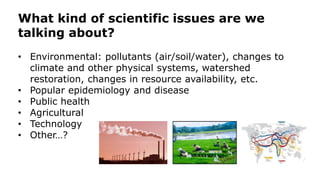
What kind of scientific issues are we
talking about?
• Environmental: pollutants (air/soil/water), changes to
climate and other physical systems, watershed
restoration, changes in resource availability, etc.
• Popular epidemiology and disease
• Public health
• Agricultural
• Technology
• Other…?
What forms does community science
literacy take?
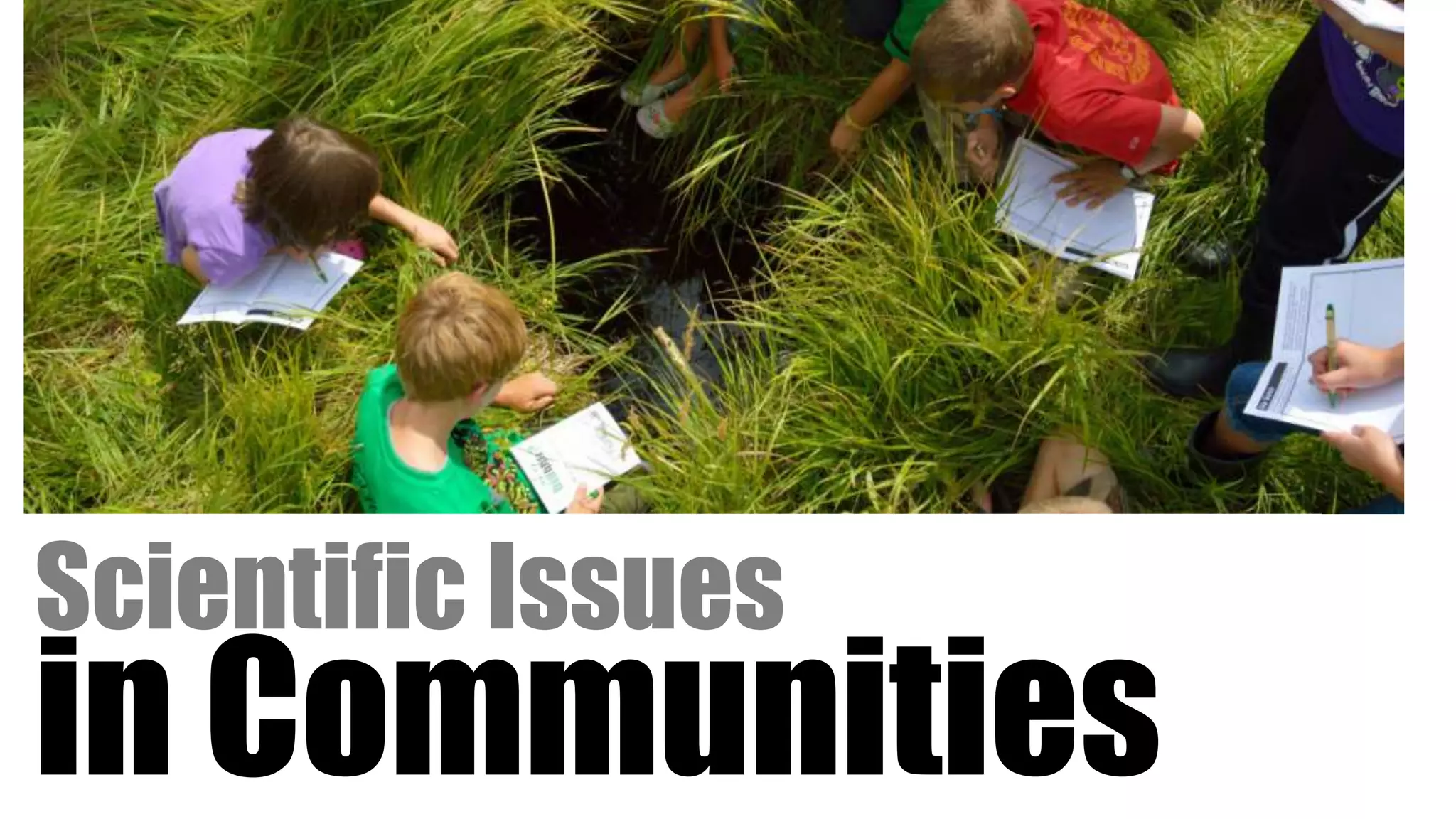
• Citizen science (becoming versed in scientific practice
through participatory environmental monitoring,
popular epidemiology, etc.)
• Working with scientists, fundraisers, and policymakers
on an issue
• Direct action (e.g. EarthFirst!, Greenpeace, and other
environmental activist groups)

Scientific Issues in Communities

  • 1.
  • 2.
    Definition of community scienceliteracy: “Science literacy in a community does not require each individual to attain a particular threshold of knowledge, skills, and abilities; rather, it is a matter of a community having sufficient shared resources that are distributed and organized in such a way that the varying abilities of community members work in concert to contribute to the community's overall well-being”(NAS, Science Literacy 73). Q: What are “sufficient shared resources”?
  • 3.
    Definition of community: “communitiesare groups of people who are functionally interconnected in a way that enables exchange of information and are typically defined by shared goals and interests”(NAS, Science Literacy 74).
  • 4.
    “Communities” can be… •Geographic (people in the CDA area) • Genetic (e.g., those with the BRCA gene) • Occupational (e.g., mine workers) • Based in demographics (e.g., menopausal women) • Those who have common health issues (e.g. Celiac’s disease sufferers) • Others?
  • 5.
    What kind ofscientific issues are we talking about? • Environmental: pollutants (air/soil/water), changes to climate and other physical systems, watershed restoration, changes in resource availability, etc. • Popular epidemiology and disease • Public health • Agricultural • Technology • Other…?
  • 6.
    What forms doescommunity science literacy take? • Citizen science (becoming versed in scientific practice through participatory environmental monitoring, popular epidemiology, etc.) • Working with scientists, fundraisers, and policymakers on an issue • Direct action (e.g. EarthFirst!, Greenpeace, and other environmental activist groups)