THE SCIENTIFIC METHOD
PART 4 – RESULTS/CONCLUSION
RESULTS/CONCLUSION (A PARAGRAPH)
○ Restate the purpose of your lab
○ Restate your hypothesis
○ Summarize your procedure in 2-3 sentences
○ Summarize your results/data
○ Do your results/data support or reject your
hypothesis
Let’s put our knowledge of the
Scientific Method to a realistic
example that includes some of
the terms you’ll be needing to
use and understand.
Complete the
following in the
brainwork
section of your
notebook
PROBLEM/QUESTION
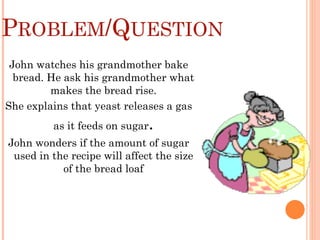
John watches his grandmother bake
bread. He ask his grandmother what
makes the bread rise.
She explains that yeast releases a gas
as it feeds on sugar.
John wonders if the amount of sugar
used in the recipe will affect the size
of the bread loaf
OBSERVATION/RESEARCH
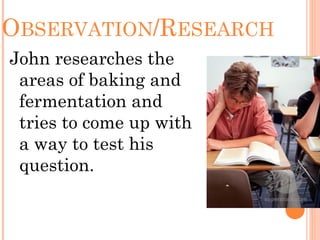
John researches the
areas of baking and
fermentation and
tries to come up with
a way to test his
question.
FORMULATE A HYPOTHESIS
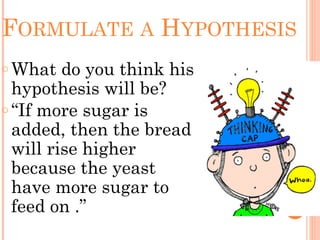
○ What do you think his
hypothesis will be?
○ “If more sugar is
added, then the bread
will rise higher
because the yeast
have more sugar to
feed on .”
INDEPENDENT VARIABLE
What will the independent variable
be?
Answer: the amount of sugar
John is going to use 25g., 50g.,
100g., 250g., 500g. of sugar in
his experiment.
DEPENDENT VARIABLE
What will the dependent
variable be?
In this case, it would be the size
of the loaf of bread.
CONTROL GROUP
What will the control group be?
The control group may be a “no
treatment" group.
CONTROL GROUP
Because his grandmother
always used 50g. of sugar in
her recipe, John is going to use
that amount in his control
group.
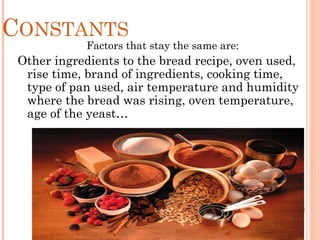
CONSTANTS
Factors that stay the same are:
Other ingredients to the bread recipe, oven used,
rise time, brand of ingredients, cooking time,
type of pan used, air temperature and humidity
where the bread was rising, oven temperature,
age of the yeast…
TRIALS
!
How many trials
should be done to
ensure reliability of
his data?
John is going to test
each sugar variable
3 times.
COLLECT AND ANALYZE RESULTS
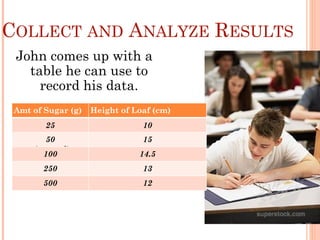
John comes up with a
table he can use to
record his data.
Amt of Sugar (g) Height of Loaf (cm)
25 10
50
(control)
15
100 14.5
250 13
500 12
COLLECT AND ANALYZE RESULTS
John examines his
data and notices that
his control worked
the best in this
experiment, but not
significantly better
than 100g. of sugar.
CONCLUSION
Do the results support
or reject John’s
hypothesis?
John rejects his
hypothesis, but
decides to re-test
using sugar amounts
between 50g. and
100g.
CONCLUSION
John finds that 70g.
of sugar produces
the largest loaf.
His new hypothesis
is accepted.

sciencepdf

  • 1.
    THE SCIENTIFIC METHOD PART4 – RESULTS/CONCLUSION
  • 2.
    RESULTS/CONCLUSION (A PARAGRAPH) ○Restate the purpose of your lab ○ Restate your hypothesis ○ Summarize your procedure in 2-3 sentences ○ Summarize your results/data ○ Do your results/data support or reject your hypothesis
  • 3.
    Let’s put ourknowledge of the Scientific Method to a realistic example that includes some of the terms you’ll be needing to use and understand. Complete the following in the brainwork section of your notebook
  • 4.
    PROBLEM/QUESTION John watches hisgrandmother bake bread. He ask his grandmother what makes the bread rise. She explains that yeast releases a gas as it feeds on sugar. John wonders if the amount of sugar used in the recipe will affect the size of the bread loaf
  • 5.
    OBSERVATION/RESEARCH John researches the areasof baking and fermentation and tries to come up with a way to test his question.
  • 6.
    FORMULATE A HYPOTHESIS ○What do you think his hypothesis will be? ○ “If more sugar is added, then the bread will rise higher because the yeast have more sugar to feed on .”
  • 7.
    INDEPENDENT VARIABLE What willthe independent variable be? Answer: the amount of sugar John is going to use 25g., 50g., 100g., 250g., 500g. of sugar in his experiment.
  • 8.
    DEPENDENT VARIABLE What willthe dependent variable be? In this case, it would be the size of the loaf of bread.
  • 9.
    CONTROL GROUP What willthe control group be? The control group may be a “no treatment" group.
  • 10.
    CONTROL GROUP Because hisgrandmother always used 50g. of sugar in her recipe, John is going to use that amount in his control group.
  • 11.
    CONSTANTS Factors that staythe same are: Other ingredients to the bread recipe, oven used, rise time, brand of ingredients, cooking time, type of pan used, air temperature and humidity where the bread was rising, oven temperature, age of the yeast…
  • 12.
    TRIALS ! How many trials shouldbe done to ensure reliability of his data? John is going to test each sugar variable 3 times.
  • 13.
    COLLECT AND ANALYZERESULTS John comes up with a table he can use to record his data. Amt of Sugar (g) Height of Loaf (cm) 25 10 50 (control) 15 100 14.5 250 13 500 12
  • 14.
    COLLECT AND ANALYZERESULTS John examines his data and notices that his control worked the best in this experiment, but not significantly better than 100g. of sugar.
  • 15.
    CONCLUSION Do the resultssupport or reject John’s hypothesis? John rejects his hypothesis, but decides to re-test using sugar amounts between 50g. and 100g.
  • 16.
    CONCLUSION John finds that70g. of sugar produces the largest loaf. His new hypothesis is accepted.